


Abstract
Background and Objectives: Gastrointestinal organ proximity can limit target coverage in pancreatic stereotactic body radiotherapy (SBRT). We characterized the target-coverage trade-off and clinical outcomes associated with planning risk volume (PRV)-based protection. Materials and Methods: We retrospectively reviewed 24 patients treated between May 2020 and April 2026. Overall survival was estimated by Kaplan–Meier analysis, and local progression was analyzed with death as a competing event. The five-fraction comparison included 22 patients. Results: Median follow-up and overall survival were 14.0 and 13.0 months. PRVs were used in 10/22 five-fraction treatments. The PRV group had more direct PTV–gastrointestinal OAR overlap (90.0% vs. 41.7%), larger targets, and higher prescribed BED10. Median PTV V100% was 60.5% versus 97.8% (p = 0.003), and median GTV V100% was 70.6% versus 100.0% (p = 0.003). Six local-progression events occurred (2/10 vs. 4/12); 12-month cumulative incidences were 21.7% (95% CI, 0.0–50.0) versus 30.9% (95% CI, 0.0–63.9; Gray’s test, p = 0.399). Among nine patients with PTV-PRV overlap, six received formal simultaneous integrated protection, and three received optimization-based protection. No grade ≥ 3 acute toxicity was documented. Record review identified no documented grade ≥ 3 RT-related gastrointestinal toxicity, although late-toxicity ascertainment was incomplete. Conclusions: In anatomically challenging tumors, selective PRV-based protection supported SBRT planning while prioritizing gastrointestinal constraints, at the cost of lower target coverage. The PRV group did not have a higher observed 12-month local-progression incidence, and no severe RT-related gastrointestinal toxicity was documented. PRV/SIP is a pragmatic option when targets overlap OARs, but these findings require validation because of nonrandomized selection, few events, and incomplete late-toxicity surveillance.
1. Introduction
Pancreatic ductal adenocarcinoma remains a challenging malignancy, with surgical resection representing the only potentially curative treatment. However, fewer than one-fifth of patients are candidates for surgery at diagnosis, highlighting the need for effective systemic and nonsurgical local treatment strategies. Despite advances in surgical techniques and systemic therapy, durable distant and local disease control remains difficult [1].
Multiagent chemotherapy constitutes the backbone of treatment for unresectable disease, yet local progression can cause pain, biliary or gastrointestinal obstruction, and other clinically significant morbidity. Improving local control therefore remains clinically relevant. PREOPANC demonstrated improved long-term outcomes with neoadjuvant chemoradiotherapy in resectable or borderline resectable disease [2], whereas LAP07 improved local control but not overall survival after induction chemotherapy in locally advanced disease [3]. More recently, the CONKO-007 trial further illustrated the difficulty of defining the incremental benefit of conventionally fractionated chemoradiotherapy in this setting [4].
Given the inconsistent and still limited evidence for conventionally fractionated chemoradiotherapy, SBRT has become an area of investigation in pancreatic cancer [5]. Its short treatment course and potential for ablative dose delivery have been hypothesized to reduce morbidity from local progression while minimizing interruption of systemic therapy. However, the close and variable relationship of the target to the duodenum, stomach, and bowel may cause these structures to abut or overlap the planning target volume (PTV), limiting safe dose escalation [6,7]. Preservation of gastrointestinal organ-at-risk (OAR) constraints may therefore require deliberate target undercoverage.
Planning risk volumes (PRVs), avoidance structures, and simultaneous integrated protection (SIP) have been proposed to account for gastrointestinal positional uncertainty. PRV margins can reduce excessive OAR dose but may compromise target coverage, and clinical data linking this trade-off to local outcomes remain limited [8,9,10,11]. We therefore evaluated PRV use, PTV-PRV overlap, target coverage, gastrointestinal dosimetry, local progression, acute toxicity, and documented severe late gastrointestinal toxicity in a single-center cohort of patients with pancreatic adenocarcinoma treated with SBRT. Our objective was to characterize whether PRV/SIP could support SBRT planning in anatomically challenging cases and whether the accompanying coverage trade-off was associated with an observable signal of poorer local control or severe gastrointestinal toxicity. The study is reported in accordance with the STROBE statement.
2. Materials and Methods
2.1. Study Design and Patients
This retrospective single-center cohort included 24 consecutive adults with histologically confirmed pancreatic adenocarcinoma treated with SBRT between May 2020 and April 2026. Eligibility required age 18 years or older and retrievable clinical, treatment, and radiotherapy planning records. SBRT was delivered as definitive local treatment, for primary-site progression after chemotherapy, or as salvage treatment for postoperative locoregional recurrence. Clinical records, radiologic follow-up, and radiotherapy planning data were reviewed. Because these settings have different biological and prognostic characteristics, outcome analyses were considered descriptive and exploratory. No formal sample-size calculation was performed. The study was conducted in accordance with the Declaration of Helsinki and approved by the Ankara Bilkent City Hospital Clinical Research Ethics Committee (protocol code TABED 1/2926/2026; approval date: 12 August 2026). The requirement for individual informed consent was waived because of the retrospective nature of the study.
Systemic therapy received during the overall treatment course was recorded by regimen, and use of an irinotecan-containing regimen was recorded separately.
2.2. Simulation, Treatment Planning, and SBRT Delivery
After a 4 h fast, all patients underwent planning computed tomography (CT) using a Discovery RT CT simulator (GE Medical Systems, LLC, Waukesha, WI, USA) with a slice thickness of 1.25 mm. The same fasting interval was required before each treatment fraction. Four-dimensional CT (4D-CT) was acquired in 12 patients to assess respiratory motion. During acquisition, the external respiratory signal was recorded using the Real-time Position Management (RPM) system (Varian Medical Systems, Inc., Palo Alto, CA, USA). Acquisition was not feasible in the remaining patients because of inability to comply with the acquisition protocol or other patient-related limitations.
The gross tumor volume (GTV) was defined on planning CT with PET-CT or MRI incorporated when available. For internal target volume (ITV)-based treatment, the ITV encompassed respiratory GTV motion across 4D-CT phases and the PTV was generated from the ITV; otherwise, the PTV was generated directly from the GTV using an individualized margin. No elective nodal irradiation or separate clinical target volume was used. Critical gastrointestinal OARs were the duodenum, stomach, and combined bowel.
Gastrointestinal PRV use and expansion margins (2–5 mm) were individualized according to patient-specific target–OAR anatomy and the treating radiation oncologist’s clinical judgment, rather than a uniform organ-specific margin rule. When full PTV prescription coverage conflicted with OAR/PRV constraints, these constraints were prioritized, followed by preferential preservation of GTV and then PTV coverage. Dose constraints were generally based on the UK SABR recommendations [12]; constraints for non-five-fraction regimens were individualized. For five-fraction treatments, a D0.1cc planning objective of 33 Gy was applied to the gastrointestinal PRV union, with values up to 35 Gy accepted when required by patient-specific anatomy. This upper limit was met in all but one PRV-based plan. In the single exception, the PRV objective could not be fully achieved because of extreme target–OAR proximity, while the corresponding native gastrointestinal OAR constraints were maintained. Because the bowel was contoured as a combined structure, small-bowel limits were used only as conservative reference values.
Gastrointestinal dose–volume metrics were extracted from the corresponding PRV structures when a PRV had been generated for that organ, and from the original OAR structures otherwise. Accordingly, the reported gastrointestinal dose metrics represent a combination of PRV-based and native OAR-based DVH measurements.
For this analysis, gastrointestinal PRVs were combined into a union structure when more than one was present, and PTV-PRV overlap was defined as the geometric intersection of the PTV and combined PRV. Absolute overlap volume, overlap/PTV ratio, and overlap Dmean, D50, D95, and D98 were recorded. Across the six formal SIP plans, the same general planning framework was used with patient-specific variations. The protected target subvolume was derived from the PTV-PRV interface. In four patients, the PTV-PRV intersection was assigned a reduced-dose objective below 33 Gy. Prescription-dose coverage was then preferentially maintained in the remaining PTV, typically defined as PTV minus the PRV with an additional 0–3 mm optimization buffer. The exact combination of overlap dose reduction, optimization buffer, and prescription-dose coverage objective was individualized according to target–OAR geometry and the extent of PTV-PRV overlap. In the three optimization-based protection plans, no separately optimized SIP target subvolume was created; instead, gastrointestinal protection was achieved through inverse-planning objectives applied directly to the relevant OAR/PRV structures. In both approaches, compliance with gastrointestinal dose constraints was prioritized over complete prescription-dose coverage when these objectives conflicted.
All patients received volumetric modulated arc therapy using a TrueBeam STx or Edge linear accelerator (Varian Medical Systems, Inc., Palo Alto, CA, USA) with a six-degree-of-freedom treatment couch. Treatment plans were generated in Eclipse version 18.02.00 (Varian Medical Systems, Inc., Palo Alto, CA, USA) using the Anisotropic Analytical Algorithm. Kilovoltage cone-beam CT (kV-CBCT) was performed before each fraction for image guidance. Twenty-two patients received 25–45 Gy in five fractions, one received 35 Gy in seven fractions, and one received 40 Gy in eight fractions. Fourteen were treated on consecutive days and 10 every other day. BED10 was calculated as nd[1 + d/(α/β)], using α/β = 10 Gy.
2.3. Response, Follow-Up, and Toxicity
Overall survival was calculated from completion of the final SBRT fraction to death from any cause. Radiologic response was assessed at the first available post-SBRT imaging. Local progression was defined as new or progressive disease within the primary SBRT-treated region. For local progression analysis, death without prior local progression was treated as a competing event.
Gastrointestinal toxicity was assessed retrospectively using available post-SBRT clinical records, including follow-up visits, diagnostic investigations, and consultation notes. Acute and late toxicities were defined as events occurring within and beyond 90 days after SBRT, respectively, and graded according to CTCAE v5.0. Events were considered treatment-related based on clinical attribution. The completeness of late-toxicity assessment was evaluated separately from general clinical follow-up.
2.4. Statistical Analysis
Continuous variables were summarized as median (IQR) and categorical variables as number and percentage. Overall survival was estimated by Kaplan–Meier analysis and follow-up by reverse Kaplan–Meier. Univariable Cox proportional hazards models evaluated GTV volume, ECOG performance status, prior pancreatic resection, and use of an irinotecan-containing regimen. Because of the limited number of deaths, the multivariable Cox model was restricted to GTV volume and ECOG performance status to represent tumor burden and baseline functional status while limiting model complexity; a sensitivity analysis excluded the two patients with metastatic disease at diagnosis. Local progression was analyzed with death without prior local progression as a competing event. Event times were calculated from exact treatment-completion and event or censoring dates and expressed in months. Cumulative incidence functions were estimated overall and by PRV use in the five-fraction subgroup and compared using Gray’s test. Pointwise 95% CIs for the overall CIF estimates at 6, 12, and 24 months and for the 12-month subgroup estimates were obtained using a nonparametric percentile bootstrap with 10,000 patient-level resamples. For the overall cohort, patients were resampled with replacement from the full cohort; for subgroup estimates, resampling was performed within each PRV group. Event time and event type were retained together for each sampled patient, so death without prior local progression remained a competing event in every bootstrap sample. The CIF was re-estimated at each prespecified time point for every resample, and the 2.5th and 97.5th percentiles of the bootstrap distribution were used as the confidence limits. Fine–Gray regression was limited to exploratory univariable analyses of GTV volume and PTV margin because of the limited number of local-progression events; no multivariable competing-risk model was performed. Five-fraction continuous planning characteristics and target-coverage parameters were compared by PRV use using two-sided Mann–Whitney U tests; direct PTV-OAR overlap was compared using Fisher’s exact test. All tests were two-sided, with p < 0.05 considered significant. Statistical analyses were performed using IBM SPSS Statistics for Windows, version 25.0 (IBM Corp., Armonk, NY, USA), and R (R Foundation for Statistical Computing, Vienna, Austria, https://www.R-project.org/), competing-risk analyses were conducted using the cmprsk package (https://CRAN.R-project.org/package=cmprsk; accessed on 17 November 2026). For variables with missing observations, analyses were restricted to patients with available data; missing values were not imputed, and the corresponding denominators were reported. Motion-management distributions were compared between PRV groups using Fisher’s exact test.
3. Results
3.1. Study Population and Treatment Overview
Twenty-four patients were included: 15 received definitive local SBRT, two received SBRT for primary-site progression after chemotherapy, and seven received postoperative salvage SBRT for locoregional recurrence. Two patients had M1 disease at diagnosis, 22 received systemic chemotherapy, and 22 received five-fraction SBRT. Dedicated respiratory motion management was used in 18 patients (ITV in eight, a breath-hold technique in four, and abdominal compression in six); six were treated with unassisted free breathing. Median BED10 was 50.5 Gy (IQR, 45.5–63.0). Gastrointestinal PRVs were used in 10 patients, and direct PTV overlap with a gastrointestinal OAR was present in 16.
Chemotherapy regimens were FOLFIRINOX in 12 patients, FOLFOX in four, single-agent gemcitabine in three, and gemcitabine plus cisplatin in three. Irinotecan-containing therapy was administered to 12 patients overall; within the five-fraction comparison, use was balanced between the PRV and non-PRV groups (5/10 vs. 6/12, respectively). Further patient and treatment characteristics are summarized in Table 1.
Table 1.
Patient and treatment characteristics.
3.2. Target Coverage, PRV Use, and Overlap Analysis
Table 2 summarizes anatomical and treatment-planning characteristics by gastrointestinal PRV use in the five-fraction cohort. PRV use was also associated with lower target coverage across all evaluated PTV and GTV coverage metrics (two-sided p values ranged from 0.002 to 0.011; Figure 1). These comparisons were exploratory.
Table 2.
Anatomical and treatment-planning characteristics according to gastrointestinal PRV use in the five-fraction cohort.
Figure 1.
Target coverage according to gastrointestinal planning risk volume (PRV) use in the five-fraction cohort. (A) Planning target volume (PTV) coverage. (B) Gross tumor volume (GTV) coverage. Boxes show medians and interquartile ranges, whiskers extend to 1.5 times the interquartile range, and circles represent individual patients. The horizontal dotted line marks 100% of the prescription dose. p values are from two-sided Mann–Whitney U tests. Abbreviations: D95, dose received by 95% of the volume; D98, dose received by 98% of the volume; Rx, prescription dose; V100%, percentage of the volume receiving 100% of the prescription dose.
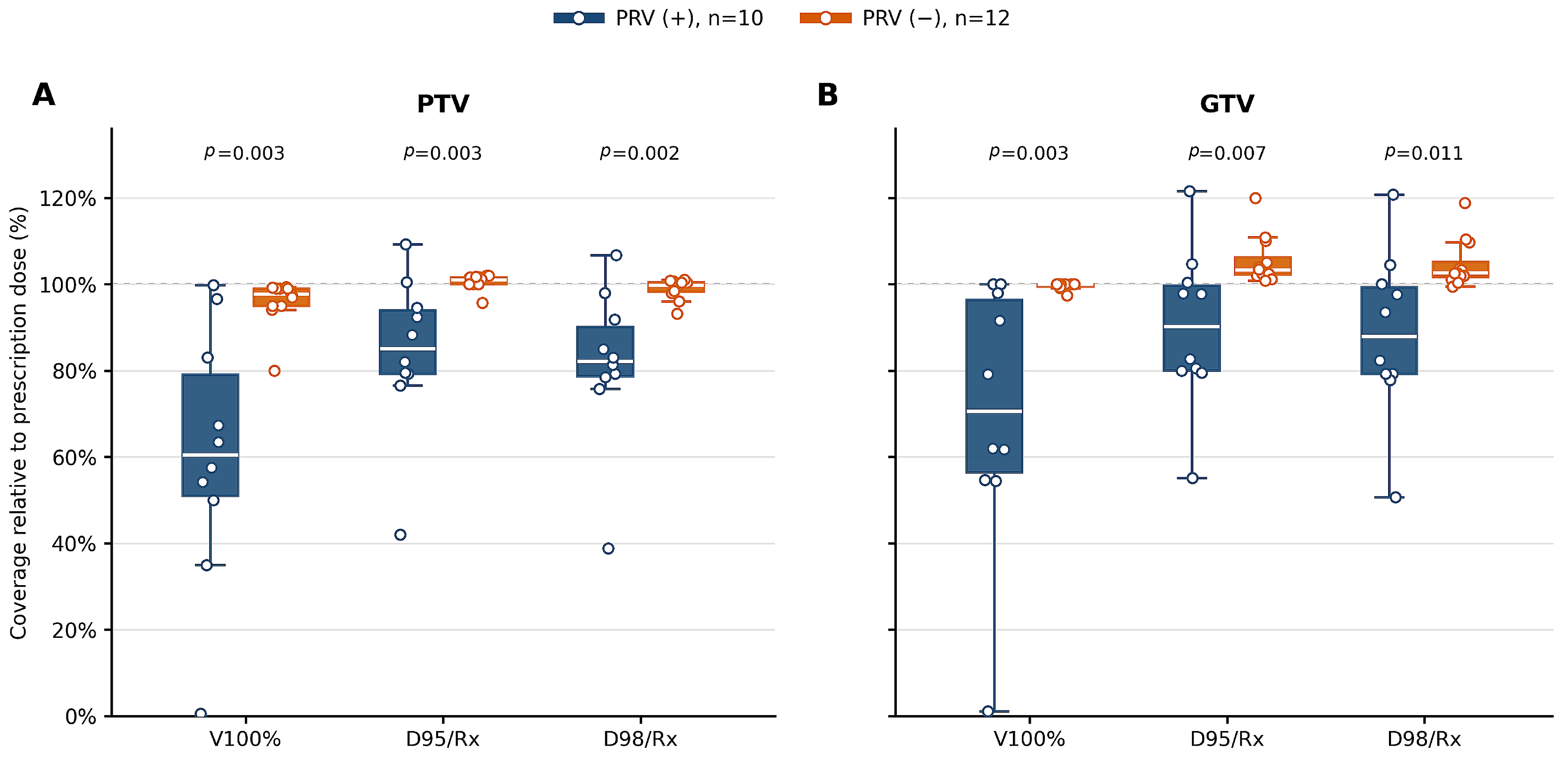
PTV-PRV overlap was present in nine of the 10 PRV-treated patients. Among these nine patients, the median overlap volume was 10.0 cc (IQR, 6.9–21.0), corresponding to 18.3% (IQR, 9.6–21.7) of the total PTV. Formal SIP was used in six patients, whereas three were managed using optimization-based protection without a formal SIP structure. In the formal SIP subgroup, the protected overlap represented a median of 20.2% (IQR, 18.4–22.8) of the PTV, and the median overlap D95 was 78.6% of the prescription dose. These SIP and optimization subgroups were described without formal statistical comparison because of their small sizes.
Selected overall dosimetric and clinical outcomes are summarized in Table 3.
Table 3.
Overall dosimetric and clinical outcomes.
3.3. Overall Survival and Local Progression
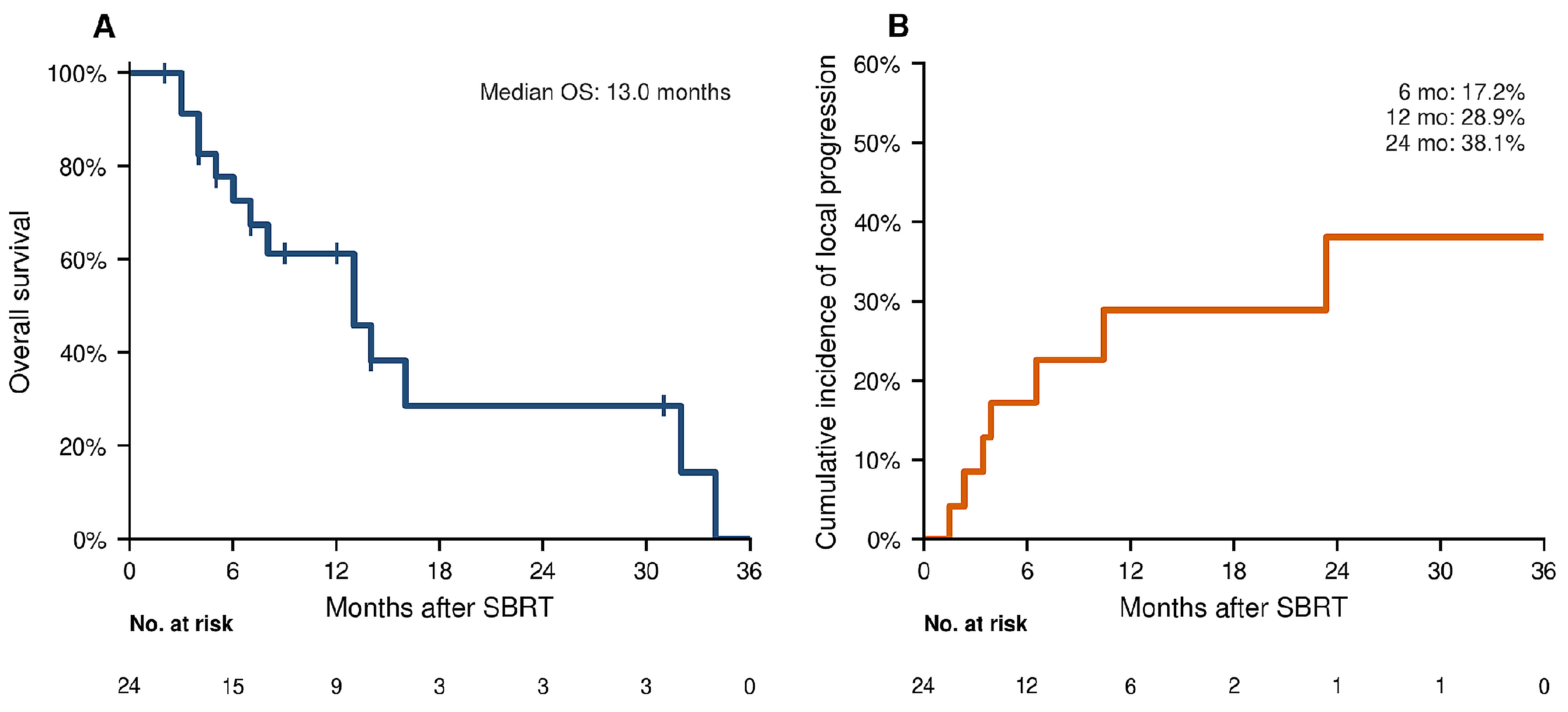
Median follow-up was 14.0 months. Fourteen patients died during follow-up, and median OS from completion of SBRT was 13.0 months (95% CI, 6.6–19.4) (Figure 2A).
Figure 2.
Clinical outcomes after stereotactic body radiotherapy (SBRT) for pancreatic adenocarcinoma. (A) Kaplan–Meier curve for overall survival calculated from completion of SBRT. (B) Cumulative incidence function for local progression, with death without prior local progression treated as a competing event; CIF time was calculated from exact treatment-completion and event or censoring dates. Numbers below each panel show patients at risk. Abbreviations: CIF, cumulative incidence function; OS, overall survival; SBRT, stereotactic body radiotherapy.
In univariable Cox analyses, larger GTV volume was associated with worse OS (HR per 10 cc increase, 1.40; 95% CI, 1.07–1.82; p = 0.013), whereas ECOG 2–3 was not significantly associated with OS relative to ECOG 0–1 (HR, 1.84; 95% CI, 0.56–6.11; p = 0.317). Prior pancreatic resection (HR, 0.58; 95% CI, 0.17–2.01; p = 0.394) and use of an irinotecan-containing regimen (HR, 2.09; 95% CI, 0.68–6.49; p = 0.200) were also not significantly associated with OS in exploratory univariable analyses. In the two-variable model, larger GTV volume remained associated with worse OS (adjusted HR per 10 cc increase, 1.40; 95% CI, 1.07–1.82; p = 0.014), while ECOG 2–3 remained nonsignificant (adjusted HR, 1.73; 95% CI, 0.51–5.84; p = 0.379).
Exclusion of the two patients with metastatic disease at diagnosis did not materially alter median OS, which remained 13.0 months (95% CI, 6.6–19.4). The association between larger GTV volume and worse OS also persisted in this M0 sensitivity analysis (adjusted HR per 10 cc increase, 1.44; 95% CI, 1.09–1.91; p = 0.011).
Seven patients developed local progression. The 12-month cumulative incidence of local progression was 28.9% (bootstrap 95% CI, 9.5–49.5; Figure 2B). In exploratory univariable Fine–Gray analyses, neither GTV volume (sHR per 10 cc increase, 0.88; 95% CI, 0.64–1.22; p = 0.441) nor PTV margin (sHR per 1 mm increase, 0.65; 95% CI, 0.40–1.05; p = 0.076) was significantly associated with local progression.
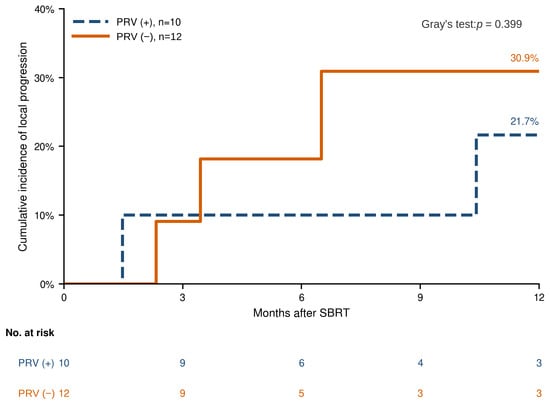
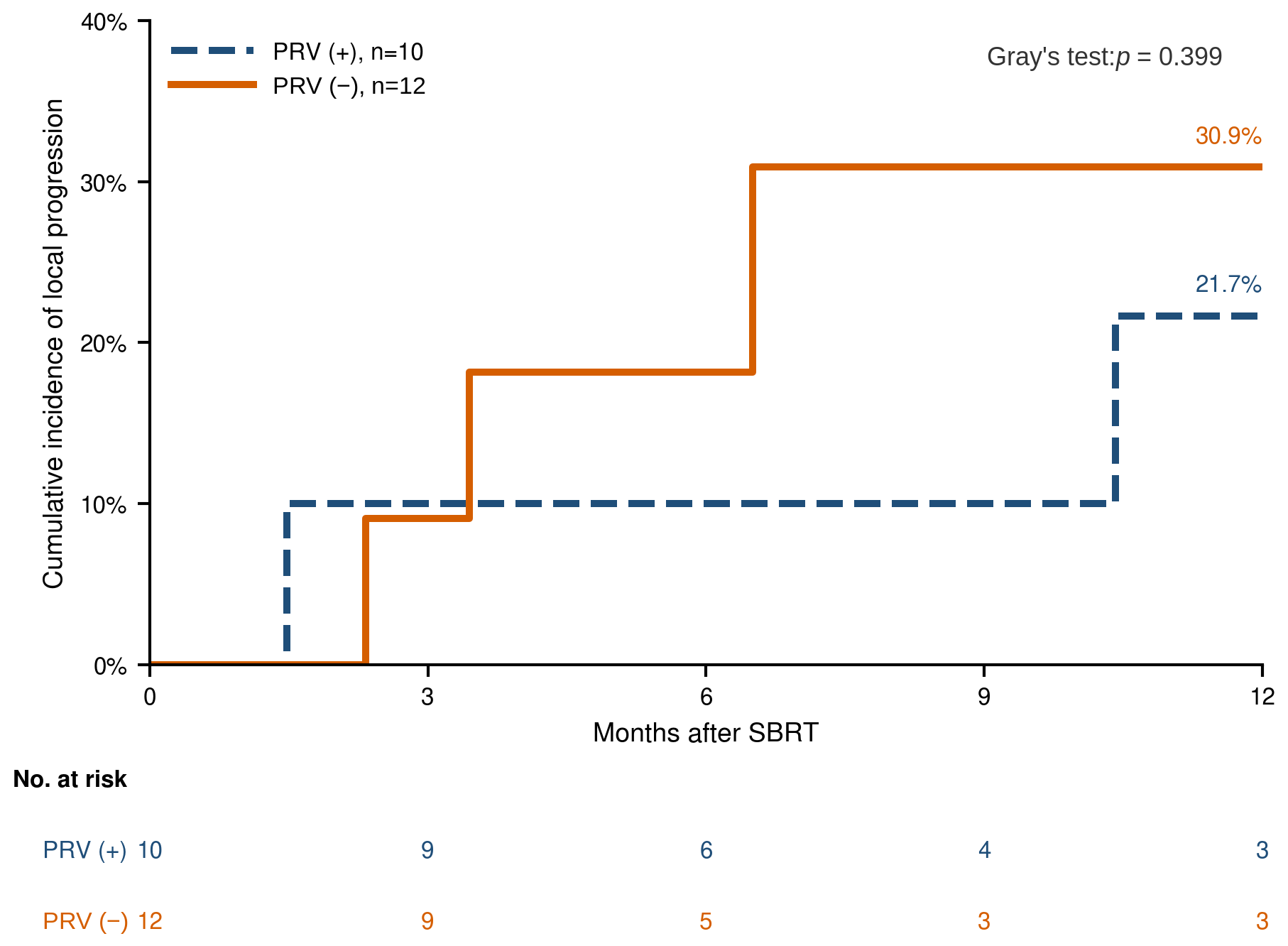
Within the five-fraction subgroup, six local-progression events occurred: 2/10 in the PRV group and 4/12 in the non-PRV group. The corresponding 12-month cumulative incidence estimates were 21.7% (bootstrap 95% CI, 0.0–50.0) and 30.9% (bootstrap 95% CI, 0.0–63.9), respectively (Gray’s test, p = 0.399; Figure 3).
Figure 3.
Cumulative incidence of local progression according to gastrointestinal planning risk volume (PRV) use in patients treated with five-fraction SBRT. Death without prior local progression was treated as a competing event, and event time was calculated from exact treatment-completion and event or censoring dates. Numbers below the plot show patients at risk. Six local-progression events occurred (PRV, 2/10; non-PRV, 4/12). The 12-month estimates were 21.7% (bootstrap 95% CI, 0.0–50.0) and 30.9% (bootstrap 95% CI, 0.0–63.9), respectively. Gray’s test, p = 0.399. This exploratory comparison was not designed to establish equivalence.
Among the 17 patients treated without prior pancreatic resection, median OS was 13.0 months (95% CI, 7.6–18.4). Median OS was 16.0 months in the seven patients treated with postoperative salvage SBRT. These subgroup estimates were descriptive and were not intended for direct comparison.
3.4. Toxicity
Among the 24 patients, eight had documented grade 1–2 acute treatment-related toxicities, all of which were gastrointestinal; no grade ≥ 3 acute treatment-related toxicity was documented (Table 3). No grade ≥ 3 RT-related gastrointestinal toxicity was identified in the available clinical records, including those from the late post-treatment period. Clinical follow-up extended beyond 90 days after SBRT in 22 patients, whereas the remaining two had their last recorded clinical contact within 90 days. However, the frequency and duration of toxicity-specific assessments varied, limiting the completeness of late-toxicity ascertainment.
4. Discussion
In this real-world pancreatic SBRT cohort, gastrointestinal PRV-based planning was used predominantly in patients with larger tumors and more frequent target–OAR overlap. It enabled gastrointestinal constraints to be prioritized but was associated with substantially lower PTV and GTV prescription-dose coverage. Despite this trade-off, the PRV group did not have a higher observed 12-month local-progression incidence (21.7% vs. 30.9%), and no grade ≥ 3 RT-related gastrointestinal toxicity was documented. These findings support selective PRV/SIP as a pragmatic planning strategy for anatomically challenging pancreatic tumors, while the small nonrandomized comparison and retrospective toxicity ascertainment limit definitive conclusions about comparative local control and safety. In the overall cohort, median OS was 13 months, and the 12-month cumulative incidence of local progression was 28.9%; larger GTV volume was associated with worse OS.
Systemic therapy remains central for unresectable pancreatic cancer, but local treatment is relevant in patients without systemic progression after induction chemotherapy. In LAP07, chemoradiotherapy after induction chemotherapy reduced local progression but did not improve OS compared with continued chemotherapy [3]. More recently, the CONKO-007 trial similarly showed no OS benefit from adding chemoradiotherapy after induction treatment, although it increased the rate of circumferentially margin-negative resection among patients who ultimately underwent surgery [4]. Thus, improved locoregional control or resection quality does not necessarily translate into longer survival in a disease dominated by distant failure. SBRT can be completed rapidly with limited interruption of systemic therapy, and comparative data suggest similar 1-year survival and lower acute grade 3–4 toxicity than conventionally fractionated radiotherapy, without established survival superiority [13].
Published pancreatic SBRT outcomes vary substantially according to disease setting, induction therapy, resection, dose, follow-up, and endpoint definitions [10,11,14,15,16]. Our median OS of 13 months and 12-month local-progression CIF of 28.9% should therefore be interpreted as descriptive estimates from a heterogeneous cohort rather than directly benchmarked against more selected prospective or retrospective series. Within our cohort, larger GTV volume was associated with worse OS, with a similar estimate after excluding patients with metastatic disease at diagnosis. Although this association may reflect tumor burden and underlying disease biology, it should be considered hypothesis-generating given the limited sample size and number of events.
Dose-intensification studies highlight the challenge of balancing local disease control against gastrointestinal toxicity in pancreatic radiotherapy. Although prospective and retrospective studies have reported encouraging local outcomes with higher-dose approaches, clinically significant gastrointestinal toxicity remains a concern [17,18,19]. However, the Alliance A021501 trial did not demonstrate a survival benefit from adding SBRT or hypofractionated radiotherapy to mFOLFIRINOX in patients with borderline resectable pancreatic cancer [20]. Given the heterogeneity of these studies, direct comparisons are inappropriate. Collectively, these findings reinforce the importance of individualized dose planning that prioritizes gastrointestinal protection without assuming that greater prescribed dose necessarily translates into improved survival.
Local ablative therapy may also be considered as a treatment-beyond-progression strategy in carefully selected patients with isolated locoregional recurrence or limited oligoprogression while other disease sites remain controlled. Treating the resistant site may permit continuation of an otherwise effective systemic regimen and defer second-line therapy; however, this objective was not directly tested in our cohort and evidence in pancreatic cancer remains retrospective. Reddy et al. reported a median OS of 17.1 months in 19 patients treated with SBRT for locally recurrent disease after resection [21]. Median OS was 16 months in our seven-patient salvage subgroup, broadly consistent with published series [21,22,23,24], although the small subgroup and differences in selection preclude meaningful comparison. Other minimally invasive local ablative approaches, including endoscopic ultrasound-guided ethanol ablation and radiofrequency ablation, have also been investigated in pancreatic tumors [25,26]. Together, these approaches highlight the increasing interest in individualized local treatment strategies and their potential clinical importance for selected patients with pancreatic malignancies, particularly when conventional treatment options are limited.
The dosimetric trade-off associated with gastrointestinal protection is increasingly recognized. In non-adaptive pancreatic SABR, larger PRV margins can limit delivered OAR dose increases but compromise PTV coverage [8]. Related strategies include formal SIP of the PTV-PRV intersection and optimization-based protection without a separately prescribed SIP subvolume [9,10,11]. In our cohort, PTV-PRV overlap occurred in nine PRV-treated patients; six received formal SIP and three received optimization-based protection. The overlap represented a median of 18.3% of the PTV and 20.2% among formal SIP patients.
Clinically, individualized PRV margins and selective protection of the target–OAR interface offer a pragmatic means of preserving SBRT feasibility when large pancreatic tumors abut or overlap the duodenum, stomach, or bowel. Our data support considering this approach in carefully selected patients, provided that the protected overlap and resulting target-coverage trade-off are explicitly quantified and gastrointestinal constraints remain prioritized. Prospective evaluation is needed to define its effects on local control and late morbidity.
The greater frequency of direct PTV-OAR overlap, larger target volumes, and higher prescribed BED10 in the PRV group place the coverage findings in their clinical planning context. PRV-based protection was used in patients with more challenging target–OAR relationships, and the observed coverage differences may reflect both treatment selection and the planning approach. The combination of higher prescribed BED10 and lower target coverage also illustrates why prescription dose alone does not fully describe target irradiation. Reporting coverage and protected overlap volumes alongside prescription dose therefore provides a more complete description of these individualized plans.
Several limitations should be considered. This was a retrospective single-center study of 24 patients with heterogeneous disease settings, dose-fractionation schedules, and motion-management techniques. PRV use was clinician-selected for anatomically more challenging cases; target–OAR geometry therefore confounds the associations with coverage and local progression. The five-fraction comparison included only six local-progression events, the wide confidence intervals preclude claims of equivalence or non-inferiority, and the effects of BED10 or motion management could not be modeled reliably. Toxicity ascertainment depended on retrospective documentation; two patients had less than 90 days of recorded clinical follow-up, and later contact in the remainder did not constitute standardized surveillance. Consequently, unrecorded late events cannot be excluded, nor can a reliable late-toxicity incidence be estimated. The absence of a non-SBRT comparator further limits comparative inference. Nevertheless, the detailed planning review, quantification of protected overlap, and record re-review provide clinically relevant information on how PRV/SIP can be implemented in anatomically difficult pancreatic SBRT.
5. Conclusions
In anatomically challenging pancreatic tumors, selective gastrointestinal PRV-based protection enabled SBRT planning with prioritized OAR constraints, although at the cost of lower PTV and GTV prescription-dose coverage. The PRV group did not have a higher observed 12-month local-progression incidence, and no grade ≥ 3 RT-related gastrointestinal toxicity was documented in the reviewed records. Together, these findings support PRV/SIP as a pragmatic option when large targets abut or overlap the duodenum, stomach, or bowel, provided that the protected overlap and resulting target undercoverage are explicitly evaluated. Because of nonrandomized selection, few events, and incomplete standardized late-toxicity surveillance, the results should be regarded as supportive feasibility data rather than proof of equivalent local control or safety.
Author Contributions
Conceptualization, H.F.Ö. and Y.T.; methodology, H.F.Ö.; formal analysis, H.F.Ö.; investigation, H.F.Ö., S.A.A., İ.P.A., H.B. and A.C.K.; resources, S.A.A., İ.P.A., H.B., A.C.K. and Y.T.; data curation, H.F.Ö. and A.C.K.; validation, G.A.İ.; writing—original draft preparation, H.F.Ö.; writing—review and editing, all authors; supervision, Y.T.; project administration, Y.T. All authors have read and agreed to the published version of the manuscript.
Funding
This research received no external funding.
Institutional Review Board Statement
The study was conducted in accordance with the Declaration of Helsinki and approved by the Ankara Bilkent City Hospital Clinical Research Ethics Committee (protocol code TABED 1/2926/2026; approval date: 12 August 2026).
Informed Consent Statement
The requirement for individual informed consent was waived by the Ankara Bilkent City Hospital Clinical Research Ethics Committee because of the retrospective nature of the study.
Data Availability Statement
The data presented in this study are available from the corresponding author on reasonable request. The data are not publicly available because of institutional and ethical restrictions.
Acknowledgments
During preparation of this manuscript, the authors used ChatGPT (OpenAI, https://chatgpt.com/) for language editing and journal-specific formatting. The authors reviewed and edited the output and take full responsibility for the content of the publication.
Conflicts of Interest
The authors declare no conflicts of interest.
References
- Conroy, T.; Pfeiffer, P.; Vilgrain, V.; Lamarca, A.; Seufferlein, T.; O’Reilly, E.M.; Hackert, T.; Golan, T.; Prager, G.; Haustermans, K.; et al. Pancreatic cancer: ESMO Clinical Practice Guideline for diagnosis, treatment and follow-up. Ann. Oncol. 2023, 34, 987–1002. [Google Scholar] [CrossRef] [Scilit]
- Versteijne, E.; van Dam, J.L.; Suker, M.; Janssen, Q.P.; Groothuis, K.; Akkermans-Vogelaar, J.M.; Besselink, M.G.; Bonsing, B.A.; Buijsen, J.; Busch, O.R.; et al. Neoadjuvant chemoradiotherapy versus upfront surgery for resectable and borderline resectable pancreatic cancer: Long-term results of the Dutch randomized PREOPANC trial. J. Clin. Oncol. 2022, 40, 1220–1230. [Google Scholar] [CrossRef] [Scilit]
- Hammel, P.; Huguet, F.; van Laethem, J.-L.; Goldstein, D.; Glimelius, B.; Artru, P.; Borbath, I.; Bouché, O.; Shannon, J.; André, T.; et al. Effect of chemoradiotherapy vs chemotherapy on survival in patients with locally advanced pancreatic cancer controlled after 4 months of gemcitabine with or without erlotinib: The LAP07 randomized clinical trial. JAMA 2016, 315, 1844–1853. [Google Scholar] [CrossRef] [Scilit]
- Fietkau, R.; Ghadimi, M.; Grützmann, R.; Wittel, U.A.; Jacobasch, L.; Uhl, W.; Croner, R.S.; Bechstein, W.O.; Neumann, U.P.; Waldschmidt, D.; et al. Benefit of chemoradiotherapy versus chemotherapy after induction therapy for conversion of unresectable into resectable pancreatic cancer: The randomized CONKO-007 trial. J. Clin. Oncol. 2025, 43, 3266–3278, Erratum in J. Clin. Oncol. 2026, 44, 430. https://doi.org/10.1200/JCO-25-03004. [Google Scholar] [CrossRef] [Scilit]
- A Shouman, M.; Fuchs, F.; Walter, F.; Corradini, S.; Westphalen, C.B.; Vornhülz, M.; Beyer, G.; Andrade, D.; Belka, C.; Niyazi, M.; et al. Stereotactic body radiotherapy for pancreatic cancer—A systematic review of prospective data. Clin. Transl. Radiat. Oncol. 2024, 45, 100738. [Google Scholar] [CrossRef] [Scilit]
- Oar, A.; Lee, M.; Le, H.; Hruby, G.; Dalfsen, R.; Pryor, D.; Lee, D.; Chu, J.; Holloway, L.; Briggs, A.; et al. Australasian Gastrointestinal Trials Group (AGITG) and Trans-Tasman Radiation Oncology Group (TROG) guidelines for pancreatic stereotactic body radiation therapy (SBRT). Pract. Radiat. Oncol. 2020, 10, e136–e146. [Google Scholar] [CrossRef] [Scilit]
- Brunner, T.B.; Haustermans, K.; Huguet, F.; Morganti, A.G.; Mukherjee, S.; Belka, C.; Krempien, R.; Hawkins, M.A.; Valentini, V.; Roeder, F. ESTRO ACROP guidelines for target volume definition in pancreatic cancer. Radiother. Oncol. 2021, 154, 60–69. [Google Scholar] [CrossRef] [Scilit]
- Robinson, M.; Eltinay, A.; George, B.; Owens, R.; Good, J.; Mukherjee, S.; Muirhead, R. Assessment of planning organ at risk volume margins in non-adaptive pancreatic stereotactic body radiotherapy. Phys. Imaging Radiat. Oncol. 2026, 40, 101043. [Google Scholar] [CrossRef] [Scilit]
- Brunner, T.B.; Nestle, U.; Adebahr, S.; Gkika, E.; Wiehle, R.; Baltas, D.; Grosu, A.-L. Simultaneous integrated protection: A new concept for high-precision radiation therapy. Strahlenther. Onkol. 2016, 192, 886–894. [Google Scholar] [CrossRef] [Scilit]
- Gkika, E.; Adebahr, S.; Kirste, S.; Schimek-Jasch, T.; Wiehle, R.; Claus, R.; Wittel, U.; Nestle, U.; Baltas, D.; Grosu, A.L.; et al. Stereotactic body radiotherapy (SBRT) in recurrent or oligometastatic pancreatic cancer: A toxicity review of simultaneous integrated protection (SIP) versus conventional SBRT. Strahlenther. Onkol. 2017, 193, 433–443. [Google Scholar] [CrossRef] [Scilit]
- Simoni, N.; Micera, R.; Paiella, S.; Guariglia, S.; Zivelonghi, E.; Malleo, G.; Rossi, G.; Addari, L.; Giuliani, T.; Pollini, T.; et al. Hypofractionated stereotactic body radiation therapy with simultaneous integrated boost and simultaneous integrated protection in pancreatic ductal adenocarcinoma. Clin. Oncol. 2021, 33, e31–e38. [Google Scholar] [CrossRef] [Scilit]
- Diez, P.; Hanna, G.; Aitken, K.; van As, N.; Carver, A.; Colaco, R.; Conibear, J.; Dunne, E.; Eaton, D.; Franks, K.; et al. UK 2022 consensus on normal tissue dose-volume constraints for oligometastatic, primary lung and hepatocellular carcinoma stereotactic ablative radiotherapy. Clin. Oncol. 2022, 34, 288–300. [Google Scholar] [CrossRef] [Scilit]
- Tchelebi, L.T.; Lehrer, E.J.; Trifiletti, D.M.; Sharma, N.K.; Gusani, N.J.; Crane, C.H.; Zaorsky, N.G. Conventionally fractionated radiation therapy versus stereotactic body radiation therapy for locally advanced pancreatic cancer (CRiSP): An international systematic review and meta-analysis. Cancer 2020, 126, 2120–2131. [Google Scholar] [CrossRef] [Scilit]
- Hill, C.S.; Rosati, L.; Wang, H.; Tsai, H.-L.; He, J.; Hacker-Prietz, A.; Laheru, D.A.; Zheng, L.; Sehgal, S.; Bernard, V.; et al. Multiagent chemotherapy and stereotactic body radiation therapy in patients with unresectable pancreatic adenocarcinoma: A prospective nonrandomized controlled trial. Pract. Radiat. Oncol. 2022, 12, 511–523. [Google Scholar] [CrossRef] [Scilit]
- Suker, M.; Nuyttens, J.J.; Eskens, F.A.; Haberkorn, B.C.; Coene, P.-P.L.; van der Harst, E.; Bonsing, B.A.; Vahrmeijer, A.L.; Mieog, J.D.; Swijnenburg, R.J.; et al. Efficacy and feasibility of stereotactic radiotherapy after FOLFIRINOX in patients with locally advanced pancreatic cancer (LAPC-1 trial). eClinicalMedicine 2019, 17, 100200. [Google Scholar] [CrossRef] [Scilit]
- Teriaca, M.; Loi, M.; Suker, M.; Eskens, F.; van Eijck, C.; Nuyttens, J. A phase II study of stereotactic radiotherapy after FOLFIRINOX for locally advanced pancreatic cancer (LAPC-1 trial): Long-term outcome. Radiother. Oncol. 2021, 155, 232–236. [Google Scholar] [CrossRef] [Scilit]
- Courtney, P.T.; Paravati, A.J.; Atwood, T.F.; Raja, N.; Zimmerman, C.T.; Fanta, P.T.; Lowy, A.M.; Simpson, D.R.; Xu, R.; Murphy, J.D. Phase I trial of stereotactic body radiation therapy dose escalation in pancreatic cancer. Int. J. Radiat. Oncol. Biol. Phys. 2021, 110, 1003–1012. [Google Scholar] [CrossRef] [Scilit]
- Pollom, E.L.; Alagappan, M.; von Eyben, R.; Kunz, P.L.; Fisher, G.A.; Ford, J.A.; Poultsides, G.A.; Visser, B.C.; Norton, J.A.; Kamaya, A.; et al. Single- versus multifraction stereotactic body radiation therapy for pancreatic adenocarcinoma: Outcomes and toxicity. Int. J. Radiat. Oncol. Biol. Phys. 2014, 90, 918–925. [Google Scholar] [CrossRef] [Scilit]
- Reyngold, M.; O’Reilly, E.M.; Varghese, A.M.; Fiasconaro, M.; Zinovoy, M.; Romesser, P.B.; Wu, A.; Hajj, C.; Cuaron, J.J.; Tuli, R.; et al. Association of ablative radiation therapy with survival among patients with inoperable pancreatic cancer. JAMA Oncol. 2021, 7, 735–738. [Google Scholar] [CrossRef] [Scilit]
- Katz, M.H.G.; Shi, Q.; Meyers, J.; Herman, J.M.; Chuong, M.; Wolpin, B.M.; Ahmad, S.; Marsh, R.; Schwartz, L.; Behr, S.; et al. Efficacy of preoperative mFOLFIRINOX vs mFOLFIRINOX plus hypofractionated radiotherapy for borderline resectable adenocarcinoma of the pancreas: The A021501 phase 2 randomized clinical trial. JAMA Oncol. 2022, 8, 1263–1270. [Google Scholar] [CrossRef] [Scilit]
- Reddy, A.V.; Hill, C.S.; Sehgal, S.; He, J.; Zheng, L.; Herman, J.M.; Meyer, J.; Narang, A.K. Stereotactic body radiation therapy for the treatment of locally recurrent pancreatic cancer after surgical resection. J. Gastrointest. Oncol. 2022, 13, 1402–1412. [Google Scholar] [CrossRef] [Scilit]
- Ji, X.; Zhou, B.; Ding, W.; Wang, J.; Jiang, W.; Li, Y.; Hu, J.; Sun, X. Efficacy of stereotactic body radiation therapy for locoregional recurrent pancreatic cancer after radical resection. Front. Oncol. 2022, 12, 925043. [Google Scholar] [CrossRef] [Scilit]
- Poiset, S.J.; Shah, S.; Cappelli, L.; Anné, P.; Mooney, K.E.; Werner-Wasik, M.; Laufer, T.S.; Posey, J.A.; Lin, D.; Basu Mallick, A.; et al. Early outcomes of MR-guided SBRT for patients with recurrent pancreatic adenocarcinoma. Radiat. Oncol. 2024, 19, 65. [Google Scholar] [CrossRef] [Scilit]
- Dee, E.C.; Ng, V.C.; O’Reilly, E.M.; Wei, A.C.; Lobaugh, S.M.; Varghese, A.M.; Zinovoy, M.; Romesser, P.B.; Wu, A.J.; Hajj, C.; et al. Salvage ablative radiotherapy for isolated local recurrence of pancreatic adenocarcinoma following definitive surgery. J. Clin. Med. 2024, 13, 2631. [Google Scholar] [CrossRef] [Scilit]
- Facciorusso, A.; Di Maso, M.; Serviddio, G.; Larghi, A.; Costamagna, G.; Muscatiello, N. Echoendoscopic ethanol ablation of tumor combined with celiac plexus neurolysis in patients with pancreatic adenocarcinoma. J. Gastroenterol. Hepatol. 2017, 32, 439–445. [Google Scholar] [CrossRef] [Scilit]
- Armellini, E.; Facciorusso, A.; Crinò, S.F. Efficacy and safety of endoscopic ultrasound-guided radiofrequency ablation for pancreatic neuroendocrine tumors: A systematic review and metanalysis. Medicina 2023, 59, 359. [Google Scholar] [CrossRef] [Scilit]

Disclaimer/Publisher’s Note: The statements, opinions and data contained in all publications are solely those of the individual author(s) and contributor(s) and not of MDPI and/or the editor(s). MDPI and/or the editor(s) disclaim responsibility for any injury to people or property resulting from any ideas, methods, instructions or products referred to in the content. |
© 2026 by the authors. Published by MDPI on behalf of the Lithuanian University of Health Sciences. Licensee MDPI, Basel, Switzerland. This article is an open access article distributed under the terms and conditions of the Creative Commons Attribution (CC BY) license.