


Abstract
Background and Objectives: Movement-evoked pain captures pain experienced during postoperative activity and complements assessment of pain at rest after mastectomy. We evaluated whether the combined strategy of interpectoral and pectoserratus plane blocks with an additional superficial serratus plane injection was associated with lower movement-evoked pain during the first 24 postoperative hours. Materials and Methods: This single-centre retrospective cohort study included adults undergoing unilateral mastectomy from January 2023 through December 2025. Patients received interpectoral and pectoserratus plane blocks alone or the same strategy plus a superficial serratus plane injection. The primary outcome was movement-evoked numeric rating scale pain at 2, 6, 12, and 24 h. Repeated pain scores were analysed using covariate-adjusted linear mixed-effects models, with unadjusted models and inverse probability of treatment weighting as complementary analyses. Results: Among 216 patients assessed, 169 were included (81 interpectoral–pectoserratus; 88 combined strategy). Mean total bupivacaine doses were 66.39 mg and 110.06 mg, respectively. The adjusted mean between-group difference in movement-evoked pain, averaged across four assessments and expressed as interpectoral–pectoserratus minus combined strategy, was 2.09 points (95% CI 1.87–2.32); the unadjusted difference was 2.13 points (95% CI 1.90–2.36). The adjusted resting pain difference was 1.59 points (95% CI 1.38–1.80). Weighted estimates were similar. Rescue tramadol was administered to 13.6% and 8.0% of patients, respectively (p = 0.319). No block-related complications were documented. Conclusions: The combined strategy was associated with lower recorded movement-evoked and resting pain but involved approximately 66% more bupivacaine and a greater total injectate volume. These observational findings cannot establish whether the additional injection site provides an analgesic benefit independent of the higher local anaesthetic dose and volume.
1. Introduction
1.1. Background
Movement-evoked pain during early recovery after mastectomy may interfere with mobilisation, upper-extremity use, and participation in postoperative rehabilitation, and is clinically distinct from pain assessed at rest [1,2,3,4]. Although resting pain is commonly reported in perioperative studies, movement-evoked pain may more closely reflect the pain burden experienced by patients during routine postoperative activity.
Ultrasound-guided interpectoral and pectoserratus plane blocks, commonly described as PECS I and PECS II blocks, are widely incorporated into multimodal perioperative analgesic strategies for breast surgery [5,6,7,8]. These techniques primarily provide analgesic coverage of the anterior and anterolateral chest wall. Serratus plane injection has also been used to extend regional analgesic coverage toward the lateral thoracic wall and axillary region [9].
1.2. Rationale and Knowledge Gap
Previous systematic reviews and clinical studies support the analgesic efficacy of pectoral and serratus plane blocks after breast surgery [5,6,10,11,12,13]. However, the incremental clinical value of adding a serratus plane injection to interpectoral and pectoserratus plane blocks remains incompletely defined. Available studies have primarily focused on isolated postoperative pain assessments or comparisons with systemic analgesia, whereas longitudinal movement-evoked pain has been less frequently evaluated. In observational comparisons, actual postoperative non-opioid and rescue analgesic administration should also be considered because these co-interventions may influence recorded pain scores. Understanding how regional block strategies perform alongside routine perioperative analgesic care may help inform multimodal protocols for surgical patients.
1.3. Objective
This retrospective cohort study compared recorded movement-evoked pain during the first 24 postoperative hours after mastectomy between two clinical analgesic strategies, namely interpectoral and pectoserratus plane blocks alone and the same blocks with an additional superficial serratus plane injection. The primary outcome was movement-evoked pain assessed at 2, 6, 12, and 24 h. Secondary outcomes were resting pain and actual postoperative non-opioid and rescue analgesic administration during routine postoperative care. Because treatment allocation was not randomised, the study evaluated the block strategies as implemented in routine clinical practice rather than the isolated causal or anatomical effect of the serratus plane injection. We present this article in accordance with the STROBE reporting checklist.
2. Materials and Methods
2.1. Study Design and Setting
This single-centre retrospective cohort study was conducted at a tertiary university hospital in Türkiye. The study was approved by the Ordu University Faculty of Medicine Ethics Committee (approval number 2026/101; 10 April 2026). Clinical care was provided between January 2023 and December 2025 as part of routine practice. Ethics approval was subsequently obtained on 10 April 2026, before any study-specific data extraction or analysis. The requirement for individual informed consent was waived by the ethics committee because of the retrospective design. Clinical trial registration was not applicable because this was a retrospective observational cohort study.
The medical records of consecutive adult patients who underwent mastectomy between 1 January 2023 and 31 December 2025 were reviewed. Patients were considered for inclusion if they had received either ultrasound-guided interpectoral and pectoserratus plane blocks alone or the same blocks with an additional superficial serratus plane injection.
The regional analgesic strategy was selected as part of routine clinical care according to the attending anaesthesiologist’s case-by-case preference. According to the attending anaesthesiologists, no consistent informal patient selection criteria guided this choice. There was no randomisation, predefined allocation algorithm, or formal institutional transition from one block strategy to the other during the study period. Because this was a retrospective study, no formal a priori sample size calculation was performed, and all eligible patients within the predefined study period were included.
2.2. Patient Selection
Patients aged 18 years or older who underwent unilateral simple or modified radical mastectomy were eligible. Inclusion required documentation of the regional block strategy and the volumes administered, together with recorded numeric rating scale pain scores at all four predefined postoperative time points of 2, 6, 12, and 24 h.
Patients were excluded if perioperative or postoperative records were incomplete, block documentation was insufficient, or one or more predefined postoperative pain assessments were missing. Additional exclusion criteria were bilateral surgery, revision surgery, breast-conserving surgery, reconstructive surgery, and the use of an additional concurrent regional analgesic technique. Missing pain values were not imputed.
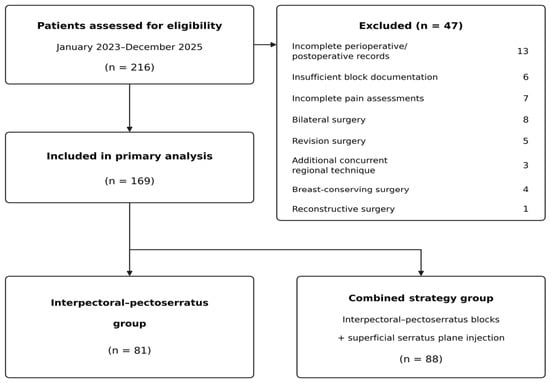
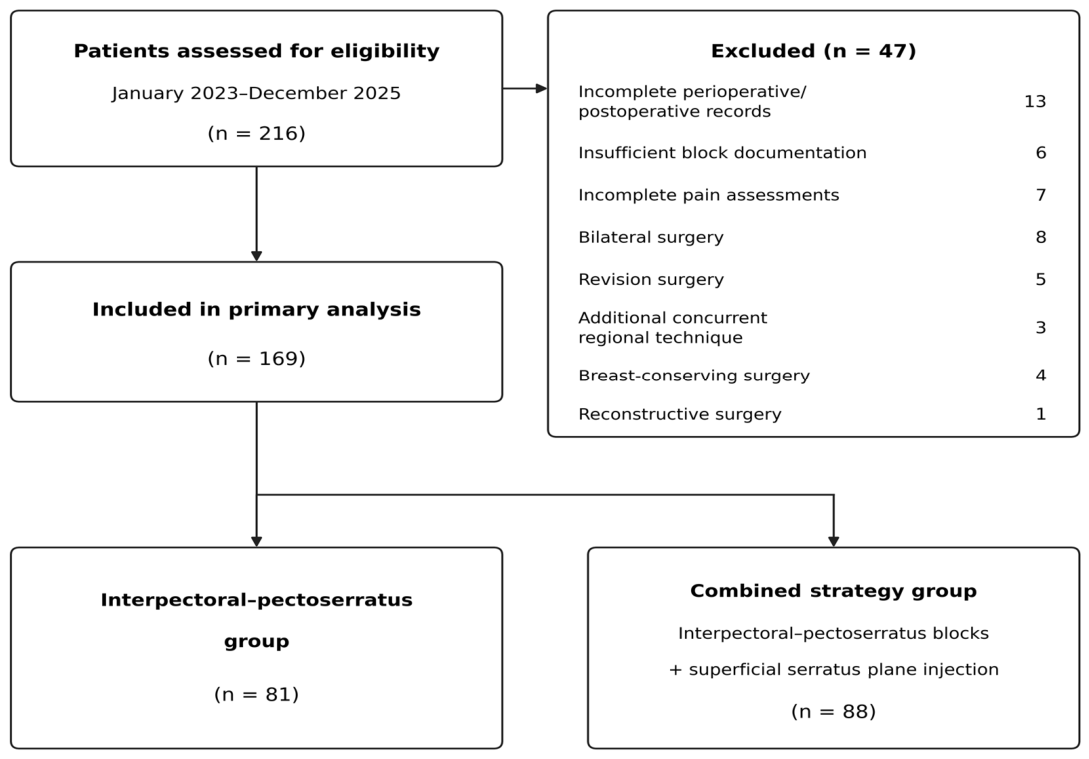
The patient selection process and the number of patients excluded for each reason are shown in Figure 1. For exclusions related to incomplete perioperative or postoperative records, block documentation, or postoperative pain assessments, the distribution according to block strategy is also presented in Figure 1.
Figure 1.
Patient selection flow diagram. Among 216 patients assessed for eligibility, 47 were excluded and 169 were included in the final analysis. The analytic cohort comprised 81 patients who received interpectoral and pectoserratus plane blocks alone and 88 patients who received the same strategy combined with an additional superficial serratus plane injection. For exclusions related to incomplete perioperative or postoperative records, insufficient block documentation, and incomplete postoperative pain assessments, the corresponding interpectoral–pectoserratus versus combined strategy counts were 8 versus 5, 2 versus 4, and 3 versus 4, respectively.
2.3. Block Groups and Technique
Patients were classified according to the regional analgesic strategy documented in the anaesthesia record as either interpectoral and pectoserratus plane blocks alone (interpectoral–pectoserratus group) or the same blocks with an additional superficial serratus plane injection (combined strategy group).
All blocks were performed unilaterally on the surgical side under ultrasound guidance by one of three attending anaesthesiologists, each of whom had regularly performed these techniques for at least 5 years. According to routine institutional practice, patients were positioned supine with the ipsilateral arm abducted, and a high-frequency linear ultrasound transducer connected to an MX7 ultrasound system (Shenzhen Mindray Bio-Medical Electronics Co., Ltd., Shenzhen, China) was used. The three anaesthesiologists used a common institutional approach to block performance. Minor adjustments in rib level and transducer position were made when required according to individual anatomy and ultrasound visualisation. Blocks were performed at the end of surgery, after completion of the final surgical suture and before emergence from general anaesthesia, in accordance with institutional practice.
For the interpectoral injection, 7–10 mL of 0.25% bupivacaine (Buvicaine 0.5%; Polifarma İlaç San. ve Tic. A.Ş., Tekirdağ, Türkiye)was deposited in the fascial plane between the pectoralis major and pectoralis minor muscles, typically near the third rib level. For the pectoserratus injection, 15–20 mL of 0.25% bupivacaine was deposited between the pectoralis minor and serratus anterior muscles in the anterior axillary region, typically at the third or fourth rib level.
In the combined strategy group, an additional superficial serratus plane injection was performed at the fourth or fifth rib level along the midaxillary line, with 15–20 mL of 0.25% bupivacaine deposited superficial to the serratus anterior muscle.
The regional block strategy and patient-level local anaesthetic volumes were extracted from the anaesthesia records. Total bupivacaine dose was calculated in milligrams using the documented volume and a concentration of 2.5 mg/mL and was additionally expressed in milligrams per kilogram using the recorded body weight. Thus, the combined strategy involved both an additional injection plane and greater total local anaesthetic exposure than interpectoral and pectoserratus plane blocks alone.
Surgical wound infiltration was not performed in any patient included in the study. Anaesthesia records, post-anaesthesia care unit records, and ward follow-up notes were reviewed for documented block-related complications, specifically pneumothorax, local anaesthetic systemic toxicity, haematoma, and vascular puncture.
2.4. Data Collection
Demographic, surgical, anaesthetic, regional block, and postoperative outcome data were extracted from the electronic medical records and standardised anaesthesia and postoperative follow-up forms. Recorded variables included age, body mass index, ASA physical status, mastectomy type, axillary intervention, duration of surgery, intraoperative fentanyl dose, and intraoperative remifentanil dose. Mastectomy type was categorised as simple or modified radical mastectomy, and axillary intervention as none, sentinel lymph node biopsy, or axillary lymph node dissection.
The date of surgery, attending anaesthesiologist, regional block strategy, patient-level injectate volumes, and calculated total bupivacaine dose were also recorded. The three attending anaesthesiologists were anonymised as A1, A2, and A3, and the anaesthesiologist identifier was retained for sensitivity analyses. All breast procedures were performed by the same breast surgeon.
Medication administration records were reviewed from admission to the post-anaesthesia care unit through the first 24 postoperative hours. Extracted variables were cumulative paracetamol dose, dexketoprofen administration and cumulative dose, rescue tramadol administration and cumulative dose, and documented time to first rescue analgesia. Analgesics administered in the post-anaesthesia care unit before ward transfer were included in the cumulative postoperative measures. For patients with complete medication administration records and no documented administration of dexketoprofen or tramadol, the corresponding dose was coded as zero. Blank or uncertain records were not interpreted as absence of medication administration.
2.5. Perioperative Anaesthetic and Analgesic Management
All patients underwent general anaesthesia according to routine institutional practice. Intraoperative fentanyl and remifentanil administration was titrated by the attending anaesthesiologist according to haemodynamic responses and clinical judgement. Total administered doses were recorded in the anaesthesia chart and included as covariates in the primary adjusted analyses.
As part of the institutional multimodal analgesic approach, intravenous paracetamol 1 g and dexketoprofen 50 mg were administered intraoperatively unless contraindicated. Regional blocks were performed at the end of surgery before emergence from general anaesthesia, as detailed in the preceding section. Following emergence, patients were transferred to the post-anaesthesia care unit and subsequently to the surgical ward.
Paracetamol 1 g three times daily formed the basis of routine postoperative analgesia. Additional dexketoprofen was administered on a case-by-case basis according to clinical judgement and the absence of contraindications. The same clinical approach to additional dexketoprofen administration was used in both block strategy groups. When routine analgesia was considered insufficient, tramadol was administered in 100 mg rescue doses according to clinical assessment. For comparative analyses, postoperative analgesic exposure was determined from the doses actually administered between admission to the post-anaesthesia care unit and 24 h after surgery rather than from prescribed or standing medication orders.
2.6. Outcomes
The primary outcome was movement-evoked postoperative pain assessed using the numeric rating scale (NRS; 0 = no pain and 10 = worst imaginable pain) at 2, 6, 12, and 24 h after surgery. Pain assessments were performed as part of the routine institutional postoperative pain follow-up and were documented on standardised clinical evaluation forms at the predefined time points.
Movement-evoked pain was defined as pain reported during active abduction of the shoulder on the operated side. The same movement instruction was used at each assessment; patients were asked to actively raise the arm on the operated side laterally to the maximum extent they could tolerate and to report their pain during the manoeuvre. The degree of shoulder abduction was not formally measured or documented.
Throughout the study period, pain scores were documented by one of two senior anaesthesia residents who staffed the institutional pain follow-up team and had received the same training in postoperative pain assessment. Formal inter-rater reliability data were not available. According to the clinical team, assessors were ordinarily unaware of the block strategy during routine pain assessments; identifying it would have required separate review of the anaesthesia or block records. Access to these records was not restricted, however, and assessor awareness at individual assessments could not be verified retrospectively. Assessors documented pain scores as part of routine institutional pain team activity rather than for research purposes, which may have reduced but not eliminated the potential for differential ascertainment. Nevertheless, use of the same institutional assessment procedure and the same restricted group of assessors throughout the study period may have reduced, although not eliminated, within-study measurement variability.
Secondary outcomes included resting NRS pain scores recorded at the same postoperative time points. Resting pain was assessed during the same evaluation session, before the shoulder abduction manoeuvre, while the patient was at rest.
Analgesic outcomes were evaluated from admission to the post-anaesthesia care unit through the first 24 postoperative hours and included cumulative paracetamol dose, any dexketoprofen administration, cumulative dexketoprofen dose, any rescue tramadol administration, and cumulative tramadol dose. Time to first rescue analgesia was reported descriptively among patients who received rescue treatment during the 24 h observation period. These outcomes were based on medications actually administered rather than prescribed or standing medication orders.
Documented block-related complications, specifically pneumothorax, local anaesthetic systemic toxicity, haematoma, and vascular puncture, were tabulated as absolute counts by group. No formal between-group statistical comparison of complications was planned because of the expected low event frequency.
2.7. Statistical Analysis
Descriptive analyses and conventional between-group comparisons were performed using IBM SPSS Statistics for Windows, version 30.0 (IBM Corp., Armonk, NY, USA). Linear mixed-effects models, inverse probability of treatment weighting, and robust variance analyses were performed in Python version 3.13.5 using the statsmodels version 0.14.6 and SciPy version 1.17.0 packages.
Distributional characteristics of continuous variables were assessed using histograms, quantile–quantile plots, and the Shapiro–Wilk test. Continuous variables are presented as mean ± standard deviation or median with interquartile range, as appropriate, and categorical variables as number and percentage. Baseline and perioperative characteristics were compared between groups using the independent samples t test or Mann–Whitney U test for continuous variables and the chi-square test or Fisher’s exact test for categorical variables, as appropriate.
Movement-evoked and resting pain scores were analysed separately using linear mixed-effects models. Time was treated as a categorical variable with four levels corresponding to the 2, 6, 12, and 24 h assessments. Unadjusted models containing block strategy, time, and the block-strategy-by-time interaction were fitted first to estimate crude between-group differences. The prespecified primary models additionally adjusted for age, body mass index, ASA physical status, mastectomy type, axillary intervention, total intraoperative fentanyl dose, and total intraoperative remifentanil dose. A patient-specific random intercept was included to account for within-patient correlation across repeated pain assessments. Models were estimated using restricted maximum likelihood. Overall fixed effects and block-strategy-by-time interactions were evaluated using Wald tests. The multivariable models were intended to estimate explanatory associations rather than to develop a prediction model.
Because the regional blocks were administered at the end of surgery, total intraoperative fentanyl and remifentanil doses were recorded before block performance. These variables were included in the adjusted models because of their potential direct association with early postoperative pain and their possible relationship with surgical and anaesthetic management.
The primary model-based estimand was the adjusted mean difference in movement-evoked pain between the two block strategies, averaged equally across the four postoperative time points. The block-strategy-by-time interaction was used to assess whether the magnitude of the between-group difference varied over time. Model-based adjusted means, between-group mean differences, and 95% confidence intervals were calculated. Time-specific between-group contrasts were considered secondary and were adjusted for multiple comparisons using the Holm method. The same modelling approach was applied to resting pain as a secondary outcome. Model assumptions were assessed by visual inspection of residual distributions and residual-versus-fitted-value plots.
Operation duration was summarised descriptively but was not included in the primary adjusted models because it was considered a proxy for surgical extent and procedural complexity and substantially overlapped with mastectomy type and axillary intervention. Total bupivacaine dose was not included as a covariate because the additional local anaesthetic volume was an intrinsic component of the combined block strategy rather than a pretreatment confounder. Adjustment for total bupivacaine dose would remove part of the exposure contrast inherent to the combined strategy and could therefore result in overadjustment. Total bupivacaine exposure in milligrams and milligrams per kilogram was reported descriptively by group.
To assess robustness to potential operator-related and temporal differences, the mixed-effects models were refitted after additionally including attending anaesthesiologist and calendar year of surgery as categorical fixed effects. Anaesthesiologist-by-block-strategy and anaesthesiologist-by-time interaction terms were not included because this analysis was intended to account for operator-related differences rather than evaluate effect modification.
Postoperative analgesic outcomes were analysed as secondary outcomes. Cumulative paracetamol, dexketoprofen, and tramadol doses were compared using the independent samples t test or Mann–Whitney U test according to their distributions. Dexketoprofen administration and rescue tramadol administration were analysed as binary outcomes using the chi-square test or Fisher’s exact test, as appropriate. Group-specific proportions, absolute risk differences with 95% confidence intervals calculated using the Newcombe hybrid score method, and odds ratios with 95% confidence intervals were reported where estimable. Time to first rescue analgesia was summarised descriptively among patients who received rescue tramadol during the 24 h observation period. Patients who did not receive rescue tramadol were not included in this specific descriptive analysis. Block-related complications were reported as absolute counts by group without formal hypothesis testing because of the low expected event frequency. No multiplicity adjustment was applied to medication-related secondary outcomes, which were interpreted as exploratory.
To assess robustness through an alternative approach to confounding control, inverse probability of treatment weighting was performed using propensity scores estimated by binary logistic regression. The propensity score model included age, body mass index, ASA physical status, mastectomy type, axillary intervention, total intraoperative fentanyl dose, total intraoperative remifentanil dose, attending anaesthesiologist, and calendar year of surgery. Stabilised inverse probability weights were used to target the average treatment effect estimand.
Propensity score overlap was assessed visually using group-specific propensity score distributions. The distribution of stabilised weights was examined for extreme values potentially indicating limited positivity. No trimming or truncation of the stabilised weights was applied. Covariate balance before and after weighting was evaluated using absolute standardised mean differences, including category-specific standardised mean differences for multicategory variables. An absolute standardised mean difference below 0.10 was considered indicative of acceptable balance. The effective sample size after weighting was calculated as the squared sum of the weights divided by the sum of their squared values and was reported to quantify the loss of precision associated with weighting.
IPTW-weighted movement-evoked and resting pain outcomes were analysed using marginal linear models containing block strategy, categorical time, and the block-strategy-by-time interaction. Patient-clustered robust sandwich standard errors were used to account for correlation among repeated measurements from the same patient and to calculate 95% confidence intervals. Overall weighted between-group differences were obtained by averaging the model-based contrasts equally across the four postoperative time points. Weighted block-strategy-by-time interactions were evaluated using robust Wald tests. The variance estimates did not account for uncertainty in the estimated propensity scores. These IPTW analyses were considered complementary sensitivity analyses and did not replace the primary covariate-adjusted mixed-effects models.
No pain values were missing in the primary complete-case cohort of 169 patients. In a sensitivity analysis, the primary covariate-adjusted linear mixed-effects models were refitted using the available partial recordings at the predefined assessment times from the seven patients excluded because of incomplete pain assessments. Movement-evoked and resting pain were analysed separately, retaining the same fixed effects, patient-specific random intercept, restricted maximum likelihood estimation, and equal averaging of the four time-specific contrasts. Available scores for one pain outcome were retained even when the other outcome was missing. Missing values were not imputed. Medication administration records were complete for all patients in the primary cohort. All statistical tests were two-sided, and a p value below 0.05 was considered statistically significant. p values are reported to three decimal places; values smaller than 0.001 are reported as p < 0.001.
A post hoc quantitative bias analysis assessed sensitivity of the primary movement-evoked pain contrast to a hypothetical binary unmeasured confounder [14]. Bias was specified as B = δ × γ, where δ denotes the between-strategy prevalence difference conditional on measured covariates and γ denotes the confounder-associated mean NRS difference. We assumed a time-invariant confounder, a constant additive association across strategy groups, time points, and measured covariate strata, and a constant conditional prevalence difference. Scenarios assumed greater prevalence of a pain-increasing confounder in the interpectoral–pectoserratus group. For each fixed scenario, B was subtracted from the adjusted contrast and both confidence limits, retaining the original model-based standard error. We calculated the parameter combinations that reduced the estimate or its lower 95% confidence limit to zero. Uncertainty in the sensitivity parameters was not incorporated.
During manuscript preparation and revision, ChatGPT (GPT-6.1 Sol, OpenAI, San Francisco, CA, USA) was used to assist with language editing, reference formatting, manuscript organisation, and checking of reported statistical results. The authors reviewed all AI-assisted material and take full responsibility for the final manuscript.
3. Results
3.1. Patient Selection and Baseline Characteristics
The patient selection process is shown in Figure 1. Among 216 patients assessed during the study period, 47 were excluded and 169 were included in the final analysis. Of these, 81 patients (47.9%) received interpectoral and pectoserratus plane blocks alone, whereas 88 patients (52.1%) received the same block strategy combined with an additional superficial serratus plane injection.
The reasons for exclusion were incomplete perioperative or postoperative records in 13 patients, insufficient block documentation in six, incomplete postoperative pain assessments in seven, bilateral surgery in eight, revision surgery in five, an additional concurrent regional analgesic technique in three, breast-conserving surgery in four, and reconstructive surgery in one. Among the 26 patients excluded because of incomplete records, block documentation, or pain assessments, 13 belonged to each block strategy group. Specifically, incomplete perioperative or postoperative records occurred in eight and five patients, insufficient block documentation in two and four patients, and incomplete postoperative pain assessments in three and four patients in the interpectoral–pectoserratus and combined strategy groups, respectively. The seven patients excluded because of incomplete postoperative pain assessments were aged 41–55 years; all had ASA physical status II, four underwent modified radical mastectomy, and two underwent axillary lymph node dissection. Their characteristics were summarised descriptively without formal hypothesis testing. Baseline data were unavailable for the other 19 patients excluded because of incomplete perioperative or postoperative records or insufficient block documentation; therefore, their characteristics could not be compared with those of included patients.
Baseline and perioperative characteristics are presented in Table 1. Mean age was 48.4 ± 14.4 years in the interpectoral–pectoserratus group and 51.7 ± 14.7 years in the combined strategy group (p = 0.146). Body mass index and ASA physical status were not statistically significantly different between groups (p = 0.386 and p = 0.858, respectively). Modified radical mastectomy was more frequent in the combined strategy group than in the interpectoral–pectoserratus group (55.7% vs. 39.5%; p = 0.035), whereas the distribution of axillary intervention was not statistically significantly different (p = 0.142). Mastectomy type was included as a prespecified covariate in both the adjusted mixed-effects models and the propensity score model.
Table 1.
Baseline and perioperative characteristics.
Duration of surgery was 94.9 ± 23.8 min in the interpectoral–pectoserratus group and 100.9 ± 27.7 min in the combined strategy group (p = 0.185). Intraoperative fentanyl doses were 76.8 ± 16.6 and 73.5 ± 15.6 μg, respectively (p = 0.172), and intraoperative remifentanil doses were 50.8 ± 11.4 and 52.7 ± 12.4 μg, respectively (p = 0.331). The distributions of attending anaesthesiologist and calendar year of surgery were not statistically significantly different between groups (p = 0.557 and p = 0.439, respectively).
3.2. Regional Block Characteristics, Local Anaesthetic Exposure, and Safety
Regional block characteristics and local anaesthetic exposure are summarised in Table 2. Mean interpectoral injection volumes were 8.60 ± 1.20 mL in the interpectoral–pectoserratus group and 8.66 ± 1.26 mL in the combined strategy group. Corresponding pectoserratus injection volumes were 17.95 ± 1.88 and 17.82 ± 1.58 mL, respectively. Patients in the combined strategy group additionally received a superficial serratus plane injection of 17.55 ± 1.95 mL.
Table 2.
Regional block characteristics, local anaesthetic exposure, postoperative analgesic administration, and safety.
Total bupivacaine exposure was 66.39 ± 5.23 mg in the interpectoral–pectoserratus group and 110.06 ± 7.34 mg in the combined strategy group. The corresponding weight-adjusted exposures were 0.88 ± 0.14 and 1.46 ± 0.24 mg/kg, respectively. Total exposure ranged from 55.0 to 75.0 mg and from 0.52 to 1.16 mg/kg in the interpectoral–pectoserratus group, and from 95.0 to 125.0 mg and from 1.02 to 2.18 mg/kg in the combined strategy group.
No block-related complications were documented in either group. However, the absence of documented complications in this retrospective chart review does not establish safety, particularly regarding uncommon or incompletely documented adverse events.
3.3. Movement-Evoked Pain
In the unadjusted linear mixed-effects model, movement-evoked pain was lower in the combined strategy group by an average of 2.13 NRS points across the four postoperative assessments (95% CI 1.90–2.36; p < 0.001). The unadjusted block-strategy-by-time interaction was significant (Wald χ2 = 101.73, df = 3; p < 0.001). The unadjusted between-group differences were 1.43 points at 2 h (95% CI 1.16–1.69), 2.39 points at 6 h (95% CI 2.12–2.66), 2.42 points at 12 h (95% CI 2.15–2.69), and 2.29 points at 24 h (95% CI 2.02–2.56); all Holm-adjusted time-specific p values were <0.001.
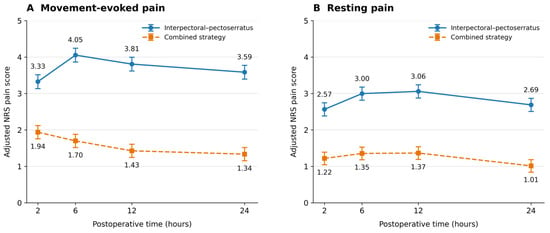
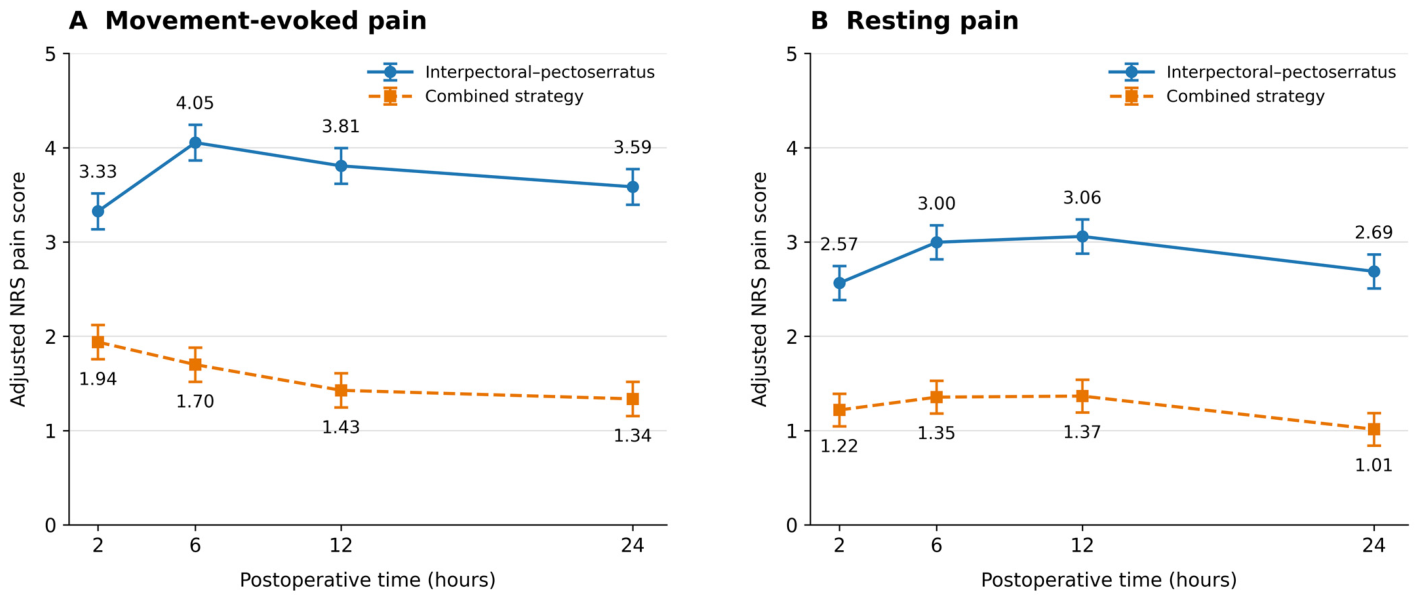
In the prespecified covariate-adjusted model, movement-evoked pain remained lower in the combined strategy group during the first 24 postoperative hours (Table 3 and Figure 2A). The adjusted mean difference averaged equally across the four postoperative time points, expressed as interpectoral–pectoserratus minus combined strategy, was 2.09 NRS points (95% CI 1.87–2.32; p < 0.001).
Table 3.
Unadjusted and adjusted movement-evoked and resting pain outcomes.
Figure 2.
Adjusted model-based postoperative pain trajectories. Adjusted numeric rating scale pain scores at 2, 6, 12, and 24 postoperative hours for movement-evoked pain (A) and resting pain (B). Points represent estimated marginal means, and error bars represent 95% confidence intervals. Estimates were obtained from the prespecified linear mixed-effects models including block strategy, categorical time, the block-strategy-by-time interaction, age, body mass index, ASA physical status, mastectomy type, axillary intervention, intraoperative fentanyl dose, and intraoperative remifentanil dose, with a patient-specific random intercept. The combined strategy comprised interpectoral and pectoserratus plane blocks with an additional superficial serratus plane injection. Lower scores indicate less pain.
The block-strategy-by-time interaction was significant (Wald χ2 = 101.73, df = 3; p < 0.001), indicating that the magnitude of the between-group difference varied over time. At 2 h, adjusted mean movement-evoked pain scores were 3.33 in the interpectoral–pectoserratus group and 1.94 in the combined strategy group, corresponding to a mean difference of 1.39 points (95% CI 1.12–1.65). At 6 h, the corresponding adjusted means were 4.05 and 1.70, with a difference of 2.35 points (95% CI 2.09–2.62). At 12 h, the adjusted means were 3.81 and 1.43, with a difference of 2.38 points (95% CI 2.11–2.65). At 24 h, the adjusted means were 3.59 and 1.34, with a difference of 2.25 points (95% CI 1.98–2.52). All Holm-adjusted time-specific p values were <0.001.
The between-group difference was smallest at 2 h and increased thereafter, remaining between 2.25 and 2.38 NRS points from 6 through 24 h. After additional adjustment for attending anaesthesiologist and calendar year of surgery, the average between-group difference remained essentially unchanged at 2.11 NRS points (95% CI 1.88–2.34; p < 0.001).
In the sensitivity analysis incorporating available partial movement-evoked pain recordings from patients excluded because of incomplete pain assessments, three additional patients each contributed one observation (three observations in total), yielding 172 patients and 679 observations. The adjusted mean between-group difference, averaged equally across the four postoperative assessment times and expressed as interpectoral–pectoserratus minus combined strategy, was 2.04 NRS points (95% CI 1.81–2.27; p < 0.001), compared with 2.09 points (95% CI 1.87–2.32) in the primary analysis.
Abbreviations: ASA, American Society of Anesthesiologists; NRS, numeric rating scale.
3.4. Resting Pain
In the unadjusted model, resting pain was lower in the combined strategy group by an average of 1.64 NRS points across the four postoperative assessments (95% CI 1.44–1.85; p < 0.001). The unadjusted block-strategy-by-time interaction was significant (Wald χ2 = 10.75, df = 3; p = 0.013). The unadjusted between-group differences were 1.40 points at 2 h (95% CI 1.15–1.65), 1.70 points at 6 h (95% CI 1.44–1.95), 1.75 points at 12 h (95% CI 1.49–2.00), and 1.73 points at 24 h (95% CI 1.47–1.98); all Holm-adjusted time-specific p values were <0.001.
In the prespecified covariate-adjusted model, resting pain was also lower in the combined strategy group during the first 24 postoperative hours (Table 3 and Figure 2B). The adjusted mean difference averaged equally across the four postoperative time points was 1.59 NRS points (95% CI 1.38–1.80; p < 0.001).
The block-strategy-by-time interaction was significant (Wald χ2 = 10.75, df = 3; p = 0.013). At 2 h, the adjusted mean resting pain scores were 2.57 in the interpectoral–pectoserratus group and 1.22 in the combined strategy group, corresponding to a difference of 1.35 points (95% CI 1.09–1.60). At 6 h, the adjusted means were 3.00 and 1.35, with a difference of 1.64 points (95% CI 1.39–1.90). At 12 h, the adjusted means were 3.06 and 1.37, with a difference of 1.69 points (95% CI 1.44–1.95). At 24 h, the adjusted means were 2.69 and 1.01, with a difference of 1.68 points (95% CI 1.42–1.93). All Holm-adjusted time-specific p values were <0.001.
In the sensitivity model additionally including attending anaesthesiologist and calendar year of surgery, the average adjusted difference was 1.60 NRS points (95% CI 1.39–1.81; p < 0.001). In the sensitivity analysis incorporating available partial resting pain recordings from patients excluded because of incomplete pain assessments, six additional patients contributed 13 observations, yielding 175 patients and 689 observations. The adjusted mean between-group difference, averaged equally across the four postoperative assessment times and expressed as interpectoral–pectoserratus minus combined strategy, was 1.55 NRS points (95% CI 1.34–1.75; p < 0.001), compared with 1.59 points (95% CI 1.38–1.80) in the primary analysis.
3.5. Postoperative Analgesic Administration
Medication administration records from admission to the post-anaesthesia care unit through the first 24 postoperative hours were complete for all 169 patients. The actual postoperative analgesic administration is summarised in Table 2.
A cumulative paracetamol dose of 3000 mg was administered to 66 of 81 patients (81.5%) in the interpectoral–pectoserratus group and 75 of 88 patients (85.2%) in the combined strategy group; the remaining patients received 2000 mg. Median cumulative paracetamol exposure was 3000 mg [IQR 3000–3000] in both groups (p = 0.516).
Dexketoprofen was administered to 34 patients (42.0%) in the interpectoral–pectoserratus group and 36 patients (40.9%) in the combined strategy group (p = 1.000). Median cumulative dexketoprofen dose was 0 mg [IQR 0–50] in both groups (p = 0.685).
Rescue tramadol was administered to 11 of 81 patients (13.6%) in the interpectoral–pectoserratus group and seven of 88 patients (8.0%) in the combined strategy group (p = 0.319). Rescue tramadol use was numerically less frequent in the combined strategy group, although the difference was not statistically significant. The absolute risk difference, expressed as combined strategy minus interpectoral–pectoserratus, was −5.6 percentage points (95% CI −15.6 to 3.9). The corresponding odds ratio was 0.55 (95% CI 0.20–1.50). All patients requiring rescue analgesia received a total tramadol dose of 100 mg; no repeated rescue tramadol doses were documented.
Among patients receiving rescue tramadol, the median time to first administration was 11 h [IQR, 10–13] in the interpectoral–pectoserratus group and 12 h [IQR, 11–12.5] in the combined strategy group.
3.6. IPTW Sensitivity Analysis
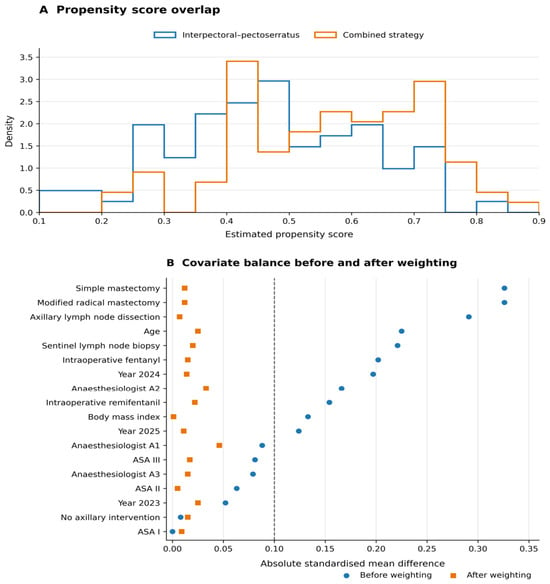
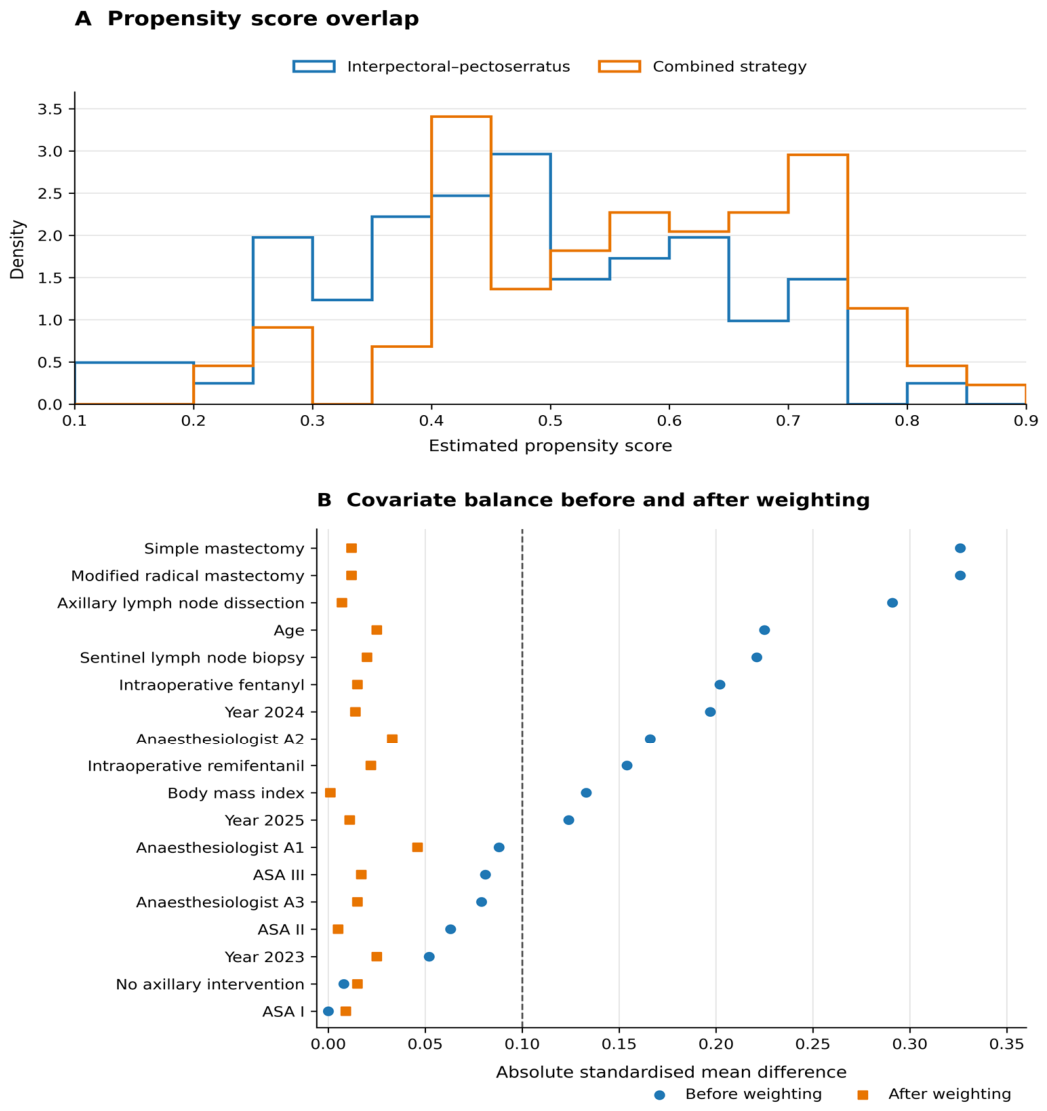
Visual assessment of the propensity score distributions indicated adequate overlap between the two block strategy groups. The estimated propensity scores ranged from 0.134 to 0.857. The stabilised weights ranged from 0.554 to 2.422, with a mean of 0.997. No weight trimming or truncation was applied. The effective sample size after weighting was 151.5, corresponding to 89.6% of the original analytic cohort.
Covariate balance improved after weighting; the maximum absolute standardised mean difference decreased from 0.326 to 0.046, with all post-weighting values below 0.10. For modified radical mastectomy, the absolute standardised mean difference decreased from 0.326 to 0.012. Detailed propensity score overlap and covariate balance diagnostics are provided in Figure 3, which shows group-specific propensity score distributions and absolute standardised mean differences before and after inverse probability of treatment weighting; Table S1 reports weighting diagnostics, category-specific covariate balance, and IPTW-weighted pain estimates.
Figure 3.
Propensity score overlap and covariate balance. (A) Distribution of estimated propensity scores in the interpectoral–pectoserratus and combined strategy groups. (B) Absolute standardised mean differences before and after stabilised inverse probability of treatment weighting. Values below 0.10 indicate acceptable covariate balance. The combined strategy comprised interpectoral and pectoserratus plane blocks with an additional superficial serratus plane injection.
In the IPTW-weighted marginal analysis using patient-clustered robust sandwich standard errors, movement-evoked pain remained lower in the combined strategy group by an average of 2.10 NRS points (95% CI 1.84–2.36; p < 0.001). The weighted block-strategy-by-time interaction remained significant (robust Wald χ2 = 53.19, df = 3; p < 0.001).
Resting pain remained lower in the combined strategy group by an average of 1.61 NRS points (95% CI 1.37–1.84; p < 0.001). The weighted block-strategy-by-time interaction for resting pain was not statistically significant (robust Wald χ2 = 7.04, df = 3; p = 0.071). Overall, the weighted estimates were consistent in direction and magnitude with the primary covariate-adjusted mixed-effects analyses.
Abbreviations: ASA, American Society of Anesthesiologists; IPTW, inverse probability of treatment weighting; SMD, standardised mean difference.
3.7. Sensitivity to Unmeasured Confounding
Under the specified bias model, a hypothetical binary confounder with a conditional prevalence difference of 50 percentage points between strategies would require an association of 4.19 NRS points to reduce the adjusted movement-evoked pain contrast to zero, or 3.73 points to move its lower 95% confidence limit to zero. Corresponding associations for a 30-percentage-point difference were 6.98 and 6.22 points.
4. Discussion
4.1. Key Findings
In this retrospective cohort study, the combined strategy, which included an additional superficial serratus plane injection and greater total local anaesthetic exposure, was associated with lower recorded postoperative pain during the first 24 h after mastectomy than interpectoral and pectoserratus plane blocks alone. The primary finding was an adjusted mean between-group difference of 2.09 NRS points in movement-evoked pain across the four postoperative assessments. Resting pain was also lower in the combined strategy group, with an adjusted mean difference of 1.59 NRS points. These estimates remained essentially unchanged after additional adjustment for attending anaesthesiologist and calendar year and after inverse probability of treatment weighting.
4.2. Comparison with Similar Research
The larger between-group difference observed for movement-evoked pain than for resting pain may be clinically relevant because pain during movement can hinder upper-extremity use, early mobilisation, and participation in postoperative recovery activities [15,16,17]. The between-group difference in movement-evoked pain was smallest at 2 h and increased thereafter, remaining approximately 2.3 NRS points from 6 through 24 h. Repeated pain assessments may reveal temporal postoperative pain patterns that are not apparent from isolated measurements [18,19]. The clinical importance of recognising and managing movement-evoked pain during postoperative recovery has also been emphasised previously [20]. The magnitude of the present movement-evoked pain difference warrants particular attention. A recent multicentre study of 2661 postsurgical patients, including patients undergoing breast surgery, estimated minimal clinically important changes of approximately 1.2 NRS points for pain at rest and 1.6 points for pain during activity on an 11-point scale [21]. These estimates describe within-patient change and should not be directly equated with between-group treatment differences, for which clinical importance requires broader contextual interpretation [22]. Thus, the adjusted 2.09-point difference observed here is large in magnitude and potentially clinically relevant, but its clinical importance cannot be inferred from MCID thresholds alone. The magnitude also warrants caution because the achieved shoulder abduction angle was neither standardised nor recorded, and assessor blinding could not be verified. In practical terms, a difference of this magnitude may represent less discomfort during activities involving the operated-side shoulder, such as repositioning or dressing. However, pain during these specific activities and the ability to perform them were not assessed, so this interpretation remains illustrative rather than evidence of functional improvement. Importantly, the similarity of the unadjusted, covariate-adjusted, operator-/year-adjusted, and IPTW estimates indicates that the magnitude of the association was not dependent on a single analytical specification. The present data cannot determine whether the observed temporal pattern reflects differences in the evolution of block analgesia, surgical pain progression, postoperative activity, or other unmeasured factors.
4.3. Explanations of Findings
The observed association is anatomically plausible. Interpectoral and pectoserratus plane injections primarily address nociceptive input from the anterior and anterolateral chest wall, whereas an additional superficial serratus plane injection may extend local anaesthetic spread toward the lateral thoracic wall and axillary region [7,9,23]. Such coverage may be relevant during shoulder movement, which can place tension on tissues affected by lateral thoracic and axillary dissection. Nevertheless, the present study cannot establish the anatomical mechanism responsible for the observed differences. Sensory block distribution was not formally assessed, and movement-evoked pain was not evaluated using a standardised shoulder abduction angle.
A central limitation is that the two strategies differed simultaneously in injection site, total injectate volume, and total bupivacaine dose. Mean total bupivacaine exposure was 66.39 mg in the interpectoral–pectoserratus group and 110.06 mg in the combined strategy group, approximately 66% higher with the combined strategy. Because the bupivacaine concentration was identical in all patients, total dose and volume were directly proportional. Neither total dose nor total volume overlapped between groups (55–75 versus 95–125 mg and 22–30 versus 38–50 mL, respectively), so estimating a strategy effect at a common total dose would require extrapolation beyond the observed data. Within each strategy, the absolute dose varied only within the narrow range set by the institutional injection volume ranges (standard deviations of 5.23 and 7.34 mg), and variation in weight-adjusted dose arose mainly from body weight rather than from the amount of local anaesthetic administered; within-strategy exposure–response analyses were accordingly not undertaken. The observed pain score differences therefore cannot be attributed to the additional injection site independently of the higher dose and volume. Adjustment for measured patient and perioperative characteristics does not separate these components of the strategy comparison. The findings should consequently be interpreted as an association between two complete clinical strategies rather than evidence of an independent analgesic benefit of the additional injection plane. The maximum calculated exposure in the combined strategy group was 2.18 mg/kg. No local anaesthetic systemic toxicity or other block-related complication was documented in the available perioperative records; however, retrospective record review may miss undocumented events, particularly minor complications, and the absence of documented complications does not establish safety. If this combined strategy is used in routine practice, a strict dosing protocol should specify the lowest effective dose and patient-specific dose limits, accounting for body weight, relevant comorbidities, and cumulative local anaesthetic exposure from all injection sites. Appropriate monitoring during and after injection for neurological and cardiovascular signs of local anaesthetic systemic toxicity, together with immediate access to lipid emulsion and resuscitation resources, is essential [24].
Postoperative paracetamol and dexketoprofen administration was similar between groups. However, patient-level indications for additional dexketoprofen were not compared, so similar administration rates do not establish that the clinical circumstances prompting its use were equivalent. Rescue tramadol was administered to 13.6% of patients in the interpectoral–pectoserratus group and 8.0% in the combined strategy group (p = 0.319). The absolute risk difference (combined strategy minus interpectoral–pectoserratus) was −5.6 percentage points (95% CI −15.6 to 3.9), an interval compatible with a clinically meaningful reduction, no difference, or a small increase in rescue use. With only 18 recipients, this estimate remains imprecise and establishes neither an opioid-sparing benefit nor equivalence between strategies. The apparent discrepancy with the pain score findings may partly reflect the distinction between scheduled NRS assessments and rescue treatment based on clinical judgement. The adjusted mean NRS scores in the interpectoral–pectoserratus group ranged from 2.57 to 3.06 at rest and from 3.33 to 4.05 during movement, and all patients received 2000–3000 mg of postoperative paracetamol. This background analgesia and the observed average pain levels may help explain the low rescue treatment rates, although group means cannot establish individual treatment indications. Rescue medication administered before a scheduled assessment may also have influenced subsequent pain scores.
The combined strategy group included a higher proportion of patients undergoing modified radical mastectomy and therefore did not have an obviously more favourable surgical profile at baseline. The fact that more extensive surgery was more frequent in the group with lower recorded pain argues against a simple explanation based on the combined strategy group having less extensive surgery, although it does not exclude confounding by indication from other measured or unmeasured factors. The estimated between-group differences remained almost unchanged after adjustment for mastectomy type and other measured covariates, after additional control for attending anaesthesiologist and calendar year, and after IPTW. Propensity score overlap was adequate, post-weighting covariate balance was acceptable, and the weighted estimates were nearly identical to those from the primary models. This agreement across complementary analytic approaches supports robustness with respect to measured confounders. However, the clinical reasons underlying the decision to add the serratus plane injection were not systematically recorded, so the treatment selection mechanism could not be fully modelled and residual confounding by indication remains possible. Nevertheless, the near-identical estimates after conventional adjustment and IPTW suggest that measured differences in patient, surgical, anaesthetic, operator, and temporal characteristics do not readily explain the observed association. The tipping point analysis quantified the combinations of hypothetical residual imbalance and pain association required to eliminate the estimated contrast or move its lower confidence limit to zero. These scenarios do not establish the absence of unmeasured confounding and depend on simplifying assumptions. They do not address measurement bias, distinguish injection site effects from local anaesthetic exposure, or exclude partial attenuation of the estimated between-strategy difference by unmeasured confounding.
The temporal interaction for resting pain was less consistent than the overall resting pain association. The block-strategy-by-time interaction was statistically significant in the primary mixed-effects model but not in the IPTW analysis. Therefore, evidence that the magnitude of the resting pain difference changed over time was not fully robust across analytic approaches. In contrast, the overall between-group difference in resting pain remained stable in the primary analysis, the model additionally adjusted for anaesthesiologist and calendar year, and the weighted analysis.
4.4. Strengths and Limitations
The study has several strengths. Movement-evoked pain was prespecified as the primary outcome and was assessed repeatedly at clinically relevant postoperative time points. Pain assessments were obtained through a structured institutional follow-up process by a restricted group of trained assessors. Patient-level local anaesthetic volumes and actual postoperative medication administration, including medications administered in the post-anaesthesia care unit, were available for all included patients. All operations were performed by the same breast surgeon, and the three attending anaesthesiologists used both block strategies during the study period without a formal temporal transition in practice. Finally, the primary findings were consistent after adjustment for measured perioperative factors, additional operator and calendar year control, and IPTW.
The relatively large movement-evoked pain difference warrants cautious interpretation. However, its stability across unadjusted, covariate-adjusted, operator-/year-adjusted, and IPTW analyses indicates that the finding was not dependent on a single modelling approach. As with any retrospective comparison, residual confounding and measurement bias remain possible and primarily limit causal and mechanistic interpretation.
Several limitations should be acknowledged. First, the retrospective and non-randomised design precludes causal inference, and the clinical reasoning behind block selection was not systematically recorded, leaving residual confounding by indication that cannot be eliminated by adjustment for measured covariates. Second, the strategies differed structurally in total local anaesthetic dose and volume as well as injection location; therefore, the study estimates the association between complete clinical strategies rather than the independent contribution of anatomical coverage or dose. Third, 47 of 216 screened patients (21.8%) were excluded from the primary analytic cohort. Of these, 26 were excluded because of incomplete perioperative or postoperative records, insufficient block documentation, or missing pain assessments, whereas the remaining 21 were excluded according to other eligibility criteria. Although these eligibility criteria defined the intended study population, the overall exclusions may have produced a selected cohort and limited the representativeness of the findings. In particular, documentation-related exclusions could introduce selection bias if record completeness was associated with block strategy, pain severity, or postoperative recovery. The primary analysis also required complete pain assessments at all four postoperative time points. According to the clinical team, incomplete assessments were primarily associated with competing clinical duties during routine pain team rounds, particularly evening rounds. However, reasons for individual missing measurements were not systematically documented, and missingness unrelated to pain severity or other patient characteristics cannot be assumed. A sensitivity analysis incorporating the available partial recordings yielded similar estimates, but the small number of additional observations, particularly for movement-evoked pain, limits its ability to address selection bias or informative missingness. Baseline data were unavailable for the other 19 patients excluded because of incomplete records or insufficient block documentation, precluding assessment of their comparability with included patients. Fourth, movement-evoked pain was assessed during active shoulder abduction to the maximum extent tolerated by each patient, without a standardised or recorded abduction angle. Consequently, the NRS scores may have reflected different ranges of movement and mechanical loading across patients and assessments rather than pain during an identical movement task. This variability could have influenced the magnitude of the observed between-group difference; its direction and extent cannot be determined from the available data. Because movement-evoked pain was the primary outcome, this limitation is particularly important. The inability to verify assessor blinding and the absence of formal inter-rater reliability data introduce additional uncertainty regarding measurement bias. Fifth, sensory block success and anatomical spread were not formally documented. Sixth, functional recovery was not directly evaluated, because shoulder range of motion, time to first ambulation, and participation in physiotherapy were not assessed. Sleep quality and validated quality-of-recovery instruments were not assessed either, and patient satisfaction ratings documented during routine follow-up were not analysed because their timing was not standardised. Therefore, the lower recorded movement-evoked pain scores cannot be interpreted as evidence of improved shoulder function, earlier mobilisation, or better rehabilitation participation. Seventh, routine care analgesic administration could have influenced subsequent pain assessments, and the small number of rescue tramadol events limits the precision of this secondary outcome. Because no a priori power calculation was performed, the available cohort rather than a prespecified minimum clinically important effect determined the precision of the estimates; this is particularly relevant to non-significant secondary outcomes with relatively few events. Outcomes were limited to the first 24 postoperative hours and therefore cannot inform persistent postsurgical or chronic postmastectomy pain. The single-centre setting and the specific regional anaesthesia and postoperative analgesic approach may also limit generalisability.
Finally, the exclusion of reconstructive procedures further limits applicability to patients undergoing immediate breast reconstruction. In implant-based reconstruction, implant position, tissue tension, and pectoral muscle manipulation may alter the postoperative pain profile and the relevance of individual components of the block strategy [25]. From an anatomical perspective, the interpectoral component targeting the pectoral nerves may be particularly relevant when subpectoral implant placement involves pectoralis major manipulation [26]. The present findings, however, cannot establish the additional value of a superficial serratus plane injection in either prepectoral or subpectoral reconstruction. In autologous reconstruction, analgesic planning must also account for the donor site; for example, abdominal donor site pain requires separate consideration beyond these chest wall blocks, with a transversus abdominis plane block being one possible adjunct [27]. Adaptation of the strategy should therefore consider the reconstructive technique, the operative sites requiring analgesia, and cumulative local anaesthetic exposure when additional blocks or infiltration are used. The comparative effectiveness of this strategy in reconstructive surgery requires dedicated prospective evaluation.
4.5. Implications and Future Research
These findings provide observational data on two analgesic strategies used in routine care, with lower recorded movement-evoked and resting pain in the combined strategy group. However, the study cannot separate the contribution of the additional injection site from that of greater local anaesthetic exposure, nor can it eliminate unmeasured treatment selection or measurement bias. Prospective randomised studies with standardised movement testing, blinded outcome assessment, and matched total local anaesthetic dose and volume are needed to evaluate the independent contribution of the additional injection plane. These studies should also include functional measures and validated patient-reported recovery outcomes to determine whether lower movement-evoked pain translates into meaningful improvements in postoperative recovery.
5. Conclusions
In this retrospective cohort, the combined strategy was associated with lower recorded movement-evoked and resting pain during the first 24 h after mastectomy than interpectoral and pectoserratus plane blocks alone. Because the strategies also differed substantially in total local anaesthetic dose and volume, these findings do not establish an independent analgesic benefit of the additional injection site. Prospective randomised comparisons with matched total local anaesthetic dose and volume are needed to evaluate this question.
Supplementary Materials
The following supporting information can be downloaded at: https://www.mdpi.com/article/10.3390/medicina62112119/s1, Table S1: IPTW diagnostics, covariate balance, and weighted pain estimates.
Author Contributions
Conceptualisation, Ü.C.O., K.Ş.O., Ç.A., Z.C., Y.İ. and B.D.; methodology, Ü.C.O., K.Ş.O., Ç.A., Z.C., Y.İ. and B.D.; investigation, Ü.C.O., K.Ş.O. and B.D.; data curation, Ü.C.O., K.Ş.O. and B.D.; formal analysis, Ü.C.O. and Ç.A.; writing—original draft preparation, Ü.C.O., K.Ş.O., Ç.A., Z.C., Y.İ. and B.D. (each author drafted assigned sections, and Ü.C.O. integrated these contributions into the complete manuscript); writing—review and editing, Ü.C.O. (lead), K.Ş.O., Ç.A., Z.C., Y.İ. and B.D. (Ü.C.O. led the revisions in response to the reviewers’ comments). All authors have read and agreed to the published version of the manuscript.
Funding
This research received no external funding.
Institutional Review Board Statement
The study was conducted in accordance with the Declaration of Helsinki and approved by the Ordu University Faculty of Medicine Ethics Committee (protocol code 2026/101; 10 April 2026).
Informed Consent Statement
Patient consent was waived by the Ordu University Faculty of Medicine Ethics Committee because of the retrospective study design. The manuscript contains no identifiable individual participant information, images, or videos.
Data Availability Statement
De-identified participant-level data underlying the reported results may be made available to qualified researchers upon reasonable request to the corresponding author, subject to institutional approval, patient confidentiality requirements, and any required data use agreement. Data that are subject to institutional or ethical restrictions will not be shared.
Acknowledgments
The generative artificial intelligence tool used during manuscript preparation and revision was ChatGPT (OpenAI; GPT-6.1 Sol). Its use is described in Section 2.7. The authors reviewed and checked all AI-assisted content and calculations and take full responsibility for the content of this publication.
Conflicts of Interest
The authors declare no conflicts of interest.
References
- Jacobs, A.; Lemoine, A.; Joshi, G.P.; Van de Velde, M.; Bonnet, F.; The PROSPECT Working Group Collaborators. PROSPECT guideline for oncological breast surgery: A systematic review and procedure-specific postoperative pain management recommendations. Anaesthesia 2020, 75, 664–673. [Google Scholar] [CrossRef] [Scilit] [PubMed]
- Hung, K.C.; Ko, C.C.; Hsu, C.W.; Pang, Y.L.; Chen, J.Y.; Sun, C.K. Association of peripheral nerve blocks with patient-reported quality of recovery in female patients receiving breast cancer surgery: A systematic review and meta-analysis of randomized controlled studies. Can. J. Anesth./J. Can. D’anesthésie 2022, 69, 1288–1299. [Google Scholar] [CrossRef] [Scilit] [PubMed]
- Gilron, I.; Lao, N.; Carley, M.; Camiré, D.; Kehlet, H.; Brennan, T.J.; Erb, J. Movement-evoked pain versus pain at rest in postsurgical clinical trials and in meta-analyses: An updated systematic review. Anesthesiology 2024, 140, 442–449. [Google Scholar] [CrossRef] [Scilit] [PubMed]
- Carr, H.M.; Patel, R.A.; Beederman, M.R.; Maassen, N.H.; Hanson, S.E. Risk factors for upper extremity impairment after mastectomy: A single institution retrospective review. Plast. Reconstr. Surg. Glob. Open 2024, 12, e5684. [Google Scholar] [CrossRef] [Scilit] [PubMed]
- Versyck, B.; van Geffen, G.J.; Chin, K.J. Analgesic efficacy of the Pecs II block: A systematic review and meta-analysis. Anaesthesia 2019, 74, 663–673. [Google Scholar] [CrossRef] [Scilit] [PubMed]
- Hussain, N.; Brull, R.; McCartney, C.J.L.; Wong, P.; Kumar, N.; Essandoh, M.; Sawyer, T.; Sullivan, T.; Abdallah, F.W. Pectoralis-II myofascial block and analgesia in breast cancer surgery: A systematic review and meta-analysis. Anesthesiology 2019, 131, 630–648. [Google Scholar] [CrossRef] [Scilit] [PubMed]
- Blanco, R.; Fajardo, M.; Maldonado, T.P. Ultrasound description of Pecs II (modified Pecs I): A novel approach to breast surgery. Rev. Esp. Anestesiol. Reanim. 2012, 59, 470–475. [Google Scholar] [CrossRef] [Scilit] [PubMed]
- El-Boghdadly, K.; Wolmarans, M.; Stengel, A.D.; Albrecht, E.; Chin, K.J.; Elsharkawy, H.; Kopp, S.; Mariano, E.R.; Xu, J.L.; Adhikary, S.; et al. Standardizing nomenclature in regional anesthesia: An ASRA-ESRA Delphi consensus study of abdominal wall, paraspinal, and chest wall blocks. Reg. Anesth. Pain Med. 2021, 46, 571–580. [Google Scholar] [CrossRef] [Scilit] [PubMed]
- Mayes, J.; Davison, E.; Panahi, P.; Patten, D.; Eljelani, F.; Womack, J.; Varma, M. An anatomical evaluation of the serratus anterior plane block. Anaesthesia 2016, 71, 1064–1069. [Google Scholar] [CrossRef] [Scilit] [PubMed]
- Grape, S.; Jaunin, E.; El-Boghdadly, K.; Chan, V.; Albrecht, E. Analgesic efficacy of PECS and serratus plane blocks after breast surgery: A systematic review, meta-analysis and trial sequential analysis. J. Clin. Anesth. 2020, 63, 109744. [Google Scholar] [CrossRef] [Scilit] [PubMed]
- Singh, N.P.; Makkar, J.; Bhat, A.D.; Singh, P.M. Analgaesic efficacy of single-injection serratus anterior plane block for breast surgery: A systematic review, meta-analysis and trial sequential analysis of randomised controlled trials. Indian J. Anaesth. 2023, 67, 343–356. [Google Scholar] [CrossRef] [Scilit] [PubMed]
- Wong, H.Y.; Pilling, R.J.; Young, B.W.M.; Owolabi, A.A.; Onwochei, D.N.; Desai, N. Comparison of local and regional anesthesia modalities in breast surgery: A systematic review and network meta-analysis. J. Clin. Anesth. 2021, 72, 110274, Corrigendum in J. Clin. Anesth. 2021, 75, 110491. https://doi.org/10.1016/j.jclinane.2021.110491. [Google Scholar] [CrossRef] [Scilit] [PubMed]
- Hong, B.; Bang, S.; Oh, C.; Park, E.; Park, S. Comparison of PECS II and erector spinae plane block for postoperative analgesia following modified radical mastectomy: Bayesian network meta-analysis using a control group. J. Anesth. 2021, 35, 723–733. [Google Scholar] [CrossRef] [Scilit] [PubMed]
- VanderWeele, T.J.; Arah, O.A. Bias formulas for sensitivity analysis of unmeasured confounding for general outcomes, treatments, and confounders. Epidemiology 2011, 22, 42–52. [Google Scholar] [CrossRef] [Scilit] [PubMed]
- Srikandarajah, S.; Gilron, I. Systematic review of movement-evoked pain versus pain at rest in postsurgical clinical trials and meta-analyses: A fundamental distinction requiring standardized measurement. Pain 2011, 152, 1734–1739. [Google Scholar] [CrossRef] [Scilit] [PubMed]
- Xu, Q.; Liu, C.; Jia, S.; Wang, P.; Liu, Q.; Ding, F.; Ren, Y.; Ma, X.; Zhu, J. Effect of physical exercise on postoperative shoulder mobility and upper limb function in patients with breast cancer: A systematic review and meta-analysis. Gland Surg. 2024, 13, 1494–1510. [Google Scholar] [CrossRef] [Scilit] [PubMed]
- Camiré, D.; Erb, J.; Kehlet, H.; Brennan, T.; Gilron, I. Movement-evoked pain versus pain at rest in postsurgical clinical trials and meta-analyses: Protocol for a follow-up systematic review. JMIR Res. Protoc. 2020, 9, e15309. [Google Scholar] [CrossRef] [Scilit] [PubMed]
- Althaus, A.; Arránz Becker, O.; Moser, K.H.; Lux, E.A.; Weber, F.; Neugebauer, E.; Simanski, C. Postoperative pain trajectories and pain chronification—An empirical typology of pain patients. Pain Med. 2018, 19, 2536–2545. [Google Scholar] [CrossRef] [Scilit] [PubMed]
- Giordano, N.A.; Kent, M.L.; Kroma, R.B.; Rojas, W.; Lindl, M.J.; Lujan, E.; Buckenmaier, C.C.; Highland, K.B. Acute postoperative pain impact trajectories and factors contributing to trajectory membership. Pain Med. 2023, 24, 829–836. [Google Scholar] [CrossRef] [Scilit] [PubMed]
- Arnstein, P.; van Boekel, R.; Booker, S.Q. CE: Overcoming movement-evoked pain to facilitate postoperative recovery. AJN Am. J. Nurs. 2023, 123, 28–37. [Google Scholar] [CrossRef] [Scilit] [PubMed]
- Vollert, J.; Egert, V.M.; Segelcke, D.; Fletcher, D.; Kalso, E.; Kemp, H.; Lavand’homme, P.; Komann, M.; Weinmann, C.; Meissner, W.; et al. Minimal clinically important changes of patient-reported outcome measures for acute postsurgical pain. Anesthesiology 2026, 144, 143–153. [Google Scholar] [CrossRef] [Scilit] [PubMed]
- Dworkin, R.H.; Turk, D.C.; McDermott, M.P.; Peirce-Sandner, S.; Burke, L.B.; Cowan, P.; Farrar, J.T.; Hertz, S.; Raja, S.N.; Rappaport, B.A.; et al. Interpreting the clinical importance of group differences in chronic pain clinical trials: IMMPACT recommendations. Pain 2009, 146, 238–244. [Google Scholar] [CrossRef] [Scilit] [PubMed]
- Bin Ghali, K.; AlKharraz, N.; Almisnid, O.; Alqarni, A.; Alyamani, O.A. The pectoral (PECS) regional block: A scoping review. Cureus 2023, 15, e46594. [Google Scholar] [CrossRef] [Scilit] [PubMed]
- Neal, J.M.; Barrington, M.J.; Fettiplace, M.R.; Gitman, M.; Memtsoudis, S.G.; Mörwald, E.E.; Rubin, D.S.; Weinberg, G. The Third American Society of Regional Anesthesia and Pain Medicine practice advisory on local anesthetic systemic toxicity: Executive summary 2017. Reg. Anesth. Pain Med. 2018, 43, 113–123. [Google Scholar] [CrossRef] [Scilit] [PubMed]
- Dyrberg, D.L.; Bille, C.; Koudahl, V.; Gerke, O.; Sørensen, J.A.; Thomsen, J.B. Evaluation of breast animation deformity following pre- and subpectoral direct-to-implant breast reconstruction: A randomized controlled trial. Arch. Plast. Surg. 2022, 49, 587–595. [Google Scholar] [CrossRef] [Scilit] [PubMed]
- Blanco, R. The ‘pecs block’: A novel technique for providing analgesia after breast surgery. Anaesthesia 2011, 66, 847–848. [Google Scholar] [CrossRef] [Scilit] [PubMed]
- Abdou, S.A.; Daar, D.A.; Wilson, S.C.; Thanik, V. Transversus abdominis plane blocks in microsurgical breast reconstruction: A systematic review and meta-analysis. J. Reconstr. Microsurg. 2020, 36, 353–361. [Google Scholar] [CrossRef] [Scilit] [PubMed]

Disclaimer/Publisher’s Note: The statements, opinions and data contained in all publications are solely those of the individual author(s) and contributor(s) and not of MDPI and/or the editor(s). MDPI and/or the editor(s) disclaim responsibility for any injury to people or property resulting from any ideas, methods, instructions or products referred to in the content. |
© 2026 by the authors. Published by MDPI on behalf of the Lithuanian University of Health Sciences. Licensee MDPI, Basel, Switzerland. This article is an open access article distributed under the terms and conditions of the Creative Commons Attribution (CC BY) license.