


The Concept of Venous Steal: The Impact of Vascular Stenosis and Outflow Pressure Gradient on Blood Flow Diversion


 ,
,
Abstract
1. Introduction
- -
- Systemic pressure (Pa),
- -
- Arterial stenosis,
- -
- Regional and collateral network conductivities (G, G_COLLATERAL),
- -
- Venous outflow pressure (Pv).
2. Compartmental Perfusion Model
3. Starling Resistor
4. Blood Flow Distribution in Parallel Starling Resistors with Common Inflow
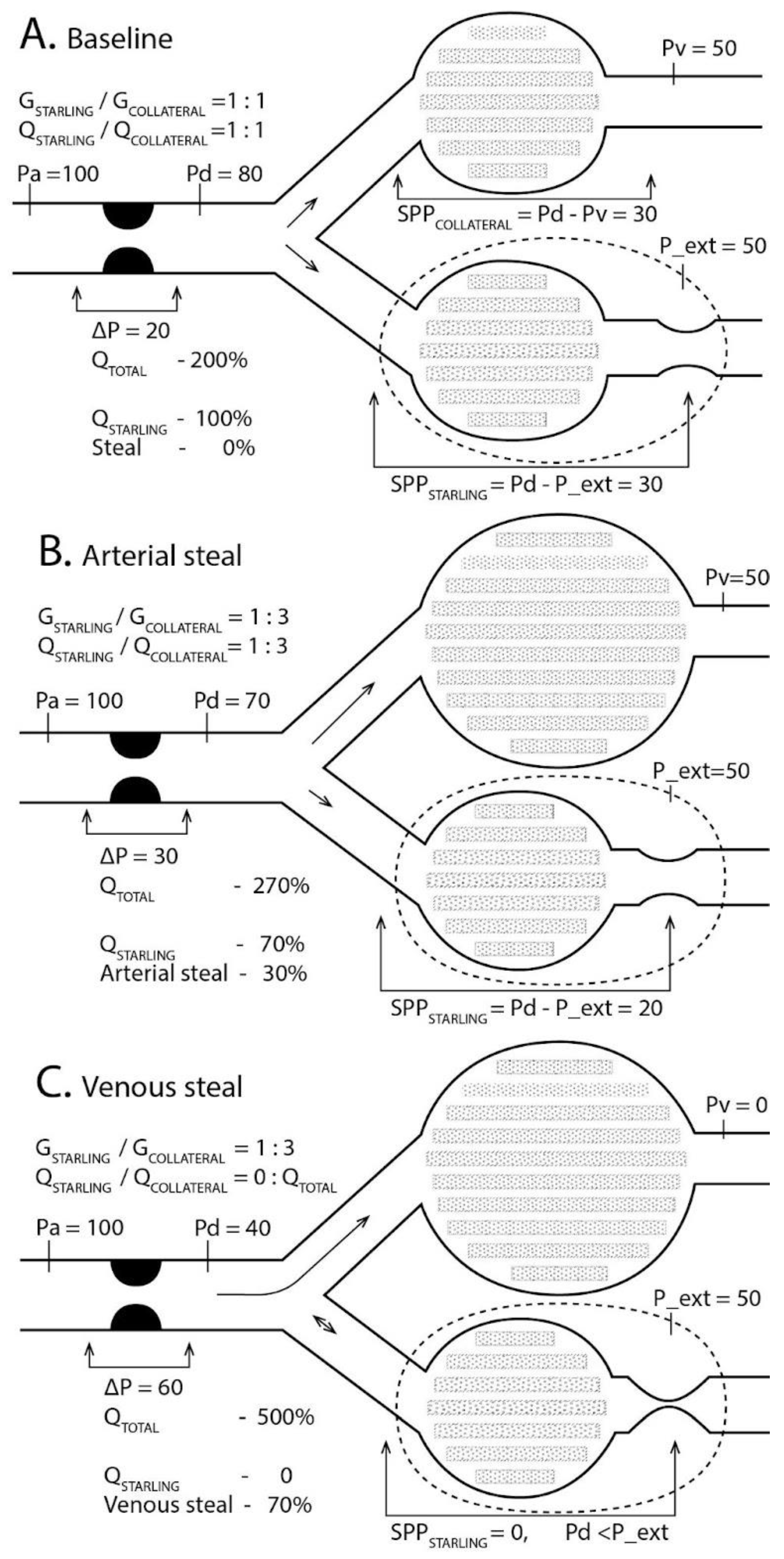
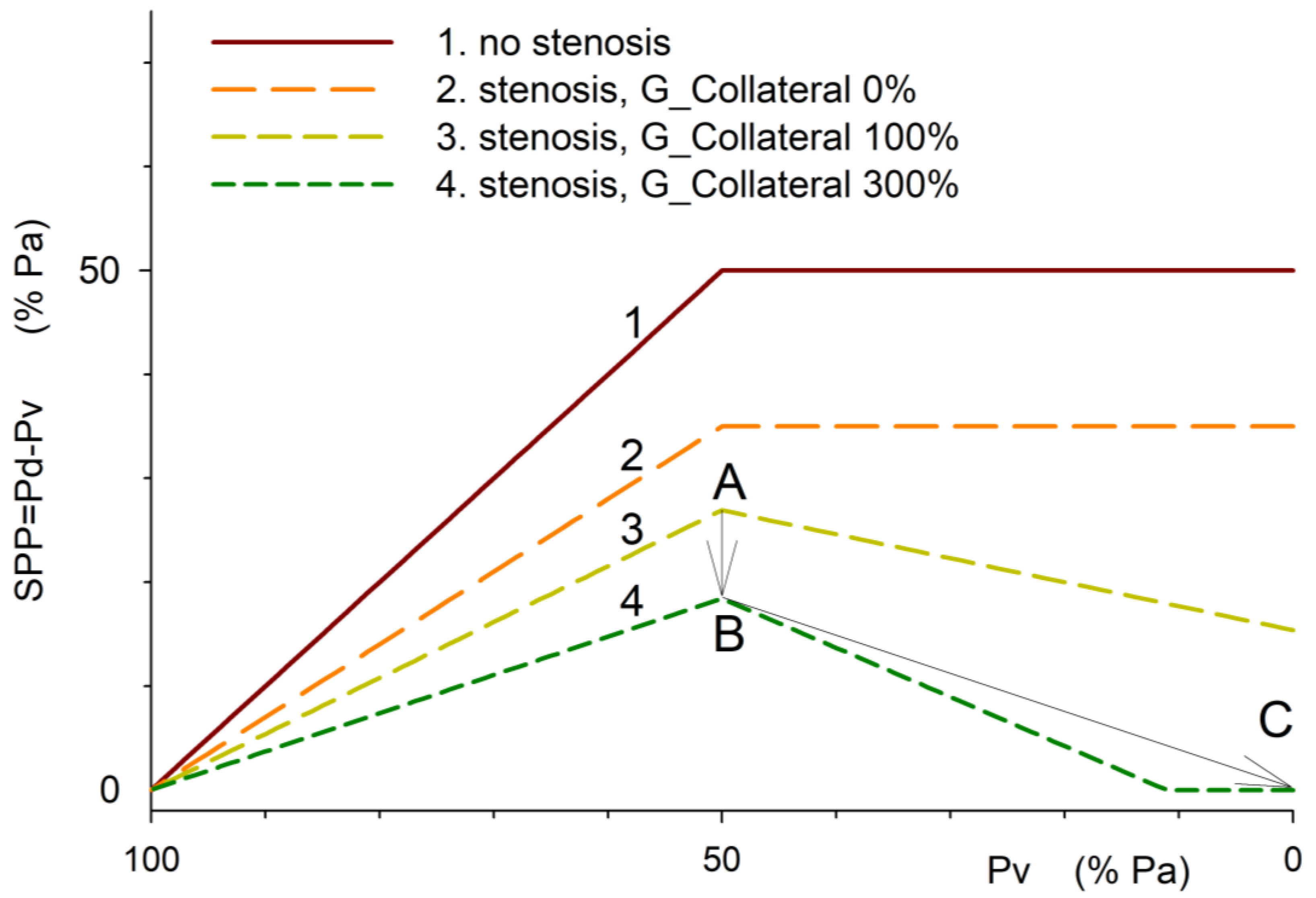
5. Arterial and Venous Steal
6. Venous Steal Conditions During Shock and Anesthesia
7. The Significance of Venous Steal and Reverse Venous Steal as a Therapeutic Strategy
7.1. Quantification of Arterial and Venous Steal
7.2. Post-Stenotic Pressure Pd and Its Relationship with Arterial Pressure (FFR)
7.3. Estimating Compartment Pressure P_ext
7.4. Segmental Perfusion Pressure (SPP) for Intracranial Compartment
7.5. Reverse Venous Steal as a Therapeutic Strategy
7.6. Enhancement of Selective Cerebral Cooling via Reverse Venous Steal
7.7. Utilizing the Venous Steal Model to Optimize Revascularization Strategies
7.8. Ensuring Adequate Cerebral Perfusion During Selective Antegrade Perfusion and Carotid Endarterectomy
8. Discussion of Venous Steal Model Limitations
9. Conclusions
Supplementary Materials
Author Contributions
Funding
Institutional Review Board Statement
Data Availability Statement
Conflicts of Interest
References
- Starling, E.H. On the Absorption of Fluids from the Connective Tissue Spaces. J. Physiol. 1896, 19, 312–326. [Google Scholar] [CrossRef] [Scilit]
- Luce, J.M.; Huseby, J.S.; Kirk, W.; Butler, J. A Starling resistor regulates cerebral venous outflow in dogs. J. Appl. Physiol. 1982, 53, 1496–1503. [Google Scholar] [CrossRef] [Scilit]
- Shrier, I.; Magder, S. Pressure-flow relationships in in vitro model of compartment syndrome. J. Appl. Physiol. 1995, 79, 214–221. [Google Scholar] [CrossRef] [Scilit] [PubMed]
- West, J.B.; Dollery, C.T.; Naimark, A. Distribution of Blood Flow in Isolated Lung; Relation to Vascular and Alveolar Pressures. J. Appl. Physiol. 1964, 19, 713–724. [Google Scholar] [CrossRef] [Scilit]
- Pranevicius, M.; Pranevicius, O. Cerebral venous steal: Blood flow diversion with increased tissue pressure. Neurosurgery 2002, 51, 1267–1274. [Google Scholar] [CrossRef] [Scilit] [PubMed]
- Pranevicius, M.; Pranevicius, H.; Pranevicius, O. Cerebral venous steal equation for intracranial segmental perfusion pressure predicts and quantifies reversible intracranial to extracranial flow diversion. Sci. Rep. 2021, 11, 7711. [Google Scholar] [CrossRef] [Scilit]
- Pranevicius, H.; Naujokaitis, D.; Pilkauskas, V.; Pranevicius, O.; Pranevicius, M. Electrical Circuit Model of Fractional Flow Reserve in Cerebrovascular Disorders. Elektron. Elektrotechnika 2014, 20, 40–43. [Google Scholar] [CrossRef] [Scilit]
- Pijls, N.H.; Van Gelder, B.; Van der Voort, P.; Peels, K.; Bracke, F.A.; Bonnier, H.J.; El Gamal, M.I. Fractional flow reserve. A useful index to evaluate the influence of an epicardial coronary stenosis on myocardial blood flow. Circulation 1995, 92, 3183–3193. [Google Scholar] [CrossRef] [Scilit]
- Patterson, S.W.; Starling, E.H. On the mechanical factors which determine the output of the ventricles. J. Physiol. 1914, 48, 357–379. [Google Scholar] [CrossRef] [Scilit]
- Sabbah, H.N.; Marzilli, M.; Liu, Z.; Stein, P.D. Relation of intramyocardial pressure to coronary pressure at zero flow. Clin. Exp. Pharmacol. Physiol. 1986, 13, 477–486. [Google Scholar] [CrossRef] [Scilit]
- Chi, Z.; Beile, L.; Deyu, L.; Yubo, F. Application of multiscale coupling models in the numerical study of circulation system. Med. Nov. Technol. Devices 2022, 14, 100117. [Google Scholar]
- Pranevicius, M.; Pranevicius, H.; Pranevicius, O. Apparatus to Diagnose and Treat Intracranial Circulation. U.S. Patent 20220322955-A1, 13 October 2022. [Google Scholar]
- Nielsen, P.E.; Hubbe, P.; Poulsen, H.L. Skin blood pressure in the forehead in patients with internal carotid lesions. Stroke 1975, 6, 58–61. [Google Scholar] [PubMed]
- Strauss, A.L.; Rieger, H.; Roth, F.J.; Schoop, W. Doppler ophthalmic blood pressure measurement in the hemodynamic evaluation of occlusive carotid artery disease. Stroke 1989, 20, 1012–1015. [Google Scholar]
- LoGerfo, F.W.; Mason, G.R. Directional Doppler studies of supraorbital artery flow in internal carotid stenosis and occlusion. Surgery 1974, 76, 723–728. [Google Scholar]
- Lee, T.K.; Egbert, T.P.; Westenskow, D.R. Supraorbital artery as an alternative site for oscillometric blood pressure measurement. J. Clin. Monit. 1996, 12, 293–297. [Google Scholar]
- Tong, L.S.; Guo, Z.N.; Ou, Y.B.; Yu, Y.N.; Zhang, X.C.; Tang, J.; Zhang, J.H.; Lou, M. Cerebral venous collaterals: A new fort for fighting ischemic stroke? Prog. Neurobiol. 2018, 163–164, 172–193. [Google Scholar]
- Pijls, N.H.; van Son, J.A.; Kirkeeide, R.L.; De Bruyne, B.; Gould, K.L. Experimental basis of determining maximum coronary, myocardial, and collateral blood flow by pressure measurements for assessing functional stenosis severity before and after percutaneous transluminal coronary angioplasty. Circulation 1993, 87, 1354–1367. [Google Scholar]
- Goel, R.S.; Goyal, N.K.; Dharap, S.B.; Kumar, M.; Gore, M.A. Utility of optic nerve ultrasonography in head injury. Injury 2008, 39, 519–524. [Google Scholar]
- Hansen, H.C.; Helmke, K. Validation of the optic nerve sheath response to changing cerebrospinal fluid pressure: Ultrasound findings during intrathecal infusion tests. J. Neurosurg. 1997, 87, 34–40. [Google Scholar]
- Motschmann, M.; Muller, C.; Kuchenbecker, J.; Walter, S.; Schmitz, K.; Schütze, M.; Behrens-Baumann, W.; Firsching, R. Ophthalmodynamometry: A reliable method for measuring intracranial pressure. Strabismus 2001, 9, 13–16. [Google Scholar] [CrossRef] [Scilit]
- Ragauskas, A.; Matijosaitis, V.; Zakelis, R.; Petrikonis, K.; Rastenyte, D.; Piper, I.; Daubaris, G. Clinical assessment of noninvasive intracranial pressure absolute value measurement method. Neurology 2012, 78, 1684–1691. [Google Scholar] [CrossRef] [Scilit] [PubMed]
- Franjic, B.D.; Lovricevic, I.; Brkic, P.; Dobrota, D.; Aždajić, S.; Hranjec, J. Role of Doppler Ultrasound Analysis of Blood Flow Through the Ophthalmic and Intracranial Arteries in Predicting Neurologic Symptoms During Carotid Endarterectomy. J. Ultrasound Med. 2021, 40, 2141–2156. [Google Scholar] [CrossRef] [Scilit]
- Radmehr, H.; Soleimani, A.; Tatari, H.; Salehi, M. Does combined antegrade-retrograde cardioplegia have any superiority over antegrade cardioplegia? Heart Lung Circ. 2008, 17, 475–477. [Google Scholar] [CrossRef] [Scilit]
- Chen, X.; An, H.; Wu, D.; Ji, X. Research progress of selective brain cooling methods in the prehospital care for stroke patients: A narrative review. Brain Circ. 2023, 9, 16–20. [Google Scholar] [CrossRef] [Scilit] [PubMed]
- Zhai, K.; Li, M.; Li, J.; Wei, S.; Li, Z.; Zhang, Y.; Gao, B.; Wu, X.; Li, Y. Neuroprotective effect of selective hypothermic cerebral perfusion in extracorporeal cardiopulmonary resuscitation: A preclinical study. JTCVS Open 2022, 12, 221–233. [Google Scholar] [CrossRef] [Scilit] [PubMed]
- Wang, H.; Olivero, W.; Lanzino, G.; Elkins, W.; Rose, J.; Honings, D.; Rodde, M.; Burnham, J.; Wang, D. Rapid and selective cerebral hypothermia achieved using a cooling helmet. J. Neurosurg. 2004, 100, 272–277. [Google Scholar] [CrossRef] [Scilit]
- Berthet, K.; Lukaszewicz, A.C.; Bousser, M.G.; Payen, D. Lower body positive pressure application with an antigravity suit in acute carotid occlusion. Stroke Res. Treat. 2010, 2010, 950524. [Google Scholar] [CrossRef] [Scilit]
- Tajeddini, F.; Nikmaneshi, M.R.; Firoozabadi, B.; Pakravan, H.A.; Ahmadi Tafti, S.H.; Afshin, H. High precision invasive FFR, low-cost invasive iFR, or non-invasive CFR?: Optimum assessment of coronary artery stenosis based on the patient-specific computational models. Int. J. Numer. Method. Biomed. Eng. 2020, 36, e3382. [Google Scholar] [CrossRef] [Scilit]
Disclaimer/Publisher’s Note: The statements, opinions and data contained in all publications are solely those of the individual author(s) and contributor(s) and not of MDPI and/or the editor(s). MDPI and/or the editor(s) disclaim responsibility for any injury to people or property resulting from any ideas, methods, instructions or products referred to in the content. |
© 2025 by the authors. Published by MDPI on behalf of the Lithuanian University of Health Sciences. Licensee MDPI, Basel, Switzerland. This article is an open access article distributed under the terms and conditions of the Creative Commons Attribution (CC BY) license (https://creativecommons.org/licenses/by/4.0/).
Share and Cite
Pranevičius, M.; Makackas, D.; Macas, A.; Petrikonis, K.; Šakalytė, G.; Pranevičius, O.; Benetis, R. The Concept of Venous Steal: The Impact of Vascular Stenosis and Outflow Pressure Gradient on Blood Flow Diversion. Medicina 2025, 61, 672. https://doi.org/10.3390/medicina61040672
Pranevičius M, Makackas D, Macas A, Petrikonis K, Šakalytė G, Pranevičius O, Benetis R. The Concept of Venous Steal: The Impact of Vascular Stenosis and Outflow Pressure Gradient on Blood Flow Diversion. Medicina. 2025; 61(4):672. https://doi.org/10.3390/medicina61040672
Chicago/Turabian StylePranevičius, Mindaugas, Dalius Makackas, Andrius Macas, Kęstutis Petrikonis, Gintarė Šakalytė, Osvaldas Pranevičius, and Rimantas Benetis. 2025. "The Concept of Venous Steal: The Impact of Vascular Stenosis and Outflow Pressure Gradient on Blood Flow Diversion" Medicina 61, no. 4: 672. https://doi.org/10.3390/medicina61040672
APA StylePranevičius, M., Makackas, D., Macas, A., Petrikonis, K., Šakalytė, G., Pranevičius, O., & Benetis, R. (2025). The Concept of Venous Steal: The Impact of Vascular Stenosis and Outflow Pressure Gradient on Blood Flow Diversion. Medicina, 61(4), 672. https://doi.org/10.3390/medicina61040672

