Article

Survival Analysis of Glass Ionomer Cement and Resin-Based Sealant Retention: A 10-Year Follow-Up Study

by
Sandra Petrauskienė
,
Kristina Saldūnaitė-Mikučionienė
and
Julija Narbutaitė
*
Department of Preventive and Paediatric Dentistry, Faculty of Odontology, Lithuanian University of Health Sciences, Luksos-Daumanto Str. 6, LT-50106 Kaunas, Lithuania
*
Author to whom correspondence should be addressed.
Medicina 2024, 60(5), 756; https://doi.org/10.3390/medicina60050756

Submission received: 27 March 2024 / Revised: 29 April 2024 / Accepted: 29 April 2024 / Published: 1 May 2024
(This article belongs to the Special Issue Updates on Caries Management in the Primary and Permanent Dentition)

Abstract

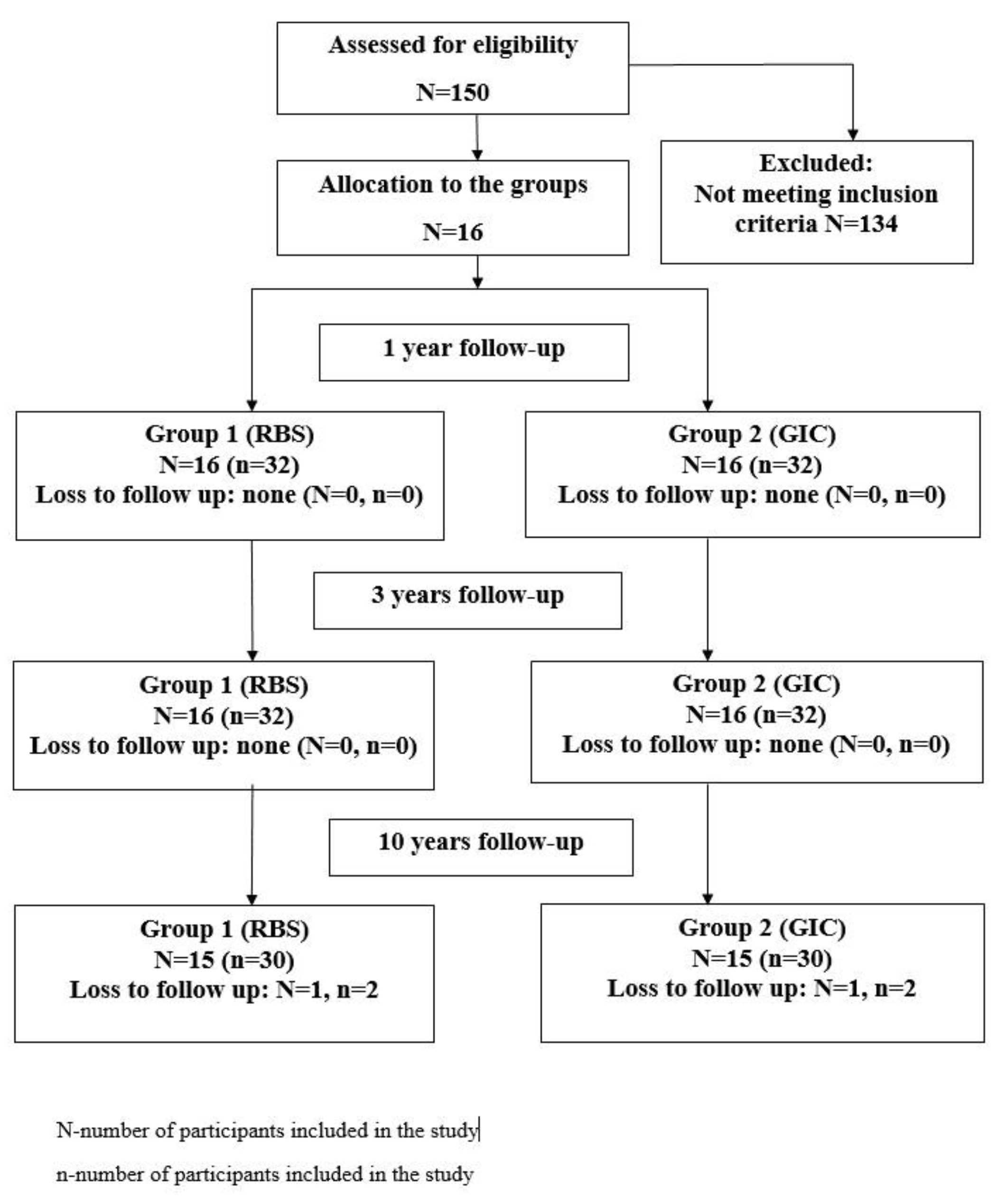
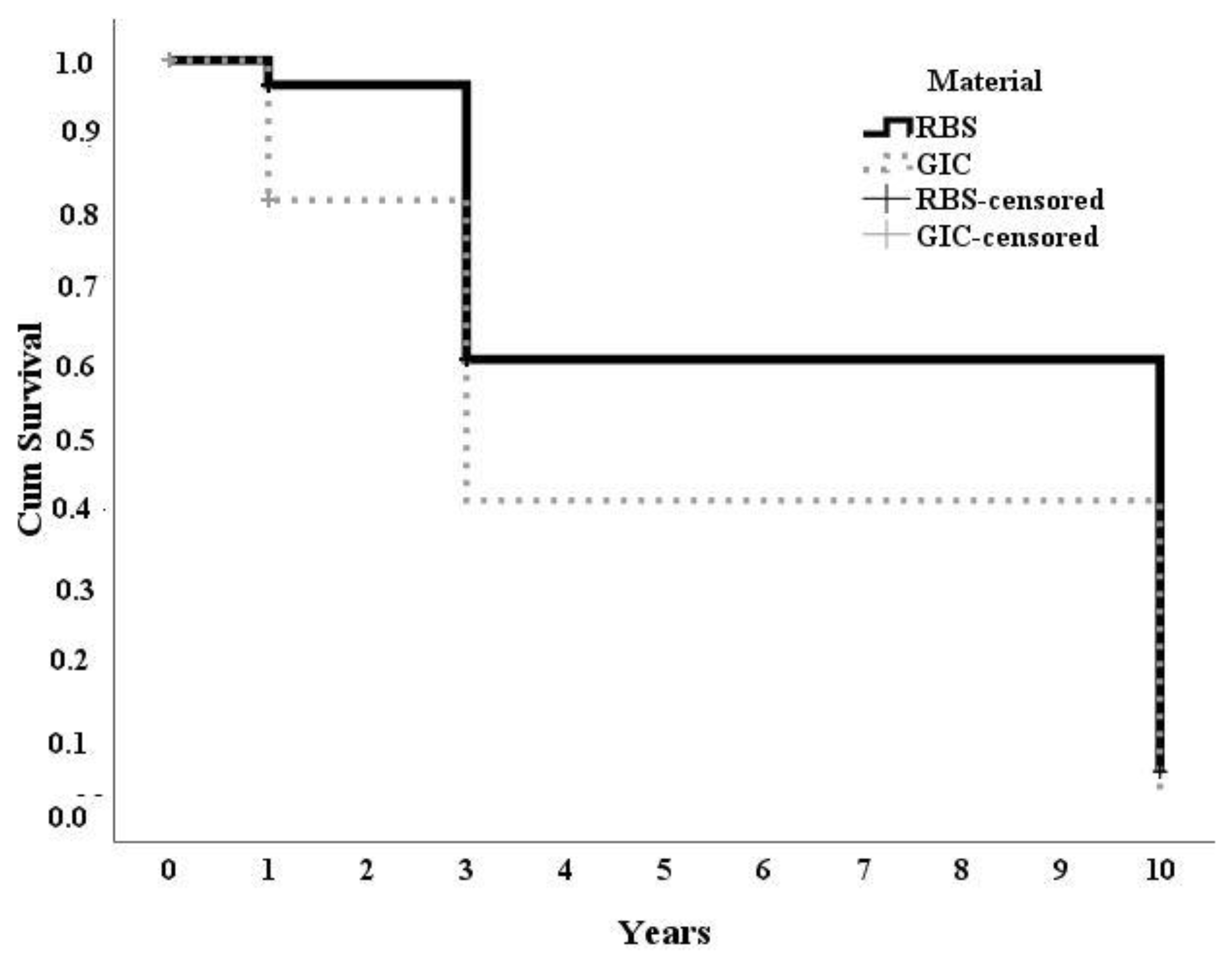
Background and Objective: Sealant application is a proven method to prevent occlusal caries; however, long-term studies on this topic are scarce. This study aimed to assess the survival rate and clinical effectiveness of glass ionomer cement (GIC) and resin-based sealants (RBSs) on second permanent molars over a long-term follow-up period. Materials and methods: Sixteen patients aged 11–13 years with all four completely erupted permanent second molars were enrolled in the study. All patients attended 1-year and 3-year follow-ups; however, one participant did not respond after 10 years and was excluded from the final analyses. The oral health status evaluation was based on WHO criteria. A total of 32 teeth received an RBS (Clinpro), and a further 32 teeth were sealed with GIC (Fuji IX). The sealant retention was determined according to the Kilpatrick criteria after 1 year, 3 years, and 10 years, respectively. Statistical analysis included a chi-square test, the Kaplan–Meier method, and the Cox proportional hazard model. Results: At baseline, seven boys and eight girls participated in the study, with a mean age of 12.3 ± 0.9 years. The 1-year follow-up results revealed that 90% of the RBSs and 43.3% of the GIC sealants were completely retained, and no caries lesions were recorded (p = 0.01). The 3-year follow-up results showed that 23.3% of the RBSs and 0% of the GIC sealants demonstrated complete retention (p = 0.034). Moreover, 10.0% of the occlusal surfaces in the RBS group and 13.3% of the occlusal surfaces in the GIC group were filled (p > 0.05). A total of 6.7% of the RBSs showed complete retention. One-third of the sealed teeth (30.0% of the teeth sealed with RBSs and 36.7% of teeth applied with GIC) were filled after 10 years. The Kaplan–Meier analysis demonstrated a higher survival rate in the RBS group when compared with the GIC over the entire follow-up period (p = 0.001). Conclusions: Although the survival rate of RBSs was higher than GIC sealants, their effectiveness in preventing fissure caries in permanent second molars did not differ significantly over a 10-year follow-up.
Keywords: caries prevention; resin-based sealant; glass ionomer sealant; fissure sealant; sealant retention caries prevention; resin-based sealant; glass ionomer sealant; fissure sealant; sealant retention