


Abstract
The translocase of the inner membrane (TIM) family plays an essential role in mediating the transport of nuclear-encoded precursor proteins across the inner mitochondrial membrane and regulating cellular energy metabolism. Sea-island cotton (Gossypium barbadense) is valued for its superior fiber quality, yet the composition, evolution, and expression patterns of its TIM genes remain unclear. To address this, we performed a genome-wide analysis of the TIM family in G. barbadense, using the diploid cotton G. arboreum, and G. raimondii and the allotetraploid G. hirsutum as comparative references. A total of 44 GbTIM genes were identified in G. barbadense and characterized through phylogenetic, structural, collinearity, promoter, and expression analyses. The TIM family expanded during cotton polyploidization, with tetraploid species containing approximately twice as many genes as diploids. Phylogenetic analysis categorized TIM proteins into seven subfamilies, with Group VI representing the largest clade. Promoter regions were enriched in light- and phytohormone-responsive elements. Interspecific synteny analysis demonstrated extensive collinearity between G. barbadense and its diploid ancestors but limited collinearity with G. hirsutum, indicating divergence among tetraploids. Transcriptomic profiling revealed highly spatiotemporal expression patterns. Gbar_A11G001280 was abundantly expressed during fiber initiation and upregulated in low-lint-percentage germplasm, whereas Gbar_D07G010770 was continuously expressed throughout fiber development. This study clarifies the evolutionary lineage of the TIM family across four cotton species, with a primary focus on G. barbadense, and provides candidate genes for molecular breeding of high-quality fiber. Functional validation of these candidate genes is recommended in future studies.
1. Introduction
Cotton (Gossypium spp.) represents one of the most vital industrial crops globally, serving as the primary raw material for natural textile fibers. During the evolutionary history of the genus Gossypium, a pivotal polyploidization event occurred approximately 1.0 to 1.5 million years ago; a diploid ancestor from the A-genome clade (G. arboreum) hybridized naturally with a D-genome clade ancestor (G. raimondii), followed by chromosome doubling to form two major allotetraploid species, G. hirsutum (AD1) and G. barbadense (AD2) [1,2]. Compared with G. hirsutum (upland cotton), G. barbadense (sea-island or extra-long staple cotton) is renowned for superior fiber quality characterized by exceptional length, strength, and fineness, alongside enhanced resistance to abiotic and biotic stresses [3]. With continuous refinements in high-throughput sequencing and reference genome assemblies across Gossypium taxa, systematically deciphering the evolutionary trajectories and developmental roles of key functional gene families at the genome-wide level has become an indispensable strategy for cotton molecular breeding.
The translocase of the inner membrane (TIM) protein complex serves an imperative function in mitochondrial complex transport and cellular energy metabolism. As essential building blocks of the mitochondrial inner membrane transport system, TIM proteins oversee the translocation, insertion, and assembly of nuclear-encoded precursor proteins synthesized in the cytosol across the inner mitochondrial membrane [4]. Members of this family typically possess conserved Pfam domain architectures such as TIM22, TIM17, or SAM. Beyond maintaining mitochondrial membrane potential and facilitating respiratory chain complex assembly, plant TIM proteins exert multifaceted regulatory influences on abiotic stress adaptation, plant growth (e.g., pollen tube elongation and root morphogenesis), and phytohormone signaling cascades [5,6,7,8,9]. Specifically, the TIM23 translocase complex contains TIM23 and TIM17 as its central transmembrane subunits, which mediate the transport of precursor proteins across the inner mitochondrial membrane [10,11]. Despite sharing structural domain similarities, TIM23 and TIM17 display mechanistically distinct translocation and membrane-integration modes, signifying functional divergence within the family [12]. Furthermore, studies in Arabidopsis thaliana have demonstrated that AtTIM17-1 modulates the timing of seed germination by altering endogenous abscisic acid (ABA) and gibberellin (GA) dynamics [13]. However, impairment of TIM core components compromises mitochondrial DNA import efficiency [14]. These findings highlight that plant TIM proteins not only operate in fundamental protein import, but also actively participate in complex developmental networks through mitochondrial activity regulation.
Nevertheless, systematic characterization, evolutionary dynamics, and expression patterns of the TIM family in allotetraploid cotton species G. barbadense remain unexplored, particularly regarding how polyploidization has shaped this gene family and how specific members contribute to fiber development. Polyploidization frequently triggers gene family duplication, functional diversification, and subgenome expression dominance. Genome-wide identification of GbTIM members and systematic profiling of their involvement in fiber development and organogenesis are thus of profound biological relevance. In this study, we conducted a comprehensive genome-wide survey of the TIM family across four representative cotton species (G. barbadense, G. hirsutum, G. arboreum, and G. raimondii). We detailed the physicochemical parameters, phylogenetic classification, chromosomal mapping, gene structures, syntenic duplications, and promoter cis-elements of GbTIM genes. Utilizing public and tissue-specific transcriptomic datasets, we analyzed GbTIM expression dynamics across diverse tissues and fiber developmental stages in extreme lint-percentage sea-island cotton lines. Our findings provide novel insights into the evolutionary expansion of the TIM family in polyploid cotton species and highlight promising candidate loci for fiber quality manipulation.
2. Materials and Methods
2.1. Identification of TIM Family Members
Whole-genome sequences, coding sequences, and protein annotations for G. hirsutum (AD1_HAU), G. barbadense (AD2_HAU), G. arboreum (A2_HAU), and G. raimondii (D5_HAU) were retrieved from the CottonMD database (https://yanglab.hzau.edu.cn/, accessed on 13 January 2026) [15]. Genomic data for Arabidopsis thaliana were downloaded from Ensembl Plants (https://plants.ensembl.org/index.html, accessed on 13 January 2026). A dual-query strategy was deployed to identify TIM family members. Known Arabidopsis TIM amino acid sequences extracted from TAIR (https://www.arabidopsis.org, accessed on 10 February 2026) were used as queries for local BLASTp alignment against the cotton protein databases (E-value ≤ 1 × 10⁻⁵). The Hidden Markov Model (HMM) profile corresponding to the TIM domain (PF02466) was acquired from Pfam and queried against target proteomes using HMMER 3.0 (E-value ≤ 1 × 10⁻⁵). Candidate genes retrieved from both approaches were intersected. Domain integrity was confirmed using the NCBI Batch CD-Search platform (https://www.ncbi.nlm.nih.gov/Structure/bwrpsb/bwrpsb.cgi, accessed on 3 March 2026) [16]. Genes lacking intact core TIM domains were removed.
2.2. Physicochemical Characterization and Subcellular Localization
The physicochemical properties of identified TIM proteins were obtained from the ExPASy database (https://www.expasy.org, accessed on 10 March 2026) [17], including amino acid length, molecular weight (MW), theoretical isoelectric point (pI), instability index, aliphatic index, and grand average of hydropathicity (GRAVY). Subcellular targeting locations were predicted using the WoLF PSORT software program (https://wolfpsort.hgc.jp, accessed on 11 March 2026) [18] under default plant parameters.
2.3. Phylogenetic Reconstruction
Multiple sequence alignments of TIM proteins from A. thaliana and the four cotton species were generated using ClustalW within MEGA 12 (version 12.1.1). Unrooted phylogenetic trees were constructed using the Maximum Likelihood (ML) method with 1000 bootstrap replicates. The resulting phylogenetic tree was customized using the Interactive Tree Of Life (iTOL) tool (https://itol.embl.de/, accessed on 5 April 2026).
2.4. Gene Structure, Conserved Motif, and Domain Architecture Analysis
Exon–intron structures were obtained from the G. barbadense genome annotation files. Conserved protein motifs were identified via the MEME suite (http://meme-suite.org/tools/meme, accessed on 15 April 2026), with maximum motif count set to 10 [19]. Conserved functional domains were annotated using the NCBI Conserved Domain Database (CDD, https://ncbiinsights.ncbi.nlm.nih.gov/tag/conserved-domains-database-cdd/, accessed on 15 April 2026). Structural features, conserved motifs, domain layouts, and phylogenetic branching were visualized using TBtools-II (version 2.454) [20].
2.5. Chromosomal Mapping
Chromosomal positions and gene densities of GbTIM genes were obtained from the genome annotation file. Map diagrams illustrating chromosomal positions were generated using TBtools-II (version 2.454).
2.6. Synteny and Duplication Analysis
Intraspecific and interspecific gene collinearity analyses were executed using One Step MCScanX-Super Fast in TBtools-II (version 2.454). Chromosomal distribution and intraspecific duplication events within G. barbadense were displayed using Advanced Circos (https://circos.ca/software/download/circos, accessed on 4 May 2026) [21]. Interspecific synteny relationships between G. barbadense and the other three cotton species (G. hirsutum, G. arboreum, and G. raimondii) were plotted using Dual Synteny Plot for MCScanX (https://github.com/wyp1125/MCScanX, accessed on 13 May 2026) [22].
2.7. Cis-Elements Analysis
The 2000 bp upstream sequence from the transcription start site (TSS) for each GbTIM gene was submitted to the online website PLANTCARE (https://bioinformatics.psb.ugent.be/webtools/plantcare/html, accessed on 18 May 2026) for cis-element prediction [23].
2.8. Transcriptomic Profiling and Differential Expression
RNA-seq expression data across root, stem, leaf, petal, anther, bract, filament, pistil, sepal, torus, and different ovule/fiber developmental stages in G. barbadense were retrieved from CottonMD. Expression heatmaps were generated with TBtools-II (version 2.454) following row-mean normalization. Transcriptome profiles were further evaluated using two accessions of G. barbadense featuring contrasting lint percentages, Ashi (high lint percentage) and Xinhai 33 (XH33, low lint percentage), across multiple fiber development time points (0, 5, 10, 15, 20, 25 DPA).
3. Results
3.1. Genome-Wide Identification and Physicochemical Traits of Cotton TIM Genes
To provide a comprehensive evolutionary context, we identified TIM family members in representative diploid (G. arboreum and G. raimondii) and tetraploid (G. hirsutum and G. barbadense) cotton species, with a total of 22, 22, 40, and 44 members, respectively (Table S1). This demonstrates a two-fold expansion in gene number within tetraploid species compared to their diploid ancestors. Physicochemical evaluations revealed noticeable evolutionary conservation among cotton TIM proteins. Most members exhibited protein lengths ranging between 203 and 207 amino acids, MWs ranging from 21.21 to 21.59 kDa, and weak basic theoretical pI values (7.44–7.76). Instability indices ranged from 47.2 to 47.5, indicating moderate protein instability, while aliphatic index values (76.3–76.9) reflected hydrophobic characteristics. Conversely, GbTIM proteins in G. barbadense demonstrated greater structural diversity, with amino acid lengths spanning from 131 to 521 and MWs ranging from 13.6 to 58 kDa. Subcellular predictions suggested that most diploid TIM proteins localize to mitochondria and nuclei, whereas one GbTIM member (Gbar_D11G030130) in G. barbadense was additionally predicted to reside in the cytoplasm (Table S1).
3.2. Chromosomal Distribution and Phylogenetic Topology of GbTIMs
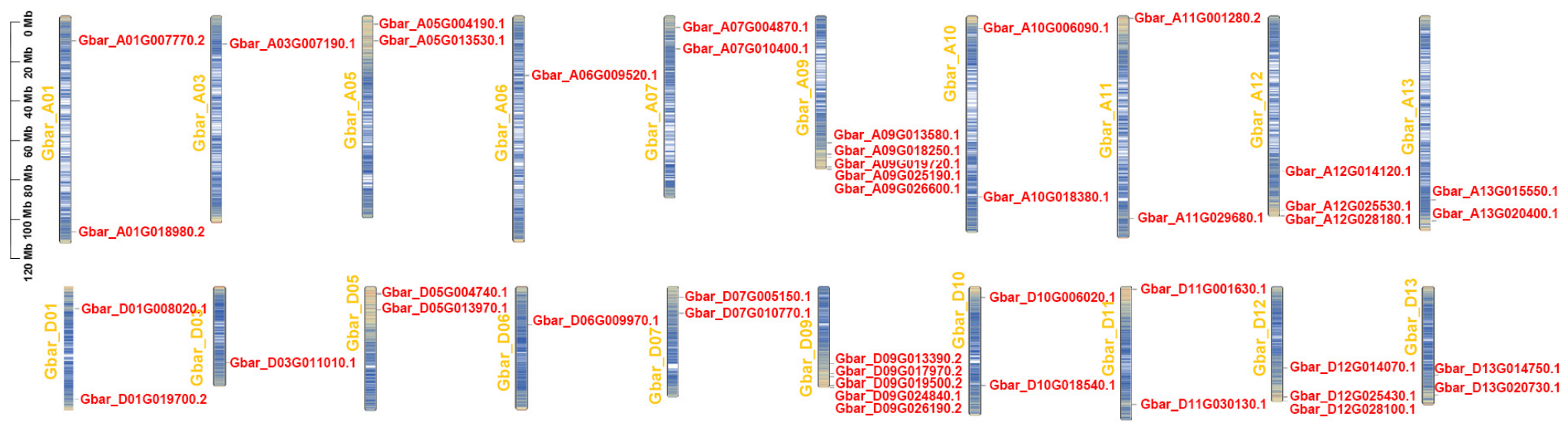
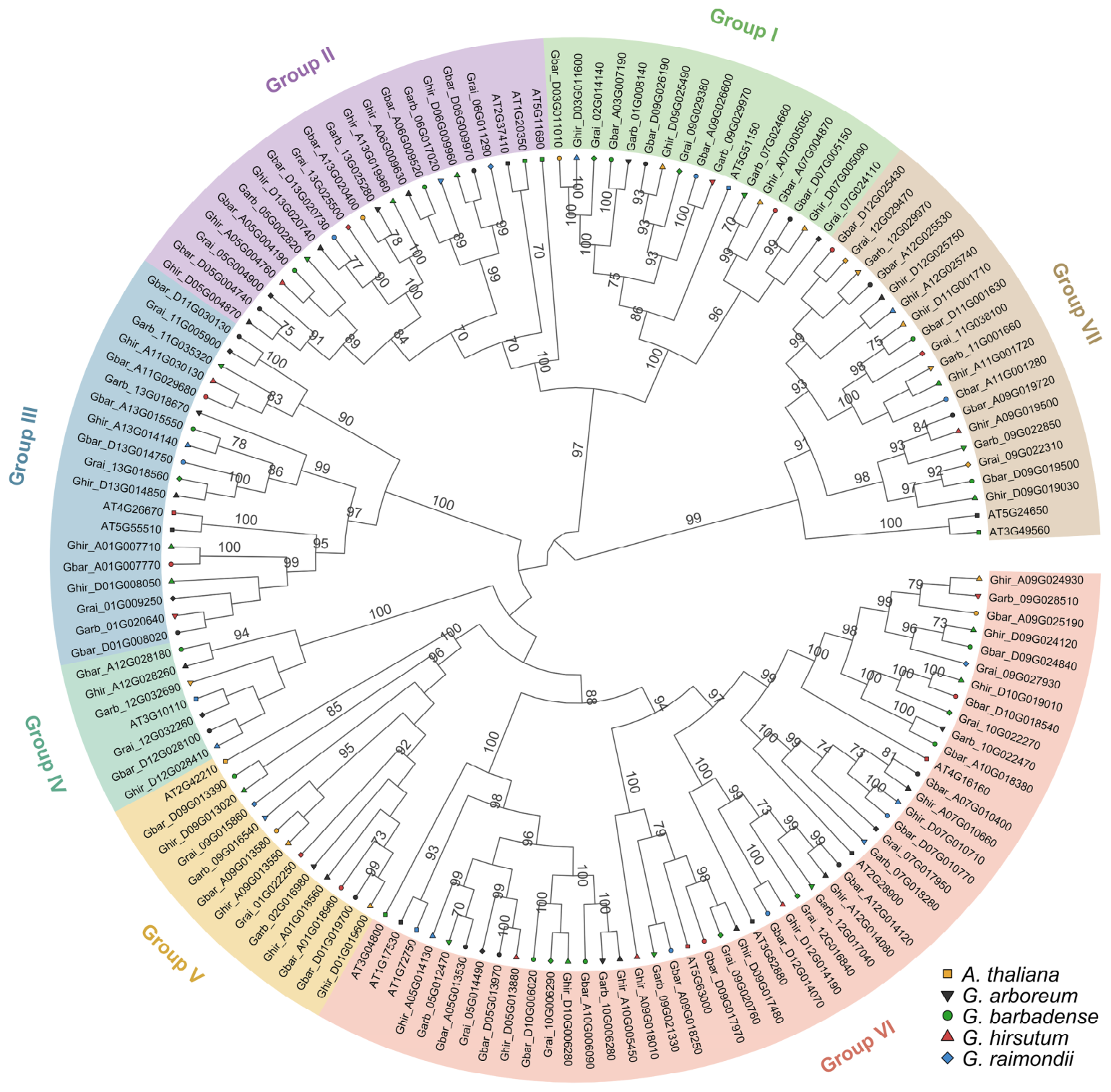
Chromosomal mapping revealed that 44 GbTIM genes were broadly distributed across both subgenomes in G. barbadense (Figure 1). Chromosomes A02, A04, A08, D02, D04, and D08 contained no GbTIM loci. Gene density clusters were identified on chromosomes A09 and D09, whereas homoeologous chromosome pairs (e.g., A12/D12 and A13/D13) harbored symmetrical gene distributions. A maximum likelihood phylogenetic tree was constructed using 146 TIM amino acid sequences from A. thaliana and four cotton species (Figure 2). The members were divided into seven evolutionary subfamilies (Group I–VII), containing 18, 21, 19, 7, 13, 48, and 20 members, respectively. Among the G. barbadense members, Group VI contained the largest gene complement, whereas Group IV was the smallest, reflecting lineage-specific expansion rates during polyploid evolution.
Figure 1.
Chromosomal distribution of GbTIM gene family in G. barbadense. The scale is in megabases (Mb). Sea-island cotton: Gossypium barbadense. Chromosome numbers are highlighted in yellow, and gene IDs are highlighted in red.
Figure 2.
Phylogenetic topology of TIM genes in four cotton species and Arabidopsis. Arabidopsis: Arabidopsis thaliana; upland cotton: Gossypium hirsutum; sea-island cotton: Gossypium barbadense.
3.3. Gene Architecture and Domain Compositions
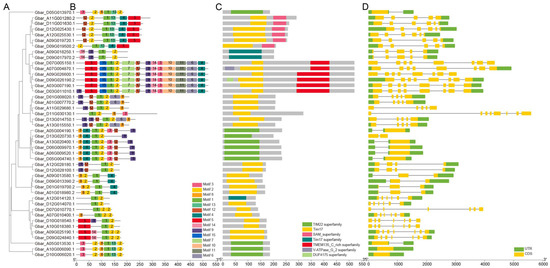
To evaluate structural diversification, conserved motifs, Pfam domains, and exon-intron architectures of GbTIM genes were integrated with the phylogenetic layout. Conserved motifs were shared among closely related members within the same clade (Figure 3A,B). Motifs 1 and 2 were present across all 44 GbTIM proteins. Domain annotations confirmed that GbTIM proteins harbor canonical TIM22, TIM17, or SAM superfamily domains (Figure 3C). Exon–intron configurations revealed structural diversity, and exon counts ranged from 1 to 8, with intronless genes observed in specific clades (Figure 3D).
Figure 3.
Evolutionary relationships (A), conserved motifs (B), domain compositions (C), and gene structures (D) of the GbTIM gene family in G. barbadense. Sea-island cotton: Gossypium barbadense.
3.4. Intraspecific and Interspecific Synteny of GbTIMs
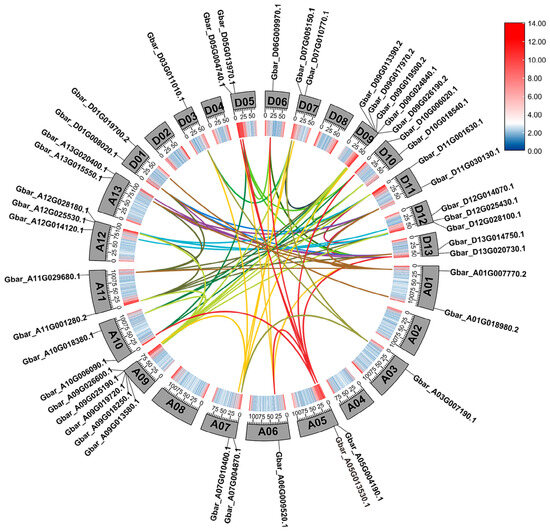
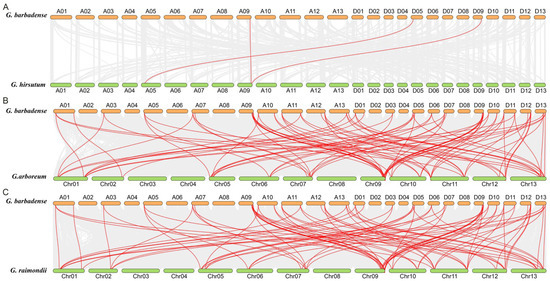
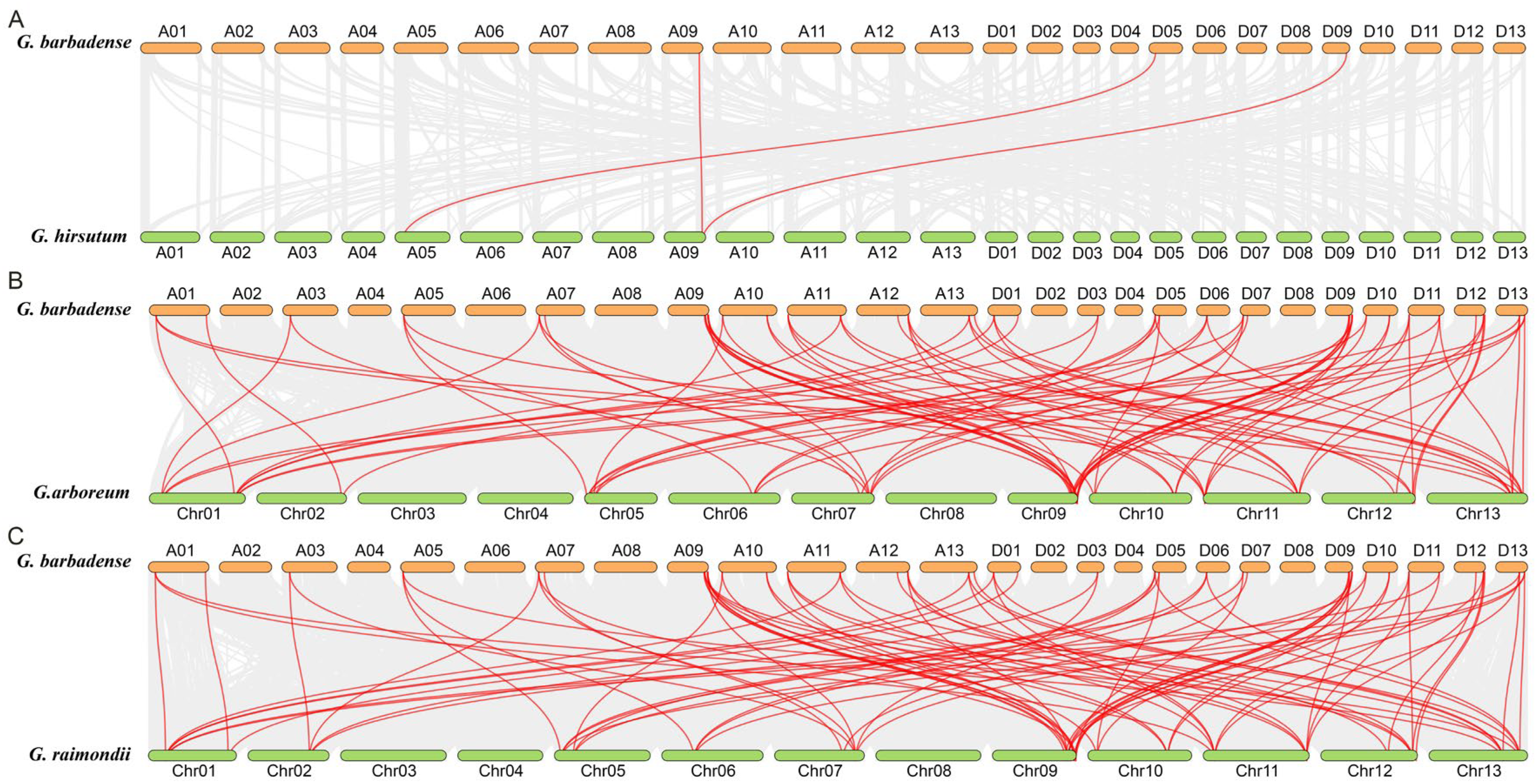
Intraspecific synteny analysis identified 67 collinear gene pairs within the G. barbadense genome (Figure 4). These included 11 segmental duplication pairs within the At subgenome, 12 within the Dt subgenome, and 44 inter-subgenomic duplication pairs between At and Dt. Segmental duplication across subgenomes served as the primary mechanism driving GbTIM family expansion. Interspecific synteny analysis revealed that G. barbadense maintained 84 collinear pairs with diploid G. arboreum (A2) and 82 pairs with G. raimondii (D5) (Figure 5). In contrast, G. barbadense shared only 3 syntenic pairs with allotetraploid G. hirsutum (AD1). This indicates that while ancestral genomic synteny was preserved following polyploidization, extensive lineage-specific genomic rearrangements or gene loss occurred after the divergence of the two tetraploid species.
Figure 4.
Intraspecific synteny of the GbTIM gene family in G. barbadense. The outer circle represents the chromosomes (A01–A13 and D01–D13). The red-blue heatmap (scale 0.00–14.00) indicates gene density across the chromosomes. The inner colored lines represent intra-genomic collinear blocks; different colors are used to visually distinguish different syntenic regions. Sea-island cotton: Gossypium barbadense.
Figure 5.
Interspecific synteny of the GbTIM gene family with G. hirsutum (A), G. arboreum (B), G. raimondii (C). Upland cotton: Gossypium hirsutum; sea-island cotton: Gossypium barbadense. Red lines highlighted the duplicated TIM gene pairs, and gray lines in the background indicated the collinear blocks.
3.5. Promoter Cis-Regulatory Element Analysis
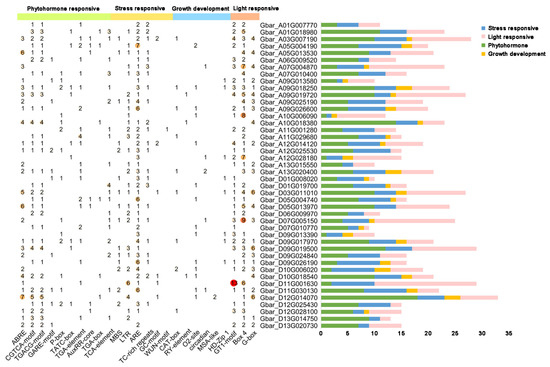
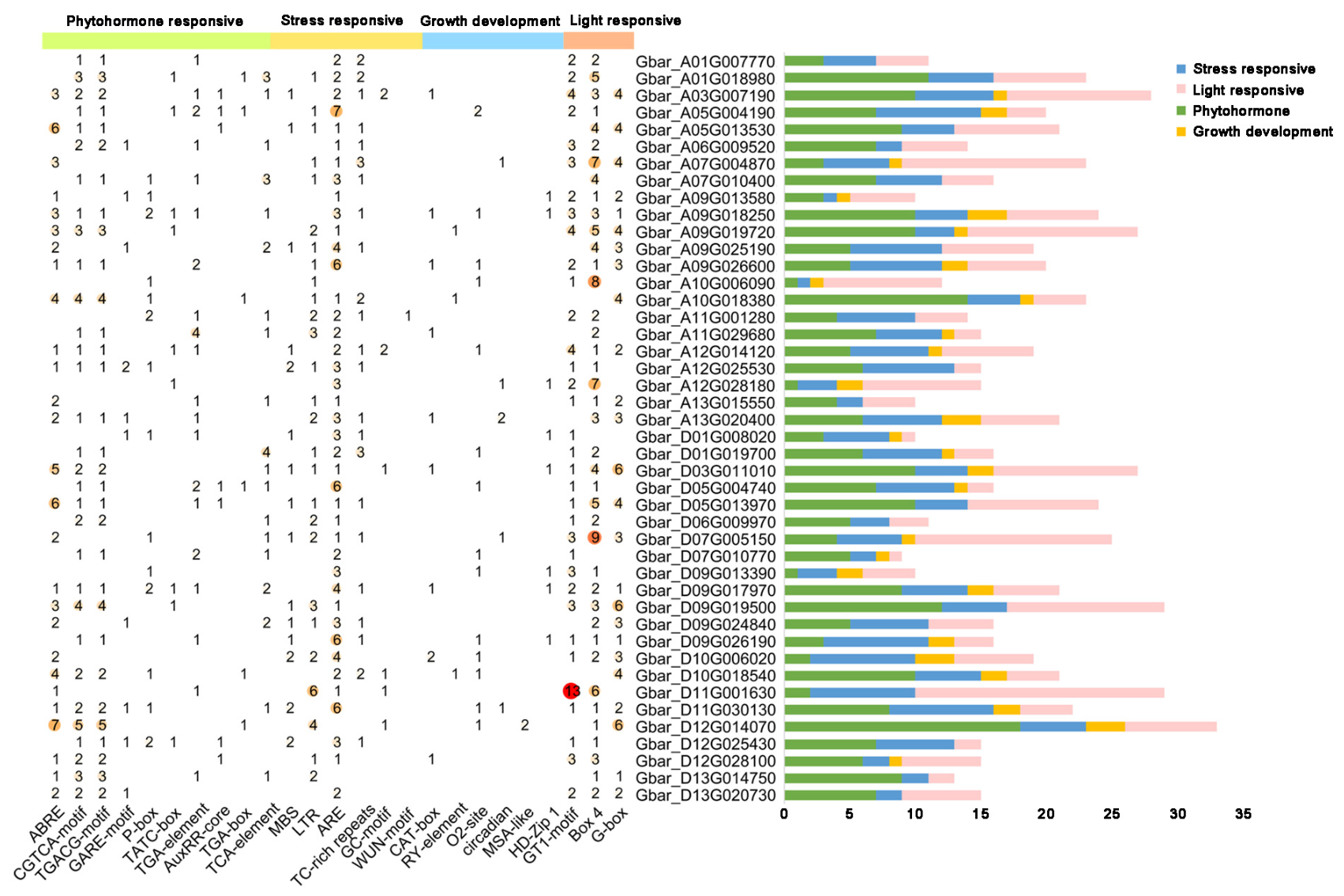
Scan of the 2.0 kb upstream promoter regions of 44 GbTIM genes identified various cis-regulatory elements, including light-responsive elements (e.g., Box4 and G-box), phytohormone elements (ABRE for ABA-responsive, CGTCA/TGACG motifs for MeJA, and P-box for gibberellin), and stress-responsive elements (MBS for drought and ARE for anaerobic induction) (Figure 6). Gbar_D12G014070 harbored the highest density of light-responsive elements. Notably, these in silico predictions indicate potential regulatory interactions, but the actual functionality of these motifs and their cell-type-specific activities require experimental validation.
Figure 6.
Cis-acting elements existed in promoters of GbTIM genes. Sea-island cotton: Gossypium barbadense.
3.6. Spatiotemporal Expression Dynamics and Fiber Development Profiles
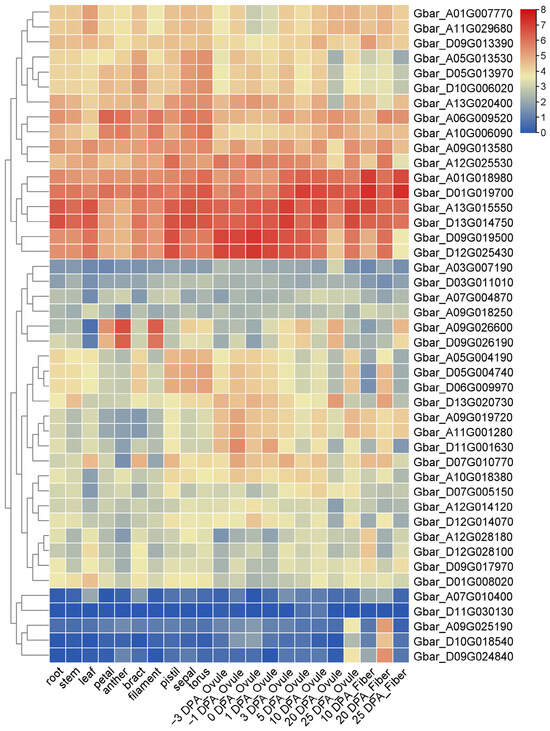
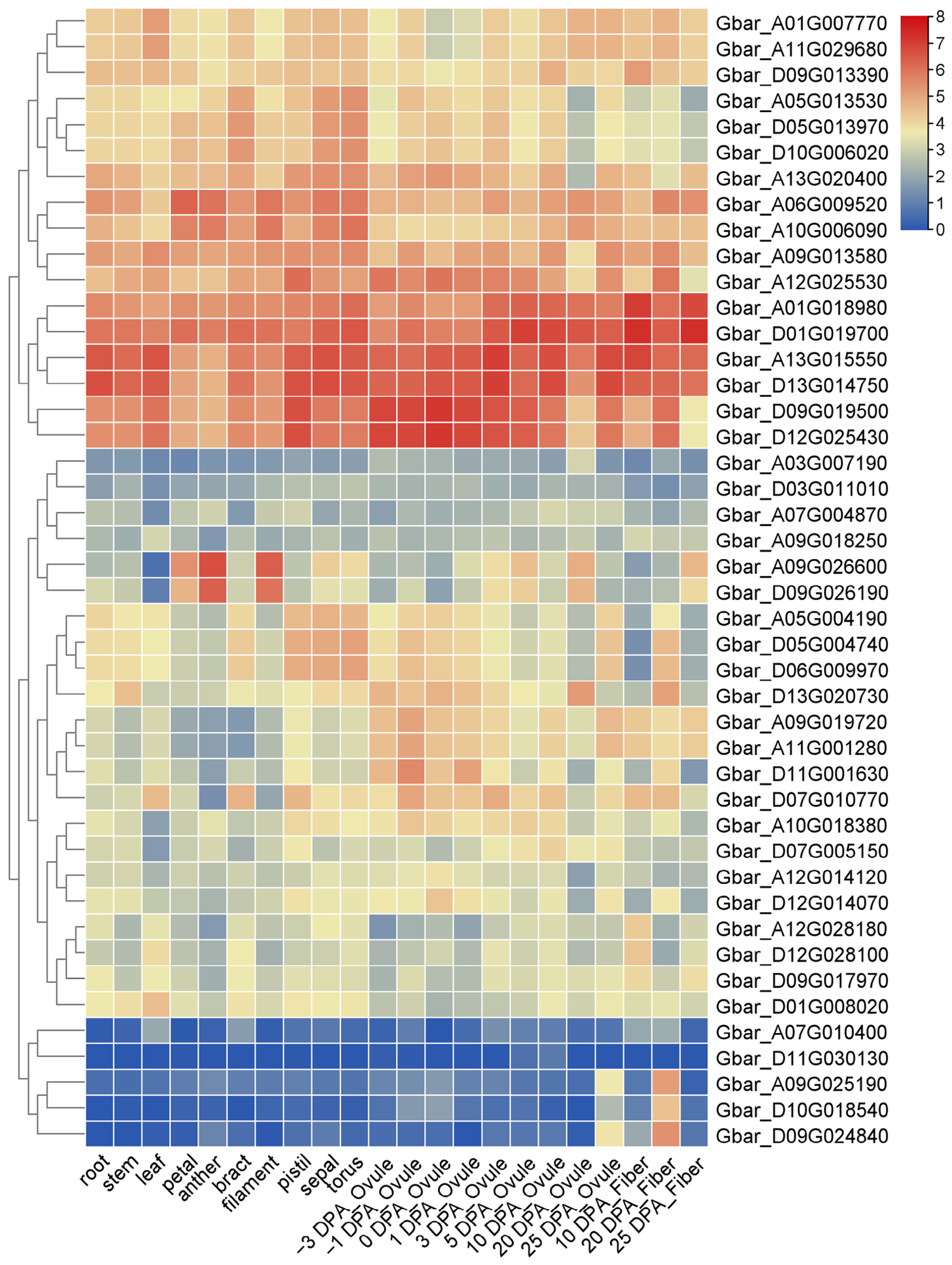
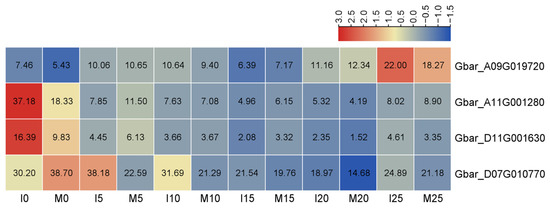
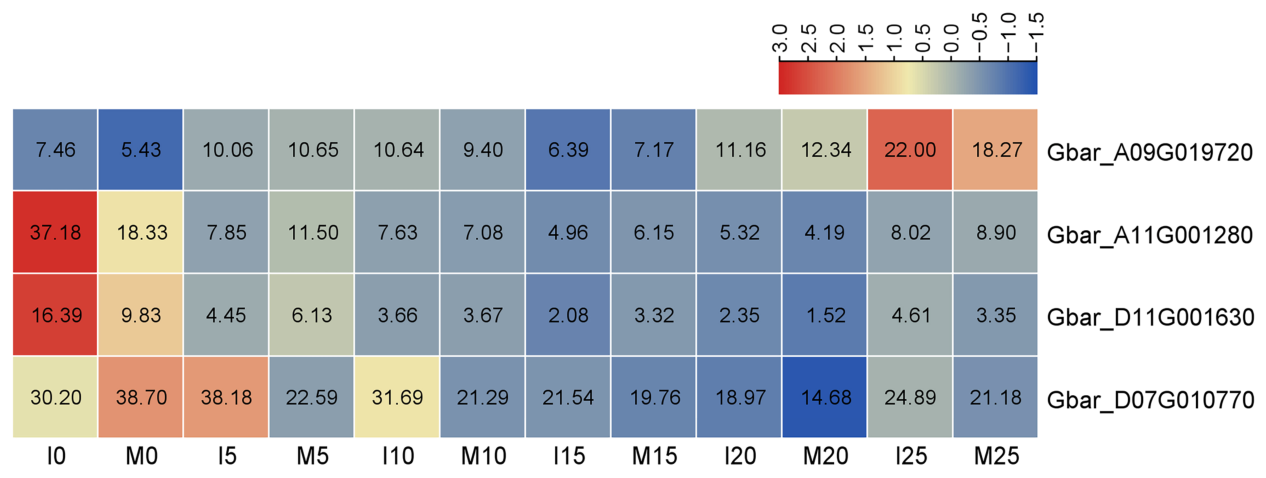
Transcriptomic profiling at the tissue level revealed expression divergence among GbTIM genes across different organs and developmental stages (Figure 7). A core module comprising 17 genes (including Gbar_A01G018980 and Gbar_D01G019700) displayed relatively ubiquitous expression across all tissues examined, suggesting potential roles in fundamental metabolic processes. Conversely, Gbar_A09G026600 and Gbar_D09G026190 displayed preferential expression in floral tissues (petals, anthers, and filaments). Five genes, including Gbar_D11G030130, showed minimal transcript abundance across all samples tested. Temporal expression patterns were also observed during ovule development; for example, Gbar_A09G019720 and Gbar_A11G001280 exhibited higher transcript levels at early stages (−3 to 1 DPA) compared to later stages (10 to 25 DPA). However, as these data were derived from whole-tissue RNA-seq, the expression patterns represent average signals from mixed cell populations. Further studies at single-cell resolution or via in situ hybridization are needed to determine whether these genes are expressed uniformly within a tissue or restricted to specific cell types. Moreover, analysis of extreme lint-percentage lines revealed that Gbar_D07G010770 maintained high transcript levels throughout fiber elongation. In contrast, Gbar_A11G001280 was specifically upregulated during fiber initiation (0 DPA), with significantly higher expression in the low-lint-percentage accession (XH33) than in the high-lint-percentage line (Ashi) (Figure 8).
Figure 7.
Expression profiles of GbTIMs across different tissues and developmental stages. Transcriptomic data were row-mean normalized, with red intensity representing the level of gene expression. The redder the color, the higher the gene expression level. Sea-island cotton: Gossypium barbadense.
Figure 8.
The expression of GbTIMs in extreme lint-percentage cotton materials. I: low-lint-percentage sea-island cotton acc. XH33; M: high-lint-percentage sea-island cotton acc. Ashi. 0, 5, 10, 15, 20, 25 represent samples collected at 0, 5, 10, 15, 20, 25 DPA. Sea-island cotton: Gossypium barbadense.
4. Discussion
Mitochondrial homeostasis relies on the translocation of cytosolically synthesized preproteins through inner membrane translocase complexes. TIM23 and TIM22 complexes operate as primary entry channels, governing the targeting and assembly of metabolic enzymes and respiratory chain components [24,25]. In Arabidopsis, TIM proteins regulate mitochondrial biogenesis, influencing photosynthetic efficiency, anthocyanin accumulation, hormone crosstalk, and seed development [9,26]. However, the evolutionary dynamics and functional roles of the TIM family in allotetraploid sea-island cotton had not been systematically characterized. Here, we identified 44 GbTIM genes in G. barbadense, providing insights into the evolution and functional specialization of mitochondrial transport systems in polyploid cotton.
Genome-wide identification offers a framework for understanding complex trait evolution in polyploid species. Allotetraploid cotton evolution involved whole-genome duplication and extensive segmental duplication [27,28,29,30,31]. Our results show that the TIM family doubled in size in tetraploid cottons relative to diploid ancestors. Subcellular targeting predictions consistently indicated mitochondrial localization, highlighting functional conservation. Structural variations, including exon number divergence and intronless members, point to potential alternative splicing or pseudogenization events during polyploid evolution [32].
Phylogenetic reconstruction divided cotton TIM proteins into seven subfamilies, with Group VI and IV representing the largest and smallest clades. The number of TIM genes in the Gossypium genus is much higher than that in Arabidopsis, indicating that this family has undergone significant species-specific expansion during the evolution of the Gossypium genus. This is consistent with the differentiation pattern of the TIM family sub-members in early eukaryotes, suggesting that its core function is strongly conserved during plant evolution [11]. Members within the same subgroup are highly conserved in gene structure, while there are significant differences between different subgroups. This feature has also been observed in gene families such as ERF, GAox, and cellulose synthase [33,34,35], suggesting an intrinsic relationship between structural differentiation and the formation of functional diversity. Chromosomal distribution demonstrated gene enrichment on homoeologous chromosomes A09 and D09, indicating that localized duplication contributed to family expansion.
Synteny analysis further showed that inter-subgenomic (At-Dt) duplication exceeded intra-subgenomic events, identifying cross-subgenome duplications as the primary driver of expansion. Notably, G. barbadense maintained high synteny with diploid ancestors but showed significant syntenic divergence from allotetraploid G. hirsutum. This indicates that despite shared ancestry, independent polyploid lineages underwent differential gene loss, structural rearrangements, and copy number variations, consistent with evolutionary patterns reported for AGP and Trihelix families [28,36,37,38].
Arabidopsis TIM17 and TIM23 subtypes have shown temporal and spatial specificity, and the general and carrier import pathways may be differently regulated [10]. Here, expression profiling provided evidence of functional specialization among GbTIM genes. While constitutively active members maintain basic metabolic functions, others exhibited organ- or stage-specific expression. Selective expression in floral organs and early ovules (−3 to 1 DPA), a critical window determining fiber cell initiation density [39,40], suggests involvement in early cell differentiation. Enriched light- and hormone-responsive promoter elements suggest that GbTIM proteins may integrate environmental and hormonal signals with mitochondrial energy supply during fiber initiation. Differential expression of Gbar_A11G001280 in contrasting lint-percentage lines highlights its potential utility as a target for modulating fiber cell initiation.
5. Conclusions
This study systematically characterized the TIM gene family in allotetraploid G. barbadense, identifying 44 GbTIM genes and demonstrating that inter-subgenomic segmental duplication served as the primary mechanism underlying their expansion. Comparative synteny analyses across four cotton species revealed conserved collinearity between G. barbadense and its diploid progenitors, while limited synteny with G. hirsutum indicated substantial genomic divergence between tetraploid cottons. Expression profiling further identified candidate genes, including Gbar_A09G019720 and Gbar_A11G001280, with preferential expression in floral organs or during fiber initiation, suggesting their potential roles in fiber quality formation. Collectively, these findings not only advance our understanding of mitochondrial translocase evolution in polyploid cotton but also provide promising target loci for molecular breeding aimed at fiber improvement. Given that the current conclusions are derived primarily from genomic and transcriptomic analyses, future functional validation using transgenic or gene-editing approaches will be essential to confirm the biological functions of these candidate genes.
Supplementary Materials
The following supporting information can be downloaded at https://www.mdpi.com/article/10.3390/cimb48090929/s1.
Author Contributions
Conceptualization, Z.Z. and N.Z.; methodology, Y.L. and L.R.; software, J.L. and Y.W.; validation, Z.L. and J.Y.; formal analysis, Z.Z.; investigation, W.W. and M.W.; resources, J.Z. and W.K.; data curation, C.L. and Y.D.; writing—original draft preparation, Z.Z. and N.Z.; writing—review and editing, Z.Z. and N.Z.; visualization, Z.Z.; supervision, A.A.; project administration, J.K.; funding acquisition, Z.Z. and N.Z. All authors have read and agreed to the published version of the manuscript.
Funding
This research was funded by the Project of Fund for the Xinjiang Uygur Autonomous Region Tianchi Talent, China—Young Doctor for Zixin Zhou (“Functional identification and mechanism illustration of GbPH1 gene in Gossypium barbadense”) and Nan Zhao (“Gene mining and functional dissection of growth period in Sea Island cotton”), the Project of Fund for Stable Support to Agricultural Sci-Tech Renovation, China (xjnkywdzc-2025001-25 and xjnkywdzc-2026001-15), the projected of Multi-resistant and Machine-harvested Cotton Bio-breeding Innovation Team (2023TSYCTD0002), and the project of Arid Region Agriculture Xinjiang Research Institute, China (XJHQNY-2025-9).
Institutional Review Board Statement
Not applicable.
Informed Consent Statement
Not applicable.
Data Availability Statement
The original data presented in the study are openly available in CottonMD at https://yanglab.hzau.edu.cn/CottonMD, accessed on 13 January 2026. The fiber development transcriptome data for extreme lint-percentage lines (Ashi and XH33) are openly available in the Gene Expression Omnibus (GEO) repository under accession number GSE184965.
Acknowledgments
The authors are grateful to the editors for processing the manuscript and to the reviewers for their constructive comments.
Conflicts of Interest
The authors declare no conflicts of interest.
References
- Paterson, A.H.; Wendel, J.F.; Gundlach, H.; Guo, H.; Jenkins, J.; Jin, D.; Llewellyn, D.; Showmaker, K.C.; Shu, S.; Udall, J.; et al. Repeated polyploidization of Gossypium genomes and the evolution of cotton fibers. Nature 2012, 492, 423–427. [Google Scholar] [CrossRef] [Scilit] [PubMed]
- Wang, M.; Wang, R.; Hu, G.; Zhang, X.; Wendel, J.F. Harnessing polyploidy for climate-resilient crops: Lessons from the evolutionary model, allotetraploid cotton. Proc. Natl. Acad. Sci. USA 2026, 123, e2522073123. [Google Scholar] [CrossRef] [Scilit] [PubMed]
- Wang, M.; Tu, L.; Lin, M.; Lin, Z.; Wang, P.; Yang, Q.; Ye, Z.; Shen, C.; Li, J.; Zhang, L.; et al. Asymmetric subgenome selection and resource redistribution in the evolution of allotetraploid cotton. Nat. Genet. 2019, 51, 224–237. [Google Scholar] [PubMed]
- Wiedemann, N.; Pfanner, N. Mitochondrial machinery for protein import and assembly. Annu. Rev. Biochem. 2017, 86, 685–714. [Google Scholar] [CrossRef] [Scilit] [PubMed]
- Wasilewski, M.; Draczkowski, P.; Chacinska, A. Protein import into mitochondria—A new path through the membranes. Nat. Struct. Mol. Biol. 2023, 30, 1831–1833. [Google Scholar] [CrossRef] [Scilit] [PubMed]
- Glaser, E.; Sjöling, S.; Tanudji, M.; Whelan, J. Mitochondrial protein import in plants—Signals, sorting, targeting, processing and regulation. Plant Mol. Biol. 1998, 38, 311–338. [Google Scholar] [CrossRef] [Scilit] [PubMed]
- Prasai, K. Regulation of mitochondrial structure and function by protein import: A current review. Pathophysiology 2017, 24, 107–122. [Google Scholar] [CrossRef] [Scilit] [PubMed]
- Murcha, M.W.; Elhafez, D.; Millar, A.H.; Whelan, J. The C-terminal region of TIM17 links the outer and inner mitochondrial membranes in Arabidopsis and is essential for protein import. J. Biol. Chem. 2005, 280, 16476–16483. [Google Scholar] [CrossRef] [Scilit] [PubMed]
- Zhang, Y.; Hu, Y.; Wang, Z.; Lin, X.; Li, Z.; Ren, Y.; Zhao, J. The translocase of the inner mitochondrial membrane 22-2 is required for mitochondrial membrane function during Arabidopsis seed development. J. Exp. Bot. 2023, 74, 4427–4448. [Google Scholar] [CrossRef] [Scilit] [PubMed]
- Murcha, M.W.; Lister, R.; Ho, A.Y.Y.; Whelan, J. Identification, expression, and import of components 17 and 23 of the inner mitochondrial membrane translocase from Arabidopsis. Plant Physiol. 2003, 131, 1737–1747. [Google Scholar] [CrossRef] [Scilit] [PubMed]
- Káldi, K.; Bauer, M.F.; Sirrenberg, C.; Neupert, W.; Brunner, M. Biogenesis of Tim23 and Tim17, integral components of the TIM machinery for matrix-targeted preproteins. EMBO J. 1998, 17, 1569–1576. [Google Scholar] [CrossRef] [Scilit] [PubMed]
- Malhotra, K.; Modak, A.; Nangia, S.; Daman, T.H.; Gunsel, U.; Robinson, V.L.; Mokranjac, D.; May, E.R.; Alder, N.N. Cardiolipin mediates membrane and channel interactions of the mitochondrial TIM23 protein import complex receptor Tim50. Sci. Adv. 2017, 3, e1700532. [Google Scholar] [CrossRef] [Scilit] [PubMed]
- Wang, Y.; Law, S.R.; Ivanova, A.; van Aken, O.; Kubiszewski-Jakubiak, S.; Uggalla, V.; van der Merwe, M.; Duncan, O.; Narsai, R.; Whelan, J.; et al. The mitochondrial protein import component, TRANSLOCASE OF THE INNER MEMBRANE17-1, plays a role in defining the timing of germination in Arabidopsis. Plant Physiol. 2014, 166, 1420–1435. [Google Scholar] [CrossRef] [Scilit] [PubMed]
- Tarasenko, T.A.; Elizova, K.D.; Tarasenko, V.I.; Koulintchenko, M.V.; Konstantinov, Y.M. Inactivation of the TIM complex components leads to a decrease in the level of DNA import into Arabidopsis mitochondria. Vavilov J. Genet. Breed. 2023, 27, 971. [Google Scholar] [CrossRef] [Scilit] [PubMed]
- Yang, Z.; Wang, J.; Huang, Y.; Wang, S.; Wei, L.; Liu, D.; Weng, Y.; Xiang, J.; Zhu, Q.; Yang, Z.; et al. CottonMD: A multi-omics database for cotton biological study. Nucleic Acids Res. 2023, 51, D1446–D1456. [Google Scholar] [CrossRef] [Scilit] [PubMed]
- Wang, J.; Chitsaz, F.; Derbyshire, M.K.; Gonzales, N.R.; Gwadz, M.; Lu, S.; Marchler, G.H.; Song, J.S.; Thanki, N.; Yamashita, R.A.; et al. The conserved domain database in 2023. Nucleic Acids Res. 2023, 51, D384–D388. [Google Scholar] [CrossRef] [Scilit] [PubMed]
- Wilkins, M.R.; Gasteiger, E.; Bairoch, A.; Sanchez, J.C.; Williams, K.L.; Appel, R.D.; Hochstrasser, D.F. Protein Identification and Analysis Tools in the ExPASy Server. In 2-D Proteome Analysis Protocols; Methods in Molecular Biology; Humana Press: Totowa, NJ, USA, 1999; Volume 112, pp. 531–552. [Google Scholar]
- Horton, P.; Park, K.-J.; Obayashi, T.; Fujita, N.; Harada, H.; Adams-Collier, C.J.; Nakai, K. WoLF PSORT: Protein localization predictor. Nucleic Acids Res. 2007, 35, W585–W587. [Google Scholar] [CrossRef] [Scilit] [PubMed]
- Bailey, T.L.; Boden, M.; Buske, F.A.; Frith, M.; Grant, C.E.; Clementi, L.; Ren, J.; Li, W.W.; Noble, W.S. MEME Suite: Tools for motif discovery and searching. Nucleic Acids Res. 2009, 37, W202–W208. [Google Scholar] [CrossRef] [Scilit] [PubMed]
- Chen, C.; Wu, Y.; Li, J.; Wang, X.; Zeng, Z.; Xu, J.; Liu, Y.; Feng, J.; Chen, H.; He, Y.; et al. TBtools-II: A “one for all, all for one” bioinformatics platform for biological big-data mining. Mol. Plant 2023, 16, 1733–1742. [Google Scholar] [CrossRef] [Scilit] [PubMed]
- Krzywinski, M.; Schein, J.; Birol, I.; Connors, J.; Gascoyne, R.; Horsman, D.; Jones, S.J.; Marra, M.A. Circos: An information aesthetic for comparative genomics. Genome Res. 2009, 19, 1639–1645. [Google Scholar] [CrossRef] [Scilit] [PubMed]
- Wang, Y.; Tang, H.; DeBarry, J.D.; Tan, X.; Li, J.; Wang, X.; Lee, T.-H.; Jin, H.; Marler, B.; Guo, H.; et al. MCScanX: A toolkit for detection and evolutionary analysis of gene synteny and collinearity. Nucleic Acids Res. 2012, 40, e49. [Google Scholar] [CrossRef] [Scilit] [PubMed]
- Lescot, M.; Déhais, P.; Thijs, G.; Marchal, K.; Moreau, Y.; Van de Peer, Y.; Rouzé, P.; Rombauts, S. PlantCARE, a database of plant cis-acting regulatory elements and a portal to tools for in silico analysis of promoter sequences. Nucleic Acids Res. 2002, 30, 325–327. [Google Scholar] [CrossRef] [Scilit] [PubMed]
- Ghifari, A.S.; Gill-Hille, M.; Murcha, M.W. Plant mitochondrial protein import: The ins and outs. Biochem. J. 2018, 475, 2191–2208. [Google Scholar] [CrossRef] [Scilit] [PubMed]
- Rossig, C.; Reinbothe, C.; Gray, J.; Valdes, O.; von Wettstein, D.; Reinbothe, S. Three proteins mediate import of transit sequence-less precursors into the inner envelope of chloroplasts in Arabidopsis thaliana. Proc. Natl. Acad. Sci. USA 2013, 110, 19962–19967. [Google Scholar] [CrossRef] [Scilit] [PubMed]
- Fielden, L.F.; Busch, J.D.; Merkt, S.G.; Ganesan, I.; Steiert, C.; Hasselblatt, H.B.; Busto, J.V.; Wirth, C.; Zufall, N.; Jungbluth, S.; et al. Central role of Tim17 in mitochondrial presequence protein translocation. Nature 2023, 621, 627–634. [Google Scholar] [CrossRef] [Scilit] [PubMed]
- Huang, P.; Lin, Z.; Zhang, Y.; Gao, Y.; Tan, S.; Wang, S.; Cao, X.; Shi, H.; Sun, C.; Bai, J.; et al. Genome-wide identification and expression analysis of ADK gene family members in cotton under abiotic stress. Int. J. Mol. Sci. 2024, 25, 7821. [Google Scholar] [CrossRef] [Scilit] [PubMed]
- Li, T.-G.; Zhang, D.-D.; Zhou, L.; Kong, Z.-Q.; Hussaini, A.S.; Wang, D.; Li, J.-J.; Short, D.P.G.; Dhar, N.; Klosterman, S.J.; et al. Genome-wide identification and functional analyses of the CRK gene family in cotton reveals GbCRK18 confers Verticillium wilt resistance in Gossypium barbadense. Front. Plant Sci. 2018, 9, 1266. [Google Scholar] [CrossRef] [Scilit] [PubMed]
- Chaudhuri, M.; Darden, C.; Gonzalez, F.S.; Singha, U.K.; Quinones, L.; Tripathi, A. Tim17 updates: A comprehensive review of an ancient mitochondrial protein translocator. Biomolecules 2020, 10, 1643. [Google Scholar] [CrossRef] [Scilit] [PubMed]
- Murcha, M.W.; Elhafez, D.; Lister, R.; Tonti-Filippini, J.; Baumgartner, M.; Philippar, K.; Carrie, C.; Mokranjac, D.; Soll, J.; Whelan, J. Characterization of the preprotein and amino acid transporter gene family in Arabidopsis. Plant Physiol. 2007, 143, 199–212. [Google Scholar] [CrossRef] [Scilit] [PubMed]
- Žárský, V.; Doležal, P. Evolution of the Tim17 protein family. Biol. Direct 2016, 11, 54. [Google Scholar] [CrossRef] [Scilit] [PubMed]
- Lynch, M.; Conery, J.S. The evolutionary fate and consequences of duplicate genes. Science 2000, 290, 1151–1155. [Google Scholar] [CrossRef] [Scilit] [PubMed]
- Zafar, M.M.; Rehman, A.; Razzaq, A.; Parvaiz, A.; Mustafa, G.; Sharif, F.; Mo, H.; Youlu, Y.; Shakeel, A.; Ren, M. Genome-wide characterization and expression analysis of Erf gene family in cotton. BMC Plant Biol. 2022, 22, 134. [Google Scholar] [CrossRef] [Scilit] [PubMed]
- Zhou, Z.; Wang, W.; Zhao, N.; Wang, M.; Zhu, J.; Yang, J.; Aierxi, A.; Kong, J. Genome-wide characterization of gibberellin oxidase genes (GbGAoxs) and illustration of their molecular responses to exogenous GA3 in Gossypium barbadense. Int. J. Mol. Sci. 2025, 26, 1985. [Google Scholar] [CrossRef] [Scilit] [PubMed]
- Zhao, R.L. Genome-Wide Identification of Cellulose Synthase Gene Family in Upland Cotton and Cloning and Functional Analysis of GhCesA32. Master’s Thesis, Chinese Academy of Agricultural Sciences, Beijing, China, 2022. [Google Scholar]
- Liu, Q.; Wang, R.; Gu, S.; Gao, Z.; Zhang, X.; Hu, G.; Ma, X. Genome-wide characterization of the cotton E2F/DP gene family and a negative role of GhDEL1D08 in salt tolerance. BMC Plant Biol. 2025, 26, 43. [Google Scholar] [CrossRef] [Scilit] [PubMed]
- Tang, J.; Mehari, T.G.; Qian, D.; Li, R.; Chen, Z.; Zhou, Z.; Yan, Y.; Chen, H.; Wang, W.; Wang, B. Genome-wide identification unravels the role of the arabinogalactan peptide (AGP) gene family in cotton plant architecture. Plant Cell Rep. 2025, 44, 71, Erratum in Plant Cell Rep. 2025, 45, 13. https://doi.org/10.1007/s00299-025-03695-4. [Google Scholar] [PubMed]
- Chang, X.Y. Mapping and Preliminary Functional Validation of the Key Candidate Gene GHiGT-51 in Cotton in Response to Drought Stress. Master’s Thesis, Shihezi University, Shihezi, China, 2023. [Google Scholar]
- Walford, S.A.; Wu, Y.; Llewellyn, D.J.; Dennis, E.S. GhMYB25-like: A key factor in early cotton fibre development. Plant J. 2011, 65, 785–797. [Google Scholar] [CrossRef] [Scilit] [PubMed]
- Zhang, M.; Zheng, X.; Song, S.; Zeng, Q.; Hou, L.; Li, D.; Zhao, J.; Wei, Y.; Li, X.; Luo, M.; et al. Spatiotemporal manipulation of auxin biosynthesis in cotton ovule epidermal cells enhances fiber yield and quality. Nat. Biotechnol. 2011, 29, 453–458. [Google Scholar] [CrossRef] [Scilit] [PubMed]
Disclaimer/Publisher’s Note: The statements, opinions and data contained in all publications are solely those of the individual author(s) and contributor(s) and not of MDPI and/or the editor(s). MDPI and/or the editor(s) disclaim responsibility for any injury to people or property resulting from any ideas, methods, instructions or products referred to in the content. |
© 2026 by the authors. Licensee MDPI, Basel, Switzerland. This article is an open access article distributed under the terms and conditions of the Creative Commons Attribution (CC BY) license.