


Abstract
WOX transcription factors play conserved roles in plant adventitious root development, but the WOX family in pepino (Solanum muricatum) has not been systematically characterized. To investigate this family, genome-wide identification and expression analysis were performed. A total of 15 SmWOX genes were identified, unevenly distributed across 12 chromosomes and phylogenetically divided into three clades: WUS (11), Intermediate (3), and Ancient (1). RT-qPCR revealed that most SmWOX genes showed the highest expression in apical buds and the lowest in leaves; among them, SmWOX5 and SmWOX15 exhibited significantly higher expression in roots. These two genes were subsequently cloned and subjected to subcellular localization analysis. SmWOX5 (492 bp, 163 amino acids) and SmWOX15 (2514 bp, 837 amino acids) were both predicted as non-transmembrane, non-secretory proteins, with differences in phosphorylation site distribution and structural conformations. Subcellular localization showed that SmWOX5 is exclusively nuclear, whereas SmWOX15 is predominantly nuclear with partial plasma membrane distribution. The WOX family in pepino exhibits evolutionary conservation with signs of functional divergence. The high root expression and differential localization of SmWOX5 and SmWOX15 suggest their distinct regulatory roles in root development and adventitious root formation, providing candidate genes for improving cutting propagation efficiency in pepino (Solanum muricatum).
1. Introduction
Pepino (Solanum muricatum, 2n = 24) is a perennial herbaceous species belonging to the Solanaceae family and native to the Andes Mountains of South America [1]. The fruit is nutrient-dense and holds significant economic value, coupled with strong developmental prospects [2,3]. In commercial production, pepino is propagated predominantly through asexual means, specifically stem cuttings, a method valued for its high survival rate and reliable preservation of varietal characteristics [4,5]. Given that the key to successful cutting propagation lies in the initiation and development of adventitious roots, and that pepino stem nodes possess a highly developed capacity for adventitious root formation, exploring the molecular regulatory mechanisms underlying root development holds significant application value for optimizing cutting propagation techniques and improving seedling quality.
WOX (WUSCHEL-related homeobox) is a plant-specific transcription factor belonging to the homeobox superfamily [6,7,8]. Its protein harbors a homeodomain comprising 60–66 highly conserved amino acid residues, which mediates sequence-specific binding to target gene DNA via a helix-turn-helix (HTH) motif [9,10]. WOX transcription factors play a central regulatory role in key developmental processes in plants, including embryogenesis, stem cell maintenance, and organogenesis [11,12,13]. Recently, the evolutionarily conserved function of the WOX family in regulating adventitious root formation has been demonstrated across a broad spectrum of plant species [14,15]. In Arabidopsis, WOX11 and WOX12 are activated by wound-induced auxin signaling, thereby promoting the fate transition of procambial cells into root founder cells and initiating the adventitious root developmental program [16]. Similarly, OsWOX11 in rice and PeWOX11a/b in poplar are implicated in adventitious root formation [17,18]. Moreover, MdWOX4b in apple and RhWOX331 in rose have likewise been shown to promote adventitious and lateral root development [19,20]. These findings demonstrate that WOX transcription factors play a conserved and essential role in adventitious root development across plant species, acting through the integration of hormonal signals, regulation of cell fate specification, and promotion of root primordium formation. Despite this, no systematic, genome-wide identification of the WOX gene family has been conducted in pepino, and the molecular mechanisms governing root development in this crop remain poorly understood. Consequently, such knowledge gaps impede genetic improvement efforts.
In this study, we conducted a genome-wide identification of the WOX gene family in pepino, followed by phylogenetic analysis and tissue-specific expression profiling. Particular attention was focused on SmWOX5 and SmWOX15, two root-enriched genes that were cloned, subjected to bioinformatic analyses, and validated for subcellular localization via transient expression in tobacco. Collectively, these findings provide a molecular foundation for understanding adventitious root regulation and offer candidate genes for improving cutting propagation efficiency in pepino.
2. Materials and Methods
2.1. Plant Materials
The pepino cultivar ‘Qingtianxiang’ (Solanum muricatum) used in this study was registered with the Qinghai Academy of Agriculture and Forestry Sciences. According to the official registration record, this cultivar is suitable for protected cultivation in the Hehuang Valley and the Qaidam Basin of Qinghai Province, as well as for open-field cultivation at altitudes between 1800 and 2200 m. The plant materials used in this study were obtained from the germplasm repository of the Academy and maintained under standard cultivation conditions. Plants were grown at the Horticultural Innovation Base of the Academy. Stem segments were harvested from uniformly developed plants exhibiting consistent lateral bud germination rates and were used for vegetative propagation via stem cuttings. Sixty days after cutting, four tissue types, apical buds, lateral buds, roots, and leaves, were collected. Root tissues were utilized for gene cloning, whereas all four tissue types were employed for RT-qPCR analysis.
2.2. Methods
2.2.1. Identification of the WOX Gene Family in Pepino
The pepino reference genome assembly used in this study was generated by our research group [21,22]. The WOX protein sequences of Arabidopsis thaliana were retrieved from the Arabidopsis Information Resource (TAIR; https://www.arabidopsis.org/, accessed on 12 August 2024) as reference sequences. A proteome-wide BLASTP search was conducted against the predicted pepino protein dataset using TBtools (v2.0) (https://github.com/CJ-Chen/TBtools accessed on 23 August 2024) to identify candidate WOX proteins. Additionally, the Hidden Markov Model (HMM) profile for the WOX family homeodomain (PF00046) was downloaded from the Pfam database (http://pfam-legacy.xfam.org/, accessed on 19 August 2024), and HMMER (http://hmmer.org/, accessed on 21 August 2024) was employed to search against the same pepino protein dataset. The candidate genes were subsequently defined by the union of protein hits obtained from both BLASTP and HMMER analyses, and the corresponding gene IDs were then mapped to the pepino genome for systematic naming.
2.2.2. Bioinformatic Analysis of the SmWOX Gene Family
WOX protein sequences from tomato, pepper, potato, and maize were retrieved from the PlantTFDB database (https://planttfdb.gao-lab.org/, accessed on 29 August 2024). Multiple sequence alignment was conducted using MAFFT (v7.490) (https://mafft.cbrc.jp/alignment/software/, accessed on 23 August 2024), and a maximum-likelihood (ML) phylogenetic tree was inferred with IQ-TREE (V2.2.0) (1000 bootstrap replicates). The resulting tree was visualized using iTOL (V6.9.1) (https://itol.embl.de/, accessed on 25 August 2024). Conserved motifs in the pepino WOX proteins were identified using MEME (v5.5.6) (http://meme-suite.org/, accessed on 28 August 2024), with the maximum number of motifs set to 12. Physicochemical properties including amino acid length, molecular weight, isoelectric point (pI), instability index, aliphatic index, and grand average of hydropathicity (GRAVY) were computed for each SmWOX protein using the ExPASy ProtParam tool (https://www.expasy.org/, accessed on 1 September 2024). Chromosomal locations of the SmWOX genes were determined based on the pepino genome annotation file using TBtools. Gene duplication events within the pepino genome, as well as interspecific syntenic relationships between pepino and other species, were analyzed using MCScanX. For each SmWOX gene, the 2000 bp genomic sequence upstream of the translation start codon (ATG) was extracted from the pepino reference genome. Putative cis-regulatory elements in these promoter regions were predicted using PlantCARE (http://bioinformatics.psb.ugent.be/webtools/plantcare/html/, accessed on 2 September 2024) and graphically represented using TBtools (v2.0).
2.2.3. Expression Analysis of SmWOX Genes in Different Tissues
To investigate the expression patterns of SmWOX genes across different pepino tissues, total RNA was extracted from apical buds, lateral buds, roots, and leaves using the OMEGA HP Plant RNA Kit (OMEGA, Norcross, GA, USA). RNA integrity and concentration were assessed spectrophotometrically (A260/A280 and A260/A230 ratios) and by 1% agarose gel electrophoresis. High-quality RNA samples were reverse-transcribed into cDNA using the All In One 5× RT MasterMix (ABM, Richmond, BC, Canada). Quantitative real-time PCR (RT-qPCR) was performed with the FastReal qPCR PreMix (SYBR Green) (TIANGEN, Beijing, China), using UBQ119 as the internal reference gene; the PCR reaction system and cycling program are detailed in Figure S1A. Gene-specific primers were designed using Primer 5.0 (sequences listed in Table S1A). For each tissue type, three independent biological replicates were collected, and each biological sample was analyzed in technical triplicate. Relative gene expression levels were calculated using the 2−ΔΔCT method. Data are presented as mean ± SD (n = 3 biological replicates). Statistical significance was determined by one-way ANOVA followed by Tukey’s HSD post hoc test for multiple comparisons, with p < 0.05 considered statistically significant.
2.2.4. Cloning and Bioinformatics Analysis of SmWOX5 and SmWOX15
To investigate the functional roles of SmWOX5 and SmWOX15 in adventitious root formation in pepino (Solanum muricatum), comprehensive gene structure and bioinformatic analyses were performed. Total RNA was extracted from root tissues of two-month-old stem cuttings, and first strand cDNA was synthesized as described in Section 2.2.3. Full-length coding sequences of SmWOX5 and SmWOX15 were amplified via PCR using PrimeSTAR® Max DNA Polymerase (TIANGEN, Beijing, China) and gene-specific primers (Table S1B). The PCR reaction system and thermal cycling program are detailed in Figure S1B. Amplification products were resolved by 1% agarose gel electrophoresis. Target bands were excised, purified, and recovered using the TaKaRa MiniBEST Agarose Gel DNA Extraction Kit Ver. 4.0 (Takara Bio Inc., Kusatsu, Japan) and subsequently sequenced by Sangon Biotech Co., Ltd. (Shanghai, China). Protein structural features including transmembrane domains, signal peptides, phosphorylation sites, secondary structure, and tertiary structure were predicted using TMHMM-2.0 (https://services.healthtech.dtu.dk/services/TMHMM-2.0/, accessed on 23 August 2024), SignalP-6.0 (https://services.healthtech.dtu.dk/services/SignalP-6.0/, accessed on 24 August 2024), NetPhos 3.1 (https://services.healthtech.dtu.dk/services/NetPhos-3.1/, accessed on 25 August 2024), SOPMA (https://npsa-prabi.ibcp.fr/cgi-bin/npsa_automat.pl, accessed on 10 September 2024), and SWISS-MODEL (https://swissmodel.expasy.org/, accessed on 15 September 2024), respectively.
2.2.5. Subcellular Localization of SmWOX5 and SmWOX15
Vector Construction
To construct subcellular localization expression vectors, the full-length coding sequences of SmWOX5 and SmWOX15 excluding stop codons were amplified from pepino root cDNA using gene-specific primers bearing homologous overhangs (Table S1C). The pCAMBIA2300-GFP vector served as the backbone and was double-digested with SacI and XbaI restriction enzymes. Digested products were resolved by 1% agarose gel electrophoresis, and the linearized vector fragments were purified. Amplified target gene fragments were then cloned into the linearized vector via homologous recombination, following the manufacturer’s protocol for the NovoRec® Plus One Step PCR Cloning Kit (Novoprotein, Suzhou, China). Following the recombination reaction, the ligation products were transformed into Escherichia coli DH5α competent cells. Transformants were selected on LB solid medium supplemented with kanamycin (50 mg/L). Individual kanamycin-resistant colonies were picked, and plasmids were isolated. The resulting recombinant plasmids were subsequently introduced into Agrobacterium tumefaciens GV3101 competent cells by heat shock. Transformed Agrobacterium cells were plated onto dual-antibiotic selective medium containing kanamycin and rifampicin. Positive clones were confirmed by colony PCR. The successfully assembled recombinant constructs were designated pCAMBIA2300-SmWOX5-GFP and pCAMBIA2300-SmWOX15-GFP.
Fluorescence Detection
Positive Agrobacterium clones were resuspended in MES buffer (10 mM MgCl2, 10 mM MES, pH 5.6, supplemented with 200 µM acetosyringone) to an OD600 of 0.6–0.8. The bacterial suspension was infiltrated into the abaxial surface of the third or fourth fully expanded leaves of 4–6-week-old Nicotiana benthamiana plants using a needleless syringe. For each construct, three independent infiltration experiments were performed, with three plants per replicate and two leaves infiltrated per plant. Following infiltration, plants were incubated at 22–25 °C under a 16 h light/8 h dark photoperiod for 48 h. Confocal laser scanning microscopy was performed using an FV1000-ASW microscope. GFP fluorescence was excited at 488 nm and detected through a 500–530 nm bandpass filter; chlorophyll autofluorescence was simultaneously collected using a 650–750 nm bandpass filter under the same 488 nm excitation. Nuclei were counterstained with DAPI (excitation: 358 nm; emission: 400–450 nm). Composite images were generated by merging GFP, chlorophyll (CHL), DAPI, and differential interference contrast (DIC) channels to determine the subcellular localization of the target proteins.
3. Results
3.1. Identification and Phylogenetic Analysis of SmWOX Family Members
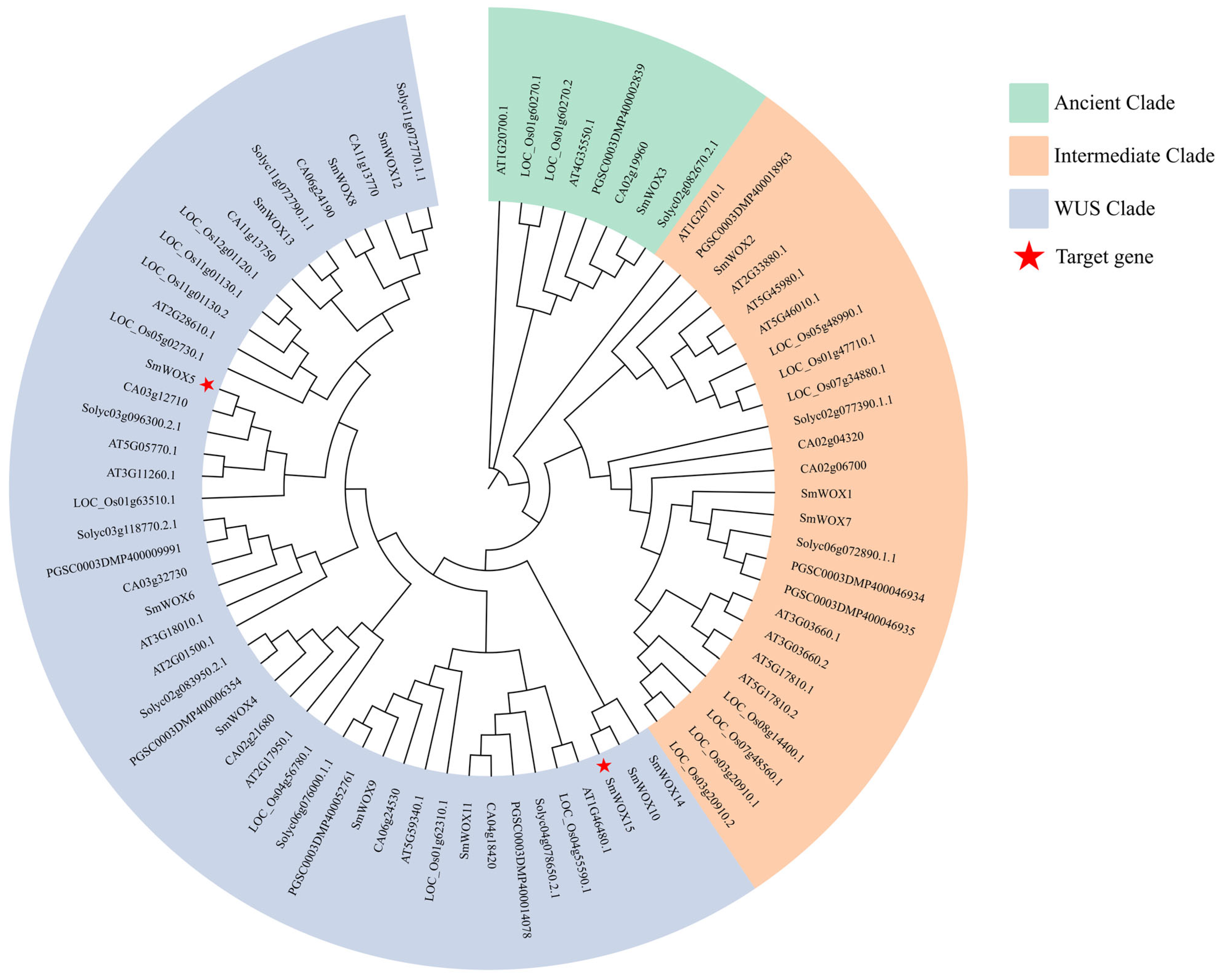
A total of 15 WOX family members were identified in the pepino (Solanum muricatum) genome and designated SmWOX1–SmWOX15 according to their physical order along the chromosomes (Table 1). To elucidate their evolutionary relationships, the deduced amino acid sequences of the 15 SmWOX proteins were aligned with those of WOX proteins from Arabidopsis thaliana (18), tomato (Solanum lycopersicum, 10), pepper (Capsicum annuum, 11), rice (Oryza sativa, 17), and potato (Solanum tuberosum, 8). A maximum-likelihood phylogenetic tree was subsequently constructed (Figure 1). Phylogenetic analysis revealed that all WOX genes clustered into three well-supported clades: the WUS clade, the Intermediate clade, and the Ancient clade. These three clades are distinguished by their phylogenetic positions and conserved motifs, with the WUS clade characterized by the presence of the WUS-box motif, whereas the Ancient clade lacks this motif and represents the most evolutionarily conserved lineage. Among them, the WUS clade comprised the largest number of members, while the Ancient clade contained the fewest.
Table 1.
WOX gene family identified in the pepino genome.
Figure 1.
Phylogenetic tree of WOX proteins.
The pepino WOX family members were most abundantly represented in the WUS clade, comprising 11 members: SmWOX4, SmWOX5, SmWOX6, SmWOX8, SmWOX9, SmWOX10, SmWOX11, SmWOX12, SmWOX13, SmWOX14, and SmWOX15. Among these, SmWOX4 is orthologous to Arabidopsis AtWUS, and SmWOX5 is orthologous to AtWOX5, suggesting conserved functional roles in shoot apical meristem and root apical meristem development, respectively. SmWOX1, SmWOX2, and SmWOX7 cluster within the intermediate clade, whereas SmWOX3 belongs to the Ancient clade. Among the six species analyzed, Arabidopsis is the only one harboring multiple Ancient clade WOX genes; all other species possess a single representative. Phylogenetic analyses revealed that pepino exhibits higher sequence homology and closer evolutionary relationships with tomato, potato, and pepper, whereas it displays lower homology and more distant evolutionary divergence from Arabidopsis and rice.
3.2. Bioinformatics Analysis of SmWOX Gene Family
3.2.1. Physicochemical Property Analysis
Prediction of the physicochemical properties of the pepino WOX family proteins revealed the following ranges: amino acid length, 163–898; molecular weight, 19,263.73–98,884.23 Da; isoelectric point (pI), 5.47–9.98; instability index, 40.93–69.53; and aliphatic index, 49.3–87.03. The grand average of hydropathicity (GRAVY) values ranged from 1.031 to 0.103 consistently negative, indicating that all WOX proteins are hydrophilic in nature (Table S2).
3.2.2. Conserved Motif and Gene Structure Analyses
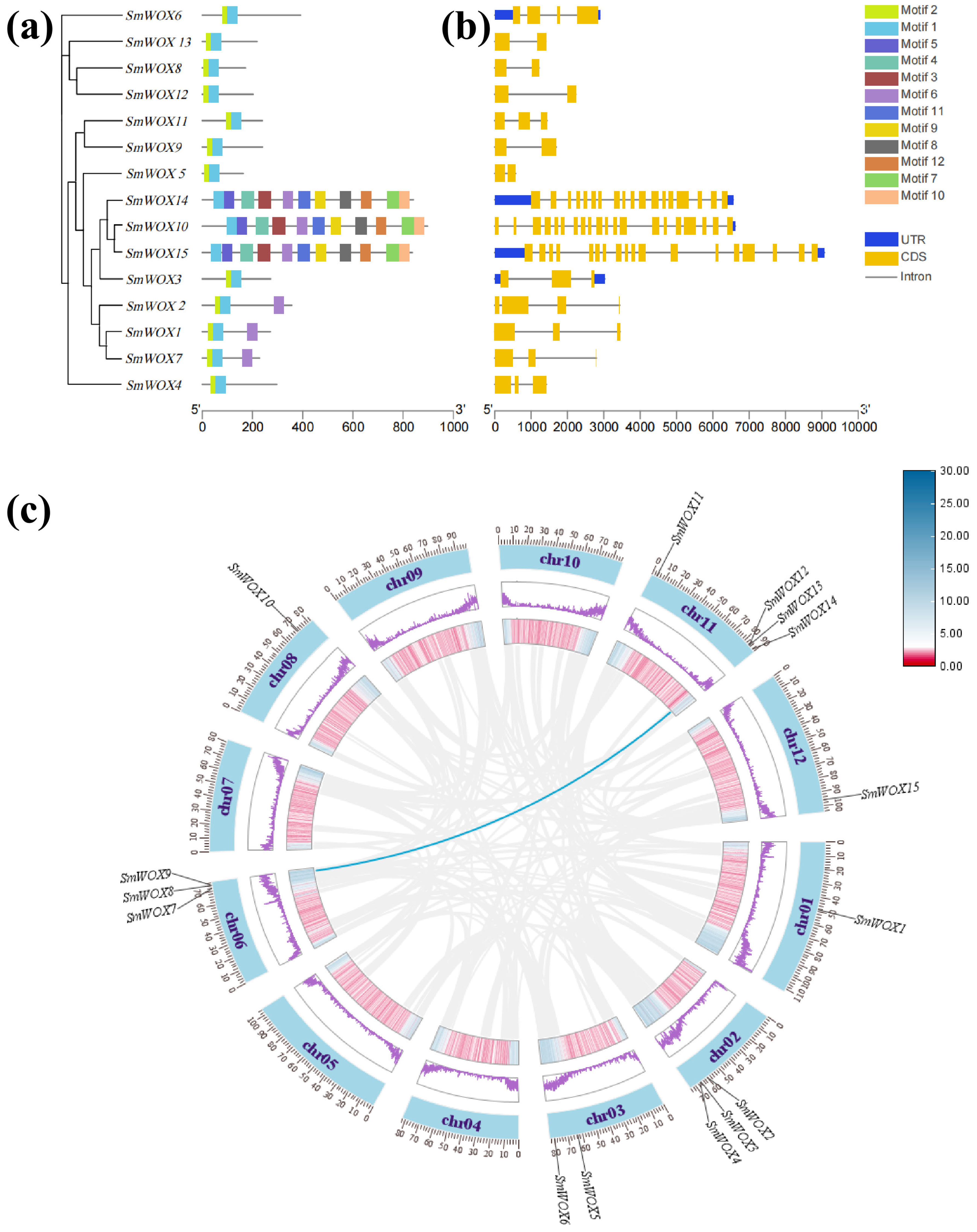
Conserved motif prediction analysis identified a total of 12 conserved motifs across the WOX family. Motif 1 was present in all family members, suggesting its potential role as a core functional motif essential for WOX protein activity. With the exception of SmWOX10, SmWOX14, and SmWOX15, which each harbored 11 conserved motifs, the remaining family members contained only 2–3 conserved motifs, all of which included Motif 2. In contrast, Motifs 3–5 and 7–12 were exclusively detected in SmWOX10, SmWOX14, and SmWOX15 (Figure 2a).
Figure 2.
Conserved motifs, gene structures, and chromosomal distribution of the pepino WOX family. (a) Conserved motifs identified in pepino WOX proteins. (b) Gene structure (exon–intron organization) of pepino WOX genes. (c) Chromosomal distribution of pepino WOX genes on 12 chromosomes.
Gene structure analysis showed that 10 of the 15 family members (SmWOX13, SmWOX8, SmWOX12, SmWOX11, SmWOX9, SmWOX5, SmWOX2, SmWOX1, SmWOX7, and SmWOX4) contained only CDS regions, while five members (SmWOX6, SmWOX14, SmWOX10, SmWOX15, and SmWOX3) contained UTR regions. Among them, SmWOX10 had the highest number of CDS (20), SmWOX14 and SmWOX15 each contained 18 CDS, and the remaining members had 2–4 introns (Figure 2b).
3.2.3. Chromosomal Localization and Duplication Event Analyses
The pepino WOX genes were unevenly distributed across the 12 chromosomes, with no SmWOX genes located on chromosomes 4, 5, 7, 9, or 10. Chromosome 11 harbored the highest number of WOX genes (four: SmWOX11, SmWOX12, SmWOX13, and SmWOX14). Chromosome 2 contained SmWOX2, SmWOX3, and SmWOX4; chromosome 6 contained SmWOX7, SmWOX8, and SmWOX9; chromosome 3 carried two genes (SmWOX5 and SmWOX6); and chromosomes 1, 8, and 12 each harbored a single gene (SmWOX1, SmWOX10, and SmWOX15, respectively). Gene duplication analysis identified only one pair of segmentally duplicated genes among the pepino WOX family, SmWOX8 and SmWOX12 (Figure 2c).
3.2.4. Promoter Cis-Regulatory Element Analysis
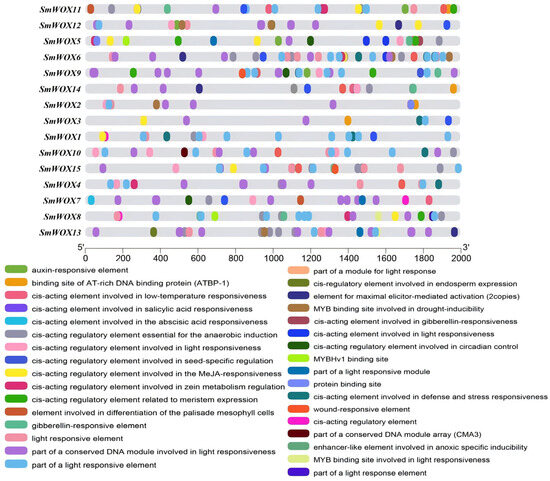
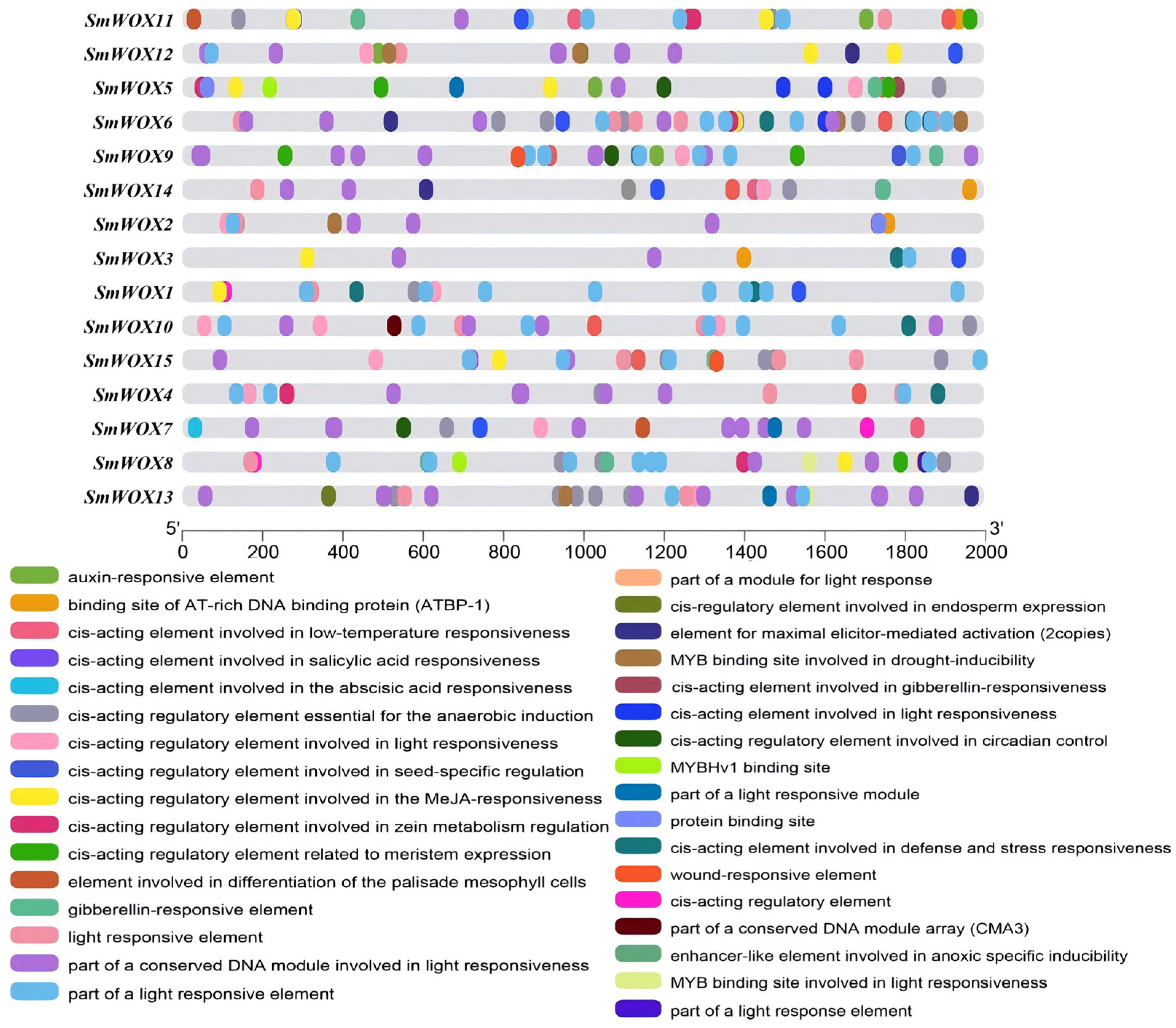
To analyze the functional characteristics of the SmWOX genes, the 2000 bp genomic sequences upstream of the translational start codon (ATG) for each gene were retrieved for promoter analysis. Cis-regulatory elements were predicted using the PlantCARE database. The results revealed that, in addition to core promoter elements (e.g., TATA-box and CAAT-box), the identified cis-elements were predominantly grouped into four functional categories: light-responsive elements, phytohormone-responsive elements, abiotic stress-responsive elements, and elements associated with plant growth and development. Among these, light-responsive elements were the most abundant; ten distinct types were identified and were widely distributed across multiple SmWOX promoters. Seven abiotic stress-related elements were detected, including two anaerobic induction elements (ARE), one low-temperature responsive element (LTR), two MYB binding sites (MBS), and two wound responsive elements (WUN-motif). Furthermore, six phytohormone responsive elements and eight growth- and development-related elements were identified. With respect to phytohormone responsiveness, cis-elements conferring sensitivity to abscisic acid (ABA), auxin (IAA), gibberellin (GA), methyl jasmonate (MeJA), and salicylic acid (SA) were present in the promoters of most SmWOX genes. Regarding growth and development, the ATBP-1 motif represents an AT-rich sequence binding site, whereas CMA3 is implicated in the regulation of developmental stage transitions. Notably, several SmWOX genes also harbored cis-elements linked to meristem-specific expression, seed-specific regulation, palisade mesophyll cell differentiation, and endosperm expression (Figure 3). Collectively, these findings suggest that the WOX gene family plays pivotal roles in mediating light signaling and phytohormone-regulated processes during pepino development.
Figure 3.
Cis-regulatory element analysis of SmWOX gene promoters.
3.2.5. Synteny Analysis Across Species
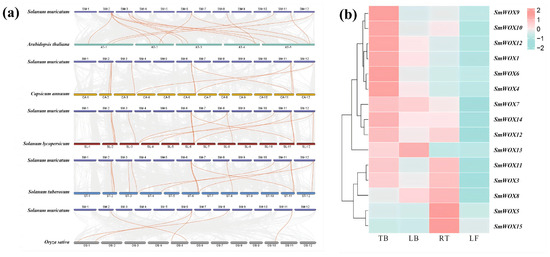
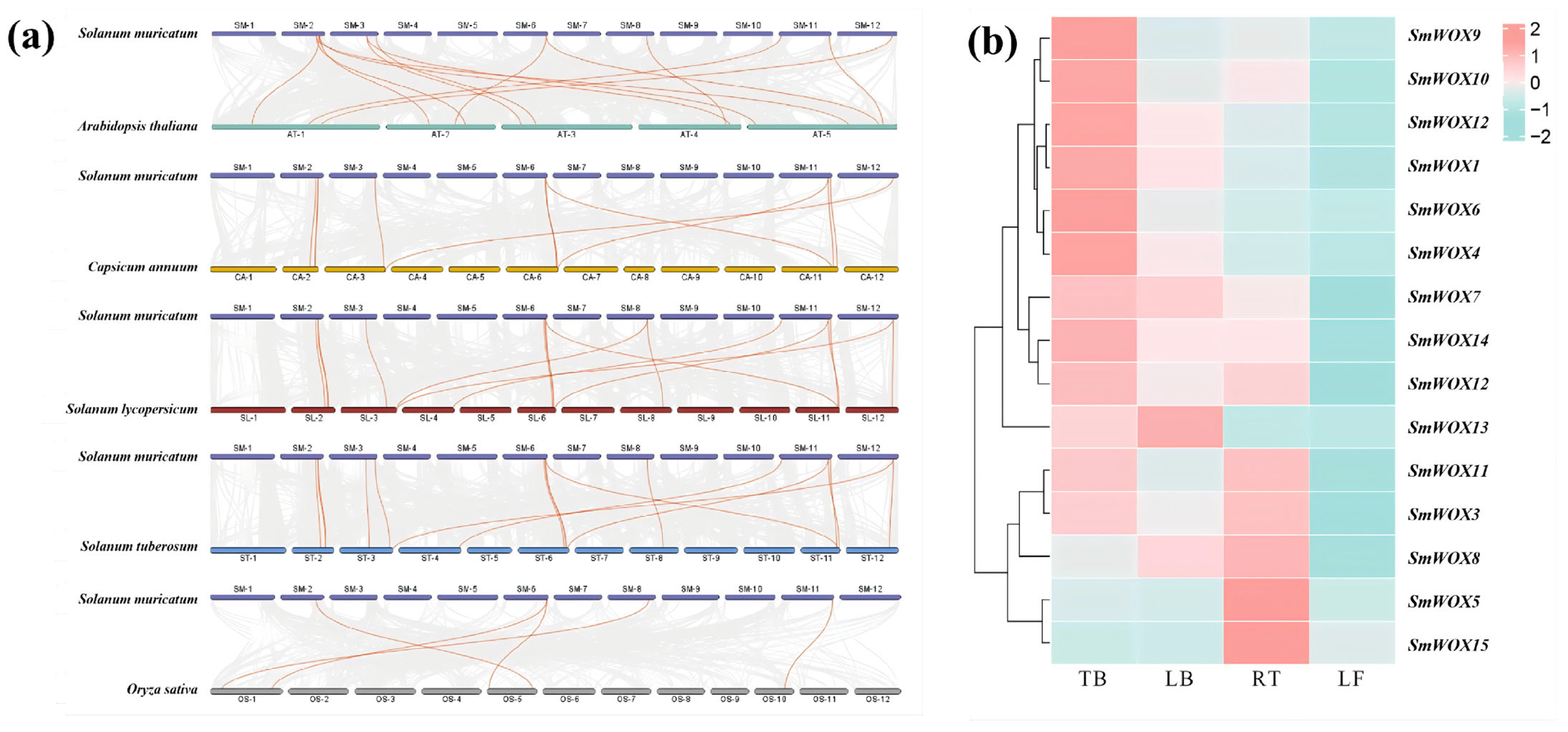
Synteny analysis revealed variations in the number of WOX syntenic gene pairs between pepino and the other examined species. A total of 14 syntenic gene pairs were identified between pepino and Arabidopsis thaliana, located on pepino chromosomes 2, 3, 6, 8, 11, and 12. Between pepino and pepper (Capsicum annuum), 11 syntenic gene pairs were detected, distributed across chromosomes 2, 3, 6, 11, and 12. The highest numbers of syntenic gene pairs were observed between pepino and tomato (Solanum lycopersicum) and between pepino and potato (Solanum tuberosum), with 15 pairs in each case likely reflecting their close phylogenetic relationship as members of the Solanaceae family. In contrast, the fewest syntenic gene pairs were found between pepino and rice (Oryza sativa), with only five pairs distributed on chromosomes 2, 6, 8, and 11 consistent with their more distant evolutionary divergence. Notably, SmWOX2, SmWOX8, SmWOX9, and SmWOX10 formed homologous gene pairs across all five species, suggesting that these genes may play critical roles in plant evolution (Figure 4a).
Figure 4.
Chromosomal localization and tissue-specific expression patterns of SmWOX genes in pepino. (a) Chromosomal localization and synteny analysis of SmWOX genes. The 12 chromosomes are indicated by bars, and the scale bar represents megabases (Mb). Segmental duplication pairs are connected by red lines. (b) Tissue-specific expression patterns of SmWOX genes. Expression levels in apical bud, lateral bud, root, and leaf are shown using a color scale from 5 to 35, representing relative expression values. The UBI119 gene was used as the internal control.
3.3. Differential Expression Analysis in Different Tissues
To further characterize the expression patterns and potential functional roles of the WOX gene family across different pepino (Solanum muricatum) tissues, RT-qPCR was employed to quantify the transcript levels of all 15 identified WOX genes in four representative tissues: apical buds, lateral buds, roots, and leaves. The results revealed that most WOX genes exhibited highest expression in apical buds, followed by lateral buds and roots, with the lowest expression consistently observed in leaves. Notably, apical and lateral buds constitute the primary sites of meristematic activity. Within these tissues, members of the WUS clade and all members of the Intermediate clade showed relatively higher expression levels, including SmWOX9, SmWOX10, SmWOX2, SmWOX1, SmWOX6, and SmWOX4, thereby reinforcing the central involvement of pepino WOX genes in the regulation of plant growth and development (Figure 4b). In contrast, SmWOX5 and SmWOX15 displayed moderate expression in roots; notably, SmWOX15 expression was significantly higher than that of SmWOX5 (Table S3), suggesting a potentially specialized role for SmWOX15 in root development and root meristem maintenance.
3.4. Sequence and Structural Features of SmWOX5 and SmWOX15
3.4.1. Gene Analysis of SmWOX5 and SmWOX15
Agarose gel electrophoresis of the PCR amplicons yielded distinct bands corresponding to the expected sizes (Figure S2A). Sanger sequencing confirmed that the full length coding sequences of SmWOX5 and SmWOX15 are 492 bp and 2514 bp in length, respectively, encoding polypeptides of 163 and 837 amino acids.
3.4.2. Bioinformatics Analysis of SmWOX5 and SmWOX15
Transmembrane structure prediction indicated that neither SmWOX5 nor SmWOX15 harbors any transmembrane domains across their full length sequences, as evidenced by stable and consistently low prediction probability profiles. These results strongly suggest that both proteins are non-transmembrane, cytosolic or nuclear localized factors (Figure S3A). Signal peptide prediction analysis revealed that the N-terminal sequences of both proteins failed to meet the established threshold for signal peptide identification, indicating the absence of canonical signal peptides and supporting the conclusion that SmWOX5 and SmWOX15 are not classical secretory proteins (Figure S3B).
Protein phosphorylation site analysis identified multiple potential phosphorylation sites in both SmWOX5 and SmWOX15; however, marked differences were observed in both the number and spatial distribution of these sites. SmWOX5, characterized by a relatively short polypeptide chain (~160 amino acids), possesses a limited number of predicted phosphorylation sites, predominantly localized on serine residues, followed by threonine and, to a lesser extent, tyrosine. Only a small subset of these sites exhibited phosphorylation propensity scores marginally exceeding the prediction threshold, implying that SmWOX5 may undergo relatively constrained, context-specific phosphorylation-mediated regulation. In contrast, SmWOX15, featuring a substantially longer sequence (~800 amino acids), contains numerous predicted phosphorylation sites distributed broadly along its primary structure. Notably, sites with scores significantly above the threshold are enriched within the N-terminal region (residues 0–300), where serine and threonine residues display markedly elevated phosphorylation potential; several tyrosine residues in this region also exhibit clear, above-threshold phosphorylation propensity. Collectively, these findings suggest that SmWOX15 is likely engaged in more extensive and dynamic signal perception, transduction, and protein–protein interaction networks (Figure S3C).
Secondary structure prediction indicated that SmWOX5 is predominantly composed of random coils (66.26%), with α-helices (20.86%) and β-sheets (12.88%) constituting the remainder. Tertiary structure modeling further revealed a comparatively simple three-dimensional architecture, supported by a high template–model sequence identity (85.80%) and a Global Model Quality Estimation (GMQE) score of 0.6. For SmWOX15, the secondary structure exhibited a more complex and compact structural organization (Figure S3D).
3.5. Subcellular Distribution of SmWOX5 and SmWOX15
3.5.1. Vector Construction
Detection of the recombinant vectors by 1% agarose gel electrophoresis revealed distinct bands corresponding to the expected sizes of pCAMBIA2300-SmWOX5-GFP and pCAMBIA2300-SmWOX15-GFP, confirming successful vector construction (Figure S2B).
3.5.2. Subcellular Localization Results
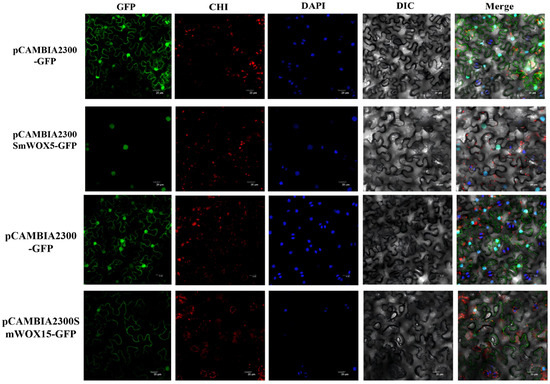
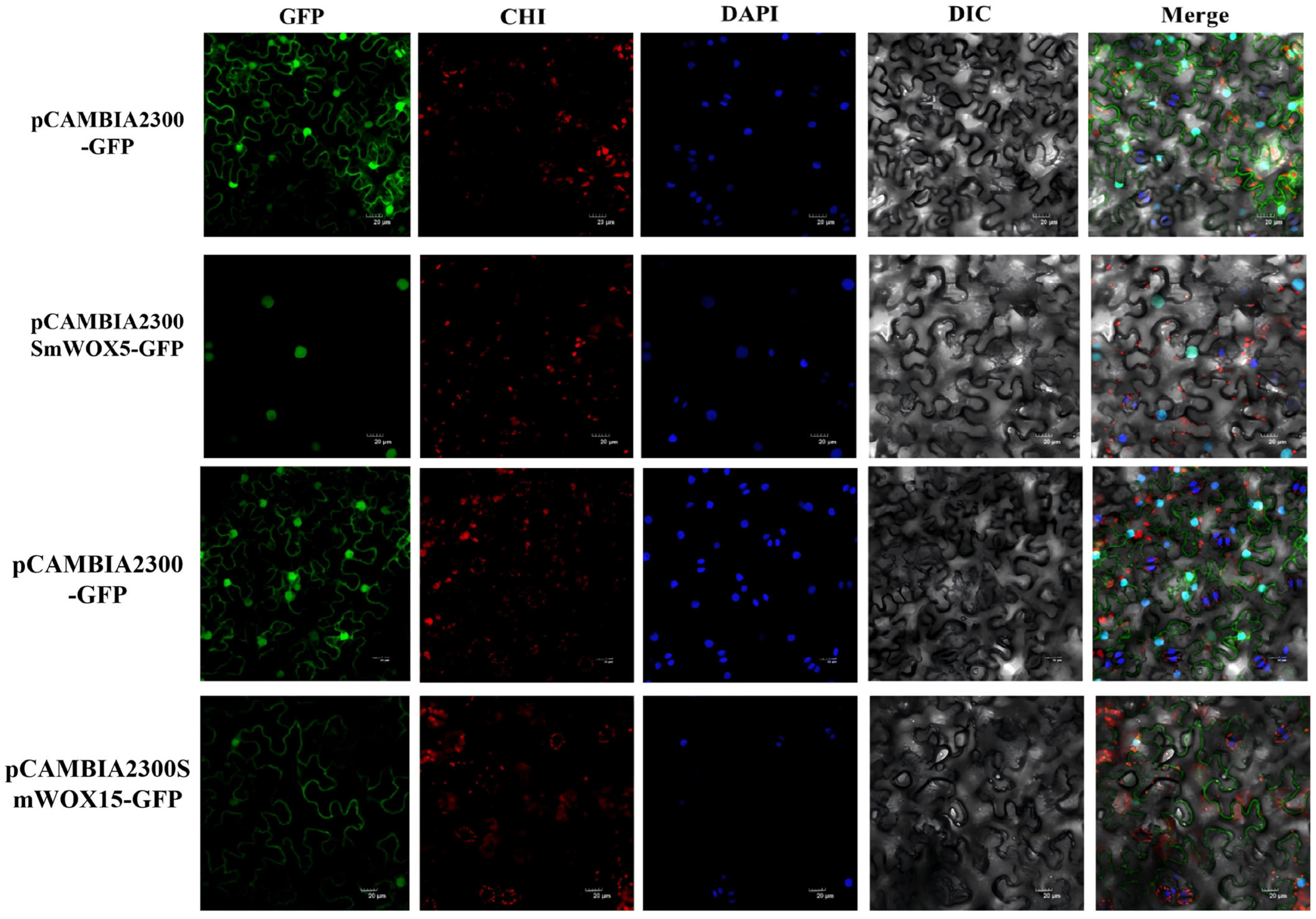
Using the empty vector pCAMBIA2300 as a control, green fluorescence was observed throughout the cytoplasm and nucleus, consistent with the expected diffuse localization of free GFP. Subcellular localization analysis of the pCAMBIA2300-SmWOX5-GFP and pCAMBIA2300-SmWOX15-GFP fusion proteins revealed that GFP fluorescence signals were predominantly localized to the nucleus, with the GFP signals detected in the same regions as DAPI-stained nuclei. Notably, in addition to nuclear accumulation, SmWOX15-GFP also displayed distinct GFP fluorescence at the plasma membrane (Figure 5). These findings indicate that SmWOX5 is exclusively nuclear, whereas SmWOX15 exhibits predominant nuclear localization with partial association at the plasma membrane.
Figure 5.
Subcellular localization of SmWOX5 and SmWOX15 proteins in tobacco leaf epidermal cells. The recombinant vectors pCAMBIA2300-SmWOX5-GFP and pCAMBIA2300-SmWOX15-GFP were transiently expressed in Nicotiana benthamiana leaves. GFP fluorescence (green), chlorophyll autofluorescence (red), and DAPI-stained nuclei (blue) were visualized using confocal microscopy. Merged images (Merge) and bright-field (DIC) images are shown. Bars = 20 μm. The empty vector (pCAMBIA2300-GFP) was used as a control.
4. Discussion
4.1. Evolutionary Features of the WOX Gene Family in Pepino
In this study, a total of 15 WOX genes were identified in the pepino (Solanum muricatum) genome. This number is comparable to those found in other Solanaceae species, such as tomato (10), pepper (11), and potato (11), and is identical to that in Arabidopsis thaliana (15). In contrast, it is higher than in rice (14). These results suggest that, while the WOX family size is generally conserved in Solanaceae and close to that of Arabidopsis, a slight variation exists among different lineages [23,24]. Phylogenetic analysis classified these genes into three evolutionarily conserved clades, namely the WUS clade (11 members), the Intermediate clade (3 members), and the Ancient clade (1 member), a tripartite organization widely observed across angiosperms [14,25,26]. The WUS clade constituted the largest proportion (73.3%) of WOX genes in pepino, a distribution pattern consistent with those in tomato and potato, implying relatively active evolutionary diversification of this clade within the Solanaceae. However, notable differences exist in the WUS clade composition: pepino has 11 WUS-clade members, whereas tomato and potato have fewer (eight), suggesting that the WUS clade may have undergone slight expansion in pepino after divergence from other Solanaceae lineages. In contrast, the Ancient clade comprised only a single gene, SmWOX3, mirroring the pattern observed in most angiosperms and indicating strong purifying selection acting on this deeply conserved lineage [27]. Synteny analysis revealed that pepino shares the greatest number of syntenic gene pairs with tomato and potato (15 pairs each) and the fewest with rice (5 pairs), aligning with the well-established close phylogenetic relationship among the three Solanaceae species. Notably, only one pair of segmentally duplicated genes, SmWOX8 and SmWOX12, was detected, suggesting that segmental duplication has not been a major driver of WOX family expansion in pepino [19]. These results suggest that while the overall WOX family structure is conserved in Solanaceae, species-specific variations in gene number and clade composition may reflect divergent evolutionary trajectories. Importantly, while previous WOX studies in tomato, pepper, and potato have been largely limited to bioinformatic predictions and expression profiling, our study goes beyond by providing direct experimental validation of subcellular localization for two root-enriched WOX proteins in a Solanaceae species.
4.2. High Root Expression of SmWOX5 and SmWOX15 and Its Relationship with Cutting Propagation
Tissue-specific expression analysis revealed that SmWOX5 and SmWOX15 exhibited significantly higher transcript levels in roots compared with other tissues, with SmWOX15 showing markedly greater expression than SmWOX5. WOX5 is a well-established core regulator of root apical meristem (RAM) maintenance, with evolutionarily conserved functions across diverse plant species, including Arabidopsis thaliana and Oryza sativa [28,29]. Thus, the pronounced root-specific expression of SmWOX5 strongly suggests a conserved role in RAM maintenance in Solanum muricatum. The exceptionally high expression of SmWOX15 in roots is particularly noteworthy, given that adventitious root formation is essential for successful stem-cutting propagation [30]. Accumulating evidence implicates multiple WOX family members in adventitious root development: OsWOX11 regulates crown root initiation in rice [18,31], and WOX genes in Eucalyptus display dynamic, stage-specific expression patterns during adventitious root formation [32]. Since pepino is predominantly propagated via stem cuttings, the robust root-specific expression of SmWOX15 implies a potential functional role in adventitious root initiation, particularly in response to wound-induced auxin signaling during cutting propagation. Consistent with this hypothesis, promoter sequence analysis revealed that most SmWOX genes harbor canonical auxin-responsive cis-elements (AuxREs), further supporting their regulation by auxin-mediated signaling pathways [33].
4.3. Differences in Subcellular Localization Between SmWOX5 and SmWOX15
Subcellular localization analysis revealed that SmWOX5 is exclusively localized to the nucleus, whereas SmWOX15 exhibits predominant nuclear localization with partial accumulation at the plasma membrane. The strictly nuclear localization of SmWOX5 is consistent with its predicted role in root apical meristem (RAM) maintenance and aligns with the canonical localization pattern of classical WOX proteins, such as AtWOX5 [26]. In contrast, the dual (nuclear and plasma membrane) localization of SmWOX15 is relatively uncommon among WOX family members. Structural prediction indicates that SmWOX15 (837 amino acids) is substantially longer than SmWOX5 (163 amino acids) and harbors numerous putative phosphorylation sites particularly enriched in its N-terminal region (residues 1–300). Previous studies have shown that the subcellular distribution of transcription factors can be dynamically regulated by post-translational modifications, including phosphorylation [34,35], and certain transcription factors undergo transient retention at the plasma membrane via interactions with membrane-anchored proteins [36]. Based on these observations, we hypothesize that the plasma membrane association of SmWOX15 may represent a dynamic “signal-sensing” state. It is tempting to speculate that, upon perception of specific extracellular or intracellular cues, SmWOX15 could be phosphorylated and subsequently translocated into the nucleus to modulate transcriptional programs. However, we acknowledge that this model is currently speculative and requires direct experimental validation, such as phosphorylation assays, time-course imaging, and stimulus-response experiments, in future studies. By comparison, SmWOX5 possesses a more compact structure and a highly specialized functional role; its exclusive nuclear localization reflects the evolutionary conservation of its function in RAM maintenance.
In summary, SmWOX5 and SmWOX15 likely exhibit functional divergence during root development and adventitious root formation in pepino: SmWOX5 appears to be primarily dedicated to sustaining the root apical meristem, whereas SmWOX15 may act as a regulatory node integrating environmental or developmental signals to modulate adventitious root initiation. However, the functional roles of SmWOX5 and SmWOX15 in root development and cutting propagation need to be further validated through stable genetic transformation and ectopic expression studies. Future work will focus on generating transgenic pepino lines overexpressing these two genes to elucidate their common and specific functions, which will provide valuable genetic resources for pepino breeding programs.
5. Conclusions
In this study, a total of 15 WOX family genes were identified in the pepino (Solanum muricatum) genome. Phylogenetic analysis grouped these genes into three evolutionarily distinct clades: the WUS clade (11 members), the Intermediate clade (3 members), and the Ancient clade (1 member). Tissue-specific expression profiling revealed that SmWOX5 and SmWOX15 exhibited markedly elevated expression levels in roots. Subcellular localization assays demonstrated that SmWOX5 is exclusively localized to the nucleus, whereas SmWOX15 displays predominant nuclear localization with partial accumulation at the plasma membrane. Collectively, these findings identify SmWOX5 and SmWOX15 as promising candidate genes and provide a theoretical foundation for enhancing adventitious root formation in pepino cuttings, and thereby improving cutting propagation efficiency, through targeted regulation of these two genes.
Supplementary Materials
The following supporting information can be downloaded at: https://www.mdpi.com/article/10.3390/cimb48080782/s1.
Author Contributions
Conceptualization, L.W. and X.S.; methodology, Y.C.; formal analysis, X.Z.; investigation, Y.C.; writing—original draft preparation, X.Z.; writing—review and editing, L.W.; visualization, Y.C.; funding acquisition, S.Y. All authors have read and agreed to the published version of the manuscript.
Funding
This research was financially supported by the National Natural Science Foundation of China (NSFC), (No. 32560738).
Institutional Review Board Statement
Not applicable.
Informed Consent Statement
Not applicable.
Data Availability Statement
The CDS sequences of SmWOX5 and SmWOX15 have been deposited in the GenBase database of the China National Center for Bioinformation (CNCB) under accession numbers C_AA491322.1 (SmWOX5) and C_AA491323.1 (SmWOX15).
Acknowledgments
We are grateful to Cheng Si, Zhu Sun, Yujiang Wu, and Yuan Zong for their help with this study.
Conflicts of Interest
The authors declare no conflicts of interest.
References
- Anderson, G.J.; Jansen, R.K.; Kim, Y. The origin and relationships of the pepino, Solanum muricatum (solanaceae): DNA restriction fragment evidence. Econ. Bot. 1996, 50, 369–380. [Google Scholar] [CrossRef] [Scilit]
- Herraiz, F.J.; Raigón, M.D.; Vilanova, S.; García-Martínez, M.D.; Gramazio, P.; Plazas, M.; Rodríguez-Burruezo, A.; Prohens, J. Fruit composition diversity in land races and modern pepino (Solanum muricatum) varieties and wild related species. Food Chem. 2016, 203, 49–58. [Google Scholar] [CrossRef] [Scilit] [PubMed]
- Chan, H.T.L.; Chan, K.M.; Abhreet-Kaur; Sam, S.W.; Chan, S.W. A review of the pharmacological effects of solanum muricatum fruit (Pepino melon). Foods 2024, 13, 2740. [Google Scholar] [CrossRef] [Scilit] [PubMed]
- Rodríguez-Burruezo, A.; Prohens, J.; Fita, A.M. Breeding strategies for improving the performance and fruit quality of the pepino (Solanum muricatum): A model for the enhancement of underutilized exotic fruits. Food Res. Int. 2011, 44, 1927–1935. [Google Scholar] [CrossRef] [Scilit]
- Nemati, S.H.; Karimian, Z.; Tehranifar, A.; Mashhadian, N.V.; Lakzian, A. Investigation of some effective factors on yield traits of pepino (Solanum muricatum) as a new vegetable in iran. Pak. J. Biol. Sci. 2009, 12, 492–497. [Google Scholar] [CrossRef] [Scilit] [PubMed]
- Khan, F.S.; Goher, F.; Hu, C.G.; Zhang, J.Z. WUSCHEL-related homeobox (WOX) transcription factors: Key regulators in combating abiotic stresses in plants. Hortic. Adv. 2024, 2, 2. [Google Scholar] [CrossRef] [Scilit]
- Dolzblasz, A.; Nardmann, J.; Clerici, E.; Causier, B.; van der Graaff, E.; Chen, J.; Davies, B.; Werr, W.; Laux, T. Stem cell regulation by arabidopsis WOX genes. Mol. Plant 2016, 9, 1028–1039. [Google Scholar] [CrossRef] [Scilit] [PubMed]
- Rasheed, H.; Shi, L.; Winarsih, C.; Jakada, B.H.; Chai, R.; Huang, H. Plant growth regulators: An overview of WOX gene family. Plants 2024, 13, 3108. [Google Scholar] [CrossRef] [Scilit] [PubMed]
- Mukherjee, K.; Brocchieri, L.; Burglin, T.R. A comprehensive classification and evolutionary analysis of plant homeobox genes. Mol. Biol. Evol. 2009, 26, 2775–2794. [Google Scholar] [CrossRef] [Scilit] [PubMed]
- Wang, Z.; Cai, Q.; Xia, H.; Han, B.; Li, M.; Wang, Y.; Zhu, M.; Jiao, C.; Wang, D.; Zhu, J.; et al. Genome-wide identification and comparative analysis of WOX genes in four euphorbiaceae species and their expression patterns in Jatropha curcas. Front. Genet. 2022, 13, 878554. [Google Scholar] [CrossRef] [Scilit] [PubMed]
- Zhou, X.; Han, H.; Chen, J.; Han, H. The emerging roles of WOX genes in development and stress responses in woody plants. Plant Sci. Int. J. Exp. Plant Biol. 2024, 349, 112259. [Google Scholar] [CrossRef] [Scilit] [PubMed]
- Li, M.; Wang, R.; Liu, Z.; Wu, X.; Wang, J. Genome-wide identification and analysis of the WUSCHEL-related homeobox (WOX) gene family in allotetraploid brassica napus reveals changes in WOX genes during polyploidization. BMC Genom. 2019, 20, 317. [Google Scholar] [CrossRef] [Scilit] [PubMed]
- Zheng, R.; Peng, Y.; Chen, J.; Zhu, X.; Xie, K.; Ahmad, S.; Zhao, K.; Peng, D.; Liu, Z.J.; Zhou, Y. The genome-level survey of the WOX gene family in Melastoma dodecandrum lour. Int. J. Mol. Sci. 2023, 24, 17349. [Google Scholar] [CrossRef] [Scilit] [PubMed]
- Deng, Y.; Zhu, Y.; Su, W.; Zhang, M.; Liao, W. Transcription factor WUSCHEL-related homeobox (WOX) underground revelations: Insights into plant root development. Plant Physiol. Biochem. 2025, 224, 109928. [Google Scholar] [CrossRef] [Scilit] [PubMed]
- Wei, X.; Geng, M.; Li, J.; Duan, H.; Li, F.; Ge, X. GhWOX11 and GhWOX12 promote cell fate specification during embryogenesis. Ind. Crops Prod. 2022, 184, 115031. [Google Scholar] [CrossRef] [Scilit]
- Liu, J.; Sheng, L.; Xu, Y.; Li, J.; Yang, Z.; Huang, H.; Xu, L. WOX11 and 12 are involved in the first-step cell fate transition during de novo root organogenesis in Arabidopsis. Plant Cell 2014, 26, 1081–1093. [Google Scholar] [CrossRef] [Scilit] [PubMed]
- Xu, M.; Xie, W.; Huang, M. Two WUSCHEL-related HOMEOBOX genes, PeWOX11a and PeWOX11b, are involved in adventitious root formation of poplar. Physiol. Plant. 2015, 155, 446–456. [Google Scholar] [CrossRef] [Scilit] [PubMed]
- Zhao, Y.; Hu, Y.; Dai, M.; Huang, L.; Zhou, D.X. The WUSCHEL-related homeobox gene WOX11 is required to activate shoot-borne crown root development in rice. Plant Cell 2009, 21, 736–748. [Google Scholar] [CrossRef] [Scilit] [PubMed]
- Xu, X.Z.; Che, Q.Q.; Cheng, C.X.; Yuan, Y.B.; Wang, Y.Z. Genome-wide identiffcation of WOX gene family in apple and a functional analysis of MdWOX4b during adventitious root formation. J. Integr. Agric. 2022, 5, 1332–1345. [Google Scholar] [CrossRef] [Scilit]
- Duan, L.; Hou, Z.; Zhang, W.; Liang, S.; Huangfu, M.; Zhang, J.; Yang, T.; Dong, J.; Che, D. Genome-wide analysis of the WOX gene family and function exploration of RhWOX331 in rose (r. ‘the fairy’). Front. Plant Sci. 2024, 15, 1461322. [Google Scholar] [CrossRef] [Scilit] [PubMed]
- Si, C.; Zhong, Q.; Yang, S. Assembly of Pepino Genome Based on PacBio’s Third-generation Spquencing Technology. Biotechnol. Bull. 2022, 38, 180–190. (In Chinese) [Google Scholar] [CrossRef]
- Si, C.; Yang, S.; Lou, X.; Zhang, G.; Zhong, Q. Effects of light spectrum on the morphophysiology and gene expression of lateral branching in pepino (Solanum muricatum). Front. Plant Sci. 2022, 13, 1012086. [Google Scholar] [CrossRef] [Scilit] [PubMed]
- van der Graaff, E.; Laux, T.; Rensing, S.A. The WUS homeobox-containing (WOX) protein family. Genome Biol. 2009, 10, 248–2129. [Google Scholar] [CrossRef] [Scilit] [PubMed]
- Li, X.; Hamyat, M.; Liu, C.; Ahmad, S.; Gao, X.; Guo, C.; Wang, Y.; Guo, Y. Identification and characterization of the WOX family genes in five solanaceae species reveal their conserved roles in peptide signaling. Genes 2018, 9, 260, Correction in Genes 2018, 9, 457. https://doi.org/10.3390/genes9090457. [Google Scholar] [CrossRef] [Scilit] [PubMed]
- Li, H.; Li, C.; Wang, Y.; Qin, X.; Meng, L.; Sun, X. Genome-wide analysis of the WOX transcription factor genes in dendrobium Catenatum lindl. Genes 2022, 13, 1481. [Google Scholar] [CrossRef] [Scilit] [PubMed]
- Wang, Y.; Yang, L.; Geng, W.; Cheng, R.; Zhang, H.; Zhou, H. Genome-wide prediction and functional analysis of WOX genes in blueberry. BMC Genom. 2024, 25, 434. [Google Scholar] [CrossRef] [Scilit] [PubMed]
- Deveaux, Y.; Toffano-Nioche, C.; Claisse, G.; Thareau, V.; Morin, H.; Laufs, P.; Moreau, H.; Kreis, M.; Lecharny, A. Genes of the most conserved WOX clade in plants affect root and flower development in Arabidopsis. BMC Evol. Biol. 2008, 8, 291. [Google Scholar] [CrossRef] [Scilit] [PubMed]
- Pi, L.; Aichinger, E.; van der Graaff, E.; Llavata-Peris, C.I.; Weijers, D.; Hennig, L.; Groot, E.; Laux, T. Organizer-derived WOX5 signal maintains root columella stem cells through chromatin-mediated repression of CDF4 expression. Dev. Cell 2015, 33, 576–588. [Google Scholar] [CrossRef] [Scilit] [PubMed]
- Sarkar, A.K.; Luijten, M.; Miyashima, S.; Lenhard, M.; Hashimoto, T.; Nakajima, K.; Scheres, B.; Heidstra, R.; Laux, T. Conserved factors regulate signalling in Arabidopsis thaliana shoot and root stem cell organizers. Nature 2007, 446, 811–814. [Google Scholar] [CrossRef] [Scilit] [PubMed]
- Bellini, C.; Pacurar, D.I.; Perrone, I. Adventitious roots and lateral roots: Similarities and differences. Annu. Rev. Plant Biol. 2014, 65, 639–666. [Google Scholar] [CrossRef] [Scilit] [PubMed]
- Geng, L.; Li, Q.; Jiao, L.; Xiang, Y.; Deng, Q.; Zhou, D.X.; Zhao, Y. WOX11 and CRL1 act synergistically to promote crown root development by maintaining cytokinin homeostasis in rice. New Phytol. 2022, 237, 204–216. [Google Scholar] [CrossRef] [Scilit] [PubMed]
- Chen, M.; Luo, J.; Lin, Y.; Huang, A.; Liu, G. Identification and expression profile analysis of WOX family genes in the formation of eucalyptus adventitious root. Forests 2024, 15, 442. [Google Scholar] [CrossRef] [Scilit]
- Yu, J.; Zhang, Y.; Liu, W.; Wang, H.; Wen, S.; Zhang, Y.; Xu, L. Molecular evolution of auxin-mediated root initiation in plants. Mol. Biol. Evol. 2020, 37, 1387–1393. [Google Scholar] [CrossRef] [Scilit] [PubMed]
- Wang, B.; Sun, Z.; Liu, Y.; Xu, B.; Li, J.; Chi, M.; Xing, Y.; Yang, B.; Li, J.; Liu, J.; et al. A pervasive phosphorylation cascade modulation of plant transcription factors in response to abiotic stress. Planta 2023, 258, 73. [Google Scholar] [CrossRef] [Scilit] [PubMed]
- Puertollano, R.; Ferguson, S.M.; Brugarolas, J.; Ballabio, A. The complex relationship between TFEB transcription factor phosphorylation and subcellular localization. EMBO. J. 2018, 37, EMBJ201798804. [Google Scholar] [CrossRef] [Scilit] [PubMed]
- Seo, P.J.; Park, C.M. A membrane-bound NAC transcription factor as an integrator of biotic and abiotic stress signals. Plant Signal. Behav. 2010, 5, 481–483. [Google Scholar] [CrossRef] [Scilit] [PubMed]

Disclaimer/Publisher’s Note: The statements, opinions and data contained in all publications are solely those of the individual author(s) and contributor(s) and not of MDPI and/or the editor(s). MDPI and/or the editor(s) disclaim responsibility for any injury to people or property resulting from any ideas, methods, instructions or products referred to in the content. |
© 2026 by the authors. Licensee MDPI, Basel, Switzerland. This article is an open access article distributed under the terms and conditions of the Creative Commons Attribution (CC BY) license.