This is an early access version, the complete PDF, HTML, and XML versions will be available soon.
Open AccessArticle
Comprehensive Molecular Characterization of Extensively Drug-Resistant Acinetobacter baumannii Isolated from Intensive Care Unit Patients: Carbapenemase Genes, Plasmid-Mediated Resistance Determinants, and PFGE-Based Clonal Analysis
by
Cihat Öztürk
 Cihat Öztürk
Department of Medical Microbiology, Kırşehir Ahi Evran University, Kırşehir 40100, Turkey
Pharmaceuticals 2026, 19(6), 862; https://doi.org/10.3390/ph19060862 (registering DOI)
Submission received: 9 April 2026
/
Revised: 17 May 2026
/
Accepted: 20 May 2026
/
Published: 29 May 2026
Abstract
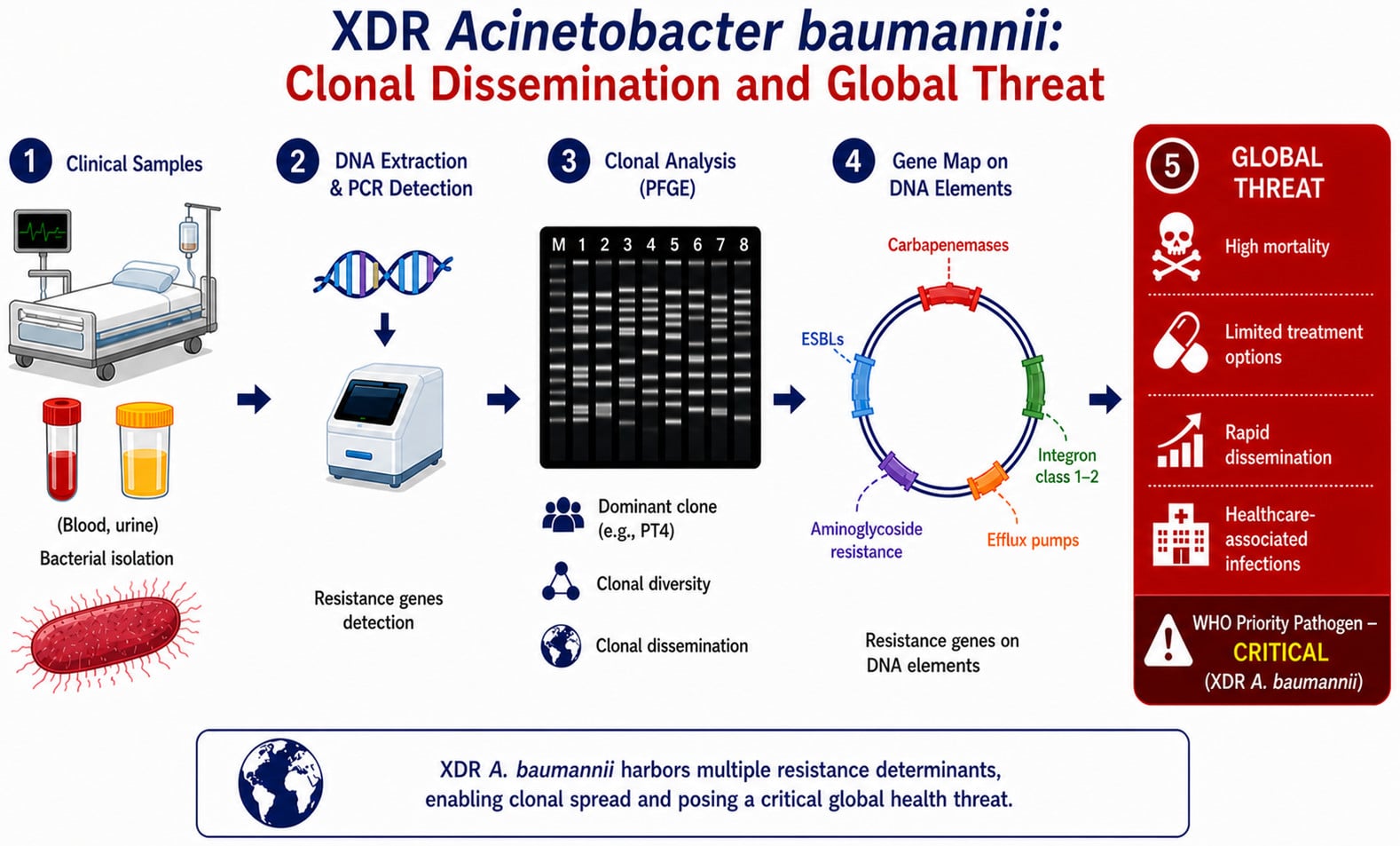
Background: Colistin- and carbapenem-resistant Acinetobacter baumannii (CRAB) represent a critical threat in intensive care unit (ICU) settings. This study aimed to provide a comprehensive molecular epidemiological characterization of extensively drug-resistant (XDR) A. baumannii clinical isolates from a tertiary-care hospital in Kırşehir, Central Anatolia, a region previously absent from the national surveillance literature. Methods: A total of 43 non-duplicate XDR A. baumannii isolates recovered from ICU patients between November 2021 and December 2023 were included. Antimicrobial susceptibility testing was performed by automated systems and broth microdilution for colistin. Resistance genes, including OXA-type carbapenemases, extended-spectrum β-lactamases (ESBLs), metallo-β-lactamases, plasmid-mediated colistin resistance (mcr-1 to mcr-5), plasmid-mediated quinolone resistance genes (qnr, qepA, oqxAB, aac(6′)-Ib-cr), and class 1 and 2 integrons, were screened by PCR. Integron gene cassettes were characterized by sequencing. Clonal relatedness was assessed by pulsed-field gel electrophoresis (PFGE) using ApaI digestion. Results: All 43 isolates exhibited the XDR phenotype with universal resistance to carbapenems, colistin, fluoroquinolones, aminoglycosides (except amikacin), piperacillin, cephalosporins, and tobramycin. Amikacin susceptibility was retained in 58.1% of isolates. blaOXA-51 was detected in all isolates (100%), and blaOXA-23 was the predominant acquired carbapenemase (90.7%). Notably, blaOXA-48, a carbapenemase typically associated with Enterobacteriaceae, was identified in 3 isolates (7.0%), each belonging to a distinct pulsotype. No blaOXA-24/40, blaOXA-58, or class B metallo-β-lactamase genes were detected. ESBL genes were found in a subset of isolates, with blaCTX-M group 1 being the most prevalent (20.9%). The aac(6′)-Ib-cr gene was detected in 81.4% of isolates, and oqxA/oqxB in 60.5% and 39.5%, respectively. No mcr or classical qnr genes were identified. Class 1 and 2 integrons were detected in 4.7% and 7.0% of isolates, respectively, carrying dfrA12-DUF1010-aadA2 (class 1) and dfrA1-sat-1 (class 2) gene cassettes. PFGE identified 12 pulsotypes among the typeable isolates; PT4 (n = 20, 47.6%) and PT11 (n = 8, 19.0%) were the dominant clonal clusters, together accounting for 65.1% of typeable isolates. Conclusions: This study presents one of the first comprehensive molecular epidemiological analyses of XDR A. baumannii from Central Anatolia. The dominance of OXA-23-carrying clonal lineages, the detection of blaOXA-48 in A. baumannii distributed across three distinct pulsotypes, the high prevalence of aac(6′)-Ib-cr, and the concurrent distribution of resistance determinants across genetically diverse clonal backgrounds indicate that both clonal expansion and possible horizontal gene transfer contribute to resistance dissemination in this setting. These findings underscore the need for systematic molecular surveillance and reinforced infection control strategies in ICU settings, at both the regional and national levels.
Share and Cite
MDPI and ACS Style
Öztürk, C.
Comprehensive Molecular Characterization of Extensively Drug-Resistant Acinetobacter baumannii Isolated from Intensive Care Unit Patients: Carbapenemase Genes, Plasmid-Mediated Resistance Determinants, and PFGE-Based Clonal Analysis. Pharmaceuticals 2026, 19, 862.
https://doi.org/10.3390/ph19060862
AMA Style
Öztürk C.
Comprehensive Molecular Characterization of Extensively Drug-Resistant Acinetobacter baumannii Isolated from Intensive Care Unit Patients: Carbapenemase Genes, Plasmid-Mediated Resistance Determinants, and PFGE-Based Clonal Analysis. Pharmaceuticals. 2026; 19(6):862.
https://doi.org/10.3390/ph19060862
Chicago/Turabian Style
Öztürk, Cihat.
2026. "Comprehensive Molecular Characterization of Extensively Drug-Resistant Acinetobacter baumannii Isolated from Intensive Care Unit Patients: Carbapenemase Genes, Plasmid-Mediated Resistance Determinants, and PFGE-Based Clonal Analysis" Pharmaceuticals 19, no. 6: 862.
https://doi.org/10.3390/ph19060862
APA Style
Öztürk, C.
(2026). Comprehensive Molecular Characterization of Extensively Drug-Resistant Acinetobacter baumannii Isolated from Intensive Care Unit Patients: Carbapenemase Genes, Plasmid-Mediated Resistance Determinants, and PFGE-Based Clonal Analysis. Pharmaceuticals, 19(6), 862.
https://doi.org/10.3390/ph19060862
Note that from the first issue of 2016, this journal uses article numbers instead of page numbers. See further details
here.
Article Metrics
Article metric data becomes available approximately 24 hours after publication online.