


Abstract
Background/Objectives: Aggressive behaviour is commonly associated with neurodevelopmental disorders, such as autism spectrum disorder (ASD), and could be understood as a response to daily stress routines, which negatively impacts patients’ quality of life. Oxytocin (OT), a neuropeptide involved in social bonding and socio-affective regulation, has emerged as a promising candidate to enrich, rather than replace, current pharmacological approaches in managing ASD-associated aggressive behaviour. In this study, we examined the potential of OT to modulate aggressive behaviour frequency in a VPA-based animal model of ASD. Methods: Sixty adult zebrafish (1:1 sex ratio) were divided into six groups (n = 10/group) and received the following treatment for 7 consecutive days: CTR—control (no treatment); VPA (28.8 mg/L valproic acid); OT (33.2 ng/mL oxytocin); RIS (170 μg/L risperidone); VPA + OT (28.8 mg/L valproic acid and 33.2 ng/mL oxytocin); and VPA + RIS (28.8 mg/L valproic acid and 170 μg/L risperidone). The locomotor performance, and socio-affective and aggressive behaviours, were measured in the Novel Tank and Mirror Biting tests at the end of the treatments. Results: We observed that the VPA treatment led to locomotion and socio-affective impairments, as well as aggressive behaviour. Also, we found that OT and RIS had comparable potential to modulate the frequency of aggressive and anxiety-like behaviours. Conclusions: Our preliminary data showed that OT has the potential to modulate the frequency of anxiety-like and aggressive behaviours, similarly to the atypical antipsychotic, RIS, in our VPA zebrafish model. However, further studies are needed to investigate the mechanisms of action and their potential synergistic effects.
1. Introduction
Aggressive behaviour could be defined as any deliberate act of inflicting physical or psychological damage to individuals or property [1]. While DSM-5 generically classifies aggressive behaviour as a disorder of impulse control and conduct [2], it could be associated with neurodevelopmental disorders, such as autism spectrum disorder (ASD) [1], implying an altered response to daily stress and decreasing patients’ quality of life. Despite not being a core symptom of ASD, aggressive behaviour could play an important role in the efforts to manage ASD patients, while its pharmacological approaches are currently scarce, with only risperidone (RIS) and aripiprazole being approved by the FDA [3]. Studies have reported that dopamine agonists efficiently improved aggressive behaviour, impulsivity, and stereotypic behaviour [3,4]. The positive effects of other antipsychotics, such as haloperidol, lurasidone, and naltrexone, or serotonin reuptake inhibitors (SSRIs), such as fluoxetine and fluvoxamine, were also described, also used for reducing the symptoms, but not for addressing the underlying causes [3,5].
Oxytocin (OT) is an endogenous polypeptide produced in the hypothalamus and released in the blood circulation by the posterior pituitary gland [6,7]. OT is clinically used for inducing labour, post-partum haemorrhage, lactation, and improving migraine, sexual dysfunctions, and drug addictions [6,8], but also as a therapy adjuvant in neuropsychiatric disorders, such as ASD and schizophrenia [6,7]. In this context, the analgesic effect of OT was reported to contribute to managing pain, anxiety, depressive mood, and stress response in ASD and other psychiatric disorders [6,7,9]. Various animal model studies have described the neurobiological effects of endogenous oxytocin on improving social impairments and associated behavioural manifestations [10,11,12].
Risperidone (RIS) is an atypical antipsychotic antagonising D2 dopaminergic and 5-HT2A serotonin receptors to improve social interactions and reduce aggressive behaviour and irritability [3,5,13]. Despite being widely used to manage ASD patients’ aggressive behaviour, several secondary effects of RIS were reported, mainly due to also being an antagonist of histaminergic H1 receptors, leading to reduced dopaminergic activity, sedation, and increased body weight [13,14].
Due to the ability to perform complex behavioural tasks and increased similarity of brain morphology, neural and signalling pathways with mammalian species, and zebrafish (Danio rerio), are widely used in neurobiological research [15,16,17]. In this way, animal models, such as zebrafish, could contribute to the understanding of the neurobiology of ASD, including the pharmacological modulation of ASD-related socio-affective behaviour, such as social withdrawal, social anxiety, and aggressive or repetitive behaviours, which are the result of highly conserved cognitive pathways [16,18,19].
In this context, this study aimed to evaluate and describe the potential of OT to modulate ASD-associated behaviours, especially aggressive behaviour, in a VPA-based adult zebrafish model, as well as to compare the modulatory potential of OT with that of an atypical antipsychotic widely used to treat aggressive behaviour in ASD patients (i.e., RIS).
2. Results
2.1. The Effect of OT on Exploratory Behaviour
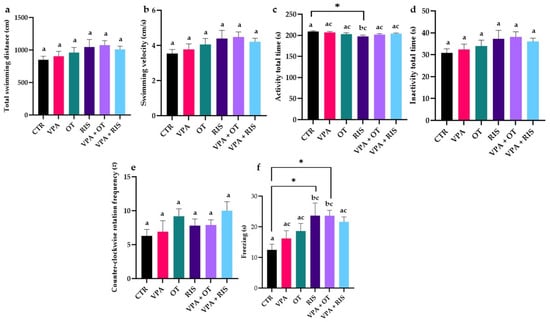
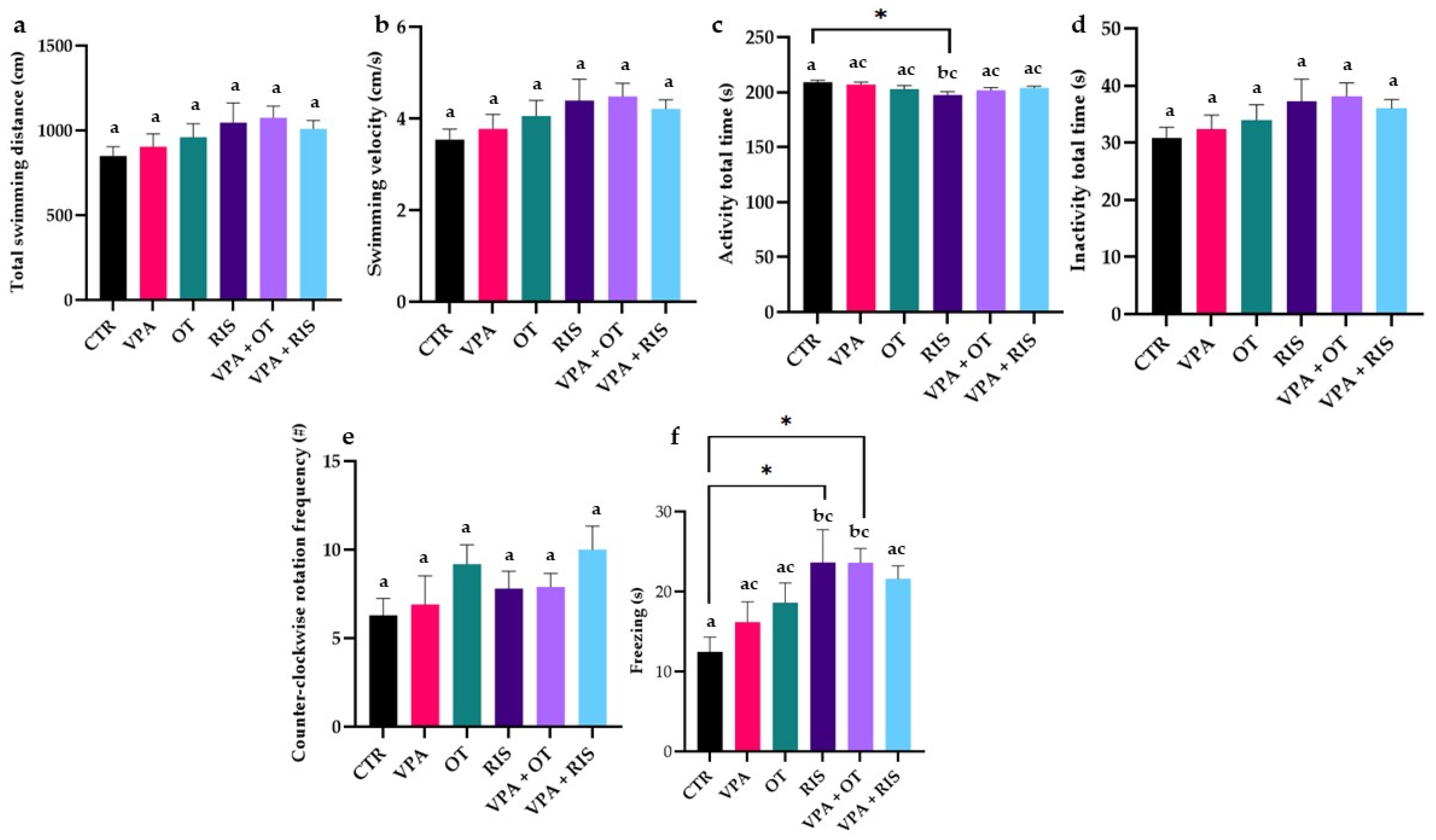
The total swimming distance, along with the swimming velocity, visibly increased in the VPA-treated groups, as compared to healthy individuals. Total activity time decreased, as compared to the CTR group, especially in the RIS group (p < 0.05 in two-way ANOVA test). No significant differences were observed for the inactivity time and counter-clockwise rotation frequency in all experimental groups (Figure 1d,e). On the other hand, freezing time was visibly increased in all groups, as compared to the CTR group (Figure 1f). Significantly higher freezing time was recorded in the RIS (p < 0.05 in a two-way ANOVA test) and VPA + OT (p < 0.05 in a two-way ANOVA test) groups, as compared to the CTR group, suggesting increased anxiety-like states (Figure 1f).
Figure 1.
Locomotor performance, as evaluated using NTT: (a) Total swimming distance (cm); (b) swimming velocity (cm/s); (c) activity total time (s); (d) inactivity total time (s); (e) freezing behaviour duration (s); and (f) counter-clockwise rotation frequency (#). The results are expressed as mean ± SEM (CTR—control; VPA—valproic acid exposure; OT—oxytocin; RIS—risperidone; VPA + OT—valproic acid and oxytocin; and VPA + RIS—valproic acid and risperidone); * p < 0.05 in two-way ANOVA test; a–c in Tukey’s HSD test.
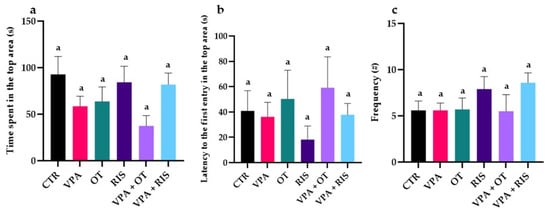
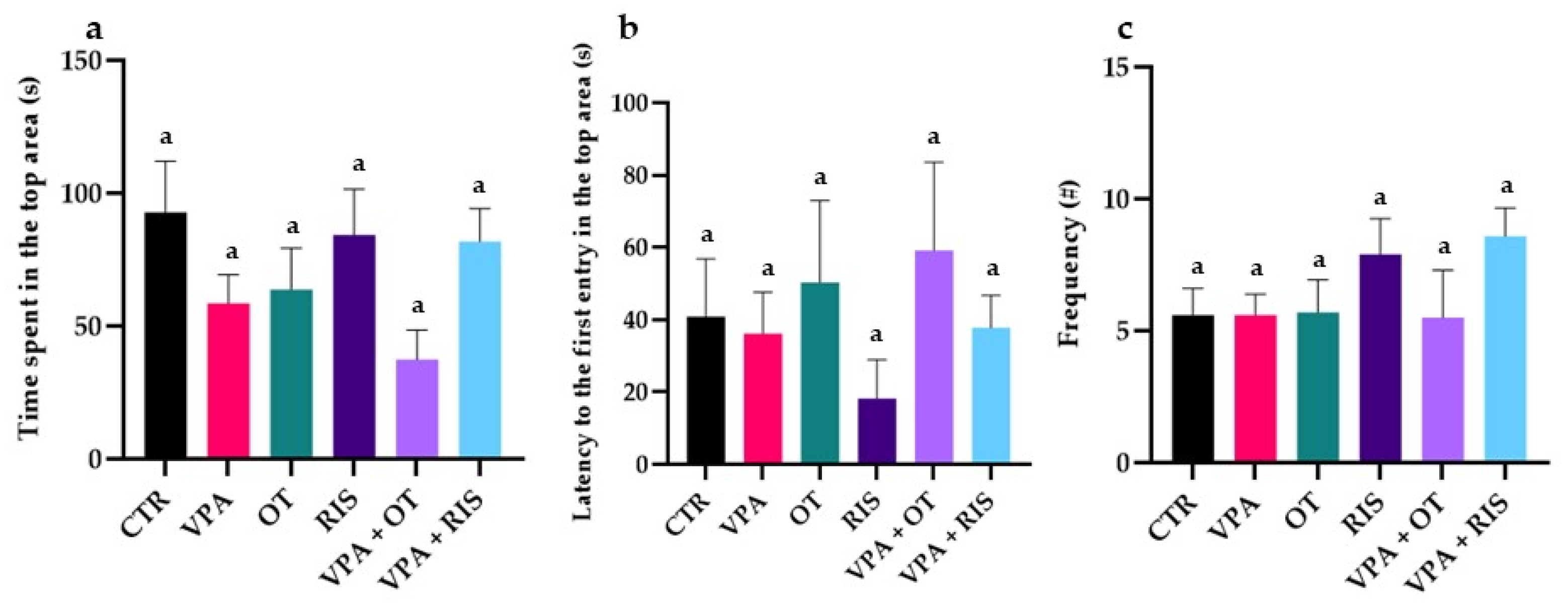
Furthermore, regarding the anxiety-specific behavioural parameters, we found that the time spent in the top area of the tank decreased in the VPA-treated groups, as compared to the CTR group (Figure 2a). OT and RIS, both solely and combined, showed anxiolytic effects in VPA-treated groups (Figure 2). Otherwise, the exposure to OT visibly increased the time spent in the top area (Figure 2a). No significant differences were obtained while comparing some parameters (latency to the first entry in the top area and frequency between the top and button area) relevant for exploratory behaviour when treating the ASD model with OT and RIS (Figure 2b,c).
Figure 2.
Specific behavioural parameters evaluated using NTT: (a) Time spent in the top area (s); (b) latency to the first entry in the top area (s); and (c) zone alternation frequency (#). The results are expressed as mean ± SEM (CTR—control; VPA—valproic acid exposure; OT—oxytocin; RIS—risperidone; VPA + OT—valproic acid and oxytocin; and VPA + RIS—valproic acid and risperidone; letter a marks results of Tukey’s HSD test).
2.2. The Effect of OT on Aggressive Behaviour
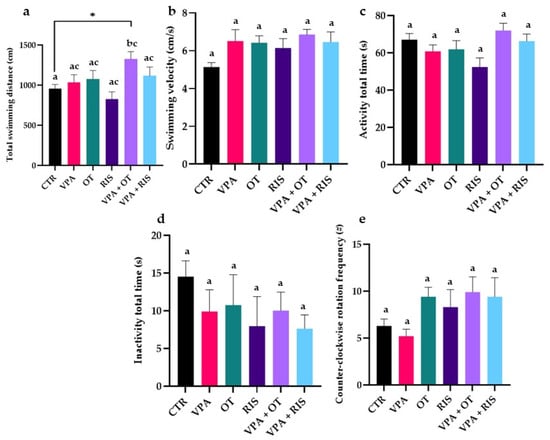
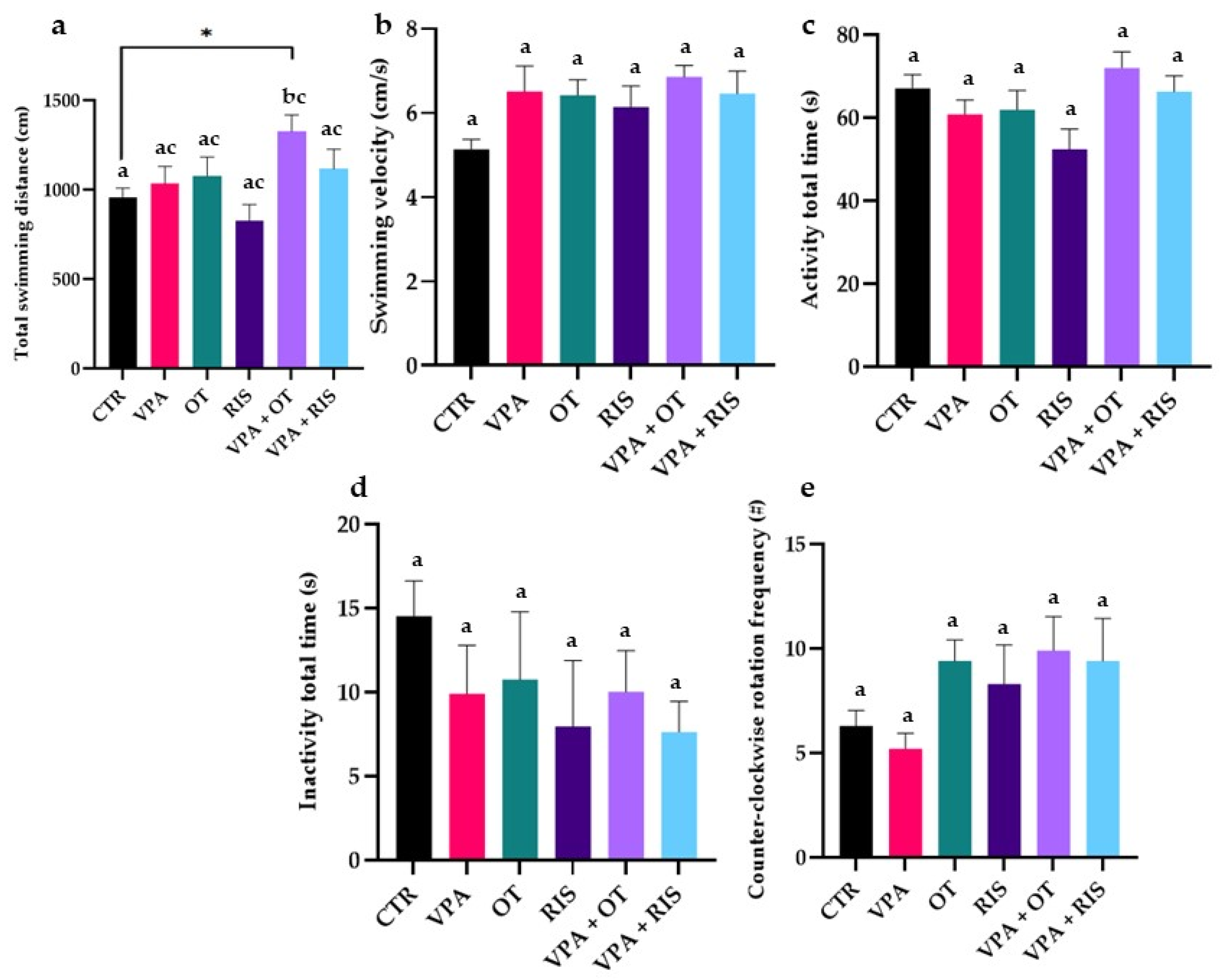
In the MBT, we observed that both locomotion and aggression parameters were impaired after VPA treatment. Regarding the locomotory activity, visible increases in general locomotion parameters were observed for all VPA-treated groups, and significantly for the VPA + OT group (p < 0.05 in two-way ANOVA test), as compared to the CTR group (Figure 3a,b). Similar effects of both OT and RIS-treated groups were observed during evaluating the activity/inactivity total time, along with the counter-clockwise rotation frequency (Figure 3c–e).
Figure 3.
Locomotor performance parameters evaluated in the aggression test: (a) Total swimming distance (cm); (b) swimming velocity (cm/s); (c) activity total time (%); (d) inactivity total time (%); and (e) counter-clockwise rotation frequency (#). The results are expressed as mean ± SEM (CTR—control; VPA—valproic acid exposure; OT—oxytocin; RIS—risperidone; VPA + OT—valproic acid and oxytocin; and VPA + RIS—valproic acid and risperidone; * p < 0.05 in two-way ANOVA test; a–c in Tukey’s HSD test).
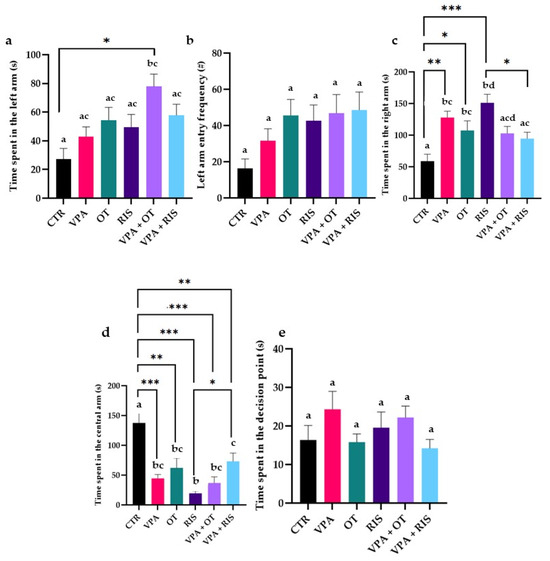
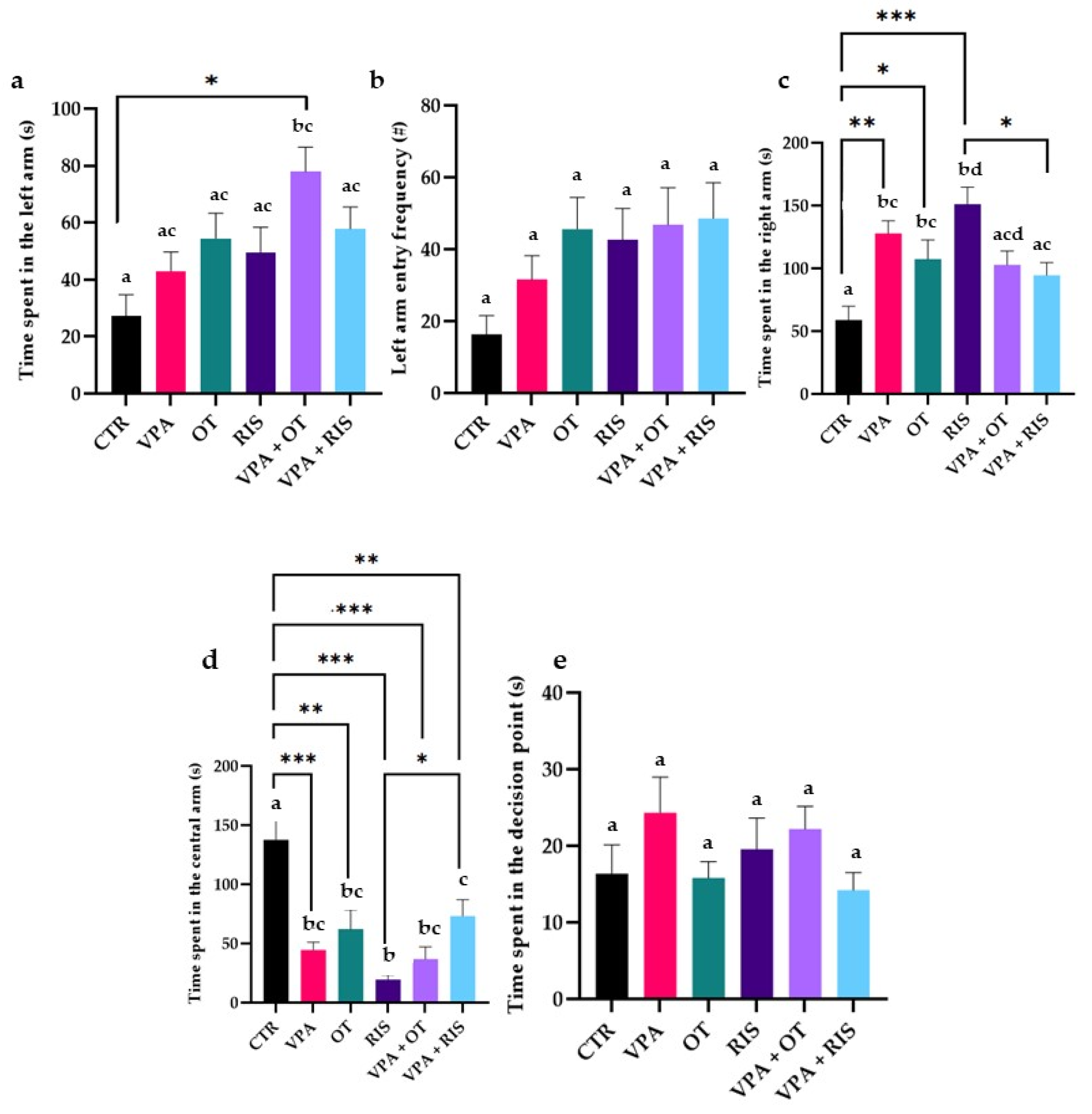
We also observed that the time spent and entry frequency in the arm containing the mirror visibly increased after VPA treatment, as compared to untreated zebrafish. Also, both OT and RIS showed potential in improving aggressive behaviour in VPA-treated zebrafish (Figure 4a,b).
Figure 4.
Aggression behavioural parameters evaluated using MBT: (a) Time spent in the left arm (s); (b) left arm entry frequency (#); (c) time spent in the right arm (s); (d) time spent in the central arm (s); and (e) time spent in the decision point (s). The results are expressed as mean ± SEM (CTR—control; VPA—valproic acid; OT—oxytocin; RIS—risperidone; VPA + OT—valproic acid and oxytocin; and VPA + RIS—valproic acid and risperidone; * p < 0.05, ** p < 0.01, *** p < 0.001 in two-way ANOVA test; a–d in Tukey’s HSD test).
Significant increases in the left arm, as well as in the right arm, central arm, and entry frequency were seen in all experimental groups, as compared to the CTR group (left arm: VPA + OT versus CTR, p < 0.01 in two-way ANOVA test; right arm: CTR versus VPA, p < 0.01; CTR versus OT, p < 0.05; CTR versus RIS, p < 0.001; RIS versus VPA + RIS, p < 0.05 in two-way ANOVA test; central arm: CTR versus VPA, p < 0.001; CTR versus OT, p < 0.01; CTR versus RIS, CTR versus VPA + OT, p < 0.001; CTR versus VPA + RIS, p < 0.01 in two-way ANOVA test). Also, we observed that OT and RIS treatments significantly alleviated anxiety-like behaviour in both untreated and VPA-treated animals, as compared to the CTR group (VPA vs. CTR, p < 0.01; OT vs. CTR, p < 0.01; RIS vs. CTR, p < 0.001, in two-way ANOVA test) (Figure 4c–e).
3. Discussion
Since only two atypical antipsychotics are recommended as standard clinical treatments for aggressive behaviour, the current directions of pharmacotherapy in ASD are limited [10,20]. Thus, recent research proposed improving behavioural outcomes and reducing side effects by complementing existing therapeutic strategies [4,21,22]. While RIS and aripiprazole are effective in reducing aggressive behaviour, irritability, and agitation [23], emerging evidence described the superior potential of OT to improve socio-affective impairments in ASD patients, with fewer side effects [24,25,26]. In this context, our study aimed to evaluate the potential of OT, by relation to RIS, to modulate aggressive and anxiety-like behaviours, in a VPA zebrafish model. Consequently, our results showed that OT and RIS had comparable potential to modulate the frequency of aggressive and anxiety-like behaviours and to improve exploratory behaviour, in both healthy and VPA-treated zebrafish.
Our ASD model consisting in VPA treatment for 7 consecutive days manifested in locomotor impairments and increased frequency of anxiety-like behaviour. The neurotoxic effects of VPA involves multiple nervous system pathways, including the monoaminergic system, leading to behavioural deficits, such as socio-affective impairments [27,28,29,30,31]. Moreover, zebrafish studies showed that VPA neurotoxicity could affect zebrafish brains during all developmental stages in a dose and time-dependent manner [32,33,34]. Nevertheless, the correlation between VPA neurotoxicity and aggressive behaviour was previously documented by multiple studies [32,33,35,36]. Strungaru et al. [37] suggested that even spending more time in the proximity of the mirror (i.e., the left arm) could be a sign of potential engagement, and thus a more intense swimming behaviour near the mirror could be associated with a higher level of aggression. In this context, our group has previously reported that a treatment as light as 2.5 mg/L (18 µM) VPA for 2–11 days could result in increased time spent near the mirror, in adult zebrafish [35]. In the current experimental design, we observed that 28.8 mg/L VPA for 7 days led to increased time spent in the arm containing the mirror. Consistent with that, Li et al., 2024 [32] reported both increased time spent near the mirror and mirror attack frequency in adult zebrafish following acute high doses of VPA (500 µM VPA, meaning 144 mg VPA/L, for 4 consecutive days).
Moreover, when OT is administered together with VPA, a possible synergic effect could be observed. In the MBT test, an escalation in aggressive behaviour frequency was observed in the VPA+OT group, as compared to VPA and CTR groups. This apparent paradoxical effect was previously observed by our group when OT was administered to healthy fish [38]. The mechanism through which this synergic effect is obtained could be based on the interaction between cortisol and OT, as previous studies suggested that VPA could modulate anxiety by decreasing cortisol levels [36,39,40]. In parallel, high OT levels in low cortisol conditions could result in increased aggressive behaviour [41]. Moreover, previous rodent studies explained the implications of OT in modulating primary social behaviour as well as stress response [42,43,44,45]. OT-related amygdala activity modulation could thus be the result of both endogenous and exogenous neuroendocrine factors shaping the prosocial and antisocial behaviours in stress conditions [41,42,46,47]. In unfamiliar or stressful contexts, OT has been suggested to promote defensive behaviours [41,46,47].
Furthermore, we observed that when treatment with VPA and OT was performed, increased anxiety-like behaviour frequency, alongside hypolocomotory tendencies, was obtained in the NTT test, as compared with VPA and CTR groups. These results could suggest a synergic effect of OT and VPA in our experimental models. Similar trends were obtained by Robea et al. [38] when continuously treating healthy fish with 33.2 ng/mL (0.033 µM) OT for 7 days. However, their results suggested that shorter OT treatments could be beneficial in improving aggressive behaviour, validating the previous observation of de Los Ángeles Cintado et al. [36] that VPA could modulate anxiety by decreasing cortisol levels, and that high levels of OT could potentiate aggressive response [41].
Similar hypolocomotory trends were obtained when RIS was administered solely and in combination with VPA, according to the previously reported sedative effect of RIS. However, some studies reported that RIS at a similar dose was not able to affect locomotory performance, suggesting that environmental conditions could influence the stress response in RIS treatment conditions (novel environment, or social stimuli) [48,49]. On the other hand, Lungu et al. [17] recently reported that a much smaller dose of RIS (0.08 mg/L [17] versus 0.17 mg/L in our study) could lead to hypolocomotion (i.e., reduced swimming velocity), yet not acknowledging a sedative effect. These differences could be due to subtle modulatory mechanisms of the studied pharmacological compounds (VPA, OT, RIS). The mechanisms of action include the modulation of serotonergic and dopaminergic receptors [50,51,52,53,54,55]. Regarding aggressive behaviour, despite very different mechanisms of action, OT and RIS produce similar behavioural responses. While RIS blocked dopaminergic and stimulated serotonergic receptors to improve aggressive behaviour in humans [19], OT and dopamine could directly interact in determining aggressive behaviour [56,57,58,59]. In ASD, as well as in other aggressivity related disorders, increased dopamine levels and decreased serotonin levels lead to sustained aggressive behaviour [19]. In this context, Petersson et al. [59] reported that OT could increase the dopamine release in the amygdala modulating stress response.
In ASD patients, OT could also modulate socio-affective behaviour by increasing cerebral activity in areas associated with stress response, which are rich in OT receptors [60,61,62,63]. The beneficial effect of OT on improving ASD-associated irritability and aggressive behaviour was acknowledged, yet a correlation between anxiety and aggressive behaviour could limit OT action [20,25,64,65,66,67,68]. In this context, Pfundamair et al. [69] reported a significant correlation between improving aggressive behaviour and anxiety levels, i.e., OT-driven aggressive response was obtained in low anxiety, but not in high anxiety individuals. Accordingly, we showed that the VPA anxiolytic effect could prevent OT action against aggressive behaviour in our VPA zebrafish model.
Several limitations of our study need to be mentioned. Firstly, the present study adds value to the understanding of the neurobiology of ASD, yet animal model experiments should be translated into clinical practice with great caution, as the translational significance could be limited by inherent species-specific differences in neurobiology and behaviour (zebrafish versus human). Secondly, our preliminary results only focussed on general observation of aggressive behaviour, as evaluated by MBT. Yet, several studies have reported that zebrafish could exhibit several subtypes of aggressive behaviour, including impulsive and reactive aggressive behaviour, similarly to non-human mammalian species [18]. In this context, future studies should focus on the more subtle behavioural responses, as different aggressive response subtypes may be modulated by VPA, OT, RIS and other treatments in zebrafish models.
4. Materials and Methods
4.1. Animals and Housing Conditions
Sixty adult wild-type zebrafish (Danio rerio, 3–4 months, sex ratio 1:1) were purchased from a local breeder. Previously to any experimental procedures, the fish were accommodated for 2 weeks in a 50 L glass tank. Afterwards, the fish were randomly assigned to 6 groups and left to accommodate for 7 days in the experimental tanks under standard laboratory conditions (water temperature: 27 ± 1 °C, pH: 7.5, dissolved oxygen: 7.20 mg/L, daily replacement) in 14:10 light to dark cycles. Standard fish food formulation (TetraMin flakes, Melle, Germany) was used to feed the fish twice daily, according to the recommended food/weight ratio. Zebrafish maintenance and experimental procedures were performed according to the Recommendation of the European Union Commission of 18 June 2007, and the Directive of the European Parliament and of the Council of the European Union of 22 September 2010. All the procedures were approved by the Local Ethics Committee of the Faculty of Biology of Alexandru Ioan Cuza University of Iasi (no. 122/12 May 2025).
4.2. Drugs and Treatments
VPA (Sigma Aldrich, Darmstadt, Germany), OT (10 UI/mL, Pasteur Institute, Filipesti, Romania), and RIS (Sigma Aldrich, Darmstadt, Germany) solutions were prepared extemporaneously at convenient concentrations to ease the administration in the housing tanks (with water volumes at 5 L each). All the treatments were performed concomitantly, for 7 consecutive days. All doses were selected based on available guidelines and previous studies [38,48,70,71,72] and consisted of the following: 28.8 mg/L VPA, 33.2 ng/mL OT, and 170 μg/L RIS. The treatments were administered in the experimental housing tanks, while the water was replaced daily.
4.3. Experimental Design
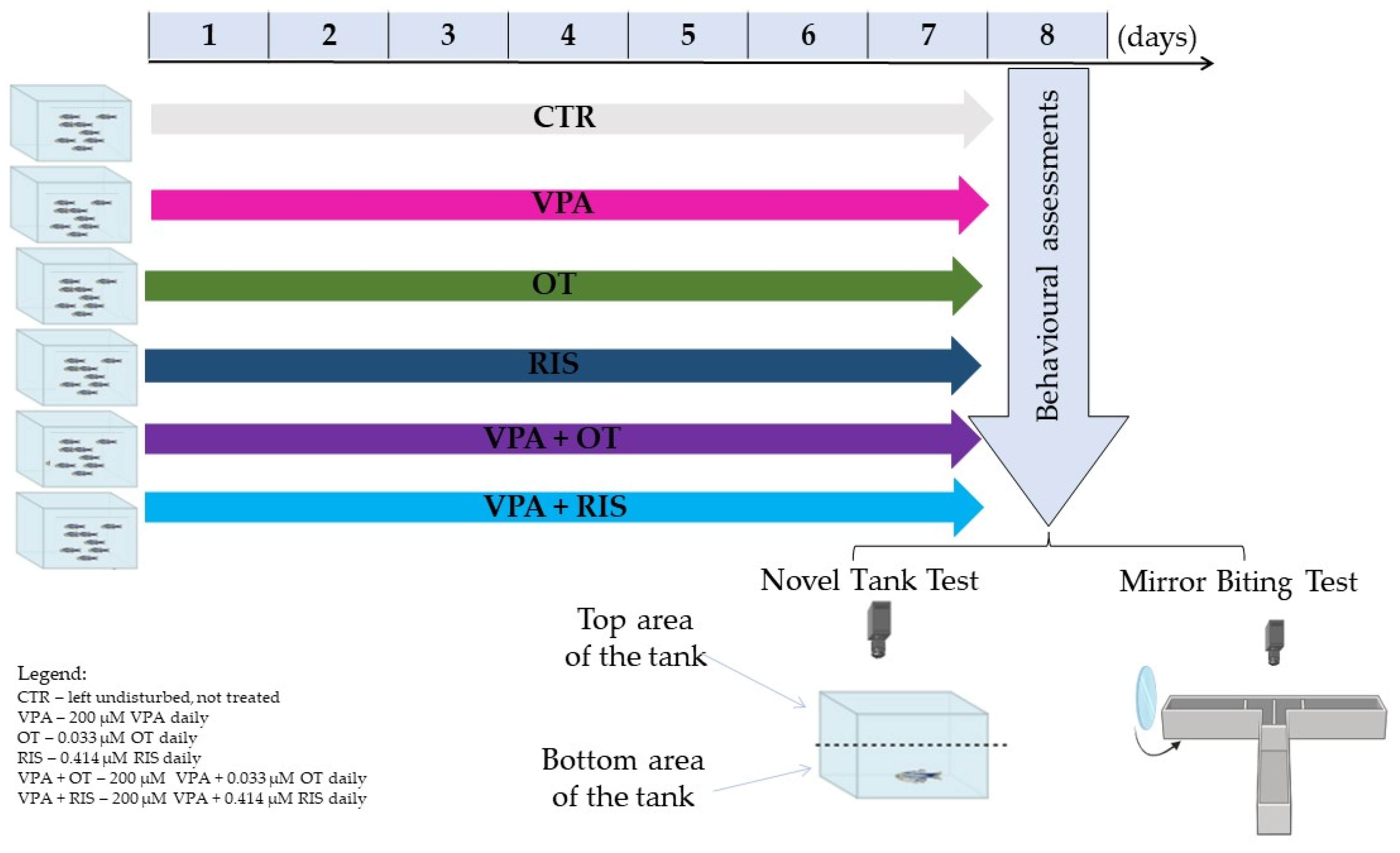
Following the accommodation period, fish were randomly assigned to 6 experimental groups (n = 10/group): CTR—control; VPA (28.8 mg/L valproic acid); OT (33.2 ng/mL oxytocin); RIS (170 µg/L risperidone); VPA + OT (28.8 mg/L valproic acid and 33.2 ng/mL oxytocin); and VPA + RIS (28.8 mg/L valproic acid and 170 µg/L risperidone). An overview of the experimental design and procedures can be seen in Figure 5.
Figure 5.
Schematic representation of the experimental design.
4.4. Behavioural Assessments
At the end of the last day of treatments, standard behavioural tests (novel tank test, NTT and mirror biting test, MBT) were performed to evaluate exploratory, anxiety-like, and aggressive behaviours.
- Novel tank test
NTT is commonly used to evaluate locomotory performance and anxiety-like behaviour [73]. A 6 L rectangular tank divided into 2 observational areas (from a side view: bottom and top areas) was used. After 30 s of acclimatisation, the fish freely explored the tank for 4 min. The zebrafish behaviour was video-recorded and processed using EthoVision XT 16 software (Wageningen, The Netherlands). Several behavioural parameters, such as total swimming distance (cm), swimming velocity (cm/s), activity/inactivity total time (s), the frequency of freezing episodes (#), and counter-clockwise rotations (#) were used to describe locomotory performance. On the other hand, the time spent in the top area of the tank (s), the latency to the first entry in the top area (s), and the frequency of top/bottom transition (#) were used to evaluate anxiety-like behaviour.
- Mirror biting test
MBT was used to assess the frequency of aggressive behaviour, according to previous experience and guidelines [35,38]. A T-shaped maze consisting of 3 arms (central, left, and right) was used. A mirror was placed at the end of the left arm to simulate the presence of a conspecific. Since animals are not able to recognise their reflection in the mirror, they could respond with aggression to the possible opponent [37,74,75]. After 30 s of accommodation at the starting point, the behaviour of the tested fish was observed for 4 min. The zebrafish activity was recorded and processed using the EthoVision XT 16 software (Wageningen, The Netherlands). The specific behavioural parameters for aggressive behaviour recorded included the time spent near the mirror (s), which indicates the time spent in the proximity of the stimulus and actively interacting with it. In parallel, the possibility of aggressive behaviour tendency was assessed by the left arm entry frequency (#) parameter, which counts the number of individual returns to the left arm. Additionally, the time spent in the other segments (s) (time spent in the right arm (s); time spent in the central arm (s); and time spent in the decision point (s)) measured the time spent avoiding the stimulus, alongside decision-making cognitive processes. In addition, the standard locomotion parameters (total swimming distance (cm), swimming velocity (cm/s), activity/inactivity total time (s), and counter-clockwise rotations (#)) were measured to evaluate general locomotor activity and ensure that the observed behavioural changes were not due to alterations in movement capacity.
4.5. Statistical Analysis
The numerical data obtained by analysing the behavioural parameters were statistically processed using the GraphPad PRISM software (version 10.0.0 for Windows, Boston, MA, USA). The results were expressed as mean ± SEM. A two-way ANOVA test, followed by post hoc analyses (Tukey’s HSD test), was performed to test the multiple comparisons between the groups. An F value for which p was less than 0.05 was considered statistically significant.
5. Conclusions
The pharmacotherapy of neurodevelopmental disorders increasingly emphasises the use of potential modulators of the neuronal pathways controlling socio-affective behaviour. Our results showed that, in a VPA zebrafish model, OT and RIS have the potential to modulate aggressive behaviour. Also, we observed that both OT and RIS improved anxiety-like behaviours in VPA-treated and healthy zebrafish.
Author Contributions
Conceptualization, O.-G.O., I.-M.B., and A.C.; methodology, O.-G.O., I.-M.B., P.F.L., and A.I.C.; software, P.F.L., A.I.C., R.S.-J., and M.N.N.; formal analysis and investigation, O.-G.O., I.-M.B., P.F.L., and A.I.C.; resources, M.N.N., G.P., A.C., D.G., and S.C.; data curation, O.-G.O., and I.-M.B.; writing—original draft preparation, O.-G.O., and I.-M.B.; writing—review and editing, R.S.-J., D.G., S.C., and A.C.; visualisation, O.-G.O., I.-M.B., P.F.L., and A.I.C.; and supervision, G.P., M.N.N., D.G., S.C., and A.C. All authors have read and agreed to the published version of the manuscript.
Funding
This research received no external funding.
Institutional Review Board Statement
The animal study protocol was approved by the Local Ethics Committee of the Faculty of Biology of Alexandru Ioan Cuza University of Iasi (122/12 May 2025).
Informed Consent Statement
Not applicable.
Data Availability Statement
The raw data supporting the conclusions of this article will be made available by the authors on request.
Conflicts of Interest
The authors declare no conflicts of interest.
References
- Tordjman, S. Aggressive behavior: A language to be understood. L’Encephale 2022, 48, S4–S13. [Google Scholar] [CrossRef] [Scilit] [PubMed]
- American Psychiatric Association. Diagnostic and Statistical Manual of Mental Disorders, 5th ed.; American Psychiatric Association Publishing: Washington, DC, USA, 2013. [Google Scholar] [CrossRef] [Scilit]
- Fitzpatrick, S.E.; Srivorakiat, L.; Wink, L.K.; Pedapati, E.V.; Erickson, C.A. Aggression in autism spectrum disorder: Presentation and treatment options. Neuropsychiatr. Dis. Treat. 2016, 12, 1525–1538. [Google Scholar] [CrossRef] [Scilit] [PubMed]
- Qin, L.; Wang, H.; Ning, W.; Cui, M.; Wang, Q. New advances in the diagnosis and treatment of autism spectrum disorders. Eur. J. Med. Res. 2024, 29, 322. [Google Scholar] [CrossRef] [Scilit] [PubMed]
- Turner, M. The role of drugs in the treatment of autism. Aust. Prescrib. 2020, 43, 185–190. [Google Scholar] [CrossRef] [Scilit]
- Goodin, B.R.; Ness, T.J.; Robbins, M.T. Oxytocin—A multifunctional analgesic for chronic deep tissue pain. Curr. Pharm. Des. 2015, 21, 906–913. [Google Scholar] [CrossRef] [Scilit]
- Griffiths, J.L.; Mishaal, R.A.; Nabetani, M.; Goldman, R.D. Oxytocin for the treatment of autism spectrum disorder in children. Can. Fam. Physician 2022, 68, 103–105. [Google Scholar] [CrossRef] [Scilit]
- Alfirevic, Z.; Kelly, A.J.; Dowswell, T. Intravenous oxytocin alone for cervical ripening and induction of labour. Cochrane Database Syst. Rev. 2009, 2009, CD003246. [Google Scholar] [CrossRef] [Scilit]
- Moerkerke, M.; Daniels, N.; Tibermont, L.; Tang, T.; Evenepoel, M.; Van der Donck, S.; Debbaut, E.; Prinsen, J.; Chubar, V.; Claes, S.; et al. Chronic oxytocin administration stimulates the oxytocinergic system in children with autism. Nat. Commun. 2024, 15, 58. [Google Scholar] [CrossRef] [Scilit]
- Lee, S.Y.; Lee, A.R.; Hwangbo, R.; Han, J.; Hong, M.; Bahn, G.H. Is Oxytocin Application for Autism Spectrum Disorder Evidence-Based? Exp. Neurobiol. 2015, 24, 312–324. [Google Scholar] [CrossRef] [Scilit]
- Pedersen, C.A.; Prange, A.J., Jr. Induction of maternal behavior in virgin rats after intracerebroventricular administration of oxytocin. Proc. Natl. Acad. Sci. USA 1979, 76, 6661–6665. [Google Scholar] [CrossRef] [Scilit]
- Insel, T.R. Oxytocin—A neuropeptide for affiliation: Evidence from behavioral, receptor autoradiographic, and comparative studies. Psychoneuroendocrinology 1992, 17, 3–35. [Google Scholar] [CrossRef] [Scilit] [PubMed]
- Mano-Sousa, B.J.; Pedrosa, A.M.; Alves, B.C.; Galduróz, J.C.F.; Belo, V.S.; Chaves, V.E.; Duarte-Almeida, J.M. Effects of Risperidone in Autistic Children and Young Adults: A Systematic Review and Meta-Analysis. Curr. Neuropharmacol. 2021, 19, 538–552. [Google Scholar] [CrossRef] [Scilit] [PubMed]
- Yoon, Y.; Wink, L.K.; Pedapati, E.V.; Horn, P.S.; Erickson, C.A. Weight Gain Effects of Second-Generation Antipsychotic Treatment in Autism Spectrum Disorder. J. Child. Adolesc. Psychopharmacol. 2016, 26, 822–827. [Google Scholar] [CrossRef] [Scilit] [PubMed]
- Teles, M.C.; Oliveira, R.F. Quantifying Aggressive Behavior in Zebrafish. Methods Mol. Biol. 2016, 1451, 293–305. [Google Scholar] [CrossRef] [Scilit]
- Tayanloo-Beik, A.; Hamidpour, S.K.; Abedi, M.; Shojaei, H.; Tavirani, M.R.; Namazi, N.; Larijani, B.; Arjmand, B. Zebrafish Modeling of Autism Spectrum Disorders, Current Status and Future Prospective. Front. Psychiatry 2022, 13, 911770. [Google Scholar] [CrossRef] [Scilit]
- Lungu, P.F.; Hritcu, L.D.; Nicoara, M.-N.; Savuca, A.; Curpan, A.-S.; Chelaru, A.I.; Lungu, C.M.; Gurzu, B.; Balmus, I.-M.; Ciobica, A.; et al. Preliminary Data Regarding the Alleviating Effects of Haloperidol and Risperidone on the Short-Term Memory and Associative Learning in a Zebrafish Model of Schizophrenia. Pharmaceuticals 2025, 18, 1548. [Google Scholar] [CrossRef] [Scilit]
- Jones, L.J.; Norton, W.H.J. Using zebrafish to uncover the genetic and neural basis of aggression, a frequent comorbid symptom of psychiatric disorders. Behav. Brain Res. 2015, 276, 171–180. [Google Scholar] [CrossRef] [Scilit]
- Martin, H.; Choi, J.E.; Rodrigues, A.R.; Eshel, N. Review: Dopamine, Serotonin, and the Translational Neuroscience of Aggression in Autism Spectrum Disorder. JAACAP Open 2024, 3, 29–41. [Google Scholar] [CrossRef] [Scilit]
- Yatawara, C.J.; Einfeld, S.L.; Hickie, I.B.; Davenport, T.A.; Guastella, A.J. The effect of oxytocin nasal spray on social interaction deficits observed in young children with autism: A randomized clinical crossover trial. Mol. Psychiatry 2016, 21, 1225–1231. [Google Scholar] [CrossRef] [Scilit]
- Li, H.; Chen, Y.; Qiu, Y. Oxytocin lipidation expanding therapeutics for long-term reversal of autistic behaviors in rats. Int. J. Pharm. 2025, 672, 125299. [Google Scholar] [CrossRef] [Scilit]
- Pant, S. AAP: Leucovorin Not Recommended for Autism. JAMA 2025, 334, 2061. [Google Scholar] [CrossRef] [Scilit]
- van Schalkwyk, G.I.; Lewis, A.S.; Beyer, C.; Johnson, J.; van Rensburg, S.; Bloch, M.H. Efficacy of antipsychotics for irritability and aggression in children: A meta-analysis. Expert Rev. Neurother. 2017, 17, 1045–1053. [Google Scholar] [CrossRef] [Scilit] [PubMed]
- Son, J.J.; Suk, J.-W.; Garvey, W.F.; Edwards, R.T.; Leibenluft, E.; Blair, R.J.R.; Hwang, S. Mediating Impact of Intranasal Oxytocin on the Interaction Between Irritability and Reactive Aggression in Youth with Severe Irritability. Life 2025, 15, 1253. [Google Scholar] [CrossRef] [Scilit] [PubMed]
- Berends, Y.R.; van de Weert, A.; Wesselmann, E.D.; Hurlemann, R. Intranasal oxytocin attenuates the cortisol response to physical stress: A dose-response study. Psychoneuroendocrinology 2025, 106, 147–154. [Google Scholar] [CrossRef] [Scilit] [PubMed]
- Higashida, H.; Munesue, T.; Kosaka, H.; Yamasue, H.; Yokoyama, S.; Kikuchi, M. Social Interaction Improved by Oxytocin in the Subclass of Autism with Comorbid Intellectual Disabilities. Diseases 2019, 7, 24. [Google Scholar] [CrossRef] [Scilit]
- Ricarte, M.; Tagkalidou, N.; Bellot, M.; Bedrossiantz, J.; Prats, E.; Gomez-Canela, C.; Garcia-Reyero, N.; Raldúa, D. Short- and Long-Term Neurobehavioral Effects of Developmental Exposure to Valproic Acid in Zebrafish. Int. J. Mol. Sci. 2024, 25, 7688. [Google Scholar] [CrossRef] [Scilit]
- Camussi, D.; Marchese, M.; Nicoletti, F.; Santorelli, F.M.; Ogi, A. Valproate-Induced Model of Autism in Adult Zebrafish: A Systematic Review. Cells 2025, 14, 109. [Google Scholar] [CrossRef] [Scilit]
- Flores-Prieto, B.; Caycho-Salazar, F.; Manzo, J.; Hernández-Aguilar, M.E.; Coria-Avila, A.G.; Herrera-Covarrubias, D.; Rojas-Dúran, F.; Aranda-Abreu, G.E.; Pérez-Estudillo, C.A.; Toledo-Cárdenas, M.R. Effect of Enriched Environment on Cerebellum and Social Behavior of Valproic Zebrafish. NeuroSci 2024, 5, 128–140. [Google Scholar] [CrossRef] [Scilit]
- Baronio, D.; Puttonen, H.A.J.; Sundvik, M.; Semenova, S.; Lehtonen, E.; Panula, P. Embryonic exposure to valproic acid affects the histaminergic system and the social behaviour of adult zebrafish (Danio rerio). Br. J. Pharmacol. 2018, 175, 797–809. [Google Scholar] [CrossRef] [Scilit]
- Kurahashi, H.; Kunisawa, K.; Tanaka, K.F.; Kubota, H.; Hasegawa, M.; Miyachi, M.; Moriya, Y.; Hasegawa, Y.; Nagai, T.; Saito, K.; et al. Autism spectrum disorder-like behaviors induced by hyper-glutamatergic NMDA receptor signaling through hypo-serotonergic 5-HT1A receptor signaling in the prefrontal cortex in mice exposed to prenatal valproic acid. Neuropsychopharmacology 2025, 50, 739–750. [Google Scholar] [CrossRef] [Scilit]
- Li, X.; Feng, T.; Lu, W. The Effects of Valproic Acid Neurotoxicity on Aggressive Behavior in Zebrafish Autism Model. Comp. Biochem. Physiol. Part C Toxicol. Pharmacol. 2024, 275, 109783. [Google Scholar] [CrossRef] [Scilit] [PubMed]
- Robea, M.A.; Ciobica, A.; Curpan, A.-S.; Plavan, G.; Strungaru, S.; Lefter, R.; Nicoara, M. Preliminary Results Regarding Sleep in a Zebrafish Model of Autism Spectrum Disorder. Brain Sci. 2021, 11, 556. [Google Scholar] [CrossRef] [Scilit] [PubMed]
- Joseph, T.P.; Zhou, F.; Sai, L.Y.; Chen, H.; Lin, S.L.; Schachner, M. Duloxetine ameliorates valproic acid-induced hyperactivity, anxiety-like behavior, and social interaction deficits in zebrafish. Autism Res. 2022, 15, 27–41. [Google Scholar] [CrossRef] [Scilit] [PubMed]
- Ilie, O.D.; Duta, R.; Jijie, R.; Nita, I.B.; Nicoara, M.; Faggio, C.; Dobrin, R.; Mavroudis, I.; Ciobica, A.; Doroftei, B. Assessing Anti-Social and Aggressive Behavior in a Zebrafish (Danio rerio) Model of Parkinson’s Disease Chronically Exposed to Rotenone. Brain Sci. 2022, 12, 898. [Google Scholar] [CrossRef] [Scilit]
- de Los Ángeles Cintado, M.; De la Casa, L.G.; González, G. Anxiolytic and sedative effects of sodium valproate with different experimental paradigms in male and female rats. Neuropsychopharmacol. Rep. 2024, 44, 737–748. [Google Scholar] [CrossRef] [Scilit]
- Strungaru, S.A.; Robea, M.A.; Plavan, G.; Todirascu-Ciornea, E.; Ciobica, A.; Nicoara, M. Acute exposure to methylmercury chloride induces fast changes in swimming performance, cognitive processes and oxidative stress of zebrafish (Danio rerio) as reference model for fish community. J. Trace Elem. Med. Biol. 2018, 47, 115–123. [Google Scholar] [CrossRef] [Scilit]
- Robea, M.A.; Oprea, G.; Plavan, G.; Nicoara, M.N.; Mavroudis, I.; Burlui, V.; Ciobica, A. Oxytocin Enhances Time-Dependent Responses in the Aggressive Zebrafish (Danio rerio). Brain Sci. 2024, 14, 203. [Google Scholar] [CrossRef] [Scilit]
- Buteme, J. The Role of Valproic Acid, a Histone Deacetylase Inhibitor, in Reducing Anxiety Levels in Rats: An Epigenetics Study. Bachelor’s Thesis, University of Massachusetts, Boston, MA, USA, 2015. Available online: https://scholarworks.umb.edu/honors_theses/12 (accessed on 7 November 2025).
- Aggernaes, H.; Kirkegaard, C.; Magelund, G. The effect of sodium valproate on serum cortisol levels in healthy subjects and depressed patients. Acta Psychiatr. Scand. 1988, 77, 170–174. [Google Scholar] [CrossRef] [Scilit]
- Popescu, E.R.; Semeniuc, S.; Hritcu, L.D.; Horhogea, C.E.; Spataru, M.C.; Trus, C.; Dobrin, R.P.; Chirita, V.; Chirita, R. Cortisol and Oxytocin Could Predict Covert Aggression in Some Psychotic Patients. Medicina 2021, 57, 760. [Google Scholar] [CrossRef] [Scilit]
- Neumann, I.D. Brain oxytocin: A key regulator of emotional and social behaviours in both females and males. J. Neuroendocrinol. 2008, 20, 858–865. [Google Scholar] [CrossRef] [Scilit]
- Chuang, H.-J.; Chang, C.-Y.; Ho, H.-P.; Chou, M.-Y. Oxytocin Signaling Acts as a Marker for Environmental Stressors in Zebrafish. Int. J. Mol. Sci. 2021, 22, 7459. [Google Scholar] [CrossRef] [Scilit] [PubMed]
- Gemmer, A.; Mirkes, K.; Anneser, L.; Eilers, T.; Kibat, C.; Mathuru, A.; Ryu, S.; Schuman, E. Oxytocin receptors influence the development and maintenance of social behavior in zebrafish (Danio rerio). Sci. Rep. 2022, 12, 4322. [Google Scholar] [CrossRef] [Scilit] [PubMed]
- Akinrinade, I.; Kareklas, K.; Teles, M.C.; Reis, T.K.; Gliksberg, M.; Petri, G.; Levkowitz, G.; Oliveira, R.F. Evolutionarily conserved role of oxytocin in social fear contagion in zebrafish. Science 2023, 379, 1232–1237. [Google Scholar] [CrossRef] [Scilit] [PubMed]
- Beckmann, H.; Lang, R.E.; Gattaz, W.F. Vasopressin-oxytocin in cerebrospinal fluid of schizophrenic patients and normal controls. Psychoneuroendocrinology 1985, 10, 187–191. [Google Scholar] [CrossRef] [Scilit]
- Bartz, J.A.; Zaki, J.; Bolger, N.; Ochsner, K.N. Social effects of oxytocin in humans: Context and person matter. Trends Cogn. Sci. 2011, 15, 301–309. [Google Scholar] [CrossRef] [Scilit]
- Idalencio, R.; Kalichak, F.; Rosa, J.G.; de Oliveira, T.A.; Koakoski, G.; Gusso, D.; Abreu, M.S.; Giacomini, A.C.; Barcellos, H.H.; Piato, A.L.; et al. Waterborne Risperidone Decreases Stress Response in Zebrafish. PLoS ONE 2015, 10, e0140800. [Google Scholar] [CrossRef] [Scilit]
- Danila, A.M.; Savuca, A.; Ciobica, A.S.; Gurzu, I.L.; Nicoara, M.N.; Gurzu, B. The Impact of Oxytocin on Stimulus Discrimination of Zebrafish Albino and Non-Albino Models. Int. J. Mol. Sci. 2025, 26, 2070. [Google Scholar] [CrossRef] [Scilit]
- Prieto, M.J.; Gutiérrez, H.C.; Arévalo, R.; Chiaramoni, N.S.; Alonso, S.D.V. Effect of risperidone and fluoxetine on the movement and neurochemical changes of zebrafish. Open J. Med. Chem. 2012, 2, 129–138. [Google Scholar] [CrossRef]
- Kalichak, F.; de Alcantara Barcellos, H.H.; Idalencio, R.; Koakoski, G.; Soares, S.M.; Pompermaier, A.; Rossini, M.; Barcellos, L.J.G. Persistent and transgenerational effects of risperidone in zebrafish. Environ. Sci. Pollut. Res. Int. 2019, 26, 26293–26303. [Google Scholar] [CrossRef] [Scilit]
- Wasser-Bennett, G.; Brown, A.R.; Maynard, S.K.; Owen, S.F.; Tyler, C.R. Critical insights into the potential risks of antipsychotic drugs to fish, including through effects on behaviour. Biol. Rev. Camb. Philos. Soc. 2025, 100, 1994–2019. [Google Scholar] [CrossRef] [Scilit]
- Purba, C.A.P.; Febriyana, N.; Setiawati, Y. Managing Aggressive Behavior in Adolescents with Autism Spectrum Disorder: Pharmacological and Non-Pharmacological Approaches. J. Korean Acad. Child. Adolesc. Psychiatry 2024, 35, 223–229. [Google Scholar] [CrossRef] [Scilit]
- Kalichak, F.; Idalencio, R.; da Rosa, J.G.S.; Barcellos, H.H.A.; Fagundes, M.; Piato, A.; Barcellos, L.J.G. Psychotropic in the environment: Risperidone residues affect the behavior of fish larvae. Sci. Rep. 2017, 7, 14121. [Google Scholar] [CrossRef] [Scilit]
- Fukushima, H.C.S.; Bailone, R.L.; Borra, R.C. Assessment of Risperidone Toxicity in Zebrafish (Danio rerio) Embryos. Comp. Med. 2023, 73, 260–266. [Google Scholar] [CrossRef] [Scilit] [PubMed]
- Audunsdottir, K.; Sartorius, A.M.; Kang, H.; Glaser, B.D.; Boen, R.; Nærland, T.; Alaerts, K.; Kildal, E.S.M.; Westlye, L.T.; Andreassen, O.A.; et al. The effects of oxytocin administration on social and routinized behaviors in autism: A preregistered systematic review and meta-analysis. Psychoneuroendocrinology 2024, 167, 107067. [Google Scholar] [CrossRef] [Scilit] [PubMed]
- Guastella, A.J.; Hickie, I.B. Oxytocin Treatment, Circuitry, and Autism: A Critical Review of the Literature Placing Oxytocin Into the Autism Context. Biol. Psychiatry 2016, 79, 234–242. [Google Scholar] [CrossRef] [Scilit] [PubMed]
- Andari, E.; Duhamel, J.R.; Zalla, T.; Herbrecht, E.; Leboyer, M.; Sirigu, A. Promoting social behavior with oxytocin in high-functioning autism spectrum disorders. Proc. Natl. Acad. Sci. USA 2010, 107, 4389–4394. [Google Scholar] [CrossRef] [Scilit]
- Petersson, M.; Uvnäs-Moberg, K. Interactions of Oxytocin and Dopamine—Effects on Behavior in Health and Disease. Biomedicines 2024, 12, 2440. [Google Scholar] [CrossRef] [Scilit]
- Cai, Q.; Feng, L.; Yap, K.Z. Systematic review and meta-analysis of reported adverse events of long-term intranasal oxytocin treatment for autism spectrum disorder. Psychiatry Clin. Neurosci. 2018, 72, 140–151. [Google Scholar] [CrossRef] [Scilit]
- Josselsohn, A.; Zhao, Y.; Espinoza, D.; Hollander, E. Oxytocin in neurodevelopmental disorders: Autism spectrum disorder and Prader-Willi syndrome. Pharmacol. Ther. 2024, 264, 108734. [Google Scholar] [CrossRef] [Scilit]
- Dudko, N.A.; Nurieva, G.N.; Kunizheva, S.S.; Kuznetsova, I.L. Epigenetics of Aggression: Recent Advances and Perspectives on Animal Models. Russ. J. Genet. 2025, 61, 1177–1186. [Google Scholar] [CrossRef] [Scilit]
- Xing, C.; Yu, X. Oxytocin and autism: Insights from clinical trials and animal models. Curr. Opin. Neurobiol. 2025, 92, 103015. [Google Scholar] [CrossRef] [Scilit] [PubMed]
- Kosaka, H.; Munesue, T.; Ishitobi, M.; Asano, M.; Omori, M.; Sato, M.; Tomoda, A.; Wada, Y. Long-term oxytocin administration improves social behaviors in a girl with autistic disorder. BMC Psychiatry 2012, 12, 110. [Google Scholar] [CrossRef] [Scilit] [PubMed]
- Prinsen, J.; Alaerts, K. Endogenous and exogenous oxytocin modulate interpersonal motor resonance in autism: A context-dependent and person-specific approach. Autism 2025, 29, 2123–2136. [Google Scholar] [CrossRef] [Scilit] [PubMed]
- Hollander, E.; Bartz, J.; Chaplin, W.; Phillips, A.; Sumner, J.; Soorya, L.; Anagnostou, E.; Wasserman, S. Oxytocin increases retention of social cognition in autism. Biol. Psychiatry 2007, 61, 498–503. [Google Scholar] [CrossRef] [Scilit]
- Hollander, E.; Novotny, S.; Hanratty, M.; Hanratty, M.; Yaffe, R.; DeCaria, C.M.; Aronowitz, B.R.; Mosovich, S. Oxytocin Infusion Reduces Repetitive Behaviors in Adults with Autistic and Asperger’s Disorders. Neuropsychopharmacology 2003, 28, 193–198. [Google Scholar] [CrossRef] [Scilit]
- Alcorn, J.L., 3rd; Green, C.E.; Schmitz, J.; Lane, S.D. Effects of oxytocin on aggressive responding in healthy adult men. Behav. Pharmacol. 2015, 26, 798–804. [Google Scholar] [CrossRef] [Scilit]
- Pfundmair, M.; Reinelt, A.; DeWall, C.N.; Feldmann, L. Oxytocin strengthens the link between provocation and aggression among low anxiety people. Psychoneuroendocrinology 2018, 93, 124–132. [Google Scholar] [CrossRef] [Scilit]
- Zimmermann, F.F.; Gaspary, K.V.; Leite, C.E.; De Paula Cognato, G.; Bonan, C.D. Embryological exposure to valproic acid induces social interaction deficits in zebrafish (Danio rerio): A developmental behavior analysis. Neurotoxicol. Teratol. 2015, 52, 36–41. [Google Scholar] [CrossRef] [Scilit]
- Balmus, I.; Strungaru, Ș.-A.; Nicoara, M.; Plavan, G.; Cojocaru, S.; Simion, L. Preliminary Data Regarding the Effects of Oxytocin Administration on the Oxidative Stress Status of Zebrafish (Danio rerio). Rev. Chim. 2017, 68, 1640–1643. [Google Scholar] [CrossRef] [Scilit]
- Rahmati-Holasoo, H.; Salek Maghsoudi, A.; Akbarzade, M.; Gholami, M.; Shadboorestan, A.; Vakhshiteh, F.; Armandeh, M.; Hassani, S. Oxytocin protective effects on zebrafish larvae models of autism-like spectrum disorder. Iran. J. Basic. Med. Sci. 2023, 26, 316–325. [Google Scholar] [CrossRef] [Scilit]
- Golushko, N.I.; Matrynov, D.; Galstyan, D.S.; Apukhtin, K.V.; de Abreu, M.S.; Yang, L.; Stewart, A.M.; Kalueff, A.V. Understanding (and appreciating) behavioral complexity of zebrafish novel tank assays. Behav. Processes 2025, 230, 105230. [Google Scholar] [CrossRef] [Scilit]
- Zabegalov, K.N.; Kolesnikova, T.O.; Khatsko, S.L.; Volgin, A.D.; Yakovlev, O.A.; Amstislavskaya, T.G.; Friend, A.J.; Bao, W.; Alekseeva, P.A.; Lakstygal, A.M.; et al. Understanding zebrafish aggressive behavior. Behav. Processes 2019, 158, 200–210. [Google Scholar] [CrossRef] [Scilit]
- Reichmann, F.; Pilic, J.; Trajanoski, S.; Norton, W.H.J. Transcriptomic underpinnings of high and low mirror aggression zebrafish behaviours. BMC Biol. 2022, 20, 97. [Google Scholar] [CrossRef] [Scilit]
Disclaimer/Publisher’s Note: The statements, opinions and data contained in all publications are solely those of the individual author(s) and contributor(s) and not of MDPI and/or the editor(s). MDPI and/or the editor(s) disclaim responsibility for any injury to people or property resulting from any ideas, methods, instructions or products referred to in the content. |
© 2026 by the authors. Licensee MDPI, Basel, Switzerland. This article is an open access article distributed under the terms and conditions of the Creative Commons Attribution (CC BY) license.