


Abstract
Background: Dermatophytosis has evolved into a major therapeutic challenge with the global emergence of Trichophyton indotineae, a pathogen associated with chronic, recurrent, and treatment-refractory infections. The widespread emergence of antifungal resistance, particularly to terbinafine and, increasingly, itraconazole, has substantially limited effective systemic treatment options. Terbinafine resistance, primarily mediated by mutations in the squalene epoxidase (SQLE) gene (Erg1), including Phe397Leu, Leu393Phe, and Leu393Ser, has been reported in 17–75% of isolates, whereas reduced itraconazole susceptibility has reached 25–37% in selected cohorts from endemic regions. Objective: The present review examines the existent global resistance to Trichophyton indotineae, its mechanisms, measures that can be used to circumvent it, and the possible treatment options, with particular emphasis on the role of a novel azole fosravuconazole L-lysine ethanolate (F-RVCZ). Methods: The following bibliographic databases were searched from 2018 to June 2026: PubMed, Embase, Web of Science, and Cochrane Library databases using the key words fosravuconazole AND dermatophytosis, T. indotineae, resistance mechanisms, treatment, and synergy. Results: The established resistance mechanisms in T. indotineae are mutations in the Erg1 gene leading to alteration of the SQLE protein. Mutations of Erg11 are also reported and there is evidence that overexpression of efflux pumps may also be a compensatory mechanism leading to resistance to multiple currently used antifungals. While several agents have demonstrated in vitro efficacy, and experimental approaches targeting efflux pumps, kinases, and heat-shock proteins may be explored, the development of novel antifungal agents and rational antifungal drug combinations currently remain the most pragmatic strategies to manage recalcitrant dermatophytosis. Conclusions: While there is extensive data on resistance mechanisms, data on novel drugs that subvert or transcend these mechanisms are scant. There is a need for novel drugs or drug combinations to treat recalcitrant dermatophytosis, based on a priori laboratory data, and synergy studies. Clinical evidence for the use of F-RVCZ is in onychomycosis, with some data on utility in tinea pedis, tinea capitis, tinea barbae, eumycetoma, and selected subcutaneous mycoses. Real-world studies suggest an acceptable safety profile with mild and reversible laboratory abnormalities. Although available minimum inhibitory concentration data suggest it may be a feasible option in dermatophytosis, further in vitro susceptibility studies and clinical data from endemic areas facing rampant T. indotineae infections are required to explore its possible use in cutaneous dermatophytic infections.
1. Introduction
Dermatophytosis remains one of the most prevalent superficial fungal infections worldwide, affecting an estimated 20–25% of the global population [1]. Over the past decade, it has evolved from a readily treatable superficial fungal infection into a significant therapeutic challenge. This shift has largely been driven by the emergence and rapid dissemination of Trichophyton indotineae (T. indotineae) [2,3], a newly recognized dermatophyte species associated with chronic, recurrent, extensive, and treatment-refractory disease. Originally identified as Trichophyton mentagrophytes ITS genotype VIII, T. indotineae is now recognized as the predominant pathogen responsible for the ongoing surge of recalcitrant dermatophytosis.
Numerous resistance mechanisms have been described. Terbinafine (TER) resistance has emerged as a major concern and is primarily mediated by mutations in the SQLE gene (Erg1), resulting in amino acid substitutions, particularly Leu393Phe, Phe397Leu, and Leu393Ser substitutions in the SQLE protein. In India, TER resistance rates of up to 71% have been reported, with similar trends increasingly recognized in Bangladesh, Europe, and Japan [4,5]. Further, reduced susceptibility to itraconazole (ITZ) has also emerged, with resistance rates approaching 25% in some cohorts [6]. This may partly explain the need for prolonged treatment durations with ITZ as well.
The management of dermatophytosis has shifted from short-course ITZ therapy (100–200 mg/day for 1–2 weeks) to prolonged regimens of 100–400 mg/day for 4–8 weeks in contemporary practice, with a median treatment duration of 11.5 weeks reported in T. indotineae infection [7,8,9,10]. The prolonged durations suggest that there could be a need for alternative systemic antifungal agents, particularly newer triazoles with potent anti-dermatophyte activity and desirable pharmacokinetic properties.
Ravuconazole (RVCZ) is a fourth-generation triazole antifungal characterized by broad-spectrum antifungal activity, prolonged tissue persistence, minimal drug–drug interactions, and good tolerability [11]. Fosravuconazole L-lysine ethanolate (F-RVCZ) is an orally bioavailable prodrug of RVCZ developed to overcome the poor aqueous solubility and limited oral bioavailability of the parent compound. Earlier research on ER-30346, the precursor compound to RVCZ, showed potent in vitro and in vivo antifungal activity against dermatophytes, Candida spp., Cryptococcus neoformans, and Aspergillus fumigatus [11].
The objective of our review was to examine the existing resistance mechanisms in dermatophytes, especially T. indotineae, and the therapeutic options to circumvent it. Apart from examining the existing gaps in knowledge, we also examined the role of F-RVCZ in dermatophytosis.
2. Results
2.1. Resistance Mechanisms in Dermatophytes
Resistance Mechanisms in Trichophyton indotineae
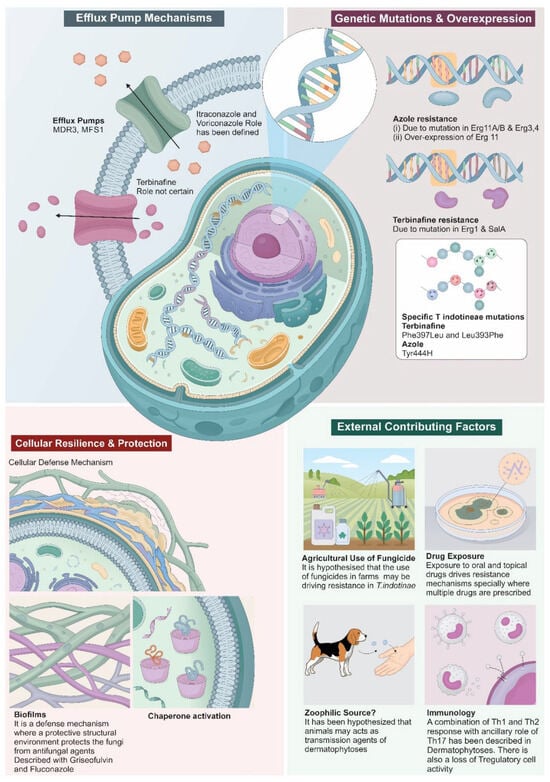
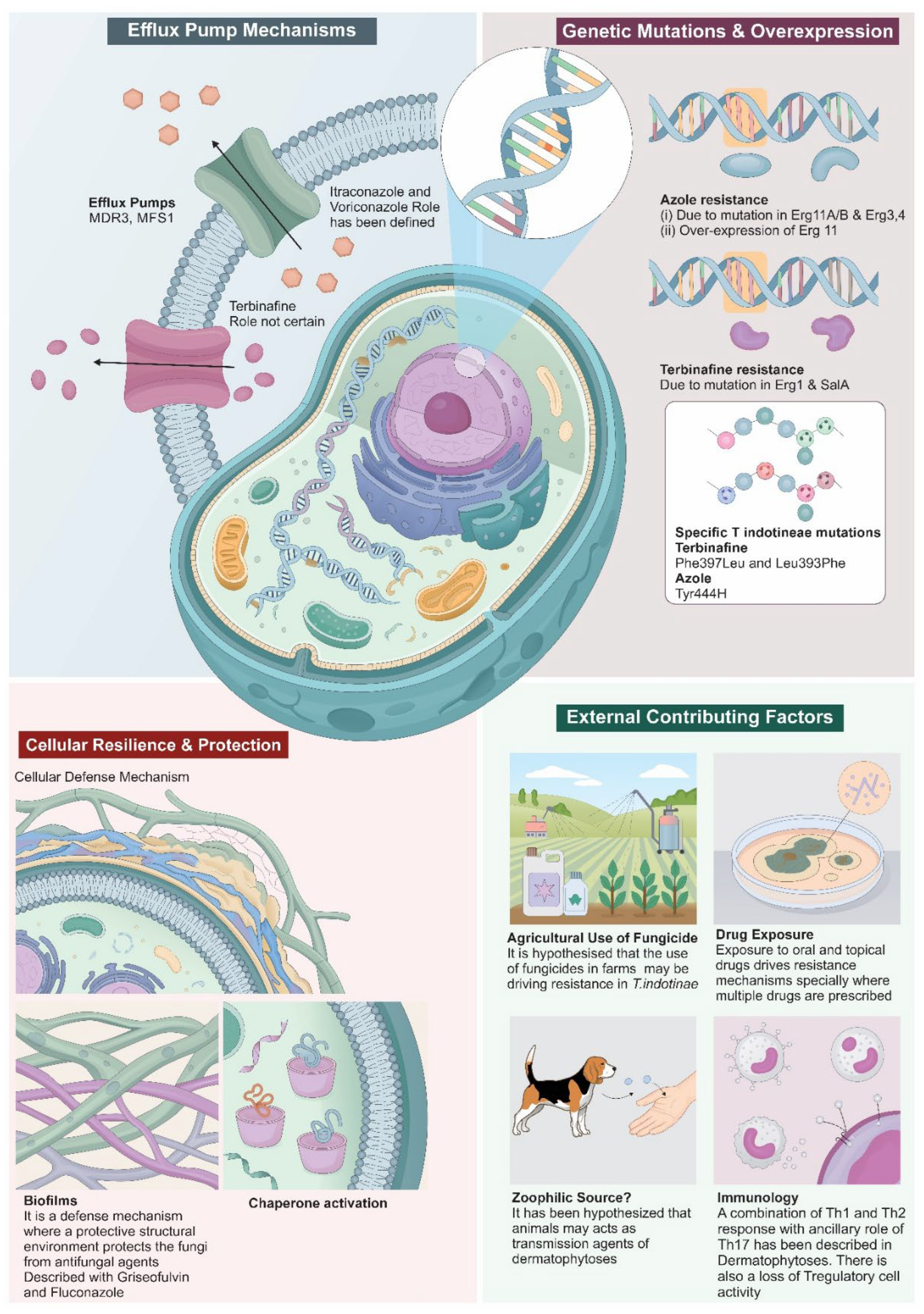
While the initial reports of resistance largely focus on the SQLE gene (Erg1), now there is increasing evidence that resistance mechanisms can also affect the efficacy of azoles, especially ITZ [12]. Notably, myriad resistance mechanisms have been described related to mutations affecting other enzymes involved in ergosterol synthesis or overexpression of efflux pump mechanism, though not all mechanisms have been firmly linked to therapeutic failures or lowered in vitro susceptibility (Figure 1) [13,14].
Figure 1.
Mechanisms underlying antifungal resistance in Trichophyton indotineae. The figure also highlights host- and environment-related factors that may facilitate the emergence and dissemination of resistant dermatophyte strains, even though some such as the use of fungicide are not rigorously studied. MDR: multidrug resistance; MFS: major facilitator superfamily.
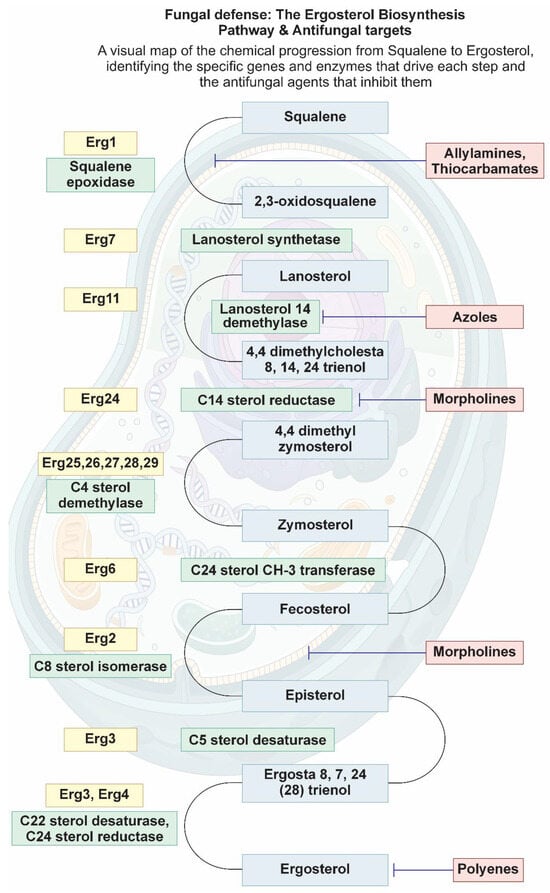
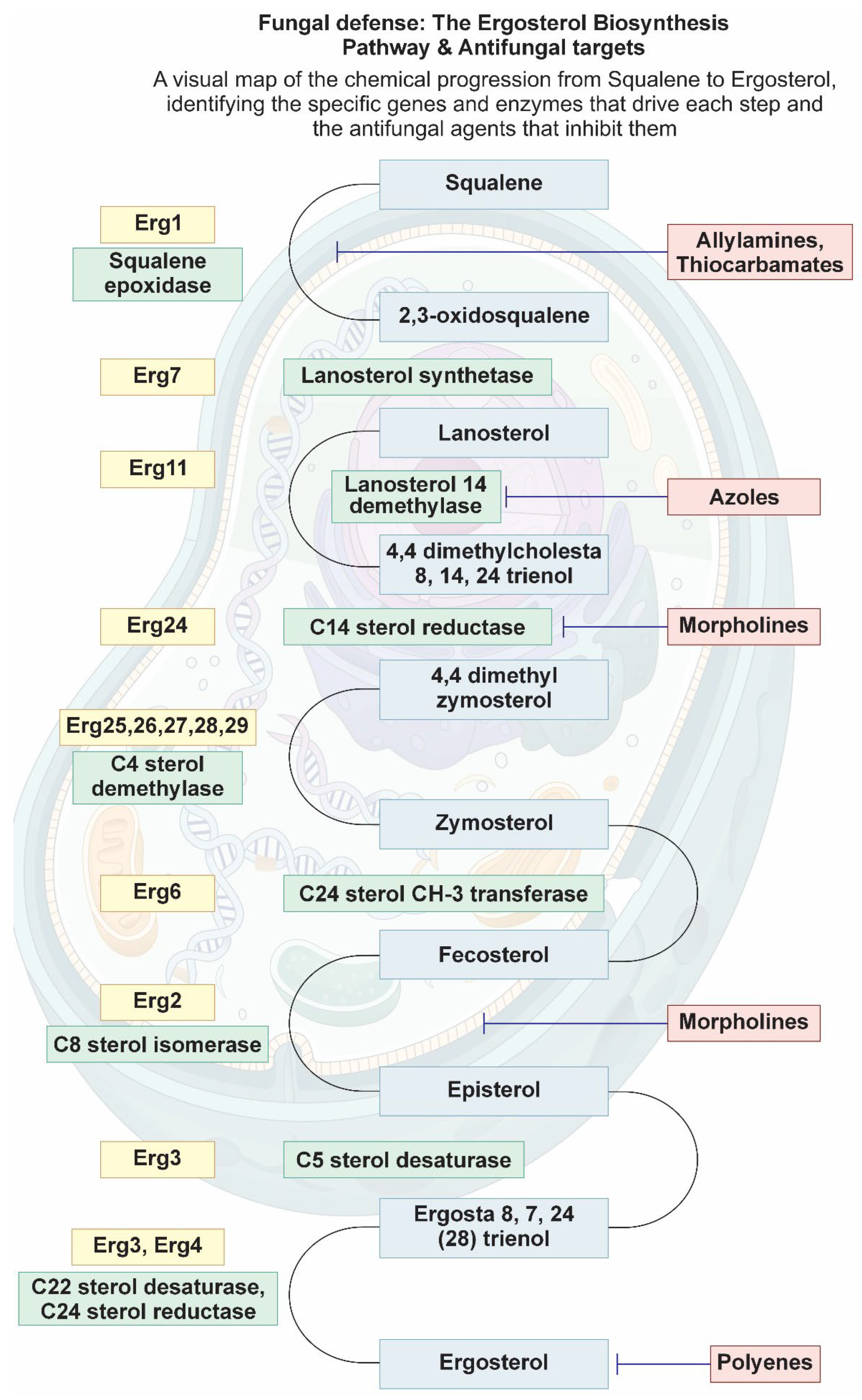
Before we address mutations, it is important to contextualize the ergosterol synthesis pathway which primarily occurs in the endoplasmic reticulum (ER) membrane. Firstly, two molecules of farnesyl-PP are used by the squalene synthase [ergosterol 9 (Erg9)] enzymes to form squalene, which is the precursor of all steroids. After this, SQLE and lanosterol synthase (Erg7) enzymes convert squalene into lanosterol. Furthermore, lanosterol is transformed to zymosterol, a step mediated by lanosterol 14-α-demethylase (Cyp51, encoded by Erg 11), C-14 reductase (Erg24) and the C-4 sterol demethylation complex (Erg25-Erg26-Erg27). Then, C-24 sterol methyltransferase (Erg6) converts zymosterol into fecosterol, followed by the formation of episterol by C-8 sterol isomerase (Erg2), which is finally desaturated and reduced by C-5 sterol desaturase (Erg3), C-22 sterol desaturase (Erg5), and C-24 (28) sterol reductase (Erg4) to ergosterol [15] (Figure 2).
Figure 2.
Schematic representation of the fungal ergosterol biosynthesis pathway based on a pathway dominant in yeasts, highlighting the key enzymes and corresponding genes involved in each step, along with the sites of action of the major classes of antifungal agents.
2.1.1. Mutations
Although ergosterol is synthesized in the ER, it is predominantly transported to the plasma membrane (PM) [16]. SQLE represents the rate-limiting step in this pathway. Allylamines are non-competitive inhibitors of SQLE, while azoles target the cytochrome P-450 enzyme- lanosterol 14-α demethylase by directly binding to the iron atom within the heme group of the enzyme [16] (Figure 2).
Terbinafine
Mutations in the Erg1 gene which encodes the target SQLE enzyme may occur in one of the five amino acid positions (Leu393, Phe397, Gln408, Phe415, Ala448 and His440) [17,18,19], with Phe397Leu being the most common (about 90% of resistant strains). Leu393Phe drives the highest absolute MIC values, while Ala448Thr is associated with azole resistance mechanisms, leading to treatment failures in dual-resistance scenarios [4,12]. The increased MIC aligns well with the clinical failures in endemic areas accounting for the greater use of ITZ for T. indotineae infections [19].
Azoles
Dermatophytes have two paralogous sterol 14α-demethylase genes, Erg11A (CYP51A) and Erg11B (CYP51B), which encode isoforms of the target enzyme of azole antifungals. These genes arose through gene duplication and are paralogs rather than allelic variants—similar to Aspergillus. The first possible mechanisms of azole resistance are point mutations within the Erg 11 gene restricted to the DYGYG Binding Motif [12,14]. A second pathway involves the overexpression of the gene (Type I Amplification), which leads to increased protein levels that can bind the administered azoles while still maintaining sufficient enzymatic activity in ergosterol metabolism [12].
Mutations in fungal Erg11 result in the accumulation of 14α-methylated sterol intermediates. These intermediates are subsequently processed by downstream enzymes, including those encoded by Erg6, Erg25, Erg26, Erg27, and Erg3, leading to the formation of 14α-methylergosta-8,24(28)-dien-3β,6α-diol, a toxic sterol that disrupts membrane function and exerts a predominantly fungistatic effect [20]. Thus, only when there are concomitant mutations in Erg6 and Erg3 genes can there be true azole resistance [21]. This mechanism of azole resistance has been described in Candida albicans and Saccharomyces species [12] and may also contribute to azole resistance in dermatophytes, although evidence in dermatophytes remains limited due to absence of research on this aspect.
Relevant to T. indotineae, mutations in Erg 11B have been described at position 444, followed by positions 441, 445, and 443 [3,6]. Tyr444His was observed to be the most common point mutation at position 444, followed by Tyr444Cys and Tyr444Ser [3,4,5,6] (depicted in Figure 1). However, a firm link with in vitro resistance based on gene mutations and clinical failures has not been consistently documented, -the so called phenotypic ambiguity [5,22].
As fungi can adapt to antifungal pressure, through compensatory mechanisms, other genetic loci may also contribute to resistance. Supporting this possibility, one study identified mutations in Erg1, Erg3, Erg4, and Erg11 in a multidrug treatment-failure isolate belonging to the Trichophyton mentagrophytes/interdigitale complex [23]. However, in the absence of genomic analysis or longitudinal sampling, it cannot be determined whether these mutations represented acquired resistance arising under antifungal drug pressure or pre-existing genomic variations, associated with species or strain characteristics. Nevertheless, the history of failure of multiple oral antifungal agents in the affected patients raises the possibility that antifungal drug pressure may have contributed to the emergence or selection of resistant variants [23].
2.1.2. Overexpression of Ergosterol Pathway Gene
A second mechanism that has been identified as a possible cause of drug resistance in T. indotineae is the overexpression of target enzymes. This has been defined in azole-resistant T. indotineae strains [24,25,26]. An experimentally demonstrated heat-dependent increase in Erg11B transcripts combined with downregulation of Erg1 in T. indotineae isolates suggests a protective role for Erg11B [25]. An overexpression of Erg11B caused by the amplification of genomic copies causes increased resistance to itraconazole and voriconazole [25,26] (Figure 1). Azole-resistant T. indotineae strains have been classified as type I or type II according to a tandem duplication that increases the TinCYP51B copy number: small 2404 bp CYP51B-only blocks (type I) or large 7374 bp blocks that also carry TinCHBK and TinFYV4 (type II). The two types may have distinct geographic distributions [27]. Type I amplification is linked to exceptionally high MICs for ITZ and voriconazole, while Type II is commoner and usually co-exists with the Erg1 Ala448Thr exchange.
2.1.3. Efflux Pumps
There are two main classes of efflux pumps, ATP-binding cassette (ABC) proteins and major facilitator superfamily (MFS) pumps (Figure 1). These membrane proteins actively translocate compounds across cell membranes using different energy sources. The major family that determines efflux is the ABC superfamily, which has three important members: multidrug resistance (MDR), MDR-associated protein (MRP), and pleiotropic drug resistance (PDR) families. Four ABC transporters (TruMDR1, TruMDR2, TruMDR3, and TruMDR5) and a second MFS transporter (TruMFS2) are known to operate as azole efflux pumps [12].
The early evidence comes from T. rubrum isolates, in which MDR3 and MDR4 were overexpressed in multidrug-resistant isolates [28], with MDR2 specifically linked to ITZ resistance [29]. The MDR3 transporter affected both voriconazole and ITZ susceptibility and MDR2 affected only ITZ susceptibility [30] (Figure 2). Furthermore, an MDR3 knockout mutant in T. rubrum lost its resistance to voriconazole and showed reduced MIC values for ITZ.
In T. mentagrophytes, overexpressed Pma1 has been linked to terbinafine tolerance [31], while ITZ exposure leads to MDR and MFS1 overexpression. A study that examined mutations and efflux pumps in clinical failures found MDR1 and MFS overexpression concomitantly with Erg11, helps to explain a possible cause of clinical failure in endemic areas [23] (Figure 1).
In T. indotineae, MDR3 has been reported to be variably overexpressed; however, its expression does not consistently correlate with azole resistance. Notably, MDR3 knockout mutants of T. indotineae did not show increased susceptibility to either ITZ or voriconazole, suggesting that MDR3 alone may not be a major determinant of resistance to these azoles in this species [26]. In T. indotineae, constitutively elevated expression of Erg11B has been reported in an Erg1Ala448Thr strain and may contribute to azole resistance [26]. MDR3 overexpression may represent an additional adaptive mechanism, as its expression, along with that of Erg11A, was induced following exposure to short-chain azoles [25], but this is not the primary resistance mechanism in T. indotineae.
These findings suggest that target-site alterations and efflux-mediated mechanisms may operate as complementary mechanisms contributing to azole resistance in T. indotineae. While efflux pumps have been studied with respect to terbinafine, at present they do not seem to have any role in resistance to the drug. In case of T. indotineae, fluconazole strongly induces MDR3 in all strains, explaining its consistent lack of efficacy. But there is a need to examine the significance of efflux pumps in therapeutic failures as opposed to in vitro strains to understand their significance.
2.1.4. Other Mechanisms
Various other mechanisms have been described, including biofilms [12,32], fungal heat shock proteins, altered expression of enzymes including acetyl Co-A transferase, and upregulation of thioredoxin reductase and peroxiredoxin [12]. Other suggested causes include the use of antifungal pesticides in agriculture and zoophilic spread [12,33]. Immunological alterations have been described, though it is difficult to ascertain if this is a cause or consequence of T. indotineae infections [34].
2.1.5. Summary
While there is published data on resistance mechanisms, the clinical significance of these findings is yet to be established by a corroborative clinical study that shows failures. This is because the microbiological data published is not exclusively from clinical failure cases, but in many studied from laboratory strains. TER resistance is higher (17% to 75%) as compared to ITZ resistance (up to 25%) in T. indotineae isolates from India [6]. Mechanisms for azole resistance in T. indotineae are not clearly understood but appear to be multifactorial, involving Erg11 mutations, overexpression and increased activity of efflux pumps under drug pressure.
Also, MIC data needs uniform and standard cut-off values. While a study noted an epidemiological cut of ≥0.5 µg/mL for ITZ and ≥0.25 µg/mL for voriconazole, this essentially differentiates wild type from non-wild type isolates [35]. A review opined that up to 37.6% of strains could be considered resistant to ITZ with MICs ≥ 0.25 µg/mL [36]. Thus, as a starting point we need a reliable and uniform cut-off value to decode resistance, based on MIC values, which needs to be corroborated by mutations or overexpression of the Erg11 gene.
3. Overview of Fosravuconazole
The growing burden of antifungal resistance and reduced susceptibility to azoles has stimulated interest in the development of newer-generation azoles with improved potency, broader antifungal spectra, enhanced pharmacokinetic properties, and reduced toxicity. Recent additions such as isavuconazole, luliconazole, efinaconazole, albaconazole, and F-RVCZ have expanded the therapeutic armamentarium, while several novel triazoles and tetrazoles are currently undergoing preclinical and clinical evaluation [37]. Among these, F-RVCZ, a prodrug of RVCZ, represents a fourth-generation triazole with broad-spectrum antifungal activity, excellent tissue penetration, and prolonged half-life, which makes it a potential therapeutic option in the era of emerging antifungal resistance.
Box 1. Timeline of development of fosravuconazole.
1994: RVCZ: Clinical development candidate for visceral mycosis (candidiasis, aspergillosis and others)
1995: In vitro and in vivo antifungal activities of ER-30346, a novel oral triazole with a broad antifungal spectrum [11]
1999: Phase 2 trials for ravuconazole [38]
2002: BMS-379224 fosravuconazole, a water-soluble prodrug of ravuconazole [39]
2003: Ravuconazole potent activity against Trypanosoma cruzi, causative organism of Chagas disease [40]
2005: Phase 2 trials of onychomycosis of ravuconazole [41]
2007: Ravuconazole discontinued due to bioavailability concern
2014: Phase 3 onychomycosis trials for fosravuconazole initiated [42]
2015: Ongoing study for eumycetoma
2018: Approval in Japan of fosravuconazole for onychomycosis
2024: (NCT0308622) Phase 2 trials of fosravuconazole for eumycetoma [43]
2025: Pilot study of fosravuconazole in Tinea pedis [44]
2025: WHO suggests fosravuconazole as a potential candidate for label extension
3.1. Mechanism of Action
F-RVCZ is a water-soluble phosphonooxymethyl prodrug that is rapidly converted to its active metabolite, RVCZ, a triazole antifungal that inhibits fungal lanosterol 14α-demethylase (CYP51), a key enzyme in the ergosterol biosynthesis pathway. By binding to the heme moiety of CYP51, RVCZ blocks the conversion of lanosterol to ergosterol, an essential component of the fungal cell membrane (Figure 2). This results in the depletion of ergosterol and accumulation of toxic 14α-methylated sterol intermediates, leading to impaired membrane integrity, altered permeability, and inhibition of fungal growth [45].
In vitro susceptibility studies have shown antifungal activity of RVCZ against Candida spp., Aspergillus spp., and dermatophytes [46]. Compared with conventional triazoles, RVCZ demonstrates superior in vitro activity against dermatophytes, with MICs 2–10-fold lower than ITZ and up to 32-fold lower than fluconazole [39,46].
3.2. Pharmacology
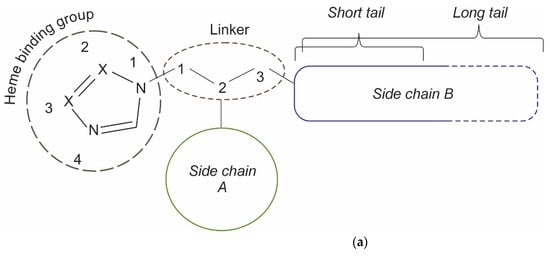
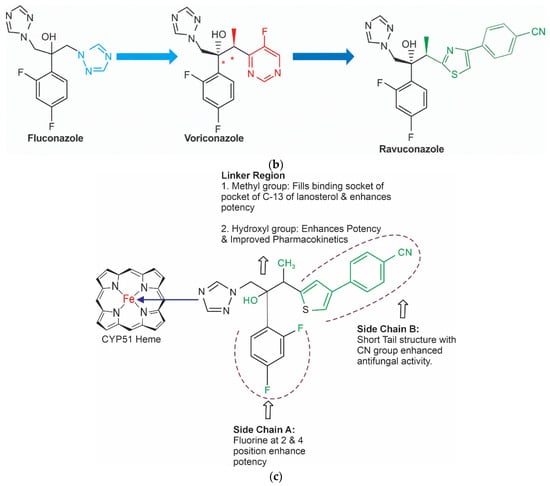
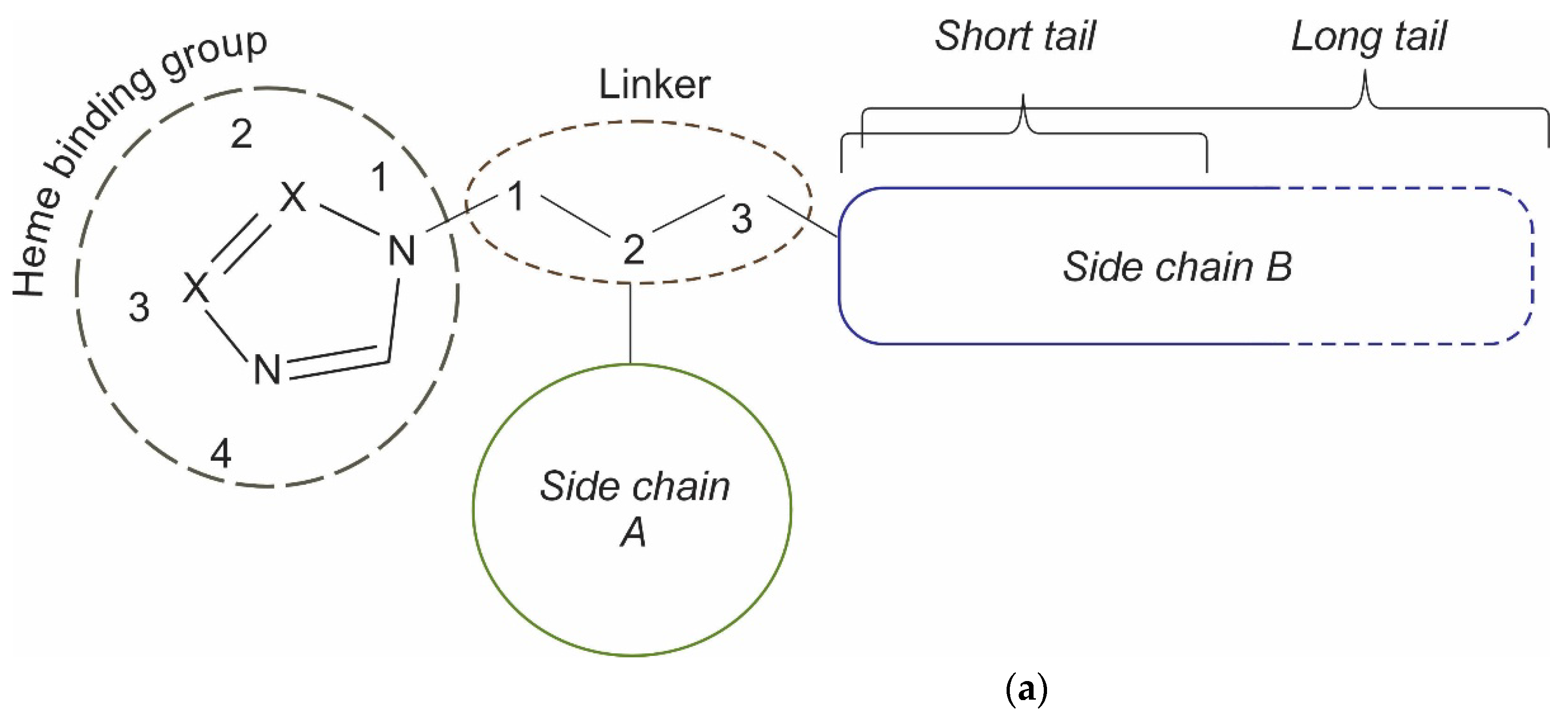
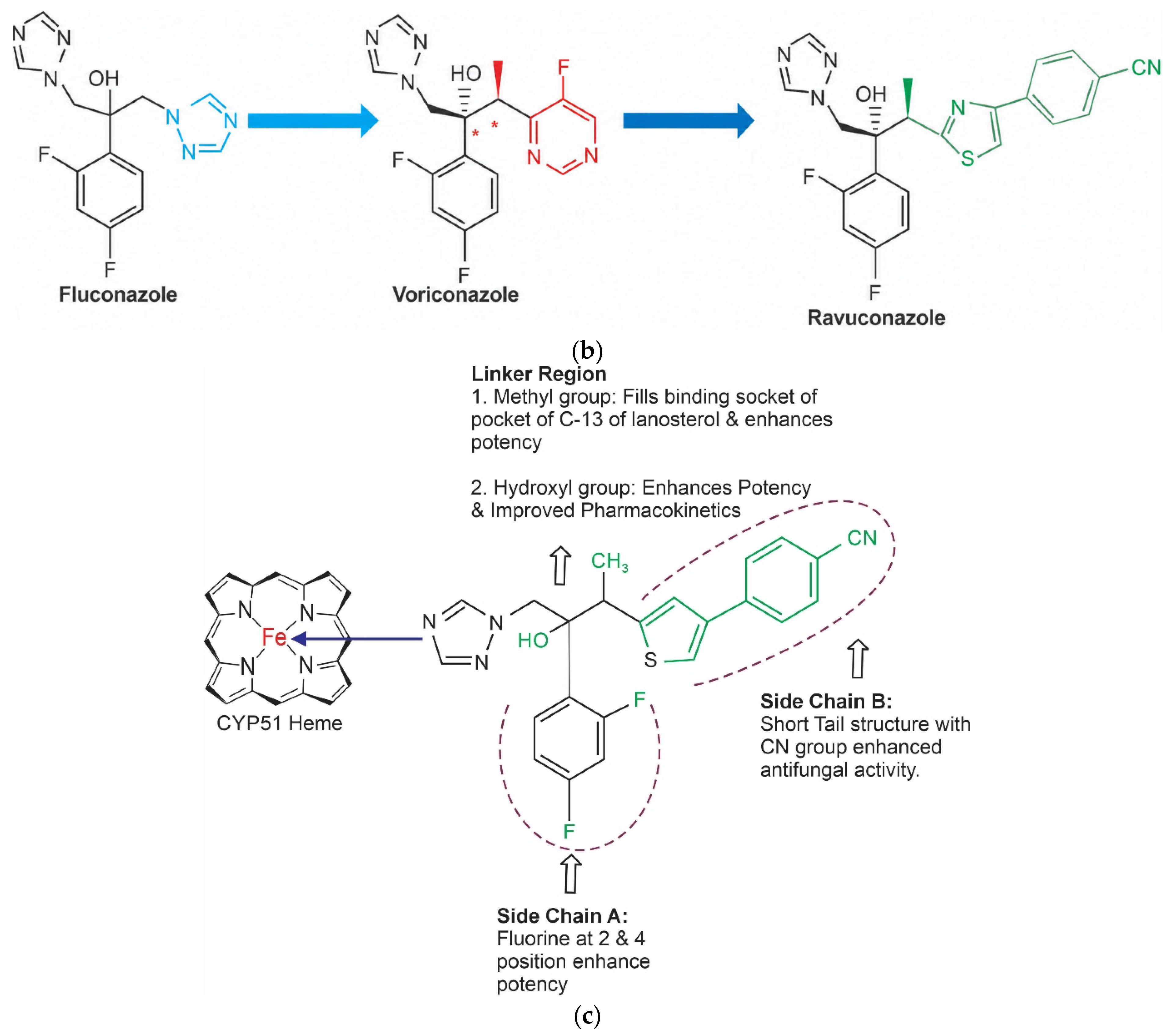
All azole drugs have a similar structural model (Figure 3a), consisting of a heme binding group, a three-atom linker, side-chain A, and side-chain B. Fluconazole was the first triazole to be developed [11,37,47,48]. The substitution of one triazole ring in fluconazole with 5-fluoropyrimidine and the insertion of a methyl group on the linker next to the stereogenic center have been demonstrated to be favorable structural modifications. These structural modifications generate a triazolylbutanol drug, voriconazole, with two chiral centers that is active against all Aspergillus species [48]. Consequently, modification of 2-fluoropyrimidine in the side-chain of VCZ resulted in a newer generation of triazolylbutanols including RCZ (Figure 3b), displaying a favorable antifungal spectrum [48].
Figure 3.
(a) A depiction of the structure of azoles. (b) Fluconazole was the first triazole to be developed, which was followed by itraconazole, voriconazole, and ravuconazole. (c) Structure of Ravuconazole: (i) The three-atom linker where the three-atom shape makes a special distance between different arms of the structure, leading to greater potency. The presence of an oxygen atom as a hydroxyl group on C-2 has several beneficial effects such as enhanced potency due to an indirect H-bond via water molecules with an active site, improved pharmacokinetic properties and water solubility. (ii) The side-chain A is responsible for its inhibitory effect and fluorine atoms in C-2 and C-4 provides greater potency. (iii) The side-chain B divides azole drugs into two groups based on the size of the side-chain, short-tail and long-tail structures. Ravuconazole falls into the short-tail structures. Small hydrophobic, electron-withdrawing groups (e.g., –CN) enhance potency in the ring attached to the linker, with probable steric and hydrophobic interactions.
In the early stages of clinical development, clinical studies using RVCZ in patients with onychomycosis were conducted mainly in the USA but were limited by poor aqueous solubility and low oral bioavailability [38,41]. Subsequently, F-RVCZ, a prodrug of RVCZ, was discovered to have improved hydrophilicity and oral bioavailability and has been studied for onychomycosis treatment in Japan [42].
Further, structural modifications, including fluorinated aromatic side-chains, a shorter side-chain architecture, and the triazole nucleus, are believed to enhance binding affinity for fungal lanosterol 14α-demethylase (CYP51), which may contribute to its retained activity against fungi with reduced susceptibility to conventional azoles (Figure 3c). According to molecular docking studies, it was suggested that the presence of various stabilizing interactions (hydrogen bonds, hydrophobic contacts, aromaticity, halogen bonding and electrostatic interactions) at the active sites impacted on the binding ability, making it a potential antifungal drug [49].
RVCZ demonstrates weaker CYP3A4 inhibition than itraconazole with a negligible effect on other major cytochrome P450 isoenzymes (CYP2C8, CYP2C9, CYP2C19, CYP2D6, and CYP1A2), thus reducing the likelihood of clinically significant drug–drug interactions. This makes the drug suitable for those who are on multiple concomitant medications. An overview of the salient pharmacological aspects is given in Table 1 [38,50,51,52].
Table 1.
Pharmacological aspects of Fosravuconazole [38,50,51,52].
3.3. Therapeutic Trials and Clinical Applications of Fosravuconazole
3.3.1. Approved Indications
F-RVCZ was approved in Japan in 2018 for the treatment of onychomycosis [42] (Table 2). Of note, oral F-RVCZ achieved complete cure in cases of terbinafine-resistant T. rubrum onychomycosis, including an outbreak caused by strains carrying the Leu393Phe mutation [45]. It also retained excellent in vitro activity against resistant isolates, even in strains with reduced susceptibility to terbinafine and ITZ, in both dermatophyte and non -dermatophyte onychomycosis [45,53,54]. Terbinafine-resistant dermatophyte isolates from clinical cases of onychomycosis, with additional reduced susceptibility to ITZ, demonstrated high susceptibility to RVCZ [54].
Clinical studies on onychomycosis have reported high cure rates of 59.4% at 48 weeks and a mycological cure rate of 82% [42]. Also, RVCZ concentrations remained above the MIC90 for dermatophytes even after completion of therapy, supporting its prolonged antifungal effect. Long-term follow-up studies in elderly patients have additionally documented sustained safety, efficacy, and successful retreatment in recurrent onychomycosis [55]. It has also been shown to be effective in refractory onychomycosis and dermatophytomas, a recalcitrant form of onychomycosis associated with biofilm-mediated antifungal tolerance, where a 57% cure rate was attained with oral F-RVCZ without nail avulsion or debridement [56].
Further, F-RVCZ (100 mg/day) successfully treated TER-resistant T. rubrum dermatophytoma, reducing nail involvement from 86% to 46% after 3 months, with complete cure achieved following 8 months of continuous therapy despite an initial recurrence [57]. In addition, F-RVCZ has been used in recalcitrant Candida parapsilosis onychomycosis unresponsive to prolonged TER, ITZ, and topical efinaconazole therapy [58] and Candida tropicalis [59] and rare non-dermatophyte mold onychomycoses caused by Aspergillus circumdati [60].
3.3.2. Off-Label Indications
Dermatophytoses
Short-course oral F-RVCZ has shown promising efficacy in tinea pedis, tinea barbae, and tinea capitis, with acceptable tolerability [44,61,62,63,64,65] (Table 2). Patients with interdigital and vesicular tinea pedis achieved complete cure and overall treatment success rates of 24.5% and 66.0%, respectively (1 week of F-RVCZ therapy), whereas patients with hyperkeratotic tinea pedis achieved corresponding rates of 18.4% and 77.6%, respectively (4 weeks of F-RVCZ therapy) [44]. Kitauchi Y et al. [61] reported its use in a case of tinea corporis caused by T. rubrum who had previously received ITZ and failed TER, and had documented resistance to terbinafine with underlying Erg1 mutation.
It has also been used in Tinea capitis caused by T. violaceum, where it was used for 12 weeks with a response in 6 weeks [62]. Further, kerion caused by T. tonsurans and Microsporum canis responded favorably to oral F-RVCZ (100 mg/day), with clinical resolution achieved within 6–12 weeks [63,64]. A case of Tinea barbae, where T. rubrum was identified, responded to F-RVCZ in 4 weeks [65]. However, the drug has not been formally used in T. indotineae infections, except where MIC data in a single case of terbinafine failure showed MIC of 0.03 mg/L for ITZ, and 0.03 mg/L (as opposed to > 32 mg/L) for TER [66].
Other uses are listed in Table 2 and include subcutaneous and deep mycoses [67,68,69] and Chagas disease [70].
Table 2.
Clinical uses of fosravuconazole [40,42,43,44,53,54,56,57,58,61,62,63,64,65,67,68,69,70].
3.4. Adverse Effects
Clinical trials and real-world studies have consistently supported the safety and tolerability of F-RVCZ. Adverse events are generally mild to moderate, with laboratory abnormalities representing the most frequently reported treatment-related events. In the pivotal Phase 3 trial involving 101 onychomycosis patients receiving F-RVCZ 100 mg once daily for 12 weeks, adverse reactions occurred in 24 patients (23.8%) as compared to 3.8% in placebo group [42]. The most common abnormalities were elevations in γ-glutamyl transferase (γ-GTP; 15.8%), alanine aminotransferase (ALT; 8.9%), aspartate aminotransferase (AST; 7.9%), abdominal discomfort (4.0%), and elevated alkaline phosphatase levels (2.0%) [42]. No serious adverse events were reported, and all laboratory abnormalities were reversible following treatment completion or discontinuation.
Long-term follow-up studies have corroborated the acceptable safety profile of F-RVCZ. In elderly patients with recurrent onychomycosis, re-administration of F-RVCZ following relapse was well tolerated, with no increase in adverse events compared with the initial treatment course and no serious treatment-related toxicities observed [55]. Likewise, a real-world retrospective study of 128 patients found that although γ-GTP levels increased more frequently than other hepatic parameters, clinically significant hepatic or renal dysfunction was uncommon [71]. Only three patients (2.3%) met predefined hepatic discontinuation criteria and five (3.9%) met renal monitoring thresholds; however, none developed clinical symptoms, and treatment discontinuation was required in only one patient. F-RVCZ should be interrupted or discontinued if AST/ALT levels exceed 100 U/L or if renal function deteriorates, defined as an eGFR reduction ≥30% or serum creatinine increase ≥40% from baseline [71]. There are rare cases of kidney injury more common in patients on angiotensin-converting enzyme inhibitors, but in short-term administration in patients with no underlying kidney dysfunction the serum creatinine may plateau approximately after 2 weeks of use of the drug [72,73].
4. How to Treat Resistant Trichophyton indotineae and Place of F-RVCZ
A proven clinical and mycological failure of first-line oral antifungal drugs necessitates a search for possible resistance mechanisms (Figure 1), which can help to tailor an appropriate antifungal drug therapy targeting these mechanisms [12,74,75,76,77,78,79,80,81] (Box 2). At present, while TER resistance correlates with clinical failure [19], similar corroborative data is not consistently reported with ITZ, even though it seems that there is a delayed response [5]. Isolates with higher MICs (>0.125 mg/L) often harbor Erg1 mutations, which may be linked to clinical non-response, and this scenario warrants a change in oral antifungal drug [76]. For T. indotineae, the established WT-UL values (in mg/L or µg/mL) are as follows: terbinafine, 0.125 mg/L; itraconazole, 0.25 mg/L; voriconazole, 1 mg/L [76]. But, the epidemiological cut-off values (ECOFFs) define the upper limit of the wild-type population, rather than predicting definitive clinical success or failure.
Drugs like ketoconazole (KTZ) can be used sparingly, with data from endemic areas highlighting its effectiveness [82,83]. Voriconazole and posaconazole are susceptible to the same resistance mechanisms as ITZ [30] and should be avoided, especially as they are indicated in systemic fungal infections and have not yet shown superiority over ITZ [52,84,85]. Their use in dermatophytosis is against the principles of antifungal stewardship [85]. Other experimental measures include efflux pump inhibitors [12], like sertraline and ritonavir [86] and inhibition of Hsp90 which can increase the susceptibility of the fungus to ITZ and micafungin [87].
Box 2. Possible treatment options of recalcitrant dermatophytosis [12].
| Options | Evidence |
| Azoles with novel formulation | SUBA ITZ has a better pharmacokinetic profile than conventional pellet-based ITZ and may be prescribed to obviate quality issues. Studies have shown that SUBA ITZ efficacy is comparable to C-ITZ [74]. |
| Antifungal drug combinations | Drug combinations based on in vitro synergy testing using checkerboard analysis followed by clinical trials. Some combinations which have shown synergy in isolates from clinical failures include oral ITZ + topical KTZ/LUZ/TER [75]. |
| Novel or sparingly used azoles | KTZ [82,83], posaconazole [52], voriconazole [52,84], fosravuconazole [43,44,45,46,51,52,53,54,55,56,57,61,62,63,64,65,66]. |
| Agents that target major antifungal drug resistance mechanisms [12] (clinical evidence lacking) |
|
| Repurposed drugs (clinical evidence lacking) |
|
| MIC: minimum inhibitory concentration, TER: terbinafine, ITZ: itraconazole, SUBA: supra bioavailable, KTZ: ketoconazole, LUZ: luliconazole. | |
Of the various measures (Box 2) in real-world practice, clinicians often combine oral and topical antifungals, which should be based on a priori study of synergistic combinations. However, there is scant mycological or clinical data to support this approach in tinea corporis/cruris. Any assumption that the use of two or more effective drugs with different mechanisms of action will produce an improved outcome compared to the use of a single agent alone is simplistic and unscientific [88].
The use of combination antifungals based on such a premise could actually reduce antifungal killing and clinical efficacy, increase drug resistance, lead to drug interactions, and increase the overall cost of treatment [88,89]. Ideally, checkerboard testing and in vivo animal model validation should precede clinical trials [89], as is commonly done in cases of antibiotic combinations. Significant synergy is determined by the fractional inhibitory concentration index (FICI), which is calculated as the sum of the ratios of MIC ≤ 0.5 [89].
While studies show that amorolfine or ciclopirox with azoles achieved 100% synergistic interaction against many Trichophyton species, this is usually restricted to animal models with little in vivo data [90,91]. In fact, luliconazole (LUZ) which is believed to be a potent agent showed no synergistic effect with TER but was synergistically effective with ITZ [92]. This shows that the oft-believed concept of combining drugs with different modes of action is flawed and a checkerboard analysis followed by clinical studies is needed to determine the ideal combination [88,89]. A study of cases with clinical treatment failure demonstrated synergistic interactions between ITZ and TER, LUZ, or KTZ based on checkerboard study data [75]. Interestingly, despite SQLE mutations (Erg1), TER showed synergism with ITZ [75].
There is in vitro data on the antifungal effect of natural essential oils [81], tacrolimus [79,80], peptides, efflux pump inhibitors, and statins [78], with some data that shows synergy with ITZ/KTZ in T. mentagrophytes [75]. Tacrolimus has been studied as a synergistic agent with various antifungal drug across species [80], but this has not been ratified by a clinical study [12]. This also applies to the use of silver nanoparticles and Allium cepa [93].
The present data on synergy can be summarized as below [12].
- (i)
- The in vitro synergy data in dermatophytes is overwhelmingly based on a limited spectra of drugs, with laboratory rather than clinical isolates, and with isolates that had a mixture of Candida species, non-dermatophyte molds, and dermatophytes [90,91,92].
- (ii)
- Some in vitro studies show impressive results with combinations of antifungals and non-antifungal molecules, but the drugs tested cannot be used clinically or possibly have never been used in an approved combination [12,85], like tacrolimus, statins, ritonavir, sertraline, and silver [78,79,80,86,93].
- (iii)
- No drug combination has been shown to be consistently synergistic in combination, especially against T. indotineae beyond in vitro data, with a recent paper showing synergy with tacrolimus [79].
- (iv)
- Very few combinations have been shown to be clinically useful, and in vivo studies and human trials are essential to study this aspect to make the data relevant [89,94].
Thus, apart from synergistic combinations, in the case of failure with ITZ, novel antifungal drugs can be explored in recalcitrant dermatophytoses. Posaconazole and voriconazole have limited clinical data supporting their efficacy in T. indotineae infections. Furthermore, given their important role in the management of invasive mycoses, their routine use for dermatophytosis is discouraged [94]. While F-RVCZ seems to be a potentially useful drug, it must be noted that resistance mechanisms like mutations or increased expression of the Erg11 gene and efflux pump mechanisms have not been studied after exposure to this drug and data from endemic countries where both treatment-naïve and refractory cases are seen are awaited.
5. Conclusions and Future Directions
While recent research on dermatophytosis has increasingly focused on elucidating diverse mechanisms of antifungal resistance, the availability of alternative drugs remains limited, with itraconazole continuing to be a mainstay of treatment. Voriconazole and posaconazole should not be prescribed for dermatophytosis, given their important role in the management of invasive mycoses and the limited clinical evidence supporting their use in dermatophytosis. Furthermore, mechanisms underlying itraconazole resistance may confer cross-resistance or reduced susceptibility to other azoles, although this may vary between drugs and resistance mechanisms.
While various measures have been propounded to tackle resistance, drug combinations with in vitro synergy data seem to be a way to utilize the present drug formulary effectively to treat recalcitrant dermatophytosis. The issue is that synergy studies are few in number and usually on drugs that may not be translated to clinical use. Amongst approved molecules, F-RVCZ holds potential as it exhibits potent activity against dermatophytes, including terbinafine-resistant isolates, although it has not been used in T. indotineae-endemic areas as yet.
Although the clinical efficacy of F-RVCZ has been extensively evaluated in onychomycosis, there is a need for more in vitro data, with synergy data and F-RVCZ that can be translated into clinical use in dermatophytosis beyond onychomycosis.
Our goal in this review was to provide a preliminary map of the available evidence on antifungal resistance mechanisms and to highlight the need for translational research on novel antifungal agents. Such research should bridge in vitro findings with clinical outcomes, particularly through studies conducted in endemic settings, with the potential for subsequent validation and application across different geographical regions. Future studies should integrate an understanding of resistance mechanisms with systematic in vitro susceptibility and synergy testing, followed by appropriately designed clinical studies. This translational approach is particularly relevant to F-RVCZ, for which further evidence is needed to establish its role in dermatophytosis.
6. Methods
This narrative review was based on a literature search of pertinent publications in the PubMed, Embase, Web of Science, and Cochrane Library databases from 2018 to 2026. The key words and search results included fosravuconazole AND dermatophytosis [35 results], fosravuconazole, AND trichophyton [15 results], and fosravuconazole AND resistance [17 results]. The search for resistance mechanism was done from 2021 to 2026 using the key words Trichophyton indotineae AND resistance AND mechanism [25 results] and trichophyton AND synergy [14 results].
The inclusion criteria encompassed all study designs, as studies on F-RVCZ are few in number and restricted to onychomycosis. We searched for meta-analyses, systematic reviews, cohort studies, case–control studies, case series, and case reports. The reports were initially screened based on title and abstract, followed by a full-text review of the selected articles and their relevant references to ensure a thorough analysis. Duplicate studies and reviews and studies not meeting the search criterion were excluded. Articles related to economics and patient prescription were not included. Exclusion criteria were papers published in non-English publications and grey literature.
Author Contributions
K.S.: Conceptualization, supervision, data curation, writing—original draft, methodology, project administration, writing—review and editing, formal analysis, validation. S.S.: Data curation, formal analysis, methodology, project administration, writing—original draft, writing—review and editing. A.K.: Conceptualization, writing—review and editing, project administration, validation. All authors have read and agreed to the published version of the manuscript.
Funding
This research received no external funding.
Institutional Review Board Statement
Not applicable.
Informed Consent Statement
Not applicable.
Data Availability Statement
No new data were created or analyzed in this study. Data sharing is not applicable to this article.
Acknowledgments
The authors thank Navita Budhiraja for providing support in the pharmacological overview of the drug.
Conflicts of Interest
The authors declare no conflicts of interest.
Abbreviations
The following abbreviations are used in this manuscript:
| F-RVCZ | Fosravuconazole L-lysine ethanolate |
| RVCZ | Ravuconazole |
| ITZ | Itraconazole |
| TER | Terbinafine |
| T. indotineae | Trichophyton indotineae |
| SQLE | Squalene epoxidase |
| MIC | Minimum inhibitory concentration |
| ER | Endoplasmic reticulum |
| Erg | Ergosterol |
| PM | Plasma membrane |
| ABC | ATP-binding cassette |
| MFS | Major facilitator superfamily |
| MDR | Multidrug resistance |
| MRP | MDR-associated protein |
| PDR | Pleiotropic drug resistance |
| γ-GTP | γ-glutamyl transferase |
| ALT | Alanine aminotransferase |
| AST | Aspartate aminotransferase |
| SUBA | Supra bioavailable |
| KTZ | Ketoconazole |
| LUZ | Luliconazole |
| FICI | Fractional inhibitory concentration index |
References
- World Health Organization: Ringworm (Tinea). WHO Fact Sheet. Available online: https://www.who.int/news-room/fact-sheets/detail/ringworm-(tinea) (accessed on 14 June 2026).
- Khurana, A.; Sharath, S.; Sardana, K.; Chowdhary, A.; Panesar, S. Therapeutic Updates on the Management of Tinea Corporis or Cruris in the Era of Trichophyton Indotineae: Separating Evidence from Hype-A Narrative Review. Indian J. Dermatol. 2023, 68, 525–540. [Google Scholar] [CrossRef] [Scilit] [PubMed]
- Khurana, A.; Sharath, S.; Sardana, K.; Chowdhary, A. Clinico-mycological and therapeutic updates on cutaneous dermatophytic infections in the era of Trichophyton indotineae. J. Am. Acad. Dermatol. 2024, 91, 315–323. [Google Scholar] [CrossRef] [Scilit] [PubMed]
- Ebert, A.; Monod, M.; Salamin, K.; Burmester, A.; Uhrlaß, S.; Wiegand, C.; Hipler, U.-C.; Krüger, C.; Koch, D.; Wittig, F.; et al. Alarming India-wide phenomenon of antifungal resistance in dermatophytes: A multicentre study. Mycoses 2020, 63, 717–728. [Google Scholar] [CrossRef] [Scilit] [PubMed]
- Bhuiyan, M.S.I.; Verma, S.B.; Illigner, G.-M.; Uhrlaß, S.; Klonowski, E.; Burmester, A.; Noor, T.; Nenoff, P. Trichophyton mentagrophytes ITS Genotype VIII/Trichophyton indotineae Infection and Antifungal Resistance in Bangladesh. J. Fungi 2024, 10, 768. [Google Scholar] [CrossRef] [Scilit] [PubMed]
- Chowdhary, A.; Singh, A.; Kaur, A.; Khurana, A. The emergence and worldwide spread of the species Trichophyton indotineae causing difficult-to-treat dermatophytosis: A new challenge in the management of dermatophytosis. PLoS Pathog. 2022, 29, e1010795. [Google Scholar] [CrossRef] [Scilit] [PubMed]
- Boonk, W.; De Geer, D.; De Kreek, E.; Remme, J.; Van Huystee, B. Itraconazole in the treatment of tinea corporis and tinea cruris: Comparison of two treatment schedules. Mycoses 1998, 41, 509–514. [Google Scholar] [CrossRef] [Scilit] [PubMed]
- Singh, S.K.; Subba, N.; Tilak, R. Efficacy of Terbinafine and Itraconazole in Different Doses and in Combination in the Treatment of Tinea Infection: A Randomized Controlled Parallel Group Open Labeled Trial with Clinico-Mycological Correlation. Indian J. Dermatol. 2020, 65, 284–289. [Google Scholar] [CrossRef] [Scilit] [PubMed]
- Khurana, A.; Agarwal, A.; Agrawal, D.; Panesar, S.; Ghadlinge, M.; Sardana, K.; Sethia, K.; Malhotra, S.; Chauhan, A.; Mehta, N. Effect of Different Itraconazole Dosing Regimens on Cure Rates, Treatment Duration, Safety, and Relapse Rates in Adult Patients with Tinea Corporis/Cruris: A Randomized Clinical Trial. JAMA Dermatol. 2022, 158, 1269–1278. [Google Scholar] [CrossRef] [Scilit] [PubMed]
- Leeyaphan, C.; Saengthong-Aram, P.; Laomoleethorn, J.; Phinyo, P.; Lumkul, L.; Bunyaratavej, S. Therapeutic Outcomes in Patients with Trichophyton indotineae: A Systematic Review and Meta-Analysis of Individual Patient Data. Mycoses 2025, 68, e70048. [Google Scholar] [CrossRef] [Scilit] [PubMed]
- Hata, K.; Kimura, J.; Miki, H.; Toyosawa, T.; Nakamura, T.; Katsu, K. In vitro and in vivo antifungal activities of ER-30346, a novel oral triazole with a broad antifungal spectrum. Antimicrob. Agents Chemother. 1996, 40, 2237–2242. [Google Scholar] [CrossRef] [Scilit] [PubMed]
- Sardana, K.; Sharath, S.; Khurana, A.; Ghosh, S. An update on the myriad antifungal resistance mechanisms in dermatophytes and the place of experimental and existential therapeutic agents for Trichophyton complex implicated in tinea corporis and cruris. Expert Rev. Anti-Infect. Ther. 2023, 21, 977–991. [Google Scholar] [CrossRef] [Scilit] [PubMed]
- Sardana, K.; Kaur, R.; Arora, P.; Goyal, R.; Ghunawat, S. Is Antifungal Resistance a Cause for Treatment Failure in Dermatophytosis: A Study Focused on Tinea Corporis and Cruris from a Tertiary Centre? Indian Dermatol. Online J. 2018, 9, 90–95. [Google Scholar] [CrossRef] [Scilit] [PubMed]
- Khurana, A.; Sardana, K.; Chowdhary, A. Antifungal resistance in dermatophytes: Recent trends and therapeutic implications. Fungal Genet. Biol. 2019, 132, 103255. [Google Scholar] [CrossRef] [Scilit] [PubMed]
- Liu, J.F.; Xia, J.J.; Nie, K.L.; Wang, F.; Deng, L. Outline of the biosynthesis and regulation of ergosterol in yeast. World J. Microbiol. Biotechnol. 2019, 35, 98. [Google Scholar] [CrossRef] [Scilit] [PubMed]
- Ghelardi, E.; Celandroni, F.; Gueye, S.A.; Salvetti, S.; Senesi, S.; Bulgheroni, A.; Mailland, F. Potential of Ergosterol synthesis inhibitors to cause resistance or cross-resistance in Trichophyton rubrum. Antimicrob. Agents Chemother. 2014, 58, 2825–2829. [Google Scholar] [CrossRef] [Scilit] [PubMed]
- Rudramurthy, S.M.; Shankarnarayan, S.A.; Dogra, S.; Shaw, D.; Mushtaq, K.; Paul, R.A.; Narang, T.; Chakrabarti, A. Mutation in the Squalene Epoxidase Gene of Trichophyton interdigitale and Trichophyton rubrum Associated with Allylamine Resistance. Antimicrob. Agents Chemother. 2018, 62, e02522-17. [Google Scholar] [CrossRef] [Scilit] [PubMed]
- Singh, A.; Masih, A.; Khurana, A.; Singh, P.K.; Gupta, M.; Hagen, F.; Meis, J.F.; Chowdhary, A. High terbinafine resistance in Trichophyton interdigitale isolates in Delhi, India harbouring mutations in the squalene epoxidase gene. Mycoses 2018, 61, 477–484. [Google Scholar] [CrossRef] [Scilit] [PubMed]
- Khurana, A.; Masih, A.; Chowdhary, A.; Sardana, K.; Borker, S.; Gupta, A.; Gautam, R.K.; Sharma, P.K.; Jain, D. Correlation of In Vitro Susceptibility Based on MICs and Squalene Epoxidase Mutations with Clinical Response to Terbinafine in Patients with Tinea Corporis/Cruris. Antimicrob. Agents Chemother. 2018, 62, e01038-18. [Google Scholar] [CrossRef] [Scilit] [PubMed]
- Bhattacharya, S.; Esquivel, B.D.; White, T.C. Overexpression or Deletion of Ergosterol Biosynthesis Genes Alters Doubling Time, Response to Stress Agents, and Drug Susceptibility in Saccharomyces cerevisiae. mBio 2018, 9, e01291-18. [Google Scholar] [CrossRef] [Scilit] [PubMed]
- Sanglard, D.; Ischer, F.; Parkinson, T.; Falconer, D.; Bille, J. Candida albicans mutations in the ergosterol biosynthetic pathway and resistance to several antifungal agents. Antimicrob. Agents Chemother. 2003, 47, 2404–2412. [Google Scholar] [CrossRef] [Scilit] [PubMed]
- Burmester, A.; Hipler, U.C.; Elsner, P.; Wiegand, C. Point mutations in the squalene epoxidase SQLE and sterol 14-α demethylase SQLE1 gene of T indotineae isolates indicate that the resistant mutant strains evolved independently. Mycoses 2022, 65, 97–102. [Google Scholar] [CrossRef] [Scilit] [PubMed]
- Bhattacharyya, A.; Sadhasivam, S.; Sinha, M.; Gupta, S.; Saini, S.; Singh, H.; Khurana, A.; Sachdeva, S.; Sardana, K.; Ghosh, S. Treatment recalcitrant cases of tinea corporis/cruris caused by T. mentagrophytes—Interdigitale complex with mutations in SQLE1 ERG 3, ERG4, MDR1 MFS genes & SQLE and their potential implications. Int. J. Dermatol. 2023, 62, 637–648. [Google Scholar] [CrossRef] [Scilit] [PubMed]
- Carmo, P.H.F.; Costa, M.C.; Leocádio, V.A.T.; Gouveia-Eufrásio, L.; Emídio, E.C.P.; Pimentel, S.P.; A Paixão, T.; A Peres, N.T.; A Santos, D. Exposure to itraconazole influences the susceptibility to antifungals, physiology, and virulence of Trichophyton interdigitale. Med. Mycol. 2022, 60, myac088. [Google Scholar] [CrossRef] [Scilit] [PubMed]
- Berstecher, N.; Burmester, A.; Gregersen, D.M.; Tittelbach, J.; Wiegand, C. Trichophyton indotineae SQLEAla448Thr Strain Expressed Constitutively High Levels of Sterol 14-α Demethylase SQLE1B mRNA, While Transporter MDR3 and SQLE1A mRNA Expression Was Induced After Addition of Short Chain Azoles. J. Fungi 2024, 10, 731. [Google Scholar] [CrossRef] [Scilit] [PubMed]
- Yamada, T.; Yaguchi, T.; Maeda, M.; Alshahni, M.M.; Salamin, K.; Guenova, E.; Feuermann, M.; Monod, M. Gene Amplification of CYP51B: A New Mechanism of Resistance to Azole Compounds in Trichophyton indotineae. Antimicrob. Agents Chemother. 2022, 66, e0005922. [Google Scholar] [CrossRef] [Scilit] [PubMed]
- Yamada, T.; Maeda, M.; Nakagawa, M.; Yaguchi, T.; Ishii, M.; Salamin, K.; Pich-Bavastro, C.; Monod, M. The entire CYP51B locus in azole-resistant isolates of the dermatophyte Trichophyton indotineae revealed by optical genome mapping. Antimicrob. Agents Chemother. 2026, 70, e0181725. [Google Scholar] [CrossRef] [Scilit] [PubMed]
- Kano, R.; Kimura, U.; Noguchi, H.; Hiruma, M. Clinical Isolate of a Multi-Antifungal-Resistant Trichophyton rubrum. Antimicrob. Agents Chemother. 2022, 66, e02393-21. [Google Scholar] [CrossRef] [Scilit] [PubMed]
- Yamada, T.; Yaguchi, T.; Tamura, T.; Pich, C.; Salamin, K.; Feuermann, M.; Monod, M. Itraconazole resistance of Trichophyton rubrum mediated by the ABC transporter TruMDR2. Mycoses 2021, 64, 936–946. [Google Scholar] [CrossRef] [Scilit] [PubMed]
- Monod, M.; Feuermann, M.; Salamin, K.; Fratti, M.; Makino, M.; Alshahni, M.M.; Makimura, K.; Yamada, T. Trichophyton rubrum Azole Resistance Mediated by a New ABC Transporter, TruMDR3. Antimicrob. Agents Chemother. 2019, 63, e00863-19. [Google Scholar] [CrossRef] [Scilit] [PubMed]
- Ishii, M.; Yamada, T.; Ishikawa, K.; Ichinose, K.; Monod, M.; Ohata, S. The Ptk2-Pma1 pathway enhances tolerance to terbinafine in Trichophyton rubrum. Antimicrob. Agents Chemother. 2024, 68, e0160923. [Google Scholar] [CrossRef] [Scilit] [PubMed]
- Pandhi, D.; Gaurav, V.; Anand, G.R.P.; Das, S.; Khan, A.M. A Cross-sectional Study Comparing the in vitro Biofilm Optical Density of Dermatophytic Isolates with Clinical Profile, Risk Factors, and Antifungal Susceptibility. Indian J. Dermatol. 2025, 70, 320–329. [Google Scholar] [CrossRef] [Scilit] [PubMed]
- Tang, C.; Kong, X.; Ahmed, S.A.; Thakur, R.; Chowdhary, A.; Nenoff, P.; Uhrlass, S.; Verma, S.B.; Meis, J.F.; Kandemir, H.; et al. Taxonomy of the Trichophyton mentagrophytes/T. interdigitale Species Complex Harboring the Highly Virulent, Multiresistant Genotype T. indotineae. Mycopathologia 2021, 186, 315–326. [Google Scholar] [CrossRef] [Scilit] [PubMed]
- Sardana, K.; Gupta, A.; Mathachan, S.R. Immunopathogenesis of Dermatophytoses and Factors Leading to Recalcitrant Infections. Indian Dermatol. Online J. 2021, 12, 389–399. [Google Scholar] [CrossRef] [Scilit] [PubMed]
- Shaw, D.; Singh, S.; Dogra, S.; Jayaraman, J.; Bhat, R.; Panda, S.; Chakrabarti, A.; Anjum, N.; Chowdappa, A.; Nagamoti, M.; et al. MIC and Upper Limit of Wild-Type Distribution for 13 Antifungal Agents against a Trichophyton mentagrophytes-Trichophyton interdigitale Complex of Indian Origin. Antimicrob. Agents Chemother. 2020, 64, e01964-19. [Google Scholar] [CrossRef] [Scilit] [PubMed]
- Gupta, A.K.; Nguyen, H.C.; Liddy, A.; Talukder, M.; Wang, T.; Magal, L.; Chowdhary, A.; Shemer, A.; Saunte, D.M.L.; Hay, R.; et al. Trichophyton indotineae: Epidemiology, antifungal resistance and antifungal stewardship strategies. J. Eur. Acad. Dermatol. Venereol. 2026, 40, 29–45. [Google Scholar] [CrossRef] [Scilit] [PubMed]
- Teixeira, M.M.; Carvalho, D.T.; Sousa, E.; Pinto, E. New Antifungal Agents with Azole Moieties. Pharmaceuticals 2022, 15, 1427. [Google Scholar] [CrossRef] [Scilit] [PubMed]
- Arikan, S.; Rex, J.H. Ravuconazole Eisai/Bristol-Myers Squibb. Curr. Opin. Investig. Drugs 2002, 3, 555–561. [Google Scholar] [PubMed]
- Ueda, Y.; Matiskella, J.D.; Golik, J.; Connolly, T.P.; Hudyma, T.W.; Venkatesh, S.; Dali, M.; Kang, S.-H.; Barbour, N.; Tejwani, R.; et al. Phosphonooxymethyl prodrugs of the broad spectrum antifungal azole, ravuconazole: Synthesis and biological properties. Bioorganic Med. Chem. Lett. 2003, 13, 3669–3672. [Google Scholar] [CrossRef] [Scilit] [PubMed]
- Urbina, J.A.; Payares, G.; Sanoja, C.; Lira, R.; Romanha, A.J. In vitro and in vivo activities of ravuconazole on Trypanosoma cruzi, the causative agent of Chagas disease. Int. J. Antimicrob. Agents 2003, 21, 27–38. [Google Scholar] [CrossRef] [Scilit] [PubMed]
- Gupta, A.K.; Leonardi, C.; Stoltz, R.R.; Pierce, P.F.; Conetta, B. Ravuconazole onychomycosis group. A phase I/II randomized, double-blind, placebo-controlled, dose-ranging study evaluating the efficacy, safety and pharmacokinetics of ravuconazole in the treatment of onychomycosis. J. Eur. Acad. Dermatol. Venereol. 2005, 19, 437–443. [Google Scholar] [CrossRef] [Scilit] [PubMed]
- Watanabe, S.; Tsubouchi, I.; Okubo, A. Efficacy and safety of fosravuconazole L-lysine ethanolate, a novel oral triazole antifungal agent, for the treatment of onychomycosis: A multicenter, double-blind, randomized phase III study. J. Dermatol. 2018, 45, 1151–1159. [Google Scholar] [CrossRef] [Scilit] [PubMed]
- Fahal, A.H.; Ahmed, E.S.; Bakhiet, S.M.; Bakhiet, O.E.; Fahal, L.A.; Mohamed, A.A.; Mohamedelamin, E.S.W.; Bahar, M.E.N.; Attalla, H.Y.; Siddig, E.E.; et al. Two dose levels of once-weekly fosravuconazole versus daily itraconazole in combination with surgery in patients with eumycetoma in Sudan: A randomised, double-blind, phase 2, proof-of-concept superiority trial. Lancet Infect. Dis. 2024, 24, 1254–1265. [Google Scholar] [CrossRef] [Scilit] [PubMed]
- Tsunemi, Y.; Naka, W. Exploratory study on short-term administration of oral fosravuconazole for tinea pedis. J. Dermatol. 2025, 52, 79–86. [Google Scholar] [CrossRef] [Scilit] [PubMed]
- Yamaguchi, H. Potential of Ravuconazole and its Prodrugs as the New Oral Therapeutics for Onychomycosis. Med. Mycol. J. 2016, 57, E93–E110. [Google Scholar] [CrossRef] [Scilit] [PubMed]
- Yamaguchi, H.; Ikeda, F.; Iyoda, T.; Suzuki, M.; Mikawa, T. In vitro antifungal activity of ravuconazole against isolates of dermatophytes and Candida species from patients with dermatomycoses. Med. Mycol. J. 2014, 55, J157–J163. (In Japanese) [Google Scholar] [CrossRef] [Scilit] [PubMed]
- Ghobadi, E.; Saednia, S.; Emami, S. Synthetic approaches and structural diversity of triazolylbutanols derived from voriconazole in the antifungal drug development. Eur. J. Med. Chem. 2022, 231, 114161. [Google Scholar] [CrossRef] [Scilit] [PubMed]
- Shafiei, M.; Peyton, L.; Hashemzadeh, M.; Foroumadi, A. History of the development of antifungal azoles: A review on structures, SAR, and mechanism of action. Bioorganic Chem. 2020, 104, 104240. [Google Scholar] [CrossRef] [Scilit] [PubMed]
- Gaur, N.; Parvez, N.; Nagpal, K. Molecular Docking Analysis of Second-Generation Triazole Antifungal Agents Against CYP51 and Squalene Epoxidase Targets Associated with Dermatophytosis. Int. J. Drug Deliv. Technol. 2026, 359–364. [Google Scholar] [CrossRef] [Scilit]
- Chu, W.-Y.; Fahal, A.H.; Ahmed, E.S.; Bakhiet, S.M.; Bakhiet, O.E.; Fahal, L.A.; Mohamed, A.A.; Mohamedelamin, E.S.W.; Bahar, M.E.N.; Attalla, H.Y.; et al. Pharmacokinetics and Pharmacodynamics of Fosravuconazole, Itraconazole, and Hydroxyitraconazole in Sudanese Patients with Eumycetoma. J. Infect. Dis. 2025, 232, e518–e528. [Google Scholar] [CrossRef] [Scilit] [PubMed]
- Nakano, M.; Aoki, Y.; Yamaguchi, H. Drug properties of fosravuconazole L-lysine ethanolate (NAILIN® Capsules 100 mg), a new oral azole therapeutic for onychomycosis: An analysis based on non-clinical and clinical trial data. Nihon Yakurigaku Zasshi 2019, 153, 79–87. [Google Scholar] [CrossRef] [Scilit] [PubMed]
- Gupta, A.K.; Talukder, M.; Venkataraman, M. Review of the alternative therapies for onychomycosis and superficial fungal infections: Posaconazole, fosravuconazole, voriconazole, oteseconazole. Int. J. Dermatol. 2022, 61, 1431–1441. [Google Scholar] [CrossRef] [Scilit] [PubMed]
- Naka, W.; Tsunemi, Y. Effects of additional oral fosravuconazole l-lysine ethanolate therapy following inadequate response to initial treatment for onychomycosis: A multicenter, randomized controlled trial. J. Dermatol. 2024, 51, 964–972. [Google Scholar] [CrossRef] [Scilit] [PubMed]
- Ohara, S.; Noguchi, H.; Matsumoto, T.; Kubo, M.; Hayashi, D.; Kashiwada-Nakamura, K.; Yaguchi, T.; Kano, R. Emerging Antifungal-Resistant Onychomycosis in a Dermatology Clinic in Kumamoto, Japan. Med. Mycol. J. 2025, 66, 61–67. [Google Scholar] [CrossRef] [Scilit] [PubMed]
- Okubo, A.; Hanada, M.; Kodama, S.; Taniguchi, N.; Miyazaki, Y. Long-term follow-up study of the efficacy of fosravuconazole in the treatment of onychomycosis in elderly patients. J. Dermatol. 2024, 51, 1091–1097. [Google Scholar] [CrossRef] [Scilit] [PubMed]
- Shimoyama, H.; Yo, A.; Sei, Y.; Kuwano, Y. Treatment Outcome with Fosravuconazole for Onychomycosis. Mycopathologia 2021, 186, 259–267. [Google Scholar] [CrossRef] [Scilit] [PubMed]
- Noguchi, H.; Matsumoto, T.; Kubo, M.; Kimura, U.; Hiruma, M.; Yaguchi, T. Dermatophytoma caused by terbinafine-resistant Trichophyton rubrum treated with fosravuconazole. J. Dermatol. 2022, 49, e407–e408. [Google Scholar] [CrossRef] [Scilit] [PubMed]
- Noguchi, H.; Matsumoto, T.; Kimura, U.; Hiruma, M.; Kano, R.; Yaguchi, T.; Fukushima, S.; Ihn, H. Fungal melanonychia caused by Candida parapsilosis successfully treated with oral fosravuconazole. J. Dermatol. 2019, 46, 911–913. [Google Scholar] [CrossRef] [Scilit] [PubMed]
- Harada, K.; Maeda, T. Case of onychomycosis due to Candida tropicalis successfully treated using fosravuconazole. J. Dermatol. 2020, 47, e348–e349. [Google Scholar] [CrossRef] [Scilit] [PubMed]
- Hayashi, D.; Kashiwada-Nakamura, K.; Noguchi, H.; Matsumoto, T.; Yaguchi, T.; Ohara, S.; Kubo, M.; Makino, K.; Fukushima, S. Onychomycosis caused by Aspergillus species belonging to section Circumdati. J. Dermatol. 2025, 52, 536–540. [Google Scholar] [CrossRef] [Scilit] [PubMed]
- Kitauchi, Y.; Kumagai, Y.; Inoue-Masuda, Y.; Sugiura, M.; Sato, T.; Yaguchi, T.; Yokoyama, T. Tinea corporis caused by terbinafine-resistant Trichophyton rubrum successfully treated with fosravuconazole. J. Dermatol. 2021, 48, e329–e330. [Google Scholar] [CrossRef] [Scilit] [PubMed]
- Miyata, A.; Kimura, U.; Noguchi, H.; Matsumoto, T.; Hiruma, M.; Kano, R.; Takamori, K.; Suga, Y. Tinea capitis caused by Trichophyton violaceum successfully treated with fosravuconazole. J. Dermatol. 2021, 48, e331–e332. [Google Scholar] [CrossRef] [Scilit] [PubMed]
- Miyata, A.; Kimura, U.; Noguchi, H.; Hiruma, M.; Kano, R.; Suga, Y. Tinea Capitis Caused by Trichophyton tonsurans That Responded to Fosravuconazole. Med. Mycol. J. 2025, 66, 51–54. [Google Scholar] [CrossRef] [Scilit] [PubMed]
- Shimoyama, H.; Taira, H.; Satoh, K.; Tamura, T.; Yo, A.; Sei, Y.; Makimura, K.; Kuwano, Y. Kerion Celsi due to Microsporum canis in an Adult Woman, Treated Successfully with Fosravuconazole. Med. Mycol. J. 2023, 64, 37–43. [Google Scholar] [CrossRef] [Scilit] [PubMed]
- Takeshima, R.; Asahina, Y.; Yaguchii, T.; Sato, T. Tinea barbae due to Trichophyton rubrum successfully treated using oral fosravuconazole l-lysine ethanolate. J. Dermatol. 2020, 47, e254–e255. [Google Scholar] [CrossRef] [Scilit] [PubMed]
- Kano, R.; Kimura, U.; Kakurai, M.; Hiruma, J.; Kamata, H.; Suga, Y.; Harada, K. Trichophyton indotineae sp. nov.: A New Highly Terbinafine-Resistant Anthropophilic Dermatophyte Species. Mycopathologia 2020, 185, 947–958. [Google Scholar] [CrossRef] [Scilit] [PubMed]
- Tokuhisa, Y.; Tokuhisa, Y.; Noguchi, H.; Hiruma, M.; Kano, R. Successful treatment of lymphocutaneous sporotrichosis with fosravuconazole. J. Dermatol. 2025, 52, e563–e564. [Google Scholar] [CrossRef] [Scilit] [PubMed]
- Uehara, H.; Yamaguchi, S.; Komatsu, K.; Miyagi, T.; Takahashi, K. Successful treatment of subcutaneous Purpureocillium lilacinum infection with fosravuconazole. J. Dermatol. 2023, 50, e104–e105. [Google Scholar] [CrossRef] [Scilit] [PubMed]
- Noguchi, H.; Matsumoto, T.; Kimura, U.; Hiruma, M.; Kano, R.; Yaguchi, T.; Kubo, M.; Kashiwada-Nakamura, K.; Fukushima, S. Empiric antifungal therapy in patients with cutaneous and subcutaneous phaeohyphomycosis. J. Dermatol. 2022, 49, 564–571. [Google Scholar] [CrossRef] [Scilit] [PubMed]
- Assmus, F.; Cruz, C.; Watson, J.A.; White, N.J.; Adehin, A.; Hoglund, R.M.; de Oliveira, B.B.; Barreira, F.; Scandale, I.; Tarning, J. Population pharmacokinetic-pharmacodynamic analysis of benznidazole monotherapy and combination therapy with fosravuconazole in chronic Chagas disease (BENDITA). PLoS Neglected Trop. Dis. 2025, 19, e0013522. [Google Scholar] [CrossRef] [Scilit] [PubMed]
- Shimoyama, H.; Sei, Y. Evaluation of Hepatic and Renal Function Algorithms for Fosravuconazole in Real-World Clinical Practice. Med. Mycol. J. 2026, 67, 97–101. [Google Scholar] [CrossRef] [Scilit] [PubMed]
- Shinzato, T.; Nagai, K.; Hoshino, Y.; Fujiwara, Y.; Yamamoto, Y.; Ogura, K.; Morishita, A.; Okawa, T.; Ito, K.; Murakami, M.; et al. Kidney injury associated with fosravuconazole L-lysine ethanolate. Clin. Exp. Nephrol. 2025, 29, 427–432. [Google Scholar] [CrossRef] [Scilit] [PubMed]
- Tsunemi, Y.; Kaname, S.; Nonaka, Y.; Hasegawa, S.; Naka, W. Changes in Renal Function Tests During Short-Term Administration of Oral Fosravuconazole for Tinea Pedis. J. Dermatol. 2026, 53, 712–714. [Google Scholar] [CrossRef] [Scilit] [PubMed]
- Tyagi, H.; Goel, S.; Puri, A.; Singla, I.; Rathore, A. Comparative Efficacy of Three Oral Itraconazole Formulations in Superficial Dermatophytosis. Mycoses 2025, 68, e70080. [Google Scholar] [CrossRef] [Scilit] [PubMed]
- Sardana, K.; Gupta, A.; Sadhasivam, S.; Gautam, R.K.; Khurana, A.; Saini, S.; Gupta, S.; Ghosh, S. Checkerboard analysis to evaluate synergistic combinations of existing antifungal drugs and propylene glycol monocaprylate in isolates from recalcitrant tinea corporis and cruris patients harboring squalene epoxidase gene mutation. Antimicrob. Agents Chemother. 2021, 65, e0032121. [Google Scholar] [CrossRef] [Scilit] [PubMed]
- Meletiadis, J.; Siopi, M.; Jørgensen, K.M.; Escribano, P.; van de Lee, H.; Buil, J.B.; Friberg, N.; Guinea, J.; Arendrup, M.C. Multicentre evaluation of a EUCAST-based agar-screening method for terbinafine and itraconazole susceptibility of Trichophyton spp. Clin. Microbiol. Infect. 2025, 31, 1887–1892. [Google Scholar] [CrossRef] [Scilit] [PubMed]
- Kane, A.; Rothwell, J.G.; Guttentag, A.; Hainsworth, S.; Carter, D. Bisphosphonates synergistically enhance the antifungal activity of azoles in dermatophytes and other pathogenic molds. mSphere 2024, 9, e0024824. [Google Scholar] [CrossRef] [Scilit] [PubMed]
- Nyilasi, I.; Kocsubé, S.; Krizsán, K.; Galgóczy, L.; Papp, T.; Pesti, M.; Nagy, K.; Vágvölgyi, C. Susceptibility of clinically important dermatophytes against statins and different statin-antifungal combinations. Med. Mycol. 2014, 52, 140–148. [Google Scholar] [CrossRef] [Scilit] [PubMed]
- Zhang, J.; Tan, J.; Yang, L.; He, Y. Tacrolimus, not triamcinolone acetonide, interacts synergistically with itraconazole, terbinafine, bifonazole, and amorolfine against clinical dermatophyte isolates. J. Mycol. Med. 2018, 28, 612–616. [Google Scholar] [CrossRef] [Scilit] [PubMed]
- Seiad Ahmadnezhad, R.; Farahyar, S.; Mehravi, B.; Roudbary, M.; Ghazi Mirsaid, R.; Soleymanzadeh, S.; Mahmoudi, S. In Vitro Interaction of Tacrolimus (FK506) with Conventional and Nanoformulated Antifungal Drugs Against Clinical Dermatophyte Isolates Including Trichophyton indotineae. ASSAY Drug Dev. Technol. 2026, 24, 640–646. [Google Scholar] [CrossRef] [Scilit] [PubMed]
- Tullio, V.; Roana, J.; Scalas, D.; Mandras, N. Evaluation of the antifungal activity of Mentha x piperita (Lamiaceae) of Pancalieri (Turin, Italy) essential oil and its synergistic interaction with azoles. Molecules 2019, 24, 3148. [Google Scholar] [CrossRef] [Scilit] [PubMed]
- Sharath, S.; Sardana, K.; Khurana, A. Multi drug failure of tinea corporis to terbinafine, itraconazole and fluconazole; translating extensive Indian microbiological and resistance data to a trial of ketoconazole with remarkable efficacy. Indian J. Dermatol. Venereol. Leprol. 2025, 91, 807–809. [Google Scholar] [CrossRef] [Scilit] [PubMed]
- Arora, P.; Sardana, K.; Kulhari, A.; Kaur, R.; Rawat, D.; Panesar, S. Real World Analysis of Response Rate and Efficacy of Oral Ketoconazole in Patients with Recalcitrant Tinea Corporis and Cruris. Am. J. Trop. Med. Hyg. 2021, 106, 38–44. [Google Scholar] [CrossRef] [Scilit] [PubMed]
- Sardana, K.; Sharath, S.; Khurana, A. Trichophyton indotineae and itraconazole failures: Is it really happening and what can we do about it? Indian J. Dermatol. Venereol. Leprol. 2025, 91, 846–847. [Google Scholar] [CrossRef] [Scilit] [PubMed]
- Sardana, K.; Mathachan, S.R.; Sachdeva, S.; Khurana, A. Is there a rationale for the use of voriconazole in dermatophytosis in the absence of mycological and mutational data? An urgent need for antifungal stewardship. Clin. Exp. Dermatol. 2021, 46, 1621–1623. [Google Scholar] [CrossRef] [Scilit] [PubMed]
- Günther, A.; Burmester, A.; Fabri, M.; Tittelbach, J.; Wiegand, C. Co-Treatment with Ritonavir or Sertraline Enhances Itraconazole Efficacy Against Azole-Resistant Trichophyton indotineae Isolates. J. Fungi 2025, 11, 698. [Google Scholar] [CrossRef] [Scilit] [PubMed]
- Jacob, T.R.; Peres, N.T.A.; Martins, M.P.; Lang, E.A.S.; Sanches, P.R.; Rossi, A.; Martinez-Rossi, N.M. Heat Shock Protein 90 (Hsp90) as a Molecular Target for the Development of Novel Drugs Against the Dermatophyte Trichophyton rubrum. Front. Microbiol. 2015, 6, 1241. [Google Scholar] [CrossRef] [Scilit] [PubMed]
- Johnson, M.D.; MacDougall, C.; Ostrosky-Zeichner, L.; Perfect, J.R.; Rex, J.H. Combination antifungal therapy. Antimicrob. Agents Chemother. 2004, 48, 693–715. [Google Scholar] [CrossRef] [Scilit] [PubMed]
- Sardana, K.; Mathachan, S.R. The science and rationale of arriving at the correct drug and dosimetry of griseofulvin, fluconazole, terbinafine and itraconazole in superficial dermatophyte infections: An important step before a pragmatic trial. Br. J. Dermatol. 2021, 184, 376–377. [Google Scholar] [CrossRef] [Scilit] [PubMed]
- Polak, A. Combination of amorolfine with various antifungal drugs in dermatophytosis. Mycoses 1993, 36, 43–49. [Google Scholar] [CrossRef] [Scilit] [PubMed]
- Tamura, T.; Asahara, M.; Yamamoto, M.; Yamaura, M.; Matsumura, M.; Goto, K.; Rezaei-Matehkolaei, A.; Mirhendi, H.; Makimura, M.; Makimura, K. In vitro susceptibility of dermatomycoses agents to six antifungal drugs and evaluation by fractional inhibitory concentration index of combined effects of amorolfine and itraconazole in dermatophytes. Microbiol. Immunol. 2014, 58, 1–8. [Google Scholar] [CrossRef] [Scilit] [PubMed]
- Sugiura, K.; Masumoto, A.; Tachibana, H.; Tatsumi, Y. In vitro combination effect of topical and oral anti-onychomycosis drugs on Trichophyton rubrum and Trichophyton interdigitale. J. Fungi 2021, 7, 208. [Google Scholar] [CrossRef] [Scilit] [PubMed]
- Márquez, G.H.; Patiño-Herrera, R.; Medina, H.R.; Salado-Leza, D.; Louvier-Hernández, J.F.; Pérez, E. Synergy Between Silver Nanoparticles and Allium cepa Extract: A New Era in Antifungal Treatments. Chem. Biodivers. 2025, 22, e00675. [Google Scholar] [CrossRef] [Scilit] [PubMed]
- Khurana, A.; Jayaraman, J.; Adil, M.; Chowdhary, A.; Bhunia, D.; Sardana, K.; Chalam, K.V.; Rudramurthy, S.M.; Rengasamy, M.; Shenoy, M.; et al. IADVL consensus recommendations on Trichophyton indotineae infections: Using modified Delphi method. J. Eur. Acad. Dermatol. Venereol. 2026; in press. [CrossRef] [Scilit] [PubMed]

Disclaimer/Publisher’s Note: The statements, opinions and data contained in all publications are solely those of the individual author(s) and contributor(s) and not of MDPI and/or the editor(s). MDPI and/or the editor(s) disclaim responsibility for any injury to people or property resulting from any ideas, methods, instructions or products referred to in the content. |
© 2026 by the authors. Licensee MDPI, Basel, Switzerland. This article is an open access article distributed under the terms and conditions of the Creative Commons Attribution (CC BY) license.