


Abstract
This Systematic Mapping Study (SMS) analyzes 123 studies on Internet of Things (IoT) systems in rural and remote environments, published between 2015 and 2025 and selected through a PRISMA-based protocol. The studies were classified according to a structured taxonomy of five dimensions: application domains, technological components, architectural approaches, levels of formalization, and reported challenges. Agriculture and environmental monitoring were the most frequently reported application domains, multi-layer or hybrid architectures were the most frequent architectural pattern, and the most frequent formalization category comprised studies with insufficient evidence to assign either a proposed framework or standard adoption. Despite the diversity of technologies reported, recurring challenges remain in connectivity, scalability, energy availability, latency, cost, security and privacy, and data quality. These challenges indicate that rural IoT deployment is conditioned not only by technology selection but also by the characteristics of the deployment environment. From these findings, Territory-Oriented IoT is proposed as an approach in which territorial constraints are treated as explicit design conditions for IoT systems in rural and remote environments.
1. Introduction
The Internet of Things (IoT) is widely used for monitoring, management, and automation across different application domains [1,2]. Most IoT technologies and deployment models, however, assume the availability of electrical infrastructure, connectivity, and technical support. These conditions cannot always be assumed in rural and remote areas, where geographic dispersion, limited or absent connectivity, lack of grid electricity at deployment sites, and resource constraints affect system implementation [3,4]. Consequently, the suitability of an IoT solution in these environments depends not only on the technologies employed but also on how its design responds to the conditions of the deployment territory.
Research on rural IoT has increased over the last decade, with applications reported in agriculture, environmental monitoring, water management, and community services [5,6]. Despite this growth, the literature continues to report challenges related to the implementation and long-term operation of IoT systems in rural and remote environments. These difficulties are not limited to the technologies used but also involve the conditions under which sensing, communication, processing, and energy components must operate. This motivates examining how deployment conditions can be explicitly incorporated into structured approaches to rural IoT system design.
To examine this gap, we conducted a Systematic Mapping Study (SMS), which provides a structured way to classify a broad research field and identify its main trends and knowledge gaps [7]. This approach was selected because rural IoT encompasses heterogeneous application domains, technologies, architectures, and deployment conditions. Rather than evaluating the effectiveness of specific interventions, the purpose here is to map how the field is structured and identify areas where evidence remains limited.
We analyzed 123 primary studies published between 2015 and 2025 and classified them according to five dimensions: application domains, technological components, architectural approaches, levels of formalization, and reported challenges. The aim was to characterize IoT research in rural and remote areas, identify recurring patterns and research gaps, and examine the evidence available for the development of territory-oriented IoT frameworks.
The findings show that the challenges reported in rural IoT extend beyond the selection of technologies and are also associated with territorial, architectural, and operational conditions. From these findings, we propose “Territory-Oriented IoT” as an approach in which the characteristics and constraints of the deployment territory are explicitly considered in the design of IoT systems. This perspective provides a basis for defining design principles and developing frameworks adapted to rural and remote environments.
The remainder of the article is organized as follows. Section 2 presents the background on IoT, architectures, frameworks, and rural and remote environments. Section 3 reviews the state of the art and the main research trends. Section 4 describes the SMS methodology, and Section 5 reports the results for the five mapping questions. Section 6 discusses the findings and develops the principles associated with Territory-Oriented IoT. Finally, Section 7 summarizes the main conclusions, contributions, research gaps, and threats to validity.
2. Background
2.1. Internet of Things
The Internet of Things (IoT) connects physical devices with communication and processing capabilities to collect, exchange, and use data across distributed systems. Beyond device connectivity, IoT systems integrate sensing, communication, processing, platforms, and users according to the requirements of their application context [1,2].
As IoT applications have expanded, this combination of sensing, communication, and processing has been applied in domains such as environmental monitoring, smart agriculture, and resource management [8,9]. The configuration of these systems, however, depends on the environment in which they operate.
This dependence is particularly relevant in rural and remote areas. Unlike environments where stable connectivity, electrical infrastructure, and technical services are readily available, rural deployments may operate under limitations in connectivity, energy supply, and maintenance access. These conditions directly affect communication, energy consumption, system autonomy, and resilience, and therefore need to be considered when designing IoT solutions for these environments [3,10].
2.2. IoT Architectures
IoT architectures organize the components and functions involved in data acquisition, communication, processing, and application services. Early models commonly represented IoT systems through three layers—perception, network, and application—while later models incorporated additional layers to address processing, data management, and other system functions [1,2,8].
The evolution of IoT architectures has also incorporated distributed processing approaches. Fog computing places computing resources between end devices and the cloud [11], whereas edge computing moves processing closer to the data source [12]. Both approaches reduce dependence on centralized cloud processing and provide alternatives for systems operating under communication or latency constraints.
Reference architectures and standards provide more general structures for organizing IoT systems. ITU-T Y.2060 defines a reference model based on functional capabilities, ISO/IEC 30141 specifies an IoT reference architecture, and IEEE 2413 establishes an architectural framework intended to support interoperability across different IoT application domains [13,14,15].
These reference models are not specific to rural or remote deployments. In such environments, architectural decisions may also be constrained by connectivity, energy availability, and access to infrastructure and maintenance services [10]. These conditions make the deployment context relevant when selecting or adapting an IoT architecture.
2.3. IoT Frameworks
IoT frameworks provide structured guidance for organizing the design, implementation, and evaluation of IoT systems. They can define architectural components, relationships, processes, and design criteria intended to support consistency, interoperability, and system evolution [16,17].
Some frameworks have been developed for specific application contexts, including environmental monitoring and rural water management [18,19]. These proposals illustrate how general IoT concepts can be organized according to the requirements and constraints of a particular deployment context.
2.4. Rural or Remote Areas
Rural and remote areas are characterized not only by geographic location or low population density but also by limitations in infrastructure, connectivity, access to services, and technological resources [3,4]. For this study, rurality is therefore considered in terms of the conditions that may affect the deployment and operation of IoT systems, including geographic dispersion, infrastructure availability, connectivity, and access to technical support. This operational perspective allows the analysis to include different rural and remote settings without relying exclusively on administrative or demographic definitions.
3. State of the Art on IoT in Rural Areas
3.1. Evolution of the Research Field in the Internet of Things
Research on the Internet of Things (IoT) has expanded considerably since the early 2000s, giving rise to a broad and multidisciplinary body of literature. In a bibliometric analysis of 14,385 documents indexed in Web of Science between 2002 and 2019, Furstenau et al. [5] identified 31 thematic clusters, showing the progression of IoT research from early conceptual developments toward applications involving smart environments, intelligent systems, interoperability, and related technological challenges.
A different perspective is provided by Sadeghi-Niaraki [6], who analyzed the IoT review literature and organized it into eight categories: applications, IoT types, security, data, communication networks, development, standards/protocols, and technologies. Applications, technologies, and security were among the categories with the largest volume of publications.
These studies provide broad views of the development and thematic structure of IoT research, but they do not specifically examine how IoT systems are designed and implemented under rural and remote conditions. This distinction is relevant to the present SMS, which focuses on the intersection between deployment context, technological and architectural choices, design formalization, and the challenges reported in rural and remote IoT studies.
3.2. Dominant Thematic Trends in the IoT Literature
Previous reviews show that IoT research has developed around several recurring application and technological areas [5,6]. Agriculture is one of the most established application domains, particularly in precision agriculture and smart farming. IoT solutions in this area use sensors, wireless sensor networks, and data-processing platforms to monitor soil, crops, and environmental conditions and to support agricultural decision-making [20,21].
Connectivity is another recurrent topic, particularly for deployments in remote or geographically isolated environments. Research in this area examines communication alternatives for locations where terrestrial networks provide limited or no coverage. Satellite communications and non-terrestrial networks are among the approaches considered for connecting devices distributed over large geographic areas [22,23].
Interoperability and data management constitute another line of research, especially in heterogeneous IoT environments involving different devices, platforms, and data sources. Semantic Web technologies, for example, have been investigated as a means of representing and integrating IoT data across heterogeneous systems [24].
These trends show that previous research has addressed important aspects of IoT from application-specific and technology-specific perspectives. However, examining agriculture, connectivity, or interoperability separately does not provide a complete view of how technological choices, architectures, formal design approaches, and deployment constraints interact in rural and remote environments. This relationship is the focus of the mapping dimensions analyzed in the present study.
Among the reviews identified during screening, Centenaro et al. [25] examine satellite IoT technologies, architectures, standards, and challenges for rural and remote areas; Ogbodo et al. [26] discuss architectures and security for integrating 5G and LPWAN in smart cities and remote areas; Islam et al. [27] review IoT and UAV applications and communication technologies for sustainable smart farming; and Prauzek et al. [28] examine energy harvesting sources, storage devices, and system topologies for remote environmental wireless sensor networks. These specialized reviews overlap with several dimensions of the present study. Our SMS complements them by applying a common classification to 123 primary studies across different rural and remote application domains, jointly mapping applications, technologies, architectures, reported frameworks and standards, and challenges. This contribution enables examination of the distribution of these dimensions within the retrieved corpus, while complementing the technical depth of specialized reviews.
4. Research Methodology
We conducted a Systematic Mapping Study (SMS) following the guidelines proposed by Petersen et al. [7] and used PRISMA 2020 [29] to document the study-selection process. The SMS was designed to map research on Internet of Things (IoT) systems in rural and remote environments by identifying application domains, technological components, architectural patterns, the use of standards and frameworks, and reported challenges. The review protocol was established considering the items from the PRISMA 2020 statement (Table S1)
The study followed a predefined protocol covering the mapping questions, search strategy, inclusion and exclusion criteria, study selection, and data extraction. The selected studies were classified through an iterative keywording process based on Petersen et al. [7]. Concepts identified in the primary studies were grouped into categories and refined during the classification process. Each study was then coded using the resulting taxonomy.
4.1. Research Framing Using PICOS
PICOS was used to define the scope of the search and selection criteria. Although the framework originated in health research, in this SMS it was used only as a structure for specifying the population, intervention, comparison, outcomes, and study types considered in the review. Its adaptation to the present study is shown in Table 1.
Table 1.
Adaptation of the PICOS Framework to the Systematic Mapping Study.
4.2. Research Questions
This Systematic Mapping Study is guided by a set of structured mapping questions designed to characterize the current state of research on Internet of Things (IoT) deployments in rural and remote contexts.
Unlike hypothesis-driven research questions, mapping questions aim to organize and classify existing knowledge, identify thematic concentrations, and detect research gaps. In alignment with the PICOS framing and the objectives of this study, five mapping questions (MP1–MP5) were defined:
MP1: What are the main application domains of IoT systems deployed in rural and remote areas?
MP2: What technological components (sensing, hardware, communication, processing, and energy strategies) are employed in rural IoT systems?
MP3: What architectural patterns are proposed or implemented in IoT solutions designed for rural or remote environments?
MP4: To what extent do the studies adopt recognized standards or propose explicit frameworks as a basis for rural IoT system design?
MP5: What challenges, limitations, and research gaps are reported in the literature concerning IoT deployments in rural and remote contexts?
Together, these mapping questions enable a multidimensional analysis of the field, encompassing application focus, technological configuration, structural organization, degree of formalization, and systemic constraints. This structured approach supports the identification of recurring patterns and research gaps across the analyzed corpus.
4.3. Search Strategy
The search was conducted in Scopus, Web of Science (WoS), and IEEE Xplore to identify peer-reviewed studies on IoT implementations in rural and remote environments. Scopus and WoS were selected for their multidisciplinary coverage, while IEEE Xplore was included for its focus on engineering, telecommunications, embedded systems, and IoT research.
The following search string was defined and adapted to the syntax of each database:
(“Internet of Things” OR IoT) AND (application OR deployment OR framework OR architecture) AND (“rural area” OR “remote area” OR “isolated area”) AND (technology OR implementation)
The searches covered publications from 2015 to 2025. English-language publications and peer-reviewed journal articles and conference papers were specified as criteria for final inclusion. The retrieved records also included other document types, whose eligibility was assessed during study selection.
The 2015–2025 period was selected to capture recent developments in IoT technologies and their application in rural and remote environments. The searches were conducted on 21 July 2025. The database-specific search strings and filters are reported in Table 2.
Table 2.
Search Strings and Applied Filters.
The search strategy was designed to identify studies explicitly using terminology associated with IoT and rural, remote, or isolated areas. Consequently, retrieval was bounded by the terms specified in the search strings and did not encompass all possible alternative expressions used to describe territories with similar characteristics. This decision enabled a uniform and reproducible strategy across the three databases, although relevant studies using different terminology to describe these contexts may have been missed. The treatment of quoted phrases differs across the databases consulted. Consequently, the executed search strategy does not guarantee equivalent coverage of singular and plural variants across the three sources, which constitutes an additional retrieval limitation.
4.4. Inclusion and Exclusion Criteria
Inclusion criteria
Studies that met all of the following conditions were included:
- Explicitly describe applications, deployments, or proposals based on Internet of Things (IoT) technologies designed or applied in rural, remote, or isolated areas.
- Present a specific IoT-related system, architecture, framework, or implementation, including aspects of design, deployment, or evaluation.
- They were published in English.
- They were published between 2015 and 2025.
Exclusion criteria
Studies were excluded during the title and abstract assessment or during the full-text assessment when they met at least one of the following conditions:
- Conceptual or theoretical works that do not present a specific IoT system design, architecture, framework, implementation, or evaluation relevant to rural or remote environments. Conceptual proposals were eligible when they explicitly described such a design, architecture, or framework; operational deployment was not mandatory.
- Absence of a rural or remote context, when the proposed solution is limited to urban, industrial, or generic environments.
- Studies that do not describe an IoT system as an integrated solution or as an explicit, contextualized IoT application.
- Publications that do not correspond to primary studies, such as literature reviews (including systematic reviews and survey studies), books, or book chapters.
The complete register of included studies, together with their MP1–MP5 classifications and the corresponding codebook, is provided in Supplementary Table S2.
Full-text availability was treated as a retrieval outcome rather than a substantive eligibility criterion. Reports whose full texts could not be retrieved were recorded separately as not retrieved. Their titles, abstracts, and available bibliographic metadata were examined in a supplementary analysis of potential retrieval bias (Table S3); this analysis did not substitute for full-text eligibility assessment.
4.5. Study Selection and PRISMA Flow
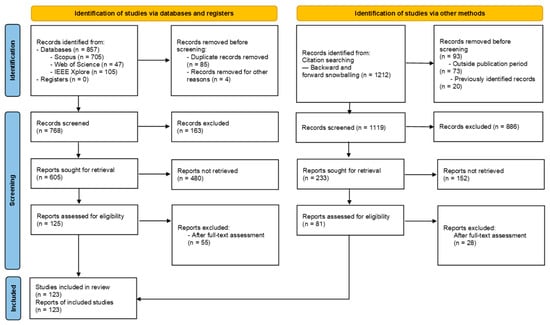
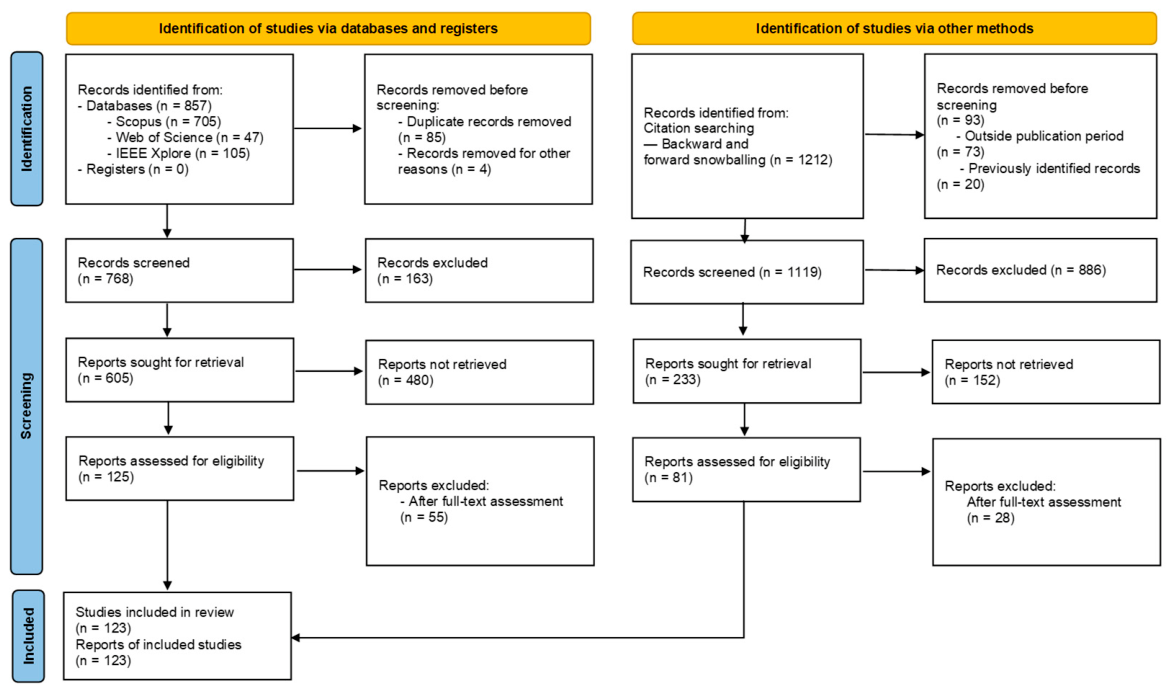
The selection of studies followed the PRISMA 2020 recommendations, adapted to the characteristics of a systematic mapping study. Figure 1 presents the corresponding PRISMA diagram, while the main stages of the process are described below.
Figure 1.
PRISMA flow diagram of the study selection process.
Identification: A total of 857 records were retrieved from the three selected databases: Scopus (705), Web of Science (47), and IEEE Xplore (105). The searches used the same conceptual blocks across the three databases. However, differences in the treatment of quoted phrases, as discussed in Section 4.3, mean that equivalent retrieval across databases cannot be assumed.
Duplicate and retracted publication removal: After consolidating the 857 records, 85 duplicate records and 4 retracted publications were removed, leaving 768 records for title and abstract screening.
Screening (title and abstract): A total of 768 records were assessed, of which 163 were excluded for failing to meet the thematic or document-type criteria, including secondary studies. The remaining 605 records proceeded to the full-text retrieval stage.
Full-text retrieval: Of the 605 reports that passed title and abstract screening, 125 were retrieved and assessed for eligibility, whereas 480 (79.3%) could not be retrieved. The latter were recorded as not retrieved, without determining their eligibility through full-text assessment. To examine potential differences associated with retrieval, available metadata and thematic distributions derived from the abstracts of both groups were compared in a supplementary analysis presented in Table S3. This analysis did not replace a full-text eligibility assessment.
Eligibility assessment: Of the 125 reports retrieved from the original search, 55 were excluded and 70 met the inclusion criteria. Exclusions comprised secondary studies, ineligible document types, publications in languages other than English, absence of a rural or remote context, and reports without a specific IoT proposal within the study scope. Decisions and their rationale were documented. Conceptual proposals were not excluded solely for lacking operational deployment when they described a specific IoT architecture or framework.
Complementary reference and citation searching: One round of backward reference searching and forward citation searching was conducted using reviews [25,28] as seed studies. A total of 1212 records were identified, of which 93 were removed before screening (73 outside the specified publication period and 20 previously identified records), leaving 1119 records for screening. Of these, 886 were excluded, and full-text retrieval was sought for 233 reports. Eighty-one reports were retrieved and assessed, whereas 152 could not be retrieved. Of the assessed reports, 28 were excluded and 53 met the inclusion criteria. Identification routes and decisions were documented in the complementary search register.
Following eligibility reassessment, 70 studies from the original search were retained. Complementary backward reference searching and forward citation searching, using reviews [25,26,27,28] as seeds, added 53 studies following full-text retrieval and eligibility assessment. The updated corpus comprises 123 studies, whose MP1–MP5 coding was rechecked using the full texts. Classifications, supporting evidence, and the codebook are provided in Supplementary Table S2.
Flow diagram of study selection following PRISMA 2020, integrating the original database search and complementary reference and citation searching. The corpus comprises 70 studies from the original search and 53 from complementary searching, including the following full-text eligibility assessment. Reports not retrieved are shown separately from reports excluded on eligibility grounds.
4.6. Data Extraction and Classification Scheme
Data extraction and classification were carried out using the keywording method proposed by Petersen et al. [7]. Given the conceptual and technical heterogeneity of IoT research in rural areas, an inductive classification scheme was developed to organize the included studies and answer the mapping questions MP1–MP5.
The taxonomy was developed iteratively through reading the studies and extracting passages and concepts related to MP1–MP5. An initial exploratory phase informed the preliminary categories, which were subsequently refined during coding of the corpus. During revision, all five dimensions were rechecked across the entire corpus using the full texts and the codebook definitions. Assignments were retained, added, or removed according to the evidence identified, without treating previously reported frequencies as constraints on classification.
4.6.1. Resulting Taxonomy
The resulting taxonomy includes five analytical dimensions aligned with the mapping questions MP1–MP5.
MP1—Application Domain
AG (Smart Agriculture), EN (Smart Energy/Grid), EH (e-Health and Elderly Care), ENVI (Environmental Monitoring), RS (Rural Safety/Resilience), GV (Governance and Public Services), INFR (Rural Infrastructure/Infrastructure IoT)
MP2—IoT Technologies
COM (Connectivity), SENS (Sensing Hardware), EDGE (Edge/Fog/MEC), CLOUD (Cloud Analytics), SEC (Security/Blockchain), PWR (Energy/Autonomy), UAV (Unmanned Aerial Vehicles), AI (Artificial Intelligence)
MP3—Architectural Pattern
NGW-C (Node→Gateway→Cloud), EDGE-F (Edge/Fog Processing), UAV-MEC (Drone-based Edge), MULTI-L (Layered Hybrid), BLCHAIN (Blockchain-IoT), VIRT (NFV/VNF/Virtualized IoT), NR (Not Reported)
MP4—Framework/Standard Adoption
For MP4, FW-A was assigned when the study explicitly proposed a framework or structured model for organizing the design or implementation of the IoT solution, whereas STD was assigned when the study explicitly reported the adoption or use of a formal standard, recommendation, or specification. When both criteria were supported, FW-A took precedence to preserve the single-label coding of MP4. NR was used when neither form of formalization was identified in the study.
NR (Not Reported), FW-A (Framework Proposed), STD (Standard Compliant)
MP5—Reported Challenges
Because a single study may report multiple challenges, the MP5 categories are not mutually exclusive; therefore, the sum of their frequencies exceeds the total number of included studies.
COV (Coverage), ENE (Energy), LAT (Latency), SCALE (Scalability), SEC-P (Security/Privacy), COST (Economic Feasibility), DATA (Data Quality/Management)
This taxonomy served as the basis for the systematic coding of all included studies.
4.6.2. Coding Procedure for the Systematic Mapping
Title and abstract screening, full-text eligibility assessment, and initial data extraction and coding were performed by a single researcher. Data extraction and coding were supported by a language model, whose outputs were manually reviewed and corrected before consolidation. To assess the reproducibility of the classification, a random sample of 25 studies, representing 20.3% of the corpus, was selected and sent to a second evaluator for independent coding using the same codebook, without access to the first coder’s labels.
The comparison of independent coding assignments yielded an observed agreement of 90.3% and a pooled Cohen’s kappa coefficient of 0.740, calculated across 800 binary classification decisions covering the five mapping dimensions. These results provide evidence of inter-rater agreement, although interpretative differences between coders remain possible. The independent coding assignments and inter-coder agreement calculations are provided in Supplementary Table S4. The complete register of complementary reference and citation searching, described in Section 4.5, is provided in Supplementary Table S5.
Once the taxonomy was defined, a systematic coding procedure was applied to the included reports. In a first phase, the full text of each article was examined, and passages supporting information relevant to MP1–MP5 were extracted, recording their source to maintain the traceability of coding assignments.
In a second phase, the collected textual evidence was analyzed and mapped to the corresponding categories of the taxonomy, assigning to each article the taxonomic values that best represented the reported information.
Finally, coding was represented as a binary matrix, with one row per study and one column per category. A value of 1 indicated that the extracted evidence supported the assignment; a value of 0 indicated that sufficient supporting evidence had not been identified, without establishing the absence of the characteristic. MP1, MP2, MP3, and MP5 were treated as multi-label dimensions. MP2 comprised eight categories: COM, SENS, EDGE, CLOUD, SEC, PWR, UAV, and AI. LPWAN technologies were included under COM, and nanosensors and wearable sensors under SENS. MULTI-L was used exclusively in MP3 as an architectural pattern. MP4 was treated as a single-label dimension: FW-A, STD, or NR. Consequently, the sum of category frequencies in the multi-label dimensions may exceed the corpus size, whereas MP4 frequencies sum to the total number of included studies.
Supplementary analysis of retrieval bias. The 125 retrieved and 480 unretrieved reports were compared by year, database, document type, journal or conference, publisher, and open-access status, using available metadata. Missing data were explicitly identified and were not interpreted as closed access. Abstracts from both groups were also coded with language-model assistance using the MP1–MP5 taxonomy, retaining the passages supporting each assignment. Lack of supporting evidence in an abstract was not interpreted as an absence of the characteristic. After applying the same relevance rules to both groups, the thematic comparison included 96 retrieved and 344 unretrieved records, including uncertain cases. A sensitivity analysis restricted the comparison to potentially relevant records: 85 and 287, respectively. Decisions, supporting evidence, and denominators are provided in Table S3.
5. Results and Mapping
The results presented below synthesize the evidence extracted and coded from the included studies, according to the dimensions of the defined mapping.
5.1. Overview of the Included Studies
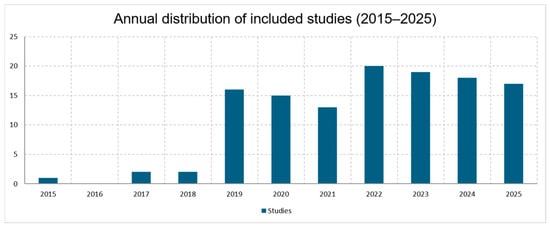
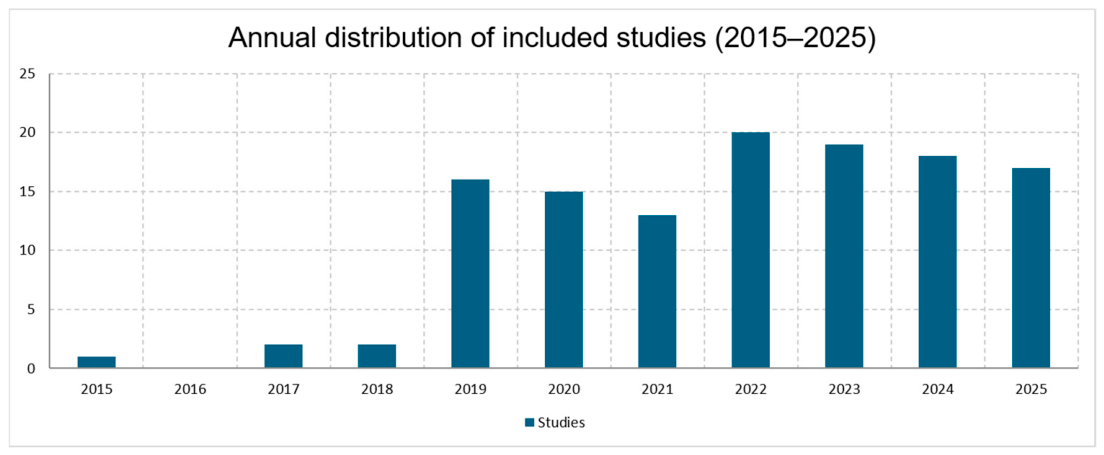
The revised corpus comprises 123 primary studies published between 2015 and 2025. Their annual distribution, shown in Figure 2, describes the temporal composition of the included studies and should not be interpreted as an estimate of trends across the entire literature on IoT in rural and remote environments.
Figure 2.
Temporal distribution of the included studies (2015–2025).
Annual distribution of the 123 included primary studies, published between 2015 and 2025. Frequencies refer to the included studies. Coverage of 2025 is partial because the search was conducted on 21 July 2025.
Within the corpus of 123 studies, 2022 accounts for the largest number of publications (20), followed by 2023 (19) and 2024 (18). Seventeen included studies were published in 2025. These frequencies describe the distribution of the analyzed studies; they do not establish trends in the field’s annual research output, given the search and retrieval limitations.
5.2. Results by Mapping Question (MP1–MP5)
This subsection presents the results organized by each mapping question (MP1–MP5), in accordance with the defined taxonomy and coding scheme.
5.2.1. MP1—What Are the Main Application Domains of IoT in Rural or Remote Areas?
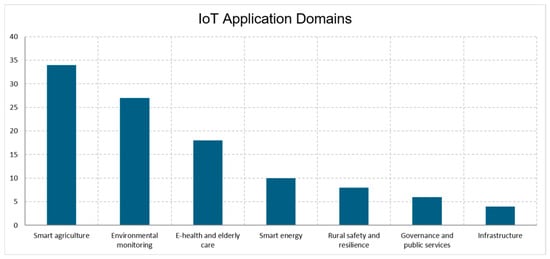
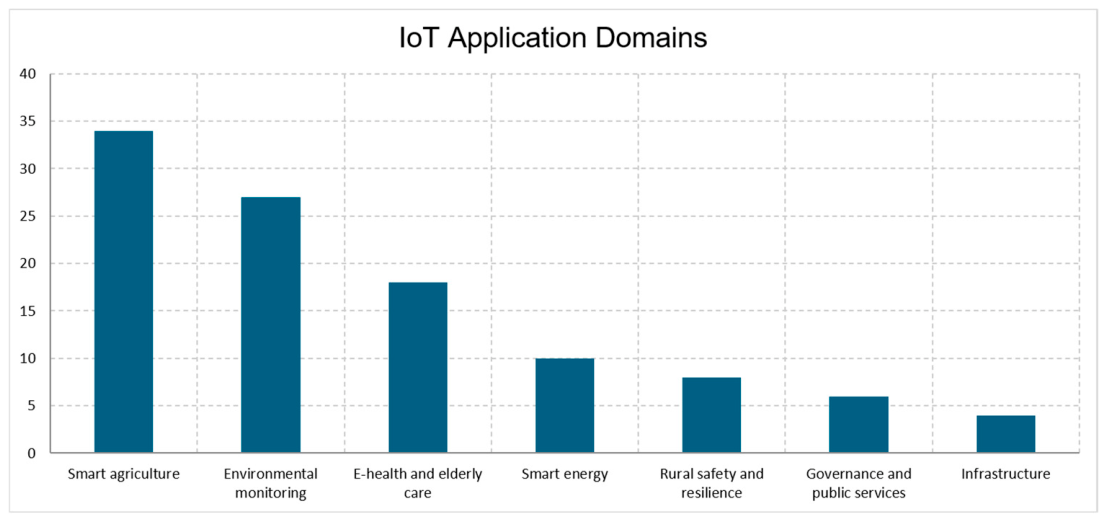
Figure 3 presents the application domains supported by the evidence extracted from the corpus. Smart agriculture and environmental monitoring feature prominently among the identified applications, alongside e-health and elderly care. A study may contribute to several domains because MP1 is a multi-label dimension.
Figure 3.
Distribution of IoT application domains in rural and remote areas (MP1).
Frequency of application domains identified in the corpus: AG (Smart Agriculture), ENVI (Environmental Monitoring), RS (Rural Safety and Resilience), EH (e-Health and Elderly Care), GV (Governance and Public Services), EN (Smart Energy), and INFR (Infrastructure). Categories are multi-label, and percentages are calculated relative to the total number of included studies.
Agriculture, environmental monitoring, and e-health and elderly care feature prominently among the domains represented in the corpus. Applications related to energy, rural safety and resilience, governance and public services, and infrastructure were also identified. This distribution illustrates the diversity of applications addressed without establishing the relative importance of each domain across rural IoT research as a whole.
5.2.2. MP2—IoT Technologies Used in Rural and Remote Scenarios
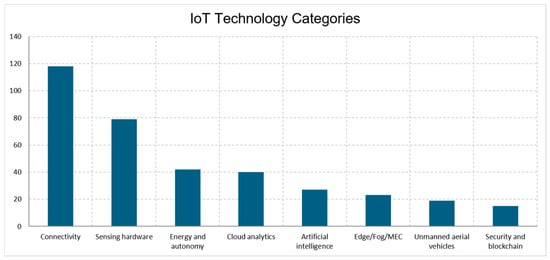
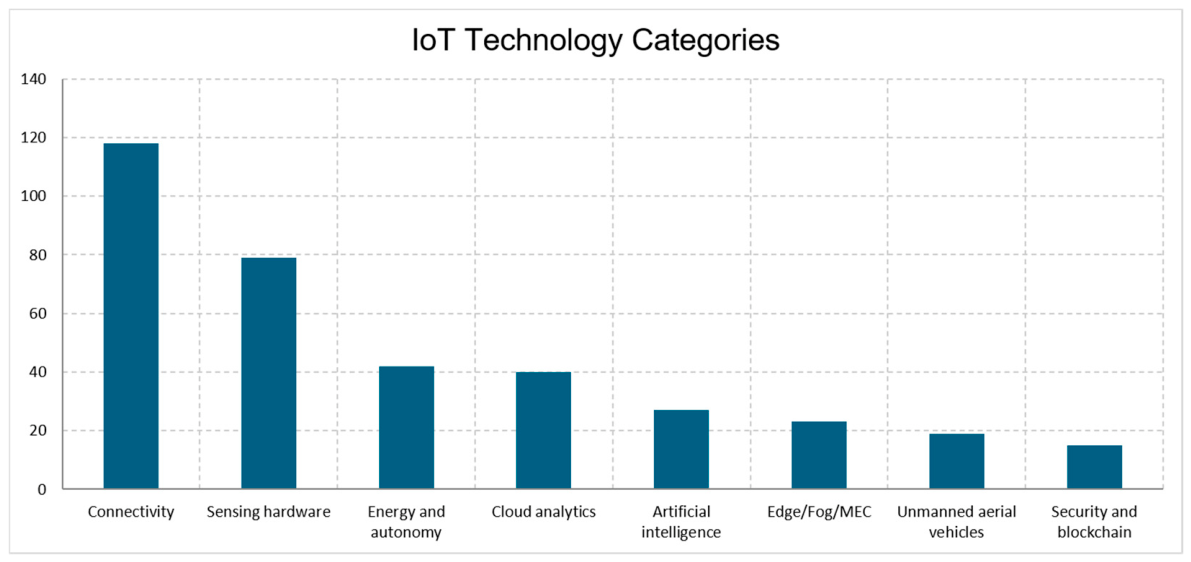
Connectivity (COM) and sensing hardware (SENS) are the most frequent technological categories in the corpus (Figure 4). Energy and autonomy technologies (PWR), cloud analytics (CLOUD), and edge, fog, or MEC processing (EDGE) were also identified.
Figure 4.
Distribution of IoT technological components employed in rural and remote contexts (MP2).
The corpus also includes artificial intelligence (AI), unmanned aerial vehicles (UAV), and security or blockchain technologies (SEC). These categories may coexist within a study because MP2 uses multi-label coding. The frequencies describe technologies supported by the extracted evidence without establishing their effectiveness or maturity.
Frequency of technological categories identified in the corpus: COM (Connectivity), SENS (Sensing Hardware), EDGE (Edge/Fog/MEC), CLOUD (Cloud Analytics), SEC (Security and Blockchain), PWR (Energy and Autonomy), UAV (Unmanned Aerial Vehicles), and AI (Artificial Intelligence). MP2 uses multi-label coding; percentages are calculated relative to the total number of included studies.
5.2.3. MP3—What IoT Architectures Are Used in Rural or Remote Scenarios?
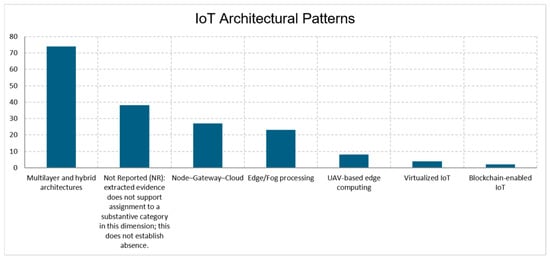
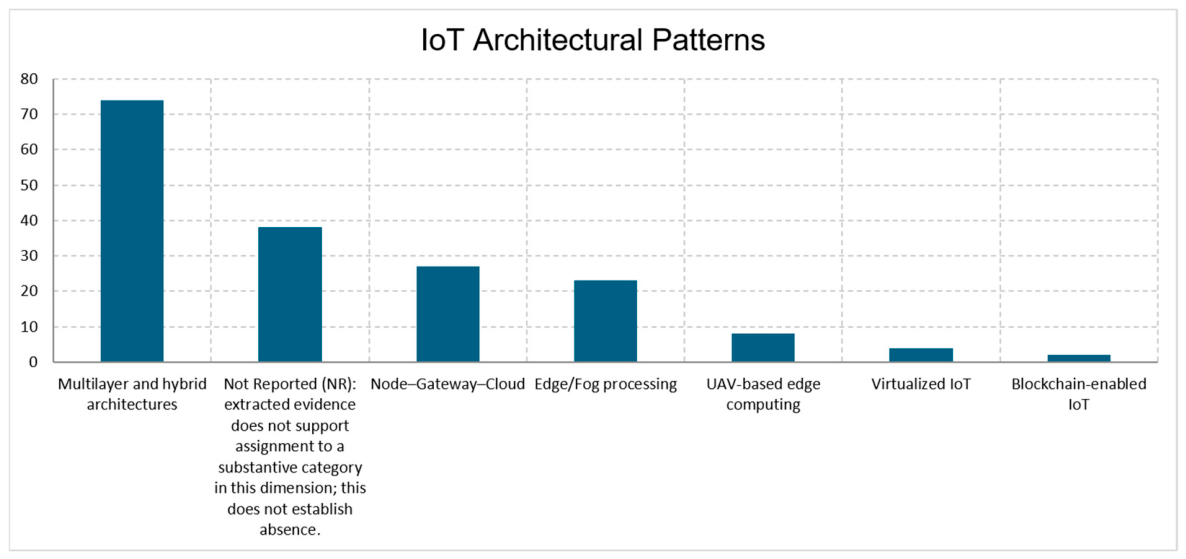
Multi-layer or hybrid architectures (MULTI-L) are the most frequent architectural pattern in the corpus (Figure 5). They organize IoT functions into multiple layers or combine different architectural approaches. Node–Gateway–Cloud (NGW-C) configurations, which connect IoT nodes to remote services through a gateway, were also identified. Both patterns may coexist because MP3 uses multi-label coding.
Figure 5.
Distribution of IoT architectural approaches in rural and remote areas (MP3).
Other proposals incorporate processing near devices or data sources (EDGE-F), aerial platforms with edge computing (UAV-MEC), virtualized architectures (VIRT), or blockchain integration (BLCHAIN).
NR was recorded when the extracted evidence did not support assignment to an architectural pattern defined in the codebook. This label does not imply that the study lacks an architecture.
Frequency of architectural categories identified in the corpus: NGW-C (Node–Gateway–Cloud), MULTI-L (Multi-layer and Hybrid Architectures), EDGE-F (Edge/Fog Processing), UAV-MEC (UAV-based Edge Computing), BLCHAIN (Blockchain-enabled IoT), and VIRT (Virtualized IoT). MP3 uses multi-label coding; percentages are calculated relative to the total number of included studies. NR identifies cases with insufficient evidence to assign an architectural category.
5.2.4. To What Extent Do Studies Use Standards or Propose Frameworks?
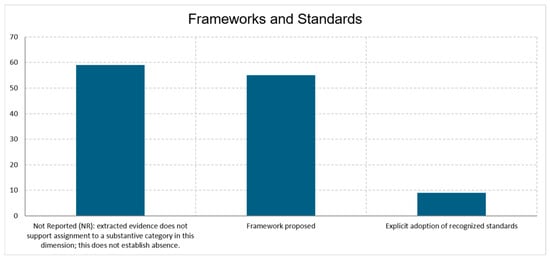
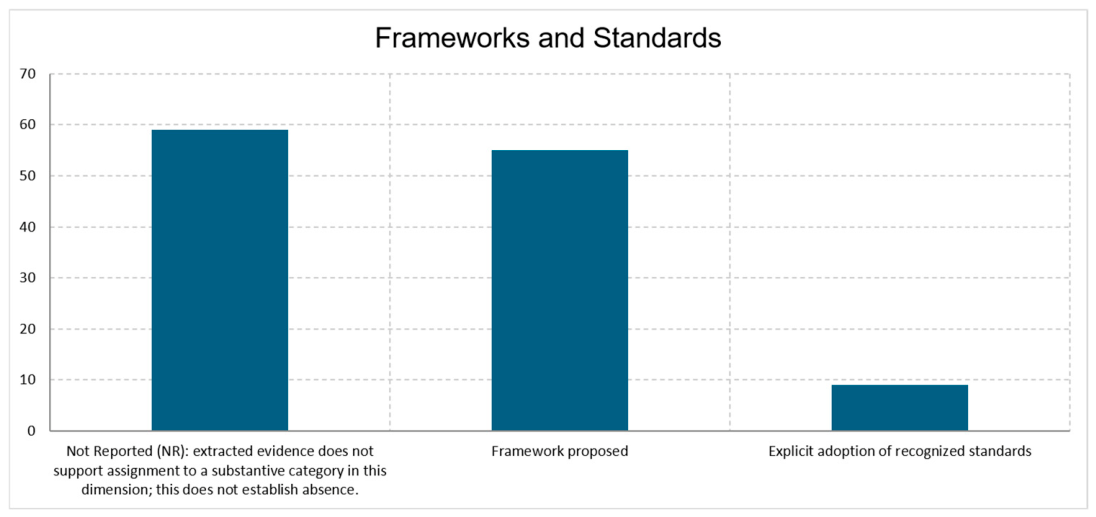
The corpus includes studies proposing frameworks or structured architectural models (FW-A), studies documenting the adoption of recognized standards (STD), and studies whose evidence does not support either assignment (NR) (Figure 6). NR indicates insufficient evidence for classification and does not establish the absence of standards or frameworks.
Figure 6.
Formalization level of IoT solutions in rural and remote contexts (MP4).
Proposals classified as FW-A organize the design or implementation of an IoT solution, but this label alone does not establish their reusability or validation in other territories. Likewise, STD identifies explicitly documented use of standards and does not imply independent verification of compliance.
Distribution of MP4 across the corpus: NR (Not Reported), STD (explicit use of recognized standards), and FW-A (Framework or Architectural Model Proposed). Classification is single-label, and categories are mutually exclusive.
5.2.5. MP5—What Challenges and Limitations Are Most Frequently Reported in IoT for Rural and Remote Areas?
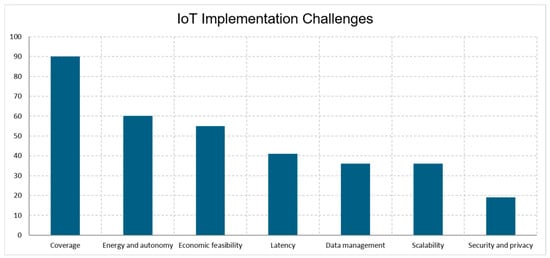
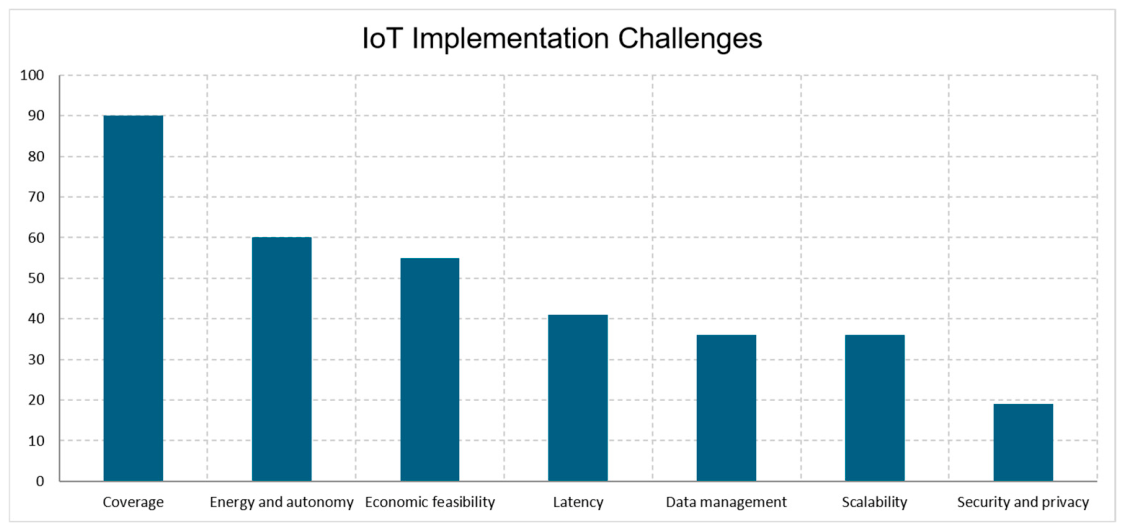
Coverage (COV) is the most frequently reported challenge in the corpus (Figure 7). Energy limitations (ENE) and cost or economic feasibility constraints (COST) also feature prominently. Other identified challenges include latency (LAT), scalability (SCALE), data quality and management (DATA), and security and privacy (SEC-P). These categories may coexist within a study; their frequencies reflect documented challenges without establishing their relative severity or demonstrating their absence when not reported.
Figure 7.
Distribution of reported challenges in rural IoT systems (MP5).
Frequency of challenges identified in the corpus, classified according to MP5: COV (Coverage), SCALE (Scalability), ENE (Energy), COST (Economic Feasibility), LAT (Latency), SEC-P (Security and Privacy), and DATA (Data Quality and Management). Coding is multi-label, and percentages are calculated relative to the total number of included studies.
The supplementary analysis identified differences between retrieved and unretrieved reports. Journal articles accounted for 68.3% versus 25.4%, respectively, whereas conference papers accounted for 19.8% versus 56.3%. In the abstract-based thematic comparison—96 retrieved and 344 unretrieved records—agriculture showed similar proportions (20.8% and 20.6%), whereas EDGE was more frequent among unretrieved records (12.8% versus 7.3%). These findings suggest uneven retrieval by document type and potential thematic differences, without establishing the definitive eligibility of unretrieved reports. Missing metadata limited comparisons by venue, publisher, and open-access status. Complete results are provided in Table S3.
6. Discussion
The results show that the challenges reported for IoT in rural and remote areas cannot be explained solely by technological limitations. Sensing, communication, and processing technologies are used across multiple rural applications, while constraints related to connectivity, energy, infrastructure, architecture, and long-term operation remain recurrent. This indicates that technology availability alone is not sufficient; IoT system design must also account for the conditions of the territory in which the solution will operate.
Agriculture and environmental monitoring are the most frequent application domains identified in the corpus. In these applications, IoT systems are used to collect meteorological and environmental variables through distributed sensing nodes and provide remote access to the resulting data [30,31]. Water-monitoring applications also combine data acquisition with mechanisms for informing or alerting users, particularly in smart-village initiatives [32]. For example, Oliveira-Jr et al. [33] propose a low-cost, modular sensing platform that combines measurements of soil and environmental conditions with computer vision to support small-scale farming in rural Africa.
From an architectural perspective, the corpus includes multilayer and hybrid configurations, node–gateway–cloud configurations, and edge/fog processing approaches. Node–gateway–cloud configurations are used in environmental, agricultural, and water-monitoring applications, where sensing nodes collect field data, gateways provide aggregation and communication functions, and remote platforms support data storage and analysis [30,32,34]. Other studies incorporate edge processing to reduce latency and bandwidth requirements or to support operation under connectivity constraints [35]. This diversity illustrates different ways of distributing system functions and motivates consideration of territorial conditions when selecting an architectural configuration.
The MP4 results show both proposals for frameworks or structured architectural models and studies whose evidence does not establish either standards adoption or a framework proposal. The approaches that do provide some degree of formalization are often associated with specific application domains. Examples include a framework for evaluating IoT healthcare systems in developing countries [36] and the DESIRA conceptual approach, which examines IoT within rural digital transformation processes [37]. Other proposals address particular rural applications through architectures or frameworks involving technologies such as edge computing, machine learning, or digital training [38,39].
A smaller subset of studies explicitly uses established standards, platforms, or technical specifications, particularly for connectivity and IoT service management. Celesti et al. [40] integrate the interoperable FIWARE platform into an IoT-based e-Health system, while Cotrim and Margi [41] examine the performance implications of LoRaWAN in multihop networks. Tondo et al. [42] explore direct communication between LoRa nodes and low Earth orbit (LEO) satellites for areas without terrestrial infrastructure. These examples illustrate the use of platforms and specifications to address particular technological aspects of rural IoT systems. MP4 identifies standards adoption or the proposal of frameworks and architectures but does not assess how comprehensively they incorporate territorial conditions or cover design, deployment, and long-term operation. These aspects require a dedicated assessment and constitute a complementary research direction.
The challenges identified in MP5 can be grouped according to the main conditions they affect in rural IoT deployments. For the discussion, they are organized into three groups: infrastructural limitations (COV, LAT, and ENE), design and architecture challenges (SCALE, DATA, and SEC-P), and economic feasibility and operational sustainability (COST). This grouping is used to examine how the reported challenges relate to territorial conditions, system design, and long-term operation.
A1—Infrastructural Limitations (COV + LAT + ENE)
The first group comprises challenges associated with network coverage, latency, and energy availability, all of which are directly affected by the conditions of rural and remote environments. Connectivity in these settings may depend on satellite links or long-range LPWAN networks whose availability and performance vary with the deployment context. Satellite communication systems for remote communities report latency and capacity constraints that can affect data transmission and service reliability [43]. In Arctic regions, intermittent coverage and limited backhaul infrastructure have led to the use of delay-tolerant communication approaches [44]. Direct communication between LoRa nodes and low Earth orbit satellites has also been explored for locations without terrestrial infrastructure [42]. Energy availability introduces an additional constraint, particularly for battery-powered nodes, where communication and processing must be managed according to the available energy budget [45].
These studies show that connectivity and energy conditions are not external considerations in rural IoT deployments; they directly influence communication strategies, processing decisions, and system operation.
A2—Design and Architecture Challenges (SCALE + DATA + SEC-P)
Scalability, data management, and security and privacy form the second group of challenges identified in MP5. As rural IoT deployments expand, increasing numbers of devices, data flows, and communication links place additional demands on system architecture. Studies addressing large-scale or distributed deployments report the use of hierarchical, edge, and fog-based approaches to distribute processing and reduce dependence on centralized infrastructure. Data management introduces related requirements concerning the collection, transmission, storage, and processing of information generated by geographically dispersed devices. Security and privacy add further design requirements, particularly when data are transmitted through heterogeneous networks or processed across different system components.
Several studies address these challenges through distributed processing and alternative data-management mechanisms. Edge and fog computing are used to move processing closer to data sources and reduce dependence on centralized cloud infrastructure [35,38,46]. Other proposals incorporate mechanisms for managing heterogeneous data or improving interoperability between devices and platforms [24]. Security and privacy are addressed through different mechanisms according to the application and architecture, although these concerns appear less frequently than connectivity, scalability, or energy challenges in the mapped corpus.
Security and privacy constitute another challenge within this group. Some proposals combine edge computing and blockchain technologies to protect sensitive data and strengthen system security, although these mechanisms may introduce additional computational overhead and latency in resource-constrained environments [38]. Together with scalability and data management, these requirements need to be considered when rural IoT systems move beyond small-scale prototypes toward larger operational deployments.
A3—Economic Feasibility and Operational Sustainability (COST)
Economic feasibility and operational sustainability constitute the third group of challenges. In rural and remote environments, maintaining an IoT system over time depends not only on its technical performance but also on the resources required for connectivity, equipment, maintenance, and operation. This is particularly relevant when deployments rely on satellite links or other communication infrastructure whose costs may affect service continuity and scalability [43,44].
Energy requirements also have economic implications. Energy-harvesting and wireless energy-transfer approaches can increase node autonomy, but they may require additional devices, conversion systems, and maintenance [47,48]. Low-cost environmental monitoring systems reduce initial deployment costs, but recurring expenses associated with maintenance, component replacement, and processing platforms remain relevant during operation [34]. Therefore, cost should be considered throughout the operational life of rural IoT systems rather than only at the initial deployment stage.
Daneels et al. [49] and Hidayat et al. [30] provide examples of proposals addressing environmental monitoring in rural settings. Daneels et al. propose a LoRaWAN-based framework for environmental monitoring that integrates sensing nodes, communication infrastructure, and cloud services, whereas Hidayat et al. present an IoT framework specifically designed for environmental monitoring in rural settings. Both proposals address relevant aspects of rural IoT implementation, particularly sensing, communication, and data management. However, their scope is centered on specific applications and technological configurations rather than on a broader implementation process that incorporates territorial conditions from system design through deployment and long-term operation.
The mapped evidence shows a diversity of technologies and architectures applied to rural IoT, alongside recurring challenges concerning connectivity, energy availability, latency, cost, scalability, security, and data management. The presence of these challenges across the corpus motivates joint consideration of deployment conditions and technological, architectural, and operational decisions. This synthesis provides the basis for proposing a territory-oriented approach to rural IoT.
Emergent Principles for Rural IoT Systems
In rural and remote areas, the mapped evidence shows recurrent constraints related to connectivity, energy availability, infrastructure, cost, and other deployment conditions. These findings motivate the consideration of such conditions from the design stage.
Technical design principles:
The following principles are not categories directly evaluated in the SMS but rather a conceptual synthesis derived from the patterns observed across the MP1–MP5 dimensions. Therefore, they should be interpreted as design implications grounded in the mapped evidence rather than as outcomes directly measured in the included studies.
Principle 1: Territory-aware IoT Design
The results show that IoT deployments in rural and remote areas recurrently face constraints associated with coverage, energy availability, scalability, latency, cost, and data management. These conditions indicate that the characteristics of the deployment environment should not be considered solely as implementation difficulties but as conditions that may influence system design decisions. From this perspective, territory-aware design proposes characterizing the relevant conditions of the deployment environment before selecting technologies and defining the system architecture.
Principle 2: Territory-constrained IoT Design
Once the territorial conditions have been characterized, the identified constraints should be explicitly incorporated into design decisions. The SMS results identify coverage and energy availability as recurrent challenges in the analyzed corpus. From this evidence, it follows that the design of IoT systems for rural and remote areas should not assume continuous connectivity or permanent energy availability. Instead, decisions concerning communication, processing, storage, and energy supply should be adapted to the conditions identified in the deployment environment.
Principle 3: Distributed Computing (Processing and Storage)
The results show the presence of edge processing and architectures that distribute functions across devices, gateways, and remote platforms, while coverage and latency emerge as recurrent challenges. The convergence of these findings suggests that, in environments where connectivity may be limited or intermittent, system operation should not depend exclusively on a continuous connection to remote services. From this perspective, local or distributed processing and storage can enable specific functions, such as data acquisition, temporary processing, and data preservation, to continue during periods of disconnection, while synchronization or transmission can occur when connectivity becomes available.
Principle 4: Design for Maintainability and Remote Operation
In rural and remote areas, geographic dispersion may limit the feasibility of frequent technical interventions. This suggests that maintainability should be considered from the early stages of system design, with the aim of reducing dependence on on-site interventions. Capabilities such as remote diagnostics, system health monitoring, and remote updates can contribute to this purpose.
Governance and sustainability principles:
Principle 5: Long-term operational sustainability
The challenges identified in relation to cost, energy availability, and scalability suggest that the viability of an IoT system in rural and remote areas should not be considered solely in terms of its initial implementation. Operational sustainability requires considering, from the design stage, the resources and conditions necessary to keep the system functioning over time. From this perspective, technological and architectural decisions should consider not only the initial feasibility of the solution but also its operation, maintenance, and eventual expansion.
Principle 6: Governance-oriented Design
The challenges identified in relation to security, privacy, and data suggest that the design of IoT systems in rural and remote areas should consider not only how data are acquired, transmitted, and stored but also how they are managed and used. From this perspective, data governance involves considering aspects such as access, responsibility, and the conditions governing the use of data generated by the system. These aspects become particularly relevant when data generated within the territory are used by different stakeholders, such as communities, institutions, researchers, or service providers.
Principle 7: Framework-based Development
The corpus includes proposed frameworks and architectures, alongside studies whose recorded evidence does not establish standards adoption or framework proposal. This diversity motivates examining how reference approaches can structure design decisions and support knowledge transfer across rural and remote contexts. From this perspective, the development of rural IoT solutions could benefit from frameworks that integrate the previous principles: knowledge of the territory, infrastructure constraints, distributed computing, remote operability, operational sustainability, and data governance.
7. Conclusions
7.1. Evidence-Based Conclusions
This Systematic Mapping Study provides a structured, quantitative synthesis of research on Internet of Things (IoT) technologies in rural and remote contexts, based on the corpus of primary studies published between 2015 and 2025. Agriculture and environmental monitoring feature prominently among the identified application domains.
From a technological and architectural perspective, connectivity and sensing are the most frequently identified technological components, while architectures include multilayer and hybrid configurations, node–gateway–cloud configurations, and edge/fog approaches. Recurring challenges concerning coverage, energy availability, and cost reinforce the importance of considering deployment conditions alongside technological and architectural decisions.
The analysis also shows that operational sustainability, data governance, and long-term system evolution are not explicitly represented as dimensions in the resulting taxonomy. Although related concerns appear through challenges associated with cost, energy, scalability, security/privacy, and data, the mapped evidence does not support determining the extent to which these aspects are systematically addressed over the operational life of the reported systems.
Recurring challenges concerning coverage, energy, cost, latency, scalability, security and privacy, and data management identify relevant conditions for rural IoT system design. The corpus also includes framework and architecture proposals and standards adoption, alongside reports whose available evidence does not support these assignments. These findings motivate investigating how structured design approaches can integrate territorial conditions and evaluating their usefulness across different rural and remote environments.
7.2. Conceptual Conclusions and Field Implications
This Systematic Mapping Study establishes the following conceptual conclusions:
First: The mapped evidence shows that IoT systems in rural and remote environments recurrently operate under constraints related to coverage, energy availability, scalability, latency, cost, security/privacy, and data. These conditions should therefore be explicitly considered when analyzing and designing IoT systems for these environments.
Second: The barriers identified in the analyzed corpus are not limited to the technological dimension. Recurrent challenges related to coverage, energy, scalability, latency, cost, security/privacy, and data indicate that deployment conditions should be considered together with technological and architectural decisions.
Third: The identified frameworks and architectures provide reference points for organizing rural IoT system design decisions. A research direction is to examine how these approaches incorporate territorial conditions and assess their applicability across different rural and remote environments.
Fourth: For analytical purposes, the challenges identified in the mapped evidence can be organized into three groups: infrastructural limitations, design and architecture challenges, and economic feasibility and operational sustainability. This grouping provides a structured interpretation of the recurrent challenges reported across the analyzed studies, without implying causal relationships among them.
Fifth: As a conceptual synthesis of the identified challenges, Territory-Oriented IoT is proposed as an approach that treats territorial characteristics and constraints as explicit conditions for the design, implementation, and operation of rural IoT systems. Its usefulness should be examined through subsequent applications and evaluations.
7.3. Scientific Contributions of This Study
C1. Rural IoT as a Distinct Research Domain
The study provides systematized evidence of the application domains, technologies, architectures, formalization approaches, and challenges reported in rural and remote IoT research. This characterization enables examination of the diversity of solutions and recurrent challenges within the corpus, providing an empirical basis for exploring design approaches that explicitly consider the conditions of rural and remote deployment environments.
C2. A Structured Taxonomy for Rural IoT Literature
The contribution is the taxonomy itself, which organizes rural IoT studies across five dimensions: application domains, technological components, architectural patterns, levels of formalization through frameworks and standards, and reported challenges. The taxonomy provides a common classification scheme for systematically comparing studies across these dimensions and can be reused or extended in future reviews of rural IoT research.
C3. A Structured Synthesis of Rural IoT Challenges
This study provides a structured synthesis of the challenges identified in the mapped evidence, organized for analytical purposes into three groups: infrastructural limitations, design and architecture challenges, and economic feasibility and operational sustainability. This organization relates the recurrent MP5 challenges to broader aspects of rural IoT deployment and provides a basis for examining how territorial conditions can be considered in future design approaches, without implying causal relationships among the identified challenges.
C4. Characterization of Reported Frameworks and Standards
The analysis characterizes framework and architecture proposals and standards adoption identified within the corpus, distinguishing them from reports whose available evidence does not support these assignments. Together with the recurrent challenges identified in MP5, this characterization provides an empirical basis for investigating structured design approaches that incorporate the conditions of rural and remote deployment environments.
C5. The Concept of Territory-Oriented IoT
The recurrent patterns identified across the MP1–MP5 dimensions motivate the formulation of “Territory-Oriented IoT” as a conceptual approach in which the characteristics and constraints of the deployment territory are explicitly considered in IoT system design. Rather than treating coverage, energy availability, infrastructure, cost, and other recurrent constraints as external implementation difficulties, this perspective considers them as conditions that may influence technological, architectural, and operational decisions. Territory-Oriented IoT should therefore be understood as a conceptual synthesis derived from the mapped evidence and as a basis for further investigation, rather than as an approach directly evaluated by this SMS.
7.4. Research Gaps
The analysis of the patterns identified within the included corpus makes it possible to recognize research gaps directly supported by the mapped categories, as well as research needs emerging from their synthesis. These aspects and their supporting evidence are summarized in Table 3.
Table 3.
Research Gaps Identified from the Systematic Mapping Study.
7.5. Threats to Validity
This Systematic Mapping Study presents several limitations that should be considered when interpreting its results. First, the search was restricted to three databases (Scopus, Web of Science, and IEEE Xplore); therefore, relevant literature indexed exclusively in other sources, such as the ACM Digital Library, may have been excluded from the study. In addition, the search string used a bounded set of terms to represent rural and remote contexts (“rural area”, “remote area”, and “isolated area”). Although these terms provided an explicit and reproducible retrieval criterion, studies describing equivalent contexts using alternative terminology may not have been retrieved. Therefore, the findings should be interpreted within the scope defined by the search strategy used.
Second, 480 of the 605 reports sought in the original selection process (79.3%) could not be retrieved in full text. The supplementary comparison identified differences in document types and some thematic categories between retrieved and unretrieved reports, sustaining concern about potential retrieval bias. Abstract-level analysis neither determines definitive eligibility nor eliminates this bias. Although complementary reference and citation searching expanded the corpus, it does not establish its representativeness. Therefore, the results should be interpreted as characteristics of the assessed corpus rather than representative estimates of the entire literature.
Third, screening and eligibility assessment were performed by a single researcher, introducing a risk of selection bias. Assigning studies to the MP1–MP5 categories also involves interpretation; iterative refinement of the taxonomy and manual review of coding decisions were used to reduce this risk. Independent checking of coding in a sample does not substitute for independent screening or guarantee the absence of errors in the remainder of the corpus.
Supplementary Materials
The following supporting information can be downloaded at: https://www.mdpi.com/article/10.3390/s26237530/s1, Table S1: PRISMA 2020 checklist for the present systematic mapping study. Table S2: Primary study register, MP1–MP5 classification matrix, and classification codebook. Table S3: Supplementary retrieval analysis of retrieved and unretrieved reports. Table S4: Independent coding and inter-coder agreement assessment for a subsample of 25 studies. Table S5: Complete register of records identified through complementary searching and backward and forward snowballing.
Author Contributions
Conceptualization, S.N.-M., A.N.-N. and B.C.; Methodology, S.N.-M. and B.C.; Formal Analysis, S.N.-M., A.N.-N. and B.C.; Investigation, S.N.-M.; Data Curation, S.N.-M. and A.N.-N.; Visualization, S.N.-M. and A.N.-N.; Project Administration, S.N.-M.; Supervision, B.C.; Writing—Original Draft Preparation, S.N.-M.; Writing—Review and Editing, S.N.-M., B.C., A.N.-N. and O.C.-F. All authors have read and agreed to the published version of the manuscript.
Funding
This research has been funded by the project VLIR-UOS: Vlaamse Interuniversitaire Raad-Universitaire Ontwikkelingssamenwerking and by the DGD: Directorate General for Development Cooperation and Humanitarian Aid, under funding code BO2017IUC034A105. And a thank you to Universidad Tecnológica Indoamérica for its support in the development of this research under the project IIDI-001-23.
Institutional Review Board Statement
Not applicable.
Informed Consent Statement
Not applicable.
Data Availability Statement
The data supporting the findings of this study are available within the article and its Supplementary Materials (Table S2).
Conflicts of Interest
The authors declare no conflicts of interest.
References
- Atzori, L.; Iera, A.; Morabito, G. The Internet of Things: A Survey. Comput. Netw. 2010, 54, 2787–2805. [Google Scholar] [CrossRef] [Scilit]
- Gubbi, J.; Buyya, R.; Marusic, S.; Palaniswami, M. Internet of Things (IoT): A Vision, Architectural Elements, and Future Directions. Future Gener. Comput. Syst. 2013, 29, 1645–1660. [Google Scholar] [CrossRef] [Scilit]
- Dlodlo, N.; Kalezhi, J. The Internet of Things in Agriculture for Sustainable Rural Development. In Proceedings of the 2015 International Conference on Emerging Trends in Networks and Computer Communications (ETNCC); IEEE: Windhoek, Namibia, 2015; pp. 13–18. [Google Scholar]
- Salemink, K.; Strijker, D.; Bosworth, G. Rural Development in the Digital Age: A Systematic Literature Review on Unequal ICT Availability, Adoption, and Use in Rural Areas. J. Rural Stud. 2017, 54, 360–371. [Google Scholar] [CrossRef] [Scilit]
- Furstenau, L.B.; Rodrigues, Y.P.R.; Sott, M.K.; Leivas, P.; Dohan, M.S.; López-Robles, J.R.; Cobo, M.J.; Bragazzi, N.L.; Choo, K.-K.R. Internet of Things: Conceptual Network Structure, Main Challenges and Future Directions. Digit. Commun. Netw. 2023, 9, 677–687. [Google Scholar] [CrossRef] [Scilit]
- Sadeghi-Niaraki, A. Internet of Thing (IoT) Review of Review: Bibliometric Overview since Its Foundation. Future Gener. Comput. Syst. 2023, 143, 361–377. [Google Scholar] [CrossRef] [Scilit]
- Petersen, K.; Feldt, R.; Mujtaba, S.; Mattsson, M. Systematic Mapping Studies in Software Engineering. In 12th International Conference on Evaluation and Assessment in Software Engineering (EASE); BCS Learning & Development: Swindon, UK, 2008. [Google Scholar]
- Al-Fuqaha, A.; Guizani, M.; Mohammadi, M.; Aledhari, M.; Ayyash, M. Internet of Things: A Survey on Enabling Technologies, Protocols, and Applications. IEEE Commun. Surv. Tutor. 2015, 17, 2347–2376. [Google Scholar] [CrossRef] [Scilit]
- Zanella, A.; Bui, N.; Castellani, A.; Vangelista, L.; Zorzi, M. Internet of Things for Smart Cities. IEEE Internet Things J. 2014, 1, 22–32. [Google Scholar] [CrossRef] [Scilit]
- Kassab, W.; Darabkh, K.A. A–Z Survey of Internet of Things: Architectures, Protocols, Applications, Recent Advances, Future Directions and Recommendations. J. Netw. Comput. Appl. 2020, 163, 102663. [Google Scholar] [CrossRef] [Scilit]
- Bonomi, F.; Milito, R.; Zhu, J.; Addepalli, S. Fog Computing and Its Role in the Internet of Things. In Proceedings of the First Edition of the MCC Workshop on Mobile Cloud Computing; ACM: Helsinki, Finland, 2012; pp. 13–16. [Google Scholar]
- Shi, W.; Cao, J.; Zhang, Q.; Li, Y.; Xu, L. Edge Computing: Vision and Challenges. IEEE Internet Things J. 2016, 3, 637–646. [Google Scholar] [CrossRef] [Scilit]
- IEEE. IEEE Standard for an Architectural Framework for the Internet of Things (IoT); Institute of Electrical and Electronics Engineers: New York, NY, USA, 2019. [Google Scholar]
- International Telecommunication Union. Overview of the Internet of Things; International Telecommunication Union: Geneva, Switzerland, 2012. [Google Scholar]
- ISO/IEC 30141:2018; Internet of Things (IoT)—Reference Architecture. International Organization for Standardization: Geneva, Switzerland, 2018.
- Ameyed, D.; Jaafar, F.; Petrillo, F.; Cheriet, M. Quality and Security Frameworks for IoT-Architecture Models Evaluation. SN Comput. Sci. 2023, 4, 394. [Google Scholar] [CrossRef] [Scilit]
- Fortino, G.; Savaglio, C.; Spezzano, G.; Zhou, M. Internet of Things as System of Systems: A Review of Methodologies, Frameworks, Platforms, and Tools. IEEE Trans. Syst. Man Cybern. Syst. 2021, 51, 223–236. [Google Scholar] [CrossRef] [Scilit]
- Kozlowski, T.; Noran, O.; Trevathan, J. Designing an Evaluation Framework for IoT Environmental Monitoring Systems. Procedia Comput. Sci. 2023, 219, 220–227. [Google Scholar] [CrossRef] [Scilit]
- Maroli, A.A.; Narwane, V.S.; Raut, R.D.; Narkhede, B.E. Framework for the Implementation of an Internet of Things (IoT)-Based Water Distribution and Management System. Clean Technol. Environ. Policy 2021, 23, 271–283. [Google Scholar] [CrossRef] [Scilit] [PubMed]
- Navarro, E.; Costa, N.; Pereira, A. A Systematic Review of IoT Solutions for Smart Farming. Sensors 2020, 20, 4231. [Google Scholar] [CrossRef] [Scilit] [PubMed]
- Shafi, U.; Mumtaz, R.; García-Nieto, J.; Hassan, S.A.; Zaidi, S.A.R.; Iqbal, N. Precision Agriculture Techniques and Practices: From Considerations to Applications. Sensors 2019, 19, 3796. [Google Scholar] [CrossRef] [Scilit] [PubMed]
- Giordani, M.; Ardizzon, F.; Crosara, L.; Laurenti, N.; Zorzi, M. The Role of Non-terrestrial Networks: Features and Physical-Layer Security Concerns. In Physical-Layer Security for 6G; Mohapatra, P., Pappas, N., Chorti, A., Tomasin, S., Eds.; Wiley: Hoboken, NJ, USA, 2024; pp. 275–303. [Google Scholar]
- Kodheli, O.; Lagunas, E.; Maturo, N.; Sharma, S.K.; Shankar, B.; Montoya, J.F.M.; Duncan, J.C.M.; Spano, D.; Chatzinotas, S.; Kisseleff, S.; et al. Satellite Communications in the New Space Era: A Survey and Future Challenges. IEEE Commun. Surv. Tutor. 2021, 23, 70–109. [Google Scholar] [CrossRef] [Scilit]
- Seydoux, N.; Drira, K.; Hernandez, N.; Monteil, T. Capturing the Contributions of the Semantic Web to the IoT: A Unifying Vision. arXiv 2017, arXiv:1709.03576. [Google Scholar]
- Centenaro, M.; Costa, C.E.; Granelli, F.; Sacchi, C.; Vangelista, L. A Survey on Technologies, Standards and Open Challenges in Satellite IoT. IEEE Commun. Surv. Tutor. 2021, 23, 1693–1720. [Google Scholar] [CrossRef] [Scilit]
- Ogbodo, E.U.; Abu-Mahfouz, A.M.; Kurien, A.M. A Survey on 5G and LPWAN-IoT for Improved Smart Cities and Remote Area Applications: From the Aspect of Architecture and Security. Sensors 2022, 22, 6313. [Google Scholar] [CrossRef] [Scilit] [PubMed]
- Islam, N.; Rashid, M.M.; Pasandideh, F.; Ray, B.; Moore, S.; Kadel, R. A Review of Applications and Communication Technologies for Internet of Things (IoT) and Unmanned Aerial Vehicle (UAV) Based Sustainable Smart Farming. Sustainability 2021, 13, 1821. [Google Scholar] [CrossRef] [Scilit]
- Prauzek, M.; Konecny, J.; Borova, M.; Janosova, K.; Hlavica, J.; Musilek, P. Energy Harvesting Sources, Storage Devices and System Topologies for Environmental Wireless Sensor Networks: A Review. Sensors 2018, 18, 2446. [Google Scholar] [CrossRef] [Scilit] [PubMed]
- Page, M.J.; McKenzie, J.E.; Bossuyt, P.M.; Boutron, I.; Hoffmann, T.C.; Mulrow, C.D.; Shamseer, L.; Tetzlaff, J.M.; Akl, E.A.; Brennan, S.E.; et al. The PRISMA 2020 Statement: An Updated Guideline for Reporting Systematic Reviews. BMJ 2021, 372, n71. [Google Scholar] [CrossRef] [Scilit] [PubMed]
- Hidayat, M.S.; Nugroho, A.P.; Sutiarso, L.; Okayasu, T. Development of Environmental Monitoring Systems Based on LoRa with Cloud Integration for Rural Area. IOP Conf. Ser. Earth Environ. Sci. 2019, 355, 012010. [Google Scholar] [CrossRef] [Scilit]
- Murdyantoro, E.; Setiawan, R.; Rosyadi, I.; Nugraha, A.W.; Susilawati, H.; Ramadhani, Y. Prototype Weather Station Uses LoRa Wireless Connectivity Infrastructure. J. Phys. Conf. Ser. 2019, 1367, 012089. [Google Scholar] [CrossRef] [Scilit]
- Sarkar, I.; Karforma, S.; Bose, R.; Roy, S. Ubiquitous On-Demand Water Reservoir Tracking System for Smart Village. Univers. J. Agric. Res. 2022, 10, 193–203. [Google Scholar] [CrossRef] [Scilit]
- Oliveira-Jr, A.; Resende, C.; Pereira, A.; Madureira, P.; Gonçalves, J.; Moutinho, R.; Soares, F.; Moreira, W. IoT Sensing Platform as a Driver for Digital Farming in Rural Africa. Sensors 2020, 20, 3511. [Google Scholar] [CrossRef] [Scilit] [PubMed]
- Gaspar, P.N.; Magalhães De Lima, J.P.; Sousa, L.M.C.; Pinto, V.P. Development of a Meteorological Data Acquisition Prototype: A Low-Cost and Mobile Proposal. E3S Web Conf. 2024, 546, 01015. [Google Scholar] [CrossRef] [Scilit]
- Griva, A.I.; Boursianis, A.D.; Wan, S.; Sarigiannidis, P.; Psannis, K.E.; Karagiannidis, G.; Goudos, S.K. LoRa-Based IoT Network Assessment in Rural and Urban Scenarios. Sensors 2023, 23, 1695. [Google Scholar] [CrossRef] [Scilit] [PubMed]
- Ahmed, R.; Yafi, E.; Su’ud, M.M.; Alam, M.M.; Faizan, M. A Framework for Real-Time Healthcare System Performance in Developing Countries. J. Comput. Sci. 2020, 16, 1250–1257. [Google Scholar] [CrossRef] [Scilit]
- Bacco, M.; Brunori, G.; Ferrari, A.; Koltsida, P.; Toli, E. IoT as a Digital Game Changer in Rural Areas: The DESIRA Conceptual Approach. In Proceedings of the 2020 Global Internet of Things Summit (GIoTS); IEEE: Dublin, Ireland, 2020; pp. 1–6. [Google Scholar]
- Flores-Martin, D.; Rojo, J.; Moguel, E.; Berrocal, J.; Murillo, J.M. Smart Nursing Homes: Self-Management Architecture Based on IoT and Machine Learning for Rural Areas. Wirel. Commun. Mob. Comput. 2021, 2021, 8874988. [Google Scholar] [CrossRef] [Scilit]
- Yooyativong, T.; Kamyod, C. IoT Technology and Digital Upskilling Framework for Farmers in the Northern Rural Area of Thailand. J. Mob. Multimed. 2023, 19, 1129–1152. [Google Scholar] [CrossRef] [Scilit]
- Celesti, A.; Fazio, M.; Galán Márquez, F.; Glikson, A.; Mauwa, H.; Bagula, A.; Celesti, F.; Villari, M. How to Develop IoT Cloud E-Health Systems Based on FIWARE: A Lesson Learnt. J. Sens. Actuator Netw. 2019, 8, 7. [Google Scholar] [CrossRef] [Scilit]
- Cotrim, J.R.; Margi, C.B. Make or Break? How LoRaWAN Duty Cycle Impacts Performance in Multihop Networks. IEEE Access 2024, 12, 168925–168937. [Google Scholar] [CrossRef] [Scilit]
- Tondo, F.A.; Afhamisis, M.; Montejo-Sánchez, S.; López, O.L.A.; Palattella, M.R.; Souza, R.D. Multiple Channel LoRa-to-LEO Scheduling for Direct-to-Satellite IoT. IEEE Access 2024, 12, 30627–30637. [Google Scholar] [CrossRef] [Scilit]
- Kagai, F.; Branch, P.; But, J.; Allen, R.; Rice, M. Rapidly Deployable Satellite-Based Emergency Communications Infrastructure. IEEE Access 2024, 12, 139368–139410. [Google Scholar] [CrossRef] [Scilit]
- Yermolenko, A.; Ferguson, P. Low-Cost IoT Communication in the Arctic Region: Using the SWARM Satellite Constellation for Remote Community Connectivity. Aerospace 2025, 12, 130. [Google Scholar] [CrossRef] [Scilit]
- Heine, S.; Hofmann, C.A.; Knopp, A. Energy-Aware Protocol Design and Evaluation of the PHY Layer in Satellite IoT. Int. J. Satell. Commun. Netw. 2025, 43, 61–76. [Google Scholar] [CrossRef] [Scilit]
- Zhang, H.; Yi, Z.; Xu, C.; Liu, H. Vibration and Displacement Monitoring of Surface and Rock Strata in Geological Hazards Based on Mixed Technologies. Wirel. Commun. Mob. Comput. 2023, 2023, 3134946. [Google Scholar] [CrossRef] [Scilit]
- Kucova, T.; Prauzek, M.; Konecny, J.; Andriukaitis, D.; Zilys, M.; Martinek, R. Thermoelectric Energy Harvesting for Internet of Things Devices Using Machine Learning: A Review. CAAI Trans. Intell. Technol. 2023, 8, 680–700. [Google Scholar] [CrossRef] [Scilit]
- Tiurlikova, A.; Stepanov, N.; Mikhaylov, K. Wireless Power Transfer from Unmanned Aerial Vehicle to Low-Power Wide Area Network Nodes: Performance and Business Prospects for LoRaWAN. Int. J. Distrib. Sens. Netw. 2019, 15, 155014771988816. [Google Scholar] [CrossRef] [Scilit]
- Daneels, G.; Municio, E.; Spaey, K.; Vandewiele, G.; Dejonghe, A.; Ongenae, F.; Latre, S.; Famaey, J. Real-Time Data Dissemination and Analytics Platform for Challenging IoT Environments. In Proceedings of the 2017 Global Information Infrastructure and Networking Symposium (GIIS); IEEE: Trois-Rivières, QC, Canada, 2017; pp. 23–30. [Google Scholar]

Disclaimer/Publisher’s Note: The statements, opinions and data contained in all publications are solely those of the individual author(s) and contributor(s) and not of MDPI and/or the editor(s). MDPI and/or the editor(s) disclaim responsibility for any injury to people or property resulting from any ideas, methods, instructions or products referred to in the content. |
© 2026 by the authors. Licensee MDPI, Basel, Switzerland. This article is an open access article distributed under the terms and conditions of the Creative Commons Attribution (CC BY) license.