


Abstract
To address the limitations of zero-shot industrial surface defect detection, particularly the scarcity of defect samples, complex distributions of defect categories, and challenges in recognizing unseen defect categories, this paper proposes a knowledge graph-guided generative model for zero-shot industrial surface defect detection. It constructs a defect semantic knowledge graph using semantic similarity, superclass mapping, attribute associations and label co-occurrence, and learns structured semantic representations through a defect knowledge representation module. A multi-modal alignment module connects semantic and visual features, and a semantic-enhanced disentangled generation module synthesizes unseen defect features. A denoising diffusion module improves feature diversity, and K-means++-based feature selection updates the detector classifier. Tests on NEU-DET and GC10-DET demonstrate that our method outperforms RRFS by 11.5% and 12.5% in zero-shot detection, and exceeds KEFS by 3.8% and 5.1% on unseen classes under generalized zero-shot detection. The above results indicate that the proposed method achieves good detection accuracy in zero-shot industrial surface defect detection.
1. Introduction
With the in-depth advancement of Industry 4.0, intelligent manufacturing has been widely applied in key sectors such as aerospace, automotive manufacturing, and microelectronics. Product quality control serves as a critical metric for assessing manufacturing capabilities and the core competitiveness of enterprises [1,2,3]. This is particularly true in high-precision industries, where surface defects not only detract from the aesthetic appeal of products but are also closely linked to their structural integrity and operational safety [4]. Consequently, industrial surface defect detection plays a vital role in modern manufacturing, ensuring product quality, consistency, and reliability.
Traditional industrial surface defect detection primarily relies on manual visual inspection. While this method offers a degree of flexibility, it suffers from limitations such as low efficiency, high subjectivity, and susceptibility to fatigue and varying levels of experience [5]. These factors make it challenging to meet the core demands that modern industry places on detection processes: high efficiency, standardization, and automation. With advancements in industrial image acquisition technologies and computational power, computer vision has become increasingly pivotal in industrial quality detection. Automated defect detection methods based on vision integrate image processing and machine learning algorithms, effectively enhancing detection efficiency, reducing labor costs, and improving accuracy. These methods have been widely adopted in industries such as metal processing, electronic manufacturing, and textile production [6].
In recent years, the rapid development of deep learning technology has made convolutional neural network (CNN)-based industrial defect detection a prominent research focus [7]. Compared to traditional image processing methods, deep learning models excel in automatic feature extraction and pattern recognition, demonstrating adaptability to various defects and complex backgrounds. This capability significantly enhances the robustness and generalization of detection systems. These models are widely employed in defect classification, target recognition, and image segmentation, effectively addressing multi-granularity detection requirements that range from macro-level judgments to pixel-level annotations. For instance, Li et al. [8] utilized the YOLO algorithm to detect steel surface defects while mitigating overfitting through data augmentation. Similarly, Ferguson et al. [9] proposed a mask-based CNN model for defect detection and segmentation in X-ray images. Nevertheless, existing deep learning methods encounter numerous challenges: industrial defects are often characterized by uneven sample distributions, complex morphologies, and small defect regions, resulting in high data annotation costs and difficulties in sample acquisition. Additionally, the dynamic nature of production conditions in industrial environments leads to the continuous emergence of new defect types. Traditional supervised learning approaches rely heavily on a substantial number of annotated samples, making it challenging to swiftly adapt to unseen defect detection tasks. Particularly in complex manufacturing processes, the diversity of defect types and their significant long-tailed distribution contribute to the insufficient generalization ability and stability of models in scenarios with limited data and unknown categories.
Zero-shot learning (ZSL) [10] provides an effective solution to the aforementioned issues by incorporating semantic information. Zero-shot learning (ZSL)-based industrial zero-shot models are primarily categorized into embedding-based and generative approaches. Embedding-based models learn a mapping function that projects real-world features and semantic information into an embedding space, performing classification via similarity measures. However, they cannot address the absence of data for unseen defect classes, are prone to domain shift, and exhibit limited generalization capability. In contrast, generative models learn the joint distribution between semantic descriptions and real-world features, synthesizing features for unseen classes from their semantics. This transforms the zero-shot problem into a supervised one, thereby mitigating, to some extent, the challenges posed by scarce and incomplete defect samples. Building on this foundation, generative zero-shot object detection (ZSD) integrates object detection models with generative zero-shot techniques to achieve object detection under zero-shot conditions. Zero-shot learning achieves the transfer of knowledge obtained from training samples to unknown categories by establishing the association between known category data and auxiliary knowledge information. This enables the identification of unseen categories in the absence of labeled data. Some scholars have successfully applied ZSL to the field of defect detection.For instance, Hayat et al. [11] proposed a method based on generative adversarial networks, which expands the recognition capability of zero-shot object detection models by synthesizing unseen target samples, Sarma et al. [12] effectively reduced the semantic confusion problem by introducing a semantic disambiguation mechanism to optimize the classification decisions of the detection model; Huang et al. [13] designed a robust feature synthesis network, which synthesizes features of unknown categories from the regional features of known categories, enhancing the generalization ability of the detection model. Zhou et al. [14] improved the zero-sample food detection performance in real scenarios by introducing a structured knowledge graph to generate semantically consistent and discriminative feature representations. However, existing zero-shot detection (ZSD) methods continue to face numerous challenges in practical industrial defect detection scenarios and are difficult to apply directly. Due to limited annotated data, image noise, and label errors, The current methods have obvious deficiencies in semantic modeling, unable to precisely model the complex relationships between defect categories and their attributes, resulting in significant difficulties in fine-grained category distinction and prone to category confusion, thus having poor overall adaptability. Additionally, the quality of defect features generated by the generator in the ZSL model is inconsistent, and low-quality feature samples hinder the effectiveness and accuracy of detection models. Furthermore, the generated features often suffer from semantic ambiguity, increasing the risk of false positives or missed detections. Lastly, the lack of diversity in generated features hampers the ability to account for variations in target objects across different scenarios and perspectives, particularly in complex industrial settings, thereby limiting the generalization ability and robustness of detection models.
To address the above issues, this paper proposes a knowledge graph-guided generative Zero-shot industrial defect detection. The specific contributions are as follows:
- To address the issues of insufficient semantic modeling and the challenges in accu rately capturing the complex relationships between defect categories and their attributes in existing zero-shot detection methods, this paper constructs a knowledge graph utilizing the base adjacency matrix, superclass mapping, attribute correlation, and label statistical co-occurrence. This knowledge graph serves as structured semantic prior knowledge for the model. Furthermore, we design a defect knowledge representation acquisition module and a decoupled generation module to generate features for previously unseen defect categories. These features are subsequently integrated into the subsequent network layers to update the classifier of the defect detection network, thereby facilitating the detection of defects in previously unseen categories.
- To address the issues of insufficient quality and semantic confusion in defect features generated by existing zero-shot detection (ZSD) models in industrial scenarios, this paper proposes a Multi-Modal Defect Feature Alignment (MMFA) module. By integrating supervised contrastive learning, defect feature alignment, and semantic consistency reconstruction, the module overcomes the limitations of single-method approaches. It aligns the generated visual defect features with semantic information, thereby enhancing the quality of the generated defect features and effectively mitigating semantic confusion.
- This paper proposes a Diffusion-Inspired Feature Denoising and Generation Module (DFDD) specifically designed for defect features. By leveraging the principles of diffusion models, this module is capable of generating unseen defect features through a simulated progressive noise-adding process, followed by reverse denoising. This approach not only enhances the diversity of the generated features but also ensures that a representative subset is selected, thereby maintaining a high quality alongside the diversity of the generated defect features.
- The performance of the proposed model is evaluated on two benchmark industrial surface defect datasets, namely NEU-DET and GC10-DET. The experimental results show that, compared with other ZSD models, the model proposed in this paper demonstrates superior detection performance.
The remainder of this paper is organized as follows. Section 2 presents the proposed KG-GZID framework, including the defect detection network and the defect feature generation network. Section 3 formulates the total loss function. Section 4 describes the datasets, experimental settings, comparative experiments, ablation studies, and visualization results. Finally, Section 5 concludes the paper and discusses limitations and future work.
2. Methods
2.1. Overall Framework
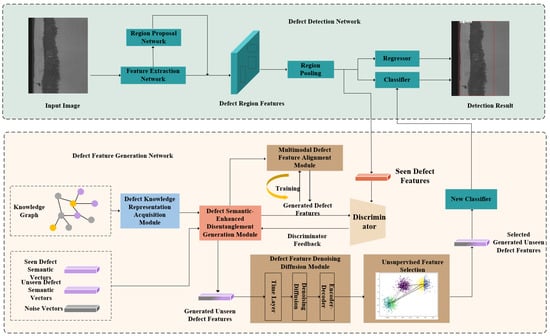
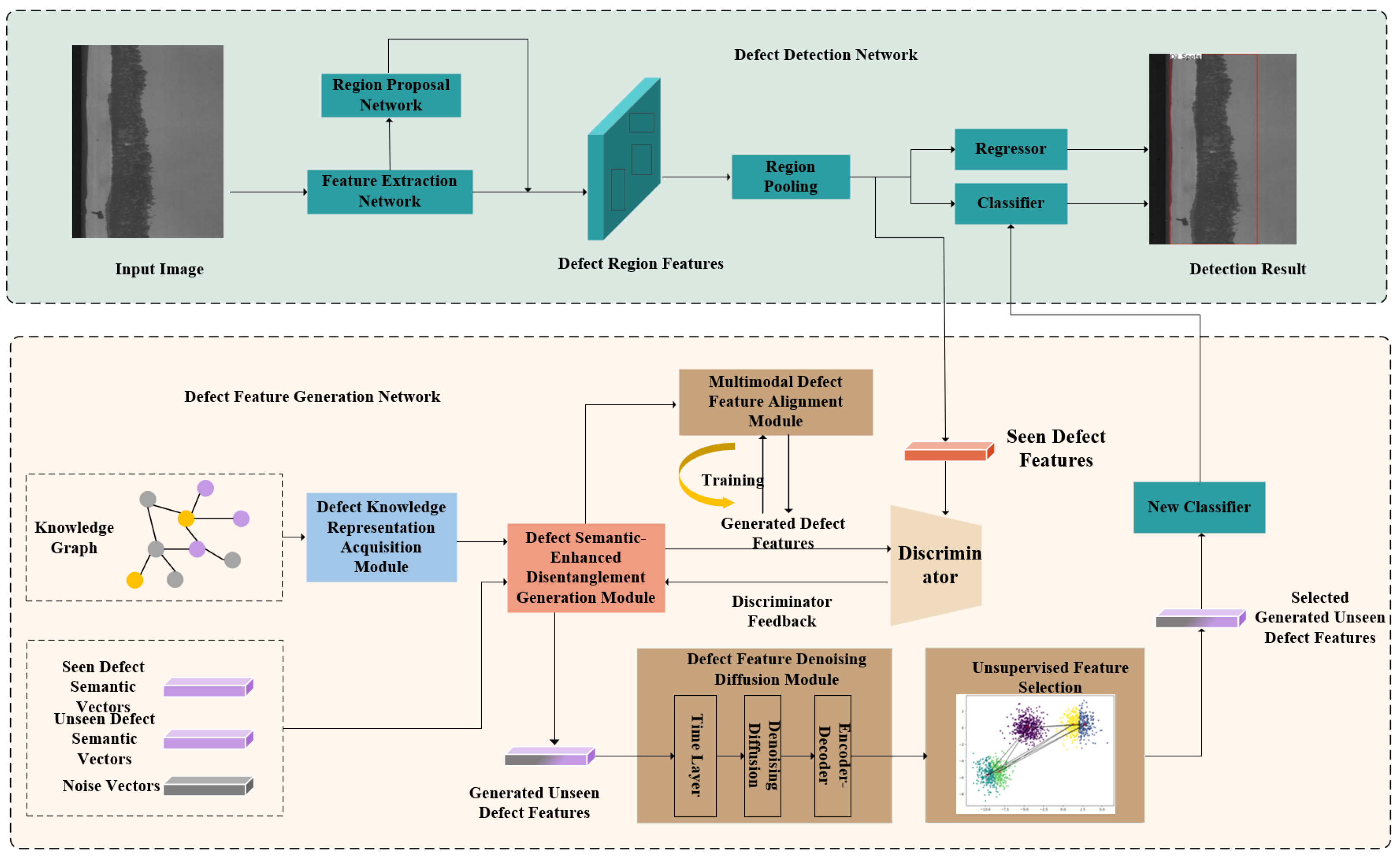
The knowledge graph-guided generative zero-shot industrial defect detection model (KG-GZID) proposed in this paper features an overall framework, as illustrated in Figure 1, which includes both a defect detection network and a defect feature generation network. The defect detection network employs a two-stage object detection approach to facilitate the detection of industrial surface defects, encompassing defect localization and feature extraction of observed defects. Utilizing the features extracted by the defect detection network alongside defect semantic attributes as inputs, the defect feature generation network explores high-order semantic relationships to produce knowledge vectors through the defect knowledge representation acquisition module, which is integrated with the constructed defect knowledge graph. Subsequently, it disentangles semantic and geometric features via the defect semantic enhancement and disentanglement generation module, as well as the Multi-modal Feature Alignment (MMFA) module, to generate unseen defect features that exhibit both consistency and diversity. The generated defect features undergo processing by the diffusion model and unsupervised feature selection (UFS), after which they are fed back into the defect detection network to update the classifier, thereby enabling the detection of unseen defects.
Figure 1.
Overall framework of the KG-GZID model.
2.2. Defect Detection Network
The input to the defect detection network consists of industrial surface defect images, each annotated with known defect categories. Prior to input, all images undergo standardization. Initially, these images are processed by the feature extraction network, specifically ResNet-101, which extracts defect features. Subsequently, the extracted features are forwarded to the Region Proposal Network (RPN), which generates potential defect region proposals. These proposals indicate the areas within the image where defects may be present. Following this, the candidate boxes are integrated with the feature maps obtained from the feature extraction network. Fixed-size features for each candidate box are then extracted through Region of Interest (RoI) pooling, ensuring uniformity in feature dimensions. The features resulting from RoI pooling are subsequently fed into the classifier and regressor. The classifier determines the defect type for each candidate box, while the regressor accurately locates the position and size of the defect. Ultimately, the network outputs the defect categories and their corresponding positions within the image. The defect detection network is tasked with both defect localization and category annotation, while the generation of unseen defect features is handled by the defect feature generation network.
2.3. Defect Feature Generation Network
The input logic of the defect feature generation network is as follows: based on the knowledge graph, the defect knowledge representation acquisition module processes the graph, and then the processed graph is input into the defect semantic enhancement generation module together with the semantic vectors of seen defects, semantic vectors of unseen defects and random noise vectors. After the module generates initial defect features, the features are fed into the MMFA for training together with the seen defect features. At the same time, the generated defect features are input into the defect feature discriminator, which outputs discriminant feedback to optimize the generation process. The trained generated defect features are sent to the defect feature denoising diffusion module for unsupervised feature selection, and the required unseen defect features are finally obtained to update the classifier of the defect detection network.
2.3.1. Knowledge Graph Representation of Defect Semantics
In the field of industrial surface defect detection, various defect categories exhibit complex semantic correlations across multiple levels and attributes, including hierarchical structures, attribute sharing, and scene co-occurrence. However, traditional zero-shot detection methods treat semantic representations as independent feature vectors, thereby neglecting the high-order correlation information between categories. This oversight limits the feature generation capabilities of the generator and hampers the performance of the detection network. To address this issue, this paper constructs a defect semantic knowledge graph that provides structured semantic prior knowledge to support the model. The knowledge graph is developed through four distinct methods.
- Basic adjacency matrix
Firstly, the defect category names are split into words, and the corresponding word vectors are extracted by using the pre-trained FastText model [15]. The average of all word vectors is taken to obtain the embedding representation of each defect category, forming a category embedding matrix. The cosine similarity between category embedding vectors is calculated to quantify the semantic similarity between categories and construct a basic adjacency matrix, as shown in Equation (1).
where and represent the embedding vectors of category i and category j, respectively, and represent category indices. The basic adjacency matrix S reflects the relative positions and semantic similarity of category names in the embedding space, and is the basis for relationship modeling in the knowledge graph.
- 2.
- Superclass correlation
Superclass correlation is achieved by hierarchically modeling defect categories, revealing the semantic hierarchical structure and subordinate relationships among categories [16]. It is a core component of high-order associations in knowledge graphs. Based on the basic adjacency matrix, by mapping superclasses hierarchically, the semantic information of defect categories is gradually enhanced, and a superclass relationship matrix that reflects the subordinate hierarchy of defect categories is constructed.
The construction of superclass mapping is divided into three levels: the first-level mapping, the second-level mapping, and the third-level mapping. Specifically, the first-level mapping, as shown in Table 1, defines the direct subordinate relationship between each defect category and its corresponding macroscopic superclass. In detail, based on the attribute characteristics or functional characteristics of the defect, it is classified into macroscopic superclasses such as surface defects and structural defects. The first-level mapping serves as the foundation for semantic modeling and provides a top-level semantic framework for defect categories, serving as the core starting point for the subsequent construction of superclass hierarchies.
Table 1.
First-Level Mapping of Superclasses.
Based on the first-level mapping, Table 2 further refined the defect categories within each superclass, establishing a second-level mapping relationship. For instance, the Hole type superclass includes specific defect types such as Punch Holes, while the Welding type superclass encompasses subcategories such as Welds. The second-level mapping not only reveals the composition structure within each superclass but also enhances the semantic expression ability of the knowledge graph, providing more granular information support for its hierarchical modeling.
Table 2.
Second-Level Mapping of Superclasses.
As shown in Table 3, the three-level mapping, based on the secondary categories and combined with specific examples or scene characteristics, further divides the defect types into more detailed categories. Taking Spot Variety as an example, it covers specific instances such as Water Spots, Oil Spots, and Silk Spots. The fine-grained representation at this level helps to precisely distinguish different defect forms and provides more distinctive semantic guidance information for the detection network.
Table 3.
Third-Level Mapping of Superclasses.
On the basis of the basic adjacency matrix, the semantic information of defect categories is gradually enhanced by hierarchical mapping of superclasses, and a superclass relation matrix that can reflect the subordinate hierarchy of defect categories is constructed. Based on the above superclass mapping, a superclass relation matrix can be defined , which indicates whether category i and category j belong to the same superclass, as defined in Equation (2).
where represents the superclass label of category i, and are the indices of categories . The weight of the superclass relationship matrix is determined by whether the two categories belong to the same superclass, if two categories belong to the same superclass, their weight is set to 100, indicating a high semantic correlation; otherwise, the weight is set to 0, indicating no direct association.
The super-class relationship matrix not only enriches the hierarchical semantic information of the knowledge graph, but also provides a global semantic framework for the generator and detection networks. During the feature generation process, the super-class relationship can help the model capture high-order semantic associations between categories, thereby enhancing the model’s ability to classify fine-grained defects; in the detection network, the super-class relationship can guide the classifier to better utilize the subordinate relationships between categories, improving the model robustness in complex industrial scenarios. Through By introducing the super-class relationship matrix, the model can more effectively integrate global semantic information, thereby improving the accuracy and adaptability of defect detection.
- 3.
- Attribute correlation
Attribute correlation provides fine-grained semantic information support for the construction of knowledge graph by characterizing the similarity of shared attributes between defect categories [17]. In the defect detection task, different types of defects often share certain common or related attributes, which play a crucial role in class distinction and feature generation. This section, based on the NUE-DET and GC10 DET datasets, provides a detailed description of the attributes of defect categories and constructs an attribute correlation matrix through similarity calculations.
Initially, a set of attribute words is defined for each defect category to describe its characteristics, as shown in Table 4 and Table 5. The attribute descriptions are derived from multiple dimensions such as the geometric characteristics, material properties, and surface characteristics of the defects, comprehensively reflecting the attribute information of the categories. For instance, in the NUE-DET dataset, the attributes of the Crazing category include crack, surface, and fine, indicating that this defect has crack-like surface characteristics; in the GC10-DET dataset, the attributes of the Welds category include metal, joined, and fusion, describing the metal characteristics and connection features of the welding defect. These attribute descriptions provide a basis for the similarity calculation between different categories.
Table 4.
Attribute Descriptions of Each Class in the NEU-DET Dataset.
Table 5.
Attribute Descriptions of Each Class in the GC10-DET Dataset.
The attribute correlation matrix can be constructed by calculating the similarity of shared attributes between categories, which is used to represent the attribute similarity between different categories. The matrix is constructed by using the Jaccard similarity method, as shown in Equation (3).
where and represent the attribute sets of category i and category j, respectively, and i and j are category indices. The Jaccard similarity quantifies the degree of shared attributes between two categories by calculating the ratio of the intersection to the union of their attribute sets.
The attribute correlation matrix captures the shared attribute information among categories, providing a more precise and granular semantic representation for the knowledge graph. Compared to adjacency matrices based on category names or structural relationships, this matrix can more intuitively reflect the semantic similarity between categories, enabling the generator to fully utilize the shared attribute information of seen categories when generating features for unseen categories, thereby enhancing the authenticity and recognition degree of generated defective features. By integrating this matrix, the model can more comprehensively understand the semantic associations of defect categories, improving the efficiency and accuracy of defect detection in complex industrial scenarios.
- 4.
- Statistical correlation of labels
In industrial defect detection, defect labels of different categories may have co-occurrence relationships in actual scenarios. The statistical correlation of labels provides a data-driven semantic association supplement for the knowledge graph by modeling this co-occurrence pattern, so as to improve the model’s generalization ability for unseen defect categories.
The label statistical correlation is computed based on the co-occurrence frequency of defect categories within the training dataset [18], Images, tags, and related statistical information of unseen categories do not participate in the calculation. A statistical correlation matrix is constructed to quantify the conditional probability relationship between the co-occurrence of seen category i and category j in the data, as defined in Equation (4).
where denotes the co-occurrence count of category i and category j, and denotes the total occurrence count of category i. This formulation computes the probability of category j co-occurring with category i in the dataset, thereby capturing the statistical dependency between the two categories.
To make the statistical correlation matrix suitable for knowledge graph construction, it must be quantified. By establishing a threshold , we can select category pairs that exhibit significant co-occurrence relationships. Any similarity below this threshold is set to 0, thereby resulting in the formation of the adjacency matrix. The calculation formula of the quantified adjacency matrix is shown in Equation (5).
Among them, represent the relationship matrices between different categories, and is the set threshold. Through this process, the significant statistical correlation relationships between categories are retained, and possible noise interference is eliminated.
The introduction of the statistical correlation matrix provides data-driven semantic supplementation for the knowledge graph, enabling it to effectively capture the co-occurrence patterns of defect categories in real scenarios. The statistical modeling method based on co-occurrence relationships further enhances the semantic expression ability of the knowledge graph, providing strong support for the generalization performance of the model in complex industrial environments, allowing it to more comprehensively understand the correlations between defect categories, and thereby improving the accuracy and robustness of the detection task.
To address the modeling requirements of complex semantic relationships among defect categories, we construct a knowledge graph utilizing four methods: basic adjacency matrix, superclass mapping, attribute correlation, and label statistical co-occurrence. This knowledge graph integrates multi-dimensional semantic information, including category similarity, hierarchical structure, attribute sharing, and scene co-occurrence. It facilitates a hierarchical and structured representation that spans from macro superclasses to micro instances. By incorporating high-order semantic relationships, we effectively resolve the limitations of semantic modeling capabilities inherent in traditional zero-shot detection methods. This advancement provides robust semantic support for the generator, enabling it to produce more distinguishable features, while also enhancing the detection network’s ability to recognize fine-grained defects.
2.3.2. Defect Semantic Modeling and Knowledge Extraction Module
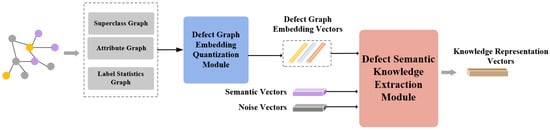
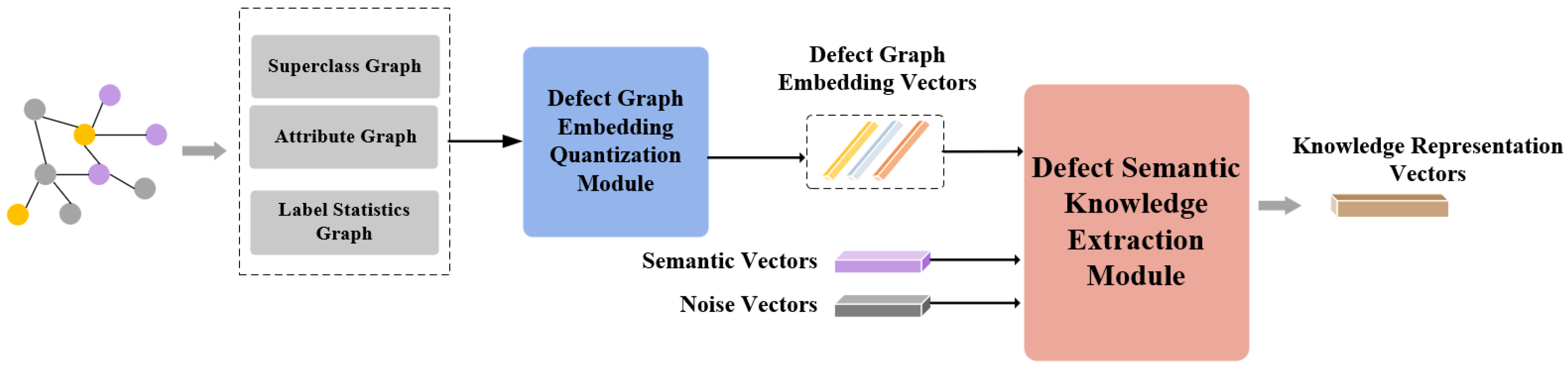
The defect semantic modeling and knowledge extraction module aims to model and extract intricate semantic relationships between defect categories and the attributes associated with those categories, thereby providing structured semantic prior support for both the generator and detection networks. As illustrated in Figure 2, this module consists of two essential sub-modules, namely the defect graph embedding quantization module and the defect semantic knowledge extraction module.
Figure 2.
Structural diagram of the defect semantic modeling and knowledge extraction module.
The defect knowledge graph constructed earlier integrates the superclass graph, attribute graph, and label statistical graph, encompassing three types of semantic structures: defect category hierarchical relationships, attribute dependencies, and co-occurrence patterns. This integration provides structured input for the defect semantic modeling and knowledge extraction module. The primary objective of this module is to mine the deep semantic correlations between defect categories and attributes, generate highly discriminative knowledge vectors, and offer precise semantic support for the generator and detection network [19]. This is primarily achieved through the collaboration of the defect graph embedding quantization module and the defect semantic knowledge extraction module.
The defect graph embedding quantization module is tasked with converting the graph structure into high-dimensional semantic vectors. It takes as input three types of adjacency matrices: superclass correlation, attribute correlation, and label statistical correlation. Each matrix extracts local semantic features via an independent graph convolution layer, introduces nonlinear modeling capabilities through the Leaky ReLU activation function, and generates three types of feature scores. Following a weighted fusion process, these scores are fed into a 6-layer Transformer encoder [20], where global context dependencies are captured through the multi-head self-attention mechanism. Ultimately, the output consists of node embedding vectors that fuse local structures with global semantics.
The defect semantic knowledge extraction module integrates multi-source vectors to produce the final knowledge representation. The input to this module consists of graph embedding vectors, semantic vectors, and noise vectors. The cross-attention module facilitates the modal fusion of noise vectors and graph embedding vectors. Subsequently, through a six-layer stacked style TransEncoder module and the higher-order semantic interaction between content features and style features, the unified knowledge representation vectors, characterized by both discriminability and diversity, are ultimately generated, establishing a semantic foundation for subsequent defect feature generation.
Addressing the challenges of complex semantic relationships, modality heterogeneity, and insufficient semantic utilization in industrial surface defects, the defect semantic modeling and knowledge extraction module establishes a structured knowledge representation mechanism. Leveraging a knowledge graph, this module quantitatively extracts global structural semantic information through graph embedding and performs multi-modal fusion modeling by integrating semantic vectors and noise vectors. This process effectively captures semantic correlations and contextual dependencies among categories, enhances model comprehension of unseen categories, and provides robust semantic support for subsequent defect feature generation and zero-shot detection.
2.3.3. Multi-Modal Defect Feature Alignment Module
In practical industrial scenarios, surface defects on steel often exhibit diverse shapes and varying sizes, with multiple types of defects and background interference coexisting within a single image. This complex manifestation interferes with Zero-Shot Detection (ZSD) models during steel surface defect detection, leading to missed detections and false positives. Although existing generative ZSD models [11,12,13] can partially alleviate these issues, they suffer from insufficient quality of generated defect features when handling such complex scenarios, which directly compromises the robustness of the models.Meanwhile, knowledge graphs integrate superclass hierarchical structures, attribute associations, and label co-occurrence statistics. However, name-based class embeddings may still fail to adequately capture visual characteristics and could introduce noise into graph representations. To mitigate these problems, this paper proposes a multi-modal defect feature alignment module based on ZSD, which realizes the alignment of visual modality and semantic modality by combining visual features and semantic information, thereby improving the quality of generated defect features.
The MMFA module achieves precise alignment of visual and semantic modalities through three strategies.During the training process, the module employs a supervised contrastive learning approach. By optimizing the distribution of the feature space, it makes samples of the same category closer to each other in the feature space, while expanding the distance between samples of different categories. This enables the alignment of the visual modality and the semantic modality. Additionally, to further enhance the modality alignment effect, this chapter combines two strategies: defect feature alignment and semantic consistency reconstruction. These are used in conjunction to optimize the robustness of the model.
- Supervised contrastive learning approach
Supervised Contrastive Learning (SCL) aims to optimize the feature space at the global distribution level. By introducing a hypersphere constraint, the model constructs positive and negative samples respectively within and outside the hypersphere centered on the query noise [21]. This constraint promotes the compact aggregation of similar defect features and the separation of dissimilar features, thereby balancing the diversity and consistency of the generated features. Its loss function is defined as shown in Equation (6).
where denotes the concatenated generated feature vector, denotes the positive-sample feature, denotes the negative-sample feature corresponding to , I is the index set of a batch, is the set of positive samples belonging to the same class as query sample i, and is a temperature parameter.
- 2.
- Defect feature alignment
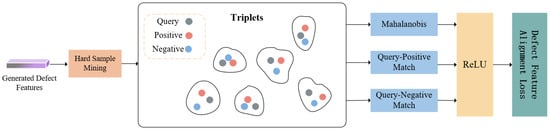
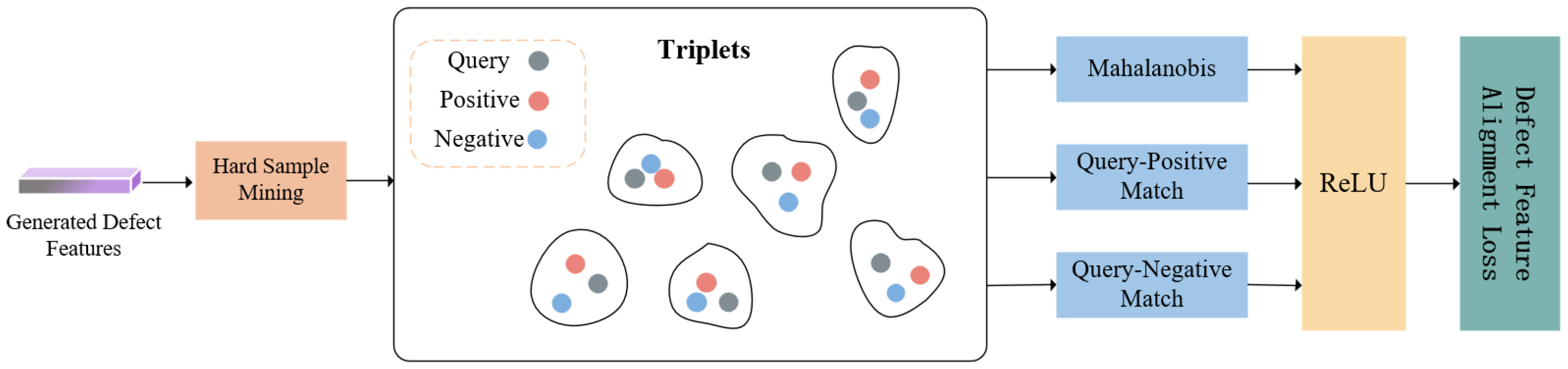
To further distinguish fine-grained defects that have similar visual appearances but different semantic meanings, this paper has constructed a defect feature alignment (DFA) module.As shown in Figure 3, this module constructs triples through difficult case mining, and prioritizes the selection of the most difficult-to-distinguish negative samples for calculation [22]. In terms of distance measurement, Mahalanobis distance is introduced to consider the correlation between features, thereby more accurately capturing the category differences in the high-dimensional space. The definition of its alignment loss is as shown in Equation (7).
where is the anchor feature in the i-th triplet, is the positive-sample feature, is the negative-sample feature, and is the Mahalanobis distance.
Figure 3.
Structural diagram of defect feature alignment.
- 3.
- Semantic consistency reconstruction
To ensure that the generated visual features do not deviate from the original semantic information, this paper introduces the Semantic Consistency Reconstruction (SCR) module. This module uses the pre-trained regressor to map the generated feature f back to the semantic space, and calculates the mean square error between the predicted attribute and the true semantic vector . This process plays the role of a cross-modal semantic anchor in the feature space. The reconstruction loss is defined as shown in Equation (8).
where denotes the semantic attribute vector, z denotes the random noise vector, denotes the pre-trained regressor, f denotes the generated defect feature, and V denotes the attribute distribution of defect classes. By minimizing this loss, it ensures that the generated features not only possess inter-class discriminative power but also are highly aligned with the original defect semantics.
Through the joint optimization of the three aforementioned components, the model not only enhances the discriminative capability of defect features, but also strengthens the coordination and consistency across multi-modal data.Such a design effectively alleviates information loss and misinterpretation among different modalities, thereby improving the model’s robustness and generalization ability, and enabling it to better adapt to complex industrial defect detection scenarios.
2.3.4. Defect Semantic Enhancement and Disentanglement Generation Module
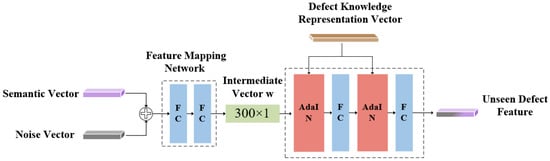
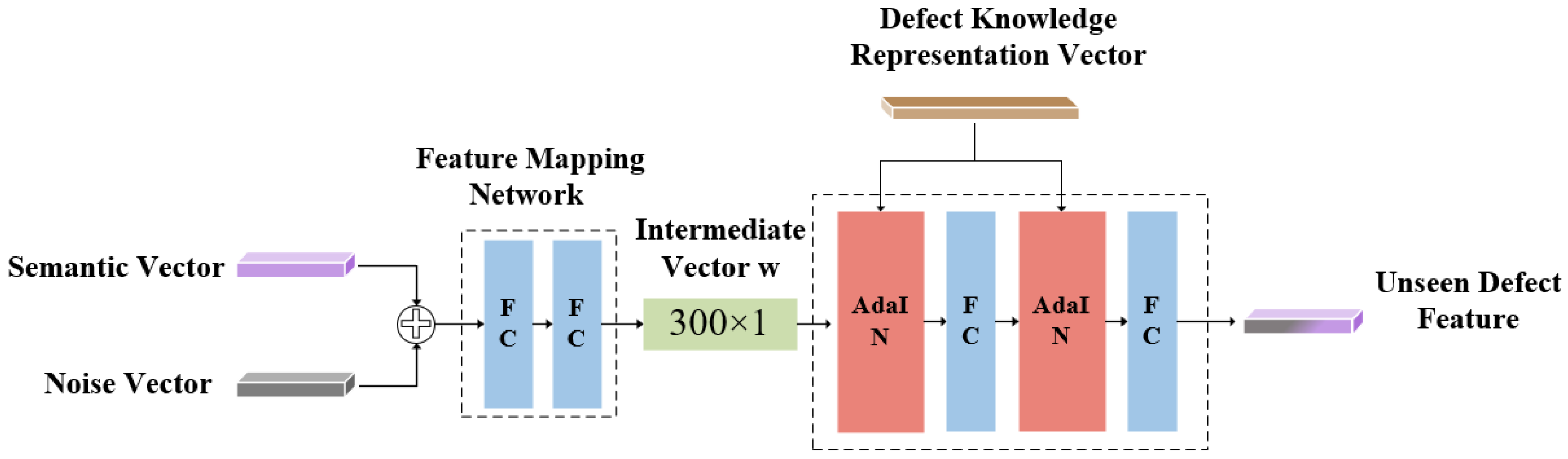
In the zero-shot industrial defect detection task, the model must identify previously unseen defect categories. Traditional methods struggle to generate category features that maintain both semantic consistency and diversity. To address this issue, this paper proposes a structural diagram for the defect semantic enhancement and disentanglement generation module, as illustrated in Figure 4.
Figure 4.
Structural Diagram of the Defect Semantic Enhancement and Disentanglement Generation Module.
The disentanglement mapping generation network is the core part of this module, which is composed of multiple stacked Decoupling Blocks. Each block includes Adaptive Instance Normalization (AdaIN) [23] and a fully connected layer, aiming to realize semantic enhancement and feature disentanglement.
Among them, the AdaIN module takes the defect knowledge representation vector as the control signal, dynamically adjusts the distribution of intermediate features according to its mean and standard deviation, and realizes the semantic alignment of feature styles. Its calculation formula is shown in Equation (9).
where is the intermediate feature, is the defect knowledge representation vector, and represent the mean and standard deviation respectively. Through the AdaIN operation, the distribution of generated features can be dynamically adjusted according to the characteristics of the defect knowledge representation vector [24], so as to realize knowledge enhancement. A fully connected layer is connected after AdaIN to further model the semantically enhanced features and realize the fine-grained disentanglement and extraction of semantic information. The layer-by-layer stacking of multiple decoupling blocks continuously optimizes the feature representation, making the final generated features have sufficient diversity and expression ability while ensuring semantic consistency.
The semantically enhanced disentangled features generated by this module will be used to update the downstream classifier as the pseudo-sample input for zero-shot detection. Compared with the traditional way of generating features directly based on semantics, this module realizes the unified modeling of structural semantics and diverse information, provides more reliable and rich feature expression for the model, and effectively improves the recognition ability and detection robustness for unseen defects.
2.3.5. Defect Feature Denoising Diffusion Module
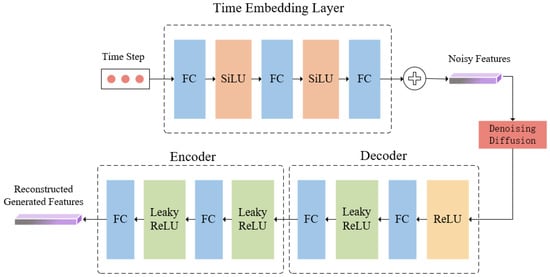
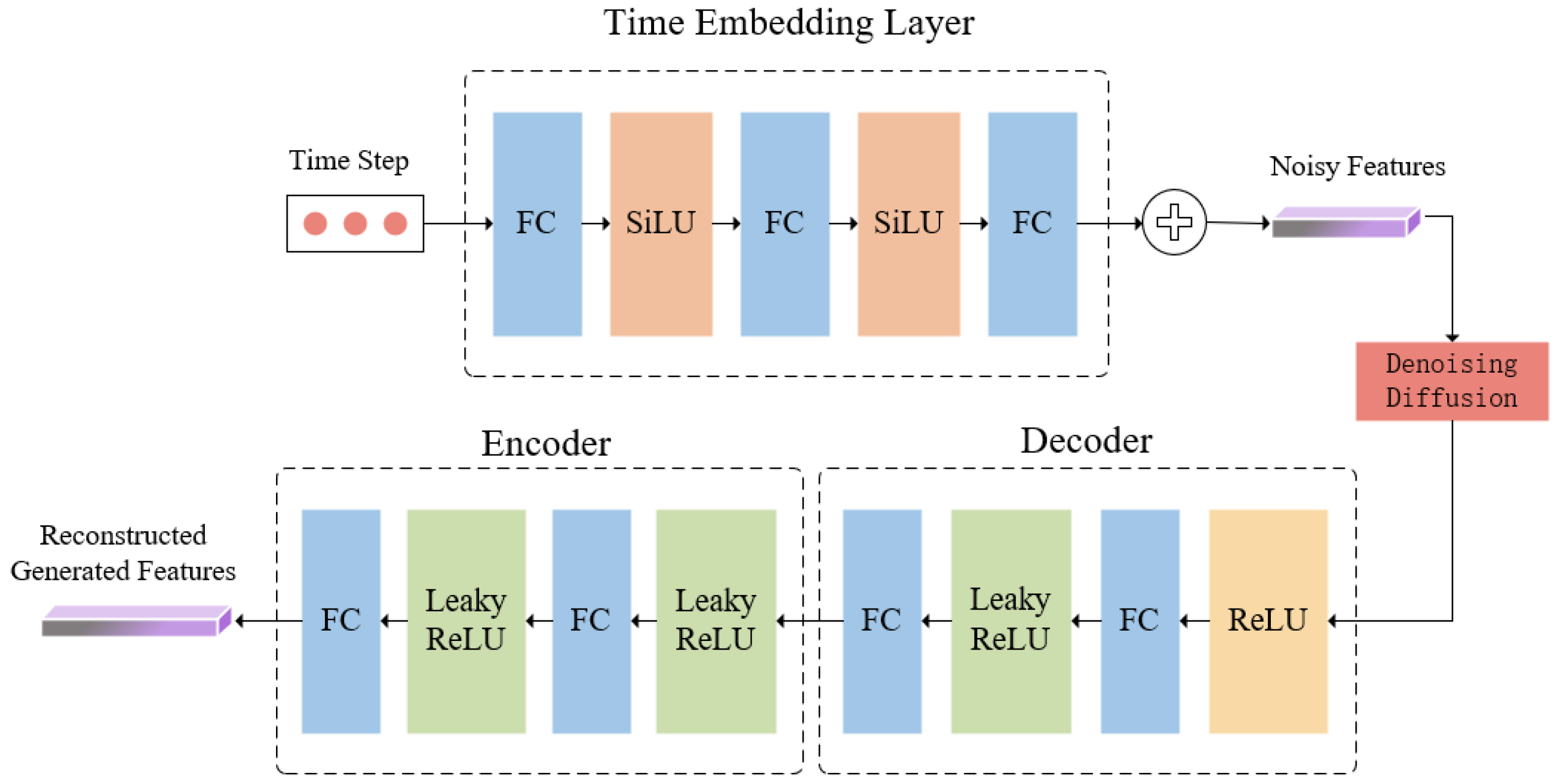
In generative zero-shot industrial surface defect detection, collected defect samples exhibit singular manifestations and insufficient variability. This limitation prevents the model from effectively handling the diverse variations that may be encountered in practical applications. To address this issue, this paper introduces the diffusion model and proposes a defect feature denoising diffusion module (DFDD [25]). This module enables the generation of high-quality and diverse defect features, thereby enhancing detection performance. The architecture of the proposed DFDD module is illustrated in Figure 5. The architecture primarily consists of four components: the time embedding layer, the denoising diffusion module, the encoder, and the decoder. Initially, the time embedding layer accepts the timestep as input, processing it through two fully connected layers followed by a SiLU activation function to generate time embedding features. Subsequently, these time embedding features are concatenated with the noisy features into a unified dimensionality. The combined features then undergo noise addition and denoising through the diffusion process to reconstruct the original defect features. Finally, the reconstructed original defect features are input into the encoder for feature compression, after which the decoder restores the compressed features to yield the final generated defect features.
Figure 5.
Defect Feature Denoising Diffusion Structure.
The core of the defect feature denoising diffusion module is the denoising diffusion process, which improves the diversity of generated defect features through the process of gradually adding and removing noise, thereby enhancing the robustness of the model. In the forward process, the model gradually adds noise to the data, converting the original defect features into a pure noise state; in the reverse process, the model attempts to reconstruct the original defect features from the noise data.The forward and reverse processes are expressed as Equations (10) and (11).
where denotes noise sampled from the standard normal distribution, is the parameter controlling the noise level, denotes the noisy data at the current time step, and denotes the noisy data at the previous time step; is predicted by a neural network, and is a predetermined covariance matrix. Ultimately, the model can gradually recover clear features that are close to the original input. The final training objective is to minimize the expectation of the reconstruction error over all time steps, as calculated in Equation (12).
Here, is the noise vector predicted by the model based on the noisy data and time step t, and is the noise vector actually added to the data during the forward process.
In the defect feature denoising diffusion module, the noise-to-clarity restoration process enhances the diversity of unseen defect features generated by the multi-modal feature alignment module. This process improves feature representation and the discriminative ability for various defect types, thereby enhancing model robustness and increasing detection accuracy.
2.3.6. Unsupervised Feature Selection
The defect feature denoising diffusion module enhances the diversity of generated defect features; however, during the training with a large dataset, it is crucial to balance the diversity and quality of the samples. This paper references the work of Pengfei et al., who employed the K-means algorithm for unsupervised feature selection (UFS) [25]. Nevertheless, during the training of the proposed model on the industrial surface defect dataset, it was observed that the randomness inherent in the initial centroid selection of the K-means algorithm could result in an excessively large initial centroid, thereby hindering the training of the defect feature generation network. To address this issue, this study adopts the K-means++ algorithm for unsupervised feature selection. This algorithm enhances the selection of initial centroids by maximizing the distance between them, thereby increasing the likelihood of convergence to the global optimal solution and effectively mitigating the risk of excessively large or unreasonable centroid values. Through unsupervised feature selection, a suitable number of representative features are extracted from all generated defect features, which reduces the training data volume while preserving sufficient information to train a robust model. This approach strikes a balance between the diversity and quality of the generated samples, ultimately improving the quality of feature selection.
3. Loss Function
The total loss function of the model is shown in Equation (13).
where, represents the loss function of the conditional generative adversarial network, represents the classifier loss, represents the supervised contrastive learning loss, represents the defect feature alignment loss, represents the semantic consistency reconstruction loss, represents the graph convolutional network loss, and , , , , , are the weight coefficients corresponding to different loss functions.
The GCN loss term is designed to enhance the generative model’s ability to learn graph structural information, particularly in zero-shot scenarios. By leveraging the semantic connections between categories in knowledge graphs, it strengthens the model capacity to semantically represent unseen classes. The calculation method of the GCN loss is shown in Equation (14).
Here, is the embedding representation of the i-th sample for the true label , and is the embedding representation of the i-th sample corresponding to all possible categories j. This loss function adopts the mathematical form of cross-entropy to measure the degree of match between the model’s prediction and the true label. represents the classifier loss is shown in Equation (15) [16].
is the feature generator; is the class semantic vector; is random noise; y is the class label; is the classifier’s predicted probability; is the frozen seen-class classifier; is a semantics-based classifier; and are the seen/unseen class semantic matrices.
represents the loss function of the conditional generative adversarial network semantic vectors is shown in Equation (18).
where f denotes the real defect feature, denotes the generated defect feature, denotes the semantic vector, denotes the discriminator, , and .
In the zero-shot industrial surface defect detection task, the relies on the hierarchical structure and attribute correlation of the knowledge graph to guide the model to model the semantic relationship between unseen categories and seen categories, improving the discriminability and generalization ability of generated features. As a key semantic constraint, injects structured prior knowledge into the generated samples, effectively improving the detection performance and semantic expression ability of the model in complex industrial scenarios.
4. Experiments and Analysis
4.1. Datasets
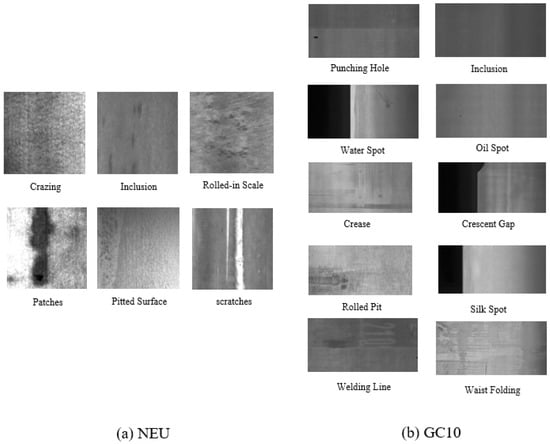
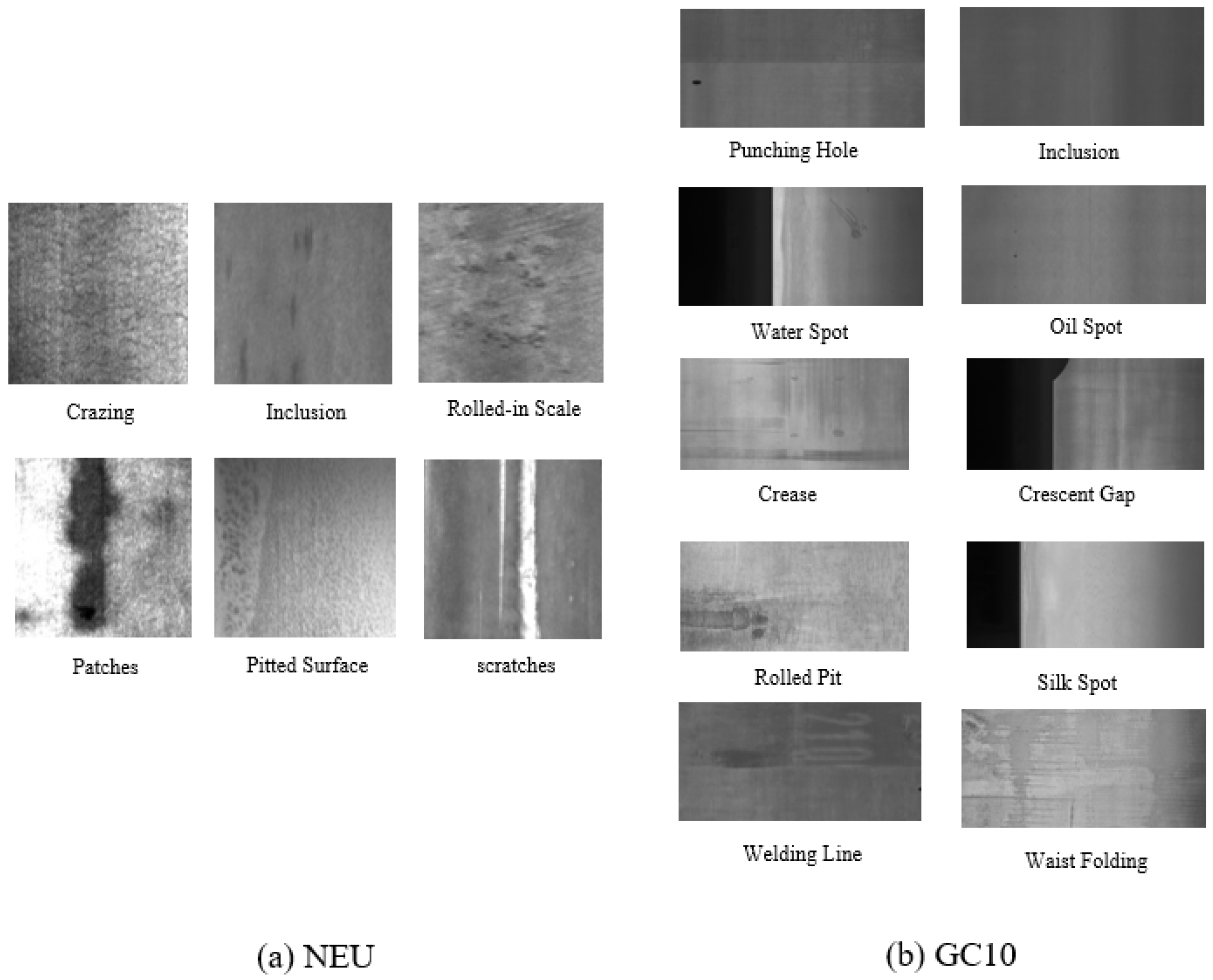
This paper utilizes two specialized datasets for the detection of surface defects in steel: the NEU Surface Defect Database (NEU-DET) [26] and the GC10 Surface Defect Database (GC10-DET) [27], both published by Northeastern University. Data augmentation techniques were applied to these datasets, including operations such as horizontal flipping, scaling, Gaussian blur, linear contrast adjustment, rotation, and the addition of Gaussian noise. Figure 6 illustrates the defect class names and provides image examples from the industrial surface defect datasets.
Figure 6.
Industrial Surface Defect Datasets Defect Class Names and Image Examples.
4.2. Experimental Design
4.2.1. Experimental Environment
The hardware platform used in the experiment is Intel CORE i7-13700KF, the development environment is Python 3.7 under the Ubuntu 20.04 system, the NVIDIA RTX4080 super graphics card with 16G video memory, the development tool is PyCharm. The experimental model is built based on the Pytorch 1.13.0 deep learning framework, equipped with Cuda 11.7 high-performance GPU computing.
4.2.2. Experimental Settings
In the zero-shot setting, the NEU-DET dataset sets Patches as unseen defect categories, and the GC10 DET dataset sets Oil Spots and Creases as unseen defect categories. A 7:3 split is applied only to the seen class samples for constructing the training and test subsets, while all samples of unseen categories are reserved for testing and excluded from the training phase.
The defect feature generation network uses 300-dimensional pre-trained embedding vectors as the semantic vectors of defect categories, the category semantic vectors of NEU-DET and GC10-DET are extracted by FastText. When training the synthesizer, we use the Adam optimizer with a learning rate of . The threshold for the logical adjacency matrix is set to . Both the self-attention module and the knowledge encoder in our proposed method consist of 6 layers. The number of heads in the multi-head attention mechanism is set to 4. In supervised contrastive learning, the number of negative samples is set to 10, and the temperature coefficient is set to 0.1. For semantic consistency reconstruction, the pre-trained regressor uses the Adam optimizer with a learning rate of , weight decay , and employs the mean squared error loss function for the regression task. We generate 500 features per unseen class to train the classifier. For the denoising diffusion process, the noise sampling schedule sets , with the linear start noise scale and linear end noise scale adjusted to and , respectively. In unsupervised feature selection, the top representative features are selected as the final features for unseen defects. The weights in Equation (14) are set as , , , , , .
4.2.3. Evaluation Metrics
To evaluate whether the model can detect unseen defect categories on steel surfaces, this paper adopts Mean Average Precision (mAP) [28] as the evaluation metric. mAP is calculated by averaging the AP values across different categories, which reflects overall model performance on multiple categories. This paper also uses the harmonic mean (HM) between the precision for seen categories and the precision for unseen categories to evaluate detection performance under the GZSD setting, and the calculation formula is shown in Equation (7).
4.3. Experimental Results and Analysis
4.3.1. Comparative Experiments
This paper sets up comparative experiments to verify the detection performance of the model. The comparative models include seven generative ZSD models: HRE [29], BLC [30], PL [31], SUZOD [11], ZSCR [12], RRFS [13], and KEFS [14]. Table 6 and Table 7 show the comparative results between the proposed model and the seven ZSD models on the NEU-DET and GC10-DET.
Table 6.
Evaluation Results of KG-GZID and Other Generative Models on the NEU-DET Dataset.
Table 7.
Evaluation Results of KG-GZID and Other Generative Models on the GC10-DET Dataset.
As demonstrated in Table 6, the experimental results on the NEU-DET dataset indicate that the proposed KG-GZID model consistently and significantly outperforms all baseline models across all evaluation metrics. In the Zero-Shot Detection (ZSD) task, KG-GZID achieves substantially higher detection accuracy than benchmark models such as KEFS and RRFS, highlighting superior capability in recognizing unseen defect categories. This advantage arises from the integration of high-order semantic relationships encoded in knowledge graphs, which enhances both the semantic consistency and discriminability of the generated features. Furthermore, in the Generalized Zero-Shot Detection (GZSD) task, KG-GZID attains state-of-the-art performance, surpassing all compared models in both seen and unseen defect categories, as well as the Harmonic Mean (HM) metric. Specifically, the accuracy for unseen classes is improved by 3.8% over KEFS, while the HM value is increased by 6.3% relative to KEFS.
As illustrated in Table 7, the KG-GZID model also demonstrates exceptional performance on the GC10-DET dataset in the ZSD task. For the crease (Cre) defect category, its detection accuracy is 9.5% higher than that of the optimal RRFS model; for the oil spot defect category, the accuracy of KG-GZID exceeds that of RRFS by 16.6%. In the GZSD task, KG-GZID outperforms the competing state-of-the-art models, RRFS and KEFS, in terms of both seen and unseen defect categories, as well as the overall performance metric HM. These results suggest that KG-GZID can more effectively identify complex defect categories. Regarding the robustness of generative ZSD models and the challenge of generating diverse features, the model proposed in this paper demonstrates the highest detection accuracy in both the ZSD and GZSD settings.
Collectively, by integrating knowledge graph representation and disentanglement generation strategies, KG-GZID not only improves the detection accuracy of known categories but also enhances the adaptability to unseen defect categories. In the complex industrial surface defect detection task, KG-GZID demonstrates stronger robustness, especially in multi-category defect detection tasks, where it improves the stability and accuracy of detection.
4.3.2. Ablation Studies
To validate the effectiveness of the core modules and the multi-semantic feature fusion strategy, two groups of ablation studies are conducted on the NEU-DET and GC10-DET. The results are presented in Table 8 and Table 9 (“√” indicates the integration of the corresponding module), with ZSD accuracy and GZSD HM value as the core metrics to evaluate model performance.
Table 8.
Ablation study of the core modules.
Table 9.
Ablation study of the multi-semantic feature fusion strategy.
The first set of experiments evaluates the effectiveness of three key components: multi-modal defect feature alignment, defect feature denoising diffusion, and unsupervised feature selection module, As shown in Table 8. On the NEU-DET dataset, incorporating only the multi-modal defect feature alignment module improves ZSD accuracy by 7.6%; adding the defect feature denoising diffusion module further boosts accuracy by 2.7%; and integrating the unsupervised feature selection module ultimately achieves a ZSD accuracy of 28.1%. On the GC10-DET, sequential incorporation of all three modules yields a 17.4% improvement in ZSD accuracy and a 9.8% increase in the HM score for GZSD. Among them, the unsupervised feature selection module made the most significant contribution, verifying the importance of its screening of high-quality features.
The second set of experiments investigates the combined effect of superclass correlation, attribute correlation, and label statistical correlation, as shown in Table 9. On the NEU-DET, using attribute correlation alone achieves a ZSD accuracy of 30.3%; combining superclass and attribute correlations raises accuracy to 32.4%; and jointly leveraging all three correlation types further elevates accuracy to 34.0%. On the GC10-DET, the full fusion of the three correlation types improves ZSD accuracy by 3.3% over attribute correlation alone and increases accuracy on seen classes by 8.7%, demonstrating the enhanced adaptability of multi-semantic fusion in complex, real-world scenarios.
Table 10 evaluates the individual contributions of the three loss functions in the MMFA module. Compared with the baseline, the complete model significantly improves ZSD accuracy on the NEU-DET dataset from 26.8% to 34.0%, and on the GC10-DET dataset from 24.2% to 39.3%, while increasing the HM for GZSD by 6.4% and 6.9%, respectively. Notably, SCR contributes most to these performance gains. This indicates that without SCR, even if SCL sufficiently separates inter-class distances, the detector still fails to correctly identify targets due to misaligned generated features. Without SCR, even when SCL widens the inter-class distances, the detector cannot correctly recognize objects if the generated features are inherently misaligned. The three loss functions exhibit strong complementarity, jointly enhancing the discriminative power and semantic consistency of the features.
Table 10.
Ablation study on the loss functions within the multi-modal alignment process.
Overall, the modules proposed in this paper play an important role in improving the model’s detection performance on unseen defects. The multi-modal defect feature alignment module significantly enhances the discriminative power of generated features, the defect feature denoising diffusion module increases the diversity of generated features, and the unsupervised feature selection module further improves the classification accuracy of the model by optimizing the quality of generated features; the collaborative fusion of the three types of feature correlations significantly improves the performance of the KG-GZID model in ZSD. The knowledge graph semantic modeling module helps the model to more accurately understand the high-order relationships between defect categories by introducing structured semantic information; the disentanglement generation module further improves the diversity and distinguishability of feature generation. Finally, KG-GZID not only maintains high-precision recognition ability on seen categories, but also shows stronger generalization in the detection of unseen categories, verifying the adaptability and effectiveness of the model in complex industrial defect detection tasks.
4.3.3. Visualization Results
- t-SNE Visualization
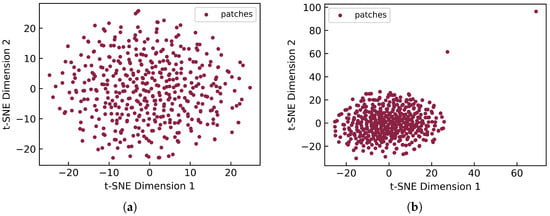
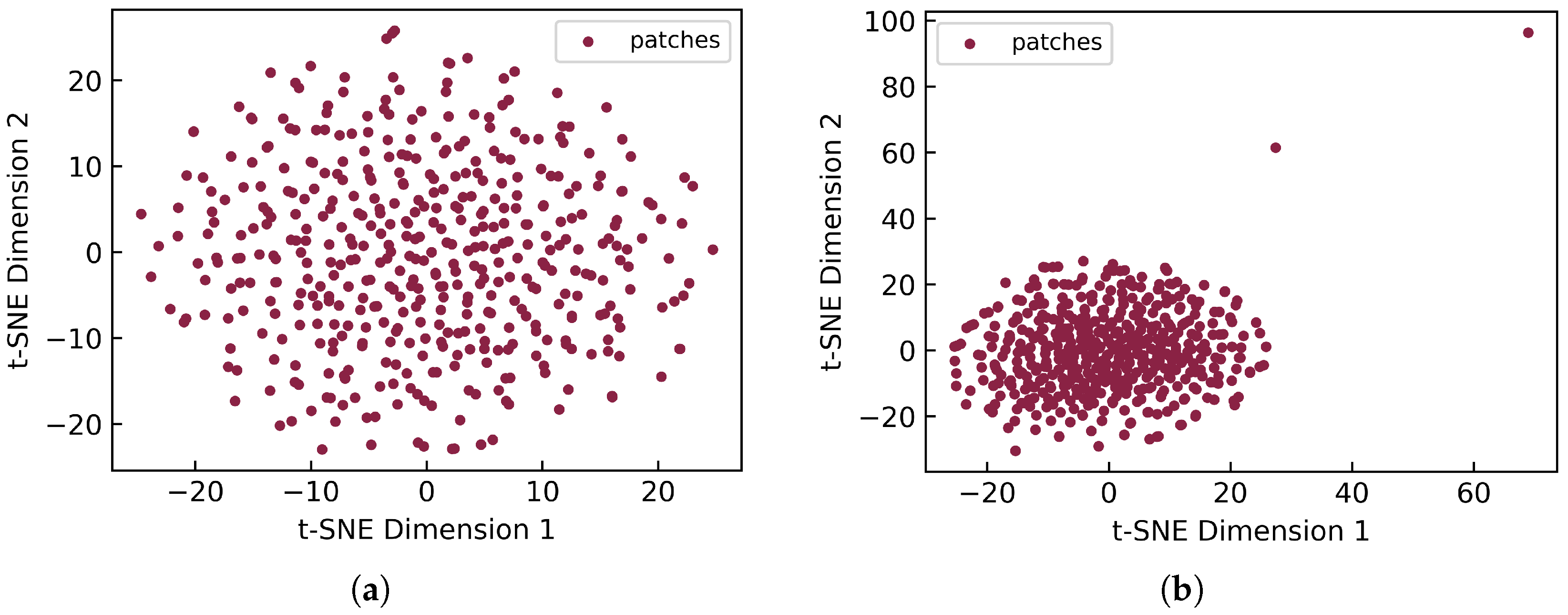
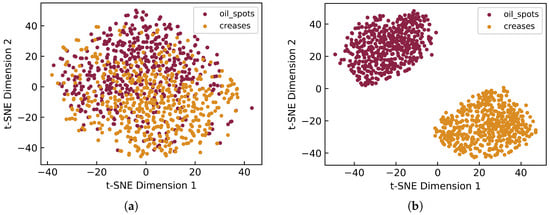
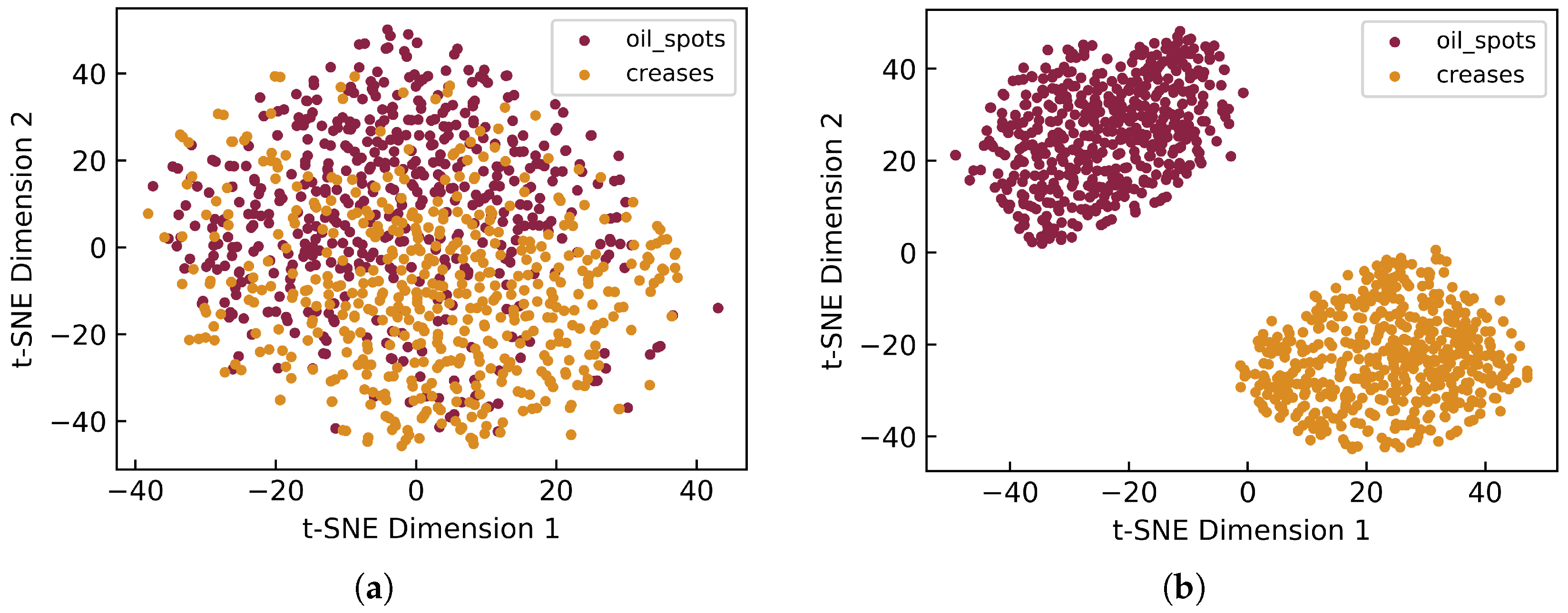
To more intuitively observe the separability and clustering effect of generated features on unseen defect categories, this paper conducts t-SNE visualization analysis on the generated features of different models on the NEU-DET and GC10-DET datasets, and the results are shown in Figure 7 and Figure 8. The comparative models include the benchmark model and the KG-GZID model proposed in this paper.
Figure 7.
t-SNE results of feature distribution alignment for the single unseen class (Patches) on the NEU-DET dataset. (a) Benchmark model; (b) KG-GZID model.
Figure 8.
t-SNE results of different models on the GC10-DET dataset. (a) Benchmark model; (b) KG-GZID model.
Figure 7 shows the t-SNE results of different models on the NEU-DET dataset. The features generated by the baseline model are scattered in the feature space and the category boundaries are blurry; in contrast, the features generated by KG-GZID form a clear, compact and separated clustering structure in the semantic space, significantly reducing the interference between categories. This is attributed to the collaborative effect of semantic modeling and decoupling mechanism: the former accurately extracts and distinguishes the semantic information of categories, while the latter strengthens the discriminative feature expression, providing a robust feature basis for zero-shot detection.
To further evaluate the inter-class separability, Figure 8 presents the visualization results on the GC10-DET dataset, verifying the performance consistency of KG-GZID in complex scenarios. The multi-category features of the baseline model are significantly overlapping, especially for Oil Spots and Creases defects, with blurred boundaries; while KG-GZID performs more stably on this dataset, with high aggregation degree of various features, clear boundaries and no cross-interference, and excellent feature separability. This further proves its knowledge graph semantic modeling and decoupling mechanism, which can adapt to simple category distinction scenarios and also efficiently handle the feature generation and recognition tasks of complex defects.
- 2.
- Visualization of Test Results
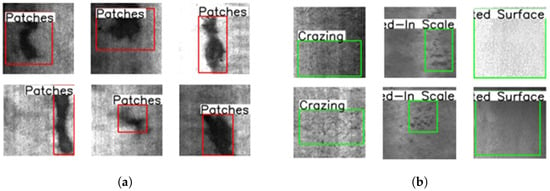
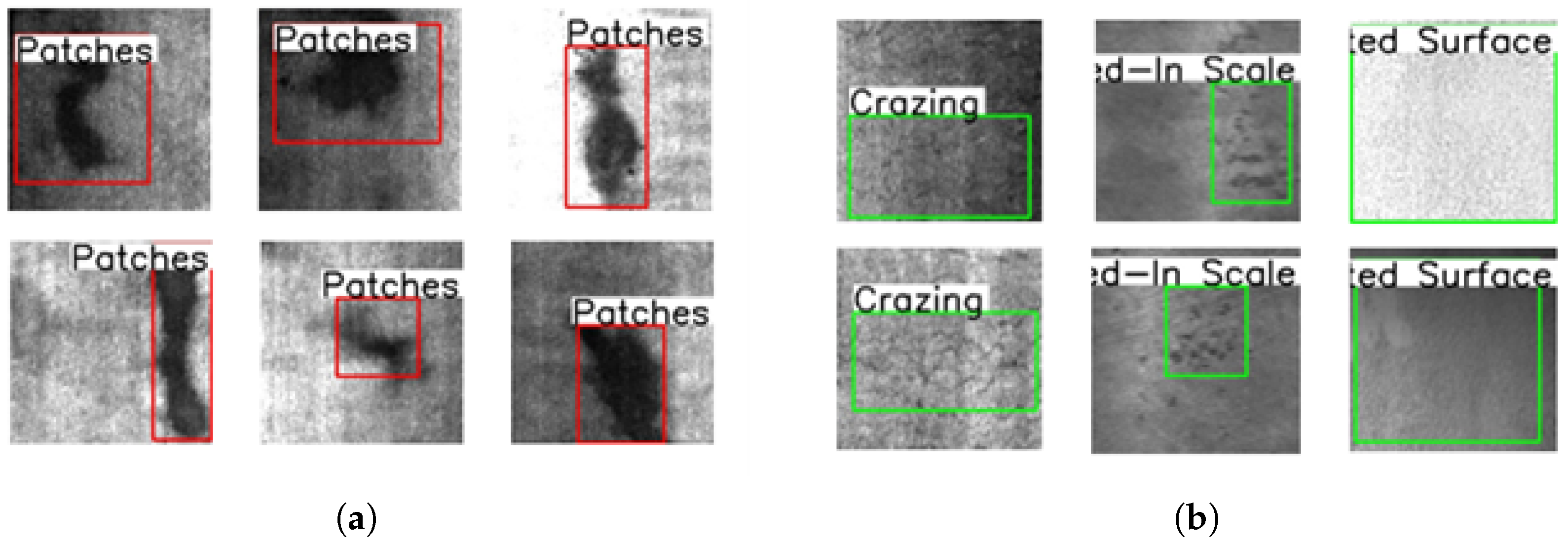
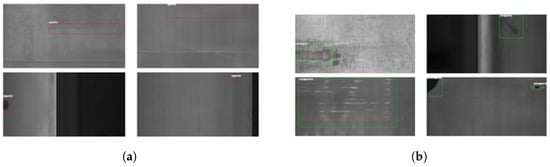
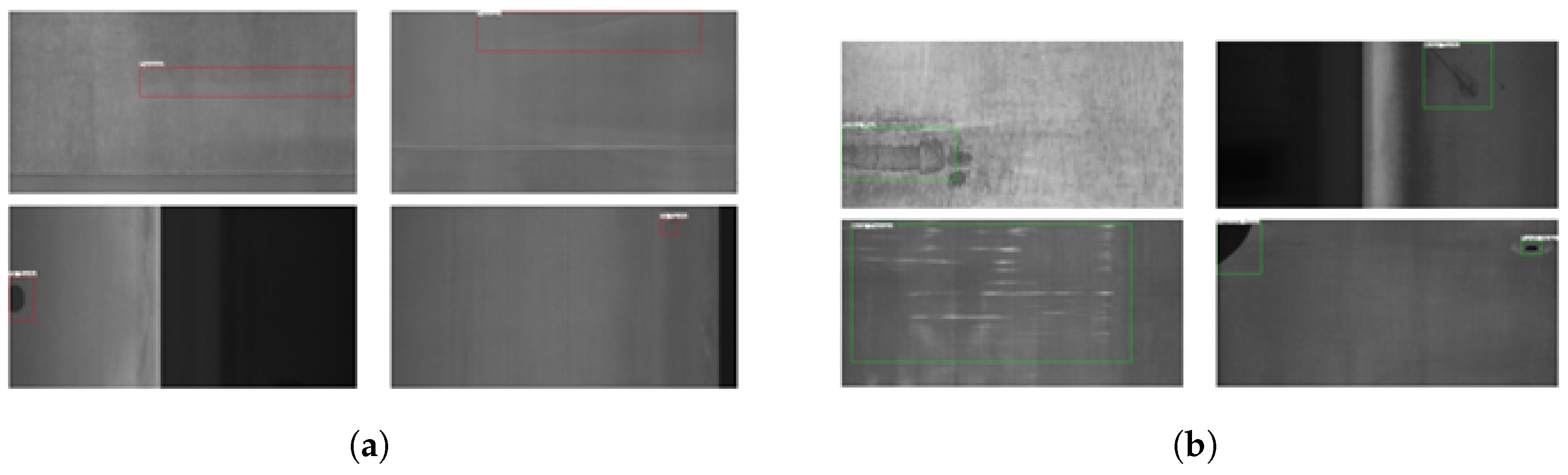
To more intuitively evaluate the detection performance of the KG-GZID model in dealing with known and unknown defect categories, this paper conducts defect detection experiments on two datasets, NEU-DET and GC10-DET, under the settings of ZSD and GZSD, and visualized the detection results, as shown in Figure 9 and Figure 10. In these figures, the red boxes represent the detection results of unseen defect categories, and the green boxes represent the detection results of seen defect categories.
Figure 9.
Detection results on the NEU-DET dataset. (a) Detection results under ZSD setting; (b) Detection results under GZSD setting.
Figure 10.
Detection results on the GC10-DET dataset. (a) Detection results under ZSD setting; (b) Detection results under GZSD setting.
On the NEU-DET, the model under the ZSD setting can accurately locate and identify unseen category defects. The red box clearly marks the relevant targets, demonstrating that KG-GZID has strong feature generation and semantic representation capabilities, enabling reliable detection of unseen defects. Under the GZSD setting, the model maintains the detection ability for unseen defect categories while accurately identifying existing category defects, indicating its good discriminative and stability in multi-category scenarios. This result is attributed to the defect semantic modeling and knowledge extraction module, which effectively improves semantic reasoning capabilities by modeling the hierarchical structure and attribute associations of categories, making the generated features more in line with the semantic distribution of target categories. The defect semantic enhanced decoupling generation module enhances the independence and discriminability of features by decoupling semantic and geometric information, reducing the risk of category confusion.
On the GC10-DET, KG-GZID still exhibits stable detection capabilities. Under the ZSD setting, the model can successfully identify unseen defects when encountering a new category for the first time, with the red box precisely marking the target area, verifying its ability to perform feature reasoning based on semantic information. Under the GZSD setting, the model achieves simultaneous detection of both seen and unseen categories, with clear red and green boxes and no obvious interference between categories, demonstrating strong robustness and generalization ability. Compared to the ZSD setting, the performance of identifying unseen defect categories does not decline, and the detection of seen defect categories still maintains high accuracy. This good compatibility is attributed to the model’s thorough modeling of semantic relationships and reasonable separation of feature spaces. Especially when dealing with complex defect categories (such as Oil Spots and Creases), KG-GZID can construct clear category boundaries, avoiding sample overlap or identification ambiguity.
Based on the detection results of NEU-DET and GC10-DET, KG-GZID demonstrates excellent detection capabilities in both ZSD and GZSD settings. Firstly, the knowledge graph-driven semantic modeling enhanced the fine-grained representation ability and transferability of features; secondly, the decoupling generation mechanism improved the discrimination and representational integrity of features.
5. Conclusions
This paper focuses on zero-shot industrial surface defect detection. To address limited defect samples, complex categories, and the challenges associated with identifying unseen defect categories, this paper proposes the KG-GZID model. The model integrates knowledge graphs for fine-grained semantic modeling and employs a decoupling generation mechanism to enhance detection accuracy for complex defects. By employing multi-modal feature alignment and diffusion mechanisms, the quality of generated features and the capability to identify unseen defect categories are significantly improved. Experiments conducted on industrial datasets demonstrate that the proposed model outperforms existing methods, particularly in detecting unseen and complex defects. However, there is still room for improvement in absolute accuracy on unseen categories, and two limitations remain. First, the knowledge graph relies on manually defined domain knowledge. The supercategory hierarchy and attribute descriptions lack granularity and completeness, and label co-occurrence is mined only from the training split of seen categories, which limits the expressive power of graph-based semantic representations. Second, generalization depends on semantic relevance. The model transfers well to unseen defects that share attributes or supercategories with seen categories. However, its transfer capability degrades for completely novel defect types with weak semantic relevance. Therefore, in high-reliability industrial scenarios, the model is currently more suitable as an auxiliary detection tool, providing candidate prompts and review support for human inspection. Its performance in extremely complex backgrounds, on minute defects, and for new defect types with weak semantic relevance still requires further validation on real production line data. Future work will advance along two directions: improving knowledge graph construction by incorporating additional physical characteristics of defects and process-related information to enrich semantic dimensions and enhance fine-grained semantic modeling, and conducting ablation studies varying the number of unseen categories to analyze the impact of the quantity of unseen categories on the model generalization performance.
Author Contributions
R.J. conceived methodology and modified the manuscript. S.Y. wrote the manuscript and implemented the software. Y.Z. performed the validation and visualization. C.B. assisted in data collection and organization. All authors have read and agreed to the published version of the manuscript.
Funding
This work was supported by the Key Research and Development Project of Shaanxi Province (2024GX-YBXM-138).
Institutional Review Board Statement
Not applicable.
Informed Consent Statement
Not applicable.
Data Availability Statement
The NEU-DET dataset used in this paper is from http://faculty.neu.edu.cn/songkechen/zh_CN/zdylm/263270/list/index.htm (accessed on 13 October 2026). The GC10-DET dataset used in this paper is from https://github.com/lvxiaoming2019/GC10-DET-Metallic-Surface-Defect-Datasets (accessed on 13 October 2026).
Conflicts of Interest
The authors declare no conflicts of interest.
References
- He, Z.; Zhang, J.; Wu, S.; Tian, J.; Chen, K.; Cheng, Y. A Mamba-KAN-enabled closed-loop framework for spacecraft health state estimation and fault-tolerant control with physics-regularized reinforcement learning. IEEE Trans. Ind. Inform. 2026, early access. [CrossRef] [Scilit]
- Zhang, J.; Yang, S.; Wang, C.; Ma, W.; Tian, J.; Chen, K.; Cheng, Y. Dynamic weighted adversarial transferring network-guided remaining useful life prediction under cross-domain conditions. IEEE Trans. Ind. Informat. 2026, early access. [CrossRef] [Scilit]
- He, Z.; Fei, X.; Wang, C.; Wang, J.; Chen, K.; Cheng, Y.; Zhang, J. A Closed-Loop Scheme for Spacecraft Health-State Estimation and Fault-Tolerant Control: Long-Sequence Modeling With Meta-Q-Learning Policy Adaptation. IEEE Trans. Ind. Informat. 2026, early access. [CrossRef] [Scilit]
- He, Z.; Liu, Q. Deep Regression Neural Network for Industrial Surface Defect Detection. IEEE Access 2020, 8, 35583–35591. [Google Scholar] [CrossRef] [Scilit]
- Gao, J.; Zhang, T.; Xu, C. I Know the Relationships: Zero-Shot Action Recognition via Two-Stream Graph Convolutional Networks and Knowledge Graphs. Proc. AAAI Conf. Artif. Intell. 2019, 33, 8303–8311. [Google Scholar] [CrossRef] [Scilit]
- Czimmermann, T.; Ciuti, G.; Milazzo, M.; Chiurazzi, M.; Roccella, S.; Oddo, C.M.; Dario, P. Visual-Based Defect Detection and Classification Approaches for Industrial Applications—A SURVEY. Sensors 2020, 20, 1459. [Google Scholar] [CrossRef] [Scilit] [PubMed]
- Soukup, D.; Huber-Mörk, R. Convolutional Neural Networks for Steel Surface Defect Detection from Photometric Stereo Images. In Proceedings of the International Symposium on Visual Computing; Springer: Cham, Switzerland, 2014; pp. 668–677. [Google Scholar] [CrossRef] [Scilit]
- Li, J.; Su, Z.; Geng, J.; Yin, Y. Real-Time Detection of Steel Strip Surface Defects Based on Improved YOLO Detection Network. IFAC-PapersOnLine 2018, 51, 76–81. [Google Scholar] [CrossRef] [Scilit]
- Ferguson, M.; Ak, R.; Lee, Y.T.T.; Law, K.H. Detection and Segmentation of Manufacturing Defects with Convolutional Neural Networks and Transfer Learning. Smart Sustain. Manuf. Syst. 2018, 2, 0033. [Google Scholar] [CrossRef] [Scilit] [PubMed]
- Lampert, C.H.; Nickisch, H.; Harmeling, S. Learning to Detect Unseen Object Classes by Between-Class Attribute Transfer. In Proceedings of the 2009 IEEE Conference on Computer Vision and Pattern Recognition, Miami, FL, USA, 20–25 June 2009; IEEE: Piscataway, NJ, USA, 2009; pp. 951–958. [Google Scholar] [CrossRef] [Scilit]
- Hayat, N.; Hayat, M.; Rahman, S.; Khan, S.; Zamir, S.W.; Khan, F.S. Synthesizing the Unseen for Zero-Shot Object Detection. In Proceedings of the Asian Conference on Computer Vision; Springer: Cham, Switzerland, 2021; pp. 155–170. [Google Scholar] [CrossRef] [Scilit]
- Sarma, S.; Kumar, S.; Sura, S. Resolving Semantic Confusions for Improved Zero-Shot Detection. arXiv 2022, arXiv:2212.06097. [Google Scholar] [CrossRef] [Scilit]
- Huang, P.L.; Han, J.W.; Cheng, D.; Zhang, D.W. Robust Region Feature Synthesizer for Zero-Shot Object Detection. In Proceedings of the 2022 IEEE/CVF Conference on Computer Vision and Pattern Recognition; IEEE: Piscataway, NJ, USA, 2022; pp. 7612–7621. [Google Scholar] [CrossRef] [Scilit]
- Zhou, P.; Min, W.; Song, J.; Zhang, Y.; Jiang, S. Synthesizing Knowledge-Enhanced Features for Real-World Zero-Shot Food Detection. IEEE Trans. Image Process. 2024, 33, 1285–1298. [Google Scholar] [CrossRef] [Scilit] [PubMed]
- Zhao, C.; Duan, X.H.; Su, J.K. Research on Ceramic Tile Surface Defect Detection by Improved Faster RCNN. Comput. Eng. Appl. 2023, 59, 201–208. [Google Scholar] [CrossRef]
- Dong, Y. Research and Application of Recommendation Technology Based on Hypergraph Completion. Master’s Thesis, University of Electronic Science and Technology of China, Chengdu, China, 2023. Available online: http://d.wanfangdata.com.cn/thesis/D03104355 (accessed on 13 October 2026).
- Wang, S.; Du, Z.J.; Meng, X.F. Research Progress of Large-Scale Knowledge Graph Completion Technology. Sci. Sin. Informationis 2020, 50, 551–575. [Google Scholar] [CrossRef] [Scilit]
- Xing, Y.; Zhao, M.C.; Yang, B.; Zhang, Y.W.; Li, W.J.; Gu, J.W.; Yuan, J. Defect Category Prediction Method Based on Multi-Source Domain Adaptation. J. Softw. 2024, 35, 3227–3244. [Google Scholar] [CrossRef]
- Nakayama, K.; Fukuta, H.; Watanabe, H. Point Cloud Denoising and Outlier Detection with Local Geometric Structure by Dynamic Graph CNN. In Proceedings of the 2023 IEEE 12th Global Conference on Consumer Electronics (GCCE), Nara, Japan, 10–13 October 2023; pp. 156–159. [Google Scholar] [CrossRef] [Scilit]
- Lu, X.; Fan, W. Transformer-Based Encoder-Decoder Model for Surface Defect Detection. In Proceedings of the 6th International Conference on Innovation in Artificial Intelligence (ICIAI), Guangzhou, China, 4–6 March 2022; ACM: New York, NY, USA, 2022; pp. 45–52. [Google Scholar] [CrossRef] [Scilit]
- Liu, R.; Ge, Y.X.; Choi, C.L.; Wang, X.G.; Li, H.S. DivCo: Diverse Conditional Image Synthesis via Contrastive Generative Adversarial Network. In Proceedings of the 2021 IEEE/CVF Conference on Computer Vision and Pattern Recognition; IEEE: Piscataway, NJ, USA, 2021; pp. 16372–16381. [Google Scholar] [CrossRef] [Scilit]
- Schroff, F.; Kalenichenko, D.; Philbin, J. FaceNet: A Unified Embedding for Face Recognition and Clustering. In Proceedings of the 2015 IEEE Conference on Computer Vision and Pattern Recognition; IEEE: Piscataway, NJ, USA, 2015; pp. 815–823. [Google Scholar] [CrossRef] [Scilit]
- Huang, X.; Belongie, S. Arbitrary Style Transfer in Real-Time with Adaptive Instance Normalization. In Proceedings of the 2017 IEEE International Conference on Computer Vision (ICCV), Venice, Italy, 22–29 October 2017; pp. 1501–1510. [Google Scholar] [CrossRef] [Scilit]
- Doukas, M.C.; Zafeiriou, S.; Sharmanska, V. Headgan: One-shot neural head synthesis and editing. In Proceedings of the IEEE/CVF International conference on Computer Vision, Montreal, QC, Canada, 10–17 October 2021; pp. 14398–14407. [Google Scholar] [CrossRef] [Scilit]
- Zhou, P.; Min, W.; Zhang, Y.; Song, J.; Jin, Y.; Jiang, S. SeeDS: Semantic separable diffusion synthesizer for zero shot food detection. In Proceedings of the 31st ACM International Conference on Multimedia, Ottawa, ON, Canada, 29 October–3 November 2023; pp. 8157–8166. [Google Scholar] [CrossRef] [Scilit]
- Song, K.C.; Yan, Y.H. A noise robust method based on completed local binary patterns for hot-rolled steel strip sur face defects. Appl. Surf. Sci. 2013, 285, 858–864. [Google Scholar] [CrossRef] [Scilit]
- Su, J.; Jia, Z.; Qin, Y.; Zhang, J. Improved YOLOv8 algorithm for industrial surface defect detection. Comput. Engi Neering Appl. 2024, 60, 187–196. [Google Scholar] [CrossRef]
- Han, Z.; Fu, Z.; Chen, S.; Yang, J. Contrastive embedding for generalized zero-shot learning. In Proceedings of the 2021 IEEE/CVF Conference on Computer Vision and Pattern Recognition; IEEE: Piscataway, NJ, USA, 2021; pp. 2371–2381. [Google Scholar]
- Demirel, B.; Cinbis, R.G.; Ikizler-Cinbis, N. Zero-Shot Object Detection by Hybrid Region Embedding. Available online: https://api.semanticscholar.org/CorpusID:21688595 (accessed on 13 October 2026).
- Zheng, Y.; Huang, R.; Han, C.; Huang, X.; Cui, L. Background Learnable Cascade for Zero-Shot Object Detection. In Computer Vision ACCV 2020; Ishikawa, H., Liu, C.L., Pajdla, T., Shi, J., Eds.; ACCV 2020; Lecture Notes in Computer Science; Springer: Cham, Switzerland, 2020; Volume 12624. [Google Scholar] [CrossRef] [Scilit]
- Rahman, S.; Khan, S.; Barnes, N. Polarity Loss: Improving Visual-Semantic Alignment for Zero-Shot Detection. IEEE Trans. Neural Netw. Learn. Syst. 2025, 36, 4066–4078. [Google Scholar] [CrossRef] [Scilit] [PubMed]

Disclaimer/Publisher’s Note: The statements, opinions and data contained in all publications are solely those of the individual author(s) and contributor(s) and not of MDPI and/or the editor(s). MDPI and/or the editor(s) disclaim responsibility for any injury to people or property resulting from any ideas, methods, instructions or products referred to in the content. |
© 2026 by the authors. Licensee MDPI, Basel, Switzerland. This article is an open access article distributed under the terms and conditions of the Creative Commons Attribution (CC BY) license.