


Abstract
This evidence-stratified systematic mapping review evaluates artificial intelligence (AI) and field-programmable gate array (FPGA) technologies in nanosatellite and small-satellite systems. A preserved Scopus screening history retained 67 records published from 2015 to 8 September 2026; deduplication left 65 unique records, comprising 56 primary studies and nine contextual sources. A subsequent eligibility audit identified four primary records unsuitable for strict satellite-specific inference, yielding 52 analytically eligible primary studies without altering historical screening counts. Earth observation represented 30 of the original 56 primary records. A source-traced technical audit distinguishes directly verified values, absent metrics in examined full texts, and source-limited fields. Detailed primary-source verification confirms in-orbit OPS-SAT inference on Cyclone V at 24–25 microseconds per patch and 1.4–1.5 W average power. It also reclassifies a fuzzy attitude controller study as behavioral simulation and separates Versal AI Engine execution from programmable logic resources. Heterogeneous data, devices, baselines, and validation conditions prevent pooled performance rankings across computing architectures. The contribution is an auditable mission–model–hardware and validation maturity map, together with explicit limitations on technical and flight heritage evidence.
1. Introduction
Nanosatellite and small-satellite missions increasingly combine high-data-rate sensors, embedded computing, and autonomous functions within strict size, weight, and power (SWaP) budgets. The selected literature shows a transition from reconfigurable radio and avionics concepts toward onboard edge processing in which FPGAs, heterogeneous System-on-Chip (SoC) devices, and AI models are used to reduce latency and the dependence on ground processing [1,2,3,4,5,6,7,8]. This shift is especially visible in Earth observation missions, where hyperspectral, optical, and SAR payloads can produce more data than can be transmitted continuously through constrained downlinks [9,10,11,12,13,14,15].
FPGAs are attractive in this setting because their configurable logic can implement application-specific parallel datapaths, deterministic pipelines, and tightly coupled hardware/software functions. The corpus includes flight-oriented and in-orbit examples based on Zynq, UltraScale+, PolarFire, Cyclone V, Versal, and radiation-aware hybrid architectures [3,11,16,17,18,19,20,21]. AI contributes complementary capabilities such as classification, segmentation, anomaly detection, navigation, image prioritization, and autonomous decision-making [22,23,24,25,26,27,28,29]. The central research problem is therefore not whether AI or FPGA technology is independently useful but how the two should be co-designed under mission constraints.
To guide this exploration, the following research questions are addressed:
- How can AI and FPGA technologies be effectively integrated to address the power, computational, communication, and operational constraints of nanosatellites?
- What benefits are demonstrated by the reviewed FPGA–AI implementations in terms of latency, energy efficiency, onboard data reduction, autonomy, and robustness?
- What challenges remain in model deployment, hardware/software integration, radiation tolerance, verification, cybersecurity, and mission qualification?
The preserved historical screening set includes 67 indexed entries. Post-screening deduplication reduces this to 65 unique entries. Fifty-six primary records received technical coding; four were later flagged as not eligible for strict satellite-specific inference. Source access is recorded explicitly, not treated as full-text verification by default.
Aim, Novelty, and Relationship with Prior Reviews
The aim is to distinguish which mission functions have demonstrated AI mapped to FPGA fabric, under which computational and operational constraints, and at what level of validation maturity. The distinctive contribution is not a new inference algorithm or accelerator but a source-traced comparison linking the mission, AI family, hardware fabric, reported metrics, benchmark baseline, and strength of evidence. This extends the broad embedded ML space survey by Eshaq et al. [7] and the CubeSat computing review of Liubimov and Turkin [8] with a narrower evidence role audit. Leonard et al. [30] survey FPGA-based remote sensing across airborne, ground, and space settings and supply deeper experiment-level taxonomies; Antunes and Podobas [31] specifically survey FPGA neural accelerators for space. Our contribution differs in separating nanosatellite/small-satellite mission claims from generic FPGA work, auditing eligibility, and avoiding flight heritage and cross-device comparisons unsupported by the records. The later October 2026 journal survey is used for positioning and is not inserted retrospectively into the September 2026 search corpus. Table 1 summarizes the respective review scopes.
Table 1.
Position relative to related reviews (comparison of scope, not of review quality).
2. Background and Mission Context
2.1. Development of Onboard Processing
The selected period includes reconfigurable communications and flight computing studies, followed by embedded FPGA inference for cloud detection, hyperspectral classification, SAR processing, and spacecraft monitoring. This is a descriptive chronology, not evidence for a universal rate of technical progress [5,6,10,18].
2.2. Communication and Resource Constraints
Mission design must jointly consider the sensing rate, processing latency, onboard storage, payload power, fault resilience, and available downlink windows. Onboard cloud filtering and image prioritization are examples of data-volume-aware processing; FPGA error control and detector interfaces are adjacent enabling functions and are not in themselves evidence of integrated AI inference [13,32,33]. General reconfigurable antenna surveys are retained as historical background only and excluded from direct AI–FPGA evidence.
2.3. Data-Efficient Learning Under Limited Observations
Ding et al. [34] study a few-shot conditional generative adversarial network-based fusion CNN for jamming signal recognition. Such augmentation may be relevant to data-limited spacecraft learning, but the cited wireless study is not evidence of a nanosatellite FPGA accelerator. Onboard use would additionally require the evaluation of synthetic data validity, robustness to sensor/domain shift, and accelerator resource costs.
3. Methodology
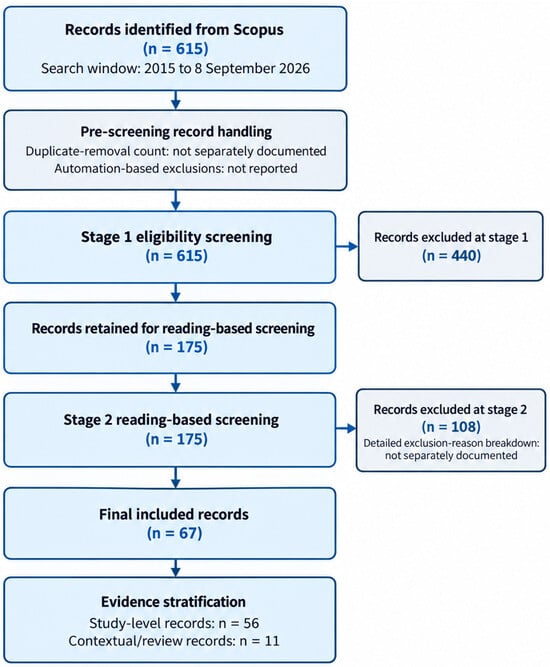
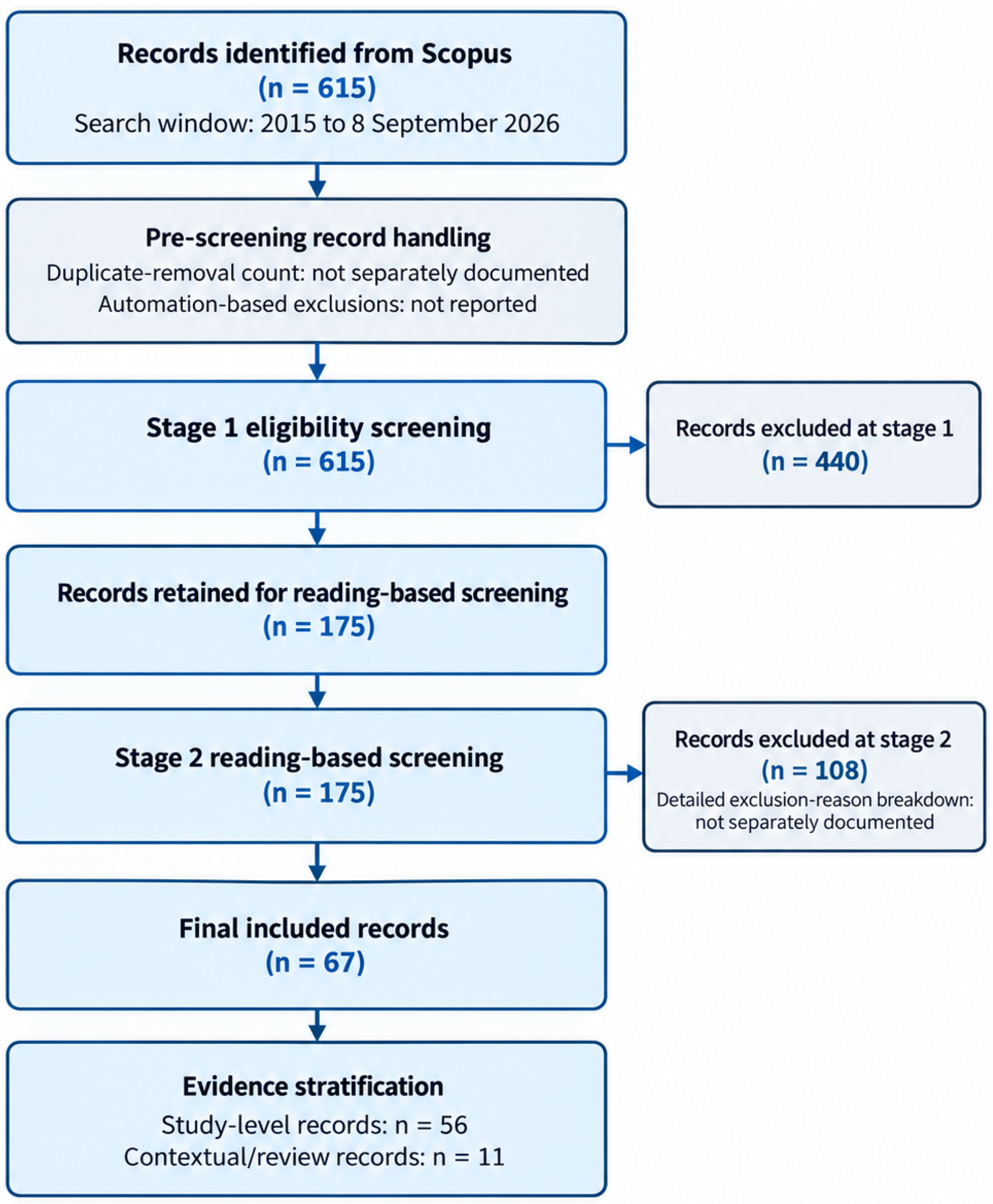
This study is a systematic mapping review informed by applicable PRISMA-ScR reporting items, not a registered protocol or a PRISMA-ScR-compliant meta-analysis. The preserved Scopus screening history contains 615 initial records, 175 after first-stage exclusions, and 67 after the second stage (615 − 440 = 175; 175 − 108 = 67). Two duplicate entries for the same ICSINC 2023 proceedings volume (IDs 23 and 60) are consolidated after screening, leaving 65 unique records: 56 primary and nine contextual sources. The search ended on 8 September 2026. The original Boolean query and reviewer disagreement log have not been recovered; neither is reconstructed as historical fact. The subsequent source audit also identifies four scope-flagged primary studies (IDs 28, 45, 61, and 62), resulting in 52 studies eligible for strict mission-specific interpretation while preserving all original counts for reproducibility.
The selection flow is historical; the duplicate and sensitivity audits were conducted afterward. Figure 1 presents the selection flow, and Appendix A documents the resulting analytical distinction.
Figure 1.
PRISMA 2020-aligned study selection flow for the systematic mapping review (Source: author, adapted to available historical review records).
3.1. Research Questions
The review addresses three questions:
- How can AI and FPGA technologies be integrated to address power, computational, communication, and operational constraints in nanosatellite and small-satellite systems?
- What benefits are reported for FPGA–AI implementations in terms of latency, energy efficiency, onboard data reduction, autonomy, and robustness?
- What challenges remain in model deployment, hardware/software integration, radiation tolerance, verification, cybersecurity, and mission qualification?
3.2. Search Strategy and Eligibility Criteria
Scopus was the bibliographic source. The documented keyword blocks from the source manuscript are reproduced in Table 2. The historical source files do not preserve the exact Boolean query string submitted to Scopus; therefore, this paper does not present an invented query as if it were the original search syntax. Appendix B provides an illustrative Boolean reconstruction of the documented keyword blocks. Because the exact historical Scopus query is not preserved, this reconstructed expression should not be interpreted as reproducing the original search and should be verified against any archived Scopus search history, if available.
Table 2.
Documented keyword blocks used to define the search scope.
The eligibility criteria were defined to remain consistent with the scope of the review and the final 67-record corpus.
- Inclusion: English-language records published from 2015 to 8 September 2026 addressing nanosatellite or small-satellite systems and providing evidence relevant to FPGA/reconfigurable computing, onboard AI/ML, or their integration. For the core FPGA–AI synthesis, studies were required to address both intelligent onboard processing and FPGA, programmable logic, heterogeneous SoC, or closely related hardware acceleration aspects. Studies addressing only one side of the integration were retained only when they provided relevant contextual evidence regarding communication, computing architecture, autonomy, resilience, or hardware constraints.
- Exclusion: Records outside the nanosatellite/small-satellite scope; studies unrelated to onboard computing, AI/ML, FPGA or hardware acceleration, communication/data handling, autonomy, or resilience; non-English records; and records outside the 2015–2026 publication period.
The available source material does not document a separate duplicate removal count or a multi-reviewer disagreement resolution procedure. These details are therefore not inferred and are reported as limitations of the review. Table 3 summarizes the paper selection guidelines.
Table 3.
Paper selection guidelines.
3.3. Screening and Evidence Stratification
The documented screening flow is internally consistent. The initial search returned 615 records. The first eligibility stage excluded 440 records and retained 175 for reading-based screening. The second stage excluded 108 records, yielding 67 final records: and .
The 67 historically eligible export entries include two redundant proceedings volume records (IDs 23 and 60). Consolidation leaves 65 unique records, including 56 primary and nine contextual sources. Four of these primary records were later scope-flagged and excluded from strict satellite-specific inference; 52 mission-relevant primary studies remained. No contextual source or generic accelerator experiment was treated as demonstrating nanosatellite AI inference.
3.4. Data Extraction, Verification, and Coding
A per-study technical audit retains the algorithm family, FPGA/SoC execution fabric, deployment toolchain, dataset, numerical precision, LUT/ALM, FF, DSP and memory use, latency and throughput, power boundary definition, algorithm metrics, benchmark baseline, and hardware/flight validation. The study-level table includes all 56 historical primary records; Table S1 provides machine-readable field-level provenance. Evidence states are as follows: Verified (supported by an inspected full paper or official author/agency source); Not Reported (complete exact source examined and explicitly lacks the value); Source-Limited (exact source not available or field is supported only by an incomplete abstract or summary). An unavailable value could not be labelled Not Reported.
The earlier manuscript identified 15 fully consulted sources and 41 other records audited from limited material; the priority audit improved several records and retrieved one additional exact full paper, while 23 of 27 priority exact bodies remain inaccessible. The model-to-hardware evidence is stronger for selected cloud and Earth observation applications than for navigation and general operations. There is no common dataset/measurement baseline supporting a pooled FPGA-vs.-CPU, GPU, ASIC, or VPU ranking.
3.5. Application Categories
The 56 historical primary records are coded as follows: 30 Earth observation/onboard sensing, 11 autonomy/navigation/health, seven computing/architecture, six communications/interfaces, and two security. Removing the four later scope-flagged primary records yields 29, 11, six, four, and two studies, respectively, in the strict 52-study interpretation. This post-screening sensitivity analysis is reported separately and does not alter the original 615–175–67 screening record.
3.6. Demographic Analysis
3.6.1. Year-Wise Publications
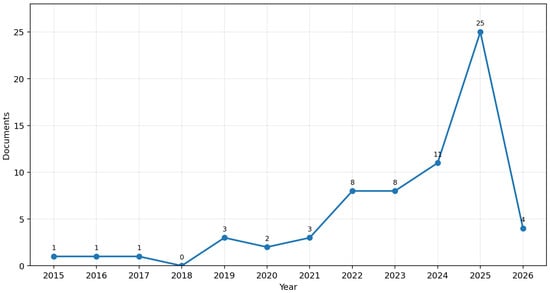
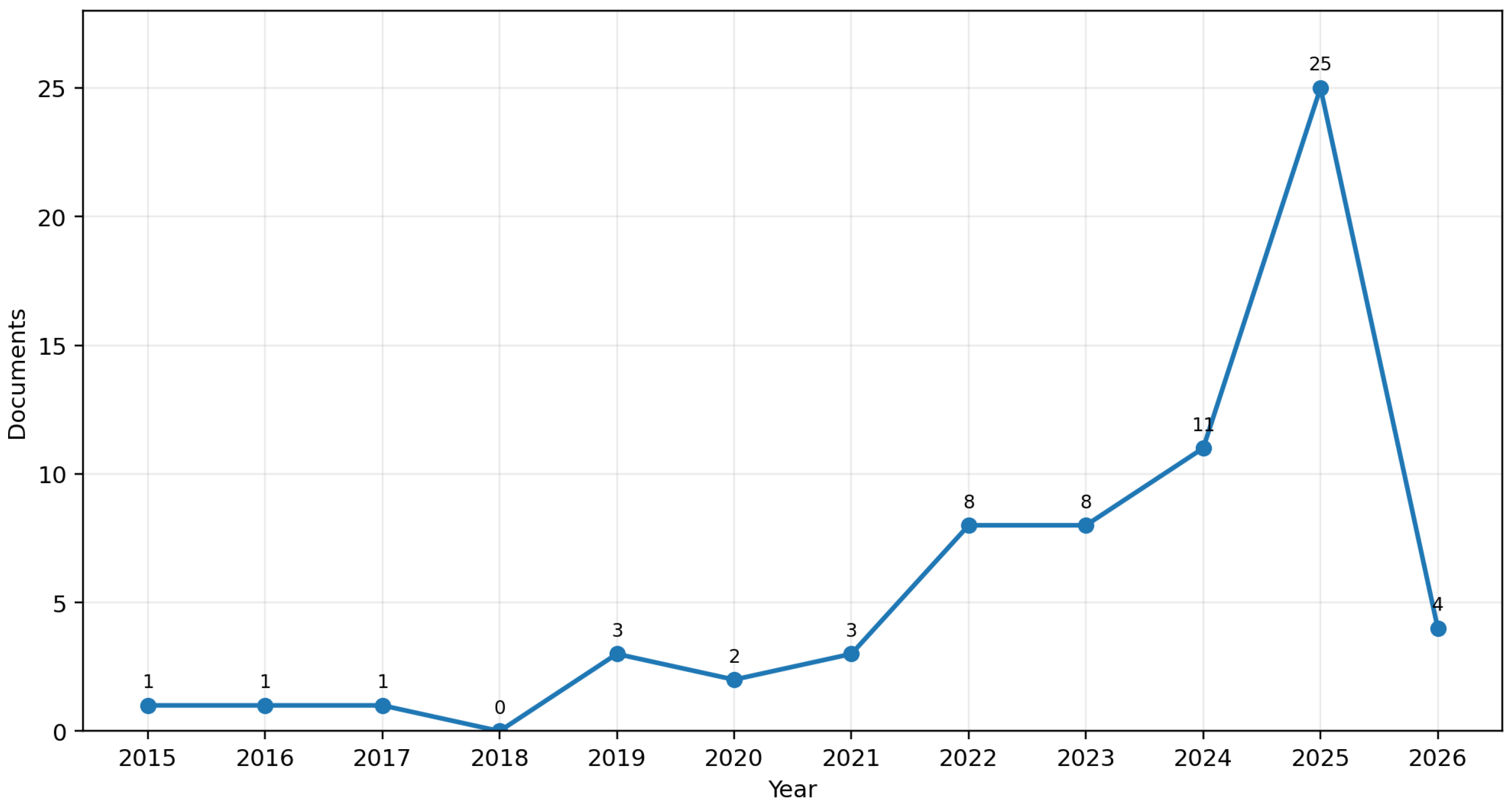
The publication distribution is as follows: 2015 (1), 2016 (1), 2017 (1), 2018 (0), 2019 (3), 2020 (2), 2021 (3), 2022 (8), 2023 (8), 2024 (11), 2025 (25), and 2026 (4 up to 8 September). These historical 67 counts include proceedings/review records and duplicate proceedings volume entries. The 2026 count is partial because the last search was on 8 September 2026; the plot is not a measure of comparable annual experimental activity. Figure 2 displays the yearly distribution.
Figure 2.
Year-wise historical Scopus export entries (2015–8 September 2026; includes contextual records and duplicate proceedings) (source: author analysis of the final Scopus export).
3.6.2. Contributions by Country
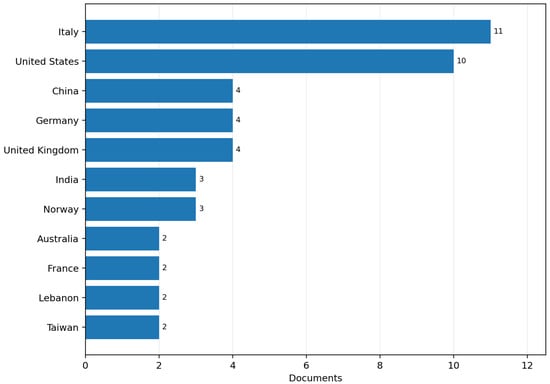
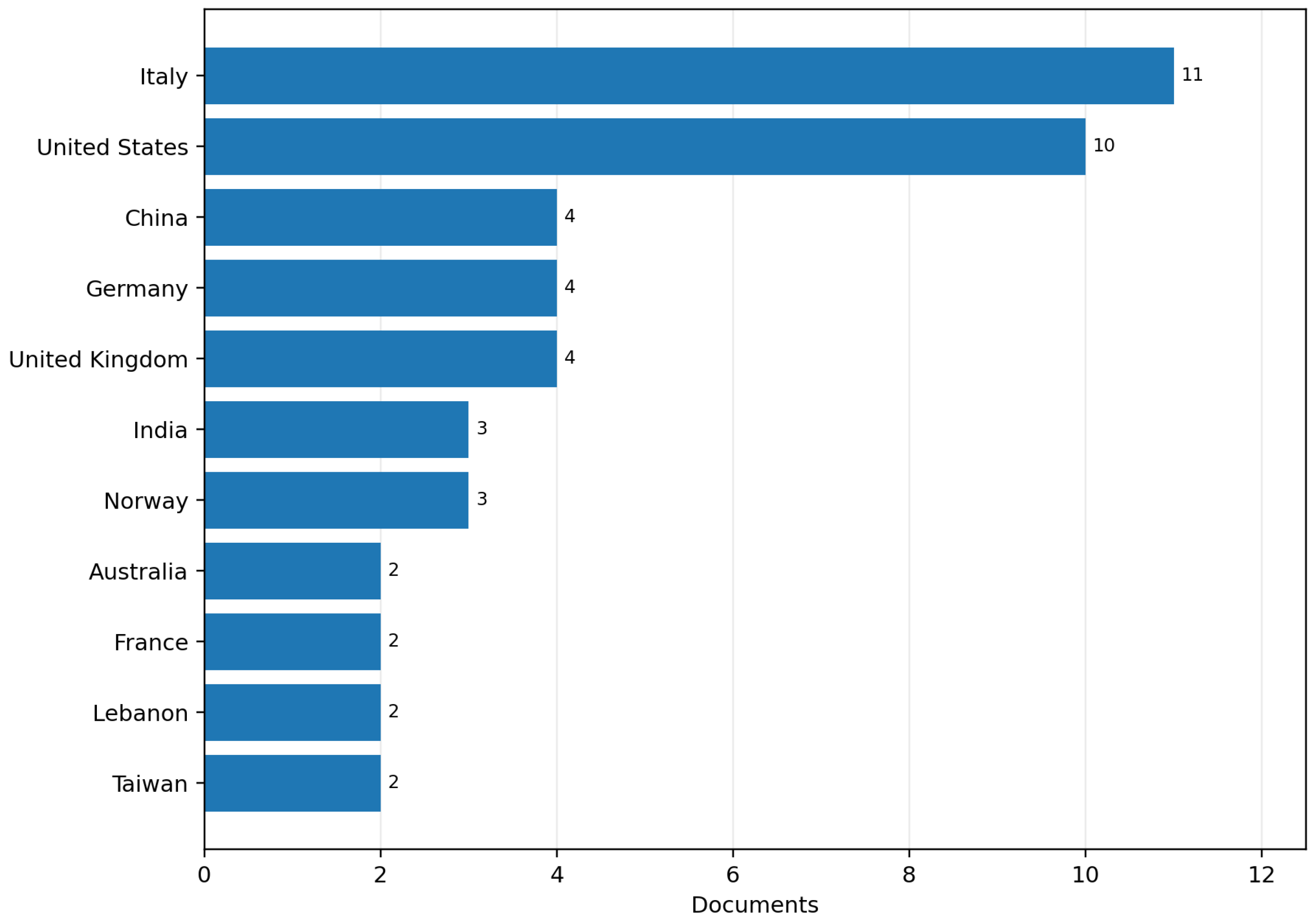
Country contributions were calculated from the Affiliations field. Affiliation information is available for 58 of the 67 records; nine records have no affiliation value. Each document is counted at most once for each country, so an internationally co-authored document may contribute to more than one country. Italy appears in 11 documents and the United States in 10; China, Germany, and the United Kingdom appear in four each; India and Norway in three each; and Australia, France, Lebanon, and Taiwan in two each. Figure 3 shows all countries represented by at least two documents, avoiding arbitrary tie-breaking among countries represented by one document.
Figure 3.
Country/territory contributions derived from Scopus affiliation metadata; countries represented by at least two documents are shown (source: author analysis of the final Scopus export).
4. Results
4.1. Satellite Class and CubeSat Interpretation
The corpus uses overlapping terms including CubeSat, nanosatellite, micro-/ nanosatellite, SmallSat, and small satellite. Rather than imposing a new mass threshold that is not uniformly used by all records, this review retains the source terminology and focuses on the recurring engineering context: constrained onboard resources combined with increasing sensing, communication, and autonomy demands [7,8,12]. By common mass convention, nanosatellites are approximately 1–10 kg, whereas CubeSat units describe a standard mechanical form factor rather than a uniform mass class. The available text does not establish a reliable count of 1U–12U targeted studies; this quantity is not inferred from the titles. A 10 W accelerator result does not establish small-satellite compliance without the payload power, thermal design, duty cycle, and spacecraft bus budget.
4.2. Communication and Data Handling Functions in Nanosatellites
The selected evidence supports a functional classification of communication-related use rather than a generic list of modulation schemes. Four recurring roles can be distinguished.
- Telemetry, tracking, and control/health data: Onboard telemetry streams and command/data handling functions motivate reliable interfaces, anomaly detection, and fault awareness [19,22,32].
- Payload data downlink: Onboard classification, filtering, compression, and prioritization are used to reduce the amount of low-value data transmitted to the ground [10,13,15,35].
- Communication payloads and relay functions: The UWE-5 design illustrates K-/Ka-band communication, beam steering, and LoRa inter-satellite link experimentation on CubeSat-class platforms [36].
- Reconfigurable sensing and interfaces: Programmable antenna/control concepts and configurable detector interfaces use FPGA flexibility to accommodate changing device or mission requirements [1,2,33,37].
4.3. Onboard Diagnostic and Health Monitoring Functions
Diagnostic functions in the final corpus extend beyond conventional link quality monitoring. Error detection and correction mechanisms address corrupted onboard communication data [32]; AI-based telemetry analysis targets the early recognition of developing spacecraft faults [19]; edge anomaly detection uses onboard sensor information to reduce the reliance on raw-data downlink [23]; and cybersecurity work addresses both general satellite cyber-interference and adversarial attacks against onboard anomaly detection [25,38]. Radiation-aware computing and sensing add another diagnostic dimension by explicitly monitoring or mitigating space environment effects [16,20].
4.4. Communication and Processing Interfaces
The reviewed records describe several link and interface contexts but do not provide a controlled comparison that would justify ranking one modulation as universally optimal. UWE-5 discusses K- and Ka-band communication links together with LoRa inter-satellite link tests [36]. OPS-SAT operational work describes SpaceWire connectivity and an IP tunnel between the payload computer and ground systems [29]. ScOSA uses SpaceWire for distributed onboard computing [17], while a 2025 study evaluates software-emulated high-speed synchronous communication on COTS hardware for onboard imaging payloads [37]. These examples indicate that interface selection is mission- and architecture-dependent.
4.5. Mapping Mission Functions to Communication and Onboard Processing Requirements
Mission configuration is jointly constrained by communication, sensing, and processing. The evidence suggests a relationship linking mission functions and requirements with link-related constraints, processing needs, and suitable onboard processing architectures. Rather than identifying a universally optimal configuration, the framework emphasizes mission-dependent co-design, in which TT&C, payload downlink, Earth observation, navigation, autonomous operation, and resilience requirements jointly influence communication and hardware choices [1,13,14,19,32,33,36,37].
5. FPGAs and AI
5.1. Overview of FPGAs
FPGAs are reconfigurable computing devices that can implement custom datapaths and interfaces while remaining programmable after manufacture. In the selected space-oriented corpus, their principal value is not simply “high performance” but the ability to tailor parallelism, memory movement, precision, and I/O to a specific mission workload. This is reflected in hybrid radiation-aware processors, distributed onboard computers, CNN accelerators, and specialized arithmetic architectures [11,16,17,39,40]. The 2026 embedded space review likewise frames FPGA/SoC hardware as one option within a broader trade space that also includes microcontrollers and GPU-capable systems [7].
5.2. FPGA Roles in Nanosatellite Communication and Data Handling
The communication-related records show FPGA roles at several layers; general reconfigurable antenna publications provide background only and do not demonstrate AI inference on a nanosatellite. Error control work uses FPGA processing to support reliable nanosatellite data transfer [32]. Detector control hardware uses FPGA timing and memory to provide configurable sensor readout and high-speed streaming toward onboard processors [33]. UWE-5 combines a communication-focused CubeSat mission with a PolarFire SoC FPGA payload computer for onboard image analysis [36], while software-emulated synchronous communication work evaluates when COTS processors may substitute for dedicated interfaces [37]. These examples support an architecture in which the FPGA can sit at the boundary between sensing, communication, and intelligent processing.
Architectural Advantages of FPGA Integration
The selected technical records suggest four potential architectural capabilities, conditional on workload mapping.
- Reconfigurability and mission adaptation: FPGA logic, detector timing, software-defined processing, and in-flight experimentation can be modified without replacing the physical platform [17,29,33].
- Parallel and pipelined execution: Neural network and signal processing accelerators exploit dataflow and parallel compute structures to reduce inference or processing latency [10,11,40,41].
- Application-specific efficiency: Quantization, pruning, specialized arithmetic, and model-specific pipelines enable useful throughput within restricted power budgets [12,21,39,42,43].
- Heterogeneous and resilient integration: FPGAs can be combined with CPUs, GPUs, or radiation-tolerant processors to balance control flow, acceleration, and reliability [3,16,17].
These advantages are conditional on implementation quality. Toolchain effort, design verification, power delivery, radiation effects, and model compatibility can offset the benefits if they are not handled as part of system-level design [6,15,20,44].
5.3. Limits of CPU, GPU, ASIC, and FPGA Comparisons
The search was organized around FPGA-related studies, not a balanced sampling of CPU, GPU, ASIC, and VPU implementations. Consequently, no corpus-wide claim of FPGA superiority, relative energy efficiency, or hardware qualification is justified. The comparisons below are local, source-reported results against the stated baseline and must not be aggregated. The baseline denominator and full system boundary are as important as the accelerator’s peak throughput. Table 4 presents the comparison validity rules.
Table 4.
Comparison validity rules; no cross-platform ranking is inferred.
5.4. Artificial Intelligence for Onboard Nanosatellite Systems
AI in the final corpus is used primarily to convert raw onboard data into decisions, priorities, or compact information products before transmission. This includes cloud and object detection, hyperspectral classification, telemetry anomaly detection, navigation/pose estimation, and mission automation [9,10,13,14,19,26,27,29]. The role of AI is therefore broader than communication protocol optimization: it changes what the spacecraft needs to transmit and how autonomously it can act on sensor and health data.
AI Capabilities in Onboard Processing
The algorithm-to-mission synthesis distinguishes the principal AI capability groups identified across the reviewed nanosatellite applications. The evidence is concentrated in detection and classification, while anomaly detection and prediction, navigation and pose estimation, autonomous decision-making, and security and resilience are also represented. Recent studies further extend this landscape toward adversarial resilience and robust model–hardware co-design.
5.5. Algorithm Families and FPGA Mapping Constraints
The AI architecture matters independently of the mission application. Convolutional neural networks (CNNs), compact U-Nets, and YOLO-family detectors exhibit regular convolution/data reuse patterns suited to line buffers, quantization, and pipelined inference, but intermediate feature maps may dominate BRAM and external-memory use. Recurrent networks such as LSTMs introduce recurrent state and sequential dependencies; an LSTM mapped to Versal AIE-ML cannot be described as FPGA fabric neural inference. Classical anomaly detection and fuzzy inference can reduce model memory but need separate proof of hardware implementation. Transformers introduce attention and high-dimensional matrix operations with potentially demanding activation storage; reinforcement learning may be used for decision policies but requires a documented inference/training architecture to claim an FPGA implementation. These categories indicate design constraints, not measured prevalence across the corpus. Table 5 summarizes the model-to-hardware challenges.
Table 5.
Model-to-hardware challenges; examples do not imply direct FPGA flight execution in every case.
5.6. Application-Level AI Evidence
The corpus is strongly application-oriented. The first group centers on onboard sensing and Earth observation; the second centers on navigation, autonomy, and health monitoring; and the third addresses resilience, architecture, and alternative low-power AI implementations. Study-level examples appear below, with the evidence strength and FPGA execution carefully distinguished.
Table 6 distinguishes individual application reports and their implementation status instead of combining dissimilar publications in a single row. It is illustrative; the record-level map and study-level audit appear in Table A1 and Table A2 (Appendix C and Appendix D), with per-study provenance in Supplementary Data S1.
Table 6.
Individual study-level mission/model/hardware examples. These rows do not imply a common benchmark.
Proceedings volume and review entries are contextual sources; the duplicate ICSINC records are counted only once in the 65 unique records, and none is treated as a source of experiment-specific metrics [7,8,46].
6. FPGA–AI Integration for Nanosatellites
The combined evidence supports the joint consideration of the AI model, numerical precision, data movement, accelerator structure, and mission constraints. However, no common experiment establishes that this approach is best for every satellite class or application.
6.1. Capabilities of FPGA–AI Integration
Selected FPGA–AI implementations demonstrate onboard inference and filtering; some report data reduction, while the broader corpus proposes autonomy and energy management. The most substantiated implementation cases concern application-specific pipelines for cloud, SAR, hyperspectral, telemetry, and navigation workloads [10,11,13,14,15,19,35,39,41]. In-orbit results on OPS-SAT and other mission-oriented studies show that these capabilities are not limited to simulation, although the level of flight maturity differs across records [18,21,29].
6.2. Steps for Integrating FPGA–AI in Nanosatellite Use Cases
The following sequence is a proposed synthesis, not a counted or universally followed procedure. Selected papers document individual steps, but the review has no per-study adoption denominator for the whole workflow. First, the mission defines SWaP, latency, interface, reliability, and data reduction requirements. Second, the processing platform is selected according to these constraints. Third, the AI model or signal processing algorithm is trained or configured. Fourth, model compression, pruning, quantization, or architecture simplification is applied where needed. Fifth, the model is mapped to the FPGA using HLS, DPU toolchains, or custom RTL/dataflow design. Sixth, the accelerator is integrated with sensors, memory, buses, and communication functions. Finally, the design is verified through simulation, hardware testing, HIL experiments, power/resource measurement, and, where applicable, radiation/fault analysis or in-orbit validation [10,11,15,20,28,35,39,41,42,47,48].
Quantitative examples must retain their source depth, hardware mapping, measurement basis, and validation status. Table 7 distinguishes these attributes instead of ranking incompatible speedups.
Table 7.
Source-traced implementation examples. Values are conditional on the stated configurations; SL = source-limited. This is not a normalized league table.
6.3. Validation and Flight Heritage
Hardware maturity is coded using six distinct states: (i) in-orbit inference on programmable logic, (ii) a physical ground FPGA prototype, (iii) post-implementation synthesis/timing simulation, (iv) behavioral RTL simulation only, (v) heterogeneous AI engines adjacent to PL, and (vi) supporting or conceptual evidence. They are not interchangeable TRL scores; a TRL is not assigned unless a source explicitly reports one.
6.4. Challenges in FPGA–AI Integration
Table 8 summarizes the illustrative validation classes. The selected evidence identifies six interdependent challenge groups. SWaP and thermal limits constrain both the accelerator size and sustained throughput [3,7,44]. Memory and compute limitations drive pruning, quantization, and lightweight architectures [11,39,40,42]. Radiation and fault tolerance require device selection, mitigation, or hybrid architectures [16,17,20]. Toolchain and verification complexity remains significant despite HLS and automated deployment flows [6,15,39]. Security and adversarial resilience is becoming a distinct design requirement for onboard AI [25,38]. Finally, bandwidth and I/O bottlenecks connect the computing architecture back to the communication system [13,33,37].
Table 8.
Illustrative validation classifications; not a complete flight manifest.
7. Conclusions, Limitations, and Technical Priorities
This mapping differentiates 67 historically screened records, 65 unique records, 56 primary source-traced research records, and 52 primary studies qualifying for strict mission-specific interpretation after four post-screening scope flags. The main technical finding is conditional, not a universal FPGA superiority claim: OPS-SAT supplies a directly documented in-orbit Cyclone V inference result, whereas several other apparent spacecraft implementations are in fact board prototypes, behavioral simulations, or heterogeneous AIE-ML deployments. Model precision, data movement, and thermal/power system boundaries determine what the metrics mean.
7.1. Limitations
The source corpus comes from Scopus alone; the original Boolean string, eligibility disagreement log, and exact 1U–12U study count were not available. The 2026 search window ends on 8 September, so this year’s count is partial. The technical audit depth differs markedly across studies: a baseline of 15 complete papers/preprints and one additional exact paper from a 27-record priority audit, complemented by official posters and abstracts, cannot substitute all 56 full texts. Twenty-three exact priority bodies remain unobtained, and many technical fields are source-limited. Power may represent the FPGA fabric alone, embedded board, or estimated system draw; throughput and accuracy depend on the dataset and input definition. No pooled performance comparisons or comprehensive space qualification ranking is possible. Security and radiation studies are sparse and should be treated as emerging concerns, not quantified dominant conclusions.
7.2. Testable Future Research Priorities
The study suggests focused experimental questions rather than claiming that they were resolved. Reconfiguration: Measure the latency, fault impact, and mission energy cost of on-orbit reconfigurable AI models. Radiation-aware inference: Report bit-flip injection and fault propagation impacts on task decisions along with mitigation resource overhead. Online adaptation: Constrain gradient updates or recalibration by onboard memory, compute, and model drift monitoring. Communication-aware scheduling: Test deadline-constrained selection of sensing/inference/downlink tasks against orbital contact windows, not just constant-link benchmarks. Hardware assurance: Evaluate performance during thermal/radiation stress and secure update/rollback. Each study should report the target board, exact compute fabric, AI weights/precision, toolchain, benchmark data, input units, total power boundary, resource use, latency quantiles, flight/HIL stage, and, if applicable, separate TRL justification.
In conclusion, resource-constrained AI–FPGA integration can support spaceborne inference, but its engineering value depends on measured mission-specific trade-offs and verified validation maturity.
Supplementary Materials
The following supporting information can be downloaded at https://www.mdpi.com/article/10.3390/s26227328/s1. PRISMA 2020 Checklist-Completed Location Mapping. Table S1: Study-level technical extraction and field-level evidence provenance for 56 historical primary records.
Funding
This research received no external funding.
Data Availability Statement
The data supporting the findings of this study are available from the corresponding author upon reasonable request.
Conflicts of Interest
The authors declare no conflicts of interest.
Appendix A. Scope Reconciliation and Data Provenance
The original export contains 67 entries; entries 23 and 60 are repeated proceedings volume records, giving 65 unique sources. These include 56 primary research records and nine contextual/review sources. Primary records 28 and 45 are general antenna work, 61 is UAV image classification, and 62 is a non-mission accelerator. They are shown for auditability but excluded from the strictly mission-related analytical denominator of 52. The mission class and a reported 1U–12U count cannot be reconstructed without further full-text acquisition.
Appendix B. Transparent Reconstruction of the Documented Search Scope
The exact historical Scopus Boolean string is not available in the source manuscript or final export. Accordingly, the expression below is provided only as an illustrative reconstruction based on the keyword blocks documented in Table 2. It should not be interpreted as the exact historical query that generated the original search results and should be verified against any archived Scopus search history, if available.
TITLE-ABS-KEY((“embedded systems” OR nanosatellites OR UHF OR VHF OR “Command (TT&C)” OR “signal processing”)AND (“FPGA optimization” OR “AI accelerators” OR “machine learning hardware”OR “hardware-software co-design” OR “neural processing units” OR “data processing”))
The publication window corresponding to the final corpus is 2015 to 8 September 2026, with English-language records retained. The reconstructed expression is presented for transparency rather than as an exact reproducible record of the historical search. The documented 615 → 175 → 67 screening counts therefore refer to the original review process and not to a rerun of this reconstructed expression.
Appendix C. Record-Level Evidence Map
Table A1.
Record-level evidence map for all 67 Scopus records. Dominant focus is a descriptive title/abstract coding; contextual/review records are not treated as experiment-specific performance evidence.
Appendix D. Per-Study Technical Verification Register
The following 56-row register is aligned with Table S1. A status of Source-Limited refers to consulted-source depth, not an assertion that the paper itself omits metrics. “In orbit” is reserved for documented onboard inference; “OBC tested” is not equivalent.
Table A2.
Per-study technical audit summary: original export IDs; full metric/provenance columns in Table S1.
References
- Costantine, J.; Tawk, Y.; Barbin, S.E.; Christodoulou, C.G. Reconfigurable antennas: Design and applications. Proc. IEEE 2015, 103, 424–437. [Google Scholar] [CrossRef] [Scilit]
- Costantine, J.; Tawk, Y.; Christodoulou, C.G. Reconfigurable antennas. In Handbook of Antenna Technologies; Springer: Singapore, 2016; pp. 1737–1772. [Google Scholar] [CrossRef] [Scilit]
- Adams, C.; Spain, A.; Parker, J.; Hevert, M.; Roach, J.; Cotten, D. Towards an Integrated GPU Accelerated SoC as a Flight Computer for Small Satellites. In Proceedings of the IEEE Aerospace Conference Proceedings; IEEE: Piscataway, NJ, USA, 2019. [Google Scholar] [CrossRef] [Scilit]
- Santangelo, A.D. Quicksat/autonomy-an open autonomy framework for cubesats and small satellites. In Proceedings of the Accelerating Space Commerce, Exploration, and New Discovery Conference, ASCEND 2020; AIAA: Reston, VA, USA, 2020. [Google Scholar] [CrossRef] [Scilit]
- Nalepa, J.; Kuligowski, P.; Gumiela, M.; Drobik, M.; Nowak, M. Leopard: A new chapter in on-board deep learning-powered analysis of hyperspectral imagery. In Proceedings of the International Astronautical Congress, IAC; IAF: Paris, France, 2020. [Google Scholar]
- Rapuano, E.; Meoni, G.; Pacini, T.; Dinelli, G.; Furano, G.; Giuffrida, G.; Fanucci, L. An FPGA-based hardware accelerator for CNNs inference on board satellites: Benchmarking with Myriad 2-based solution for the cloudscout case study. Remote Sens. 2021, 13, 1518. [Google Scholar] [CrossRef] [Scilit]
- Eshaq, M.; Zitouni, M.S.; Zabalza, J.; Macdonald, M. A Review of Machine Learning in Embedded Space Systems: Challenges, Techniques, and Future Directions. IEEE Access 2026, 14, 103896–103928. [Google Scholar] [CrossRef] [Scilit]
- Liubimov, O.; Turkin, I. CUBESATS AND THEIR ON-BOARD COMPUTERS: SYSTEMATIC LITERATURE REVIEW; [SUPUTNIKI CUBESAT I YiKhNI BORTOVI KOMP’IuTERI: SISTEMATIChNII OGLIaD LITERATURNIKh DZhEREL]. Space Sci. Technol. 2025, 31, 14–37. [Google Scholar] [CrossRef] [Scilit]
- Vitolo, P.; Fasolino, A.; Liguori, R.; Di Benedetto, L.; Rubino, A.; Licciardo, G.D. Real-Time On-board Satellite Cloud Cover Detection Hardware Architecture using Spaceborne Remote Sensing Imagery. In Proceedings of the SPIE—The International Society for Optical Engineering; SPIE: Bellingham, WA, USA, 2024. [Google Scholar] [CrossRef] [Scilit]
- Boyle, S.; Mikulowski, P.; Orlandic, M. Onboard Accelerator of Hyperspectral Classification for HYPSO. In Proceedings of the 2025 14th Mediterranean Conference on Embedded Computing, MECO 2025; IEEE: Piscataway, NJ, USA, 2025. [Google Scholar] [CrossRef] [Scilit]
- Cratere, A.; Farissi, M.S.; Carbone, A.; Asciolla, M.; Rizzi, M.; Dell’olio, F.; Nascetti, A.; Spiller, D. Efficient FPGA-Accelerated Convolutional Neural Networks for Cloud Detection on CubeSats. IEEE J. Miniaturization Air Space Syst. 2025, 6, 187–197. [Google Scholar] [CrossRef] [Scilit]
- Pitonak, R.; Mucha, J.; Dobis, L.; Javorka, M.; Marusin, M. CloudSatNet-1: FPGA-Based Hardware-Accelerated Quantized CNN for Satellite On-Board Cloud Coverage Classification. Remote Sens. 2022, 14, 3180. [Google Scholar] [CrossRef] [Scilit]
- Kim, J.H.; Kim, Y.; Cho, D.H.; Kim, S.M. On-Orbit AI: Cloud Detection Technique for Resource-Limited Nanosatellite. Int. J. Aeronaut. Space Sci. 2025, 26, 1975–1988. [Google Scholar] [CrossRef] [Scilit]
- Laganier, C.; Fletcher, L.; Kwan, E.; Walters, R.; Nockles, V. Efficient SAR Vessel Detection for FPGA-Based On-Satellite Sensing. In Proceedings of the SEC 2025—Proceedings of the 2025 10th ACM/IEEE Symposium on Edge Computing; ACM: New York, NY, USA, 2025. [Google Scholar] [CrossRef] [Scilit]
- Novoselnik, F.; Mamic, M.; Gembec, F.; Skokic, I. On-orbit data processing utilizing FPGA-Accelerated deep learning models. In Proceedings of the 2025 European Data Handling and Data Processing Conference for Space, EDHPC 2025; IEEE: Piscataway, NJ, USA, 2025. [Google Scholar]
- Perryman, N.; Franconi, N.; Crum, G.; Wilson, C.; George, A.D. SpaceCube GHOST: A Resilient Processor for Low-Power, High-Reliability Space Computing. In Proceedings of the IEEE Aerospace Conference Proceedings; IEEE: Piscataway, NJ, USA, 2024. [Google Scholar] [CrossRef] [Scilit]
- Ludtke, D.; Firchau, T.; Cortes, C.G.; Lund, A.; Nepal, A.M.; Elbarrawy, M.M.; Hammadeh, Z.H.; Mes, J.G.; Kenny, P.; Bromer, F.; et al. ScOSA on the Way to Orbit: Reconfigurable High-Performance Computing for Spacecraft. In Proceedings of the Proceedings—2023 IEEE Space Computing Conference, SCC 2023; IEEE: Piscataway, NJ, USA, 2023; pp. 34–44. [Google Scholar] [CrossRef] [Scilit]
- Kervennic, E.; Louis, T.; Benguigui, M.; Bobichon, Y.; Avaro, N.; Grenet, I.; Feresin, F.; Girard, A. Embedded cloud segmentation using AI: Back on years of experiments in orbit on OPS-SAT. In Proceedings of the 2023 European Data Handling and Data Processing Conference for Space, EDHPC 2023; IEEE: Piscataway, NJ, USA, 2023. [Google Scholar] [CrossRef] [Scilit]
- McCormick, A.; Adetomi, A.; O’Neill, K. Deploying AI-based Spacecraft Telemetry Anomaly Detection on an Adaptive System-on-Chip Solution. In Proceedings of the 2025 European Data Handling and Data Processing Conference for Space, EDHPC 2025; IEEE: Piscataway, NJ, USA, 2025. [Google Scholar]
- Popa, S.; Kazak, A.; Dinu, A.; Ivanovici, M.; Secrieru, N.; Carbune, V.; Melnic, V. Architecture and Design Choices for an AI-enabled FPGA-based Cosmic Radiation Sensor. In Proceedings of the 2024 16th International Symposium on Electronics and Telecommunications, ISETC 2024—Conference Proceedings; IEEE: Piscataway, NJ, USA, 2024. [Google Scholar] [CrossRef] [Scilit]
- Abderrahmane, N.; Miramond, B.; Kervennic, E.; Girard, A. SPLEAT: SPiking Low-power Event-based ArchiTecture for in-orbit processing of satellite imagery. In Proceedings of the International Joint Conference on Neural Networks; IEEE: Piscataway, NJ, USA, 2022. [Google Scholar] [CrossRef] [Scilit]
- Ogut, M.; Bosch-Lluis, X.; Kangaslahti, P.; Ramos-Perez, I.; Munoz-Martin, J.F.; Cooperrider, J.; Yue, Q.; Swope, J.; Tavallali, P.; Chien, S.; et al. Autonomous Capabilities and Command and Data Handling Design for the Smart Remote Sensing of Cloud Ice. In Proceedings of the International Geoscience and Remote Sensing Symposium (IGARSS); IEEE: Piscataway, NJ, USA, 2022; pp. 7119–7122. [Google Scholar] [CrossRef] [Scilit]
- Moreira, C.M.; Hein, A.M. Edge computing in space: A machine learning approach for anomaly detection. In Proceedings of the International Astronautical Congress, IAC; IAF: Paris, France, 2022. [Google Scholar]
- Rui, Z.; Zhaokui, W.; Yulin, Z. A person-following nanosatellite for in-cabin astronaut assistance: System design and deep-learning-based astronaut visual tracking implementation. Acta Astronaut. 2019, 162, 121–134. [Google Scholar] [CrossRef] [Scilit]
- Belali, F.; Essetty, A.; Bah, S. S-LARF: Layered Adversarial Resilience Framework for spaceborne anomaly detection. Int. J. Crit. Infrastruct. Prot. 2026, 53, 100851. [Google Scholar] [CrossRef] [Scilit]
- Liu, Y.; Bettens, A.; Wu, X. Hardware/Software Co-Design of a Feature-Based Satellite Pose Estimation System. IEEE J. Miniaturization Air Space Syst. 2024, 5, 16–26. [Google Scholar] [CrossRef] [Scilit]
- Carmeli, G.; Ben-Moshe, B. AI-Based Real-Time Star Tracker. Electronics 2023, 12, 2084. [Google Scholar] [CrossRef] [Scilit]
- Capuano, G.; Capuano, V.; Severi, M.; Napolano, G.; Strollo, A.; Opromolla, R.; Petra, N.; Cuciniello, G.; Zaccagnino, E.; Varacalli, G. FPGA Hardware Acceleration for Deep Learning-based Satellite Pose Estimation. In Proceedings of the AIAA Science and Technology Forum and Exposition, AIAA SciTech Forum 2025; AIAA: Reston, VA, USA, 2025. [Google Scholar] [CrossRef] [Scilit]
- Carvalho, N.R.; Oerther, T.; Bammens, S.; Henkel, M.; Evans, D. OPS-SAT-1 Mission Planning, Scheduling and Automation Concepts of Operations. In Proceedings of the International Astronautical Congress, IAC; IAF: Paris, France, 2025; pp. 138–146. [Google Scholar] [CrossRef] [Scilit]
- Leonard, C.; Stober, D.; Schulz, M. FPGA-Enabled Machine Learning Applications in Earth Observation: A Systematic Review. ACM Comput. Surv. 2026, 58, 1–36. [Google Scholar] [CrossRef] [Scilit]
- Antunes, P.; Podobas, A. FPGA-Based Neural Network Accelerators for Space Missions: A Survey. ACM Comput. Surv. 2026, 32, 1–48. [Google Scholar] [CrossRef] [Scilit]
- Islam, M.M.; Hasan, M.; Bhuiyan, Z.A. An analytical approach to error detection and correction for onboard nanosatellites. Eurasip J. Wirel. Commun. Netw. 2023, 2023, 49. [Google Scholar] [CrossRef] [Scilit]
- Jolley, G.; Vaccarella, A.; Grigoriev, A.; Ellis, M.; Benhizia, H.; Jiang, N.; White, M.; Schofield, W.; Mathew, J.; Sharp, R. The configurable detector control solution for small satellite missions. In Proceedings of the International Astronautical Congress, IAC; IAF: Paris, France, 2025; pp. 1031–1035. [Google Scholar] [CrossRef] [Scilit]
- Ding, Q.; Lu, Y.; Zhang, Y.; Li, G.; Gao, X.; Ye, N. Few-Shot Recognition and Classification Framework for Jamming Signal: A CGAN-Based Fusion CNN Approach. IEEE Trans. Veh. Technol. 2026, 75, 17494–17508. [Google Scholar] [CrossRef] [Scilit]
- Cratere, A.; Asciolla, M.; Dell’Olio, F. Towards the Integration of FPGA-based Deep Learning Edge Computing on SmallSats for Low-Latency Autonomous Decision-Making. In Proceedings of the IEEE Sensors Applications Symposium, SAS; IEEE: Piscataway, NJ, USA, 2025. [Google Scholar] [CrossRef] [Scilit]
- Heimbach, M.P.; Kumar, P.; Heubach, L.; Bergmann, P.; Gardill, M.; Dietl, G.; Schmidt, M. UWE-5: Design And Development Of An Educational Communications Satellite Mission. In Proceedings of the International Astronautical Congress, IAC; IAF: Paris, France, 2025; pp. 297–305. [Google Scholar] [CrossRef] [Scilit]
- Voon, D.W.T.; Ng, G.; Soh, V.; Lee, W.J.; Ee, W.H.E. Evaluating the Feasibility of Software-Emulated High-Speed Synchronous Communication for Onboard Satellite Systems Using COTS Hardware. In Proceedings of the International Astronautical Congress, IAC; IAF: Paris, France, 2025; pp. 779–781. [Google Scholar] [CrossRef] [Scilit]
- Ellery, A. Hybrid AI as a defence against cyber-interference of military satellites. In Proceedings of the International Astronautical Congress, IAC; IAF: Paris, France, 2019. [Google Scholar]
- Wickramasinghe, S.; Ye, T.; Raghavendra, C.; Prasanna, V. A Model-Hardware Co-design Framework for Robust and Efficient CNN-Based SAR ATR. In Proceedings of the 2026 ACM/SIGDA International Symposium on Field Programmable Gate Arrays, FPGA 2026; ACM: New York, NY, USA, 2026; p. 39. [Google Scholar] [CrossRef] [Scilit]
- Awaki, K.; Tomioka, Y.; Okuyama, Y.; Saito, H.; Semba, S.; Sedukhin, S.; Takahashi, Y.; Morioka, S. Design and Power-Efficiency Analysis of FPGA-Based Dot and Outer Product Units. In Proceedings of the 2025 IEEE 18th International Symposium on Embedded Multicore/Many-Core Systems-on-Chip, MCSoC 2025; IEEE: Piscataway, NJ, USA, 2025; pp. 670–677. [Google Scholar] [CrossRef] [Scilit]
- Wickramasinghe, S.; Lin, Y.C.; Raghavendra, C.; Prasanna, V. SMART: High-Performance SAR ATR Through Model-Architecture Co-Design on FPGA. In Proceedings of the 2025 IEEE 33rd Annual International Symposium on Field-Programmable Custom Computing Machines, FCCM 2025; IEEE: Piscataway, NJ, USA, 2025; pp. 75–84. [Google Scholar] [CrossRef] [Scilit]
- Zhao, Y.; Lv, Y.; Li, C. Hardware Acceleration of Satellite Remote Sensing Image Object Detection Based on Channel Pruning. Appl. Sci. 2023, 13, 10111. [Google Scholar] [CrossRef] [Scilit]
- Fang, N.; Li, L.; Zhou, X.; Zhang, W.; Chen, F. An FPGA-Based Hybrid Overlapping Acceleration Architecture for Small-Target Remote Sensing Detection. Remote Sens. 2025, 17, 494. [Google Scholar] [CrossRef] [Scilit]
- Franconi, N.; Cook, T.; Wilson, C.; George, A.D. Comparison of Multi-Phase Power Converters and Power Delivery Networks for Next-Generation Space Architectures. In Proceedings of the IEEE Aerospace Conference Proceedings; IEEE: Piscataway, NJ, USA, 2023. [Google Scholar] [CrossRef] [Scilit]
- Lopez-Balcazar, C.; Hernandez, J.; Ramirez-Lopez, F.; Garcia-Balcazar, G. Verilog-based logical design of CubeSat ACS based in fuzzy inference systems focused on trapezoidal membership functions. In Proceedings of the Journal of Physics: Conference Series; IOP Publishing: Bristol, UK, 2025. [Google Scholar] [CrossRef] [Scilit]
- Wang, Y.; Zou, J.; Xu, L.; Ling, Z.; Cheng, X. (Eds.) Signal and Information Processing, Networking and Computers: Proceedings of the 11th International Conference (ICSINC 2023); Lecture Notes in Electrical Engineering; Springer: Singapore, 2024. [Google Scholar]
- Boyle, S.; Penne, C.; Alinejad, A.; Langer, D.; Orlandic, M. HW/SW Codesigned Calibration for HYPSO. In Proceedings of the 2025 European Data Handling and Data Processing Conference for Space, EDHPC 2025; IEEE: Piscataway, NJ, USA, 2025. [Google Scholar]
- Spiller, D.; Carbone, A.; Latorre, F.; Curti, F. Hardware-in-the-loop Simulations of Remote Sensing Disaster Monitoring Systems with Real-Time On-Board Computation. In Proceedings of the 2022 IEEE International Workshop on Metrology for Extended Reality, Artificial Intelligence and Neural Engineering, MetroXRAINE 2022—Proceedings; IEEE: Piscataway, NJ, USA, 2022; pp. 731–736. [Google Scholar] [CrossRef] [Scilit]
- Kervennic, E.; Louis, T.; Benguigui, M.; Bobichon, Y.; Avaro, N.; Grenet, I.; Feresin, F.; Girard, A. Embedded Cloud Segmentation Using AI: Back on Years of Experiments in Orbit on OPS-SAT. Poster Presented at the European Data Handling and Data Processing Conference (EDHPC). 2023. Available online: https://indico.esa.int/event/445/contributions/8482/attachments/5632/9249/Poster%20EDHPC%20-%20VFinale.pdf (accessed on 14 November 2026).
- IEEE. 2025 IEEE 11th International Conference on Space Mission Challenges for Information Technology (SMC-IT 2025); Conference proceedings; IEEE: Piscataway, NJ, USA, 2025. [Google Scholar]
- Capuano, G.M.; Capuozzo, S.; Strollo, A.G.M.; Petra, N. Super-Resolution-Based Small Object Detection for Real-Time Surveillance and Monitoring: An Onboard Satellite FPGA Implementation. In Proceedings of the International Astronautical Congress, IAC; IAF: Paris, France, 2024; pp. 929–943. [Google Scholar] [CrossRef] [Scilit]
- IEEE. 2021 IEEE Aerospace Conference Proceedings; IEEE: Piscataway, NJ, USA, 2021. [Google Scholar]
- Murthy, D.; Kishore, J.; Reddy, K.M.; Gupta, S.; Vijayakumar, L.; Aparna, N.; Ryali, H.S.V.U.S.; Jayasri, P.; Varaprasad, B. FPGA Processing for m-Delta (δ) Decomposition of L1 SLC Images for a Potential Smart Small Satellite Based CP-SAR Mission for Earth Observations. J. Indian Soc. Remote Sens. 2025, 53, 2299–2310. [Google Scholar] [CrossRef] [Scilit]
- Capuano, G.M.; Saggiomo, F.; Strollo, A.G.; Petra, N.; Confuorto, B.; Zaccagnino, E.; Di Clemente, M. Enhancing Satellite Imagery through Advanced Focal Plane In-flight Active Motion Control: The FOPAC System Implementation and Results. In Proceedings of the International Astronautical Congress, IAC; IAF: Paris, France, 2025; pp. 817–827. [Google Scholar] [CrossRef] [Scilit]
- Juang, J.C.; Lee, P.J. Development of Intelligent Remote Sensing Payloads for CubeSat Applications. In Proceedings of the Proceedings of SPIE—The International Society for Optical Engineering; SPIE: Bellingham, WA, USA, 2025. [Google Scholar] [CrossRef] [Scilit]
- Sharma, D.K.; Son, L.H.; Sharma, R.; Cengiz, K. (Eds.) Micro-Electronics and Telecommunication Engineering: Proceedings of 4th ICMETE 2020; Lecture Notes in Networks and Systems; Springer: Singapore, 2021. [Google Scholar] [CrossRef] [Scilit]
- Cratere, A.; Carbone, A.; Cannizzaro, I.; Asciolla, M.; Spiller, D.; Dell’olio, F. Enabling real-time wildfire detection through edge AI onboard CubeSat platforms. In Proceedings of SPIE—The International Society for Optical Engineering; SPIE: Bellingham, WA, USA, 2025. [Google Scholar] [CrossRef] [Scilit]
- IEEE. 2023 3rd International Scientific Conference of Engineering Sciences (ISCES 2023): Proceedings; IEEE: Piscataway, NJ, USA, 2023. [Google Scholar]
- Abrate, M.; Reynaud, F.; Bertaina, M.E.; Coretti, A.G.; Frasson, A.; Montanaro, A.; Bonino, R.; Sirovich, R. Implementation of the Stack-CNN Algorithm for Space Debris Detection on FPGA Board. Appl. Sci. 2025, 15, 9268. [Google Scholar] [CrossRef] [Scilit]
- Boyle, S. Flexible Inference of Arbitrary Precision Neural Network Accelerator for Cloud Detection. In Proceedings of the International Astronautical Congress, IAC; IAF: Paris, France, 2024; pp. 685–691. [Google Scholar] [CrossRef] [Scilit]
- Castelino, C.; Khandelwal, S.; Shreejith, S.; Bogaraju, S.V. An Energy-Efficient Artefact Detection Accelerator on FPGAs for Hyper-Spectral Satellite Imagery. In Proceedings of the 2024 27th Euromicro Conference on Digital System Design, DSD 2024; IEEE: Piscataway, NJ, USA, 2024; pp. 551–558. [Google Scholar] [CrossRef] [Scilit]
- Das, S.; Arya, D.S.; Sakhare, D.Y. (Eds.) Emerging Trends in Microelectronics, Communication and Intelligent Systems: Proceedings of ETMCIS 2024; Lecture Notes in Electrical Engineering; Springer: Singapore, 2025. [Google Scholar] [CrossRef] [Scilit]
- Kandi, K.A.; Ravi Kumar, L.; Shashikala, V.; Sharma, S. High Resolution Deep Space Imaging and Earth Observation Missions with Artificial Intelligence based ASIC Accelerators. In Proceedings of the International Astronautical Congress, IAC; IAF: Paris, France, 2022. [Google Scholar]
- Chen, W.; Yao, B.; Li, Y.; Liu, L.; Liang, J. A Real-Time Ship Detection System for Large-Scale Optical Remote Sensing Image on Micro-Nano Satellite. In Proceedings of the 2022 IEEE International Conference on Real-Time Computing and Robotics, RCAR 2022; IEEE: Piscataway, NJ, USA, 2022; pp. 450–455. [Google Scholar] [CrossRef] [Scilit]
- Mejia, M.J.L.; Schafer, K.; Horch, C.; Busch, S.; Schafer, F. ON-BOARD IMAGE PROCESSING WITH FPGA ACCELERATION USING DEEP NEURAL NETWORK INFERENCE. In Proceedings of the International Astronautical Congress, IAC; IAF: Paris, France, 2022. [Google Scholar]
- IEEE. 2017 International Conference on Inventive Systems and Control (ICISC 2017): Proceedings; IEEE: Piscataway, NJ, USA, 2017. [Google Scholar]
- Upadhyay, G.; Ghosal, S.; Kar, S.; Jain, K.; Shantala, S.; Thakar Lalit Krushna, J.; Srividhya, S.; Balwantrao, S.A. Design and implementation of CNN-based Custom Net Architecture with improved inference time for Realtime Remote Sensing Application. In Proceedings of the 2024 IEEE Space, Aerospace and Defence Conference, SPACE 2024; IEEE: Piscataway, NJ, USA, 2024; pp. 647–651. [Google Scholar] [CrossRef] [Scilit]
- Reynaud, F.; Abrate, M.; Coretti, A.G.; Bertaina, M.E.; Frasson, A.; Montanaro, A.; Bonino, R.; Sirovich, R. Space debris detection from orbit: A prototype detector study. J. Space Saf. Eng. 2026, 13, 191–201. [Google Scholar] [CrossRef] [Scilit]
- Wang, Y.S.; Tsai, Y.C.; Chiou, Y.S.; Shih, M.J.; Chen, Y.C. DETECTION AND INTERPRETATION OF TRANSPLANTED POSITIONS ON FULL-COLOR IMAGE FOR RICE PADDIES WITH FPGA. In Proceedings of the 44th Asian Conference on Remote Sensing, ACRS 2023; Asian Association on Remote Sensing: Pathumthani, Thailand, 2023. [Google Scholar]

Disclaimer/Publisher’s Note: The statements, opinions and data contained in all publications are solely those of the individual author(s) and contributor(s) and not of MDPI and/or the editor(s). MDPI and/or the editor(s) disclaim responsibility for any injury to people or property resulting from any ideas, methods, instructions or products referred to in the content. |
© 2026 by the authors. Licensee MDPI, Basel, Switzerland. This article is an open access article distributed under the terms and conditions of the Creative Commons Attribution (CC BY) license.