


Abstract
Automatic analog-gauge interpretation is constrained by the cost of pointer-level annotation and by limited coverage of rare operating states. This work presents a mechanism-constrained synthetic-data framework (B-data) for detection-oriented gauge sensing under limited pointer supervision. Six real seed templates are decomposed into dial and pointer assets, deterministically re-centered to a common pivot, and synthesized by sampling only within template-specific valid angular intervals. A same-budget unconstrained control uses the same assets, perturbations, and 6000-image budget but samples over the full range. The theoretical valid-arc coverage of unconstrained rotation is 54.91%, and the observed rate is 54.97% (3298/6000), whereas B-data achieves 100% valid-arc compliance. Under the principal setting, in which pointer boxes are available for 25% of the 422 real training images, B-data reaches 62.8 ± 2.2% pointer AP@0.5 across three independent training seeds on a 100-image independent test set from 18 unseen instruments, compared with 54.9 ± 2.5% for unconstrained synthesis and 47.6 ± 2.8% for real-only training. B-data also increases geometry-consistent output to 40.3 ± 1.5%, reduces conditional angular MAE to 5.2 ± 0.7°, and raises end-to-end ≤10° success to 35.7 ± 1.5%. These results show that valid-state constraints provide transferable structural supervision beyond synthetic-data quantity alone. The resulting 6000-image mechanism-constrained B-data release, including paired detection annotations and generation metadata, is publicly available on Zenodo.
Dataset: B-data: A Mechanism-Constrained Synthetic Dataset for Analog-Gauge Detection; Zenodo; DOI: 10.5281/zenodo.23551774.
Dataset License: Creative Commons Attribution 4.0 International (CC BY 4.0)
1. Introduction
The petrochemical industry is an important component of modern industrial infrastructure, and its safe operation is closely related to energy stability, production safety, and environmental protection. Continuous monitoring of operational parameters, such as pressure, temperature, flow rate, and liquid level, is widely required to support process awareness, abnormal-state detection, and risk mitigation. Machine-learning-based non-contact measurement has also been investigated for key petrochemical equipment, such as estimating the tube-metal temperature of ethylene cracking furnaces, demonstrating the potential of intelligent sensing techniques for industrial parameter monitoring [1].
Although distributed control systems (DCSs) and programmable logic controllers (PLCs) have been widely deployed in modern industrial facilities, legacy analog gauges remain extensively used in petrochemical environments. These instruments are mechanically robust, simple to maintain, independent of external power or network infrastructure, and they are often retained as local backup indicators for safety-critical processes. Replacing them completely with digital sensors may require costly retrofitting and production interruption. Therefore, automatic visual interpretation of analog gauges remains an important task for intelligent inspection robots and industrial monitoring systems [2,3,4,5,6,7].
Recent advances in computer vision have enabled data-driven approaches for industrial perception tasks, including object detection, component localization, and visual measurement. Recent studies on pointer-meter and analog-gauge reading have explored detection-, segmentation-, correction-, and geometry-based pipelines for this purpose [8,9,10,11,12,13,14,15,16,17,18,19]. However, analog gauge reading remains challenging under limited annotation conditions. Unlike general object recognition tasks, gauge reading is a structure-dominant vision problem: the semantic reading is primarily determined by the geometric relationship between the dial and the pointer, rather than by global texture or appearance alone. As a result, reliable pointer localization and dial–pointer geometric consistency are essential for a complete detection–geometry–calibration pipeline.
In real petrochemical environments, acquiring fine-grained component-level annotations is difficult. Ordinary inspection images can often be annotated with dial boxes at relatively low cost, but pointer boxes, pointer masks, dial centers, scale endpoints, pointer angles, and physical readings require substantially more manual effort and instrument-specific knowledge. Existing high-precision approaches often rely on additional geometric correction, pointer segmentation, scale localization, or perspective normalization, which further increases the need for fine-grained structural information [20,21,22,23,24,25]. Moreover, industrial operating states are naturally imbalanced. Normal readings are frequently observed, while abnormal or extreme pointer states are rare and difficult to collect deliberately for safety and operational reasons. Real inspection images may also suffer from viewpoint variation, blur, contamination, and other corruptions [26,27,28]. Consequently, real-world datasets collected under practical constraints may provide authentic industrial appearance but insufficient structural supervision for pointer-related learning.
Synthetic data provides a potential way to supplement real supervision, and virtual-sample generation, synthetic object detection, domain randomization, and active-learning-assisted synthetic data have been investigated in industrial or robotic perception contexts [29,30,31,32,33,34]. Recent studies have further explored synthetic data specifically for analog-gauge understanding. Direct regression-based approaches have also been investigated to avoid explicit pointer localization and provide alternative solutions for circular pointer meter reading [35]. Leon-Alcazar et al. developed a synthetic-data-based framework for learning analog gauge reading, demonstrating that generated samples can effectively reduce dependence on manually annotated gauge images [36]. Deng et al. introduced a large-scale synthetic benchmark for robust analog gauge reading, further highlighting the importance of synthetic resources in this field [37]. Peixoto et al. investigated an analog gauge reading solution based on computer vision and deep learning for IoT applications, while Ninama et al. explored computer vision and deep transfer learning for automatic gauge reading detection [38,39]. In addition, GAN-based pointer-meter synthesis and physics-assisted image synthesis have been explored to improve data availability and generation quality in measurement and imaging tasks [40,41]. However, existing synthetic approaches mainly emphasize visual realism, dataset scale, or domain diversity, while the physical mechanisms governing pointer motion and gauge states are rarely modeled explicitly. Therefore, generated samples may improve visual diversity but still lack mechanism-consistent structural supervision for detection-oriented sensing tasks. Pixel-level perturbations, such as illumination changes, noise, blur, cropping, or color jittering, can improve appearance diversity but cannot generate new physically meaningful pointer states. Distribution-driven generative models may synthesize visually plausible images, but they do not inherently guarantee strict geometric consistency between the pointer state, dial structure, and generated labels. For structure-dominant measurement tasks, such geometric inconsistency can introduce harmful supervision noise.
To address these limitations, this study investigates a mechanism-constrained synthetic-data framework for detection-oriented analog-gauge visual sensing. The proposed B-data pipeline treats synthetic generation as a structural-supervision problem rather than as unconstrained image synthesis. Each selected seed template is decomposed into dial-background and pointer-foreground assets; the stored pointer pivot is deterministically translated to a common canvas center; the pointer is then rotated only within the template-specific valid angular interval, and the transformed pointer mask is used to derive the corresponding label. Label-preserving photometric perturbations are applied only after the structural state has been generated. The study therefore focuses on whether controlled structural supervision improves pointer localization and downstream angle estimation when real pointer annotations are limited, rather than on universal physical-value calibration across heterogeneous instruments.
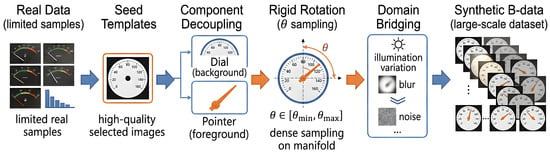
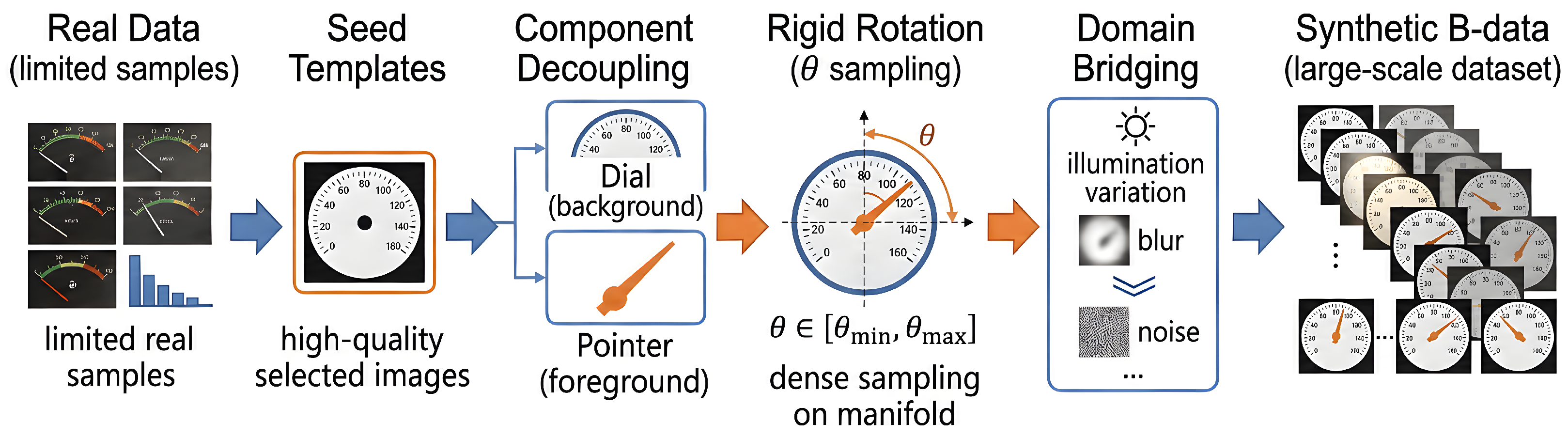
The overall workflow is summarized in Figure 1. Real images provide target-domain appearance, six selected templates provide controllable dial–pointer assets, and the resulting B-data supplies additional structural states for detector training. To distinguish synthetic-data quantity from the mechanism constraint itself, an unconstrained control uses the same templates, the same 6000-image budget, and the same perturbation pipeline but samples pointer angles over the full range.
Figure 1.
Overview of the proposed mechanism-constrained B-data synthesis pipeline. Selected real templates are decomposed into dial-background and pointer-foreground assets, the stored pointer pivot is deterministically re-centered, valid pointer states are sampled within template-specific angular intervals, and labels are generated from the same transformed assets. The resulting synthetic data are combined with real images for detector training and evaluated on an independent set of unseen physical instruments.
The contributions are threefold. First, we define a reproducible mechanism-constrained synthesis process that separates valid-arc compliance, pivot consistency, and mask–label consistency instead of treating synthetic validity as a single qualitative property, and we publicly release the resulting fixed 6000-image B-data pool with paired dial/pointer detection annotations and generation metadata. Second, we establish a controlled real–synthetic training protocol in which the real-image pool, synthetic budget, seed assets, and augmentation pipeline are fixed while the pointer-state constraint is varied, together with partial-label controls that test sensitivity to incomplete real pointer annotation. Third, we evaluate the resulting models at multiple levels—pointer detection, dial–pointer co-detection, geometry-consistent output, and end-to-end angular success—on a 100-image independent test set collected from 18 physical instruments not present in training, validation, or synthesis-seed preparation. Instrument-level comparisons, clustered bootstrap intervals, threshold sensitivity, valid-limit perturbation, and across-seed variability are used to test whether the observed advantage is robust rather than driven by a single operating point or a small subset of instruments.
2. Dataset Description
2.1. Public Release Scope
The public dataset associated with this Data Descriptor is the fixed 6000-image mechanism-constrained B-data release archived on Zenodo (DOI: 10.5281/zenodo.23551774). The release contains the synthetic gauge images, paired dial/pointer detection annotations, the per-image synthesis manifest, and accompanying generation metadata and configuration records. These files constitute the openly reusable dataset described by this article and are distributed under the Creative Commons Attribution 4.0 International (CC BY 4.0) license.
The real-image resources used for source preparation, detector training, validation, and independent testing are supporting experimental data rather than components of the public release. The industrial R-data and independent-test images are not publicly distributed because they contain operational instrumentation subject to confidentiality restrictions. The E-data are likewise not redistributed as source images because explicit redistribution-license records for the original online resources were not retained. These access restrictions do not apply to the released B-data, for which redistribution and relicensing rights have been confirmed.
2.2. Data Collection and Recognition Challenges
The supporting real-image collection contains 528 analog-gauge images from two sources. The first subset, denoted as R-data, contains 300 images acquired by an inspection robot in an operational petrochemical environment. These images include pressure gauges, temperature gauges, and lightning-arrester monitoring instruments captured under naturally varying viewpoints, illumination, contamination, partial occlusion, and motion blur. R-data is used internally for source preparation and controlled detector experiments but are not included in the public release because the industrial imagery is subject to confidentiality restrictions. The second subset, denoted as E-dat, contains 228 images collected from commercial product listings and other online image resources. E-data broadens the diversity of dial appearance, scale layout, and instrument design and is used only as an auxiliary internal source; the original E-data images are not redistributed because explicit redistribution-license records were not retained.
The collection exposes three practical limitations. First, dial boxes are relatively inexpensive to annotate, whereas pointer boxes, pointer masks, dial centers, pointer tips, angular endpoints, and physical readings require substantially more manual effort and instrument-specific knowledge. Second, real operating states are not uniformly distributed: frequently observed states are easier to collect than rare or extreme pointer positions. Third, ordinary photometric augmentation changes appearance but does not create new instrument-consistent pointer states. The proposed synthesis pipeline therefore targets missing structural supervision rather than attempting to replace real-domain appearance.
An additional 100-image independent real test set was collected after the training/validation protocol had been defined. These images come from 18 physical instruments not present in the final real training set, the validation set, or the synthesis seed library. As summarized in Table 1, each instrument contributes 5 or 6 test images (mean 5.56 images per instrument), so no individual instrument accounts for more than 6% of the test set. The independent test set is used only for final evaluation and is never used for training, checkpoint selection, augmentation selection, confidence-threshold selection, or other model tuning. Because it contains industrial instrument imagery subject to the same confidentiality constraints, it is not part of the public data release.
Table 1.
Distribution of the 100 independent-test images across the 18 unseen physical instruments. Instrument identifiers are anonymized because the test imagery is subject to confidentiality restrictions.
2.3. Annotation Protocol and Ground Truth
All images used for detector training or evaluation contain a dial bounding-box annotation. The 422-image final real training set is used under partial pointer supervision: the principal controlled comparison uses the standard 25% real-pointer annotation condition, while the annotation-ratio experiment varies real pointer-box availability over 0%, 10%, 25%, 50%, and 100%. The validation and independent-test images are fully annotated with a dial box, a pointer box, a dial center, and a pointer tip.
For an annotated dial center and pointer tip , the raw reference angle is defined as
and the normalized ground-truth angle is defined as
The center–tip annotations are used only for geometric validation and independent-test evaluation; they are not detector training targets.
Six images from the 428-image candidate remainder were prepared as synthesis seed templates. Each seed contains a pointer-free dial background, an RGBA pointer layer with alpha mask, the original pivot coordinate, a valid angular interval, and an initial pointer orientation. These six images and their physical instruments are excluded from final real detector training. The resulting annotation and metadata availability across all experimental subsets is summarized in Table 2.
Table 2.
Annotation and metadata availability under the final experimental protocol.
2.4. Train, Validation, and Independent-Test Split
The real-image partition is defined in two stages. First, 100 images are selected from the original 528-image collection as the validation subset, leaving a 428-image candidate remainder. Second, six images are selected from this candidate remainder as synthesis seeds and removed from real detector training. The final real training set therefore contains 422 images:
A fixed 6000-image mechanism-constrained B-data set and a fixed 6000-image unconstrained synthetic control are generated on the training side. The B-data pool corresponds to the public Zenodo release described above, whereas the unconstrained pool is retained as an experimental same-budget control and is not part of the public dataset release. Each fixed synthetic pool is reused across training seeds 0, 1, and 2 so that repeated-run variation reflects detector-training stochasticity rather than changes in the synthetic samples. For each training seed, the best checkpoint is selected using the validation subset and then evaluated on the independent 100-image test set from 18 unseen instruments. The complete data partition and the experimental role of each component are summarized in Table 3.
Table 3.
Data partition and experimental role. The value 428 denotes the candidate remainder before seed removal; the final real detector-training set contains 422 images.
2.5. Seed Provenance and Instrument Separation
Seed provenance was audited explicitly because the six templates were originally selected from the 428-image candidate remainder. As summarized in Table 4, each seed is removed from the final 422-image real training set, none overlaps the validation subset, and none of the six seed instruments overlaps the final real training instruments.
Table 4.
Provenance audit of the six synthesis seed templates.
The independent test set is separated at the physical-instrument level rather than only at the image level. If , , , and denote physical-instrument identity sets, the final protocol satisfies
This separation prevents the independent-test results from being inflated by repeated views of physical gauges used during training or seed preparation.
2.6. Motivation for Valid-Arc-Constrained Pointer-State Sampling
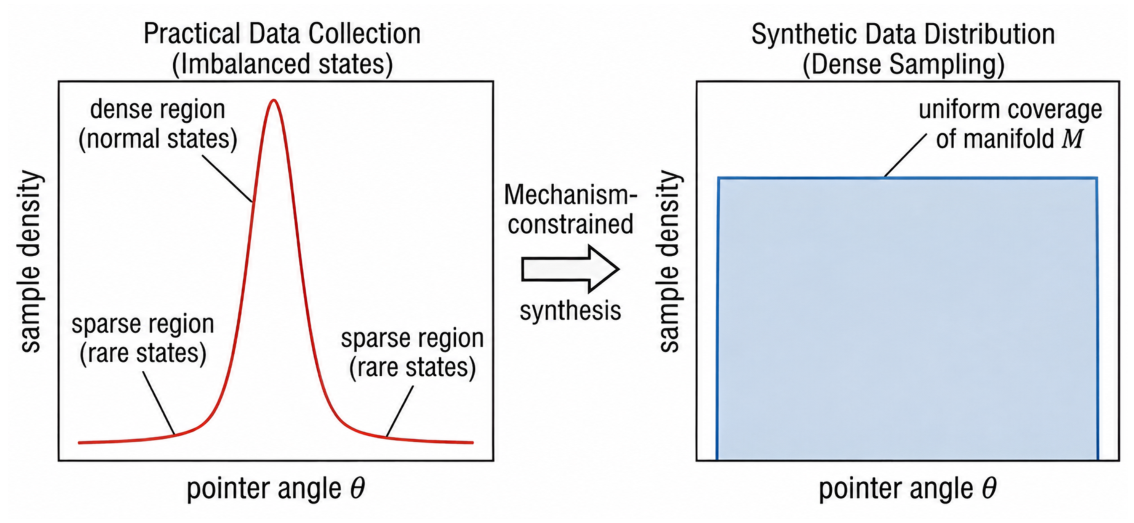
Industrial gauge observations are often concentrated around frequently occurring operating states, whereas rare or extreme pointer positions can be difficult to collect deliberately for safety and operational reasons. Synthetic data can broaden state coverage, but unrestricted rotation can place a pointer outside the active arc of a specific instrument. B-data therefore constrains the synthesized pointer angle to the template-specific valid angular interval. This should be interpreted as controlled geometric coverage of the valid state space, not as an attempt to reproduce the empirical deployment probability distribution of gauge readings.
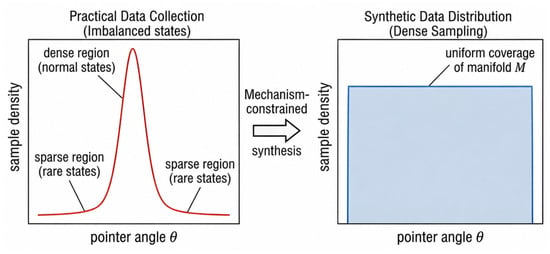
Because the real collection contains different instrument categories, units, and measurement ranges, raw physical values such as MPa or °C are not directly comparable across all images. The present work consequently evaluates structural detection and angular estimation rather than claiming universal physical-value calibration. The role of dense valid-state sampling is illustrated conceptually in Figure 2.
Figure 2.
Conceptual illustration of operating-state imbalance and valid-arc-constrained sampling. Real observations may concentrate around frequently occurring states, whereas B-data deliberately broadens coverage within the valid angular interval of each template. The figure is conceptual and does not represent a measured probability distribution of the current real-image collection.
2.7. Seed Template Selection and Dataset Summary
Six seed templates were selected from R-data and E-data using criteria intended to support reliable component separation: an intact dial structure, clearly visible scale markings, an unobstructed pointer, and sufficient image quality for mask extraction. The selected set contains five pressure-gauge templates and one temperature-gauge template. This composition reflects the available high-quality candidates rather than a statistically stratified sample of all gauge types and is treated as a limitation when interpreting generalization.
Table 5 summarizes the final roles of the real and synthetic data streams. Real images provide target-domain appearance, whereas synthetic data provides controllable dial–pointer structural supervision. The unconstrained and mechanism-constrained synthetic streams use the same six source assets and the same nominal image budget, allowing the valid-state constraint to be evaluated separately from synthetic-data quantity.
Table 5.
Final dataset composition and experimental role.
3. Methods
3.1. Research Logic and Controlled Hypotheses
The experimental design separates the contribution of synthetic pointer supervision from the additional contribution of valid-state constraints. Three principal training strategies are therefore compared under the same detector architecture and real-image split. Real only (R) uses the 422-image final real training set. Unconstrained synthesis (U) combines the same real set with 6000 synthetic images generated from the six seed assets using full- pointer-state sampling. Mechanism-constrained B-data (B) uses the same real set, seed assets, synthetic budget, and perturbation pipeline, but samples each pointer only within the valid angular interval of its template. The principal comparison uses the standard 25% real-pointer annotation condition; separate experiments vary the annotation ratio and partial-label handling.
This design addresses four linked questions: (1) does synthetic structural supervision improve pointer perception relative to real-only training; (2) under the same 6000-image budget, does valid-state sampling provide additional benefit beyond unconstrained synthesis; (3) is the observed advantage robust to partial-label handling, confidence thresholds, and moderate error in manually specified valid limits; and (4) does the detector-level improvement persist on unseen physical instruments and propagate to downstream angular estimation?
3.2. Problem Formulation
Analog-gauge interpretation is treated as a staged sensing problem consisting of structural perception, geometric angle estimation, and instrument-specific calibration. Given an input image , a two-class detector predicts a dial box and a pointer box,
where denotes the YOLOv8n detector. A deterministic geometry module then estimates the pointer direction,
An instrument-specific calibration function could subsequently convert angle into a physical value,
where contains the instrument’s value range, angular endpoints, angular direction, and any convention-conversion offset. The present work evaluates the first two stages. Universal physical-value calibration is outside scope because the dataset contains instruments with different units, ranges, and scale conventions.
3.3. Standardized Template Assets, Pivot Alignment, and Angular Metadata
For synthesis, each of the six real seed images is represented on a standardized canvas by a pointer-free dial background and an RGBA pointer layer . The alpha channel of the pointer layer supplies the foreground mask used for rotation, compositing, and automatic annotation. Seed preparation is performed offline using initial pointer segmentation, limited boundary correction, deterministic local inpainting of the pointer-free background, and visual quality control. The accepted assets are fixed before synthetic generation.
The original mechanical pivot of each template is stored as . Before generation, the aligned assets are translated by
so the transformed pivot is exactly
The generator uses the same as the rotation center. Consequently, the residual pivot offset after preprocessing is zero by construction rather than by an empirical approximation. The deterministic translations and the resulting zero residual offsets for all six templates are summarized in Table 6.
Table 6.
Deterministic pivot alignment of the six synthesis templates.
The file assets_metadata.csv stores the template identifier, valid angular endpoints and , and the initial pointer orientation . When , the valid interval crosses and is interpreted as a wrapped interval. The final angular metadata are listed in Table 7.
Table 7.
Angular metadata of the six standardized seed templates.
3.4. Mechanism-Constrained State Synthesis
For each synthetic image, one of the six templates is sampled and a target pointer angle is drawn from the valid angular interval of that template. Let . The implemented sampling rule is
The corresponding OpenCV rotation is
The pointer RGB layer and alpha channel are warped using the same transform and then alpha-composited with the pointer-free dial background,
Because the label geometry is derived from the transformed alpha mask, image content and pointer annotation remain coupled by the same rigid transformation.
The dial is represented by a 32-vertex circular polygon centered at with radius pixels. For the pointer, the largest external contour of the rotated alpha mask is retained; a pointer polygon is written when the contour area exceeds 50 pixels. The detector is trained in detect mode, so these polygons are converted by the dataset loader to axis-aligned boxes. The generator also writes a synthesis_manifest.csv containing the image filename, template identifier, sampled angle, angular endpoints, and initial pointer orientation. The fixed 6000-image B-data pool is generated once and reused for all three detector-training seeds.
3.5. Same-Budget Unconstrained State-Synthesis Control
The unconstrained synthetic control is generated from the same six aligned assets with the same total budget , the same compositing and label-generation code, and the same synthesis-time perturbation pipeline. The only intended change is the pointer-state sampling rule,
Thus, both U and B provide positive pointer supervision and the same nominal amount of synthetic data, whereas only B restricts pointer states to the template-specific valid arc. The U–B comparison is therefore the direct test of the mechanism constraint under a fixed synthetic budget.
3.6. Domain-Bridging Augmentation
After compositing, three label-preserving photometric operators are applied independently as lightweight domain-bridging perturbations: illumination adjustment, Gaussian noise, and Gaussian blur. Illumination adjustment is triggered with probability 0.3 and multiplies the HSV V channel by . Gaussian noise is triggered with probability 0.2 in normalized image space with variance . Gaussian blur is triggered with probability 0.2 using a randomly selected or kernel. These operations modify appearance but not the synthetic geometry or labels. Detector-level online augmentation is applied identically to all controlled training configurations. The common detector-training and online-augmentation settings are summarized in Table 8.
Table 8.
Detector training and online-augmentation configuration.
3.7. Detector Training Under Partial Pointer Supervision
The detector has two output classes, dial and pointer. All principal R/U/B configurations use the same 422 real training images. In the standard main experiment, 25% of these real images provide manual pointer boxes in addition to dial boxes; the remaining real images provide dial supervision without positive pointer labels. The annotation-ratio study repeats the same Standard partial-label protocol at 0%, 10%, 25%, 50%, and 100% real pointer-box availability.
Reduced-FN Partial-Label Control
Under the Standard training protocol, real images for which the pointer annotation is intentionally withheld still contain a visible pointer. With the conventional two-class detection loss, such images may therefore contribute negative classification supervision to the pointer class. To test whether the comparison between unconstrained synthesis and mechanism-constrained B-data depends on this effect, we introduce a Reduced-FN robustness control that modifies only the pointer-class classification loss for these partially annotated real images. Specifically, for a real image without a pointer box, all pointer-class classification-loss terms are masked out before loss reduction, whereas the dial-class classification loss and the box/DFL losses associated with annotated dial instances are retained. For real images with pointer annotations and for all synthetic images, the original YOLOv8n detection loss is used without modification.
Let indicate whether real training image b has a manual pointer annotation. The image-level class mask is defined as
For synthetic images, for both classes. Let i index the classification prediction elements and . The Reduced-FN classification term is
where and denote the predicted class score and corresponding classification target, respectively. Normalization over the remaining active class terms keeps the classification-loss scale comparable across training configurations. No pseudo pointer labels are introduced, and no image is removed from the real training pool. Thus, Reduced-FN suppresses explicit false-negative supervision caused by intentionally missing pointer labels while preserving the same real-image split, synthetic-image budget, detector architecture, augmentation pipeline, training schedule, and random seeds. It is used only as a robustness control and does not replace the Standard protocol used for the principal R/U/B comparison.
All detector configurations are trained for 100 epochs using seeds 0, 1, and 2. For each seed, the best checkpoint is selected on the 100-image validation subset and is then evaluated once on the independent test set. Unless otherwise stated, repeated-run results are reported as mean ± standard deviation over these three independently trained models. The independent test set is not used to select checkpoints, thresholds, augmentation settings, or model hyperparameters.
3.8. Geometry Module, Unified Angle Definition, and Fixed Operating Point
The downstream geometry module determines whether detector outputs are sufficiently complete and spatially coherent to estimate a pointer direction. When multiple predictions are returned, the highest-confidence dial and pointer boxes are retained. The predicted dial box is converted to a filled mask whose centroid gives the estimated dial center . The pointer rectangle is clipped to a slightly dilated dial mask; the largest connected component is retained. A pair is rejected if either class is absent, fewer than eight pointer-mask pixels remain after clipping, or a non-degenerate direction cannot be determined. The raw co-detection rate requires only at least one dial and one pointer prediction, whereas the stricter geometry-consistent output rate requires the geometry checks to be passed.
Let denote the retained pointer pixels and . The default tip estimate is the mean of pixels near the maximum radius,
when at least three such pixels exist; otherwise, the farthest pixel is used. The direction vector is
If the maximum pointer distance is less than 0.12 of the estimated dial radius, the implementation falls back to the principal axis of the retained pointer pixels and resolves the sign using pointer-mask support along the two candidate rays.
The predicted angle is normalized using the same convention as the ground truth,
The signed circular difference and absolute circular angular error are
which guarantees and . Boundary checks such as and therefore produce the expected and errors rather than artificial wrap-around errors.
The downstream operating point is fixed before independent-test evaluation, as summarized in Table 9. Conditional MAE and median angular error are computed only for images producing a geometry-consistent valid angle. In contrast, end-to-end success at and uses all independent-test images as the denominator and therefore penalizes both geometric failure and angular inaccuracy.
Table 9.
Fixed operating parameters for downstream geometry evaluation.
3.9. Controlled Factors and Synthetic-Validity Audit
The principal controlled comparison holds the real-image split, seed assets, synthetic budget, photometric perturbations, detector architecture, and training schedule fixed. The R–U comparison measures the net effect of adding synthetic pointer supervision, whereas the U–B comparison isolates the additional effect of valid-arc-constrained state sampling under the same 6000-image budget. No additional physics loss is introduced; the term mechanism-constrained refers to the data-generation process.
Synthetic validity is audited at three distinct levels. Valid-arc compliance checks whether the sampled pointer angle lies within the template-specific active interval. Pivot consistency is guaranteed by the deterministic re-centering in Equation (9). Mask–label consistency checks that the pointer label is derived from the same transformed alpha mask used to construct the image. Separating these criteria avoids conflating angular validity with geometric alignment or label consistency. The complete generation procedure is summarized in Algorithm 1.
| Algorithm 1 Mechanism-constrained B-data generation |
|
4. Technical Validation
The validation subset is used for checkpoint selection and controlled ablations, while the 100-image independent real test set from 18 unseen instruments is reserved for final performance assessment. Principal R/U/B results are reported over training seeds 0, 1, and 2. The analyses below are ordered to first verify the synthetic-data construction, then test the same-budget training hypothesis, and finally examine downstream geometry, instrument-level generalization, and sensitivity to implementation choices.
4.1. Synthetic-Data Integrity and Valid-Angle Coverage
Using the angular metadata in Table 7, the theoretical fraction of full- rotations that fall inside a valid arc can be computed before examining any generated images. Table 10 shows that the six valid arcs sum to , giving an equal-template theoretical valid rate of
Table 10.
Theoretical valid-angle coverage of the six seed templates under unconstrained rotation.
The actual unconstrained synthetic pool was then audited using the same intervals. Of 6000 generated samples, 3298 were valid-arc compliant, corresponding to 54.97%, which closely matches the 54.91% theoretical expectation. In contrast, B-data samples directly from the valid interval and therefore attains 100% valid-arc compliance. Both strategies remain pivot-consistent because all seed assets are deterministically re-centered before rotation, and both remain mask–label consistent because labels are derived from the transformed pointer mask. The observed compliance and structural-consistency audit is summarized in Table 11.
Table 11.
Observed valid-arc compliance and structural consistency of the two synthetic strategies.
These results narrow the methodological claim: the mechanism constraint increases valid-arc compliance from approximately 55% to 100% while preserving pivot and label consistency, rather than relying on a broader and less verifiable statement that every synthetic property is ”mechanically valid.”
4.2. Same-Budget Performance on Unseen Instruments
Table 12 presents the principal controlled comparison on the independent test set. Relative to real-only training, unconstrained synthesis improves pointer AP@0.5 from 47.6 ± 2.8% to 54.9 ± 2.5%. With the same 6000-image synthetic budget, B-data further increases pointer AP@0.5 to 62.8 ± 2.2%. The same ordering is observed for co-detection, geometry-consistent output, and end-to-end angular success. Conditional angular MAE decreases from 8.7 ± 1.2° for real-only training to 7.1 ± 0.9° with unconstrained synthesis and to 5.2 ± 0.7° with B-data.
Table 12.
Independent-instrument detection and end-to-end angular estimation. Values are the mean ± standard deviation over three independently trained models; conditional angular errors are computed only for geometry-consistent valid-angle outputs, whereas ≤/all and ≤10°/all use all 100 test images as the denominator.
Because U and B use the same real training set, seed assets, synthetic image count, and augmentation pipeline, the B–U gap cannot be explained by synthetic-data quantity alone. The result instead supports the narrower conclusion that restricting generated pointer states to template-specific valid arcs provides additional transferable structural supervision under the present protocol.
4.3. End-to-End Evaluation Funnel
The stage-wise funnel in Table 13 shows where the B-data advantage emerges. B-data improves both class-specific detection availability and the fraction of images that survive the downstream geometry checks. Most importantly, the all-image angular success rates remain ordered B > U > R after failures are included in the denominator.
Table 13.
End-to-end evaluation funnel on the 100-image independent test set from 18 unseen instruments. Stage counts are the mean ± standard deviation across three independently trained models; the test-set size is fixed at 100 images.
The funnel also clarifies the distinction between conditional angular accuracy and end-to-end utility. The 5.2° MAE in Table 12 describes angular accuracy after a valid geometric output has been obtained; the 25.0% and 35.7% all-image success rates at 5° and 10°, respectively, additionally penalize missing or geometrically invalid detections.
4.4. Robustness to Partial-Label Handling and Annotation Density
All analyses in this subsection are conducted on the 100-image validation set and are reported as mean ± standard deviation over three independently trained models using training seeds 0, 1, and 2. These robustness analyses are distinct from the principal independent-test results reported in Table 12 and Table 13.
A concern with partially annotated real images is that visible but unlabeled pointers may contribute false-negative supervision under the Standard partial-label protocol. We therefore evaluate whether the U–B comparison is sensitive to this treatment using the Reduced-FN control defined in Section 3.7. The real-image pool, synthetic-data budget, augmentation pipeline, training schedule, and training seeds are otherwise unchanged within each strategy. As shown in Table 14, Reduced-FN handling yields higher validation performance for both synthetic strategies. Importantly, the B–U gap in pointer AP@0.5 remains similar under the two treatments: 5.6 percentage points under Standard handling and 5.4 percentage points under Reduced-FN handling. Mechanism-constrained B-data also retains higher valid-geometry rates in both cases. The preserved B–U ordering indicates that the mechanism-constrained advantage does not depend on a single treatment of incomplete pointer labels.
Table 14.
Validation-set sensitivity of the unconstrained-versus-mechanism-constrained synthetic-strategy comparison to partial-label handling under the fixed 25% real-pointer annotation condition. Values are the mean ± standard deviation over three independently trained models using training seeds 0, 1, and 2.
Having established that the U–B ordering is preserved under Reduced-FN handling, we next examine annotation density using the Standard partial-label protocol throughout. The real pointer-annotation ratio is varied from 0% to 100%, while the mechanism-constrained synthetic stream and all other training settings are kept fixed. The resulting validation-set trend is reported in Table 15.
Table 15.
Validation-set performance under increasing real pointer-annotation ratios using the Standard partial-label mode and an otherwise fixed mechanism-constrained B-data training protocol. Values are the mean ± standard deviation over three independently trained models using training seeds 0, 1, and 2. The 25% condition corresponds to the standard limited-annotation setting used in the principal controlled comparison.
Performance improves monotonically as real pointer annotation increases from 0% to 100%. Pointer AP@0.5 increases from 58.2 ± 1.2% to 74.0 ± 1.3%, while the valid-geometry rate increases from 34.3 ± 1.2% to 50.3 ± 1.4%. The 25% condition is retained as the principal limited-annotation setting and reproduces the mechanism-constrained/Standard condition in Table 14. Under the Standard partial-label protocol used throughout this experiment, increasing the annotation ratio simultaneously increases positive pointer supervision and reduces the number of visible pointers that remain unlabeled. Table 15 should therefore be interpreted as an annotation-completeness analysis rather than as a pure positive-label-count ablation. Together with the Reduced-FN comparison in Table 14, these results show that B-data remains useful under sparse real pointer supervision while complementing, rather than replacing, increasingly complete real annotation.
4.5. Instrument-Level Generalization and Clustered Uncertainty
Because the 100 independent-test images come from 18 physical instruments, image-level averages alone could overstate the effective amount of independent evidence. Two complementary analyses were therefore performed at the instrument level. First, Table 16 summarizes the number of instruments on which B-data wins, ties, or loses relative to unconstrained synthesis. B-data wins on the majority of instruments for every downstream criterion, indicating that the aggregate gain is not driven by only a small number of gauges.
Table 16.
Instrument-level win/tie/loss summary for B-data relative to unconstrained synthesis across 18 unseen instruments.
Second, a 5000-replicate instrument-clustered bootstrap resamples physical instruments rather than treating all images as independent. The resulting intervals in Table 17 preserve the same overall ordering and provide uncertainty estimates that account for within-instrument correlation.
Table 17.
Instrument-clustered bootstrap results on the independent test set (5000 replicates). Values are point estimate [95% interval].
4.6. Threshold and Valid-Limit Sensitivity
The absolute co-detection rate depends on the confidence threshold, so the relevant robustness question is whether the comparative ordering changes over a reasonable operating range. The validation-set analysis in Table 18 shows that B > U > R is maintained from confidence 0.10 to 0.50. The independent-test operating point remains fixed at 0.25 as defined in Table 9; the sensitivity analysis is not used to tune the test results.
Table 18.
Validation-set co-detection sensitivity to confidence threshold. The independent-test operating point is fixed at 0.25.
The valid angular limits are manually specified from the template metadata and can therefore contain small errors. Table 19 evaluates the sensitivity of B-data to symmetric endpoint perturbations. Small perturbations produce only modest degradation, whereas larger errors progressively reduce performance. Even with a perturbation, the constrained strategy remains above the unconstrained baseline for pointer AP50, valid geometry, and end-to-end ≤10° success.
Table 19.
Sensitivity to perturbations of the valid angular limits.
4.7. Across-Seed Reproducibility
The principal independent-test results in Table 12 are averaged over three independently trained models using seeds 0, 1, and 2. To summarize training stochasticity without duplicating the mean values already reported there, Table 20 lists the corresponding across-seed standard deviations for the main structural and end-to-end metrics. The variability remains modest relative to the mean performance gaps: for pointer AP50, the B–U mean difference is 7.9 percentage points, whereas the across-seed standard deviations are 2.2 and 2.5 points, respectively. Comparable variability is observed for co-detection, valid geometry, and all-image ≤10° angular success.
Table 20.
Across-seed variability on the independent test set. Values are standard deviations over three independently trained models using seeds 0, 1, and 2; the corresponding mean values are reported in Table 12.
4.8. Supporting Ablations Under the Cold-Start Protocol
The following exploratory ablations are retained from the original study because they clarify practical design choices, but they are not used as the primary evidence for the U–B mechanism comparison. They use the 0% real-pointer-label cold-start setting and are evaluated on the validation set, so their absolute values should not be compared directly with the 25% principal independent-test results above.
A source-complementarity experiment compares real-only, B-data-only, and mixed training. Synthetic-only training transfers poorly to the real validation images, whereas mixed training combines real target-domain appearance with synthetic pointer supervision. This supports the interpretation of B-data as a structural supplement rather than a replacement for real imagery. The corresponding three-run validation results are summarized in Table 21.
Table 21.
Cold-start validation results for real-only, B-data-only, and mixed real + B-data training. Values are the mean ± standard deviation over three runs.
Two seed-0 ablations further examine synthetic quantity and template diversity. Increasing the B-data budget from 1000 to 6000 images produces substantial gains, whereas the additional gain at 12,000 images is small. Under a fixed 6000-image budget, the selected six-template library also performs materially better than the fixed one- and three-template subsets. The quantity and template-count results are reported in Table 22 and Table 23, respectively. These ablations motivate the 6000-image, six-template configuration used in the controlled experiments, but they should not be interpreted as universal scaling laws.
Table 22.
Seed-0 effect of B-data quantity with the fixed 422-image real training set under the cold-start protocol.
Table 23.
Seed-0 effect of seed-template count with a fixed 6000-image synthetic budget under the cold-start protocol.
The synthesis-time photometric ablation is likewise retained as a supporting validation analysis. As summarized in Table 24, the full illumination + noise + blur configuration reproduces the cold-start mixed-training result and performs best among the tested operator combinations, while the main U–B conclusion remains a structural-state comparison rather than a claim about any individual photometric operator.
Table 24.
Three-run ablation of synthesis-time domain-bridging operators under the unified six-template, 6000-image cold-start protocol.
4.9. Interpretation, Practical Scope, and Limitations
The combined evidence supports a staged interpretation. Synthetic structural supervision is useful, as U improves over R under the same real-image split. More importantly, B consistently improves over U while keeping the synthetic budget and assets fixed, indicating that valid-arc-constrained state generation contributes beyond image quantity alone. The benefit is visible not only in pointer AP but also in geometry-consistent output and all-image angular success, and it is reproduced across training seeds and across most of the 18 unseen physical instruments.
The method should nevertheless be interpreted within its scope. Mechanism-constrained synthetic supervision primarily addresses training-time structural coverage and label consistency; it does not replace deployment-side reliability mechanisms such as physical fault testing, record-consistency checks, or input-health screening. These complementary safeguards address different failure sources and could be combined with the present data-centric strategy in a broader industrial monitoring pipeline [42,43]. Uniform sampling over a valid arc is a coverage strategy; it does not claim to reproduce the empirical deployment distribution of gauge readings. The six-template library contains five pressure gauges and one temperature gauge and is not statistically representative of all analog-gauge families. Valid angular limits are manually specified, although the perturbation analysis indicates that small limit errors cause only modest degradation. Seed preparation still requires semi-automatic pointer extraction, deterministic re-centering, and quality control. Finally, the downstream geometry module operates on axis-aligned detection boxes and therefore cannot recover pointer centerlines as precisely as a dedicated segmentation or keypoint model. Future work should expand and automate the seed library, evaluate broader instrument mechanisms and nonuniform scales, and integrate instrument-specific calibration for physical-value reading.
5. User Notes
The public B-data release (Zenodo DOI: 10.5281/zenodo.23551774) is intended for research on analog-gauge perception, synthetic structural supervision, industrial visual inspection, and related computer-vision tasks. The released files comprise the 6000 mechanism-constrained synthetic images, paired dial/pointer detection annotations, the synthesis manifest, and accompanying generation metadata/configuration records. The real training, validation, and independent-test images described in this article are restricted supporting experimental resources and are not included in the Zenodo release. They are reported in the manuscript to document the technical-validation protocol and the provenance of the reported detector results. B-data should not be interpreted as reproducing the empirical operating-state distribution of a deployment site; its purpose is to broaden coverage within template-specific valid angular intervals. Instrument-specific physical-value calibration is not included in the present benchmark.
For reproducibility, the project archive retains the legacy directory name test_real for the 100-image validation subset. Throughout this manuscript, this subset is referred to as the validation set because it is used for checkpoint selection and controlled validation rather than final testing.
6. Conclusions and Future Work
This study presents a mechanism-constrained B-data synthesis framework for analog-gauge perception under limited pointer annotation. The revised protocol separates data integrity, valid-state generation, same-budget training effects, partial-label handling, and unseen-instrument evaluation. The six synthesis templates are removed from the final real detector-training set, deterministically re-centered to a common pivot, and sampled only within their template-specific valid angular intervals. Under unconstrained full- rotation, the theoretical valid-arc coverage is 54.91% and the observed rate is 54.97% (3298/6000); B-data increases valid-arc compliance to 100% while retaining pivot and mask–label consistency.
On the independent 100-image test set from 18 unseen instruments, B-data reaches 62.8 ± 2.2% pointer AP@0.5, compared with 54.9 ± 2.5% for unconstrained synthesis and 47.6 ± 2.8% for real-only training. The advantage propagates to downstream sensing: geometry-consistent output reaches 40.3 ± 1.5%, conditional angular MAE decreases to 5.2 ± 0.7°, and all-image ≤10° angular success reaches 35.7 ± 1.5%. Instrument-level comparisons, clustered bootstrap analysis, threshold sensitivity, valid-limit perturbation, and the across-seed variability analysis support the same overall conclusion. These findings support the conclusion that valid-state structural constraints provide useful supervision beyond synthetic-data quantity alone.
The public 6000-image B-data release and its accompanying annotations and generation metadata provide a reusable resource for studying mechanism-constrained synthetic supervision under limited pointer annotation. Future work will expand the seed library across broader gauge families, automate seed-asset preparation and valid-limit extraction, investigate segmentation- or keypoint-based pointer geometry, and incorporate instrument-specific calibration so that the present detection-and-angle framework can be extended toward full physical-value reading in deployment settings.
7. Specifications Table
A compact summary of the dataset scope, data types, collection, source, and accessibility is provided in Table 25.
Table 25.
Specifications of the dataset described in this work.
Author Contributions
Conceptualization, Q.L. and H.L.; methodology, H.L.; software, H.L.; validation, H.L.; formal analysis, H.L.; investigation, H.L.; data curation, H.L.; visualization, H.L.; writing—original draft preparation, H.L.; writing—review and editing, Q.L. and H.L.; supervision, Q.L.; project administration, Q.L.; resources, Q.L. and Z.P.; funding acquisition, Q.L.; technical discussion, Z.P., D.C., G.L., Y.K. and Y.Z. All authors have read and agreed to the published version of the manuscript.
Funding
The work presented in this paper was supported by the National Natural Science Foundation of China (62273109); the Guangdong Basic and Applied Basic Research Foundation (2023A1515240020); the Key Field Special Project of the Department of Education of Guangdong Province (2024ZDZX1034 and 2025ZDZX1016); and the Maoming Science and Technology Project (2022DZXHT028).
Data Availability Statement
The 6000-image mechanism-constrained B-data dataset described in this Data Descriptor is openly available on Zenodo (DOI: 10.5281/zenodo.23551774) under the Creative Commons Attribution 4.0 International (CC BY 4.0) license. The public release includes the synthetic images, paired dial/pointer detection annotations, the synthesis manifest, and accompanying generation metadata and configuration files. The real-image resources used for source preparation, detector training, validation, and independent testing are not included in the public release. R-data and the independent-test images contain industrial instrumentation subject to confidentiality restrictions and therefore cannot be publicly distributed. The original E-data images are not redistributed because explicit redistribution-license records for the source images were not retained. Any access to restricted real-image resources would require separate institutional and confidentiality approval.
Acknowledgments
The authors thank the Guangdong Provincial Key Laboratory of Petrochemical Equipment Fault Diagnosis for providing research support.
Conflicts of Interest
The authors declare no conflicts of interest.
References
- Zhao, J.; Peng, Z.; Cui, D.; Li, Q.; He, J.; Qiu, J. A method for measuring tube metal temperature of ethylene cracking furnace tubes based on machine learning and neural network. IEEE Access 2019, 7, 158643–158654. [Google Scholar] [CrossRef] [Scilit]
- Liu, Y.; Liu, J.; Ke, Y. A detection and recognition system of pointer meters in substations based on computer vision. Measurement 2020, 152, 107333. [Google Scholar] [CrossRef] [Scilit]
- Hou, L.; Qu, H. Automatic recognition system of pointer meters based on lightweight CNN and WSNs with on-sensor image processing. Measurement 2021, 183, 109819. [Google Scholar] [CrossRef] [Scilit]
- Guo, X.; Zhu, Y.; Zhang, J.; Hai, Y.; Ma, X.; Lv, C.; Liu, S. Intelligent pointer meter interconnection solution for data collection in farmlands. Comput. Electron. Agric. 2021, 182, 105985. [Google Scholar] [CrossRef] [Scilit]
- Fan, Z.; Shi, L.; Xi, C.; Wang, H.; Wang, S.; Wu, G. Real time power equipment meter recognition based on deep learning. IEEE Trans. Instrum. Meas. 2022, 71, 5017015. [Google Scholar] [CrossRef] [Scilit]
- Peixoto, J.; Sousa, J.; Carvalho, R.; Santos, G.; Cardoso, R.; Reis, A. End-to-end solution for analog gauge monitoring using computer vision in an IoT platform. Sensors 2023, 23, 9858. [Google Scholar] [CrossRef] [Scilit] [PubMed]
- Wang, C.; Pei, H.; Tang, G.; Liu, B.; Liu, Z. Pointer meter recognition in UAV inspection of overhead transmission lines. Energy Rep. 2022, 8, 243–250. [Google Scholar] [CrossRef] [Scilit]
- Zuo, L.; He, P.; Zhang, C.; Zhang, Z. A robust approach to reading recognition of pointer meters based on improved Mask-RCNN. Neurocomputing 2020, 388, 90–101. [Google Scholar] [CrossRef] [Scilit]
- Li, Z.; Zhou, Y.; Sheng, Q.; Chen, K.; Huang, J. A high-robust automatic reading algorithm of pointer meters based on text detection. Sensors 2020, 20, 5946. [Google Scholar] [CrossRef] [Scilit] [PubMed]
- Dong, Z.; Gao, Y.; Yan, Y.; Chen, F. Vector detection network: An application study on robots reading analog meters in the wild. IEEE Trans. Artif. Intell. 2021, 2, 394–403. [Google Scholar] [CrossRef] [Scilit]
- Salomon, G.; Laroca, R.; Menotti, D. Image-based automatic dial meter reading in unconstrained scenarios. Measurement 2022, 204, 112025. [Google Scholar] [CrossRef] [Scilit]
- Zou, L.; Wang, K.; Wang, X.; Zhang, J.; Li, R.; Wu, Z. Automatic recognition reading method of pointer meter based on YOLOv5-MR model. Sensors 2023, 23, 6644. [Google Scholar] [CrossRef] [Scilit] [PubMed]
- Hou, L.; Wang, S.; Sun, X.; Mao, G. A pointer meter reading recognition method based on YOLOX and semantic segmentation technology. Measurement 2023, 218, 113241. [Google Scholar] [CrossRef] [Scilit]
- Chen, L.; Wu, X.; Sun, C.; Zou, T.; Meng, K.; Lou, P. An intelligent vision recognition method based on deep learning for pointer meters. Meas. Sci. Technol. 2023, 34, 055410. [Google Scholar] [CrossRef] [Scilit]
- Jiao, W.; Zhao, D.; Mei, X.; Yang, S.; Zhang, X.; Li, C.; Li, L. Multiresolution deep feature learning for pointer meters reading recognition. J. Manuf. Processes 2024, 114, 168–177. [Google Scholar] [CrossRef] [Scilit]
- Lu, X.; Zhu, S.; Lu, B. Pointer meter reading method based on YOLOv8 and improved LinkNet. Sensors 2024, 24, 5288. [Google Scholar] [CrossRef] [Scilit] [PubMed]
- Fan, H.; Li, Y. Image recognition and reading of single pointer meter based on deep learning. IEEE Sens. J. 2024, 24, 25163–25174. [Google Scholar] [CrossRef] [Scilit]
- Wang, Z.; Ikeura, R.; Zhang, Z.; Li, Q. A general-purpose pointer meter reading detection method based on adaptive feature fusion and data augmentation. Measurement 2024, 233, 114773. [Google Scholar] [CrossRef] [Scilit]
- Li, X.; Zhao, J.; Zeng, C.; Yao, Y.; Zhang, S.; Yang, S. Deep learning-based pointer meter reading recognition for advancing manufacturing digital transformation research. Sensors 2025, 25, 244. [Google Scholar] [CrossRef] [Scilit] [PubMed]
- Ji, D.; Zhang, W.; Zhao, Q.; Yang, W. Correction and pointer reading recognition of circular pointer meter. Meas. Sci. Technol. 2023, 34, 025406. [Google Scholar] [CrossRef] [Scilit]
- Zhai, X.; Tian, J.; Li, J. An accurate reading algorithm for substation pointer meters based on improved 2-D gamma function and PA-RetinaNet. IEEE Sens. J. 2023, 23, 13738–13750. [Google Scholar] [CrossRef] [Scilit]
- Zhang, W.; Ji, D.; Yang, W.; Zhao, Q.; Yang, L.; Zhuoma, C. Application of Swin-Unet for pointer detection and automatic calculation of readings in pointer-type meters. Meas. Sci. Technol. 2024, 35, 025904. [Google Scholar] [CrossRef] [Scilit]
- Huo, Y.; Bai, H.; Sun, L.; Fang, Y. Reading recognition of pointer meters based on an improved UNet++ network. Meas. Sci. Technol. 2024, 35, 035009. [Google Scholar] [CrossRef] [Scilit]
- Li, Y.; Li, X.; Zhang, C. Pointer meter reading recognition by joint detection and segmentation. Appl. Sci. 2024, 14, 1443. [Google Scholar] [CrossRef] [Scilit]
- Tan, L.; Wu, W.; Ding, J.; Ye, W.; Li, C.; Liang, Q. A robust pointer meter reading recognition method based on TransUNet and perspective transformation correction. Electronics 2024, 13, 2436. [Google Scholar] [CrossRef] [Scilit]
- Zhou, D.; Yang, Y.; Zhu, J.; Wang, K. Intelligent reading recognition method of a pointer meter based on deep learning in a real environment. Meas. Sci. Technol. 2022, 33, 055021. [Google Scholar] [CrossRef] [Scilit]
- Zhang, H.; Rao, Y.; Shao, J.; Meng, F.; Pu, J. Reading various types of pointer meters under extreme motion blur. IEEE Trans. Instrum. Meas. 2023, 72, 5019815. [Google Scholar] [CrossRef] [Scilit]
- Wang, Z.; Tian, L.; Du, Q.; An, Y.; Sun, Z.; Liao, W. Robust pointer meter reading recognition method under image corruption. IEEE Trans. Instrum. Meas. 2024, 73, 2513016. [Google Scholar] [CrossRef] [Scilit]
- Cai, W.; Ma, B.; Zhang, L.; Han, Y. A pointer meter recognition method based on virtual sample generation technology. Measurement 2020, 163, 107962. [Google Scholar] [CrossRef] [Scilit]
- Westerski, A.; Fong, W.T. Synthetic data for object detection with neural networks: State-of-the-art survey of domain randomisation techniques. ACM Trans. Multimed. Comput. Commun. Appl. 2024, 21, 2. [Google Scholar] [CrossRef] [Scilit]
- Eversberg, L.; Lambrecht, J.; Kruger, J. Combining synthetic images and deep active learning for automated industrial object detection. J. Imaging 2024, 10, 16. [Google Scholar] [CrossRef] [Scilit] [PubMed]
- Horvath, D.; Erdos, G.; Istenes, Z.; Horvath, T.; Foldi, S. Object detection using sim2real domain randomization for robotic applications. IEEE Trans. Robot. 2023, 39, 1225–1243. [Google Scholar] [CrossRef] [Scilit]
- Schieber, H.; Marzijarani, N.S.; Wasenmüller, O.; Stricker, D. Indoor synthetic data generation: A systematic review. Comput. Vis. Image Underst. 2024, 241, 103907. [Google Scholar] [CrossRef] [Scilit]
- Clement, N.; Schoen, A.; Boedihardjo, A.; Jenkins, A. Synthetic data and hierarchical object detection in overhead imagery. ACM Trans. Multimed. Comput. Commun. Appl. 2024, 20, 117. [Google Scholar] [CrossRef] [Scilit]
- Ji, D.; Zhang, W.; Yang, W.; Zhao, Q. Another way: Direct regression of meter readings for circular pointer meter images. Eng. Appl. Artif. Intell. 2024, 134, 108863. [Google Scholar] [CrossRef] [Scilit]
- Leon-Alcazar, J.; Alnumay, Y.; Zheng, C.; Trigui, H.; Patel, S.; Ghanem, B. Learning to read analog gauges from synthetic data. In Proceedings of the IEEE/CVF Winter Conference on Applications of Computer Vision (WACV); IEEE: New York, NY, USA, 2024; pp. 8601–8610. [Google Scholar] [CrossRef] [Scilit]
- Deng, Y.; Yan, Y.; He, W.; Zhong, Y.; Luo, P.; Deng, Z.; Qi, D. A large-scale synthetic benchmark for robust analog gauge reading. Sci. Data 2026, 13, 1367. [Google Scholar] [CrossRef] [Scilit] [PubMed]
- Peixoto, J.; Sousa, J.; Carvalho, R.; Santos, G.; Mendes, J.; Cardoso, R.; Reis, A. Development of an analog gauge reading solution based on computer vision and deep learning for an IoT application. Telecom 2022, 3, 564–580. [Google Scholar] [CrossRef] [Scilit]
- Ninama, H.; Raikwal, J.; Ravuri, A.; Sukheja, D.; Bhoi, S.K.; Jhanjhi, N.Z.; Elnour, A.A.H.; Abdelmaboud, A. Computer vision and deep transfer learning for automatic gauge reading detection. Sci. Rep. 2024, 14, 23019. [Google Scholar] [CrossRef] [Scilit] [PubMed]
- Lin, Y.; Xu, Z.; Yuan, M.; Chen, D.; Zhu, J.; Yuan, Y. Pointer generation and main scale detection for occluded meter reading based on generative adversarial network. Measurement 2024, 234, 114836. [Google Scholar] [CrossRef] [Scilit]
- Zhang, X.; Sisniega, A.; Zbijewski, W.B.; Lee, J.; Jones, C.K.; Wu, P.; Han, R.; Uneri, A.; Vagdargi, P.; Helm, P.A.; et al. Combining physics-based models with deep learning image synthesis and uncertainty in intraoperative cone-beam CT of the brain. Med. Phys. 2023, 50, 2607–2624. [Google Scholar] [CrossRef] [Scilit] [PubMed]
- Yang, Y.; Yin, H.; Zhang, Z.; Guo, J.; Yin, Y. Boundary-aware dual-modal recognition of gas-liquid flow patterns in horizontal pipelines with record consistency and input health screening. Ocean. Eng. 2026, 367, 128006. [Google Scholar] [CrossRef] [Scilit]
- Arman, A.; Bellini, P.; Bologna, D.; Nesi, P.; Pantaleo, G.; Paolucci, M. Automating IoT data ingestion enabling visual representation. Sensors 2021, 21, 8429. [Google Scholar] [CrossRef] [Scilit] [PubMed]

Disclaimer/Publisher’s Note: The statements, opinions and data contained in all publications are solely those of the individual author(s) and contributor(s) and not of MDPI and/or the editor(s). MDPI and/or the editor(s) disclaim responsibility for any injury to people or property resulting from any ideas, methods, instructions or products referred to in the content. |
© 2026 by the authors. Licensee MDPI, Basel, Switzerland. This article is an open access article distributed under the terms and conditions of the Creative Commons Attribution (CC BY) license.