


Abstract
Bluetooth Low Energy (BLE) Received Signal Strength (RSS)-based positioning combines low-cost deployment with widespread smartphone support. This review synthesizes peer-reviewed studies from 2013 through the search cutoff of 19 September 2026 for mobile and Internet of Things (IoT) platforms, including methods adapted from other radios and BLE-specific techniques. We systematically searched major bibliographic databases using BLE, RSS, positioning, localization, and methodological terms and then deduplicated and screened the records. The synthesis covers six dimensions: (i) RSS preprocessing and filtering; (ii) proximity-based, model-based, and fingerprinting approaches; (iii) sensor fusion; (iv) applications; (v) public BLE RSS datasets; and (vi) comparisons with other RSS-based positioning technologies. BLE RSS offers practical, cost-effective positioning in Global Navigation Satellite System (GNSS)-denied environments, but RSS instability remains the predominant limitation.
1. Introduction
Widely available IEEE 802.11 Wireless LAN (Wi-Fi) and Bluetooth radios support positioning and short-range communication [1]. While GNSS is standard outdoors, attenuation, multipath, and unavailable satellite Line-of-Sight (LoS) degrade indoor performance [2]. This motivates alternative Indoor Positioning System (IPS) solutions using radios that are already integrated into off-the-shelf devices.
Wi-Fi positioning benefits from existing infrastructure, but frequent scanning consumes energy, while interference, multipath, and environmental changes can limit accuracy and real-time operation on battery-powered devices. Bluetooth Classic primarily supports short-range, connection-oriented communication and is less commonly used for positioning. These limitations have encouraged lower-power alternatives such as BLE [3].
Designed for low-power IoT operation, BLE supports inexpensive deployments through smartphones and embedded devices. RSS-based methods can be implemented without specialized positioning hardware, although channel-dependent behavior, multipath, and measurement noise affect performance.
Recent BLE RSS surveys cover algorithms, challenges, and datasets for reproducible benchmarking [4], accuracy and its practical determinants [5], and fingerprinting workflows [6]. Shi and Gong provide a broader Bluetooth-localization taxonomy and compare cost, availability, scalability, and accuracy [7].
Broader reviews include a meta-review of indoor positioning surveys and Wi-Fi/BLE RSS fingerprinting [8], cross-technology trade-offs [9], technology selection for IoT applications [10], and industrial techniques, use cases, and gaps in end-to-end location services [11].
This review covers peer-reviewed BLE RSS positioning research from 2013 to 2026. It organizes proximity-based, model-based, and fingerprinting methods alongside RSS preprocessing and sensor fusion and then examines applications, public datasets, and comparisons with other RSS-based technologies.
Section 2 describes the search and eligibility criteria. Section 3, Section 4, Section 5 and Section 6 cover BLE acquisition, RSS preprocessing, positioning methods, and sensor fusion. Section 7 and Section 8 review datasets and applications; Section 9 compares technologies. Section 10 and Section 11 discuss future challenges and conclusions.
2. Search Criteria
2.1. Search Strategy and Scope
We searched Scopus (https://www.scopus.com/search/form.uri?display=advanced&zone=header&origin=, accessed on 19 September 2026), Web of Science (https://www.webofscience.com/wos/woscc/basic-search, accessed on 19 September 2026), and IEEE Xplore (https://ieeexplore.ieee.org/Xplore/home.jsp, accessed on 19 September 2026) for studies that analyze BLE RSS or explicitly use it in positioning, localization, ranging, proximity detection, or tracking.
The database searches were conducted on 19 September 2026; coverage of 2026 is limited to records available by that search cutoff.
We distinguish database retrievals, the methodological corpus, and contextual or supporting references. Database retrievals comprise all exported records before screening. The methodological corpus comprises the 561 journal and conference papers accepted for the final review after assessment of BLE RSS relevance and available evidence. Contextual application papers illustrate deployment domains, while supporting references provide background or documentation. Table 1 and Figure 1 describe database retrievals before final selection; they do not represent the size of the methodological corpus.
Table 1.
Records retrieved from IEEE Xplore, Web of Science, and Scopus before and after deduplication. Counts include all exported results and precede relevance screening.
Figure 1.
Yearly distribution of the 2136 unique database records after deduplication and before final selection. The 2026 count is partial through 19 September 2026. One Web of Science record present in the 19 September 2026 export is indexed with a 2027 issue year and is retained in the retrieval distribution.
The search combined the following term groups:
- Technology: BLE, Bluetooth Low Energy, Bluetooth LE, iBeacon, and Eddystone.
- Physical Quantity: RSS, RSSI, received signal strength, and received signal strength indicator.
- Positioning Methods: Positioning, localization, fingerprinting, radio maps, trilateration, multilateration, distance or range estimation, and proximity detection, estimation, or classification.
- RSS Research Topics: Characterization, propagation, path loss, variability, filtering, preprocessing, calibration, advertising channels, channel diversity, and datasets.
This review targets English-language, peer-reviewed journal articles and full conference papers from 2013 to 2026, with database coverage of 2026 limited to 19 September 2026. Platform terms were not mandatory because they could exclude device-independent methods; smartphone, operating-system, embedded-system, and robotic-platform details were recorded during extraction.
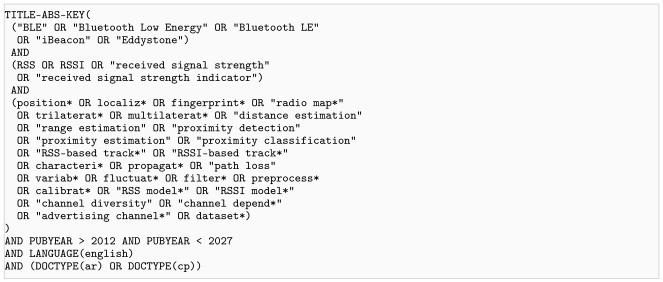
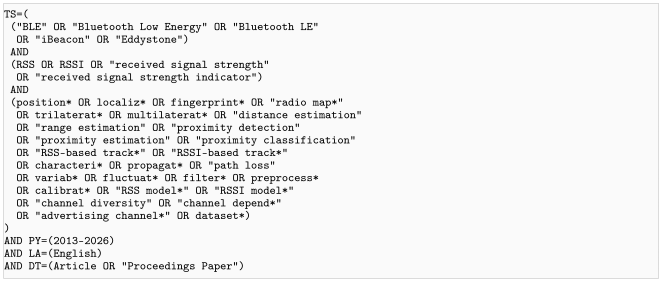
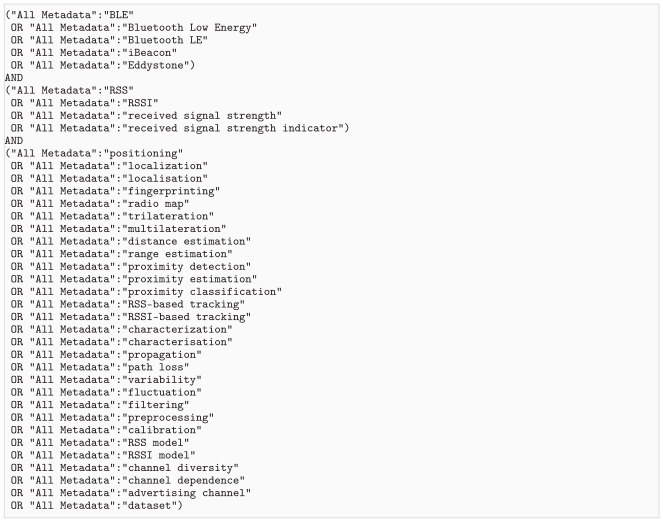
The queries combine the technology and RSS groups with AND and the positioning and RSS-research alternatives with OR. Listings 1–3 give the database-specific syntax.
In the Scopus and Web of Science queries, an asterisk (∗) denotes truncation/wildcard matching of term variants (for example, localiz∗); the IEEE Xplore query lists the corresponding terms explicitly.
For IEEE Xplore, the 2013–2026 range and journal/conference content types were selected through the search interface. Non-English records and publications other than full peer-reviewed papers were excluded during screening.
The supplied database exports contained 3356 records: 1655 from IEEE Xplore, 723 from Web of Science, and 978 from Scopus. Deduplication used normalized DOIs and titles together with publication year and supporting metadata, with conflicting cases reviewed individually. This removed 1220 duplicate database copies and yielded 2136 unique publications: 1444 conference papers and 692 journal articles. Database rows retain the source classifications. The 2136 unique records constitute the retrieval set considered for screening, not the final set included in the methodological synthesis.
| Listing 1. Scopus query. |
 |
| Listing 2. Web of Science query. |
 |
| Listing 3. IEEE Xplore query. |
 |
2.2. Eligibility and Screening Criteria
The 2136 unique database records formed the screening pool. Titles and abstracts were assessed first, and full texts were inspected when the role of BLE RSS remained unclear. Papers retained in the methodological corpus were required to satisfy the following criteria:
- Direct Use: Measured or simulated BLE RSS was acquired, processed, modeled, or used by the method.
- Substantive Role: BLE RSS contributed to the research objective, method, experimental analysis, or technical contribution.
- Sufficient Description: Acquisition, representation, filtering, calibration, modeling, or integration of BLE RSS was identifiable.
- RSS-Specific Evidence: At least one result, observation, parameter, model, or conclusion concerned BLE RSS behavior or use.
- Publication Eligibility: An English-language, peer-reviewed journal article or full conference paper within the review period.
Eligible topics include measurement and propagation characterization; preprocessing and calibration; proximity, ranging, model-based positioning, and fingerprinting; radio-map construction and learning; sensor fusion; hardware, antenna, channel, and deployment effects; documented public datasets; and direct comparisons with other RSS-based technologies. Multimodal studies were eligible when the BLE RSS contribution was identifiable; a separate BLE-only ablation was not required.
The following records were excluded from the core corpus:
- Publications outside the review period or eligible publication types. Reviews, standards, theses, reports, editorials, posters, and demonstration abstracts could serve as background sources.
- Studies using BLE only for communication, synchronization, identification, service discovery, or content delivery or mentioning RSS only as background or an incidental implementation detail.
- Black-box positioning services, application-only evaluations, or multimodal systems without sufficient explanation of the BLE RSS method. Application outcomes such as user satisfaction, attendance, engagement, workflow improvement, or energy savings alone did not establish methodological eligibility.
- Studies relying exclusively on time- or angle-based BLE observables, unless they also analyzed or compared an RSS-based method.
For borderline studies, the publication had to establish what BLE RSS information was used, how it entered the method, and what RSS-specific contribution or evidence was reported. Failure to establish any of these points precluded core inclusion.
From the screening records, 561 papers were accepted for the final review and are treated as a single methodological corpus. The remaining 1575 deduplicated retrieved records were not included because they did not explicitly address BLE RSS as a substantive methodological component or because the available resources did not permit full assessment and incorporation of all potentially relevant records.
The review provides a thematic synthesis rather than an exhaustive article-by-article catalogue. The discussion groups papers with related contributions rather than describing every included paper individually. Methodological tables summarize extractable characteristics and representative results, while contextual references illustrate deployment domains. Because the retrieval set was large and the available review resources were finite, the final 561-paper corpus should not be interpreted as an exhaustive set of all potentially relevant BLE RSS publications. Relevant studies may therefore exist that satisfy the broad topic scope but were not included in the final synthesis. Supporting and contextual references may also appear in the bibliography without belonging to the 561-paper methodological corpus.
2.3. Treatment of Application-Oriented and Supporting References
Application-focused papers were excluded from the methodological corpus when they reported only application outcomes or provided insufficient information to extract a substantive BLE RSS method, measurement finding, or evaluation result. An application study remained eligible when it independently satisfied the methodological criteria.
Selected application-only papers were cited to illustrate healthcare, navigation, safety, industry, agriculture, education, tourism, smart buildings, and crowdsensing. These examples are representative rather than exhaustive and do not contribute to methodological counts or comparisons. Any such papers retrieved by the databases remain in the all-results counts and yearly distribution.
Reviews, standards, general positioning literature, and conceptual works provide background. Dataset repository records document accessibility without counting as additional primary studies. A paper may support both methodological and application discussions, but this does not create an additional study in the corpus.
2.4. Classification and Data Extraction
Methodological studies could receive multiple thematic tags:
- Application Context: Use case or deployment domain; this tag alone did not establish eligibility.
- Proximity: RSS-based presence, proximity, or symbolic classification.
- Model-Based Positioning: Propagation-based RSS-to-distance mapping and range-based position solvers.
- Fingerprinting: Positioning from stored or learned RSS fingerprints.
- RSS Modeling: Propagation, statistical, or data-driven models for characterization, simulation, ranging, or positioning.
- RSS Filtering: Processing to reduce noise, outliers, instability, or temporal variability.
- Sensor Fusion: Integration with inertial sensors, other radios, maps, vision, or context.
- Datasets: Documented BLE RSS data releases and reproducibility material.
- Other Technologies: Direct comparisons with analogous RSS-based methods.
Where available, we extracted the environment, hardware, transmitter/receiver configuration, acquisition parameters, evaluation protocol, positioning method, performance metric, and results. Channel dependence, LoS/NLoS conditions, and PHY effects are discussed within the relevant methodological sections. Studies spanning several topics may be cited in multiple sections.
Figure 1 counts each of the 2136 deduplicated retrieved publications once, independently of methodological tags or final inclusion. Publication years follow IEEE Xplore and then Scopus, followed by Web of Science when sources disagree; original year variants remain in the merged record list. The distribution retains one Web of Science record indexed under a 2027 issue year because it was present in the 19 September 2026 export as an early-access record. Its presence in the retrieval set does not extend the core review’s 2013–2026 scope.
The search and screening cannot guarantee exhaustive coverage. Relevant publications may have been missed because of database coverage, indexing delays, terminology, language or publication-type restrictions, and the finite resources available for full-text assessment and synthesis. Screening and classification also involve judgment. Consequently, the final 561-paper corpus is a selected evidence base rather than a claim that every potentially eligible BLE RSS study was included.
3. Overview
3.1. Technology Development
Introduced in Bluetooth Core 4.0 in 2010, BLE supports short, intermittent exchanges on energy-constrained devices. Smartphone and embedded implementations make connectionless received-power measurements accessible for proximity and positioning [12].
BLE uses 40 channels spaced by 2 MHz in the 2.4 GHz Industrial, Scientific, and Medical (ISM) band (Figure 2). Channels 37, 38, and 39 carry primary advertising; channels 0–36 carry connection traffic and, since Bluetooth 5.0, secondary advertising. Multiple receivers can observe a connectionless advertiser without maintaining separate links [12].
Figure 2.
BLE channel distribution. Channels 37–39 are the primary advertising channels; channels 0–36, labeled connection channels in the diagram, also carry secondary advertising packets with Extended Advertising [12].
3.2. RSS Measurement
RSS is a radio-produced received-power estimate exposed through a controller or platform interface. Advertising, discoverability, and connectability are distinct: Non-discoverable devices may advertise, and nonconnectable beacons provide RSS without accepting connections. Passive scanning receives advertisements; active scanning may request responses from scannable advertisers. A new conventional LE connection requires connectable advertising, even outside discoverable mode [12] (see the Bluetooth Core Specification, Volume 3, Part C, Sections 9.1–9.3).
Acquisition mode complements the algorithmic taxonomy. Connectionless observation avoids per-beacon links; connected measurements follow connection-event timing and consume communication resources. Advertising intervals, scan windows, duplicate filtering, and operating-system restrictions affect available observations. Deployment comparisons should distinguish passive scanning, active scanning, and connected sampling.
The BLE physical layer uses Gaussian frequency-shift keying (GFSK). PHY, coding, receiver sensitivity, and packet duration affect reception and sampling of received power [12] (see the Bluetooth Core Specification, Volume 6, Part A, Sections 3 and 4). Better reception does not guarantee less biased RSS-derived distances: Multipath, shadowing, and calibration remain relevant. Comparisons should document PHY and transmit power and distinguish measurement availability from positioning accuracy.
BLE legacy and Extended Advertising reports express RSSI in dBm; 127 denotes an unavailable reading. The Basic Rate/Enhanced Data Rate (BR/EDR) connected-link Host Controller Interface (HCI) command HCI_Read_RSSI instead reports a signed deviation in dB from a controller-selected receive-power range, returning zero within it. For LE connections, it reports dBm [12] (see the Bluetooth Core Specification, Volume 4, Part E, Sections 7.5.4, 7.7.65.2, and 7.7.65.13). We use RSS for BLE received-power estimates; RSSI is not inherently unitless, and the BR/EDR zero-valued interval does not apply to BLE advertising. Platform calibration, quantization, and saturation still require characterization.
4. RSS Filtering Techniques in BLE Positioning Systems
BLE RSS varies with propagation, devices, and advertising/scanning settings [13]. Preprocessing comprises four overlapping families: basic techniques (window summaries and outlier rejection); temporal filtering of raw or aggregated observations; model-based recursive filtering, including Kalman Filter (KF) and particle filters with prediction–update cycles and explicit uncertainty; and channel-aware filtering, which processes identified channels separately before fusion. Windows use sample counts or durations. Families can be combined: moving averages are both window summaries and temporal filters.
4.1. Notation
Let r denote an RSS measurement in dBm; unless stated otherwise, aggregation and filtering operate on these logarithmic values. The window contains samples acquired in order at a fixed position for the same transmitter–receiver pair. Alternatively, indexes acquisition times , relative to the capture start or an absolute reference, as specified. Channel- or frequency-specific values carry channel identifiers, .
4.2. Basic Techniques
For a sample window collected at a fixed position for a given transmitter, the arithmetic mean, median, and maximum are as follows:
The arithmetic mean averages dBm values. Linear-power averaging gives dBm, with expressed numerically in mW. These summaries estimate different quantities. The median resists isolated extreme observations [14,15] but passes through additive device offsets, which require calibration or compensation. Mean smoothing reduces responsiveness to abrupt changes. The maximum can improve performance in some scenarios but is sensitive to spurious peaks, potentially from hardware rather than propagation [16]. Other variants include the mode, majority voting, and multi-level combinations of simple filters. These inexpensive techniques can reduce short-term variability relative to unfiltered signals [17].
Gaussian-based modeling and outlier detection include rejecting values more than k standard deviations from the mean:
where and are the window mean and standard deviation, and k controls rejection. Ionescu et al. use a Chebyshev-based rule with , followed by averaging and Kalman filtering [18]. Thresholds should reflect the measurement distribution and operating conditions.
4.3. Temporal (Sequential) Filtering
Temporal filtering smooths consecutive raw measurements or window summaries . A moving mean is also sliding-window aggregation, so these categories overlap.
Window aggregation is as follows:
where is an aggregation operator (e.g., mean, median, percentile) over the n-th time window of duration T. Filtering the series can reduce abrupt inter-window jumps.
A moving average filters the raw or aggregated sequence [19]:
where M is the filter length in samples or windows, and is the input: raw measurement or window estimate .
Alternatively, Exponentially Weighted Moving Average (EWMA) uses to balance noise reduction and responsiveness [20]:
with typical initialization . Stability comes at the cost of latency: Generally, a larger M or smaller increases smoothing and effective delay. Discrete low-pass filters (e.g., Butterworth) also attenuate high-frequency RSS components, with latency determined by their temporal response [21].
4.4. Recursive Filters (KF and Particle Filters)
Recursive filters use dynamic models to estimate RSS, RSS-derived range, or position/navigation states at different pipeline stages. The linear scalar KF illustrates RSS preprocessing through a prediction–update cycle [22]. Its state is the underlying RSS at time step k. We assume a random walk, direct observations, and mutually independent, temporally white, zero-mean Gaussian process and measurement noise independent of the initial state:
where Q, R, and P are the process-noise, measurement-noise, and estimation-error variances, respectively, and is the Kalman gain. Typical initialization uses (or an initial short average), with large for high initial uncertainty. The Extended Kalman Filter (EKF) and Unscented Kalman Filter (UKF) accommodate nonlinear state or observation models; changing noise statistics requires adaptive noise modeling or covariance adjustment.
Particle filters approximate state distributions with weighted particles [23]. For scalar RSS, denotes particles and weights at step k. A bootstrap filter propagates particles through the state-transition prior and then updates their weights before resampling:
Normalize the weights and resample particles when needed to control weight degeneracy; resampled particles receive equal weights. Proposals other than the transition prior require importance-weight correction. Particle filters represent nonlinear and non-Gaussian distributions, with performance depending on the model, particle count, and computation budget. Navigation-state filtering with RSS observations [24] differs from scalar RSS smoothing. Model and noise choices also affect recursive BLE estimators [25,26]. Position and sensor-fusion applications follow later.
4.5. Channel-Aware Filtering
Primary advertising channels 37, 38, and 39 permit separate processing when identifiers are available [12]. Given representative values , such as per-channel means over the same observation window, an equal-channel summary is
Pooling weights channels by observed packet count and describes the observed packet mixture; equal weighting gives a channel-balanced summary. Neither is universally unbiased or lower variance, so channel-specific means and missing or uneven sampling require explicit treatment. Filtered channel summaries can be fused; high-percentile or maximum selection remains a heuristic sensitive to extremes. If calibrated aggregates estimate a common RSS level without bias and have independent errors with variances , variance-weighted fusion is
where contains the available channels. For independent equal-variance samples on channel c, the sample-mean variance is , with packet-noise variance . Temporal or cross-channel correlations require the aggregate-error covariance; raw packet variance alone does not quantify aggregate uncertainty. When channel means contain useful frequency-dependent information, separate features may be preferable to a common-level interpretation.
When channel identifiers are unavailable, we recommend assessing how the aggregation window affects sensitivity to changes in the received channel mixture. Extended Advertising permits auxiliary packets on channels 0–36. Secondary-channel selection for AUX_ADV_IND and AUX_CHAIN_IND is implementation-specific; uniform sampling of all secondary channels is not guaranteed [12] (see the Bluetooth Core Specification, Volume 6, Part B, Section 4.4.2.1). Preprocessing should account for observed channels, unequal sample counts, missing observations, PHY, and transmit-power settings, retaining channel identifiers when the acquisition interface exposes them. Extended-advertising localization has been investigated [27]; further work should assess preprocessing generalization across receivers and acquisition configurations.
Multi-stage preprocessing can combine outlier rejection, averaging, and Kalman filtering [18]; separate fusion approaches integrate Pedestrian Dead Reckoning (PDR) and iBeacon measurements [28]. RSS instability nevertheless remains an open problem and major accuracy limitation [29]. Table 2 classifies studies by preprocessing strategy.
Table 2.
RSS processing and recursive state estimation for BLE positioning. Filters may act on RSS, ranges, or navigation states, as distinguished in the text.
5. BLE RSS-Based Positioning
RSS-based positioning comprises three categories: (i) proximity, which uses signal presence or the strongest transmitter; (ii) model-based methods, which convert RSS to distance using a propagation model; and (iii) fingerprinting, which matches observed RSS patterns to a surveyed database. This taxonomy also applies to Wi-Fi, although BLE-specific characteristics produce different performance trade-offs.
Inconsistent error reporting complicates comparisons: Studies report classification percentages, coordinate errors summarized by Mean Squared Error (MSE), mean absolute error (MAE), or other metrics, and less frequently full error distributions or cumulative distribution functions. We identify each approach and its key characteristics, reporting representative results where sufficient information permits comparison. The categories are discussed separately, although practical systems often combine them with other technologies.
5.1. Proximity-Based BLE Positioning
Proximity-based BLE localization uses lightweight rules based on signal presence, relative RSS, or thresholds. Low complexity, minimal calibration, and easy deployment come at the cost of coarse resolution and sensitivity to beacon placement, coverage overlap, and user and device effects [73,133]. With asynchronous BLE reception, scan duty-cycling and short-window aggregation help balance responsiveness and stability [120,134].
5.1.1. Presence Detection and Strongest-Beacon Assignment
Presence detection interprets advertisement reception as entry into a predefined area, supporting events, context changes, or handover rather than continuous tracking. Examples include indoor, semi-outdoor, and outdoor context switching [135], mapping beacon identifiers to indoor areas [136], entry/exit notifications [137], and zone-based interaction gating [138]. Temporal aggregation reduces spurious transitions in binary monitoring, such as choke-point entry/exit, without calibration surveys [139].
Strongest-beacon assignment maps users to the region of the transmitter with the highest RSS [120]. Although generally less accurate than lateration or fingerprinting, it suits low-power, low-maintenance deployments [52,140]. Studies use it for room or zone labels [136,141,142,143,144], often prioritizing symbolic locations and waypoint navigation over coordinates [145,146].
Robust variants combine max-RSS, absolute thresholds (e.g., dBm), and windowed majority voting. Windowed strongest-beacon selection has achieved acceptable zone accuracy in small testbeds [147] and high classification rates in long-running clinical and operational deployments [75]. More structured zone recognition can improve room decisions without radio maps [40].
5.1.2. Thresholding and Distance-Proxy Refinement
Threshold rules stabilize proximity decisions by converting fluctuating RSS into categories [148]. They reject weak signals, form RSS bands for room-presence detection [141], or define empirical inside/outside boundaries [149]. Applications include hazard-boundary alerts [150,151,152] and contact detection, where windowed RSS identifies distance violations subject to minimum-duration constraints [153,154]. Supporting reports and poster abstracts are identified separately below.
Path-loss models can supply an RSS-based distance proxy for nearest-beacon or landmark selection while retaining discrete room/zone labels. One-beacon-per-room systems use these models for low-latency detection with minimal calibration [134,142,155]. Others trigger short-range actions using conservative thresholds to limit false positives under motion and obstacles [156,157]. Hybrid methods may apply cell of origin above a high RSS threshold and switch to more complex methods elsewhere to bound worst-case errors [35]. At ultra-short ranges, separable RSS bands enable near-field zone triggering [158].
5.1.3. Integration into Hybrid Pipelines and Practical Limitations
Tracking pipelines can treat stronger RSS as evidence of proximity to an anchor, for example, in particle filters [20,159]. Proximity can initialize or re-synchronize inertial tracking by anchoring a position or defining a bounding box from multiple above-threshold beacons [160]. Landmark detections provide absolute constraints that limit drift and reduce database-generation overhead [161]. Fingerprinting-like schemes can further improve room-level robustness [47].
Hybrid systems switch between confident proximity and fingerprinting [35], preselect candidate regions before refinement [162], or use building geometry to limit leakage across rooms and walls [163]. Dedicated proximity landmarks can enforce doorway or zone transitions when BLE RSS thresholds are ambiguous [164].
Environment and deployment remain decisive [165]. Overlap, interference, and multipath obscure closest-beacon evidence [133], while device orientation and body obstruction affect positioning and contact detection [73,166]. Beacon height, spacing, and coverage-boundary design improve separability and handover reliability [167,168,169,170]. Transmit power and scan/aggregation windows are jointly tuned for latency and robustness: higher power may improve stability while increasing overlap and ambiguity [169,171,172].
5.1.4. Contact Tracing and COVID-19
During COVID-19, digital contact tracing aimed to complement manual tracing by logging short-range encounters and accelerating exposure notifications. Smartphone systems exchange BLE advertisements and assess proximity and duration; their core task is coarse proximity classification [153].
Device diversity, body blockage, and multipath make RSS a noisy distance proxy, causing false positives and negatives. Contact-tracing measurements confirm substantial proximity-estimation variability [173], motivating temporal aggregation and conservative exposure decisions [174].
Privacy and trust also matter at scale. ConTra Corona combines elements of centralized and decentralized cryptographic designs to strengthen privacy [175]. Infrastructure- or wearable-based alternatives (e.g., RFID or Wi-Fi) can benefit controlled environments, with different cost, coverage, and privacy trade-offs from BLE-only smartphones [176].
5.1.5. Proximity: Classification and Reported Performance
Table 3.
BLE proximity and coarse-localization methods. Algorithm families, robustness mechanisms, and use cases overlap.
Table 4.
BLE RSS proximity and room-classification results. Classification rates, coordinate errors and ranging-tolerance success rates are distinct metrics; SVM classification differs from simple proximity rules.
5.2. Model-Based Positioning
Model-based positioning converts RSS to transmitter–receiver ranges using a propagation model and then combines ranges to estimate location. We review range models, position solvers, and robustness and integration issues, focusing on BLE studies and adaptations of methods shared with other wireless technologies.
5.2.1. RSS-to-Distance Models
BLE Received Signal Strength Indicator (RSSI)-to-distance conversion commonly uses the Log-Distance Path Loss (LDPL) (log-normal shadowing) model. Received power in dBm at distance d is modeled as
where A is the mean received power in dBm at the reference distance (typically ), is the dimensionless path-loss exponent, and is a random term in dB. The corresponding range estimate is obtained by inversion:
In practice, A and n are calibrated for each beacon, receiver, or environment; decentralized automatic calibration has also been investigated [219]. As a generic ordinary least-squares example, let and for calibration sample i, and let and be their sample means. Provided that the calibration distances are not all identical, Least Squares (LS) yields
Reported n values typically range from to , depending on LoS/Non-Line-of-Sight (NLoS) conditions and the environment [41,44,45,141,220,221,222]. The LDPL model remains the dominant baseline for BLE trilateration and ranging [223].
The log-normal model assumes Gaussian measurement noise in dB:
which gives log-normal received power in linear units. Even with this exact model, inversion is mean-biased: For and known A and n, and . Thus, the range estimate is median-unbiased but mean-biased. Although convenient for analysis and probabilistic filters, the Gaussian assumption requires validation. Multipath, human-body shadowing, and channel diversity can produce skewed, heavy-tailed, or multimodal BLE RSS distributions [198], adding model-mismatch errors to inversion bias [117,224].
Extensions of standard path-loss models include direct polynomial mappings from RSS to distance, for example,
where a, b, and c are fitted coefficients, and RSS is expressed in dBm. Alternatively, one can fit RSS as a function of distance and invert the fitted relationship over a calibrated monotonic interval [52,225,226]. The two regressions minimize residuals in different variables and are not generally equivalent. Piecewise or segmented models capture different distance regimes:
Here, is the first reference distance and is the transition distance. The dimensionless parameters and are the path-loss exponents in the first and second regimes. The intercepts and are the reference mean received powers in dBm for the first regime at and for the second regime extrapolated to , respectively. For a continuous mean path-loss curve, the intercepts must satisfy . Fitting the intercepts independently allows a discontinuity at , which must be justified by the modeled propagation transition rather than assumed implicitly.
Structural extensions add deterministic losses:
where sums penetration losses: j indexes wall/material classes, is the number of traversed walls in class j, and is the corresponding loss in dB. The terms and are floor and human-occlusion losses in dB [51,108,132,227,228,229]. An empirical oscillatory correction can represent local departures from a smooth path-loss curve, for example,
where is the fitted oscillation amplitude in dB, is a fitted spatial period in the same length unit as d, and is a phase offset in radians. This empirical expression is not a physical two-ray derivation: physical interference depends on the difference between propagation-path lengths and on the summed complex fields. Two-ray and ray-tracing approaches explicitly account for reflection geometry [31,230,231]; their performance and transferability depend on the deployment.
Channel-aware approaches exploit BLE advertising channels [118]. Separate models for give
For independent, unbiased range estimates with error variances , inverse-variance fusion gives
These are range-error variances, not RSS-noise variances. For small RSS errors and fixed calibration parameters, first-order propagation gives
where refers to the RSS value or aggregate used in that range estimate. This approximation omits calibration uncertainty and nonlinear effects. Biased or correlated estimates require corresponding bias and covariance treatment; the naive LDPL inversion does not automatically satisfy the unbiasedness assumption. Separately, the distribution of packet RSS pooled across channels obeys the law of total variance. If R denotes a packet-level RSS value and M its channel index,
The second term is the between-channel contribution to packet-mixture variance. An averaged estimator’s variance also depends on sample counts and temporal or cross-channel correlations. Studies report lower variance and more consistent path-loss parameters with separate channels than aggregated RSS [109,118,231,232,233]. Limitations of a single Gaussian log-normal model motivate hybrid path-loss, channel-modeling, sensor-fusion, and probabilistic-learning methods [234,235,236,237,238]. Stochastic BLE RSSI modeling also addresses time-correlated noise jointly with path-loss parameter estimation [239]. The BLE Physical Layer (PHY) configuration affects ranging: a study of coded PHY with evaluates RSSI-based distance estimation alongside RTT and jitter [240].
Table 5 distinguishes RSS-to-distance mappings from RSS-field prediction and joint localization/mapping. A model that predicts RSS at a position is not automatically a direct range estimator. Supporting reviews and poster abstracts are not classified as primary model contributions.
Table 5.
RSS-to-distance, RSS-field, and related approaches. Range prediction, RSS-at-position prediction and joint localization/mapping have distinct outputs; categories may overlap.
5.2.2. Position Solvers
Range or distance-like estimates are combined to locate an unknown node, as in GNSS and Wi-Fi positioning [282]. We summarize lateration fundamentals and reported BLE adaptations.
Lateration estimates the position from distances between a receiver and multiple anchors. Spherical lateration uses absolute range estimates, whereas hyperbolic lateration uses metric range differences between anchor pairs. RSS-difference models instead yield distance ratios under the assumptions stated below.
Range-Based Lateration (Spherical)
Given m anchors at known positions , and noisy range estimates (often derived from RSS or other BLE measurements), a standard formulation is weighted LS:
where reflects link reliability or geometric relevance. In 2D, with and anchors , the geometric range is .
This RSS → distance → position pipeline includes trilateration or circle intersections [87,110,147,247,254], multilateration with more than three anchors [44,77,220,251,261], and integration into tracking pipelines [90,283].
With three beacons, range estimates and define three circles:
Their common intersection gives the position estimate when the ranges are consistent; otherwise, a best-fit solution is required. BLE implementations use circle intersections or equivalent closed-form algebra after converting RSS to ranges [32,87,96,147,247,254].
With n beacons, robust aggregation of multiple trilateration candidates requires enough uncontaminated, well-conditioned triplets; ill-conditioned triplets should be excluded or down-weighted. Ordinary averaging alone does not ensure robustness. Weighting based on the sample median and mean absolute deviation about that median combines all candidates in [55]; similar multi-candidate aggregation appears in [284].
Subtracting one squared anchor-range equation from the others produces a linear system , where A contains known anchor-coordinate differences and contains the corresponding squared-range and squared-anchor-coordinate terms. With m anchors in d spatial dimensions, this reference-subtracted system has equations and is overdetermined when : at least four anchors in 2D or five in 3D. Redundancy can improve robustness, although additional biased ranges do not guarantee an improvement [77,236,241]. If A has full column rank and the weight matrix W is positive definite, weighted LS gives
Diagonal weights can encode chosen link reliabilities. Subtracting a common anchor equation induces correlated residuals, however; generalized least squares instead uses W proportional to the inverse residual covariance when that covariance is known [282]. In practice, weighted fits commonly emphasize short or reliable links [52,89,241,271,285].
Performance depends strongly on calibration and geometry [286]. An RSS-to-range least-squares pipeline with EKF/PDR fusion and graph-estimated beacon positions reports mean errors of m (dense) and m (sparse) [17]; other studies examine calibrated lateration and geometry-dependent corrections [77,89]. In [236], average errors of about m with 11 beacons and m with six illustrate density and geometry effects.
Instead of linearization, lateration can be solved directly as a Nonlinear Least Squares (NLLS) problem:
Here, is the candidate position, is the known position of anchor i, is its RSS-derived range estimate, and m is the number of anchors. Iterative NLLS variants are evaluated in [25,261].
Weights encode both link reliability (stability, outlier filtering, and channel effects) and geometric considerations (visibility and spatial diversity). This unified view covers LS/WLS, NLLS, closed-form trilateration, and region-based methods when exact intersections are unreliable [123,241].
Weighting strategies include (i) inverse-distance or expected-error weights to limit far-link error amplification [241,285,287]; (ii) reliability weighting and device selection through decision rules, outlier rejection, or channel-dependent weights [271]; (iii) temporal attenuation favoring recent measurements [288]; and (iv) robust reweighting, such as likelihood/M-estimator-like schemes, to suppress anomalies [289,290]. Weighted-centroid approaches similarly improve geometric consistency without trusting every RSS-derived range equally [36,135,291].
RSS-Difference and Range-Difference Formulations
Assume that the links share a path-loss exponent and that their reference-power intercepts are equal or have been calibrated to a common value. Under the log-distance model, the difference between the resulting RSS measurements and , expressed in dBm, is
where is the receiver position, is anchor i’s position, and is the difference between the two RSS errors. Independent transmit-power or hardware offsets do not cancel unless accounted for by calibration. Neglecting noise gives the distance ratio
For distinct anchors, a fixed ratio defines an Apollonius circle in 2D or a sphere in 3D; when , it defines the perpendicular bisector or bisector plane. A compatible estimator fits the RSS differences directly:
where is the chosen set of anchor pairs, and are reliability weights. Pair differences sharing an RSS measurement have correlated errors, so statistically efficient weighting should account for their covariance. Temporal aggregation may precede differencing but does not change the ratio geometry.
Range-Difference Lateration (Hyperbolic)
Hyperbolic constraints require metric range differences, , not directly supplied by RSS ratios. The algorithm termed “hyperbolic” in [282] instead subtracts squared, individually estimated ranges to form a linear system. Collaborative smartphone approaches also combine RSS-derived lateration with fingerprinting in hybrid, cooperative positioning [292].
5.2.3. Robustness Issues and Integration
For biased ranges, annuli can replace circles to define a feasible region [119]. Min–max or bounded-box solvers use the k best beacons and shrink this region as scans arrive, improving stability under fragile RSS-to-range inversion [123]. Nikodem combines RSS-derived annular constraints with measurements aggregated over non-overlapping 30 s windows and total-signal-strength weighting [119]; other approaches refine feasible regions through evidence accumulation [79,80].
Noise or bias can prevent circle intersections. Remedies include proportional radius correction and projection onto trusted constraints, such as short or LoS links [89]. Perpendicular-bisector constructions can stabilize initialization; explicit non-intersection rules appear in [113], and LS pipelines also use proportional radius adjustment [293].
Anchor geometry determines how range errors affect position: angularly diverse, non-collinear placement improves conditioning, whereas corridors may promote collinearity. Selection should balance geometry and link quality [84,294]. The top-N closest or most reliable beacons can outperform all visible anchors [49], because weak links may add bias without sufficient geometric benefit [287]. Four rather than three anchors can reduce degradation near polygon edges and smooth transitions [36,295].
Lateration provides direct position fixes or measurement models for recursive estimators (PF, KF/EKF) that constrain drift and stabilize trajectories [95,248,296]. To improve RSS-to-distance mapping, studies use per-beacon calibration [89,297], transmit-power-aware ranging [275], channel-aware ranging [271], and two-ray [270] or segmented propagation models [236].
5.2.4. Model-Based Positioning: Classification and Reported Performance
Table 6.
BLE range-based solvers and robustness mechanisms. Solver families, anchor selection, and aggregation overlap.
Table 7.
Model-based BLE RSS positioning results. Labeled hybrid outcomes are not standalone BLE-only accuracy bounds.
5.3. Fingerprinting
Following [312], fingerprinting comprises (i) deterministic k-Nearest Neighbors (k-NN)/Weighted k-Nearest Neighbors (Wk-NN) methods; (ii) probabilistic methods modeling measurements conditional on position; and (iii) machine learning methods. Probabilistic approaches are less extensively explored than in Wi-Fi [313]. Channel-aware features apply across all three families and form an orthogonal attribute in Table 8.
Table 8.
BLE RSS fingerprinting approaches. Algorithm families differ from orthogonal channel, maintenance, and deployment attributes; multiple tags are allowed.
5.3.1. Lazy Learning Methods
Classic k-NN/Wk-NN remains a strong baseline due to simplicity and robustness, often with Euclidean (or Manhattan) distances and inverse-distance weights [13,42,314,315,316,317,320,342,402]. Formally, given an online RSS vector with B RSS features and a reference fingerprint at location , typical distances are
Let denote the selected fingerprint distance, and let denote the indices of the k nearest reference fingerprints. Then, k-NN/Wk-NN uses inverse-distance (or power-law) weights
Setting yields unweighted k-NN, whereas prevents division by zero.
Recent BLE RSS Wk-NN methods constrain candidates using previous positions and adaptive thresholds to reduce error propagation and search complexity [403]. Distance metric, k, and weighting should be tuned jointly for each dataset before comparing optimized methods [404]. Transmit power, beacon density, and measurement windows also affect accuracy [171,244,314,315,395].
The density study in [14] reports 95th-percentile errors below for high-density BLE and for lower density. A generic alternative to inverse-distance matching uses Gaussian similarity weights. For ,
where is an unnormalized similarity weight, and is a kernel scale in the same units as . Normalizing these weights does not by itself establish a probabilistic likelihood or posterior; a Bayesian interpretation additionally requires an observation model and prior. Operational parameters, including advertising period, observation window, fingerprint dimensionality, beacon density, and transmit power, should be reported alongside positioning results.
Spatial Template Matching
Eight-neighborhood template matching (ENTM) builds access-point-specific templates from measured RSS and learned quadrant-specific center-to-neighbor differences. It selects the position that minimizes the squared differences between these templates and radio-map subimages [352]. The reported RMSE was versus for both k-NN and Wk-NN [352].
5.3.2. Machine Learning in Fingerprinting
Classical methods classify rooms or grid cells or regress coordinates using support-vector, random-forest, linear-discriminant, and decision-tree models [53,316,353,405]. Linear support vector machines (SVMs), for example, maximize class separation while regularization permits some misclassifications. Calibrated classifier probabilities can support fusion if training priors and dependence are accounted for; performance depends on the task, data, and scenario. XGBoost has also been evaluated [371]. Room-level classification serves assistive living and building automation, where semantic labels suffice [355,406,407].
Semi-supervised physics-informed genetic fuzzy systems have been compared with neural-network and k-NN baselines for BLE localization [374].
Deep-learning approaches include denoising autoencoders for reconstructing clean RSS patterns from corrupted inputs [383]. Xiao et al. use reconstruction-based denoising-autoencoder scores for weighted fingerprint matching, reporting approximately mean horizontal localization error in a × room with ten beacons [375]. Semi-supervised deep reinforcement learning (DRL) with variational autoencoders (VAEs) uses unlabeled fingerprints to reduce reliance on fully labeled maps, reporting a 23% improvement in distance to the target over supervised DRL [380]. Synthetic fingerprints and generative adversarial network (GAN) augmentation aim to reduce surveys and improve generalization [376,389]. Dynamic-environment pipelines combine interpolation, differential RSS features, Transformer representations, and outlier mitigation [408]. Machine-learning algorithms have also been evaluated for BLE RSSI-based indoor localization [409].
5.3.3. Channel Diversity in Fingerprinting
Separating BLE advertising channels into radio maps or “virtual beacons” can improve fingerprinting over channel aggregation [52,348,350,351]. A simple formulation builds three models and fuses their position estimates. If their errors are unbiased, independent across channels, and isotropic with covariance (), then
where I is the identity matrix, and is the per-coordinate position-error variance. Anisotropic or correlated position errors require covariance-aware fusion, and overlapping observations should not be treated as independent without justification. Alternatively, per-channel RSS can be concatenated as and used in standard k-NN/Wk-NN matching [34]. For example, [350] reports a 28.5% reduction in 90th-percentile positioning error, from to , using separate-channel fingerprints.
5.3.4. Limitations and Integration
Radio maps require maintenance as environments and measurement conditions change. Online updates, including dynamic resampling and cut-off areas, remove unreliable RSS observations [390,410]. Radial-basis functions, kernel regression, and Gaussian-process-like methods densify sparse surveys or assign probabilistic location scores [14,37,162,336]. Fuzzy clustering and weighted interpolation also aim to improve BLE radio maps [411].
Performance depends on RP density, beacon count, user orientation, and device heterogeneity [33,140,314,315,412]. Orientation models, per-orientation fingerprints, and iterative candidate restriction aim to reduce error and computation [33,35,57,412,413,414]. For room-level BLE RSSI localization, gap-aware segmentation with random-forest and hidden Markov model (HMM) inference handles irregular RSSI streams and discontinuous movement [415].
5.3.5. Classification and Reported Performance
Table 9.
BLE RSS fingerprinting and labeled hybrid results. Mean, RMSE, percentiles, and classification metrics are not interchangeable.
6. Sensor Fusion Approaches
Fusion combines BLE-based positioning with other technologies to improve accuracy or provide continuous position estimates. A recurring combination in the reviewed literature pairs any of the three BLE approaches with pedestrian dead reckoning (PDR). Other schemes integrate Wi-Fi, GNSS, or both, sometimes adding environmental or map information to refine estimates.
6.1. Integration with PDR
PDR integrates step events and heading changes from inertial sensors to estimate short-term motion. BLE trilateration, proximity, or fingerprinting provides absolute updates to correct drift and often initialize or re-anchor trajectories [28,74,84,285,296,418]. Fusion typically uses Bayesian filtering—most commonly Kalman/EKF variants or particle filters—with PDR providing predictions and BLE measurement corrections.
Reported outcomes include smoother trajectories and consistent error reductions; Kalman fusion of BLE trilateration and dead reckoning achieved sub-meter accuracy in the evaluated testbed [84].
6.2. Other Fusion Approaches
For conditionally independent modalities, Bayesian fusion combines observation likelihoods with a prior over the candidate state. Classifier scores require calibration or an explicit score-fusion model; posterior outputs also require accounting for training priors. Table 10 distinguishes complementary online inputs from offline training/calibration and benchmark ground truth. Optical laser/single-photon avalanche diode (SPAD) proximity sensors add constraints [164], whereas BeSound uses ultrasound supervision during training and BLE-only inference [65]. Comparing separate systems does not itself constitute fusion.
Vision can complement BLE RSS region classification: Mamede et al. combine RSSI and camera-image classifier outputs through ensemble models [419]. Near-Field Communication (NFC) tags can provide known-location checkpoints complementing BLE guidance in systems supporting indoor/outdoor navigation [136].
Contextual and environmental signals further stabilize positioning. Phone orientation sensors can reference RSS-derived bearings to north [72]; orientation and radio bearing are distinct observables, and a magnetometer does not directly measure a BLE signal’s arrival direction. Barometric pressure is widely used for multi-floor inference by mapping changes to relative altitude, enabling reliable floor-transition detection with BLE or inertial tracking [420]. Building/floorplan constraints and, in some studies, learned motion/velocity priors such as ResNet-18 prune implausible trajectories and reduce drift [235]. Smart-home contact and pressure sensors provide location cues that particle filters can fuse with BLE RSS for greater robustness [234].
Fusion architecture and measurement gating can matter as much as the sensor set. BLE proximity events provide anchor-like corrections to reset PDR drift when users are confidently near beacons [28]. Other systems switch between fingerprinting and multilateration according to beacon visibility and signal conditions [285]. Channel-aware designs weight BLE measurements by their estimated reliability (e.g., down-weighting higher-variance channels) before combining position hypotheses. For emerging cellular-based positioning, recent work fuses 5G uplink signals with complementary BLE RSSI through spatiotemporal attention [421].
Table 10.
BLE multimodal approaches: online fusion, offline calibration/training, and benchmarking.
7. BLE RSS Datasets
Environment-dependent performance complicates comparisons of BLE RSS-based positioning methods. Well-documented open datasets support reproducibility and fair comparison through shared data, protocols, and metrics. Following documentation and organization practices established by Wi-Fi datasets such as UJIIndoorLoc [449], BLE datasets address diverse objectives. Early BLE RSS datasets mainly targeted university fingerprinting: Ref. [450] examined device heterogeneity and transmit power, while Ref. [394] compared power settings and receiver- versus transmitter-localization schemes.
Office and academic datasets cover dense grids, multiple power levels, autonomous or remote modes, smartphone heterogeneity, energy-aware acquisition, and LiDAR-calibrated maps. The ISTI-CNR dataset [394] includes a research-office grid with multiple power settings and acquisition modes for fingerprinting and tracking. SAL-RB [451] records BLE RSSI from ten nRF52840 sniffers at 100 ms intervals in an automotive testbed, with walking/vehicle trajectories and photosensor-derived region labels. A LiDAR-equipped robot supplies geometric ground truth for dense apartment/building radio-map calibration [279]. Clinical BLE tag measurements from fixed Raspberry Pi receivers provide labeled RSSI images for deep-learning localization [452].
Channel-aware datasets include RSS and channel measurements for BLE 5.0 Extended Advertising [27]. Auxiliary advertisements can use secondary channels 0–36 alongside primary advertising on channels 37–39; these remain distinct channel classes, and a measurement window need not sample every channel [12]. Studies [351,453] compare systems with and without channel information using custom hardware, including frequency-dependent directive antennas. Within the reviewed corpus, we found no openly accessible smartphone dataset pairing per-packet advertising-channel identifiers with RSS. OutFin combines outdoor Bluetooth, Wi-Fi, cellular, and inertial fingerprints with location ground truth; its inquiry-based discovery and device-capability flags do not establish a BLE-advertising subset, so it remains a contextual multimodal benchmark [454]. Indoor multi-technology corpora support cross-technology comparisons [247], while a recent industrial, interference-prone dataset combines BLE/Wi-Fi RSSI with position, orientation, and velocity ground truth [455].
Outside the positioning context, some datasets have focused on RSS analysis to study specific effects. LOS/NLOS and proximity studies include controlled experiments (indoor/outdoor) with obstacles and per-channel logging [117,166], as well as labeled Wi-Fi and BLE RSS measurements for training and evaluating NLOS detectors [456,457].
Table 11 separates study/descriptor citations from repository links; a dash denotes that no separate paper is cited. Counts refer to different units, including raw observations, fingerprints, images, positions, transmitters, and advertising slots. Competition entries identify specific tracks or releases. IPIN 2019 Track 3 and OutFin are retained as contextual multimodal benchmarks rather than BLE RSS-only datasets. The final column separates auxiliary measurements from analysis methods.
Table 11.
Selected BLE RSS datasets and contextual multimodal positioning benchmarks.
8. Application Domains of BLE-Based Positioning
BLE positioning spans geofencing, visitor services, healthcare, safety-critical monitoring, and industrial workflows, supported by low deployment cost, off-the-shelf smartphone compatibility, and adaptability to diverse environments [496]. This section groups applications by domain, independently of the positioning technique. Proximity methods suit simple zone or encounter detection with low computational requirements.
Applications of BLE navigation and user assistance [256,497] include airport luggage tracking and passenger notifications [137]. RSSI has also been investigated for detecting close contacts between ship passengers [498]. Related services include parking guidance and vehicle-recall functions that help users locate their cars [200,499].
Healthcare and assisted living [191,500,501] include patient monitoring in hospitals and nursing homes [38,40,62], sedentary behavior analysis [241,502], and home rehabilitation and elderly care [40]. Assistive navigation for visually impaired users often uses BLE in hybrid trilateration or fingerprinting solutions [503,504]. During COVID-19, BLE proximity became central to contact tracing and exposure notifications; some studies used channel-specific responses to improve distance estimates [117,231].
Safety and emergency applications include fire management, evacuation support and command-center firefighter tracking [505,506], access and security monitoring [86], and evacuation guidance for elderly-care facilities [507]. Other uses include crowdsensing at large gatherings [508], AGV proximity control in crematorium workflows [199], and infant monitoring with dynamically defined danger zones and entry alerts [297].
In shopping malls and retail environments, BLE is used for proximity-based marketing through broadcast advertisements [357,509]. BLE-based positioning has been integrated into power management systems for large buildings [510,511] and smart homes [512], enabling occupancy-driven control of heating, ventilation, and air conditioning (HVAC), and lighting [39,141]. These applications demonstrate BLE’s ability to improve energy efficiency and support context-aware smart building services.
Industrial and agricultural applications also use BLE positioning. In warehouses, it supports logistics optimization and forklift tracking [402]. In agriculture, BLE tags enable continuous livestock monitoring and estimation of drinking-event frequency and duration [30,513]. BLE has also been applied to study group dynamics, such as the co-localization of walking groups to analyze collective mobility behavior [514].
Construction, mining, and industrial systems use BLE to track workers and equipment, issue proximity warnings, associate assets with operators, and support logistics and digital site monitoring under obstruction and metallic interference [515,516,517,518,519,520,521]. These real-time locating systems (RTLSs) often prioritize robustness and low maintenance over fine-grained accuracy.
Education-related deployments use BLE beacons for automated attendance tracking and location-triggered classroom services, including personalized notifications and interactions between lecturers and students [522,523]. BLE has been deployed in museums and cultural heritage sites to provide context-aware visitor guidance and personalized content delivery [73,192,225,524].
Smartphones and wearables can continuously scan BLE advertisements for coarse proximity indicators, including RSSI trends and encounter events. Systems can aggregate these opportunistic observations across participants to estimate pedestrian density and flow, identify popular routes, and detect congestion hotspots without dense dedicated infrastructure [525,526]. Typical implementations use beacon sightings or encounter logs to reconstruct coarse trajectories and activity patterns in public buildings, campuses, and large events [527,528]. Challenges include device-dependent scanning, uneven participation, and the privacy implications of collecting encounter and trajectory data.
Table 12 summarizes the application domains discussed in this section.
Table 12.
BLE positioning application domains; multiple tags are allowed. Inclusion here does not establish core methodological eligibility.
9. Comparison with Other Technologies
We compare BLE RSS positioning with RSS-based alternatives, excluding timing- or angle-based methods (e.g., ToF and Angle of Arrival (AoA)). Because many methods originated in Wi-Fi or classic Bluetooth, we emphasize direct comparisons with BLE. The technologies considered include Wi-Fi, LoRa/LoRaWAN, UWB, Zigbee, classic Bluetooth, NFC, and Radio-Frequency Identification (RFID).
Table 13 retains study-specific metrics and conditions; its results are neither universal accuracy ranges nor a ranking across deployments. NFC and passive RFID provide contextual proximity or identification alternatives where coordinate-based RSS comparisons are unavailable.
Table 13.
BLE RSS and alternative technologies. Reported errors are study-specific; coverage and deployment considerations are qualitative. Timing- and angle-based positioning results are excluded.
Wi-Fi, an IEEE 802.11 Wireless Local Area Network (WLAN), typically operates at 2.4 GHz and 5 GHz, with newer versions using 6 GHz (Wi-Fi 6E/7). Indoor RSS depends on multipath, users, devices, and available Access Points (APs). Wi-Fi generally consumes more energy than BLE but can reuse infrastructure. Direct RSS comparisons include [247,611,612,613]. Faragher and Harle reported 95th-percentile errors below 2.6 m for BLE and 8.5 m for Wi-Fi in the same area [14]. De Blasio et al. reported Wi-Fi mean errors of 3.94 m to 4.82 m (90th percentile: 5.21 m to 7.0 m) and BLE mean errors of 1.47 m to 2.15 m (90th percentile: 1.81 m to 3.58 m) with 1 beacon per 45.7 m2 [33].
Classic Bluetooth is a 2.4 GHz ISM wireless personal area network (WPAN) technology for continuous connections, including audio and peripherals. RSS/RSSI supports proximity and coarse positioning, but discovery and connection procedures make dense beacon deployments less practical than BLE advertising. Reported results include 2.2 m positioning error with smoothed BLE iBeacon measurements [614] and 5.1 m mean horizontal error for classic Bluetooth RSSI fingerprinting (3.90–5.78 m in static tests) [608].
Zigbee is a low-power stack built on IEEE 802.15.4, typically at 2.4 GHz. Indoor RSS performance depends on anchor density and geometry; smartphone support is less common than for BLE. A multi-radio RSS trilateration study reported BLE/Zigbee overall mean errors of 0.753 m/0.896 m and 0.661 m/0.882 m in Environment 1 and 0.844 m/0.911 m in Environment 2 [247].
LoRa/LoRaWAN provides low-power, long-range, low-bitrate links, usually in sub-GHz ISM bands such as 868 MHz or 915 MHz. Sparse gateways and slow indoor RSS sampling often yield coarser localization than BLE. In [247], the LoRaWAN aggregate of 1.190 m conflicts with the two environment-specific values, 0.846 m and 1.109 m; we neither use that aggregate nor replace it with a calculated value. Separately, wide-area LoRaWAN RSSI fingerprinting reported approximately 284.57 m mean error [615].
Although usually used for accurate ranging, short-range, wide-bandwidth UWB also supports RSS-only proximity and fingerprinting. Its RSS remains sensitive to multipath and device differences, and RSS-only studies are less common than for BLE. A direct BLE/UWB RSS fingerprinting comparison appears in [609], with broader context in [1].
NFC uses near-field induction at 13.56 MHz for identification, access control, and pairing. Its centimeter-scale range provides proximity rather than room-scale RSS positioning. BLE at 2.4 GHz covers meters to tens of meters for zone detection and coarse positioning. Short-range BLE as a near-field-like alternative is studied in [158]; NFC proximity comparisons appear in [192].
RFID includes LF/HF systems (including 13.56 MHz) and UHF systems (typically 860 MHz to 960 MHz) used for inventory and asset tracking. Received-power or link-quality indicators can support presence, zones, and sometimes RSS localization depending on the band and reader/tag design. Often-passive, inexpensive RFID tags generally require dedicated readers; active BLE tags can use commodity receivers. Passive UHF RFID and BLE are compared for RSS-based room detection and contact tracing in [176], with broader context in [1].
Beyond this review’s RSS scope, BLE provides AoA, AoD, and MCPD positioning observables [616,617].
10. Open Challenges and Future Trends
BLE RSS supports proximity, fingerprinting, and model-based positioning on accessible hardware, but acquisition, propagation, and evaluation conditions affect performance. Priorities include cross-device/environment robustness, affordable maintenance, and integration with additional Bluetooth observables.
Multipath, body obstruction, and antenna orientation alter RSS without distance changes. Channel diversity and filtering can reduce variability [108], but methods should distinguish transient fluctuations from persistent bias and quantify reliability. Fingerprinting priorities include device normalization, adaptation with limited labels, and incremental radio-map updates, evaluated across independent devices, sessions, and environments. Physics-informed models can combine propagation constraints with learned corrections, but they must demonstrate gains over simpler calibrated baselines under imperfect propagation assumptions.
Extended Advertising provides channel diversity already investigated for localization [27], but observations may be incomplete, unevenly sampled, or inaccessible through receiver interfaces. Datasets should document available channel identifiers, PHY, transmit power, timestamps, and filtering settings. Comparisons should control observation duration, packet count, and energy to distinguish diversity gains from increased acquisition effort.
Bluetooth Core 5.1 introduced Direction Finding in 2019, using receiver antenna arrays for Angle of Arrival (AoA) or transmitter arrays for Angle of Departure (AoD) [616]. Core 6.0 introduced Channel Sounding (CS) in 2024 [618], supporting multi-frequency Phase-Based Ranging (PBR) and Round-Trip Timing (RTT) [619]. Unlike connectionless RSS observation, standardized CS requires compatible controllers at both endpoints and an LE connection for setup and control [619]. Earlier RSS/multi-carrier phase-difference comparisons predate standardized CS [617]. These direction and distance observables remain affected by multipath, non-line-of-sight propagation, antenna characteristics, and calibration; evaluations should distinguish ranging from positioning errors and account for hardware, latency, and energy.
Hybrid systems could use RSS for discovery, coarse localization, or anchor selection, activating CS or direction measurements when accuracy gains justify acquisition cost. Fusion should account for uncertainty and correlated propagation errors. Inertial sensing and maps can maintain continuity between radio updates; adaptive scheduling can follow motion and uncertainty. Scalability evaluation should measure endpoint energy, processing delays, and supported devices under actual measurement schedules.
Reproducible benchmarks should document acquisition, ground truth, preprocessing, and model selection and use independent training and test sessions, heterogeneous devices, changing occupancy, and missing anchors. Overlapping temporal windows must remain in one data partition; online methods may use only observations available at estimation time. Report availability alongside distinct mean, median, root-mean-square, and percentile errors. Separate radio coverage from the evaluated positioning region (Table 13). Accuracy, latency, privacy, energy, and maintenance should guide application-specific choices between RSS and richer Bluetooth observables.
11. Conclusions
This review covers BLE RSS positioning from 2013 through the search cutoff of 19 September 2026, distinguishing proximity-based, model-based, and fingerprinting methods. It synthesizes reported evidence on preprocessing, sensor fusion, datasets, applications, and cross-technology comparisons.
BLE enables low-power beacons and flexible placement in GNSS-denied environments, but costs depend on scanning, battery replacement, calibration, and radio-map maintenance. RSS at 2.4 GHz remains sensitive to multipath, shadowing, body absorption, and device bias, requiring trade-offs between acquisition effort, latency, and robustness.
Windowed aggregation can reduce short-term fluctuations, typically at the cost of latency. Channel-aware methods can exploit frequency-dependent information when receivers expose channel identifiers. Fusion, including PDR, can improve continuity and control drift. Public datasets support diverse evaluations, subject to acquisition and access limits; applications include security, healthcare, navigation, and monitoring. These examples establish neither prevalence nor universal accuracy rankings. Method selection should reflect acquisition constraints, deployment conditions, and independent evaluation.
Author Contributions
Investigation (literature screening and data extraction), formal analysis, and writing—original draft preparation, F.J.A.; conceptualization, methodology, validation, and funding acquisition, J.R.-J.; writing—review and editing, F.J.Á. and J.T.-S. All authors have read and agreed to the published version of the manuscript.
Funding
This work was supported in part by Grant PID2025-168024OB-C43, funded by MICIU/AEI/10.13039/501100011033 and the European Regional Development Fund (ERDF)/EU; by the Regional Government of Extremadura and FEDER under Project GR24102; and by the Regional Government of Extremadura and the ERDF–ESF funds through a predoctoral grant (43/2023, File No. PD23057). Joaquín Torres-Sospedra acknowledges funding from the Generalitat Valenciana (CIDEXG/2023/17, Conselleria d’Educació, Universitats i Ocupació).
Data Availability Statement
This review synthesizes previously published studies; no new experimental BLE RSS measurements were collected. The methodological classifications and extracted performance summaries are presented in the manuscript tables, with the underlying publications identified in the reference list. Table 11 and the corresponding references identify third-party datasets and their repository records. Access to these resources is governed by the respective providers. A separate publication-level screening and extraction register is not supplied with this article.
Acknowledgments
ChatGPT (OpenAI; model GPT-5.5) assisted with language editing, citation and technical-consistency checks, examination of reported values and public dataset contents, and preparation of proposed manuscript revisions and reviewer responses. MATLAB R2026a (The MathWorks, Inc., Natick, MA, USA), using base MATLAB functions, was used to generate Figure 1 from the deduplicated publication register. The authors are responsible for verifying the source evidence, methodological decisions, and final manuscript content.
Conflicts of Interest
The authors declare no conflicts of interest.
Abbreviations
The following abbreviations are used in this manuscript:
| AGV | Automated Guided Vehicle |
| ANN | Artificial Neural Network |
| AoA | Angle of Arrival |
| AoD | Angle of Departure |
| AP | Access Point |
| BLE | Bluetooth Low Energy |
| BR/EDR | Basic Rate/Enhanced Data Rate |
| CNN | Convolutional Neural Network |
| COTS | Commercial Off-the-Shelf |
| CS | Channel Sounding |
| DRL | Deep Reinforcement Learning |
| DT | Decision Tree |
| EKF | Extended Kalman Filter |
| ENTM | Eight-Neighborhood Template Matching |
| EWMA | Exponentially Weighted Moving Average |
| FSLWA | Frequency-Scanned Leaky-Wave Antenna |
| GAN | Generative Adversarial Network |
| GAP | Generic Access Profile |
| GATT | Generic Attribute Profile |
| GFSK | Gaussian Frequency-Shift Keying |
| GNSS | Global Navigation Satellite System |
| GPR | Gaussian Process Regression |
| GPS | Global Positioning System |
| HCI | Host Controller Interface |
| HMM | Hidden Markov Model |
| HVAC | Heating, Ventilation, and Air Conditioning |
| IMU | Inertial Measurement Unit |
| IoT | Internet of Things |
| IPS | Indoor Positioning System |
| ISM | Industrial, Scientific, and Medical |
| KF | Kalman Filter |
| k-NN | k-Nearest Neighbors |
| KRR | Kernel Ridge Regression |
| LDA | Linear Discriminant Analysis |
| LDPL | Log-Distance Path Loss |
| LNSM | Log-Normal Shadowing Model |
| LoS | Line-of-Sight |
| LS | Least Squares |
| LSTM | Long Short-Term Memory |
| MA | Moving Average |
| MAD | Median Absolute Deviation |
| MAE | Mean Absolute Error |
| MCPD | Multi-Carrier Phase-Difference |
| ML | Machine Learning |
| MSE | Mean Squared Error |
| NFC | Near-Field Communication |
| NLLS | Nonlinear Least Squares |
| NLoS | Non-Line-of-Sight |
| PBR | Phase-Based Ranging |
| PDR | Pedestrian Dead Reckoning |
| PF | Particle Filter |
| PHY | Physical Layer |
| RBF | Radial Basis Function |
| RF | Random Forest |
| RFID | Radio-Frequency Identification |
| RMSE | Root Mean Squared Error |
| RP | Reference Point |
| RPs | Reference Points |
| RSS | Received Signal Strength |
| RSSI | Received Signal Strength Indicator |
| RTLS | Real-Time Locating System |
| RTT | Round-Trip Timing |
| SLAM | Simultaneous Localization and Mapping |
| SPAD | Single-Photon Avalanche Diode |
| SVM | Support Vector Machine |
| TDoA | Time Difference of Arrival |
| ToF | Time of Flight |
| UKF | Unscented Kalman Filter |
| UWB | Ultra-Wideband |
| VAE | Variational Autoencoder |
| Wi-Fi | IEEE 802.11 Wireless LAN |
| Wk-NN | Weighted k-Nearest Neighbors |
| WLAN | Wireless Local Area Network |
| WLS | Weighted Least Squares |
| WPAN | Wireless Personal Area Network |
References
- Leitch, S.G.; Ahmed, Q.Z.; Abbas, W.B.; Hafeez, M.; Lazaridis, P.I.; Sureephong, P.; Alade, T. On Indoor Localization Using WiFi, BLE, UWB, and IMU Technologies. Sensors 2023, 23, 8598. [Google Scholar] [CrossRef] [Scilit]
- Seco-Granados, G.; López-Salcedo, J.A.; Jiménez-Baños, D.; López-Risueño, G. Challenges in Indoor Global Navigation Satellite Systems: Unveiling its core features in signal processing. IEEE Signal Process. Mag. 2012, 29, 108–131. [Google Scholar] [CrossRef] [Scilit]
- Ashraf, I.; Hur, S.; Park, Y. Smartphone Sensor Based Indoor Positioning: Current Status, Opportunities, and Future Challenges. Electronics 2020, 9, 891. [Google Scholar] [CrossRef] [Scilit]
- Ghaemifar, M.; Motie, S.; Moosaviun, S.M.; Nemati, Y.; Ebadollahi, S. Bluetooth low energy for indoor positioning: Challenges, algorithms and datasets. Autom. Constr. 2025, 177, 106316. [Google Scholar] [CrossRef] [Scilit]
- Morgan, A.A. On the accuracy of BLE indoor localization systems: An assessment survey. Comput. Electr. Eng. 2024, 118, 109455. [Google Scholar] [CrossRef] [Scilit]
- Ji, T.; Li, W.; Zhu, X.; Liu, M. Survey on indoor fingerprint localization for BLE. In Proceedings of the 2022 IEEE 6th Information Technology and Mechatronics Engineering Conference (ITOEC); IEEE: Piscataway, NJ, USA, 2022; Volume 6, pp. 129–134. [Google Scholar] [CrossRef] [Scilit]
- Shi, T.; Gong, W. A Survey of Bluetooth Indoor Localization. In Proceedings of the 10th IEEE Conference on Big Data Security on Cloud, BigDataSecurity 2024, New York City, NY, USA, 10–12 May 2024; IEEE: Piscataway, NJ, USA, 2024; pp. 71–77. [Google Scholar] [CrossRef] [Scilit]
- Mendoza-Silva, G.M.; Torres-Sospedra, J.; Huerta, J. A Meta-Review of Indoor Positioning Systems. Sensors 2019, 19, 4507. [Google Scholar] [CrossRef] [Scilit]
- Zafari, F.; Gkelias, A.; Leung, K.K. A Survey of Indoor Localization Systems and Technologies. IEEE Commun. Surv. Tutor. 2019, 21, 2568–2599. [Google Scholar] [CrossRef] [Scilit]
- Farahsari, P.S.; Farahzadi, A.; Rezazadeh, J.; Bagheri, A. A Survey on Indoor Positioning Systems for IoT-Based Applications. IEEE Internet Things J. 2022, 9, 7680–7699. [Google Scholar] [CrossRef] [Scilit]
- Hayward, S.J.; van Lopik, K.; Hinde, C.; West, A.A. A Survey of Indoor Location Technologies, Techniques and Applications in Industry. Internet Things 2022, 20, 100608. [Google Scholar] [CrossRef] [Scilit]
- Bluetooth SIG. Bluetooth Core Specification, Version 5.4. 2023. Available online: https://www.bluetooth.com/specifications/specs/core-specification-5-4/ (accessed on 15 January 2026).
- Kriz, P.; Maly, F.; Kozel, T. Improving Indoor Localization Using Bluetooth Low Energy Beacons. Mob. Inf. Syst. 2016, 2016, 2083094. [Google Scholar] [CrossRef] [Scilit]
- Faragher, R.; Harle, R. Location Fingerprinting with Bluetooth Low Energy Beacons. IEEE J. Sel. Areas Commun. 2015, 33, 2418–2428. [Google Scholar] [CrossRef] [Scilit]
- Ramirez, R.; Huang, C.Y.; Liao, C.A.; Lin, P.T.; Lin, H.W.; Liang, S.H. A Practice of BLE RSSI Measurement for Indoor Positioning. Sensors 2021, 21, 5181. [Google Scholar] [CrossRef] [Scilit]
- Daniş, F.S. Live RSSI Filtering for Indoor Positioning with Bluetooth Low-Energy. In Proceedings of the 2022 IEEE 12th International Conference on Indoor Positioning and Indoor Navigation (IPIN); IEEE: Piscataway, NJ, USA, 2022; pp. 1–8. [Google Scholar] [CrossRef] [Scilit]
- Zuo, Z.; Liu, L.; Zhang, L.; Fang, Y. Indoor Positioning Based on Bluetooth Low-Energy Beacons Adopting Graph Optimization. Sensors 2018, 18, 3736. [Google Scholar] [CrossRef] [Scilit]
- Ionescu, G.; Martínez de la Osa, C.; Deriaz, M. Improving Distance Estimation in Object Localisation with Bluetooth Low Energy. In Proceedings of the Eighth International Conference on Sensor Technologies and Applications (SENSORCOMM 2014), Lisbon, Portugal, 16–20 November 2014; pp. 45–49. Available online: https://www.thinkmind.org/library/SENSORCOMM/SENSORCOMM_2014/sensorcomm_2014_2_40_10125.html (accessed on 19 September 2026).
- Shin, B.; Kim, T.; Kyung, H.; Yu, C.; Shin, D.; Lee, T. Vehicle Tracking System in Underground Parking Lots Using Smartphone. IEEE Trans. Intell. Transp. Syst. 2024, 25, 16938–16952. [Google Scholar] [CrossRef] [Scilit]
- Dickinson, P.; Cielniak, G.; Szymanezyk, O.; Mannion, M. Indoor positioning of shoppers using a network of Bluetooth Low Energy beacons. In Proceedings of the 2016 International Conference on Indoor Positioning and Indoor Navigation (IPIN), Alcalá de Henares, Spain, 4–7 October 2016; pp. 1–8. [Google Scholar] [CrossRef] [Scilit]
- Contreras, D.; Castro, M.; Sánchez de la Torre, D. Performance evaluation of Bluetooth Low Energy in indoor positioning systems. Trans. Emerg. Telecommun. Technol. 2017, 28, e2864. [Google Scholar] [CrossRef] [Scilit]
- Kalman, R.E. A New Approach to Linear Filtering and Prediction Problems. J. Basic Eng. 1960, 82, 35–45. [Google Scholar] [CrossRef] [Scilit]
- Doucet, A.; de Freitas, N.; Gordon, N. (Eds.) Sequential Monte Carlo Methods in Practice; Information Science and Statistics; Springer: New York, NY, USA, 2001. [Google Scholar] [CrossRef] [Scilit]
- Daniş, F.S.; Cemgil, A.T.; Ersoy, C. Adaptive Sequential Monte Carlo Filter for Indoor Positioning and Tracking with Bluetooth Low Energy Beacons. IEEE Access 2021, 9, 37022–37038. [Google Scholar] [CrossRef] [Scilit]
- Sadowski, S.; Spachos, P. Optimization of BLE Beacon Density for RSSI-Based Indoor Localization. In Proceedings of the 2019 IEEE International Conference on Communications Workshops (ICC Workshops), Shanghai, China, 20–24 May 2019; pp. 1–6. [Google Scholar] [CrossRef] [Scilit]
- Mackey, A.; Spachos, P.; Song, L.; Plataniotis, K.N. Improving BLE Beacon Proximity Estimation Accuracy Through Bayesian Filtering. IEEE Internet Things J. 2020, 7, 3160–3169. [Google Scholar] [CrossRef] [Scilit]
- Nikodem, M.; Szelinski, P. Channel Diversity for Indoor Localization Using Bluetooth Low Energy and Extended Advertisements. IEEE Access 2021, 9, 169261–169269. [Google Scholar] [CrossRef] [Scilit]
- Chen, Z.; Zhu, Q.; Soh, Y.C. Smartphone Inertial Sensor-Based Indoor Localization and Tracking with iBeacon Corrections. IEEE Trans. Ind. Inform. 2016, 12, 1540–1549. [Google Scholar] [CrossRef] [Scilit]
- López-de-Teruel, P.E.; Cánovas, Ó.; García, F.J.; González, R.; Carrasco, J.A. Beyond the RSSI value in BLE-based passive indoor localization: Let data speak. In Proceedings of the 15th EAI International Conference on Mobile and Ubiquitous Systems: Computing, Networking and Services; ACM: New York, NY, USA, 2018; pp. 29–38. [Google Scholar] [CrossRef] [Scilit]
- Bloch, V.; Pastell, M. Monitoring of Cow Location in a Barn by an Open-Source, Low-Cost, Low-Energy Bluetooth Tag System. Sensors 2020, 20, 3841. [Google Scholar] [CrossRef] [Scilit]
- Viswanathan, S.; Srinivasan, S. Improved path loss prediction model for short range indoor positioning using Bluetooth Low Energy. In Proceedings of the 2015 IEEE SENSORS, Busan, Republic of Korea, 1–4 November 2015; pp. 1–4. [Google Scholar] [CrossRef] [Scilit]
- Zhu, J.; Luo, H.; Chen, Z.; Li, Z. RSSI based Bluetooth low energy indoor positioning. In Proceedings of the 2014 International Conference on Indoor Positioning and Indoor Navigation (IPIN), Busan, Republic of Korea, 27–30 October 2014; pp. 526–533. [Google Scholar] [CrossRef] [Scilit]
- de Blasio, G.; Quesada-Arencibia, A.; García, C.; Molina-Gil, J.; Caballero-Gil, C. Study on an Indoor Positioning System for Harsh Environments Based on Wi-Fi and Bluetooth Low Energy. Sensors 2017, 17, 1299. [Google Scholar] [CrossRef] [Scilit]
- Ishida, S.; Takashima, Y.; Tagashira, S.; Fukuda, A. Proposal of Separate Channel Fingerprinting Using Bluetooth Low Energy. In Proceedings of the 2016 5th IIAI International Congress on Advanced Applied Informatics (IIAI-AAI), Kumamoto, Japan, 10–14 July 2016; pp. 230–233. [Google Scholar] [CrossRef] [Scilit]
- Li, H.Y.; Ma, H.P. A Low Complexity Low Power Indoor Positioning System Based on Wireless Received Signal Strength. In Proceedings of the 2018 IEEE 20th International Conference on e-Health Networking, Applications and Services (Healthcom), Ostrava, Czech Republic, 17–20 September 2018; pp. 1–6. [Google Scholar] [CrossRef] [Scilit]
- Anagnostopoulos, G.G.; Deriaz, M. Accuracy Enhancements in Indoor Localization with the Weighted Average Technique. In Proceedings of the 8th International Conference on Sensor Technologies and Applications (SENSORCOMM 2014), Lisbon, Portugal, 16–20 November 2014; pp. 112–116. Available online: https://www.thinkmind.org/library/SENSORCOMM/SENSORCOMM_2014/sensorcomm_2014_5_30_10116.html (accessed on 19 September 2026).
- Benaissa, B.; Hendrichovsky, F.; Yishida, K.; Köppen, M.; Sinčák, P. Phone Application for Indoor Localization Based on BLE Signal Fingerprint. In Proceedings of the 2018 9th IFIP International Conference on New Technologies, Mobility and Security (NTMS); IEEE: Piscataway, NJ, USA, 2018; pp. 1–5. [Google Scholar] [CrossRef] [Scilit]
- Lin, X.Y.; Ho, T.W.; Fang, C.C.; Yen, Z.S.; Yang, B.J.; Lai, F. A mobile indoor positioning system based on iBeacon technology. In Proceedings of the 2015 37th Annual International Conference of the IEEE Engineering in Medicine and Biology Society (EMBC), Milan, Italy, 25–29 August 2015; pp. 4970–4973. [Google Scholar] [CrossRef] [Scilit]
- Corna, A.; Fontana, L.; Nacci, A.A.; Sciuto, D. Occupancy Detection via iBeacon on Android Devices for Smart Building Management. In Proceedings of the 2015 Design, Automation & Test in Europe Conference & Exhibition (DATE), Grenoble, France, 9–13 March 2015; pp. 629–632. [Google Scholar] [CrossRef] [Scilit]
- Bouchard, K.; Ramezani, R.; Naeim, A. Features based proximity localization with Bluetooth emitters. In Proceedings of the 2016 IEEE 7th Annual Ubiquitous Computing, Electronics & Mobile Communication Conference (UEMCON), New York, NY, USA, 20–22 October 2016; IEEE: Piscataway, NJ, USA, 2016; pp. 1–5. [Google Scholar] [CrossRef] [Scilit]
- Dalkılıç, F.; Çabuk, U.C.; Arıkan, E.; Gürkan, A. An Analysis of the Positioning Accuracy of iBeacon Technology in Indoor Environments. In Proceedings of the 2017 International Conference on Computer Science and Engineering (UBMK), Antalya, Turkey, 5–8 October 2017; IEEE: Piscataway, NJ, USA, 2017; pp. 549–553. [Google Scholar] [CrossRef] [Scilit]
- Wang, Y.; Yang, Q.; Zhang, G.; Zhang, P. Indoor Positioning System Using Euclidean Distance Correction Algorithm with Bluetooth Low Energy Beacon. In Proceedings of the 2016 International Conference on Internet of Things and Applications (IOTA), Pune, India, 22–24 January 2016; IEEE: Piscataway, NJ, USA, 2016; pp. 243–247. [Google Scholar] [CrossRef] [Scilit]
- Onofre, S.; Silvestre, P.M.; Pimentão, J.P.; Sousa, P.A.C. Surpassing Bluetooth Low Energy limitations on distance determination. In Proceedings of the 2016 IEEE International Power Electronics and Motion Control Conference (PEMC), Varna, Bulgaria, 25–28 September 2016; pp. 843–847. [Google Scholar] [CrossRef] [Scilit]
- Shchekotov, M.; Shilov, N. Semi-Automatic Self-Calibrating Indoor Localization Using BLE Beacon Multilateration. In Proceedings of the 2018 23rd Conference of Open Innovations Association (FRUCT), Bologna, Italy, 13–16 November 2018; Balandin, S., Salmon Cinotti, T., Viola, F., Tyutina, T., Eds.; IEEE: Piscataway, NJ, USA, 2018; pp. 348–355. [Google Scholar] [CrossRef] [Scilit]
- Assayag, Y.; Oliveira, H.; Souto, E.; Barreto, R.; Pazzi, R. A Model-Based BLE Indoor Positioning System Using Particle Swarm Optimization. IEEE Sens. J. 2024, 24, 6898–6908. [Google Scholar] [CrossRef] [Scilit]
- Cao, Y.; Kandula, H.; Li, X. Measurement and Analysis of RSS Using Bluetooth Mesh Network for Localization Applications. Network 2021, 1, 315–334. [Google Scholar] [CrossRef] [Scilit]
- Bouse, L.; King, S.A.; Chu, T. Simplified Indoor Localization Using Bluetooth Beacons and Received Signal Strength Fingerprinting with Smartwatch. Sensors 2024, 24, 2088. [Google Scholar] [CrossRef] [Scilit]
- Nakajima, N.; Tang, S.; Ogishi, T.; Obana, S. Improving Precision of BLE-based Indoor Positioning by Using Multiple Wearable Devices. In MOBIQUITOUS 2016: Adjunct Proceedings of the 13th International Conference on Mobile and Ubiquitous Systems: Computing Networking and Services; ACM: New York, NY, USA, 2016; pp. 118–123. [Google Scholar] [CrossRef] [Scilit]
- You, Y.; Wu, C. Hybrid Indoor Positioning System for Pedestrians with Swinging Arms Based on Smartphone IMU and RSSI of BLE. IEEE Trans. Instrum. Meas. 2021, 70, 1–15. [Google Scholar] [CrossRef] [Scilit]
- Jin, H.; Holz, C.; Hornbæk, K. Tracko: Ad-hoc Mobile 3D Tracking Using Bluetooth Low Energy and Inaudible Signals for Cross-Device Interaction. In Proceedings of the 28th Annual ACM Symposium on User Interface Software & Technology; ACM: New York, NY, USA, 2015; pp. 147–156. [Google Scholar] [CrossRef] [Scilit]
- Yu, N.; Zhan, X.; Zhao, S.; Wu, Y.; Feng, R. A Precise Dead Reckoning Algorithm Based on Bluetooth and Multiple Sensors. IEEE Internet Things J. 2018, 5, 336–351. [Google Scholar] [CrossRef] [Scilit]
- Zhuang, Y.; Yang, J.; Li, Y.; Qi, L.; El-Sheimy, N. Smartphone-Based Indoor Localization with Bluetooth Low Energy Beacons. Sensors 2016, 16, 596. [Google Scholar] [CrossRef] [Scilit]
- Subhan, F.; Saleem, S.; Bari, H.; Khan, W.Z.; Hakak, S.; Ahmad, S.; El-Sherbeeny, A.M. Linear Discriminant Analysis-Based Dynamic Indoor Localization Using Bluetooth Low Energy (BLE). Sustainability 2020, 12, 10627. [Google Scholar] [CrossRef] [Scilit]
- Kuxdorf-Alkirata, N.; Maus, G.; Gemci, M.; Brückmann, D. A passive fingerprinting approach for device-free surveillance and localization applications using a Bluetooth Low Energy infrastructure. In Proceedings of the 2020 IEEE 24th International Conference on Intelligent Engineering Systems (INES), Reykjavík, Iceland, 8–10 July 2020; pp. 31–36. [Google Scholar] [CrossRef] [Scilit]
- Shan, G.; Park, B.H.; Nam, S.H.; Kim, B.; Roh, B.H.; Ko, Y.B. A 3-dimensional triangulation scheme to improve the accuracy of indoor localization for IoT services. In Proceedings of the 2015 IEEE Pacific Rim Conference on Communications, Computers and Signal Processing (PACRIM), Victoria, BC, Canada, 24–26 August 2015; pp. 359–363. [Google Scholar] [CrossRef] [Scilit]
- Chowdhury, T.I.; Rahman, M.M.; Parvez, S.A.; Alam, A.K.M.M.; Basher, A.; Alam, A.; Rizwan, S. A Multi-step Approach for RSSI-Based Distance Estimation Using Smartphones. In Proceedings of the 2015 International Conference on Networking Systems and Security (NSysS); IEEE: Piscataway, NJ, USA, 2015; pp. 1–5. [Google Scholar] [CrossRef] [Scilit]
- Peng, Y.; Fan, W.; Dong, X.; Zhang, X. An Iterative Weighted KNN (IW-KNN) Based Indoor Localization Method in Bluetooth Low Energy (BLE) Environment. In Proceedings of the 2016 International IEEE Conferences on Ubiquitous Intelligence & Computing, Advanced and Trusted Computing, Scalable Computing and Communications, Cloud and Big Data Computing, Internet of People, and Smart World Congress (UIC/ATC/ScalCom/CBDCom/IoP/SmartWorld), Toulouse, France, 18–21 July 2016; pp. 794–800. [Google Scholar] [CrossRef] [Scilit]
- Ho, Y.H.; Chan, H.C.B. BluePrint: BLE Positioning Algorithm Based on NUFO Detection. In Proceedings of the GLOBECOM 2017—2017 IEEE Global Communications Conference; IEEE: Piscataway, NJ, USA, 2017; pp. 1–6. [Google Scholar] [CrossRef] [Scilit]
- Wang, M.; Duan, N.; Zhou, Z.; Qiu, H.; Li, X.; Zheng, F. Indoor Localization on Smartphone Using PDR and Sparse Deployed BLE Beacons in Large Open Area. In Proceedings of the 2021 International Wireless Communications and Mobile Computing (IWCMC); IEEE: Piscataway, NJ, USA, 2021; pp. 141–148. [Google Scholar] [CrossRef] [Scilit]
- Pascacio, P.; Casteleyn, S.; Torres-Sospedra, J. Smartphone Distance Estimation Based on RSSI-Fuzzy Classification Approach. In Proceedings of the 2021 International Conference on Localization and GNSS (ICL-GNSS); IEEE: Piscataway, NJ, USA, 2021; pp. 1–6. [Google Scholar] [CrossRef] [Scilit]
- Tseng, C.H.; Yen, J.S. Enhanced Gaussian mixture model of RSSI purification for indoor positioning. J. Syst. Archit. 2017, 81, 1–6. [Google Scholar] [CrossRef] [Scilit]
- Kennedy, B.; Taylor, G.W.; Spachos, P. BLE Beacon Based Patient Tracking in Smart Care Facilities. In Proceedings of the 2018 IEEE International Conference on Pervasive Computing and Communications Workshops (PerCom Workshops); IEEE: Piscataway, NJ, USA, 2018; pp. 439–441. [Google Scholar] [CrossRef] [Scilit]
- Powar, J.; Gao, C.; Harle, R. Assessing the impact of multi-channel BLE beacons on fingerprint-based positioning. In Proceedings of the 2017 International Conference on Indoor Positioning and Indoor Navigation (IPIN); IEEE: Piscataway, NJ, USA, 2017; pp. 1–8. [Google Scholar] [CrossRef] [Scilit]
- Jayakody, J.A.D.C.A.; Lokuliyana, S.; Chathurangi, D.; Vithana, D. Indoor Positioning: Novel Approach for Bluetooth Networks using RSSI Smoothing. Int. J. Comput. Appl. 2016, 137, 26–32. [Google Scholar] [CrossRef] [Scilit]
- Bello, H.; Suh, S.; Zhou, B.; Lukowicz, P. BeSound: Bluetooth-Based Position Estimation Enhancing with Cross-Modality Distillation. In Proceedings of the 2024 International Conference on Activity and Behavior Computing (ABC), Oita/Kitakyushu, Japan, 29–31 May 2024; pp. 1–10. [Google Scholar] [CrossRef] [Scilit]
- Sansano-Sansano, E.; Aranda, F.J.; Montoliu, R.; Álvarez, F.J. BLE-GSpeed: A New BLE-Based Dataset to Estimate User Gait Speed. Data 2020, 5, 115. [Google Scholar] [CrossRef] [Scilit]
- Yanagimoto, H.; Hashimoto, K.; Matsuo, T. Indoor Positioning Estimation Using BLE Beacons. In Proceedings of the 2018 International Joint Symposium on Artificial Intelligence and Natural Language Processing (iSAI-NLP), Pattaya, Thailand, 15–17 November 2018; pp. 1–6. [Google Scholar] [CrossRef] [Scilit]
- Huang, K.; He, K.; Du, X. A Hybrid Method to Improve the BLE-Based Indoor Positioning in a Dense Bluetooth Environment. Sensors 2019, 19, 424. [Google Scholar] [CrossRef] [Scilit]
- Lamoureux, C.; Chelouah, R. Fusion particle and fingerprint recognition for indoor positioning system on mobile. Eng. Appl. Artif. Intell. 2021, 98, 104082. [Google Scholar] [CrossRef] [Scilit]
- Chen, D.; Shin, K.G.; Jiang, Y.; Kim, K.H. Locating and Tracking BLE Beacons with Smartphones. In CoNEXT ’17: Proceedings of the 13th International Conference on Emerging Networking EXperiments and Technologies, Incheon, Republic of Korea, 12–15 December 2017; ACM: New York, NY, USA, 2017; pp. 263–275. [Google Scholar] [CrossRef] [Scilit]
- Kanzaki, R.; Fujita, S. Indoor Positioning Based on the iBeacon Framework with Gaussian Weight Functions. In Proceedings of the 2016 IEEE International Conference on Computational Science and Engineering (CSE) and IEEE International Conference on Embedded and Ubiquitous Computing (EUC) and 15th International Symposium on Distributed Computing and Applications for Business Engineering (DCABES), Paris, France, 24–26 August 2016; IEEE: Piscataway, NJ, USA, 2016; pp. 158–165. [Google Scholar] [CrossRef] [Scilit]
- Kandula, H.; Chidurala, V.; Cao, Y.; Li, X. Localization of a BLE Device Based on Single-Device RSSI and DOA Measurements. Network 2024, 4, 196–216. [Google Scholar] [CrossRef] [Scilit]
- Kouyoumdjieva, S.T.; Karlsson, G. Experimental Evaluation of Precision of a Proximity-based Indoor Positioning System. In Proceedings of the 2019 15th Annual Conference on Wireless On-Demand Network Systems and Services (WONS); IEEE: Piscataway, NJ, USA, 2019; pp. 130–137. [Google Scholar] [CrossRef] [Scilit]
- Dinh, T.M.T.; Duong, N.S.; Sandrasegaran, K. Smartphone-Based Indoor Positioning Using BLE iBeacon and Reliable Lightweight Fingerprint Map. IEEE Sens. J. 2020, 20, 10283–10294. [Google Scholar] [CrossRef] [Scilit]
- Marini, G.; Tag, B.; Goncalves, J.; Velloso, E.; Jurdak, R.; Capurro, D.; McCarthy, C.; Shearer, W.; Kostakos, V. Measuring Mobility and Room Occupancy in Clinical Settings: System Development and Implementation. JMIR mHealth uHealth 2020, 8, e19874. [Google Scholar] [CrossRef] [Scilit]
- Bahle, G.; Rey, V.F.; Bian, S.; Bello, H.; Lukowicz, P. Using Privacy Respecting Sound Analysis to Improve Bluetooth Based Proximity Detection for COVID-19 Exposure Tracing and Social Distancing. Sensors 2021, 21, 5604. [Google Scholar] [CrossRef] [Scilit]
- Schwarz, D.; Schwarz, M.; Stückler, J.; Behnke, S. Cosero, Find My Keys! Object Localization and Retrieval using Bluetooth Low Energy Tags. In Proceedings of the RoboCup 2014: Robot World Cup XVIII; Lecture Notes in Computer Science; Springer: Cham, Switzerland, 2015; Volume 8992, pp. 195–206. [Google Scholar] [CrossRef] [Scilit]
- Wu, T.; Xia, H.; Liu, S.; Qiao, Y. Probability-Based Indoor Positioning Algorithm Using iBeacons. Sensors 2019, 19, 5226. [Google Scholar] [CrossRef] [Scilit]
- Palumbo, F.; Barsocchi, P.; Chessa, S.; Augusto, J.C. A stigmergic approach to indoor localization using Bluetooth Low Energy beacons. In Proceedings of the 2015 12th IEEE International Conference on Advanced Video and Signal Based Surveillance (AVSS); IEEE: Piscataway, NJ, USA, 2015; pp. 1–6. [Google Scholar] [CrossRef] [Scilit]
- Mainetti, L.; Patrono, L.; Secco, A.; Sergi, I. An IoT-aware AAL system for elderly people. In Proceedings of the 2016 International Multidisciplinary Conference on Computer and Energy Science (SpliTech); IEEE: Piscataway, NJ, USA, 2016; pp. 1–6. [Google Scholar] [CrossRef] [Scilit]
- Lee, Y.S.; Fanjiang, Y.Y.; Hung, C.H.; Huang, Y.S. BLE Signal Processing and Machine Learning for Indoor Behavior Classification. Sensors 2025, 25, 4496. [Google Scholar] [CrossRef] [Scilit]
- Lin, C.B.; Huang, Y.F.; Chen, L.X.; Chang, Y.C.; Hong, Z.M.; Chen, J.S. A Low-Costed Positioning System Based on Wearable Devices for Elders and Children in a Local Area. In Proceedings of the Intelligent Information and Database Systems; Lecture Notes in Computer Science; Springer: Cham, Switzerland, 2018; pp. 324–332. [Google Scholar] [CrossRef] [Scilit]
- Wu, H.; Liu, H.; Roddelkopf, T.; Thurow, K. BLE beacon-based floor detection for mobile robots in a multi-floor automation laboratory. Transp. Saf. Environ. 2024, 6, tdad024. [Google Scholar] [CrossRef] [Scilit]
- Röbesaat, J.; Zhang, P.; Abdelaal, M.; Theel, O. An Improved BLE Indoor Localization with Kalman-Based Fusion: An Experimental Study. Sensors 2017, 17, 951. [Google Scholar] [CrossRef] [Scilit]
- Ozer, A.; John, E. Improving the Accuracy of Bluetooth Low Energy Indoor Positioning System Using Kalman Filtering. In Proceedings of the 2016 International Conference on Computational Science and Computational Intelligence (CSCI); IEEE: Piscataway, NJ, USA, 2016; pp. 180–185. [Google Scholar] [CrossRef] [Scilit]
- Kang, J.; Seo, J.; Won, Y. Ephemeral ID Beacon-Based Improved Indoor Positioning System. Symmetry 2018, 10, 622. [Google Scholar] [CrossRef] [Scilit]
- Spachos, P.; Plataniotis, K.N. BLE Beacons for Indoor Positioning at an Interactive IoT-Based Smart Museum. IEEE Syst. J. 2020, 14, 3483–3493. [Google Scholar] [CrossRef] [Scilit]
- Lim, I.K.; Lee, S.H.; Lee, J.G.; Mo, E.S.; Lee, J.H.; Lee, J.K. Design of MDM System using BLE Beacon and Extended Kalman Filter. Indian J. Sci. Technol. 2016, 9, 1–9. [Google Scholar] [CrossRef] [Scilit]
- Nguyen, Q.H.; Johnson, P.; Nguyen, T.T.; Randles, M. Optimized indoor positioning for static mode smart devices using BLE. In Proceedings of the 2017 IEEE 28th Annual International Symposium on Personal, Indoor, and Mobile Radio Communications (PIMRC); IEEE: Piscataway, NJ, USA, 2017; pp. 1–6. [Google Scholar] [CrossRef] [Scilit]
- Zafari, F.; Papapanagiotou, I. Enhancing iBeacon Based Micro-Location with Particle Filtering. In Proceedings of the 2015 IEEE Global Communications Conference (GLOBECOM); IEEE: Piscataway, NJ, USA, 2015; pp. 1–7. [Google Scholar] [CrossRef] [Scilit]
- Conte, G.; De Marchi, M.; Nacci, A.A.; Rana, V.; Sciuto, D. BlueSentinel: A First Approach Using iBeacon for an Energy-Efficient Occupancy Detection System. In Proceedings of the 1st ACM Conference on Embedded Systems for Energy-Efficient Buildings; ACM: New York, NY, USA, 2014; pp. 11–19. [Google Scholar] [CrossRef] [Scilit]
- Momose, R.; Nitta, T.; Yanagisawa, M.; Togawa, N. An Accurate Indoor Positioning Algorithm using Particle Filter based on the Proximity of Bluetooth Beacons. In Proceedings of the 2017 IEEE 6th Global Conference on Consumer Electronics (GCCE); IEEE: Piscataway, NJ, USA, 2017; pp. 1–5. [Google Scholar] [CrossRef] [Scilit]
- Ponte, S.; Ariante, G.; Greco, A.; Del Core, G. Differential Positioning with Bluetooth Low Energy (BLE) Beacons for UAS Indoor Operations: Analysis and Results. Sensors 2024, 24, 7170. [Google Scholar] [CrossRef] [Scilit]
- Sykes, E.R.; Mustafa, A. Enhancing Micro-location Accuracy for Asset Tracking: An Evaluation of Two Fingerprinting Approaches Using Three Machine Learning Algorithms. In Proceedings of the Future Technologies Conference (FTC) 2021, Volume 2; Lecture Notes in Networks and Systems; Springer: Cham, Switzerland, 2022; Volume 359, pp. 84–104. [Google Scholar] [CrossRef] [Scilit]
- Lee, S.H.; Lim, I.K.; Lee, J.K. Method for Improving Indoor Positioning Accuracy Using Extended Kalman Filter. Mob. Inf. Syst. 2016, 2016, 2369103, Erratum in Mob. Inf. Syst. 2017, 2017, 3465187. https://doi.org/10.1155/2017/3465187. [Google Scholar] [CrossRef] [Scilit]
- Song, W.; Lee, H.; Lee, S.H.; Choi, M.H.; Hong, M. Implementation of Android application for indoor positioning system with Estimote BLE beacons. J. Internet Technol. 2018, 19, 871–878. [Google Scholar] [CrossRef]
- Pesic, S.; Tosic, M.; Ikovic, O.; Radovanovic, M.; Ivanovic, M.; Boskovic, D. Bluetooth Low Energy Microlocation Asset Tracking (BLEMAT) in a Context-Aware Fog Computing System. In Proceedings of the 8th International Conference on Web Intelligence, Mining and Semantics (WIMS ‘18); Akerkar, R., Ivanovic, M., Kim, S.W., Manolopoulos, Y., Rosati, R., Savic, M., Badica, C., Radovanovic, M., Eds.; ACM International Conference Proceeding Series; ACM: New York, NY, USA, 2018; pp. 1–11. [Google Scholar] [CrossRef] [Scilit]
- Duong, N.S.; Thi, T.M.D. Smartphone indoor positioning based on enhanced BLE beacon multi-lateration. TELKOMNIKA Telecommun. Comput. Electron. Control 2021, 19, 51–62. [Google Scholar] [CrossRef] [Scilit]
- Ainul, R.D.; Wibowo, S.; Djuwari; Siswanto, M. An Improved Indoor RSSI Based Positioning System Using Kalman Filter and MultiQuad Algorithm. In Proceedings of the 2021 International Electronics Symposium (IES); IEEE: Piscataway, NJ, USA, 2021; pp. 558–564. [Google Scholar] [CrossRef] [Scilit]
- Roienko, A.; Chervoniak, Y.; Sirenko, F.; Gorovyi, I. Data Processing Methods for Mobile Indoor Navigation. In Proceedings of the 2018 IEEE Second International Conference on Data Stream Mining & Processing (DSMP); IEEE: Piscataway, NJ, USA, 2018; pp. 236–240. [Google Scholar] [CrossRef] [Scilit]
- Vaščák, J.; Savko, I. Radio Beacons in Indoor Navigation. In Proceedings of the 2018 World Symposium on Digital Intelligence for Systems and Machines (DISA); IEEE: Piscataway, NJ, USA, 2018; pp. 283–288. [Google Scholar] [CrossRef] [Scilit]
- Jondhale, S.R.; Deshpande, R.S. GRNN and KF framework based real-time target tracking using PSOC BLE and smartphone. Ad Hoc Netw. 2019, 84, 19–28. [Google Scholar] [CrossRef] [Scilit]
- Bonavolontà, F.; Liccardo, A.; Moriello, R.S.L.; Caputo, E.; de Alteriis, G.; Palladino, A.; Vitolo, G. An Improved Method Based on Bluetooth Low-Energy Fingerprinting for the Implementation of PEPS System. Sensors 2022, 22, 9615. [Google Scholar] [CrossRef] [Scilit]
- Kalynchuk, T.N. Indoor Positioning with Bluetooth Low Energy and Extended Kalman Filter. Electron. Inf. Technol. 2026, 33, 31–42. [Google Scholar] [CrossRef] [Scilit]
- Zhou, C.; Yuan, J.; Liu, H.; Qiu, J. Bluetooth Indoor Positioning Based on RSSI and Kalman Filter. Wirel. Pers. Commun. 2017, 96, 4115–4130. [Google Scholar] [CrossRef] [Scilit]
- Shen, Y.; Hwang, B.; Jeong, J.P. Particle Filtering-Based Indoor Positioning System for Beacon Tag Tracking. IEEE Access 2020, 8, 226445–226460. [Google Scholar] [CrossRef] [Scilit]
- Malekzadeh, P.; Mohammadi, A.; Barbulescu, M.; Plataniotis, K.N. STUPEFY: Set-Valued Box Particle Filtering for Bluetooth Low Energy-Based Indoor Localization. IEEE Signal Process. Lett. 2019, 26, 1773–1777. [Google Scholar] [CrossRef] [Scilit]
- Cantón Paterna, V.; Calveras Augé, A.; Paradells Aspas, J.; Pérez Bullones, M. A Bluetooth Low Energy Indoor Positioning System with Channel Diversity, Weighted Trilateration and Kalman Filtering. Sensors 2017, 17, 2927. [Google Scholar] [CrossRef] [Scilit]
- Yoon, J.S.; Kim, D.H.; Gang, H.S.; Pyun, J.Y. Indoor Positioning System with Grouping Strategy of BLE Advertising Packets. In Proceedings of the 2021 International Conference on Information and Communication Technology Convergence (ICTC); IEEE: Piscataway, NJ, USA, 2021; pp. 1501–1503. [Google Scholar] [CrossRef] [Scilit]
- Bae, Y. Robust Localization for Robot and IoT Using RSSI. Energies 2019, 12, 2212. [Google Scholar] [CrossRef] [Scilit]
- Ciabattoni, L.; Foresi, G.; Monteriù, A.; Pepa, L.; Proietti Pagnotta, D.; Spalazzi, L.; Verdini, F. Real time indoor localization integrating a model based pedestrian dead reckoning on smartphone and BLE beacons. J. Ambient. Intell. Humaniz. Comput. 2019, 10, 1–12. [Google Scholar] [CrossRef] [Scilit]
- Wang, Q.; Sun, R.; Zhang, X.; Sun, Y.; Lu, X. Bluetooth positioning based on weighted K-nearest neighbors and adaptive bandwidth mean shift. Int. J. Distrib. Sens. Netw. 2017, 13, 1–8. [Google Scholar] [CrossRef] [Scilit]
- Paek, J.; Ko, J.; Shin, H. A Measurement Study of BLE iBeacon and Geometric Adjustment Scheme for Indoor Location-Based Mobile Applications. Mob. Inf. Syst. 2016, 2016, 8367638. [Google Scholar] [CrossRef] [Scilit]
- Filus, K.; Nowak, S.; Domanska, J.; Duda, J. Cost-effective filtering of unreliable proximity detection results based on BLE RSSI and IMU readings using smartphones. Sci. Rep. 2022, 12, 2440, Erratum in Sci. Rep. 2022, 12, 3263. https://doi.org/10.1038/s41598-022-07289-y. [Google Scholar] [CrossRef] [Scilit]
- Safwat, R.; Shaaban, E.; Al-Tabbakh, S.M.; Emara, K. Fingerprint-based indoor positioning system using BLE: Real deployment study. Bull. Electr. Eng. Inform. 2023, 12, 240–249. [Google Scholar] [CrossRef] [Scilit]
- Maus, G.; Kuxdorf-Alkirata, N.; Bruckmann, D.; Gemci, M. A low-cost BLE based sensor platform for efficient Received Signal Strength monitoring. In Proceedings of the 2019 IEEE 62nd International Midwest Symposium on Circuits and Systems (MWSCAS); IEEE: Piscataway, NJ, USA, 2019; pp. 1199–1202. [Google Scholar] [CrossRef] [Scilit]
- Flueratoru, L.; Shubina, V.; Niculescu, D.; Lohan, E.S. On the High Fluctuations of Received Signal Strength Measurements with BLE Signals for Contact Tracing and Proximity Detection. IEEE Sens. J. 2022, 22, 5086–5100. [Google Scholar] [CrossRef] [Scilit]
- Guo, G.; Chen, R.; Yan, K.; Li, P.; Yuan, L.; Chen, L. Multichannel and Multi-RSS Based BLE Range Estimation for Indoor Tracking of Commercial Smartphones. IEEE Sens. J. 2023, 23, 30728–30738. [Google Scholar] [CrossRef] [Scilit]
- Nikodem, M. Bluetooth Low Energy Livestock Positioning for Smart Farming Applications. In Proceedings of the Computational Science—ICCS 2021; Lecture Notes in Computer Science; Springer: Cham, Switzerland, 2021; pp. 55–67. [Google Scholar] [CrossRef] [Scilit]
- Pusnik, M.; Galun, M.; Sumak, B. Improved Bluetooth Low Energy Sensor Detection for Indoor Localization Services. Sensors 2020, 20, 2336. [Google Scholar] [CrossRef] [Scilit]
- Bu, Y.; Seo, K.; Huh, J.H. A Study of Enhancement of Ranging Performance of Beacons through Improvement of the Smart Phone’s Gyroscope: Focusing on the Bluetooth Low Energy. In Proceedings of the 11th International Conference on Ubiquitous Information Management and Communication (IMCOM ’17); ACM: New York, NY, USA, 2017; pp. 1–7. [Google Scholar] [CrossRef] [Scilit]
- Albín-Rodríguez, A.-P.; De-La-Fuente-Robles, Y.-M.; López-Ruiz, J.-L.; Verdejo-Espinosa, Á.; Espinilla Estévez, M. UJAmI Location: A Fuzzy Indoor Location System for the Elderly. Int. J. Environ. Res. Public Health 2021, 18, 8326. [Google Scholar] [CrossRef] [Scilit]
- Huang, J.; Zhao, Y.; Li, X.; Xu, C.Z. Ultra-Low Power Localization System Using Mobile Cloud Computing. In Cloud Computing—CLOUD 2019; Lecture Notes in Computer Science; Springer: Cham, Switzerland, 2019; pp. 1–10. [Google Scholar] [CrossRef] [Scilit]
- Onofre, S.; Caseiro, B.; Pimentão, J.P.; Sousa, P. Using Fuzzy Logic to Improve BLE Indoor Positioning System. In Proceedings of the Technological Innovation for Cyber-Physical Systems; IFIP Advances in Information and Communication Technology; Springer International Publishing: Cham, Switzerland, 2016; Volume 470, pp. 169–177. [Google Scholar] [CrossRef] [Scilit]
- Ferrero-López, A.; Gallego, A.J.; Lozano, M.Á. Bluetooth low energy indoor positioning: A fingerprinting neural network approach. Internet Things 2025, 31, 101565. [Google Scholar] [CrossRef] [Scilit]
- Han, G.; Klinker, G.J. Dynamic Threshold Adjustment in a Proximity-Based Location Tracking System Using Reference Modules. In Proceedings of the 2015 International Wireless Communications and Mobile Computing Conference (IWCMC); IEEE: Piscataway, NJ, USA, 2015; pp. 1248–1253. [Google Scholar] [CrossRef] [Scilit]
- Nilsson, T.; Hogsden, C.; Perera, C.; Aghaee, S.; Scruton, D.J.; Lund, A.; Blackwell, A.F. Applying Seamful Design in Location-Based Mobile Museum Applications. ACM Trans. Multimed. Comput. Commun. Appl. 2016, 12, 1–23. [Google Scholar] [CrossRef] [Scilit]
- Varela, P.M.; Ohtsuki, T. Discovering Co-Located Walking Groups of People Using iBeacon Technology. IEEE Access 2016, 4, 6591–6601. [Google Scholar] [CrossRef] [Scilit]
- Park, S. D-PARK: User-Centric Smart Parking System over BLE-Beacon Based Internet of Things. Electronics 2021, 10, 541. [Google Scholar] [CrossRef] [Scilit]
- Lorenc, A.; Szarata, J.; Czuba, M. Real-Time Location System (RTLS) Based on the Bluetooth Technology for Internal Logistics. Sustainability 2023, 15, 4976. [Google Scholar] [CrossRef] [Scilit]
- Milano, F.; da Rocha, H.; Laracca, M.; Ferrigno, L.; Espírito Santo, A.; Salvado, J.; Paciello, V. BLE-Based Indoor Localization: Analysis of Some Solutions for Performance Improvement. Sensors 2024, 24, 376. [Google Scholar] [CrossRef] [Scilit]
- Naghdi, S.; O’Keefe, K. Detecting and Correcting for Human Obstacles in BLE Trilateration Using Artificial Intelligence. Sensors 2020, 20, 1350. [Google Scholar] [CrossRef] [Scilit]
- Dagher, R.; Molina, F.X.; Abadie, A.; Mitton, N.; Baccelli, E. An Open Experimental Platform for Ranging, Proximity and Contact Event Tracking using Ultra-Wide-Band and Bluetooth Low-Energy. In Proceedings of the IEEE INFOCOM 2021—IEEE Conference on Computer Communications Workshops (INFOCOM WKSHPS); IEEE: Piscataway, NJ, USA, 2021; pp. 1–6. [Google Scholar] [CrossRef] [Scilit]
- Mighali, V.; Fiore, G.D.; Patrono, L.; Mainetti, L.; Alletto, S.; Serra, G.; Cucchiara, R. Innovative IoT-aware Services for a Smart Museum. In Proceedings of the Companion Proceedings of the 24th International World Wide Web Conference (WWW 2015 Companion); ACM: New York, NY, USA, 2015; pp. 547–550. [Google Scholar] [CrossRef] [Scilit]
- Zou, H.; Jiang, H.; Luo, Y.; Zhu, J.; Lu, X.; Xie, L. BlueDetect: An iBeacon-Enabled Scheme for Accurate and Energy-Efficient Indoor-Outdoor Detection and Seamless Location-Based Service. Sensors 2016, 16, 268. [Google Scholar] [CrossRef] [Scilit]
- Cheng, R.S.; Hong, W.J.; Wang, J.S.; Lin, K.W. Seamless Guidance System Combining GPS, BLE Beacon, and NFC Technologies. Mob. Inf. Syst. 2016, 2016, 5032365. [Google Scholar] [CrossRef] [Scilit]
- Köhne, M.; Sieck, J. Location-Based Services with iBeacon Technology. In Proceedings of the 2014 2nd International Conference on Artificial Intelligence, Modelling and Simulation (AIMS), Madrid, Spain, 18–20 November 2014; Al-Dabass, D., Romero, G., Corchado, E., Pantelous, A., Saad, I., Orsoni, A., Eds.; IEEE: Piscataway, NJ, USA, 2014; pp. 315–321. [Google Scholar] [CrossRef] [Scilit]
- Yohan, A.; Lo, N.W.; Winata, D. An Indoor Positioning-Based Mobile Payment System Using Bluetooth Low Energy Technology. Sensors 2018, 18, 974. [Google Scholar] [CrossRef] [Scilit]
- Lai, J.T.; Chapman, B.P.; Carreiro, S.P.; Babu, K.M.; Boyer, E.W.; Chai, P.R. Understanding Naloxone Uptake from an Emergency Department Distribution Program Using a Low-Energy Bluetooth Real-time Location System. J. Med. Toxicol. 2020, 16, 405–415. [Google Scholar] [CrossRef] [Scilit]
- Cannizzaro, D.; Zafiri, M.; Jahier Pagliari, D.; Patti, E.; Macii, E.; Poncino, M.; Acquaviva, A. A Comparison Analysis of BLE-Based Algorithms for Localization in Industrial Environments. Electronics 2020, 9, 44. [Google Scholar] [CrossRef] [Scilit]
- Kyritsis, A.I.; Kostopoulos, P.; Deriaz, M.; Konstantas, D. A BLE-based probabilistic room-level localization method. In Proceedings of the 2016 International Conference on Localization and GNSS (ICL-GNSS), Barcelona, Spain, 28–30 June 2016; pp. 1–6. [Google Scholar] [CrossRef] [Scilit]
- Alletto, S.; Cucchiara, R.; Del Fiore, G.; Mainetti, L.; Mighali, V.; Patrono, L.; Serra, G. An Indoor Location-Aware System for an IoT-Based Smart Museum. IEEE Internet Things J. 2016, 3, 244–253. [Google Scholar] [CrossRef] [Scilit]
- Arumugam, G.R.M.; Anbananthen, K.S.M.; Muthaiyah, S. Improving Patient Turnaround Time in Malaysian Hospitals with Real-Time IoT BLE Location Tracking. J. Hum. Earth Future 2025, 6, 115–130. [Google Scholar] [CrossRef] [Scilit]
- Taşkın, D.; Taşkın, C.; Yazar, S.; Çolak, A. Real-Time Low Energy Indoor Positioning System to Efficient Use of Operating Theaters with Medical Asset and Staff Tracking. Rom. J. Inf. Sci. Technol. 2024, 27, 151–165. [Google Scholar] [CrossRef] [Scilit]
- Uttraphan, C.; Aziz, F.A.; Wahab, M.H.A.; Idrus, S.Z.S. Bluetooth Based Indoor Navigation System. IOP Conf. Ser. Mater. Sci. Eng. 2020, 917, 012055. [Google Scholar] [CrossRef] [Scilit]
- Hung, L.P.; Chao, Y.H.; Chen, C.L. A Hybrid Key Item Locating Method to Assist Elderly Daily Life Using Internet of Things. Mob. Netw. Appl. 2019, 24, 786–795. [Google Scholar] [CrossRef] [Scilit]
- Leong, T.Y.; Ramlee, R.H.; Tarmizi, A.I.; Shah Zainudin, M.N.; Kamarudin, R. Location Identification Methods for IoT Devices Using Bluetooth Low Energy (BLE). Int. J. Eng. Adv. Technol. 2019, 9, 4257–4260. [Google Scholar] [CrossRef] [Scilit]
- Kwon, J.H.; Lee, S.B.; Kim, E.J. Q-Learning-Based Pending Zone Adjustment for Proximity Classification. Sensors 2023, 23, 4352. [Google Scholar] [CrossRef] [Scilit]
- Wijaya, R.; Kristianto, S.; Hasibuan, Y.B.; Alexander, I. Contactless Student Attendance System Using BLE Technology, QR-Code, and Android. In Innovative Technologies in Intelligent Systems and Industrial Applications; Lecture Notes in Electrical Engineering; Springer: Cham, Switzerland, 2023; Volume 1029, pp. 527–537. [Google Scholar] [CrossRef] [Scilit]
- Ifuku, Y.; Arai, K.; Oda, M. Approach Detection and Warning Using BLE and Image Recognition at Construction Sites. Int. J. Adv. Comput. Sci. Appl. 2025, 16, 80–86. [Google Scholar] [CrossRef] [Scilit]
- Park, J.; Yang, X.; Cho, Y.K.; Seo, J. Improving dynamic proximity sensing and processing for smart work-zone safety. Autom. Constr. 2017, 84, 111–120. [Google Scholar] [CrossRef] [Scilit]
- Bramanti, A.; Catarinucci, L.; Cotardo, M.; Del Sorbo, R.; Giliberti, C.; Jan, M.; Landi, L.; Mariconte, R.; Montanaro, T.; Paolucci, F.; et al. Smart Industrial Safety in High-Noise Environments Using IoT and AI. Electronics 2026, 15, 1311. [Google Scholar] [CrossRef] [Scilit]
- Ng, P.C.; Spachos, P.; Plataniotis, K.N. COVID-19 and Your Smartphone: BLE-Based Smart Contact Tracing. IEEE Syst. J. 2021, 15, 5367–5378. [Google Scholar] [CrossRef] [Scilit]
- Kim, D.Y.; Kim, S.H.; Choi, D.; Jin, S.H. Accurate Indoor Proximity Zone Detection Based on Time Window and Frequency with Bluetooth Low Energy. Procedia Comput. Sci. 2015, 56, 88–95. [Google Scholar] [CrossRef] [Scilit]
- Mainetti, L.; Patrono, L.; Secco, A.; Sergi, I. An IoT-aware AAL System to Capture Behavioral Changes of Elderly People. J. Commun. Softw. Syst. (JCOMSS) 2017, 13, 68–76. [Google Scholar] [CrossRef] [Scilit][Green Version]
- Gowrishankar, S.; Madhu, N.; Basavaraju, T.G. Role of BLE in Proximity Based Automation of IoT: A Practical Approach. In Proceedings of the 2015 IEEE Recent Advances in Intelligent Computational Systems (RAICS); IEEE: Piscataway, NJ, USA, 2015; pp. 400–405. [Google Scholar] [CrossRef] [Scilit]
- Andreev, P.; Aprahamyan, B.R. Safety System for Handling Medium and High Voltage Apparatus. In Proceedings of the 2016 19th International Symposium on Electrical Apparatus and Technologies (SIELA); IEEE: Piscataway, NJ, USA, 2016; pp. 1–3. [Google Scholar] [CrossRef] [Scilit]
- Narzt, W.; Furtmüller, L. Imitating Near Field Communication with Bluetooth Low Energy. In Proceedings of the 13th International Conference on Advances in Mobile Computing and Multimedia; ACM: New York, NY, USA, 2015; pp. 322–325. [Google Scholar] [CrossRef] [Scilit]
- Zhao, Y.; Fritsche, C.; Yin, F.; Gunnarsson, F.; Gustafsson, F. Sequential Monte Carlo Methods and Theoretical Bounds for Proximity Report Based Indoor Positioning. IEEE Trans. Veh. Technol. 2018, 67, 5372–5386. [Google Scholar] [CrossRef]
- Liao, J.K.; Chiang, K.W.; Zhou, Z.M. The Performance Analysis of Smartphone-Based Pedestrian Dead Reckoning and Wireless Locating Technology for Indoor Navigation Application. Inventions 2016, 1, 25. [Google Scholar] [CrossRef] [Scilit]
- Yu, Y.; Zhang, Y.; Chen, L.; Chen, R. Intelligent Fusion Structure for Wi-Fi/BLE/QR/MEMS Sensor-Based Indoor Localization. Remote Sens. 2023, 15, 1202. [Google Scholar] [CrossRef] [Scilit]
- Murata, M.; Ahmetovic, D.; Sato, D.; Takagi, H.; Kitani, K.M.; Asakawa, C. Smartphone-based localization for blind navigation in building-scale indoor environments. Pervasive Mob. Comput. 2019, 57, 14–32. [Google Scholar] [CrossRef] [Scilit]
- Ferreira, J.C.; Resende, R.; Martinho, S. Beacons and BIM Models for Indoor Guidance and Location. Sensors 2018, 18, 4374. [Google Scholar] [CrossRef] [Scilit]
- Kolakowski, M. Improving Accuracy and Reliability of Bluetooth Low-Energy-Based Localization Systems Using Proximity Sensors. Appl. Sci. 2019, 9, 4081. [Google Scholar] [CrossRef] [Scilit]
- Szyc, K.; Nikodem, M.; Zdunek, M. Bluetooth Low Energy Indoor Localization for Large Industrial Areas and Limited Infrastructure. Ad Hoc Netw. 2023, 139, 103024. [Google Scholar] [CrossRef] [Scilit]
- Moayeri, N.; Li, C.; Shi, L. On the Feasibility of COVID-19 Proximity Detection Using Bluetooth Low Energy Signals; NIST Internal Report NIST IR 8437; National Institute of Standards and Technology (NIST): Gaithersburg, MD, USA, 2022. [Google Scholar] [CrossRef] [Scilit]
- Pyt, P.; Skrobacz, K.; Jankowski-Mihułowicz, P.; Węglarski, M.; Kamuda, K. Empowering Accessibility: BLE Beacon-Based IoT Localization. Electronics 2023, 12, 4012. [Google Scholar] [CrossRef] [Scilit]
- Prandi, C.; Delnevo, G.; Salomoni, P.; Mirri, S. On Supporting University Communities in Indoor Wayfinding: An Inclusive Design Approach. Sensors 2021, 21, 3134. [Google Scholar] [CrossRef] [Scilit]
- Spachos, P.; Mackey, A. Energy efficiency and accuracy of solar powered BLE beacons. Comput. Commun. 2018, 119, 94–100. [Google Scholar] [CrossRef] [Scilit]
- Ruan, L.; Zhang, L.; Cheng, F.; Long, Y. The Global Optimal Placement of BLE Beacon for Localization based on Indoor Map. Int. Arch. Photogramm. Remote Sens. Spat. Inf. Sci. 2018, XLII-4, 529–534. [Google Scholar] [CrossRef] [Scilit][Green Version]
- de Blasio, G.S.; Rodríguez-Rodríguez, J.C.; García, C.R.; Quesada-Arencibia, A. Beacon-Related Parameters of Bluetooth Low Energy: Development of a Semi-Automatic System to Study Their Impact on Indoor Positioning Systems. Sensors 2019, 19, 3087. [Google Scholar] [CrossRef] [Scilit]
- Yamaguchi, S.; Arai, D.; Ogishi, T.; Ano, S. Short paper: Experimental study of long-term operation of BLE tags for realizing indoor location based service. In Proceedings of the 2015 18th International Conference on Intelligence in Next Generation Networks (ICIN); IEEE: Piscataway, NJ, USA, 2015; pp. 136–138. [Google Scholar] [CrossRef] [Scilit]
- Etzlinger, B.; Nußbaummüller, B.; Peterseil, P.; Hummel, K.A. Distance Estimation for BLE-based Contact Tracing—A Measurement Study. In Proceedings of the 2021 Wireless Days (WD); IEEE: Piscataway, NJ, USA, 2021; pp. 1–5. [Google Scholar] [CrossRef] [Scilit]
- Zhao, Q.; Wen, H.; Lin, Z.; Xuan, D.; Shroff, N. On the Accuracy of Measured Proximity of Bluetooth-Based Contact Tracing Apps. In Proceedings of the Security and Privacy in Communication Networks; Lecture Notes of the Institute for Computer Sciences, Social Informatics and Telecommunications Engineering; Springer: Cham, Switzerland, 2020; pp. 49–60. [Google Scholar] [CrossRef] [Scilit]
- Beskorovajnov, W.; Dörre, F.; Hartung, G.; Koch, A.; Müller-Quade, J.; Strufe, T. ConTra Corona: Contact Tracing against the Coronavirus by Bridging the Centralized–Decentralized Divide for Stronger Privacy. In Proceedings of the Advances in Cryptology—ASIACRYPT 2021: 27th International Conference on the Theory and Application of Cryptology and Information Security, Singapore, 6–10 December 2021, Proceedings, Part II; Tibouchi, M., Wang, H., Eds.; Lecture Notes in Computer Science; Springer: Cham, Switzerland, 2021; Volume 13091, pp. 665–695. [Google Scholar] [CrossRef] [Scilit]
- Gendy, M.; Tham, P.; Harrison, F.; Yuce, M.R. Comparing Efficiency and Performance of IoT BLE and RFID-Based Systems for Achieving Contact Tracing to Monitor Infection Spread among Hospital and Office Staff. Sensors 2023, 23, 1397. [Google Scholar] [CrossRef] [Scilit]
- Chang, C.M.; Li, S.C.; Huang, Y. Building Bluetooth Beacon-based Network for Spatial-Temporal Data Collection. In Proceedings of the 2016 International Conference on Communication and Information Systems; ACM: New York, NY, USA, 2016; pp. 91–95. [Google Scholar] [CrossRef] [Scilit]
- Sharhan, S.M.H.; Zickau, S. Indoor Mapping for Location-based Policy Tooling Using Bluetooth Low Energy Beacons. In Proceedings of the 2015 IEEE 11th International Conference on Wireless and Mobile Computing, Networking and Communications (WiMob); IEEE: Piscataway, NJ, USA, 2015; pp. 28–36. [Google Scholar] [CrossRef] [Scilit]
- Gervasi, O.; Fortunelli, M.; Magni, R.; Perri, D.; Simonetti, M. Mobile Localization Techniques Oriented to Tangible Web. In Proceedings of the Computational Science and Its Applications—ICCSA 2019; Lecture Notes in Computer Science; Springer: Cham, Switzerland, 2019; Volume 11619, pp. 118–128. [Google Scholar] [CrossRef] [Scilit]
- Clark, B.K.; Winkler, E.A.; Brakenridge, C.L.; Trost, S.G.; Healy, G.N. Using Bluetooth proximity sensing to determine where office workers spend time at work. PLoS ONE 2018, 13, e0193971. [Google Scholar] [CrossRef] [Scilit]
- Khian, C.C.; Rashid, R.A.; Hamid, S.Z.A.; Elvin, C.J.; Kamaruzaman, M.A. Lightweight IoT Based Indoor Positioning for Guard Touring System. In Control, Instrumentation and Mechatronics: Theory and Practice; Lecture Notes in Electrical Engineering; Springer: Singapore, 2022; Volume 921, pp. 44–55. [Google Scholar] [CrossRef] [Scilit]
- Liu, R.; Yin, Z.; Jiang, W.; He, T. WiBeacon: Expanding BLE Location-based Services via WiFi. In Proceedings of the 27th Annual International Conference on Mobile Computing and Networking (MobiCom); ACM: New York, NY, USA, 2021; pp. 83–96. [Google Scholar] [CrossRef] [Scilit]
- Onishi, K. Indoor Position Detection Using BLE Signals Based on Voronoi Diagram. In Proceedings of the Intelligent Software Methodologies, Tools and Techniques (SoMeT 2015); Communications in Computer and Information Science (CCIS); Springer: Cham, Switzerland, 2015; Volume 532, pp. 18–29. [Google Scholar] [CrossRef] [Scilit]
- Lin, Y.W.; Lin, C.Y. An Interactive Real-Time Locating System Based on Bluetooth Low-Energy Beacon Network. Sensors 2018, 18, 1637. [Google Scholar] [CrossRef] [Scilit]
- Janczak, D.; Walendziuk, W.; Sadowski, M.; Zankiewicz, A.; Konopko, K.; Idzkowski, A. Accuracy Analysis of the Indoor Location System Based on Bluetooth Low-EnergyMeasurements. Energies 2022, 15, 8832. [Google Scholar] [CrossRef] [Scilit]
- Wang, M.; Brassil, J. Managing large scale, ultra-dense beacon deployments in smart campuses. In Proceedings of the 2015 IEEE Conference on Computer Communications Workshops (INFOCOM WKSHPS); IEEE: Piscataway, NJ, USA, 2015; pp. 606–611. [Google Scholar] [CrossRef] [Scilit]
- Adkar, N.; Talele, A.; Mundhe, C.; Gunjal, A. Bluetooth Beacon Applications in Retail Market. In Proceedings of the 2018 International Conference On Advances in Communication and Computing Technology (ICACCT); IEEE: Piscataway, NJ, USA, 2018; pp. 225–229. [Google Scholar] [CrossRef] [Scilit]
- Chantaweesomboon, W.; Athikulwongse, K.; Wisadsud, S.; Manatrinon, S.; Wongsatho, T.; Phoojaruenchanachai, S.; Kovavisaruch, L.O.; Kaemarungsi, K. A Dual-MPU BLE Anchor for Indoor Asset Tracking with Over-the-Air Upgrade Capability. In Proceedings of the 2025 International Technical Conference on Circuits/Systems, Computers, and Communications (ITC-CSCC); IEEE: Piscataway, NJ, USA, 2025; pp. 1–5. [Google Scholar] [CrossRef] [Scilit]
- Pascale, F.; Adinolfi, E.A.; Avagliano, M.; Giannella, V.; Salas, A. A Low Energy IoT Application Using Beacon for Indoor Localization. Appl. Sci. 2021, 11, 4902. [Google Scholar] [CrossRef] [Scilit]
- Fard, H.K.; Chen, Y.; Son, K.K. Indoor positioning of mobile devices with agile iBeacon deployment. In Proceedings of the 2015 IEEE 28th Canadian Conference on Electrical and Computer Engineering (CCECE), Halifax, NS, Canada, 3–6 May 2015; pp. 275–279. [Google Scholar] [CrossRef] [Scilit]
- Woodward, K.; Kanjo, E.; Parker, W.; Patrick, B. A stand-alone proximity-based gaming wearable for remote physical activity monitoring. Data-Centric Eng. 2024, 5, e9. [Google Scholar] [CrossRef] [Scilit]
- Barsocchi, P.; Girolami, M.; La Rosa, D. Detecting Proximity with Bluetooth Low Energy Beacons for Cultural Heritage. Sensors 2021, 21, 7089. [Google Scholar] [CrossRef] [Scilit]
- Samama, N.; Patarot, A. An IoT-Based GeoData Production System Deployed in a Hospital. Sensors 2023, 23, 2086. [Google Scholar] [CrossRef] [Scilit]
- Einavipour, S.; Javidan, R. An intelligent IoT-based positioning system for theme parks. J. Supercomput. 2021, 77, 9879–9904. [Google Scholar] [CrossRef] [Scilit]
- Abraham, A. Lessons Learned from Designing, Deploying and Testing an Accessible BLE Beacon-based Wayfinding System in a Multi-Floor Indoor Environment. In Proceedings of the 24th International ACM SIGACCESS Conference on Computers and Accessibility; ACM: New York, NY, USA, 2022; pp. 1–7. [Google Scholar] [CrossRef] [Scilit]
- Philippopoulos, P.I.; Koutrakis, K.N.; Tsafaras, E.D.; Papadopoulou, E.G.; Sigalas, D.; Tselikas, N.D.; Ougiaroglou, S.; Vassilakis, C. Cost-Efficient RSSI-Based Indoor Proximity Positioning, for Large/Complex Museum Exhibition Spaces. Sensors 2025, 25, 2713. [Google Scholar] [CrossRef] [Scilit]
- Surian, D.; Kim, V.; Menon, R.; Dunn, A.G.; Sintchenko, V.; Coiera, E. Tracking a Moving User in Indoor Environments Using Bluetooth Low Energy Beacons. J. Biomed. Inform. 2019, 98, 103288. [Google Scholar] [CrossRef] [Scilit]
- Ng, T.M. From “Where I am” to “Here I am”: Accuracy study on location-based services with iBeacon technology. HKIE Trans. 2015, 22, 23–31. [Google Scholar] [CrossRef] [Scilit]
- Hong, Y.S.; Jeon, H.K. Sensor based location tracking in crematorium. Int. J. Innov. Technol. Explor. Eng. 2019, 8, 513–519. [Google Scholar] [CrossRef] [Scilit]
- Caballero-Gil, C.; Caballero-Gil, P.; Molina-Gil, J. Cellular Automata-Based Application for Driver Assistance in Indoor Parking Areas. Sensors 2016, 16, 1921. [Google Scholar] [CrossRef] [Scilit]
- Bisio, I.; Sciarrone, A.; Zappatore, S. Asset Tracking Solution with BLE and Smartphones: An Energy/Position Accuracy Trade-Off. In Proceedings of the 2015 IEEE Global Communications Conference (GLOBECOM); IEEE: Piscataway, NJ, USA, 2015; pp. 1–6. [Google Scholar] [CrossRef] [Scilit]
- Bisio, I.; Sciarrone, A.; Zappatore, S. Asset Tracking Architecture with Bluetooth Low Energy Tags and Ad Hoc Smartphone Applications. In Proceedings of the 2015 European Conference on Networks and Communications (EuCNC); IEEE: Piscataway, NJ, USA, 2015; pp. 460–464. [Google Scholar] [CrossRef] [Scilit]
- Fazio, M.; Celesti, A.; Villari, M. Improving Proximity Detection of Mesh Beacons at the Edge for Indoor and Outdoor Navigation. In Proceedings of the 2020 IEEE 25th International Workshop on Computer Aided Modeling and Design of Communication Links and Networks (CAMAD), Pisa, Italy, 14–16 September 2020; pp. 1–6. [Google Scholar] [CrossRef] [Scilit]
- Kaiser, M.S.; Mahmud, M.; Noor, M.B.T.; Zenia, N.Z.; Mamun, S.A.; Mahmud, K.M.A.; Azad, S.; Aradhya, V.N.M.; Stephan, P.; Stephan, T.; et al. iWorkSafe: Towards Healthy Workplaces during COVID-19 with an Intelligent pHealth App for Industrial Settings. IEEE Access 2021, 9, 13814–13828. [Google Scholar] [CrossRef] [Scilit]
- Anantharajah, H.; Harika, K.; Jayasinghe, A.; Aibin, M. COVID-19 Contact Tracing Using BLE and RFID for Data Protection and Integrity. In Proceedings of the 2021 IEEE 12th Annual Ubiquitous Computing, Electronics & Mobile Communication Conference (UEMCON); IEEE: Piscataway, NJ, USA, 2021; pp. 190–196. [Google Scholar] [CrossRef] [Scilit]
- Yi, F.; Xie, Y.; Jamieson, K. Cellular-Assisted, Deep Learning Based COVID-19 Contact Tracing. Proc. ACM Interact. Mob. Wearable Ubiquitous Technol. 2022, 6, 1–27. [Google Scholar] [CrossRef] [Scilit]
- Kwan, T.H. Comparative Analysis of Digital Contact-Tracing Technologies for Informing Public Health Policies. Eng. Proc. 2023, 55, 5. [Google Scholar] [CrossRef] [Scilit]
- Nurkahfi, G.N.; Armi, N.; Mardiana, V.A.; Dinata, M.M.M.; Mitayani, A.; Setiarini, A.; Prawara, B.; Kurniawan, D.; Firmansyah, R.; Sudirja; et al. Development of a low-cost wearable device for Covid-19 self-quarantine monitoring system. Public Health Pract. 2022, 4, 100299. [Google Scholar] [CrossRef] [Scilit]
- Qin, H.; Guo, T.; Han, Y. Locating Infectious Sources Using Bluetooth System of Smart Devices. Appl. Sci. 2023, 13, 7218. [Google Scholar] [CrossRef] [Scilit]
- Sibirski, A.; Veiel, D. Use of context-based adaptation to defuse threatening situations in times of a pandemic. i-com 2025, 24, 67–85. [Google Scholar] [CrossRef] [Scilit]
- Girolami, M.; Mavilia, F.; Delmastro, F. Sensing social interactions through BLE beacons and commercial mobile devices. Pervasive Mob. Comput. 2020, 67, 101198. [Google Scholar] [CrossRef] [Scilit]
- Su, Z.; Pahlavan, K.; Agu, E.; Wei, H. Proximity Detection During Epidemics: Direct UWB TOA Versus Machine Learning Based RSSI. Int. J. Wirel. Inf. Netw. 2022, 29, 480–490. [Google Scholar] [CrossRef] [Scilit]
- Khodamoradi, F.; Rezazadeh, J.; Ayoade, J. Accurate Indoor Localization with IoT Devices and Advanced Fingerprinting Methods. Algorithms 2024, 17, 544. [Google Scholar] [CrossRef] [Scilit]
- Arun, A.; Gupta, A.; Bhatka, S.; Komatineni, S.; Bharadia, D. Poster Abstract: BluBLE, Space-time social distancing to monitor the spread of COVID-19. In Proceedings of the 18th ACM Conference on Embedded Networked Sensor Systems (SenSys ’20); ACM: New York, NY, USA, 2020; pp. 750–751. [Google Scholar] [CrossRef] [Scilit]
- Woodward, K.; Kanjo, E.; Anderez, D.O.; Anwar, A.; Johnson, T.; Hunt, J.A. Poster Abstract: DigitalPPE: Low Cost Wearable that acts as a Social Distancing Reminder and Contact Tracer. In Proceedings of the 18th ACM Conference on Embedded Networked Sensor Systems (SenSys ’20); ACM: New York, NY, USA, 2020; pp. 758–759. [Google Scholar] [CrossRef] [Scilit]
- Alattar, A.E.; Mohsen, S. A Survey on Smart Wearable Devices for Healthcare Applications. Wirel. Pers. Commun. 2023, 132, 775–783. [Google Scholar] [CrossRef] [Scilit]
- Shubina, V.; Holcer, S.; Gould, M.; Lohan, E.S. Survey of Decentralized Solutions with Mobile Devices for User Location Tracking, Proximity Detection, and Contact Tracing in the COVID-19 Era. Data 2020, 5, 87. [Google Scholar] [CrossRef] [Scilit]
- Terán, M.; Aranda, J.; Carrillo, H.; Mendez, D.; Parra, C. IoT-based System for Indoor Location using Bluetooth Low Energy. In Proceedings of the 2017 IEEE Colombian Conference on Communications and Computing (COLCOM), Cartagena, Colombia, 16–18 August 2017; IEEE: Piscataway, NJ, USA, 2017; pp. 1–6. [Google Scholar] [CrossRef] [Scilit]
- Ho, Y.H.; Chan, H.C.B. Decentralized Adaptive Indoor Positioning Protocol Using Bluetooth Low Energy. Comput. Commun. 2020, 159, 231–244. [Google Scholar] [CrossRef] [Scilit]
- Liu, Y.; Wu, C.; Kong, X.; Du, X.; You, Y. A Tightly Coupled Method for Indoor Vehicle Navigation Based on Smartphone IMU and BLE. IEEE Trans. Instrum. Meas. 2024, 73, 1–12. [Google Scholar] [CrossRef] [Scilit]
- Rozum, S.; Sebesta, J. SIMO RSS measurement in Bluetooth low power indoor positioning system. In Proceedings of the 2018 28th International Conference Radioelektronika (RADIOELEKTRONIKA); IEEE: Piscataway, NJ, USA, 2018; pp. 1–5. [Google Scholar] [CrossRef] [Scilit]
- Li, G.; Geng, E.; Ye, Z.; Xu, Y.; Lin, J.; Pang, Y. Indoor Positioning Algorithm Based on the Improved RSSI Distance Model. Sensors 2018, 18, 2820. [Google Scholar] [CrossRef] [Scilit]
- Yeh, S.C.; Wang, C.H.; Hsieh, C.H.; Chiou, Y.S.; Cheng, T.P. Cost-Effective Fitting Model for Indoor Positioning Systems Based on Bluetooth Low Energy. Sensors 2022, 22, 6007. [Google Scholar] [CrossRef] [Scilit]
- Subhan, F.; Khan, A.; Saleem, S.; Ahmed, S.; Imran, M.; Asghar, Z.; Bangash, J.I. Experimental Analysis of Received Signals Strength in Bluetooth Low Energy (BLE) and Its Effect on Distance and Position Estimation. Trans. Emerg. Telecommun. Technol. 2022, 33, e3793. [Google Scholar] [CrossRef] [Scilit]
- Bisio, I.; Sciarrone, A.; Zappatore, S. A new asset tracking architecture integrating RFID, Bluetooth Low Energy tags and ad hoc smartphone applications. Pervasive Mob. Comput. 2016, 31, 79–93. [Google Scholar] [CrossRef] [Scilit]
- Kaczmarek, M.; Ruminski, J.; Bujnowski, A. Accuracy analysis of the RSSI BLE SensorTag signal for indoor localization purposes. In Proceedings of the 2016 Federated Conference on Computer Science and Information Systems (FedCSIS), Gdańsk, Poland, 11–14 September 2016; Gdańsk, Poland, Ganzha, M., Maciaszek, L.A., Paprzycki, M., Eds.; Annals of Computer Science and Information Systems; ACSIS: Marlton, NJ, USA, 2016; Volume 8, pp. 1413–1416. [Google Scholar] [CrossRef] [Scilit]
- Lohan, E.S.; Talvitie, J.; Figueiredo e Silva, P.; Nurminen, H.; Ali-Löytty, S.; Piché, R. Received signal strength models for WLAN and BLE-based indoor positioning in multi-floor buildings. In Proceedings of the 2015 International Conference on Location and GNSS (ICL-GNSS), Gothenburg, Sweden, 22–24 June 2015; pp. 1–6. [Google Scholar] [CrossRef] [Scilit]
- Naghdi, S.; O’Keefe, K. Trilateration with BLE RSSI Accounting for Pathloss Due to Human Obstacles. In Proceedings of the 2019 International Conference on Indoor Positioning and Indoor Navigation (IPIN), Pisa, Italy, 30 September–3 October 2019; pp. 1–8. [Google Scholar] [CrossRef] [Scilit]
- Tian, Z.; Cai, L.; Li, Z.; Wang, Y. A Novel Indoor Human Occlusion Identification Method with BLE Signals. In Proceedings of the 2023 Asia-Pacific Microwave Conference (APMC); IEEE: Piscataway, NJ, USA, 2023; pp. 576–578. [Google Scholar] [CrossRef] [Scilit]
- Jikyo, T.; Kamada, T.; Ohta, C.; Yaguchi, T.; Oyama, K.; Ohkawa, T.; Nishide, R. Error Factor Analysis of DNN-based Fingerprinting Localization through Virtual Space. In Proceedings of the 2021 IEEE 18th Annual Consumer Communications & Networking Conference (CCNC); IEEE: Piscataway, NJ, USA, 2021; pp. 1–4. [Google Scholar] [CrossRef] [Scilit]
- Ferranti, L.; Salvo, P.; Persia, S.; Rea, L.; Riva, G.; Frullone, M. BLE channel model analysis for SARS-COV2 location and tracking applications. In Proceedings of the ICC 2021—IEEE International Conference on Communications; IEEE: Piscataway, NJ, USA, 2021; pp. 1–6. [Google Scholar] [CrossRef] [Scilit]
- Nikoukar, A.; Abboud, M.; Samadi, B.; Güneş, M.; Dezfouli, B. Empirical analysis and modeling of Bluetooth low-energy (BLE) advertisement channels. In Proceedings of the 2018 17th Annual Mediterranean Ad Hoc Networking Workshop (Med-Hoc-Net); IEEE: Piscataway, NJ, USA, 2018; pp. 1–6. [Google Scholar] [CrossRef] [Scilit]
- Gentner, C.; Guenther, D.; Kindt, P.H. Identifying the BLE Advertising Channel for Reliable Distance Estimation on Smartphones. IEEE Access 2022, 10, 9563–9575. [Google Scholar] [CrossRef] [Scilit]
- Jiménez, A.R.; Seco, F.; Peltola, P.; Espinilla, M. Location of Persons Using Binary Sensors and BLE Beacons for Ambient Assitive Living. In Proceedings of the 2018 International Conference on Indoor Positioning and Indoor Navigation (IPIN); IEEE: Piscataway, NJ, USA, 2018; pp. 206–212. [Google Scholar] [CrossRef] [Scilit]
- Fetzer, T.; Bullmann, M.; Kastner, S.; Deinzer, F.; Grzegorzek, M. Advancing Smartphone-based Indoor Positioning through Particle Distribution Optimization. In Proceedings of the 2024 27th International Conference on Information Fusion (FUSION); IEEE: Piscataway, NJ, USA, 2024; pp. 1–8. [Google Scholar] [CrossRef] [Scilit]
- Dinh, T.M.T.; Duong, N.S.; Nguyen, Q.T. Developing a Novel Real-Time Indoor Positioning System Based on BLE Beacons and Smartphone Sensors. IEEE Sens. J. 2021, 21, 23055–23068. [Google Scholar] [CrossRef] [Scilit]
- He, Z.; Li, Y.; Pei, L.; Chen, R.; El-Sheimy, N. Calibrating Multi-Channel RSS Observations for Localization Using Gaussian Process. IEEE Wirel. Commun. Lett. 2019, 8, 1116–1119. [Google Scholar] [CrossRef] [Scilit]
- Pinto, B.; Barreto, R.S.; Souto, E.; Oliveira, H.A.B.F. Robust RSSI-Based Indoor Positioning System Using K-Means Clustering and Bayesian Estimation. IEEE Sens. J. 2021, 21, 24462–24470. [Google Scholar] [CrossRef] [Scilit]
- Kariminejad, M.M.; Sharifi, M.A.; Amiri-Simkooei, A.; Mostafavi, M.A. Stochastic and functional modeling of RSSI measurements for accurate distance estimation in Bluetooth low energy-based indoor positioning. Measurement 2026, 289, 122582. [Google Scholar] [CrossRef] [Scilit]
- de Oliveira Ferreira, D.A.; Albuquerque, H.F.; de Sousa, J.O. BLE Coded PHY S=8 for Indoor Positioning: An Empirical Study of Distance Estimation. In Proceedings of the 2026 IEEE International Conference on Consumer Electronics (ICCE); IEEE: Piscataway, NJ, USA, 2026; pp. 1–2. [Google Scholar] [CrossRef] [Scilit]
- Mohsin, N.; Payandeh, S.; Ho, D.; Gelinas, J.P. Study of Activity Tracking through Bluetooth Low Energy-Based Network. J. Sens. 2019, 2019, 6876925. [Google Scholar] [CrossRef] [Scilit]
- Park, J.K.; Kim, J.; Kang, S.J. A Situation-Aware Indoor Localization (SAIL) System Using a LF and RF Hybrid Approach. Sensors 2018, 18, 3864. [Google Scholar] [CrossRef] [Scilit]
- Fachri, M.; Khumaidi, A. Positioning Accuracy of Commercial Bluetooth Low Energy Beacon. In Proceedings of the 2019 Fourth International Conference on Informatics and Computing (ICIC); IEEE: Piscataway, NJ, USA, 2019; pp. 1–4. [Google Scholar] [CrossRef] [Scilit]
- Castillo-Cara, M.; Lovón-Melgarejo, J.; Bravo-Rocca, G.; Orozco-Barbosa, L.; García-Varea, I. An Analysis of Multiple Criteria and Setups for Bluetooth Smartphone-Based Indoor Localization Mechanism. J. Sens. 2017, 2017, 1928578. [Google Scholar] [CrossRef] [Scilit]
- Qureshi, U.M.; Umair, Z.; Hancke, G.P. Evaluating the Implications of Varying Bluetooth Low Energy (BLE) Transmission Power Levels on Wireless Indoor Localization Accuracy and Precision. Sensors 2019, 19, 3282. [Google Scholar] [CrossRef] [Scilit]
- Sung, K.; Lee, D.K.R.; Kim, H. Indoor Pedestrian Localization Using iBeacon and Improved Kalman Filter. Sensors 2018, 18, 1722. [Google Scholar] [CrossRef] [Scilit]
- Sadowski, S.; Spachos, P. RSSI-Based Indoor Localization with the Internet of Things. IEEE Access 2018, 6, 30149–30161. [Google Scholar] [CrossRef] [Scilit]
- Wu, X.; Shen, R.; Fu, L.; Tian, X.; Liu, P.; Wang, X. iBILL: Using iBeacon and Inertial Sensors for Accurate Indoor Localization in Large Open Areas. IEEE Access 2017, 5, 14589–14599. [Google Scholar] [CrossRef] [Scilit]
- He, W.; Ho, P.H.; Tapolcai, J. Beacon Deployment for Unambiguous Positioning. IEEE Internet Things J. 2017, 4, 1370–1379. [Google Scholar] [CrossRef] [Scilit]
- Harmanda, T.T.; Priandana, K.; Hardhienata, M.K. Development of Localization Technique using Trilateration Algorithm for E-Puck2 Robot. In Proceedings of the 2020 International Conference on Smart Technology and Applications (ICoSTA); IEEE: Piscataway, NJ, USA, 2020; pp. 1–6. [Google Scholar] [CrossRef] [Scilit]
- Yuzawa, K.; Fujii, T. Indoor Positioning using BLE Beacons and User Equipments in Factory Environment. In Proceedings of the 2024 Fifteenth International Conference on Ubiquitous and Future Networks (ICUFN); IEEE: Piscataway, NJ, USA, 2024; pp. 28–33. [Google Scholar] [CrossRef] [Scilit]
- Xiaodong, G.; Jiwei, H.; Siyu, L.; Jianhua, L.; Mingyi, D. Indoor localization method of intelligent mobile terminal based on BIM. In Proceedings of the 2018 Ubiquitous Positioning, Indoor Navigation and Location-Based Services (UPINLBS); IEEE: Piscataway, NJ, USA, 2018; pp. 1–9. [Google Scholar] [CrossRef] [Scilit]
- Ge, H.; Hamada, T.; Sumitomo, T.; Koshizuka, N. PrecaElevator: Towards Zero-Waiting Time on Calling Elevator By Utilizing Context Aware Platform in Smart Building. In Proceedings of the 2018 IEEE 7th Global Conference on Consumer Electronics (GCCE); IEEE: Piscataway, NJ, USA, 2018; pp. 566–570. [Google Scholar] [CrossRef] [Scilit]
- Khan, F.U.; Awais, M.; Rasheed, M.B.; Masood, B.; Ghadi, Y. A Comparison of Wireless Standards in IoT for Indoor Localization Using LoPy. IEEE Access 2021, 9, 65925–65933. [Google Scholar] [CrossRef] [Scilit]
- Bai, L.; Ciravegna, F.; Bond, R.; Mulvenna, M. A Low Cost Indoor Positioning System Using Bluetooth Low Energy. IEEE Access 2020, 8, 136858–136871. [Google Scholar] [CrossRef] [Scilit]
- Noertjahyana, A.; Wijayanto, I.A.; Andjarwirawan, J. Development of Mobile Indoor Positioning System Application Using Android and Bluetooth Low Energy with Trilateration Method. In Proceedings of the 2017 International Conference on Soft Computing, Intelligent System and Information Technology (ICSIIT); IEEE: Piscataway, NJ, USA, 2017; pp. 185–189. [Google Scholar] [CrossRef] [Scilit]
- Pelant, J.; Tlamsa, Z.; Benes, V.; Polak, L.; Kaller, O.; Bolecek, L.; Kufa, J.; Sebesta, J.; Kratochvil, T. BLE device indoor localization based on RSS fingerprinting mapped by propagation modes. In Proceedings of the 2017 27th International Conference Radioelektronika (RADIOELEKTRONIKA), Brno, Czech Republic, 19–20 April 2017; pp. 1–5. [Google Scholar] [CrossRef] [Scilit]
- Chan, C.S.; Pang, W.L.; Chan, K.Y.; Ng, A.S.T. Design of an IoT Safety Distance Monitoring Device for COVID-19. In Proceedings of the 8th International Conference on Computational Science and Technology; Alfred, R., Lim, Y., Eds.; Lecture Notes in Electrical Engineering; Springer: Singapore, 2022; Volume 835, pp. 261–272. [Google Scholar] [CrossRef] [Scilit]
- Seong, J.H.; Seo, D.H. Environment Adaptive Localization Method Using Wi-Fi and Bluetooth Low Energy. Wirel. Pers. Commun. 2018, 99, 765–778. [Google Scholar] [CrossRef] [Scilit]
- Montilla, Y.M.; León-Sánchez, C.; Salcedo, I.L. Creation, Implementation and Evaluation of an Indoor Navigation System for Users with Disabilities. ISPRS Ann. Photogramm. Remote Sens. Spat. Inf. Sci. 2022, 10, 201–208. [Google Scholar] [CrossRef] [Scilit]
- Li, L.; Huang, Q.; Xu, K.; Guo, G.; Chen, R. Vehicle Positioning in Underground Space Using a Smartphone. Int. Arch. Photogramm. Remote Sens. Spat. Inf. Sci. 2022, 46, 81–87. [Google Scholar] [CrossRef] [Scilit]
- Sakphrom, S.; Suwannarat, K.; Haiges, R.; Funsian, K. A Simplified and High Accuracy Algorithm of RSSI-Based Localization Zoning for Children Tracking In-Out the School Buses Using Bluetooth Low Energy Beacon. Informatics 2021, 8, 65. [Google Scholar] [CrossRef] [Scilit]
- Benčak, P.; Hercog, D.; Lerher, T. Indoor Positioning System Based on Bluetooth Low Energy Technology and a Nature-Inspired Optimization Algorithm. Electronics 2022, 11, 308. [Google Scholar] [CrossRef] [Scilit]
- Kwiecień, A.; Maćkowski, M.; Kojder, M.; Manczyk, M. Reliability of Bluetooth Smart Technology for Indoor Localization System. In Computer Networks; Gaj, P., Kwiecień, A., Stera, P., Eds.; Communications in Computer and Information Science; Springer: Cham, Switzerland, 2015; Volume 522, pp. 444–454. [Google Scholar] [CrossRef] [Scilit]
- Adiyatma, F.Y.M.; Suroso, D.J.; Cherntanomwong, P. Regression-based Path Loss Model Correction to Construct Fingerprint Database for Indoor Localization. In Proceedings of the 2023 6th International Conference on Electronics, Communications and Control Engineering; ACM: New York, NY, USA, 2023; pp. 181–186. [Google Scholar] [CrossRef] [Scilit]
- Leugner, S.; Hellbrück, H. Location Awareness in the Internet of Things. In Advances in Information and Communication (FICC 2021); Arai, K., Ed.; Advances in Intelligent Systems and Computing; Springer: Cham, Switzerland, 2021; Volume 1363, pp. 249–265. [Google Scholar] [CrossRef] [Scilit]
- Chai, S.; An, R.; Du, Z. An Indoor Positioning Algorithm Using Bluetooth Low Energy RSSI. In Proceedings of the 2016 International Conference on Advanced Materials Science and Environmental Engineering; Advances in Engineering Research; Atlantis Press: Dordrecht, The Netherlands, 2016; pp. 274–276. [Google Scholar] [CrossRef] [Scilit]
- Fafoutis, X.; Mellios, E.; Twomey, N.; Diethe, T.; Hilton, G.; Piechocki, R. An RSSI-based Wall Prediction Model for Residential Floor Map Construction. In Proceedings of the 2015 IEEE 2nd World Forum on Internet of Things (WF-IoT); IEEE: Piscataway, NJ, USA, 2015; pp. 357–362. [Google Scholar] [CrossRef] [Scilit]
- Neburka, J.; Tlamsa, Z.; Benes, V.; Polak, L.; Kaller, O.; Bolecek, L.; Sebesta, J.; Kratochvil, T. Study of the performance of RSSI based Bluetooth Smart indoor positioning. In Proceedings of the 2016 26th International Conference Radioelektronika (RADIOELEKTRONIKA); IEEE: Piscataway, NJ, USA, 2016; pp. 121–125. [Google Scholar] [CrossRef] [Scilit]
- Huidobro, C.; Gutiérrez Gaitán, M.; Oberli, C.; Pettorru, G.; Martalò, M.; Pilloni, V. Assessing the Interplay between IoT Localization Accuracy and the Two-Ray Channel. In Proceedings of the 2025 IEEE Wireless Communications and Networking Conference (WCNC); IEEE: Piscataway, NJ, USA, 2025; pp. 1–6. [Google Scholar] [CrossRef] [Scilit]
- Huang, B.; Liu, J.; Sun, W.; Yang, F. A Robust Indoor Positioning Method based on Bluetooth Low Energy with Separate Channel Information. Sensors 2019, 19, 3487. [Google Scholar] [CrossRef] [Scilit]
- Takagi, Y.; Kushida, T. Accurate Indoor Positioning Based on Beacon Weighting Using RSSI. In Lecture Notes in Computer Science (LNCS), GIoTS 2022; Springer International Publishing: Cham, Switzerland, 2022; Volume 13533, pp. 17–28. [Google Scholar] [CrossRef] [Scilit]
- Zanella, A.; Bardella, A. RSS-Based Ranging by Multichannel RSS Averaging. IEEE Wirel. Commun. Lett. 2014, 3, 10–13. [Google Scholar] [CrossRef] [Scilit]
- Cuadra-Troncoso, J.M.; Rivas-Casado, A.; Álvarez-Sánchez, J.R.; de la Paz-López, F.; Obregón-Castellanos, D. Towards Robot Localization Using Bluetooth Low Energy Beacons RSSI Measures. In Bioinspired Computation in Artificial Systems; Lecture Notes in Computer Science; Springer: Cham, Switzerland, 2015; Volume 9108, pp. 222–231. [Google Scholar] [CrossRef] [Scilit]
- Qathrady, M.A.; Helmy, A. Improving BLE Distance Estimation and Classification Using TX Power and Machine Learning: A Comparative Analysis. In Proceedings of the 20th ACM International Conference on Modelling, Analysis and Simulation of Wireless and Mobile Systems; ACM: New York, NY, USA, 2017; pp. 79–83. [Google Scholar] [CrossRef] [Scilit]
- Subedi, S.; Pyun, J.Y. Lightweight Workload Fingerprinting Localization Using Affinity Propagation Clustering and Gaussian Process Regression. Sensors 2018, 18, 4267. [Google Scholar] [CrossRef] [Scilit]
- Zhao, Y.; Yin, F.; Gunnarsson, F.; Amirijoo, M.; Hendeby, G. Gaussian Process for Propagation Modeling and Proximity Reports Based Indoor Positioning. In Proceedings of the 2016 IEEE 83rd Vehicular Technology Conference (VTC Spring); IEEE: Piscataway, NJ, USA, 2016; pp. 1–5. [Google Scholar] [CrossRef] [Scilit][Green Version]
- Zhao, Y.; Liu, C.; Mihaylova, L.S.; Gunnarsson, F. Gaussian Processes for RSS Fingerprints Construction in Indoor Localization. In Proceedings of the 2018 21st International Conference on Information Fusion (FUSION); IEEE: Piscataway, NJ, USA, 2018; pp. 1377–1384. [Google Scholar] [CrossRef] [Scilit]
- Kolakowski, M. Automated Calibration of RSS Fingerprinting Based Systems Using a Mobile Robot and Machine Learning. Sensors 2021, 21, 6270. [Google Scholar] [CrossRef] [Scilit]
- Kok, M.; Solin, A.; Schön, T.B. Rao-Blackwellized particle smoothing for simultaneous localization and mapping. Data-Centric Eng. 2024, 5, e15. [Google Scholar] [CrossRef] [Scilit]
- Assayag, Y.; Oliveira, H.; Souto, E.; Barreto, R.; Pazzi, R. Indoor Positioning System Using Dynamic Model Estimation. Sensors 2020, 20, 7003. [Google Scholar] [CrossRef] [Scilit]
- Tarrío, P.; Bernardos, A.M.; Casar, J.R. Weighted Least Squares Techniques for Improved Received Signal Strength Based Localization. Sensors 2011, 11, 8569–8592. [Google Scholar] [CrossRef] [Scilit]
- Handojo, A.; Lim, R.; Octavia, T.; Anggita, J.K. Museum Interactive Information Broadcasting Using Indoor Positioning System and Bluetooth Low Energy: A Pilot Project on Trowulan Museum Indonesia. In Proceedings of the 2018 3rd Technology Innovation Management and Engineering Science International Conference (TIMES-iCON); IEEE: Piscataway, NJ, USA, 2018; pp. 1–5. [Google Scholar] [CrossRef] [Scilit]
- Huh, J.H.; Seo, K. An Indoor Location-Based Control System Using Bluetooth Beacons for IoT Systems. Sensors 2017, 17, 2917. [Google Scholar] [CrossRef] [Scilit]
- Liu, L.; Li, B.; Yang, L.; Liu, T. Real-Time Indoor Positioning Approach Using iBeacons and Smartphone Sensors. Appl. Sci. 2020, 10, 2003. [Google Scholar] [CrossRef] [Scilit]
- Pakanon, N.; Chamchoy, M.; Supanakoon, P. Study on Accuracy of Trilateration Method for Indoor Positioning with BLE Beacons. In Proceedings of the 2020 6th International Conference on Engineering, Applied Sciences and Technology (ICEAST), Chiang Mai, Thailand, 1–4 July 2020; pp. 1–4. [Google Scholar] [CrossRef] [Scilit]
- Qureshi, U.M.; Umair, Z.; Duan, Y.; Hancke, G.P. Analysis of Bluetooth Low Energy (BLE) Based Indoor Localization System with Multiple Transmission Power Levels. In Proceedings of the 2018 IEEE 27th International Symposium on Industrial Electronics (ISIE); IEEE: Piscataway, NJ, USA, 2018; pp. 1302–1307. [Google Scholar] [CrossRef] [Scilit]
- Kao, C.H.; Hsiao, R.S.; Chen, T.X.; Chen, P.S.; Pan, M.J. A hybrid indoor positioning for asset tracking using Bluetooth low energy and Wi-Fi. In Proceedings of the 2017 IEEE International Conference on Consumer Electronics—Taiwan (ICCE-TW); IEEE: Piscataway, NJ, USA, 2017; pp. 63–64. [Google Scholar] [CrossRef] [Scilit]
- Alsmadi, L.; Kong, X.; Sandrasegaran, K.; Fang, G. An Improved Indoor Positioning Accuracy Using Filtered RSSI and Beacon Weight. IEEE Sens. J. 2021, 21, 18205–18213. [Google Scholar] [CrossRef] [Scilit]
- Guo, Y.; Zheng, J.; Zhu, W.; Xiang, G.; Di, S. iBeacon Indoor Positioning Method Combined with Real-Time Anomaly Rate to Determine Weight Matrix. Sensors 2021, 21, 120. [Google Scholar] [CrossRef] [Scilit]
- Yan, J.; Zhang, M.; Yang, J.; Mihaylova, L.; Yuan, W.; Li, Y. WC-CP: A Bluetooth Low Energy Indoor Positioning Method Based on the Weighted Centroid of the Convex Polygon. ISPRS Int. J. Geo-Inf. 2024, 13, 354. [Google Scholar] [CrossRef] [Scilit]
- Pascacio de Los Santos, P.; Torres-Sospedra, J.; Casteleyn, S.; Lohan, E.S.; Nurmi, J. L/F-CIPS: Collaborative Indoor Positioning for Smartphones with Lateration and Fingerprinting. IEEE Sens. J. 2023, 23, 24787–24799. [Google Scholar] [CrossRef] [Scilit]
- Fabris, A.; Rayel, O.K.; Rebelatto, J.L.; Moritz, G.L.; Souza, R.D. AoA and RSSI-Based BLE Indoor Positioning System with Kalman Filter and Data Fusion. IEEE Internet Things J. 2025, 12, 15348–15359. [Google Scholar] [CrossRef] [Scilit]
- Heo, J.; Kwon, Y. Improved Indoor Positioning System Using BLE Beacons and a Compensated Gyroscope Sensor. In Intelligent Robotics and Applications; Huang, Y., Wu, H., Liu, H., Yin, Z., Eds.; Lecture Notes in Computer Science; Springer International Publishing: Cham, Switzerland, 2017; Volume 10464, pp. 69–76. [Google Scholar] [CrossRef] [Scilit]
- Kariminejad, M.M.; Sharifi, M.A.; Amiri-Simkooei, A.; Mostafavi, M.A. Impact of Model Uncertainty and Sensor Deployment Geometry on the Precision of BLE RSSI-Based Indoor Positioning. IEEE Sens. J. 2026, 26, 2181–2193. [Google Scholar] [CrossRef] [Scilit]
- Wang, J.; Mi, X.; Chen, W.; Luo, H.; Mansour, A.; Li, Y.; Yu, Y.; Weng, D. Tightly Coupled Bluetooth Enhanced GNSS/PDR System for Pedestrian Navigation in Dense Urban Environments. IEEE Trans. Instrum. Meas. 2024, 73, 1–13. [Google Scholar] [CrossRef] [Scilit]
- Cao, Z.; Cheng, Y.; Chen, R.; Guo, G.; Ye, F.; Chen, L.; Pan, Y. An infant monitoring system with the support of accurate real-time indoor positioning. Geo-Spat. Inf. Sci. 2019, 22, 279–289. [Google Scholar] [CrossRef] [Scilit]
- Cullen, G.; Curran, K.; Santos, J.; Maguire, G.; Bourne, D. CAPTURE: Extending the Scope of Self-Localization in Indoor Positioning Systems. In Proceedings of the 2015 International Conference on Indoor Positioning and Indoor Navigation (IPIN); IEEE: Piscataway, NJ, USA, 2015; pp. 1–10. [Google Scholar] [CrossRef] [Scilit]
- Mateos Sánchez, M.; Berjón Gallinas, R.; Beato Gutiérrez, M.E.; Fermoso García, A.M. A Tool to Calculate the Level of Occupancy in Indoor and Outdoor Spaces Using BLE and Open Data to Be Published in Real-Time. Sensors 2020, 20, 3916. [Google Scholar] [CrossRef] [Scilit]
- Islam, B.; Uddin, M.; Mukherjee, S.; Nirjon, S. Rethinking Ranging of Unmodified BLE Peripherals in Smart City Infrastructure. In Proceedings of the 9th ACM Multimedia Systems Conference; ACM: New York, NY, USA, 2018; pp. 339–350. [Google Scholar] [CrossRef] [Scilit]
- Giovanelli, D.; Farella, E. RSSI or Time-of-Flight for Bluetooth Low Energy based localization? An experimental evaluation. In Proceedings of the 2018 11th IFIP Wireless and Mobile Networking Conference (WMNC); IEEE: Piscataway, NJ, USA, 2018; pp. 1–8. [Google Scholar] [CrossRef] [Scilit]
- Fujiwara, M.; Nakatani, T.; Tian, Y.; Korpela, J.; Maekawa, T.; Hara, T. Smartphone-assisted Automatic Indoor Localization of BLE-enabled Appliances Using BLE and GNSS Signals. In Proceedings of the 7th ACM International Conference on Systems for Energy-Efficient Buildings, Cities, and Transportation; ACM: New York, NY, USA, 2020; pp. 80–89. [Google Scholar] [CrossRef] [Scilit]
- Kartika, B.V.; Kusuma, G.P.; Irwansyah, E. Hybrid Indoor Positioning System with Fingerprinting and Multilateration GNN Edge Regression. SN Comput. Sci. 2025, 6, 733. [Google Scholar] [CrossRef] [Scilit]
- Bembenik, R.; Falcman, K. BLE Indoor Positioning System Using RSSI-based Trilateration. J. Wirel. Mob. Netw. Ubiquitous Comput. Dependable Appl. 2020, 11, 50–69. [Google Scholar] [CrossRef]
- Li, H. Low-Cost 3D Bluetooth Indoor Positioning with Least Square. Wirel. Pers. Commun. 2014, 78, 1331–1344. [Google Scholar] [CrossRef] [Scilit]
- Pongthavornkamol, T.; Wisadsud, S.; Sungpetch, W.; Srimoung, S.; Manatrainon, S.; Wongsatho, T.; Maneerat, K.; Lim, S.; Chinda, K.; Sanpechuda, T.; et al. Real Time Energy Monitoring and Location Tracking System for Medical Equipment Management in Hospital. In Proceedings of the 2025 13th International Electrical Engineering Congress (iEECON); IEEE: Piscataway, NJ, USA, 2025; pp. 1–6. [Google Scholar] [CrossRef] [Scilit]
- Jin, Z.; Li, Y.; Yang, Z.; Zhang, Y.; Cheng, Z. Real-Time Indoor Positioning Based on BLE Beacons and Pedestrian Dead Reckoning for Smartphones. Appl. Sci. 2023, 13, 4415. [Google Scholar] [CrossRef] [Scilit]
- Avilés-Viñas, J.; Carrasco-Alvarez, R.; Vázquez-Castillo, J.; Ortegón-Aguilar, J.; Estrada-López, J.J.; Jensen, D.D.; Peón-Escalante, R.; Castillo-Atoche, A. An Accurate UAV Ground Landing Station System Based on BLE-RSSI and Maximum Likelihood Target Position Estimation. Appl. Sci. 2022, 12, 6618. [Google Scholar] [CrossRef] [Scilit]
- Pinto, B.; Assayag, Y.; Barreto, R.; Oliveira, H. OPTIMAPS: A Site Survey-Free Indoor Positioning System Based on RSSI Diversity and Sequential Least Squares Programming. IEEE Internet Things J. 2026, 13, 9524–9534. [Google Scholar] [CrossRef] [Scilit]
- Khoshrangbaf, M.; Akram, V.K.; Challenger, M.; Dagdeviren, O. An Experimental Evaluation of Indoor Localization in Autonomous Mobile Robots. Sensors 2025, 25, 2209. [Google Scholar] [CrossRef] [Scilit]
- Xiang, L.; Tai, T.Y.; Li, B.; Li, B. Tack: Learning Towards Contextual and Ephemeral Indoor Localization with Crowdsourcing. IEEE J. Sel. Areas Commun. 2017, 35, 863–879. [Google Scholar] [CrossRef] [Scilit]
- Aranda, F.J.; Parralejo, F.; Álvarez, F.J.; Paredes, J.A. Performance analysis of fingerprinting indoor positioning methods with BLE. Expert Syst. Appl. 2022, 202, 117095. [Google Scholar] [CrossRef] [Scilit]
- Daniş, F.S.; Ersoy, C.; Cemgil, A.T. Probabilistic Indoor Tracking of Bluetooth Low-Energy Beacons. Perform. Eval. 2023, 162, 102374. [Google Scholar] [CrossRef] [Scilit]
- de Blasio, G.S.; Quesada-Arencibia, A.; García, C.R.; Rodríguez-Rodríguez, J.C.; Moreno-Díaz, R. A Protocol-Channel-Based Indoor Positioning Performance Study for Bluetooth Low Energy. IEEE Access 2018, 6, 33440–33450. [Google Scholar] [CrossRef] [Scilit]
- Obreja, S.G.; Vulpe, A. Evaluation of an Indoor Localization Solution Based on Bluetooth Low Energy Beacons. In Proceedings of the 2020 13th International Conference on Communications (COMM); IEEE: Piscataway, NJ, USA, 2020; pp. 227–231. [Google Scholar] [CrossRef] [Scilit]
- Terán, M.; Carrillo, H.; Parra, C. WLAN-BLE Based Indoor Positioning System using Machine Learning Cloud Services. In Proceedings of the 2018 IEEE 2nd Colombian Conference on Robotics and Automation (CCRA); IEEE: Piscataway, NJ, USA, 2018; pp. 1–6. [Google Scholar] [CrossRef] [Scilit]
- Pu, Y.C.; You, P.C. Indoor Positioning System Based on BLE Location Fingerprinting with Classification Approach. Appl. Math. Model. 2018, 62, 654–663. [Google Scholar] [CrossRef] [Scilit]
- Thi, T.M.D.; Duong, N.S. iBeacon-based indoor positioning system: From theory to practical deployment. Int. J. Electr. Comput. Eng. (IJECE) 2023, 13, 5156–5164. [Google Scholar] [CrossRef] [Scilit]
- Hung, L.P.; Huang, W.; Shih, J.Y.; Liu, C.L. A Novel IoT Based Positioning and Shadowing System for Dementia Training. Int. J. Environ. Res. Public Health 2021, 18, 1610. [Google Scholar] [CrossRef] [Scilit]
- Gang, H.S.; Pyun, J.Y. A Smartphone Indoor Positioning System Using Hybrid Localization Technology. Energies 2019, 12, 3702. [Google Scholar] [CrossRef] [Scilit]
- Dierna, G.L.; Machì, A. Towards accurate indoor localization using iBeacons, fingerprinting and particle filtering. In Proceedings of the 2016 International Conference on Indoor Positioning and Indoor Navigation (IPIN), Alcalá de Henares, Spain, 4–7 October 2016; pp. 1–4. Available online: https://ipin2016.web.uah.es/usb/app/descargas/224_WIP.pdf (accessed on 19 September 2026).
- Kwok, C.Y.T.; Wong, M.S.; Griffiths, S.; Wong, F.Y.Y.; Kam, R.; Chin, D.C.W.; Xiong, G.; Mok, E. Performance Evaluation of iBeacon Deployment for Location-Based Services in Physical Learning Spaces. Appl. Sci. 2020, 10, 7126. [Google Scholar] [CrossRef] [Scilit]
- Gomes, R.; Amaral, V.; Brito e Abreu, F. Combining Different Data Sources for IIoT-Based Process Monitoring. In Proceedings of the International Conference on Information Technology and Applications; Lecture Notes in Networks and Systems; Springer: Singapore, 2023; Volume 614, pp. 111–121. [Google Scholar] [CrossRef] [Scilit]
- García-Paterna, P.J.; Martínez-Sala, A.S.; Sánchez-Aarnoutse, J.C. Empirical Study of a Room-Level Localization System Based on Bluetooth Low Energy Beacons. Sensors 2021, 21, 3665. [Google Scholar] [CrossRef] [Scilit]
- Thakur, N.; Han, C.Y. Multimodal Approaches for Indoor Localization for Ambient Assisted Living in Smart Homes. Information 2021, 12, 114. [Google Scholar] [CrossRef] [Scilit]
- Ahmetovic, D.; Gleason, C.; Ruan, C.; Kitani, K.M.; Takagi, H.; Asakawa, C. NavCog: A Navigational Cognitive Assistant for the Blind. In Proceedings of the 18th International Conference on Human-Computer Interaction with Mobile Devices and Services; ACM: New York, NY, USA, 2016; pp. 90–99. [Google Scholar] [CrossRef] [Scilit]
- Ahmetovic, D.; Gleason, C.; Kitani, K.M.; Takagi, H.; Asakawa, C. NavCog: Turn-by-turn smartphone navigation assistant for people with visual impairments or blindness. In Proceedings of the 13th International Web for All Conference; ACM: New York, NY, USA, 2016; pp. 1–2. [Google Scholar] [CrossRef] [Scilit]
- Ramadhan, H.; Yustiawan, Y.; Kwon, J. Applying Movement Constraints to BLE RSSI-Based Indoor Positioning for Extracting Valid Semantic Trajectories. Sensors 2020, 20, 527. [Google Scholar] [CrossRef] [Scilit]
- Cao, Y.; Lu, X.; Zhao, Z.; Ji, X.; Yang, J.; Pang, X. A Comparative Study of BLE-based Fingerprint Localization for Vehicular Application. In Proceedings of the 2018 Ubiquitous Positioning, Indoor Navigation and Location-Based Services (UPINLBS); IEEE: Piscataway, NJ, USA, 2018; pp. 1–7. [Google Scholar] [CrossRef] [Scilit]
- Flores, G.H.; Griffin, T.D.; Jadav, D. An iBeacon Training App for Indoor Fingerprinting. In Proceedings of the 2017 5th IEEE International Conference on Mobile Cloud Computing, Services, and Engineering (MobileCloud); IEEE: Piscataway, NJ, USA, 2017; pp. 173–176. [Google Scholar] [CrossRef] [Scilit]
- Filippoupolitis, A.; Oliff, W.; Loukas, G. Bluetooth Low Energy Based Occupancy Detection for Emergency Management. In Proceedings of the 2016 15th International Conference on Ubiquitous Computing and Communications and 2016 International Symposium on Cyberspace and Security (IUCC-CSS); IEEE: Piscataway, NJ, USA, 2016; pp. 31–38. [Google Scholar] [CrossRef] [Scilit]
- Bertalanic, B.; Morano, G.; Cerar, G. LOG-a-TEC Testbed outdoor localization using BLE beacons. In Proceedings of the 2022 International Balkan Conference on Communications and Networking (BalkanCom); IEEE: Piscataway, NJ, USA, 2022; pp. 115–119. [Google Scholar] [CrossRef] [Scilit]
- Wang, Q.; Feng, Y.; Zhang, X.; Sun, Y.; Lu, X. IWKNN: An Effective Bluetooth Positioning Method Based on Isomap and WKNN. Mob. Inf. Syst. 2016, 2016, 8765874. [Google Scholar] [CrossRef] [Scilit]
- Ke, C.K.; Ho, W.C.; Lu, K.C. Developing a Beacon-Based Location System Using Bluetooth Low Energy Location Fingerprinting for Smart Home Device Management. In Wireless Internet; Lecture Notes of the Institute for Computer Sciences, Social Informatics and Telecommunications Engineering; Springer: Cham, Switzerland, 2019; Volume 264, pp. 235–244. [Google Scholar] [CrossRef] [Scilit]
- Zhang, C.; Zhang, F.; Zhao, L. Research and Optimization of BLE Fingerprint Indoor Positioning Algorithm Based on Fusion Clustering. In Proceedings of the 2019 IEEE International Conference on Artificial Intelligence and Computer Applications (ICAICA); IEEE: Piscataway, NJ, USA, 2019; pp. 95–100. [Google Scholar] [CrossRef] [Scilit]
- Longo, A.; Rizzi, M.; Amendolare, D.; Stanisci, S.; Russo, R.; Cice, G.; D’Aloia, M. Localization and Monitoring System Based on BLE Fingerprint Method. In Proceedings of the Workshop on Artificial Intelligence with Application in Health, Co-Located with AI*IA 2017, Bari, Italy, 14 November 2017; Impedovo, D., Pirlo, G., Eds.; CEURWorkshop Proceedings; CEUR-WS.org: Bonn, Germany, 2017; Volume 1982, pp. 25–32. Available online: https://ceur-ws.org/Vol-1982/paper4.pdf (accessed on 19 September 2026).
- Han, D.; Rho, H.; Lim, S. HMM-Based Indoor Localization Using Smart Watches’ BLE Signals. In Proceedings of the 2018 IEEE 6th International Conference on Future Internet of Things and Cloud (FiCloud); IEEE: Piscataway, NJ, USA, 2018; pp. 296–302. [Google Scholar] [CrossRef] [Scilit]
- Radoi, I.; Gutu, G.; Rebedea, T.; Neagu, C.; Popa, M. Indoor Positioning inside an Office Building Using BLE. In Proceedings of the 2017 21st International Conference on Control Systems and Computer Science (CSCS); IEEE: Piscataway, NJ, USA, 2017; pp. 159–164. [Google Scholar] [CrossRef] [Scilit]
- Nguyen, D.D.; Le, M.T. Enhanced Indoor Localization Based BLE Using Gaussian Process Regression and Improved Weighted kNN. IEEE Access 2021, 9, 143795–143806. [Google Scholar] [CrossRef] [Scilit]
- Ruan, L.; Zhang, L.; Zhou, T.; Long, Y. An Improved Bluetooth Indoor Positioning Method Using Dynamic Fingerprint Window. Sensors 2020, 20, 7269. [Google Scholar] [CrossRef] [Scilit]
- Lu, T.T.; Yeh, S.C.; Chen, C.Y. A study of indoor positioning systems using iBeacons with different transmission power levels. J. Chin. Inst. Eng. 2017, 40, 525–535. [Google Scholar] [CrossRef] [Scilit]
- Cortesi, S.; Dreher, M.; Magno, M. Design and Implementation of an RSSI-Based Bluetooth Low Energy Indoor Localization System. In Proceedings of the 2021 17th International Conference on Wireless and Mobile Computing, Networking and Communications (WiMob), Bologna, Italy, 11–13 October 2021; pp. 163–168. [Google Scholar] [CrossRef] [Scilit]
- Groth, M.; Nyka, K.; Kulas, L. Calibration-Free Single-Anchor Indoor Localization Using an ESPAR Antenna. Sensors 2021, 21, 3431. [Google Scholar] [CrossRef] [Scilit]
- Ng, P.C.; Spachos, P.; She, J.; Plataniotis, K.N. A Kernel Method to Nonlinear Location Estimation with RSS-Based Fingerprint. IEEE Trans. Mob. Comput. 2023, 22, 4388–4404. [Google Scholar] [CrossRef] [Scilit]
- Daniş, F.S.; Cemgil, A.T. Model-Based Localization and Tracking Using Bluetooth Low-Energy Beacons. Sensors 2017, 17, 2484. [Google Scholar] [CrossRef] [Scilit]
- Jin, H.; Xu, C.; Lyons, K. Corona: Positioning Adjacent Device with Asymmetric Bluetooth Low Energy RSSI Distributions. In Proceedings of the 28th Annual ACM Symposium on User Interface Software and Technology (UIST ’15); ACM: New York, NY, USA, 2015; pp. 175–179. [Google Scholar] [CrossRef] [Scilit]
- Polak, L.; Rozum, S.; Slanina, M.; Bravenec, T.; Fryza, T.; Pikrakis, A. Received Signal Strength Fingerprinting-Based Indoor Location Estimation Employing Machine Learning. Sensors 2021, 21, 4605. [Google Scholar] [CrossRef] [Scilit]
- Yamamoto, T.; Ishida, S.; Kimoto, R.; Tagashira, S.; Fukuda, A. Design of BLE 2-Step Separate Channel Fingerprinting. In Proceedings of the 2020 IEEE 91st Vehicular Technology Conference (VTC2020-Spring); IEEE: Piscataway, NJ, USA, 2020; pp. 1–6. [Google Scholar] [CrossRef] [Scilit]
- Zadgaonkar, H.; Chandak, M. Locating Objects in Warehouses Using BLE Beacons and Machine Learning. IEEE Access 2021, 9, 153116–153125. [Google Scholar] [CrossRef] [Scilit]
- Ishida, S.; Takaki, S.; Yamamoto, T.; Tagashira, S.; Fukuda, A. Evaluation of BLE Separate Channel Fingerprinting in Practical Environment. In Proceedings of the 2018 7th International Congress on Advanced Applied Informatics (IIAI-AAI); IEEE: Piscataway, NJ, USA, 2018; pp. 121–124. [Google Scholar] [CrossRef] [Scilit]
- Aranda, F.J.; Parralejo, F.; Aguilera, T.; Álvarez, F.J.; Torres-Sospedra, J. RSS Channel-Based Integration for BLE Fingerprinting Positioning. In Proceedings of the 2023 13th International Conference on Indoor Positioning and Indoor Navigation (IPIN); IEEE: Piscataway, NJ, USA, 2023; pp. 1–6. [Google Scholar] [CrossRef] [Scilit]
- Li, M.; Zhao, L.; Tan, D.; Tong, X. BLE Fingerprint Indoor Localization Algorithm Based on Eight-Neighborhood Template Matching. Sensors 2019, 19, 4859. [Google Scholar] [CrossRef] [Scilit]
- Alexander, I.; Kusuma, G.P. Predicting Indoor Position Using Bluetooth Low Energy And Machine Learning. Int. J. Sci. Technol. Res. 2019, 8, 1661–1667. [Google Scholar]
- Castillo-Cara, M.; Lovón-Melgarejo, J.; Bravo-Rocca, G.; Orozco-Barbosa, L.; García-Varea, I. An Empirical Study of the Transmission Power Setting for Bluetooth-Based Indoor Localization Mechanisms. Sensors 2017, 17, 1318. [Google Scholar] [CrossRef] [Scilit]
- Kapiczynski, M.; Rotger-Griful, S.; Wagner, S. Indoor Localization Services for Hearing Aids using Bluetooth Low Energy. EAI Endorsed Trans. Pervasive Health Technol. 2019, 5, e5. [Google Scholar] [CrossRef] [Scilit]
- Pratama, A.R.; Lazovik, A.; Aiello, M. Office Multi-Occupancy Detection using BLE Beacons and Power Meters. In Proceedings of the 2019 IEEE 10th Annual Ubiquitous Computing, Electronics & Mobile Communication Conference (UEMCON); IEEE: Piscataway, NJ, USA, 2019; pp. 440–448. [Google Scholar] [CrossRef] [Scilit]
- Muddinagiri, R.; Ambavane, S.; Jadhav, V.; Tamboli, S. Implementation of Proximity Marketing Leveraging Bluetooth Low Energy. In Proceedings of the 2020 International Conference on Electronics and Sustainable Communication Systems (ICESC); IEEE: Piscataway, NJ, USA, 2020; pp. 608–612. [Google Scholar] [CrossRef] [Scilit]
- An, H.; Park, W.; Liu, P.; Park, S. Mobile-AI-Based Docent System—Navigation and Localization for Visually Impaired Gallery Visitors. Appl. Sci. 2025, 15, 5161. [Google Scholar] [CrossRef] [Scilit]
- Pratama, A.R.; Widyawan; Lazovik, A.; Aiello, M. Multi-User Low Intrusive Occupancy Detection. Sensors 2018, 18, 796. [Google Scholar] [CrossRef] [Scilit]
- Skandamis, T.; Alogdianakis, G.; Antonopoulos, K.; Faliagka, E.; Karadimas, D.; Masouros, C.; Antonopoulos, C.P.; Voros, N. Sensing Assisted Localization Services for Indoor Environments. In Proceedings of the 2025 23rd International Symposium on Modeling and Optimization in Mobile, Ad Hoc, and Wireless Networks (WiOpt); IEEE: Piscataway, NJ, USA, 2025; pp. 68–75. [Google Scholar] [CrossRef] [Scilit]
- Baejah; Ahmadi, N.; Mulyawan, R.; Adiono, T. Real-Time Indoor Localization System Based on Wearable Device, Bluetooth Low Energy (BLE) Beacons, and Machine Learning. IEEE Access 2024, 12, 166486–166494. [Google Scholar] [CrossRef] [Scilit]
- Švigelj, A.; Hrovat, A.; Javornik, T. User-Centric Proximity Estimation Using Smartphone Radio Fingerprinting. Sensors 2022, 22, 5609. [Google Scholar] [CrossRef] [Scilit]
- Biehl, J.T.; Lee, A.J.; Filby, G.; Cooper, M. You’re Where? Prove it! Towards Trusted Indoor Location Estimation of Mobile Devices. In Proceedings of the 2015 ACM International Joint Conference on Pervasive and Ubiquitous Computing (UbiComp ’15); ACM: New York, NY, USA, 2015; pp. 909–919. [Google Scholar] [CrossRef] [Scilit]
- Wu, C.; Wang, Y.; Ke, W.; Yang, X. A Comparative Study of Bluetooth Indoor Positioning by Using RSS and Machine Learning Algorithms. In Proceedings of the 2023 9th International Conference on Communication and Information Processing; ACM: New York, NY, USA, 2023; pp. 478–483. [Google Scholar] [CrossRef] [Scilit]
- Maduranga, M.W.P.; Tilwari, V.; Abeysekera, R. Improved RSSI Indoor Localization in IoT Systems with Machine Learning Algorithms. Signals 2023, 4, 651–668. [Google Scholar] [CrossRef] [Scilit]
- Ngo Hoang Anh, V.; Thai, Y.; Nguyen, Q.A. Robust Indoor Nurse Localization Using Received Signal Strength Indicator Pattern-Based Preprocessing and Supervised Learning in Beacon Systems. Int. J. Act. Behav. Comput. 2026, 2026, 1–18. [Google Scholar] [CrossRef]
- Paliwal, S.; Pawalia, S.; Shibata, T. Floor Plan Aware Feature Engineering and Gradient Boosted Learning for BLE Based Indoor Localization. Int. J. Act. Behav. Comput. 2026, 2026, 1–20. [Google Scholar] [CrossRef]
- Herlambang, A.F.; Villanda, T.M.; Khalisha, S.; A’ani, W.; Nst, M.H.; Aidilof, H.A.K.; Fikry, M. Interactive Signal Pattern-Based Relabelling for Indoor Localization in Nursing Care Facilities with Two-Stage KL/JS Divergence and Wasserstein Distance Approach. Int. J. Act. Behav. Comput. 2026, 2026, 1–18. [Google Scholar] [CrossRef]
- Khandaker, S.; Shahriar, S.; Hasan, M.M.; Adib, G.M.A.; Hasan, K.J.; Arefin, A.S.S.M.N.; Chowdhury, M.T.; Uddin, M.S.; Islam, M.B. A Coverage-Preserving Ensemble Framework with Minority Recovery for Robust Indoor Localization. Int. J. Act. Behav. Comput. 2026, 2026, 1–17. [Google Scholar] [CrossRef]
- Widiyanto, A.; Yunus, A.P.; Ibrahim, A.M.; Bashiran, H.; Dewi, A.I.C.M.; Wicaksono, A.D.P.; Latief, M.A. A Hierarchical Classification Approach for Beacon-Based Indoor Localization in Nursing Care Facilities. Int. J. Act. Behav. Comput. 2026, 2026, 1–17. [Google Scholar] [CrossRef]
- Kamal, A.H.M.; Alam, M.G.R.; Hassan, M.R.; Apon, T.S.; Hassan, M.M. Explainable Indoor Localization of BLE Devices through RSSI Using Recursive Continuous Wavelet Transformation and XGBoost Classifier. Future Gener. Comput. Syst. 2023, 141, 230–242. [Google Scholar] [CrossRef] [Scilit]
- Lie, M.M.K.; Kusuma, G.P. A Fingerprint-Based Coarse-to-Fine Algorithm for Indoor Positioning System Using Bluetooth Low Energy. Neural Comput. Appl. 2021, 33, 2735–2751. [Google Scholar] [CrossRef] [Scilit]
- Lovón-Melgarejo, J.; Castillo-Cara, M.; Huarcaya-Canal, O.; Orozco-Barbosa, L.; García-Varea, I. Comparative Study of Supervised Learning and Metaheuristic Algorithms for the Development of Bluetooth-Based Indoor Localization Mechanisms. IEEE Access 2019, 7, 26123–26135. [Google Scholar] [CrossRef] [Scilit]
- Manasreh, D.; Swaleh, S.; Cohen, K.; Nazzal, M. Semi-supervised Physics-Informed Genetic Fuzzy System for IoT BLE Localization. In Applications of Fuzzy Techniques; Dick, S., Kreinovich, V., Lingras, P., Eds.; Lecture Notes in Networks and Systems; Springer International Publishing: Cham, Switzerland, 2023; Volume 500, pp. 135–147. [Google Scholar] [CrossRef] [Scilit]
- Xiao, C.; Yang, D.; Chen, Z.; Tan, G. 3-D BLE Indoor Localization Based on Denoising Autoencoder. IEEE Access 2017, 5, 12751–12760. [Google Scholar] [CrossRef] [Scilit]
- Junoh, S.A.; Pyun, J.Y. Enhancing Indoor Localization with Semi-Crowdsourced Fingerprinting and GAN-Based Data Augmentation. IEEE Internet Things J. 2024, 11, 11945–11959. [Google Scholar] [CrossRef] [Scilit]
- Soni, L.; Thakur, K.; Taneja, A. Robust CNN based approach for Indoor localization using RSSI. In Proceedings of the 2025 IEEE International Conference on Interdisciplinary Approaches in Technology and Management for Social Innovation (IATMSI); IEEE: Piscataway, NJ, USA, 2025; Volume 3, pp. 1–6. [Google Scholar] [CrossRef] [Scilit]
- Jiang, X.; Chen, Y.; Liu, J.; Gu, Y.; Hu, L. FSELM: Fusion semi-supervised extreme learning machine for indoor localization with Wi-Fi and Bluetooth fingerprints. Soft Comput. 2018, 22, 3621–3635. [Google Scholar] [CrossRef] [Scilit]
- Molina, B.; Olivares, E.; Palau Salvador, C.E.; Esteve, M. A Multimodal Fingerprint-Based Indoor Positioning System for Airports. IEEE Access 2018, 6, 10092–10106. [Google Scholar] [CrossRef] [Scilit]
- Mohammadi, M.; Al-Fuqaha, A.; Guizani, M.; Oh, J.S. Semisupervised Deep Reinforcement Learning in Support of IoT and Smart City Services. IEEE Internet Things J. 2018, 5, 624–635. [Google Scholar] [CrossRef] [Scilit]
- Monteiro, M.E.P.; Dos Santos, A.B.; Peron, G.d.S.; Rayel, O.K.; dos Santos, E.N. Deep Learning for Bluetooth Low Energy Indoor Positioning: A Comparative Analysis of Fingerprinting Accuracy and Generalization to Unseen Locations. IEEE Access 2026, 14, 10395–10405. [Google Scholar] [CrossRef] [Scilit]
- Badhon, N.H.; Preanto, S.A.; Arefin, A.S.S.M.N.; Hasan, K.J.; Islam, M.B. Temporal Convolutional Network Based Indoor Location Recognition from BLE Beacon Signals in Nursing Care Facility. Int. J. Act. Behav. Comput. 2026, 2026, 1–17. [Google Scholar] [CrossRef]
- Kim, K.; Lee, J. Adaptive Scheme of Denoising Autoencoder for Estimating Indoor Localization Based on RSSI Analytics in BLE Environment. Sensors 2023, 23, 5544. [Google Scholar] [CrossRef] [Scilit]
- Wu, C.; Wong, I.C.; Wang, Y.; Ke, W.; Yang, X. Experimental Study of Bluetooth Indoor Positioning Using RSS and Deep Learning Algorithms. Mathematics 2024, 12, 1386. [Google Scholar] [CrossRef] [Scilit]
- Yang, S.; Sun, C.; Kim, Y. Indoor 3D Localization Scheme Based on BLE Signal Fingerprinting and 1D Convolutional Neural Network. Electronics 2021, 10, 1758. [Google Scholar] [CrossRef] [Scilit]
- Hu, S.; He, K.; Yang, X.; Peng, S. Bluetooth Fingerprint Based Indoor Localization Using Bi-LSTM. In Proceedings of the 2022 31st Wireless and Optical Communications Conference (WOCC), Shenzhen, China, 11–12 August 2022; pp. 161–165. [Google Scholar] [CrossRef] [Scilit]
- Talla-Chumpitaz, R.; Castillo-Cara, M.; Orozco-Barbosa, L.; García-Castro, R. A Novel Deep Learning Approach Using Blurring Image Techniques for Bluetooth-Based Indoor Localisation. Inf. Fusion 2023, 91, 173–186. [Google Scholar] [CrossRef] [Scilit]
- Han, T.T.; Nguyen Dinh, P.; Nguyen Duc, T.; Nguyen Long, V.; Dinh Tan, H. An Efficient Method for BLE Indoor Localization Using Signal Fingerprint. EAI Endorsed Trans. Ind. Netw. Intell. Syst. 2024, 12, 1–12. [Google Scholar] [CrossRef] [Scilit]
- Junoh, S.A.; Pyun, J.Y. Augmentation of Fingerprints for Indoor BLE Localization Using Conditional GANs. IEEE Access 2024, 12, 30176–30190. [Google Scholar] [CrossRef] [Scilit]
- Wen, X.; Tao, W.; Own, C.M.; Pan, Z. On the Dynamic RSS Feedbacks of Indoor Fingerprinting Databases for Localization Reliability Improvement. Sensors 2016, 16, 1278. [Google Scholar] [CrossRef] [Scilit]
- Ai, H.; Huang, W.; Yang, Y.; Liao, L. The BLE Fingerprint Map Fast Construction Method for Indoor Localization. In Algorithms and Architectures for Parallel Processing (ICA3PP 2018); Lecture Notes in Computer Science; Springer: Cham, Switzerland, 2018; Volume 11337, pp. 326–340. [Google Scholar] [CrossRef] [Scilit]
- Subedi, S.; Pyun, J.Y. Practical Fingerprinting Localization for Indoor Positioning System by Using Beacons. J. Sens. 2017, 2017, 9742170. [Google Scholar] [CrossRef] [Scilit]
- Lopez-de Teruel, P.E.; Canovas, O.; Garcia, F.J. Using Dimensionality Reduction Techniques for Refining Passive Indoor Positioning Systems Based on Radio Fingerprinting. Sensors 2017, 17, 871. [Google Scholar] [CrossRef] [Scilit]
- Baronti, P.; Barsocchi, P.; Chessa, S.; Mavilia, F.; Palumbo, F. Indoor Bluetooth Low Energy Dataset for Localization, Tracking, Occupancy, and Social Interaction. Sensors 2018, 18, 4462. [Google Scholar] [CrossRef] [Scilit]
- Ji, M.; Kim, J.; Jeon, J.; Cho, Y. Analysis of positioning accuracy corresponding to the number of BLE beacons in indoor positioning system. In Proceedings of the 2015 17th International Conference on Advanced Communication Technology (ICACT); IEEE: Piscataway, NJ, USA, 2015; pp. 92–95. [Google Scholar] [CrossRef] [Scilit]
- Engström, J.; Jevinger, Å.; Olsson, C.M.; Persson, J.A. Some Design Considerations in Passive Indoor Positioning Systems. Sensors 2023, 23, 5684. [Google Scholar] [CrossRef] [Scilit]
- Martins, P.; Abbasi, M.; Sa, F.; Cecilio, J.; Morgado, F.; Caldeira, F. Improving Bluetooth beacon-based indoor location and fingerprinting. J. Ambient. Intell. Humaniz. Comput. 2020, 11, 3907–3919. [Google Scholar] [CrossRef] [Scilit]
- Benaissa, B.; Hendrichovsky, F.; As, M.; Yoshida, K. BLE Signal Reception and Localization Performance with Varying Receiver and Beacon Setups. Future Internet 2025, 17, 54. [Google Scholar] [CrossRef] [Scilit]
- Topak, F.; Pekeriçli, M.K.; Tanyer, A.M. Technological Viability Assessment of Bluetooth Low Energy Technology for Indoor Localization. J. Comput. Civ. Eng. 2018, 32, 04018034. [Google Scholar] [CrossRef] [Scilit]
- Kajioka, S.; Mori, T.; Uchiya, T.; Takumi, I.; Matsuo, H. Experiment of indoor position presumption based on RSSI of Bluetooth LE beacon. In Proceedings of the 2014 IEEE 3rd Global Conference on Consumer Electronics (GCCE); IEEE: Piscataway, NJ, USA, 2014; pp. 337–339. [Google Scholar] [CrossRef] [Scilit]
- Aranda Polo, F.J.; Parralejo, F.; Aguilera, T.; Álvarez, F.J.; Torres-Sospedra, J. Finding Optimal BLE Configuration for Indoor Positioning with Consumption Restrictions. Zenodo, Version v1. 2021. Available online: https://zenodo.org/records/4873915 (accessed on 19 September 2026).
- Zhao, Z.; Fang, J.; Huang, G.Q.; Zhang, M. iBeacon enabled indoor positioning for warehouse management. In Proceedings of the 2016 4th International Symposium on Computational and Business Intelligence (ISCBI); IEEE: Piscataway, NJ, USA, 2016; pp. 21–26. [Google Scholar] [CrossRef] [Scilit]
- Ma, X.; Zhao, Y.; Lou, X.; Mao, D. A Bluetooth Indoor Positioning Method Based on Soft Range Limitation and Dynamic Threshold. IET Commun. 2026, 20, e70185. [Google Scholar] [CrossRef] [Scilit]
- Torres-Sospedra, J.; Pendão, C.; Silva, I.; Meneses, F.; Quezada-Gaibor, D.; Montoliu, R.; Crivello, A.; Barsocchi, P.; Pérez-Navarro, A.; Moreira, A. Let’s Talk about k-NN for Indoor Positioning: Myths and Facts in RF-based Fingerprinting. In Proceedings of the 2023 13th International Conference on Indoor Positioning and Indoor Navigation (IPIN); IEEE: Piscataway, NJ, USA, 2023; pp. 1–6. [Google Scholar] [CrossRef] [Scilit]
- Zhang, L.; Liu, X.; Song, J.; Gurrin, C.; Zhu, Z. A Comprehensive Study of Bluetooth Fingerprinting-Based Algorithms for Localization. In Proceedings of the 2013 27th International Conference on Advanced Information Networking and Applications Workshops; IEEE: Piscataway, NJ, USA, 2013; pp. 300–305. [Google Scholar] [CrossRef] [Scilit]
- Ke, C.; Wu, M.; Chan, Y.; Lu, K. Developing a BLE Beacon-Based Location System Using Location Fingerprint Positioning for Smart Home Power Management. Energies 2018, 11, 3464. [Google Scholar] [CrossRef] [Scilit]
- Laberge, L.A.; Mirzaseyedi, M.; Alia, S.S.; Lago, P. Toward Context-Aware Support for Caregivers: Handling Imperfect Sensor Data in Nursing Home Environments. Int. J. Act. Behav. Comput. 2026, 2026, 1–16. [Google Scholar] [CrossRef]
- Gong, Y.; Jung, K.; Kwon, Y.; Sung, T.; Kim, M. Comprehensive Deep Learning Framework for Indoor Localization with BLE RSSI in Dynamic Environments. IEEE Internet Things J. 2026, 13, 38505–38516. [Google Scholar] [CrossRef] [Scilit]
- Patel, M.; Korat, U. Enhancing Indoor Localization Accuracy with Bluetooth Low Energy RSSI Signals Analysis Using Machine Learning Algorithms. In Proceedings of the 2026 14th International Symposium on Digital Forensics and Security (ISDFS); IEEE: Piscataway, NJ, USA, 2026; pp. 1–6. [Google Scholar] [CrossRef] [Scilit]
- Antonopoulos, K.; Skandamis, T.; Alogdianakis, G.; Faliagka, E.; Antonopoulos, C.P.; Voros, N. Indoor Localization and ADL Monitoring via RSSI-Driven ML with Feedback Process. Electronics 2025, 14, 3759. [Google Scholar] [CrossRef] [Scilit]
- Barahouei Pasandi, H.; Moradbeikie, A.; Barros, D.; Verde, D.; Paiva, S.; Lopes, S.I. Improving BLE Fingerprint Radio Maps: A Method based on Fuzzy Clustering and Weighted Interpolation. In Proceedings of the 1st Workshop on Enhanced Network Techniques and Technologies for the Industrial IoT to Cloud Continuum; ACM: New York, NY, USA, 2023; pp. 41–47. [Google Scholar] [CrossRef] [Scilit]
- Kanaris, L.; Kokkinis, A.; Liotta, A.; Stavrou, S. Fusing Bluetooth Beacon Data with Wi-Fi Radiomaps for Improved Indoor Localization. Sensors 2017, 17, 812. [Google Scholar] [CrossRef] [Scilit]
- Qian, J.; Komuro, N.; Kim, W.S.; Yoo, Y. Enhanced Position Estimation via RSSI Offset Correction in BLE Fingerprinting-Based Indoor Positioning. Future Internet 2025, 17, 440. [Google Scholar] [CrossRef] [Scilit]
- Jamil, S.; Pyun, J.Y. BLE Channel Classification with Stability Encoding for Indoor Positioning. Smart Media J. 2026, 15, 124–133. [Google Scholar] [CrossRef] [Scilit]
- Dao, V.A.; Ngo, T.A.; Le, V.B.; Nguyen, B.N.V.; Le, N.T. Gap-Aware Temporal Segmentation and Random Forest-Hidden Markov Modeling for Bluetooth Low Energy-Based Indoor Localization. In Proceedings of the 2026 International Conference on Activity and Behavior Computing (ABC); IEEE: Piscataway, NJ, USA, 2026; pp. 1–11. [Google Scholar] [CrossRef] [Scilit]
- Jimenez Martin, A.; Miranda Gordo, I.; Garcia Dominguez, J.J.; Torres-Sospedra, J.; Lluva-Plaza, S.; Gualda-Gomez, D. Affinity Propagation Clustering for Older Adults Daily Routine Estimation. In Proceedings of the 2021 International Conference on Indoor Positioning and Indoor Navigation (IPIN); IEEE: Piscataway, NJ, USA, 2021; pp. 1–7. [Google Scholar] [CrossRef] [Scilit]
- Peltola, P.; Hill, C.; Moore, T. Particle Filter for Context Sensitive Indoor Pedestrian Navigation. In Proceedings of the 2016 International Conference on Localization and GNSS (ICL-GNSS); IEEE: Piscataway, NJ, USA, 2016; pp. 1–6. [Google Scholar] [CrossRef] [Scilit]
- Yu, Y.; Chen, R.; Chen, L.; Zheng, X.; Wu, D.; Li, W.; Wu, Y. A Novel 3-D Indoor Localization Algorithm Based on BLE and Multiple Sensors. IEEE Internet Things J. 2021, 8, 9359–9372. [Google Scholar] [CrossRef] [Scilit]
- Mamede, T.; Silva, N.; Marques, E.R.B.; Lopes, L.M.B. Machine Learning Models for Indoor Positioning Using Bluetooth RSSI and Video Data: A Case Study. Sensors 2025, 25, 6640. [Google Scholar] [CrossRef] [Scilit]
- Jamil, H.; Jian, Y. An Evolutionary Enhanced Particle Filter-Based Fusion Localization Scheme for Fast Tracking of Smartphone Users in Tall Complex Buildings for Hazardous Situations. IEEE Sens. J. 2024, 24, 6799–6812. [Google Scholar] [CrossRef] [Scilit]
- Wu, Z.; Hu, P.; Huang, Y.; Liu, N.; Niu, Q.; Liang, L.; Pang, T. HIPS: A Spatial-Temporal Attention-Guided Framework for Accurate Indoor Positioning via 5G/BLE Signal Fusion. IEEE Trans. Veh. Technol. 2026, 75, 14489–14505. [Google Scholar] [CrossRef] [Scilit]
- Ma, W.; Zhang, S.; Huang, J. Mobile augmented reality based indoor map for improving geo-visualization. PeerJ Comput. Sci. 2021, 7, e704. [Google Scholar] [CrossRef] [Scilit]
- Castillo-Cara, M.; Huaranga-Junco, E.; Mondragón-Ruiz, G.; Salazar, A.; Barbosa, L.O.; Antúnez, E.A. Ray: Smart Indoor/Outdoor Routes for the Blind Using Bluetooth 4.0 BLE. Procedia Comput. Sci. 2016, 83, 690–694. [Google Scholar] [CrossRef] [Scilit]
- Cao, Z.; Chen, R.; Guo, G.; Pan, Y. iBaby: A low cost BLE pseudolite based indoor baby care system. In Proceedings of the 2018 Ubiquitous Positioning, Indoor Navigation and Location-Based Services (UPINLBS); IEEE: Piscataway, NJ, USA, 2018; pp. 1–6. [Google Scholar] [CrossRef] [Scilit]
- Yan, K.; Chen, R.; Guo, G.; Chen, L. Locating Smartphone Indoors by Using Tightly Coupling Bluetooth Ranging and Accelerometer Measurements. Remote Sens. 2022, 14, 3468. [Google Scholar] [CrossRef] [Scilit]
- Jamil, H.; Qayyum, F.; Jamil, F.; Kim, D.H. Enhanced PDR-BLE Compensation Mechanism Based on HMM and AWCLA for Improving Indoor Localization. Sensors 2021, 21, 6972. [Google Scholar] [CrossRef] [Scilit]
- Kim, B.; Li, S.; Kim, J.; Shin, B. AI-Generated Spatial Pattern Matching for Hospital Indoor Positioning. Appl. Sci. 2026, 16, 2552. [Google Scholar] [CrossRef] [Scilit]
- Xu, S.; Wang, Y.; Sun, M.; Si, M.; Cao, H. A Real-Time BLE/PDR Integrated System by Using an Improved Robust Filter for Indoor Position. Appl. Sci. 2021, 11, 8170. [Google Scholar] [CrossRef] [Scilit]
- Riady, A.; Kusuma, G.P. Indoor Positioning System Using Hybrid Method of Fingerprinting and Pedestrian Dead Reckoning. J. King Saud Univ.-Comput. Inf. Sci. 2022, 34, 7101–7110. [Google Scholar] [CrossRef] [Scilit]
- Lim, J.S.; Song, K.I.; Lee, H.L. Real-Time Location Tracking of Multiple Construction Laborers. Sensors 2016, 16, 1869. [Google Scholar] [CrossRef] [Scilit]
- Ha, Y.; An, H.; Lee, W.H.; Choi, J. 3-D Localization of Wi-Fi APs and BLE Beacons with Interfloor Path Loss in Multifloor Buildings. IEEE Trans. Instrum. Meas. 2026, 75, 8500715. [Google Scholar] [CrossRef] [Scilit]
- Junoh, S.A.; Subedi, S.; Pyun, J.Y. Smartphone-based Indoor Navigation System Using Particle Filter and Map-Constraints. In Proceedings of the SMA 2020: The 9th International Conference on Smart Media and Applications; ACM: New York, NY, USA, 2020; pp. 354–357. [Google Scholar] [CrossRef] [Scilit]
- Park, J.W.; Chen, J.; Cho, Y.K. Self-corrective knowledge-based hybrid tracking system using BIM and multimodal sensors. Adv. Eng. Inform. 2017, 32, 126–138. [Google Scholar] [CrossRef] [Scilit]
- Boudani, B.E.; Dagiuklas, T.; Kanaris, L.; Iqbal, M.; Chrysoulas, C. Information Fusion for 5G IoT: An Improved 3D Localisation Approach Using K-DNN and Multi-Layered Hybrid Radiomap. Electronics 2023, 12, 4150. [Google Scholar] [CrossRef] [Scilit]
- Antevski, K.; Redondi, A.E.C.; Pitic, R. A Hybrid BLE and Wi-Fi Localization System for the Creation of Study Groups in Smart Libraries. In Proceedings of the 2016 9th IFIP Wireless and Mobile Networking Conference (WMNC); IEEE: Piscataway, NJ, USA, 2016; pp. 41–48. [Google Scholar] [CrossRef] [Scilit]
- NonAlinsavath, K.; Nugroho, L.E.; Widyawan, W.; Hamamoto, K. Integration of Indoor Localization System using Wi-Fi Fingerprint, Bluetooth Low Energy Beacon and Pedometer Based on Android Application Platform. Int. J. Intell. Eng. Syst. 2020, 13, 171–181. [Google Scholar] [CrossRef] [Scilit]
- Azaddel, M.H.; Nourian, M.A.; ShahHosseini, K.; Junoh, S.A.; Akbari, A. SPOTTER: A Novel Asynchronous and Independent WiFi and BLE Fusion Method Based on Particle Filter for Indoor Positioning. Internet Things 2023, 24, 100967. [Google Scholar] [CrossRef] [Scilit]
- Xia, J.; Wu, Y.; Du, X. Indoor Positioning Technology Based on the Fusion of UWB and BLE. In Proceedings of the Security, Privacy, and Anonymity in Computation, Communication, and Storage; Lecture Notes in Computer Science; Springer: Cham, Switzerland, 2021; pp. 209–221. [Google Scholar] [CrossRef] [Scilit]
- Li, S.; Rashidzadeh, R. A Hybrid Indoor Location Positioning System. In Proceedings of the 2018 IEEE International Conference on Electro/Information Technology (EIT); IEEE: Piscataway, NJ, USA, 2018; pp. 187–191. [Google Scholar] [CrossRef] [Scilit][Green Version]
- Tomažič, S.; Škrjanc, I. An Automated Indoor Localization System for Online Bluetooth Signal Strength Modeling Using Visual-Inertial SLAM. Sensors 2021, 21, 2857. [Google Scholar] [CrossRef] [Scilit]
- Ishihara, T.; Kitani, K.M.; Asakawa, C.; Hirose, M. Deep Learning and Geometry-based Image Localization Enhanced by Bluetooth Signals. J. Inf. Process. 2018, 26, 707–717. [Google Scholar] [CrossRef] [Scilit]
- Sturari, M.; Liciotti, D.; Pierdicca, R.; Frontoni, E.; Mancini, A.; Contigiani, M.; Zingaretti, P. Robust and Affordable Retail Customer Profiling by Vision and Radio Beacon Sensor Fusion. Pattern Recognit. Lett. 2016, 81, 30–40. [Google Scholar] [CrossRef] [Scilit]
- Naghdi, S.; O’Keefe, K. Combining Multichannel RSSI and Vision with Artificial Neural Networks to Improve BLE Trilateration. Sensors 2022, 22, 4320. [Google Scholar] [CrossRef] [Scilit]
- Mohebbi, P.; Stroulia, E.; Nikolaidis, I. Sensor-Data Fusion for Multi-Person Indoor Location Estimation. Sensors 2017, 17, 2377. [Google Scholar] [CrossRef] [Scilit]
- Alevizaki, A.; Trigoni, N. RoomE and WatchBLoc: A BLE and Smartwatch IMU Algorithm and Dataset for Room-Level Localisation in Privacy-Preserving Environments. In Proceedings of the Mobile and Ubiquitous Systems: Computing, Networking and Services; Lecture Notes of the Institute for Computer Sciences, Social Informatics and Telecommunications Engineering; Springer Nature: Cham, Switzerland, 2023; Volume 492, pp. 266–289. [Google Scholar] [CrossRef] [Scilit]
- Yang, Y.; Yang, H.; Meng, F. A Bluetooth Indoor Positioning System Based on Deep Learning with RSSI and AoA. Sensors 2025, 25, 2834. [Google Scholar] [CrossRef] [Scilit]
- Lee, K. Bluetooth Low Energy-Based Docking Solution for Mobile Robots. Electronics 2026, 15, 483. [Google Scholar] [CrossRef] [Scilit]
- Girolami, M.; Furfari, F.; Barsocchi, P.; Mavilia, F. A Bluetooth 5.1 Dataset Based on Angle of Arrival and RSS for Indoor Localization. IEEE Access 2023, 11, 81763–81776. [Google Scholar] [CrossRef] [Scilit]
- Torres-Sospedra, J.; Montoliu, R.; Martínez-Usó, A.; Arnau, T.J.; Avariento, J.P. UJIIndoorLoc; UCI Machine Learning Repository: Irvine, CA, USA, 2014; Available online: https://archive.ics.uci.edu/dataset/310/ujiindoorloc (accessed on 19 September 2026).
- Mendoza-Silva, G.M.; Matey-Sanz, M.; Torres-Sospedra, J.; Huerta, J. BLE RSS Measurements Dataset for Research on Accurate Indoor Positioning. Data 2019, 4, 12. [Google Scholar] [CrossRef] [Scilit]
- Karoliny, J.; Blazek, T.; Ademaj, F.; Bernhard, H.P. SAL-Autarkic-Localization-RSSI-BLE-Dataset: SAL-RB-Dataset. 2020. Available online: https://zenodo.org/records/4073072 (accessed on 19 September 2026).
- Iqbal, Z.; Luo, D.; Henry, P.; Kazemifar, S.; Rozario, T.; Yan, Y.; Westover, K.; Lu, W.; Nguyen, D.; Long, T.; et al. Accurate real time localization tracking in a clinical environment using Bluetooth Low Energy and deep learning. PLoS ONE 2018, 13, e0205392. [Google Scholar] [CrossRef] [Scilit]
- López-Pastor, J.A.; Hernández-Mateos, A.D.; Gil-Martínez, A.; Algaba-Brazález, A.; Gomez-Tornero, J.L. Bluetooth Low Energy Separate Channel Fingerprinting Dataset with Frequency-Scanned Antennas and Monopole. Zenodo, Version v2. 2024. Available online: https://zenodo.org/records/14548531 (accessed on 19 September 2026).
- Alhomayani, F.; Mahoor, M.H. OutFin, a multi-device and multi-modal dataset for outdoor localization based on the fingerprinting approach. Sci. Data 2021, 8, 66. [Google Scholar] [CrossRef] [Scilit]
- Pettorru, G.; Pilloni, V.; Martalò, M.; Lopes, S.I. A multimodal RSSI-based dataset for indoor navigation in interference-prone environments. Future Gener. Comput. Syst. 2026, 184, 108634. [Google Scholar] [CrossRef] [Scilit]
- Aranda, F.J.; Parralejo, F.; Álvarez, F.J.; Aguilera, T.; Morera, J. A Machine Learning-based Approach to NLOS Detection for Wi-Fi and BLE RSS Measurements. In Proceedings of the 2023 IEEE International Conference on Omni-layer Intelligent Systems (COINS); IEEE: Piscataway, NJ, USA, 2023; pp. 1–6. [Google Scholar] [CrossRef] [Scilit]
- Aranda, F.J.; Parralejo, F.; Álvarez, F.J.; Aguilera, T. A Machine Learning-Based Approach to NLOS Detection for Wi-Fi and BLE RSS Measurements (Dataset & Supporting Material). 2023. Available online: https://zenodo.org/records/8045127 (accessed on 19 September 2026).
- Bloch, V. Monitoring of Cow Location in Barn by an Open Source Low Cost Low Energy Bluetooth Tag System. 2020. Available online: https://zenodo.org/records/3900340 (accessed on 19 September 2026).
- Baronti, P.; Barsocchi, P.; Chessa, S.; Mavilia, F.; Palumbo, F. Indoor Bluetooth Low Energy Dataset for Localization, Tracking, Occupancy, and Social Interaction (Dataset). Wireless Networks Lab (WNLab), ISTI-CNR. 2018. Available online: https://wnlab.isti.cnr.it/fileadmin/assets/resources/dataset.zip (accessed on 18 February 2026).
- Assayag, Y.; Oliveira, H.; Lima, M.; Junior, J.; Preste, M.; Guimarães, L.; Souto, E. Indoor Environment Dataset Based on RSSI Collected with Bluetooth Devices. Data Brief 2024, 55, 110692. [Google Scholar] [CrossRef] [Scilit]
- Assayag, Y. Indoor Environment Dataset Based on RSSI Collected with Bluetooth Devices (Dataset). Mendeley Data, Version 1. 2024. Available online: https://data.mendeley.com/datasets/3v9mcsvcd2/1 (accessed on 19 September 2026).
- Byrne, D.; Kozlowski, M.; Santos-Rodriguez, R.; Piechocki, R.; Craddock, I. Residential wearable RSSI and accelerometer measurements with detailed location annotations. Sci. Data 2018, 5, 180168. [Google Scholar] [CrossRef] [Scilit]
- Byrne, D.; Kozlowski, M. Residential Wearable RSSI and Accelerometer Measurements with Detailed Annotations. Figshare. Dataset, Version 1. 2018. Available online: https://figshare.com/articles/dataset/Residential_Wearable_RSSI_and_Accelerometer_Measurements_with_Detailed_Annotations/6051794/1 (accessed on 19 September 2026).
- Renaudin, V.; Ortiz, M.; Perul, J.; Torres-Sospedra, J.; Jiménez, A.R.; Pérez-Navarro, A.; Mendoza-Silva, G.M.; Seco, F.; Landau, Y.; Marbel, R.; et al. Evaluating Indoor Positioning Systems in a Shopping Mall: The Lessons Learned From the IPIN 2018 Competition. IEEE Access 2019, 7, 148594–148628. [Google Scholar] [CrossRef] [Scilit]
- Jiménez Ruiz, A.R.; Mendoza-Silva, G.M.; Ortiz, M.; Perez-Navarro, A.; Perul, J.; Seco, F.; Torres-Sospedra, J. Datasets and Supporting Materials for the IPIN 2018 Competition Track 3 (Smartphone-Based, Off-Site). 2018. Available online: https://zenodo.org/records/2823964 (accessed on 19 September 2026).
- Sansano-Sansano, E. BLE Room Location. 2021. Available online: https://zenodo.org/records/4753189 (accessed on 19 September 2026).
- Iqbal, Z.; Luo, D.; Henry, P.; Kazemifar, S.; Rozario, T.; Yan, Y.; Westover, K.; Lu, W.; Nguyen, D.; Long, T.; et al. BLE-Tracking-with-Deep-Learning (Dataset). GitHub Repository, 2018. Companion Dataset for the Clinical BLE-Tracking Study. Available online: https://github.com/zoball/BLE-Tracking-with-Deep-Learning (accessed on 19 September 2026).
- Potortì, F.; Park, S.; Crivello, A.; Palumbo, F.; Girolami, M.; Barsocchi, P.; Lee, S.; Torres-Sospedra, J.; Jiménez Ruiz, A.R.; Perez-Navarro, A.; et al. The IPIN 2019 Indoor Localisation Competition—Description and Results. IEEE Access 2020, 8, 206674–206718. [Google Scholar] [CrossRef] [Scilit]
- Jiménez Ruiz, A.R.; Perez-Navarro, A.; Crivello, A.; Mendoza-Silva, G.M.; Seco, F.; Ortiz, M.; Perul, J.; Torres-Sospedra, J. Datasets and Supporting Materials for the IPIN 2019 Competition Track 3 (Smartphone-Based, Off-Site). Zenodo, Version 1.0. 2019. Available online: https://zenodo.org/records/3606765 (accessed on 19 September 2026).
- Potortì, F.; Crivello, A.; Lee, S.; Vladimirov, B.; Park, S.; Chen, Y.; Wang, L.; Chen, R.; Zhao, F.; Zhuge, Y.; et al. Offsite Evaluation of Localization Systems: Criteria, Systems, and Results From IPIN 2021 and 2022 Competitions. IEEE J. Indoor Seamless Position. Navig. 2024, 2, 92–129. [Google Scholar] [CrossRef] [Scilit]
- Torres-Sospedra, J.; Aranda Polo, F.; Parralejo, F.; Bellavista-Parent, V.; Álvarez, F.; Pérez-Navarro, A.; Jiménez, A.R.; Seco, F. Datasets and Supporting Materials for the IPIN 2021 Competition Track 3 (Smartphone-Based, Off-Site). 2021. Available online: https://zenodo.org/records/5948678 (accessed on 19 September 2026).
- Aranda, F.J.; Parralejo, F.; Álvarez, F.J.; Torres-Sospedra, J. Multi-Slot BLE Raw Database for Accurate Positioning in Mixed Indoor/Outdoor Environments. Data 2020, 5, 67. [Google Scholar] [CrossRef] [Scilit]
- Aranda, F.J.; Parralejo, F.; Álvarez, F.J.; Torres-Sospedra, J. Multi-Slot BLE Raw Database for Accurate Positioning in Mixed Indoor/Outdoor Environments (Dataset). Zenodo. 2020. Available online: https://zenodo.org/records/3927588 (accessed on 19 September 2026).
- Sadowski, S.; Spachos, P. RSSI-Based Indoor Localization with the Internet of Things (Dataset). IEEE DataPort. Companion Dataset. 2018. Available online: https://ieee-dataport.org/documents/rssi-based-indoor-localization-internet-things (accessed on 19 September 2026).
- Sansano-Sansano, E.; Aranda, F.J.; Montoliu, R.; Álvarez, F.J. GSPEED—BLE-Based Gait Speed Dataset. 2020. Available online: https://zenodo.org/records/4261381 (accessed on 19 September 2026).
- Alhomayani, F.; Mahoor, M.H. OutFin, a Multi-Device and Multi-Modal Dataset for Outdoor Localization Based on the Fingerprinting Approach. Figshare, Dataset. 2020. Available online: https://figshare.com/articles/dataset/OutFin_a_multi-device_and_multi-modal_dataset_for_outdoor_localization_based_on_the_fingerprinting_approach/12069993 (accessed on 19 September 2026).
- Flueratoru, L.; Shubina, V.; Niculescu, D.; Lohan, E.S. Open-Access Data for “Received SignalStrength Measurements with BLE Signals for Contact Tracing and Proximity Detection”. 2021. Available online: https://zenodo.org/records/4643668 (accessed on 19 September 2026).
- Kolakowski, M. BLE RSS Dataset for Fingerprinting Radio Map Calibration. 2021. Available online: https://zenodo.org/records/5457591 (accessed on 19 September 2026).
- Alevizaki, A.; Trigoni, N. WatchBLoc: A Smartwatch IMU and Ambient BLE Dataset for Room-Level Localisation. 2022. Available online: https://zenodo.org/records/7039555 (accessed on 19 September 2026).
- Aranda, F.J.; Parralejo, F.; Álvarez, F.J.; Paredes, J.A. Supplementary Material (mmc1) for: Performance Analysis of Fingerprinting Indoor Positioning Methods with BLE. ScienceDirect (Elsevier), Supplementary Material/Database, 2022. Includes the UEx URI BLE Fingerprinting Dataset. Available online: https://www.sciencedirect.com/science/article/abs/pii/S0957417422005012#mmc1 (accessed on 19 September 2026).
- Nor Hisham, A.N.; Ng, Y.H.; Tan, C.K.; Chieng, D. Hybrid Wi-Fi and BLE Fingerprinting Dataset for Multi-Floor Indoor Environments with Different Layouts. Data 2022, 7, 156. [Google Scholar] [CrossRef] [Scilit]
- Nor Hisham, A.N.; Ng, Y.H.; Tan, C.K.; Chieng, D. Hybrid Wi-Fi and BLE Fingerprinting Dataset for Multi-Floor Indoor Environments with Different Layouts (Dataset). Zenodo, 2022. Available online: https://zenodo.org/records/7306455 (accessed on 19 September 2026).
- Girolami, M.; Furfari, F.; Barsocchi, P.; Mavilia, F. A Bluetooth 5.1 Dataset Based on Angle of Arrival and RSS for Indoor Localization (Dataset). Zenodo, 2023. Available online: https://zenodo.org/records/7759557 (accessed on 19 September 2026).
- Hu, Y.; Fan, X.; Yin, Z.; Qian, F.; Ji, Z.; Shu, Y.; Han, Y.; Xu, Q.; Liu, J.; Bahl, P. The Wisdom of 1,170 Teams: Lessons and Experiences from a Large Indoor Localization Competition. In ACM MobiCom ’23: Proceedings of the 29th Annual International Conference on Mobile Computing and Networking; ACM: New York, NY, USA, 2023; pp. 1–15. [Google Scholar] [CrossRef] [Scilit]
- Hu, Y.; Fan, X.; Yin, Z.; Qian, F.; Ji, Z.; Shu, Y.; Han, Y.; Xu, Q.; Liu, J.; Bahl, P. Indoor Location Competition 2.0 Dataset. 2023. Available online: https://zenodo.org/records/8265879 (accessed on 19 September 2026).
- Szeliński, P.; Nikodem, M. Multi-channel BLE RSSI Measurements for Indoor Localization. IEEE DataPort, 2021. Available online: https://ieee-dataport.org/documents/multi-channel-ble-rssi-measurements-indoor-localization (accessed on 19 September 2026).
- Moayeri, N.; Li, C.; Shi, L. Bluetooth Low Energy (BLE) Received Signal Strength Indicator (RSSI) Data for Proximity Detection in COVID-19 Electronic Contact Tracing. NIST Public Data Repository; Indexed by Data.gov. 2022. Dataset Accompanying NIST IR 8437: On the Feasibility of COVID-19 Proximity Detection Using Bluetooth Low Energy Signals. Available online: https://catalog.data.gov/dataset/bluetooth-low-energy-ble-received-signal-strength-indicator-rssi-data-for-proximity-detect-583f1 (accessed on 19 September 2026).
- Qian, J.; Li, J.; Komuro, N.; Kim, W.S.; Yoo, Y. Improved Particle Filter in Machine Learning-Based BLE Fingerprinting Method to Reduce Indoor Location Estimation Errors. Future Internet 2024, 16, 211. [Google Scholar] [CrossRef] [Scilit]
- Qian, J.; Li, J.; Komuro, N. BLE RSSI Dataset for Indoor Localization. 2024. Available online: https://zenodo.org/records/11604290 (accessed on 19 September 2026).
- Mendoza-Silva, G.M.; Matey-Sanz, M.; Torres-Sospedra, J.; Huerta, J. BLE RSS Measurements Database and Supporting Materials. 2018. Available online: https://zenodo.org/records/1618692 (accessed on 19 September 2026).
- Yuen, B.; Bie, Y.; Cairns, D.; Harper, G.; Xu, J.; Chang, C.; Dong, X.; Lu, T. Wi-Fi and Bluetooth Contact Tracing Without User Intervention. IEEE Access 2022, 10, 91027–91044. [Google Scholar] [CrossRef] [Scilit]
- López-Pastor, J.A.; Gil-Martinez, A.; Hernández-Mateos, A.; Algaba-Brazález, A.; Gómez Tornero, J.L. Bluetooth Low Energy Dataset Using Separate-Channel Fingerprinting Techniques and Frequency Scanned Antennas. Sci. Data 2025, 12, 255. [Google Scholar] [CrossRef] [Scilit]
- Cabrero, S.; Jansen, J.; Röggla, T.; Guerra-Gomez, J.A.; Shamma, D.A.; Cesar, P. CWI-ADE2016 Dataset: Sensing Nightclubs Through 40 Million BLE Packets. In Proceedings of the 8th ACM on Multimedia Systems Conference; ACM: New York, NY, USA, 2017; pp. 181–186. [Google Scholar] [CrossRef] [Scilit]
- Cabrero, S.; Jansen, J.; Röggla, T.; Guerra-Gomez, J.A.; Shamma, D.A.; Cesar, P. CWI-ADE2016 Dataset: Sensing Nightclubs Through 40 Million BLE Packets (Dataset); Version 1.0; ACM: New York, NY, USA, 2017; Available online: https://dl.acm.org/do/10.1145/3193312/full/ (accessed on 19 September 2026).
- Pettorru, G.; Pilloni, V.; Martalò, M.; Lopes, S.I. Multimodal RSSI Localization Dataset: Repository Accompanying the Interference-Prone Indoor Navigation Dataset. GitHub Repository (Dataset). Available online: https://github.com/GiovanniPettorru/multimodal-RSSI-localization-dataset (accessed on 19 September 2026).
- Mier, J.; Jaramillo-Alcázar, A.; Freire, J.J. At a Glance: Indoor Positioning Systems Technologies and Their Applications Areas. In Information Technology and Systems; Advances in Intelligent Systems and Computing; Springer: Cham, Switzerland, 2019; Volume 918, pp. 483–493. [Google Scholar] [CrossRef] [Scilit]
- Hösch, L.; Käthner, D.; Christ, T. Creating a Traveller Digital Twin: Bluetooth Low Energy for Fine-Granular Traveller Localisation. In Proceedings of the Emerging Cutting-Edge Applied Research and Development in Intelligent Traffic and Transportation Systems; Shafik, M., Ed.; Advances in Transdisciplinary Engineering; IOS Press: Amsterdam, The Netherlands, 2024; Volume 63, pp. 284–298. [Google Scholar] [CrossRef] [Scilit]
- Lin, Q.; Son, J. Analysis of Bluetooth RSSI for Proximity Detection of Ship Passengers. Appl. Sci. 2022, 12, 517. [Google Scholar] [CrossRef] [Scilit]
- Wang, S.S. A BLE-Based Pedestrian Navigation System for Car Searching in Indoor Parking Garages. Sensors 2018, 18, 1442. [Google Scholar] [CrossRef] [Scilit]
- Wang, H.; Ganesh, G.; Zon, M.; Ghosh, O.; Siu, H.; Fang, Q. A BLE based turnkey indoor positioning system for mobility assessment in aging-in-place settings. PLoS Digit. Health 2025, 4, e0000774. [Google Scholar] [CrossRef] [Scilit]
- Mizan, K.S.E.; Kaiser, M.S.; Mamun, S.A.; Biswas, M.; Zenia, N.Z.; Mahmud, M.; Adamov, A. Indoor Positioning and Navigation Using Bluetooth Low Energy and Cloud Service in Healthcare Perspective. In Proceedings of the Applied Intelligence and Informatics; Communications in Computer and Information Science CCIS; Springer: Cham, Switzerland, 2022; Volume 1724, pp. 452–466. [Google Scholar] [CrossRef] [Scilit]
- Ceron, J.D.; Lopez, D.M.; Ramirez, G.A. A mobile system for sedentary behaviors classification based on accelerometer and location data. Comput. Ind. 2017, 92-93, 25–31. [Google Scholar] [CrossRef] [Scilit]
- AL-Madani, B.; Orujov, F.; Maskeliūnas, R.; Damaševičius, R.; Venčkauskas, A. Fuzzy Logic Type-2 Based Wireless Indoor Localization System for Navigation of Visually Impaired People in Buildings. Sensors 2019, 19, 2114. [Google Scholar] [CrossRef] [Scilit]
- Helmer, D.; Weil, R.; Hinkelmann, H.; Reh, E.; Szilvas, K.; Hollstein, T. Accessible routes: Evaluation and implementation of an inclusive indoor navigation app for people with disabilities. Gerontechnology 2024, 23, 1. [Google Scholar] [CrossRef] [Scilit]
- Yu, L.; Liu, Y.; Chi, T.; Peng, L. An iBeacon-based indoor and outdoor positioning system for the fire emergency command. In Proceedings of the 2017 Forum on Cooperative Positioning and Service (CPGPS); IEEE: Piscataway, NJ, USA, 2017; pp. 326–329. [Google Scholar] [CrossRef] [Scilit]
- Filippoupolitis, A.; Oliff, W.; Loukas, G. Occupancy Detection for Building Emergency Management Using BLE Beacons. In Proceedings of the Computer and Information Sciences; Communications in Computer and Information Science (CCIS); Springer: Cham, Switzerland, 2016; Volume 659, pp. 233–240. [Google Scholar] [CrossRef] [Scilit]
- Oh, J.W.; Kang, J.K. Implementation of Disaster Evacuation Guidance System using Beacon Technology for Elderly Care Facilities. Int. J. Recent Technol. Eng. 2019, 8, 42–47. [Google Scholar] [CrossRef] [Scilit]
- Basalamah, A. Sensing the Crowds Using Bluetooth Low Energy Tags. IEEE Access 2016, 4, 4225–4233. [Google Scholar] [CrossRef] [Scilit]
- Gülcü, A.; Onur, İ.; Öztop, S.; Uğurlu, E.; Sain, R.E. Customer In-Store Behavior Analysis Using Beacon Data at a Home Improvement Retailer. Int. J. Electr. Comput. Eng. Syst. 2025, 16, 485–495. [Google Scholar] [CrossRef] [Scilit]
- Mainetti, L.; Mighali, V.; Patrono, L. A Location-Aware Architecture for Heterogeneous Building Automation Systems. In Proceedings of the 2015 IFIP/IEEE International Symposium on Integrated Network Management (IM)—Experience Session; IEEE: Piscataway, NJ, USA, 2015; pp. 1065–1070. [Google Scholar] [CrossRef] [Scilit]
- Choi, M.O.; Park, W.K.; Lee, I.W. Smart Office Energy-Saving Service Using Bluetooth Low Energy Beacons and Smart Plugs. In Proceedings of the 2015 IEEE International Conference on Data Science and Data Intensive Systems (DSDIS); IEEE: Piscataway, NJ, USA, 2015; pp. 247–251. [Google Scholar] [CrossRef] [Scilit]
- Liu, Q.; Yang, X.; Deng, L. An IBeacon-Based Location System for Smart Home Control. Sensors 2018, 18, 1897. [Google Scholar] [CrossRef] [Scilit]
- Abecia, J.A.; Erden, P.; Canto, F. Using proximity loggers in studies of sheep behavior: An estimation of the daily frequency of water consumption. Anim. Biotelemetry 2024, 12, 19. [Google Scholar] [CrossRef] [Scilit]
- Katevas, K.; Haddadi, H.; Tokarchuk, L.N.; Clegg, R.G. Detecting Group Formations using iBeacon Technology. In Proceedings of the 2016 ACM International Joint Conference on Pervasive and Ubiquitous Computing: Adjunct; ACM: New York, NY, USA, 2016; pp. 742–752. [Google Scholar] [CrossRef] [Scilit]
- Zhao, J.; Zhang, J.; Seppänen, O. Real-time Tracking for Intelligent Construction Site Platform in Finland and China: Implementation, Data Analysis and Use Cases. In Proceedings of the 36th International Symposium on Automation and Robotics in Construction (ISARC 2019); IAARC: Oulu, Finland, 2019; pp. 62–68. [Google Scholar] [CrossRef] [Scilit]
- Park, J.; Cho, Y.K.; Kim, K. Field Construction Management Application through Mobile BIM and Location Tracking Technology. In Proceedings of the 33rd International Symposium on Automation and Robotics in Construction (ISARC 2016); IAARC: Oulu, Finland, 2016; pp. 83–89. [Google Scholar] [CrossRef] [Scilit]
- Khazen, M.; Nik-Bakht, M.; Moselhi, O. Monitoring workers on indoor construction sites using data fusion of real-time worker’s location, body orientation, and productivity state. Autom. Constr. 2024, 160, 105327. [Google Scholar] [CrossRef] [Scilit]
- Cortesi, S.; Crabolu, M.; Mekikis, P.V.; Bellusci, G.; Vogt, C.; Magno, M. A Proximity-Based Approach for Dynamically Matching Industrial Assets and Their Operators Using Low-Power IoT Devices. IEEE Internet Things J. 2025, 12, 3350–3362. [Google Scholar] [CrossRef] [Scilit]
- Pattnaik, S.K.; Samal, S.R.; Bandopadhaya, S.; Swain, K.; Choudhury, S.; Das, J.K.; Mihovska, A.; Poulkov, V. Future Wireless Communication Technology towards 6G IoT: An Application-Based Analysis of IoT in Real-Time Location Monitoring of Employees Inside Underground Mines by Using BLE. Sensors 2022, 22, 3438. [Google Scholar] [CrossRef] [Scilit]
- Rey-Merchan, M.d.C.; Gomez-de Gabriel, J.M.; Lopez-Arquillos, A.; Fernandez-Madrigal, J.A. Virtual Fence System Based on IoT Paradigm to Prevent Occupational Accidents in the Construction Sector. Int. J. Environ. Res. Public Health 2021, 18, 6839. [Google Scholar] [CrossRef] [Scilit]
- Yian, L.T.; Ahmad, F.; Sarijari, M.A. OPTIMAL BLUETOOTH LOW ENERGY (BLE) SYSTEM DEPLOYMENT STRATEGY PRIOR TO SYSTEM APPLICATION ON THE CONSTRUCTION SITE. J. Teknol. (Sci. Eng.) 2023, 85, 161–168. [Google Scholar] [CrossRef] [Scilit]
- Dong, H.J.; Abdulla, R.; Selvaperumal, S.K.; Duraikannan, S.; Lakshmanan, R.; Abbas, M.K. Interactive on smart classroom system using beacon technology. Int. J. Electr. Comput. Eng. 2019, 9, 4250–4257. [Google Scholar] [CrossRef] [Scilit]
- Munivrana, L.; Pleština, V.; Gotovac, S. Smarttendance: A BLE-Based Mobile Application for Real-Time Student Attendance Tracking. In Proceedings of the 2025 10th International Conference on Smart and Sustainable Technologies (SpliTech); IEEE: Piscataway, NJ, USA, 2025; pp. 1–6. [Google Scholar] [CrossRef] [Scilit]
- He, Z.; Cui, B.; Zhou, W.; Yokoi, S. A Proposal of Interaction System Between Visitor and Collection in Museum Hall by iBeacon. In Proceedings of the 2015 10th International Conference on Computer Science & Education (ICCSE 2015), Cambridge, UK, 22–24 July 2015; pp. 427–430. [Google Scholar] [CrossRef] [Scilit]
- Chen, L.W.; Liao, C.W.; Liu, J.X. Proactive Crowdsourced Monitoring and Sensing with Expansible Activity Recognition Based on Internet of Things Localization. IEEE Internet Things J. 2025, 12, 17674–17686. [Google Scholar] [CrossRef] [Scilit]
- Katevas, K.; Tokarchuk, L.; Haddadi, H.; Clegg, R.G.; Irfan, M. Demo: Detecting Group Formations using iBeacon Technology. In Proceedings of the 15th Annual International Conference on Mobile Systems, Applications, and Services; ACM: New York, NY, USA, 2017; p. 190. [Google Scholar] [CrossRef] [Scilit]
- Chang, C.M.; Li, S.C.; Huang, Y. Crowdsensing route reconstruction using portable Bluetooth beacon-based two-way network. In Proceedings of the 2016 ACM International Joint Conference on Pervasive and Ubiquitous Computing: Adjunct; ACM: New York, NY, USA, 2016; pp. 265–268. [Google Scholar] [CrossRef] [Scilit]
- Jamil, S.; Basalamah, A.; Lbath, A. Crowdsensing Traces Using Bluetooth Low Energy (BLE) Proximity Tags. In Proceedings of the Adjunct Proceedings of the 2014 ACM International Joint Conference on Pervasive and Ubiquitous Computing (UbiComp ’14 Adjunct); ACM: New York, NY, USA, 2014; pp. 71–74. [Google Scholar] [CrossRef] [Scilit]
- Fazio, M.; Buzachis, A.; Galletta, A.; Celesti, A.; Villari, M. A proximity-based indoor navigation system tackling the COVID-19 social distancing measures. In Proceedings of the 2020 IEEE Symposium on Computers and Communications (ISCC); IEEE: Piscataway, NJ, USA, 2020; pp. 1–6. [Google Scholar] [CrossRef] [Scilit]
- Han, Y.; Yashiro, Y.; Hatori, F. A Visualization System for Improving Managerial Capacity of Construction Site. In Proceedings of the 34th International Symposium on Automation and Robotics in Construction (ISARC); IAARC: Oulu, Finland, 2017; pp. 388–395. [Google Scholar] [CrossRef] [Scilit]
- Chesser, M.; Chea, L.; Ranasinghe, D.C. Demo Abstract: Field Deployable Real-Time Indoor Spatial Tracking System for Human Behavior Observations. In Proceedings of the SenSys ’18 (Proceedings of the 16th ACM Conference on Embedded Networked Sensor Systems); ACM: New York, NY, USA, 2018; pp. 369–370. [Google Scholar] [CrossRef] [Scilit]
- Baldeón, J.; Auccapuri, D.; Masuda, A.; Gálvez, R.; Díaz, E.; Arana, A.; Chávez, P.; Hernández, V.; Lau, M. Exploring the Use of Bluetooth Low Energy (BLE) Beacons for Enhancing Ecotrails in the Amazon Jungle of Peru. In Computing, Internet of Things and Data Analytics; Studies in Computational Intelligence; Springer: Cham, Switzerland, 2024; pp. 334–343. [Google Scholar] [CrossRef] [Scilit]
- Kothandaraman, D.; Chellappan, C. Human Movement Tracking System with Smartphone Sensing and Bluetooth Low Energy in Internet of Things. Asian J. Inf. Technol. 2016, 15, 661–669. [Google Scholar]
- Thamizhselvi, D.; Kaushik, K.; Sandhiya, A.; Praveen, M. Real-Time Asset Tracking Using BLE Technology. In Proceedings of the 2025 International Conference on Computing and Communication Technologies (ICCCT); IEEE: Piscataway, NJ, USA, 2025; pp. 1–5. [Google Scholar] [CrossRef] [Scilit]
- Kim, J.E.; Bessho, M.; Kobayashi, S.; Koshizuka, N.; Sakamura, K. Navigating Visually Impaired Travelers in a Large Train Station Using Smartphone and Bluetooth Low Energy. In Proceedings of the 31st Annual ACM Symposium on Applied Computing; ACM: New York, NY, USA, 2016; pp. 604–611. [Google Scholar] [CrossRef] [Scilit]
- Tabbakha, N.E.; Ooi, C.P.; Tan, W.H.; Tan, Y.F. A wearable device for machine learning based elderly’s activity tracking and indoor location system. Bull. Electr. Eng. Inform. 2021, 10, 927–939. [Google Scholar] [CrossRef] [Scilit]
- Pallares, L.E.; Díaz-Gutierrez, Y.; Krejci, E.; Muñoz, H. Design and Characterization of an Indoor Geolocator Using Beacons Captured by Bluetooth to Guide and Position People in a State of Visual Disability. In Proceedings of the Applied Computer Sciences in Engineering; Communications in Computer and Information Science; Springer: Cham, Switzerland, 2017; pp. 331–338. [Google Scholar] [CrossRef] [Scilit]
- Concepción-Sánchez, J.Á.; Caballero-Gil, P.; Suárez-Armas, J.; Álvarez-Díaz, N. Mobile Application for Elderly Assistance in Public Transport. In Proceedings of the 1st International Conference on Internet of Things and Machine Learning; ACM: New York, NY, USA, 2017; pp. 1–7. [Google Scholar] [CrossRef] [Scilit]
- Hansen, S.B.; Komandur, S. Touchless Access Control Using iBeacons in Norwegian Hospitals. In Proceedings of the 20th Congress of the International Ergonomics Association (IEA 2018); Advances in Intelligent Systems and Computing (AISC); Springer: Cham, Switzerland, 2019; Volume 819, pp. 382–386. [Google Scholar] [CrossRef] [Scilit]
- Smolenaers, F.; Chestney, T.; Walsh, J.; Mathieson, S.; Thompson, D.; Gurkan, M.; Marshall, S. User Centred Development of a Smartphone Application for Wayfinding in a Complex Hospital Environment. In Proceedings of the 20th Congress of the International Ergonomics Association (IEA 2018); Advances in Intelligent Systems and Computing; Springer Nature Switzerland AG: Cham, Switzerland, 2019; pp. 383–393. [Google Scholar] [CrossRef] [Scilit]
- Kim, J.E.; Bessho, M.; Koshizuka, N.; Sakamura, K. Enhancing Public Transit Accessibility for the Visually Impaired Using IoT and Open Data Infrastructures. In Proceedings of the First International Conference on IoT in Urban Space; ACM: New York, NY, USA, 2014; pp. 80–86. [Google Scholar] [CrossRef] [Scilit]
- Misra, P.; Rajaraman, V.; S.N., A.; Dwivedi, B.; Warrior, J. Poster Abstract: CleanHands: An Integrated Monitoring System for Control of Hospital Acquired Infections. In Proceedings of the IPSN 2015 (ACM); ACM: New York, NY, USA, 2015; pp. 348–349. [Google Scholar] [CrossRef] [Scilit]
- Lin, Y.J.; Chen, H.S.; Su, M.J. A Cloud Based Bluetooth Low Energy Tracking System for Dementia Patients. In Proceedings of the 2015 Eighth International Conference on Mobile Computing and Ubiquitous Networking (ICMU); IEEE: Piscataway, NJ, USA, 2015; pp. 88–89. [Google Scholar] [CrossRef] [Scilit]
- Tegou, T.; Kalamaras, I.; Votis, K.; Tzovaras, D. A low-cost room-level indoor localization system with easy setup for medical applications. In Proceedings of the 2018 11th IFIP Wireless and Mobile Networking Conference (WMNC); IEEE: Piscataway, NJ, USA; IFIP: Mödling, Austria, 2018; pp. 1–7. [Google Scholar] [CrossRef] [Scilit]
- Alabduljabbar, R. An IoT-Aware System for Managing Patients’ Waiting Time Using Bluetooth Low-Energy Technology. Comput. Syst. Sci. Eng. 2022, 40, 1–16. [Google Scholar] [CrossRef] [Scilit]
- Theodorou, P.; Tsiligkos, K.; Meliones, A.; Tsigris, A. An extended usability and UX evaluation of a mobile application for the navigation of individuals with blindness and visual impairments indoors: An evaluation approach combined with training sessions. Br. J. Vis. Impair. 2024, 42, 86–123. [Google Scholar] [CrossRef] [Scilit]
- Kriara, L.; Hipp, J.; Chatham, C.; Nobbs, D.; Slater, D.; Lipsmeier, F.; Lindemann, M. Beacon-Based Remote Measurement of Social Behavior in ASD Clinical Trials: A Technical Feasibility Assessment. Sensors 2021, 21, 4664. [Google Scholar] [CrossRef] [Scilit]
- Biswas, M.; Rahman, A.; Kaiser, M.S.; Mamun, S.A.; Mizan, K.S.E.; Islam, M.S.; Mahmud, M. Indoor Navigation Support System for Patients with Neurodegenerative Diseases. In Proceedings of the Brain Informatics; Lecture Notes in Computer Science; Springer International Publishing: Cham, Switzerland, 2021; pp. 411–422. [Google Scholar] [CrossRef] [Scilit]
- Chaari, M.Z.; Al-Rahimi, R.; Aljaberi, A. Real-Time Monitoring of Indoor Healthcare Tracking Using the Internet of Things Based IBeacon. In Online Engineering and Society 4.0; Lecture Notes in Networks and Systems; Springer: Cham, Switzerland, 2022; pp. 332–342. [Google Scholar] [CrossRef] [Scilit]
- Ronan, I.; Tabirca, S.; Murphy, D.; Cornally, N.; Saab, M. Where Care: A Patient Localization System for Nursing Homes. In Proceedings of the 2024 IEEE 21st International Conference on Mobile Ad-Hoc and Smart Systems (MASS); IEEE: Piscataway, NJ, USA, 2024; pp. 387–393. [Google Scholar] [CrossRef] [Scilit]
- Skypalova, E.; Boros, M.; Lovecek, T.; Vel’as, A. Innovative Indoor Positioning: BLE Beacons for Healthcare Tracking. Electronics 2025, 14, 2018. [Google Scholar] [CrossRef] [Scilit]
- Hsu, Y.L.; Yi, C.H.; Lee, S.C.; Yen, K.H. RSSI-Based Localization of Smart Mattresses in Hospital Settings. J. Low Power Electron. Appl. 2026, 16, 4. [Google Scholar] [CrossRef] [Scilit]
- Giannoumis, G.A.; Gjøsæter, T.; Radianti, J.; Paupini, C. Universally Designed Beacon-Assisted Indoor Navigation for Emergency Evacuations. In Information Technology in Disaster Risk Reduction; Murayama, Y., Velev, D., Zlateva, P., Eds.; IFIP Advances in Information and Communication Technology; Springer: Cham, Switzerland, 2019; Volume 550, pp. 120–129. [Google Scholar] [CrossRef] [Scilit]
- Sykes, E.R. A context-aware system using mobile applications and beacons for on-premise security environments. J. Ambient. Intell. Humaniz. Comput. 2020, 11, 5487–5511. [Google Scholar] [CrossRef] [Scilit]
- Hernández-Goya, C.; Cruz-Rodriguez, D.; Aguasca-Colomo, R.; Caballero Gil, P. BLE Beacon System for Smartphone Secure Tracking. In Proceedings of the International Conference on Ubiquitous Computing & Ambient Intelligence (UCAmI 2022); Lecture Notes in Networks and Systems; Springer International Publishing: Cham, Switzerland, 2023; Volume 594, pp. 1031–1040. [Google Scholar] [CrossRef] [Scilit]
- Shanker, S.; Keerthana, E.; Nishanthi, P. Child and Women Safety Measures using iBeacon Technology. In Proceedings of the 2025 5th International Conference on Trends in Material Science and Inventive Materials (ICTMIM); IEEE: Piscataway, NJ, USA, 2025; pp. 1668–1673. [Google Scholar] [CrossRef] [Scilit]
- Zhang, J.; Guo, J.; Xiong, H.; Liu, X.; Zhang, D. A Framework for an Intelligent and Personalized Fire Evacuation Management System. Sensors 2019, 19, 3128. [Google Scholar] [CrossRef] [Scilit]
- Rodriguez-Sanchez, M.C.; Fernández-Jiménez, L.; Jiménez, A.R.; Vaquero, J.; Borromeo, S.; Lázaro-Galilea, J.L. HelpResponder—System for the Security of First Responder Interventions. Sensors 2021, 21, 2614. [Google Scholar] [CrossRef] [Scilit]
- Nikodem, J.; de Blasio, G.S.; Gawłowski, P.; Klempous, R.; Quesada-Arencibia, A. Indoor Positioning Framework for Training Rescue Operations Procedures at the Site of a Mass Incident or Disaster. In Proceedings of the Computer Aided Systems Theory—EUROCAST 2022; Lecture Notes in Computer Science; Springer Nature: Cham, Switzerland, 2022; Volume 13789, pp. 520–527. [Google Scholar] [CrossRef] [Scilit]
- Arellano, S.V.E.; de Mesa, K.R.; Desuasido, L.A.P. Child Detector Android Application using Bluetooth Low Energy (BLE) Beacon Technology. Int. J. Eng. Adv. Technol. (IJEAT) 2018, 8, 7–12. [Google Scholar]
- Boyle, A.; Tolentino, M.E. Localization within Hostile Indoor Environments for Emergency Responders. Sensors 2022, 22, 5134. [Google Scholar] [CrossRef] [Scilit]
- Gautham, K.; Raghav, G.; Krishnamurthy, V.; Raajan, N.R. Personnel Security System using Bluetooth Low Energy (BLE) Tag. Int. J. Eng. Technol. 2013, 5, 1527–1534. [Google Scholar]
- Kim, Y.; Baek, J.; Choi, Y. Smart Helmet-Based Personnel Proximity Warning System for Improving Underground Mine Safety. Appl. Sci. 2021, 11, 4342. [Google Scholar] [CrossRef] [Scilit]
- Lodeiro-Santiago, M.; Santos-Gonzalez, I.; Caballero-Gil, P.; Caballero-Gil, C. Secure system based on UAV and BLE for improving SAR missions. J. Ambient. Intell. Humaniz. Comput. 2020, 11, 3109–3120. [Google Scholar] [CrossRef] [Scilit]
- Lodeiro-Santiago, M.; Santos-González, I.; Caballero-Gil, P. UAV-Based Rescue System for Emergency Situations. In Proceedings of the Ubiquitous Computing and Ambient Intelligence; Lecture Notes in Computer Science; Springer International Publishing: Cham, Switzerland, 2016; pp. 163–173. [Google Scholar] [CrossRef] [Scilit]
- Park, W.; An, H.; Yim, Y.; Park, S. AI-Aided Proximity Detection and Location-Dependent Authentication on Mobile-Based Digital Twin Networks: A Case Study of Door Materials. Appl. Sci. 2024, 14, 9402. [Google Scholar] [CrossRef] [Scilit]
- Thamm, A.; Anke, J.; Haugk, S.; Radic, D. Towards the Omni-Channel: Beacon-Based Services in Retail. In Proceedings of the Business Information Systems; Lecture Notes in Business Information Processing (LNBIP); Springer: Cham, Switzerland, 2016; Volume 255, pp. 181–192. [Google Scholar] [CrossRef] [Scilit]
- Samuel, M.; Nazeem, N.; Sreevals, P.; Ramachandran, R.; Careena, P. Smart indoor navigation and proximity advertising with Android application using BLE technology. Mater. Today Proc. 2021, 43, 3799–3803. [Google Scholar] [CrossRef] [Scilit]
- Ding, Y.; Jiang, D.; Liu, Y.; Zhang, D.; He, T. SmartLOC: Indoor Localization with Smartphone Anchors for On-Demand Delivery. Proc. ACM Interact. Mob. Wearable Ubiquitous Technol. 2021, 5, 1–24. [Google Scholar] [CrossRef] [Scilit]
- Menon, S.; George, A.; Mathew, N.; Vivek, V.; John, J. Smart Workplace—Using iBeacon. In Proceedings of the 2017 International Conference on Networks & Advances in Computational Technologies (NetACT); IEEE: Piscataway, NJ, USA, 2017; pp. 396–400. [Google Scholar] [CrossRef] [Scilit]
- Sung, W.T.; Devi, I.V.; Hsiao, S.J.; Fadillah, F.N. Smart Garbage Bin Based on AIoT. Intell. Autom. Soft Comput. 2022, 32, 1387–1401. [Google Scholar] [CrossRef] [Scilit]
- Ramakrishnan, R.; Gaur, L.; Singh, G. Feasibility and Efficacy of BLE Beacon IoT Devices in Inventory Management at the Shop Floor. Int. J. Electr. Comput. Eng. (IJECE) 2016, 6, 2362. [Google Scholar] [CrossRef] [Scilit]
- Dawood, R.; Fitria, M.; Khamdan Muchamad, M.; Maulana, A.; Wahyudi, D.; Ahsya, Y.; Adzkia, M.A.; Na, S.R.R.; Rizki, N.R. A Novel System for Predicting the Arrival Times of Public Buses in Developing Countries. In HCI in Mobility, Transport, and Automotive Systems; Lecture Notes in Computer Science; Springer: Cham, Switzerland, 2025; pp. 302–313. [Google Scholar] [CrossRef] [Scilit]
- Papadakis, N.; Koukoulas, N.; Christakis, I.; Stavrakas, I.; Kandris, D. An IoT-Based Participatory Antitheft System for Public Safety Enhancement in Smart Cities. Smart Cities 2021, 4, 919–937. [Google Scholar] [CrossRef] [Scilit]
- Loy, W.Y.K.; Ng, A.K.; Goh, S.Y.H.; Thoy, W. Design and Prototyping of a Real-Time Location Tracking System for Railway Track Maintenance Personnel. In Proceedings of the 2025 11th International Conference on Control, Automation and Robotics (ICCAR); IEEE: Piscataway, NJ, USA, 2025; pp. 465–469. [Google Scholar] [CrossRef] [Scilit]
- Han, M.; Kim, Y.; Park, H.S.; Kim, D.H. A study on the asset smart management system based on IoT. Int. J. Eng. Technol. 2018, 7, 110–114. [Google Scholar] [CrossRef] [Scilit]
- Albraheem, L.; Alshathri, H.; Alsheddi, R.; Alotaibi, R.; Alkharashi, G. Hybrid asset localization using light fidelity and Bluetooth Low Energy. PLoS ONE 2022, 17, e0274452. [Google Scholar] [CrossRef] [Scilit]
- Kitbutrawat, N.; Chen, C.; Kajita, S.; Yamaguchi, H.; Higashino, T. Localization of Heating, Ventilation, and Air Conditioning by Walking in Smart Building. Sens. Mater. 2020, 32, 59–78. [Google Scholar] [CrossRef] [Scilit]
- Jung, K.K.; Kim, Y.J. Design of smart monitoring system based on Bluetooth Low Energy. In Proceedings of the 2018 International Conference on Electronics, Information, and Communication (ICEIC); IEEE: Piscataway, NJ, USA, 2018; pp. 1–3. [Google Scholar] [CrossRef] [Scilit]
- Fujihara, A.; Yanagizawa, T. Proposing an Extended iBeacon System for Indoor Route Guidance. In Proceedings of the 2015 International Conference on Intelligent Networking and Collaborative Systems (INCoS 2015), Taipei, Taiwan, 2–4 September 2015; Xhafa, F., Barolli, L., Eds.; IEEE: Piscataway, NJ, USA, 2015; pp. 31–37. [Google Scholar] [CrossRef] [Scilit]
- Arsan, T.; Kepez, O. Early Steps in Automated Behavior Mapping via Indoor Sensors. Sensors 2017, 17, 2925. [Google Scholar] [CrossRef] [Scilit]
- Zafari, F.; Papapanagiotou, I.; Christidis, K. Microlocation for Internet-of-Things-Equipped Smart Buildings. IEEE Internet Things J. 2016, 3, 96–112. [Google Scholar] [CrossRef] [Scilit]
- Kawaguchi, N.; Hiroi, K.; Shionozaki, A.; Asukai, M.; Nasu, T.; Hashimoto, Y.; Nakamura, T.; Gotou, T.; Ando, S. Wi-Fi Human Behavior Analysis and BLE Tag Localization: A Case Study at an Underground Shopping Mall. In Proceedings of the 13th International Conference on Mobile and Ubiquitous Systems: Computing, Networking and Services; ACM: New York, NY, USA, 2016; pp. 151–159. [Google Scholar] [CrossRef] [Scilit]
- Maroto-Molina, F.; Navarro-García, J.; Príncipe-Aguirre, K.; Gómez-Maqueda, I.; Guerrero-Ginel, J.E.; Garrido-Varo, A.; Pérez-Marín, D.C. A Low-Cost IoT-Based System to Monitor the Location of a Whole Herd. Sensors 2019, 19, 2298. [Google Scholar] [CrossRef] [Scilit]
- Kirkpatrick, L.; Herrera Olivares, I.; Massawe, A.; Sabuni, C.; Leirs, H.; Berkvens, R.; Eens, M.; Weyn, M. ProxLogs: Miniaturised Proximity Loggers for Monitoring Association Behaviour in Small Animals. Hystrix Ital. J. Mammal. 2021, 32, 165–175. [Google Scholar] [CrossRef] [Scilit]
- Farine, D.R.; Penndorf, J.; Bolcato, S.; Nyaguthii, B.; Aplin, L.M. Low-cost animal tracking using Bluetooth low energy beacons on a crowd-sourced network. Methods Ecol. Evol. 2024, 15, 2247–2261. [Google Scholar] [CrossRef] [Scilit]
- Meliones, A.; Sampson, D. Blind MuseumTourer: A System for Self-Guided Tours in Museums and Blind Indoor Navigation. Technologies 2018, 6, 4. [Google Scholar] [CrossRef] [Scilit]
- Gonçalves, F.; Ferreira, J.C.; Campos, P. Improving the Tourists’ Experience. In Human Work Interaction Design. Designing Engaging Automation; IFIP Advances in Information and Communication Technology; Springer International Publishing: Cham, Switzerland, 2019; pp. 57–68. [Google Scholar] [CrossRef] [Scilit]
- Sriharee, G.; Boonyakaite, N.; Charoeanwet, W.; Summat, P.; Saikhow, P. Integrating Bluetooth-Low Energy to Support Visitor Recommendation and Space Management. In Proceedings of the 2018 VII International Conference on Network, Communication and Computing; ACM: New York, NY, USA, 2018; pp. 165–170. [Google Scholar] [CrossRef] [Scilit]
- Handojo, A.; Octavia, T.; Lim, R.; Anggita, J.K. Indoor positioning system using BLE beacon to improve knowledge about museum visitors. TELKOMNIKA Telecommun. Comput. Electron. Control 2020, 18, 792–798. [Google Scholar] [CrossRef] [Scilit]
- Gonçalves, F.; Martins, A.L.; Ferreira, J.C.; Marques, E.; Andrade, M.; Mota, L. Tourism Guidance Tracking and Safety Platform. In Proceedings of the Intelligent Transport Systems. From Research and Development to the Market Uptake; Lecture Notes of the Institute for Computer Sciences, Social Informatics and Telecommunications Engineering; Springer International Publishing: Cham, Switzerland, 2020; pp. 162–171. [Google Scholar] [CrossRef] [Scilit]
- Hammady, R.; Ma, M.; Powell, A. User Experience of Markerless Augmented Reality Applications in Cultural Heritage Museums: ‘MuseumEye’ as a Case Study. In Augmented Reality, Virtual Reality, and Computer Graphics; Lecture Notes in Computer Science; Springer International Publishing: Cham, Switzerland, 2018; Volume 10851, pp. 349–369. [Google Scholar] [CrossRef] [Scilit]
- Mandeville, A.; Crossley, C. Using iBeacons for Location-Based Tracking in Alternate Reality Games: A Pilot Study. In Proceedings of the Virtual, Augmented and Mixed Reality; Lecture Notes in Computer Science; Springer: Cham, Switzerland, 2016; pp. 339–347. [Google Scholar] [CrossRef] [Scilit]
- Hiramatsu, Y.; Sato, F.; Ito, A.; Hatano, H.; Sato, M.; Watanabe, Y.; Sasaki, A. Outdoor Studying System Using Bluetooth Low Energy Beacon–To Feel Cultural Sites. In Learning and Collaboration Technologies. Novel Learning Ecosystems; Lecture Notes in Computer Science; Springer: Cham, Switzerland, 2017; pp. 340–352. [Google Scholar] [CrossRef] [Scilit]
- Philippopoulos, P.I.; Drivas, I.C.; Tselikas, N.D.; Koutrakis, K.N.; Melidi, E.; Kouis, D. A Holistic Approach for Enhancing Museum Performance and Visitor Experience. Sensors 2024, 24, 966. [Google Scholar] [CrossRef] [Scilit]
- Sasaki, A.; Xiang, F.; Hayashi, R.; Hiramatsu, Y.; Ueda, K.; Harada, Y.; Hatano, H.; Hasegawa, H.; Ito, A. A Study on the Development of Tourist Support System Using ICT and Psychological Effects. Appl. Sci. 2020, 10, 8930. [Google Scholar] [CrossRef] [Scilit]
- Belka, R.; Deniziak, R.S.; Łukawski, G.; Pięta, P. BLE-Based Indoor Tracking System with Overlapping-Resistant IoT Solution for Tourism Applications. Sensors 2021, 21, 329. [Google Scholar] [CrossRef] [Scilit]
- Cheraghi, S.A.; Namboodiri, V.; Arsal, G. CityGuide: A seamless indoor–outdoor wayfinding system for people with vision impairments. Univers. Access Inf. Soc. 2024, 23, 1843–1855. [Google Scholar] [CrossRef] [Scilit]
- Prasitsupparote, A.; Jungjit, S. Classroom Attendance System using Bluetooth Low Energy. In Proceedings of the 2025 Joint International Conference on Digital Arts, Media and Technology with ECTI Northern Section Conference on Electrical, Electronics, Computer and Telecommunications Engineering (ECTI DAMT & NCON); IEEE: Piscataway, NJ, USA, 2025; pp. 328–333. [Google Scholar] [CrossRef] [Scilit]
- Krupáš, M.; Orlovský, V.; Zolotová, I. Integration of Human Localization into Augmented Reality Applications. In Proceedings of the 2025 IEEE 23rd World Symposium on Applied Machine Intelligence and Informatics (SAMI); IEEE: Piscataway, NJ, USA, 2025; pp. 453–458. [Google Scholar] [CrossRef] [Scilit]
- Sulaimani, N.A.; Al-Humairi, A.; Khanjari, S.A. User Friendly Indoor Navigation Application for Visually Impaired Users in Museums Using 3D Sound. In Proceedings of the Second International Conference on Innovations in Computing Research (ICR’23); Lecture Notes in Networks and Systems; Springer: Cham, Switzerland, 2023; pp. 441–444. [Google Scholar] [CrossRef] [Scilit]
- Alrowaily, M.A. Utilizing beacon technology for the development of a smart attendance system. Int. J. Adv. Appl. Sci. 2022, 9, 26–35. [Google Scholar] [CrossRef] [Scilit]
- Aihara, K.; Piao, B.; Imura, H. On the Relationship Between Accuracy of Bus Position Estimated by Crowdsourcing and Participation Density. In Proceedings of the Distributed, Ambient and Pervasive Interactions; Lecture Notes in Computer Science; Springer: Cham, Switzerland, 2019; pp. 101–112. [Google Scholar] [CrossRef] [Scilit]
- Chang, C.; Li, S.; Huang, Y. Crowdsensing Traces Visualization in Bluetooth Beacon-based Sensor Network Using Wearable Device. In Proceedings of the SIGGRAPH Asia 2016 Posters (SA ’16 Posters); ACM: New York, NY, USA, 2016; pp. 1–2. [Google Scholar] [CrossRef] [Scilit]
- Goto, I.; Ueda, K.; Matsuda, Y.; Suwa, H.; Yasumoto, K. BLESS: BLE based Street Sensing for People Counting and Flow Direction Estimation. In Proceedings of the 2024 IEEE International Conference on Pervasive Computing and Communications Workshops and other Affiliated Events (PerCom Workshops); IEEE: Piscataway, NJ, USA, 2024; pp. 76–81. [Google Scholar] [CrossRef] [Scilit]
- Matsuda, Y.; Ueda, K.; Taya, E.; Suwa, H.; Yasumoto, K. BLECE: BLE-Based Crowdedness Estimation Method for Restaurants and Public Facilities. In Proceedings of the 2023 Fourteenth International Conference on Mobile Computing and Ubiquitous Network (ICMU); IEEE: Piscataway, NJ, USA, 2023; pp. 1–6. [Google Scholar] [CrossRef] [Scilit]
- Kanamitsu, Y.; Taya, E.; Tachibana, K.; Nakamura, Y.; Matsuda, Y.; Suwa, H.; Yasumoto, K. Estimating Congestion in a Fixed-Route Bus by Using BLE Signals. Sensors 2022, 22, 881. [Google Scholar] [CrossRef] [Scilit]
- Pei, L.; Chen, R.; Liu, J.; Kuusniemi, H.; Tenhunen, T.; Chen, Y. Using Inquiry-based Bluetooth RSSI Probability Distributions for Indoor Positioning. J. Glob. Position. Syst. 2010, 9, 122–130. [Google Scholar]
- Polo-Rodríguez, A.; Valera, J.C.; Peral, J.; Gil, D.; Medina-Quero, J. Tracking daily paths in home contexts with RSSI fingerprinting based on UWB through deep learning models. Multimed. Tools Appl. 2025, 84, 24957–24981. [Google Scholar] [CrossRef] [Scilit]
- NFC Forum. NFC Technology: Technical Overview. Available online: https://nfc-forum.org/learn/nfc-technology/ (accessed on 19 August 2026).
- Lindemann, A.; Schnor, B.; Sohre, J.; Vogel, P. Indoor Positioning: A Comparison of WiFi and Bluetooth Low Energy for Region Monitoring. In Proceedings of the 9th International Joint Conference on Biomedical Engineering Systems and Technologies (BIOSTEC 2016), Volume 5: HEALTHINF; INSTICC; SciTePress: Setúbal, Portugal, 2016; pp. 314–321. [Google Scholar] [CrossRef] [Scilit]
- Ibwe, K.; Pande, S.; Abdalla, A.T.; Gadiel, G.M. Indoor positioning using circle expansion-based adaptive trilateration algorithm. J. Electr. Syst. Inf. Technol. 2023, 10, 10. [Google Scholar] [CrossRef] [Scilit]
- Adjedjou, H.; Zerioul, L.; Ahriz, I.; Garcia, S.; Terré, M. A Comparative Analysis of Wi-Fi, BLE and LoRa Signal Characteristics for Indoor Environments: Evaluation in Context of Localization Systems. Ad Hoc Netw. 2026, 188, 104231. [Google Scholar] [CrossRef] [Scilit]
- Mustafa, A.; Sykes, E.R. A High Fidelity Indoor Navigation System for Users in Motion Using BLE with Beacons. In Proceedings of the 11th International Conference on Indoor Positioning and Indoor Navigation—Work-in-Progress Papers (IPIN-WiP 2021); Pérez-Navarro, A., Montoliu, R., Torres-Sospedra, J., Eds.; CEUR Workshop Proceedings; CEUR-WS: Bonn, Germany, 2021; Volume 3097, Paper 13; Available online: https://ceur-ws.org/Vol-3097/paper13.pdf (accessed on 19 September 2026).
- Lutakamale, A.S.; Myburgh, H.C.; de Freitas, A. RSSI-based fingerprint localization in LoRaWAN networks using CNNs with squeeze and excitation blocks. Ad Hoc Netw. 2024, 159, 103486. [Google Scholar] [CrossRef] [Scilit]
- Bluetooth Special Interest Group. Enhancing Bluetooth Location Services with Direction Finding. 2019. Available online: https://www.bluetooth.com/bluetooth-resources/enhancing-bluetooth-location-services-with-direction-finding/ (accessed on 19 August 2026).
- Cortesi, S.; Vogt, C.; Magno, M. Comparison between an RSSI- and an MCPD-Based BLE Indoor Localization System. Computers 2023, 12, 59. [Google Scholar] [CrossRef] [Scilit]
- Bluetooth Special Interest Group. Bluetooth Core Specification, Version 6.0. 2024. Available online: https://www.bluetooth.com/specifications/specs/core-specification-6-0/ (accessed on 19 August 2026).
- Woolley, M. Bluetooth Channel Sounding: A Technical Overview; Technical Report; Bluetooth Special Interest Group: Kirkland, WA, USA, 2024; Available online: https://www.bluetooth.com/channel-sounding-tech-overview/ (accessed on 19 August 2026).
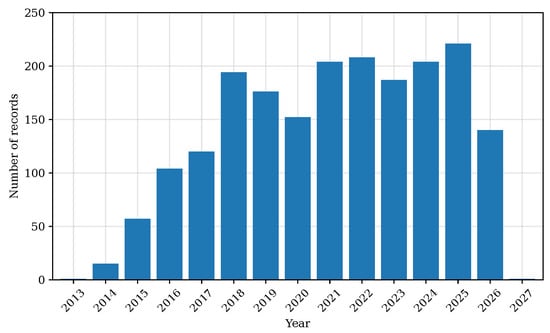
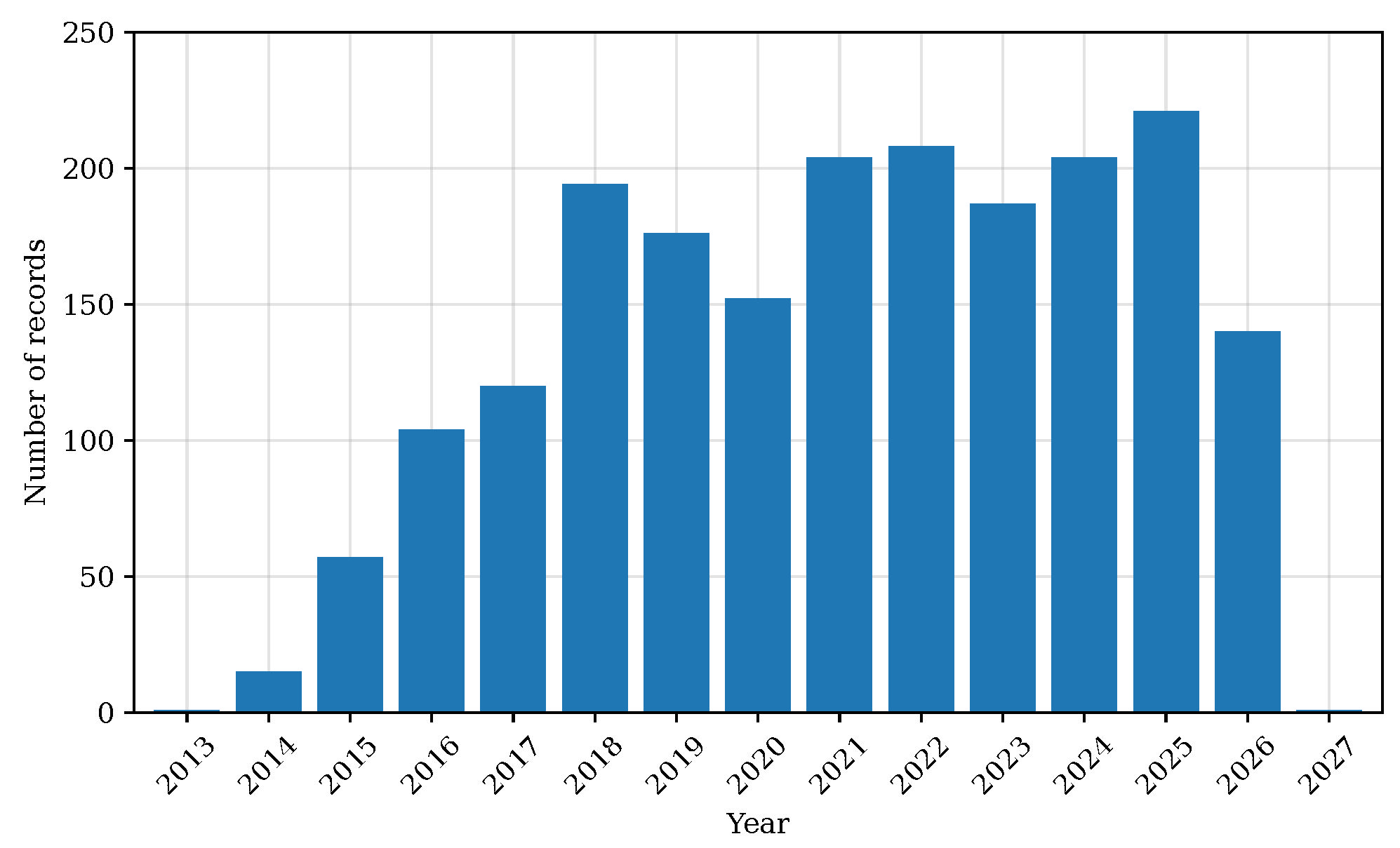
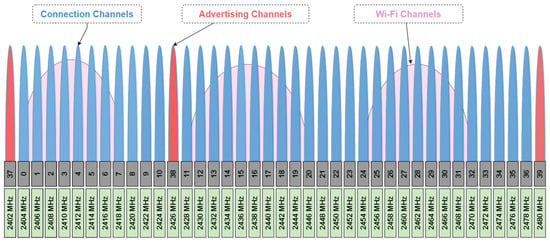
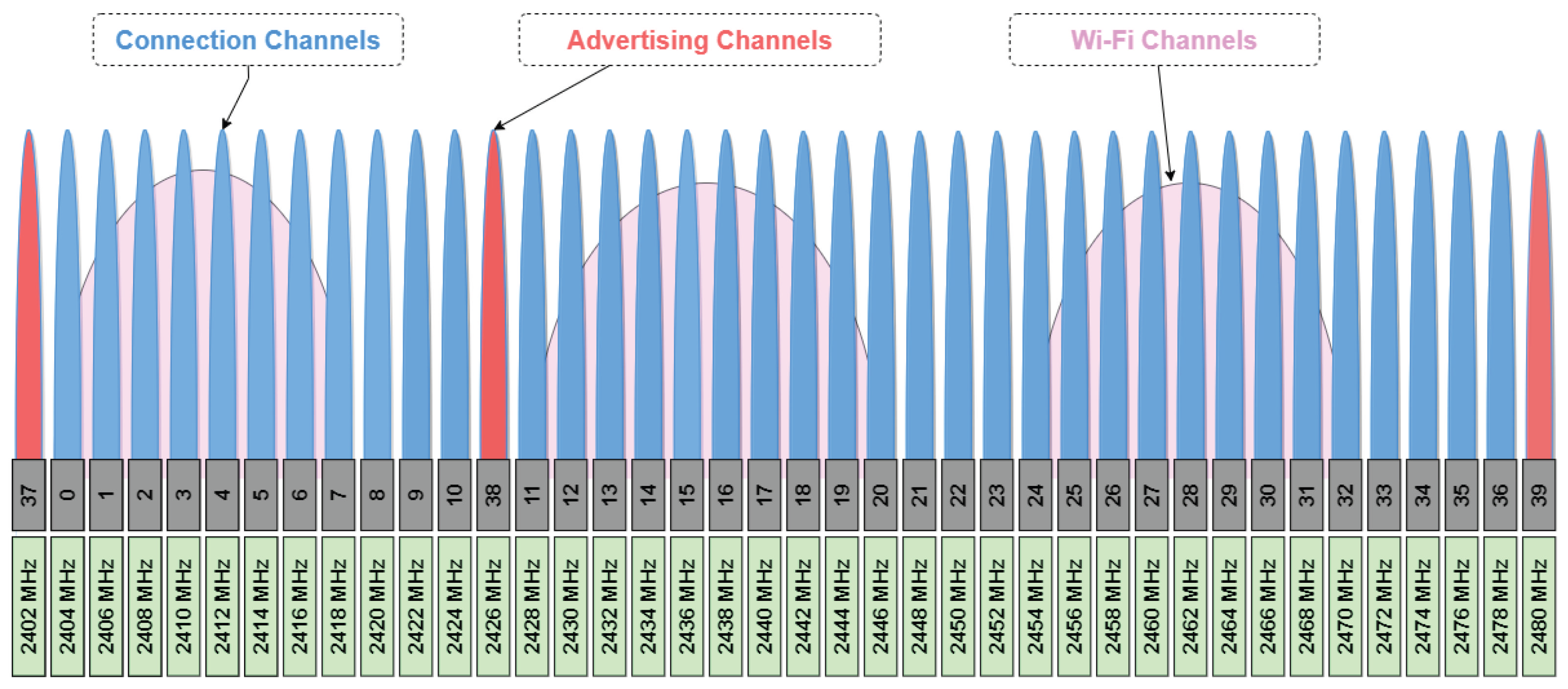

Disclaimer/Publisher’s Note: The statements, opinions and data contained in all publications are solely those of the individual author(s) and contributor(s) and not of MDPI and/or the editor(s). MDPI and/or the editor(s) disclaim responsibility for any injury to people or property resulting from any ideas, methods, instructions or products referred to in the content. |
© 2026 by the authors. Licensee MDPI, Basel, Switzerland. This article is an open access article distributed under the terms and conditions of the Creative Commons Attribution (CC BY) license.