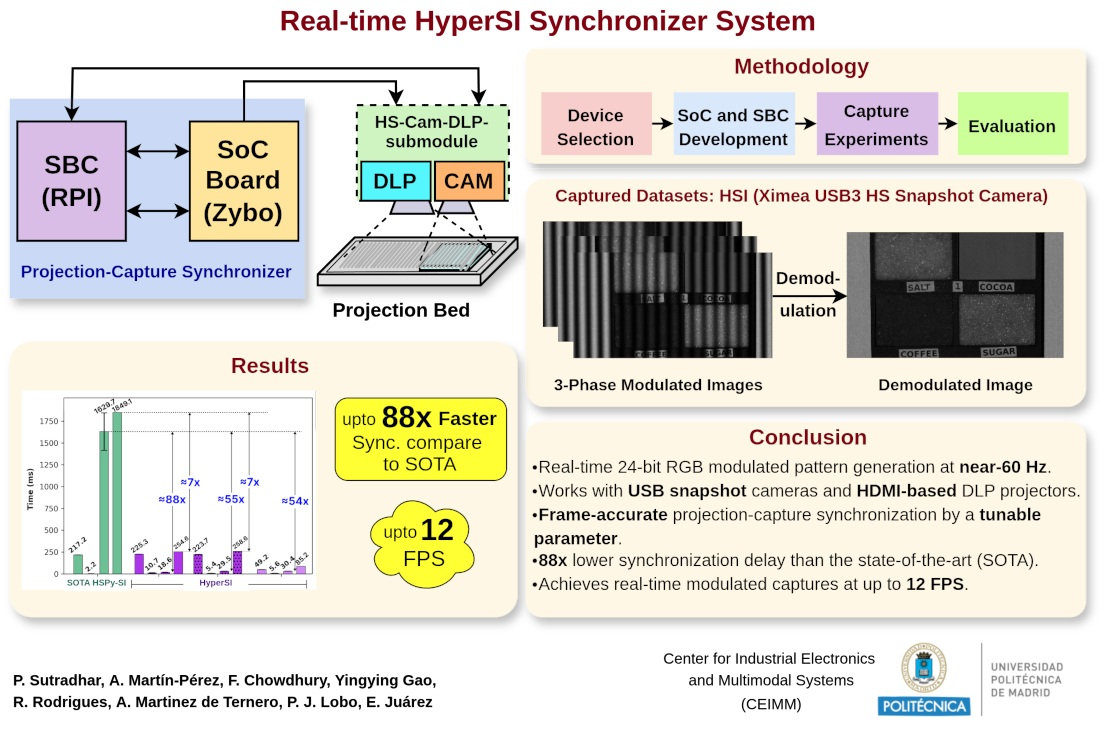
Real-Time Structural Illumination with Hyperspectral Images: A Tunable Projection–Capture Synchronizer for Three-Phase Demodulation on Embedded Heterogeneous Computing Platforms

 , , , , , , and
 Abstract
Share and Cite
Sutradhar, P.; Martín-Pérez, A.; Chowdhury, F.; Gao, Y.; Rodrigues, R.; Ternero, A.M.d.; Lobo, P.J.; Juarez, E. Real-Time Structural Illumination with Hyperspectral Images: A Tunable Projection–Capture Synchronizer for Three-Phase Demodulation on Embedded Heterogeneous Computing Platforms. Sensors 2026, 26, 4159. https://doi.org/10.3390/s26134159
Sutradhar P, Martín-Pérez A, Chowdhury F, Gao Y, Rodrigues R, Ternero AMd, Lobo PJ, Juarez E. Real-Time Structural Illumination with Hyperspectral Images: A Tunable Projection–Capture Synchronizer for Three-Phase Demodulation on Embedded Heterogeneous Computing Platforms. Sensors. 2026; 26(13):4159. https://doi.org/10.3390/s26134159
Chicago/Turabian StyleSutradhar, Pallab, Alberto Martín-Pérez, Fahima Chowdhury, Yingying Gao, Rubén Rodrigues, Alejandro Martinez de Ternero, Pedro J. Lobo, and Eduardo Juarez. 2026. "Real-Time Structural Illumination with Hyperspectral Images: A Tunable Projection–Capture Synchronizer for Three-Phase Demodulation on Embedded Heterogeneous Computing Platforms" Sensors 26, no. 13: 4159. https://doi.org/10.3390/s26134159
APA StyleSutradhar, P., Martín-Pérez, A., Chowdhury, F., Gao, Y., Rodrigues, R., Ternero, A. M. d., Lobo, P. J., & Juarez, E. (2026). Real-Time Structural Illumination with Hyperspectral Images: A Tunable Projection–Capture Synchronizer for Three-Phase Demodulation on Embedded Heterogeneous Computing Platforms. Sensors, 26(13), 4159. https://doi.org/10.3390/s26134159