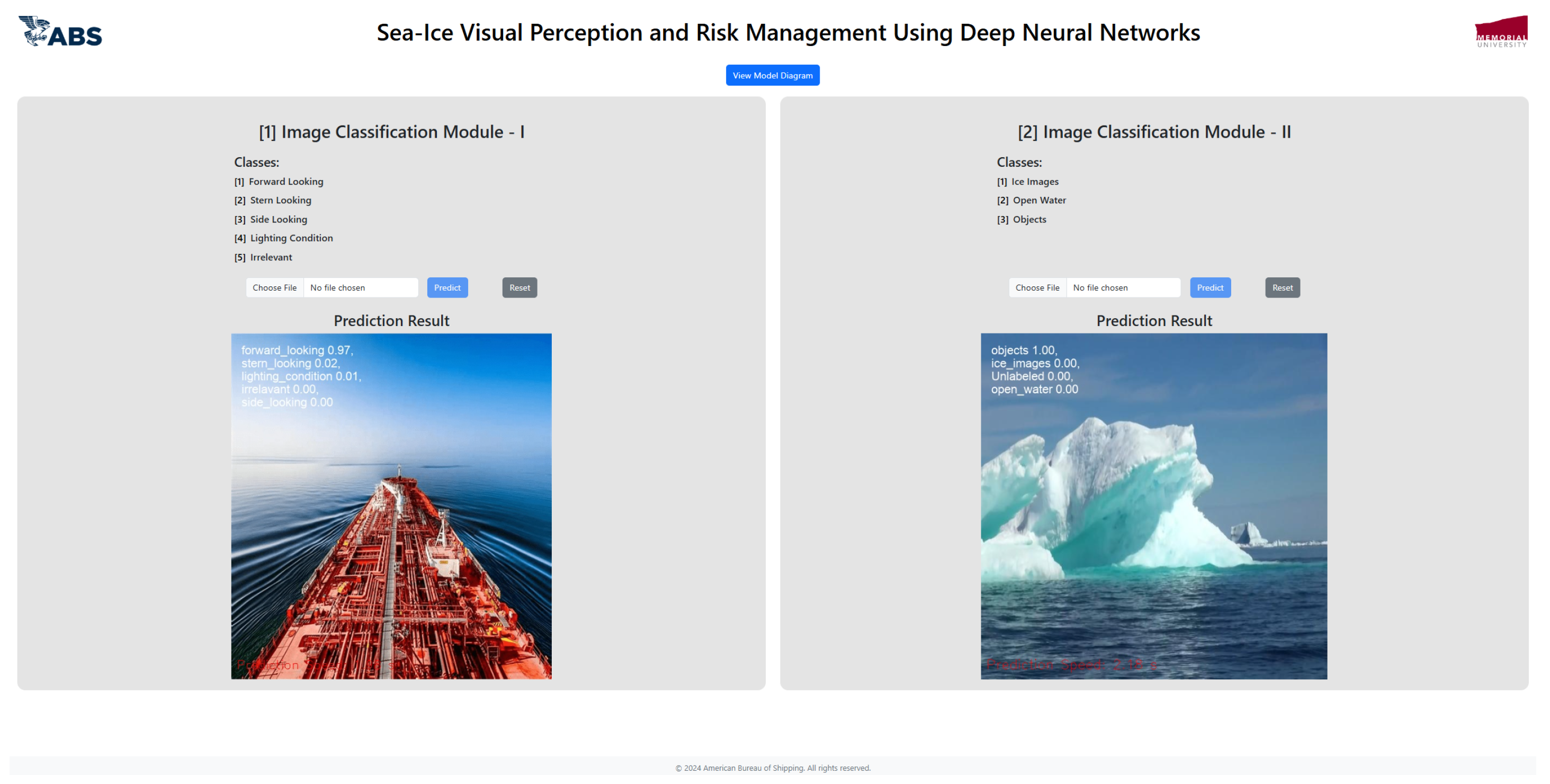
Performance Evaluation of Deep Learning Image Classification Modules in the MUN-ABSAI Ice Risk Management Architecture

Abstract
Share and Cite
Thalagala, R.G.; De Silva, O.; Oldford, D.; Molyneux, D. Performance Evaluation of Deep Learning Image Classification Modules in the MUN-ABSAI Ice Risk Management Architecture. Sensors 2025, 25, 326. https://doi.org/10.3390/s25020326
Thalagala RG, De Silva O, Oldford D, Molyneux D. Performance Evaluation of Deep Learning Image Classification Modules in the MUN-ABSAI Ice Risk Management Architecture. Sensors. 2025; 25(2):326. https://doi.org/10.3390/s25020326
Chicago/Turabian StyleThalagala, Ravindu G., Oscar De Silva, Dan Oldford, and David Molyneux. 2025. "Performance Evaluation of Deep Learning Image Classification Modules in the MUN-ABSAI Ice Risk Management Architecture" Sensors 25, no. 2: 326. https://doi.org/10.3390/s25020326
APA StyleThalagala, R. G., De Silva, O., Oldford, D., & Molyneux, D. (2025). Performance Evaluation of Deep Learning Image Classification Modules in the MUN-ABSAI Ice Risk Management Architecture. Sensors, 25(2), 326. https://doi.org/10.3390/s25020326