Understanding Malicious Accounts in Online Political Discussions: A Multilayer Network Approach


Abstract
1. Introduction
- RQ1: Which malicious accounts are the most influential accounts in the discussion networks?
- -
- RQ1.1: Which malicious accounts are the most influential accounts in Tsai’s, Han’s, and Ko’s discussion networks, respectively?
- -
- RQ1.2: Which malicious accounts are the most influential accounts in the whole network?
- -
- RQ1.3: Are the ranks of influential malicious accounts persistent across different networks?
- RQ2: Does the interaction of malicious accounts vary across different networks?
- RQ3: What is the community structure of each network?
- -
- RQ3.1: Which communities are the prominent communities in each network?
- -
- RQ3.2: Which malicious accounts are the opinion leaders of each prominent community?
- RQ4: What is the main activity of each prominent community?
- -
- RQ4.1: Which communities are the most active communities regarding the number of posted articles and the number of given comments?
- -
- RQ4.2: What are the temporal trends of comments and articles posted by each prominent community during the observation timeframe?
2. Related Work
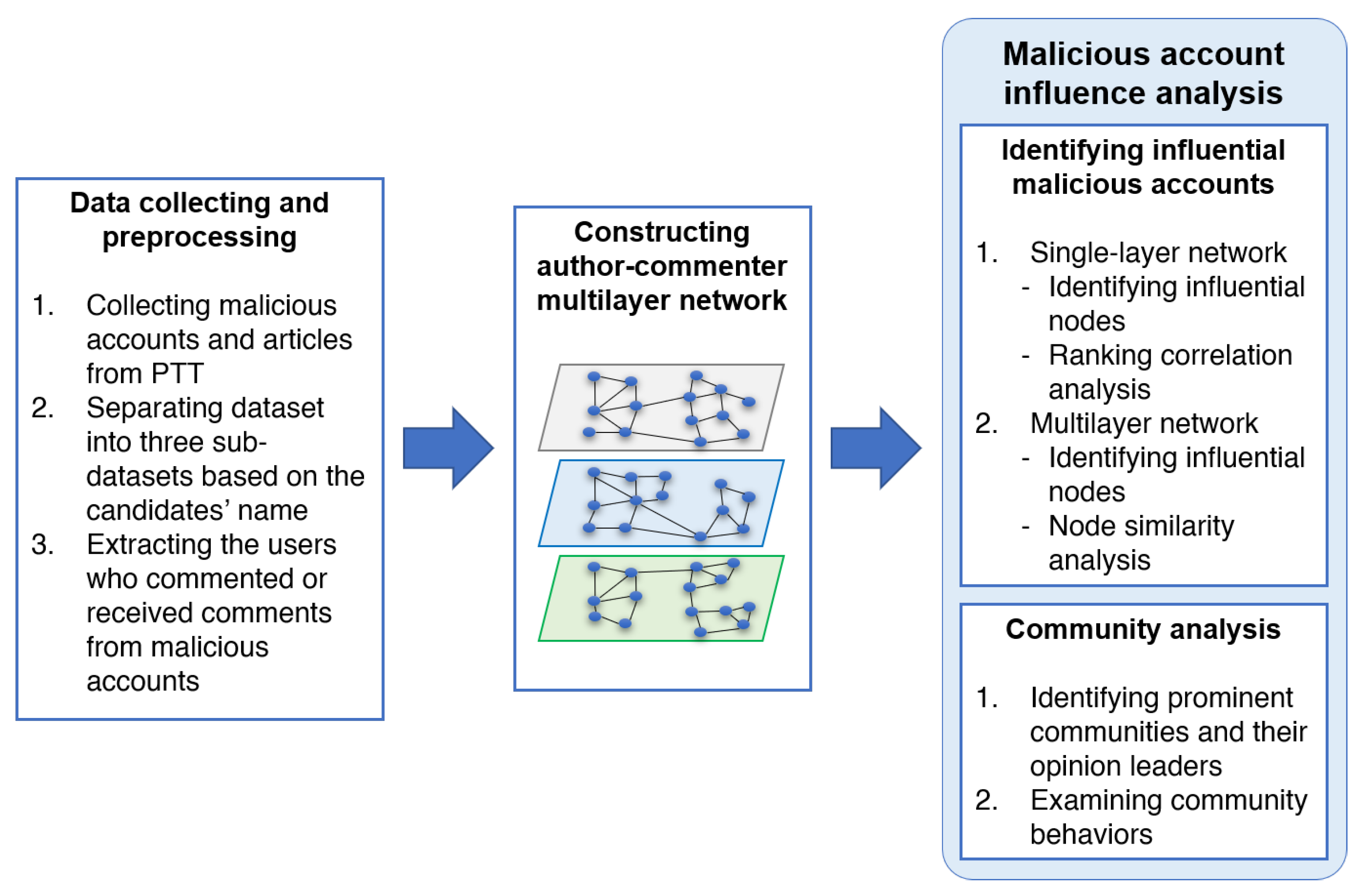
3. Proposed Approach
- We collect the dataset from PTT, the most influential discussion forum in Taiwan, and the malicious user list announced by the PTT official.
- We preprocess the collected dataset and extract the users who participated in malicious accounts’ discussions.
- We model the online political discussions as a multilayer network and identify influential nodes as well as their communities using various centrality measures.
- We conduct the experiments and analyze the experimental results from various aspects.
3.1. PTT
3.2. Data Collection
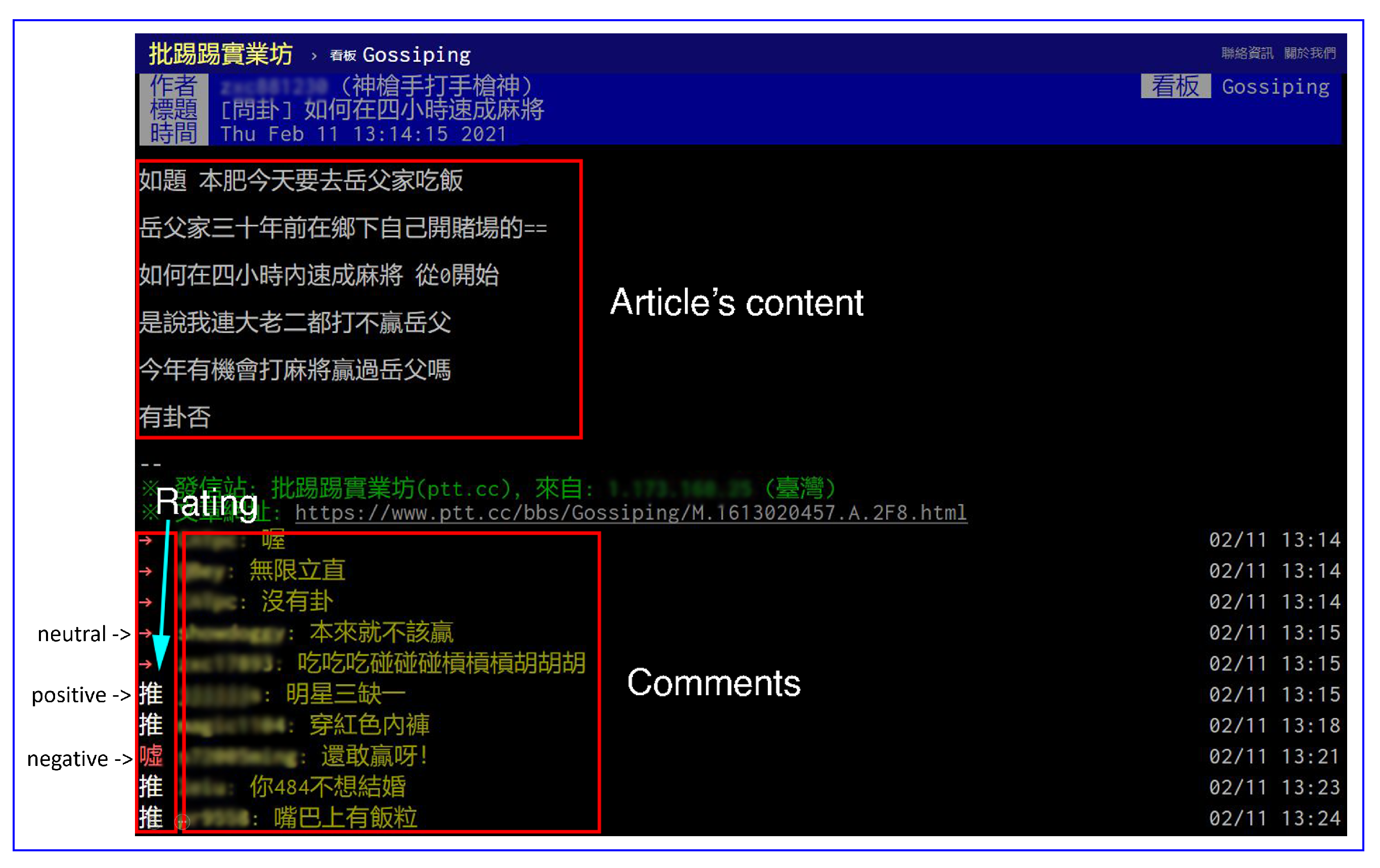
- Article metadata: Each article has its corresponding metadata, which includes the article ’s ID and the submission time.Article content: Each article has its title and the main content.Author information: Author information of an article includes the author nickname, author ID, and IP address.User comment and rating: An article may have more than one comment. Each comment contains the textual part, the user ID of the commenter, the comment timestamp, and the rating. The rating can be positive/negative/neutral rating.
3.3. Author-Commenter Multilayer Network
3.4. Influential Malicious Accounts (RQ1)
3.4.1. Identifying Influential Malicious Accounts (RQ1.1, RQ1.2)
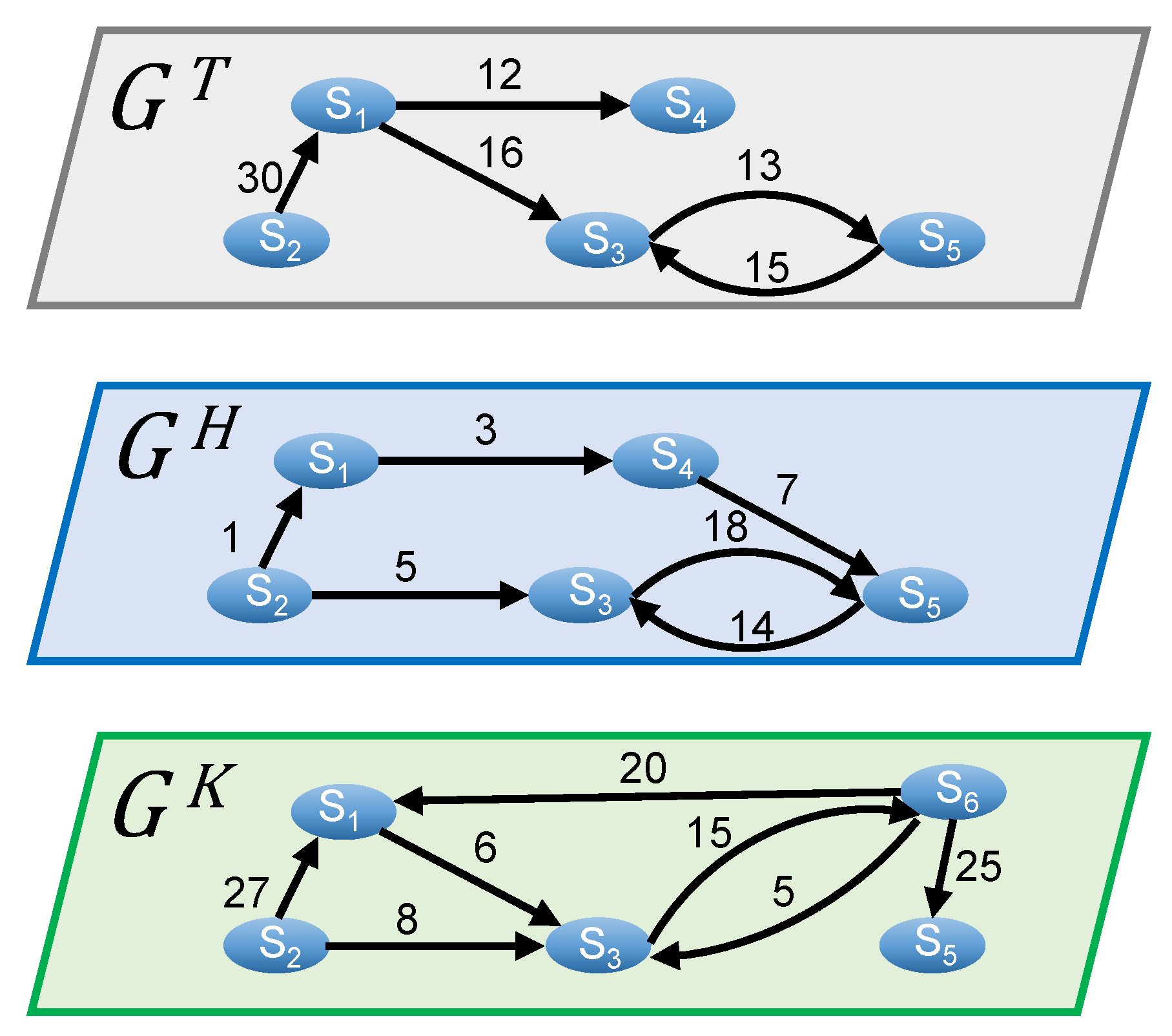
- Indegree:The indegree of node v in layer l is the number of links that point to v. Let be the in-neighbors of node v in layer l. The indegree is calculated by Equation (1).A malicious account with a high value of indegree means that its articles have received much attention from other users of the same layer. For example, as shown in Figure 3, , , , , and ; thus, the most influential malicious account in layer in terms of attracting comments from others is as it has the highest indegree in this layer.Outdegree: The outdegree of node v in layer l is the number of out-going links that point from v. Let be the out-neighbors of node v in layer l. The outdegree can be calculated using Equation (2).An active malicious account typically joins most of the conversations to influence public opinion; therefore, its outdegree is usually much higher than that of others. For example, as shown in Figure 3, , , , , and . Thus, is considered to be the most active account in layer in terms of commenting activity since it has commented on the articles of almost all other accounts.Cross-indegree: The cross-indegree of node v in a multilayer network can be defined as the number of its unique in-neighbors across the different layers of the network. The cross-indegree of node v in is defined as in Equation (3).where is a set of in-neighbors of v in layer l. In Figure 3, , , and , thus, . The cross-indegree allows us to evaluate the importance of a node through different layers of the ACMN in terms of attracting attention from other users for its published articles.Cross-outdegree: Similar to the cross-indegree, the cross-outdegree of node v in a multilayer network is the total number of its unique out-neighbors over all layers of the network. The cross-outdegree of node v in can be calculated using the following equation:where is a set of out-neighbors of v in layer l. For example, as shown in Figure 3, , , and , thus, . The cross-outdegree is a way to measure the activeness of users in terms of commenting across the different layers of the ACMN. The higher cross-outdegree the node has, the more active in commenting on articles posted by others it is.PageRank: PageRank is a well-known algorithm for ranking web pages for Google search engine [35]. The PageRank of a page makes contributions to the pages that it points to. In other words, a page receives a high rank if the pages that point to it have high ranks. In this paper, we adopted PageRank for ranking malicious accounts in a single layer as we consider that a malicious account has a high influence on the network if it receives comments from other highly influential users. The PageRank of node v in layer l of a multilayer network is computed as in Equation (5).In Equation (5), is the number of nodes in layer l, is a set of in-neighbors of v, is the outdegree of u, and d is the damping factor which is generally set as [35].Multiplex PageRank: As aforementioned, PageRank is used to find influential nodes in a single-layer network. However, it cannot be used to rank nodes in a multilayer network. Multiplex PageRank, an extension of PageRank, was proposed to rank nodes in multiplex networks [34]. In this paper, we suppose that the centrality of a malicious account in a layer influences its centrality in other layers. Therefore, additive multiplex PageRank was adopted to rank malicious accounts in the ACMN [36]. Generally, additive multiplex PageRank is similar to the original PageRank [35]; however, in additive multiplex PageRank, when calculating the PageRank centrality of a node in one layer, its PageRank centrality in other layers is considered. The additive multiplex PageRank of nodes in layer with respect to layer is calculated by adding some values to the weight of PageRank the nodes have in layer in proportion to the weight of PageRank that they have in layer . Mathematically, the additive Multiplex PageRank of node v in layer with respect to layer , denoted as , is calculated according to in Equation (6).where denotes the PageRank of node v in layer , is the average of PageRank of N nodes in layer , and d is the damping factor which is also set around 0.85.The process of calculating the PageRank of nodes in the ACMN is described as Algorithm 1.
| Algorithm 1 Calculating the PageRank of nodes in the ACMN. |
| Input: |
| Output: Multiplex PageRank of nodes in |
| 1: Calculate the largest eigenvalue of each layer. |
| 2: Arrange the layers in descending order of their eigenvalues as a larger eigenvalue indicates faster information dissemination [37]. |
| 3: Calculate the PageRank of the 1st layer using Equation (5). |
| 4: Calculate the PageRank of the 2nd layer with respect to the 1st layer using Equation (6). |
| 5: Calculate the PageRank of the 3rd layer with respect to the 2nd layer according to Equation (6). |
| 6: Return: The PageRank of the 3rd layer is the PageRank of the ACMN. |
3.4.2. Malicious Account Influence Across Layers (RQ1.3)
3.5. Node Similarity (RQ2)
3.6. Community Analysis (RQ3)
3.6.1. Community Structure
3.6.2. Prominent Community (RQ3.1)
3.6.3. Opinion Leaders of Prominent Community (RQ3.2)
3.7. Community Behavior (RQ4)
3.7.1. Thread Starting Community and Active Commenting Community (RQ4.1)
- TSC: Let denotes the number of articles posted by community c of layer l, and be the total number of articles posted by all users in layer l. The community c of layer l is labeled as the TSC using the following equation:where and are the number of nodes in community c of layer l and the total number of nodes in layer l, respectively. is the adjustment parameter; the bigger this parameter, the more active in posting articles the community is.
- ACC: Let be the number of comments posted by community c of layer l, and be the total number of comments posted by all users in layer l. The community c is labeled as the ACC according to the following expression:where and are the number of nodes in community c of layer l and the total number of nodes in layer l, respectively. is the adjustment parameter; the bigger this parameter, the more active in commenting the community is.
3.7.2. Temporal Pattern (RQ4.2)
4. Results and Discussion
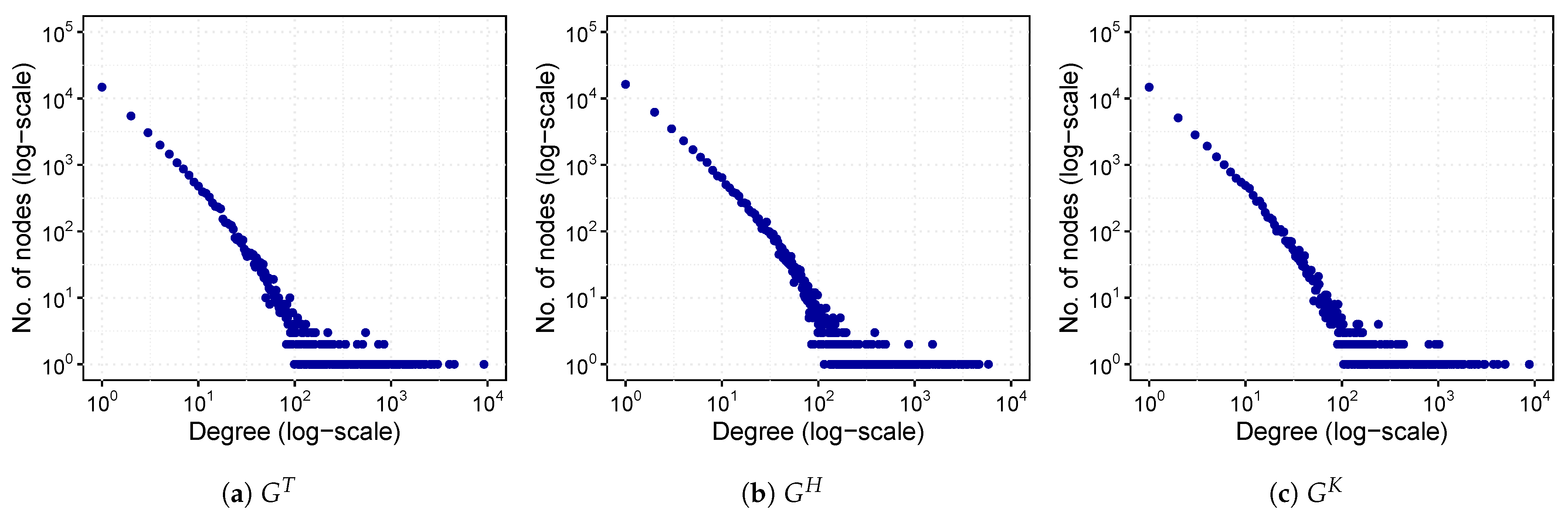
4.1. Characteristics of the ACMN
4.2. Influential Malicious Accounts (RQ1)
4.2.1. Influential Malicious Accounts of a Single-Layer (RQ1.1)
4.2.2. Influential Malicious Accounts of the ACMN (RQ1.2)
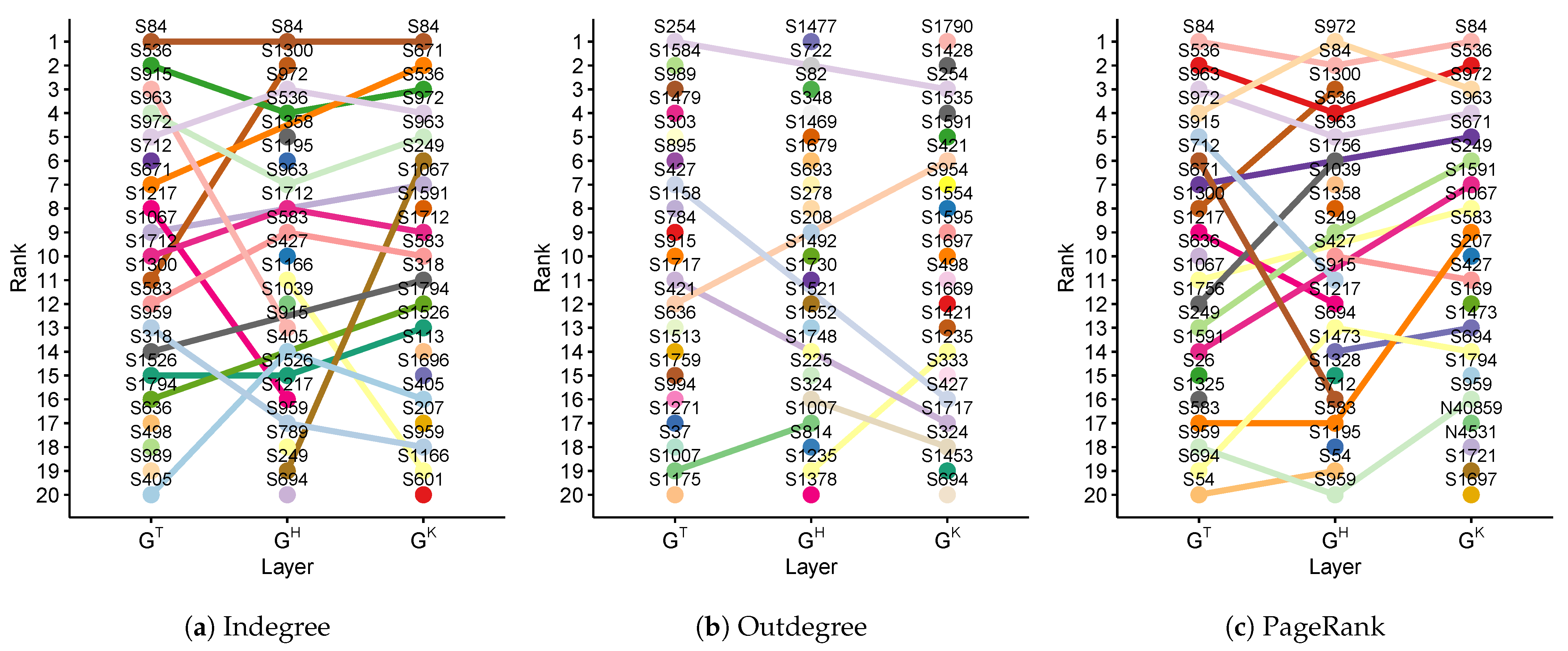
4.2.3. Malicious Account Influence Across Layers (RQ1.3)
4.3. Node Similarity (RQ2)
4.4. Community Analysis (RQ3)
4.4.1. Prominent Community (RQ3.1)
4.4.2. Opinion Leaders of Prominent Community (RQ3.2)
4.5. Community Behavior (RQ4)
4.5.1. ACC and TSC of the ACMN (RQ4.1)
4.5.2. Temporal Pattern (RQ4.2)
5. Conclusions and Future Works
- We proposed a new approach for identifying influential users on political discussion networks. In contrast to previous studies that represented an online discussion network as a single-layer network, we modeled the discussion networks as a multilayer network which helped us to investigate user behaviors across different discussion themes.
- We introduced an exploration method to examine the community structure of the discussion network that revealed some communities with unusual commenting and posting articles activities.
- We demonstrated the applicability of the proposed approach by conducting the experiments on the dataset extracted from a political discussion forum during the electoral campaign in Taiwan. According to the experimental results, our method extended the knowledge and understanding of influential malicious accounts with apparent behavior differences from others.
Author Contributions
Funding
Data Availability Statement
Conflicts of Interest
References
- Vergeer, M.; Hermans, L.; Sams, S. Online Social Networks and Micro-blogging in Political Campaigning: The Exploration of a New Campaign Tool and a New Campaign Style. Party Politics 2013, 19, 477–501. [Google Scholar] [CrossRef] [Scilit]
- Yaqub, U.; Chun, S.A.; Atluri, V.; Vaidya, J. Analysis of Political Discourse on Twitter in the Context of the 2016 US Presidential Elections. Gov. Inf. Q. 2017, 34, 613–626. [Google Scholar] [CrossRef] [Scilit]
- Badawy, A.; Ferrara, E.; Lerman, K. Analyzing the Digital Traces of Political Manipulation: The 2016 Russian Interference Twitter Campaign. In Proceedings of the 2018 IEEE/ACM International Conference on Advances in Social Networks Analysis and Mining, Barcelona, Spain, 28–31 August 2018; IEEE: Piscataway, NJ, USA, 2018; pp. 258–265. [Google Scholar] [CrossRef] [Scilit]
- Bravo, R.B.; Valle, M.E.D. Opinion Leadership in Parliamentary Twitter Networks: A Matter of Layers of Interaction? J. Inf. Technol. Polit. 2017, 14, 263–276. [Google Scholar] [CrossRef] [Scilit]
- Åkerlund, M. The Importance of Influential Users in (Re)Producing Swedish Far-Right Discourse on Twitter. Eur. J. Commun. 2020, 35, 613–628. [Google Scholar] [CrossRef] [Scilit]
- Riquelme, F.; González-Cantergiani, P. Measuring User Influence on Twitter: A Survey. Inf. Process. Manag. 2016, 52, 949–975. [Google Scholar] [CrossRef] [Scilit]
- Al-Garadi, M.A.; Varathan, K.D.; Ravana, S.D.; Ahmed, E.; Chang, V. Identifying the Influential Spreaders in Multilayer Interactions of Online Social Networks. J. Intell. Fuzzy Syst. 2016, 31, 2721–2735. [Google Scholar] [CrossRef] [Scilit]
- Bindu, P.; Thilagam, P.S.; Ahuja, D. Discovering Suspicious Behavior in Multilayer Social Networks. Comput. Hum. Behav. 2017, 73, 568–582. [Google Scholar] [CrossRef] [Scilit]
- Borondo, J.; Morales, A.; Benito, R.; Losada, J. Multiple Leaders on a Multilayer Social Media. Chaos Solitons Fractals 2015, 72, 90–98. [Google Scholar] [CrossRef] [Scilit]
- Bessi, A.; Ferrara, E. Social Bots Distort the 2016 US Presidential Election Online Discussion. First Monday 2016, 21. [Google Scholar] [CrossRef] [Scilit]
- Hagen, L.; Neely, S.; Keller, T.E.; Scharf, R.; Vasquez, F.E. Rise of the Machines? Examining the Influence of Social Bots on a Political Discussion Network. Soc. Sci. Comput. Rev. 2020. [Google Scholar] [CrossRef] [Scilit]
- Heredia, B.; Prusa, J.D.; Khoshgoftaar, T.M. The Impact of Malicious Accounts on Political Tweet Sentiment. In Proceedings of the 2018 IEEE 4th International Conference on Collaboration and Internet Computing (CIC), Philadelphia, PA, USA, 18–20 October 2018; pp. 197–202. [Google Scholar] [CrossRef] [Scilit]
- Darwish, K.; Alexandrov, D.; Nakov, P.; Mejova, Y. Seminar Users in the Arabic Twitter Sphere. In Lecture Notes in Computer Science, Proceedings of the Social Informatics, Oxford, UK, 13–15 September 2017; Ciampaglia, G.L., Mashhadi, A., Yasseri, T., Eds.; Springer International Publishing: Cham, Switzerland, 2017; pp. 91–108. [Google Scholar] [CrossRef] [Scilit]
- Ko, M.C.; Chen, H.H. Analysis of Cyber Army’s Behaviours on Web Forum for Elect Campaign. In Lecture Notes in Computer Science, Proceedings of the Information Retrieval Technology, Brisbane, QLD, Australia, 2–4 December 2015; Zuccon, G., Geva, S., Joho, H., Scholer, F., Sun, A., Zhang, P., Eds.; Springer International Publishing: Cham, Switzerland, 2015; pp. 394–399. [Google Scholar] [CrossRef] [Scilit]
- Wang, M.H.; Dai, Y.C. POSTER: How Do Suspicious Accounts Participate in Online Political Discussions? A Preliminary Study in Taiwan. In Proceedings of the 15th ACM Asia Conference on Computer and Communications Security, Taipei, Taiwan, 5–9 October 2020; Association for Computing Machinery: New York, NY, USA, 2020; pp. 886–888. [Google Scholar] [CrossRef] [Scilit]
- Chiang, C.P.; Chen, H.Y.; Tsai, T.M.; Chang, S.H.; Chen, Y.C.; Wang, S.J. Profiling Operations of Cyber Army in Manipulating Public Opinions. In Proceedings of the 2020 The 6th International Conference on Frontiers of Educational Technologies, Tokyo, Japan, 5–8 June 2020; Association for Computing Machinery: New York, NY, USA, 2020; pp. 222–225. [Google Scholar] [CrossRef] [Scilit]
- Karlsen, R. Followers Are Opinion Leaders: The Role of People in the Flow of Political Communication on and Beyond Social Networking Sites. Eur. J. Commun. 2015, 30, 301–318. [Google Scholar] [CrossRef] [Scilit]
- Weeks, B.E.; Ardèvol-Abreu, A.; Gil de Zúñiga, H. Online Influence? Social Media Use, Opinion Leadership, and Political Persuasion. Int. J. Public Opin. Res. 2015, 29, 214–239. [Google Scholar] [CrossRef] [Scilit]
- Cha, M.; Haddadi, H.; Benevenuto, F.; Gummadi, K. Measuring User Influence in Twitter: The Million Follower Fallacy. In Proceedings of the International AAAI Conference on Web and Social Media, Washington, DC, USA, 23–26 May 2010; Volume 4. [Google Scholar]
- Feng, Y. Are You Connected? Evaluating Information Cascades in Online Discussion about the #RaceTogether Campaign. Comput. Hum. Behav. 2016, 54, 43–53. [Google Scholar] [CrossRef] [Scilit]
- Adalat, M.; Niazi, M.A.; Vasilakos, A.V. Variations in Power of Opinion Leaders in Online Communication Networks. R. Soc. Open Sci. 2018, 5, 180642. [Google Scholar] [CrossRef] [Scilit]
- Lamirán-Palomares, J.M.; Baviera, T.; Baviera-Puig, A. Identifying Opinion Leaders on Twitter During Sporting Events: Lessons from a Case Study. Soc. Sci. 2019, 8, 141. [Google Scholar] [CrossRef] [Scilit]
- Tang, X.; Yang, C.C. Ranking User Influence in Healthcare Social Media. ACM Trans. Intell. Syst. Technol. 2012, 3. [Google Scholar] [CrossRef] [Scilit]
- Dubois, E.; Gaffney, D. The Multiple Facets of Influence: Identifying Political Influentials and Opinion Leaders on Twitter. Am. Behav. Sci. 2014, 58, 1260–1277. [Google Scholar] [CrossRef] [Scilit]
- Benigni, M.C.; Joseph, K.; Carley, K.M. Bot-ivistm: Assessing Information Manipulation in Social Media Using Network Analytics. In Emerging Research Challenges and Opportunities in Computational Social Network Analysis and Mining; Springer International Publishing: Cham, Switzerland, 2019; pp. 19–42. [Google Scholar] [CrossRef] [Scilit]
- Liu, Y.; Tang, M.; Zhou, T.; Do, Y. Core-Like Groups Result in Invalidation of Identifying Super-Spreader by K-Shell Decomposition. Sci. Rep. 2015, 5, 9602. [Google Scholar] [CrossRef] [Scilit]
- Al Zayer, M.; Gunes, M.H. Exploring Visual Impairment Awareness Campaigns on Twitter. Soc. Netw. Anal. Min. 2018, 8, 40. [Google Scholar] [CrossRef] [Scilit]
- Kwak, H.; Lee, C.; Park, H.; Moon, S. What is Twitter, a Social Network or a News Media? In Proceedings of the 19th International Conference on World Wide Web, Raleigh North, CA, USA, 26–30 April 2010; Association for Computing Machinery: New York, NY, USA, 2010; pp. 591–600. [Google Scholar] [CrossRef] [Scilit]
- Bibi, F.; Khan, H.U.; Iqbal, T.; Farooq, M.; Mehmood, I.; Nam, Y. Ranking authors in an academic network using social network measures. Appl. Sci. 2018, 8, 1824. [Google Scholar] [CrossRef] [Scilit]
- Jussila, J.; Huhtamäki, J.; Kärkkäinen, H.; Still, K. Information Visualization of Twitter Data for Co-Organizing Conferences. In Proceedings of the International Conference on Making Sense of Converging Media, Tampere, Finland, 1–4 October 2013; Association for Computing Machinery: New York, NY, USA, 2013; pp. 139–145. [Google Scholar] [CrossRef] [Scilit]
- Hu, Y.; Wang, S.; Ren, Y.; Choo, K.K.R. User Influence Analysis for Github Developer Social Networks. Expert Syst. Appl. 2018, 108, 108–118. [Google Scholar] [CrossRef] [Scilit]
- Desai, T.; Dhingra, V.; Shariff, A.; Shariff, A.; Lerma, E.; Singla, P.; Kachare, S.; Syed, Z.; Minhas, D.; Madanick, R.; et al. Quantifying the Twitter Influence of Third Party Commercial Entities versus Healthcare Providers in Thirteen Medical Conferences from 2011–2013. PLoS ONE 2016, 11, e0162376. [Google Scholar] [CrossRef] [Scilit]
- Bródka, P.; Kazienko, P.; MusiaÅ, K.; Skibicki, K. Analysis of Neighbourhoods in Multi-layered Dynamic Social Networks. Int. J. Comput. Intell. Syst. 2012, 5, 582–596. [Google Scholar] [CrossRef] [Scilit]
- Halu, A.; Mondragón, R.J.; Panzarasa, P.; Bianconi, G. Multiplex PageRank. PLoS ONE 2013, 8, e078293. [Google Scholar] [CrossRef] [Scilit] [PubMed]
- Brin, S.; Page, L. The Anatomy of a Large-Scale Hypertextual Web Search Engine. Comput. Networks ISDN Syst. 1998, 30, 107–117. [Google Scholar] [CrossRef] [Scilit]
- Iacovacci, J.; Bianconi, G. Extracting Information from Multiplex Networks. Chaos Interdiscip. J. Nonlinear Sci. 2016, 26, 065306. [Google Scholar] [CrossRef] [Scilit] [PubMed]
- Basaras, P.; Iosifidis, G.; Katsaros, D.; Tassiulas, L. Identifying Influential Spreaders in Complex Multilayer Networks: A Centrality Perspective. IEEE Trans. Netw. Sci. Eng. 2019, 6, 31–45. [Google Scholar] [CrossRef] [Scilit]
- Khan, H.U.; Daud, A.; Malik, T.A. MIIB: A Metric to Identify Top Influential Bloggers in a Community. PLoS ONE 2015, 10, e0138359. [Google Scholar] [CrossRef] [Scilit]
- Zhang, R.J.; Ye, F.Y. Measuring Similarity for Clarifying Layer Difference in Multiplex Ad Hoc Duplex Information Networks. J. Inf. 2020, 14, 100987. [Google Scholar] [CrossRef] [Scilit]
- Fani, H.; Bagheri, E. Community detection in social networks. Encycl. Semant. Comput. Robot. Intell. 2017, 01, 1630001. [Google Scholar] [CrossRef] [Scilit]
- Blondel, V.D.; Guillaume, J.L.; Lambiotte, R.; Lefebvre, E. Fast Unfolding of Communities in Large Networks. J. Stat. Mech. Theory Exp. 2008, 2008, P10008. [Google Scholar] [CrossRef] [Scilit]
- Wasserman, S.; Faust, K. Social Network Analysis: Methods and Applications; Structural Analysis in the Social Sciences; Cambridge University Press: Cambridge, UK, 1994. [Google Scholar] [CrossRef] [Scilit]
- Barabási, A.L.; Albert, R. Emergence of Scaling in Random Networks. Science 1999, 286, 509–512. [Google Scholar] [CrossRef] [Scilit] [PubMed]
- Clauset, A.; Shalizi, C.R.; Newman, M.E.J. Power-Law Distributions in Empirical Data. SIAM Rev. 2009, 51, 661–703. [Google Scholar] [CrossRef] [Scilit]
- Massey, F.J. The Kolmogorov-Smirnov Test for Goodness of Fit. J. Am. Stat. Assoc. 1951, 46, 68–78. [Google Scholar] [CrossRef]
- Barabási, A.L.; Bonabeau, E. Scale-Free Networks. Sci. Am. 2003, 288, 60–69. [Google Scholar] [CrossRef] [Scilit] [PubMed]
- Said, A.; Bowman, T.D.; Abbasi, R.A.; Aljohani, N.R.; Hassan, S.U.; Nawaz, R. Mining Network-Level Properties of Twitter Altmetrics Data. Scientometrics 2019, 120, 217–235. [Google Scholar] [CrossRef] [Scilit]



| Sub-Dataset | Candidate | No. of Articles | No. of Comments | No. of Authors | No. of Commenters |
|---|---|---|---|---|---|
| 1 | Tsai Ing-Wen | 2193 | 60,404 | 347 | 1365 |
| 2 | Han Kuo-Yu | 3672 | 73,671 | 435 | 1434 |
| 3 | Ko Wen-Je | 2304 | 67,996 | 348 | 1478 |
| Layer | No. of Nodes | No. of Edges | Density | Avg. Degree | ||
|---|---|---|---|---|---|---|
| Malicious Account | Normal Account | Malicious-Malicious | Malicious-Normal | |||
| 1441 | 33,694 | 6080 | 175,825 | 0.000147 | 10.355 | |
| 1493 | 40,057 | 9308 | 262,318 | 0.000157 | 13.075 | |
| 1543 | 32,404 | 4319 | 166,051 | 0.000148 | 10.037 | |
| Rank | Cross-Indegree | Cross-Outdegree | Mutiplex PageRank | |||
|---|---|---|---|---|---|---|
| ID | Score | ID | Score | ID | Score | |
| 1 | S84 | 2204 | S254 | 14,076 | S536 | 0.00570 |
| 2 | S536 | 1840 | S1790 | 9974 | S84 | 0.00553 |
| 3 | S972 | 1589 | S1584 | 6628 | S972 | 0.00513 |
| 4 | S963 | 1424 | S1535 | 6590 | S963 | 0.00452 |
| 5 | S671 | 1247 | S1477 | 6357 | S671 | 0.00387 |
| 6 | S1300 | 1144 | S989 | 6271 | S249 | 0.00363 |
| 7 | S1712 | 1096 | S1469 | 6239 | S1067 | 0.00217 |
| 8 | S583 | 1029 | S1595 | 5886 | S1591 | 0.00207 |
| 9 | S249 | 1007 | S324 | 5666 | S1473 | 0.00141 |
| 10 | S1067 | 952 | S1428 | 5649 | S427 | 0.00139 |
| 11 | S915 | 924 | S421 | 5629 | S207 | 0.00122 |
| 12 | S1526 | 848 | S1235 | 5624 | S1300 | 0.00121 |
| 13 | S318 | 810 | S1521 | 5604 | S694 | 0.00118 |
| 14 | S959 | 800 | S1007 | 5559 | S959 | 0.00117 |
| 15 | S405 | 790 | S427 | 5448 | S583 | 0.00108 |
| 16 | S1794 | 753 | S722 | 5212 | S1712 | 0.00104 |
| 17 | S1166 | 748 | S1591 | 5126 | S169 | 0.00091 |
| 18 | S1591 | 725 | S1717 | 5109 | S1697 | 0.00089 |
| 19 | S1217 | 721 | S1679 | 5034 | S915 | 0.00086 |
| 20 | S712 | 687 | S348 | 4926 | S1794 | 0.00082 |
| Layer | Indegree | Outdegree | PageRank |
|---|---|---|---|
| (, ) | 0.84 ** | 0.58 ** | 0.70 ** |
| (, ) | 0.79 ** | 0.64 ** | 0.71 ** |
| (, ) | 0.73 ** | 0.56 ** | 0.65 ** |
| ID | Indegree | Cross-Indegree | ID | Outdegree | Cross-Outdegree | ||||
|---|---|---|---|---|---|---|---|---|---|
| S84 | 0.177 | 0.242 | 0.435 | 2204 | S254 | 0.221 | 0.324 | 0.264 | 14,076 |
| S536 | 0.268 | 0.258 | 0.305 | 1840 | S1790 | 0.219 | 0.066 | 0.141 | 9974 |
| S972 | 0.253 | 0.335 | 0.290 | 1589 | S1584 | - | 0.293 | - | 6628 |
| S963 | 0.270 | 0.311 | 0.334 | 1424 | S1535 | 0.263 | 0.132 | 0.073 | 6590 |
| S671 | 0.159 | 0.129 | 0.271 | 1247 | S1477 | 0.254 | - | - | 6357 |
| S1300 | 0.156 | 0.424 | 0.156 | 1144 | S989 | 0.138 | 0.250 | 0.171 | 6271 |
| S1712 | 0.224 | 0.245 | 0.218 | 1096 | S1469 | 0.172 | 0.447 | 0.135 | 6239 |
| S583 | 0.227 | 0.211 | 0.244 | 1029 | S1595 | 0.250 | 0.364 | 0.210 | 5886 |
| S249 | 0.222 | 0.231 | 0.221 | 1007 | S324 | 0.226 | 0.384 | 0.202 | 5666 |
| S1067 | 0.104 | 0.074 | 0.192 | 952 | S1428 | 0.077 | 0.068 | 0.172 | 5649 |
| S915 | 0.107 | 0.200 | 0.087 | 924 | S421 | 0.168 | 0.194 | 0.262 | 5629 |
| S1526 | 0.218 | 0.181 | 0.219 | 848 | S1235 | 0.244 | 0.407 | 0.190 | 5624 |
| S318 | 0.189 | 0.211 | 0.120 | 810 | S1521 | 0.143 | 0.321 | 0.179 | 5604 |
| S959 | 0.146 | 0.167 | 0.100 | 800 | S1007 | 0.173 | 0.192 | 0.215 | 5559 |
| S405 | 0.222 | 0.201 | 0.200 | 790 | S427 | 0.134 | 0.184 | 0.157 | 5448 |
| S1794 | 0.187 | 0.171 | 0.233 | 753 | S722 | 0.076 | 0.307 | 0.054 | 5212 |
| S1166 | 0.162 | 0.202 | 0.195 | 748 | S1591 | 0.157 | 0.112 | 0.191 | 5126 |
| S1591 | 0.064 | 0.085 | 0.054 | 725 | S1717 | 0.130 | 0.157 | 0.157 | 5109 |
| S1217 | 0.085 | 0.113 | 0.091 | 721 | S1679 | 0.144 | 0.289 | 0.083 | 5034 |
| S712 | 0.130 | 0.144 | 0.274 | 687 | S348 | 0.145 | 0.313 | 0.048 | 4926 |
| Layer | C | No. of Users | No. of Articles | Avg. Articles/User | No. of Comments | Avg. Comments/User | ACC | TSC |
|---|---|---|---|---|---|---|---|---|
| 0 | 331 | 450 | 1.4 | 20,023 | 60.5 | • | ||
| 4 | 221 | 198 | 0.9 | 15,875 | 71.8 | • | ||
| 5 | 131 | 173 | 1.3 | 3476 | 26.5 | |||
| 6 | 261 | 1195 | 4.6 | 17,294 | 66.3 | • | • | |
| 0 | 525 | 749 | 1.4 | 32,382 | 61.7 | • | ||
| 2 | 357 | 255 | 0.7 | 14,877 | 41.7 | |||
| 6 | 303 | 2557 | 8.4 | 24,513 | 80.9 | • | • | |
| 0 | 301 | 143 | 0.5 | 8013 | 26.6 | |||
| 1 | 221 | 213 | 1.0 | 10,232 | 46.3 | |||
| 3 | 123 | 57 | 0.5 | 4080 | 33.2 | |||
| 4 | 268 | 1415 | 5.3 | 26,298 | 98.1 | • | • |
Publisher’s Note: MDPI stays neutral with regard to jurisdictional claims in published maps and institutional affiliations. |
© 2021 by the authors. Licensee MDPI, Basel, Switzerland. This article is an open access article distributed under the terms and conditions of the Creative Commons Attribution (CC BY) license (http://creativecommons.org/licenses/by/4.0/).
Share and Cite
Nguyen, N.-L.; Wang, M.-H.; Dai, Y.-C.; Dow, C.-R. Understanding Malicious Accounts in Online Political Discussions: A Multilayer Network Approach. Sensors 2021, 21, 2183. https://doi.org/10.3390/s21062183
Nguyen N-L, Wang M-H, Dai Y-C, Dow C-R. Understanding Malicious Accounts in Online Political Discussions: A Multilayer Network Approach. Sensors. 2021; 21(6):2183. https://doi.org/10.3390/s21062183
Chicago/Turabian StyleNguyen, Nhut-Lam, Ming-Hung Wang, Yu-Chen Dai, and Chyi-Ren Dow. 2021. "Understanding Malicious Accounts in Online Political Discussions: A Multilayer Network Approach" Sensors 21, no. 6: 2183. https://doi.org/10.3390/s21062183
APA StyleNguyen, N.-L., Wang, M.-H., Dai, Y.-C., & Dow, C.-R. (2021). Understanding Malicious Accounts in Online Political Discussions: A Multilayer Network Approach. Sensors, 21(6), 2183. https://doi.org/10.3390/s21062183