Article

Improved In-Flight Estimation of Inertial Biases through CDGNSS/Vision Based Cooperative Navigation


Department of Industrial Engineering, University of Naples Federico II, Piazzale Tecchio 80, 80125 Naples, Italy
*
Author to whom correspondence should be addressed.
Sensors 2021, 21(10), 3438; https://doi.org/10.3390/s21103438
Submission received: 29 April 2021 / Revised: 11 May 2021 / Accepted: 12 May 2021 / Published: 14 May 2021
(This article belongs to the Section Navigation and Positioning)

Abstract

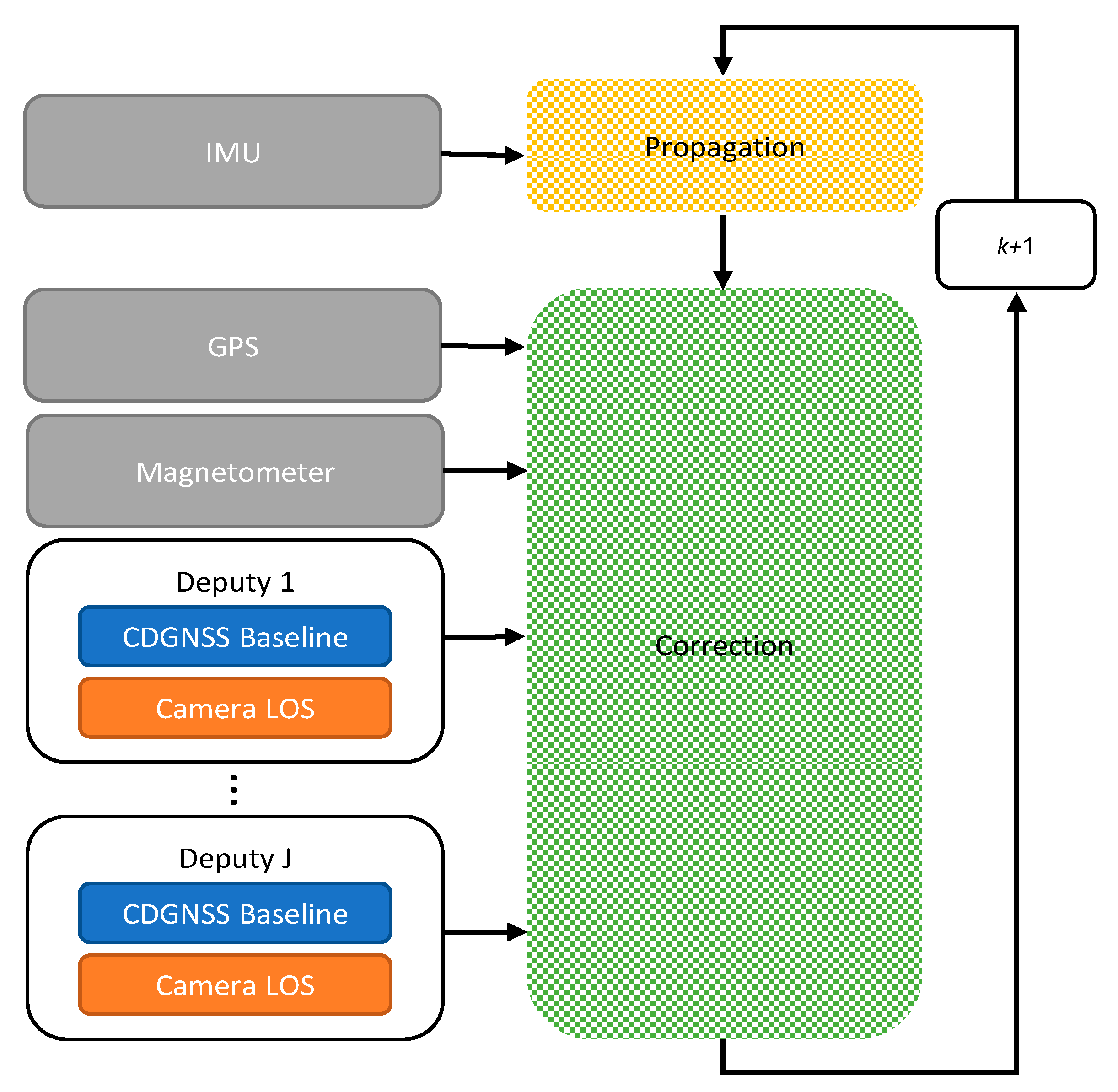
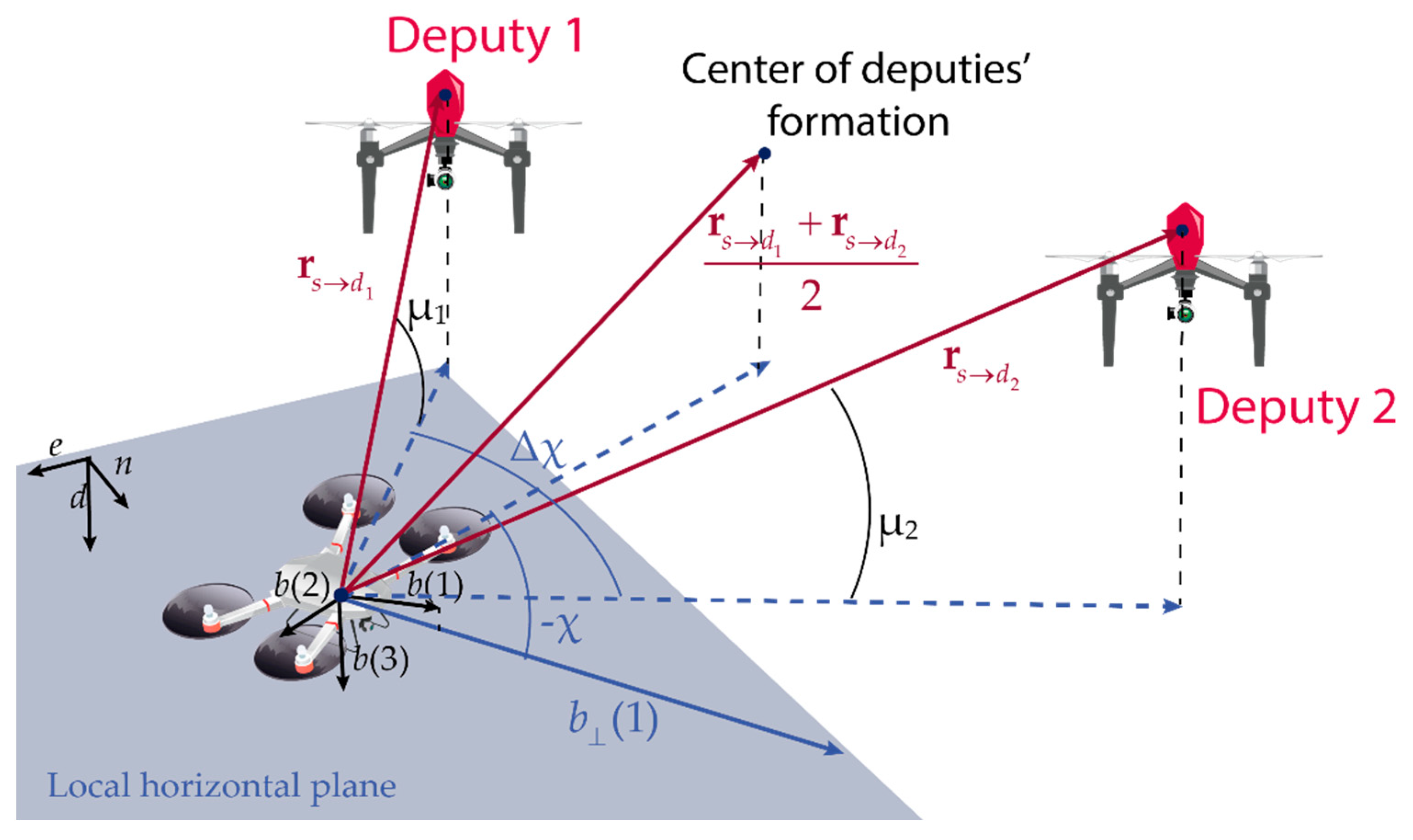
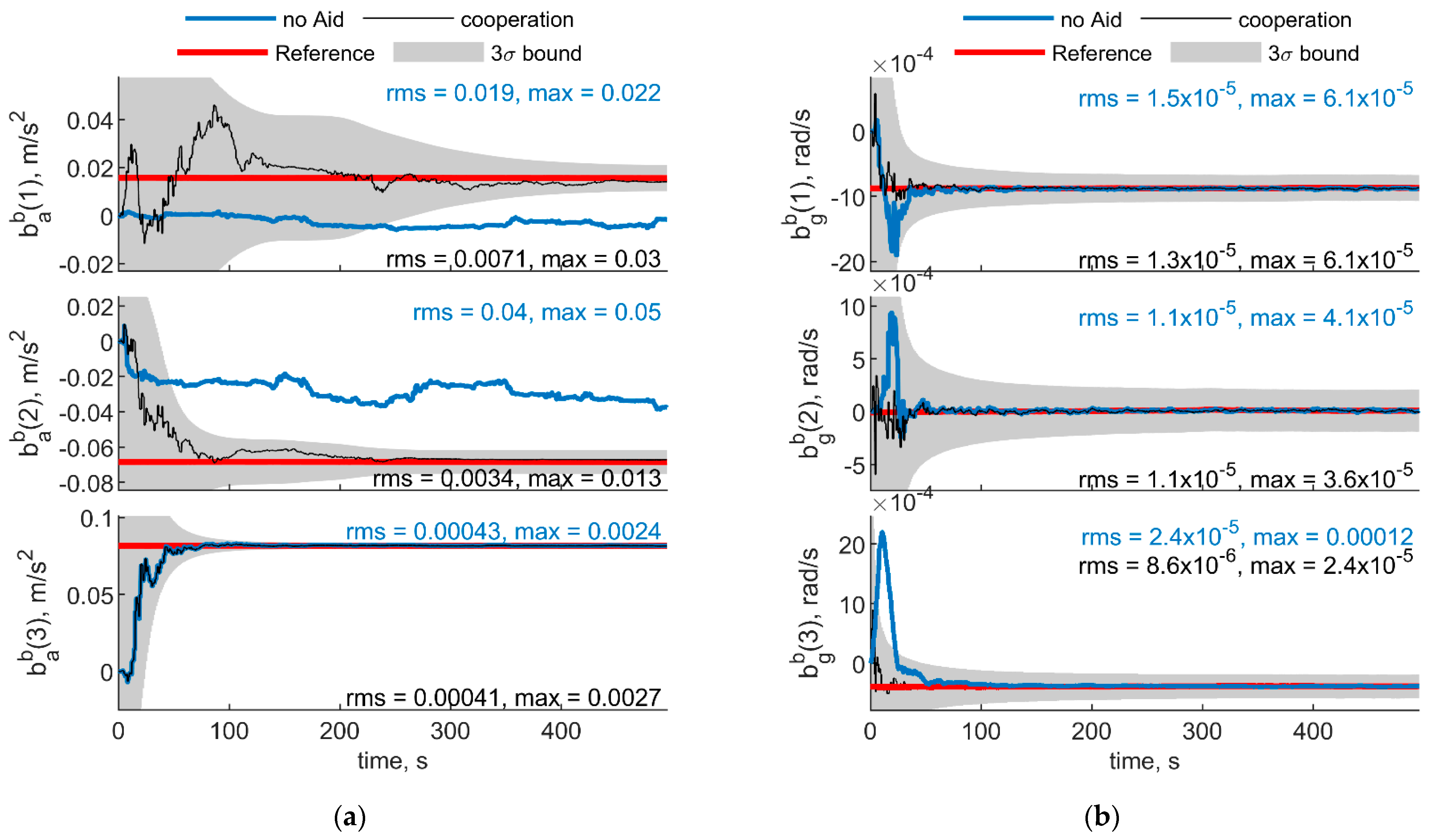
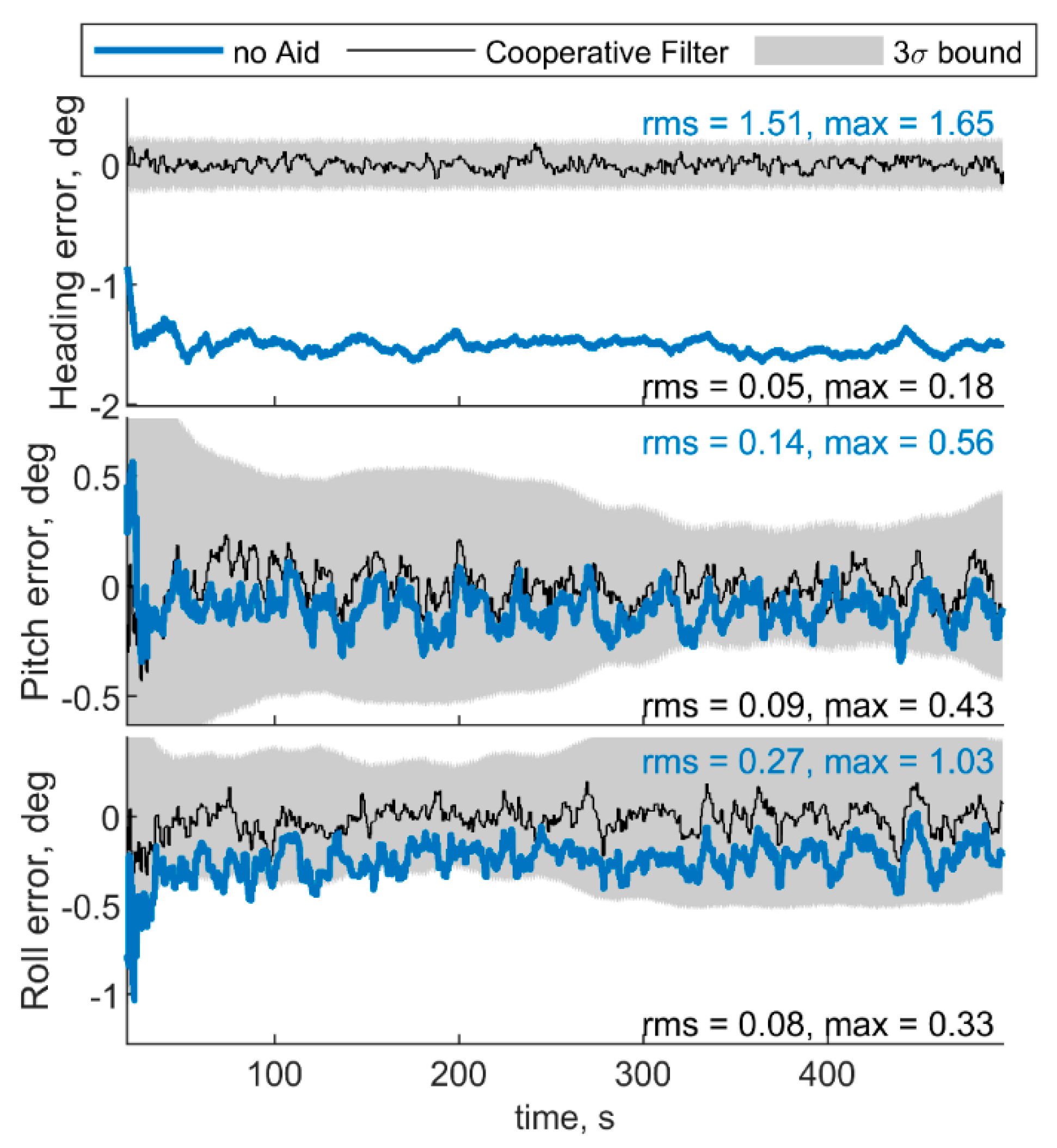
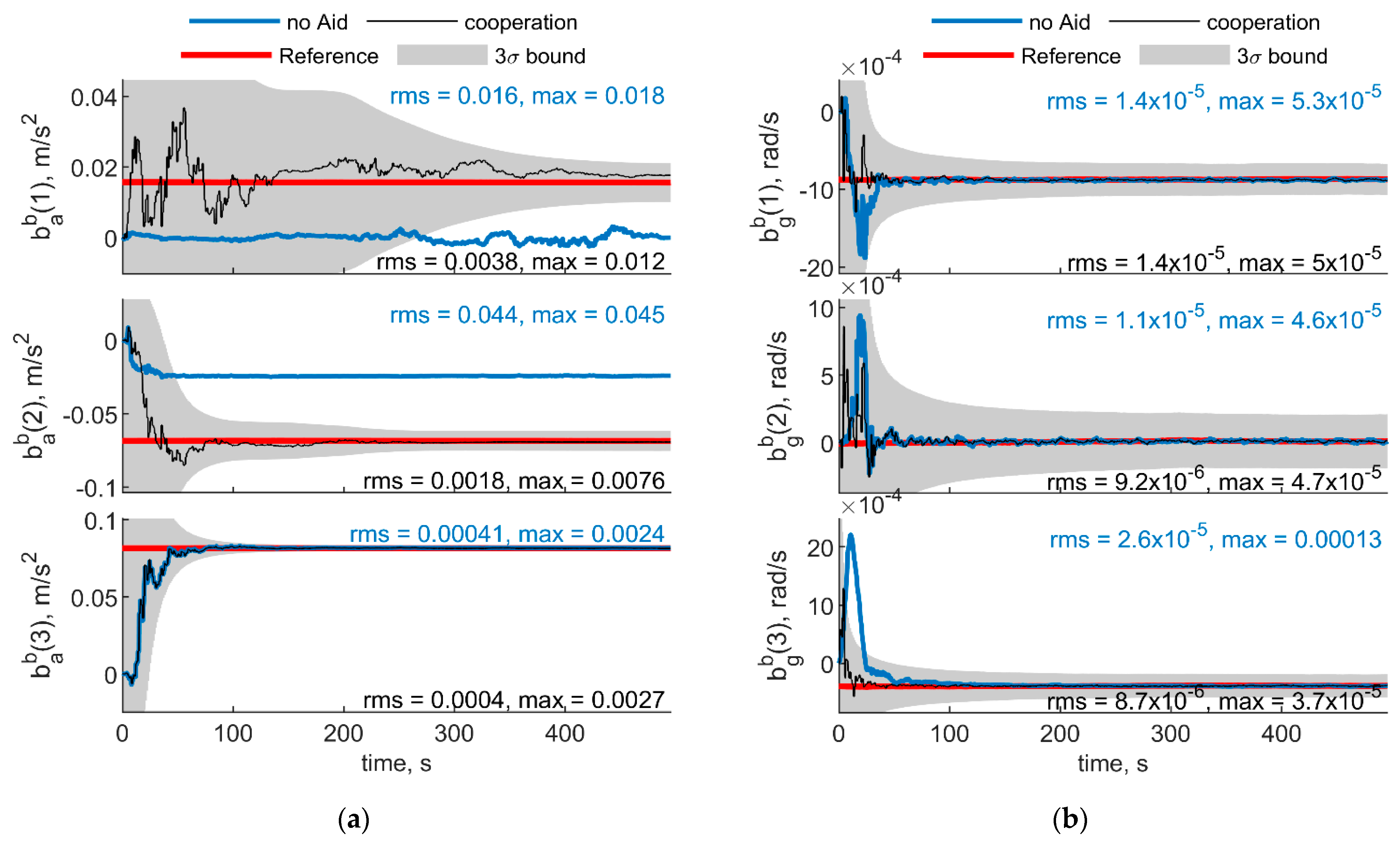
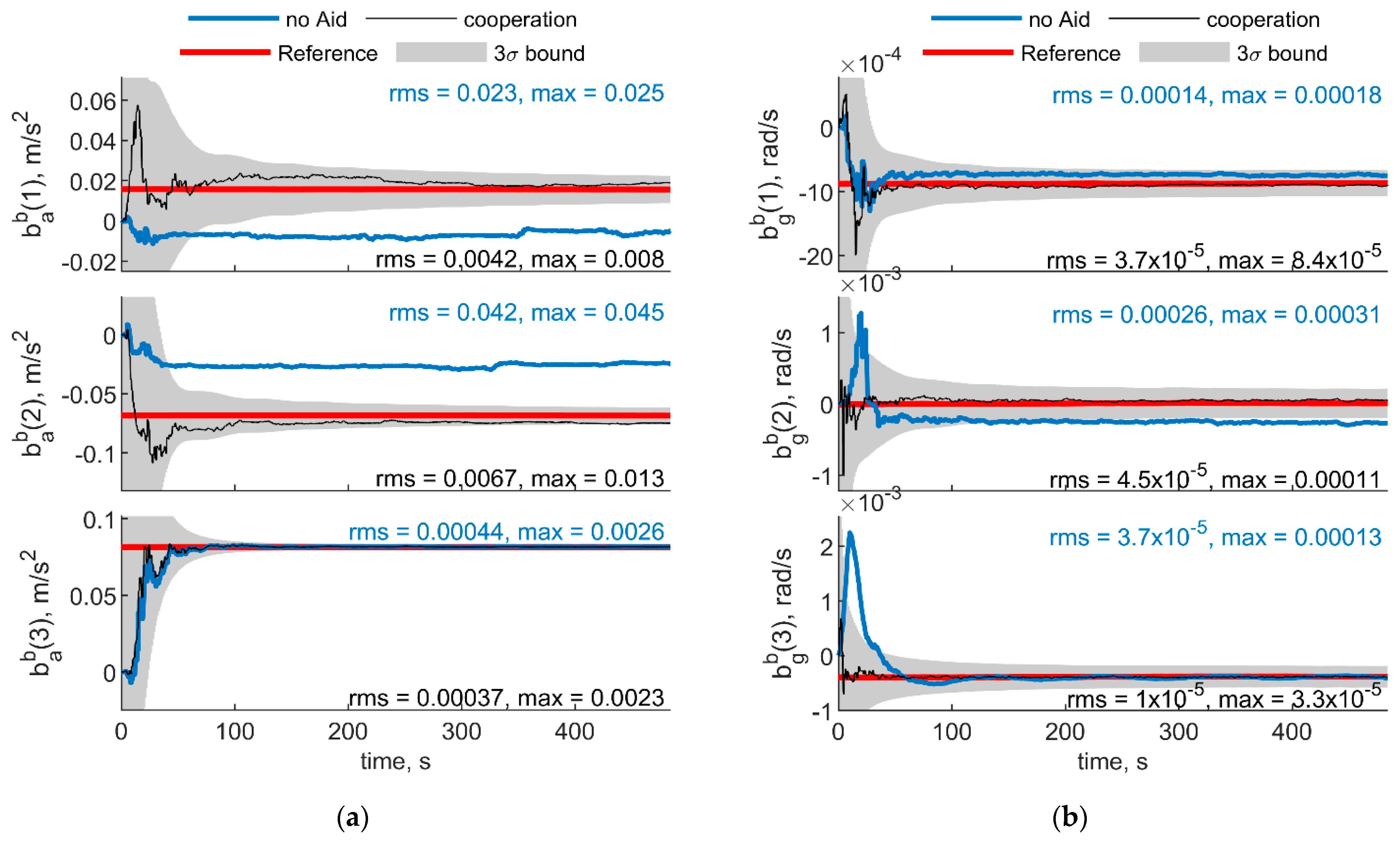
This paper discusses the exploitation of a cooperative navigation strategy for improved in-flight estimation of inertial sensors biases on board unmanned aerial vehicles. The proposed multi-vehicle technique is conceived for a “chief” Unmanned Aerial Vehicle (UAV) and relies on one or more deputy aircrafts equipped with Global Navigation Satellite System (GNSS) antennas for differential positioning which also act as features for visual tracking. Combining carrier-phase differential GNSS and visual estimates, it is possible to retrieve accurate inertial-independent attitude information, thus potentially enabling improved bias estimation. Camera and carrier-phase differential GNSS measurements are integrated within a 15 states extended Kalman filter. Exploiting an ad hoc developed numerical environment, the paper analyzes the performance of the cooperative approach for inertial biases estimation as a function of number of deputies, formation geometry and distances, and absolute and relative dynamics. It is shown that exploiting two deputies it is possible to improve biases estimation, while a single deputy can be effective if changes of relative geometry and dynamics are also considered. Experimental proofs of concept based on two multi-rotors flying in formation are presented and discussed. The proposed framework is applicable beyond the domain of small UAVs.
Keywords: cooperative navigation; extended Kalman filter; dynamic inertial bias estimation; relative motion geometry; visual tracking; carrier-phase differential GNSS cooperative navigation; extended Kalman filter; dynamic inertial bias estimation; relative motion geometry; visual tracking; carrier-phase differential GNSS