


Abstract
Environmental DNA (eDNA) metabarcoding is an efficient, non-invasive approach for surveying fish diversity in complex habitats such as large rivers. This study conducted continuous eDNA monitoring along the Jiangsu section of the Yangtze River mainstem from 2022 to 2024 to characterize spatiotemporal variations in fish community composition and diversity during the fishing ban period. To improve species identification accuracy, a regional 12S rRNA barcode database was constructed, containing 141 fish species and 1204 sequences. Genetic distance analysis revealed a clear barcode gap, with inter-specific and intra-specific distances of 0.232 and 0.007, respectively, and 65.96% of species formed well-supported monophyletic clades in the phylogenetic tree, indicating useful taxonomic resolution for many of the included taxa. Using this regional reference database, eDNA-based monitoring detected 131 fish species over three years, 72.52% of which occurred in all three years. Cypriniformes consistently dominated (54.92–67.16%), showing a relative abundance trend that first increased and then declined, with dominant species changing annually. Alpha diversity analysis showed a significant decline in Chao1 richness from 83.33 to 36.75, while the Shannon index decreased slightly from 2.69 to 2.43. In contrast, Pielou_J evenness increased from 0.62 to 0.68, suggesting a shift toward lower richness but more even abundance distribution. These patterns may reflect the combined influences of multiple environmental and anthropogenic factors during the study period. Spatially, alpha diversity in the Tai–Tong reach was significantly lower than in the Ning–Zhen and Zhen–Tai reaches (p < 0.05), and community composition in 2022 and 2024 was clearly separated from upstream reaches. However, differences among reaches disappeared in 2023, suggesting interannual variation in spatial differentiation, likely associated with flow-driven mixing and transport. Overall, this study reveals multi-year fish community dynamics in the Jiangsu section of the Yangtze River mainstem and demonstrates that a regional barcode database combined with eDNA metabarcoding provides an effective approach for large-river fish monitoring and biodiversity assessment.
1. Introduction
The Yangtze River, the longest river in Asia and the third longest in the world, represents a lifeline for China’s ecological integrity and socioeconomic development [1]. Based on physiographic characteristics, the river can be divided into three reaches: the upper reach (upstream of Yichang), the middle reach (from Yichang to Hukou), and the lower reach (from Hukou to the Yangtze River Estuary) [2,3]. The lower Yangtze River is connected to numerous lakes and, together with extensive floodplains and shoals, forms a unique large-scale composite ecosystem that provides essential nursery, feeding, and spawning habitats for fish [4]. Jiangsu Province is located in the lower reach of the Yangtze River and exhibits pronounced freshwater–brackish water interactions, resulting in a complex assemblage of aquatic biota and making it an ecologically sensitive region within the Yangtze River basin. In recent decades, intensive anthropogenic disturbances—including dam construction, water pollution, channel regulation, and riverbank hardening—have severely threatened the biodiversity of fish and other aquatic organisms in the basin [5].
To curb the decline of fishery resources, the Chinese government implemented a comprehensive fishing ban starting in January 2020 across 332 aquatic wildlife conservation areas in the Yangtze River basin, followed by a ten-year moratorium initiated in January 2021 covering the mainstem, major tributaries, and large connected lakes (excluding protected areas). However, the effectiveness of the fishing ban is influenced by multiple factors, including habitat connectivity, enforcement against illegal fishing, and integrated watershed management [6]. In this context, establishing efficient and sustainable fish resource monitoring approaches is essential for evaluating the effectiveness of the fishing ban and supporting basin-scale ecological management.
Traditional fish biodiversity monitoring relies primarily on hydroacoustic surveys, electrofishing, netting, and trapping to obtain biological samples. Species identification is subsequently conducted based on morphological characteristics, and fish abundance and biomass are assessed through individual counts and weight measurements [7,8]. Environmental DNA (eDNA) metabarcoding offers notable advantages, including non-invasiveness, minimal disturbance, and high sensitivity. In recent years, it has been widely applied across riverine, lacustrine, and marine ecosystems and has demonstrated strong potential for species detection and community diversity assessment [9,10,11]. Consequently, eDNA has been recognized as a powerful tool for large-scale and long-term ecological monitoring. Nevertheless, the performance of eDNA metabarcoding is highly dependent on the accuracy and completeness of reference databases [12]. Currently, most fish eDNA studies rely on public databases such as NCBI, BOLD, MitoFish, and FISH-BOL for taxonomic annotation. However, limitations including uneven sequence quality, data redundancy, and insufficient regional species coverage may lead to misidentification or species omission. Under these circumstances, a region-specific barcode reference database covering local fish diversity is essential for improving the accuracy and stability of eDNA-based monitoring. In addition, rigorous quality control throughout field sampling and laboratory procedures is required to minimize false positives or false negatives resulting from DNA degradation and contamination.
In the Jiangsu section of the Yangtze River mainstem, numerous studies based on conventional net surveys have investigated fish taxonomy, species composition, and diversity patterns. In contrast, eDNA-based monitoring studies remain relatively limited. Li et al. [13] applied eDNA techniques to analyze fish species composition and diversity in the Nanjing reach of the Yangtze River between June and August 2023. Wang et al. [14] surveyed the diversity of cultured and non-native fish across 112 rivers, lakes, and reservoirs in Jiangsu Province using eDNA methods. Lyu et al. [15] integrated eDNA techniques with bottom trawl surveys to assess species composition and diversity in the Yangtze estuary and adjacent waters in 2023. Overall, existing eDNA-based studies have largely focused on localized river sections or estuarine areas and are primarily limited to single-year or short-term investigations. Systematic, multi-year studies covering the Jiangsu section of the Yangtze River mainstem remain lacking, thereby constraining a comprehensive understanding of fish community structure and its interannual variation in this region.
Against this background, the present study focused on the Jiangsu section of the Yangtze River mainstem. A 12S rRNA reference database covering the regional fish fauna was first constructed, followed by three consecutive years (2022–2024) of eDNA-based monitoring. Fish species composition, community structure, and diversity dynamics were systematically analyzed to address the lack of long-term, large-scale eDNA monitoring along this river section. The findings aim to provide scientific evidence and methodological support for basin-scale fish resource monitoring and ecological management.
2. Materials and Methods
2.1. Sampling Site Design and Sample Collection
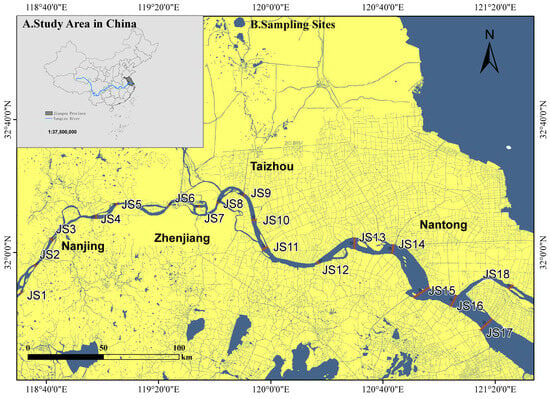
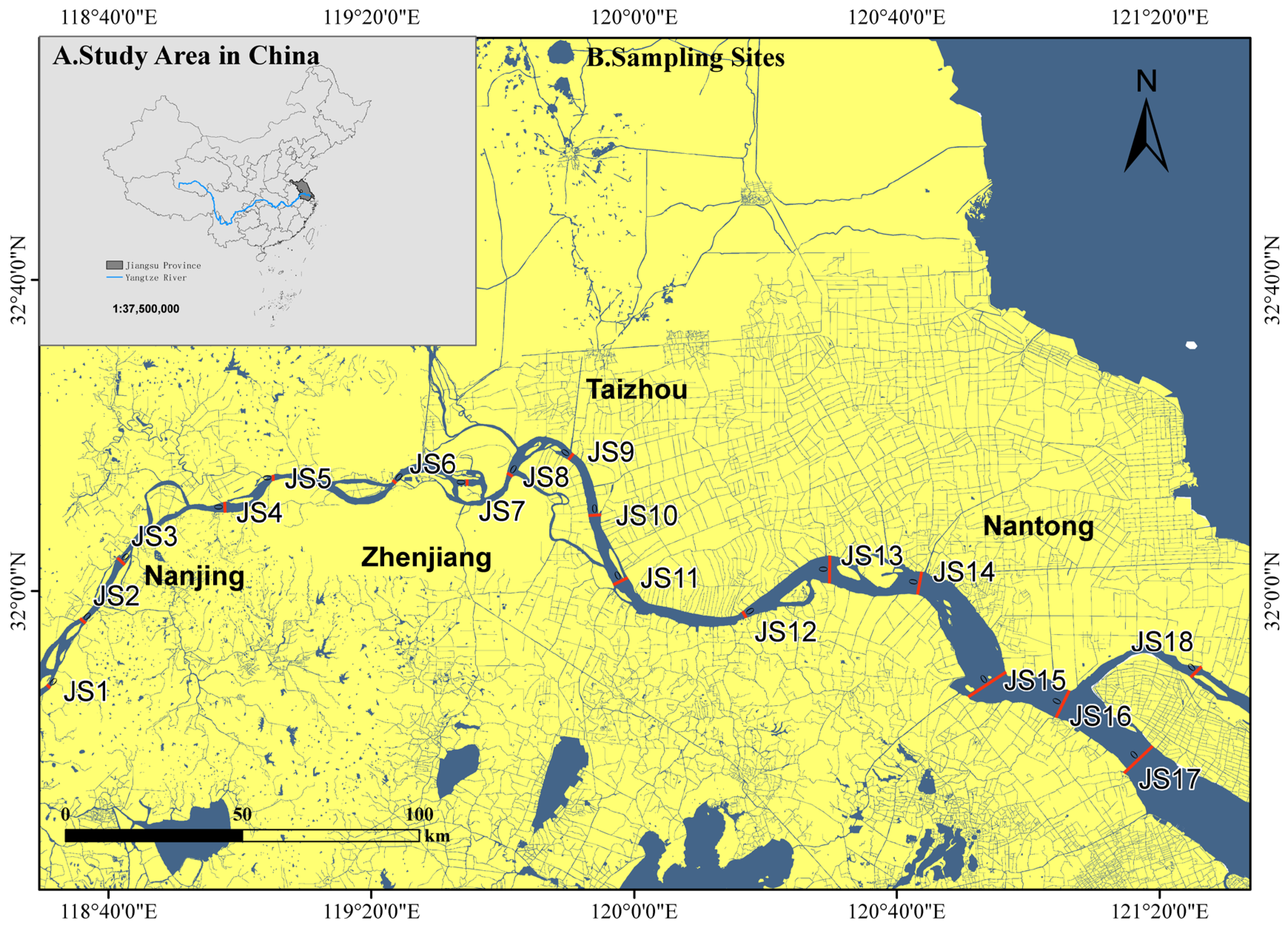
A total of 18 eDNA sampling transects (JS1–JS18) were established along the Jiangsu section of the Yangtze River mainstem, China (Figure 1). eDNA samples were collected during the low-flow season on 8–9 December 2022, 30–31 October 2023, and 21–22 October 2024. Although all surveys were conducted during the low-flow season, the sampling dates differed among years by approximately 1–1.5 months, which may introduce some seasonal variation into interannual comparisons. At each monitoring transect, surface-layer water samples were collected at approximately 0.5 m below the water surface from the left bank, right bank, and mid-channel using a water sampler. Equal-volume subsamples from the three positions were thoroughly homogenized to generate one composite water sample for each transect. Two litres of the homogenized water were transferred to a sterile sampling bag, stored at 4 °C, and filtered within 6 h of collection. For each transect, the composite water sample was divided into six filtration replicates. Water samples were filtered using a glass vacuum filtration apparatus equipped with mixed cellulose ester membranes (45 mm diameter, 0.45 μm pore size; MF-Millipore, Burlington, MA, USA). After filtration, membranes were transferred into sterile centrifuge tubes containing absolute ethanol and stored at −20 °C until DNA extraction. All sampling containers and filtration apparatus were sterilized with 10% bleach solution prior to use and thoroughly rinsed with double-distilled water. Six field blanks were included in each sampling campaign to monitor potential contamination. For each blank, 2 L of sterile water was placed into a sterile sampling bag in the field and subsequently processed in parallel with the environmental samples through filtration, DNA extraction, PCR amplification, library preparation, and sequencing. Potential contaminant OTUs/ASVs were identified by prevalence-based comparison of environmental samples and field blanks and removed before downstream analyses. OTUs/ASVs with fewer than five reads were subsequently filtered as low-abundance noise.
Figure 1.
Locations of eDNA monitoring sites in the Jiangsu section of the Yangtze River mainstem. (A) Location of the study area within China. (B) Spatial distribution of sampling sites (JS1–JS18) along the mainstem of the Yangtze River from Nanjing to Nantong.
2.2. eDNA Extraction, PCR Amplification, and High-Throughput Sequencing
The preserved filter membranes were transported to Shanghai BIOZERON Co., Ltd (Shanghai, China). for eDNA extraction, PCR amplification, and high-throughput sequencing. Total DNA was extracted from the filters using an Omega Bio-tek DNA extraction kit according to the manufacturer’s instructions (Omega Bio-tek, Norcross, GA, USA), and DNA quality was assessed using a Qubit 3.0 fluorometer and 1% agarose gel electrophoresis. PCR amplification was performed using the universal freshwater fish 12S primers Tele02: Tele02-F (5′-AAACTCGTGCCAGCCACC-3′) and Tele02-R (5′-GGGTATCTAATCCCAGTTTG-3′). The PCR reaction was carried out in a total volume of 20 μL, containing 4 μL of 5× FastPfu Buffer, 2 μL of 2.5 mM dNTPs, 0.8 μL of forward primer (5 μM), 0.8 μL of reverse primer (5 μM), 0.4 μL of FastPfu Polymerase, 10 ng of template DNA, and nuclease-free water to a final volume of 20 μL. The thermal cycling program consisted of an initial denaturation at 95 °C for 2 min, followed by 25 cycles of denaturation at 95 °C for 30 s, annealing at 55 °C for 30 s, and extension at 72 °C for 30 s, with a final extension at 72 °C for 5 min. Each sample was amplified in triplicate PCR reactions.
PCR products were verified using 2% agarose gel electrophoresis, followed by gel excision and purification using the AxyPrep DNA Gel Extraction Kit (Axygen Biosciences, Union City, CA, USA) according to the manufacturer’s instructions. Purified amplicons were quantified using a Qubit 3.0 fluorometer (Invitrogen, Carlsbad, CA, USA).
Each sample was amplified in the first-round PCR using Tele02 primers carrying a unique combination of dual-end sample barcodes. Up to 24 uniquely barcoded amplicons were pooled in equimolar amounts to form one amplicon pool. Each year, the 108 environmental samples together with six procedural blanks were distributed among five amplicon pools (four pools containing 24 samples and one pool containing 18 samples). Each amplicon pool was subsequently subjected to a second-round PCR, during which a library-specific index was introduced, resulting in five indexed libraries. The indexed libraries were then purified, quantified, normalized, and sequenced on the Illumina MiSeq platform using paired-end sequencing (2 × 250 bp) at Shanghai BIOZERON Co., Ltd., generating raw sequencing data for subsequent bioinformatics analyses.
2.3. Reference Database Construction
In this study, a comprehensive fish species list for the Jiangsu section of the Yangtze River mainstem was compiled based on Fishes of Yangtze River [16], supplemented with long-term net survey data (2017–2021) from the Freshwater Fisheries Research Center, Chinese Academy of Fishery Sciences [17]. A total of 156 fish species were systematically cataloged.
Latin scientific names (including species and subspecies) were standardized and deduplicated. The curated species list was then matched at the species level against two mitochondrial sequence repositories—MitoFish (v4.01) and a proprietary fish database maintained by Shanghai BIOZERON Co., Ltd. Available sequences were merged, and redundant or duplicate records were removed. For unmatched taxa, Latin names were further corrected and re-searched; species for which no corresponding sequences could be obtained were excluded. Ultimately, 141 fish species were retained for database construction.
Sequence data corresponding to the successfully matched sequence IDs were batch retrieved, followed by systematic curation and taxonomic validation. Hierarchical taxonomic annotations—including Latin names and classifications at the phylum, class, order, family, genus, and species levels—were standardized and integrated. All procedures were implemented using custom Perl scripts.
Finally, a local BLAST reference database was constructed based on the curated sequence dataset. Indexing was performed using the makeblastdb program in BLAST v2.15 (makeblastdb -in jiangsu-fish.fa -dbtype nucl), which served as the reference for subsequent taxonomic annotation and sequence alignment of eDNA reads. The accession numbers (or internal sequence identifiers for proprietary records) and corresponding species names of all reference sequences included in the regional 12S rRNA database are provided in Supplementary Table S1. Reference sequences spanning the Tele02 target region were compared using a custom Python script (Python 3.13.5). Sequences with 100% identity across the target region were considered the same haplotype, and haplotypes shared by different species were defined as interspecific shared haplotypes.
2.4. Data Processing and Sequence Alignment
Raw sequencing data (FASTQ format) were first demultiplexed based on sample-specific barcode sequences using custom Perl scripts. Quality control and filtering were performed according to the following criteria: for 250 bp raw reads, quality trimming was conducted using a 10 bp sliding window, and sequences were truncated when the average quality score within the window dropped below Q20; reads shorter than 50 bp after trimming were discarded. Barcodes were required to match exactly, while up to two mismatches were allowed in primer regions. Sequences containing ambiguous bases (N) were removed. Only reads with an overlap length greater than 10 bp were retained for merging, and reads that could not be successfully assembled were excluded.
Denoising was performed using the dada2 algorithm to generate high-quality amplicon sequence variants (ASVs). The denoised sequences were subsequently clustered into operational taxonomic units (OTUs) at a 97% sequence similarity threshold. This additional clustering step was applied to reduce over-splitting caused by fine-scale sequence variation and to generate an OTU-based dataset that facilitates comparison with conventional OTU-based studies. Representative sequences of the resulting OTUs were then aligned against the locally constructed 12S rRNA reference database for taxonomic annotation using the UCLUST algorithm, with a classification confidence threshold of 0.80. Species-level assignments were retained only when the classification confidence score at the species level was ≥0.80; otherwise, sequences were conservatively assigned to the genus level or reported as unassigned. An OTU abundance table was subsequently generated for downstream analyses.
2.5. Data Analysis
Genetic distances were calculated using the Kimura two-parameter (K2P) model implemented in MEGA version 11.0, including both interspecific and intraspecific genetic distances. Frequency distribution histograms of genetic distances were generated based on comparisons between intra- and interspecific divergence. A phylogenetic tree based on the fish 12S rRNA gene was constructed using the Neighbor-Joining (NJ) method. Node support was assessed using bootstrap analysis with 1000 replicates to evaluate the reliability of phylogenetic relationships.
Fish species sequence abundance data from each sampling site were used for downstream analyses. Data preprocessing was conducted in Excel 2021, while statistical analyses and visualization were performed in R (version 4.2.2). Alpha diversity indices, including the Chao1 index, Shannon–Wiener index, and Pielou_J evenness index, were calculated using the vegan package. Bray–Curtis dissimilarity among species was computed using the vegdist function in the vegan package.
Interannual differences in alpha diversity were assessed using the Friedman test, followed by pairwise Wilcoxon signed-rank tests with Benjamini–Hochberg correction when significant. Spatial differences among river reaches were tested using the Kruskal–Wallis test, followed by pairwise Wilcoxon rank-sum tests with the same correction. Principal coordinates analysis (PCoA) based on Bray–Curtis dissimilarities was used to visualize community variation, and permutational multivariate analysis of variance (PERMANOVA) was performed to test for differences in fish community structure among river reaches. Homogeneity of multivariate dispersion was assessed using PERMDISP, implemented with the betadisper function in the vegan package, with significance evaluated by 999 permutations. In addition, GraphPad Prism 8.0.2 was used to generate figures illustrating taxonomic composition at the order level and the composition of dominant fish species in the Jiangsu section of the Yangtze River.
3. Results
3.1. Construction and Evaluation of the Barcode Reference Database
To ensure accurate taxonomic annotation of environmental DNA metabarcoding data, a regional fish 12S rRNA reference database was constructed. The database comprised 1204 sequences representing 141 fish species distributed across 19 orders, 36 families, and 96 genera in the Jiangsu section of the Yangtze River mainstem.
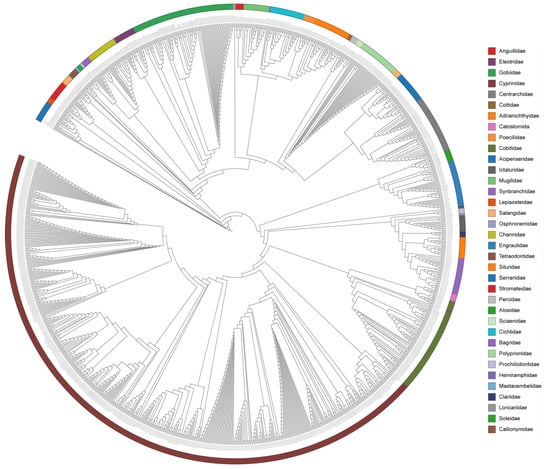
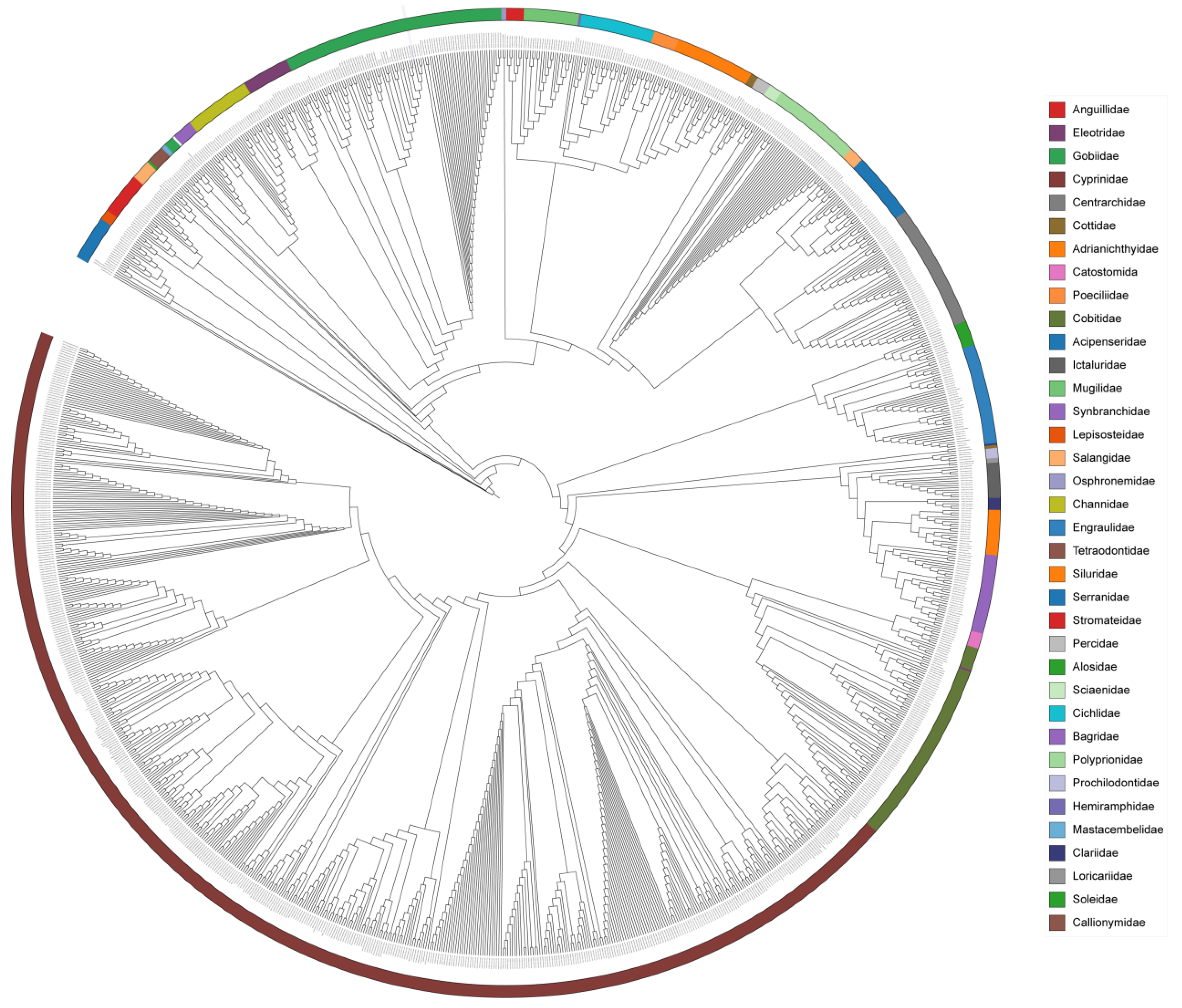
To evaluate the species discrimination performance of the database, a systematic barcode analysis was conducted. Genetic distance calculations based on the Kimura two-parameter (K2P) model revealed that the mean intraspecific distance was 0.007 (range: 0–0.050), whereas the mean interspecific distance reached 0.232 (range: 0.101–0.696), indicating a pronounced divergence between intra- and interspecific genetic variation. The frequency distribution of genetic distances further demonstrated a clear barcode gap (Supplementary Figure S1), suggesting that the 12S rRNA marker possesses effective discriminatory power for most fish species in the study region. The Neighbor-Joining (NJ) phylogenetic tree (Figure 2) provided an additional assessment of taxonomic resolution within the reference database. Among the 141 species, 93 (65.96%) formed well-supported monophyletic clades with bootstrap support ≥95, indicating relatively high phylogenetic support for these taxa. Further examination of the Tele02 target region identified 13 pairs of closely related species sharing at least one identical haplotype, indicating potential limitations in species-level discrimination for these taxa (Supplementary Table S2).
Figure 2.
Phylogenetic tree constructed based on 12S rRNA sequences. The outer colored ring represents different fish families, and the legend indicates the corresponding family-level taxonomic groups.
3.2. Fish Species Composition and Community Structure Based on eDNA
eDNA-based monitoring of fish communities in the Jiangsu section of the Yangtze River mainstem revealed substantial interannual variation in species composition. A total of 119 fish species were detected in 2022, belonging to 15 orders, 30 families, and 83 genera. In 2023, 114 species were identified, representing 14 orders, 27 families, and 82 genera. In 2024, 117 species were recorded, distributed across 15 orders, 31 families, and 81 genera (Supplementary Table S3). Across the three consecutive years, 95 species were consistently detected, accounting for 72.52% of the total recorded species (Supplementary Figure S2).
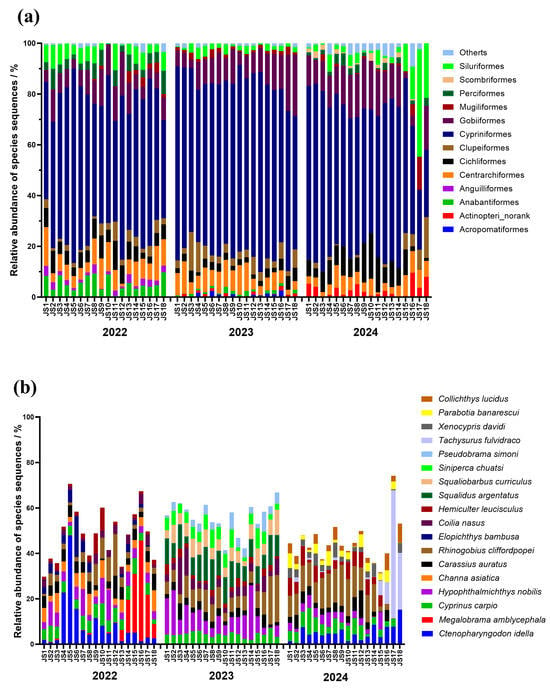
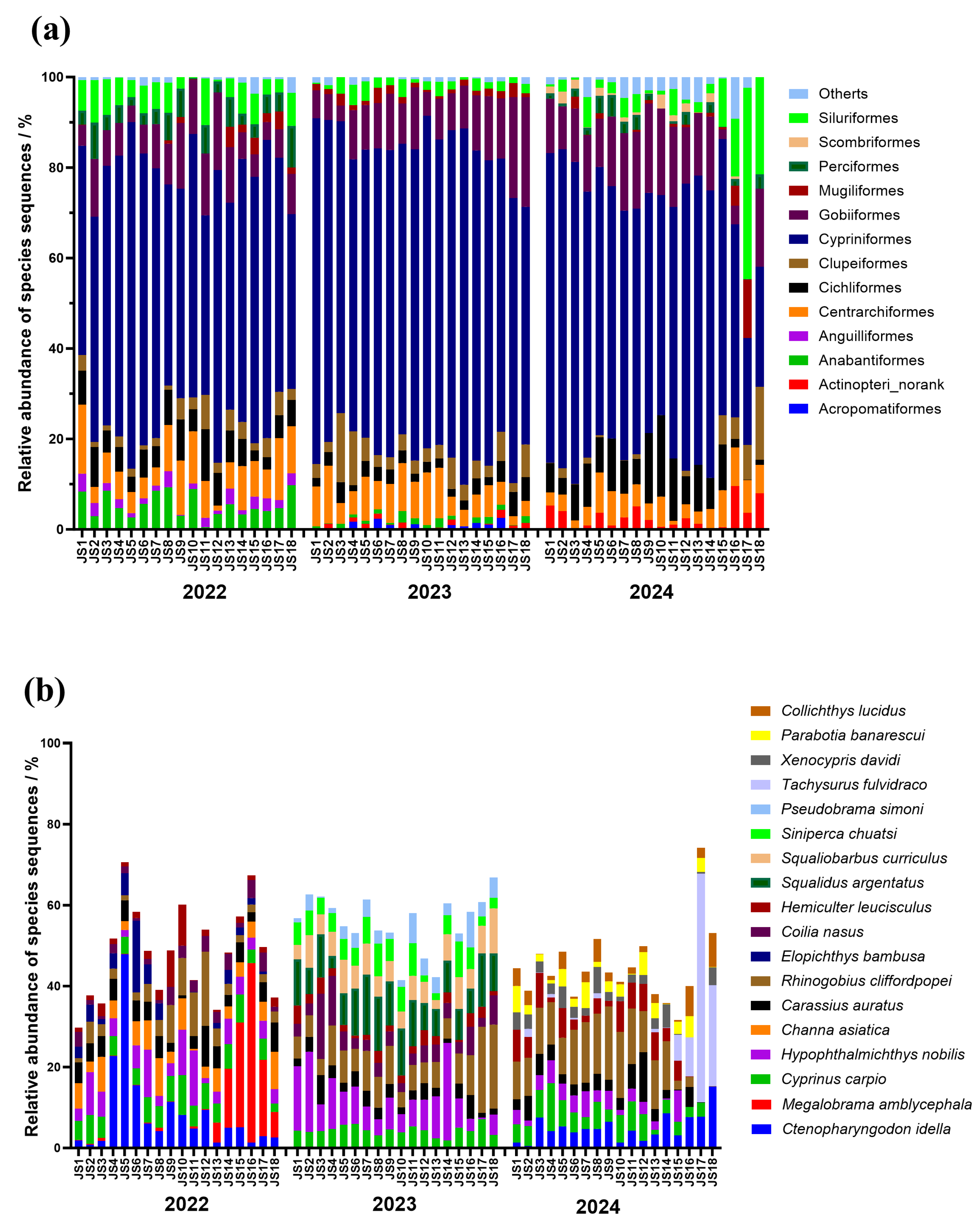
At the order level (Figure 3a), Cypriniformes dominated the community in all three years. In 2022, Cypriniformes accounted for 55.31% of the total relative abundance. This proportion increased to 67.16% in 2023 and subsequently decreased to 54.92% in 2024. Meanwhile, the relative contributions of Siluriformes, Perciformes, and other orders increased in 2024, indicating a more diversified community structure.
Figure 3.
Taxonomic composition of fish assemblages detected by eDNA metabarcoding during 2022–2024. (a) Relative sequence abundance at the order level. (b) Relative sequence abundance of taxa with high eDNA sequence contributions. Each stacked bar represents a monitoring site, and colors denote different fish orders in panel (a) and dominant fish species in panel (b).
The top 10 fish species based on OTU relative sequence abundance were used to characterize taxa with high eDNA sequence contributions in the Jiangsu section of the Yangtze River mainstem (Figure 3b). In 2022, the highest relative eDNA sequence contributions were observed for Ctenopharyngodon idella, Megalobrama amblycephala, and Cyprinus carpio. In 2023, Squalidus argentatus, Rhinogobius cliffordpopei, and Hypophthalmichthys nobilis showed relatively high sequence contributions. In 2024, Rhinogobius cliffordpopei, Ctenopharyngodon idella, and Cyprinus carpio showed the highest relative sequence contributions.
3.3. Spatiotemporal Patterns of Fish Diversity Based on eDNA
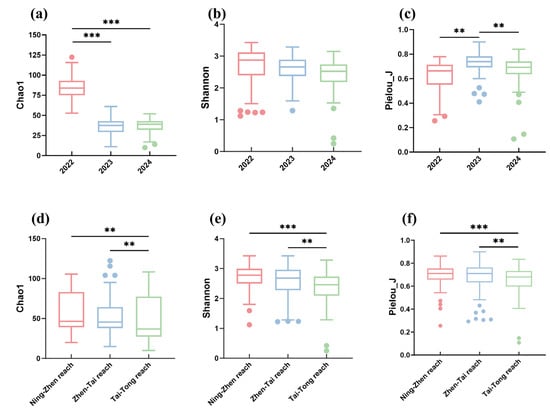
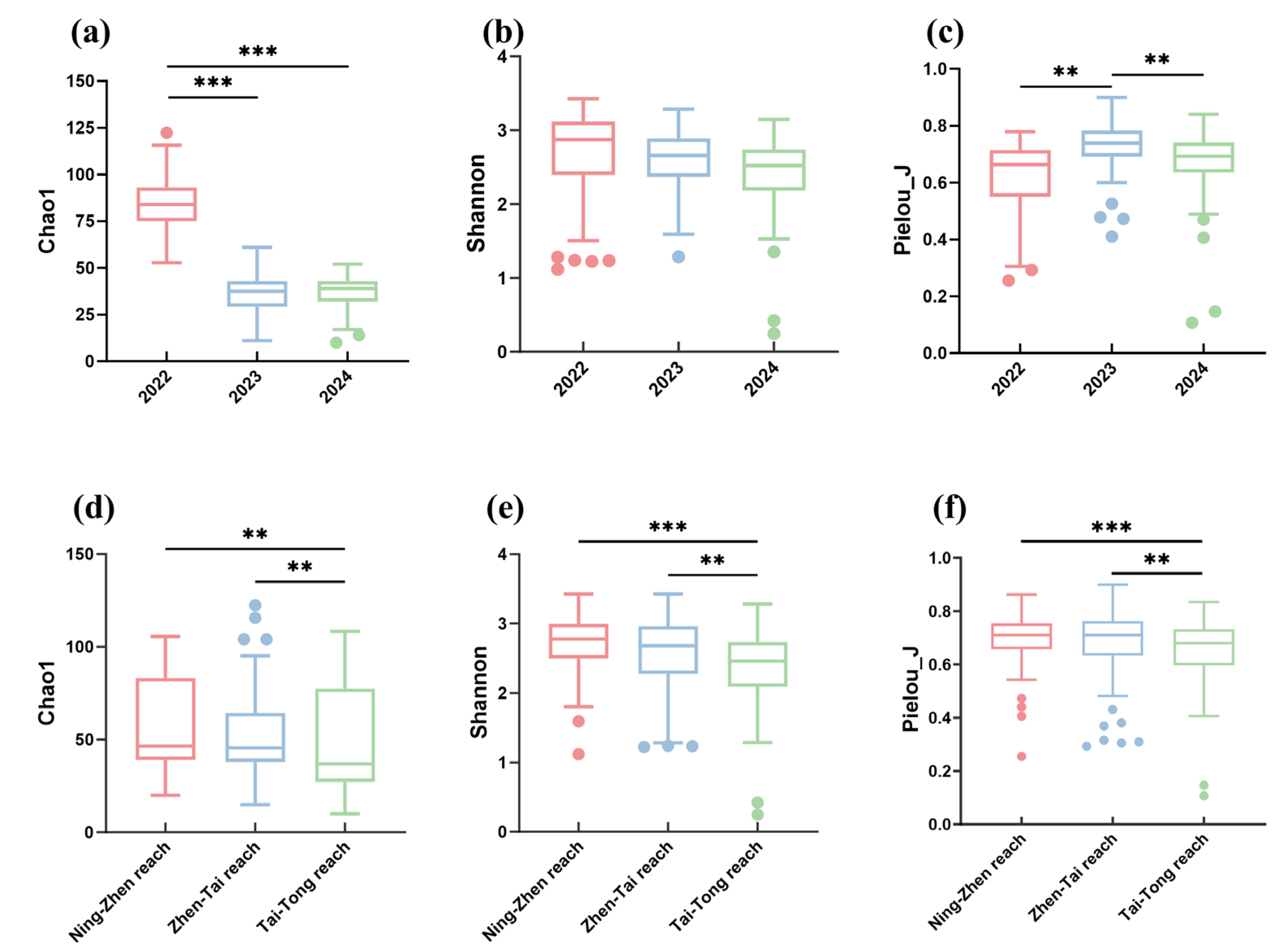
To comprehensively evaluate temporal and spatial variation in fish community diversity, alpha diversity of fish assemblages in the Jiangsu section of the Yangtze River mainstem was assessed using the Chao1 richness index, Shannon diversity index, and Pielou_J evenness index. The results revealed significant interannual differences in some alpha-diversity metrics (Figure 4a–c). Among the three years, the Chao1 index was highest in 2022 (83.33 ± 13.71), and was significantly higher than that in 2023 (36.96 ± 10.19) and 2024 (36.75 ± 9.05) (p < 0.001), whereas no significant difference was observed between 2023 and 2024 (p > 0.05). The Shannon index decreased from 2.69 ± 0.56 in 2022 to 2.61 ± 0.38 in 2023, and further declined to 2.43 ± 0.47 in 2024, showing a declining trend, although the interannual differences were not statistically significant (p > 0.05). Pielou_J evenness index was lowest in 2022 (0.62 ± 0.12), increased significantly to 0.73 ± 0.08 in 2023 (p < 0.01), and then decreased significantly to 0.68 ± 0.11 in 2024 (p < 0.01), whereas no significant difference was observed between 2022 and 2024 (p = 0.071). Based on the hydrological characteristics of the Jiangsu section of the Yangtze River mainstem, the study area was divided into three reaches: the Nanjing–Zhenjiang reach (Ning–Zhen reach; sites JS1-JS6), Zhenjiang–Taizhou reach (Zhen–Tai reach; sites JS7-JS12), and Taizhou–Nantong reach (Tai–Tong reach; sites JS13-JS18). Alpha diversity analysis demonstrated significant spatial heterogeneity in fish diversity among these reaches (Figure 4d–f). The Ning–Zhen and Zhen–Tai reaches exhibited significantly higher alpha diversity indices than the Tai–Tong reach (p < 0.001), whereas no significant difference was detected between the Ning–Zhen and Zhen–Tai reaches (p > 0.05). These findings indicate that fish communities in the upper and middle reaches within the Jiangsu section of the Yangtze River mainstem exhibited higher species richness and greater community complexity, whereas fish diversity was comparatively lower in the downstream reach.
Figure 4.
Temporal and spatial patterns of fish α-diversity detected by eDNA metabarcoding in the Jiangsu section of the Yangtze River during 2022–2024. Panels (a–c) show interannual differences in Chao1 richness, Shannon diversity, and Pielou_J evenness, respectively. Panels (d–f) show differences in these α-diversity indices among the Ning–Zhen, Zhen–Tai, and Tai–Tong reaches. Boxplots represent the distribution of α-diversity values across monitoring sites. Colored circles indicate outliers, with colors corresponding to the respective groups. Asterisks denote statistically significant differences between groups: ** p < 0.01 and *** p < 0.001.
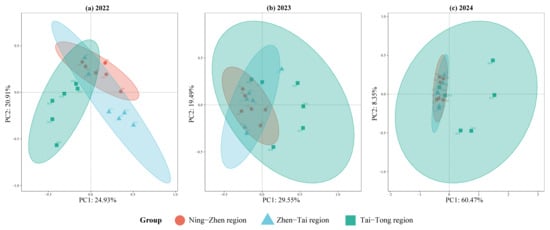
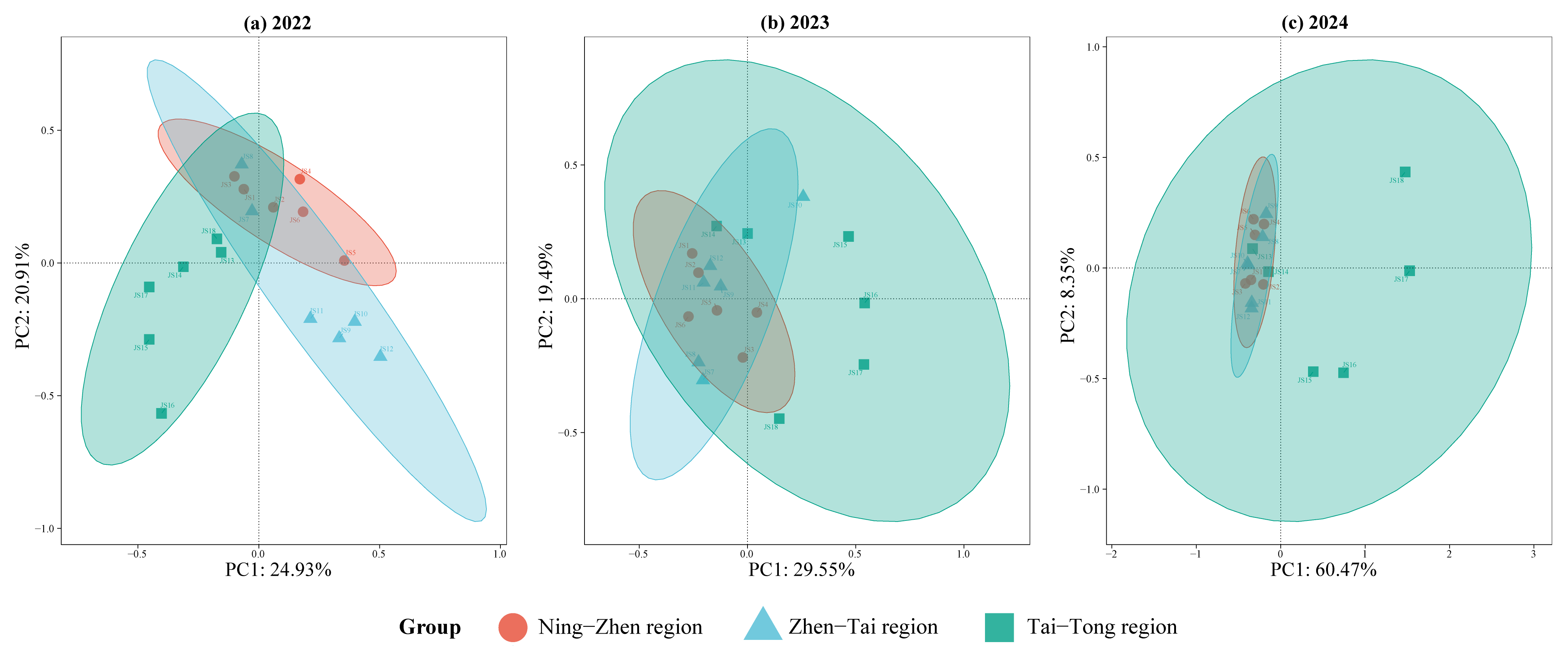
PCoA based on Bray–Curtis distances revealed clear interannual variation in the spatial structure of fish communities in the Jiangsu section of the Yangtze River mainstem. In 2022 and 2024, the Ning–Zhen and Zhen–Tai reaches showed substantial overlap, whereas the Tai–Tong reach was clearly separated from the two upstream reaches (Figure 5). PERMANOVA confirmed significant among-reach differences in these years (R2 = 0.27672, p = 0.001; R2 = 0.21915, p = 0.009). In 2023, samples from all three reaches largely overlapped, with no significant spatial difference detected (R2 = 0.14789, p = 0.151), indicating weaker spatial differentiation than in 2022 and 2024. PERMDISP detected no significant differences in multivariate dispersion among reaches in any of the three years (p > 0.05), supporting the assumption of homogeneous within-group dispersion for the PERMANOVA analyses.
Figure 5.
Principal coordinate analysis (PCoA) of fish eDNA community composition among different reaches from 2022 to 2024. Panels (a–c) represent the ordination results for 2022, 2023 and 2024, respectively. Points represent monitoring sites, and ellipses indicate confidence regions for each river section. Colors and shapes denote the Ning–Zhen, Zhen–Tai and Tai–Tong reaches.
4. Discussion
4.1. Construction of a Regional eDNA Barcode Reference Database
Accurate interpretation of eDNA metabarcoding data from complex fish communities in large river systems highly depends on the coverage, sequence accuracy, and taxonomic resolution of reference databases. [18,19,20]. Therefore, constructing a regional reference database with verified local species records, standardized taxonomy, and sufficient sequence coverage is a critical prerequisite for improving the reliability of eDNA-based community analysis.
The mitochondrial 12S rRNA gene is widely used in fish eDNA studies, while region-specific 12S reference databases can further improve taxonomic assignment accuracy [21,22,23]. This study established a 12S barcode database comprising 141 fish species for the fish fauna of the Jiangsu section of the Yangtze River mainstem. To evaluate the species discrimination capacity of this database, classical barcode assessment was performed. Genetic distance analysis showed that the mean interspecific genetic distance (0.232) was 33.14 times higher than the mean intraspecific distance (0.007), far exceeding the empirical “10-fold rule” proposed by [24]. More importantly, barcode gap analysis revealed that the minimum interspecific distance was greater than the maximum intraspecific distance, forming an effective discriminatory gap (Figure S1). Phylogenetic analysis further showed that 93 fish species formed monophyletic clades with bootstrap support values ≥ 95 (Figure 2). Collectively, the genetic-distance and phylogenetic analyses indicate substantial taxonomic resolution within the regional 12S reference database. Further examination of the Tele02 target region identified 13 pairs of closely related species sharing at least one identical haplotype (Supplementary Table S2), indicating localized limitations in species-level resolution. For these taxa, species-level assignments can be retained when the environmental OTU sequence corresponds to a species-specific haplotype, whereas assignments involving haplotypes shared by multiple closely related species should be regarded as potentially ambiguous and interpreted accordingly. A customized reference database can restrict taxonomic assignment to species that are potentially distributed within the study region, thereby reducing the risk of false-positive detections caused by the inclusion of taxa outside the regional species pool. However, regional fish assemblages are often complex and exhibit pronounced spatiotemporal variability, making it difficult for a regional reference database to cover all species that may actually occur in the study area. When target species are absent from the database or lack corresponding reference sequences, eDNA sequences can often be assigned only at a coarser taxonomic resolution, or may remain unassigned, thereby increasing the risk of false-negative detections [25]. Therefore, monitoring data obtained from traditional surveys should be integrated to continuously expand and update regional reference databases, thereby improving species coverage and reducing the risk of missed detections.
4.2. Fish Community Composition and Dynamic Patterns in the Jiangsu Section of the Yangtze River Mainstem
A total of 131 fish species were detected in the Jiangsu section of the Yangtze River mainstem during this study (Supplementary Table S3), including 113 native fish species, representing 87.60% of the 129 species recorded in Fishes of Yangtze River [16]. Compared with recent conventional surveys (86–108 species) [26,27,28], the present study identified a higher number of species, which may partly reflect the high sensitivity of eDNA metabarcoding, while differences in survey design should also be considered. In addition, 95 species (72.52%) were consistently detected across the three consecutive years, indicating a relatively stable species composition within this river section. Minor interannual fluctuations in total species richness were primarily associated with marginal or low-abundance species [29].
Despite the overall stability in species composition, the dominance structure and relative abundance exhibited pronounced interannual dynamics. At the order level, Cypriniformes consistently dominated the assemblage, with its relative abundance peaking in 2023 before declining in 2024, concurrent with increases in Siluriformes and Perciformes. At the species level, Cyprinus carpio, Hypophthalmichthys nobilis, Hemiculter leucisculus, Carassius auratus, and Rhinogobius cliffordpopei remained dominant across all three years, forming a stable core assemblage. The persistent presence of such foundational species plays a crucial role in maintaining overall community function and buffering environmental fluctuations [30].
Meanwhile, notable interannual shifts were observed in the composition of dominant species. In 2022, the dominant assemblage was mainly composed of medium- to large-bodied periodic strategists, including Ctenopharyngodon idella, Megalobrama amblycephala, and Cyprinus carpio. Against the background of reduced fishing pressure following the implementation of the fishing ban, these common economically important species maintained relatively high eDNA sequence contributions, suggesting favorable conditions for their persistence and continued ecological prominence in the assemblage. In 2023, the dominant assemblage showed an increased contribution of small-bodied opportunistic species, such as Squalidus argentatus and Pseudobrama simoni. In 2024, the dominant assemblage was composed of taxa representing periodic, equilibrium, and opportunistic life-history strategies. Notably, medium- and small-bodied equilibrium strategists, including Rhinogobius cliffordpopei, Tachysurus fulvidraco, and Parabotia banarescui, entered the dominant assemblage. These shifts in dominance patterns likely reflect dynamic community responses to hydrological variation, habitat modification, and interspecific interactions [31].
Overall, the fish community in the Jiangsu section of the Yangtze River mainstem exhibited temporal stability in species occurrence, accompanied by interannual changes in relative eDNA sequence composition and the taxa with high sequence contributions. This pattern indicates a relatively stable regional species pool together with continuous changes in community composition during the study period. Because sequence-based relative abundance from eDNA metabarcoding does not directly represent true fish abundance or biomass, changes in dominant taxa and community structure should be interpreted cautiously and ideally validated using traditional surveys or other quantitative evidence [32].
4.3. Spatiotemporal Dynamics of Fish Communities in the Jiangsu Section of the Yangtze River Mainstem
From 2022 to 2024, alpha diversity showed clear interannual variation. The Chao1 richness index declined significantly, whereas the Shannon diversity index showed a decreasing trend without significant interannual differences, suggesting a reduction in species richness and a potential decrease in low-frequency or rare taxa. This pattern may be associated with the extreme low-flow conditions in 2022, when the Yangtze River Basin experienced its most severe drought since 1961 [33]. Previous studies have shown that extreme low-flow events can not only reduce river water levels and shrink aquatic habitats, but also weaken marginal habitats and hydrological connectivity, thereby affecting fish survival, reproduction, and biotic interactions in aquatic ecosystems [34,35,36]. In light of the results of this study, the 2022 extreme low-flow event may have contributed to the observed temporal variation in fish community metrics, potentially through changes in habitat availability and hydrological connectivity. However, the absence of synchronized environmental monitoring data prevents direct evaluation of its specific contribution. In contrast, Pielou_J evenness index showed a fluctuating increase in subsequent years, suggesting a more even distribution of relative abundance among species. In particular, the dominance of a single species weakened in 2023, with multiple dominant taxa contributing jointly to the assemblage (Figure 3b), resulting in a temporary increase in community evenness.
Spatial variation in fish communities results from the combined effects of natural geographical conditions and anthropogenic activities [37]. The Ning–Zhen and Zhen–Tai reaches contain more complex channel structures, shoals, and tributaries, which may support higher alpha diversity [38,39], whereas the Tai–Tong reach is more strongly influenced by tidal processes and habitat homogenization. In addition, the inclusion of JS18 in the saline-influenced north branch, where coastal–estuarine fishes dominate and diversity is relatively low, may have further reduced the overall diversity of the Tai–Tong reach [40]. However, the strength of spatial differentiation varied among years. PCoA showed significant differences between the Tai–Tong and upstream reaches in 2022 and 2024 (p < 0.05), whereas no significant spatial differentiation was detected among the three reaches in 2023 (p > 0.05). Because the sampling design and season were relatively consistent across years, this interannual –variation was more likely associated with changes in hydrodynamic conditions. The Jiangsu section of the Yangtze River mainstem is jointly influenced by upstream discharge and marine tides [41,42], which generate environmental gradients in salinity, turbidity, and particulate matter transport and thereby affect fish community structure.
According to the 2022–2024 Yangtze River Sediment Bulletin [43,44,45] issued by the Changjiang Water Resources Commission (CWRC), runoff at Datong Station, an important indicator of upstream discharge conditions in the lower Yangtze River, showed clear interannual differences during October–December from 2022 to 2024. Runoff was relatively high in 2023, approximately 50–75 billion m3, whereas it was markedly lower during the same period in 2022 and 2024, approximately 25–30 billion m3 and 30–35 billion m3, respectively. In terms of spatial patterns, 2023 corresponded to weakened community differentiation and increased compositional convergence among reaches, whereas 2022 and 2024 showed stronger among-reach differentiation. This indicates a relatively consistent correspondence between runoff variation and the strength of spatial community structuring. Previous studies have shown that higher discharge can enhance hydrological mixing and transport and expand the spatial integration scale of eDNA signals [46,47], thereby “blurring” true spatial boundaries of communities in eDNA datasets.
In contrast, tidal conditions did not show a similarly consistent relationship with spatial community patterns. Based on the lunar phase and tidal cycle corresponding to the sampling dates in the Tai–Tong reach, sampling in both 2022 and 2023 occurred during spring tides, whereas sampling in 2024 occurred during a neap tide. However, despite both occurring during spring tides, 2022 and 2023 showed markedly different spatial community patterns. Conversely, although 2024 occurred during a neap tide, its spatial differentiation was more similar to that observed in 2022. However, spring–neap tidal phase alone did not show a consistent correspondence with the observed interannual patterns of spatial community differentiation. Because tidal stage at the exact sampling time, water level, current velocity, and salinity were not measured synchronously, the broader influence of tidal processes on eDNA transport and community patterns could not be fully evaluated. Therefore, within the temporal scope of this study, the observed interannual pattern of spatial community differentiation was more consistent with variation in runoff conditions than with the available spring–neap tidal information. Such downstream transport and spatial integration of eDNA are natural consequences of hydrological connectivity rather than methodological artifacts [48].
4.4. Management Implications and Methodological Insights
This study demonstrates that eDNA technology can efficiently reveal fish species composition, dominant detected taxa, and spatiotemporal community patterns in the Jiangsu section of the Yangtze River mainstem over a relatively broad spatial scale, providing an effective tool for long-term monitoring of fish diversity during the fishing ban period in the Yangtze River. Compared with traditional net-based surveys, eDNA has greater potential for detecting low-abundance, cryptic, and difficult-to-capture species, and can therefore serve as an important complementary approach for evaluating the effects of the Yangtze River fishing ban and supporting fish diversity conservation. However, uncertainties remain in eDNA data regarding abundance quantification, signal origin, and hydrodynamic interpretation. Therefore, future monitoring should establish an integrated framework combining continuous eDNA monitoring, traditional fishery resource surveys, and synchronized hydrological and environmental measurements, so as to more accurately assess fish community recovery processes and their underlying drivers after the implementation of the fishing ban.
5. Conclusions
This study constructed a regional 12S rRNA barcode reference database for fish eDNA monitoring in the Jiangsu section of the Yangtze River mainstem and used eDNA metabarcoding to characterize fish diversity and spatiotemporal community dynamics during the fishing ban period. The localized database improved taxonomic assignment of fish eDNA sequences and provided a basis for biodiversity monitoring in the lower Yangtze River. A total of 131 fish species were detected, including 113 native species, representing 87.60% of the historically recorded fauna. Among them, 95 species were consistently detected across the three years, indicating a relatively complete and stable regional species pool. However, the relative eDNA sequence abundance of major taxa and the composition of taxa with high sequence contributions varied among years, suggesting that fish communities were characterized by a stable species pool but continuous internal restructuring. Alpha diversity and PCoA further revealed interannual variation in community diversity and spatial differentiation, which may have been associated with extreme low-flow conditions and runoff variation. Overall, eDNA metabarcoding effectively revealed fish community composition and dynamics in this large river system, providing scientific support for fish conservation, biodiversity assessment, and long-term ecological monitoring during the fishing ban period.
Supplementary Materials
The following supporting information can be downloaded at: https://www.mdpi.com/article/10.3390/d18090548/s1. Figure S1: Frequency distribution of intra- and interspecific K2P genetic distances based on 12S rRNA sequences. Figure S2: Interannual overlap in fish species detected by eDNA metabarcoding from 2022 to 2024. Table S1: 12S reference sequences. Table S2: Closely related species sharing identical haplotypes within the Tele02 target region of the regional 12S reference database. Table S3: Taxonomic list of fish species detected by eDNA monitoring from 2022 to 2024.
Author Contributions
Y.W.: conceptualization, methodology, software, data curation, investigation, validation, formal analysis, visualization, writing—original draft, writing—review and editing. D.Y.: methodology, data curation, investigation, validation, formal analysis, visualization. S.L.: methodology, investigation, data curation, validation, formal analysis. M.J.: methodology, resources, supervision, project administration, writing—review and editing. X.Z.: data curation, validation, visualization, formal analysis. K.L.: conceptualization, methodology, supervision, funding acquisition, project administration, resources, writing—review and editing. All authors have read and agreed to the published version of the manuscript.
Funding
This project was financed by the Central Public-interest Scientific Institution Basal Research Fund, CAFS (NO. 2023TD11), the Ecological Compensation Project of the Wudongde and Baihetan Hydropower Stations Involving the National Nature Reserve for Rare and Endemic Fishes in the Upper Yangtze River—Research and Development of Novel Intelligent Fish Tracking and Monitoring Technologies and Equipment (JGGJ0425034 and JGGJ0425035), and the Procurement Project for Fisheries Ecology and Resources Monitoring Services(JSTCC2502512467).
Data Availability Statement
The original contributions presented in this study are included in the article. Further inquiries can be directed to the corresponding author.
Acknowledgments
We thank all colleagues and field investigators who assisted with eDNA sample collection, field surveys, and environmental data recording in the Jiangsu section of the Yangtze River. We also appreciate the support of laboratory staff in sample processing, molecular experiments, and data analysis.
Conflicts of Interest
The authors declare no competing interests.
References
- Li, F.L.; Peng, Y.; Fang, W.D.; Altermatt, F.; Xie, Y.W.; Yang, J.H.; Zhang, X.W. Application of environmental DNA metabarcoding for predicting anthropogenic pollution in rivers. Environ. Sci. Technol. 2018, 52, 11708–11719. [Google Scholar] [CrossRef] [Scilit] [PubMed]
- Hu, M.; Liu, Y.; Zhang, Y.; Shen, H.; Yao, M.; Dahlgren, R.A.; Chen, D. Long-term (1980–2015) changes in net anthropogenic phosphorus inputs and riverine phosphorus export in the Yangtze River basin. Water Res. 2020, 177, 115779. [Google Scholar] [CrossRef] [Scilit] [PubMed]
- Zhang, H.; Kang, M.; Shen, L.; Wu, J.; Li, J.; Du, H.; Wang, C.; Yang, H.; Zhou, Q.; Liu, Z.; et al. Rapid change in Yangtze fisheries and its implications for global freshwater ecosystem management. Fish. Fish. 2020, 21, 601–620. [Google Scholar] [CrossRef] [Scilit]
- Ren, P.; Schmidt, B.V.; Fang, D.A.; Xu, D. Spatial distribution patterns of fish egg and larval assemblages in the lower reach of the Yangtze River: Potential implications for conservation and management. Aquat. Conserv. Mar. Freshw. Ecosyst. 2021, 31, 1929–1944. [Google Scholar] [CrossRef] [Scilit]
- Chen, J.; Wang, H.; Zhang, L.; Jeppesen, E.; Xie, P. A new window for conservation biogeography. Innov. Geosci. 2024, 2, 100052. [Google Scholar] [CrossRef] [Scilit]
- Li, A.; Fan, J.; Guo, F.; Carpenter-Bundhoo, L.; Huang, G.; Shi, Y.; Ao, Y.; Wang, J. Assessing the impact of river connectivity on fish biodiversity in the Yangtze River Basin using a multi-index evaluation framework. Environ. Res. 2024, 242, 117729. [Google Scholar] [CrossRef] [Scilit] [PubMed]
- Zhang, S.; Zhao, J.; Yao, M. A comprehensive and comparative evaluation of primers for metabarcoding eDNA from fish. Methods Ecol. Evol. 2020, 11, 1609–1625. [Google Scholar] [CrossRef] [Scilit]
- Guri, G.; Shelton, A.O.; Kelly, R.P.; Yoccoz, N.G.; Johansen, T.; Præbel, K.; Hanebrekke, T.; Ray, J.L.; Fall, J.; Westgaard, J.-I. Predicting trawl catches using environmental DNA. ICES J. Mar. Sci. 2024, 81, 1536–1548. [Google Scholar] [CrossRef] [Scilit]
- Deiner, K.; Bik, H.M.; Mächler, E.; Seymour, M.; Lacoursière-Roussel, A.; Altermatt, F.; Creer, S.; Bista, I.; Lodge, D.M.; de Vere, N.; et al. Environmental DNA metabarcoding: Transforming how we survey animal and plant communities. Mol. Ecol. 2017, 26, 5872–5895. [Google Scholar] [CrossRef] [Scilit] [PubMed]
- Thomsen, P.F.; Willerslev, E. Environmental DNA—An emerging tool in conservation for monitoring past and present biodiversity. Biol. Conserv. 2015, 183, 4–18. [Google Scholar] [CrossRef] [Scilit]
- He, X.; Jeffery, N.W.; Stanley, R.R.E.; Hamilton, L.C.; Rubidge, E.M.; Abbott, C.L. EDNA metabarcoding enriches traditional trawl survey data for monitoring biodiversity in the marine environment. ICES J. Mar. Sci. 2023, 80, 1529–1538. [Google Scholar] [CrossRef] [Scilit]
- Doi, H.; Inui, R.; Mori, S.; Akamatsu, Y. Estimation of biodiversity metrics by environmental DNA metabarcoding compared with visual and capture surveys of river fish communities. Freshw. Biol. 2021, 66, 1257–1266. [Google Scholar] [CrossRef] [Scilit]
- Li, T.Y.; Wu, S.R.; Zhao, H.L.; Tang, Y.; Liu, B.X.; Fang, D.A. Assessing fish diversity in the Nanjing section of the Yangtze River by fish larvae survey and eDNA technology. Chin. J. Ecol. 2025, 44, 3161–3168. [Google Scholar] [CrossRef]
- Wang, P.; Yang, N.; Hu, X.; Niu, L.; Xu, J.; Huang, R.; Lin, L.; Li, Y. Domestic and exotic freshwater fish communities of different water systems under anthropogenic pressures: Diversity patterns, environmental drivers and ecological interactions. J. Environ. Sci. 2026, 164, 506–515. [Google Scholar] [CrossRef] [Scilit] [PubMed]
- Lyu, S.; Tong, J.F.; Wu, J.H.; Wang, X.F.; Geng, X.Y.; Gao, C.X.; Wang, Y. Towards a comprehensive assessment of ichthyofaunal diversity in the Yangtze River estuary: Leveraging environmental DNA technology and bottom trawl surveys. Heliyon 2024, 10, e34761. [Google Scholar] [CrossRef] [Scilit] [PubMed]
- Fish Research Laboratory; Hubei Institute of Aquatic Biology. Fishes of Yangtze River; Science Press: Beijing, China, 1976. [Google Scholar]
- Yang, H.; Shen, L.; He, Y.; Tian, H.; Gao, L.; Wu, J.; Mei, Z.; Wei, N.; Wang, L.; Zhu, T.; et al. Status of aquatic organisms resources and their environments in Yangtze River system (2017–2021). Aquac. Fish. 2024, 9, 833–850. [Google Scholar] [CrossRef] [Scilit]
- Jerde, C.L.; Mahon, A.R.; Campbell, T.; McElroy, M.E.; Pin, K.; Childress, J.N.; Armstrong, M.N.; Zehnpfennig, J.R.; Kelson, S.J.; Koning, A.A.; et al. Are genetic reference libraries sufficient for environmental DNA metabarcoding of Mekong River basin fish? Water 2021, 13, 1767. [Google Scholar] [CrossRef] [Scilit]
- Keck, F.; Couton, M.; Altermatt, F. Navigating the seven challenges of taxonomic reference databases in metabarcoding analyses. Mol. Ecol. Resour. 2023, 23, 742–755. [Google Scholar] [CrossRef] [Scilit] [PubMed]
- Mugnai, F.; Costantini, F.; Chenuil, A.; Leduc, M.; Ortega, J.; Meglécz, E. Be positive: Customized reference databases and new, local barcodes balance false taxonomic assignments in metabarcoding studies. PeerJ 2023, 11, e14616. [Google Scholar] [CrossRef] [Scilit] [PubMed]
- Kasmi, Y.; Eschbach, E.; Hanel, R. Mare-MAGE curated reference database of fish mitochondrial genes. BMC Genom. Data 2023, 24, 18. [Google Scholar] [CrossRef] [Scilit] [PubMed]
- Milan, D.T.; Mendes, I.S.; Damasceno, J.S.; Teixeira, D.F.; Sales, N.G.; Carvalho, D.C. New 12S metabarcoding primers for enhanced Neotropical freshwater fish biodiversity assessment. Sci. Rep. 2020, 10, 17966. [Google Scholar] [CrossRef] [Scilit] [PubMed]
- Volanandiana, J.J.A.; Ponton, D.; Ruiz, E.; Fiadanamiarinjato, A.E.M.; Rieuvilleneuve, F.; Raberinary, D.; Collet, A.; Behivoke, F.; Jaonalison, H.; Ranaivomanana, S.; et al. Building a DNA reference for Madagascar’s marine fishes: Expanding the COI barcode library and establishing the first 12S dataset for eDNA monitoring. Diversity 2025, 17, 495. [Google Scholar] [CrossRef] [Scilit]
- Hebert, P.D.N.; Cywinska, A.; Ball, S.L.; DeWaard, J.R. Biological identifications through DNA barcodes. Proc. R. Soc. B Biol. Sci. 2003, 270, 313–321. [Google Scholar] [CrossRef] [Scilit] [PubMed]
- Claver, C.; Canals, O.; de Amézaga, L.G.; Mendibil, I.; Rodriguez-Ezpeleta, N. An automated workflow to assess completeness and curate GenBank for environmental DNA metabarcoding: The marine fish assemblage as case study. Environ. DNA 2023, 5, 634–647. [Google Scholar] [CrossRef] [Scilit]
- Chen, X.; Bian, W.; Zhao, Q.; Yan, W.; Peng, G. On fish composition and dominant species in the Yangtze River in Jiangsu Province. Resour. Environ. Yangtze Basin 2007, 16, 571–577. [Google Scholar]
- Wang, Y.; Deng, Y.; Liu, S.; Li, P.; Liu, K. Status analysis of fish community in the lower reaches of the Yangtze River at the beginning of 10-year fishing ban and assessment of fishing ban effect. J. Fish. China 2023, 47, 206–218. [Google Scholar] [CrossRef]
- Zhou, Y. Evaluate the Biological Integrity of Typical Sections in the Lower Reaches of the Yangtze River and the Yangtze Estuary. Master’s Thesis, Shanghai Ocean University, Shanghai, China, 2024. [Google Scholar]
- Henderson, P.A.; Magurran, A.E. Direct evidence that density-dependent regulation underpins the temporal stability of abundant species in a diverse animal community. Proc. R. Soc. B Biol. Sci. 2014, 281, 20141336. [Google Scholar] [CrossRef] [Scilit] [PubMed]
- Gu, S.; Deng, Y.; Wang, P.; Li, C.; Shi, D.; Wang, S. Assessing riverine fish community diversity and stability by eDNA metabarcoding. Ecol. Indic. 2023, 157, 111222. [Google Scholar] [CrossRef] [Scilit]
- Hillebrand, H.; Blasius, B.; Borer, E.T.; Chase, J.M.; Downing, J.A.; Eriksson, B.K.; Filstrup, C.T.; Harpole, W.S.; Hodapp, D.; Larsen, S.; et al. Biodiversity change is uncoupled from species richness trends: Consequences for conservation and monitoring. J. Appl. Ecol. 2018, 55, 169–184. [Google Scholar] [CrossRef] [Scilit]
- Shu, L.; Ludwig, A.; Peng, Z. Environmental DNA metabarcoding primers for freshwater fish detection and quantification: In silico and in tanks. Ecol. Evol. 2021, 11, 8281–8294. [Google Scholar] [CrossRef] [Scilit] [PubMed]
- Duan, A.; Zhong, Y.; Xu, G.; Yang, K.; Tian, B.; Wu, Y.; Bai, H.; Hu, E. Quantifying the 2022 extreme drought in the Yangtze River Basin using GRACE-FO. J. Hydrol. 2024, 630, 130680. [Google Scholar] [CrossRef] [Scilit]
- Qiu, J.; Yuan, S.; Tang, H.; Deng, Y.; Gualtieri, C. Flow regulation mitigates drought-induced degradation of fish habitats in river-lake systems. Ecol. Indic. 2025, 179, 114243. [Google Scholar] [CrossRef] [Scilit]
- Chang, T.; Wu, C.; Lin, P.; Gao, X. Sudden change of fish functional compositions during a drought in the wet season of the middle Yangtze River, China. Glob. Ecol. Conserv. 2024, 54, e03144. [Google Scholar] [CrossRef] [Scilit]
- Lennox, R.J.; Crook, D.A.; Moyle, P.B.; Struthers, D.P.; Cooke, S.J. Toward a better understanding of freshwater fish responses to an increasingly drought-stricken world. Rev. Fish. Biol. Fish. 2019, 29, 71–92. [Google Scholar] [CrossRef] [Scilit]
- Heino, J.; Soininen, J.; Alahuhta, J.; Lappalainen, J.; Virtanen, R. A comparative analysis of metacommunity types in the freshwater realm. Ecol. Evol. 2015, 5, 1525–1537. [Google Scholar] [CrossRef] [Scilit] [PubMed]
- Wang, N.; Huang, S.; Cao, S.; Zhang, H.; Zhang, T. Analysis on the characteristics of channel scour and deposition in the Nanjing Reach of the Yangtze River after impoundment of the Three Gorges Reservoir. In Proceedings of PIANC Smart Rivers 2022; Li, Y., Hu, Y., Rigo, P., Lefler, F.E., Zhao, G., Eds.; Lecture Notes in Civil Engineering; Springer: Berlin/Heidelberg, Germany, 2023; Volume 264, pp. 1460–1470. [Google Scholar] [CrossRef] [Scilit]
- Cao, G.; Li, P.; Wang, Y.; Yang, Y.; Liu, K. Study on fish community diversity in the north of Hechangzhou section of the lower Yangtze River. J. Hydroecol. 2018, 39, 73–80. [Google Scholar] [CrossRef]
- Liu, K. Biodiversity Status of the Fishery Community in the Lower Reaches of the Yangtze River and a Preliminary Evaluation of the Effects of the Spring Fishing Closure. Master’s Thesis, Nanjing Agricultural University, Nanjing, China, 2007. [Google Scholar]
- Li, X.; Chen, Y.; Mao, L.; Zhang, N. Time-frequency feature extraction and analysis of inland waterway buoy motion based on massive monitoring data. Sensors 2025, 25, 5237. [Google Scholar] [CrossRef] [Scilit] [PubMed]
- Wen, Y.; Xia, Y.; Du, D.; Xu, H.; Zhang, F.; Cheng, Z. Study of Jingjiang beach morphodynamics in the tidal reach of the Yangtze River. Water 2022, 14, 1109. [Google Scholar] [CrossRef] [Scilit]
- Changjiang Water Resources Commission of the Ministry of Water Resources. Yangtze River Sediment Bulletin 2022; Yangtze River Press: Wuhan, China, 2023. [Google Scholar]
- Changjiang Water Resources Commission of the Ministry of Water Resources. Yangtze River Sediment Bulletin 2023; Yangtze River Press: Wuhan, China, 2024. [Google Scholar]
- Changjiang Water Resources Commission of the Ministry of Water Resources. Yangtze River Sediment Bulletin 2024; Yangtze River Press: Wuhan, China, 2025. [Google Scholar]
- Deiner, K.; Altermatt, F. Transport distance of invertebrate environmental DNA in a natural river. PLoS ONE 2014, 9, e88786. [Google Scholar] [CrossRef] [Scilit] [PubMed]
- Van Driessche, C.; Everts, T.; Neyrinck, S.; Brys, R. Experimental assessment of downstream environmental DNA patterns under variable fish biomass and river discharge rates. Environ. DNA 2023, 5, 102–116. [Google Scholar] [CrossRef] [Scilit]
- Deiner, K.; Fronhofer, E.A.; Mächler, E.; Walser, J.-C.; Altermatt, F. Environmental DNA reveals that rivers are conveyer belts of biodiversity information. Nat. Commun. 2016, 7, 12544. [Google Scholar] [CrossRef] [Scilit] [PubMed]
Disclaimer/Publisher’s Note: The statements, opinions and data contained in all publications are solely those of the individual author(s) and contributor(s) and not of MDPI and/or the editor(s). MDPI and/or the editor(s) disclaim responsibility for any injury to people or property resulting from any ideas, methods, instructions or products referred to in the content. |
© 2026 by the authors. Licensee MDPI, Basel, Switzerland. This article is an open access article distributed under the terms and conditions of the Creative Commons Attribution (CC BY) license.