


Abstract
The ecological success of termites is closely linked to their associations with gut microbial communities, yet these interactions may also entail potential fitness costs. The effects of gut-associated bacteria on host performance remain poorly understood. Here, we experimentally assessed the effects of a gut-derived Bacillus sp. isolate on the survival and feeding behavior of workers of the termite Constrictotermes cyphergaster (Silvestri, 1901) (Termitidae: Nasutitermitinae), using the opportunistic pathogen Pseudomonas aeruginosa as a reference treatment. Workers were exposed to increasing bacterial doses, and survival analyses revealed that both bacteria induced a significant dose-dependent decline in survival. However, the Bacillus isolate caused a stronger reduction in overall survival compared to controls, whereas P. aeruginosa also reduced survival but with a comparatively weaker effect. Feeding activity was independent of dose, but exposure to Bacillus sp. significantly reduced food consumption, a pattern not observed for P. aeruginosa. These results demonstrate that a gut-derived bacterium can negatively affect host survival and feeding under experimental conditions, highlighting the importance of considering both beneficial and potentially harmful effects of host-associated microorganisms on termite fitness.
1. Introduction
Host-associated microbial communities play a central role in shaping host fitness, an idea often framed within the holobiont concept [1,2,3]. These associations encompass a continuum of interactions, ranging from mutualism to parasitism, and their outcomes depend on the composition and functional stability of the microbiota [4,5,6]. Microorganisms can provide essential metabolic functions and contribute to host performance, particularly in resource-limited environments [7,8,9]. However, these interactions are not inherently beneficial: under certain conditions, host-associated microbes may also impose physiological costs or act as opportunistic pathogens [10,11,12,13].
Termites (Blattaria: Isoptera) are widely recognized as model systems for studying host–microbe interactions, as their ecological success is closely associated with complex gut microbial communities [14,15,16,17]. Within the Termitidae, the microbiota has co-evolved to optimize host metabolic efficiency and facilitate niche expansion [18,19,20]. However, the crowded and genetically homogeneous environment of a termite colony that favors symbiotic stability also increases susceptibility to pathogenic outbreaks [21,22,23]. In response, termites have evolved multiple layers of defense, including individual immune responses and collective behaviors often referred to as social immunity [24,25,26,27]. These mechanisms help regulate microbial exposure and reduce the impact of both external pathogens and opportunistic microorganisms.
Members of the Bacillaceae, particularly those within the genus Bacillus, are frequently detected in the termite gut and exhibit a wide range of ecological roles. While some strains are well-established entomopathogens [28,29,30], others have been reported in association with termites without clear evidence of pathogenic effects [31,32,33,34]. This functional diversity raises questions about how different Bacillus strains interact with their hosts and under which conditions they may affect host fitness. In neotropical semiarid environments, the termite Constrictotermes cyphergaster (Silvestri, 1901) (Termitidae: Nasutitermitinae) plays a central role in wood decomposition and nutrient cycling [35,36] and harbors a specialized microbiota adapted to the seasonal constraints of the Caatinga biome [37]. Although Bacillus strains have been reported in the gut of C. cyphergaster [38], their effects on host survival and behavior remain poorly understood. Addressing this gap requires experimental approaches that compare the effects of gut-derived bacteria with those of well-known opportunistic pathogens.
The primary objective of this study was to evaluate how bacterial origin and inoculation dose influence termite survival and feeding behavior. To this end, we compared the responses of C. cyphergaster workers to a gut-derived Bacillus isolate and to the exogenous pathogen Pseudomonas aeruginosa across a range of inoculation doses. We hypothesized that bacterial origin would modulate host responses, leading to differences in survival and feeding behavior across dose levels. By experimentally exposing termites to controlled bacterial inoculations, we assessed how gut-derived and exogenous bacteria affect host fitness under standardized conditions.
2. Materials and Methods
2.1. Study Area and Termite Sampling
Workers of C. cyphergaster were collected from five active colonies located at the São João do Cariri Experimental Station (7°20′34″ S, 36°31′50″ W), Paraíba State, northeastern Brazil. These colonies were used exclusively for gut dissection and bacterial isolation procedures. Nests were carefully removed from host trees and transported in sealed plastic bags to the laboratory. All subsequent procedures described in the sections below were conducted under sterile conditions to minimize contamination.
2.2. Isolation and Cultivation of Gut-Associated Bacteria
To isolate cultivable gut-associated bacteria, the digestive tracts of 50 worker termites from each of the five sampled colonies (n = 250) were dissected under a stereomicroscope under sterile conditions, using sterile physiological saline solution (0.9% NaCl) to facilitate tissue handling and pooled in sterile microtubes. Gut samples from each colony were initially processed independently during dissection, homogenization, and serial dilution steps. For each colony, dissected guts were homogenized in 90 mL of sterile distilled water, followed by serial dilutions prepared in 9.0 mL of 0.9% saline solution, following the protocol described by Lacerda et al. [39]. Aliquots (100 μL) from dilutions ranging from 10−4 to 10−8 were plated onto nutrient agar using the spread-plate technique with a Drigalski loop and incubated at 37 °C for 24–48 h. Once cultivable bacterial colonies were obtained, isolates were handled collectively for subsequent identification and experimental assays, and their colony of origin was not systematically tracked.
Bacterial cell concentrations were estimated using two complementary approaches. First, colony-forming units (CFUs) were quantified directly from agar plates. Second, a 10 μL aliquot from each dilution was loaded into a Neubauer counting chamber, and cells were enumerated under an optical microscope [40]. Both methods were used to ensure accurate estimation of bacterial densities. Isolated colonies were preserved in 20% glycerol stock solutions and stored at −20 °C until further use in pathogenicity assays. Sterility was maintained using standard aseptic techniques, including the use of sterilized materials and laminar flow conditions. Negative controls (sterile media and filter papers without bacterial inoculation) were included to detect potential contamination. Bacterial cultures were prepared from fresh samples, and inoculum viability was confirmed prior to application based on visible growth and expected colony morphology.
2.3. Molecular Identification of Bacterial Isolates
Bacterial taxonomic identification was based on 16S rRNA gene sequencing. Genomic DNA was extracted from cultured bacterial isolates using the CTAB method of Doyle and Doyle [41]. The 16S rRNA gene was amplified using universal primers 27F (5′-AGAGTTTGATCMTGGCTCAG-3′) and 1389R (5′-ACGGGCGGTGTGTACAAG-3′).
PCR reactions were performed in a final volume of 25 μL containing 20 ng of genomic DNA, 1 U of Taq DNA polymerase (Ludwig Biotechnology Ltda, Alvorada, RS, Brazil), 10 μmol of each primer, 1× PCR buffer, and 10 mM of each dNTP. Thermal cycling conditions consisted of an initial denaturation at 95 °C for 3 min, followed by 30 cycles of denaturation at 95 °C for 1 min, annealing at 55 °C for 2 min, and extension at 72 °C for 2 min, with a final extension step at 72 °C for 10 min.
PCR products were visualized by electrophoresis on 0.8% agarose gels and subsequently sequenced using an ABI PRISM 3130 Genetic Analyzer (Applied Biosystems, Foster City, CA, USA) at the sequencing facility of CpqGM/Fiocruz, Salvador, Bahia, Brazil. Phylogenetic analyses were conducted based on partial 16S rRNA gene sequences obtained by Sanger sequencing. Forward and reverse reads were assembled into consensus sequences, and low-quality reads and short fragments were excluded prior to analysis. To provide taxonomic context, representative 16S rRNA sequences of Bacillus cereus and Bacillus thuringiensis were retrieved from the NCBI GenBank database, and only sequences between 500 and 2000 bp were retained. Sequences were aligned using the DECIPHER package [42] in R [43].
Phylogenetic relationships were inferred using a maximum-likelihood approach implemented in the phangorn package [44]. The best-fitting substitution model (GTR) was selected, and tree topology was optimized using nearest-neighbor interchange. Node support was assessed with 1000 bootstrap replicates. The resulting tree was midpoint-rooted for visualization, and only bootstrap values ≥70% are shown. We note that 16S rRNA gene sequencing may not provide sufficient resolution to reliably distinguish closely related species within the genus Bacillus. Therefore, taxonomic assignments should be interpreted at the genus or species-complex level.
2.4. Experimental Bioassays
The effects of bacterial exposure on termite survival were assessed using adult workers obtained from an independent set of four colonies, distinct from those used for bacterial isolation. For each colony, workers were randomly selected and transferred to sterile Petri dishes (5.5 cm diameter × 1.5 cm height) containing one filter paper disc impregnated with 300 μL of bacterial suspension at concentrations of 104, 105, 106, 107, and 108 CFU mL−1. Each concentration was tested with four replicates per colony, with each replicate consisting of one Petri dish containing 40 individuals. This resulted in a total of 800 individuals (5 concentrations × 4 replicates × 40 individuals) per colony. Termites were allowed to freely walk over and eat the inoculated filter paper and were maintained under controlled conditions (25 ± 2 °C, 70% r.h.), under natural light–dark conditions. Negative control treatments consisted of filter paper discs moistened with sterile distilled water only.
As a positive control, suspensions of the entomopathogenic P. aeruginosa (Pseudomonadota) [45,46] were applied following the same experimental protocol and concentration range used for Bacillus. Colonies of P. aeruginosa were obtained from the Laboratório de Microbiologia Ambiental at the Instituto Nacional de Pesquisa no Semiárido (INSA), Campina Grande, Brazil. Importantly, P. aeruginosa was not isolated from the gut of C. cyphergaster and was used as a reference treatment to provide a benchmark for infection-induced mortality caused by a non-resident bacterium.
Termite survival was monitored daily for seven consecutive days, by which time approximately 80% of the population had died. Individuals were considered dead when they remained immobile for more than 1 min and failed to respond to physical stimulation. Dead termites were removed to prevent secondary contamination [47].
2.5. Assessment of Feeding Activity
To assess whether bacterial exposure affected feeding behavior, filter paper consumption was quantified as a proxy for appetite reduction commonly associated with microbial infection. Filter papers from the bioassays were analyzed using ImageJ (version 1.8.0). Calibration was performed using “known distance” = 10 and “unit of length” = mm with the “Set Scale” tool. Segmentation was then used to determine the proportion of pixels corresponding to the total area and the area consumed by the individuals of C. cyphergaster. The consumption rate was calculated as the ratio between the consumed area and the initial total area of the filter paper.
2.6. Statistical Analysis
The effects of bacterial treatments on termite survival were analyzed using parametric survival models assuming a Weibull distribution, fitted with the survreg function in R version 4.4.0 [43]. Overall treatment effects were evaluated by comparing full and reduced models using likelihood ratio tests (LRTs), implemented with the drop1 function. A significance level of α = 0.05 was adopted. Pairwise comparisons against the control were conducted using Dunnett’s test with the emmeans package [48].
Dose–response relationships were evaluated separately for each bacterial treatment by fitting parametric Weibull survival models, with dose included as a continuous predictor (log10[dose + 1]) and the control group (dose = 0) included in the analysis. Colony identity was included as a clustering variable to account for the non-independence of individuals from the same colony. The significance of dose effects was assessed using likelihood ratio tests (LRTs).
Food consumption data were analyzed using generalized linear models (GLMs) with a Gamma error distribution and a log-link function. Dose–response relationships were evaluated separately for each bacterial treatment (Bacillus sp. and P. aeruginosa) by including dose as a continuous predictor (log10[dose + 1]). Treatment effects, including the control group, were assessed in a separate model with treatment as a categorical predictor. The significance of predictors was evaluated using likelihood ratio tests (LRTs). All analyses were conducted in R version 4.4.0 [43].
3. Results
3.1. Phylogenetic Characterization and Selection of Bacillus Isolate
A total of 10 Bacillus strains were recovered from the gut of C. cyphergaster (GenBank accession numbers OQ615298–OQ615307; see Figure S1). Phylogenetic analyses revealed two distinct clades: one comprising isolates closely related to the Bacillus thuringiensis and B. cereus group and another clustering with B. velezensis and B. megaterium (Figure S1). Based on its high biomass productivity and phylogenetic proximity to members of the B. thuringiensis group (98.5% 16S rRNA gene sequence similarity), isolate 9631B03 was selected for all subsequent experimental bioassays. The focal isolate clustered within the B. cereus group (Figure S1), although no clear separation between B. cereus and B. thuringiensis was observed.
3.2. Effects of Bacillus sp. on Worker Survival
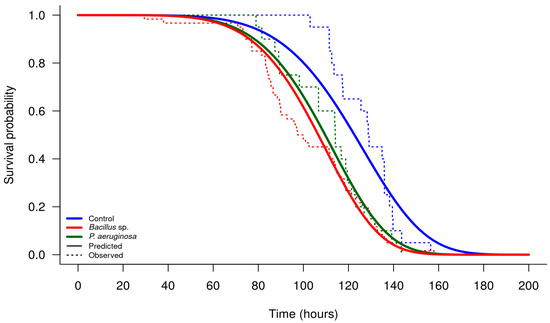
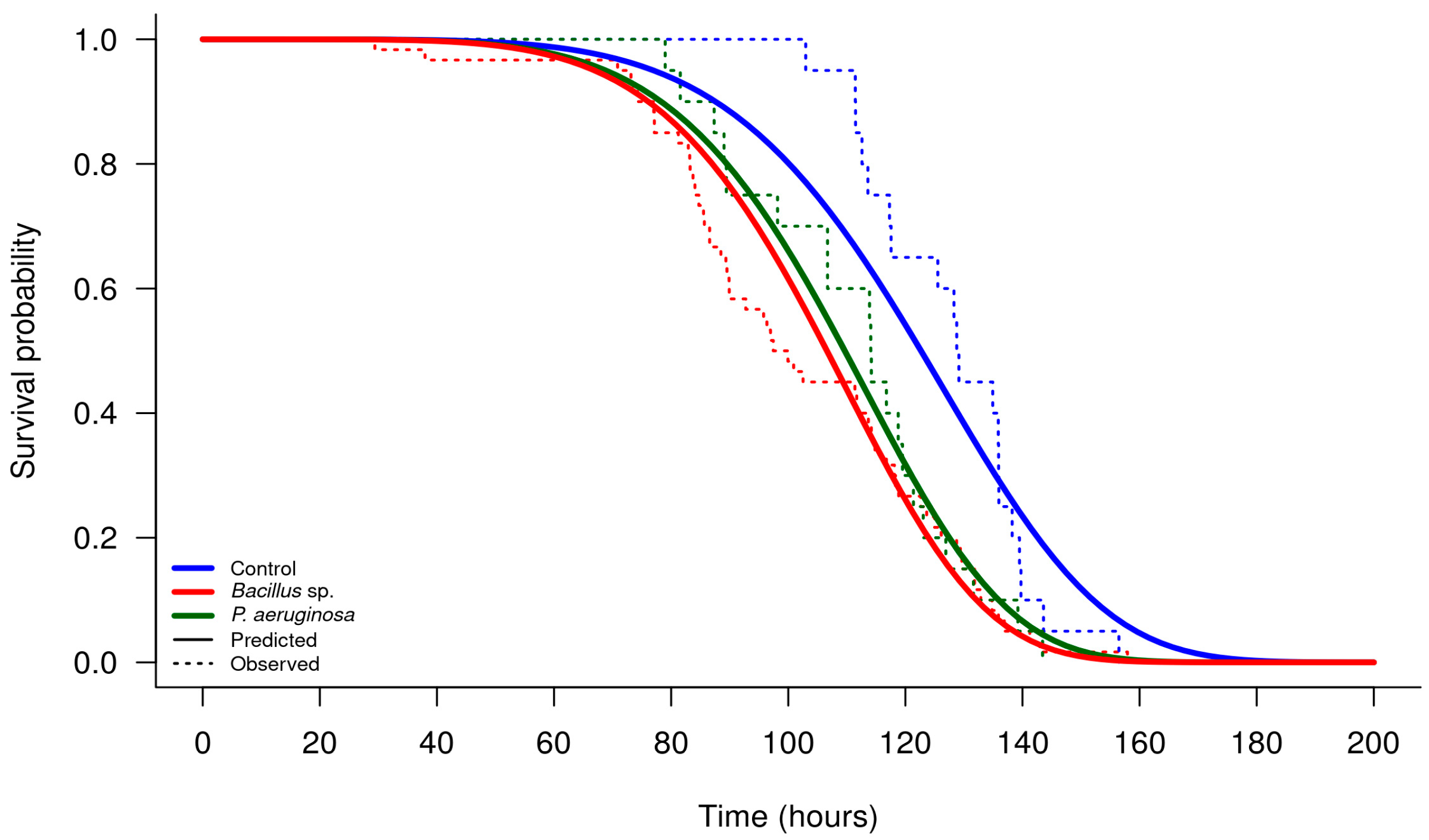
Treatment significantly affected the survival of C. cyphergaster workers (LRT = 10.29; df = 2; p = 0.0058) (Figure 1). This effect was primarily driven by exposure to the gut-derived Bacillus sp. isolate (9631B03), which caused a marked reduction in worker survival compared to the control group. In comparison, P. aeruginosa, included as a positive control, also showed a statistically significant reduction in survival compared to the control. Post hoc comparisons using Dunnett’s test corroborated these patterns, revealing a significant decrease in mean survival time under the Bacillus sp. treatment (ratio = 0.86; df = 96; t = −3.97; p < 0.001). Similarly, P. aeruginosa showed a statistically significant reduction in survival relative to the control (ratio = 0.894; SE = 0.0438; df = 96; t = −2.29; p = 0.0459).
Figure 1.
Survival probability of the termite Constrictotermes cyphergaster (Termitidae: Nasutitermitinae) over time following exposure to different bacterial treatments. Solid lines represent the predicted survival probabilities derived from the Weibull parametric model, whereas dotted step lines indicate the observed survival probabilities calculated using the Kaplan–Meier method. Blue: control; red: Bacillus sp.; green: P. aeruginosa.
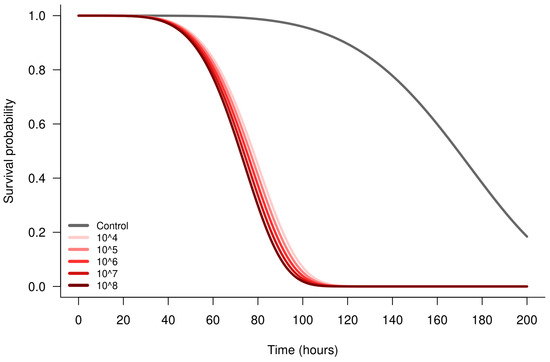
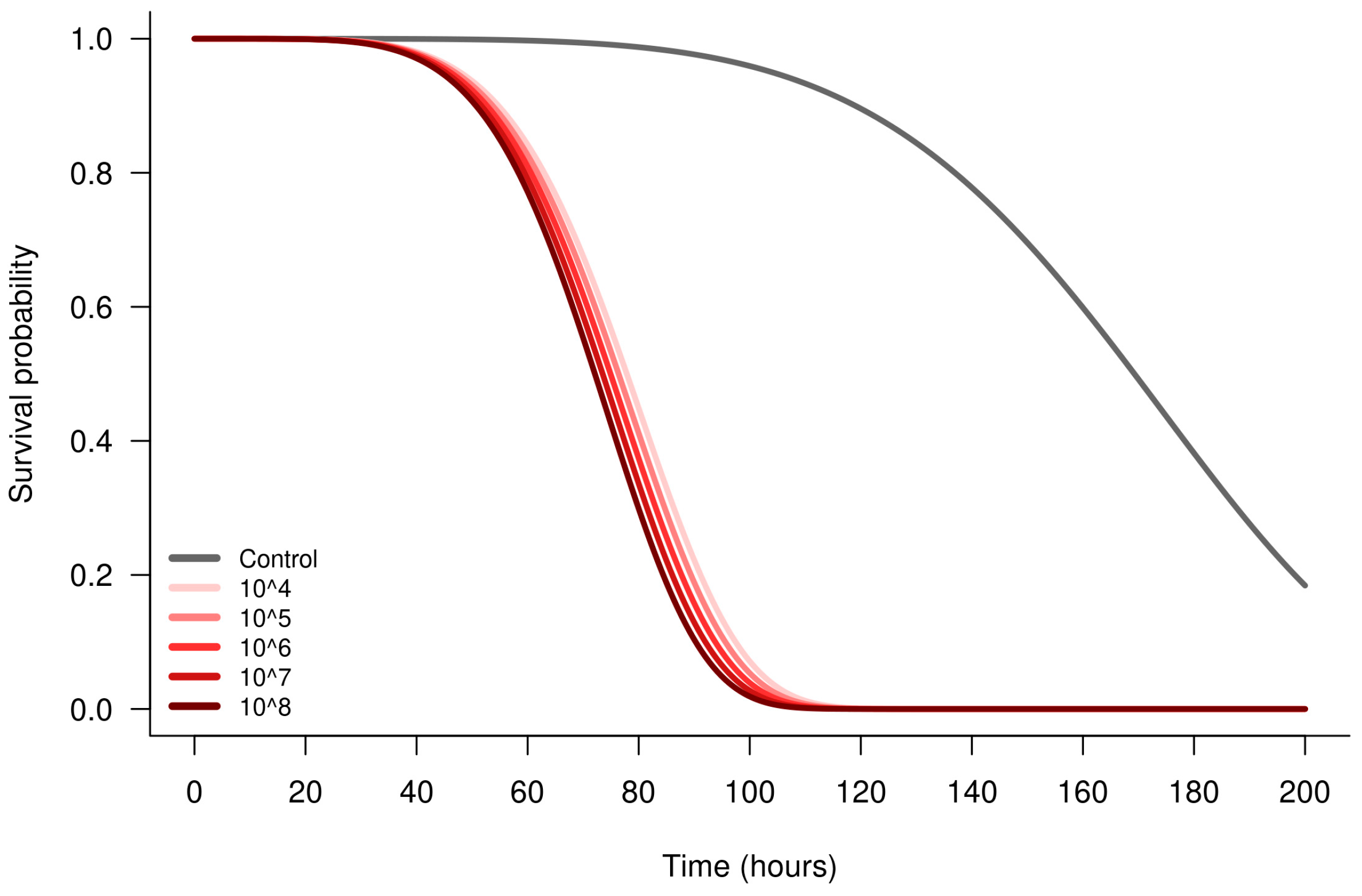
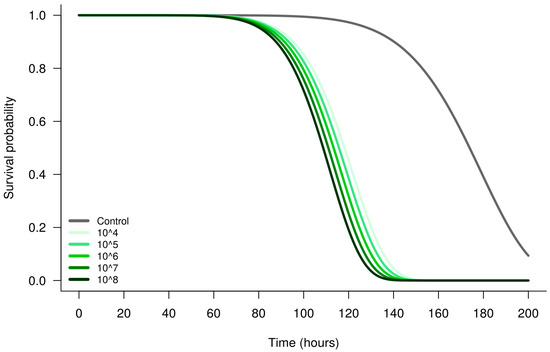
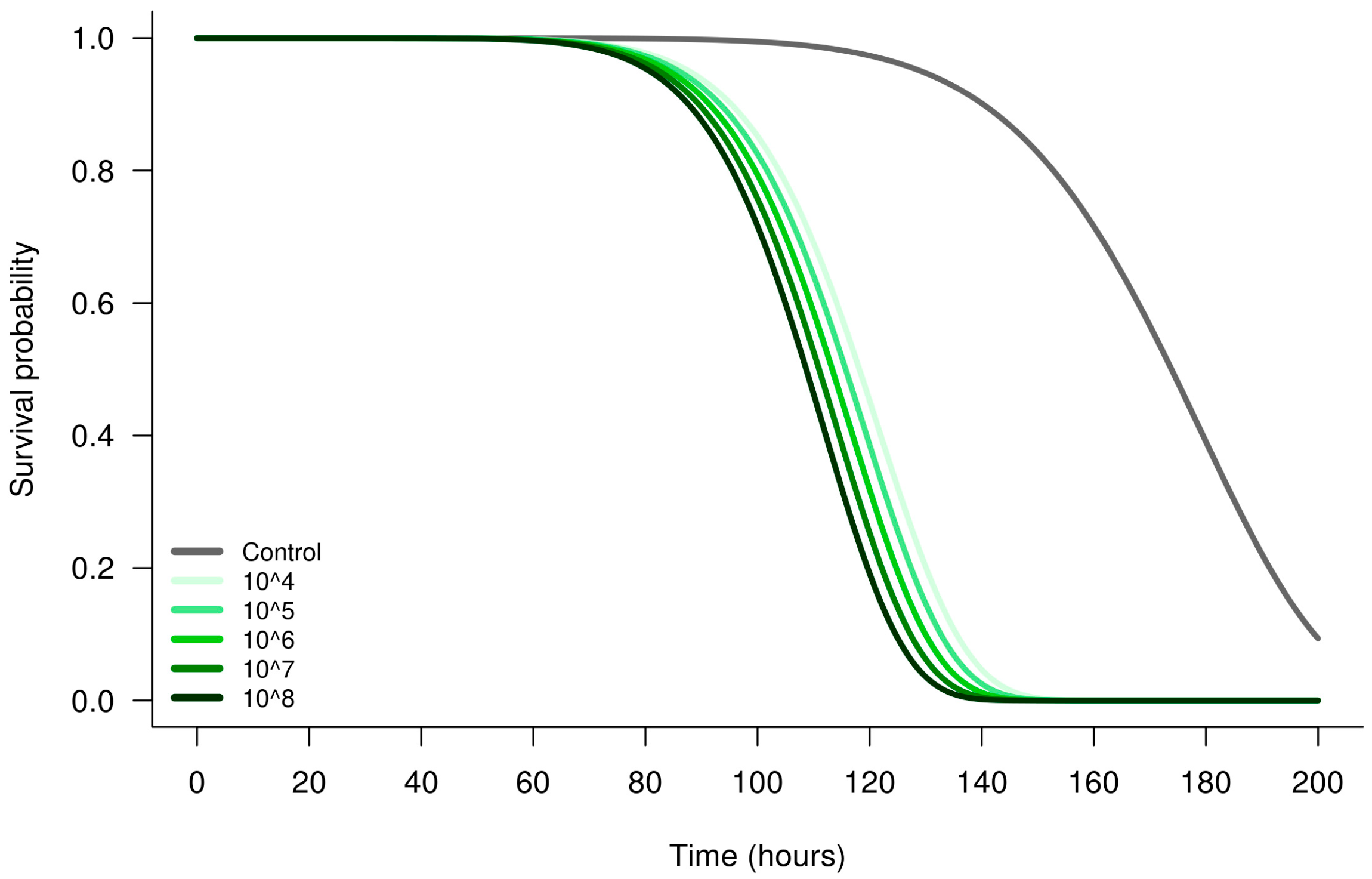
Dose–response analyses indicated that the survival of termites was significantly affected by inoculation doses for both pathogens. For Bacillus sp., the dose–response model indicated a significant effect of dose on survival (LRT = 7.92; df = 1; p = 0.004) (Figure 2). Similarly, for P. aeruginosa, a significant dose-dependent decline in survival was observed (LRT = 10.2; df = 1; p = 0.001) (Figure 3).
Figure 2.
Survival probability over time for hosts exposed to increasing concentrations of Bacillus sp. (104–108), compared with the control treatment. Survival curves indicate a strong dose-dependent effect. Time is expressed in hours.
Figure 3.
Survival probability over time for hosts exposed to increasing concentrations of Pseudomonas aeruginosa (104–108), compared with the control treatment. Curves represent fitted survival functions, showing a dose-dependent reduction in survival. Time is expressed in hours.
3.3. Feeding Behavior and Sickness Response
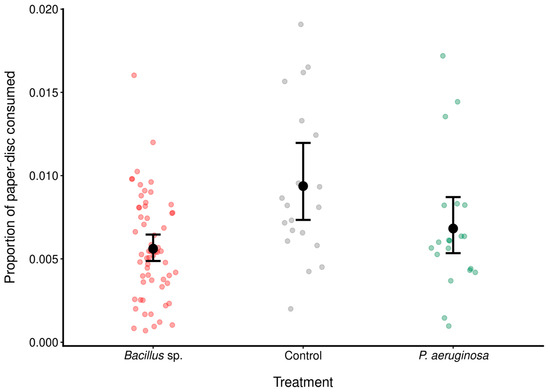
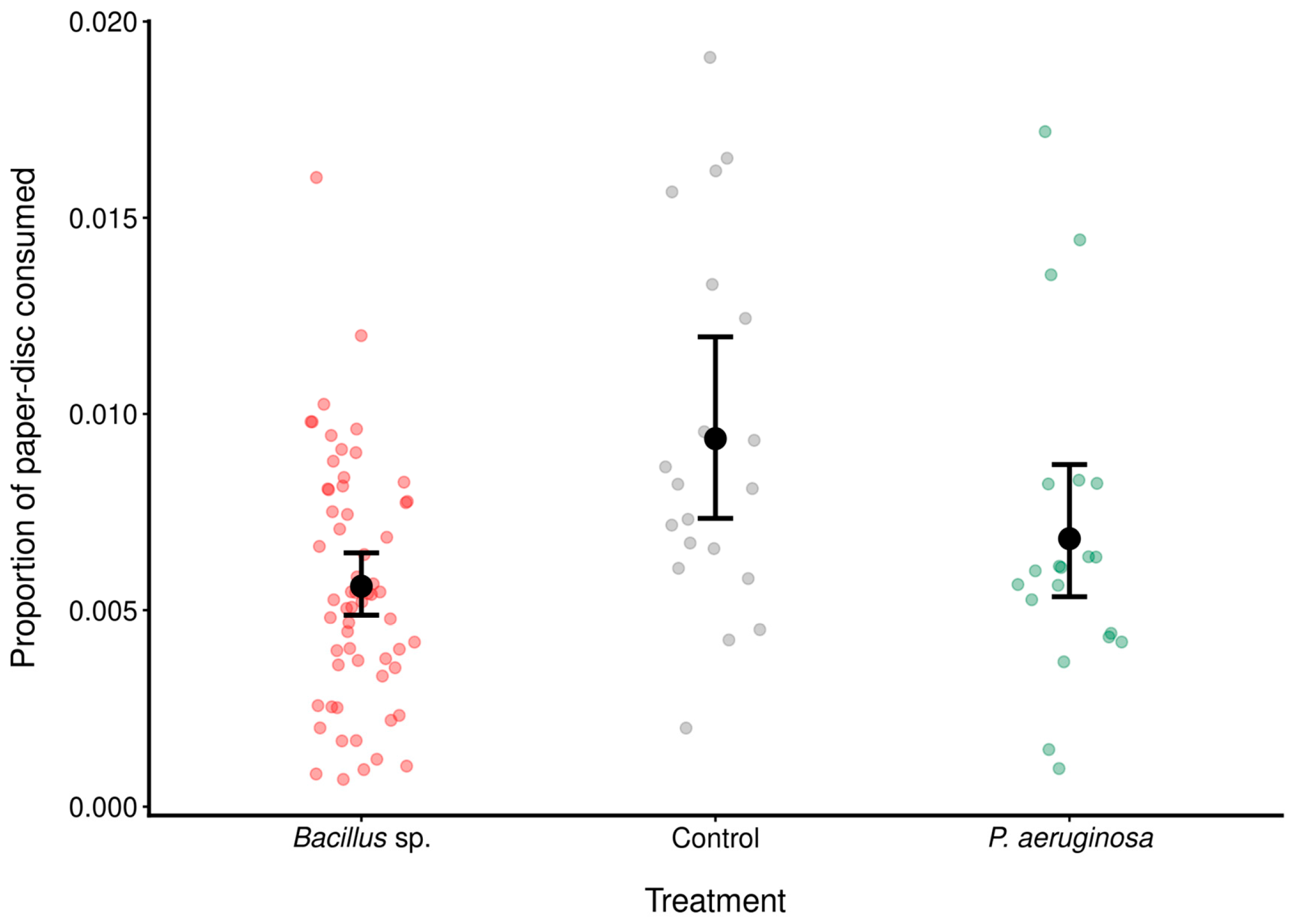
Food consumption did not vary with bacterial dose within either treatment (Bacillus sp.: β = −0.043 ± 0.051, t = −0.854, df = 58, p = 0.397; P. aeruginosa: β = 0.032 ± 0.096, t = 0.329, df = 18, p = 0.746). However, consumption differed among treatments, with individuals exposed to Bacillus sp. consuming significantly less than controls (Tukey test, ratio = 0.599, df = 97, p = 0.0014), while P. aeruginosa did not differ from either group (Figure 4).
Figure 4.
Paper-disc consumption by Constrictotermes cyphergaster workers under different bacterial treatments. Colored points represent individual replicates (jitter), while black points and error bars indicate the adjusted mean and 95% confidence interval derived from the generalized linear model (GLM). Consumption was significantly reduced in individuals exposed to Bacillus sp. (in red) compared to the control group (in grey), whereas exposure to P. aeruginosa (in green) resulted in no significant difference in feeding behavior relative to the control.
4. Discussion
Understanding how gut-associated microorganisms influence host fitness is central to elucidating the ecological and evolutionary dynamics of symbiotic systems. In this context, the present study investigated the interaction between the termite C. cyphergaster and a gut-derived Bacillus sp. isolate, comparing its effects with those of the opportunistic pathogen P. aeruginosa. Our results showed a significant reduction in host survival following exposure to both bacterial treatments, with higher inoculation densities leading to decreased longevity. However, the Bacillus isolate induced a stronger overall reduction in survival compared to P. aeruginosa and was also associated with a decrease in feeding activity. These findings suggest that bacteria derived from the termite gut environment can exert negative effects on host survival and behavior. Such effects highlight the potential for diverse interactions between hosts and associated microorganisms, including outcomes that may be detrimental under certain contexts.
4.1. Pathogenic Potential of Gut-Derived Bacillus
The significant mortality induced by the gut-derived Bacillus sp. suggests that bacteria associated with the termite gut environment can exhibit pathogenic effects under experimental conditions [49,50,51,52]. Although the isolate showed 98.5% 16S rRNA gene sequence similarity to members of the B. thuringiensis group, its precise taxonomic identity remains uncertain due to the limited resolution of this marker. Moreover, we cannot determine whether it represents a stable member of the microbiota or a transient or opportunistic organism. Therefore, rather than classifying this isolate, our results demonstrate that gut-derived bacteria may have the potential to negatively affect host survival under certain conditions, highlighting the importance of considering both beneficial and harmful interactions within host-associated microbial communities.
In this context, the stronger mortality induced by the Bacillus isolate compared to the exogenous P. aeruginosa highlights differences in how these bacteria interact with the host [53,54,55,56]. However, the mechanisms underlying this pattern remain unclear. Rather than reflecting specific adaptations to overcome host defenses, the observed effects may result from differences in bacterial physiology, toxin production, or growth dynamics in the experimental context [57,58,59].
4.2. Dose Dependency and Virulence Strategies
Both isolates followed a classic dose–response relationship, where higher inoculation densities led to a significant decline in host longevity [60,61]. However, C. cyphergaster exhibited greater sensitivity to the Bacillus isolate compared to P. aeruginosa, as reflected by the stronger reduction in survival across doses [62,63]. This pattern may reflect a high degree of compatibility between the toxins of the microbe and the physiological vulnerabilities of the host, resulting in a more potent pathogenic cascade as the dose increases [64,65,66].
Conversely, the attenuated impact of P. aeruginosa suggests different infection dynamics. As an opportunistic environmental pathogen, P. aeruginosa may rely on quorum-sensing-mediated virulence or metabolic competition, which requires reaching critical densities to overcome host defenses [67,68,69]. However, similar density-dependent mechanisms could also apply to the Bacillus isolate, and our data do not allow us to distinguish between these possibilities. This underscores the evolutionary arms race between termites and pathogens [70,71,72,73], where the host has developed effective barriers that are breached when the pathogen reaches pronounced densities [26,74,75].
4.3. Behavioral Impairment and Physiological Collapse
The reduction in food consumption among individuals exposed to Bacillus sp. further suggests that this bacterium affects host feeding behavior. In insect–pathogen interactions, decreased feeding is a common response and may result from multiple factors, including physiological stress, immune activation, gut damage, or avoidance of contaminated food [76,77,78,79,80]. In our study, feeding reduction was observed only in the Bacillus treatment, whereas P. aeruginosa did not produce a comparable effect despite also causing dose-dependent mortality. Bacillus species are known to cause gut damage in insects, which can lead to reduced feeding [81,82,83], but we did not directly assess tissue-level effects in this study. Therefore, while the observed behavioral changes are consistent with infection-related stress, they should be interpreted cautiously, without attributing them to specific mechanisms.
5. Conclusions
Taken together, our findings indicate that a bacterium isolated from the termite gut can negatively affect host survival and feeding, with effects comparable to those observed for an exogenous opportunistic pathogen. Differences between bacterial treatments were observed, with the gut-derived Bacillus exerting a stronger overall impact on survival and reducing feeding activity. Importantly, these effects were dose-dependent, with increasing bacterial concentrations leading to reduced survival, highlighting the role of inoculum size in shaping host responses. The observed mortality and reduction in feeding highlight that host-associated bacteria may influence termite survival in multiple ways. Rather than supporting a strictly protective view of termite–microbe associations, these results underscore the potential for diverse outcomes arising from such interactions, including negative effects under certain conditions. Although the broader ecological relevance of these findings remains to be determined, our study emphasizes the importance of considering both beneficial and potentially harmful roles of host-associated microorganisms in shaping symbiotic systems.
Supplementary Materials
The following supporting information can be downloaded at: https://www.mdpi.com/article/10.3390/d18050281/s1, Figure S1: Maximum-likelihood phylogeny inferred from partial 16S rRNA gene sequences of Bacillus isolates recovered from the gut of Constrictotermes cyphergaster and reference sequences of Bacillus cereus and B. thuringiensis retrieved from GenBank. The focal isolate selected for subsequent bioassays (10*) is highlighted and clusters within the Bacillus cereus sensu lato group. Numbers at nodes indicate bootstrap support values (1000 replicates; values ≥70% shown). The tree is midpoint-rooted.
Author Contributions
Conceptualization: M.L. and M.A.B.-G.; Data curation: M.L., D.L., M.H.d.O., L.M.d.L. and É.L.; Formal analysis: M.L.; Funding acquisition: M.L. and M.A.B.-G.; Investigation: M.L., D.L. and M.A.B.-G.; Supervised experiments: M.L., D.L., M.H.d.O., L.M.d.L. and É.L.; Project administration: M.L., A.A. and M.A.B.-G.; Software: M.L.; Supervision: A.A. and M.A.B.-G.; Validation: M.L. and M.A.B.-G.; Visualization: M.L.; Writing—original draft: M.L., D.L. and M.A.B.-G.; Writing—review and editing: M.L., D.L., M.H.d.O., L.M.d.L., É.L., A.A. and M.A.B.-G. All authors have read and agreed to the published version of the manuscript.
Funding
Financial support was provided by Brazilian funding agencies. M.L., D.L., and M.H.d.O. were supported by postgraduate fellowships from the Coordination for the Development of Higher Education Personnel (CAPES, Brazil; Finance Code 001). A.A. was supported by São Paulo Research Foundation (FAPESP), grants # 2023/15703-9 and 2018/22839-6. This study was financed in part by Paraiba State University, grant #01/2026.
Institutional Review Board Statement
Not applicable.
Data Availability Statement
The original contributions presented in this study are included in the article and Supplementary Materials. Further inquiries can be directed to the corresponding author.
Acknowledgments
We are grateful to all individuals who contributed to the development of this study and to the preparation of the manuscript. We also express our sincere gratitude to the Laboratory of Environmental Microbiology at the Instituto Nacional do Semiárido (INSA), Campina Grande, Brazil, for kindly providing the Pseudomonas aeruginosa isolate used in this study, and to Embrapa Algodão, Campina Grande, Brazil, for their invaluable assistance with the DNA extraction of the samples. We are also grateful to Alan Victor Andrade Canton for producing the illustrations for the graphical abstract.
Conflicts of Interest
The authors declare no conflicts of interest related to the research or the manuscript.
References
- Berlanga, M.; Guerrero, R. The holobiont concept: The case of xylophagous termites and cockroaches. Symbiosis 2016, 68, 49–60. [Google Scholar] [CrossRef] [Scilit]
- Germer, J.; Cerveau, N.; Jackson, D.J. The Holo-Transcriptome of a Calcified Early Branching Metazoan. Front. Mar. Sci. 2017, 4, 81. [Google Scholar] [CrossRef] [Scilit]
- Dittami, S.M.; Arboleda, E.; Auguet, J.-C.; Bigalke, A.; Briand, E.; Cárdenas, P.; Cardini, U.; Decelle, J.; Engelen, A.H.; Eveillard, D. A community perspective on the concept of marine holobionts: Current status, challenges, and future directions. PeerJ 2021, 9, e10911. [Google Scholar] [CrossRef] [Scilit]
- Tamarit, D.; Andersson, S.G.E. Rethinking microbial symbioses. FEMS Microbiol. Lett. 2020, 367, fnz255. [Google Scholar] [CrossRef] [Scilit] [PubMed]
- Wiesmann, C.L.; Wang, N.R.; Zhang, Y.; Liu, Z.; Haney, C.H. Origins of symbiosis: Shared mechanisms underlying microbial pathogenesis, commensalism and mutualism of plants and animals. FEMS Microbiol. Rev. 2023, 47, fuac048. [Google Scholar] [CrossRef] [Scilit] [PubMed]
- Hajra, D.; Kirthivasan, N.; Chakravortty, D. Symbiotic Synergy from Sponges to Humans: Microflora-Host Harmony is Crucial for Ensuring Survival and Shielding against Invading Pathogens. ACS Infect. Dis. 2024, 10, 317–336. [Google Scholar] [CrossRef] [Scilit] [PubMed]
- Moraïs, S.; Mizrahi, I. Islands in the stream: From individual to communal fiber degradation in the rumen ecosystem. FEMS Microbiol. Rev. 2019, 43, 362–379. [Google Scholar] [CrossRef] [Scilit]
- Hoepfner, C.; Guzmán, D.; Vidal-Veuthey, B.; Foronda, V.; Beggs, A.; Cárdenas, J.P.; Vargas, V.A.; Alfaro, F.D. Functional stratification and enzymatic arrangement in microbial communities across a hypersaline depth gradient. Front. Microbiol. 2025, 16, 1624058. [Google Scholar] [CrossRef] [Scilit]
- Lushchak, V.I. Symphony of Digestion: Coordinated Host–Microbiome Enzymatic Interplay in Gut Ecosystem. Biomolecules 2025, 15, 1151. [Google Scholar] [CrossRef] [Scilit]
- Liu, H.; Macdonald, C.A.; Cook, J.; Anderson, I.C.; Singh, B.K. An Ecological Loop: Host Microbiomes across Multitrophic Interactions. Trends Ecol. Evol. 2019, 34, 1118–1130. [Google Scholar] [CrossRef] [Scilit]
- Weiss, S. Microbiota as mediator and moderator of stress. BioEssays News Rev. Mol. Cell. Dev. Biol. 2021, 43, e2000277. [Google Scholar] [CrossRef] [Scilit]
- Bastías, D.A.; Balestrini, R.; Pollmann, S.; Gundel, P.E. Environmental interference of plant−microbe interactions. Plant Cell Environ. 2022, 45, 3387–3398. [Google Scholar] [CrossRef] [Scilit] [PubMed]
- Lai, T.-T.; Liou, C.-W.; Tsai, Y.-H.; Lin, Y.-Y.; Wu, W.-L. Butterflies in the gut: The interplay between intestinal microbiota and stress. J. Biomed. Sci. 2023, 30, 92. [Google Scholar] [CrossRef] [Scilit]
- Ohkuma, M.; Brune, A. Diversity, Structure, and Evolution of the Termite Gut Microbial Community. In Biology of Termites: A Modern Synthesis; Springer: Dordrecht, The Netherlands, 2010; pp. 413–438. [Google Scholar]
- Sabree, Z.L.; Huang, C.Y.; Arakawa, G.; Tokuda, G.; Lo, N.; Watanabe, H.; Moran, N.A. Genome shrinkage and loss of nutrient-providing potential in the obligate symbiont of the primitive termite Mastotermes darwiniensis. Appl. Environ. Microbiol. 2012, 78, 204–210. [Google Scholar] [CrossRef] [Scilit]
- Brune, A. Symbiotic digestion of lignocellulose in termite guts. Nat. Rev. Microbiol. 2014, 12, 168–180. [Google Scholar] [CrossRef] [Scilit]
- Chouvenc, T.; Šobotník, J.; Engel, M.S.; Bourguignon, T. Termite evolution: Mutualistic associations, key innovations, and the rise of Termitidae. Cell. Mol. Life Sci. 2021, 78, 2749–2769. [Google Scholar] [CrossRef] [Scilit]
- Brune, A.; Dietrich, C. The Gut Microbiota of Termites: Digesting the Diversity in the Light of Ecology and Evolution. Annu. Rev. Microbiol. 2015, 69, 145–166. [Google Scholar] [CrossRef] [Scilit] [PubMed]
- Arora, J.; Kinjo, Y.; Šobotník, J.; Buček, A.; Clitheroe, C.; Stiblik, P.; Roisin, Y.; Žifčáková, L.; Park, Y.C.; Kim, K.Y.; et al. The functional evolution of termite gut microbiota. Microbiome 2022, 10, 78. [Google Scholar] [CrossRef] [Scilit]
- Sero, E.T.; Amobonye, A.; Bhagwat, P.; Singh, N.K.; de Carvalho, J.C.; Permaul, K.; Pillai, S. Exploring the termite gut as a hub of industrially important microbes and enzymes for biofuel production. Biomass Bioenergy 2025, 199, 107899. [Google Scholar] [CrossRef] [Scilit]
- Calleri, D.V.; McGrail Reid, E.; Rosengaus, R.B.; Vargo, E.L.; Traniello, J.F.A. Inbreeding and disease resistance in a social insect: Effects of heterozygosity on immunocompetence in the termite Zootermopsis angusticollis. Proc. Biol. Sci. 2006, 273, 2633–2640. [Google Scholar] [CrossRef] [Scilit] [PubMed]
- Rosengaus, R.; Traniello, J.; Bulmer, M. Ecology, Behavior and Evolution of Disease Resistance in Termites. In Biology of Termites: A Modern Synthesis; Springer: Dordrecht, The Netherlands, 2010; pp. 165–191. [Google Scholar]
- Wisselink, M.; Aanen, D.K.; van’t Padje, A. The Longevity of Colonies of Fungus-Growing Termites and the Stability of the Symbiosis. Insects 2020, 11, 527. [Google Scholar] [CrossRef] [Scilit]
- Traniello, J.F.A.; Rosengaus, R.B.; Savoie, K. The development of immunity in a social insect: Evidence for the group facilitation of disease resistance. Proc. Natl. Acad. Sci. USA 2002, 99, 6838–6842. [Google Scholar] [CrossRef] [Scilit] [PubMed]
- Rozen, D. Faecal pharmaceuticals and external immunity in termites. J. Exp. Biol. 2014, 217, 161. [Google Scholar] [CrossRef] [Scilit]
- Moran, M.N.; Aguero, C.M.; Eyer, P.-A.; Vargo, E.L. Rescue Strategy in a Termite: Workers Exposed to a Fungal Pathogen are Reintegrated into the Colony. Front. Ecol. Evol. 2022, 10, 840223. [Google Scholar] [CrossRef] [Scilit]
- Liu, L.; Zhao, X.-Y.; Tang, Q.-B.; Lei, C.-L.; Huang, Q.-Y. The Mechanisms of Social Immunity Against Fungal Infections in Eusocial Insects. Toxins 2019, 11, 244. [Google Scholar] [CrossRef] [Scilit]
- Palma, L.; Muñoz, D.; Berry, C.; Murillo, J.; Caballero, P. Bacillus thuringiensis Toxins: An Overview of Their Biocidal Activity. Toxins 2014, 6, 3296–3325. [Google Scholar] [CrossRef] [Scilit] [PubMed]
- Baranek, J.; Pluskota, M.; Rusin, M.; Konecka, E.; Kaznowski, A.; Wiland-Szymańska, J. Insecticidal activity of Bacillus thuringiensis strains isolated from tropical greenhouses towards Cydia pomonella and Spodoptera exigua larvae. BioControl 2023, 68, 39–48. [Google Scholar] [CrossRef] [Scilit]
- Ma, X.; Hu, J.; Ding, C.; Portieles, R.; Xu, H.; Gao, J.; Du, L.; Gao, X.; Yue, Q.; Zhao, L.; et al. New native Bacillus thuringiensis strains induce high insecticidal action against Culex pipiens pallens larvae and adults. BMC Microbiol. 2023, 23, 100. [Google Scholar] [CrossRef] [Scilit]
- König, H. Bacillus species in the intestine of termites and other soil invertebrates. J. Appl. Microbiol. 2006, 101, 620–627. [Google Scholar] [CrossRef] [Scilit]
- Mathew, G.M.; Ju, Y.-M.; Lai, C.-Y.; Mathew, D.C.; Huang, C.C. Microbial community analysis in the termite gut and fungus comb of Odontotermes formosanus: The implication of Bacillus as mutualists. FEMS Microbiol. Ecol. 2012, 79, 504–517. [Google Scholar] [CrossRef] [Scilit]
- Mathew, G.M.; Mathew, D.C.; Lo, S.-C.; Alexios, G.M.; Yang, J.-C.; Sashikumar, J.M.; Shaikh, T.M.; Huang, C.-C. Synergistic collaboration of gut symbionts in Odontotermes formosanus for lignocellulosic degradation and bio-hydrogen production. Bioresour. Technol. 2013, 145, 337–344. [Google Scholar] [CrossRef] [Scilit]
- Korsa, G.; Beyene, A.; Ayele, A. Bacterial diversity from soil-feeding termite gut and their potential application. Ann. Microbiol. 2023, 73, 38. [Google Scholar] [CrossRef] [Scilit]
- Moura, F.M.S.; Vasconcellos, A.; Araújo, V.F.P.; Bandeira, A.G. Seasonality in foraging behaviour of Constrictotermes cyphergaster (Termitidae, Nasutitermitinae) in the Caatinga of Northeastern Brazil. Insectes Sociaux 2006, 53, 472–479. [Google Scholar] [CrossRef] [Scilit]
- Oliveira, M.H.d.; Viana-Junior, A.B.; Rolim, M.d.S.L.; Eloi, I.; Andrade, M.R.d.L.; Souza, J.J.L.L.d.; Bezerra-Gusmão, M.A. The Impact of Constrictotermes cyphergaster (Termitidae: Nasutitermitinae) Termites on Semiarid Ecosystems in Brazil: A Review of Current Research. Insects 2022, 13, 704. [Google Scholar] [CrossRef] [Scilit]
- Arab, A.; Paulino, L.C.; Rolim, M.S.L.; de Menezes, L.R.; de Oliveira, M.H.; dos Santos, R.A.C.; Cairo, J.P.L.F.; Bezerra-Gusmão, M.A.; Costa-Leonardo, A.M.; Cunha, H.; et al. The gut microbiome and lignocellulose digestion in Constrictotermes cyphergaster (Termitidae: Nasutitermitinae): A termite incorporating lichen into its diet. Diversity 2024, 16, 623. [Google Scholar] [CrossRef] [Scilit]
- de Oliveira, M.H.; Lacerda-Rolim, M.d.S.; Barbosa-Silva, A.M.; Abad, A.C.A.; Mota, R.A.; Pereira, E.C.; Martins, M.C.B.; de Lima, L.M.; Bezerra-Gusmão, M.A. Inhibitory effect of usnic acid on the gut microbiota of the termite Constrictotermes cyphergaster. Symbiosis 2023, 89, 329–335. [Google Scholar] [CrossRef] [Scilit]
- Lacerda, M.; Eloi, I.; Lira, D.; Araújo, E.G.L.; Oliveira, M.H.; Abad, A.C.A.; Lima, L.M.; Pereira, E.C.; Martins, M.C.B.; Mota, R.A.; et al. Lichen-derived atranorin effects on cultivable gut-associated bacteria in Constrictotermes cyphergaster. Symbiosis, 2026; accepted. [CrossRef] [Scilit]
- Barreto, M.R.; Loguercio, L.L.; Valicente, F.H.; Paiva, E. Insecticidal activity of culture supernatants from Bacillus thuringiensis Berliner strains against Spodoptera frugiperda Smith (Lepidoptera: Noctuidae) larvae. An. Soc. Entomológica Bras. 1999, 28, 675–685. [Google Scholar] [CrossRef] [Scilit]
- Doyle, J.J.; Doyle, J.L. A rapid DNA isolation procedure for small quantities of fresh leaf tissue. Phytochem. Bull. 1987, 19, 11–15. [Google Scholar]
- Wright, E.S. Using DECIPHER v2.0 to analyze big biological sequence data in R. R J. 2016, 8, 352–359. [Google Scholar] [CrossRef] [Scilit]
- R Core Team. R: A Language and Environment for Statistical Computing; R Foundation for Statistical Computing: Vienna, Austria, 2024; Available online: https://www.R-project.org/.
- Schliep, K.P. phangorn: Phylogenetic analysis in R. Bioinformatics 2011, 27, 592–593. [Google Scholar] [CrossRef] [Scilit] [PubMed]
- Hall-Stoodley, L.; Costerton, J.W.; Stoodley, P. Bacterial biofilms: From the natural environment to infectious diseases. Nat. Rev. Microbiol. 2004, 2, 95–108. [Google Scholar] [CrossRef] [Scilit] [PubMed]
- Zhang, Q.; Wang, S.; Zhang, X.; Zhang, R.; Zhang, Z. Negative Impact of Pseudomonas aeruginosa Y12 on Its Host Musca domestica. Front. Microbiol. 2021, 12, 691158. [Google Scholar] [CrossRef] [Scilit]
- Campanini, E.B.; Davolos, C.C.; Alves, E.C.d.C.; Lemos, M.V.F. Caracterização de novos isolados de Bacillus thuringiensis para o controle de importantes insetos-praga da agricultura. Bragantia 2012, 71, 362–369. [Google Scholar] [CrossRef] [Scilit]
- Lenth, R.V. Emmeans: Estimated Marginal Means, aka Least-Squares Means, R package version 2025; Comprehensive R Archive Network: Vienna, Austria, 2025. [Google Scholar]
- Brugger, S.D.; Bomar, L.; Lemon, K.P. Commensal–Pathogen Interactions along the Human Nasal Passages. PLoS Pathog. 2016, 12, e1005633. [Google Scholar] [CrossRef] [Scilit]
- Pitlik, S.D.; Koren, O. How holobionts get sick—Toward a unifying scheme of disease. Microbiome 2017, 5, 64. [Google Scholar] [CrossRef] [Scilit]
- Cho, K.; Spasova, D.; Hong, S.-W.; O, E.; Surh, C.D.; Im, S.-H.; Kim, K.S. Listeria monocytogenes Establishes Commensalism in Germ-Free Mice Through the Reversible Downregulation of Virulence Gene Expression. Front. Immunol. 2021, 12, 666088. [Google Scholar] [CrossRef] [Scilit]
- Li, H.; Miao, M.; Jia, C.; Cao, Y.-B.; Yan, T.-H.; Jiang, Y.-Y.; Yang, F. Interactions between Candida albicans and the resident microbiota. Front. Microbiol. 2022, 13, 930495. [Google Scholar] [CrossRef] [Scilit]
- Bass, D.; Stentiford, G.D.; Wang, H.-C.; Koskella, B.; Tyler, C.R. The Pathobiome in Animal and Plant Diseases. Trends Ecol. Evol. 2019, 34, 996–1008. [Google Scholar] [CrossRef] [Scilit]
- Burmeister, A.R.; Hansen, E.; Cunningham, J.J.; Rego, E.H.; Turner, P.E.; Weitz, J.S.; Hochberg, M.E. Fighting microbial pathogens by integrating host ecosystem interactions and evolution. BioEssays 2021, 43, 2000272. [Google Scholar] [CrossRef] [Scilit]
- Hanson, M.A. When the microbiome shapes the host: Immune evolution implications for infectious disease. Philos. Trans. R. Soc. B Biol. Sci. 2024, 379, 20230061. [Google Scholar] [CrossRef] [Scilit] [PubMed]
- Hoang, K.L.; Read, T.D.; King, K.C. Incomplete immunity in a natural animal-microbiota interaction selects for higher pathogen virulence. Curr. Biol. 2024, 34, 1357–1363.e3. [Google Scholar] [CrossRef] [Scilit]
- Hegedus, D.; Erlandson, M.; Gillott, C.; Toprak, U. New insights into peritrophic matrix synthesis, architecture, and function. Annu. Rev. Entomol. 2009, 54, 285–302. [Google Scholar] [CrossRef] [Scilit] [PubMed]
- Abraham, N.M.; Liu, L.; Jutras, B.L.; Yadav, A.K.; Narasimhan, S.; Gopalakrishnan, V.; Ansari, J.M.; Jefferson, K.K.; Cava, F.; Jacobs-Wagner, C.; et al. Pathogen-mediated manipulation of arthropod microbiota to promote infection. Proc. Natl. Acad. Sci. USA 2017, 114, E781–E790. [Google Scholar] [CrossRef] [Scilit]
- Prakash, A.; Monteith, K.M.; Vale, P.F. Mechanisms of damage prevention, signalling and repair impact disease tolerance. Proc. R. Soc. B Biol. Sci. 2022, 289, 20220837. [Google Scholar] [CrossRef] [Scilit]
- Gupta, P.K. (Ed.) Principles of Toxicology. In Problem Solving Questions in Toxicology: A Study Guide for the Board and Other Examinations; Springer International Publishing: Cham, Switzerland, 2020; pp. 27–45. [Google Scholar]
- Moffett, D.; Elmasri, H.; Fowler, B. General Considerations of Dose-Effect and Dose-Response Relationships. In Handbook on the Toxicology of Metals; Academic Press: Cambridge, MA, USA, 2007; pp. 101–115. [Google Scholar]
- Petersen, C.; Round, J.L. Defining dysbiosis and its influence on host immunity and disease. Cell. Microbiol. 2014, 16, 1024–1033. [Google Scholar] [CrossRef] [Scilit]
- Fujita, H.; Ushio, M.; Suzuki, K.; Abe, M.S.; Yamamichi, M.; Iwayama, K.; Canarini, A.; Hayashi, I.; Fukushima, K.; Fukuda, S.; et al. Alternative stable states, nonlinear behavior, and predictability of microbiome dynamics. Microbiome 2023, 11, 63. [Google Scholar] [CrossRef] [Scilit]
- Kamada, N.; Chen, G.Y.; Inohara, N.; Núñez, G. Control of pathogens and pathobionts by the gut microbiota. Nat. Immunol. 2013, 14, 685–690. [Google Scholar] [CrossRef] [Scilit]
- Iacob, S.; Iacob, D.G. Infectious Threats, the Intestinal Barrier, and Its Trojan Horse: Dysbiosis. Front. Microbiol. 2019, 10, 1676. [Google Scholar] [CrossRef] [Scilit] [PubMed]
- Sugihara, K.; Kamada, N. Metabolic network of the gut microbiota in inflammatory bowel disease. Inflamm. Regen. 2024, 44, 11. [Google Scholar] [CrossRef] [Scilit]
- Darch, S.E.; West, S.A.; Winzer, K.; Diggle, S.P. Density-dependent fitness benefits in quorum-sensing bacterial populations. Proc. Natl. Acad. Sci. USA 2012, 109, 8259–8263. [Google Scholar] [CrossRef] [Scilit]
- Gellatly, S.L.; Hancock, R.E.W. Pseudomonas aeruginosa: New insights into pathogenesis and host defenses. Pathog. Dis. 2013, 67, 159–173. [Google Scholar] [CrossRef] [Scilit] [PubMed]
- Faure, E.; Kwong, K.; Nguyen, D. Pseudomonas aeruginosa in Chronic Lung Infections: How to Adapt Within the Host? Front. Immunol. 2018, 9, 2416. [Google Scholar] [CrossRef] [Scilit]
- Arango, R.A.; Carlson, C.M.; Currie, C.R.; McDonald, B.R.; Book, A.J.; Green, F.; Lebow, N.K.; Raffa, K.F. Antimicrobial Activity of Actinobacteria Isolated From the Guts of Subterranean Termites. Environ. Entomol. 2016, 45, 1415–1423. [Google Scholar] [CrossRef] [Scilit]
- Mitaka, Y.; Mori, N.; Matsuura, K. A termite fungistatic compound, mellein, inhibits entomopathogenic fungi but not egg-mimicking termite ball fungi. Appl. Entomol. Zool. 2018, 54, 39–46. [Google Scholar] [CrossRef] [Scilit]
- Li, X.; Wang, M.; Feng, K.; Sun, H.; Tang, F. The Function of Termicin from Odontotermes formosanus (Shiraki) in the Defense against Bacillus thuringiensis (Bt) and Beauveria bassiana (Bb) Infection. Insects 2024, 15, 360. [Google Scholar] [CrossRef] [Scilit]
- Nakashima, M.; Mitaka, Y.; Inagaki, T.; Matsuura, K. An antifungal compound secreted by termite workers, phenylacetic acid, inhibits the growth of both termite egg-mimicking fungus and entomopathogenic fungi. Insectes Sociaux 2024, 71, 221–232. [Google Scholar] [CrossRef] [Scilit]
- Nakashima, M.; Matsuura, K. Termite antimicrobial defense through interaction with symbiotic microorganisms in nest materials. Sci. Rep. 2025, 15, 23391. [Google Scholar] [CrossRef] [Scilit]
- Roxinol, J.; Costantin, E.; Castiblanco, J.; Rolim, M.D.S.L.; Bezerra-Gusmão, M.A.; Rosengaus, R.; DeSouza, O. Resilience that goes beyond prophylaxis: Benefits of faecal accumulation within termite nests. Ecol. Entomol. 2025, 50, 1044–1056. [Google Scholar] [CrossRef] [Scilit]
- Ayres, J.S.; Schneider, D.S. The Role of Anorexia in Resistance and Tolerance to Infections in Drosophila. PLoS Biol. 2009, 7, e1000150. [Google Scholar] [CrossRef] [Scilit] [PubMed]
- Eakin, L.; Wang, M.; Dwyer, G. The effects of the avoidance of infectious hosts on infection risk in an insect-pathogen interaction. Am. Nat. 2015, 185, 100–112. [Google Scholar] [CrossRef] [Scilit]
- Surendran, S.; Hückesfeld, S.; Wäschle, B.; Pankratz, M.J. Pathogen-induced food evasion behavior in Drosophila larvae. J. Exp. Biol. 2017, 220, 1774–1780. [Google Scholar] [CrossRef] [Scilit] [PubMed]
- Hite, J.L.; Pfenning, A.C.; Cressler, C.E. Starving the Enemy? Feeding Behavior Shapes Host-Parasite Interactions. Trends Ecol. Evol. 2020, 35, 68–80. [Google Scholar] [CrossRef] [Scilit]
- Sieksmeyer, T.; He, S.; Esparza-Mora, M.A.; Jiang, S.; Petrašiūnaitė, V.; Kuropka, B.; Banasiak, R.; Julseth, M.J.; Weise, C.; Johnston, P.R.; et al. Eating in a losing cause: Limited benefit of modified macronutrient consumption following infection in the oriental cockroach Blatta orientalis. BMC Ecol. Evol. 2022, 22, 67. [Google Scholar] [CrossRef] [Scilit] [PubMed]
- Lightfoot, Y.L.; Yang, T.; Sahay, B.; Zadeh, M.; Cheng, S.X.; Wang, G.P.; Owen, J.L.; Mohamadzadeh, M. Colonic Immune Suppression, Barrier Dysfunction, and Dysbiosis by Gastrointestinal Bacillus anthracis Infection. PLoS ONE 2014, 9, e100532. [Google Scholar] [CrossRef] [Scilit]
- Glare, T.; Jurat-Fuentes, J.; O’Callaghan, M. Basic and Applied Research. In Microbial Control of Insect and Mite Pests; Academic Press: Cambridge, MA, USA, 2017; pp. 47–67. [Google Scholar]
- Ningshen, T.J.; Chauhan, V.K.; Dhania, N.K.; Dutta-Gupta, A. Insecticidal Effects of Hemocoelic Delivery of Bacillus thuringiensis Cry Toxins in Achaea janata Larvae. Front. Physiol. 2017, 8, 289. [Google Scholar] [CrossRef] [Scilit] [PubMed]
Disclaimer/Publisher’s Note: The statements, opinions and data contained in all publications are solely those of the individual author(s) and contributor(s) and not of MDPI and/or the editor(s). MDPI and/or the editor(s) disclaim responsibility for any injury to people or property resulting from any ideas, methods, instructions or products referred to in the content. |
© 2026 by the authors. Licensee MDPI, Basel, Switzerland. This article is an open access article distributed under the terms and conditions of the Creative Commons Attribution (CC BY) license.