


Abstract
This study reports on the first Mesozoic turtle remains from Cambodia. The material, consisting of shell fragments, was collected at Koh Moul, an island in the Gulf of Thailand. These turtle remains are assigned to Trionychoidae indet. and have strong similarities with the Early Cretaceous basal trionychoid Basilochelys macrobios from the Khorat Group, NE Thailand. The discovery suggests an Early Cretaceous age for the fossil-bearing strata.
1. Introduction
The Mesozoic non-marine deposits of Southeast Asia are rich in turtle fossils. The majority of Mesozoic turtles are recorded from Thailand, ranging from the Late Triassic to Early Cretaceous (See [1,2,3] and references therein). Turtle specimens have also been reported from the Early Cretaceous of Laos and Malaysia [4,5]. Although non-marine Mesozoic deposits crop out in several regions of Cambodia, no turtle remains have been reported from that country to date. In this paper, we report on the first Mesozoic turtle remains from Cambodia and discuss their stratigraphical implications.
2. Geographical and Geological Settings
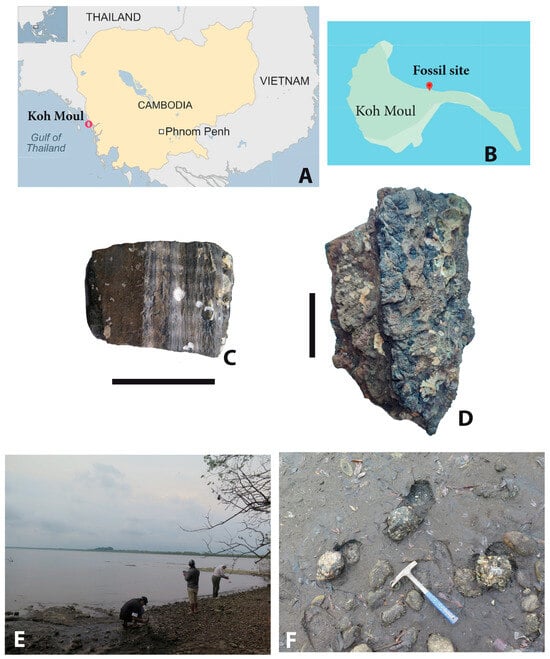
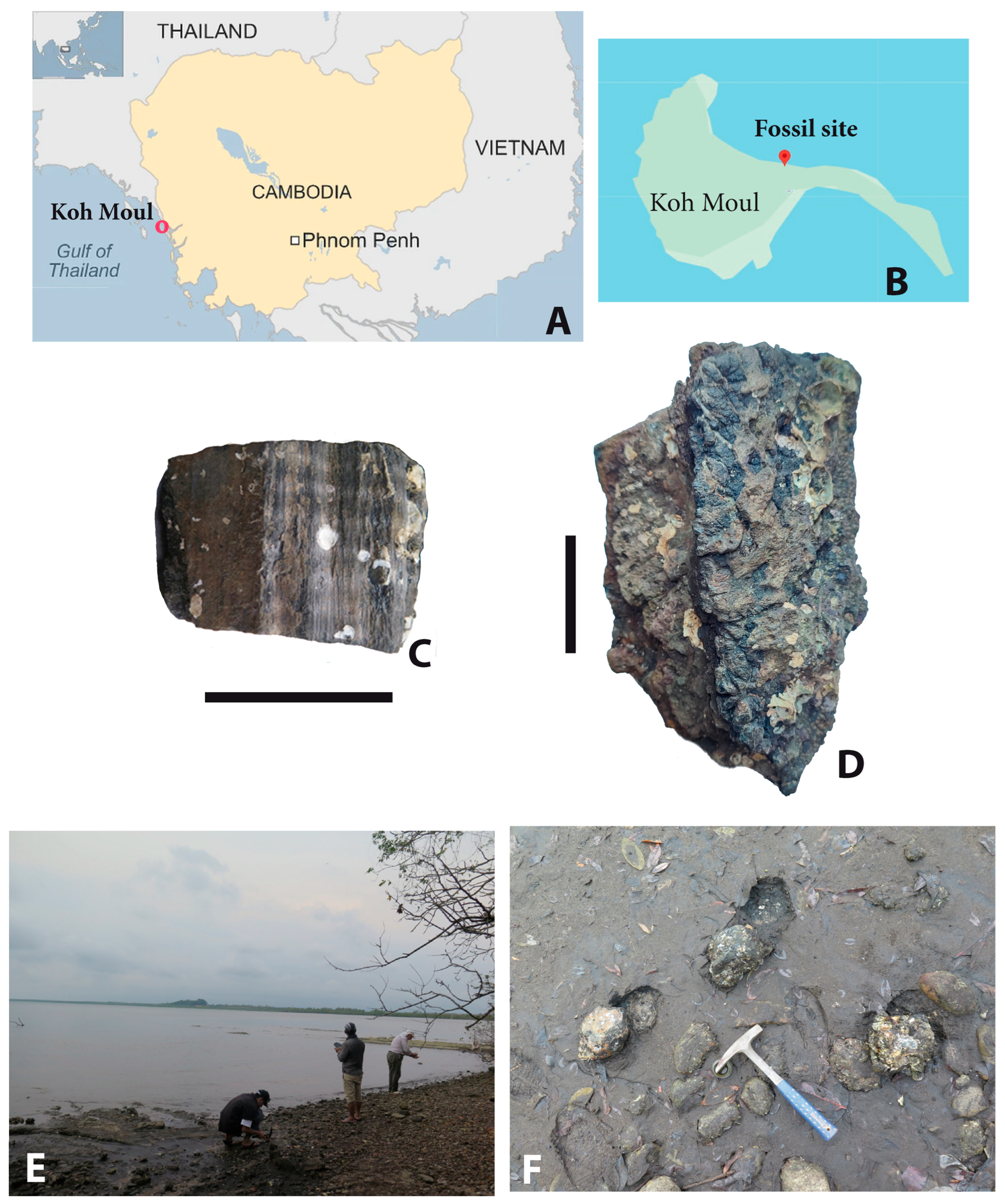
Koh Moul is a small island in the Gulf of Thailand, in Koh Kong Province, southwest Cambodia (Figure 1), some 30 km south of the city of Koh Kong.
Figure 1.
(A). Geographical position of Koh Moul, SW Cambodia; (B). Location of fossil site at Koh Moul; (C). Fossil wood of the conifer type (tracheidoxyl); (D). Bridge peripherals of turtle (MOEC-4) before preparation; (E,F). Outcrop on the beach at low tide of the Koh Moul site. Scale bar = 5 cm.
The fossil site was discovered by local people when fossil wood was found on the beach. In November 2023, during our first visit to the site, some turtle shell fragments were collected along with abundant fossil wood. Additional material was collected in November 2024, February and October 2025.
The site is located on the beach of Koh Moul. Underwater most of the time, it is exposed only at low tide (Figure 1E,F). The sediments mostly consist of siltstones/mudstones, and erosion has formed numerous concretions/pebbles that are covered by large numbers of oysters and other seashells on the surface. Some of these concretions/pebbles are, in fact, fossil wood or turtle shell remains. This is the case of a large piece of shell consisting of two almost complete bridge peripherals of a turtle (MOEC-4, Figure 1D).
The fossil-bearing rocks at Koh Moul belong to the non-marine series, which forms the bedrock of much of southwestern Cambodia. This thick succession of sandstones and clayey sediments has traditionally been known as the “Grès Supérieurs” (Upper Sandstones), a term first coined by French geologists working in northern Laos [6] and subsequently used for poorly dated non-marine Mesozoic formations in many parts of Indochina [7]. The thick Mesozoic continental deposits of SW Cambodia (Cardamom Mountains, Elephant Range, Bokor Plateau), including the Koh Moul area, have been referred to the Grès Supérieurs by various authors [8,9]. However, as noted by Buffetaut et al. [10], “The concept of Grès Supérieurs is in fact rather vague and covers lithologically and chronostratigraphically diverse formations in various parts of Southeast Asia”, so it seems advisable not to use it anymore. In recent years, the Mesozoic non-marine formations of SW Cambodia have yielded various fossils (in addition to the turtle remains described in the present paper), including plants, molluscs [10] and a single dinosaur bone [11]. Although biostratigraphic correlations with the non-marine Khorat Group of nearby Thailand are worth attempting (see below), it should be noted that the Cambodian and Thai sedimentary series were apparently deposited in different basins (N. Sattayarak, pers. com.) and that the formations defined on the Khorat Plateau cannot easily be identified in SW Cambodia [10].
3. Identification
Testudines Linnaeus, 1758
Cryptodira Cope, 1868
Trionychoidae Fitzinger, 1826
Trionychoidae indet.
(Figure 2)
Figure 2.
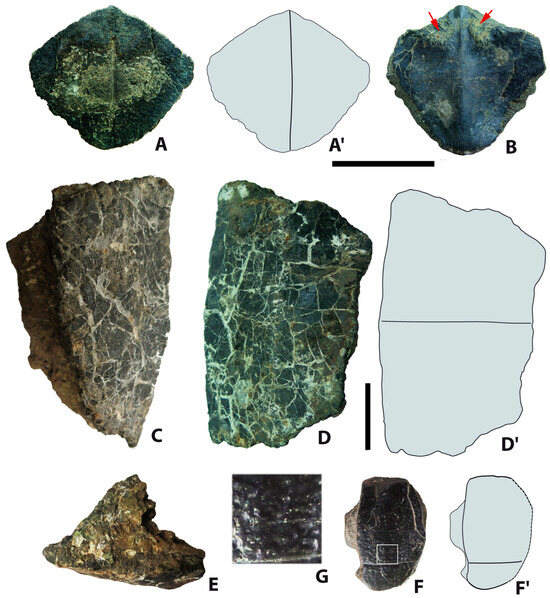
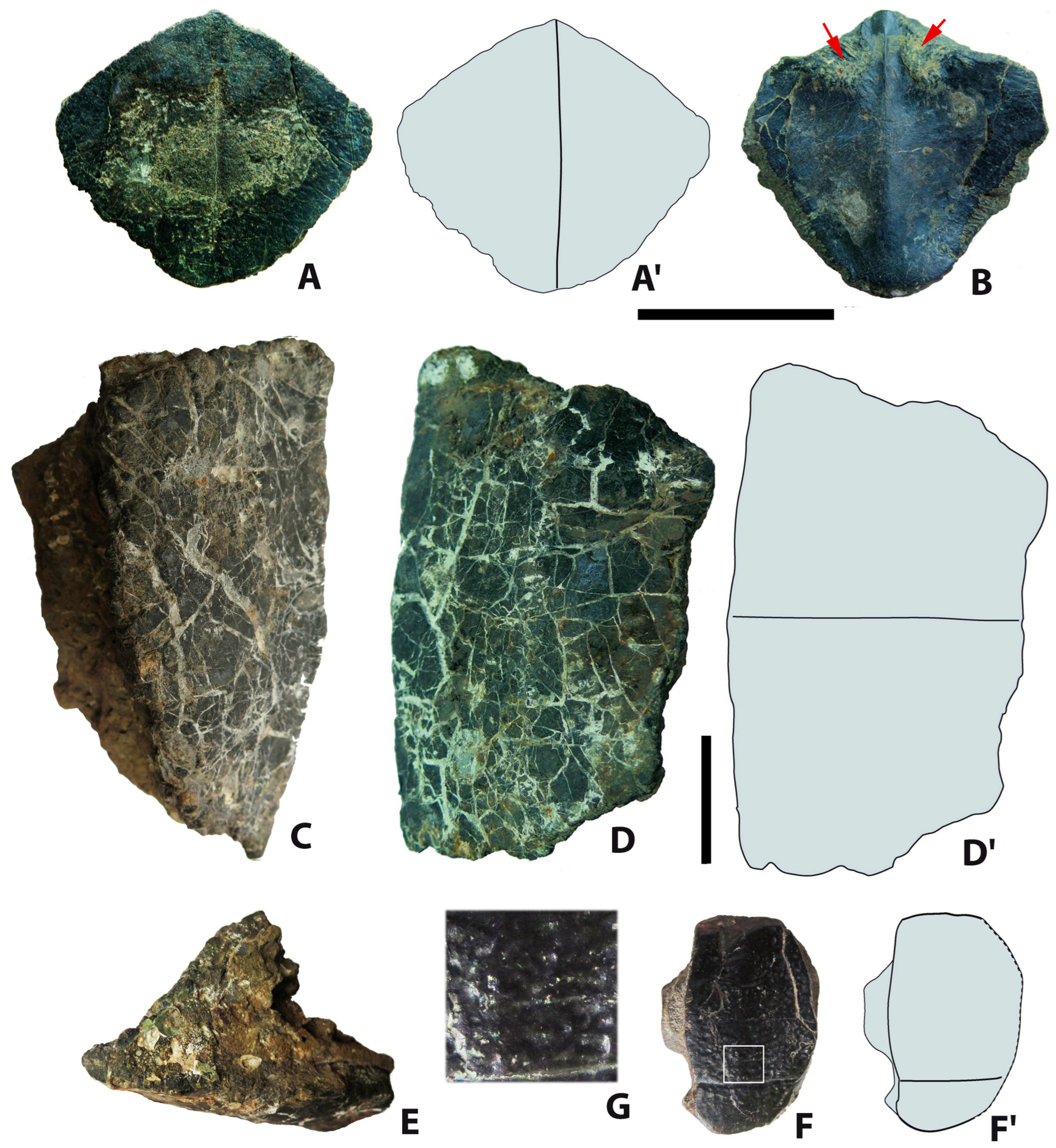
Turtle specimens from Koh Moul, SW Cambodia. (A,B). Entoplastron (MOEC-2) in ventral (A,A’) and dorsal (B) views; (C–E). Bridge peripherals (MOEC-4) in dorsal (C), ventral (D,D’), and anterior (E) views; (F,G). fragment of costal (MOEC-3) in dorsal view (F,F’) and close up showing ornamentation (G); Scale bar = 5 cm. (horizontal bar for (A,B,F), vertical bar for (C–E)). Red arrows indicate the scars.
Referred material: a complete entoplastron (MOEC-2); a distal end of a costal (MOEC-3), two bridge peripherals in articulation (MOEC-4), and other shell fragments. The specimens are housed in the collection of the Cultural Heritage Office, Department of Heritage Parks, Ministry of Environment, Phnom Penh.
3.1. Description
These turtle plates show a sculptured outer surface, consisting of irregular vermiculated ridges and bulges.
The most significant specimen is the entoplastron (MOEC-2, collected in November 2024; Figure 2A,B). The plate is diamond-shaped, slightly wider than it is long, measuring 6.7 cm in length, 7.5 cm in width, and 2 cm in maximum thickness. The outer surface is covered with distinct ornamentation. A midline sulcus is visible throughout the length of the plate, whereas the gular/intergular and the humeropectoral sulci are absent from the plate. On the inner surface, a pair of large scars, representing the contact site with the scapula, is located close to the anterior border. Between the scars is a midline ridge extending from the anterior tip to the posterior end. It is low and thin anteriorly and enlarged and more prominent posteriorly. The plate becomes thicker at its posterior end.
A fragment of carapace consists of two bridge peripherals in articulation (MOEC-4, collected in February 2025; Figure 2C–E), measuring 11 cm in length and 18 cm in width. In cross-section, the plate is V-shaped and open medially. In dorsal view, the dorsal sheet is convex dorsally, and there is a wide gutter along the free margin. The ventral sheet is almost flat and slightly longer than the dorsal sheet.
A costal fragment (MOEC-3; Figure 2F,G) with a free rib end is probably the distal portion of a left costal 6. A transverse sulcus is visible on its posterior part.
3.2. Size Estimation
On the basis of the peripheral plates (MOEC-4) and by comparison with Basilochelys macrobios [12], the total carapace length is estimated at about 80 cm.
3.3. Comparisons and Systematic Assignment
The shell surface ornamentation, consisting of vermiculate ridges and bulges seen on the specimens from Koh Moul, is characteristic of Trionychoidae. Trionychoidae (sensu Meylan and Gaffney, 1989 [13]) consists of Adocidae (Early Cretaceous–Eocene), Nanhsiungchelyidae (Cretaceous), Trionychidae (Early Cretaceous–Present), Carettochelyidae (Early Cretaceous–Present), and some basal members (e.g., Basilochelys macrobios, Sinaspideretes wimani) from the Late Jurassic/Early Cretaceous of Asia. Among this group, the shell surface ornamentation of the Koh Moul turtle differs from the pitted surface of Adocidae and the large cells/parallel ridges of Nanhsiungchelyidae [14,15,16].
The presence of peripheral plates and shell scutes in the Koh Moul turtle remains distinguishes them from Trionychidae, in which these elements are absent [17].
The wider-than-long diamond-shaped entoplastron from Koh Moul is reminiscent of some basal Trionychoidae, such as Sinaspideretes wimani, Siamochelys peninsularis, Basilochelys macrobios, adocids, and nanhsiungchelyids [12,13,18,19,20,21,22,23,24,25,26,27,28]. In xinjiangchelyids and macrobaenids, the entoplastron is elongate [29,30,31,32,33], whereas in carettochelyids, the entoplastron is triangular in shape [34,35]. The entoplastron from Koh Moul is only slightly wider than it is long, with a length/width ratio of 0.87, comparable to that of Basilochelys macrobios (0.88), a basal Trionychoidae known from the basal Cretaceous of the Khorat Plateau, NE Thailand. However, the entopolastron from Koh Moul is more angular compared with that of Basilochelys macrobios, which has a more rounded outline [12]. In other stem Trionychoidae, the length/width ratio of the entoplastron of Siamochelys penninsularis is 0.71, whereas in Sinaspideretes wimani, the entoplastron is nearly as long as wide [19,25,36,37]. In adocids, the entoplastron is generally wider, with a length/width ratio ranging from 0.55 to 0.75 [13,21,22,23,28,38,39,40,41]. The entoplastron from Koh Moul is not crossed by the gular/intergular or humeropectoral sulci, which is different from most nanhsiungchelyids, in which the pectoroabdominal sulcus is curved, invading the entoplastron (e.g., Basilemys spp., Hanbgdemys orientalis, Jiangxichelys spp., Kharakhutulia kalandadzei, Nanhsiungchelys wuchingensis, Yuchelys nanyangensis, Zangerlia spp.); but more similar to Basilochelys macrobios, in which only the pectoroabdominal sulcus barely covers the posterior end of the entoplastron [12,18,42,43,44,45,46,47]. In addition, the pair of raised tubercles seen on the inner surface of the entoplastron is reminiscent of that of Basilochelys macrobios, in which “On the inner side, a pair of rounded tubercles is present on the anterior part of this plate” ([12], p. 163). Such a structure, for the contact with the scapula [48], is not developed as raised tubercles in other turtles (e.g., testudinids, geoemydids, emydids). In adocids, a system of Y-shaped ridges is present on the dorsal surface of the entoplastron [21,22,23,39]. In nanhsiungchelyids, there is a V-shaped ridge instead [20,49].
In summary, the turtle remains from Koh Moul are referred to Trionychoidae and are close in morphology to Basilochelys from the Khorat Group of Thailand.
4. Stratigraphical Implications
The Khorat Group (NE Thailand) consists of five formations, namely, from bottom to top, the Phu Kradung, Phra Wihan, Sao Khua, Phu Phan, and Khok Kruat formations, ranging in age from the Late Jurassic to the mid-Cretaceous. Abundant turtle remains have been collected from the Phu Kradung, Sao Khua, and Khok Kruat formations. The turtle fauna of the Khorat Group comprises two distinct assemblages. The lower part of the Phu Kradung Formation has yielded xinjiangchelyid turtles, which are comparable to the Late Jurassic turtle fauna of mainland Asia (China and Central Asia), whereas the assemblage from the top of the Phu Kradung Formation and younger formations (Sao Khua and Khok Kruat formations) is dominated by trionychoid turtles. Both Adocidae and Carettochelyidae are present in the Sao Khua and Khok Kruat formations. The top of the Phu Kradung Formation has yielded the large trionychoid turtle Basilochelys macrobios, which is considered a basal trionychoid [12,25]. As mentioned above, the morphology of the shell remains from Koh Moul, especially that of the entoplastron, closely resembles that of Basilochelys. Some large trionychoid remains have also been reported from the Sao Khua Formation and its coeval strata in eastern Thailand, as well as from Ko Kut (Kut Island, also spelled Koh Kood) in the Gulf of Thailand [50], but their relationships are poorly understood due to poor preservation of the material. As the age of the top of the Phu Kradung Formation is basal Cretaceous [51] and that of the Sao Khua Formation is Hautrivian to Barremian [52,53,54] or Valanginian [55], this would suggest that the turtle-bearing strata of Koh Moul are likely Early Cretaceous in age.
This is in agreement with the Early Cretaceous age suggested on the basis of plant remains by Corsin and Desreumaux [8] for non-marine rocks (referred to the “Grès Supérieurs”) in the Bokor-Kampot area (about 180 km SE of Koh Moul), and also with the presence of a sauropod dinosaur reminiscent of Cretaceous euhelopodids in sandstones in a similar stratigraphic position at Koh Paur, near Koh Kong, about 30 km north of Koh Moul [11].
5. Note on Fossil Wood from Koh Moul
Associated fossil woods from Koh Moul were also examined. One specimen is approximately 90 cm long, with diameters of 7 cm and 10 cm at its respective ends. Another, larger cast, approximately 150 cm long, exhibits a complex branching pattern, with one branch measuring about 117 cm in length; this morphology may represent part of a root system. These are tracheidoxyls, i.e., conifer-type wood. However, their preservation is insufficient for more precise identification. The fossil record of Mesozoic woods in Thailand is relatively uniform [56], and without a collection of several anatomically well-preserved woods, few stratigraphic conclusions can be drawn. This is probably also the case in Cambodia.
6. Conclusions
Turtle remains from Koh Moul are referred to Trionychoidae indet., and show strong similarities with Basilochelys macrobios, a basal member of that clade. Considering the occurrence of large trionychoids at the top of the Phu Kradung Formation and the Sao Khua Formation of the Khorat Group, a correlation based on turtle remains, with the presence of such a large basal trionychoid, would suggest an Early Cretaceous age for the vertebrate- and wood-bearing deposits of Koh Moul. This is in agreement with age assessments based on other kinds of fossils from other locations in SW Cambodia.
Author Contributions
Conceptualization, H.T. and E.B.; methodology, H.T. and J.C.; validation, H.T., E.B., V.L., M.P., N.B. and J.C.; investigation, H.T., E.B., V.L., M.P., N.B.; resources, H.T. and V.L.; data curation, H.T. and V.L.; writing—original draft preparation, H.T.; writing—review and editing, H.T., E.B., M.P., N.B. and J.C.; visualization, H.T.; supervision, H.T. and E.B.; project administration, V.L.; funding acquisition, V.L. All authors have read and agreed to the published version of the manuscript.
Funding
This study is supported by the Cambodian Ministry of Environment, the International Research Network “Palaeobiodiversity of South-East Asia” of the Centre National de la Recherche Scientifique (CNRS), Paris, France (No grant numbers were provided), and UNESCO (No 3240113284).
Data Availability Statement
The original contributions presented in this study are included in the article. Further inquiries can be directed to the corresponding author.
Acknowledgments
We thank all the researchers, students, and volunteers who took part in the research for fossils in Koh Moul.
Conflicts of Interest
The authors declare no conflicts of interest.
Abbreviation
| MOEC | Cambodian Ministry of Environment |
References
- Tong, H.; Claude, J.; Buffetaut, E.; Suteethorn, V.; Naksri, W.; Chitsing, S. Fossil Turtles of Thailand: An Updated Review. In Proceedings of the Papers from the 2005 Heyuan International Dinosaur Symposium; Geological Publishing House: Beijing, China, 2006; pp. 183–194. [Google Scholar]
- Tong, H.; Claude, J.; Suteethorn, V.; Naksri, W.; Buffetaut, E. Turtle Assemblages of the Khorat Group (Late Jurassic-Early Cretaceous) of NE Thailand and Their Palaeobiogeographical Significance. In Late Palaeozoic and Mesozoic Continental Ecosystems in SE Asia; Buffetaut, E., Cuny, G., Le Loeuff, J., Suteethorn, V., Eds.; Special Publication 315; Geological Society: London, UK, 2009; pp. 141–152. [Google Scholar]
- Tong, H.; Chanthasit, P.; Naksri, W.; Suteethorn, S.; Claude, J. New Material of Turtles from the Upper Jurassic of Phu Noi, NE Thailand: Phylogenetic Implications. Ann. Paléontologie 2023, 109, 102656. [Google Scholar] [CrossRef] [Scilit]
- Lapparent de Broin, F.d. A New Shachemydinae (Chelonii, Cryptodira) from the Lower Cretaceous of Laos: Preliminary Data. Comptes Rendus Palevol. 2004, 3, 387–396. [Google Scholar] [CrossRef] [Scilit]
- Teng, Y.H.; Sone, M.; Hirayama, R.; Yoshida, M.; Komatsu, T.; Khamha, S.; Cuny, G. First Cretaceous Fish Fauna from Malaysia. J. Vertebr. Paleontol. 2019, 39, e1573735. [Google Scholar] [CrossRef] [Scilit]
- Jacob, C.; Dussault, L. Explorations Géologiques Dans Le Haut-Laos. Bull. Serv. Géologique L’Indochine 1924, 13, 1–147. [Google Scholar]
- Saurin, E. Indochine. In Lexique Stratigraphique International. Volume III, Asie, Fascicule 6a: Indochine; Dubertret, L., Ed.; Centre National de la Recherche Scientifique: Paris, France, 1956; Volume 15, pp. 1–146. [Google Scholar]
- Corsin, P.; Desreumaux, C. Découverte d’une Flore Néocomienne Dans Les «Grès Supérieurs» de Bokor (Cambodge Méridional). Ann. De La Société Géologique Du Nord 1972, 92, 199–212. [Google Scholar]
- Fleuriot de Langle, P. Carte Géologique de Reconnaissance à 1/200 000. Editions Du Bureau de Recherches Géologiques et Minières; Service National des Mines, de la Géologie et du Pétrole: Paris, France, 1972. [Google Scholar]
- Buffetaut, E.; Tong, H.; Cavin, L.; Lim, V.; Ly, P.S.; Heng, M. Fossil-Bearing Non-Marine Mesozoic Formations of South-Western Cambodia. In Proceedings of the 18th Regional Geoscience Conference of Southeast Asia: GEOSEA 2024, Khon Kaen, Thailand, 20–23 February 2024; pp. 55–63. [Google Scholar]
- Lim, V.; Buffetaut, E.; Tong, H.; Cavin, L.; Pann, K.; Ngoeun, P.P. The First Dinosaur from the Kingdom of Cambodia: A Sauropod Fibula from the Lower Cretaceous of Koh Kong Province, South-Western Cambodia. Fossils 2023, 1, 49–59. [Google Scholar] [CrossRef] [Scilit]
- Tong, H.; Claude, J.; Naksri, W.; Suteethorn, V.; Buffetaut, E.; Khansubha, S.; Wongko, K.; Yuangdetkla, P. Basilochelys macrobios n. gen. and n. sp., a Large Cryptodiran Turtle from the Phu Kradung Formation (Latest Jurassic-Earliest Cretaceous) of the Khorat Plateau, NE Thailand. In Late Palaeozoic and Mesozoic Continental Ecosystems in SE Asia; Buffetaut, E., Cuny, G., Le Loeuff, J., Suteethorn, V., Eds.; Special Publication 315; Geological Society: London, UK, 2009; Volume 315, pp. 153–173. [Google Scholar]
- Meylan, P.A.; Gaffney, E.S. The Skeletal Morphology of the Cretaceous Cryptodiran Turtle, Adocus, and the Relationships of the Trionychoidea. Am. Mus. Novit. 1989, 1–22. [Google Scholar]
- Hirayama, R.; Sakurai, K.; Chitoku, T.; Kawakami, G.; Kito, N. Anomalochelys angulata, an Unusual Land Turtle of Family Nanhsiungchelyidae (Superfamily Trionychoidea; Order Testudines) from the Upper Cretaceous of Hokkaido, North Japan. Russ. J. Herpetol. 2001, 8, 127–138. [Google Scholar]
- Danilov, I.G.; Syromyatnikova, E.V. New Materials on Turtles of the Family Nanhsiungchelyidae from the Cretaceous of Uzbekistan and Mongolia, with a Review of the Nanhsiungchelyid Record in Asia. Proc. Zool. Inst. RAS 2008, 312, 3–25. [Google Scholar] [CrossRef] [Scilit]
- Danilov, I.G.; Sukhanov, V.B.; Syromyatnikova, E.V. New Asiatic Materials on Turtles of the Family Adocidae with a Review of the Adocid Record in Asia. Proc. Zool. Inst. RAS 2011, 315, 101–132. [Google Scholar] [CrossRef] [Scilit]
- Georgalis, G.L.; Joyce, W.G. A Review of the Fossil Record of Old World Turtles of the Clade Pan-Trionychidae. Bull. Peabody Mus. Nat. Hist. 2017, 58, 115–208. [Google Scholar] [CrossRef] [Scilit]
- Langston, W. The Shell of Basilemys varialosa (Cope). Bull. Nat. Mus. Can. 1956, 147, 155–163. [Google Scholar]
- Tong, H.; Buffetaut, E.; Suteethorn, V. Middle Jurassic Turtles from Southern Thailand. Geol. Mag. 2002, 139, 687–697. [Google Scholar] [CrossRef] [Scilit]
- Sukhanov, V.B.; Danilov, I.G.; Syromyatnikova, E.V. The Description and Phylogenetic Position of a New Nanhsiungchelyid Turtle from the Late Cretaceous of Mongolia. Acta Palaeontol. Pol. 2008, 53, 601–614. [Google Scholar] [CrossRef] [Scilit]
- Syromyatnikova, E.V. Turtles of the Genus Ferganemys Nessov et Khosatzky, 1977 (Adocidae): Shell Morphology and Phylogenetic Position. Proc. Zool. Inst. Russ. Acad. Sci. 2011, 315, 38–52. [Google Scholar] [CrossRef] [Scilit]
- Syromyatnikova, E.V.; Danilov, I.G.; Sukhanov, V.B. A Redescription and Phylogenetic Position of Adocus planus, an Adocid Turtle from the Late Cretaceous of Mongolia. Proc. Zool. Inst. RAS 2012, 316, 380–391. [Google Scholar] [CrossRef] [Scilit]
- Syromyatnikova, E.V.; Danilov, I.G.; Sukhanov, V.B. The Skeletal Morphology and Phylogenetic Position of Adocus amtgai, an Adocid Turtle from the Late Cretaceous of Mongolia. Cretac. Res. 2013, 45, 155–173. [Google Scholar] [CrossRef] [Scilit]
- Sullivan, R.M.; Jasinski, S.E.; Lucas, S.G. Re-Assessment of Late Campanian (Kirtlandian) Turtles from the Upper Cretaceous Fruitland and Kirtland Formations, San Juan Basin, New Mexico, USA. In Morphology and Evolution of Turtles; Brinkman, D.B., Holroyd, P.A., Gardner, J.D., Eds.; Vertebrate Paleobiology and Paleoanthropology; Springer Netherlands: Dordrecht, The Netherlands, 2013; pp. 337–387. ISBN 978-94-007-4308-3. [Google Scholar]
- Tong, H.; Li, L.; Ouyang, H. A Revision of Sinaspideretes wimani Young & Chow, 1953 (Testudines: Cryptodira: Trionychoidae) from the Jurassic of the Sichuan Basin, China. Geol. Mag. 2014, 151, 600–610. [Google Scholar]
- Mallon, J.C.; Brinkman, D.B. Basilemys morrinensis, a New Species of Nanhsiungchelyid Turtle from the Horseshoe Canyon Formation (Upper Cretaceous) of Alberta, Canada. J. Vertebr. Paleontol. 2018, 38, e1431922. [Google Scholar] [CrossRef] [Scilit]
- Tong, H.; Li, L. A Revision of the Holotype of Nanhsiungchelys wuchingensis, Ye, 1966 (Testudines: Cryptodira: Trionychoidae: Nanhsiungchelyidae). Cretac. Res. 2019, 95, 151–163. [Google Scholar] [CrossRef] [Scilit]
- Hirayama, R.; Sonoda, T.; Uno, H.; Horie, K.; Tsutsumi, Y.; Sasaki, K.; Mitsuzuka, S.; Takisawa, T. Adocus kohaku, a New Species of Aquatic Turtle (Testudines: Cryptodira: Adocidae) from the Late Cretaceous of Kuji, Iwate Prefecture, Northeast Japan, with Special References to the Geological Age of the Tamagawa Formation (Kuji Group). Int. J. Paleobiol. Paleontol 2021, 4, 12. [Google Scholar] [CrossRef] [Scilit]
- Peng, J.-H.; Brinkman, D.B. New Material of Xinjiangchelys (Reptilia: Testudines) from the Late Jurassic Qigu Formation (Shishugou Group) of the Pingfengshan Locality, Junggar Basin, Xinjiang. Can. J. Earth Sci. 1993, 30, 2013–2026. [Google Scholar] [CrossRef] [Scilit]
- Rabi, M.; Zhou, C.-F.; Wings, O.; Ge, S.; Joyce, W.G. A New Xinjiangchelyid Turtle from the Middle Jurassic of Xinjiang, China and the Evolution of the Basipterygoid Process in Mesozoic Turtles. BMC Evol. Biol. 2013, 13, 203. [Google Scholar] [CrossRef] [Scilit]
- Rabi, M.; Sukhanov, V.B.; Egorova, V.N.; Danilov, I.; Joyce, W.G. Osteology, Relationships, and Ecology of Annemys (Testudines, Eucryptodira) from the Late Jurassic of Shar Teg, Mongolia, and Phylogenetic Definitions for Xinjiangchelyidae, Sinemydidae, and Macrobaenidae. J. Vertebr. Paleontol. 2014, 34, 327–352. [Google Scholar] [CrossRef] [Scilit]
- Tong, H.; Chanthasit, P.; Naksri, W.; Ditbanjong, P.; Suteethorn, S.; Buffetaut, E.; Suteethorn, V.; Wongko, K.; Deesri, U.; Claude, J. Yakemys multiporcata n. g. n. sp., a Large Macrobaenid Turtle from the Basal Cretaceous of Thailand, with a Review of the Turtle Fauna from the Phu Kradung Formation and Its Stratigraphical Implications. Diversity 2021, 13, 630. [Google Scholar] [CrossRef] [Scilit]
- Obraztsova, E.M.; Krasnolutskii, S.A.; Sukhanov, V.B.; Danilov, I.G. Xinjiangchelyid Turtles from the Middle Jurassic of the Berezovsk Coal Mine (Krasnoyarsk Territory, Russia): Systematics, Skeletal Morphology, Variation, Relationships and Palaeobiogeographic Implications. J. Syst. Palaeontol. 2022, 20, 2093662. [Google Scholar] [CrossRef] [Scilit]
- Joyce, W.G. A Review of the Fossil Record of Turtles of the Clade Pan-Carettochelys. Bull. Peabody Mus. Nat. Hist. 2014, 55, 3–33. [Google Scholar] [CrossRef] [Scilit]
- Kim, M.; Jung, J.; Joyce, W.G.; Park, J.-I.; Jung, H.-Y.; Jo, H.; Huh, M. A New, Early Cretaceous Carettochelyid Turtle from South Korea Provides Insights into Softshell Evolution and Aquatic Ecology. Swiss J Palaeontol 2025, 144, 75. [Google Scholar] [CrossRef] [Scilit]
- Ye, H.-K. Fossil Turtles of China. Palaeontol. Sin. 1963, 150, 1–112. [Google Scholar]
- Danilov, I.G.; Parham, J.F. A Redescription of ‘Plesiochelys’ tatsuensis from the Late Jurassic of China, with Comments on the Antiquity of the Crown Clade Cryptodira. J. Vertebr. Paleontol. 2006, 26, 573–580. [Google Scholar] [CrossRef] [Scilit]
- Tong, H.; Buffetaut, E.; Suteethorn, V. Isanemys, a New Adocid Turtle from the Sao Khua Formation (Early Cretaceous) of the Khorat Plateau, Northeastern Thailand. Foss. Turt. Res. 2006, 1, 128–137. [Google Scholar]
- Syromyatnikova, E.V.; Danilov, I.G. New Material and a Revision of Turtles of the Genus Adocus (Adocidae) from the Late Cretaceous of Middle Asia and Kazakhstan. Proc. Zool. Inst. RAS 2009, 313, 74–94. [Google Scholar] [CrossRef] [Scilit]
- Danilov, I.G.; Syromyatnikova, E.V.; Skutschas, P.P.; Kodrul, T.M.; Jin, J. The First ‘True’ Adocus (Testudines, Adocidae) from the Paleogene of Asia. J. Vertebr. Paleontol. 2013, 33, 1071–1080. [Google Scholar] [CrossRef] [Scilit]
- Tong, H.; Buffetaut, E.; Suteethorn, V.; Suteethorn, S.; Cuny, G.; Cavin, L.; Deesri, U.; Martin, J.E.; Wongko, K.; Naksri, W. Phu Din Daeng, a New Early Cretaceous Vertebrate Locality on the Khorat Plateau, NE Thailand. Ann. Paléontologie 2019, 105, 223–237. [Google Scholar] [CrossRef] [Scilit]
- Sukhanov, V.B. Mesozoic Turtles of Middle and Central Asia. In The Age of Dinosaurs in Russia and Mongolia; Benton, M.J., Shishkin, M.A., Unwin, D.M., Kurochkin, E.N., Eds.; Cambridge University Press: Cambridge, UK, 2000; pp. 309–367. [Google Scholar]
- Joyce, W.G.; Norell, M.A. Zangerlia ukhaachelys, New Species, a Nanhsiungchelyid Turtle from the Late Cretaceous of Ukhaa Tolgod, Mongolia. Am. Mus. Novit. 2005, 1–20. [Google Scholar] [CrossRef] [Scilit]
- Tong, H.; Xu, L.; Buffetaut, E.; Zhang, X.; Jia, S. A New Nanhsiungchelyid Turtle from the Late Cretaceous of Neixiang, Henan Province, China. Ann. Paléontologie 2012, 98, 303–314. [Google Scholar] [CrossRef] [Scilit]
- Danilov, I.G.; Sukhanov, V.B.; Syromyatnikova, E.V. A Redescription of Zangerlia dzamynchondi (Testudines: Nanhsiungchelyidae) from the Late Cretaceous of Mongolia with a Reassessment of the Phylogenetic Position and Relationships of Zangerlia. In Morphology and Evolution of Turtles; Springer: Dordrecht, The Nertherlands, 2013; pp. 407–417. [Google Scholar]
- Brinkman, D.B.; Tong, H.; Li, H.; Sun, Y.; Zhang, J.-S.; Godefroit, P.; Zhang, Z.-M. New Exceptionally Well-Preserved Specimens of “Zangerlia” neimongolensis from Bayan Mandahu, Inner Mongolia, and Their Taxonomic Significance. Comptes Rendus Palevol. 2015, 14, 577–587. [Google Scholar] [CrossRef] [Scilit]
- Tong, H.; Li, L.; Jie, C.; Yi, L. New Material of Jiangxichelys ganzhouensis Tong & Mo, 2010 (Testudines: Cryptodira: Nanhsiungchelyidae) and Its Phylogenetic and Palaeogeographical Implications. Geol. Mag. 2017, 154, 456–464. [Google Scholar]
- Gaffney, E.S. The Postcranial Morphology of Meiolania platyceps and a Review of the Meiolaniidae. Bull. Am. Mus. Nat. Hist. 1996, 229, 1–166. [Google Scholar]
- Brinkman, D.; Nicholls, E.L. New Specimen of Basilemys praeclara Hay and Its Bearing on the Relationships of the Nanhsiungchelyidae (Reptilia: Testudines). J. Paleontol. 1993, 67, 1027–1031. [Google Scholar] [CrossRef] [Scilit]
- Tong, H.; Naksri, W.; Buffetaut, E.; Suteethorn, S.; Suteethorn, V.; Deesri, U.; Claude, J. Turtle Remains from the Early Cretaceous of Kut Island, Gulf of Thailand. Comptes Rendus Palevol. 2021, 20, 345–349. [Google Scholar] [CrossRef] [Scilit]
- Tong, H.; Chanthasit, P.; Naksri, W.; Suteethorn, S.; Suteethorn, V.; Buffetaut, E.; Claude, J. Turtle Assemblages from the Phu Kradung Formation (NE Thailand): An Updated Review and Their Stratigraphical implications. In Proceeding of the 18th Regional Geoscience Conference of Southeast Asia, Khon Kaen, Thailand, 20–23 February 2024; pp. 125–134. [Google Scholar]
- Buffetaut, E.; Suteethorn, V.; Tong, H. Dinosaur Assemblages from Thailand: A Comparison with Chinese Faunas. In Proceedings of the Heyuan International Dinosaur Symposium; Lü, J., Kobayashi, Y., Huang, D., Lee, Y.N., Eds.; Geological Publishing House: Beijing, China, 2006; pp. 19–37. [Google Scholar]
- Racey, A.; Goodall, J.G. Palynology and Stratigraphy of the Mesozoic Khorat Group Red Bed Sequences from Thailand. In Late Palaeozoic and Mesozoic Continental Ecosystems in SE Asia; Buffetaut, E., Cuny, G., Le Loeuff, J., Suteethorn, V., Eds.; Special Publications 315; Geological Society: London, UK, 2009; pp. 69–83. [Google Scholar]
- Tumpeesuwan, S.; Sato, Y.; Nakhapadungrat, S. A New Species of Pseudohyria (Matsumotoina) (Bivalvia: Trigonioidoidea) from the Early Cretaceous Sao Khua Formation, Khorat Group, Northeastern Thailand. Trop. Nat. Hist. 2010, 10, 93–106. [Google Scholar] [CrossRef] [Scilit]
- Tucker, R.T.; Hyland, E.G.; Gates, T.A.; King, M.R.; Roberts, E.M.; Foley, E.K.; Berndt, D.; Hanta, R.; Khansubha, S.; Aswasereelert, W. Age, Depositional History, and Paleoclimatic Setting of Early Cretaceous Dinosaur Assemblages from the Sao Khua Formation (Khorat Group), Thailand. Palaeogeogr. Palaeoclimatol. Palaeoecol. 2022, 601, 111107. [Google Scholar] [CrossRef] [Scilit]
- Philippe, M.; Suteethorn, V.; Lutat, P.; Buffetaut, E.; Cavin, L.; Cuny, G.; Barale, G. Stratigraphical and Palaeobiogeographical Significance of Fossil Wood from the Mesozoic Khorat Group of Thailand. Geol. Mag. 2004, 141, 319–328. [Google Scholar] [CrossRef] [Scilit]
Disclaimer/Publisher’s Note: The statements, opinions and data contained in all publications are solely those of the individual author(s) and contributor(s) and not of MDPI and/or the editor(s). MDPI and/or the editor(s) disclaim responsibility for any injury to people or property resulting from any ideas, methods, instructions or products referred to in the content. |
© 2026 by the authors. Licensee MDPI, Basel, Switzerland. This article is an open access article distributed under the terms and conditions of the Creative Commons Attribution (CC BY) license.