


Abstract
Bronchiectasis is characterized by irreversible bronchial dilatation, chronic neutrophilic airway inflammation, and recurrent exacerbations, and the anti-inflammatory treatment options available for it remain very limited. We ranked herbs by the similarity of their diffusion profiles to that of the disease with a biased random walk on a multiscale interactome, derived the active compounds of the highest ranked herbs, and assessed structural plausibility by molecular docking and binding-mode analysis on structures validated by co-crystal redocking. The ten prioritized herbs were linked to 183 targets, and the 46 targets shared by three or more of them were concentrated in IL-17 signaling, TNF signaling, Th17 cell differentiation, and Toll-like receptor signaling. At the compound level, 26 herb–compound pairs covering 19 compounds were significant across all ten herbs, and genistein was directly connected to the disease proteins CFTR and ATM. In docking, scopoletin, pogostone, aloe-emodin, emodin, and genistein gave top-ranked poses at TNF, MAPK8, PTGS2, and MAPK1 that met the 5 Å centroid-distance criterion with a ligand efficiency of at least 0.30, dehydrodiconiferyl alcohol hydrogen bonded to Tyr385 of PTGS2, and aloe-emodin hydrogen bonded to Ser60 and Tyr151 of TNF. The framework nominates herbs and compounds without previous reports in bronchiectasis as candidates that converge on the neutrophil–Th17 axis.
1. Introduction
Bronchiectasis is a chronic airway disease characterized by irreversible bronchial dilatation, chronic sputum production, and recurrent infection [1]. In a population-based cohort in the United Kingdom, both the incidence and the prevalence rose markedly between 2004 and 2013, and mortality was higher than in the general population [2]. The patient population is highly heterogeneous in aetiology, severity, and exacerbation frequency, and this heterogeneity is now approached through endotyping [3].
The pathology of bronchiectasis is summarized as a neutrophil-driven vicious cycle of infection, inflammation, and airway damage. Neutrophilic inflammation and bacterial colonization persist in the airway even during clinical stability, and sputum neutrophil elastase activity predicts exacerbation frequency and lung function decline [3,4]. The causes are genetically heterogeneous, and several monogenic disorders such as primary ciliary dyskinesia, immunodeficiencies including antibody deficiency, and α1-antitrypsin deficiency give rise to bronchiectasis, while dysfunction of the CFTR channel has also been reported in bronchiectasis that is not caused by cystic fibrosis [5,6]. Treatment nevertheless centres on airway clearance and the management of exacerbations [7]. Among anti-inflammatory drugs, only long-term macrolides have reduced exacerbations in an individual participant data meta-analysis, and resistance and adverse effects constrain their long-term use [8]. The DPP-1 inhibitor brensocatib, which targets the neutrophil serine protease axis, reduced exacerbations in a phase 3 trial and has recently been introduced, and the fact that this is the first agent of its kind illustrates how narrow the anti-inflammatory options remain [9].
Herbal medicine has been applied to bronchiectasis, and a network pharmacology analysis of the Beimu-Gualou formula and a series of N-of-1 trials of individualized prescriptions have been reported [10,11]. In both designs the prescription is fixed in advance and the analysis explains the mechanism of that prescription. No study has started from the disease itself, screened the whole herb space to select candidates, and gone on to nominate herbs that have not previously been reported for it.
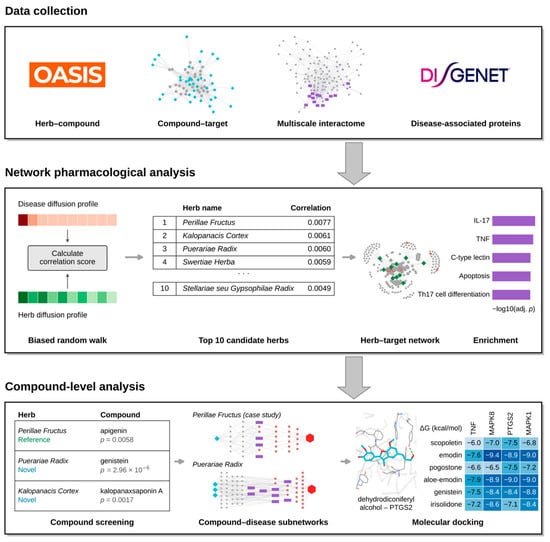
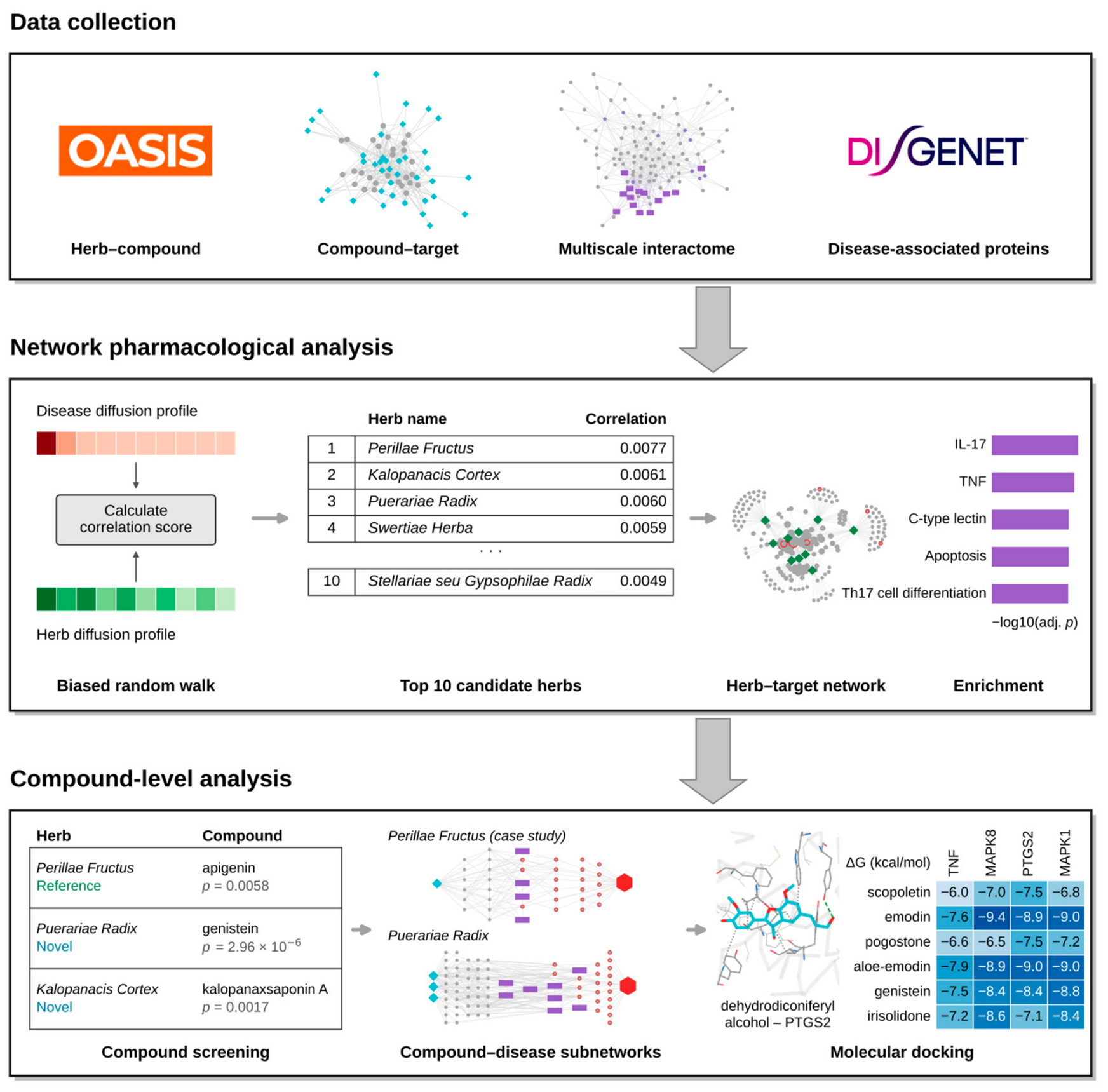
The present study quantifies herb–disease diffusion-profile similarity with a biased random walk on a multiscale interactome, which extends conventional network pharmacology by placing proteins and biological functions on a single multiscale graph [12]. Our group has applied the same framework to antioxidant activity, postmenopausal osteoporosis, and hepatic cirrhosis [13,14,15]. Here, we add structure-based docking under a redocking validation gate, together with binding-mode analysis, so that the prioritized compounds are also examined for whether they can plausibly bind the core targets (Figure 1).
Figure 1.
Workflow of the multiscale interactome-based framework for bronchiectasis. Herb–compound (OASIS), compound–target and multiscale interactome data were combined with 40 bronchiectasis-associated proteins (DisGeNET); biased random walks generated diffusion profiles and herbs were ranked by their correlation with the disease profile. The top 10 herbs were analysed by herb–target network and KEGG/GO enrichment, and their compounds were screened, assembled into compound–disease subnetworks, and docked to redocking-validated targets with binding-mode analysis by the Protein–Ligand Interaction Profiler (PLIP). The example panels show the Perillae Fructus and Puerariae Radix subnetworks, Vina scores (ΔG, kcal/mol) for six docked compounds, and the dehydrodiconiferyl alcohol–PTGS2 pose. Within the network panels, diamonds denote herbs or compounds, circles denote proteins, squares denote disease-associated proteins, and the hexagon denotes the disease; the grey arrows indicate the direction of the workflow only.
2. Results
2.1. Candidate Herbs for Bronchiectasis
The 349 herbs were ranked by the cosine correlation between their diffusion profiles and the bronchiectasis diffusion profile, and the overlap test and the compound criterion were applied to select ten candidates (Table 1). In rank order, these were Perillae Fructus (0.0077), Kalopanacis Cortex (0.0061), Puerariae Radix (0.0060), Swertiae Herba (0.0059), Puerariae Flos (0.0059), Pogostemonis Herba (0.0052), Bambusae Concretio Silicea (0.0052), Cassiae Semen (0.0051), Sambuci Lignum (0.0050), and Stellariae seu Gypsophilae Radix (0.0049).
Table 1.
Top 10 candidate herbs ranked by correlation with the bronchiectasis diffusion profile.
Overlap significance did not track the correlation ranking. Puerariae Radix and Puerariae Flos ranked third and fifth by correlation but shared the lowest overlap p value of 1.85 × 10⁻⁵, whereas Perillae Fructus, which ranked first by correlation, had the highest overlap p value of the ten at 0.045. The correlation compares the shape of two diffusion profiles across the whole interactome, while the overlap test asks only how many herb targets fall inside the disease protein set, so the two indices describe different aspects of herb–disease association and are reported side by side.
Perillae Fructus is a constituent herb of the prescription used in a series of N-of-1 trials in patients with stable bronchiectasis [11]. For the remaining nine herbs, a PubMed search carried out on 20 October 2026 that combined the Latin name, the botanical source, and the Pinyin name of each herb with bronchiectasis returned no report for this disease. Pharmacological reports at the herb level exist for several of them, but all of these were obtained in other disease contexts [16,17,18,19,20].
2.2. Herb–Target Network and Pathway Enrichment
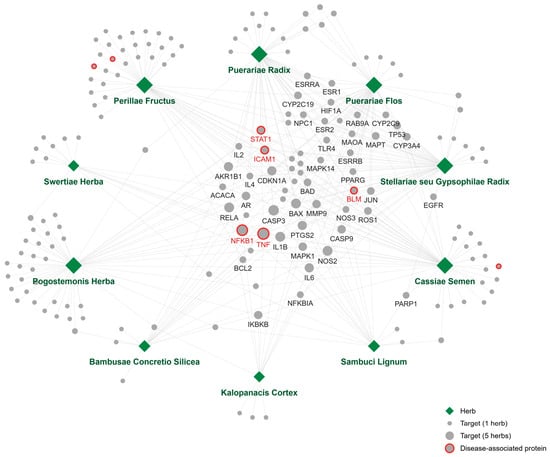
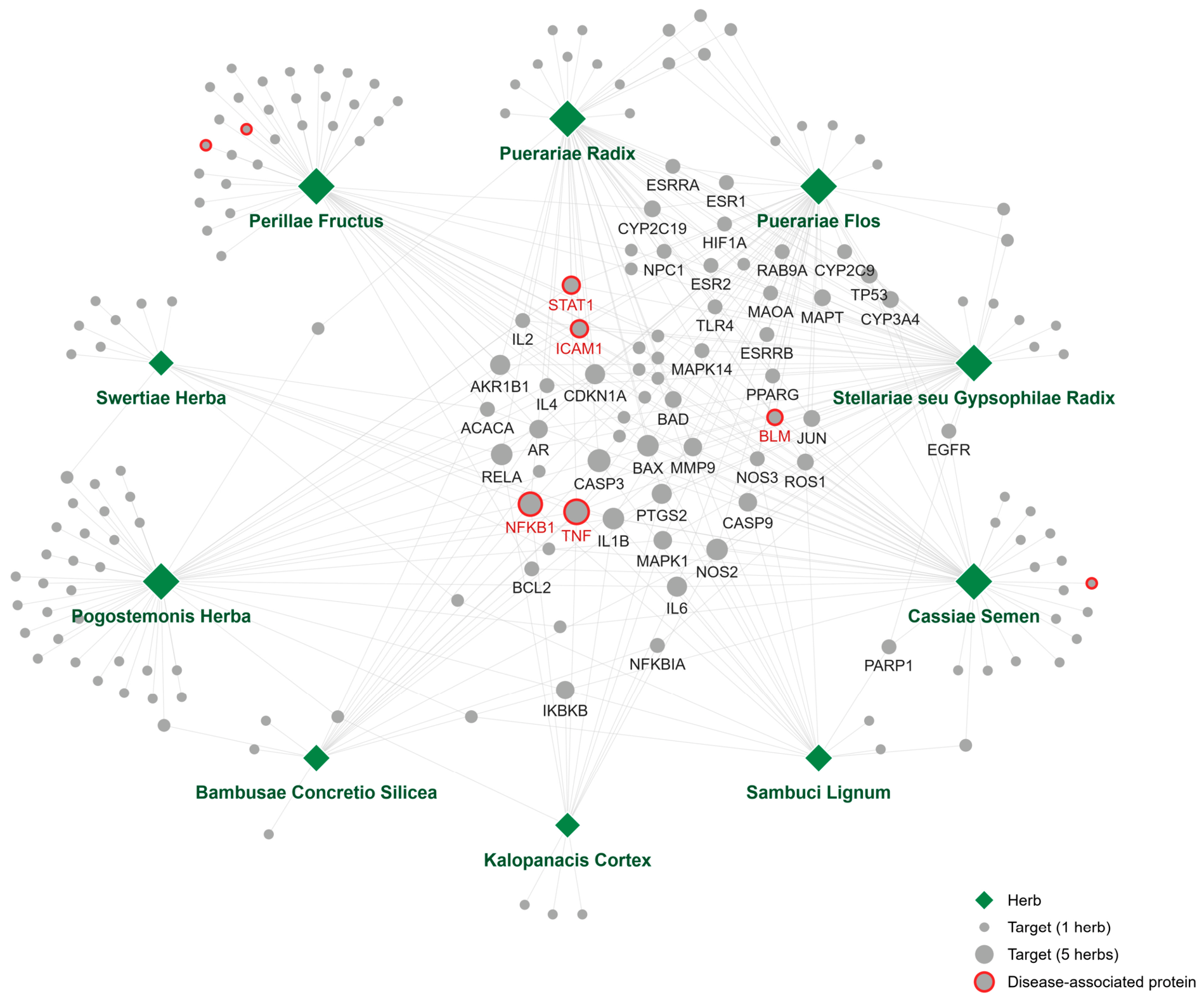
The ten candidate herbs were connected to 183 targets through 366 edges, and 46 targets were shared by three or more herbs (Figure 2). The shared targets included TNF, RELA, NFKB1, STAT1, IL6, IL1B, MAPK1, MAPK8, MAPK14, PTGS2, TLR4, and CASP3. Only 8 of the 40 curated disease proteins fall inside this network, which follows from the fact that the network is built from compound–target annotations rather than from the disease seed.
Figure 2.
Herb–target network of the top 10 candidate herbs for bronchiectasis. The network comprises 183 target nodes and 366 edges. Green diamonds denote herbs and grey circles denote targets, and circle size is proportional to the number of herbs sharing the target. Targets shared by three or more herbs (46) are labeled, and disease-associated proteins (8) are outlined in red.
KEGG enrichment of the core targets returned 156 significant pathways. After the composite pathways of the Human Diseases category were set aside, 80 remained, and the most significant of these were IL-17 signaling (14/94, adjusted p = 6.83 × 10⁻²¹), TNF signaling (14/112, 5.50 × 10⁻²⁰), C-type lectin receptor signaling (13/104, 1.03 × 10⁻¹⁸), apoptosis (14/142, 1.03 × 10⁻¹⁸), Th17 cell differentiation (13/107, 1.40 × 10⁻¹⁸), Toll-like receptor signaling (12/104, 6.14 × 10⁻¹⁷), NOD-like receptor signaling (13/181, 9.42 × 10⁻¹⁶), and NF-κB signaling (11/104, 2.88 × 10⁻¹⁵) (Table 2).
Table 2.
KEGG pathway enrichment of the core targets shared by the candidate herbs.
The appearance of IL-17 signaling and Th17 cell differentiation together among the five most significant pathways is the central feature of this result. A role for the Th17 pathway has been reported in cystic fibrosis lung disease [21], and low-dose clarithromycin modulates the Th17 response in patients with bronchiectasis that is not caused by cystic fibrosis [22]. Because the IL-17 axis recruits and sustains neutrophils, this enrichment meets the neutrophil-centred pathophysiology described in the Introduction at the same point [4].
2.3. Gene Ontology Enrichment
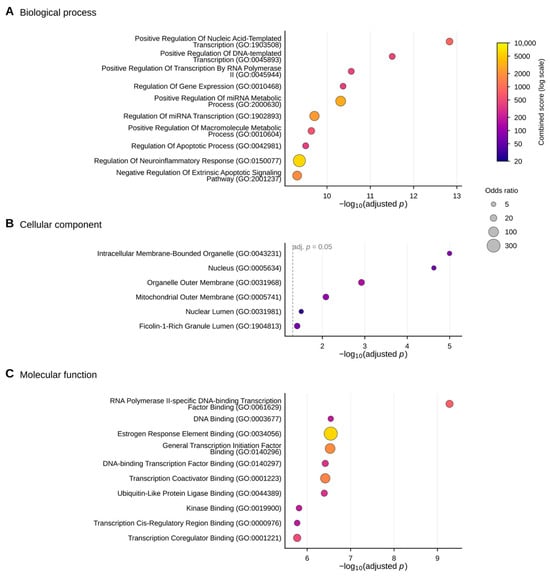
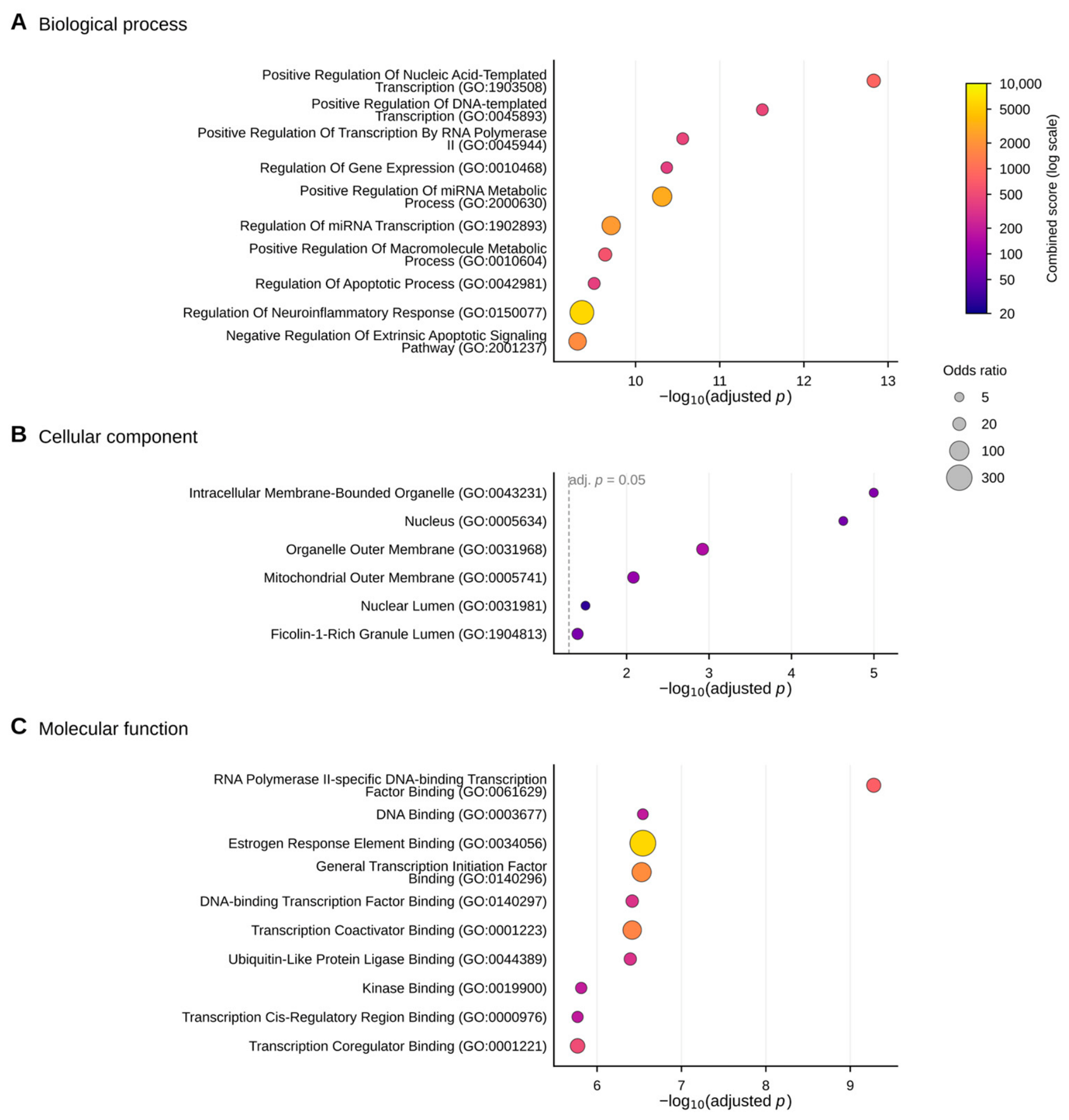
Gene Ontology enrichment of the same 46 core targets returned 789 significant terms in the biological process category, 6 in the cellular component category, and 98 in the molecular function category at an adjusted p below 0.05 (Figure 3).
Figure 3.
Gene Ontology enrichment of the targets of the top 10 candidate herbs for bronchiectasis. (A) Biological process, (B) cellular component, and (C) molecular function terms from Enrichr (GO 2023 libraries). Biological process, 10 of 789 terms with adjusted p < 0.05 are shown. Cellular component—6 of 6 terms with adjusted p < 0.05 are shown. Molecular function—10 of 98 terms with adjusted p < 0.05 are shown. Terms are ordered by adjusted p and the x axis is −log10(adjusted p). The dot size indicates the odds ratio and colour indicates the Enrichr combined score on a log scale shared across the three panels.
The most significant biological process terms were positive regulation of nucleic acid-templated transcription (18/557, adjusted p = 1.48 × 10⁻¹³), positive regulation of DNA-templated transcription (22/1243, 3.12 × 10⁻¹²), and positive regulation of transcription by RNA polymerase II (19/938, 2.75 × 10⁻¹¹). Terms defined by smaller gene sets with larger odds ratios were also enriched, namely regulation of neuroinflammatory response (6/19, 4.34 × 10⁻¹⁰, odds ratio 230.1), positive regulation of miRNA metabolic process (8/49, 4.84 × 10⁻¹¹, odds ratio 102.2), negative regulation of extrinsic apoptotic signaling pathway (8/70, 4.89 × 10⁻¹⁰, odds ratio 67.5), and regulation of apoptotic process (16/705, 3.10 × 10⁻¹⁰).
The six cellular component terms were intracellular membrane-bounded organelle (29/5175, 1.01 × 10⁻⁵), nucleus (26/4487, 2.35 × 10⁻⁵), organelle outer membrane (5/170, 1.20 × 10⁻³), mitochondrial outer membrane (4/151, 8.26 × 10⁻³), nuclear lumen (7/780, 3.15 × 10⁻²), and ficolin-1-rich granule lumen (3/123, 3.93 × 10⁻², odds ratio 11.5). The last of these refers to a granule compartment defined by proteomic profiling of human neutrophil granule subsets [23]. Ficolin-1 itself is not confined to neutrophils, as it is also synthesised in monocytes and in type II alveolar epithelial cells [24], and the three genes that drive the term here are MAPK1, MAPK14, and MMP9, none of which are neutrophil-restricted. The term is therefore noted as consistent with a granulocytic context rather than as evidence of a neutrophil-specific signal, and since its adjusted p lies at the margin of significance and it rests on three genes, it is reported here without further interpretation.
The most significant molecular function terms were RNA polymerase II-specific DNA-binding transcription factor binding (11/228, 5.27 × 10⁻¹⁰, odds ratio 28.6), DNA binding (14/846, 2.87 × 10⁻⁷), estrogen response element binding (4/10, 2.87 × 10⁻⁷, odds ratio 316.6), and general transcription initiation factor binding (5/30, 2.97 × 10⁻⁷). The biological process and molecular function categories therefore converge on the same place—namely the binding of transcription factors and the regulation of transcription.
Taken together, the three categories place the core targets on the transcription factor axes represented by NF-κB, STAT, and AP-1, with neutrophil granule components and the regulation of apoptosis around them. This points in the same direction as the KEGG result in Section 2.2. Because the enrichment was computed on a set of herb targets rather than on material from patients, it is described here as a correspondence with the pathophysiology of the disease and not as direct evidence for it.
2.4. Putative Active Compounds
The compound-level analysis was applied to the 45 target-annotated compounds of the ten candidate herbs, which form 56 herb–compound pairs. Twenty-six pairs covering 19 distinct compounds met the overlap criterion of p < 0.05, and every one of the ten herbs contributed at least one such pair (Table 3). Ranked by compound–disease correlation, the highest were pogostone of Pogostemonis Herba (0.0092, 2/8, p = 6.25 × 10⁻⁴), swertiamarin of Swertiae Herba (0.0087, 2/9, p = 8.01 × 10⁻⁴), and verbascoside of Pogostemonis Herba (0.0083, 1/5, p = 0.024). Ranked by the overlap test, the smallest p values were those of emodin of Cassiae Semen (0.0067, 6/81, p = 2.13 × 10⁻⁶), genistein of Puerariae Radix (0.0072, 7/134, p = 2.96 × 10⁻⁶), and daidzein of Puerariae Radix (0.0059, 5/76, p = 2.91 × 10⁻⁵). Both orderings are given in Table 3.
Table 3.
Compound-level screening of the top 10 candidate herbs and prior evidence for bronchiectasis.
Perillae Fructus, the one herb with prior evidence, contributed a single compound meeting the criterion, namely apigenin (4/151, p = 0.0058). This herb was therefore kept as a reference herb and used for the case study in Section 2.5. Apigenin has already been examined in two network pharmacology studies of bronchiectasis [10,25].
The significant compounds of the nine herbs without prior evidence were all carried forward to the subnetwork analysis. For docking, ten compounds were taken from the nine subnetworks (Supplementary Table S4B): hederagenin for Kalopanacis Cortex, in place of kalopanaxsaponin A for the reason given in Section 2.7; genistein for Puerariae Radix; swertiamarin for Swertiae Herba; irisolidone for Puerariae Flos; pogostone for Pogostemonis Herba; isovitexin for Bambusae Concretio Silicea; emodin and aloe-emodin for Cassiae Semen; dehydrodiconiferyl alcohol for Sambuci Lignum; and scopoletin for Stellariae seu Gypsophilae Radix. Puerariae Radix contributed genistein (7/134, p = 2.96 × 10⁻⁶), daidzein (5/76, p = 2.91 × 10⁻⁵), and puerarin (2/15, p = 0.0023), all three of which are also present in Puerariae Flos, and Bambusae Concretio Silicea contributed a single compound, isovitexin (1/5, p = 0.024).
Puerariae Flos and Stellariae seu Gypsophilae Radix share biochanin A, puerarin, daidzein, and genistein, so a large part of their annotated compound composition is common to both.
A PubMed search carried out on 20 October 2026 that combined each compound name with bronchiectasis returned only in silico studies of apigenin, luteolin, and (2S)-naringenin as work addressing the disease itself [10,25]. For emodin, which inhibits MUC5AC expression in airway epithelium, for scopoletin, which suppresses Pseudomonas aeruginosa virulence, and for genistein, which activates CFTR, only reports of a related mechanism were found, and these are listed in Supplementary Table S1.
2.5. Compound–Disease Subnetwork of the Reference Herb Perillae Fructus
Perillae Fructus is the highest ranked of the ten candidate herbs by diffusion correlation (0.0077; Table 1) and is one of the constituent herbs of the prescription used in the N-of-1 trials in patients with stable bronchiectasis [11]. Its traditional indications of relieving cough and resolving phlegm correspond to chronic sputum production and cough, which are the cardinal symptoms of bronchiectasis [16]. The only compound of this herb meeting the compound-level criterion is apigenin, with a correlation of 0.0058 and an overlap of 4/151 at p = 0.0058.
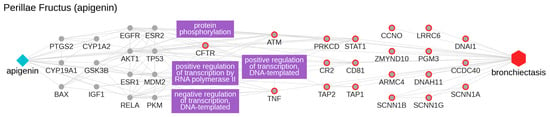
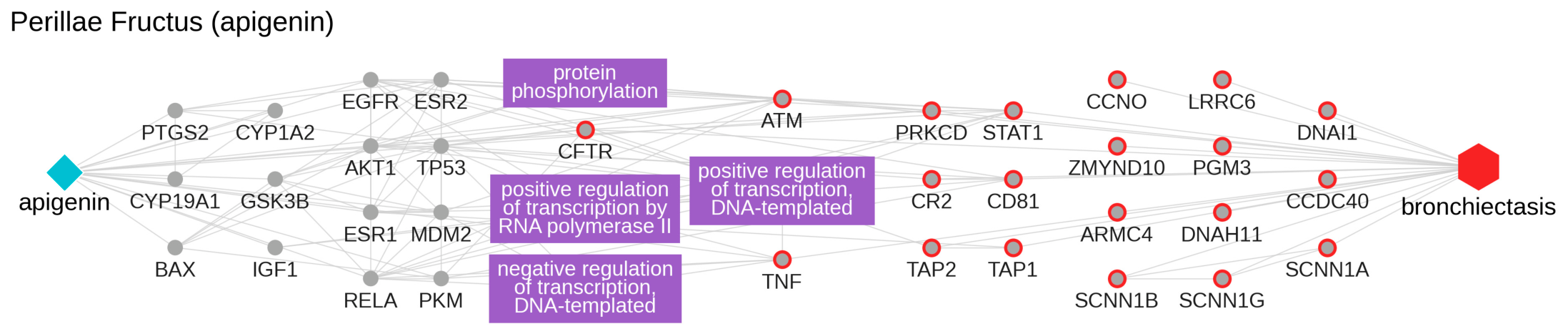
The compound–disease subnetwork of apigenin comprises 40 nodes and 126 edges, of which 34 are proteins and 4 are biological function nodes (Figure 4). The targets with the highest degree were TP53 with a degree of 16, AKT1 with 13, RELA with 12, EGFR with 12, ESR1 with 11, and MDM2 with 10, and the function nodes included protein phosphorylation together with terms for the regulation of transcription.
Figure 4.
Compound–disease subnetwork of the reference herb Perillae Fructus, linking apigenin, the only compound of Perillae Fructus meeting the compound-level criterion (p < 0.05; Table 3), to bronchiectasis-associated proteins. Diamonds denote compounds, circles denote proteins, boxes denote enriched biological functions, and the hexagon denotes the disease. Disease-associated proteins are outlined in red.
The subnetwork reaches 18 of the bronchiectasis-associated proteins, and their composition maps onto the aetiological classes set out in the Introduction. Airway ion transport is represented by CFTR and SCNN1G, primary ciliary dyskinesia by DNAH11, DNAI1, CCNO, ZMYND10, LRRC6, ARMC4, and CCDC40, immunodeficiency by TAP1, TAP2, CD81, CR2, PGM3, and ATM, and inflammatory signaling by TNF, STAT1, and PRKCD.
Many of the 40 bronchiectasis-associated proteins are monogenic causes of ciliary dysfunction or immunodeficiency, so the breadth of this subnetwork is described as closeness to the disease module rather than as a specific mechanism; this point is taken up among the limitations in Section 3. Apigenin has also been nominated as a candidate in in silico studies of bronchiectasis [10,25].
2.6. Compound–Disease Subnetworks of the Novel Candidate Herbs
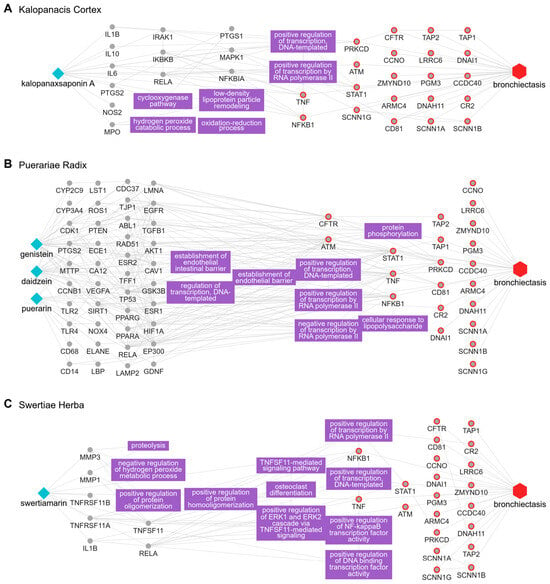
Compound–disease subnetworks were constructed for the nine herbs from which compounds were derived (Figure 5 and Supplementary Figures S1–S4). Their sizes were 125 nodes and 662 edges for Stellariae seu Gypsophilae Radix, 121 and 669 for Puerariae Flos, 74 and 302 for Puerariae Radix, 56 and 111 for Pogostemonis Herba, and 54 and 182 for Cassiae Semen, while Swertiae Herba, Bambusae Concretio Silicea, Sambuci Lignum, and Kalopanacis Cortex each had 41 nodes with 81, 73, 80, and 85 edges respectively.
Figure 5.
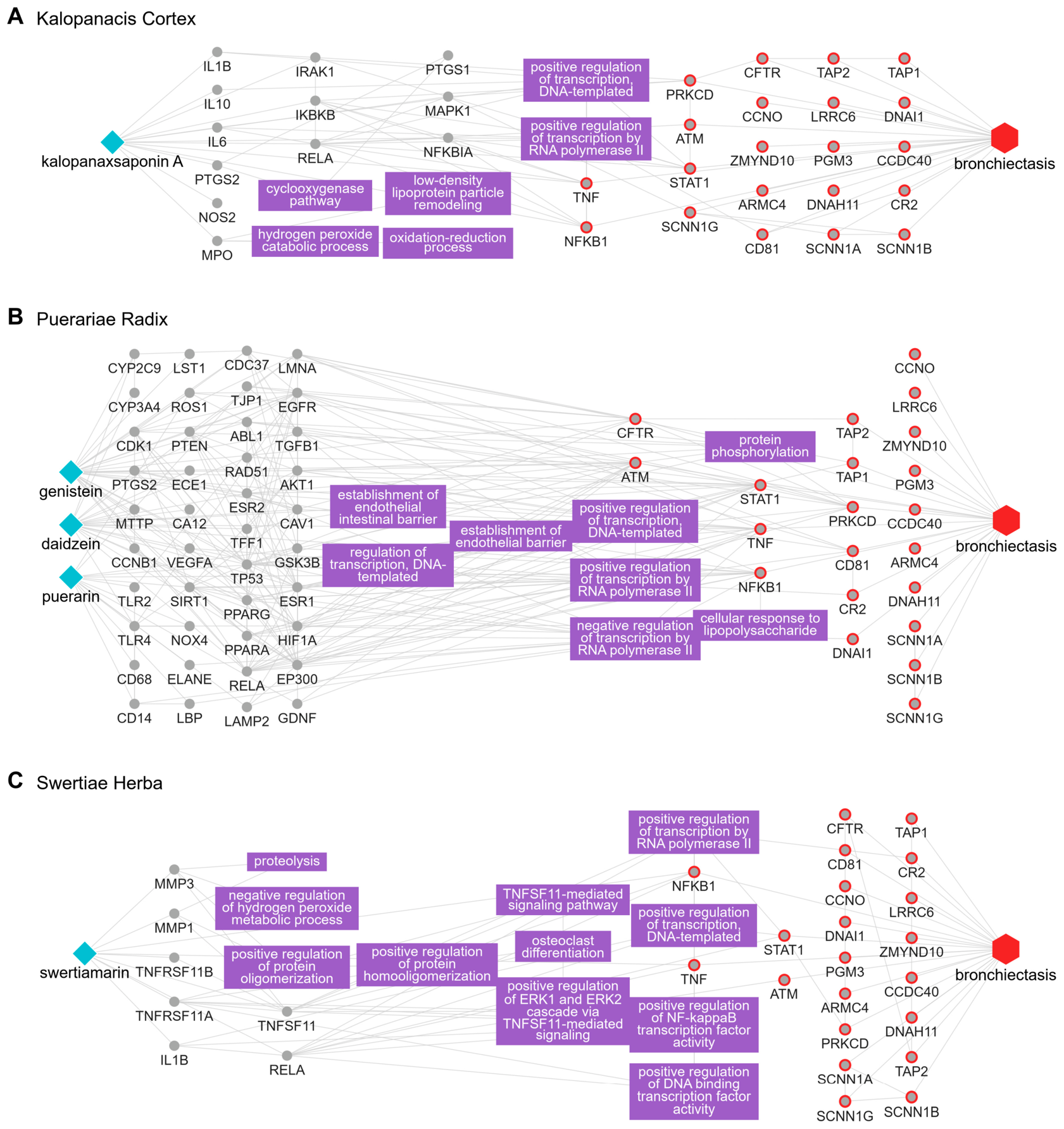
Compound–disease subnetworks of novel candidate herbs for bronchiectasis. (A) Kalopanacis Cortex. (B) Puerariae Radix. (C) Swertiae Herba. Novel candidate herbs ranked fifth to ninth in Table 1 are shown in Supplementary Figures S1–S3. Diamonds denote compounds, circles denote proteins, boxes denote enriched biological functions, and the hexagon denotes the disease. Disease-associated proteins are outlined in red.
The highest-ranked nodes of the disease seed enter every subnetwork by construction, and all nine contain TNF, STAT1, ATM, CFTR, and PRKCD, so the comparison between herbs was made on targets directly connected to a compound. TNF was directly connected in all nine herbs, RELA in eight, NFKB1 in seven, and PTGS2 in six. The compounds differ considerably in structure, yet they show common convergence on the NF-κB and TNF axis.
The direct connections of the individual compounds define slightly different axes. Dehydrodiconiferyl alcohol of Sambuci Lignum connects to CHUK, IKBKB, NFKB1, TNF, IL1B, IL6, PTGS2, NOS2, CASP1, and CCL2 and therefore passes through the IKK complex. Kalopanaxsaponin A of Kalopanacis Cortex connects to IRAK1, IKBKB, NFKBIA, RELA, and MPO, pogostone of Pogostemonis Herba to MPO, NFE2L2, CASP3, and RELA, and puerarin of Puerariae Flos to ELANE, CD14, LBP, TLR2, and TLR4. Puerarin of Puerariae Radix reaches the same targets, and isovitexin of Bambusae Concretio Silicea connects to IKBKB, NOS2, PTGS2, RELA, and TNF, with prostaglandin biosynthetic process, cyclooxygenase pathway, and tumor necrosis factor-mediated signaling pathway appearing as function nodes in that subnetwork.
The repeated appearance of ELANE and MPO across several herbs deserves attention. Neutrophil elastase and myeloperoxidase are established markers of exacerbation and severity in bronchiectasis [4], and the neutrophil serine protease axis is also the axis that brensocatib targets [9].
In the subnetworks of Puerariae Radix, Puerariae Flos, and Stellariae seu Gypsophilae Radix, genistein is directly connected to the disease proteins CFTR and ATM (Figure 5B), and together with daidzein and puerarin it also reaches NFKB1, STAT1, and TNF. Dysfunction of the CFTR channel has been reported in bronchiectasis that is not caused by cystic fibrosis [5,6], and genistein has long been studied as an activator of CFTR [26].
Figure 5 in the main text carries the three herbs placed highest in Table 1, namely Kalopanacis Cortex in second place, Puerariae Radix in third, and Swertiae Herba in fourth. Puerariae Flos, in fifth place, is shown in its full seven-compound form in Supplementary Figure S1; Pogostemonis Herba and Bambusae Concretio Silicea in Supplementary Figure S2; and Cassiae Semen and Sambuci Lignum in Supplementary Figure S3. All 74 nodes of the Puerariae Radix subnetwork are contained in the Puerariae Flos subnetwork. Stellariae seu Gypsophilae Radix is shown in Supplementary Figure S4 only, because the legume isoflavones annotated to this caryophyllaceous herb in the source database probably reflect misattribution.
2.7. Molecular Docking of the Prioritized Compounds
In the redocking validation, MAPK8 (3ELJ, 1.43 Å) and PTGS2 (5KIR, 0.88 Å) met the criterion of a heavy-atom root-mean-square deviation (RMSD) below 2.0 Å at an exhaustiveness of 8; TNF (2AZ5) and MAPK1 (4QTA) failed at 8, with 3.55 and 6.44 Å, and met it on the single re-evaluation at 32 permitted by the redocking rule, with 0.65 and 0.24 Å (Section 4.6). CASP3, excluded at target selection for carrying covalent inhibitors, gave 3.58 Å under both conditions (Supplementary Table S4A) [27,28,29].
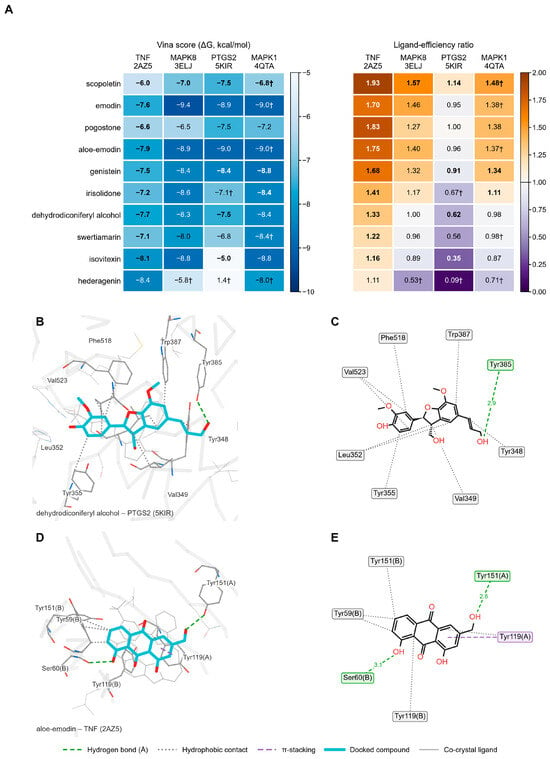
Compounds of low molecular weight occupied the top ranks for every target (Figure 6A and Supplementary Table S4B). Scopoletin and pogostone, with 14 and 16 heavy atoms, reached the highest ligand-efficiency ratios, 1.93 and 1.84 at TNF, and met the centroid-distance criterion at TNF, MAPK8 and PTGS2 with a ligand efficiency of at least 0.30; pogostone met it at MAPK1 as well. The anthraquinones aloe-emodin and emodin met the criterion at MAPK8 and PTGS2, with ligand-efficiency ratios of 0.95 to 1.46, but triggered the RDKit PAINS alert [30]. Genistein, which is annotated to both Puerariae Radix and Puerariae Flos, met the criterion at all four targets with a ligand efficiency of at least 0.30, consistent with its contacts with CFTR and TNF in the subnetwork, and isovitexin met it at all four but with a ligand efficiency of 0.16 to 0.29.
Figure 6.
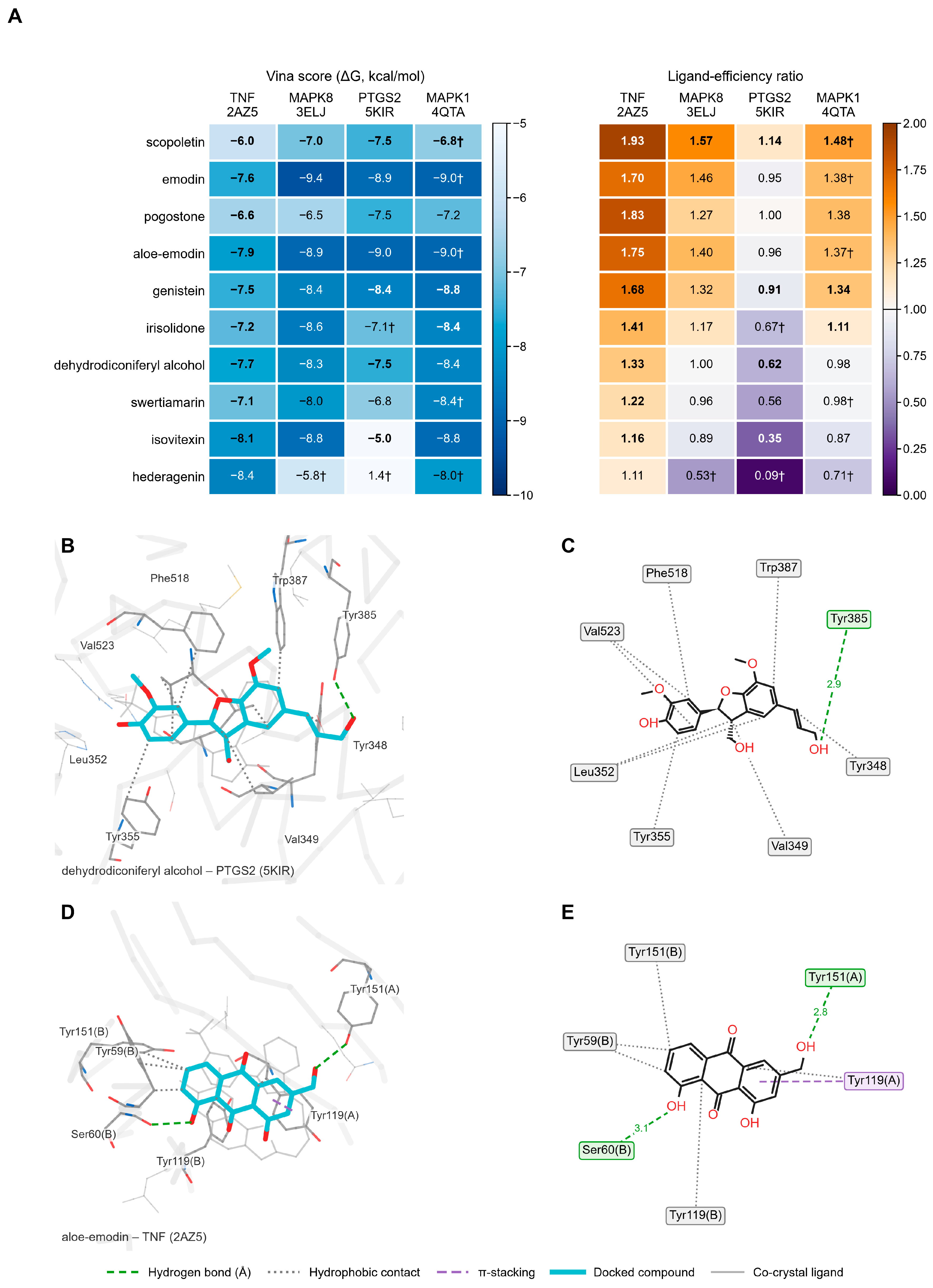
Molecular docking of the prioritized compounds for bronchiectasis. (A) AutoDock Vina score (ΔG, kcal/mol) of the top pose (left) and ligand-efficiency (LE) ratio, the compound LE divided by that of the co-crystal ligand of the same structure (right; 1.0 = equal efficiency). Bold, pairs directly connected in the subnetwork; †, top-pose centroid ≥ 5 Å from the co-crystal ligand; n.d., not docked. (B,C) Dehydrodiconiferyl alcohol in the cyclooxygenase channel of PTGS2/COX-2 (5KIR), in three dimensions and as an interaction diagram. (D,E) Aloe-emodin in the SPD304 site at the TNF dimer interface (2AZ5, chains A/B). Docked compound, cyan carbons; co-crystal ligand, grey sticks; interacting residues (PLIP), sticks with PDB numbering. Green dashed, hydrogen bonds; grey dotted, hydrophobic contacts; purple dashed, π-stacking. Selection rule, Section 4.6.
MAPK1 passed the redocking validation, but most compound poses fell outside the reference site at this target. Scopoletin (6.38 Å), emodin (5.65 Å), aloe-emodin (6.57 Å), swertiamarin (5.43 Å), and hederagenin (5.97 Å) had centroid distances above 5 Å, whereas pogostone (4.37 Å), genistein (4.31 Å), irisolidone (4.16 Å), and dehydrodiconiferyl alcohol (4.54 Å) met the criterion. The MAPK1 results are therefore interpreted more cautiously than those at MAPK8.
Kalopanaxsaponin A of Kalopanacis Cortex is a triterpenoid glycoside that did not fit inside the search box. Its aglycone hederagenin was docked as a candidate in its own right rather than as a proxy; the two differ in size, polarity, flexibility and the interactions available to them, so no structural inference is drawn for the parent glycoside. Hederagenin met the centroid-distance criterion at TNF alone, where its ligand-efficiency ratio was 1.11 but its ligand efficiency 0.25, below the threshold of 0.30.
Among the combinations directly connected in the subnetwork that met the centroid-distance criterion with a binding free energy of −7.0 kcal/mol or lower, the two reproducing the largest fraction of co-crystal contact residues are shown in Figure 6; scopoletin was set aside as a compound of Stellariae seu Gypsophilae Radix alone, whose annotation is doubtful. Dehydrodiconiferyl alcohol at PTGS2 (−7.54 kcal/mol, centroid distance 1.60 Å) hydrogen bonded to Tyr385 at the top of the cyclooxygenase channel and reproduced four of the five contact residues of rofecoxib (Figure 6B,C). Aloe-emodin at TNF (−7.87 kcal/mol, 1.46 Å) hydrogen bonded to Ser60 of chain B and Tyr151 of chain A and π-stacked with Tyr119, reproducing five of the seven residues of SPD304 (Figure 6D,E); because it triggers the PAINS alert, this mode is read only as a structural illustration. Pogostone at TNF reproduced the same five residues at −6.58 kcal/mol, below the binding-strength condition (Supplementary Figure S5A,B). All contacts are listed in Supplementary Table S5.
The ligand efficiency of SPD304, the co-crystal ligand of TNF, is low at 0.224, so the ligand-efficiency ratio at this target rises as the compound gets smaller. The ratio therefore has to be read together with the binding free energy, and the present results speak to the plausibility of binding rather than to affinity [31,32,33].
3. Discussion
Multiscale diffusion yielded ten candidate herbs for bronchiectasis and 26 significant herb–compound pairs, 25 of which belong to the nine herbs carried into the downstream analyses, and the targets shared by these herbs converged on IL-17 signaling, TNF signaling, Th17 cell differentiation, and Toll-like receptor signaling. Among the compounds that the analysis produced, those of low molecular weight also occupied the binding sites of the core targets in converged poses at the structural level.
The level of novelty claimed here needs to be stated precisely. What this analysis establishes is that no previous report has proposed these herbs and compounds as treatment candidates for bronchiectasis. It does not support the stronger claim that no bioactivity has ever been reported for them. Several of the compounds have in fact been reported to be anti-inflammatory in other models of lung disease, and that is not a contradiction of the present result but rather support for its biological plausibility.
The convergence of the most significant pathways on IL-17 signaling and Th17 cell differentiation meets the pathophysiology of bronchiectasis directly, because the IL-17 axis recruits and sustains the neutrophilic inflammation that drives the disease [21,22]. What makes this more than a restatement of the enrichment is that dehydrodiconiferyl alcohol, the only active compound of Sambuci Lignum, has already been reported to modulate the differentiation of Th17 and Th1 cells [34]. The network enrichment and the published pharmacology of a compound that the network selected therefore point independently at the same axis. ELANE and MPO, which recur across the subnetworks, are likewise established markers of exacerbation in bronchiectasis and belong to the neutrophil serine protease axis that brensocatib targets [4,9].
The direct connection of genistein to the disease protein CFTR is the most concrete contact that this analysis produced. Channel dysfunction of CFTR has been reported in bronchiectasis that is not caused by cystic fibrosis [5,6], and genistein has been studied for many years as a compound that activates CFTR [26]. The action of genistein on CFTR is known to be biphasic with concentration, since it potentiates the channel in the low micromolar range and inhibits it at higher concentrations, so this contact is reported as a hypothesis to be tested rather than as a predicted therapeutic effect.
Prior pharmacological evidence exists for the individual compounds. Pogostone, puerarin, emodin, aloe-emodin, swertiamarin, kalopanaxsaponin A, scopoletin, and irisolidone have all been reported to be anti-inflammatory in models of pulmonary or systemic inflammation. Representative examples are the protection afforded by pogostone against lipopolysaccharide-induced acute lung injury [35], the suppression of lipopolysaccharide-induced inflammatory responses by aloe-emodin [30], and the inhibition of IRAK-1 by kalopanaxsaponin A [36]. Because these results were obtained in pulmonary or systemic inflammatory contexts, the extrapolation to bronchiectasis does not require a large leap. Kalopanaxsaponin A itself was analysed only at the network level, where its reported inhibition of IRAK-1 lies; no docking result is attributed to it.
Safety considerations set the order of priority among the candidates. The anthraquinones of Cassiae Semen, namely aloe-emodin and emodin, trigger the RDKit PAINS alert and have reported hepatotoxicity and nephrotoxicity on prolonged use, which lowers their priority [19]. Pogostone of Pogostemonis Herba and dehydrodiconiferyl alcohol of Sambuci Lignum trigger no PAINS alert, have quantitative estimates of drug-likeness of 0.80 and 0.74, and connect clearly to the Th17 and IKK axes, which makes them the most suitable subjects for follow-up validation [18,20]. Kalopanacis Cortex carries a toxicological literature of its own that would need to be reviewed before any in vivo work [17]. Stellariae seu Gypsophilae Radix was not prioritized, because the isoflavones annotated to it are characteristic of legumes rather than of the Caryophyllaceae.
Several limitations apply. The curated interaction data are incomplete and herb–compound attribution is taken at the database level, so absence from the network is not evidence of absence in biology and misattribution of the kind suspected for Stellariae seu Gypsophilae Radix cannot be excluded elsewhere. Many of the 40 bronchiectasis-associated proteins are monogenic causes of ciliary dysfunction or immunodeficiency, which may draw the diffusion profile toward these rather than the inflammatory axis, and because every subnetwork contains the top nodes of the disease seed, disease proteins alone cannot establish specificity between herbs. Sensitivity to the restart probability was not examined, and bronchiectasis is heterogeneous in aetiology, so one candidate is unlikely to suit the whole patient population [3]. The compound–target edges are undirected: a mode of action is annotated for approved drugs but rarely for plant secondary metabolites, so whether a compound activates or inhibits its target is unknown, and modulation of IL-17, TNF, NF-κB and Th17 signalling may be beneficial or detrimental with context. Docking likewise speaks only to the plausibility of binding. The work is therefore a computational prioritisation and not evidence of efficacy: the herbs and compounds reported here are hypotheses, to be tested by measuring direct interaction with the prioritised proteins, modulation of inflammatory mediators such as IL-17 and TNF in stimulated airway epithelial or neutrophil models, and cytotoxicity.
4. Materials and Methods
4.1. Herb–Compound–Target Network Construction
Herb–compound associations were taken from OASIS, and experimentally supported compound–target associations were integrated from DrugBank 5.0, the Therapeutic Target Database, STITCH 5, and the curated dataset of Huang et al. [37,38,39,40,41]. The two layers were joined through PubChem CIDs to give target profiles for 349 herbs. For each herb, the 50 targets with the largest number of compound paths were used in the subsequent analyses, following the procedure applied in our previous studies [13,15]. These compound–target associations are recorded as undirected pairs; no activating or inhibiting mode of action is assigned in the integrated resource, and none was inferred here.
4.2. Disease-Related Targets
Proteins associated with bronchiectasis (C0006267) were extracted from the curated subset of DisGeNET [42]. Entries supported only by animal models or by text mining and entries carrying a therapeutic flag were excluded, which left 40 proteins. Four nodes whose gene symbol field was empty were filled in through the Entrez identifier mapping of the HERB v2 target table, giving SCNN1A for 6337, SCNN1B for 6338, TNFSF11 for 8600, and DRD5 for 1816 [43].
4.3. Multiscale Network Analysis
Herb–disease relationships were quantified on the multiscale interactome of Ruiz et al., which places proteins and biological functions on a single graph and comprises 17,669 proteins, 387,626 protein–protein interactions, 34,777 protein–function edges, and 22,545 hierarchical relations among biological functions [12]. The random walk is biased in the sense that the edges leaving a node are weighted by the type of the node they reach rather than being traversed uniformly. The weights optimised by Ruiz et al. were used without modification, namely 4.40 for protein, 6.58 for biological function, 2.10 for the upward direction of the function hierarchy, and 4.49 for its downward direction [12]. Because the walk was seeded directly on protein nodes, the drug and indication edge weights of the original formulation do not enter the present calculation.
A diffusion profile is the stationary visit distribution of a random walk with restart over the protein and biological-function nodes of this graph. At each step, the walk moves along a weighted outgoing edge with probability α and returns to the seed set with probability 1 − α. Following Ruiz et al., α was fixed at 0.8595, which corresponds to a restart probability of 0.1405 [12]. The probability vector p was updated as p ← α(pW + m) + (1 − α)s, where W is the row-normalised weighted adjacency matrix, s is the seed vector, and m redistributes the probability mass held by nodes without outgoing edges; iteration continued until the L1 change between successive steps fell below the convergence tolerance. For a herb the seed was the uniform distribution over its 50 targets, and for bronchiectasis the uniform distribution over its 40 associated proteins. The resulting profile therefore describes how the influence of a seed set spreads both over proteins and over the biological functions in which those proteins participate.
Herbs were ranked by the cosine similarity between the herb profile and the disease profile, computed over all protein and biological-function nodes. This measure compares the shape of two complete diffusion profiles and is therefore distinct from the shortest-path network proximity of Guney et al., which was not used in this work. As a second and independent index, the overlap between the herb targets and the disease proteins was tested with the hypergeometric distribution. Among the herbs ranked highest by similarity, the ten that had an overlap p below 0.05 and at least two target-annotated compounds were selected as candidates, and herbs annotated with a single compound were excluded.
4.4. Enrichment Analysis
The 46 targets shared by three or more of the candidate herbs were analysed with Enrichr against the Gene Ontology 2023 biological process, cellular component, and molecular function libraries and against KEGG 2021 Human, and a Benjamini–Hochberg adjusted p below 0.05 was taken as significant [44,45,46].
4.5. Compound-Level Analysis and Subnetworks
The same diffusion analysis was applied to the individual compounds of all ten candidate herbs, and compounds with an overlap p below 0.05 were taken as putative active compounds. Prior evidence was checked on PubMed at the herb level, including herbs that appear as constituents of a formula, and at the compound level, combining the Latin name, the botanical source, and the Pinyin name of each herb and the compound names with bronchiectasis, with a search date of 20 October 2026. Herbs with herb-level evidence were kept as reference herbs, and compound–disease subnetworks were constructed for the significant compounds of the herbs without such evidence. Each subnetwork takes the disease and each compound as seeds, collects for every seed the 20 protein and biological function nodes with the highest visit probability in the corresponding diffusion profile, builds the induced subgraph of the multiscale interactome on those nodes, and retains the largest connected component [12]. Because the top nodes of the disease seed enter every subnetwork, comparisons between herbs were made on targets directly connected to a compound.
4.6. Molecular Docking
Targets were selected as proteins that are directly connected to an active compound in a subnetwork, belong to an enriched pathway, and have a non-covalent small-molecule co-crystal structure in the Protein Data Bank. Four proteins met these conditions, namely TNF (2AZ5 with SPD304), MAPK8/JNK1 (3ELJ with GS7), PTGS2/COX-2 (5KIR with rofecoxib), and MAPK1/ERK2 (4QTA with SCH772984) [27,28,29]. CASP3 did not meet this condition and was excluded: both available structures carry covalent inhibitors, the ligand TQ8 of 2XYG being a chloromethyl ketone bonded to Cys163. This was the operative criterion; the redocking result reported for CASP3 in Supplementary Table S4A is a subsequent check and not the reason for exclusion. One compound per herb was docked, chosen as the compound with the largest number of direct target connections in that herb’s subnetwork; where two herbs shared a representative compound, the same docking result applies to both. Genistein and irisolidone were the representatives of Puerariae Radix and Puerariae Flos and isovitexin represented Bambusae Concretio Silicea. For Kalopanacis Cortex, the docked compound was hederagenin, which is treated as a candidate in its own right rather than as a proxy for kalopanaxsaponin A (Section 2.7).
Receptors were protonated at pH 7.4 with PDBFixer in OpenMM 8 and converted to PDBQT with Open Babel 3.2.1, and ligand three-dimensional structures were generated with RDKit 2026.09.1 using ETKDGv3 and MMFF94 optimization with a random seed of 42 and prepared with Meeko 0.8.0 [47,48,49,50].
Docking was carried out with AutoDock Vina 1.2.7 in a 22 Å cube centred on the co-crystal ligand, and a 24 Å cube was used for MAPK1 alone because of its wider pocket. An exhaustiveness of 8, a random seed of 42, and 9 output poses were used, and the calculation was fixed to a single CPU for reproducibility [51]. Isovitexin was docked in a separate run with the AutoDock Vina 1.2.7 executable for Windows under the same receptor preparation, grid, seed, and exhaustiveness settings, and redocking the co-crystal ligands and genistein in that environment reproduced the original values to within 0.04 kcal/mol in binding free energy and 0.05 Å in centroid drift.
A redocking validation rule was fixed before any compound was docked. The co-crystal ligand of each target was redocked, and only targets whose top pose gave a heavy-atom RMSD below 2.0 Å were carried forward. A target that failed at an exhaustiveness of 8 was re-evaluated once at 32, and if it then met the criterion, all compounds for that target were docked under the same condition. RMSD was computed after element-wise atom correspondence had been established with the Hungarian algorithm.
Ligand efficiency was defined as the absolute binding free energy divided by the number of heavy atoms, the ligand-efficiency ratio as the ligand efficiency of the compound divided by that of the co-crystal ligand of the same structure, and the centroid distance as the distance between the centroid of the top-ranked pose and that of the co-crystal ligand; a centroid distance below 5 Å was taken to indicate that the pose occupied the reference binding site. The quantitative estimate of drug-likeness and the PAINS alerts were computed with RDKit. Docking scores were interpreted as indicators of binding plausibility rather than of affinity [31,32,33].
For the binding-mode analysis, bond orders were restored for the top pose of each combination from the Meeko record of SMILES and atom correspondence, the ligand was merged with the receptor chains used for docking, and hydrogen bonds, hydrophobic contacts, π interactions, and salt bridges were assigned with the Protein–Ligand Interaction Profiler (PLIP) 3.0.1 under its default criteria [52]. Salt bridges reported for ligands carrying no ionizable group were discarded because they arise from misrecognition of esters and lactones. The contact residues of the co-crystal ligand of the same receptor were determined in the same way, and the fraction of those residues reproduced by the compound pose served as a secondary indicator of pose plausibility. The representative combinations shown in Figure 6 were chosen one per target under a rule fixed in advance, requiring a direct connection in the subnetwork, a centroid distance below 5 Å, a binding free energy of −7.0 kcal/mol or lower, and the largest fraction of co-crystal contact residues reproduced, with the lower binding free energy breaking a tie. Because the reproduction fraction considers only the positions of the contact residues, it favours small molecules that fill hydrophobic pockets. The pair that drops out under the binding free energy condition, pogostone at TNF, is shown in Supplementary Figure S5. Three-dimensional and two-dimensional figures were produced with RDKit 2026.09.1, Open Babel 3.2.1, and matplotlib 3.11.2 [49]. The receptor chains retained, the search-box centres and edge lengths, the treatment of water, heteroatoms and missing residues, and the stereochemical status of each ligand are listed in Supplementary Table S6.
5. Conclusions
A framework combining multiscale diffusion with structure-based validation nominated candidate herbs and compounds that have not previously been reported for bronchiectasis. The convergence of the shared targets on the IL-17, TNF, and Th17 axis and the recurrence of ELANE and MPO across the subnetworks agree with the direction in which treatment for this disease is currently being developed. Pogostone of Pogostemonis Herba and dehydrodiconiferyl alcohol of Sambuci Lignum lead on both drug-likeness and connectivity to that axis, and they are proposed as the first subjects for experimental validation, which remains necessary before any therapeutic claim can be made.
Supplementary Materials
The following supporting information can be downloaded at: https://www.mdpi.com/article/10.3390/ijms272310793/s1.
Funding
This research was supported by grants from the National Research Foundation of Korea (NRF) funded by the Korean government (MSIT) (Grant numbers: RS-2023-00243363, RS-2024-00335030, RS-2026-25597553 and RS-2026-25598536), and by the Korea Health Technology R&D Project through the Korea Health Industry Development Institute (KHIDI), funded by the Ministry of Health & Welfare, Republic of Korea (Grant number: RS-2025-02303579).
Institutional Review Board Statement
Not applicable.
Informed Consent Statement
Not applicable.
Data Availability Statement
The data supporting this study are available in the article and its Supplementary Materials. Data sources, random-walk parameters and the random seed are reported in Section 4; the literature search records in Table S1; the full enrichment results in Tables S2 and S3; the receptor, search-box and ligand specification in Table S6; and the docking results and pose interactions in Tables S4 and S5.
Acknowledgments
During the preparation of this manuscript, the author used Claude (Opus 5; Anthropic, San Francisco, CA, USA) for writing analysis scripts, preparing figures, and drafting and editing the text. The author has reviewed and edited the output and takes full responsibility for the content of this publication.
Conflicts of Interest
The author declares no conflicts of interest.
References
- Chalmers, J.D.; Chang, A.B.; Chotirmall, S.H.; Dhar, R.; McShane, P.J. Bronchiectasis. Nat. Rev. Dis. Primers 2018, 4, 45. [Google Scholar] [CrossRef] [Scilit] [PubMed]
- Quint, J.K.; Millett, E.R.C.; Joshi, M.; Navaratnam, V.; Thomas, S.L.; Hurst, J.R.; Smeeth, L.; Brown, J.S. Changes in the incidence, prevalence and mortality of bronchiectasis in the UK from 2004 to 2013: A population-based cohort study. Eur. Respir. J. 2016, 47, 186–193. [Google Scholar] [CrossRef] [Scilit] [PubMed]
- Flume, P.A.; Chalmers, J.D.; Olivier, K.N. Advances in bronchiectasis: Endotyping, genetics, microbiome, and disease heterogeneity. Lancet 2018, 392, 880–890. [Google Scholar] [CrossRef] [Scilit] [PubMed]
- Chalmers, J.D.; Moffitt, K.L.; Suarez-Cuartin, G.; Sibila, O.; Finch, S.; Furrie, E.; Dicker, A.; Wrobel, K.; Elborn, J.S.; Walker, B.; et al. Neutrophil elastase activity is associated with exacerbations and lung function decline in bronchiectasis. Am. J. Respir. Crit. Care Med. 2017, 195, 1384–1393. [Google Scholar] [CrossRef] [Scilit] [PubMed]
- Perea, L.; Faner, R.; Chalmers, J.D.; Sibila, O. Pathophysiology and genomics of bronchiectasis. Eur. Respir. Rev. 2024, 33, 240055. [Google Scholar] [CrossRef] [Scilit] [PubMed]
- Bienvenu, T.; Sermet-Gaudelus, I.; Burgel, P.-R.; Hubert, D.; Crestani, B.; Bassinet, L.; Dusser, D.; Fajac, I. Cystic fibrosis transmembrane conductance regulator channel dysfunction in non-cystic fibrosis bronchiectasis. Am. J. Respir. Crit. Care Med. 2010, 181, 1078–1084. [Google Scholar] [CrossRef] [Scilit] [PubMed]
- Chalmers, J.D.; Haworth, C.S.; Flume, P.; Long, M.B.; Burgel, P.-R.; Dimakou, K.; Blasi, F.; Herrero-Cortina, B.; Dhar, R.; Chotirmall, S.H.; et al. European Respiratory Society clinical practice guideline for the management of adult bronchiectasis. Eur. Respir. J. 2025, 66, 2501126. [Google Scholar] [CrossRef] [Scilit] [PubMed]
- Chalmers, J.D.; Boersma, W.; Lonergan, M.; Jayaram, L.; Crichton, M.L.; Karalus, N.; Taylor, S.L.; Martin, M.L.; Burr, L.D.; Wong, C.; et al. Long-term macrolide antibiotics for the treatment of bronchiectasis in adults: An individual participant data meta-analysis. Lancet Respir. Med. 2019, 7, 845–854. [Google Scholar] [CrossRef] [Scilit] [PubMed]
- Chalmers, J.D.; Burgel, P.-R.; Daley, C.L.; De Soyza, A.; Haworth, C.S.; Mauger, D.; Loebinger, M.R.; McShane, P.J.; Ringshausen, F.C.; Blasi, F.; et al. Phase 3 trial of the DPP-1 inhibitor brensocatib in bronchiectasis. N. Engl. J. Med. 2025, 392, 1569–1581. [Google Scholar] [CrossRef] [Scilit] [PubMed]
- Shen, X.; Li, H.; Zou, W.-J.; Wu, J.-M.; Wang, L.; Wang, W.; Chen, H.; Zhou, L.-L.; Hu, Y.-H.; Qin, X.-H.; et al. Network pharmacology analysis of the therapeutic mechanisms underlying Beimu-Gualou formula activity against bronchiectasis with molecular docking validation. Evid. Based Complement. Altern. Med. 2021, 2021, 3656272. [Google Scholar] [CrossRef] [Scilit] [PubMed]
- Huang, H.; Yang, P.; Wang, J.; Wu, Y.; Zi, S.; Tang, J.; Wang, Z.; Ma, Y.; Zhang, Y. Investigation into the individualized treatment of traditional Chinese medicine through a series of N-of-1 trials. Evid. Based Complement. Altern. Med. 2018, 2018, 5813767. [Google Scholar] [CrossRef] [Scilit] [PubMed]
- Ruiz, C.; Zitnik, M.; Leskovec, J. Identification of disease treatment mechanisms through the multiscale interactome. Nat. Commun. 2021, 12, 1796. [Google Scholar] [CrossRef] [Scilit] [PubMed]
- Bak, S.B.; Song, Y.R.; Bae, S.-J.; Lee, W.-Y.; Kim, Y.W. Integrative approach to uncover antioxidant properties of Bupleuri Radix and its active compounds: Multiscale interactome-level analysis with experimental validation. Free Radic. Biol. Med. 2023, 199, 141–153. [Google Scholar] [CrossRef] [Scilit] [PubMed]
- Jang, B.; Kim, Y.; Song, J.; Kim, Y.W.; Lee, W.-Y. Identifying herbal candidates and active ingredients against postmenopausal osteoporosis using biased random walk on a multiscale network. Int. J. Mol. Sci. 2024, 25, 12322. [Google Scholar] [CrossRef] [Scilit] [PubMed]
- Lee, J.-H.; Bak, S.-B.; Lee, W.-Y.; Kim, Y.-K. Multiscale interactome-guided prioritization of candidate herbs and active compounds for hepatic cirrhosis using a biased random walk algorithm. Curr. Issues Mol. Biol. 2026, 48, 277. [Google Scholar] [CrossRef] [Scilit] [PubMed]
- Liu, S.; Jin, X.; Shang, Y.; Wang, L.; Du, K.; Chen, S.; Li, J.; He, J.; Fang, S.; Chang, Y. A comprehensive review of the botany, ethnopharmacology, phytochemistry, pharmacology, toxicity and quality control of Perillae Fructus. J. Ethnopharmacol. 2023, 304, 116022. [Google Scholar] [CrossRef] [Scilit] [PubMed]
- Liu, W.; Ma, J.; Sun, H.; Wang, X.; Wang, G.; Yan, Y.; Wang, Y.; Li, Y.; Ding, Y. Kalopanax septemlobus: Its phytochemistry, pharmacology and toxicity (1966–2022). Fitoterapia 2023, 168, 105561. [Google Scholar] [CrossRef] [Scilit] [PubMed]
- Swamy, M.K.; Sinniah, U.R. A comprehensive review on the phytochemical constituents and pharmacological activities of Pogostemon cablin Benth.: An aromatic medicinal plant of industrial importance. Molecules 2015, 20, 8521–8547. [Google Scholar] [CrossRef] [Scilit] [PubMed]
- Chen, Y.; Chen, X.; Yang, X.; Gao, P.; Yue, C.; Wang, L.; Wu, T.; Jiang, T.; Wu, H.; Tang, L.; et al. Cassiae Semen: A comprehensive review of botany, traditional use, phytochemistry, pharmacology, toxicity, and quality control. J. Ethnopharmacol. 2023, 306, 116199. [Google Scholar] [CrossRef] [Scilit] [PubMed]
- Xiao, H.-H.; Zhang, Y.; Cooper, R.; Yao, X.-S.; Wong, M.-S. Phytochemicals and potential health effects of Sambucus williamsii Hance (Jiegumu). Chin. Med. 2016, 11, 36. [Google Scholar] [CrossRef] [Scilit] [PubMed]
- Tan, H.-L.; Regamey, N.; Brown, S.; Bush, A.; Lloyd, C.M.; Davies, J.C. The Th17 pathway in cystic fibrosis lung disease. Am. J. Respir. Crit. Care Med. 2011, 184, 252–258. [Google Scholar] [CrossRef] [Scilit] [PubMed]
- Fouka, E.; Lamprianidou, E.; Arvanitidis, K.; Filidou, E.; Kolios, G.; Miltiades, P.; Paraskakis, E.; Antoniadis, A.; Kotsianidis, I.; Bouros, D. Low-dose clarithromycin therapy modulates Th17 response in non-cystic fibrosis bronchiectasis patients. Lung 2014, 192, 849–855. [Google Scholar] [CrossRef] [Scilit] [PubMed]
- Rørvig, S.; Østergaard, O.; Heegaard, N.H.; Borregaard, N. Proteome profiling of human neutrophil granule subsets, secretory vesicles, and cell membrane: Correlation with transcriptome profiling of neutrophil precursors. J. Leukoc. Biol. 2013, 94, 711–721. [Google Scholar] [CrossRef] [Scilit] [PubMed]
- Rørvig, S.; Honore, C.; Larsson, L.I.; Ohlsson, S.; Pedersen, C.C.; Jacobsen, L.C.; Cowland, J.B.; Garred, P.; Borregaard, N. Ficolin-1 is present in a highly mobilizable subset of human neutrophil granules and associates with the cell surface after stimulation with fMLP. J. Leukoc. Biol. 2009, 86, 1439–1449. [Google Scholar] [CrossRef] [Scilit] [PubMed]
- Huang, H.; Han, J.; Liu, Y.; Zhang, Q.; Zhou, Y.; Zheng, S.; Zhou, C.; Bao, C.; Qing, C.; Lu, W.; et al. Exploring the molecular mechanism of apigenin in treating bronchiectasis based on network pharmacology and molecular docking. Sci. Rep. 2025, 15, 39161. [Google Scholar] [CrossRef] [Scilit] [PubMed]
- Tonelli, M.R.; Aitken, M.L. New and emerging therapies for pulmonary complications of cystic fibrosis. Drugs 2001, 61, 1379–1385. [Google Scholar] [CrossRef] [Scilit] [PubMed]
- He, M.M.; Smith, A.S.; Oslob, J.D.; Flanagan, W.M.; Braisted, A.C.; Whitty, A.; Cancilla, M.T.; Wang, J.; Lugovskoy, A.A.; Yoburn, J.C.; et al. Small-molecule inhibition of TNF-alpha. Science 2005, 310, 1022–1025. [Google Scholar] [CrossRef] [Scilit] [PubMed]
- Orlando, B.J.; Malkowski, M.G. Crystal structure of rofecoxib bound to human cyclooxygenase-2. Acta Crystallogr. F Struct. Biol. Commun. 2016, 72, 772–776. [Google Scholar] [CrossRef] [Scilit] [PubMed]
- Chaikuad, A.; Tacconi, E.M.C.; Zimmer, J.; Liang, Y.; Gray, N.S.; Tarsounas, M.; Knapp, S. A unique inhibitor binding site in ERK1/2 is associated with slow binding kinetics. Nat. Chem. Biol. 2014, 10, 853–860. [Google Scholar] [CrossRef] [Scilit] [PubMed]
- Hu, B.; Zhang, H.; Meng, X.; Wang, F.; Wang, P. Aloe-emodin from rhubarb (Rheum rhabarbarum) inhibits lipopolysaccharide-induced inflammatory responses in RAW264.7 macrophages. J. Ethnopharmacol. 2014, 153, 846–853. [Google Scholar] [CrossRef] [Scilit] [PubMed]
- Hopkins, A.L.; Groom, C.R.; Alex, A. Ligand efficiency: A useful metric for lead selection. Drug Discov. Today 2004, 9, 430–431. [Google Scholar] [CrossRef] [Scilit] [PubMed]
- Bickerton, G.R.; Paolini, G.V.; Besnard, J.; Muresan, S.; Hopkins, A.L. Quantifying the chemical beauty of drugs. Nat. Chem. 2012, 4, 90–98. [Google Scholar] [CrossRef] [Scilit] [PubMed]
- Baell, J.B.; Holloway, G.A. New substructure filters for removal of pan assay interference compounds (PAINS) from screening libraries and for their exclusion in bioassays. J. Med. Chem. 2010, 53, 2719–2740. [Google Scholar] [CrossRef] [Scilit] [PubMed]
- Lee, J.; Choi, J.; Lee, W.; Ko, K.; Kim, S. Dehydrodiconiferyl alcohol (DHCA) modulates the differentiation of Th17 and Th1 cells and suppresses experimental autoimmune encephalomyelitis. Mol. Immunol. 2015, 68, 434–444. [Google Scholar] [CrossRef] [Scilit] [PubMed]
- Sun, C.-Y.; Xu, L.-Q.; Zhang, Z.-B.; Chen, C.-H.; Huang, Y.-Z.; Su, Z.-Q.; Guo, H.-Z.; Chen, X.-Y.; Zhang, X.; Liu, Y.-H.; et al. Protective effects of pogostone against LPS-induced acute lung injury in mice via regulation of Keap1-Nrf2/NF-κB signaling pathways. Int. Immunopharmacol. 2016, 32, 55–61. [Google Scholar] [CrossRef] [Scilit] [PubMed]
- Joh, E.-H.; Kim, D.-H. Kalopanaxsaponin A ameliorates experimental colitis in mice by inhibiting IRAK-1 activation in the NF-κB and MAPK pathways. Br. J. Pharmacol. 2011, 162, 1731–1742. [Google Scholar] [CrossRef] [Scilit] [PubMed]
- Korea Institute of Oriental Medicine (KIOM). OASIS (Oriental Medicine Advanced Searching Integrated System). Available online: https://oasis.kiom.re.kr/index.jsp (accessed on 17 October 2026).
- Wishart, D.S.; Feunang, Y.D.; Guo, A.C.; Lo, E.J.; Marcu, A.; Grant, J.R.; Sajed, T.; Johnson, D.; Li, C.; Sayeeda, Z.; et al. DrugBank 5.0: A major update to the DrugBank database for 2018. Nucleic Acids Res. 2018, 46, D1074–D1082. [Google Scholar] [CrossRef] [Scilit] [PubMed]
- Wang, Y.; Zhang, S.; Li, F.; Zhou, Y.; Zhang, Y.; Wang, Z.; Zhang, R.; Zhu, J.; Ren, Y.; Tan, Y.; et al. Therapeutic Target Database 2020: Enriched resource for facilitating research and early development of targeted therapeutics. Nucleic Acids Res. 2020, 48, D1031–D1041. [Google Scholar] [CrossRef] [Scilit] [PubMed]
- Szklarczyk, D.; Santos, A.; von Mering, C.; Jensen, L.J.; Bork, P.; Kuhn, M. STITCH 5: Augmenting protein-chemical interaction networks with tissue and affinity data. Nucleic Acids Res. 2016, 44, D380–D384. [Google Scholar] [CrossRef] [Scilit] [PubMed]
- Huang, Y.; Fang, J.; Lu, W.; Wang, Z.; Wang, Q.; Hou, Y.; Jiang, X.; Reizes, O.; Lathia, J.; Nussinov, R.; et al. A systems pharmacology approach uncovers wogonoside as an angiogenesis inhibitor of triple-negative breast cancer by targeting Hedgehog signaling. Cell Chem. Biol. 2019, 26, 1143–1158.e6. [Google Scholar] [CrossRef] [Scilit] [PubMed]
- Piñero, J.; Ramírez-Anguita, J.M.; Saüch-Pitarch, J.; Ronzano, F.; Centeno, E.; Sanz, F.; Furlong, L.I. The DisGeNET knowledge platform for disease genomics: 2019 update. Nucleic Acids Res. 2020, 48, D845–D855. [Google Scholar] [CrossRef] [Scilit] [PubMed]
- Fang, S.; Dong, L.; Liu, L.; Guo, J.; Zhao, L.; Zhang, J.; Bu, D.; Liu, X.; Huo, P.; Cao, W.; et al. HERB: A high-throughput experiment- and reference-guided database of traditional Chinese medicine. Nucleic Acids Res. 2021, 49, D1197–D1206. [Google Scholar] [CrossRef] [Scilit] [PubMed]
- Kuleshov, M.V.; Jones, M.R.; Rouillard, A.D.; Fernandez, N.F.; Duan, Q.; Wang, Z.; Koplev, S.; Jenkins, S.L.; Jagodnik, K.M.; Lachmann, A.; et al. Enrichr: A comprehensive gene set enrichment analysis web server 2016 update. Nucleic Acids Res. 2016, 44, W90–W97. [Google Scholar] [CrossRef] [Scilit] [PubMed]
- Gene Ontology Consortium; Aleksander, S.A.; Balhoff, J.; Carbon, S.; Cherry, J.M.; Drabkin, H.J.; Ebert, D.; Feuermann, M.; Gaudet, P.; Harris, N.L.; et al. The Gene Ontology knowledgebase in 2023. Genetics 2023, 224, iyad031. [Google Scholar] [CrossRef] [Scilit] [PubMed]
- Kanehisa, M.; Furumichi, M.; Sato, Y.; Ishiguro-Watanabe, M.; Tanabe, M. KEGG: Integrating viruses and cellular organisms. Nucleic Acids Res. 2021, 49, D545–D551. [Google Scholar] [CrossRef] [Scilit] [PubMed]
- Eastman, P.; Galvelis, R.; Peláez, R.P.; Abreu, C.R.A.; Farr, S.E.; Gallicchio, E.; Gorenko, A.; Henry, M.M.; Hu, F.; Huang, J.; et al. OpenMM 8: Molecular dynamics simulation with machine learning potentials. J. Phys. Chem. B 2024, 128, 109–116. [Google Scholar] [CrossRef] [Scilit] [PubMed]
- O’Boyle, N.M.; Banck, M.; James, C.A.; Morley, C.; Vandermeersch, T.; Hutchison, G.R. Open Babel: An open chemical toolbox. J. Cheminform. 2011, 3, 33. [Google Scholar] [CrossRef] [Scilit] [PubMed]
- RDKit. RDKit: Open-Source Cheminformatics. Available online: https://www.rdkit.org (accessed on 17 October 2026).
- Forli Lab. Meeko: Preparation of Small Molecules for AutoDock. Available online: https://github.com/forlilab/Meeko (accessed on 17 October 2026).
- Eberhardt, J.; Santos-Martins, D.; Tillack, A.F.; Forli, S. AutoDock Vina 1.2.0: New docking methods, expanded force field, and Python bindings. J. Chem. Inf. Model. 2021, 61, 3891–3898. [Google Scholar] [CrossRef] [Scilit] [PubMed]
- Schake, P.; Bolz, S.N.; Linnemann, K.; Schroeder, M. PLIP 2025: Introducing protein-protein interactions to the protein-ligand interaction profiler. Nucleic Acids Res. 2025, 53, W463–W465. [Google Scholar] [CrossRef] [Scilit] [PubMed]

Disclaimer/Publisher’s Note: The statements, opinions and data contained in all publications are solely those of the individual author(s) and contributor(s) and not of MDPI and/or the editor(s). MDPI and/or the editor(s) disclaim responsibility for any injury to people or property resulting from any ideas, methods, instructions or products referred to in the content. |
© 2026 by the author. Licensee MDPI, Basel, Switzerland. This article is an open access article distributed under the terms and conditions of the Creative Commons Attribution (CC BY) license.