


Abstract
Molybdenum phosphide (MoP) catalyzes methanol synthesis from CO2 while resisting the formate poisoning that limits Cu-based catalysts. However, an atomistic understanding of how phosphorus alters the branching between direct C–O dissociation and sequential hydrogenation is still lacking. Here, periodic density functional theory calculations were used to map the CO2 hydrogenation network on Mo(110) and Mo-terminated MoP(001), which represent metallic Mo and P-deficient MoP, respectively. All intermediates bind more strongly on MoP(001), and formate is selectively over-stabilized while retaining a bidentate geometry. On both surfaces, hydrogenation of CO2 at carbon to formate is preferred over carboxyl formation by at least 90 kJ mol−1. The P-modified Mo lattice raises the barrier for direct C–O scission from 22 to 48 kJ mol−1. It also widens the effective separation between the hydrogenation and dissociation transition states from 13 to 56 kJ mol−1, directing carbon into the formate pathway. Methanol then forms via H2COO*, H2COOH*, CH2O*, and CH3O*. However, methoxy hydrogenation and the removal of surface O* and OH* are prohibitive, and secondary CO hydrogenation offers no route around this bottleneck. Phosphorus thus improves the selectivity of CO2 activation, but Mo-terminated sites cannot sustain a methanol cycle and act instead as sites for side reactions and oxygen uptake. These results, together with previous studies of P-containing MoP surfaces, suggest that methanol formation on MoP catalysts requires sites with exposed surface phosphorus.
1. Introduction
Methanol (CH3OH) is one of the most important platform chemicals in the modern chemical industry, serving both as a precursor to formaldehyde, acetic acid, olefins, and aromatics and as an emerging energy carrier and liquid fuel [1,2]. Global methanol production reached approximately 112 million tonnes per year in 2024, the overwhelming majority of which is derived from fossil-based syngas obtained from natural gas reforming or coal gasification [2]. This dependence on fossil feedstocks, together with the increasingly stringent decarbonization targets imposed on sectors such as shipping and heavy chemical manufacturing, has intensified interest in producing green methanol by hydrogenating captured carbon dioxide (CO2) with renewable hydrogen. Because the resulting fuel closes the carbon cycle—emitting only the CO2 consumed during its synthesis—methanol has become a cornerstone of the methanol economy concept first articulated by Olah and co-workers [3,4]. The direct hydrogenation of CO2 to methanol (CO2 + 3H2 → CH3OH + H2O) therefore represents both an attractive route to CO2 utilization and a technologically demanding catalytic challenge [5,6].
Commercial methanol synthesis relies predominantly on the Cu/ZnO/Al2O3 catalyst, which operates at approximately 220–300 °C and 50–100 bar and was optimized for CO-rich syngas [6,7]. When operated on CO2-rich feeds, however, this catalyst suffers from two coupled problems: a substantial loss of methanol selectivity due to the competing reverse water–gas shift (RWGS) reaction (CO2 + H2 → CO + H2O), and accelerated deactivation caused by the water co-product, which promotes Cu sintering and ZnO reduction [6,7]. These limitations have motivated an extensive search for the true nature of the active site—whether the Cu–ZnO interface, a metallic ZnCu alloy, a ZnO overlayer, or low-coordinated step and defect sites such as Cu(211)—and for the dominant mechanistic pathway [8,9]. Computational and operando studies generally identify the formate (HCOO*) route (CO2* → HCOO* → H2COO* → H2COOH* → CH2O* → CH3O* → CH3OH) as kinetically preferred over the competing carboxyl (COOH*) and RWGS-plus-CO-hydrogenation pathways, with the hydrogenation of methoxy (CH3O*) to methanol frequently identified as the most energy-demanding step [8,10,11].
A recurring theme across these studies is the dual role of formate. Formate is simultaneously the first intermediate on the productive pathway to methanol and the most abundant surface intermediate under reaction conditions [11,12]. On transition metals, formate binds in a bidentate configuration, with both oxygen atoms anchored to neighboring metal atoms. Because its binding scales linearly with that of other O-bound intermediates, a metal that binds CO appropriately for methanol synthesis also binds formate strongly. The resulting high formate coverage blocks active sites and deactivates the catalyst [12]. This linear scaling relation between the adsorption energies of oxygenated intermediates constitutes a fundamental limitation on methanol synthesis catalysts, analogous to the Brønsted–Evans–Polanyi (BEP) trade-off that constrains N2 activation in ammonia synthesis [13]. Breaking or circumventing such scaling relations through dual-atom sites, inverse oxide/metal architectures, or geometric control of adsorbate binding modes has become a central design principle in CO2 conversion catalysis [14,15].
These challenges have driven the exploration of non-copper catalyst families designed with distinct active-site geometries and electronic structures to decouple CO2 activation from intermediate over-binding. Indium-based systems such as In2O3/ZrO2 and Pd/In2O3 exploit surface oxygen vacancies to deliver up to 100% methanol selectivity [16,17], while ZnO–ZrO2 solid solutions achieve 86–91% selectivity by pairing H2 activation on Zn with CO2 activation on adjacent Zr [18,19]. Similarly, vacancy-engineered MoS2 yields 94% selectivity at 180 °C, and Ni–Ga intermetallics like Ni5Ga3 effectively suppress CO formation at ambient pressure [20,21]. However, strongly oxophilic alternatives like molybdenum carbides (β-Mo2C) and sulfides often suffer from excessive C–O cleavage, promoting RWGS and methanation over methanol synthesis [22,23].
Within this landscape, transition metal phosphides (TMPs) such as MoP, Ni2P, and Co2P offer an attractive alternative by using phosphorus incorporation to simultaneously induce electronic (ligand) and geometric (ensemble) modifications [24]. Charge withdrawal to electronegative phosphorus atoms moderates metal site reactivity, while increased metal–metal spacing disrupts contiguous ensembles [25]. Previous studies have demonstrated that such P-incorporation can enhance steric C–O cleavage selectivity in deoxygenation reactions [26], tune product distributions in methanol steam reforming [27], and unlock alternative pathways that circumvent scaling relations in ammonia synthesis [28]. Experimental work has shown that MoP circumvents formate-induced deactivation in CO/CO2 hydrogenation through site-isolation geometry [12]. The expanded active-site spacing in MoP geometrically prohibits bidentate coordination, forcing formate into a weaker monodentate binding mode confirmed in situ by DRIFTS. By breaking the scaling relation that traps formate on copper, MoP catalysts reach methanol formation rates comparable to industrial Cu/ZnO/Al2O3 catalysts while resisting poisoning across broad CO/CO2/H2 feeds.
Despite these experimental observations, an atomistic rationale for how phosphorus alters the branching between direct C–O dissociation and sequential hydrogenation remains missing. In this work, a comprehensive periodic density functional theory study of CO2 hydrogenation over Mo(110) and MoP(001) is presented. The two surfaces represent metallic Mo and P-deficient MoP, respectively. Adsorption energies of all relevant C1 intermediates, activation and reaction enthalpies of the elementary steps, and effective-enthalpy profiles were evaluated for the formate, carboxyl, direct dissociation, and CO hydrogenation pathways, together with the steps that remove surface oxygen as water. Both surfaces favor the formate route over carboxyl formation. The P-modified Mo lattice substantially widens the energetic separation between hydrogenation and direct C–O scission of CO2, and thus directs carbon into the formate pathway more selectively than metallic Mo does. The same surfaces, however, bind formate, methoxy, and oxygen so strongly that methoxy hydrogenation and surface deoxygenation become prohibitive. These findings indicate that Mo-terminated sites, with or without subsurface phosphorus, act as sites for side reactions and oxygen uptake rather than for methanol formation. Combined with previous experimental and theoretical work, they suggest that the methanol activity of MoP catalysts arises from sites with exposed surface phosphorus.
2. Results and Discussion
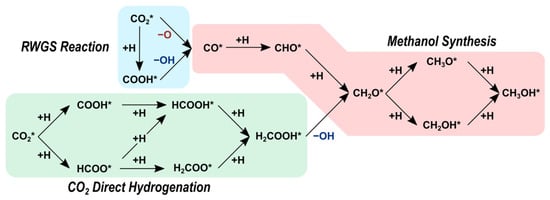
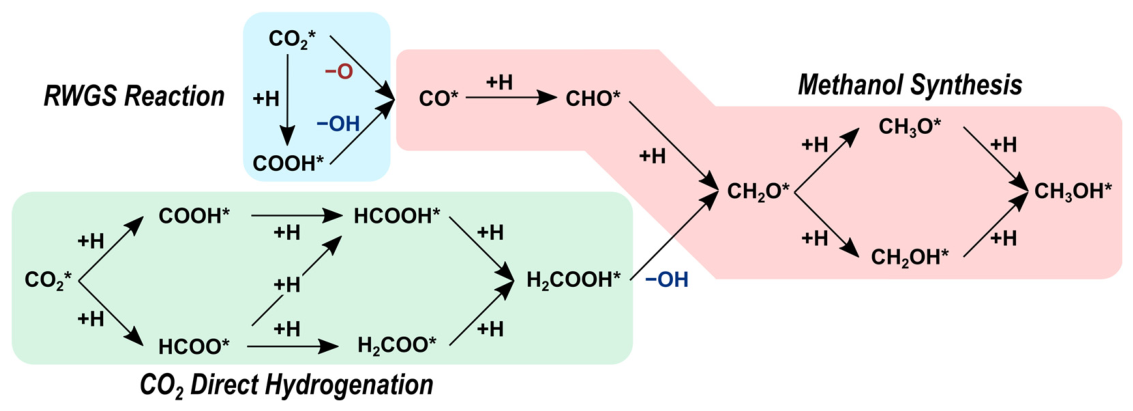
The reaction network examined in this work is summarized in Scheme 1. It was built from the mechanisms most often proposed for methanol synthesis on Cu-based and related catalysts and has three interconnected sub-networks [10,11,29]. In the direct hydrogenation sub-network (green), adsorbed CO2* is hydrogenated either at the carbon atom to formate (HCOO*) or at an oxygen atom to carboxyl (COOH*). Further hydrogenation through dioxymethylene (H2COO*) or formic acid (HCOOH*) gives hydroxymethoxy (H2COOH*), whose C–OH bond scission releases formaldehyde (CH2O*). In the reverse water–gas shift (RWGS) sub-network (blue), CO* forms either by direct C–O cleavage of CO2* or by decomposition of COOH*. The methanol synthesis sub-network (red) collects both branches. CO* is hydrogenated to formyl (CHO*) and then to CH2O*, the intermediate common to all routes. CH2O* is converted to CH3OH* through either methoxy (CH3O*) or hydroxymethyl (CH2OH*). The O* and OH* fragments released along these routes must be removed as water to regenerate the active sites, and their removal is treated as a separate set of steps.
Scheme 1.
Reaction network considered for CO2 hydrogenation to methanol on Mo(110) and MoP(001) surfaces. Pathways are color-coded by dominant reaction sequence: Reverse Water–Gas Shift (RWGS, light blue), direct CO2 hydrogenation via formate/formic acid intermediates (light green), and methanol synthesis pathway (light red). Asterisks (*) denote adsorbed surface species.
All intermediates and elementary steps were evaluated on Mo(110), the most stable facet of bcc Mo, and on Mo-terminated MoP(001). The latter exposes only Mo atoms above a subsurface P layer. It therefore models the P-deficient, Mo-rich regions. Comparing the two surfaces thus probes how subsurface phosphorus and the accompanying change in Mo coordination modify an otherwise metallic Mo ensemble.
The adsorption of individual intermediates is first discussed in Section 2.1. The energetics of the elementary steps and the complete reaction pathways are then discussed in the subsequent sections.
2.1. Surface Adsorption Modes and Binding Energetics
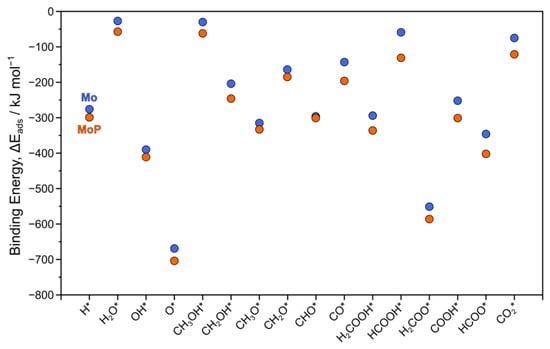
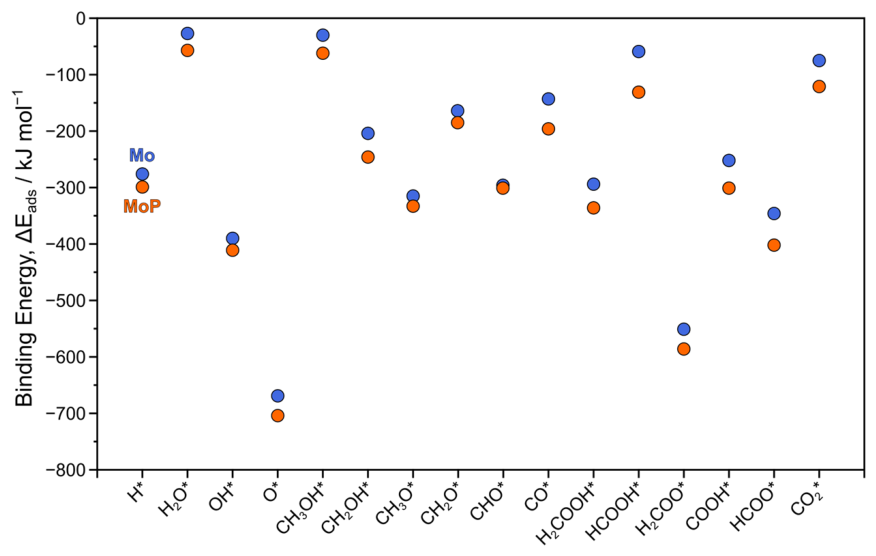
The most stable adsorption configurations of the reaction intermediates in Scheme 1 are shown in Figures S1 and S2. Their adsorption modes and adsorption energies, calculated with Equation (1), are listed in Table 1 and compared in Figure 1. Binding sites are labeled by the number of surface metal atoms coordinated to the adsorbate as discussed in Section 3.
Table 1.
Adsorption modes and corresponding adsorption energies (ΔEads, kJ mol−1) calculated using Equation (1) for key intermediates involved in CO2 hydrogenation over Mo(110) and MoP(001) surfaces.
Figure 1.
Comparison of adsorption energies (ΔEads, kJ mol−1) for reaction intermediates on Mo(110) (blue circles) and MoP(001) (orange circles) surfaces. More negative values indicate stronger surface binding.
Because ΔEads is referenced to the corresponding gas-phase species, open-shell fragments such as O*, OH*, and HCOO* naturally show much larger magnitudes than closed-shell molecules. The discussion below therefore focuses on two things: how the binding of a given species changes between the two surfaces, and how related intermediates are ordered. Absolute values are not compared across species.
The most striking feature of Figure 1 is that every intermediate binds more strongly on MoP(001) than on Mo(110). The additional stabilization ranges from −5 kJ mol−1 for CHO* to −72 kJ mol−1 for HCOOH* and averages about −36 kJ mol−1. This runs counter to the common view that phosphorus moderates the reactivity of metal sites by withdrawing electron density from the metal atoms [24,25]. Bader charge analysis (Table S1) shows that this occurs despite substantial charge withdrawal by phosphorus. The top-layer Mo atoms of MoP(001) carry +0.90 e, compared with +1.22 and +1.27 e for the subsurface Mo layers, which have more P neighbors. The stronger binding is therefore not a consequence of reduced charge withdrawal. It can instead be attributed to the coordination environment of the surface Mo atoms. The in-plane Mo–Mo separation on MoP(001) (≈3.2 Å) is much larger than the nearest-neighbor distance on Mo(110) (≈2.7 Å), which reduces d–d overlap between neighboring surface atoms. Within the d-band model, such a reduction in coordination is expected to raise the surface d states toward the Fermi level and strengthen adsorbate–surface interactions [30,31].
A further contribution comes from the choice of reference. Mo(110) is the close-packed and least reactive facet of bcc Mo, whereas Mo-terminated MoP(001) is an open termination exposing coordinatively unsaturated Mo. Part of the difference in Figure 1 is therefore a facet effect. The two surfaces are best viewed as representing well-coordinated metallic Mo and unsaturated, P-deficient Mo, respectively. Here, the expanded Mo–Mo spacing (from 2.73 Å on Mo(110) to 3.24 Å on MoP(001)) is a geometric consequence of P incorporation into the lattice. Throughout this work, the effects of phosphorus are therefore discussed in terms of this geometric modification of the Mo ensemble rather than a ligand effect. Contributions from the different facet symmetry of the two surfaces cannot be separated in the present comparison.
The stabilization is far from uniform, and its pattern supports this view. If charge transfer to P, which leaves the surface Mo atoms partially cationic, were the dominant effect, the largest stabilization would be expected for adsorbates bound through electronegative oxygen. Figure 1 shows essentially the reverse. Species anchored through a single O atom, such as OH* (−21 kJ mol−1) and CH3O* (−18 kJ mol−1), are the least affected, whereas CO and the CO2-derived C1 species HCOOH* (−72), HCOO* (−56), CO* (−53), COOH* (−49), and CO2* (−46 kJ mol−1) are the most affected. These species interact with the surface through a carbon atom, a delocalized π system, or several atoms at once, so their binding is more sensitive to the ensemble of Mo atoms available. Their stronger binding is not accompanied by greater charge transfer. HCOO* carries nearly the same charge on both surfaces (−0.78 and −0.82 e), and CO2* receives less charge on MoP(001) (−1.15 e) than on Mo(110) (−1.66 e) (Table S1).
Although P is absent from the outermost layer, subsurface phosphorus still leaves a clear fingerprint on site preference. On MoP(001), the O-anchored intermediates O*, OH*, CH3O*, H2COO*, and H2COOH*, together with CHO*, preferentially occupy the M3P hollow. H*, CH2OH*, CH2O*, COOH*, and HCOOH* prefer the M3 hollow, which has no P atom beneath it. On Mo(110), by contrast, most of these species share the same threefold site. The P-induced electronic perturbation is therefore present but local. It steers O-bound species toward particular sites without being large enough to offset the coordination-driven strengthening of binding overall.
These trends bear directly on the central argument of Duyar et al. [12]. On transition metals, formate binding scales with that of other O-bound intermediates such as OH* and CH3O*. P-containing surfaces escape this limitation by restricting formate to a weaker, monodentate geometry anchored through a surface P atom. On P-deficient MoP(001), the opposite occurs: HCOO* is stabilized by 56 kJ mol−1 relative to Mo(110), roughly three times more than OH* (21 kJ mol−1) or CH3O* (18 kJ mol−1). Relative to the intermediates it scales with on metals, formate is therefore over-stabilized on P-deficient MoP. This would push such sites toward more formate accumulation. Consistent with this, HCOO* adopts a bridging configuration on both surfaces, binding through both O atoms to two adjacent Mo atoms (Figures S1 and S2). Our results therefore suggest that Mo–Mo spacing alone does not preclude bidentate formate. The monodentate geometry instead appears to require surface P, which both interrupts the Mo ensemble and provides the O–P anchor. This interpretation is consistent with the monodentate, P-anchored formate predicted and observed on P-containing MoP, although P-terminated surfaces were not examined here.
Taken together, removing P from the outermost layer does not produce a moderated metal surface. It produces a more reactive, more oxophilic one on which formate is selectively over-stabilized relative to other O-bound intermediates. Adsorption thermodynamics alone therefore predict that P-deficient MoP(001) is more prone than Mo(110) to formate and oxygen accumulation, in line with the experimental assignment of Mo-rich sites to side reactions rather than methanol synthesis [12]. However, the branching between C–O scission and hydrogenation is set by kinetics, which is examined next.
2.2. Initial CO2 Activation: Direct Dissociation vs. Hydrogenation Branching
Adsorbed CO2* is the first branch point of the network in Scheme 1. It can lose an oxygen atom by direct C–O scission (CO2* → CO* + O*, reaction 9 in Table 2). It can also react with a neighboring H* atom, either at the carbon atom to form formate (HCOO*, reaction 1) or at an oxygen atom to form carboxyl (COOH*, reaction 2). The activation and reaction enthalpies of these three steps are listed in Table 2.
Table 2.
Calculated forward activation enthalpies (ΔHact = HTS − Hreactants) and reaction enthalpies (ΔHrxn = Hproducts − Hreactants) in kJ mol−1 for elementary reaction steps evaluated at 523 K on Mo(110) and MoP(001) surfaces. Reverse activation enthalpies are given by ΔHact − ΔHrxn. Reaction images can be found in Figures S3 and S4.
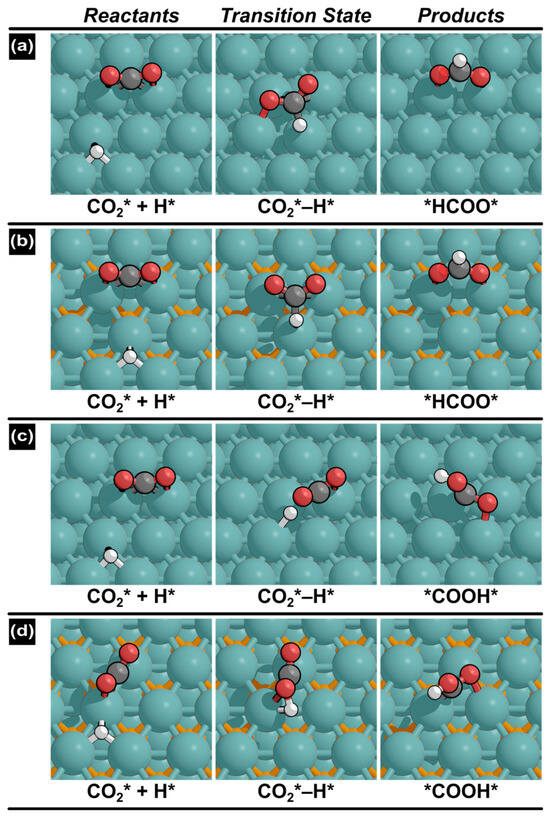
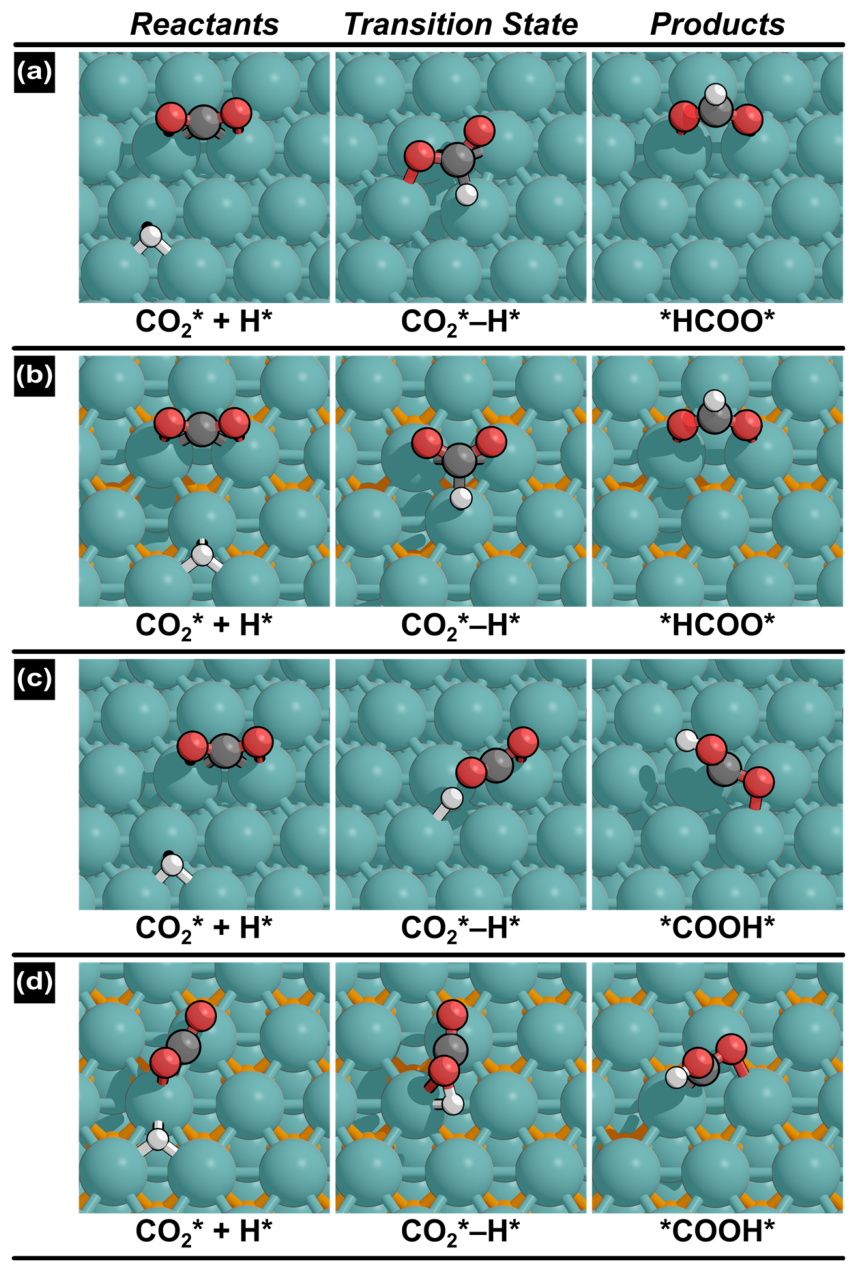
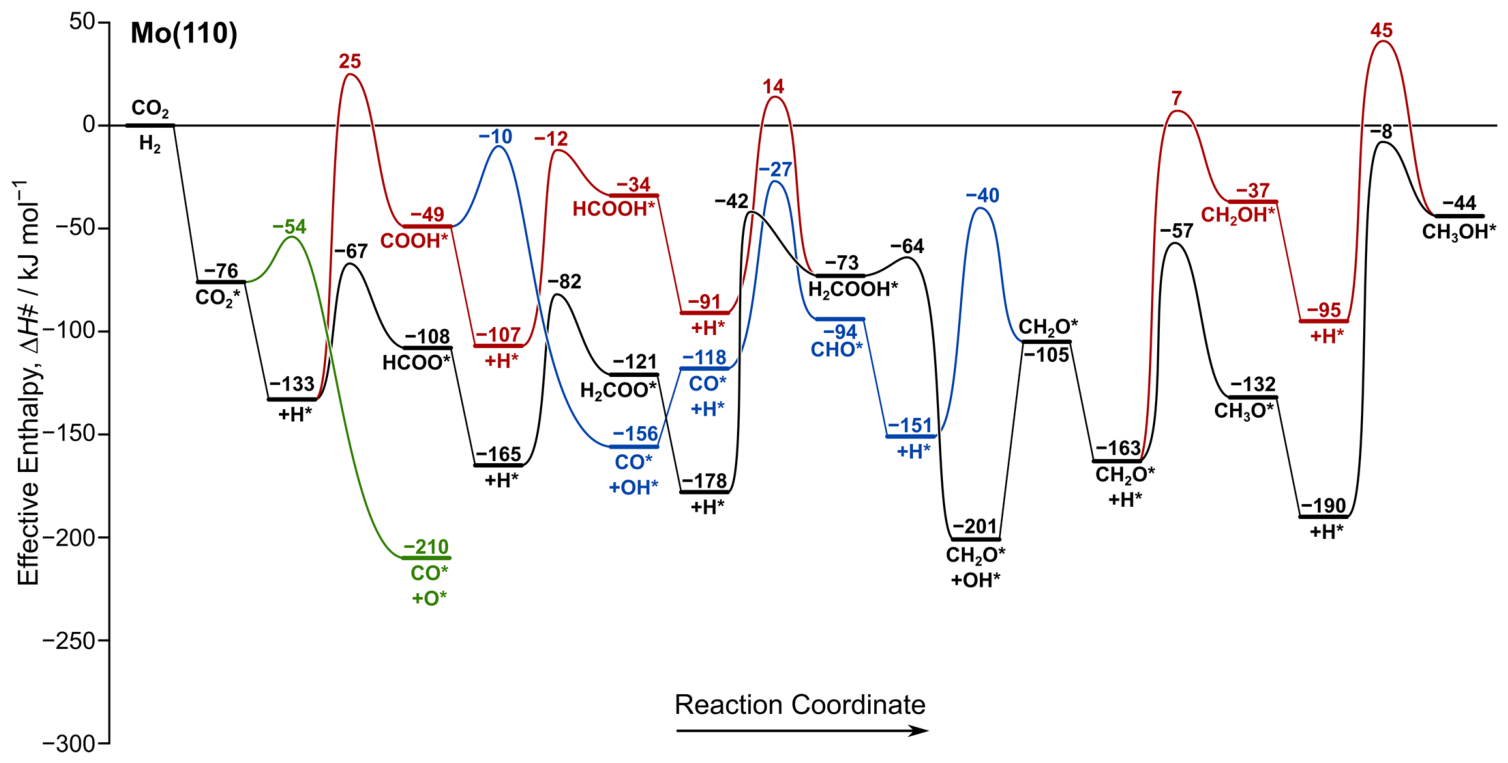
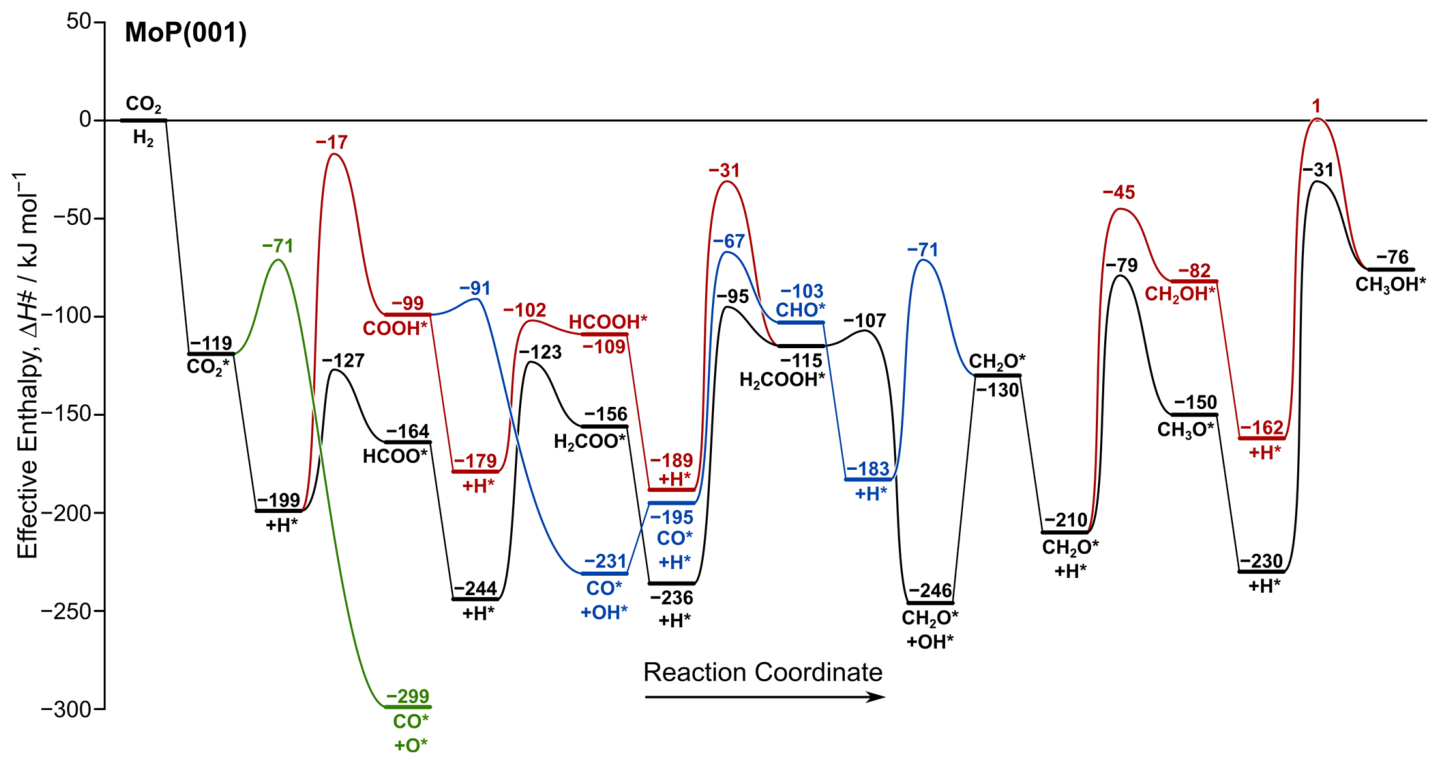
Both surfaces chemisorb CO2 in a bent geometry, with the carbon atom and both oxygen atoms coordinated to surface Mo atoms (Figure 2). Adsorption lowers the effective enthalpy to −76 kJ mol−1 on Mo(110) and to −119 kJ mol−1 on MoP(001) (Figure 3 and Figure 4). This distinguishes both Mo-based surfaces from Cu. On Cu(211), CO2 is at most weakly physisorbed, and formate forms by reaction of H* with an essentially gas-phase-like CO2 molecule [10,32]. The binding of CO2 on MoP(001) is close to that reported for a Ho-doped Cu(211) step (−120 kJ mol−1), where the strong bending of the molecule was taken as evidence of its activation [10]. On both Mo surfaces, the first hydrogenation step is therefore a Langmuir–Hinshelwood reaction between two strongly bound species. Its energetics must be weighed against the alternative of breaking a C–O bond in the already activated molecule.
Figure 2.
Optimized atomic configurations of initial states (Reactants), transition states, and final states (Products) for initial CO2* hydrogenation on (a,c) Mo(110) and (b,d) MoP(001).
Figure 3.
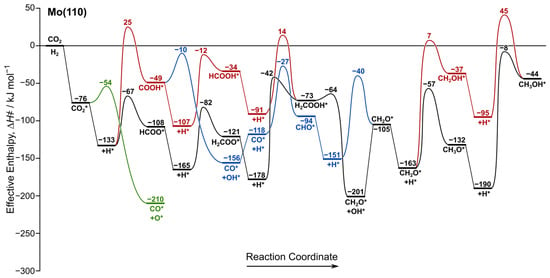
DFT-predicted reaction coordinate diagram for CO2 hydrogenation pathways on Mo(110) at 523 K. Effective enthalpies are calculated using Equation (2).
Figure 4.
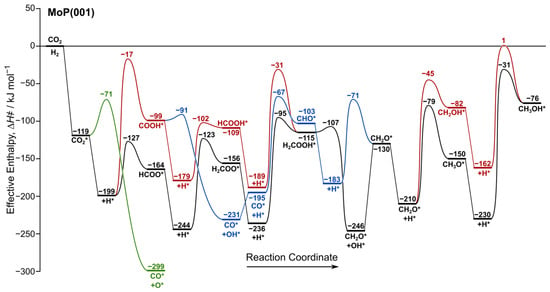
DFT-predicted reaction coordinate diagram for CO2 hydrogenation pathways on MoP(001) at 523 K. Effective enthalpies are calculated using Equation (2).
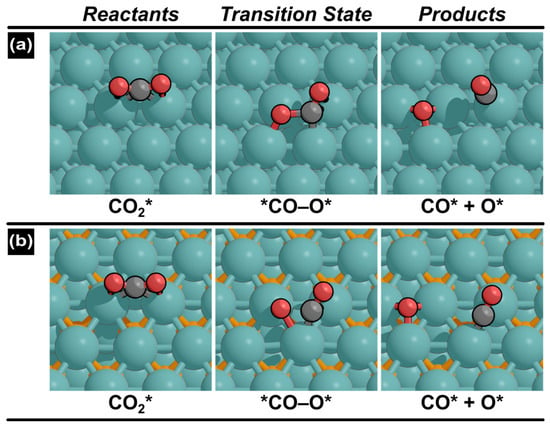
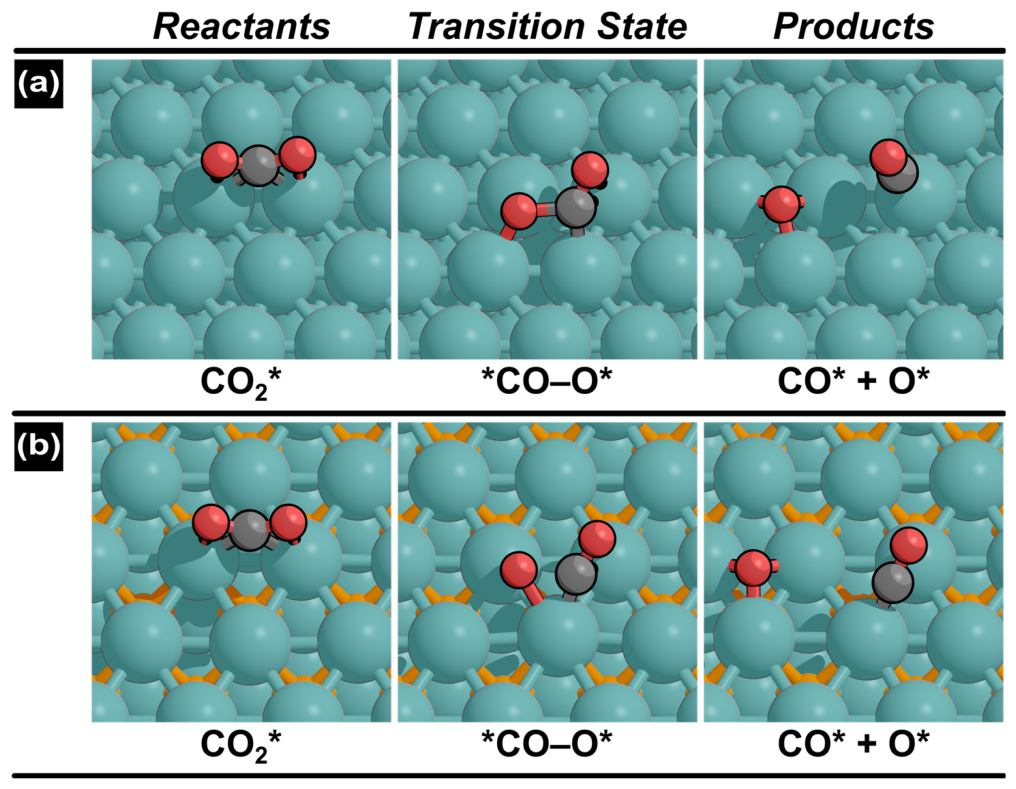
Direct C–O scission is facile and strongly exothermic on both surfaces. On Mo(110), the activation enthalpy is only 22 kJ mol−1 and the reaction enthalpy is −134 kJ mol−1 (reaction 9 in Table 2). Therefore, CO2* dissociation is nearly spontaneous at 523 K. This is consistent with the strong oxophilicity of metallic Mo. It also parallels the spontaneous C–O cleavage predicted and observed on Mo-terminated β-Mo2C(001) [33]. On MoP(001), the reaction is even more exothermic (−180 kJ mol−1), yet the barrier more than doubles to 48 kJ mol−1. The larger driving force on MoP(001) is therefore not accompanied by a lower barrier. This indicates that the two surfaces, which differ in site geometry and transition-state structure, do not follow a common Brønsted–Evans–Polanyi (BEP)-type correlation for this step [34].
The effective enthalpies show where this difference originates. Relative to Mo(110), MoP(001) stabilizes the CO2* initial state by 43 kJ mol−1 and the CO* + O* final state by 89 kJ mol−1. The dissociation transition state, however, is stabilized by only 17 kJ mol−1. The transition state is therefore the configuration least able to benefit from the higher reactivity of the coordinatively unsaturated Mo atoms identified in Section 2.1. A plausible origin is geometric. In the transition state, the departing O atom must be transferred toward a neighboring hollow site (Figure 5). Because the in-plane Mo–Mo separation increases from ≈2.7 Å on Mo(110) to ≈3.2 Å on MoP(001), this transfer requires greater elongation of the C–O bond before the O atom can be accommodated. This is consistent with the more product-like transition state on MoP(001) (Figure 5b). The expanded, P-modified Mo lattice thus hinders C–O scission kinetically even though it favors it thermodynamically. A similar effect has been reported for molybdenum carbides. On the Mo-terminated β-Mo2C(001) surface, the C–O bond of CO2 breaks spontaneously. On δ-MoC(001), which has a higher C/Mo ratio, the molecule is activated, but the C–O bond is preserved [33].
Figure 5.
Optimized atomic configurations for direct CO2* dissociation into CO* and O* on (a) Mo(110) and (b) MoP(001).
Hydrogenation at the carbon atom is strongly preferred over hydrogenation at oxygen on both surfaces. Formate forms with activation enthalpies of 67 and 72 kJ mol−1 on Mo(110) and MoP(001), respectively, whereas carboxyl formation requires 158 and 182 kJ mol−1 (Table 2). In the formate transition state, H* inserts beneath the carbon atom while both oxygen atoms remain bound to Mo (Figure 2a,b). Carboxyl formation instead requires H* to attack an oxygen atom that is strongly coordinated to oxophilic Mo (Figure 2c,d). The same preference has been reported on Cu(211) and Ho-doped Cu(211) [10,11]. Although COOH* readily decomposes to CO* + OH* (reaction 10), this RWGS route is therefore closed at its entrance, and CO forms mainly by direct C–O scission of CO2 (Section 2.4). Formate formation is also endothermic on both surfaces (+26 and +35 kJ mol−1), unlike on Cu(211) [11], which reflects the deep CO2* well.
Because dissociation and hydrogenation start from different states, their competition is best judged from the effective transition-state enthalpies in Figure 3 and Figure 4. On Mo(110), the formate transition state lies only 13 kJ mol−1 below the dissociation transition state, whereas on MoP(001) the separation widens to 56 kJ mol−1. Because the hydrogenation route consumes gas-phase H2, its transition state is penalized by the associated entropy loss. Effective free energies at 523 K (Table S2) raise the formate transition state relative to the dissociation transition state by 41 and 37 kJ mol−1 on Mo(110) and MoP(001), respectively. Direct C–O scission therefore becomes preferred on Mo(110), by 28 kJ mol−1, whereas formate formation remains preferred on MoP(001), by 19 kJ mol−1.
The 43 kJ mol−1 widening in enthalpy has three contributions: a higher intrinsic dissociation barrier on MoP(001) (+26 kJ mol−1), stronger H* binding that lowers the CO2* + H* state (+23 kJ mol−1; −80 vs. −57 kJ mol−1 per ½H2), and a slightly higher formate barrier that partly offsets them (−5 kJ mol−1). The small residual is due to rounding. Since formate formation is reversible (reverse barriers of 41 and 37 kJ mol−1, well below those for its further hydrogenation), the dissociation transition state must also be compared with the highest transition state on the hydrogenation path up to its first irreversible step, H2COOH* → CH2O* + OH* (Section 2.3). On Mo(110), this point (−42 kJ mol−1) lies above the dissociation transition state (−54 kJ mol−1), therefore, CO2 that enters the formate manifold can still revert and leave through C–O scission. On MoP(001), it (−95 kJ mol−1) remains well below the dissociation transition state (−71 kJ mol−1).
These results are consistent with the experimental assignment of CO formation on MoP to underphosphided, Mo-rich sites. Blocking these sites with CeO2 raised the methanol selectivity of MoP K/SiO2 from 18% to 76% [12]. C–O scission thus becomes more competitive as the Mo ensemble becomes more metallic. Each scission event deposits an O* atom in the deepest state of both profiles (−210 and −299 kJ mol−1), and the removal of this O* is discussed in Section 2.5. The fate of the carbon that enters the formate manifold is examined next.
2.3. Hydrogenation Network to Methanol: The Formate Pathway
HCOO* can be hydrogenated at the carbon atom to dioxymethylene (H2COO*, reaction 3) or at an oxygen atom to formic acid (HCOOH*, reaction 4). Dioxymethylene is clearly preferred on both surfaces. Its formation requires 83 and 120 kJ mol−1 on Mo(110) and MoP(001), respectively. HCOOH* formation instead requires 155 and 181 kJ mol−1 and is endothermic by more than 130 kJ mol−1 (Table 2). This preference reflects the oxophilicity of the Mo surfaces. H2COO* binds strongly through both oxygen atoms (−551 and −586 kJ mol−1, Table 1), whereas HCOOH* is only weakly held (−59 and −131 kJ mol−1). The same preference was found on Ho-doped Cu(211) (0.95 vs. 2.00 eV) [10], whereas on clean Cu(211) the reaction is usually taken to proceed through HCOOH* [11]. On the Mo surfaces, HCOOH* could therefore form only from COOH* (reaction 5), whose formation is already blocked (Section 2.2); the formic acid branch is therefore not considered further.
Formate hydrogenation is notably harder on MoP(001). The barrier is 37 kJ mol−1 higher than on Mo(110), and the reaction enthalpy doubles from +44 to +88 kJ mol−1. This is the kinetic counterpart of the formate over-stabilization identified in Section 2.1. On P-deficient MoP, bidentate formate is a less reactive intermediate. This suggests that the reactive monodentate formate observed by DRIFTS on MoP catalysts resides at P-containing sites [12].
The subsequent hydrogenation of H2COO* to hydroxymethoxy (H2COOH*, reaction 7) is the most demanding step before C–O scission. It requires 136 and 141 kJ mol−1 and is endothermic by 105 and 120 kJ mol−1 on Mo(110) and MoP(001), respectively. Its transition state is the highest point on this CO2 direct hydrogenation pathway (−42 and −95 kJ mol−1, Figure 3 and Figure 4). H2COOH* then splits into CH2O* + OH* almost without a barrier (9 and 8 kJ mol−1, reaction 8) and with a reaction enthalpy of about −130 kJ mol−1. This step is considerably easier than on Cu(211) (0.42 eV) and Ho-doped Cu(211) (0.32 eV) [10,11], because oxophilic Mo strongly binds the departing OH group. The step is irreversible and commits the carbon to the methanol formation pathway.
CH2O* is hydrogenated preferentially at carbon to methoxy (CH3O*, reaction 13) rather than at oxygen to hydroxymethyl (CH2OH*, reaction 14). The barriers are 106 vs. 169 kJ mol−1 on Mo(110) and 131 vs. 165 kJ mol−1 on MoP(001). The corresponding effective transition states lie at −57 vs. +7 kJ mol−1 and −79 vs. −45 kJ mol−1. The CH2OH* route also ends in a demanding hydrogenation step (136 and 163 kJ mol−1, reaction 16), therefore, methanol forms through methoxy on both surfaces.
The final step, CH3O* + H* → CH3OH* (reaction 15), has the highest barrier on the carbon pathway (181 and 199 kJ mol−1) and is endothermic by about 150 kJ mol−1. Its transition state is also the highest effective point along the formate route (−8 and −31 kJ mol−1, Figure 3 and Figure 4). Methoxy hydrogenation is often identified as the most demanding step on Cu-based surfaces as well [10,11]. The deepest state preceding this transition state is CH3O* + H* (−190 and −230 kJ mol−1). Methoxy is therefore expected to accumulate on both surfaces. This is in line with the use of CH3O* binding by Duyar et al. as the descriptor governing methanol release, with activity increasing as this binding weakens [12].
The formate pathway on both surfaces thus proceeds as CO2* → HCOO* → H2COO* → H2COOH* → CH2O* + OH* → CH3O* → CH3OH*. P-deficient MoP(001) directs carbon into this pathway more selectively than Mo(110) does (Section 2.2). On both surfaces, methoxy hydrogenation is the bottleneck. Mo-terminated sites, with or without subsurface phosphorus, therefore appear unable to complete methanol formation efficiently. The high methanol rates reported for MoP catalysts are more plausibly associated with sites where surface P weakens the binding of formate and methoxy. The competing route through CO*, which joins this pathway at CH2O*, is examined next.
2.4. Competing RWGS and Secondary CO Hydrogenation
CO* can form on the Mo surfaces through several routes. COOH* decomposes readily to CO* + OH* (39 and 9 kJ mol−1, reaction 10), but COOH* itself is kinetically inaccessible from CO2* + H* (Section 2.2), and its formation from HCOO* would require an isomerization to a state 59–65 kJ mol−1 higher in enthalpy. Formate decomposition to CO can instead proceed readily through CO2*. HCOO* reverts to CO2* + H* (41 and 37 kJ mol−1), and CO2* then undergoes C–O scission (reaction 9). Formate can thus act as a CO precursor through its reversibility, but CO* still forms mainly by C–O cleavage of CO2*. The resulting CO* is strongly bound (−143 and −196 kJ mol−1 on Mo(110) and MoP(001), Table 1). Its desorption enthalpy exceeds the barrier for its first hydrogenation on both surfaces. Desorption is entropically favored and cannot be excluded at 523 K. In enthalpic terms, however, CO* is more likely to be retained and hydrogenated than released as an RWGS product, particularly on MoP(001).
Secondary hydrogenation of CO* proceeds through formyl (CHO*, reaction 11) to CH2O* (reaction 12), where it joins the formate pathway. On Mo(110), CHO* formation requires 91 kJ mol−1 and is mildly endothermic (+24 kJ mol−1). On MoP(001), the barrier rises to 128 kJ mol−1 and the reaction enthalpy to +92 kJ mol−1. This follows from the adsorption trends in Section 2.1: MoP(001) stabilizes CO* by 53 kJ mol−1 relative to Mo(110) but CHO* by only 5 kJ mol−1. The second step, CHO* + H* → CH2O*, is similar on both surfaces (111 and 112 kJ mol−1). The highest transition state on the CO route (−27 and −67 kJ mol−1) lies 15 and 28 kJ mol−1 above that of the formate route (−42 and −95 kJ mol−1) on Mo(110) and MoP(001), respectively (Figure 3 and Figure 4). The same conclusion follows from the intrinsic barriers alone, since CHO* formation already requires 91 and 128 kJ mol−1. Secondary CO hydrogenation is therefore a minor source of CH2O* on both surfaces, and an even less competitive one on MoP(001).
2.5. Catalyst Regeneration: Surface Deoxygenation and Water Formation
Every CO2 molecule converted on these surfaces leaves one oxygen atom behind. That oxygen is released as OH* when H2COOH* splits on the formate pathway (Section 2.3), or as O* when CO2* dissociates directly (Section 2.2). Closing the catalytic cycle therefore requires removing these species as water. Direct hydrogenation is prohibitive on both surfaces. O* + H* → OH* requires 179 and 207 kJ mol−1 on Mo(110) and MoP(001), respectively, and OH* + H* → H2O* requires 173 and 182 kJ mol−1. Both steps are also strongly endothermic (111–148 kJ mol−1, reactions 17 and 18). These barriers are comparable to that of methoxy hydrogenation and reflect the very strong binding of O* and OH* (Table 1), which is further enhanced on MoP(001).
The only facile route to water is OH* disproportionation (OH* + OH* → H2O* + O*, reaction 19). This step requires only 40 and 49 kJ mol−1 on Mo(110) and MoP(001), respectively, and is mildly endothermic on Mo(110) and thermoneutral on MoP(001). On Cu(211), OH* disproportionation is likewise the preferred route to O* [11]. This route, however, regenerates O*, which cannot be hydrogenated further at an appreciable rate. Coadsorbed water, which on Cu is known to mediate hydrogen transfer, offers only limited help. Water-assisted OH* hydrogenation (H2O* + OH* + H* → 2H2O*, reaction 20) lowers the barrier by about 20 kJ mol−1 relative to the unassisted step, to 152 and 160 kJ mol−1. The step nevertheless remains prohibitive and strongly endothermic (134 and 148 kJ mol−1). The reverse reaction, water-assisted dissociation of H2O*, is correspondingly nearly barrierless (18 and 12 kJ mol−1). Because H2O* is only weakly bound (−27 and −57 kJ mol−1), any water that does not desorb promptly is therefore converted back into surface hydroxyl.
On both Mo-terminated surfaces, deoxygenation thus cannot keep pace with oxygen deposition, and O* and OH* are expected to accumulate until the surface is partially oxidized. This is consistent with the oxide layer detected by XPS on MoP K/SiO2 and with the MoO2- and MoO3-like features that XAS associates with underphosphided Mo regions [12]. Partial O/OH coverage may also modify the binding of the remaining intermediates. On Cu(211), preadsorbed O and OH weaken formate adsorption and accelerate methanol formation [11]. Whether a similar effect operates on Mo-based sites remains to be established. Together, these results indicate that Mo-terminated ensembles convert CO2 but cannot sustain a catalytic cycle to methanol. Their role on working MoP catalysts is therefore more plausibly that of sites for side reactions and oxygen uptake than of methanol-forming sites.
3. Materials and Methods
All periodic density functional theory (DFT) calculations were performed using the Vienna ab initio simulation package (VASP) as implemented through the Computational Catalysis Interface (CCI) [35,36,37,38,39]. The interactions between ion cores and valence electrons were described using projector augmented-wave (PAW) potentials [40,41]. Exchange and correlation energies were calculated within the generalized gradient approximation (GGA) using the revised Perdew-Burke-Ernzerhof (RPBE) functional [42,43,44]. A plane-wave basis set with an energy cutoff of 396 eV was used for all calculations, and gas-phase molecules were modeled in a periodic 15 × 15 × 15 Å unit cell. Bulk structures for Mo and MoP were optimized from crystallographic data [45,46], and spin-polarized test calculations showed no net magnetic moment.
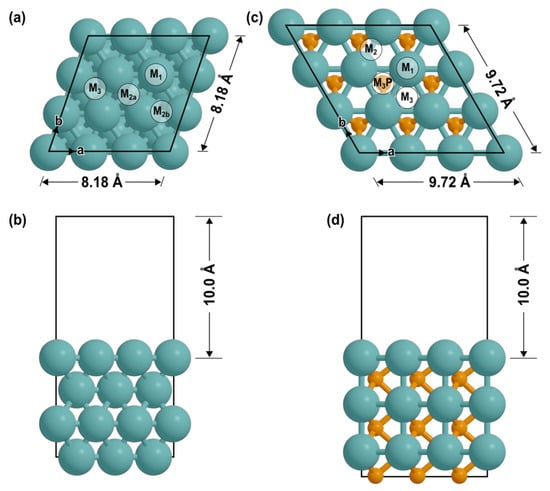
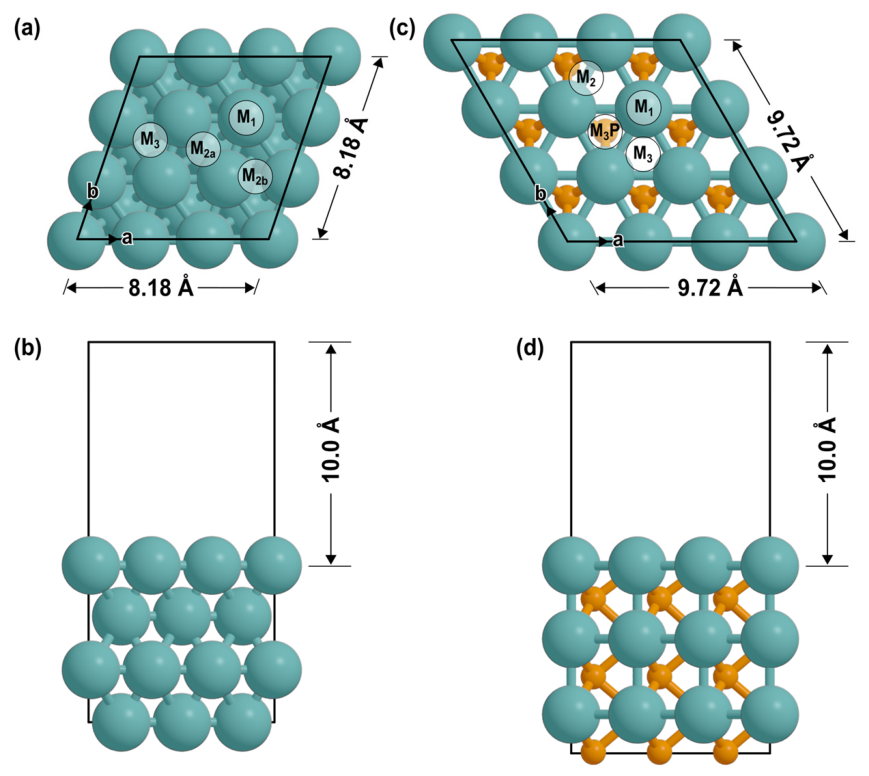
The Mo(110) surface was modeled using a 3 × 3 supercell containing four atomic layers (Figure 6a,b). The MoP catalyst was represented by the Mo-terminated (001) 3 × 3 surface (Figure 6c), constructed with three repeating units (six atomic layers) (Figure 6d). The Mo-terminated surface was chosen to represent the underphosphided, Mo-rich regions identified on MoP catalysts by XAS [12]. It corresponds to the P-free MoP(Mo) model used by Duyar et al. to describe these regions, and it is not intended to represent the most stable termination of MoP under all conditions. Both surface models included a vacuum layer of 10 Å orthogonal to the surface to minimize periodic interactions. The Brillouin zone was sampled using Monkhorst-Pack k-point mesh of 4 × 4 × 1 for Mo(110) and 3 × 3 × 1 for MoP(001) [47,48]. During geometry optimizations, the bottom half of each slab was constrained to bulk positions, while the upper layers and adsorbates were fully relaxed. Convergence criteria were set to 10−6 eV for electronic energy and 0.05 eV Å−1 for ionic forces. Adsorbates were placed in all symmetrically distinct sites and orientations, and the lowest-energy configuration was retained. Coadsorbed reactants were placed on neighboring sites within the same supercell, using the lowest-energy arrangement.
Figure 6.
Top and side views of the DFT slab models for (a,b) Mo(110) and (c,d) MoP(001) catalyst surfaces. Labels denote the binding site (M1: metal atop; M2: metal bridge; M3: metal 3-fold hollow; M3P: metal-phosphorus 3-fold hollow).
Transition state structures were identified using the nudged elastic band (NEB) and dimer methods [49,50,51]. A single imaginary frequency was confirmed for the dimer calculations. Vibrational frequency calculations were conducted to determine the thermal enthalpy corrections at a temperature of 523 K, with frequencies below 60 cm−1 set to 60 cm−1. The binding energy of adsorbates (ΔEads) was calculated relative to the clean catalyst surface and the corresponding molecule in the gas phase using Equation (1):
Therefore, a more negative value signifies a more stable, exothermic adsorption. Reaction coordinate diagrams were constructed from effective enthalpies referenced to gas-phase CO2 and H2 and the clean surface:
where x is the number of H2O molecules removed (O atoms released as water) and y is the total number of H atoms added, including those in the water. This reference is a bookkeeping convention that places all states on a common scale; it does not imply that the removal of O as water is kinetically facile. Additional computational details are available in Section S1 of the Supporting Information.
4. Conclusions
Periodic DFT calculations were used to map the CO2 hydrogenation network on Mo(110) and Mo-terminated MoP(001), which represent metallic Mo and P-deficient MoP, respectively. Every intermediate binds more strongly on MoP(001), by about 36 kJ mol−1 on average. This strengthening occurs despite substantial charge withdrawal by phosphorus (+0.90 e on surface Mo) and is attributed to the reduced coordination of the surface Mo atoms. Formate is over-stabilized relative to the other O-bound intermediates and retains its bidentate geometry. The monodentate formate associated with active MoP is therefore likely to require phosphorus in the surface layer, a hypothesis that remains to be tested on P-terminated surfaces.
At the CO2* branch point, hydrogenation at carbon to formate is preferred over carboxyl formation by at least 90 kJ mol−1 on both surfaces, which closes the carboxyl-mediated RWGS route. The P-modified Mo lattice of MoP(001) raises the barrier for direct C–O scission from 22 to 48 kJ mol−1 despite a larger driving force. It thereby widens the effective separation between the hydrogenation and dissociation transition states from 13 to 56 kJ mol−1. On Mo(110), CO2 that enters the formate pathway can still revert and dissociate, whereas on MoP(001) the hydrogenation sequence up to H2COOH* remains below the dissociation transition state.
Methanol formation proceeds through HCOO*, H2COO*, H2COOH*, CH2O*, and CH3O*. The rate-limiting step of this pathway is methoxy hydrogenation, which requires 181 and 199 kJ mol−1 on the two surfaces. CO-derived carbon contributes little to methanol formation and joins the pathway at CH2O*, so it does not bypass this step. The removal of O* and OH* is similarly prohibitive. The only facile water-forming step, OH* disproportionation, regenerates O*, so oxygen is expected to accumulate on both surfaces.
Phosphorus therefore improves the selectivity of CO2 activation on Mo-based sites, but subsurface phosphorus alone cannot sustain a catalytic cycle to methanol. These results provide a mechanistic basis for the experimental assignment of underphosphided Mo regions to CO formation and surface oxidation and for the benefit of promoters that block such sites. Catalyst design should therefore aim to preserve phosphorus in the outermost layer, where formate, methoxy, and oxygen are expected to bind more weakly. This hypothesis remains to be tested directly, because the present study is limited to a Mo-terminated surface at low coverage and does not include P-terminated or mixed Mo–P terminations. Future work should address P-terminated MoP surfaces, coverage effects, and free-energy-based microkinetic modeling to quantify these trends under reaction conditions.
Supplementary Materials
The following supporting information can be downloaded at: https://www.mdpi.com/article/10.3390/ijms272210370/s1.
Funding
This work was supported by the Deanship of Scientific Research, Vice Presidency for Graduate Studies and Scientific Research, King Faisal University, Saudi Arabia (Grant No. KFU266451).
Institutional Review Board Statement
Not applicable.
Informed Consent Statement
Not applicable.
Data Availability Statement
The original contributions presented in this study are included in the article/Supplementary Materials. Further inquiries can be directed to the corresponding author.
Conflicts of Interest
The author declares no conflicts of interest.
References
- Olah, G.A. After Oil and Gas: Methanol Economy. Catal. Lett. 2004, 93, 1–2. [Google Scholar] [CrossRef] [Scilit]
- Cui, X.; Hou, D.; Bing, Q.; Hu, J.; Deng, D. Shaping the Future of Green Methanol. Chem. Catal. 2025, 5, 101515. [Google Scholar] [CrossRef] [Scilit]
- Olah, G.A. Beyond Oil and Gas: The Methanol Economy. Angew. Chem. Int. Ed. 2005, 44, 2636–2639. [Google Scholar] [CrossRef] [Scilit] [PubMed]
- Olah, G.A.; Goeppert, A.; Prakash, G.K.S. Beyond Oil and Gas: The Methanol Economy; Wiley-VCH: Weinheim, Germany, 2018; ISBN 3527805656. [Google Scholar]
- Guil-López, R.; Mota, N.; Llorente, J.; Millán, E.; Pawelec, B.; Fierro, J.L.G.; Navarro, R.M. Methanol Synthesis from CO2: A Review of the Latest Developments in Heterogeneous Catalysis. Materials 2019, 12, 3902. [Google Scholar] [CrossRef] [Scilit] [PubMed]
- Ren, M.; Zhang, Y.; Wang, X.; Qiu, H. Catalytic Hydrogenation of CO2 to Methanol: A Review. Catalysts 2022, 12, 403. [Google Scholar] [CrossRef] [Scilit]
- Li, H.-X.; Yang, L.-Q.-Q.; Chi, Z.-Y.; Zhang, Y.-L.; Li, X.-G.; He, Y.-L.; Reina, T.R.; Xiao, W.-D. CO2 Hydrogenation to Methanol Over Cu/ZnO/Al2O3 Catalyst: Kinetic Modeling Based on Either Single- or Dual-Active Site Mechanism. Catal. Lett. 2022, 152, 3110–3124. [Google Scholar] [CrossRef] [Scilit]
- Wang, X.; Zhang, H.; Qin, H.; Wu, K.; Wang, K.; Ma, J.; Fan, W. A DFT Study of Methanol Synthesis from CO2 Hydrogenation on Cu/ZnO Catalyst. Fuel 2023, 346, 128381. [Google Scholar] [CrossRef] [Scilit]
- Kattel, S.; Ramírez, P.J.; Chen, J.G.; Rodriguez, J.A.; Liu, P. Active Sites for CO2 Hydrogenation to Methanol on Cu/ZnO Catalysts. Science 2017, 355, 1296–1299. [Google Scholar] [CrossRef] [Scilit] [PubMed]
- Tezsevin, I.; Senkan, S.; Onal, I.; Düzenli, D. DFT Study on the Hydrogenation of CO2 to Methanol on Ho-Doped Cu(211) Surface. J. Phys. Chem. C 2020, 124, 22426–22434. [Google Scholar] [CrossRef] [Scilit]
- Xu, D.; Wu, P.; Yang, B. Essential Role of Water in the Autocatalysis Behavior of Methanol Synthesis from CO2 Hydrogenation on Cu: A Combined DFT and Microkinetic Modeling Study. J. Phys. Chem. C 2019, 123, 8959–8966. [Google Scholar] [CrossRef] [Scilit]
- Duyar, M.S.; Tsai, C.; Snider, J.L.; Singh, J.A.; Gallo, A.; Yoo, J.S.; Medford, A.J.; Abild-Pedersen, F.; Studt, F.; Kibsgaard, J.; et al. A Highly Active Molybdenum Phosphide Catalyst for Methanol Synthesis from CO and CO2. Angew. Chem. 2018, 130, 15265–15270. [Google Scholar] [CrossRef] [Scilit]
- Bligaard, T.; Nørskov, J.K.; Dahl, S.; Matthiesen, J.; Christensen, C.H.; Sehested, J. The Brønsted–Evans–Polanyi Relation and the Volcano Curve in Heterogeneous Catalysis. J. Catal. 2004, 224, 206–217. [Google Scholar] [CrossRef] [Scilit]
- Ouyang, Y.; Shi, L.; Bai, X.; Li, Q.; Wang, J. Breaking Scaling Relations for Efficient CO2 Electrochemical Reduction through Dual-Atom Catalysts. Chem. Sci. 2020, 11, 1807–1813. [Google Scholar] [CrossRef] [Scilit] [PubMed]
- Wang, Y.; Yu, M.; Zhang, X.; Gao, Y.; Liu, J.; Zhang, X.; Gong, C.; Cao, X.; Ju, Z.; Peng, Y. Density Functional Theory Study of CO2 Hydrogenation on Transition-Metal-Doped Cu(211) Surfaces. Molecules 2023, 28, 2852. [Google Scholar] [CrossRef] [Scilit] [PubMed]
- Frei, M.S.; Capdevila-Cortada, M.; García-Muelas, R.; Mondelli, C.; López, N.; Stewart, J.A.; Curulla Ferré, D.; Pérez-Ramírez, J. Mechanism and Microkinetics of Methanol Synthesis via CO2 Hydrogenation on Indium Oxide. J. Catal. 2018, 361, 313–321. [Google Scholar] [CrossRef] [Scilit]
- Frei, M.S.; Mondelli, C.; Cesarini, A.; Krumeich, F.; Hauert, R.; Stewart, J.A.; Curulla Ferré, D.; Pérez-Ramírez, J. Role of Zirconia in Indium Oxide-Catalyzed CO2 Hydrogenation to Methanol. ACS Catal. 2020, 10, 1133–1145. [Google Scholar] [CrossRef] [Scilit]
- Wang, J.; Li, G.; Li, Z.; Tang, C.; Feng, Z.; An, H.; Liu, H.; Liu, T.; Li, C. A Highly Selective and Stable ZnO-ZrO2 Solid Solution Catalyst for CO2 Hydrogenation to Methanol. Sci. Adv. 2017, 3, e1701290. [Google Scholar] [CrossRef] [Scilit] [PubMed]
- Zhou, S.; Li, S. Insights into the High Activity and Methanol Selectivity of the Zn/ZrO2 Solid Solution Catalyst for CO2 Hydrogenation. J. Phys. Chem. C 2020, 124, 27467–27478. [Google Scholar] [CrossRef] [Scilit]
- Hu, J.; Yu, L.; Deng, J.; Wang, Y.; Cheng, K.; Ma, C.; Zhang, Q.; Wen, W.; Yu, S.; Pan, Y.; et al. Sulfur Vacancy-Rich MoS2 as a Catalyst for the Hydrogenation of CO2 to Methanol. Nat. Catal. 2021, 4, 242–250. [Google Scholar] [CrossRef] [Scilit]
- Studt, F.; Sharafutdinov, I.; Abild-Pedersen, F.; Elkjær, C.F.; Hummelshøj, J.S.; Dahl, S.; Chorkendorff, I.; Nørskov, J.K. Discovery of a Ni-Ga Catalyst for Carbon Dioxide Reduction to Methanol. Nat. Chem. 2014, 6, 320–324. [Google Scholar] [CrossRef] [Scilit] [PubMed]
- Figueras, M.; Gutiérrez, R.A.; Viñes, F.; Ramírez, P.J.; Rodriguez, J.A.; Illas, F. Supported Molybdenum Carbide Nanoparticles as an Excellent Catalyst for CO2 Hydrogenation. ACS Catal. 2021, 11, 9679–9687. [Google Scholar] [CrossRef] [Scilit]
- Zhou, H.; Chen, Z.; Kountoupi, E.; Tsoukalou, A.; Abdala, P.M.; Florian, P.; Fedorov, A.; Müller, C.R. Two-Dimensional Molybdenum Carbide 2D-Mo2C as a Superior Catalyst for CO2 Hydrogenation. Nat. Commun. 2021, 12, 5510. [Google Scholar] [CrossRef] [Scilit] [PubMed]
- Al-Ali, L.I.; Elmutasim, O.; Al Ali, K.; Singh, N.; Polychronopoulou, K. Transition Metal Phosphides (TMP) as a Versatile Class of Catalysts for the Hydrodeoxygenation Reaction (HDO) of Oil-Derived Compounds. Nanomaterials 2022, 12, 1435. [Google Scholar] [CrossRef] [Scilit] [PubMed]
- Waldt, C.; Montalvo-Castro, H.; Almithn, A.; Loaiza-Orduz, Á.; Plaisance, C.; Hibbitts, D. Role of Phosphorous in Transition Metal Phosphides for Selective Hydrogenolysis of Hindered C–O Bonds. J. Catal. 2023, 421, 403–418. [Google Scholar] [CrossRef] [Scilit]
- Witzke, M.E.; Almithn, A.; Conrad, C.L.; Hibbitts, D.D.; Flaherty, D.W. Mechanisms and Active Sites for C–O Bond Rupture within 2-Methyltetrahydrofuran over Ni, Ni12P5, and Ni2P Catalysts. ACS Catal. 2018, 8, 7141–7157. [Google Scholar] [CrossRef] [Scilit]
- Almithn, A. Effects of P:Ni Ratio on Methanol Steam Reforming on Nickel Phosphide Catalysts. Molecules 2023, 28, 6079. [Google Scholar] [CrossRef] [Scilit] [PubMed]
- Almithn, A. Phosphorus Modification of Iron: Mechanistic Insights into Ammonia Synthesis on Fe2P Catalyst. Molecules 2024, 29, 1894. [Google Scholar] [CrossRef] [Scilit] [PubMed]
- Liu, L.; Yao, H.; Jiang, Z.; Fang, T. Theoretical Study of Methanol Synthesis from CO2 Hydrogenation on PdCu3(111) Surface. Appl. Surf. Sci. 2018, 451, 333–345. [Google Scholar] [CrossRef] [Scilit]
- Hammer, B.; Nørskov, J.K. Electronic Factors Determining the Reactivity of Metal Surfaces. Surf. Sci. 1995, 343, 211–220. [Google Scholar] [CrossRef] [Scilit]
- Hammer, B.; Nørskov, J.K. Theoretical Surface Science and Catalysis—Calculations and Concepts. Adv. Catal. 2000, 45, 71–129. [Google Scholar] [CrossRef] [Scilit]
- Muttaqien, F.; Hamamoto, Y.; Inagaki, K.; Morikawa, Y. Dissociative Adsorption of CO2 on Flat, Stepped, and Kinked Cu Surfaces. J. Chem. Phys. 2014, 141, 034702. [Google Scholar] [CrossRef] [Scilit] [PubMed]
- Posada-Pérez, S.; Viñes, F.; Ramirez, P.J.; Vidal, A.B.; Rodriguez, J.A.; Illas, F. The Bending Machine: CO2 Activation and Hydrogenation on δ-MoC(001) and β-Mo2C(001) Surfaces. Phys. Chem. Chem. Phys. 2014, 16, 14912–14921. [Google Scholar] [CrossRef] [Scilit] [PubMed]
- Nørskov, J.K.; Bligaard, T.; Logadottir, A.; Bahn, S.; Hansen, L.B.; Bollinger, M.; Bengaard, H.; Hammer, B.; Sljivancanin, Z.; Mavrikakis, M.; et al. Universality in Heterogeneous Catalysis. J. Catal. 2002, 209, 275–278. [Google Scholar] [CrossRef] [Scilit]
- Kresse, G.; Hafner, J. Ab Initio Molecular Dynamics for Liquid Metals. Phys. Rev. B 1993, 47, 558–561. [Google Scholar] [CrossRef] [Scilit] [PubMed]
- Kresse, G.; Hafner, J. Ab Initio Molecular-Dynamics Simulation of the Liquid-Metal–Amorphous-Semiconductor Transition in Germanium. Phys. Rev. B 1994, 49, 14251–14269. [Google Scholar] [CrossRef] [Scilit] [PubMed]
- Kresse, G.; Furthmüller, J. Efficient Iterative Schemes for Ab Initio Total-Energy Calculations Using a Plane-Wave Basis Set. Phys. Rev. B 1996, 54, 11169–11186. [Google Scholar] [CrossRef] [Scilit] [PubMed]
- Kresse, G.; Furthmüller, J. Efficiency of Ab-Initio Total Energy Calculations for Metals and Semiconductors Using a Plane-Wave Basis Set. Comput. Mater. Sci. 1996, 6, 15–50. [Google Scholar] [CrossRef] [Scilit]
- Kravchenko, P.; Plaisance, C.; Hibbitts, D. A New Computational Interface for Catalysis. ChemRxiv 2019. [Google Scholar] [CrossRef]
- Blöchl, P.E. Projector Augmented-Wave Method. Phys. Rev. B 1994, 50, 17953–17979. [Google Scholar] [CrossRef] [Scilit] [PubMed]
- Kresse, G.; Joubert, D. From Ultrasoft Pseudopotentials to the Projector Augmented-Wave Method. Phys. Rev. B 1999, 59, 1758–1775. [Google Scholar] [CrossRef] [Scilit]
- Hammer, B.; Hansen, L.B.; Nørskov, J.K. Improved Adsorption Energetics within Density-Functional Theory Using Revised Perdew-Burke-Ernzerhof Functionals. Phys. Rev. B 1999, 59, 7413–7421. [Google Scholar] [CrossRef] [Scilit]
- Perdew, J.P.; Burke, K.; Ernzerhof, M. Generalized Gradient Approximation Made Simple. Phys. Rev. Lett. 1996, 77, 3865–3868. [Google Scholar] [CrossRef] [Scilit] [PubMed]
- Zhang, Y.; Yang, W. Comment on “Generalized Gradient Approximation Made Simple”. Phys. Rev. Lett. 1998, 80, 890. [Google Scholar] [CrossRef] [Scilit]
- Rundqvist, S.; Lundström, T. X-Ray Studies of Molybdenum and Tungsten Phosphides. Acta Chem. Scand. 1963, 17, 37–46. [Google Scholar] [CrossRef] [Scilit]
- Wyckoff, R.W.G. Crystal Structures, 2nd ed.; Interscience Publishers: New York, NY, USA, 1963; Volume 1. [Google Scholar]
- Monkhorst, H.J.; Pack, J.D. Special Points for Brillouin-Zone Integrations. Phys. Rev. B 1976, 13, 5188–5192. [Google Scholar] [CrossRef] [Scilit]
- Pack, J.D.; Monkhorst, H.J. “Special Points for Brillouin-Zone Integrations”—A Reply. Phys. Rev. B 1977, 16, 1748–1749. [Google Scholar] [CrossRef] [Scilit]
- Henkelman, G.; Jónsson, H. Improved Tangent Estimate in the Nudged Elastic Band Method for Finding Minimum Energy Paths and Saddle Points. J. Chem. Phys. 2000, 113, 9978–9985. [Google Scholar] [CrossRef] [Scilit]
- Jónsson, H.; Mills, G.; Jacobsen, K.W. Nudged Elastic Band Method for Finding Minimum Energy Paths of Transitions. In Proceedings of the Classical and Quantum Dynamics in Condensed Phase Simulations; World Scientific: Singapore, 1998; pp. 385–404. [Google Scholar]
- Henkelman, G.; Jónsson, H. A Dimer Method for Finding Saddle Points on High Dimensional Potential Surfaces Using Only First Derivatives. J. Chem. Phys. 1999, 111, 7010–7022. [Google Scholar] [CrossRef] [Scilit]

Disclaimer/Publisher’s Note: The statements, opinions and data contained in all publications are solely those of the individual author(s) and contributor(s) and not of MDPI and/or the editor(s). MDPI and/or the editor(s) disclaim responsibility for any injury to people or property resulting from any ideas, methods, instructions or products referred to in the content. |
© 2026 by the author. Licensee MDPI, Basel, Switzerland. This article is an open access article distributed under the terms and conditions of the Creative Commons Attribution (CC BY) license.