


Abstract
Poultry colibacillosis is a common bacterial disease caused by pathogenic strains of Escherichia coli. The growing drug resistance of these strains is driving the search for new phytobiotics that are effective against this bacterium. A medieval recipe, the “Thieves” protective blend, shows promising results in this regard. This blend contains essential oils (EOs) from cinnamon bark (cinnamaldehyde chemotype), clove buds (eugenol chemotype), rosemary and eucalyptus (both eucalyptol chemotype) and lemon (limonene). The minimum inhibitory concentration (MIC) method was used to determine the activity of a total of 12 selected EOs (5 single EOs and 7 protective blends) against fifty clinical isolates of E. coli and the reference strain ATCC 25922. The detailed chemical composition of all EOs and their blends was determined using gas chromatography-mass spectrometry (GC-MS). Cinnamon bark EO showed the strongest activity (mean MIC = 0.14% v/v), followed by two mixtures containing 50% and 20% of this EO (mean MICs of 0.22% and 0.25% v/v, respectively). The second most active EO was clove bud EO (mean MIC = 0.28% v/v) and the related blend (mean MIC 0.27% v/v). Rosemary, eucalyptus, and lemon EOs appear to have low activity against E. coli (MIC > 4% v/v). However, typical MIC values for their mixtures ranged from 0.34 to 0.5% v/v, indicating a possible synergy between the individual components of the “Thieves” blend. If additional synergistic effects with antibiotics can be identified in the future, it will be possible to use this type of protective blend in the adjunctive treatment of colibacillosis in poultry.
1. Introduction
Avian Pathogenic Escherichia coli (APEC) strains are associated primarily with respiratory or systemic infections in chickens, turkeys, and other bird species worldwide (colibacillosis), which has serious economic consequences for the poultry industry [1]. APEC strains belong to the group of extraintestinal pathogenic E. coli (ExPEC) [2] and share deep genetic similarities and virulence traits with human pathogens such as uropathogenic E. coli (UPEC) [3] and newborn meningitis E. coli (NMEC) [4], which is associated with a potential zoonotic risk. However, the question of whether there is a direct link between poultry strains and human disease remains under investigation, as conclusive clinical evidence is still lacking.
Previous studies have indicated that serotypes O78, O1, O2, and O18 are the predominant APEC serotypes, particularly in Europe. However, depending on geographic location, other serotypes may be prevalent in a given country, such as O145 or O157 [4,5,6]. Although the pathogenic mechanisms of APEC have not yet been fully clarified, this group may serve as a reservoir of virulence genes and antibiotic resistance genes for other ExPEC strains found in humans [6]. The last discovery of a new class of antibiotics commercially available on the market occurred in 1987. Since then, innovation in this field has stagnated (the so-called “discovery void”); fortunately, there has recently been a resurgence of activity, and only a few new classes of potential antibiotics are currently in the multi-year development phase [7].
Nowadays, there is growing interest in the search for new naturally derived antimicrobial agents—such as essential oils and extracts from herbs—that have been used in traditional medicine for centuries. Essential oils and antibiotics kill microorganisms in different ways. Antibiotics are potent, single-component drugs targeted at bacterial infections. Essential oils (EOs) have a broad spectrum of action but are often less potent; therefore, they continue to be used primarily to support prevention and disinfection rather than as a substitute for the treatment of serious diseases in humans and animals. This is primarily due to the wide variation in their composition, their high volatility, their low water solubility and bioavailability [8].
A natural essential oil is a complex mixture of several dozen to even more than 100 volatile chemical compounds. Chemically, these are mainly monoterpenes and sesquiterpenes, as well as ketones, aldehydes, alcohols, esters, lactones, and other organic compounds responsible for their specific scents and effects [9]. Generally, Gram-negative bacteria tend to be more resistant to the antimicrobial activity of EOs than Gram-positive bacteria due to differences in cell wall composition [10]. The antibacterial and antifungal activities of spices and herbs have already been relatively well documented [11,12], including for E. coli. The Lauraceae (e.g., cinnamon, cassia), Myrtaceae (e.g., clove, eucalyptus), Lamiaceae (e.g., rosemary, thyme, mentha, oregano, basil, salvia, lavender, marjoram) and Apiaceae (e.g., anise, cumin, coriander, fennel) families demonstrated the highest potency [13].
EO blends are combinations of several pure EOs that mutually enhance their therapeutic and aromatic effects (synergy). Ready-to-use blends help to achieve specific effects, ranging from deep relaxation and improved concentration to easier breathing and protection against microorganisms [14]. One example of a so-called “protective blend” is a medieval mixture commonly known as Thieves Oil. It consists of cinnamon, clove, eucalyptus, rosemary, and lemon EOs. A limited number of studies in this area have demonstrated the effective action of this blend against Staphylococcus pseudintermedius isolated from cases of otitis externa in dogs [15]. Thus, the aim of this study is the evaluation of the activity of Thieves-type EOs against a large collection of clinical poultry E. coli isolates, as well as analysis of their chemical composition.
2. Results
2.1. Chemical Composition of Five Single Essential Oils
The results of the chemical composition analysis of the individual EOs are presented in Table 1. Cinnamon bark EO consisted mainly of cinnamaldehyde (55.8%), ß-caryophyllene (7.2%), cinnamyl acetate (6.7%), eugenol (4.55%), linalool (4.72%), limonene (3.63%) and benzyl benzoate (2.4%). Clove EO consisted mainly of eugenol (78.07%) and caryophyllenes: β-caryophyllene (12.87%) and α-humulene (α-caryophyllene) (3.85%). The main component of rosemary EO was 1,8-cineole (eucalyptol) (33.44%), followed by camphor (15.58%), α-pinene (9.62%), β-caryophyllene (6.21%), β-pinene (5.93%), borneol (5.19%), camphene (5.15%), and α-terpineol (4.58%). Eucalyptus EO was mainly composed of 1,8-cineole (eucalyptol) (55.67%); significant amounts of α-terpineol (17.78%), carvacrol (4.71%), terpinen-4-ol (4.1%), and pinenes (α-pinene—3.66% and β-pinene—3.24%) were also detected. The last of the analyzed EOs, lemon EO, consisted mainly of limonene (49.27%), β-pinene (16.81%), and γ-terpinene (13.27%), as well as smaller amounts of α-pinene (3.36%) and citral: geranial (trans-citral) (4.28%) and neral (cis-citral) (2.88%). The chromatograms are available in the Supplementary Materials Figures S1–S5.
Table 1.
Chemical composition of five single essential oils (the key components defining their chemotypes are highlighted in bold).
2.2. Chemical Composition of Seven Protective Blends
Table 2 summarizes the chemical composition of all the blends analyzed. Blend B contained the highest amount of trans-cinnamaldehyde (34.14%), since cinnamon EO was the dominant component of that blend. Blend A, which had a balanced composition of EOs, contained 18.78% of this component. The other blends had similar trans-cinnamaldehyde contents, ranging from 12 to 15%. Eugenol was the predominant component in Blend C (42.32%), due to the fact that it was composed of 50% clove EO. A surprisingly high amount of eugenol was detected in the Nature’s Shield® blend by Now Foods (29.95%). Blend A also contained a significant amount of eugenol (22.28%), while its content in the other blends ranged between 14 and 18%. 1.8-cineole (eucalyptol) is a main component of both rosemary and eucalyptus EOs; therefore, the related blends D and E contained significant amounts of eucalyptol (24.48% and 29.8%, respectively). In the other prepared blends, noticeably lower contents of this ingredient (8–15%) were found, while the commercial Nature’s Shield® blend was surprisingly characterized by a very low eucalyptol content (only 5.1%). Limonene, typical for citrus fruits, was found in the highest concentration in Blend F (23.55%). It was also present in fairly high amounts in the commercial Nature’s Shield® blend (15.54%). The other blends contained smaller amounts of limonene (2–8.5%). Among other chemical compounds, the following were present in moderate amounts: β-caryophyllene (4–8%), β-pinene (3–8%), camphor (1–8%), α-terpineol (2–7.5%), α-pinene (2–6%), and γ-terpinene (1.5–6%). The chromatograms are available in the Supplementary Materials Figures S6–S12.
Table 2.
Chemical composition of seven protective blends (the key components defining the chemotypes of the individual essential oils are highlighted in bold).
2.3. Antibacterial Activity
The results of the activity analysis of single EOs and their blends against fifty-one E. coli strains are summarized in Table 3. Cinnamon EO had the strongest effect (mean MIC = 0.14% v/v), followed by Blend B, which contained 50% of this EO (mean MIC = 0.22% v/v), and Blend A, which consisted of equal parts of each EO, including 20% cinnamon EO (mean MIC = 0.25% v/v). The second most active EO was clove EO (mean MIC = 0.28% v/v) and the related Blend C (mean MIC 0.27% v/v). Next, the commercial blend Nature’s Shield (mean MIC = 0.34% v/v) should be listed. The last three blends were characterized by MIC values around 0.5% v/v: Blend D (rosemary-based; mean MIC 0.44% v/v), Blend E (eucalyptus-based; mean MIC 0.48% v/v), and Blend F (lemon-based; MIC was always 0.5% v/v). In contrast to these results, three single EOs exhibited low activity. Two of them (rosemary EO and eucalyptus EO) had the same chemotype (1.8-cineole), and their MICs were always within the range of 4–8% v/v. Lemon EO (limonene chemotype) appears to be ineffective against E. coli, as MIC values higher than 8% v/v were consistently obtained.
Table 3.
Minimum inhibitory concentration (MIC) and minimum bactericidal concentration (MBC) values for five essential oils and seven blends in relation to 51 strains of Escherichia coli.
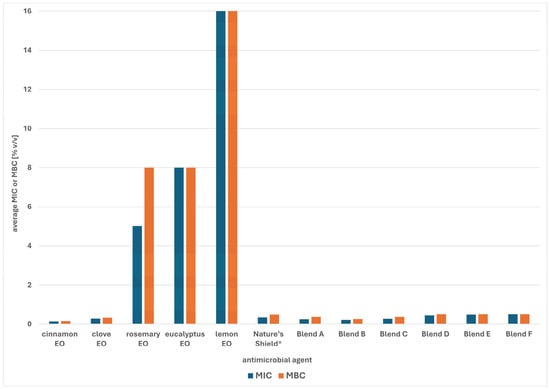
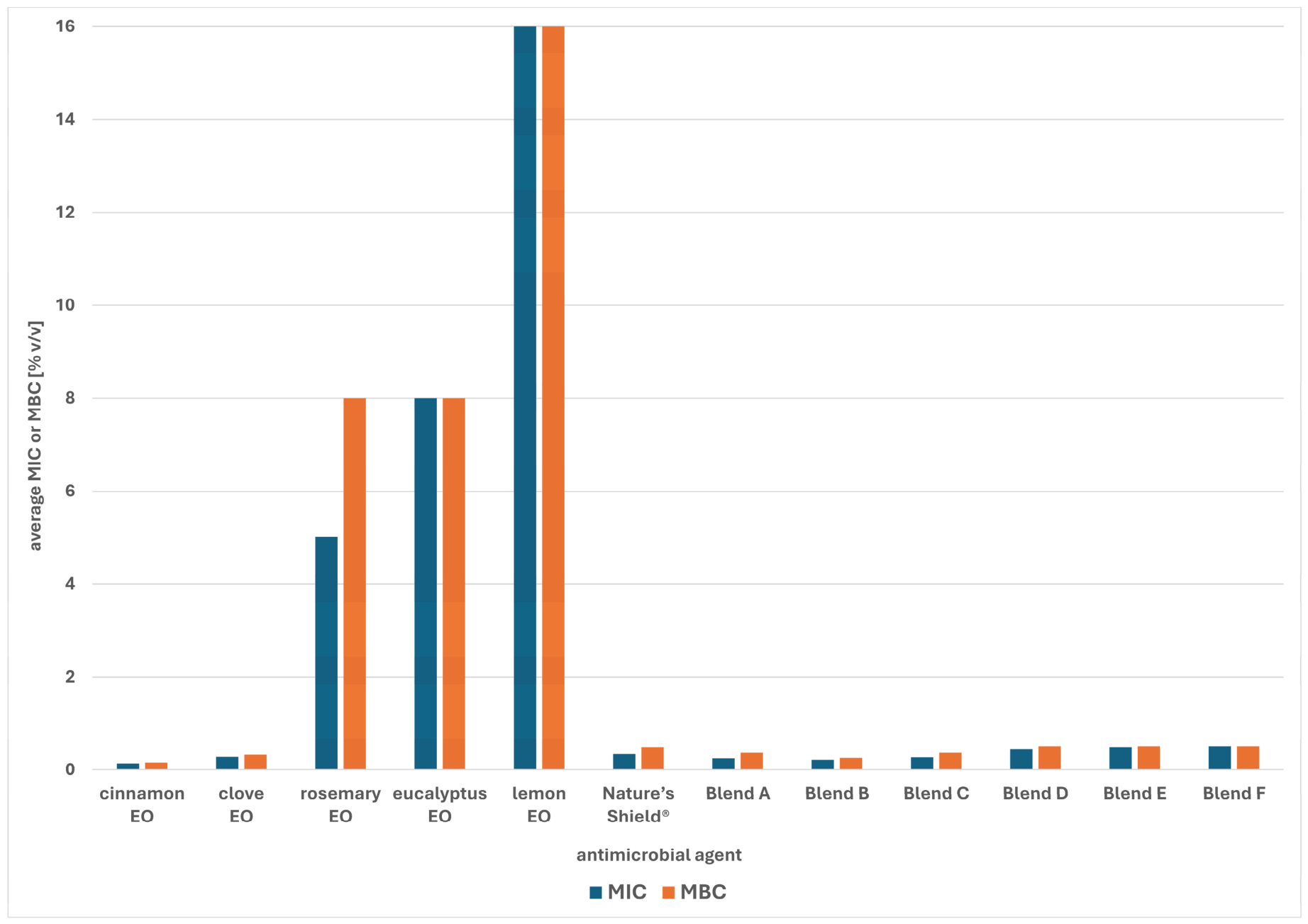
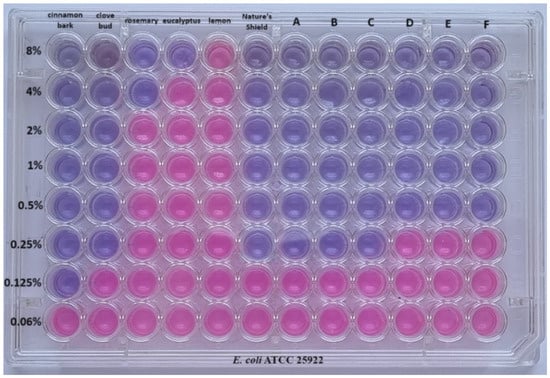
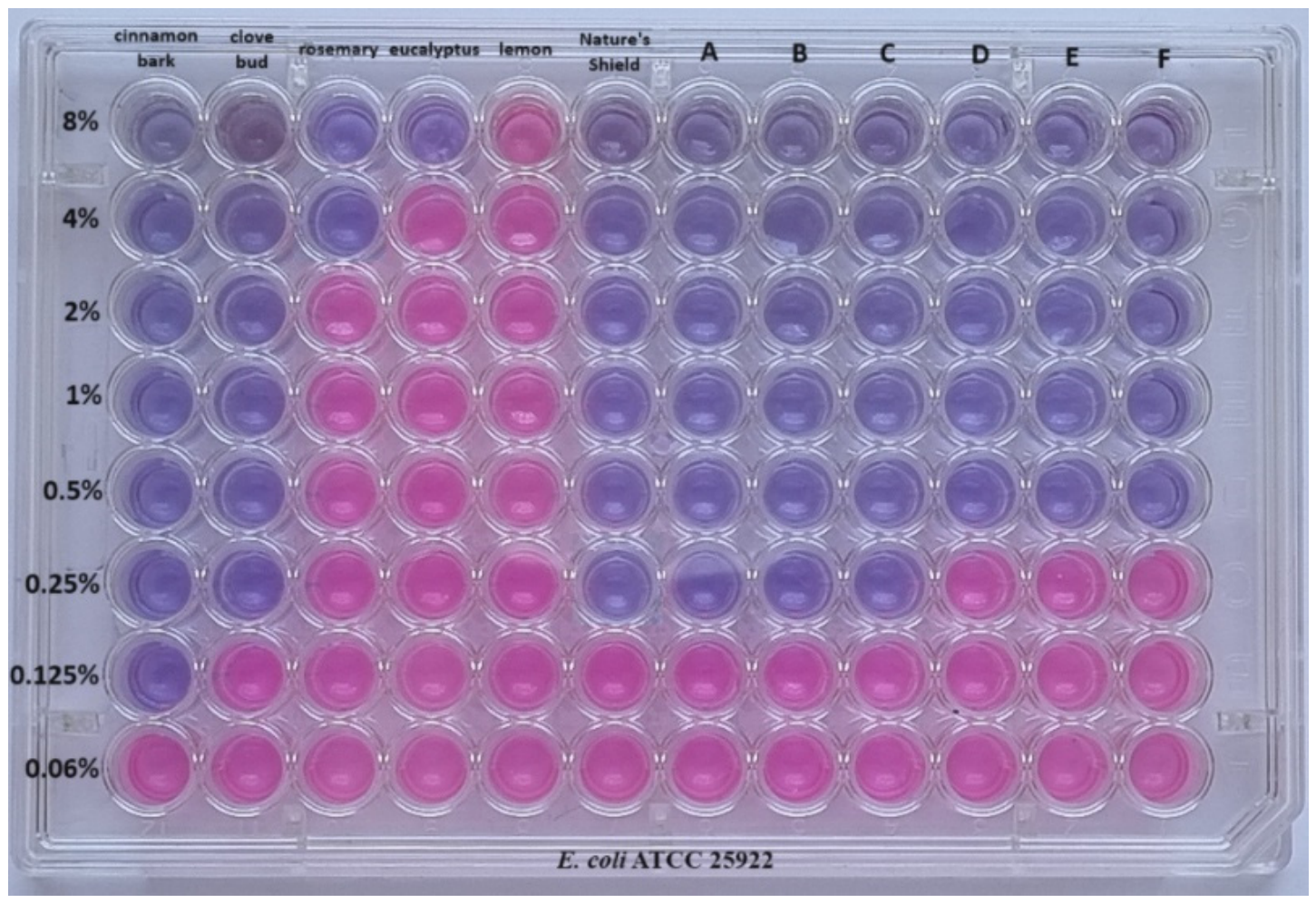
The difference in the activity of individual antimicrobial agents is more clearly visible in the graph (Figure 1) and on the sample test plate (Figure 2). The biggest difference between MIC and MBC values was observed for rosemary EO. When considering only the MBC, rosemary and eucalyptus EOs (both of the 1,8-cineole chemotype) show similar activity. In most cases, for cinnamon and clove EOs, as well as for almost all blends, the differences between the mean MIC and MBC values were relatively small. What is more, for eucalyptus and lemon EOs, as well as for Blend F (lemon-based), no differences between the MIC and the MBC were found.
Figure 1.
A graphical comparison of average minimum inhibitory concentration (MIC) and minimum bactericidal concentration (MBC) values with regard to 12 antimicrobial agents (the lower the bar, the stronger the antibacterial effect). EO—essential oil; Nature’s Shield®—commercial protective blend; Blend A—a protective blend consisting of equal amounts of essential oils; Blend B—cinnamon-based protective blend; Blend C—clove-based protective blend; Blend D—rosemary-based protective blend; Blend E—eucalyptus-based protective blend; Blend F—lemon-based protective blend.
Figure 2.
Example of a 96-well test plate—Escherichia coli strain ATCC 25922.
3. Discussion
Essential oils are potential sources of novel antimicrobial compounds, especially against bacterial pathogens. Depending on their chemical composition, EOs can affect bacteria in various ways. Some of them can directly kill bacteria (bactericidal effect), while others can only slow their growth (bacteriostatic effect). EOs can also have an impact on cellular processes, such as nutrient processing, molecule synthesis, and the regulation of biological processes occurring between cells [17]. Moreover, the chemical compounds found in various EOs can interact with each other, resulting in a significantly stronger effect. This has already been thoroughly studied and described using mathematical models in terms of potential synergy, additive effects, indifference, or antagonism [18]. Some EOs with interesting therapeutic properties may have a strong smell or be irritating when used alone (e.g., clove or cinnamon EOs). Combining them in a blend with some milder EOs (such as sweet orange or lemon) allows for preserving their health-promoting properties while neutralizing their irritating potential and enhancing their scent. This connection was first observed 400 years ago in France during a plague that decimated the population of Europe, leading to the creation of a recipe for what is nowadays known as “Thieves’ Oil” [15]. The commercially available protective blend (Nature’s Shield®) and the blends investigated in this study contain ingredients commonly associated with traditional Thieves-type formulations.
Cinnamon EO was found to be the most potent ingredient in this blend. Cinnamon is derived from the dried bark of several species in the Cinnamomum genus, mainly including Cinnamomum verum (C. zeylanicum) and Cinnamomum cassia and has a long documented history of Ayurvedic medicine and culinary use. Generally, cinnamaldehyde, eugenol, ß-caryophyllene, linalool and cinnamyl acetate are the most predominant constituents reported in cinnamon EO [19]. However, (E)-cinnamaldehyde is the main therapeutic constituent (usually 50–78%) responsible for the distinct spicy flavor, strong antioxidant capacity, and potent antibacterial/antifungal activity, but this is true only in the case of EOs extracted from the bark of C. verum, while in cinnamon EOs extracted from leaves, eugenol is the main compound (70–95%) [20]. The commercial cinnamon EO used in our study corresponds to this range. In the study by Park et al. [21], cinnamon EO was effective against E. coli O157:H7 and Salmonella Typhimurium ATCC 14028, with MICs ranging from 0.0625 to 0.125% v/v, similar to our study. In the study by Raeisi et al. [22], the MIC and MBC for E. coli ATCC 43894 were also similar to our results. Combinations of cinnamon EO and conventional antimicrobial agents may represent a potential approach to reducing the concentrations required for antimicrobial activity in vitro. Regarding the E. coli ATCC 25922 strain, El Atki et al. [23] reported a synergistic effect of cinnamon EO with chloramphenicol, an additive effect with streptomycin, and no interaction with ampicillin. In contrast, Zych et al. [24] observed a synergistic and an additive effect for poultry E. coli isolates and the reference strain ATCC 25922. This may indicate that cinnamaldehyde has great potential for enhancing the activity of other chemical compounds, including antibiotics and other EOs. Further in vivo studies are needed to evaluate their therapeutic relevance.
Other species of the Cinnamomum genus also contain high levels of cinnamaldehyde and exhibit antimicrobial activity. Aqueous extracts of cinnamon cassia exhibited bacteriostatic activity against a methicillin-resistant Staphylococcus aureus strain and bactericidal activity against Klebsiella pneumoniae, Pseudomonas aeruginosa, and E. coli [25]. Cinnamon cassia EO, with a high cinnamaldehyde content (85.7%), exhibited very strong activity against eleven E. coli strains isolated from cases of mastitis in cattle [26]. As the primary active constituent in Cinnamomum osmophloeum leaf EO, cinnamaldehyde shows strong antibacterial activity against E. coli within the range of 0.25 to 1 mg/mL (0.025–0.1% v/v) depending on the specific strain and assay conditions [27]. Moreover, Cinnamomum burmannii bark EO was also active in inhibiting E. coli ATCC 25922 [28]. Naik et al. [29] described the antibacterial activity of Cinnamomum tamala leaf EO (Indian cinnamon) against the E. coli strain MTCC 723. In another study, the MIC of the essential oil from the bark of Ocotea quixos (known as Ishpingo or American cinnamon tree) against the bacterium E. coli ATCC 25922 was 1.3% v/v. The major components of this EO were cinnamaldehyde (30.69%) and its derivatives such as methoxy cinnamaldehyde (16.29%), cinnamyl acetate (12.18%), and methyl cinnamate (5.72%) [30]. Other species of cinnamon, such as Saigon cinnamon (Cinnamomum loureiroi, also known as Vietnamese cinnamon), Cinnamomum sulphuratum, Cinnamomum pubescens, and Cinnamomum aureofulvum, also contain high concentrations of cinnamaldehyde (46–65%) [31], but their activity against E. coli is not yet well studied. Cinnamaldehyde can also be found in trace amounts (often less than 1%) in various culinary and medicinal plants such as lavender, patchouli, myrrh, celery, tomatoes, vanilla, and even various fruits. However, its significance there is very marginal [32].
Clove EO, which has properties similar to those of cinnamon leaf EO, is produced from the buds and leaves of the clove tree (Syzygium aromaticum L., Myrtaceae), an aromatic plant widely cultivated in tropical and subtropical countries. Eugenol is the major compound (at least 50%); however, it most often reaches a typical level ranging from 70 to 88% [33]. In a study by Nuñez and Aquino [34], clove EO at a concentration of 0.2% v/v effectively eliminated E. coli ATCC 25922 after 10 h of incubation. In a study by Bai et al. [35], also against the E. coli ATCC 25922 strain, pure eugenol suspended in methanol was ten times more potent than our commercial EO, while clove EO was only twofold less effective than eugenol. In contrast, in the study by Aditya et al. [36], the activity of clove oil against 83 multidrug-resistant E. coli isolates and the ATCC 25922 reference strain was in the range of 1–2 mg/mL (MBC), which is close to our results. In other studies in this field, clove bud EO has been shown to be effective at a concentration of 0.125% v/v (equivalent to 1.31 mg/mL). However, due to the additive effect, mixing clove oil at a concentration of 0.03% v/v with 0.008 µg/mL of enrofloxacin eliminated the E. coli ATCC 25922 reference strain after six hours [24]. Both clove EO and cinnamon leaf EO exhibited identical bactericidal activity at a concentration of 0.125% v/v against stationary-phase uropathogenic E. coli UTI89 [37]. In other studies, cinnamon leaf EO exhibited high antibacterial activity against several bacteria in vitro, including E. coli ATCC 25922 [38]. Similar results for this strain were obtained by Islam et al. [39] for an essential oil extracted from C. verum leaves using microwave extraction and hydrodistillation. Allspice (Pimenta dioica) is also rich in eugenol (48% to 65%) and methyl eugenol (35%). Xiao et al. [37] estimated the activity of this EO against the stationary-phase uropathogenic E. coli strain UTI89. The leaves of Ocimum sanctum, traditionally known in India as “holy basil” or Tulsi, also contain significant amounts of eugenol (50–75%). For the E. coli strain ATCC 25922, the MIC and MBC values for ethanol extract were 4 mg/mL (0.4% v/v) and 8 mg/mL (0.8% v/v), respectively [40]. The chemical profile of West Indian bay leaves (Pimenta racemosa, syn. Pimenta acris) is also dominated by eugenol (60–83%). For the essential oil extracted from this plant, Contreras-Moreno et al. [41] reported a high MIC (2% v/v) for the reference strain E. coli ATCC 25922. Eugenol is found in many other EOs and extracts, but its concentration is usually low (up to a few percent).
Both cinnamon and clove EOs can act against bacteria in various ways. Firstly, they act as a membrane permeabilizer. Both EOs penetrate and rupture the outer cytoplasmic membrane of Gram-negative bacteria like E. coli, causing crucial intracellular materials (like proteins, DNA, and enzymes) to leak out [42,43]. Scanning electron microscope (SEM) analysis showed that cinnamaldehyde-treated E. coli cells undergo physical shrinkage or elongation, cytoplasmic membrane separation from the cell wall, cell wall and cell membrane lysis, cytoplasmic content leakage, cytoplasmic content polarization, cell distortion, and cytoplasmic content condensation [44]. SEM analysis of E. coli treated with clove EO or its primary active compound, eugenol, also reveals severe, concentration-dependent morphological damage characterized by outer membrane wrinkling, cell wall lysis, indentation, and complete cellular content leakage [45]. Both EOs also induce oxidative stress by the accumulation of destructive reactive oxygen species (ROS) within the bacterial cell, causing irreversible DNA cleavage [35,46]. E. coli is known for its ability to form biofilms—protective, slimy layers that shield bacteria from regular antibiotics and sanitizers [47]. The study conducted by Rafique et al. [48] aimed to investigate the prevalence, patterns of antimicrobial resistance, and biofilm-forming ability in E. coli isolated from chicken meat samples. The E. coli ATCC 25922 reference strain was also included. 40% of strong biofilm producers were inhibited when subjected to both clove (MIC: 250 to 500 μL/mL) and cinnamon (MIC: 62.5 μL/mL) EOs. However, the inhibitory effect of cinnamon oil was more pronounced compared to clove EO, as it almost eradicated the formed biofilm.
EOs of the 1,8-cineole chemotype (rosemary and eucalyptus) and limonene chemotype (lemon) seem to have lower activity against E. coli. In a study by Moukhfi et al. [49] based on poultry-isolated E. coli strains, the MIC for pure eucalyptol was up to 11.37 mg/mL and up to 45.50 mg/mL for rosemary EO, which is consistent with our observations. An additional docking analysis performed by these authors showed that eucalyptol can fit into the active sites of various E. coli proteins, such as IFJ4, 1LX6, 5U10, and 4K3P. Compared with the other essential oils, eucalyptus EO (obtained from many species of eucalyptus) has usually lower and strain-dependent antimicrobial effects against E. coli and better antiviral activity [50,51]. In the case applied in our studies, Eucalyptus radiata EO, a softer and milder form of eucalyptus compared to the most popular E. globulus, there is still limited research on its activity against E. coli. However, Santos et al. [52] evaluated the antibacterial and anti-adhesive effects of E. radiata EO (chemotype unknown) against foodborne strains of E. coli. Their MIC and MBC values ranged from 0.5 mg/mL to 1 mg/mL for the E. coli CCCD-E003 reference strain, which was significantly lower than in our study (approx. 72 mg/mL). However, regarding four clinical strains, a concentration of 1 mg/mL was ineffective in the MBC study, and the authors did not conduct further studies to determine the definitive concentration. In contrast, Lee [53] reported MICs ranging from 1 to 10% v/v. On the other hand, in a study by Ormai et al. [54], lemon EO exhibited weak antibacterial activity (MIC > 5% v/v) against E. coli strains 128673 and 130063. When compared to our result (>8% v/v), it can be concluded that lemon EO has very low activity against E. coli. However, the situation is completely different when all the ingredients are mixed together.
In addition to their beautiful aromas, blending EOs aims to look for possible synergy—combining them in such a way as to bring out the best in each one. As we can see in Figure 1, even EOs that are theoretically less active against E. coli (rosemary, eucalyptus, and lemon) show quite good inhibitory effects when combined with cinnamon and clove (Blends D–F). Cinnamon and clove EOs likely play a major role, although their content is limited to 12.5% each (eight times less than singles). This is a positive aspect, as cinnamon EO and clove EO belong to the group of the strongest allergens compared to the other EOs in the “Thieves” blend. Reducing the concentrations of potentially allergenic EOs may be worth investigating, provided that the desired antimicrobial activity is maintained [24]. Surprisingly, despite the “Thieves” oil’s history spanning several hundred years, there is a lack of research on its activity against specific pathogens. The few manuscripts on this topic also attribute the strongest destructive effect on bacterial cell structures to the clove and cinnamon EOs contained in the blend, with regard to Staphylococcus aureus [37], Staphylococcus pseudintermedius [15], Pseudomonas aeruginosa [55] and a number of clinical isolates, including extended-spectrum beta-lactamase-producing and carbapenem-resistant Enterobacteriaceae, multidrug-resistant Pseudomonas aeruginosa, and methicillin-resistant S. aureus [56]. To our knowledge, our manuscript is the first to report the activity of a Thieves-type blend against E. coli.
At this point, one more fact should be taken into account: the actual value of the results obtained in terms of activity assessment criteria. Saraiva et al. [57] described fairly rigorous criteria regarding the activity of EOs. MIC values < 100 µg/mL (<0.01% v/v) are the most favorable, and such activity is classified as very high. When the obtained MIC values range from 100 to 500 µg/mL (0.01–0.05% v/v), the activity is considered moderate. For MIC values ranging from 500 to 2000 μg/mL (0.05–0.2% v/v), activity is considered low, while for MIC values > 2000 μg/mL (0.2% v/v), such EOs are classified as inactive. Following this approach, only cinnamon EO can be considered to be weakly active, while clove EO and some blends deviate only slightly from these requirements. One possible approach for further investigation is to evaluate combinations of these EOs with conventional antibiotics using the checkerboard method. When synergy or an additive effect occurs, the effective concentration of these EOs can be reduced (minimum 4 to 8 times), which may improve their in vitro antimicrobial potential. Nevertheless, further toxicity, pharmacokinetic, and in vivo efficacy studies are necessary before considering their application as adjunctive treatments in poultry.
4. Materials and Methods
4.1. Essential Oils
Five single commercial EOs (Now Foods, Bloomingdale, IL, USA) from cinnamon bark (Cinnamomum zeylanicum), clove (Eugenia caryophyllus), rosemary (Rosmarinus officinalis), eucalyptus (Eucalyptus radiata) and lemon (Citrus limon), as well as one commercial protective blend named Nature’s Shield® were purchased and used in the study. In addition, six unique protective blends (marked as A–F) were created from the above-mentioned single EOs, each with a different proportion of a particular EO (Table 4). Blend A consisted of equal amounts of each EO (20% of each); the other blends had one dominant EO (50%) and an equal amount of the remaining EOs (12.5% of each).
Table 4.
Composition of six essential oil blends.
4.2. Gas Chromatography-Mass Spectrometry (GC-MS)
The chemical composition of all EOs and their blends was determined by the gas chromatography with mass selective detector (GC-MS) method. Directly before chromatographic analyses, 20 μL of EO/blend was dissolved in 1 mL of acetone (Chempur, Piekary Śląskie, Poland). Three samples were prepared for each EO and analyzed. The analyses were carried out using a 6890 N gas chromatograph (Agilent Technologies, Santa Clara, CA, USA) with a 5973 Network Mass Selective Detector. For chromatographic separation of analytes, the HP-5MS capillary column (30 m × 0.25 mm × 0.25 μm) was used with the temperature program from 50 °C to 290 °C at a rate of 4 °C/min. Helium was applied as a carrier gas (gas flow at 1.2 mL/min). Analytical samples (2 μL) were dosed to a column using a 7683 Series Injector Autosampler in a split mode (10:1). The temperatures of the Mass Selective Detector were respectively: ion source 230 °C, quadrupole 150 °C. The mass spectra of separated compounds were obtained via electron impact ionization (70 eV) by scanning in the range of 20–600 m/z. Identification of the particular compounds in the essential oils was performed on the basis of the mass spectra compared with the NIST04 MS library. Additionally, it was verified using the calculated values of the linear retention indices (LRI), compared with the values published in the literature [16] and by comparison of retention times with the standards available in the laboratory. To determine the linear retention indices, the C7-C30 n-alkanes standard mixture in hexane (Supelco, Merck KGaA, Darmstadt, Germany) was analyzed in the same chromatographic conditions [58]. The internal normalization method was used for quantitative analysis, and the relative contents of the particular compounds were determined as the peak area percentages in TIC (Total Ion Chromatogram).
4.3. Bacterial Strains
The antibacterial activity of selected EOs and their blends was tested against 50 clinical isolates causing colibacillosis in chickens (marked as E.C.1–E.C.50). All isolates were obtained from a strain bank intended for use in avian autovaccines (“Labo-Wet” Szczecin, Poland). These E. coli strains were isolated from the yolk sacs and hearts of broiler chickens and from the air sacs and lungs of adult hens in breeding flocks. The APEC serotypes and drug resistance profiles of all strains have not yet been fully identified. No living animals were used in the research. In addition, the E. coli ATCC 25922 reference strain was also used (KWIK-STIK™ Plus, Microbiologics, St. Cloud, MN, USA). The inoculum suspension was obtained by taking colonies from 24 h cultures. The colonies were suspended in sterile 0.9% NaCl (Ecotainer®, B. Braun Medical AG, Sempach, Switzerland). The density was adjusted to the turbidity of a 0.5 McFarland standard (108 colony-forming units [CFU]/mL), but the final bacterial count in each well was 106 CFU/mL.
4.4. Determination of the Activity of Antimicrobial Agents
The minimum inhibitory concentration (MIC) method was used to determine the activity of the 12 selected antimicrobial agents (5 single EOs and 7 so-called protective blends). MIC assays were performed in 96-well microplates (Wuxi NEST Biotechnology, Wuxi, China) using a horizontal sample arrangement on the plate. Commercial Mueller–Hinton broth (MHB) (Graso, Starogard Gdański, Poland) was used as the culture medium. For all EOs and blends, a preliminary working dilution of 80% v/v in dimethyl sulfoxide (DMSO) (Warchem, Zakret, Poland) was prepared. On each plate, a decreasing concentration gradient (from 8% to 0.06% v/v) was prepared for each antimicrobial agent (100 µL per well). Finally, 10 µL of bacterial suspension was added to each well (one isolate per plate). The inoculated plates were covered with dedicated covers and incubated at 37 °C for 18 h. For each isolate, the assay was performed in triplicate. In addition, control tests were always performed for each E. coli strain. Firstly, to evaluate normal bacterial growth in the medium, wells without any antimicrobial agent were tested separately. To confirm the sterility of the medium and resazurin, additional wells were incubated without the addition of bacteria. To assess the effect of the diluent, an additional test was conducted using 2% DMSO in a well, which corresponds to the maximum concentration of this diluent in the first row of each test plate.
High concentrations of some EOs in MHB may result in spontaneous precipitation and/or artificial turbidity, potentially producing false-positive results in MIC. To identify wells containing live bacterial cells, 25 µL of a sterile 0.01% resazurin solution (POL-AURA, Olsztyn, Poland) was added to each well after the incubation period. The plates were incubated for a further 2 h at 37 °C and then were read visually. If there were live bacterial cells in the well, the dark blue colour changed to a vivid pink. The MIC was defined as the lowest concentration of the antimicrobial agent at which no viable cells were detected (blue wells). In addition, immediately after the MIC was determined, the entire content of each well was spread onto Columbia Agar supplemented with 5% sheep blood (Graso, Starogard Gdański, Poland). The results were read after incubating the plates for 18 h at 37 °C. The minimum bactericidal concentration (MBC) was defined as the lowest concentration of EO or blend at which no bacterial colony growth was observed on the plates.
5. Conclusions
The results of this study indicate that Thieves-type EO blends may represent a promising approach to controlling poultry-derived Escherichia coli. Cinnamon bark and clove bud EOs exhibited the strongest individual antibacterial activity, while combining them with rosemary, eucalyptus, or lemon EOs enhanced the overall efficacy of the blends. This boosting effect suggests that EO combinations may offer an effective alternative to the use of individual oils at higher concentrations. Nevertheless, further studies are needed to investigate the interactions between this blend and its individual components, as well as assess their potential synergy with antibiotics used to treat colibacillosis in poultry, and evaluate their practical applicability in poultry production.
Supplementary Materials
The following supporting information can be downloaded at: https://www.mdpi.com/article/10.3390/ijms272210124/s1.
Author Contributions
Conceptualization, S.Z., M.A.-S. and M.A.S.; Methodology, S.Z., M.A.-S. and M.D.; Software, S.Z., M.A.-S. and M.D.; Validation, S.Z., M.A.-S. and M.D.; Formal analysis, S.Z., M.A.-S., P.K., K.K. and D.W.; Investigation, S.Z., M.A.-S., M.D., P.K., K.K., D.W. and M.A.S.; Resources, S.Z., M.A.-S., P.K. and M.A.S.; Data curation, S.Z., P.K., K.K. and D.W.; Writing—original draft, S.Z., M.A.-S. and M.A.S.; Writing—review and editing, S.Z., M.A.-S., M.D., P.K., K.K., D.W. and M.A.S.; Visualization, S.Z.; Supervision, S.Z.; Project administration, P.K., K.K. and D.W.; Funding acquisition, P.K., K.K. and D.W. All authors have read and agreed to the published version of the manuscript.
Funding
This research was funded by the Minister of Science under “the Regional Initiative of Excellence Program” (RID/SP/0025/2024/01).
Institutional Review Board Statement
Not applicable.
Informed Consent Statement
Not applicable.
Data Availability Statement
Further inquiries can be directed to the corresponding author.
Conflicts of Interest
The authors declare no conflicts of interest.
References
- Antão, E.M.; Glodde, S.; Li, G.; Sharifi, R.; Homeier, T.; Laturnus, C.; Diehl, I.; Bethe, A.; Philipp, H.C.; Preisinger, R.; et al. The chicken as a natural model for extraintestinal infections caused by avian pathogenic Escherichia coli (APEC). Microb. Pathog. 2008, 45, 361–369. [Google Scholar] [CrossRef] [Scilit] [PubMed]
- Russo, T.A.; Johnson, J.R. Medical and economic impact of extraintestinal infections due to Escherichia coli: Focus on an increasingly important endemic problem. Microbes Infect. 2003, 5, 449–456. [Google Scholar] [CrossRef] [Scilit] [PubMed]
- Rocha, D.T.; Salle, F.O.; Borges, K.A.; Furian, T.Q.; Nascimento, V.P.; Moraes, H.L.S.; Salle, C.T.P. Avian pathogenic Escherichia coli (APEC) and uropathogenic Escherichia coli (UPEC): Characterization and comparison. J. Infect. Dev. Ctries. 2021, 15, 945–953. [Google Scholar] [CrossRef] [Scilit] [PubMed]
- Tivendale, K.A.; Logue, C.M.; Kariyawasam, S.; Jordan, D.; Hussein, A.; Li, G.; Wannemuehler, Y.; Nolan, L.K. Avian-pathogenic Escherichia coli strains are similar to neonatal meningitis E. coli strains and are able to cause meningitis in the rat model of human disease. Infect. Immun. 2010, 78, 3412–3419. [Google Scholar] [CrossRef] [Scilit] [PubMed]
- Hu, J.; Afayibo, D.J.A.; Zhang, B.; Zhu, H.; Yao, L.; Guo, W.; Wang, X.; Wang, Z.; Wang, D.; Peng, H.; et al. Characteristics, pathogenic mechanism, zoonotic potential, drug resistance, and prevention of avian pathogenic Escherichia coli (APEC). Front. Microbiol. 2022, 13, 1049391. [Google Scholar] [CrossRef] [Scilit] [PubMed]
- Nawaz, S.; Wang, Z.; Zhang, Y.; Jia, Y.; Jiang, W.; Chen, Z.; Yin, H.; Huang, C.; Han, X. Avian pathogenic Escherichia coli (APEC): Current insights and future challenges. Poult. Sci. 2024, 103, 104359. [Google Scholar] [CrossRef] [Scilit] [PubMed]
- WHO. Analysis of Antibacterial Agents in Clinical and Preclinical Development: Overview and Analysis 2025; World Health Organization: Geneva, Switzerland, 2025. [Google Scholar]
- Aftab, N.; Varghese, P.; Khalid, A.; Hooper, S.E. Linking chemical-composition to antimicrobial efficacy: Development of an essential oil-based topical gel prototype. Appl. Microbiol. Biotechnol. 2025, 109, 253. [Google Scholar] [CrossRef] [Scilit] [PubMed]
- Afassi, F.; Charki, A.; El Youssfi, C.; Loukili, E.H.; Labhar, A.; Ahari, M.; Amhamdi, H.; Mourabit, F.; Ez Zoubi, Y.; Salhi, A.; et al. Chemical composition and biological activities of essential oils from medicinal plants: A comprehensive review and bibliometric analysis. Results Eng. 2026, 32, 112439. [Google Scholar] [CrossRef] [Scilit]
- da Silva, B.D.; Bernardes, P.C.; Pinheiro, P.F.; Fantuzzi, E.; Roberto, C.D. Chemical composition, extraction sources and action mechanisms of essential oils: Natural preservative and limitations of use in meat products. Meat Sci. 2021, 176, 108463. [Google Scholar] [CrossRef] [Scilit] [PubMed]
- Liu, Q.; Meng, X.; Li, Y.; Zhao, C.N.; Tang, G.Y.; Li, H.B. Antibacterial and antifungal activities of spices. Int. J. Mol. Sci. 2017, 18, 1283. [Google Scholar] [CrossRef] [Scilit] [PubMed]
- Khatri, P.; Rani, A.; Hameed, S.; Chandra, S.; Chang, C.-M.; Pandey, R.P. Current understanding of the molecular basis of spices for the development of potential antimicrobial medicine. Antibiotics 2023, 12, 270. [Google Scholar] [CrossRef] [Scilit] [PubMed]
- Zouine, N.; Ghachtouli, N.E.; Abed, S.E.; Koraichi, S.I. A comprehensive review on medicinal plant extracts as antibacterial agents: Factors, mechanism insights and future prospects. Sci. Afr. 2024, 26, e02395. [Google Scholar] [CrossRef] [Scilit]
- Nacer-Eddine, D.K.; Loukili, E.H.; Lebrazi, S.; Sabbahi, R.; Fadil, M.; Er-rajy, M.; Taibi, M.; Yahyaoui, M.I.; Azougay, A.; Asehraou, A.; et al. Predictive mixture design of three essential oil blends to enhance antioxidant and antimicrobial activity for food security and nutrition. Sci. Rep. 2026, 16, 899. [Google Scholar] [CrossRef] [Scilit] [PubMed]
- Szewczuk, M.A.; Zych, S.; Stankiewicz, T.; Błaszczyk, B.; Ochmian, I. Activity of thieves-type protective blends and their individual components (cinnamon, clove, rosemary, eucalyptus and lemon essential oils) against Staphylococcus pseudintermedius strains isolated from canine Otitis externa. BMC Vet. Res. 2026, 22, 430. [Google Scholar] [CrossRef] [Scilit] [PubMed]
- Babushok, V.I.; Linstrom, P.J.; Zenkevich, I.G. Retention indices for frequently reported compounds of plant essential oils. J. Phys. Chem. Ref. Data 2011, 4, 431011–431046. [Google Scholar] [CrossRef] [Scilit]
- Pezantes-Orellana, C.; German-Bermúdez, F.; Matías De la Cruz, C.; Montalvo, J.L.; Orellana-Manzano, A. Essential oils: A systematic review on revolutionizing health, nutrition, and omics for optimal well-being. Front. Med. 2024, 11, 1337785. [Google Scholar] [CrossRef] [Scilit] [PubMed]
- Van Vuuren, S.; Viljoen, A. Plant-based antimicrobial studies. Methods and approaches to study the interaction between natural products. Planta Med. 2011, 77, 1168–1182, Erratum in Planta Med. 2012, 78, 302. [Google Scholar] [CrossRef] [Scilit] [PubMed]
- Guo, J.; Jiang, X.; Tian, Y.; Yan, S.; Liu, J.; Xie, J.; Zhang, F.; Yao, C.; Hao, E. Therapeutic potential of cinnamon oil: Chemical composition, pharmacological actions, and applications. Pharmaceuticals 2024, 17, 1700. [Google Scholar] [CrossRef] [Scilit] [PubMed]
- Rao, P.V.; Gan, S.H. Cinnamon: A multifaceted medicinal plant. Evid.-Based Complement. Altern. Med. 2014, 2014, 642942. [Google Scholar]
- Park, J.B.; Kang, J.H.; Song, K.B. Antibacterial activities of a cinnamon essential oil with cetylpyridinium chloride emulsion against Escherichia coli O157:H7 and Salmonella Typhimurium in basil leaves. Food Sci. Biotechnol. 2017, 27, 47–55. [Google Scholar] [CrossRef] [Scilit] [PubMed]
- Raeisi, M.; Tajik, H.; Yarahmadi, A.; Sanginabadi, S. Antimicrobial effect of cinnamon essential oil against Escherichia coli and Staphylococcus aureus. Health Scope 2015, 4, e21808. [Google Scholar] [CrossRef] [Scilit]
- El Atki, Y.; Aouam, I.; El Kamari, F.; Taroq, A.; Nayme, K.; Timinouni, M.; Lyoussi, B.; Abdellaoui, A. Antibacterial activity of cinnamon essential oils and their synergistic potential with antibiotics. J. Adv. Pharm. Technol. Res. 2019, 10, 63–67. [Google Scholar] [CrossRef] [Scilit] [PubMed]
- Zych, S.; Adaszyńska-Skwirzyńska, M.; Szewczuk, M.A.; Szczerbińska, D. Interaction between enrofloxacin and three essential oils (cinnamon bark, clove bud and lavender flower). A study on multidrug-resistant Escherichia coli strains isolated from 1-day-old broiler chickens. Int. J. Mol. Sci. 2024, 25, 5220. [Google Scholar] [CrossRef] [Scilit] [PubMed]
- Safa, M.I.; Mutaman Ali, A.K.; Elnour, E.A. Evaluation of antimicrobial activity of cinnamon, Cinnamomum cassia plant extract and its complementary effects of the plant extracts and the antibiotics. Ecol. Conserv. Sci. 2023, 3, 555625. [Google Scholar] [CrossRef] [Scilit]
- Nguyen Chinh, N.; Nguyen Hai, V.; Dinh Thu, T.; Tran Kim, T.; Le Quang, H.; Vu Thu, T. Antibacterial effect of essential oils (Cinnamon cassia, Chenopodium ambrosioides, and Litsea cubeba) against bacteria isolated from bovine mastitis in Northern Vietnam. Eng. Technol. Sustain. Dev. 2026, 36, 046–053. [Google Scholar] [CrossRef] [Scilit]
- Chang, S.T.; Chen, P.F.; Chang, S.C. Antibacterial activity of leaf essential oils and their constituents from Cinnamomum osmophloeum. J. Ethnopharmacol. 2001, 77, 123–127. [Google Scholar] [CrossRef] [Scilit] [PubMed]
- Ginting, E.V.; Retnaningrum, E.; Widiasih, D.A. Antibacterial activity of clove (Syzygium aromaticum) and cinnamon (Cinnamomum burmannii) essential oil against extended-spectrum β-lactamase-producing bacteria. Vet. World 2021, 14, 2206–2211. [Google Scholar] [CrossRef] [Scilit] [PubMed]
- Naik, G.; Haider, S.Z.; Bhandari, U.; Lohani, H.; Chauhan, N. Comparative analysis of in vitro antimicrobial and antioxidant potential of Cinnamomum tamala extract and their essential oils of two different chemotypes. Agric. Scence Dig. 2021, 41, 307–312. [Google Scholar]
- Noriega, P.; Mosquera, T.; Paredes, E.; Parra, M.; Zappia, M.; Herrera, M.; Osorio, E. Antimicrobial and antioxidant bioautography activity of bark essential oil from Ocotea quixos (Lam.) Kosterm. J. Plan. Chromat. 2018, 31, 163–168. [Google Scholar] [CrossRef] [Scilit]
- Karimirad, R.; Inbaraj, B.S.; Chen, B.-H. Recent advances on the analysis and biological functions of cinnamaldehyde and its derivatives. Antioxidants 2025, 14, 765. [Google Scholar] [CrossRef] [Scilit] [PubMed]
- Friedman, M. Chemistry, antimicrobial mechanisms, and antibiotic activities of cinnamaldehyde against pathogenic bacteria in animal feeds and human foods. J. Agric. Food Chem. 2017, 65, 10406–10423. [Google Scholar] [CrossRef] [Scilit] [PubMed]
- Haro-González, J.N.; Castillo-Herrera, G.A.; Martínez-Velázquez, M.; Espinosa-Andrews, H. Clove essential oil (Syzygium aromaticum L. Myrtaceae): Extraction, chemical composition, food applications, and essential bioactivity for human health. Molecules 2021, 26, 6387. [Google Scholar] [CrossRef] [Scilit] [PubMed]
- Nuñez, L.; Aquino, M.D. Microbicide activity of clove essential oil (Eugenia caryophyllata). Braz. J. Microbiol. 2012, 43, 1255–1260. [Google Scholar] [CrossRef] [Scilit] [PubMed]
- Bai, J.; Li, J.; Chen, Z.; Bai, X.; Yang, Z.; Wang, Z.; Yang, Y. Antibacterial activity and mechanism of clove essential oil against foodborne pathogens. LWT 2023, 173, 114249. [Google Scholar] [CrossRef] [Scilit]
- Aditya, V.; Mangalore, A.; Kunder, S.U.; Prabhu, C.; Saleth, A.; Kini, S.; Kumar, B.K.; Deekshit, V.K.; Rai, P. Inhibitory effect of essential oil and oleoresin of clove (Syzygium aromaticum) on food-borne Escherichia coli and Salmonella spp. Biomed. Biotechnol. Res. J. 2026, 10, 66–75. [Google Scholar] [CrossRef] [Scilit] [PubMed]
- Xiao, S.; Cui, P.; Shi, W.; Zhang, Y. Identification of essential oils with activity against stationary phase Staphylococcus aureus. BMC Complement. Med. Ther. 2020, 20, 99. [Google Scholar] [CrossRef] [Scilit] [PubMed]
- Cui, H.; Zhou, H.; Lin, L.; Zhao, C.T.; Zhang, X.J.; Xiao, Z.H.; Li, C.Z. Antibacterial activity and mechanism of cinnamon essential oil and its application in milk. J. Anim. Plant Sci. 2016, 26, 514–521. [Google Scholar]
- Islam, M.T.; Barmon, J.; Dey, S.S.; Chowdhury, T.A.; Karmaker, P.; Ghos, B.C.; Karmakar, A.; Uddin, M.J.; Rahman, A.H.M.M.; Rosly, M.; et al. Green extraction of essential oils from Cinnamomum verum leaves through microwave and hydrodistillation techniques: Comparative analysis of chemical profiling, in vitro and in silico investigations. LWT 2025, 238, 118787. [Google Scholar] [CrossRef] [Scilit]
- Nisa, I.; Fazal, M.R.; Mahmood, M.A.; Hayat, A.; Khalid, M.; Mahmood, W.; Shireen, F.; Bangash, S.A.; Hannan, P.A.; Ullah, I. Antibacterial and antioxidant properties of Ocimum sanctum extracts against Streptococcus mutans and Escherichia coli. JMHSR 2025, 2, 1911–1929. [Google Scholar] [CrossRef] [Scilit]
- Contreras-Moreno, B.Z.; Velasco, J.J.; Rojas, J.C.; Méndez, L.C.; Celis, M.T. Antimicrobial activity of essential oil of Pimenta racemosa var. racemosa (Myrtaceae) leaves. J. Pharm. Pharmacogn. Res. 2016, 4, 224–230. [Google Scholar] [CrossRef] [Scilit]
- Yap, P.S.X.; Krishnan, T.; Chan, K.-G.; Lim, S.H.E. Antibacterial mode of action of Cinnamomum verum bark essential oil, alone and in combination with piperacillin, against a multi-drug-resistant Escherichia coli strain. J. Microbiol. Biotechnol. 2015, 25, 1299–1306. [Google Scholar] [CrossRef] [Scilit] [PubMed]
- Sun, H.; Luo, D.; Zheng, S.; Li, Z.; Xu, W. Antimicrobial behavior and mechanism of clove oil nanoemulsion. J. Food Sci. Technol. 2022, 59, 1939–1947. [Google Scholar] [CrossRef] [Scilit] [PubMed]
- Shen, S.; Zhang, T.; Yuan, Y.; Lin, S.; Xu, J.; Ye, H. Effects of cinnamaldehyde on Escherichia coli and Staphylococcus aureus membrane. Food Control 2015, 47, 196–202. [Google Scholar] [CrossRef] [Scilit]
- Jeyakumar, G.E.; Lawrence, R. Mechanisms of bactericidal action of eugenol against Escherichia coli. J. Herb. Med. 2021, 26, 100406. [Google Scholar] [CrossRef] [Scilit]
- Wang, J.; Wu, Z.; Wang, Y.; Ling, Y.; Xu, X.; Yang, D.; Peng, H. Preparation of cinnamon oil and its role in mediating the killing of Escherichia coli through reactive oxygen species. Chem. Ind. For. Prod. 2026, 46, 56–64. [Google Scholar]
- Ballén, V.; Cepas, V.; Ratia, C.; Gabasa, Y.; Soto, S.M. Clinical Escherichia coli: From biofilm formation to new antibiofilm strategies. Microorganisms 2022, 10, 1103. [Google Scholar] [CrossRef] [Scilit] [PubMed]
- Rafique, A.; Baig, N.; Naim, A.; Rafiq, I. Utilization of clove and cinnamon essential oils as an alternative to inhibit MDR and biofilm producing E. coli from raw chicken meat. Sci. Rep. 2025, 15, 34079. [Google Scholar] [CrossRef] [Scilit] [PubMed]
- Moukhfi, F.; Chninigue, J.; Abdou, A.; Maaghloud, F.E.; Chadli, N.; Dakir, M. Eucalyptol from Rosmarinus officinalis L. as an antioxidant and antibacterial agent against poultry-isolated bacterial strains: In vitro and in silico study. Chem. Afr. 2024, 7, 1865–1876. [Google Scholar] [CrossRef] [Scilit]
- Kambira, P.F.A.; Liliana, M.; Arfenda, L.B.; Marcella, S. Antibacterial and antiviral activity of eucalyptus oil: A systematic review. J. Farm. Indones. 2020, 12, 145–154. [Google Scholar]
- Mieres-Castro, D.; Ahmar, S.; Shabbir, R.; Mora-Poblete, F. Antiviral activities of eucalyptus essential oils: Their effectiveness as therapeutic targets against human viruses. Pharmaceuticals 2021, 14, 1210. [Google Scholar] [CrossRef] [Scilit] [PubMed]
- Santos, B.; Farias, J.H.A.; Simões, M.M.; Medeiros, M.A.A.; Alves, M.S.; Diniz, A.F.; Soares, A.P.O.; Cavalcante, A.P.T.M.; Silva, B.J.N.; Almeida, J.C.S.; et al. Evaluation of the antimicrobial activity of Eucalyptus radiata essential oil against Escherichia coli strains isolated from meat products. Braz. J. Biol. 2024, 84, e281361. [Google Scholar] [CrossRef] [Scilit] [PubMed]
- Lee, M.H. Chemical profile, antimicrobial and anti-oxidative activity of commercial eucalyptus and lavender essential oils and their applicability in cosmetics. Indian J. Sci. Technol. 2016, 9, 1–10. [Google Scholar] [CrossRef] [Scilit]
- Ormai, E.; Szemerédi, N.; Kocsis, B.; Szilágyi-Utczás, M.; Ollmann, T.; Spengler, G.; Horváth, G.; Balázs, V.L. Selected essential oils modulate ethidium bromide accumulation and exhibit antibacterial activity against multidrug-resistant Escherichia coli and Klebsiella pneumoniae. Plants 2026, 15, 2587. [Google Scholar] [CrossRef] [Scilit] [PubMed]
- Siejak, P.; Smułek, W.; Fathordobady, F.; Grygier, A.; Baranowska, H.M.; Rudzińska, M.; Masewicz, Ł.; Jarzębska, M.; Nowakowski, P.T.; Makiej, A.; et al. Multidisciplinary studies of folk medicine “Five Thieves’ Oil” (Olejek Pięciu Złodziei) components. Molecules 2021, 26, 2931. [Google Scholar] [CrossRef] [Scilit] [PubMed]
- Patterson, J.E.; McElmeel, L.; Wiederhold, N.P. In vitro activity of essential oils against gram-positive and gram-negative clinical isolates, including carbapenem-resistant Enterobacteriaceae. Open Forum Infect. Dis. 2019, 6, ofz502. [Google Scholar] [CrossRef] [Scilit] [PubMed]
- Saraiva, A.M.; Castro, R.H.A.; Cordeiro, R.P.; Sobrinho, T.; Castro, V.; Amorim, E.; Xavier, H.; Pisciottano, M. In vitro evaluation of antioxidant, antimicrobial and toxicity properties of extracts of Schinopsis brasiliensis Engl. (Anacardiaceae). Afr. J. Pharm. Pharmacol. 2011, 14, 1724–1731. [Google Scholar] [CrossRef] [Scilit]
- Adaszyńska-Skwirzyńska, M.; Dzięcioł, M.; Zych, S. Evaluation of different chemotypes of Lavandula angustifolia essential oils as phytobiotics for the control of clinical Escherichia coli strains isolated from commercial poultry production. Molecules 2026, 31, 3495. [Google Scholar] [CrossRef] [Scilit] [PubMed]

Disclaimer/Publisher’s Note: The statements, opinions and data contained in all publications are solely those of the individual author(s) and contributor(s) and not of MDPI and/or the editor(s). MDPI and/or the editor(s) disclaim responsibility for any injury to people or property resulting from any ideas, methods, instructions or products referred to in the content. |
© 2026 by the authors. Licensee MDPI, Basel, Switzerland. This article is an open access article distributed under the terms and conditions of the Creative Commons Attribution (CC BY) license.