


Abstract
Monogenic diseases are traditionally interpreted through a linear causal model linking pathogenic variants to molecular dysfunction and clinical phenotypes. However, this model does not fully explain incomplete penetrance, variable expressivity, and heterogeneous disease progression. This review aims to explore the applicability of the landscape–attractor framework, originally developed in evolutionary and developmental biology and subsequently extended to gene regulatory networks, to the interpretation of monogenic diseases. We propose that pathogenic variants act as persistent perturbations of interconnected molecular networks, modifying the stability and accessibility of physiological and pathological states. Within this framework, phenotypic variability emerges from interactions between the causal variant and genetic modifiers, epigenetic regulation, environmental influences, stochastic processes, and compensatory mechanisms. We further extend this perspective across molecular, cellular, tissue, and organismal levels, introducing the concept of functional fitness to describe disease-related physiological performance. Finally, we discuss how therapeutic interventions may redirect biological systems toward more favorable functional states without necessarily correcting the underlying genetic defect. This framework offers a complementary systems-level perspective on genotype–phenotype relationships and suggests experimentally testable hypotheses for understanding and modifying disease expression.
1. Introduction
The concept of a biological landscape has a long history in evolutionary and developmental biology. Sewall Wright introduced the fitness landscape as a representation of the relationship between genotype and biological fitness [1]. In its classical formulation, populations can be represented as moving across a multidimensional landscape containing regions associated with different levels of reproductive fitness. The concept was initially developed in evolutionary genetics but subsequently influenced broader thinking about adaptation, molecular evolution, and the behavior of complex biological systems.
Approximately twenty-five years later, Conrad Waddington introduced a different landscape metaphor to describe development and cellular differentiation [2]. In Waddington’s epigenetic landscape, the developmental fate of a cell is represented by a ball moving through a contoured landscape. Valleys correspond to developmental trajectories, whereas branching points represent alternative developmental possibilities. Once a developmental pathway becomes sufficiently stabilized, the cell is canalized toward a particular phenotype.
Although Wright’s and Waddington’s landscapes were developed for different purposes, both introduced an important conceptual principle: biological outcomes do not depend only on individual components, but also on the structure of the space within which a biological system evolves or develops.
The Waddington landscape has subsequently acquired a more formal interpretation through systems biology. Gene regulatory networks (GRNs) consist of interacting genes, transcription factors, signaling pathways, chromatin regulators, and other molecular components. Because these interactions involve positive and negative feedback loops, GRNs can display nonlinear dynamics and generate relatively stable states. Kauffman proposed that stable patterns of gene activity could be interpreted as attractors of regulatory networks [3]. In this framework, differentiated cellular phenotypes can be represented as attractor states, whereas differentiation or phenotypic transitions correspond to movement from one attractor basin to another [4,5].
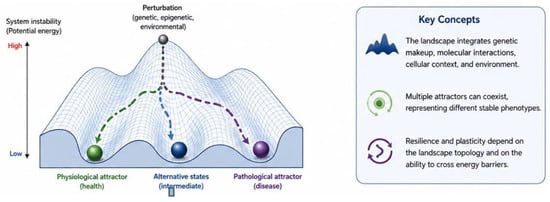
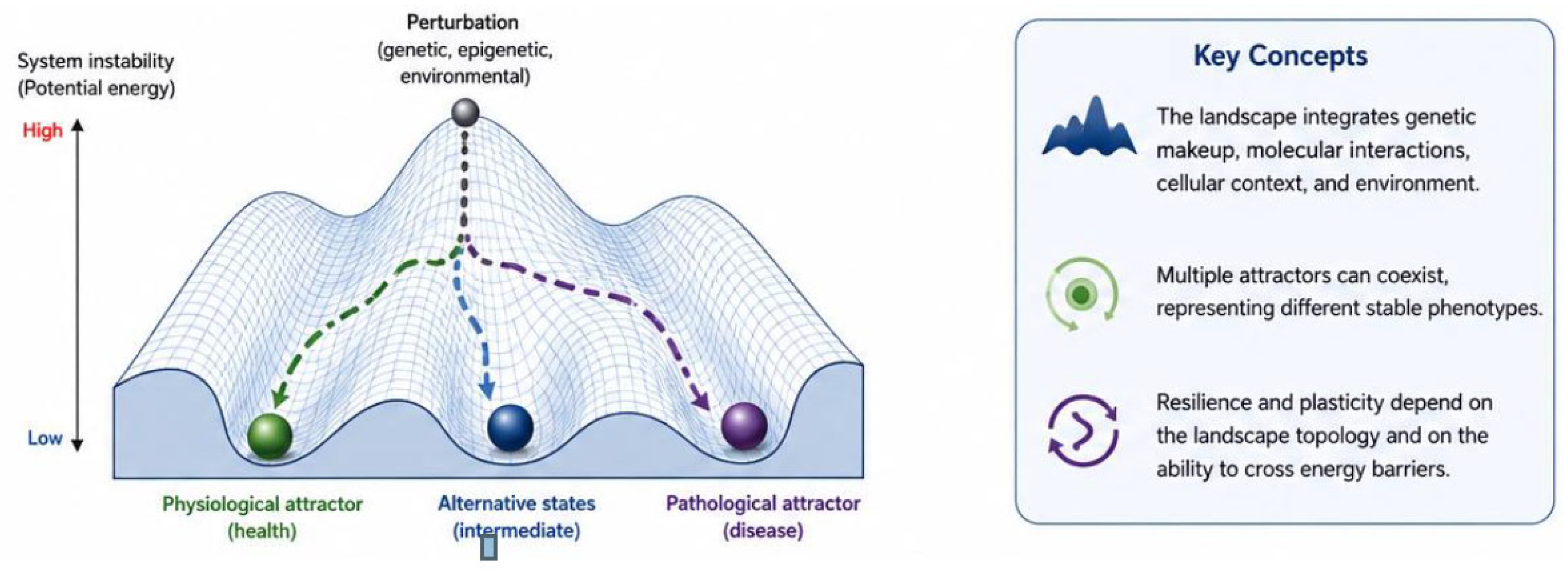
An attractor should therefore not be understood simply as a morphological feature of a graphical landscape. More precisely, it represents a dynamically stable or relatively stable state toward which a biological system tends to evolve from a range of nearby initial conditions. The surrounding basin of attraction corresponds to the set of states from which the system tends to converge toward that attractor. The depth and width of a basin can be used metaphorically to represent the stability and accessibility of the corresponding state (Figure 1).
Figure 1.
Landscape and attractors: a dynamic view of biological systems. The landscape represents all possible states of a biological system. The height corresponds to system instability: low valleys are stable states, high peaks are unstable states. Attractors are stable states toward which the system tends to evolve. They can be physiological (beneficial) or pathological. State transitions: internal or external perturbations can modify the system from one state to another. The system may return to the original attractor (resilience) or move to an alternative attractor (disease).
This distinction is important when extending the concept to human disease. The landscape is not an anatomical structure but a representation of the possible states of a complex biological system and of the probabilities or constraints governing transitions among them.
Fitness landscapes and epigenetic landscapes describe complementary aspects of biological organization. Wright’s fitness landscape concerns the relationship between genetic variation and evolutionary fitness, whereas Waddington’s epigenetic landscape concerns developmental and phenotypic states. Systems biology adds a third perspective by linking the topology of the landscape to the dynamics of the underlying molecular networks.
These ideas have been extensively discussed in cancer biology. Tumor cells have been proposed to occupy abnormal attractor states generated or stabilized by altered gene regulatory networks [6]. Mutations, epigenetic alterations, and environmental signals can reshape these networks and modify the accessibility of alternative cellular states. More recently, genetic and non-genetic mechanisms of tumor progression have been integrated within landscape-based models in which genetic evolution changes the constraints acting on the system while regulatory dynamics determine the cellular states that become accessible [7].
Cancer, however, represents a special situation because genetic and epigenetic instability continuously generates new cellular variants during tumor evolution. Monogenic disease differs fundamentally in this respect. In most inherited disorders, the primary pathogenic variant is already present in the germline and remains essentially unchanged throughout the individual’s lifetime. The relevant question is therefore not how successive mutations generate progressively different genotypes, but how a relatively fixed genetic perturbation can produce remarkably different phenotypes among individuals and over time.
This difference suggests that the landscape concept should be modified before being applied to monogenic disease. A pathogenic variant should not necessarily be assumed to directly “generate a pathological attractor.” Rather, it represents a persistent perturbation of molecular and regulatory systems. Depending on the structure and dynamics of these systems, the perturbation may destabilize physiological states, stabilize pathological states, modify the barriers between states, or alter the probability of transitions among them.
Such a view provides a possible conceptual bridge between molecular genetics and several well-known but incompletely explained features of inherited disease. Unlike existing systems biology, network medicine, and Waddington landscape approaches, the framework proposed here explicitly integrates a persistent monogenic perturbation with the dynamics of cellular states and organism-level physiological function. Its distinctive contribution is the introduction of a multilevel interpretation linking network perturbations, attractor stability, clinical variability, and therapeutic modulation of functional states (Table 1).
Table 1.
Comparison of existing conceptual frameworks with the proposed multilevel landscape–attractor model for monogenic diseases.
2. From a Linear Genotype–Phenotype Model to a Dynamic Systems Model
The classical interpretation of a monogenic disorder can be represented by a simple causal sequence: pathogenic variant → altered gene product → cellular dysfunction → clinical phenotype. This formulation remains fundamental. A monogenic disease is defined precisely because variation in a particular gene represents a major causal determinant of the disorder. Any systems-level model must therefore preserve, rather than replace, this causal relationship. Nevertheless, the correspondence between genotype and phenotype is frequently not one-to-one. Individuals carrying the same pathogenic variant may remain clinically unaffected, develop disease at different ages, present different combinations of symptoms, or experience markedly different levels of severity. These phenomena are described clinically as incomplete penetrance and variable expressivity. Penetrance refers to the proportion of individuals carrying a disease-associated genotype who manifest the corresponding phenotype, whereas expressivity describes the range and severity of clinical manifestations among affected individuals. Incomplete penetrance and variable expressivity indicate that the same pathogenic genotype does not necessarily produce identical clinical outcomes.
Several mechanisms can contribute to this variability, including modifier genes, common polygenic variation, regulatory variants, epigenetic differences, mosaicism, developmental history, environmental exposures, lifestyle, and stochastic biological processes [8,9,10]. Even among related individuals carrying the same causal variant, phenotypic manifestations can therefore differ substantially. From a systems perspective, this is not unexpected. A disease gene does not operate as an isolated molecular entity. Its product participates in networks containing numerous interacting components. Perturbation of one component can propagate through these networks and generate direct effects, compensatory responses, feedback regulation, and secondary adaptations [11].
Biological systems are also characterized by robustness, defined as the ability to maintain function in the presence of internal or external perturbations [12]. Robustness can result from redundancy, feedback regulation, buffering mechanisms, alternative pathways, and modular organization. Consequently, the immediate molecular consequence of a pathogenic variant and the final physiological consequence of that variant need not be proportional.
This distinction is particularly relevant for monogenic disorders. Two individuals carrying the same mutation may differ in the capacity of their regulatory networks to compensate for the primary defect. In one individual, compensatory mechanisms may preserve a physiological state; in another, the same perturbation may cross a threshold beyond which the system moves toward a pathological state.
Stochastic processes provide another potential source of variability. Gene expression itself has stochastic components, and fluctuations in transcription, translation, signaling, and cell-state transitions can contribute to cell-to-cell and individual-to-individual differences [13]. In nonlinear regulatory networks, relatively small differences can sometimes be amplified and contribute to different stable or metastable outcomes.
The landscape–attractor framework provides a graphical and conceptual representation of these properties. Instead of assuming that the phenotype is determined exclusively by the magnitude of the initial molecular defect, it considers the pathogenic variant as a perturbation acting on a dynamical system with several possible states.
The final phenotype is therefore determined by both the perturbation and the structure of the system being perturbed. This systems-level perspective provides the basis for interpreting monogenic diseases within the landscape–attractor framework, as discussed below.
3. Extending the Landscape–Attractor Framework to Monogenic Diseases
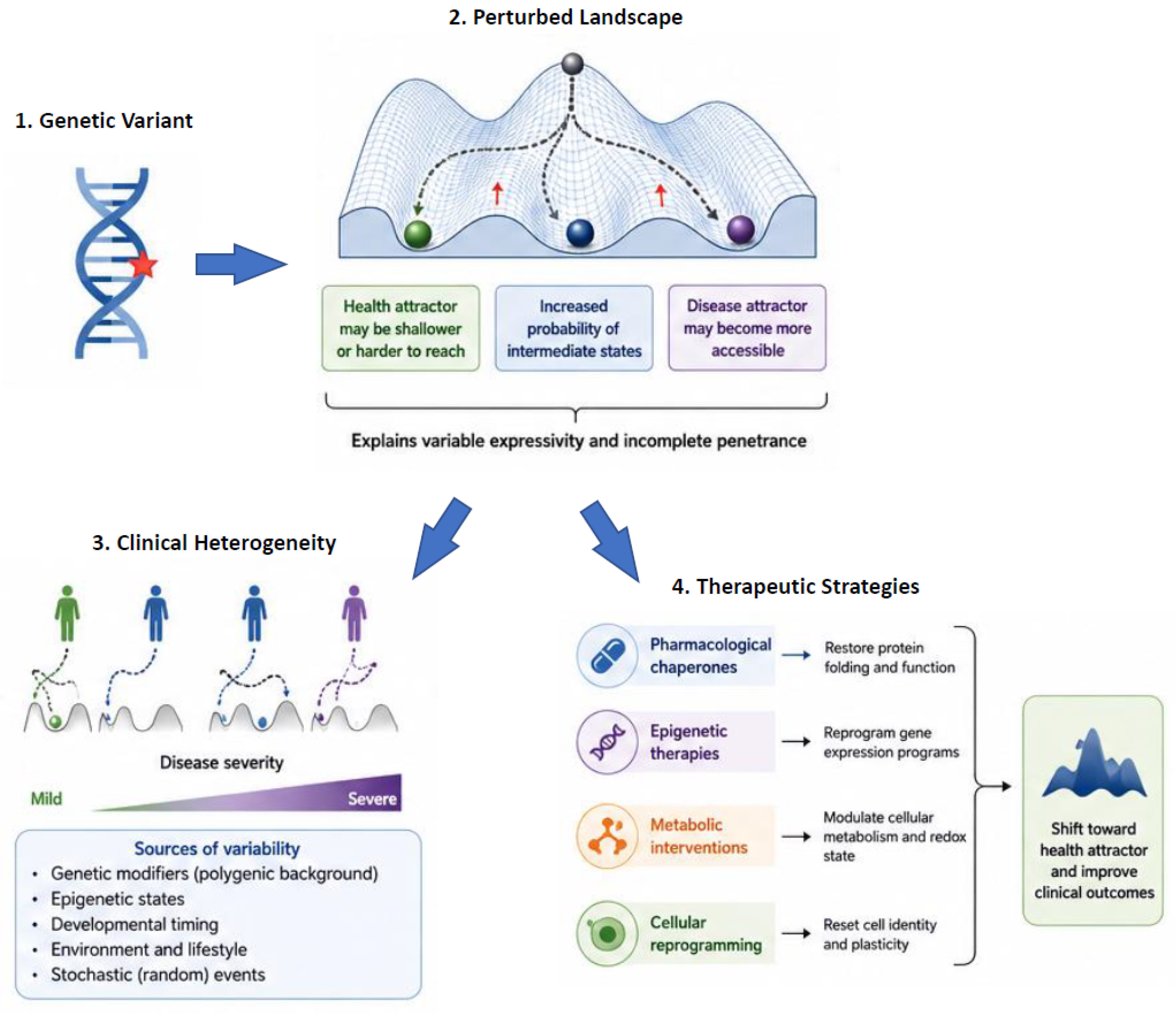
Within this framework, physiological cellular states can be represented as regions of the state space maintained by the dynamics of regulatory networks. Pathogenic gene variants alter one or more components of these networks and may therefore change their dynamical properties (Figure 2). Several consequences are possible.
Figure 2.
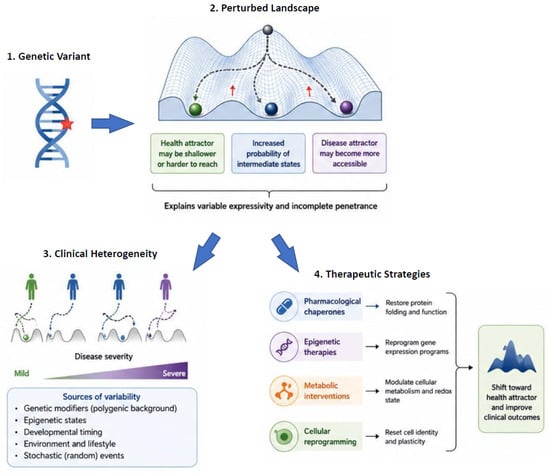
Application of the landscape framework to monogenic diseases. The landscape framework provides a unifying, system-level perspective to understand disease mechanisms and guide precision therapy in monogenic diseases. 1. Genetic Variant. A variant in a single gene alters components and their interactions. 2. Perturbed Landscape. The variant reshapes the landscape by modifying biological constraints and energy barriers. 3. Clinical Heterogeneity. Different individuals experience different trajectories depending on modifiers and environmental factors. 4. Therapeutic Strategies. Interventions aim to reshape the landscape by lowering barriers or stabilizing beneficial attractors.
A pathogenic variant may reduce the stability of a physiological attractor, making it easier for the system to leave that state. It may increase the stability of a pathological state, making recovery more difficult. It may alter the barrier separating alternative states or change the trajectories through which transitions occur. Finally, it may modify the relative accessibility of pre-existing states rather than creating entirely new states.
This formulation is deliberately more conservative than stating that every pathogenic mutation creates a novel attractor. Whether distinct clinical states can actually be demonstrated to correspond to mathematically defined attractors must be established experimentally for each biological system. Nevertheless, attractor terminology provides a useful conceptual description of stable or recurrent phenotypic states generated by interacting regulatory processes.
Clinical variability can then be interpreted as differences in the probability that individuals carrying the same causal variant occupy or transition toward particular regions of the disease-associated state space (Figure 2).
Genetic background can reshape this landscape by modifying the activity of interacting pathways. Epigenetic regulation can change the expression of disease-related genes or compensatory pathways. Developmental events can establish different initial conditions. Environmental exposures can continuously modify signaling and metabolism. Stochastic processes can contribute additional variability. Together, these factors influence the stability and accessibility of physiological and pathological states.
Incomplete penetrance represents an especially intuitive example. If a pathogenic variant perturbs the system but does not inevitably destabilize the physiological attractor, some individuals may remain within a functionally normal region of the landscape whereas others cross a threshold into a disease-associated state.
Variable expressivity can similarly be represented by different degrees of displacement from the physiological state, occupation of different pathological states, or differences in the stability of these states.
Age-dependent penetrance introduces a temporal dimension. A system may initially compensate for a genetic perturbation but progressively lose robustness because of aging, cumulative environmental exposure, repeated cellular injury, altered metabolism, or exhaustion of compensatory pathways. Disease onset can therefore be conceptualized as a transition occurring when the system is no longer able to remain within a previously stable physiological basin.
Thus, the landscape should not be considered static. Its topology can itself change during development, aging, environmental exposure, tissue damage, and treatment. To understand how these dynamic changes translate into clinical phenotypes, the landscape framework must be extended across different levels of biological organization.
4. A Multilevel Landscape Framework for Monogenic Disorders
The application of landscape concepts to monogenic disease requires consideration of multiple biological levels. The phenotype of an inherited disorder is rarely determined at a single organizational scale. This multilevel organization is consistent with systems biology approaches emphasizing the emergence of physiological and pathological properties from interactions among molecular, cellular, and organismal components [14,15]. Molecular abnormalities alter cells; cellular alterations modify tissue organization; tissue dysfunction changes organ performance; and these effects ultimately determine the clinical phenotype.
We therefore propose a three-level conceptual framework.
4.1. Level 1: The Pathogenic Variant as a Molecular Network Perturbation
At the first level, the pathogenic variant produces a primary molecular alteration. Depending on the disease, this may involve loss of protein function, gain of function, altered dosage, protein misfolding, abnormal localization, defective signaling, or impaired enzymatic activity. These mechanisms include haploinsufficiency, in which a single functional allele cannot provide sufficient gene product to maintain normal function, and toxic gain-of-function, in which an altered protein acquires harmful properties. Although their primary molecular consequences differ, both mechanisms may perturb regulatory networks and modify the stability of physiological and pathological states. Thus, the landscape–attractor framework can potentially accommodate distinct pathogenic mechanisms within a common systems-level interpretation. However, the affected protein is embedded within a network of molecular interactions. Consequently, the primary alteration propagates beyond the immediate gene product. Signaling pathways, transcriptional networks, metabolic reactions, protein–protein interactions, and feedback circuits may all be affected.
This perspective is consistent with network medicine, which emphasizes that disease phenotypes emerge from perturbations of interconnected molecular networks rather than from isolated molecular components [11]. The magnitude of the primary molecular defect therefore represents only one determinant of disease severity. The response of the surrounding network is equally important. Compensatory pathways may partially restore function, whereas positive feedback loops may amplify dysfunction.
4.2. Level 2: Network Perturbation Modifies Cellular State Landscapes
At the second level, changes in network architecture and dynamics alter the stability and accessibility of cellular states. A normal cell is maintained by interacting regulatory processes that stabilize its identity and physiological functions. A pathogenic variant can modify these interactions and thereby deform the underlying regulatory landscape [4,5,6].
The effects need not be all-or-none. A physiological attractor may become shallower but remain accessible. A pathological state may become more probable without becoming inevitable. Intermediate or metastable states may appear. Transitions may become more frequent or less reversible. This provides a dynamic interpretation of disease progression. Rather than being viewed exclusively as the cumulative direct consequence of a molecular defect, progression can also be interpreted as movement through a state space whose topology has been modified by the persistent genetic perturbation.
Importantly, the same pathogenic variant may generate different dynamical consequences in different cell types because the underlying regulatory networks are different. This provides a possible systems-level explanation for tissue specificity in disorders caused by genes that are broadly expressed.
4.3. Level 3: Cellular States Generate Tissue-, Organ-, and Organism-Level Functional States
The third level concerns physiological function. Clinical disease does not result directly from gene expression states but from altered tissue and organ performance [14,16]. Muscle force, neuronal signaling, epithelial transport, vascular regulation, cardiac output, immune competence, or metabolic homeostasis emerge from interactions among large numbers of cells and tissues. At this level, it may be useful to define a functional landscape whose coordinates represent physiologically relevant variables rather than gene-expression states.
For example, the relevant variables in a muscular disease may include muscle fiber integrity, regenerative capacity, inflammatory activity, fibrosis, and mechanical performance. In cystic fibrosis, they may include epithelial ion transport, mucus hydration, airway inflammation, infection, and tissue remodeling. In phenylketonuria, they may include phenylalanine metabolism, transport across the blood–brain barrier, neurotransmitter metabolism, and neuronal function. The important point is that the cellular regulatory landscape and the organism-level functional landscape should not be regarded as identical. They are connected levels of description. A pathogenic variant perturbs molecular networks; these perturbations modify cellular states; cellular states influence tissue and organ function; and the resulting functional state determines the clinical phenotype. The resulting conceptual sequence is therefore: pathogenic variant → molecular network perturbation → altered regulatory landscape → altered cellular states → altered tissue/organ functional landscape → clinical phenotype (Figure 2). This sequence preserves the causal importance of the mutation while providing intermediate levels through which modifier effects, environmental influences, compensatory processes, and stochastic variability can act.
5. A Functional Fitness Landscape for Monogenic Diseases
Wright’s classical concept of fitness is primarily evolutionary and is ultimately related to reproductive success. Although some inherited diseases clearly influence reproductive fitness, this is not the most useful variable for describing the short- and medium-term physiological consequences of most monogenic disorders. For this reason, a broader operational concept of functional fitness may be useful. Here, functional fitness does not replace or redefine evolutionary fitness. It is used simply to describe the ability of a biological system to maintain a disease-relevant physiological function despite perturbation.
Depending on the disorder, functional fitness may therefore refer to neuronal activity, muscle performance, epithelial transport, metabolic homeostasis, immune competence, vascular stability, or another measurable physiological output. A functional landscape could then represent the set of physiological states accessible to the organism. Regions associated with preserved function would correspond to high functional fitness, whereas regions associated with severe dysfunction would correspond to low functional fitness (Figure 1). Importantly, functional fitness and attractor stability are related but not identical concepts. A state may be dynamically stable but physiologically undesirable. A pathological attractor can therefore be highly stable while having low functional fitness.
This distinction is essential. The objective of therapy is not necessarily to increase the stability of the existing state, but rather to move the system toward a state associated with greater physiological function and then stabilize that state. Within this framework, clinical severity can be represented as the position of an individual within a multidimensional functional landscape. The same pathogenic variant may be associated with different positions because other biological variables alter network behavior and functional compensation. This interpretation may be particularly useful for diseases in which the relationship between genotype and clinical severity is weak. The following examples illustrate how this conceptual framework can be applied to monogenic disorders with different molecular mechanisms and clinical manifestations.
6. Monogenic Diseases as Examples of Landscape Modulation
The following examples illustrate different aspects of the proposed framework. It is important, however, to distinguish experimentally established observations from their interpretation in landscape–attractor terms. The effects of genetic modifiers, compensatory mechanisms, metabolic regulation, and therapeutic interventions are supported by experimental and clinical evidence. For example, the modulation of disease severity by fetal hemoglobin in sickle cell anemia and the modification of metabolic and clinical outcomes by dietary treatment in phenylketonuria provide well-established evidence that the consequences of a pathogenic genotype can be substantially modified. Nevertheless, interpreting these phenomena as changes in attractor stability or transitions between attractor states remains a theoretical extension of these findings, rather than direct experimental demonstration of such attractors.
6.1. Cystic Fibrosis
Cystic fibrosis provides a paradigmatic example of phenotypic variability in a monogenic disorder. Although pathogenic variants in CFTR are the primary cause of disease and strongly influence some phenotypic components, patients with similar or identical CFTR genotypes can differ substantially in the severity of pulmonary disease and in gastrointestinal and other manifestations [17]. Modifier genes, environmental exposure, infection history, inflammation, treatment, and stochastic factors contribute to this variability.
Within a landscape model, the CFTR defect represents the persistent primary perturbation. However, the long-term pulmonary phenotype emerges from the interaction between epithelial ion transport, mucus properties, infection, inflammatory responses, tissue remodeling, and compensatory mechanisms. Thus, rather than representing a single direct trajectory from CFTR dysfunction to lung failure, cystic fibrosis can be viewed as a system in which the genetic defect changes the probability and stability of several physiological and pathological states. Different individuals carrying similar CFTR variants may consequently follow different trajectories through this state space.
6.2. Duchenne Muscular Dystrophy
Duchenne muscular dystrophy provides a different example. Loss of functional dystrophin destabilizes the muscle fiber membrane and initiates a complex series of secondary events that includes repeated cycles of muscle degeneration and regeneration, chronic inflammation, altered cellular signaling, activation and eventual dysfunction of regenerative mechanisms, and progressive fibrosis [18]. The primary genetic alteration is therefore followed by extensive reorganization of the tissue environment. From a landscape perspective, these processes can be interpreted as changes in the stability and accessibility of tissue states over time. During early phases of disease, regenerative and compensatory mechanisms may partially maintain muscle function. Repeated injury, chronic inflammation, satellite-cell dysfunction, and fibrosis subsequently modify the tissue landscape and progressively restrict the ability of the system to return to a more functional state. Disease progression in Duchenne muscular dystrophy can therefore be considered not only as accumulation of molecular damage but also as a progressive alteration of the tissue-level state space.
6.3. Sickle Cell Anemia
Sickle cell anemia represents perhaps one of the clearest demonstrations that a highly specific molecular lesion does not determine a unique clinical trajectory. The classical HbSS form results from homozygosity for the pathogenic sickle variant in HBB. Nevertheless, clinical severity varies markedly among patients. Levels of fetal hemoglobin, co-inheritance of α-thalassemia, additional genetic modifiers, inflammatory pathways, vascular biology, and environmental factors can substantially influence the phenotype [19]. The polymerization of deoxygenated HbS provides the primary molecular event, but the clinical phenotype emerges from interactions among erythrocyte deformation, hemolysis, endothelial activation, vascular adhesion, inflammation, nitric oxide biology, tissue oxygenation, and compensatory responses. The landscape–attractor framework provides a way of conceptualizing this multicomponent system. The HBB variant constrains the landscape, but additional variables determine whether the organism remains within relatively compensated functional states or moves toward states characterized by recurrent vaso-occlusion, chronic inflammation, vascular damage, and progressive organ dysfunction.
6.4. Hereditary Hemochromatosis
Hereditary hemochromatosis provides a particularly clear example of incomplete penetrance and variable expressivity despite a well-defined causal genotype. Homozygosity for the HFE C282Y (p.Cys282Tyr) variant is the major genetic determinant of HFE-related hemochromatosis, yet individuals with this genotype can range from little or no clinically relevant iron overload to progressive iron accumulation with hepatic and extrahepatic complications. Clinical expression is influenced by sex, age, alcohol exposure, metabolic factors, and additional genetic modifiers, indicating that the pathogenic genotype defines susceptibility without uniquely determining the final phenotype [20]. Within a landscape framework, C282Y homozygosity can therefore be viewed as a persistent perturbation of systemic iron homeostasis that reshapes the range and stability of accessible physiological states; modifier and environmental factors influence whether the system remains in a relatively compensated state or moves toward progressively iron-loaded, organ-damaging states.
6.5. Phenylketonuria
Phenylketonuria provides a particularly informative example because it also illustrates the therapeutic implications of the framework. PKU is caused by deficient phenylalanine hydroxylase activity resulting from pathogenic variants in PAH. The immediate biochemical consequence is impaired conversion of phenylalanine to tyrosine, leading to elevated phenylalanine concentrations and, if untreated, severe neurological consequences. However, treatment can profoundly change the phenotype without correcting the underlying genotype. Dietary restriction of phenylalanine, amino-acid supplementation, and, in appropriate patients, pharmacological interventions can maintain phenylalanine concentrations within safer ranges and dramatically modify the clinical trajectory [21].
In landscape terms, the pathogenic genotype remains unchanged, whereas manipulation of an external variable—nutrient availability—alters the metabolic operating state of the system. PKU therefore provides a particularly intuitive example of the distinction between correcting a genotype and redirecting a physiological system toward a more favorable region of its functional landscape.
7. Robustness, Compensation, and Disease Thresholds
An additional concept that may strengthen the landscape interpretation of monogenic disease is biological robustness. Biological systems can preserve function despite genetic or environmental perturbations through feedback regulation, redundancy, compensatory pathways, and network reorganization [12]. Such mechanisms can be represented within a landscape as processes that stabilize a physiological basin despite perturbation.
An extreme illustration of biological robustness is provided by naturally occurring human gene knockouts. Population sequencing studies, particularly in cohorts with elevated consanguinity, have identified adults carrying biallelic predicted loss-of-function variants that effectively inactivate individual genes, yet who show no obvious clinical phenotype attributable to the knockout [22,23]. These observations indicate that even a major molecular perturbation does not necessarily displace the organism from a physiologically functional region of the state space. From a landscape perspective, network redundancy, compensatory pathways, alternative regulatory configurations, and the specific position of a gene within biological networks may buffer the perturbation and preserve functional fitness. The term “apparently unaffected” is nevertheless more appropriate than “asymptomatic,” because subtle, context-dependent, or late-onset phenotypes may escape detection in population-based studies.
Disease may therefore emerge when the magnitude of the perturbation exceeds the buffering capacity of the system. This threshold concept offers a possible interpretation of incomplete penetrance. Individuals with greater buffering capacity may remain within the physiological basin despite carrying a pathogenic variant, whereas individuals with lower buffering capacity may cross a transition threshold. Similarly, age-dependent disease onset may result from progressive erosion of robustness. Aging, repeated injury, metabolic stress, inflammation, and environmental exposure may gradually reduce the stability of a previously compensated physiological state.
This model also predicts that protective modifier genes are not merely modifiers of the primary gene product. They may act at many different points in the system, including feedback loops, parallel pathways, stress responses, tissue repair, and metabolic compensation.
Identifying these mechanisms may therefore reveal therapeutic targets that would not be evident from analysis of the causal gene alone. These considerations also provide a rationale for therapeutic strategies aimed at modifying disease-associated network states rather than directly correcting the causal genetic variant.
8. Therapeutic Implications of the Landscape–Attractor Framework
One of the most interesting implications of the landscape–attractor model concerns therapy (Figure 2). The conventional molecular objective of treatment for a monogenic disorder is correction of the primary defect. Gene replacement, genome editing, RNA correction, and other gene-directed approaches follow this principle and, when feasible, offer the most direct strategy. However, the landscape model suggests a complementary therapeutic principle:
The pathogenic genotype does not necessarily have to be corrected in order to produce a healthier phenotype. If disease results partly from occupation or stabilization of a pathological state, treatment may act by modifying the topology of the landscape, reducing the stability of pathological states, increasing the stability of physiological states, or lowering the barriers required to reach them.
Several existing therapeutic strategies are conceptually consistent with this interpretation.
Pharmacological chaperones stabilize particular protein conformations and can increase the amount of correctly folded or functionally competent protein without correcting the underlying DNA variant [24]. In landscape terminology, the genotype is unchanged, but molecular interactions are altered in a direction that may restore a more functional state.
Metabolic therapies provide another clear example. Dietary interventions, substrate reduction, cofactor supplementation, enzyme replacement, and manipulation of metabolic pathways can substantially modify phenotype even though the causal genotype remains unchanged. PKU represents the classical example: environmental manipulation of phenylalanine intake profoundly changes neurological outcome [25].
Modifier pathways offer a further therapeutic opportunity. If naturally occurring genetic modifiers can shift patients carrying the same causal mutation toward milder phenotypes, pharmacological reproduction of those protective mechanisms may achieve a similar transition. This strategy effectively attempts to reproduce a naturally occurring favorable landscape configuration.
Epigenetic interventions provide another theoretically relevant approach. Because chromatin state and gene expression contribute to the dynamics of regulatory networks, pharmacological or targeted manipulation of epigenetic regulation could alter the accessibility of cellular states without changing DNA sequence.
At a more experimental level, cellular reprogramming and cell-state manipulation provide an especially direct illustration of landscape modification. Reprogramming demonstrates that differentiated cellular states are not necessarily irreversible and that sufficiently strong regulatory perturbations can drive cells across barriers separating different attractor states [26]. These approaches were not necessarily developed from landscape theory. Therefore, it would be inappropriate to claim that the landscape–attractor model predicts their efficacy in a strict mechanistic sense. Rather, the framework provides a common conceptual interpretation of otherwise very different therapeutic strategies.
Gene therapy corrects the primary perturbation. Other treatments may leave the perturbation in place while altering the response of the system.
These two therapeutic principles should be considered complementary rather than competing. Importantly, the applicability and efficacy of these therapeutic strategies are highly disease-dependent. They are influenced by the molecular defect, the affected biological pathways, the degree of irreversible tissue damage, and the availability of effective compensatory mechanisms. While some monogenic disorders may benefit substantially from interventions that modify downstream pathways without correcting the causal variant, others may require direct restoration of the defective gene product. Thus, the landscape–attractor framework provides a conceptual interpretation of different therapeutic approaches, but does not independently establish their efficacy, which must be demonstrated experimentally and clinically for each disorder.
9. Conceptual Limitations and Testable Implications
The application of attractor terminology to monogenic disease also requires caution.
First, not every stable clinical phenotype has been experimentally demonstrated to represent a mathematically defined attractor. In many cases, the term should therefore be regarded as a systems-level hypothesis or conceptual analogy.
Second, molecular, cellular, tissue, and organism-level landscapes should not be conflated. An attractor defined by gene-expression dynamics is not automatically equivalent to a stable physiological state of an organ or to a clinical phenotype. Relationships among these levels need to be demonstrated rather than assumed.
Third, disease progression may be continuous rather than composed of discrete transitions. Some disorders may therefore be better represented by gradual deformation of a landscape or movement along continuous trajectories than by transitions among sharply separated attractors.
Fourth, the concept of functional fitness proposed here is operational and should be distinguished clearly from Wright’s evolutionary fitness. Its value will depend on the identification of quantitative physiological variables that can define clinically meaningful states.
These limitations also generate experimentally testable predictions.
If clinical variability reflects alternative network states, patients carrying the same pathogenic variant but displaying different disease severities should show reproducible differences in gene-expression, epigenetic, metabolic, signaling, or cellular-state profiles.
If progression involves a change in attractor stability, longitudinal data should reveal early molecular changes preceding clinical transition.
If protective genetic modifiers reshape the landscape, their molecular effects should converge on regulatory mechanisms that increase resilience to the primary perturbation.
Finally, successful non-gene-correcting therapies should move molecular or physiological state profiles toward those observed in individuals with milder disease or toward physiologically normal states.
Although primarily conceptual, these notions can be investigated using measurable biological variables and computational approaches. Functional fitness may be approximated through residual protein activity, metabolic efficiency, cellular homeostasis, and tissue-specific physiological performance. For example, in cystic fibrosis, residual CFTR function can be quantified in patient-derived intestinal organoids, providing a measurable indicator of epithelial function. Attractor stability may be investigated by examining the robustness of cellular states to perturbations, using single-cell transcriptomics and computational models of gene regulatory networks. Longitudinal studies could correlate molecular changes with disease onset or progression, while single-cell analyses could identify distinct cellular states associated with different clinical phenotypes in patients carrying the same pathogenic variant. Computational models could then test whether changes in regulatory network dynamics predict the stability of these states and their transitions, providing hypotheses that can be validated through experimental perturbations.
The future utility of the landscape–attractor framework will therefore depend on its ability to move beyond metaphor and generate measurable relationships among genotype, network dynamics, cellular state, and physiological function.
10. Conclusions
Monogenic diseases have traditionally provided some of the clearest examples of causal relationships between genotype and phenotype. Nevertheless, identification of the causal gene does not necessarily explain the complete clinical phenotype. Incomplete penetrance, variable expressivity, differences in age at onset, tissue specificity, and heterogeneous disease progression demonstrate that the effect of a pathogenic variant is filtered through multiple levels of biological organization. The landscape–attractor framework offers a potentially useful conceptual bridge between genetics, developmental biology, systems biology, and physiology. Within this framework, an inherited pathogenic variant can be regarded as a persistent perturbation of interconnected molecular networks. This perturbation modifies regulatory dynamics and may alter the stability and accessibility of physiological and pathological cellular states. These cellular states interact at the tissue and organismal levels to generate different functional outcomes. The causal mutation therefore remains central, but it does not act in isolation. Genetic background, epigenetic regulation, developmental history, environmental exposures, stochastic events, compensatory mechanisms, and aging can reshape the landscape on which the primary mutation acts. This interpretation provides a possible systems-level explanation for why individuals carrying the same pathogenic variant may follow different clinical trajectories. A multilevel landscape framework also helps distinguish the genetic cause of disease from the dynamic state of the affected biological system. This distinction has important therapeutic implications. Correcting the causal genetic defect represents one strategy for restoring function, but it is not necessarily the only one. Therapies that stabilize residual protein function, modify compensatory pathways, alter metabolism, reshape epigenetic regulation, or redirect cellular states may also move the system toward a more favorable region of the functional landscape.
The landscape–attractor framework should not therefore be considered an alternative to molecular genetics. Rather, it provides an additional level of interpretation connecting molecular causation with the emergent behavior of complex biological systems.
Its principal value may ultimately lie in shifting the central question from “Which mutation causes the disease?” to a broader question: “How does a fixed pathogenic variant reshape the space of biological states available to the organism, and what determines which of these states is actually reached?” Answering this question may contribute to a more integrated understanding of genotype–phenotype relationships in inherited disease and may identify mechanisms capable of modifying disease expression even when the causal genetic variant itself cannot be corrected.
Author Contributions
G.D. conceived and designed the study and wrote the manuscript, except for the sections addressing the individual genetic diseases. F.F. wrote the sections on genetic diseases and critically reviewed and revised the manuscript. All authors have read and agreed to the published version of the manuscript.
Funding
The work was performed thanks to the support of the Departmental Strategic Plan (PSD) of the University of Udine-Interdepartmental Project on Healthy Ageing (2020–25).
Data Availability Statement
No new data were generated or analyzed in this study. Data sharing is not applicable to this article.
Acknowledgments
The work was performed thanks to the support of the Departmental Strategic Plan (PSD) of the University of Udine-Interdepartmental Project on Healthy Ageing (2020–25). During the preparation of this manuscript, the author used ChatGPT (OpenAI, GPT-5.6 Sol) to as-sist with English-language editing and improvement of paragraphs organization. The author re-viewed and edited all outputs and takes full responsibility for the content of this publication.
Conflicts of Interest
The authors declare no conflicts of interest.
References
- Wright, S. The roles of mutation, inbreeding, crossbreeding and selection in evolution. In Proceedings of the Sixth International Congress on Genetics, Ithaca, NY, USA, 24–31 August 1932. [Google Scholar]
- Waddington, C.H. The Strategy of the Genes; Allen & Unwin: London, UK, 1957. [Google Scholar]
- Kauffman, S. Metabolic stability and epigenesis in randomly constructed genetic nets. J. Theor. Biol. 1969, 22, 437–467. [Google Scholar] [CrossRef] [Scilit] [PubMed]
- Huang, S. The molecular and mathematical basis of Waddington’s epigenetic landscape: A framework for post-Darwinian biology? BioEssays 2011, 34, 149–157. [Google Scholar] [CrossRef] [Scilit] [PubMed]
- Davila-Velderrain, J.; Martinez-Garcia, J.C.; Alvarez-Buylla, E.R. Modeling the epigenetic attractors landscape: Toward a post-genomic mechanistic understanding of development. Front. Genet. 2015, 6, 160. [Google Scholar] [CrossRef] [Scilit] [PubMed]
- Huang, S.; Ernberg, I.; Kauffman, S. Cancer attractors: A systems view of tumors from a gene network dynamics and developmental perspective. Semin. Cell Dev. Biol. 2009, 20, 869–876. [Google Scholar] [CrossRef] [Scilit] [PubMed]
- Grunt, T.W. Understanding cancer from a biophysical, developmental and systems biology perspective using the landscapes-attractor model. BioSystems 2024, 247, 105376. [Google Scholar] [CrossRef] [Scilit] [PubMed]
- Nadeau, J.H. Modifier genes in mice and humans. Nat. Rev. Genet. 2001, 2, 165–174. [Google Scholar] [CrossRef] [Scilit] [PubMed]
- Cooper, D.N.; Krawczak, M.; Polychronakos, C.; Tyler-Smith, C.; Kehrer-Sawatzki, H. Where genotype is not predictive of phenotype: Towards an understanding of the molecular basis of reduced penetrance in human inherited disease. Hum. Genet. 2013, 132, 1077–1130. [Google Scholar] [CrossRef] [Scilit] [PubMed]
- Kingdom, R.; Wright, C.F. Incomplete Penetrance and Variable Expressivity: From Clinical Studies to Population Cohorts. Front. Genet. 2022, 13, 920390. [Google Scholar] [CrossRef] [Scilit] [PubMed]
- Barabási, A.-L.; Gulbahce, N.; Loscalzo, J. Network medicine: A network-based approach to human disease. Nat. Rev. Genet. 2010, 12, 56–68. [Google Scholar] [CrossRef] [Scilit] [PubMed]
- Kitano, H. Biological robustness. Nat. Rev. Genet. 2004, 5, 826–837. [Google Scholar] [CrossRef] [Scilit] [PubMed]
- Raj, A.; van Oudenaarden, A. Nature, nurture, or chance: Stochastic gene expression and its consequences. Cell 2008, 135, 216–226. [Google Scholar] [CrossRef] [Scilit] [PubMed]
- Kitano, H. Systems Biology: A Brief Overview. Science 2002, 295, 1662–1664. [Google Scholar] [CrossRef] [Scilit] [PubMed]
- Loscalzo, J.; Kohane, I.; Barabasi, A. Human disease classification in the postgenomic era: A complex systems approach to human pathobiology. Mol. Syst. Biol. 2007, 3, 124. [Google Scholar] [CrossRef] [Scilit] [PubMed]
- Macklem, P.T. Emergent phenomena and the secrets of life. J. Appl. Physiol. 2008, 104, 1844–1846. [Google Scholar] [CrossRef] [Scilit] [PubMed]
- O’Neal, W.K.; Knowles, M.R. Cystic Fibrosis Disease Modifiers: Complex Genetics Defines the Phenotypic Diversity in a Monogenic Disease. Annu. Rev. Genom. Hum. Genet. 2018, 19, 201–222. [Google Scholar] [CrossRef] [Scilit] [PubMed]
- Dowling, P.; Swandulla, D.; Ohlendieck, K. Cellular pathogenesis of Duchenne muscular dystrophy: Progressive myofibre degeneration, chronic inflammation, reactive myofibrosis and satellite cell dysfunction. Eur. J. Transl. Myol. 2023, 33, 11856. [Google Scholar] [CrossRef] [Scilit] [PubMed]
- Steinberg, M.H.; Sebastiani, P. Genetic basis of heterogeneity and severity in sickle cell disease. Exp. Biol. Med. 2016, 241, 689–696. [Google Scholar] [CrossRef] [Scilit] [PubMed]
- Allen, K.J.; Gurrin, L.C.; Constantine, C.C.; Osborne, N.J.; Delatycki, M.B.; Nicoll, A.J.; McLaren, C.E.; Bahlo, M.; Nisselle, A.E.; Vulpe, C.D.; et al. Iron-overload-related disease in HFE hereditary hemochromatosis. N. Engl. J. Med. 2008, 358, 221–230. [Google Scholar] [PubMed]
- Van Wegberg, A.M.J.; Macdonald, A.; Ahring, K.; BéLanger-Quintana, A.; Blau, N.; Bosch, A.M.; Burlina, A.; Campistol, J.; Feillet, F.; Giżewska, M.; et al. The complete European guidelines on phenylketonuria: Diagnosis and treatment. Orphanet J. Rare Dis. 2017, 12, 162. [Google Scholar] [CrossRef] [Scilit] [PubMed]
- Narasimhan, V.M.; Hunt, K.A.; Mason, D.; Baker, C.L.; Karczewski, K.J.; Barnes, M.R.; Barnett, A.H.; Bates, C.; Bellary, S.; Bockett, N.A.; et al. Health and population effects of rare gene knockouts in adult humans with related parents. Science 2016, 352, 474–477. [Google Scholar] [CrossRef] [Scilit] [PubMed]
- Saleheen, D.; Natarajan, P.; Armean, I.M.; Zhao, W.; Rasheed, A.; Khetarpal, S.A.; Won, H.-H.; Karczewski, K.J.; O’Donnell-Luria, A.H.; Samocha, K.E.; et al. Human knockouts and phenotypic analysis in a cohort with a high rate of consanguinity. Nature 2017, 544, 235–239. [Google Scholar] [CrossRef] [Scilit] [PubMed]
- Convertino, M.; Das, J.; Dokholyan, N.V. Pharmacological Chaperones: Design and Development of New Therapeutic Strategies for the Treatment of Conformational Diseases. ACS Chem. Biol. 2016, 11, 1471–1489. [Google Scholar] [CrossRef] [Scilit] [PubMed]
- van Karnebeek, C.D.M.; Wortmann, S.B.; Koelewijn, M.J.; Tseng, L.A.; Houben, R.; Stöckler-Ipsiroglu, S.; Ferreira, C.R.; van Karnebeek, C.D.M. Treatable inherited metabolic disorders causing intellectual disability: 2021 review and digital app. Orphanet J. Rare Dis. 2021, 16, 170. [Google Scholar] [CrossRef] [Scilit] [PubMed]
- Lee, J.; Herron, T.; Studer, L.; Mummery, C.L.; Wu, J.C. Induced pluripotent stem cells from discovery to translation. Nat. Med. 2026, 32, 3164–3180. [Google Scholar] [CrossRef] [Scilit] [PubMed]

Disclaimer/Publisher’s Note: The statements, opinions and data contained in all publications are solely those of the individual author(s) and contributor(s) and not of MDPI and/or the editor(s). MDPI and/or the editor(s) disclaim responsibility for any injury to people or property resulting from any ideas, methods, instructions or products referred to in the content. |
© 2026 by the authors. Licensee MDPI, Basel, Switzerland. This article is an open access article distributed under the terms and conditions of the Creative Commons Attribution (CC BY) license.