


Abstract
The effect of the reaction medium pH value on the rate and yield of enzymatic transglycosylation catalyzed by Escherichia coli purine nucleoside phosphorylase (EcPNP) and Lactobacillus leichmanii type II nucleoside deoxyribosyltransferase (LlNDTII) was investigated. In the presence of EcPNP at pH 5.5, a significant reduction in the inosine formation rate was observed, compared with that of adenosine. A substituent at the purine O6 position neutralizes the negative effect of the 6-oxo group on the reaction rate. A substituent at the purine N6 position has virtually no effect on the transglycosylation rate. In reactions catalyzed by LlNDTII, the rate of nucleoside formation from 4-oxopyrimidines was higher at pH 5.5, but the yield decreased by approximately 10% compared with that at pH 7.0; an unusual dependence of the yield of the target nucleoside on the enzyme concentration used was also revealed.
1. Introduction
Nucleosides are an important class of natural compounds that serve as the basis for the development of new drugs possessing a broad spectrum of biological activity. Currently, effective antiviral and antitumour drugs can have a modified nucleoside or similar fragment in their structure, which acts by mimicking the natural components of nucleic acids in the cell, thereby becoming included in cellular metabolism. The spectrum of biological activity of nucleoside analogues is diverse and includes antiviral, antibacterial, antifungal, and antitumour activity [1,2,3,4]. Nucleosides hold great potential for combating drug-resistant microorganisms [5]. Technologies for the production of practically significant modified nucleosides based on enzymatic transglycosylation reactions are currently being widely developed. Biocatalytic reactions, providing regio- and stereoselectivity as well as tunability, can complement, enhance or partially replace some steps of chemical methods of synthesis. Combining individual enzymatic reactions into multistep enzyme-catalyzed cascades brings additional advantages. Cascade enzymatic reactions are also eco-friendly, eliminating the time- and reagent-costly steps of isolation and purification of intermediates, as well as the functional groups’ protection/deprotection steps. Numerous enzymes such as glycosyltransferases, phosphoribosyltransferases, kinases, and reductases can participate in the cascade enzymatic synthesis of modified biologically active nucleosides [6,7,8]. However, enzymatic transglycosylation (consisting of two coupled phosphorolysis reactions) remains one of the primary enzymatic reactions for producing biologically active nucleosides. This reaction is typically catalyzed by enzymes of the glycosyltransferase class (EC 2.4) from various natural sources. Nucleoside phosphorylases (NPs, EC 2.4.2.x) and nucleoside-2′-deoxyribosyltransferases (NDTs, EC 2.4.2.6), which play an important role in nucleoside metabolism are primarily used as biocatalysts. NPs participate in the secondary pathway of nucleoside synthesis in the cell and catalyze the reversible phosphorolysis of (2′-deoxy)ribonucleosides, releasing the corresponding nucleobase and (2-deoxy)ribose-1-phosphate. NDTs participate in the recycling of nucleobases and 2′-deoxyribonucleosides in the DNA synthesis pathway in microorganisms, directly transferring a 2-deoxyribose residue between purine and/or pyrimidine bases.
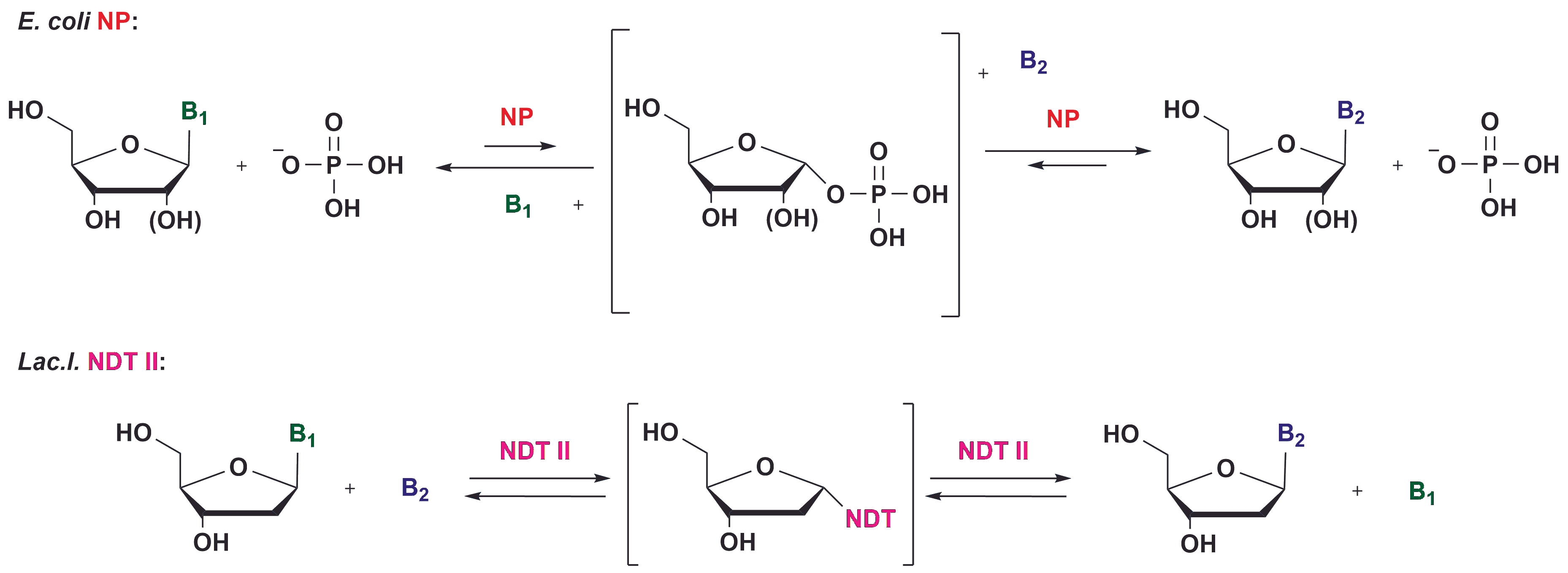
Enzymatic transglycosylation is the reaction of the N-glycoside bond of the reversible cleavage in ribonucleosides/2′-deoxyribonucleosides forming the corresponding heterocyclic base and pentafuranose phosphate- or pentafuranose-enzyme complex derivative followed by the transfer of the latter to another heterocyclic base (Figure 1). The nucleoside phosphorylases (NPs) that are the most commonly used in the biotechnological industry are purine nucleoside phosphorylase (PNP, EC 2.4.2.1), pyrimidine-nucleoside phosphorylase (PyNP, EC 2.4.2.2), uridine phosphorylase (UP, EC 2.4.2.3), and thymidine phosphorylase (TP, EC 2.4.2.4). They require the presence of a phosphate anion, which is needed to form the intermediate pentafuranose-1-phosphate releasing the heterocyclic base from the initial nucleoside (Figure 1). Nucleoside phosphorylases are ubiquitous and found in almost all organisms.
Figure 1.
Enzymatic transglycosylation reactions catalyzed by NP and NDT II. B1 and B2 are heterocyclic bases.
Other pentosyltransferases used in the nucleoside derivatives synthesis comprised nucleoside deoxyribosyltransferases (NDTs), enzymes catalyzing the transfer of a 2-deoxyribose moiety from one purine/or pyrimidine nucleoside to another pyrimidine/purine base [8,9] forming pentafuranose-enzyme intermediate complex. Unlike nucleoside phosphorylases, these enzymes seem to be limited in their distribution to the bacterial genus Lactobacillus [10,11] and also found in parasitic unicellular organisms [12]. NDTs comprise two types of enzymes, according to their substrate specificity: enzymes belonging to type I are specific for purine nucleosides and heterocyclic bases, and type II enzymes utilize and catalyze reactions of both purine and pyrimidine nucleosides and bases [8,13]. The catalytic use of both types is limited to the synthesis of 2′-deoxyribonucleosides. The use of both types of enzymes—NPs and NDTs—has certain advantages and disadvantages. When NPs are used as catalysts, the reaction outcome is contingent upon the equilibrium shift toward nucleoside-donor phosphorolysis. Additionally, a pair of NPs (purine and pyrimidine) must be used if purine and pyrimidine nucleobases/nucleosides are present in the reaction medium. The inability to obtain cytosine/cytidine derivatives is a limitation. Finally, the presence of a labile intermediate α-D-(deoxy)ribose-1-phosphate in the reaction medium is a potential issue that could negatively affect the yield of target nucleosides. The advantages of NPs are as follows: (a) their widespread availability and accessibility, (b) their specificity for both deoxy- and ribo-derivatives of the carbohydrate residue, and (c) their sufficiently broad specificity to heterocyclic bases. The direct transfer of the deoxyribose residue to the acceptor base, the possibility of obtaining 2′-deoxycytidine/cytosine derivatives (such as cytarabine having an arabinose residue as the carbohydrate moiety), and the ability to use a single enzyme for purine and pyrimidine bases/nucleosides are benefits of NDTs. Disadvantages include the scarcity of sources for obtaining NDT enzymes and the specificity to 2′-deoxynucleosides only. The use of NDTs and NPs in biotechnological production could significantly increase the number of biologically active nucleosides and pharmaceutical substances that can be synthesized via enzymatic glycosylation. Despite the aforementioned deficiencies of both types of enzymes, some of them have been successfully resolved or are on the brink of being resolved. Thus, to shift the equilibrium when using NPs, a nucleoside donor undergoing irreversible phosphorolysis can be used [14,15,16]. The use of the minimum concentration of the second substrate, the phosphate anion, also has a significant effect on shifting the equilibrium towards the heterocyclic base and α-D-(deoxy)ribose-1-phosphate. This was first observed by Krenitsky [17] and was later confirmed by a proposed mathematical model [18] of enzymatic transglycosylation describing this effect [19,20]. The problem of the low prevalence of NDTs can be solved using genetic engineering methods to obtain highly purified recombinant enzymes in large quantities [8,9,21,22].
Currently, there is a lot of information concerning the influence of pH on enzyme activity. However, we have not been able to find any studies aimed at determining the dependence of the enzymatic transglycosylation yield (rate, outcome, efficiency) on the reaction medium pH value and the structure of the base acceptor, namely the configuration of the 6th position of the purine cycle (6-oxo- and 6-amino) for purines and the 4th position (4-oxo- and 4-amino-) for pyrimidines. We believe that the results of our study may be useful and applicable in the pharmacological and biotechnological industry.
2. Results and Discussion
To date, there is little or no literature data describing the effect of pH on the enzymatic activity of EcPNP and LlNDTII in the enzymatic transglycosylation process. Thus, there are some literature sources describing the effect of pH only on PNP activity, i.g. mammalian PNP from chicken liver [23,24], Chinese hamster [25], and bovine brain [26]. These works are mainly devoted to characterizing the enzyme—determining the pH optimum (its physicochemical properties)—with only a few of them studying catalytic activity as a function of pH. We could not find any studies examining the impact of pH on the yield and course of enzymatic transglycosylation depending on the structure of the target nucleoside. Thus, we found only one investigation that examined the phosphorolysis of adenosine and inosine in the presence of EcPNP at varied pH values. It was devoted to studying the mechanism of PNP catalysis and the substrate-enzyme complex transition state having considerable oxocarbonium ion-like character using alpha-deuterium isotope effects [27]. Determining enzyme activity at different pH values has become a standard mandatory procedure in the characterization of newly discovered enzymes—the pH optimum is determined, as well as the pH values at which enzyme activity is minimal and, less commonly, the range of pH values at which the enzyme shows some residual activity before its inactivation.
In the present work, we investigated the effect of pH on the course of enzymatic transglycosylation of 6(4)-oxo- or 6(4)-amino purine (pyrimidine) derivatives in the presence of Escherichia coli purine nucleoside phosphorylase (EcPNP) and Lactobacillus leichmanii Nucleoside deoxyribosyltransferase type II (LlNDTII).
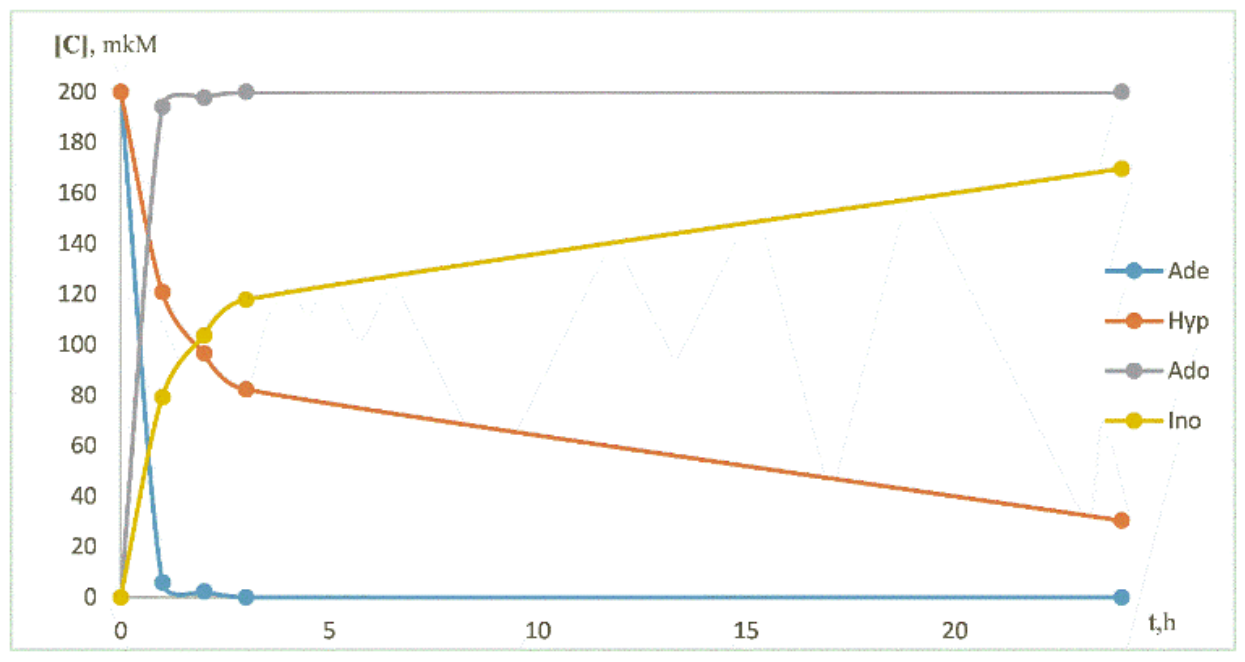
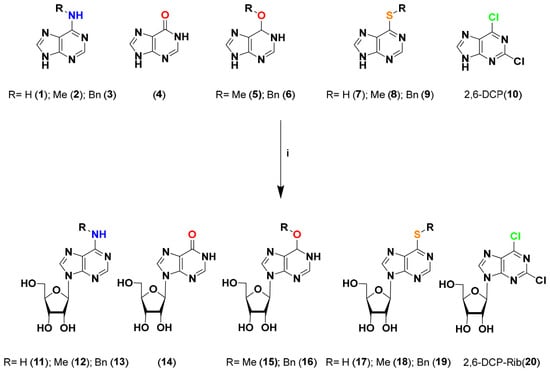
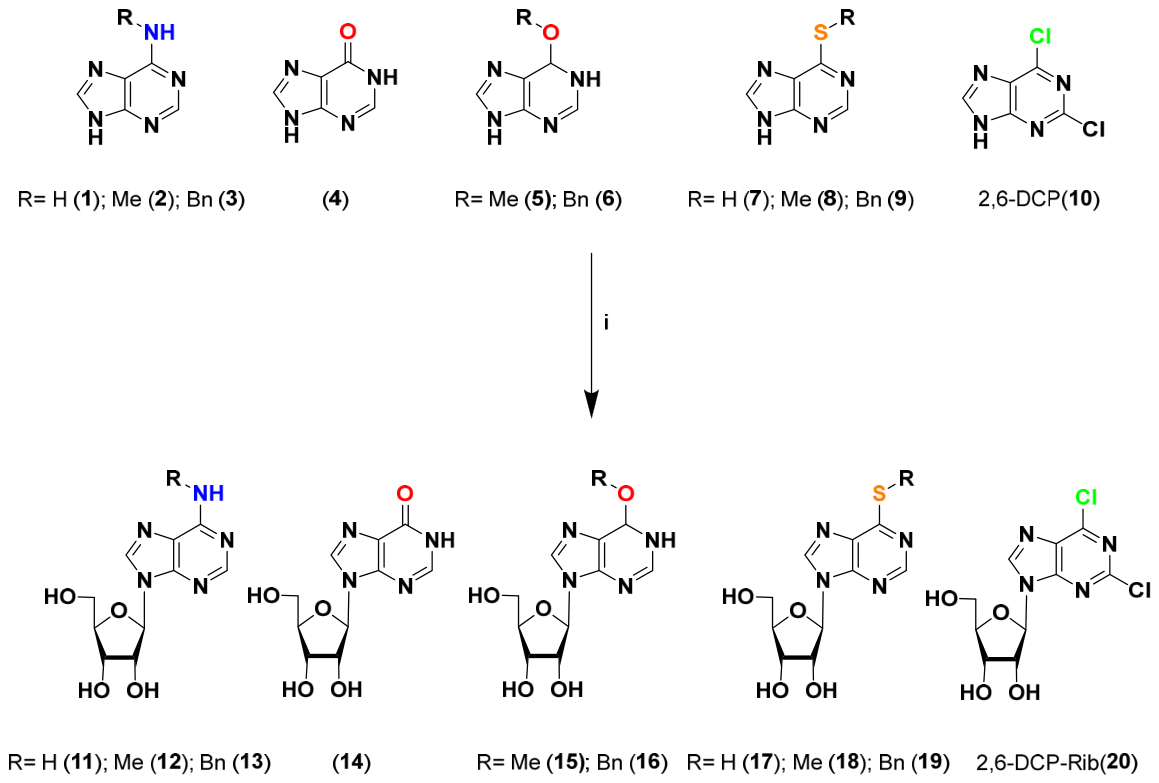
To study the effect of pH, adenine (Ade, 1), hypoxanthine (Hyp, 4), 6-mercaptopurine (6-MP, 7) and 2,6-dichloropurine (2,6-DCP, 10) (Scheme 1) were selected, containing an amino, carbonyl, sulfur or halogen substituent in the 6th position, respectively. The change in pH value had virtually no effect on the adenosine (Ado, 11) synthesis rate, except at pH 5.5, where a slight decrease in the rate of synthesis was observed. But even in this case, the conversion of Ade was complete within 3 h. We observed the opposite outcome in the case of Hyp: a rather significant rate drop at pH 5.5 (Figure 2), after 24 h the conversion of Hyp was about 85% (Table 1).
Scheme 1.
NP-catalyzed reactions of nucleoside formation. Reagents and conditions: (i) EcPNP (0.3 mM 7-mGuo: 0.2 mM Base: 0.1 Pi (1.5:1:0.5)), 37 °C, 50 mM NaOAc (pH 5.5); 50 mM Tris-HCl, (pH 7.0); 50 mM Tris-HCl, (pH 8.5). Me: –CH3, Bn: –CH2C6H5.
Figure 2.
Conversion of Ade and Hyp and synthesis of Ado and Ino. Conditions: 2 μL EcPNP (100 U/mL), 50 mM NaOAc, pH 5.5, 37 °C.
Table 1.
Enzymatic synthesis of nucleosides using EcPNP at different pH values (a).
Nevertheless, at pH 7.0 and 8.5, the rate of inosine (Ino, 14) synthesis was practically equal to the rate of Ado synthesis. To verify the discriminating effect (or lack thereof) of the 6-oxo group on the enzymatic glycosylation rate, we obtained a series of O6-, N6- and S6-substituted (methyl- and benzyl-) derivatives of Hyp (5, 6), Ade (2, 3), and 6-MP (8, 9), respectively, with which we performed transglycosylation. During the synthesis of O6-benzyl-inosine (O6-BnIno, 16) we observed a significant increase in its formation rate at pH 5.5 compared to that of Hyp. Thus, complete conversion of O6-BnHyp (6) occurred in approximately 40 min (while in the case of N6-BnAdo (13), it took only approx. 3 h). Transglycosylation of the O6-methyl-hypoxanthine (O6-mHyp, 5), which has the smallest possible alkyl element, also showed a positive effect of the substituent on the reaction rate. In this case, the rate of O6-mIno (15) formation was higher than that of N6-mAdo: approx. 68% in 20 min and 81% in 1 h, respectively (at pH 7.0 and 8.5, complete O6-mHyp conversion occurred in 1.5 h, and O6-mAde conversion in 2.5 h, Tables S3 and S5). The proposed mechanism of catalysis by EcPNP suggests [28] that the hydroxyl group of the Asp204 residue must be protonated so that this proton is subsequently transferred to the N7 atom of the heterocyclic base. According to other data [29], an additional hydrogen bond between the carbonyl group of the Asp204 residue and the carbonyl oxygen atom of the 6-keto group is also required for the productive orientation of the heterocyclic moiety of the substrate. It is possible that, at a reaction pH of 5.5, the stabilization of hypoxanthine in the active site is impeded, which may explain the sharp drop in the rate of its glycosylation. Conversely, the introduction of a substituent at the O6-position of hypoxanthine, by preventing binding or other interactions between the O6 of hypoxanthine and Asp204 at a reaction pH of 5.5, may contribute to the further stabilization of the heterocyclic base in the active site through the formation of non-specific π–π interactions involving Phe159 and Tyr160, leading to a sharp increase in the reaction rate (Table 1).
Studies conducted with 6-MP and its methyl (8) and benzyl (9) derivatives showed only a slight increase in the S6-benzyl-mercaptopurine riboside (17) formation rate compared to the S6-methyl derivative (18) at pH 5.5 and 7.0 (Table S4).
Similar to guanosine, several tautomeric forms are possible in inosine: three amino-oxo, and one imino-hydroxy. The change in the tautomeric form of the Hyp moiety does not affect the conformation of its nucleoside. The rate constant of the water-assisted proton transfer in inosine from the keto-enamine to enol-imine form is significantly large to generate imino-hydroxy tautomer (k = 5.64 × 101 s−1), whilst the time necessary to reach the equilibrium concentration of the 6-keto and 6-hydroxy tautomeric forms is 2.10 × 10⁻⁶ s [30].
As azole prototropic tautomerism, which creates N7H and N9H forms, is typical of purine base derivatives [31,32,33], we used the B3LYP-D4/6-311++G(d,p)/CPCM(water) method to find the differences in electronic energy (ΔE) and Gibbs free energy (ΔG) between the two tautomeric forms of the Hyp and 6-MP derivatives we were studying. Binding within the active site of EcPNP and, as a result, the rate of enzymatic glycosylation can be influenced by the relative thermodynamic stability of these forms [33]. For Ade, which reacts efficiently with EcPNP, the calculated relative energy of the N9H form is lower than that of the N7H form [34]. Both forms are energetically similar [33,35] in the case of Hyp, which manifests a significantly reduced conversion rate. The conversion rates of Hyp and 6-MP into their corresponding ribosides by EcPNP are lower at pH 5.5 than those of the O6-/S6-derivatives studied, as shown in Table 1 and Table S4. The methyl and benzyl substituents stabilize the N9H form, according to the computation results (Table 2), and could enhance the effectiveness of enzymatic glycosylation. Mercaptopurine was the sole compound for which the calculated relative energy of the N7H tautomer was lower than that of the N9H form. This may be one of the reasons why it demonstrates the lowest efficiency in enzymatic glycosylation among all the compounds studied. These results suggest a correlation between the relative stability of the N7H and N9H tautomers of purine bases and the efficiency of their enzymatic glycosylation by EcPNP. For 6-mercaptopurine, calculations carried out considering both the aqueous solution and the gold nanoparticles show that the experimental Raman spectrum is dominated by two tautomeric forms of the thione—thione (N1,N7) and thione (N1,N9), which are approximately equal in energy, while the authors did not require the thiol forms of 6-mercaptopurine to explain the observed spectral pattern [36].
Table 2.
Electronic energy differences (ΔE = EN7H − EN9H) and Gibbs free energy differences (ΔG = GN7H − GN9H) between the N7H and N9H forms of Hyp/O6-Hyp derivatives, 6-MP/S6-MP derivatives, and Ade (a).
When conducting studies with 2,6-DCP, as expected, the lowest synthesis rate of 2,6-dichloropurine riboside (2,6-DCP-Rib, 20) was observed at pH 5.5: 20 h after the initiation of the reaction, the yield of the target nucleoside was only 11%, while after 2.5 h at pH 7.0 and 8.5, the yield was 96.7% and 71.6%, respectively. The rate of the glycosyl donor 7-methylguanosine (7-mGuo) concentration decrease in all reactions performed rises from pH 5.5 to 8.5. This fact is apparently associated with the occurrence of side reactions of the nucleoside’s imidazole cycle non-specific cleavage [37,38]. Based on the obtained results, it can be concluded that conducting the reaction at pH 5.5 allows for almost 100% of the glycosyl donor target consumption for the target nucleoside formation, despite the reaction rate decreasing (in the case of hypoxanthine, more significantly). When transglycosylation is carried out at pH 7.0, the partial non-specific consumption of the nucleoside donor takes place due to the destruction of its imidazole cycle, and at pH 8.5 the donor is destroyed quite rapidly. If we disregard the consumption and/or non-targeted destruction of the donor, it does not seem advisable to carry out enzymatic transglycosylation at pH 5.5, especially in the case of hypoxanthine derivatives with a free carbonyl group at the 6th position of the heterocycle.
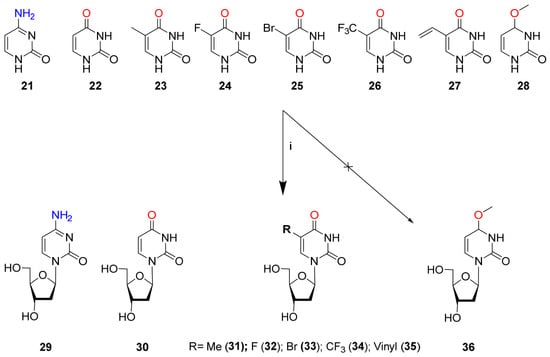
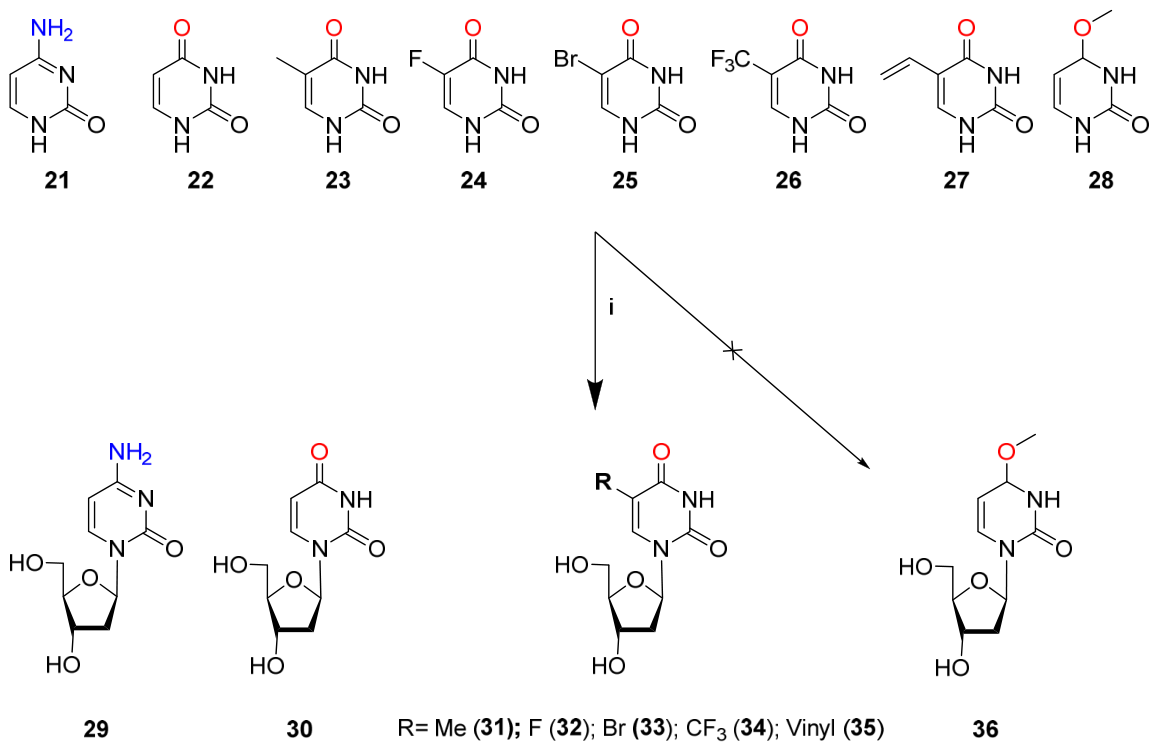
Natural nucleobases cytosine (Cyt, 21), uracil (Ura, 22), and thymine (Thy, 23) and modified heterocyclic bases 5-fluorouracil (5-FUra, 24), 5-bromouracil (5-BrUra, 25), 5-trifluoromethyluracil (5-CF3Ura, 26), 5-vinyluracil (5-VinUra, 27), and O4-methyluracil (O4-mUra, 28) (Table 2, Scheme 2) were used as acceptors. These heterocyclic bases were chosen to study the influence of the size and nature of the substituents at the O4- and 5th positions of uracil on the course of enzymatic transglycosylation at different pH values, as well as for their practical importance: some synthetic analogues of 2-deoxyuridine are currently used in clinical practice as drugs [39,40] and may be used as nucleoside labels [41].
Scheme 2.
NDT II-catalyzed reactions of nucleoside formation. Reagents and conditions: (i) LlNDTII, 0.1 mM Base: 0.3 mM 7-mdGuo (1:3), 20 °C, 50 mM NaOAc (pH 5.5), 50 mM Tris-HCl, (pH 7.0) or 50 mM Tris-HCl, (pH 8.5).
The results in Table 2 show that the pH of the reaction mixture can affect the reaction rate and product yields. For Cyt, the maximum reaction rate was achieved at pH 7.0, the reaction proceeded more slowly at pH 5.5, in both cases quantitative yields were obtained. At pH 8.5, the slowest reaction rate was observed, as well as a slight decrease in yield. For uracil derivatives, which contain a carbonyl group at the 4th position, the highest transglycosylation rate is observed at pH 5.5, and the lowest at pH 8.5. An effect of pH on the reaction rate and yield was also found in the presence of a substituent at the 5-position of uracil.
Maximum yields were observed at pH 7.0, with yields decreasing by approximately 10% at pH 5.5 and significantly decreasing at pH 8.5. The results of the study of the influence of pH on the transglycosylation reaction carried out with purine heterocyclic bases (Table 2) showed a similar trend as with pyrimidine compounds, but not as with transglycosylation catalyzed by EcPNP. For Hyp, the reaction proceeded faster at pH 5.5 than at pH 7.0, and no reaction was observed at pH 8.5. However, unlike O4-mUra, the methylated carbonyl group of Hyp does not hinder the reaction. This can be explained by the ability of the terminal carboxylate of Tyr157′ to form hydrogen bonds with the N7 atom of the purine. In the case of pyrimidine bases, a hydrogen bond is formed between the carboxyl group at the C-terminus and O4 [42]. The absence of changes in the rate and yield of reactions carried out with adenine at different pH values is additional evidence that the presence of a carbonyl group in the structure of the purine heterocyclic base-acceptor makes the rate and yield of enzymatic transglycosylation dependent on the pH value of the reaction medium.
During the experiments to determine the concentration of LlNDTII, it was discovered that the reaction yields at pH 8.5 were unusually dependent on the concentration of enzyme used, in addition to the expected change in the enzymatic transglycosylation rate at pH 5.5 and 7.0 (Table 2). This fact was also revealed by our colleagues [43] while this article was being prepared. Therefore, additional studies of transglycosylation reactions catalyzed by LlNDTI were carried out with the previously considered heterocyclic bases-acceptors and donor at pH 8.5, but with an increased enzyme concentration of 26 × 10−3 U (Table 3). The enzyme concentration was selected based on the obtained data (entry 5, Table S7) showing that this is the lowest concentration at which the maximum yield of the test reaction of 5-hmUra with 7-mdGuo is achieved at pH 8.5.
Table 3.
Enzymatic synthesis of 2′-deoxynucleosides using LlNDTII at different pH values (a).
The obtained data at pH 8.5 (Table 4) indicate that at an enzyme concentration of 26 × 10−3 U, in contrast to 7.8 × 10⁻³ U, quantitative yields are achieved in reactions with heterocyclic bases Cyt, Ura, Thy, 5-BrUra, Hyp, and O6-mHyp. Under these conditions, the conversion of 5-VinUra reached 88%, which is higher than the conversion of this base (using 7.8 × 10⁻³ U of enzyme) at both pH 5.5 and 7.0 (entry 16, Table 2). This may be due to the very low reaction rate, since monitoring its progress and determining the equilibrium state are complicated. Therefore, the lower yields at pH 5.5 and 7.0 may be the result of the reverse hydrolysis reaction. The reaction at pH 8.5 completely consumed the donor, so it is possible that increasing the acceptor:donor ratio could lead to even higher yields. In this case, the difference in yields at different pH values is independent of the reaction rate and target nucleoside hydrolysis.
Table 4.
Enzymatic synthesis of 2′-deoxynucleosides using LlNDTII at pH 8.5 (a).
In contrast to the heterocyclic base-acceptors conversions previously studied at an enzyme concentration of 26 × 10−3 U (Table 3), reactions with 5-FUra and 5-CF3Ura yielded modest yields of 31% and 25%, respectively. Doubling the enzyme activity in the reaction mixture to 52 × 10−3 units resulted in a quantitative yield for the reaction with 5-FUra and an 86% yield for 5-CF3Ura. In the case of the latter, complete consumption of the donor nucleoside was observed, as in the case of the reaction with 5-VinUra. Thus, when performing transglycosylation reactions at pH 8.5, a decrease in the reaction rate is observed. This favourably affects the ability to study the course of analytical reactions, since the reverse hydrolysis reaction is also slowed. At the same time, a higher enzyme concentration at pH 8.5 contributes to achieving the maximum possible yields. However, when performing preparative transglycosylation reactions catalyzed by LlNDTII, the forward and reverse reactions are already slower, especially with pyrimidine bases as acceptors, so it is not advisable to use buffer solutions with a pH of 8.5. Enzymatic transglycosylation at pH 5.5 is also not preferable, since reduced yields are observed in many studied reactions with different heterocyclic bases. We suppose the optimal pH value for scaling up transglycosylation reactions is 7.0.
3. Materials and Methods
The solvents and materials were reagent grade and were used without additional purification. Column chromatography was performed on silica gel (Kieselgel 60 Merck KGaA, Darmstadt, Germany, 0.040–0.063 mm). All reagents and solvents were purchased from Sigma Aldrich (Sigma-Aldrich, Inc., St. Louis, MO, USA) and used without additional purification. TLC was performed on an Alugram SIL G/UV254 (Macherey-Nagel, Düren, Germany) with UV visualization. Purine and pyrimidine bases were obtained from the Engelhardt Institute of Molecular Biology nucleoside collection. 7-mdGuo was obtained according to the previously elaborated procedure [14]. Thymidine (Sigma-Aldrich #89270), purine nucleoside phosphorylase E. coli (Sigma-Aldrich #N2415, EC 2.4.2.1), and Lactobacillus leichmannii nucleoside deoxyribosyltransferase II (Sigma-Aldrich #N2665, EC 2.4.2.6) were purchased from Sigma-Aldrich.
3.1. Selecting a Nucleoside Donor, Initial Concentrations and Molar Ratios of Substrates
Enzymatic transglycosylation is an equilibrium process; therefore, the reaction conditions were selected to maximize the shift in equilibrium towards the target nucleoside. For EcPNP-catalyzed reactions, 7-methylguanosine (7-mGuo) and a molar ratio of substrates of 1.5:1:0.5 (Nuc:Base:Pi) were selected, conditions that had previously shown excellent results [16]. For LlNDTII, we previously considered various donors (Thd, 2′-dIno and 7-methyl-2′-deoxyguanosine (7-mdGuo)) and donor-acceptor ratios of 1:1, 1:3, and 1:6 [44]. The use of 7-mdGuo also allows transglycosylation reactions with 5-substituted uracil derivatives and purine bases to be carried out with high yields, so 7-mdGuo was chosen for the study as the optimal carbohydrate residue donor in a 3-fold excess (Table S6).
3.2. Enzymatic Synthesis of Nucleosides (For Analysis, General Method)
The reactions were carried out in 1.5 mL plastic tubes (Eppendorf, Hamburg, Germany), the volume of the reaction mixture was 1 mL in 50 mM Tris—HCl or NaOAc (at pH 5.5, 7.0, and 8.5) buffer at 37 °C, with substrate concentrations of Base:Donor:Phosphate in the range 0.1–0.6 mM. The molar concentration ratio was 1:1.5:0.5 (Base:Donor:Phosphate) for EcPNP and 1:1 or 1:3 (Base:Donor) for LlNDTII. The reactions were catalyzed by the addition of 0.12 units (U) Lactobacillus leichmanii NDT II (Ll NDT II) or 0.3 U of EcPNP.
Enzymatic transglycosylation reactions were performed until equilibrium was established.
3.3. Choosing pH Values
When choosing pH values for the study, we were guided by literature data, which determined optimal pH values, as well as values at which enzyme activity was practically undetectable. Thus, pH values of 5.5, 7.0, and 8.5 were selected, lying within the minimum and optimum activity ranges for EcPNP [45] and LlNDTII [46]. When selecting a buffer system, we were guided by reliability and the minimal (or negligible) effect on the enzymatic activity of the enzymes used. The Tris-HCl buffer has a limited pH range (app. pH 7.0–9.2) within which it exhibits satisfactory buffer capacity. For pH 5.5 we used sodium acetate buffer (app. pH 3.6–5.6), which is also widely used in work relating to purification and precipitation of nucleic acids, enzyme crystallization and catalysis. To further check the possible influence (or its exclusion) of the buffer components on the enzyme activity at pH 5.5, a citrate buffer was also used to carry out the transglycosylation of Hyp + 7mGuo at pH 5.5.
3.4. Adjusting of Enzyme Quantity for Transglycosylation Catalyzed by LlNDTII
According to a prior study [44] on enzymatic transglycosylation catalyzed by LlNDTII, the synthesis of target nucleosides proceeds at varying rates with the same quantity of enzyme in the reaction mixture, contingent on the acceptor base’s structure. Therefore, to allow convenient monitoring of reactions and determination of the time difference to reach equilibrium at different pH values, the optimal amount of enzyme was selected using the example reaction of 5-hydroxymethyluracil (5-hmUra) with 7-mdGuo. This reaction occurs at an average rate (not too fast and not too slow), relative to other heterocyclic bases (Table S7). Since transglycosylation is a reversible reaction, the reverse reaction of the target nucleoside glycosidic bond hydrolysis begins immediately after equilibrium is reached. The data from Table S2 show that the amount of enzyme, added to the reaction mixture, predictably affects the enzymatic reaction rate. Increasing enzyme concentration increases both the rate of transglycosylation and the hydrolysis rate. Therefore, for analytical reactions (with low substrate concentrations) to capture the equilibrium state, it is preferable to use lower enzyme concentrations. However, at the lowest enzyme activity studied by us (2.6 × 10⁻³ U), transglycosylation proceeds too slowly, which makes it difficult to determine the heterocyclic base maximum conversion and reach the reaction plateau. Moreover, a lower yield was observed 24 h after the reaction was initiated; thus, it can be assumed that by this time the target nucleoside had already been partially hydrolyzed. Hence, for further studies of transglycosylation reactions with other heterocyclic bases, an enzyme activity of 7.8 × 10⁻³ U was selected, i.e., the minimum activity that allows for the most accurate determination of the equilibrium state. To ensure that pH does not affect the efficiency of the nucleoside donor used, a series of reactions was performed also with Thd as the glycosyl donor and 5-hmUra, varying the enzyme concentration. The data obtained (Table S8) showed that donor efficiency is independent of pH, and the same reaction patterns are observed regardless of the nucleoside donor used.
3.5. HPLC Analytical Experiments
An HPLC analysis was performed using an Akvilon (Moscow, Russia) HPLC system (2 × Stayer pumps (2nd series), a Stayer MS16 dynamic mixer and a Stayer 104 M UV-Vis detector. Enzymatic reactions were assessed by HPLC analysis (elution conditions and details can be found in the Supplementary Material). HPLC analysis was performed with a 20 μL analytical volume. HPLC analysis was run in a linear acetonitrile gradient in 0.06% (v/v) TFA/deionized water. The detailed analytical methods, the columns, and sorbents used, as well as the gradient rates and retention times of the compounds, are described in the Supplementary Material.
3.6. Software and Calculating
The Molecular Operating Environment (MOE, version 2019.0102; Chemical Computing Group, Montreal, QC, Canada) software package was used for molecular structure preparation, preliminary energy minimization using the PM3 method, and conformational searches (gradient convergence criterion: 0.01 kcal·mol−1·Å−1) [47]. The maximum number of iterations for the conformational search was 1000, while the maximum number of iterations for molecular mechanics minimization was 500. The lowest-energy conformers of the N7H and N9H tautomers were searched for using the LowModeMD method, with energy minimization employing the Amber10:EHT force field and the R-field solvent model.
Quantum chemical calculations were performed using the ORCA software package (ORCA, version 6.1.1; FACCTs GmbH, Recklinghausen, Germany) [48] within the framework of density functional theory (DFT) [49]. Molecular geometry optimization and the calculation of thermodynamic properties were carried out using the B3LYP hybrid functional with the D4 dispersion correction [50] and the 6-311++G(d,p) basis set. The effect of the aqueous environment was accounted for using the conductor-like polarizable continuum model (CPCM) [51]. Geometry optimization and convergence of the self-consistent field procedure were controlled using the TightOpt and TightSCF settings, respectively. Following geometry optimization, vibrational frequencies and thermochemical properties were calculated.
4. Conclusions
Based on the results, it can be concluded that the discriminatory effect of the hypoxanthine O6-oxo group on the rate of enzymatic transglycosylation in the reaction catalyzed by EcPNP at pH 5.5 is essentially eliminated when a substituent is added. A bulky lipophilic substituent may affect binding in the active centre of EcPNP and influence the reaction rate, as in the case of O6-BnHyp and S6-BnMP-Rib. Studies conducted with 6-MP and its derivatives showed an increase in S6-benzyl-mercaptopurine riboside formation rate compared to the S6-methyl derivative at pH 5.5 and 7.0. When the acceptor base is adenine, however, we observe only a negligible effect of substituents at the N6 position on the rate of transglycosylation, compared with a free amino group.
The results obtained from LlNDTII-catalyzed transglycosylation also indicate that the pH of the reaction mixture affects the reaction rate and product yield. For Cyt, which has a free amino group at the N4 position, the maximum reaction rate was achieved at pH 7.0; at pH 5.5, the reaction proceeded more slowly; nevertheless, quantitative yields were obtained in both cases. At pH 8.5, the lowest rate of cytidine formation was observed, along with a slight decrease in yield. For uracil derivatives containing a free carbonyl group at the 4th position, the highest rate of transglycosylation is observed at pH 5.5, and the lowest at pH 8.5. A change in the reaction rate was also observed depending on the nature of the substituent at the 5-position of uracil. Furthermore, a dependence of the yield of the target nucleoside on the concentration of LlNDTII was found.
Conducting enzymatic transglycosylation at pH 5.5 allows for almost 100% consumption of the target glycosyl donor for target nucleoside synthesis, despite the reaction rate decreasing (which is more significant in the case of hypoxanthine). The rate of the glycosyl donor 7-methylguanosine (7-mGuo) concentration decrease in all reactions performed rises from pH 5.5 to 8.5. If we disregard the consumption and/or non-targeted depletion of the donor, it does not seem advisable to carry out enzymatic transglycosylation at 5.5, especially in the case of hypoxanthine derivatives with a free carbonyl group at the 6th position of the heterocycle.
Supplementary Materials
The following supporting information can be downloaded at: https://www.mdpi.com/article/10.3390/ijms27219901/s1.
Author Contributions
Conceptualization, C.S.A.; methodology, C.S.A.; validation, M.A.K. and D.A.P.; formal analysis, I.A.O. and M.S.D.; investigation, M.A.K., D.A.P., I.A.O. and M.S.D.; resources, M.S.D.; software, I.A.O.; writing—original draft preparation, C.S.A.; writing—review and editing, C.S.A. and M.S.D.; supervision, C.S.A., M.S.D.; project administration, C.S.A.; funding acquisition, C.S.A. All authors have read and agreed to the published version of the manuscript.
Funding
This research was funded by the Russian Science Foundation, grant number 24-24-00542.
Institutional Review Board Statement
Not applicable.
Informed Consent Statement
Not applicable.
Data Availability Statement
The original contributions presented in this study are included in the article/Supplementary Material. Further inquiries can be directed to the corresponding author(s).
Conflicts of Interest
The authors declare no conflicts of interest.
References
- Parker, W.B. Enzymology of purine and pyrimidine antimetabolites used in the treatment of cancer. Chem. Rev. 2009, 109, 2880–2893. [Google Scholar] [CrossRef] [Scilit] [PubMed]
- Deval, J.; Symons, J.A.; Beigelman, L. Inhibition of viral RNA polymerases by nucleoside and nucleotide analogs: Therapeutic applications against positive-strand RNA viruses beyond hepatitis C virus. Curr. Opin. Virol. 2014, 9, 1–7. [Google Scholar] [CrossRef] [Scilit] [PubMed]
- De Clercq, E. Anti-HIV drugs: 25 compounds approved within 25 years after the discovery of HIV. Int. J. Antimicrob. Agents 2009, 33, 307–320. [Google Scholar] [CrossRef] [Scilit] [PubMed]
- Jordheim, L.P.; Durantel, D.; Zoulim, F.; Charles, D. Advances in the development of nucleoside and nucleotide analogues for cancer and viral diseases. Nat. Rev. Drug Discov. 2013, 12, 447–464. [Google Scholar] [CrossRef] [Scilit] [PubMed]
- Thomson, J.M.; Lamont, I.L. Nucleoside analogues as antibacterial agents. Front. Microbiol. 2019, 10, 952. [Google Scholar] [CrossRef] [Scilit] [PubMed]
- Frisch, J.; Maršić, T.; Loderer, C. A novel one-pot enzyme cascade for the biosynthesis of cladribine triphosphate. Biomolecules 2021, 11, 346. [Google Scholar] [CrossRef] [Scilit] [PubMed]
- Cruz, G.; Saiz, L.P.; Bilal, M.; Eltoukhy, L.; Loderer, C.; Fernández-Lucas, J. Magnetic multi-enzymatic system for cladribine manufacturing. Int. J. Mol. Sci. 2022, 23, 13634. [Google Scholar] [CrossRef] [Scilit] [PubMed]
- Holguin, J.; Cardinaud, R. Trans-N-Deoxyribosylase: Purification by Affinity Chromatography and Characterization. Eur. J. Biochem. 1975, 54, 505–514. [Google Scholar] [CrossRef] [Scilit] [PubMed]
- Kaminski, P.A. Functional Cloning, Heterologous Expression, and Purification of Two Different N-Deoxyribosyltransferases from Lactobacillus helveticus. J. Biol. Chem. 2002, 277, 14400–14407. [Google Scholar] [CrossRef] [Scilit] [PubMed]
- Holguin, J.; Cardinaud, R.; Salemink, C.A. Trans-N-Deoxyribosylase: Substrate Specificity Studies: Purine Bases as Acceptors. Eur. J. Biochem. 1975, 54, 515–520. [Google Scholar] [CrossRef] [Scilit] [PubMed]
- Whistler, R.L.; BeMiller, J.N. Methods in Carbohydrate chemistry. In General Methods, Glycosaminoglycans, and Glycoproteins; Stout, M.G., Hoard, D.E., Holman, M.J., Wu, E.S., Siegel, J.M., Eds.; Volume 7: Preparation of 2′-Deoxyribonucleosides via Nucleoside Deoxyribosyl Transferase; Academic Press: New York, NY, USA, 1976; pp. 19–24. [Google Scholar]
- Fresco-Taboada, A.; de la Mata, I.; Arroyo, M.; Fernández-Lucas, J. New insights on nucleoside 2′-deoxyribosyltransferases: A versatile biocatalyst for one-pot one-step synthesis of nucleoside analogs. Appl. Microbiol. Biotechnol. 2013, 97, 3773–3785. [Google Scholar] [CrossRef] [Scilit] [PubMed]
- Becker, J.; Brendel, M. Rapid purification and characterization of two distinct N-deoxyribosyltransferases of Lactobacillus leichmannii. J. Biol. Chem. 1996, 377, 357–362. [Google Scholar] [CrossRef] [Scilit] [PubMed]
- Drenichev, M.S.; Alexeev, C.S.; Kurochkin, N.N.; Mikhailov, S.N. Use of nucleoside phosphorylases for the preparation of purine and pyrimidine 2′-deoxynucleosides. Adv. Synth. Catal. 2018, 360, 305–312. [Google Scholar] [CrossRef] [Scilit]
- Rabuffetti, M.; Bavaro, T.; Semproli, R.; Cattaneo, G.; Massone, M.; Morelli, C.F.; Speranza, G.; Ubiali, D. Synthesis of ribavirin, tecadenoson, and cladribine by enzymatic transglycosylation. Catalysts 2019, 9, 355. [Google Scholar] [CrossRef] [Scilit]
- Alexeev, C.S.; Drenichev, M.S.; Dorinova, E.O.; Esipov, R.S.; Kulikova, I.V.; Mikhailov, S.N. Use of nucleoside phosphorylases for the preparation of 5-modified pyrimidine ribonucleosides. Biochim. Biophys. Acta (BBA)-Proteins Proteom. 2019, 1868, 140292. [Google Scholar] [CrossRef] [Scilit] [PubMed]
- Krenitsky, T.A.; Koszalka, G.W.; Tuttle, J.V. Purine nucleoside synthesis: An efficient method employing nucleoside phosphorylases. Biochemistry 1981, 20, 3615–3621. [Google Scholar] [CrossRef] [Scilit] [PubMed]
- Alexeev, C.S.; Kulikova, I.V.; Gavryushov, S.; Tararov, V.I.; Mikhailov, S.N. Quantitative prediction of yield in transglycosylation reaction catalyzed by nucleoside phosphorylases. Adv. Synth. Catal. 2018, 360, 3090–3096. [Google Scholar] [CrossRef] [Scilit]
- Kaspar, F.; Giessmann, R.T.; Hellendahl, K.F.; Neubauer, P.; Wagner, A.; Gimpel, M. General principles for yield optimization of nucleoside phosphorylase-catalyzed transglycosylations. ChemBioChem 2020, 21, 1428–1432. [Google Scholar] [CrossRef] [Scilit] [PubMed]
- Kaspar, F.; Brandt, F.; Westarp, S.; Eilert, L.; Kemper, S.; Kurreck, A.; Neubauer, P.; Jacob, C.R.; Schallmey, A. Biased Borate Esterification during Nucleoside Phosphorylase-Catalyzed Reactions: Apparent Equilibrium Shifts and Kinetic Implications. Angew. Chem. Int. Ed. 2023, 62, e202218492. [Google Scholar] [CrossRef] [Scilit] [PubMed]
- Cook, W.J.; Short, S.A.; Ealick, S.E. Crystallization and preliminary X-ray investigation of recombinant Lactobacillus leichmannii nucleoside deoxyribosyltransferase. J. Biol. Chem. 1990, 265, 2682–2683. [Google Scholar] [CrossRef] [Scilit]
- Kaminski, P.A.; Dacher, P.; Dugué, L.; Pochet, S. In vivo reshaping the catalytic site of nucleoside 2′-deoxyribosyltransferase for dideoxy-and didehydronucleosides via a single amino acid substitution. J. Biol. Chem. 2008, 283, 20053–20059. [Google Scholar] [CrossRef] [Scilit] [PubMed]
- Murakami, K.; Tsushima, K. Crystallization and some properties of purine nucleoside phosphorylase from chicken liver. Biochim. Biophys. Acta (BBA)-Enzymol. 1975, 384, 390–398. [Google Scholar] [CrossRef] [Scilit] [PubMed]
- Murakami, K.; Tsushima, K. Molecular properties and a nonidentical trimeric structure of purine nucleoside phosphorylase from chicken liver. Biochim. Biophys. Acta (BBA)-Protein Struct. 1976, 453, 205–210. [Google Scholar] [CrossRef] [Scilit] [PubMed]
- Milman, G.; Anton, D.L.; Weber, J.L. Chinese hamster purine-nucleoside phosphorylase: Purification, structural, and catalytic properties. Biochemistry 1976, 15, 4967–4973. [Google Scholar] [CrossRef] [Scilit] [PubMed]
- Lewis, A.S.; Glantz, M.D. Bovine brain purine-nucleoside phosphorylase purification, characterization, and catalytic mechanism. Biochemistry 1976, 15, 4451–4457. [Google Scholar] [CrossRef] [Scilit] [PubMed]
- Stein, R.L.; Cordes, E.H. Kinetic alpha-deuterium isotope effects for Escherichia coli purine nucleoside phosphorylase-catalyzed phosphorolysis of adenosine and inosine. J. Biol. Chem. 1981, 256, 767–772. [Google Scholar] [CrossRef] [Scilit]
- Koellner, G.; Bzowska, A.; Wielgus-Kutrowska, B.; Luić, M.; Steiner, T.; Saenger, W.; Stȩpiński, J. Open and closed conformation of the E. coli purine nucleoside phosphorylase active center and implications for the catalytic mechanism. J. Mol. Biol. 2002, 315, 351–371. [Google Scholar] [CrossRef] [Scilit] [PubMed]
- Bennett, E.M.; Li, C.; Allan, P.W.; Parker, W.B.; Ealick, S.E. Structural Basis for Substrate Specificity of Escherichia coli Purine Nucleoside Phosphorylase. J. Biol. Chem. 2003, 278, 47110–47118. [Google Scholar] [CrossRef] [Scilit] [PubMed]
- Markova, N.; Enchev, V. Tautomerism of inosine in water: Is it possible? J. Phys. Chem. B 2019, 123, 622–630. [Google Scholar] [CrossRef] [Scilit] [PubMed]
- Sečkářová, P.; Marek, R.; Maliňáková, K.; Kolehmainen, E.; Hocková, D.; Hocek, M.; Sklenář, V. Direct determination of tautomerism in purine derivatives by low-temperature NMR spectroscopy. Tetrahedron Lett. 2004, 45, 6259–6263. [Google Scholar] [CrossRef] [Scilit]
- Pullman, B.; Pullman, A. Electronic aspects of purine tautomerism. In Advances in Heterocyclic Chemistry; Katritzky, A.R., Boulton, A.J., Eds.; Academic Press: New York, NY, USA, 1971; Volume 13, pp. 77–159. [Google Scholar] [CrossRef] [Scilit]
- Fateev, I.V.; Antonov, K.V.; Konstantinova, I.D.; Muravyova, T.I.; Seela, F.; Esipov, R.S.; Miroshnikov, A.I.; Mikhailopulo, I.A. The chemoenzymatic synthesis of clofarabine and related 2′-deoxyfluoroarabinosyl nucleosides: The electronic and stereochemical factors determining substrate recognition by E. coli nucleoside phosphorylases. Beilstein J. Org. Chem. 2014, 10, 1657–1669. [Google Scholar] [CrossRef] [Scilit] [PubMed]
- Hanus, M.; Kabeláč, M.; Rejnek, J.; Ryjáček, F.; Hobza, P. Correlated ab initio study of nucleic acid bases and their tautomers in the gas phase, in a microhydrated environment, and in aqueous solution. Part 3. Adenine. J. Phys. Chem. B 2004, 108, 2087–2097. [Google Scholar] [CrossRef] [Scilit]
- Shukla, M.K.; Leszczynski, J. A DFT investigation on effects of hydration on the tautomeric equilibria of hypoxanthine. J. Mol. Struct. THEOCHEM 2000, 529, 99–112. [Google Scholar] [CrossRef] [Scilit]
- Cimino, P.; Musto, P.; Pannico, M.; Coppola, F.; Rega, N. Molecular Modeling of the Raman and SERS Response of 6-Mercaptopurine: Tautomerism, Surface Coverage, and Charge Transfer. J. Phys. Chem. C 2026, 130, 13824–13841. [Google Scholar] [CrossRef] [Scilit] [PubMed]
- Darzynkiewicz, E.; Labadi, I.; Haber, D.; Burger, K.; Lönnberg, H. 7-Methylguanine nucleotides and their structural analogues; protolytic equilibria, complexing with magnesium (II) ion and kinetics for alkaline opening of the imidazole ring. Acta Chem. Scand. Ser. B Org. Chem. Biochem. 1988, 42, 86–92. [Google Scholar] [CrossRef] [Scilit] [PubMed]
- Lahti, M.; Santa, H.; Darzynkiewicz, E.; Lönnberg, H. PH-independent depurination of 7-alkylguanosines and their 5′-monophosphates. Acta Chem. Scand. 1990, 44, 636–638. [Google Scholar] [CrossRef] [Scilit]
- Uchikubo, Y.; Hasegawa, T.; Mitani, S.; Kim, H.S.; Wataya, Y. Mechanisms of cell death induced by 5-fluoro-2′-deoxyuridine (FUdR)—Necrosis or apoptosis after treated with FUdR. Nucleic Acids Symp. Ser. 2002, 2, 245–246. [Google Scholar] [CrossRef] [Scilit] [PubMed]
- De Clercq, E. Selective anti-herpesvirus agents. Antivir. Chem. Chemother. 2013, 23, 93–101. [Google Scholar] [CrossRef] [Scilit] [PubMed]
- Goz, B. The effects of incorporation of 5-halogenated deoxyuridines into the DNA of eukaryotic cells. Pharmacol. Rev. 1977, 29, 249–272. [Google Scholar] [CrossRef] [Scilit]
- Armstrong, S.R.; Cook, W.J.; Short, S.A.; Ealick, S.E. Crystal structures of nucleoside 2-deoxyribosyltransferase in native and ligand-bound forms reveal architecture of the active site. Structure 1996, 4, 97–107. [Google Scholar] [CrossRef] [Scilit] [PubMed]
- Grogan, G.J.; Salihovic, A.; Ascham, A.; Taladriz-Sender, A.; Bryson, S.; Withers, J.; McKean, I.; Hoskisson, P.; Burley, G. Gram-scale enzymatic synthesis of 2′-deoxyribonucleoside analogues using nucleoside transglycosylase-2. Chem. Sci. 2024, 15, 15399–15407. [Google Scholar] [CrossRef] [Scilit] [PubMed]
- Konkina, M.A.; Drenichev, M.S.; Nasyrova, D.I.; Porozov, Y.B.; Alexeev, C.S. Studies on enzymatic transglycosylation catalyzed by bacterial Nucleoside deoxyribosyltransferase II and Nucleoside phosphorylase for the synthesis of pyrimidine 2′-deoxyribonucleosides containing modified heterocyclic base. Sustain. Chem. Pharm. 2023, 32, 101011. [Google Scholar] [CrossRef] [Scilit]
- Jensen, K.F.; Nygaard, P. Purine nucleoside phosphorylase from Escherichia coli and Salmonella typhimurium: Purification and some properties. Eur. J. Biochem. 1975, 51, 253–265. [Google Scholar] [CrossRef] [Scilit] [PubMed]
- Del Arco, J.; Acosta, J.; Fernández-Lucas, J. New trends in the biocatalytic production of nucleosidic active pharmaceutical ingredients using 2′-deoxyribosyltransferases. Biotechnol. Adv. 2021, 51, 107701. [Google Scholar] [CrossRef] [Scilit] [PubMed]
- Chemical Computing Group ULC. Molecular Operating Environment (MOE), Version 2019.0102; Chemical Computing Group ULC: Montreal, QC, Canada, 2019. [Google Scholar]
- Neese, F. Software update: The ORCA program system—Version 6.0. WIREs Comput. Mol. Sci. 2025, 15, e70019. [Google Scholar] [CrossRef] [Scilit]
- Parr, R.G. Density functional theory of atoms and molecules. In Horizons of Quantum Chemistry; Fukui, K., Pullman, B., Eds.; Springer: Dordrecht, The Netherlands, 1980; pp. 5–15. [Google Scholar] [CrossRef] [Scilit]
- Caldeweyher, E.; Ehlert, S.; Hansen, A.; Neugebauer, H.; Spicher, S.; Bannwarth, C.; Grimme, S. A generally applicable atomic-charge dependent London dispersion correction. J. Chem. Phys. 2019, 150, 154122. [Google Scholar] [CrossRef] [Scilit] [PubMed]
- Cossi, M.; Rega, N.; Scalmani, G.; Barone, V. Energies, structures, and electronic properties of molecules in solution with the C-PCM solvation model. J. Comput. Chem. 2003, 24, 669–681. [Google Scholar] [CrossRef] [Scilit] [PubMed]

Disclaimer/Publisher’s Note: The statements, opinions and data contained in all publications are solely those of the individual author(s) and contributor(s) and not of MDPI and/or the editor(s). MDPI and/or the editor(s) disclaim responsibility for any injury to people or property resulting from any ideas, methods, instructions or products referred to in the content. |
© 2026 by the authors. Licensee MDPI, Basel, Switzerland. This article is an open access article distributed under the terms and conditions of the Creative Commons Attribution (CC BY) license.