


Abstract
Earliness and plant architecture are major breeding targets in cucurbit crops because they influence crop duration, early yield, planting density, canopy management, and production efficiency. This review summarizes genetic, molecular, and genome-editing advances related to flowering, sex expression, fruit development, stem elongation, branching, and canopy architecture in cucumber, melon, watermelon, Cucurbita species, and other cucurbits. Current evidence shows that earlier flowering or increased femaleness does not necessarily lead to earlier commercial maturity, while compact growth must be evaluated together with yield, fruit quality, and environmental adaptation. CRISPR/Cas9 knockout remains the most established editing approach, whereas base editing, cis-regulatory editing, multiplex editing, developmental-regulator-assisted regeneration, and DNA-free RNP delivery offer promising routes toward more precise trait optimization. Major constraints include genotype-dependent transformation, pleiotropic effects, limited validation in elite germplasm, and scarce direct evidence for shortening fruit-development duration. An evidence-guided framework is proposed that links trait definition, functional genomics, target prioritization, tailored genome editing, whole-plant evaluation, and breeding deployment. Future progress will depend on quantitatively tuned alleles and coordinated optimization of reproductive timing, canopy architecture, productivity, fruit quality, and environmental stability.
1. Introduction
Cucumber (Cucumis sativus), melon (Cucumis melo), watermelon (Citrullus lanatus), squashes and pumpkins (Cucurbita spp.), and other related cucurbits are cultivated under increasingly intensive production systems. These systems favor rapid crop turnover, predictable harvest periods, and high early marketable yield. Consequently, earliness has substantial economic importance in protected cultivation, early-season field production, and multiple-cropping systems. It is also an important breeding target for reducing generation intervals. Genetic mapping studies in cucumber and other cucurbits have identified numerous loci associated with flowering time, female flowering, and maturity. However, the phenotypic effects of these loci often vary across developmental stages and environmental conditions [1,2,3,4]. Plant architecture determines how efficiently cucurbit canopies occupy space and convert intercepted light into marketable yield. Key architectural traits include vine length, internode length, branching pattern, leaf and petiole angle, and shoot determinacy. These traits influence planting density, pruning and training requirements, canopy light distribution, and compatibility with labor-saving or mechanized production systems. Natural regulatory variation at YABBY1, together with genome-edited compact-canopy modules, demonstrates that canopy architecture can be deliberately modified without treating dwarfism as the primary breeding objective [5,6]. Earliness and plant architecture are developmentally interconnected. Their coordination involves shoot apical meristem fate, floral transition, sex determination, hormone signaling, branching, internode elongation, and source–sink relationships. Temperature and photoperiod can modify determinate growth through TFL1-related and cold-responsive pathways [7,8]. In addition, interactions between flowering–branching modules and architecture-related genes can produce coordinated multi-trait phenotypes. Therefore, the central breeding challenge is not simply to shorten the crop cycle or reduce plant size independently. Rather, developmental timing and canopy architecture must be co-optimized without compromising fertility, yield, fruit quality, or environmental stability.
Reproductive-transition earliness, as defined in this review, refers to the timing of floral transition and first flowering. These traits provide informative measures of reproductive development but do not directly indicate commercial maturity. Comparative analyses of PEBP family genes and flowering regulators in cucumber support a broadly conserved FT/TFL1-related regulatory framework [9,10]. At the same time, species-specific allelic variation can modify this framework. For example, variation in CsPHYB can advance flowering, indicating that photoreceptor signaling also contributes to reproductive-transition earliness [11]. Female-flowering earliness describes the timing and abundance of female reproductive sites. Relevant traits include days to the first female flower, node of the first female flower, female-flower frequency, and the capacity to set fruit soon after reproductive transition. These traits are particularly important in monoecious and gynoecious cucurbits because fruit production depends directly on the availability of female flowers. Sex-expression genetics should therefore be considered an integral component of reproductive earliness. However, gynoecy or a lower node of the first female flower does not, by itself, demonstrate earlier physiological or commercial maturity [12,13,14]. Fruit developmental earliness refers to the interval from anthesis or fruit set to commercial harvest. Physiological ripening represents a later developmental program and should be distinguished from this interval. Its biological meaning also differs between climacteric and non-climacteric cucurbits. Studies of rootstocks and production systems in watermelon further show that flowering time and fruit maturity can respond differently to cultivation conditions [15]. Accordingly, delayed ripening or extended shelf life should not be classified as early maturity solely because a fruit-development gene has been edited.
Stem and vine architecture encompasses total vine length, plant height, internode length, node-production dynamics, dwarfism, and compact growth. These traits determine the physical dimensions of the canopy and the spatial position of reproductive nodes. However, internode shortening does not necessarily alter the node number at which the first female flower appears. Comparative analyses among cucumber cultivars further indicate that node production and internode development change dynamically along the vine [16]. Thus, vine length should be interpreted as the integrated outcome of both node-production rate and internode elongation. A broader definition of plant architecture also includes determinacy, axillary-bud initiation and outgrowth, lateral-branch number, leaf size and shape, petiole and leaf angle, tendril identity, and other outputs of shoot meristem development. These components are not genetically independent. Regulators of tendril development and lateral-organ identity can also influence flowering, branching, and yield-related traits [17,18]. Such pleiotropic effects are important when evaluating architectural genes as breeding or genome-editing targets.
Genome editing provides a translational bridge between genetic discovery and crop improvement. It complements QTL mapping, GWAS, mutant analysis, and functional genomics by enabling the direct manipulation of candidate and functionally validated genes. In this review, the available evidence is organized in a stepwise framework that begins with phenotype definition and proceeds through genetic and molecular characterization, regulatory pathway analysis, gene validation, genome-editing evidence, edited phenotypes, breeding value, current limitations, and prospective editing strategies. This framework distinguishes three related but conceptually distinct levels of evidence: causal biological knowledge, technical editability, and agronomic deployability.
This review focuses on cucumber, melon, watermelon, Cucurbita species, and other Cucurbitaceae for which sufficiently strong genetic and functional evidence is available. Despite substantial progress in identifying genes associated with earliness and plant architecture, the extent to which these genes have been directly validated through genome editing remains uneven across traits and species. Moreover, many genes supported by genetic, molecular, or functional evidence have not yet been evaluated as genome-editing targets. The translational potential of these unedited candidates therefore remains insufficiently resolved. Given these knowledge gaps, the review evaluates the current evidence for genome-edited genes controlling earliness and plant architecture and identifies functionally supported genes that remain credible targets for future editing. It further examines editing strategies that may enable the coordinated improvement of early maturity and compact plant architecture. Notably, the central challenge is not simply to modify individual traits, but to determine whether developmental timing and canopy architecture can be co-optimized while maintaining fertility, yield, fruit quality, and environmental stability.
More broadly, the review assesses how advances in functional genomics and genome editing can translate expanding knowledge of earliness and plant architecture into precision breeding of cucurbit crops. Particular emphasis is placed on linking biological causality with editability and agronomic utility. To address these knowledge gaps, this narrative review draws primarily on published studies of genome editing, genetic and functional characterization, and developmental and agronomic traits in cucurbit crops. Genetic mapping and omics studies are also considered to explain how candidate genes have been identified, while studies in non-cucurbit species are used only to provide mechanistic or methodological context. Because the available evidence varies across genes, traits, and species, we classify it into three levels according to the strength and type of experimental support. Level I includes genes directly edited in cucurbit species with experimentally characterized effects on the trait of interest. Level II includes genes supported by strong genetic or functional evidence in cucurbits but without direct genome-editing validation of that trait. Level III includes candidate genes identified mainly through QTL mapping, genome-wide association studies (GWAS), transcriptomic analyses, comparative genomics, or orthology, for which causal or functional evidence remains limited. These levels are assigned separately for each trait, as genome-editing validation of a plant architecture phenotype does not necessarily demonstrate an effect on earliness. Furthermore, the strength of biological evidence is evaluated independently of potential breeding value, since a validated gene or edited allele may not always confer agronomically desirable traits.
2. Genome-Editing Platforms in Cucurbits
2.1. CRISPR/Cas9 and Transgene-Free Editing
CRISPR/Cas9 remains the most widely used genome-editing platform in cucurbits. Early studies demonstrated efficient gene knockout in watermelon [19] and the recovery of non-transgenic edited cucumber plants after segregation [20]. More recent work has focused on developmental traits with direct breeding relevance, including sex determination, internode elongation, canopy geometry, and flowering–branching modules [6,21,22,23,24]. The key question is therefore no longer simply whether mutations can be generated, but whether a specific edited allele can improve an agronomic trait in a breeding-relevant genetic background. In sexually propagated cucurbits, segregation of editing constructs can yield transgene-free progeny, as shown in cucumber [20,21]. The approach works when transformation and generation advancement are efficient, but it does not remove the genotype dependence and tissue-culture burden that regeneration itself carries.
2.2. Transformation and Regeneration
The recovery of edited plants, rather than guide-RNA design, remains a major practical constraint in most cucurbits. Conventional Agrobacterium-mediated transformation is strongly genotype dependent and can result in low regeneration efficiency, long tissue-culture cycles, chimerism, and somaclonal variation. An optimized transformation procedure enabled stable editing of ERECTA homologs in cucumber, melon, and squash and provided the first reported heritable genome editing in melon and squash [23]. Developmental regulators provide a complementary way to improve regeneration. In watermelon, AtGRF5 increased transformation efficiency to approximately 24.7% and was combined with CRISPR editing [25]. In melon, AtGRF5 and AtPLT5 improved transformation in two genotypes and enabled recovery of CmPDS-edited plants from recalcitrant material [26]. These advances are important because genome editing must ultimately work in elite commercial germplasm, not only in transformation-friendly laboratory genotypes.
Editing efficiency measured in transformed tissue is not breeding efficiency. Chimeric shoots, poor germline transmission, and genotype-specific regeneration can stop apparently efficient editing systems from yielding stable elite lines. Platform comparisons should report regeneration rate, editing frequency, zygosity, chimerism, germline transmission, and recovery of transgene-free progeny as separate metrics. Genome structure also affects target design. Cucumber, melon and watermelon are commonly diploid crops with 2n = 14, 24 and 22 chromosomes, respectively [27,28,29]. Cultivated Cucurbita pepo generally has 2n = 40 chromosomes and retains signatures of an ancient whole-genome duplication [30]. Reference assembly sizes, estimates of genome size and ploidy must be distinguished. Functional target-copy number, paralog sequence similarity and genotype-specific sequence variation, rather than chromosome number alone, influence editability (Supplementary Table S1). Transformation, regeneration and editing efficiencies measure different outcomes. In a watermelon AtGRF5-assisted transformation system, a transformation efficiency of approximately 24.73% was reported in the tested background [25]; this is not the proportion of independently regenerated plants with stably inherited, transgene-free target edits. Comparisons should report explicit denominators and distinguish explants, transformed tissues, regenerated individuals, independent events, edited genotypes, chimeric plants and heritable progeny (Supplementary Table S2).
2.3. Multiplex Editing
A Pol II-driven sgRNA/Csy4 system increased editing efficiency in melon and watermelon and frequently generated large-fragment deletions between paired target sites [31]. Although these experiments did not target earliness or plant architecture, they provide a technical basis for future multi-locus or multi-element editing of developmental networks. For ideotype breeding, the value of multiplex editing lies in combining appropriately tuned alleles across partially independent pathways rather than simply stacking severe null mutations. A useful goal would be to combine earlier reproductive transition, moderate internode shortening, and reduced nonproductive branching. The number of edited loci is less important than the resulting whole-plant phenotype. The potential of multiplex editing is supported by the reported performance of the Pol II–Csy4 system, which achieved PDS editing efficiencies of 42.82% in melon and 41.48% in watermelon, compared with 25.20% using a Pol II–tRNA system in melon [31]. However, these results reflect editing efficiencies under specific experimental conditions and do not necessarily translate into stable inheritance, recovery of homozygous mutants, or improved breeding outcomes. Beyond technical efficiency, successful multiplex editing also depends on the careful selection of target genes. Although genes within the PEBP, WIP, ERECTA, and ACS/ACO families may share sequence similarities, they can have distinct functions in plant growth and development. Therefore, the functions, expression patterns, and potential interactions of individual genes should be evaluated before simultaneously editing multiple members of the same family. Such an approach would help identify suitable gene combinations for improving earliness and plant architecture while minimizing unintended effects.
2.4. Precision Editing
Cytosine base editing has been demonstrated in melon using CmeIF4E as the target, showing that defined nucleotide conversions can be generated without relying on double-strand-break repair [32]. This proof of concept is relevant to the future recreation of favorable natural alleles for quantitative developmental traits. More precise editing platforms should be described conservatively. Base editing is well established in several crops [33], and prime editing can generate precise sequence changes in cucumber, melon and pumpkin [34]. However, robust and routinely deployable prime-editing systems for cucurbit earliness or architecture genes have not yet been demonstrated. Adenine base editing and prime editing should therefore be regarded as emerging or future strategies for these traits until direct cucurbit evidence becomes available. The practical performance of precision editing in elite cucurbit genotypes also depends on editing windows, sequence context, delivery, regeneration, molecular validation and stable inheritance. DNA-free delivery can avoid stable foreign-DNA integration but does not by itself eliminate genetic mosaicism or the need for progeny confirmation. Claims of molecular precision must therefore be distinguished from reproducible recovery of suitable breeding material.
2.5. Regulatory and DNA-Free Editing
Regulatory editing is particularly attractive for dosage-sensitive developmental genes. The YABBY1 Bush locus provides a direct cucurbit example: editing a conserved 5′UTR region produces graded changes in stem length rather than a single knockout phenotype [5]. This result illustrates why promoter, untranslated-region, enhancer, or allele-specific editing may be more suitable than complete gene disruption for quantitative ideotype design. Preassembled CRISPR/Cas ribonucleoproteins avoid stable foreign-DNA integration and have long been attractive for DNA-free plant editing [35]. In melon, particle bombardment of Cas9 RNPs into shoot apical meristems generated heritable CmACO1 edits without conventional cell culture [36], a direct demonstration of a DNA-free in planta route in a cucurbit crop. Cas9-mediated knockout and conventional transformation are currently the most established cucurbit technologies. Developmental-regulator-assisted regeneration, cytosine base editing, improved multiplex systems, and in planta RNP delivery are promising but less broadly validated across genotypes. Routine prime editing, systematic promoter editing, and broadly genotype-independent tissue-culture-free editing remain future objectives. Maintaining these distinctions is important to avoid equating technical feasibility with breeding readiness. Representative platforms and their current development status are summarized in Table 1.
Table 1.
Genome-editing platforms and delivery systems in major cucurbit crops.
3. Genetic Basis of Earliness
3.1. Flowering and Meristem Regulation
Floral transition in cucurbits is controlled by homologs of well-known flowering and meristem regulators, although the strength of functional evidence differs among species. Comparative analysis of the PEBP family shows diversification in FT/TFL1-related expression and interaction patterns [10]. In cucumber, TFL1/TFL1d respond to temperature and photoperiod and inhibit determinate growth [7], while CsTFL1 interacts with CsNOT2a to maintain indeterminate meristem activity [37]. These findings place PEBP-family genes at the intersection of flowering time and shoot determinacy rather than identifying a single universal ‘earliness gene.’ Some cucurbit loci also provide clear links between environmental signals and development. A 5.5 kb LTR-retrotransposon insertion in cucumber CsPHYB causes a long-hypocotyl, early-flowering phenotype [11], while a cold-shock protein induced at low temperature modulates determinate growth [8]. These results make light- and temperature-response pathways relevant to protected-cultivation breeding, but they also emphasize the need to test edited alleles across environments rather than relying on strong loss-of-function mutations. Meristem identity ties reproductive timing to architecture. CsLFY is needed for shoot-meristem maintenance and flower development and acts with CsWUS [38]; CsCLV2 loss disturbs shoot-apical-meristem maintenance and determinacy [39]. In watermelon, ClTFL1 and its GRF partners offer direct evidence that a meristem-related module can jointly govern flowering and lateral branching [24].
3.2. Sex Determination and Female Flowering
Sex determination is an important component of reproductive earliness because fruit production requires female reproductive organs. A WIP-family repressor contributes to androecy and the evolution of dioecy in cucurbits [40], and the andromonoecious sex-determination gene predates the divergence of Cucumis and Citrullus [41]. Direct editing of WIP1 homologs in cucumber and watermelon, discussed in Section 4, further supports the conserved role of this pathway. Ethylene is the best-characterized hormonal pathway controlling sex determination in cucurbits [12,13]. In cucumber, CRISPR/Cas9 and complementary genetic analyses established ACS1G as the gene responsible for gynoecy at the F locus [42]. In watermelon, CitACS4 regulates monoecy/andromonoecy through ethylene biosynthesis [43], whereas a separate partial-andromonoecy locus identified by BSA-seq and GWAS remains unresolved at the causal-gene level [44]. In Cucurbita pepo, the ethylene receptors CpETR1A, CpETR1B, and CpETR2B contribute to female-flower initiation and sex determination [45,46]. CpACO1A is involved in ethylene biosynthesis and female-flower development [47], while CpMYB62 regulates the genetic network controlling the female floral transition [48].
Auxin also contributes to the sex-determination network. Direct deletion of cucumber CsARF3 causes an androecious phenotype, whereas overexpression increases the number of female flowers, demonstrating an essential role in carpel development and sex determination [49]. CsERF31 forms a positive feedback loop that promotes female-flower development [50], and expression differences associated with the F and M loci further support ethylene-mediated regulation [51]. In C. pepo, the jasmonate-biosynthesis gene CpLOX3A affects male and female flower opening and early fruit development through jasmonate–ethylene crosstalk [52]. Additional regulatory layers include temperature-associated DNA methylation changes in cucumber [53], epigenetic regulation in melon [54], and an miR164-resistant CpCUC2B mutation that alters carpel arrest and floral-boundary specification in C. pepo [55].
Together, these studies show that ethylene-centered regulation is broadly conserved across cucumber, melon, watermelon, and Cucurbita, but the specific genes, floral phenotypes, and breeding consequences differ among species [41,56,57]. Therefore, functional evidence from one cucurbit species should not be assumed to predict the effect of editing an orthologous gene in another species.
3.3. Female-Flower Position and Capacity
Female-flower timing, nodal position, and frequency decide when potential fruiting sites become available. QTL analysis has identified loci associated with early female flowering in zucchini [4], while genetic resources in cucumber include loci related to flower and fruit traits [58]. These female-flowering traits should be measured separately from days to first flower because the timing of male and female flowering can be genetically regulated differently. Female-flower earliness should also be distinguished from compact plant architecture. Short internodes reduce the physical height of each node but do not necessarily reduce the node number at which the first female flower appears. Therefore, a dwarf or compact plant may appear to bear fruit closer to the ground simply because its nodes are more closely spaced, rather than because female flowers develop earlier. When sex-expression alleles are combined with compact architecture, earlier female flowering should therefore be confirmed by measuring the node number of the first female flower and/or the time to female flowering, rather than inferred from plant height alone.
3.4. Fruit Set and Maturity
Early flowering does not necessarily lead to early yield because fruit set and subsequent fruit development are separate stages. Ethylene biosynthesis and signaling are involved in fruit set and early fruit development in zucchini squash [59]. Jasmonate also contributes to this developmental stage: mutation of CpLOX3A in C. pepo affects flower opening and promotes parthenocarpic fruit development, demonstrating crosstalk between jasmonate and ethylene during flower maturation and early fruit development [52]. In cucumber, SF1 regulates the stability of ACS2, thereby controlling ethylene dosage, cell division, and fruit elongation [60]. These findings demonstrate important hormonal control of fruit set and early fruit growth, but they do not show that fruits reach commercial maturity earlier.
The interval from flowering to harvest is influenced by several processes, including parthenocarpy, pollination and fertilization, ovary development, cell division, and cell expansion. Effects on any of these processes should therefore be distinguished from a direct reduction in fruit-development duration. Fruit ripening must also be considered separately. Ethylene plays a major role in the ripening of climacteric melon, whereas ripening is regulated differently in non-climacteric cucumber and watermelon [61]. Genome-editing studies should therefore distinguish among fruit set, early fruit growth, the duration from anthesis or fruit set to commercial harvest, physiological ripening, and shelf life. A change in one of these traits should not automatically be interpreted as earlier commercial maturity. Earliness endpoints should be reported separately: days to floral transition, node and days to first female flower, first successful fruit set, the interval from anthesis or fruit set to a crop-specific commercial harvest standard, days to first marketable harvest, and cumulative early marketable yield. Cucumber and summer squash are commonly harvested as immature fruits, whereas melon and watermelon have different harvest and quality criteria. Earlier flowering or increased femaleness should not be described as improved early marketable yield unless the latter was directly measured under a specified harvest window.
Comparisons with other crops provide hypotheses but not direct evidence of shorter cucurbit harvest intervals. In tomato, CRISPR disruption of RIN alters fruit ripening without establishing earlier commercial harvest, while natural rin, nor and Cnr alleles show interacting and allele-dependent ripening phenotypes [62,63]. FW2.2-related mechanisms principally concern fruit growth and size, which should not be equated with a reduction in anthesis-to-harvest duration. Existing cucurbit mechanisms involving SF1–ACS2 and CpLOX3A provide initial functional leads [52,60]; causal effects on commercial developmental duration remain to be tested.
3.5. Mapping to Edit-Ready Targets
Earliness is a complex quantitative trait that is strongly influenced by environmental conditions. QTL studies in bitter gourd, citron watermelon, zucchini, cucumber, and other cucurbits have identified loci associated with flowering time, female-flower timing or position, fruit traits, and other earliness-related agronomic traits [2,3,4,58,64]. However, identifying a QTL or marker associated with a trait does not directly provide a suitable target for genome editing. Because many loci have relatively small effects, further fine mapping is needed to identify the causal gene or regulatory variant responsible for the observed phenotype. Potential editing targets should then be evaluated through functional validation, assessment of the direction and strength of the allele effect, analysis of possible pleiotropic effects, and consideration of the intended breeding objective. These steps are particularly important for Level III candidates identified mainly through QTL, GWAS, or omics studies, because editing an annotated gene located within a mapped region may not reproduce the phenotype associated with that region. At present, the strongest Level I evidence for earliness-related traits includes direct editing of the ClTFL1–ClGRF module and ClPID for flowering-related phenotypes, and CsWIP1, ClWIP1, ACS1G, and CsARF3 for sex expression and female-flower development [17,21,22,24,42,49]. Direct editing of ClAP1 also provides Level I evidence for its role in floral initiation, but knockout inhibits floral initiation and therefore does not represent an earliness-improving allele [17]. Similarly, direct editing of CmACO1 provides Level I evidence for fruit-ripening modification, but the reported phenotype is delayed ripening and extended shelf life rather than earlier commercial maturity [36]. Other genes have strong functional evidence but do not yet provide direct genome-editing evidence for the focal earliness phenotype. These Level II targets include CsTFL1/CsTFL1d, CsPHYB, CsLFY/CsWUS, CsCLV2 in the context of earliness, CitACS4, several ethylene receptors and ACO/ERF-related regulators, CpMYB62, CpCUC2B, CpLOX3A, and SF1/ACS2 [7,11,37,38,39,43,45,46,47,48,50,52,55,60]. Notably, CsCLV2 has direct genome-editing evidence for plant architecture, but the reported edited phenotype does not establish earlier flowering or earlier commercial maturity [39]. Level III evidence includes unresolved QTLs and loci associated with flowering time, female-flower position, sex expression, and other earliness-related traits [2,3,4,44,58,64]. An important remaining gap is the genetic control of the period from fruit set to commercial harvest. Compared with flowering and sex determination, direct genome-editing evidence for shortening fruit-development duration and achieving earlier commercial maturity is still very limited in cucurbits.
4. Genome Editing for Earliness
4.1. Flowering and Meristem Editing
Direct genome-editing evidence for flowering time remains limited in cucurbits compared with the large number of genes and loci identified through genetic mapping. However, studies in watermelon have provided clear evidence that genome editing can be used to modify flowering time. CRISPR/Cas9 knockout of ClTFL1 resulted in earlier flowering and fewer lateral branches and tendrils, while knockout of ClGRF8 or ClGRF12 in the same regulatory module also promoted earlier flowering and reduced lateral branching [24]. These findings provide Level I evidence that the same regulatory module can influence both flowering time and plant architecture. However, the simultaneous changes in several traits also indicate a risk of pleiotropic effects. Therefore, complete loss-of-function alleles of these genes may not always be suitable for breeding elite cultivars. A similar issue is seen with other developmental regulators in watermelon. CRISPR/Cas9 knockout of ClPID produced dwarf plants that flowered earlier but also developed abnormal floral organs and round, non-lobed leaves [17]. In the same study, editing ClTEN disrupted tendril development, whereas editing ClAP1 inhibited floral initiation [17]. These results demonstrate that genes controlling lateral-organ development can be successfully edited, but they also show that strong gene disruption may cause undesirable changes in other organs or developmental processes. For breeding purposes, weaker alleles or regulatory and tissue-specific editing may therefore be more appropriate when the aim is to modify flowering time or plant architecture while minimizing unwanted developmental effects.
4.2. Sex Determination Editing
CRISPR/Cas9 disruption of CsWIP1 produced non-transgenic gynoecious cucumber plants with substantially more female flowers [21]. This provides Level I evidence that genome editing can be used to modify sex expression and increase the number of female reproductive sites, which is also useful for hybrid seed production. However, producing more female flowers does not necessarily result in earlier commercial maturity. Earlier maturity can only be demonstrated if subsequent processes, such as fruit set and the time from anthesis to harvest, are also evaluated. In watermelon, CRISPR/Cas9 editing of ClWIP1 similarly produced gynoecious plants [22], providing independent evidence for the conserved role of WIP1 in cucurbit sex determination. As in cucumber, this finding demonstrates successful modification of sex expression but does not by itself demonstrate earlier fruit maturity. Two additional cucumber genes have Level I evidence for direct modification of sex expression. CRISPR/Cas9 and complementary genetic analyses established ACS1G as the gene responsible for gynoecy at the F locus [42]. Direct deletion of CsARF3 causes androecy, whereas overexpression increases the number of female flowers [49]. These studies demonstrate direct manipulation of genes controlling female-flower development and sex expression. However, as with WIP1, changes in sex expression should not be interpreted as earlier commercial maturity unless fruit set, fruit-development duration, and harvest timing are also measured. Other components of the sex-determination network remain Level II for the breeding outcomes considered here. In watermelon, CitACS4 has strong functional genetic evidence for the regulation of monoecy/andromonoecy but has not been directly validated through genome editing for the focal trait [43]. In C. pepo, CpETR1A/CpETR1B/CpETR2B, CpACO1A, and CpMYB62 have functional evidence from mutant and genetic analyses [45,46,47,48], while CsERF31 has strong functional evidence in cucumber [50]. CpCUC2B also affects carpel arrest and floral-boundary specification in C. pepo [55]. In contrast, the partial-andromonoecy locus identified in watermelon by BSA-seq and GWAS remains Level III because its causal gene has not yet been resolved [44]. Because many of these regulators participate in broader hormone-signaling and developmental pathways, future editing strategies should consider allele strength, tissue or developmental-stage specificity, and possible pleiotropic effects. The breeding value of edited sex-expression alleles should ultimately be assessed by their effects on fruit set, early yield, and commercial maturity rather than by female-flower number alone.
4.3. Fruit Development and Maturity Editing
DNA-free in planta RNP editing of CmACO1 in melon reduced ethylene production and extended fruit shelf life [36]. This study demonstrates that heritable genome editing can be achieved through in planta RNP delivery and that this approach can be used to modify fruit ripening. However, the edited phenotype was delayed ripening and longer shelf life rather than earlier commercial maturity. Therefore, this study should not be considered direct evidence that genome editing can shorten the crop cycle. Compared with the progress made in editing flowering time and sex determination, direct genome editing to shorten the period from anthesis to commercial harvest remains limited in cucurbits. Future studies should identify and edit genes that specifically control the duration of fruit development, accurately measure the time from anthesis or fruit set to commercial maturity, and evaluate edited lines under different environmental conditions. Such studies will be necessary to determine whether earlier maturity is caused by the edited allele itself rather than by environmental stress or abnormal fruit development that may reduce fruit quality. A research strategy for fruit-development earliness should begin with crop- and market-specific commercial harvest criteria, followed by time-resolved phenotyping and combined mapping, transcriptomic and functional analyses. Candidate alleles should be validated before editing, with quantitative or regulatory changes considered when complete knockout risks disrupting fruit quality. Edited materials should be compared with appropriate controls for fruit set, anthesis-to-harvest duration, marketable size, quality, early marketable yield and total yield in representative environments. Candidate effects inferred only from ripening or fruit size must remain explicitly provisional.
4.4. Target Prioritization for Earliness
We prioritized genes and loci related to earliness using the three evidence levels defined in the Introduction (Table 2). Level I indicates direct genome-editing evidence for a relevant reproductive trait in cucurbits; Level II indicates strong functional evidence without direct editing validation of the specific earliness outcome; and Level III covers candidate loci identified mainly through genetic mapping. These levels describe the strength and relevance of the evidence, not whether an allele is ready for breeding. Level I entries include ClTFL1/ClGRFs, ClPID, CsWIP1, ClWIP1, ACS1G, and CsARF3 [17,21,22,24,42,49]. However, their reported effects are not interchangeable: some influence flowering time, whereas others primarily affect sex expression or female-flower development. Two additional edited genes illustrate why the phenotype must be considered carefully. ClAP1 knockout prevents floral initiation, confirming its role in flowering but not providing an allele that promotes earliness [17]. Editing CmACO1 reduces ethylene production and delays fruit ripening, extending shelf life rather than advancing commercial maturity [36]. Level II includes genes with cucurbit-specific functional evidence related to flowering, meristem activity, sex determination, flower opening, or fruit development, but without direct editing evidence that establishes an improvement in the relevant earliness outcome. These include CsTFL1/CsTFL1d, CsPHYB, CsLFY/CsWUS, CsCLV2, CitACS4, CpETR1A/CpETR1B/CpETR2B, CpACO1A, CpMYB62, CsERF31, CpCUC2B, CpLOX3A, and SF1/ACS2 [7,11,37,38,39,43,45,46,47,48,50,52,55,60]. For example, CsCLV2 has been edited successfully, but the reported dwarf and determinate growth phenotype does not demonstrate earlier flowering or commercial maturity [39]. It is therefore classified as Level II specifically for earliness, even though it has direct editing evidence for plant architecture. Level III comprises mapped loci associated with flowering time, the timing or position of female flowers, sex expression, and maturity-related traits [2,3,4,44,58,64]. Before these loci can be considered defined editing targets, the causal genes or variants must be identified, their effects and direction confirmed, and their performance tested across genetic backgrounds and environments. Overall, a higher evidence level does not necessarily imply greater breeding value: a mapped locus could yield a favorable allele after validation, while a directly edited gene could produce undesirable effects or substantial pleiotropy.
Table 2.
Evidence classification and breeding relevance of earliness-related genes and loci in cucurbit crops.
Successful genome editing alone is therefore not sufficient for breeding application. Edited lines should be evaluated throughout the major stages of reproductive development, including floral transition, appearance of the first female flower, first fruit set, fruit developmental duration, commercial maturity, and early yield. Studies should also evaluate allele strength, stable inheritance, pleiotropic effects, and agronomic performance under production-relevant environments. Together, these measurements can determine whether an edited allele is not only effective at modifying the target trait but also useful for breeding. The principal earliness-related genes, their evidence levels, editing status, and breeding implications are summarized in Table 2. Studies in Table 2 report different outcomes rather than a single measure of earliness. Editing ClTFL1/ClGRFs affects both flowering and branching [24], while editing CsWIP1 or ClWIP1 changes sex expression [21,22]. ClPID knockout promotes earlier flowering but also causes marked developmental defects [17]. By contrast, CmACO1 editing delays ripening and improves shelf life [36]. Thus, evidence that an edited gene changes one reproductive trait should not be taken as proof of earlier harvest or higher early yield. Table 2 identifies the observed phenotype and explains what remains unproven for breeding.
5. Genetic Regulation of Plant Architecture
5.1. Meristem Fate and Determinacy
Plant growth habit is strongly influenced by the activity and developmental fate of the shoot apical meristem. In cucumber, CsTFL1 helps maintain shoot apical meristem activity and prevents determinate growth and terminal flower formation through its interaction with CsNOT2a [37]. A premature-stop allele of CsTFL1 causes the determinate-2 phenotype and is also associated with earlier flowering and changes in branching [65]. In watermelon, the branchless gene Clbl encodes a TFL1 protein that regulates the number of lateral branches [66]. Direct genome editing provides further evidence for the role of this gene family: editing the ClTFL1–ClGRF module affects both flowering time and lateral branching [24]. Together, these studies show that TFL1-related genes can influence both plant architecture and reproductive timing, making them important targets for coordinating growth habit, branching, and flowering in cucurbit breeding. Other genes involved in shoot meristem maintenance also have important effects on plant architecture. Loss of CsCLV2 in cucumber causes dwarfism and premature termination of the shoot apical meristem [39]. CsLFY is also required for shoot meristem maintenance and flower development through its interaction with CsWUS [38]. Because these genes regulate fundamental processes in meristem development, strong disruption may affect several developmental traits at the same time. Therefore, the strength and spatial pattern of gene modification should be carefully considered when these genes are targeted for breeding. For breeding applications, TFL1-related genes are promising targets because they regulate meristem fate, flowering time, and branching. However, the effects of different alleles and the intended harvesting system should be considered when selecting targets. In contrast, disrupting CLV2 or LFY may impair meristem maintenance and reproductive development. Therefore, weaker alleles or modifications to gene regulation may be preferable when the goal is to achieve determinate growth without premature meristem termination.
5.2. Stem Growth and Compactness
Gibberellin (GA) metabolism and signaling play major roles in controlling internode length in cucurbit crops. In cucumber, CsERECTA promotes stem elongation by regulating GA biosynthesis [67]. Mutation of ent-kaurenoic acid oxidase causes GA deficiency and dwarfism [68], while CsIREH1 regulates plant height by affecting DELLA stability [69]. CsDELLA1 acts as a negative regulator of GA-mediated growth [70]. Similar GA-related mechanisms have been identified in other cucurbits. Mutations in Cldf/GA3ox cause dwarfism in watermelon [71,72]. In squash, CpDw and CmaGA2ox2 encode or are associated with GA2-oxidase activity that restricts internode elongation [73,74], while mutation of LacDWARF1 causes GA-deficient dwarfism in sponge gourd [75]. Together, these studies show that GA-related regulation of stem growth is widely conserved across cucurbit species. However, for breeding purposes, moderate reductions in internode length are likely to be more useful than severe GA-deficient dwarfism.
Brassinosteroid (BR) metabolism is another important regulator of compact growth. In cucumber, CsCYP85A1 has been proposed as a candidate gene for the super compact-1 mutation [76]. Mutation of CsDET2 causes systemic BR deficiency and produces a super-compact phenotype [77], while mutations in CsDWF5 and CsDWF7 disrupt sterol or BR biosynthesis and also result in compact growth [78,79]. Direct genome-editing evidence is available for another BR-related regulator. In watermelon, ClDUF21 interacts with the BR-biosynthetic protein ClDWF1, and genome editing of ClDUF21 and its cucumber homolog produces similar compact phenotypes [80]. These findings support a conserved role for BR-related pathways in the control of cucurbit plant stature.
Auxin transport and signaling also contribute to stem elongation. In watermelon, the dwarf gene Cldw-1 encodes an ABCB auxin transporter [81], and another mutation involving an ABC transporter has also been associated with dwarfism [82]. In melon, CmSi encodes an ERECTA-like receptor kinase that regulates stem elongation through auxin signaling and interacts with CmPIN2 [83]. In comparison, cucumber CsERECTA influences stem elongation through GA-related regulation [67]. These findings suggest that related receptor-kinase systems can contribute to stem-growth regulation through different hormone-related mechanisms in different cucurbit species.
Stem growth is also controlled by mechanisms beyond hormone metabolism and signaling. In cucumber, deletion of the cyclin-dependent kinase inhibitor CsSMR1 reduces both internode cell number and cell size, resulting in dwarf and determinate growth [84]. Other genes have been identified as candidates but still require stronger functional evidence. The classic cucumber cp locus was fine-mapped to a 220 kb region containing a CKX homolog as a proposed candidate, although its causal role has not been functionally confirmed [85]. CsCLAVATA1 has also been proposed as a candidate associated with a cucumber dwarf mutation [86]. In watermelon, ClNAC100 positively regulates GA-related and expansin-associated growth and affects both plant height and fruit size [87], while additional dwarf-associated loci have been identified through fine mapping or bulked-segregant analysis [88,89]. In melon, bulked-segregant analysis identified a genomic region associated with short internodes [90]. These studies illustrate an important distinction for genome-editing research: genes identified within mapped regions should not be treated as validated editing targets until their causal roles have been confirmed.
Despite differences among species, compact growth in cucumber, watermelon, melon, squash/pumpkin, and Luffa is repeatedly associated with GA and BR metabolism, auxin transport and signaling, receptor kinases, cell-cycle regulation, and meristem-related processes. However, the specific causal alleles are often species dependent. Quantitative genetic analysis of internode length in winter squash [91] and high-density mapping of the dwarf-vine trait in pumpkin [92] further indicate that plant architecture can be influenced by both major genes and the broader polygenic background.
For breeding, the value of compact growth should be judged by plant performance under the intended production system rather than by plant height alone. Severe disruption of hormone pathways may produce very short plants but can also reduce vigor, leaf area, fertility, or fruit growth. In contrast, moderate internode shortening may allow higher planting density and reduce the labor required for training and canopy management. Therefore, the breeding objective should be to obtain an appropriate degree of compactness while maintaining normal growth and reproductive performance, rather than simply producing the strongest possible dwarf phenotype. Direct editing of ERECTA-family genes and the YABBY1 5′UTR provides higher-priority evidence for controllable stem architecture [5,23,67]. By contrast, severe GA- or BR-deficient dwarf phenotypes can reduce vigor and may be poor commercial candidates. Alleles that moderately shorten internodes while preserving reproductive performance should be prioritized over maximal dwarfism.
5.3. Branching and Axillary Growth
Branching in cucurbits is controlled by several interacting hormonal and environmental pathways. In cucumber, CsBRC1 suppresses axillary-bud outgrowth by directly repressing the auxin efflux carrier CsPIN3 [93]. The CsTIE1–CsAGL16 and CsAGL16–CsGRF1 regulatory modules also control lateral-bud outgrowth through ABA catabolism [94,95]. In addition, the CsPHYB–CsPIF4–CsBRC1 module connects light signaling with ABA-dependent regulation of branching [96]. These studies provide strong functional evidence for several regulatory pathways that could be targeted to reduce excessive vegetative branching. Direct CRISPR/Cas9 editing validates CsTIE1, CsAGL16, and CsGRF1 for architectural phenotypes; CsPIF4 has direct functional disruption evidence and an independently reported CRISPR knockout phenotype [94,95,96,97]. Other pathway components must be assessed individually, and Level I status does not establish improved commercial yield. From a breeding perspective, the aim should not be to eliminate lateral branches completely, but to reduce unnecessary vegetative growth while retaining productive branches that contribute to flowering and fruit yield.
Branching is also genetically regulated in other cucurbit crops. In watermelon, ClLs is involved in lateral-organ initiation [17], Clbl/TFL1 controls lateral-branch number [66], and the ClTFL1–ClGRF module affects both branching and flowering [24]. In melon, CmSVPc is required for lateral-branch development [98], and QTL mapping has identified additional candidate loci associated with branch number [99]. A dwarf and branchless watermelon germplasm combining Cldw-1 and Clbl further demonstrates that different architecture alleles can be combined in the same genetic background [100]. This example shows that combining genes for plant height and branching is already feasible through conventional allele pyramiding and provides a useful basis for future multiplex genome-editing strategies. Branching targets should be assessed individually for direct editing, expression pattern, environmental sensitivity and productive lateral-branch retention. CsTIE1, CsAGL16 and CsGRF1 have direct CRISPR evidence, but the direction of CsGRF1 loss-of-function is increased rather than reduced branching [94,95]. Quantitative regulation, rather than complete suppression of laterals, is preferable when fruit production relies on side shoots.
5.4. Leaf and Canopy Architecture
Leaf angle, size, and shape are important components of canopy architecture because they influence how plants occupy space and intercept light. In cucumber, CsABCB19 encodes an auxin transporter, and its mutation produces erect leaves and a more compact leaf architecture [101]. CsIAGLU also regulates leaf petiole angle through auxin homeostasis, and CRISPR/Cas9 knockout directly demonstrated its role in petiole-angle control [102]. However, CsIAGLU knockout increases petiole angle [102]. Therefore, if the breeding objective is to develop a compact canopy for dense planting, simply knocking out CsIAGLU would not be the preferred strategy. Instead, breeding or editing approaches would more likely aim to maintain or strengthen alleles associated with smaller petiole angles or to increase CsIAGLU activity. Other developmental regulators affect leaf size and shape. In cucumber, WOX1 controls leaf vein patterning and leaf size [103], while transcriptomic analysis of the LITTLELEAF phenotype suggests the involvement of auxin- and cytokinin-related regulatory networks [104]. Mutation of CsGME produces small, wrinkled leaves [105], and CsRAX factors affect leaf size and fruiting ability through auxin glycosylation [106]. In watermelon, ClLL1 regulates lobed-leaf development by modifying auxin distribution [107]. Transcriptome profiling in melon also suggests that phytohormone-related pathways are involved in controlling the angle between the leaf stalk and stem [108]. Together, these studies show that leaf architecture is controlled by several developmental and hormone-related pathways.
For breeding, however, a compact leaf or canopy phenotype should be evaluated under the planting density for which it is intended. CRISPR/Cas9 knockout of CsHLS1 in cucumber reduces petiole angle, leaf size, and overall plant width [6]. The edited line maintained total yield at normal planting density and showed higher photosynthetic rates and increased early yield at one higher planting density, although its full-season yield performance under high-density conditions still requires further validation [6]. This study is therefore an important example of evaluating an edited architectural trait not only by its morphological phenotype, but also by its performance within a specific production system. These findings highlight the importance of selecting appropriate editing strategies based on gene-specific effects and evaluating canopy-related traits in terms of photosynthetic performance, fruit set, and marketable yield at the intended planting density [6,102].
5.5. Tendril and Lateral-Organ Development
Tendrils are characteristic lateral organs of cucurbits, and their development is closely connected with the development of branches, leaves, and flowers. In watermelon, studies of ClLs and CRISPR-edited ClTEN, ClPID, and ClAP1 show that changes in these developmental regulators can affect tendrils together with other lateral organs [17]. In summer squash, a pleiotropic mutation in a tendril-related TCP gene is associated with multiple flowering and increased yield [18]. These findings show that tendril development cannot be considered independently from other reproductive and vegetative traits. This developmental connection is important when tendril-related genes are considered as breeding or genome-editing targets. Removing tendrils or other lateral structures may simplify the canopy, but strong disruption of lateral-organ development could also have undesirable effects on flowering or reproduction. Therefore, the breeding value of a tendril-related phenotype should be evaluated together with its effects on other organs and on yield. Where strong loss-of-function alleles cause undesirable effects, weaker or regulatory alleles may provide a better way to reduce unwanted vegetative structures while retaining beneficial reproductive traits. Tendril and lateral-organ regulators should be approached cautiously because severe ClPID- and ClLs-associated perturbations can also affect floral and leaf development [17]. Where feasible, weaker or spatially restricted alleles merit testing. Fruit set, fertility, productive branching and management savings—not tendril absence alone—should determine breeding priority.
5.6. Hormonal Integration
Several hormone pathways contribute to the regulation of cucurbit plant architecture, but the strength of evidence differs among them. Gibberellin (GA) and brassinosteroid (BR) are the best-supported hormonal pathways controlling internode elongation and dwarfism. Natural, induced, and genome-edited alleles affecting these pathways have been reported across several cucurbit genera [67,71,72,73,74,77,80]. The repeated involvement of GA and BR across species suggests that these pathways have conserved roles in stem-growth regulation. However, many GA- or BR-deficient mutants show severe dwarfism, indicating that complete loss of gene function may not always produce a phenotype suitable for breeding.
Auxin, ABA, and light signaling also contribute to the regulation of branching and leaf architecture. In cucumber, regulatory modules such as CsBRC1–CsPIN3 and CsPHYB–CsPIF4–CsBRC1 connect auxin transport, ABA-related regulation, and light signaling with axillary-bud growth [93,96]. CsPIF4 also promotes hypocotyl elongation in response to high temperature [97]. Because some of these pathways respond strongly to environmental conditions, edited phenotypes should be evaluated across relevant environments rather than under a single growth condition. Other hormonal pathways may also contribute to cucurbit architecture, but the current evidence is less complete. Cytokinin-related candidates and ethylene-mediated reproductive pathways may influence architectural traits, although their cucurbit-specific evidence is currently weaker than that for GA, BR, or auxin. Strigolactone is an important regulator of branching in other plant species, but current evidence in cucurbits is not sufficient to consider it an established genome-editing pathway for combined earliness and architecture breeding. Until stronger cucurbit-specific causal evidence becomes available, these less well-supported pathways should be presented as possible mechanisms or future editing targets rather than as validated breeding targets.GA, BR and auxin pathways are supported as major architectural regulators, but perturbation of central components may affect many organs. The CsTIE1–CsAGL16 ABA-related pathway also connects branching and drought responses [94,95], illustrating a potential architecture–stress trade-off. Edited genotypes should be compared for internodes, reproductive sites, marketable productivity and relevant environmental responses before hormone-pathway alleles are advanced.
6. Genome Editing for Plant Architecture
6.1. ERECTA Editing and Compact Architecture
ERECTA-family genes are among the best-supported genome-editing targets for compact plant architecture in cucurbits. Using an optimized transformation system, targeted editing of ERECTA homologs produced stable plants with shorter internodes and more compact growth in cucumber, melon, and squash [23]. The similar phenotypes observed across these species support a conserved role of ERECTA-family genes in stem growth and show that the same editing strategy can be applied to several major cucurbit crops. Further evidence comes from cucumber CsERECTA. Map-based cloning followed by CRISPR validation showed that CsERECTA knockout reduces endogenous GA levels and stem elongation, while application of exogenous GA3 partially restores the dwarf phenotype [67]. CsERECTA therefore represents a Level I architecture target supported by both direct genome editing and evidence for its role in GA-related stem growth. Shorter internodes and a smaller canopy may be useful for dense planting and could reduce the labor required for crop training and management. However, the degree of growth reduction is important. Complete loss of ERECTA function may produce stronger compactness than is desirable for commercial cultivars. Therefore, regulatory or partial-loss-of-function alleles should be compared with complete knockouts to identify an appropriate degree of compactness in elite breeding backgrounds.
6.2. YABBY1 Regulatory Editing
The YABBY1 Bush locus provides a clear example of using regulatory editing to produce different degrees of compact growth. A conserved B-region in the YABBY1 5′UTR regulates translation efficiency. Deletion of this region increases YABBY1 protein accumulation and suppresses stem elongation [5]. CRISPR/Cas9 editing of the YABBY1 5′UTR produced shortened-stem phenotypes in pumpkin, cucumber, and watermelon [5]. Importantly, this approach generated a series of alleles with different effects rather than a single knockout phenotype. YABBY1 therefore provides Level I evidence that cis-regulatory editing can be used to modify a quantitative architecture trait in cucurbits. This example also has broader value for genome-editing-based breeding. For developmental genes whose effects depend on gene dosage, editing regulatory regions may allow the strength of the phenotype to be adjusted without completely disrupting gene function. Different alleles can then be evaluated to identify the degree of compactness that best fits planting density, fruiting habit, and the canopy requirements of individual cucurbit crops.
6.3. Hormone-Linked Compactness
Genome editing has also directly validated genes associated with hormone-regulated compact growth. In watermelon, CRISPR/Cas9 disruption of ClDUF21 causes pronounced dwarfism, and the interaction between ClDUF21 and the BR-biosynthetic protein ClDWF1 links this phenotype to BR homeostasis [80]. Editing the cucumber homolog CsDUF21 similarly shortens internodes [80]. These results provide Level I evidence for a conserved role of DUF21 in compact growth across cucurbit species. However, severe dwarfism may also reduce plant vigor or reproductive performance and therefore requires careful evaluation before breeding use. Mutations that strongly disrupt GA- and BR-related genes can also produce dwarf or super-compact plants [68,71,72,73,77,79]. Although these studies clearly demonstrate the importance of GA and BR pathways in plant stature, severe hormone-deficient phenotypes may not be suitable for commercial production. When the breeding objective is moderate internode shortening rather than extreme dwarfism, approaches such as base editing, promoter editing, or recreation of favorable natural alleles may be more appropriate than complete loss of gene function.
6.4. Meristem and Canopy Editing
Genome editing of meristem-related genes can also modify plant architecture. Loss of CsCLV2 function in cucumber causes dwarf and determinate growth, and genome-edited mutants reproduce this phenotype [39]. CsCLV2 can therefore be classified as a Level I architecture target. However, premature termination of the shoot apical meristem may have broad developmental effects because determinate growth changes both the duration and spatial pattern of reproductive development. This pleiotropy must be considered when CsCLV2 alleles are evaluated for breeding. Canopy architecture can also be modified directly through genome editing. CRISPR/Cas9 disruption of CsHLS1 reduces leaf petiole angle, leaf size, and overall plant width, while functional analysis identifies CsHLS1 as part of the CsHLS1–CsSCL28 regulatory module [6]. The edited line maintained yield at normal planting density and showed improved photosynthetic performance and increased early yield at one higher planting density, although its full-season yield under high-density conditions still requires further validation [6]. This study is particularly useful because the edited phenotype was evaluated not only at the level of plant morphology but also in relation to planting density and crop performance.
6.5. Branching and Lateral-Organ Editing
Some genome-edited genes affect more than one component of plant architecture. In watermelon, editing the ClTFL1–ClGRF module changes both flowering time and lateral branching [24]. This makes the module relevant to both earliness and plant architecture and shows that genome editing can modify these two traits together. However, strong loss-of-function alleles may reduce branching more than is desirable and could affect reproductive capacity. The appropriate degree of branch reduction therefore needs to be determined for breeding applications.
Editing of other lateral-organ regulators in watermelon further illustrates the limitations of complete gene knockout. ClPID editing causes dwarfism and earlier flowering but also produces abnormalities in floral organs and leaves, while disruption of ClLs can eliminate branches, tendrils, and flowers [17]. These experiments provide important Level I functional evidence, but the resulting phenotypes may not be directly suitable for breeding. They also show that successful genome editing alone does not establish breeding value; the effects of an edited allele on plant growth, reproduction, and other agronomic traits must also be evaluated.
6.6. Evidence and Breeding Readiness
For plant architecture, Level I evidence refers to genes or regulatory regions that have been directly edited in cucurbits with a reported architectural phenotype. However, direct editing does not necessarily mean that the resulting allele is suitable for breeding. Current Level I targets include ERECTA-family genes, the YABBY1 cis-regulatory region, CsHLS1, CsCLV2, ClDUF21/CsDUF21, the ClTFL1–ClGRF module, ClPID/ClLs/ClTEN, CsIAGLU, CsIREH1, CsTIE1, CsAGL16/CsGRF1, CsPIF4, ClNAC100, CsRAXs, and ClLMI1 [5,6,17,23,24,39,67,69,80,87,94,95,96,102,106,107]. The YABBY1 example is particularly informative because editing its regulatory region generated alleles with different effects rather than a single knockout phenotype [5]. In contrast, strongly pleiotropic edited mutants such as ClPID and ClNAC100 show that direct functional validation does not necessarily produce an allele that is immediately useful for breeding [17,87]. Level II includes genes with strong functional evidence in cucurbits but without direct genome-editing evidence for the architectural trait considered here. Representative examples include CsTFL1, Clbl, CsBRC1–CsPIN3, CsABCB19, CsDELLA1, CmSVPc, CsWOX1, CsGME, and several GA- and BR-related dwarf genes [37,65,66,68,70,71,72,73,74,75,76,77,78,79,81,82,83,84,93,98,101,103,105]. These genes provide well-supported biological targets, but direct editing and evaluation of the desired architectural phenotype are still needed before they can be considered Level I targets. Level III includes unresolved candidate genes, QTLs, and regulatory pathways associated with plant height, branching, internode length, leaf size, or canopy architecture through mapping or omics studies [76,85,86,88,89,90,91,92,99,104,108,109]. These targets require further resolution of the causal gene or variant and validation of its phenotypic effect before specific genome-editing strategies can be designed. Importantly, evidence level and breeding value should be considered separately. Moving a target toward practical breeding requires not only successful editing but also selection of an appropriate allele strength, confirmation of stable inheritance, and direct evaluation of yield, fertility, plant vigor, and management benefits under relevant production systems. Table 3 summarizes the major plant-architecture targets, their evidence levels, editing status, and potential breeding value or limitations. Importantly, similar compact phenotypes may arise through distinct mechanisms, with different implications for breeding. For example, ERECTA-family editing affects internode elongation [23,67], YABBY1 regulatory editing enables graded changes in stem growth [5], whereas CsCLV2 loss leads to premature meristem termination [39]. Thus, breeding value should be assessed not by reduced plant size alone, but by the underlying mechanism, allele effects, and potential trade-offs in plant vigor and reproductive productivity. Supplementary Table S2 provides reported editing outcomes, available quantitative phenotypic data, and evidence limitations to support this assessment.
Table 3.
Evidence classification and breeding relevance of plant-architecture genes and loci in cucurbit crops.
7. Integrating Earliness and Plant Architecture
Earliness and plant architecture are closely connected through meristem fate, branching, internode elongation, leaf architecture, and reproductive development. However, modifying one of these traits does not necessarily improve the other. For example, the switch between determinate and indeterminate growth changes the duration of vegetative development and can concentrate reproduction into a shorter period, but it does not automatically lead to earlier marketable yield. CsTFL1 alleles link meristem termination with flowering and branching [37,65], while Clbl/TFL1 and the edited ClTFL1–ClGRF module similarly regulate branch number in watermelon [24,66]. These findings identify meristem fate as an important connection between earliness and architecture, but the effects on harvest earliness still need to be measured directly.
Hormonal pathways provide additional links between reproductive timing and plant architecture. Auxin contributes to several components of this network, including CsARF3 in sex determination [49], CsBRC1–CsPIN3 in branching [93], CsABCB19 and CsIAGLU in leaf architecture [101,102], and ClPID/ClLs-related lateral-organ development in watermelon [17]. This broad involvement makes auxin signaling a promising target for coordinated trait improvement, but strong disruption of central auxin transport or response components may also cause substantial pleiotropic effects. GA and BR mainly regulate internode elongation and plant vigor, whereas ethylene has major roles in sex expression, fruit set, and ripening. Together, these hormone pathways connect canopy development with the timing and strength of reproductive sinks [42,56,60,77,80]. These connections also create important trade-offs. Reduced vegetative growth should not be assumed to redirect resources automatically toward earlier yield. Faster flowering may shorten the vegetative phase but can also reduce the source capacity required for subsequent fruit growth. The ClTFL1/ClGRF and ClPID editing phenotypes illustrate this issue, as early flowering was accompanied by substantial changes in branching, plant stature, or organ morphology [17,24]. Similarly, reducing nonproductive branches can lower pruning requirements and improve light penetration, but excessive suppression of branching may remove reproductive sites in genotypes that bear fruit on lateral vines. Branching alleles should therefore be evaluated according to crop species, fruiting habit, and harvest system rather than branch number alone. Severe GA- or BR-related mutations can generate strong compactness, but often at the cost of plant vigor, organ size, or reproductive performance. For breeding purposes, moderate compactness is therefore likely to be more useful than extreme dwarfism.
The same principle applies to reproductive traits. Increasing the number or earliness of female flowers provides more potential sites for fruit production, but early marketable yield ultimately depends on successful fruit set and sufficient assimilate supply. CsHLS1-edited plants provide an example in which a compact canopy was evaluated together with photosynthesis and yield across planting densities [6], while female-flower regulators can increase the availability of female reproductive sites [21,50]. Combining these traits should therefore be assessed at the whole-plant level, with particular attention to source–sink balance, rather than evaluating architecture or reproductive development separately. Figure 1 summarizes these major cross-trait relationships. On this basis, the desired combination of earliness and architecture should be defined according to the production system. In protected fresh-market production, a useful ideotype would combine a reasonably early reproductive transition, strong but manageable femaleness, fruiting on the main vine, few unnecessary lateral branches, moderate internode shortening, and leaf angles that maintain favorable light distribution at high planting density. The breeding goal is rapid early yield with reduced training and pruning labor, rather than maximal dwarfism. In dense open-field production, compact architecture should additionally support efficient canopy light use, lodging resistance, reliable fruit set, and stable performance across environments. Environment-responsive pathways require particular caution in this context. For example, phenotypes controlled by CsPHYB- and CsPIF4-related modules may vary with light and temperature conditions [11,96,97]. For once-over or mechanized harvest, stronger determinacy, concentrated flowering and fruit set, compact architecture, and uniform maturity become more important than continuous fruit production. Such systems may therefore benefit from stronger modification of meristem fate, although reproductive synchrony, yield, and fruit-quality uniformity must be demonstrated directly.
Gene-editing strategies for these ideotypes should therefore focus on coordinated but moderate modification of multiple traits. The ClTFL1–ClGRF module shows that a single editing target can influence both flowering and branching [24], whereas YABBY1 cis-regulatory editing demonstrates that architectural traits can be adjusted quantitatively rather than through complete loss of gene function [5]. These examples support a rational multiplex strategy in which a mild allele affecting flowering or sex expression is combined with a quantitatively tuned architecture allele, instead of stacking several severe knockout mutations. Multi-guide editing systems already established in melon and watermelon provide a technical basis for this approach [31].
Comparison of the available studies further highlights the distinction between developmental effects and breeding benefits. Editing of the ClTFL1–ClGRF module affects both flowering and branching, whereas ClPID disruption causes additional abnormalities in plant stature and floral-organ development [17,24]. By contrast, YABBY1 cis-regulatory editing provides evidence for graded modification of stem growth, and CsHLS1 editing has been evaluated for canopy architecture and yield under different planting densities [5,6]. These studies differ in their target traits, experimental endpoints, and extent of agronomic validation, limiting direct comparisons of breeding value. Moreover, pleiotropic effects observed after editing a single regulator do not establish the performance of independently combined alleles. Such combinations require direct assessment of fruit set, productive branching, marketable yield, fruit quality, and environmental stability in the intended genetic backgrounds and production systems.
Allele strength will be especially important when targeting dosage-sensitive developmental regulators. Editing promoters, enhancers, untranslated regions, or specific alleles may generate graded changes in gene expression while preserving essential gene functions and reducing unwanted pleiotropic effects. YABBY1 provides a direct precedent for this strategy in cucurbits [5]. Similar regulatory editing approaches could be explored for TFL1/CEN, BRC1, hormone biosynthesis and signaling genes, and sex-determination regulators with restricted expression domains. Overall, integrating earliness with plant architecture should aim to balance reproductive timing, canopy structure, source capacity, and fruit set rather than maximize any single trait. Combining appropriately tuned alleles and evaluating them under the target production system will be important for developing compact cucurbit ideotypes that achieve earlier marketable yield without compromising plant vigor, reproductive performance, or fruit quality. Figure 1 integrates these concepts into a unified framework linking the underlying genetic and hormonal pathways, developmental crosstalk and trade-offs, production-system-specific ideotypes, and multiplex/regulatory strategies for the coordinated optimization of earliness and plant architecture.
Figure 1.
Integrated framework for co-optimizing earliness and plant architecture in cucurbits.
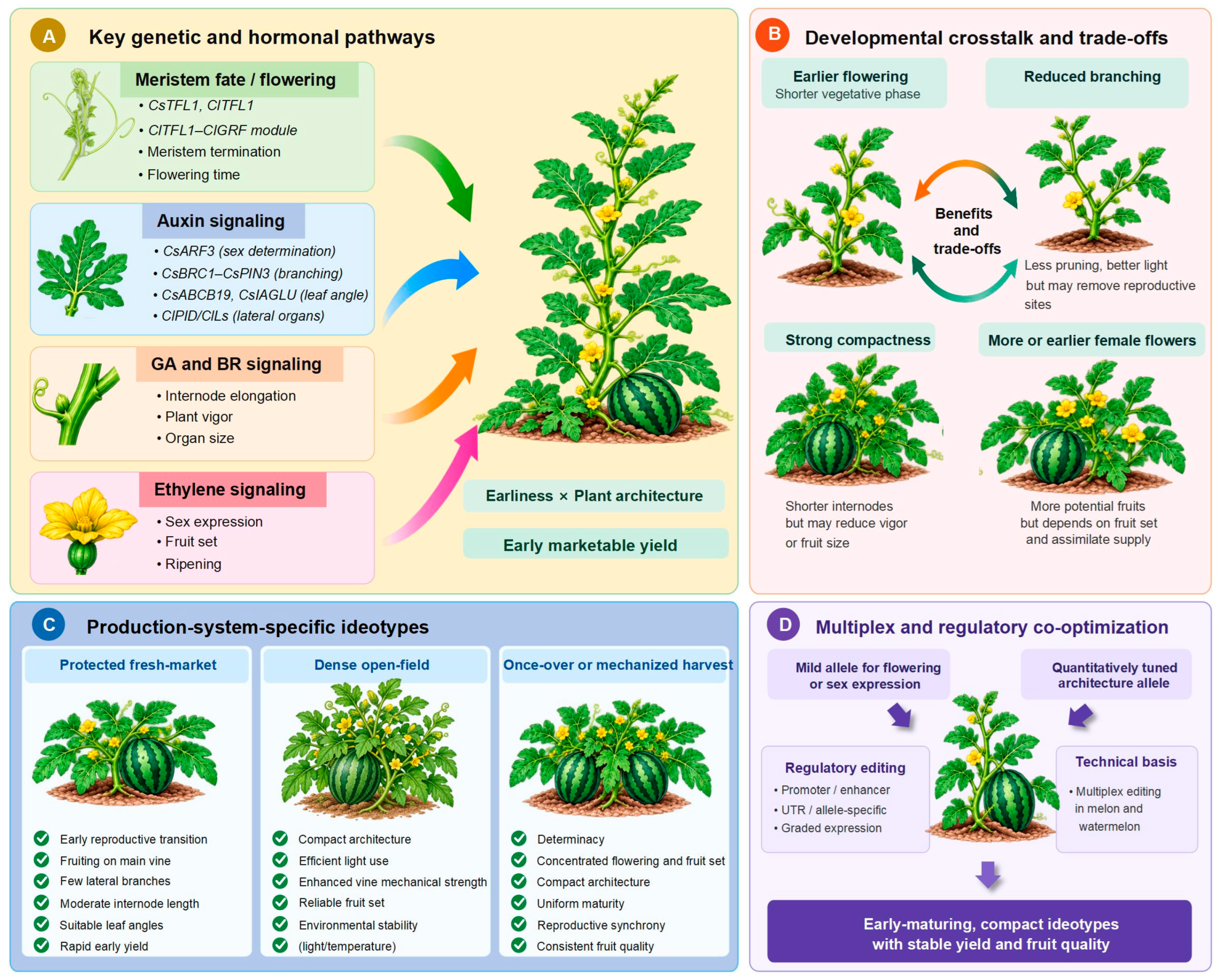
- (A)
- Key genetic and hormonal pathways connecting reproductive development and plant architecture.
- (B)
- Major developmental crosstalk and trade-offs between earliness and plant architecture.
- (C)
- Production-system-specific ideotypes for protected fresh-market, dense open-field, and once-over or mechanized harvest systems.
- (D)
- A strategy for multiplex and regulatory co-optimization using mild alleles and quantitative regulation to integrate earliness and plant architecture.
The genetic and hormonal relationships summarized in this figure are based on published studies with differing levels of experimental support. The proposed ideotypes and combinations of edited alleles represent prospective breeding applications rather than experimentally validated outcomes of simultaneous multi-trait editing. Direct validation of combined phenotypes and agronomic performance remains necessary.
8. Current Bottlenecks and Challenges
Transformation and plant regeneration remain the most immediate technical bottlenecks for genome editing in cucurbit crops. High editing efficiency at the cellular level has limited practical value if elite genotypes cannot be efficiently regenerated into fertile plants. Conventional tissue-culture-based approaches are often strongly genotype dependent and may require long regeneration periods. They can also result in chimerism, somaclonal variation, and incomplete transmission of edited alleles through the germline. Recent advances are beginning to address these limitations. Optimized transformation protocols applicable across several cucurbit crops [23] and developmental-regulator-assisted transformation systems developed in watermelon and melon [25,26] have improved transformation and regeneration efficiency. In parallel, segregation-based removal of transgenes and DNA-free in planta delivery of CRISPR ribonucleoproteins (RNPs) provide alternative routes for obtaining stable, transgene-free edited plants [21,36]. However, these approaches still need to be systematically evaluated in a broader range of elite germplasm. Comparisons should use standardized criteria, including regeneration efficiency, editing frequency, zygosity, chimerism, germline transmission, and recovery of edited progeny.
A second major limitation is the current dependence on indel-mediated loss-of-function mutations. Gene knockout is effective when complete loss of function produces a desirable phenotype, as in some negative regulators such as WIP1. However, complete knockout may be less suitable for dosage-sensitive genes involved in meristem development, hormone signaling, and plant architecture because strong mutations can also cause undesirable developmental effects. More precise editing strategies therefore need further development. Cytosine base editing in melon has demonstrated the feasibility of defined nucleotide conversion [32], while improved multi-guide systems have expanded the capacity for paired and multiplex editing [31]. Nevertheless, precise allele replacement, routine prime editing, and predictable engineering of multiple loci remain considerably less mature than conventional Cas9-mediated knockout. As genome editing moves toward breeding applications, both off-target mutations and unintended structural changes at the target site should be evaluated through careful guide design, molecular genotyping, segregation or backcrossing when appropriate, and phenotypic validation. Successful sequence modification alone is not sufficient evidence of a breeding-ready allele.
Biological complexity presents an equally important challenge. Genes controlling earliness and plant architecture often function in central developmental pathways, so improvement in one trait can negatively affect another. Accelerated flowering may reduce vegetative biomass, suppression of branching may remove potential fruiting sites, and severe disruption of gibberellin (GA) or brassinosteroid (BR) pathways may reduce plant vigor. Sex-expression phenotypes can also be influenced by temperature and photoperiod. The pleiotropic phenotypes produced by editing ClTFL1/ClGRFs and ClPID illustrate these trade-offs directly [17,24]. Promising edited alleles should therefore be tested under protected and open-field conditions, at different planting densities, and under contrasting temperature and light regimes. CsPHYB- and CsPIF4-related responses further illustrate the environmental sensitivity of flowering and growth pathways [11,96,97]. UV-A treatment can induce a robust dwarf phenotype in cucumber without reducing fruit yield [110], whereas waterlogging-induced adventitious rooting is regulated through ethylene–auxin–ROS signaling [111]. These studies demonstrate environmental plasticity and stress–hormone interactions, but neither provides evidence of earlier maturity. Comprehensive evaluation should include dynamic measurements of vine elongation, node production, branching, leaf angle, flowering, female-flower formation, fruit set, fruit growth, maturity, and early yield. AI-assisted phenotyping is beginning to emerge in cucumber, although current tools such as CucumberAI focus on automated fruit-morphology measurements rather than full developmental trajectories [112].
Finally, proof-of-concept mutants must be converted into agronomically useful elite breeding lines. A compact or determinate phenotype observed in a greenhouse has limited breeding value unless early and total yield, fruit quality, fertility, stress response, canopy-management requirements, and harvest efficiency are maintained or improved. Conventional Cas9-mediated knockout is currently the most established genome-editing strategy in cucurbits. Developmental-regulator-assisted transformation, cytosine base editing, improved multiplex systems, YABBY1-type cis-regulatory engineering, and in planta RNP delivery are emerging approaches or proof-of-concept technologies, depending on the crop and genotype. In contrast, routine prime editing, broadly genotype-independent tissue-culture-free editing, and predictive engineering of regulatory networks remain longer-term goals. The key translational challenge is therefore not simply to increase editing efficiency, but to combine efficient editing with stable inheritance, favorable multi-trait agronomic performance, and reliable deployment in elite cucurbit germplasm. Regulation and market access vary among jurisdictions and product characteristics. In the United States, a federal court vacated USDA-APHIS’s 2020 SECURE Rule in December 2024, so its former exemptions should not be assumed to remain universally applicable [113]. Japan has genome-editing notification or prior-information procedures according to the genetic characteristics of the organism [114], while Argentina uses case-by-case prior consultation under Resolution 21/2021 [115]. In England, the precision-breeding framework requires applicable release or marketing procedures, with separate food and feed authorization requirements where relevant [116]. The absence of integrated foreign DNA does not alone guarantee exemption or product approval. Breeding programs should account for intended markets, documentation, seed systems and licensing as well as biological performance. Economic and operational comparisons should include conventional crossing, marker-assisted selection and targeted editing. Where a favorable allele is already available in germplasm, conventional methods may be faster or cheaper; precision editing is attractive when a defined desired allele is absent or linkage drag is problematic. Crop-specific cost per transformation event, number of independent lines required for elite selection and time to cultivar release have not been consistently reported for cucurbits; cross-crop economic analyses should not be presented as such measurements [117]. A realistic timeline includes causal-target validation, delivery and regeneration, molecular confirmation, stable allele recovery, genetic-background development, environmental trials, seed production and regulatory assessment. Agronomic validation should be distinguished from molecular and developmental proof of concept. The CsHLS1-edited cucumber line offers a production-relevant example rather than a laboratory phenotype alone. In the study cited as [6], the edited line maintained a total yield comparable to the control under normal planting density; the reported approximately 1.67% higher per-plant yield was not statistically significant. Under one higher-density treatment (458 plants per 100 m2), the reported early-stage average fruit yield per plant was approximately 13.4% higher than the control, whereas this advantage was not maintained at 500 plants per 100 m2 [6]. These observations support a density-dependent agronomic response, but do not establish a consistent full-season yield advantage across high-density treatments, multi-location stability or commercial cultivar release. Thus, the evidence should be described as cultivation-condition evaluation, not as documented commercial deployment.
Economic and Breeding-Timeline Considerations. The relative merits of genome editing, conventional hybridization and marker-assisted selection (MAS) depend on the causal knowledge of a trait, the availability of useful natural alleles and the genetic background targeted for improvement. When a favorable allele already occurs in compatible germplasm and can be followed by a reliable marker, crossing and MAS may be faster or less expensive than establishing a new transformation and regeneration system. Editing may instead be attractive when a desirable sequence-defined allele is absent from accessible germplasm or when it can be introduced directly into an elite line without linkage drag. However, the full path from target discovery to a cultivar includes construct or reagent preparation, regeneration of independent events, genotyping, inheritance and transgene-status testing where relevant, background recovery, multi-season agronomic trials and seed multiplication; a high editing percentage does not measure time to cultivar release [20,23,25,26,31]. The cost per attempted transformation is also distinct from the cost per independent heritable edited event and the cost per elite, agronomically acceptable line. The studies reviewed here do not provide a consistently defined cucurbit-wide cost per transformation event, the number of events required to deliver one elite line, or a directly comparable editing-versus-MAS cultivar-development timeline. Accordingly, numerical cost savings or universal time advantages cannot be inferred from the available citations. Future reports should separately document laboratory and regeneration inputs, failed events, number of independent confirmed lines, generations and backcrosses required, field-evaluation costs and the ultimate cultivar-development outcome. Genome editing should therefore be viewed as a complementary breeding tool whose economic value must be evaluated case by case, rather than assumed to exceed conventional methods.
9. Future Directions for Precision Genome Editing and Breeding in Cucurbits
Future progress in cucurbit genome editing will depend on a transition from predominantly loss-of-function mutagenesis toward precision engineering of allelic variation. Base editing provides a route to introduce defined nucleotide substitutions without generating double-strand breaks and could be particularly valuable for recreating or mimicking sequence-defined alleles underlying flowering and GA- or BR-associated architectural variation [65,72,79]. Prime editing further expands the editable sequence space by enabling targeted substitutions, insertions, and deletions; its successful application in rice and wheat demonstrates the feasibility of this approach in crop species [34], although efficient implementation in cucurbits remains to be established. Beyond coding sequences, cis-regulatory regions represent especially attractive targets for developmental regulators whose complete disruption may cause strong pleiotropic effects. Editing promoters, untranslated regions, or enhancers could generate graded allelic series and thereby enable quantitative tuning of gene activity. The YABBY1 5′UTR provides a compelling proof of concept in cucurbits, in which engineered variation in a conserved regulatory region produced dose-dependent changes in stem length and enabled customization of plant architecture [5]. Thus, the future value of precision editing will lie not simply in increasing editing efficiency, but in generating alleles of appropriate functional strength for breeding.
A complementary priority is to move from single-locus manipulation toward rational engineering of allele combinations that coordinate earliness, reproductive development, and plant architecture. Multiplex editing should therefore be guided by developmental relationships among traits rather than by the number of loci that can technically be modified. Multi-sgRNA CRISPR architectures developed in melon and watermelon, including systems capable of tandem sgRNA assembly and dual-target editing, provide an initial technical basis for such strategies [31]. However, useful ideotypes will require balanced phenotypic combinations rather than maximal perturbation of individual pathways. Earlier flowering or enhanced female-flower formation will not necessarily translate into earlier harvest if fruit set or subsequent fruit development becomes limiting, while reduced internode length or branching must be evaluated in the context of canopy function, yield, and environmental adaptation. This need for integrated trait design is underscored by the CsTIE1–CsAGL16 module, which links lateral branch development with drought responses in cucumber [94], as well as by environmental regulatory pathways in which light signaling modulates axillary bud outgrowth [96] and elevated temperature promotes hypocotyl elongation through CsPIF4-dependent auxin regulation [97]. Future multiplex-editing studies should therefore prioritize defined allele combinations and evaluate their effects at the whole-plant level under production-relevant environments rather than using molecular editing efficiency as the primary endpoint.
An additional consideration when designing multiplex-editing strategies is the distinction between functional redundancy and functional divergence among members of the same gene family (Supplementary Table S3). Several gene families in cucurbits—including the PEBP family (which includes FT and TFL1), the WIP and ERECTA families, growth-regulating factors (GRFs), ethylene receptors, and ACS/ACO enzymes—contain multiple members; however, the presence of multiple members within a family does not, by itself, establish that paralogs compensate for one another [7,10,24,37,42,45,46]. Differences in expression domains, developmental roles, or regulatory interactions may explain why disrupting one member produces a strong phenotype, whereas the single-gene knockout of another member has little or no detectable effect. A weak or absent phenotype in a single-mutant line may also reflect incomplete editing, genetic background, or environmental conditions, rather than true functional redundancy. Before targeting multiple paralogs simultaneously, their sequences, expression patterns, and individual loss-of-function phenotypes should therefore be compared. Targeted double or higher-order mutants can then be generated to test whether these genes have compensatory functions. Such combinations should be evaluated for their effects on floral development, stress responses, fruit set, and marketable yield, because the simultaneous disruption of developmental regulators may exacerbate pleiotropic effects. Multi-sgRNA CRISPR systems developed in melon and watermelon provide a technical starting point for testing such combinations [31]; however, technical feasibility alone does not demonstrate that multiplexing paralogs will improve agronomic performance.
Evidence from other crop families provides useful guidance for prioritizing flowering and architecture targets in cucurbits, although the reported phenotypes should not be assumed to transfer directly across species. In rice, Gn1a and OsCKX2 designate the same cytokinin oxidase locus: natural allelic variation affects cytokinin accumulation in reproductive meristems and grain number [118]. The rice SMALL PANICLE (SPA) locus, studied together with LAX PANICLE, provides separate genetic evidence that axillary meristem formation contributes to inflorescence branching [119]. These examples support examining developmental processes underlying reproductive-organ initiation and branching in cucurbits, rather than treating increased organ number as a guaranteed yield benefit. In tomato, editing the flowering repressor SP5G accelerated flowering and early yield in the tested genetic backgrounds [120], while a subsequent study combined SP5G with SELF PRUNING (SP), which affects growth termination, and SlER, a regulator of internode length, to develop compact, early-yielding plants [121]. This offers a particularly relevant example of combining distinct developmental targets rather than maximizing the effect of a single mutation. In soybean, Dt1 (GmTFL1b) determines stem growth habit and the fate of the shoot apex after floral induction [122], whereas editing Pdh1 improves resistance to pod shattering without establishing a role in flowering or compact growth [123]. These contrasting examples highlight the need to match each editing target to a clearly defined breeding endpoint. Finally, barley Ppd-H1 and wheat Ppd-D1 illustrate the importance of photoperiod-response alleles in flowering adaptation [124,125], while barley Vrs1 demonstrates that a defined developmental regulator can alter spikelet fertility and inflorescence form [126]. For cucurbits, the practical lesson is therefore to select causally supported loci, test modest or combinatorial allelic changes where appropriate, and evaluate flowering time, plant architecture, fruit set, harvest-related traits, and environmental responses together in relevant genetic backgrounds. Such cross-family evidence can guide target selection and experimental design, but cucurbit-specific validation remains essential.
Realizing these designs in breeding germplasm will require parallel advances in editing delivery, regeneration, and target discovery. Current cucurbit transformation and regeneration systems remain strongly genotype dependent, making the development of transgene-free and tissue-culture-independent or -reduced approaches particularly important. In melon, in planta delivery of CRISPR/Cas9 ribonucleoproteins by particle bombardment has enabled heritable, DNA-free editing while bypassing conventional cell-culture regeneration [36]. Developmental regulators have also improved transformation or regeneration efficiency in watermelon and melon [25,26], providing an alternative strategy for recalcitrant genotypes. Further work should focus on increasing germline editing frequencies, extending reproducibility across elite germplasm, and developing transient or removable regeneration-enhancing systems that minimize unintended developmental effects. At the same time, target discovery should increasingly integrate genetic diversity, fine mapping, pangenomic information, and multi-omics datasets. Wild relatives, landraces, mutant populations, and breeding collections represent important sources of functional variation, while resources such as the cucumber EMS mutant library facilitate forward-genetic identification of genes affecting plant architecture and other agronomic traits [127]. Robust QTLs for flowering, sex expression, branching, internode length, and plant height should ultimately be resolved to causal genes or regulatory variants before being prioritized for editing. Integration of these resources with transcriptomic, epigenomic, proteomic, and high-throughput phenotyping data should improve target prioritization and help identify loci with lower pleiotropic risk.
In the longer term, precision allele design and multiplex editing could extend cucurbit improvement from individual-gene modification to developmental-network engineering and, potentially, de novo domestication. Editing multiple domestication-related loci has already enabled rapid modification of plant architecture, fruit size, fruit number, and nutritional traits in wild tomato [128], providing a conceptual framework for exploiting useful diversity in wild cucurbit germplasm while modifying traits that constrain cultivation. For cucurbits, such strategies could seek to retain disease-resistance, stress-adaptation, or quality-associated variation while reshaping reproductive timing, sex expression, stem growth, and branching. The breeding objective should therefore shift toward coordinated optimization of flowering, female-flower formation, fruit set, internode length, branching, canopy organization, yield, quality, and stress adaptation through quantitatively designed allele combinations. Over the next five to ten years, key priorities will include establishing robust editing platforms for elite cucumber, melon, watermelon, and Cucurbita germplasm; converting reproducible QTLs into causal editable variants; generating regulatory and weak-effect allelic series for dosage-sensitive genes; validating defined multiplex combinations under production conditions; and transferring superior allele combinations into breeding pipelines. The development of watermelon germplasm combining dwarf and branchless mutations already demonstrates that favorable architecture alleles can be successfully pyramided [100]. Genome editing should make such combinations faster to construct, more precisely tunable, and more readily testable across genetic backgrounds and environments. An evidence-guided workflow integrating trait definition, functional genomics, target prioritization, precision allele design, phenotypic evaluation, and breeding deployment is proposed to guide the translation of genome-editing advances into practical cucurbit improvement (Figure 2).
Figure 2.
Evidence-guided workflow from trait definition and target validation to allele design, edited-line characterization, production-relevant evaluation and breeding deployment. This diagram describes a proposed framework, not a sequence experimentally completed for any single cucurbit line.
10. Conclusions
Genome editing has strengthened the functional validation of genes controlling flowering, sex expression, internode length, branching and canopy architecture in cucurbits. However, direct editing, functional evidence and candidate mapping differ in evidentiary strength, and none alone establishes commercial breeding value. The evidence framework used here therefore separates causal knowledge, technical editability and agronomic deployment.
A central unresolved question is whether the interval from fruit set to crop-specific commercial harvest can be shortened without sacrificing fruit size, quality or yield. Future studies should define and measure separate endpoints for flowering, female-flower formation, fruit set, developmental duration, marketable harvest and early production. Genes influencing ripening or fruit size require direct testing before being designated early-harvest targets.
An additional priority is to obtain quantitatively tuned alleles that avoid the severe pleiotropy of strong loss-of-function mutations. ERECTA-related knockouts, YABBY1 cis-regulatory alleles and flowering–branching modules illustrate both opportunity and biological risk [5,23,24]. Partial-loss-of-function, regulatory editing and carefully evaluated multi-locus combinations should be judged by whole-plant fertility, source–sink relations and marketable productivity, not by the strength of dwarfism or early flowering alone.
Trait definition establishes breeding objectives for early-maturing and compact ideotypes; functional genomics identifies candidate genes; evidence ranking prioritizes editing targets; tailored genome-editing strategies generate desired alleles; edited phenotypes are evaluated for earliness, architecture, and agronomic performance; and superior traits are deployed in breeding programs. Phenotype-genotype feedback further refines target discovery and supports iterative quantitative ideotype design.
Supplementary Materials
The following supporting information can be downloaded at: https://www.mdpi.com/article/10.3390/ijms27219697/s1.
Author Contributions
Conceptualization and original draft preparation, L.W. and Z.W.; compilation of examples and citations, J.R., J.W. and H.Z.; review and editing, L.W. and M.T.; supervision, L.W. and M.T.; project administration, X.L., J.Q. and J.X. All authors have read and agreed to the published version of the manuscript.
Funding
This research was funded by Hubei Provincial Science and Technology Innovation Talent Program, grant number Project Approval No. 2025DJA079 and Hubei Key Research Project of Development and Breeding of New Watermelon Cultivars with Enhanced Crack Resistance and Superior Fruit Quality, grant number Project Approval No.2025BBB020.
Institutional Review Board Statement
Not applicable.
Informed Consent Statement
Not applicable.
Data Availability Statement
No new data were created or analyzed in this study. Data sharing is not applicable to this article.
Acknowledgments
During the preparation of this manuscript, the authors used ChatGPT (GPT-5.6) to improve the English language, grammar, clarity, and readability of the text. The authors have reviewed and edited the output and take full responsibility for the content of this publication.
Conflicts of Interest
The authors declare no conflicts of interest.
References
- Wang, Y.; Bo, K.; Gu, X.; Pan, J.; Li, Y.; Chen, J.; Wen, C.; Ren, Z.; Ren, H.; Chen, X.; et al. Molecularly tagged genes and quantitative trait loci in cucumber with recommendations for QTL nomenclature. Hortic. Res. 2020, 7, 3. [Google Scholar] [CrossRef] [Scilit] [PubMed]
- Kaur, G.; Pathak, M.; Singla, D.; Chhabra, G.; Chhuneja, P.; Kaur Sarao, N. Quantitative Trait Loci Mapping for Earliness, Fruit, and Seed Related Traits Using High Density Genotyping-by-Sequencing-Based Genetic Map in Bitter Gourd (Momordica charantia L.). Front. Plant Sci. 2022, 12, 799932. [Google Scholar] [CrossRef] [Scilit] [PubMed]
- Katuuramu, D.N.; Levi, A.; Wechter, W.P. Genetic control of flowering time and fruit yield in citron watermelon. Front. Plant Sci. 2023, 14, 1236576. [Google Scholar] [CrossRef] [Scilit] [PubMed]
- Qu, S.; Yang, D.; Yu, H.; Chen, F.; Wang, K.; Ding, W.; Xu, W.; Wang, Y. QTL analysis of early flowering of female flowers in zucchini (Cucurbita pepo L.). J. Integr. Agric. 2023, 22, 3321–3330. [Google Scholar] [CrossRef] [Scilit]
- Wang, S.; Wang, K.; Li, Z.; Li, Y.; He, J.; Li, H.; Wang, B.; Xin, T.; Tian, H.; Tian, J.; et al. Architecture design of cucurbit crops for enhanced productivity by a natural allele. Nat. Plants 2022, 8, 1394–1407. [Google Scholar] [CrossRef] [Scilit] [PubMed]
- Wang, C.; Li, J.; Fang, K.; Yao, H.; Chai, X.; Du, Y.; Wang, J.; Hao, N.; Cao, J.; Li, B.; et al. CsHLS1-CsSCL28 module regulates compact plant architecture in cucumber. Plant Biotechnol. J. 2024, 22, 1724–1739. [Google Scholar] [CrossRef] [Scilit] [PubMed]
- Wen, H.; Pan, J.; Chen, Y.; Chen, G.; Du, H.; Zhang, L.; Zhang, K.; He, H.; Wang, G.; Cai, R.; et al. TERMINAL FLOWER1 and TERMINAL FLOWER1d respond to temperature and photoperiod signals to inhibit determinate growth in cucumber. Plant Cell Environ. 2021, 44, 2580–2592. [Google Scholar] [CrossRef] [Scilit] [PubMed]
- Liu, L.; Wen, H.; Song, T.; Wang, X.; Pan, J.; Pan, J.; Li, T. Low temperature-induced cold shock protein modulates determinate growth in cucumber. Mol. Hortic. 2026, 6, 16. [Google Scholar] [CrossRef] [Scilit] [PubMed]
- Zhang, M.; Ma, M.; Lang, H.; Jiang, M. Research Advances and Perspectives on Early Flowering Traits in Cucumber. Plants 2025, 14, 1158. [Google Scholar] [CrossRef] [Scilit] [PubMed]
- Fan, L.; Zhu, Z.; Lin, X.; Shen, X.; Yang, T.; Wang, H.; Zhou, X. Comparative Genomic Analysis of PEBP Genes in Cucurbits Explores the Interactors of Cucumber CsPEBPs Related to Flowering Time. Int. J. Mol. Sci. 2024, 25, 3815. [Google Scholar] [CrossRef] [Scilit] [PubMed]
- Hu, L.; Zhang, M.; Shang, J.; Liu, Z.; Weng, Y.; Yue, H.; Li, Y.; Chen, P. A 5.5-kb LTR-retrotransposon insertion inside phytochrome B gene (CsPHYB) results in long hypocotyl and early flowering in cucumber (Cucumis sativus L.). Theor. Appl. Genet. 2023, 136, 68. [Google Scholar] [CrossRef] [Scilit] [PubMed]
- Martínez, C.; Jamilena, M. To be a male or a female flower, a question of ethylene in cucurbits. Curr. Opin. Plant Biol. 2021, 59, 101981. [Google Scholar] [CrossRef] [Scilit] [PubMed]
- Pawełkowicz, M.E.; Skarzyńska, A.; Pląder, W.; Przybecki, Z. Genetic and molecular bases of cucumber (Cucumis sativus L.) sex determination. Mol. Breed. 2019, 39, 50. [Google Scholar] [CrossRef] [Scilit]
- Dhall, R.K.; Kaur, H.; Manchanda, P.; Eshanee. Genetics and marker-assisted breeding for sex expression in cucumber. Front. Genet. 2023, 14, 1180083. [Google Scholar] [CrossRef] [Scilit] [PubMed]
- Devi, P.; Perkins-Veazie, P.; Miles, C.A. Rootstock and Plastic Mulch Effect on Watermelon Flowering and Fruit Maturity in a Verticillium dahliae–Infested Field. HortScience 2020, 55, 1438–1445. [Google Scholar] [CrossRef] [Scilit]
- Ando, E.; Maeda, K.; Aimi, N.; Ahn, D.-H. Comparative analyses of cucumber (Cucumis sativus L.) cultivars with varying node formation rate in greenhouse. BMC Plant Biol. 2025, 25, 1547. [Google Scholar] [CrossRef] [Scilit] [PubMed]
- Jiang, Y.; Zhang, A.; He, W.; Li, Q.; Zhao, B.; Zhao, H.; Ke, X.; Guo, Y.; Sun, P.; Yang, T.; et al. GRAS family member LATERAL SUPPRESSOR regulates the initiation and morphogenesis of watermelon lateral organs. Plant Physiol. 2023, 193, 2592–2604. [Google Scholar] [CrossRef] [Scilit] [PubMed]
- Tzuri, G.; Faigenboim-Doron, A.; Paris, H.S.; Gur, A. Pleiotropic mutation in a tendril TCP gene underlies the yield-enhancing multiple-flowering trait in summer squash (Cucurbita pepo). Plant J. 2026, 125, e70813. [Google Scholar] [CrossRef] [Scilit] [PubMed]
- Tian, S.; Jiang, L.; Gao, Q.; Zhang, J.; Zong, M.; Zhang, H.; Ren, Y.; Guo, S.; Gong, G.; Liu, F.; et al. Efficient CRISPR/Cas9-based gene knockout in watermelon. Plant Cell Rep. 2017, 36, 399–406. [Google Scholar] [CrossRef] [Scilit] [PubMed]
- Chandrasekaran, J.; Brumin, M.; Wolf, D.; Leibman, D.; Klap, C.; Pearlsman, M.; Sherman, A.; Arazi, T.; Gal-On, A. Development of broad virus resistance in non-transgenic cucumber using CRISPR/Cas9 technology. Mol. Plant Pathol. 2016, 17, 1140–1153. [Google Scholar] [CrossRef] [Scilit] [PubMed]
- Hu, B.; Li, D.; Liu, X.; Qi, J.; Gao, D.; Zhao, S.; Huang, S.; Sun, J.; Yang, L. Engineering non-transgenic gynoecious cucumber using an improved transformation protocol and optimized CRISPR/Cas9 system. Mol. Plant 2017, 10, 1575–1578. [Google Scholar] [CrossRef] [Scilit] [PubMed]
- Zhang, J.; Guo, S.; Ji, G.; Zhao, H.; Sun, H.; Ren, Y.; Tian, S.; Li, M.; Gong, G.; Zhang, H.; et al. A unique chromosome translocation disrupting ClWIP1 leads to gynoecy in watermelon. Plant J. 2020, 101, 265–277. [Google Scholar] [CrossRef] [Scilit] [PubMed]
- Xin, T.; Tian, H.; Ma, Y.; Wang, S.; Yang, L.; Li, X.; Zhang, M.; Chen, C.; Wang, H.; Li, H.; et al. Targeted creation of new mutants with compact plant architecture using CRISPR/Cas9 genome editing by an optimized genetic transformation procedure in cucurbit plants. Hortic. Res. 2022, 9, uhab086. [Google Scholar] [CrossRef] [Scilit] [PubMed]
- Guo, Y.; Liu, Y.; Niu, H.; Wang, Y.; Chen, Z.; Cui, J.; Shen, C.; Duan, S.; Kang, Q.; Zhu, H.; et al. The ClTFL1-ClGRFs module regulates lateral branch number and flowering time via auxin-mediated pathway in watermelon (Citrullus lanatus). Horticulturae 2025, 11, 1022. [Google Scholar] [CrossRef] [Scilit]
- Pan, W.; Cheng, Z.; Han, Z.; Yang, H.; Zhang, W.; Zhang, H. Efficient genetic transformation and CRISPR/Cas9-mediated genome editing of watermelon assisted by genes encoding developmental regulators. J. Zhejiang Univ. Sci. B 2022, 23, 339–344. [Google Scholar] [CrossRef] [Scilit] [PubMed]
- Wan, L.; Wang, Z.; Zhang, X.; Zeng, H.; Ren, J.; Zhang, N.; Sun, Y.; Tang, M. Optimised Agrobacterium-mediated transformation and application of developmental regulators improve regeneration efficiency in melons. Genes 2023, 14, 1432. [Google Scholar] [CrossRef] [Scilit] [PubMed]
- Huang, S.; Li, R.; Zhang, Z.; Li, L.; Gu, X.; Fan, W.; Lucas, W.J.; Wang, X.; Xie, B.; Ni, P.; et al. The genome of the cucumber, Cucumis sativus L. Nat. Genet. 2009, 41, 1275–1281. [Google Scholar] [CrossRef] [Scilit] [PubMed]
- Garcia-Mas, J.; Benjak, A.; Sanseverino, W.; Bourgeois, M.; Mir, G.; González, V.M.; Hénaff, E.; Câmara, F.; Cozzuto, L.; Lowy, E.; et al. The genome of melon (Cucumis melo L.). Proc. Natl. Acad. Sci. USA 2012, 109, 11872–11877. [Google Scholar] [CrossRef] [Scilit] [PubMed]
- Guo, S.; Zhang, J.; Sun, H.; Salse, J.; Lucas, W.J.; Zhang, H.; Zheng, Y.; Mao, L.; Ren, Y.; Wang, Z.; et al. The draft genome of watermelon (Citrullus lanatus) and resequencing of 20 diverse accessions. Nat. Genet. 2013, 45, 51–58. [Google Scholar] [CrossRef] [Scilit] [PubMed]
- Montero-Pau, J.; Blanca, J.; Bombarely, A.; Ziarsolo, P.; Esteras, C.; Martí-Gómez, C.; Ferriol, M.; Gómez, P.; Jamilena, M.; Mueller, L.; et al. De novo assembly of the zucchini genome reveals a whole-genome duplication associated with the origin of the Cucurbita genus. Plant Biotechnol. J. 2018, 16, 1161–1171. [Google Scholar] [CrossRef] [Scilit] [PubMed]
- Wang, Z.; Wan, L.; Ren, J.; Zhang, N.; Zeng, H.; Wei, J.; Tang, M. Improving the genome editing efficiency of CRISPR/Cas9 in melon and watermelon. Cells 2024, 13, 1782. [Google Scholar] [CrossRef] [Scilit] [PubMed]
- Shirazi Parsa, H.; Sabet, M.S.; Moieni, A.; Shojaeiyan, A.; Dogimont, C.; Boualem, A.; Bendahmane, A. CRISPR/Cas9-mediated cytosine base editing using an improved transformation procedure in melon (Cucumis melo L.). Int. J. Mol. Sci. 2023, 24, 11189. [Google Scholar] [CrossRef] [Scilit] [PubMed]
- Zong, Y.; Wang, Y.; Li, C.; Zhang, R.; Chen, K.; Ran, Y.; Qiu, J.-L.; Wang, D.; Gao, C. Precise base editing in rice, wheat and maize with a Cas9-cytidine deaminase fusion. Nat. Biotechnol. 2017, 35, 438–440, Correction in Nat. Biotechnol. 2025, 43, 1011. [Google Scholar] [CrossRef] [Scilit] [PubMed]
- Wang, J.; Xiao, L.; Xin, T.; Li, J.; Yang, X. Development of a highly efficient prime editing platform for cucurbits enables breeding of multi-disease-resistant cucumber. J. Integr. Plant Biol. 2026, 68, 3340–3351. [Google Scholar] [CrossRef] [Scilit] [PubMed]
- Woo, J.W.; Kim, J.; Kwon, S.I.; Corvalan, C.; Cho, S.W.; Kim, H.; Kim, S.-G.; Kim, S.-T.; Choe, S.; Kim, J.-S. DNA-free genome editing in plants with preassembled CRISPR-Cas9 ribonucleoproteins. Nat. Biotechnol. 2015, 33, 1162–1164. [Google Scholar] [CrossRef] [Scilit] [PubMed]
- Sasaki, K.; Urano, K.; Mimida, N.; Nonaka, S.; Ezura, H.; Imai, R. A long shelf-life melon created via CRISPR/Cas9 RNP-based in planta genome editing. Front. Genome Ed. 2025, 7, 1623097. [Google Scholar] [CrossRef] [Scilit] [PubMed]
- Wen, C.; Zhao, W.; Liu, W.; Yang, L.; Wang, Y.; Liu, X.; Xu, Y.; Ren, H.; Guo, Y.; Li, C.; et al. CsTFL1 inhibits determinate growth and terminal flower formation through interaction with CsNOT2a in cucumber. Development 2019, 146, dev180166. [Google Scholar] [CrossRef] [Scilit] [PubMed]
- Zhao, W.; Chen, Z.; Liu, X.; Che, G.; Gu, R.; Zhao, J.; Wang, Z.; Hou, Y.; Zhang, X. CsLFY is required for shoot meristem maintenance via interaction with WUSCHEL in cucumber (Cucumis sativus). New Phytol. 2018, 218, 344–356. [Google Scholar] [CrossRef] [Scilit] [PubMed]
- Chen, L.; Yun, M.; Chen, B.; Xie, S.; Liu, W.; Wang, M.; Yan, J.; Cai, J.; Yang, S.; Peng, Q.; et al. Loss of CsCLV2 function causes dwarfism and determinates growth in cucumber. Plant J. 2025, 124, e70525. [Google Scholar] [CrossRef] [Scilit] [PubMed]
- Boualem, A.; Troadec, C.; Camps, C.; Lemhemdi, A.; Morin, H.; Sari, M.-A.; Fraenkel-Zagouri, R.; Kovalski, I.; Dogimont, C.; Perl-Treves, R.; et al. A cucurbit androecy gene reveals how unisexual flowers develop and dioecy emerges. Science 2015, 350, 688–691. [Google Scholar] [CrossRef] [Scilit] [PubMed]
- Boualem, A.; Lemhemdi, A.; Sari, M.-A.; Pignoly, S.; Troadec, C.; Abou Choucha, F.; Solmaz, I.; Sari, N.; Dogimont, C.; Bendahmane, A. The Andromonoecious Sex Determination Gene Predates the Separation of Cucumis and Citrullus. PLoS ONE 2016, 11, e0155444. [Google Scholar] [CrossRef] [Scilit] [PubMed]
- Zhang, H.; Li, S.; Yang, L.; Cai, G.; Chen, H.; Gao, D.; Lin, T.; Cui, Q.; Wang, D.; Li, Z.; et al. Gain-of-function of the 1-aminocyclopropane-1-carboxylate synthase gene ACS1G induces female flower development in cucumber gynoecy. Plant Cell 2021, 33, 306–321. [Google Scholar] [CrossRef] [Scilit] [PubMed]
- Manzano, S.; Aguado, E.; Martínez, C.; Megías, Z.; García, A.; Jamilena, M. The Ethylene Biosynthesis Gene CitACS4 Regulates Monoecy/Andromonoecy in Watermelon. PLoS ONE 2016, 11, e0154362. [Google Scholar] [CrossRef] [Scilit] [PubMed]
- Aguado, E.; García, A.; Iglesias-Moya, J.; Romero, J.; Wehner, T.C.; Gómez-Guillamón, M.L.; Picó, B.; Garcés-Claver, A.; Martínez, C.; Jamilena, M. Mapping a Partial Andromonoecy Locus in Citrullus lanatus Using BSA-Seq and GWAS Approaches. Front. Plant Sci. 2020, 11, 1243. [Google Scholar] [CrossRef] [Scilit] [PubMed]
- García, A.; Aguado, E.; Martínez, C.; Loska, D.; Beltrán, S.; Valenzuela, J.L.; Garrido, D.; Jamilena, M. The ethylene receptors CpETR1A and CpETR2B cooperate in the control of sex determination in Cucurbita pepo. J. Exp. Bot. 2020, 71, 154–167. [Google Scholar] [CrossRef] [Scilit] [PubMed]
- García, A.; Aguado, E.; Garrido, D.; Martínez, C.; Jamilena, M. Two androecious mutations reveal the crucial role of ethylene receptors in the initiation of female flower development in Cucurbita pepo. Plant J. 2020, 103, 1548–1560. [Google Scholar] [CrossRef] [Scilit] [PubMed]
- Cebrián, G.; Iglesias-Moya, J.; Romero, J.; Martínez, C.; Garrido, D.; Jamilena, M. The Ethylene Biosynthesis Gene CpACO1A: A New Player in the Regulation of Sex Determination and Female Flower Development in Cucurbita pepo. Front. Plant Sci. 2022, 12, 817922. [Google Scholar] [CrossRef] [Scilit] [PubMed]
- Segura, M.; García, A.; Gamarra, G.; Benítez, Á.; Iglesias-Moya, J.; Martínez, C.; Jamilena, M. The transcription factor CpMYB62 controls the genetic network that leads to the determination of female flowers in Cucurbita pepo. Hortic. Res. 2024, 11, uhae115. [Google Scholar] [CrossRef] [Scilit] [PubMed]
- Han, L.; Li, M.; Li, C.; Zhao, B.; Wang, Z.; Liu, Y.; Liu, Z.; Huang, Y.; Liu, L.; Geng, H.; et al. ARF3-mediated auxin signaling is essential for sex determination in cucumber. Science 2026, 391, 59–63. [Google Scholar] [CrossRef] [Scilit] [PubMed]
- Pan, J.; Wen, H.; Chen, G.; Lin, W.-H.; Du, H.; Chen, Y.; Zhang, L.; Lian, H.; Wang, G.; Cai, R.; et al. A positive feedback loop mediated by CsERF31 initiates female cucumber flower development. Plant Physiol. 2021, 186, 1088–1100. [Google Scholar] [CrossRef] [Scilit] [PubMed]
- Pan, J.; Wang, G.; Wen, H.; Du, H.; Lian, H.; He, H.; Pan, J.; Cai, R. Differential Gene Expression Caused by the F and M Loci Provides Insight Into Ethylene-Mediated Female Flower Differentiation in Cucumber. Front. Plant Sci. 2018, 9, 1091. [Google Scholar] [CrossRef] [Scilit] [PubMed]
- Cebrián, G.; Segura, M.; Martínez, J.; Iglesias-Moya, J.; Martínez, C.; Garrido, D.; Jamilena, M. Jasmonate-deficient mutant lox3a reveals crosstalk between jasmonate and ethylene in the differential regulation of male and female flower opening and early fruit development in Cucurbita pepo. J. Exp. Bot. 2023, 74, 1258–1274. [Google Scholar] [CrossRef] [Scilit] [PubMed]
- Lai, Y.-S.; Zhang, X.; Zhang, W.; Shen, D.; Wang, H.; Xia, Y.; Qiu, Y.; Song, J.; Wang, C.; Li, X. The association of changes in DNA methylation with temperature-dependent sex determination in cucumber. J. Exp. Bot. 2017, 68, 2899–2912. [Google Scholar] [CrossRef] [Scilit] [PubMed]
- Latrasse, D.; Rodriguez-Granados, N.Y.; Veluchamy, A.; Mariappan, K.G.; Bevilacqua, C.; Crapart, N.; Camps, C.; Sommard, V.; Raynaud, C.; Dogimont, C.; et al. The quest for epigenetic regulation underlying unisexual flower development in Cucumis melo. Epigenet. Chromatin 2017, 10, 22. [Google Scholar] [CrossRef] [Scilit] [PubMed]
- Segura, M.; García, A.; Gamarra, G.; Benítez, Á.; Iglesias-Moya, J.; Martínez, C.; Jamilena, M. An miR164-resistant mutation in the transcription factor gene CpCUC2B enhances carpel arrest and ectopic boundary specification in Cucurbita pepo flower development. J. Exp. Bot. 2024, 75, 1948–1966. [Google Scholar] [CrossRef] [Scilit] [PubMed]
- Boualem, A.; Berthet, S.; Devani, R.S.; Camps, C.; Fleurier, S.; Morin, H.; Troadec, C.; Giovinazzo, N.; Sari, N.; Dogimont, C.; et al. Ethylene plays a dual role in sex determination and fruit shape in cucurbits. Curr. Biol. 2022, 32, 2390–2401.e4. [Google Scholar] [CrossRef] [Scilit] [PubMed]
- Li, D.; Sheng, Y.; Niu, H.; Li, Z. Gene Interactions Regulating Sex Determination in Cucurbits. Front. Plant Sci. 2019, 10, 1231. [Google Scholar] [CrossRef] [Scilit] [PubMed]
- Yuan, X.J.; Pan, J.S.; Cai, R.; Guan, Y.; Liu, L.Z.; Zhang, W.W.; Li, Z.; He, H.L.; Zhang, C.; Si, L.T.; et al. Genetic mapping and QTL analysis of fruit and flower related traits in cucumber (Cucumis sativus L.) using recombinant inbred lines. Euphytica 2008, 164, 473–491. [Google Scholar] [CrossRef] [Scilit]
- Martínez, C.; Manzano, S.; Megías, Z.; Garrido, D.; Picó, B.; Jamilena, M. Involvement of ethylene biosynthesis and signalling in fruit set and early fruit development in zucchini squash (Cucurbita pepo L.). BMC Plant Biol. 2013, 13, 139. [Google Scholar] [CrossRef] [Scilit] [PubMed]
- Xin, T.; Zhang, Z.; Li, S.; Zhang, S.; Li, Q.; Zhang, Z.-H.; Huang, S.; Yang, X. Genetic Regulation of Ethylene Dosage for Cucumber Fruit Elongation. Plant Cell 2019, 31, 1063–1076. [Google Scholar] [CrossRef] [Scilit] [PubMed]
- Martínez, C.; García, A.; Jamilena, M. Role of Ethylene in Flower and Fruit Development. In Ethylene in Plant Biology; Singh, S., Husain, T., Singh, V.P., Tripathi, D.K., Prasad, S.M., Dubey, N.K., Eds.; Wiley: Hoboken, NJ, USA, 2022; pp. 178–219. [Google Scholar] [CrossRef] [Scilit]
- Li, S.; Zhu, B.; Pirrello, J.; Xu, C.; Zhang, B.; Bouzayen, M.; Chen, K.; Grierson, D. Roles of RIN and ethylene in tomato fruit ripening and ripening-associated traits. New Phytol. 2020, 226, 460–475. [Google Scholar] [CrossRef] [Scilit] [PubMed]
- Wang, R.; Lammers, M.; Tikunov, Y.; Bovy, A.G.; Angenent, G.C.; de Maagd, R.A. The rin, nor and Cnr spontaneous mutations inhibit tomato fruit ripening in additive and epistatic manners. Plant Sci. 2020, 294, 110436. [Google Scholar] [CrossRef] [Scilit] [PubMed]
- Liu, L.; Gan, Y.; Luo, J.; Li, J.; Zheng, X.; Gong, H.; Liu, X.; Deng, L.; Zhao, G.; Wu, H. QTL mapping reveals candidate genes for main agronomic traits in Luffa based on a high-resolution genetic map. Front. Plant Sci. 2022, 13, 1069618. [Google Scholar] [CrossRef] [Scilit] [PubMed]
- Biernacik, B.; Słomnicka, R.; Kaźmińska, K.; Mużacz, S.; Bartoszewski, G. A single nucleotide substitution introducing premature stop codon within CsTFL1 explains the determinate-2 phenotype in cucumber. Sci. Rep. 2024, 14, 25368. [Google Scholar] [CrossRef] [Scilit] [PubMed]
- Dou, J.; Yang, H.; Sun, D.; Yang, S.; Sun, S.; Zhao, S.; Lu, X.; Zhu, H.; Liu, D.; Ma, C.; et al. The branchless gene Clbl in watermelon encoding a TERMINAL FLOWER 1 protein regulates the number of lateral branches. Theor. Appl. Genet. 2022, 135, 65–79. [Google Scholar] [CrossRef] [Scilit] [PubMed]
- Sun, Y.; Zhou, K.; Wang, X.; Li, X.; Zhang, X.; Han, N.; Zhang, J.; Chen, S. Identification and characterization of CsERECTA, a major gene controlling stem elongation through regulating GA biosynthesis in cucumber. Theor. Appl. Genet. 2024, 137, 151. [Google Scholar] [CrossRef] [Scilit] [PubMed]
- Zhang, M.; Song, M.; Cheng, F.; Han, X.; Cheng, C.; Yu, X.; Chen, J.; Lou, Q. The mutation of ent-kaurenoic acid oxidase, a key enzyme involved in gibberellin biosynthesis, confers a dwarf phenotype to cucumber. Theor. Appl. Genet. 2025, 138, 12. [Google Scholar] [CrossRef] [Scilit] [PubMed]
- Zhao, H.; Sun, P.; Tong, C.; Li, X.; Yang, T.; Jiang, Y.; Zhao, B.; Dong, J.; Jiang, B.; Shen, J.; et al. CsIREH1 phosphorylation regulates DELLA protein affecting plant height in cucumber. New Phytol. 2025, 245, 1528–1546. [Google Scholar] [CrossRef] [Scilit] [PubMed]
- Zhou, Y.; Chen, J.; Hu, Y.; Xiao, L.; Hu, Z.; Zhou, Y.; Liu, S. Comprehensive Survey of the DELLA Transcription Factors in Cucumber and Functional Characterization of CsDELLA1 in Regulation of GA-Mediated Growth and Development. J. Plant Growth Regul. 2024, 43, 2802–2816. [Google Scholar] [CrossRef] [Scilit]
- Wei, C.; Zhu, C.; Yang, L.; Zhao, W.; Ma, R.; Li, H.; Zhang, Y.; Ma, J.; Yang, J.; Zhang, X. A point mutation resulting in a 13 bp deletion in the coding sequence of Cldf leads to a GA-deficient dwarf phenotype in watermelon. Hortic. Res. 2019, 6, 132. [Google Scholar] [CrossRef] [Scilit] [PubMed]
- Sun, Y.; Zhang, H.; Fan, M.; He, Y.; Guo, P. A mutation in the intron splice acceptor site of a GA3ox gene confers dwarf architecture in watermelon (Citrullus lanatus L.). Sci. Rep. 2020, 10, 14915. [Google Scholar] [CrossRef] [Scilit] [PubMed]
- Ding, W.; Wang, Y.; Qi, C.; Luo, Y.; Wang, C.; Xu, W.; Qu, S. Fine mapping identified the gibberellin 2-oxidase gene CpDw leading to a dwarf phenotype in squash (Cucurbita pepo L.). Plant Sci. 2021, 306, 110857. [Google Scholar] [CrossRef] [Scilit] [PubMed]
- Xiang, C.; Duan, Y.; Shu, Q.; Bo, K.; Weng, Y.; Sui, X.; Wang, C. CmaGA2ox2 is associated with dwarf plant architecture controlled by the single dominant CmaDw-1 locus in winter squash. Hortic. Plant J. 2026, 12, 1883–1896. [Google Scholar] [CrossRef] [Scilit]
- Zhao, G.; Luo, C.; Luo, J.; Li, J.; Gong, H.; Zheng, X.; Liu, X.; Guo, J.; Zhou, L.; Wu, H. A mutation in LacDWARF1 results in a GA-deficient dwarf phenotype in sponge gourd (Luffa acutangula). Theor. Appl. Genet. 2021, 134, 3443–3457. [Google Scholar] [CrossRef] [Scilit] [PubMed]
- Wang, H.; Li, W.; Qin, Y.; Pan, Y.; Wang, X.; Weng, Y.; Chen, P.; Li, Y. The Cytochrome P450 Gene CsCYP85A1 Is a Putative Candidate for Super Compact-1 (Scp-1) Plant Architecture Mutation in Cucumber. Front. Plant Sci. 2017, 8, 266. [Google Scholar] [CrossRef] [Scilit] [PubMed]
- Hou, S.; Niu, H.; Tao, Q.; Wang, S.; Gong, Z.; Li, S.; Weng, Y.; Li, Z. A mutant in the CsDET2 gene leads to a systemic brassinosteroid deficiency and super compact phenotype in cucumber. Theor. Appl. Genet. 2017, 130, 1693–1703. [Google Scholar] [CrossRef] [Scilit] [PubMed]
- Zhang, M.; Song, M.; Cheng, F.; Yang, Z.; Davoudi, M.; Chen, J.; Lou, Q. Identification of a putative candidate gene encoding 7-dehydrocholesterol reductase involved in brassinosteroids biosynthesis for compact plant architecture in cucumber (Cucumis sativus L.). Theor. Appl. Genet. 2021, 134, 2023–2034. [Google Scholar] [CrossRef] [Scilit] [PubMed]
- Zhang, H.; Liu, Z.; Wang, Y.; Mu, S.; Yue, H.; Luo, Y.; Zhang, Z.; Li, Y.; Chen, P. A mutation in CsDWF7 gene encoding a delta7 sterol C-5(6) desaturase leads to the phenotype of super compact in cucumber. Theor. Appl. Genet. 2024, 137, 20. [Google Scholar] [CrossRef] [Scilit] [PubMed]
- Sun, P.; Zhao, H.; Cao, L.; Zhang, T.; Zhang, H.; Yang, T.; Zhao, B.; Jiang, Y.; Dong, J.; Chen, T.; et al. A DUF21 domain-containing protein regulates plant dwarfing in watermelon. Plant Physiol. 2024, 196, 3091–3104. [Google Scholar] [CrossRef] [Scilit] [PubMed]
- Zhang, M.; Yan, W.; Yan, M.; Zhu, H.; Hu, A.; Xie, K.; Yan, H.; Liu, Y.; Dou, J.; Niu, H.; et al. Development of near-isogenic line of dwarf gene Cldw-1 and transcriptome analysis in watermelon. Sci. Hortic. 2025, 343, 114065. [Google Scholar] [CrossRef] [Scilit]
- Zhu, H.; Zhang, M.; Sun, S.; Yang, S.; Li, J.; Li, H.; Yang, H.; Zhang, K.; Hu, J.; Liu, D.; et al. A Single Nucleotide Deletion in an ABC Transporter Gene Leads to a Dwarf Phenotype in Watermelon. Front. Plant Sci. 2019, 10, 1399. [Google Scholar] [CrossRef] [Scilit] [PubMed]
- Yang, S.; Zhang, K.; Zhu, H.; Zhang, X.; Yan, W.; Xu, N.; Liu, D.; Hu, J.; Wu, Y.; Weng, Y.; et al. Melon short internode (CmSi) encodes an ERECTA-like receptor kinase regulating stem elongation through auxin signaling. Hortic. Res. 2020, 7, 202. [Google Scholar] [CrossRef] [Scilit] [PubMed]
- Li, S.; Zhang, Q.; Zhang, H.; Wang, J.; Sun, J.; Yang, X.; Huang, S.; Zhang, Z. Deletion of a cyclin-dependent protein kinase inhibitor, CsSMR1, leads to dwarf and determinate growth in cucumber. Theor. Appl. Genet. 2022, 135, 915–927. [Google Scholar] [CrossRef] [Scilit] [PubMed]
- Li, Y.; Yang, L.; Pathak, M.; Li, D.; He, X.; Weng, Y. Fine genetic mapping of cp: A recessive gene for compact (dwarf) plant architecture in cucumber, Cucumis sativus L. Theor. Appl. Genet. 2011, 123, 973–983. [Google Scholar] [CrossRef] [Scilit] [PubMed]
- Xu, L.; Wang, C.; Cao, W.; Zhou, S.; Wu, T. CLAVATA1-type receptor-like kinase CsCLAVATA1 is a putative candidate gene for dwarf mutation in cucumber. Mol. Genet. Genom. 2018, 293, 1393–1405. [Google Scholar] [CrossRef] [Scilit] [PubMed]
- Wang, J.; Zhu, Y.; Li, M.; Zhang, H.; Zhang, X.; Tian, S.; Ren, Y.; Yu, Y.; Liao, S.; Gong, G.; et al. The NAC transcription factor ClNAC100 positively regulates plant height and fruit size in watermelon. Plant J. 2025, 123, e70292. [Google Scholar] [CrossRef] [Scilit] [PubMed]
- Zhang, T.; Liu, J.; Amanullah, S.; Ding, Z.; Cui, H.; Luan, F.; Gao, P. Fine Mapping of Cla015407 Controlling Plant Height in Watermelon. J. Am. Soc. Hortic. Sci. 2021, 146, 196–205. [Google Scholar] [CrossRef] [Scilit]
- Dong, W.; Wu, D.; Li, G.; Wu, D.; Wang, Z. Next-generation sequencing from bulked segregant analysis identifies a dwarfism gene in watermelon. Sci. Rep. 2018, 8, 2908. [Google Scholar] [CrossRef] [Scilit] [PubMed]
- Zhang, T.; Liu, J.; Liu, S.; Ding, Z.; Luan, F.; Gao, P. Bulked-segregant Analysis Identified a Putative Region Related to Short Internode Length in Melon. HortScience 2019, 54, 1293–1298. [Google Scholar] [CrossRef] [Scilit]
- Almeida, C.F.; Gomes, R.S.; Machado Junior, R.; Oliveira, R.L.; Laurindo, R.D.F.; Chagas, R.R.; da Silva, D.J.H. Genetic control of internode length in winter squash (Cucurbita moschata). Genet. Mol. Res. 2020, 19, GMR18660. [Google Scholar] [CrossRef] [Scilit]
- Zhang, G.; Ren, Y.; Sun, H.; Guo, S.; Zhang, F.; Zhang, J.; Zhang, H.; Jia, Z.; Fei, Z.; Xu, Y.; et al. A high-density genetic map for anchoring genome sequences and identifying QTLs associated with dwarf vine in pumpkin (Cucurbita maxima Duch.). BMC Genom. 2015, 16, 1101. [Google Scholar] [CrossRef] [Scilit] [PubMed]
- Shen, J.; Zhang, Y.; Ge, D.; Wang, Z.; Song, W.; Gu, R.; Che, G.; Cheng, Z.; Liu, R.; Zhang, X. CsBRC1 inhibits axillary bud outgrowth by directly repressing the auxin efflux carrier CsPIN3 in cucumber. Proc. Natl. Acad. Sci. USA 2019, 116, 17105–17114. [Google Scholar] [CrossRef] [Scilit] [PubMed]
- Chen, J.; Chen, G.; Guo, J.; He, Y.; Liu, L.; Wang, S.; Gu, C.; Han, L.; Li, M.; Song, W.; et al. The CsTIE1-CsAGL16 module regulates lateral branch outgrowth and drought tolerance in cucumber. Hortic. Res. 2025, 12, uhae279. [Google Scholar] [CrossRef] [Scilit] [PubMed]
- Chen, J.; Liu, L.; Wang, G.; Chen, G.; Liu, X.; Li, M.; Han, L.; Song, W.; Wang, S.; Li, C.; et al. The AGAMOUS-LIKE 16-GENERAL REGULATORY FACTOR 1 module regulates axillary bud outgrowth via catabolism of abscisic acid in cucumber. Plant Cell 2024, 36, 2689–2708. [Google Scholar] [CrossRef] [Scilit] [PubMed]
- Liu, Y.; Liu, Z.; Li, C.; Li, M.; She, D.; Zhang, J.; Ren, H.; Zhong, X.; Huang, Y.; Huang, Y.; et al. The CsphyB-CsPIF4-CsBRC1 module regulates ABA biosynthesis and axillary bud outgrowth in cucumber. J. Integr. Plant Biol. 2025, 67, 2561–2577. [Google Scholar] [CrossRef] [Scilit] [PubMed]
- Nie, J.; Jiang, Y.; Lv, L.; Shi, Y.; Chen, P.; Zhang, Q.; Sui, X. The bHLH transcription factor CsPIF4 positively regulates high temperature-induced hypocotyl elongation in cucumber. Hortic. Plant J. 2024, 10, 1187–1197. [Google Scholar] [CrossRef] [Scilit]
- Fang, S.; Zhao, J.; Guo, K.; Duan, Y.; Wang, F.; Nie, L.; Zhao, W. Identification of SHORT VEGETATIVE PHASE (SVP)-like genes and necessary responsibility of CmSVPc for the development of lateral branches in melon. Sci. Hortic. 2023, 312, 111845. [Google Scholar] [CrossRef] [Scilit]
- Wang, L.; Yang, L.; Zhang, F.; Dai, D.; Wang, D.; Sheng, Y. Major QTL Mapping and Candidate Gene Analysis of Branching Number Habits in Cucumis melo. Agronomy 2024, 14, 3012. [Google Scholar] [CrossRef] [Scilit]
- Dou, J.; Kang, Q.; Li, T.; Umer, M.J.; Alharthi, B.; Liu, D.; Yang, S.; Niu, H.; Ma, C.; Zhu, H.; et al. Construction and application of a new watermelon germplasm with the phenotype of dwarf and branchless. Funct. Integr. Genom. 2023, 23, 310. [Google Scholar] [CrossRef] [Scilit] [PubMed]
- Cheng, F.; Song, M.; Zhang, M.; Zha, G.; Yin, J.; Cheng, C.; Chen, J.; Lou, Q. A mutation in CsABCB19 encoding an ATP-binding cassette auxin transporter leads to erect and compact leaf architecture in cucumber. Plant Sci. 2023, 329, 111625. [Google Scholar] [CrossRef] [Scilit] [PubMed]
- Chen, J.; Huang, Y.; Liu, X.; Chen, G.; Liu, L.; Cheng, Z.; Song, W.; Han, L.; Wang, S.; Wang, L.; et al. CsIAGLU Regulates the Angle of Leaf Petiole by Affecting Endogenous Content of Auxin in Cucumber (Cucumis sativus L.). Genes 2022, 13, 2216. [Google Scholar] [CrossRef] [Scilit] [PubMed]
- Wang, H.; Niu, H.; Li, C.; Shen, G.; Liu, X.; Weng, Y.; Wu, T.; Li, Z. WUSCHEL-related homeobox1 (WOX1) regulates vein patterning and leaf size in Cucumis sativus. Hortic. Res. 2020, 7, 182. [Google Scholar] [CrossRef] [Scilit] [PubMed]
- Xu, N.; Fang, X.; Xie, K.; Cheng, S.; Wang, Y.; Yang, S.; Zhu, H.; Sun, S.; Weng, Y.; Yang, L. Transcriptional and phytohormone regulatory network involved in LITTLELEAF-mediated organ size development in cucumber. Sci. Hortic. 2023, 321, 112294. [Google Scholar] [CrossRef] [Scilit]
- Liu, M.; Li, Z.; Kang, Y.; Lv, J.; Jin, Z.; Mu, S.; Yue, H.; Li, L.; Chen, P.; Li, Y. A mutation in CsGME encoding GDP-mannose 3,5-epimerase results in little and wrinkled leaf in cucumber. Theor. Appl. Genet. 2024, 137, 114. [Google Scholar] [CrossRef] [Scilit] [PubMed]
- Chen, J.; Liu, L.; Chen, G.; Wang, S.; Liu, Y.; Zhang, Z.; Li, H.; Wang, L.; Zhou, Z.; Zhao, J.; et al. CsRAXs negatively regulate leaf size and fruiting ability through auxin glycosylation in cucumber. J. Integr. Plant Biol. 2024, 66, 1024–1037. [Google Scholar] [CrossRef] [Scilit] [PubMed]
- Zhou, Y.; Chen, C.; Yi, S.; Zhang, K.; Lyu, X.; Yang, J.; Hu, Z.; Zhang, M. Homeodomain leucine zipper protein controls the lobed leaf formation by modulating auxin distribution in watermelon. Theor. Appl. Genet. 2025, 138, 156. [Google Scholar] [CrossRef] [Scilit] [PubMed]
- Mao, J.; Wang, H.; Li, J.; Yang, J.; Zhang, Y.; Wu, H. Comparative transcriptome profiling suggests the role of phytohormones in leaf stalk-stem angle in melon. PeerJ 2024, 12, e18467. [Google Scholar] [CrossRef] [Scilit] [PubMed]
- Duan, Y.; Bo, K.; Shu, Q.; Zhang, M.; Shi, Y.; Weng, Y.; Wang, C. Development of recombinant inbred lines and QTL analysis of plant height and fruit shape-related traits in Cucurbita pepo L. Mol. Breed. 2025, 45, 74. [Google Scholar] [CrossRef] [Scilit] [PubMed]
- Qian, M.; Rosenqvist, E.; Flygare, A.-M.; Kalbina, I.; Teng, Y.; Jansen, M.A.K.; Strid, Å. UV-A light induces a robust and dwarfed phenotype in cucumber plants (Cucumis sativus L.) without affecting fruit yield. Sci. Hortic. 2020, 263, 109110. [Google Scholar] [CrossRef] [Scilit]
- Qi, X.; Li, Q.; Ma, X.; Qian, C.; Wang, H.; Ren, N.; Shen, C.; Huang, S.; Xu, X.; Xu, Q.; et al. Waterlogging-induced adventitious root formation in cucumber is regulated by ethylene and auxin through reactive oxygen species signalling. Plant Cell Environ. 2019, 42, 1458–1470. [Google Scholar] [CrossRef] [Scilit] [PubMed]
- Xue, W.; Ding, H.; Jin, T.; Meng, J.; Wang, S.; Liu, Z.; Ma, X.; Li, J. CucumberAI: Cucumber Fruit Morphology Identification System Based on Artificial Intelligence. Plant Phenomics 2024, 6, 0193. [Google Scholar] [CrossRef] [Scilit] [PubMed]
- United States Department of Agriculture; Animal and Plant Health Inspection Service. APHIS Acknowledges New Court Ruling Vacating Updates to Biotechnology Regulations. 2024. Available online: https://www.aphis.usda.gov/news/program-update/aphis-acknowledges-new-court-ruling-vacating-updates-biotechnology-regulations (accessed on 18 October 2026).
- Ministry of the Environment, Japan. Handling of Organisms Obtained Using Genome Editing Technology that Do Not Fall Under the Definition of Living Modified Organisms Under the Cartagena Act. 2019. Available online: https://www.env.go.jp/press/106439.html (accessed on 18 October 2026).
- Secretaría de Alimentos, Bioeconomía y Desarrollo Regional, Argentina. Resolución 21/2021: Procedimientos—Establécense. Boletín Oficial de la República Argentina 2021. Available online: https://www.argentina.gob.ar/normativa/nacional/resoluci%C3%B3n-21-2021-346839/texto (accessed on 18 October 2026).
- Department for Environment, Food & Rural Affairs, United Kingdom. Precision Bred Plants: Releasing and Marketing. 2025, Updated 2026. Available online: https://www.gov.uk/government/publications/precision-bred-plants-releasing-and-marketing (accessed on 18 October 2026).
- Kalaitzandonakes, N.; Willig, C.; Zahringer, K. The economics and policy of genome editing in crop improvement. Plant Genome 2023, 16, e20248. [Google Scholar] [CrossRef] [Scilit] [PubMed]
- Ashikari, M.; Sakakibara, H.; Lin, S.; Yamamoto, T.; Takashi, T.; Nishimura, A.; Angeles, E.R.; Qian, Q.; Kitano, H.; Matsuoka, M. Cytokinin oxidase regulates rice grain production. Science 2005, 309, 741–745. [Google Scholar] [CrossRef] [Scilit] [PubMed]
- Komatsu, K.; Maekawa, M.; Ujiie, S.; Satake, Y.; Furutani, I.; Okamoto, H.; Shimamoto, K.; Kyozuka, J. LAX and SPA: Major regulators of shoot branching in rice. Proc. Natl. Acad. Sci. USA 2003, 100, 11765–11770. [Google Scholar] [CrossRef] [Scilit] [PubMed]
- Soyk, S.; Müller, N.A.; Park, S.J.; Schmalenbach, I.; Jiang, K.; Hayama, R.; Zhang, L.; Van Eck, J.; Jiménez-Gómez, J.M.; Lippman, Z.B. Variation in the flowering gene SELF PRUNING 5G promotes day-neutrality and early yield in tomato. Nat. Genet. 2017, 49, 162–168. [Google Scholar] [CrossRef] [Scilit] [PubMed]
- Kwon, C.-T.; Heo, J.; Lemmon, Z.H.; Capua, Y.; Hutton, S.F.; Van Eck, J.; Park, S.J.; Lippman, Z.B. Rapid customization of Solanaceae fruit crops for urban agriculture. Nat. Biotechnol. 2020, 38, 182–188. [Google Scholar] [CrossRef] [Scilit] [PubMed]
- Liu, B.; Watanabe, S.; Uchiyama, T.; Kong, F.; Kanazawa, A.; Xia, Z.; Nagamatsu, A.; Arai, M.; Yamada, T.; Kitamura, K.; et al. The soybean stem growth habit gene Dt1 is an ortholog of Arabidopsis TERMINAL FLOWER1. Plant Physiol. 2010, 153, 198–210. [Google Scholar] [CrossRef] [Scilit] [PubMed]
- Zhang, Z.; Wang, J.; Kuang, H.; Hou, Z.; Gong, P.; Bai, M.; Zhou, S.; Yao, X.; Song, S.; Yan, L.; et al. Elimination of an unfavorable allele conferring pod shattering in an elite soybean cultivar by CRISPR/Cas9. aBIOTECH 2022, 3, 110–114. [Google Scholar] [CrossRef] [Scilit] [PubMed]
- Turner, A.; Beales, J.; Faure, S.; Dunford, R.P.; Laurie, D.A. The pseudo-response regulator Ppd-H1 provides adaptation to photoperiod in barley. Science 2005, 310, 1031–1034. [Google Scholar] [CrossRef] [Scilit] [PubMed]
- Beales, J.; Turner, A.; Griffiths, S.; Snape, J.W.; Laurie, D.A. A pseudo-response regulator is misexpressed in the photoperiod insensitive Ppd-D1a mutant of wheat (Triticum aestivum L.). Theor. Appl. Genet. 2007, 115, 721–733. [Google Scholar] [CrossRef] [Scilit] [PubMed]
- Komatsuda, T.; Pourkheirandish, M.; He, C.; Azhaguvel, P.; Kanamori, H.; Perovic, D.; Stein, N.; Graner, A.; Wicker, T.; Tagiri, A.; et al. Six-rowed barley originated from a mutation in a homeodomain-leucine zipper I-class homeobox gene. Proc. Natl. Acad. Sci. USA 2007, 104, 1424–1429. [Google Scholar] [CrossRef] [Scilit] [PubMed]
- Chen, C.; Cui, Q.-Z.; Huang, S.-W.; Wang, S.; Liu, X.; Lu, X.; Chen, H.; Tian, Y. An EMS mutant library for cucumber. J. Integr. Agric. 2018, 17, 1612–1619. [Google Scholar] [CrossRef] [Scilit]
- Zsögön, A.; Čermák, T.; Naves, E.R.; Notini, M.M.; Edel, K.H.; Weinl, S.; Freschi, L.; Voytas, D.F.; Kudla, J.; Peres, L.E.P. De novo domestication of wild tomato using genome editing. Nat. Biotechnol. 2018, 36, 1211–1216. [Google Scholar] [CrossRef] [Scilit] [PubMed]
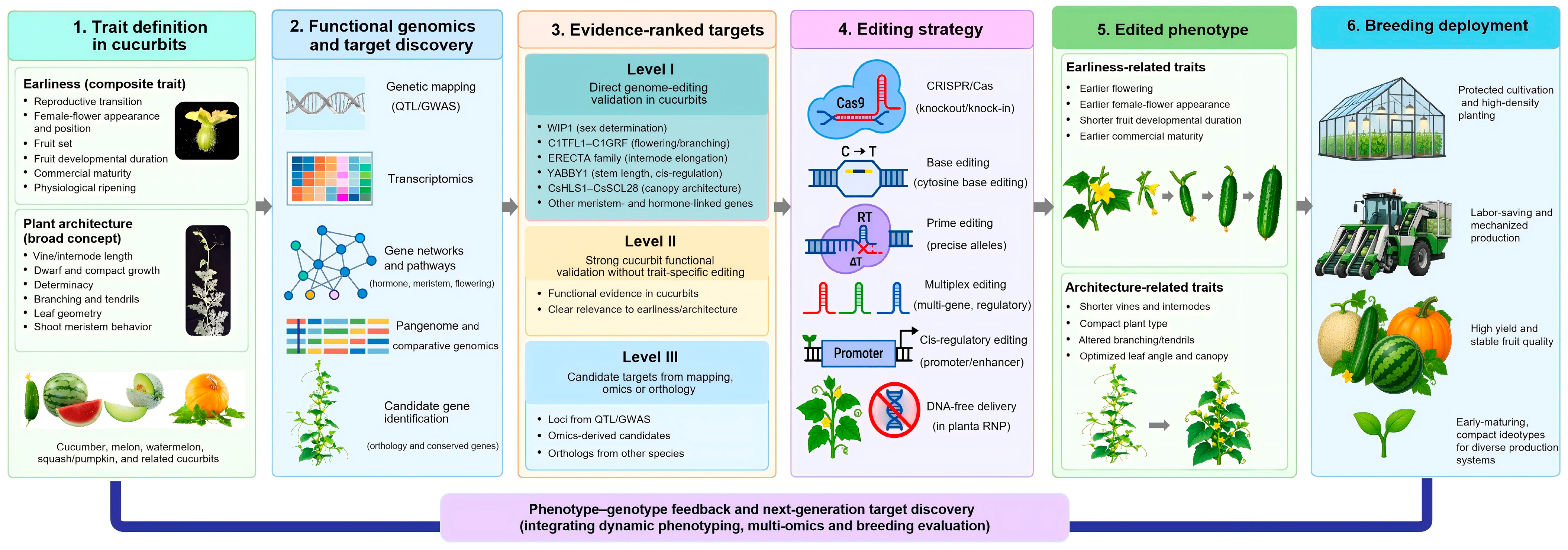

Disclaimer/Publisher’s Note: The statements, opinions and data contained in all publications are solely those of the individual author(s) and contributor(s) and not of MDPI and/or the editor(s). MDPI and/or the editor(s) disclaim responsibility for any injury to people or property resulting from any ideas, methods, instructions or products referred to in the content. |
© 2026 by the authors. Licensee MDPI, Basel, Switzerland. This article is an open access article distributed under the terms and conditions of the Creative Commons Attribution (CC BY) license.