


Abstract
Epilepsy is a common neurological disorder in which genetic and neuroinflammatory mechanisms may contribute to differences in seizure control. Chemokine receptor signaling plays an important role in inflammatory processes, and genetic variations in neuroinflammatory chemokine receptor genes may potentially influence the prognosis of epilepsy. This study aimed to investigate genetic variations in the neuroinflammatory chemokine receptor genes CCR5 and CXCR4 in patients with epilepsy and to explore their potential association with seizure control during treatment. Targeted next-generation sequencing (tNGS) was performed to investigate genetic variations in the CCR5 and CXCR4 genes using genomic DNA obtained from 22 patients with epilepsy receiving antiseizure medication (ASM) treatment with levetiracetam and/or valproic acid. Patients were classified into two groups according to seizure frequency to evaluate the association between genetic variation and clinical prognosis. A total of seven genetic variants were identified in the CCR5 and CXCR4 genes, including three variants in CCR5 and four variants in CXCR4. However, sufficient genotype variation for group-wise comparisons was available only for CCR5 rs1799988 and rs1800023. No significant differences were observed in the genotype or allele distributions of the CCR5 and CXCR4 gene variants between the responsive and persistent groups. The two CCR5 variants, rs1799988 and rs1800023, showed strong linkage disequilibrium (D′ = 1.000, r2 = 0.913) and were included in a single haplotype block. None of the identified CCR5 haplotypes was significantly associated with seizure control. In this preliminary cohort, no statistically significant associations were detected between the analyzed genetic variations and seizure control during treatment; however, the limited sample size may have reduced the statistical power to detect potential associations. Strong linkage disequilibrium was observed between rs1799988 and rs1800023 (D′ = 1.000, r2 = 0.913), consistent with previously reported patterns. Given the small sample size and the limited number of informative variants, these findings should be interpreted as preliminary and hypothesis-generating rather than as evidence for or against a genetic contribution to seizure control. Larger, independent cohorts are needed to assess the potential clinical relevance of CCR5 and CXCR4 variation in epilepsy.
1. Introduction
Epilepsy is one of the most common serious neurological disorders, affecting more than 70 million people worldwide [1,2]. Epilepsy is a heterogeneous neurological disorder characterized by recurrent unprovoked seizures and diverse clinical manifestations [3]. Despite substantial advances in antiseizure medication (ASM) therapy, achieving sustained seizure control remains challenging in a proportion of patients. Although ASMs provide adequate seizure control for many individuals, a considerable subset continues to experience seizures despite appropriate treatment. This variability in treatment response reflects the complex and multifactorial nature of epilepsy and may arise from differences in genetic background, disease characteristics, drug disposition, and underlying biological pathways [4]. Understanding the factors contributing to interindividual variability in treatment response is therefore important for improving the management of patients with epilepsy and identifying potential molecular determinants of treatment outcome.
Genetic factors are increasingly recognized as potential contributors to the interindividual variability observed in epilepsy and treatment outcomes. Genetic variation may influence susceptibility to seizures, disease phenotype, and the clinical response to antiseizure medications through effects on biological pathways involved in neuronal excitability, immune regulation, and drug action [4,5]. Although several genetic variants have been investigated in relation to antiseizure medication response, the available evidence remains heterogeneous and only a limited number of genetic markers have demonstrated consistent clinical relevance [4,5]. Therefore, identifying additional genetic determinants of treatment response may provide further insight into the biological mechanisms underlying variability in epilepsy outcomes.
Neuroinflammation has increasingly been recognized as an important component of the pathophysiology of epilepsy [6]. Evidence from both experimental and human studies indicates that seizures can activate inflammatory processes in the brain, including microglial and astrocytic activation, disruption of the blood–brain barrier, and increased production of proinflammatory cytokines and chemokines [6,7]. These inflammatory mediators can influence neuronal excitability and may contribute to a lower seizure threshold and the persistence of epileptic activity. Thus, neuroinflammatory pathways may represent important biological mechanisms underlying the clinical heterogeneity of epilepsy and may contribute to differences in seizure control among individuals.
Among the mediators involved in neuroinflammatory signaling, chemokines and their receptors have attracted increasing attention in epilepsy. Chemokines regulate immune-cell migration and communication within the central nervous system and may influence inflammatory responses following seizure activity [7]. In particular, chemokine receptor signaling has been implicated in the recruitment and activation of inflammatory cells and in the modulation of neuroinflammatory processes associated with neuronal injury [8]. CCR5 is expressed in the central nervous system and has been implicated in microglial activation, leukocyte recruitment, and seizure-associated neuroinflammation [8]. Experimental studies have further suggested that modulation of the CCL5/CCR5 axis can influence neuroinflammatory responses and neuronal injury following seizures [9,10]. The CXCR4 receptor, another important chemokine receptor involved in immune-cell trafficking and inflammatory signaling, may likewise participate in neuroinflammatory processes within the central nervous system [10,11]. Together, these findings suggest that chemokine receptor signaling may represent a biologically plausible pathway through which genetic variation could contribute to interindividual differences in epilepsy.
Genetic variation in chemokine receptor genes may contribute to interindividual differences in immune signaling and inflammatory responses by altering receptor expression, ligand interaction, or downstream signaling activity [12]. In this context, polymorphisms in CCR5 and CXCR4 represent potential candidate variants for investigating the genetic basis of variability in epilepsy. Although alterations in chemokine and chemokine receptor signaling have been reported in epileptic brain tissue and experimental models, evidence regarding the contribution of inherited variation in CCR5 and CXCR4 to clinical heterogeneity in epilepsy remains limited [6,7]. In particular, the potential relationship between genetic variation in these receptors and seizure control during treatment has not been sufficiently investigated. Therefore, examining CCR5 and CXCR4 genetic variation may provide preliminary insight into whether neuroinflammatory signaling pathways contribute to interindividual differences in epilepsy outcomes.
Therefore, the present study aimed to investigate genetic variations in the neuroinflammatory chemokine receptor genes CCR5 and CXCR4 in patients with epilepsy. As a secondary exploratory objective, we evaluated whether the identified genetic variations were associated with seizure control during treatment.
2. Results
2.1. CCR5 and CXCR4 Gene Variant Analysis
Targeted sequencing of the CCR5 and CXCR4 genes was performed in 22 patients with epilepsy who were receiving antiepileptic treatment with levetiracetam and/or valproic acid. A total of seven variants were identified across the two genes. Three variants were detected in CCR5 (rs1799988, rs1800023, and rs333), while four variants were identified in CXCR4 (rs2680880, rs2471859, rs139877430, and rs2228014) (Table 1).
In the CCR5 gene, the rs1799988 variant was detected in 17 patients, including 11 heterozygous and 6 homozygous individuals. The rs1800023 variant was identified in 16 patients, of whom 10 were heterozygous and 6 were homozygous. Both variants were upstream gene variants and classified as having a modifier effect. In addition, the rs333 variant was detected in two patients in a heterozygous. This variant corresponds to a c.554_585del deletion resulting in a p.Ser185IlefsTer32 frameshift alteration and was annotated as a high-impact variant.
In the CXCR4 gene, the most frequently observed variant was rs2680880:A > T, which was detected in seven patients in a heterozygous. This variant was annotated as c.16-67T > A and classified as an intronic variant. The rs2471859:A > G variant was detected in three patients, whereas rs139877430:G > A was identified in two patients; both variants were located within intronic regions. The rs2228014:G > A variant was detected in one patient in the heterozygous state. This variant corresponds to c.414C > T (p.Ile138=) and was annotated as a synonymous variant.
The identified variants were predominantly located in intronic or regulatory regions of the CCR5 and CXCR4 genes. Among the detected variants, CCR5 rs333 was notable because of its predicted frameshift effect and high-impact annotation. Although rs333 was annotated as a high-impact frameshift variant based on its predicted molecular consequence, its clinical significance was classified as benign.
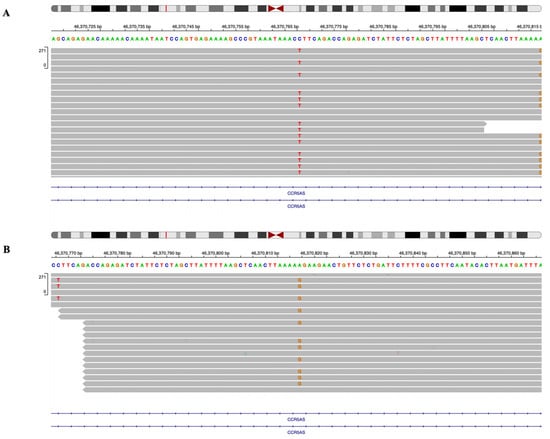
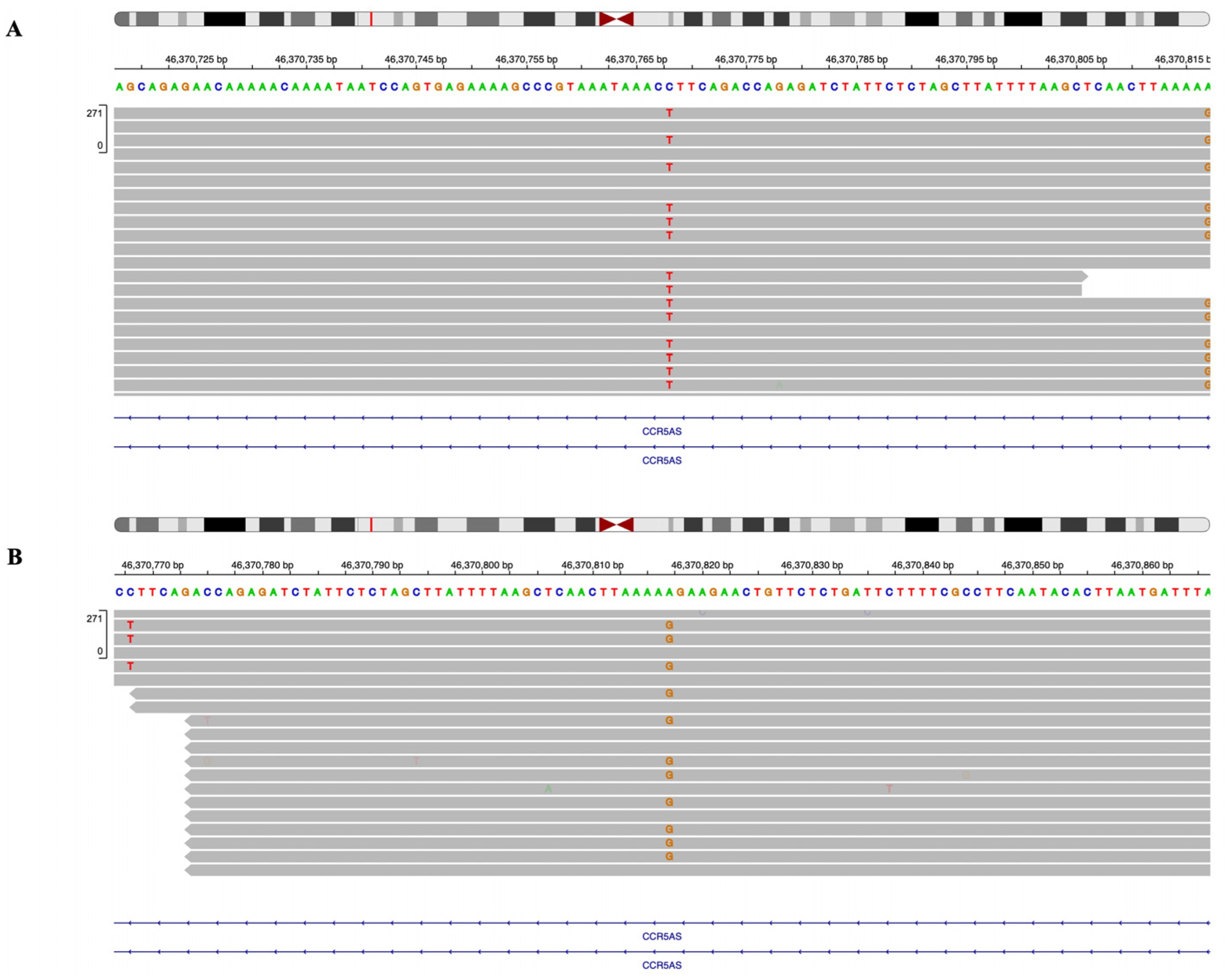
According to the variant annotation in the sequencing pipeline, the CCR5 variants rs1799988 and rs1800023 were classified as benign. Among the CXCR4 variants, rs139877430 was classified as likely benign, while rs2228014:G > A, rs2471859:A > G, and rs2680880:A > T were classified as benign. No pathogenic or likely pathogenic variants were identified in the analyzed CCR5 or CXCR4 variants. Among the identified CCR5 variants, rs1799988:C > T and rs1800023:A > G were selected for further analysis based on their relevance to the study objectives. The identified CCR5 rs1799988:C > T and rs1800023:A > G variants were visualized using Integrative Genomics Viewer (IGV), as shown in Figure 1.
Figure 1.
IGV visualization of the CCR5 gene variants rs1799988:C > T (A) and rs1800023:A > G (B) identified by targeted sequencing.
Table 1.
Genetic variants identified in the CCR5 and CXCR4 genes in patients with epilepsy.
Although seven variants were identified by targeted sequencing, sufficient genotype variation for statistical comparison between the persistent and responsive groups was observed only for CCR5 rs1799988:C > T and rs1800023:A > G. The remaining five variants (rs333, rs139877430:G > A, rs2228014:G > A, rs2471859:A > G, and rs2680880:A > T) showed low genotype distributions, with the variant genotypes observed in only a small number of individuals. Therefore, these variants were not included in the genotype-based statistical analyses because the low number of observations did not allow meaningful or reliable group-wise comparisons. Accordingly, HWE analyses were restricted to the two variants with sufficient genotype variation for the planned statistical analyses. The genotype distributions of the CCR5 rs1799988:C > T and rs1800023:A > G variants were assessed for Hardy–Weinberg equilibrium (HWE) in the persistent and responsive groups. For rs1799988:C > T, the observed genotype frequencies were consistent with the expected frequencies in the persistent group (χ2 = 0.11, p = 0.738) and in the responsive group (χ2 = 0.06, p = 0.796). Similarly, the genotype distribution of rs1800023:A > G was in accordance with HWE in both the persistent (χ2 = 0.11, p = 0.738) and responsive (χ2 = 0.50, p = 0.405) groups (Table 2). Thus, neither variant showed a significant deviation from HWE in either seizure-control group.
Table 2.
Hardy–Weinberg equilibrium between the groups for CCR5 rs1799988:C > T, and CCR5 rs1800023:A > G.
No significant differences were observed in the genotype or allele distributions of CCR5 rs1799988:C > T between the responsive and persistent groups. Similarly, no significant association was detected for rs1800023:A > G under genotypic, dominant, recessive, or allelic models (all p > 0.05).
2.2. CCR5 Haplotype and Linkage Disequilibrium Analysis
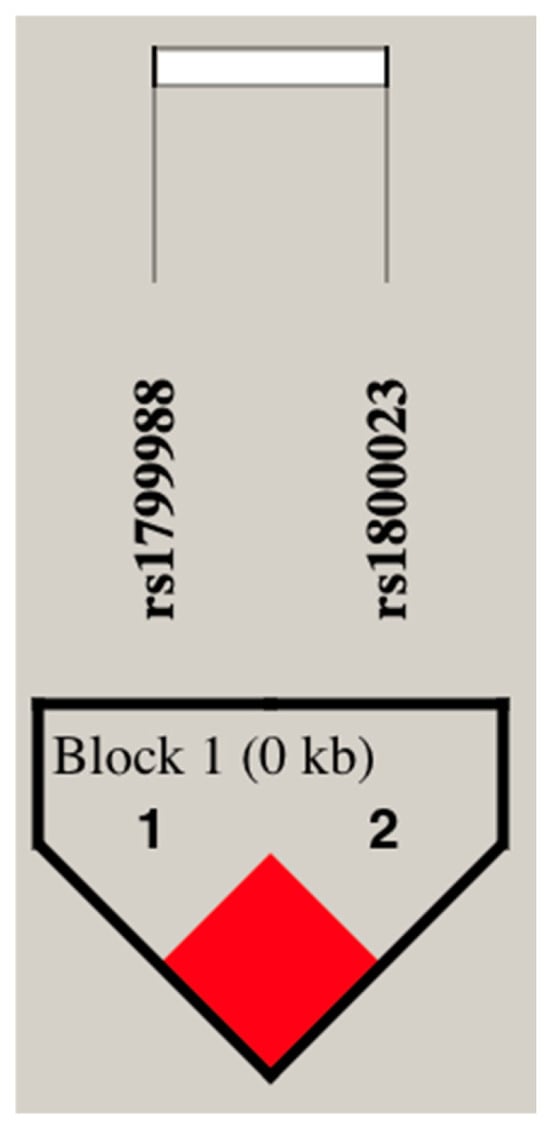
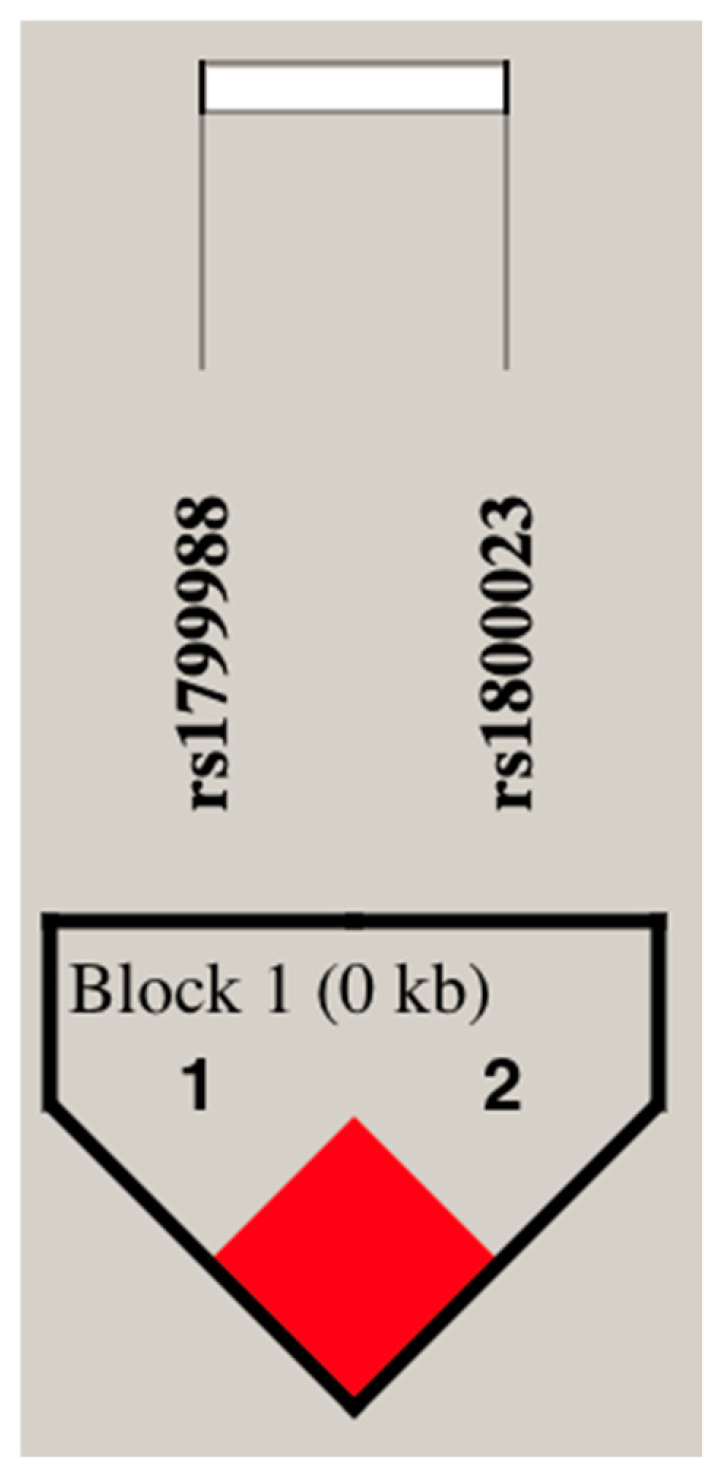
Haplotype analysis was performed for the two CCR5 polymorphisms, rs1799988:C > T and rs1800023:A > G (Table 3). The two variants showed strong linkage disequilibrium (LD), with a D′ value of 1.000 and an r2 value of 0.913 and were therefore included in a single haplotype block (Figure 2). Three haplotypes (TG, CA, and TA) were identified. The TG haplotype was the most frequent, with an overall frequency of 0.500, and showed identical frequencies in the responsive and persistent groups (0.500 vs. 0.500; χ2 = 0.000, p = 1.000). The CA haplotype was observed at frequencies of 0.500 and 0.462 in the responsive and persistent groups, respectively (χ2 = 0.063, p = 0.802). The rare TA haplotype was observed only in the persistent group (0.000 vs. 0.038); however, this difference was not statistically significant (χ2 = 0.708, p = 0.400). None of the CCR5 haplotypes was significantly associated with seizure control (Table 4).
Figure 2.
The CCR5 gene rs1799988 and rs1800023 polymorphisms in a single haplotype block. Linkage disequilibrium: D′ = 1.000; r2 = 0.913.
Table 3.
CCR5 Gene rs1799988 and rs1800023 Variations in Haplotype Analysis Markers.
Table 4.
Single and Block Haplotype Analysis of Variations in the CCR5 Gene.
3. Discussion
In this exploratory study, we characterized genetic variation in CCR5 and CXCR4 in 22 patients with epilepsy and examined its potential relationship with seizure-control status. Seven variants were identified; however, the low number of carriers for several variants limited the scope of genotype-based association analyses to CCR5 rs1799988:C > T and rs1800023:A > G. No statistically significant associations were detected between these variants and seizure-control status. The observed linkage disequilibrium between the two CCR5 variants was consistent with previously reported patterns and should be regarded as a descriptive finding rather than a novel contribution. Given the limited sample size, the present findings are insufficient to determine whether genetic variation in either gene is associated with seizure control.
CCR5 is a chemokine receptor involved in immune-cell recruitment and inflammatory signaling and has been implicated in neuroinflammatory processes within the central nervous system [8,13]. CCR5 signaling may contribute to the recruitment and activation of inflammatory cells and to the regulation of microglial responses following seizure activity [8]. Experimental studies have suggested that alterations in the CCL5/CCR5 axis may influence neuroinflammatory responses and neuronal injury in epilepsy models [9]. These biological properties make CCR5 a plausible candidate gene for investigating interindividual variation in epilepsy. However, the biological plausibility of CCR5 does not necessarily imply a direct relationship between CCR5 genetic variation and treatment response, which requires specific clinical and genetic evaluation.
In the present exploratory study, no significant differences were observed in the genotype or allele distributions of CCR5 rs1799988:C > T and rs1800023:A > G between the seizure-control and persistent-seizure groups. Both rs1799988:C > T and rs1800023:A > G are upstream regulatory region variants of CCR5 that have previously been investigated in human populations in the context of immune-mediated and inflammatory conditions [14,15]. Likewise, neither dominant nor recessive genetic models revealed significant associations with seizure control, and no significant associations were observed for the CCR5 haplotypes. Although no significant association was detected between these variants and seizure control, the strong linkage disequilibrium was observed between rs1799988:C > T and rs1800023:A > G (D′ = 1.000, r2 = 0.913). This finding suggests that these two variants are strongly correlated in the present cohort and may represent a linked genetic background rather than independent sources of genetic variation. Such linkage may be relevant when considering the combined contribution of CCR5 variants in future studies, although the clinical significance of this finding remains to be established.
The potential functional relevance of the CCR5 promoter variants identified in this study warrants consideration. Previous in silico analyses have suggested that CCR5 promoter polymorphisms may influence transcription factor binding, with rs1799988 predicted to affect a glucocorticoid receptor alpha binding region [14]. In addition, previous studies have reported differences in CCR5 promoter activity associated with promoter haplotypes [15]. However, the specific functional effects of the individual rs1799988:C > T and rs1800023:A > G variants have not been directly validated experimentally. Further functional studies are therefore needed to clarify their potential regulatory effects.
The CCR5 rs333 (CCR5-Δ32) variant was identified in two heterozygous patients in our cohort. However, the limited number of carriers precluded a reliable assessment of its association with treatment response. Although the functional consequences of the CCR5-Δ32 variant have been well documented in previous studies, these established biological effects should not be interpreted as evidence of an association in the present cohort. Therefore, the identification of rs333 in two patients should be considered a descriptive finding, and larger studies are required to determine whether this variant has any relevance to seizure control.
Four genetic variants were identified in CXCR4, including intronic and synonymous variants. However, several of these variants were observed at low frequencies in the study cohort, limiting the ability to perform robust genotype-based comparisons and to draw meaningful conclusions regarding their potential relationship with seizure control. Although CXCR4 is biologically relevant to chemokine-mediated inflammatory signaling and has been implicated in neuroinflammatory processes associated with epilepsy [16], the present findings do not provide evidence for a significant association between the identified CXCR4 variants and seizure control.
The observed variants may nevertheless provide a basis for further investigation of the contribution of chemokine receptor genetic variation to epilepsy and seizure control in larger cohorts. Chemokine receptors such as CCR5 and CXCR4 are involved in immune-cell trafficking and inflammatory signaling, and neuroinflammatory mechanisms have increasingly been implicated in epilepsy. Although a direct mechanistic link between genetic variation in these receptors and seizure control has not been established, alterations in chemokine signaling could potentially modify inflammatory processes that influence neuronal function and the biological response to seizure control. Thus, the potential relevance of CCR5 and CXCR4 genetic variation to treatment response should be considered a hypothesis requiring further investigation rather than an established mechanism.
Our previous studies in Turkish patients with epilepsy have also investigated genetic variation in ion-channel genes, including SCN1A, CACNA2D2, and voltage-gated potassium channel genes, in relation to antiseizure medication response [17,18]. These studies, together with the present findings, support the investigation of diverse biologically relevant genetic pathways as potential contributors to interindividual variability in epilepsy treatment outcomes. However, the potential role of chemokine receptor variation in seizure control remains to be established and requires validation in larger, adequately powered cohorts.
Limitations
Several limitations should be considered when interpreting these findings. The small sample size substantially limited statistical power and the precision of association estimates. This limitation was particularly important for the five variants with low numbers of carriers, for which meaningful genotype-based comparisons could not be performed. Therefore, the absence of statistically significant associations should not be interpreted as evidence that these variants have no effect on seizure control.
Clinical heterogeneity, including differences in age, sex, disease characteristics, and antiseizure medication regimens, may have contributed to variability in seizure control. These potential confounding factors could not be adequately accounted for in multivariable analyses because of the limited sample size. Furthermore, although all participants were recruited from the same geographical region and study setting, ancestry-related population structure could not be formally assessed using ancestry-informative markers or genome-wide genetic data.
The observed linkage disequilibrium between CCR5 rs1799988 and rs1800023 is a descriptive finding consistent with previous reports and should not be interpreted as a novel finding or as evidence of an independent association with seizure control. The study also lacked functional validation and an independent replication cohort, limiting the ability to establish the biological relevance and reproducibility of the observed findings.
The findings should be considered preliminary and hypothesis-generating rather than definitive evidence of pharmacogenetic associations. Larger studies with adequate statistical power, well-characterized clinical phenotypes, standardized treatment exposure, appropriate adjustment for potential confounders, ancestry-related genetic data, and independent replication are needed to determine whether genetic variation in CCR5 or CXCR4 is associated with seizure control in epilepsy.
4. Materials and Methods
4.1. Study Design
In this study, 22 patients with epilepsy who had been receiving antiseizure medication (ASM) treatment for at least five years were evaluated. All participants received valproic acid and/or levetiracetam as monotherapy or polytherapy. Patients who had experienced three or more seizures during the previous year despite ongoing ASM treatment were classified as the persistent-seizure group. Patients who had remained seizure-free for more than one year while receiving ASM treatment were classified as the responsive group [19]. Thus, this classification was based on observed seizure frequency during the 12-month assessment period and was not intended to constitute a formal classification of drug-resistant epilepsy according to the ILAE definition. Seizure-control status was determined based on the patients’ clinical records and treatment history. Patients were not selected based on treatment response or resistance, and no specific seizure type was excluded. Both patients with adequate seizure control and those with persistent seizures during ASM therapy were included and subsequently classified according to their observed seizure-control status. The study was approved by the Haliç University Ethics Committee (Reference number 2025/355) and was conducted in accordance with the Declaration of Helsinki. Written informed consent was obtained from all participants. Peripheral whole-blood samples were obtained from the Republic of Turkey Ministry of Health Sinan Sipahi Family Health Center.
4.2. Next-Generation Sequencing Method
Genomic DNA was isolated from EDTA-coated peripheral blood samples using the Genomic DNA-Column Kits (QIAGEN®, Silicon Valley, CA, USA, cat. nos. 51304). NanoDrop 2000c (Thermo-Fisher Sci., Waltham, MA, USA) was used to check the purity and concentration of DNA samples. Firstly, the exons of CCR5 and CXCR4 genes and the regions located at the exon and exon-intron boundaries were amplified using a PCR device (C1000; Biorad, Hercules, CA, USA). Libraries were constructed using the TruSeqCustom Amplicon v1.5 Exome Library Prep Kit (Illumina, Inc., San Diego, CA, USA, cat, nos. 20018705), and all samples were sequenced on the NovaSeq 6000 System (Illumina, Inc., San Diego, CA, USA) platform.
4.3. Analyzing Raw Data
In previous studies, we achieved over 20-fold coverage for 95% of the targeted regions, as detailed in the methodology [20,21]. Sequencing data were initially evaluated for read quality with FastQC v0.11.9. Adapter sequences and low-quality bases were subsequently removed using Cutadapt v5.0. The resulting high-quality reads were mapped to the human GRCh38 reference genome and downstream read processing and variant calling were performed using the DRAGEN v4.3.6 pipeline. Functional and genomic annotations of the identified variants were generated with Ensembl Variant Effect Predictor (VEP) v115.2. Candidate variants were then inspected manually in the Integrative Genomics Viewer (IGV) v3.8.3 to confirm the sequencing. A minimum read depth of 30× was applied for variant assessment, and 95% coverage of the targeted regions was achieved. These quality control criteria were used to support the reliability of variant detection and subsequent analyses.
Variants with a minor allele frequency (MAF) below 1% in the gnomAD v4.1 database were considered rare and, where relevant, prioritized for further evaluation based on their potential functional effects. Population allele frequencies reported in Table 1 were obtained from the GnomAD v4.1 database. Variant interpretation was performed using the Ilyome Bioinformatics platform. The clinical significance of variants was assessed according to the 2015 standards and guidelines established by the American College of Medical Genetics and Genomics and the Association for Molecular Pathology (ACMG/AMP) [22].
4.4. Statistical Analyzes
Statistical analysis was carried out using GraphPad Prism version 10.3.1 software. The Chi-square test was applied to compare the study groups. Fisher’s exact test was utilized when any expected cell frequency was below 5. Allele and genotype frequencies were calculated, and Hardy–Weinberg equilibrium estimates were also determined. Deviations from Hardy–Weinberg equilibrium were analyzed using Michael H. Court’s (2005–2008) online calculator. Haplotype analysis was performed using the Haploview 4.1 software for the CCR5 rs1799988 and rs1800023 variants, which had sufficient genotype variation for haplotype estimation. The remaining five low-frequency variants were not included in the haplotype analysis because their low genotype frequencies did not allow reliable estimation of haplotype frequencies. A p-value of less than 0.05 was regarded as statistically significant.
No correction for multiple testing was applied, as none of the seven identified variants showed a nominally significant association with treatment response (all p > 0.05). Given the small sample size and the low number of carriers for several variants, the analyses were not intended to provide definitive evidence of association. Therefore, the association analyses were considered exploratory.
5. Conclusions
In conclusion, this exploratory study identified genetic variation in CCR5 and CXCR4 among patients with epilepsy but did not detect statistically significant associations between the investigated variants and seizure control during treatment. Given the small sample size and the low frequency of several variants, these findings should not be interpreted as evidence against a potential role of CCR5 and CXCR4 genetic variation in seizure control. Rather, they provide preliminary, hypothesis-generating observations that require validation in larger, adequately powered cohorts.
Author Contributions
K.C.P.-U.: Methodology, Conceptualization, Investigation, Data Analysis, Writing—Original Draft, and Review and Editing. E.R.A.: Data Curation, Clinical Examinations, and Review and Editing. H.U.: Writing—Original Draft and Review and Editing. All authors have read and agreed to the published version of the manuscript.
Funding
This research received no external funding.
Institutional Review Board Statement
The study was conducted in accordance with the Declaration of Helsinki on medical research involving human subjects. This study was approved by the Haliç University Ethics Committee. (Approval Number: 2025/355; Date: 29 May 2025).
Informed Consent Statement
Informed consent was obtained from all subjects involved in the study.
Data Availability Statement
The original contributions presented in this study are included in the article. Further inquiries can be directed to the corresponding author.
Acknowledgments
We thank our patients who participated in the study.
Conflicts of Interest
The authors declare that they have no conflicts of interest related to this study.
References
- Singh, A.; Trevick, S. The Epidemiology of Global Epilepsy. Neurol. Clin. 2016, 34, 837–847. [Google Scholar] [CrossRef] [Scilit] [PubMed]
- Löscher, W.; Potschka, H.; Sisodiya, S.M.; Vezzani, A. Drug Resistance in Epilepsy: Clinical Impact, Potential Mechanisms, and New Innovative Treatment Options. Pharmacol. Rev. 2020, 72, 606–638. [Google Scholar] [CrossRef] [Scilit] [PubMed]
- Fisher, R.S.; Acevedo, C.; Arzimanoglou, A.; Bogacz, A.; Cross, J.H.; Elger, C.E.; Engel, J., Jr.; Forsgren, L.; French, J.A.; Glynn, M.; et al. ILAE official report: A practical clinical definition of epilepsy. Epilepsia 2014, 55, 475–482. [Google Scholar] [CrossRef] [Scilit] [PubMed]
- Barguilla, A.; Riera, P.; Ros-Castelló, V.; Muino, E.; Sierra-Marcos, A. Pharmacogenomics of anti-seizure medications in epilepsy: A systematic review of genetic predictors of response and tolerance. Expert Rev. Neurother. 2026, 26, 485–495. [Google Scholar] [CrossRef] [Scilit] [PubMed]
- Lin, C.H.; Ho, C.J.; Chen, S.Y.; Lu, Y.T.; Tsai, M.H. Review of pharmacogenetics of antiseizure medications: Focusing on genetic variants of mechanistic targets. Front. Pharmacol. 2024, 15, 1411487. [Google Scholar] [CrossRef] [Scilit] [PubMed]
- van Vliet, E.A.; Aronica, E.; Vezzani, A.; Ravizza, T. Review: Neuroinflammatory pathways as treatment targets and biomarker candidates in epilepsy: Emerging evidence from preclinical and clinical studies. Neuropathol. Appl. Neurobiol. 2018, 44, 91–111. [Google Scholar] [CrossRef] [Scilit] [PubMed]
- Chen, Y.; Nagib, M.M.; Yasmen, N.; Sluter, M.N.; Littlejohn, T.L.; Yu, Y.; Jiang, J. Neuroinflammatory mediators in acquired epilepsy: An update. Inflamm. Res. 2023, 72, 683–701. [Google Scholar] [CrossRef] [Scilit] [PubMed]
- Louboutin, J.P.; Strayer, D. Relationship between the chemokine receptor CCR5 and microglia in neurological disorders: Consequences of targeting CCR5 on neuroinflammation, neuronal death and regeneration in a model of epilepsy. CNS Neurol. Disord. Drug Targets 2013, 12, 815–829. [Google Scholar] [CrossRef] [Scilit] [PubMed]
- Zhang, Z.; Li, Y.; Jiang, S.; Shi, F.D.; Shi, K.; Jin, W.N. Targeting CCL5 signaling attenuates neuroinflammation after seizure. CNS Neurosci. Ther. 2023, 29, 317–330. [Google Scholar] [CrossRef] [Scilit] [PubMed]
- Hiragi, T.; Ikegaya, Y.; Koyama, R. Microglia after Seizures and in Epilepsy. Cells 2018, 7, 26. [Google Scholar] [CrossRef] [Scilit] [PubMed]
- Li, W.; Wu, J.; Zeng, Y.; Zheng, W. Neuroinflammation in epileptogenesis: From pathophysiology to therapeutic strategies. Front. Immunol. 2023, 14, 1269241. [Google Scholar] [CrossRef] [Scilit] [PubMed]
- Stone, M.J.; Hayward, J.A.; Huang, C.; Huma, Z.E.; Sanchez, J. Mechanisms of Regulation of the Chemokine-Receptor Network. Int. J. Mol. Sci. 2017, 18, 342. [Google Scholar] [CrossRef] [Scilit] [PubMed]
- Louboutin, J.; Chekmasova, A.; Marusich, E.; Agrawal, L.; Strayer, D.S. Role of CCR5 and its ligands in the control of vascular inflammation and leukocyte recruitment required for acute excitotoxic seizure induction and neural damage. FASEB J. 2011, 25, 737–753. [Google Scholar] [CrossRef] [Scilit] [PubMed]
- Liu, S.; Chen, J.; Yan, Z.; Dai, S.; Li, C.; Yao, Y.; Shi, L. Polymorphisms in the CCR5 promoter associated with cervical intraepithelial neoplasia in a Chinese Han population. BMC Cancer 2019, 19, 525. [Google Scholar] [CrossRef] [Scilit] [PubMed]
- Liu, S.; Liu, N.; Wang, H.; Zhang, X.; Yao, Y.; Zhang, S.; Shi, L. CCR5 Promoter Polymorphisms Associated with Pulmonary Tuberculosis in a Chinese Han Population. Front. Immunol. 2021, 11, 544548. [Google Scholar] [CrossRef] [Scilit] [PubMed]
- Zhou, Z.; Liu, T.; Sun, X.; Mu, X.; Zhu, G.; Xiao, T.; Zhao, M.; Zhao, C. CXCR4 antagonist AMD3100 reverses the neurogenesis promoted by enriched environment and suppresses long-term seizure activity in adult rats of temporal lobe epilepsy. Behav. Brain Res. 2017, 322, 83–91. [Google Scholar] [CrossRef] [Scilit] [PubMed]
- Pekkoc-Uyanik, K.C.; Todurga-Seven, Z.G.; Agay, E.R.; Uzun, H. Targeted Sequencing and Haplotype Analysis of Voltage-Gated Potassium Channel Genes Reveal a Potential Association of KCNV2 Haplotypes with Antiseizure Medication Response in Turkish Patients with Epilepsy. Pharmaceuticals 2026, 19, 1193. [Google Scholar] [CrossRef] [Scilit] [PubMed]
- Todurga-Seven, Z.G.; Pekkoc-Uyanik, K.C.; Agay, E.R. CACNA2D2 rs56287038:G>T and SCN1A rs2298771:C>T Variants Are Associated with Anti-Seizure Medication Response in Turkish Epilepsy Patients: A Pilot Study. Neuropsychobiology 2026, 85, 231–244. [Google Scholar] [CrossRef] [Scilit] [PubMed]
- Kwan, P.; Arzimanoglou, A.; Berg, A.T.; Brodie, M.J.; Hauser, W.A.; Mathern, G.; Moshé, S.L.; Perucca, E.; Wiebe, S.; French, J. Definition of drug resistant epilepsy: Consensus proposal by the ad hoc Task Force of the ILAE Commission on Therapeutic Strategies. Epilepsia 2010, 51, 1069–1077. [Google Scholar] [CrossRef] [Scilit] [PubMed]
- Pekkoc-Uyanik, K.C.; Aslan, E.I.; Kilicarslan, O.; Ser, O.S.; Ozyildirim, S.; Yanar, F.; Yildiz, A.; Ozturk, O.; Yilmaz-Aydogan, H. Next-generation sequencing of prolidase gene identifies novel and common variants associated with low prolidase in coronary artery ectasia. Mol. Biol. Rep. 2023, 50, 1349–1365. [Google Scholar] [CrossRef] [Scilit] [PubMed]
- Pekkoc-Uyanik, K.C.; Todurga-Seven, Z.G.; Shahzadi, A.; Sonmez, H.; Mercan, S.; Mete, B.; Tabak, F. Next-generation sequencing of CCR5, CXCR4, and IFNAR1 variants in relation to HIV-1 disease progression and ART response. Sci. Rep. 2025, 15, 26511. [Google Scholar] [CrossRef] [Scilit] [PubMed]
- Richards, S.; Aziz, N.; Bale, S.; Bick, D.; Das, S.; Gastier-Foster, J.; Grody, W.W.; Hegde, M.; Lyon, E.; Spector, E.; et al. Standards and guidelines for the interpretation of sequence variants: A joint consensus recommendation of the American College of Medical Genetics and Genomics and the Association for Molecular Pathology. Genet. Med. 2015, 17, 405–424. [Google Scholar] [CrossRef] [Scilit] [PubMed]

Disclaimer/Publisher’s Note: The statements, opinions and data contained in all publications are solely those of the individual author(s) and contributor(s) and not of MDPI and/or the editor(s). MDPI and/or the editor(s) disclaim responsibility for any injury to people or property resulting from any ideas, methods, instructions or products referred to in the content. |
© 2026 by the authors. Licensee MDPI, Basel, Switzerland. This article is an open access article distributed under the terms and conditions of the Creative Commons Attribution (CC BY) license.