


Abstract
Adventitious roots (ARs) are essential for clonal vegetative propagation of woody tree species. Extensive studies have focused on phytohormone and transcription factor regulatory networks during AR development in poplar, yet the regulatory roles of reactive oxygen species (ROS) signaling during AR development remain poorly understood. In this study, we performed a genome-wide identification and systematic characterization of the Respiratory Burst Oxidase Homolog (Rboh) gene family in Populus trichocarpa. A total of 10 PtrRbohs were identified and phylogenetically classified into five subfamilies. Expression profiling revealed distinct tissue-specific and stress-responsive expression patterns among PtrRbohs. Functional validation via CRISPR/Cas9-mediated knockout showed that disruption of PtrRbohB significantly reduced AR length, diameter, and lateral root density in poplar. Heterologous overexpression of PtrRbohB in Arabidopsis thaliana enhanced ROS accumulation, confirming its conserved function in ROS generation. Furthermore, knockout of PtrRohB down-regulated the expression of several AR-positive regulators and up-regulated that of AR-negative regulators in poplar. Collectively, this study provides the direct genetic evidence that Rboh regulates AR formation in poplar, and identifies PtrRbohB as a key positive regulator of AR development. These findings enrich our understanding of woody plant AR formation and provide candidate genes for molecular breeding of poplar rooting traits.
1. Introduction
Adventitious roots (ARs) initiate from non-root tissues such as stems and branches, and are indispensable for clonal vegetative propagation of most woody plant species [1]. For forest trees, the capacity for AR formation directly determines the survival rate of cuttings, the popularization of elite germplasm, and the efficiency of large-scale afforestation [2]. In many woody species, poor rooting ability severely restricts cutting breeding and genetic improvement of excellent varieties [2]. Over decades, substantial progress has been achieved in exploring anatomical characteristics, physiological and biochemical changes, and hormone regulatory networks governing woody plant AR development [3]. Nevertheless, most mechanistic knowledge originates from herbaceous model plants; the molecular regulatory framework underlying woody-specific AR reprogramming remains fragmentary. In particular, how wound-triggered signal molecules coordinate cell fate transition during AR induction and initiation has not been fully elucidated, which hinders our capacity to genetically improve rooting traits in forest trees.
Multiple transcription factors and hormone-related regulatory modules controlling woody AR development have been identified in recent years. In poplar, key genes including WOX11, SCR, LBD16, AIL1, and RR13 participate in the cell dedifferentiation, primordium initiation and outgrowth of ARs, forming a complex transcriptional regulatory cascade intertwined with auxin–cytokinin crosstalk [4,5]. Similar regulatory factors have also been characterized in other tree genera, yet these studies largely center on phytohormone and transcription factor pathways [6,7]. Increasing physiological evidence indicates that reactive oxygen species (ROS) act as vital secondary messengers upon wounding stimulus during cutting propagation, participating in cell wall remodeling and cell fate reprogramming of root founder cells [8,9,10]. Accordingly, it is reasonable to speculate that ROS-generating components may serve as critical regulatory factors for woody plant AR formation, deserving further genetic validation.
Plasma membrane-localized Respiratory Burst Oxidase Homolog (Rboh, also known as NADPH oxidase) is the primary enzyme responsible for apoplastic ROS production in plants [11]. Upon perceiving developmental or stress signals, Rboh proteins use the cytosolic nicotinamide adenine dinucleotide phosphate reduced form (NADPH) as an electron donor to catalyze superoxide anion generation, which is subsequently converted into hydrogen peroxide and other ROS molecules to modulate plant growth, morphogenesis, and stress adaptation, especially the elongation of the pollen tube and the regulation of stem cell activity [8,9]. Functional studies in herbaceous plants have demonstrated that Rboh-derived ROS modulates root-hair elongation, lateral-root emergence, cell-wall rigidity modification and hormone signal transduction [12]. For instance, AtRbohC is essential for root-hair tip growth in Arabidopsis thaliana; loss-of-function mutation leads to shortened root hairs and disturbed root apical development [13]. Recent transcriptomic studies on apple and camphor tree cuttings revealed that several Rboh homologs are significantly induced during AR primordia formation, implying potential links between Rboh-dependent ROS accumulation and AR development in woody plants [6,7]. However, the direct genetic functional verification of the Rboh gene family remains scarce in perennial woody trees.
Poplars (Populus spp.) represent the most important fast-growing perennial woody model tree, possessing enormous ecological value in ecological restoration and considerable economic value for timber, pulp and bio-energy industries [14]. Among poplar taxa, sections Tacamahaca (balsam poplars) are characterized by high adventitious rooting capacity, which provides superior material for cutting propagation and cross-breeding [15]. Populus trichocarpa, a representative species of balsam poplar, has inherently easy-to-root traits, which distinguish it from poplar species that are difficult to root. In addition, it boasts a high-quality reference genome and a mature, stable genetic transformation system [16], making P. trichocarpa an ideal experimental system for dissecting the genetic basis that governs the development of ARs in woody plants. In this study, we systematically identified 10 PtrRboh family members across the P. trichocarpa genome and performed comprehensive analyses of phylogeny, gene duplication, conserved structure, cis-elements, post-translational modification (PTM) sites and tissue/stress-responsive expression profiles. A root-preferentially expressed gene, PtrRbohB, was selected for further functional characterization via CRISPR/Cas9-mediated gene knockout and heterologous overexpression assays. Our results demonstrate that PtrRbohB positively regulates ARs growth and modulates ROS accumulation. Collectively, these findings enrich our understanding of Rboh functions and provide candidate genes for molecular breeding targeting poplar rooting traits.
2. Results
2.1. Identification and Phylogenetic Analysis of Rbohs
Ten Rboh family members were identified in P. trichocarpa based on the NADPH_Ox and NAD_binding_6 domains. According to their evolutionary relationships with A. thaliana, these members were named PtrRbohA through PtrRbohJ (Table S1). PtrRboh proteins varied in length from 846 aa (PtrRbohJ) to 949 aa (PtrRbohI), with molecular weights ranging from 96.7 kDa (PtrRbohJ) to 107.7 kDa (PtrRbohI) and isoelectric points between 9.10 (PtrRbohG) and 9.41 (PtrRbohF and PtrRbohH). Subcellular localization prediction indicated that all 10 PtrRbohs were membrane-localized. Among PtrRbohs, eight members possessed four transmembrane helices, PtrRbohJ/PtrRbohH had five and six transmembrane helices, respectively (Figure S1).
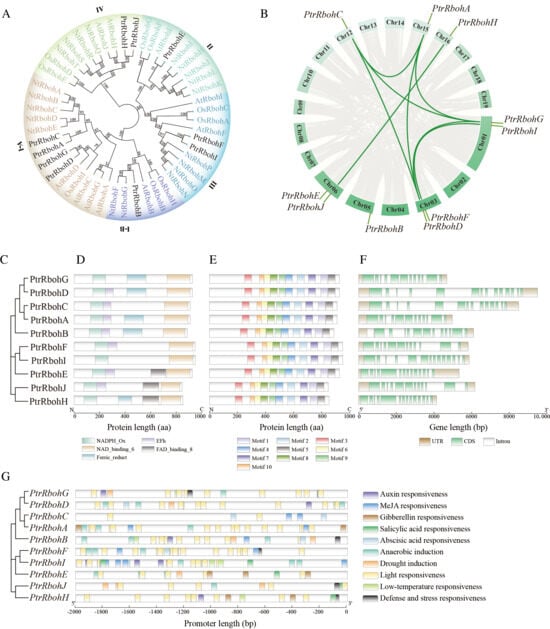
For phylogenetic analysis, 49 Rboh protein sequences from P. trichocarpa, A. thaliana, Oryza sativa, and Nicotiana tabacum were retrieved and used to construct a phylogenetic tree (Figure 1A). These Rbohs clustered into five subfamilies: I-A comprised four PtrRbohs (PtrRbohA, PtrRbohC, PtrRbohD, and PtrRbohG); I-B comprised PtrRbohB; II comprised PtrRbohE; III comprised PtrRbohF and PtrRbohI; and IV comprised PtrRbohH and PtrRbohJ.
Figure 1.
Bioinformatic characterization of PtrRbohs. (A) Phylogenetic relationships of Rboh proteins. These proteins are clustered into five subfamilies, each marked by a distinct color (beige, purple, green, light green, and blue). (B) Chromosomal distribution and synteny of PtrRbohs. Nineteen chromosomes are represented by green boxes; grey lines and green lines represent collinearity relationships of genome and PtrRbohs, respectively. (C) Phylogenetic analysis of PtrRbohs. (D) Conserved domains of PtrRbohs. (E) Motifs of PtrRbohs. (F) Gene structure of PtrRbohs. (G) Analysis of cis-acting elements in promoters of PtrRbohs.
2.2. Chromosome Localization and Synteny Analysis of PtrRbohs
To investigate the duplication of PtrRbohs, chromosomal distribution and synteny relationships were examined. In P. trichocarpa, 10 PtrRbohs were unevenly distributed across six chromosomes (Figure 1B), namely Chr01, Chr03, Chr06, Chr12, Chr15, and Chr16. Genome-wide synteny analysis revealed eight syntenic gene pairs within the Rboh family. PtrRbohA, PtrRbohC, PtrRbohD, and PtrRbohG formed a collinear relationship comprising four genes. PtrRbohJ was collinear with PtrRbohH, and PtrRbohI was collinear with PtrRbohF. In contrast, PtrRbohB and PtrRbohE had no collinear relationship and were identified as singletons. Among these eight gene pairs, eight PtrRbohs were involved in eight segmental duplication events, whereas none underwent tandem duplication (Table S2), suggesting that segmental duplication serves as the primary force driving PtrRbohs expansion. All gene pairs had Ka/Ks values below 1 (Table S2), implying that purifying selection contributed substantially to the evolution of PtrRbohs.
2.3. Conserved Motif, Gene Structure, and Conserved Domain Analysis
To characterize the structural similarities and differences among PtrRbohs, we examined their conserved features. An evolutionary tree of the 10 PtrRbohs was constructed (Figure 1C), and conserved domains were predicted by the NCBI-CDD tool (Figure 1D). Domain analysis revealed that NADPH_Ox and NAD_binding_6 were present in all PtrRbohs, whereas the domains of the Ferric_reduct, EFh, and FAD_binding_8 varied among these proteins, and PtrRbohI simultaneously lacked these three domains. Analysis of conserved motifs showed that all PtrRbohs had 10 conserved motifs (Figure 1E and Figure S2). Analysis of gene structure showed that most PtrRbohs shared similar exon–intron organization (Figure 1F). PtrRbohC, PtrRbohD, PtrRbohE, PtrRbohH, and PtrRbohI had 13 introns; PtrRbohG, PtrRbohA, PtrRbohF, and PtrRbohJ had 11 introns. PtrRbohB had 12 introns, different from the others. The difference also appeared in the UTRs. PtrRbohB had three UTRs (including two separated 5′-UTRs), while the other nine PtrRbohs had only two UTRs. These data indicate that PtrRbohs have a close evolutionary relationship, although there are some differences in gene structure and protein characteristics.
2.4. Stress-, Growth-, and Development-Related Cis-Element Analysis of PtrRboh Promoters
To explore the potential functions of PtrRbohs, stress-, growth-, and development-related cis-acting elements were predicted in their promoters (Figure 1G). These elements included light-responsive, hormone-responsive (gibberellin, abscisic acid, salicylic acid, methyl jasmonate (MeJA), and auxin), and stress-responsive (drought-inducible, defense/stress-responsive, low-temperature-responsive, and anaerobic induction) elements. The positions and numbers of the 10 element types differed markedly. Light-responsive elements were present in all promoters and accounted for the largest proportion (42.23%). Most PtrRbohs had anaerobic induction- and salicylic acid-responsive elements. Auxin-responsive elements were detected only in PtrRbohG, PtrRbohD, PtrRbohB, PtrRbohI, and PtrRbohH. Gibberellin-responsive elements were found in PtrRbohA, PtrRbohE, and PtrRbohH. MeJA-responsive elements were found in PtrRbohA, PtrRbohB, PtrRbohC, PtrRbohI, and PtrRbohF. Drought-inducible, defense, and stress-responsive elements were detected only in PtrRbohG, PtrRbohB, PtrRbohJ, and PtrRbohH, whereas low-temperature-responsive elements occurred in PtrRbohD, PtrRbohB, PtrRbohI, and PtrRbohH. These findings suggest that PtrRbohs participated in multiple pathways regulating plant growth, development, and stress responses.
2.5. Analysis of PTM Sites in PtrRbohs
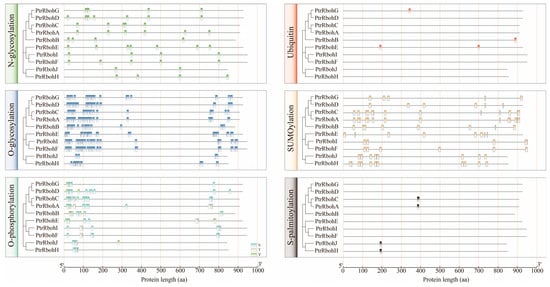
PTMs typically serve as key regulators of Rboh activity [17]; therefore, we analyzed six PTM sites (N-glycosylation, O-glycosylation, O-phosphorylation, ubiquitylation, SUMOylation, and palmitoylation) in PtrRbohs (Figure 2, Table S3). Closely related members tend to share more similar PTM patterns, with modification sites preferentially enriched at the N- and C-termini. Among all 10 proteins, phosphorylation sites were the most abundant, with a total of 128 sites; phosphorylation site counts varied from 8 in PtrRbohJ to 22 in PtrRbohC per protein. O-glycosylation (n = 77, N represents the total number of modification sites, and the same applies below) and SUMOylation (n = 76) were the second and third most abundant PTMs, respectively, in terms of the total number of modified proteins. Ubiquitylation had the fewest sites (n = 4), with counts ranging from 0 (PtrRbohI, PtrRbohF, PtrRbohD, PtrRbohA, PtrRbohC, and PtrRbohH) to 2 (PtrRbohE) per protein; PtrRbohB and PtrRbohG each had one site. In addition, O-glycosylation, O-phosphorylation, and SUMOylation sites were abundantly distributed at the N- and C-termini of these proteins. The PtrRbohs had a long chain at the N-terminus and a β-sheet at the C-terminus (Figure S2), suggesting that PTM may influence protein structure and potential functions.
Figure 2.
PTM site prediction of PtrRbohs. Parameter settings: N-glycosylation (threshold was set at >0.5), O-glycosylation (threshold was set at >0.5), O-phosphorylation (score was set at >0.8), ubiquitin (threshold was set at >0.5), SUMOylation (threshold was set at >0.5), and S-palmitoylation (threshold was set at >0.5).
2.6. Expression Pattern Analysis of PtrRbohs
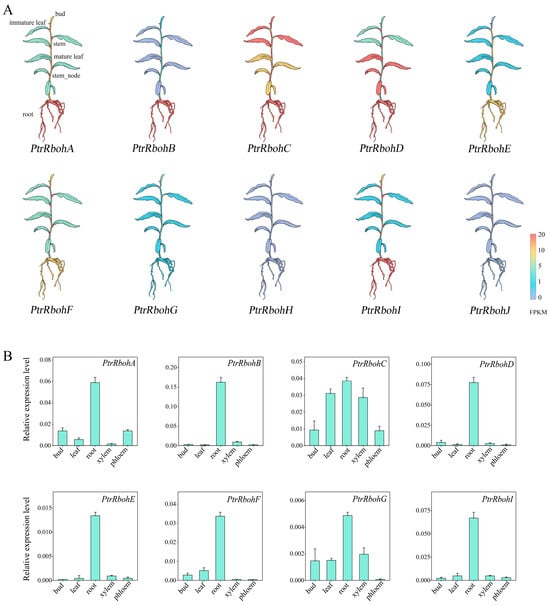
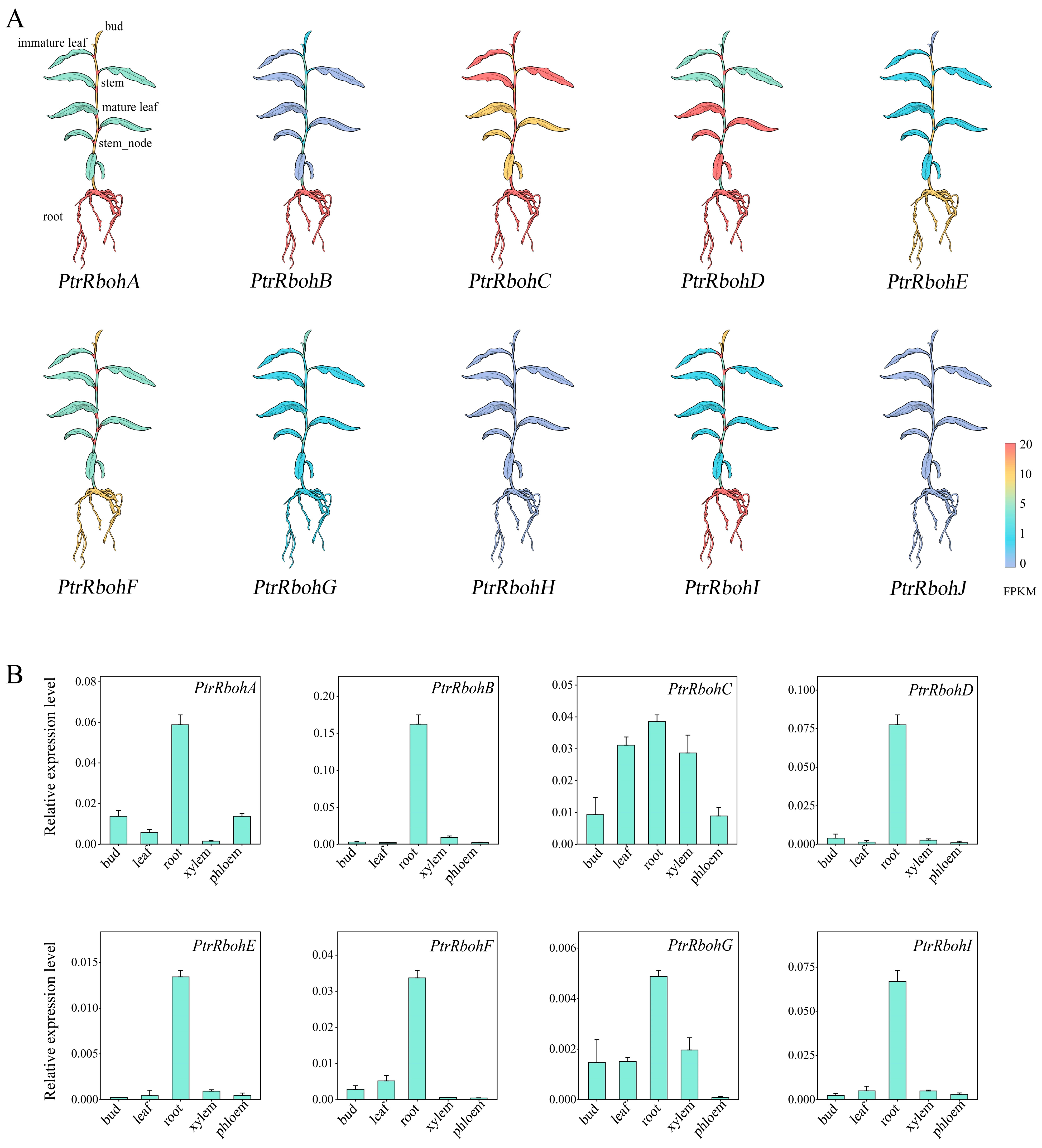
To further confirm the functions of PtrRboh genes, expression patterns in buds, immature and mature leaves, stems, stem nodes, and roots were analyzed. The results showed significant differences (Figure 3A). PtrRbohA exhibited peak expression in stems and stem nodes, indicating its association with lignification. PtrRbohB, PtrRbohD, PtrRbohE, PtrRbohF, and PtrRbohI were preferentially expressed in roots, suggesting their involvement in root development. Additionally, RT-qPCR was conducted to analyze and test the expression patterns of PtrRbohs in buds, leaves, roots, xylem, and phloem (Figure 3B). The verification results are roughly similar to the transcriptome data. Six PtrRbohs (PtrRbohA, PtrRbohB, PtrRbohD, PtrRbohE, PtrRbohF, and PtrRbohI) showed preferential expression in roots, indicating that PtrRbohs may be involved in root development. Among them, PtrRbohB had the highest relative expression level in roots, suggesting its potential functions in root development.
Figure 3.
Expression pattern analysis of PtrRbohs. (A) Expression levels of PtrRbohs in 6 tissues: bud, immature leaf, mature leaf, stem, the node of stem, and root. (B) Expression levels of PtrRbohs in bud, leaf, root, xylem, and phloem. All experiments were performed with three biological replicates, and error bars represent the standard deviation.
2.7. Expression of PtrRbohs Under Drought, Salt, Heat, and Cold Stress
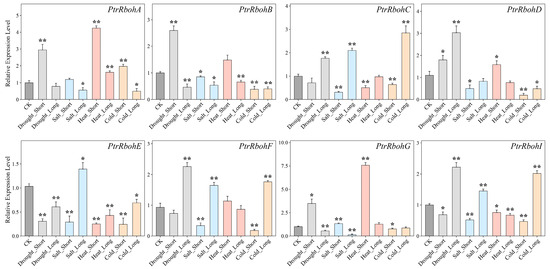
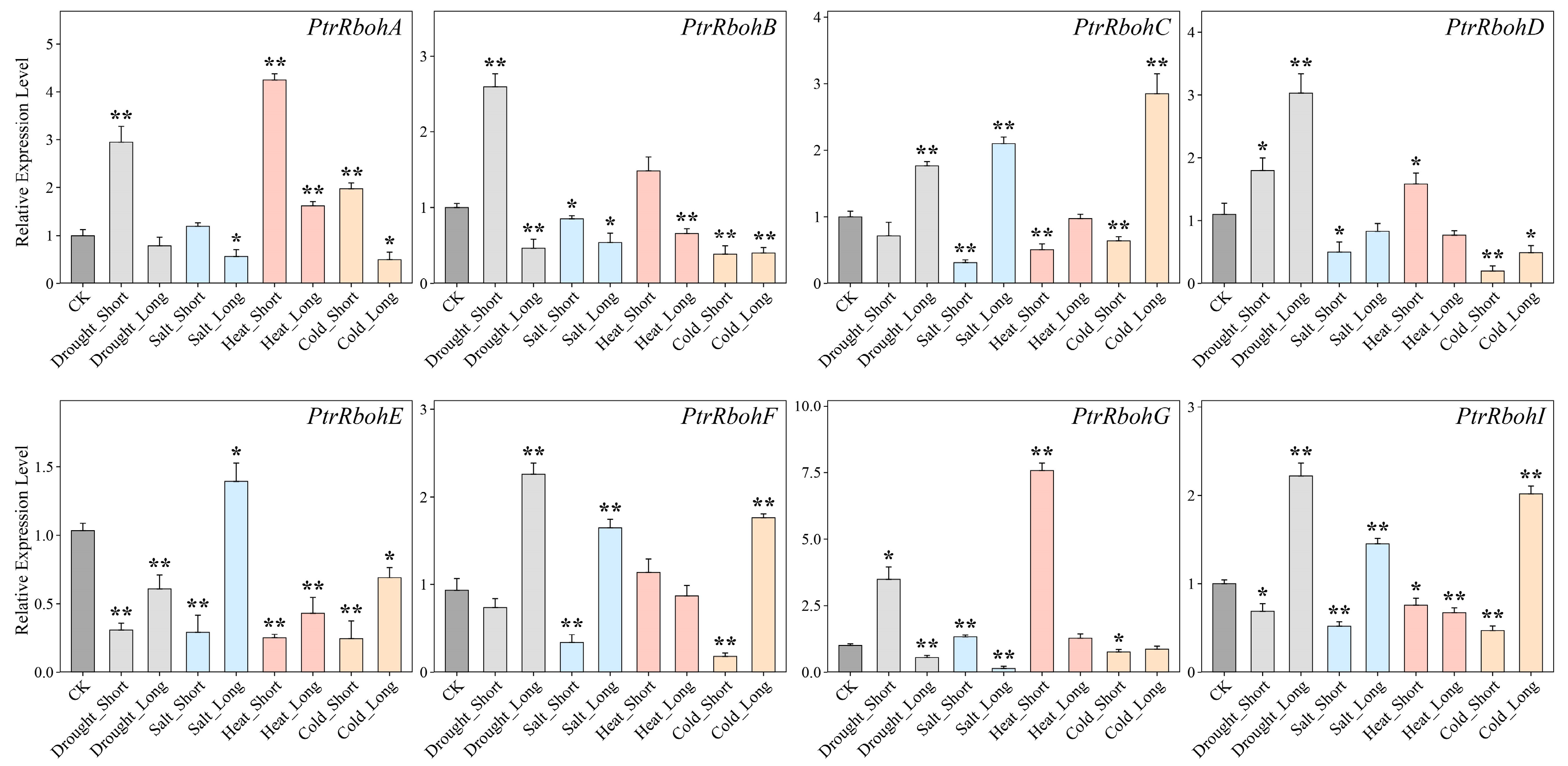
To investigate the response of PtrRbohs to abiotic stresses, RT-qPCR was performed to quantify the transcript levels of all PtrRboh members in roots under short-term and long-term exposure to drought, salt, heat, and cold stresses (Figure 4). Under drought stress, PtrRbohA, PtrRbohB, PtrRbohD, and PtrRbohG showed significantly increased expression during short-term treatment, whereas PtrRbohE exhibited decreased expression under both short-term and long-term drought stress. Under 100 mM NaCl stress, the expression levels of four PtrRbohs (PtrRbohC, PtrRbohE, PtrRbohF, and PtrRbohI) showed time-dependent expression patterns, and PtrRbohC, PtrRbohE, PtrRbohF, and PtrRbohI showed decreased expression during short-term salt treatment but increased expression under long-term salt stress, suggesting a dynamic adaptive response to salt stress over time. For heat stress, PtrRbohA and PtrRbohG exhibited high expression levels under short-term heat stress, suggesting that these two members are involved in the early response to heat stress in poplar roots. Under long-term cold stress, PtrRbohC, PtrRbohF, and PtrRbohI were significantly up-regulated under long-term cold stress, indicating their potential roles in long-term cold acclimation. Collectively, PtrRboh family members exhibited distinct differences in expression responses to different abiotic stresses. These results also provide basic expression-level data for further exploring the roles of PtrRbohs in poplar stress adaptation.
Figure 4.
Expression levels of PtrRbohs in roots under drought, salt, heat, and cold stress. Eight groups of data are presented, including short- and long-term treatments for each stress treatment. All experiments were performed with three biological replicates, and error bars represent the standard deviation. Statistical significance was assessed with one-way ANOVA (* p < 0.05, ** p < 0.01).
2.8. Knockout of PtrRbohB Inhibits AR Development in P. trichocarpa
To confirm the function of PtrRbohB, we constructed stable transgenic Arabidopsis lines with the floral dip method, and three highly expressed lines were selected for further analysis (Figure S3A). Since PtrRbohB is annotated as an NADPH oxidase, we collected several fresh leaves from the transgenic lines for histological DAB staining analysis (Figure S3B). The results revealed that after decolorization, compared with the wild-type (WT) plants, PtrRbohB-OE lines displayed dark brown leaves, which indicated increased ROS accumulation in the overexpression lines. The conserved Rboh domains (Figure 1D), together with DAB staining showing ROS accumulation, collectively confirm the function of PtrRbohB as an Rboh.
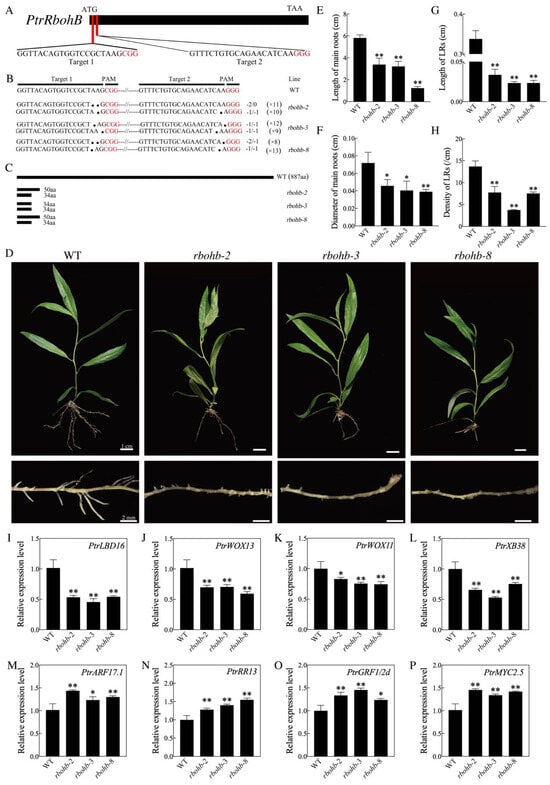
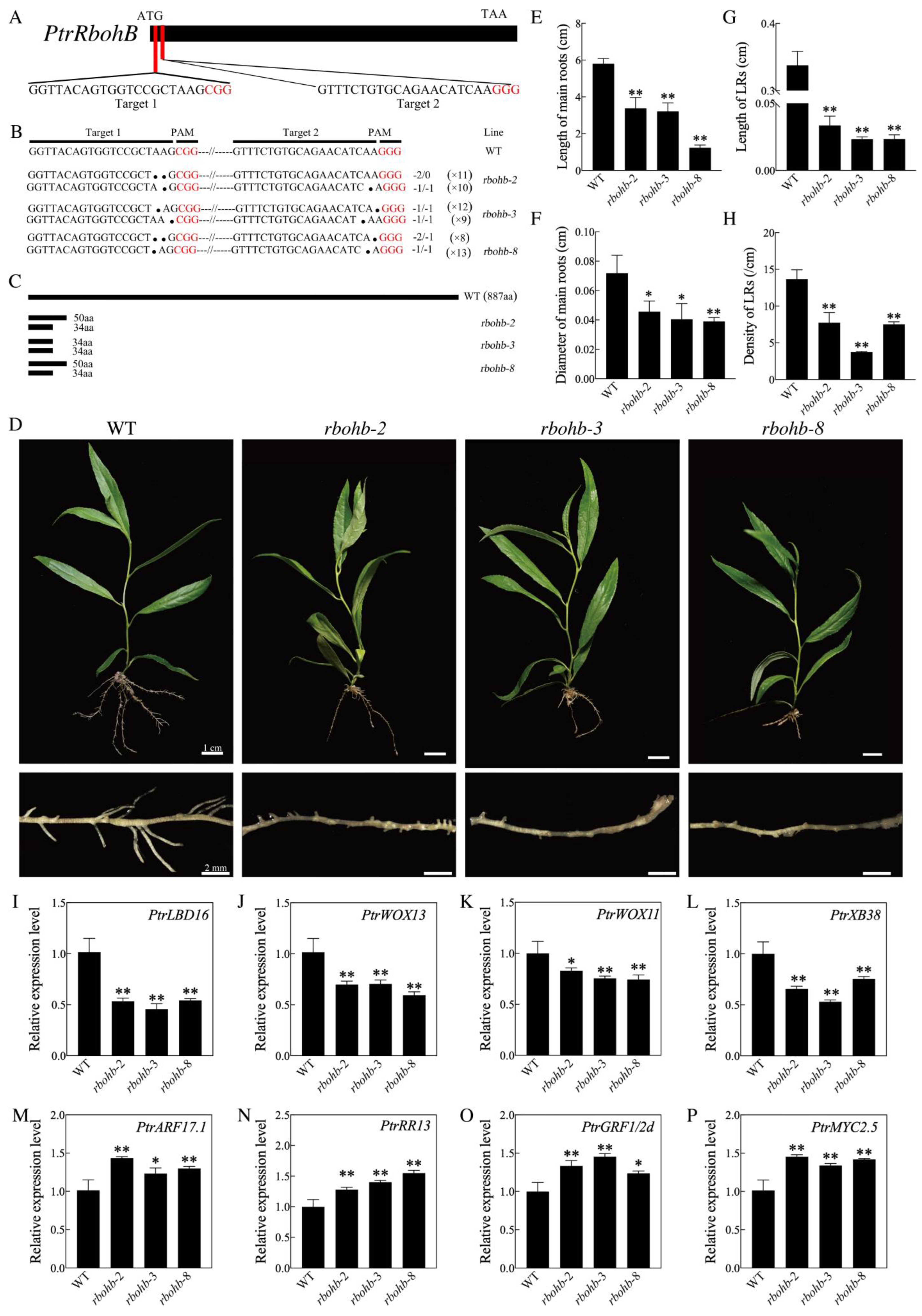
To further clarify the biological function of PtrRbohB, we constructed several ptrrbohb knockout mutants. Sequencing analysis of the edited target sequences confirmed that the frameshift induced by the mutation introduced a premature stop codon, resulting in the early termination of translation (Figure 5A–C). We then selected three independent transgenic lines (rbohb-2/3/8) to investigate the root phenotype. Compared with WT plants, the rbohb mutant lines showed significantly different root system architecture. The AR length and diameter of rbohb lines decreased significantly, as did the length and density of lateral roots (Figure 5D–H). These results indicate that knockout of PtrRbohB significantly inhibits AR development. To further explore the role of PtrRbohB in AR development, RT-qPCR was carried out to examine analyze the expression of several marker genes associated with AR development. The expression levels of positively regulated genes (PtrLBD16, PtrWOX13, PtrWOX11, and PtrXB38) decreased significantly relative to WT (Figure 5I–L). In contrast, the expression levels of negatively regulated genes (PtrARF17.1, PtrRR13A, PtrGFR1/2d, and PtrMYC2.5) were significantly higher than those in WT (Figure 5M–P).
Figure 5.
CRISPR/Cas9-induced ptrrbohb mutations in P. trichocarpa. (A) CRISPR/Cas9 target sites of PtrRbohB. Target1/2 indicate the positions of gRNA-targeted sites by different pHSE401-2gRNA vectors. (B) Mutation sites in PtrRbohB. Black text and dots represent native gRNA target sequences and deleted nucleotides, respectively. Red text denotes the PAM (protospacer adjacent motif) (C) Selected potential mutated PtrRbohB proteins. (D) Phenotypic differences of roots between WT and transgenic lines. (E) Length of roots. (F) Diameter of roots. (G) Length of LRs. (H) Density of LRs. (I) Expression level of PtrLBD16. (J) Expression level of PtrWOX13. (K) Expression level of PtrXB38. (L) Expression level of PtrWOX11. (M) Expression level of PtrARF17.1. (N) Expression level of PtrRR13. (O) Expression level of PtrGRF1/2d. (P) Expression level of PtrMYC2.5. All experiments were performed with three biological replicates, and error bars represent the standard deviation. Statistical significance was assessed with one-way ANOVA (* p < 0.05, ** p < 0.01).
3. Discussion
3.1. Identification and Evolutionary Conservation and Divergence of the PtrRbohs
In this study, 10 PtrRboh family members were identified in the P. trichocarpa genome and phylogenetically divided into five subfamilies (I-A, I-B, II, III, IV). The number of Rboh family members varies widely across plant lineages: 10 in A. thaliana [18], nine in rice [19], 20 in tobacco [20], and up to 40 in bread wheat [21]. Notably, P. trichocarpa harbors the same number of Rboh genes as A. thaliana, despite over 100 million years of independent evolution between woody angiosperms and herbaceous Brassicaceae [22]. Synteny analysis revealed that segmental duplication, rather than tandem duplication, was the dominant driving force for PtrRboh family expansion (Figure 1B). All collinear gene pairs had Ka/Ks values far below 1, indicating that purifying selection has acted to maintain the core enzymatic functions of Rboh proteins during poplar evolution. Meanwhile, all PtrRbohs contain the two core catalytic domains, NADPH_Ox and NAD_binding_6, as well as 10 conserved motifs (Figure 1D), reflecting high evolutionary conservation of basic Rboh function. Nevertheless, noticeable structural divergence was observed among subfamilies: intron number ranged from 11 to 13, the number of transmembrane helices also varied from 4 to 6, and the distribution of predicted sites of PTMs (Figure 1F, Figure 2 and Figure S2). These structural divergences, especially in promoter regions and PTM sites, provide the molecular basis for the differential expression patterns and functional specialization of PtrRboh family members.
3.2. Functional Divergence of PtrRbohs in Growth, Development and Stress Responses
Gene expression patterns are tightly linked to their biological function. Tissue expression profiling showed that PtrRboh members exhibited distinct tissue specificities (Figure 3), implying extensive functional differentiation. PtrRbohC was preferentially expressed in buds and leaves, suggesting involvement in leaf development and morphogenesis. PtrRbohA and PtrRbohI showed peak expression in stems, consistent with potential roles in xylem lignification and secondary cell wall formation. Additionally, PtrRbohB, PtrRbohD, PtrRbohE, PtrRbohF, and PtrRbohI were abundantly expressed in roots, indicating their participation in root system development and function. For abiotic stress responses, these PtrRbohs also showed differentiated response patterns under drought, salt, heat and cold stresses (Figure 4). Most PtrRbohs were slightly up-regulated under salt stress, suggesting a conserved role for RBOH-mediated ROS signaling in salt stress. In contrast, PtrRbohA and PtrRbohB were induced by short-term drought, while PtrRbohC, PtrRbohF and PtrRbohI were up-regulated under long-term cold stress. This functional divergence is consistent with the diverse distribution of cis-acting elements in promoter regions (Figure 1G). Notably, all stress expression assays in this study were performed on wild-type plants; the stress response of PtrRbohB knockout lines will be investigated in our follow-up work. Taken together, these PtrRbohs have undergone functional divergence during evolution, with different members participating in distinct biological processes of growth, development and stress adaptation.
3.3. PtrRbohB Is a Key Positive Regulator of AR Formation
Among the root-abundant PtrRbohs, PtrRbohB showed the most prominent root-specific expression pattern, and its promoter harbors auxin-responsive elements closely associated with AR induction, indicating that PtrRbohB may be a key regulator of poplar AR development. Genetic evidence from CRISPR/Cas9-mediated knockout further confirmed this function; knockout of PtrRbohB significantly reduced AR length and diameter, as well as lateral root length and density, demonstrating that PtrRbohB positively regulates multiple developmental stages of ARs, including induction, initiation and elongation.
Previous transcriptomic studies in apple and poplar cuttings have shown that several Rboh homologs are significantly up-regulated during AR primordium formation, and exogenous H2O2 treatment can promote AR formation [23,24]. In Arabidopsis, RBOH-derived ROS has been proven to facilitate lateral root emergence by modifying cell wall properties [25]. Previous studies identified 10 Rboh members in Populus yunnanensis and analyzed their potential reactive oxygen production functions and protein interaction networks [26]; however, the biological function of Rbohs remained unclear, and direct genetic evidence for Rboh involvement in AR development in woody plants has been lacking. This study provides direct genetic evidence that Rboh protein regulates AR development in poplar, a model woody species. From a forest tree biology perspective, AR formation depends on reprogramming of differentiated somatic cells to acquire root meristem identity, and cell wall remodeling is a key step in this process [2]. The function of PtrRbohB in AR regulation suggests that RBOH-mediated ROS signaling may be involved in cell wall remodeling and somatic cell fate transition during poplar AR formation [2].
3.4. Potential Regulatory Pathway of PtrRbohB During AR Formation
RBOH proteins are the primary enzymes responsible for apoplastic ROS production in plants [8,27]. In this study, heterologous overexpression of PtrRbohB in Arabidopsis resulted in increased H2O2 accumulation in leaves as shown by DAB staining (Figure S3B), confirming that PtrRbohB retains the conserved function of catalyzing ROS production. In fact, ROS can regulate the activity of cell wall-modifying methylesterases, expansins and glycoside hydrolases, adjusting cell wall rigidity and extensibility, thereby promoting expansion of root founder cells and breakthrough of root primordia through surrounding tissues [28]. This is consistent with the finding that cell wall remodeling-related genes are highly expressed in the early stage of poplar AR formation [5]. Moreover, ROS as signaling molecules may regulate the expression of key AR-related transcription factors. RT-qPCR results showed that knockout of PtrRbohB significantly down-regulated the expression of AR positive regulators PtrLBD16, PtrWOX11, PtrWOX13 and PtrXB38, and up-regulated negative regulators such as PtrARF17.1 and PtrRR13A (Figure 5I–N). We speculate that PtrRbohB-derived ROS may modulate the expression or activity of these transcription factors, either directly or through crosstalk with auxin signaling pathways, thereby regulating AR formation. However, the upstream regulatory mechanisms of PtrRbohB and the direct downstream targets of ROS remain to be further experimentally verified. In addition, the PTM sites and cis-acting elements in this study are based on bioinformatics predictions, and their actual functions need to be confirmed by subsequent experiments. Collectively, this study identifies PtrRbohB as a key regulator of poplar AR development and lays a foundation for deciphering the ROS regulatory network that controls adventitious rooting in woody plants.
4. Materials and Methods
4.1. Identification and Phylogenetic Analysis of Rbohs in P. trichocarpa
To identify Rbohs in P. trichocarpa, 10 Rboh protein sequences from A. thaliana were used to blast in Phytozome (https://phytozome-next.jgi.doe.gov/, accessed on 1 July 2025). After removing redundant and incomplete sequences, 10 candidates were obtained and analyzed by NCBI-CDD (https://www.ncbi.nlm.nih.gov/Structure/cdd/wrpsb.cgi, accessed on 1 July 2025). Sequences containing the NADPH_Ox (PF08414) and NAD_binding_6 (PF08030) domains were identified as candidate Rbohs [29].
Protein sequences of Rbohs in three species (A. thaliana, O. sativa, and N. tabacum) were retrieved from NCBI (https://ncbi.nlm.nih.gov/, accessed on 3 July 2025) and used for phylogenetic analysis. The tree was visualized and annotated with MEGA 5.2 and iTOL (https://itol.embl.de, accessed on 7 July 2025) according to the previous research [30].
4.2. Chromosomal Localization and Synteny Analysis of PtrRbohs
The localization information for PtrRbohs was extracted from the genome file. Duplicated gene pairs were analyzed using MCScanX in TBtools (v2.441), and values of Ka/Ks were calculated with a simple Ka/Ks calculator in TBtools (v2.441) . The location and duplication relationship were visualized according to the previous research [31].
4.3. Conserved Domain, Conserved Motif, and Gene Structure Analyses of PtrRbohs
Conserved motifs of PtrRbohs were predicted by MEME (https://meme-suite.org/meme/, accessed on 27 July 2025) tool [32]. Conserved domains were identified by NCBI-CDD, and the gene structure information was analyzed based on the genome files [33]. Motifs, domain annotation, and gene structure information were visualized using the basic BioSequence Viewer in TBtools (v2.441) function according to the previous research [34].
4.4. Promoters Cis-Acting Elements and PTM Site Prediction Analysis of the PtrRboh
The 2 kb promoters were extracted from the P. trichocarpa genome and used for cis-elements prediction via PlantCARE (https://bioinformatics.psb.ugent.be/webtools/plantcare/html/, accessed on 27 August 2026). The identified cis-acting elements were visualized by the basic biosequence viewer [35]. For the PTM site prediction analysis, the detailed prediction method can be found in our previous research [36].
4.5. Expression Analysis of PtrRbohs
To determine the expression patterns of PtrRbohs, transcriptome data of six tissues (bud, immature leaf, mature leaf, stem, stem node, and roots) were downloaded from Phytozome (https://phytozome-next.jgi.doe.gov/, accessed on 1 September 2026) and visualized with TBtools (v2.441) [37]. Quantitative real-time PCR (RT-qPCR) was performed for five tissues (bud, leaf, root, xylem, and phloem) from 4-month-old poplar seedlings to verify the transcriptome data.
4.6. Plant Materials and Acquisition of Transgenic Lines
Tissue-cultured seedlings of P. trichocarpa, preserved in the laboratory. To obtain ptrrbohb mutant poplars, the knockout CRISPR/Cas9 vector was constructed as our previous description [38]. Stem segments of sterile tissue culture seedlings were used as transformation explants. To obtain overexpressed A. thaliana, the CDS of PtrRbohB was cloned into the pCAMBIA1300 vector for genetic transformation (primers are listed in Table S4). Seeds were screened by hygromycin selection, and quantitative screening was performed by the previous protocol [38]. Populus trichocarpa (Nisqually-1) seedlings, preserved in the laboratory, were cultured in conditions of 25 ± 2 °C, 70 ± 10% relative humidity, 5000 lux light intensity, and a 16 h light/8 h dark cycle.
4.7. Stress Treatment and RT-qPCR
Three-month-old seedlings of P. trichocarpa were used for stress treatment as described previously [39]. Both short- and long-term treatments were applied to each stress condition. Under drought treatment, plants were grown without additional watering for 7 days and 14 days. Under salt stress, plants were treated with 100 mM NaCl solution watering in the tray. Roots were collected after 24 h and 7 days. Under heat stress, plants were treated at 39 °C for 12 h and 7 days. Under cold stress, plants were subjected to 4 °C (night) and 12 °C (day) for 24 h or 7 days. Total roots were collected for RNA extraction and RT-qPCR according to the previous study [40]. PtrActin2 (Potri.001G309500) served as the internal reference gene (Table S4). All experimental procedures, including RNA integrity validation, DNase digestion, reverse transcription, qPCR reaction setup, primer amplification efficiency calibration, target amplicon length control and thermal cycling program, were strictly performed following the corresponding manufacturer protocols.
4.8. Phenotype Measurement and DAB Staining
Twenty-day-old transgenic and WT poplars were used for root phenotype measurement according to our previous study [36]. Leaves of transgenic A. thaliana were homogenized in DAB staining solution, which contained 1 mg·mL−1 diaminobenzidine, PBS solution, and 95% alcohol. The vacuum treatment of the blades was performed for five minutes. After 4–5 h of shaking at 80–100 rpm, leaves were removed in 95% alcohol for decolorization, and the images were recorded [41].
4.9. Statistical Analysis
All experiments were repeated at least three times. Statistical analysis was performed using SPSS (19.0). Differences among groups were assessed by one-way ANOVA followed by Duncan’s multiple range test. Significance levels are indicated as * p < 0.05 and ** p < 0.01.
5. Conclusions
In this study, 10 Rboh gene family members were systematically identified in the P. trichocarpa genome and phylogenetically divided into five subfamilies. Evolutionary analysis revealed that segmental duplication and purifying selection were the main drivers of PtrRboh family expansion and functional conservation. Structural analyses showed that all PtrRboh proteins harbored conserved core catalytic domains, while divergent gene structures, cis-regulatory elements and post-translational modification sites provided the molecular basis for functional differentiation among family members. Expression profiling confirmed that PtrRboh members participate in diverse developmental processes and abiotic stress responses, with five members showing root-preferential expression patterns. Notably, the most root-specific member, PtrRbohB, was functionally validated as a positive regulator of AR formation in poplar. Knockout of PtrRbohB significantly inhibited AR development and altered the expression of key AR-related transcription factors. Overall, these findings provide valuable insights into the biological functions of woody plant Rboh genes and lay a foundation for molecular breeding targeting rooting efficiency in poplar and related forest trees.
Supplementary Materials
The following supporting information can be downloaded at: https://www.mdpi.com/article/10.3390/ijms27208982/s1.
Author Contributions
Conceptualization, S.C. and F.S.; methodology, S.C. and R.S.; validation, P.G.; data curation, Y.D.; writing—original draft preparation, R.S.; writing—review and editing, S.C.; supervision, S.C.; funding acquisition, S.C. All authors have read and agreed to the published version of the manuscript.
Funding
This research was funded by the Young Elite Scientists Sponsorship Program by the Henan Association for Science and Technology (2025HYTP011); National Natural Science Foundation of China (32401609); Postdoctoral Research Funding Project of Henan Province (HN2023114).
Institutional Review Board Statement
Not applicable.
Informed Consent Statement
Not applicable.
Data Availability Statement
The original contributions presented in this study are included in the article/Supplementary Material. Further inquiries can be directed to the corresponding authors.
Conflicts of Interest
The authors declare no conflicts of interest.
References
- Bellini, C.; Pacurar, D.I.; Perrone, I. Adventitious roots and lateral roots: Similarities and differences. Annu. Rev. Plant Biol. 2014, 65, 639–666. [Google Scholar] [CrossRef] [Scilit] [PubMed]
- Díaz-Sala, C. A Perspective on adventitious root formation in tree species. Plants 2020, 9, 1789. [Google Scholar] [CrossRef] [Scilit] [PubMed]
- Legué, V.; Rigal, A.; Bhalerao, R.P. Adventitious root formation in tree species: Involvement of transcription factors. Physiol. Plant. 2014, 151, 192–198. [Google Scholar] [CrossRef] [Scilit] [PubMed]
- Lv, K.; Liu, N.; Niu, Y.; Song, X.; Liu, Y.; Yue, Z.; Ali, M.; Guo, Q.; Lv, F.; Liu, X. Spatial transcriptome analysis reveals de novo regeneration of poplar roots. Hortic. Res. 2024, 11, uhae237. [Google Scholar] [CrossRef] [Scilit] [PubMed]
- Rigal, A.; Yordanov, Y.S.; Perrone, I.; Karlberg, A.; Tisserant, E.; Bellini, C.; Busov, V.B.; Martin, F.; Kohler, A.; Bhalerao, R.; et al. The AINTEGUMENTA LIKE1 homeotic transcription factor PtAIL1 controls the formation of adventitious root primordia in poplar. Plant Physiol. 2012, 160, 1996–2006. [Google Scholar] [CrossRef] [Scilit] [PubMed]
- Zheng, B.; Li, F.; Zhu, J.; Xing, P.; Zhai, L.; Wang, J.; Liang, T.; Li, X.; Bian, S. Transcriptomic analysis reveals a regulatory network of adventitious root formation in blueberry and significance of VcWOX4a in lateral root formation. J. Integr. Agric. 2026; in press. [CrossRef] [Scilit]
- Luo, C.; Liu, X.; Zheng, Y.; Dai, X.; Tang, X.; Zhang, T.; Zhang, X. Physiological and transcriptomic analysis reveal the regulation of adventitious root formation in Cinnamomum parthenoxylon cuttings. BMC Plant Biol. 2024, 24, 1217. [Google Scholar] [CrossRef] [Scilit] [PubMed]
- Mhamdi, A.; Van Breusegem, F. Reactive oxygen species in plant development. Development 2018, 145, dev164376. [Google Scholar] [CrossRef] [Scilit] [PubMed]
- Řehák, J.; Tsinyk, M.; Dvořák, P.; Takáč, T. Linking superoxide production and scavenging in plant development. Plant Cell Environ. 2026, 49, 2048–2068. [Google Scholar] [CrossRef] [Scilit] [PubMed]
- Yang, S.; Yu, Q.; Zhang, Y.; Jia, Y.; Wan, S.; Kong, X.; Ding, Z. ROS: The fine-tuner of plant stem cell Fate. Trends Plant Sci. 2018, 23, 850–853. [Google Scholar] [CrossRef] [Scilit] [PubMed]
- Hu, C.; Wang, P.; Zhang, P.; Nie, X.; Li, B.; Tai, L.; Liu, W.; Li, W.; Chen, K. NADPH Oxidases: The vital performers and center hubs during plant growth and signaling. Cells 2020, 9, 437. [Google Scholar] [CrossRef] [Scilit] [PubMed]
- Dewi, J.R.; Foyer, C.H.; Considine, M.J. Reactive oxygen species, antioxidants and the regulation of plant development. FEBS J. 2026; in press. [CrossRef] [Scilit] [PubMed]
- Kuběnová, L.; Tichá, M.; Šamaj, J.; Ovečka, M. ROOT HAIR DEFECTIVE 2 vesicular delivery to the apical plasma membrane domain during Arabidopsis root hair development. Plant Physiol. 2022, 188, 1563–1585. [Google Scholar] [CrossRef] [Scilit] [PubMed]
- Alkuddsi, Y.; Aleinikovas, M.; Silinskas, B.; Alahmad, M.; Hafez, A.M.A.; Alghoraibi, I.; Skema, M.; Beniusiene, L.; Thalji, Y.; Saado, S. Integrating dendrometric traits and wood density to predict biomass productivity, bioenergy yield, and carbon sequestration in hybrid Populus clones. Sci. Rep. 2026; in press. [CrossRef] [Scilit] [PubMed]
- Bannoud, F.; Bellini, C. Adventitious rooting in Populus species: Update and perspectives. Front. Plant Sci. 2021, 12, 668837. [Google Scholar] [CrossRef] [Scilit] [PubMed]
- Gao, W.; Wang, S.; Jiang, T.; Hu, H.; Gao, R.; Zhou, M.; Wang, G. Chromosome-scale and haplotype-resolved genome assembly of Populus trichocarpa. Hortic. Res. 2025, 12, uhaf012. [Google Scholar] [CrossRef] [Scilit] [PubMed]
- Fuglsang, A.T.; Borch, J.; Bych, K.; Jahn, T.P.; Roepstorff, P.; Palmgren, M.G. The binding site for regulatory 14-3-3 protein in plant plasma membrane H+-ATPase: Involvement of a region promoting phosphorylation-independent interaction in addition to the phosphorylation-dependent C-terminal end. J. Biol. Chem. 2003, 278, 42266–42272. [Google Scholar] [CrossRef] [Scilit] [PubMed]
- Kaur, G.; Pati, P.K. Analysis of cis-acting regulatory elements of Respiratory Burst Oxidase Homolog (Rboh) gene families in Arabidopsis and rice provides clues for their diverse functions. Comput. Biol. Chem. 2016, 62, 104–118. [Google Scholar] [CrossRef] [Scilit] [PubMed]
- Zhu, Y.; Su, H.; Liu, X.; Sun, J.; Xiang, L.; Liu, Y.; Hu, Z.; Xiong, X.; Yang, X.; Bhutto, S.H.; et al. Identification of NADPH Oxidase genes crucial for rice multiple disease resistance and yield traits. Rice 2024, 17, 1. [Google Scholar] [CrossRef] [Scilit] [PubMed]
- Yu, S.; Kakar, K.U.; Yang, Z.; Nawaz, Z.; Lin, S.; Guo, Y.; Ren, X.L.; Baloch, A.A.; Han, D. Systematic study of the stress-responsive Rboh gene family in Nicotiana tabacum: Genome-wide identification, evolution and role in disease resistance. Genomics 2020, 112, 1404–1418. [Google Scholar] [CrossRef] [Scilit] [PubMed]
- Sharma, Y.; Ishu; Shumayla; Dixit, S.; Singh, K.; Upadhyay, S.K. Decoding the features and potential roles of respiratory burst oxidase homologs in bread wheat. Curr. Plant Biol. 2024, 37, 100315. [Google Scholar] [CrossRef] [Scilit]
- Quesada, T.; Li, Z.; Dervinis, C.; Li, Y.; Bocock, P.N.; Tuskan, G.A.; Casella, G.; Davis, J.M.; Kirst, M. Comparative analysis of the transcriptomes of Populus trichocarpa and Arabidopsis thaliana suggests extensive evolution of gene expression regulation in angiosperms. New Phytol. 2008, 180, 408–420. [Google Scholar] [CrossRef] [Scilit] [PubMed]
- Cheng, C.; Che, Q.; Su, S.; Liu, Y.; Wang, Y.; Xu, X. Genome-wide identification and characterization of respiratory burst oxidase homolog genes in six Rosaceae species and an analysis of their effects on adventitious rooting in apple. PLoS ONE 2020, 15, e0239705. [Google Scholar] [CrossRef] [Scilit] [PubMed]
- Zhang, Y.; Xiao, Z.; Zhan, C.; Liu, M.; Xia, W.; Wang, N. Comprehensive analysis of dynamic gene expression and investigation of the roles of hydrogen peroxide during adventitious rooting in poplar. BMC Plant Biol. 2019, 19, 99. [Google Scholar] [CrossRef] [Scilit] [PubMed]
- Orman-Ligeza, B.; Parizot, B.; de Rycke, R.; Fernandez, A.; Himschoot, E.; Van Breusegem, F.; Bennett, M.J.; Périlleux, C.; Beeckman, T.; Draye, X. RBOH-mediated ROS production facilitates lateral root emergence in Arabidopsis. Development 2016, 143, 3328–3339. [Google Scholar] [CrossRef] [Scilit] [PubMed]
- Wang, J.; Liu, X.; Kang, Y.; Liu, A.; Li, P. Functional analysis and interaction networks of Rboh in poplar under abiotic stress. Front. Plant Sci. 2025, 16, 1553057. [Google Scholar] [CrossRef] [Scilit] [PubMed]
- Chapman, J.M.; Muhlemann, J.K.; Gayomba, S.R.; Muday, G.K. RBOH-Dependent ROS Synthesis and ROS scavenging by plant specialized metabolites to modulate plant development and stress responses. Chem. Res. Toxicol. 2019, 32, 370–396. [Google Scholar] [CrossRef] [Scilit] [PubMed]
- Kärkönen, A.; Kuchitsu, K. Reactive oxygen species in cell wall metabolism and development in plants. Phytochemistry 2015, 112, 22–32. [Google Scholar] [CrossRef] [Scilit] [PubMed]
- Zheng, C.; Sheng, J.; Zhong, C.; Wang, Y.; Wang, M.; Huang, J.; Tang, H. Physiological responses to chilling stress and transcriptome-assisted genome-wide characterization of the DREB gene family in durian. Int. J. Mol. Sci. 2026, 27, 8065. [Google Scholar] [CrossRef] [Scilit] [PubMed]
- Zou, W.; Chen, X.; Wang, Z.; Liao, W. The SlDUF789 gene family in tomato: Genome-wide identification and responsiveness to hormonal and abiotic stress signals. Int. J. Mol. Sci. 2026, 27, 8014. [Google Scholar] [CrossRef] [Scilit] [PubMed]
- Wang, D.; Hu, W.; Xin, C.; Sun, X.; Yang, W.; Zhu, M.; Li, H.; Fan, Y.; Cao, Y. Genome-wide identification of SNF7 gene family in maize and potential roles in response to abiotic and biotic stress. Int. J. Mol. Sci. 2026, 27, 7985. [Google Scholar] [CrossRef] [Scilit] [PubMed]
- Qiu, C.; Long, X.; Gai, Z.; Han, X.; Song, J.; Yang, Y.; Sun, J.; Li, Z. Genome-wide identification of the WOX gene family in three Populus species and expression profiling of Populus euphratica and Populus pruinosa under abiotic stresses. Int. J. Mol. Sci. 2026, 27, 5999. [Google Scholar] [CrossRef] [Scilit] [PubMed]
- Geng, Z.; Liu, R.; Yan, X. Genome-wide characterization and expression profile of the Jumonji-C family genes in Populus alba × Populus glandulosa reveal their potential roles in wood formation. Int. J. Mol. Sci. 2025, 26, 5666. [Google Scholar] [CrossRef] [Scilit] [PubMed]
- Hao, F.; Xia, J.; Shen, Z.; Zhang, S. Genome-wide identification and bioinformatics analysis of the FAD gene family in walnut (Juglans regia L.). Int. J. Mol. Sci. 2026, 27, 7879. [Google Scholar] [CrossRef] [Scilit] [PubMed]
- Cui, C.; Chen, X.; Wang, J.; Yao, Q.; Wang, C.; Ren, S.; Xie, K. Genome-wide identification and expression pattern of the ANK gene family in Sorghum bicolor under salt stress. Int. J. Mol. Sci. 2026, 27, 7810. [Google Scholar] [CrossRef] [Scilit] [PubMed]
- Shi, R.; Wu, X.; Zhang, B.; Ding, Y.; Yu, E.; Guo, P.; Shang, F.; Cao, S. Genome-wide analysis of plasma membrane H+-ATPases in Populus tomentosa reveals the roles of PtoPHA14D in regulating adventitious root development. Ind. Crops Prod. 2026, 247, 123558. [Google Scholar] [CrossRef] [Scilit]
- Chen, C.J.; Wu, Y.; Li, J.W.; Wang, X.; Zeng, Z.H.; Xu, J.; Liu, Y.L.; Feng, J.T.; Chen, H.; He, Y.H.; et al. TBtools-II: A “One for all, all for one” bioinformatics platform for biological big-data mining. Mol. Plant 2023, 16, 1733–1742. [Google Scholar] [CrossRef] [Scilit] [PubMed]
- Cao, S.; Guo, M.; Cheng, J.; Cheng, H.; Liu, X.; Ji, H.; Liu, G.; Cheng, Y.; Yang, C. Aspartic proteases modulate programmed cell death and secondary cell wall synthesis during wood formation in poplar. J. Exp. Bot. 2022, 73, 6876–6890. [Google Scholar] [CrossRef] [Scilit] [PubMed]
- Filichkin, S.A.; Hamilton, M.; Dharmawardhana, P.D.; Singh, S.K.; Sullivan, C.; Ben-Hur, A.; Reddy, A.S.N.; Jaiswal, P. Abiotic stresses modulate landscape of poplar transcriptome via alternative splicing, differential intron retention, and isoform ratio switching. Front. Plant Sci. 2018, 9, 5. [Google Scholar] [CrossRef] [Scilit] [PubMed]
- Long, X.; Qiu, C.; Sun, J.; Song, T.; Li, J.; Jin, H.; Miao, D.; Han, X.; Li, Z.; Gai, Z. Identification of the NLP gene family in Populus euphratica and its expression analysis under drought stress. Int. J. Mol. Sci. 2026, 27, 3071. [Google Scholar] [CrossRef] [Scilit] [PubMed]
- Guo, M.; Ma, X.; Xu, S.; Cheng, J.; Xu, W.; Elsheery, N.I.; Cheng, Y. Genome-wide identification of TLP gene family in Populus trichocarpa and functional characterization of PtTLP6, preferentially expressed in phloem. Int. J. Mol. Sci. 2024, 25, 5990. [Google Scholar] [CrossRef] [Scilit] [PubMed]
Disclaimer/Publisher’s Note: The statements, opinions and data contained in all publications are solely those of the individual author(s) and contributor(s) and not of MDPI and/or the editor(s). MDPI and/or the editor(s) disclaim responsibility for any injury to people or property resulting from any ideas, methods, instructions or products referred to in the content. |
© 2026 by the authors. Licensee MDPI, Basel, Switzerland. This article is an open access article distributed under the terms and conditions of the Creative Commons Attribution (CC BY) license.