


Abstract
The airway epithelium is a critical component of the respiratory system, serving as a barrier against inhaled pathogens and toxins. It is composed of various cell types, each with specific functions essential to proper airway function. Chronic respiratory diseases can disrupt the cellular composition of the airway epithelium, leading to a decrease in multiciliated cells (MCCs) and an increase in secretory cells (SCs). Basal cells (BCs) have been identified as the primary stem cells in the airway epithelium, capable of self-renewal and differentiation into MCCs and SCs. This review emphasizes the role of transcription factors in the differentiation process from BCs to MCCs and SCs. Recent advancements in single-cell RNA sequencing (scRNAseq) techniques have provided insights into the cellular composition of the airway epithelium, revealing specialized and rare cell types, including neuroendocrine cells, tuft cells, and ionocytes. Understanding the cellular composition and differentiation processes within the airway epithelium is crucial for developing targeted therapies for respiratory diseases. Additionally, the maintenance of BC populations and the involvement of Notch signaling in BC self-renewal and differentiation are discussed. Further research in these areas could provide valuable insights into the mechanisms underlying airway epithelial homeostasis and disease pathogenesis.
1. Introduction
The airway epithelium plays a vital role in maintaining optimal respiratory function throughout the airway, from the trachea to the alveoli. It possesses innate immunological properties and acts as a barrier to eliminate inhaled pathogens and toxins, thereby preserving lung homeostasis [1,2]. This epithelium consists of various cell types, each contributing to specific functions essential to proper airway function [3].
Previous studies have established that basal cells (BCs) are the primary stem cells in the respiratory tract, possessing self-renewal capabilities and the capacity to differentiate into both multiciliated cells (MCCs) and secretory cells (SCs) [4]. However, chronic respiratory diseases can disrupt the mucociliary dynamics of the epithelium, leading to a decrease in the number of MCCs and an increase in the number of SCs [5,6]. Additionally, viral infections such as the Severe Acute Respiratory Syndrome Coronavirus 2 (SARS-CoV-2) can produce an alteration in the normal regeneration of the respiratory epithelium, promoting the proliferation of basal cells [7,8].
The processes of MCC and SC differentiation require the activation of a transcriptional program that specifies cell fate. Among regulatory pathways, NOTCH signaling provides the differentiation of basal cells into secretory cells types, while its inhibition is required for the differentiation of multiciliated cells [9,10].
The generation of multiciliated cells involves a program in which two master transcription regulators participate, GMNC (geminin coiled-coil domain containing) and MCIDAS (multi-ciliate differentiation and DNA synthesis) associated cell cycle protein, under the inhibitory regulatory control of GEMININ and NOTCH [11,12,13]. Their induction of essential multiciliogenesis genes [e.g., TP73 (tumor protein 73), MYB (myeloblastosis), RFX (regulatory factor X) and FOXJ1 (forkhead box J1)] results in downstream centriole amplification and basal body docking. Additionally, ciliogenesis is also accompanied by the up-regulation of multiple axonemal dyneins and other motile cilia proteins [14,15,16,17,18,19].
Recent studies have revealed that the NOTCH pathway can switch on the HEY1 (Hairy/enhancer-of-split related with YRPW motif protein 1) transcriptor factor to repress the multiciliated cell gene expression program and acquire a secretory cell precursor identity [20]. Besides HEY1, the differentiation of SCs involves the contribution of several transcription factors, such as SAM-pointed-domain-containing Ets-like factor (SPDEF), FOXA2 (forkhead box A2), TTF-1 (thyroid transcription factor 1), FOXM1 (forkhead box M1), RUNX2 (RUNX family transcription factor), and Krüppel-Like Factors (KLF5 and KLF4), among others [21,22,23,24,25,26,27,28].
Several recent reviews have reported different issues about airway epithelium differentiation [7,29,30,31,32,33]. The present review will focus on providing an overview of airway epithelial differentiation pathways. Specifically, this review aims to emphasize the pivotal role of various transcription factors involved in the differentiation process from BCs to MCCs and SCs within the airway epithelium. Furthermore, we highlight the relevant role of the NOTCH pathway to determine epithelial cell fate.
Regarding the search strategy to perform this review, we searched PubMed, Scopus, Web of Science and Google Scholar using different keywords and the combinations of each of them. On the one hand, the criteria for study inclusion were (1) human and mice studies; (2) airway epithelial cells; (3) processes involved in airway epithelium differentiation; (4) experimental in vitro models of cell differentiation; (5) publication year from 2002 to 2023; (6) English language; (7) papers with available abstract. On the other hand, exclusion criteria were (1) studies in other species (e.g., zebrafish, xenopus); (2) studies in other cellular models (e.g., skin cells, renal cells); (3) studies focusing on epithelial cells’ development; (4) studies focusing on cancer cells and other respiratory pathology; (5) papers outside the topic.
Two reviewers (G.C.L. and D.A.B.) independently screened the articles for relevance based on titles and abstracts. Then, the full texts of the retrieved studies were evaluated by all the authors. The management and organization of the bibliographic sources were carried out using the computer program Mendeley (www.mendeley.com) (accessed on 10 July 2023). The extracted information and results were analyzed and summarized, and then they were included in this review.
2. Cellular Composition of the Airway Epithelium
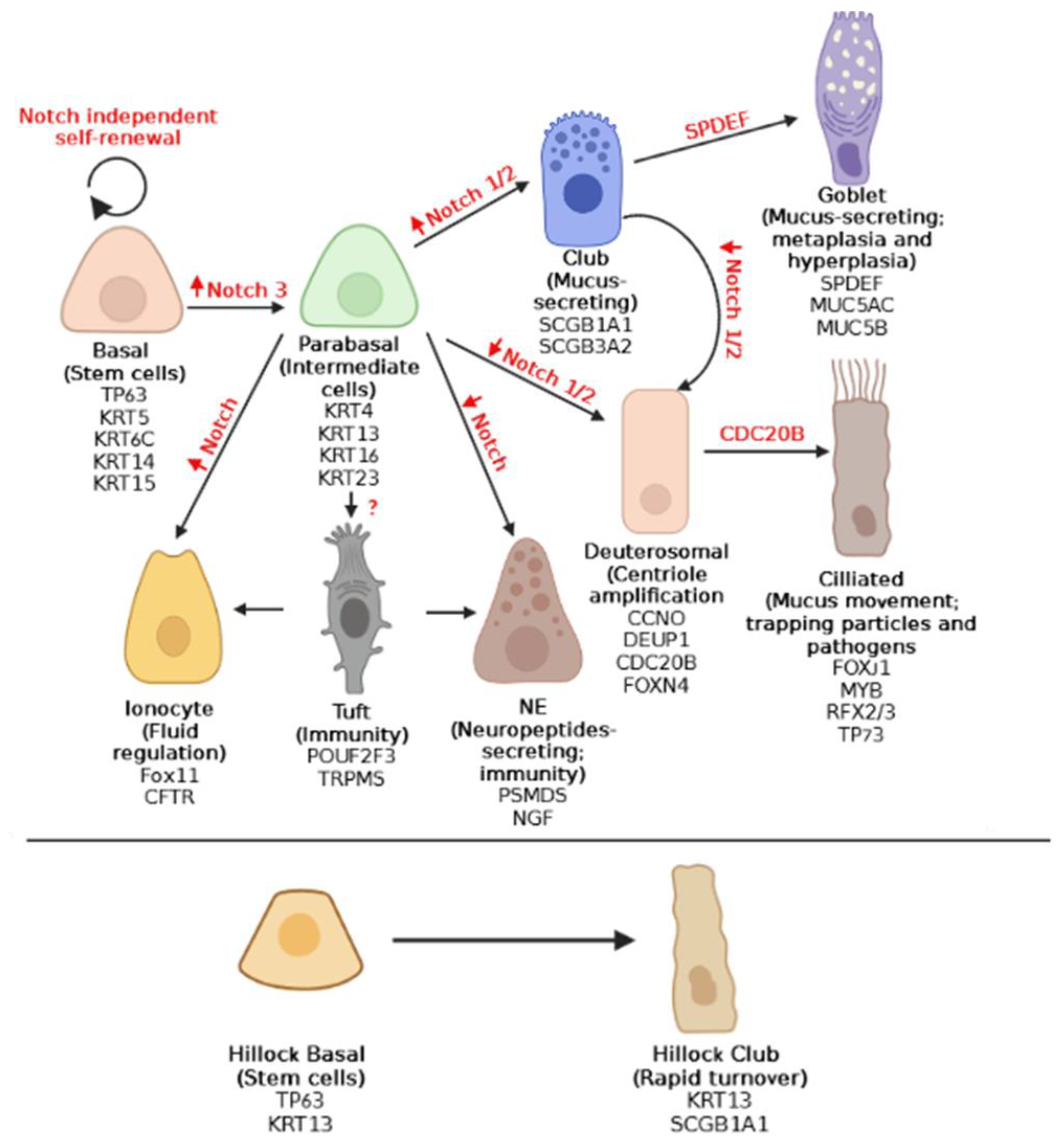
At the cellular level, the epithelium of the mouse trachea and human airways primarily consists of BCs, MCCs, and SCs (main airway epithelial cells) (Figure 1) [4,34,35].
Recent advancements in single-cell RNA sequencing (scRNA-seq) techniques have provided valuable insights into the cellular composition of both the mouse and the human airway epithelium [36,37,38]. Consequently, data analysis from RNA-seq studies on airway epithelial tissue has unveiled the presence of specialized and/or rare cell types, such as neuroendocrine cells (NECs), brush cells or tuft cells, and ionocytes [39,40,41,42]. Furthermore, scRNA-seq techniques have identified additional intermediate cell populations, including deuterosomal cells and suprabasal or parabasal cells, in both human and mouse airway epithelia [4,29,43].
Figure 1.
Airway epithelial differentiation pathways. The airway epithelium is mainly composed of MCCs, SCs, and BCs, as well as more rare cell types including ionocytes, NECs, tuft cells, and deuterosomal cells, according to recent human scRNAseq studies [29,44]. BCs have the capacity to self-renew and produce all epithelial cell types [33]. NOTCH pathway can regulate cell differentiation processes, where up- and downward red arrows indicate stimulation and suppression, respectively. Self-renewal basal cells are independent of NOTCH, while the activation of NOTCH signaling will determine epithelial cell fate toward secretory (club and goblet) or ciliated cells, for which the level of NOTCH2 signaling is decisive [9]. Club cells can undergo trans-differentiation into ciliated cells, through NOTCH 1/2 pathway inhibition. For each cell (sub)type, its function and the most important cellular markers are indicated. TP63, KRT5, KRT6C, KRT14 and KRT15 are basal cell markers, while supra-basal cells are distinguished by the expression of KRT4, KRT13, KRT16 and KRT23. The deuterosomal cells express CDC20B, CCNO, FOXN4, and DEUP1, and mature ciliated cells are distinguished by the expression of FOXJ1, MYB, RFX2/3, and TP73. Club cells are characterized by the expression of SCGB1A1, and SCGB3A2, and mature goblet cells express SPDEF, MUC5B, and MUC5AC. Supra-basal cells can also differentiate into ionocytes (FOXI1+ and CFTR+), NECs (PSMD5 and NGF), or tuft cells (POUF2F2+ and TRPM5+). Tuft cells in turn can differentiate either to ionocytes or to neuroendocrine cells. While NOTCH signaling seems to be involved in ionocytes’ and tuft cells’ differentiation, it is still unclear (?) which signaling pathways are involved in NECs’ lineage. Moreover, “Hillocks” TP63+/KRT13+ basal cells give rise to SCGB1A1+/KRT13+ club cells [9]. Created with BioRender.com (accessed on 10 July 2023).
2.1. Main Airway Epithelial Cells
In this subsection, the three main airway epithelium cells (BCs, SCs and MCCs) are described in detail.
Firstly, as outlined above, BCs reside in the airway epithelium. They comprise approximately 30% of the airway epithelium and are anchored to the basal lamina through desmosomes [10,45,46,47,48]. Extensive research has demonstrated that BCs serve as the primary stem cells, with remarkable regenerative potential for the airway epithelium, acting as precursors for specialized cell types [4,39,41,47,49].
Molecularly, BCs are characterized by the expression of transformation-related protein P63 (TP63), as well as cytoskeletal proteins Keratin 5 (KRT5), KRT6C, KRT14, and KRT15 [45,47,50] (Figure 1). TP63, a member of the p53 family of transcription factors, plays a crucial role in BC development. Studies using mutant mice lacking this protein have shown an absence of BCs in the pseudostratified epithelium of the trachea [51,52].
Within the BC population, there are parabasal or suprabasal cells that have detached from the basal lamina to contribute to cell renewal [10]. Previous investigations have confirmed that the transition from basal to suprabasal cells is driven by the endogenous activation of NOTCH3 signaling in murine tracheal and proximal airways (e.g., [43]) (Figure 1). Suprabasal cells are characterized by the expression of KRT4, KRT13, KRT16, and KRT23, and they exhibit lower levels of p63 compared to BCs [29] (Figure 1). These intermediate cells have the potential to differentiate into MCCs, into SCs, or directly into tuft cells [4,10,43,49].
Another group of relevant epithelial cells are SCs, which are interspersed among other cell types in the airway epithelium and play a crucial role in secreting mucus into the respiratory tract lumen, facilitating the trapping of suspended particles [53]. As depicted in Figure 1, SCs encompass a heterogeneous population, including club cells (previously known as Clara cells) and goblet cells [53]. Club cells, which have been extensively studied, exhibit mature states characterized by the presence of the secretoglobins SCGB1A1 and SCGB3A2 [54]. Goblet cells, on the other hand, are molecularly identified through the expression of mucin 5AC (MUC5AC), mucin 5B (MUC5B), and SPDEF [55].
Finally, the third type of main cells of the respiratory epithelium are MCCs. They are specialized airway epithelial cells characterized by the presence of multiple motile cilia on their apical surface. These cells play a crucial role in facilitating the movement of mucus that coats the epithelium, which aids in trapping particles and pathogens [56,57]. Consequently, dysfunction in MCCs can lead to recurrent respiratory infections [58]. As depicted in Figure 1, several molecular markers associated with MCC cells, such as FOXJ1, RFX2, RFX3, MYB, and p73, are instrumental in regulating the expression of numerous proteins involved in MCC differentiation [32].
2.2. Intermediate and Specialized and/or Rare Cell Types
Recent studies (e.g., [59]) have identified a population of cells called deuterosomal cells inside the cellular composition and the hierarchy of the airway epithelium, through scRNA-seq, which represent a transitional state during MCCs differentiation (Figure 1). Deuterosomal cells exhibit an intermediate phenotype between SCs and mature MCCs. These cells express specific markers such as CDC20B (cell division cycle 20 homolog B) and DEUP-1 (deuterosome assembly protein 1), which are involved in centriole amplification and the organization of apical microtubules required for cilia formation [12,31].
Additionally, deuterosomal cells [60] also express FOXJ1 but display distinct marker expression compared to mature MCCs, including FOXN4 (Forkhead Box N4), CDC20B, DEUP1, and CCNO (cyclin-O) [60,61]. This intermediate cell type has been observed in both human and mouse airway epithelia [59,60]. Furthermore, CCNO, a member of the cyclin protein family required for cell cycle progression, is involved in the early stages of deuterosome-mediated centriole formation [31]. The expression of both CDC20B and CCNO is regulated by MCIDAS (Multicilin (MCI) and IDAS, encoded by MCIDAS), a key regulator of multiciliogenesis [60,62].
Figure 1 also illustrates the presence of tuft cells (also known as Brush cells), which are specialized and/or rare cell types and are involved in immune responses. These cells are characterized by the expression of common markers such as transient receptor potential cation channel subfamily M member 5 (TRPM5) and POU domain class 2 homeobox 3 (POU2F3) [4,63]. The transcription factor POU2F3 plays a crucial role in the formation and differentiation of tuft cells [63]. Additionally, Bukowy-Bieryllo et al. (2022) [29] suggest that tuft cells may serve as progenitors for NECs and ionocytes (as depicted in Figure 1). However, it must be noted that NECs and pulmonary ionocytes can also directly differentiate from BCs through NOTCH signaling [39,41,64].
In regards to the NECs, they constitute approximately 0.5% of all epithelial cells in human airways and express markers such as PSMD5 (Proteasome 26S Subunit, Non-ATPase 5) and NGF (Nerve Growth Factor) [29,65,66]. These innervated epithelial-resident cells play a role in sensing airway activity and secreting neuropeptides to stimulate immune responses [30]. NECs contribute to immune modulation through chemical secretion and are molecularly characterized by the expression of Chromogranin A (CHGA) and calcitonin gene-related peptide (CGRP) [2,4,35,55]. Similar to basal and club cells, a subset of NECs can undergo reprogramming in response to epithelial damage, assuming alternative cell fates and serving as stem cells to facilitate tissue repair [66,67].
As for pulmonary ionocytes, these cells exhibit high expression levels of FOXI1 and cystic fibrosis transmembrane conductance regulator (CFTR), suggesting their involvement in the regulation of airway surface liquid (as depicted in Figure 1). The CFTR gene encodes a critical chloride channel that is frequently mutated in cystic fibrosis pathology [35,41].
Lastly, Montoro et al. (2018) [39] discovered a novel population of basal progenitor cells, referred to as Hillock basal cells, which express both TP63 and KRT13 (as shown in Figure 1). These Hillock basal cells are known to differentiate into Hillock club cells, exhibiting elevated levels of markers such as Scgb1ab1+ and KRT13+. Although Hillock club cells display high turnover rates, their precise physiological role remains relatively unexplored [39].
Therefore, BCs are the major stem cells of the respiratory tract with the ability to differentiate into ciliated cells, club cells, tuft cells, neuroendocrine cells, and pulmonary ionocytes. For this reason, we will focus this work on reviewing the basal stem cell population maintenance, including both MCC and SC differentiation programs.
3. Basal Stem Cells’ Population Maintenance
As previously indicated, BCs play a crucial role in the development of mammalian airway epithelium, as they possess the ability to self-renew and give rise to all epithelial cell types [33]. NOTCH signaling is highly conserved and plays a relevant role as master regulator of various biological functions. While NOTCH signaling has been implicated in the differentiation of adult airway BCs, their self-renewal appears to be independent of NOTCH [9,10,68]. In addition, Garrido-Jimenez at al. (2021) [69] reported that p53 protein contributes to the self-renewal and differentiation of basal stem cells in mouse and human airway epithelium.
3.1. NOTCH Signaling in Airway Epithelium
The mammalian NOTCH family consists of four receptors (NOTCH1-4) and five ligands (delta-like ligand (DLL) 1, 3, 4, and jagged (JAG) 1 and 2) [70]. Human bronchial epithelial cells express all four NOTCH receptors and all NOTCH ligands, with the exception of DLL3 [71].
Several studies provide ample evidence that NOTCH3 signaling is involved in the generation of parabasal cells, which subsequently differentiate into secretory or ciliated cells through the activation of the NOTCH1 and NOTCH2 pathways [43,72]. Furthermore, the suppression of NOTCH1–NOTCH2 signaling leads to the expansion of MCCs, while the activation of NOTCH signaling determines the fate of lung epithelial cells towards secretory lineages such as club and goblet cells [32,43,71,72]. Recently, the up-regulation of NOTCH signaling was observed in SARS-CoV-2-infected cells [8]. In cells directly infected by SARS-CoV-2, the NOTCH pathway might promote viral entry, and in addition, excessive NOTCH signaling may promote interleukin 6 (IL-6) and inflammatory pathways that can exacerbate the morbidity and severity of COVID-19 [7].
It must be pointed out that NOTCH2 plays a more central role than NOTCH1 in determining the Clara/ciliated cell fate [9]. Additionally, studies have shown that secretory progenitor cells (club cells) can undergo trans-differentiation into ciliated cells, a process involving NOTCH1–NOTCH2 pathway inhibition [31,33,73]. Rock et al. (2011) [10] demonstrated that BC differentiation in the airways relies on NOTCH signaling, as the inhibition of NOTCH signaling using the gamma-secretase inhibitor DBZ resulted in the absence of intermediate cells responsible for generating ciliated and secretory lineages, leaving only TRP63+ BCs in a pseudostratified epithelium.
3.2. p53 Function in BCs' Homeostasis and Differentiation
Recent studies conducted in mouse tracheal epithelial cell culture and human bronchial epithelial cells have highlighted the significance of regulating p53 protein levels in maintaining the self-renewal, differentiation competence, and homeostasis of BCs [69]. In addition, the MDM2/p53 interaction is involved in the regulation of p53 protein levels during BC differentiation, and the disruption of this interaction leads to defects in cell differentiation and alterations in cilia formation [69].
4. Transcription Factors Related to Multiciliated Cell Differentiation
As mentioned previously, the differentiation of MCCs, either through NOTCH signaling inhibition in BCs or the trans-differentiation of SCs in the airway epithelium, raises the question of what occurs at the transcription factor level. In the next subsections, the several stages together with trasnscription factors involved in MCC differentation are described in detail.
4.1. Transcriptional Regulators Implicated in Initial Stages of MCC Differentiation
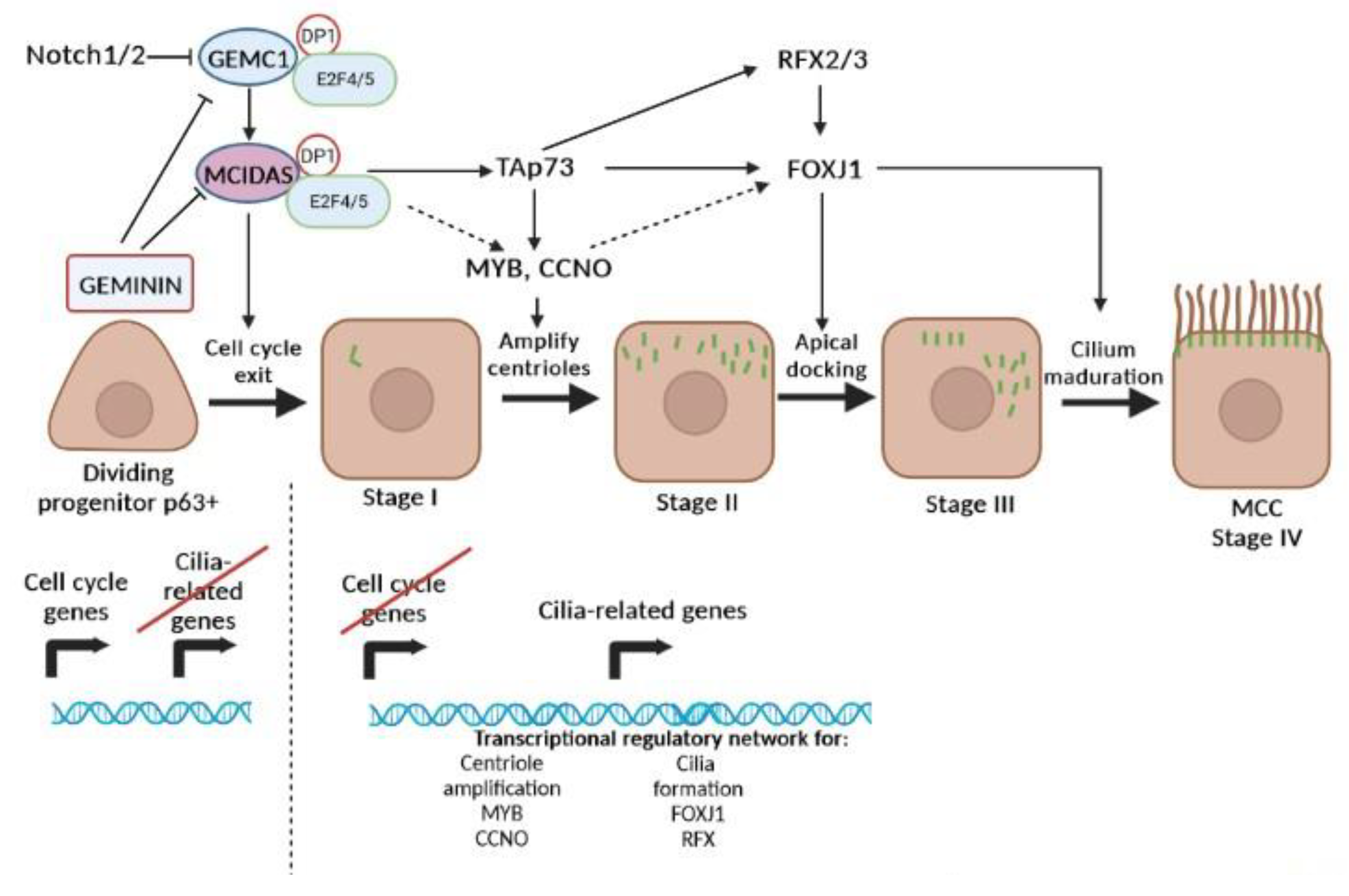
Previous studies have demonstrated the collaborative role of various members of the GEMININ family in determining the fate of progenitor/stem cells [11]. As depicted in Figure 2, the initial stages of MCC differentiation involve protein interactions, including GEMININ (encoded by GMNN), GEMC1 (Geminin coiled-coil-domain-containing protein 1, encoded by GMNC), MCIDAS, E2F transcription factor (E2F4/5), and DEUP1 [11,12,13].
Figure 2.
Molecular pathways involved in multiciliogenesis. Different transcriptional regulators associated with each step in the program are shown, along with the regulatory relationships among them, together with the NOTCH signaling pathway that controls the initiation of the program. Black lines ending with a perpendicular line indicate an inhibitory effect. Dotted arrows and black arrows illustrate stimulation by different transcription factors. In progenitor cells, GEMININ is expressed at high levels, inhibiting MCIDAS and GEMC1 [11]. At this point, cell cycle genes are active and cilia-related genes remain repressed. For cells to differentiate in multiciliate cell lineage, GEMININ levels must drop while the levels of GEMC1 increase. GEMC1 interact with the E2F4/5 and DP1 transcription factors, promoting the transcriptional activation of MCIDAS, which also forms complexes with E2F4/5 and DP1 [11]. These complexes activate genes required for centriole amplification and cilia formation, pushing cells toward multiciliogenesis. MCIDAS is upstream of TAp73, where TAp73 is a master transcriptional regulator of motile multiciliogenesis in airways, directly controlling MYB, CCNO, FOXJ1, and RFX2/3. MYB and CCNO are involved in centriole amplification, while FOXJ1 and RFX are implicated in cilia formation [17,31,74]. Created with BioRender.com (accessed on 10 July 2023).
The expression analysis of these proteins has revealed that in progenitor cells of the airway epithelium, GEMININ is highly expressed, while MCIDAS and GEMC1 are expressed at low levels (Figure 2). Consequently, GEMININ acts as an inhibitor of the transcriptional activation by MCIDAS and GEMC1 [11,12,13]. It has been proposed that GEMININ may prevent the initiation of the multiciliogenesis program until dividing cells exit the cell cycle [12]. Subsequently, GEMININ is down-regulated both transcriptionally and through proteolysis, leading to decreased levels and the disinhibition of GEMC1, which in turn increases its expression [11].
GEMC1 interacts with E2F4/5 transcription factors and DEUP1, facilitating MCIDAS transcription [12]. MCIDAS forms complexes with E2F4/5 and DEUP1 (EDM complex), thereby activating genes involved in centriole amplification (cMYB and CCNO) as well as genes necessary for cilia formation (FOXJ1 and RFX), ultimately directing the cell toward multiciliogenesis [11,32,75]. Furthermore, MCIDAS acts on FOXN4 [76], CP110 [77], and p73 [17,78], which also serve as regulators of ciliogenesis. Hence, MCIDAS activates the expression of transcriptional regulators involved in cilia formation, promoting the production of basal bodies for MCC formation [11].
Various observations have highlighted the involvement of additional transcription factors in the process of MCC differentiation. Granhead-like2 (GRHL-2) and the aryl hydrocarbon receptor (AHR) have been identified as transcriptional inducers of MCIDAS [79]. GRHL-2 not only regulates airway cell polarity, barrier function, and differentiation but also acts in parallel with MCIDAS to regulate ciliogenesis [79]. Similarly, AHR transcriptionally activates MCIDAS and CCNO, thereby inducing MCC formation in the airway epithelium [79,80].
Cytokinin signaling, as demonstrated by [81], also influences ciliated cell fate. IL-6 and STAT-3 stimulate MCC differentiation by downregulating NOTCH signaling and activating genes such as MCIDAS and FOXJ1 involved in ciliogenesis. Conversely, interleukin 13 (IL-13) inhibits ciliated cell differentiation by suppressing MCIDAS and FOXJ1 expression [81].
4.2. MCCs Differentiation Stages
After the initial stages of MCC differentiation described above, this process can be categorized into distinct stages based on the expression of various transcription factors and the localization of proteins required for cilia formation (Figure 2). These stages include basal body biogenesis protein synthesis (Stage I), basal body biogenesis (Stage II), the migration and docking of basal bodies in the apical membrane (Stage III), and the generation of motile cilia from the basal bodies (Stage IV) [74]. Transcription factors such as Trp73, MYB, FOXJ1, and RFX2/3, among others, play critical roles in regulating gene expression and orchestrating the differentiation of MCCs in these four stages.
4.2.1. Transcription Factors Implicated in Stages I/II
Transformation-related protein 73 (Trp73) is a member of the p53 family of transcription factors [17,18]. It exists in two isoforms: the activating form (TAp73) and the N-terminally truncated form (DNp73). TAp73 is essential for airway multiciliogenesis, while DNp73 acts as a dominant-negative inhibitor of p53/TAp63/TAp73 [18,78,82,83].
The co-expression of p73 and p63 has been observed in a subset of BCs in murine tracheal cells, with p73 acting as a marker for BCs during MCC differentiation [78]. Trp73-deficient mice exhibit the impaired maintenance and differentiation of BCs, defects in basal body docking, axoneme extension, and motility, as well as hyperplasia and loss of the airway epithelium [18,84].
Furthermore, p73 is induced by GEMC1 and MCIDAS through the E2F4/5-DEUP1 complexes, contributing to the transcriptional regulation of genes involved in multiciliogenesis [12,16,17,18]. Notably, p73 regulates the expression of key genes such as FOXJ1, RFX2, RFX3, MYB, and miR34bc, which are essential for various stages of MCC differentiation, including centriole amplification and the apical docking of centrioles with axoneme components [74,78,84] (Figure 2).
Another transcriptor factor involved in Stages I/II is c-MYB, which plays a role in promoting the S phase in progenitor cells [19]. In the context of multiciliogenesis in the airway epithelium, MYB expression is initiated after progenitor cells exit the cell cycle [74]. It is involved in centriole amplification, but its activity is turned off once centrioles dock and MCCs mature.
The inactivation of MYB leads to a failure of complete ciliation in the airways due to impairments in centriole amplification and the expression of FOXJ1, a transcription factor crucial for centriole docking and ciliary motility [74]. MYB is also influenced by NOTCH and MCIDAS signaling and acts upstream of FOXJ1, contributing to centriole amplification [74,85] (Figure 2). Moreover, MYB is required for early multilineage differentiation of airway epithelial cells, specifically in distinct intermediate progenitor cells. These cells, characterized by being MYB+ and p63−, play a crucial role in normal differentiation processes [38].
Additionally, studies suggest that CCNO, another protein involved in multiciliogenesis, may promote a cell cycle state that supports centriole amplification and compensates for MYB deletion, enabling multiciliogenesis in specific cell types [58].
4.2.2. Transcription Factors Implicated in Stages III/IV
Cilia formation (apical docking and cilium maturation) occurs in Stages III/IV in which the FOXJ1 and RFX transcription factors play a relevant role (Figure 2).
FOXJ1 is a forkhead box (f-box) transcription factor that plays a central role in the differentiation of ciliated airway epithelial cells [86]. Studies using mouse airway epithelium cells have shown that FOXJ11 expression promotes differentiation during the late stage of ciliogenesis in committed ciliated cells [86].
FOXJ1 functions by establishing mechanisms for the docking of basal bodies at the apical membrane and inducing axoneme assembly, contributing to both ciliogenesis in MCCs and the expression of axonemal proteins involved in ciliary motility [15] (Figure 2). FOXJ1-deficient mice studies have revealed that the production of basal bodies is not affected, but their docking at the apical surface of cells is impaired, leading to defects in ciliogenesis and the loss of axonemes in motile multicilia [58,87].
FOXJ1 is regulated by TAp73, GEMC1, and MCIDAS during early multiciliogenesis stages (Figure 2), and other transcription factors such as RFX2/3 act as coactivators of FOXJ1 in the differentiation of MCCs [11,87,88,89,90]. The regulatory network of FOXJ1 involves important effector proteins with ciliary roles, identified through cilia-associated expression analysis and gene ontology (GO) analysis, such as PLSCR1 (phospholipid scramblase 1), SSX2IP (SSX Family Member 2 Interacting Protein), ACTN2 (actinin alpha 2), CDC42 (cell division control protein 42 homolog), CFAP206 (cilia and flagella fssociated protein 206), and PIAS4 (protein inhibitor of activated STAT protein 4), among others [15,91,92,93,94,95,96].
The RFX transcription factor family consists of nine members, but only three of them (RFX2, RFX3, and RFX4) have been found to be functionally associated with motile cilia in various tissues [14,15,97,98]. Studies indicate that RFX2/3 and FOXJ1 form a transcriptional complex that specifically regulates genes related to motile cilia [88].
RFX3 and RFX2 serve as transcriptional coactivators of FOXJ1 (Figure 2), promoting the expression of genes involved in the differentiation of MCCs [88,89]. Moreover, FOXJ1 can induce the expression of RFX2 and RFX3 in the human airway epithelium, suggesting their involvement in the differentiation of BCs into MCCs [88]. The expression of RFX2 and RFX3 is observed in the late phase of ciliogenesis, indicating their distinct roles in promoting airway ciliogenesis.
The deletion of both RFX2 and RFX3 results in significant impairment of airway ciliogenesis, leading to a reduction in the number of multiciliated tracheal cells, while individual deletion of RFX3 or RFX2 does not cause ciliary defects in the trachea [97,99]. Notably, RFX3 has been shown to induce the expression of several axonemal dynein genes, including Dnahc9, which encodes a dynein protein associated with human motile respiratory cilia [100]. On the other hand, RFX2 is predominantly expressed in the bronchial epithelium and is involved in the differentiation of ciliated cells from basal progenitor cells during epithelial regeneration [79].
Additionally, there are other regulators involved in MCC differentiation in the airway epithelium, including Transformation/transcription-domain-associated protein (TRRAP) [101], FOXN4 [31,76], Fibronectin type 3 and ankyrin repeat domains 1 (Fank1), JAZF zinc finger 1 (Jazf1) [102], and aryl hydrocarbon receptor (Ahr) [80].
5. Transcription Factors Related to Secreted Cell Differentiation
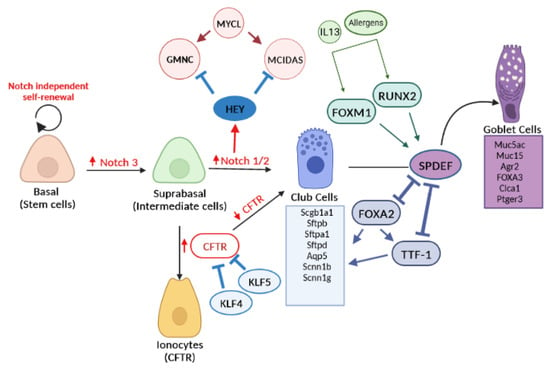
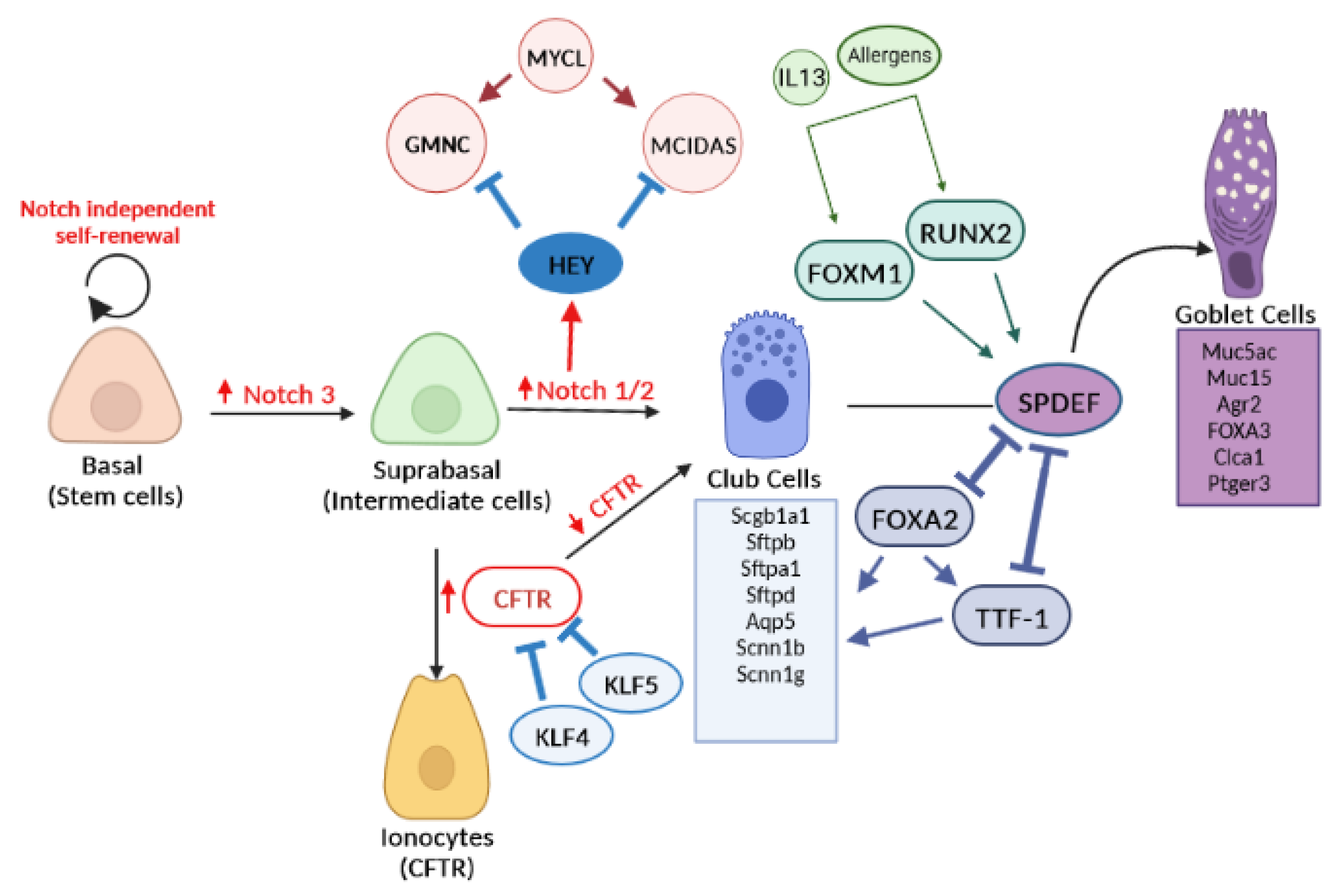
As depicted in Figure 3, BCs undergo a NOTCH-dependent process to generate multipotent suprabasal cells [71]. These suprabasal cells possess a limited proliferative capacity and give rise to differentiated ciliated or secretory cells upon the activation of NOTCH signaling [71]. In addition, HEY1 transcriptor factor can be activated by the NOTCH pathway to repress the multiciliated cell gene expression program and acquire a secretory cell precursor identity [20]. Among other transcription factors involved in the differentiation of SCs are SPDEF, FOXA2, TTF-1, FOXM1, RUNX2, and KLF5 and KLF4.
Figure 3.
Schematic representation of secretory cell (SC) differentiation programs. Black lines ending with a perpendicular line indicate an inhibitory effect, while arrows show a stimulatory result; up- and downward red arrows indicate stimulation and suppression, respectively. Suprabasal cells activated by the NOTCH pathway activate the transcription factor HEY, leading to the repression of the MCC gene expression program and the differentiation in SCs [20]. Conversely, intermediate cells that do not receive active NOTCH signaling trigger a network involving MYCL, GMNC, and MCIDAS, leading to the differentiation into MCC precursors [20]. KLF4 and KLF5 repress the CFTR transcript, determining epithelial cell fate toward being secretory (club and goblet) [22,27]. The fates of club or goblet cells are determined by the expression of different transcription factors such as FOXM1, RUNX2, FOXA3, and SPDEF to goblet cells, while FOXA2 and TTF-1 inhibit genes implicated in goblet cell differentiation (Muc5ac, Muc15, Agr2, FOXA3, Clca1, Ptger3) [21,23,24,103]. In addition, FOXA2 and TTF-1 are relevant transcriptional regulators of genes expressed selectively in club cells (Scgb1a1, Sftpb, Sftpa1, Sftpd, Aqp5, Scnn1b, Scnn1g) [21,104,105,106]. Created with BioRender.com (accessed on 10 July 2023).
5.1. NOTCH Signaling and HEY Transcriptor Factor in SC Differentiation
In the process of airway epithelial differentiation, NOTCH3 can prime a subset of BCs to differentiate into club cells, which subsequently have the potential to differentiate into goblet or ciliated cells through the downstream signaling of NOTCH1/NOTCH2. The availability of NOTCH ligands Jag1 (Jagged1) and Jag2 is necessary for this process [43,107]. Specifically, Jag1 has been implicated in the differentiation of human airway epithelial cells toward SCs [70].
Moreover, recent studies have revealed the regulatory role of the NOTCH pathway on two transcription factors, namely HEY1 and MYCL, as illustrated in Figure 3. These transcription factors play crucial roles in determining the fate of intermediate cells during the differentiation of basal stem cells in the airway epithelium [20]. Intermediate cells harbor the expression of HEY1 and MYCL, with MYCL acting as an early driver of MCC differentiation and HEY1 functioning as an early repressor of the MCC fate specifically expressed in SC precursors. Consequently, intermediate cells activated by the NOTCH pathway activate the transcription factor HEY1, leading to the repression of the MCC gene expression program and the acquisition of an SC precursor identity. Conversely, intermediate cells that do not receive active NOTCH signaling trigger a network involving MYCL, GMNC, and MCIDAS, ultimately leading to their differentiation into MCC precursors [20].
5.2. Other Transcriptor Regulators Implicated in Goblet Cell Differentiation
In addition to HEY1, the differentiation of SCs involves the contribution of various transcription factors, including SPDEF, FOXA2, TTF-1, FOXM1, RUNX2, and KLF5 and KLF4, among others (Figure 3).
Specifically, SPDEF is essential for goblet cell differentiation and the production of mucus, particularly the major secreted airway mucin MUC5AC [23,24]. Conversely, FOXA2 acts as a potent inhibitor of goblet cell differentiation in the lung [21,23,24,103]. FOXA2 and TTF-1 (also known as NKX2-1) are critical transcriptional regulators that are selectively expressed in club cells and function to inhibit goblet cell differentiation in the lungs [21,104,105,106].
Several studies have shown that SPDEF expression is upregulated in mice and human airway epithelial cells in response to IL-13 or pulmonary allergens [21,97,106,108]. This up-regulation of SPDEF leads to increased expression of genes associated with goblet cell differentiation and mucin biosynthesis, glycosylation, and packaging (Figure 3).
In contrast, SPDEF inhibits the expression of characteristic genes of club cells in normal bronchiolar epithelium, including FOXA2, TTF1, and genes involved in fluid and electrolyte transport and innate host defense (Figure 3) [21,106,108]. It is important to keep in mind that goblet cells are typically not abundant in the conducting airways of the lung; however, their differentiation can be induced by acute and chronic inflammatory stimuli such as IL-13 and allergens, leading to changes in goblet cell numbers and activity [24].
Additionally, it has been reported that another transcription factor, FOXM1, plays a role in goblet cell differentiation by directly activating SPDEF upon exposure to allergens [25,109]. FOXM1, a member of the Fork head box (FOX) family, acts as an upstream regulator of SPDEF [25].
Furthermore, Shi et al. (2019) [26] identified the Runt-related transcription factor (RUNX2) as a factor that binds to the SPDEF promoter, thereby activating goblet cell differentiation (Figure 3). They also demonstrated that the knockdown of RUNX2 significantly decreased differentiation and mucus production after IL-13 exposure [26]. More recently, luciferase assays and chromatin immunoprecipitation PCR (ChIP-PCR) studies revealed that RUNX2 is a direct target of miR-30a-3p [28]. In vitro assays confirmed that the inhibition of miR-30a-3p expression enhanced IL-13-induced expression of RUNX2 and HMGB1 in airway epithelial cells [28].
Other studies conducted on primary human airway epithelial cells and airway cell lines have indicated that KLF5 acts as a repressor of CFTR transcript [22,110]. Interestingly, scRNAseq analysis revealed that CFTR transcripts were found in low abundance in many SCs, while high levels were restricted to rare pulmonary ionocytes [22]. Similarly, Sousa et al. (2020) [27] demonstrated that another member of the KLF family, specifically KLF4, suppresses CFTR expression through an AKT-mediated pathway in the human lung (Figure 3). Hence, both KLF4 and KLF5 play pivotal roles in airway epithelial differentiation by regulating CFTR expression.
6. Conclusions and Remarks
Several key conclusions and remarks can be made regarding the differentiation programs of BCs and the formation of MCCs and SCs in the airway epithelium.
BCs are crucial for airway development and possess self-renewal capabilities, which are independent of NOTCH signaling. NOTCH signaling, however, plays a role in the differentiation of adult airway BCs. Different NOTCH receptors and ligands are expressed in human bronchial epithelial cells and determine whether lung epithelial cells develop into secretory or ciliated lineages. MCC differentiation can occur through NOTCH signaling inhibition in BCs or the trans-differentiation of SCs.
Specific transcription factors collaborate to regulate the MCC differentiation process, which involves basal body biogenesis, migration, the docking of basal bodies, and the generation of motile cilia. SCs can differentiate from BCs, and NOTCH signaling is involved in generating multipotent suprabasal cells that can further differentiate into secretory or ciliated cells. NOTCH ligands are necessary for this differentiation process. And once again, additional transcription factors are involved in the regulation of gene expression and overall differentiation processes, highlighting the complexity that requires further research to fully understand the differentiation process from BCs.
7. Future Directions
There are several potential future directions for research on the differentiation programs of BCs and the formation of MCCs and SCs in the airway epithelium. Further investigation is needed to understand the precise mechanisms of NOTCH signaling in the differentiation of BCs and their subsequent fate toward secretory or ciliated lineages. This could involve studying the specific interactions between different NOTCH receptors, ligands, and downstream effectors in regulating cell fate determination.
Also, further research can focus on unraveling the complex transcriptional networks involving these factors and identifying additional transcriptional regulators involved in these processes, for example, investigating BC heterogeneity. BCs have been identified as a key cell population involved in airway development and repair. However, it is important to explore the heterogeneity within the BC population and understand whether distinct subpopulations contribute differentially to MCC and SC differentiation.
These studies could also investigate how environmental factors, such as air pollutants or microbial exposures, influence the differentiation programs of BCs and how the formation of MCCs and SCs could provide important insights into respiratory health and disease. Additionally, exploring epigenetic modifications that regulate gene expression during differentiation processes may uncover new mechanisms and potential therapeutic targets.
Overall, further research in these directions will enhance our understanding of the complex differentiation programs in the airway epithelium and may have implications for the development of therapies targeting respiratory diseases and conditions.
Author Contributions
Conceptualization, G.C.-L. and D.A.B.; methodology, G.C.-L. and D.A.B.; software, G.C.-L. and D.A.B.; validation, G.C.-L., D.A.B., S.M.-N. and J.M.C.-G.; formal analysis, G.C.-L. and D.A.B.; investigation, G.C.-L. and D.A.B.; resources, G.C.-L. and D.A.B.; data curation, G.C.-L. and D.A.B.; writing—original draft preparation, G.C.-L., D.A.B., S.M.-N. and J.M.C.-G.; writing—review and editing, G.C.-L., D.A.B., S.M.-N. and J.M.C.-G.; visualization, G.C.-L., D.A.B., S.M.-N. and J.M.C.-G.; supervision, S.M.-N. and J.M.C.-G.; project administration, J.M.C.-G.; funding acquisition, J.M.C.-G. All authors have read and agreed to the published version of the manuscript.
Funding
This work was supported by BFU2017-85547-P, TED2021-130560B-I00 and PID2021-126905NB-I00 grants from the Ministry of Economy, IB18014 from Junta de Extremadura to J.M.C.-G. and GR21140 from Junta de Extremadura to S.M.-N. All Spanish funding is co-sponsored by the European Union FEDER program.
Conflicts of Interest
The authors declare no conflict of interest.
References
- Hewitt, R.J.; Lloyd, C.M. Regulation of immune responses by the airway epithelial cell landscape. Nat. Rev. Immunol. 2021, 21, 347–362. [Google Scholar] [CrossRef] [Scilit] [PubMed]
- Ramachandran, H.; Herfurth, K.; Grosschedl, R.; Schäfer, T.; Walz, G. SUMOylation blocks the ubiquitin-mediated degradation of the nephronophthisis gene product Glis2/NPHP7. PLoS ONE 2015, 10, e0130275. [Google Scholar] [CrossRef] [Scilit] [PubMed]
- Travaglini, K.J.; Nabhan, A.N.; Penland, L.; Sinha, R.; Gillich, A.; Sit, R.V.; Chang, S.; Conley, S.D.; Mori, Y.; Seita, J.; et al. A molecular cell atlas of the human lung from single-cell RNA sequencing. Nature 2020, 587, 619–625. [Google Scholar] [CrossRef] [Scilit] [PubMed]
- Ruysseveldt, E.; Martens, K.; Steelant, B. Airway Basal Cells, Protectors of Epithelial Walls in Health and Respiratory Diseases. Front. Allergy 2021, 2, 787128. [Google Scholar] [CrossRef] [Scilit] [PubMed]
- Cohn, L. Mucus in chronic airway diseases: Sorting out the sticky details. J. Clin. Investig. 2006, 116, 306–308. [Google Scholar] [CrossRef] [Scilit]
- Curran, D.R.; Cohn, L. Advances in mucous cell metaplasia: A plug for mucus as a therapeutic focus in chronic airway disease. Am. J. Respir. Cell Mol. Biol. 2010, 42, 268–275. [Google Scholar] [CrossRef] [Scilit]
- Baindara, P.; Sarker, M.B.; Earhart, A.P.; Mandal, S.M.; Schrum, A.G. NOTCH signaling in COVID-19: A central hub controlling genes, proteins, and cells that mediate SARS-CoV-2 entry, the inflammatory response, and lung regeneration. Front. Cell. Infect. Microbiol. 2022, 12, 928704. [Google Scholar] [CrossRef] [Scilit]
- Rosa, B.A.; Ahmed, M.; Singh, D.K.; Choreño-Parra, J.A.; Cole, J.; Jiménez-Álvarez, L.A.; Rodríguez-Reyna, T.S.; Singh, B.; Gonzalez, O.; Carrion, R.; et al. IFN signaling and neutrophil degranulation transcriptional signatures are induced during SARS-CoV-2 infection. Commun. Biol. 2021, 4, 290. [Google Scholar] [CrossRef] [Scilit] [PubMed]
- Morimoto, M.; Nishinakamura, R.; Saga, Y.; Kopan, R. Different assemblies of Notch receptors coordinate the distribution of the major bronchial Clara, ciliated and neuroendocrine cells. Development 2012, 139, 4365–4373. [Google Scholar] [CrossRef] [Scilit]
- Rock, J.R.; Gao, X.; Xue, Y.; Randell, S.H.; Kong, Y.Y.; Hogan, B.L. Notch-dependent differentiation of adult airway basal stem cells. Cell Stem Cell 2011, 8, 639–648. [Google Scholar] [CrossRef] [Scilit]
- Arbi, M.; Pefani, D.E.; Taraviras, S.; Lygerou, Z. Controlling centriole numbers: Geminin family members as master regulators of centriole amplification and multiciliogenesis. Chromosoma 2018, 127, 151–174. [Google Scholar] [CrossRef] [Scilit] [PubMed]
- Ma, L.; Quigley, I.; Omran, H.; Kintner, C. Multicilin drives centriole biogenesis via E2f proteins. Genes Dev. 2014, 28, 1461–1471. [Google Scholar] [CrossRef] [Scilit]
- Terré, B.; Piergiovanni, G.; Segura-Bayona, S.; Gil-Gómez, G.; Youssef, S.A.; Attolini, C.S.; Wilsch-Bräuninger, M.; Jung, C.; Rojas, A.M.; Marjanović, M.; et al. GEMC 1 is a critical regulator of multiciliated cell differentiation. EMBO J. 2016, 35, 942–960. [Google Scholar] [CrossRef] [Scilit] [PubMed]
- Bisgrove, B.W.; Makova, S.; Yost, H.J.; Brueckner, M. RFX2 is essential in the ciliated organ of asymmetry and an RFX2 transgene identifies a population of ciliated cells sufficient for fluid flow. Dev. Biol. 2012, 363, 166–178. [Google Scholar] [CrossRef] [Scilit] [PubMed]
- Choksi, S.P.; Lauter, G.; Swoboda, P.; Roy, S. Switching on cilia: Transcriptional networks regulating ciliogenesis. Development 2014, 141, 1427–1441. [Google Scholar] [CrossRef] [Scilit]
- Lalioti, M.E.; Arbi, M.; Loukas, I.; Kaplani, K.; Kalogeropoulou, A.; Lokka, G.; Kyrousi, C.; Mizi, A.; Georgomanolis, T.; Josipovic, N.; et al. GemC1 governs multiciliogenesis through direct interaction with and transcriptional regulation of p73. J. Cell Sci. 2019, 132, jcs228684. [Google Scholar] [CrossRef] [Scilit]
- Nemajerova, A.; Amelio, I.; Gebel, J.; Dötsch, V.; Melino, G.; Moll, U.M. Non-oncogenic roles of TAp73: From multiciliogenesis to metabolism. Cell Death Differ. 2018, 25, 144–153. [Google Scholar] [CrossRef] [Scilit]
- Nemajerova, A.; Kramer, D.; Siller, S.S.; Herr, C.; Shomroni, O.; Pena, T.; Suazo, C.G.; Glaser, K.; Wildung, M.; Steffen, H.; et al. TAp73 is a central transcriptional regulator of airway multiciliogenesis. Genes Dev. 2016, 30, 1300–1312. [Google Scholar] [CrossRef] [Scilit] [PubMed]
- Wang, W.; Wu, S.; Shi, Y.; Miao, Y.; Luo, X.; Ji, M.; Yao, K.; He, J. C-MYB regulates cell growth and DNA damage repair through modulating MiR-143. FEBS Lett. 2015, 589, 555–564. [Google Scholar] [CrossRef] [Scilit] [PubMed]
- Byrnes, L.E.; Deleon, R.; Reiter, J.F.; Choksi, S.P. Opposing transcription factors MYCL and HEY1 mediate the Notch- dependent airway stem cell fate decision. bioRxiv 2022. [Google Scholar] [CrossRef] [Scilit]
- Chen, G.; Korfhagen, T.R.; Xu, Y.; Kitzmiller, J.; Wert, S.E.; Maeda, Y.; Gregorieff, A.; Clevers, H.; Whitsett, J.A. SPDEF is required for mouse pulmonary goblet cell differentiation and regulates a network of genes associated with mucus production. J. Clin. Investig. 2009, 119, 2914–2924. [Google Scholar] [CrossRef] [Scilit]
- Pal, B.; Chen, Y.; Vaillant, F.; Jamieson, P.; Gordon, L.; Rios, A.C.; Wilcox, S.; Fu, N.; Liu, K.H.; Jackling, F.C.; et al. Construction of developmental lineage relationships in the mouse mammary gland by single-cell RNA profiling. Nat. Commun. 2017, 8, 1627. [Google Scholar] [CrossRef] [Scilit]
- Paranjapye, A.; Nandymazumdar, M.; Harris, A. Krüppel-Like Factor 5 regulates CFTR expression through repression by maintaining chromatin architecture coupled with direct enhancer activation. J. Mol. Biol 2022, 434, 167561. [Google Scholar] [CrossRef] [Scilit] [PubMed]
- Quigley, I.K.; Kintner, C. Rfx2 Stabilizes Foxj1 Binding at Chromatin Loops to Enable Multiciliated Cell Gene Expression. PLoS Genet. 2017, 13, e1006538. [Google Scholar] [CrossRef] [Scilit] [PubMed]
- Rao Tata, P.; Rajagopal, J. Plasticity in the lung: Making and breaking cell identity. Development 2017, 144, 755–766. [Google Scholar] [CrossRef] [Scilit]
- Shi, J.; Folwaczny, M.; Wichelhaus, A.; Baumert, U. Differences in RUNX2 and P2RX7 gene expression between mono- and coculture of human periodontal ligament cells and human osteoblasts under compressive force application. Orthod. Craniofacial Res. 2019, 22, 168–176. [Google Scholar] [CrossRef] [Scilit] [PubMed]
- Sousa, L.; Pankonien, I.; Clarke, L.A.; Silva, I.; Kunzelmann, K.; Amaral, M.D. KLF4 Acts as a wt-CFTR Suppressor through an AKT-Mediated Pathway. Cells 2020, 9, 1607. [Google Scholar] [CrossRef] [Scilit] [PubMed]
- Wu, W.; Gao, J.; Chen, D.; Chen, G.; Feng, Y.; Chang, C.; Chen, S.; Yi, L.; Zhen, G. Epithelial microRNA-30a-3p targets RUNX2/HMGB1 axis to suppress airway eosinophilic inflammation in asthma. Respir. Res. 2022, 23, 1–14. [Google Scholar] [CrossRef] [Scilit] [PubMed]
- Bukowy-Bieryłło, Z.; Daca-Roszak, P.; Jurczak, J.; Przystałowska-Macioła, H.; Jaksik, R.; Witt, M.; Ziętkiewicz, E. In vitro differentiation of ciliated cells in ALI-cultured human airway epithelium—The framework for functional studies on airway differentiation in ciliopathies. Eur. J. Cell Biol. 2022, 101, 151189. [Google Scholar] [CrossRef] [Scilit]
- Davis, J.D.; Wypych, T.P. Cellular and functional heterogeneity of the airway epithelium. Mucosal Immunol. 2021, 14, 978–990. [Google Scholar] [CrossRef] [Scilit]
- Legendre, M.; Zaragosi, L.E.; Mitchison, H.M. Motile cilia and airway disease. Semin. Cell Dev. Biol. 2021, 110, 19–33. [Google Scholar] [CrossRef] [Scilit]
- Lewis, M.; Stracker, T.H. Transcriptional regulation of multiciliated cell differentiation. Semin. Cell Dev. Biol. 2021, 110, 51–60. [Google Scholar] [CrossRef] [Scilit]
- Walentek, P. Signaling Control of Mucociliary Epithelia: Stem Cells, Cell Fates, and the Plasticity of Cell Identity in Development and Disease. Cells Tissues Organs 2023, 211, 736–753. [Google Scholar] [CrossRef] [Scilit]
- Kotton, D.N.; Morrisey, E.E. Lung regeneration: Mechanisms, applications and emerging stem cell populations. Nat. Med. 2014, 20, 822–832. [Google Scholar] [CrossRef] [Scilit] [PubMed]
- Zepp, J.A.; Zacharias, W.J.; Frank, D.B.; Cavanaugh, C.A.; Zhou, S.; Morley, M.P.; Morrisey, E.E. Distinct Mesenchymal Lineages and Niches Promote Epithelial Self-Renewal and Myofibrogenesis in the Lung. Cell 2017, 170, 1134–1148.e10. [Google Scholar] [CrossRef] [Scilit] [PubMed]
- Fletcher, R.B.; Das, D.; Gadye, L.; Street, K.N.; Baudhuin, A.; Wagner, A.; Cole, M.B.; Flores, Q.; Choi, Y.G.; Yosef, N.; et al. Deconstructing Olfactory Stem Cell Trajectories at Single-Cell Resolution. Cell Stem Cell 2017, 20, 817–830.e8. [Google Scholar] [CrossRef] [Scilit] [PubMed]
- Karamitros, D.; Stoilova, B.; Aboukhalil, Z.; Hamey, F.; Reinisch, A.; Samitsch, M.; Quek, L.; Otto, G.; Repapi, E.; Doondeea, J.; et al. Heterogeneity of human lympho-myeloid progenitors at the single cell level. Nat. Immunol. 2018, 19, 85. [Google Scholar] [CrossRef] [Scilit]
- Pan, J.H.; Adair-Kirk, T.L.; Patel, A.C.; Huang, T.; Yozamp, N.S.; Xu, J.; Reddy, E.P.; Byers, D.E.; Pierce, R.A.; Holtzman, M.J.; et al. Myb permits multilineage airway epithelial cell differentiation. Stem Cells 2014, 32, 3245–3256. [Google Scholar] [CrossRef] [Scilit] [PubMed]
- Montoro, D.T.; Haber, A.L.; Biton, M.; Vinarsky, V.; Lin, B.; Birket, S.E.; Yuan, F.; Chen, S.; Leung, H.M.; Villoria, J.; et al. A revised airway epithelial hierarchy includes CFTR-expressing ionocytes. Nature 2018, 560, 319–324. [Google Scholar] [CrossRef] [Scilit]
- Ordovas-Montanes, J.; Dwyer, D.F.; Nyquist, S.K.; Buchheit, K.M.; Vukovic, M.; Deb, C.; Wadsworth, M.H.; Hughes, T.K.; Kazer, S.W.; Yoshimoto, E.; et al. Allergic inflammatory memory in human respiratory epithelial progenitor cells. Nature 2018, 560, 649–654. [Google Scholar] [CrossRef] [Scilit]
- Park, K.S.; Korfhagen, T.R.; Bruno, M.D.; Kitzmiller, J.A.; Wan, H.; Wert, S.E.; Khurana Hershey, G.K.; Chen, G.; Whitsett, J.A. SPDEF regulates goblet cell hyperplasia in the airway epithelium. J. Clin. Investig. 2007, 117, 978–988. [Google Scholar] [CrossRef] [Scilit]
- Treutlein, B.; Brownfield, D.G.; Wu, A.R.; Neff, N.F.; Mantalas, G.L.; Espinoza, F.H.; Desai, T.J.; Krasnow, M.A.; Quake, S.R. Reconstructing lineage hierarchies of the distal lung epithelium using single-cell RNA-seq. Nature 2014, 509, 371–375. [Google Scholar] [CrossRef] [Scilit]
- Mori, M.; Mahoney, J.E.; Stupnikov, M.R.; Paez-Cortez, J.R.; Szymaniak, A.D.; Varelas, X.; Herrick, D.B.; Schwob, J.; Zhang, H.; Cardoso, W.V. Notch3-Jagged signaling controls the pool of undifferentiated airway progenitors. Development 2015, 142, 258–267. [Google Scholar] [CrossRef] [Scilit] [PubMed]
- Goldfarbmuren, K.C.; Jackson, N.D.; Sajuthi, S.P.; Dyjack, N.; Li, K.S.; Rios, C.L.; Plender, E.G.; Montgomery, M.T.; Everman, J.L.; Bratcher, P.E.; et al. Dissecting the cellular specificity of smoking effects and reconstructing lineages in the human airway epithelium. Nat. Commun. 2020, 11, 2485. [Google Scholar] [CrossRef] [Scilit] [PubMed]
- Hogan, B.L.M.; Barkauskas, C.E.; Chapman, H.A.; Epstein, J.A.; Jain, R.; Hsia, C.C.W.; Niklason, L.; Calle, E.; Le, A.; Randell, S.H.; et al. Repair and regeneration of the respiratory system: Complexity, plasticity, and mechanisms of lung stem cell function. Cell Stem Cell 2014, 15, 123–138. [Google Scholar] [CrossRef] [Scilit] [PubMed]
- Reynolds, S.D.; Reynolds, P.R.; Pryhuber, G.S.; Finder, J.D.; Stripp, B.R. Secretoglobins SCGB3A1 and SCGB3A2 define secretory cell subsets in mouse and human airways. Am. J. Respir. Crit. Care Med. 2002, 166, 1498–1509. [Google Scholar] [CrossRef] [Scilit] [PubMed]
- Rock, J.R.; Onaitis, M.W.; Rawlins, E.L.; Lu, Y.; Clark, C.P.; Xue, Y.; Randell, S.H.; Hogan, B.L.M. Basal cells as stem cells of the mouse trachea and human airway epithelium. Proc. Natl. Acad. Sci. USA 2009, 106, 12771–12775. [Google Scholar] [CrossRef] [Scilit] [PubMed]
- Rock, J.R.; Randell, S.H.; Hogan, B.L.M. Airway basal stem cells: A perspective on their roles in epithelial homeostasis and remodeling. DMM Dis. Models Mech. 2010, 3, 545–556. [Google Scholar] [CrossRef] [Scilit] [PubMed]
- Watson, J.K.; Rulands, S.; Wilkinson, A.C.; Wuidart, A.; Ousset, M.; Van Keymeulen, A.; Göttgens, B.; Blanpain, C.; Simons, B.D.; Rawlins, E.L. Clonal Dynamics Reveal Two Distinct Populations of Basal Cells in Slow-Turnover Airway Epithelium. Cell Rep. 2015, 12, 90–101. [Google Scholar] [CrossRef] [Scilit]
- Bilodeau, C.; Shojaie, S.; Goltsis, O.; Wang, J.; Luo, D.; Ackerley, C.; MRogers, I.; Cox, B.; Post, M. TP63 basal cells are indispensable during endoderm differentiation into proximal airway cells on acellular lung scaffolds. npj Regen. Med. 2021, 6, 12. [Google Scholar] [CrossRef] [Scilit]
- Chakravarti, D.; Su, X.; Cho, M.S.; Bui, N.H.B.; Coarfa, C.; Venkatanarayan, A.; Benham, A.L.; Flores González, R.E.; Alana, J.; Xiao, W.; et al. Induced multipotency in adult keratinocytes through down-regulation of Δnp63 or DGCR8. Proc. Natl. Acad. Sci. USA 2014, 111, E572–E581. [Google Scholar] [CrossRef] [Scilit]
- Daniely, Y.; Liao, G.; Dixon, D.; Linnoila, R.I.; Lori, A.; Randell, S.H.; Oren, M.; Jetten, A.M. Critical role of p63 in the development of a normal esophageal and tracheobronchial epithelium. Am. J. Physiol.—Cell Physiol. 2004, 287, 171–181. [Google Scholar] [CrossRef] [Scilit] [PubMed]
- Revinski, D.R.; Zaragosi, L.E.; Boutin, C.; Ruiz-Garcia, S.; Deprez, M.; Thomé, V.; Rosnet, O.; Gay, A.S.; Mercey, O.; Paquet, A.; et al. CDC20B is required for deuterosome-mediated centriole production in multiciliated cells. Nat. Commun. 2018, 9, 4668. [Google Scholar] [CrossRef] [Scilit] [PubMed]
- Xu, M.; Yang, W.; Wang, X.; Nayak, D.K. Lung Secretoglobin Scgb1a1 Influences Alveolar Macrophage-Mediated Inflammation and Immunity. Front. Immunol. 2020, 11, 584310. [Google Scholar] [CrossRef] [Scilit]
- Nikolić, M.Z.; Sun, D.; Rawlins, E.L. Human lung development: Recent progress and new challenges. Development 2018, 145, dev163485. [Google Scholar] [CrossRef] [Scilit]
- Spassky, N.; Meunier, A. The development and functions of multiciliated epithelia. Nat. Rev. Mol. Cell Biol. 2017, 18, 423–436. [Google Scholar] [CrossRef] [Scilit] [PubMed]
- Yuan, S.; Liu, Y.; Peng, H.; Tang, C.; Hennig, G.W.; Wang, Z.; Wang, L.; Yu, T.; Klukovich, R.; Zhang, Y.; et al. Motile cilia of the male reproductive system require miR-34/miR-449 for development and function to generate luminal turbulence. Proc. Natl. Acad. Sci. USA 2019, 116, 3584–3593. [Google Scholar] [CrossRef] [Scilit]
- Wallmeier, J.; Al-Mutairi, D.A.; Chen, C.T.; Loges, N.T.; Pennekamp, P.; Menchen, T.; Ma, L.; Shamseldin, H.E.; Olbrich, H.; Dougherty, G.W.; et al. Mutations in CCNO result in congenital mucociliary clearance disorder with reduced generation of multiple motile cilia. Nat. Genet. 2014, 46, 646–651. [Google Scholar] [CrossRef] [Scilit]
- Barbry, P.; Cavard, A.; Chanson, M.; Jaffe, A.B.; Plasschaert, L.W. Regeneration of airway epithelial cells to study rare cell states in cystic fibrosis. J. Cyst. Fibros. 2020, 19, S42–S46. [Google Scholar] [CrossRef] [Scilit]
- Ren, X.; Shah, T.A.; Ustiyan, V.; Zhang, Y.; Shinn, J.; Chen, G.; Whitsett, J.A.; Kalin, T.V.; Kalinichenko, V.V. FOXM1 Promotes Allergen-Induced Goblet Cell Metaplasia and Pulmonary Inflammation. Mol. Cell. Biol. 2013, 33, 371–386. [Google Scholar] [CrossRef] [Scilit]
- Garcıá, S.R.; Deprez, M.; Lebrigand, K.; Cavard, A.; Paquet, A.; Arguel, M.J.; Magnone, V.; Truchi, M.; Caballero, I.; Leroy, S.; et al. Novel dynamics of human mucociliary differentiation revealed by single-cell RNA sequencing of nasal epithelial cultures. Development 2019, 146, dev177428. [Google Scholar] [CrossRef] [Scilit] [PubMed]
- Thomas, J.; Morlé, L.; Soulavie, F.; Laurençon, A.; Sagnol, S.; Durand, B. Transcriptional control of genes involved in ciliogenesis: A first step in making cilia. Biol. Cell 2010, 102, 499–513. [Google Scholar] [CrossRef] [Scilit]
- Gerbe, F.; Sidot, E.; Smyth, D.J.; Ohmoto, M.; Matsumoto, I.; Dardalhon, V.; Cesses, P.; Garnier, L.; Pouzolles, M.; Brulin, B.; et al. Intestinal epithelial tuft cells initiate type 2 mucosal immunity to helminth parasites. Nature 2016, 529, 226–230. [Google Scholar] [CrossRef] [Scilit]
- Kiyokawa, H.; Morimoto, M. Notch signaling in the mammalian respiratory system, specifically the trachea and lungs, in development, homeostasis, regeneration, and disease. Dev. Growth Differ. 2020, 62, 67–79. [Google Scholar] [CrossRef] [Scilit]
- Guha, A.; Vasconcelos, M.; Zhao, R.; Gower, A.C.; Rajagopal, J.; Cardoso, W.V. Analysis of notch signaling-dependent gene expression in developing airways reveals diversity of clara cells. PLoS ONE 2014, 9, e88848. [Google Scholar] [CrossRef] [Scilit]
- Song, H.; Yao, E.; Lin, C.; Gacayan, R.; Chen, M.H.; Chuang, P.T. Functional characterization of pulmonary neuroendocrine cells in lung development, injury, and tumorigenesis. Proc. Natl. Acad. Sci. USA 2012, 109, 17531–17536. [Google Scholar] [CrossRef] [Scilit]
- Ouadah, Y.; Rojas, E.R.; Riordan, D.P.; Capostagno, S.; Kuo, C.S.; Krasnow, M.A. Rare Pulmonary Neuroendocrine Cells Are Stem Cells Regulated by Rb, p53, and Notch. Cell 2019, 179, 403–416.e23. [Google Scholar] [CrossRef] [Scilit]
- Danahay, H.; Pessotti, A.D.; Coote, J.; Montgomery, B.E.; Xia, D.; Wilson, A.; Yang, H.; Wang, Z.; Bevan, L.; Thomas, C.; et al. Notch2 is required for inflammatory cytokine-driven goblet cell metaplasia in the lung. Cell Rep. 2015, 10, 239–252. [Google Scholar] [CrossRef] [Scilit] [PubMed]
- Garrido-Jimenez, S.; Barrera-Lopez, J.F.; Diaz-Chamorro, S.; Mateos-Quiros, C.M.; Rodriguez-Blanco, I.; Marquez-Perez, F.L.; Lorenzo, M.J.; Centeno, F.; Roman, A.C.; Carvajal-Gonzalez, J.M. p53 regulation by MDM2 contributes to self-renewal and differentiation of basal stem cells in mouse and human airway epithelium. FASEB J. 2021, 35, 1–18. [Google Scholar] [CrossRef] [Scilit]
- Gomi, K.; Staudt, M.R.; Salit, J.; Kaner, R.J.; Heldrich, J.; Rogalski, A.M.; Arbelaez, V.; Crystal, R.G.; Walters, M.S. JAG1-Mediated Notch Signaling Regulates Secretory Cell Differentiation of the Human Airway Epithelium. Stem Cell Rev. Rep. 2016, 12, 454–463. [Google Scholar] [CrossRef] [Scilit] [PubMed]
- Gomi, K.; Arbelaez, V.; Crystal, R.G.; Walters, M.S. Activation of NOTCH1 or NOTCH3 signaling skews human airway basal cell differentiation toward a secretory pathway. PLoS ONE 2015, 10, e0116507. [Google Scholar] [CrossRef] [Scilit]
- Kent, S.; Hutchinson, J.; Balboni, A.; DeCastro, A.; Cherukuri, P.; DiRenzo, J. ΔNp63α promotes cellular quiescence via induction and activation of Notch3. Cell Cycle 2011, 10, 3111–3118. [Google Scholar] [CrossRef] [Scilit] [PubMed]
- Lafkas, D.; Shelton, A.; Chiu, C.; De Leon Boenig, G.; Chen, Y.; Stawicki, S.S.; Siltanen, C.; Reichelt, M.; Zhou, M.; Wu, X.; et al. Therapeutic antibodies reveal Notch control of transdifferentiation in the adult lung. Nature 2015, 528, 127–131. [Google Scholar] [CrossRef] [Scilit]
- Tan, F.E.; Vladar, E.K.; Ma, L.; Fuentealba, L.C.; Hoh, R.; Hernán Espinoza, F.; Axelrod, J.D.; Alvarez-Buylla, A.; Stearns, T.; Kintner, C.; et al. Myb promotes centriole amplification and later steps of the multiciliogenesis program. Development 2013, 140, 4277–4286. [Google Scholar] [CrossRef] [Scilit]
- Lu, H.; Anujan, P.; Zhou, F.; Zhang, Y.; Chong, Y.L.; Bingle, C.D.; Roy, S. Mcidas mutant mice reveal a two-step process for the specification and differentiation of multiciliated cells in mammals. Development 2019, 146, dev172643. [Google Scholar] [CrossRef] [Scilit]
- Campbell, E.P.; Quigley, I.K.; Kintner, C.; Campbell, E.P.; Quigley, I.K.; Kintner, C. Correction: Foxn4 promotes gene expression required for the formation of multiple motile cilia. Development 2017, 144, 731. [Google Scholar] [CrossRef] [Scilit]
- Walentek, P.; Quigley, I.K.; Sun, D.I.; Sajjan, U.K.; Kintner, C.; Harland, R.M. Ciliary transcription factors and miRNAs precisely regulate Cp110 levels required for ciliary adhesions and ciliogenesis. eLife 2016, 5, e17557. [Google Scholar] [CrossRef] [Scilit] [PubMed]
- Marshall, C.B.; Mays, D.J.; Beeler, J.S.; Rosenbluth, J.M.; Boyd, K.L.; Santos Guasch, G.L.; Shaver, T.M.; Tang, L.J.; Liu, Q.; Shyr, Y.; et al. P73 Is Required for Multiciliogenesis and Regulates the Foxj1-Associated Gene Network. Cell Rep. 2016, 14, 2289–2300. [Google Scholar] [CrossRef] [Scilit] [PubMed]
- Gao, X.; Bali, A.S.; Randell, S.H.; Hogan, B.L.M. GRHL2 coordinates regeneration of a polarized mucociliary epithelium from basal stem cells. J. Cell Biol. 2015, 211, 669–682. [Google Scholar] [CrossRef] [Scilit]
- Villa, M.; Crotta, S.; Dingwell, K.S.; Hirst, E.M.A.; Gialitakis, M.; Ahlfors, H.; Smith, J.C.; Stockinger, B.; Wack, A. The aryl hydrocarbon receptor controls cyclin O to promote epithelial multiciliogenesis. Nat. Commun. 2016, 7, 12652. [Google Scholar] [CrossRef] [Scilit]
- Tadokoro, T.; Wang, Y.; Barak, L.S.; Bai, Y.; Randell, S.H.; Hogan, B.L. IL-6/STAT3 promotes regeneration of airway ciliated cells from basal stem cells. Proc. Natl. Acad. Sci. USA 2014, 111, 3641–3649. [Google Scholar] [CrossRef] [Scilit] [PubMed]
- Grespi, F.; Amelio, I.; Tucci, P.; Annicchiarico-Petruzzelli, M.; Melino, G. Tissue-specific expression of p73 C-terminal isoforms in mice. Cell Cycle 2012, 11, 4474–4483. [Google Scholar] [CrossRef] [Scilit]
- Wildung, M.; Esser, T.U.; Grausam, K.B.; Wiedwald, C.; Volceanov-Hahn, L.; Riedel, D.; Beuermann, S.; Li, L.; Zylla, J.; Guenther, A.K.; et al. Transcription factor TAp73 and microRNA-449 complement each other to support multiciliogenesis. Cell Death Differ. 2019, 26, 2740–2757. [Google Scholar] [CrossRef] [Scilit]
- Gomperts, B.N.; Gong-Cooper, X.; Hackett, B.P. Foxj1 regulates basal body anchoring to the cytoskeleton of ciliated pulmonary epithelial cells. J. Cell Sci. 2004, 117, 1329–1337. [Google Scholar] [CrossRef] [Scilit] [PubMed]
- Brooks, E.R.; Wallingford, J.B. Multiciliated Cells. Curr. Biol. 2014, 24, R973–R982. [Google Scholar] [CrossRef] [Scilit]
- You, Y.; Huang, T.; Richer, E.J.; Schmidt, J.E.H.; Zabner, J.; Borok, Z.; Brody, S.L. Role of f-box factor foxj1 in differentiation of ciliated airway epithelial cells. Am. J. Physiol. Lung Cell. Mol. Physiol. 2004, 286, 650–657. [Google Scholar] [CrossRef] [Scilit] [PubMed]
- Boon, M.; Wallmeier, J.; Ma, L.; Loges, N.T.; Jaspers, M.; Olbrich, H.; Dougherty, G.W.; Raidt, J.; Werner, C.; Amirav, I.; et al. MCIDAS mutations result in a mucociliary clearance disorder with reduced generation of multiple motile cilia. Nat. Commun. 2014, 5, 4418. [Google Scholar] [CrossRef] [Scilit]
- Didon, L.; Zwick, R.K.; Chao, I.W.; Walters, M.S.; Wang, R.; Hackett, N.R.; Crystal, R.G. RFX3 Modulation of FOXJ1 regulation of cilia genes in the human airway epithelium. Respir. Res. 2013, 14, 1–13. [Google Scholar] [CrossRef] [Scilit]
- Plasschaert, L.W.; Žilionis, R.; Choo-Wing, R.; Savova, V.; Knehr, J.; Roma, G.; Klein, A.M.; Jaffe, A.B. A single-cell atlas of the airway epithelium reveals the CFTR-rich pulmonary ionocyte. Nature 2018, 560, 377–381. [Google Scholar] [CrossRef] [Scilit]
- Zhou, F.; Narasimhan, V.; Shboul, M.; Chong, Y.L.; Reversade, B.; Roy, S. Gmnc Is a Master Regulator of the Multiciliated Cell Differentiation Program. Curr. Biol. 2015, 25, 3267–3273. [Google Scholar] [CrossRef] [Scilit]
- Croft, D.; Mundo, A.F.; Haw, R.; Milacic, M.; Weiser, J.; Wu, G.; Caudy, M.; Garapati, P.; Gillespie, M.; Kamdar, M.R.; et al. The Reactome pathway knowledgebase. Nucleic Acids Res. 2014, 42, 472–477. [Google Scholar] [CrossRef] [Scilit]
- Fabregat, A.; Jupe, S.; Matthews, L.; Sidiropoulos, K.; Gillespie, M.; Garapati, P.; Haw, R.; Jassal, B.; Korninger, F.; May, B.; et al. The Reactome Pathway Knowledgebase. Nucleic Acids Res. 2018, 46, D649–D655. [Google Scholar] [CrossRef] [Scilit] [PubMed]
- Klinger, M.; Wang, W.; Kuhns, S.; Bärenz, F.; Dräger-Meurer, S.; Pereira, G.; Gruss, O.J. The novel centriolar satellite protein SSX2IP targets Cep290 to the ciliary transition zone. Mol. Biol. Cell 2014, 25, 495–507. [Google Scholar] [CrossRef] [Scilit] [PubMed]
- Kohli, P.; Höhne, M.; Jüngst, C.; Bertsch, S.; Ebert, L.K.; Schauss, A.C.; Benzing, T.; Rinschen, M.M.; Schermer, B. The ciliary membrane-associated proteome reveals actin-binding proteins as key components of cilia. EMBO Rep. 2017, 18, 1521–1535. [Google Scholar] [CrossRef] [Scilit] [PubMed]
- Mukherjee, I.; Roy, S.; Chakrabarti, S. Identification of important effector proteins in the FOXJ1 transcriptional network associated with ciliogenesis and ciliary function. Front. Genet. 2019, 10, 23. [Google Scholar] [CrossRef] [Scilit] [PubMed]
- Rajavelu, P.; Chen, G.; Xu, Y.; Kitzmiller, J.A.; Korfhagen, T.R.; Whitsett, J.A. Airway epithelial SPDEF integrates goblet cell differentiation and pulmonary Th2 inflammation. J. Clin. Investig. 2015, 125, 2021–2031. [Google Scholar] [CrossRef] [Scilit] [PubMed]
- Kistler, W.S.; Baas, D.; Lemeille, S.; Paschaki, M.; Seguin-Estevez, Q.; Barras, E.; Ma, W.; Duteyrat, J.L.; Morlé, L.; Durand, B.; et al. RFX2 Is a Major Transcriptional Regulator of Spermiogenesis. PLoS Genet. 2015, 11, e1005368. [Google Scholar] [CrossRef] [Scilit]
- Wu, Y.; Hu, X.; Li, Z.; Wang, M.; Li, S.; Wang, X.; Lin, X.; Liao, S.; Zhang, Z.; Feng, X.; et al. Transcription Factor RFX2 Is a Key Regulator of Mouse Spermiogenesis. Sci. Rep. 2016, 6, 20435. [Google Scholar] [CrossRef] [Scilit] [PubMed]
- Lemeille, S.; Paschaki, M.; Baas, D.; Morlé, L.; Duteyrat, J.L.; Ait-Lounis, A.; Barras, E.; Soulavie, F.; Jerber, J.; Thomas, J.; et al. Interplay of RFX transcription factors 1, 2 and 3 in motile ciliogenesis. Nucleic Acids Res. 2020, 48, 9019–9036. [Google Scholar] [CrossRef] [Scilit]
- El Zein, L.; Ait-Lounis, A.; Morlé, L.; Thomas, J.; Chhin, B.; Spassky, N.; Reith, W.; Durand, B. RFX3 governs growth and beating efficiency of motile cilia in mouse and controls the expression of genes involved in human ciliopathies. J. Cell Sci. 2009, 122, 3180–3189. [Google Scholar] [CrossRef] [Scilit] [PubMed]
- Wang, Z.; Plasschaert, L.W.; Aryal, S.; Renaud, N.A.; Yang, Z.; Choo-Wing, R.; Pessotti, A.D.; Kirkpatrick, N.D.; Cochran, N.R.; Carbone, W.; et al. TRR AP is a central regulator of human multiciliated cell formation. J. Cell Biol. 2018, 217, 1941–1955. [Google Scholar] [CrossRef] [Scilit] [PubMed]
- Johnson, J.A.; Watson, J.K.; Nikolić, M.Z.; Rawlins, E.L. Fank1 and Jazf1 promote multiciliated cell differentiation in the mouse airway epithelium. Biol. Open 2018, 7, bio033944. [Google Scholar] [CrossRef] [Scilit] [PubMed]
- Song, J.; Heijink, I.H.; Kistemaker, L.E.M.; Reinders-Luinge, M.; Kooistra, W.; Noordhoek, J.A.; Gosens, R.; Brandsma, C.A.; Timens, W.; Hiemstra, P.S.; et al. Aberrant DNA methylation and expression of SPDEF and FOXA2 in airway epithelium of patients with COPD. Clin. Epigenetics 2017, 9, 1–10. [Google Scholar] [CrossRef] [Scilit] [PubMed]
- Chen, G.; Wan, H.; Luo, F.; Zhang, L.; Xu, Y.; Lewkowich, I.; Wills-Karp, M.; Whitsett, J.A. Foxa2 Programs Th2 Cell-Mediated Innate Immunity in the Developing Lung. J. Immunol. 2010, 184, 6133–6141. [Google Scholar] [CrossRef] [Scilit] [PubMed]
- Wan, H.; Kaestner, K.H.; Ang, S.L.; Ikegami, M.; Finkelman, F.D.; Stahlman, M.T.; Fulkerson, P.C.; Rothenberg, M.E.; Whitsett, J.A. Foxa2 regulates alveolarization and goblet cell hyperplasia. Development 2004, 131, 953–964. [Google Scholar] [CrossRef] [Scilit] [PubMed]
- Whitsett, J.A.; Kalin, T.V.; Xu, Y.; Kalinichenko, V.V. Building and regenerating the lung cell by cell. Physiol. Rev. 2019, 99, 513–554. [Google Scholar] [CrossRef] [Scilit] [PubMed]
- Bai, J.; Miao, B.; Wu, X.; Luo, X.; Ma, R.; Zhang, J.; Li, L.; Shi, J.; Li, H. Enhanced expression of SAM-pointed domain-containing Ets-like factor in chronic rhinosinusitis with nasal polyps. Laryngoscope 2015, 125, E97–E103. [Google Scholar] [CrossRef] [Scilit] [PubMed]
- Kistemaker, L.E.; Hiemstra, P.S.; Bos, I.S.T.; Bouwman, S.; Van Den Berge, M.; Hylkema, M.N.; Meurs, H.; Kerstjens, H.A.M.; Gosens, R. Tiotropium attenuates IL-13-induced goblet cell metaplasia of human airway epithelial cells. Thorax 2015, 70, 668–676. [Google Scholar] [CrossRef] [Scilit] [PubMed]
- Sun, L.; Ren, X.; Wang, I.C.; Pradhan, A.; Zhang, Y.; Flood, H.M.; Han, B.; Whitsett, J.A.; Kalin, T.V.; Kalinichenko, V.V. The FOXM1 inhibitor RCM-1 suppresses goblet cell metaplasia and prevents IL-13 and STAT6 signaling in allergen-exposed mice. Sci. Signal. 2017, 10, eaai8583. [Google Scholar] [CrossRef] [Scilit]
- Mutolo, M.J.; Leir, S.H.; Fossum, S.L.; Browne, J.A.; Harris, A. A transcription factor network represses CFTR gene expression in airway epithelial cells. Biochem. J. 2018, 475, 1323–1334. [Google Scholar] [CrossRef] [Scilit] [PubMed]
Disclaimer/Publisher’s Note: The statements, opinions and data contained in all publications are solely those of the individual author(s) and contributor(s) and not of MDPI and/or the editor(s). MDPI and/or the editor(s) disclaim responsibility for any injury to people or property resulting from any ideas, methods, instructions or products referred to in the content. |
© 2023 by the authors. Licensee MDPI, Basel, Switzerland. This article is an open access article distributed under the terms and conditions of the Creative Commons Attribution (CC BY) license (https://creativecommons.org/licenses/by/4.0/).