

You are currently viewing a new version of our website. To view the old version click .

International Journal of Molecular Sciences, Volume 23, Issue 3

February-1 2022 - 914 articles

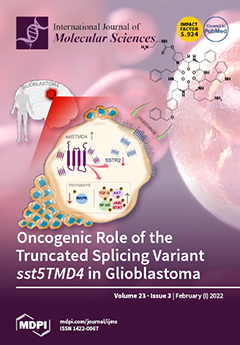
Cover Story: Glioblastoma is the most lethal brain tumor with the poorest overall survival. Current standard treatments are not effective. Hence, the identification of novel strategies to treat this devastating pathology is crucial. In this context, the dysregulation of alternative splicing process represents a valuable source for the identification of novel diagnostic and prognostic tools, as well as therapeutic targets, in different tumor pathologies. This study unveils that the truncated splicing variant of the somatostatin receptor subtype 5 (sst5TMD4) is overexpressed and associated with enhanced malignancy features in human glioblastoma, demonstrating the potential utility of sst5TMD4 as a potential diagnostic and prognostic biomarker. Furthermore, sst5TMD4 also represents a novel therapeutic target for glioblastoma patients. View this paper
  • Issues are regarded as officially published after their release is announced to the table of contents alert mailing list .
  • You may sign up for email alerts to receive table of contents of newly released issues.
  • PDF is the official format for papers published in both, html and pdf forms. To view the papers in pdf format, click on the "PDF Full-text" link, and use the free Adobe Reader to open them.

Articles (914)

  • Article
  • Open Access
9 Citations
3,983 Views
15 Pages

8 February 2022

Histamine levels in the human brain are controlled by rather peculiar metabolic pathways. In the first step, histamine is enzymatically methylated at its imidazole Nτ atom, and the produced N-methylhistamine undergoes an oxidative deamination cat...

  • Article
  • Open Access
18 Citations
7,661 Views
22 Pages

Fusarium graminearum Infection Strategy in Wheat Involves a Highly Conserved Genetic Program That Controls the Expression of a Core Effectome

  • Florian Rocher,
  • Tarek Alouane,
  • Géraldine Philippe,
  • Marie-Laure Martin,
  • Philippe Label,
  • Thierry Langin and
  • Ludovic Bonhomme

8 February 2022

Fusarium graminearum, the main causal agent of Fusarium Head Blight (FHB), is one of the most damaging pathogens in wheat. Because of the complex organization of wheat resistance to FHB, this pathosystem represents a relevant model to elucidate the m...

  • Article
  • Open Access
14 Citations
4,121 Views
14 Pages

AKR1B10, One of the Triggers of Cytokine Storm in SARS-CoV2 Severe Acute Respiratory Syndrome

  • Clovis Chabert,
  • Anne-Laure Vitte,
  • Domenico Iuso,
  • Florent Chuffart,
  • Candice Trocme,
  • Marlyse Buisson,
  • Pascal Poignard,
  • Benjamin Lardinois,
  • Régis Debois and
  • Sophie Rousseaux
  • + 3 authors

8 February 2022

Preventing the cytokine storm observed in COVID-19 is a crucial goal for reducing the occurrence of severe acute respiratory failure and improving outcomes. Here, we identify Aldo-Keto Reductase 1B10 (AKR1B10) as a key enzyme involved in the expressi...

  • Article
  • Open Access
11 Citations
3,724 Views
12 Pages

ERAP2 Inhibition Induces Cell-Surface Presentation by MOLT-4 Leukemia Cancer Cells of Many Novel and Potentially Antigenic Peptides

  • Ioannis Temponeras,
  • George Stamatakis,
  • Martina Samiotaki,
  • Dimitris Georgiadis,
  • Harris Pratsinis,
  • George Panayotou and
  • Efstratios Stratikos

8 February 2022

Recent studies have linked the activity of ER aminopeptidase 2 (ERAP2) to increased efficacy of immune-checkpoint inhibitor cancer immunotherapy, suggesting that pharmacological inhibition of ERAP2 could have important therapeutic implications. To ex...

  • Article
  • Open Access
11 Citations
4,552 Views
16 Pages

8 February 2022

Cisplatin can induce peripheral neuropathy, which is a common complication of anti-cancer treatment and negatively impacts cancer survivors during and after completion of treatment; therefore, the mechanisms by which cisplatin alters sensory neuronal...

  • Article
  • Open Access
30 Citations
6,291 Views
24 Pages

Blood Bacteria-Free DNA in Septic Mice Enhances LPS-Induced Inflammation in Mice through Macrophage Response

  • Warerat Kaewduangduen,
  • Peerapat Visitchanakun,
  • Wilasinee Saisorn,
  • Ariya Phawadee,
  • Charintorn Manonitnantawat,
  • Chirapas Chutimaskul,
  • Paweena Susantitaphong,
  • Patcharee Ritprajak,
  • Naraporn Somboonna and
  • Thanya Cheibchalard
  • + 3 authors

8 February 2022

Although bacteria-free DNA in blood during systemic infection is mainly derived from bacterial death, translocation of the DNA from the gut into the blood circulation (gut translocation) is also possible. Hence, several mouse models with experiments...

  • Article
  • Open Access
30 Citations
5,156 Views
24 Pages

High, in Contrast to Low Levels of Acute Stress Induce Depressive-like Behavior by Involving Astrocytic, in Addition to Microglial P2X7 Receptors in the Rodent Hippocampus

  • Ya-Fei Zhao,
  • Wen-Jing Ren,
  • Ying Zhang,
  • Jin-Rong He,
  • Hai-Yan Yin,
  • Yang Liao,
  • Patrizia Rubini,
  • Jan M. Deussing,
  • Alexei Verkhratsky and
  • Zeng-Qiang Yuan
  • + 2 authors

8 February 2022

Extracellular adenosine 5′-triphosphate (ATP) in the brain is suggested to be an etiological factor of major depressive disorder (MDD). It has been assumed that stress-released ATP stimulates P2X7 receptors (Rs) at the microglia, thereby causin...

  • Article
  • Open Access
6 Citations
4,316 Views
17 Pages

A Real-Time, Plate-Based BRET Assay for Detection of cGMP in Primary Cells

  • Adam L. Valkovic,
  • Martina Kocan,
  • Brad Hoare,
  • Sarah Marshall,
  • Daniel J. Scott and
  • Ross A. D. Bathgate

8 February 2022

Cyclic guanosine monophosphate (cGMP) is a second messenger involved in the regulation of numerous physiological processes. The modulation of cGMP is important in many diseases, but reliably assaying cGMP in live cells in a plate-based format with te...

  • Article
  • Open Access
10 Citations
3,673 Views
18 Pages

The Expression of TP53-Induced Glycolysis and Apoptosis Regulator (TIGAR) Can Be Controlled by the Antioxidant Orchestrator NRF2 in Human Carcinoma Cells

  • Helga Simon-Molas,
  • Cristina Sánchez-de-Diego,
  • Àurea Navarro-Sabaté,
  • Esther Castaño,
  • Francesc Ventura,
  • Ramon Bartrons and
  • Anna Manzano

8 February 2022

Hyperactivation of the KEAP1-NRF2 axis is a common molecular trait in carcinomas from different origin. The transcriptional program induced by NRF2 involves antioxidant and metabolic genes that render cancer cells more capable of dealing with oxidati...

  • Article
  • Open Access
10 Citations
3,687 Views
14 Pages

The Biosynthesis and Transport of Ophiobolins in Aspergillus ustus 094102

  • Jingjing Yan,
  • Jiamin Pang,
  • Jianjia Liang,
  • Wulin Yu,
  • Xuequn Liao,
  • Ayikaimaier Aobulikasimu,
  • Xinrui Yi,
  • Yapeng Yin,
  • Zixin Deng and
  • Kui Hong

8 February 2022

Ophiobolins are a group of sesterterpenoids with a 5-8-5 tricyclic skeleton. They exhibit a significant cytotoxicity and present potential medicinal prospects. However, the biosynthesis and transport mechanisms of these valuable compounds have not be...

of 92

Get Alerted

Add your email address to receive forthcoming issues of this journal.

XFacebookLinkedIn
Int. J. Mol. Sci. - ISSN 1422-0067