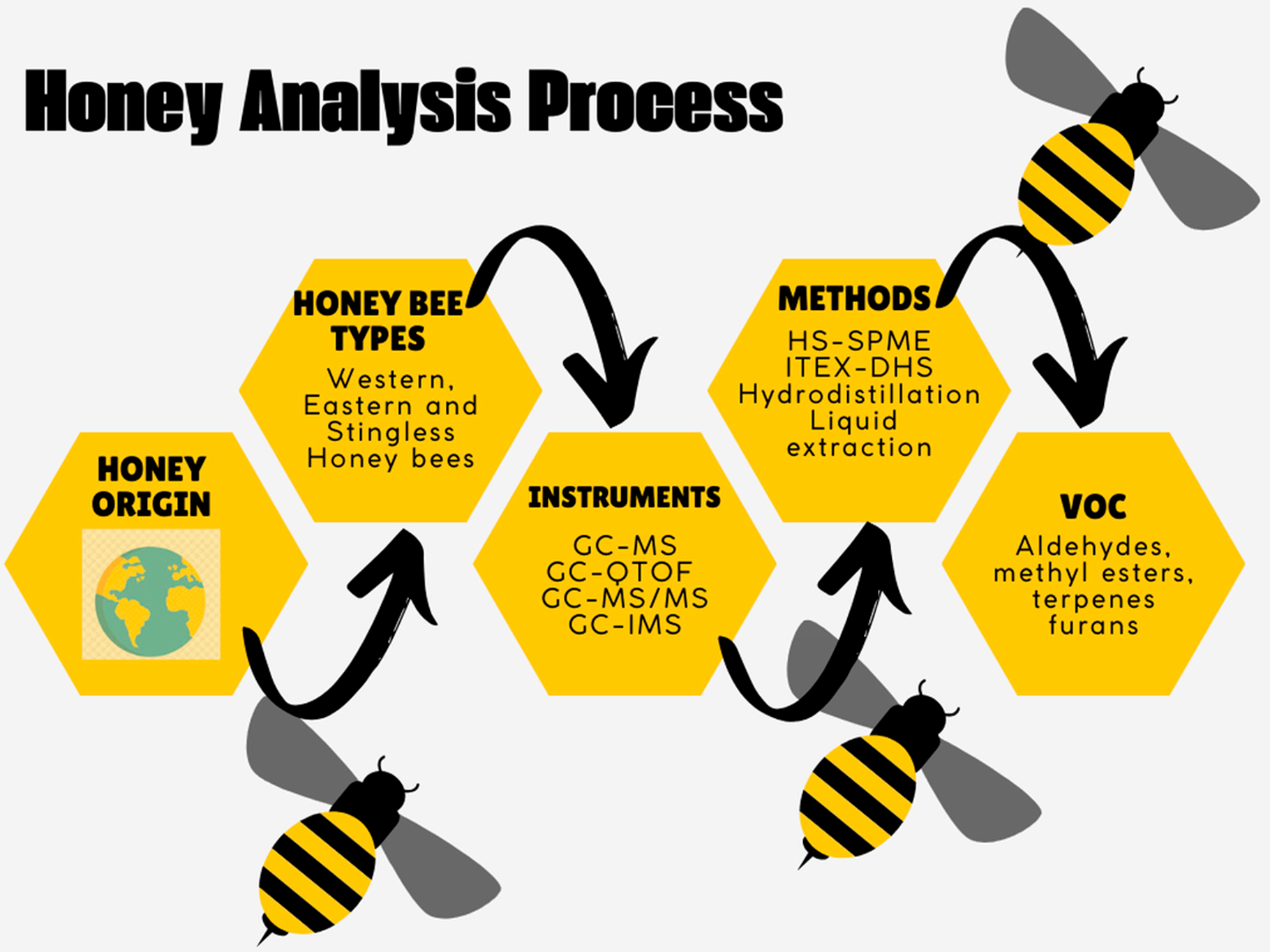
Commonly Used Analytical Tools and Methods for the Discrimination of Honey Types Based on Volatile Organic Compound Profiles





Abstract
1. Introduction
Aroma Profile of Honey
2. Volatile Organic Compounds (VOCs) Analysis in Honey
2.1. Extraction Methods
2.2. Methods and Instruments
2.3. Comparison of the Most Used Analytical Technologies

| No | Title | Type of Sample | Extraction Method | Instrument | Additional Information | Year Ref. |
|---|---|---|---|---|---|---|
| 1 | Volatile and non-volatile/semi-volatile compounds and in vitro bioactive properties of Chilean Ulmo (Eucryphia cordifolia Cav.) honey | Ulmo honey from Chile | HS-SPME | GC-MS | Fiber: DVB/CAR/PDMS; column: Rtx®-5MS (5% diphenyl/95% dimethyl polysiloxane, 30 m × 0.25 mm with a 0.25 μm film thickness); acquisition SCAN mode, m/z 20–550. | 2017 [83] |
| 2 | A decisive strategy for monofloral honey authentication using analysis of volatile compounds and pattern recognition techniques | Different types of honey (number of samples: 89) | HS-SPME | GC-MS | Fiber: DVB/CAR/PDMS; column: DB-5MS (cross-linked 5% PHME PH siloxane) (60 m × 320 μm i.d., ×1 μm film thickness); acquisition SCAN mode, m/z 50–550. | 2020 [81] |
| 3 | Stability of volatile compounds of honey during prolonged storage | Honey samples from Brazil | HS-SPME | GC-MS | Fiber: DVB/CAR/PDMS; column: HP-5MS (30 m × 0.25 mm × 0.25 μm). | 2020 [42] |
| 4 | Volatile compounds of five types of unifloral honey in Northwest China: Correlation with aroma and floral origin based on HS-SPME/GC–MS combined with chemometrics | Fifty-six samples of honey from China | HS-SPME | GC-MS | Fiber: DVB/CAR/PDMS; column: HP-5MS (60 m × 0.25 mm × 0.25 μm); acquisition SCAN mode, m/z 50–350. | 2022 [44] |
| 5 | A targeted chemometric evaluation of the volatile compounds of Quercus ilex honey in relation to its provenance | Thirty-four Quercus ilex honey samples from Greece | HS-SPME | GC-MS | Fiber: DVB/CAR/PDMS; DB-5MS (cross-linked 5% PH ME siloxane) capillary column (60 m × 320 μm i.d., × 1 μm film thickness); acquisition SCAN mode, m/z 50–550. | 2022 [82] |
| 6 | Study on honey quality evaluation and detection of adulteration by analysis of volatile compounds | Honey samples (n = 76) were analyzed | HS-SPME | GC-MS | Fiber DVB/CAR/PDMS; HP-5MS column (30 m × 250 μm × 0.25 μm). | 2017 [16] |
| 7 | Comprehensive study of volatile compounds of rare Leucosceptrum canum Smith honey: Aroma profiling and characteristic compound screening via GC–MS and GC–MS/MS | Nine types of monofloral honeys (China) | HS-SPME and liquid extraction | GC-MS and GC-MS/MS | Fiber: DVB/CAR/PDMS; HP-5 capillary column (30 m × 0.25 mm × 0.25 μm); acquisition SCAN mode, m/z 29–450 for GC-MS. Injection volume: 2 µL; HP-5 capillary column (30 m × 0.25 mm × 0.25 μm); acquisition MRM mode for GC-MS/MS. | 2023 [69] |
| 8 | Aromatic profiles and enantiomeric distributions of volatile compounds during the ripening of Dendropanax dentiger honey | Dendropanax dentiger honey (DDH) samples from China | HS-SPME | GC-QTOF and GC-TOF | Fiber: DVB/Carbon WR/PDMS; capillary column: HP-5MS UI (30 m × 0.25 mm × 0.25 μm); acquisition mass scan range of 45–550 m/z for volatile compounds. Fiber: DVB/CAR/PDMS; CycloSil-B column (30 m × 0.25 mm × 0.25 μm); acquisition m/z scan range of 33–600 for enantiomeric volatile compounds. | 2024 [70] |
| 9 | Characterization of Evodia rutaecarpa (Juss) Benth honey: volatile profile, odor-active compounds and odor properties | Eight Evodia rutaecarpa (Juss) Benth honey samples from China | HS-SPME | GC-QTOF | Fiber: SPME arrow divinylbenzene/carbon wide-range/polydimethylsiloxane; capillary column: HP-5MS UI (30 m × 0.25 mm × 0.25 μm); full scan mode, acquisition mass range m/z 45–550. | 2023 [71] |
| 10 | Response surface methodology to optimize the isolation of dominant volatile compounds from Monofloral Greek Thyme honey using SPME-GC-MS | Eighty thyme honey samples | HS-SPME | GC-MS | Fiber: divinylbenzene/carboxen/polydimethylsiloxane (DVB/CAR/PDMS); capillary column: Restek Rtx-5MS (30 m × 0.25 mm i.d., 0.25 µm film thickness); acquisition scan at 35–650 m/z mass range. | 2021 [84] |
| 11 | Headspace volatile compounds fluctuations in honeydew honey during storage at in-house conditions | Honeydew honey from Greece | HS-SPME | GC-MS | Fiber: DVB/CAR/PDMS; capillary column: DB-5MS (cross-linked 5% PH ME siloxane, 60 m × 320 μm i.d., ×1 μm film thickness). | 2022 [85] |
| 12 | Volatile organic compounds of Thai honeys produced from several floral sources by different honey bee species | Thai honeys produced from five different floral sources by three species of honey bees | HS-SPME | GC-MS | Fiber: SPME divinylbenzene/carboxen/polymethylsiloxane; capillary column: HP 5MS (30 m × 0.25 mm × 0.25 μm); acquisition SCAN mode, m/z 24–360. | 2017 [86] |
| 13 | Honey: Determination of volatile compounds, antioxidant and antibacterial activities | Honey samples were obtained directly from beekeepers in Malatya (Turkey) | HS, not clear | GC-MS | DB-5MS column (30 m × 25 mm and 0.25 μm film thickness). | 2021 [87] |
| 14 | Characterization of Botanical Origin of Italian Honey by Carbohydrate Composition and Volatile Organic Compounds (VOCs) | Forty-eight samples of Apis mellifera honeys from northeastern Italy | HS-SPME | GC-MS | Fiber: divinylbenzene/carboxen/polydimethylsiloxane; VF-WAXms column (30.0 m × 0.25 mm I.D. × 0.25 µm film thickness). | 2022 [88] |
| 15 | Differentiation of Monofloral Honey Using Volatile Organic Compounds by HS-GCxIMS | Fifty-eight honey samples with six different botanical origins | HS | GCxIMS and GC-MS (identification) | Column for GCxIMS: 15 m × 0.53 mm × 1 µm MXT-5; detection with a drift tube of 15.2 mm (diameter) and 98 mm (length); ionization by 3H-source at 45 °C; nitrogen drift gas flow rate of 150 mL/min; and field strength of 500 V/cm. Capillary column for GC-MS: HP-5MS UI (30 m × 0.25 mm × 0.5 µm); acquisition scan range of 32–300 m/z. | 2022 [74] |
| 16 | Monitoring Volatile Organic Compounds and Aroma Profile of Robinia pseudoacacia L. Honey at Different Storage Temperatures during Shelf Life | Robinia pseudoacacia honey from Italy | HS-SPME for GC-MS | GC-MS and e-nose (electronic nose) | Fiber: Divinylbenzene/Carboxen/polydimethylsiloxane (CAR/PDMS/DVB); column: Rtx-Wax (30 m × 0.25 mm i.d. × 0.25 µm film thickness); acquisition scan range of 30–350 m/z. E-nose: 10 metal oxide sensors (MOS). | 2023 [72] |
| 17 | In-tube dynamic extraction for analysis of volatile organic compounds in honey samples | Thirty-eight honey samples (Acacia, blossom, and forest) | ITEX-DHS | GC-MS | Tenax TA ITEX trap (polydiphenylene oxide); Optima FFAPplus fused-silica capillary column (60 m × 0.32 mm I.D., 0.5 μm film thickness); acquisition SCAN mode, m/z 40–200; acquisition SIM mode. | 2022 [65] |
| 18 | Optimization of a miniaturized solid-phase microextraction method followed by gas chromatography mass spectrometry for the determination of twenty four volatile and semivolatile compounds in honey from Galicia (NW Spain) and foreign countries | Different types of honey samples including several varieties from Spain and some from Italy, France, Greece, and Kazakhstan. | HS-mini-SPME | GC-MS | Fiber: DVB/CAR/PDMS; DB-WAX capillary column (50 m × 0.20 mm i.d., 0.20 μm film thickness); acquisition SCAN mode, m/z 35–400. | 2021 [61] |
| 19 | Volatile compounds in off-odor honey | Ten samples of off-odor honeys from Brazil | HS-SPME | GC-MS | Fiber: polydimethylsiloxane/divinylbenzene; VF-Wax MS capillary column (30 m × 0.25 mm internal diameter × 0.25 μm). | 2021 [89] |
| 20 | Chemometrics exploration of monosaccharides, sugar acids, stable carbon isotopes, and volatile organic compounds in Malaysian stingless bee honey from different geographical origins | Fifteen multifloral stingless bee honey samples from Peninsular Malaysia | Liquid–liquid extraction | GC-MS | HP-5MS ((5%-phenyl)-methylpolysiloxane phase) (30 m × 0.25 mm × 0.25 μm film thickness); acquisition SCAN mode, m/z 40–650. | 2024 [90] |
| 21 | Rhamnus frangula honey: screening of volatile organic compounds and their composition after short-term heating | Four Rhamnus frangula L. honey samples from North Croatia | HS-SPME and Ultrasonic Solvent Extraction (USE) | GC-MS and GC-FID | Fiber: divinylbenzene/Carboxen/polydimethylsiloxane (DVB/CAR/PDMS); pentane–Et2O (1:2, v/v) solvent used in USE; column: HP-5MS (30 m × 0.25 mm i.d., coating thickness: 0.25 μm); acquisition SCAN mode, m/z 30–300. | 2015 [54] |
| 22 | Analysis of Volatile Compounds of Some Turkish Flower Honey Samples by Solid-Phase Microextraction and Gas Chromatography-Mass Spectrometry | Five different flower honeys from Turkey | HS-SPME | GC-MS | Fiber: PDMS/DVB; column: RTX-5MS (30 m × 0.25 mm × 0.25 µm). | 2020 [50] |
| 23 | Quality of stingless bee honey based on volatile organic compounds and gas released | Stingless bee honey | - | FTIR coupled with White Gas Cell | Cyclone C5 gas cell with 2 to 8 m adjustable path length connected to the Frontier FTIR spectrometer with a deuterated triglycine sulphate (DTGS); range of spectrum set from 4000 cm−1 to 500 cm−1. | 2020 [71] |
| 24 | Identification and Quantification of Volatile Compounds Released by Stingless Honey using Long Optical Path Infrared spectroscopy | Stingless bee honey from Malaysia | - | FTIR coupled with White Gas Cell | Cyclone C5 gas cell with 2 to 8 m adjustable path length connected to the Frontier FTIR spectrometer with a deuterated triglycine sulphate (DTGS); range of spectrum set from 4000 cm−1 to 450 cm−1. | 2016 [70] |
| 25 | The Tracing of VOC Composition of Acacia Honey During Ripening Stages by Comprehensive Two-Dimensional Gas Chromatography | All honey samples and the related comb wax samples were from Slovakia | HS-SPME | GCxGC/TOF-MS | Fiber: DVB/CAR/PDMS; DB-FFAP column (30 m × 0.25 mm 0.25 µm) in the first dimension and BPX-50 column (1.5 m × 0.1 mm × 0.1 µm) in the second dimension; the signal acquisition rate was 100 spectra/s in the m/z range 29–450. | 2016 [69] |
| 26 | The effect of low-temperature spray drying with dehumidified air on phenolic compounds, antioxidant activity, and aroma compounds of rapeseed honey powders | Rapeseed honey from a local apiarist in Poland | HS-SPME | GC-MS | Fiber: divinylbenzene/carboxene/polydimtheylsiloxane; ZB WAX plus capillary column (30 m × 0.25 mm × 0.25 μm); acquisition SCAN mode, m/z 35–500. | 2019 [91] |
| 27 | The phenolic composition, aroma compounds, physicochemical and antimicrobial properties of Nigella sativa L. (black cumin) honey | Black cumin honey samples were obtained from experienced beekeepers in Turkey | HS-SPME | GC-MS | Fiber: divinylbenzene/carboxin/polydimethylsiloxane; 30 m 5 Ms column. | 2023 [92] |
| 28 | Changes of various quality characteristics and aroma compounds of astragalus honey obtained from different altitudes of Adana-Turkey | Honey samples were obtained from honey producers as centrifugal honey in Turkey | Liquid–liquid extraction | GS-MS-FID | Extraction with dichloromethane and concentration of organic phase with Vigreux column; DB-WAX capillary column (30 m × 0.25 mm × 0.25 μm); acquisition SCAN mode, m/z 29–350. | 2021 [59] |
| 29 | Untargeted and Targeted Discrimination of Honey Collected by Apis cerana and Apis mellifera Based on Volatiles Using HS-GC-IMS and HS-SPME-GC−MS | Several honey samples from A. cerana and A. mellifera collected in China | HS and HS-SPME | GC-IMS and GC-MS | FS-SE-54-CB-0.5 (15 m × 0.53 mm ID) column; drift tube operated at a constant voltage of 400 V/cm at 45 °C for GC-IMS. Fiber: divinylbenzene/carboxen/polydimethylsiloxane; capillary column: HP-DB-5 (30 m × 0.25 m × 0.25 μm); acquisition SCAN mode, m/z 15–200 for GC-MS. | 2019 [67] |
| 30 | Chemical markers of a rare honey from the traditional spice plant Amomum tsao-ko Crevost et Lemari’e, via integrated GC–MS and LC-MS approaches | Linden, chaste, acacia, loquat, cherry, and rape honey samples were obtained from cooperative apiaries in China | HS-SPME | GC-MS | Fiber: DVB/CAR/PDMS; HP-5 capillary column (30 m × 0.25 mm × 0.25 μm). | 2023 [93] |
| 31 | Fingerprinting chemical markers in the Mediterranean orange blossom honey: UHPLC-HRMS metabolomics study Integrating melissopalynological analysis, GC-MS and HPLC-PDA-ESI/MS | Some honey samples (n = 28) were collected in Italy, Greece, and Egypt, and another 12 citrus honey samples were purchased from an Italian market | HS-SPME | GC-MS | Fiber: polyacrylate; MEGA 5-HT column (30 m × 0.25 mm, 0.25 µm film thickness); acquisition SCAN mode, m/z 50–500. | 2023 [51] |
| 32 | Optimization of the extraction of the volatile fraction from honey samples by SPME-GC-MS, experimental design, and multivariate target functions | Commercial organic multiflower honey | HS-SPME | GC-MS | Fiber: DVB/CAR/PDMS; capillary column: VF-5MS (30 m × 0.25 mm × 0.25 µm); acquisition SCAN mode, m/z 35–400. | 2017 [94] |
| 33 | Authentication of chaste honey adulterated with high fructose corn syrup by HS-SPME-GC-MS coupled with chemometrics | Chaste honey samples (n = 15) were obtained directly from farmers at China bee farms | HS-SPME | GC-MS | Fiber: Polydimethylsiloxane/divinylbenzene; HP-5MS capillary column (60 m × 0.25 mm, 0.25 μm); acquisition SCAN mode, m/z 50–500. | 2023 [53] |
| 34 | Screening of polish Fir honeydew honey using GC/MS, HPLC-DAD, and physical-chemical parameters: benzene derivatives and terpenes as chemical markers | Five samples of Fir honeydew honey were obtained from professional beekeepers in different parts of Poland | HS-SPME and ultrasound-assisted solvent extraction (USE) | GC-FID and GC-MS | Two fibers: PDMS/DVB and DVB/CAR/PDMS; two different solvents—a mixture of pentane with diethyl ether and dichloromethane were used for separate extractions (in case of USE); capillary column HP-5MS (30 × 0.25 mm, with coating thickness 0.25 μm); acquisition SCAN mode, m/z 30–300. | 2017 [58] |
| 35 | Stir bar sorptive extraction coupled with GC/MS applied to honey: optimization of method and comparative study with headspace extraction techniques | A monofloral sample of eucalyptus honey (Eucalyptus camaldulensis Dehnh.) was obtained from a professional beekeeper from Italy | Stir bar sorptive extraction (SBSE) | GC-MS | Twister® stir bar; VF-Wax capillary column (60 m × 0.25 mm i.d., 0.5 μm film thickness) and HP-5MS capillary column (30 m × 0.25 mm, film thickness 0.17 μm). | 2017 [62] |
| 36 | Influence of beeswax adulteration with paraffin on the composition and quality of honey determined by physico-chemical analyses, 1H NMR, FTIR-ATR and HS-SPME/GC–MS | Honey ripened in honeycomb built on paraffin-based (90%) comb foundations (PF-H), and honey ripened in honeycomb constructed on comb foundations made of genuine beeswax (BWF-H) | HS-SPME | GC-MS | Fiber: DVB/CARB/PDMS; HP-5MS capillary column (5% phenylmethylpolysiloxane); acquisition SCAN mode, m/z 30–300. | 2019 [95] |
| 37 | Unifloral Autumn Heather Honey from Indigenous Greek Erica manipuliflora Salisb.: SPME/GC-MS Characterization of the Volatile Fraction and Optimization of the Isolation Parameters | Twenty-five honey samples provided directly by Greek beekeepers | HS-SPME | GC-MS | Fiber: DVB/CAR/PDMS; Rtx-5MS (30 m × 0.25 mm i.d., 0.25 µm film thickness) chromatography column; acquisition SCAN mode, m/z 30–650. | 2021 [96] |
| 38 | GC–MS investigations of VOCs in South Indian honey samples as environmental biomarkers | Twenty-five honey samples collected from the Western Ghats, India | Liquid–liquid extraction | GC-MS | Extraction with dichloromethane and injection; Rtix 5 MS colum; acquisition SCAN mode, m/z 50–800. | 2021 [57] |
| 39 | The Microscopic and GC-MS Analysis of Turkish Honeydew (Pine) Honey | Seventy-eight honeydew (Pine) honey samples were collected from ten areas of Turkey | Liquid–liquid extraction | GC-MS | Extraction with methanol and then with ethanol. After sample drying, this was dissolved in 0.5 mL of ethanol; DB 5MS column (30 m × 0.25 mm and 0.25 μm of film thickness). | 2016 [97] |
| 40 | HS-SPME-GC-MS Analysis of the Volatile Composition of Italian Honey for Its Characterization and Authentication Using the Genetic Algorithm | Ninety-eight honey samples from Italian honey producers, with the exception of four Greek samples | HS-SPME | GC-MS | Fiber: DVB/CAR/PDMS; DB InnoWAX column (0.4 μm × 0.2 mm × 50 m); acquisition SCAN mode, m/z 29–350. | 2024 [98] |
| 41 | Comparison of original honey (Apis sp. and Tetragonula sp.) and fake honey compounds in Indonesia using gas chromatography-mass spectrometry (GC-MS) | Honeys from Apis sp. (Apis melifera, A. dorsata, A. cerana) and Tetragonula sp. from several regions in Indonesia. Fake honey samples (n = 20) were prepared by adding fructose, NaHCO3, and Aquadest | Liquid–liquid extraction | GC-MS | No details are reported. | 2019 [99] |
| 42 | HS-SPME/GC-MS metabolomic analysis for the identification of exogenous volatile metabolites of monofloral honey and quality control suggestions | Total of 203 monofloral honey samples of different botanical origins (citrus, fir, pine, and thyme) | HS-SPME | GC-MS | Fiber: divinyl benzene/carboxen/polydimethylsiloxane (DVB/CAR/PDMS); DB-5MS column (cross-linked 5% PH ME siloxane) (60 m × 320 µm i.d., × 1 µm film thickness); acquisition SCAN mode, m/z 50–550. | 2022 [100] |
| 43 | Characterization of Summer Savory (Satureja hortensis L.) Honey by Physico-Chemical Parameters and Chromatographic/Spectroscopic Techniques (GC-FID/MS, HPLC-DAD, UV/VIS and FTIR-ATR) | Sample of Satureja hortensis L. honey was obtained from a plantation in Poland | HS-SPME and Ultrasonic Solvent Extraction | GC-MS and GC-FID | Fiber: divinylbenzene/carboxene/polydimethylsiloxane (DVB/CAR/PDMS); extraction with pentane:Et2O 1:2 (v/v) mixture and concentration of the organic phase with distillation with Danish–Kuderna apparatus; the same column was used for GC-MS and FID: 30 m capillary column HP-5MS (5% phenyl-methylpolysiloxane); acquisition SCAN mode, m/z 30–300 for GC-MS. | 2015 [56] |
| 44 | GC-MS Analysis of the Volatile Constituents and Antioxidant Activity of the Crude Honey Residue from Takum Local Government Area of Taraba State, Nigeria | The crude honey was collected from the wild in Takum Local Government Area of Taraba State, Nigeria | Hydrodistillation | GC-MS | The extraction lasted for two (2) hours and the extract was collected over hexane; column: HP-5MS (30 m × 0.320 mm; 0.25 μm thickness); acquisition SCAN mode, m/z 35–500. | 2022 [63] |
| 45 | Screening of Satureja subspicata Vis. Honey by HPLC-DAD, GC-FID/MS and UV/VIS: Prephenate Derivatives as Biomarkers | Ten samples of Satureja subspicata Vis. honey were obtained from professional bee-keepers in Croatia (the bee species was Apis mellifera carnica) | Ultrasonic Solvent Extraction | GC-MS and GC-FID | Two solvents were used for extraction: pentane:Et2O 1:2 (v/v) mixture and CH2Cl2. Sample was concentrated with distillation with Danish–Kuderna apparatus; the same column was used for GC-MS and FID: capillary column: HP-5MS (5% phenyl-methylpolysiloxane) (30 m × 0.25 mm; 0.25 µm); acquisition SCAN mode, m/z 29–350 for GC-MS. | 2016 [55] |
3. Volatile Organic Compounds in Honey: Types and Geographical Origin
3.1. Floral Origin
3.2. Geographical Origin
3.3. Entomological Origin
| Name of the Honey | Botanical Origin (Nectar Source) | Terpenes | Aldehydes | Ketones | Other VOCs | Aroma Profile | Geographical Origin |
|---|---|---|---|---|---|---|---|
| Paraná Delta * | Eucalyptus spp. | Cineole; a-pinene; limonene | Furfural | - | - | Medicinal, herbal, slightly citrusy | Paraná Delta and Islands, Argentina [10] |
| Espinal * | Helianthus annus | - | Hexanal | Octanone | Methyl esters | Fruity, floral, slightly nutty | Espinal, Argentina [10] |
| Pampa ** | Trifolium spp. | Limonene | Benzaldehyde | - | Hydroxymethyl furfural (HMF); Phenylethyl alcohol | Sweet, floral, mild buttery undertones | Pampa, Argentina [10] |
| Patagonian ** | Nothofagus, Berberis | Limonene; Pinene | - | - | Phenylethyl alcohol; Furans | Complex, floral, earthy | Patagonian Forest, Argentina [10] |
| Alfalfa * | Medicago sativa | - | Benzenea- cetaldehyde; Nonanal | - | 2-methoxyphenol | Sweet, floral, slight citrusy undertones | Córdoba, Argentina [32] |
| Sunflower * | Helianthus annuus | - | octanal | - | 2-Methoxyphenol | Earthy, herbal with low sweetness | Córdoba, Argentina [32] |
| White Clover * | Melilotus albus | - | Benzene acetaldehyde | 2-H-1-Benzopyran-2-one | - | Mildly sweet, vanilla-like aroma | Córdoba, Argentina [32] |
| Carob * | Prosopis spp. | - | Nonanal; Octanal | - | - | Woody, slightly nutty, and floral | Córdoba, Argentina [32] |
| Caldén * | Prosopis caldenia | - | Nonanal | - | 1-Octanol | Fruity, with faint herbal notes | Córdoba, Argentina [32] |
| Apies cerana * | Litchi chinensis | - | - | - | 1-Nonanol; 1-Heptanol; Phenethyl Acetate | Sweet, fruity (pineapple, grape), herbaceous | Guangdong, Gansu, Shaanxi, China [26] |
| Apies mellifera * | Litchi chinensis | - | Benzaldehyde; Heptanal; Phenylacetaldehyde | - | - | Floral (hawthorne, lavender), almond, citrus | Guangdong, Henan, Sichuan, China [26] |
| Citrus (Egypt) * | Citrus sinensis | Linalool | 2-Methylbutanal; Benzaldehyde | Heptane | Methyl anthranilate; | Fruity, floral, citrusy notes | Egypt [36] |
| Citrus (Greece) * | Citrus reticulata | p-cymene | Nonanal; Decanal; Lilac Aldehydes | - | - | Sweet, floral, and slightly spicy | Greece [36] |
| Citrus (Morocco) * | Citrus aurantium | - | Benzaldehyde | - | Dill Ether; Cis-Linalool Oxide | Herbal, earthy, slightly fruity | Morocco [36] |
| Citrus (Spain) * | Citrus limon | - | - | - | Ethyl octanoate; ethyl nonanoate; ethyl acetate | Mild floral, light fruity, and citrusy | Spain [36] |
| Winter * | Schefflera actinophylla | - | Benzaldehyde; Phenylacetaldehyde; Heptanal | 2-heptanone | - | Sweet, floral, slightly spicy | Southern China [106] |
| Sapium * | Triadica sebifera | - | Lilac aldehydes | - | Phenylethyl acetate; hotrienol | Lightly sour, rough texture, low concentration | Southern China [106] |
| Litchi * | Litchi chinensis | Cis-rose oxide; Trans-linalool oxide | Lilac aldehydes | - | - | Floral, fruity, sweet | India (Karnataka) [22] |
| Neem * | Azadirachta indica | Azadirachtin; Germacrene | - | - | Dipropyl disulphide | Medicinal, slightly bitter, sulfurous | India (Karnataka) [22] |
| Ginger * | Zingiber officinale | Zingiberene; Farnesene | Octadecenal | Spicy, woody, warm | India (Karnataka) [22] | ||
| Eucalyptus * | Eucalyptus spp. | - | Phenylacetaldehyde | Acetoin | 2-Hydroxycineole | Herbal, woody, slightly minty | India (Karnataka) [22] |
| Lemon * | Citrus limon | Limonene diol | - | - | Limonyl alcohol; Methyl anthranilate | Sweet, citrusy, floral | India (Karnataka) [22] |
| Kashmiri White ** | Trifolium repens | - | - | Furyl hydroxymethyl ketone | Heptanol | Mild, light floral | India (Kashmir) [22] |
| B.R. Hill ** | Emblica officinalis | Cis-linalool oxide | 2-Pentyl-2-nonenal | - | Caffeine | Earthy, robust, slightly woody | India (Karnataka) [22] |
| Pan India * | Brassica campestris/spp. | - | - | - | Ethyl oleate; Decane; Nonadecanol | Mild, mixed floral | India (Nationwide) [22] |
| Lycium * | Lycium barbarum | - | - | - | β-Glucose; Melezitose; Xylobiose | Sweet, mildly floral | Ningxia, China [42] |
| Jujube * | Ziziphus jujuba Mill. | - | - | - | Proline; Uridine; | Fruity, rich, slightly tangy | Henan, China [42] |
| Linden * | Tilia spp. | - | - | - | Melezitose; Lysine | Herbal, woody, floral | Inner Mongolia, China [42] |
| Locust * | Robinia pseudoacacia L. | - | - | - | Xylobiose; Melezitose | Light, delicately floral | Jiangsu, China [42] |
| Sunflower * | Helianthus annuus | - | - | - | Proline; β-Glucose | Nutty, earthy, floral | Xinjiang, China [42] |
| Multifloral ** | Prunus padus | - | - | - | Proline; Melezitose | Mixed floral, complex | Sichuan, China [42] |
| Chaste * | Vitex negundo | - | - | - | Xylobiose; Lysine | Sweet, herbal, slightly spicy | Hubei, China [42] |
| Eriobotrya * | Eriobotrya japonica | - | - | - | Uridine, Turanose | Mild fruity, subtly floral | Guangdong, China [42] |
| Mandaguarí Negra *** | Scaptotrigona postica | Linalool | Safranal | - | Hotrienol oxide; Acetic acid | Floral, saffron-like, fruity | Misiones, Argentina [9] |
| Borá *** | Tetragona clavipes | β-caryophyllene; sesquiterpenes | - | - | Octanoic acid; Ethyl octanoate | Fruity, fatty, slightly spicy | Misiones, Argentina [9] |
| Mandazaia *** | Melipona quadrifasciata quadrifasciata | - | - | - | Ethyl benzoate; Diethyl succinate; 2-phenylethanol | Sweet, fruity, floral | Misiones, Argentina [9] |
| Yateí *** | Tetragonisca fiebrigi | - | - | β-damascenone | Acetic acid; Benzyl alcohol | Herbal, fruity, lightly floral | Misiones, Argentina [9] |
| Honeybee (Sample 5) ** | Trifolium spp. | Linalool; monoterpenoids | Lilac aldehydes; Furfural | - | - | Sweet, floral, caramel-like | Wanda, Misiones, Argentina [9] |
| Honeybee (Sample 6) ** | Trifolium spp. | β-pinene; limonene | Furfural; Lilac aldehydes | Floral, woody, caramel notes | Eldorado, Misiones, Argentina [9] | ||
| Rape ** | Brassica napus | - | Benzaldehyde; 2-methyl-butanal | - | Acetone; Hotrienol | Mild, floral, slightly nutty | West Pomeranian, Poland [4] |
| Lime ** | Tilia spp. | Dehydro-p-cymene | - | - | Menthofuran; Terpinen-4-ol | Herbal, citrusy, woody | Podlaskie, Poland [4] |
| Meadow & Marsh ** | Trifolium spp. | - | Grandlure IV | 1,4-butanediol diacetate; p-cymen-8-ol | Floral, fruity, smoky | Podlaskie, Poland [4] | |
| Lime * | Tilia spp. | - | Grandlure IV; Furfural | - | Terpinen-4-ol | Lightly herbal, floral | Poland [4] |
| Buckwheat * | Fagopyrum esculentum | - | Furfural; Phenylacetaldehyde | - | Isovaleric acid; Ethanol | Strong, malty, earthy, pungent | Poland [4] |
| Honeydew * | Abies spp. | - | - | Acetoin | Valeric acid methyl ester; Isoamyl alcohol | Woody, resinous, fermented notes | Poland [4] |
| Arabian Jujube (H1) * | Ziziphus spina-christi | - | Furfural; Benzaldehyde | - | Phenylethyl alcohol | Sweet, fruity, floral | Ad. Damazin, Sudan [11] |
| Scented Thorn (H2) * | Acacia nilotica | - | 2-Methylbutanal; Safranal | - | Benzyl alcohol | Floral, woody, slightly spicy | Ad. Damazin, Sudan [11] |
| Talh (H3) * | Vachellia seyal | - | Furfural; Phenylacetaldehyde | - | 1-butanol | Earthy, resinous, caramel-like | Ad. Damazin, Sudan [11] |
| Multifloral (H4) ** | Multifloral sources | - | Benzaldehyde; Hexanal | - | 1-pentanol | Mild, mixed floral | Kabam, Sudan [11] |
| Multifloral (H5) ** | Multifloral sources | - | Furfural | - | Phenylethyl alcohol; Methyl salicylate | Fruity, herbal | Um Dafoug, Sudan [11] |
| Arabian Jujube (H6) * | Ziziphus spina-christi | - | Safranal | - | Benzyl alcohol; Phenylethyl alcohol | Rich, fruity, floral | Wadisaleh, Sudan [11] |
| Multifloral (H7) ** | Multifloral sources | - | 2-methylbutanal; Furfural | - | Phenol derivatives | Floral, herbal, woody | El Obeid, Sudan [11] |
| Lisan Tair (H8) * | Amaranthus graecizans | - | Benzaldehyde; Furfural | - | Phenylethyl alcohol | Sweet, floral, slightly nutty | El Obeid, Sudan [11] |
| Talh (H9) * | Vachellia seyal | - | Safranal | - | Benzyl alcohol; Butanoic acid | Woody, herbal, earthy | Al Qadarif, Sudan [11] |
| Ban (H10) * | Eucalyptus spp. | - | Benzaldehyde; furfural | - | Phenylethyl alcohol | Fruity, floral, fresh | Al Qadarif, Sudan [11] |
| Acacia (Zone 1) * | Robinia pseudoacacia | Linalool oxide | Benzaldehyde | - | 3-methyl-3-buten-1-ol; Acetic acid | Floral, sweet, mild fruity | Transylvania, Romania [108] |
| Acacia (Zone 2) * | Robinia pseudoacacia | - | - | 5-ethenyldihydro-5-furanone | Ethanol; Acetic acid; Benzyl alcohol | Fruity, acidic, fresh | Southern Romania [108] |
| Acacia (Zone 3) * | Robinia pseudoacacia | trans-Linalool oxide | Benzeneacetaldehyde; Hotrienol | Acetone | - | Floral, slightly woody, aromatic | Eastern Romania [108] |
| Carob Tree * | Ceratonia siliqua | α-Pinene; Linalool oxide | - | - | Methyl anthranilate | Woody, slightly floral | Algarve, Portugal [21] |
| Chestnut * | Castanea sativa | α-pinene | Benzaldehyde | Acetophenone | - | Nutty, strong, slightly bitter | Trás-os-Montes, Portugal [21] |
| Eucalyptus * | Eucalyptus spp. | α-Pinene | - | - | Aromadendrene; Eudesmol | Herbal, woody, slightly minty | Beira Baixa, Portugal [21] |
| Bell Heather * | Erica spp. | Linalool oxide | Benzene acetaldehyde; Hotrienol | - | - | Floral, spicy, resinous | Trás-os-Montes, Portugal [21] |
| Incense * | Pittosporum undulatum | Limonene | - | - | Benzyl salicylate; α-terpineol | Woody, balsamic, slightly floral | Azores, Portugal [21] |
| Lavender * | Lavandula spp. | - | n-Nonanal; Decanal | - | Benzyl alcohol | Sweet, aromatic, floral | Beira Baixa, Portugal [21] |
| Orange * | Citrus spp. | - | Lilac aldehydes | - | Methyl anthranilate; indole | Citrus, fruity, floral | Algarve, Portugal [21] |
| Rape * | Brassica napus | - | - | - | Dimethyl trisulfide | Mild, slightly sulfurous | Alentejo, Portugal [21] |
| Raspberry * | Rubus idaeus | Linalool oxide | Hotrienol; lilac aldehydes | - | - | Fruity, floral, fresh | Estremadura, Portugal [21] |
| Rosemary * | Rosmarinus officinalis | Linalool oxide | Benzaldehyde; Hotrienol | - | - | Herbal, floral, slightly minty | Algarve, Portugal [21] |
| Sunflower * | Helianthus annuus | α-Pinene; β-copaene | Benzene acetaldehyde | Earthy, nutty, slightly woody | Baixo Alentejo, Portugal [21] | ||
| Strawberry Tree * | Arbutus unedo | - | - | α-Isophorone; 4-keto-isophorone | Trimethylphenol | Bitter, earthy, caramel-like | Algarve, Portugal [21] |
| Guairapó *** | Multifloral sources | Linalool oxide | Hotrienol; benzaldehyde | - | - | Floral, fruity, slightly herbal | Guaraqueçaba, Cambará, Brazil [24] |
| Mandurí *** | Multifloral sources | Linalool oxide | -- | Benzyl alcohol; Epoxylinalool | Floral, light citrusy | Guaraqueçaba, Cambará, Brazil [24] | |
| Uruçu *** | Multifloral sources | Linalool | Benzaldehyde; Hotrienol | - | - | Sweet, floral, mild woody | Guaraqueçaba, Cambará, Brazil [24] |
| Mandaçaia *** | Multifloral sources | - | Hotrienol, | - | Benzyl alcohol; Ethyl benzoate | Herbal, slightly fruity | Guaraqueçaba, Cambará, Brazil [24] |
| Borá *** | Multifloral sources | - | Benzaldehyde | - | Ethyl octanoate; Ethyl decanoate | Strong, fruity, slightly acidic | Guaraqueçaba, Cambará, Brazil [24] |
| Jataí *** | Multifloral sources | Linalool | Lilac aldehydes | - | benzyl alcohol | Floral, light caramel | Guaraqueçaba, Cambará, Brazil [24] |
| Tubuna *** | Multifloral sources | Linalool oxide | - | 2-Heptanone | 2-Heptanol | Fruity, resinous, slightly spicy | Guaraqueçaba, Prudentópolis, Brazil [24] |
| Tujumirim *** | Multifloral sources | Linalool oxide | Hotrienol | - | Benzyl salicylate | Woody, herbal, balsamic | Guaraqueçaba, Brazil [24] |
3.4. VOCs Formation Pathways
3.5. VOC Profiles in Adulteration Detection
4. Conclusions
Author Contributions
Funding
Institutional Review Board Statement
Informed Consent Statement
Data Availability Statement
Conflicts of Interest
Abbreviations
| VOC | Volatile organic compounds |
| GCMS | Gas chromatography and mass spectrometry |
| HS-GCMS | Headspace solid extraction, gas chromatography, and mass spectrometry |
| FTIR | Fourier Transform Infrared Spectroscopy |
| GC-MS/MS | Gas chromatography and tandem mass spectrometry |
| GC-QTOF | Gas Chromatography Quadrupole Time-of-Flight |
| GC-O | Gas chromatography–olfactometry |
| GC-IMS | Gas Chromatography–Ion Mobility Spectrometry |
| GC-FID | Gas Chromatography with Flame Ionization Detection |
| GCxGC-MS | Two-dimensional gas chromatography mass spectrometry |
References
- Moldakhmetova, G.; Kurmanov, R.; Toishimanov, M.; Tajiyev, K. Palynological, Physicochemical, and Organo-leptic Analysis of Honey from Different Climate Zones of Kazakhstan. Casp. J. Environ. Sci. 2023, 21, 543–553. [Google Scholar] [CrossRef]
- Maikanov, B.; Auteleyeva, L.; Satayeva, Z.; Aipova, A. The Development of Balqymyz Beverage from Honey and Koumiss. J. Agric. Food Res. 2023, 14, 100731. [Google Scholar] [CrossRef]
- America, S.; Squadrone, S.; Brizio, P.; Stella, C.; Mantia, M.; Pederiva, S.; Brusa, F.; Mogliotti, P.; Garrone, A.; Abete, M.C. Trace Elements and Rare Earth Elements in Honeys from the Balkans, Kazakhstan, Italy, South America, and Tanzania. Environ. Sci. Pollut. Res. 2020, 27, 12646–12657. [Google Scholar] [CrossRef] [PubMed]
- Derewiaka, D.; Majewska, E.; Kuzak, K.; Szadkowska, D. Comparison of Volatiles and Chemical Composition of Traditional and Non-Traditional Honey Available on the Polish Market. Appl. Sci. 2021, 11, 6371. [Google Scholar] [CrossRef]
- Isidorov, V.A.; Buczek, K.; Segiet, A.; Zambrowski, G.; Swiecicka, I. Activity of Selected Plant Extracts against Honey Bee Pathogen Paenibacillus larvae. Apidologie 2018, 49, 687–704. [Google Scholar] [CrossRef]
- Isidorov, V.A.; Maslowiecka, J.; Pellizzer, N.; Miranda, D.; Bakier, S. Chemical Composition of Volatile Components in the Honey of Some Species of Stingless Bees. Food Control 2023, 146, 109545. [Google Scholar] [CrossRef]
- da Silva, P.L.; de Lima, L.S.; Caetano, Í.K. Comparative Analysis of the Volatile Composition of Honeys from Brazilian Stingless Bees by Static Headspace GC—MS. Food Res. Int. 2017, 102, 536–543. [Google Scholar] [CrossRef]
- Machado, A.M.; Miguel, M.G.; Vilas-Boas, M.; Figueiredo, A.C. Honey Volatiles as a Fingerprint for Botanical Origin—A Review on Their Occurrence on Monofloral Honeys. Molecules 2020, 25, 374. [Google Scholar] [CrossRef]
- Patrignani, M.; Ciappini, M.C.; Tananaki, C.; Fagúndez, G.A.; Thrasyvoulou, A.; Lupano, C.E. Correlations of Sensory Parameters with Physicochemical Characteristics of Argentinean Honeys by Multivariate Statistical Techniques. Int. J. Food Sci. Technol. 2018, 53, 1176–1184. [Google Scholar] [CrossRef]
- Patrignani, M.; Fagúndez, G.A.; Tananaki, C.; Thrasyvoulou, A.; Lupano, C.E. Volatile Compounds of Argentinean Honeys: Correlation with Floral and Geographical Origin. Food Chem. 2018, 246, 32–40. [Google Scholar] [CrossRef]
- Tahir, H.E.; Xiaobo, Z.; Zhihua, L.; Yaodi, Z. Comprehensive Evaluation of Antioxidant Properties and Volatile Compounds of Sudanese Honeys. J. Food Biochem. 2015, 39, 349–359. [Google Scholar] [CrossRef]
- Tahir, H.E.; Xiaobo, Z.; Xiaowei, H.; Jiyong, S.; Mariod, A.A. Discrimination of Honeys Using Colorimetric Sensor Arrays, Sensory Analysis and Gas Chromatography Techniques. Food Chem. 2016, 206, 37–43. [Google Scholar] [CrossRef]
- Kružík, V.; Grégrová, A.; Rajchl, A.; Čížková, H. Study on Honey Quality Evaluation and Detection of Adulteration by Analysis of Volatile Compounds. J. Apic. Sci. 2017, 61, 17–27. [Google Scholar] [CrossRef]
- Taleuzzaman, M.; Alam, M.J.; Kala, C.; Rahat, I. Honey of Authenticity: An Analytical Approach; Springer: Berlin/Heidelberg, Germany, 2020; Volume 1, ISBN 9789811567995. [Google Scholar]
- Tanleque-Alberto, F.; Juan-Borrás, M.; Escriche, I. Quality Parameters, Pollen and Volatile Profiles of Honey from North and Central Mozambique. Food Chem. 2019, 277, 543–553. [Google Scholar] [CrossRef] [PubMed]
- Manyi-Loh, C.E.; Ndip, R.N.; Clarke, A.M. Volatile Compounds in Honey: A Review on Their Involvement in Aroma, Botanical Origin Determination and Potential Biomedical Activities. Int. J. Mol. Sci. 2011, 12, 9514–9532. [Google Scholar] [CrossRef]
- Manyi-Loh, C.E.; Clarke, A.M.; Ndip, R.N. Identification of Volatile Compounds in Solvent Extracts of Honeys Produced in South Africa. Afr. J. Agric. Res. 2011, 6, 4327–4334. [Google Scholar]
- Moniruzzaman, M.; Rodríguez, I.; Ramil, M.; Cela, R.; Sulaiman, S.A.; Gan, S.H. Assessment of Gas Chromatog-raphy Time-of-Flight Accurate Mass Spectrometry for Identification of Volatile and Semi-Volatile Compounds in Honey. Talanta 2014, 129, 505–515. [Google Scholar] [CrossRef] [PubMed]
- Tornuk, F.; Karaman, S.; Ozturk, I.; Toker, O.S.; Tastemur, B.; Sagdic, O.; Dogan, M.; Kayacier, A. Quality Characterization of Artisanal and Retail Turkish Blossom Honeys: Determination of Physicochemical, Microbiological, Bioactive Properties and Aroma Profile. Ind. Crops Prod. 2013, 46, 124–131. [Google Scholar] [CrossRef]
- Yamani, H.; Mantri, N.; Morrison, P.D.; Pang, E. Analysis of the Volatile Organic Compounds from Leaves, Flower Spikes, and Nectar of Australian Grown Agastache Rugosa. BMC Complement. Altern. Med. 2014, 14, 495. [Google Scholar] [CrossRef]
- Machado, A.M.; Miguel, M.G.; Vilas-boas, M.; Figueiredo, A.C. Volatile Profile of Portuguese Monofloral Honeys: Significance in Botanical Origin Determination. Molecules 2021, 26, 4970. [Google Scholar] [CrossRef]
- Devi, A.; Jangir, J.; Appaiah, K.A. Chemical Characterization Complemented with Chemometrics for the Botanical Origin Identification of Unifloral and Multifloral Honeys from India. Food Res. Int. 2018, 107, 216–226. [Google Scholar] [CrossRef]
- Missio, P.; Gauche, C.; Gonzaga, L.V.; Carolina, A.; Costa, O. Honey: Chemical Composition, Stability and Authenticity. Food Chem. 2016, 196, 309–323. [Google Scholar] [CrossRef]
- Costa, A.C.V.D.; Sousa, J.M.B.; da Silva, M.A.A.P.; Garruti, D.D.S.; Madruga, M.S. Sensory and Volatile Profiles of Monofloral Honeys Produced by Native Stingless Bees of the Brazilian Semiarid Region. Food Res. Int. 2018, 105, 110–120. [Google Scholar] [CrossRef] [PubMed]
- da Costa, A.C.V.; Sousa, J.M.B.; Bezerra, T.K.A.; da Silva, F.L.H.; Pastore, G.M.; da Silva, M.A.A.P.; Madruga, M.S. Volatile Profile of Monofloral Honeys Produced in Brazilian Semiarid Region by Stingless Bees and Key Volatile Compounds. LWT 2018, 94, 198–207. [Google Scholar] [CrossRef]
- Feng, S.; Huang, M.; Crane, J.H.; Wang, Y. Characterization of Key Aroma-Active Compounds in Lychee (Litchi Chinensis Sonn.). J. Food Drug Anal. 2018, 26, 497–503. [Google Scholar] [CrossRef]
- Bertelsen, A.S.; Mielby, L.A.; Alexi, N.; Byrne, D.V.; Kidmose, U. Sweetness Enhancement by Aromas: Measured by Descriptive Sensory Analysis and Relative to Reference Scaling. Chem. Senses 2020, 45, 293–301. [Google Scholar] [CrossRef]
- Đorđević, S.; Nedić, N.; Pavlović, A.; Milojković-Opsenica, D.; Tešić, Ž.; Gašić, U. Honey with Added Value—Enriched with Rutin and Quercetin from Sophora Flower. J. Herb. Med. 2022, 34, 100580. [Google Scholar] [CrossRef]
- Grace, E.; Olarte Mantilla, S.M.; Sunarharum, W.B.; Ong, C.M.; Waanders, J.; D’Arcy, B.R.; Smyth, H.E. Sensory Properties of Yellow Pea and Macadamia Honeys from Conventional and Flow Hive Extraction Methods. J. Sci. Food Agric. 2020, 100, 2027–2034. [Google Scholar] [CrossRef]
- Mongi, R.J.; Ruhembe, C.C. Sugar Profile and Sensory Properties of Honey from Different Geographical Zones and Botanical Origins in Tanzania. Heliyon 2024, 10, e38094. [Google Scholar] [CrossRef] [PubMed]
- Praseptiangga, D.; Ferichani, I.P.; Mufida, N. Development and Characterization of Bioactive Edible Films Based on Semi-Refined Kappa Carrageenan Incorporated with Honey and Kaempferia Galanga L. Essential Oil. Trends Sci. 2022, 19, 5761. [Google Scholar] [CrossRef]
- Romero, C.A.; Sosa, N.; Vallejos, O.A.; Navarro, A.S.; Yamul, D.K.; Baldi Coronel, B.M. Physicochemical, Microbiological, and Sensory Properties of Stingless Bee Honey from Argentina. J. Apic. Res. 2024, 64, 932–943. [Google Scholar] [CrossRef]
- Šedík, P.; Kňazovická, V.; Horská, E.; Kačániová, M. Consumer Sensory Evaluation of Honey across Age Cohorts In Slovakia. Potravin. Slovak J. Food Sci. 2018, 12, 673–679. [Google Scholar] [CrossRef]
- Šedík, P.; Horská, E.; Ivanišová, E.; Kačániová, M.; Krasnodȩbski, A. Consumer Behaviour of Young Generation in Slovakia towards Cocoa-Enriched Honey. Potravin. Slovak J. Food Sci. 2019, 13, 18–24. [Google Scholar] [CrossRef] [PubMed]
- Predanócyová, K.; Šedík, P. Honey Market Challenges: Flavored Honey As Healthy Food Choice For Consumers. J. Microbiol. Biotechnol. Food Sci. 2024, 13, e11021. [Google Scholar] [CrossRef]
- Karabagias, I.K.; Louppis, A.P.; Karabournioti, S.; Kontakos, S.; Papastephanou, C.; Kontominas, M.G. Characterization and Geographical Discrimination of Commercial Citrus Spp. Honeys Produced in Different Mediterranean Countries Based on Minerals, Volatile Compounds and Physicochemical Parameters, Using Chemometrics. Food Chem. 2017, 217, 445–455. [Google Scholar] [CrossRef]
- Karabagias, I.K.; Dimitriou, E.; Halatsi, E.; Nikolaou, C. Volatile Profile, Pigment Content, and in Vitro Radical Scavenging Activity of Flower, Thyme, and Fir Honeys Produced in Hellas. J. Food Chem. Nanotechnol. 2017, 3, 98–104. [Google Scholar] [CrossRef]
- Louppis, A.P.; Karabagias, I.K.; Kontakos, S.; Kontominas, M.G.; Papastephanou, C. Botanical Discrimination of Greek Unifloral Honeys Based on Mineral Content in Combination with Physicochemical Parameter Analysis, Using a Validated Chemometric Approach. Microchem. J. 2017, 135, 180–189. [Google Scholar] [CrossRef]
- da Silva, P.M.; Gonzaga, L.V.; de Azevedo, M.S.; Biluca, F.C.; Schulz, M.; Costa, A.C.O.; Fett, R. Stability of Volatile Compounds of Honey during Prolonged Storage. J. Food Sci. Technol. 2020, 57, 1167–1182. [Google Scholar] [CrossRef]
- Zhu, M.; Sun, J.; Zhao, H.; Wu, F.; Xue, X.; Wu, L.; Cao, W. Volatile Compounds of Five Types of Unifloral Honey in Northwest China: Correlation with Aroma and Floral Origin Based on HS-SPME/GC–MS Combined with Chemometrics. Food Chem. 2022, 384, 132461. [Google Scholar] [CrossRef]
- Li, Q.; Yang, S.; Zhang, R.; Liu, S.; Zhang, C.; Li, Y.; Li, J. Characterization of Honey Peach (Prunus persica (L.) Batsch) Aroma Variation and Unraveling the Potential Aroma Metabolism Mechanism through Proteomics Analysis under Abiotic Stress. Food Chem. 2022, 386, 132720. [Google Scholar] [CrossRef] [PubMed]
- Li, H.; Lang, Y.; Liu, Z.; Song, M.; Jiang, A.; Li, N.; Chen, L. Dynamic Variation in the Aroma Characteristics of Rhus Chinensis Honey at Different Stages after Capping. Food Chem. 2024, 449, 139226. [Google Scholar] [CrossRef]
- Leoni, V.; Giupponi, L.; Pavlovic, R.; Gianoncelli, C.; Cecati, F.; Ranzato, E.; Martinotti, S.; Pedrali, D.; Giorgi, A.; Panseri, S. Multidisciplinary Analysis of Italian Alpine Wildflower Honey Reveals Criticalities, Diversity and Value. Sci. Rep. 2021, 11, 19316. [Google Scholar] [CrossRef] [PubMed]
- Jerković, I.; Obradović, M.; Kuś, P.M.; Šarolić, M. Bioorganic Diversity of Rare Coriandrum sativum L. Honey: Unusual Chromatographic Profiles Containing Derivatives of Linalool/Oxygenated Methoxybenzene. Chem. Biodivers. 2013, 10, 1549–1558. [Google Scholar] [CrossRef]
- Prđun, S.; Flanjak, I.; Svečnjak, L.; Primorac, L.; Lazarus, M.; Orct, T.; Bubalo, D.; Bilić Rajs, B. Characterization of Rare Himalayan Balsam (Impatiens Glandulifera Royle) Honey from Croatia. Foods 2022, 11, 3025. [Google Scholar] [CrossRef]
- Prđun, S.; Kremer, D.; Bubalo, D.; Svečnjak, L. Physico-Chemical, Melissopalynological and Sensory Characteristics Osatsuma Mandarin Honey (Citrus unshiu Marc.)|Fizikalno-Kemijska, Melisopalinološka i Senzorska Svojstva Meda Od Unšijske Mandarine (Citrus unshiu Marc.). J. Cent. Eur. Agric. 2020, 21, 256–267. [Google Scholar] [CrossRef]
- Arthur, C.L.; Pawliszyn, J. Solid Phase Microextraction with Thermal Desorption Using Fused Silica Optical Fibers. Anal. Chem. 1990, 62, 2145–2148. [Google Scholar] [CrossRef]
- Kamgang Nzekoue, F.; Angeloni, S.; Caprioli, G.; Cortese, M.; Maggi, F.; Marconi, U.M.B.; Perali, A.; Ricciutelli, M.; Sagratini, G.; Vittori, S. Fiber-Sample Distance, An Important Parameter to Be Considered in Headspace Solid-Phase Microextraction Applications. Anal. Chem. 2020, 92, 7478–7484. [Google Scholar] [CrossRef] [PubMed]
- Silva, P.; Freitas, J.; Nunes, F.M.; Câmara, J.S. Effect of Processing and Storage on the Volatile Profile of Sugarcane Honey: A Four-Year Study. Food Chem. 2021, 365, 130457. [Google Scholar] [CrossRef] [PubMed]
- Durmaz, N.E.; Anli, E.; Güçer, Y.; Artik, N. Bazı Türk Çiçek Ballarının Uçucu Bileşenlerinin Katı Faz Mikroekstraksiyonu Ve Gaz Kromatografisi-Kütle Spektrometresi İle Analizi. Eur. J. Sci. Technol. 2020, 20, 796–800. [Google Scholar] [CrossRef]
- Kasiotis, K.M.; Baira, E.; Iosifidou, S.; Manea-Karga, E.; Tsipi, D.; Gounari, S.; Theologidis, I.; Barmpouni, T.; Danieli, P.P.; Lazzari, F.; et al. Fingerprinting Chemical Markers in the Mediterranean Orange Blossom Honey: UHPLC-HRMS Metabolomics Study Integrating Melissopalynological Analysis, GC-MS and HPLC-PDA-ESI/MS. Molecules 2023, 28, 3967. [Google Scholar] [CrossRef]
- Zhao, J.; Du, X.; Cheng, N.; Chen, L.; Xue, X.; Zhao, J.; Wu, L.; Cao, W. Identification of Monofloral Honeys Using HPLC-ECD and Chemometrics. Food Chem. 2016, 194, 167–174. [Google Scholar] [CrossRef] [PubMed]
- Wei, Q.; Sun, J.; Guo, J.; Li, X.; Zhang, X.; Xiao, F. Authentication of Chaste Honey Adulterated with High Fructose Corn Syrup by HS-SPME-GC-MS Coupled with Chemometrics. LWT 2023, 176, 114509. [Google Scholar] [CrossRef]
- Jerkovic, I.; Kranjac, M.; Suste, M.; Kus, P.M.; Svecnjak, L. Rhamnus Frangula Honey: Screening of Volatile Organic Compounds and Their Composition After Short-Term Heating. Chem. Nat. Compd. 2015, 51, 1174–1177. [Google Scholar] [CrossRef]
- Jerković, I.; Kranjac, M.; Marijanović, Z.; Zekić, M.; Radonić, A.; Tuberoso, C.I.G. Screening of Satureja Subspicata Vis. Honey by HPLC-DAD, GC-FID/MS and UV/VIS: Prephenate Derivatives as Biomarkers. Molecules 2016, 21, 377. [Google Scholar] [CrossRef]
- Jerković, I.; Tuberoso, C.I.G.; Baranović, G.; Marijanović, Z.; Kranjac, M.; Svečnjak, L.; Kuś, P.M. Characterization of Summer Savory (Satureja hortensis L.) Honey by Physico-Chemical Parameters and Chromatograph-ic/Spectroscopic Techniques (GC-FID/MS, HPLC-DAD, UV/VIS and FTIR-ATR). Croat. Chem. Acta 2015, 88, 15–22. [Google Scholar] [CrossRef]
- Srinivasan, A.; Maruthavanan, T.; Mayildurai, R.; Ramasubbu, A. GC–MS Investigations of VOCs in South Indian Honey Samples as Environmental Biomarkers. Environ. Monit. Assess. 2021, 193, 539. [Google Scholar] [CrossRef]
- Kuś, P.M.; Jerković, I.; Marijanović, Z.; Tuberoso, C.I.G. Screening of Polish Fir Honeydew Honey Using GC/MS, HPLC-DAD, and Physical-Chemical Parameters: Benzene Derivatives and Terpenes as Chemical Markers. Chem. Biodivers. 2017, 14, e1700179. [Google Scholar] [CrossRef]
- Türk, G.; Şen, K. Changes of Various Quality Characteristics and Aroma Compounds of Astragalus Honey Obtained from Different Altitudes of Adana-Turkey. J. Food Process. Preserv. 2021, 45, e15852. [Google Scholar] [CrossRef]
- Kaziur-Cegla, W.; Jochmann, M.A.; Molt, K.; Bruchmann, A.; Schmidt, T.C. In-Tube Dynamic Extraction for Analysis of Volatile Organic Compounds in Honey Samples. Food Chem. X 2022, 14, 100337. [Google Scholar] [CrossRef]
- Vazquez, L.; Celeiro, M.; Sergazina, M.; Dagnac, T.; Llompart, M. Optimization of a Miniaturized Solid-Phase Microextraction Method Followed by Gas Chromatography Mass Spectrometry for the Determination of Twenty Four Volatile and Semivolatile Compounds in Honey from Galicia (NW Spain) and Foreign Countries. Sustain. Chem. Pharm. 2021, 21, 100451. [Google Scholar] [CrossRef]
- Petretto, G.L.; Urgeghe, P.P.; Mascia, I.; Fadda, C.; Rourke, J.P.; Pintore, G. Stir Bar Sorptive Extraction Coupled with GC/MS Applied to Honey: Optimization of Method and Comparative Study with Headspace Extraction Techniques. Eur. Food Res. Technol. 2017, 243, 735–741. [Google Scholar] [CrossRef]
- Hamilton-Amachree, A.; Odokwo, E.O. GC-MS Analysis of the Volatile Constituents and Antioxidant Activity of the Crude Honey Residue from Takum Local Government Area of Taraba State, Nigeria. Afr. Sci. J. 2022, 23, 193–200. [Google Scholar]
- Wang, X.; Yan, S.; Zhao, W.; Wu, L.; Tian, W.; Xue, X. Comprehensive Study of Volatile Compounds of Rare Leucosceptrum Canum Smith Honey: Aroma Profiling and Characteristic Compound Screening via GC–MS and GC–MS/MS. Food Res. Int. 2023, 169, 112799. [Google Scholar] [CrossRef] [PubMed]
- Li, H.; Liu, Z.; Song, M.; Jiang, A.; Lang, Y.; Chen, L. Aromatic Profiles and Enantiomeric Distributions of Volatile Compounds during the Ripening of Dendropanax Dentiger Honey. Food Res. Int. 2024, 175, 113677. [Google Scholar] [CrossRef] [PubMed]
- Li, H.; Liu, Z.; Shuai, M.; Song, M.; Qiao, D.; Peng, W.; Chen, L. Characterization of Evodia Rutaecarpa (Juss) Benth Honey: Volatile Profile, Odor-Active Compounds and Odor Properties. J. Sci. Food Agric. 2024, 104, 2038–2048. [Google Scholar] [CrossRef] [PubMed]
- Wang, X.; Rogers, K.M.; Li, Y.; Yang, S.; Chen, L.; Zhou, J. Untargeted and Targeted Discrimination of Honey Collected by Apis Cerana and Apis Mellifera Based on Volatiles Using HS-GC-IMS and HS-SPME-GC−MS. J. Agric. Food Chem. 2019, 67, 12144–12152. [Google Scholar] [CrossRef]
- Schanzmann, H.; Augustini, A.L.R.M.; Sanders, D.; Dahlheimer, M.; Wigger, M.; Zech, P.M.; Sielemann, S. Differentiation of Monofloral Honey Using Volatile Organic Compounds by HS-GCxIMS. Molecules 2022, 27, 7554. [Google Scholar] [CrossRef]
- Vyviurska, O.; Chlebo, R.; Pysarevska, S.; Špánik, I. The Tracing of VOC Composition of Acacia Honey During Ripening Stages by Comprehensive Two-Dimensional Gas Chromatography. Chem. Biodivers. 2016, 13, 1316–1325. [Google Scholar] [CrossRef]
- Kuan Wei, S.; Kamarulzaman Raja Ibrahim, R.; Nizam Lani, M.; Bahri Abd Razak, S. Identification and Quantification of Volatile Compounds Released by Stingless Honey Using Long Optical Path Infrared Spectroscopy. In Proceedings of the 4th International Science Postgraduate Conference, ISPC 2016, Johor Bahru, Malaysia, 22–24 February 2016. [Google Scholar]
- Nur Ain Mohammed Hassan, K.; Kamarulzaman Raja Ibrahim, R.; Hani Jameela Sapingi, H.; Afiq Daniel Azmi, M.; Zakaria, Z.; Ihsan, N. Quality of Stingless Bee Honey Based on Volatile Organic Compounds and Gas Released. In Proceedings of the Journal of Physics: Conference Series; Institute of Physics Publishing: Bristol, UK, 2020; Volume 1484. [Google Scholar]
- Panseri, S.; Borgonovo, F.; Guarino, M.; Chiesa, L.; Piana, M.L.; Rizzi, R.; Mortarino, M. Monitoring Volatile Organic Compounds and Aroma Profile of Robinia pseudoacacia L. Honey at Different Storage Temperatures during Shelf Life. Foods 2023, 12, 3105. [Google Scholar] [CrossRef]
- Mohd Ali, M.; Hashim, N.; Abd Aziz, S.; Lasekan, O.O. Principles and Recent Advances in Electronic Nose for Quality Inspection of Agricultural and Food Products. Trends Food Sci. Technol. 2020, 99, 1–10. [Google Scholar] [CrossRef]
- Xiao, Y.; Huang, Y.; Chen, Y.; Zhu, M.; He, C.; Li, Z.; Wang, Y.; Liu, Z. Characteristic Fingerprints and Change of Volatile Organic Compounds of Dark Teas during Solid-State Fermentation with Eurotium Cristatum by Using HS-GC-IMS, HS-SPME-GC-MS, E-Nose and Sensory Evaluation. LWT 2022, 169, 113925. [Google Scholar] [CrossRef]
- Merkle, S.; Kleeberg, K.; Fritsche, J. Recent Developments and Applications of Solid Phase Microextraction (SPME) in Food and Environmental Analysis—A Review. Chromatography 2015, 2, 293–381. [Google Scholar] [CrossRef]
- Oymen, B.; Aşır, S.; Türkmen, D.; Denizli, A. Determination of Multi-Pesticide Residues in Honey with a Modified QuEChERS Procedure Followed by LC-MS/MS and GC-MS/MS. J. Apic. Res. 2022, 61, 530–542. [Google Scholar] [CrossRef]
- Nolvachai, Y.; Amaral, M.S.S.; Marriott, P.J. Foods and Contaminants Analysis Using Multidimensional Gas Chromatography: An Update of Recent Studies, Technology, and Applications. Anal. Chem. 2023, 95, 238–263. [Google Scholar] [CrossRef]
- Shen, X.; Wang, H.; Yao, L.; Sun, M.; Yu, C.; Feng, T.; Kang, W. Volatile Compounds Analysis and Sensory Profiling of Xinjiang Ili Different Floral Source Honey via GC-O-MS, GC-IMS and GC × GC-TOF MS. J. Food Sci. 2025, 90, e70750. [Google Scholar] [CrossRef]
- Gerhardt, N.; Birkenmeier, M.; Schwolow, S.; Rohn, S.; Weller, P. Volatile-Compound Fingerprinting by Headspace-Gas-Chromatography Ion-Mobility Spectrometry (HS-GC-IMS) as a Benchtop Alternative to 1H NMR Profiling for Assessment of the Authenticity of Honey. Anal. Chem. 2018, 90, 1777–1785. [Google Scholar] [CrossRef]
- Zhang, L.; Peng, X.; Wu, X.; Tie, X.; Ma, J.; Yi, Y.; Chen, Y.; Li, K.; Hou, A.; Yang, J.; et al. Characterization and decoding of volatile organic compounds in Moso bamboo shoots (Phyllostachys edulis L.) at different growth stages: A combined analysis by HS-GC-IMS, HS-SPME-GC–MS, E-nose, and molecular docking. Food Res. Int. 2025, 221, 117559. [Google Scholar] [CrossRef]
- Feng, D.; Wang, J.; He, Y.; Ji, X.J.; Tang, H.; Dong, Y.M.; Yan, W.J. HS-GC-IMS detection of volatile organic compounds in Acacia honey powders under vacuum belt drying at different temperatures. Food Sci. Nutr. 2021, 9, 4085–4093. [Google Scholar] [CrossRef] [PubMed]
- Wei, G.; Dan, M.; Zhao, G.; Wang, D. Recent advances in chromatography-mass spectrometry and electronic nose technology in food flavor analysis and detection. Food Chem. 2023, 405, 134814. [Google Scholar] [CrossRef] [PubMed]
- Acevedo, F.; Torres, P.; Oomah, B.D.; de Alencar, S.M.; Massarioli, A.P.; Martín-Venegas, R.; Albarral-Ávila, V.; Burgos-Díaz, C.; Ferrer, R.; Rubilar, M. Volatile and Non-Volatile/Semi-Volatile Compounds and in Vitro Bioactive Properties of Chilean Ulmo (Eucryphia cordifolia Cav.) Honey. Food Res. Int. 2017, 94, 20–28. [Google Scholar] [CrossRef]
- Xagoraris, M.; Skouria, A.; Revelou, P.K.; Alissandrakis, E.; Tarantilis, P.A.; Pappas, C.S. Response Surface Methodology to Optimize the Isolation of Dominant Volatile Compounds from Monofloral Greek Thyme Honey Using Spme-Gc-Ms. Molecules 2021, 26, 3612. [Google Scholar] [CrossRef] [PubMed]
- Karabagias, I.K. Headspace Volatile Compounds Fluctuations in Honeydew Honey during Storage at In-House Conditions. Eur. Food Res. Technol. 2022, 248, 715–726. [Google Scholar] [CrossRef]
- Pattamayutanon, P.; Angeli, S.; Thakeow, P.; Abraham, J.; Disayathanoowat, T.; Chantawannakul, P. Volatile Organic Compounds of Thai Honeys Produced from Several Floral Sources by Different Honey Bee Species. PLoS ONE 2017, 12, e0172099. [Google Scholar] [CrossRef]
- Karlidag, S.; Keskin, M.; Bayram, S.; Mayda, N.; Ozkok, A. Honey: Determination of Volatile Compounds, Antioxidant and Antibacterial Activities. Czech J. Food Sci. 2021, 39, 208–216. [Google Scholar] [CrossRef]
- Tedesco, R.; Scalabrin, E.; Malagnini, V.; Strojnik, L.; Ogrinc, N.; Capodaglio, G. Characterization of Botanical Origin of Italian Honey by Carbohydrate Composition and Volatile Organic Compounds (VOCs). Foods 2022, 11, 2441. [Google Scholar] [CrossRef]
- Da Silva, B.R.; D’Apolito, C.; Botelho, S.C.C.; Cavalheiro, L.; De Andrade, E.A.; Wobeto, C. Volatile Compounds in Off-Odor Honey. Cienc. Rural 2021, 51, e20200387. [Google Scholar] [CrossRef]
- Manickavasagam, G.; Saaid, M.; Shafie, M.H.; Lim, V.; Mohd Rodhi, A. Chemometrics Exploration of Monosaccharides, Sugar Acids, Stable Carbon Isotopes, and Volatile Organic Compounds in Malaysian Stingless Bee Honey from Different Geographical Origins. J. Iran. Chem. Soc. 2024, 21, 2351–2367. [Google Scholar] [CrossRef]
- Samborska, K.; Jedlińska, A.; Wiktor, A.; Derewiaka, D.; Wołosiak, R.; Matwijczuk, A.; Jamróz, W.; Skwarczyńska-Maj, K.; Kiełczewski, D.; Błażowski, Ł.; et al. The Effect of Low-Temperature Spray Drying with Dehumidified Air on Phenolic Compounds, Antioxidant Activity, and Aroma Compounds of Rapeseed Honey Powders. Food Bioproc. Technol. 2019, 12, 919–932. [Google Scholar] [CrossRef]
- Kolayli, S.; Kazaz, G.; Özkök, A.; Keskin, M.; Kara, Y.; Demir Kanbur, E.; Ertürk, Ö. The Phenolic Composition, Aroma Compounds, Physicochemical and Antimicrobial Properties of Nigella sativa L. (Black Cumin) Honey. Eur. Food Res. Technol. 2023, 249, 653–664. [Google Scholar] [CrossRef]
- Yan, S.; Liu, Y.; Zhao, W.; Zhao, H.; Xue, X. Chemical Markers of a Rare Honey from the Traditional Spice Plant Amomum Tsao–Ko Crevost et Lemarié, via Integrated GC–MS and LC-MS Approaches. Food Res. Int. 2023, 172, 113234. [Google Scholar] [CrossRef]
- Robotti, E.; Campo, F.; Riviello, M.; Bobba, M.; Manfredi, M.; Mazzucco, E.; Gosetti, F.; Calabrese, G.; Sangiorgi, E.; Marengo, E. Optimization of the Extraction of the Volatile Fraction from Honey Samples by SPME-GC-MS, Experimental Design, and Multivariate Target Functions. J. Chem. 2017, 2017, 6437857. [Google Scholar] [CrossRef]
- Svečnjak, L.; Jović, O.; Prđun, S.; Rogina, J.; Marijanović, Z.; Car, J.; Matošević, M.; Jerković, I. Influence of Beeswax Adulteration with Paraffin on the Composition and Quality of Honey Determined by Physico-Chemical Analyses, 1 H NMR, FTIR-ATR and HS-SPME/GC–MS. Food Chem. 2019, 291, 187–198. [Google Scholar] [CrossRef]
- Xagoraris, M.; Chrysoulaki, F.; Revelou, P.K.; Alissandrakis, E.; Tarantilis, P.A.; Pappas, C.S. Unifloral Autumn Heather Honey from Indigenous Greek Erica manipuliflora Salisb.: Spme/Gc-Ms Characterization of the Volatile Fraction and Optimization of the Isolation Parameters. Foods 2021, 10, 2487. [Google Scholar] [CrossRef]
- Özkök, A.; Sorkun, K.; Salih, B. The Microscopic and GC-MS Analysis of Turkish Honeydew (Pine) Honey Türk Çam Ballarının Mikroskobik ve GC-MS Analizi. Hacet. J. Biol. Chem. 2016, 44, 375–383. [Google Scholar]
- Breschi, C.; Ieri, F.; Calamai, L.; Miele, A.; D’Agostino, S.; Melani, F.; Zanoni, B.; Mulinacci, N.; Cecchi, L. HS-SPME-GC-MS Analysis of the Volatile Composition of Italian Honey for Its Characterization and Authentication Using the Genetic Algorithm. Separations 2024, 11, 266. [Google Scholar] [CrossRef]
- Damayanti, N.W.; Sahlan, M.; Lischer, K.; Hermansyah, H.; Kusumoputro, B.; Pratami, D.K. Comparison of Original Honey (Apis sp. and Tetragonula sp.) and Fake Honey Compounds in Indonesia Using Gas Chromatography-Mass Spectrometry (GC-MS). AIP Conf. Proc. 2019, 2193, 030018. [Google Scholar] [CrossRef]
- Karabagias, I.K. HS-SPME/GC-MS Metabolomic Analysis for the Identification of Exogenous Volatile Metabolites of Monofloral Honey and Quality Control Suggestions. Eur. Food Res. Technol. 2022, 248, 1815–1821. [Google Scholar] [CrossRef]
- Karabagias, I.K.; Badeka, A.; Kontominas, M.G. A Decisive Strategy for Monofloral Honey Authentication Using Analysis of Volatile Compounds and Pattern Recognition Techniques. Microchem. J. 2020, 152, 104263. [Google Scholar] [CrossRef]
- Karabagias, I.K.; Karabagias, V.K.; Nayik, G.A.; Gatzias, I.; Badeka, A.V. A Targeted Chemometric Evaluation of the Volatile Compounds of Quercus Ilex Honey in Relation to Its Provenance. LWT 2022, 154, 112588. [Google Scholar] [CrossRef]
- Baroni, M.V.; Nores, M.L.; Díaz, M.D.P.; Chiabrando, G.A.; Fassano, J.P.; Costa, C.; Wunderlin, D.A. Determination of Volatile Organic Compound Patterns Characteristic of Five Unifloral Honey by Solid-Phase Microextraction-Gas Chromatography-Mass Spectrometry Coupled to Chemometrics. J. Agric. Food Chem. 2006, 54, 7235–7241. [Google Scholar] [CrossRef]
- Fallico, B.; Arena, E.; Zappala, M. Degradation of 5-Hydroxymethylfurfural in Honey. J. Food Sci. 2008, 73, 625–631. [Google Scholar] [CrossRef]
- Luca, L.; Pauliuc, D.; Oroian, M. Honey Microbiota, Methods for Determining the Microbiological Composition and the Antimicrobial Effect of Honey—A Review. Food Chem. X 2024, 23, 101524. [Google Scholar] [CrossRef]
- Khassenbekova, Z.; Gulayev, A.; Akhmetova, A.; Sergazy, S.; Baidildinova, G.; Kushugulova, A.; Kozhakhmetov, S.; Urasova, M.; Nurgozhin, T. THE ANTIMICROBIAL ACTIVITY OF HONEY KAZAKHSTAN REGIONS. In Proceedings of the Third International Scientific Conference, Astana, Kazakhstan, 10 June–10 September 2017. [Google Scholar]
- Wang, Y.; Gou, X.; Yue, T.; Ren, R.; Zhao, H.; He, L.; Liu, C.; Cao, W. Evaluation of Physicochemical Properties of Qinling Apis Cerana Honey and the Antimicrobial Activity of the Extract against Salmonella Typhimurium LT2 in Vitro and in Vivo. Food Chem. 2021, 337, 127774. [Google Scholar] [CrossRef] [PubMed]
- Profile, V.; Determination, N.V. Volatile Profile and Physico-Chemical Analysis of Acacia Honey for Geographical Origin And Nutritional Value Determination. Foods 2019, 8, 445. [Google Scholar] [CrossRef] [PubMed]
- Iwaniuk, P.; Kaczy, P. Journal of Food Composition and Analysis Analysis of 22 Free Amino Acids in Honey from Eastern Europe and Central Asia Using LC-MS/MS Technique without Derivatization Step. J. Food Compos. Anal. 2021, 98, 103837. [Google Scholar] [CrossRef]
- Microextraction, H.S.; Mamedova, M.; Alimzhanova, M.B. Determination of Biomarkers in Multifloral Honey by Vacuum-Assisted Determination of Biomarkers in Multifloral Honey by Vacuum Assisted Headspace Sol-id Phase Microextraction. Food Anal. Methods 2023, 16, 1180–1190. [Google Scholar] [CrossRef]
- Liang, D.; Wen, H.; Zhou, Y.; Wang, T.; Jia, G.; Cui, Z.; Li, A. Simultaneous Qualitative and Quantitative Analyses of Volatile Components in Chinese Honey of Six Botanical Origins Using Headspace Solid-Phase Microextraction and Gas Chromatography–Mass Spectrometry. J. Sci. Food Agric. 2023, 103, 7631–7642. [Google Scholar] [CrossRef] [PubMed]
- Wang, X.; Yang, S.; He, J.; Chen, L.; Zhang, J.; Jin, Y.; Zhou, J.; Zhang, Y. A Green Triple-Locked Strategy Based on Volatile-Compound Imaging, Chemometrics, and Markers to Discriminate Winter Honey and Sapium Honey Using Headspace Gas Chromatography-Ion Mobility Spectrometry. Food Res. Int. 2019, 119, 960–967. [Google Scholar] [CrossRef]
- Mekious, S.; Masseaux, C.; Loucif-Ayad, W.; Vercelli, M. Pollen Quality and Sensory Attributes of Algerian Jujube (Ziziphus lotus (L.) Lam.) Honeys|Kakovost Peloda in Senzorične Lastnosti Medu Iz Alžirske Vrste Čičimaka (Ziziphus lotus (L.) Lam.). Acta Agric. Slov. 2022, 118, 1–7. [Google Scholar] [CrossRef]
- Izabely Nunes Moreira, F.; de Medeiros, L.L.; de Carvalho, L.M.; Souza Olegario, L.; de Sousa Galvão, M.; da Franca, S.A.M.; Kênia Alencar Bezerra, T.; dos Santos Lima, M.; Suely Madruga, M. Quality of Brazilian Stingless Bee Honeys: Cephalotrigona Capitata/Mombucão and Melipona Scutellaris Latrelle/Uruçu. Food Chem. 2023, 404, 134306. [Google Scholar] [CrossRef]
- Wang, X.; Lim, L.T.; Tan, S.; Fu, Y. Investigation of the Factors That Affect the Volume and Stability of Espresso Crema. Food Res. Int. 2019, 116, 668–675. [Google Scholar] [CrossRef]
- Kumar, A.; Gill, J.P.S.; Bedi, J.S.; Manav, M.; Ansari, M.J.; Walia, G.S. Sensorial and Physicochemical Analysis of Indian Honeys for Assessment of Quality and Floral Origins. Food Res. Int. 2018, 108, 571–583. [Google Scholar] [CrossRef]
- Alissandrakis, E.; Tarantilis, P.A.; Harizanis, P.C.; Polissiou, M. Comparison of the Volatile Composition in Thyme Honeys from Several Origins in Greece. J. Agric. Food Chem. 2007, 55, 8152–8157. [Google Scholar] [CrossRef]
- Ribeiro, M.I.; Fernandes, A.J.; Cabo, P.S.; Diniz, F.J. Trends in Honey Purchase and Consumption in Trás-Os-Montes Region, Portugal. Econ. Reg. 2019, 15, 822–833. [Google Scholar] [CrossRef]
- González, M.M.; De Lorenzo, C.; Pérez, R.A. Development of a Structured Sensory Honey Analysis: Application to Artisanal Madrid Honeys. Food Sci. Technol. Int. 2010, 16, 19–29. [Google Scholar] [CrossRef] [PubMed]
- He, C.; Liu, Y.; Liu, H.; Zheng, X.; Shen, G.; Feng, J. Compositional Identification and Authentication of Chinese Honeys by 1H NMR Combined with Multivariate Analysis. Food Res. Int. 2020, 130, 108936. [Google Scholar] [CrossRef] [PubMed]
- Rahman, M.M.; Alam, M.N.; Fatima, N.; Shahjalal, H.M.; Gan, S.H.; Khalil, M.I. Chemical Composition and Biological Properties of Aromatic Compounds in Honey: An Overview. J. Food Biochem. 2017, 41, e12405. [Google Scholar] [CrossRef]
- Iguchi, H.; Watanabe, A. Honey Flavors Formed via Yeast Fermentation in Honey from Japanese Honeybees. Biosci. Biotechnol. Biochem. 2025, 89, 1062–1069. [Google Scholar] [CrossRef]
- Yang, H.; Wu, M.; Shen, X.; Lai, Y.; Wang, D.; Ma, C.; Ye, X.; Sun, C.; Cao, J.; Sun, C.; et al. A Comprehensive Review of VOCs as a Key Indicator in Food Authentication. eFood 2025, 6, e70057. [Google Scholar] [CrossRef]
- Lapinskaitė, V.; Bartkutė, P.; Lukša-Žebelovič, J.; Strazdaitė-Žielienė, Ž.; Servienė, E. Diversity and Functional Potential of Yeasts Inhabiting Honey Bee Drones. Microorganisms 2025, 13, 2614. [Google Scholar] [CrossRef]
- Pokajewicz, K.; Lamaka, D.; Hudz, N.; Adamchuk, L.; Wieczorek, P.P. Volatile Profile of Bee Bread. Sci. Rep. 2024, 14, 6870. [Google Scholar] [CrossRef] [PubMed]
- Zhang, X.H.; Gu, H.W.; Liu, R.J.; Qing, X.D.; Nie, J.F. A Comprehensive Review of the Current Trends and Recent Advancements on the Authenticity of Honey. Food Chem. X 2023, 19, 100850. [Google Scholar] [CrossRef] [PubMed]
- Pourmoradian, A.; Barzegar, M.; Gharaghani, S.; Sahari, M.A. Honey Adulteration Detection Using the HS-SPME-IMS Technique Combined with Chemometric Analysis. Food Chem. X 2025, 32, 103365. [Google Scholar] [CrossRef] [PubMed]
Disclaimer/Publisher’s Note: The statements, opinions and data contained in all publications are solely those of the individual author(s) and contributor(s) and not of MDPI and/or the editor(s). MDPI and/or the editor(s) disclaim responsibility for any injury to people or property resulting from any ideas, methods, instructions or products referred to in the content. |
© 2026 by the authors. Licensee MDPI, Basel, Switzerland. This article is an open access article distributed under the terms and conditions of the Creative Commons Attribution (CC BY) license.
Share and Cite
Khamitova, G.; Angeloni, S.; Karasholakova, L.; Caprioli, G. Commonly Used Analytical Tools and Methods for the Discrimination of Honey Types Based on Volatile Organic Compound Profiles. Molecules 2026, 31, 638. https://doi.org/10.3390/molecules31040638
Khamitova G, Angeloni S, Karasholakova L, Caprioli G. Commonly Used Analytical Tools and Methods for the Discrimination of Honey Types Based on Volatile Organic Compound Profiles. Molecules. 2026; 31(4):638. https://doi.org/10.3390/molecules31040638
Chicago/Turabian StyleKhamitova, Gulzhan, Simone Angeloni, Lazzat Karasholakova, and Giovanni Caprioli. 2026. "Commonly Used Analytical Tools and Methods for the Discrimination of Honey Types Based on Volatile Organic Compound Profiles" Molecules 31, no. 4: 638. https://doi.org/10.3390/molecules31040638
APA StyleKhamitova, G., Angeloni, S., Karasholakova, L., & Caprioli, G. (2026). Commonly Used Analytical Tools and Methods for the Discrimination of Honey Types Based on Volatile Organic Compound Profiles. Molecules, 31(4), 638. https://doi.org/10.3390/molecules31040638