


Abstract
Interface modification is an effective strategy to achieve higher power conversion efficiency and better stability in organic solar cells. Zinc oxide (ZnO) is commonly used as electron transporting layer in inverted organic solar cells. However, the power conversion efficiency and stability of the resulting devices are always lower than those of conventional devices due to its defects, photocatalytic activity, agglomeration, and surface incompatibility with the hydrophobic active layer. Herein, 1 wt% of cross-linkable conjugated polymer (PFN-OX) is added into the ZnO solution in inverted organic solar cells. The power conversion efficiency of the resulting device based on the PM6:Y6 bulk heterojunction and the ZnO:PFN-OX electron transporting layer is improved from 15.8% (ZnO) to 16.8% (ZnO:PFN-OX), primarily due to the lower work function of the modified electron transporting layer, a homogeneous film morphology, and reduced defects, which benefited from the compatible interface at the electron transporting layer and bulk heterojunction layer. Appropriate transparency, surface properties, and hydrophobicity with improved charge extraction properties were examined in the ZnO:PFN-OX electron transporting layer. Moreover, benefiting from the reduced defects, the resulting device with an electron-transporting layer (ZnO:PFN-OX) exhibits better storage stability, retaining about 90% of its initial power conversion efficiency after glove box storage for 3550 h. Impressively, the modified electron-transporting layer-based devices exhibited superior thermal stability retaining 85% of its performance after 1000 h of thermal storage at 85 °C and 80% after 140 h of UV aging. This work offers a promising approach to improve the power conversion efficiency and stability of inverted organic solar cells by fine-tuning the properties of the interfacial layer using a compatible additive.
1. Introduction
Organic solar cells (OSCs) have gained huge attention due to their several outstanding features, including lightweight, low cost, solution processability, flexibility, and roll-to-roll fabrication on a flexible substrate [1,2]. Recently, major developments have been reported in materials synthesis, device engineering, mechanism studies, and interface engineering to improve the power conversion efficiency (PCE) and stability of the devices [3,4,5,6,7]. From a stability perspective, an inverted device structure is more stable than a conventional structure due to the robustness of the bottom electron transporting layer (ETL) and the higher work function metal contact (Ag) [8]. Zinc oxide (ZnO) is commonly used as ETL in inverted organic solar cells due to its higher transparency, solution processability, environmentally friendly nature, and suitable energy level [9,10,11]. However, the ZnO nanoparticles (NPs)-based ETL in the inverted device always exhibits lower performance due to incompatibility between the hydrophilic ZnO layer and hydrophobic active layer, surface defects, and non-homogenous surface morphology of the ZnO layer [12]. In addition, traditional ZnO usually suffers from photocatalytic, light soaking, and aggregation, which adversely affect the performance of solar cells [13,14]. To resolve these issues, various approaches have been introduced, such as self-assembled monolayers (SAMs), doping, and bilayer strategies [15,16,17,18,19]. However, the impact of interfacial properties in inverted devices still needs to be explored further. This type of interfacial layer study is essential not only for gaining deeper insight into the various properties of the ETL but also for enabling improved power conversion efficiency and enhanced stability in organic solar cells.
Conjugated polymers have been used in solar cells, photodetectors, and light-emitting devices due to their positive effect in improving interfacial contact between the interlayer and organic semiconductors [19,20,21,22]. Poly [(9,9-bis(3′-(N,N-dimethylamino)propyl)-2,7-fluorene)-alt-2,7-(9,9–dioctylfluorene)] (PFN) is a conjugated polymer and has been used in organic solar cells and light-emitting devices as an electron transporting layer and electron injection layer, respectively [23,24]. Zheng et al. [25] developed and established that mixing PFN-Br into ZnO nanoparticle films modulates the surface free energy of the ETL, optimizing the morphology of the non-fullerene active layer and improving device efficiency and stability. PFN-OX is a derivative of PFN. PFN-OX forms a cross-linked network that is insoluble after thermal treatment, providing a fixed, solvent-resistant interface. Due to the hydrophobic nature of PFN-OX, it resists water and moisture penetration into the active layer, thus protecting the underlying layer from moisture-related degradation [24,26]. Consequently, the incorporation of a PFN-OX not only preserves favorable contact and charge extraction properties but also significantly improves the environmental stability of OSCs, representing a critical materials design strategy towards achieving durable, high-performance organic photovoltaics. Furthermore, Cao et al. [27] demonstrated bare PFN-OX in fullerene-based OSCs and achieved a PCE of 8.9%. However, when the thickness of PFN-OX was increased, the series resistance (Rs) of the device increased significantly, which dropped the performance. Previous studies have demonstrated that partial dissolution of PFN by organic processing solvents can result in the formation of an intermixing region between the interlayer and the active layer, potentially compromising the structural definition of the interface and its charge-selective properties [28,29]. Additionally, when a polyelectrolyte is deposited as a thin interlayer beneath a solution-processed active layer, it is vulnerable to partial dissolution or swelling by the active-layer processing solvent such as chlorobenzene, leading to poorly defined interfaces and potential degradation of the interfacial function [30]. This is a fundamental limitation for any interfacial modifier intended to function as a robust, reproducible ETL component.
In this contribution, we address the above-mentioned shortcomings of ZnO by employing a solution-processed conjugated polymer PFN-OX into ZnO solution to fabricate ETL in inverted organic solar cells. We studied the interfacial properties of ZnO:PFN-OX ETL using PM6:Y6 as an active blend. We found that ZnO:PFN-OX exhibits improved device parameters, and the final PCE reached 16.8% compared to the 15.8% with ZnO ETL. Atomic force microscopy (AFM) and contact angle measurement of ZnO:PFN-OX indicate the formation of smooth, compact, and uniform film morphology with a relatively hydrophobic surface. The transmission result showed that ZnO:PFN-OX has no negative impact on light absorption, while the slightly lower work function of ZnO:PFN-OX than ZnO ETL reflects the presence of an interfacial dipole in ZnO:PFN-OX. The enhanced charge extraction and longer carrier lifetime were assessed by transient photocurrent and transient photovoltage measurements. Moreover, the ZnO:PFN-OX-based devices exhibits better stability, retaining about 90% of its initial PCE upon storage in a nitrogen atmosphere at room temperature after 3550 h due to stable film formation, which suppressed the agglomeration of ZnO. ZnO:PFN-OX maintained nearly 85% of its initial PCE after 1000 h of storage at 85 °C in nitrogen-filled glove box, whereas the PCE of ZnO reduced to ~67% using PM6:Y6 active layer. Furthermore, the photostability test revealed that the PCE of the optimized device retained about 80% of its initial value after 140 h under UV aging.
2. Results and Discussion
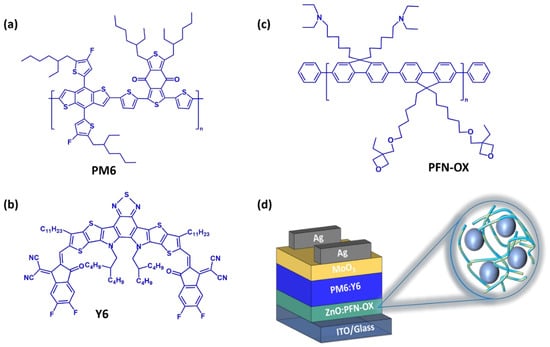
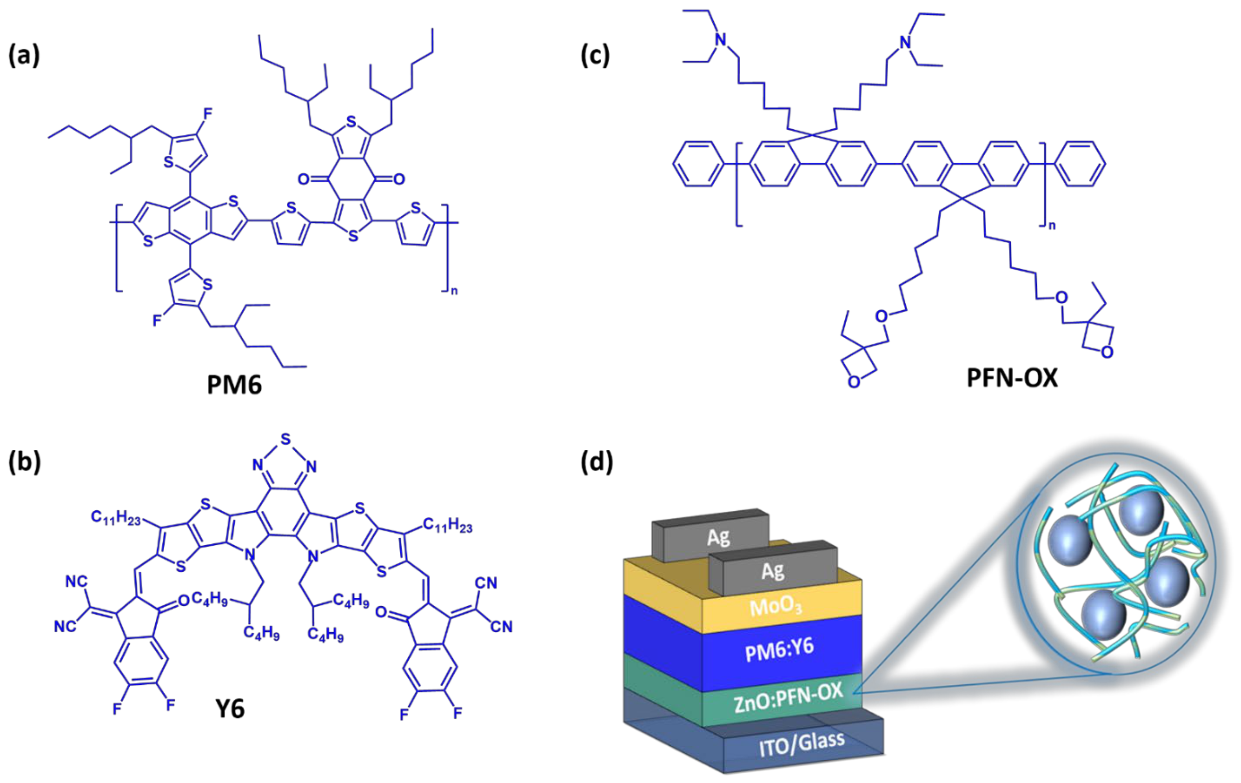
The structural formulas of the donor (PM6), NF-acceptors (Y6), additive (PFN-OX), and the device structure of non-fullerene organic solar cells (NF-OSCs) are shown in Figure 1a,b,c, and d, respectively. In this work, we introduced PFN-OX as an additive into the ZnO solution to improve the efficiency and stability of inverted NF-OSCs. To determine the optimal PFN-OX content, we prepared ZnO:PFN-OX composite ETLs by adding PFN-OX directly to the ZnO nanoparticle dispersion at concentrations of 0.5, 1, and 2 wt% and compared them with devices based on bare ZnO and neat PFN-OX. The photovoltaic parameters are summarized in Table S1, and the corresponding J-V characteristics are shown in Figure S1. The bare ZnO device exhibited Voc = 0.85 V, Jsc = 25.37 mA/cm2, FF = 73.6%, and PCE = 15.8%. Adding 0.5 wt% PFN-OX to the ZnO dispersion improved all parameters modestly (Voc = 0.86 V, Jsc = 25.50 mA/cm2, FF = 74.4%, PCE = 16.3%), indicating that even a small amount of PFN-OX in the composite ink begins to modify the ETL/active-layer interface. At 1 wt%, the device reached the best overall performance (Voc = 0.87 V, Jsc = 25.67 mA/cm2, FF = 75.6%, PCE = 16.8%). This concurrent enhancement of Voc, Jsc, and FF is consistent with PFN-OX acting as a multifunctional additive within the ZnO film. Its polar diethylamino groups and conjugated backbone promote interfacial dipole formation and improve electron extraction, while its electron-doping effect on the acceptor phase reduces interfacial recombination and enhances charge collection. Increasing the PFN-OX loading to 2 wt% degraded performance (Voc = 0.86 V, Jsc = 24.43 mA/cm2, FF = 73.4%, PCE = 15.4%). Because PFN-OX is introduced into the ZnO dispersion rather than as a separate overlayer, excess PFN-OX can disrupt the packing and connectivity of the ZnO nanoparticle network, introducing insulating domains that impede electron transport through the composite film and outweighing the interfacial benefits. A device using neat PFN-OX (without ZnO) performed poorly (Voc = 0.82 V, Jsc = 22.78 mA/cm2, FF = 61.6%, PCE = 11.5%), confirming that ZnO provides the primary electron-transport pathway and that PFN-OX functions optimally as an additive rather than as a standalone ETL. These results establish 1 wt% as the optimum PFN-OX content in the ZnO dispersion, and all subsequent devices were fabricated at this concentration.
Figure 1.
Molecular structure of (a) PM6, (b) Y6, and (c) PFN-OX. (d) Device structure of organic solar cells.
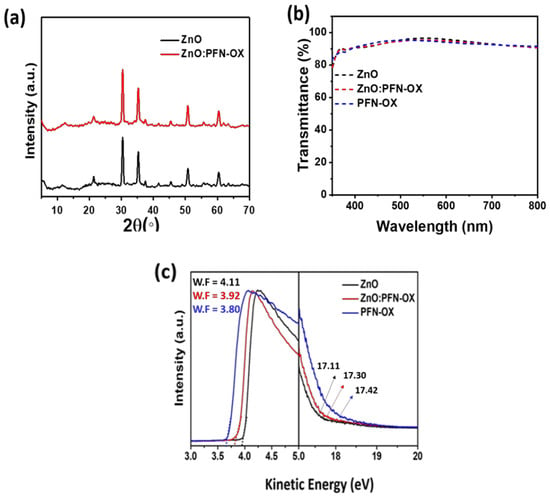
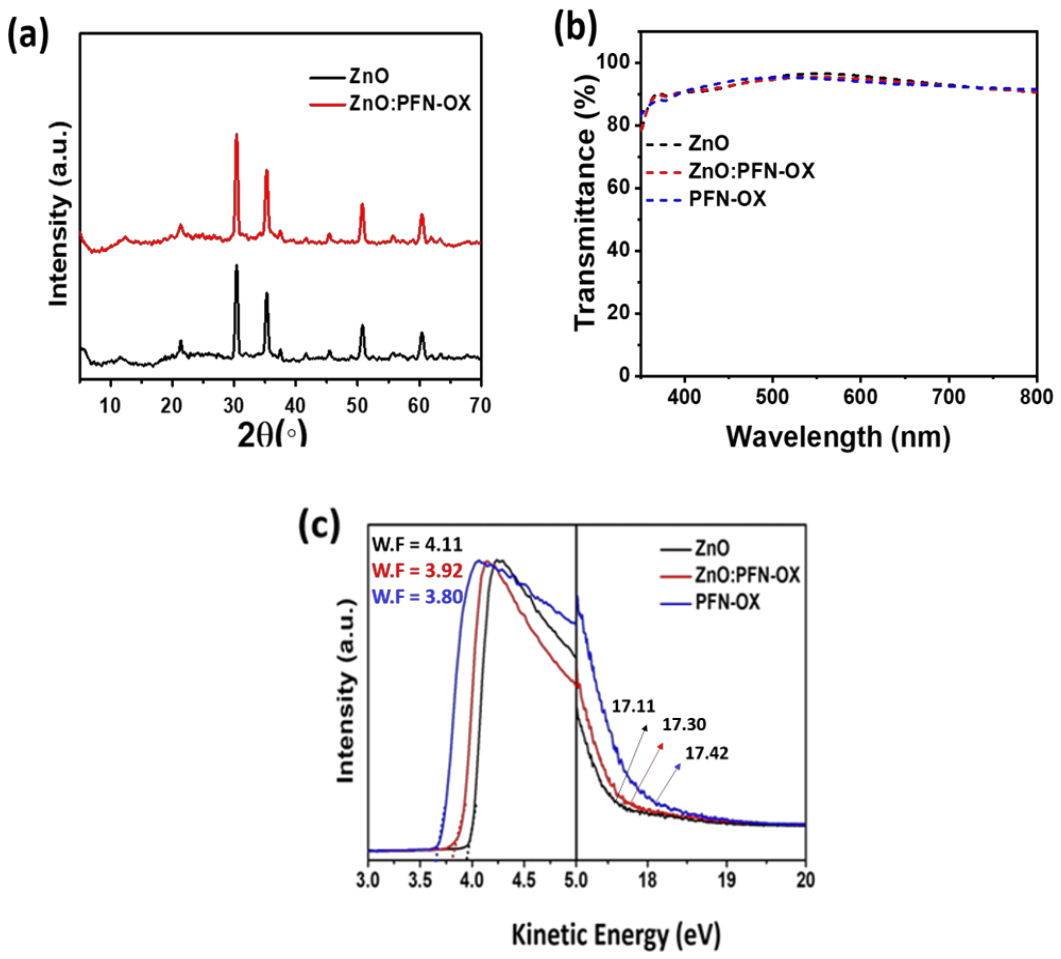
Furthermore, we evaluate the optoelectronic properties of ZnO. To investigate the impact of PFN-OX on ZnO lattice structure in the ZnO:PFN-OX blend, we first employed X-ray diffraction (XRD) to examine the structure of ZnO and ZnO:PFN-OX. Figure 2a shows the diffraction pattern of ZnO and ZnO:PFN-OX, which suggests that the insertion of PFN-OX into ZnO does not negatively impact the lattice structure. In inverted NF-OSCs, a highly transparent ETL is required so that maximum photons can reach the photoreactive blend and generate more electron-hole pairs [31]. Considering this, we characterized thin films to analyze the transmittance spectra of ETL by UV/Vis spectroscopy as displayed in Figure 2b. We observed a negligible difference between ZnO and ZnO:PFN-OX thin films, which shows that the transparency of thin film ETL (ZnO, ZnO:PFN-OX) is not compromised by adding a small portion of PFN-OX into ZnO. For efficient electron extraction at the cathode, a suitable work function of ETL that matches well with the LUMO level of the acceptor is a basic requirement [32].
Figure 2.
(a) XRD diffraction pattern of ZnO and ZnO:PFN-OX. (b) Transmittance spectra of ZnO, ZnO:PFN-OX, and PFN-OX thin film. (c) Ultraviolet photoelectron spectroscopy (UPS) data of ZnO, ZnO:PFN-OX and PFN-OX on an ITO substrate.
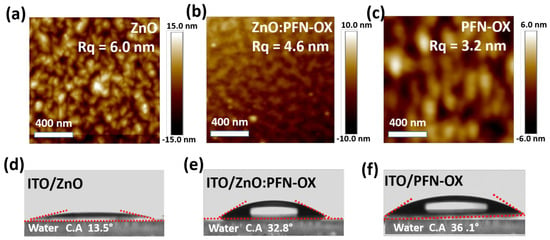
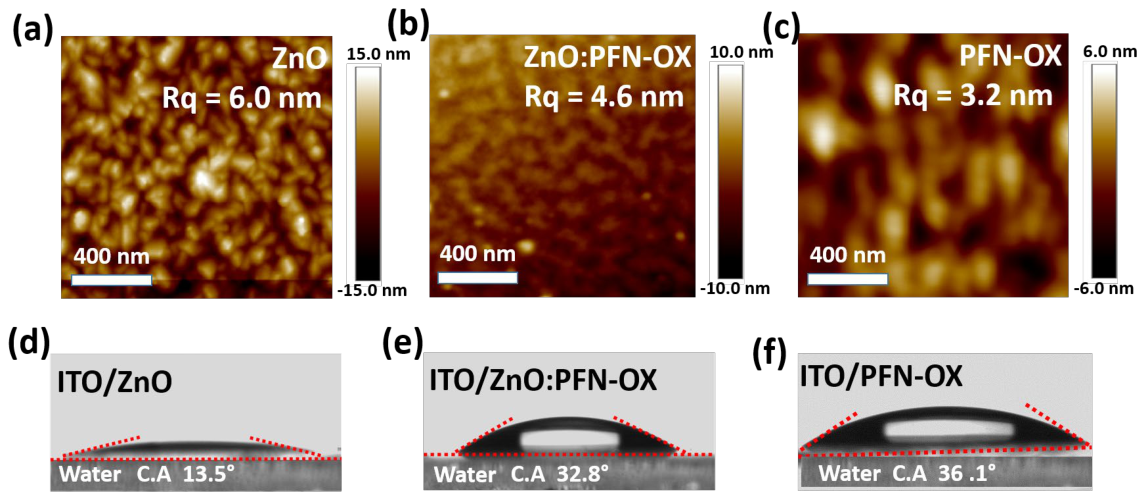
Next, we measured the work function of ZnO, ZnO:PFN-OX, and PFN-OX thin films by ultraviolet photoelectron spectroscopy (UPS). As illustrated in Figure 2c, the work function of ZnO, ZnO:PFN-OX, and PFN-OX was measured to be 4.11 eV, 3.92 eV, and 3.80 eV, respectively. The slightly lower work function of ZnO:PFN-OX, which is mainly due to the interfacial dipole, provides a more favorable energy level alignment with the LUMO of Y6, thereby reducing the electron extraction barrier and facilitating efficient electron extraction at the cathode. Afterward, we employed atomic force microscopy (AFM) to show how the PFN-OX influences the surface morphology of ZnO thin film. As shown in the topographic images of Figure 3a–c, the surface roughness of ZnO and PFN-OX films is 6.0 nm and 3.2 nm, respectively. Interestingly, ZnO:PFN-OX forms a uniform, regular, and compact morphology with a slightly reduced root-mean-square roughness of 4.6 nm, which is beneficial for improving the interfacial contact between BHJ/ETL in OSCs. The wettability and surface energy of the underlying interfacial layer play a significant role in inverted OSCs. Next, we examine the contact angle measurement. The water contact angle of ZnO, ZnO:PFN-OX, and PFN-OX is measured to be 13.5°, 32.8°, and 36.1°, respectively, as shown in Figure 3d–f. The addition of PFN-OX to the ZnO solution not only slightly changes the work function of the ETL but also moderately alters the surface wettability of the ETL which suggests improved wetting of the active layer on the modified ETL compared with bare ZnO [25].
Figure 3.
AFM topographic images of (a) ZnO, (b) ZnO:PFN-OX, and (c) PFN-OX. Contact angles of (d) ITO/ZnO (e) ITO/ZnO:PFN-OX and (f) ITO/PFN-OX.
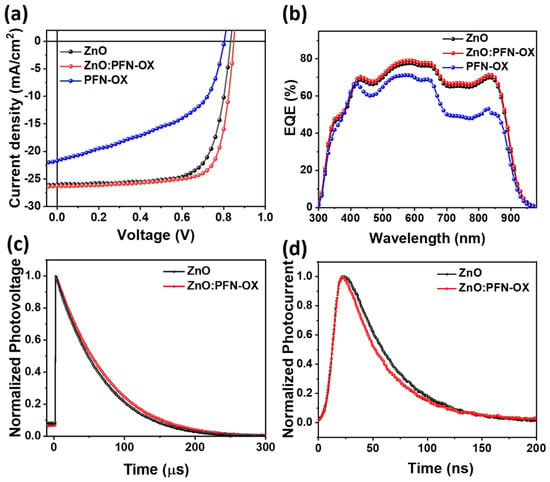
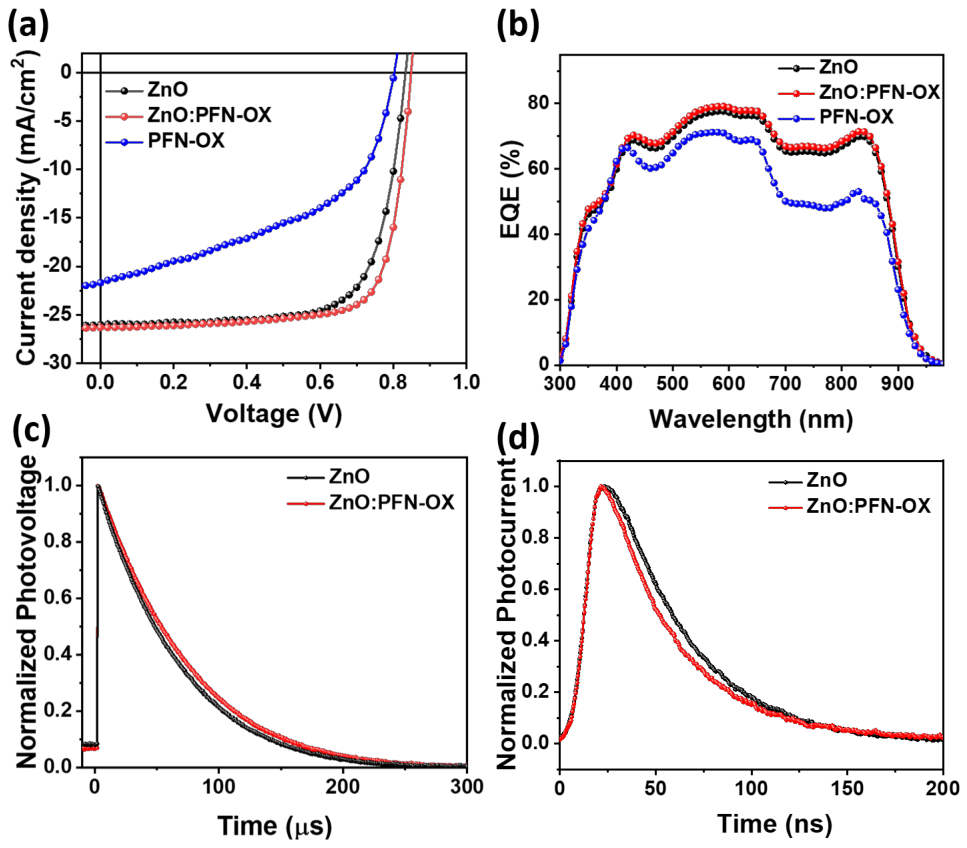
To explore the impact of PFN-OX:ZnO ETL on photovoltaic performance, inverted devices with the configuration of ITO/ZnO or ZnO:PFN-OX/PM6:Y6/MoO3/Ag were fabricated. Firstly, different amounts of ZnO and PFN-OX solutions (0.5%, 1%, and 2%) were prepared and fabricated using an inverted device architecture under 1.5 G illumination. The typical J-V curves of OSCs with ZnO and optimum ratios of ZnO:PFN-OX and PFN-OX as ETLs are shown in Figure 4a, and the device parameters are summarized in Table 1. From the results, the reference device with ZnO ETL exhibits a Voc of 0.85 V, Jsc of 25.37 mA/cm2, FF of 73.6%, and final PCE of 15.8%, consistent with the reported value in the literature [33,34,35]. After inserting bare PFN-OX ETL, the device displayed poor performance with lower Voc of 0.82 V, Jsc of 22.78 mA/cm2, FF of 61.6%, and final PCE of 11.5%. Interestingly, a higher PCE of 16.8% was achieved in ZnO:PFN:OX ETL with improved Voc of 0.87, Jsc of 25.67 mA/cm2, and FF of 75.6%. The better Voc, FF, and PCE reflect that ZnO:PFN-OX delivers satisfactory performance in an inverted structure. The integrated Jsc values obtained from external quantum efficiency (EQE) spectra were measured to be 24.46 mA/cm2 and 24.81 mA/cm2 for ZnO and PFN:OX: ZnO ETLs, respectively, which are in good agreement with the data obtained from J-V results with less than 5% deviation (Figure 4b).
Figure 4.
(a) J-V curves and (b) EQE spectra of ZnO, ZnO:PFN-OX, and PFN-OX-based devices. (c) TPV and (d) TPC of PM6:Y6 devices based on ZnO and ZnO:PFN-OX ETLs.
Table 1.
Photovoltaic parameters for devices based on ZnO, ZnO:PFN-OX and PFN-OX ETL with PM6:Y6 active layer in inverted non-fullerene organic solar cells.
To gain further insight into the improved photovoltaic parameters of the device, we employed transient photovoltage (TPV) and transient photocurrent (TPC) measurements to evaluate the carrier lifetime and charge extraction in the device with ZnO and ZnO:PFN-OX ETLs (Figure 4c,d). The devices with ZnO:PFN-OX show a longer carrier lifetime (69.6 µs) compared to bare ZnO (49.2 µs) in the normalized TPV curve, as exhibited in Figure 4c. The longer carrier lifetime and modified surface morphology can elucidate the enhancement of photovoltaic parameters in devices based on ZnO:PFN-OX ETL. On the other hand, the charge extraction time for ZnO and ZnO:PFN-OX-based devices was calculated to be 44 ns and 29 ns, respectively. The shorter decay time reflects that the charge extraction ability in the corresponding device (ZnO:PFN-OX) is high. These observations suggest that the modified ZnO interlayer facilitates more favorable charge-carrier dynamics by suppressing recombination while improving charge extraction. This behavior is consistent with the enhanced EQE response of the modified-ZnO device, indicating improved photocurrent generation.
Furthermore, the dark J-V also demonstrated (Figure S2) that ZnO:PFN-OX-based devices reduce the leakage current efficiently compared to ZnO-based devices. To gain more insight, we further examined carrier mobility in both devices using a single carrier device by adopting the space charge limited current (SCLC) method. The electron mobility was measured to be 2.47 × 10⁻⁴ cm2 V−1 s−1 and 4.10 × 10⁻⁴ cm2 V−1 s−1 for ZnO and ZnO:PFN-OX-based ETLs using PM6:Y6 as an active layer (Figure S3). The comparatively higher mobility in ZnO:PFN-OX-based ETLs can be favorable to suppressing charge recombination and decreasing the interfacial recombination.
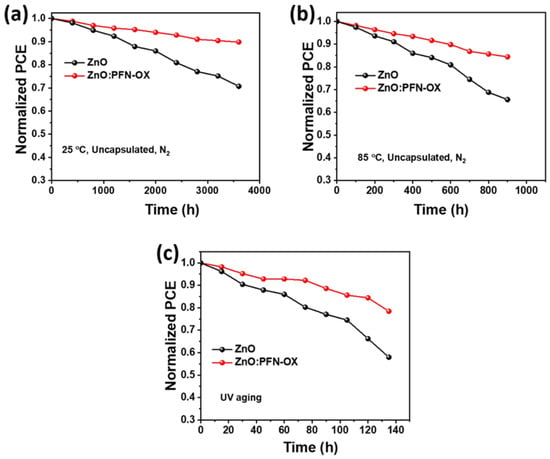
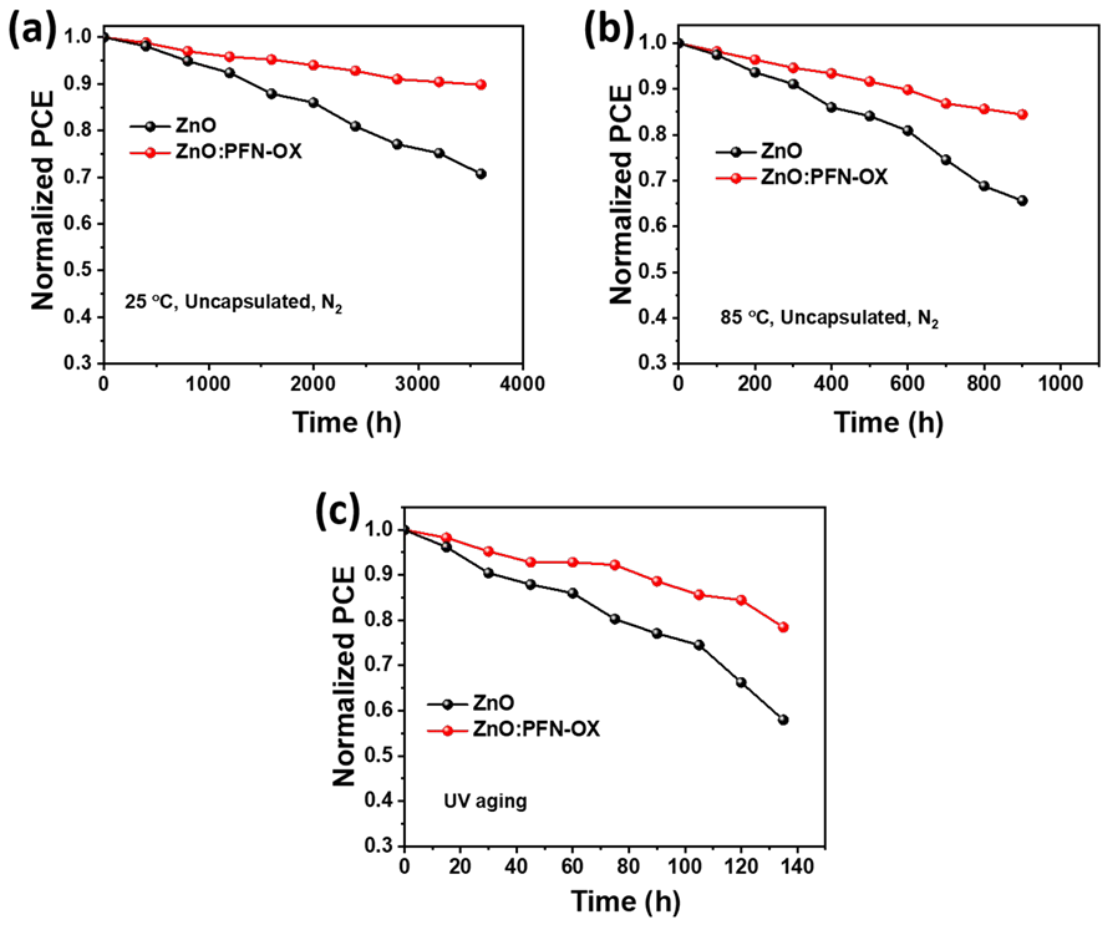
Finally, we evaluate the stability of ZnO and ZnO:PFN-OX ETL-based devices under UV exposure, thermal stress, and storage stability in a nitrogen-filled glove box (temperature = 25 °C; oxygen content 0.1 ppm; water content: 0.1 ppm). The device with ZnO ETL exhibited quick degradation in PCE and retained only 71% of its original PCE after 3550 h of storage, as shown in Figure 5a. In contrast, the device based on ZnO:PFN-OX exhibited reduced device degradation and maintained 90% of its initial PCE under the same set of conditions.
Figure 5.
(a) Storage stability of devices based on ZnO and ZnO:PFN-OX in a nitrogen glove box. (b) Thermal aging test of devices under 85 °C in nitrogen atmosphere. (c) UV aging test in nitrogen glove box.
This finding shows that mixing an optimum amount of PFN-OX with ZnO can significantly improve the stability of an inverted device by inhibiting agglomeration, leading to stabilized ETL. Further, we assessed the thermal stability of devices at 85 °C for 1000 h. As shown in Figure 5b, the devices based on ZnO:PFN-OX ETL maintained nearly 85% of its initial PCE after 1000 h, whereas the PCE of ZnO-based devices reduced to 67% using PM6:Y6 active layer. The stability under continuous UV exposure aging (365 nm, 4.32 mW cm−2) was further assessed as shown in Figure 5c. The PCE of optimized devices with ZnO:PFN-OX ETL retained 80% of their initial value after 140 h under UV aging. On the other hand, the reference device with ZnO considerably decreased to ~65%, mainly due to quick degradation in FF and Jsc.
3. Materials and Methods
3.1. Materials
PM6, Y6, and PFN-OX were purchased from Solarmer Materials Inc. (Beijing, China), Chlorobenzene (CB), chloronapthalene (CN), and 1-8-diiodooctane (DIO) were purchased from Sigma-Aldrich (St. Louis, MO, USA). Molybdenum trioxide (MoO3), acetic acid, methanol, and ethanol were purchased from Aladdin (Shanghai, China). ZnO nanoparticle dispersion was obtained from Sigma (St. Louis, MO, USA).
3.2. Solution Preparation
PFN-OX solution (1 mg/mL) was prepared in methanol: acetic acid (100:1 v/v). The ZnO:PFN-OX ETL solution was prepared with different ratios of PFN-OX (0.1%, 0.5%, 2%). The active layer solution, PM6:Y6 (1:1, w/w) blend, was dissolved in chloroform with a total concentration of 16 mg/mL and stirred for more than 3 h at room temperature. Chloronaphthalene (0.5 vol %) was also added as an additive in the blend solution before spin coating.
3.3. Device Fabrication
To fabricate the inverted device, ITO-coated glass substrates were first ultrasonically cleaned with acetone, detergent, distilled water, and isopropanol, followed by ultraviolet-ozone treatment for 15 min. ZnO (15 mg/mL) ETL was spin-coated onto ITO at 5000 rpm for 30 s, while PFN-OX solution was spin-coated onto ITO from its solution of methanol:acetic acid (100:1 v/v) at 3000 rpm for 20 s. The ZnO:PFN-OX ETL was coated onto ITO at 4000 rpm for 30 s, followed by annealing at 140 °C for 15 min. Afterward, the BHJ solution (PM6:Y6) was spin-coated onto ETL at 3000 rpm for one minute, followed by thermal annealing at 100 °C for 10 min in a nitrogen-filled glove box. Finally, MoO3 and Al metal contacts were evaporated onto the BHJ film under vacuum (3 × 10⁻⁵ Pa).
3.4. Characterization
Current density-voltage (J-V) characteristics of solar cells were measured using a Keithley 2400 source meter under AM 1.5 G illumination (100 mW/cm2) provided by an Oriel solar simulator. The incident light intensity was adjusted with a silicon calibration photodiode (Peccell Technologies, Inc., Yokohama, Japan). Single-carrier devices were characterized by using a Keithley 2400 source in a dark environment. EQE spectra were measured by a Solar Cell Spectral Response Measurement System QE-R3011 (Enlitech, Kaohsiung, Taiwan). The light intensity at each wavelength was calibrated with a single-crystal Si photovoltaic cell. The transmittance and absorbance spectra were attained by using a UV–Vis spectrometer (Perkin Elmer Lambda 650/850/950 UVVis spectrophotometer, (Waltham, MA, USA)). Topographic AFM images were acquired using a Nanoscope V AFM (Bruker) microscope (Santa Barbara, CA, USA) in the tapping mode. For TPV, the device was measured under the condition of 1 sun intensity using white LED illumination, setting the champion device to open-circuit conditions. For TPC, the champion device was set to short-circuit conditions in the dark. The output signal was recorded using a Keysight oscilloscope. Space charge limited current (SCLC) measurements were conducted using electron-only devices fabricated with ITO/ZnO or (ZnO:PFN-OX/active layer/PDINN)/Ag structures. Dark J-V characteristics were recorded in a nitrogen-filled glovebox using a Keithley source-measure unit. The data were plotted on log–log axes; the region with a slope close to 2 was identified as the trap-free SCLC regime, and only this region was used for mobility extraction. The mobility was then calculated from the Mott–Gurney equation: J = (9/8) ε0 εᵣ μ (V − Vbi)2/*d*3; where ε0 is the permittivity of the free space, εr is the average dielectric constant of the blend film and assumed to be 3, and V is the applied voltage. Vbi is the built-in voltage, and *d* is the film thickness. The UPS spectra were acquired with He I excitation (21.22 eV). The work function was extracted from the secondary-electron cutoff (SECO) on the x-axis of each spectrum using: Φ = hν − E_cutoff; where hν = 21.22 eV and E_cutoff energy at the SECO, determined from the intersection of a linear extrapolation of the steeply rising SECO edge with the baseline. The three spectra were measured under identical conditions so the relative shifts between samples are reliable. The resulting values were obtained by equation Φ = 21.22 − E_cutoff. For TPV, the device was measured under the condition of 1 sun intensity using white LED illumination, setting the champion device to open-circuit conditions. For TPC, the champion device was set to short-circuit conditions in the dark. The output signal was recorded using a Keysight oscilloscope. Moreover, for TPV measurements, the devices were illuminated under a constant background light intensity of 100 mW cm−2 using a white LED source. A small perturbation light pulse was superimposed on the background illumination to generate a transient photovoltage response under open-circuit conditions. The photovoltage decay signals were recorded using a digital oscilloscope. For TPC measurements, the devices were maintained under short-circuit conditions and illuminated with a short optical pulse. The resulting transient photocurrent signals were recorded using a digital oscilloscope to evaluate the charge-extraction dynamics. The TPV and TPC decay profiles were analyzed using exponential fitting functions: TPV:ΔV(t) = Aexp(−t/τTPV) + CΔV(t) = Aexp(−t/τTPV) + C; TPC: I(t) = Aexp(−t/τTPC) + CI(t) = Aexp(−t/τTPC) + C; ΔV(t) is the transient photovoltage at time t, A is the pre-exponential amplitude factor. τTPV is the charge carrier lifetime and C is the baseline offset constant. I(t) is the transient photocurrent at time t, A is the pre-exponential amplitude factor, τTPC is the charge extraction time and C is the baseline offset constant.
4. Conclusions
In conclusion, we demonstrated an effective strategy for achieving higher efficiency and stability with an optimum ratio of PFN-OX into ZnO ETL using the inverted structure of OSCs. A PCE of 16.8% was achieved based on PM6:Y6 BHJ and ZnO:PFN-OX ETL (1 wt%) primarily due to the lower work function of the modified ETL, a homogeneous film morphology, and reduced defects, which benefited from the compatible interface at the ETL and BHJ layer. Appropriate transparency and suitable hydrophobicity with improved charge extraction properties were examined in ZnO:PFN-OX ETL. Moreover, the resulting device with ZnO:PFN-OX ETL exhibits better stability, retaining about 90%, 85%, and 80% of its initial PCE after glove box storage for 3550 h, thermal storage at 85 °C for 1000 h, and UV aging test for 140 h, respectively, owing to stable film formation, which suppressed agglomeration of ZnO nanoparticles. This work offers a promising approach to improve the power conversion efficiency and stability of inverted organic solar cells by fine-tuning the properties of the interfacial layer using a compatible additive.
Supplementary Materials
The following supporting information can be downloaded at https://www.mdpi.com/article/10.3390/molecules31234352/s1, Figure S1. J-V characteristics curves of the PM6:Y6 devices based on different amount of PFN-OX into ZnO ETL; Table S1. Photovoltaic parameters for devices based on ZnO and different ratios of ZnO/PFN-OX; Figure S2. Dark current measurement of ZnO and Zno: PFN-OX-based ETL; Figure S3. Dark J-V of electron-only devices with a configuration of ITO/ZnO or ZnO:PFN-OX/BHJ/Ag.
Author Contributions
N.A.: Conceptualization, supervision, project administration, funding acquisition, methodology, formal analysis and writing—original draft. B.I.A.: formal analysis, and editing. All authors have read and agreed to the published version of the manuscript.
Funding
This research was supported by the Research start-up fund from Chengdu University of Technology, Chengdu, Sichuan, China, under grant number [10912-KYQD2025-11104].
Institutional Review Board Statement
Not applicable.
Informed Consent Statement
Not applicable.
Data Availability Statement
Data is contained within the article or Supplementary Materials.
Conflicts of Interest
The authors declare no conflicts of interest.
References
- Ma, R.; Luo, Z.; Zhang, Y.; Zhan, L.; Jia, T.; Cheng, P.; Yan, C.; Fan, Q.; Liu, S.; Ye, L. Organic solar cells: Beyond 20%. Sci. China Mater. 2025, 68, 1689–1701. [Google Scholar] [CrossRef] [Scilit]
- Li, G.; Al-Hashimi, M.; Facchetti, A.; Marks, T.J. Decoding the halogenation cost-performance paradox in organic solar cells. Nat. Rev. Mater. 2025, 10, 617–631. [Google Scholar] [CrossRef] [Scilit]
- Bai, Y.; Li, S.; Wang, Q.; Chen, Q.; Zhang, Z.; Meng, S.; Zang, Y.; Fu, H.; Xue, L.; Ye, L. Simultaneous enhancement of efficiency, stability and stretchability in binary polymer solar cells with a three-dimensional aromatic-core tethered tetrameric acceptor. Natl. Sci. Rev. 2025, 12, nwaf019. [Google Scholar] [CrossRef] [Scilit] [PubMed]
- Huang, Z.; Xu, Y.; Liu, L.; Xie, J.; Li, H.; Yang, Z.; Zhang, K.; Huang, F. A multifunctional strategy to improve the efficiency and stability of organic solar cells via a 2PACz/MA composite hole transport layer. J. Mater. Chem. A 2025, 13, 15574–15584. [Google Scholar] [CrossRef] [Scilit]
- Zhang, D.; Kim, J.H.; Hong, W.T.; Han, H.; Choe, W.S.; Kwon, G.H.; Moon, K.I.; Kim, M.C.; Park, J.; Kim, J.K. Suppressing Water Electrolysis via Pb Single Atoms in Nitrogen-Doped Carbon for High-Energy-Density Supercapacitors. Adv. Energy Mater. 2026, 16, e70900. [Google Scholar] [CrossRef] [Scilit]
- Yin, Y.; Shen, X.; Sun, Q.; Yang, H.; Cao, Y. Termination-determined defect tolerance in CsPbI3: A first-principles guide for surface defect engineering. Comput. Mater. Sci. 2026, 274, 115042. [Google Scholar] [CrossRef] [Scilit]
- Zhang, T.; Liu, Z.; Sun, Y.; Wang, T.; Li, Q.; Li, X.; Li, R.; Sun, X.; Wang, F.; Wang, X. Synergistic Molecular Modulation via Coordination and Hydrogen Bonding for Efficient Perovskite and Tandem Solar Cells. Adv. Mater. 2026, 38, e74639. [Google Scholar] [CrossRef] [Scilit] [PubMed]
- Yao, J.; Bai, Y.; Xue, L.; Hu, L.; Xu, Y.; Du, M.; Li, F.; Chen, X.; Li, R.; Liu, M. 20.5% Efficiency Organic Photovoltaics Enabled by Strong Photo-Responsive Aromatic-Diimide Cathode Interlayer. Adv. Funct. Mater. 2026, 36, e00058. [Google Scholar] [CrossRef] [Scilit]
- Fu, Z.; Qiao, J.-W.; Zhang, K.-N.; Zhang, W.-Q.; Zhou, M.-X.; Xu, J.-Q.; Lu, P.; Yin, H.; Du, X.-Y.; Hao, X.-T. Suppression of exciton–vibration coupling via modulated insulator dilution for thickness-tolerant organic solar cells. Natl. Sci. Rev. 2025, 12, nwaf387. [Google Scholar] [CrossRef] [Scilit] [PubMed]
- Wang, Y.; Tian, R.; Lu, X.; Zhou, Y. Correlation among Work Function Dynamics, Charge Transport, and Annealing Temperature of the ZnO Layer in Organic Photovoltaics. J. Phys. Chem. C 2026, 130, 5067–5073. [Google Scholar] [CrossRef] [Scilit]
- Zheng, X.; Fu, Y.; Huang, J.; Li, N.; Hou, H.; Xiao, X.; Lin, Y.; Lu, X.; Zhan, X. Enhancing photovoltaic performance by modulating fractal dimensions of non-fullerene acceptors. J. Mater. Chem. C 2026, 14, 3917–3925. [Google Scholar] [CrossRef] [Scilit]
- Thilakan, A.P.; Hung, P.L.; Yang, J.B.; Lin, D.L.; Tzeng, S.D.; Hsu, Y.K.; Tsai, C.H.; Pai, Y.H.; Yabushita, A.; Luo, C.W. Investigating Dopant Effects in ZnO as an Electron Transport Layer for Enhanced Efficiency in Organic Photovoltaics. Adv. Mater. Interfaces 2025, 12, 2400923. [Google Scholar] [CrossRef] [Scilit]
- Cai, P.; Song, C.; Du, Y.; Wang, J.; Wang, J.; Sun, L.; Gao, F.; Xue, Q. Recent progress of solution-processed thickness-insensitive cathode interlayers for high-performance organic solar cells. Adv. Funct. Mater. 2025, 35, 2422023. [Google Scholar] [CrossRef] [Scilit]
- Jung, S.P.; Oh, D.W.; Jeong, B.J.; Lee, J.Y.; Roh, D.H.; Vediappan, K.; Gnanamuthu, R.; Gunasekaran, S.S.; Lee, C.W. Sol–Gel-Derived Ge-Substituted LLZO Ceramic Coatings on Lithium-Rich Layered Oxide Cathodes for Improved Interfacial Stability. Gels 2026, 12, 114. [Google Scholar] [CrossRef] [Scilit] [PubMed]
- Ji, Y.; Liang, L.; Chen, T.; Liu, X.; Mao, M.; Hu, Y.; Jin, Y.; Huang, X.; Ren, X.; Xie, D. High-Performance Ultrathin Flexible Organic Solar Cells Through the Modification of Self-Assembled Monolayers. Adv. Energy Mater. 2025, 15, 2501698. [Google Scholar] [CrossRef] [Scilit]
- Azeez, A.; Huang, Y.; Stanly, L.; Kan, Z.; Karuthedath, S. Advances in self-assembled monolayer-engineered organic solar cells. EES Sol. 2025, 1, 248–266. [Google Scholar] [CrossRef] [Scilit]
- Zhao, Z.; Chung, S.; Bai, L.; Zhang, J.; Liu, Y.; Tan, L.; Azeez, A.; Huang, Y.; Ok, E.; Cho, K. Solubility-Driven Acceptor Fibrilization Enables Bilayer Organic Solar Cells with Efficiency Approaching 20%. Adv. Funct. Mater. 2025, 35, 2506593. [Google Scholar] [CrossRef] [Scilit]
- Zhao, Z.; Chung, S.; Tan, L.; Zhao, J.; Liu, Y.; Li, X.; Bai, L.; Lee, H.; Jeong, M.; Cho, K. Molecular order manipulation with dual additives suppressing trap density in non-fullerene acceptors enables efficient bilayer organic solar cells. Energy Environ. Sci. 2025, 18, 2791–2803. [Google Scholar] [CrossRef] [Scilit]
- Sutradhar, S.C.; Ahmed, M.S.; Uddin, M.A.; Oh, Y.-C.; Park, J.; Nam, K.-W.; Islam, M. Applications of Conductive Polymer Hydrogels for Supercapacitor, Solar Cell, and Energy Conversion. Gels 2025, 11, 741. [Google Scholar] [CrossRef] [Scilit] [PubMed]
- Tong, Y.; Feng, L.; Li, J.; Liu, H.; An, C.; Yan, S.; Xu, B. Anode Engineering with pH-Neutral Conjugated Polyelectrolyte Enabling Over 19% Efficiency in Organic Solar Cells. Angew. Chem. Int. Ed. 2025, 64, e202504085. [Google Scholar] [CrossRef] [Scilit] [PubMed]
- Liu, H.; Duan, Z.; Wang, Z.; Zhang, J.; Zhang, Z.; Xu, B. Highly Conductive Polythiophene-Based Conjugated Polyelectrolyte Toward Efficient Anode Modification in Organic Solar Cells. Sol. RRL 2026, 10, e70321. [Google Scholar] [CrossRef] [Scilit]
- Wang, H.; Liu, S.; Yang, Y.; Li, H.; Wei, Z.; Cheng, Y.; Hou, J.; Xu, B. Reducing the depletion region width at the anode interface via a highly doped conjugated polyelectrolyte composite for efficient organic solar cells. ACS Appl. Mater. Interfaces 2024, 16, 3744–3754. [Google Scholar] [CrossRef] [Scilit] [PubMed]
- Hsu, F.-C.; Yeh, Z.-Y.; Li, C.-P. High detectivity, efficient, ambient-stable inverted organic photodetectors incorporating a conjugated polymer as an electron transport layer. J. Mater. Chem. C 2024, 12, 14445–14454. [Google Scholar] [CrossRef] [Scilit]
- Ma, Z.; Zhao, B.; Gao, H.; Gong, Y.; Yu, R.; Tan, Z.A. Recent advances of crosslinkable organic semiconductors in achieving solution-processed and stable optoelectronic devices. J. Mater. Chem. A 2022, 10, 18542–18576. [Google Scholar] [CrossRef] [Scilit]
- Zheng, Z.; Zhang, S.; Wang, J.; Zhang, J.; Zhang, D.; Zhang, Y.; Wei, Z.; Tang, Z.; Hou, J.; Zhou, H. Exquisite modulation of ZnO nanoparticle electron transporting layer for high-performance fullerene-free organic solar cell with inverted structure. J. Mater. Chem. A 2019, 7, 3570–3576. [Google Scholar] [CrossRef] [Scilit]
- Ahmad, N.; Zhou, H.; Fan, P.; Liang, G. Recent progress in cathode interlayer materials for non-fullerene organic solar cells. EcoMat 2022, 4, e12156. [Google Scholar] [CrossRef] [Scilit]
- Zhang, K.; Zhong, C.; Liu, S.; Mu, C.; Li, Z.; Yan, H.; Huang, F.; Cao, Y. Highly efficient inverted polymer solar cells based on a cross-linkable water-/alcohol-soluble conjugated polymer interlayer. ACS Appl. Mater. Interfaces 2014, 6, 10429–10435. [Google Scholar] [CrossRef] [Scilit] [PubMed]
- Zhang, H.; Zhou, W.; Yu, C.; Guo, J.; Li, F. Revealing working mechanisms of PFN as a cathode interlayer in conventional and inverted polymer solar cells. Phys. Chem. Chem. Phys. 2019, 21, 20065–20072. [Google Scholar] [CrossRef] [Scilit] [PubMed]
- Ahmad, N.; Yuan, J.; Zou, Y. One more step towards better stability of non-fullerene organic solar cells: Advances, challenges, future perspectives, and the Era of artificial intelligence. Energy Environ. Sci. 2025, 18, 5093–5158. [Google Scholar] [CrossRef] [Scilit]
- Sorrentino, R.; Kozma, E.; Luzzati, S.; Po, R. Interlayers for non-fullerene based polymer solar cells: Distinctive features and challenges. Energy Environ. Sci. 2021, 14, 180–223. [Google Scholar] [CrossRef] [Scilit]
- Jeong, S.; Oh, J.; Park, J.; Cho, Y.; Jung, S.; Lee, S.; Park, J.; Yang, C. Visible-transparent electron-selective self-assembled monolayer for electron-transport-layer-free high-efficiency and flexible organic solar cells. ACS Energy Lett. 2024, 9, 3771–3779. [Google Scholar] [CrossRef] [Scilit]
- Ahmad, N.; Yanxun, L.; Zhang, X.; Wang, B.; Zhang, Y.; Zhou, H. A biopolymeric buffer layer improves device efficiency and stability in inverted organic solar cells. J. Mater. Chem. C 2020, 8, 15795–15803. [Google Scholar] [CrossRef] [Scilit]
- Li, Y.; Huang, B.; Zhang, X.; Ding, J.; Zhang, Y.; Xiao, L.; Wang, B.; Cheng, Q.; Huang, G.; Zhang, H. Lifetime over 10000 hours for organic solar cells with Ir/IrOx electron-transporting layer. Nat. Commun. 2023, 14, 1241. [Google Scholar] [CrossRef] [Scilit] [PubMed]
- Yuan, J.; Zhang, Y.; Zhou, L.; Zhang, G.; Yip, H.-L.; Lau, T.-K.; Lu, X.; Zhu, C.; Peng, H.; Johnson, P.A. Single-junction organic solar cell with over 15% efficiency using fused-ring acceptor with electron-deficient core. Joule 2019, 3, 1140–1151. [Google Scholar] [CrossRef] [Scilit]
- Yu, M.; Shi, H.; Hu, L.; Du, M.; Lan, S.; Jin, Y.; Yao, J.; Du, M.; Yan, Z.; Zhou, E. Mussel-inspired surface engineering for highly efficient and stable flexible non-fullerene organic solar cells. Surf. Interfaces 2025, 65, 106538. [Google Scholar] [CrossRef] [Scilit]

Disclaimer/Publisher’s Note: The statements, opinions and data contained in all publications are solely those of the individual author(s) and contributor(s) and not of MDPI and/or the editor(s). MDPI and/or the editor(s) disclaim responsibility for any injury to people or property resulting from any ideas, methods, instructions or products referred to in the content. |
© 2026 by the authors. Licensee MDPI, Basel, Switzerland. This article is an open access article distributed under the terms and conditions of the Creative Commons Attribution (CC BY) license.