


Abstract
Reports of lunasin in non-soybean seeds have not consistently been supported by sequence-resolved identification. As a sequence-based candidate-prioritization study, we screened 11 assembly-specific plant proteomes with three ungapped, overlapping fixed-window queries: the two soybean-lunasin antibody immunogens (20 and 15 residues) and the 43-residue reference. The complete search was calibrated using 999 per-proteome, within-protein composition-preserving randomizations; five parent-protein/control sequences underwent InterProScan family-signature analysis. Historical seed-extract antibody results and independent enzyme-rule predictions were evaluated only as external context. Maximum non-soybean identity was 50% (20 residues), 60% (15 residues), and 44.2% (43 residues). Under the specified null model, peanut, chickpea, and lupin 43-residue maxima survived Benjamini–Hochberg correction for the identity-only test, whereas none of the shorter-query maxima did; the more conservative Benjamini–Yekutieli adjustment retained no identity-only discoveries. Domain signatures supported a chickpea 2S seed-storage-family annotation but only a broad structural-superfamily classification for lupin. None of the selected non-soybean 43-residue windows contained the complete reference RGD/acidic-tail architecture. Historical immunoblots used unmatched seed materials and different assay stringencies, and cleavage predictions were non-sequential. This restricted, version-specific analysis prioritizes candidate sequences for validation; it does not establish epitopes, antibody binding, protein homology from short windows, mature lunasin production, or gastrointestinal peptide stability.
1. Introduction
Food-derived bioactive peptides can occur within larger protein precursors and may be generated by endogenous processing, fermentation, enzymatic hydrolysis, or gastrointestinal digestion. Lunasin, an aspartate-rich peptide originally characterized in soybean (Glycine max), was subsequently mapped to the small-subunit region of the Gm2S-1 2S albumin precursor [1,2]. Its molecular identity is defined by the peptide sequence and precursor context, not by a single short determinant: the canonical 43-residue form contains an Arg-Gly-Asp (RGD) motif and an extended acidic C-terminal segment. Both sequence architecture and processing are therefore relevant to the chemical identification of lunasin-derived material [3].
Interest in lunasin led to reports of lunasin or lunasin-like material in several non-soybean plants, including barley, wheat, rye, triticale, oat, and amaranth [4,5,6,7,8,9]. Such reports are intriguing because highly similar peptides distributed across distant plant lineages would imply substantial conservation, repeated convergence, or detection of distinct proteins that share only local sequence features.
Claims of lunasin occurrence in cereals remain contested because antibody-based detection and sequence-resolved studies have not consistently agreed. Mitchell et al. [10] questioned the origin of reported cereal lunasin, and Dinelli et al. [11] failed to confirm authentic lunasin in tested wheat genotypes by complementary chemical and molecular analyses. These discrepancies matter analytically: detection of an immunoreactive protein band does not establish the molecular sequence of the bound antigen, much less the presence of a released peptide [12].
This discrepancy was examined experimentally by Alaswad and Krishnan [13] using two independently generated polyclonal antibodies raised against different regions of soybean lunasin. The N-terminal immunizing peptide was SKWQHQQDSCRKQLQGVNLT (20 residues), whereas the C-terminal immunizing peptide was CEKHIMEKIQGRGDD (15 residues). Authentic soybean lunasin was recognized by both antibodies. In contrast, proteins from several other seeds reacted with the N-terminal antibody but not with the C-terminal antibody, particularly under reduced-stringency Western blot conditions. These findings raised the possibility that at least part of the reported lunasin-positive immunoreactivity outside soybean reflected antibody cross-recognition of shorter sequence determinants rather than the presence of canonical peptide.
Flax (Linum usitatissimum) provided a particularly informative example. A strongly N-terminal-reactive protein of approximately 7 kDa remained detectable under stringent conditions and was identified by MALDI-TOF mass spectrometry as conlinin, a flax 2S seed-storage albumin [13]. The previously reported local alignment between conlinin and lunasin showed 40.6% identity and 65.6% similarity across 32 residues. Conlinin is encoded by a seed-specific 2S albumin gene family [14], making it an experimentally anchored example in which a noncanonical seed-storage protein can display lunasin-like immunoreactivity.
Antibodies recognize molecular determinants rather than entire proteome entries. With polyclonal sera raised against peptide immunogens, individual antibody populations may bind distinct, partially overlapping linear motifs; binding also depends on antigen abundance, accessibility and assay conditions. Thus, a high-scoring fixed-window match is neither a measured epitope nor proof of binding. The distinction between sequence resemblance and immunochemical identity is central to assessing putative non-soybean lunasin signals [15,16].
Reference plant proteomes provide a tractable way to examine this molecular question systematically. Chromosome-scale assemblies are available for faba bean (Vicia faba) and a reference genome is available for Andean lupin (Lupinus mutabilis) [17,18]. However, searching for many overlapping amino-acid windows can produce substantial maximum similarity by chance, particularly in compositionally biased regions. Such maxima require an appropriate null model before statistical significance or evolutionary relatedness can be inferred [19,20].
The 11-proteome discovery panel was a purposive, assembly-specific selection centered on the legumes and cereals relevant to the earlier antibody study and publicly documented reference-sequence resources. It was not a random or exhaustive survey of crops. Historical reports also included amaranth and triticale [7,9,13], but neither taxon belonged to the fixed 11-proteome set used in this reproducible analysis. Annotated genomic resources for both taxa are now reported [21,22]; their omission should not be presented as proof that data were unavailable. The conclusions therefore do not extend to those species, nor to unscreened cultivars.
A second question is whether larger proteins containing local lunasin-like sequence regions could preserve those regions during proteolysis. Fermentation and digestion can generate peptide fragments that are absent as free peptides in the intact protein [23,24]. However, in silico cleavage predictions are screening tools rather than evidence that a peptide is produced, survives digestion, is absorbed, or remains biologically active [25].
Here, we apply sequence-based triage to distinguish (i) local fixed-window sequence identity to the N- and C-terminal antibody-immunizing peptides, (ii) resemblance to the 43-residue soybean lunasin reference and its RGD/acidic-tail architecture, (iii) candidate parent-protein family context, (iv) descriptive correspondence with biologically unmatched historical immunoblot observations, and (v) susceptibility under separate theoretical protease rules. The resulting matches are prioritized computational candidates, not inferred antibody epitopes or established lunasin peptides.
2. Results
2.1. Local Similarity to Antibody-Immunizing Peptides
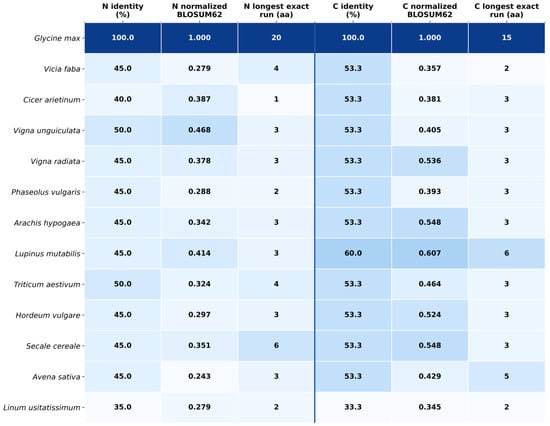
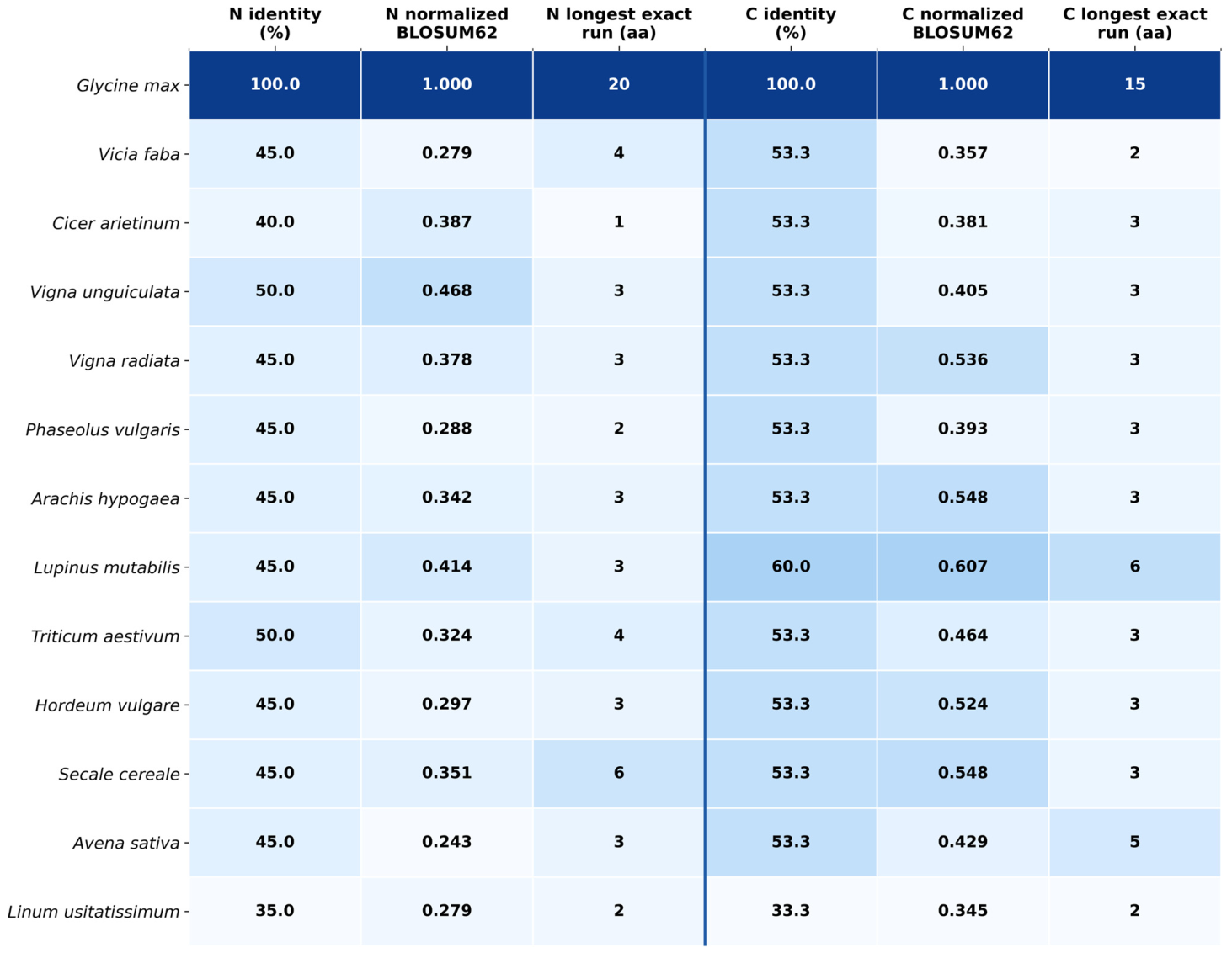
The exact soybean reference matched both immunizing peptides at 100% identity (Figure 1; Table 1). Among non-soybean entries, the maximum N-terminal 20-residue identity reached 50% in cowpea and wheat; the highest C-terminal 15-residue identity was 60% in lupin. Exact runs within the non-soybean candidate windows reached six residues for rye (N-terminal) and lupin (C-terminal). These values represent best windows identified by a proteome-scale search, not peptides shown to exist as free molecules or experimentally identified antibody epitopes.
Figure 1.
Proteome-wide fixed-window similarity profiles for the two lunasin antibody-immunizing peptides. Metrics include percent identity, BLOSUM62 score normalized to the corresponding query self-score, and longest uninterrupted identical-residue run. Soybean P19594 and flax Q8LPD4 are single-protein references; the other 11 entries were selected from assembly-wide scans. Shading is metric-specific and should not be interpreted as statistical significance.
Table 1.
Highest-ranking 20-residue N-terminal and 15-residue C-terminal lunasin-immunogen matches. Percent identities and normalized BLOSUM62 values are descriptive properties of the selected windows.
The observed 20- and 15-residue maxima remain descriptive properties of proteome-wide selected windows: none of the short-query comparisons survived Benjamini–Hochberg correction in the completed composition-preserving randomization analysis (Section 2.6; Supplementary Table S5). Identity, normalized BLOSUM62 similarity, and longest uninterrupted identical runs are distinct ranking measures and do not, individually or jointly, establish antibody recognition.
2.2. Full-Reference Resemblance, Precursor Context, and Molecular Motif Architecture
No non-soybean top-ranked 43-residue window reproduced the canonical soybean lunasin sequence (Table 2). The greatest non-soybean identity was 44.2% for Lupinus mutabilis ANN24498-RA, followed by 39.5% for the peanut Ara h 6 candidate and 37.2% for chickpea XP_004487601.1. InterProScan supports a 2S seed-storage/conglutin-like family assignment for chickpea, whereas the lupin candidate has broader structural-superfamily support without a specific 2S family signature; Ara h 6 is an established 2S albumin. In contrast, the highest wheat 43-residue window occurred in glucose-6-phosphate 1-dehydrogenase, demonstrating that local resemblance can also occur in an unrelated metabolic-protein context.
Table 2.
Highest-ranking 43-residue soybean-lunasin reference matches in selected plant proteomes. Parent-protein contexts are based on available annotations or explicitly qualified sequence evidence.
The candidate parent-protein evidence is not uniform. Peanut Ara h 6 is a recognized 2S albumin; chickpea XP_004487601.1 has mutually supporting PANTHER, Pfam, and SMART signatures consistent with its conglutin delta 2-like annotation; and the 83-residue lupin ANN24498-RA sequence shows only broader seed-storage/lipid-transfer helical-superfamily matches, with no reported specific Pfam or PANTHER 2S-family signature. Accordingly, the lupin 2S/δ-conglutin-like classification remains provisional. None of these assignments demonstrates the formation of a mature lunasin peptide (Supplementary Table S6).
The motif audit demonstrated an additional molecular distinction (Table S4): the exact RGD tripeptide was present in the soybean reference but absent from all 12 selected non-soybean 43-residue windows. The final nine positions were entirely aspartate in the soybean reference, faba bean candidate, and rye candidate; however, the latter two lacked RGD and did not reproduce the complete lunasin sequence. The most similar lupin 43-residue candidate contained two cysteines but only one aspartate among the final nine aligned positions. Thus, resemblance in the acidic tail, isolated short segments, or a putative storage-protein background does not reconstruct the combined sequence architecture of the reference peptide. These observations describe selected aligned windows and cannot exclude other unexamined variants or processing products.
Full-length InterProScan analysis provided accession-specific support for several candidate parent-protein annotations (Supplementary Table S6). Chickpea XP_004487601.1 (147 amino acids, nine cysteines) matched the PANTHER 2S seed-storage protein 1-related family (PTHR35496; residues 1–144; E = 3.4 × 10⁻¹⁹), the Pfam protease inhibitor/seed-storage/lipid-transfer family (PF00234; residues 47–139; location E = 1.6 × 10⁻⁴), and the SMART AAI domain (SM00499; residues 47–141; E = 2.3 × 10⁻⁴). A secretory signal peptide was predicted at residues 1–23. These independent signatures support the existing conglutin delta 2-like/2S seed-storage-family annotation, although they do not establish a processed lunasin peptide. In contrast, the shorter lupin ANN24498-RA protein (83 amino acids, two cysteines) matched the broader inhibitor/lipid-transfer/seed-storage structural superfamily (SUPERFAMILY SSF47699, residues 9–55, E = 2.47 × 10⁻⁶; CATH-Gene3D G3DSA:1.10.110.10, residues 28–83, E = 6.7 × 10⁻⁶) and carried a predicted N-terminal signal peptide, but lacked reported Pfam PF00234 and PANTHER 2S-family matches. Its annotation is therefore retained as a provisional 2S/δ-conglutin-like hypothesis. The established peanut Ara h 2 and Ara h 6 controls recovered expected 2S-related family signatures; the unrelated wheat glucose-6-phosphate dehydrogenase control yielded enzyme-specific domains instead.
2.3. Local Sequence Similarity vs. Historical Antibody Response
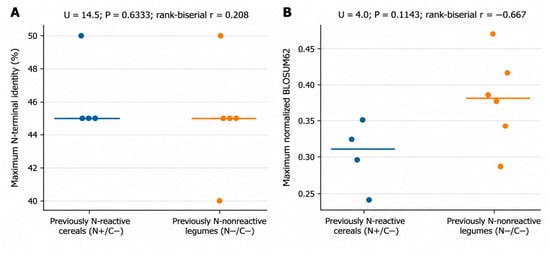
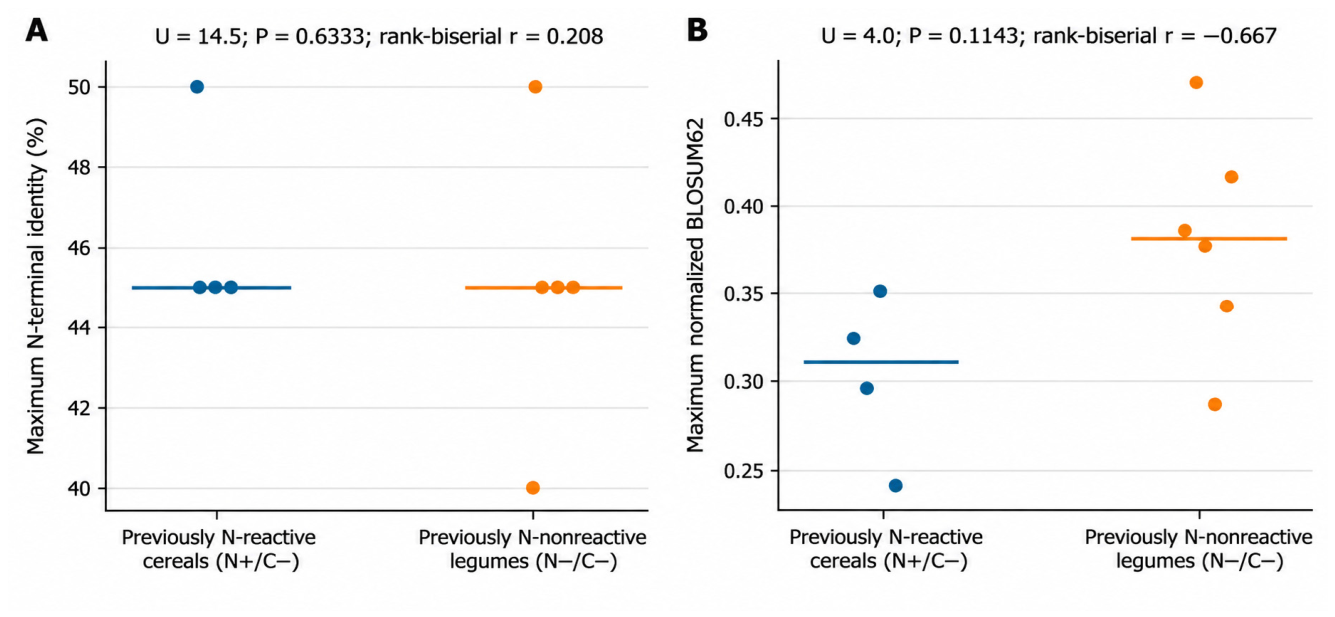
The four previously N-terminal-antibody-reactive cereal species and six historically nonreactive legumes had the same median maximum 20-residue identity (45%; Figure 2A). Their median normalized BLOSUM62 values were 0.311 and 0.383, respectively (Figure 2B). The previously calculated exploratory permutation comparisons were U = 14.5, p = 0.6333 for identity and U = 4.0, p = 0.1143 for normalized BLOSUM62. These values describe only the selected species; the antibody phenotype was inseparable from taxonomy, and reference accessions were not matched to the historically immunoblotted material. The data therefore do not validate or refute the ability of individual candidate proteins to bind the antibodies.
Figure 2.
Descriptive comparison of maximal N-terminal immunogen resemblance and historical antibody categories. Four historically N-reactive cereals and six nonreactive legumes were compared using highest-ranking 20-residue identity (A) and normalized BLOSUM62 similarity (B). Blue and orange dots represent individual cereal and legume species, respectively, and horizontal lines indicate group medians. Plotted exploratory tests are not a measure of epitope recognition or generalizable classification accuracy because phenotype and taxonomy are confounded and reference genotypes differ from the historical assay material.
The historical antibody categories came from experimental seed extracts, whereas the present sequence screen used predicted proteins from assembly-specific reference genotypes. Neither cultivar identity nor seed-protein expression, abundance, precursor processing, extraction conditions, or antigen accessibility was matched across sources. Thus, the immunoreactive bands cannot be assigned to the current highest-scoring candidate proteins, and a historical negative immunoblot does not demonstrate that the candidate sequence is absent from a reference proteome. Because the four historically reactive cereals and six nonreactive legumes also differ in lineage, the species-level comparison is exploratory and cannot estimate candidate-specific antibody-binding sensitivity, specificity, or predictive value.
2.4. Residue-Level Comparisons of Selected Local Matches
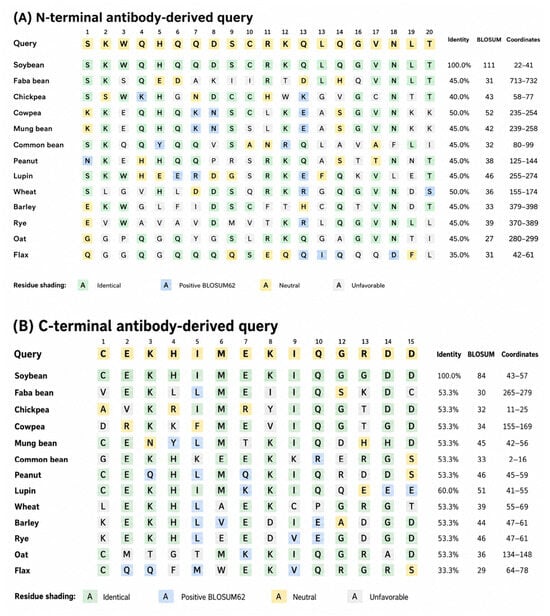
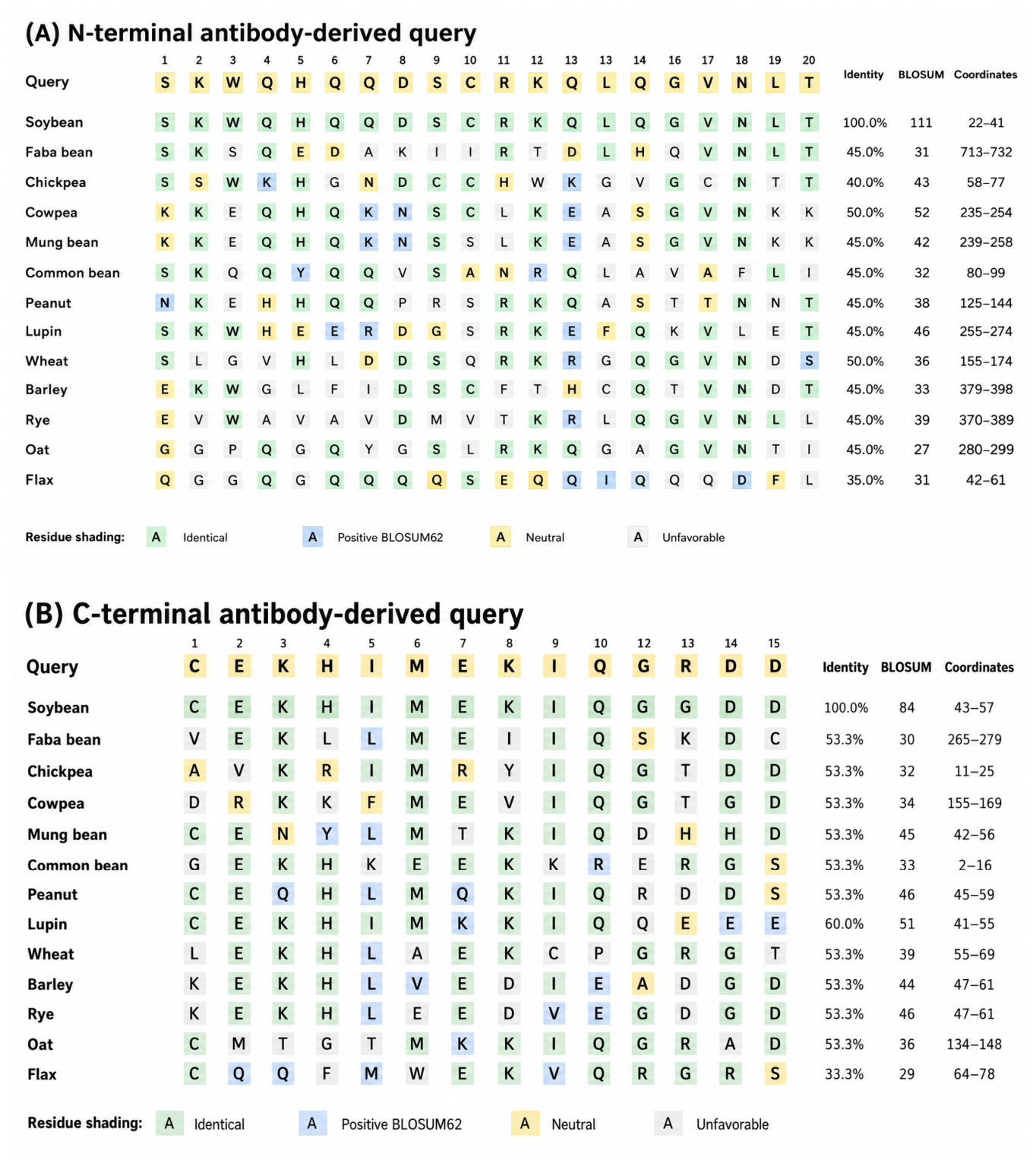
The position-specific comparisons clarify why sequence identity, and antibody recognition cannot be treated interchangeably (Figure 3). Cowpea and wheat both reached 50% identity across the N-terminal query, but the cowpea window had a higher BLOSUM62 score. Rye showed a longer uninterrupted N-terminal match (six residues) despite lower overall identity. The lupin C-terminal window reached 60% identity, a normalized score of 0.607 and a six-residue exact run, despite the historical C-terminal-negative phenotype of the species-level sample. Conversely, experimentally identified flax conlinin gave modest local similarity in the present single-protein comparison. These observations support prioritization of regions for targeted experiments, not assignment of molecular epitopes from computational rank alone.
Figure 3.
Fixed-length sequence comparison of the highest-ranking matches to the lunasin antibody-derived queries. (A) N-terminal 20-residue query, SKWQHQQDSCRKQLQGVNLT. (B) C-terminal 15-residue query, CEKHIMEKIQGRGDD. Residue shading distinguishes exact identities, positive BLOSUM62 substitutions, neutral substitutions, and unfavorable substitutions. The right-hand columns report full-window identity, raw BLOSUM62 score, and parent-protein coordinates. These are fixed-window comparisons rather than gap-containing multiple-sequence alignments.
2.5. Predicted Protease Cleavage and Retention of Lunasin-like Regions
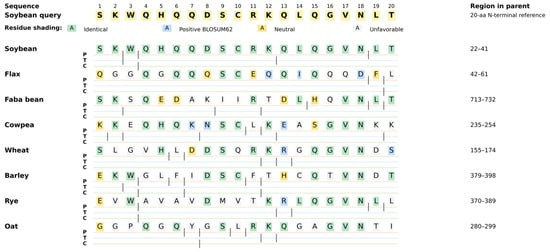
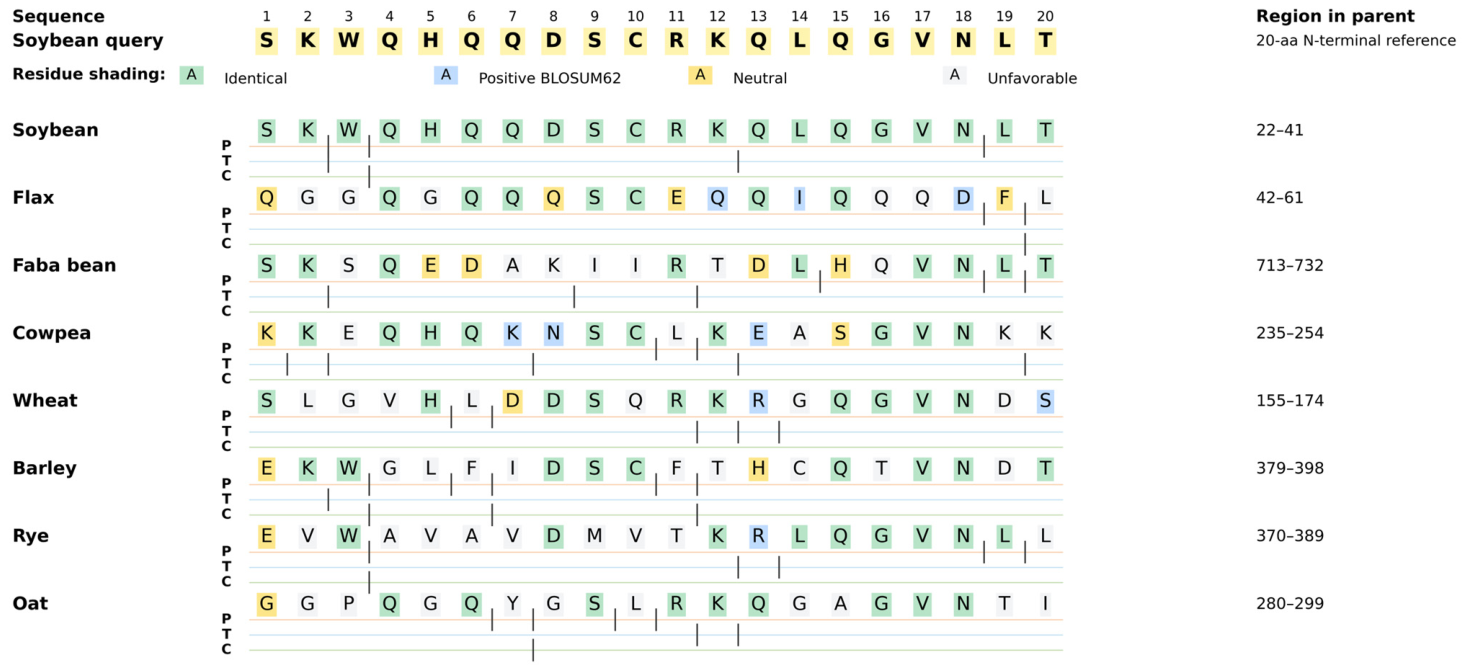
Independent enzyme-rule analyses identified potential internal pepsin cleavage positions within all eight selected 20-residue regions (Figure 4; Table 3). Under the specified complete-cleavage rule set, the intact 20-residue region was absent from any one theoretical pepsin fragment. The maximum overlapping fragment lengths ranged from 9/20 residues in barley to 18/20 in flax; soybean and rye each retained 15/20. These values report contiguous overlap with predicted products rather than observed peptide yield, persistence, or bioavailability.
Figure 4.
Ungapped candidate-region alignment with rule-predicted protease cleavage boundaries. The upper reference is the soybean lunasin N-terminal immunizing sequence; P, pepsin at pH > 2; T, trypsin; C, high-specificity chymotrypsin. The vertical marks denote cleavage positions predicted from independent enzyme-specific rules, not observed fragments or kinetic probabilities. No sequential digestion, gastrointestinal peptide stability, bioavailability, or biological effect was established.
Table 3.
Theoretical retention of candidate 20-residue N-terminal regions within single-enzyme cleavage fragments.
Under the independent trypsin model, the flax region remained within a predicted 24-residue fragment, whereas the other selected regions contained cleavage sites. High-specificity chymotrypsin rules predicted intact 20-residue regions within longer fragments for faba bean, cowpea, and wheat. The enzyme models were applied separately: no sequential stomach–intestine digestion, cleavage kinetics, matrix effects, or subsequent degradation were modeled. Accordingly, “retention” in this context means containment within a theoretical fragment, not liberation or chemical verification of free lunasin-like peptide (Table S3B).
These single-enzyme predictions cannot reproduce sequential gastrointestinal proteolysis: pepsin-generated fragments entering the intestinal phase may be further cleaved by trypsin, chymotrypsin, and other proteases. Consequently, an intact 20-residue segment within a theoretical fragment from one enzyme may not survive successive exposure. Conversely, a predicted cleavage boundary is not evidence of quantitative hydrolysis in a folded precursor or food matrix. The Table 3 values describe enzyme-specific sequence containment, not release, concentration, stability, absorption, or bioavailability of an authentic peptide.
2.6. Empirical Statistical Calibration of Proteome-Wide Lunasin-like Matches
Composition-preserving Monte Carlo randomization provided empirical significance estimates for the 33 species-by-query comparisons (Supplementary Table S5).
In the primary identity-only analysis, six comparisons yielded unadjusted empirical p-values below 0.05. Following Benjamini–Hochberg correction, three remained significant (q < 0.05), all involving the full 43-residue lunasin reference: Arachis hypogaea (p = 0.001; q = 0.0165), Cicer arietinum (p = 0.002; q = 0.0220), and Lupinus mutabilis (p = 0.001; q = 0.0165).
The secondary composite-ranking analysis identified nine comparisons with unadjusted p < 0.05, of which four remained significant after Benjamini–Hochberg correction. These comprised the same three 43-residue legume candidates (each q = 0.011) and Secale cereale (p = 0.005; q = 0.04125).
Under the more conservative Benjamini–Yekutieli procedure, no identity-only comparison remained significant, whereas the three 43-residue legume candidates retained significance in the secondary composite-ranking analysis (each q = 0.04498).
The screening reproduced the previously reported candidate sequences and similarity scores in all 33 comparisons. Thirty-one results matched the published protein identifiers and coordinates exactly, whereas the wheat C-terminal 15-residue and oat N-terminal 20-residue comparisons yielded alternative highest-ranking windows with equivalent sequences and scores.
These findings indicate that selected full-reference sequence matches are less frequent than expected under the specified whole-protein composition-preserving null model. They do not establish authentic lunasin identity, precursor homology, antibody binding, or biological activity.
3. Discussion
3.1. Distinguishing Peptide Molecular Identity from Local Sequence Resemblance
The central analytical issue is the distinction between detecting a local sequence resemblance and identifying an authentic molecular species. Screening millions of overlapping proteome windows generates identity-selected maxima whose biological interpretation depends on protein context, sequence composition, and the selection procedure. A Karlin–Altschul-based index is not calibrated for this fixed-length identity-first algorithm. Here, the observed maxima were instead compared with whole-proteome, composition-preserving randomized maxima (Section 2.6; Supplementary Table S5). The resulting empirical probabilities assess rarity under that specified null model, not evolutionary homology or molecular identity.
The null analysis reproduced the entire search-and-selection process for each randomized proteome. Shuffling residues within each protein preserved protein length and overall amino-acid composition but disrupted residue order, local low-complexity patterns, domain architecture, and evolutionary relationships. All annotated isoforms were retained, so related sequences and redundant isoforms may affect the effective search space. The findings are therefore conditional on this null model; an isoform-collapsed or local-composition-aware sensitivity analysis remains a useful future extension.
The molecular-authentication implication is substantial. Neither an immunoreactive band nor a moderate resemblance to a short antibody immunogen identifies the sequence of the bound protein or a released lunasin peptide. Chemical identification requires orthogonal, sequence-resolved evidence, such as targeted tandem mass spectrometry against appropriate synthetic standards with precursor and fragment-ion verification [26]. This requirement is consistent with prior investigations questioning canonical lunasin in cereals [10,11] and recent reviews of reported lunasin-like material [12].
The observed full-reference maxima were 17/43 identity for peanut (null median 13), 16/43 for chickpea (null median 13), and 19/43 for lupin (null median 13); each exceeded the corresponding 99th-percentile identity maximum in the 999-replicate null (15/43). These model-relative results should be read alongside the non-significant BY-adjusted primary tests and are not independent evidence of functional or evolutionary conservation (Supplementary Table S5).
The empirical calibration provides a statistical basis for distinguishing some of the observed sequence maxima from those expected under whole-protein composition-preserving randomization. Three legume candidates remained significant in the primary identity-based analysis after Benjamini–Hochberg correction, whereas the composite-ranking analysis additionally identified a significant rye candidate. However, the latter did not remain significant under the more conservative Benjamini–Yekutieli adjustment. These differences emphasize that the conclusions depend on the chosen test statistic and multiple-testing procedure.
Statistical enrichment relative to a composition-preserving null does not establish evolutionary homology or authentic lunasin production. In particular, amino-acid shuffling does not preserve local low-complexity patterns, conserved domains, or evolutionary relationships among proteins. Therefore, the significant 43-residue matches should be prioritized for further sequence-context and experimental verification rather than interpreted as molecular authentication of lunasin.
3.2. Precursor Context and the Non-Equivalence of Individual Lunasin Motifs
Full-length analysis provides different levels of support for the 43-residue candidates. Peanut Ara h 6 is an established 2S albumin; chickpea XP_004487601.1 has a conglutin delta 2-like annotation supported by multiple conserved-domain signatures; and lupin ANN24498-RA shows broader structural-superfamily similarity but lacks the reported specific 2S signatures. These findings refine candidate selection but do not establish a shared processed peptide, its release, or immunological cross-recognition (Supplementary Table S6).
Protein-family classification must consider the complete precursor rather than the selected lunasin-like window alone. InterProScan domain analysis and signal-peptide predictions have now been completed for chickpea, lupin, two positive-control peanut 2S albumins, and an unrelated wheat enzyme. They support a chickpea 2S family context but not a definitive lupin 2S assignment. More detailed cysteine/disulfide architecture, reciprocal sequence comparisons, and full-length phylogenetic analyses remain potential follow-up tests [27,28,29]. BLAST-based sequence comparisons are one possible follow-up approach [30]. A predicted signal peptide is not evidence of production of an authentic lunasin peptide.
The newly summarized motif features reinforce this caution. The soybean reference uniquely combined an exact RGD motif with a nine-aspartate terminal segment among the top-ranked windows considered here. Faba bean and rye matched the terminal nine-aspartate pattern but lacked RGD; the highest-identity lupin window had neither feature in the same combination (Table S4). Acidic runs may elevate local sequence resemblance without establishing the complete lunasin molecular architecture. The lack of RGD in the selected non-soybean windows does not rule out RGD in other sequences elsewhere in those proteomes.
The cereal contrast is particularly instructive: the strongest 43-residue match in wheat occurs in glucose-6-phosphate 1-dehydrogenase, a metabolic enzyme, and related cereal entries contain similar segments. The protein-context audit therefore provides an essential safeguard against assigning a peptide identity based only on the largest alignment score.
Accession-specific conserved-domain analysis supports the chickpea XP_004487601.1 2S seed-storage/conglutin-like family classification through concordant PANTHER, Pfam, SMART, and structural-superfamily evidence. For the short lupin ANN24498-RA protein, broader superfamily matches, only two cysteines, and absent specific Pfam/PANTHER 2S-family matches prevent a definitive assignment. The data do not establish that the lupin sequence is a truncated gene model, nor do they demonstrate mature lunasin release or antibody binding (Supplementary Table S6).
3.3. Historical Antibody Reactivity Cannot Be Explained by Whole-Immunogen Maximum Identity
The historically N-reactive cereal group did not have higher maximal 20-residue identity than the nonreactive legume group. This observation does not demonstrate that short sequence determinants are irrelevant to antibody binding. Polyclonal antibodies can recognize smaller or context-dependent determinants; immunoblot signals are also influenced by protein expression, extraction, processing and assay stringency. Critically, the historical reactivity groups are completely confounded with plant lineage and were not tested using genotype-matched candidate proteins. These data can neither estimate diagnostic performance nor establish the mechanism of the historical antibody signals.
The historical immunoblot samples and current reference proteomes were not genotype-matched, and a species-level antibody response cannot be assigned to an individual predicted protein. Protein expression, extraction, processing, and epitope accessibility can independently affect reactivity. A definitive link would require cultivar-matched seed extracts, LC–MS/MS identification of the immunoreactive band, and direct binding or epitope-mapping tests of the identified protein.
Primary sequence resemblance alone does not specify antibody recognition [15,16]. The cereal-versus-legume grouping is completely confounded with historical antibody status, so no independent taxonomic or diagnostic effect can be inferred from this panel.
3.4. Flax Conlinin as an Experimentally Characterized Noncanonical Comparator
Flax conlinin provides a crucial external comparison because an N-terminal-antibody-reactive seed protein was identified as a 2S albumin by mass spectrometry in the historical study [13]. The present analysis evaluates Q8LPD4 as a predefined protein, not as a proteome-wide flax maximum. Although its local identity is modest, that finding is compatible with antibody recognition of a shorter or compositionally distinct determinant. Its binding site, however, has not been mapped here, and the computational results do not establish which residue pattern accounts for historical immunoreactivity.
3.5. The C-Terminal Window Is Not a Validated Identity or Binding Threshold
Lupin produced the highest non-soybean C-terminal 15-residue identity (60%) even though historically investigated lupin material was C-terminal-antibody-negative. This discrepancy underscores the limitations of comparing a selected sequence window with an extract-level immunoblot performed in different biological material. Molecular recognition depends on expressed protein abundance, the exposed antigenic sequence and the antibody population, not the window identity percentage alone. The 15-residue hit must therefore remain a candidate for experimental testing rather than an inferred antigen.
3.6. Protease-Rule Predictions Do Not Establish Peptide Bioavailability
The cleavage simulations identify potential sites in the tested sequences under independently applied enzyme rules. An intact query region embedded within a predicted trypsin or chymotrypsin fragment is not the same chemical entity as a free 20-residue peptide. Conversely, a predicted internal pepsin cut does not demonstrate complete physiological cleavage. Matrix effects, reaction kinetics, protein folding and subsequent intestinal exposures were not examined [25,31].
Sequential digestion can change both the peptides and the accessibility of subsequent cleavage sites. Gastric pepsin products become substrates for intestinal proteases, including trypsin and chymotrypsin; the independent complete-cleavage rules applied here do not represent this temporal sequence, multiple enzymes acting together, pH variation, kinetics, protein folding, or food-matrix effects. Thus, a region retained within a predicted fragment after one enzyme is not established as gastrointestinally stable; likewise, a predicted internal cleavage site does not ensure complete physiological hydrolysis. Standardized sequential oral–gastric–intestinal digestion using INFOGEST 2.0 followed by time-resolved, sequence-specific LC–MS/MS would be appropriate for verifying actual peptide generation and persistence [32,33].
Future studies should use appropriate genotype-matched precursor controls and quantitative, sequence-specific LC–MS/MS to distinguish authentic released peptides from heterogeneous degradation mixtures. Only after molecular identity and relevant exposure are demonstrated would claims of biological activity be justified [34].
3.7. Analytical Value, Limitations, and a Molecular Validation Pathway
The contribution of this study is a molecular evidence hierarchy for selecting lunasin-like candidates for analytical confirmation (Table 4). Local immunogen resemblance is a screening clue; full-reference resemblance and seed-storage-protein context refine priorities; RGD and acidic-tail features test whether a candidate approximates characteristic sequence architecture; and theoretical protease cleavage places boundaries on a digestion hypothesis. None of these observations independently prove the existence of a processed peptide or its binding to lunasin-directed antibodies.
Table 4.
Practical evidence hierarchy for interpreting putative lunasin or lunasin-like signals outside soybean.
Several limits remain relevant: historical immunoblots and reference genotypes are unmatched; antibody categories are taxonomically confounded; assembly proteomes contain uncertain annotations and potentially redundant isoforms; seed expression and antigen accessibility were not measured; the whole-protein shuffling null does not preserve local compositional or evolutionary structure; the motif audit covers only selected top-ranked windows; and individual cleavage rules do not model sequential digestion, kinetics, peptide recovery, or bioavailability. The original analysis scripts were unavailable, but independently reconstructed, benchmarked implementations and the numerical calibration outputs have been publicly deposited (Section 4.4; Data Availability Statement).
Comparability is also restricted by taxon coverage: no proteome-wide windows were calculated here for amaranth or triticale, despite prior reports and existing annotated genome resources [21,22]. Furthermore, full-length profile-HMM analysis was performed for selected candidates and controls, not exhaustively for every ranked hit, and no whole-protein phylogeny was constructed. These limits should be addressed in a broader, genotype-aware follow-up panel rather than by interpreting the present identity maxima as homologous lunasin precursors.
The revised evidence base now includes (i) a publicly archived reconstructed screening and randomization workflow with verified input manifests; (ii) empirical null-model calibration for all 33 proteome-by-query comparisons; and (iii) full-length domain evidence supporting chickpea 2S-related annotation while leaving lupin provisional. The remaining boundaries are (iv) the lack of genotype-matched immunoblot evidence and (v) the use of separate rather than sequential gastrointestinal cleavage simulations. These limits constrain interpretation to candidate prioritization rather than authentic peptide identification.
Further work should assess the sensitivity of the results to isoform redundancy and alternative sequence-order null models, clarify uncertain protein-family placement by full-length phylogeny, and test genotype-matched antigen candidates by epitope mapping. Immunoreactive proteins and any digestion-derived fragments should be identified by targeted LC–MS/MS. Publishing reconstructed code improves reproducibility but should not be misrepresented as release of the unavailable original screening scripts.
4. Materials and Methods
4.1. Overall Study Design
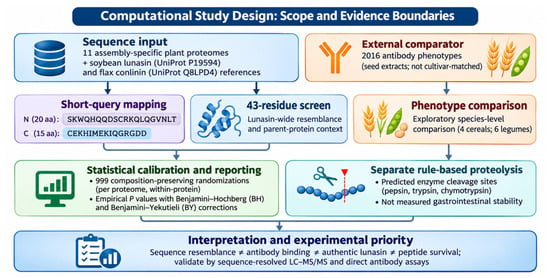
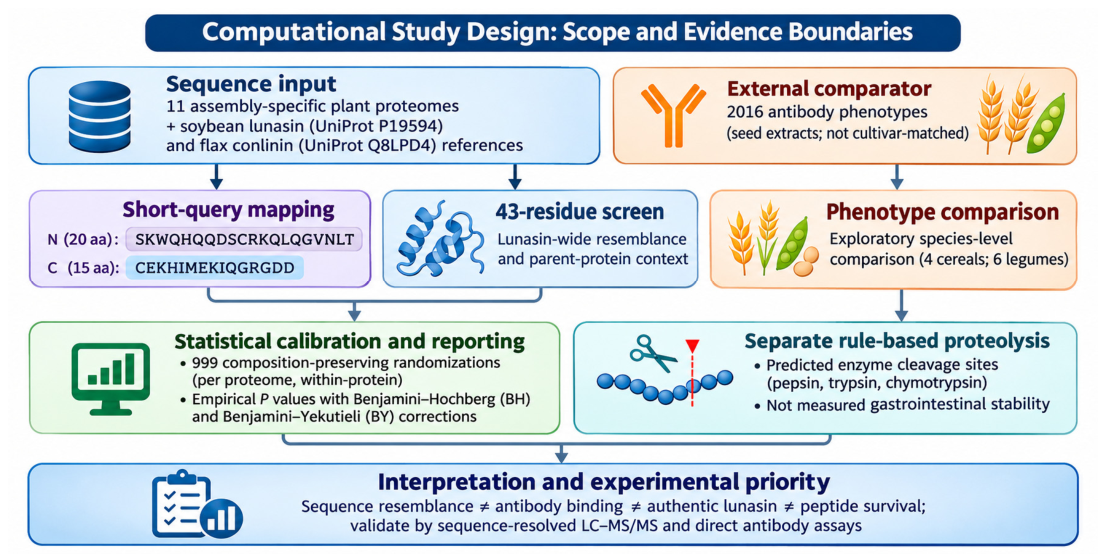
The workflow integrated fixed-window searches of 11 assembly-specific predicted plant proteomes, sequence-context characterization of their selected 43-residue matches, comparison with published species-level immunoblot categories, and independent rule-based protease cleavage prediction (Figure 5). Soybean P19594 and flax conlinin Q8LPD4 served as predefined single-protein references rather than proteome-wide discovery datasets. The study involved no new antibody-binding experiments, protein purification, tandem mass spectrometry, or digestion experiments. The historical immunoblot materials were not verified to match the sequenced reference accessions.
Figure 5.
Computational study workflow and distinct evidence levels. Eleven assembly-specific predicted plant proteomes were screened for local sequence resemblance to the 20-residue N-terminal and 15-residue C-terminal antibody immunogens and the 43-residue soybean lunasin reference. Soybean P19594 and flax conlinin Q8LPD4 served as predefined single-protein comparators. Selected full-reference matches were examined for sequence architecture and parent-protein context. Statistical calibration involved 999 within-protein, composition-preserving randomizations per proteome, with Benjamini–Hochberg (BH) and Benjamini–Yekutieli (BY) multiple-testing corrections. The arrows indicate the direction of the analytical workflow, while the colored boxes distinguish sequence inputs and full-reference screening (blue), short-query mapping (purple), historical antibody comparisons (orange), statistical calibration (green), and independent protease cleavage predictions (teal). Historical immunoblot observations and theoretical cleavage predictions provide contextual evidence rather than experimental validation of individual computational candidates.
4.2. Reference Lunasin Sequence and Antibody-Derived Query Peptides
The primary reference was the soybean Gm2S-1 2S albumin precursor (UniProt P19594; GenBank protein AAB71140.1; transcript AF005030.1). The explicit 43-residue lunasin sequence used for residue numbering and the full-lunasin screen was SKWQHQQDSCRKQLQGVNLTPCEKHIMEKIQGRGDDDDDDDDD. Both 43- and 44-residue natural forms have been reported; the 44-residue form contains an additional C-terminal asparagine [35]. The 43-residue sequence was selected because the antibody antigens used in the previous study lie entirely within it [13].
Two antibody-derived queries were analyzed independently: the N-terminal 20-mer SKWQHQQDSCRKQLQGVNLT and the C-terminal 15-mer CEKHIMEKIQGRGDD. The C-terminal query spans the RGD-containing portion of lunasin, whereas the full reference contains the terminal poly-aspartate region. RGD occurrence and acidic enrichment were treated as contextual features rather than sufficient criteria for lunasin identity.
4.3. Plant Species and Historical Antibody Phenotypes
The study comprised soybean, seven additional legumes, four cereals, and flax (Table 5). The phenotypes reported by Alaswad and Krishnan [13] were N+/C+ for soybean, N+/C− for wheat, barley, rye, oat, and flax, and N−/C− for chickpea, cowpea, mung bean, common bean, peanut, and Lupinus mutabilis; faba bean was not tested. These are historical seed-extract immunoblot observations, not results measured from the particular genome-reference cultivars or from the computationally retrieved proteins. Flax was represented here only by the conlinin Q8LPD4 sequence and was therefore excluded from comparisons of assembly-wide maxima.
Table 5.
Plant species included in comparative analysis and their historical antibody phenotypes.
The published 2016 study used rabbit polyclonal antisera directed against the soybean-lunasin N20 and C15 immunogens [13]. The reported N/C phenotype summary pools observations across experiment-specific assay stringencies and, for some species, multiple seed accessions. Standard Western blotting used primary antibody at 1:20,000 with 0.05% Tween 20, whereas a more permissive assay used 1:5000 with 0.01% Tween 20; weaker-condition N-terminal signals in cereals should not be treated as proof of canonical peptide detection. Reported historical samples and cultivar identifiers are listed separately in Table 6; unspecified accessions are explicitly marked as not reported. Other earlier cereal/amaranth studies [4,5,6,7,8,9] are historical reports of different methods, not a harmonized set of N20/C15 immunoblot measurements.
Table 6.
Provenance of the historical seed-extract lunasin-antibody observations used as external context. All immunoblot categories and named accessions below are from Alaswad and Krishnan [13].
4.4. Reference Sequence Datasets and Reproducibility
Predicted protein sets were retrieved from Ensembl Plants release 63 (June 2026) [36], NCBI Datasets, or PulseDB, using the reference assemblies listed in Table S1. The Vicia faba Hedin/2 and Lupinus mutabilis cv. Inti resources are described by Jayakodi et al. [17] and Pancaldi et al. [18], respectively. All annotated isoforms were screened; many windows may thus represent the same gene or related isoforms rather than independent sequence opportunities. Assembly identifiers, sequence files, counts, amino-acid totals, and checksums are reported in Table S1. These assembly-specific predicted proteomes are neither comprehensive representations of all cultivars nor measures of seed expression. They were not genotype-matched to material used for the historical antibody study. Soybean P19594 and flax Q8LPD4 were evaluated as predefined single proteins, not assembly-wide scans.
The eleven input datasets were selected because assembly-specific protein FASTAs with traceable protein identifiers were available and could be checked against the original analysis, not because all assemblies met a uniform N50/BUSCO quality cutoff. Assembly accessions and annotation sources are specified in Table S1. Uniform cross-assembly quality metrics were not recalculated, and annotation quality or missing protein models could differ among species. Original file-by-file download dates were not retained; the source release (Ensembl Plants release 63, June 2026, where applicable), stable assemblies, and November 2026 verification records provide available provenance. In particular, the unavailable timestamps should not be represented as a single verified acquisition date.
The 11 input proteomes were checked against assembly-specific sequence identifiers, protein counts, amino-acid totals, and SHA-256 digests (Supplementary Table S1). Biopython provides general-purpose tools for computational molecular biology [37]. Independently reconstructed Python and C++ implementations reproduced the recorded top-window similarity results in all 33 species-by-query comparisons: 31 matched the reported accessions and coordinates exactly, and two had equivalent highest-scoring tied windows. These reconstructed implementations are not the original unpublished screening scripts. The documented code, manifests, verification outputs, randomized null-model results, and reproducibility instructions are archived at https://doi.org/10.5281/zenodo.24376192 (accessed on 19 November 2026), Version 1.0.0.
4.5. Ungapped Fixed-Window Screening, Candidate Ranking, and Search-Space Enumeration
For each query of length L = 15, 20, or 43 residues, every eligible predicted protein of length n ≥ L was scanned using overlapping contiguous windows of length L at a one-residue step. An ungapped match denotes a position-by-position comparison of the query and the selected window, without insertions, deletions, or local realignment. Each window contains L positions, and identity (%) = 100 × [number of exactly matching amino acids]/L. BLOSUM62 [38] raw substitution scores were summed positionally; normalized BLOSUM62 = raw query–window score divided by the corresponding query self-score (84 for C15, 111 for N20, and 244 for L43). The longest exact run is the maximum number of consecutive positions with identical query and window residues, reset to zero on a mismatch. All annotated isoforms, including potentially homologous or redundant isoforms, were retained. No low-complexity masking or composition-based window filtering was imposed; windows containing any residue outside the 20 canonical amino acids were excluded from scoring.
The independently reconstructed workflow selected one highest-ranking window per query and proteome by lexicographic order: (1) number of identical residues, (2) raw BLOSUM62 score, and (3) longest consecutive exact run; unresolved ties were assigned by FASTA input order. The original unavailable scripts may have used different exact-tie conventions; two tied alternative positions are documented in the verification package. Enumerating the exact 11 input FASTAs yielded 319,196,597 eligible C15 windows, 315,412,185 eligible N20 windows, and 298,021,652 eligible L43 windows (932,630,434 query-specific windows in total). The corresponding numbers excluded for noncanonical symbols were 70,553, 85,447, and 144,966. Source-specific counts and counting definitions are provided in Supplementary Table S7. Larger and more isoform-rich proteomes have more opportunities for chance maxima; the empirical null analysis therefore used each original proteome as its own search space.
4.6. Search-Space Calibration Using Composition-Preserving Randomization
To assess whether the highest-ranking lunasin-like sequence matches exceeded chance expectations, empirical null distributions were generated for each of the 11 original assembly-specific proteomes. Input protein FASTA datasets were verified against the protein counts, amino-acid totals, and SHA-256 checksums reported in Supplementary Table S1.
Each proteome was independently randomized 999 times by shuffling amino-acid positions within individual proteins while preserving protein lengths and exact amino-acid compositions. All annotated protein isoforms were retained. For each randomized replicate, the complete proteome was re-screened using the same ungapped fixed-window procedure applied to the observed datasets, with three soybean-lunasin queries of 20, 15, and 43 amino acids.
For each randomized replicate, the maximum-scoring window was identified under the documented reconstructed identity-first lexicographic criterion: number of identical residues, raw BLOSUM62 score, and longest uninterrupted exact-residue run. The primary empirical test compared the observed maximum number of identical positions with the randomized maxima; a secondary test evaluated the complete three-component ranking statistic. The original unavailable script’s handling of exact ties was not asserted to be identical.
Empirical upper-tail probabilities were calculated as p = (b + 1)/(R + 1), where b represents the number of randomized maxima at least as extreme as the observed statistic and R = 999 randomizations. Multiple-testing correction was performed separately for the primary and secondary analyses across the 33 species-by-query comparisons using the Benjamini–Hochberg procedure. Benjamini–Yekutieli-adjusted values were additionally calculated as a conservative sensitivity analysis.
The randomization procedure preserves each full protein’s overall residue counts and length, and it repeats the maximum-selection step across its whole proteome. It does not preserve short-range sequence composition, protein domains, natural local low-complexity patterns, phylogenetic dependence, or isoform redundancy. With 999 replicates, the smallest resolvable empirical probability is 0.001; the precision of tail probabilities and adjusted discoveries is limited. The 33 tests include correlated species and overlapping sequence queries: Benjamini–Hochberg results are reported alongside the more conservative Benjamini–Yekutieli adjustment, rather than interpreted as model-independent significance. No isoform-collapsed or local-composition-preserving sensitivity simulation was performed. Reconstructed code, verified input manifests, observed and null scores, and instructions are archived at https://doi.org/10.5281/zenodo.24376192 (accessed on 19 November 2026), Version 1.0.0.
4.7. Full-Length Lunasin Screening, Precursor Annotation, and Molecular Motif Audit
The complete 43-residue soybean lunasin reference was compared with the 11 predicted proteomes using the same ungapped fixed-window procedure. The query self-score under BLOSUM62 was 244. One highest-ranking 43-residue window per proteome was retained, alongside the predefined soybean and flax references. Candidate protein descriptions were evaluated using the original sequence records and curated seed-storage-protein literature. Parent-protein family membership was not inferred solely from a short alignment.
Parent proteins were evaluated at full length, distinguishing curated identifiers, automated annotations, and provisional family hypotheses. Profile-HMM-based conserved-family/domain searches were available from the completed InterProScan (Pfam, PANTHER, SMART, CATH-Gene3D, SUPERFAMILY and related member libraries) for chickpea XP_004487601.1, lupin ANN24498-RA, peanut Ara h 2 and Ara h 6 (positive controls), and wheat glucose-6-phosphate dehydrogenase (unrelated control; Supplementary Table S6). This is a targeted full-protein family-signature assessment, not a proteome-wide homology search. Neither a new BLASTP search across all proteins nor a phylogenetic reconstruction was conducted, and ungapped short-window identities were not considered evidence of evolutionary homology.
To distinguish local sequence similarity from molecular identity, we additionally examined the 13 displayed 43-residue matched windows for (i) exact occurrence of RGD, (ii) total cysteine residues, (iii) the number of aspartate residues among the last nine aligned positions, and (iv) the longest consecutive aspartate run. These descriptive features were computed directly from the sequences in Supplementary Table S3A and are presented in Supplementary Table S4. They apply to the selected top-ranked windows, not to every possible peptide or protein in the underlying proteomes; motif absence in a top-ranked window is therefore not a proteome-wide absence claim.
Full-length protein sequences for the candidate chickpea XP_004487601.1 and lupin ANN24498-RA entries, peanut Ara h 2 and Ara h 6 positive controls, and wheat glucose-6-phosphate dehydrogenase negative-context control were extracted from the original assembly-specific FASTA datasets and analyzed using the EMBL-EBI InterProScan sequence-search service (InterProScan 6.0.3.0; InterPro 111.0). Member database outputs included Pfam, PANTHER, SMART, CATH-Gene3D, SUPERFAMILY, Phobius, and SignalP where available. Signature accession numbers, protein coordinates, E-values and predicted signal peptides were retrieved from the original TSV/JSON outputs and are tabulated in Supplementary Table S6. Family annotations were interpreted conservatively because shared structural superfamily signatures can encompass seed-storage proteins, lipid-transfer proteins, and protease inhibitors.
4.8. Integration with Historical Antibody Phenotypes
Published N-terminal (N) and C-terminal (C) antibody immunoblot phenotypes were taken from Alaswad and Krishnan [13]. The comparison included four previously N-reactive cereals and six historically nonreactive legumes; soybean was the canonical positive reference, while faba bean lacked a reported phenotype and flax was screened as only one predefined protein. The historical material and sequence-reference cultivars were not matched. The previously reported exploratory two-sided exact permutation Mann–Whitney comparisons reflect only this selected ten-species panel (210 group assignments). Reactivity is perfectly confounded with cereal-versus-legume grouping, and related species are not phylogenetically independent; therefore, the statistics do not estimate predictive validity or antibody-binding causality.
The retrospective comparison was restricted to the N20/C15 historical categories reported in one antibody study [13] (Table 6), rather than conflating those categories with earlier biochemical claims about cereals or amaranth [4,5,6,7,8,9]. Reported accessions and immunoblot assay conditions differ from the sequenced reference cultivars, so the plotted species-level associations in Figure 2 are exploratory context for prioritization, not matched-case observations or experimental support for binding by any selected protein.
Historical antibody phenotypes were treated as external species-level observations, not as genotype-matched measurements for the computational candidates. Cultivar identity, candidate expression and abundance, precursor processing, and antigen accessibility could not be reconciled across the earlier seed extracts and the present predicted proteomes. Thus, a historical band was not attributed to a best-scoring protein, and nonreactivity was not treated as evidence that a sequence is absent.
4.9. In Silico Proteolysis of Selected Candidates
Eight parent proteins were selected for rule-based cleavage predictions: soybean Gm2S-1 (P19594), flax conlinin (Q8LPD4), and the top N20 candidate proteins from faba bean, cowpea, wheat, barley, rye, and oat. Pepsin at pH > 2, trypsin, and high-specificity chymotrypsin were evaluated separately using ExPASy PeptideCutter-type cleavage rules [31]. Under each independent rule set, all predicted cleavage boundaries were applied to the intact input sequence (complete theoretical cleavage, no missed-cleavage model). A query segment was scored as “contained” when all 20 contiguous query-region positions fell within one predicted fragment; otherwise, the maximum contiguous overlap across predicted fragments was reported as X/20. “Retention” means this sequence containment only; the model does not predict an exactly liberated free 20-mer, fragment yield, kinetic stability, recovery, digestion bioavailability, or an antibody-binding epitope. The rules do not explicitly simulate structural accessibility, enzyme concentrations, changing pH, time-dependent cleavage, or food-matrix effects.
Pepsin, trypsin, and chymotrypsin predictions were not applied as a consecutive gastric–intestinal sequence or as a mixed intestinal enzyme system. Accordingly, the apparent containment of an N20 region after one enzyme does not establish survival after another. A predicted cleavage site is potential susceptibility, not experimentally confirmed hydrolysis. Sequential digestion (for example, INFOGEST 2.0) coupled to time-resolved sequence-specific LC–MS/MS would be necessary for experimentally measured fragment generation, persistence, and recovery [33].
5. Conclusions
This sequence-based triage of 11 selected reference proteomes identified non-soybean local maxima of 50% and 60% identity to the 20- and 15-residue antibody immunogens, respectively, and up to 44.2% to the 43-residue lunasin reference. No selected non-soybean 43-residue window reproduced both the canonical RGD and extended poly-aspartate features. Whole-proteome composition-preserving calibration prioritized three full-length-query legume matches at BH-adjusted identity-only q < 0.05, but no identity-only discovery survived the conservative BY adjustment. InterProScan supports a chickpea 2S seed-storage-family context but not a definitive lupin 2S assignment. These results define candidate sequences, not their evolutionary homology, processing, or antibody recognition.
The fixed reference-genotype panel omitted amaranth and triticale, and historical immunoblots were conducted on different materials under different assay stringencies. Independent single-enzyme cleavage simulations likewise cannot demonstrate peptide persistence through sequential gastrointestinal digestion. Authenticity and function require genotype-matched proteomics, direct antibody-binding studies, and experimentally characterized processing. Repeated screening of additional annotated reference proteomes, including amaranth and triticale, would test the generality of the candidate-ranking conclusions.
Supplementary Materials
The following supporting information can be downloaded at: https://www.mdpi.com/article/10.3390/molecules31234345/s1. Table S1, Reference sequence datasets and assembly metadata; Table S2, Detailed highest-ranking 20-residue N-terminal and 15-residue C-terminal matches; Table S3A, Full 43-residue lunasin screening results, including matched sequences and coordinates; Table S3B, Detailed predicted proteolytic fragments overlapping selected N-terminal candidate regions; Table S4, Molecular sequence features of the displayed 43-residue highest-ranking windows; Table S5, Empirical significance of proteome-wide lunasin-like sequence matches based on composition-preserving randomization and multiple-testing correction; Table S6a, Conserved-domain evidence supporting the annotation of candidate lunasin-like proteins and reference controls; Table S6b. Accession-specific InterProScan family/domain signatures, coordinates, and confidence statisticsand. Table S7, Reproducible enumeration of candidate fixed-length windows in 11 versioned plant reference proteomes. The verified reconstructed software and statistical outputs are archived at the DOI in the Data Availability Statement.
Funding
This research received no external funding.
Institutional Review Board Statement
Not applicable. This study extends the author’s previously published research through additional computational analyses of plant protein sequences. No human participants, experimental animals, or new biological sampling were involved.
Informed Consent Statement
Not applicable.
Data Availability Statement
Source proteome assembly/accession identifiers, protein counts, sequence totals and checksums are provided in Supplementary Table S1, with explicit query-wise window counts in Table S7. The original individual download timestamps were not preserved; consequently, we report source/release identifiers and the verified November 2026 analysis record rather than inventing acquisition dates. Independently reconstructed research software (not the unavailable original Python scripts), input manifests, benchmark comparisons, and 999-replicate composition-preserving randomization results are archived in Zenodo (Version 1.0.0; https://doi.org/10.5281/zenodo.24376192 (accessed on 19 November 2026). Original FASTA resources remain with their source repositories. InterProScan results are summarized in Table S6; the raw TSV/JSON analysis files should be retained with the study archive.
Conflicts of Interest
The author declares no conflicts of interest.
References
- Odani, S.; Koide, T.; Ono, T. Amino acid sequence of a soybean (Glycine max) seed polypeptide having a poly(L-aspartic acid) structure. J. Biol. Chem. 1987, 262, 10502–10505. [Google Scholar] [CrossRef] [Scilit]
- Galvez, A.F.; de Lumen, B.O. A soybean cDNA encoding a chromatin-binding peptide inhibits mitosis of mammalian cells. Nat. Biotechnol. 1999, 17, 495–500. [Google Scholar] [CrossRef] [Scilit] [PubMed]
- Fan, X.; Zhang, Z.; Hu, Y.; Richel, A.; Wang, F.; Zhang, L.; Ren, G.; Zou, L. Current research status on the structure, physicochemical properties, bioactivities, and mechanism of soybean-derived bioactive peptide lunasin. Food Chem. 2025, 479, 143836. [Google Scholar] [CrossRef] [Scilit] [PubMed]
- Jeong, H.J.; Lam, Y.; de Lumen, B.O. Barley lunasin suppresses ras-induced colony formation and inhibits core histone acetylation in mammalian cells. J. Agric. Food Chem. 2002, 50, 5903–5908. [Google Scholar] [CrossRef] [Scilit] [PubMed]
- Jeong, H.J.; Jeong, J.B.; Kim, D.S.; Park, J.H.; Lee, J.B.; Kweon, D.H.; Chung, G.Y.; Seo, E.W.; de Lumen, B.O. The cancer preventive peptide lunasin from wheat inhibits core histone acetylation. Cancer Lett. 2007, 255, 42–48. [Google Scholar] [CrossRef] [Scilit] [PubMed]
- Jeong, H.J.; Lee, J.R.; Jeong, J.B.; Park, J.H.; Cheong, Y.K.; de Lumen, B.O. The cancer preventive seed peptide lunasin from rye is bioavailable and bioactive. Nutr. Cancer 2009, 61, 680–686. [Google Scholar] [CrossRef] [Scilit] [PubMed]
- Nakurte, I.; Klavins, K.; Kirhnere, I.; Namniece, J.; Adlere, L.; Matvejevs, J.; Kronberga, A.; Kokare, A.; Strazdina, V.; Legzdina, L.; et al. Discovery of lunasin peptide in triticale (× Triticosecale Wittmack). J. Cereal Sci. 2012, 56, 510–514. [Google Scholar] [CrossRef] [Scilit]
- Nakurte, I.; Kirhnere, I.; Namniece, J.; Saleniece, K.; Krigere, L.; Mekss, P.; Vicupe, Z.; Bleidere, M.; Legzdina, L.; Muceniece, R. Detection of the lunasin peptide in oats (Avena sativa L.). J. Cereal Sci. 2013, 57, 319–324. [Google Scholar] [CrossRef] [Scilit]
- Silva-Sánchez, C.; Barba de la Rosa, A.P.; León-Galván, M.F.; de Lumen, B.O.; de León-Rodríguez, A.; González de Mejía, E. Bioactive peptides in amaranth (Amaranthus hypochondriacus) seed. J. Agric. Food Chem. 2008, 56, 1233–1240. [Google Scholar] [CrossRef] [Scilit] [PubMed]
- Mitchell, R.A.C.; Lovegrove, A.; Shewry, P.R. Lunasin in cereal seeds: What is the origin? J. Cereal Sci. 2013, 57, 267–269. [Google Scholar] [CrossRef] [Scilit] [PubMed]
- Dinelli, G.; Bregola, V.; Bosi, S.; Fiori, J.; Gotti, R.; Simonetti, E.; Trozzi, C.; Leoncini, E.; Prata, C.; Massaccesi, L.; et al. Lunasin in wheat: A chemical and molecular study on its presence or absence. Food Chem. 2014, 151, 520–525. [Google Scholar] [CrossRef] [Scilit] [PubMed]
- Gutiérrez-López, J.O.; Castañeda-Reyes, E.D.; Dávila-Ortiz, G. Lunasin-like peptide in legume and cereal seeds: A review. Int. J. Environ. Res. Public Health 2025, 22, 1505. [Google Scholar] [CrossRef] [Scilit] [PubMed]
- Alaswad, A.A.; Krishnan, H.B. Immunological investigation for the presence of lunasin, a chemopreventive soybean peptide, in the seeds of diverse plants. J. Agric. Food Chem. 2016, 64, 2901–2909. [Google Scholar] [CrossRef] [Scilit] [PubMed]
- Truksa, M.; MacKenzie, S.L.; Qiu, X. Molecular analysis of flax 2S storage protein conlinin and seed-specific activity of its promoter. Plant Physiol. Biochem. 2003, 41, 141–147. [Google Scholar] [CrossRef] [Scilit]
- Maguire, C.; Wang, C.; Ramasamy, A.; Fonken, C.; Morse, B.; Lopez, N.; Wylie, D.; Melamed, E. Molecular mimicry as a mechanism of viral immune evasion and autoimmunity. Nat. Commun. 2024, 15, 9403. [Google Scholar] [CrossRef] [Scilit] [PubMed]
- Sharma, E.; Vitte, J. A systematic review of allergen cross-reactivity: Translating basic concepts into clinical relevance. J. Allergy Clin. Immunol. Glob. 2024, 3, 100230. [Google Scholar] [CrossRef] [Scilit] [PubMed]
- Jayakodi, M.; Golicz, A.A.; Kreplak, J.; Fechete, L.I.; Angra, D.; Bednář, P.; Bornhofen, E.; Zhang, H.; Boussageon, R.; Kaur, S.; et al. The giant diploid faba genome unlocks variation in a global protein crop. Nature 2023, 615, 652–659. [Google Scholar] [CrossRef] [Scilit] [PubMed]
- Pancaldi, F.; Gulisano, A.; Severing, E.I.; van Kaauwen, M.; Finkers, R.; Kodde, L.; Trindade, L.M. The genome of Lupinus mutabilis: Evolution and genetics of an emerging bio-based crop. Plant J. 2024, 120, 881–900. [Google Scholar] [CrossRef] [Scilit] [PubMed]
- Karlin, S.; Altschul, S.F. Methods for assessing the statistical significance of molecular sequence features by using general scoring schemes. Proc. Natl. Acad. Sci. USA 1990, 87, 2264–2268. [Google Scholar] [CrossRef] [Scilit] [PubMed]
- Pearson, W.R. An introduction to sequence similarity (‘homology’) searching. Curr. Protoc. Bioinform. 2013, 42, 3.1.1–3.1.8. [Google Scholar] [CrossRef] [Scilit] [PubMed]
- Graf, C.; Winkler, T.S.; Maughan, P.J.; Stetter, M.G. Domestication shaped the chromatin landscape of grain amaranth. Nat. Commun. 2025, 16, 10407. [Google Scholar] [CrossRef] [Scilit] [PubMed]
- Liu, Y.; He, W.; Wang, C.; Yi, C.; Guo, T.; Zhu, C.; Liu, Q.; Han, F. Two near-complete assemblies reveal R-subgenome structural and centromeric divergence associated with reproductive isolation in hexaploid triticale. iMeta 2026, 5, e70155. [Google Scholar] [CrossRef] [Scilit] [PubMed]
- Jakubczyk, A.; Karaś, M.; Złotek, U.; Szymanowska, U. Identification of potential inhibitory peptides of enzymes involved in the metabolic syndrome obtained by simulated gastrointestinal digestion of fermented bean (Phaseolus vulgaris L.) seeds. Food Res. Int. 2017, 100, 489–496. [Google Scholar] [CrossRef] [Scilit] [PubMed]
- Rizzello, C.G.; Hernández-Ledesma, B.; Fernández-Tomé, S.; Curiel, J.A.; Pinto, D.; Marzani, B.; Coda, R.; Gobbetti, M. Italian legumes: Effect of sourdough fermentation on lunasin-like polypeptides. Microb. Cell Fact. 2015, 14, 168. [Google Scholar] [CrossRef] [Scilit] [PubMed]
- Rivero-Pino, F.; Millán-Linares, M.C.; Montserrat-de-la-Paz, S. Strengths and limitations of in silico tools to assess physicochemical properties, bioactivity, and bioavailability of food-derived peptides. Trends Food Sci. Technol. 2023, 138, 433–440. [Google Scholar] [CrossRef] [Scilit]
- Wang, Y.; Bednarcik, M.; Ament, C.; Cheever, M.L.; Cummings, S.; Geng, T.; Gunasekara, D.B.; Houston, N.; Kouba, K.; Liu, Z.; et al. Immunoassays and mass spectrometry for determination of protein concentrations in genetically modified crops. J. Agric. Food Chem. 2024, 72, 8879–8889. [Google Scholar] [CrossRef] [Scilit] [PubMed]
- Salmanowicz, B.P. Primary structure and polymorphism of 2S albumins from seeds of Andean lupin (Lupinus mutabilis Sweet). Eur. Food Res. Technol. 1999, 209, 416–422. [Google Scholar] [CrossRef] [Scilit]
- Souza, P.F.N. The forgotten 2S albumin proteins: Importance, structure, and biotechnological application in agriculture and human health. Int. J. Biol. Macromol. 2020, 164, 4638–4649. [Google Scholar] [CrossRef] [Scilit] [PubMed]
- Blum, M.; Andreeva, A.; Florentino, L.C.; Chuguransky, S.R.; Grego, T.; Hobbs, E.; Lazaro Pinto, B.; Orr, A.; Paysan-Lafosse, T.; Ponamareva, I.; et al. InterPro: The protein sequence classification resource in 2025. Nucleic Acids Res. 2025, 53, D444–D456. [Google Scholar] [CrossRef] [Scilit] [PubMed]
- Altschul, S.F.; Madden, T.L.; Schaffer, A.A.; Zhang, J.; Zhang, Z.; Miller, W.; Lipman, D.J. Gapped BLAST and PSI-BLAST: A new generation of protein database search programs. Nucleic Acids Res. 1997, 25, 3389–3402. [Google Scholar] [CrossRef] [Scilit] [PubMed]
- Gasteiger, E.; Hoogland, C.; Gattiker, A.; Duvaud, S.; Wilkins, M.R.; Appel, R.D.; Bairoch, A. Protein identification and analysis tools on the ExPASy server. In The Proteomics Protocols Handbook; Walker, J.M., Ed.; Humana Press: Totowa, NJ, USA, 2005; pp. 571–607. [Google Scholar] [CrossRef] [Scilit]
- Du, C.; Gong, H.; Zhao, H.; Wang, P. Recent progress in the preparation of bioactive peptides using simulated gastrointestinal digestion processes. Food Chem. 2024, 453, 139587. [Google Scholar] [CrossRef] [Scilit] [PubMed]
- Brodkorb, A.; Egger, L.; Alminger, M.; Alvito, P.; Assunção, R.; Ballance, S.; Bohn, T.; Bourlieu-Lacanal, C.; Boutrou, R.; Carrière, F.; et al. INFOGEST static in vitro simulation of gastrointestinal food digestion. Nat. Protoc. 2019, 14, 991–1014. [Google Scholar] [CrossRef] [Scilit] [PubMed]
- Portmann, R.; Jiménez-Barrios, P.; Jardin, J.; Abbühl, L.; Barile, D.; Danielsen, M.; Huang, Y.-P.; Dalsgaard, T.K.; Miralles, B.; Briard-Bion, V.; et al. A multi-centre peptidomics investigation of food digesta: Current state of the art in mass spectrometry analysis and data visualisation. Food Res. Int. 2023, 169, 112887. [Google Scholar] [CrossRef] [Scilit] [PubMed]
- Seber, L.E.; Barnett, B.W.; McConnell, E.J.; Hume, S.D.; Cai, J.; Boles, K.; Davis, K.R. Scalable purification and characterization of the anticancer lunasin peptide from soybean. PLoS ONE 2012, 7, e35409. [Google Scholar] [CrossRef] [Scilit] [PubMed]
- Yates, A.D.; Allen, J.; Amode, R.M.; Azov, A.G.; Barba, M.; Becerra, A.; Bhai, J.; Campbell, L.I.; Carbajo Martinez, M.; Chakiachvili, M.; et al. Ensembl Genomes 2022: An expanding genome resource for non-vertebrates. Nucleic Acids Res. 2022, 50, D996–D1003. [Google Scholar] [CrossRef] [Scilit] [PubMed]
- Cock, P.J.A.; Antao, T.; Chang, J.T.; Chapman, B.A.; Cox, C.J.; Dalke, A.; Friedberg, I.; Hamelryck, T.; Kauff, F.; Wilczynski, B.; et al. Biopython: Freely available Python tools for computational molecular biology and bioinformatics. Bioinformatics 2009, 25, 1422–1423. [Google Scholar] [CrossRef] [Scilit] [PubMed]
- Henikoff, S.; Henikoff, J.G. Amino acid substitution matrices from protein blocks. Proc. Natl. Acad. Sci. USA 1992, 89, 10915–10919. [Google Scholar] [CrossRef] [Scilit] [PubMed]

Disclaimer/Publisher’s Note: The statements, opinions and data contained in all publications are solely those of the individual author(s) and contributor(s) and not of MDPI and/or the editor(s). MDPI and/or the editor(s) disclaim responsibility for any injury to people or property resulting from any ideas, methods, instructions or products referred to in the content. |
© 2026 by the author. Licensee MDPI, Basel, Switzerland. This article is an open access article distributed under the terms and conditions of the Creative Commons Attribution (CC BY) license.