


Abstract
Betaine surfactants are promising agents for crude oil chemical flooding, yet their selection requires a mechanistic understanding of how molecular structure regulates adsorption-film strength at the crude oil–water interface. Here, interfacial tension (IFT), dilational rheology, relaxation behavior, and emulsifying performance were investigated for three betaines, including ASB (octadecyl dimethyl hydroxy sulfopropyl betaine), MSB (xylyl-substituted octadecanamide sulfopropyl betaine), and XSB (xylyl-substituted octadecyl sulfopropyl betaine). ASB and MSB were inferred to adopt relatively flat interfacial configurations, generating larger interfacial vacancies that allowed bulky interfacially active components from crude oil to penetrate the adsorption layer. Their incorporation promoted mixed-film formation and markedly reduced IFT, but also enhanced interfacial exchange and stress relaxation, thereby limiting the increase in dilational modulus and resulting in a comparatively lower interfacial dilational viscoelasticity. In contrast, the smaller interfacial vacancies formed in the XSB system hindered the incorporation of bulky crude-oil components. Consequently, XSB exhibited the highest IFT, a pronounced maximum in dilational modulus, the slowest relaxation, and the greatest emulsion stability, consistent with the formation of a more compact and elastic interfacial film. These results suggest that the compatibility between interfacial vacancy size and crude-oil active components may govern the balance between IFT reduction and dilational viscoelasticity. The vacancy-size mechanism is proposed here as a plausible interpretation of the observed trends, and its molecular-level verification by molecular dynamics simulation is underway. This structure–interface relationship provides mechanistic guidance for the rational selection of betaine surfactants and the design of interfacial films with tailored properties for chemical flooding applications.
1. Introduction
Chemical flooding is an effective approach for enhancing crude oil recovery. Injecting chemical agents into the reservoir reduces the interfacial tension (IFT) and improves the flowability of crude oil, thereby enabling the mobilization and displacement of residual oil [1,2]. In particular, surfactant flooding has become one of the core technologies in crude oil chemical flooding due to its ability to reduce IFT, change rock wettability, and enhance emulsification ability [3]. However, crude oils are rich in macromolecular active components such as colloids and asphaltenes, rendering their interfacial behavior more complex than that of conventional model oils. Consequently, elucidating the adsorption mechanism of surfactants at the crude oil–water interface is of fundamental importance for the rational design of high-performance surfactants for enhanced oil recovery.
Among the surfactants used in chemical flooding, zwitterionic betaine has attracted extensive attention in recent years [4,5]. Unlike conventional surfactants, betaine molecules contain both a quaternary ammonium cation and a carboxylate (or sulfonate) anion on the hydrophobic chain. This unique structure confers interfacial activity that is less affected by pH and salinity, along with excellent temperature and salt tolerance [6]. Additionally, betaines exhibit superior biodegradability, lower critical micelle concentration, and stronger foaming properties compared to conventional surfactants [7]. Zuo et al. [8] synthesized carboxybetaine and sulfobetaine with high heat resistance (>190 °C), and they could reduce the IFT of Xinjiang crude oil to ultra-low levels under alkali-free conditions. Li et al. [9] reported that a mixed system comprising betaine (ASB/XSB) and Span 80 achieved ultra-low IFT via size compatibility on the oil side. Wu et al. [10] reported a betaine (BS-18) and anionic surfactant (APGSHS) mixed system, and this system could fully emulsify crude oil under low-energy conditions and exhibited excellent thermal and salinity resistance. Wang et al. [11] found that the alkyl betaine (ASB) and internal olefin sulfonates (IOS-C18, IOS-C24) mixed system achieved ultra-low IFT at the optimal hydrophilic–lipophilic balance (HLB). Consequently, the unique interfacial properties of betaine endow it with significant potential for application in crude oil recovery.
Interfacial dilational rheology is an effective tool to investigate the interfacial behavior of betaines. By applying periodic or transient perturbations to an equilibrium interface, intermolecular interactions, molecular orientation rearrangement, diffusion exchange, and film structural reorganization can be captured [12]. Recently, dilational rheology has been widely applied to study the interfacial properties of betaines. Using interfacial dilational rheology, Li et al. [13] found that sulfonated betaine (ASB) molecules responded to interfacial deformation via reorientation of their ionic head groups. Jiang et al. [14] explored the interfacial rheological properties of an alkyl sulfonated betaine (ASB) and an extended anionic surfactant (A145). Results indicated that ASB and A145 formed an interfacial film through competitive adsorption, and their mixed system was governed by a slow relaxation process at high concentrations. Sun et al. [15] utilized interfacial dilational rheology to elucidate the influence of different dilational moduli on the deformability of emulsion droplets. Their findings revealed that ASB with a high dilational modulus inhibited droplet deformation within the pore throat, thereby reducing oil displacement efficiency, whereas A145 with a moderate dilational modulus facilitated droplet passage. By means of interfacial dilational rheology, Niu et al. [16] demonstrated that CO2 foam stabilized by erucyl dimethyl amidopropyl betaine exhibited excellent surface recovery and liquid film retention capabilities due to its high interfacial dilational modulus. Zhang et al. [17] confirmed that the mixed system of lauramidopropyl hydroxyl sulfobetaine and oleic amide propyl betaine exhibited attractive synergistic effects via interfacial dilational rheology. However, current studies on betaine are mostly confined to air–water or model oil–water interfacial systems, and there are few reports about the dilational rheological behavior of betaine at the crude oil–water interface.
The molecular structure of surfactants fundamentally determines their interfacial behaviors. For betaine, the length of the hydrophobic chain and the size of the hydrophilic group significantly affect its interfacial adsorption behavior and interfacial properties [18,19,20]. Lv et al. [21] compared the oil displacement performance of three betaines with different hydrophobic branched structures. It was reported that increased branching led to a reduction in both the interfacial dilational modulus and the emulsification-thickening effect. Zhou et al. [22] investigated the dilational rheological behavior of four betaines with different EO groups and branching degrees at the air–water interface. They noticed that the branched hydrophobic chains enhanced intermolecular interactions, resulting in higher modulus and a maximum elastic modulus at high concentrations. Sun et al. [23] examined the interfacial dilational viscoelastic properties of three betaines with different alkyl chain lengths (C12~C21). It was found that oleicyl dimethyl amidopropyl carboxybetaine with a long alkyl chain exhibited optimal stability under high-salt conditions due to the formation of viscoelastic micelles. Zhao et al. [24] found that increasing the alkyl chain length of betaine enhanced the stability of CO2 foam by strengthening interfacial adsorption and increasing interfacial film viscosity. Shangguan et al. [25] synthesized four different alkyl dimethyl carboxymethyl betaines and found that octadecyl diethyl carboxymethyl betaine exhibited superior surface activity due to its optimal hydrophobic chain length and diethyl substitution configuration. Ge et al. [26] found that short-chain betaine reduced viscosity due to electrostatic shielding, whereas long-chain betaine promoted intermolecular association and increased solution viscosity at high concentrations by forming worm-like micelles. Evidently, regulating the molecular structure of betaine is a critical approach to effectively tune interfacial film properties. Therefore, systematic investigation of the interfacial behavior of betaine molecules with different structures is considered to be of significant importance for the design of high-performance surfactant formulations.
Herein, three alkyl sulfonated betaines (ASB, MSB, and XSB) with different hydrophilic-hydrophobic size ratios were selected. Using the droplet analysis method, their dynamic dilational rheological properties and interfacial relaxation processes at the crude oil–water interface were investigated. Meanwhile, combined with emulsion stability experiments, the influence of molecular structure on the interfacial properties of betaines was explored. The results revealed an interfacial adsorption mechanism of betaine governed by the size compatibility of interfacial vacancies. This is conducive to the understanding of the formation and regulation mechanisms of betaine adsorption films at the crude oil–water interface and provides guidance for the efficient selection of surfactants and the regulation of interfacial film strength in crude oil chemical flooding.
2. Results and Discussion
2.1. Ift of Betaines
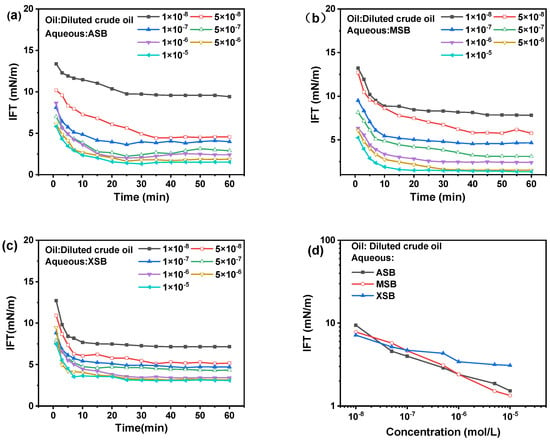
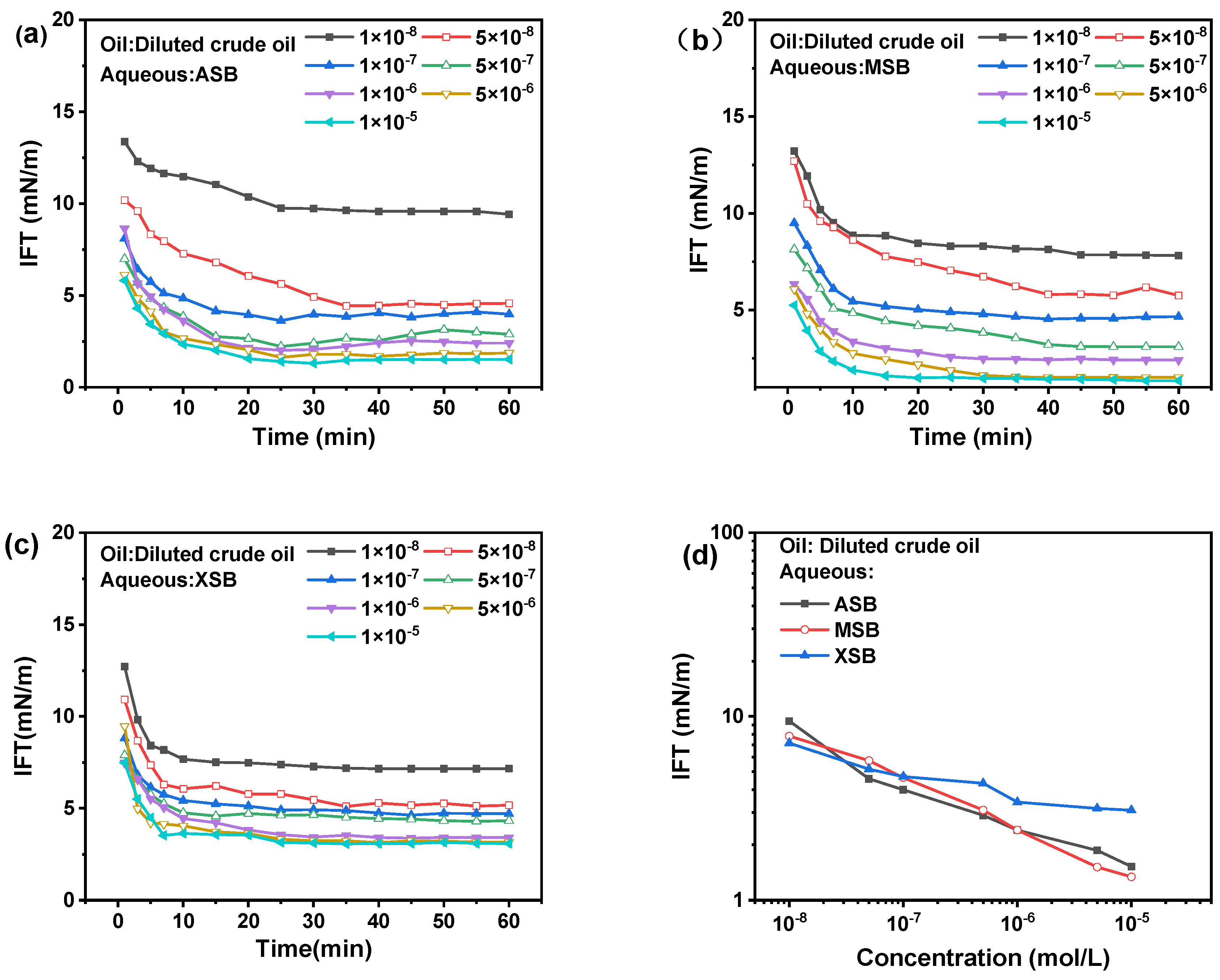
The dynamic and equilibrium IFTs of ASB, MSB, and XSB are shown in Figure 1. As shown in Figure 1a–c, the IFT decreases rapidly during the initial stage and then gradually approaches a plateau with increasing time, eventually reaching an equilibrium value. For the ASB system, a slight increase in IFT is observed after reaching a minimum at intermediate and high concentrations, indicating that the interfacial adsorption layer continues to evolve during interfacial aging. Similar non-monotonic dynamic IFT behavior has also been reported for ASB in model-oil systems containing crude-oil components. Zhou et al. attributed this IFT rise to a reorientation of betaine headgroups at the interface from a relatively upright to a more parallel arrangement with increasing aging time [27].
Figure 1.
Dynamic IFT curves of ASB (a), MSB (b), and XSB (c), and equilibrium IFT as a function of concentration (d).
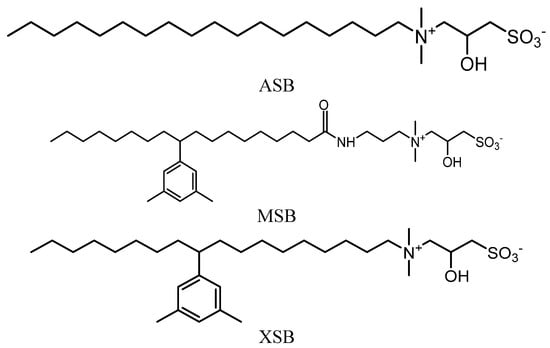
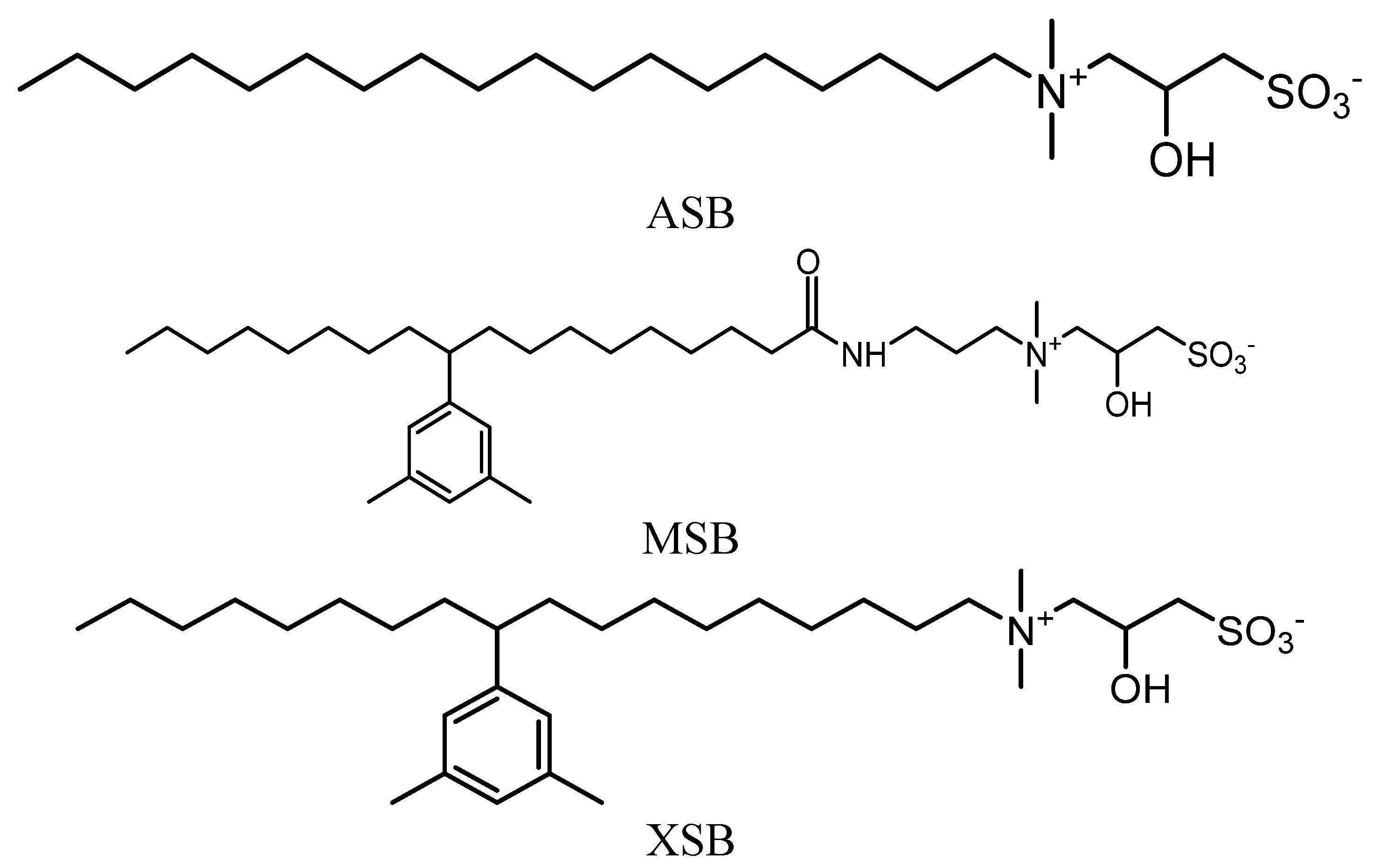
In Figure 1d, the equilibrium IFT for ASB, MSB, and XSB decreases significantly with increasing concentration. For all three betaines, the equilibrium IFT decreases markedly with increasing concentration, confirming their good interfacial activity and capacity to effectively reduce crude oil–water IFT. The equilibrium IFT values of ASB and MSB are comparable, with both achieving a diluted crude oil–water IFT of approximately 1.3 mN/m at a concentration of 1 × 10⁻⁵ mol/L. In contrast, XSB exhibits considerably higher IFT values under the same condition, indicating that the molecular structure of betaines plays a critical role in determining its ability to reduce the crude oil–water IFT. At the oil–water interface, the hydrophilic ionic head of ASB tends to lie flat, resulting in a relatively large hydrophilic group. However, the linear alkyl chain of ASB is comparatively short [27,28]. We propose the following interpretation of the observed IFT behavior. The mismatch in the sizes of the hydrophilic and hydrophobic groups of ASB is expected to create relatively larger vacancies within the adsorbed film, limiting the size compatibility of individual ASB molecules at the interface. Previous studies have shown that crude oil components, particularly acidic species and resins, can co-adsorb with linear betaines at the interface, thereby forming a compact mixed film that effectively lowers the IFT [29,30]. Moreover, the extent of IFT reduction in heavy crude oil–betaine systems is strongly dependent on the size compatibility between betaine molecules and the surface-active components present in the crude oil [31]. In the present study, the crude oil contains relatively large active components (Table 1), which can readily insert into the interfacial vacancies created by ASB molecules, facilitating the formation of a dense mixed adsorption layer. As shown in Scheme 1, the spatial size ratio between the hydrophilic and hydrophobic groups is similar for ASB and MSB. Consequently, MSB molecules are expected to generate interfacial vacancies that are compatible with the size of the crude oil active components, enabling the formation of a tight mixed adsorption film and a comparable IFT reduction. In contrast, the size difference between the hydrophobic and hydrophilic groups of XSB is relatively small, which would be expected to form smaller interfacial vacancies at the oil–water interface. This is expected to hinder the insertion of large active components into the XSB adsorption layer, thereby leading to the highest IFT among the three betaines.
Scheme 1.
Structure and abbreviation of betaine surfactants.
2.2. Dynamic Interfacial Properties
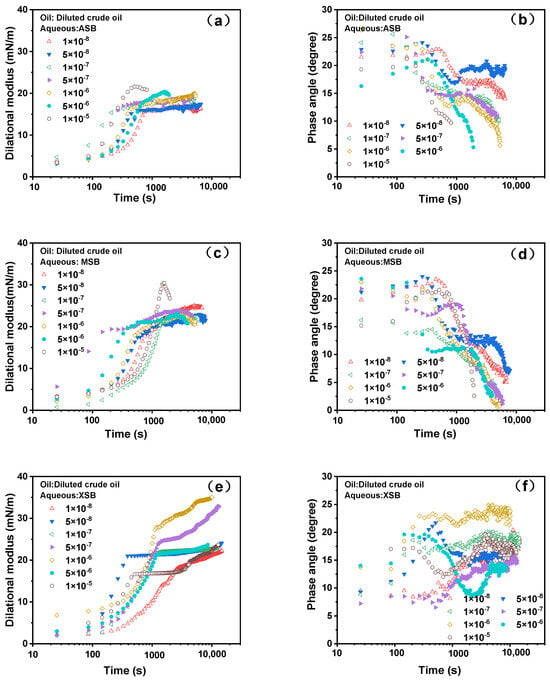
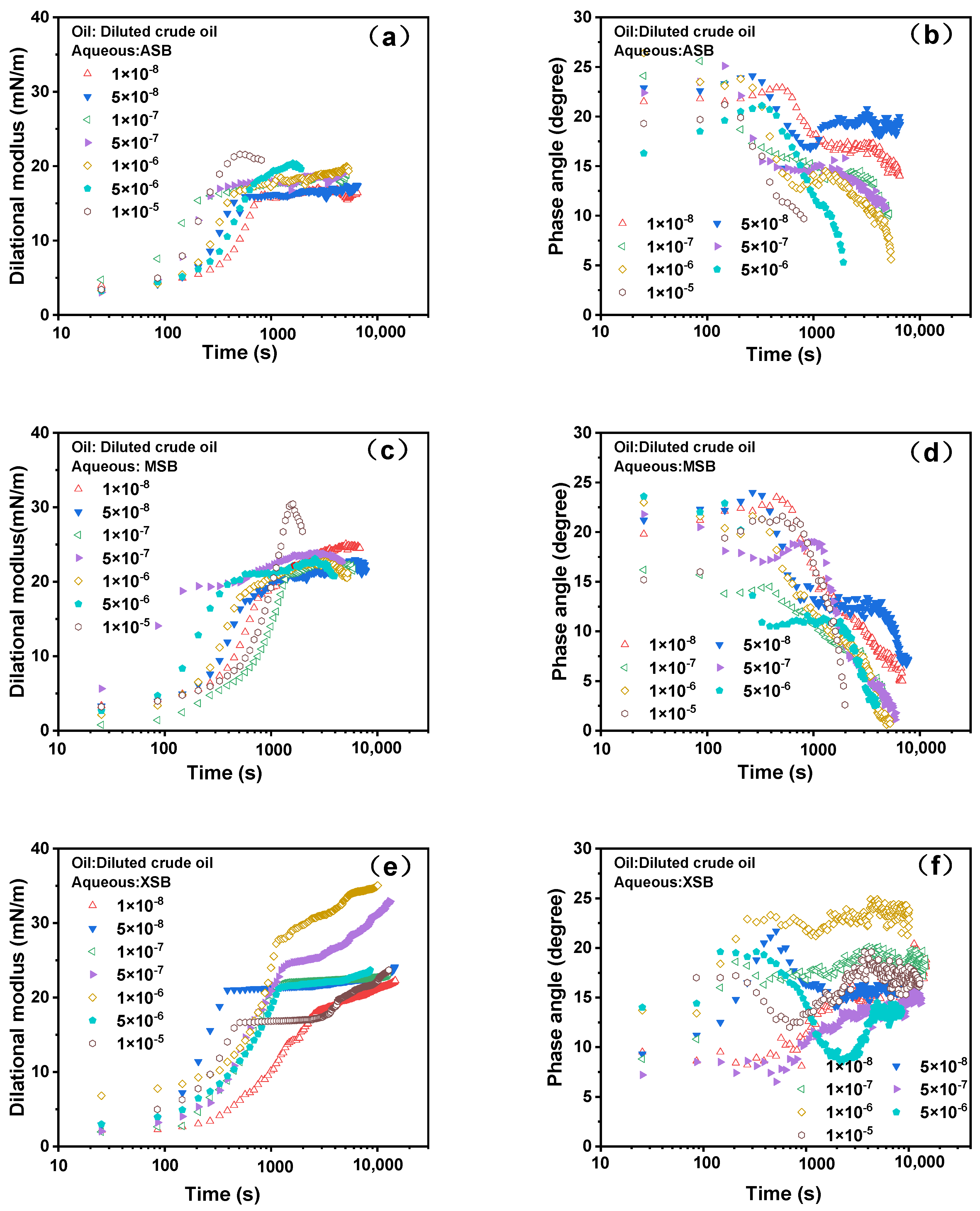
The dynamic dilational modulus curves of ASB, MSB, and XSB at different concentrations are shown in Figure 2a,c,e. At low concentrations, the adsorption of the three betaines on the diluted crude oil–water interface is limited, resulting in relatively low interfacial dilational modulus. As the adsorption time increases, the adsorption of betaine molecules on the diluted crude oil–water interface gradually increases, and the dilational modulus rises significantly.
Figure 2.
Dynamic dilational modulus and phase angle of ASB (a,b), MSB (c,d), and XSB (e,f) as a function of adsorption time.
Figure 2b,d,f show the phase angles of the three betaine solutions at different concentrations over time. The tangent of the phase angle is the ratio of the viscous (imaginary) component to the elastic (real) component of the dilational modulus. Across the entire concentration range investigated, the phase angles of all three betaines remain at relatively low values (≤20°), indicating that the adsorbed films are predominantly elastic in nature. As the adsorption time increases, the phase angle of XSB exhibits negligible variation, whereas those of ASB and MSB show a slight decreasing trend. This behavior can be rationalized by two competing effects. On the one hand, the interfacial adsorption of betaines increases with time, and the elasticity of their interfacial film enhances. On the other hand, the increasing concentration gradient between the bulk solution and the interface accelerates the diffusion exchange of betaine molecules, which contributes to an increase in the viscous component of the film. For XSB, the magnitudes of the viscous and elastic enhancements are comparable, leading to an approximately constant phase angle. For ASB and MSB, however, the elastic modulus increases to a slightly greater extent than the viscous modulus, giving rise to a slight decline in the phase angle with time.
2.3. Effect of Oscillation Frequency on Interfacial Dilational Properties
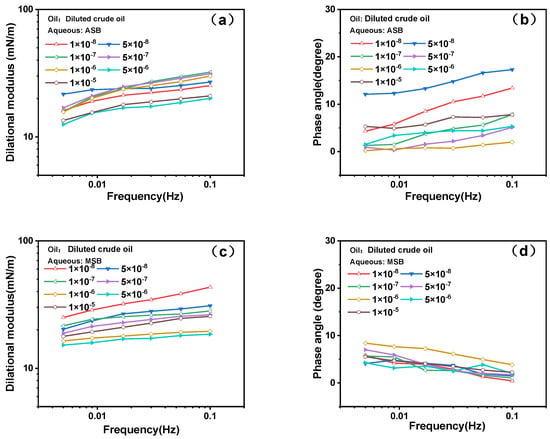
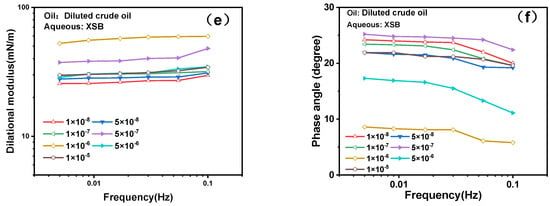
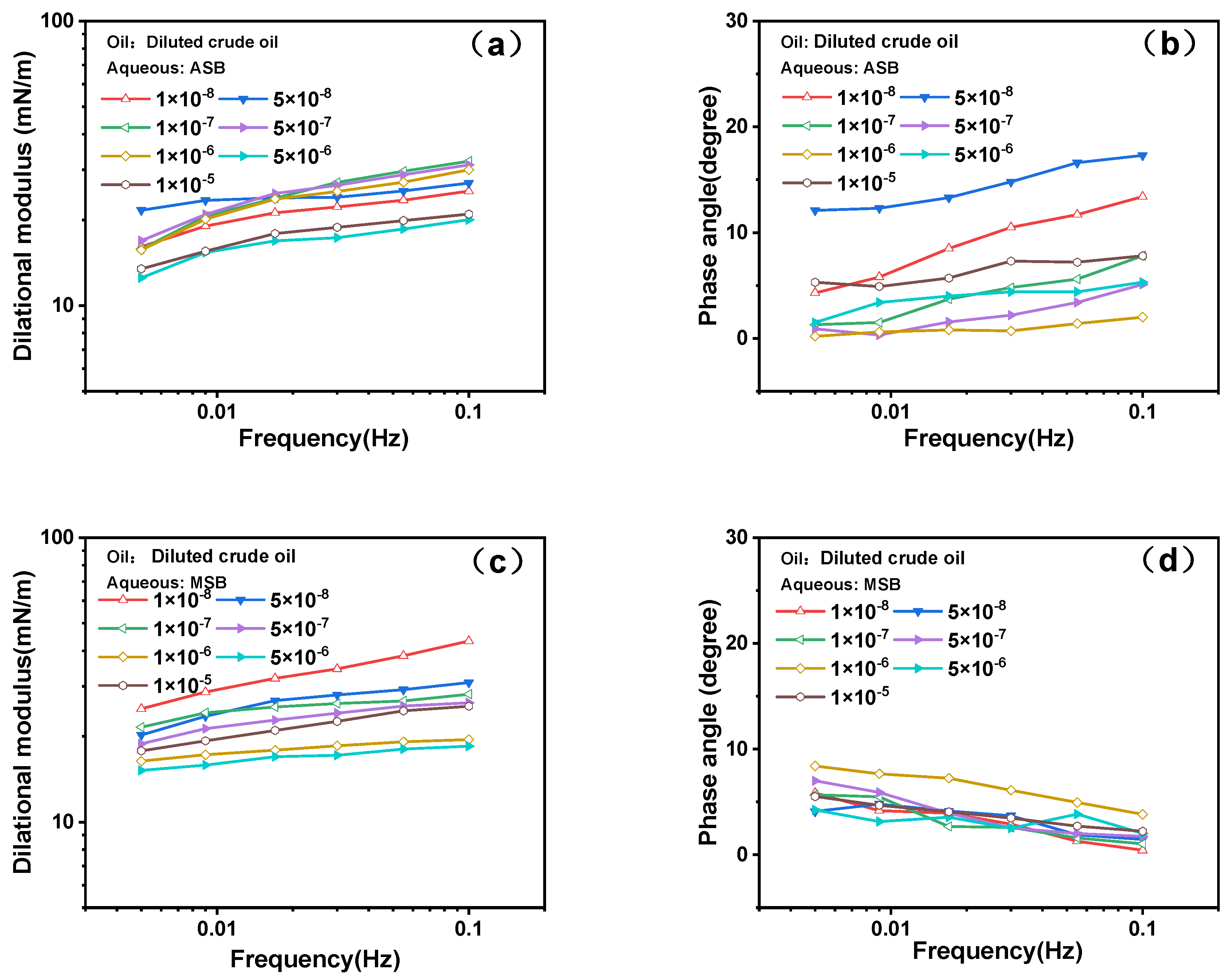
Investigating the effect of oscillation frequency on rheological parameters is a critical method to elucidate the microscopic relaxation dynamics of interfacial films. It can be observed that the interfacial dilational moduli of ASB, MSB, and XSB systems increase slightly with increasing frequency (Figure 3a,c,e). As the frequency increases, various relaxation processes are weakened to varying degrees. This frequency-dependent behavior can be attributed to the differential attenuation of various relaxation processes. Specifically, the diffusion exchange of betaine molecules between the interface and the bulk phase is suppressed at higher frequencies, while intermolecular interactions within the adsorbed film become more pronounced. Consequently, the dilational modulus for all three systems increases.
Figure 3.
Effect of oscillation frequency on the dilational modulus and phase angle of ASB (a,b), MSB (c,d), and XSB (e,f).
Similar to most conventional surfactants, phase angles of MSB and XSB decrease with increasing frequency (Figure 3d,f). An increase in oscillation frequency has a dual influence on the interfacial behavior of betaine molecules. On one hand, rapid perturbations impede the timely occurrence of most relaxation processes, thereby increasing the dilational modulus. On the other hand, high-frequency perturbations hinder the desorption of betaine molecules into the bulk phase, thereby significantly reducing the viscous contribution while concurrently enhancing the elastic component of the interfacial film. Consequently, the phase angles for MSB and XSB decrease with rising frequency. However, the phase angle of ASB increases markedly with increasing frequency in Figure 3b. An increase in phase angle means that the relative contribution of the viscous component in the interfacial film increases with frequency. In other words, the dissipation process in the response of the interfacial film to external perturbation is enhanced. This is inconsistent with the typical behavior of diffusion exchange dominance, in which the phase angle decreases with frequency. This phenomenon suggests that there may be a relaxation process with a relatively high characteristic frequency in the ASB interfacial film that has not been fully suppressed within the experimental frequency window, thereby leading to an increase in phase angle.
2.4. Effect of Concentration on Interfacial Dilational Properties
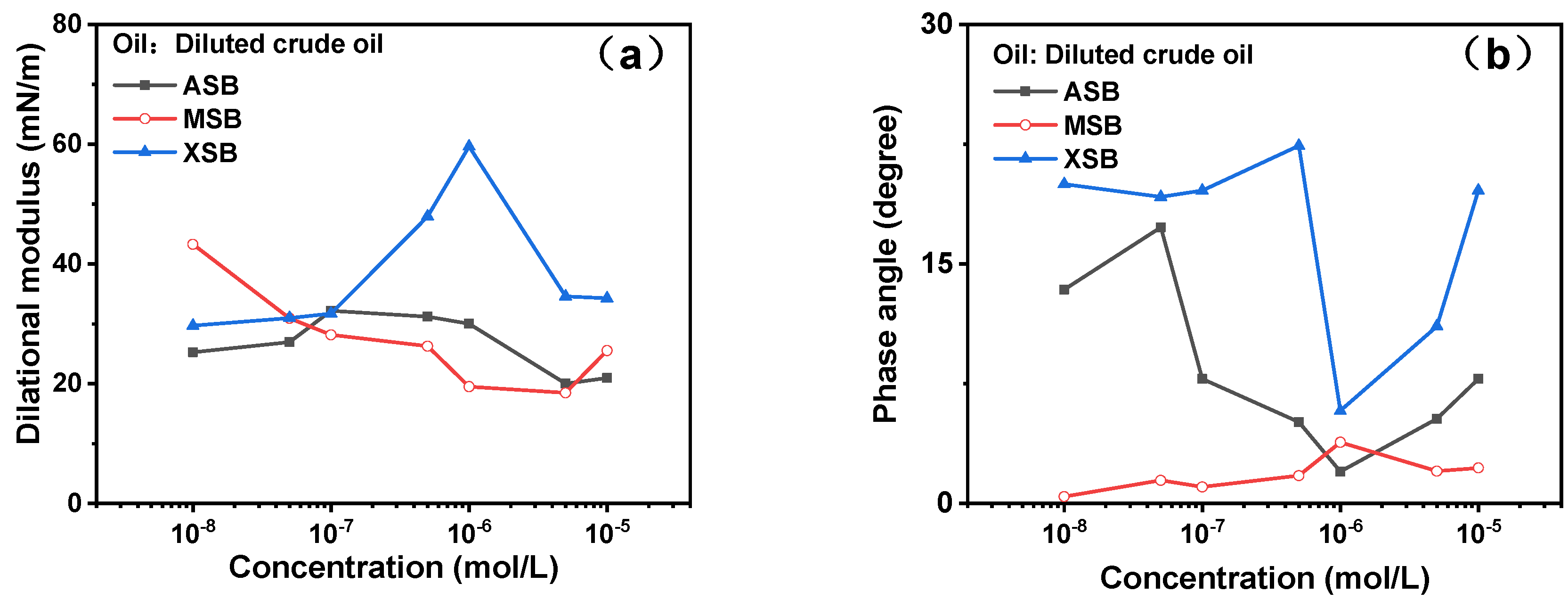
Figure 4 shows the effect of concentration on the dilational modulus and phase angle of ASB, MSB, and XSB at 0.1 Hz. In general, an increase in bulk concentration enhances the interfacial adsorption of surfactant molecules and strengthens intermolecular interactions at the interface, both of which tend to increase the dilational modulus. Conversely, an increase in bulk concentration simultaneously accelerates diffusion exchange, leading to a decrease in the dilational modulus. Therefore, the interfacial dilational modulus first increases and then decreases and simultaneously passes through a maximum value. In Figure 4a, the three betaines exhibit distinctly different concentration-dependent dilational behaviors. The dilational modulus of XSB passes through a sharp maximum as the concentration increases, reaching a value close to 60 mN/m. In contrast, the dilational modulus of ASB varies more moderately with concentration. It shows a slight increase at low concentrations, followed by a gradual decrease, and remains nearly plateaued at higher concentrations. The dilational modulus of MSB generally decreases with increasing concentration, although a minor increase is observed at 1 × 10⁻⁵ mol/L. This difference is closely associated with the involvement of active components in crude oil [32]. In ASB and MSB systems, these active components can insert into the interfacial vacancies and form a mixed adsorption film with betaine molecules. However, the active components inserted into the interfacial film undergo rapid exchange between the interface and the oil phase, which reduces the minimum modulus value. Meanwhile, the existence of active components increases the packing density of the interfacial film, resulting in a gentler variation in the modulus when concentration changes.
Figure 4.
Effect of concentration on the equilibrium dilational modulus (a) and equilibrium phase angle (b) of ASB, MSB, and XSB after 60 min of interfacial adsorption at 0.1 Hz.
As shown in Figure 4b, phase angles further reveal differences in the viscoelastic characteristics among the three interfacial films. Although the phase angles remain relatively low overall, their concentration dependences differ considerably. The phase angle of ASB generally decreases with increasing concentration, indicating an increasing relative contribution of interfacial elasticity. MSB exhibits the lowest phase angle over most of the concentration range, implying that its interfacial response is predominantly elastic. In contrast, XSB possesses the highest phase angle. On account of the relatively compact adsorption film formed by XSB molecules, it is difficult for the large active components of crude oil to insert into the oil–water interface. XSB exhibits more pronounced surfactant characteristics. Notably, the phase angle of XSB decreases markedly near 1 × 10⁻⁶ mol/L, while the dilational modulus reaches its maximum. This combination indicates a stronger resistance to area perturbations and a predominantly elastic interfacial response.
2.5. Effect of Interfacial Pressure on Interfacial Dilational Properties
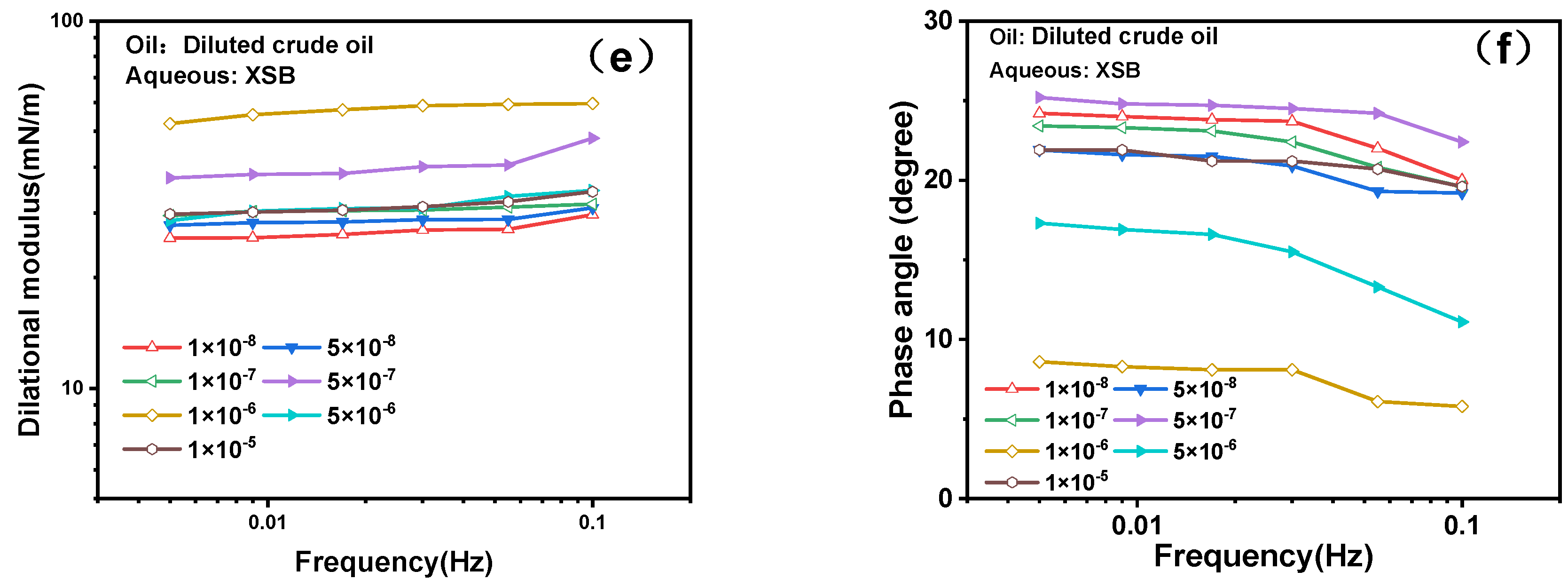
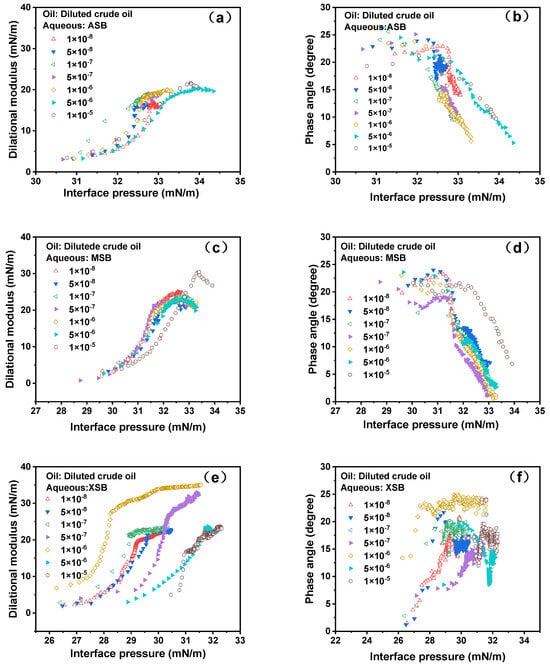
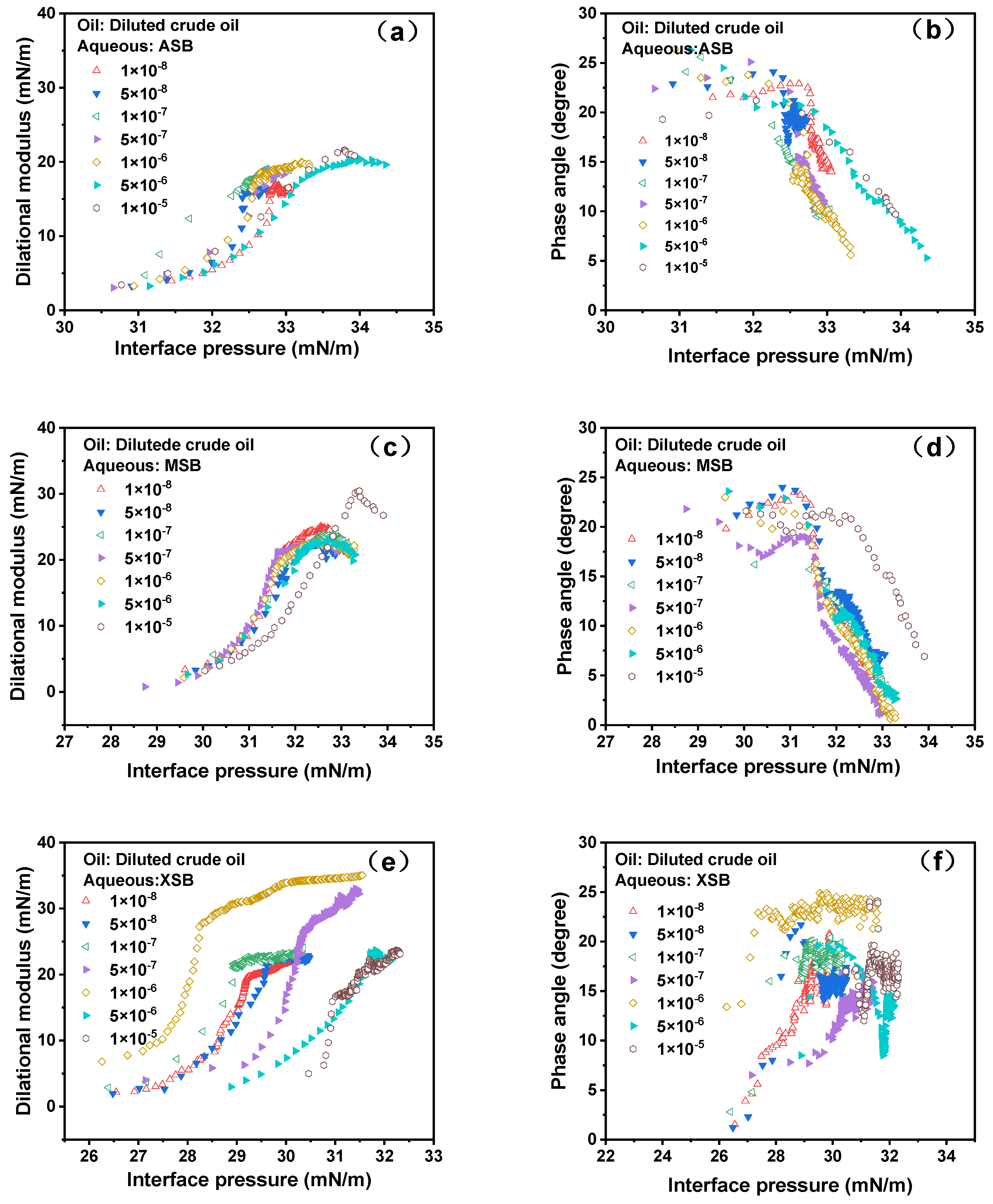
Figure 5 shows the dilational modulus and phase angle of ASB, MSB, and XSB systems as a function of interfacial pressure. The three betaine surfactants exhibit broadly similar trends in their interfacial pressure curves. As the interfacial pressure increases, their dilational modulus increases (Figure 5a,c,e), while their phase angles remain at relatively low values (Figure 5b,d,f). At a given interfacial pressure, the composition and structure of the surfactant interfacial film are unique and independent of the bulk concentration. However, since solutions at different concentrations require different times to reach a certain interfacial pressure, their diffusion exchange rates between the adsorbed molecules and the bulk phase inevitably differ. If the diffusion is the dominant factor determining the viscoelasticity of the interfacial film, the dilational modulus response to interfacial pressure should exhibit concentration dependence. The higher the bulk concentration, the more intense the diffusional exchange at a given interfacial pressure, which consequently results in a lower modulus value. Therefore, when the diffusion process dominates, the modulus–interfacial pressure curves at different concentrations exhibit dispersive characteristics. In Figure 5a,c, the interfacial pressure curves of ASB and MSB at different concentrations almost overlap. For these two systems, the diffusion exchange of surfactants between the interface and the aqueous phase does not play a dominant role. Instead, with the exception of the interfacial film structure itself, the diffusional exchange of active components between the interface and the oil phase becomes the governing process. This accounts for the relatively concentrated convergence of the interfacial pressure curves for ASB and MSB across different concentrations. In contrast, the interfacial pressure curves of XSB at different concentrations are dispersive in Figure 5e. This indicates that the interfacial dilational viscoelasticity of XSB is primarily controlled by diffusion exchange. This observation is consistent with the aforementioned finding that the adsorbed film formed by XSB molecules is more compact and exhibits more pronounced surfactant-like characteristics.
Figure 5.
Effect of interfacial pressure on the dilational modulus and phase angle of ASB (a,b), MSB (c,d), and XSB (e,f).
2.6. Relaxation Process
In relaxation experiments, betaine molecules were first allowed to adsorb at the oil–water interface until an equilibrium state was established. Subsequently, an instantaneous expansion of the droplet area was applied to perturb the system and trigger a transient response in IFT. Once the perturbation ceases, betaine systems relax back to their equilibrium state via molecular conformational adjustments and interfacial reorganization, with the IFT decaying exponentially over time. Following an interfacial area perturbation, the recovery of the interface may involve multiple relaxation mechanisms, including diffusional exchange of surfactant molecules between the bulk phase and the interface, molecular reorientation, and structural rearrangement of the adsorbed layer [33,34,35].
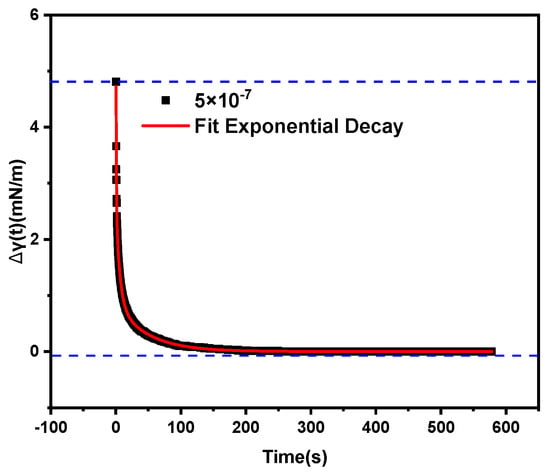
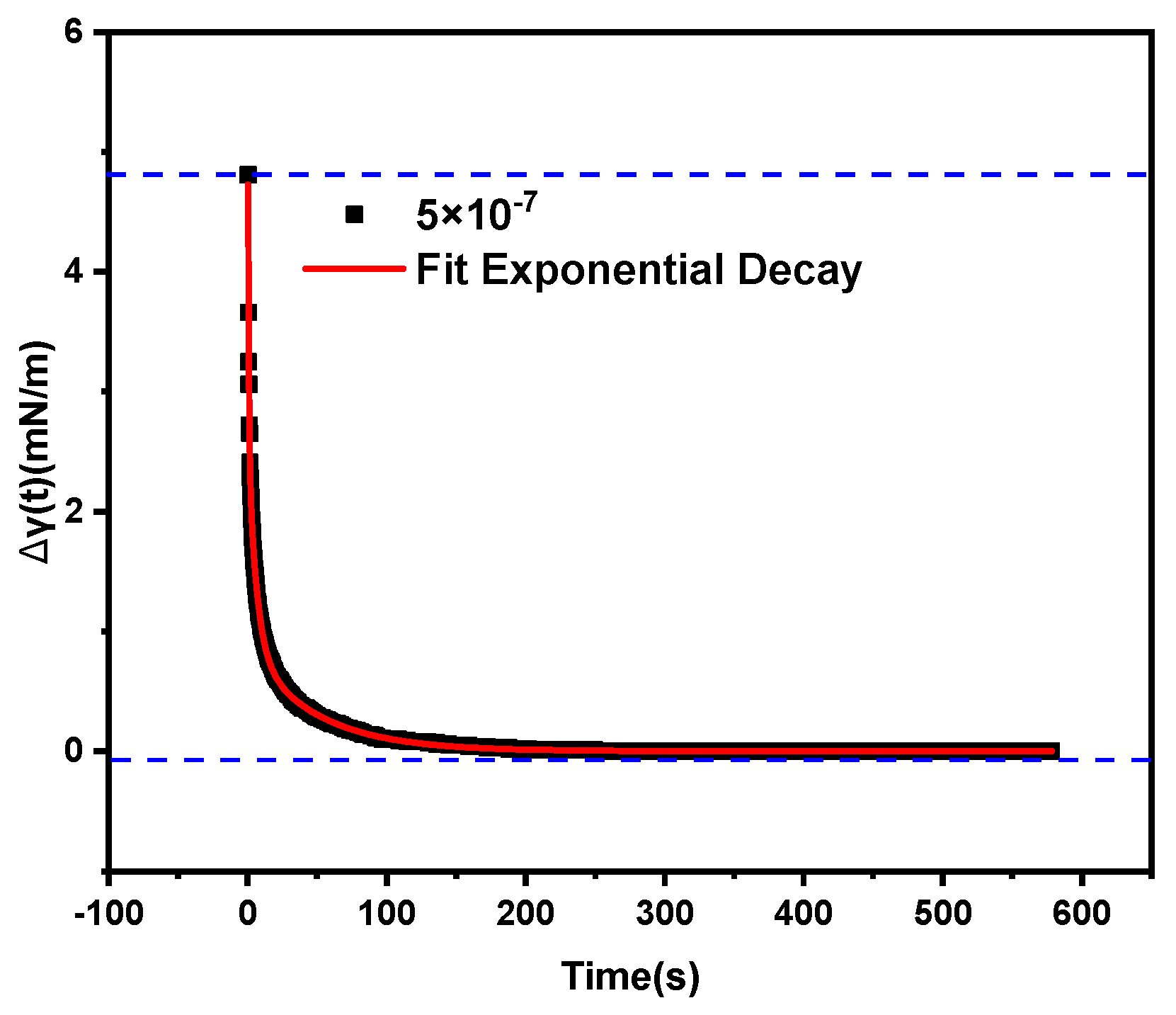
Taking the 5 × 10⁻⁷ mol/L ASB system as an example, its IFT relaxation result is shown in Figure 6. By performing a nonlinear fit on the decay curve using Equation (3) (the red line in Figure 6), the change in the IFT (Δγ) and relaxation time (T) corresponding to the fast, intermediate, and slow relaxation processes can be calculated simultaneously, providing a basis for the quantitative analysis of interfacial relaxation kinetics. It should be emphasized that the three-exponential decomposition is a mathematical treatment and cannot by itself establish a unique molecular mechanism. Therefore, the attribution of the fast, intermediate and slow processes to diffusion exchange, molecular reorientation and structural reorganization of the adsorption layer, respectively, is proposed as a reasonable explanation. The quality of all three-exponential fits was satisfactory, with R2 > 0.99.
Figure 6.
Representative fitting curve for IFT relaxation.
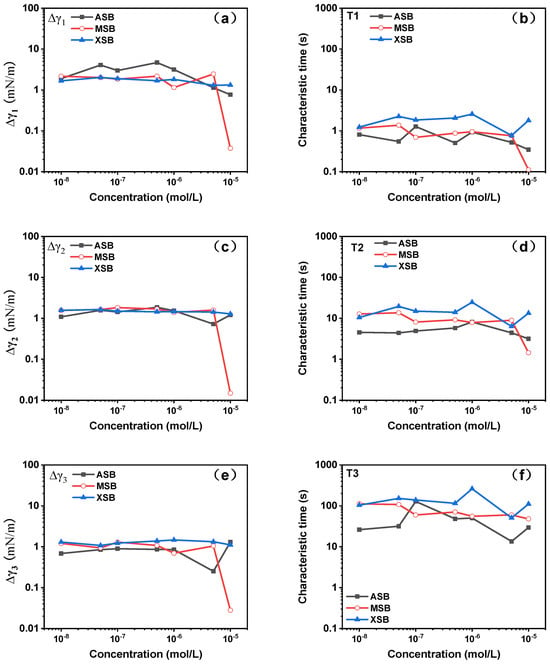
The change in the IFT (Δγ1, Δγ2, Δγ3) and corresponding characteristic time (T1, T2, T3) of the three relaxation processes for ASB, MSB, and XSB systems at different concentrations are shown in Figure 7. The three betaines exhibit significant structure dependence in their fast (diffusion exchange), intermediate (molecular reorientation), and slow (interfacial film structural reorganization) relaxation processes at the oil–water interface.
Figure 7.
Concentration dependence of the IFT change and characteristic time for the fast (a,b), intermediate (c,d) and slow (e,f) relaxation processes of ASB, MSB and XSB at the crude oil–water interface. (a) Δγ1, (c) Δγ2 and (e) Δγ3 are the IFT changes associated with the fast, intermediate and slow processes, respectively; (b) T1, (d) T2 and (f) T3 are the corresponding characteristic relaxation times.
The change in the IFT (Δγ1) and characteristic time (T1) of fast relaxation processes such as diffusion exchange are shown in Figure 7a,b. Fast interfacial relaxation is generally attributed to diffusional exchange between the bulk phase and the interface, together with rapid local molecular adjustment. Diffusional exchange often plays an important role in interfacial relaxation at oil–water interfaces [33]. Compared to MSB and XSB, ASB exhibits a higher Δγ1 and a smaller T1, indicating a shorter characteristic time for its fast relaxation process. The relatively small molecular size and low steric hindrance of ASB may facilitate its rapid exchange between the bulk phase and the interface. As for MSB, its Δγ1 remains relatively stable overall, whereas its T1 decreases markedly at high concentrations. This indicates that the diffusion exchange of MSB is significantly accelerated at high concentrations. Notably, XSB has the highest T1 value, implying the slowest diffusion exchange. Molecular dynamics simulations have demonstrated that steric effects arising from molecular structure can strongly influence the arrangement of betaine molecules at oil–water interfaces [36]. The bulky xylyl-substituted hydrophobic group of XSB may therefore restrict rapid molecular exchange and local adjustment, which likely account for its relatively long fast-relaxation time.
The change in the IFT (Δγ2) and characteristic time (T2) associated with intermediate relaxation processes such as molecular reorientation are shown in Figure 7c,d. It can be seen that the values of Δγ2 for the three betaines do not differ significantly. However, ASB, which possesses the simplest molecular structure, exhibits the smallest T2 and thus the fastest molecular reorientation. Owing to the simple linear alkyl structure of ASB, its reorientational freedom is higher and its characteristic time (T2) is correspondingly the shortest.
In the case of MSB, the presence of a branched chain and the hydrogen-bonding capability introduced by the amide group (-CONH-) render its molecular reorientation more complex, as it requires the breaking and reformation of hydrogen bonds. Consequently, both the energy barrier and characteristic time (T2) of MSB are higher [6]. By comparison, XSB exhibits the highest T2 value among the three surfactants. This may be attributed to the steric hindrance caused by the large and rigid xylyl side chain along with the benzene ring, which together result in the slowest molecular reorientation [36].
The Δγ3 and T3 of slow relaxation processes, such as the structural reorganization of the interfacial film, are shown in Figure 7e,f. It is visible that ASB has the smallest T3 value. This indicates that ASB has a relatively simple interfacial film structure and thus undergoes the fastest structural reorganization. In addition, ASB exhibits a smaller Δγ3, indicating that the contribution of structural reorganization is relatively small. Owing to hydrogen bonding, which prolongs structural reorganization, the T3 value of the MSB system lies between those of ASB and XSB. Notably, XSB exhibits the largest T3, indicating that its structural reorganization proceeds at the slowest rate.
2.7. Emulsifying Performance
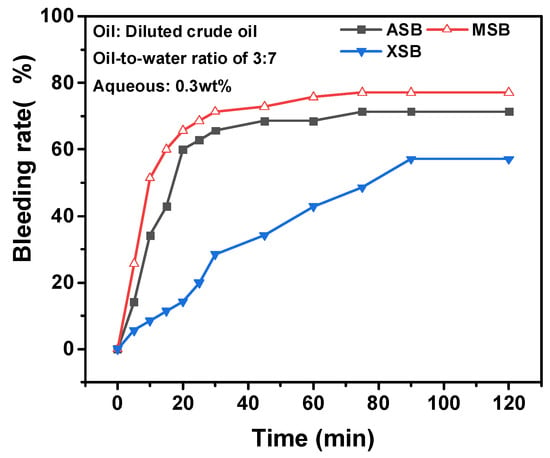
The bleeding rates of emulsions formed by dilute crude oil and different betaine solutions in a 3:7 ratio are shown in Figure 8. In general, a higher bleeding rate and a more rapid increase in bleeding rate suggest poorer emulsion stability, which reflects a weaker ability of the interfacial film to resist droplet coalescence [37]. As shown in Figure 8, the bleeding rates of all three emulsion systems increase with time; however, marked differences are observed in both the rates of increase and the final bleeding rate values. This indicates that the emulsifying stability of the three betaines is determined by a combination of interfacial film structure and relaxation kinetics, rather than by the magnitude of IFT alone. The MSB system exhibits the most rapid increase in bleeding rate, reaching 77.1% at 120 min, which indicates the poorest emulsifying stability. The ASB system shows an intermediate emulsifying stability, with a bleeding rate of 71.4% at 120 min. In contrast, the emulsion formed by XSB is the most stable, as its bleeding rate increases relatively slowly and reaches only 57.1% at 120 min. This trend is fully consistent with the dilational modulus results presented in Figure 4a. Although ASB and MSB possess lower IFT and can form mixed adsorption films with the active components of crude oil, their dilational moduli at higher concentrations (5 × 10⁻⁷ mol/L~1 × 10−5 mol/L) are relatively low (Figure 4a). Consequently, the interfacial dilational viscoelasticity of ASB and MSB is lower, which is unfavorable for the long-term stability of the interface. In contrast, although XSB exhibits a higher IFT, its adsorption film is more compact, and active components of crude oil can hardly insert into the interface. Therefore, the interfacial film of XSB maintains high structural integrity and elasticity. Moreover, the dilational modulus of XSB reaches 60 mN/m at 1 × 10⁻⁶ mol/L, indicating a strong interfacial dilational viscoelasticity. Together with the compact film structure and slow relaxation, this is expected to suppress droplet coalescence and enhance emulsion stability.
Figure 8.
Water separation rate of emulsions formed by dilute crude oil and different betaine solutions (ASB, MSB, and XSB) as a function of time.
It should be noted that a more stable emulsion or a higher dilational modulus does not necessarily lead to higher oil displacement efficiency; excessively rigid films may hinder droplet deformation and migration through pore throats. The balance between ultralow IFT (favored by ASB/MSB) and a compact, elastic film (favored by XSB) implies that the optimal surfactant depends on the dominant displacement mechanism of a given reservoir. Establishing the link between the proposed interfacial mechanism and EOR performance will require core-flooding or micromodel displacement experiments, which are planned as the next step.
2.8. Proposed Interfacial Adsorption Mechanism of the Three Betaines
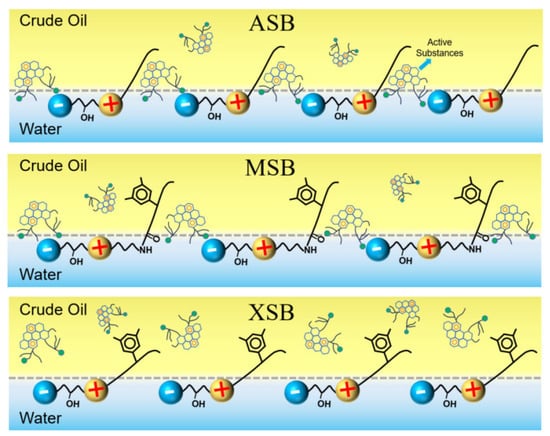
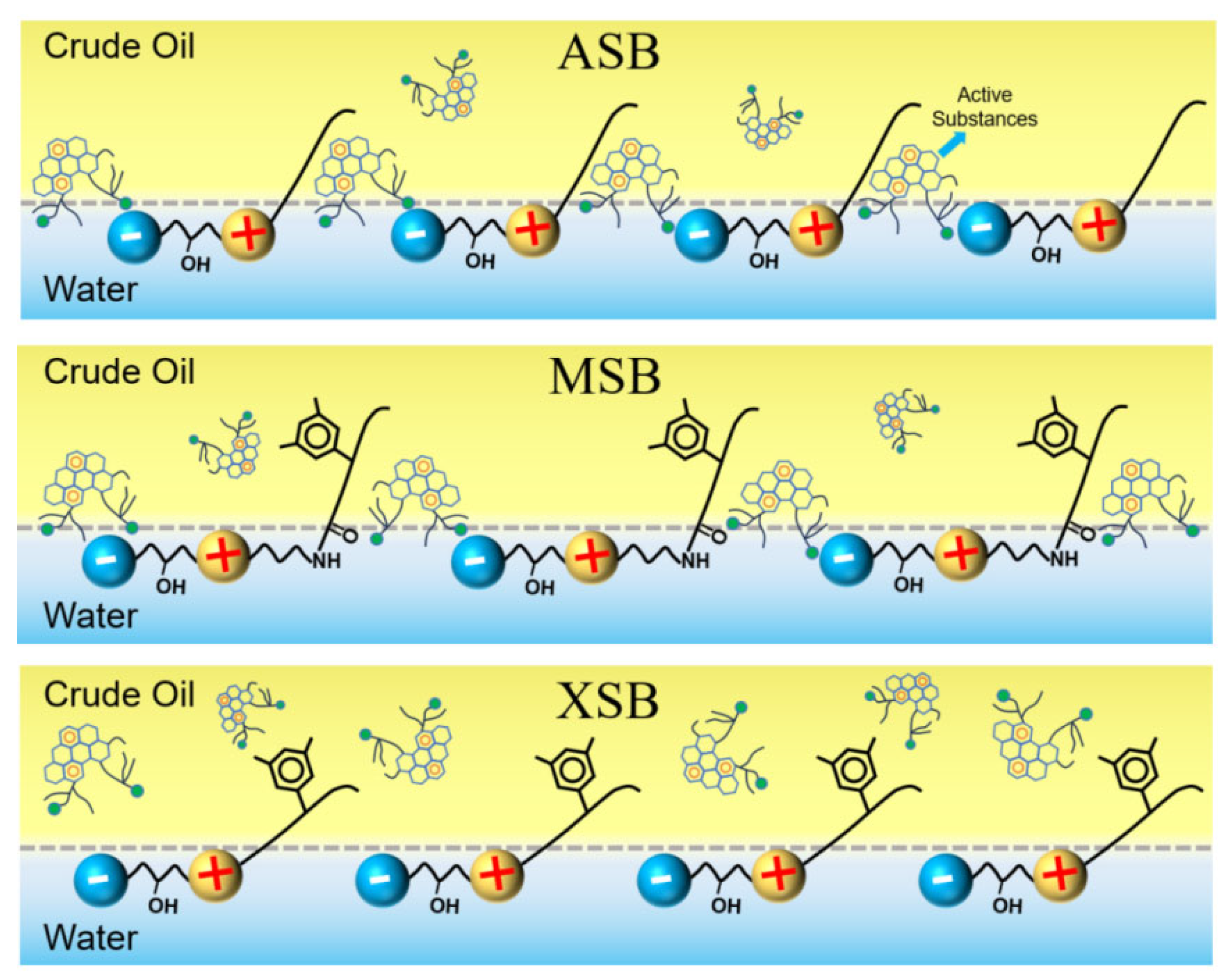
The adsorption behavior of the three betaines at the crude oil–water interface is interpreted in terms of a size-compatibility mechanism for interfacial vacancies. A schematic illustration of the proposed arrangement mechanism for ASB, MSB, and XSB at the crude oil–water interface is shown in Figure 9. The hydrophilic heads of ASB and MSB lie flat at the interface, generating relatively large interfacial vacancies that are precisely matched in size by the large polycyclic active components present in crude oil, such as colloids and asphaltenes [9,27,30,31]. As a consequence, a mixed adsorption film is formed by betaine molecules and these active components, resulting in a significant reduction in IFT. Unlike ASB, however, MSB contains an amide group. Amide functionality can act as both a hydrogen-bond donor and acceptor and has been shown to significantly affect intermolecular association and interfacial behavior of betaine surfactants [6]. Furthermore, because the exchange of active components between the interface and the oil phase is a dominant process, the interfacial pressure curves for ASB and MSB at different concentrations remain closely converged. However, the insertion of active components introduces a relatively rapid diffusion exchange, causing the dilational modulus to level off as concentration changes. In contrast, XSB has a small size disparity between its hydrophobic group and its hydrophilic group. As a result, XSB molecules form an interfacial adsorption layer with small interfacial vacancies, rendering it difficult for large-sized active components in crude oil to insert. Consequently, the interfacial film of XSB is expected to be composed predominantly of XSB molecules, leading to the highest IFT and a pronounced maximum in the dilational modulus, reaching 60 mN/m. Although ASB and MSB can synergistically reduce IFT with active components of crude oil, the interfacial dilational viscoelasticity of these two systems remains relatively low. In comparison, although XSB has a higher IFT, its compact adsorbed layer endows it with the highest dilational modulus and the best emulsifying stability among the three systems. These findings suggest that, in crude oil systems, the emulsifying stability of betaines is governed not merely by IFT, but also by the interfacial film structure and relaxation kinetics. It should be emphasized that this mechanism is proposed as a self-consistent interpretation of the macroscopic interfacial data. Direct molecular-level verification by molecular dynamics simulation is beyond the scope of the present work and is being pursued in our ongoing studies. From a practical chemical-flooding perspective, however, the interfacial vacancy-size mechanism should be combined with reservoir-rock adsorption and retention behavior, because surfactant loss on rock surfaces strongly depends on mineralogy, temperature, salinity, concentration and molecular structure [38,39,40]. Thermodynamic analysis and adsorption-optimization approaches provide complementary criteria for evaluating surfactant performance under reservoir conditions [41,42], and integrating these with the present interfacial screening strategy would help translate the vacancy-size mechanism into rational surfactant selection for chemical flooding.
Figure 9.
Schematic diagram of the proposed arrangement mechanism of ASB, MSB, and XSB at the crude oil–water interface.
3. Experimental Section
3.1. Materials
The four components of crude oil were separated according to the standard SY/T 5119-2016. The separated fractions include saturates, aromatics, resins, and asphaltenes (SARA), with their specific contents presented in Table 1. Kerosene, sodium chloride, sodium sulfate, sodium bicarbonate, calcium chloride, and magnesium chloride hexahydrate were all of analytical grade and purchased from Sinopharm Chemical Reagent Co., Ltd.
Table 1.
SARA composition and total acid value of the crude oil.
The molecular structures of the three alkyl sulfobetaine surfactants (ASB, MSB, and XSB) used in this work are shown in Scheme 1. All surfactants were synthesized in our laboratory, their molecular structures were confirmed by 1H-NMR and MS spectra, and their purities were confirmed to be ≥95% by high-performance liquid chromatography (HPLC). A simulated formation brine was used as the aqueous phase for all experiments, and its ionic composition is provided in Table 2. The crude oil used in this study was a low-sulfur paraffinic base oil sourced from the Qinghai oilfield (China). Its key physicochemical properties were as follows: density, 0.8349 g/cm3; viscosity, 15.1 mPa·s (at 120 °C); sulfur content, 0.19%; freezing point, 34.4 °C; wax content, 15.09%; wax appearance temperature, 56.8 °C; and salinity, 641.8 mg/L. At 25 °C, the crude oil exhibited an apparent viscosity of 2733 cP. However, its viscosity decreased markedly to 15.1 cP upon heating to 120 °C. To facilitate the subsequent interfacial tension (IFT) and emulsification experiments, the crude oil was diluted with kerosene at a mass ratio of 2:1, and the diluted oil sample had a viscosity of 26.4 cP at 25 °C. It should be noted that kerosene dilution lowers the effective concentration of resins and asphaltenes in the oil phase and may alter their aggregation state. Therefore, the absolute IFT and dilational modulus values reported here, as well as the concentration at which the modulus maximum occurs, may differ from those of the undiluted crude oil. The conclusions of this work are based primarily on the relative comparison among the three betaines, which was performed under identical dilution conditions.
Table 2.
Ion composition of simulated formation water.
The simulated formation water listed in Table 2 is the formation water of the crude oil reservoir used in this study, and its ionic composition and total salinity were not changed. It should be noted that the ionic composition of the aqueous phase can significantly affect surfactant adsorption, electrostatic interactions, aggregation and interfacial viscoelasticity. High ionic strength screens the electrostatic interactions between zwitterionic head groups and may promote tighter packing, thereby affecting the dilational modulus. Divalent ions (Ca2+, Mg2+) may bridge carboxyl or sulfonate groups, affecting head group hydration and effective head group size, and may thereby change the vacancy size. Since the three surfactants were compared in the same formation water, their relative ranking is expected to be determined mainly by molecular structure rather than by ionic strength. Salinity was not systematically varied in this study, which is a limitation of this work. We plan to carry out experiments under different salinity conditions in future work to test the generality of the proposed relationships.
3.2. Methods
3.2.1. Ift Measurements
The dynamic IFT between betaine solutions and the diluted crude oil was measured at 25 ± 0.5 °C using the spinning drop method on a CNGTX interfacial tensiometer (Beijing Shengwei Technology Co., Ltd. Beijing, China). Droplet profiles were recorded in real time by a high-speed camera, and IFT values were obtained by fitting the profiles to the Young-Laplace equation. The rotation speed was 5000 r/min. The measurement error for the IFT was less than ±5%.
3.2.2. Interfacial Dilational Rheology Measurements
The interfacial dilational rheological properties were determined using an LSA100OEDM rheometer at 25 °C. After the interfacial tension reached an equilibrium state, a sinusoidal area perturbation (ΔA / A = 10%) was applied, and the tension response was recorded. This amplitude provides a sufficiently detectable interfacial tension response while being small enough not to significantly disturb the interfacial structure. In addition, all three betaine systems remain within the linear viscoelastic regime at 10% amplitude. The dilational modulus ε was calculated by Equation (1), in which ε represents the dilational modulus, γ is the interfacial tension, and A is the interfacial area [43].
For viscoelastic interfaces, relaxation processes may cause a phase angle θ between tension response and area perturbation. The complex modulus ε can be decomposed into elastic modulus (εd) and viscous modulus (ωηd), with θ given by Equation (2). In Equation (2), εd is the elastic component of the dilational modulus, ω is the angular frequency of the sinusoidal area change, and ηd is the dilational viscosity. The frequency range was 0.005~0.1 Hz. The measurement error for the dilational modulus was less than ±2%.
3.2.3. Relaxation Processes
After equilibrium adsorption, an instantaneous area expansion (25% of initial area) was imposed on the droplet, and the tension decay curve was recorded. The curve was fitted with a triple-exponential function (Equation (3)) to resolve three relaxation processes with amplitudes (Δγ1, Δγ2, Δγ3) and time constants (T1, T2, T3) [44].
If the IFT failed to return to its initial value after the relaxation was complete, the residual difference (Δγ∞) was used to calculate the structural modulus (Equation (4)), which serves as a measure of the irreversibility of the interfacial adsorption layer.
3.2.4. Emulsification Performance
The emulsifying performance of the betaine solutions was evaluated using the bottle test method. The betaine concentration used in the emulsification tests was 0.3 wt% for all three surfactants. The diluted crude oil and betaine solutions were mixed at a volume ratio of 3:7 in graduated stoppered test tubes. The emulsions were prepared by manually shaking the stoppered test tubes up and down with uniform force for 100 times at room temperature (25 °C). After shaking, the emulsions were allowed to stand at 25 °C. The percentage of the separated water phase volume at the bottom of the test tube relative to the initial total water phase volume was recorded at regular intervals to characterize the static stability of the emulsions.
4. Conclusions
By investigating the IFT, dilational rheological properties, relaxation processes, and emulsifying performance of three betaines with different structures (ASB, MSB, and XSB) at the crude oil–water interface, the following main conclusions can be drawn:
- (1)
- The hydrophilic groups of ASB and MSB are inferred to lie relatively flat at the interface, which would create relatively large interfacial vacancies. Large active components in crude oil can insert into these vacancies, forming a mixed adsorption film and reducing IFT effectively. However, the interfacial vacancies in the XSB system are inferred to be small. It is difficult for active components to insert into the interfacial film of XSB, resulting in a higher IFT.
- (2)
- The characteristic frequency of ASB is higher than 0.1 Hz, and its interfacial film is primarily governed by fast relaxation processes such as diffusion exchange. The characteristic frequencies of MSB and XSB are lower than 0.005 Hz, and their interfacial films are dominated by slow relaxation processes. XSB exhibits the slowest molecular reorientation and structural reorganization, resulting in the longest structural relaxation time.
- (3)
- The XSB system exhibits a sharp modulus maximum of approximately 60 mN/m, whereas the moduli of the ASB and MSB systems vary more gradually with concentration and do not exhibit sharp maxima. This can be attributed to the rapid exchange between the interface and the oil phase induced by the insertion of the active component.
- (4)
- The interfacial pressure curves for ASB and MSB largely overlap at different concentrations, indicating that their interfacial films are primarily governed by interfacial film structure. In contrast, the interfacial pressure curve for XSB exhibits distinct concentration dependence, suggesting that its interfacial dilational viscoelasticity is primarily controlled by diffusion exchange.
- (5)
- XSB possesses the slowest water bleeding rate and the lowest final water bleeding rate, demonstrating superior emulsification stability. In crude oil systems, emulsification stability depends not only on the IFT but is also significantly influenced by interfacial film structure and relaxation kinetics. Besides the IFT and film structure, interfacial viscosity, film drainage, droplet–droplet interactions and the relaxation kinetics of the adsorbed layer also affect emulsion stability: interfacial viscosity governs the dissipation rate of deformation energy, film drainage controls the thinning and rupture of the film between droplets, the electrostatic and steric repulsion between droplets influences their collision and aggregation, and the relaxation kinetics determines how fast the film recovers after perturbation. These mechanisms act together, and the superior emulsifying stability of the XSB system results from their combined effect.
Overall, the present results are consistent with the view that interfacial vacancy size governs the accessibility of bulky crude-oil components to the betaine adsorption layer and thereby regulates mixed-film formation, interfacial relaxation, and interfacial dilational viscoelasticity. The resulting balance between IFT reduction and dilational viscoelasticity suggests that interfacial vacancy compatibility is a key structure–interface relationship controlling the behavior of betaine surfactants at crude oil–water interfaces. These findings provide a mechanistic basis for the rational selection of betaine surfactants for chemical flooding applications. This interpretation is regarded as a plausible working hypothesis rather than a conclusively established mechanism, and its direct molecular-level verification by molecular dynamics simulation will be addressed in future work.
Author Contributions
Conceptualization, Z.-H.Z. and X.F.; Validation, S.-S.G. and J.Y.; Investigation, X.-L.C. and Q.J.; Writing—original draft, X.-L.C.; Writing—review & editing, Z.-H.Z. and X.F.; Visualization, Y.-B.L.; Supervision, Y.-B.L.; Project administration, B.Z. and Q.Z.; Funding acquisition, B.Z., Q.Z. and Z.-H.Z. All authors have read and agreed to the published version of the manuscript.
Funding
This study is funded by the National Science and Technology Major Project of New Oil and Gas Exploration and Development (No. 2025ZD1406105).
Institutional Review Board Statement
Not applicable.
Informed Consent Statement
Not applicable.
Data Availability Statement
The data presented in this article are available in the main text. Raw data can be reasonably obtained from the corresponding author upon request.
Conflicts of Interest
Shan-Shan Gao and Jing You are employees of Huabei Oilfield Company; Bo Zhang, Qun Zhang, and Zhao-Hui Zhou are employees of PetroChina Research Institute of Petroleum Exploration & Development. The other authors declare no conflicts of interest. Both companies had no role in the design of the study; in the collection, analyses, or interpretation of data; in the writing of the manuscript; or in the decision to publish the results.
Abbreviations
| ASB | Octadecyl dimethyl hydroxy sulfopropyl betaine |
| EOR | Enhanced oil recovery |
| HLB | Hydrophilic–lipophilic balance |
| HPLC | High-performance liquid chromatography |
| IFT | Interfacial tension |
| MD | Molecular dynamics |
| MS | Mass spectrometry |
| MSB | Xylyl-substituted octadecanamide sulfopropyl betaine |
| NMR | Nuclear magnetic resonance |
| SARA | Saturates, aromatics, resins and asphaltenes |
| XSB | Xylyl-substituted octadecyl sulfopropyl betaine |
References
- Yuan, G.W.; Shangguan, Y.N.; Gao, C.N.; Jia, J.H.; Wang, J.H.; Wu, K.; Wang, L.L.; Zhang, Y.Q.; Wang, H.L.; Wu, J.P.; et al. Surfactant/polymer flooding combined with gel and polymer microsphere plugging for enhanced oil recovery in a low-permeability reservoir. ACS Omega 2026, 11, 19356–19368. [Google Scholar] [CrossRef] [Scilit] [PubMed]
- Pang, Q.; Pu, W.F.; Tang, X.X.; Zou, B.Y.; Li, S.Y.; Liu, R.; Pang, S.S. Experimental investigation and simulation of W/O emulsion flow in nanofluid flood for enhanced oil recovery. Geoenergy Sci. Eng. 2024, 239, 212973. [Google Scholar] [CrossRef] [Scilit]
- Podoprigora, D.; Rogachev, M.; Byazrov, R. Surfactant–polymer formulation for chemical flooding in oil reservoirs. Energies 2025, 18, 1814. [Google Scholar] [CrossRef] [Scilit]
- Yang, J.W.; Wu, T.J.; Yang, L.Z.; Zhou, P.C.; Tang, Y.; Huang, H.; Chen, G. One-pot method to prepare betaine surfactant from rapeseed oil and its application for enhanced oil recovery. Fuel 2025, 398, 135560. [Google Scholar] [CrossRef] [Scilit]
- Wang, X.S.; Zhu, Y.W.; Xia, J.; Zhang, L.; Zhang, K.; Shi, C.X.; Wang, R.J.; Wang, L.Y.; Liu, R.M.; Xu, Z.P.; et al. Synergistic effects in betaine based binary surfactant at water/oil interface: Insights from molecular dynamics simulations. AIP Adv. 2025, 15, 065019. [Google Scholar] [CrossRef] [Scilit]
- Butler, C.S.G.; Kelleppan-Meaney, V.T.; Williams, A.P.; Giles, L.W.; Vidallon, M.L.P.; Sokolova, A.; de Campo, L.; Tuck, K.L.; Tabor, R.F. Influence of tail group length, amide functionality and added salt ion identity on the behaviour of betaine surfactants. J. Colloid Interface Sci. 2024, 653, 338–350. [Google Scholar] [CrossRef] [Scilit] [PubMed]
- Park, K.H.; Lim, J.C. Synthesis of phospholipid based zwitterionic surfactant from coconut oil source and characterization of their interfacial, antiseptic and antiviral properties. J. Ind. Eng. Chem. 2022, 115, 241–250. [Google Scholar] [CrossRef] [Scilit]
- Zuo, Q.; Wang, Z.H.; Li, P.; Yang, L.Y.; Song, Z.Z. Studies on the synthesis and application properties of a betaine surfactant with a benzene ring structure. Appl. Sci. 2023, 13, 4378. [Google Scholar] [CrossRef] [Scilit]
- Li, G.Q.; Zhao, J.Y.; Han, L.; Wu, Q.B.; Zhang, Q.; Zhang, B.; Yue, R.S.; Yan, F.; Zhou, Z.H.; Ding, W. The high interfacial activity of betaine surfactants triggered by nonionic surfactant: The vacancy size matching mechanism of hydrophobic groups. Molecules 2025, 30, 2413. [Google Scholar] [CrossRef] [Scilit] [PubMed]
- Wu, H.R.; Tan, R.; Hong, S.P.; Zhou, Q.; Liu, B.Y.; Chang, J.W.; Luan, T.F.; Kang, N.; Hou, J.R. Synergistic anionic/zwitterionic mixed surfactant system with high emulsification efficiency for enhanced oil recovery in low permeability reservoirs. Pet. Sci. 2024, 21, 936–950. [Google Scholar] [CrossRef] [Scilit]
- Wang, J.X.; Yang, J.; Li, G.; Li, J.X.; Li, X.; Zhang, L.; Zhang, L.; Sun, Q. Study on oil-water interface self-assembly and ultra-low tension mechanism of betaine and internal olefin sulfonate mixed system. Colloids Surf. A 2026, 728, 138529. [Google Scholar] [CrossRef] [Scilit]
- Jiang, Q.; Xu, L.P.; Wang, L.L.; Wang, J.Z.; Zhang, L.; Zhang, L. Dilational rheological properties of 2, 5-dialkyl benzene sulfonates at air-water and decane-water interfaces. Colloids Surf. A 2022, 653, 130035. [Google Scholar] [CrossRef] [Scilit]
- Li, H.T.; Cui, C.Z.; Cao, X.L.; Yuan, F.Q.; Xu, Z.C.; Zhang, L.; Zhang, L. The interfacial dilational rheology properties of betaine solutions: Effect of anionic surfactant and polymer. Molecules 2023, 28, 5436. [Google Scholar] [CrossRef] [Scilit] [PubMed]
- Jiang, Q.; Zhu, Y.W.; Liu, Y.; Zhang, L.; Zhang, L. Studies on interfacial interactions between extended surfactant and betaine by dilational rheology. Colloids Surf. A 2025, 710, 136245. [Google Scholar] [CrossRef] [Scilit]
- Sun, Q.; Zhou, Z.-H.; Han, L.; Zou, X.Y.; Li, G.Q.; Zhang, Q.; Zhang, F.; Zhang, L.; Zhang, L. How to regulate the migration ability of emulsions in micro-scale pores: Droplet size or membrane strength? Molecules 2023, 28, 1672. [Google Scholar] [CrossRef] [Scilit] [PubMed]
- Niu, Q.Q.; Dong, Z.X.; Lv, Q.C.; Zhang, F.F.; Shen, H.; Yang, Z.H.; Lin, M.Q.; Zhang, J.; Xiao, K. Role of interfacial and bulk properties of long-chain viscoelastic surfactant in stabilization mechanism of CO2 foam for CCUS. J. CO2 Util. 2022, 66, 102297. [Google Scholar] [CrossRef] [Scilit]
- Zhang, T.C.; Ge, J.J.; Li, L.J.; Wu, H.; Guo, H.B.; Fan, J.W.; Zhang, T. Synergism between betaine surfactants under high-salt conditions. J. Dispers. Sci. Technol. 2024, 45, 39–47. [Google Scholar] [CrossRef] [Scilit]
- Zhang, Q.; Zhan, S.Y.; Zhou, Z.H.; Li, Z.X.; Lu, W.H.; Zhang, L.; Zhu, Y.; Zhang, L. Effect of crude oil fractions on the interfacial tensions of alkali-betaine mixed solutions. J. Pet. Sci. Eng. 2017, 159, 474–482. [Google Scholar] [CrossRef] [Scilit]
- Zhang, Q.; Zhou, Z.H.; Dong, L.F.; Wang, H.Z.; Cai, H.Y.; Zhang, F.; Zhang, L.; Zhang, L.; Zhao, S. Dilational rheological properties of sulphobetaines at the water–decane interface: Effect of hydrophobic group. Colloids Surf. A 2014, 455, 97–103. [Google Scholar] [CrossRef] [Scilit]
- Zhang, X.J.; Zhang, M.Z.; Xu, Z.C.; Gong, Q.T.; Zhang, L.; Zhang, L. Study on oil displacement mechanism of alkyl carboxyl betaine. China Surfactant Deterg. Cosmet. 2024, 54, 123–130. [Google Scholar]
- Lv, W.F.; Zhou, Z.H.; Zhang, Q.; Zhang, X.J.; Zhang, L. Study on the mechanism of surfactant flooding: Effect of betaine structure. Adv. Geo-Energy Res. 2023, 10, 146–158. [Google Scholar] [CrossRef] [Scilit]
- Zhou, Z.H.; Ma, D.S.; Zhang, Q.; Wang, H.Z.; Zhang, L.; Luan, H.X.; Zhu, Y.; Zhang, L. Surface dilational rheology of betaine surfactants: Effect of molecular structures. Colloids Surf. A 2018, 538, 739–747. [Google Scholar] [CrossRef] [Scilit]
- Sun, L.; Chen, D.Q.; Zhang, Y.C.; Sun, X.H.; Pu, W.F.; Wei, B.; Tang, J.Y.; Sun, X.D. Probing high-salinity-enhanced stability of betaine foam for foam application in harsh reservoirs. Fuel 2022, 327, 125144. [Google Scholar] [CrossRef] [Scilit]
- Zhao, J.; Yu, Y.Y.; Wu, K.J.; Liu, Y.Y.; Zhu, Y.M.; Lu, H.F.; Yue, H.R.; Liang, B. Experimental and molecular dynamics study of the effect of betaine surfactant structure on CO2 foam stability. Colloids Surf. A 2025, 709, 136159. [Google Scholar] [CrossRef] [Scilit]
- Shangguan, Y.N.; Liao, X.W.; Wang, L.C.; Guo, Y. Interfacial tension characteristics of alkyl carboxymethyl betaine surfactant dispersed at the crude oil/formation water interface. Processes 2026, 14, 1932. [Google Scholar] [CrossRef] [Scilit]
- Ge, J.J.; Zhang, T.C.; Pan, Y.P.; Zhang, X. The effect of betaine surfactants on the association behavior of associating polymer. Pet. Sci. 2021, 18, 1441–1449. [Google Scholar] [CrossRef] [Scilit]
- Zhou, Z.H.; Zhang, Q.; Liu, Y.; Wang, H.Z.; Cai, H.Y.; Zhang, F.; Tian, M.Z.; Liu, Z.Y.; Zhang, L.; Zhang, L. Effect of fatty acids on interfacial tensions of novel sulfobetaines solutions. Energy Fuels 2014, 28, 1020–1027. [Google Scholar] [CrossRef] [Scilit]
- Ma, G.X.; Gong, Q.T.; Xu, Z.C.; Jin, Z.Q.; Zhang, L.; Ma, G.Y.; Zhang, L. The interfacial dilational rheology of surfactant solutions with low interfacial tension. Molecules 2025, 30, 447. [Google Scholar] [CrossRef] [Scilit] [PubMed]
- Zhou, Z.H.; Zhang, Q.; Liu, Y.; Wang, H.Z.; Cai, H.Y.; Zhang, F.; Tian, M.Z.; Zhang, L.; Zhang, L. Effect of crude oil fractions on interfacial tensions of novel sulfobetaine solutions. J. Dispers. Sci. Technol. 2016, 37, 1178–1185. [Google Scholar] [CrossRef] [Scilit]
- Cao, J.H.; Zhou, Z.H.; Xu, Z.C.; Zhang, Q.; Li, S.H.; Cui, H.B.; Zhang, L.; Zhang, L. Synergism/antagonism between crude oil fractions and novel betaine solutions in reducing interfacial tension. Energy Fuels 2016, 30, 924–932. [Google Scholar] [CrossRef] [Scilit]
- Liu, M.; Xu, Z.C.; Jin, Z.Q.; Li, Z.X.; Zhang, L.; Wang, W.J.; Zhang, L. The mechanism responsible for lowering interfacial tension between heavy crude oil and betaine solutions. J. Dispers. Sci. Technol. 2023, 44, 383–391. [Google Scholar] [CrossRef] [Scilit]
- Zhao, F.J.; Yuan, F.Q.; Pan, B.L.; Xu, Z.C.; Gong, Q.T.; Zhang, L.; Hou, J.; Zhang, L. Dilational rheological properties of surfactants at the crude oil–water interface: The effect of branch-preformed particle gels and polymers. ACS Omega 2022, 7, 24871–24880. [Google Scholar] [CrossRef] [Scilit] [PubMed]
- Sun, Q.; Xu, Z.C.; Gong, Q.T.; Ma, W.J.; Jin, Z.Q.; Zhang, L.; Zhang, L. The study of interfacial adsorption behavior for hydroxyl-substituted alkylbenzene sulfonates by interfacial tension relaxation method. Molecules 2023, 28, 4318. [Google Scholar] [CrossRef] [Scilit] [PubMed]
- Liggieri, L.; Miller, R. Relaxation of surfactants adsorption layers at liquid interfaces. Curr. Opin. Colloid Interface Sci. 2010, 15, 256–263. [Google Scholar] [CrossRef] [Scilit]
- Wang, Y.Y.; Dai, Y.H.; Zhang, L.; Tang, K.; Luo, L.; Gong, Q.T.; Zhao, S.; Li, M.Z.; Wang, E.J.; Yu, J.Y. The interfacial dilational properties of hydrophobically modified associating polyacrylamide studied by the interfacial tension relaxation method at an oil–water interface. J. Colloid Interface Sci. 2004, 280, 76–82. [Google Scholar] [CrossRef] [Scilit] [PubMed]
- Ren, J.; Xiao, H.Y.; Cao, X.L.; Yuan, F.Q.; Pan, B.L.; Ma, B.D.; Zhang, L.; Zhang, L. Molecular dynamics simulation study on interfacial behaviors of betaines and extended surfactants. Colloids Surf. A 2023, 666, 131323. [Google Scholar] [CrossRef] [Scilit]
- Zhang, F.; Zhang, Q.; Zhou, Z.H.; Sun, L.L.; Zhou, Y.W. Study on the effect of different viscosity reducers on viscosity reduction and emulsification with Daqing crude oil. Molecules 2023, 28, 1399. [Google Scholar] [CrossRef] [Scilit] [PubMed]
- Lebouachera, S.E.I.; Chemini, R.; Khodja, M.; Grassl, B.; Tassalit, D.; Drouiche, N. Experimental investigations of SDS adsorption on the Algerian rock reservoir: Chemical enhanced oil recovery case. Res. Chem. Intermed. 2018, 44, 7665–7690. [Google Scholar] [CrossRef] [Scilit]
- Lebouachera, S.E.I.; Chemini, R.; Khodja, M.; Grassl, B.; Ghriga, M.A.; Tassalit, D.; Drouiche, N. Experimental design methodology as a tool to optimize the adsorption of new surfactant on the Algerian rock reservoir: cEOR applications. Eur. Phys. J. Plus 2019, 134, 436. [Google Scholar] [CrossRef] [Scilit]
- Lebouachera, S.E.I.; Balamane-Zizi, O.; Boublia, A.; Ghriga, M.A.; Hasanzadeh, M.; El Hadri, H.; Tassalit, D.; Khodja, M.; Grassl, B.; Drouiche, N. Understanding the factors affecting the adsorption of surface-active agents onto reservoir rock in chemical enhanced oil recovery applications: A comprehensive review. Chem. Afr. 2024, 7, 2283–2306. [Google Scholar] [CrossRef] [Scilit]
- Lebouachera, S.E.I.; Boublia, A.; Hadji, M.E.M.; Ghriga, M.A.; Tassalit, D.; Khodja, M.; Grassl, B.; Drouiche, N. Mini-review on the evaluation of thermodynamic parameters for surfactants adsorption onto rock reservoirs: cEOR applications. Chem. Pap. 2025, 79, 655–666. [Google Scholar] [CrossRef] [Scilit]
- Benramdane, K.I.; Hadji, M.E.M.; Khodja, M.; Drouiche, N.; Grassl, B.; Lebouachera, S.E.I. Surfactants adsorption onto Algerian rock reservoir for enhanced oil recovery applications: Prediction and optimization using design of experiments, artificial neural networks, and genetic algorithm (GA). Colloids Interfaces 2025, 9, 19. [Google Scholar] [CrossRef] [Scilit]
- Jiang, Q.; Li, Z.X.; Sun, P.Y.; Yang, R.Z.; Xu, Z.C.; Zhang, L.; Zhang, L. Interfacial dilational rheology of extended surfactants with short hydrophobic groups: Role of ionic heads and hydrophobic tails. Rheol. Acta 2026, 65, 595–609. [Google Scholar] [CrossRef] [Scilit]
- Yang, Y.; Huang, K.H.; Peng, Y.K.; Xiao, H.Y.; Ma, W.J.; Zhang, L.; Zhang, L. Hydrogen-bond regulation mechanism of the interfacial dilational modulus in sorbitol-alkylamine surfactants and their applications in green foams. Langmuir 2025, 41, 27756–27769. [Google Scholar] [CrossRef] [Scilit] [PubMed]

Disclaimer/Publisher’s Note: The statements, opinions and data contained in all publications are solely those of the individual author(s) and contributor(s) and not of MDPI and/or the editor(s). MDPI and/or the editor(s) disclaim responsibility for any injury to people or property resulting from any ideas, methods, instructions or products referred to in the content. |
© 2026 by the authors. Licensee MDPI, Basel, Switzerland. This article is an open access article distributed under the terms and conditions of the Creative Commons Attribution (CC BY) license.