


Abstract
Hexavalent chromium (Cr(VI)) is a highly toxic environmental pollutant that poses serious risks to ecosystems and human health due to its strong oxidizing properties, carcinogenicity and environmental mobility. Established analytical techniques, such as atomic absorption spectrometry (AAS) and inductively coupled plasma–mass spectrometry (ICP-MS), provide sensitive determination of elemental chromium but require additional speciation procedures for Cr(VI)-specific analysis. Their reliance on specialized instrumentation also limits their application in rapid on-site monitoring. Nanozymes, which are nanomaterials with enzyme-like catalytic activity, have attracted attention as promising materials for colorimetric Cr(VI) detection owing to their ability to regulate chromogenic reactions and produce measurable optical signals. This review examines three representative sensing modes: inhibition-based sensing, inhibitor-mediated signal recovery and Cr(VI)-promoted oxidation. Particular emphasis is placed on the electron-transfer processes and reactive oxygen species (ROS) involved in these reactions. The effects of surface and interfacial engineering, composite and porous structure design, and active-site engineering on catalytic behavior and sensing performance are discussed. Representative nanozyme-based assays are compared in terms of detection performance and validation in real samples, with attention paid to their applications in environmental waters and food-related matrices. Developments in paper-based and smartphone-assisted detection are also reviewed, together with the potential and limitations of health-related applications. Despite advances in analytical sensitivity and portable detection, matrix interference, chromium speciation and assay stability remain important challenges. Further progress in practical Cr(VI) detection will require improved sample preparation, reproducible analytical procedures and validation against established Cr(VI)-specific methods.
1. Introduction
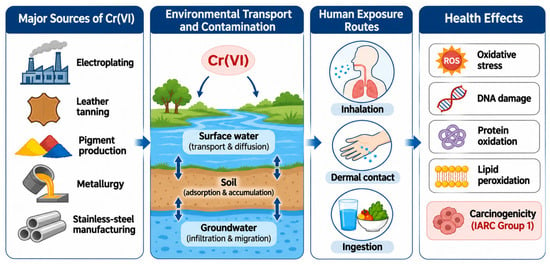
Hexavalent chromium (Cr (VI)) compounds are a family of highly toxic environmental pollutants whose strong oxidizing ability, carcinogenicity and environmental mobility pose a serious threat to ecosystems and human health. The International Agency for Research on Cancer (IARC) has classified Cr (VI) compounds as Group 1 carcinogens [1]. In nature, chromium occurs mainly in the trivalent (Cr (III)) and hexavalent (Cr (VI)) states, and Cr(VI) generally exhibits greater toxicity and mobility than Cr (III) [2]. Cr (VI) can enter the body through inhalation, dermal contact or ingestion. Its intracellular reduction can generate reactive intermediates and oxidative stress, contributing to DNA damage, protein oxidation and lipid peroxidation [3,4]. The mobility and persistence of Cr(VI) in the environment depend on pH, redox conditions and the properties of the surrounding matrix. Typical sources are concentrated in industrial sectors such as electroplating, leather tanning, pigment production, metallurgy and stainless steel manufacturing [5]. Improper disposal of chromium-containing wastewater and industrial residues can contaminate surface water, groundwater and agricultural soils, posing substantial environmental and public health challenges [6,7]. The principal environmental transport and human exposure pathways are summarized in Figure 1.
Figure 1.
Schematic of the chain from Cr(VI) pollution sources and environmental transport to human exposure and health effects. Blue arrows indicate the pathways of Cr(VI) transport and exposure, while double-headed arrows represent potential bidirectional transfer between environmental compartments.
Accurate determination of Cr(VI) is essential for environmental monitoring and pollution control. However, existing analytical methods differ considerably in their operational requirements and suitability for field applications. Laboratory-dependent techniques, including atomic absorption spectrometry (AAS) and inductively coupled plasma–mass spectrometry (ICP-MS), offer high sensitivity for elemental chromium determination. However, these techniques do not inherently distinguish Cr(VI) from Cr(III) and require appropriate speciation procedures for species-specific analysis [8]. Their dependence on specialized instrumentation and trained personnel can also limit their suitability for rapid on-site screening. On the other hand, existing field-usable rapid tools, such as portable kits based on the 1,5-diphenylcarbazide (DPC) spectrophotometric method (corresponding to U.S. EPA Method 7196A), are relatively easy to operate and provide an established approach to Cr (VI) determination. Nevertheless, their analytical performance may be affected by sample coloration, turbidity and coexisting substances [9]. Developing complementary detection methods that combine analytical reliability with simple operation and portable measurement therefore remains an important objective.
Nanozymes are nanomaterials that exhibit enzyme-like catalytic activity and have attracted considerable attention for colorimetric sensing. In 2007, Gao et al. first reported that Fe3O4 nanoparticles possess intrinsic peroxidase-like activity [10]. Earlier work by Scrimin and co-workers introduced the term “nanozyme” in relation to gold-nanoparticle-based catalysis [11], while subsequent studies further developed the concept and applications of enzyme-mimicking nanomaterials [12,13,14,15]. When applied to Cr (VI) detection, nanozymes exhibit useful catalytic properties that can be exploited to generate measurable optical responses. Nanozyme-mediated oxidation of chromogenic substrates, particularly 3,3′,5,5′-tetramethylbenzidine (TMB), provides the basis for several colorimetric sensing strategies. By regulating material composition, surface properties and catalytic sites, the colorimetric response can be modified to improve analytical performance. In addition, visible color changes can be recorded directly or through smartphone-assisted image analysis, offering opportunities for simplified and portable detection [16,17]. However, the analytical advantages of these systems depend on their reaction conditions and sample matrices, and favorable laboratory performance does not necessarily establish reliable field applicability.
Previous reviews have discussed the development of nanozymes for heavy-metal sensing and the broader applications of colorimetric methods for chromium determination [16,17,18,19]. These studies provide useful insights into catalytic materials and sensing strategies. However, nanozyme-based Cr(VI) assays involve different colorimetric response modes and underlying reaction pathways, while their analytical performance is often evaluated under different experimental conditions. In addition, the extent of real-sample validation varies among studies, particularly regarding chromium speciation, matrix interference and comparison with established analytical methods. A focused assessment of these studies would help clarify the relationships among catalytic mechanisms, material design, analytical performance and practical applicability.
A literature search was conducted in Web of Science, Scopus and PubMed using combinations of keywords related to nanozymes, Cr(VI), colorimetric sensing and smartphone-assisted detection, covering publications from 2007 to 2026. A total of 177 records were identified. After removing 79 duplicates, 98 unique publications remained for consideration. As a narrative review, relevant original studies were selected based on their contributions to sensing mechanisms, material design, analytical performance and practical applications. The review discusses 33 directly relevant original studies, including those identified through supplementary searches, of which 18 representative assays are compared in Table 1. This review focuses on three representative colorimetric response modes, including inhibition-based sensing, inhibitor-mediated signal recovery and Cr(VI)-promoted oxidation, together with the effects of material design on catalytic behavior. The analytical performance of representative sensing systems is compared with established detection methods, followed by an evaluation of their applications in environmental monitoring, food-related analysis and portable detection. Health-related applications and the remaining challenges in chromium speciation, assay stability and method validation are also discussed.
2. Catalytic Mechanisms and Material Design of Nanozymes
2.1. Mechanisms of Nanozyme-Based Cr(VI) Colorimetric Sensing
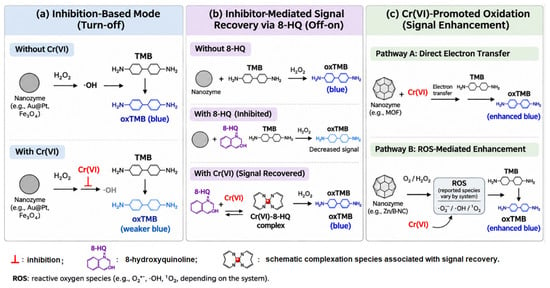
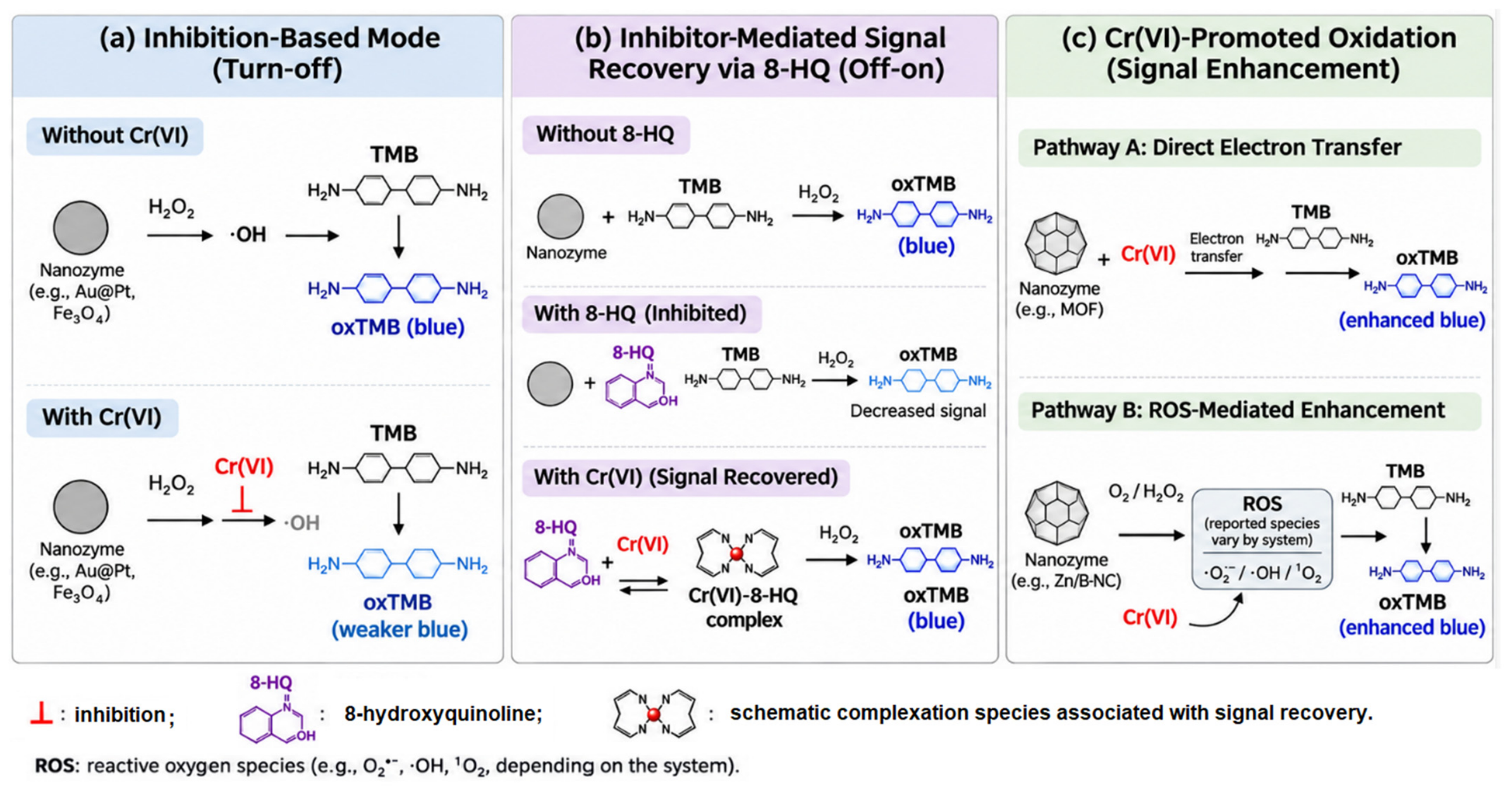
Nanozymes encompass a wide variety of types, including peroxidase mimics, oxidase mimics and superoxide dismutase mimics [18]. Among these, peroxidase-like and oxidase-like activities are particularly relevant to Cr(VI) colorimetric detection because they facilitate the oxidation of chromogenic substrates such as TMB. Depending on the catalytic system, Cr(VI) may suppress the colorimetric response, restore an inhibited reaction or promote substrate oxidation. Accordingly, three representative sensing modes can be distinguished, including inhibition-based sensing, inhibitor-mediated off–on sensing and Cr(VI)-promoted oxidation (Figure 2).
Figure 2.
Schematic illustration of the three representative colorimetric response modes in nanozyme-based Cr(VI) sensing: (a) inhibition-based signal attenuation; (b) 8-HQ-mediated signal recovery; and (c) Cr(VI)-promoted TMB oxidation through direct electron-transfer or ROS-associated pathways.
2.1.1. Inhibition-Based Colorimetric Sensing
Taking the classical Fe3O4 nanozyme as an example, under acidic conditions its peroxidase-like activity catalyzes the decomposition of H2O2 to generate hydroxyl radicals (·OH), which oxidize colorless TMB into blue oxidized TMB (oxTMB) [10]. In inhibition-based sensing, the presence of Cr(VI) decreases the colorimetric response by interfering with the catalytic reaction or the formation of the colored product. However, the effect of Cr(VI) depends on the nanozyme composition and reaction conditions, and inhibition cannot be assumed for all peroxidase-like nanozymes.
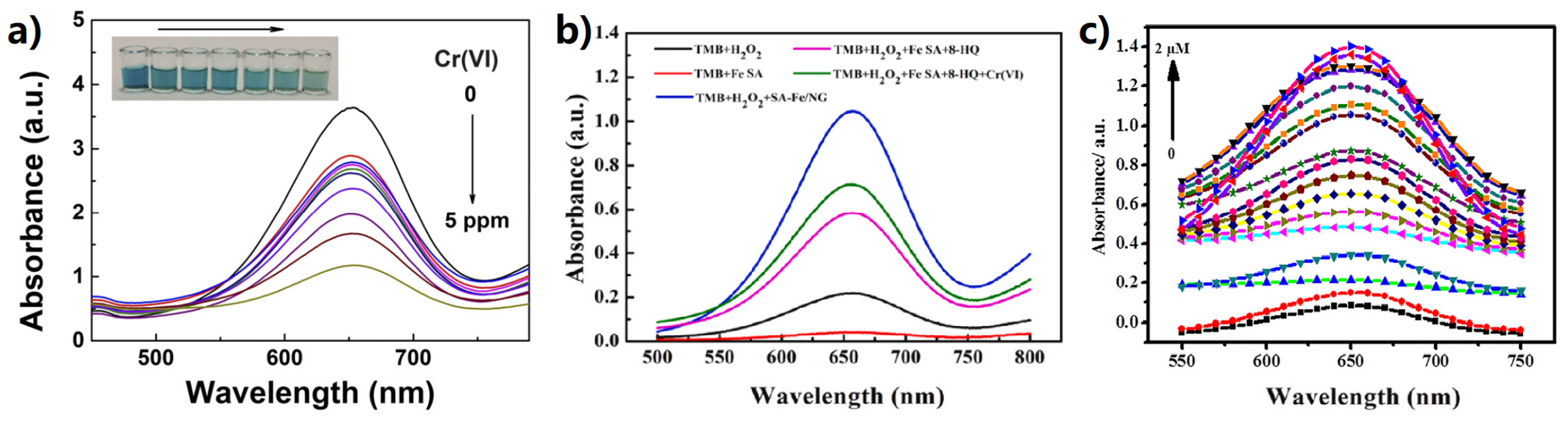
Zhou et al. reported a signal-decrease assay based on Au@Pt core–shell nanozymes [20]. In the presence of H2O2, Au@Pt promotes TMB oxidation to a blue product with an absorption band near 652 nm; electron spin resonance measurements also indicated OH formation during the catalytic reaction. Subsequent addition of Cr(VI) caused a concentration-dependent decline in absorbance. Changes in surface zeta potential suggested competitive adsorption of Cr(VI) and H2O2 on Au@Pt, while conversion of colored oxTMB to colorless TMB was proposed as an additional contribution to the fading response. The relative importance of these processes remains uncertain, illustrating that signal attenuation may involve both modulation of nanozyme catalysis and changes in the colored reaction product.
2.1.2. Inhibitor-Mediated off–on Sensing
In inhibitor-mediated off–on assays, the initial nanozyme-catalyzed TMB color reaction is attenuated by an added reductant or inhibitor, and Cr(VI) subsequently restores the blue signal. For 8-hydroxyquinoline (8-HQ)-based systems, the attenuation of the blue signal has been attributed to the reducing action of 8-HQ on oxidized TMB, while preferential interactions between Cr(VI) and 8-HQ have been proposed to account for signal recovery [21,22]. Comparable responses have been reported for Cu-curcumin and PTh-CuCe nanozymes [23,24]. Because 8-HQ can bind different metal species and participate in redox processes, the observed Cr(VI) selectivity arises from the combined reaction conditions rather than an inherently exclusive coordination reaction. Thus, off–on behavior is a common analytical response, although the underlying chemical interactions may vary across platforms.
For example, Nghia et al. achieved colorimetric detection of Cr(VI) by exploiting the peroxidase-like activity of graphene oxide nanoparticles with 8-HQ as the inhibitor [25]. Mao et al. anchored single Fe atoms on nitrogen-doped graphene (SA-Fe/NG) and employed an 8-HQ-mediated strategy for Cr(VI) detection, achieving a reported limits of detection (LOD) of 0.156 µg/L [21]. Chai et al. developed a Cu-curcumin nanozyme that exhibited a similar off–on response [23], while Fe–N–C single-atom nanozymes were subsequently incorporated into paper-based devices using the same sensing strategy [22]. These studies demonstrate that 8-HQ-mediated inhibition and signal recovery can be applied to nanozymes with different compositions and structures. Other inhibitory compounds have also been investigated. Xu et al. developed a glutathione (GSH)-mediated assay based on C@Fc(COO)2Cu nanozymes [26], while Jie et al. employed Na2SO3 to regulate TMB oxidation using hollow Co,N co-doped porous carbon (H-Co,NPC) nanozymes [27]. In both systems, Cr(VI) reduced the inhibitory effect and restored the colorimetric signal. Nevertheless, the chemical reactions involving 8-HQ, GSH and Na2SO3 differ, indicating that similar off–on responses can arise through different reaction pathways. Recent studies have further extended 8-HQ-mediated signal recovery to GO/AuNP and AuNPs/Fe-NC nanozyme systems, in which the Cr(VI) response is generated by recovery of the TMB colorimetric signal after 8-HQ-mediated suppression [28,29]. A PtNPs/Ti3C2TxNR nanozyme has also been reported using a competitive Cr(VI)/8-HQ interaction to regulate the oxTMB response, extending this signal-recovery strategy to another highly sensitive Cr(VI) platform [30].
2.1.3. Cr(VI)-Promoted Oxidation and Signal Enhancement
Exploiting the strong oxidizing nature of Cr(VI), some nanozymes (e.g., CeO2 and MOF derivatives) facilitate TMB oxidation through direct electron transfer or reactions involving ROS. These processes enhance the colorimetric response, allowing Cr(VI) determination through an increase in absorbance. For example, the nanoceria-templated MOF composite (CeO2NRs-MOF) reported by Wang et al. displays oxidase-like activity that is significantly boosted by Cr(VI) without requiring H2O2 [31]. Guo et al. developed fungus-like porous CoS nanozymes that used Cr(VI) as the oxidant to promote TMB oxidation [32].
For H2O2-independent Cr(VI) assays, the oxidizing capacity of Cr(VI) can be coupled directly to nanozyme-mediated TMB oxidation. Shi et al. found that Cu centers in MOF-199 contribute to the Cr(VI)-activated oxidoreductase-like response [33]. In Au NPs@NC@MnO2, the appearance of Cr(III) and concurrent shifts in Au and Mn oxidation states after reaction are consistent with electron transfer involving the composite and Cr(VI) [34]. Chloride-modified two-dimensional MOFs provide another example: deoxygenation caused little change in the chromogenic response, indicating that dissolved O2 was not a major participant under those conditions [35]. Together, these studies highlight the roles of metal centers, interfacial charge transport and the Cr(VI)/Cr(III) redox couple in direct-oxidation sensing. More recently, atomically dispersed CuCo-NC was reported to enable H2O2-free Cr(VI) sensing through a direct electron-accepting pathway, with Cr(VI) promoting TMB oxidation without detectable ROS intermediates [36]. Related studies have used distinct catalytic designs: CoFe2O4/H2PPOP exploited enhanced multi-enzyme activities and intercomponent electron transfer for Cr(VI) colorimetry, whereas redox-active Bi-MOF and Cu@Fe3O4@MOF-199 systems further illustrate surface electron-transfer or analyte-dependent catalytic regulation [37,38,39]. AnH2O2-independent SU-101 Bi-MOF assay further illustrates this route: Cr(VI)-coupled TMB oxidation was attributed to surface-mediated electron transfer, supported by radical-scavenging experiments, active-site inhibition and theoretical calculations [38].
Reactive oxygen species provide a distinct route to color formation in peroxide-dependent and oxygen-activation systems. In Fe3O4@PDA/PB composites, fluorescence probing supported OH production during catalytic oxidation, and the Cr(VI)-enhanced response was measured under a different pH condition from that used for characterizing maximal intrinsic activity [40]. Radical-scavenging experiments and EPR measurements supported the involvement of O2•− in TMB oxidation catalyzed by Zn/B-NC and Cu-curcumin nanozymes [23,41]. For H-Co,NPC, both ·OH and O2•− were implicated in TMB oxidation, whereas analytical Cr(VI) detection also depended on Na2SO3-mediated suppression and restoration of the optical signal [27]. These examples show that ROS generation controls the chromogenic background in some systems, while analyte-dependent signal modulation can involve an additional chemical step.
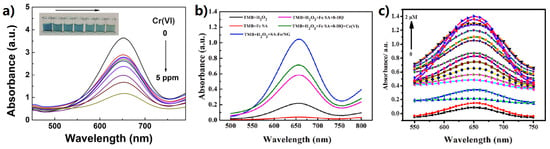
The colorimetric response is influenced by solution pH, which affects both nanozyme activity and chromium speciation. The distribution of HCrO4−, CrO42− and Cr2O72− depends on pH and chromium concentration. Although many reported assays operate under acidic conditions, the optimal pH varies among catalytic systems. For example, Fe3O4@PDA/PB exhibited its highest intrinsic peroxidase-like activity at pH 4.0, whereas Cr(VI) detection was performed at pH 7.0 [40]. Therefore, the conditions used to characterize nanozyme activity should be distinguished from those optimized for analytical detection. Representative experimental responses corresponding to the three sensing modes are compared in Figure 3.
Figure 3.
Representative experimental responses of nanozyme-based Cr(VI) colorimetric assays. (a) Signal attenuation in the Au@Pt system [20]; (b) 8-HQ-mediated signal suppression and Cr(VI)-induced recovery using SA-Fe/NG [21]; and (c) Cr(VI)-dependent signal enhancement with Au NPs@NC@MnO2 [34]. Reproduced from the cited studies with permission, where required.
2.2. Material Design Strategies for Cr(VI) Colorimetric Sensing
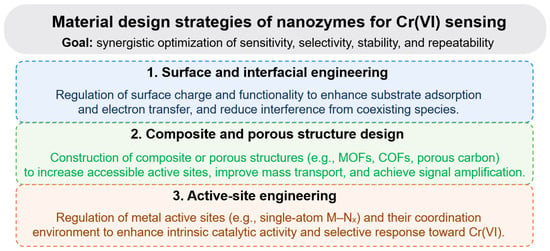
To improve the selectivity, sensitivity and environmental adaptability of detection, researchers have carried out deliberate functional design and structural regulation of nanozyme materials (Figure 4). These strategies primarily involve surface and interfacial engineering, composite and porous structure design and active-site engineering. By regulating substrate interactions, charge transfer and catalytic site accessibility, material design can influence the performance of nanozyme-based Cr(VI) sensing systems.
Figure 4.
Schematic illustration of material design strategies for nanozyme-based Cr(VI) colorimetric sensing.
2.2.1. Surface and Interfacial Engineering
Surface and interfacial engineering provides an approach to improving nanozyme catalytic performance by regulating substrate adsorption and charge-transfer behavior. Li et al. developed a chloride-mediated strategy for two-dimensional Cu-based metal-organic framework nanozymes (2DMOFs-Cl) [35]. Coordination of Cl− with surface Cu sites produced a more negatively charged interface and enhanced TMB adsorption. The apparent Michaelis–Menten constant (Km) for TMB decreased from 14.5 to 0.94 mM following modification. Density functional theory calculations further supported stronger interactions between TMB and the modified surface. The resulting nanozyme showed faster catalytic activity and was applied to Cr(VI) detection in water and food-related samples.
Li et al. also investigated conducting polymer-functionalized copper-doped cerium oxysulfate nanozymes (CuCe) prepared through in situ surface polymerization [24]. Among the resulting composites, polythiophene-functionalized CuCe (PTh-CuCe) exhibited approximately 1.68-fold higher oxidase-like activity than unmodified CuCe. Band structure analysis and photocurrent measurements indicated that improved charge separation contributed to the enhanced catalytic performance. PTh-CuCe was subsequently used for 8-hydroxyquinoline-mediated Cr(VI) colorimetric sensing. These studies illustrate how interfacial engineering can improve catalytic activity through enhanced substrate affinity and more efficient charge transfer.
2.2.2. Composite and Porous Structure Design
Composite construction can improve the dispersion and accessibility of catalytic components while providing opportunities to regulate substrate transport. Encapsulating or loading nanozymes within metal–organic frameworks (MOFs) and porous carbon materials can facilitate the formation of accessible catalytic sites. For example, the Cu-based MOF (MOF-199) nanoparticles reported by Shi et al. possess Cr(VI)-activated oxidoreductase-like activity and can directly oxidize TMB for chromogenic detection [33]. Kulandaivel et al. developed a Cu-pyrazolecarboxylic acid MOF (Cu-PyC) that enables H2O2-free colorimetric detection of Cr(VI) on paper-based substrates [42]. Fe-quercetin nanoparticles encapsulated in ZIF-67 (Fe-QueNPs@ZIF-67) exhibited different colorimetric responses to Cr(III) and Cr(VI), with Cr(III) suppressing and Cr(VI) promoting TMB oxidation [43]. Hollow Co,N co-doped porous carbon (H-Co,NPC) nanozymes derived from ZIF-8@ZIF-67 provide another example of structural regulation [27]. Their hollow architecture facilitates mass transport and improves the accessibility of catalytic sites. These studies demonstrate that framework composition and porous structure can influence catalytic behavior, although the resulting analytical performance depends on the sensing conditions.
2.2.3. Active-Site Engineering
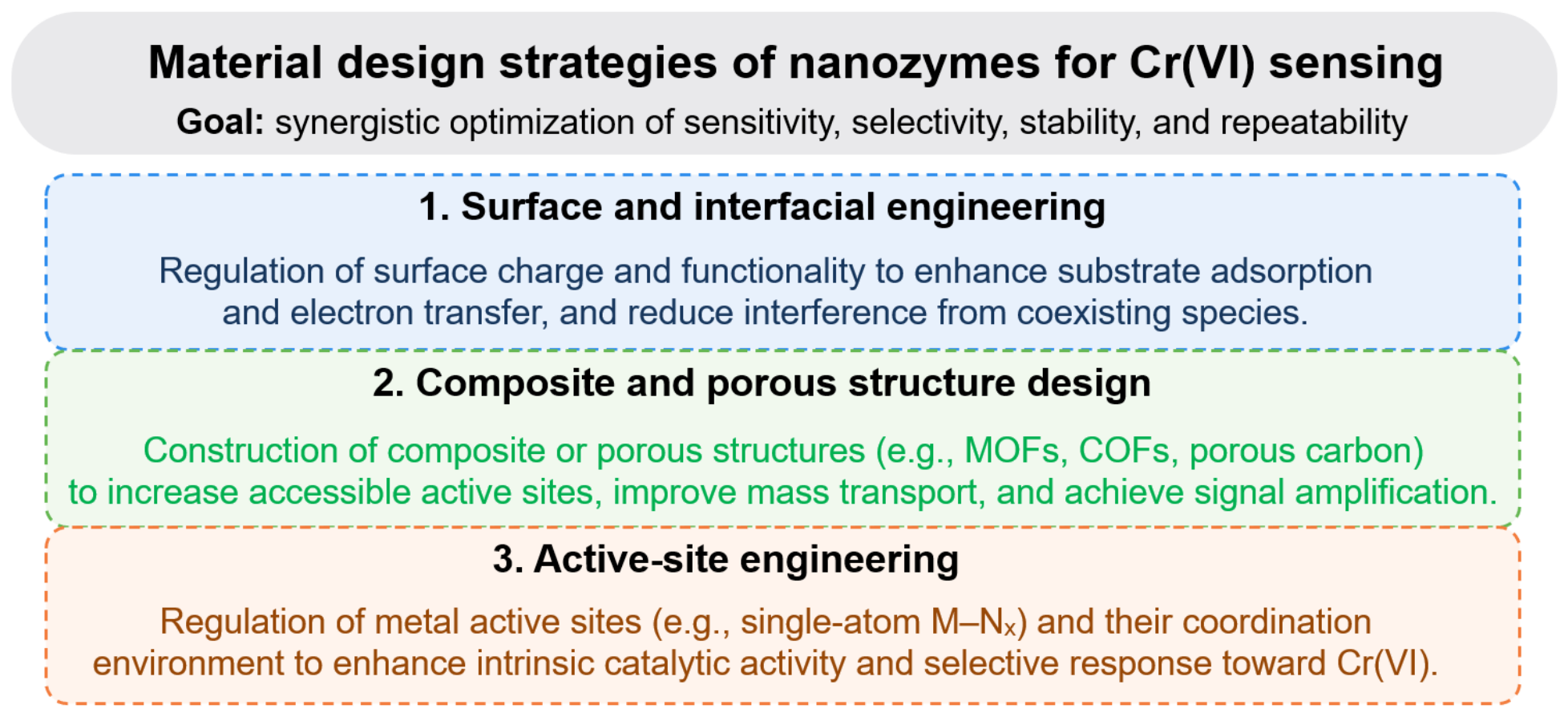
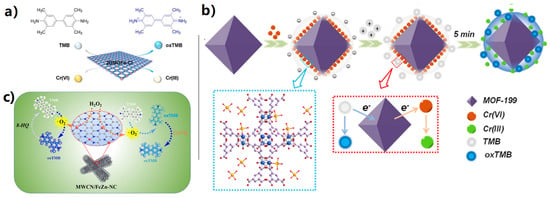
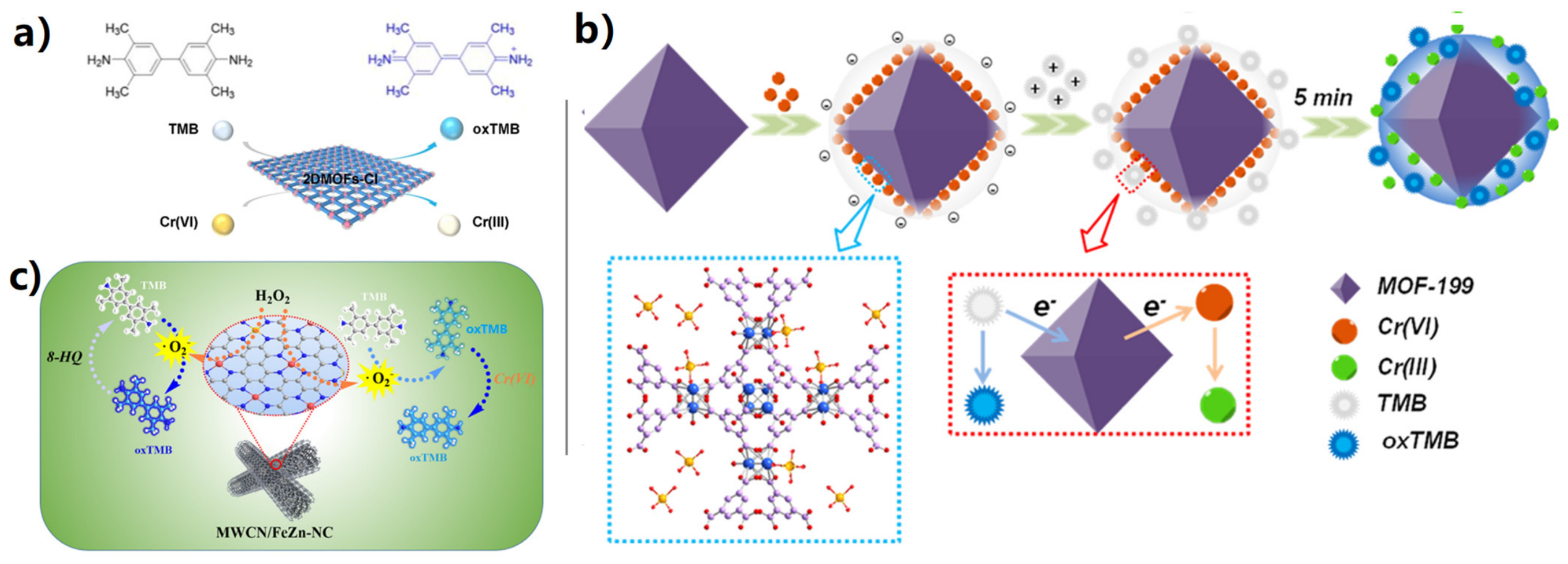
Anchoring isolated metal atoms on nitrogen-doped carbon supports can improve metal atom utilization and regulate the coordination environment of catalytic sites. Changes in the electronic structure and accessibility of metal centers can influence substrate interactions and catalytic activity. For example, Mao et al. developed single-atom Fe nanozymes supported on nitrogen-doped graphene (SA-Fe/NG) and applied them to 8-HQ-mediated Cr(VI) detection [21]. Liao et al. prepared Fe-based single-atom nanozymes by microwave-assisted synthesis and applied them for Cr(VI) sensing [44]. The flower-like boron-doped Zn single-atom nanozymes (Zn/B-NC) reported by Yang et al. demonstrated the potential of combining heteroatom doping with structural regulation to improve catalytic performance [41]. Feng et al. constructed atomically dispersed Fe-Zn dual-site nanozymes that can detect Cr(VI) and 8-HQ simultaneously through synergistic catalysis [45]. More recently, atomically dispersed CuCo-NC has further shown how cooperative Cu/Co atomic sites can tune the electronic structure to support an H2O2-free direct electron-accepting pathway for Cr(VI) sensing [36]. These studies indicate that active-site composition and coordination can influence the catalytic behavior of nanozymes. However, improvements in catalytic activity should be assessed alongside analytical selectivity and reproducibility when developing sensing systems for Cr(VI) determination. Representative material-design strategies are illustrated in Figure 5.
Figure 5.
Representative examples of material-engineering strategies in nanozyme-based Cr(VI) sensing. (a) Interfacial regulation of 2DMOFs-Cl [35]; (b) MOF-199-based Cr(VI)-activated colorimetric sensing [33]; and (c) the MWCN/FeZn-NC dual-site nanozyme sensing scheme [45]. Reproduced from the cited studies with permission, where required.
3. Analytical Performance and Comparison with Established Methods
3.1. Analytical Performance of Nanozyme-Based Cr(VI) Assays
Table 1 summarizes 18 representative nanozyme-based colorimetric assays for Cr(VI) detection, comparing their response mechanisms, LODs, calibration ranges, assay conditions and performance in real samples. Concentrations are expressed as µg/L of Cr to facilitate comparison. Differences in reaction mechanisms, detection formats, and analytical protocols should be considered when evaluating the reported performance.
Table 1.
Analytical performance and real-sample validation of representative nanozyme-based Cr(VI) colorimetric assays.
The LODs of the 18 assays span 0.0156–62.4 µg/L. Xu et al. achieved an LOD of 0.3 nM (0.0156 µg/L) using a glutathione (GSH)-mediated C@Fc(COO)2Cu sensing system [26], while the H-Co,NPC assay exhibited an LOD of 5 nM (0.260 µg/L) [27]. In contrast, the Fe-N-C paper-based analytical device (PAD) achieved an LOD of approximately 1.2 µM (62.4 µg/L) using smartphone-assisted colorimetric analysis [22]. Readout-dependent differences were also observed for PTh-CuCe, with LODs of 0.026 µM and 0.22 µM for UV-vis spectrophotometry and smartphone-based analysis, respectively [24]. These findings illustrate the variation in analytical sensitivity across nanozyme-based sensing platforms and highlight the importance of considering detection formats when comparing reported LODs.
Interference resistance is an important consideration for Cr(VI) determination in complex matrices. The studies summarized in Table 1 evaluated different combinations of metal ions, inorganic anions, and other potential interferents under varying experimental conditions. For example, the porous CoS assay showed a minor response to Cu(II) among the tested interfering species [32], whereas the H-Co,NPC platform was evaluated against five metal ions at tenfold concentrations relative to Cr(VI) [27]. These findings highlight the dependence of apparent selectivity on the identity and concentration of potential interferents.
Reaction conditions and assay times also vary considerably across nanozyme-based platforms. Fe3O4@PDA/PB enabled Cr(VI) determination at pH 7.0 within 1 min, although its intrinsic peroxidase-like activity was optimized at pH 4.0 [40]. The H-Co,NPC platform required a 10 min preincubation step [27], while Zn/B-NC involved a 20 min pre-reaction followed by a 6 min response after Cr(VI) addition [41]. Paper-based assays may additionally require device preparation and sample-processing steps beyond the reported color-development time [22]. Together, these differences demonstrate that practical analytical performance depends not only on sensitivity but also on assay conditions, interference resistance, and the complexity of the overall detection workflow.
3.2. Comparison with Conventional and Emerging Detection Methods
Table 2 compares representative analytical methods relevant to Cr(VI) determination, including elemental analysis, species-selective techniques, and emerging sensing approaches. ICP-MS and AAS enable sensitive elemental chromium determination but do not intrinsically distinguish Cr(VI) from Cr(III). Species-specific analysis therefore requires appropriate separation or validated species-selective procedures [8]. The conventional 1,5-diphenylcarbazide (DPC) method provides a well-established colorimetric approach for Cr(VI) determination, although its performance may be affected by sample coloration and chemical interferences [9]. Ion chromatography coupled with post-column DPC derivatization provides chromatographic separation prior to Cr(VI)-selective spectrophotometric detection [47]. Electrochemical and fluorescence methods offer alternative sensing strategies, with analytical performance depending on electrode or probe characteristics and sample matrix composition [48,49].
Table 2.
Comparison of representative methods relevant to Cr(VI) determination.
In comparison, nanozyme-based colorimetric assays provide readily observable optical responses and can be integrated with paper-based devices and smartphone-assisted detection systems [22,23,41,46]. These features support their potential application in portable screening and decentralized monitoring. However, unlike established laboratory-based analytical methods, many nanozyme platforms still require further validation of matrix tolerance, operational stability, and analytical reliability under field conditions. Accordingly, nanozyme-based colorimetry is better regarded as a complementary approach rather than a direct replacement for established instrumental methods.
Compared with established methods, nanozyme-based colorimetry provides a complementary approach to Cr(VI) determination. Its practical applicability depends on analytical selectivity, reproducibility and reliable performance in real sample matrices. Further validation in representative environmental and food-related samples will be important for extending these methods toward routine applications.
4. Practical Applications of Nanozyme-Based Detection
4.1. Environmental Monitoring
Several studies have reported comparisons between nanozyme-based assay results and elemental instrumental measurements, including ICP-MS, ICP-OES and AAS [30,32,33,34,35,41]. Although these comparisons provide supporting evidence for chromium quantification in environmental samples, elemental measurements alone cannot establish Cr(VI)-specific accuracy without appropriate species-selective procedures [8,47]. Beyond these comparisons, nanozyme-based sensing systems capable of distinguishing Cr(III) and Cr(VI) through their different effects on catalytic activity have also been reported [50,51], demonstrating the potential of tailored catalytic responses for chromium speciation analysis.
In soil monitoring, there is an urgent demand for rapid screening and process monitoring. Cr(VI) analysis in soils requires suitable extraction procedures, such as the alkaline digestion described in EPA Method 3060A [52]. Although portable colorimetric methods have been investigated for contaminated soils [53,54], direct evidence for nanozyme-based Cr(VI) detection in soil remains limited. Reliable application will require assessment of extraction efficiency and chromium species stability during sample preparation.
4.2. Food Safety and Complex Sample Analysis
Chromium in food-related matrices can originate from environmental contamination, processing or contact with chromium-containing materials. Its oxidation state may change during sample preparation, making species preservation an important consideration in Cr(VI) analysis. However, chromium may occur in different oxidation states, and sample pretreatment can alter its chemical form. Preservation of chromium species is therefore an important consideration when applying colorimetric methods to food-related matrices. The Chinese National Food Safety Standard GB 4806.9-2023 establishes a chromium migration limit of 0.25 mg/kg for food-contact metal materials and articles [55]. According to this standard, artificial tap water is specified for aqueous foods (pH ≥ 5), while a 5 g/L citric acid solution is generally used for acidic foods (pH < 5). Migration test temperatures and durations depend on the intended use of the material. Importantly, the chromium migration limit does not specifically refer to Cr(VI), and migration measurements should not automatically be interpreted as Cr(VI)-specific results. Chromium release from stainless steel into acidic food simulants has also been investigated [56]. Direct applications of nanozyme-based colorimetry to chromium migration from food-contact materials remain limited.
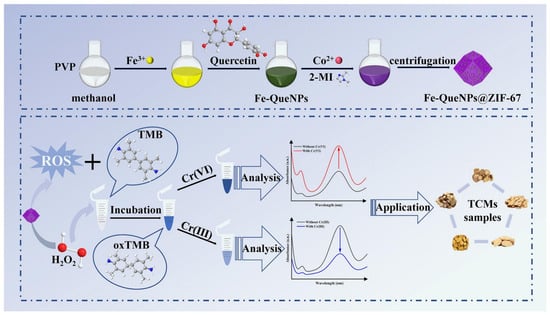
The studies summarized in Table 1 demonstrate the application of nanozyme-based Cr(VI) assays to various complex matrices, including seafood, dairy products, rice and medicinal herbs. Sample preparation procedures differed according to matrix characteristics, involving organic-solvent extraction, acid-assisted extraction or acid digestion [21,22,35,43]. A representative Fe-QueNPs@ZIF-67 sensing scheme for distinguishing Cr(III) and Cr(VI) in medicinal samples is presented in Figure 6 [43]. Beyond these representative studies, Gao et al. developed a dual-metal-site MOF nanozyme for Cr(VI) colorimetric detection in milk, yogurt, and milk powder, achieving recoveries of 84.0–110% [57]. Gu et al. reported a laccase-like Cu,Ce-phosphotungstate nanozyme for Cr(VI) determination in traditional Chinese medicine samples, employing the oxidative coupling of 2,4-dichlorophenol and 4-aminoantipyrine as an alternative to TMB-based colorimetry [58].
Figure 6.
Schematic diagram of the synthesis of Fe-QueNPs@ZIF-67 and its colorimetric response for chromium-speciation analysis. Different colors are used to distinguish the reaction stages and the colorimetric responses associated with Cr(VI) and Cr(III). Reproduced from Ref. [43] with permission. Copyright 2026, Elsevier B.V.
Although these sample preparation procedures facilitate the analysis of complex matrices, some treatments may affect chromium oxidation states. In particular, recovery experiments involving samples spiked after digestion do not establish the preservation of native Cr(VI) during sample preparation. This limitation is particularly relevant to food analysis, where matrix constituents may promote Cr(VI) reduction, as demonstrated in chromium speciation studies [59].
4.3. Health-Related Applications and Limitations
The application of nanozyme-based colorimetric assays to direct Cr(VI) biomonitoring remains limited by insufficient validation in biological matrices. Cr(VI) can undergo reduction in biological samples, while total chromium concentrations in blood or urine cannot establish the original chromium oxidation state.
A related colorimetric study examined Cr(III) in urine [60], which is distinct from direct Cr(VI) biomonitoring. Occupational exposure assessment presents additional analytical challenges, as airborne Cr(VI) monitoring requires appropriate sampling, extraction and species-specific determination. The U.S. Occupational Safety and Health Administration (OSHA) has established a permissible exposure limit of 5 µg/m3 as an 8 h time-weighted average [61]. Nevertheless, compliance with occupational exposure monitoring requirements depends on validated analytical procedures, and the applicability of nanozyme-based colorimetric assays for this purpose remains to be established.
4.4. Portable and Smartphone-Assisted Detection
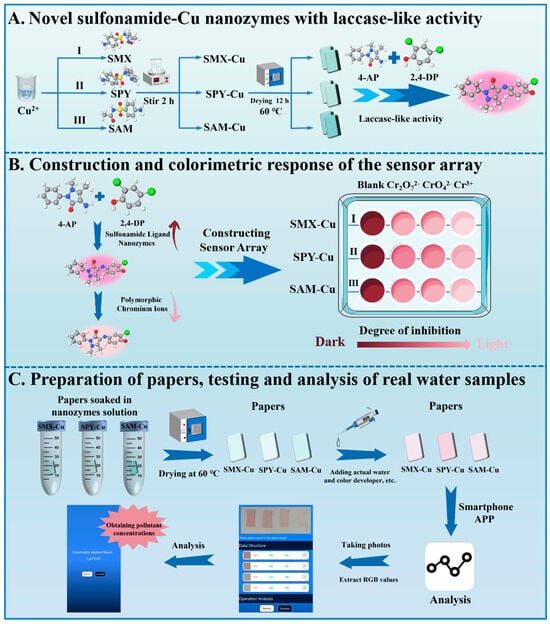
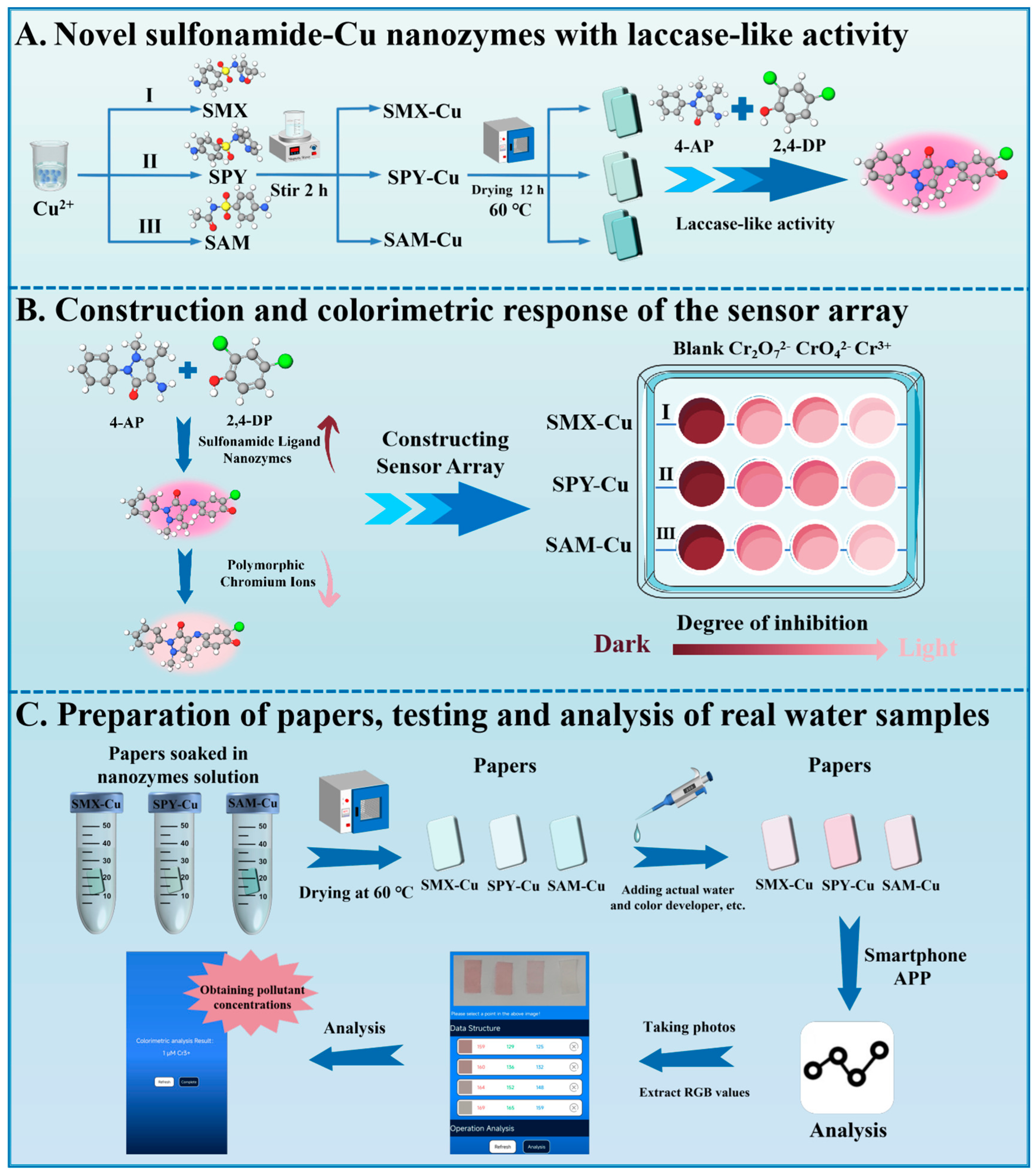
Paper-supported reactions and smartphone imaging have broadened the available readout formats for nanozyme-based Cr(VI) detection. Cu-curcumin, Zn/B-NC, Fe–N–C and CuO/CN/LDH have been incorporated into test strips or related portable arrangements. A PtNPs/Ti3C2TxNR nanozyme has also been integrated into a paper-based platform for portable Cr(VI) detection [30]. Smartphone cameras convert reaction colors into RGB-derived values, allowing concentration estimates through image calibration without a conventional UV–vis spectrophotometer. In a PTh-CuCe system, the smartphone detection limit was 0.22 µM, compared with 0.026 µM for the solution UV–vis measurement; spiked-water recoveries by smartphone were in the range of 87.02–124.95% [24]. Thus, miniaturization simplifies signal acquisition, but differences in illumination, background, optical geometry and processing algorithms can influence quantitative performance [62,63,64]. A sulfonamide-Cu nanozyme sensor array integrating paper-based readout with smartphone-assisted analysis provides a representative example of this approach (Figure 7) [63].
Figure 7.
Schematic of (A) sulfonamide-Cu nanozyme synthesis, (B) sensor-array construction and colorimetric response, and (C) paper-based testing and analysis of real water samples. Different colors distinguish the chemical components and colorimetric responses illustrated in the original study. Reproduced from Ref. [63] with permission. Copyright 2025, Elsevier B.V.
The integration of microfluidic chips with paper-based devices is advancing toward automation and low cost. Microfluidic paper-based analytical devices can facilitate sample transport and reduce reagent consumption [65,66,67,68]. However, conventional DPC-based devices and nonenzymatic AuNP colorimetric probes should be distinguished from nanozyme-based sensing systems when evaluating their development. For comparison, smartphone-assisted Cr(VI) detection has also been reported with maleic-acid-functionalized Au nanoparticles; this non-nanozyme platform provides a useful reference for portable optical readout [69]. Portable colorimetric measurements remain sensitive to illumination, camera settings, reagent storage and sample handling. Available studies have demonstrated feasibility under controlled laboratory conditions rather than extensive field validation [65,70,71].
5. Current Challenges and Future Directions
Despite the broad prospects, nanozyme-based colorimetric sensing still faces challenges in moving toward large-scale practical application. The accurate determination of trace Cr(VI) in complex real matrices, including industrial wastewater, soil extracts and biological fluids, remains challenging. Coexisting metal ions, inorganic anions and dissolved organic matter may alter nanozyme catalytic activity or interfere with the optical response [18,71]. Sample coloration and turbidity can further affect absorbance measurements. Although satisfactory recoveries have been reported in various spiked samples, these results do not necessarily establish accurate determination of native Cr(VI). Future studies should therefore evaluate matrix effects using representative samples and assess the reliability of quantitative results at environmentally relevant concentrations.
Reliable chromium speciation is another important challenge. Although several nanozyme-based systems have shown different responses toward Cr(III) and Cr(VI) [32,43], selective detection can be affected by oxidation-state changes during sample collection, storage and pretreatment. Such transformations are particularly relevant in samples containing reducing agents or reactive organic compounds. Acid extraction and digestion may also alter the original chromium species, making the interpretation of food and biological sample results more difficult. Cr(VI)-specific determination therefore requires suitable sample-preservation procedures and validation against established speciation methods. Comparisons with total chromium measurements alone cannot confirm the accuracy of Cr(VI) analysis [8,47,59].
Material stability and batch-to-batch reproducibility are important for translating nanozyme-based assays into practical measurements [72]. MOF-based architectures can provide protective environments for catalytic components and support immobilization strategies [73]. In an original Cr(VI) sensing study, MOF-919-Fe-Cu retained 91.87% of its initial catalytic activity after eight months of storage, showed reproducibility across five preparation batches and was integrated into an agarose hydrogel for smartphone-assisted analysis [74]. Such evidence supports the potential of material and format engineering, but catalyst stability alone does not establish the shelf life or accuracy of the full assay. The stability of the chromogenic reaction also warrants consideration, as TMB exhibits high sensitivity, good color purity and reasonable stability of its oxidation products compared with other benzidine derivatives [75]. Future evaluations should examine complete-reagent storage, time-dependent response and batch-to-batch variability under realistic operating conditions.
Moving the technology from the laboratory to the market requires the establishment of standard methods and the reduction in costs. At present, most nanozyme assays are laboratory-developed methods that lack unified performance-validation standards and operating protocols [15,19]. Reliable analytical procedures should define reaction conditions, calibration requirements and quality-control criteria. Batch-to-batch variability should be evaluated using independently prepared nanozyme materials, while method reproducibility should be assessed across different operators and, where possible, laboratories. Established procedures such as EPA Method 7196A for Cr(VI) colorimetric determination and EPA Method 3060A for alkaline digestion of solid samples provide relevant methodological references [9,52]. Validation against appropriate Cr(VI)-specific methods is essential for assessing analytical accuracy. The overall cost should also account for sample pretreatment, reagent storage and quality control rather than material synthesis alone.
Future development will place greater emphasis on interdisciplinary integration. Paper-based and smartphone-assisted platforms have demonstrated the feasibility of portable nanozyme-based Cr(VI) detection [22,23,41,46]. However, their application under field conditions remains insufficiently evaluated. Illumination, camera settings, background coloration and sample handling can affect the measured color response. Standardized image acquisition, calibration transfer and device-to-device reproducibility should therefore be examined under realistic operating conditions. Health-related applications require additional validation because chromium species may undergo transformation in biological matrices. Progress toward practical detection will depend on improved matrix tolerance, reliable chromium speciation and reproducible analytical performance rather than sensitivity improvements alone.
6. Conclusions
Nanozyme-based colorimetric sensing of Cr(VI) combines catalytic signal regulation with relatively simple optical detection, offering a promising complement to established analytical methods. Recent advances in understanding catalytic pathways and regulating nanozyme structures have contributed to the development of sensitive Cr(VI) detection methods. The reported sensing strategies can be broadly grouped into inhibition-based sensing, inhibitor-mediated signal recovery and Cr(VI)-promoted oxidation. Material design strategies involving interfacial engineering, porous structures and active-site regulation have further improved catalytic performance. Applications have been demonstrated in environmental waters and selected food-related samples, while paper-based and smartphone-assisted platforms have expanded the possibilities for portable detection. Nevertheless, most studies rely on laboratory-based experiments and spiked-sample validation, with limited evidence supporting routine field monitoring or direct Cr(VI) biomonitoring. Reliable practical application still requires improved chromium speciation, resistance to matrix interference, assay stability and reproducibility. Future research should emphasize species-preserving sample preparation, standardized analytical procedures and validation against established Cr(VI)-specific methods to improve the reliability of nanozyme-based sensing in practical applications.
Author Contributions
Conceptualization, Z.C., T.Z. and R.M.; Formal analysis, Z.C., T.Z., R.M. and Z.L.; Investigation, Z.C., T.Z., R.M. and Z.L.; Writing—original draft preparation, Z.C., T.Z. and R.M.; resources, X.W. and B.L.; Supervision, X.W. and B.L.; Project administration, X.W. and B.L.; Writing—review and editing, X.W., B.L. and Z.L.; Funding acquisition, Z.L. All authors have read and agreed to the published version of the manuscript.
Funding
The authors acknowledge the financial support received from the Postdoctoral Fellowship Program of CPSF (Grant No. GZC20261712).
Data Availability Statement
No new data were created or analyzed in this study. Data sharing is not applicable to this article.
Conflicts of Interest
The authors declare no conflicts of interest.
References
- IARC. Chromium (VI) Compounds. In IARC Monographs on the Evaluation of Carcinogenic Risks to Humans, Vol. 100C; IARC: Lyon, France, 2012; pp. 147–167. [Google Scholar]
- Costa, M.; Klein, C.B. Toxicity and Carcinogenicity of Chromium Compounds in Humans. Crit. Rev. Toxicol. 2006, 36, 155–163. [Google Scholar] [CrossRef] [Scilit] [PubMed]
- Zhitkovich, A. Chromium in Drinking Water: Sources, Metabolism, and Cancer Risks. Chem. Res. Toxicol. 2011, 24, 1617–1629. [Google Scholar] [CrossRef] [Scilit] [PubMed]
- O’bRien, T.J.; Ceryak, S.; Patierno, S.R. Complexities of chromium carcinogenesis: Role of cellular response, repair and recovery mechanisms. Mutat. Res. Fundam. Mol. Mech. Mutagen. 2003, 533, 3–36. [Google Scholar] [CrossRef] [Scilit] [PubMed]
- Kimbrough, D.E.; Cohen, Y.; Winer, A.M.; Creelman, L.; Mabuni, C. A Critical Assessment of Chromium in the Environment. Crit. Rev. Environ. Sci. Technol. 1999, 29, 1–46. [Google Scholar] [CrossRef] [Scilit]
- Kotaś, J.; Stasicka, Z. Chromium occurrence in the environment and methods of its speciation. Environ. Pollut. 2000, 107, 263–283. [Google Scholar] [CrossRef] [Scilit] [PubMed]
- ATSDR. Toxicological Profile for Chromium; Agency for Toxic Substances and Disease Registry: Atlanta, GA, USA, 2012.
- APHA. Standard Methods for the Examination of Water and Wastewater, 23rd ed.; American Public Health Association: Washington, DC, USA, 2017. [Google Scholar]
- USEPA. Method 7196A: Chromium, Hexavalent (Colorimetric); U.S. Environmental Protection Agency: Washington, DC, USA, 1992.
- Gao, L.; Zhuang, J.; Nie, L.; Zhang, J.; Zhang, Y.; Gu, N.; Wang, T.; Feng, J.; Yang, D.; Perrett, S.; et al. Intrinsic peroxidase-like activity of ferromagnetic nanoparticles. Nat. Nanotechnol. 2007, 2, 577–583. [Google Scholar] [CrossRef] [Scilit] [PubMed]
- Manea, F.; Houillon, F.B.; Pasquato, L.; Scrimin, P. Nanozymes: Gold-Nanoparticle-Based Transphosphorylation Catalysts. Angew. Chem. Int. Ed. 2004, 43, 6165–6169. [Google Scholar] [CrossRef] [Scilit] [PubMed]
- Wei, H.; Wang, E. Nanomaterials with Enzyme-like Characteristics (Nanozymes): Next-Generation Artificial Enzymes. Chem. Soc. Rev. 2013, 42, 6060–6093. [Google Scholar] [CrossRef] [Scilit] [PubMed]
- Wu, J.; Wang, X.; Wang, Q.; Lou, Z.; Li, S.; Zhu, Y.; Qin, L.; Wei, H. Nanomaterials with enzyme-like characteristics (nanozymes): Next-generation artificial enzymes (II). Chem. Soc. Rev. 2018, 48, 1004–1076. [Google Scholar] [CrossRef] [Scilit] [PubMed]
- Huang, Y.; Ren, J.; Qu, X. Nanozymes: Classification, Catalytic Mechanisms, Activity Regulation, and Applications. Chem. Rev. 2019, 119, 4357–4412. [Google Scholar] [CrossRef] [Scilit] [PubMed]
- Liang, M.; Yan, X. Nanozymes: From New Concepts, Mechanisms, and Standards to Applications. Acc. Chem. Res. 2019, 52, 2190–2200. [Google Scholar] [CrossRef] [Scilit] [PubMed]
- Liu, Y.T.; Lu, Q.; Tang, Z.Y.; Yang, H.; Peng, G. Research Progress on Redox Nanozyme-Based Colorimetric Sensors in Food Safety Detection. Food Sci. 2024, 45, 311–321. [Google Scholar] [CrossRef]
- Huang, X.J.; Zhang, X.Q.; Liu, Y.N.; Zhou, Z.R.; Zou, L.N.; Pan, H.Z.; Rong, S.Z.; Ma, H.K. Research Progress of Colorimetric Sensors Based on Nanoenzymes for Detection of Heavy Metals. Phys. Test. Chem. Anal. Part B Chem. Anal. 2025, 61, 489–496. [Google Scholar]
- Wong, E.L.S.; Vuong, K.Q.; Chow, E. Nanozymes for Environmental Pollutant Monitoring and Remediation. Sensors 2021, 21, 408. [Google Scholar] [CrossRef] [Scilit] [PubMed]
- Meng, Y.; Li, W.; Pan, X.; Gadd, G.M. Applications of Nanozymes in the Environment. Environ. Sci. Nano 2020, 7, 1305–1318. [Google Scholar] [CrossRef] [Scilit]
- Zhou, T.; Lin, J.; Jin, F.; Yao, Y.; Li, Z.; Wang, L. Rational design of monodispersed Au@Pt core–shell nanostructures with excellent peroxidase-mimicking activity for colorimetric detection of Cr(vi). Anal. Methods 2024, 16, 7502–7508. [Google Scholar] [CrossRef] [Scilit] [PubMed]
- Mao, Y.; Gao, S.; Yao, L.; Wang, L.; Qu, H.; Wu, Y.; Chen, Y.; Zheng, L. Single-atom nanozyme enabled fast and highly sensitive colorimetric detection of Cr(VI). J. Hazard. Mater. 2021, 408, 124898. [Google Scholar] [CrossRef] [Scilit] [PubMed]
- Wu, S.; Khan, M.A.; Zhang, L.; Zhao, H.; Huang, T.; Cao, H.; Ye, D. Paper-based colorimetric sensor using a single-atom nanozyme for the ultrasensitive detection of Cr(vi) in short-necked clams. Anal. Methods 2024, 16, 7333–7340. [Google Scholar] [CrossRef] [Scilit] [PubMed]
- Chai, Z.; Zhou, A.; Huang, J.; Qu, L.; Ge, J.; Zhang, L.; Li, Z. Cu-curcumin nanozyme for detection of Cr(vi) through an off–on strategy based on peroxidase mimicking activity. Anal. 2024, 150, 371–377. [Google Scholar] [CrossRef] [Scilit] [PubMed]
- Li, S.; Ji, Y.; Hong, H.; Wang, X.; Xu, Y.; Xue, K.; Liu, Q. Cerium-Based Nanozyme Functionalized by Conducting Polymers with Dual Enzyme Activities for Intelligent Colorimetric Sensing of Hexavalent Chromium. Inorg. Chem. 2025, 64, 13786–13795. [Google Scholar] [CrossRef] [Scilit] [PubMed]
- Nghia, N.N.; Huy, B.T.; Lee, Y.-I. Colorimetric detection of chromium(VI) using graphene oxide nanoparticles acting as a peroxidase mimetic catalyst and 8-hydroxyquinoline as an inhibitor. Microchim. Acta 2018, 186, 36. [Google Scholar] [CrossRef] [Scilit] [PubMed]
- Xu, A.; Ye, R.; Guo, H. Glutathione-mediated carbon-coated Cu-ferrocenecarboxylate nanozyme for ultrasensitive colorimetric detection of Cr(VI). Microchem. J. 2025, 215, 114502. [Google Scholar] [CrossRef] [Scilit]
- Jie, Y.; Wang, W.; He, M.; Yang, C.; Wang, L. A colorimetric sensing platform based on MOF-derived hollow Co, N co-doped C with dual-enzyme mimetic activity for the highly sensitive detection of hexavalent chromium. Ionics 2026, 32, 1–11. [Google Scholar] [CrossRef] [Scilit]
- Qi, Y.; Li, B.; Song, D.; Xiu, F.-R.; Gao, X. Ultrafast colorimetric detection of Cr(VI) based on competition of 8-HQ to Cr(VI) and TMB oxides using GO/AuNPs nanocomposites as peroxidase mimic. Spectrochim. Acta Part A Mol. Biomol. Spectrosc. 2023, 297, 122722. [Google Scholar] [CrossRef] [Scilit] [PubMed]
- Xi, S.; Luo, F.; Chen, P.; Wang, D.; Wang, J.; Kou, B.; Zhao, R. Novel Au-anchored Fe–NC nanozyme-enabled rapid and sensitive colorimetric detection of Cr(vi). Anal. 2025, 150, 5054–5061. [Google Scholar] [CrossRef] [Scilit] [PubMed]
- Wei, M.; Liu, R.; Zheng, L.; Liu, J.; Yi, Y.; Wang, Q.; Ou, Y. PtNPs/Ti3C2TxNR Nanozyme-Enabled Portable Colorimetric Platform for Ultrasensitive Hexavalent Chromium Monitoring. Ann. N. Y. Acad. Sci. 2025, 1553, 531–540. [Google Scholar] [CrossRef] [Scilit] [PubMed]
- Wang, Y.; Liang, R.-P.; Qiu, J.-D. Nanoceria-Templated Metal Organic Frameworks with Oxidase-Mimicking Activity Boosted by Hexavalent Chromium. Anal. Chem. 2019, 92, 2339–2346. [Google Scholar] [CrossRef] [Scilit] [PubMed]
- Guo, J.; Wu, J.; Yang, J.; He, J. A colorimetric and electrochemical dual-mode system for identifying and detecting varied Cr species based on fungus-like porous CoS nanosensor. Talanta 2024, 285, 127379. [Google Scholar] [CrossRef] [Scilit] [PubMed]
- Shi, W.; He, M.; Li, W.; Wei, X.; Bui, B.; Chen, M.; Chen, W. Cu-Based Metal–Organic Framework Nanoparticles for Sensing Cr(VI) Ions. ACS Appl. Nano Mater. 2021, 4, 802–810. [Google Scholar] [CrossRef] [Scilit]
- Wang, D.; Gong, C.; Zhao, H. Au NPs@NC@MnO2 with exceptional nano-enzyme activity for sensitive colorimetric detection of Cr (VI). Microchem. J. 2022, 181, 107706. [Google Scholar] [CrossRef] [Scilit]
- Li, Z.; Li, X.; Lin, Q.; Zhan, Y.; Hu, J.; Zhou, T.; Gao, M.; He, T.; Yao, Q.; Wang, L. Interfacial engineering of two-dimensional metal-organic framework nanozyme to enhance substrate affinity for the rapid and highly sensitive detection of Cr(VI). Sens. Actuators B Chem. 2024, 418, 136341. [Google Scholar] [CrossRef] [Scilit]
- Liang, J.; Ye, H.; Yuan, Z.; Wu, Z.; Li, G.; Hao, R.; Wu, X.; Cheng, S.; Hu, Y.; Zhu, W. Ultrasensitive Cr(VI) sensing via H2O2-free electron-accepting pathway using atomically dispersed CuCo-NC. Anal. Sci. 2026, 42, 1075–1086. [Google Scholar] [CrossRef] [Scilit] [PubMed]
- Guo, X.; Yang, F.; Jing, L.; Li, J.; Li, Y.; Ding, R.; Duan, B.; Zhang, X. In-situ generation of highly active and four-in-one CoFe2O4/H2PPOP nanozyme: Mechanism and its application for fast colorimetric detection of Cr (VI). J. Hazard. Mater. 2022, 431, 128621. [Google Scholar] [CrossRef] [Scilit] [PubMed]
- Kulandaivel, S.; Wang, Y.-N.; Chittibabu, D.K.D.; Lu, Y.-K.; Chen, H.-T.; Yeh, Y.-C. Peroxide-Free Hexavalent Chromium Detection via Surface Electron Transfer in a Redox-Active Bismuth Metal–Organic Framework Nanozyme. ACS Appl. Nano Mater. 2025, 8, 13060–13070. [Google Scholar] [CrossRef] [Scilit]
- Ye, R.; Xu, A.; Li, X.; Lin, X.; Guo, H. Nanozyme Cu@Fe3O4@MOF-199 with highly sensitive of colorimetric-electrochemical detection for Cr(VI): Mechanism of substrate catalytic promotion-inhibiting dual-effect driving. Sens. Actuators B Chem. 2025, 444, 138522. [Google Scholar] [CrossRef] [Scilit]
- Xu, X.; Guo, J.; Lei, Z. Ultrafast colorimetric detection of Cr(vi) using Fe3O4@polydopamine/Prussian blue composites as a highly efficient peroxidase mimic. Anal. Methods 2022, 15, 221–227. [Google Scholar] [CrossRef] [Scilit] [PubMed]
- Yang, X.; Chen, X.; Yang, H.; Fan, Y.; Jiang, L.; Huo, F. Flower-like boron-doped zinc single-atom nanozymes for colorimetric sensing and smartphone-assisted detection of Cr(VI). Spectrochim. Acta Part A Mol. Biomol. Spectrosc. 2024, 327, 125328. [Google Scholar] [CrossRef] [Scilit] [PubMed]
- Kulandaivel, S.; Lo, W.-C.; Lin, C.-H.; Yeh, Y.-C. Cu-PyC MOF with oxidoreductase-like catalytic activity boosting colorimetric detection of Cr(VI) on paper. Anal. Chim. Acta 2022, 1227, 340335. [Google Scholar] [CrossRef] [Scilit] [PubMed]
- Chen, G.; Wan, G.-Z.; Chen, J. A Fe-QueNPs@ZIF-67 nanozyme-based colorimetric assay for discriminative detection of Cr(III) and Cr(VI) in Traditional Chinese Medicines. Microchem. J. 2026, 224, 117466. [Google Scholar] [CrossRef] [Scilit]
- Liao, Z.; Ren, Y.; Yuan, B.; Li, L.; You, T. Microwave-assisted synthesis of Fe-based single-atom nanozyme: A colorimetric approach to detect Cr(vi). Dalton Trans. 2025, 55, 345–352. [Google Scholar] [CrossRef] [Scilit] [PubMed]
- Feng, M.; Chen, X.; Liu, Y.; Zhao, Y.; Karmaker, P.G.; Liu, J.; Wang, Y.; Yang, X. Atomically dispersed Fe–Zn dual-site nanozymes with synergistic catalytic effects for the simultaneous detection of Cr(vi) and 8-hydroxyquinoline. J. Mater. Chem. B 2023, 11, 4020–4027. [Google Scholar] [CrossRef] [Scilit] [PubMed]
- Li, S.; Hao, S.; Li, W.; Meng, R.; Wang, Q.; Wang, Y.; Wang, L.; Liu, X.; Zhou, Y.; Wang, H.; et al. Rapid detection of hexavalent chromium using CuO/CN/LDH as an oxidase mimetic and the construction of a paper-based device. Microchim. Acta 2026, 193, 209. [Google Scholar] [CrossRef] [Scilit] [PubMed]
- USEPA. Method 218.7: Determination of Hexavalent Chromium in Drinking Water by Ion Chromatography with Post-Column Derivatization and UV-Visible Spectroscopic Detection, Version 1.0; EPA 815-R-11-005; U.S. Environmental Protection Agency: Cincinnati, OH, USA, 2011.
- Yang, Q.-Y.; Wan, C.-Q.; Wang, Y.-X.; Shen, X.-F.; Pang, Y.-H. Bismuth-based metal-organic framework peroxidase-mimic nanozyme: Preparation and mechanism for colorimetric-converted ultra-trace electrochemical sensing of chromium ion. J. Hazard. Mater. 2023, 451, 131148. [Google Scholar] [CrossRef] [Scilit] [PubMed]
- Shifera, G.A.; Kitte, S.A.; Beyene, T.T.; Gure, A. Ag-Doped ZnO Quantum Dots for Fluorescence-Based Detection of Trace Cr(VI) from River Water and Fish samples. J. Fluoresc. 2026, 36, 3245–3255. [Google Scholar] [CrossRef] [Scilit] [PubMed]
- Li, P.; Li, Y.; Qi, M.; Zhang, X. Detection of Cr(III) and Cr(VI) in lake water by inhibiting and enhancing oxidase-like activity of iron-manganese bimetallic oxide nano-cubes. Chem. Eng. J. 2024, 493, 152686. [Google Scholar] [CrossRef] [Scilit]
- Zhang, K.; Xia, L.; Shi, J.; Tao, H.; Zhou, J.; Wu, Y. “Kill two birds with one stone” role of Ag-BC@Cu nanozyme: Orthogonal colorimetric discrimination and determination of Cr(III) and Cr(VI) in water through independently regulated dual enzyme-mimicking pathways. Talanta 2026, 313, 130761. [Google Scholar] [CrossRef] [Scilit] [PubMed]
- USEPA. Method 3060A: Alkaline Digestion for Hexavalent Chromium; U.S. Environmental Protection Agency: Washington, DC, USA, 1996.
- Li, M.; Tang, Y.; Zhao, R.; Gao, T.; Zhang, L. Rapid ultrasensitive detection of hexavalent chromium in soil and groundwater by a microProbing imaging platform. J. Hazard. Mater. 2022, 433, 128809. [Google Scholar] [CrossRef] [Scilit] [PubMed]
- Guo, L.; Shi, Y.; Li, K.-W.; Yan, J.; Hong, Z.-N.; Jiang, J.; Xu, R.-K. Rapid assessment of soil accessible Cr(VI) in the field by a portable RGB color sensor. Ecotoxicol. Environ. Saf. 2024, 273, 116117. [Google Scholar] [CrossRef] [Scilit] [PubMed]
- GB 4806.9-2023; National Food Safety Standard: Metal Materials and Articles for Food Contact. National Health Commission and State Administration for Market Regulation: Beijing, China, 2023. (In Chinese)
- Herting, G.; Wallinder, I.O.; Leygraf, C. Corrosion-induced release of chromium and iron from ferritic stainless steel grade AISI 430 in simulated food contact. J. Food Eng. 2008, 87, 291–300. [Google Scholar] [CrossRef] [Scilit]
- Gao, M.; Li, Z.; Liu, M.; He, T.; Su, X.; Zhao, Y.; Zou, Z.; Yao, Y.; Jin, F.; Li, Z.; et al. Dual-metal-site MOF nanozyme with enhanced activity for highly sensitive colorimetric detection of Cr(VI) in dairy products. Food Chem. 2026, 525, 150463. [Google Scholar] [CrossRef] [Scilit]
- Gu, Y.; Jiao, Y.; Ruan, Y.; Yang, J.; Yang, Y. Cu,Ce-containing phosphotungstates as laccase-like nanozyme for colorimetric detection of Cr(VI) and Fe(III). Spectrochim. Acta Part A Mol. Biomol. Spectrosc. 2024, 324, 124948. [Google Scholar] [CrossRef] [Scilit] [PubMed]
- Song, G.; Tan, H.; Cheng, C.; Li, P.; Sun, X.; Zhou, Y.; Fang, Y. Development of a Fast Method Using Inductively Coupled Plasma Mass Spectrometry Coupled with High-Performance Liquid Chromatography and Exploration of the Reduction Mechanism of Cr(VI) in Foods. Toxics 2024, 12, 325. [Google Scholar] [CrossRef] [Scilit] [PubMed]
- Shellaiah, M.; Simon, T.; Venkatesan, P.; Sun, K.W.; Ko, F.-H.; Wu, S.-P. Nanodiamonds conjugated to gold nanoparticles for colorimetric detection of clenbuterol and chromium(III) in urine. Microchim. Acta 2017, 185, 74. [Google Scholar] [CrossRef] [Scilit] [PubMed]
- OSHA. Hexavalent Chromium: 29 CFR 1910.1026; Occupational Safety and Health Administration: Washington, DC, USA, 2006.
- Cui, M.; Chi, Y.; Lin, Y.; Liu, Y.; Chen, J.; Guo, L. A portable photocatalysis-based, smartphone-assisted colorimetric device for on-site Cr(VI) detection. Microchem. J. 2025, 219, 115927. [Google Scholar] [CrossRef] [Scilit]
- Chen, X.; Han, Q.; Li, K.; Wang, X.; Li, J.; Wang, Y.; Hu, J.; Wang, L.; Huang, H.; Li, Y. Facile and on-site recognition of polymorphic chromium ions by three-channel colorimetric sensor array based on novel laccase-like nanozymes with smartphone APP. Chem. Eng. J. 2025, 520, 165610. [Google Scholar] [CrossRef] [Scilit]
- Yao, C.-X.; Yang, L.; Wang, J.; Lv, H.; Ji, X.-M.; Li, S.-J.; Liu, J.-M.; Wang, S. A visual and reversible nanoprobe for rapid and on-site determination of hexavalent chromium and lysine based on dual-emission carbon quantum dots coupled with smartphone. Microchim. Acta 2022, 189, 354. [Google Scholar] [CrossRef] [Scilit] [PubMed]
- Xu, J.; Ma, X.; Li, Z.; Zhou, T.; Wang, Y.; Zhu, J. Recent Advances in Paper-Based Microfluidic Devices for Heavy Metal Ion Detection: A Review. Micromachines 2026, 17, 780. [Google Scholar] [CrossRef] [Scilit] [PubMed]
- Yetisen, A.K.; Akram, M.S.; Lowe, C.R. Paper-based microfluidic point-of-care diagnostic devices. Lab Chip 2013, 13, 2210–2251. [Google Scholar] [CrossRef] [Scilit] [PubMed]
- Wang, H.; Li, Y.-J.; Wei, J.-F.; Xu, J.-R.; Wang, Y.-H.; Zheng, G.-X. Paper-based three-dimensional microfluidic device for monitoring of heavy metals with a camera cell phone. Anal. Bioanal. Chem. 2014, 406, 2799–2807. [Google Scholar] [CrossRef] [Scilit] [PubMed]
- Li, F.; Hu, Y.; Li, Z.; Liu, J.; Guo, L.; He, J. Three-dimensional microfluidic paper-based device for multiplexed colorimetric detection of six metal ions combined with use of a smartphone. Anal. Bioanal. Chem. 2019, 411, 6497–6508. [Google Scholar] [CrossRef] [Scilit] [PubMed]
- Mohamed, A.; Li, X.; Li, C.; Li, X.; Yuan, C.; Barakat, H. Smartphone-Based Colorimetric Detection of Chromium (VI) by Maleic Acid-Functionalized Gold Nanoparticles. Appl. Sci. 2021, 11, 10894. [Google Scholar] [CrossRef] [Scilit]
- Muhammed, A.; Hussen, A.; Kaneta, T. Speciation of chromium in water samples using microfluidic paper-based analytical devices with online oxidation of trivalent chromium. Anal. Bioanal. Chem. 2021, 413, 3339–3347. [Google Scholar] [CrossRef] [Scilit] [PubMed]
- Zhai, H.-M.; Zhou, T.; Fang, F.; Wu, Z.-Y. Colorimetric speciation of Cr on paper-based analytical devices based on field amplified stacking. Talanta 2020, 210, 120635. [Google Scholar] [CrossRef] [Scilit] [PubMed]
- Ashrafi, A.M.; Bytesnikova, Z.; Barek, J.; Richtera, L.; Adam, V. A critical comparison of natural enzymes and nanozymes in biosensing and bioassays. Biosens. Bioelectron. 2021, 192, 113494. [Google Scholar] [CrossRef] [Scilit] [PubMed]
- Xu, W.; Jiao, L.; Wu, Y.; Hu, L.; Gu, W.; Zhu, C. Metal–Organic Frameworks Enhance Biomimetic Cascade Catalysis for Biosensing. Adv. Mater. 2021, 33, 2005172. [Google Scholar] [CrossRef] [Scilit] [PubMed]
- Li, Z.; Di, S.; Zhang, Q.; Xiong, X.; Liu, M.; Chen, P.; Qin, H.; Yin, H.; Zhu, S. Bimetallic MOFs probe-based colorimetric sensor and smartphone-enabled analysis system for the rapid and sensitive determination of Cr(VI) in harsh water environment. Microchem. J. 2026, 221, 116966. [Google Scholar] [CrossRef] [Scilit]
- Zhang, X.; Yang, Q.; Lang, Y.; Jiang, X.; Wu, P. Rationale of 3,3′,5,5′-Tetramethylbenzidine as the Chromogenic Substrate in Colorimetric Analysis. Anal. Chem. 2020, 92, 12400–12406. [Google Scholar] [CrossRef] [Scilit] [PubMed]



Disclaimer/Publisher’s Note: The statements, opinions and data contained in all publications are solely those of the individual author(s) and contributor(s) and not of MDPI and/or the editor(s). MDPI and/or the editor(s) disclaim responsibility for any injury to people or property resulting from any ideas, methods, instructions or products referred to in the content. |
© 2026 by the authors. Licensee MDPI, Basel, Switzerland. This article is an open access article distributed under the terms and conditions of the Creative Commons Attribution (CC BY) license.