


Abstract
Meals from oil extraction processing are by-products containing proteins that could be utilized as protein sources in food manufacturing. A protein coprecipitate from canola and sunflower meals (CSPCo) was obtained by alkaline extraction and isoelectric precipitation methods. The CSPCo was subjected to sonication (at 200, 400 and 600 W for 15 min) and enzymatic hydrolysis (alcalase, trypsin and chymotrypsin for 60 min) to evaluate its effects on the physicochemical, functional, and structural properties. In general, both treatments improved the functional characteristics of CSPCo. The protein solubility, oil absorption capacity, foaming capacity, foam stability, and emulsifying activity index of CSPCo were significantly increased (p < 0.05) through the use of high-intensity ultrasound (HInUS) by 18.6–27.1%, 14.2–20.1%, 8.07–22.6%, 19.9–25.8%, and 4.2–9.7% respectively, whereas through enzymatic hydrolysis (EnHs), these same parameters increased by 20.0–33.6%, 17.1–32.2%, 25–32.2%, 20–47.3%, and 3.5–12.5%, in comparison with a control. Likewise, only HInUS at 600 W and EnHs with Chym improved water-absorption capacity by 18.6% and 9.1%, respectively, compared to the control. Furthermore, antioxidant activity increased with HInUS (1.9–3.9%) and EnHs (7.4–7.8%). The benefit of the functional properties by HInUS and EnHs was mainly associated with structural changes manifested through the composition of the secondary structure, surface hydrophobicity, particle size and surface charge of the proteins. CSPCo treated with HInUS and EnHs could represent a novel alternative for the recovery and utilization of canola and sunflower proteins for application as a food ingredient.
1. Introduction
The urgent need to replace animal proteins with plant proteins, due to their lower environmental impact and health benefits, has led the search for sustainable alternatives to meet global protein needs [1]. Among the main plant resources available for the recovery of food proteins, oilseed pastes from the oil industry stand out, with canola (Brassica napus L.) and sunflower (Helianthus annuus L.) being two of the most important, due to the easy cultivation, good nutritional qualities, and environmental sustainability [2].
Although canola and sunflower meals are used mainly as animal feed for their high protein content, they can also be used for human consumption by preparing protein concentrates or isolates [3]. However, oilseed meal proteins may have nutritional and functional limitations that restrict their use [4,5]. Canola meal contains antinutrients such as phytic acid and glucosinolates, while sunflower meal contains chlorogenic acid, phytates, and protease and arginase inhibitors. Overcoming these limitations is key to optimizing their use in the food industry [6,7].
To mitigate these issues associated with such protein sources, two main strategies are currently employed: protein blending and protein coprecipitation [8]. Protein blending involves the direct mixing of protein isolates or concentrates, whereas protein coprecipitation entails the extraction and subsequent precipitation (via isoelectric, thermal-acid, or thermal-acid-with-salt methods) of the protein sources [9]. Unlike simple blending, protein coprecipitation facilitates genuine molecular interaction and coordinated protein aggregation, thereby optimizing the functional and nutritional properties of the final product [10].
Recent studies on protein coprecipitates (PCo) reveal that the nutritional and functional advantages with respect to single-source proteins include those of Bambara groundnut–fish collagen [11], soy–zein [12], soy–wheat [13], and millet–moringa [14]. Although the improvement in the functional, nutritional and biological properties of PCo results from the complementary effect of the intrinsic properties of the protein sources used and processing conditions, new protein complexes are also formed that influence these characteristics [9].
In addition to the improved functionality and nutritional value resulting from protein coprecipitation, physical, chemical, and biological treatments are also available to enhance protein quality [15]. Therefore, further benefits in PCo production would be expected if complementary treatments were applied to these materials, such as high-intensity ultrasound (HInUS) and enzymatic hydrolysis (EnHs), which are considered highly relevant in the food sector [16,17].
HInUS is a non-thermal physical technology used to alter the characteristics of plant proteins due to its benefits in terms of environmental protection, high efficiency, and low impact on nutritional value. HInUS uses acoustic waves with frequencies between 20 and 100 kHz to generate cavitation, dynamic agitation, shear stress, and turbulence on the proteins [18]. Several studies have demonstrated that HInUS can affect the physicochemical and functional properties by structural changes of plant proteins [19,20,21,22]. According to these studies the main reasons for the changes in the functional properties of proteins induced by HInUS are based on three aspects: (a) structural modification, due to changes in particle size and, primarily, an increase in hydrophobicity and sulfhydryl groups; (b) denaturation and/or aggregation of protein molecules; and (c) alterations of the ultrasound microenvironment (pH, temperature, and ionic strength).
EnHs, as a method for modifying plant proteins, has been also used because it is environmentally friendly and energy efficient and does not generate toxic by-products.
The application of various enzymes obtained from animal, plant, or microbial sources, such as pepsin, trypsin, alcalase, papain, and chymotrypsin, to modify the functional characteristics of plant proteins has been previously investigated [23,24,25,26]. The results of these investigations indicate that the changes in functional properties are mainly due to the enzymes’ ability to: a) reduce molecular weight, b) expose and/or rearrange hydrophobic and hydrophilic groups, and c) increase the number of ionizable groups in native proteins.
In a recent study conducted by this same research group, it was determined that the canola–sunflower coprecipitate (CSPCo) prepared from a 1:1 (w/w) ratio of their respective pastes exhibited good functional properties [27]. Based on this premise, the hypothesis of this study is that HInUS and EnHs will induce specific structural changes in CSPCo, thereby optimizing its physicochemical and functional characteristics.
Therefore, the objective of this study was to determine the impact of HInUS and EnHs on the physicochemical, functional, and structural characteristics of CSPCo. The results of this research could represent a valorization of canola and sunflower proteins from oilseed industry waste as a new alternative for their use as food ingredients, the development of new products and the improvement of existing ones.
2. Results and Discussion
2.1. Composition and Physicochemical Characteristics
2.1.1. Proximate Composition
The impact of HInU and EnHs on the proximal composition of CSPCo is shown in Table 1. HInUS and EnHs treatments significantly increased (p < 0.05) the protein content of CSPCo with respect to a control treatment. The most significant improvement in protein content due to HInU was observed at 400 W (3.4%), while for EnHs employing Tryp (3.1%). In general, HInU and EnHs did not alter the moisture content, except at 200 W and 400 W, where a significant (p < 0.05) increase of 7.9% and a decrease of 9.3% were observed, respectively. Likewise, HInU and EnHs did not modify the ash content at 400 W, which decreased by 11.5% compared to the control. Furthermore, the carbohydrate content decreased by both HInUS (48.3–64.7%) and EnHs (41.7–60.4%), although the lipid content was not altered by either treatment. Improvements in protein content can be attributed to a reduction in carbohydrates, resulting from the effects of HInU and EnHs.
Table 1.
Influence of the high-intensity ultrasound and enzymatic hydrolysis on the centesimal composition of canola–sunflower protein coprecipitate.
The chemical composition of protein materials treated with HInUS and EnHS could be related to a variation in water content due to the structural modification of these polymers [28]. The protein concentration effect of HInUS has been observed in protein isolates from faba bean [29] and soursop [30], as well as in proteins from chickpea [31] and pea [23] when treated with EnHS, consistent with the results of this study.
2.1.2. Color
Color is a sensory parameter of utmost importance for the acceptance of food products. This characteristic is determined by measuring the parameters L* (lightness), a* (reddish–greenish), and b* (yellowish–bluish) [32]. The effect of HInUS and EnHs on L*, a*, b* and ΔE of CSPCo is presented in Table 2.
Table 2.
Influence of high-intensity ultrasound and enzymatic hydrolysis on physicochemical characteristics of canola–sunflower protein coprecipitate.
The main color change in CSPCo due to HInUS and EnHs was manifested by the increase in the parameters L*, a* and b*. L* increased significantly (p < 0.05) in a range of 3.3% to 14.7% for treatments with HInUS, while those processed with EnHs rose from 11% to 23.8%, compared to the control treatment. The most noticeable changes for a* (+199.1%) and b* (+70.5%) were observed for EnHs with Alc.
The alterations of L*, a* and b* due to the HInUS and EnHs effects described above were reflected in a decrease in ΔE and Hab and an increase in C*. The maximum changes observed for EnHs in ΔE, C*, and Hab were with Chym (−21.4%), Alc (+70.9%), and Alc (−5.5%), respectively, while for HInUS with 600 W (−13.2%), 600 W (+35.2%), and 400 W (−4.3%).
The modification of the color of CSPCo by HInUS and EnHs in this study could be a consequence of the alteration or destruction of pigments caused by cavitation [33] and the formation of new colored substances by the processing conditions during EnHs [34]. Studies where HInUS was applied to proteins of pumpkin [20], orange [22], and guamuchil [35] seeds showed color changes. In the same way, studies on EnHs of proteins of soy [25], oyster mushroom [36] and rainbow trout [34] reported variations in color parameters.
2.1.3. Water Activity (aw)
A good indicator of the stability and shelf life of dehydrated food products is aw [37]. In general, no significant differences (p > 0.05) in aw were observed in CSPCo by effect of HInUS and EnHS, except for the Tryp hydrolysate, which showed a reduction of 12.5% compared to the control (Table 2). Protein isolates from orange seeds [22] and peanut [38] also diminished aw after HInUS, due to structural changes of such polymers, resulting in easier elimination of a higher amount of free water during freeze-drying. In addition, Jogi et al. [25] reported that EnHS did not modify the aw of soy proteins, as was observed for the CSPCo treated with Alc and Chym, as well as with HInUS of the study.
2.1.4. Turbidity
Turbidity is an important and widely used property as a criterion for defining and monitoring the formation of protein aggregates [38]. Table 2 shows the effect of HInUS and EnHs on the turbidity of CSPCo dispersions. Overall, the results indicate a significant decrease (p < 0.05) in turbidity for all sonicated and hydrolyzed CSPCo samples, compared to the control treatment.
The decrease in CSPCo turbidity ranged from 24.4% (200 W) to 46.3% (400 W) for those treated with HInUS and from 9.8% (Alc) to 31.7% (Chym) for the hydrolyzed samples, compared to the control. The reduction in turbidity may be due to the cavitation and proteolysis phenomena caused by HInUS and EnHs, respectively, which produce a smaller Ps (see Section 2.4.5). López-Mártir et al. [28] and Jogi et al. [25] reported a decrease in the turbidity of noni seeds and soy proteins, respectively, due to the influence of HInUS and EnHs.
2.2. Functional Characteristics
2.2.1. Protein Solubility (PSo)
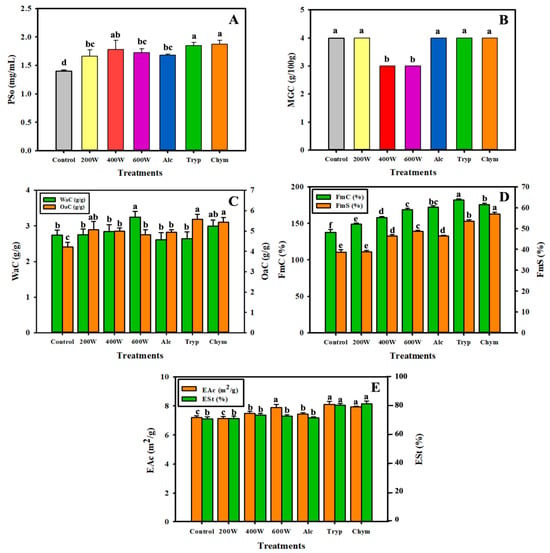
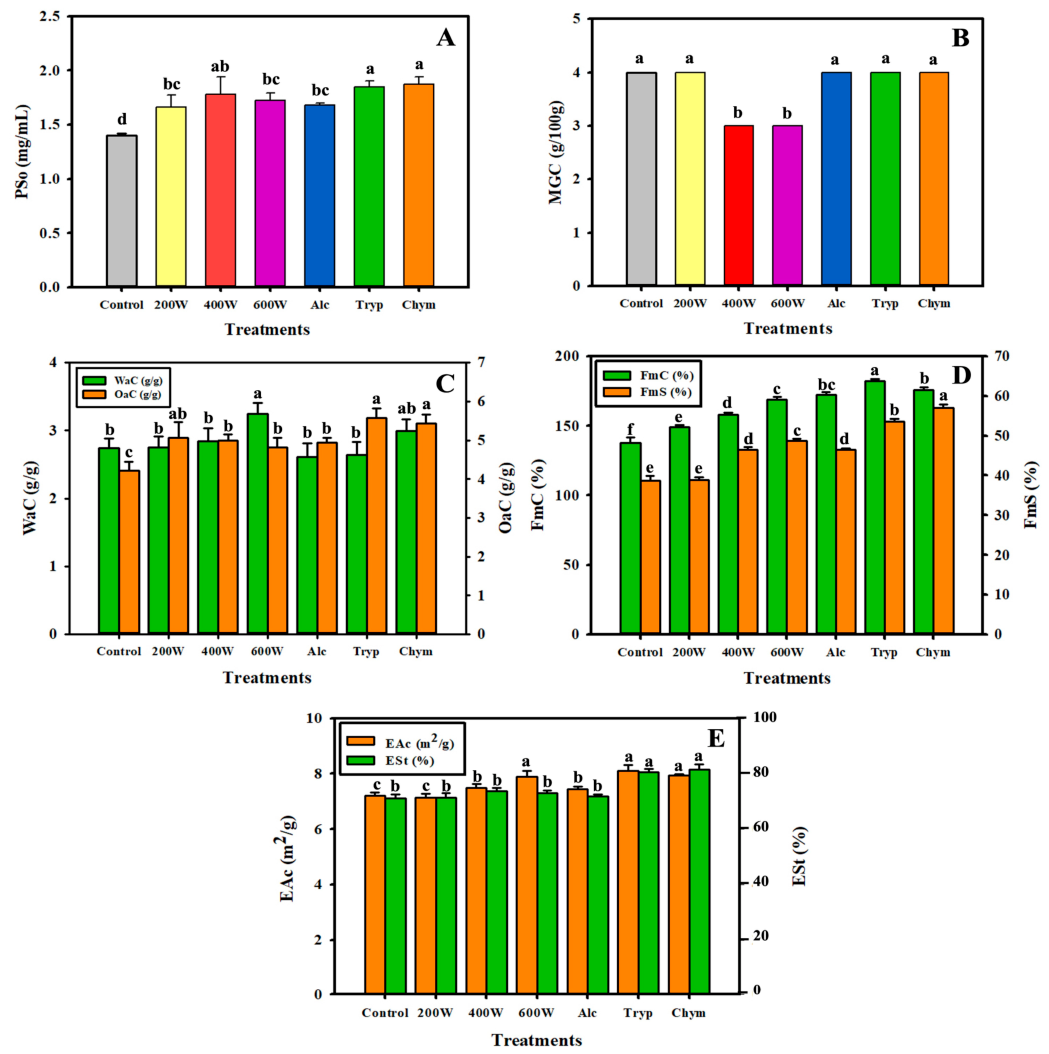
PSo is a very important property for the successful incorporation of plant-based protein isolates and hydrolysates into many water-based food systems [39]. The HInUS and EnHs treatments significantly increased (p < 0.05) PSo in all cases compared to the control treatment (Figure 1A). The PSo values for the control at 200 W, 400 W, and 600 W with Alc, Tryp, and Chym were 1.40 ± 0.02, 1.66 ± 0.11, 1.78 ± 0.16, 1.72 ± 0.07, 1.68 ± 0.02, 1.85 ± 0.05, and 1.87 ± 0.07 mg/mL, respectively. The improvement in PSo in the HInUS treatments ranged from 18.6% (200 W) to 27.1% (400 W), and for those with EnHs from 20.0% (Alc) to 33.6% (Chym). However, in general, at 400 W, the Tryp and Chym treatments, which are statistically equal, were the ones that had the maximum improvement in PSo. Tahir et al. [40] and Arteaga et al. [41] determined that the augment in PSo with HInUS and EnHs could be due to structural variations in proteins that generate the exposure of reactive groups and the release of small protein aggregates, which increase the protein–water interaction sites. The studies of Liu et al. [42], Lai et al. [43] and Ye et al. [44] with hemp, chickpea and canola proteins have demonstrated an increase in PSo after ultrasonication, while those of Thirulogasundar et al. [45] and Sareen et al. [46] with chickpea and fava bean proteins also by EnHs, consistent with the results for CSPCo.
Figure 1.
Effect of high-intensity ultrasound and enzymatic hydrolysis on: (A) protein solubility (PSo), (B) minimum gelation concentration (MGC), (C) water-absorption capacity (WaC)/oil-holding capacity (OaC), (D) foaming capacity (FmC)/foam stability (FmS) and (E) emulsifying activity index (EAc)/emulsifying stability index (ESt) of canola–sunflower protein coprecipitate. Distinct letters on the bars indicate significant (p < 0.05) difference (average ± SD, n = 3).
2.2.2. Minimum Gelation Concentration (MGC)
Gelation is the process where a fluid turns into a semi-solid gel by forming a 3-dimensional network of polymers that traps the liquid inside. In food products such as yogurt, cheese and many more, proteins play a relevant role in texture due to their gelling properties, which are estimated by their MGC [47]. According to López-Mártir et al. [30], a value of MGC <4%, 4–8%, and >8% corresponds to high, medium, and low gelling properties, respectively. Therefore, only CSPCo exposed to HInUS at 400 W and 600 W improved its gelling properties by going from a medium (4%) to a high (3%) MGC (Figure 1B).
The reduction in the MGC of proteins by HInUS can be attributed to factors such as partial denaturation and increased exposure of the hydrophobic and sulfhydryl groups, as was observed in proteins from melon [18,48] and orange [22], as determined in this study (see Figure 2C and Table 3).
Figure 2.
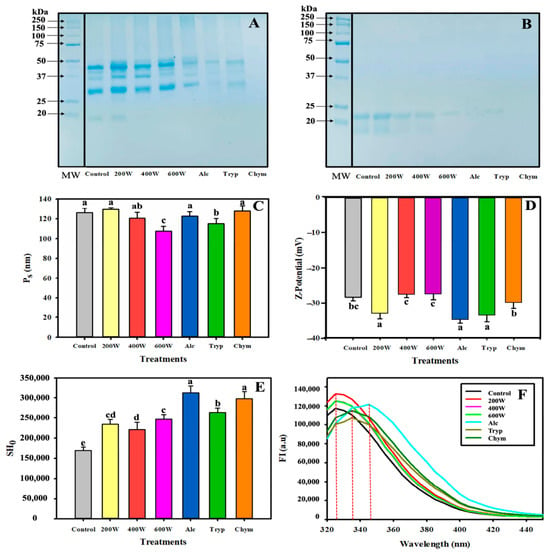
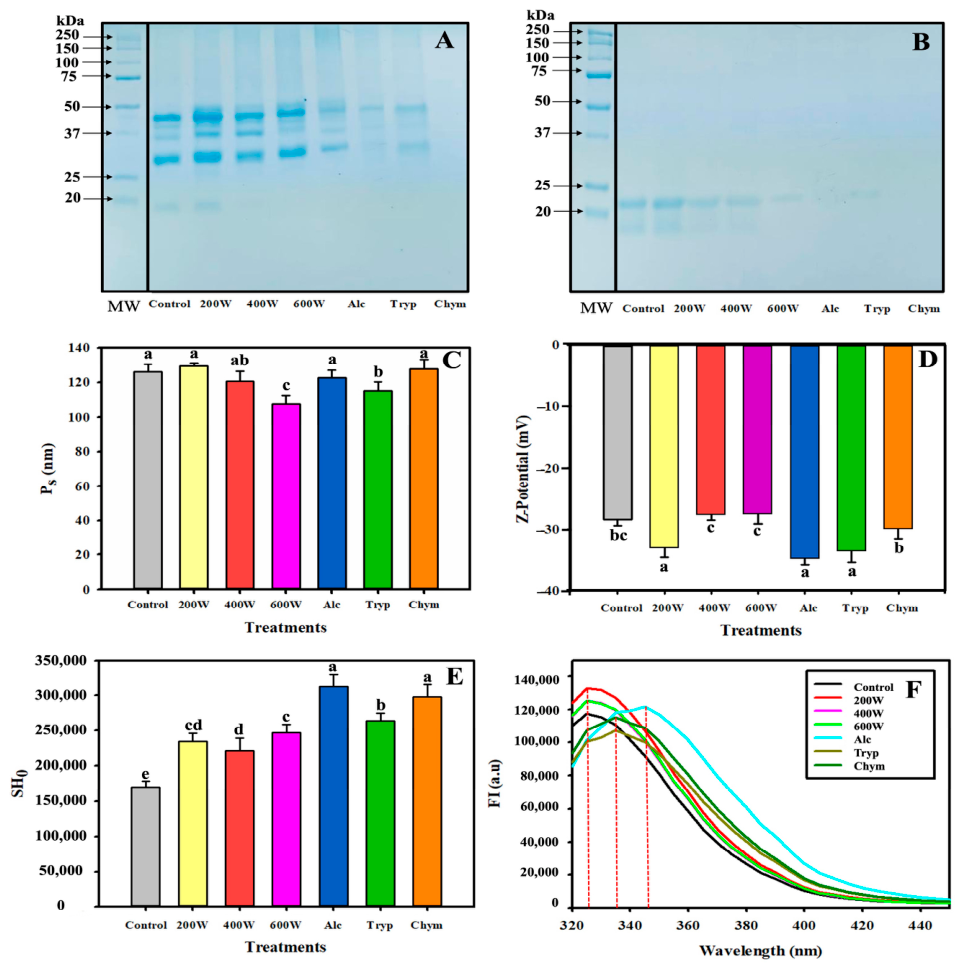
Effect of high-intensity ultrasound and enzymatic hydrolysis; (A) SDS-PAGE non-reducing conditions, (B) SDS-PAGE reducing conditions, (C) particle size (Ps), (D) zeta potential, (E) surface hydrophobicity (SH0) and (F) intrinsic fluorescence (IF) of canola–sunflower protein coprecipitate. Distinct letters on the bars indicate significant (p < 0.05) difference (average ± SD, n = 3).
Table 3.
Influence of high-intensity ultrasound and enzymatic hydrolysis on biological and structural characteristics of canola–sunflower protein coprecipitate.
2.2.3. Water-Absorption Capacity (WaC) and Oil-Holding Capacity (OaC)
The WaC and OaC of proteins are parameters related to the texture and mouthfeel, flavor and aroma in food products [49]. Only HInUS at 600 W (18.6%) and EnHs with Chym (9.1%) had a significant (p <0.05) beneficial effect on the WaC of CSPCo (Figure 1C), in comparison with the control. On the other hand, the OaC of CSPCo rose significantly (p < 0.05) to all conditions of HInUS and EnHs, compared to the control treatment. The OaC values of the control at 200 W, 400 W, and 600 W with Alc, Tryp, and Chym were 4.22 ± 0.21, 5.07 ± 0.40, 4.99 ± 0.16, 4.82 ± 0.24, 4.94 ± 012, 5.58 ± 0.24, and 5.44 ± 0.22 g oil/g protein, respectively. The greater increase with HInUS was at 200 W (20.1%), while for EnHs with Tryp (32.2%).
The WaC and OaC changes of CSPCo by HInUS and EnHs could be due to the balance modifying of the hydrophilic and hydrophobic groups on the protein surface [50]. Yolandani et al. [51] reported an improvement in WaC and OaC in soy protein by HInUS, while Konieczny et al. [23] did so for pea protein by EnHs.
2.2.4. Foam Capacity (FmC) and Foam Stability (FmS)
Foam is a type of material that forms when air or gas is trapped in a liquid or solid system. Among the most commonly used foaming agents in food are proteins, whose quality is evaluated through FmC and FmS tests, where the first indicates the amount of foam produced relative to the initial volume, and the latter reflects the proportion of foam remaining after a given time [52]. Figure 1D shows the FmC and FmS values of CSPCo treated with HInUS and EnHS. A significant increase (p < 0.05) in the FmC of CSPCo was observed due to HInUS and EnHS, ranging from 8.1% (200 W) to 32.2% (Tryp). For FmS, all treatments with HInUS and EnHS augmented this parameter, except for the 200 W treatment, with improvements ranging from 19.9% (400 W) to 47.3% (Chym). According to Manzoor et al. [19] and Arteaga et al. [41], HInUS and EnHS rose the foaming properties of red pepper and pea seed proteins, respectively, due to an augment of the MFl, SH0, and random coil content of the secondary structure of such polymers, as observed in this study for CSPCo.
2.2.5. Emulsifying Activity Index (EAc) and Emulsifying Stability Index (ESt)
Emulsions are dispersions of liquids that normally are immiscible as water and oil, which can be stabilized using surfactants such as proteins to formulate emulsion-type products [53].
The EAc of CSPCo showed the same behavior as ESt; that is, all treatments improved this property, except for 200 W (Figure 1E), with the highest improvements of 9.7% for HInUS at 600 W and 10.1% for EnHs with Tryp, in contrast with the control. Khan et al. [54] and Yildiz et al. [21] reported benefits in EAc for sea buckthorn and pumpkin protein isolates, respectively, after HInUS application, whilst Mazoor et al. [26] for an apple seed protein isolate and Fathollahy et al. [24] for a lime seed protein isolate by EnHs using papain and Alc. The enhancement in EAc by HInUS and EnHs may be due to a higher concentration of smaller soluble proteins, which provoked a more efficiently adsorption at the oil–water interface, as well as changes in SH0 and Z-potential that increase the surface activity of the biopolymers (Figure 2C–E).
On the other hand, only EnHs with Tryp and Chym augmented the ESt of CSPCo by up to 14.4%. Sareen et al. [46] and Konieczny et al. [23] reported advantages in ESt for bean and pea protein isolates, respectively, when treated with Tryp and papain, due to the high PSo of the samples, allowing for faster migration of protein particles to the interfacial area.
2.3. Biological Properties
2.3.1. In Vitro Protein Digestibility (InVPD)
Digestibility is one of the most important properties that define the nutritional quality of proteins. Generally, plant proteins have limitations in this property, which can be overcome through treatment with physical or biological processes [55]. Table 3 shows the response of HInUS and EnHs on the InVPD of CSPCo. Only HInUS at 600 W (86.98%) and EnHs with Alc (87.11%), Tryp (87.24%) and Chym (87.35%) had a beneficial effect on the InVPD of CSPCo, in comparison with the control (86.22%). Jogi et al. [25] and Yildiz et al. [21] reported that modifications to protein structures during hydrolysis and cavitation by EnHs and HInUS, respectively, could expose a greater number of peptide bonds for potential cleavage during in vitro digestion. This, in turn, would generate smaller peptides that are more easily absorbed by the body. Furthermore, Bhavana et al. [14] raised the possibility that a change in protein structure could reduce interactions with antinutritional factors, which would hypothetically improve the efficiency of proteolysis.
2.3.2. Antioxidant Activity by DPPH (AoxA)
In addition to their nutritional properties, proteins also possess other properties called nutraceuticals because they promote health, especially antioxidants [56].
Table 3 shows the effect of HInUS and EnHs on the AoxA of CSPCo. The AoxA of CSPCo increased significantly (p < 0.05) with HInUS (1.9–3.9%) and EnHs (7.4–7.8%).
According to Yolandani et al. [51], HInUS enhances antioxidant capacity by unfolding proteins, exposing amino acid residues and side chains capable of trapping free radicals. In a study with soursop [30] and melon [18] proteins, HInUS increased their antioxidant capacities, consistent with the findings of this study.
Pang et al. [57] established that EnHs promotes an increase in AoxA due to a decrease in protein molecular weight, which releases peptides that can readily interact with free radicals. Several studies have reported that EnHs generates antioxidant peptides, such as those conducted with protein isolates from plum [58] and watermelon [59]. According to Balderas-León et al. [60], hydrophobic amino acids, particularly histidine, proline, methionine, cysteine, tyrosine, tryptophan, and phenylalanine, can enhance the antioxidant activity of bioactive peptides by donating protons to DPPH radicals.
2.4. Structural Properties
2.4.1. Molecular Flexibility (MFl)
The MFl of a protein is defined as its ability to rearrange the amino acid residues in its polypeptide chain in response to changes in the external environment [61]. Table 3 shows the effect of HInUS and EnHs on the MFl of CSPCo. All HInUS and EnHs conditions significantly increased (p < 0.05) the MFle of CSPCo, which suggests a modification of the structural conformation of the proteins. HInUS shear forces [62] and EnHs proteolysis [63] destabilize the native secondary protein structure, promoting conformational relaxation and thus improving the MFl of CSPCo. According to Li et al. [64], the increased MFl of proteins improves surface properties such as emulsification and foaming, as it facilitates structural reorganization and adsorption, as observed in this study for CSPCo (Figure 1).
2.4.2. Attenuated Total Reflectance–Fourier Transform Infrared Spectra (ATR-FTIR)
The secondary structures of alpha helix (α-H), beta sheet (β-S), beta turn (β-T), and random coil (R-C) describe the local folding patterns within a polypeptide chain [65]. In general, the secondary-structure composition of CSPCo was modified by the effects of HInUS and EnHs, showing an increase in β-S (except Alc), α-H, and R-C and a reduction in β-T, compared to the control (Table 3). The conditions that favored the greatest increases in β-S (13.6%), α-H (79.6%), and R-C (150.5%) in CSPCo due to HInUS were 400 W, 600 W, and 200 W, respectively. In the case of CSPCo treated with EnHs, the greatest increase in β-S (23.1%) was obtained with Chym, while for α-H (66.6%) and R-C (74.0%) they were obtained with Tryp. HInUS and EnHs can depolymerize and rearrange canola–sunflower protein subunits, which explains the high levels of β-S and R-C (Table 3), as well as SH0 (Table 2). Furthermore, the high β-S content in CSPCos indicates more intense protein–protein interactions [14]. The decrease in β-T in CSPCo, resulting from the application of HInUS and EnHs, may have facilitated the alignment of protein segments (in a parallel or antiparallel orientation) with other chains to form β-S or, alternatively, their transition toward a disordered and highly flexible structure, such as R-C, a finding that is consistent with the observations made in this study. Tian et al. [66] reported that HInUS (20 kHz for 40 min) increased the β-S and SH0 content in a whey protein isolate–Tremella fuciformis system, as observed in this study. Studies by Liu et al. [42] on hemp proteins treated with HInUS and by Pang et al. [57] on whey with EnHs also demonstrated changes in their secondary structure.
2.4.3. Free (SHF) and Total (SHT) Sulfhydryl Groups and Disulfide Bridges (S-SB)
Three types of quantifications associated with the structural properties associated with the presence of S were performed on the proteins: SHF, SHT and S-SB. SHF groups are those located on the surface of polypeptides, SHT include both SHF and those integrated into the protein structure, whilst S-SB are covalent bonds that link S atoms from two cysteine residues [67]. The impact of HInUS and EnHs on SHF, SHT, and S-SB content is shown in Table 3. The SHF of CSPC with HInUS (11.8–20%) and EnHs (15.9–55.8%) significantly increased (p < 0.05), except for at 200 W, but in the case of SHT its values also increased for all conditions of EnHs and only at 600 W (11.8%) for HInUS, with respect to the control (Table 3). Furthermore, HInUS and EnHS significantly reduced (p < 0.05) the S-SB content, with the exception of at 400 W and 600 W and with Chym. Specifically, the largest reductions were observed at 200 W (41.7%), with Alc (64.8%) and Tryp (47.22%). Alterations by HInUS and EnHs can affect the disulfide and hydrogen bonds within the molecules, causing structural changes in CSPCo [68].
According to Ren et al. [69], the cavitation and hydrolysis effects by HInUS and EnHS, respectively, increase the exposure of SHF on the protein surface and the potential rupture of S-SB, leading to a higher SHT value. In other studies, HInUS also increased the SHF and SHT of soursop [30] and soybean [69] seed proteins, as observed in this research.
2.4.4. Electrophoretic Profile by Sodium Dodecyl Sulfate–Polyacrylamide Gel Electrophoresis (SDS-PAGE)
Figure 2A,B show the effect of HInUS and EnHs on the electrophoretic profiles of CSPCo under non-reducing (Figure 2A) and reducing (Figure 2B) conditions. Under non-reducing conditions, both the control treatment and the HInUS treated at 200 W and 400 W showed five bands with molecular weights of ~49, 38, 35, 29, and 18 kDa, which are related to the 11S globulin and 2S albumin fractions of canola and sunflower proteins [70,71]. A similar electrophoretic pattern was observed for the 600 W treatment, but the 18 kDa band disappeared, which could be due to an alteration of the primary structure of the proteins by HInUS under certain conditions. For example, Ozkan et al. [72] reported that HInUS at 20 kHz and 17.12 W/cm2 for 10–30 min dissociated pea protein subunits, generating lower-molecular-weight fragments due to the action of acoustic cavitation. In the case of EnHs, only three characteristic bands with molecular weights of ~49, 35 and 29 were observed, regardless of the enzyme used, being fainter than the control and those of the ultrasonic treatments (Figure 2A), the same phenomena that was identified in quinoa protein by action of the Alc enzyme [73]. Apparently, bands associated with proteins of molecular weights of ~38 and 18 kDa were the only ones susceptible to the action of Alc, Tryp and Chym, which explains their disappearance. Therefore, EnHs of the proteins in the corresponding bands of ~38 and 18 kDa could be beneficial for CSPCo, since they belong to the allergenic type in canola [74]. Wu et al. [12] reported that papain (15–30 min) efficiently degraded the zein–soy PCo, resulting in a reduction in its molecular weight.
On the other hand, under reducing conditions, the electrophoretic profile of CSPCo due to the effects of HInUS and EnHs varied widely. At 200 W and 400 W, only two bands with molecular weights of ~23 and 18 kDa were identified, similar to the control. These fractions correspond to the globulins and albumins of canola and sunflower proteins (Figure 2B). However, for the treatments at 600 W and with the Tryp hydrolysate, only an 18 kDa band was shown, while in those with Alc and Chym no fraction was identified, from which the presence of smaller peptides of <10 kDa is inferred, which were not detected in the gel.
According to Turker and Isleroglu [75], proteins with a molecular weight distribution between 59 kDa and 22 kDa, such as those in the CSPCo samples in this study, are associated with good functional properties, such as emulsifying, foaming, and gelling capabilities. Furthermore, certain proteins within this molecular weight range may contain bioactive peptides, thus contributing to the enhancement in their biological properties (Table 3), as observed in the CSPCo sample in this study.
2.4.5. Particle Size (Ps) and Z-Potential
Ps is a measure of the size of soluble protein aggregates [76], while Z-potential is a measure of the surface charge of the proteins that indicates the degree of electrostatic repulsion [77]. Such properties are very important for the use of this type of polymers in the food industry.
The effect of HInUS and EnHs on the Ps and Z-potential of CSPCo are shown in Figure 2C and D, respectively. EnHs decreased Ps by 8.2% (Alc), 8.8% (Tryp), and 6.4% (Chym), while the 600 W treatment reduced Ps by 14.5%, compared to the control treatment. These results indicate that HInUS, through the turbulence and high-energy shear forces produced by cavitation, can reduce protein aggregation by breaking hydrogen bonds, hydrophobic interactions, and electrostatic interactions, resulting in a lower Ps [78]. In the case of EnHs, the decrease in Ps may be due to the breaking of peptide bonds during enzymatic processing and the formation of small polypeptide fragments [79]. These findings are consistent with those reported by Ozkan et al. [72] in pea proteins and Rout et al. [80] in whey proteins, who found reductions in Ps due to the effect of HInUS and EnHs, respectively.
On the other hand, the negative Z-potential of CSPCo only changed significantly (p < 0.05) from −28.43 (control) to −33.10 mV when HInUS was applied at 200 W, while for EnHs using Alc and Tryp the Z-potential increased to −34.83 and −33.63, respectively. According to Briceño-Islas et al. [81], the modification of protein charge by EnHs and HInUS, as occurred in the CSPCo of this study, could be a consequence of changes in the number of ionizable amino and carboxyl groups exposed on the surface. Ong et al. [82] and Fameau et al. [83] reported that proteins with high Z-potential values (negative or positive) and a smaller Ps tend to have a greater ability to disperse in water and interact with interfaces, forming a repulsive barrier that stabilizes colloidal systems and prevents the formation of protein aggregates. In line with these results, Bahmanyar et al. [84] and Pang et al. [57] observed modifications in the Z-potential of pea and whey protein isolates after HInUS and EnHs, respectively.
2.4.6. Surface Hydrophobicity (SH0)
SH0 indicates the content of chemical groups distributed over the surface of the protein that repel water, which greatly impacts its functionality [85]. Both HInUS and EnHs significantly rose (p < 0.05) the SH0 of CSPCo; however, the highest increases were detected in the second case (Figure 2E). Specifically, the CSPCo treated with Alc showed the greatest increase in SH0 (45.5%), followed by the one subjected to HInUS at 600 W (30.9%), compared to the control. Essentially, the modification of the SH0 of proteins by EnHs and HInUS is due to the fact that such treatments cause greater exposure of nonpolar amino acids. According to research by Bhavana et al. [14], applying high pressure to a PCo of millet and moringa significantly altered its structure and functional properties. The treatment caused the molecular unfolding of the proteins, disrupting weak interactions such as van der Waals forces and hydrogen bonds, resulting in greater exposure of hydrophobic regions. Similar to this research, in guamuchil seed proteins [35] and chickpea proteins [43] HInUS increased SH0, while EnHs did so in pea proteins [23].
2.4.7. Intrinsic Fluorescence Spectroscopy (InFS)
InFS allows for the determination of changes in the tertiary structure of proteins by detecting variations in intrinsic fluorescence intensity (FI) as well as the wavelength of maximum absorption (λmax) in the spectrum [78]. The impact of HInUS and EnHs on the InFS of CSPCo is shown in Figure 2F. It was observed that EnHs shifted the position of the λmax peaks, compared to HInUS and the control treatment. In particular, CSPCo treated with Alc had λmax = 345 nm, those with Tryp and Chim λmax = 335 nm, while the sonicated ones and the control λmax = 325 nm. Furthermore, the FI was modified with respect to the control in all CSPCos exposed to HInUS and EnHs. Studies on peanut proteins treated with HInUS [86] and chia subjected to EnHs [81] also demonstrated the modification of the tertiary structure measured through a greater exposure of its chromophore amino acids.
3. Materials and Methods
3.1. Materials and Chemicals
Canola meal (CaM) and sunflower meal (SuM) were supplied by Forrajes y Alimentos San Cayetano (Tepic, Nayarit, México) and New Country Organics Inc. (Lubbock, TX, USA), respectively. Alcalase® (from Bacillus lincheniformis-Type VIII, 7–15 U/mg solid), Trypsin® (from bovine pancreas-Type XI, ≥ 6000 BAEE U/mg protein), and α-Chymotrypsin® (from bovine pancreas-Type II, ≥ 40 U/mg protein) were purchased from Sigma-Aldrich (St. Louis, MO, USA). All other chemicals employed in this study were analytical grade and acquired from Fermont (Monterrey, NL, México), J.T. Baker (Phillipsburg, NJ, USA), and Bio-Rad, Inc. (Hercules, CA, USA).
3.2. Preparation of CSPCo
CSPCo was obtained in three independent batches using a 50%CaM:50%SuM ratio (protein content: 39.72% CaM, 33.54% SuM), via alkaline extraction and isoelectric precipitation, following the method described by Flores-Jiménez et al. [27], with an average yield of 5.20 ± 0.26%.
3.3. High-Intensity Ultrasound Treatment (HInUS)
CSPCo suspensions (1:10 w/v) were subjected to sonication (CPX750, Cole-Parmer Instruments, Vernon Hills, IL, USA) using a titanium probe (2.54 cm) inserted to a depth of 5 cm into each 200 mL suspension [86]. The samples were placed in 500 mL containers, which were set in an ice-water bath prior to processing to maintain the temperature below 15 °C. The suspensions were subjected to HInUS (20 kHz) at output power levels of 200 W, 400 W, and 600 W (with a pulse duration of 5 s and a pause interval of 1 s) for 15 min.
The exposed treatments at 200 W, 400 W and 600 W received an acoustic energy density of 114 ± 0.3 J/mL, 226.8 ± 3.3 J/mL, and 441.2 ± 4.8 J/mL, respectively. Finally, the CSPCo suspensions subjected to HInUS were lyophilized to obtain the CSPCo as dry powder. The ultrasonicated treatments were stored at −4 °C in airtight containers for later analysis.
3.4. Enzymatic Hydrolysis (EnHs)
EnHs of CSPCo was performed according to Balderas-León et al. [60]. Three independent enzymes were used: alcalase (Alc), trypsin (Tryp), and α-chymotrypsin (Chym). In all treatments, the enzymes were applied at a constant activity level of 100 U/g of protein. Hydrolysis with Alc was performed at 50 °C and pH 8, while hydrolysis with Tryp and Chym was performed at 37 °C and pH 7.8. The pH was kept constant during the hydrolysis process (60 min) by the addition of 0.1 N of HCl or 0.1 N of NaOH. Finally, to stop the enzymatic reaction, the samples were immediately heated to 95 °C in a water bath for 15 min and stored at room temperature in airtight containers until use. The degree of hydrolysis of CSPCo treated with Alc, Tryp and Chym were 25.8%, 29.5%, and 28.4%, respectively, which was measured according to the reported method by Jogi et al. [25]. The CSPCo hydrolysates were lyophilized and stored at −4 °C in airtight containers for later use.
3.5. Composition and Physicochemical Characteristics
3.5.1. Proximate Analysis
The proximate composition of the protein samples was analyzed following official AOAC methods [87]. Total carbohydrates were estimated by analytical difference (subtracting moisture, fat, protein, and ash from 100%). All results were expressed in g/100 g.
3.5.2. Color Analysis
Color coordinates were measured using a model CR-300 colorimeter (Konica Minolta Holdings, Inc., Chiyoda, TYO, Japan). The device was calibrated using a standard white ceramic plate, and values for lightness (L*), chromaticity on the red–green axis (a*), and chromaticity on the yellow–blue axis (b*) were recorded. The , , and values for the standard white ceramic plate were 94.44, −0.20, and 3.87, respectively. The total variation of color (ΔE) was determined as follows:
Hue angle (Hab) was calculated as the arc tangent of the ratio of yellowness to redness, as shown in Equation (2).
Chroma (C*) was determined as the Euclidean distance of the color vector (L, a, b) for a sample from the lightness axis, as shown in Equation (3).
3.5.3. aw
The determination of aw in the freeze-dried samples was carried out at a controlled temperature of 25 °C, using the water activity meter model 4 TEV instrument (Decagon Devices Inc., Pullman, WA, USA).
3.5.4. Turbidity
The turbidity of the protein dispersions (1%, w/v) was determined by measuring the absorbance at 600 nm, using a UV-Vis spectrophotometer (model FI-01620, Thermo Fisher Scientific, Vantaa, Finland).
3.6. Functional Characteristics
3.6.1. PSo
PSo was performed as described by Chin et al. [88], with some modifications. Samples containing 40 mg of protein were mixed with 20 mL of 0.01 M of sodium phosphate buffer (pH 7) for 60 min at 20 °C, followed by centrifugation (8000× g for 10 min at 20 °C). Soluble protein concentrations before (C−1) and after (C−2) centrifugation were quantified using the Bradford method [89] with bovine serum albumin as standard. The percentage of soluble protein was calculated using Equation (4).
3.6.2. MGC
The MGC was determined following the methodology of Rosas-Ulloa et al. [22], with some modifications. Protein dispersions (2–20% w/v) were prepared in 5 mL volumes at pH 7, heated at 90 °C for 1 h, and subsequently cooled at 4 °C for 2 h. The MGC was identified as the concentration at which the sample in an inverted test tube neither fell out nor slid down.
3.6.3. WaC and OaC
To evaluate WaC and OaC, 0.5 g of protein was dispersed in 10 mL of distilled water or canola oil using tared 50 mL tubes. After vortexing and allowing the samples to stand for 30 min at room temperature, they were centrifuged at 5000× g for 20 min at 25 °C. Finally, the supernatant was removed, and the sediment was weighed [90], with the results expressed as grams of liquid absorbed per gram of protein.
3.6.4. FmC and FmS
The FmC and FmS of the samples were measured following the procedure of Silva-Carrillo et al. [20], with small variations. Protein suspensions were prepared (5%) with 0.01 M of sodium phosphate buffer (pH 7). Then, a sample of 15 mL was mixed for 1 min at 12,000 rpm and poured into the graduated tube. The initial volume of the dispersion (V1) and the volume of foam generated (V2) after the homogenization process were recorded. The volume of the remaining foam (V3) was recorded after keeping the sample at room temperature for 20 min. The FmC and FmS were calculated as follows:
3.6.5. EAc and ESt
The EAc and ESt were measured according to the method of Kang et al. [91]. A total of 5 mL of canola oil was homogenized (IKA T-25, IKA, Staufen im Breisgau, BW, Germany) with 16 mL of the sample solution (0.1% w/v in 0.01 M of sodium phosphate buffer; pH 7) at 10,000 rpm for 1 min. Subsequently, 50 μL of the emulsion was withdrawn from the bottom of the tube at two different time points: immediately after mixing (0 min) and after 10 min. Each 50 μL aliquot was diluted in 5 mL of a 0.1% SDS (sodium dodecyl sulfate) solution and vortexed for 5 s. Finally, the absorbance of both dilutions was measured at 500 nm. EAc and ESt were calculated using Equations 7 and 8, respectively:
where A0 and A10 = absorbance of the emulsion at 0 and 10 min, respectively, C = protein concentration (g/mL), and Ø = oil volume fraction (0.238).
3.7. Biological Properties
3.7.1. InVPD
The InVPD method described by Garcia et al. [55] was used, with some modifications. Protein dispersions (50 mL), at a concentration of 6.25 mg/mL, were adjusted to pH 8 using 0.1 M of NaOH. A multi-enzyme solution (pH 8) was prepared containing trypsin, protease, and bovine pancreatin at concentrations of 1.6 mg/mL, 0.05 mg/mL, and 1 mg/mL, respectively. Then, 1.5 mL of the multi-enzyme mixture was added to the protein dispersions, which were then kept under agitation for 10 min at 37 °C. The drop in pH was recorded after 10 min of reaction. InVPD was estimated as follows:
where X = pH sample dispersion after 10 min of reaction with the multi-enzyme preparation.
InVPD (%) = 210.464 − 18.10(X)
3.7.2. AoxA
The AoxA of the protein samples was evaluated using 1,1-diphenyl-2-picrylhydrazyl (DPPH), following the method reported by López-Mártir et al. [28], with some modifications. A volume of 250 μL of 0.06 mM of DPPH was mixed with 30 μL of protein suspension (0.5 mg/mL). The mixture was left to stand in the dark for 30 min at 25 º C. Subsequently, the absorbance was measured at 515 nm using a spectrophotometer Multiskan Go (Thermo Fisher Scientific, Waltham, MA, USA), with a blank (250 μL of DPPH + 30 μL of distilled water). The percentage of AoxA is determined by applying the corresponding mathematical equation:
where Abl and Asa are the absorbances of the blank and the sample, respectively.
3.8. Structural Properties
3.8.1. MFl
The MFl of the samples (1 mg/mL in 0.01 M of sodium phosphate buffer; pH 8) was evaluated using the technique proposed by Chin et al. [88].
3.8.2. ATR-FTIR
Infrared spectra of the protein samples were obtained using an ATR-FTIR spectrometer (Agilent Cary 630, Agilent Technologies, Santa Clara, CA, USA). A total of 0.1 g of protein samples was placed in a ZnSe cell, using a wavelength range of 650 to 4000 cm−1 with a resolution of 4 cm−1 and 21 scans at 20 °C. The infrared spectra obtained were analyzed using the OriginPro8 software (OriginLab Corporation, Northampton, MA, USA). The amide I band (1600–1700 cm−1) was analyzed to obtain the proportion of secondary structure in the protein samples.
3.8.3. SHF, SHT and S-SB
The determination of the content of SHF, SHT and S-SB of the protein samples was carried out according to the methods described by De Angelis et al. [92]. SHF and SHT concentrations were calculated using Equation (11), and S-SB using Equation (12).
where A412 = absorbance of the sample at 412 nm, C = sample protein concentration (1 mg/mL), and D = dilution factor (D = 1).
3.8.4. SDS-PAGE
The determination of SDS-PAGE of the protein samples was performed according to the method described by Flores-Jiménez et al. [93]. Samples were processed on 4–20% polyacrylamide gel and prepared in reducing and non-reducing conditions (β-mercaptoethanol). A total of 20 µL of each sample with 15 µg of protein were charged into each channel of gel, including the molecular weight marker (MW) from 10 to 250 kDa (Precision Plus Protein All Blue Prestained Protein Standards, Bio-Rad, Inc. Hercules, CA, USA). Electrophoresis was performed at 140 V for 10 min, and after that at 110 V for approximately 2 h. The gel was stained with Coomassie brilliant blue for 24 h. Ultimately, the gel was destained until bands were easily seen and then captured using the ImageJ software version 1.54t (National Health Institute, Bethesda, MD, USA) for molecular mass definition.
3.8.5. Ps and Z-Potential
Ps and Z-potential were measured at 20 °C using a Zetasizer Nano-ZS90 (Malvern Instruments, Malvern, UK). Prior to analysis, the protein samples were diluted to a concentration of 0.2 mg/mL in 0.01 M of sodium phosphate buffer (pH 9). For Pz, the analysis was performed in a glass cuvette (ZEN0118, Malvern Instruments), while for Zp, disposable folded capillary cells (DTS1060) were used.
3.8.6. SH0
SH0 was determined by fluorometry using the molecular probe 8-anilino-1-naphthalenesulfonic acid (ANS), following the methodology described by Ma et al. [94]. Starting from a 0.2 mg/mL stock solution, protein dilutions were prepared within a concentration range of 0.01 to 0.05 mg/mL in a 2 mL volume. Subsequently, 25 μL of an 8 mM ANS solution was added to each sample, and the samples were incubated for 1 h in the dark. The final volume in the tubes was adjusted to 2 mL, taking protein solubility into account. Fluorescence intensity was recorded using a Tecan Infinite 200 Pro microplate (Grödig, SBG, Austria) reader at excitation and emission wavelengths of 364 nm and 475 nm. SH0 was calculated as the slope of the linear plot of fluorescence versus protein concentration (mg/mL).
3.8.7. InFS
InFS was determined from protein solutions (0.2 mg/mL in 0.01 M of sodium phosphate buffer; pH 9) using a Tecan Infinite 200 Pro spectrofluorometer (Grödig, SBG, Austria). Measurement parameters included excitation at 290 nm, a spectral scan from 320 to 450 nm, and a slit width of 5 nm.
3.9. Statistical Analysis
All measurements are presented as the mean ± standard deviation of three batches. Data analysis involved a one-way ANOVA, and comparison of means was performed using Fisher’s test (statistical significance considered at p < 0.05) with the Statistica software version 7.1 (TIBCO Software, Inc., Palo Alto, CA, USA).
4. Conclusions
In general, HInUS and EnHS modified the physicochemical, functional, and structural properties of CSPCo obtained by alkaline extraction and isoelectric precipitation. Specifically, HInUS significantly increased (p < 0.05) the PSo (18.6–27.1%), MGC (25%) (this means a 25% reduction in protein required for gel formation), OaC (14.2–20.1%), FmC (8.07–22.6%), FmS (19.9–25.8%) and EAc (4.2–9.7%) of CSPCo, while for EnHS the benefits in PSo, OaC, FmC, FmS and EAc were 20.0–33.6%, 17.1–32.2%, 25–32.2%, 20–47.3% and 3.5–12.5%, respectively. The functional enhancements resulting from HInUS and EnHs were associated with structural changes manifested in the secondary-structure composition, Ps, SH0, InFS, MFl, SHF, and SHT, as well as the molecular weight of the proteins. Of these two methods, EnHS had a greater impact on functional characteristics compared to HInUS. However, both HInUS and EnHs can contribute to the use of CSPCo as a novel food ingredient. Further research on the nutritional and rheological properties of CSPCo could help expand its applications in the food and nutrition industries.
Author Contributions
N.T.F.-J.: Investigation; Methodology; Writing—Original draft preparation; Editing. J.A.U.: Investigation; Writing—Original draft; Review; Editing; Conceptualization; Supervision; Data curation; Funding acquisition. J.E.U.-S.: Software; Supervision; Validation. P.R.-U.: Conceptualization. K.U.L.-M.: Software. J.C.R.-R.: Formal analysis. R.G.-L.: Formal analysis. Y.S.-C.: Supervision. B.E.U.-R.: Supervision. All authors have read and agreed to the published version of the manuscript.
Funding
Partial financial support was received from Patronage to Administer the Special Tax Destined to the Autonomous University of Nayarit for providing research funds (PU2025/01). Additionally, the Secretariat of Science, Humanities, Technology and Innovation (SECIHTI) of Mexico for the postdoctoral scholarship awarded to Nitzia Thalía Flores Jiménez (CVU: 601948).
Data Availability Statement
Data will be made available on request.
Acknowledgments
The authors acknowledge the Secretariat of Science, Humanities, Technology and Innovation (SECIHTI) of Mexico for the scholarship awarded to Nitzia Thalía Flores Jiménez (CVU: 601948) and the Patronage to Administer the Special Tax Destined to the Autonomous University of Nayarit (UAN) for financial support.
Conflicts of Interest
The authors declare that they have no known competing financial interests or personal relationships that could have appeared to influence the work reported in this manuscript.
References
- Gil, M.; Rudy, M.; Duma-Kocan, P.; Stanisławczyk, R.; Krajewska, A.; Dziki, D.; Hassoon, W.H. Sustainability of alternatives to animal protein sources, a comprehensive review. Sustainability 2024, 16, 7701. [Google Scholar] [CrossRef] [Scilit]
- Rahim, M.A.; Ayub, H.; Sehrish, A.; Ambreen, S.; Khan, F.A.; Itrat, N.; Rocha, J.M. Essential components from plant source oils: A review on extraction, detection, identification, and quantification. Molecules 2023, 28, 6881. [Google Scholar] [CrossRef] [Scilit]
- Ancuța, P.; Sonia, A. Oil press-cakes and meals valorization through circular economy approaches: A review. Appl. Sci. 2020, 10, 7432. [Google Scholar] [CrossRef] [Scilit]
- Arrutia, F.; Binner, E.; Williams, P.; Waldron, K.W. Oilseeds beyond oil: Press cakes and meals supplying global protein requirements. Trends Food Sci. Technol. 2020, 100, 88–102. [Google Scholar] [CrossRef] [Scilit]
- Vahedifar, A.; Wu, J. Extraction, nutrition, functionality and commercial applications of canola proteins as an underutilized plant protein source for human nutrition. In Advances in Food and Nutrition Research; Academic Press: Cambridge, MA, USA, 2022; Volume 101, pp. 17–69. [Google Scholar] [CrossRef] [Scilit]
- Bell, J.M. Factors affecting the nutritional value of canola meal: A review. Can. J. Anim. Sci. 1993, 73, 689–697. [Google Scholar] [CrossRef] [Scilit]
- Adesina, S.A. Effects of Conventional Food Processing Methods on the Mineral and Anti-Nutrient Composition of Sunflower (Helianthus annuus) Seeds. Agric. Food Sci. J. Ghana 2019, 12, 1106–1119. [Google Scholar]
- Liu, C.; Wang, R.; Wang, T.; Gu, C.; Zhang, L.; Meng, D.; Yang, R. The whey–plant protein heteroprotein systems with synergistic properties and versatile applications. J. Agric. Food Chem. 2025, 73, 4440–4454. [Google Scholar] [CrossRef] [Scilit]
- Flores-Jiménez, N.T.; Ulloa, J.A.; Urías-Silvas, J.E. Techno-functional and structural characteristics of coprecipitates and protein mixtures: A Review. J. Food Sci. 2025, 90, 70569. [Google Scholar] [CrossRef] [Scilit]
- Liu, X.; Zhang, M.; Yang, M.; Han, C.; Shen, Y.; Su, Y.; Lv, Y. Structural modification and enhanced gel properties of peanut protein via co-precipitation with egg white protein. Foods 2026, 15, 2187. [Google Scholar] [CrossRef] [Scilit]
- Awal, M.S.; Benjakul, S.; Prodpran, T.; Nilsuwan, K. Characteristics and properties of co-precipitated protein and film based on Bambara groundnut protein isolate and fish skin acid-soluble collagen. J. Agric. Food Res. 2024, 18, 101430. [Google Scholar] [CrossRef] [Scilit]
- Wu, D.; Wu, W.; Zhang, N.; Soladoye, O.P.; Aluko, R.E.; Zhang, Y.; Fu, Y. Tailoring soy protein/corn zein mixture by limited enzymatic hydrolysis to improve digestibility and functionality. Food Chem. X 2024, 23, 101550. [Google Scholar] [CrossRef] [Scilit]
- Tian, T.; Tong, X.; Ren, K.; Cao, J.; Yuan, Y.; Yang, J.; Zhu, J.; Miao, L.; Yang, S.; Yu, A.; et al. Influence of protein ratios on the structure and gel properties of soybean-wheat co-precipitated proteins. LWT-Food Sci. Technol. 2022, 170, 114045. [Google Scholar] [CrossRef] [Scilit]
- Bhavana, M.R.; Hegde, K.R.; Buvaneswaran, M.; Sinija, V.R.; Rawson, A.; Hema, V. The effect of co-precipitation and high-pressure treatment on functional and structural properties of millet and moringa protein. Food Chem. 2025, 471, 142773. [Google Scholar] [CrossRef] [Scilit]
- Yuan, Y.; Wei, X.; Mao, Y.; Zheng, Y.; He, N.; Guo, Y.; Wang, S. Innovative food processing technologies promoting efficient utilization of nutrients in staple food crops. Engineering 2025, 50, 229–244. [Google Scholar] [CrossRef] [Scilit]
- Qiu, L.; Zhu, Y.; Zhu, X.; Liu, L.; Lv, M.; Huang, Y.; Qu, M. Effects of ultrasound on the structure and properties of soy protein gels prepared with different 11S/7S ratios. Food Hydrocoll. 2025, 167, 111392. [Google Scholar] [CrossRef] [Scilit]
- Gasparre, N.; Rosell, C.M.; Boukid, F. Enzymatic hydrolysis of plant proteins: Tailoring characteristics, enhancing functionality, and expanding applications in the food industry. Food Bioprocess Technol. 2025, 18, 3272–3287. [Google Scholar] [CrossRef] [Scilit]
- Yildiz, G. Effects of high-intensity ultrasound, high-pressure processing, and their combination with pH-shifting on the techno-functionality and digestibility of melon seed protein isolate. Food Res. Int. 2025, 208, 116219. [Google Scholar] [CrossRef] [Scilit]
- Manzoor, M.F.; Waseem, M.; Diana, T.; Wang, R.; Ahmed, Z.; Ahmed, I.A.M.; Mohamed-Ahmed, I.A.; Ali, M.; An-Zeng, X. Ultrasound-assisted modification to improve the red pepper seed protein isolate structural, functional, and antioxidant properties. Int. J. Biol. Macromol. 2025, 309, 143154. [Google Scholar] [CrossRef] [Scilit]
- Silva-Carrillo, Y.; Ulloa, J.A.; Silvas Urías, J.E.; Ramírez, J.C.R.; Leyva-Gutiérrez, R.G. Physicochemical and functional characteristics of a gourd (Cucurbita argyrosperma Huber) seed protein isolate subjected to high-intensity ultrasound. Heliyon 2024, 10, 32225. [Google Scholar] [CrossRef] [Scilit]
- Yildiz, G. From seed to solution: Enhancing techno-functionality and digestibility of pumpkin seed protein isolate through high-intensity ultrasound, high-pressure processing, and pH-shifting. Food Chem. 2025, 474, 143222. [Google Scholar] [CrossRef] [Scilit]
- Rosas-Ulloa, P.; Ulloa, J.A.; Ulloa Rangel, B.E.; López Mártir, K.U. Protein isolate from orange (Citrus sinensis L.) seeds: Effect of high-intensity ultrasound on its physicochemical and functional properties. Food Bioprocess Technol. 2023, 16, 589–602. [Google Scholar] [CrossRef] [Scilit]
- Konieczny, D.; Stone, A.K.; Nosworthy, M.G.; House, J.D.; Korber, D.R.; Nickerson, M.T.; Tanaka, T. Nutritional properties of pea protein-enriched flour treated with different proteases to varying degrees of hydrolysis. Cereal Chem. 2020, 97, 429–440. [Google Scholar] [CrossRef] [Scilit]
- Fathollahy, I.; Farmani, J.; Kasaai, M.R.; Hamishehkar, H. Characteristics and functional properties of Persian lime (Citrus latifolia) seed protein isolate and enzymatic hydrolysates. LWT—Food Sci. Technol. 2021, 140, 110765. [Google Scholar] [CrossRef] [Scilit]
- Jogi, N.; Adusumilli, S.; Nagesh, M.; Yannam, S.K.; Mamatha, B.S. The role of duel hydrolysis of soybean on functional properties and protein digestibility: A sustainable approach. Front. Nutr. 2024, 11, 1444329. [Google Scholar] [CrossRef] [Scilit]
- Manzoor, M.; Singh, J.; Bhat, Z.F.; Jaglan, S. Multifunctional apple seed protein hydrolysates: Impact of enzymolysis on the biochemical, techno-functional and in vitro α-glucosidase, pancreatic lipase and angiotensin-converting enzyme inhibition activities. Int. J. Biol. Macromol. 2024, 257, 128553. [Google Scholar] [CrossRef] [Scilit]
- Flores-Jiménez, N.T.; Ulloa, J.A.; Silvas-Urías, J.E. Valorization of sunflower (Helianthus annuus L.) and canola (Brassica napus L.) meals through protein coprecipitation: Physicochemical, functional, and structural characterization. Sustain. Food Technol. 2026, 4, 3344–3362. [Google Scholar] [CrossRef] [Scilit]
- López-Mártir, K.U.; Ulloa, J.A.; Urías-Silvas, J.E.; Rosas-Ulloa, P.; Ulloa-Rangel, B.E. High-intensity ultrasound affects the physicochemical, structural and functional properties of proteins recovered from noni (Morinda citrifolia) seeds. Sustain. Food Technol. 2025, 3, 700–713. [Google Scholar] [CrossRef] [Scilit]
- Badjona, A.; Bradshaw, R.; Millman, C.; Howarth, M.; Dubey, B. Structural, thermal, and physicochemical properties of ultrasound-assisted extraction of faba bean protein isolate (FPI). J. Food Eng. 2024, 377, 112082. [Google Scholar] [CrossRef] [Scilit]
- López-Mártir, K.U.; Ulloa, J.A.; Urías-Silvas, J.E.; Rosas-Ulloa, P.; Ramírez-Ramírez, J.C.; Resendiz-Vázquez, J.A. Modification of the physicochemical, functional, biochemical and structural properties of a soursop seed (Annona muricata L.) protein isolate treated with high-intensity ultrasound. Ultrason. Sonochem. 2024, 105, 106870. [Google Scholar] [CrossRef] [Scilit]
- Ghribi, A.; Gafsi, I.; Sila, A.; Blecker, C.; Danthine, S.; Attia, H.; Besbes, S. Effects of enzymatic hydrolysis on conformational and functional properties of chickpea protein isolate. Food Chem. 2015, 187, 322–330. [Google Scholar] [CrossRef] [Scilit]
- Marques Soutelino, M.E.M.; de Oliveira, B.C.R.; de Aguiar Sobral, L.; de Vasconcellos, F.J.; Mársico, E.T.; Esmerino, E.A.; de Oliveira Silva, A.C. Hydrolyzed collagen as a potentially functional ingredient and optimizer of technological properties of chocolate-flavored dairy dessert. J. Food Sci. 2025, 90, 70636. [Google Scholar] [CrossRef] [Scilit]
- Kutlu, N.; Pandiselvam, R.; Kamiloglu, A.; Saka, I.; Sruthi, N.U.; Kothakota, A.; Maerescu, C.M. Impact of ultrasonication applications on color profile of foods. Ultrason. Sonochem. 2022, 89, 106109. [Google Scholar] [CrossRef] [Scilit]
- Kvangarsnes, K.; Dauksas, E.; Tolstorebrov, I.; Rustad, T.; Bartolomei, M.; Xu, R.; Cropotova, J. Physicochemical and functional properties of rainbow trout (Oncorhynchus mykiss) hydrolysate. Heliyon 2023, 9, 17979. [Google Scholar] [CrossRef] [Scilit]
- Flores-Jiménez, N.T.; Ulloa, J.A.; Urías-Silvas, J.E.; Ramírez-Ramírez, J.C.; Bautista-Rosales, P.U.; Gutiérrez-Leyva, R. Influence of high-intensity ultrasound on physicochemical and functional properties of a guamuchil Pithecellobium dulce (Roxb.) seed protein isolate. Ultrason. Sonochem. 2022, 84, 105976. [Google Scholar] [CrossRef] [Scilit]
- Khapudang, R.; Siddiqui, S. Structural, thermal and functional properties of protein isolates from oyster mushroom (Pleurotus ostreatus) isolated by alkaline iso-electric, ultra-sonication and enzymatic extraction techniques. Food Phys. 2026, 3, 100072. [Google Scholar] [CrossRef] [Scilit]
- Ahmad, F.; Zaidi, S. The influence of ultrasound-assisted osmotic dehydration as a pre-treatment method on the quality of vacuum dried pineapple. Food Humanit. 2023, 1, 137–146. [Google Scholar] [CrossRef] [Scilit]
- Rodríguez-Rivera, A.E.; Ulloa, J.A.; Flores-Jiménez, N.T.; Urías-Silvas, J.E. Effect of high-intensity ultrasound on the physicochemical, nutritional, rheological, microstructural, and techno-functional properties of a groundnut (Arachis hypogaea L.) paste protein isolate. Sustain. Food Technol. 2025, 3, 1376–1390. [Google Scholar] [CrossRef] [Scilit]
- Yousefi, N.; Abbasi, S. Food proteins: Solubility & thermal stability improvement techniques. Food Chem. Adv. 2022, 1, 100090, Erratum in Food Chem. Adv. 2023, 3, 100317. [Google Scholar] [CrossRef] [Scilit]
- Tahir, A.B.; Khalil, A.A.; Gull, H.; Ali, K.; AlMasoud, N.; Alomar, T.S.; Aadil, R.M. Enhancing structural and functional properties of commercially available pea protein isolate for plant-based meat analogues using combined pH-Shift, high-intensity ultrasound, and heat treatments. Ultrason. Sonochem. 2025, 117, 107342. [Google Scholar] [CrossRef] [Scilit]
- Arteaga, V.G.; Guardia, M.S.; Muranyi, I.; Eisner, P.; Schweiggert-Weisz, U. Effect of enzymatic hydrolysis on molecular weight distribution, techno-functional properties and sensory perception of pea protein isolates. Innov. Food Sci. Emerg. Technol. 2020, 65, 102449. [Google Scholar] [CrossRef] [Scilit]
- Liu, X.; Wang, M.; Xue, F.; Adhikari, B. Application of ultrasound treatment to improve the technofunctional properties of hemp protein isolate. Future Foods 2022, 6, 100176. [Google Scholar] [CrossRef] [Scilit]
- Lai, X.J.; Chen, J.Q.; Nie, J.; Guo, P.F.; Manzoor, M.F.; Huang, Y.Y.; Wang, R. Enhancement of extraction efficiency and functional properties of chickpea protein isolate using pulsed electric field combined with ultrasound treatment. Ultrason. Sonochem. 2024, 111, 107089. [Google Scholar] [CrossRef] [Scilit]
- Ye, Z.; Wang, J.; Ma, G.; Ma, J. Ultrasound and glycosylation modifications enhance the physicochemical and functional properties of canola protein isolate for O/W emulsion stabilization. Food Chem. X 2025, 28, 102535. [Google Scholar] [CrossRef] [Scilit]
- Thirulogasundar, A.; Shi, D.; Stone, A.K.; Xu, C.; Bhagwat, A.; Lu, Y.; Nickerson, M.T. Effect of enzyme hydrolysis on the functionality, protein quality, and flavour profile of lentil and chickpea protein isolates. J. Food Meas. Charact. 2024, 18, 1592–1609. [Google Scholar] [CrossRef] [Scilit]
- Sareen, J.; Shi, D.; Stone, A.K.; Xu, C.; Polley, B.; House, J.D.; Nickerson, M.T. Effect of enzyme hydrolysis on the physicochemical, functional, and nutritional properties of pea and faba bean protein isolates. Eur. Food Res. Technol. 2023, 249, 3175–3190. [Google Scholar] [CrossRef] [Scilit]
- Khalesi, M.; Glenn-Davi, K.; Mohammadi, N.; FitzGerald, R.J. Key factors influencing gelation in plant vs. animal proteins: A comparative mini-review. Gels 2024, 10, 575. [Google Scholar] [CrossRef] [Scilit]
- Naik, M.; Natarajan, V.; Modupalli, N.; Thangaraj, S.; Rawson, A. Pulsed ultrasound assisted extraction of protein from defatted Bitter melon seeds (Momardica charantia L.) meal: Kinetics and quality measurements. LWT—Food Sci. Technol. 2022, 155, 112997. [Google Scholar] [CrossRef] [Scilit]
- Gharehbeglou, P.; Sarabandi, K.; Akbarbaglu, Z. Insights into enzymatic hydrolysis: Exploring effects on antioxidant and functional properties of bioactive peptides from chlorella proteins. J. Agric. Food Res. 2024, 16, 101129. [Google Scholar] [CrossRef] [Scilit]
- Habib, M.; Rani, S.; Singh, S.; Jan, S.; Jan, K.; Swer, T.L.; Bashir, K. Effects of high-frequency ultrasound on the functionality and physicochemical properties of chickpea protein isolates. Food Biomacromol. 2025, 2, 315–324. [Google Scholar] [CrossRef] [Scilit]
- Yolandani, Y.; Ma, H.; Liu, D.; Cheng, Y.; Raynaldo, F.A.; Dabbour, M.; Yang, S. Ultrasound viscous-reduction effects on the proteolysis of soy protein isolate at limited degree of hydrolysis: Alterations on the functional properties and protein structure. Ultrason. Sonochem. 2024, 104, 106847. [Google Scholar] [CrossRef] [Scilit]
- Krishnan, V.G.; Fiorucci, L.; Sarbu, A.; Drenckhan-Andreatta, W. Characterizing the foaming process of polymers: Review of experimental methods. Adv. Colloid Interface Sci. 2025, 344, 103579. [Google Scholar] [CrossRef] [Scilit]
- Li, M.; Zhang, X.; Wu, L. Adsorption and interfacial properties of proteins and its relationship to emulsification and foaming: A mini review. Nutr. Food Sci. 2023, 11, 555820. [Google Scholar] [CrossRef] [Scilit]
- Khan, Z.S.; Sodhi, N.S.; Dhillon, B.; Dar, B.; Bakshi, R.A.; Shah, S.F. Seabuckthorn (Hippophae rhamnoides L.), a novel seed protein concentrate: Isolation and modification by high power ultrasound and characterization for its functional and structural properties. J. Food Meas. Charact. 2021, 15, 4371–4379. [Google Scholar] [CrossRef] [Scilit]
- Garcia, S.R.; Orellana-Palacios, J.C.; McClements, D.J.; Moreno, A.; Hadidi, M. Sustainable proteins from wine industrial by-product: Ultrasound-assisted extraction, fractionation, and characterization. Food Chem. 2024, 455, 139743, Corrigendum in Food Chem. 2024, 467, 142446. [Google Scholar] [CrossRef] [Scilit]
- Zhang, Y.; Sun, G.; Li, D.; Xu, J.; McClements, D.J.; Li, Y. Chapter 4 Advances in emulsion-based delivery systems for nutraceuticals: Utilization of interfacial engineering approaches to control bioavailability. In Advances in Food and Nutrition Research; Academic Press: Cambridge, MA, USA, 2023; Volume 104, pp. 139–178. [Google Scholar] [CrossRef] [Scilit]
- Pang, L.; Zhang, W.; Chen, C.; Li, R.; Huang, Z.; Liu, S.; Jiang, Y. Effect of enzymatic hydrolysis and ultrasound pretreatment on allergenicity, functional properties and bioactivity of whey protein isolates. LWT-Food Sci. Technol. 2024, 210, 116891. [Google Scholar] [CrossRef] [Scilit]
- Xue, F.; Zhao, X.; Li, C.; Adhikari, B. Modification of plum seed protein isolate via enzymatic hydrolysis, polyphenol conjugation and polysaccharide complexation to enhance emulsification and encapsulation of essential oils. Int. J. Biol. Macromol. 2025, 306, 141812. [Google Scholar] [CrossRef] [Scilit]
- Şenol, E.; Özçelik, B.; Neidhart, S.; Leitenberger, M.; Jekle, M. Enzymatic hydrolysis for functionalisation of watermelon seed protein from ultrasound-assisted extraction in comparison to soy protein isolate. Int. J. Food Sci. Technol. 2024, 59, 854–863. [Google Scholar] [CrossRef] [Scilit]
- Balderas-León, I.; Baigts-Allende, D.; Cardador-Martínez, A. Antioxidant, angiotensin-converting enzyme, and α-amylase inhibitory activities of protein hydrolysates of Leucaena leucocephala seeds. CyTA—J. Food 2021, 19, 349–359. [Google Scholar] [CrossRef] [Scilit]
- Tian, Y.; Lv, X.; Oh, D.H.; Kassem, J.M.; Salama, M.; Fu, X. Emulsifying properties of egg proteins: Influencing factors, modification techniques, and applications. Compr. Rev. Food Sci. Food Saf. 2024, 23, 70004. [Google Scholar] [CrossRef] [Scilit]
- Sun, F.; Ba, G.; Dong, C.; Fan, Z.; Zhang, H.; Shen, L.; Guo, Z. Regulation of protein flexibility and promoting the formation of high internal phase emulsions in peanut protein isolate using dual succinylation and ultrasonication modifications. Food Chem. X 2025, 29, 102727. [Google Scholar] [CrossRef] [Scilit]
- Vorob’ev, M.M. Modeling of the peptide release during proteolysis of β-lactoglobulin by trypsin with consideration of peptide bond demasking. Int. J. Mol. Sci. 2023, 24, 11929. [Google Scholar] [CrossRef] [Scilit]
- Li, H.; Liu, Y.; Tan, H.; Wu, X.; Wu, W. Effect of ultrasonic pretreatment on the emulsion rheological properties and interface protein structure of epigallocatechin-3-gallate and rice bran protein complex. Food Chem. 2025, 463, 141406. [Google Scholar] [CrossRef] [Scilit]
- Bondu, C.; Gimeno, F.; Evon, P.; Vaca-Medina, G.; Rouilly, A. Use of FTIR to study secondary structure of texturized plant proteins by high moisture extrusion cooking, a comprehensive review. Food Res. Int. 2024, 197, 115147. [Google Scholar] [CrossRef] [Scilit]
- Tian, L.; Roos, Y.H.; Biliaderis, C.G.; Miao, S. Effect of ultrasound on the interactions and physicochemical properties of the whey protein isolate-Tremella fuciformis polysaccharide system. Food Hydrocoll. 2024, 157, 110375. [Google Scholar] [CrossRef] [Scilit]
- Yan, X.; Zhu, F. Structural, physicochemical and functional properties of quinoa, buckwheat and amaranth protein isolates: A comparative study. Food Chem. 2025, 491, 145301. [Google Scholar] [CrossRef] [Scilit]
- Zhao, R.; Fu, W.; Li, D.; Dong, C.; Bao, Z.; Wang, C. Structure and functionality of whey protein, pea protein, and mixed whey and pea proteins treated by pH shift or high-intensity ultrasound. J. Dairy Sci. 2024, 107, 726–741. [Google Scholar] [CrossRef] [Scilit]
- Ren, X.; Li, C.; Feng, Y.; YongChun, H.; ChengDu, H.; KunMing, Z.; Yan, L. Comparison of hydrodynamic and ultrasonic cavitation effects on soy protein isolate functionality. J. Food Eng. 2020, 265, 109697. [Google Scholar] [CrossRef] [Scilit]
- Flores-Jiménez, N.T.; Ulloa, J.A.; Urías-Silvas, J.E.; Ramírez-Ramírez, J.C.; Rosas-Ulloa, P.; Bautista-Rosales, P.U.; Gutiérrez-Leyva, R. Effect of high-intensity ultrasound on the compositional, physicochemical, biochemical, functional and structural properties of canola (Brassica napus L.) protein isolate. Food Res. Int. 2019, 121, 947–956. [Google Scholar] [CrossRef] [Scilit]
- Jia, W.; Sethi, D.S.; van der Goot, A.J.; Keppler, J.K. Covalent and non-covalent modification of sunflower protein with chlorogenic acid: Identifying the critical ratios that affect techno-functionality. Food Hydrocoll. 2022, 131, 107800. [Google Scholar] [CrossRef] [Scilit]
- Ozkan, G.; Tataroglu, P.; Gulec, S.; Capanoglu, E. Modification of pea protein isolates by high-intensity ultrasonication: Functional, structural and nutritional properties. Food Chem. Adv. 2024, 5, 100793. [Google Scholar] [CrossRef] [Scilit]
- Wang, X.; Cheng, L.; Wang, H.; Yang, Z. Limited Alcalase hydrolysis improves the thermally-induced gelation of quinoa protein isolate (QPI) dispersions. Curr. Res. Food Sci. 2022, 5, 2061–2069. [Google Scholar] [CrossRef] [Scilit]
- Gomes, M.; Martinez, M.J.; Pineda, F.; Mendes, A. Unveiling unique allergenic properties of rapeseed oil: A clinical case study. J. Allergy Clin. Immunol. Glob. 2025, 4, 100493. [Google Scholar] [CrossRef] [Scilit]
- Turker, I.; Isleroglu, H. Ultrasound and enzymatic treatments to improve protein extraction from cress seeds, and the characterization of protein isolates. Food Biosci. 2024, 60, 104443. [Google Scholar] [CrossRef] [Scilit]
- Yu, R.; Huppertz, T.; Vasiljevic, T. Impact of reconstitution conditions on the solubility of faba bean protein isolate. Foods 2024, 13, 3857. [Google Scholar] [CrossRef] [Scilit]
- Siva, S.; Jin, J.O.; Choi, I.; Kim, M. Nanoliposome based biosensors for probing mycotoxins and their applications for food: A review. Biosens. Bioelectron. 2023, 219, 114845. [Google Scholar] [CrossRef] [Scilit]
- Yan, J.; Zhao, S.; Xu, X.; Liu, F. Enhancing pea protein isolate functionality: A comparative study of high-pressure homogenization, ultrasonic treatment, and combined processing techniques. Curr. Res. Food Sci. 2024, 8, 100653. [Google Scholar] [CrossRef] [Scilit]
- Qian, J.; Chen, D.; Zhang, Y.; Gao, X.; Xu, L.; Guan, G.; Wang, F. Ultrasound-assisted enzymatic protein hydrolysis in food processing: Mechanism and parameters. Foods 2023, 12, 4027. [Google Scholar] [CrossRef] [Scilit]
- Rout, P.; Chakraborty, C.; Hossain, S. Functional characterization of enzyme-hydrolysed soy and whey protein isolates: A comparative approach. Food Chem. Adv. 2024, 5, 100745. [Google Scholar] [CrossRef] [Scilit]
- Briceño-Islas, G.; Mojica, L.; Urías-Silvas, J.E. Functional chia (Salvia hispanica L.) co-product protein hydrolysate: An analysis of biochemical, antidiabetic, antioxidant potential and physicochemical properties. Food Chem. 2024, 460, 140406. [Google Scholar] [CrossRef] [Scilit]
- Ong, K.S.; Chiang, J.H.; Sim, S.Y.J.; Liebl, D.; Madathummal, M.; Henry, C.J. Functionalising insoluble pea protein aggregates using high-pressure homogenisation: Effects on physicochemical, microstructural and functional properties. Food Struct. 2022, 34, 100298. [Google Scholar] [CrossRef] [Scilit]
- Fameau, A.L.; Guzmán, E.; Ritacco, H.A.; Saint-Jalmes, A. Interfacial properties of protein particles at fluid/fluid interfaces and relationship with the stability of foams and emulsions. Front. Soft Matter 2023, 3, 1016061. [Google Scholar] [CrossRef] [Scilit]
- Bahmanyar, F.; Pashaei, M.; Nayebzadeh, K.; Dini, A.; Mirmoghtadaie, L.; Hosseini, H. Techno-functionality of pea protein isolate: Influence of ultrasound and high-pressure homogenization modification methods. Ultrason. Sonochem. 2025, 116, 107321. [Google Scholar] [CrossRef] [Scilit]
- Chen, B.; Liu, X.; Zhou, K.; Xie, Y.; Wang, Y.; Zhou, H.; Xu, B. Differentiating the effects of hydrophobic interaction and disulfide bond on the myofibrillar protein emulsion gels at the high temperature and the protein interfacial properties. Food Chem. 2023, 412, 135472. [Google Scholar] [CrossRef] [Scilit]
- Rodríguez-Rivera, A.E.; Ulloa, J.A.; Silvas-Urías, J.E.; Ramírez-Ramírez, J.C.; Resendiz-Vázquez, J.A. Physicochemical, techno-functional, biochemical and structural characterization of a protein isolate from groundnut (Arachis hypogaea L.) paste treated with high-intensity ultrasound. Food Chem. 2025, 464, 141848. [Google Scholar] [CrossRef] [Scilit]
- AOAC. Official Methods of AOAC International, 21th ed.; AOAC International: Gaithersburg, MD, USA, 2019. [Google Scholar]
- Chin, T.G.J.; Ruethers, T.; Chan, B.A.; Lopata, A.L.; Du, J. Techno-functional properties and allergenicity of mung bean (Vigna radiata) protein isolates from Imara and KPS2 varieties. Food Chem. 2024, 457, 140069. [Google Scholar] [CrossRef] [Scilit]
- Bradford, M. A rapid and sensitive method for the quantitation of microgram quantities of protein utilizing the principle of protein-dye binding. Anal. Biochem. 1976, 72, 248–254. [Google Scholar] [CrossRef]
- Balderas-León, I.; Cardador-Martínez, A.; Baigts-Allende, D.K.; Velázquez-Carriles, C.A.; Silva-Jara, J.M. Sustainable approach from underutilized Leucaena leucocephala biomass by polyphenols composition and protein functional properties assessment. Chem. Pap. 2024, 78, 5513–5525. [Google Scholar] [CrossRef] [Scilit]
- Kang, Z.; Zhang, S.; Kong, Y.; Wu, Z.; Li, Y.; Liu, T.; Xie, F. Modification of soybean protein isolate by pH-shifting combined with ultrasonic treatment: Structural, viscosity, and functional properties. Food Struct. 2024, 42, 100383. [Google Scholar] [CrossRef] [Scilit]
- De Angelis, D.; Latrofa, V.; Squeo, G.; Pasqualone, A.; Summo, C. Techno-functional, rheological, and chemical properties of plant-based protein ingredients obtained with dry fractionation and wet extraction. Curr. Res. Food Sci. 2024, 9, 100906. [Google Scholar] [CrossRef] [Scilit]
- Flores-Jiménez, N.T.; Ulloa, J.A.; Urías-Silvas, J.E. Assessment of the physicochemical, functional and structural characteristics of a defatted flour from guamuchil (Pithecellobium dulce (Roxb.) seeds. Future Foods 2024, 9, 100351. [Google Scholar] [CrossRef] [Scilit]
- Ma, X.; Habibi, M.; Sagis, L.M. Interfacial and foaming properties of soluble lupin protein isolates: Effect of pH. Food Hydrocoll. 2024, 155, 110228. [Google Scholar] [CrossRef] [Scilit]

Disclaimer/Publisher’s Note: The statements, opinions and data contained in all publications are solely those of the individual author(s) and contributor(s) and not of MDPI and/or the editor(s). MDPI and/or the editor(s) disclaim responsibility for any injury to people or property resulting from any ideas, methods, instructions or products referred to in the content. |
© 2026 by the authors. Licensee MDPI, Basel, Switzerland. This article is an open access article distributed under the terms and conditions of the Creative Commons Attribution (CC BY) license.