


Abstract
A modified Quick, Easy, Cheap, Effective, Rugged, and Safe (QuEChERS) procedure coupled with gas chromatography–tandem mass spectrometry (GC–MS/MS) was optimized and validated for the simultaneous determination of eight polycyclic aromatic hydrocarbons (PAHs, including benzo[a]pyrene) in complex herbal matrices. This study aimed to address the severe lipophilic matrix interferences associated with conventional liquid–liquid extraction (LLE) in essential oil-rich herbal materials. A 2:3 (v/v) acetonitrile–acetone mixture was identified as the optimal extraction solvent, and C18 as the optimal clean-up sorbent. Validation using representative matrices (Atractylodes macrocephala and Cinnamomum cassia) met AOAC acceptance criteria for linearity, sensitivity, accuracy, and precision. Testing across 10 herbal medicines representing diverse plant parts showed acceptable recoveries and precision at low spiking concentrations, confirming broad applicability. Overall, this modified QuEChERS strategy provides a robust and efficient approach for routine monitoring of priority PAHs in complex botanical materials and supports future pharmacopoeial updates.
1. Introduction
The Quick, Easy, Cheap, Effective, Rugged, and Safe (QuEChERS) method is an efficient sample preparation technique widely used to determine multiclass residues and contaminants in complex matrices. It is generally categorized into three approaches: the original unbuffered method, AOAC 2007.01 [1], and EN 15662 [2]. The original method uses simple, unbuffered extraction but may cause degradation or low recovery of pH-sensitive analytes [1,3,4,5,6]. Buffered methods, including AOAC 2007.01 and EN 15662, were developed to control pH during partitioning. AOAC 2007.01 uses an acetate buffer to improve compound stability and phase separation [7,8,9,10], whereas EN 15662 uses a citrate buffer to protect pH-sensitive compounds and is widely used as a regulatory method [11,12,13,14]. Following extraction, dispersive solid-phase extraction (d-SPE) removes matrix interferences using sorbents selected according to sample composition. Primary secondary amine (PSA) is widely used to remove polar interferences, including organic acids, sugars, and some fatty acids [15]. C18 (octadecylsilane) is added for lipid-rich matrices to remove nonpolar interferences [16,17]. Graphitized carbon black (GCB) removes chlorophyll and carotenoids from strongly pigmented matrices but requires careful optimization to avoid adsorption of planar analytes [18]. Z-Sep and enhanced matrix removal-lipid (EMR-Lipid) are advanced sorbents designed to selectively remove lipids from high-fat matrices while preserving hydrophobic analyte recovery [19,20]. Modified QuEChERS approaches are also used for limited sample amounts, complex matrices, or low analyte recovery, including μ-QuEChERS, which reduces solvent consumption, and customized solvent-to-salt ratios [21,22].
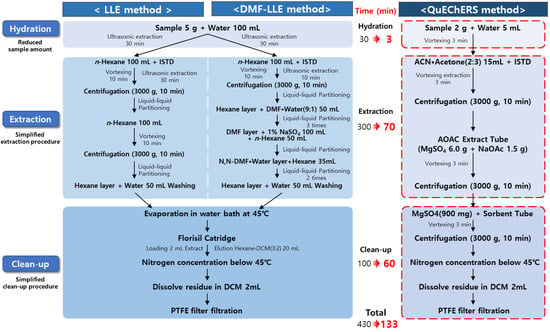
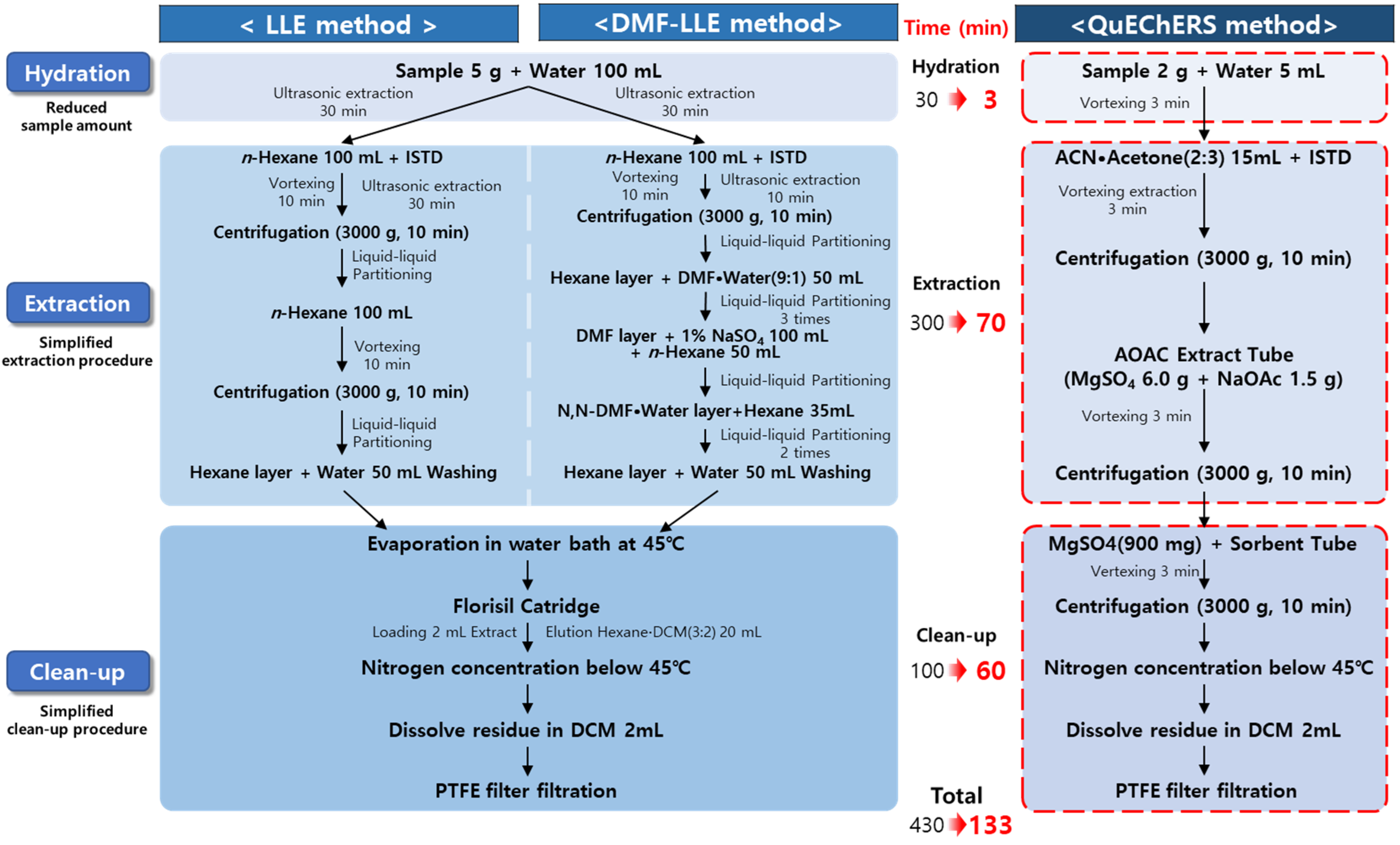
Polycyclic aromatic hydrocarbons (PAHs) are ubiquitous environmental contaminants consisting of fused aromatic rings, primarily generated by incomplete combustion of organic matter from natural and anthropogenic sources [23]. The International Agency for Research on Cancer (IARC) categorizes PAHs into Groups 1, 2A, and 2B based on human carcinogenicity, with benzo[a]pyrene classified as a Group 1 carcinogen. Due to their carcinogenic and mutagenic properties, the United States Environmental Protection Agency (U.S. EPA) designated 16 priority PAHs, while the European Food Safety Authority (EFSA) established PAH4 and PAH8 as food safety indicators (Table 1) [24,25,26]. Regulatory authorities in the United States, Europe, and South Korea have established PAH residue standards for food products, with South Korea specifically setting maximum limits for BaP in target herbal medicines, including Rehmanniae Radix Prepata, Rehmanniae Radix, Mume Fructus, and Tsaoko Fructus [27,28,29]. The Korean Pharmacopoeia (KP) currently prescribes an LLE method for BaP analysis in herbal materials; however, for matrices particularly rich in lipophilic compounds, such as Mume Fructus and Tsaoko Fructus, an additional cleanup step using N,N-dimethylformamide (DMF) is required to minimize severe matrix interference [30]. Despite this modification, both conventional LLE and DMF-supplemented LLE remain suboptimal due to high organic solvent consumption and tedious, time-consuming sample preparation procedures (Figure 1). Consequently, there is an imperative need to develop a streamlined, efficient analytical method capable of effectively removing complex herbal matrices as well as high concentrations of lipophilic components (e.g., essential oils).
Table 1.
Physicochemical properties and international safety classification levels of 16 polycyclic aromatic hydrocarbons (PAHs).
Figure 1.
Comparison of sample preparation procedures and processing times between conventional Korean Pharmacopoeia (KP) methods (LLE and DMF–LLE) and the modified QuEChERS method.
To overcome the analytical constraints of conventional LLE, the present study applied the QuEChERS methodology for improved clean-up of complex herbal matrices, particularly targeting essential oil removal. In this modified QuEChERS approach, the extraction solvent was tailored to the physicochemical characteristics of eight PAHs, including BaP, and various sorbents, including C18, PSA, GCB, Z-Sep, and EMR-Lipid, were systematically investigated to address diverse matrix interferences. Ultimately, this study aimed to optimize the modified QuEChERS conditions to mitigate matrix effects and ensure high recovery and sensitivity for the target PAHs in complex botanical materials.
2. Results & Discussion
The recovery rates of eight PAHs at varying extraction solvent mixing ratios are summarized in Table 2. When GCB was used as the adsorbent, none of the eight target PAHs were detected, indicating complete adsorption onto GCB. This is attributed to the planar geometry of PAHs, including benzo[a]pyrene, which has a strong affinity for the planar surface of GCB through π–π interactions, as previously reported [31].
Table 2.
Recovery rates of eight PAHs under different extraction solvent ratios and sorbent types in modified QuEChERS optimization.
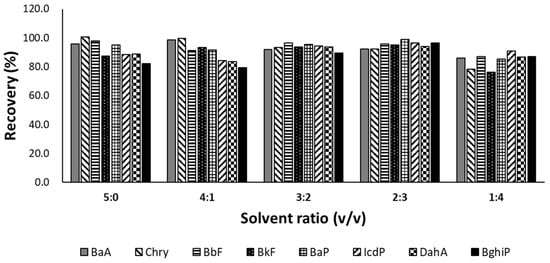
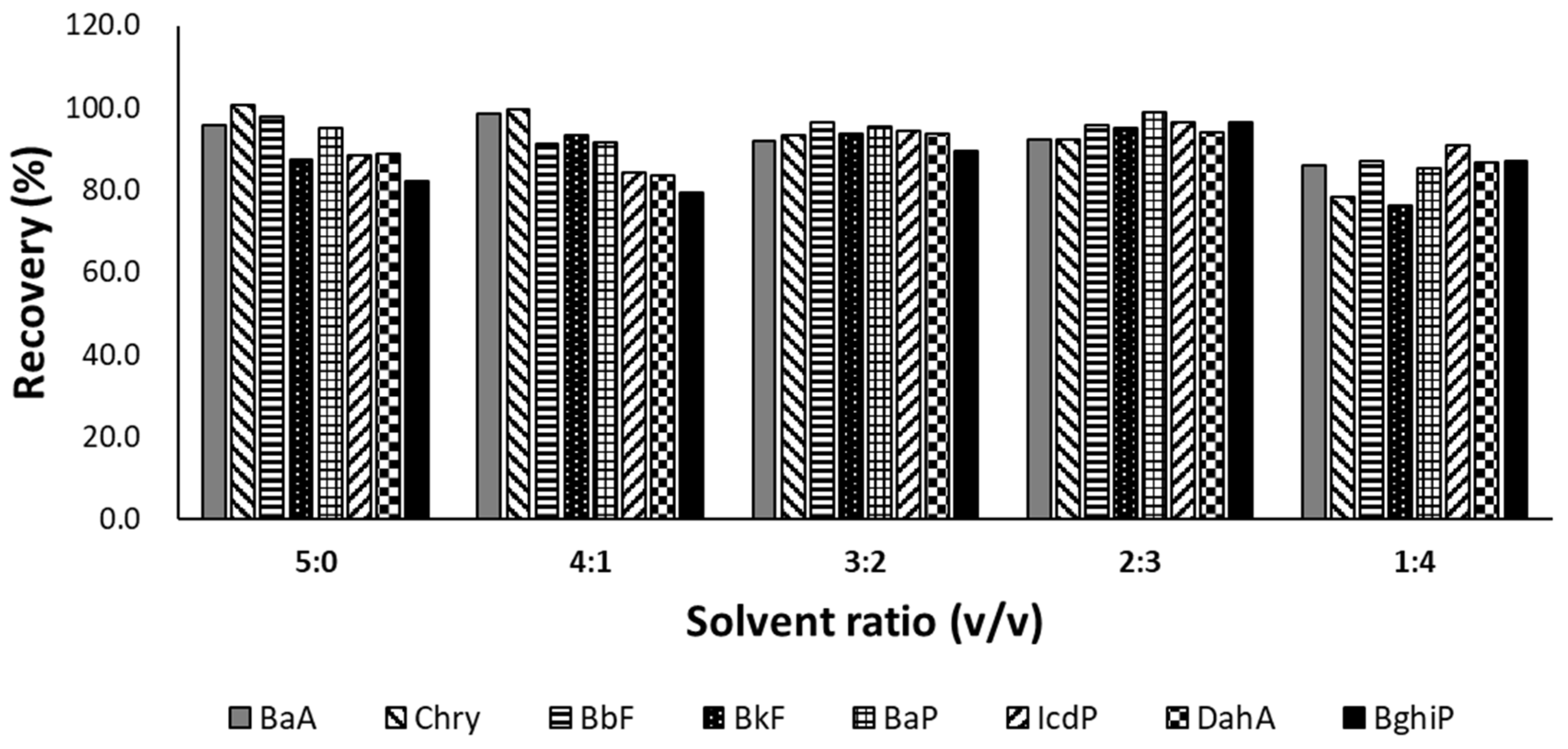
To eliminate the influence of different adsorbents and evaluate the net effect of the extraction solvent ratio, the mean recovery rates across the four adsorbents (excluding GCB) were calculated and compared. Evaluation of these mean recovery rates showed that increasing the proportion of acetone enhanced the recovery of high-molecular-weight PAHs containing 5–6 fused rings (Table 2 and Figure 2). This trend is consistent with findings by Sun et al. [21], which demonstrated that extraction solvent polarity significantly influences the extraction efficiency of 5–6-ring PAHs. Conversely, when the MeCN-to-acetone ratio reached 1:4 (v/v), overall recovery declined across the target compounds. Therefore, based on these findings, an MeCN–acetone ratio of 2:3 (v/v) was established as the optimal extraction solvent ratio to ensure stable and high recovery values (%) for PAHs containing up to six rings.
Figure 2.
Average recovery rates of eight PAHs across different extraction solvent ratios using C18, Z-Sep, EMR-Lipid, and PSA, excluding GCB.
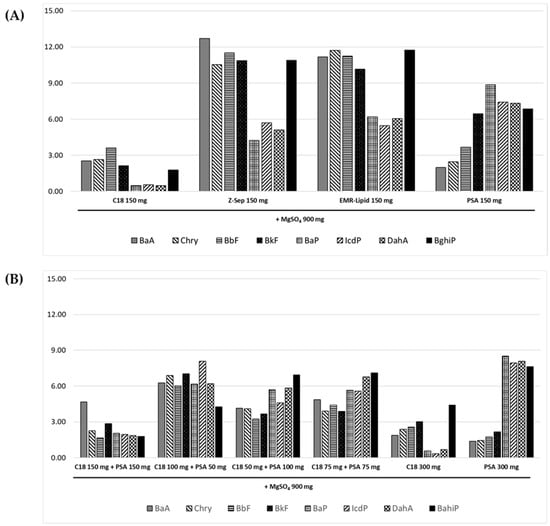
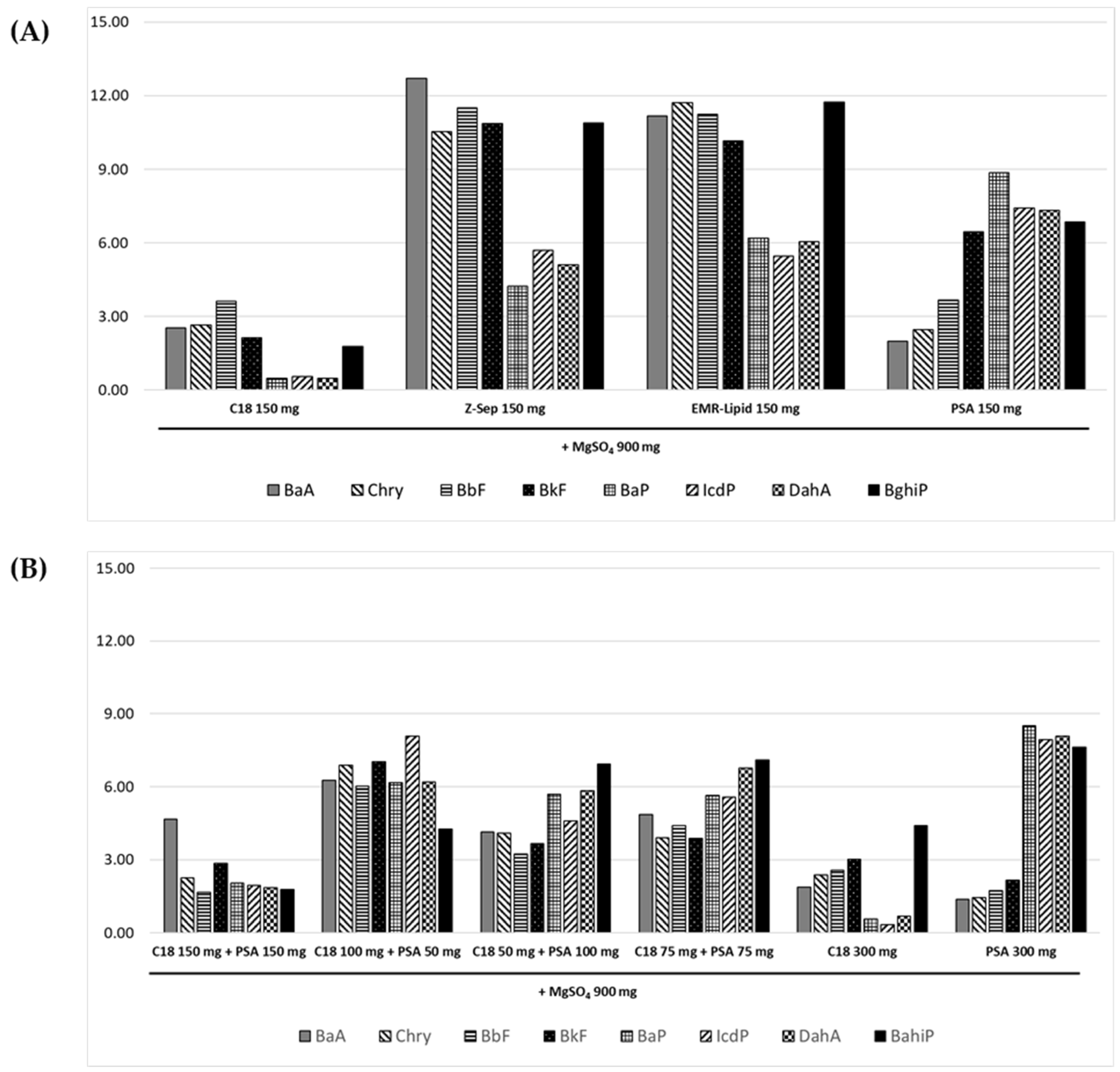
At a solvent mixing ratio of 2:3 (v/v), all targeted PAHs showed high recovery values (%) ranging from 87.67% to 107.26% across the different sorbents (Table 2). However, significant differences were observed in analytical repeatability, expressed as relative standard deviation (RSD, %) (Figure 3A).
Figure 3.
Comparison of relative standard deviation (% RSD) values for eight PAHs at a 2:3 solvent ratio using (A) single sorbents and (B) C18/PSA combination treatments.
Among the four sorbents—C18, Z-Sep, EMR-Lipid, and PSA—evaluated across independent replicates (n = 3), C18, Z-Sep, and PSA satisfied the AOAC acceptance criteria for precision, showing descriptive RSD values below 15% for all target analytes. In contrast, EMR-Lipid exhibited RSD values exceeding the 15% threshold for 4-ring PAHs, which was presumably attributable to incomplete removal of co-extracted matrix interferences in the corresponding chromatographic retention window. In terms of descriptive comparison among the compliant sorbents, PSA yielded higher mean recoveries (92.3–102.3%), whereas C18 consistently showed the lowest RSD values across all eight target PAHs.
To explore whether combining sorbents could further improve performance, mixtures of C18 and PSA at various blending ratios were evaluated (n = 3, Figure 3B). Descriptively, the C18–PSA combinations did not yield higher recoveries than C18 alone and, for several analytes, resulted in higher RSD values. Therefore, based on the predefined quantitative selection criteria—(1) achieving acceptable recoveries (70–125%) and the lowest overall precision variability (RSD < 15%) across all eight PAHs, and (2) maintaining procedural simplicity without additional sorbent consumption—single-sorbent treatment with C18 was selected as the optimal clean-up condition.
The optimized QuEChERS condition (MeCN–acetone = 2:3, v/v; C18) was validated using Atractylodes Rhizome and Cassia Bark. Validation parameters, including the LOD, LOQ, specificity, linearity, accuracy, and precision, were evaluated according to the AOAC guidelines. Because herbal medicines exhibit distinct physical characteristics depending on the plant parts used, applicability testing was subsequently conducted across herbal materials from various botanical parts.
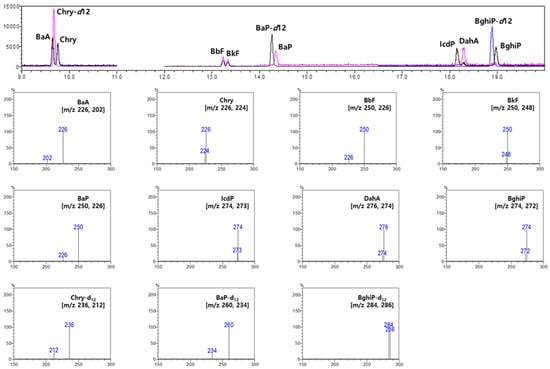
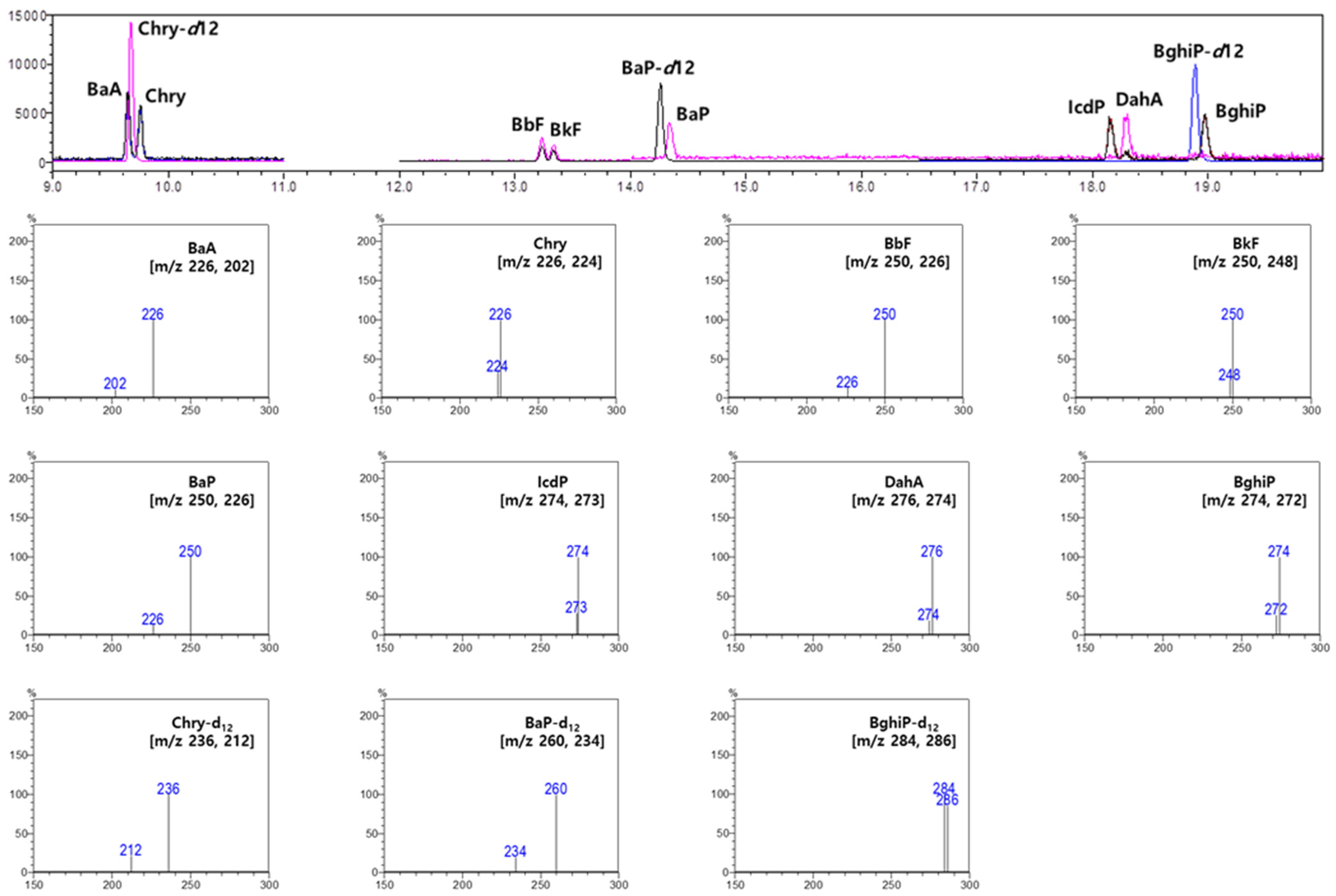
Figure 4 shows the GC–MS/MS (QqQ) chromatograms and ion spectra of the eight target PAHs and three internal standards (Chry-d12, BaP-d12, and BghiP-d12). Using multiple reaction monitoring mode, all 11 peaks were successfully separated without matrix interference. The calibration curves for the eight PAHs exhibited excellent linearity, with coefficients of determination (R2) ranging from 0.9992 to 0.9999. The LOD and LOQ ranged from 0.16 to 0.30 ng/g and 1.00 ng/g, respectively (Table 3).
Figure 4.
Total ion chromatograms and ion spectra of eight PAHs for specificity.
Table 3.
Linearity, limits of detection/quantitation, and back-calculation accuracy of matrix-matched calibration curves (n = 6).
The quantitative reliability of the matrix-matched calibration models was further validated through residual analysis and back-calculation error evaluations. The residual plots for all eight PAHs showed a random distribution around zero, indicating no systematic heteroscedasticity across the calibration range. The back-calculated concentrations for each calibration standard level (n = 6) exhibited mean accuracies ranging from 82.6% to 104.7%, with relative errors (%REs) well within ±15% for higher calibration levels and ± 20% at the lowest level, confirming the high robustness and accuracy of the calibration models (Table 3).
Furthermore, the extent of matrix interference was quantitatively assessed by comparing the slopes of the matrix-matched calibration curves with those of the solvent-based calibration curves (ME[%] = [(Slopematrix/Slopesolvent) − 1] × 100) (Table 4). The mean matrix effect (ME) values for the eight target PAHs in the representative herbal matrices ranged from −18.9% to −0.6% (n = 6). According to the SANTE guidelines [32], all ME values fell within the range of −20% to +20%, confirming that matrix effects were negligible and effectively minimized by the proposed clean-up protocol. Although the theoretically calculated LOQs ranged from 0.47 to 0.91 ng/g, a practical LOQ of 1.0 ng/g (the lowest calibration point) was conservatively adopted to ensure analytical precision and accuracy. At this practical LOQ level (1.0 ng/g), empirical verification using six replicate matrix-spiked samples (n = 6) yielded acceptable recoveries of 82.6–99.1% with relative standard deviations (%RSD) of 5.74–12.60%, fully satisfying the AOAC performance criteria.
Table 4.
Quantitative assessment of matrix effects and empirical method validation at practical LOQ (1.0 ng/g).
The modified method demonstrated excellent recovery across low, medium, and high fortification levels (2, 5, and 10 ng/g). Specifically, intra-day accuracy and precision were evaluated using three independently prepared replicate samples (n = 3) at each fortification level within a single day, whereas inter-day precision was assessed across three consecutive days using freshly prepared independent replicates each day (n = 3 per day, total n = 9). For Atractylodes Rhizome, intra-day recoveries, indicating accuracy, ranged from 74.7% to 106.8%, while inter-day (3 days) precision, expressed as RSD (%), ranged from 1.11% to 14.87% (Table 5). For Cassia Bark, intra-day recoveries ranged from 73.1% to 111.5%, and inter-day precision ranged from 0.86% to 13.06% RSD (%) (Table 6). Thus, the validation results for both Atractylodes Rhizome and Cassia Bark satisfied the AOAC validation guidelines.
Table 5.
Intra-day accuracy (recoveries) and inter-day precision (RSDs) for eight PAHs in Atractylodes Rhizome at three spiking concentrations (2, 5, and 10 ng/g).
Table 6.
Intra-day accuracy (recoveries) and inter-day precision (RSDs) for eight PAHs in Cassia Bark at three spiking concentrations (2, 5, and 10 ng/g).
The results of method applicability testing for the ten herbal materials are shown in Table 7. At the low concentration level of 2 ng/g, recoveries and precision (RSD, %) ranged from 82.1 to 124.0% and 0.08 to 14.83%, respectively, falling within the AOAC acceptance criteria (70–125% for recovery and ≤15% for RSD). While these results suggest promising preliminary applicability at trace contamination levels across diverse medicinal plant parts, further multi-level fortification studies across the entire calibration range are warranted to fully account for matrix variations in essential oil and pigment compositions among different botanicals.
Table 7.
Optimized QuEChERS method applicability results of the proposed method for 10 herbal medicines with different medicinal parts.
3. Materials and Methods
3.1. Chemicals and Reagents
Analytical standards of eight PAHs—Benzo[a]anthracene (BaA), Chrysene (Chry), Benzo[a]pyrene (BaP), Benzo[b]fluoranthene (BbF), Benzo[k]fluoranthene (BkF), Indeno[1,2,3-cd]pyrene (IcdP), Dibenzo[a,h]anthracene (DahA), and Benzo[g,h,i]perylene (BghiP)—and three internal standards (Chry-d12, BaP-d12, and BghiP-d12) (Table 8) were of analytical grade (purity ≥ 99.0%) and purchased from Sigma-Aldrich (St. Louis, MO, USA). Acetonitrile (MeCN), acetone, dichloromethane (DCM), and distilled water (DW) were of LC grade and purchased from Merck (Darmstadt, Germany). Dispersive solid-phase extraction (d-SPE) sorbents—octadecyl (C18), Z-Sep, GCB, primary–secondary amine (PSA), and enhanced matrix removal lipid (EMR-Lipid)—were obtained from Agilent Technologies (Santa Clara, CA, USA). The extraction salt mixture of anhydrous magnesium sulfate (MgSO4) and sodium acetate (NaOAc) was supplied by Supelco (Bellefonte, PA, USA).
Table 8.
Retention times of eight PAHs and three internal standards.
3.2. Preparation of Standard Solutions
Eight target PAHs and three internal standards were prepared as multicomponent mixed solutions. Individual stock solutions (100 μg/mL) were prepared in ethanol. A mixed working standard solution was prepared by diluting the eight stock solutions with DCM to 400 ng/mL for each analyte. Similarly, a mixed internal standard (ISTD) solution was prepared by diluting the three ISTD stocks with DCM to 1000 ng/mL for each compound. Both solutions were stored in amber glass vials at −20 °C in the dark to maintain stability and prevent photodegradation.
3.3. Samples
A total of 12 essential oil-rich herbal medicines were purchased from local markets in South Korea and authenticated by an expert according to Korean Pharmacopoeia (KP) standards. Atractylodes macrocephala (Atractylodes Rhizome) was selected as the representative matrix for modified QuEChERS optimization based on its regulated essential oil content in the KP and preliminary screening confirming no detectable PAH contamination. A. macrocephala and Cinnamomum cassia (Cassia Bark) were used for method validation. C. cassia was included as a challenging matrix because of its high essential oil content and potential for elevated PAH levels.
To assess applicability across medicinal parts, ten additional species with regulated EO standards in the KP were analyzed: Syzygium aromaticum (flower), Myristica fragrans (seed), Illicium verum (fruit), Elettaria cardamomum (fruit), Amomum villosum (fruit), Asarum sieboldii (root), Zanthoxylum schinifolium (pericarp), Atractylodes lancea (rhizome), Foeniculum vulgare (fruit), and Mentha arvensis (whole herb).
3.4. Sample Preparation and Extraction Method
A 2.0 g homogenized sample was weighed into a 50 mL centrifuge tube and wetted with 5 mL of DW for 3 min. After spiking with 10 μL of mixed standard (final concentrations of 2, 5, and 10 ng/g for method validation; 2 ng/g for method optimization and applicability testing) and 100 μL of ISTD solutions (final concentration of 50 ng/g), 15 mL of the optimized MeCN/acetone mixture (Section 3.6) was added. The sample was shaken for 3 min and centrifuged at 3000× g and 4 °C for 10 min. The supernatant was treated with 6 g of anhydrous MgSO4 and 1.5 g of NaOAc, shaken for 3 min, and centrifuged again at 3000× g and 4 °C for 10 min. The organic layer was collected for clean-up.
3.5. Purification Method
The organic extract was transferred to a tube containing 900 mg of MgSO4 and 150 mg of the sorbent mixture (Section 3.6), shaken for 3 min, and centrifuged at 3000× g and 4 °C for 10 min. The supernatant was evaporated to dryness under nitrogen, reconstituted in 2 mL of DCM, and filtered through a 0.2 μm PTFE membrane filter for GC–MS/MS analysis.
3.6. Optimization of the Experimental Conditions
To establish the parameters used in the aforementioned protocol, a systematic optimization was conducted.
Extraction solvent composition: The MeCN-to-acetone ratio was optimized using five binary mixtures at 1:0, 4:1, 3:2, 2:3, and 1:4 (MeCN, v/v). The mixtures were added to the wetted samples before salting-out to determine the optimal composition for PAH recovery.
Sorbent selection and mixing ratio: Clean-up efficiency was evaluated using five sorbents (C18, PSA, GCB, Z-Sep, and EMR-Lipid). The most effective sorbents were then blended at various mass ratios to identify the optimal combination for removing essential oil interferences while maintaining PAH recoveries.
3.7. Instrumentation
A GC-QqQ-MS (GC–MS-TQ8040, Shimadzu) was used to analyze the 8 PAHs (Table 7) on a DB-5MS capillary column (30 m × 0.25 mm × 0.25 μm; Agilent J&W Scientific, Folsom, CA, USA). The column temperature was initially 100 °C (0 min), increased to 230 °C at 55 °C/min, and then to 320 °C at 5 °C/min, with a 2 min hold. The total run time was approximately 22.36 min. Helium was used at 1.5 mL/min. The injector, interface, and ion source temperatures were 310 °C, 310 °C, and 250 °C, respectively. A 1 μL sample was injected in split mode (1/10) (Table 9). Quantification was performed using multiple reaction monitoring, with optimized transitions and collision energies listed in Table 10.
Table 9.
GC–MS/MS instrumental conditions and parameters for the eight PAHs’ analysis.
Table 10.
GC–MS/MS multiple reaction monitoring mode for the quantification and identification of eight PAHs.
3.8. Method Validation
The QuEChERS-based method was validated for selectivity, specificity, linearity, LOD, LOQ, accuracy, and precision according to AOAC Official Methods of Analysis guidelines [33]. Method validation was evaluated using A. macrocephala and C. cassia. A three-level spiking experiment was performed at 2, 5, and 10 ng/g.
3.9. Selectivity & Linearity
Selectivity was evaluated by comparing blank matrix and matrix-matched standard chromatograms for interfering peaks at the retention times of the eight PAHs and three ISTDs. Linearity was assessed using matrix-matched calibration curves at 1–20 ng/mL across five concentration levels. The correlation coefficient (R2) evaluated the goodness of fit.
3.10. Sensitivity
LOD and LOQ were determined from the SD of the intercept and mean slope of the calibration curve using the following equations:
where σ is the SD of the y-intercept, and S is the mean slope of the calibration curve (n = 5).
3.11. Accuracy and Precision
Accuracy and precision were evaluated using recovery studies of spiked samples. Accuracy was expressed as percentage recovery, and precision as the relative standard deviation (RSD, %) of intra-day and inter-day (3 days) analyses.
3.12. Method Applicability
Method applicability was evaluated using ten herbal medicines with established essential oil content standards in the KP to assess performance across medicinal parts beyond the validation matrices (A. macrocephala and C. cassia). A single-level spiking experiment was performed at 2 ng/g. The selected species represented flower (clove, S. aromaticum), seed (nutmeg, M. fragrans), fruit (star anise, I. verum; cardamom, E. cardamomum; Amomum fruit, A. villosum; and fennel, F. vulgare), root (Asarum root, A. sieboldii), pericarp (Zanthoxylum fruit, Z. schinifolium), rhizome (Atractylodes rhizome, A. lancea), and aerial parts (Japanese mint, M. arvensis). All analyses were performed in triplicate, and suitability was assessed by recovery and precision (RSD, %) for each matrix.
4. Conclusions
In this study, an optimized QuEChERS-based GC–MS/MS method was developed and validated for determining eight target PAHs in complex, essential oil-rich herbal matrices. Systematic optimization identified an acetonitrile–acetone mixture (2:3, v/v) as the optimal extraction solvent, providing high recoveries of high-molecular-weight PAHs with up to six fused rings. Among the d-SPE sorbents, C18 effectively reduced matrix interferences without compromising reproducibility or causing analyte loss through planar adsorption, as observed with GCB. Validation according to AOAC and SANTE guidelines using Atractylodes Rhizome and Cassia Bark showed excellent linearity (R2 > 0.99), negligible matrix effects (ME% within ±20%), sensitivity (LOD: 0.16–0.30 ng/g; LOQ: 1.00 ng/g), and accuracy and precision across low, medium, and high spiking levels (recoveries: 73.1–111.5%; RSDs < 15%). Furthermore, preliminary testing at a trace fortification level (2 ng/g) suggested promising applicability across ten diverse medicinal plant parts, including flowers, seeds, fruits, roots, pericarps, rhizomes, and aerial parts. Overall, this modified method demonstrated satisfactory analytical performance and high-throughput potential for the determination of eight PAHs in essential oil-rich botanical materials. While these results provide a foundational analytical basis that may inform future regulatory discussions and potential updates to the Korean Pharmacopoeia (KP), further validation of operational parameters—such as method robustness, carryover effects, and extract stability under minor variations in extraction conditions—is warranted before full implementation in routine quality control and official compendial monographs.
Author Contributions
Conceptualization, Y.B.C. and I.H.; methodology, Y.B.C. and I.S.K.; validation, Y.B.C. and I.S.K.; investigation, Y.B.C. and I.S.K.; writing—original draft preparation, Y.B.C.; writing—review and editing, Y.B.C.; project administration, J.K. (Jinchul Kim), J.K. (JinHong Kim), S.M.L. and B.R.P.; supervision, J.Y.K.; funding acquisition, J.Y.K. All authors have read and agreed to the published version of the manuscript.
Funding
This research was funded by the National Institute of Food and Drug Safety Evaluation, Republic of Korea (grant number 25201MFDS001).
Data Availability Statement
The data presented in this study are available on request from the corresponding author due to institutional and regulatory restrictions.
Conflicts of Interest
The authors declare no conflicts of interest.
Abbreviations
The following abbreviations are used in this manuscript:
| DW | Distilled water |
| EFSA | European Food Safety Authority |
| IARC | International Agency for Research on Cancer |
| KP | Korean Pharmacopoeia |
| LOD | Limit of detection |
| LOQ | Limit of quantification |
| PAHs | Polycyclic aromatic hydrocarbons |
| RSD | Relative standard deviation |
| GCB | Graphitized carbon black |
References
- Anastassiades, M.; Lehotay, S.J.; Štajnbaher, D.; Schenck, F.J. Fast and easy multiresidue method employing acetonitrile extraction/partitioning and “dispersive solid-phase extraction” for the determination of pesticide residues in produce. J. AOAC Int. 2003, 86, 412–431. [Google Scholar] [CrossRef] [Scilit]
- Foods of Plant Origin—Determination of Pesticide Residues Using GC-MS and/or LC-MS/MS Following Acetonitrile Extraction/Partitioning and Clean-Up by Dispersive SPE—QuEChERS-Method; European Committee for Standardization (CEN): Brussels, Belgium, 2008.
- Bargańska, Ż.; Ślebioda, M.; Namieśnik, J. Determination of pesticide residues in honeybees using modified QUEChERS sample work-up and liquid chromatography-tandem mass spectrometry. Molecules 2014, 19, 2911–2924. [Google Scholar] [CrossRef] [Scilit] [PubMed]
- Riaño-Herrera, D.A.; Herrera-Paiva, L.; Chenet, J.G.; Uribe-Jongbloed, A.; Varela-Martínez, D.A.; González-Curbelo, M.Á. QuEChERS-GC-MS/MS analysis of multi-class pesticide residues in tropical agricultural soils. Molecules 2026, 31, 2564. [Google Scholar] [CrossRef] [Scilit] [PubMed]
- Słowik-Borowiec, M.; Szpyrka, E.; Książek-Trela, P.; Podbielska, M. Simultaneous determination of multi-class pesticide residues and PAHs in plant material and soil samples using the optimized QuEChERS method and tandem mass spectrometry analysis. Molecules 2022, 27, 2140. [Google Scholar] [CrossRef] [Scilit] [PubMed]
- Ostadgholami, M.; Zeeb, M.; Amirahmadi, M.; Daraei, B. Multivariate optimization and validation of a modified QuEChERS method for determination of PAHs and PCBs in grilled meat by GC-MS. Foods 2023, 13, 143. [Google Scholar] [CrossRef] [Scilit] [PubMed]
- Lehotay, S.J. Determination of pesticide residues in foods by acetonitrile extraction and partitioning with magnesium sulfate: Collaborative study. J. AOAC Int. 2007, 90, 485–520. [Google Scholar] [CrossRef] [Scilit]
- Chawla, S.; Patel, D.J.; Patel, S.H.; Kalasariya, R.L.; Shah, P.G. Behaviour and risk assessment of fluopyram and its metabolite in cucumber (Cucumis sativus) fruit and in soil. Environ. Sci. Pollut. Res. 2018, 25, 11626–11634. [Google Scholar] [CrossRef] [Scilit] [PubMed]
- Mohapatra, S.; S, L. Residue level and dissipation of carbendazim in/on pomegranate fruits and soil. Environ. Monit. Assess. 2016, 188, 406. [Google Scholar] [CrossRef] [Scilit] [PubMed]
- Kumar, A.; Gill, J.P.S.; Bedi, J.S.; Kumar, A. Pesticide residues in Indian raw honeys, an indicator of environmental pollution. Environ. Sci. Pollut. Res. 2018, 25, 34005–34016. [Google Scholar] [CrossRef] [Scilit] [PubMed]
- Lehotay, S.J.; Son, K.A.; Kwon, H.; Koesukwiwat, U.; Fu, W.; Mastovska, K.; Hoh, E.; Leepipatpiboon, N. Comparison of QuEChERS sample preparation methods for the analysis of pesticide residues in fruits and vegetables. J. Chromatogr. A 2010, 1217, 2548–2560. [Google Scholar] [CrossRef] [Scilit] [PubMed]
- Golge, O.; Koluman, A.; Kabak, B. Validation of a modified QuEChERS method for the determination of 167 pesticides in milk and milk products by LC-MS/MS. Food Anal. Methods 2018, 11, 1122–1148. [Google Scholar] [CrossRef] [Scilit]
- Uclés, S.; Hakme, E.; Ferrer, C.; Fernández-Alba, A.R. Analysis of thermally labile pesticides by on-column injection gas chromatography in fruit and vegetables. Anal. Bioanal. Chem. 2018, 410, 6861–6871. [Google Scholar] [CrossRef] [Scilit] [PubMed]
- Trevisan, M.T.S.; Owen, R.W.; Calatayud-Vernich, P.; Breuer, A.; Picó, Y. Pesticide analysis in coffee leaves using a quick, easy, cheap, effective, rugged and safe approach and liquid chromatography tandem mass spectrometry: Optimization of the clean-up step. J. Chromatogr. A 2017, 1512, 98–106. [Google Scholar] [CrossRef] [Scilit] [PubMed]
- Yussuf, N.H.; Odabas, E.; Afacan, F.O.; Kabak, B. Processing-dependent acrylamide formation in French fries: Optimisation of QuEChERS-based extraction and HPLC-PDA determination. Molecules 2026, 31, 2777. [Google Scholar] [CrossRef] [Scilit] [PubMed]
- Song, J.G.; Cao, C.; Li, J.; Xu, Y.J.; Liu, Y. Development and validation of a QuEChERS-LC-MS/MS method for the analysis of phenolic compounds in rapeseed oil. J. Agric. Food Chem. 2019, 67, 4105–4112. [Google Scholar] [CrossRef] [Scilit] [PubMed]
- Martins, M.L.; Kemmerich, M.; Prestes, O.D.; Maldaner, L.; Jardim, I.C.; Zanella, R. Evaluation of an alternative fluorinated sorbent for dispersive solid-phase extraction clean-up of the quick, easy, cheap, effective, rugged, and safe method for pesticide residues analysis. J. Chromatogr. A 2017, 1514, 36–43. [Google Scholar] [CrossRef] [Scilit] [PubMed]
- Islam, A.K.M.M.; Hong, S.M.; Lee, H.S.; Moon, B.C.; Kim, D.; Kwon, H. Identification and characterization of matrix components in spinach during QuEChERS sample preparation for pesticide residue analysis by LC–ESI–MS/MS, GC–MS and UPLC-DAD. J. Food Sci. Technol. 2018, 55, 3930–3938. [Google Scholar] [CrossRef] [Scilit] [PubMed]
- Mokhtar, H.I.; Salama, G.M.; El Gindy, A.; Abdel Hameed, E.A. Optimization of the combined use of Z-Sep Plus and EMR-Lipid in QuEChERS procedure for the analysis of eight pesticides in real milk samples. Food Anal. Methods 2025, 18, 245–263. [Google Scholar] [CrossRef] [Scilit]
- Chen, R.; Chen, L.; Du, M.; Guo, Q.; Zhong, C.; Zhang, J.; Yu, X. High-Throughput Determination of Multiclass Chemical Hazards in Poultry Muscles and Eggs Using UPLC–MS/MS. Foods 2025, 14, 1660. [Google Scholar] [CrossRef] [Scilit] [PubMed]
- Sun, Y.; Wu, S. Analysis of PAHs in oily systems using modified QuEChERS with EMR-Lipid clean-up followed by GC-QqQ-MS. Food Control 2020, 109, 106950. [Google Scholar] [CrossRef] [Scilit]
- Correia-Sá, L.; Norberto, S.; Delerue-Matos, C.; Calhau, C.; Domingues, V.F. Micro-QuEChERS extraction coupled to GC–MS for a fast determination of Bisphenol A in human urine. J. Chromatogr. B 2018, 1072, 9–16. [Google Scholar] [CrossRef] [Scilit] [PubMed]
- Menzie, C.A.; Potocki, B.B.; Santodonato, J. Exposure to carcinogenic PAHs in the environment. Environ. Sci. Technol. 1992, 26, 1278–1284. [Google Scholar] [CrossRef] [Scilit]
- Bojes, H.K.; Pope, P.G. Characterization of EPA’s 16 priority pollutant polycyclic aromatic hydrocarbons (PAHs) in tank bottom solids and associated contaminated soils at oil exploration and production sites in Texas. Regul. Toxicol. Pharmacol. 2007, 47, 288–295. [Google Scholar] [CrossRef] [Scilit] [PubMed]
- European Food Safety Authority. Polycyclic aromatic hydrocarbons in food: Scientific opinion of the panel on contaminants in the food chain. EFSA J. 2008, 6, 724. [Google Scholar] [CrossRef] [Scilit]
- Jameson, C.W. Polycyclic aromatic hydrocarbons and associated occupational exposures. In Tumour Site Concordance and Mechanisms of Carcinogenesis; International Agency for Research on Cancer, Ed.; IARC Scientific Publications No. 165; International Agency for Research on Cancer: Lyon, France, 2019; pp. 120–141. [Google Scholar]
- U.S. Food and Drug Administration. Process Contaminants in Food. 5 March 2024. Available online: https://www.fda.gov/food/chemical-contaminants-pesticides/process-contaminants-food (accessed on 12 October 2026).
- European Commission. Commission Regulation (EU) No 835/2011 of 19 August 2011 amending Regulation (EC) No 1881/2006 as regards maximum levels for polycyclic aromatic hydrocarbons in foodstuffs. Off. J. Eur. Union 2011, L 215, 1–8. [Google Scholar]
- Ministry of Food and Drug Safety. Food Code (MFDS Notice No. 2024-55); Ministry of Food and Drug Safety: Cheongju, Republic of Korea, 2024. [Google Scholar]
- Ministry of Food and Drug Safety. The Korean Pharmacopoeia (MFDS Notice No. 2026-44); Ministry of Food and Drug Safety: Cheongju, Republic of Korea, 2026. [Google Scholar]
- Zhu, D.; Pignatello, J.J. Characterization of aromatic compound sorptive interactions with black carbon (charcoal) assisted by graphite as a model. Environ. Sci. Technol. 2005, 39, 2033–2041. [Google Scholar] [CrossRef] [Scilit] [PubMed]
- European Commission (EC). Analytical Quality Control and Method Validation Procedures for Pesticide Residues Analysis in Food and Feed (SANTE/11312/2021 v2); Directorate-General for Health and Food Safety: Brussels, Belgium, 2024; Available online: https://food.ec.europa.eu/system/files/2023-11/pesticides_mrl_guidelines_wrkdoc_2021-11312.pdf (accessed on 12 November 2026).
- AOAC. Guidelines for Single Laboratory Validation of Chemical Methods for Dietary Supplements and Botanicals. Available online: https://s27415.pcdn.co/wp-content/uploads/2020/01/64ER20-7/Validation_Methods/d-AOAC_Guidelines_For_Single_Laboratory_Validation_Dietary_Supplements_and_Botanicals.pdf (accessed on 12 October 2026).

Disclaimer/Publisher’s Note: The statements, opinions and data contained in all publications are solely those of the individual author(s) and contributor(s) and not of MDPI and/or the editor(s). MDPI and/or the editor(s) disclaim responsibility for any injury to people or property resulting from any ideas, methods, instructions or products referred to in the content. |
© 2026 by the authors. Licensee MDPI, Basel, Switzerland. This article is an open access article distributed under the terms and conditions of the Creative Commons Attribution (CC BY) license.