


Abstract
Secnidazole (SNZ), a nitroimidazole antibiotic widely used to treat anaerobic and protozoal infections, has emerged as a contaminant of emerging concern in aquatic systems. In this study, a ZIF-8-derived ZDC/FeS2 composite was synthesized through pyrolysis and sulfurization for the solar photocatalytic removal of SNZ from aqueous media. The resulting material exhibited an optical bandgap of 2.25 eV and favorable charge-transfer characteristics. Under natural solar irradiation, the composite achieved approximately 90% SNZ removal within 120 min at pH 12, following pseudo-first-order kinetics. At pH 7, SNZ removal reached approximately 65%, accompanied by an approximately 75% reduction in aqueous-phase total organic carbon (TOC). Scavenger experiments identified superoxide radicals (⋅O2−) as the predominant reactive species involved in SNZ degradation. Furthermore, MTT assays using HCT-116 cells showed that the IC25 increased from 0.37 to 1.96 μg mL−1 following photocatalytic treatment, corresponding to a 5.3-fold increase in the concentration required to produce 25% inhibition and indicating attenuated cytotoxicity. These findings highlight the potential of the ZIF-8-derived ZDC/FeS2 composite for solar-driven pharmaceutical contaminant removal from aqueous media.
1. Introduction
The occurrence of pharmaceutical contaminants in aquatic systems has become an important environmental concern because of their persistence, incomplete transformation, and potential adverse effects on ecosystems and human health. Furthermore, conventional wastewater treatment technologies (such as adsorption, coagulation, and biological processes) often exhibit significant limitations, including high operational costs, incomplete pollutant mineralization, and the generation of secondary toxic sludge. Among these compounds, nitroimidazole antibiotics such as metronidazole and tinidazole have received considerable attention owing to their widespread use and reported occurrence in aquatic environments [1,2,3,4]. In comparison, secnidazole (SNZ) remains less investigated from the perspective of environmental remediation. SNZ is a synthetic nitroimidazole antibiotic used to treat infections caused by anaerobic bacteria and protozoa, including Giardia lamblia, Entamoeba histolytica, and Trichomonas vaginalis. Its release into wastewater and other aquatic matrices raises concerns about the occurrence of pharmaceutical residues and their potential effects on aquatic organisms and microbial communities. Moreover, the continuous release of antibiotics into the environment may exert selective pressure on microbial populations, potentially contributing to the dissemination of antimicrobial resistance [5,6]. These concerns highlight the need to investigate treatment strategies capable of removing SNZ from contaminated water.
Advanced Oxidation Processes (AOPs), particularly heterogeneous photocatalysis, have emerged as promising alternatives for the elimination of pharmaceutical pollutants. Unlike conventional wastewater treatment technologies such as physical adsorption or chemical coagulation—which merely transfer pollutants from one phase to another and produce hazardous secondary sludge—photocatalysis offers the key advantage of complete pollutant degradation into harmless inorganic end-products due to their capacity to generate reactive oxygen species (ROS) capable of degrading persistent organic compounds [7,8,9]. Species such as hydroxyl (⋅OH) and superoxide (⋅O2−) radicals participate in oxidative reactions that promote contaminant transformation and, under appropriate conditions, complete mineralization. However, traditional semiconductors such as TiO2 and ZnO exhibit inherent limitations for solar-driven applications, primarily due to their wide bandgaps that restrict photon harvesting to a small fraction of the solar spectrum [5,10,11,12,13]. Consequently, developing photocatalytic materials with extended visible-light response and efficient charge-carrier separation is crucial for enhancing solar energy utilization.
Metal–organic frameworks (MOFs) are a class of porous crystalline materials constructed from metal ions or clusters coordinated to organic ligands. Their tunable structural and compositional features have made them attractive platforms for designing functional nanocomposites. Among them, zeolitic imidazolate framework-8 (ZIF-8) stands out for its high specific surface area, exceptional thermal and chemical stability, and rich Zn and N content, making it an ideal precursor for synthesizing nitrogen-doped carbonaceous materials through thermal treatment [14]. Thermal conversion of ZIF-8 can partially preserve the morphology and porous network of the parent framework while yielding a N-doped carbon matrix with tailorable electronic and surface properties. Nevertheless, MOF-derived carbonaceous materials often suffer from rapid recombination of photogenerated charge carriers, which limits their overall photocatalytic activity. Constructing heterostructures by integrating additional semiconductors represents an effective approach to promote interfacial charge separation and transfer [15].
In this context, iron disulfide (FeS2), particularly in its pyrite phase, represents a compelling semiconductor owing to its narrow bandgap and high electronic conductivity. It has been investigated in photocatalytic and Fenton-like processes, where its favorable band positions facilitate interfacial reactions and ROS generation [16,17]. Integrating FeS2 into a ZIF-8-derived carbon matrix can establish a favorable semiconductor/carbon interface for charge transport, combining the strong visible-light absorption of FeS2 with the high surface area and conductivity of the carbonaceous matrix. This architectural design is expected to mitigate electron–hole recombination and enhance the generation of reactive species responsible for SNZ degradation.
In this study, a ZIF-8-derived ZDC/FeS2 composite was synthesized through pyrolysis and sulfurization and evaluated for the photocatalytic removal of SNZ under natural solar irradiation in Quito, Ecuador. Structural, morphological, spectroscopic, and electrochemical techniques were used to characterize the material and examine its optical and charge-transfer properties. Treatment performance was investigated by assessing SNZ removal at different pH values, apparent reaction kinetics, aqueous-phase total organic carbon (TOC) reduction, reactive-species scavenging experiments, and photocatalyst reusability. In addition, the cytotoxicity of untreated and photocatalytically treated SNZ solutions was evaluated using MTT assays with human HCT-116 cells. By systematically coupling solar-driven degradation, TOC mineralization, and biological evaluation, this work provides a comprehensive strategy to overcome the limited environmental remediation data for SNZ using a novel ZIF-8-derived ZDC/FeS2 heterojunction.
2. Results and Discussion
2.1. Structural and Morphological Characterization
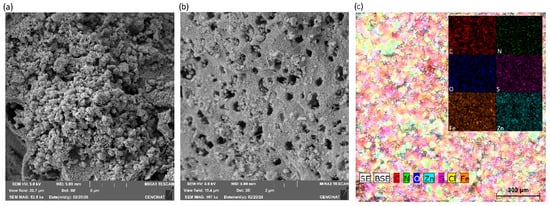
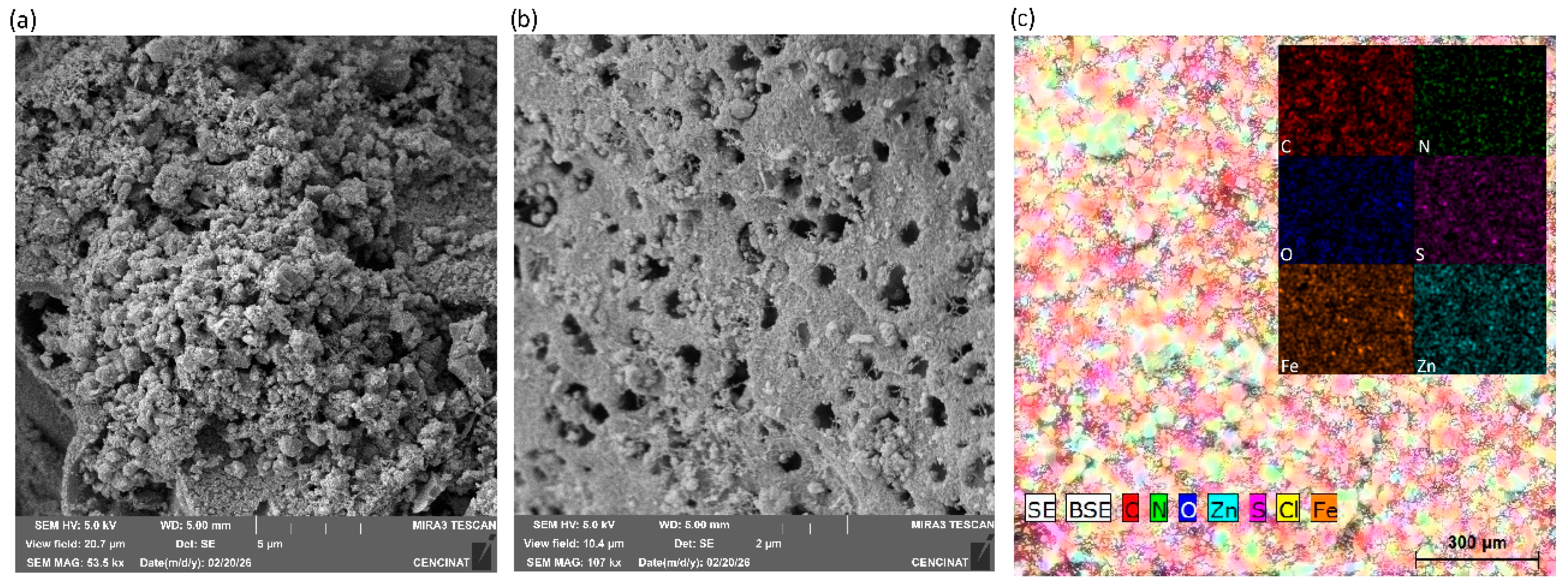
Scanning electron microscopy (SEM) images (Figure 1a,b) show that the ZDC/FeS2 material exhibits an irregular and aggregated morphology following the thermal treatments. This morphological transformation is consistent with the thermal decomposition of the ZIF-8 precursor and the subsequent formation of a MOF-derived carbonaceous matrix [18]. Complementarily, atomic force microscopy (AFM) analysis (Figure S5) reveals a surface with heterogeneous topography, evidencing variations in the material’s surface morphology. This feature can enhance the interaction between SNZ molecules and the photocatalyst surface, thereby promoting the initial adsorption step and subsequent photocatalytic reactions.
Figure 1.
(a,b) SEM images of the ZDC/FeS2 material showing surface morphology after pyrolysis; (c) EDS elemental mapping corresponding to C, N, O, S, Fe, and Zn, demonstrating the homogeneous distribution of elements within the material matrix.
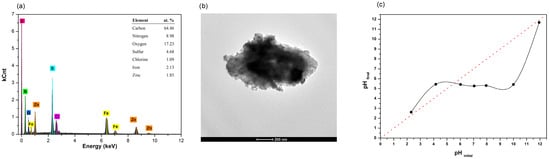
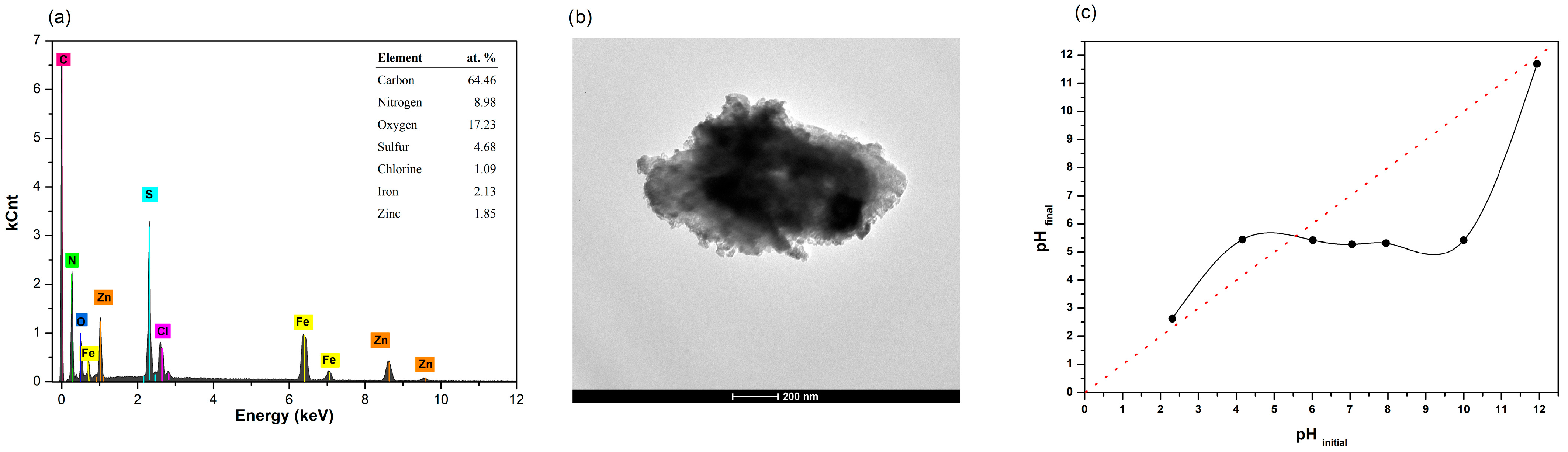
Energy-dispersive X-ray spectroscopy (EDS) elemental mapping and the corresponding spectrum (Figure 1c and Figure 2a, respectively) confirm the presence and spatial distribution of C, N, O, S, Fe, and Zn throughout the analyzed region of the ZDC/FeS2 composite. The elemental composition is dominated by carbon (64.46 at.%), followed by oxygen (17.23 at.%) and nitrogen (8.98 at.%), consistent with the formation of a carbonaceous matrix retaining nitrogen derived from the 2-methylimidazole linker during pyrolysis. The high oxygen fraction is predominantly associated with oxygenated functional groups inherently formed within the porous N-doped carbon scaffold (ZDC) during thermal processing and ambient exposure, rather than massive metal oxide phases, given that the atomic abundances of Fe (2.13 at.%) and Zn (1.85 at.%) are significantly lower. The Fe and S contents were 2.13 per cent and 4.68 per cent by atom, respectively, corresponding to an S/Fe atomic ratio of approximately 2.2, which is close to the nominal stoichiometry of FeS2, suggesting effective sulphidation of the iron throughout the carbon matrix. Together with the XRD results, this compositional evidence supports the formation of FeS2 within the carbonaceous matrix. The elemental maps further show that Fe and S are spatially distributed throughout the analyzed region, consistent with the incorporation of Fe–S-containing domains into the carbon matrix. Residual Zn (1.85 at.%) was also detected, indicating that a fraction of the Zn species originating from the ZIF-8 framework remained after carbonization. The low Cl content (1.09 at.%) can be attributed to residual chloride associated with the FeCl3 precursor. Overall, the EDS analysis confirms the coexistence and spatial distribution of the principal elements within the composite and, together with the XRD results, provides complementary evidence for the formation of the ZDC/FeS2 structure [19].
Figure 2.
(a) EDS spectrum of the ZDC/FeS2 material along with the atomic percentage elemental composition; (b) TEM image displaying an aggregated structure with high-contrast domains associated with dense inorganic phases surrounded by a carbonaceous matrix; (c) determination for pHpzc of ZDC/FeS2 by the drift method.
The TEM micrograph (Figure 2b) reveals a heterogeneous architecture composed of domains with higher electron contrast distributed within a matrix of lower contrast. The dark, high-contrast nano-domains correspond to dense inorganic regions enriched in heavier elements (principally crystalline pyrite FeS2 nanoparticles, alongside residual Zn-containing species and potential localized oxo-metallic domains). In contrast, the surrounding translucent, lower-contrast regions represent the lighter N-doped carbonaceous scaffold (ZDC) derived from ZIF-8 pyrolysis. The presence of these dense domains embedded within the matrix suggests that the inorganic species generated during sulfurization are partially encapsulated or confined within the carbon framework. This spatial encapsulation prevents severe nanoparticle agglomeration and promotes intimate contact interfaces between the Fe–S species and the ZIF-8-derived carbon matrix, which is vital for facilitating charge-transfer processes as discussed below.
2.2. Vibrational and Crystallographic Analysis
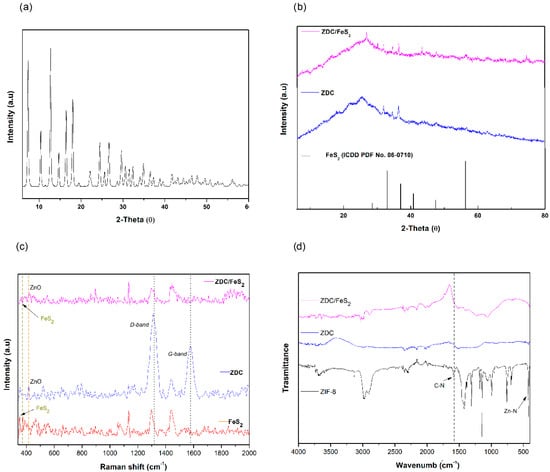
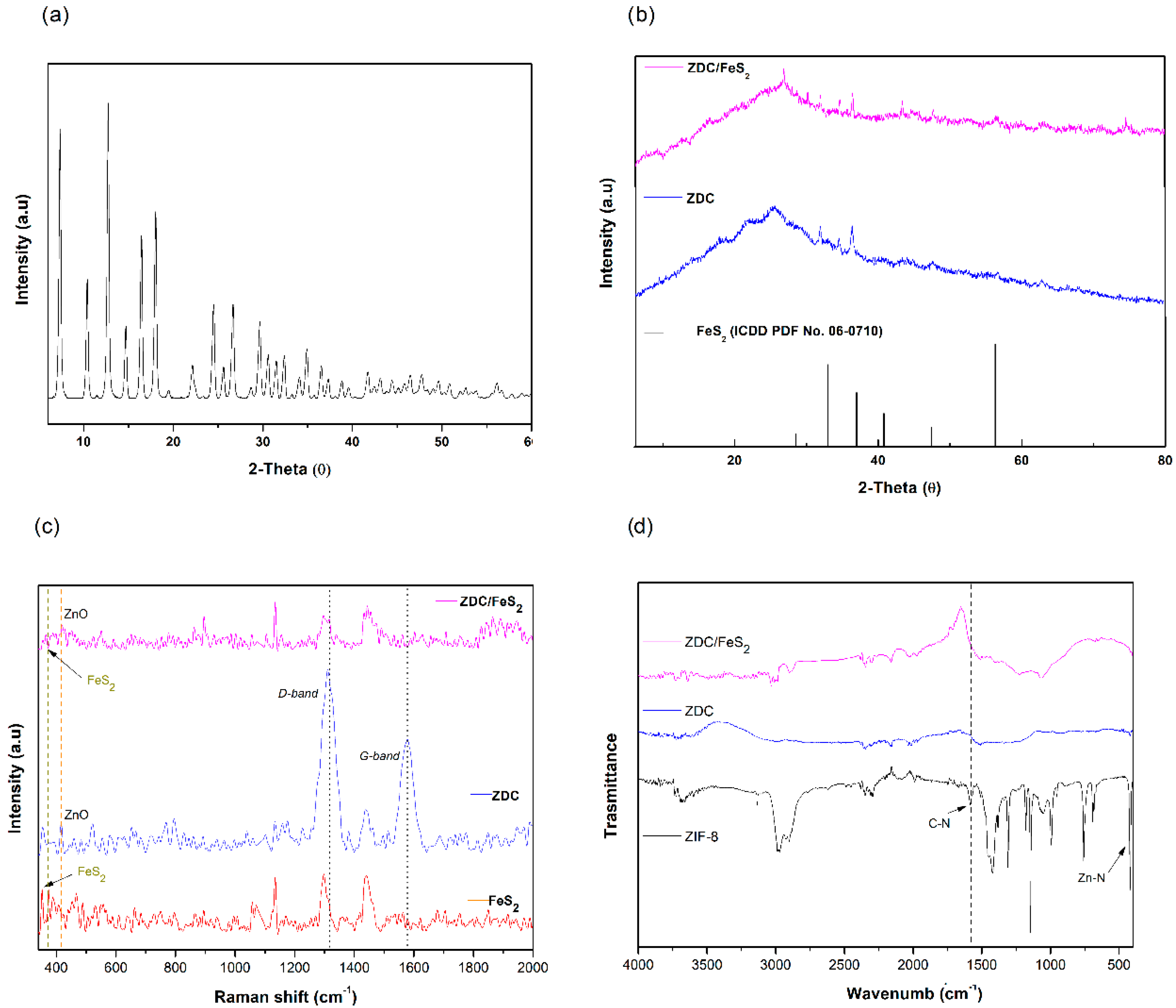
The synthesized ZIF-8 nanoparticles had an average particle size of 100–200 nm (Figure S2). The XRD pattern (Figure 3a) of pristine ZIF-8 displays well-defined characteristic reflections at 2θ values of 7.3°, 10.3°, 12.7°, 14.7°, 16.4°, 18.0°, 22.1°, 24.4°, 25.5°, 26.6°, 29.6°, and 34.9°. The positions and relative intensities of these peaks closely match those reported in the literature for sodalite-type ZIF-8, confirming the successful synthesis of a highly crystalline MOF without detectable secondary crystalline phases [20].
Figure 3.
(a) XRD pattern of pristine ZIF-8; (b) XRD patterns of ZDC and ZDC/FeS2, showing the identified crystalline phases; (c) Raman spectra of the synthesized materials highlighting the characteristic carbon D and G bands, along with vertical dashed lines indicating the characteristic vibrational modes of FeS2 (375 cm−1) and ZnO (437 cm−1), respectively; (d) FT-IR spectra across the different synthesis steps.
Following carbonization, the sharp diffraction peaks of ZIF-8 completely disappear and are replaced by a broad diffraction band centered between approximately 24° and 27° (Figure 3b). This transformation indicates the collapse of the long-range crystalline order of the MOF and the conversion of its organic ligands into an amorphous or short-range ordered carbonaceous matrix. Upon sulfurization, the broad carbonaceous band remains virtually unchanged, indicating that the incorporation of FeS2 does not significantly alter the overall structural framework of the carbon support. Additionally, ZDC/FeS2 exhibits weak reflections at approximately 33°, 37°, 41°, 47°, and 56°, which correspond to the primary diffraction planes of pyrite-phase FeS2 (ICDD PDF No. 06-0710). The relatively low intensity of these peaks can be attributed to a low mass fraction of crystalline FeS2 and/or the presence of ultra-small, highly dispersed crystallites embedded within the carbon matrix. In combination with EDS elemental mapping, these XRD findings provide complementary evidence for the successful formation of a crystalline FeS2 phase integrated within the ZIF-8-derived architecture.
The Raman spectrum (Figure 3c) exhibits the characteristic D and G bands of carbonaceous materials, centered at approximately 1300 and 1580 cm−1, respectively. The D band is associated with defect-related disorder in sp2 carbon domains, whereas the G band corresponds to the in-plane C–C stretching vibration of graphitic domains. The ID/IG ratio decreased from 1.61 for ZDC to 1.03 for ZDC/FeS2, indicating a lower relative contribution of defect-related Raman scattering after Fe–S incorporation. This decrease can be associated with the formation of Fe–S-containing domains on the carbon matrix, which may partially cover or modify defect-rich regions and consequently alter their contribution to the Raman response. The observed change therefore reflects a modification of the carbon surface and its local structural environment following Fe–S incorporation. This structural modification is consistent with the lower charge-transfer resistance observed for ZDC/FeS2 by EIS, although the improved charge-transfer characteristics likely arise from the combined effects of the carbon matrix and the Fe–S phase [21,22].
FT-IR spectra (Figure 3d) confirm the chemical evolution of the ZIF-8 precursor throughout the multi-step synthesis. For pristine ZIF-8, prominent absorption bands between 500 and 1500 cm−1 are assigned to the stretching and bending vibrations of the imidazolate ring and Zn–N coordination bonds [20]. After carbonization, the attenuation or complete disappearance of these signals confirms the thermal decomposition of the organic ligand and the destruction of the metal–organic framework. The residual band near 1550 cm−1 corresponds to C=C and C–N stretching modes within the nitrogen-doped carbon matrix. For ZDC/FeS2, subtle modifications emerge in the low-frequency region (<700 cm−1), which are assigned to Fe–S vibrational modes, offering further proof of the successful integration of sulfurized iron species into the composite matrix.
2.3. Optical and Electrochemical Properties
The optical properties of the synthesized materials were characterized via UV–vis spectroscopy (Figure S3a). Tauc plot analysis revealed that pristine ZIF-8 exhibits a wide bandgap energy (Eg) of 5.10 eV, characteristic of insulating MOF structures with light absorption restricted to the deep-ultraviolet region [23]. Following thermal conversion, the resulting ZIF-8-derived carbon (ZDC) exhibited a reduced band gap of 4.6 eV, which can be associated with the formation of the N-doped carbonaceous framework and the resulting modification of its electronic structure. A further reduction to 2.25 eV was observed after FeS2 incorporation. This change in the optical response may arise from the contribution of the narrow-band-gap FeS2 phase to the overall absorption of the composite, together with possible electronic interactions between FeS2 and the N-doped carbon matrix [24]. Since ZDC/FeS2 is a multiphase material, the obtained value represents an apparent optical band gap rather than the intrinsic band gap of an individual component. All band gap values were estimated using the same Tauc approach, assuming a direct allowed transition, by extrapolating the linear region of the (αhv)2 versus (hv) plots. The resulting optical response extends toward the visible-light region, which is advantageous for harvesting a broader fraction of the natural solar spectrum during photocatalytic treatment.
Mott–Schottky analysis was conducted to determine the semiconductor nature and band edge positions of ZDC/FeS2 (Figure S3b). The positive slope in the C−2 versus potential plot confirms n-type semiconductor behavior, where electrons serve as the majority charge carriers. Linear extrapolation to the potential axis yielded a flat-band potential (Efb) of −1.15 V vs. Ag/AgCl, corresponding to approximately −0.98 V vs. the normal hydrogen electrode (NHE). For n-type semiconductors, the conduction band minimum (ECB) typically lies 0.1–0.2 V more negative than Efb, providing an estimated ECB position of approximately −1.05 V vs. NHE. Combined with the optical bandgap (Eg = 2.25 eV), the valence band maximum (EVB) is estimated at +1.27 V vs. NHE.
The strongly negative conduction band position is particularly advantageous for superoxide radical generation. The standard reduction potential for the one-electron reduction of dissolved oxygen (O2/O2−) is −0.33 V vs. NHE. Because the ECB of ZDC/FeS2 (−0.98 V vs. NHE) is significantly more negative than this redox threshold, photogenerated electrons can readily reduce dissolved O2 to yield ⋅O2− radicals. This thermodynamic feasibility is fully consistent with scavenger experiment results, wherein the addition of p-benzoquinone caused the most significant inhibition of SNZ degradation.
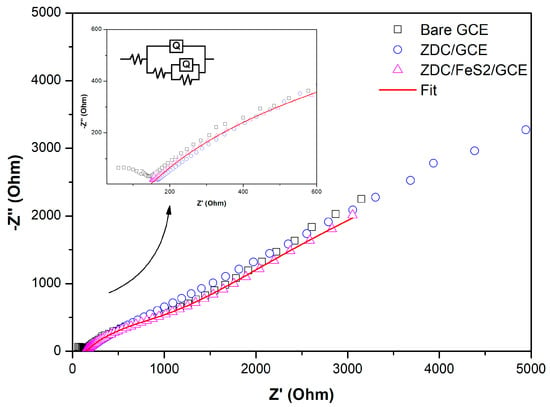
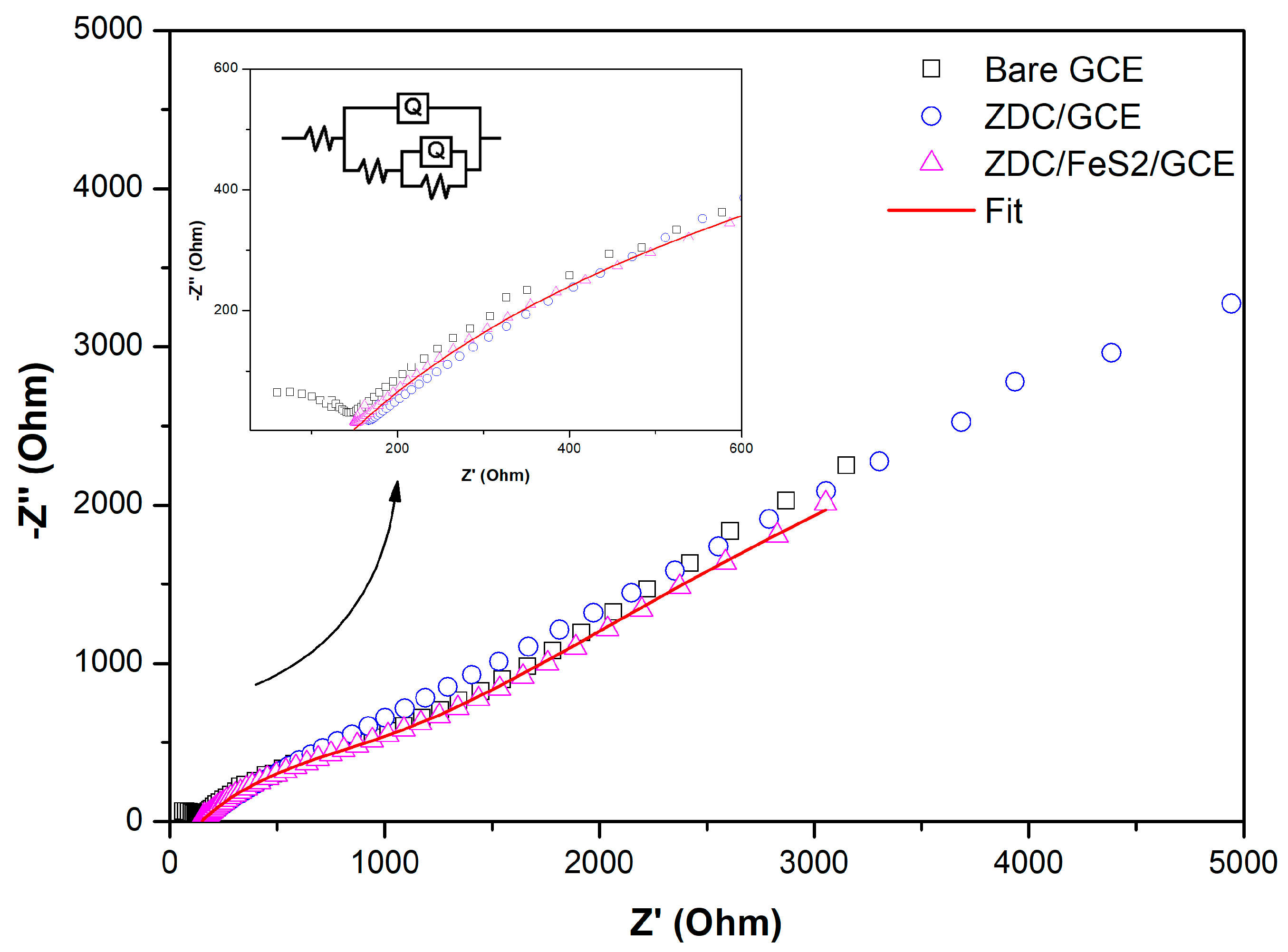
To complement the electronic characterization, electrochemical impedance spectroscopy (EIS) measurements were carried out. Nyquist plots (Figure 4) were fitted using an equivalent electrical circuit (Rs(Rct Qct), shown as inset in Figure 4), and the fitted circuit parameters are summarized in Table 1. The circuit model incorporates the solution resistance (Rs), the charge-transfer resistance (Rct), and a constant phase element (Qct) representing interfacial capacitance non-ideality.
Figure 4.
Nyquist plots obtained via electrochemical impedance spectroscopy (EIS) for Bare GCE, ZDC/GCE, and ZDC/FeS2/GCE (inset: equivalent electrical circuit used to fit the experimental data).
Table 1.
Electrical circuit parameters obtained by fitting EIS Nyquist plots.
Modifying the glassy carbon electrode (GCE) with ZDC led to a dramatic drop in Rct, decreasing from 3.48 × 10⁶ Ohm for the bare electrode to 3.52 × 10³ Ohm. This sharp reduction demonstrates that the ZIF-8-derived carbon matrix constructs a highly conductive pathway that facilitates charge transport across the electrode interface.
The subsequent incorporation of FeS2 further reduced Rct to 1.42 × 10³ Ω, representing an approximately 60% reduction relative to ZDC alone (3.52 × 10³ Ω). This decrease suggests improved interfacial charge-transfer properties in the ZDC/FeS2 composite, which may contribute to its photocatalytic performance. The importance of interfacial charge transfer and band alignment in photocatalytic heterostructures has also been highlighted in recent studies, particularly in systems where oxygen vacancies influence the electronic structure and charge-transfer pathways [25]. The concurrent decrease in Rct and Qct, alongside the increase in the phase exponent nct toward unity, confirms a more homogenous and conductive interfacial structure.
The enhanced electronic properties revealed by EIS stem directly from the hybrid composite architecture. The ZIF-8-derived nitrogen-doped carbon framework acts as a conductive, defect-rich scaffold, while the embedded FeS2 crystallites form intimate heterointerfaces that facilitate rapid charge separation. Together with the reduced bandgap and n-type semiconductor characteristics, these electrocatalytic metrics confirm that FeS2 integration effectively optimizes charge-carrier dynamics within the ZDC host matrix.
2.4. Evaluation of Photocatalytic Performance
2.4.1. Comparative Photocatalytic Activity and Reaction Kinetics
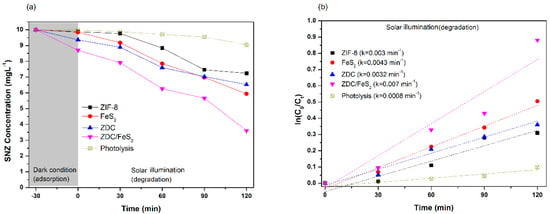
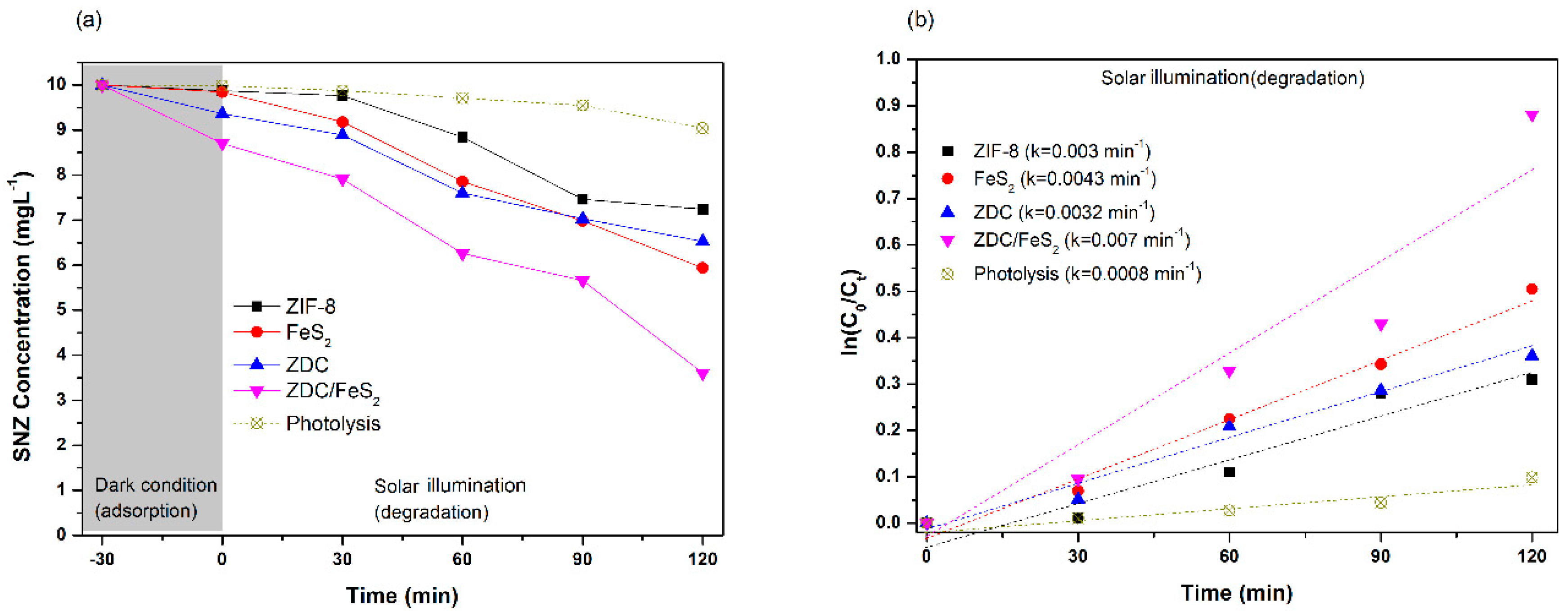
The photocatalytic activity of ZDC/FeS2 was evaluated through comparative degradation experiments and kinetic modeling. Figure 5 summarizes the performance of the various synthesized materials during both the dark adsorption phase and subsequent natural solar irradiation. The photocatalytic removal of secnidazole (SNZ) under natural sunlight (600 W m−2) confirmed the superior activity of the ZDC/FeS2 composite over its individual constituents (Figure 5a). During the 30 min dark adsorption period, ZDC/FeS2 exhibited a markedly higher adsorption capacity than its precursors, which can be attributed to the high specific surface area and porous architecture inherited from the ZIF-8 framework, along with a uniform distribution of active adsorption sites across the carbonaceous matrix.
Figure 5.
(a) Comparative adsorption and photocatalytic degradation profiles of SNZ using pristine ZIF-8, ZDC, FeS2, and the ZDC/FeS2 composite; (b) pseudo-first-order degradation kinetics of SNZ under natural solar irradiation ([SNZ]0 = 10 mg L−1, catalyst dosage = 50 mg L−1, solar irradiance = 600 W m−2).
Under solar illumination, SNZ degradation kinetics complied well with the pseudo-first-order kinetic model (Figure 5b). The apparent rate constant (k) for ZDC/FeS2 reached 0.007 min−1, which is 2.33, 2.18, and 1.62 times higher than those observed for pristine ZIF-8 (0.003 min−1), ZDC (0.0032 min−1), and bare FeS2 (0.0043 min−1), respectively. This remarkable enhancement in photocatalytic activity stems from a synergistic structural and electronic integration: the narrowed bandgap enables enhanced photon harvesting across the visible spectrum, while the ZDC/FeS2 heterojunction promotes rapid interfacial charge transport and spatial carrier separation, effectively suppressing electron–hole recombination losses.
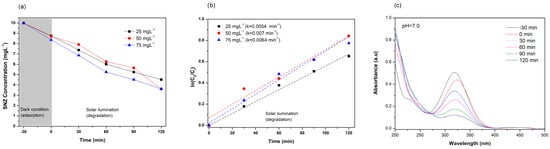
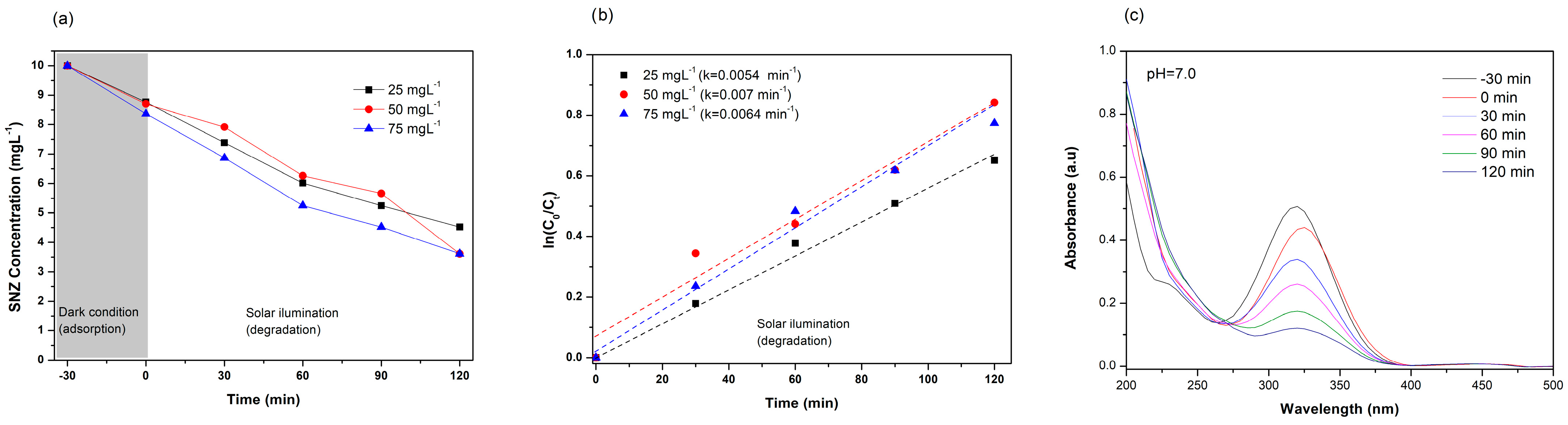
The influence of photocatalyst loading was systematically investigated across a dosage range of 25–75 mg L−1 (Figure 6). Both dark adsorption and subsequent photocatalytic degradation efficiency exhibited a direct positive dependence on catalyst loading up to an optimal dosage of 50 mg L−1 (5 mg in 100 mL). As shown by the kinetic fittings in Figure 6b, the apparent rate constant increased from 0.0054 min−1 at 25 mg L−1 to a maximum of 0.007 min−1 at 50 mg L−1. However, increasing the dosage further to 75 mg L−1 resulted in a slight decline in the apparent rate constant down to 0.0064 min−1.
Figure 6.
(a) Effect of ZDC/FeS2 catalyst loading on dark adsorption and photocatalytic degradation of SNZ; (b) pseudo-first-order kinetic plots for different catalyst dosages ([SNZ]0 = 10 mg L−1, solar irradiance = 600 W m−2); (c) time-dependent UV-Vis absorption spectra (200–500 nm) of the aqueous SNZ solution during the photocatalytic degradation process at the optimum catalyst dosage of 50 mg L−1 (pH 7.0, natural solar irradiation).
This kinetic suppression at higher catalyst loadings is attributed to light-scattering and optical shielding effects. An excess concentration of suspended particles increases solution turbidity, causing backscattering of incident photons and restricting light penetration through the reactor depth [26]. Consequently, 50 mg L−1 was identified as the optimal catalyst loading to maximize reactive oxygen species (ROS) generation while preserving optical transmittance in the photocatalytic system. To confirm the degradation profile and monitor the evolution of the characteristic absorption band of SNZ, time-dependent UV-Vis absorption spectra (200–500 nm) were recorded during the photocatalytic process at the optimum catalyst dosage of 50 mg L−1 (pH 7.0). As shown in Figure 6c, the absorption peak at 320 nm progressively decreased with irradiation time, verifying the efficient breakdown of the drug under natural solar light.
2.4.2. Influence of Initial Solution pH
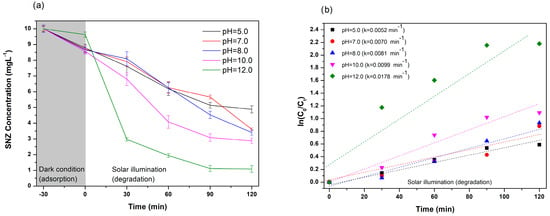
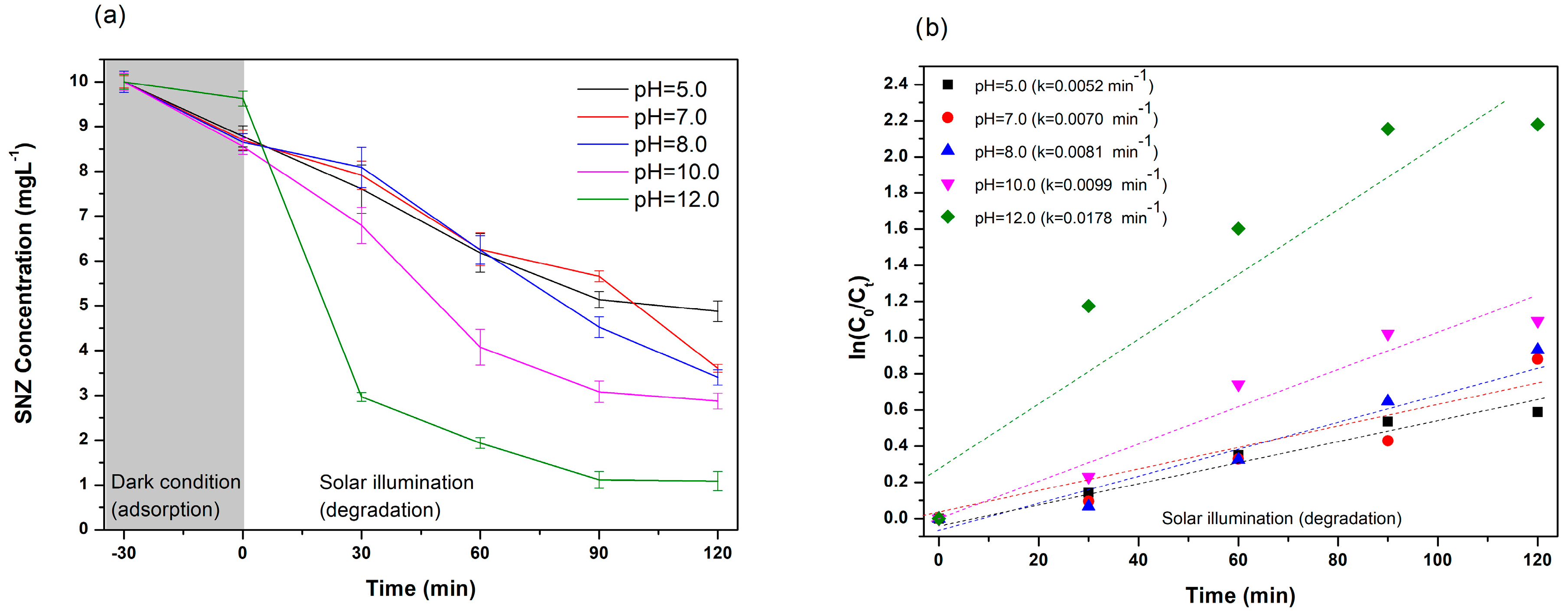
The effect of initial solution pH on SNZ degradation was evaluated exclusively using the ZDC/FeS2 photocatalyst, as it demonstrated the highest overall performance. Initial pH is a critical parameter in heterogeneous photocatalysis because it simultaneously governs the speciation of the pollutant molecule and the surface charge properties of the photocatalyst. Figure 7a displays the degradation profiles across a pH range from 5.0 to 12.0, revealing a significant enhancement in degradation efficiency under alkaline conditions.
Figure 7.
(a) Effect of initial pH value on SNZ adsorption and photocatalytic degradation; and (b) SNZ evolution with irradiation time at different pH values (intensity = 600 W⋅m−2; [SNZ]0 = 10 mg⋅L−1, catalyst dosage = 50 mg⋅L−1).
As shown in Figure 7b, at pH 12.0, the system reached an apparent rate constant (k) of 0.0178 min−1, representing a 3.42-fold, 2.54-fold, 2.20-fold, and 1.80-fold kinetic acceleration compared to the values obtained at pH 5.0 (0.0052 min−1), pH 7.0 (0.0070 min−1), pH 8.0 (0.0081 min−1), and pH 10.0 (0.0099 min−1), respectively. This progressive enhancement in degradation kinetics under increasingly basic conditions can be attributed to the higher abundance of OH− ions, which can react with photogenerated holes (h+) to yield hydroxyl radicals (⋅OH). However, the minor inhibition observed during ⋅OH scavenger tests suggests that hydroxyl radicals play only a secondary role in the reaction pathway under the evaluated conditions [27,28]. Furthermore, considering that secnidazole remains predominantly in its neutral molecular form across this pH range (pKa approx. 1.25), the pH-induced kinetic acceleration is primarily driven by changes in the catalyst’s surface charge density and interfacial electron transfer mechanics toward dissolved oxygen, which significantly boosts superoxide radical (⋅O2−) generation [29].
The surface charge properties of the ZDC/FeS2 composite were evaluated by determining its point of zero charge (pHpzc), which was found to be approximately 5.5 (Figure 2c). At pH < 5.5, the surface of the composite is protonated and carries a net positive charge (ZDC/FeS2-H+), whereas at pH > 5.5, surface deprotonation results in a net negative charge (ZDC/FeS2−). Considering that secnidazole remains in its neutral molecular form across the evaluated pH range, the remarkable kinetic acceleration observed under alkaline conditions (pH 12.0, k = 0.0178 min−1) is strongly favored by this surface charge state. Operating well above the pHpzc creates an electrostatically favorable environment that, combined with the high abundance of OH− ions, accelerates interfacial electron transfer toward dissolved oxygen and promotes the generation of reactive oxygen species such as superoxide radicals (O2−).
The photocatalytic performance of ZDC/FeS2 was compared with previously reported materials for the degradation of nitroimidazole pharmaceuticals. The main results are summarized in Table 2.
Table 2.
Comparison of photocatalytic performance of different materials for the degradation of nitroimidazole compounds.
As shown in Table 2, the ZDC/FeS2 composite achieved approximately 90% removal of secnidazole after 120 min under natural solar irradiation. Although some reported photocatalysts exhibited higher removal efficiencies, direct comparisons are limited by differences in experimental conditions and target pollutants. Notably, several studies achieved high removal efficiencies using H2O2 as an additional oxidant, whereas ZDC/FeS2 achieved substantial secnidazole removal without external oxidant addition. Furthermore, this study extends the application of solar-driven photocatalytic materials to secnidazole, a less explored nitroimidazole compound.
2.4.3. Reusability and Catalyst Stability
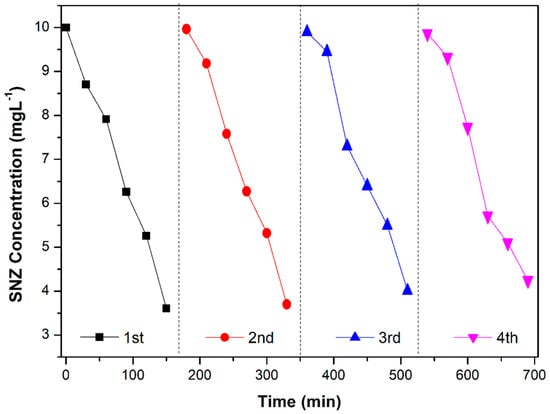
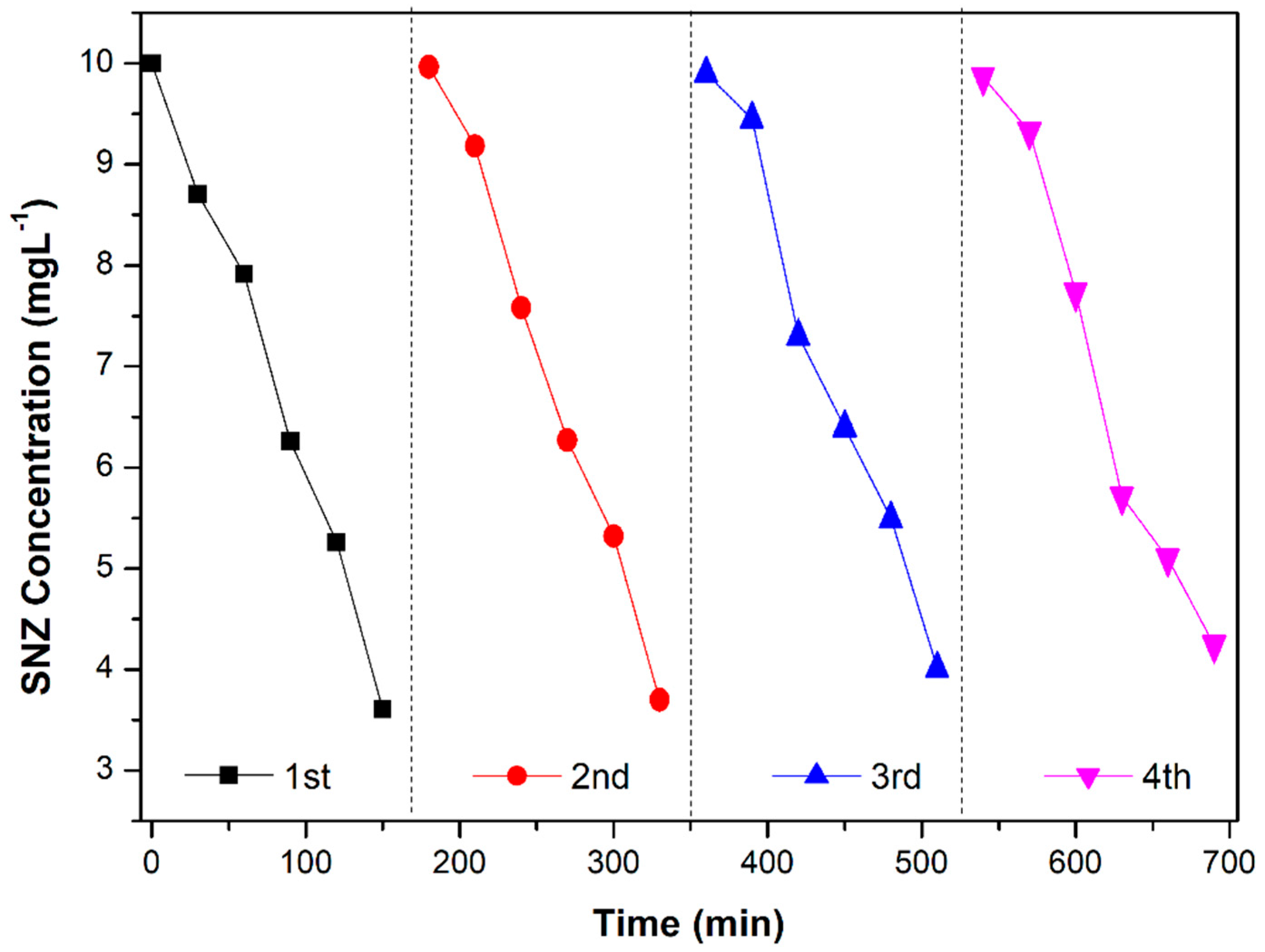
The reusability and operational stability of the ZDC/FeS2 photocatalyst were evaluated over four consecutive SNZ treatment cycles under natural solar irradiation at pH 7. After each reaction cycle, the photocatalyst was recovered by centrifugation, washed with deionized water, dried at 45 °C, and reused. The catalyst dosage was readjusted to 50 mg L−1 before each cycle to maintain a consistent concentration. The corresponding SNZ concentration profiles over the four consecutive cycles are presented in Figure 8.
Figure 8.
Evolution of SNZ concentration over reaction time during four consecutive recycling cycles using ZDC/FeS2 (intensity = 600 W⋅m−2; [SNZ]0 = 10 mg⋅L−1; catalyst dosage = 50 mg⋅L−1).
After the fourth cycle, the ZDC/FeS2 photocatalyst retained approximately 86.2% of its initial SNZ removal efficiency, indicating that most of its initial performance was maintained during repeated use. To evaluate the structural stability of the ZDC/FeS2 photocatalyst during the degradation process, X-ray diffraction (XRD) patterns of the pristine and recovered materials were compared (Figure S4). Comparing both diffractograms reveals that the crystallographic profile remains virtually unchanged, maintaining both the broad halo associated with the ZIF-8-derived carbon matrix and the weak characteristic reflections of the FeS2 phase. Furthermore, no additional diffraction peaks corresponding to secondary crystalline phases were detected, indicating that no appreciable phase transformations occurred during repeated photocatalytic cycles. Slight variations observed in the relative intensity of certain reflections and baseline fluctuations can be attributed to the surface adsorption of reaction intermediates, as well as minor sample losses during the recovery, washing, and drying steps. Overall, the XRD analysis confirms that the ZDC/FeS2 composite maintains its structural and crystalline integrity after four recycling cycles, which correlates with its structural durability and sustained residual activity. The preservation of the crystalline framework demonstrates that the ZIF-8-derived carbon matrix acts as a robust support for FeS2 nanoparticles, preventing agglomeration and preserving the material’s architectural integrity throughout the photocatalytic process.
2.5. Reaction Mechanism
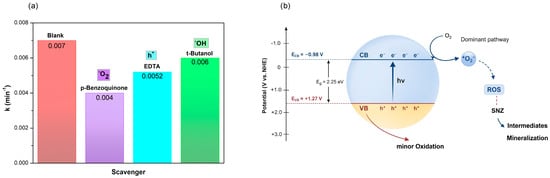
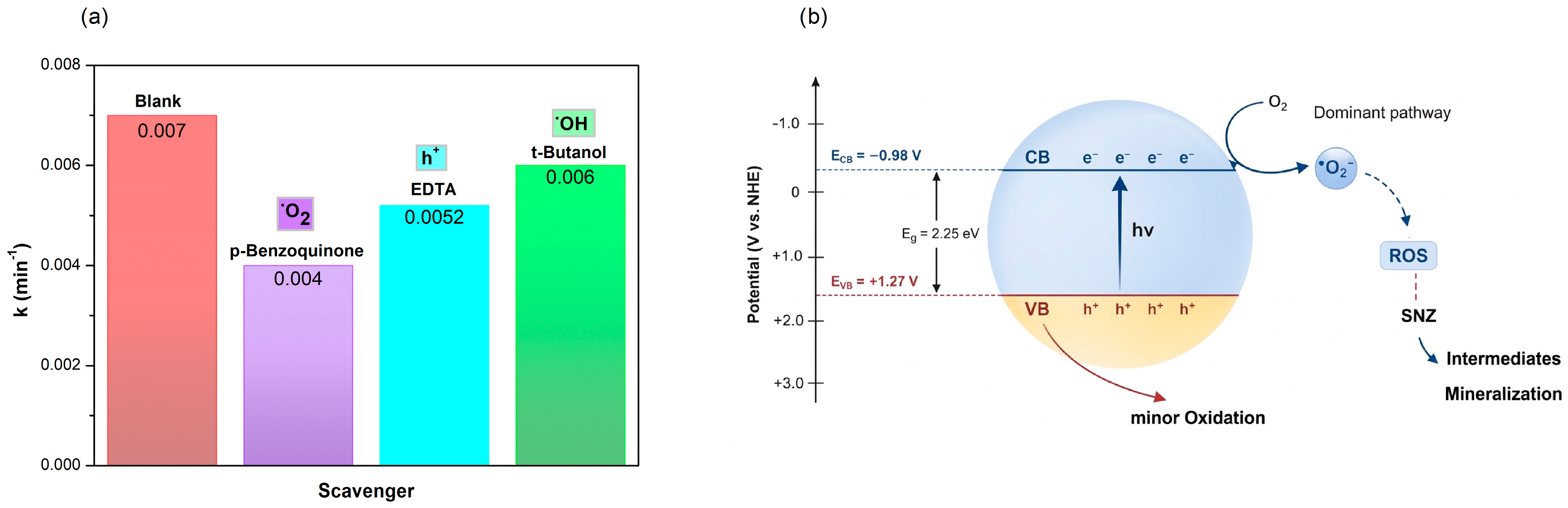
To elucidate the contribution of the primary reactive oxygen species (ROS) involved in the photodegradation of SNZ, scavenger trapping experiments were conducted (Figure 9a). The apparent rate constant (k) decreased from 0.007 min−1 (control) to 0.004 min−1 upon the addition of BQ, representing the most significant kinetic inhibition (~43%). The addition of EDTA also suppressed the reaction rate to 0.0052 min−1, whereas t-BuOH exhibited the weakest inhibitory effect (0.006 min−1).
Figure 9.
(a) Pseudo-first-order rate constants (k) for SNZ photocatalytic degradation using ZDC/FeS2 in the presence of various scavengers (intensity = 600 W⋅m−2; [SNZ]0 = 10 mg⋅L−1; catalyst dosage = 50 mg⋅L−1; [scavenger] = 1 mM); and (b) Proposed charge-transfer mechanism and SNZ degradation pathway. Solid and dashed blue arrows indicate the dominant reductive pathway (⋅O2− generation and SNZ degradation), the red dashed line shows ROS-mediated oxidation of SNZ, and the solid red arrow represents minor hole (h+) oxidation from the VB.
These results indicate that superoxide radicals (⋅O2−) serve as the primary reactive species driving SNZ degradation, followed by photogenerated holes (h+), whereas hydroxyl radicals (⋅OH) play a secondary role in this specific system, which is fully consistent with the band alignment configuration of the material [34].
Figure 9b illustrates the proposed charge-transfer mechanism based on the band edge positions determined from Mott–Schottky analysis (Figure S3b) and Tauc plot estimations (Figure S3a). The ZDC/FeS2 composite possesses a narrow bandgap energy (Eg) of 2.25 eV, with a conduction band minimum (ECB) positioned at −0.98 V vs. NHE and a valence band maximum (EVB) located at +1.27 V vs. NHE. Under solar illumination, electrons (e−) are promoted from the EVB to the ECB of the synthesized composite. Because the ECB potential is substantially more negative than the standard one-electron reduction potential of O2/⋅O2− (−0.33 V vs. NHE), accumulated photoelectrons readily reduce dissolved oxygen to yield active ⋅O2− radicals. These reactive species subsequently trigger oxidative cleavage, leading to the progressive transformation and fragmentation of the SNZ molecule [5,29].
Conversely, the EVB potential (+1.27 V vs. NHE) is thermodynamically insufficient to drive the direct oxidation of H2O/⋅OH (+2.38 V vs. NHE) or OH−/⋅OH (+1.99 V vs. NHE). This limitation directly explains the minor contribution of ⋅OH radicals observed in the trapping assays. Nevertheless, photogenerated holes (h+) residing in the EVB possess sufficient thermodynamic potential to directly oxidize SNZ molecules adsorbed onto the porous catalyst surface. This synergistic carrier dynamics—facilitated by intimate contact interfaces between FeS2 and the nitrogen-doped carbon matrix—underpins the enhanced photocatalytic efficiency of the composite.
2.6. Mineralization and Toxicity Assessment
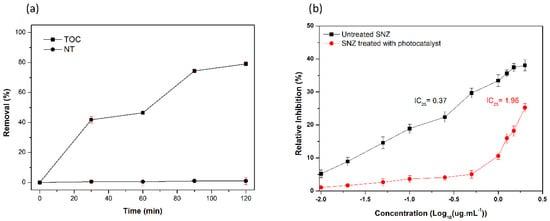
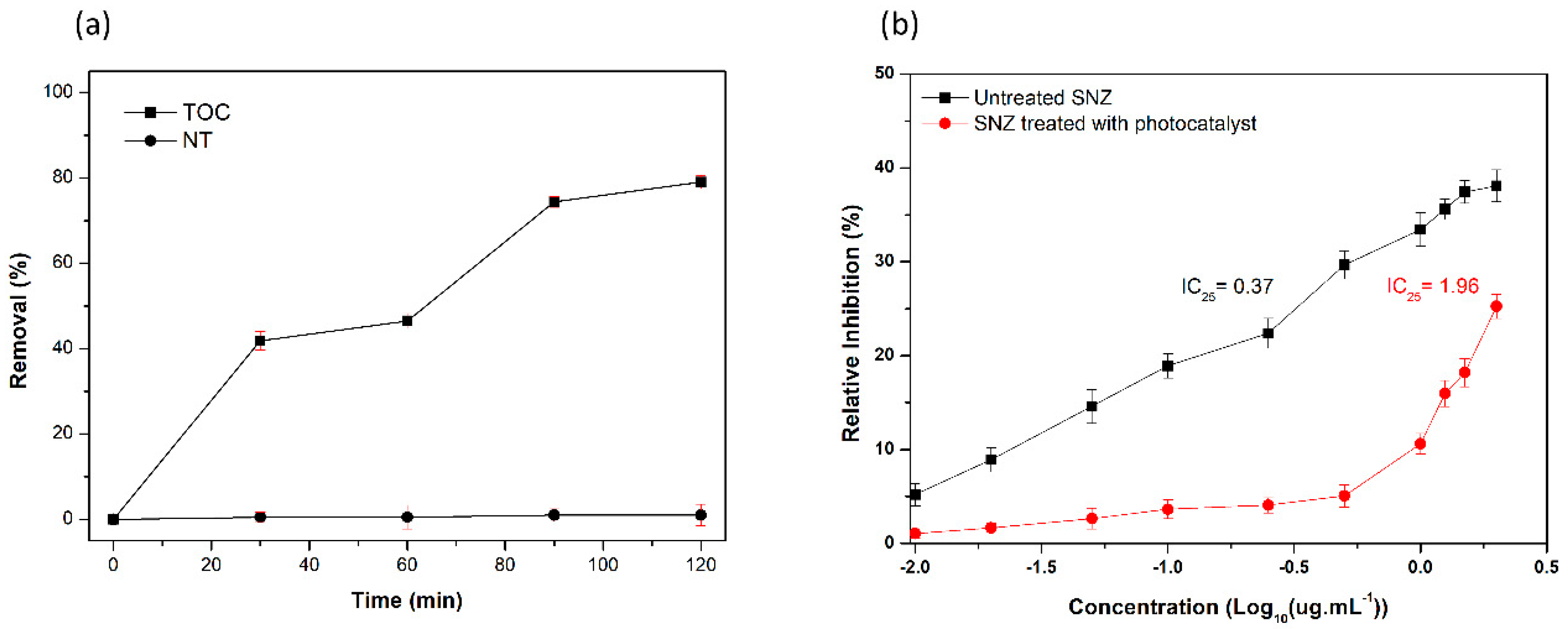
To assess changes in organic carbon and nitrogen during photocatalytic treatment, total organic carbon (TOC) and total nitrogen (TN) were monitored (Figure 10). After 120 min of treatment at pH 7, the aqueous-phase TOC decreased by approximately 75% in the presence of the ZDC/FeS2 composite, whereas SNZ removal reached approximately 65% under the same conditions (Figure 10a). In contrast, the control without photocatalyst exhibited only approximately 1.2% TOC reduction over the same period, indicating a negligible effect of solar irradiation alone on aqueous-phase TOC. The dark adsorption experiment showed only a minor decrease in SNZ concentration, suggesting that adsorption of the parent compound was limited under the tested conditions. This finding supports the contribution of light-driven processes to SNZ removal. Nevertheless, because TOC was measured after separating the photocatalyst from the aqueous phase, the observed TOC reduction cannot be attributed exclusively to mineralization, as adsorption of transformation products or other carbon-transfer processes cannot be completely excluded [28,29]. Meanwhile, TN exhibited comparatively limited variation, suggesting that most nitrogen remained in the aqueous phase. However, TN measurements alone cannot distinguish individual nitrogen-containing species or establish their transformation pathways (Figure 10a).
Figure 10.
(a) Time course of SNZ mineralization during photocatalytic treatment evaluated by aqueous TOC and TN dynamics (intensity = 600 W⋅m−2; [SNZ]0 = 10 mg⋅L−1; catalyst dosage = 50 mg⋅L−1; vertical bars indicate standard deviations, n = 3); (b) comparison of IC25 values of the SNZ aqueous solution before and after 120 min of photocatalytic degradation, calculated via the non-linear sigmoidal model.
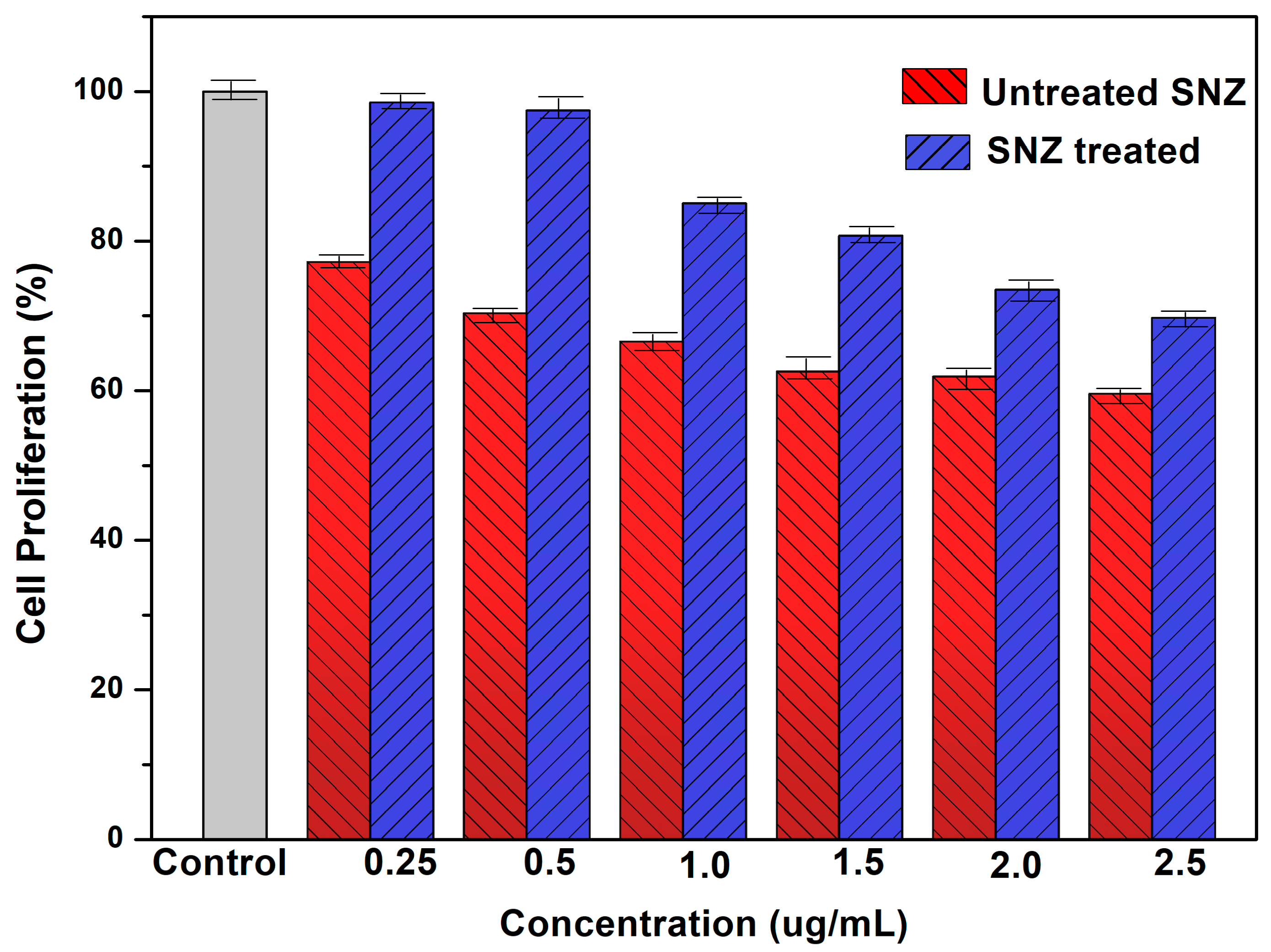
The reduction in potential effluent toxicity was evaluated via the MTT assay using human HCT-116 cells. The half-maximal inhibitory concentration threshold (IC25) increased from 0.37 µg mL−1 for untreated SNZ to 1.96 µg mL−1 following photocatalytic treatment, representing an approximate 5.3-fold reduction in toxicity (Figure 10b and Figure S6). Because a higher IC25 value indicates that a greater pollutant concentration is required to induce a 25% reduction in cell viability, these results provide clear evidence of a significant decrease in overall solution cytotoxicity under the evaluated conditions [35,36,37].
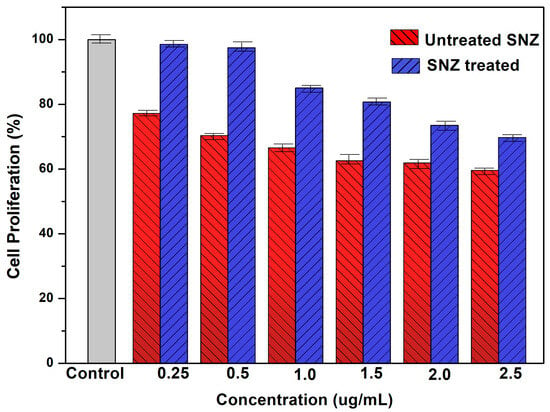
The concentration–response profile in Figure 11 demonstrates a concentration-dependent reduction in HCT-116 cell viability following exposure to the untreated SNZ solution over the evaluated range of 0.25–2.5 µg mL−1. Cell viability decreased from approximately 77% at 0.25 µg mL−1 to 59 ± 1% at 2.5 µg mL−1. In contrast, the photocatalytically treated SNZ solution exhibited substantially higher cell viability across the entire concentration range, decreasing from 98 ± 1% at 0.25 µg mL−1 to approximately 70% at 2.5 µg mL−1. Thus, photocatalytic treatment shifted the concentration–response profile toward higher cell viability, indicating a substantial attenuation of the cytotoxic response associated with SNZ. Although cell viability progressively decreased with increasing concentration after treatment, the values remained at or near the 70% viability threshold across the evaluated range. These results, together with the increase in IC25 from 0.37 to 1.96 µg mL−1, demonstrate that photocatalytic treatment substantially reduced the cytotoxicity of the SNZ solution under the investigated conditions.
Figure 11.
Concentration–response curves and HCT-116 cell viability profiles for untreated SNZ, treated SNZ solution (120 min), and untreated control cells across different concentration levels.
3. Experimental Procedure
3.1. Materials
Secnidazole (SNZ, ≥98%), zinc nitrate hexahydrate (Zn(NO3)2·6H2O, 98%), 2-methylimidazole (Hmim, 99%), ferric chloride hexahydrate (FeCl3·6H2O, 98%), elemental sulfur (S8), methanol (CH3OH), ethanol (C2H5OH), ethylenediaminetetraacetic acid (EDTA), tert-butanol (t-BuOH), and p-benzoquinone (BQ) were purchased from Alfa Aesar (Karlsruhe, Germany). Nitrogen gas (N2, 99%) was supplied by [Linde Ecuador S.A./Messer, Quito, Ecuador] and deionized water was used as received without further purification.
For the cytotoxicity assays, human colorectal carcinoma cells HCT-116 (ATCC® CCL-247™), Dulbecco’s Modified Eagle Medium (DMEM), fetal bovine serum (FBS, 10%), gentamicin/amphotericin B, and penicillin/streptomycin antibiotics were used. The 3-(4,5-dimethylthiazol-2-yl)-2,5-diphenyltetrazolium bromide (MTT) reagent, dimethyl sulfoxide (DMSO), glycine–Sörensen buffer, and sodium chloride (NaCl, 99%) were purchased from Alfa Aesar (Karlsruhe, Germany).
OpenAI (San Francisco, CA, USA) was used to assist with language editing and improving the clarity and readability of the manuscript.
3.2. Synthesis of the ZDC/FeS2 Composite
The ZIF-8 precursor was synthesized following a previously reported procedure [20]. Briefly, 0.585 g of Zn(NO3)2·6H2O and 5.254 g of 2-methylimidazole were dissolved in 15 mL of methanol at room temperature. The mixture was stirred for 10 min and subsequently aged without disturbance for 24 h. The resulting solid was recovered by centrifugation at 12,000 rpm for 10 min, washed three times with methanol, and dried at 105 °C for 12 h.
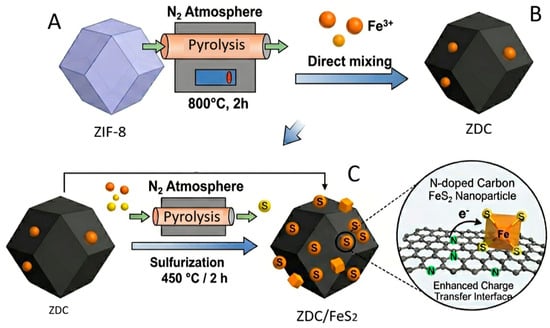
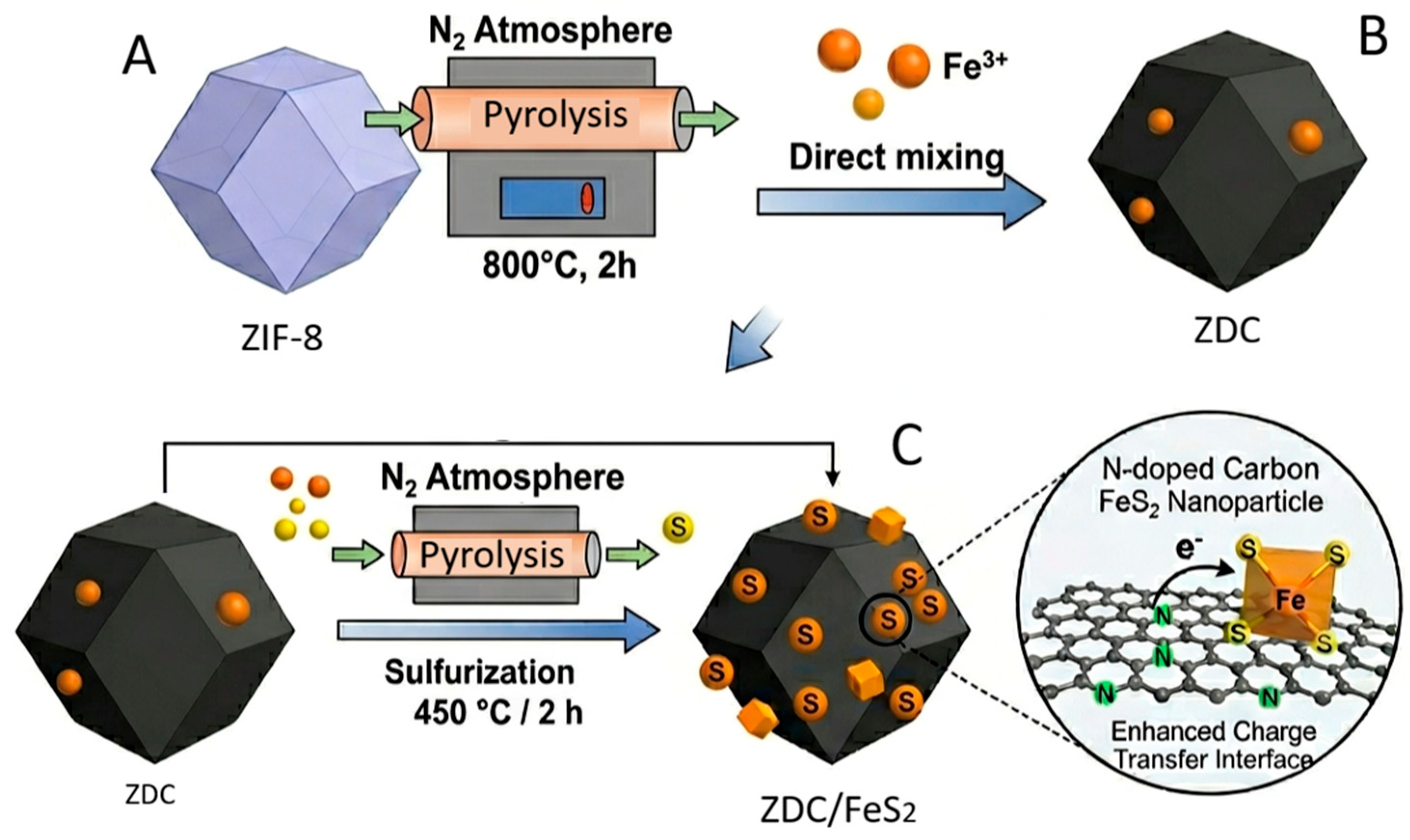
Subsequently, ZIF-8 was carbonized at 800 °C for 2 h under an N2 atmosphere at a heating rate of 5 °C min−1 to yield the ZIF-8-derived carbon matrix, designated as ZDC. For the incorporation of Fe and S, ZDC was impregnated with an amount of FeCl3·6H2O corresponding to 1 wt% of elemental Fe relative to the mass of ZDC. The resulting suspension was stirred for 4 h and then dried. The impregnated material underwent a second thermal treatment at 450 °C for 2 h under an N2 atmosphere in the presence of excess elemental sulfur. This treatment promoted the sulfurization of Fe species and the in situ formation of FeS2 within the carbonaceous matrix. The final product was denoted as ZDC/FeS2. The synthesis procedure is schematically depicted in Figure 12.
Figure 12.
Schematic illustration of the multi-step synthesis of the ZIF-8-derived ZDC/FeS2 composite: (A) pyrolysis of pristine ZIF-8 under N2 atmosphere at 800 °C for 2 h; (B) direct mixing of the carbonized product with Fe3+ ions to form the ZDC intermediate; and (C) subsequent sulfurization with elemental sulfur at 450 °C for 2 h under N2 atmosphere, yielding the ZDC/FeS2 composite.
3.3. Characterization Techniques
The pH at the zero-charge point (pHpzc) was determined using the pH drift method. To do this, the pH of several NaCl solutions (0.01 M, 50 mL) was adjusted with the necessary amount of NaOH (0.1 M) or HCl (0.1 M) to a range between 2 and 12 (pH ≈ 2, 4, 6, 7, 8, 10, 12). Next, 0.15 g of ZDC/FeS2 was dispersed in these solutions, and the pH was recorded after 24 h of stirring. A curve is obtained by plotting pHfinal against pHinitial. The point of intersection of this curve with the straight line representing the linear relationship between pHfinal and pHinitial provides the value of pHPZC. The surface morphology and elemental composition of ZDC/FeS2 were analyzed via scanning electron microscopy (SEM, Carl Zeiss Microscopy GmbH, Jena, Germany) equipped with an energy-dispersive X-ray spectroscopy (EDS) detector. The internal nanostructure of the material was examined using transmission electron microscopy (TEM). Crystalline phases were identified by X-ray diffraction (XRD) on a Bruker D8 Advance diffractometer (Bruker AXS, Karlsruhe, Germany) using Cu Kα radiation (λ = 1.5406 Å) over a 2θ range of 6–80°.
The structural characteristics of the carbonaceous matrix were investigated by Raman spectroscopy using a 532 nm excitation laser. The intensity ratio of the D and G bands (ID/IG) was used to evaluate the relative degree of structural disorder within the carbon network. Surface functional groups were identified by attenuated total reflectance Fourier-transform infrared spectroscopy (ATR-FTIR, Jasco 4X, Jasco Corporation, Tokyo, Japan) in the range of 400–4000 cm−1. Optical properties were determined using UV–vis spectroscopy, and the bandgap energy (Eg) was estimated via the Tauc plot method.
Electrochemical properties were evaluated through electrochemical impedance spectroscopy (EIS) and Mott–Schottky analysis using a Metrohm Autolab potentiostat (Metrohm Autolab B.V., Utrecht, The Netherlands). Experiments were conducted in a conventional three-electrode cell configuration consisting of a catalyst-modified graphite working electrode, an Ag/AgCl reference electrode, and a Pt counter electrode. The working electrode was prepared by drop-casting a catalytic ink formulated with the material and Nafion as a binder. EIS measurements were performed with a 10 mV sinusoidal amplitude perturbation across a frequency range of 0.1 Hz to 100 kHz. Impedance spectra were fitted to equivalent electrical circuits using ZSimpWin software (version 3.20, Princeton Applied Research, Oak Ridge, TN, USA). Mott–Schottky measurements were acquired at frequencies of 800 and 1000 Hz in a 0.1 M Na2SO4 electrolyte solution, sweeping the potential from −1.0 to 0 V.
3.4. Photocatalytic Degradation Experiments
The photocatalytic activity of the material was evaluated through the degradation of SNZ under natural solar irradiation in Quito, Ecuador (10:00–12:00 h), with an average solar irradiance of approximately 600 W m−2 and a UV index ranging between 7 and 9 during the experimental period [38]. For each run, 5 mg of photocatalyst was suspended in 100 mL of an aqueous SNZ solution (10 mg L−1), corresponding to a catalyst dosage of 50 mg L−1. The reaction was conducted in an open cylindrical Pyrex glass reactor (150 mL total capacity, 63 mm inner diameter, resulting in a liquid depth of sim 3.2 cm) under continuous magnetic stirring at 200 rpm. The suspension was kept in the dark for 30 min to reach adsorption–desorption equilibrium and subsequently exposed to natural sunlight. During illumination, 5 mL aliquots were collected at predetermined time intervals. All samples were filtered through 0.2 um PTFE syringe filters prior to analysis. The solution pH was adjusted using dilute HCl or NaOH solutions as needed.
Scavenger experiments were performed at pH 7.0 under the same experimental conditions as the degradation runs. tert-Butanol (t-BuOH), p-benzoquinone (BQ), and ethylenediaminetetraacetic acid (EDTA)—each at a concentration of 1 mM—were employed as trapping agents for ⋅OH, ⋅O2− and h+, respectively [39]. The reusability and stability of ZDC/FeS2 were evaluated over four consecutive 120 min reaction cycles. After each cycle, the photocatalyst was recovered by centrifugation, washed with deionized water, and dried at 45 °C prior to the subsequent run under identical conditions.
The residual SNZ concentration was quantified by UV–vis spectrophotometry at λmax = 320 nm using an external calibration curve prepared across the 0–10 mg L−1 range (Figure S1). Degradation kinetics were fitted to the pseudo-first-order model, expressed as ln(C0/C) = kt, where k represents the apparent rate constant (min−1).
Mineralization was assessed by quantifying total organic carbon (TOC) and total nitrogen (TN). Samples were pre-digested using a Hach DRB200 reactor (Hach Company, Loveland, CO, USA) and subsequently analyzed using a Hach DR1900 spectrophotometer (Hach Company, Loveland, CO, USA) according to the manufacturer’s standard protocols. All samples were filtered prior to analysis to eliminate photocatalyst particles.
All photocatalytic experiments were conducted in triplicate, and data are presented as the mean ± standard deviation.
3.5. In Vitro Cytotoxicity Assay
The cytotoxicity of SNZ solutions before and after photocatalytic treatment was evaluated using the MTT assay with human HCT-116 cells (ATCC® CCL-247™) [37,40]. Cells were seeded at a density of 6 × 10³ cells per well in 96-well plates and incubated for 24 h at 37 °C in a humidified atmosphere containing 5% CO2. Subsequently, the culture medium was replaced with DMEM containing the respective samples, and the cells were incubated for an additional 48 h. Three experimental conditions were evaluated: (i) untreated cell control, (ii) untreated SNZ solution, and (iii) SNZ solution after 120 min of photocatalytic treatment with ZDC/FeS2. To construct concentration–response curves, SNZ exposure concentrations ranged from 0.25 to 3.0 µg mL−1. Following the exposure period, 30 µL of MTT reagent (5 mg mL−1) was added to each well, and the plates were incubated for 4 h at 37 °C protected from light. The medium was then removed, and the intracellular formazan crystals were solubilized by adding 200 µL of DMSO and 25 µL of glycine–Sörensen buffer (0.1 M glycine, 0.1 M NaCl, pH 10.5). Absorbance was recorded at 570 nm. Cell viability was expressed as a percentage relative to the untreated control cells. The resulting viability data were fitted to a non-linear sigmoidal 3-parameter concentration–response regression model to determine the IC25 value, defined as the SNZ concentration corresponding to a 25% reduction in cell viability. All assays were conducted in independent triplicates.
4. Conclusions
The ZIF-8-derived ZDC/FeS2 composite demonstrated favorable optical and electrochemical properties for the photocatalytic degradation of secnidazole (SNZ) under natural solar irradiation. The composite exhibited a narrowed bandgap energy of 2.25 eV and a significantly reduced charge-transfer resistance compared to unfunctionalized ZDC. Under baseline operating conditions, the material achieved approximately 65% SNZ removal within 120 min, corresponding to an apparent rate constant of 0.007 min−1, while alkaline adjustment to pH 12.0 accelerated the reaction kinetics up to 0.0178 min−1. Scavenger trapping assays confirmed a dominant contribution of superoxide radicals (⋅O2−), followed by photogenerated holes (h+). Furthermore, a ~75% reduction in aqueous-phase TOC was recorded, accompanied by a 5.3-fold increase in the IC25 value (from 0.37 to 1.96 ug mL−1), confirming a substantial attenuation in post-treatment cytotoxicity toward human HCT-116 cells. After four consecutive recycling cycles, the photocatalyst retained approximately 86.2% of its initial activity, underscoring its promising potential for solar-driven pharmaceutical wastewater remediation.
Supplementary Materials
The following supporting information can be downloaded at: https://www.mdpi.com/article/10.3390/molecules31224173/s1: Figure S1. Calibration curve for secnidazole; Figure S2. SEM image of the synthesised ZIF-8 nanoparticles; Figure S3. (a) Tauc plot used to estimate the optical band gap energy through a direct transition, using the relationship ((hνα)2) versus (hν), and (b) Mott–Schottky plots recorded at 800 and 1000 Hz to evaluate the semiconductor electronic properties; Figure S4. XRD of the ZDC/FeS2 catalyst before and after four cycles of use; Figure S5. AFM micrograph of pyrolysed ZIF-8 ZDC; Figure S6: Antiproliferative activity in the HCT-116 cell line.
Author Contributions
Conceptualization, R.B.S. and H.P.; methodology, R.B.S., H.P., Y.M., C.S. (Cristina Silva) and D.D.; software, H.P.; validation, R.B.S.; formal analysis, R.B.S., H.P., M.F., A.D. and C.S. (Carina Stael); investigation, Y.M., C.S. (Cristina Silva), D.D., Y.J., A.D., C.S. (Carina Stael), P.L. and H.P.; resources, R.B.S.; data curation, H.P., C.S. (Cristina Silva), Y.J., A.D. and C.S. (Carina Stael); writing—original draft preparation, H.P. and Y.M.; writing—review and editing, R.B.S., H.P., Y.M., C.S. (Cristina Silva), D.D., Y.J., M.F., A.D., C.S. (Carina Stael) and P.L.; visualization, H.P. and M.F.; supervision, R.B.S.; project administration, R.B.S.; funding acquisition, R.B.S. and P.L. All authors have read and agreed to the published version of the manuscript.
Funding
This research was funded by the Central University of Ecuador (Universidad Central del Ecuador, UCE), under project No. DI-CONV-2025-018 and supported within the framework of the Académie de Recherche et d’Enseignement Supérieur (ARES). The APC was funded by the Central University of Ecuador (UCE).
Institutional Review Board Statement
Not applicable.
Informed Consent Statement
Not applicable.
Data Availability Statement
The original contributions presented in this study are included in the article/Supplementary Material. Further inquiries can be directed to the corresponding authors.
Acknowledgments
The authors gratefully acknowledge the Renewable Energy Laboratory of the Faculty of Chemical Sciences at the Central University of Ecuador for its support and facilities provided for the development of this research. The authors also thank the Central University of Ecuador for funding this work under project No. DI-CONV-2025-018. During the preparation of this manuscript, the authors used ChatGPT (GPT-4) from OpenAI for assistance with language editing and improving the clarity of the text. The authors reviewed and edited the output and take full responsibility for the content of this publication.
Conflicts of Interest
The authors declare no conflicts of interest.
References
- Hesham, R.; El-Aziz, H.A.; El-Shaheny, R. From carob to carbon dots: Sustainable synthesis of fluorescent nanosensor for sensitive secnidazole determination in pharmaceutical, biological, and environmental samples. Talanta Open 2025, 12, 100588. [Google Scholar] [CrossRef] [Scilit]
- Menezes, Á.G.; Cardoso, F.G.; Galego, G.B.; Alves, L.M.; Arbo, M.D.; Garcia, S.C.; Velho, M.C.; Boniatti, J.; Beck, R.C.R.; Tasca, T. Secnidazole and metronidazole in the treatment of Trichomoniasis: Comparative study of the mechanism of action and development of innovative 3D printed intrauterine devices. Microb. Pathog. 2026, 211, 108222. [Google Scholar] [CrossRef] [Scilit] [PubMed]
- Xu, X.; Fang, L.; Lu, X.; Hu, Y.; Yang, X.; Li, M.; Liu, Y.; Chen, Y.; You, Z.; He, Z. Sulfur-modified electrolytic manganese residue catalysts promote surface oxidative complex formation for the degradation of nitroimidazole organic pollutants with high half-wave potentials. Chem. Eng. J. 2026, 534, 175275. [Google Scholar] [CrossRef] [Scilit]
- Barwa, T.N.; Glennon, L.; Luo, Y.; Collins, G.; Dempsey, E.; Ramaraj, S.; Bresin, C.B. Synthesis of a CeO2/TeO2/CNTs composite and its electrocatalytic performance in the reduction of 2-nitroimidazole. Electrochim. Acta 2026, 578, 149908. [Google Scholar] [CrossRef] [Scilit]
- Liu, H.; Chen, X.; Li, D.; Liu, L.; Li, L. The mechanism of catalytic degradation of secnidazole by semiconductor titanium dioxide: A density functional theory study. Surf. Sci. 2023, 728, 122198. [Google Scholar] [CrossRef] [Scilit]
- Wang, Y.-L.; Gómez-Avilés, A.; Zhang, S.; Rodriguez, J.; Bedia, J.; Belver, C. Metronidazole photodegradation under solar light with UiO-66-NH2 photocatalyst: Mechanisms, pathway, and toxicity assessment. J. Environ. Chem. Eng. 2023, 11, 109744. [Google Scholar] [CrossRef] [Scilit]
- Ghosh, S.; Falyouna, O.; Onyeaka, H.; Malloum, A.; Bornman, C.; AlKafaas, S.S.; Al-Sharify, Z.T.; Ahmadi, S.; Dehghani, M.H.; Mahvi, A.H.; et al. Recent progress on the remediation of metronidazole antibiotic as emerging contaminant from water environments using sustainable adsorbents: A review. J. Water Process Eng. 2023, 51, 103405. [Google Scholar] [CrossRef] [Scilit]
- Kayed, S.F. Polímeros de coordinación derivados de hidracina como fotocatalizadores para la degradación de metronidazol en aguas residuales farmacéuticas. Langmuir 2025, 41, 16274–16287. [Google Scholar] [CrossRef] [Scilit] [PubMed]
- Roy, S.; Mishra, S.R.; Gadore, V.; Guha, A.K.; Ahmaruzzaman, M. Anchoring Ni(II) bisacetylacetonate complex into CuS immobilized MOF for enhanced removal of tinidazole and metronidazole. npj Clean Water 2024, 7, 83. [Google Scholar] [CrossRef] [Scilit]
- Palominos, R.A.; Mondaca, M.A.; Giraldo, A.; Peñuela, G.; Pérez-Moya, M.; Mansilla, H.D. Photocatalytic oxidation of the antibiotic tetracycline on TiO2 and ZnO suspensions. Catal. Today 2009, 144, 100–105. [Google Scholar] [CrossRef] [Scilit]
- Pelaez, M.; Nolan, N.T.; Pillai, S.C.; Seery, M.K.; Falaras, P.; Kontos, A.G.; Dunlop, P.S.M.; Hamilton, J.W.J.; Byrne, J.A.; O’Shea, K.; et al. A review on the visible light active titanium dioxide photocatalysts for environmental applications. Appl. Catal. B Environ. 2012, 125, 331–349. [Google Scholar] [CrossRef] [Scilit]
- Lu, Z.; Ling, Y.; Sun, W.; Liu, C.; Mao, T.; Ao, X.; Huang, T. Antibiotics degradation by UV/chlor(am)ine advanced oxidation processes: A comprehensive review. Environ. Pollut. 2022, 308, 119673. [Google Scholar] [CrossRef] [Scilit] [PubMed]
- Bakshi, M.; Singh, S. ICH guidance in practice: Establishment of inherent stability of secnidazole and development of a validated stability-indicating high-performance liquid chromatographic assay method. J. Pharm. Biomed. Anal. 2004, 36, 769–775. [Google Scholar] [CrossRef] [Scilit] [PubMed]
- Liang, P.; Zhang, C.; Sun, H.; Liu, S.; Tadé, M.; Wang, S. Photocatalysis of C, N-doped ZnO derived from ZIF-8 for dye degradation and water oxidation. RSC Adv. 2016, 6, 95903–95909. [Google Scholar] [CrossRef] [Scilit]
- Zulfa, L.L.; Hidayat, A.R.P.; Utomo, W.P.; Subagyo, R.; Kusumawati, E.N.; Kusumawati, Y.; Hartanto, D.; Widyastuti, W.; Ediati, R. Facile synthesis of Ni-ZIF-8 with improved photodegradation performance for methylene blue. Case Stud. Chem. Environ. Eng. 2024, 10, 100828. [Google Scholar] [CrossRef] [Scilit]
- Guo, Q.; Tang, G.; Zhu, W.; Luo, Y.; Gao, X. In situ construction of Z-scheme FeS2/Fe2O3 photocatalyst via structural transformation of pyrite for photocatalytic degradation of carbamazepine and the synergistic reduction of Cr(VI). J. Environ. Sci. 2021, 101, 351–360. [Google Scholar] [CrossRef] [Scilit] [PubMed]
- Wang, H.; Zhao, D.; Liu, C.; Fan, X.; Li, Z.; Luo, Y.; Zheng, D.; Sun, S.; Chen, J.; Zhang, J.; et al. FeS2@TiO2 nanobelt array enabled high-efficiency electrocatalytic nitrate reduction to ammonia. J. Mater. Chem. A 2022, 10, 24462–24467. [Google Scholar] [CrossRef] [Scilit]
- Xu, S.; Lv, Y.; Zeng, X.; Cao, D. ZIF-derived nitrogen-doped porous carbons as highly efficient adsorbents for removal of organic compounds from wastewater. Chem. Eng. J. 2017, 323, 502–511. [Google Scholar] [CrossRef] [Scilit]
- Zhong, S.; Zhan, C.; Cao, D. Zeolitic imidazolate framework-derived nitrogen-doped porous carbons as high performance supercapacitor electrode materials. Carbon 2015, 85, 51–59. [Google Scholar] [CrossRef] [Scilit]
- Pupiales, H.; Soria, R.B.; Arboleda, D.; Cevallos, C.; Alcívar, C.; Francis, L.; Xu, X.; Luis, P. ZIF-8/Chitosan Composite Hydrogel as a High-Performance Separator for Bioelectrochemical Systems. Membranes 2025, 15, 282. [Google Scholar] [CrossRef] [Scilit] [PubMed]
- Gong, Y.; Li, B.; Pei, T.; Lin, C.; Lee, S. Raman investigation on carbonization process of metal–organic frameworks. J. Raman Spectrosc. 2016, 47, 1271–1275. [Google Scholar] [CrossRef] [Scilit]
- Cui, N.; Bi, K.; Sun, W.; Wu, Q.; Li, Y.; Xu, T.; Lv, B.; Zhang, S. Effect of Pyrolysis Conditions on the Performance of Co–Doped MOF–Derived Carbon Catalysts for Oxygen Reduction Reaction. Catalysts 2021, 11, 1163. [Google Scholar] [CrossRef] [Scilit]
- Naz, F.; Mak, C.H.; Wang, Z.; Tong, H.; Santoso, S.P.; Du, M.; Kai, J.-J.; Cheng, K.-C.; Hsieh, C.-W.; Niu, W.; et al. In situ thermal solvent-free synthesis of doped ZIF-8 as a highly efficient visible-light-driven photocatalyst. RSC Appl. Interfaces 2025, 2, 741–754. [Google Scholar] [CrossRef] [Scilit]
- Wen, F.; Pang, L.; Zhang, T.; Huang, X.; Li, C.; Liu, H. Conductive nitrogen-doped carbon armored MOF-derived Fe doped nickel sulfide for efficient oxygen evolution reaction. Int. J. Hydrogen Energy 2024, 57, 263–272. [Google Scholar] [CrossRef] [Scilit]
- Hu, L.; Nie, R.; Zhang, W.; Du, Y.; Cao, J.; Zhang, Q.; Ning, P. Oxygen vacancy-mediated band alignment in facet heterojunctions for enhanced photocatalytic nitrogen reduction. Appl. Surf. Sci. 2026, 752, 168169. [Google Scholar] [CrossRef] [Scilit]
- Gupta, T.; Chauhan, R. Photocatalytic degradation of water pollutants using II-VI semiconducting catalysts: A comprehensive review. J. Environ. Chem. Eng. 2021, 9, 106734. [Google Scholar] [CrossRef] [Scilit]
- Li, M.; Liu, W.; Peng, C.; Ren, Q.; Lu, W.; Deng, W. A DFT study on reaction of eupatilin with hydroxyl radical in solution. Int. J. Quantum Chem. 2013, 113, 966–974. [Google Scholar] [CrossRef] [Scilit]
- Rodríguez, E.M.; Márquez, G.; Tena, M.; Álvarez, P.M.; Beltrán, F.J. Determination of main species involved in the first steps of TiO2 photocatalytic degradation of organics with the use of scavengers: The case of ofloxacin. Appl. Catal. B Environ. 2015, 178, 44–53. [Google Scholar] [CrossRef] [Scilit]
- Prados-Joya, G.; Sánchez-Polo, M.; Rivera-Utrilla, J.; Ferro-García, M. Photodegradation of the antibiotics nitroimidazoles in aqueous solution by ultraviolet radiation. Water Res. 2011, 45, 393–403. [Google Scholar] [CrossRef] [Scilit] [PubMed]
- Shuvo, S.H.; Putul, R.A.; Hossain, K.S.; Masum, S.M.; Molla, A.I. Photocatalytic Removal of Metronidazole Antibiotics from Water Using Novel Ag-N-SnO2 Nanohybrid Material. Toxics 2024, 12, 36. [Google Scholar] [CrossRef] [Scilit] [PubMed]
- Gadore, V.; Mishra, S.R.; Ahmaruzzaman, M. Bandgap engineering approach for synthesising photoactive novel Ag/HAp/SnS2 for removing toxic anti-fungal pharmaceutical from aqueous environment. J. Hazard. Mater. 2024, 461, 132458. [Google Scholar] [CrossRef] [Scilit] [PubMed]
- Rani, M.; Choudhary, S.; Shukla, G.; Shanker, U. Highly efficient photo-adsorptive degradation of tetracycline and metronidazole antibiotics by green synthesized Ag doped CeO2@SnO2 nanocomposites. Environ. Nanotechnol. Monit. Manag. 2024, 21, 100935. [Google Scholar] [CrossRef] [Scilit]
- Hussain, A.; Roy, S.; Ahmaruzzaman, M. Novel magnetically retrievable SnO2/Fe3O4/WSe2 heterojunction for the photocatalytic degradation of tinidazole through a synergistic strategy for environmental remediation. Sci. Rep. 2026, 16, 11206. [Google Scholar] [CrossRef] [Scilit] [PubMed]
- Solís, R.R.; Peñas-Garzón, M.; Belver, C.; Rodriguez, J.J.; Bedia, J. Highly stable UiO-66-NH2 by the microwave-assisted synthesis for solar photocatalytic water treatment. J. Environ. Chem. Eng. 2022, 10, 107122. [Google Scholar] [CrossRef] [Scilit]
- Oliveira, A.P.A.; Freitas, J.T.J.; Diniz, R.; Pessoa, C.; Maranhão, S.S.; Ribeiro, J.M.; Souza-Fagundes, E.M.; Beraldo, H. Triethylphosphinegold(I) Complexes with Secnidazole-Derived Thiosemicarbazones: Cytotoxic Activity against HCT-116 Colorectal Cancer Cells under Hypoxia Conditions. ACS Omega 2020, 5, 2939–2946. [Google Scholar] [CrossRef] [Scilit] [PubMed]
- Lessa, J.A.; Guerra, J.C.; de Miranda, L.F.; Romeiro, C.F.; Da Silva, J.G.; Mendes, I.C.; Speziali, N.L.; Souza-Fagundes, E.M.; Beraldo, H. Gold(I) complexes with thiosemicarbazones: Cytotoxicity against human tumor cell lines and inhibition of thioredoxin reductase activity. J. Inorg. Biochem. 2011, 105, 1729–1739. [Google Scholar] [CrossRef] [Scilit] [PubMed]
- Harshitha, V.; Devadiga, V.; Mohan, S.; Suresh, D. Green synthesis of Cu-Pr Co-Doped V2O5/rGO nanocomposites for enhanced photocatalytic hydrogen evolution, antioxidant activity, and latent fingerprint detection. Surf. Interfaces 2025, 77, 108047. [Google Scholar] [CrossRef] [Scilit]
- Energía Solar en Quito (Ecuador)—Radiación Solar 15 Días. Available online: https://www.radiacionsolar.es/quito.html (accessed on 3 April 2026).
- Pelaez, M.; Falaras, P.; Likodimos, V.; O’shea, K.; de la Cruz, A.A.; Dunlop, P.S.; Byrne, J.A.; Dionysiou, D.D. Use of Selected Scavengers for the Determination of NF-TiO2 Reactive Oxygen Species during the Degradation of Microcystin-LR under Visible Light Irradiation. J. Mol. Catal. A Chem. 2016, 425, 183. [Google Scholar] [CrossRef] [Scilit] [PubMed]
- Nagilla, P.S.; Karanam, S.P.; Nagella, N.K.; Khaderbad, Y.; Dabbeta, N.K.; Kalakonda, P.B.; Pandya, B.; Morampudi, V.; Balu, K.; Kalakonda, P. Green-engineered Ag-Ni-Co trimetallic nanocomposite: A unified platform for visible-light photocatalysis and bioactivity. Nanotechnol. Environ. Eng. 2026, 11, 105. [Google Scholar] [CrossRef] [Scilit]

Disclaimer/Publisher’s Note: The statements, opinions and data contained in all publications are solely those of the individual author(s) and contributor(s) and not of MDPI and/or the editor(s). MDPI and/or the editor(s) disclaim responsibility for any injury to people or property resulting from any ideas, methods, instructions or products referred to in the content. |
© 2026 by the authors. Licensee MDPI, Basel, Switzerland. This article is an open access article distributed under the terms and conditions of the Creative Commons Attribution (CC BY) license.