


Abstract
During the extraction of soy protein isolate (SPI), lipoxygenase (LOX)-catalyzed lipid oxidation generates residual off-flavor compounds, limiting its applications as a food ingredient and flavor carrier. To eliminate residual volatile compounds and prepare an SPI with a reduced volatile profile, this study systematically investigated the effects of moist-heat enzyme deactivation temperature, deactivation time, and ethanol washing cycles on the residual volatile profile, as well as on the proximate composition, solubility, surface hydrophobicity, and degree of denaturation of SPI. The results demonstrated that the number of residual volatile compounds decreased from 58 in untreated SPI to 36, 33, 11, and 12 after moist-heat treatment for 20 min at 70, 80, 90, and 100 °C, respectively, reaching a minimum (11 compounds) at 90 °C. Furthermore, at this optimal temperature, extending the deactivation time to 10, 20, and 30 min reduced the number of volatile compounds to 40, 11, and 15, respectively, indicating that 20 min was sufficient. Additionally, one, two, and three ethanol washing cycles reduced the volatile compounds to 39, 25, and 14, respectively, leaving only 14 compounds after three washes. Considering both off-flavor removal efficiency and protein functionality, moist-heat enzyme deactivation at 90 °C for 20 min combined with three ethanol washing cycles was established as the optimal complementary process within the scope of this laboratory study. This process exerted minimal impact on the main components of SPI (maintaining a dry-basis protein content above 91%) while preserving a high solubility of over 85%, significantly increasing surface hydrophobicity, and slightly elevating the denaturation temperature (Td) and enthalpy change (ΔH) of the 7S and 11S globulins, thereby altering thermal stability. The resulting SPI with reduced volatile residues exhibits good water solubility, providing a potential clean matrix for future studies on key aroma adsorption and the development of deodorized soy protein products.
1. Introduction
Soy protein isolate (SPI), typically produced from soybeans via alkaline extraction and isoelectric precipitation, is a vital protein ingredient in the food industry owing to its high protein content and well-balanced amino acid profile [1]. However, soybeans naturally contain lipoxygenases (LOX); upon cellular disruption during SPI extraction, these enzymes contact and catalyze the oxidation of unsaturated fatty acids to generate carbonyls and alcohols—such as hexanal, nonanal, (E)-2-heptenal, and 1-octen-3-ol—which impart pronounced beany and off-flavors that severely restrict the application of SPI in beverages, dairy alternatives, and meat products [2,3]. Consequently, effectively eliminating or inhibiting off-flavor compounds to produce an SPI with minimized volatile residues has become a key research focus in soy protein processing.
Off-flavors can be mitigated through two sequential pathways: inactivating off-flavor-generating enzymes at the source (upstream) and removing residual volatiles during downstream processing. Thermal enzyme deactivation disrupts LOX activity and inhibits lipid oxidation, serving as an effective approach to curb volatile formation; however, because soy proteins are thermosensitive and prone to excessive denaturation under high-temperature dry heating, moist-heat treatment at a relatively moderate temperature for a slightly extended duration is preferable [4,5]. Additionally, washing soybean flour with organic solvents such as ethanol facilitates the desorption and removal of pre-formed volatile residues from the protein matrix by disrupting the hydrophobic interactions between volatile compounds and proteins through repeated vacuum filtration and solvent evaporation, further reducing off-flavors [1,6].
In recent years, beyond its conventional role as a food ingredient, SPI with reduced volatile compounds has been increasingly explored as an adsorption carrier for the retention and controlled release of exogenous aroma compounds [7,8]. This creates a critical need to clearly distinguish between the removal of endogenous off-flavors (deodorization) and the subsequent application of the resulting clean SPI matrix for binding desired exogenous flavors. While individual thermal or solvent treatments have been studied, systematically evaluating their complementary combination to standardize a clean protein matrix remains necessary.
The hypothesis of this study is that combining moderate upstream moist-heat treatment to prevent new off-flavor formation with downstream ethanol washing to extract existing volatiles will yield an SPI with a minimal volatile profile without severely compromising its physicochemical functionality. With the objective of preparing a structurally characterized, low-residual-volatile SPI, this study systematically investigated the effects of enzyme deactivation temperature, deactivation time, and ethanol washing cycles on residual volatile flavor compounds, and evaluated their impacts on the proximate composition, solubility, surface hydrophobicity, and thermal stability of SPI, thereby providing an experimental basis for optimizing deodorized SPI production and serving as a foundational protein matrix for future flavor adsorption studies.
2. Results and Discussion
2.1. Effect of Enzyme Deactivation Temperature on Residual Volatile Compounds in SPI
During soy protein extraction, enzymatic catalysis induces lipid oxidation, resulting in substantial retention of off-flavor compounds in the final SPI product [9]. Inactivating lipid-oxidizing enzymes via thermal treatment prior to soybean tissue disruption effectively prevents lipid oxidation and reduces residual volatile flavor compounds. Although both dry-heat and moist-heat treatments have been employed for enzyme deactivation to improve the flavor of SPI, dry heating requires excessively high temperatures that are unsuitable for soybeans containing heat-labile protein fractions; therefore, moist-heat enzyme deactivation at a relatively lower temperature for a slightly prolonged duration is more appropriate. In this experiment, soybeans were subjected to moist-heat enzyme deactivation in hot water at 70, 80, 90, and 100 °C for 20 min.
As shown in Table 1, enzyme deactivation temperature markedly influenced the residual volatile profile of SPI: compared with 58 compounds in untreated SPI, the number of detected volatile species significantly decreased (p < 0.05) to 36, 33, 11, and 12 following treatment at 70, 80, 90, and 100 °C, respectively, demonstrating that thermal enzyme deactivation substantially reduced residual volatiles in SPI. Furthermore, semi-quantitative analysis based on internal standard normalization revealed that the peak areas of major off-flavor contributors—particularly hexanal (the primary indicator of beany flavor, decreasing from 589.00 to 10.20 × 10⁷ at 90 °C) and 1-octen-3-ol (decreasing from 225.00 to 0)—were significantly reduced after enzyme deactivation. In particular, deactivation at 90 °C yielded the fewest residual volatile species (only 11 compounds), rendering numerous previously present off-flavor compounds undetectable while drastically lowering the abundance of the remaining volatiles; thus, 90 °C was selected as the optimal deactivation temperature not only to achieve a pronounced reduction in residual volatiles, but also to avoid severe heat-induced protein denaturation associated with excessive temperatures.
Table 1.
Residual volatile compounds in SPI after different enzyme deactivation temperatures for 20 min.
2.2. Effect of Enzyme Deactivation Time on Residual Volatile Compounds in SPI
The duration of thermal enzyme deactivation directly governs the residual survival rate of LOX in soybeans, thereby dictating the level of off-flavor retention in the resulting SPI. Accordingly, residual volatile compounds in SPI were compared across moist-heat deactivation times of 10, 20, and 30 min at 90 °C, with the results summarized in Table 2.
Table 2.
Residual volatile compounds in SPI after different enzyme deactivation durations at 90 °C.
As observed in Table 2, varying the deactivation duration had distinct effects on volatile retention: the number of residual volatile compounds dropped significantly (p < 0.05) from 58 in the untreated control to 40, 11, and 15 after 10, 20, and 30 min of treatment, respectively, indicating that an appropriate extension of heating time markedly curtailed volatile residues. Consistent with the temperature trials, the peak areas of key soy off-flavor compounds—such as 3-octanone, 2,3-octanedione, hexanal, heptanal, (E)-2-heptenal, (E)-2-hexenal, nonanal, 1-hexanol, 3-octanol, 1-octen-3-ol, 1-nonanol, 2-pentylfuran, and m-xylene—decreased significantly following enzyme deactivation. Although heating for 20 min reduced the total number of volatile peaks to 11, extending the thermal exposure to 30 min resulted in a slight increase in the number of detected compounds to 15. This phenomenon is likely attributed to the thermal degradation of amino acids or secondary lipid oxidation triggered by prolonged high-temperature exposure, which can generate de novo volatile compounds. Therefore, 20 min was selected as the optimal enzyme deactivation time for SPI extraction.
2.3. Effect of Ethanol Washing Cycles on Residual Volatile Compounds in SPI
Pretreating defatted soybean flour with ethanol washing markedly reduces residual flavor compounds in the final SPI [6,10]; specifically, repeated washing with ethanol followed by vacuum filtration and solvent evaporation facilitates the progressive desorption and removal of bound volatiles from the soy protein matrix, yielding an SPI with minimal off-flavor retention. Because the number of washing cycles directly determines the extent of flavor removal, defatted soybean flour was washed with anhydrous ethanol once, twice, or three times (30 min per cycle) to compare changes in residual volatiles in SPI, as presented in Table 3.
Table 3.
Residual volatile compounds in SPI following different ethanol washing cycles.
As shown in Table 3, increasing the number of ethanol washing cycles progressively reduced volatile retention, with the number of detected volatile species declining significantly from 58 in the unwashed control to 39, 25, and 14 after one, two, and three washes, respectively. Concurrently, the peak areas of predominant volatile compounds in SPI—including 3-octanone, 2,3-octanedione, hexanal, heptanal, (E)-2-heptenal, (E)-2-hexenal, nonanal, 1-hexanol, 3-octanol, 1-octen-3-ol, 1-nonanol, 2-pentylfuran, and m-xylene—were significantly diminished following ethanol washing. These results demonstrate the complementary benefit of the process: while upstream moist-heat prevents new LOX-derived off-flavors, downstream ethanol washing effectively strips away pre-existing bound volatiles.
However, the additional reduction in volatile compounds achieved by performing three wash cycles instead of two must be critically weighed against operational trade-offs. A third cycle significantly increases organic solvent consumption, extends total processing time, and slightly decreases overall protein recovery due to the potential leaching of low-molecular-weight peptides. Despite these drawbacks, to establish a rigorously clean matrix for future interaction studies within the scope of this laboratory-scale work, three ethanol washing cycles were adopted for SPI extraction.
2.4. Effect of Enzyme Deactivation and Ethanol Washing on Proximate Composition and Yield
To comprehensively evaluate the impact of the combined treatments on product quality, the proximate composition (moisture, crude protein, crude fat, and ash) and overall protein yield were determined (Table 4).
Table 4.
Proximate composition and protein yield of untreated and optimally treated SPI.
The untreated SPI exhibited a dry-basis protein content of 92.5 ± 0.4%. Following the optimized complementary process (moist-heat enzyme deactivation at 90 °C for 20 min combined with three ethanol washing cycles), the dry-basis protein content remained high at 91.8 ± 0.3%, confirming the treatment successfully maintained a protein purity above 91%. The crude fat content was notably reduced from 0.6% to 0.2%, likely due to the lipid-extracting capability of the ethanol washes. Concurrently, the protein yield decreased slightly from 35.4% to 32.1%, which reflects the inevitable loss of some highly soluble, low-molecular-weight protein fractions during the repeated solvent washing and filtration steps.
2.5. Effects of Enzyme Deactivation and Ethanol Washing on the Solubility of SPI
Given the structural complexity and conformational sensitivity of soy proteins, thermal enzyme deactivation can considerably influence the solubility of the resulting SPI. Generally, in soy protein systems, a higher degree of protein denaturation and molecular aggregation corresponds to lower solubility; consequently, milder thermal treatment better preserves protein solubility [11,12]. Moreover, protein solubility varies depending on protein concentration, heating temperature, and heating duration [13,14].
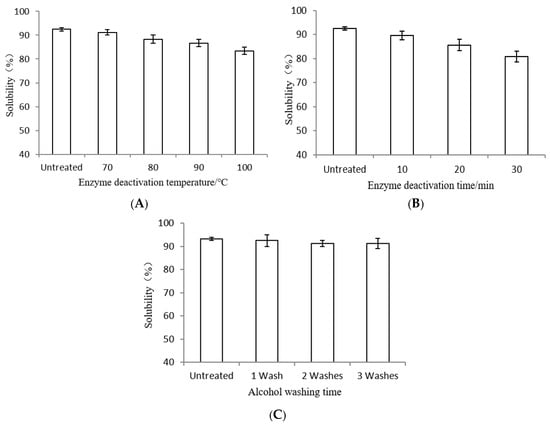
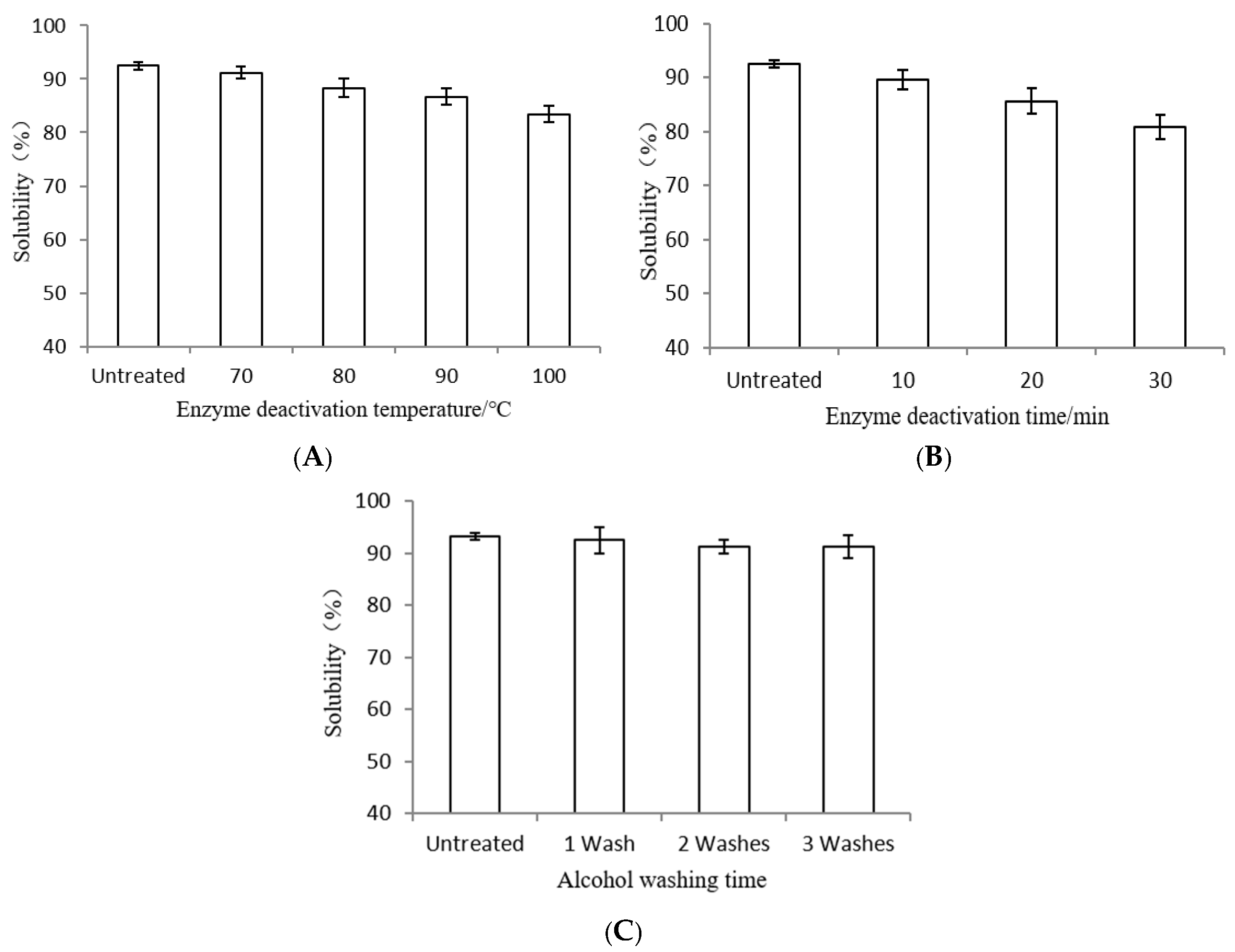
As illustrated in Figure 1A, significant differences (p < 0.05) in SPI solubility were observed across enzyme deactivation temperatures of 70, 80, 90, and 100 °C, exhibiting a downward trend as the heating temperature increased. Similarly, at a constant temperature of 90 °C (Figure 1B), prolonging the enzyme deactivation time increased cumulative thermal exposure, resulting in a gradual decline in protein solubility. This behavior is primarily due to the heat-induced unfolding of protein secondary and tertiary structures, which exposes previously buried hydrophobic residues; these exposed regions promote intermolecular hydrophobic interactions and subsequent protein aggregation, leading to a loss of solubility in aqueous environments. In contrast, as shown in Figure 1C, varying the number of ethanol washing cycles had no significant effect on the final solubility of SPI.
Figure 1.
Solubility of SPI. (A) Effect of enzyme deactivation temperature; (B) Effect of enzyme deactivation time; (C) Effect of ethanol washing cycles.
Therefore, although the combined process of moist-heat deactivation at 90 °C for 20 min followed by three ethanol washes caused a slight reduction in SPI solubility, the relatively moderate heating duration ensured that overall protein solubility remained above 85%, allowing SPI to dissolve well in aqueous systems.
2.6. Effects of Enzyme Deactivation and Ethanol Washing on the Surface Hydrophobicity of SPI
Because hydrophobic interactions play a pivotal role in flavor–protein binding, the surface hydrophobicity of SPI largely governs its adsorption capacity for characteristic aroma compounds. Thermal treatment substantially alters the surface hydrophobicity of SPI molecules; for instance, Sorgentini et al. reported that heating a 5% SPI dispersion at 80 °C and 100 °C for 30 min significantly increased its surface hydrophobicity [14]. Heat-induced conformational unfolding exposes previously buried hydrophobic amino acid residues to the molecular exterior, which is considered the primary mechanism driving the enhancement of surface hydrophobicity [13,14]. Conversely, further prolonging the heating duration can cause a gradual decline in surface hydrophobicity, as certain unfolded protein subunits re-associate during extended heating to form soluble or insoluble aggregates [15,16].
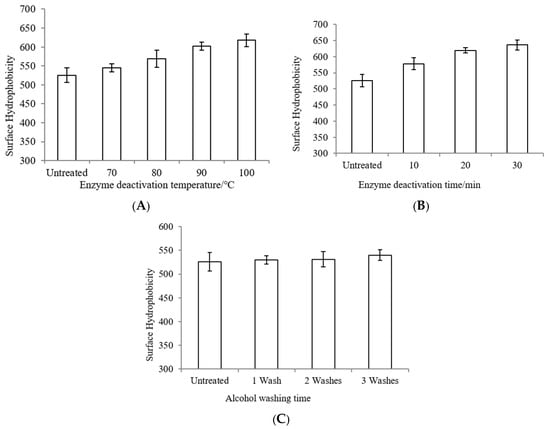
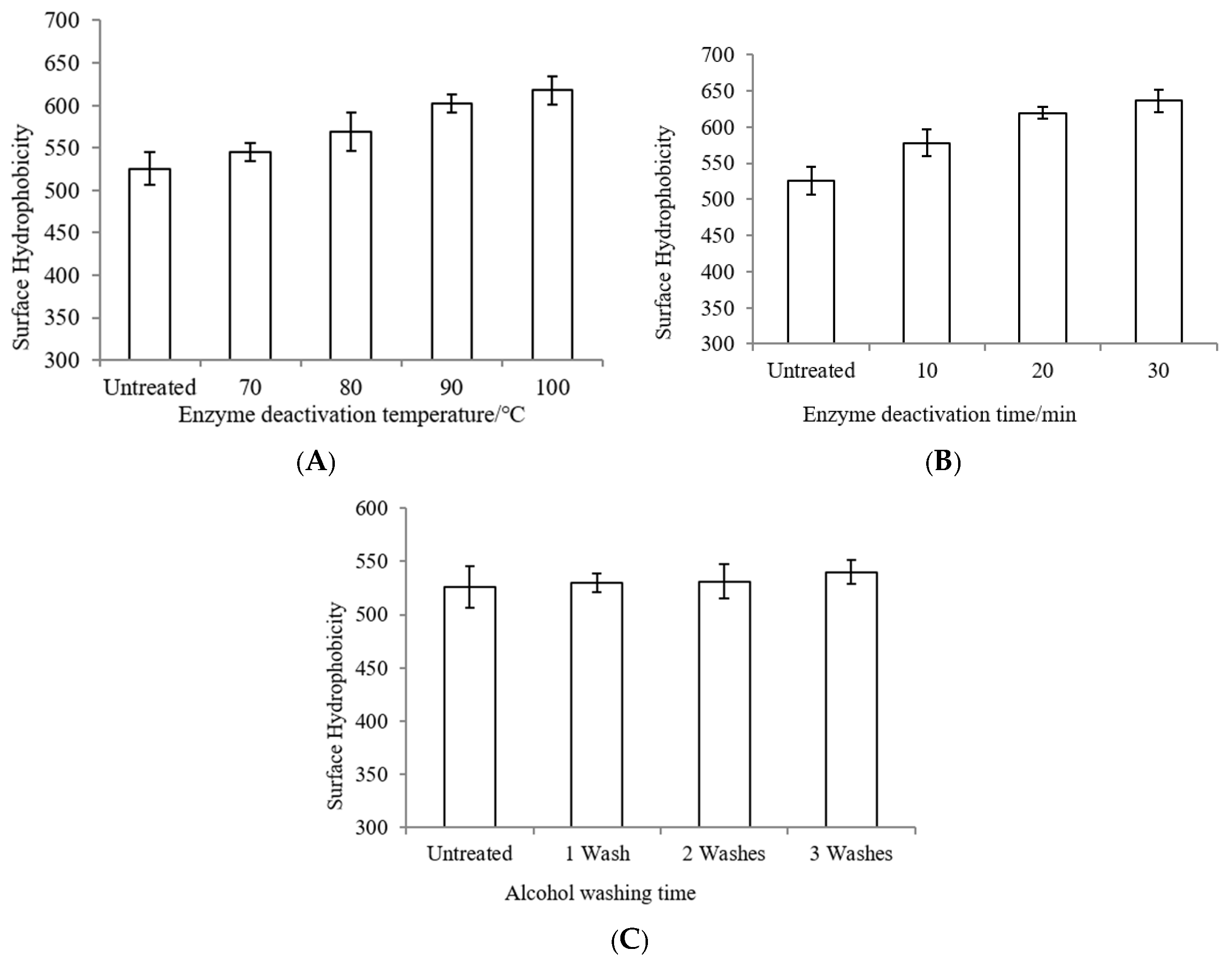
As shown in Figure 2A, the surface hydrophobicity of SPI increased significantly (p < 0.05) with rising enzyme deactivation temperature, exhibiting a marked elevation across all heated groups compared with unheated SPI [8]. Similarly, as depicted in Figure 2B, extending the deactivation time from 10 to 20 and 30 min progressively and significantly enhanced (p < 0.05) the surface hydrophobicity. While an increased surface hydrophobicity indicates the successful exposure of potential hydrophobic binding sites—which theoretically favors interactions with non-polar exogenous aroma compounds—it is important to note that direct flavor adsorption efficacy requires further empirical validation.
Figure 2.
Surface hydrophobicity of SPI. (A) Effect of enzyme deactivation temperature; (B) Effect of enzyme deactivation time; (C) Effect of ethanol washing cycles.
2.7. Effects of Enzyme Deactivation and Ethanol Washing on the Thermal Denaturation of SPI
Because enzyme deactivation involves thermal treatment, the degree of denaturation across differently treated soy protein samples was further evaluated and compared. Differential scanning calorimetry (DSC) has been widely employed to characterize protein thermal denaturation; from the peak temperature, peak height, and peak area of DSC thermograms, variations in the denaturation transition temperature (Td) and denaturation enthalpy (ΔH) can be derived, providing insights into the thermal stability, hydrophilic/hydrophobic balance, and aggregation state of SPI [7,17].
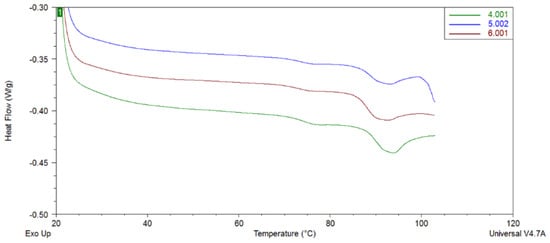
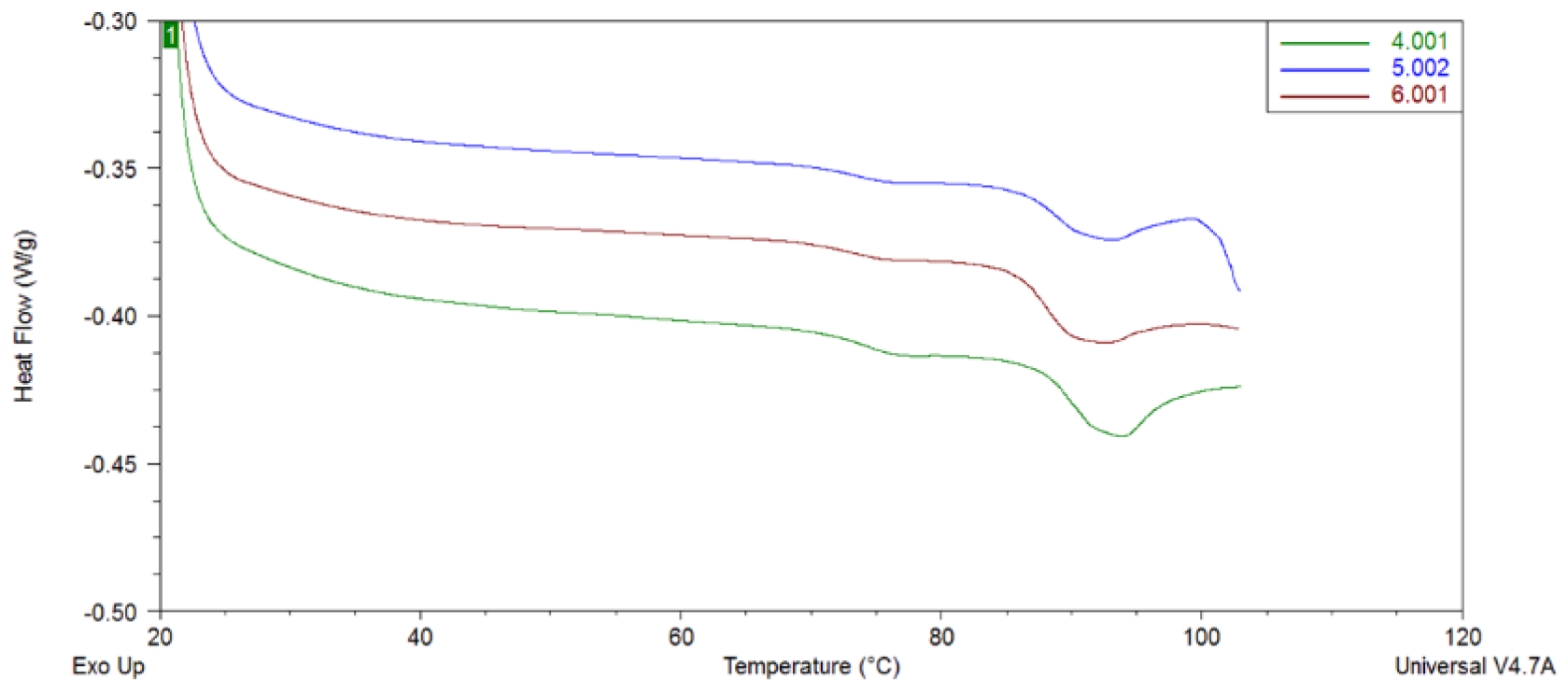
Figure 3 presents the DSC thermograms of untreated, enzyme-deactivated, and ethanol-washed SPI (from top to bottom), with the corresponding Td and ΔH values summarized in Table 5. During programmed heating around 74 °C, all three SPI samples exhibited an endothermic transition peak corresponding to the 7S globulin (β-conglycinin); both Td and ΔH values of the enzyme-deactivated and ethanol-washed samples were slightly higher than those of untreated SPI. Rather than strictly implying an enhancement in the innate thermal stability of the proteins, these increases in Td and ΔH suggest a heat-induced rearrangement of the protein fractions. The initial thermal treatment likely caused partial unfolding and subsequent structural compaction or aggregation, creating a denser protein matrix that required more thermal energy to denature during the DSC scan.
Figure 3.
DSC analysis of SPI after enzyme deactivation and ethanol washing (Note: "Exo Up" indicates the exothermic direction; "1" denotes the first heating scan; "Universal V4.7A" is the software version).
Table 5.
Denaturation transition temperature and enthalpy change in SPI samples determined by DSC.
3. Materials and Methods
3.1. Materials and Reagents
Soybeans (variety Zhonghuang 13, initial moisture content 10.2%) were harvested in Yancheng (Jiangsu, China) and stored in vacuum-sealed bags at 4 °C until use.
The internal standard 2-methyl-3-heptanone (purity ≥ 99.0%) was purchased from J&K Scientific Ltd. (Beijing, China) and was used for the relative semi-quantification of volatile compounds. A standard mixture of n-alkanes (C6–C26) was obtained from Sigma-Aldrich Trading Co., Ltd. (Shanghai, China) and was utilized to calculate Retention Indices (RI) for compound identification. Analytical-grade anhydrous ethanol, n-hexane, and HPLC-grade methanol were purchased from Sinopharm Chemical Reagent Co., Ltd. (Shanghai, China).
3.2. Instruments and Equipment
The instruments used in this study included a DELTA 320 pH meter, a JB5374-91 electronic balance, and an AL-series analytical balance (Mettler-Toledo, Greifensee, Switzerland); a Pyris 1 differential scanning calorimeter (DSC; PerkinElmer Inc., Waltham, MA, USA); a benchtop refrigerated centrifuge (Model H-1840R, Xiangyi Centrifuge Instrument Co., Ltd., Changsha, China); a soybean grinder and mechanical stirrer; a high-performance liquid chromatography (HPLC) system (Shimadzu Corp., Kyoto, Japan); a DHG-9503A electric thermostatic blast drying oven (Shanghai Yiheng Scientific Instrument Co., Ltd., Shanghai, China); a Model 650-60 fluorescence spectrophotometer (Hitachi Ltd., Tokyo, Japan); a Typ-003-2391 super thermostatic water bath (Thermo Fisher Scientific Inc., Waltham, MA, USA); a manual SPME holder equipped with 100 μm PDMS, 75 μm CAR/PDMS, 50/30 μm DVB/CAR/PDMS, and 80 μm PA fibers (ANPEL Laboratory Technologies Inc., Shanghai, China); a Varian Trace MS gas chromatography–mass spectrometry (GC-MS) system (Varian Inc., Palo Alto, CA, USA); an induction cooker (Midea Group, Foshan, China); and a KMO 2 basic magnetic stirrer (IKA Works Guangzhou, Guangzhou, China).
3.3. Experimental Methods
3.3.1. Preparation of Soy Protein Isolate (SPI)
To minimize residual endogenous flavor compounds in the final protein product, SPI was extracted according to the method of Feng and Xiong [18] with slight modifications. The experimental groups included: untreated SPI (control), heat-treated only SPI, ethanol-washed only SPI, and combined-treatment SPI. Briefly, soybeans were immersed in water at 90 °C for 20 min at a soybean-to-water mass ratio of 1:5 (w/v) for moist-heat enzyme deactivation. During this step, it took approximately 5 min for the dispersion to reach the target temperature of 90 °C. Following the 20 min holding time, the mixture was immediately and rapidly cooled in an ice-water bath for 10 min to halt further thermal denaturation. The mixture was then dried in a forced-air oven at a low temperature of 45 °C until the moisture content was below 8%, dehulled, and ground into flour. The flour was defatted by soaking in n-hexane for 2 h, followed by vacuum filtration and solvent evaporation to obtain defatted soybean flour. Subsequently, anhydrous ethanol was added to the defatted flour at a liquid-to-solid ratio of 3:1 (v/w) and soaked for 30 min at room temperature (25 °C) to remove residual volatile flavor compounds, followed by vacuum filtration and solvent evaporation; this ethanol washing procedure was repeated three times, using fresh anhydrous ethanol for each cycle. The dried flour was then dispersed in distilled water at a solid-to-liquid ratio of 1:10 (w/v, dry weight basis), adjusted to pH 8.0 with 2 mol/L NaOH, stirred for 1.5 h, and centrifuged at 13,000× g to collect the supernatant; the supernatant was then adjusted to pH 4.5 with 2 mol/L HCl, stirred for 0.5 h for acid precipitation, and centrifuged at 5000× g to recover the protein precipitate, which was re-dissolved in deionized water and neutralized to pH 7.0. Finally, the neutralized protein dispersion was freeze-dried, vacuum-packaged, and stored at −80 °C until further analysis.
3.3.2. Determination of Volatile Flavor Compounds
HS-SPME extraction and injection: Prior to extraction, the SPME fiber (50/30 μm DVB/CAR/PDMS) was conditioned in the high-temperature GC injection port for 10 min. Exactly 3.0 g of the SPI sample and 10 μL of the internal standard (2-methyl-3-heptanone, 10 μg/mL in methanol) were placed into a 15 mL headspace vial, sealed tightly with a PTFE/silicone septum. After 30 min of adsorption, the fiber was retracted into the needle assembly, withdrawn from the vial, and immediately inserted into the GC-MS injection port for thermal desorption to obtain qualitative and quantitative profiles.
GC/MS conditions: (Oven, carrier gas, and MS parameters remain as original). Data analysis: Volatile compounds were tentatively identified by computer-assisted library matching against the NIST 08 mass spectral database and firmly confirmed by comparing their calculated Retention Indices (RI) (derived from the C6-C26 n-alkane standards) with literature values. Compounds were semi-quantified relatively by calculating the ratio of their peak areas to the peak area of the internal standard.
MS conditions: Mass spectrometry was operated in electron impact (EI) mode at an ionization energy of 70 eV and a filament emission current of 150 μA, with the ion source and interface temperatures set at 220 °C and 250 °C, respectively, across a mass scan range of m/z 50.0–500.0.
3.3.3. Determination of Proximate Composition and Protein Yield
The proximate composition of the SPI samples was determined in triplicate according to standard AOAC methods [19]. Moisture content was determined by oven drying at 105 °C to a constant weight. Ash content was measured by incineration in a muffle furnace at 550 °C. Crude fat was determined using the Soxhlet extraction method with petroleum ether. The total nitrogen content was determined using the standard Kjeldahl method, and the crude protein content (on a dry matter basis) was calculated using a nitrogen-to-protein conversion factor of 6.25. Overall protein yield was calculated according to the following equation:
Protein Yield (%) = (Mass of protein recovered in SPI/Mass of total protein in initial defatted soybean flour) × 100
3.3.4. Determination of Protein Solubility
Protein solubility of SPI was determined according to the method described by Molina et al. [20]. Specifically, an SPI dispersion of approximately 20 mg/mL was prepared, adjusted to pH 8.0 using NaOH solution, stirred for 1 h to ensure thorough dissolution, allowed to stand for 2 min, and the upper phase was transferred into a centrifuge tube and centrifuged at 12,000× g for 15 min. Subsequently, a 10 mL aliquot of the supernatant was collected to determine the soluble protein content via the Kjeldahl method. Protein solubility was calculated as the ratio of protein content in the supernatant to the total protein content in the original sample.
3.3.5. Determination of Surface Hydrophobicity
Surface hydrophobicity was measured using 1-anilino-8-naphthalenesulfonate (ANS) as a fluorescent probe [21]. SPI samples were serially diluted in 0.01 mol/L phosphate buffer (pH 7.0) to obtain protein concentrations ranging from 0.05 to 10.8 mg/mL. An aliquot (20 μL) of 8 mmol/L ANS solution was added to 2 mL of each protein dilution, vortexed thoroughly, and incubated in the dark for 3 min. Fluorescence intensity was measured at an excitation wavelength of 365 nm and an emission wavelength (λem) of 520 nm, with both excitation and emission slit widths set to 5 nm. The initial slope of the fluorescence intensity versus protein concentration plot (calculated by linear regression) was defined as the surface hydrophobicity index (H0).
3.3.6. Thermal Analysis (DSC)
For DSC analysis, approximately 3.0 mg of the freeze-dried SPI sample was precisely weighed into an aluminum pan and hermetically sealed. The samples were heated from 20 °C to 120 °C at a constant heating rate of 10 °C/min, using an empty sealed aluminum pan as the reference. The thermal transitions, including denaturation temperature (Td) and enthalpy change (ΔH), were calculated using the Pyris software (version 10.0, PerkinElmer, Waltham, MA, USA).
3.3.7. Statistical Analysis
All experiments and analytical measurements were performed in three independent replicates (n = 3). Data were expressed as the mean ± standard deviation (SD). Statistical significance among different treatment groups was analyzed using a one-way analysis of variance (ANOVA). When a significant effect was detected, Tukey’s post-hoc test was utilized for multiple comparisons. Differences were considered statistically significant at a level of p < 0.05. All statistical analyses were conducted using SPSS Statistics 29.0 (IBM Corp., Armonk, NY, USA).
4. Conclusions
In this study, a combined process of moist-heat enzyme deactivation and anhydrous ethanol washing was developed to prepare SPI with reduced residual volatile compounds. The results demonstrated that moist-heat treatment presumably inhibited LOX activity at the extraction source, thereby inhibiting the formation of beany off-flavor aldehydes, ketones, and alcohols, whereas ethanol washing further stripped pre-formed volatile off-flavor components from the protein matrix; the complementary action of both steps markedly reduced residual volatiles in SPI. Balancing off-flavor removal efficiency with protein physicochemical properties, moist-heat enzyme deactivation at 90 °C for 20 min combined with three cycles of ethanol washing was established as an experimentally favorable preparation protocol.
Physicochemical characterizations revealed that moist-heat enzyme deactivation slightly decreased SPI solubility, yet solubility under the optimized conditions remained above 85%, fulfilling the requirements for flavor adsorption studies in aqueous systems, while ethanol washing had no significant impact on solubility. Moreover, moist-heat treatment induced the exposure of buried hydrophobic amino acid residues, significantly elevating the surface hydrophobicity of SPI, whereas ethanol washing caused no appreciable change in surface hydrophobicity. Furthermore, DSC analysis of denaturation temperatures (Td) and enthalpy changes (ΔH) confirmed that both enzyme deactivation and ethanol washing altered the thermal behavior and induced structural compaction of the 7S and 11S globulin fractions.
While these physicochemical markers indicate a structurally intact protein matrix, it is acknowledged that tests such as solubility and hydrophobicity alone do not encapsulate the overall functional quality of the product (e.g., gelation, emulsification), which warrants broader functional profiling in subsequent research. Furthermore, it is important to acknowledge the practical limitations associated with this sequential process. Repeated ethanol washing requires significant solvent consumption, entails high energy costs for solvent recovery, and may lead to potential losses of low-molecular-weight soluble protein fractions.
In summary, combining moist-heat enzyme deactivation with ethanol washing provides an effective strategy for producing SPI with a reduced volatile profile that integrates minimal off-flavor residue, high water solubility, and tailored hydrophobic characteristics. This establishes a well-characterized clean protein matrix for future practical investigations into protein–flavor interactions, thereby offering theoretical support for soy protein flavor modulation and the development of protein-fortified flavored foods.
Author Contributions
Conceptualization, J.C.; methodology, H.P.; formal analysis, H.P. and Z.W.; investigation, H.P.; resources, J.C.; data curation, H.P.; writing—original draft preparation, H.P.; writing—review and editing, Z.W. and J.C.; visualization, Z.W.; funding acquisition, J.C. All authors have read and agreed to the published version of the manuscript.
Funding
This study was financially supported by the National Key Research and Development Program on “Key Technologies for Innovative Functional Design and Scale Manufacturing of Food Proteins” (2024YFF1106503).
Institutional Review Board Statement
Not applicable.
Informed Consent Statement
Not applicable.
Data Availability Statement
Data are contained within the article.
Conflicts of Interest
The authors declare no conflicts of interest.
References
- Nagassa, M.; He, S.; Liu, S.; Deng, Y.; Li, H.; Zhang, R.; Song, J.; Jiang, S.; Sun, H. Reducing the Residual Oil Body Content in Soy Protein Isolate (SPI) through pH Regulation and Studying the Changes in Physicochemical, Flavor Profiles, and Processing Properties. Food Chem. 2026, 525, 150522. [Google Scholar] [CrossRef] [Scilit]
- Yang, Y.; Wang, X.; Xu, Y.; Wang, B.; Ge, A.; Zhang, G.; Xu, X.; Zhang, N.; Ma, C. Dynamic Regulation of Beany Off-aroma Adsorption by Protein Concentration: Mechanistic Insights from Soy Protein-hexanal Interactions. J. Food Sci. 2026, 91, e71096. [Google Scholar] [CrossRef] [Scilit]
- Fu, W.; Tanaka, R.; Yano, H. Antioxidant Activity and Off-Flavor Reduction in Soy-Based High-Protein, Low-Carb Spherical Snacks. CyTA-J. Food 2026, 24, 2642506. [Google Scholar] [CrossRef] [Scilit]
- Guo, J.; He, Z.; Wu, S.; Zeng, M.; Chen, J. Binding of Aromatic Compounds with Soy Protein Isolate in an Aqueous Model: Effect of pH. J. Food Biochem. 2019, 43, e12817. [Google Scholar] [CrossRef] [Scilit]
- Inouye, K.; Shiihara, M.; Uno, T.; Takita, T. Deodorization of Soybean Proteins by Enzymatic and Physicochemical Treatments. J. Agric. Food Chem. 2002, 50, 1652–1658. [Google Scholar] [CrossRef] [Scilit]
- Wang, Y.; Guldiken, B.; Tulbek, M. Impact of Alcohol Washing on the Flavour Profiles, Functionality and Protein Quality of Air Classified Pea Protein Enriched Flour. Food Res. Int. 2020, 132, 109085. [Google Scholar] [CrossRef] [Scilit]
- Chen, S.; Fan, L.; Chen, X. Microencapsulation of Lonicera caerulea pomace extract by spray drying: Characterization and stability studies. LWT-Food Sci. Technol. 2025, 223, 117778. [Google Scholar] [CrossRef] [Scilit]
- Xu, M.; Li, J.; Wang, Y.; Liu, J.; Liu, P.; Wang, Q.; Che, Z. Complex Coacervation of Soy Protein Isolate-limited Enzymatic Hydrolysates and Sodium Alginate: Formation Mechanism and Its Application. Food Sci. Nutr. 2022, 10, 4178–4188. [Google Scholar] [CrossRef] [Scilit]
- Ramasinghe, C.; Xu, B. Critical Review on Effects of Thermal and Non-Thermal Food Processing on Soy Isoflavones. Food Rev. Int. 2025, 41, 3267–3285. [Google Scholar] [CrossRef] [Scilit]
- Haleema, K.; Sakhare, S.D. Effect of Incorporating Plant and Animal-Derived Protein Sources into Whole Wheat Flour on Its Physical, Rheological, Nutritional, and Chapati-Making Attributes. J. Food Sci. Technol. 2025, 62, 841–852. [Google Scholar] [CrossRef] [Scilit]
- Sorgentini, D.A.; Wagner, J.R.; Anon, M.C. Effects of Thermal Treatment of Soy Protein Isolate on the Characteristics and Structure-Function Relationship of Soluble and Insoluble Fractions. J. Agric. Food Chem. 1995, 43, 2471–2479. [Google Scholar] [CrossRef] [Scilit]
- Chen, J.; Pu, M.; Wang, Y. Structure regulation mechanisms and interfacial properties of soy protein isolate with pH and heat treatment. Food Chem. 2026, 523, 150139. [Google Scholar] [CrossRef] [Scilit]
- Liu, W.; Xu, Q.; Liao, N.; Liu, K. Thermally Induced Denaturation/Oxidation of Plant Proteins and Its Effects on Digestive Properties: A Review. Trends Food Sci. Technol. 2026, 178, 106077. [Google Scholar] [CrossRef] [Scilit]
- Ryu, J.; Huang, G.; McClements, D.J. Modification of Thermal Gelation and Mechanical Properties of Composite Hydrogels by Combining Soy Protein Isolate with Native Corn Starches with Different Amylose Contents. Food Hydrocoll. 2027, 182, 113127. [Google Scholar] [CrossRef] [Scilit]
- Poonia, V.; Yadav, J.K.; Gavahian, M. Amyloid-like Aggregation of Soy Proteins: Critical Review on Impacts in Food Nutrition, Function, and Sustainability. Crit. Rev. Food Sci. Nutr. 2026, 66, 4536–4555. [Google Scholar] [CrossRef] [Scilit]
- Zhang, W.; Jin, M.; Wang, H.; Cheng, S.; Cao, J.; Kang, D.; Zhang, J.; Zhou, W.; Zhang, L.; Zhu, R.; et al. Effect of Thermal Treatment on Gelling and Emulsifying Properties of Soy β-Conglycinin and Glycinin. Foods 2024, 13, 1804. [Google Scholar] [CrossRef] [Scilit]
- Yan, J.; Gu, Q.; Xing, F. Effect of non-covalent and covalent complexation on structure, functional properties and digestive behavior of soybean protein isolate-soybean isoflavone complexes. Innov. Food Sci. Emerg. 2025, 100, 103928. [Google Scholar] [CrossRef] [Scilit]
- Feng, J.; Xiong, Y.L. Interaction and Functionality of Mixed Myofibrillar and Enzyme-hydrolyzed Soy Proteins. J. Food Sci. 2003, 68, 803–809. [Google Scholar] [CrossRef] [Scilit]
- AOAC International. Official Methods of Analysis, 21st ed.; AOAC International: Rockville, MD, USA, 2019. [Google Scholar]
- Molina, E.; Papadopoulou, A.; Ledward, D.A. Emulsifying Properties of High Pressure Treated Soy Protein Isolate and 7S and 11S Globulins. Food Hydrocoll. 2001, 15, 263–269. [Google Scholar] [CrossRef] [Scilit]
- Jian, W.; Wang, L.; Wu, L. Physicochemical properties of bovine serum albumin-glucose and bovine serum albumin-mannose conjugates prepared by pulsed electric fields treatment. Molecules 2018, 23, 570. [Google Scholar] [CrossRef] [Scilit]

Disclaimer/Publisher’s Note: The statements, opinions and data contained in all publications are solely those of the individual author(s) and contributor(s) and not of MDPI and/or the editor(s). MDPI and/or the editor(s) disclaim responsibility for any injury to people or property resulting from any ideas, methods, instructions or products referred to in the content. |
© 2026 by the authors. Licensee MDPI, Basel, Switzerland. This article is an open access article distributed under the terms and conditions of the Creative Commons Attribution (CC BY) license.