


Abstract
Aging determines the flavor quality of sauce-flavor Baijiu, but for the Suisha process—a high-yield, short-cycle variant that supplies a considerable share of commercial production—neither the direction of flavor change during storage nor its sensory consequences have been established. Suisha base liquor from one distillery was therefore characterized at six storage ages (1, 12, 24, 36, 48 and 60 months; SC-1M to SC-60M) by HS-SPME-GC-MS untargeted metabolomics, quantitative descriptive analysis with a trained seven-member panel, and multivariate modeling. A total of 310 volatile compounds were detected and semi-quantified. Seven of the eight sensory attributes changed significantly with storage (p < 0.001), with new-liquor floral, fruity and grassy notes fading and grain, nutty and aftertaste notes peaking in SC-24M. The volatile pool did not change monotonically: total content fell by 61.5% from SC-1M to SC-36M and then rose by 52.0% in SC-60M, as early ester hydrolysis gave way to re-esterification and to the net accumulation of aldehydes and phenols. Twenty-nine compounds carrying the largest between-age variance were retained as marker candidates, among which benzaldehyde, furfural and 3-furaldehyde rose 7.8–16.1-fold. Aldehydes formed the largest group among the odorants ranked by odor activity value at every storage age, with 56 compounds exceeding unity at one or more ages. Association analysis further pointed to a group of ketones and phenylacetaldehyde whose contents tracked the gain in grain aroma and the loss of grassy aroma; these associations are reported as testable hypotheses for the aroma transition of Suisha base liquor and as a quantitative reference for choosing storage duration.
1. Introduction
Sauce-flavor Baijiu is one of the four basic aroma types of Chinese Baijiu and is valued for its pronounced sauce-like aroma, its lingering aftertaste and the persistent empty-glass fragrance that remains after the liquor has been consumed [1,2]. The type is not a single product: depending on how the sorghum is comminuted and how many fermentation rounds are run, it separates into the Kunsha, Suisha and Fansha processes. Suisha uses crushed sorghum, a single charge of grain and fewer rounds, which raises the liquor yield, shortens the production cycle and lowers the cost, so that it now underpins a considerable part of sauce-flavor output. Chemically, the type is unusually complex—more than 2000 volatile compounds have been reported [3]—yet a small number of odorants carry most of the sensory signal: Xu et al. [4] showed that 27 compounds, among them acetic acid, propionic acid, ethyl oleate and isoamyl alcohol, were sufficient to characterize differences in base liquor quality, and targeted work has traced individual off-notes of Maotai-flavor Baijiu to specific molecules [5]. Whether the same economy of markers holds for the Suisha process, and how those markers move with storage, is the question addressed here.
Aging involves the storage of freshly distilled base liquor in earthenware jars at ambient temperature, during which slow physical and chemical processes—volatilization, adsorption on the ceramic surface, ester hydrolysis and re-esterification, oxidation and Maillard reactions—convert a harsh new liquor into a mellow and harmonious one [6]. Because the outcome depends on time, temperature and container, the relationship between storage duration and flavor has been studied repeatedly. Deng et al. [7] resolved the competition between oxidation and esterification that governs the ester balance of aged Baijiu, and Li et al. [6] quantified the sorption of volatiles on pottery powder, showing that the container is an active participant rather than an inert vessel. Wang et al. [8] characterized the key aging aroma compounds of aged Jiangxiangxing Baijiu and the factors controlling their formation, Huang et al. [9] used density functional theory and molecular dynamics to explain the storage-induced changes of strong-flavor Baijiu, and Li et al. [10] offered a thermodynamic account of the softening that long storage brings. More recently, Zhu et al. [11] tracked the key odorants of traditional Laowuzeng Baijiu through one year of aging by aroma extract dilution analysis, and Wang et al. [12] connected metal-ion migration, flavor compounds and sensory properties in newly distilled sauce-flavor liquor held in purple clay jars. Together these studies show that aging is not a single reaction but a balance of competing pathways whose net direction can change with time.
What remains unresolved is specific to Suisha. First, the literature is dominated by Kunsha base liquor, finished liquors, or single-round base liquors [13,14,15] and by comparisons across aroma types rather than within a single process variant [16]; studies that follow Suisha base liquor across a multi-year window are scarce [17,18], so it is not known whether the hydrolysis-then-re-esterification sequence reported for other processes also holds when the grain is crushed and the fermentation is shortened. Second, most reports treat vintage as a categorical factor and analyze it by discriminant methods, which establishes that ages differ but not how differences accumulate. Third, the quantitative link between chemical change and sensory change has not been established for this product [19,20], so the path from a chemical trajectory to a perceived attribute—the step that matters for quality control—remains a matter of inference [21,22,23]. Addressing these three points requires an age-resolved design, a model that respects the continuous nature of storage time, and a sensory description collected from the same samples.
This study was therefore designed around three objectives. The first was to establish the direction and magnitude of volatile change in Suisha base liquor between 1 and 60 months of storage and to determine whether that change is monotonic. The second was to identify, from the whole volatile profile rather than from a pre-selected list, the compounds that carry the between-age variance and to rank them by an explicit and reproducible criterion. The third was to test whether the chemical trajectory is mirrored by the sensory trajectory and to translate the resulting associations into candidate odorants that can be tested experimentally. The specific contribution is a five-year, six-point description of a process variant that has been largely absent from the aging literature, analyzed with a continuous-response model that treats storage time as a quantitative variable.
2. Results
2.1. Sensory Characteristics of Suisha Base Liquor at Different Aging Times
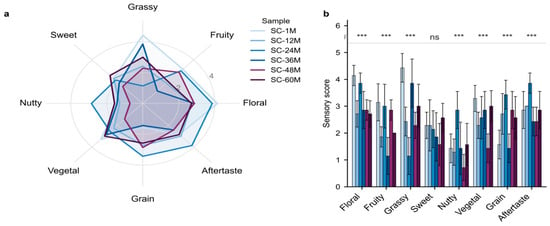
The sensory profiles and scores of Suisha base liquor at different aging times are shown in Figure 1 and Table 1. Among the eight sensory attributes, floral, fruity, grassy, nutty, plant-like, grain, and aftertaste differed highly significantly among aging times (p < 0.001). Only sweet was not significantly different (F = 1.59, p = 0.189).
Figure 1.
Sensory profiles of Suisha base liquor at different aging times. (a) Radar chart of sensory profiles. (b) Scores of each sensory attribute. Error bars are SD, n = 7; *** p < 0.001, ns not significant.
Table 1.
Sensory scores of Suisha base liquor at different aging times (n = 7).
According to the change patterns, the eight attributes could be grouped into three categories. The first category was the attenuation of new-liquor attributes. Floral scored higher in SC-1M (4.14 ± 0.38), significantly higher than in SC-12M, SC-36M, SC-48M and SC-60M but not significantly different from SC-24M. Fruity also scored highest in SC-1M (3.14 ± 0.69), significantly higher than in SC-12M, SC-36M and SC-60M but not significantly different from SC-24M (3.00 ± 0.82) and SC-48M (2.86 ± 0.38). The grassy score decreased from 4.43 ± 0.53 in SC-1M to 1.14 ± 0.69 in SC-24M, a reduction of 74.2%, the largest change among the eight attributes. The second category was the stagewise enhancement of aged-liquor attributes. The grain score increased from 1.57 ± 0.53 in SC-1M to 3.43 ± 0.53 in SC-24M, significantly higher than in SC-1M and SC-36M, followed by SC-48M (2.86 ± 0.69). The nutty score reached 2.86 ± 0.69 in SC-24M, significantly higher than in the other five samples. The aftertaste score was also highest in SC-24M (3.86 ± 0.38), significantly higher than in the other samples. The third category was mid-course recovery. The grassy score recovered to 3.86 ± 0.90 in SC-36M, not significantly different from SC-1M. The fruity score recovered to 2.86 ± 0.38 in SC-48M. The plant-like score recovered to 3.00 ± 0.58 in SC-60M, whereas it decreased to its lowest value of 1.43 ± 0.53 in SC-48M.
In summary, the sensory evolution of Suisha base liquor was not unidirectional with aging time but a composite of the attenuation of new-liquor aromas, the stagewise enhancement of aged-liquor aromas and the mid-course recovery of some attributes. SC-24M was the sample for which grain, nutty and aftertaste scores peaked simultaneously.
2.2. Overall Composition of Volatile Flavor Compounds
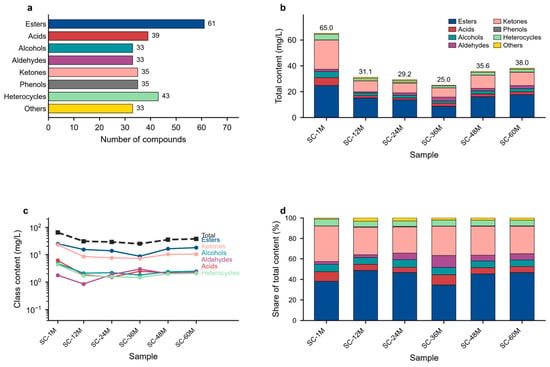
A total of 310 volatile flavor compounds were detected and semi-quantified in the Suisha base liquor samples at different aging times by HS-SPME-GC-MS, comprising 61 esters, 39 acids, 35 phenols, 35 ketones, 33 aldehydes, 31 alcohols, 43 heterocyclics, and 33 other compounds (Figure 2a); the library returned 312 assignments, two of which were attributed to the internal standard and are excluded from all subsequent calculations. Esters accounted for 19.7% of the total number of compounds, making them the most abundant class.
Figure 2.
Composition of volatile flavor compounds in Suisha base liquor at different aging times. (a) Number of compounds per class. (b) Stacked content per class with the total content above each bar. (c) Content per class versus storage time on a logarithmic axis. Dashed line: total content. (d) Relative contribution of each class to the total content. Values in (b–d) are means of three determinations (n = 3).
The total contents of volatile flavor compounds in the samples were 65.02, 31.10, 29.22, 25.04, 35.62, and 38.05 mg/L, respectively, showing a first-decreasing-then-increasing V-shaped evolution: the content decreased by 61.5% from SC-1M to SC-36M and then increased by 52.0% from SC-36M to SC-60M. Esters and ketones were the main components of the volatile flavor compounds of the Suisha base liquor. In SC-1M, their contents were 24.81 and 22.63 mg/L, respectively, together accounting for 73.0% of the total. Acids (6.06 mg/L), alcohols (4.67 mg/L), and heterocyclics (4.34 mg/L) were intermediate, whereas aldehydes (1.76 mg/L), other compounds (0.65 mg/L), and phenols (0.089 mg/L) were lower.
The evolution of each class could be grouped into three patterns. The first pattern was first-decreasing-then-increasing, including esters, ketones, acids, alcohols, and heterocyclics: esters decreased from 24.81 mg/L to 8.65 mg/L in SC-36M and then increased to 17.74 mg/L in SC-60M, and ketones decreased from 22.63 mg/L to 7.17 mg/L in SC-36M and then increased to 10.28 mg/L. The second pattern was an overall net increase between SC-1M and SC-60M, represented by aldehydes and phenols: aldehydes rose from 1.76 mg/L to 2.28 mg/L but passed through a maximum of 2.94 mg/L in SC-36M, and phenols rose from 0.089 mg/L to 0.216 mg/L, a net increase of 143%. The third pattern was fluctuation, represented by other compounds, which showed a high value of 0.997 mg/L in SC-12M and then decreased to 0.503 mg/L in SC-36M. The trajectory of the total content was therefore shaped mainly by the fall and recovery of esters and ketones, which are two orders of magnitude more abundant than aldehydes and phenols, rather than by the net increase of the latter two classes.
2.3. Screening and Temporal Evolution of Key Differential Volatile Flavor Compounds
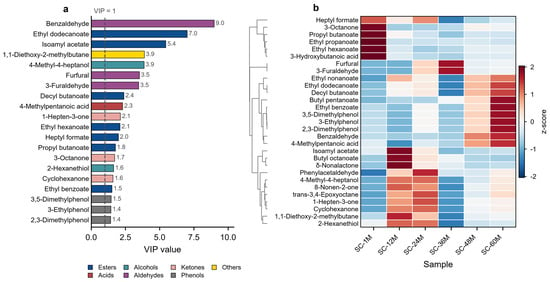
With the criteria of VIP > 1 and fold ratio ≥ 2, a total of 29 key differential compounds were screened (Table 2, Figure 3a). By chemical class, the 29 compounds comprised 12 esters, four aldehydes, four ketones, three phenols, two alcohols, two acids, one heterocyclic compound, and one other compound. Esters accounted for 41.4%, consistent with their abundance advantage in Suisha base liquor.
Table 2.
Key differential volatile flavor compounds screened by VIP > 1 and fold ratio ≥ 2.
Figure 3.
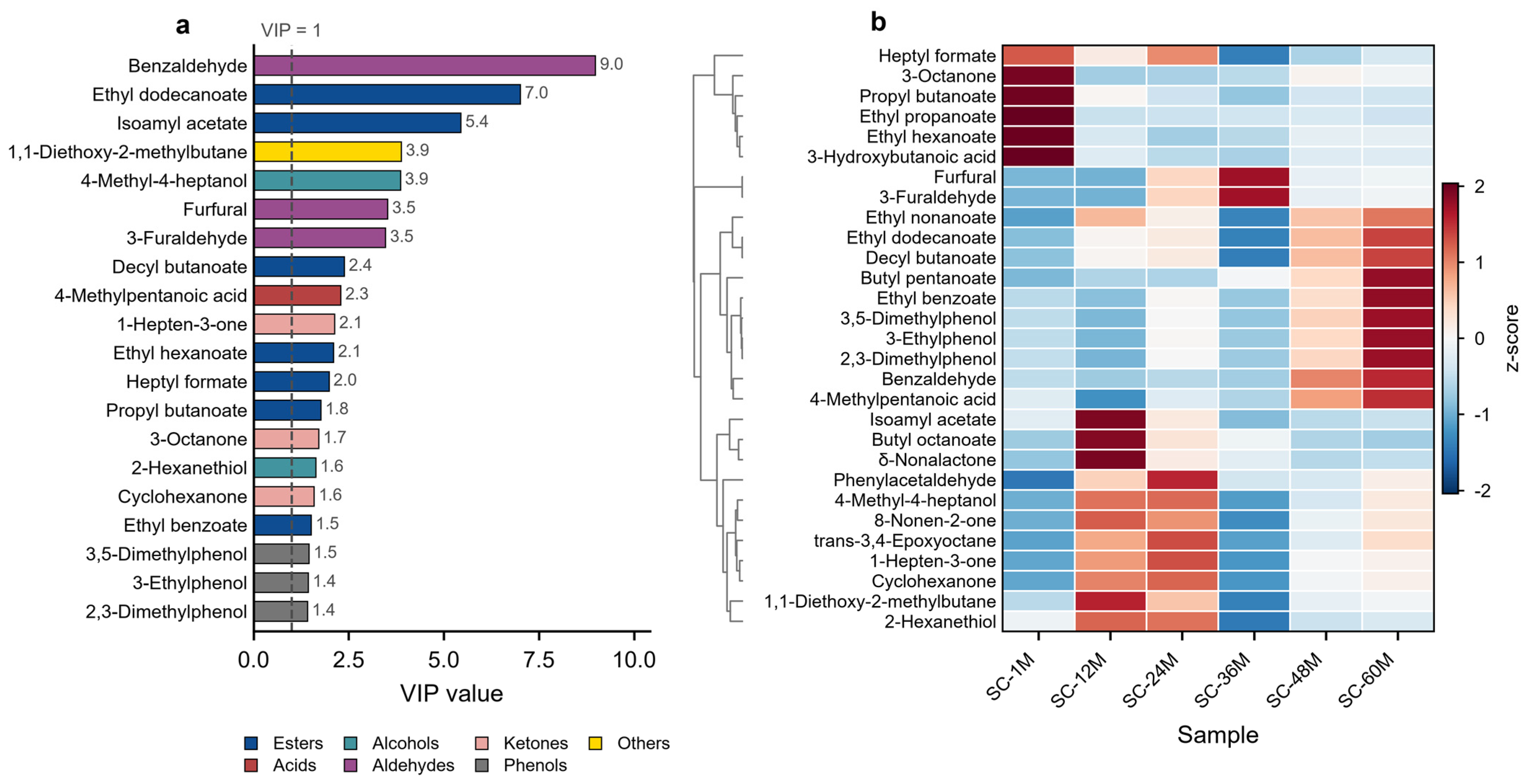
VIP analysis and clustered heat map of the key differential volatile flavor compounds. (a) Top 20 of the 29 key differential compounds by VIP. Dashed line: VIP = 1; bar color denotes chemical class. (b) Hierarchical clustering heat map of the 29 key differential compounds. Color scale: row-wise z-score across the six samples.
By VIP value, the six compounds with the greatest contribution were benzaldehyde (8.98), ethyl dodecanoate (7.01), isoamyl acetate (5.45), 1,1-diethoxy-2-methylbutane (3.88), 4-methyl-4-heptanol (3.86), and furfural (3.52). Benzaldehyde increased from 0.185 mg/L in SC-1M to 0.885 mg/L in SC-60M, reaching 4.78 times its initial value. Furfural and 3-furaldehyde increased from 0.0729 and 0.0727 mg/L to 0.385 and 0.383 mg/L, respectively. Ethyl dodecanoate increased from 0.995 mg/L to 3.190 mg/L. In contrast, ethyl hexanoate decreased from 16.616 mg/L to 6.981 mg/L, ethyl propanoate from 0.730 mg/L to 0.037 mg/L, propyl butanoate from 0.314 mg/L to 0.052 mg/L, and 3-hydroxybutanoic acid from 1.021 mg/L to 0.421 mg/L.
Second-order fitting showed that, among the 29 key differential compounds, 16 showed a U-shaped (first-decreasing-then-increasing) evolution and 13 showed an inverted-U (first-increasing-then-decreasing) evolution. This result corroborated the V-shaped trajectory of the total content and the main classes in Section 2.2, indicating that there was no simple unidirectional chemical change in Suisha base liquor over the aging window from SC-1M to SC-60M. Instead, the flavor was jointly driven by multiple reactions, including ester hydrolysis, re-esterification, and oxidative accumulation.
The clustered heat map (Figure 3b) divided the 29 compounds into three clusters distinguished by the storage age at which each compound was most abundant. The first comprised ethyl hexanoate, heptyl formate, propyl butanoate, ethyl propanoate, 3-octanone and 3-hydroxybutanoic acid, all of which were highest in SC-1M and lower in every older sample. The second comprised isoamyl acetate, 1,1-diethoxy-2-methylbutane, 4-methyl-4-heptanol, 1-hepten-3-one, 2-hexanethiol, cyclohexanone, trans-3,4-epoxyoctane, phenylacetaldehyde, 8-nonen-2-one, butyl octanoate and δ-nonalactone, which reached their maximum in SC-12M or SC-24M and their minimum, in most cases, in SC-36M. The third comprised benzaldehyde, furfural, 3-furaldehyde, ethyl dodecanoate, decyl butanoate, butyl pentanoate, ethyl nonanoate, ethyl benzoate, 4-methylpentanoic acid, 3,5-dimethylphenol, 3-ethylphenol and 2,3-dimethylphenol, which were enriched in the oldest samples—SC-60M and SC-36M for furfural and 3-furaldehyde. The late enrichment of aldehydes and phenols was the main chemical feature distinguishing long-term-aged Suisha base liquor.
2.4. Principal Component Analysis
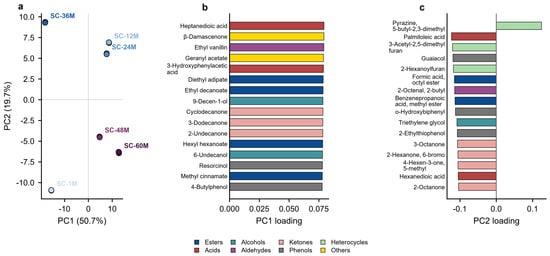
Principal component analysis was performed on the UV-scaled content matrix of the six sample means, and the results are shown in Figure 4. PC1, PC2 and PC3 explained 50.75%, 19.69% and 14.76% of the variance, respectively, so the first two components together accounted for 70.44% of the total and the first three for 85.20%. The first two components were retained for display, with PC3 reported for completeness.
Figure 4.
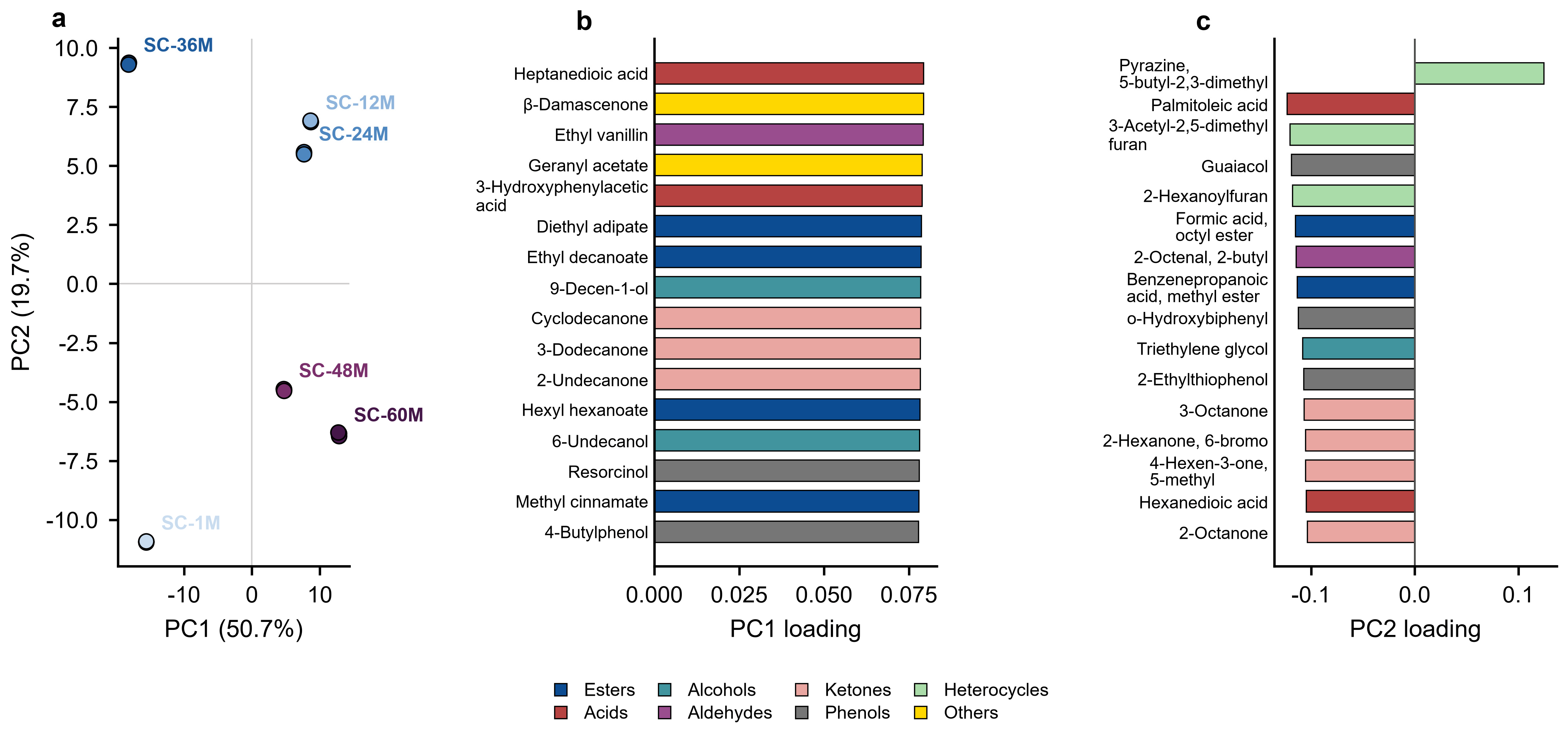
Principal component analysis of Suisha base liquor at different aging times based on volatile flavor compounds. (a) PC1–PC2 score plot, one point per liquor (the mean of the three determinations) labelled by sample code. (b) Top 20 loadings on PC1. (c) Top 20 loadings on PC2. Bar color denotes chemical class.
The score plot (Figure 4a) showed that SC-1M and SC-36M were on the negative side of PC1, with scores of −14.62 and −17.09, respectively, whereas SC-12M, SC-24M, SC-48M, and SC-60M were on the positive side, with SC-60M having the highest score of 12.01. PC2 ordered the samples differently: SC-1M had the lowest score (−10.27) and SC-36M the highest (8.77), with SC-48M (−4.22) and SC-60M (−5.98) intermediate and negative. Neither component therefore ranks the samples by storage age. Loading analysis (Figure 4b,c) showed that the compounds contributing most to PC1 were suberic acid, β-damascone, ethyl vanillin, geranyl acetate, 3-hydroxyphenylacetic acid, and diethyl adipate, whereas PC2 was dominated by 5-butyl-2,3-dimethylpyrazine, palmitoleic acid, 3-acetyl-2,5-dimethylfuran, guaiacol, and 2-hexanoylfuran. The two loading vectors thus describe different aspects of the same matrix: PC1 is defined mainly by esters and acids, the classes that carry most of the total content, and PC2 by heterocyclic and phenolic compounds. The two components resolve different chemical dimensions rather than a storage sequence, which explains why SC-1M and SC-36M occupy nearly the same position along PC1 while standing at opposite extremes of PC2.
The PC1 score was not monotonically arranged with aging time, consistent with the non-monotonic evolution revealed in Section 2.2 and Section 2.3. Because the main components such as esters and ketones reached a trough in SC-36M, whereas aldehydes and phenols increased only as a net change between SC-1M and SC-60M and did not themselves rise monotonically—the aldehyde content was highest in SC-36M—the overall flavor composition of the samples did not respond linearly to aging time. Therefore, a supervised model with aging time as the response variable was needed.
2.5. OPLS-Based Aging Axis Construction and Model Validation
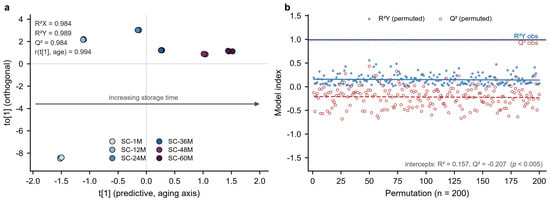
An OPLS regression model was built with aging time as the continuous response variable and the Pareto-scaled flavor-compound matrix as the predictor variables, fixed with one predictive component and two orthogonal components. The predictor matrix comprised 18 rows, corresponding to the three analytical determinations of each of the six base liquors. The predictive component ordered the samples monotonically from −1.513 in SC-1M to 1.472 in SC-60M, with a Pearson correlation of 0.994 against storage time (Figure 5a), and the three determinations of each liquor overlapped closely, the mean within-sample relative standard deviation of all compounds being 0.93%. The first orthogonal component (to [1], the orthogonal score vector) mainly reflected within-group structure unrelated to aging. Its mean value for SC-1M was −8.44, clearly lower than that of the other samples, suggesting a flavor structure specific to the youngest liquor.
Figure 5.
OPLS modeling of the volatile flavor compounds of Suisha base liquor. (a) OPLS score plot with storage age as the response. Blue arrow indicates increasing storage age. (b) A 200-permutation test. Dashed line: regression trend of permuted values; solid and dotted lines: observed R2Y and Q2.
The fit statistics were R2X = 0.984, R2Y = 0.989 and Q2 = 0.984, and in the 200-permutation test of aging time the intercepts of R2 and Q2 were 0.157 and −0.207, with no permuted value reaching the observed Q2 (p < 0.005) (Figure 5b). The Q2 above is the leave-one-determination-out value; when the three determinations of a liquor were held out together, it was −1.09. The predictive component is therefore used as an aging axis that orders the six samples studied, and the VIP values derived from it rank the compounds within this data set.
2.6. Key Odor-Active Compounds and Their Changes During Aging
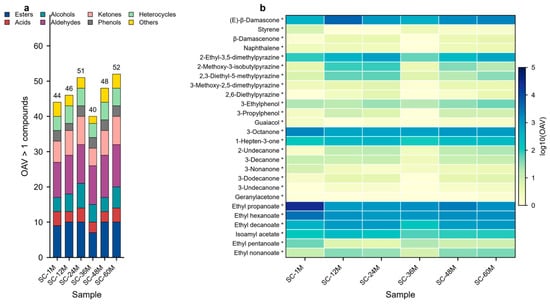
To rank the volatile compounds by their probable sensory weight, odor activity values were calculated (Figure 6). Among the compounds with OAV > 1, aldehydes were the largest class at every storage age (10–12 compounds), followed by esters (7–10), ketones (5–8) and alcohols (4–7). The number of aldehydes rose from 10 for SC-1M to 12 for SC-48M and SC-60M, whereas that of esters fell to seven for SC-36M before recovering to 10, and the number of alcohols peaked at seven for SC-24M. The number of phenolic odorants, by contrast, remained between two and three throughout (three, two, three, three, three and three from SC-1M to SC-60M), so the phenolic contribution increased in intensity rather than in breadth. The total number of compounds with OAV > 1 was 43, 45, 50, 39, 47 and 51 at the six ages, respectively. Together, these counts indicate that the odor-active pool did not simply broaden with age: it contracted in SC-36M and recovered afterwards, while aldehydes remained its largest constituent class throughout.
Figure 6.
Odor-active compounds with OAV > 1 in Suisha base liquor during storage. (a) Number of compounds with OAV > 1 per chemical class. The number above each bar is the total. (b) Heat map of OAVs of key odorants. Color scale: log10(OAV); each value is the mean of three analytical determinations of the same liquor, which express analytical repeatability and are not independent replication of storage, so no inference about differences between storage ages is drawn.
The odorants with the highest OAV included (E)-β-damascone, ethyl hexanoate, 3-octanone, ethyl decanoate, 2-ethyl-3,5-dimethylpyrazine, and 2,4-undecadienal, among others (Table 3, Figure 6). Ethyl hexanoate imparts apple and pear fruity notes; among the six ages, its own OAV was highest in SC-1M, and it remained at a relatively high level in SC-60M. The OAV of 2-ethyl-3,5-dimethylpyrazine, which carries roasted, nutty and coffee notes, peaked at 738.9 in SC-24M, consistent with the panel scoring nutty aroma highest in the same sample (Section 2.1). (E)-β-Damascone, described as fruity, floral and honey-like, peaked at 4524.6 in SC-12M, and the OAV of phenylacetaldehyde rose from 3.9 in SC-1M to 31.4 in SC-24M. These values show that the odorant profile was reorganized during storage and that concentration alone does not predict the size of the change in OAV.
Table 3.
Major odor-active compounds with OAV > 1 during storage (top 20 by maximum OAV).
2.7. Association Between Key Flavor Compounds and Sensory Attributes
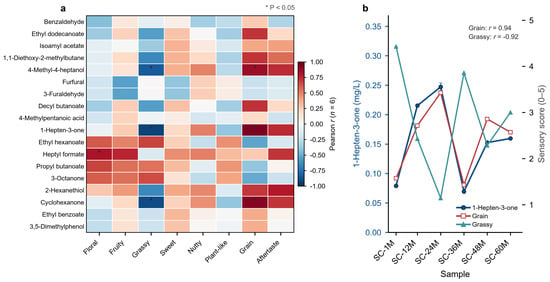
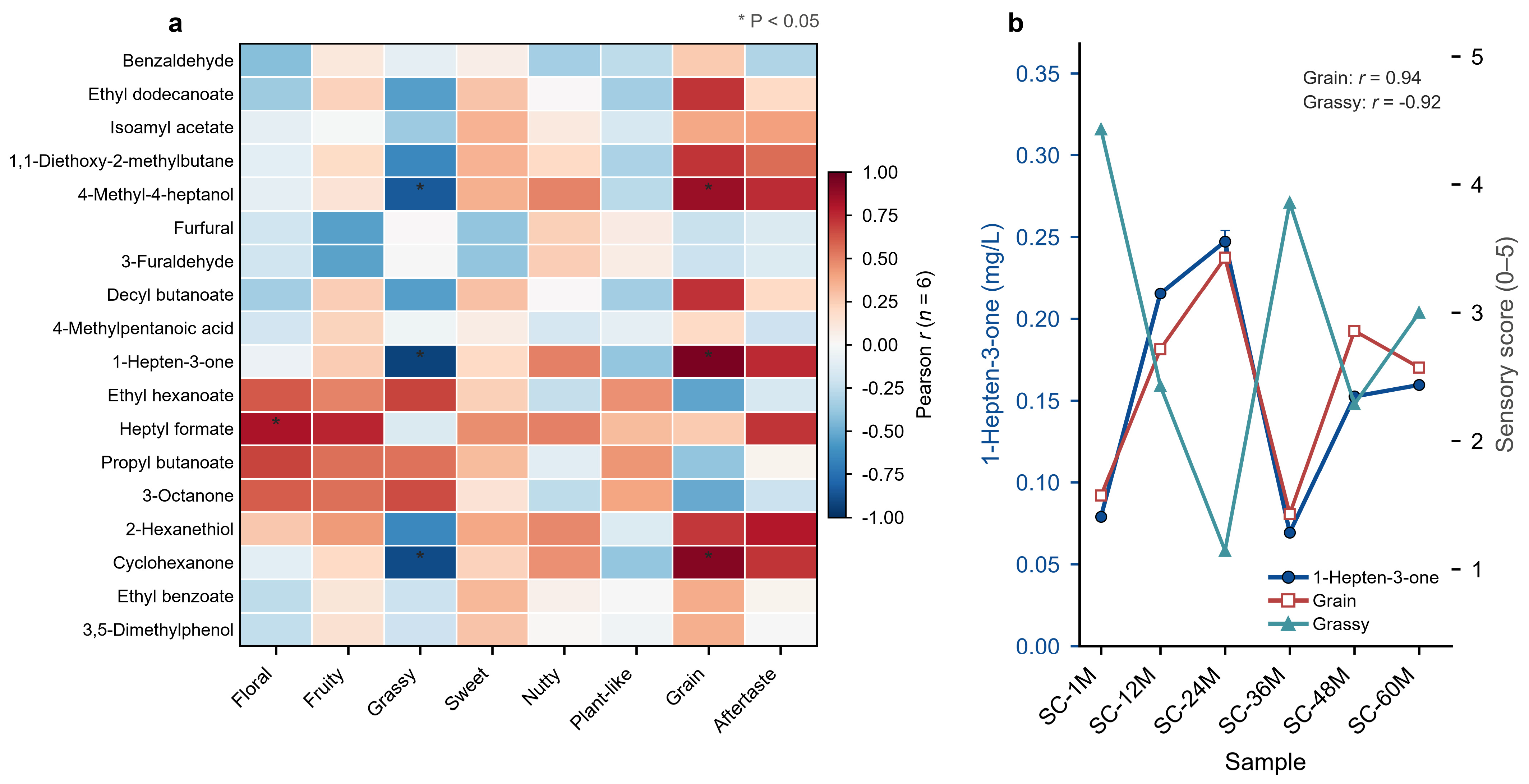
To look for a quantitative link between the chemical and the sensory data, a Pearson correlation analysis of the 29 marker candidates and the eight sensory attributes was performed, using the six sample means. Thirteen coefficients exceeded |r| > 0.8 at p < 0.05 (Table 4, Figure 7a). They were strongly attribute-selective: six were positive for grain aroma, six negative for grassy aroma and one positive for floral aroma, while the other five attributes produced none. Two robustness checks were performed. A leave-one-age-out jackknife reproduced all thirteen coefficients with unchanged sign and |r| between 0.67 and 0.99, indicating that each association is carried by the whole storage series rather than by any single age. Across the full screening matrix of 232 compound–attribute pairs, the smallest Benjamini–Hochberg q value was 0.60 and none of the thirteen coefficients reached q < 0.05, so the associations are retained as exploratory hypotheses rather than as confirmed relationships; they remain the strongest pairs of the set tested and are the ones proposed for testing by aroma recombination and omission experiments.
Table 4.
Correlations between key differential compounds and sensory attributes with |r| > 0.8 and uncorrected p < 0.05 (n = 6); none reaches Benjamini–Hochberg q < 0.05, and all are reported as hypotheses.
Figure 7.
Association between key differential compounds and sensory attributes. (a) Pearson correlation matrix of the 29 key differential compounds and the eight sensory attributes. (b) Coordinated changes of 1-hepten-3-one content with grain and grassy scores across aging age.
Specifically, 1-hepten-3-one (r = 0.940, p = 0.005), cyclohexanone (0.918, 0.010), trans-3,4-epoxyoctane (0.910, 0.012), 8-nonen-2-one (0.862, 0.027), 4-methyl-4-heptanol (0.859, 0.028) and phenylacetaldehyde (0.817, 0.047) were positively associated with grain aroma, and the same six compounds were negatively associated with grassy aroma, with coefficients between −0.815 and −0.924. Heptyl formate was positively associated with floral aroma (r = 0.815, p = 0.048). The mirror-image pattern—similar magnitude, opposite sign—associates these six compounds with the shift from grassy to grain aroma, and they are proposed as hypotheses to be tested by aroma recombination and omission experiments.
Figure 7b illustrates the coordinated chemical and sensory changes using 1-hepten-3-one as an example. Its content increased from 0.079 mg/L in SC-1M to 0.247 mg/L in SC-24M. Over the same period, the grain score increased from 1.57 to its highest value of 3.43, whereas the grassy score decreased from 4.43 to its lowest value of 1.14. Ketones often have creamy, mushroom and herbal notes and are considered important aroma compounds in Baijiu. The co-variation shown here points to an association of 1-hepten-3-one and cyclohexanone with the grain aroma of Suisha base liquor, which can be tested by spiking and omission in a reconstituted matrix.
3. Discussion
This study found that the total content of volatile flavor compounds in Suisha base liquor decreased continuously from SC-1M to SC-36M and then increased from SC-36M to SC-60M, showing a first-decreasing-then-increasing V-shaped evolution, with esters and ketones being the main contributors. A previous study that tracked one year of aging of sauce-flavor base liquor of rounds 1–4 found that short- and medium-chain ethyl esters decreased, whereas long-chain ethyl esters, acids, aldehydes, pyrazines, ketones, and furans increased [14]. In the present study, aldehydes and phenols were also higher in SC-60M than in SC-1M, although neither class increased monotonically: the total aldehyde content reached its maximum in SC-36M and declined thereafter. Nor did the esters and the total content increase monotonically; they first decreased and then increased, consistent with the understanding that ester hydrolysis predominates in the early stage of storage and that re-esterification gradually strengthens in the later stage [7,10]. Esters hydrolyze into the corresponding acids and alcohols in the presence of trace water and an acidic medium, causing the ester content to decrease. As organic acids and alcohols accumulate, the re-esterification rate rises and the ester content recovers. Meanwhile, low-boiling-point esters and ketones are lost by volatilization and adsorption during storage in earthenware jars [6], whereas oxidation and Maillard reaction products such as aldehydes and phenols accumulate over the storage window, notwithstanding the mid-storage maximum of the aldehyde total. The combination of these factors produces the non-monotonic trajectory of the total content. SC-36M can be regarded as an important sample for the transition of Suisha base liquor from a new-liquor style to an aged-liquor style: esters and ketones reached their lowest levels, the total aldehyde content reached a peak of 2.94 mg/L, and in sensory terms the grassy aroma recovered to 3.86 while the grain aroma fell to 1.43.
Among the 29 key differential compounds screened by VIP > 1 and fold ratio ≥ 2, aldehydes and phenols made particularly prominent contributions. The contents of benzaldehyde, furfural, 3-furaldehyde, and phenylacetaldehyde in SC-60M were all clearly higher than those in SC-1M, with VIP values of 8.98, 3.52, 3.47, and 1.41, respectively. Benzaldehyde mainly originates from the Strecker degradation of phenylalanine and from polyphenol oxidation. Furfural and 3-furaldehyde are typical Maillard reaction products, with caramel, roasted, and almond notes. A previous study pointed out that differences in the OAVs of acids, alcohols, and long-chain fatty acid ethyl esters are the main basis for distinguishing different grades of sauce-flavor base liquor [3]. The present study further showed that the contents of furfural and 3-furaldehyde rose steeply to a maximum in SC-36M and declined thereafter without returning to their starting level, their fold ratios across the six ages being 16.09 and 15.52, respectively, so they are candidate markers for characterizing the aging process of Suisha base liquor. Although phenolic compounds are low in content, their odor thresholds are generally low; 3-ethylphenol reached an OAV of 49.3 in SC-60M, consistent with a contribution to the smoky, herbal and aged notes of the later stages and with the report of Wang et al. [8] on key aging aroma compounds in aged sauce-flavor Baijiu. The OAV of benzaldehyde rose from 0.53 in SC-1M to 2.53 in SC-60M, which identifies it as a candidate contributor to the aged note that develops in the later stages of storage.
Correlation analysis showed that ketones such as 1-hepten-3-one, cyclohexanone, and 8-nonen-2-one, together with phenylacetaldehyde and trans-3,4-epoxyoctane, were strongly positively associated with grain aroma and strongly negatively associated with grassy aroma. Grain aroma is a representative sensory attribute of sauce-flavor Baijiu and is usually associated with pyrazines, phenols, and sulfur-containing compounds [21,22]. The present data suggest that ketones may also accompany the grain note of Suisha base liquor, either through synergistic enhancement with pyrazines during aging or through a shared precursor or reaction pathway. Because the associations do not survive correction for multiple testing and are based on six time points, they are treated as hypotheses; aroma recombination and omission experiments [23,26,27,28] on a reconstituted matrix are required to test them, and such experiments are beyond the scope of the present data set.
The six liquors necessarily originated from six production campaigns, so storage time is confounded with campaign-to-campaign variation in raw material, climate and starter culture. The confound is not hypothetical: even within a single workshop, the microbiome and metabolome profiles of high-temperature Daqu differ substantially between positions [29], so the starter culture, and with it the volatile profile that enters the jar, cannot be assumed constant from one campaign to the next. The monotonic ordering of the six samples along the aging axis (r = 0.994) is a description of these six samples: the axis was built with storage time as the response, so it cannot separate the effect of storage from that of the campaign. Because the concentrations are semi-quantitative, the fold changes and OAVs reported above are relative measures whose direction and ranking are more robust than their absolute magnitude. Gas chromatography–olfactometry together with recombination and omission tests in a reconstituted matrix will show which of the odorants ranked here actually carry the aged note, while a series that follows one batch over five years would separate storage from campaign.
4. Materials and Methods
4.1. Liquor Samples
The Suisha base liquors used in this experiment were produced by the same distillery, with the same process and the same workshop crew, and were aged in earthenware jars in an indoor cellar at ambient temperature without blending during aging. They had been stored for 1, 12, 24, 36, 48 and 60 months at the time of sampling and are denoted SC-1M, SC-12M, SC-24M, SC-36M, SC-48M and SC-60M, respectively. For each liquor, three subsamples were withdrawn from the same jar and carried independently through the whole procedure, with separate HS-SPME extraction and separate injection. For brevity, the sample codes are used to refer to the corresponding liquors below.
4.2. Sensory Evaluation
Sensory evaluation followed GB/T 33404-2016 [30] and the assessor-selection guidance of GB/T 16291.1-2012 [31]. The panel consisted of seven assessors (aged 20–45 years), each holding a national third-grade liquor-taster qualification or above, all with prior experience of descriptive evaluation of sauce-flavor Baijiu; the panel was therefore trained in the descriptors used here. Eight attributes were used, based on descriptors defined in previous aroma profile studies of sauce-flavor Baijiu [1]: floral, fruity, grassy, sweet, nutty, plant-like, grain, and aftertaste. Intensity was scored on a six-point scale (0 = no aroma, 1 = weak, 2 = relatively weak, 3 = moderate, 4 = relatively strong, 5 = strong). Samples were served in coded glasses in a balanced order and evaluated in individual booths in a tasting room at 20 °C ± 2 °C free of interfering odors, without communication between assessors. Each sample was scored once by each assessor.
4.3. HS-SPME-GC-MS Analysis
4.3.1. Sample Preparation
To a 20 mL headspace vial were added 0.5 mL of liquor sample and 4.5 mL of ultrapure water, followed by 100 μL of internal standard solution (2-octanol, 1.552 g/L). Finally, 2 g of NaCl was added, and the mixture was homogenized for headspace solid-phase microextraction–gas chromatography–mass spectrometry analysis.
4.3.2. HS-SPME Conditions
An SPME Arrow device (CTC Analytics AG, Zwingen, Switzerland) with a 120 μm DVB/CWR/PDMS fiber was used. The sample was equilibrated at 60 °C with shaking for 5 min. The fiber was inserted into the headspace of the sample vial and extracted for 15 min at 60 °C, followed by desorption at 250 °C for 5 min for injection. Before sampling, the fiber was conditioned in a Fiber Conditioning Station at 250 °C for 5 min, and a new fiber was conditioned for 2 h before use.
4.3.3. GC Conditions
A DB-5MS capillary column (30 m × 0.25 mm × 0.25 μm) was used. High-purity helium (purity ≥ 99.999%) was used as the carrier gas at a constant flow rate of 1.2 mL/min, and the injector temperature was 250 °C. The oven temperature was programmed as follows: held at 40 °C for 3.5 min, increased to 100 °C at 10 °C/min, then to 180 °C at 7 °C/min, and finally to 280 °C at 25 °C/min, held for 5 min.
4.3.4. MS Conditions
An electron ionization (EI) source with an electron energy of 70 eV was used. The ion source temperature was 230 °C, and the transfer line temperature was 230 °C. The solvent delay was 3.5 min. Mass spectra were recorded in full-scan mode over the range of 40–500 m/z.
4.4. Data Processing and Statistical Analysis
4.4.1. Qualitative and Semi-Quantitative Analysis of Volatile Flavor Compounds
Compounds were identified from the NIST 20 mass spectral library in combination with calculated linear retention indices compared with literature values. The assignments are reported as tentative annotations.
Concentrations were estimated by internal standardization. Expressed per liter of the undiluted liquor, the value reported for compound i is Ci = (Ai/As) × 310.4 mg/L, where Ai and As are the peak areas of compound i and the internal standard. The internal standard was added as 100 µL of a 1.552 g/L 2-octanol solution to 0.5 mL of liquor made up to 5.1 mL, so that the vial contained 0.1552 mg of internal standard representing 0.5 mL of the original liquor; the dilution factor (5.1/0.5 = 10.2) cancels between the concentration term and the volume term, leaving the single constant 0.1552 mg/0.5 mL = 310.4 mg/L. Every concentration reported in this paper is therefore a value per liter of the original, undiluted liquor, and no further correction is applied. No calibration curve and no compound-specific response factor were determined, and headspace extraction does not recover all analytes with equal efficiency, so the values are semi-quantitative estimates of relative abundance rather than true concentrations.
4.4.2. Odor Activity Value (OAV)
The odor activity value was calculated as OAVi = Ci/Ti, where Ti is the odor threshold of compound i in mg/L. Thresholds were taken from published compilations of odor threshold values [24,25], and values originally given per unit mass were converted to mg/L, assuming a density of 1.0 kg/L. The matrix stated by the compilation is retained for each compound, and where a compilation states no matrix, the value is recorded as not reported rather than assigned to a matrix. Most of the compiled values are detection thresholds in water, and for ethyl propanoate and pentanoic acid the values initially compiled (2.7 × 10⁻⁵ and 1.5 × 10⁻⁴ mg/L) were air-matrix thresholds and were replaced with 0.010 and 11 mg/L. A compound with an OAV > 1 was regarded as a candidate aroma contributor and prioritized for further sensory validation.
4.4.3. Data Processing
Each liquor sample was measured three times, and the mean value was used. Relative standard deviation (RSD) was used to evaluate analytical precision. The same seven assessors scored every sample, so the scores given to one attribute are not independent observations. The effect of storage age on each attribute was therefore tested by analysis of variance with the assessor entered as a block (storage age: 5 df, error: 30 df), and Tukey’s HSD test computed on the blocked error mean square was used for multiple comparisons, with the compact letter display indicating differences among the six samples. The assessor effect was not significant for any attribute (p = 0.41–0.79), and the conclusions were unchanged with respect to a one-way treatment of the same data.
The relationship between volatile flavor compounds and aging time was evaluated on the six sample means. The Pearson correlation coefficient between each compound content and aging time was calculated (n = 6, two-tailed), and a second-order polynomial was fitted to assign monotonic, U-shaped (first-decreasing-then-increasing) and inverted-U (first-increasing-then-decreasing) patterns. The Benjamini–Hochberg procedure was applied to the compound-versus-time trend tests to control the false discovery rate at 5%. For the compound–attribute correlations of Table 4, uncorrected p values are given together with q values obtained by applying the Benjamini–Hochberg procedure to all 232 compound–attribute pairs, and the stability of each coefficient was checked by a leave-one-age-out jackknife.
4.4.4. Multivariate Statistical Analysis
Multivariate statistical analysis was performed as follows. (1) Principal component analysis was performed on the UV (unit variance)-scaled content matrix of the samples. (2) An OPLS regression model was built with aging time as the response variable and the Pareto-scaled content matrix of the measurements as the predictor variables. The model was fixed with one predictive component and two orthogonal components, and the single predictive component was used to represent the aging axis. Model performance was evaluated by R2X, R2Y and the cross-validated determination coefficient Q2, computed in two ways: leave-one-determination-out, which measures the reproducibility of a repeated injection, and leave-one-sample-out, in which the three determinations of a liquor are held out together and which therefore measures the ability to place an unseen storage age on the axis. A 200-permutation test of aging time was used to examine overfitting. (3) The VIP values of the compounds in the OPLS model were calculated, and key differential compounds were screened with the criteria of VIP > 1 and fold ratio (maximum/minimum across the six time points) ≥ 2. (4) Hierarchical clustering was performed on the standardized content matrix (average linkage, Euclidean distance), and a heat map was generated. (5) Pearson correlation analysis was performed between the key differential compounds and the eight sensory attributes (n = 6), with a strong correlation defined as |r| > 0.8 and p < 0.05 before correction; Benjamini–Hochberg q values and a leave-one-age-out jackknife are reported alongside.
5. Conclusions
Suisha base liquor changed in a non-monotonic way between 1 and 60 months of storage. Seven of the eight sensory attributes differed significantly among ages (p < 0.001): floral, fruity and grassy notes were strongest in the youngest liquor; grain, nutty and aftertaste notes peaked in SC-24M; and several attributes recovered mid-course. The total content of volatile compounds fell from 65.02 to 25.04 mg/L in SC-36M and then rose to 38.05 mg/L in SC-60M; esters and ketones decreased by 28.5% and 54.6%, respectively, whereas phenols and aldehydes increased by 143% and 29.6%. Twenty-nine compounds were retained as marker candidates (VIP > 1 and fold ratio ≥ 2), the three highest VIP values being those of benzaldehyde (8.98), ethyl dodecanoate (7.01) and isoamyl acetate (5.45), and all 29 followed non-monotonic trajectories. Fifty-six compounds exceeded an OAV of 1 at one or more ages, and aldehydes were the largest class within that pool at all six ages.
The OPLS aging axis ordered the six liquors studied monotonically along a single dimension and provided the VIP ranking from which the 29 marker candidates were taken; the ordering describes these six samples and is not evidence that storage outweighs campaign-to-campaign variation. Since all 29 followed non-monotonic trajectories, assigning an unknown liquor to a storage age will depend on the combination rather than on any single marker. The compound–attribute associations were stable in sign to a leave-one-age-out jackknife but none survived correction for multiple testing, so they are put forward as hypotheses—a group of ketones together with phenylacetaldehyde—for the transition from grassy to grain aroma, to be tested by recombination and omission. Establishing which compounds actually carry the aged note of Suisha base liquor and whether the 36-month inflection generalizes beyond this distillery will be a matter for future work.
Supplementary Materials
The following supporting information can be downloaded at https://www.mdpi.com/article/10.3390/molecules31224142/s1: Table S1 is provided as a single workbook containing five tables: Table S1, Volatile flavor compounds of Suisha base liquor at six storage ages (compound name, CAS number, chemical class, MSI identification level, the three individual determinations at each storage age together with mean ± SD, odor threshold, threshold matrix and threshold source), with notes on data treatment; Table S2, Individual sensory scores of the seven assessors for the eight attributes at the six storage ages (336 records); Table S3, The 18 individual analytical determinations (six ages × three) for all 310 compounds; Table S4, All 232 compound–attribute pairs with the Pearson r, the uncorrected p, the Benjamini–Hochberg q and the leave-one-age-out jackknife range; Table S5, The OPLS VIP values, the correlation with storage time and the PCA loadings. File S1 is a zip of the analysis scripts reproducing the PCA, the OPLS model, the blocked sensory ANOVA and the correlation screening.
Author Contributions
Conceptualization, J.G. and W.S.; methodology, J.G., S.Z. and W.S.; software, J.G.; validation, J.G. and C.C.; formal analysis, J.G.; investigation, J.G., S.Z., C.C., Y.C., T.G., Y.Y., F.L., T.H. and Y.X.; resources, W.S.; data curation, J.G. and S.Z.; writing—original draft preparation, J.G.; writing—review and editing, all authors; visualization, J.G.; supervision, W.S.; project administration, W.S.; funding acquisition, W.S. All authors have read and agreed to the published version of the manuscript.
Funding
This research was funded by the Modern Baijiu Brewing Technology Engineering Research Center of Guizhou Universities, grant number Qianjiaoji [2023] 028, and by the Guizhou Province Technology Innovation Center for Jiangxiangxing Baijiu, grant number Qiankehe Platform JSZX (2025) 002.
Institutional Review Board Statement
The sensory evaluation in this study involved trained human panelists. Ethical review and approval were waived for this study because it involved only sensory evaluation of liquor samples by trained panelists and did not involve medical interventions, biological specimens, or the collection of personal health data. All panelists provided informed consent before participation.
Informed Consent Statement
Informed consent was obtained from all subjects involved in the sensory evaluation.
Data Availability Statement
The complete semi-quantitative data set supporting the results is provided as Supplementary Table S1 (all 310 compounds; the three individual analytical determinations at each of the six storage ages together with their mean and SD; CAS numbers; odor thresholds, the matrix stated by each source and the source reference). Supplementary Table S2 gives the 336 individual sensory scores of the seven assessors. The scripts used for the multivariate modeling, the blocked sensory analysis and the correlation screening, together with the derived input matrices, are provided as Supplementary File S1.
Acknowledgments
The authors thank the distillery that supplied the Suisha base liquor samples and the seven trained assessors who carried out the descriptive analysis, as well as the Modern Baijiu Brewing Technology Engineering Research Center of Guizhou Universities and the Guizhou Province Technology Innovation Center for Jiangxiangxing Baijiu for technical support.
Conflicts of Interest
The authors declare no conflicts of interest.
Abbreviations
The following abbreviations are used in this manuscript: HS-SPME-GC-MS: headspace solid-phase microextraction–gas chromatography–mass spectrometry; OPLS: orthogonal partial least squares; OAV: odor activity value; VIP: variable importance in projection; PCA: principal component analysis; ANOVA: analysis of variance; RSD: relative standard deviation; FDR: false discovery rate; QDA: quantitative descriptive analysis.
References
- Wang, L.; Tang, P.; Zhang, P.; Lu, J.; Chen, Y.; Xiao, D.; Guo, X. Unraveling the aroma profiling of Baijiu: Sensory characteristics of aroma compounds, analytical approaches, key odor-active compounds in different Baijiu, and their synthesis mechanisms. Trends Food Sci. Technol. 2024, 146, 104376. [Google Scholar] [CrossRef] [Scilit]
- Wang, M.Y.; Yang, J.G.; Zhao, Q.S.; Zhang, K.; Su, C. Research progress on flavor compounds and microorganisms of Maotai flavor Baijiu. J. Food Sci. 2019, 84, 6–18. [Google Scholar] [CrossRef] [Scilit] [PubMed]
- Li, S.; Li, T.; Han, Y.R.; Yan, P.; Li, G.; Ren, T.; Yan, M.; Lu, J.; Qiu, S. Machine learning discrimination and prediction of different quality grades of sauce-flavor baijiu based on biomarker and key flavor compounds screening. Food Chem. X 2024, 24, 101877. [Google Scholar] [CrossRef] [Scilit] [PubMed]
- Xu, Y.Q.; Zhao, J.R.; Liu, X.; Zhang, C.; Zhao, Z.; Li, X.; Sun, B. Flavor mystery of Chinese traditional fermented baijiu: The great contribution of ester compounds. Food Chem. 2022, 369, 130920. [Google Scholar] [CrossRef] [Scilit] [PubMed]
- Luo, X.; Fan, W.L.; Xu, Y.; Cheng, P.; Sun, Y.; Zhu, X.; Hu, J. Characterization of volatile bitter off-taste compounds in Maotai-flavor Baijiu (Chinese liquor). LWT 2025, 217, 117363. [Google Scholar] [CrossRef] [Scilit]
- Li, M.; Fan, W.L.; Xu, Y. Volatile compounds sorption during the aging of Chinese liquor (Baijiu) using pottery powder. Food Chem. 2021, 345, 128705. [Google Scholar] [CrossRef] [Scilit] [PubMed]
- Deng, Y.H.; Xiong, A.Y.; Zhao, K.; Hu, Y.; Kuang, B.; Xiong, X.; Yang, Z.; Yu, Y.; Zheng, Q. Mechanisms of the regulation of ester balance between oxidation and esterification in aged Baijiu. Sci. Rep. 2020, 10, 17169. [Google Scholar] [CrossRef] [Scilit] [PubMed]
- Wang, L.L.; Gao, Y.C.; Wu, L.; Chen, S.; Xu, Y. Characterization of key aging aroma compounds in aged Jiangxiangxing Baijiu and their formation influencing factors during the storage process. J. Agric. Food Chem. 2024, 72, 1695–1707. [Google Scholar] [CrossRef] [Scilit] [PubMed]
- Huang, Z.J.; Zeng, Y.H.; Sun, Q.Y.; Zhang, W.; Wang, S.; Shen, C.; Shi, B. Insights into the mechanism of flavor compound changes in strong flavor Baijiu during storage by using the density functional theory and molecular dynamics simulation. Food Chem. 2022, 373, 131522. [Google Scholar] [CrossRef] [Scilit] [PubMed]
- Li, Q.; Xu, H.Y.; Yu, Y.G.; Zheng, Q. Why does distilled liquor have a soft and harmonious flavor after long-time ageing? A thermodynamic analysis. J. Food Compos. Anal. 2023, 123, 105609. [Google Scholar] [CrossRef] [Scilit]
- Zhu, L.; Wang, X.L.; Song, X.B.; Zheng, F.; Li, H.; Chen, F.; Zhang, Y.; Zhang, F. Evolution of the key odorants and aroma profiles in traditional Laowuzeng Baijiu during its one-year ageing. Food Chem. 2020, 310, 125898. [Google Scholar] [CrossRef] [Scilit] [PubMed]
- Wang, L.W.; Zheng, L.; Mao, H.; Liu, X.; Wang, W.; Song, P.; Shen, C. Dynamic flavor evolution of newly distilled sauce-flavor Baijiu in purple clay jars during initial aging storage: Correlation between metal ion migration, flavor compounds and sensory properties. Appl. Food Res. 2026, 6, 102098. [Google Scholar] [CrossRef] [Scilit]
- Lin, Y.; Yuan, D.D.; Zhang, S.J.; Wu, T. Differences in flavor characteristics of rounds of sauce-based Baijiu based on GC-IMS, GC-MS, and electronic tongue. J. Food Compos. Anal. 2024, 135, 106696. [Google Scholar] [CrossRef] [Scilit]
- Wang, S.Y.; Li, C.; Li, Y.J.; Liu, G.-Q.; Lu, Z.-M.; Chai, L.-J.; Xu, H.-Y.; Shi, J.-S.; Wang, S.-T.; Shen, C.-H.; et al. Evolution of aroma compounds in round soy sauce aroma type baijiu during aging and the effect of aging markers on the lasting aroma in finished glass. Food Chem. X 2025, 25, 102193. [Google Scholar] [CrossRef] [Scilit] [PubMed]
- Wang, N.; Zhang, L.; Fu, L.; Wang, M.; Zhang, H.; Jiang, X.; Liu, X.; Zhang, Z.; Ren, X. GC/MS-based untargeted metabolomics reveals the differential metabolites for discriminating vintage of Chenxiang-type baijiu. Food Res. Int. 2024, 186, 114319. [Google Scholar] [CrossRef] [Scilit] [PubMed]
- Li, T.; Wang, J.; Xu, B.Z.; Sun, H.; Liu, H.; Wang, D.; Shen, Y.; Wu, J.; Zhang, J.; Huang, M.; et al. Comparative analysis of the differences among Langya flavor Baijiu and strong and soy sauce flavor Baijiu by targeted flavor analysis. J. Food Compos. Anal. 2023, 122, 105479. [Google Scholar] [CrossRef] [Scilit]
- Yang, L.; Fan, W.L.; Xu, Y. GC×GC-TOF/MS and UPLC-Q-TOF/MS based untargeted metabolomics coupled with physicochemical properties to reveal the characteristics of different type daqus for making soy sauce aroma and flavor type Baijiu. LWT 2021, 146, 111416. [Google Scholar] [CrossRef] [Scilit]
- Zhao, T.; Zhu, G.; Wu, C.; Li, Y.; Wang, Z.; Li, T.; Zhang, J.; Tang, S. Variation of aroma compounds in soy sauce aroma type baijiu during aging: Focusing on the regulatory effect of ethyl lactate on aroma release. Food Chem. X 2026, 33, 103396. [Google Scholar] [CrossRef] [Scilit] [PubMed]
- He, Y.X.; Lu, J.; Zhang, J.; Li, C.; Chen, S.; Xu, Y. Decoding regional flavor uniqueness of Jiangxiangxing Baijiu by comprehensive two-dimensional gas chromatography-time-of-flight mass spectrometry combined with quantitative descriptive analysis. Food Chem. Adv. 2024, 4, 100654. [Google Scholar] [CrossRef] [Scilit]
- Ma, Z.B.; Feng, Z.; Bian, M.H.; Zhao, D.; Gong, L.; Li, Q.; Wen, Y.; Ma, Y. Dynamic changes in volatile aroma compounds during Chinese Xiaoqu Baijiu brewing. Food Res. Int. 2025, 214, 116681. [Google Scholar] [CrossRef] [Scilit] [PubMed]
- Yan, Y.; Chen, S.; Nie, Y.; Xu, Y. Quantitative analysis of pyrazines and their perceptual interactions in soy sauce aroma type Baijiu. Foods 2021, 10, 441. [Google Scholar] [CrossRef] [Scilit] [PubMed]
- Yan, Y.; Chen, S.; Nie, Y.; Xu, Y. Characterization of volatile sulfur compounds in soy sauce aroma type Baijiu and changes during fermentation by GC×GC-TOFMS, organoleptic impact evaluation, and multivariate data analysis. Food Res. Int. 2020, 131, 109043. [Google Scholar] [CrossRef] [Scilit] [PubMed]
- Niu, Y.W.; Liu, Y.; Xiao, Z.B. Evaluation of perceptual interactions between ester aroma components in Langjiu by GC-MS, GC-O, sensory analysis, and vector model. Foods 2020, 9, 183. [Google Scholar] [CrossRef] [Scilit] [PubMed]
- van Gemert, L.J. Odour Thresholds: Compilations of Odour Threshold Values in Air, Water and Other Media, 2nd ed.; Oliemans Punter & Partners: Utrecht, The Netherlands, 2011. [Google Scholar]
- Molimard, P.; Spinnler, H.E. Compounds involved in the flavor of surface mold-ripened cheeses: Origins and properties. J. Dairy Sci. 1996, 79, 169–184. [Google Scholar] [CrossRef] [Scilit]
- Niu, Y.W.; Yao, Z.M.; Xiao, Z.B.; Zhu, G.; Zhu, J.; Chen, J. Sensory evaluation of the synergism among ester odorants in light aroma-type liquor by odor threshold, aroma intensity and flash GC electronic nose. Food Res. Int. 2018, 113, 102–114. [Google Scholar] [CrossRef] [Scilit] [PubMed]
- Sun, Y.L.; Ma, Y.; Chen, S.; Xu, Y.; Tang, K. Exploring the mystery of the sweetness of Baijiu by sensory evaluation, compositional analysis and multivariate data analysis. Foods 2021, 10, 2843. [Google Scholar] [CrossRef] [Scilit] [PubMed]
- Wang, J.; Ming, Y.Z.; Li, Y.M.; Huang, M.; Luo, S.; Li, H.; Li, H.; Wu, J.; Sun, X.; Luo, X. Characterization and comparative study of the key odorants in Caoyuanwang mild-flavor style Baijiu using gas chromatography-olfactometry and sensory approaches. Food Chem. 2021, 347, 129028. [Google Scholar] [CrossRef] [Scilit] [PubMed]
- Shi, W.; Chai, L.J.; Fang, G.-Y.; Mei, J.-L.; Lu, Z.-M.; Zhang, X.-J.; Xiao, C.; Wang, S.-T.; Shen, C.-H.; Shi, J.-S.; et al. Spatial heterogeneity of the microbiome and metabolome profiles of high-temperature Daqu in the same workshop. Food Res. Int. 2022, 156, 111298. [Google Scholar] [CrossRef] [Scilit] [PubMed]
- GB/T 33404-2016; State Administration for Market Regulation, Standardization Administration of China. Guidelines for the Sensory Evaluation of Baijiu. China Standards Press: Beijing, China, 2016.
- GB/T 16291.1-2012; State Administration for Market Regulation, Standardization Administration of China. Sensory Analysis—Selection, Training and Monitoring of Assessors—Part 1: Selected Assessors. China Standards Press: Beijing, China, 2012.

Disclaimer/Publisher’s Note: The statements, opinions and data contained in all publications are solely those of the individual author(s) and contributor(s) and not of MDPI and/or the editor(s). MDPI and/or the editor(s) disclaim responsibility for any injury to people or property resulting from any ideas, methods, instructions or products referred to in the content. |
© 2026 by the authors. Licensee MDPI, Basel, Switzerland. This article is an open access article distributed under the terms and conditions of the Creative Commons Attribution (CC BY) license.