


Abstract
A series of complexes of copper(I) iodide with 1,4-thioxane, THX, were prepared and characterized by thermal, spectroscopic, computational, and crystallographic methods. The following compounds were reported: (CuI)4(THX)3 (1), (CuI)4(THX)4 (2), (CuI)3(THX)2(MeCN) (3), and (CuI)2(THX)4 (4). The bonding of the THX ligand to Cu(I) was observed exclusively through the sulfur atom. Compound 1 consisted of chains of Cu4I4 cubane tetramers by a μ2-S THX and with two terminal THX ligands. Compound 2 was a chain link polymer with Cu2I2 rhombs bridged by μ2-S THX ligands. Compound 3 was composed of open Cu4I4 tetramers bridged by pairs of THX ligands to form a ladder polymer. Compound 4 was a simple Cu2I2 rhombic dimer with two terminal THX ligands on each Cu atom. Compounds 2 and 3 contained Cu3(μ2-I)2S2 rings comprising a CuS2 vertex and a Cu2(μ2-I)2 base, which were linked to one another through Cu2(μ2-I)2 at the vertex Cu. The difference lies in the linkage to the Cu2(μ2-I)2 base, which consisted of MeCN and Cu2(μ2-I)2 in 2 and terminal THX ligands in 3. Compounds 1–4 were luminescent, showing quantum yields of 78, 24, 19, and 53%, respectively, and lifetimes of 4.88, 4.86, 4.68, and 5.48 μs. Diffuse reflectance revealed large optical bandgaps of 2.93–3.00 eV. The partial density of states results revealed excitation via mixed halide/metal-to-metal transition.
1. Introduction
Many copper(I) compounds have been found to display strong broadband visible photoluminescence when stimulated with mid-UV radiation [1,2,3,4,5,6]. This behavior, combined with the earth abundance, renders Cu(I) complexes of great interest for sensing and phosphor applications [7,8,9,10]. We focused our attention on the complexes of copper(I) iodide, CuI, for two reasons: (a) CuI is far more air-stable than its congeners CuCl and CuBr, with this stability further enhanced by the use of soft ligands, such as those of phosphorus, sulfur, and π-bonded nitrogen. (b) Copper halides form clusters, such as rhombic Cu2X2, cubane-like Cu4X4, barrel-shaped Cu6X6, laddered CunXn, and others [1]. Many copper(I) halide complexes produce phosphorescence emissions under UV irradiation. Being variously described as a combination of metal-centered (3MC) and cluster-centered (3CC) or self-trapped excitonic (STE) emissions, these transitions result from favored intersystem crossing to mid-bandgap triplet states and exhibit large Stokes shifts [1,2,3,4,5,6]. The visible range emission wavelengths tend to be variable, often depending on the crystal-packing effects. Metal–ligand charge transfer (3MLCT) is well-known in Cu(I) complexes, generally requiring unsaturated ligands. However, 3MC/3CC or STE transitions are still active with fully saturated ligands. The copper-halide cluster size is particularly relevant with respect to the photophysical outcome, since the highest-efficiency emissions are associated with localized clusters, and efficiency is typically diminished by charge delocalization in CuX polymeric structures. While the luminescence behavior is necessarily complex, the photoluminescent quantum yield (PLQY), wavelengths, and Stokes shift depend significantly on the behavior of Cu⋯Cu (so-called cuprophilic) interactions within the clusters during excitation. Cluster distortion alters not only these Cu⋯Cu interactions, but also Cu−X distances. Thus, tetrameric Cu4X4 clusters which feature more and stronger Cu⋯Cu interactions than do Cu2X2 dimers, often produce the higher PLQY values. All 3CC transitions result in long wavelength emission bands in the mid-visible range. These bands tend to become less intense (due to the activation energy associated with the cluster distortion) and narrower (due to less vibrational population) at reduced temperatures.
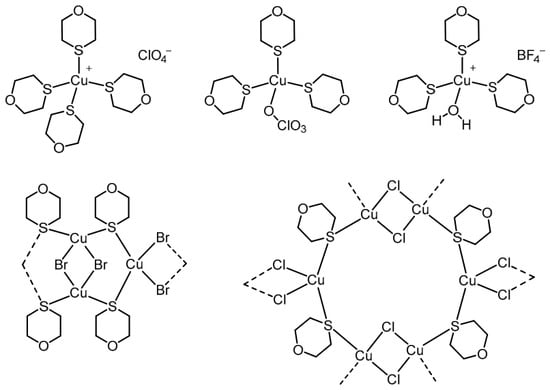
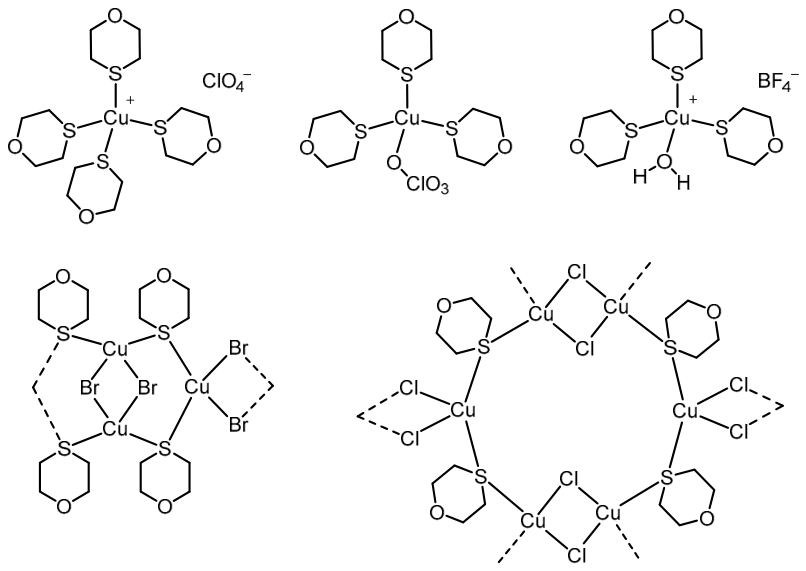
While Cu(I) does not readily coordinate to hard oxygen centers, such as ethers, the combination of an ether with a thioether offers the potential for the coordination of Cu(I) at either the softer sulfur and/or the harder oxygen. Harvey’s group and others have demonstrated a wide variety of structural types through a combination of CuX with alkyl sulfide and related ligands [4,11,12,13,14,15]. Thia-crown-ethers have also been shown to coordinate to Cu(I) halides [16]. We chose the commercially available ether/thioether 1,4-thioxane (THX). Relatively little Cu(I)-THX chemistry has been reported to date. Two Cu(II)-THX structures show Cu bonding to both oxygen and sulfur, creating networks [17,18]. The known Cu(I)-THX structures are shown in Scheme 1 [19,20,21]. Following up on our previous studies on emissive Cu(I) compounds and hoping to uncover compounds that can further coordinate with harder metal centers through pendant oxygen, we undertook the study of the structures and emissions of the complexes of CuI with THX.
Scheme 1.
Previously reported Cu(I) compounds of THX (5).
2. Results
2.1. Synthesis and Characterization
While several THX compounds of Cu(I) are known [19,20,21], none of these are based on CuI, which has been shown to result in wide-ranging structural types owing to its large size, facile bridging behavior and flexible hybridization. Therefore, we set out to determine the range of CuI-THX complexes and to assess their photoemissive behavior. The solvents we used were acetone, toluene, acetonitrile (MeCN), and THX itself (i.e., neat ligand). Of these solvents, only MeCN and THX offer significant solubility of CuI. The various reaction products were readily identified through a combination of their distinctive luminescence emissions under black light and the thermogravimetric analysis (TGA) results. Although all four compounds were strongly emissive with significant photoluminescent quantum yields (PLQY, see below), only compound 1, (CuI)4(THX)3, proved to be strongly emissive under irradiation with a 365 nm LED source, enabling its facile identification.
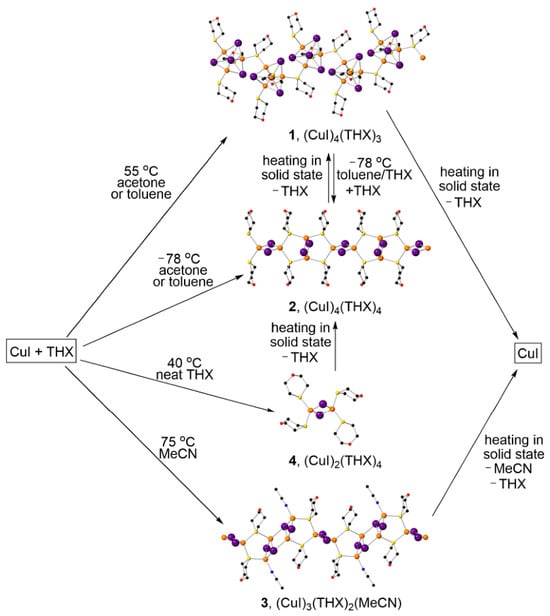
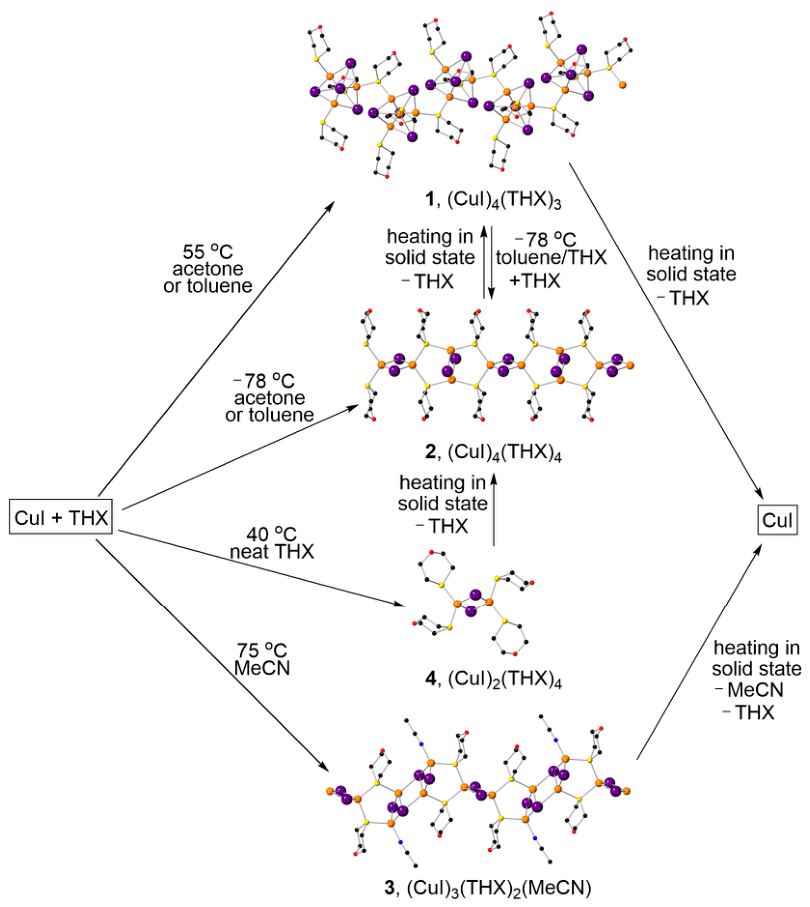
The brief, mild heating of CuI suspended in either acetone or toluene with excess dissolved THX caused the pale tan and only slightly emissive CuI to convert to a white suspension with bright yellow emissions under 365 nm irradiation. The reaction was most efficient at about 55 °C, taking place in about an hour. The yield of (CuI)4(THX)3, 1, when isolated under these conditions, was routinely above 80%. A compound with a similar stoichiometry, (CuI)4(THX)4, 2, was prepared in a good yield either from stirring the above CuI/THX mixture in acetone or by stirring 1 plus additional THX in toluene at a reduced temperature. We found that, for either method, the use of a dry ice temperature was most effective for preparing 2. The progress of either reaction was conveniently monitored under a 365 nm black light. On stirring with excess THX, the dimly orange-emissive CuI or the bright yellow-emissive 1 both converted to give the dull yellow luminescence associated with 2. The use of substoichiometric amounts of THX in any solvent resulted in mixtures of 1 and unreacted CuI.
The use of the MeCN solvent produced a starkly different result due to the ability of MeCN to coordinate to Cu(I). Although CuI is soluble to 100 mM concentrations in MeCN, the combination of CuI and THX in MeCN produced a suspension, much of which slowly dissolved when heated to 75 °C. Once heated, the small amount of residual solid proved to be CuI itself. After the removal of CuI via filtration, crystallization by layering the pale yellow solution with ethyl ether gave a compound that analyzed as (CuI)3(THX)2(MeCN), 3. Although emissive under a shorter wavelength excitation, 3 showed almost no emissions under a 365 nm black light. The synthetic yields were good, correcting for the recovery of CuI prior to crystallization. A survey of various CuI:THX ratios in MeCN yielded only 3.
A final CuI-THX product, (CuI)2(THX)4, 4, was readily prepared from neat THX. Warming a suspension of CuI in THX produced in a colorless solution. When cooled to −5 °C, crystals of 4 were formed in a quantitative yield. Much like 3, 4 showed almost no emissions under 365 nm irradiation, but was highly emissive when excited at shorter wavelengths. It tended to lose THX readily in unsealed containers. When stirred in acetone or toluene, it quickly converted to brightly emissive 1.
2.2. Thermal Analysis
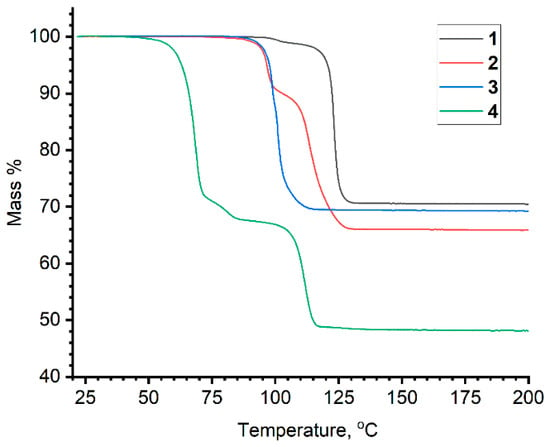
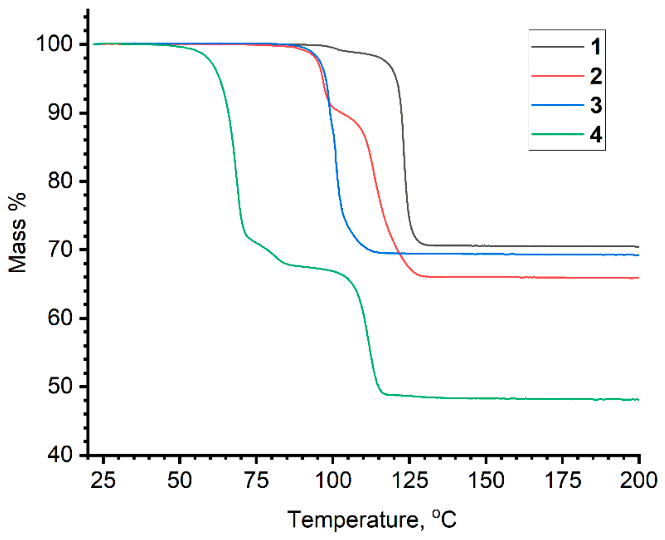
All compounds were evaluated for stoichiometry and decomposition behavior using TGA (Figure 1). In each case, clean stoichiometric ligand loss was observed at temperatures of 130 °C or less, ultimately leaving CuI. The residual CuI did not decompose until above 400 °C, and resulted in the usual combination of evaporation and reductive elimination, producing a sub-stoichiometric amount of Cu by 700 °C. The results also provide some insight into the relationship between the phases, as outlined in Scheme 2. The most thermally stable phase was clearly 1, which did not show ligand loss until nearly 100 °C. It also showed no identifiable intermediate products during decomposition to form CuI, 70.6% of the original mass (theoretical value = 70.9%). The tiny mass loss observed near 100 °C might represent traces of entrained solvent within the product network (see Scheme 2). Compounds 2 and 3 both showed mass loss beginning near 75 °C, but with rather different outcomes. For 2, a single THX molecule per four Cu atoms was lost, producing 1, with a remaining mass after this initial step of 89.5% (theory = 90.0%). This loss was followed by the removal of the remaining three THX molecules per quartet of Cu atoms, yielding CuI, with a remaining mass of 65.9% (theory = 64.6%). For compound 3, the single mass loss step was associated with the removal of all ligands (two THX and MeCN), yielding CuI, with a remaining mass of 69.3% (theory = 69.6%). Compound 4 was by far the least stable. Thus, crystals of 4 became cloudy within hours under ambient conditions. During TGA, 4 underwent a series of mass loss steps beginning at 40 °C, taking the material to 2 (72.3% mass, theory = 73.9%), then to 1 (67.8%, theory = 67.4%), and ultimately to CuI (48.2%, theory = 47.8%). These steps are summarized in Scheme 2.
Figure 1.
TGA of compounds 1–4.
Scheme 2.
Synthesis and thermal conversions of compounds 1–4. Hydrogen atoms omitted in structures. Color scheme: orange = Cu, purple = I, yellow = S, red = O, grey = C, blue = N.
2.3. Description of X-Ray Structures
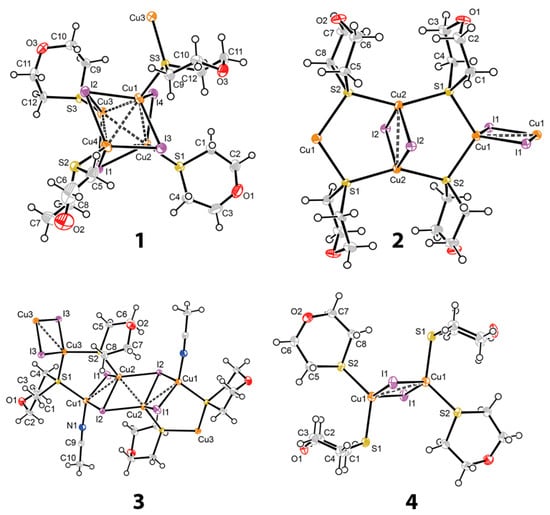
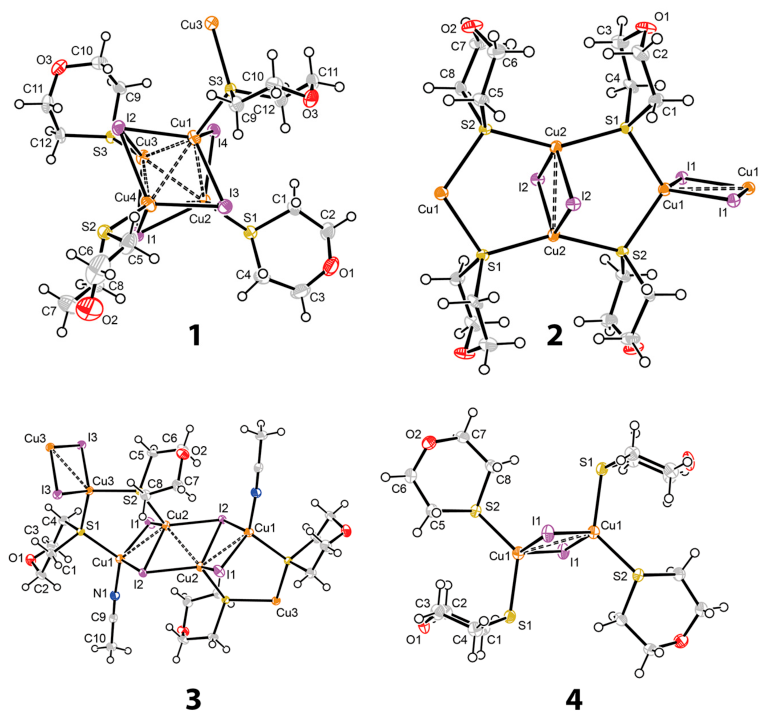
X-ray crystal structures for compounds 1–4 were determined at 100 K; see Scheme 2 and Figure 2 and Figures S1–S8, and also see Scheme 3 below. In all cases, the powder X-ray diffraction traces were found to match calculated powder diffraction patterns from single crystal data (Figures S13–S16). Table 1 and Table 2 provide crystallographic information and structural data, respectively. In all four compounds, copper(I) centers were four-coordinated and bonded only to iodine, sulfur (THX), and, for 3, nitrogen (MeCN). Compounds 1, 2, and 3 were 1-D polymers, while 4 was a dimer. The various stoichiometries observed were largely driven by the ability of iodide to be doubly (μ2-I) or triply (μ3-I) bridging and of thioether sulfur either to bridge pairs of metal centers (μ2-S) or to remain monodentate. Compound 1 crystallized in monoclinic space group P21/c, and featured a Cu4I4 cubane core, which is similar to that of many known Cu4X4 tetramers, as shown in Figure 2 [1,2,3,4,5,6,22,23]. Six short cuprophilic interactions were present within the core, with Cu⋯Cu lengths = 2.6602(7)–2.7679(8). The Cu⋯Cu interactions reported herein are in the range of about 2.6–2.9 Å, which is just under the 2.9 Å van der Waals radius sum [24]. These distances are fairly typical of those seen in other Cu2X2 rhombs, and although relatively weak, play an important role in the photophysical behavior of these systems (see below). Three S-bonded THX ligands were present, two of which were terminal, and the third was a μ2-S that bridged pairs of cores, giving (CuI)4(THX)3. The structure was similar to those of (CuI)4(EtSR)3 (R = Me, Et, nPr) [14,15]. Bridging Cu−S distances are slightly longer than terminal Cu−S distances. The resulting zigzag 1-D chain propagated parallel to the crystallographic b-axis. All four Cu atoms in 1 shared a common coordination environment: CuI3S. Compound 2, (CuI)4(THX)4, contained two Cu2I2 rhomboid dimer units, each centered around an inversion center in monoclinic space group P21/c. The dimers were bridged by pairs of μ2-S-THX ligands to form a linear linked chain that propagated parallel to the a-/c-axis bisector. This chain structure is directly analogous to that of (CuBr)4(THX)4 [20]. Within the rigid chain backbone were interesting pentagonal Cu3S2 rings, which we recently observed in a series of CuI/BiI3 networks [25,26]. There were cuprophilic interactions across like atoms in both rhombs (Cu⋯Cu = 2.808(4), 2.707(4)), which were further supported by a pair of bridging iodides. Both Cu atoms in 2 shared a common coordination environment of CuI2S2. It is noteworthy that the fusion of the two pentagonal Cu3S2 rings at Cu2 produced a very open S1−Cu2−C2 angle of 150.49(14), far larger than the standard tetrahedral angle of 109.5°.
Figure 2.
ORTEP renderings of 1–4. Ellipsoids are at the 50% level.
Scheme 3.
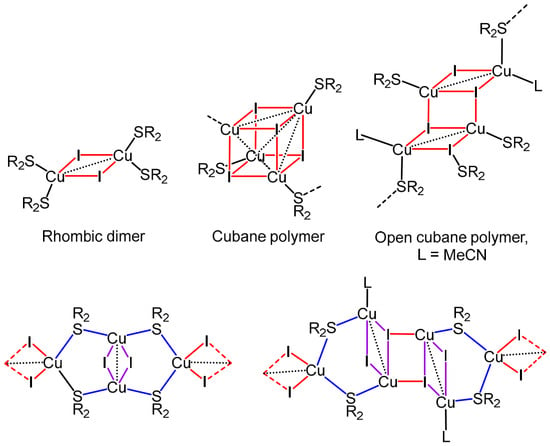
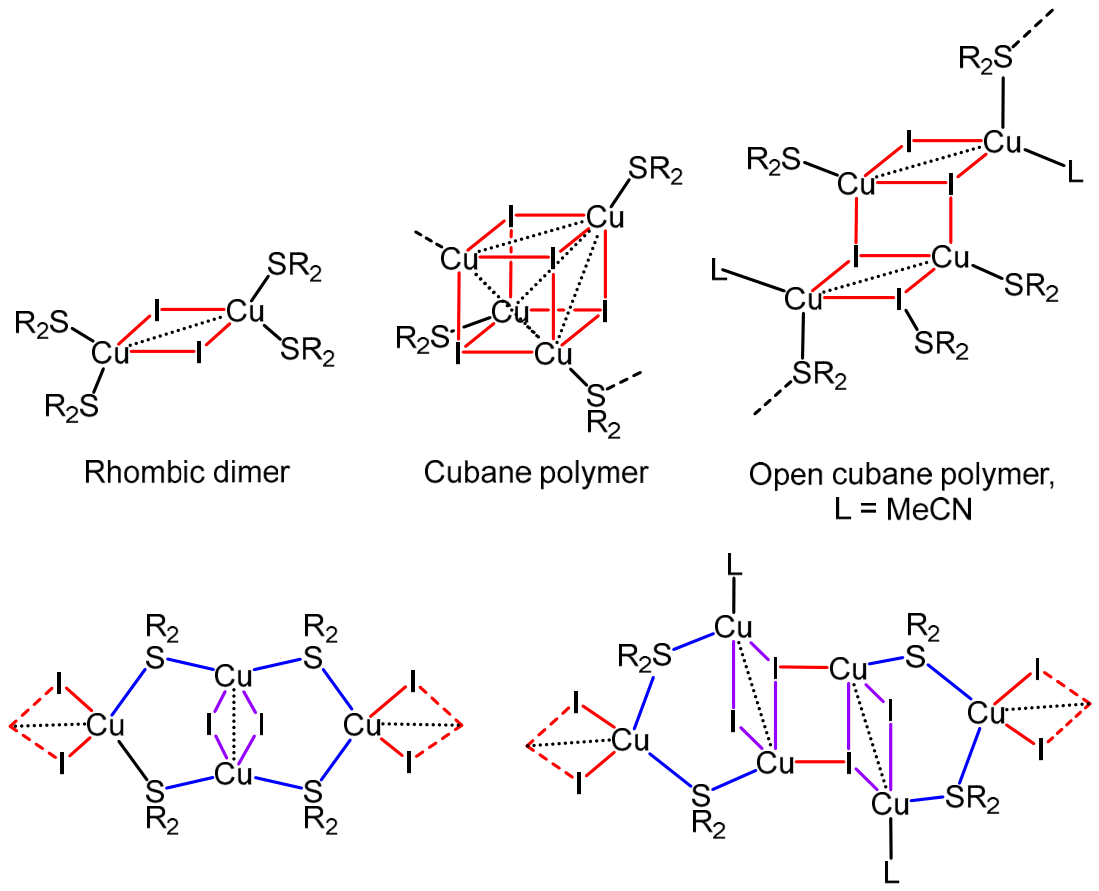
Structural motifs in CuI−SR2 complexes. L = MeCN. Dotted lines = cuprophilic interactions. Red bonds = rhombic ring, blue bonds = pentagonal ring, violet bonds = shared rhombic/pentagonal ring.
Table 1.
Crystal and structure refinement data.
Table 2.
Selected bond distances (Å) and angles (deg) for all complexes.
Compound 3 is the only solvent-bearing species reported here. It crystallized in triclinic space group P − 1. The chain structure contained four Cu2I2 rhombs, three of which were edge-sharing, forming an open ladder-like Cu4I4 core (an “open cubane”) containing two μ2-I (I1) and two μ3-I (I2) atoms. The remaining Cu2I2 rhomb (Cu3/I3) was separate. The Cu2/Cu2 and Cu3/Cu3 rhombs were centered about inversion special positions. There were cuprophilic interactions across all rhombs: Cu(1)⋯Cu(2) = 2.8648(6), Cu(2)⋯Cu(2) = 2.7008(7), Cu(3)⋯Cu(3) = 2.7078(7). The Cu2I2 and Cu4I4 units were linked by two μ2-S-THX ligands, producing pentagonal Cu3S2 rings like those in 2, except that, instead of pairs of Cu3S2 rings sharing a single Cu2I2 rhomb, each ring had its own rhomb, with the non-fused rhomb linking the Cu3S2 rings together. The result wass a 1-D linear linked chain that propagated parallel to the a-/c-axis bisector. Each crystallographically independent Cu atom in 3 had a different coordination sphere in 2: Cu(1)I2NS, Cu(2)I3S, and Cu(3)I2S2. Compound 4 crystallized in monoclinic space group P21/c as a simple rhomboid dimer molecule, Cu2I2(THX)4, which was half independent about an inversion center. All THX ligands were monodentate, with the Cu−S bond lengths of 2.3078(9), 2.3148(8) being longer than the monodentate Cu−S bonds in other compounds in this study. This longer distance presumably reflects the relatively weak ligand bonding in 4. The single Cu⋯Cu interaction was near the van der Waals radius sum, 2.8272(8). In fact, the range within the twelve such cuprophilic distances in this study was relatively narrow: 2.6602(7)–2.8648(6).
2.4. Luminescence
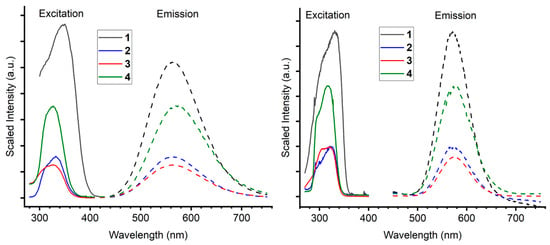
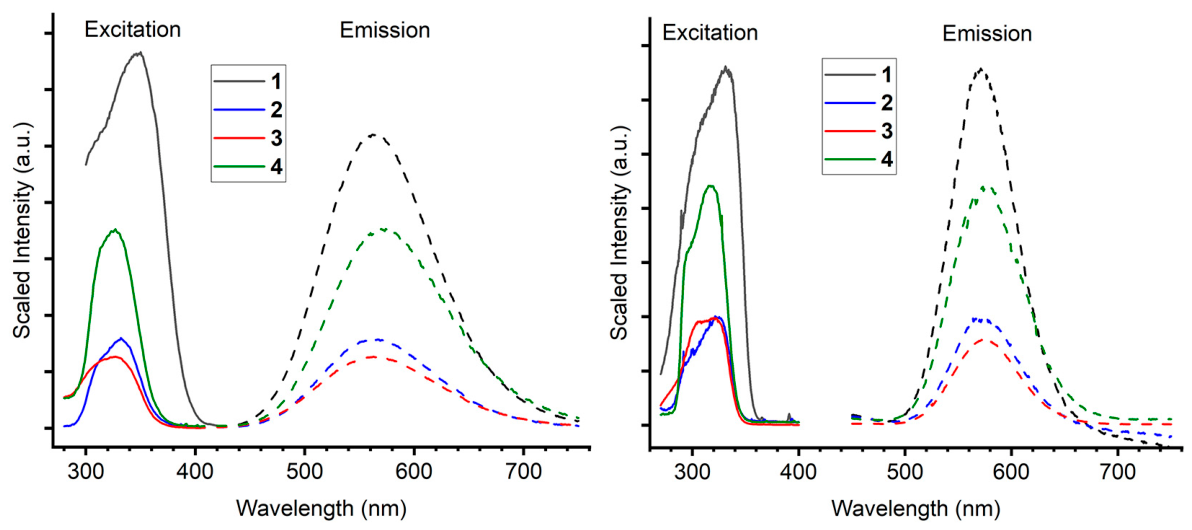
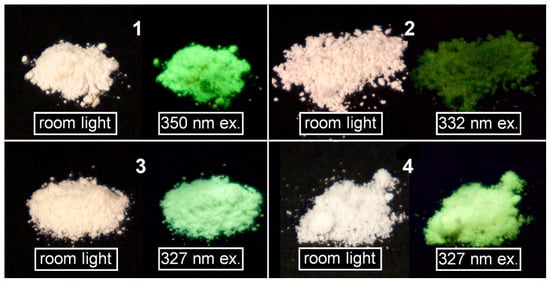
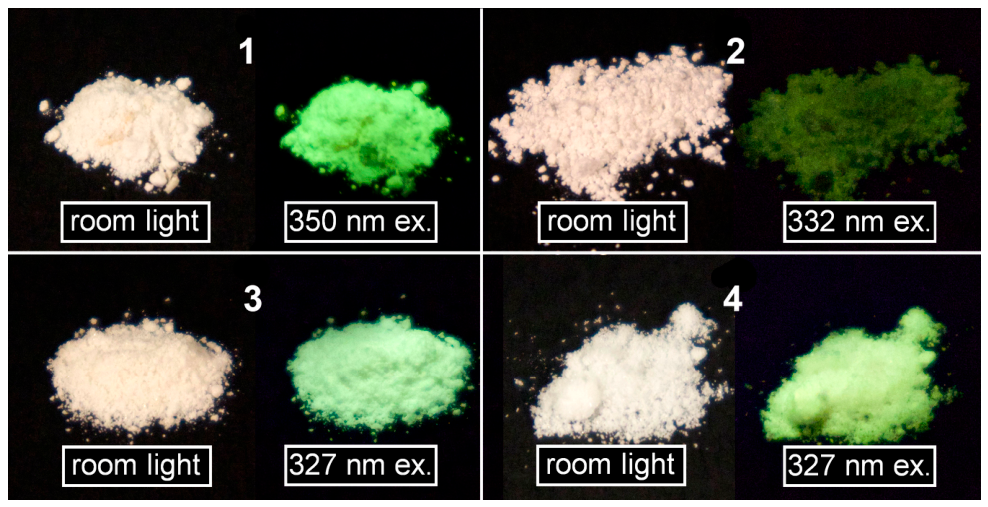
The four new compounds showed significant luminescence behavior under UV excitation. Ambient temperature excitation and emission luminescence spectra were collected on the samples; see Figure 3 and Figure S17, and Table 3. The differences in the excitation and emission wavelengths amongst the compounds were relatively small, reflecting their common nature as 3CC phenomena. Compound 1 underwent excitation at a longer wavelength (λmax = 350 nm) than those for 2–4 (λmax = 332, 327, and 327 nm, respectively). This difference reflects the fact that 1 contained Cu4I4 cubane clusters with shorter Cu⋯Cu interactions. In contrast, all four compounds showed nearly identical emission wavelengths: λmax = 562, 563, 563, and 570 nm, respectively. The similarity in emissions is evident from the photos in Figure 4, which were taken under the excitation λmax of each compound. The emissions from 1 became significantly less intense at the liquid nitrogen temperature, while the excitation showed a blue shift to 331 nm. The other compounds became slightly brighter at 77 K with no change in the excitation wavelength. No meaningful differences in the emission wavelength were evident for any of the compounds when cooled to the liquid nitrogen temperature.
Figure 3.
Luminescence spectra for 1–4 at 298 K (left) and 77 K (right). All trace intensities were normalized and scaled for ambient temperature quantum yield.
Table 3.
Excitation and emission wavelengths for 1–4 at 298 and 77 K, and PLQY and lifetime at 298 K.
Figure 4.
Photos of 1–4, under room light and UV irradiation at excitation λmax at 298 K.
The ambient temperature photoluminescence quantum yields (PLQY) were determined for each of the compounds; see Table 3. Compound 1 revealed the highest quantum yield at 78%, followed by compounds 4, 2, and 3 with yields of 53, 24, and 19%, respectively. The lifetime values for the compounds were measured, showing little variation, with values ranging between 4.68 and 5.48 μs. These relatively long lifetimes are indications of phosphorescence emissions, which is typical for emissive Cu(I) complexes [1,2,3,4,5,6]. In all cases, the phosphorescence behavior can be attributed to 3CC transitions associated with the CunXn clusters in the complexes. While compound 1 stood out in its distinct structure, its luminescence behavior was only slightly different than that of 2–4. Compound 1 showed the lowest energy excitation wavelength in the present study. This fact is probably associated with the shortened Cu⋯Cu distances produced by the cubane arrangement, rather than a different photophysical mechanism. Since all compounds emitted with similar wavelengths, 1 showed a slightly smaller ambient temperature Stokes shift of 129 kJ/mol vs. 148–156 kJ/mol for 2–4, all of which were structurally based on Cu2I2 dimer units. This Stokes shift difference was largely lost at 77 K: 152 kJ/mol vs. 161–168 kJ/mol.
2.5. Diffuse Reflectance and Computational Results
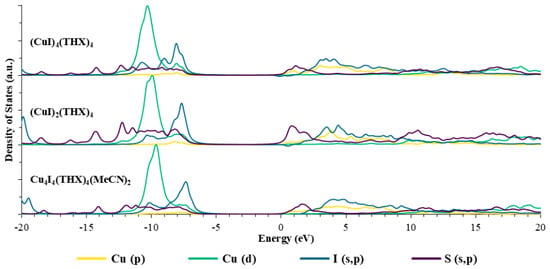
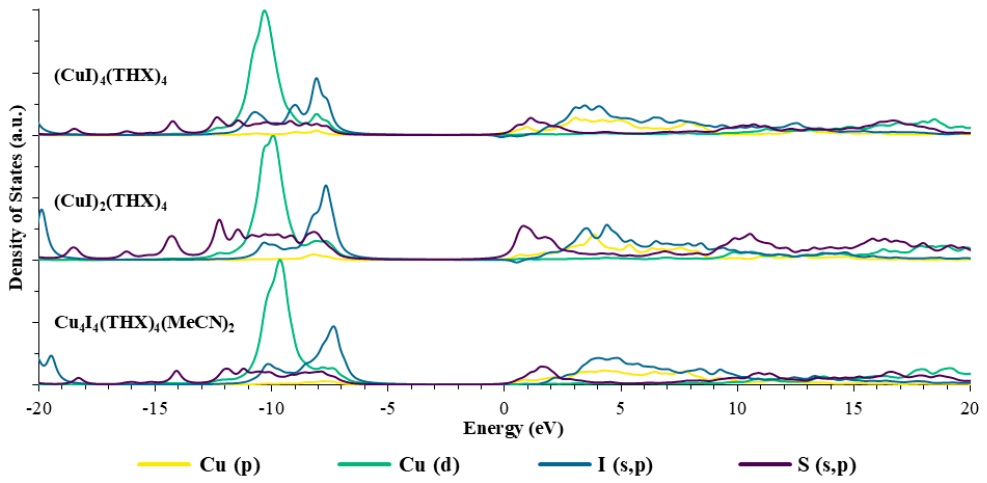
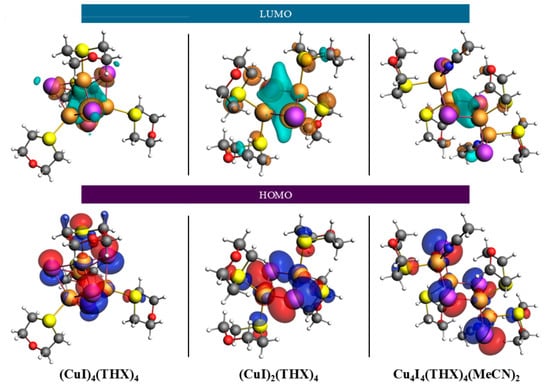
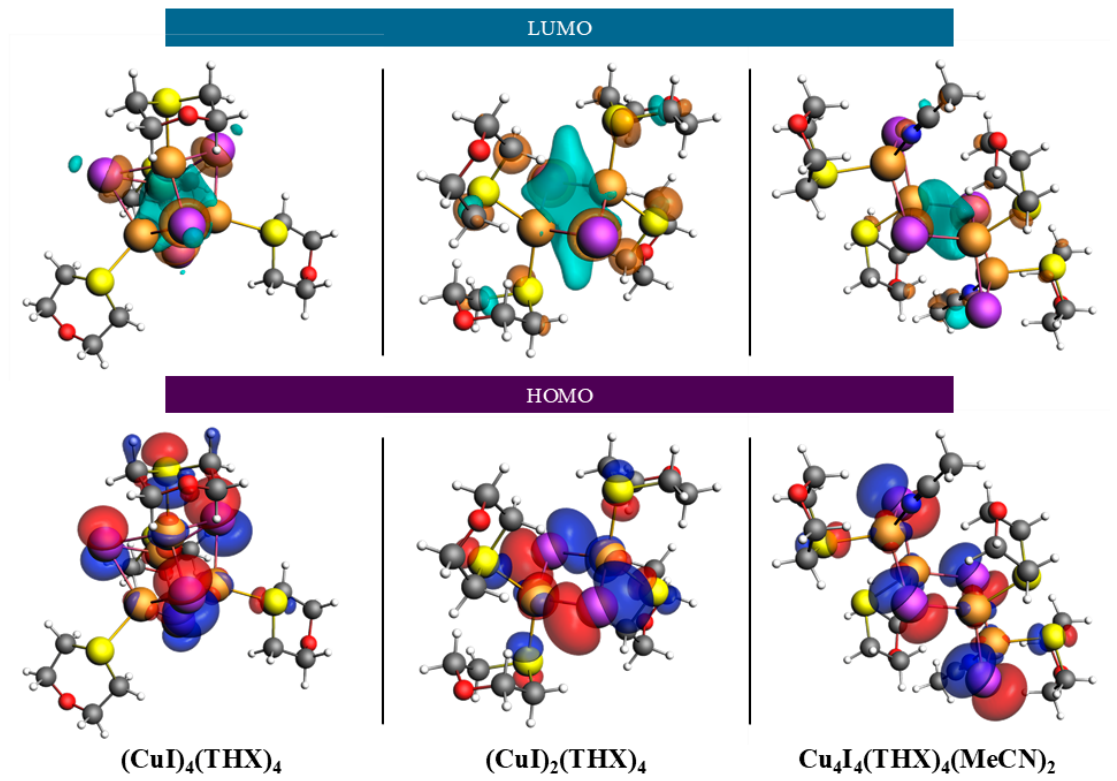
Diffuse reflectance measurements revealed comparable optical bandgap energies for 1–4, with values ranging between 2.93 eV and 3.00 eV (Figure S18). No additional bands in either the visible or near-IR regions were observed. To elucidate the photophysical behavior, DFT calculations were performed. Specifically, we were interested in the partial density of states (PDOS) and composition of the frontier molecular orbitals. Compounds 1–4 were modeled using three structures (Figure S18). The first was a non-polymeric cubane tetramer, (CuI)4(THX)4, in which the bridging THX in 1 was replaced with two terminal THX ligands. It should be noted that, despite the identical formula of (CuI)4(THX)4, this model compound was structurally quite different than the polymer 2. The second computational compound was the simple dimer (CuI)2(THX)4, i.e., 4. The third compound was an MeCN-containing model for 3, in which two bridging ligands THX in 3 were replaced with four terminal THX ligands, forming a non-polymeric open cubane, Cu4I4(THX)4(MeCN)2. DFT calculated the partial density of states (PDOS, Figure 5) for all three models, which showed energetically high-lying filled molecular orbitals at the band edge consisting of both Cu d and I s/p atomic orbitals. The energetically low-lying unfilled molecular orbitals presented as a mixture of S s and p orbitals with a small contribution from the Cu d orbitals. The rendering of the frontier molecular orbitals (Figure 6) in all cases also showed the dominance of Cu d and I s/p atomic orbitals in the HOMOs and Cu d orbitals in the LUMOs. The THX ligand (and MeCN for Cu4I4(THX)4(MeCN)2) appeared to play no significant role in all cases. Thus, the transition in these compounds was confirmed as cluster-centered with nearly no ligand contribution, despite the presence of the polarizable sulfur atom.
Figure 5.
Partial density of states (PDOS) plots of (CuI)4(THX)4, (CuI)2(THX)4, and Cu4I4(THX)4(MeCN)2 models.
Figure 6.
Isodensity representations of the frontier molecular orbitals for (CuI)4(THX)4, (CuI)2(THX)4, and Cu4I4(THX)4(MeCN)2 models.
3. Discussion
A series of CuI-THX complexes proved relatively straightforward to prepare, although the syntheses were complicated by stoichiometric similarity amongst the four ultimate products, which had CuI:THX ratios of 1:0.67 (3), 1:0.75 (1), 1:1 (2), and 1:2 (4). In particular, 1 and 2 existed in a close balance, under which the facile loss of small amounts of ligand from 2 generated the more stable 1. Nevertheless, the synthesis of 2 at a reduced temperature was successful. Generally speaking, the low-THX compounds (1 and 3) proved more stable than the THX-rich species (2 and 4). Thus, solutions of 2 and 4 will slowly convert to 1 and solutions of 1, 2, or 4 convert to 3 in MeCN.
The crystal structures of the four compounds revealed the bonding of the THX ligand to Cu(I) exclusively through the sulfur atom. This observation is in good agreement with the hard–soft acid–base theory, in which both Cu(I) and S are considered soft. The harder base oxygen is no less sterically available than sulfur, but fails to show any coordination behavior with Cu(I). When examining common structural motifs for the CuI-SR2 complexes shown in Scheme 3, it is notable that iodide bridging of Cu centers occurred without exception in this study, while sulfide showed either monodentate or bidentate bridging behavior. When looking at ring formation with the potentially bridging sulfide THX, it can be seen that both rhombic Cu2(μ2-I)2 rings (shown in red in Scheme 3) that form the well-known dimer, cubane, and open cubane clusters, sulfide bridging ligands, tend to produce the halide-supported five-membered rings (regarding the Cu⋯Cu interaction as completing the pentagonal ring, blue), which readily share edges with the rhombs (violet).
In terms of photophysics, CuI complexes tend to show transitions with long lifetimes and high quantum yields (>10%). This was the case for 1–4. In the classic Cu4I4(pyridine)4 structure first reported by White et al. [27], the Cu4I4 cubane unit was decorated with ligands containing energetically available π* molecular orbitals. This feature gave rise to interesting thermochromic behavior where the dominant emission pathway readily changes from a clustered-centered (3CC) charge transfer at room temperature to a mixed metal/halide-to-ligand charge transfer (3X/3MLCT) at cryogenic temperatures [28]. Here in 1–4, there were no available π* orbitals; thus, the emission pathway was restricted to a 3CC charge transfer at all temperatures. This is evident in the emission spectra, in which 1–4 presents a single low-energy band at both 298 K and 78 K. Cubane clusters feature relative flexibility, which allows for more significant metallophilic Cu⋯Cu interactions associated with a higher PLQY and longer 3CC lifetimes. And while there is no demonstrable correlation between these parameters and Cu⋯Cu distances [4], it is noteworthy that, amongst the compounds studied herein, the cuprophilic distances were shortest, and the PLQY greatest, in cubane 1, compared to the dimer-dominated 2–4. Another feature of 1 that stands out is its relatively small Stokes shift at ambient temperatures. This is probably indicative of less rearrangement in the cubane cluster between the ground and excited states. Thus, the difference between compound 1 and the other CuI-THX species reported herein lies in its low excitation energy, and is thus associated with the bandgap, rather than the emissions from mid-gap trap states.
Turning to the computational results, we note the delocalization of the Cu d orbitals in the LUMO as strong evidence of metallophilic behavior commonly associated with spatially adjacent +1 noble metals. Furthermore, the general frontier orbital composition is consistent with a 3CC charge transfer assignment for the emissive and absorption properties of 1–4. Interestingly, despite the structural differences between the models used herein, the DFT results were largely similar across the family. This behavior points to a robust Cu−I energetic pathway that is largely independent of organic ligand, given that the THX ligand lacks π* acceptor-capable orbitals. This observation has important implications given that closely related families of CuI compounds can be structurally tuned without a negative impact to the 3CC-based photophysical behavior (i.e., structurally oriented semiconductors). Taken together, these results provide support for the dominant and relatively ligand-insensitive nature of CuI 3CC behavior. Since CuI is the most stable of the Cu(I) halides, CuX, and cuprophilic interactions are the closest and shortest amongst those of CuX [3], CuI is a potentially important component for photoemissive applications, such as solid-state lighting and scintillation detectors. In particular, these compounds of THX demonstrate that, in the presence of free ligands, small perturbations such as temperature changes might be used to induce a phase change with corresponding emission shifts, giving rise to stimuli-responsive materials.
4. Materials and Methods
4.1. General
Safety precautions: THX is toxic, an irritant, and has a stench. It should be handled only with gloves and in an approved fume hood. THX was purchased from Acros Chemical, Thermo Fisher, Waltham, MA, USA, and used without purification. Acetone was distilled from Drierite. Toluene was distilled from CaH2. CuI was purified by recrystallizing from aqueous KI, then vacuum drying. The syntheses were carried out in open air, except as noted. IR spectra were collected on a Shimadzu IRTracer-100 instrument, Columbia, MD, USA, using a diamond attenuated total reflectance (ATR) probe (IR spectra are shown in Figures S9–S12). Analyses for C, H, and N were carried out by Atlantic Microlabs, Norcross, GA, USA. Thermogravimetric analyses (TGA) were conducted using a TA Instruments Q500 or Q550, New Castle, DE, USA, in the dynamic (variable temp.) mode with a maximum heating rate of 50 °C/min. to 800 °C under 40–60 mL/min. N2 flow. Diffuse reflectance measurements were collected at 298 K on microcrystalline powders between 350 nm and 950 nm using a Mikropack DH-2000-BAL deuterium and halogen light source, Agilent Technologies, Santa Clara, CA, USA, coupled with an Ocean Optics Flame detector, Orlando, FL, USA. Scattered light was collected with a fiberoptic cable. The spectra were referenced with Spectralon®. The data were processed using OceanView spectroscopy software (version 2.0.8.). Raw spectra were converted to Tauc plots via Kubelka–Munk for the determination of optical band gaps (see Figure S18).
4.2. Syntheses
(CuI)4(THX)3 (1). CuI (862.3 mg, 4.528 mmol) and THX (627.7 mg, 6.026 mmol) were combined in 10.0 mL of acetone. The mixture was stirred for 1 h at 55 °C. The mixture became a white suspension with strong yellow luminescence. The white powder was collected via centrifugation, washed twice with ethyl ether, and dried under a vacuum (1004.2 mg, 0.9347 mmol, 82.6%). X-ray-quality crystals were grown by layering the acetone mother liquor with ethyl ether. The white product emitted bright yellow under 365 nm. IR (cm−1): 2942, 2915, 2851, 1456, 1441, 1408, 1381, 1315, 1279, 1263, 1211, 1196, 1161, 1051, 999, 961, 821, 810, 660. Anal. Calcd for C12H24Cu4I4S3O3: C, 13.41; H, 2.25. Found: C 13.27, H 2.00. TGA Calcd for CuI: 70.9%. Found: 70.6% (95–135 °C).
(CuI)4(THX)4 (2). Method A: CuI (285.4 mg, 1.499 mmol) and THX (211.4 mg, 2.029 mmol) were combined in a vial and 5.0 mL of acetone was added. The suspension was cooled to −78 °C and stirred for 5 h. The white solid product showed a dull yellow emission under a 365 nm black light. The powder was collected via centrifugation, washed twice with ethyl ether, and dried under a vacuum (386.3 mg, 0.3278 mmol, 87.5%). Method B: 1 (204.0 mg, 0.1899 mmol) and THX (102.6 mg, 0.985 mmol) were combined in 5 mL of toluene and stirred for 5 h at −78 °C, yielding a dull yellow-emissive white solid that was collected via centrifugation, washed twice with ethyl ether, and dried under a vacuum (113.5 mg, 0.0963 mmol, 67.6%). X-ray quality crystals were grown by layering the mother liquor from either of the above reactions with ethyl ether. The white product emitted dull yellow under 365 nm. IR (cm−1): 2838, 2814, 2849, 1456, 1406, 1381, 1315, 1277, 1261, 1211, 1194, 1161, 1099, 1049, 999, 960, 821, 808, 660. Anal. Calcd for C16H32Cu4I4S4O4: C, 16.31; H, 2.74. Found: C, 16.28; H, 2.60. TGA Calcd for (CuI)4(THX)3 90.0%. Found 89.5% (70–105 °C). Calcd for CuI: 64.6%. Found: 65.9% (105–135 °C).
(CuI)3(THX)2(MeCN) (3). CuI (827.7 mg, 4.346 mmol) and THX (301.8 mg, 2.897 mmol) were combined in 25 mL MeCN. The mixture was stirred for 21 h at 75 °C in a thick-walled tube, forming a pale yellow solution with a trace of unreacted CuI solid present. The residual suspended CuI was collected (151.9 mg, 0.798 mmol). The yellow solution was crystallized in two crops by layering with ethyl ether, resulting in X-ray quality crystals. The colorless crystalline product was air-dried to prevent the loss of MeCN (yield: 784.6 mg, 0.956 mmol, 80.8%). The product showed weak emissions under 365 nm. IR (cm−1): 2947, 2916, 2855, 1454, 1442, 1403, 1383, 1354, 1314, 1277, 1259, 1211, 1192, 1099, 1047, 997, 959, 826, 804, 679, 646, 559. Anal. Calcd for C10H19Cu3I3S2NO2: C, 14.63; H, 2.33; N 1.71. Found: C, 15.03; H, 2.21; N 1.80. TGA Calcd for CuI: 69.6%. Found: 69.3% (80–120 °C).
(CuI)2(THX)4 (4). CuI (50.3 mg, 0.246 mmol) was suspended in about 0.5 mL of THX. Warming to 40 °C for 10 min. produced a colorless solution. Cooling the solution to −5 °C for several hours yielded colorless prism crystals. The crystals were washed with ethyl ether and air-dried briefly (80.8 mg, 0.101 mmol, 76.7%). IR (cm−1): 2963, 2945, 2914, 2853, 1442, 1431, 1410, 1379, 1317, 1279, 1261, 1215, 1196, 1007, 988, 961, 826, 807, 687, 654. Anal. Calcd for C16H32Cu2I2S4O4: C, 24.09; H, 4.04. Found: C, 23.84; H, 3.91. TGA Calcd for (CuI)4(THX)4 73.9%. Found 72.3% (40–70 °C). Calcd for (CuI)4(THX)3 67.4%. Found 67.8% (70–85 °C). Calcd for CuI: 47.8%. Found: 48.2% (85–135 °C).
4.3. X-Ray Data Collection, Structure Solutions and Refinements
X-ray measurements were made using a Bruker-AXS D8 Venture four-circle diffractometer, Bruker AXS, Madison, WI, USA, equipped with a microfocus Mo tube and a Photon 3 CPAD detector. The initial space group determination was based on fast scans with 180 frames. The data were reduced using SAINT+, and an empirical absorption correction applied using SADABS. Structures were solved using intrinsic phasing. Least-squares refinement for all structures was carried out on F2. The non-hydrogen atoms were refined anisotropically. Hydrogen atoms were placed in riding positions. The structure solution, refinement, and calculation of the derived results were performed using the SHELXTL package of computer programs [29] and ShelXle [30]. See Table 1 for crystallographic determination information, and Table 2 for selected bond length and angle data. Powder X-ray diffraction (PXRD) traces were collected on a Thermo Scientific ARL Equinox 100, Waltham, MA, USA, with Co radiation. The data were subsequently converted to the Cu wavelength (Figures S13–S16).
4.4. Luminescence Data
Solid-state excitation and emission spectra were collected on an Edinburgh Technologies FS5 Spectrofluorometer, Fulton, MD, USA, using a xenon arc lamp. To reach experimental temperatures of 77 K, samples were loaded into a standard NMR tube and placed into a cold finger liquid nitrogen dewar equipped with a quartz window. The experimental specifications were 1 nm excitation and emission slit widths, 1 s dwell times, 0.5 nm or 1 nm step size and 3 averaged scans per spectra. The raw data were normalized by correcting to equal λmax intensities and then scaled by multiplying by 298 K PLQY. Photoluminescent lifetime (τ) measurements were completed using a microsecond flash lamp with a frequency of 100 Hz. The decay scan range was 0–80 μs with a 4 μs delay, measured over 1000 channels. The instrument response was completed using the same settings as above, with an empty sample cup. The lifetime data were fitted using a reconvolution fit analysis and the experimental decay curve was fitted with a mono-exponential model. The measurement was performed in triplicate.
The fluorescence quantum yield measurements were collected on an Edinburgh Instruments FS5 spectrofluorometer using a xenon arc lamp source and an Edinburgh SC-30 integrating sphere. Solid samples were prepared by grinding with a mortar and pestle until a fine powder was obtained. Pulverizing the sample reduced unwanted reflections off of the sample crystal faces and improved the adhesion of the sample to the mounting slide. The powder was lightly smeared onto blank Fluorilon-99W slides (Avian Technologies, New London, NH, USA), and excess material was removed by gentle tapping to leave a thin layer on the slide.
Spectra were acquired with a 0.5 nm step size and a dwell time of 0.1 s per step, with three replicate measurements collected for each sample. These acquisition settings were selected to optimize the signal-to-noise ratio while avoiding detector saturation. Excitation wavelengths near the anticipated absorption maximum were tested to identify the wavelength producing the greatest absorption for each sample. The fluorescence quantum yields at the excitation wavelengths were determined by comparing the scattering band of the sample spectrum to that of a blank Fluorilon-99W slide. The fluorescence quantum yield (ΦF) is calculated as:
where Iblank(λ) is the blank slide’s spectrum and Isample(λ) is the sample’s spectrum measured in the photon counts, and [em1, em2] and [exc1, exc2] are integration bounds in nm for the excitation scattering and emission regions, respectively. The numerator represented the integrated fluorescence emission intensity and the denominator represented the number of excitation photons absorbed by the sample, making ΦF the ratio of emitted photon counts to absorbed photon counts. Since the excitation scattering and fluorescence emission bands did not overlap in the recorded spectra, the integration bounds were selected to encompass the full extent of each band. The fluorescence quantum yield calculations were performed using Fluoracle software (version 2.4.1).
4.5. Diffuse Reflectance Spectra
UV–vis–NIR diffuse reflectance spectra were collected on bulk solid samples at 298 K. A HL-2000-LL tungsten–halogen light source was coupled to an Ocean Optics Flame spectrometer, with diffusely scattered light collected using a fiber-optic probe. Spectra were acquired using a 400 ms integration time and averaged over 10 scans for each sample. BaSO4 was used as the reflectance reference. Spectral acquisition and processing were performed using OceanView spectroscopy software (version 2.0.20).
4.6. Computational
Initial computational models were constructed from the experimentally determined single-crystal X-ray diffraction (SCXRD) structures. Because compounds 2 and 3 formed extended chain- and stair-like structures, respectively, the truncation of the crystallographic structures was required to obtain computationally tractable molecular models. Compound 2 consists of alternating dimeric units; therefore, a discrete dimer model analogous to that used for compound 4 was selected as the most representative local structural motif. For compound 3, a truncated model preserving the relevant local coordination environment was employed. The final computational models used herein are provided in the Supporting Information. The extracted structural models were geometrically optimized prior to subsequent electronic-structure analyses. All calculations were performed using the Amsterdam Modeling Suite (AMS) 2025 software package with the Amsterdam Density Functional (ADF) 2025.103 engine [31]. Scalar relativistic effects were treated using the zeroth-order regular approximation (ZORA) Hamiltonian. Density functional theory calculations employed the M06-2X exchange-correlation functional in conjunction with an all-electron double-ζ Slater-type basis set with polarization functions (DZP).
5. Conclusions
We synthesized a variety of CuI complexes of 1,4-thioxane (THX) that depend on the synthesis conditions. A delicate balance was found between the bridged cubane chain complex 1, (CuI)4(THX)3, and a chain of bridged rhombic dimers, 2, (CuI)4(THX)4. Compound 2 also featured pentagonal Cu3S2 rings. These rings were also present in the open-cubane polymer structure of MeCN-coordinated 3, (CuI)3(THX)2(MeCN). A simple dimer, 4, (CuI)2(THX)4, was crystallized directly from neat THX. A thermal analysis showed the relative ease of ligand loss, with compound 1 being formed from 2 and 4 before the ultimate loss of ligands. All complexes were photoluminescent with microsecond lifetimes that are indicative of cluster-centered (3CC) transitions. A lack of thermochromic behavior was noted in 1–4. All compounds showed relatively high photoluminescent quantum yields (PLQYs). The PLQY of 78% for cubane chain 1 was particularly large. The partial density of states (PDOS) results for model compounds was suggestive of 3CC behavior with Cu d- and I s/p-based HOMOs and Cu d-based LUMOs.
Supplementary Materials
The following supporting information can be downloaded at: https://www.mdpi.com/article/10.3390/molecules31224104/s1, Additional crystal structure views, IR spectra, powder diffraction traces, normalized luminescence spectra, diffuse reflectance spectra, PLQY traces, and DFT files (pdf).
Author Contributions
Conceptualization, R.D.P.; methodology, R.D.P., L.C.D., and A.D.N.; formal analysis, R.D.P. and A.D.N.; investigation, R.K., A.R.J., B.T.S., L.M.K. and V.V.; crystallographic data collection and refinement, R.D.P. and A.R.J.; writing, R.D.P. and A.D.N.; supervision, R.D.P., K.L.W., D.B.L., L.C.D. and A.D.N.; project administration, R.D.P. All authors have read and agreed to the published version of the manuscript.
Funding
We acknowledge the National Laboratory for Scientific Computing (LNCC/MCTI, Brazil, SDumont supercomputer). This study was financed in part by the Coordenação de Aperfeiçoamento de Pessoal de Nível Superior—Brasil (CAPES)—Finance Code 001. L.C.D. acknowledges São Paulo Research Foundation (FAPESP) grant #2024/17236-1 and CNPq #304653/2023-3. L.M.K. and D.B.L. are grateful to the NSERC of Canada for ongoing support of this research via a Discovery Grant (D.B.L.) and a CGS-D Scholarship (L.M.K.).
Data Availability Statement
The crystallographic data were deposited with the Cambridge Crystallographic Data Centre: CCDC 2592187-2592190.
Acknowledgments
We are grateful to William & Mary for the purchase of the X-ray equipment. We thank the Roy R. Charles Center for Academic Excellence at William & Mary for student support. We acknowledge the National Laboratory for Scientific Computing (LNCC/MCTI, Brazil, SDumont supercomputer). This study was financed in part by the Coordenação de Aperfeiçoamento de Pessoal de Nível Superior—Brasil (CAPES)—Finance Code 001. L.C.D. acknowledges grants #2024/17236-1, São Paulo Research Foundation (FAPESP) and CNPq #304653/2023-3. The authors have reviewed and edited the output and take full responsibility for the content of this publication. AI was not used during manuscript preparation.
Conflicts of Interest
The authors declare no conflicts of interest.
Abbreviations
The following abbreviations are used in this manuscript:
| ADF | Amsterdam Density Functional |
| ATR | Attenuated total reflectance |
| CC | Cluster-centered |
| HOMO | Highest occupied molecular orbital |
| LUMO | Lowest unoccupied molecular orbital |
| MeCN | Acetonitrile |
| PDOS | Partial density of states |
| PLQY | Photoluminescence quantum yield |
| PXRD | Powder X-ray diffraction |
| SCXRD | Single-crystal X-ray diffraction |
| STE | Self-trapped excitonic |
| THX | 1,4-Thioxane |
| TGA | Thermogravimetric analysis |
| TZP | All-electron triple-zeta Slater-type basis set |
| X/MLCT | Metal/halide-to-ligand charge transfer |
| ZORA | Zeroth-order regular approximation |
References
- Chatterjee, J.; Tanwar, R.; Abhijit Chatterjee, A.S.; Ambhore, M.D.; Kabir, M.; Mandal, P.; Hazra, P. Controlling Triplet-Harvesting Pathways and Nonlinear Optical Properties in Cu(I) Iodide-Based Polymers through Ligand Engineering. J. Phys. Chem. Lett. 2025, 16, 1549–1558. [Google Scholar] [CrossRef] [Scilit]
- Xiong, L.; Jiang, H. The Effects of the Coordination Environment on the Self-Trapped Exciton in Hybrid Organic−Inorganic Copper(I) Halides. J. Phys. Chem. C 2025, 129, 2036–2043. [Google Scholar] [CrossRef] [Scilit]
- Popy, D.A.; Saparov, B. This or That—Light Emission from Hybrid Organic–Inorganic vs. Coordination Cu(I) Halides. J. Mater. Chem. C 2025, 13, 521–560. [Google Scholar] [CrossRef] [Scilit]
- Boivin, L.; Harvey, P.D. CuX-Based MOFs as Functional Materials for Adsorption, Catalytic, and Sensing Applications. J. Mater. Chem. C 2024, 12, 14253–14282. [Google Scholar] [CrossRef] [Scilit]
- Banerjee, D.; Saparov, B. Ultrabright Light Emission Properties of All-Inorganic and Hybrid Organic−Inorganic Copper(I) Halides. Chem. Mater. 2023, 9, 3364–3385. [Google Scholar] [CrossRef] [Scilit]
- Li, Y.; Zhou, Z.; Tewari, N.; Ng, M.; Geng, P.; Chen, D.; Ko, P.K.; Qammar, M.; Guo, L.; Halpert, J.E. Progress in Copper Metal Halides for Optoelectronic Applications. Mater. Chem. Front. 2021, 5, 4796–4820. [Google Scholar] [CrossRef] [Scilit]
- Duary, S.; Jana, A.; Da, A.; Sharma, A.; Pathak, B.; Nair, K.; Adarsh, V.D.; Pradeep, T. Solvent-Modulated Luminescent Spheroidal Assemblies of Cu8 Nanocluster for Volatile Amine Sensing. Inorg. Chem. 2025, 64, 11001–11011. [Google Scholar] [CrossRef] [Scilit]
- Guo, Z.; Li, J.; Pan, R.; Cheng, J.; Chen, R.; He, T. All-Inorganic Copper(I)-Based Ternary Metal Halides: Promising Materials toward Optoelectronics. Nanoscale 2020, 12, 15560–15576. [Google Scholar] [CrossRef] [Scilit]
- Wu, F.; Li, J.; Tong, H.; Li, Z.; Adachi, C.; Langlois, A.; Harvey, P.D.; Liu, L.; Wong, W.-Y.; Wong, W.-K.; et al. Phosphorescent Cu(I) Complexes Based on Bis(pyrazol-1-yl-methyl)pyridine Derivatives for Organic Light-Emitting Diodes. J. Mater. Chem. C 2015, 3, 138–146. [Google Scholar] [CrossRef] [Scilit]
- Liu, Z.; Qiu, J.; Wei, F.; Wang, J.; Liu, X.; Helander, M.G.; Rodney, S.; Wang, Z.; Bian, Z.; Lu, Z.; et al. Simple and High Efficiency Phosphorescence Organic Light-Emitting Diodes with Codeposited Copper(I) Emitter. Chem. Mater. 2014, 26, 2368–2373. [Google Scholar] [CrossRef] [Scilit]
- Schlacter, A.; Harvey, P.D. Properties and Applications of Copper Halide-Chalcogenoether and -Chalcogenone Networks and Functional Materials. J. Mater. Chem. C 2021, 9, 6648–6685. [Google Scholar] [CrossRef] [Scilit]
- Schlachter, A.; Tanner, K.; Harvey, P.D. Copper Halide-Chalcogenoether and -Chalcogenone Networks: Chain and Cluster Motifs, Polymer Dimensionality and Photophysical Properties. Coord. Chem. Rev. 2021, 448, 214176. [Google Scholar] [CrossRef] [Scilit]
- Bonnot, A.; Knorr, M.; Guyon, F.; Kubicki, M.M.; Rousselin, Y.; Strohmann, C.; Fortin, D.; Harvey, P.D. 1,4-Bis(arylthio)but-2-enes as Assembling Ligands for (Cu2X2)n (X = I, Br; n = 1, 2) Coordination Polymers: Aryl Substitution, Olefin Configuration, and Halide Effects on the Dimensionality, Cluster Size, and Luminescence Properties. Cryst. Growth Des. 2016, 16, 774–788. [Google Scholar] [CrossRef] [Scilit]
- Knorr, M.; Bonnot, A.; Lapprand, A.; Khatyr, A.; Strohmann, C.; Kubicki, M.M.; Rousselin, Y.; Harvey, P.D. Reactivity of CuI and CuBr toward Dialkyl Sulfides RSR: From Discrete Molecular Cu4I4S4 and Cu8I8S6 Clusters to Luminescent Copper(I) Coordination Polymers. Inorg. Chem. 2015, 54, 4076–4093. [Google Scholar] [CrossRef] [Scilit]
- Knorr, M.; Pam, A.; Khatyr, A.; Strohmann, C.; Kubicki, M.M.; Rousselin, Y.; Aly, S.M.; Fortin, D.; Harvey, P.D. Reactivity of CuI and CuBr toward Et2S: A Reinvestigation on the Self-Assembly of Luminescent Copper(I) Coordination Polymers. Inorg. Chem. 2010, 49, 5834–5844. [Google Scholar] [CrossRef] [Scilit]
- Park, I.-H.; Lee, S.S. Networking of Macrocycles: 1D and 2D Coordination Polymers of Dithia-18-crown-6 with Copper(II) and Copper(I). CrystEngComm 2011, 13, 6520–6525. [Google Scholar] [CrossRef] [Scilit]
- Barnes, J.C.; Paton, J.D.; McKissock, A. Structures of Two Complexes of Copper(II) Chloride and 1,4-Oxathiane. The Two-Dimensional Polymers Poly[di-μ-chloro-μ-(1,4-oxathiane-O,S)-copper(II)], [Cu3(C4H8OS)2Cl6]n, and Poly[dichlorobis-μ-(1,4-oxathiane-O,S)-copper(II)], [Cu(C4H8OS)2Cl2]n. Acta Cryst. 1983, C39, 547–550. [Google Scholar] [CrossRef] [Scilit]
- Olmstead, M.M.; Siemak, J.B.; Musker, W.K. Crystal Structure of Cu(1,4-thioxane)2Cl2—A Polymeric Structure of a Copper(II) Complex Containing a Monodentate Thioether. Trans. Met. Chem. 1982, 7, 214–216. [Google Scholar] [CrossRef] [Scilit]
- Salivon, N.F.; Filinchuk, Y.E.; Olijnyk, V.V. Poly[m2-chloro-m2-1,4-oxathiane-k2S:S-copper(I)]. Acta Cryst. 2007, C63, m57–m58. [Google Scholar] [CrossRef] [Scilit]
- Barnes, J.C.; Paton, J.D. Catena-Poly{copper(I)-di-μ-bromo-copper(I)-2,3:2,4-[bis-μ-(1,4-oxathiane-S:S)]-[di-μ-bromo-dicopper(I)]-3,1:4,1-[bis-μ-(1,4-oxathiane-S:S)]}. Acta Cryst. 1982, B38, 3091–3093. [Google Scholar] [CrossRef] [Scilit]
- Olmstead, M.M.; Musker, W.K.; Kessler, R.M. Differences in the Coordinating Ability of Water, Perchlorate and Tetrafluoroborate toward Copper(I). The X-Ray Crystal Structures of [Cu(1,4-thioxane)3OClO3], [Cu(1,4-thioxane)3OH2]BF4 and [Cu(1,4-thioxane)4BF4]. Trans. Met. Chem. 1982, 7, 140–146. [Google Scholar] [CrossRef] [Scilit]
- Toikka, Y.N.; Rozhkov, A.V.; Burguera, S.; Frontera, A.; Kukushkin, V.Y.; Bokach, N.A. Nucleophilicity of the Nitrile N Atom Whose Lone Pair is Blocked by Metal Coordination. The π-Hole Interaction between an Arene Carbon and the Metal-Bound Nitrile Nitrogen. Inorg. Chem. 2024, 63, 24210–24221. [Google Scholar] [CrossRef] [Scilit]
- Kirakci, K.; Fejfarová, K.; Martinčík, J.; Nikl, M.; Lang, K. Tetranuclear Copper(I) Iodide Complexes: A New Class of X-ray Phosphors. Inorg. Chem. 2017, 56, 4609–4614. [Google Scholar] [CrossRef] [Scilit]
- Harisomayajula, N.V.S.; Makovetskyi, S.; Tsai, Y.-C. Cuprophilic Interactions in and between Molecular Entities. Chem. Eur. J. 2019, 25, 8936–8954. [Google Scholar] [CrossRef] [Scilit]
- Ballenger, J.H.; Giunta, K.S.; Carlson, R.; Nicholas, A.D.; Ducati, L.C.; Oliveira de Brito, M.O.; Zeller, M.; Pike, R.D. Ternary Complexes of BiI3/CuI and SbI3/CuI with Tetrahydrothiophene. Inorg. Chem. 2024, 63, 11688–11699. [Google Scholar] [CrossRef] [Scilit]
- Ballenger, J.H.; Ahn, H.; Kluger, P.; Reynolds, T.; Nicholas, A.D.; Pike, R.D. Dithiolane and 1,4,7-Trithianonane Complexes of BiI3/CuI and SbI3/CuI. J. Chem. Cryst. 2025, 56, 12. [Google Scholar] [CrossRef] [Scilit]
- Ralston, C.L.; White, A.H. Crystal Structure of Copper(I) Iodide-Pyridine (1/1) Tetramer. J. Chem. Soc. Dalton Trans. 1976, 5, 2153–2156. [Google Scholar] [CrossRef] [Scilit]
- Ford, P.C.; Cariati, E.; Bourassa, J. Photoluminescence Properties of Multinuclear Copper(I) Compounds. Chem. Rev. 1999, 99, 3625–3647. [Google Scholar] [CrossRef] [Scilit]
- Sheldrick, G.M. Crystal Structure Refinement with SHELXL. Acta Cryst. 2015, C 71, 3–8. [Google Scholar] [CrossRef] [Scilit]
- Hübschle, C.B.; Sheldrick, G.M.; Dittrich, B. ShelXle: A Qt Graphical User Interface for SHELXL. J. Appl. Cryst. 2011, 44, 1281–1284. [Google Scholar] [CrossRef] [Scilit]
- Baerends, E.J.; Ziegler, T.; Atkins, A.J.; Autschbach, J.; Baseggio, O.; Bashford, D.; Bérces, A.; Bickelhaupt, F.M.; Bo, C.; Boerrigter, P.M.; et al. “ADF2025”, SCM, Theoretical Chemistry, Vrije Universiteit, Amsterdam, The Netherlands. Available online: https://www.scm.com (accessed on 1 October 2026).

Disclaimer/Publisher’s Note: The statements, opinions and data contained in all publications are solely those of the individual author(s) and contributor(s) and not of MDPI and/or the editor(s). MDPI and/or the editor(s) disclaim responsibility for any injury to people or property resulting from any ideas, methods, instructions or products referred to in the content. |
© 2026 by the authors. Licensee MDPI, Basel, Switzerland. This article is an open access article distributed under the terms and conditions of the Creative Commons Attribution (CC BY) license.