


Abstract
Biochar can improve composting, yet the ecotoxicological consequences of returning compost’s biochar to composting are poorly understood. Mature but off-specification compost was pyrolysed at 550 °C, and the resulting biochar (CBC) was added at 0, 3, 6 and 9% of dry matter to pilot-scale piles (one ~15 Mg pile per rate) of green waste and sewage sludge (9:1). After 39 days, the composts were analysed for respiration activity (AT4), nutrients, heavy metals and water-extractable ions and tested with the Phytotoxkit (Triticum aestivum, Sinapis alba, Pisum sativum) and Ostracodtoxkit (Heterocypris incongruens). CBC tended to increase K, Mn and Cu and reduce Ca and Mg; total metals remained below regulatory limits. CBC9 had the lowest AT4 (<10 mg O2 g−1), interpreted as inhibited microbial activity, and the strongest biological response (72.5% shoot inhibition in wheat; 83.2% ostracod growth inhibition). In PCA, these responses aligned with K, Mn, pH and oxidised N forms, probably markers of biochar loading. In this exploratory study, 3% CBC showed the most favourable ecotoxicological profile, though not an established optimum for compost quality; composts meeting chemical and stability criteria may still be ecotoxic.
1. Introduction
Composting is a well-established, mature, and affordable technology suitable for processing abundant and diverse types of organic waste. The process of composting entails the decomposition of organic waste by microbial consortia, resulting in compost, heat, and various gases and leachates. When the process is managed effectively, high-quality compost is produced and emissions are reduced. Quality compost is a material that is both environmentally stable and nutrient-rich and is used as an organic fertiliser. Consequently, organic waste is transformed into a valuable product [1]. The safe application of compost to agricultural land is contingent on rigorous quality control measures that extend beyond standard chemical analysis, particularly when novel co-substrates, such as biochar, are introduced into the composting process.
In the European Union (EU), one of the abundant substrates for the composting process is biowaste (biodegradable garden and park waste, food and kitchen waste from households, restaurants, caterers, and retail premises, and comparable waste from food processing plants). Annual biowaste production in the EU ranges from 118 to 138 million Mg [2]. It is estimated that in 2020, 71 million Mg of separately collected bio-waste were treated through composting (59%) and anaerobic digestion (42%). This excludes mechanical biological treatment processes, agricultural wastes/products, and sewage sludges [3]. Since 2024, all EU members are obligated to collect biowaste, including food and garden waste, separately, to promote recycling [4], so the quantity of waste directed to composting is expected to increase further.
Despite the simplicity and widespread use of composting technology, the resulting product, compost, often fails to meet the requirements for fertiliser materials. The primary problems include low nutrient content, limited organic stability, and increased phytotoxicity and plastic contamination, which prevent its effective agricultural use [5]. As a result, some of the compost produced, which fails to meet commercial requirements, is treated as waste and landfilled, despite being biologically stable and containing many valuable mineral and organic nutrients [6].
One of the most widely studied strategies for improving the composting process is the addition of biochar [7]. The addition of biochar to the composting process influences both the dynamics of composting and the quality of the final compost. Biochar can adsorb ammonia and nutrients by reducing their losses, e.g., by leaching. This reduces nitrogen losses and improves the fertilising value of compost [8]. The adsorption mechanism can also reduce phytotoxic compounds present in compost onto the biochar surface. Depending on the biomass type used for biochar production, it by itself contains high nutrient content that enriches compost. Due to its buffer capacity, the biochar can stabilise pH during composting. The addition of biochar can improve pile porosity and oxygen diffusion, supporting aerobic decomposition. There is evidence that an appropriate amount of biochar can reduce unwanted gas emissions and positively affect microorganisms, thereby facilitating the effective decomposition of biomass [9,10,11]. However, use of low-quality biochar or improper doses carries consequences of compost external contamination and process disturbance [12].
Although pyrolysis and biochar are generally considered environmentally friendly technologies, each thermochemical conversion process produces intermediate decomposition products of organic matter. These products include, for example, polycyclic aromatic hydrocarbons (PAHs), dioxins, and furans, which are recognised as toxic and environmentally hazardous compounds [13]. As a result, some of them can adsorb onto biochar surfaces, thereby affecting the composting process and compost quality.
Because compost is applied directly to agricultural land, any contaminant introduced with a biochar amendment enters the soil compartment and may subsequently reach crops and soil fauna and, through leaching and surface runoff, adjacent surface and ground waters. Under Regulation (EU) 2019/1009, compost placed on the market as a fertilising product must comply with limit values for heavy metals, physical impurities and pathogens, but no bioassay-based criterion is required. Whether compliance with these chemical criteria is sufficient to guarantee the ecological safety of biochar-amended composts has not, to our knowledge, been tested.
Consequently, to utilise compost that fails to meet commercial quality requirements and to improve compost production, this study investigates a novel circular strategy in which mature but off-specification compost—that is, compost that had reached biological stability but did not meet fertiliser quality requirements—is pyrolysed to produce biochar, which is subsequently incorporated into the composting of fresh biowaste. Because such compost is already biologically stable, prolonged composting cannot restore its fertiliser value, and thermochemical conversion offers a route to recover its carbon and mineral fraction. The objective of this approach is twofold: first, to stabilise the composting process; second, to enhance the quality of the resulting compost. Despite extensive research on biochar as a compost additive, there is currently a paucity of studies evaluating the ecotoxicological consequences of incorporating biochar during composting, particularly when the biochar is derived from compost itself—a novel feedstock that has not yet been investigated. The present study investigates the impact of compost biochar on the fertiliser value and environmental toxicity of the resulting compost. This analysis provides novel evidence regarding the safety and feasibility of this circular biochar application.
2. Results and Discussion
2.1. Physicochemical Properties and Elemental Composition of Compost
2.1.1. Basic Parameters and Compost Stability
The fundamental physicochemical characteristics of the four compost variants (CBC0, CBC3, CBC6 and CBC9, containing 0, 3, 6 and 9% compost’s biochar on a dry-matter basis) and of the compost’s biochar (CBC) itself are outlined in Table 1. All composts exhibited alkaline pH values, ranging from 8.58 to 8.86. A slight, dose-dependent increase in pH was observed at the higher biochar additions (8.73 and 8.86 for CBC6 and CBC9, respectively), consistent with the well-documented liming and pH-buffering capacity of biochar [14]. It is noteworthy that the biochar itself displayed a near-neutral reaction (pH 7.63), lower than that of the composts; the rise in compost pH therefore reflects the buffering behaviour of biochar within the alkaline compost matrix rather than a simple additive contribution. All values remained within the range typically reported for mature green-waste compost [15].
Table 1.
Basic parameters of the composts and of compost biochar (CBC).
The respiration activity index (AT4), utilised in this study as a metric of biological stability, was markedly lower at the highest biochar dose. As shown in Table 1, CBC0, CBC3 and CBC6 displayed comparable values of 16.19, 18.97 and 16.97 mg O2 g−1 d.m., respectively. However, CBC9 showed a pronounced reduction to 7.40 mg O2 g−1 d.m. It is interesting to note that only CBC9 fell below the frequently cited stability benchmark of ~10 mg O2 g−1 d.m. used, e.g., in Polish regulations as the stability criterion for biologically treated waste [16]. However, the AT4 test was performed after 39 days (~6 weeks) of composting, at a stage when full stabilisation of the material is not yet expected and further maturation is required. Therefore, the AT4 values are interpreted here as indicators of the current overall microbial activity rather than of final compost maturity. In this context, the markedly lower AT4 of CBC9 is interpreted primarily as an inhibitory effect of the high biochar dose on the overall activity of the microbial community rather than as greater maturity. This finding is consistent with the results of a previous study, which reported that a collapse of respiration activity in biochar-amended samples was observed already from the first week of composting [13]. Furthermore, the ecotoxicological results presented below also indicate the strongest adverse biological effects at the highest CBC dose. Despite the limitations of AT4, which are inherent to any single stability test, has limitations (e.g., the test is expressed per unit of total dry matter, which includes the recalcitrant char [12]), when used in conjunction with the bioassays it consistently indicates reduced biological activity at the highest CBC rate. The slightly higher AT4 recorded for CBC3 may reflect transient stimulation of microbial activity at the lowest addition rate [17].
Moisture content (MC) decreased progressively with increasing biochar dose, from 61.0% in CBC0 to 50.3–53.2% in CBC6 and CBC9. This trend is consistent with the very low moisture content of the biochar (1.4%) and with its porous structure, which improves moisture regulation and aeration of the composting matrix. All variants remained within the moisture range regarded as suitable for aerobic composting.
The volatile solids content (VC) increased slightly after biochar addition, from 47.0% d.m. in CBC0 to 50.1–51.3% d.m. in the amended variants. As the biochar was markedly richer in volatile/organic carbon (64.2% d.m.) than the compost, its incorporation raised the organic-matter fraction of the mixtures and contributed stable, carbon-rich material to the final product.
2.1.2. Nutrient and Heavy Metal Content
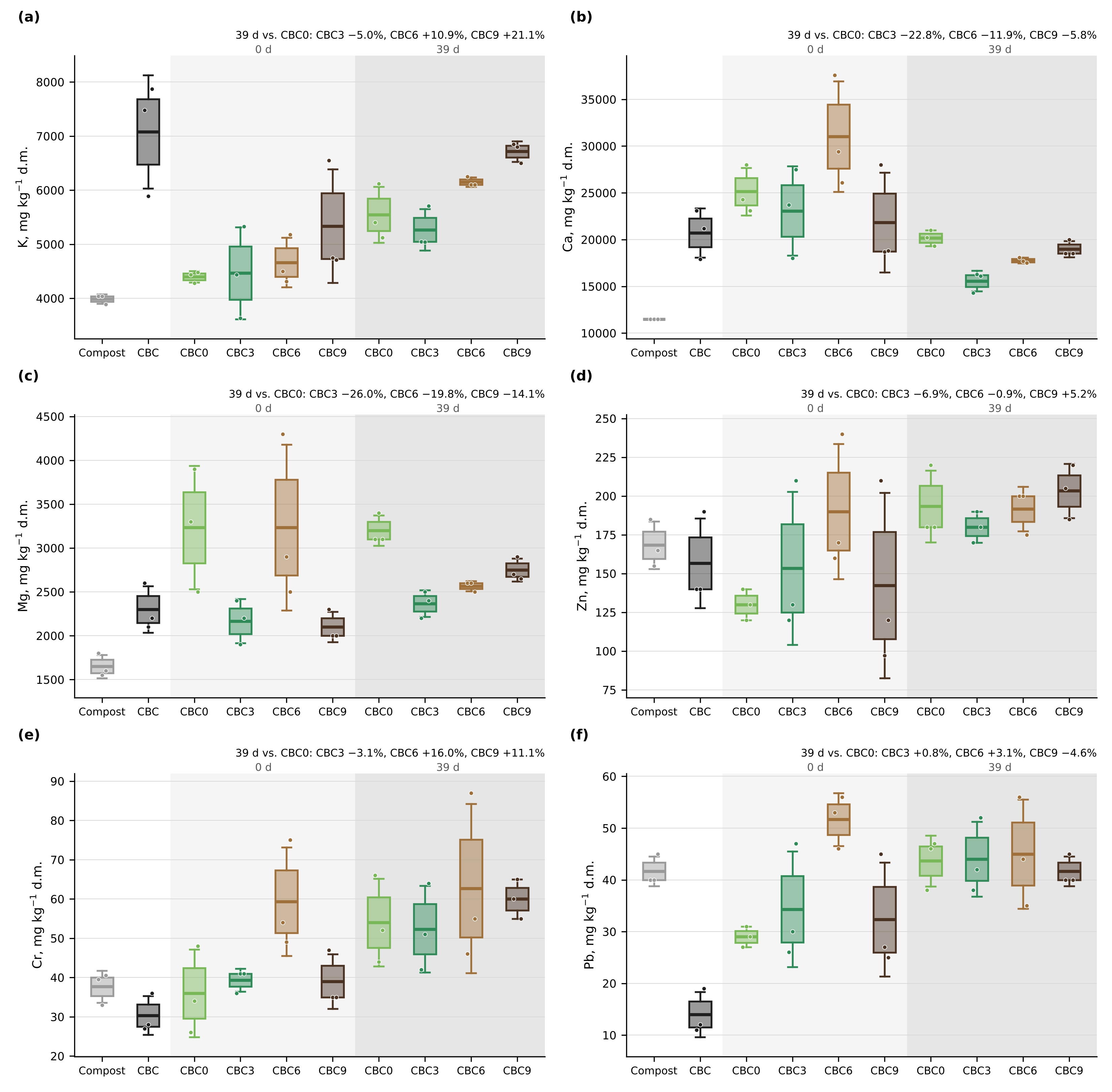
All samples before and after the process were additionally examined for nutrient and heavy metal content (Figure 1 and Appendix A, Figure A1). The observed increase in potassium (K) concentration in the final compost with increasing biochar addition rates (+10.9% and +21.1% for 6% and 9% CBC, respectively) is consistent with the known chemical composition of biochar produced by pyrolysis. During thermal conversion, volatile compounds are released and mineral elements—including K—become concentrated in the solid residue [18]. This is further supported by D’Hose et al. [19], who confirmed that biochar-blended compost had a lasting positive effect on soil K content compared with compost or biochar applied separately. The dose-dependent response observed in the present study—with 3% CBC showing a slight decrease (−5.0%) and 6% and 9% CBC showing clear increases—suggests a threshold effect, below which K contributed by biochar does not compensate for the dilution of the compost matrix.
Figure 1.
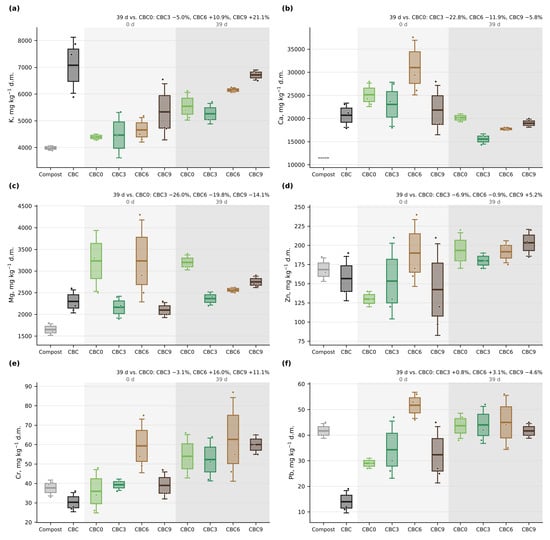
Elemental composition (mg kg−1 d.m.) of the feedstock compost (Compost), compost’s biochar (CBC) and the composting mixtures (CBC0–CBC9) at day 0 and after 39 days of pilot-scale composting: (a) K, (b) Ca, (c) Mg, (d) Zn, (e) Cr and (f) Pb. Line, mean; box, ±SE; whiskers, ±SD; dots, analytical replicates (n = 3) of the composite laboratory sample. Percentages above each panel show the change relative to CBC0 after 39 days.
In contrast to the K content, the final Mg content was lower in all amended piles than in CBC0 (−26.0%, −19.8% and −14.1% for 3%, 6% and 9% CBC, respectively; Figure 1c), whereas Mn increased at 6% and 9% CBC addition (+11.8% and +28.8%). The increase in manganese (Mn) is of agronomic importance, as Mn is an essential micronutrient involved in the activation of enzymes and assimilation of nitrogen. Conversely, the lower Mg content is undesirable, given Mg’s central role in chlorophyll synthesis and photosynthesis [20]. Similarly, the dose-dependent increase in Cu (+1.0%, +11.2%, +6.6%) supports the view that compost biochar can serve as a source of micronutrients, as also reported by Wang et al. [21], where biochar addition enhanced the overall nutrient content of the final product and a minimum 5% biochar ratio was recommended to achieve meaningful improvements. These findings are in line with the present results, where the most pronounced enrichment in K, Mn and Cu was observed at 6–9% CBC addition.
The final calcium (Ca) content was lower in all amended piles than in CBC0, with a decrease of −22.8%, −11.9% and −5.8% for 3%, 6% and 9% CBC, respectively. However, the decrease was not proportional to the CBC rate (Figure 1b). It is conceivable that a dilution of the calcium contributed by the compost feedstock may have occurred; nevertheless, given that the calcium content of CBC was of the same order as that of the final control compost, this hypothesis remains provisional. Furthermore, the presence of pile-specific heterogeneity in the feedstock may also have contributed to the observed outcomes. This result differs from studies using high-Ca feedstocks such as animal manure or lime-rich materials, which yield biochars with elevated Ca content [21].
The concentrations of chromium (Cr) and lead (Pb) in the final compost samples exhibited minimal variation among the four piles (ranging from −3.1% to +16.0% for Cr and from −4.6% to +3.1% for Pb relative to CBC0; Figure 1e,f). These differences were negligible in comparison to the variability observed in the replicate determinations. Despite the potential enrichment of non-volatile trace elements in biochar during the process of pyrolysis, where organic matter is partially volatilised [18], the CBC under investigation in this study exhibited lower concentrations of Cr and Pb compared to the final composts (Figure 1e,f). Consequently, the addition of CBC did not result in a marked enrichment of these metals. Many authors confirm that the type of biochar and the presence of compost are critical determinants of heavy metal behaviour in amended soils, noting that depending on the metal and biochar type, either immobilisation or mobilisation can occur [22,23]. These studies specifically showed that while biochar–compost mixtures effectively reduced the extractable fraction of Pb and Zn in contaminated soils, the response was not uniform across all metals, with Cu and certain other trace elements exhibiting more complex behaviour.
It should be noted that due to the fact that only one composite laboratory sample was analysed for each pile, the differences in elemental composition described above were not tested statistically and should thus be regarded as descriptive (Figure 1 and Figure A1). The absence of a consistent enrichment pattern is consistent with the selective nature of biochar-induced elements. concentration, as not all elements are enriched equally during pyrolysis and the resulting biochar composition reflects both feedstock chemistry and production conditions [18].
The total metal contents of the final composts were found to be well below the regulatory limit values applicable to compost used as a fertiliser. However, it is imperative to emphasise that adherence to these limits is expressed in terms of the total (aqua regia-extractable) contents and does not inherently substantiate ecological safety, given that metal toxicity is contingent on the soluble and bioavailable fractions, which were not ascertained in the present study. This finding is consistent with the conclusions of Visioli et al. [22], who showed that phytotoxic effects in soil bioassays were only observed at very high biochar application rates (≥5–10% w/w), far exceeding the doses used in the present work, and with Coelho et al. [18] and Karer et al. [23], who stressed that total heavy metal concentrations must be interpreted in the context of regulatory thresholds and bioavailability rather than total content alone.
The absence of detectable Hg in all samples (all values < 0.01 mg kg−1 d.m.) is consistent with the high volatility of mercury during pyrolysis, as this element is effectively driven off at the temperatures typically used for biochar production [18], indicating that Hg was not of concern in the tested materials.
2.2. Water-Extractable Ions in the Final Composts
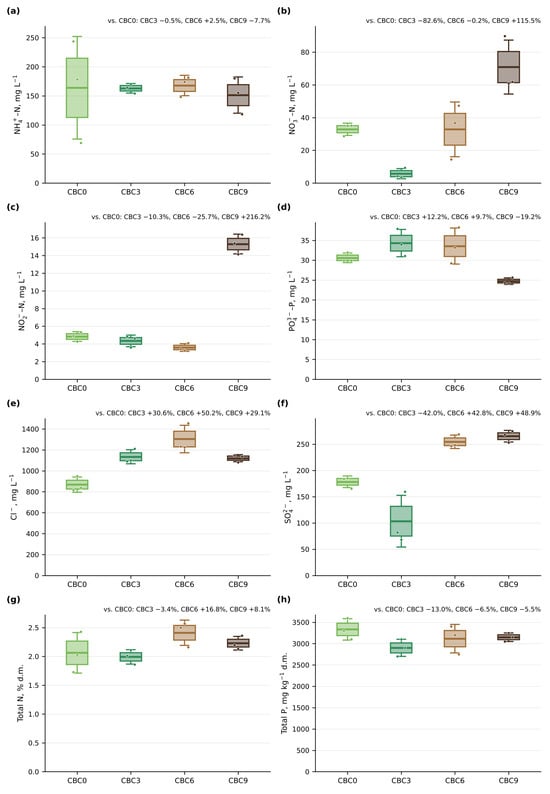
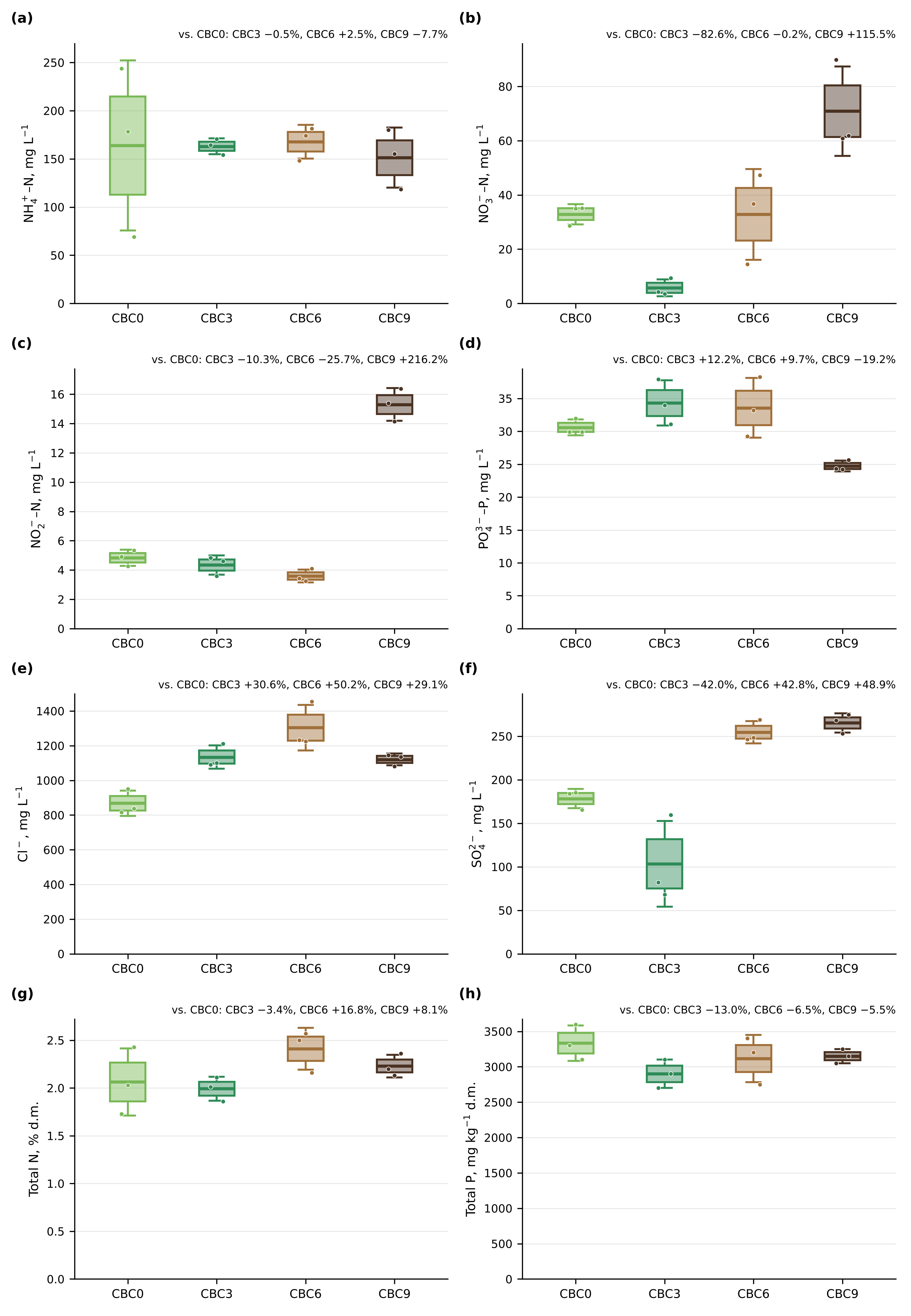
Ion concentrations are expressed in milligrams per litre of the 1:10 aqueous extracts, with nitrogen (N) and phosphorus (P) forms given as ammonium (NH4+–N), nitrate (NO3−–N), nitrite (NO2−–N) and phosphate (PO43−–P) (Figure 2). The most pronounced differences were observed in the mineral N forms (Figure 2a–c). The NH4+ –N concentration was found to be comparable in the four piles (151–168 mg L−1; Figure 2a). However, given the considerable variability observed in the replicate determinations, particularly in CBC0, it is not possible to ascertain any effect of CBC on NH4+ content or NH3 losses from these data. The total nitrogen (1.99–2.41% d.m.; Figure 2g) levels exhibited minimal variation among the piles. As stated by Ahmad et al. [24], NH4+ is initially the dominant form of N in the composting process, but as the material matures, the proportion of NO3− increases, which indicates the activity of nitrifying microorganisms. The NO3−–N concentration exhibited a marked increase in CBC9 (70.9 mg L−1) in comparison to the other piles (5.7–32.9 mg L−1; Figure 2b). Furthermore, it did not demonstrate a unidirectional increase with the CBC rate, exhibiting a nadir in CBC3. Higher nitrate levels may be indicative of more advanced nitrification in this particular pile, although it should be noted that nitrification was not measured directly. Conversely, the considerably elevated NO2–N concentration in CBC9 (15.3 mg L−1) in comparison to the range of 3.6–4.8 mg L−1 observed in the other piles (Figure 2c) may suggest a partial deceleration in the second stage of nitrification (NO2−–N → NO3−). It is hypothesised that this phenomenon may be attributable to either the restricted oxygen availability within the microenvironments of biochar pores or the elevated pH of CBC9 (Table 1). However, it should be noted that neither of these mechanisms was subjected to direct verification in the present study. A similar phenomenon of NO2− accumulation in alkaline materials was reported by İlay [25] when studying the effect of biochar from olive pomace produced at 700 °C. A comparison with the study by Huang et al. [26], which used chemically modified biochar, indicates a similar direction of change—in both cases, the use of biochar increased the amount of nitrogen retained in the material. Huang and colleagues showed that MgO- and HNO3-activated biochar increased the content of NH4+ and organic N compounds. The differences in process intensity may result from the nature of the material used—CBC acted primarily physicochemically (adsorption and pH buffering), whereas chemically modified biochars exhibited the ability to undergo surface reactions. The PO43−–P concentration (Figure 2d) ranged from 24.7 to 34.3 mg L−1 and was lowest in CBC9, whereas total P (2900–3333 mg kg−1 d.m.; Figure 2h) varied little among the piles. The lower water-extractable PO43−–P in CBC9 may be related to sorption and the formation of poorly soluble Ca–P and Mg–P compounds, although P speciation was not determined. Similar effects were described by Su et al. [27], indicating that the presence of Mg2+ and PO43− ions in compost promotes struvite precipitation and phosphorus stabilisation. The SO42− concentration (Figure 2f) was higher in CBC6 and CBC9 (255–265 mg L−1) than in CBC0 (178 mg L−1), whereas it was lowest in CBC3 (103 mg L−1). This may be due to the oxidation of organic sulfur compounds during the maturation phase and the accumulation of sulfates within the biochar structure. A similar increase in SO42− content in soils with biochar was observed by İlay [25], explained by an increase in the negative charge of the sorption complex and the mobility of anions in an alkaline environment. The Cl− concentration (Figure 2e) was higher in all CBC-amended piles (1121–1304 mg L−1) than in the control (868 mg L−1), with only small differences among the three CBC rates. This phenomenon is undesirable from the perspective of compost fertiliser quality, as Cl− ions can limit NO3− uptake by plants, potentially due to competition for ion transport [28].
Figure 2.
Water-extractable ions in 1:10 aqueous extracts of the final composts (39 d): (a) NH4+–N, (b) NO3−–N, (c) NO2−–N, (d) PO43−–P, (e) Cl− and (f) SO42− (mg L−1), and (g) total N (% d.m.) and (h) total P (mg kg−1 d.m.). Line, mean; box, ±SE; whiskers, ±SD; dots, analytical replicates (n = 3) of the composite laboratory sample. Percentages above each panel show the change relative to CBC0.
2.3. Ecotoxicological Assessment
2.3.1. Phytotoxkit Test
The phytotoxicity of the composts was evaluated in mixtures of compost with reference soil using Triticum aestivum, Sinapis alba and Pisum sativum L. at compost concentrations of 100%, 50%, 25%, 12.5%, 6.25% and 3.125%. Root and shoot elongation inhibition was calculated relative to the reference-soil control.
The phytotoxic response was concentration-dependent, with the strongest inhibition generally observed at 100% and 50% compost. No relevant inhibition was observed at the two lowest tested concentrations. Among the tested compost variants, CBC9 produced the highest mean inhibition of root and shoot elongation, whereas CBC0 and CBC3 generally produced lower responses. The magnitude of the effect varied among the three plant species and between root and shoot endpoints.
No growth inhibition was detected at concentrations of 6.25% and 3.125%. This may reflect the dilution of potentially phytotoxic compounds, including ammonium, volatile fatty acids, phenolic substances, and incompletely mineralised organic matter, below biologically effective concentrations [29,30].
The impact of biochar dosage merits further investigation. As shown in Table 2, CBC9 (9% biochar) generally produced the highest observed inhibition of root and shoot growth, particularly at 100% and 50% compost. For T. aestivum, root inhibition reached 67.9% at 100% compost, decreasing to 45.0% and 25.8% at 50% and 25%, respectively, while shoot inhibition peaked at 72.5%. CBC6 (6% biochar) generally produced the second-highest inhibition, causing 42.7% root and 53.8% shoot inhibition in wheat at full concentration. Conversely, CBC0 and CBC3 generally exhibited lower, comparable levels of inhibition, primarily at compost concentrations of 100% and 50%. The observed responses suggest higher phytotoxicity of the composts produced with higher CBC rates; because each rate was represented by a single pile, this pattern is descriptive and cannot be separated from possible pile-specific effects. One possible explanation may involve pyrolysis-derived contaminants, including PAHs and volatile organic compounds, although these compounds were not directly measured in the present study [31,32,33].
Table 2.
Inhibition (%) of root and shoot elongation in the Phytotoxkit assay in mixtures of compost with reference soil (100–3.125% compost) and EC50 screening estimates. EC50 (% compost) was obtained by linear interpolation between the two concentrations bracketing 50% inhibition; >100 indicates that 50% inhibition was not reached in undiluted compost (right-censored value); 0 indicates no inhibition (negative values, i.e., stimulation of elongation, were set to 0). Values are means of three replicate plates with 10 seeds each, i.e., laboratory replicates of a single pile per treatment. No inhibition was recorded in the reference-soil control.
Overall, Triticum aestivum showed the strongest phytotoxic response, particularly in the CBC9 treatment. Sinapis alba generally showed an intermediate response, whereas P. sativum was generally the least responsive species, particularly at compost concentrations below 25%. The comparatively lower response of pea may be related to species-specific differences in detoxification capacity or root uptake of phytotoxic compounds [34].
In some treatments, shoot elongation was slightly more inhibited than root elongation. This pattern was most evident in T. aestivum in the CBC9 treatment (72.5% shoot vs. 67.9% root inhibition), suggesting a somewhat stronger response of shoot elongation in this treatment. This response is consistent with findings from previous compost phytotoxicity studies [35].
2.3.2. Ostracodtoxkit Test
The sublethal toxicity of compost samples was assessed using the Ostracodtoxkit F solid-phase microbiotest with Heterocypris incongruens. The control validity criteria were met, with a mean body length increasing from 166.7 µm to 513.7 µm over six days and 0% control mortality, in accordance with ISO 14371:2012 [36].
No mortality was observed in any of the tested compost variants (Table 3). Therefore, the biological response was expressed exclusively as a sublethal effect on the organisms’ growth. Mean growth inhibition was low in CBC0 and CBC3 (3.0% and 1.1%) and markedly higher in CBC6 and CBC9 (61.6% and 83.2%). Because a single pile was tested per rate, differences between these treatments should be interpreted with caution [37].
Table 3.
Results of the Ostracodtoxkit F test with Heterocypris incongruens.
The findings suggest a non-linear pattern, with a marked increase in growth inhibition between 3% and 6% CBC; however, given the single pile per rate, this should not be interpreted as an established toxicity threshold. This pattern may be associated with increased exposure to particulate-associated contaminants; however, the role of PAHs or their derivatives cannot be confirmed because these compounds were not measured. Such contaminants could impair H. incongruens growth through sediment contact and ingestion. It has been demonstrated by preceding studies that low-temperature biochars have the capacity to retain mobile organic compounds that possess toxic properties [31]. Furthermore, biochar has been observed to facilitate the migration of PAHs from the pore water to the solid phase, thereby enhancing their bioavailability to deposit-feeding invertebrates [38]. A comparison with the Phytotoxkit demonstrated consistent identification of CBC9 as the treatment producing the strongest biological response and CBC0–CBC3 as the treatments producing the weakest responses. However, the Ostracodtoxkit showed more pronounced differentiation among the compost variants, consistent with exposure to undiluted compost, including particle ingestion, whereas in the plant test the compost was diluted with reference soil. This finding aligns with the observations reported by Oleszczuk [35], who noted that composted sewage sludge may demonstrate reduced phytotoxicity while maintaining or increasing toxicity towards H. incongruens. This phenomenon can be attributed to variations in contaminant bioavailability and exposure pathways.
Under the tested conditions, the CBC3 pile did not show a higher biological response than the unamended CBC0 pile, whereas a marked response was already observed in the CBC6 pile and the strongest response in the CBC9 pile. These results emphasise the necessity of optimising biochar application rates and support the incorporation of ecotoxicological bioassays alongside chemical quality criteria when evaluating biochar-amended compost.
3. Integrated Interpretation of the Chemical and Ecotoxicological Data
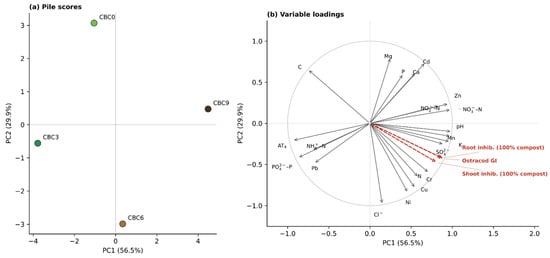
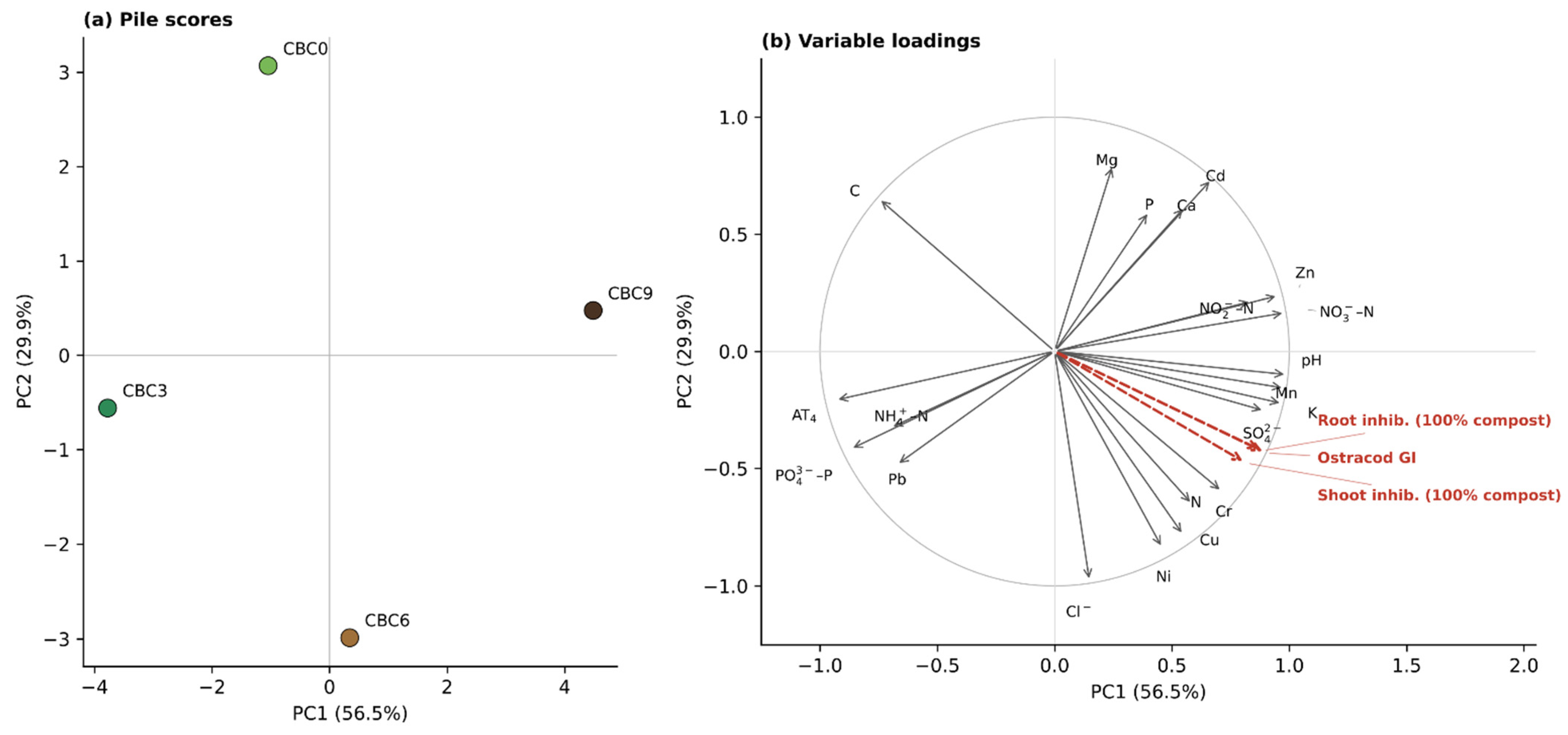
The integration of the elemental, ionic and bioassay datasets facilitates the exploration of potential drivers of the observed differences in toxicity. However, due to the representation of each CBC rate by a single pile, the correlation and PCA results are descriptive and cannot establish causal relationships. In order to explore these relationships, a principal component analysis (PCA) was performed on the mean values of the 21 chemical variables of the final composts (Figure 3; Table A1 in Appendix A). Due to the limited availability of only four piles, the analysis is inherently descriptive in nature. With a maximum of four observations, the extraction of at most three components is possible. Consequently, the first two components (representing 56.5% and 29.9% of the total variance, respectively) inevitably summarise the majority of the variance. PC1 demonstrated a positive association with pH, NO3−–N, Mn, K, Zn, SO42− and NO2−–N (loadings 0.84–0.99). However, a negative association was observed with AT4 (−0.94), PO43−–P (−0.87), total C (−0.75) and NH4+–N (−0.70). In contrast, PC2 exhibited a capacity to differentiate Mg, Cd, Ca and P (positive loadings 0.60–0.80) from Cl−, Ni and Cu (negative loadings −0.79 to −0.98). Along PC1, the piles were ordered CBC3 < CBC0 < CBC6 < CBC9, with CBC9 clearly separated from the other piles (Figure 3a). In contrast, PC2 mainly separated CBC0 from CBC6. The close alignment of K, Mn and pH on PC1 is consistent with the mineral ash fraction that becomes concentrated in the solid residue during pyrolysis, whereas Ca, Mg and P, which represent the compost mineral matrix, loaded mainly on PC2.
Figure 3.
Principal component analysis (PCA) of the final composts (39 d; pile means of 21 chemical variables, n = 4): (a) pile scores; (b) variable loadings (correlations of the variables with PC1 and PC2), with the bioassay endpoints (mean root and shoot inhibition at 100% compost and ostracod growth inhibition) projected as supplementary variables (red dashed arrows).
As the bioassay endpoints were only available at the pile level (n = 4), and since most EC50 values were right-censored (>100%; Table 2), it was decided that they would not be entered into the PCA, nor would they be correlated statistically with the chemical variables. Conversely, the mean root and shoot inhibition at 100% compost (three species) and the ostracod growth inhibition were projected onto the PCA as supplementary variables (Figure 3b). The alignment of all three endpoints with PC1 (r = 0.82–0.90; n = 4) was observed, indicating a concordance with the direction of higher K, Mn, pH and oxidised N forms, and lower AT4 and PO43−–P. As both K and Mn are elements enriched by biochar addition (Figure 1a and Figure A1), and neither is toxic at the concentrations recorded, this alignment is best interpreted as a covariance signal rather than direct causation. This is because the chemical variables and the endpoints all co-vary with the CBC rate, thus resulting in an association that is confounded by the amendment rate itself. It is therefore proposed that K and Mn act as chemical tracers of biochar loading. CBC may co-introduce other biologically active constituents, such as pyrolysis-derived organic compounds (e.g., PAHs and volatile organics) [31] or contaminants inherited from the parent compost. However, these were not measured, and their role remains a hypothesis. The position of AT4 opposite the toxicity endpoints is consistent with the interpretation that the high CBC dose inhibited microbial activity (Section 2.1.1).
However, when only four piles are considered, the PCA is unable to differentiate the contributions of individual elements. Zn (0.96), Cr (0.72) and Cd (0.67) also exhibited high positive PC1 loadings, whereas Pb loaded negatively (−0.68). Consequently, the PCA does not permit the exclusion of trace metals, despite their minimal concentrations and negligible variation among the final composts (Figure 1 and Figure A1). Water-extractable phosphate (Figure 2d) did not increase with the CBC rate and was lowest in CBC9. Consequently, the present data do not provide evidence that total heavy-metal contents can be considered a contributing factor to the observed differences in the ecotoxicological response. However, it should be noted that the study exclusively measured total (aqua regia-extractable) contents; consequently, soluble and bioavailable metal fractions in the exposure media remained unmeasured. This methodological shortcoming precludes the possibility of excluding a contribution of metals to the observed toxicity. The present finding is consistent with the observations of Visioli et al. [22], who reported phytotoxic effects only at biochar rates that considerably exceeded those used in the present study. It is also aligned with the conclusions of Karer et al. [23], who emphasised that the interpretation of total metal content must be contextualised within the framework of bioavailability rather than regarded as an independent entity.
The ionic data serve to both refine and complicate the overall picture. Ammonium (Figure 2a), a classic compost phytotoxin, exhibited comparable levels across all piles and did not demonstrate a toxicity gradient; consequently, it alone does not account for the heightened responses observed in CBC6 and CBC9. However, the potential contribution of ammonium (along with free NH3, which accounts for approximately 18–20% of total ammoniacal N at the measured pH in CBC0-CBC3, 23% in CBC6, and 29% in CBC9; pKa = 9.25, 25 °C) to the overall toxicity cannot be ruled out. The findings of the study demonstrated a correlation between two ionic signals and the biological responses. Firstly, the pronounced accumulation of NO2−–N in CBC9 (15.3 mg L−1; Figure 2c) coincided with the maximum phytotoxicity and the maximum ostracod growth inhibition. However, NO2−–N in CBC6 exhibited a comparable trend to that observed in CBC0 and CBC3, although ostracod growth inhibition in CBC6 had already attained 61.6%. This suggests that nitrite is unlikely to be the primary factor responsible for the response at 6% CBC, and at most, it may have contributed to the subsequent increase observed at 9% CBC. The marked increase in the range of 3% to 6% CBC was found to coincide with higher pH levels, increased concentrations of SO42−, and elevated levels of K and Mn. Nitrite is a well-characterised phytotoxin and aquatic toxicant. In plants, it acidifies the rhizosphere, interferes with respiratory electron transport and promotes nitrosative stress during germination. In aquatic invertebrates, it is taken up across permeable epithelia, inducing oxidative stress and impairing ion regulation. We hypothesise that the build-up of NO2− resulted from inhibition of the second nitrification step (NO2− → NO3−), possibly within oxygen-limited micro-environments of biochar pores or as a result of the higher pH [25]; neither oxygen availability nor nitrifier activity was measured. Nitrite therefore provides one possible, but untested, chemical explanation for the higher biological response observed at the highest CBC dose. Secondly, the pore waterSO42− concentration was higher at 6–9% CBC (255–265 mg L−1) than in CBC0 and CBC3 (178 and 103 mg L−1; Figure 2f) and thus followed the biological responses; together with the higher Cl− in the amended piles (1121–1304 vs. 868 mg L−1 in CBC0; Figure 2e), it may have increased the ionic strength of the pore water and imposed additional osmotic and salinity stress. Chloride alone, however, does not explain the pattern, because it was also elevated in CBC3, which showed no increased response, and as electrical conductivity was not measured, a salinity effect remains a hypothesis. Moreover, the ion concentrations were determined in 1:10 aqueous extracts; they characterise the water-extractable pool and allow the piles to be compared, but they are not identical to the pore-water concentrations to which the organisms were exposed in the solid-phase bioassays. Elevated chloride levels can exert a direct osmotic effect on germinating seeds and on H. incongruens. In addition, it has been hypothesised that chloride may antagonise NO3− uptake by competing for anion transport, thereby compounding the nutritional imbalance in the amended piles. If present at effective concentrations in the aqueous phase, these ionic stressors would act on both bioassays concomitantly, which would be consistent with the concordant identification of CBC9 as the most toxic variant in both tests.
The basic physicochemical parameters summarised in Table 1 add a further, and in some respects unexpected, dimension to the interpretation of the toxicity gradient. The most striking observation is the apparent decoupling of biological stability from ecotoxicity. CBC9 displayed the lowest respiration activity (AT4 = 7.40 mg O2 g−1 d.m.)—the only value below the commonly cited stability benchmark of ~10 mg O2 g−1 d.m.—which, taken alone, would suggest the highest biological stability of the four composts. However, as discussed in Section 2.1.1, after 39 days of composting this low value is interpreted mainly as an inhibition of the overall microbial activity by the high biochar dose rather than as greater maturity. Consistently, the same variant produced the strongest response in both the Phytotoxkit and the Ostracodtoxkit assays. This dissociation shows that a biochar-amended compost may meet a conventional respirometric stability criterion because of inhibited microbial activity rather than maturity, while simultaneously exhibiting elevated ecotoxicity, and it directly reinforces the central argument of this study: respirometric and chemical indices alone may be insufficient to certify the ecological safety of such materials, and direct-contact bioassays are required as a complementary line of evidence.
The pH data in Table 1 reveal that compost pH rises with increasing biochar dose (up to 8.86 in CBC9), indicating biochar’s pH-buffering and mild liming effects. This rise in alkalinity may have contributed to the accumulation of nitrite in CBC9, as alkaline conditions (through free NH3) can inhibit the second step of nitrification (NO2− → NO3−), leading to a transient buildup of NO2−. This coincides with the highest phytotoxicity and ostracod growth inhibition at 9% CBC, whereas the marked increase in ostracod growth inhibition between 3% and 6% CBC occurred without nitrite accumulation. Additionally, a decline in moisture content and a slight increase in volatile solids reflect biochar’s low moisture and carbon-rich, porous nature, though these factors are not directly linked to the toxicity gradient.
Taken together, the elemental and ionic analyses suggest that the differences in ecotoxicity among the piles are multifactorial rather than attributable to any single contaminant. Among the measured parameters, higher pH, SO42−, K and Mn from 6% CBC upwards and nitrite accumulation at the highest CBC rate co-varied with the biological responses; pyrolysis-derived organic compounds and contaminants inherited from the parent compost are additional plausible contributors, but they were not measured. In contrast, total heavy-metal concentrations and ammonium alone do not explain the differences in the biological response, although a contribution of free NH3 and of bioavailable metal fractions cannot be excluded. The PCA describes association rather than causation, and the toxicity endpoints were measured in solid-phase bioassays rather than on individually speciated compounds, so the relative contribution of organics, nitrite, and salinity cannot be fully disentangled from the present data alone. Nevertheless, CBC3 demonstrated the most favourable ecotoxicological profile of the tested rates, as it did not produce the increased biological responses observed for CBC6 and CBC9. Concurrently, CBC3 exhibited the most pronounced respiration activity (AT4 = 18.97 mg O2 g−1 d.m.), yet it did not attain the established benchmark of 10 mg O2 g−1 d.m. Nonetheless, it is anticipated that full stabilisation will not be achieved within 39 days of composting. Further maturation of all variants is deemed necessary prior to their utilisation. The low AT4 of CBC9, in turn, reflects inhibited microbial activity rather than greater maturity. Consequently, CBC3 did not demonstrate the inhibitory and ecotoxic effects observed at higher rates, but its stability after a complete maturation phase remains to be verified; 3% CBC should be regarded as the most promising tested rate with respect to its ecotoxicological profile rather than as an established optimum for overall compost quality.
The findings of the present study lend support to the notion of conducting further evaluations of the chemical composition of biochar (CBC) at rates of approximately 3% in co-composting, in independently replicated piles and under field conditions, and of pairing chemical speciation with multi-trophic bioassays when assessing the ecological safety of biochar-amended compost. Several limitations should be borne in mind when interpreting these results. First, pyrolysis-derived organic compounds, including PAHs and volatile organics, were not measured, so their proposed contribution to the observed toxicity remains a hypothesis rather than a demonstrated mechanism. Secondly, one pile was operated per CBC rate; one composite laboratory sample (approximately 10 kg, obtained by quartering material collected from three cross-sections of the pile) was analysed per pile in three analytical replicates. It should be noted that these reflect analytical precision only and not within-pile or between-pile variability. Consequently, statistical analysis was not employed to evaluate the disparities between the piles. This precludes the ability to disaggregate the effects that are specific to a given pile, such as local variations in the feedstock or process conditions, from the impact of the CBC rate. The study should thus be regarded as an exploratory pilot-scale case study; the dose-related trends are consistent across two bioassays but have not been reproduced across independent piles. Third, EC50 values were obtained by linear interpolation between a limited number of concentrations; only four of 24 series reached 50% inhibition, the remaining values are right-censored (>100%), and all EC50 values should be treated as screening estimates rather than toxicity thresholds. Fourth, both bioassays were performed on the bulk solid phase (compost–reference soil mixtures and undiluted compost), which captures the combined effect of all mobile constituents but does not allow the contributions of individual toxicants to be resolved. Fifth, the parent compost from which the CBC was produced did not meet fertiliser quality requirements, so contaminants inherited from that feedstock cannot be excluded as a contributor to the observed responses alongside compounds generated during pyrolysis; the parent material was not subjected to the same bioassays. Sixth, only total metal contents were determined, and the results were obtained for a single CBC feedstock, one pyrolysis temperature (550 °C), a 39-day composting period and laboratory bioassays, without field validation. Seventh, the contributions of individual stressors were not tested directly: no pH- or conductivity-matched controls, nitrite spiking or parallel bioassays of the biochar and its parent compost were performed, and these constitute the priority for confirmatory work.
From an environmental perspective, the practical consequence of these results is that the quality criteria currently used to release compost for agricultural use may not detect the risk introduced by a biochar amendment. All four composts complied with the heavy-metal limit values laid down in Regulation (EU) 2019/1009, and CBC9 additionally showed AT4 below the stability benchmark, yet CBC9 produced the strongest response in both the terrestrial and the freshwater bioassay. Because the effects were recorded in an aquatic invertebrate as well as in three crop species, they are not confined to the amended soil itself: the mobile constituents that co-varied with toxicity here, i.e., sulfate and, at the highest CBC rate, nitrite, are those readily transported with drainage water. Verification of the leaching behaviour of biochar-amended composts under field conditions, combined with speciation of the pyrolysis-derived organic fraction, is therefore the priority for further work.
4. Materials and Methods
4.1. Materials
This composting study used a mixture of 90% green waste and 10% sewage sludge, ground to a uniform size of less than 5 cm. Biochar was added at varying proportions (0, 3, 6 and 9% of the dry matter of the green waste–sewage sludge mixture, whose dry matter content was approximately 40%) and was produced by pyrolysis at 550 °C with a 1-h residence time from mature but off-specification compost, i.e., compost that had reached biological stability but did not meet fertiliser quality requirements. Compost’s biochar (CBC) was sourced from Best-Eko composting company (Rybnik, Poland) and pelletised for composting, based on prior findings that it effectively mitigates gas and improves compost quality [39]. A total of 1 Mg of CBC was produced.
4.2. Experimental Procedure
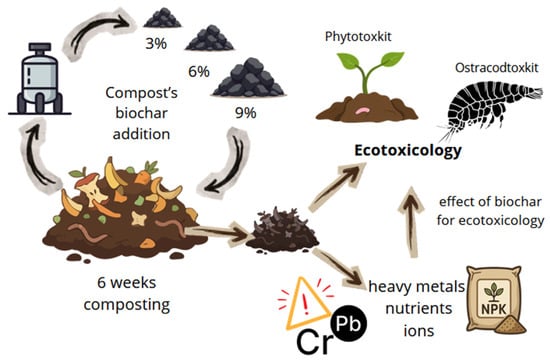
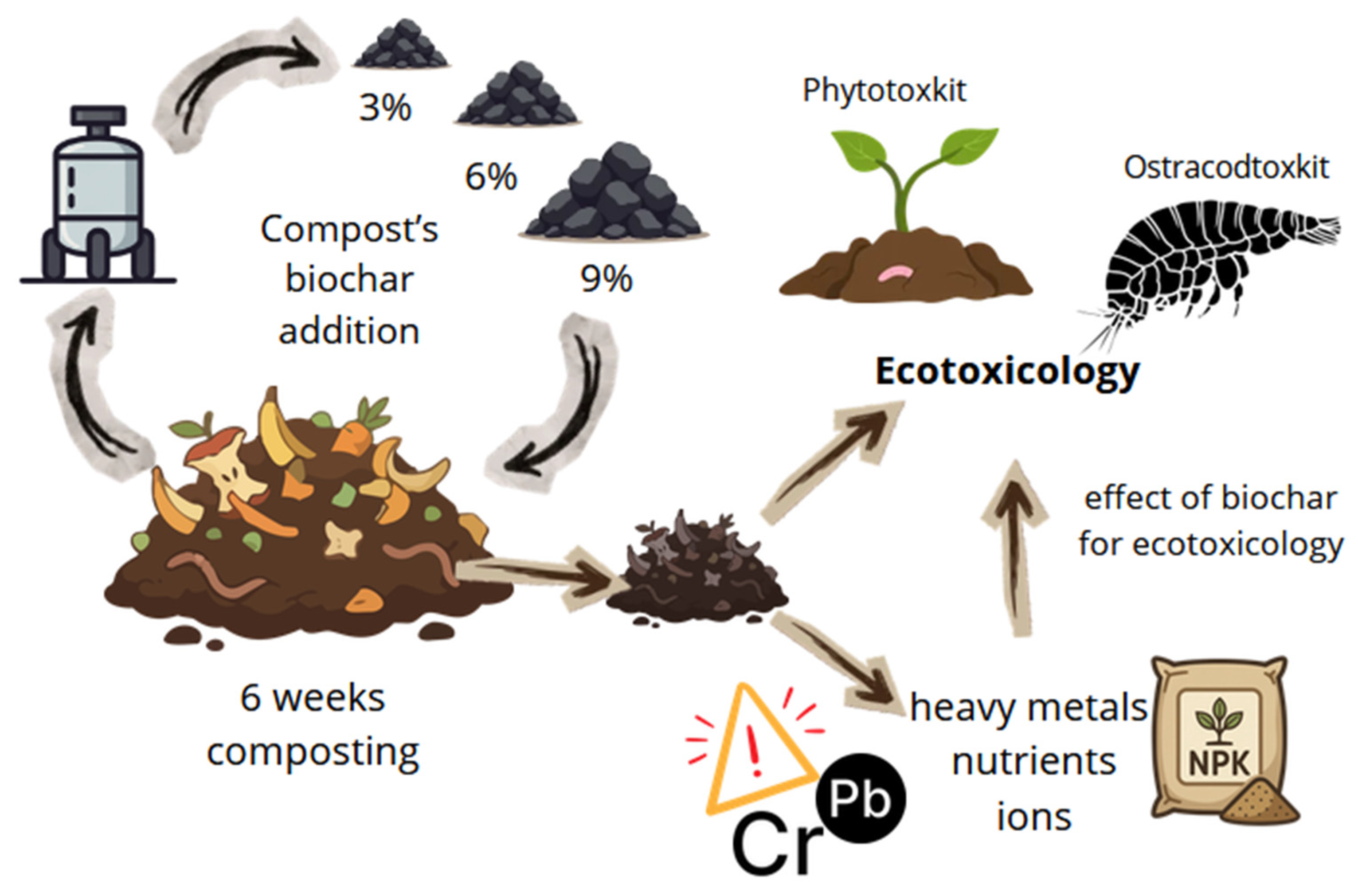
Composting experiments were conducted at the Best-Eko composting plant (Rybnik, Poland) using four pilot-scale piles with 0%, 3%, 6%, and 9% CBC (dry matter) added to green waste–sewage sludge mixtures at a 9:1 ratio (Figure 4). Each pile (approximately 15 Mg) underwent a 39-day composting process with weekly turning and aeration via air channels. The optimal temperature (>50 °C) and oxygen (>15%) for the process were provided with forced aeration. The operation of one of these piles was conducted at a rate consistent with the CBC. At each designated sampling time (i.e., day 0 and day 39), samples were collected immediately following the mixing of the pile with a windrow turner. Subsamples were then taken from three cross-sections of the pile, with approximately one dozen subsamples obtained from each section. The entirety of the collected material was then amalgamated, mixed, and reduced by quartering to a mass of approximately 10 kg. This constituted the composite laboratory sample of the pile. Consequently, one composite laboratory sample was obtained from each pile at each sampling time, and all laboratory analyses were performed on this sample in three analytical replicates (n = 3). After 39 days of composting, samples were collected to determine the effect of CBC on nutrient content, pollutants (heavy metals and ions) and ecotoxicity:
Figure 4.
The experimental composting procedure with compost biochar.
- basic properties (total solids and volatile solids), pH;
- inorganic ion content (F−, Cl−, NO2−, NO3−, SO42−, PO43−);
- nutrient (N, P, K, Ca, Mg) and heavy metal (Pb, Zn, Cd, Cr, Cu, Ni, Mn, Hg, As) content;
- ecotoxicity of compost: Phytotoxkit and Ostracodtoxkit tests.
4.3. Determination of Physicochemical Properties
After 39 days of composting, all samples were analysed using the methods and procedures listed in Table 4. Ion concentrations were determined in 1:10 (w/v, fresh mass) aqueous extracts, prepared by shaking at 50 rpm for 2 h followed by filtration, and are expressed in mg L−1 of extract; N and P forms are expressed as NH4+–N, NO3−–N, NO2−–N and PO43−–P. Total C and N were determined by elemental analysis (CHNS 2400 analyser, PerkinElmer, Waltham, MA, USA), and NH4+ by the Kjeldahl distillation method with titrimetric determination.
Table 4.
Methods used to determine the physicochemical properties of the composts and CBC.
4.4. Ecotoxicological Tests
Ecotoxicological tests were performed experimentally on the final compost samples collected after 39 days of composting from all four variants: CBC0, CBC3, CBC6 and CBC9. Both assays were solid-phase tests: the Phytotoxkit assay was performed on mixtures of compost with reference soil, and the Ostracodtoxkit F assay was performed as a direct-contact test with undiluted compost. All treatments and controls were analysed in laboratory replicates: three replicate wells per sample in the Ostracodtoxkit F assay and three replicate plates with 10 seeds each per species and concentration in the Phytotoxkit assay. The bioassays were performed on the composite laboratory sample of each pile. Because a single pile was operated per CBC rate, the wells and plates are laboratory replicates within one experimental unit rather than independent replicates of the treatment, and comparisons between rates are interpreted descriptively.
4.4.1. Ostracodtoxkit F Test
The Ostracodtoxkit F assay was conducted as a six-day direct-contact test using undiluted final compost samples CBC0, CBC3, CBC6, and CBC9. Heterocypris incongruens cysts were hatched in Standard Freshwater for 48 h at 25 ± 1 °C under continuous light according to ISO 14371:2012 [36]. Newly hatched organisms were pre-fed with Spirulina for 4 h, and their initial body length was recorded. For each sample and reference sediment, three replicate wells were set up, each with 1 mL of compost or reference sediment, 2 mL of Standard Freshwater, 2 mL of algal food suspension and 10 neonates. After six days of incubation at 25 ± 1 °C in darkness, surviving organisms were counted, measured, and used to calculate mortality and growth inhibition:
where L0 is the initial mean body length, Ls,6 is the final mean body length in the tested sample and Lc,6 is the final mean body length in the reference sediment. Growth inhibition was calculated for each well relative to the mean growth increment in the three reference-control wells (Lc,6 − L0 = 347.0 µm) and then averaged; its SD refers to the variation among the three wells. Control validity was evaluated in accordance with ISO 14371:2012 [36].
4.4.2. Phytotoxkit Test
The Phytotoxkit test evaluated the effect of the composts on seed germination and early root and shoot growth of Triticum aestivum, Sinapis alba and Pisum sativum according to ISO 18763:2016 [44] and the manufacturer’s standard operating procedure (MicroBioTests Inc., Gent, Belgium). High-quality seeds (>90% germination) were used. Composts CBC0, CBC3, CBC6 and CBC9 were mixed with the reference soil supplied with the kit to obtain 100%, 50%, 25%, 12.5%, 6.25% and 3.125% compost (w/w); the reference soil alone served as the control. The mixtures were hydrated with deionised water according to the standard operating procedure and covered with filter paper, and ten seeds were placed on the paper in each test plate (three replicate plates per species and concentration, i.e., 30 seeds; three control plates per species). The plates were incubated vertically at 25 ± 1 °C under continuous light for 5 days. Root and shoot lengths were measured, and growth inhibition was calculated as the percentage difference compared to the control:
where Lcontrol and Lsample are the mean root or shoot lengths in the reference-soil control and in the tested mixture, respectively. Negative inhibition values (stimulation of elongation) were set to 0.
Data were analysed by calculating the percentage inhibition of growth for each species and concentration. Test validity required ≥ 90% germination in the control; control germination was 100% for all three species.
4.5. Statistical Analysis
Descriptive statistics were calculated using Statistica 13.3 (TIBCO Software Inc., Palo Alto, CA, USA). As each CBC rate was represented by a single pile, and one composite laboratory sample was analysed per pile, the three analytical replicates (n = 3) reflect analytical precision only, and not variability within the pile or between the piles. Consequently, no inferential statistical tests were employed to compare the piles; the results are reported as means ± SD (with SE and the individual replicate values shown in the figures), and differences between CBC rates are expressed as percentage changes relative to CBC0 and discussed descriptively. Ostracodtoxkit growth-inhibition data were not subjected to parametric testing, because of the small number of replicate wells (n = 3) and the single pile per rate, and are reported descriptively.
The present study employed principal component analysis (PCA) to explore the relationships among the chemical variables in question. The input matrix comprised the mean values (n = 4; means of three analytical replicates) of 21 variables of the final composts (day 39): total K, P, Ca, Mg, Mn, Pb, Zn, Cd, Cr, Cu, Ni, C and N, pH, AT4 and water-extractable NH4+–N, NO3−–N, NO2−–N, PO43−–P, Cl− and SO42−; Hg was excluded because all values were below the detection limit.
It is evident that the PCA is purely descriptive in nature, given the limited availability of observations, which is constrained to a maximum of three components. The variables were subjected to z-score standardisation, PCA was performed on the correlation matrix, and the first two components were utilised for interpretation. The bioassay endpoints, which are only available at the pile level, were not included in the PCA but were projected onto it as supplementary variables (Pearson correlations of the pile-level values with the pile scores). The principal component analysis (PCA) was conducted utilising Python 3.13 (NumPy 2.5, pandas 3.0). The eigenvalues and variable loadings are delineated in Table A1 (Appendix A), and the input matrix is available upon request from the corresponding author.
As only four piles were at the researcher’s disposal, correlation coefficients among the variables and between the variables and the bioassay endpoints were not calculated or tested statistically; the associations are described on the basis of the PCA only.
Concentration–response relationships were evaluated per species and endpoint. Because only four of 24 series reached 50% inhibition, in each case only at 100% compost, fitting a parametric (log-logistic or probit) model was not justified. EC50 was therefore estimated by linear interpolation between the two tested concentrations bracketing 50% inhibition; in all four cases these were 50% and 100% compost, and the response was monotonic within that interval. Interpolation on a log-concentration scale gave values within 4 percentage points of the linear estimates (58, 56, 85 and 81% vs. 61, 58, 88 and 85%). Non-monotonic responses occurred only at low inhibition levels (<25%) and did not affect any EC50 estimate. Where inhibition did not reach 50% in undiluted compost, EC50 was reported as >100% and treated as right-censored. EC50 values are reported as screening estimates, and the percentage inhibition at 100% compost was used as the primary comparative endpoint.
5. Conclusions
In this exploratory pilot-scale study, with one pile per rate, green waste composts amended with increasing doses of compost’s biochar (0, 3, 6 and 9% of dry matter; CBC0–CBC9) were chemically characterised and evaluated ecotoxicologically using two complementary bioassays: the solid-phase Phytotoxkit (compost–reference soil mixtures; Triticum aestivum, Sinapis alba, Pisum sativum) and the direct-contact Ostracodtoxkit (Heterocypris incongruens).
The primary observation revealed that, in the compost piles exhibiting higher CBC rates, there was a discernible alteration in the elemental composition, accompanied by a pronounced intensification of the ecotoxicological responses. CBC addition was associated with elevated potassium, manganese, and, to a lesser extent, copper contents, and with diminished calcium and magnesium contents in comparison to the unamended pile. However, it should be noted that these differences were negligible and were not subjected to statistical analysis. The total metal content remained below the legal limits for fertilisers, although this does not in itself demonstrate ecological safety. CBC0 and CBC3 produced relatively low biological effects, whereas CBC6 already produced marked ostracod growth inhibition (61.6%) and CBC9 produced the strongest response, reaching 72.5% shoot inhibition in wheat and 83.2% growth inhibition in the ostracod. In the PCA, the bioassay endpoints were aligned with the elements that showed the greatest increase—potassium and manganese—as well as with pH and oxidised N forms. However, these elements are unlikely to be the causative agents of toxicity at the recorded concentrations and are interpreted as markers of the amount of CBC present. The observed pattern coincided with higher pH and SO42− from 6% CBC upwards and with nitrite accumulation at 9% CBC, while the possible contribution of pyrolysis-derived organic compounds remains hypothetical because these compounds were not directly measured. Following the integrated analysis, total heavy-metal concentrations and ammonium alone did not explain the observed biological response, although a contribution of free NH3 cannot be excluded; bioavailable metal fractions were not determined and contaminants inherited from the parent compost cannot be excluded.
In summary, the findings of this study demonstrate that the CBC rate is associated with changes in the elemental composition and toxicity of the compost under the conditions of the study (i.e., one CBC feedstock, pyrolysis at 550 °C, 39 days of composting, one pile per rate and laboratory bioassays). The markedly lower respiration activity at 9% CBC is interpreted as an inhibitory effect of biochar on the overall microbial activity rather than as greater maturity. The 3% rate demonstrated the most favourable ecotoxicological profile among the tested rates. Nevertheless, further investigation is required to ascertain its stability after a complete maturation phase, as full stabilisation is not expected after 39 days of composting. Consequently, it should be regarded as the most promising tested rate for further investigation rather than as an established optimum for overall compost quality. In order to ensure the validity of the findings, it is essential that the process of validation is carried out in two distinct stages. Firstly, the process should be replicated in an independent manner, and secondly, it should be conducted under field conditions. The results of this process indicate that a combination of chemical analysis and living-organism tests is required in order to achieve the desired outcome.
Author Contributions
Conceptualisation, S.S.-D.; methodology, S.S.-D., J.R. (Justyna Rybak) and M.W.; formal analysis, S.S.-D., J.R. (Joanna Rosik), J.R. (Justyna Rybak) and M.W.; investigation, S.S.-D. and J.R. (Joanna Rosik); writing—original draft preparation, S.S.-D., J.R. (Joanna Rosik), K.Ś., J.R. (Justyna Rybak) and M.W.; writing—review and editing, S.S.-D., J.R. (Justyna Rybak), M.W., J.R. (Joanna Rosik) and K.Ś.; supervision, S.S.-D.; funding acquisition, S.S.-D. All authors have read and agreed to the published version of the manuscript.
Funding
This research was funded by the Norway Grants 2014–2021 through the National Centre for Research and Development, grant number NOR/SGS/CompoChar/0090/2020. The APC is financed by Wroclaw University of Environmental and Life Sciences.
Institutional Review Board Statement
Not applicable.
Informed Consent Statement
Not applicable.
Data Availability Statement
The data supporting the findings of this study are available from the corresponding author upon reasonable request.
Conflicts of Interest
The authors declare no conflicts of interest.
Abbreviations
The following abbreviations are used in this manuscript:
| AT4 | Respiration activity over 4 days |
| CBC | Compost biochar |
| d.m. | Dry matter |
| EC50 | Median effective concentration |
| MC | Moisture content |
| MP-AES | Microwave plasma atomic emission spectrometry |
| PAHs | Polycyclic aromatic hydrocarbons |
| PCA | Principal component analysis |
| VC | Volatile solids content |
Appendix A
Figure A1.
Contents (mg kg−1 d.m.) of (a) P, (b) Cd, (c) Cu, (d) Ni and (e) Mn in the feedstock compost (Compost), compost’s biochar (CBC) and the composting mixtures (CBC0–CBC9) at day 0 and after 39 days of pilot-scale composting. Line, mean; box, ±SE; whiskers, ±SD; dots, analytical replicates (n = 3) of the composite laboratory sample. Percentages above each panel show the change relative to CBC0 after 39 days.
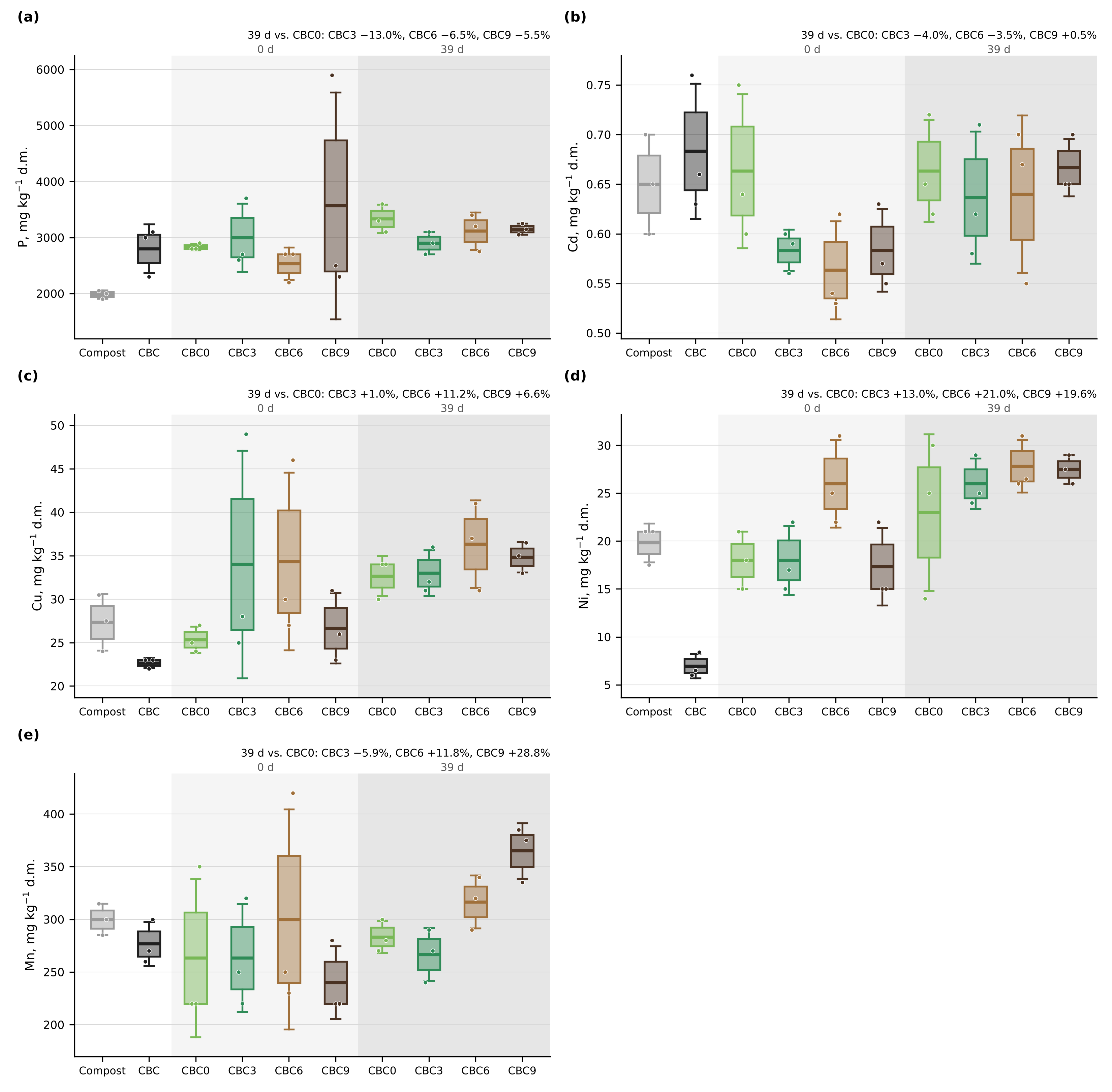
Table A1.
Eigenvalues, explained variance and loadings (correlations of the variables with the components) of the first two principal components in the PCA of the final composts (pile means, n = 4; 21 chemical variables); “sup.” denotes bioassay endpoints projected as supplementary variables (correlations of the pile-level values with the pile scores).
References
- Azis, F.A.; Rijal, M.; Suhaimi, H.; Abas, P.E. Patent landscape of composting technology: A review. Inventions 2022, 7, 38. [Google Scholar] [CrossRef] [Scilit]
- Policy Learning Platform on Environment and Resource Efficiency. The Biowaste Management Challenge; A Policy Brief from the Policy Learning Platform on Environment and Resource Efficiency; Interreg Europe: Lille, France, 2021.
- European Compost Network (ECN). ECN Data Report 2022: Compost and Digestate for a Circular Bioeconomy; ECN: Brussels, Belgium, 2022. [Google Scholar]
- European Union. Directive (EU) 2018/851 of the European Parliament and of the Council of 30 May 2018 Amending Directive 2008/98/EC on Waste. Off. J. Eur. Union 2018, L150, 109–140. Available online: https://eur-lex.europa.eu/eli/dir/2018/851/oj (accessed on 29 September 2026).
- Manea, E.E.; Bumbac, C.; Dinu, L.R.; Bumbac, M.; Nicolescu, C.M. Composting as a sustainable solution for organic solid waste management: Current practices and potential improvements. Sustainability 2024, 16, 6329. [Google Scholar] [CrossRef] [Scilit]
- Saveyn, H.; Eder, P. End-of-Waste Criteria for Biodegradable Waste Subjected to Biological Treatment (Compost & Digestate): Technical Proposals; Publications Office of the European Union: Luxembourg, 2013; Available online: https://publications.jrc.ec.europa.eu/repository/handle/JRC87124. [PubMed]
- Noor, R.S.; Shah, A.N.; Tahir, M.B.; Umair, M.; Nawaz, M.; Ali, A.; Ercisli, S.; Abdelsalam, N.R.; Ali, H.M.; Yang, S.H.; et al. Recent trends and advances in additive-mediated composting technology for agricultural waste resources: A comprehensive review. ACS Omega 2024, 9, 8632–8653. [Google Scholar] [CrossRef] [Scilit] [PubMed]
- Wang, S.P.; Wang, L.; Sun, Z.Y.; Wang, S.T.; Shen, C.H.; Tang, Y.Q.; Kida, K. Biochar addition reduces nitrogen loss and accelerates composting process by affecting the core microbial community during distilled grain waste composting. Bioresour. Technol. 2021, 337, 125492. [Google Scholar] [CrossRef] [Scilit] [PubMed]
- Guo, X.; Liu, H.; Zhang, J. The role of biochar in organic waste composting and soil improvement: A review. Waste Manag. 2020, 102, 884–899. [Google Scholar] [CrossRef] [Scilit] [PubMed]
- Li, Y.; Kumar Awasthi, M.; Sindhu, R.; Binod, P.; Zhang, Z.; Taherzadeh, M.J. Biochar preparation and evaluation of its effect in composting mechanism: A review. Bioresour. Technol. 2023, 384, 129329. [Google Scholar] [CrossRef] [Scilit] [PubMed]
- Yin, Y.; Yang, C.; Li, M.; Zheng, Y.; Ge, C.; Gu, J.; Li, H.; Duan, M.; Wang, X.; Chen, R. Research progress and prospects for using biochar to mitigate greenhouse gas emissions during composting: A review. Sci. Total Environ. 2021, 798, 149294. [Google Scholar] [CrossRef] [Scilit] [PubMed]
- Godlewska, P.; Schmidt, H.P.; Ok, Y.S.; Oleszczuk, P. Biochar for composting improvement and contaminants reduction. A review. Bioresour. Technol. 2017, 246, 193–202. [Google Scholar] [CrossRef] [Scilit] [PubMed]
- Rosik, J.; Kosiorowska, K.E.; Tomczyk, K.; Domińska, M.; Hamal, K.; Stegenta-Dąbrowska, S. Compost’s biochar as a practical odor mitigation strategy for the composting industry. Bioresour. Technol. Rep. 2025, 32, 102312. [Google Scholar] [CrossRef] [Scilit]
- Agegnehu, G.; Srivastava, A.K.; Bird, M.I. The role of biochar and biochar-compost in improving soil quality and crop performance: A review. Appl. Soil Ecol. 2017, 119, 156–170. [Google Scholar] [CrossRef] [Scilit]
- Rynk, R. The Composting Handbook: A How-to and Why Manual for Farm, Municipal, Institutional and Commercial Composters; Academic Press: London, UK, 2021. [Google Scholar] [CrossRef] [Scilit]
- Regulation of the Minister of Climate and Environment of 28 December 2022 on the Mechanical–Biological Treatment of Unsorted (Mixed) Municipal Waste. In Journal of Laws; 2023; p. item 56. Available online: https://isap.sejm.gov.pl/isap.nsf/DocDetails.xsp?id=WDU20230000056 (accessed on 9 November 2026). (In Polish)
- Xiao, R.; Awasthi, M.K.; Li, R.; Park, J.; Pensky, S.M.; Wang, Q.; Wang, J.J.; Zhang, Z. Recent developments in biochar utilization as an additive in organic solid waste composting: A review. Bioresour. Technol. 2017, 246, 203–213. [Google Scholar] [CrossRef] [Scilit] [PubMed]
- Coelho, L.; Canedo, J.N.G.V.; Custódio, M.; Flores, D.; Mourão, P.; Palma, P.; Prats, S.A. Feedstock and pyrolysis conditions of biochars: Influence on soil phytotoxicity and water ecotoxicity. Soil Biol. Biochem. 2025, 211, 109935. [Google Scholar] [CrossRef] [Scilit]
- D’Hose, T.; Debode, J.; De Tender, C.; Ruysschaert, G.; Vandecasteele, B. Has compost with biochar applied during the process added value over biochar or compost for increasing soil quality in an arable cropping system? Appl. Soil Ecol. 2020, 156, 103706. [Google Scholar] [CrossRef] [Scilit]
- Kopeć, M.; Baran, A.; Mierzwa-Hersztek, M.; Gondek, K.; Chmiel, M.J. Effect of the addition of biochar and coffee grounds on the biological properties and ecotoxicity of composts. Waste Biomass Valorization 2017, 9, 1389–1398. [Google Scholar] [CrossRef] [Scilit]
- Wang, Y.; Akdeniz, N.; Yi, S. Biochar-amended poultry mortality composting to increase compost temperatures, reduce ammonia emissions, and decrease leachate’s chemical oxygen demand. Agric. Ecosyst. Environ. 2021, 315, 107451. [Google Scholar] [CrossRef] [Scilit]
- Visioli, G.; Conti, F.D.; Menta, C.; Bandiera, M.; Malcevschi, A.; Jones, D.L.; Vamerali, T. Assessing biochar ecotoxicology for soil amendment by root phytotoxicity bioassays. Environ. Monit. Assess. 2016, 188, 166. [Google Scholar] [CrossRef] [Scilit] [PubMed]
- Karer, J.; Wawra, A.; Zehetner, F.; Dunst, G.; Wagner, M.; Pavel, P.B.; Puschenreiter, M.; Friesl-Hanl, W.; Soja, G. Effects of biochars and compost mixtures and inorganic additives on immobilisation of heavy metals in contaminated soils. Water Air Soil Pollut. 2015, 226, 342. [Google Scholar] [CrossRef] [Scilit]
- Ahmad, Z.; Yamamoto, S.; Honna, T. Leachability and phytoavailability of nitrogen, phosphorus, and potassium from different bio-composts under chloride- and sulfate-dominated irrigation water. J. Environ. Qual. 2008, 37, 1288–1298. [Google Scholar] [CrossRef] [Scilit] [PubMed]
- İlay, R. Short-lived effects of olive pomace biochar produced at different temperatures on nitrate (NO3−), bromide (Br−), sulfate (SO42−) and phosphate (PO43−) leaching from sandy loam soils. Commun. Soil Sci. Plant Anal. 2020, 51, 2223–2243. [Google Scholar] [CrossRef] [Scilit]
- Huang, Y.; Yang, X.; Li, J.; Wang, H.; Yang, H.; Yang, T.; Zhang, D.; Zhang, X.; Lin, W.; Cheng, C.; et al. Engineered biochar amended co-composting for greenhouse gas mitigation, nitrogen conservation, and eco-efficiency assessment. J. Environ. Chem. Eng. 2025, 13, 118104. [Google Scholar] [CrossRef] [Scilit]
- Su, B.; Yan, Z.; Li, Y.; Tang, S.; Pan, X.; Zhang, X.; Li, W.; Li, Y. Co-compost application of magnesium salts and orthophosphate adjusted biochar and cyanobacteria for fixing nitrogen, improving maize quality, and reducing field nutrient loss. Agronomy 2022, 12, 2406. [Google Scholar] [CrossRef] [Scilit]
- Zhang, X.; Franzisky, B.L.; Eigner, L.; Geilfus, C.-M.; Zörb, C. Antagonism of chloride and nitrate inhibits nitrate reductase activity in chloride-stressed maize. Plant Growth Regul. 2021, 93, 279–289. [Google Scholar] [CrossRef] [Scilit]
- Bernal, M.P.; Alburquerque, J.A.; Moral, R. Composting of animal manures and chemical criteria for compost maturity assessment. A review. Bioresour. Technol. 2009, 100, 5444–5453. [Google Scholar] [CrossRef] [Scilit] [PubMed]
- Stegenta-Dąbrowska, S.; Galik, M.; Bednik-Dudek, M.; Syguła, E.; Kosiorowska, K.E. Applying compost biochar for gas adsorption—Effects of pyrolysis conditions. Molecules 2025, 30, 3365. [Google Scholar] [CrossRef] [Scilit] [PubMed]
- Buss, W.; Mašek, O. Mobile organic compounds in biochar—A potential source of contamination—Phytotoxic effects on cress seed (Lepidium sativum) germination. J. Environ. Manag. 2014, 137, 111–119. [Google Scholar] [CrossRef] [Scilit] [PubMed]
- Hilber, I.; Mayer, P.; Gouliarmou, V.; Hale, S.E.; Cornelissen, G.; Schmidt, H.P.; Bucheli, T.D. Bioavailability and bioaccessibility of polycyclic aromatic hydrocarbons from (post-pyrolytically treated) biochars. Chemosphere 2017, 174, 700–707. [Google Scholar] [CrossRef] [Scilit] [PubMed]
- Steiner, C.; Das, K.C.; Melear, N.; Lakly, D. Reducing nitrogen loss during poultry litter composting using biochar. J. Environ. Qual. 2010, 39, 1236–1242. [Google Scholar] [CrossRef] [Scilit] [PubMed]
- Milon, A.R.; Chang, S.W.; Ravindran, B. Biochar amended compost maturity evaluation using commercial vegetable crops seedlings through phytotoxicity germination bioassay. J. King Saud Univ. Sci. 2022, 34, 101770. [Google Scholar] [CrossRef] [Scilit]
- Oleszczuk, P. The toxicity of composts from sewage sludges evaluated by the direct contact tests phytotoxkit and ostracodtoxkit. Waste Manag. 2008, 28, 1645–1653. [Google Scholar] [CrossRef] [Scilit] [PubMed]
- ISO 14371:2012; Water Quality—Determination of Freshwater Sediment Toxicity to Heterocypris incongruens (Crustacea, Ostracoda). International Organization for Standardization: Geneva, Switzerland, 2012.
- Persoone, G.; Marsalek, B.; Blinova, I.; Törökne, A.; Zarina, D.; Manusadzianas, L.; Nalecz-Jawecki, G.; Tofan, L.; Stepanova, N.; Tothova, L.; et al. A practical and user-friendly toxicity classification system with microbiotests for natural waters and wastewaters. Environ. Toxicol. 2003, 18, 395–402. [Google Scholar] [CrossRef] [Scilit] [PubMed]
- Stefaniuk, M.; Oleszczuk, P. Addition of biochar to sewage sludge decreases freely dissolved PAHs content and toxicity of sewage sludge-amended soil. Environ. Pollut. 2016, 218, 242–251. [Google Scholar] [CrossRef] [Scilit] [PubMed]
- Stegenta-Dąbrowska, S.; Syguła, E.; Bednik, M.; Rosik, J. Effective carbon dioxide mitigation and improvement of compost nutrients with the use of composts’ biochar. Materials 2024, 17, 563. [Google Scholar] [CrossRef] [Scilit] [PubMed]
- Standard’s PN-EN 14346:2011; Characterization of Waste—Calculation of Dry Matter by Determination of Dry Residue or Water Content. Polish Committee for Standardization: Warsaw, Poland, 2011.
- Standard’s PN-EN 15169:2011; Characterization of Waste—Determination of Loss on Ignition in Waste, Sludge and Sediments. Polish Committee for Standardization: Warsaw, Poland, 2011.
- Standard’s PN-EN ISO 10304-1:2009/AC:2012; Water Quality—Determination of Dissolved Dnions by Liquid Chromatography of Ions—Part 1: Determination of Bromide, Chloride, Fluoride, Nitrate, Nitrite, Phosphate and Sulfate. Polish Committee for Standardization: Warsaw, Poland, 2009.
- Binner, E.; Böhm, K.; Lechner, P. Large scale study on measurement of respiration activity (AT4) by Sapromat and OxiTop. Waste Manag. 2012, 32, 1752–1759. [Google Scholar] [CrossRef] [Scilit] [PubMed]
- ISO 18763:2016; Soil Quality—Determination of the Toxic Effects of Pollutants on Germination and Early Growth of Higher Plants. International Organization for Standardization: Geneva, Switzerland, 2016.

Disclaimer/Publisher’s Note: The statements, opinions and data contained in all publications are solely those of the individual author(s) and contributor(s) and not of MDPI and/or the editor(s). MDPI and/or the editor(s) disclaim responsibility for any injury to people or property resulting from any ideas, methods, instructions or products referred to in the content. |
© 2026 by the authors. Licensee MDPI, Basel, Switzerland. This article is an open access article distributed under the terms and conditions of the Creative Commons Attribution (CC BY) license.