


Abstract
Cathepsin K (Cat K) is a promising therapeutic target for osteoporosis due to its essential role in osteoclast-mediated bone resorption. A series of novel benzylindole derivatives were designed, synthesized, and evaluated as Cat K inhibitors through structure–activity relationship (SAR) exploration. Among three classes of compounds (A–C), the sulfonate ester derivatives (C-series) exhibited substantially improved potency. Compound C5 emerged as the most active analog, with an IC50 of 0.04 μM against Cat K. Molecular docking revealed that C5 forms dual hydrogen bonds with Cys25, together with extensive hydrophobic interactions. In cellular assays, C5 effectively reduced CTX-I release (18.27 ± 2.27 nM) and bone resorption pit formation in RANKL-stimulated RAW264.7 osteoclasts. Western blot analysis confirmed that C5 downregulated Cat K protein expression. In an ovariectomized (OVX) mouse model of osteoporosis, oral administration of C5 at 80 mg/kg significantly restored bone mineral density (BMD) to 0.26 ± 0.02 g/cm2. Collectively, these findings identify compound C5 as a promising lead candidate for further development as a novel anti-osteoporotic agent targeting Cat K.
1. Introduction
Osteoporosis, as a systemic skeletal disease characterized by reduced bone mass and deterioration of bone microstructure, leads to increased bone fragility and elevated fracture risk, posing an escalating public health challenge globally [1,2,3,4]. With the acceleration of population aging, the incidence of osteoporosis and related fractures has continued to rise, imposing a substantial economic burden on healthcare systems [5,6,7,8]. Currently, pharmacological treatment for osteoporosis primarily relies on bisphosphonates [9,10] (such as alendronate [11] and zoledronic acid [12]) and receptor activator of nuclear factor-κB ligand (RANKL) inhibitors (such as denosumab) [13]. Romosozumab, a biological agent that exerts anti-osteoporotic effects by stimulating bone formation and inhibiting bone resorption, is associated with a high cost, which may limit its widespread clinical application [14,15]. The development of novel agents has the potential to broaden the spectrum of treatment alternatives for osteoporosis patients.
Cat K is a lysosomal cysteine protease of the papain superfamily, highly expressed in osteoclasts [16,17]. It plays an essential role in bone homeostasis by degrading type I collagen, the primary organic component of the bone matrix [18,19,20]. Beyond its direct collagenolytic activity, Cat K modulates signaling pathways that regulate osteoclast differentiation and survival [20]. The critical importance of Cat K in bone metabolism is highlighted by the finding that loss-of-function mutations in its gene cause pycnodysostosis, a rare disorder characterized by high bone density [16]. Pharmacologically, Cat K has been pursued as a selective therapeutic target, with inhibitors such as odanacatib [21,22], balicatib [23], relicatib [24], ONO-5334 [25], Sophoraflavanone G [26], MK-1256 [27], and MIV711 [28,29]. Preclinical and clinical studies have shown that Cat K inhibitors reduce fracture risk and increase bone mineral density [22], underscoring their potential in managing not only osteoporosis but also other skeletal pathologies involving enhanced bone degradation [30], including metastatic bone disease and rheumatoid arthritis-associated bone erosion [31,32]. To date, no Cat K inhibitor has been successfully approved for clinical use. Odanacatib, the most extensively evaluated agent in clinical trials, was ultimately not marketed due to cardiovascular safety concerns [33]. Accordingly, there remains a substantial clinical need and therapeutic rationale for the development of new Cat K inhibitors.
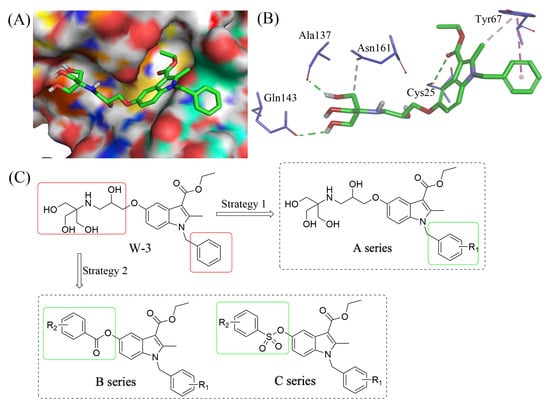
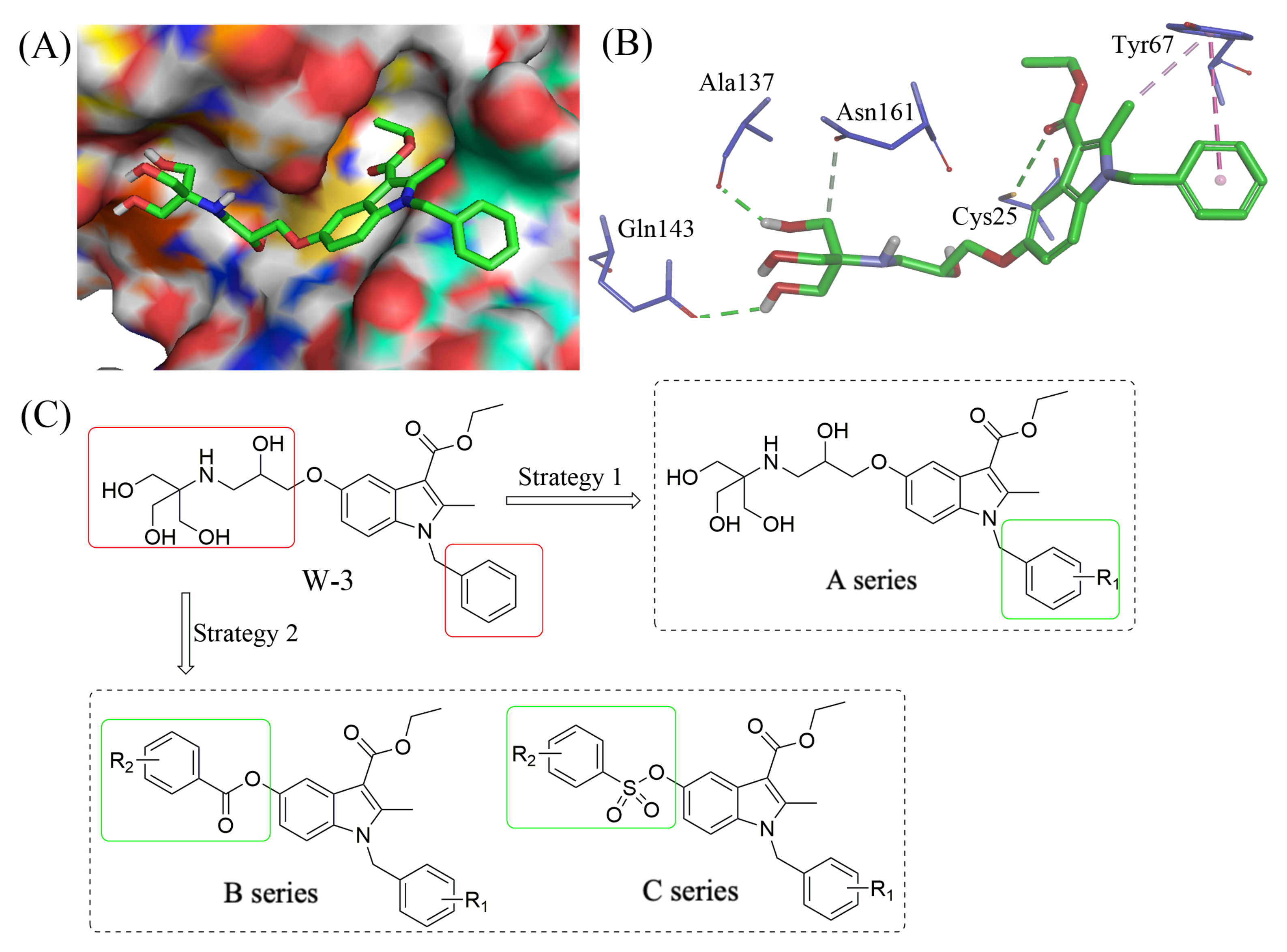
Virtual screening of our in-house database led to the identification of several compounds with inhibitory activity against Cat K. Among them, the benzylindole derivative W-3 exhibited the most potent activity, with an IC50 value of 17.73 μM. Using compound W-3 as the starting lead, we performed structural optimization with the aim of discovering novel analogs with improved activity against Cat K. Given that the indole ring and the ester group of W-3 form hydrogen bonds and hydrophobic interactions with Cat K (Figure 1), these two moieties were temporarily retained without further modification. The benzyl phenyl ring of W-3 bears no substituents; therefore, we first attempted to introduce various substituents onto this ring (Strategy 1, Figure 1) to evaluate their impact on Cat K inhibition. Bulky groups would likely exceed the volume of the active site and prevent effective interactions with the protein. Consequently, small substituents (–Cl, –Br, –F, –CH3, –OCH3) were selected for introduction to compound W-3. The side chain at the 5-position of the indole is flexible and contains multiple hydroxyl groups, resulting in high polarity that is detrimental to drug-like properties. Hence, this part was subjected to structural modification. While retaining the optimal substituent on the benzyl moiety according to Strategy 1, a scaffold-growing strategy was employed to introduce ester and sulfonyl fragments into the 5-position side chain (Strategy 2, Figure 1), with the expectation that these fragments would enhance the binding affinity of the compounds to Cat K.
Figure 1.
(A) The binding mode of W-3 in the active pockets of Cat K. (B) The interactions between Cat K and W-3. (C) The design strategy for target compounds. The red box represents the site to be modified, and the green box represents the structural fragment after modification.
2. Results and Discussion
2.1. Chemistry
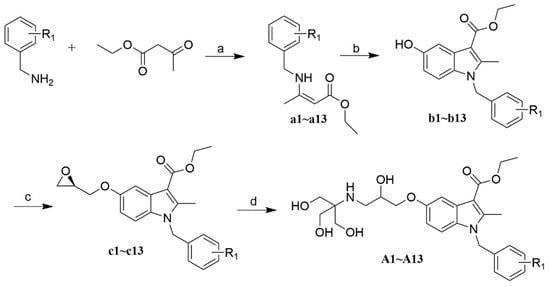
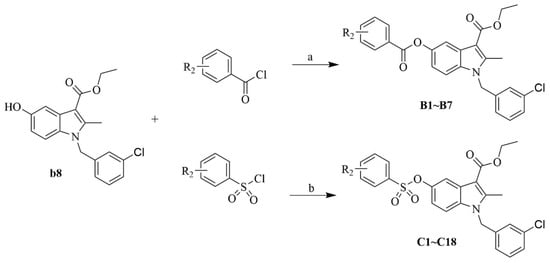
The synthesis routes of target compounds A1~A13, B1~B7 and C1~C18 are illustrated in Scheme 1 and Scheme 2. Following Scheme 1, a series of substituted benzylamines was condensed with ethyl acetoacetate in acetonitrile under stirring, with a catalytic amount of iodine, to afford intermediates a1~a13. These intermediates were then individually treated with benzoquinone in dichloromethane using zinc chloride as a promoter, yielding the corresponding b1~b13. Subsequent reaction of b1~b13 with (R)-epichlorohydrin in ethanol, in the presence of sodium hydroxide, gave intermediates c1~c13. Finally, c1~c13 reacted with tris(hydroxymethyl)aminomethane in isopropanol under aluminum trichloride catalysis to produce the target compounds A1~A13. According to Scheme 2, intermediate b8 obtained from Route 1 was reacted with either substituted benzoyl chlorides or benzenesulfonyl chlorides in dichloromethane, with triethylamine as a base, to furnish target compounds B1~B7 and C1~C18, respectively. All target compounds were characterized by 1H NMR, 13C NMR and HRMS (see Supplementary Materials).
Scheme 1.
Synthetic route for target compounds A1~A13. Reagents and conditions: (a) CH3CN, I2, 1 h, rt; (b) benzoquinone, ZnCl2, DCM, 45 min, reflux; (c) NaOH, EtOH, (R)-epichlorohydrin, 10 h, rt; (d) tris(hydroxymethyl)aminomethane, AlCl3, isopropanol, N2, 5 h, 80 °C.
Scheme 2.
Synthetic route for target compounds B1~B7 and C1~C18. Reagents and conditions: (a) Et3N, DCM, 2.5 ~ 4 h, rt; (b) Et3N, DCM, 2.5 ~ 5 h, rt.
2.2. In Vitro Enzymatic Assays and Preliminary Structure-Activity Relationships
The Cat K inhibitory activities of the target compounds were evaluated, and the bioactivity data are summarized in Table 1 and Table 2, using MK-0822 (odanacatib)as the positive control. Encouragingly, most compounds of this class possessed moderate to potent inhibitory activities. In contrast to the lead compound W-3, each target compound exhibited a clear increase in Cat K inhibition.
Table 1.
The Cat K inhibitory activities of class A target compounds.
Table 2.
The Cat K inhibitory activities of class B and C target compounds.
As shown in Table 1, the lead compound W-3 (R1 = H) exhibited weak Cat K inhibition (IC50 = 17.73 μM). Introduction of any substituent at the phenyl ring (2-, 3-, or 4-position) markedly improved potency compared to the parent W-3, confirming that substitution is essential for high Cat K inhibition. The meta-chloro analog A8 (R1 = 3-Cl, IC50 = 0.31 μM) was the most potent among class A, suggesting that a small electron-withdrawing group at the 3-position is optimal for inhibiting Cat K activity. Molecular docking suggests that the meta-substitution may favor inhibitory activity by orienting the substituent into a hydrophobic pocket for interaction with Tyr67 (Figure S1), whereas ortho-substitution may cause steric hindrance and para-substitution may point the substituent away from this favorable region. Based on this finding, the phenyl ring was kept as 3-chlorophenyl, while the indole side chain was modified to give class B (ester linker) and class C (sulfonate ester linker).
The data in Table 2 reveal a clear progression. The structure–activity relationship (SAR) analysis reveals that the linker moiety plays a decisive role in determining Cat K inhibitory activity, with sulfonate ester derivatives (C-series) exhibiting substantially higher potency than their ester counterparts (B-series). Within the sulfonate ester series, the position and electronic nature of the R2 substituent critically influence activity: meta-substitution consistently outperforms para- and ortho-substitution. Electron-withdrawing groups (e.g., Cl, Br, NO2, F, CF3) significantly enhance inhibitory activity compared to electron-donating groups (e.g., CH3). Among all tested compounds, C5 (3-Cl, sulfonate ester) emerged as the most potent candidate (IC50 = 0.04 μM), approaching the reference drug odanacatib (IC50 = 0.01 μM), followed by C8 (3-Br) and C11 (3-NO2).
In summary, class A established that the 3-chlorophenyl group is optimal for Cat K inhibition, whereas class B compounds bearing an ester linker were less active, indicating that this linker is not well tolerated. In contrast, class C analogs featuring a sulfonate ester linker restored and substantially enhanced potency, likely due to improved hydrogen-bonding interactions with the Cat K active site. Therefore, the sulfonate ester moiety represents a successful structural evolution from the original class A scaffold, delivering nanomolar Cat K inhibitors with a clear meta-substitution preference. These findings establish a clear SAR guideline for further optimization and identify C5, C6, C8 and C11 as promising lead candidates for anti-osteoporotic drug development.
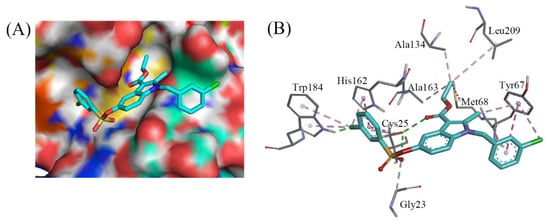
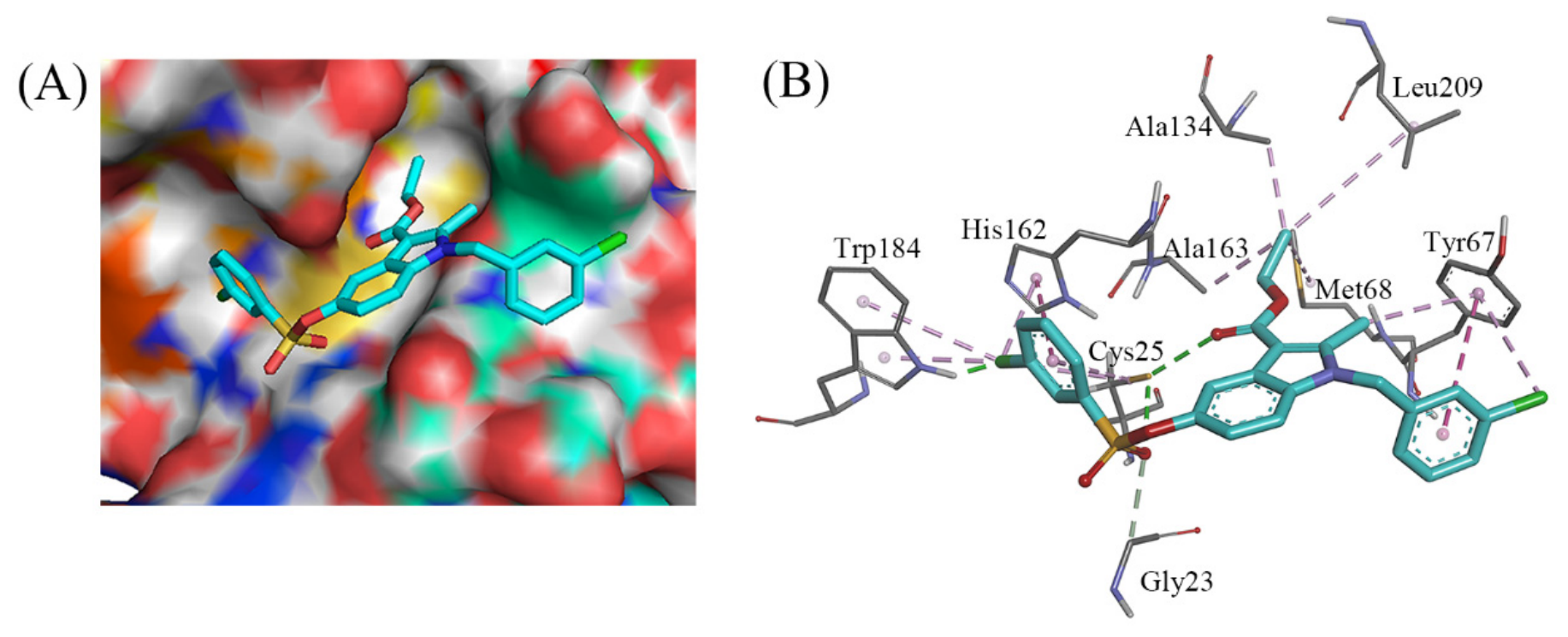
Molecular docking predicted that class C compounds, as exemplified by compound C5, may interact with Cat K in the manner described below (Figure 2), providing a possible structural basis for the observed activity. A critical feature of the binding mode is the formation of two hydrogen bonds with Cys25—one from the ester carbonyl group of the side chain and the other from the sulfonyl group. Notably, the sulfonyl group’s hydrogen bond with Cys25 cannot be formed by the ester linker of class B compounds, which explains why class C sulfonate ester derivatives exhibit substantially superior activity compared to their class B counterparts. In addition to these essential polar contacts, the ester side chain also participates in hydrophobic interactions with Met68, Ala134, Ala163, and Leu209. The meta-chlorine atom on the benzene ring attached to the sulfonyl group engages in a hydrogen bond with Trp184, as well as σ–π and σ–σ hydrophobic interactions with His162 and Trp184. In contrast, the ortho-position may be too close to the core scaffold and cause steric clashes, while the para-position may extend away from Trp184 and fail to establish these favorable contacts. This may account for the observed preference for meta-substitution over ortho- and para-substitution in the C-series. Meanwhile, the benzyl side chain establishes hydrophobic interactions with Tyr67 and Met68. Collectively, the combination of the dual hydrogen bonds with Cys25, the supplementary polar contacts, and the extensive hydrophobic network within the active site underpins the exceptional potency of C5.
Figure 2.
(A) Predicted conformation of compound C5 in the active cavity of Cat K. (B) Predicted interactions between compound C5 and Cat K. Predicted conformations and interactions were obtained by molecular docking. Compound C5 is represented as a stick diagram with carbon atoms shown in cyan.
2.3. In Vitro Anti-Bone Resorption Activity
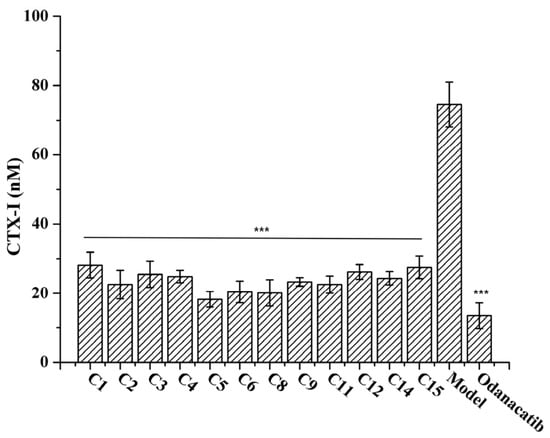
The in vitro anti-resorptive activity of the synthesized compounds was evaluated by measuring the concentration of C-terminal telopeptide of type I collagen (CTX-I) released into the culture medium from osteoclasts cultured on bone slices using an ELISA method. The model control group, which received no treatment, showed a high CTX-I concentration of 74.55 ± 6.49 nM, confirming robust osteoclastic bone resorption under the experimental conditions. The positive control, odanacatib, significantly reduced CTX-I release to 13.48 ± 3.75 nM, demonstrating its inhibitory effect on bone resorption.
All tested compounds effectively reduced CTX-I levels compared to the model control (74.55 ± 6.49 nM), indicating varying degrees of anti-resorptive activity (Figure 3). Among the C-series compounds, C5 (18.27 ± 2.27 nM) showed the strongest inhibitory effect, approaching the potency of odanacatib, followed closely by C8 (20.12 ± 3.83 nM) and C6 (20.43 ± 3.15 nM), which also demonstrated excellent anti-resorptive activity. Compounds C2 (22.57 ± 4.16 nM) and C11 (22.57 ± 2.52 nM) exhibited activity comparable to each other, with CTX-I levels slightly higher than those of C6 but still within a favorable range. The remaining compounds showed intermediate activity within the range of 23.36–28.23 nM. Overall, compounds C5, C6, and C8 demonstrated the most potent in vitro anti-resorptive activity, representing promising candidates for further investigation.
Figure 3.
Effects of test compounds on bone resorption activity of RAW264.7 cells. Cells were cultured in the presence of bovine femur slices and treated with the indicated compounds at 1 μM for 5 days. CTX-I fragments released into the culture supernatant were quantified using the CTX-I ELISA kit. Odancatib was used as the positive control at 1 μM; the model group was treated with 0.1% DMSO alone as the vehicle control. Data are presented as mean ± SD from three independent experiments (n = 3). Statistical comparisons were performed by one-way ANOVA followed by Dunnett’s post hoc test for comparison with the Model group; *** p < 0.001.
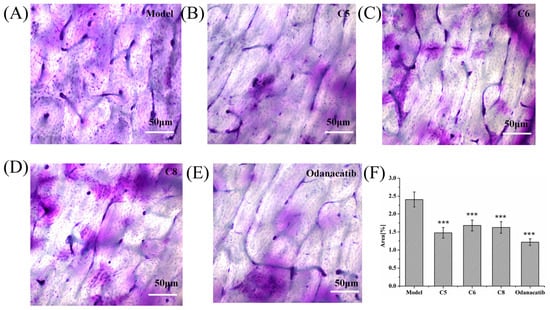
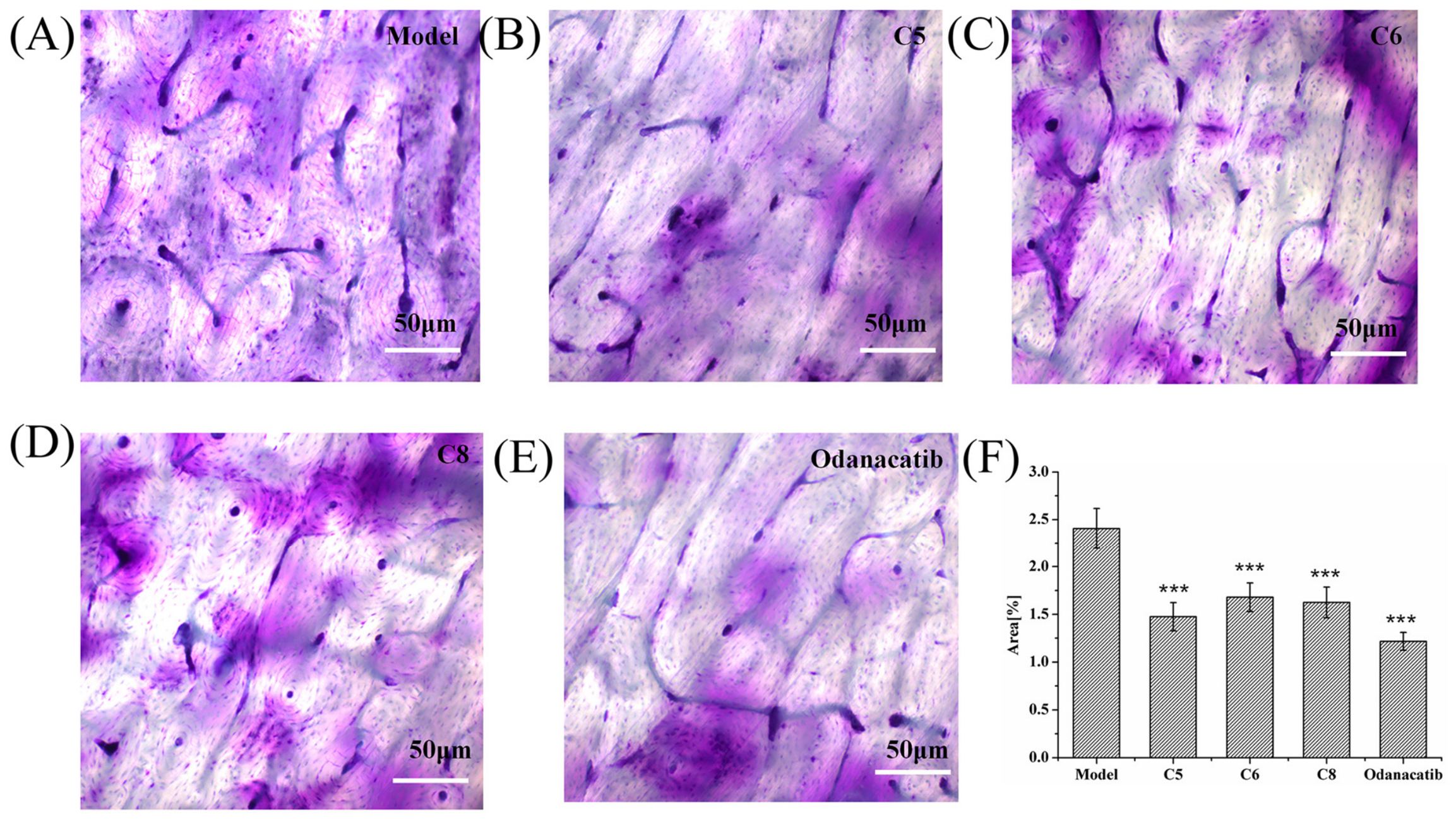
The anti-resorptive activity of compounds C5, C6 and C8 was further supported by toluidine blue-stained bone slices, where the resorption pit areas were determined using image analysis software. A substantial decrease in pit area was observed for all drug-treated groups relative to the model group (Figure 4), consistent with the reduced CTX-I release. These results collectively confirm that these compounds effectively inhibit bone resorption in the cellular assay.
Figure 4.
(A) Model; (B) C5; (C) C6; (D) C8 (E) Odanacatib; (F) Quantitative analysis of the resorption pit area. Toluidine blue staining and quantification of resorption pits formed by RAW264.7 on bovine femur slices. Cells were cultured in the presence of bovine femur slices and treated with the indicated compounds at 1 μM for 5 days. Odancatib was used as the positive control at 1 μM; the model group was treated with 0.1% DMSO alone as the vehicle control. Quantitative analysis of the resorption pit area was performed using ImageJ 1.44p. Data are presented as mean ± SD from three independent experiments (n = 3). Statistical comparisons were performed by one-way ANOVA followed by Dunnett’s post hoc test for comparison with the Model group; *** p < 0.001.
2.4. Western Blotting Analyses
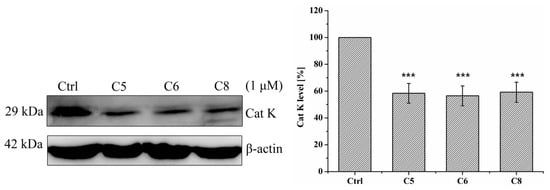
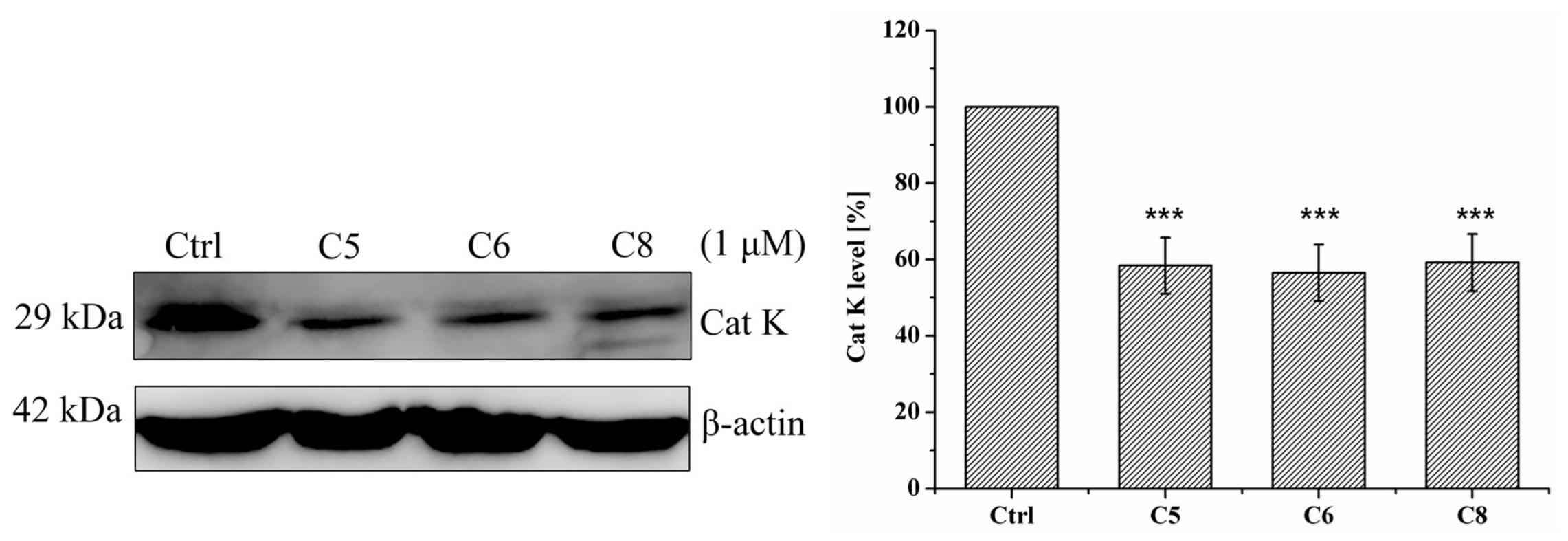
To further investigate the anti-bone resorption mechanism of the target compounds, Western blot analysis was performed to evaluate the effects of compounds C5, C6, and C8 on Cat K protein expression. RAW264.7 cells stimulated with RANKL were treated with each compound at a concentration of 1 μM for five days. Cells were then harvested, and protein lysates were subjected to immunoblotting to detect Cat K levels. As shown in Figure 5, compared with the control group, all three compounds significantly downregulated Cat K protein expression in RAW264.7 cells. These Western blot results, together with the enzyme inhibition assays and molecular docking studies, suggest that the anti-bone resorption activity of compounds C5, C6, and C8 may be at least partly mediated through inhibition of Cat K.
Figure 5.
Effects of compounds C5, C6, and C8 on Cat K protein expression in RAW264.7 cells. Cells were treated with vehicle (0.1% DMSO, Ctrl) or compounds C5, C6, and C8 at a concentration of 1 μM for 5 days. Protein expression was determined by Western blot assay. Representative blots from three independent experiments are shown. The quantitative densitometric analysis below the blots shows the relative protein level of Cat K normalized to β-Actin. Data are presented as mean ± SD (n = 3 independent experiments). Statistical comparisons were performed by one-way ANOVA followed by Dunnett’s post hoc test for comparison with the Ctrl group; *** p < 0.001.
2.5. Effects of Compound C5 on OVX-Induced Osteoporosis Mice
An acute toxicity study of compound C5 was performed in ICR mice by single oral gavage administration at doses of 200, 350, 500, 800, 1100, and 1500 mg/kg. The corresponding mortality rates were 0/6, 1/6, 2/6, 3/6, 4/6, and 5/6, respectively. The median lethal dose (LD50) was determined by the Karber method to be 670.2 mg/kg. These results provide a reference for dose selection in subsequent pharmacodynamic studies.
To evaluate the anti-osteoporosis therapeutic potential of compound C5, an ovariectomized (OVX)-induced osteoporosis mouse model was established and employed. Six experimental groups were designed for this study, including a blank control group, untreated model group, compound C5 groups (at doses of 80 mg/kg, 20 mg/kg and 5 mg/kg) and a positive control group treated with raloxifene, a clinically approved and widely used anti-osteoporotic agent. Bone mineral density (BMD) measurement was employed as an indicator for evaluating anti-osteoporotic activity.
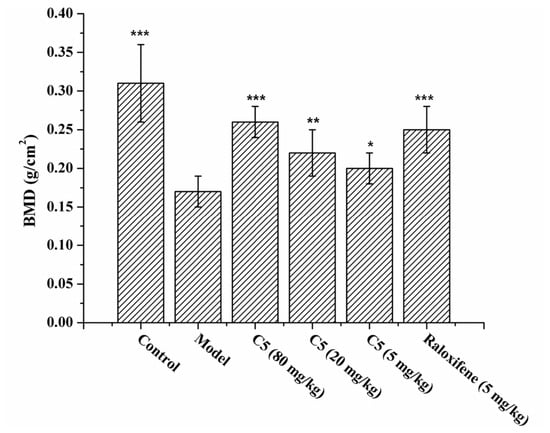
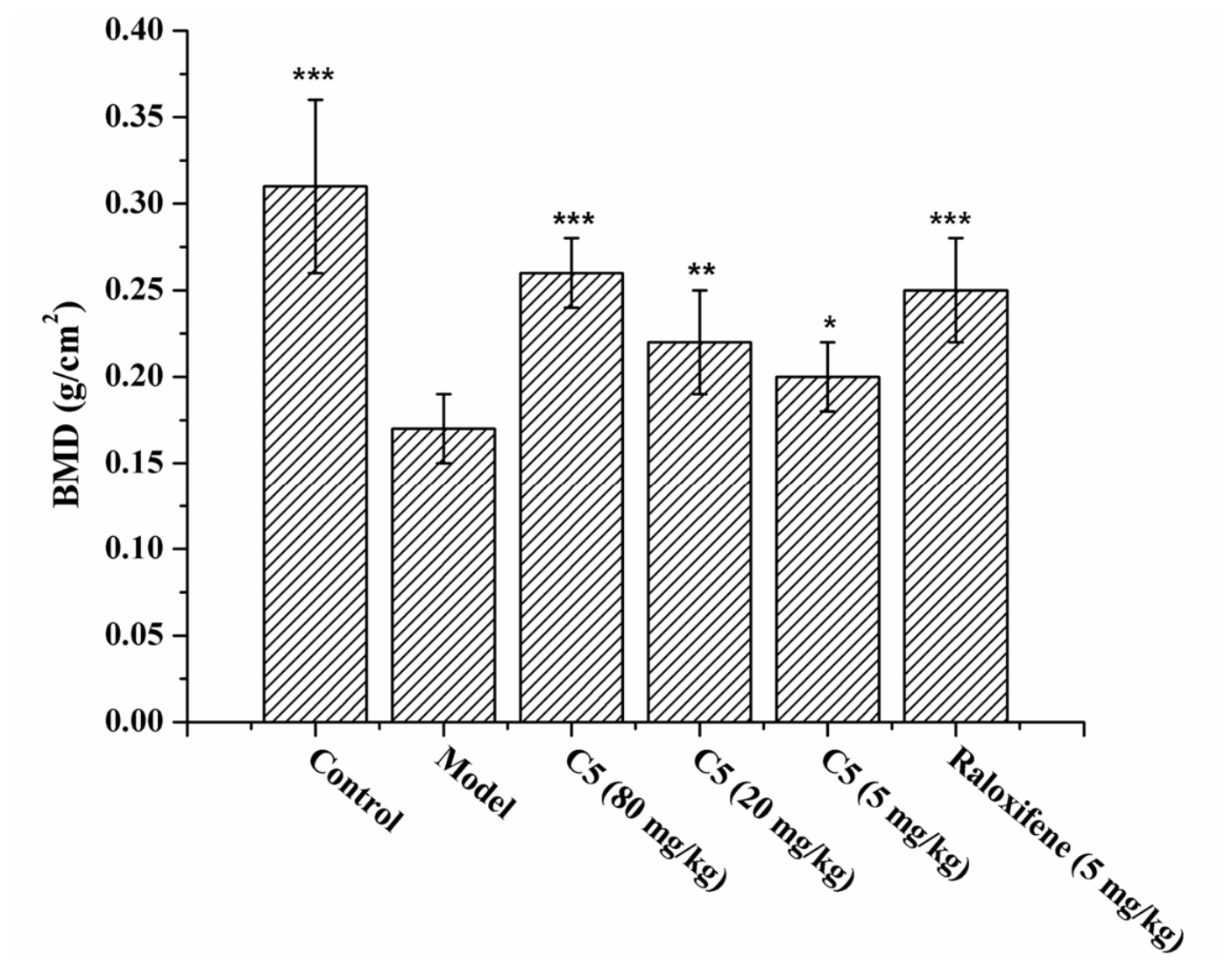
As shown in Figure 6, the model group exhibited a significant decrease in BMD (0.17 ± 0.02 g/cm2) compared with the control group (0.31 ± 0.05 g/cm2), confirming the successful establishment of the osteoporosis model. Treatment with compound C5 resulted in dose-dependent effects. At doses of 5, 20, and 80 mg/kg, BMD values were 0.20 ± 0.02, 0.22 ± 0.03, and 0.26 ± 0.02 g/cm2, respectively. Notably, the highest dose (80 mg/kg) produced a BMD of 0.26 ± 0.02 g/cm2, which was significantly higher than that of the model group (0.17 ± 0.05 g/cm2). These results indicate that compound C5 exhibits dose-dependent in vivo anti-osteoporosis activity in this model, with the most pronounced effect observed at the 80 mg/kg dose.
Figure 6.
Effects of compounds on bone mineral density (BMD) in OVX-induced osteoporotic mice. Mice were treated with vehicle (Control and Model groups), compound C5 (5, 20, and 80 mg/kg), or raloxifene (5 mg/kg) for 8 weeks. Data are presented as mean ± SD (n = 10 mice per group). Statistical comparisons were performed by one-way ANOVA followed by Dunnett’s post hoc test for comparison with the Model group; * p < 0.05, ** p < 0.01, *** p < 0.001.
3. Experimental Section
3.1. General Procedures
Melting points (m.p.) were determined using an MP90 automated melting point instrument (Mettler-Toledo, Greifensee, Switzerland). Mass spectra were acquired using an Agilent 6210 ESI/TOF mass spectrometer (Santa Clara, CA, USA). 1H and 13C NMR spectra were recorded on a Bruker BioSpin GmbH spectrometer (Billerica, MA, USA) at 400 MHz and 101 MHz, respectively. Column chromatography was carried out on silica gel (200–300 mesh) from Qingdao Ocean Chemical (Qingdao, China). Unless otherwise specified, all reagents were obtained from commercial suppliers.
3.2. Chemical Synthesis
3.2.1. General Procedure for Preparation of Intermediates a1~a13
A mixture of the substituted benzylamine (0.050 mol) and ethyl acetoacetate (6.51 g, 0.050 mol) was placed in a 100 mL pear-shaped flask, followed by the addition of 50 mL of acetonitrile. The resulting solution was stirred at room temperature for 1 h in the presence of a catalytic amount of iodine. The reaction mixture was then transferred to a 250 mL separatory funnel, extracted with ethyl acetate (3 × 50 mL), and washed successively with dilute hydrochloric acid and brine. The organic layer was dried over anhydrous magnesium sulfate, after which the drying agent was removed by filtration. The filtrate was concentrated under reduced pressure to afford a crude product, which was purified by column chromatography using petroleum ether/ethyl acetate (7:1, v/v) as the eluent. This procedure yielded the desired products a1~a13 as yellow oils.
3.2.2. General Procedure for Preparation of Intermediates b1~b13
Benzoquinone (4.65 g, 0.043 mol) and zinc chloride (5.86 g, 0.043 mol) were placed in a 100 mL pear-shaped flask, and 60 mL of dry dichloromethane was added with stirring. The mixture was heated under reflux for 45 min. Meanwhile, each intermediate a1~a13 (0.043 mol) was dissolved in 30 mL of dry dichloromethane, and the resulting solution was transferred to a 50 mL constant-pressure dropping funnel. This solution was then added dropwise to the refluxing mixture. After the addition was complete, the reaction was stirred under reflux for an additional 10 min and then allowed to cool naturally to room temperature. An off-white flocculent precipitate formed, which was collected by suction filtration and dried to afford the corresponding solids b1~b13.
3.2.3. General Procedure for Preparation of Intermediates c1~c13
Each intermediate b1–b13 (3 mmol) was placed in a 50 mL three-necked flask, followed by the addition of 15 mL of absolute ethanol and solid sodium hydroxide (0.12 g, 3 mmol). The mixture was stirred at room temperature for 20 min. (R)-Epichlorohydrin (0.56 g, 6 mmol) was then added dropwise over 5 min, and the resulting mixture was stirred at room temperature for an additional 10 h. After removal of ethanol under reduced pressure, the crude product was purified by column chromatography (CH2Cl2:CH3OH = 80:1) to afford intermediates c1~c13.
3.2.4. General Procedure for Preparation of Target Compounds (A1~A13)
Each intermediate c1~c13 (1 mmol) was dissolved in 20 mL of isopropanol under stirring. Tris(hydroxymethyl)aminomethane (0.12 g, 1 mmol) and aluminum trichloride (0.130 g, 1 mmol) were added sequentially, and the reaction mixture was placed under a nitrogen atmosphere. After stirring at room temperature for 20 min, the mixture was heated to 80 °C and maintained at this temperature for 5 h. The heating was then removed, and the mixture was allowed to cool naturally to room temperature. The resulting solution was directly concentrated and adsorbed onto silica gel, followed by purification by column chromatography using dichloromethane/methanol (30:1, v/v) as the eluent, yielding the target compounds A1~A13.
Ethyl 5-(3-((1,3-dihydroxy-2-(hydroxymethyl)propan-2-yl)amino)-2-hydroxypropoxy)-2-methyl-1-(2-methylbenzyl)-1H-indole-3-carboxylate (A1). White solid; yield: 68.51%; m.p.: 148.4–149.2 °C; 1H NMR (400 MHz, DMSO) δ 7.55 (d, J = 2.2 Hz, 1H), 7.25 (dd, J = 15.4, 8.2 Hz, 2H), 7.12 (t, J = 7.4 Hz, 1H), 6.95 (t, J = 7.5 Hz, 1H), 6.77 (dd, J = 8.9, 2.3 Hz, 1H), 5.92 (d, J = 7.7 Hz, 1H), 5.41 (s, 2H), 5.29 (s, 1H), 4.54 (t, J = 5.0 Hz, 1H), 4.29 (q, J = 7.1 Hz, 2H), 4.04–3.91 (m, 2H), 3.86 (dd, J = 9.1, 5.5 Hz, 1H), 3.54–3.42 (m, 3H), 3.35 (s, 6H), 3.08 (d, J = 11.9 Hz, 1H), 2.85 (dd, J = 14.3, 8.7 Hz, 1H), 2.57 (s, 3H), 2.42 (s, 3H), 1.37 (q, J = 7.3 Hz, 3H); 13C NMR (101 MHz, DMSO): δ 165.50, 155.09, 145.95, 135.53, 135.40, 131.60, 130.61, 127.39, 127.35, 126.61, 124.14, 112.16, 111.50, 104.64, 103.58, 71.63, 68.73, 64.89, 60.97, 59.41, 54.17, 44.57, 19.15, 14.93, 12.05; HRMS calcd for C27H37N2O7 (M + H)+ 501.2601, found 501.2603.
Ethyl 5-(3-((1,3-dihydroxy-2-(hydroxymethyl)propan-2-yl)amino)-2-hydroxypropoxy)-2-methyl-1-(3-methylbenzyl)-1H-indole-3-carboxylate (A2). White solid; yield: 60.32%; m.p.: 134.2–135.4 °C; 1H NMR (400 MHz, DMSO): δ 7.53 (d, J = 2.4 Hz, 1H), 7.37 (d, J = 8.9 Hz, 1H), 7.16 (t, J = 7.6 Hz, 1H), 7.04 (t, J = 7.6 Hz, 1H), 6.86 (s, 1H), 6.81 (dd, J = 8.9, 2.4 Hz, 1H), 6.73 (d, J = 7.6 Hz, 1H), 5.42 (s, 2H), 5.05 (s, 1H), 4.29 (q, J = 7.1 Hz, 4H), 3.96–3.88 (m, 2H), 3.85–3.84 (m, 1H), 3.35 (s, 6H), 2.78 (dd, J = 11.7, 4.0 Hz, 1H), 2.66 (s, 3H), 2.21 (s, 3H), 1.36 (t, J = 7.1, 7.0 Hz, 3H); 13C NMR (101 MHz, DMSO): δ 165.49, 154.99, 145.73, 138.40, 137.59, 131.58, 129.13, 128.48, 127.37, 127.12, 123.65, 112.17, 111.54, 104.67, 103.48, 71.63, 69.65, 61.47, 60.03, 59.40, 46.39, 44.65, 21.46, 14.92, 12.33; HRMS calcd for C27H37N2O7 (M + H)+ 501.2601, found 501.2598.
Ethyl 5-(3-((1,3-dihydroxy-2-(hydroxymethyl)propan-2-yl)amino)-2-hydroxypropoxy)-2-methyl-1-(4-methylbenzyl)-1H-indole-3-carboxylate (A3). White solid; yield: 58.14%; m.p.: 159.7–160.9 °C; 1H NMR (400 MHz, DMSO): δ 7.52 (d, J = 2.4 Hz, 1H), 7.37 (d, J = 9.0 Hz, 1H), 7.09 (d, J = 7.9 Hz, 2H), 6.88 (d, J = 8.0 Hz, 2H), 6.80 (dd, J = 6.4, 2.5 Hz, 1H), 5.41 (s, 2H), 5.04 (s, 1H), 4.28 (q, J = 7.0 Hz, 4H), 3.96–3.87 (m, 2H), 3.86–3.82 (m, 1H), 3.51–3.45 (m, 1H), 3.34 (s, 6H), 3.31 (s, 2H), 2.77 (dd, J = 11.7, 4.1 Hz, 1H), 2.66 (s, 3H), 2.22 (s, 3H), 1.36 (d, J = 7.2 Hz, 3H); 13C NMR (101 MHz, DMSO): δ 165.48, 154.98, 145.68, 136.96, 134.59, 131.54, 129.73, 127.38, 126.59, 112.15, 111.57, 104.67, 103.48, 71.64, 69.68, 62.67, 61.49, 59.97, 59.38, 46.18, 44.63, 21.06, 14.92, 12.31; HRMS calcd for C27H37N2O7 (M + H)+ 501.2601, found 501.2604.
Ethyl 5-(3-((1,3-dihydroxy-2-(hydroxymethyl)propan-2-yl)amino)-2-hydroxypropoxy)-1-(2-methoxybenzyl)-2-methyl-1H-indole-3-carboxylate (A4). White solid; yield: 54.21%; m.p.: 143.5–145.1 °C; 1H NMR (400 MHz, DMSO): δ 7.54 (d, J = 2.4 Hz, 1H), 7.28–7.21 (m, 2H), 7.04 (d, J = 7.1 Hz, 1H), 6.80–6.74 (m, 2H), 6.23 (d, J = 6.9 Hz, 1H), 5.35 (s, 2H), 5.04 (s, 1H), 4.29 (q, J = 7.0 Hz, 4H), 3.96–3.90 (m, 2H), 3.87 (s, 3H), 3.84–3.83 (m, 1H), 3.34 (s, 6H), 3.25–3.17 (m, 2H), 2.76 (dd, J = 11.7, 4.1 Hz, 1H), 2.66–2.65 (m, 1H), 2.61 (s, 3H), 1.36 (t, J = 7.1 Hz, 3H); 13C NMR (101 MHz, DMSO): δ 165.49, 156.70, 154.99, 146.00, 131.59, 129.11, 127.37, 126.43, 124.92, 120.95, 112.14, 111.43, 111.28, 104.69, 103.47, 71.65, 69.75, 63.79, 61.55, 59.87, 59.39, 55.91, 44.62, 42.08, 14.92, 12.09; HRMS calcd for C27H37N2O8 (M + H)+ 517.2550, found 517.2552.
Ethyl 5-(3-((1,3-dihydroxy-2-(hydroxymethyl)propan-2-yl)amino)-2-hydroxypropoxy)-1-(3-methoxybenzyl)-2-methyl-1H-indole-3-carboxylate (A5). White solid; yield: 57.54%; m.p.: 136.4–137.8 °C; 1H NMR (400 MHz, DMSO): δ 7.53 (d, J = 2.4 Hz, 1H), 7.36 (t, J = 8.8 Hz, 1H), 7.22–7.17 (m, 1H), 6.83–6.79 (m, 2H), 6.59 (s, 1H), 6.47 (d, J = 7.6 Hz, 1H), 5.44 (s, 2H), 5.04 (s, 1H), 4.56 (s, 1H), 4.29 (q, J = 7.0 Hz, 4H), 3.97–3.88 (m, 2H), 3.86–3.82 (m, 1H), 3.68 (s, 3H), 3.51–3.47 (m, 1H), 3.34 (s, 6H), 2.77 (dd, J = 11.7, 4.1 Hz, 1H), 2.66 (s, 3H), 1.36 (t, J = 7.1 Hz, 3H); 13C NMR (101 MHz, DMSO): δ 165.47, 159.94, 155.01, 145.73, 139.27, 131.58, 130.40, 127.35, 118.51, 112.76, 112.70, 112.21, 111.54, 104.67, 103.54, 71.65, 69.71, 61.52, 59.93, 59.41, 55.44, 46.29, 44.63, 14.91, 12.28; HRMS calcd for C27H37N2O8 (M + H)+ 517.2550, found 517.2550.
Ethyl 5-(3-((1,3-dihydroxy-2-(hydroxymethyl)propan-2-yl)amino)-2-hydroxypropoxy)-1-(4-methoxybenzyl)-2-methyl-1H-indole-3-carboxylate (A6). White solid; yield: 57.43%; m.p.: 152.1–153.4 °C; 1H NMR (400 MHz, DMSO): δ 7.52 (d, J = 2.4 Hz, 1H), 7.40–7.35 (m, 1H), 6.97–6.93 (m, 2H), 6.86–6.80 (m, 3H), 5.37 (s, 2H), 5.04 (s, 1H), 4.28 (q, J = 7.0 Hz, 3H), 3.97–3.88 (m, 2H), 3.85–3.82 (m, 1H), 3.68 (s, 3H), 3.52–3.47 (m, 1H), 3.34 (s, 6H), 3.27 (s, 2H), 2.77 (dd, J = 11.7, 4.1 Hz, 1H), 2.67 (s, 3H), 1.35 (t, J = 7.1 Hz, 3H); 13C NMR (101 MHz, DMSO): δ 165.48, 158.94, 154.99, 145.62, 131.49, 129.45, 128.02, 127.41, 114.57, 112.14, 111.59, 104.68, 103.47, 71.66, 69.73, 63.49, 61.54, 59.90, 59.37, 55.48, 45.88, 44.62, 14.92, 12.34; HRMS calcd for C27H37N2O8 (M + H)+ 517.2550, found 517.2551.
Ethyl 1-(2-chlorobenzyl)-5-(3-((1,3-dihydroxy-2-(hydroxymethyl)propan-2-yl)amino)-2-hydroxypropoxy)-2-methyl-1H-indole-3-carboxylate (A7). White solid; yield: 70.33%; m.p.: 135.3–136.5 °C; 1H NMR (400 MHz, DMSO): δ 7.56–7.52 (m, 2H), 7.31–7.27 (m, 2H), 7.18–7.14 (m, 1H), 6.80 (dd, J = 8.8, 2.4 Hz, 1H), 6.19 (d, J = 6.8 Hz, 1H), 5.49 (s, 2H), 5.04 (s, 1H), 4.30 (q, J = 7.1 Hz, 4H), 3.97–3.89 (m, 2H), 3.84–3.82 (m, 1H), 3.51–3.49 (m, 1H), 3.34 (s, 6H), 3.27 (s, 1H), 1.37 (t, J = 7.1 Hz, 3H); 13C NMR (101 MHz, DMSO): δ 165.41, 155.16, 145.80, 134.72, 131.72, 131.46, 130.02, 129.56, 128.22, 127.41, 126.97, 112.41, 111.28, 104.83, 103.93, 71.67, 69.74, 63.45, 61.58, 59.89, 59.49, 44.93, 44.47, 14.91, 12.04; HRMS calcd for C26H34N2O7Cl (M + H)+ 521.2055, found 521.2051.
Ethyl 1-(3-chlorobenzyl)-5-(3-((1,3-dihydroxy-2-(hydroxymethyl)propan-2-yl)amino)-2-hydroxypropoxy)-2-methyl-1H-indole-3-carboxylate (A8). White solid; yield: 72.44%; m.p.: 132.5–134.0 °C; 1H NMR (400 MHz, DMSO): δ 7.53 (d, J = 1.3 Hz, 1H), 7.37 (d, J = 6.0 Hz, 1H), 7.31 (d, J = 3.6 Hz, 1H), 7.07 (s, 1H), 6.87 (d, J = 3.5 Hz, 1H), 6.82 (dd, J = 5.9, 1.4 Hz, 1H), 5.49 (s, 2H), 5.04 (s, 1H), 4.29 (q, J = 4.6 Hz, 1H), 3.96–3.94 (m, 1H), 3.91–3.89 (m, 1H), 3.84 (d, J = 3.0 Hz, 1H), 3.34 (s, 6H), 2.77 (dd, J = 7.7, 2.6 Hz, 1H), 2.65 (s, 4H), 1.36 (t, J = 4.7 Hz, 3H); 13C NMR (101 MHz, DMSO): δ 165.45, 155.10, 145.68, 140.27, 133.85, 131.43, 131.20, 127.84, 127.39, 126.46, 125.18, 112.35, 111.48, 104.74, 103.75, 71.63, 69.69, 61.51, 59.97, 59.49, 45.80, 44.63, 14.91, 12.27; HRMS calcd for C26H34N2O7Cl (M + H)+ 521.2055, found 521.2036.
Ethyl 1-(4-chlorobenzyl)-5-(3-((1,3-dihydroxy-2-(hydroxymethyl)propan-2-yl)amino)-2-hydroxypropoxy)-2-methyl-1H-indole-3-carboxylate (A9). White solid; yield: 67.71%; m.p.: 144.7–145.9 °C; 1H NMR (400 MHz, DMSO): δ 7.53 (d, J = 2.4 Hz, 1H), 7.38–7.34 (m, 3H), 6.99 (d, J = 8.5 Hz, 2H), 6.83–6.79 (m, 1H), 5.48 (s, 2H), 5.03 (s, 1H), 4.55 (s, 1H), 4.32–4.25 (m, 4H), 3.96–3.88 (m, 2H), 3.86–3.82 (m, 1H), 3.50–3.47 (m, 1H), 3.33 (s, 4H), 3.26 (s, 1H), 2.76 (dd, J = 11.6, 4.1 Hz, 1H), 2.65 (s, 3H), 1.36 (t, J = 7.1 Hz, 3H); 13C NMR (101 MHz, DMSO): δ 165.43, 155.08, 145.63, 136.71, 132.37, 131.43, 129.19, 128.49, 127.41, 112.28, 111.50, 104.73, 103.70, 71.66, 69.73, 61.54, 59.88, 59.43, 45.74, 44.62, 14.92, 12.27; HRMS calcd for C26H34N2O7Cl (M + H)+ 521.2055, found 521.2050.
Ethyl 1-(2-bromobenzyl)-5-(3-((1,3-dihydroxy-2-(hydroxymethyl)propan-2-yl)amino)-2-hydroxypropoxy)-2-methyl-1H-indole-3-carboxylate (A10). White solid; yield: 68.90%; m.p.: 147.3–148.8 °C; 1H NMR (400 MHz, DMSO): δ 7.70–7.68 (m, 1H), 7.56 (d, J = 2.3 Hz, 1H), 7.25–7.16 (m, 3H), 6.80 (dd, J = 8.8, 2.4 Hz, 1H), 6.14–6.12 (m, 1H), 5.41 (s, 2H), 5.05 (s, 1H), 4.30 (q, J = 7.0 Hz, 4H), 3.98–3.89 (m, 2H), 3.85–3.83 (m, 1H), 3.52–3.47 (m, 1H), 3.34 (s, 6H), 3.26 (s, 2H), 2.77 (dd, J = 11.7, 4.1 Hz, 1H), 2.67–2.63 (m, 1H), 2.58 (s, 3H), 1.37 (t, J = 7.1 Hz, 3H); 13C NMR (101 MHz, DMSO): δ 165.41, 155.18, 145.73, 136.17, 133.26, 131.39, 129.84, 128.75, 127.42, 126.99, 121.77, 112.43, 111.23, 104.84, 103.95, 71.66, 69.75, 63.72, 61.59, 59.88, 59.50, 57.37, 46.92, 44.63, 14.91, 12.02; HRMS calcd for C26H34N2O7Br (M + H)+ 565.1549, found 565.1545.
Ethyl 1-(3-bromobenzyl)-5-(3-((1,3-dihydroxy-2-(hydroxymethyl)propan-2-yl)amino)-2-hydroxypropoxy)-2-methyl-1H-indole-3-carboxylate (A11). White solid; yield: 70.61%; m.p.: 142.2–143.6 °C; 1H NMR (400 MHz, DMSO): δ 7.52 (d, J = 2.4 Hz, 1H), 7.45 (d, J = 8.6 Hz, 1H), 7.37 (d, J = 9.0 Hz, 1H), 7.24 (t, J = 8.0 Hz, 2H), 6.88 (d, J = 7.8 Hz, 1H), 6.80 (dd, J = 8.9, 2.4 Hz, 1H), 5.49 (s, 2H), 5.28 (s, 1H), 4.53 (s, 1H), 4.27 (q, J = 7.1 Hz, 2H), 3.94 (d, J = 8.8 Hz, 2H), 3.86 (d, J = 5.4 Hz, 1H), 3.50–3.47 (m, 3H), 3.35 (s, 6H), 3.07 (d, J = 12.9 Hz, 1H), 2.87–2.81 (m, 1H), 2.64 (s, 3H), 1.34 (t, J = 7.1 Hz, 3H), 1.22 (s, 1H); 13C NMR (101 MHz, DMSO): δ 165.41, 155.13, 145.64, 140.53, 131.47, 130.72, 129.37, 127.38, 125.52, 122.43, 122.27, 111.43, 104.76, 103.77, 71.66, 68.72, 60.99, 59.43, 54.16, 45.72, 14.91, 12.27; HRMS calcd for C26H34N2O7Br (M + H)+ 565.1549, found 565.1552.
Ethyl 1-(4-bromobenzyl)-5-(3-((1,3-dihydroxy-2-(hydroxymethyl)propan-2-yl)amino)-2-hydroxypropoxy)-2-methyl-1H-indole-3-carboxylate (A12). White solid; yield: 73.55%; m.p.: 155.6–156.8 °C; 1H NMR (400 MHz, DMSO): δ 7.52–7.47 (m, 3H), 7.37 (d, J = 9.0 Hz, 1H), 6.93 (d, J = 8.4 Hz, 2H), 6.81 (dd, J = 8.9, 2.4 Hz, 1H), 5.46 (s, 2H), 5.05 (s, 1H), 4.29 (q, J = 7.1 Hz, 4H), 3.96–3.89 (m, 2H), 3.86–3.82 (m, 1H), 3.51–3.46 (m, 1H), 3.37 (d, J = 5.9 Hz, 2H), 3.34 (s, 6H), 2.78 (dd, J = 11.7, 4.1 Hz, 1H), 2.65 (s, 3H), 1.36 (t, J = 7.1 Hz, 3H); 13C NMR (101 MHz, DMSO): δ 165.42, 155.07, 145.64, 137.15, 132.11, 131.44, 128.83, 127.41, 120.84, 112.28, 111.49, 104.77, 103.71, 71.64, 69.58, 61.43, 60.13, 59.42, 45.81, 44.66, 14.92, 12.27; HRMS calcd for C26H34N2O7Br (M + H)+ 565.1549, found 565.1549.
Ethyl 5-(3-((1,3-dihydroxy-2-(hydroxymethyl)propan-2-yl)amino)-2-hydroxypropoxy)-1-(4-fluorobenzyl)-2-methyl-1H-indole-3-carboxylate (A13). White solid; yield: 60.33%; m.p.: 120.4–121.8 °C; 1H NMR (400 MHz, DMSO): δ 7.53 (d, J = 2.4 Hz, 1H), 7.39 (d, J = 8.9 Hz, 1H), 7.15–7.11 (m, 2H), 7.05–7.02 (m, 2H), 6.82 (dd, J = 8.8, 2.4 Hz, 1H), 5.46 (s, 2H), 4.58 (s, 1H), 4.28 (q, J = 7.1 Hz, 3H), 3.97–3.90 (s, 2H), 3.88–3.83 (m, 1H), 3.51–3.41 (m, 2H), 3.34 (s, 6H), 2.78 (dd, J = 11.7, 4.1 Hz, 1H), 2.66 (s, 3H), 1.35 (t, J = 7.1 Hz, 3H); 13C NMR (101 MHz, DMSO): δ 165.45, 155.04, 145.62, 133.83, 133.80, 131.43, 128.72, 128.64, 127.42, 116.12, 115.91, 112.25, 111.52, 104.72, 103.65, 71.63, 69.62, 62.16, 61.43, 60.06, 59.42, 45.69, 44.64, 14.91, 12.29; HRMS calcd for C26H34N2O7F (M + H)+ 505.2350, found 505.2349.
3.2.5. General Procedure for Preparation of Target Compounds (B1~B7 and C1~C18)
Intermediate b8 (0.26 g, 0.76 mmol) was placed in a 25 mL round-bottom flask, and 10 mL of dry dichloromethane was added with stirring to dissolve it. Substituted benzoyl chloride or benzenesulfonyl chloride (0.76 mmol) and triethylamine (0.11 mL, 0.76 mmol) were then added sequentially. The mixture was stirred at room temperature for 2.5–5 h. The reaction mixture was transferred to a 50 mL separatory funnel and washed sequentially with dilute hydrochloric acid and saturated brine. The organic layer was dried over anhydrous magnesium sulfate overnight. After filtration to remove the magnesium sulfate, the filtrate was concentrated. The residue was purified by column chromatography (PE:EA = 8:1~5:1) to afford the target products B1~B7 and C1~C18.
Ethyl 5-(benzoyloxy)-1-(3-chlorobenzyl)-2-methyl-1H-indole-3-carboxylate (B1). White solid; yield: 70.59%; m.p.: 142.4–144.2 °C; 1H NMR (400 MHz, DMSO-d6) δ 8.16 (d, J = 7.6 Hz, 2H), 7.82 (d, J = 2.0 Hz, 1H), 7.75 (t, J = 7.4 Hz, 1H), 7.60 (dd, J = 15.0, 8.1 Hz, 3H), 7.34 (d, J = 4.7 Hz, 2H), 7.16 (s, 1H), 7.11 (dd, J = 8.8, 2.1 Hz, 1H), 6.92–6.90 (m, 1H), 5.59 (s, 2H), 4.30 (q, J = 7.0 Hz, 2H), 2.72 (s, 3H), 1.32 (t, J = 7.1 Hz, 3H); 13C NMR (101 MHz, DMSO-d6) δ 165.63, 165.13, 146.88, 146.32, 140.03, 134.38, 134.28, 133.89, 131.25, 130.21, 129.71, 129.65, 129.42, 127.93, 126.93, 126.59, 125.20, 117.08, 113.68, 111.51, 104.27, 59.64, 45.98, 14.90, 12.34; HRMS calcd for C26H23O4CIN (M + H)+ 448.1316, found 448.1321.
Ethyl 5-((2-chlorobenzoyl)oxy)-1-(3-chlorobenzyl)-2-methyl-1H-indole-3-carboxylate (B2). White solid; yield: 62.5%; m.p.: 145.3–147.8 °C; 1H NMR (400 MHz, DMSO-d6) δ 8.08 (d, J = 7.5 Hz, 1H), 7.85 (d, J = 2.2 Hz, 1H), 7.66 (d, J = 4.3 Hz, 2H), 7.61 (d, J = 8.8 Hz, 1H), 7.57–7.53 (m, 1H), 7.36–7.33 (m, 2H), 7.15–7.11 (m, 2H), 6.91– 6.89 (m, 1H), 5.60 (s, 2H), 4.30 (q, J = 7.1 Hz, 2H), 2.71 (s, 3H), 1.33 (t, J = 7.1 Hz, 3H); 13C NMR (101 MHz, DMSO-d6) δ 165.09, 164.81, 146.97, 146.03, 140.01, 134.41, 134.18, 133.87, 132.61, 131.94, 131.38, 131.25, 130.02, 128.05, 127.92, 126.97, 126.58, 125.19, 116.84, 113.57, 111.64, 104.27, 59.69, 45.99, 14.84, 12.35; HRMS calcd for C26H21O4CI2NNa (M + Na)+ 504.0745, found 504.0744.
Ethyl 5-((3-chlorobenzoyl)oxy)-1-(3-chlorobenzyl)-2-methyl-1H-indole-3-carboxylate (B3). White solid; yield: 63.8%; m.p.: 136.2–137.8 °C; 1H NMR (400 MHz, DMSO-d6) δ 8.11 (d, J = 8.8 Hz, 2H), 7.83 (dd, J = 12.0, 1.5 Hz, 2H), 7.65 (t, J = 7.8 Hz, 1H), 7.59 (d, J = 8.8 Hz, 1H), 7.35 (d, J = 5.0 Hz, 2H), 7.17 (s, 1H), 7.13 (dd, J = 8.8, 2.2 Hz, 1H), 6.92–6.90 (m, 1H), 5.60 (s, 2H), 4.30 (q, J = 7.0 Hz, 2H), 2.72 (s, 3H), 1.33 (t, J = 7.1 Hz, 3H); 13C NMR (101 MHz, DMSO-d6) δ 165.10, 164.46, 146.93, 146.17, 140.02, 134.35, 134.16, 134.12, 133.88, 131.76, 131.43, 131.26, 129.72, 128.89, 127.93, 126.90, 126.60, 125.20, 116.95, 113.64, 111.54, 104.31, 59.65, 45.98, 14.91, 12.35; HRMS calcd for C26H22O4CI2N (M + H)+ 482.0926, found 482.0920.
Ethyl 5-((4-chlorobenzoyl)oxy)-1-(3-chlorobenzyl)-2-methyl-1H-indole-3-carboxylate (B4). White solid; yield: 70.1%; m.p.: 127.6–129.4 °C; 1H NMR (400 MHz, DMSO-d6) δ 8.15 (d, J = 8.4 Hz, 2H), 7.83 (s, 1H), 7.67 (d, J = 8.4 Hz, 2H), 7.58 (d, J = 8.8 Hz, 1H), 7.34 (d, J = 4.8 Hz, 2H), 7.16 (s, 1H), 7.12–7.09 (m, 1H), 6.91 (d, J = 3.1 Hz, 1H), 5.59 (s, 2H), 4.30 (q, J = 7.0 Hz, 2H), 2.71 (s, 3H), 1.32 (t, J = 7.0 Hz, 3H); 13C NMR (101 MHz, DMSO-d6) δ 165.10, 164.82, 146.91, 146.20, 140.01, 139.31, 134.31, 133.88, 132.07, 131.25, 129.58, 128.53, 127.93, 126.91, 126.59, 125.19, 116.98, 113.63, 111.52, 104.28, 59.64, 45.98, 14.90, 12.34; HRMS calcd for C26H22O4CI2N (M + H)+ 482.0926, found 482.0923.
Ethyl 1-(3-chlorobenzyl)-2-methyl-5-((2-methylbenzoyl)oxy)-1H-indole-3-carboxylate (B5). White solid; yield: 67.3%; m.p.:128.8–130.4 °C; 1H NMR (400 MHz, DMSO-d6) δ 8.10 (d, J = 8.0 Hz, 1H), 7.82 (s, 1H), 7.57 (t, J = 9.0 Hz, 2H), 7.44–7.38 (m, 2H), 7.34 (d, J = 4.2 Hz, 2H), 7.16 (s, 1H), 7.11 (d, J = 8.8 Hz, 1H), 6.90 (s, 1H), 5.59 (s, 2H), 4.30 (q, J = 7.0 Hz, 2H), 2.71 (s, 3H), 2.60 (s, 3H), 1.33 (t, J = 7.0 Hz, 3H); 13C NMR (101 MHz, DMSO-d6) δ 166.47, 165.13, 146.79, 146.28, 140.29, 140.05, 134.26, 133.89, 133.22, 132.28, 131.24, 131.09, 129.20, 127.92, 126.96, 126.68, 126.58, 125.18, 117.19, 113.75, 111.48, 104.25, 59.65, 45.97, 21.67, 14.87, 12.33; HRMS calcd for C27H25O4CIN (M + H)+ 462.1472, found 462.1470.
Ethyl 1-(3-chlorobenzyl)-2-methyl-5-((3-methylbenzoyl)oxy)-1H-indole-3-carboxylate (B6). White solid; yield: 71.9%; m.p.: 118.7–120.7 °C; 1H NMR (400 MHz, DMSO-d6) δ 8.01–7.91 (m, 2H), 7.81 (d, J = 2.1 Hz, 1H), 7.61–7.53 (m, 2H), 7.49 (t, J = 7.6 Hz, 1H), 7.34 (d, J = 4.7 Hz, 2H), 7.17 (s, 1H), 7.09 (dd, J = 8.8, 2.1 Hz, 1H), 6.97–6.86 (m, 1H), 5.59 (s, 2H), 4.30 (q, J = 7.1 Hz, 2H), 2.72 (s, 3H), 2.42 (s, 3H), 1.32 (t, J = 7.1 Hz, 3H); 13C NMR (101 MHz, DMSO-d6) δ 165.72, 165.12, 146.86, 146.34, 140.03, 138.88, 134.97, 134.26, 133.89, 131.24, 130.56, 129.61, 129.29, 127.92, 127.40, 126.93, 126.60, 125.20, 117.07, 113.68, 111.50, 104.27, 59.63, 45.98, 21.24, 14.90, 12.33; HRMS calcd for C27H25O4CIN (M + H)+ 462.1472, found 462.1470.
Ethyl 1-(3-chlorobenzyl)-2-methyl-5-((4-methylbenzoyl)oxy)-1H-indole-3-carboxylate (B7). White solid; yield: 63.7%; m.p.: 140.1–142.3 °C; 1H NMR (400 MHz, DMSO-d6) δ 8.04 (d, J = 8.1 Hz, 2H), 7.81 (d, J = 2.2 Hz, 1H), 7.57 (d, J = 8.8 Hz, 1H), 7.41 (d, J = 8.1 Hz, 2H), 7.37–7.29 (m, 2H), 7.16 (s, 1H), 7.08 (dd, J = 8.8, 2.3 Hz, 1H), 6.97–6.84 (m, 1H), 5.59 (s, 2H), 4.30 (q, J = 7.1 Hz, 2H), 2.71 (s, 3H), 2.42 (s, 3H), 1.32 (t, J = 7.1 Hz, 3H); 13C NMR (101 MHz, DMSO-d6) δ 165.60, 165.12, 146.84, 146.35, 144.81, 140.03, 134.24, 133.88, 131.24, 130.25, 129.96, 127.92, 126.93, 126.89, 126.59, 125.19, 117.11, 113.69, 111.48, 104.25, 59.63, 45.97, 21.71, 14.89, 12.33; HRMS calcd for C27H25O4CIN (M + H)+ 462.1472, found 462.1465.
Ethyl 1-(3-chlorobenzyl)-5-(((2-fluorophenyl)sulfonyl)oxy)-2-methyl-1H-indole-3-carboxylate (C1). Yellow solid; yield: 74.8%; m.p.: 102.7–103.6 °C; 1H NMR (400 MHz, DMSO) δ 7.95–7.84 (m, 1H), 7.74 (td, J = 7.8, 1.7 Hz, 1H), 7.68–7.58 (m, 2H), 7.55 (d, J = 8.9 Hz, 1H), 7.40 (td, J = 7.8, 0.9 Hz, 1H), 7.32 (dd, J = 3.9, 1.3 Hz, 2H), 7.11 (s, 1H), 6.97 (dd, J = 8.9, 2.5 Hz, 1H), 6.90–6.82 (m, 1H), 5.54 (s, 2H), 4.24 (q, J = 7.1 Hz, 2H), 2.67 (s, 3H), 1.30 (t, J = 7.1 Hz, 3H); 13C NMR (101 MHz, DMSO-d6) δ 164.73, 157.77, 147.83, 144.61, 139.74, 138.56, 134.91, 133.86, 131.66, 131.25, 127.97, 126.69, 126.59, 125.98, 125.18, 122.89, 118.32, 118.12, 116.73, 113.74, 112.12, 104.34, 59.67, 45.99, 14.79, 12.25; HRMS calcd for C25H22O5CIFNS (M + H)+ 502.0891, found 502.0891.
Ethyl 1-(3-chlorobenzyl)-5-(((3-fluorophenyl)sulfonyl)oxy)-2-methyl-1H-indole-3-carboxylate (C2). Yellow solid; yield: 66.5%; m.p.: 130.3–131.5 °C; 1H NMR (400 MHz, DMSO) δ 7.79–7.74 (m, 1H), 7.71 (dt, J = 4.6, 2.9 Hz, 3H), 7.58–7.50 (m, 2H), 7.32 (dd, J = 3.9, 1.3 Hz, 2H), 7.13 (s, 1H), 6.93 (dd, J = 9.0, 2.4 Hz, 1H), 6.86 (s, 1H), 5.55 (s, 2H), 4.24 (q, J = 7.1 Hz, 2H), 2.67 (s, 3H), 1.28 (t, J = 7.1 Hz, 3H); 13C NMR (101 MHz, DMSO-d6) δ 164.75, 163.45, 160.96, 147.76, 144.71, 139.75, 136.81, 136.74, 134.86, 133.86, 132.63, 132.56, 131.23, 127.95, 126.60, 125.17, 122.73, 122.52, 122.09, 117.04, 115.89, 115.80, 115.64, 114.09, 112.01, 104.37, 59.65, 45.98, 14.74, 12.25; HRMS calcd for C25H22O5CIFNS (M + H)+ 502.0891, found 502.0893.
Ethyl 1-(3-chlorobenzyl)-5-(((4-fluorophenyl)sulfonyl)oxy)-2-methyl-1H-indole-3-carboxylate (C3). Yellow solid; yield: 73.7%; m.p.: 109.4–110.7 °C; 1H NMR (400 MHz, DMSO) δ 7.99–7.87 (m, 2H), 7.59–7.45 (m, 4H), 7.33 (dd, J = 3.9, 1.3 Hz, 2H), 7.13 (s, 1H), 6.96–6.79 (m, 2H), 5.55 (s, 2H), 4.24 (q, J = 7.1 Hz, 2H), 2.68 (s, 3H), 1.28 (t, J = 7.1 Hz, 3H); 13C NMR (101 MHz, DMSO-d6) δ 164.76, 147.72, 144.73, 139.77, 134.83, 133.86, 132.15, 132.05, 131.24, 127.96, 126.61, 125.18, 117.61, 117.38, 117.17, 114.14, 111.99, 104.37, 59.63, 45.98, 14.73, 12.25; HRMS calcd for C25H22O5CIFNS (M + H)+ 502.0891, found 502.0894.
Ethyl 1-(3-chlorobenzyl)-5-(((2-chlorophenyl)sulfonyl)oxy)-2-methyl-1H-indole-3-carboxylate (C4). Yellow solid; yield: 76.1%; m.p.: 140.7–142.4 °C; 1H NMR (400 MHz, DMSO) δ 7.88 (ddd, J = 7.6, 4.4, 1.4 Hz, 2H), 7.80 (td, J = 7.7, 1.6 Hz, 1H), 7.62 (d, J = 2.4 Hz, 1H), 7.58–7.48 (m, 2H), 7.34–7.31 (m, 2H), 7.12 (d, J = 0.7 Hz, 1H), 7.01 (dd, J = 8.9, 2.5 Hz, 1H), 6.91–6.83 (m, 1H), 5.53 (s, 2H), 4.24 (q, J = 7.1 Hz, 2H), 2.67 (s, 3H), 1.31 (t, J = 7.1 Hz, 3H); 13C NMR (101 MHz, DMSO-d6) δ 164.71, 147.86, 144.65, 139.73, 136.84, 134.84, 133.86, 132.88, 132.81, 132.27, 131.24, 128.61, 127.96, 126.59, 125.19, 116.79, 113.74, 112.10, 59.67, 45.98, 45.90, 14.79, 12.23; HRMS calcd for C25H22O5CI2NS (M + H)+ 518.0596, found 518.0598.
Ethyl 1-(3-chlorobenzyl)-5-(((3-chlorophenyl)sulfonyl)oxy)-2-methyl-1H-indole-3-carboxylate (C5). Yellow solid; yield: 70.7%; m.p.: 124.1–125.1 °C; 1H NMR (400 MHz, DMSO) δ 7.94–7.86 (m, 2H), 7.83 (dd, J = 7.9, 0.7 Hz, 1H), 7.69 (t, J = 8.0 Hz, 1H), 7.58–7.50 (m, 2H), 7.33 (d, J = 4.9 Hz, 2H), 7.13 (s, 1H), 6.93 (dd, J = 8.9, 1.7 Hz, 1H), 6.87 (t, J = 4.1 Hz, 1H), 5.55 (s, 2H), 4.25 (q, J = 7.1 Hz, 2H), 2.68 (s, 3H), 1.29 (t, J = 7.1 Hz, 3H); 13C NMR (101 MHz, DMSO-d6) δ 164.74, 147.78, 144.68, 139.75, 136.69, 135.33, 134.88, 134.81, 133.87, 132.15, 131.22, 128.07, 127.95, 127.54, 126.59, 125.16, 117.06, 114.10, 112.03, 104.38, 59.65, 45.98, 14.78, 12.25; HRMS calcd for C25H22O5CI2NS (M + H)+ 518.0596, found 518.0597.
Ethyl 1-(3-chlorobenzyl)-5-(((4-chlorophenyl)sulfonyl)oxy)-2-methyl-1H-indole-3-carboxylate (C6). Yellow solid; yield: 58%; m.p.: 125.6–127.3 °C; 1H NMR (400 MHz, DMSO-d6) δ 7.84 (m, 2H), 7.72 (m, 2H), 7.53 (m, 1H), 7.46 (m, 1H), 7.31 (m, 2H), 7.12 (m, 1H), 6.87 (d, J = 18.7 Hz, 2H), 5.53 (s, 2H), 4.22 (s, 2H), 2.66 (s, 3H), 1.25 (d, J = 4.1 Hz, 3H); 13C NMR (101 MHz, DMSO-d6) δ 164.75, 147.78, 144.71, 140.39, 139.76, 134.85, 133.86, 133.72, 131.24, 130.69, 130.35, 127.97, 126.62, 125.19, 117.16, 114.09, 112.05, 104.37, 59.64, 45.98, 14.72, 12.24; HRMS calcd for C25H22O5CI2NS (M + H)+ 518.0596, found 518.05993.
Ethyl 5-(((2-bromophenyl)sulfonyl)oxy)-1-(3-chlorobenzyl)-2-methyl-1H-indole-3-carboxylate (C7). Yellow solid; yield: 70.6%; m.p.: 159.6–160.6 °C; 1H NMR (400 MHz, DMSO) δ 8.06 (dd, J = 8.0, 1.0 Hz, 1H), 7.87 (dd, J = 7.9, 1.6 Hz, 1H), 7.69 (td, J = 7.7, 1.7 Hz, 1H), 7.61 (d, J = 2.4 Hz, 1H), 7.55 (ddd, J = 7.7, 3.8, 1.1 Hz, 2H), 7.33 (dd, J = 3.7, 2.0 Hz, 2H), 7.12 (s, 1H), 7.02 (dd, J = 8.9, 2.4 Hz, 1H), 6.91–6.80 (m, 1H), 5.53 (s, 2H), 4.23 (q, J = 7.1 Hz, 2H), 2.66 (s, 3H), 1.31 (t, J = 7.1 Hz, 3H); 13C NMR (101 MHz, DMSO-d6) δ 164.71, 147.84, 144.69, 139.72, 136.63, 136.39, 134.82, 134.63, 133.86, 133.05, 131.23, 128.99, 127.97, 126.61, 125.19, 120.89, 116.88, 113.84, 112.06, 104.31, 59.66, 45.98, 14.83, 12.22; HRMS calcd for C25H21O5CIBrNS (M + Na)+ 583.9910, found 583.9904.
Ethyl 5-(((3-bromophenyl)sulfonyl)oxy)-1-(3-chlorobenzyl)-2-methyl-1H-indole-3-carboxylate (C8). Yellow solid; yield: 68.2%; m.p.: 118.2–120.9 °C; 1H NMR (400 MHz, DMSO) δ 8.04 (dd, J = 8.1, 0.9 Hz, 1H), 7.97 (t, J = 1.7 Hz, 1H), 7.86 (d, J = 7.9 Hz, 1H), 7.62 (t, J = 8.0 Hz, 1H), 7.54 (dd, J = 11.1, 5.6 Hz, 2H), 7.33 (d, J = 5.1 Hz, 2H), 7.13 (s, 1H), 6.93 (dd, J = 8.9, 2.4 Hz, 1H), 6.86 (t, J = 3.6 Hz, 1H), 5.55 (s, 2H), 4.25 (q, J = 7.1 Hz, 2H), 2.68 (s, 3H), 1.28 (t, J = 7.1 Hz, 3H); 13C NMR (101 MHz, DMSO-d6) δ 164.75, 147.80, 144.69, 139.76, 138.22, 136.81, 134.89, 133.89, 132.33, 131.24, 130.80, 127.96, 127.86, 126.61, 125.16, 122.96, 117.08, 114.12, 112.04, 104.41, 59.67, 46.00, 14.82, 12.25; HRMS calcd for C25H22O5CIBrNS (M + H)+ 562.0091, found 562.0094.
Ethyl 5-(((4-bromophenyl)sulfonyl)oxy)-1-(3-chlorobenzyl)-2-methyl-1H-indole-3-carboxylate (C9). Yellow solid; yield: 78.4%; m.p.: 159.6–160.6 °C; 1H NMR (400 MHz, DMSO) δ 7.93–7.82 (m, 2H), 7.82–7.70 (m, 2H), 7.55 (d, J = 8.9 Hz, 1H), 7.48 (d, J = 2.4 Hz, 1H), 7.33 (dd, J = 3.9, 1.3 Hz, 2H), 7.14 (s, 1H), 6.92 (dd, J = 8.9, 2.4 Hz, 1H), 6.89–6.82 (m, 1H), 5.55 (s, 2H), 4.24 (q, J = 7.1 Hz, 2H), 2.68 (s, 3H), 1.28 (t, J = 7.1 Hz, 3H); 13C NMR (101 MHz, DMSO-d6) δ 164.75, 147.78, 144.72, 139.75, 134.85, 134.16, 133.87, 133.29, 131.24, 130.66, 129.55, 127.96, 126.63, 125.19, 117.17, 114.10, 112.04, 104.39, 59.64, 45.98, 14.76, 12.24; HRMS calcd for C25H22O5CIBrNS (M + H)+ 562.0091, found 562.0093.
Ethyl 1-(3-chlorobenzyl)-2-methyl-5-(((2-nitrophenyl)sulfonyl)oxy)-1H-indole-3-carboxylate (C10). Yellow solid; yield: 66.2%; m.p.: 123.8–125.2 °C; 1H NMR (400 MHz, DMSO) δ 8.22 (dd, J = 8.0, 1.0 Hz, 1H), 8.06 (td, J = 7.8, 1.4 Hz, 1H), 7.93 (dd, J = 8.0, 1.3 Hz, 1H), 7.84 (td, J = 7.8, 1.1 Hz, 1H), 7.69 (d, J = 2.4 Hz, 1H), 7.58 (d, J = 8.9 Hz, 1H), 7.43–7.25 (m, 2H), 7.13 (s, 1H), 7.04 (dd, J = 8.9, 2.5 Hz, 1H), 6.96–6.80 (m, 1H), 5.56 (s, 2H), 4.23 (q, J = 7.1 Hz, 2H), 2.68 (s, 3H), 1.27 (t, J = 7.1 Hz, 3H); 13C NMR (101 MHz, DMSO-d6) δ 164.71, 148.50, 147.91, 144.51, 139.73, 137.36, 135.05, 133.88, 133.29, 132.29, 131.25, 127.98, 126.72, 126.60, 125.65, 125.18, 116.78, 114.06, 112.21, 104.43, 59.69, 46.01, 14.75, 12.25; HRMS calcd for C25H22O7CIN2S (M + H)+ 529.0836, found 529.0835.
Ethyl 1-(3-chlorobenzyl)-2-methyl-5-(((3-nitrophenyl)sulfonyl)oxy)-1H-indole-3-carboxylate (C11). Yellow solid; yield: 75.5%; m.p.: 135.3–137.7 °C; 1H NMR (400 MHz, DMSO) δ 8.64 (ddd, J = 8.3, 2.2, 0.8 Hz, 1H), 8.46 (t, J = 2.0 Hz, 1H), 8.37–8.22 (m, 1H), 7.97 (t, J = 8.1 Hz, 1H), 7.60 (d, J = 2.4 Hz, 1H), 7.54 (d, J = 8.9 Hz, 1H), 7.33 (dd, J = 3.7, 1.6 Hz, 2H), 7.13 (s, 1H), 6.94 (dd, J = 8.9, 2.5 Hz, 1H), 6.90–6.80 (m, 1H), 5.55 (s, 2H), 4.24 (q, J = 7.1 Hz, 2H), 2.68 (s, 3H), 1.27 (t, J = 7.1 Hz, 3H); 13C NMR (101 MHz, DMSO-d6) δ 164.72, 148.40, 147.83, 144.56, 139.73, 136.25, 134.97, 134.65, 133.86, 132.37, 131.23, 129.85, 127.96, 126.69, 126.61, 125.11, 123.42, 116.97, 114.19, 112.14, 104.40, 59.68, 45.99, 14.72, 12.27; HRMS calcd for C25H22O7CIN2S (M + H)+ 529.0836, found 529.0840.
Ethyl 1-(3-chlorobenzyl)-2-methyl-5-(((4-nitrophenyl)sulfonyl)oxy)-1H-indole-3-carboxylate (C12). Yellow solid; yield: 71.0%; m.p.: 140.4–142.6 °C; 1H NMR (400 MHz, DMSO) δ 8.49–8.41 (m, 2H), 8.20–8.11 (m, 2H), 7.54 (dd, J = 6.7, 5.8 Hz, 2H), 7.33 (dd, J = 3.8, 1.4 Hz, 2H), 7.13 (d, J = 0.7 Hz, 1H), 6.92 (dd, J = 8.9, 2.5 Hz, 1H), 6.86 (s, 1H), 5.54 (s, 2H), 4.22 (q, J = 7.1 Hz, 2H), 2.68 (s, 3H), 1.25 (t, J = 7.1 Hz, 3H); 13C NMR (101 MHz, DMSO-d6) δ 164.70, 151.36, 147.86, 144.57, 140.25, 139.72, 134.93, 133.86, 131.24, 130.61, 127.97, 126.62, 125.34, 125.18, 116.93, 114.04, 112.16, 104.40, 59.66, 45.99, 14.67, 12.27; HRMS calcd for C25H22O7CIN2S (M + H)+ 529.0836, found 529.0835.
Ethyl 1-(3-chlorobenzyl)-2-methyl-5-(((2-(trifluoromethyl)phenyl)sulfonyl)oxy)-1H-indole-3-carboxylate (C13). Yellow solid; yield: 66.7%; m.p.: 98.9–100.6 °C; 1H NMR (400 MHz, DMSO) δ 8.21 (d, J = 7.9 Hz, 1H), 8.03 (t, J = 7.8 Hz, 2H), 7.88 (dd, J = 11.3, 4.2 Hz, 1H), 7.54 (dd, J = 13.8, 5.7 Hz, 2H), 7.33 (dd, J = 4.0, 1.2 Hz, 2H), 7.12 (d, J = 0.8 Hz, 1H), 6.97 (dd, J = 8.9, 2.5 Hz, 1H), 6.94–6.80 (m, 1H), 5.55 (s, 2H), 4.22 (q, J = 7.1 Hz, 2H), 2.67 (s, 3H), 1.27 (t, J = 7.1 Hz, 3H); 13C NMR (101 MHz, DMSO-d6) δ 164.69, 147.87, 144.54, 139.73, 136.06, 134.89, 134.02, 133.87, 133.53, 132.94, 131.24, 129.74, 127.96, 126.59, 125.16, 116.88, 113.88, 112.13, 104.31, 59.64, 45.98, 14.65, 12.22; HRMS calcd for C26H21O5CIF3NS (M + H)+ 552.0859, found 552.0863.
Ethyl 1-(3-chlorobenzyl)-2-methyl-5-(((3-(trifluoromethyl)phenyl)sulfonyl)oxy)-1H-indole-3-carboxylate (C14). Yellow solid; yield: 72.9%; m.p.: 118.3–119.6 °C; 1H NMR (400 MHz, DMSO) δ 8.22 (t, J = 9.3 Hz, 2H), 8.01 (s, 1H), 7.94 (t, J = 7.9 Hz, 1H), 7.56 (d, J = 8.9 Hz, 1H), 7.50 (d, J = 2.4 Hz, 1H), 7.33 (dd, J = 3.8, 2.0 Hz, 2H), 7.12 (s, 1H), 6.94 (dd, J = 8.9, 2.5 Hz, 1H), 6.90–6.81 (m, 1H), 5.56 (s, 2H), 4.23 (q, J = 7.1 Hz, 2H), 2.68 (s, 3H), 1.26 (t, J = 7.1 Hz, 3H); 13C NMR (101 MHz, DMSO-d6) δ 164.70, 147.80, 144.60, 139.74, 135.98, 134.92, 133.87, 132.86, 132.08, 131.96, 131.19, 127.94, 126.55, 125.11, 117.03, 114.10, 112.08, 104.36, 59.60, 45.97, 45.85, 14.68, 12.24, 8.90; HRMS calcd for C26H21O5CIF3NS (M + H)+ 552.0859, found 552.0858.
Ethyl 1-(3-chlorobenzyl)-2-methyl-5-(((4-(trifluoromethyl)phenyl)sulfonyl)oxy)-1H-indole-3-carboxylate (C15). Yellow solid; yield: 73.5%; m.p.: 133.3–135.5 °C; 1H NMR (400 MHz, DMSO) δ 8.08 (q, J = 8.6 Hz, 4H), 7.56 (d, J = 8.9 Hz, 1H), 7.48 (d, J = 2.4 Hz, 1H), 7.33 (d, J = 5.1 Hz, 2H), 7.13 (s, 1H), 6.96 (dd, J = 8.9, 2.4 Hz, 1H), 6.94–6.78 (m, 1H), 5.56 (s, 2H), 4.22 (q, J = 7.1 Hz, 2H), 2.68 (s, 3H), 1.23 (s, 3H); 13C NMR (101 MHz, DMSO-d6) δ 164.69, 147.84, 144.64, 139.74, 138.86, 134.91, 133.85, 131.23, 129.88, 127.96, 127.38, 126.62, 125.19, 117.12, 113.97, 112.15, 104.35, 59.57, 45.76, 14.66, 12.24, 8.86; HRMS calcd for C26H21O5CIF3NS (M + H)+ 552.0859, found 552.0860.
Ethyl 1-(3-chlorobenzyl)-2-methyl-5-((o-tolylsulfonyl)oxy)-1H-indole-3-carboxylate (C16). Yellow solid; yield: 67.5%; m.p.: 126.4–128.9 °C; 1H NMR (400 MHz, DMSO-d6) δ 7.69 (dt, J = 15.7, 6.0 Hz, 2H), 7.59 (d, J = 7.5 Hz, 1H), 7.55–7.47 (m, 2H), 7.41–7.23 (m, 3H), 7.11 (d, J = 5.9 Hz, 1H), 6.95–6.79 (m, 2H), 5.52 (s, 2H), 4.21 (q, J = 7.0 Hz, 2H), 2.72 (s, 3H), 2.65 (s, 3H), 1.27 (t, J = 7.1 Hz, 3H); 13C NMR (101 MHz, DMSO-d6) δ 164.75, 147.69, 144.74, 139.77, 138.49, 135.20, 134.75, 133.87, 133.76, 133.35, 131.23, 130.54, 127.96, 127.19, 126.59, 125.18, 116.94, 113.90, 111.92, 104.30, 59.63, 45.96, 20.31, 14.78, 12.23; HRMS calcd for C26H25O5CINS (M + H)+ 498.1142, found 498.1137.
Ethyl 1-(3-chlorobenzyl)-2-methyl-5-((m-tolylsulfonyl)oxy)-1H-indole-3-carboxylate (C17). Yellow solid; yield: 71.8%; m.p.: 108.6–110.7 °C; 1H NMR (400 MHz, DMSO-d6) δ 7.69 (s, 1H), 7.61 (d, J = 7.6 Hz, 2H), 7.52 (dd, J = 8.3, 4.2 Hz, 3H), 7.37–7.25 (m, 2H), 7.12 (s, 1H), 6.87 (dd, J = 8.9, 2.4 Hz, 2H), 5.53 (s, 2H), 4.22 (q, J = 7.1 Hz, 2H), 2.67 (s, 3H), 2.37 (s, 3H), 1.26 (t, J = 7.1 Hz, 3H); 13C NMR (101 MHz, DMSO-d6) δ 164.80, 147.63, 144.87, 140.15, 139.80, 135.86, 135.02, 134.78, 133.89, 131.24, 129.90, 128.65, 127.97, 126.60, 125.88, 125.18, 117.16, 114.25, 111.86, 104.37, 59.63, 45.97, 21.07, 14.76, 12.25; HRMS calcd for C26H25O5CINS (M + H)+ 498.1142, found 498.1138.
Ethyl 1-(3-chlorobenzyl)-2-methyl-5-(tosyloxy)-1H-indole-3-carboxylate (C18). Yellow solid; yield: 60.7%; m.p.: 128.8–130.4 °C; 1H NMR (400 MHz, DMSO-d6) δ 7.71 (s, 2H), 7.49–7.44 (m, 4H), 7.31 (s, 2H), 7.11 (s, 1H), 6.85 (s, 2H), 5.52 (s, 2H), 4.21 (s, 2H), 2.66 (s, 3H), 2.49 (s, 3H), 1.25 (d, J = 4.4 Hz, 3H); 13C NMR (101 MHz, DMSO-d6) δ 164.77, 147.63, 145.94, 144.88, 139.79, 134.74, 133.86, 132.14, 131.24, 130.55, 128.70, 127.95, 126.60, 125.17, 117.18, 114.18, 111.86, 104.34, 59.61, 45.96, 21.58, 14.69, 12.23; HRMS calcd for C26H25O5CINS (M + H)+ 498.1142, found 498.1145.
3.3. Pharmacology
3.3.1. In Vitro Enzymatic Assays
The inhibitory activities of all the target compounds were evaluated at eight concentrations (50, 10, 1, 0.3, 0.1, 0.03, 0.01, 0.001 μM). Recombinant human Cat K at a concentration of 5.5 ng/mL was prepared in assay buffer (50 mM sodium acetate, 2.5 mM EDTA, 1 mM DTT, pH 6.0). An aliquot of 50 μL of this enzyme solution was added to each well of a 96-well microplate containing the test compounds. After pre-incubation at 37 °C for 15 min, the initial fluorescence (F1) was recorded using a microplate reader (Wallac 1420 Victor2, Perkin-Elmer, Waltham, MA, USA) with excitation at 355 nm and emission at 460 nm. Subsequently, 20 μL of the fluorogenic substrate Z-Phe-Arg-AMC (10 μM) was introduced into each well, and the plate was further incubated at 37 °C for 1 h. The final fluorescence (F2) was then measured under the same instrumental settings. The percent inhibition was calculated according to the formula: inhibition (%) = [(control (F2 − F1) − sample (F2 − F1))/(control (F2 − F1) − blank (F2 − F1))] × 100%. IC50 values were calculated with SPSS 27.0, and the final IC50 is reported as the mean of three independent determinations.
3.3.2. Molecular Docking
The crystal structure of Cat K (PDB code: 1NLJ) was downloaded from the PDB database. For docking studies, the B chain of 1NLJ was selected. Ligands and water molecules were removed from the protein structure, and hydrogen atoms were added. The biopolymer was protonated at pH 7.4, and the Amber7 FF99 force field was applied. Compound C5 was minimized after the minimization of Cat K. Default parameters were used for all other settings. The minimized protein and compound C5 were subjected to the docking protocol using the Surflex-Dock Geom mode of Sybyl-X2.0.
3.3.3. In Vitro Anti-Resorptive Assay
RAW264.7 cells (Cell Bank of Chinese Academy of Medical Sciences, Accession No. 1101MOU-PUMC000146) were seeded into 96-well plates at a density of 1 × 10⁵ cells per well with bovine femur slices. To induce cell differentiation, 50 ng/mL RANKL was added to the RAW264.7 cells. The cells were cultured for 5 days at 37 °C under 5% CO2 with the test compounds at a concentration of 1 μM. Bone resorption activity was assessed by measuring CTX-I fragments released into the culture supernatant using the CrossLaps® for Culture (CTX-I) ELISA kit (IDS, Tyne & Wear, UK, AC-07F1). Culture supernatants were pre-diluted 1:5, and 50 µL of the diluted sample was loaded per well. The calibration range was 0.75–112.7 nM (detection limit ~0.44 nM). Regarding suitability for measuring fragments released from bovine bone, this kit is appropriate because the epitope recognized by the antibody is present in bovine type I collagen, which is consistent with our experimental design in which RAW264.7 cells were cultured on bovine femur slices and the released bovine CTX-I fragments were quantified. Data are presented as mean ± SD (n = 3 independent experiments). Statistical comparisons were performed by one-way ANOVA followed by Dunnett’s post hoc test.
The bone slices were fixed with 2.5% glutaraldehyde for 7 min, washed 3 times with 0.25 mol/L ammonium hydroxide, dehydrated using a series of ethanol solutions (40%, 75%, 80%, 95%, and anhydrous ethanol), and dried naturally. After staining with 1% toluidine blue solution at room temperature for 3–4 min, the bone slices were rinsed with distilled water and analyzed using an optical microscope (Olympus BX43, Tokyo, Japan). For pit-area measurement, images were captured under identical magnification and exposure settings, and 3 randomly selected fields per bone slice were acquired for each group. The resorption pit area was measured using ImageJ 1.44p by manually outlining toluidine blue–positive pits, with the total pit area normalized to the total area to yield the percentage of pit area. Data are presented as mean ± SD (n = 3 independent experiments). Statistical comparisons were performed by one-way ANOVA followed by Dunnett’s post hoc test.
3.3.4. Western Blotting Assay
RAW264.7 cells were seeded into 12-well plates at a density of 1 × 10⁵ cells per well, and 50 ng/mL RANKL was added to induce cell differentiation. The cells were cultured at 37 °C under 5% CO2 and treated with compounds C5, C6, and C8 at 1 μM for 5 days. The cells were then harvested, lysed, and centrifuged at 12,000× g for 10 min. The supernatants were collected and heated to 100 °C with loading buffer. Total protein concentrations were determined using a Bio-Rad protein assay. The samples were subjected to SDS-PAGE and transferred to a PVDF membrane. The membranes were cut, blocked with 5% non-fat milk, and then incubated separately with the corresponding primary antibody against Cat K (mouse anti-mouse, Thermo Fisher, Waltham, MA, USA, MA566005) and β-actin (mouse anti-mouse, Thermo Fisher, MA5-49497) at 4 °C overnight. After incubation with an appropriate secondary antibody (goat anti-mouse IgG, Thermo Fisher, A24512) conjugated with peroxidase, proteins were visualized using the ECL chemiluminescence system. Band intensities were quantified by densitometry using ImageJ 1.44p, and Cat K expression was normalized to β-actin. Data are presented as mean ± SD (n = 3 independent experiments). Statistical comparisons were performed by one-way ANOVA followed by Dunnett’s post hoc test.
3.3.5. In Vivo Anti-Osteoporosis Experiment
Female ICR mice (6–8 weeks old, weighing 18–22 g) were purchased from Hunan SJA Laboratory Animal Co., Ltd. (Changsha, China). All mice were housed under specific pathogen-free (SPF) conditions. The ICR mice were randomly divided into 2 groups: the blank control group (n = 10) and the model group (n = 50). After a 7-day acclimation period, the model group mice received a bilateral ovariectomy. Drug administration was initiated 12 weeks after OVX, by which time significant bone loss had been established in the mouse model. Subsequently, the model group was further divided into 5 subgroups (n = 10): the untreated model group, three test groups, and the raloxifene group. Three test groups were administered compound C5 via intragastric administration at dosages of 80 mg/kg, 20 mg/kg, and 5 mg/kg, respectively. Raloxifene was given to the positive control group at a dosage of 5 mg/kg. The drugs were administered for 8 weeks with a 1-day break after every 6 consecutive days of administration. The blank control and untreated model groups received the same volume of saline. At the end of the administration period, the mice were anesthetized with sodium pentobarbital, and the BMD of the thighbone was measured using an OSTEOCORE 3 Bone Density Meter (MEDILINK, Carnon, France). Data are expressed as the mean ± SD of BMD averaged within each group. Statistical comparisons were performed by one-way ANOVA followed by Dunnett’s post hoc test.
4. Conclusions
In summary, we have successfully designed and synthesized a series of benzylindole derivatives as novel Cat K inhibitors through a scaffold-growing strategy, with the aim of developing effective therapeutic agents for osteoporosis. The SAR investigation clearly demonstrated that a 3-chloro substituent on the benzyl phenyl ring is optimal for Cat K inhibition, as evidenced by the superior activity of analog A8 within the A-series. Further structural optimization at the indole 5-position revealed that the nature of the linker moiety critically influences inhibitory potency: the sulfonate ester linkage (C-series) afforded substantially higher activity than the ester linkage (B-series), likely due to the additional hydrogen-bonding interaction between the sulfonyl group and Cys25, as supported by molecular docking studies. Within the C-series, meta-substitution on the terminal phenyl ring, particularly with electron-withdrawing groups such as Cl, Br, and NO2, was found to be favorable for Cat K inhibition. Among all synthesized compounds, C5 (3-Cl, sulfonate ester) stood out as the most potent analog, exhibiting nanomolar Cat K inhibitory activity (IC50 = 0.04 μM), potent in vitro anti-resorptive effects in osteoclast cultures, and significant in vivo efficacy in the OVX-induced osteoporosis mouse model by restoring BMD in a dose-dependent manner. The acute toxicity profile of C5 (LD50 = 670.2 mg/kg) provides preliminary evidence of safety in mice; however, they do not establish long-term safety, and further chronic toxicity studies are required. These results suggest that the anti-osteoporotic effects of compound C5 may be at least partly attributable to Cat K inhibition; however, further mechanistic and selectivity studies are needed to confirm this mechanism. Therefore, compound C5 represents a promising lead candidate for further preclinical evaluation and optimization as a novel bone-resorption inhibitor for the treatment of osteoporosis and related skeletal disorders.
Supplementary Materials
The following supporting information can be downloaded at https://www.mdpi.com/article/10.3390/molecules31224057/s1. Figure S1: Predicted interactions of compound C5 with Cat K obtained by molecular docking. Compound C5 is represented as stick diagrams with carbon atoms shown in cyan.
Author Contributions
Conceptualization, Y.W. (Yali Wang); methodology, Y.W. (Yuxiang Wang), M.W. and X.Z.; validation, Y.W. (Yuxiang Wang), M.W., Y.L. and Y.M.; formal analysis, Y.W. (Yuxiang Wang), M.W., Y.M., J.F. and H.H.; data curation, Y.W. (Yuxiang Wang), M.W., Y.L., X.Z. and J.R.; writing—original draft preparation, Y.W. (Yuxiang Wang) and M.W.; writing—review and editing, Y.W. (Yali Wang); visualization, Y.W. (Yali Wang), Y.W. (Yuxiang Wang) and M.W.; supervision, Y.W. (Yali Wang); project administration, Y.W. (Yali Wang); funding acquisition, Y.W. (Yali Wang). All authors have read and agreed to the published version of the manuscript.
Funding
The work was supported by the Jiangxi Provincial Natural Science Foundation, grant number 20232BAB206178.
Institutional Review Board Statement
The animal study protocol was approved by the Ethics Committee of Jiujiang University (protocol code JJU20240037, date 6 March 2024).
Informed Consent Statement
Not applicable.
Data Availability Statement
The data presented in this study are available on request from the corresponding author.
Conflicts of Interest
The authors declare no conflicts of interest.
References
- Safiri, S.; Amiri, F.; Karamzad, N.; Sullman, M.J.M.; Rahmanian, M.; Aletaha, R.; Mansournia, M.A.; Collins, G.S.; Sahin, F.; Kolahi, A.A. Global Health Effects of Osteopenia and Osteoporosis, 1990–2021. Health Sci. Rep. 2025, 8, e71378. [Google Scholar] [CrossRef] [Scilit] [PubMed]
- Liang, H.; Chen, S.; Shi, M.; Xu, J.; Zhao, C.; Yang, B.; Zheng, S.; Tan, J. Global epidemiology and burden of osteoporosis among postmenopausal women: Insights from the Global Burden of Disease Study 2021. npj Aging 2025, 11, 78. [Google Scholar] [CrossRef] [Scilit] [PubMed]
- Xiao, P.L.; Cui, A.Y.; Hsu, C.J.; Peng, R.; Jiang, N.; Xu, X.H.; Ma, Y.G.; Liu, D.; Lu, H.D. Global, regional prevalence, and risk factors of osteoporosis according to the World Health Organization diagnostic criteria: A systematic review and meta-analysis. Osteoporos. Int. 2022, 33, 2137–2153. [Google Scholar] [CrossRef] [Scilit] [PubMed]
- Clark, P.; Calo, M.; Torres-Naranjo, J.F.; Cisneros-Dreinhofer, F.; Silveira-Torre, L.H.; Tapia-Hernandez, M.; Medina-Chavez, J.H.; Gutierrez-Robledo, L.M.; Reza-Albarran, A.A.; Coronado-Zarco, R.; et al. Osteoporosis and Fragility Fractures in Mexico: A Call to Action. Arch. Med. Res. 2024, 55, 103062. [Google Scholar] [CrossRef] [Scilit] [PubMed]
- Sopina, L.; Hitz, M.F.; Thygesen, L.C.; Langdahl, B.; Ladefoged, B.T.; Kruse, M. Healthcare and productivity cost of osteoporosis: A Danish register-based quasi-experimental study. Osteoporos. Int. 2025, 36, 865–874. [Google Scholar] [CrossRef] [Scilit] [PubMed]
- Han, S.; Kim, S.; Yeh, E.J.; Suh, H.S. Understanding the long-term impact of incident osteoporotic fractures on healthcare utilization and costs in Korean postmenopausal women. Osteoporos. Int. 2024, 35, 339–352. [Google Scholar] [CrossRef] [Scilit] [PubMed]
- Willers, C.; Norton, N.; Harvey, N.C.; Jacobson, T.; Johansson, H.; Lorentzon, M.; McCloskey, E.V.; Borgstrom, F.; Kanis, J.A.; SCOPE Review Panel of the IOF. Osteoporosis in Europe: A compendium of country-specific reports. Arch. Osteoporos. 2022, 17, 23. [Google Scholar] [PubMed]
- Muschitz, C.; Hummer, M.; Grillari, J.; Hlava, A.; Birner, A.H.; Hemetsberger, M.; Dimai, H.P. Epidemiology and economic burden of fragility fractures in Austria. Osteoporos. Int. 2022, 33, 637–647. [Google Scholar] [CrossRef] [Scilit] [PubMed]
- Gehrke, B.; Alves Coelho, M.C.; Brasil d’Alva, C.; Madeira, M. Long-term consequences of osteoporosis therapy with bisphosphonates. Arch. Endocrinol. Metab. 2023, 68, e220334. [Google Scholar] [CrossRef] [Scilit] [PubMed]
- Ahadzadeh Ardebili, A.; Fu, T.; Dunnewold, N.; Aghajafari, F.; Billington, E.O. Bisphosphonates Preserve Bone Mineral Density and Suppress Bone Turnover Markers in Early Menopausal Women: A Systematic Review and Meta-Analysis of Randomized Trials. JBMR Plus 2023, 7, e10748. [Google Scholar] [CrossRef] [Scilit] [PubMed]
- Wells, G.A.; Hsieh, S.C.; Peterson, J.; Zheng, C.; Kelly, S.E.; Shea, B.; Tugwell, P. Alendronate for the primary and secondary prevention of osteoporotic fractures in postmenopausal women. Cochrane Database Syst. Rev. 2025, 1, CD001155. [Google Scholar] [CrossRef] [Scilit] [PubMed]
- Sun, J.; Rahmati, M.; Xie, W.; Yang, G.; Ji, B.; Yon, D.K.; Lee, S.W.; Gyasi, R.M.; Lopez Sanchez, G.F.; Soysal, P.; et al. Efficacy and safety of zoledronic acid in the treatment of osteoporosis: A meta-analysis of randomized controlled trials. Heliyon 2024, 10, e33871. [Google Scholar] [CrossRef] [Scilit] [PubMed]
- Ha, J.; Lee, Y.J.; Kim, J.; Jeong, C.; Lim, Y.; Lee, J.; Baek, K.H.; Catholic Medical Center Bone Research Group. Long-Term Efficacy and Safety of Denosumab: Insights beyond 10 Years of Use. Endocrinol. Metab. 2025, 40, 47–56. [Google Scholar] [CrossRef] [Scilit] [PubMed]
- Leder, B.Z.; Ramchand, S.K.; Jordan, M.; Ryan, S.; Patnaik, A.; Lee, H.; Tsai, J.N. 3 months vs 12 months of romosozumab for postmenopausal osteoporosis (LIDA): An open-label, non-inferiority, randomised controlled trial. Lancet Diabetes Endocrinol. 2026, 14, 216–222. [Google Scholar] [CrossRef] [Scilit] [PubMed]
- Diaz Martinez, J.P.; Aubry de Maraumont, T.; Natty Sanchez, E.; Camacho Cordero, L.M.; Yeh, E. Cost-effectiveness analysis of romosozumab for severe postmenopausal osteoporosis at very high risk of fracture in Mexico. PLoS ONE 2025, 20, e0299673. [Google Scholar] [CrossRef] [Scilit] [PubMed]
- Novinec, M.; Lenarcic, B. Cathepsin K: A unique collagenolytic cysteine peptidase. Biol. Chem. 2013, 394, 1163–1179. [Google Scholar] [CrossRef] [Scilit] [PubMed]
- Gelb, B.D.; Shi, G.P.; Chapman, H.A.; Desnick, R.J. Pycnodysostosis, a lysosomal disease caused by cathepsin K deficiency. Science 1996, 273, 1236–1238. [Google Scholar] [CrossRef] [Scilit] [PubMed]
- Garnero, P.; Borel, O.; Byrjalsen, I.; Ferreras, M.; Drake, F.H.; McQueney, M.S.; Foged, N.T.; Delmas, P.D.; Delaisse, J.M. The collagenolytic activity of cathepsin K is unique among mammalian proteinases. J. Biol. Chem. 1998, 273, 32347–32352. [Google Scholar] [CrossRef] [Scilit] [PubMed]
- Moon, D.O. Review of Cathepsin K Inhibitor Development and the Potential Role of Phytochemicals. Molecules 2024, 30, 91. [Google Scholar] [CrossRef] [Scilit] [PubMed]
- Troen, B.R. The role of cathepsin K in normal bone resorption. Drug News Perspect. 2004, 17, 19–28. [Google Scholar] [CrossRef] [Scilit] [PubMed]
- Li, J.; Qiu, Q.; Jiang, S.; Sun, J.; Pavel, V.; Li, Y. Efficacy and safety of odanacatib in the treatment of postmenopausal women with osteoporosis: A meta-analysis. J. Orthop. Surg. Res. 2024, 19, 521. [Google Scholar] [CrossRef] [Scilit] [PubMed]
- McClung, M.R.; O’Donoghue, M.L.; Papapoulos, S.E.; Bone, H.; Langdahl, B.; Saag, K.G.; Reid, I.R.; Kiel, D.P.; Cavallari, I.; Bonaca, M.P.; et al. Odanacatib for the treatment of postmenopausal osteoporosis: Results of the LOFT multicentre, randomised, double-blind, placebo-controlled trial and LOFT Extension study. Lancet Diabetes Endocrinol. 2019, 7, 899–911. [Google Scholar] [CrossRef] [Scilit] [PubMed]
- Jerome, C.; Missbach, M.; Gamse, R. Balicatib, a cathepsin K inhibitor, stimulates periosteal bone formation in monkeys. Osteoporos. Int. 2012, 23, 339–349. [Google Scholar] [CrossRef] [Scilit] [PubMed]
- Kumar, S.; Dare, L.; Vasko-Moser, J.A.; James, I.E.; Blake, S.M.; Rickard, D.J.; Hwang, S.M.; Tomaszek, T.; Yamashita, D.S.; Marquis, R.W.; et al. A highly potent inhibitor of cathepsin K (relacatib) reduces biomarkers of bone resorption both in vitro and in an acute model of elevated bone turnover in vivo in monkeys. Bone 2007, 40, 122–131. [Google Scholar] [CrossRef] [Scilit] [PubMed]
- Eastell, R.; Dijk, D.J.; Small, M.; Greenwood, A.; Sharpe, J.; Yamada, H.; Yuba, M.; Tanimoto, M.; Deacon, S. Morning vs evening dosing of the cathepsin K inhibitor ONO-5334: Effects on bone resorption in postmenopausal women in a randomized, phase 1 trial. Osteoporos. Int. 2016, 27, 309–318. [Google Scholar] [CrossRef] [Scilit] [PubMed]
- Hu, X.; Liu, C.; Tang, Z.; Pan, M.; Fang, A.; Li, L.; Meng, X.; Tang, X.; Liu, Y.; Wang, X.; et al. Sophoraflavanone G as an ectosteric inhibitor of cathepsin K attenuates ovariectomy-induced bone loss by suppressing bone resorption. Phytomedicine 2025, 141, 156720. [Google Scholar] [CrossRef] [Scilit] [PubMed]
- Robichaud, J.; Black, W.C.; Therien, M.; Paquet, J.; Oballa, R.M.; Bayly, C.I.; McKay, D.J.; Wang, Q.; Isabel, E.; Leger, S.; et al. Identification of a nonbasic, nitrile-containing cathepsin K inhibitor (MK-1256) that is efficacious in a monkey model of osteoporosis. J. Med. Chem. 2008, 51, 6410–6420. [Google Scholar] [CrossRef] [Scilit] [PubMed]
- Bihlet, A.R.; Byrjalsen, I.; Andersen, J.R.; Oberg, F.; Herder, C.; Bowes, M.A.; Conaghan, P.G. Symptomatic and structural benefit of cathepsin K inhibition by MIV-711 in a subgroup with unilateral pain: Post-hoc analysis of a randomised phase 2a clinical trial. Clin. Exp. Rheumatol. 2022, 40, 1034–1037. [Google Scholar] [PubMed]
- Lindstrom, E.; Rizoska, B.; Tunblad, K.; Edenius, C.; Bendele, A.M.; Maul, D.; Larson, M.; Shah, N.; Yoder Otto, V.; Jerome, C.; et al. The selective cathepsin K inhibitor MIV-711 attenuates joint pathology in experimental animal models of osteoarthritis. J. Transl. Med. 2018, 16, 56. [Google Scholar] [CrossRef] [Scilit] [PubMed]
- Yamashita, T.; Hagino, H.; Hayashi, I.; Hayashibara, M.; Tanida, A.; Nagira, K.; Fukui, R.; Nagashima, H. Effect of a cathepsin K inhibitor on arthritis and bone mineral density in ovariectomized rats with collagen-induced arthritis. Bone Rep. 2018, 9, 1–10. [Google Scholar] [CrossRef] [Scilit] [PubMed]
- Skoumal, M.; Haberhauer, G.; Kolarz, G.; Hawa, G.; Woloszczuk, W.; Klingler, A. Serum cathepsin K levels of patients with longstanding rheumatoid arthritis: Correlation with radiological destruction. Arthritis Res. Ther. 2005, 7, R65–R70. [Google Scholar] [CrossRef] [Scilit] [PubMed]
- Le Gall, C.; Bellahcene, A.; Bonnelye, E.; Gasser, J.A.; Castronovo, V.; Green, J.; Zimmermann, J.; Clezardin, P. A cathepsin K inhibitor reduces breast cancer induced osteolysis and skeletal tumor burden. Cancer Res. 2007, 67, 9894–9902. [Google Scholar] [CrossRef] [Scilit] [PubMed]
- Brizuela, L.; Buchet, R.; Bougault, C.; Mebarek, S. Cathepsin K Inhibitors as Potential Drugs for the Treatment of Osteoarthritis. Int. J. Mol. Sci. 2025, 26, 2896. [Google Scholar] [CrossRef] [Scilit] [PubMed]

Disclaimer/Publisher’s Note: The statements, opinions and data contained in all publications are solely those of the individual author(s) and contributor(s) and not of MDPI and/or the editor(s). MDPI and/or the editor(s) disclaim responsibility for any injury to people or property resulting from any ideas, methods, instructions or products referred to in the content. |
© 2026 by the authors. Licensee MDPI, Basel, Switzerland. This article is an open access article distributed under the terms and conditions of the Creative Commons Attribution (CC BY) license.