


Abstract
The optical properties of Dy3+- and Pr3+-doped (B2O3)60(ZnO)10(SrO)10(CaO)10(MgO)10 borate glasses were investigated using transmission, photoluminescence (PL), and three-dimensional excitation–emission matrix (EEM) spectroscopy. The transmission spectra revealed characteristic 4f–4f absorption bands of the rare-earth ions used. Dy3+-doped glasses exhibited prominent blue and yellow luminescence with the highest emission intensity observed for the 1.0 mol% Dy2O3 composition, which also exhibited near-white chromaticity. Pr3+-doped glasses showed weaker visible luminescence, with a dominant band in the orange region of the spectrum. In Dy3+/Pr3+ co-doped glasses, the visible Dy3+ emission was reduced, while the EEM maps revealed broadened excitation and additional near-infrared emission features.
1. Introduction
Rare-earth ion-doped glasses have attracted considerable attention for their distinctive optical and luminescent properties and wide range of applications in optoelectronic and photonic devices, including solid-state lasers, light-emitting diodes, and energy-efficient solutions [1,2,3,4,5,6,7]. Among various glass hosts, borate glasses are of particular interest because of their high transparency, relatively low melting points, good solubility for rare-earth ions, and high chemical stability [7,8]. The presence of BO3 and BO4 structural units in borate glasses leads to the formation of a complex three-dimensional glass network, which significantly influences the material’s physical and optical properties [9,10].
Alkaline earth oxides, such as SrO, CaO, and MgO, are widely utilized as network modifiers to tailor the structural and optical functionalities of borate glasses. The incorporation of strontium oxide (SrO) into the glass matrix is an effective strategy to alter the coordination state of boron structural units, thereby enhancing the material’s structural density, mechanical strength, and thermal stability [11]. Calcium oxide (CaO) plays a crucial role as a network modifier in borate-based glasses, optimizing their physicochemical performance and thermal stability through the controlled generation of non-bridging oxygens [12]. Among various network modifiers, magnesium oxide (MgO) has emerged as a highly effective component for inducing significant structural rearrangements in borate-based glass systems, thereby tuning their optical band gap energies [13]. The incorporation of modifiers such as ZnO can further improve glass stability, reduce non-radiative transitions, and enhance luminescence intensity [14].
In recent years, significant research attention has been devoted to developing materials for warm white light-emitting diodes (WLEDs), which offer advantages over conventional lighting sources due to their high brightness, high energy efficiency, long lifetimes, and environmental friendliness. However, traditional phosphor-based WLEDs often suffer from poor thermal stability and degradation of luminescent properties over time. Therefore, RE-doped glasses are considered promising alternatives owing to their high transparency, ease of fabrication, lack of halo effects, and stable luminescence characteristics [10,15,16]. The spectroscopic properties of Dy3+-doped glasses have been extensively investigated across various host matrices due to their strong potential for solid-state lighting, spectral conversion, and laser applications, as Dy3+ ions are among the most promising activators for white light generation, exhibiting intense emission bands in the blue (~480 nm) and yellow (~575 nm) spectral regions, corresponding to the 4F9/2 → 6H15/2 and 4F9/2 → 6H13/2 transitions, respectively [5,7,10,16]. At the same time, Pr3+ ions possess several metastable energy levels and exhibit emissions in the blue, green, orange, and red regions of the spectrum, depending on the matrix type. Owing to the proximity of certain energy levels of Dy3+ and Pr3+ ions, energy transfer between these ions may occur, enabling tunable emission colors and enhanced emission intensity [17]. In [15], lithium borate glasses co-doped with Dy3+/Pr3+ were reported to exhibit an intense emission band at 663 nm, attributed to energy transfer from Pr3+ to Dy3+, with the CIE chromaticity coordinates close to the white-light region. Similar results were reported for aluminoborate glasses [18], where warm-white emission and efficient non-radiative energy transfer mechanisms between Dy3+ and Pr3+ ions were observed. In addition, Pr3+-doped borate glasses demonstrate promising photoluminescent and photonic properties suitable for LED and laser applications [19]. However, these studies on oxide glasses focused mainly on visible emission, whereas infrared emission from Pr3+/Dy3+-doped systems has so far been reported primarily in low-phonon chalcogenide glasses [20]. In contrast, the present work uses three-dimensional (3D) excitation–emission matrix (EEM) spectroscopy to map the excitation–emission behavior over the UV–Vis–NIR range, revealing NIR emission at ~1000–1180 nm in the co-doped glass, which, to the best of our knowledge, has not been reported for Dy3+/Pr3+ co-doped borate glasses. The combination of these optical and luminescent properties makes such glasses promising for warm-white light sources and other optoelectronic devices operating in both the visible and NIR regions.
The (B2O3)60-(ZnO)10-(SrO)10-(CaO)10-(MgO)10 glass is a suitable host matrix for rare-earth ions due to its high optical transparency, structural versatility, and capacity to incorporate them. The incorporation of Dy3+ and Pr3+ ions provides an opportunity to tailor the glass’s emission characteristics over a broad spectral range and to investigate interactions between different luminescent centers. In particular, the combination of these ions enables the study of how their simultaneous incorporation affects excitation and emission processes, including potential interionic energy-transfer mechanisms. The melt-quenching method enables the preparation of homogeneous glasses with controlled dopant concentrations, providing a suitable basis for systematically studying the relationship between glass composition, rare-earth-ion concentration, energy-transfer processes, and luminescence efficiency. Therefore, this work aims to investigate the optical and luminescent properties of Dy3+-doped, Pr3+-doped, and Dy3+/ Pr3+ co-doped borate glasses and to elucidate the influence of co-doping on their visible and near-infrared (NIR) emission characteristics.
2. Results and Discussion
Chemical composition, dimensions, and physical properties (such as molar mass, density, and molar volume) of the studied glassy samples are presented in Table 1.
Table 1.
Chemical composition and physical properties of the studied glasses.
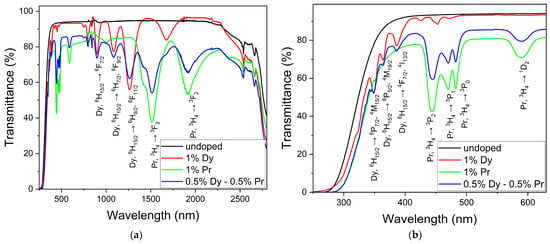
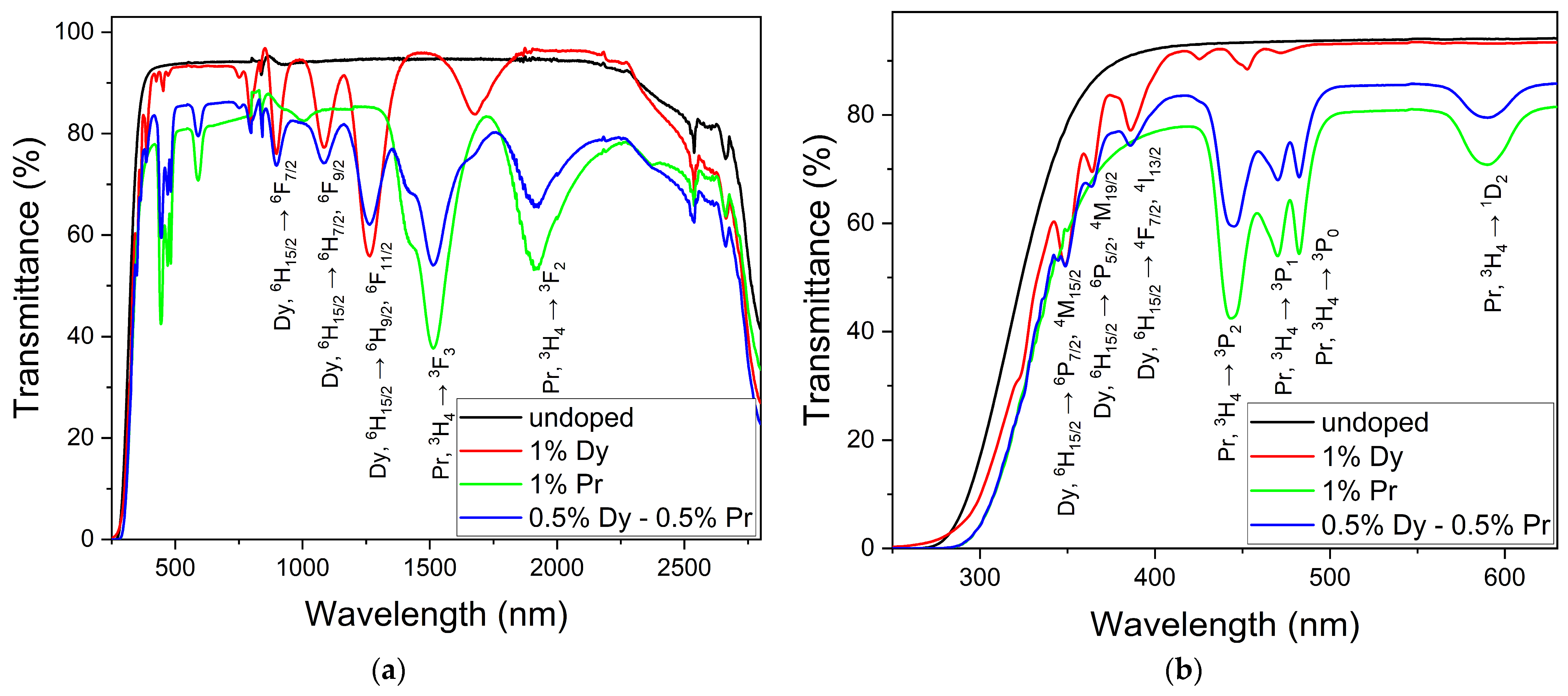
The optical properties of the borate glasses doped with Dy3+ and/or Pr3+ ions were analyzed using UV–Vis–NIR transmission spectroscopy (Figure 1). These analyses confirmed the incorporation of both rare-earth ions into the glass matrix, as indicated by their characteristic absorption transitions in the spectra. The optical transmission spectra of the Dy3+-doped, Pr3+-doped, and Dy3+/Pr3+ co-doped glasses reveal distinct absorption features associated with the characteristic 4f–4f transitions of these rare-earth ions.
Figure 1.
(a) Optical transmission spectra of B59:Dy1, B59:Pr1 single-doped and B59:Dy0.5/Pr0.5 co-doped borate glasses, (b) part of the transmission spectrum in the UV–Vis–NIR region.
For Dy3+-doped glasses, absorption bands are observed in the range of 400–3200 nm, corresponding to transitions from the 6H15/2 ground state to various excited states, with the most intense peak occurring at 1265 nm, assigned to the 6H15/2 → (6H9/2, 6F11/2) transition. The presence of hypersensitive transitions, which follow established selection rules, provides insights into the local symmetry and bonding nature of the rare-earth ions in the glass matrix.
For Pr3+-doped glasses, the transmission spectra exhibit peaks at 446, 469, 482, 587, 1421, 1518, and 1919 nm, corresponding to transitions from the 3H4 ground state to higher-energy levels. The hypersensitive 3H4 → 3P2 transition in the violet-to-blue region shows a blue shift with increasing Pr3+ concentration due to the nephelauxetic effect, indicating a reduction in the covalent nature of the rare-earth–oxygen bond. It should be noted that the intense NIR absorption bands (3H4 → 3F4, 3F3, 3F2 transitions) are particularly relevant for optical applications [21].
In co-doped B59:Dy0.5/Pr0.5 glasses, the combined absorption features of both Dy3+ and Pr3+ ions result in a modified transmission profile, with overlapping absorption bands influencing the overall spectral response. Such overlap provides possible excitation channels for both ions, affecting luminescence properties. The variations in transmission spectra between single-doped and co-doped samples provide a foundation for optimizing the composition.
Previous studies on Dy3+-doped borate glasses have reported strong luminescence with distinct excitation bands that peak at 350 nm. Under this excitation, the emission spectra displayed characteristic bands at about 480 nm (blue), 580 nm (yellow), and a very weak band near 665 nm (red), corresponding to transitions in Dy3+ ions. The optimal Dy2O3 concentration for maximum luminescence was identified near 1.00 mol%, beyond which quenching effects reduced efficiency. The CIE 1931 chromaticity diagram analysis confirmed that Dy3+-doped glasses produced near-white light (slightly bluish tint), highlighting their suitability for WLED applications [7,10,22]. These results provide a reference for comparing the luminescence behavior of Pr3+ ions in similar glass matrices.
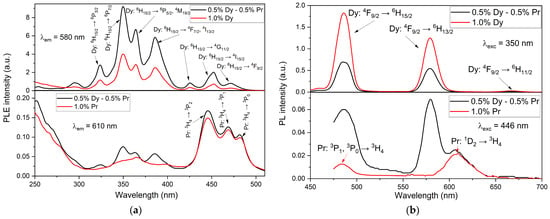
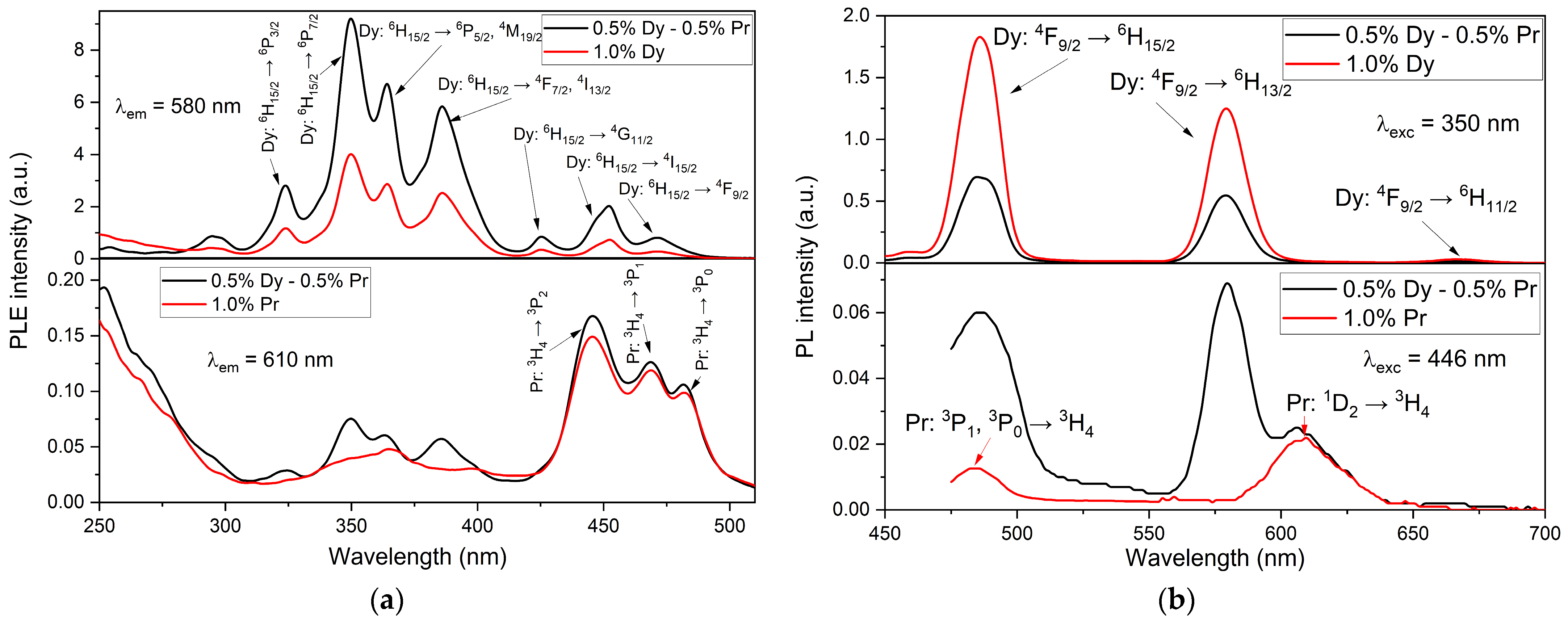
The PLE spectra (Figure 2a) reveal several characteristic excitation bands corresponding to intraconfigurational 4f–4f transitions of the rare-earth ions. The analysis of Pr3+-doped samples focused on their luminescence properties (Figure 2b) under 446 nm excitation. The emission spectra revealed a weak luminescence band centered at 610 nm, assigned to the 1D2 → 3H4 transition. Despite the presence of Pr3+, the overall luminescence intensity was relatively low. Samples co-doped with Dy3+ and Pr3+ exhibited similarly weak luminescence, likely due to energy transfer mechanisms between Dy3+ and Pr3+ ions. These mechanisms include NIR emission via the 1D2 → 3H6, 1D2 → 3F3, 1D2 → 3F4, and 1G4 → 3H4 transitions, thereby reducing the overall intensity of the visible emission [23].
Figure 2.
PL excitation (a) and emission (b) spectra of borate glasses doped with one type of Dy3+/Pr3+ ions and co-doped with Dy3+ and Pr3+ ions. The wavelengths λem = 580 nm and λexc = 350 nm correspond to Dy3+ ions, λem = 610 nm and λexc = 446 nm correspond to Pr3+ ions.
The results show that Dy3+-doped borate glasses exhibit strong luminescence, with the highest emission intensity observed at a Dy2O3 concentration of 1.0 mol%. The strong luminescence is accompanied by near-white-light emission, making these glasses promising candidates for optical applications. Adding Pr3+ ions or co-doping with Dy3+ and Pr3+ results in weaker, partially orange luminescence, highlighting the distinct behavior of Pr dopants within the glass matrix.
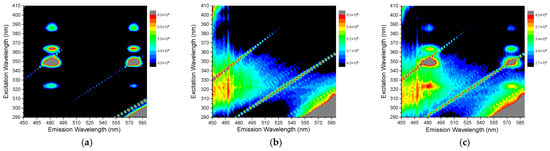
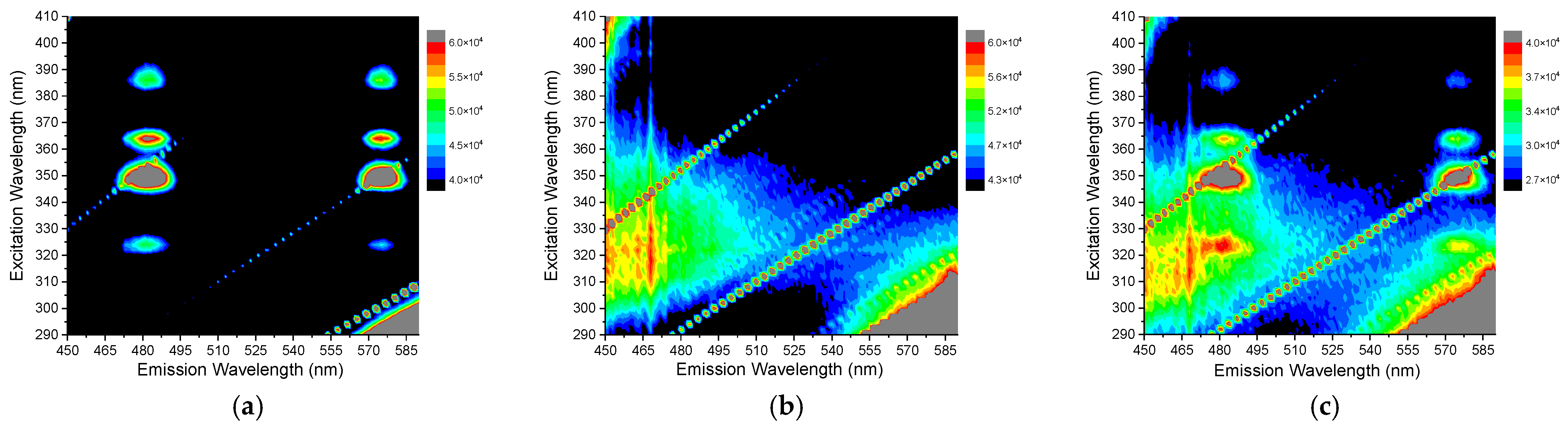
To evaluate the optical response in the synthesized glasses, 3D EEM photoluminescence maps were recorded. The obtained 3D luminescent plots for the single-doped and co-doped glasses, in the UV–Vis spectral region, are presented in Figure 3. It should be noted that the 3D photoluminescence mapping of the undoped host matrix (B2O3)60-(ZnO)10-(SrO)10-(CaO)10-(MgO)10 demonstrates a completely dark profile in both the visible and NIR (up to 1600 nm) spectral regions. Apart from the intense diagonal track corresponding to the second-order diffraction artifacts (2λex = λem), no distinct intrinsic emission peaks or defect-related luminescence bands were detected under the applied excitation wavelengths. This confirms that the host borate matrix has high optical transparency and does not show emission transitions in the UV–Vis–NIR spectral range, making it an excellent host medium for rare-earth (RE3+) activators.
Figure 3.
3D excitation–emission matrix photoluminescence maps of the studied borate glasses: (a) 1.0 mol% Dy2O3 single-doped glass; (b) 1.0 mol% Pr2O3 single-doped glass; (c) 0.5 mol% Dy2O3/0.5 mol% Pr2O3 co-doped glass.
For the 1 mol% Dy2O3 single-doped sample, the EEM map reveals a set of sharp, discrete emission features characteristic of 4f → 4f intra-configurational transitions of Dy3+ ions. In the visible region (Figure 3a), two prominent emission bands are observed: a blue emission band centered at λem ≈ 480 nm, attributed to the magnetically-allowed 4F9/2 → 6H15/2 transition and an intense yellow emission band located at λem ≈ 575 nm, originating from the hypersensitive forced electric-dipole 4F9/2 → 6H13/2 transition (∆L = 2, ∆J = 2) [24]. The excitation EEM profile shows that the 4F9/2 metastable state is most effectively populated via absorption bands in the near-UV and violet regions, including features near λex ≈ 325, 350, 365, and 385 nm, with the strongest maximum around 350 nm, corresponding to the 6H15/2 → 6P7/2/4M19/2 transition.
The EEM map of the 1 mol% Pr2O3 single-doped sample shows a fundamentally different topology, characterized by broadband emission features (Figure 3b). It demonstrates a broad emission spanning from 450 nm to the red region (~600 nm) with a fine structure in the 440–480 nm range, governed by radiative transitions from the 3P0 (and partially 1D2) states of Pr3+ to the lower 3HJ and 3FJ levels. The excitation map reveals that these transitions are strongly driven by a broad absorption band in the blue spectral region (440–480 nm), corresponding to the ground state absorption 3H4 → 3PJ. Additionally, an excitation channel emerges in the deep-UV region (λex < 340 nm), which may be associated with interconfigurational 4f → 5d transitions or host-to-activator energy transfer.
For the co-doped glass composition containing 0.5 mol.% Dy2O3 and 0.5 mol.% Pr2O3, the 3D luminescent topography reflects a superposition of both activator networks. In the visible range, the distinct “spot-like” sharp emission peaks of Dy3+ (such as 480 nm and 575 nm peaks) become superimposed on the broader emission background of Pr3+. Due to the bidirectional decrease in individual activator concentrations (from 1% to 0.5%), the overall absolute visible luminescence intensity decreases (Figure 3c).
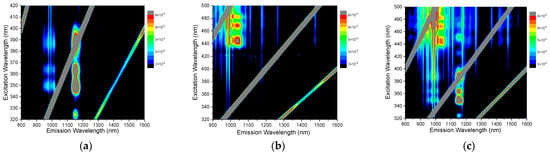
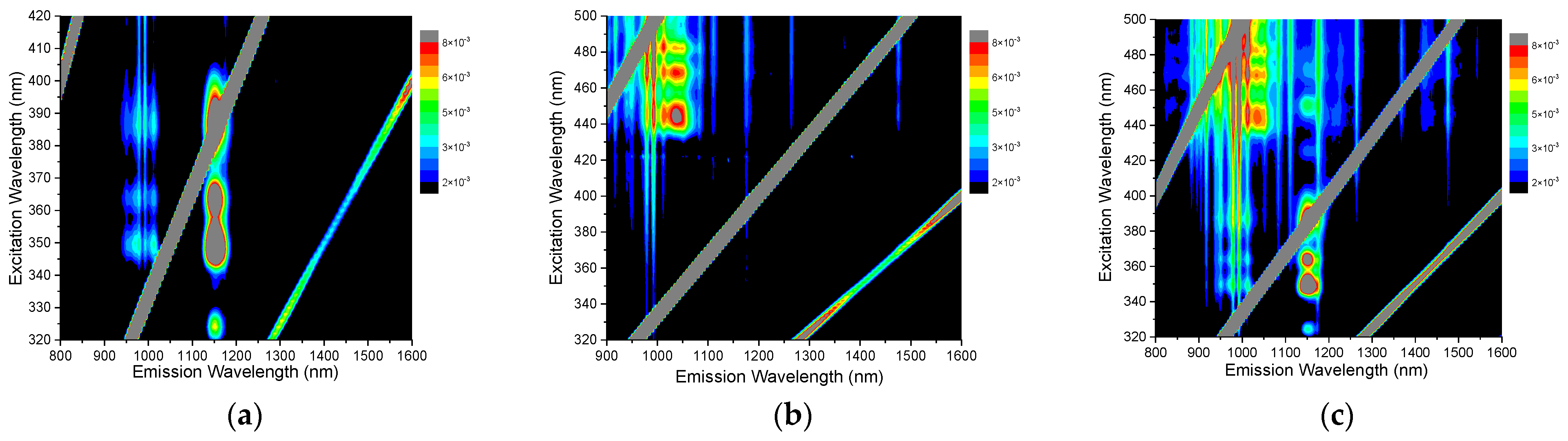
In the NIR spectrum, additional radiative relaxation pathways are observed in Dy-single-doped samples, which are characteristic of the 4F9/2 energy level. Specifically, distinct emission bands appear around 980 nm and 1010 nm (corresponding to 4F9/2 → 6F7/2 and 4I15/2 → 6F5/2 transitions, respectively). Furthermore, a strong, well-defined NIR luminescence is observed in the 1140–1180 nm range, extending the functional applications of the Dy3+-doped system into the NIR photonics (Figure 4a).
Figure 4.
3D excitation–emission matrix photoluminescence maps of the borate glass samples in the NIR spectrum: (a) 1.0 mol% Dy2O3 single-doped glass; (b) 1.0 mol% Pr2O3 single-doped glass; (c) 0.5 mol% Dy2O3 / 0.5 mol% Pr2O3 co-doped glass.
In Dy3+-doped borate glasses, the NIR luminescence observed in the 1140–1180 nm range can be assigned primarily to the Dy3+ 4F9/2 → 6F5/2 transition. The high phonon energy of the borate host efficiently drives non-radiative multiphonon relaxation from upper excited states to successfully populate this 4F9/2 emitting level. Concurrently, the highly asymmetric local environment of the borate glass network relaxes parity selection rules, resulting in the characteristic inhomogeneous broadening of this specific emission profile.
The NIR EEM map (Figure 4b) reveals strong luminescence features with distinct emission lines around 980 nm and 1020 nm, which correspond to the characteristic transitions of Pr3+ ions and are effectively populated over a broad UV-to-green excitation range (260–500 nm). Literature on Pr3+-doped glasses reports nearby 1D2 → 3F3 and 1D2 → 3F4 emissions and possible overlap with 1G4 → 3H4 near ~1.0–1.05 µm [4].
The NIR map of the co-doped glass shows combined behavior (Figure 4c). The spectral structure reveals an elongated excitation profile along the λex axis, extending from approximately 320 nm to 480 nm, which is associated with infrared emission bands at λem ≈ 1000–1050 nm and λem ≈ 1160 nm. This broad excitation response indicates that both Dy3+ and Pr3+ absorption channels contribute to the observed NIR emission. Consequently, the observed broadband NIR emission under UV/visible excitation indicates the potential of the co-doped system for spectral conversion and NIR photonic applications.
The spectral map reveals that the dominant luminescent feature in this regime is localized within the 980–1020 nm wavelength band. This primary emission achieves its maximum PL intensity when pumped at specific excitation channels, notably around 440–450 nm and 475–495 nm. A secondary, lower-intensity emission band is presented in the 1160–1180 nm range. Within the analyzed visible excitation window, this transition—primarily ascribed to the Dy3+ 4F9/2 → 6F5/2 decay channel—exhibits a localized excitation maximum at λex ~ 430–440 nm. Weak emission is also observed at approximately 1470–1480 nm under excitation in the 420–500 nm range, accompanied by trace background emission faintly discernible near 1320–1350 nm under the same excitation conditions (Figure 4c).
The two primary excitation bands observed in the blue region (440–450 nm and 475–490 nm) originate from the direct, intraconfigurational 4f–4f ground-state absorption transitions of both ions. Because both rare-earth ions possess excited energy levels that strongly absorb blue light, the broad features seen in the excitation–emission PL map are the result of the superposition of multiple overlapping transitions from both dopants. Furthermore, the amorphous nature of the multicomponent BZnSrCaMg glass host induces inhomogeneous broadening, which merges these adjacent Stark-split transitions into continuous bands.
The 430–450 nm excitation band can be regarded as a convolution of two bands: Pr3+ (the 3H4 → 3P2 transition) and Dy3+ (the 6H15/2 → 4I15/2 transition). The first one is typically among the strongest absorption channels for praseodymium in the visible spectrum, peaking around 442–445 nm. The absorption peak for dysprosium typically manifests around 450–452 nm. Their overlap limits ion-specific attribution of the corresponding EEM excitation band.
The 475–490 nm lower-energy excitation band is dominated by the strong absorption states of praseodymium, with a secondary overlapping tail from dysprosium. This region encompasses the characteristic Pr3+ 3H4 → 3P0 transition (which strongly peaks around 482 nm), as well as the closely adjacent 3H4 → 3P1 and 3H4 → 1I6 transitions (located around 468–475 nm) [25]. The 6H15/2 → 4F9/2 transition of Dy3+ ions typically peaks slightly lower (around 470–475 nm), and its lower-energy tail significantly overlaps with the Pr absorption profile (3H4 → 3P0).
Because both Pr3+ and Dy3+ are simultaneously excited by these wavelengths in the blue region, both ions are promoted to their respective excited states. Such spectral overlap may favor interionic energy transfer and cross-relaxation between Pr3+ and Dy3+ ions, thereby contributing to the NIR emission observed in the co-doped glass.
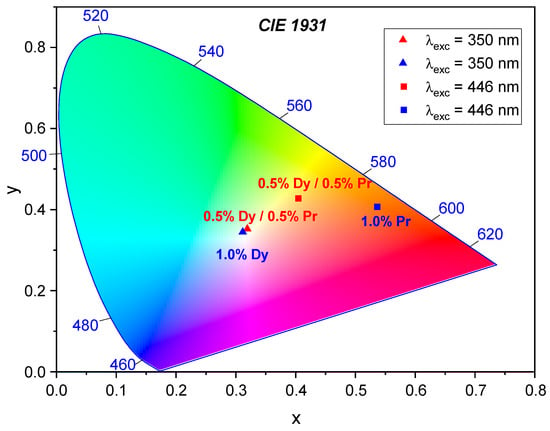
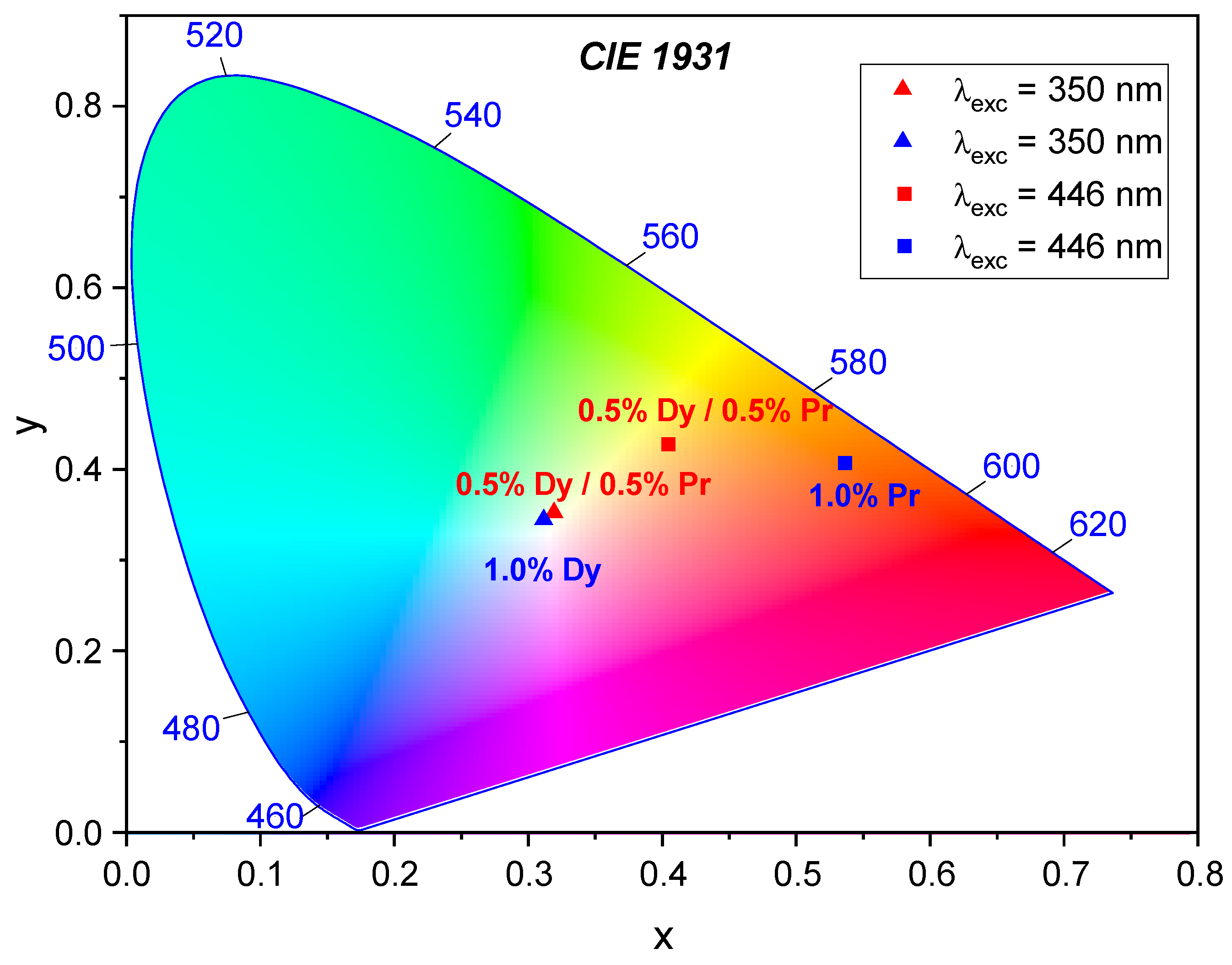
The CIE 1931 chromaticity diagram illustrates the emission color coordinates of Dy3+- and Pr3+-doped borate glasses measured under different excitation wavelengths (Figure 5). Under 350 nm excitation (triangles), both samples exhibit chromaticity coordinates close to the central region of the CIE diagram, near the white-light reference point (x, y) ≈ (0.33, 0.33). This indicates near-white chromaticity, with small differences between the Dy3+-doped and Dy3+/Pr3+ co-doped glasses. In contrast, under 446 nm excitation (squares), the Dy3+/Pr3+ co-doped glass exhibits chromaticity in the yellow-orange region, while the Pr3+-doped glass shows chromaticity in the orange region.
Figure 5.
The CIE 1931 chromaticity diagram of Dy3+- and Pr3+-doped borate glasses obtained under different concentrations of dopants and excitation wavelength.
The chromaticity diagram (Figure 5) demonstrates that the emission color of the investigated borate glasses can be modified by varying the Dy3+/Pr3+ dopant composition and excitation wavelength, indicating that the emission color can be tuned by appropriately selecting the excitation conditions and glass composition. These results highlight the potential of Dy3+- and Pr3+-doped borate glasses as color-tunable luminescent materials for phosphor and optoelectronic applications.
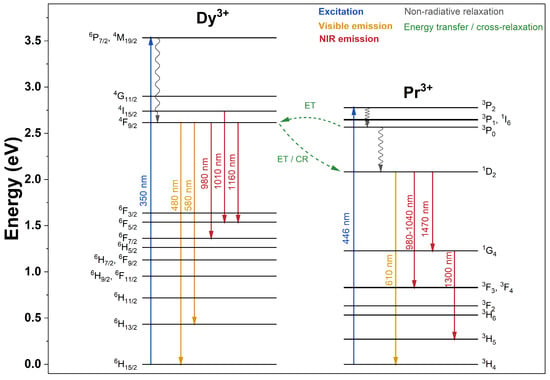
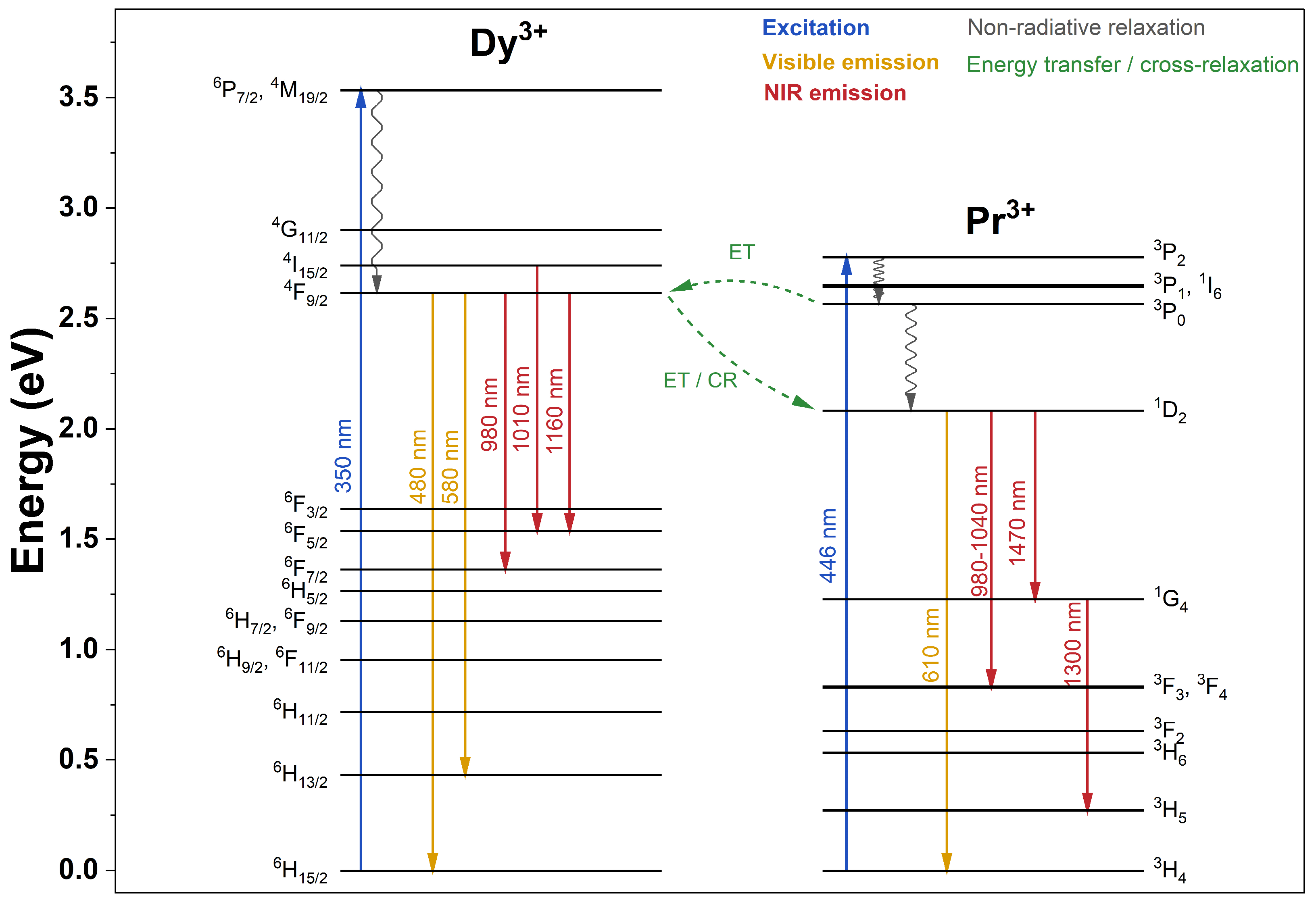
The diagram in Figure 6 illustrates the electronic energy levels of trivalent dysprosium (Dy3+) and praseodymium (Pr3+) ions, along with their excitation and emission pathways, non-radiative relaxation processes, and possible interionic energy-transfer mechanisms. Horizontal lines denote the electronic multiplet levels, solid vertical arrows denote spectrally determined excitation and emission bands, wavy arrows represent plausible nonradiative relaxation, while dashed interionic arrows are only proposed pathways of relaxation and energy-transfer processes, based on the analysis of excitation and emission spectra in the UV–visible–NIR spectral range.
Figure 6.
Energy levels diagram of Dy3+ and Pr3+ ions (excitation pathways—blue arrows, emission transitions—orange and red arrows, non-radiative relaxation processes—wavy gray arrows, and possible interionic energy-transfer mechanisms—green dashed arrows.
It should be noted that the dashed interionic arrows in Figure 6 are energy transfer hypotheses based on spectral overlap of bands and approximate ion energy-level matching. The steady-state excitation and emission spectra obtained in this work do not directly establish the energy-transfer/relaxation direction. Confirmation of a proposed mechanism would require a concentration series of samples and time-resolved decay measurements to determine lifetimes and transfer efficiencies.
The left-hand side shows the energy-level scheme of Dy3+. Its ground state is 6H15/2, and the excited states include the 6HJ, 6FJ, 4F9/2, 4I15/2, 4G11/2, and higher-lying multiplets. Excitation at 350 nm (blue arrow): promotes Dy3+ ions from the ground state to a high-energy excited state, labeled approximately 6P7/2 and/or 4M19/2 in the diagram. Excited ions non-radiatively relax to lower-lying states through phonon-assisted processes, potentially populating the metastable 4F9/2 level. The visible emissions around 480 and 575 nm (orange arrows) and NIR emission around 980, 1010, and 1160 nm (red arrows) are characteristic Dy3+ transitions.
The right-hand side presents the energy-level scheme of Pr3+. The principal multiplets include the ground state 3H4, the 3H5, 3H6, 3FJ, 1G4, 1D2, and higher-lying 3PJ states. Excitation at 446 nm (blue arrow) excites Pr3+ ions from the ground state to the 3PJ manifold, principally the 3P2 region. Non-radiative relaxation (wavy gray arrows) transfers population from the higher excited states toward lower levels, including 1D2. It should be noted that the 1D2 state is important because it contributes to both visible (orange arrows, emission at 610 nm associated with the 1D2 → 3H4) transitions) and NIR (red arrows, 980–1040 nm emission, associated with transitions from 1D2 to the 3FJ manifold) emission. The emissions at about 1300 nm and 1470 nm are assigned to the 1G4 → 3H5 and 1D2 → 1G4 transitions, respectively, involving lower-lying Pr3+ multiplets.
The green dashed arrows represent possible interionic energy transfer (ET) and cross-relaxation (CR) pathways between Dy3+ and Pr3+. The energy-level diagram illustrates possible interaction between Dy3+ and Pr3+ ions through resonant energy transfer (ET), which could redistribute excitation energy and modify their relative emission intensities (Figure 3, Figure 4 and Figure 5). The process is governed by the energy matching of electronic transitions, spectral overlap, and the distance between neighboring ions.
In particular, Dy3+ → Pr3+ energy transfer may occur from the Dy3+ 4F9/2 level to neighboring Pr3+ ions, promoting them to the 3PJ manifold, as suggested by the spectral overlap between the Dy3+ emission near 480 nm and the Pr3+ absorption bands in the 440–490 nm region. The reverse Pr3+ (3P0) → Dy3+ (4F9/2) transfer is also energetically possible. Such bidirectional interaction could account for the broadened excitation response of the co-doped glass. This makes Dy3+/Pr3+ co-doped glasses interesting for excitation-tunable visible and NIR emission.
3. Materials and Methods
3.1. Glass Synthesis
The undoped (B2O3)60-(ZnO)10-(SrO)10-(CaO)10-(MgO)10 and RE-doped (B2O3)59-(ZnO)10-(SrO)10-(CaO)10-(MgO)10 glass compositions were synthesized using the melt-quenching technique, ensuring the homogeneity and structural integrity of the prepared materials. The original borate glass matrix was single-doped with (Dy2O3)-1.0 mol%, (Pr2O3)-1.0 mol%, and co-doped with (Dy2O3)-0.5 mol% and (Pr2O3)-0.5 mol%. (Table 1).
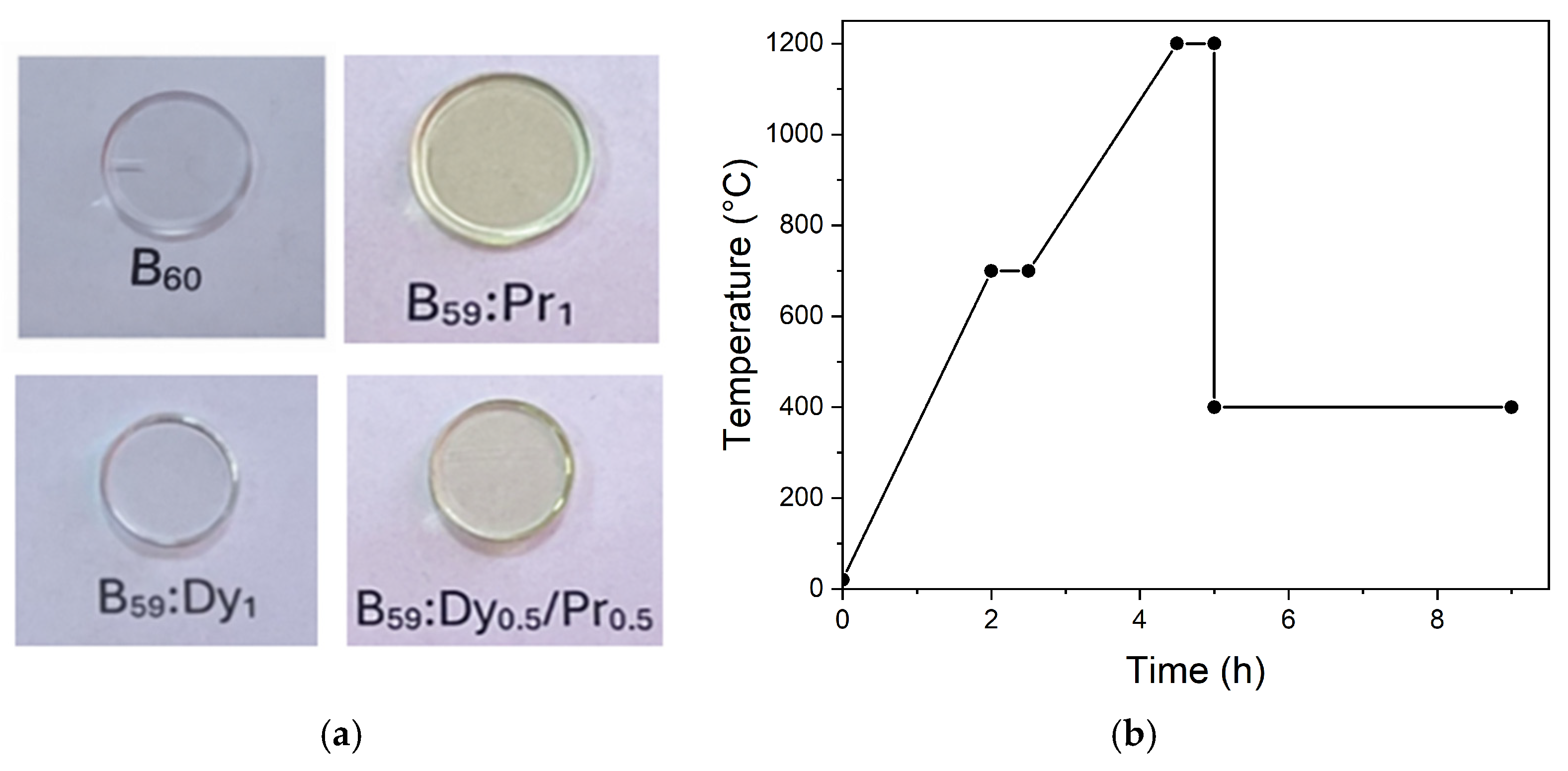
The synthesis procedure involved weighing high-purity raw materials in precise stoichiometric proportions, including B2O3, ZnO, SrO, CaO, MgO, and the respective rare-earth oxides. The powdered mixture was melted and homogenized in Al2O3 crucibles in a high-temperature furnace. The thermal treatment process (Figure 7b) included an initial 2-h heating phase from room temperature to approximately 700 °C, followed by a second heating phase to approximately 1200 °C, with a 1-h dwell to ensure successful completion of melting and homogenization. The molten glass was then rapidly quenched into carbon molds to prevent crystallization, followed by a 4-h annealing phase at approximately 400 °C to relieve internal stresses.
Figure 7.
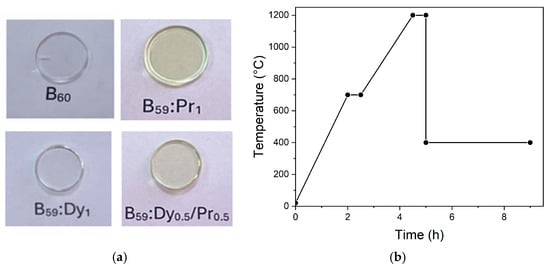
Photography of synthesized glass samples (a) and temperature map of glass synthesis (b).
After cooling, the glass samples were polished to achieve high-quality optical surfaces (Figure 7a), enabling precise optical and luminescent measurements in subsequent characterization studies. The photograph of the samples (Figure 7a) was taken with a smartphone camera under ambient daylight using automatic settings and is intended for illustrative purposes only.
3.2. Characterization Techniques
Sample thicknesses required for absorption coefficient calculations were measured with a digital micrometer (±0.01 mm accuracy) and averaged across multiple readings. Molar mass was determined using stoichiometric calculations of the oxide components, while density was assessed using Archimedes’ principle by comparing weights in air and deionized water. Molar volume was derived from the molar mass-to-density ratio, providing insights into the glass matrix structure.
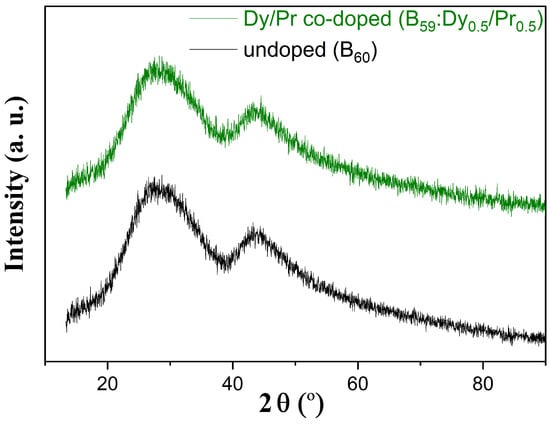
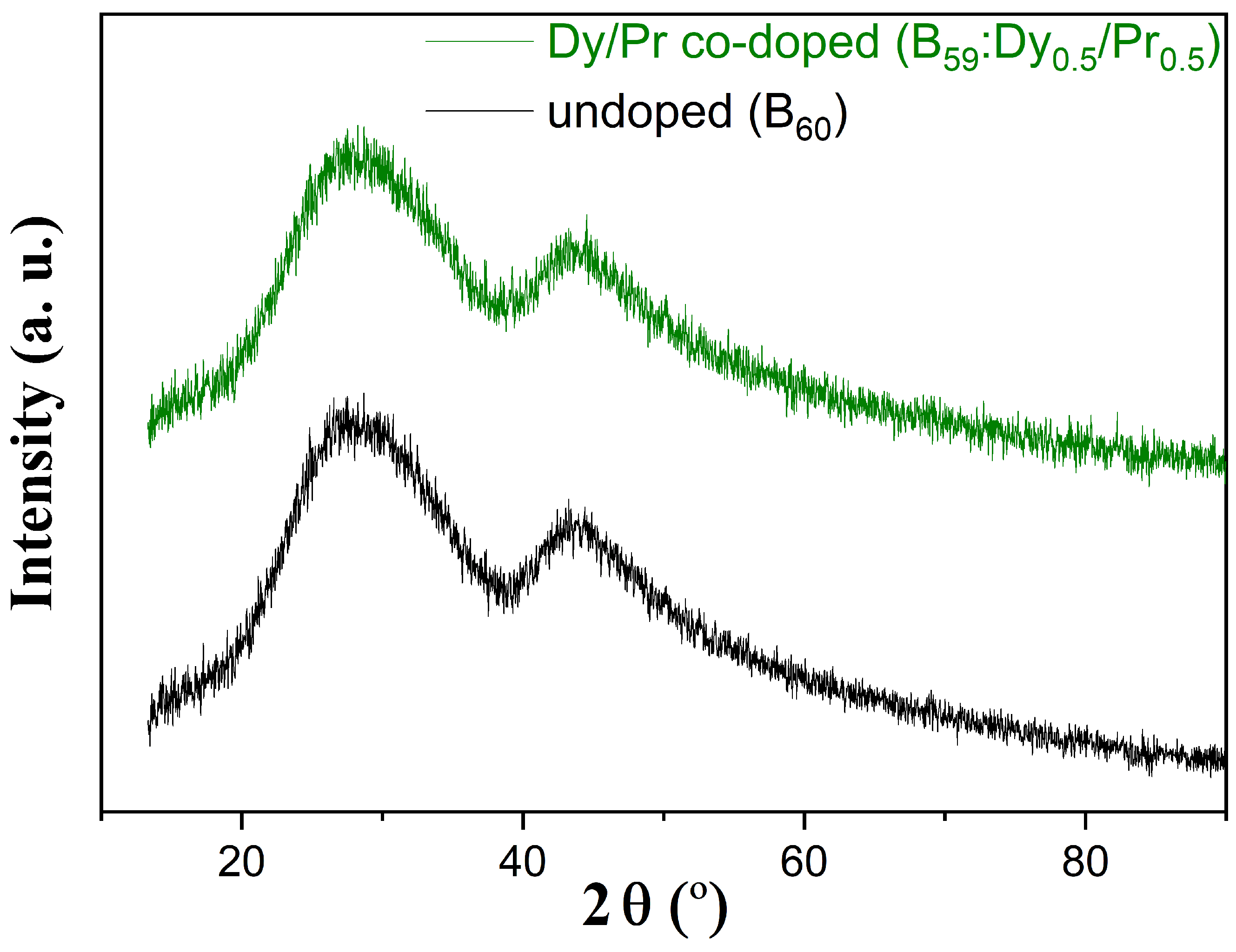
The amorphous nature of the synthesized glasses was verified by X-ray diffraction using a Bruker D8 Advance (Bruker AXS GmbH, Karlsruhe, Germany) with Cu Kα radiation (λ = 1.5406 Å) in the 2θ range of 10–90° 2θ. The XRD patterns of the undoped B60 and Dy/Pr co-doped B59:Dy0.5/Pr0.5 glasses are shown in Figure 8.
Figure 8.
The X-ray diffraction pattern of the studied B60 (undoped) and B59:Dy0.5/Pr0.5 (Dy/Pr co-doped) samples.
The patterns of undoped and Dy/Pr co-doped samples exhibit two broad, diffuse halos centered at approximately 28° and 44° (2θ) and no sharp Bragg reflections, confirming the non-crystalline character of the host matrix and the disordered atomic arrangement typical of glassy systems. The XRD pattern of the co-doped glass confirms that the incorporation of rare-earth oxides does not induce crystallization. An amorphous structure of the investigated samples is further supported by their visual transparency and homogeneity (Figure 7a).
The optical properties of Dy3+- and Pr3+-doped borate glasses were investigated using transmission and photoluminescence (PL) spectroscopy. Optical transmission spectra (200–3200 nm, 1 nm resolution) were recorded using an Agilent Cary-5000 spectrometer (Agilent Technologies, Inc., Santa Clara, CA, USA). Photoluminescence excitation (PLE) and photoluminescence (PL) spectra (220–820 nm) were recorded using a CM2203 spectrofluorometer (SOLAR, Minsk, Belarus), with a 150 W xenon lamp as the excitation source and a Hamamatsu R928 photomultiplier (Hamamatsu Photonics K.K., Hamamatsu City, Shizuoka, Japan) for detection. Excitation–emission matrix (EEM) spectroscopy was performed using a Horiba Fluorolog-3 spectrofluorometer (HORIBA Jobin Yvon S.A.S., Longjumeau, France) equipped with a xenon short-arc lamp as the light source. For the NIR emission measurements (800–1600 nm), the liquid nitrogen-cooled Jobin Yvon InGaAs DSS-IGA020L NIR detector (HORIBA France SAS, Palaiseau, France) was used. The emission data were further analyzed to generate the CIE chromaticity diagram, providing a visual representation of color coordinates and assessing the glass’s potential for white-light emission applications. Therefore, the characterization stage focused on analyzing borate glasses using optical spectrophotometry, transmission measurements, and photoluminescence spectroscopy to evaluate their optical and luminescent properties. The aim of this approach was to identify and select samples with the most favorable optical-luminescence characteristics for potential applications.
4. Conclusions
In this study, multi-component (B2O3)60(ZnO)10(SrO)10(CaO)10(MgO)10 borate glasses, single-doped and co-doped with Dy3+ and Pr3+ ions, were successfully synthesized via the conventional melt-quenching technique. UV–Vis–NIR transmission spectroscopy revealed characteristic 4f–4f absorption transitions of Dy3+ and Pr3+ ions, demonstrating effective incorporation of rare-earth activators into the borate host network.
The photoluminescence studies show that Dy3+-doped glasses exhibit prominent blue (~480 nm) and yellow (~575 nm) emissions under near-UV excitation, making them highly promising candidates for near-white-light generation in WLED applications. Conversely, samples doped solely with Pr3+ ions exhibited a dominant orange-red emission near 610 nm, with relatively low intensity.
Three-dimensional excitation–emission matrix (EEM) mapping provided a comprehensive characterization of the excitation-dependent luminescence of Dy3+- and Pr3+-doped, and Dy3+/Pr3+-doped, borate glasses across the visible and near-infrared spectral regions. This approach enabled the identification of characteristic emission bands, their optimal excitation wavelengths, and overlapping excitation–emission features that are difficult to distinguish using conventional photoluminescence spectroscopy. In particular, EEM analysis revealed distinct NIR emission bands in the 1000–1180 nm range and a broadened excitation response in the co-doped glass, demonstrating the potential for excitation-dependent spectral tuning. The observed redistribution of visible and NIR emission features suggests possible interactions between Dy3+ and Pr3+ luminescent centers, although the specific energy-transfer mechanisms require further experimental verification. These findings highlight the value of 3D EEM spectroscopy for understanding the complex luminescence behavior of rare-earth-doped glasses and identifying promising compositions for visible–NIR photonic applications.
Consequently, while Dy3+-doped compositions are optimal for solid-state lighting (WLEDs), Dy3+/Pr3+-co-doped borate glass systems are promising candidates for spectral conversion and NIR photonic applications.
Author Contributions
Conceptualization, M.K., B.M., A.L. and Y.S.; methodology, M.K., R.G., A.L. and Y.S.; formal analysis, M.K., Y.H., R.G., I.M. and D.S.; investigation, B.M., Y.H., I.M., D.S. and A.L.; data curation, B.M., Y.H. and Y.S.; writing—original draft preparation, M.K. and I.M.; writing—review and editing, Y.H., R.G., A.L. and Y.S. All authors have read and agreed to the published version of the manuscript.
Funding
This research received no external funding.
Institutional Review Board Statement
Not applicable.
Informed Consent Statement
Not applicable.
Data Availability Statement
The original contributions presented in this study are included in the article. Further inquiries can be directed to the corresponding author.
Conflicts of Interest
The authors declare no conflicts of interest.
Abbreviations
The following abbreviations are used in this manuscript:
| RE | Rare-earth |
| WLEDs | White light-emitting diodes |
| PL | Photoluminescence |
| PLE | Photoluminescence excitation |
| EEM | Excitation emission matrix |
| NIR | Near infrared |
References
- Hegde, V.; Viswanath, C.S.D.; Chauhan, N.; Mahato, K.K.; Kamath, S.D. Photoluminescence and thermally stimulated luminescence properties of Pr3+-doped zinc sodium bismuth borate glasses. Opt. Mater. 2018, 84, 268–277. [Google Scholar] [CrossRef] [Scilit]
- Deopa, N.; Rao, A.S.; Mahamuda, S.; Gupta, M.; Jayasimhadri, M.; Haranath, D.; Prakash, G.V. Spectroscopic studies of Pr3+ doped lithium lead alumino borate glasses for visible reddish orange luminescent device applications. J. Alloys Compd. 2017, 708, 911–921. [Google Scholar] [CrossRef] [Scilit]
- Manyum, P.; Rittisut, W.; Wantana, N.; Ruangtaweep, Y.; Rujirawat, S.; Kamonsuangkasem, K.; Yimnirun, R.; Prasatkhetragarn, A.; Intachai, N.; Kothan, S.; et al. Structural and luminescence properties of transparent borate glass co-doped with Gd3+/Pr3+ for photonics application. Mater. Today Commun. 2023, 37, 107078. [Google Scholar] [CrossRef] [Scilit]
- Pisarska, J.; Kuwik, M.; Pisarski, W.A. Spectroscopic properties of inorganic glasses doped with Pr3+: A comparative study. Materials 2022, 15, 767. [Google Scholar] [CrossRef] [Scilit] [PubMed]
- Hegde, V.; Viswanath, C.S.D.; Mahato, K.K.; Kamath, S.D. Warm white light and colour tunable characteristics of Dy3+ co-doped with Eu3+ and Pr3+ zinc sodium bismuth borate glasses for solid state lighting applications. Mater. Chem. Phys. 2019, 234, 369–377. [Google Scholar] [CrossRef] [Scilit]
- Shi, J.; Wang, L.; Wang, Q.; Deng, C.; Pu, X.; Yao, S.; Jiang, L.; Wang, Q. Luminescent properties and structure of Pr3+-doped multi-component transparent lead zinc borate glasses for red LEDs. J. Lumin. 2025, 286, 121384. [Google Scholar] [CrossRef] [Scilit]
- Sahu, M.K.; Prashant, D.V.; Sangwan, V.; Debnath, A.; Kumar, V.; Deopa, N.; Sachchidanand. Structural and optical characteristics of thermally stable Dy3+ doped white light emitting B2O3-WO3-Na2O-Al2O3-ZnO glasses for photonic device applications. Mater. Sci. Eng. B 2026, 329, 119440. [Google Scholar] [CrossRef] [Scilit]
- Meena, S.L. Structural, physical and optical properties of Pr3+ doped in bismuth borate glasses. Appl. Phys. A 2024, 130, 404. [Google Scholar] [CrossRef] [Scilit]
- Marzouk, M.A.; Fayad, A.M.; ElBatal, F.H. Crystallization effects on the photoluminescence efficiency of SrO-B2O3 glass activated by W6+, Eu3+, Dy3+ or Pr3+ ions. Spectrochim. Acta A Mol. Biomol. Spectrosc. 2022, 274, 121079. [Google Scholar] [CrossRef] [Scilit] [PubMed]
- Abhiram, M.; Albert, K.J.; Kennedy, S.M.M.; Vighnesh, K.R.; Mishra, V.; Sayyed, M.I.; Almuqrin, A.H.; Kamath, S.D. Multifunctional evaluation of Dy3+-doped borate glass: Thermal sensing potential, structural characteristics, and luminescent performance. Mater. Today Commun. 2026, 50, 114544. [Google Scholar] [CrossRef] [Scilit]
- Kavgacı, M.; Yaykaşlı, H.; Eskalen, H.; Kavaz Perişanoğlu, E.; Kalecik, S.; Yılmaz, R.; Tunç, H. An experimental analysis of the effects of SrO on the mechanical, structural, optical, and nuclear radiation shielding properties of barium borate glasses. Opt. Mater. 2024, 149, 114975. [Google Scholar] [CrossRef] [Scilit]
- Al-Buriahi, M.S.; K, A.; Alsufyani, S.J.; Alrowaili, Z.A.; Olarinoye, I.O.; Sriwunkum, C.; Alsaiari, N.S.; Alomayrah, N. Impact of calcium content on optical properties and radiation shielding performance of lithium antimony borate glasses. J. Radiat. Res. Appl. Sci. 2024, 17, 101124. [Google Scholar] [CrossRef] [Scilit]
- Al-Shehri, S.; Almaymoni, N.K.; Al-Harbi, N.; Mahmoud, M.; Nisar, K.S.; Alharbi, W.R.; Al-Qatlawi, H.M.G.; Kamil, S.M.; Abu-Khadra, A.S.; Abdel-Ghany, A.M. Effect of MgO on the structural, optical, and radiation shielding behavior of multi-component borate glass. J. Radiat. Res. Appl. Sci. 2026, 19, 102110. [Google Scholar] [CrossRef] [Scilit]
- Ahmed, G.S.M.; Farag, A.T.M.; Ratep, A.; Abdel-Khalek, E.K.; Kashif, I. Radiation shielding efficiency and optical properties of Pr3+-doped borate glasses. Radiat. Phys. Chem. 2025, 236, 112911. [Google Scholar] [CrossRef] [Scilit]
- Pawar, P.P.; Munishwar, S.R.; Gedam, R.S. Physical and optical properties of Dy3+/Pr3+ co-doped lithium borate glasses for W-LED. J. Alloys Compd. 2016, 660, 347–355. [Google Scholar] [CrossRef] [Scilit]
- Milanova, M.; Yordanova, A.; Aleksandrov, L.; Iordanova, R.; Petrova, P. Synthesis and photoluminescent properties of Dy3+-doped and Dy3+/Eu3+ co-doped 50ZnO:40B2O3:5WO3:Nb2O5 glass. Molecules 2025, 30, 2229. [Google Scholar] [CrossRef] [Scilit] [PubMed]
- Pawar, P.P.; Gedam, R.S. Physical, morphological, thermometric, spectroscopic properties and energy transfer mechanism from Pr3+ to Dy3+ in Dy3+/Pr3+ dual-doped lithium alumino-borate glasses used as a source for warm white light emitting diode. Ceram. Int. 2025, 51, 65446–65454. [Google Scholar] [CrossRef] [Scilit]
- Dahiya, J.; Hooda, A.; Agarwal, A.; Khasa, S. Detailed optical analysis of Dy3+ and Pr3+ co-doped alumino-borate glasses for visible lighting applications. Ceram. Int. 2023, 49, 15284–15294. [Google Scholar] [CrossRef] [Scilit]
- Damdee, B.; Kaewnuam, E.; Kirdsiri, K.; Yamanoi, K.; Sarukura, N.; Shinohara, K.; Angnanon, A.; Intachai, N.; Kothan, S.; Kaewkhao, J. Concentration-dependent physical, optical, and photoluminescence features of Pr3+-doped borate glasses. Radiat. Phys. Chem. 2024, 225, 112092. [Google Scholar] [CrossRef] [Scilit]
- Sojka, L.; Tang, Z.; Jayasuriya, D.; Shen, M.; Furniss, D.; Barney, E.; Benson, T.M.; Seddon, A.B.; Sujecki, S. Ultra-broadband mid-infrared emission from a Pr3+/Dy3+ co-doped selenide-chalcogenide glass fiber spectrally shaped by varying the pumping srrangement. Opt. Mater. Express 2019, 9, 2291–2306. [Google Scholar] [CrossRef] [Scilit]
- Luewarasirikul, N.; Kaewkhao, J. Pr3+-doped Ba-Na-B glasses: Luminescence and Judd–Ofelt analysis for photonic applications. Integr. Ferroelectr. 2022, 225, 34–41. [Google Scholar] [CrossRef] [Scilit]
- Kushlyk, M.; Slobodzyan, D.; Shpotyuk, Y.; Medvid, I.; Prokopchuk, M.; Levchenko, V.; Szlęzak, J.; Mahlovanyi, B.; Luchechko, A. Optical-luminescent and dielectric spectroscopy of B2O3–ZnO–SrO–CaO glasses doped with Dy3+ ions for white light emission applications. Meas. Sci. Technol. 2025, 36, 085602. [Google Scholar] [CrossRef] [Scilit]
- Madhu, A.; Al-Dossari, M.; Kagola, U.K.; Abd EL-Gawaad, N.S.; Kesavulu, C.R.; Angadi, B. Spectroscopic and theoretical investigation of Pr3+ doped Li2O-ZnO-B2O3 glasses. J. Alloys Compd. 2025, 1010, 177583. [Google Scholar] [CrossRef] [Scilit]
- Mahlovanyi, B.; Truax, M.; Luchechko, A.; Shpotyuk, Y.; Yang, G.; Golovchak, R.; Kovalskiy, A.; Cebulski, J. Optical properties and tunable luminescence of Ce3+/Dy3+ doped lithium borate glasses for photonic applications. J. Lumin. 2023, 263, 120120. [Google Scholar] [CrossRef] [Scilit]
- Balakrishna, A.; Babu, S.; Kumar, V.; Ntwaeaborwa, O.M.; Ratnakaram, Y.C. Optical properties and spectroscopic study of different modifier based Pr3+:LiFB glasses as optical amplifiers. Spectrochim. Acta A Mol. Biomol. Spectrosc. 2017, 170, 167–173. [Google Scholar] [CrossRef] [Scilit] [PubMed]

Disclaimer/Publisher’s Note: The statements, opinions and data contained in all publications are solely those of the individual author(s) and contributor(s) and not of MDPI and/or the editor(s). MDPI and/or the editor(s) disclaim responsibility for any injury to people or property resulting from any ideas, methods, instructions or products referred to in the content. |
© 2026 by the authors. Licensee MDPI, Basel, Switzerland. This article is an open access article distributed under the terms and conditions of the Creative Commons Attribution (CC BY) license.