


Abstract
Supercritical fluid extraction (SFE) using CO2 has many advantages for recovering bioactive compounds, such as high selectivity, minimal solvent use and preservation of thermolabile metabolites. This study optimized SFE for extracting Chamaepericlymenum suecicum (Eurasian dwarf cornel) berries and compared the metabolite profiles of samples from two locations in the Magadan region: Magadan and Ola. The extraction process was conducted at temperatures ranging from 100 to 400 °C and pressures ranging from 31 to 70 MPa, using 1% ethanol as a co-solvent. Global yield ranged from 2.60 to 8.45 mg/100 mg, with the highest yield (8.45 mg/100 mg) obtained at 250 bar and 55 °C. Two-way ANOVA revealed that temperature, pressure, and their interaction significantly influenced the extraction yield (p < 0.001). A total of 47 compounds were identified by HPLC-ion trap-MS/MS, including 33 polyphenolic compounds (flavones, flavonols, flavan-3-ols, anthocyanins, phenolic acids, coumarins, and lignans), as well as 14 other metabolites (including fatty acids, oxylipins, alkaloids, organic acids, sugars, naphthoquinones, and anabolic steroids). The metabolite profiles differed between the two locations: Magadan samples contained 26 unique polyphenolic compounds, while Ola samples were characterized by the presence of flavan-3-ols, which were absent in Magadan samples. Only nine compounds were shared between the two locations. The number of compounds ranged from 8 to 24, and the Shannon diversity index was higher in the Magadan samples (H′ = 3.178 and 2.303) than in the Ola samples (H′ = 2.079 and 2.398). These findings demonstrate that supercritical fluid extraction (SFE) combined with metabolomic analysis is a powerful tool for profiling C. suecicum berries, revealing significant geographic variation in their chemical composition and highlighting their potential as a source of bioactive compounds for functional foods and pharmaceutical applications.
1. Introduction
The genus Cornus L., which includes about 55 species, is the subject of intensive botanical study due to its unique morphology and the diversity of its ecological and geographical adaptations. Members of the genus are characterised by tetracyclic floral structures, arcuate leaf venation, and unicellular T-shaped trichomes containing calcium carbonate. Most Cornus species are trees or shrubs, but the subgenus Arctocrania (Endl.) Wangerin is distinguished by the presence of herbaceous flowering shoots developing from a perennial rhizome. This subgenus is characterized by chlorophyll-free scale-like leaves on the rhizome and in some nodes of the flowering stems, as well as by bristle-like structures on the outer surface of the petals [1].
Previously, the subgenus Arctocrania included two species: Cornus canadensis L. and Cornus suecica L. (Chamaepericlymenum suecicum L.). C. canadensis, described by Carl Linnaeus in 1753, has a circumboreal distribution extending from the Rocky Mountains and Appalachians in North America to the mountains of Japan. C. suecica, also described by Linnaeus, has a more northern and coastal circumpolar range [2]. A clear distinction between these species is difficult due to the presence of intermediate forms. Ledebour (1844) first identified the intermediate species C. unalaschkensis, which grows on the islands of Alaska [3]. Farr (1904) described specimens from Glacier National Park in Alaska, classifying them as C. canadensis var. intermedia and noting variability in morphological characteristics, such as leaf arrangement and coloration [4]. Hultén (1937) proposed a hypothesis about the hybrid origin of the mentioned forms, which was confirmed cytologically [5]. A detailed analysis of the morphological, chemical, phytogeographical, and cytological variability of species in the subgenus Arctocrania allowed Bayne and Denford (1979) to identify four taxa, including diploid C. canadensis and C. suecica, their hybrid C. canadensis × C. suecica, as well as the tetraploid C. unalaschkensis, which arose as a result of crossing C. canadensis and C. suecica. These results were supported by data on flavonoid content and cytological characteristics of the plants [5].
The flavonoid composition of C. canadensis and C. suecica demonstrates a relative simplicity of chemical structure, with a predominance of flavonol glycosides, which indicates limited chemical variability. Evolutionary changes in flavonoid content are often accompanied by a transition from woody to herbaceous forms, which is characterized by three typical changes in the flavonoid composition of leaves: the loss of proanthocyanidins, the loss of trihydroxylation in the B-ring, and the replacement of flavonols with flavones [6].
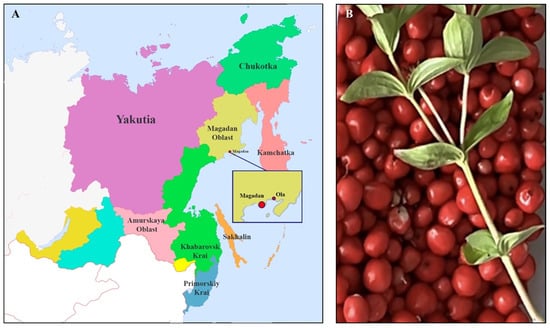
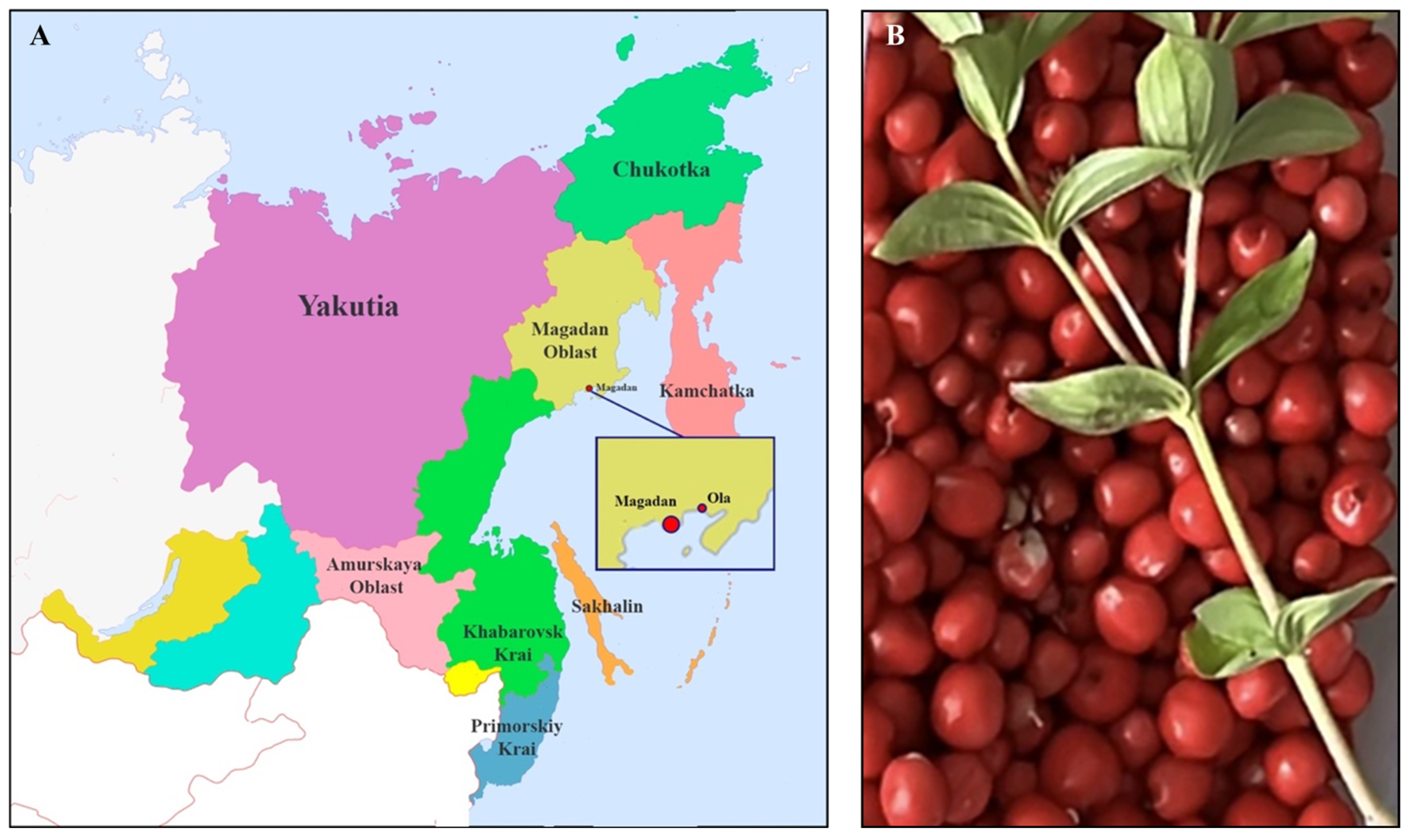
In this work, our research group carried out an in-depth analysis of the process of extracting biologically active components from C. suecica (Chamaepericlymenum suecicum L.) berries collected in the Ecoregion of Magadan (Sea of Okhotsk) using the method of supercritical CO2 extraction (Figure 1). This method, which has high selectivity and the ability to effectively separate complex matrices, allowed us to minimize the loss of valuable compounds and obtain highly concentrated extracts.
Figure 1.
(A) Locations of sample collection sites of Chamaepericlymenum suecicum in the Magadan region. (B) Berries of the Chamaepericlymenum suecicum L. sample collected from Magadan Region. The photo was taken by A. Sabitov in August 2024 during a scientific expedition conducted in the Magadan Region.
National and international legislation governing the production and circulation of food products restricts the use of solvents for the extraction of food materials, allowing only a few substances of a specified degree of purity. The choice of solvent for the extraction of spices is determined by its ability to extract the desired components, the cost-effectiveness of the desolvation process, and its potential for reuse. Modern research focuses on environmentally friendly extraction technologies, such as the use of liquid CO2, supercritical CO2, pressurised liquids, and microwave extraction [7]. These methods not only reduce the harmful effects on health and the environment, but also contribute to the development of effective methods for extracting food flavors, cosmeceuticals, nutraceuticals, and biopesticides from plant raw materials. Environmentally friendly extraction technologies have the potential to meet all current regulatory requirements in the fields of safety, health, and environmental protection [8].
SFE is an advanced method based on the use of the extracting properties of carbon dioxide (CO2) in a supercritical state. The supercritical state of CO2 is characterised by unique physical and chemical properties that arise when the substance reaches its critical point. In this state, when the temperature exceeds the critical temperature (31.1 °C for CO2) and the pressure exceeds the critical pressure (73.8 bar for CO2), carbon dioxide exhibits properties intermediate between a gas and a liquid: it has high solubility comparable to liquids and low viscosity, similar to gases. These properties ensure effective dissolution of substances in the sample matrix and accelerated mass transfer between the extractant and the dissolved substance [9].
Extraction using supercritical fluids demonstrates high selectivity due to the ability to precisely control solubility by changing pressure, temperature, or a combination of both. Compared to traditional organic solvents, supercritical fluids are characterized by increased diffusivity and reduced viscosity, which optimizes the mass transfer of dissolved substances. The most commonly used supercritical fluid is carbon dioxide (CO2), which has unique properties: inertness, non-toxicity, non-flammability, non-explosiveness, and a high degree of purification at an economically acceptable price. These characteristics make CO2 an ideal solvent for extracting thermolabile components, such as carotenoids, which are susceptible to degradation under the influence of traditional organic solvents [10].
SFE is widely used in various fields, including the extraction of plant components. These technologies represent a promising direction in the development of environmentally friendly and cost-effective methods for extracting valuable components from plant raw materials [11].
Currently, information on the chemical composition and biologically active components of C. suecicum is limited. Due to the susceptibility of berry metabolites to degradation, SFE was employed as a gentle method of preserving labile compounds. Subsequent analysis of the obtained extracts using tandem mass spectrometry enabled the detailed identification of bioactive constituents, which provides a basis for understanding their potential biological and pharmacological significance.
2. Results
2.1. Optimization of SC-CO2 Extraction Yield
Supercritical CO2 extraction of C. suecicum berries was performed at different temperatures (100–400 °C) and pressures (31–70 MPa), using 1% ethanol as a co-solvent. The yield was calculated as the ratio of the dry mass of the extract to the mass of the original berry sample (mg of extract per 100 mg of berries). The global yield ranged from 2.60 to 8.45 mg per 100 mg of plant material, with an overall mean yield of 5.73 ± 1.33 mg per 100 mg.
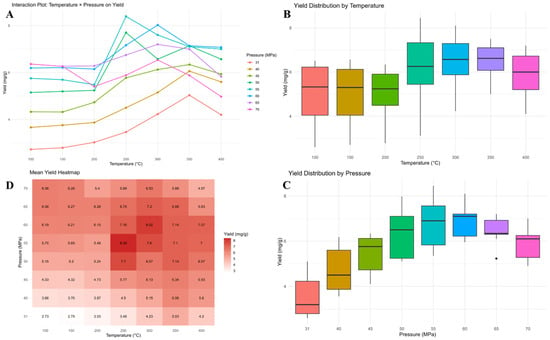
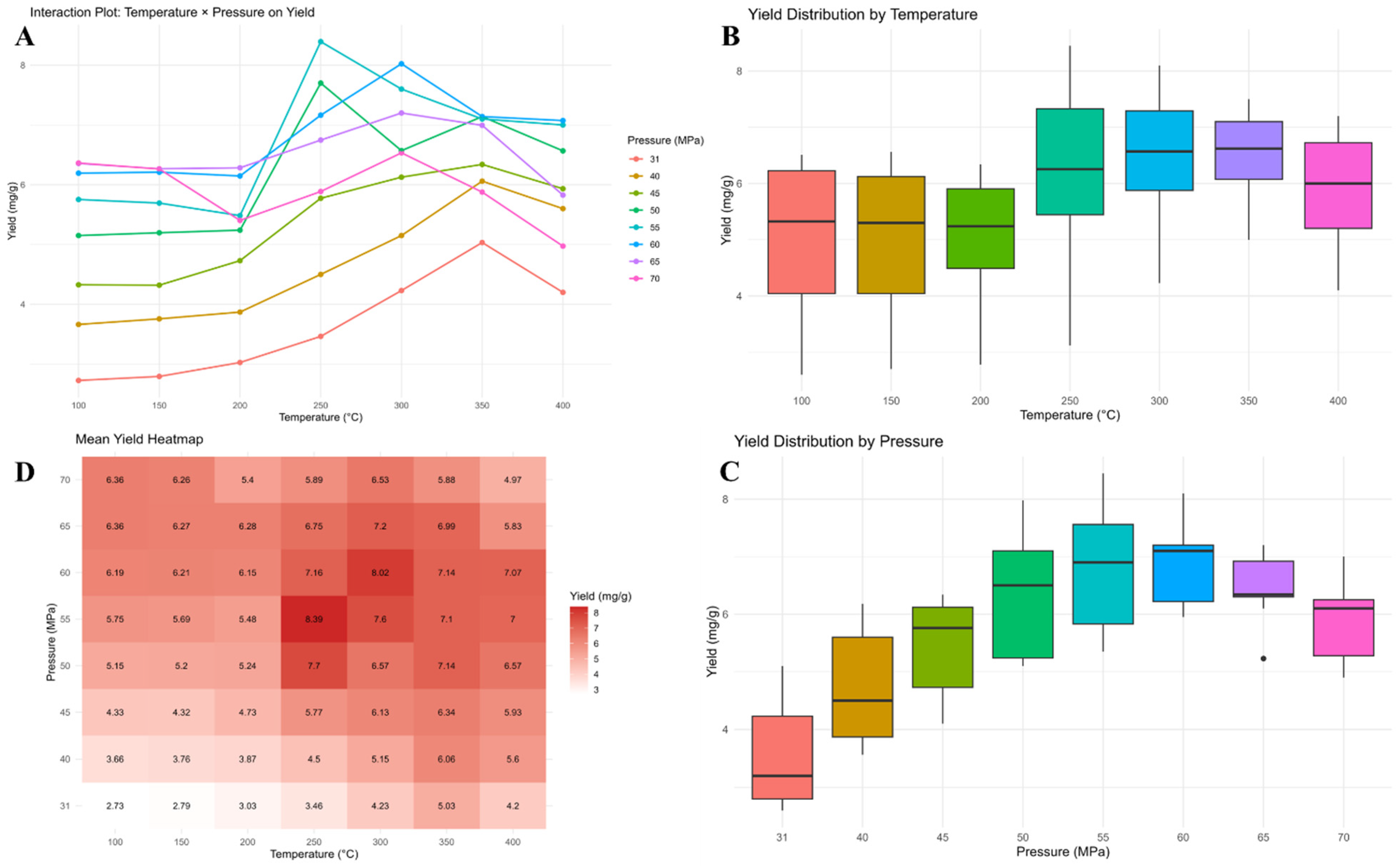
A two-way ANOVA revealed that temperature, pressure and their interaction had a significant influence on extraction yield (Table 1). The temperature–pressure interaction effect showed that the optimal extraction temperature depended on the applied pressure (Figure 2A). The mean yield increased progressively with temperature from 100 °C to 350 °C, reaching a maximum of 6.46 ± 0.76 mg/100 mg at 350 °C. This was followed by a slight decrease at 400 °C to 5.90 ± 0.96 mg/100 mg (Figure 2B). Similarly, yield increased with pressure from 31 to 60 MPa, peaking at 6.85 ± 0.67 mg/100 mg at 60 MPa. It then declined at higher pressures (65–70 MPa) (Figure 2C).
Table 1.
Two-way ANOVA results for SC-CO2 extraction yield.
Figure 2.
Optimization of supercritical CO2 extraction yield from Chamaepericlymenum suecicum berries. (A) Interaction plot showing the effect of temperature and pressure on extraction yield. Points represent mean yields; error bars indicate standard deviation. (B) Boxplot of extraction yield distribution by temperature. (C) Boxplot of extraction yield distribution by pressure. (D) Heatmap of mean extraction yield as a function of temperature and pressure; color gradient represents yield (mg/100 mg), with blue indicating lower yields and red indicating higher yields. Extraction conditions: pressure, 31–70 MPa; temperature, 100–400 °C; 1% ethanol as co-solvent; and extraction time, 60 min.
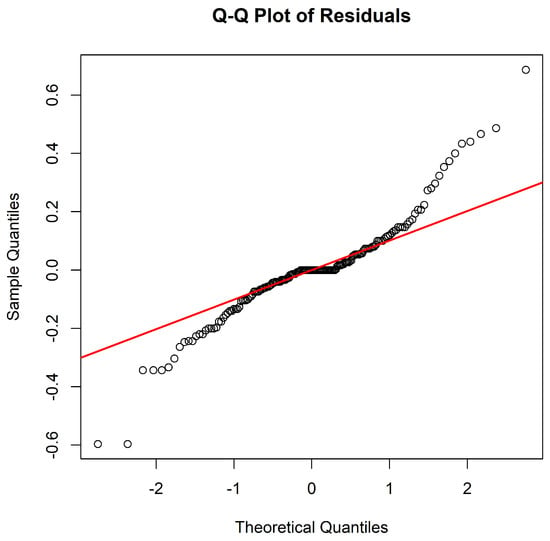
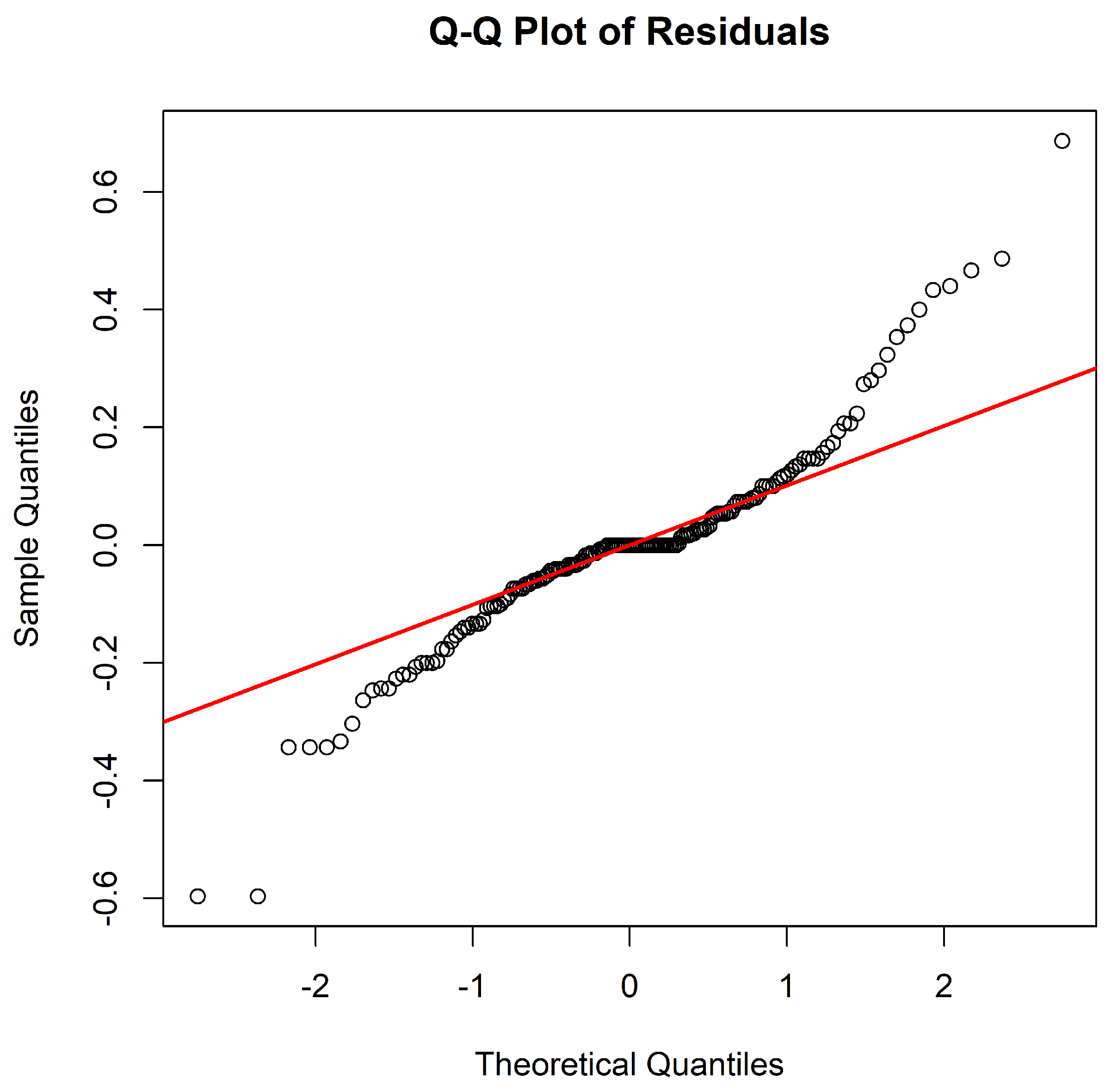
The heatmap of mean yield (Figure 2D) revealed a distinct optimal region of moderate temperatures (250–300 °C) and pressures (50–60 MPa), in which yields consistently exceeded 7.5 mg/100 mg. The highest global yield was obtained at 250 °C and 55 MPa (8.39 mg/100 mg), followed by 300 °C and 60 MPa (8.02 mg/100 mg). The addition of 1% ethanol as a co-solvent enhances extraction efficiency by increasing the polarity of the supercritical fluid, thereby improving interaction with the target bioactive compounds. The QQ plot of residuals (Figure 3) confirmed that the assumptions of ANOVA were adequately met, thereby supporting the reliability of the statistical analysis.
Figure 3.
Q-Q plot of residuals from the two-way ANOVA model for SC-CO2 extraction yield. The red diagonal line represents the expected line under perfect normality.
2.2. Identification and Classification of Bioactive Compounds
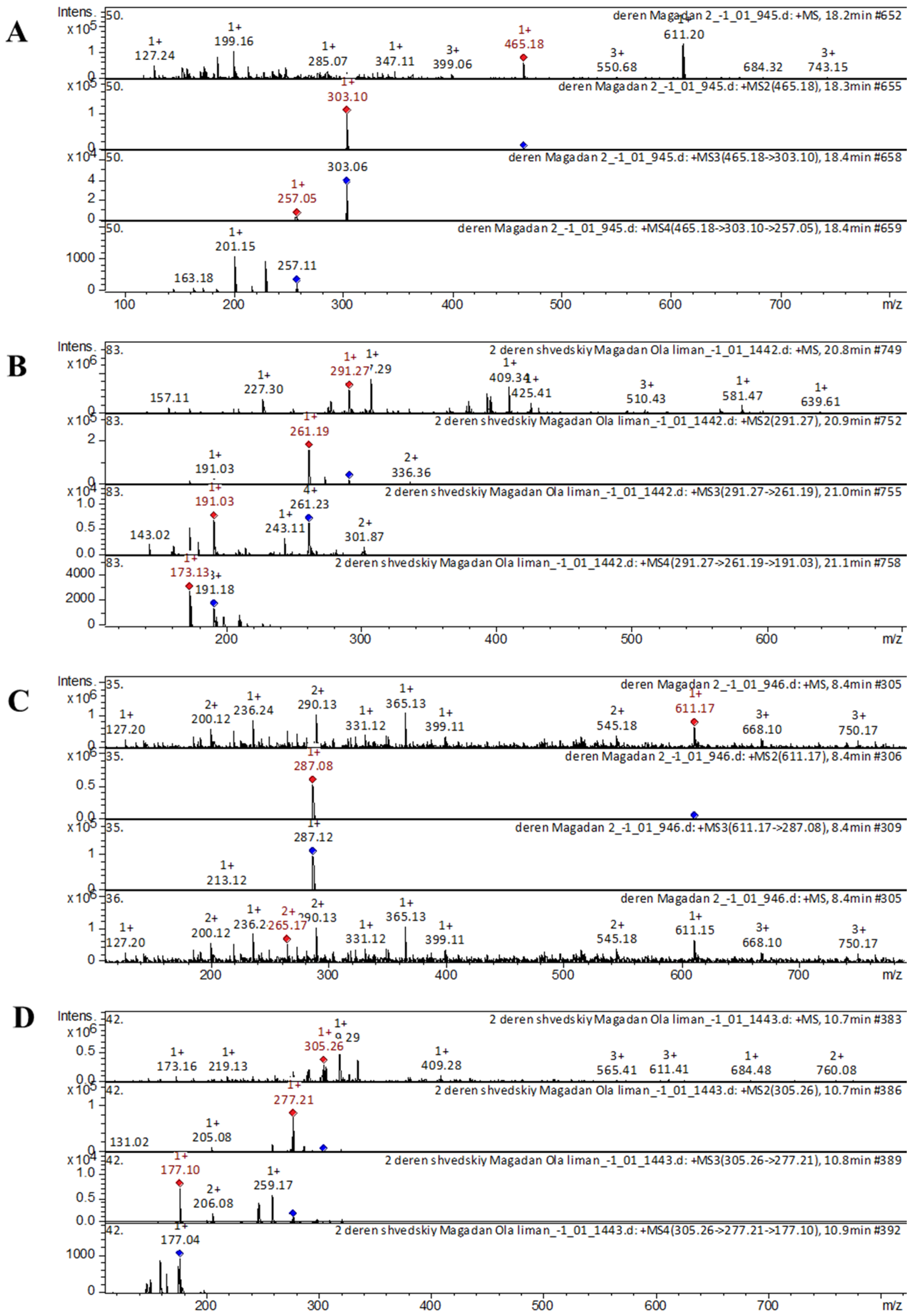
A total of 47 compounds were identified in SC-CO2 extracts of C. suecicum berries (Appendix A, Table A1). Thirty-three of these were polyphenolic compounds, including flavonoids, phenolic acids, coumarins and lignans. The remaining 14 compounds belonged to other chemical groups, including fatty acids, oxylipins, alkaloids, organic acids, sugars, naphthoquinones and anabolic steroids. The 33 polyphenolic compounds were classified into the following groups: flavones (three compounds: formononetin, apigenin and jaceosidin), flavonols (six compounds: quercetin, herbacetin, dihydroquercetin, myricetin, quercetin-3-glucoside and quercetin-3-hexoside), flavan-3-ols (eight compounds: catechin, epicatechin, gallocatechin and epigallocatechin, as well as their derivatives), anthocyanins (five compounds: delphinidin and cyanidin glycosides), phenolic acids (six compounds: protocatechuic acid, 3,4-dihydroxyhydrocinnamic acid, ethyl protocatechuate, methylgallic acid, ellagic acid and ellagic acid-O-hexoside), gallate esters (one compound: ethyl gallate), coumarins ((three compounds: umbelliferone, fraxetin and umbelliferone hexoside) and the lignan syringaresinol (one compound). Representative compounds from each major chemical class were confirmed by CID fragmentation spectra (Figure 4).
Figure 4.
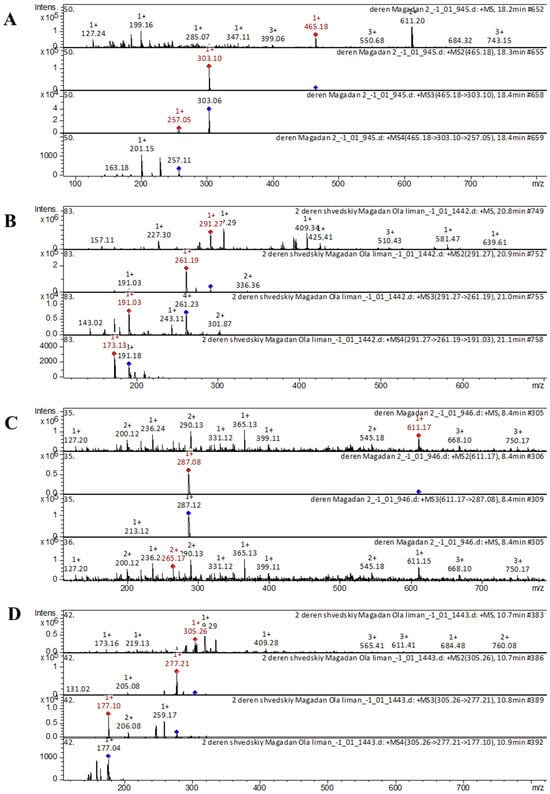
CID fragmentation spectra of representative compounds identified in supercritical CO2 extracts of C. suecicum berries: (A) quercetin 3-O-glucoside ([M+H]+ m/z 465.18); (B) (epi)-catechin ([M+H]+ m/z 291.27); (C) cyanidin-3-sophoroside ([M+H]+ m/z 611.17); (D) taxifolin ([M+H]+ m/z 305.26). For each panel, top—MS scan in the range of m/z 100–1700; bottom—fragmentation spectra (from top to bottom): MS2 of the protonated molecular ion, MS3 of the corresponding fragment ion, and MS4 of the subsequent fragment ion.
The mass spectra of polyphenolic compounds, including anthocyanidins, flavan-3-ols, and flavonols, which were identified in supercritical CO2 extracts of C. suecicum, are presented in Figure 4. These data are the result of a detailed analysis conducted using advanced mass spectrometry techniques, which made it possible to accurately determine the chemical composition of the samples under study. The flavonol quercetin 3-O-glucoside was found in the supercritical CO2 extracts of C. suecicum L. (Figure 4A).
The mass spectrum in positive ion mode of quercetin 3-O-glucoside from berry extracts of C. suecicum is shown in Figure 4A. The [M+H]+ ion produced one fragment ion at m/z 303.10. The fragment ion with m/z 303.10 yielded one daughter ion at m/z 257.05. The daughter ion produced two fragment ions at m/z 201.15, and m/z 163.18. This biologically active compound was successfully identified by mass-spectrometric analysis as a quercetin derivative, namely quercetin-3-O-glucoside. The identification was carried out as part of scientific research aimed at analyzing extracts from plant matrices of various plant species: Prunus maximowiczii [12]; Rubus occidentalis [13]; Ribes meyeri [14]; Lonicera henryl [15]; Lonicera japonica [16]; Vaccinium myrtillus [17]; and Spondias purpurea [18].
The flavan-3-ol (epi)-catechin was found in the extracts from berry extracts of C. suecicum (Figure 4B).
The mass spectrum in positive ion mode of (epi)-catechin from berry extracts of C. suecicum is shown in Figure 4B. The [M+H]+ ion produced two fragment ions at m/z: m/z 261.19 and m/z 191.03. The fragment ion with m/z 261.19 yielded three daughter ions: at m/z 243.11, m/z 191.03, and m/z 143.02. The chemical compound (epi)-catechin has been isolated and identified through mass spectrometric analysis, which demonstrates characteristic ion fragmentation patterns. This was achieved through a series of scientific studies conducted by various authors who examined the composition and properties of plant matrices: Carpinus betulus [19]; Hypericum perforatum [20]; Black soja [21]; Glycine soja [22]; Rubus occidentalis [13]; Vaccinium myrtillus [17]; Aegilops trivialis [23]; Actinidia chinensis [24]; Actinidia deliciosa [25]; Jatropha [26]; Hibiscus rosa sinensis [27]; and Loropetalum chinense [28].
The anthocyanidin cyanidin-3-sophoroside was found in the extracts from berry extracts of C. suecicum (Figure 4C).
The mass spectrum in positive ion mode of cyanidin-3-sophoroside from berry supercritical CO2 extracts of C. suecicum is shown in Figure 4C. The [M+H]+ ion produced one fragment ion at m/z 287.08. The fragment ion with m/z 287.08 yielded one daughter ion at m/z 213.12. This bioactive substance was identified in mass spectrometric studies as cyanidin-3-sophoroside in extracts of Rubus geoides [29]; Red currant [30]; and Hibiscus rosa sinensis [27].
The dihydroflavonol taxifolin was found in the extracts from supercritical CO2 extracts of C. suecicum (Figure 4D).
The mass spectrum in positive ion mode of taxifolin from supercritical CO2 extracts of C. suecicum is shown in Figure 4D. The [M+H]+ ion produced three fragment ions at m/z 277.21, m/z 205.08, and m/z 131.02. The fragment ion with m/z 277.21 yielded three daughter ions at m/z 259.17, m/z 206.08, and m/z 177.10. The biologically active compound taxifolin was identified through mass spectrometric analysis aimed at fragmenting the isolated chemical compounds from the following plant matrices: Juglans mandshurica [31], Zea mays [32], Glycine soja [22]; Larix davurica [33]; Potentilla freyniana [34]; Millettia nitida [35]; Thymus vulgaris; and Oregano [36].
2.3. Multivariate Analysis of Metabolite Profiles
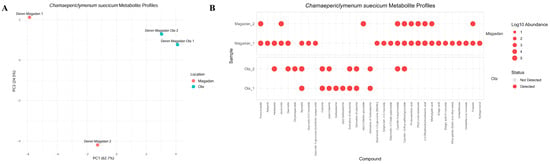
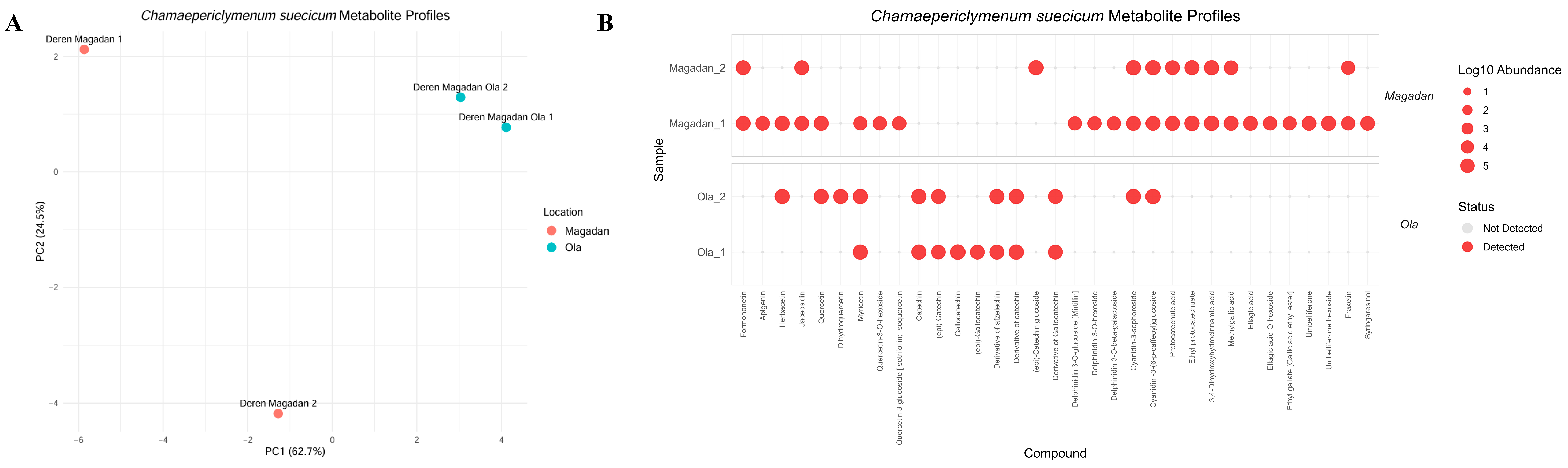
A Principal Component Analysis (PCA) was performed on the log-transformed metabolite data in order to evaluate the overall variation between the different locations. The first two principal components explained 62.7% and 24.5% of the total variance, respectively, with a cumulative percentage of 87.2% (Figure 5A). Generally, the samples from Ola showed closeness, while those from the other geography showed variation. Overall, samples from both geographies revealed a clear separation, indicating that the two geographic locations have distinct metabolic profiles.
Figure 5.
Multivariate analysis of C. suecicum metabolite profiles. (A) PCA score plot showing separation between Magadan and Ola samples based on log-transformed metabolite data. (B) Dot plot showing compound detection patterns and relative abundance across individual samples.
The dot plot (Figure 5B) visualizes the patterns of compound detection and relative abundance across the individual samples. Red dots indicate detected compounds, with dot size representing log-transformed abundance, while grey dots represent non-detected compounds. The plot confirms the higher detection frequency and abundance of compounds in Magadan samples compared to Ola samples.
2.4. Distribution of Compounds by Geographic Location
The distribution of the 47 identified compounds (Appendix A, Table A1) varied considerably between the two collection sites, Magadan and Ola. Magadan samples exhibited greater chemical diversity, with 26 polyphenolic compounds detected exclusively in this location. These included all six phenolic acids, three coumarins, the lignan syringaresinol and several flavonoids, such as formononetin, apigenin, jaceosidin, delphinidin glycosides, quercetin 3-glucoside, quercetin 3-hexoside and ellagic acid-O-hexoside, as well as ethyl gallate.
In contrast, Ola samples were characterised by the presence of flavan-3-ols (catechin, (epi)-catechin, gallocatechin, (epi)-gallocatechin and their derivatives), which were completely absent in the Magadan samples. Additionally, dihydroquercetin and cyanidin-3-(6-p-caffeoyl)glucoside were detected in the Ola samples.
Only nine compounds were present in both locations: dihydroquercetin, cyanidin-3-(6-p-caffeoyl)glucoside, herbacetin, cyanidin-3-sophoroside, ellagic acid, quercetin-3-glucoside, quercetin, myricetin and quercetin-3-hexoside.
2.5. Compound Richness and Diversity
The range of compound richness (the total number of compounds detected per sample) was from eight to 24. Magadan samples exhibited higher richness (24 and 10 compounds per replicate) than Ola samples (8 and 11 compounds per replicate) (Table 2). The Shannon diversity index (H′) values ranged from 2.079 to 3.178. Magadan samples showed higher chemical diversity (H′ = 3.178 and 2.303) than Ola samples (H′ = 2.079 and 2.398).
Table 2.
Compound richness and Shannon diversity index for C. suecicum samples.
3. Discussion
Significant variations in the composition of polyphenols identified in extracts of berries of C. suecicum collected in two geographically distant regions are attributed by the authors to differences in environmental conditions. One of the collection sites was located in close proximity to the seacoast (Magadan), while the second was significantly farther from marine areas (Ola). The scientific literature contains data indicating that marine ecosystems have a significant impact on plant metabolism, which leads to changes in the composition of bioactive compounds in extracts compared to plants growing far from the sea.
As an example, we can cite a study devoted to the polyphenolic composition of Amur grape (Vitis amurensis). Within the framework of this study, grape berries collected on the islands of the Sea of Japan (Peter the Great Bay) and grape berries collected on the continental territory (Primorsky Krai, Russia) were analysed. The results revealed significant differences in the composition of polyphenols between the samples, which confirms the influence of marine conditions on plant metabolism and the composition of their biologically active components [37].
The tandem mass spectrometry method, a modern analytical tool, has enabled the identification of a broad group of polyphenolic compounds in the extracts of C. suecicum berries. Among the identified compounds, a significant proportion are catechins, which represent an important group of flavonoids. Catechins are known for their numerous beneficial effects on human health, including antitumor, anti-adipogenic, antidiabetic, cardioprotective, antimicrobial, hepatoprotective, and neuroprotective properties. Epidemiological and clinical studies on catechins have confirmed their antitumor activity. These results have been supported by experimental data obtained in cell cultures and animal models. Moreover, the molecular mechanisms of catechins have been extensively investigated. One of the most significant mechanisms is their ability to neutralize reactive oxygen species (ROS), which play a crucial role in the pathogenesis of various diseases [38].
The biochemical properties of catechins, their antioxidant activity, and the mechanisms involved in preventing diseases associated with oxidative stress, such as cancer, cardiovascular diseases, and neurodegenerative disorders, are widely discussed in the scientific literature [39]. Catechins exhibit high antioxidant activity, making them promising candidates for developing therapeutic strategies against these diseases. In addition, catechins have anti-inflammatory properties, modulate immune response and epigenetic regulation, and inhibit the activity of receptor tyrosine kinase [40]. These properties make catechins potentially useful for the treatment of various inflammatory and autoimmune diseases.
Alzheimer’s disease (AD), one of the most common neurodegenerative diseases, is a key area of application for catechins. Oxidative stress plays an important role in the pathogenesis of AD, causing an imbalance between reactive oxygen species and antioxidants, leading to neuroinflammation and neuronal damage. Studies have shown that catechins have antioxidant and anti-inflammatory properties, as well as effects on protein kinase C activity and neurotransmission, making them promising for the prevention and treatment of AD [41].
The positive effects of catechins on neurodegenerative diseases are also supported by epidemiological evidence. Regular consumption of green tea reduces the risk of influenza infection and reduces the severity of cold symptoms. Gargling with catechin solutions may be an effective method for preventing influenza. The effects of catechins on influenza and colds require further clinical research to confirm their effectiveness. In the context of obesity, catechins such as epicatechin, methylated epigallocatechin (EGCG), theaflavins, and polyphenol metabolites found in oolong tea and black tea have been shown to have weight-reducing properties [42]. These findings highlight the potential of catechins as components of functional foods and supplements for weight management.
Significant flavonols such as herbacetin and taxifolin have been identified in the extracts of C. suecicum berries. Scientific studies have thoroughly examined the effects of herbacetin on myocardial damage, cardiac function, oxidative stress, and ferroptosis, as well as the corresponding signaling pathways, using a variety of experimental techniques. The results of these studies have demonstrated that herbacetin effectively reduces myocardial damage and cardiac dysfunction caused by doxorubicin, both in vivo and in vitro. At the molecular level, the action of herbacetin is manifested in the suppression of oxidative stress and lipid peroxidation through direct binding to tyrosine 342 in the long member of the acyl-CoA synthase family 4 (ACSL4). This specific interaction inhibits lipid peroxidation and ferroptosis, which allows herbacetin to be considered a promising inhibitor of ferroptosis and a potential therapeutic agent for the treatment of diseases associated with this pathological process. Thus, the obtained data highlight the significant therapeutic potential of herbacetin in the context of doxorubicin-induced cardiotoxicity, and also emphasize the importance of modulating ACSL4 activity and inhibiting lipid peroxidation in the development of strategies for treating diseases associated with ferroptosis [43].
Taxifolin (TAX), a highly active flavonoid found in a number of medicinal plants, has become the subject of intensive scientific research due to its promising potential in the treatment of cancer and cytoprotection against the toxicity induced by chemotherapy agents. TAX demonstrates unique biological properties, modulating key signaling cascades, which allows it to regulate a variety of pathophysiological processes in tumor cells.
The mechanism of action of TAX is aimed at suppressing the proliferation, migration, and invasion of tumor cells by inhibiting the cGMP-protein kinase G signaling pathway. This leads to the arrest of the cell cycle in the G1 phase, initiating apoptosis processes and thereby preventing further tumor growth. The anti-angiogenic and pro-apoptotic properties of TAX are due to the inhibition of key transcription factor expressions such as Hif1-α, as well as angiogenic factors including VEGF and AKT.
In addition, TAX demonstrates a synergistic interaction with traditional chemotherapy agents, enhancing their cytotoxic effect and reducing the resistance of tumor cells. This is achieved by suppressing the expression of P-glycoprotein, which is a key factor in multidrug resistance.
The cytoprotective properties of TAX are manifested in its ability to reduce the toxicity induced by various chemotherapy drugs. TAX effectively inhibits ferroptosis, which minimizes cisplatin-induced nephrotoxicity, cyclophosphamide- and pazopanib-induced hepatotoxicity, methotrexate-induced oral mucositis, and doxorubicin-induced cardiotoxicity. TAX’s immunomodulatory potential also deserves attention. In the tumor microenvironment, it enhances the immune response by increasing the sensitivity of tumor cells to immune checkpoint inhibitors. This opens up new prospects for combined immunotherapy of cancer diseases. In conclusion, TAX is a promising multifunctional agent with a direct antitumor effect and a powerful cytoprotective action. Its unique biological properties make it a potential candidate for widespread use in the complex therapy of cancer diseases, as well as for minimizing the side effects of chemotherapy [44].
In supercritical extracts of C. suecicum, the coumarins fraxetin, umbelliferone, and its hexoside have been identified. Fraxetin is a biologically active molecule that is widely distributed in various natural plants and is of significant interest in pharmacology. Fraxetin has a wide range of pharmacological properties, including antitumor, antioxidant, anti-inflammatory, hypoglycemic, anti-adipogenic, and antimicrobial effects, as well as protection of the liver, neurons, heart, bone tissue, lungs, kidneys, and other organs. Its antitumor activity may be associated with the inhibition of proliferation, invasion, and migration of malignant cells, as well as the induction of apoptosis. The beneficial effects of fraxetin on health are due to its ability to suppress cytokines and modulate the immune response, which is particularly important in the context of immune deficiency syndrome. The mechanisms of action of this molecule have been extensively studied both in vitro and in vivo, and include signaling pathways such as Janus kinase 2 (JAK2)/signal transducer and activator of transcription 3 (STAT3), phosphoinositide 3-kinase (PI3K)/protein kinase B (Akt), and nuclear factor kappa-B (NF-κB)/NLRP3. Additionally, it has been shown that fraxetin modulates the Akt/AMPK pathway, indicating its multifaceted and complex mechanism of action [45].
Umbelliferone, a coumarin compound widely distributed in higher plants, is the subject of intensive pharmacological research aimed at studying its therapeutic potential in various pathologies. Numerous studies demonstrate that this compound has multifaceted pharmacological effects, including antidiabetic, anti-cancer, anti-infective, anti-rheumatoid, and neuroprotective effects, as well as improving the condition of liver, kidney, and myocardial damage. The mechanisms of action of umbelliferone are multifaceted and include the inhibition of oxidative stress, inflammatory processes, and apoptosis. Additionally, this compound improves insulin resistance, reduces myocardial hypertrophy and tissue fibrosis, and regulates glucose levels and lipid metabolism in the blood. The most significant mechanisms of action of umbelliferone are its ability to suppress oxidative stress and inflammatory processes. These pharmacological properties make umbelliferone a promising candidate for the development of new therapeutic strategies in the treatment of a wide range of diseases [46].
As part of the scientific study, a detailed analysis was carried out on the effectiveness of the SFE method for extracting biologically active components from the berries of C. suecicum. The results showed that this method demonstrates a high degree of extraction of target compounds while simultaneously providing gentle conditions for the plant material. This makes it possible to preserve the native structure and biological activity of the extracted components, which is critically important for further application in the pharmaceutical and food industries.
4. Materials and Methods
4.1. Materials
The study focused on samples of C. suecicum berries from two locations: the vicinity of the city of Magadan, Russia (59°34′09″ north latitude, 150°48′00″ east longitude), and the vicinity of the village Ola, Magadan Region (59°34′49″ north latitude, 151°18′00″ east longitude). In August 2024, random samples of C. suecicum berries were collected in the designated geographical locations, with a total weight of 500 g. To ensure representativeness and increase the reliability of the experimental data, each collection was carried out twice, which made it possible to minimize possible errors and increase the statistical significance of the obtained results.
All samples were morphologically authenticated according to the current standard of Pharmacopoeia of the Eurasian Economic Union [47].
4.2. Chemicals and Reagents
Within the framework of this study, chemicals of analytical purity were used, which ensured high accuracy and reproducibility of the results. Acetonitrile, obtained from Fisher Scientific, located in Southborough, United Kingdom, was used as a solvent for high-performance liquid chromatography (HPLC). Formic acid, purchased from Sigma-Aldrich, located in Steinheim, Germany, was used for mass spectrometric measurements. The ultrapure water required for sample preparation was obtained using the SIEMENS ULTRA clear system, manufactured by SIEMENS Water Technologies in Munich, Germany.
4.3. Liquid Chromatography
High-performance liquid chromatography (HPLC) was performed using a Shimadzu LC-20 Prominence HPLC instrument (Shimadzu, Kyoto, Japan), equipped with an ultraviolet detector and a reversed-phase column with C18 silica gel (4.6 × 150 mm, particle size 2.7 mm). This method was used to separate multicomponent mixtures, ensuring high resolution and analytical accuracy. The gradient elution program, which includes two mobile phases, was carefully designed to achieve optimal separation of the analytes. Phase A used deionized water, and Phase B used acetonitrile with 0.1% formic acid by volume. The gradient program included the following stages: an initial period (0–2 min) with a phase B concentration of 0%, a linear increase in the content of phase B to 100% over 48 min (2–50 min), and a final control wash of the column with 100% phase B over 10 min (50–60 min).
The identification of compounds was carried out using a UV spectrometer SPD-20A (Shimadzu, Kyoto, Japan) at a wavelength of 220 nm, which ensured high sensitivity and selectivity of the method. The column temperature was maintained at 40 °C, and the total volumetric flow rate of the eluent was 0.25 mL/min. The volume of the sample introduced for analysis was 10 μL, which helped to minimize matrix effects and improve the accuracy of the results. For in-depth identification and confirmation of the structure of the analyzed compounds, the HPLC method was supplemented with mass spectrometry using an ion trap. This made it possible not only to determine the molecular weights of the compounds but also to obtain structural information, which significantly increased the reliability and informativeness of the study.
4.4. SC-CO2 Extraction
Supercritical carbon dioxide (CO2) extraction was carried out using a specialized supercritical fluid extraction device (SFE-500) manufactured by Thar SCF Waters (Milford, CT, USA). This system includes a high-pressure pump (Thar Waters P-50) designed to supply a co-solvent during the extraction of polar compounds. To accurately measure the volume of CO2 entering the system, a CO2 flow meter manufactured by Siemens (Munich, Germany) was used. Extraction vessels of varying volumes were used to extract samples of different sizes and to optimize the system’s throughput.
The CO2 flow rate varied within the range of 10 to 25 mL/min, while the cosolvent (C2H5OH) feed rate was 1.00 mL/min. The study object was 100 g of C. suecicum berries. The extraction time was recorded from the moment the critical pressure was reached under constant CO2 flow and amounted to 60 min. This method of supercritical fluid extraction of plant matrices was successfully tested by the authors on a variety of plant samples, including above-ground and underground parts of various plant species [37].
4.5. Mass Spectrometry
Mass spectrometric analysis was performed using an amaZon SL ion trap, developed by BRUKER DALTONIKS and manufactured in Munich, Germany. This instrument is equipped with an electrospray ionization source, which allows for analysis in both positive and negative ion modes. To achieve optimal analysis parameters, the following parameters were carefully adjusted: the ionization source temperature was set to 70 °C, the gas flow rate was set to 4 L/min, and the gas pressure in the nebulizer (atomizer) was set to 1.3 psi. The voltage across the capillary was 4500 V and 1500 V across the end plates, the fragmentation voltage was 280 V, and the collision energy was 60 eV.
The ion trap operated within the m/z scanning range from 100 to 1700 for MS and MS/MS methods. Chemical components were identified by comparing their retention index, mass spectra, and fragmentation results with a proprietary database created at the Laboratory of Biotechnology, Bioengineering, and Food Systems at Far Eastern Federal University, Russia. This database is based on data obtained using other spectroscopic methods, such as nuclear magnetic resonance (NMR) spectroscopy, ultraviolet spectroscopy (UV), and mass spectrometry (MS), as well as on information from literature sources, which is regularly updated and revised.
The identification of compounds was additionally confirmed by comparative analysis using such widely known databases as ChemSpider, PubChem, ChemBank, MassBank, and Elsevier ScienceDirect. Based on data regarding the exact molecular weight, characteristic fragment ions, and the results of comparisons with these databases, potential prototype components and metabolites of C. suecicum were successfully identified. The data acquisition rate was one spectrum per second for the MS method and two spectra per second for the MS/MS method. Data collection was carried out using specialized software developed for Windows and compatible with BRUKER DALTONIKS equipment. All experiments were repeated three times, which ensured a high degree of reproducibility of the results. To improve the accuracy of the analysis, a four-stage ion separation mode was implemented, which is standard practice in MS/MS methodology.
4.6. Statistical Analysis
All statistical analyses were performed using R version 4.5.3 (https://www.r-project.org/; accessed on 1 July 2026). Extraction yield data were expressed as the mean ± standard deviation (SD) from three independent replicates. The effects of temperature (100, 150, 200, 250, 300, 350 and 400 °C) and pressure (31, 40, 45, 50, 55, 60, 65 and 70 MPa), as well as the interaction between these factors, on extraction yield were evaluated using a two-way analysis of variance (ANOVA) model with replication. Prior to ANOVA, the assumptions of normality and homogeneity of variances were assessed using the Shapiro–Wilk and Levene’s tests, respectively (https://doi.org/10.5812/ijem.3505). A QQ plot of residuals was generated to visually assess normality.
For the metabolite data, the distribution was normalized by log-transforming the raw peak areas using the formula Log10(peak area + 1). A presence/absence matrix was then generated by converting all non-zero values to 1 while leaving zero values as they were. Compound richness was calculated as the total number of compounds detected per sample. The Shannon diversity index (H′) was computed from the presence/absence matrix using the formula H′ = −∑(pi × ln pi), where pi represents the proportion of each compound relative to the total number of compounds detected in each sample. This was done using the diversity function from the vegan package. The PCA was performed on the log-transformed metabolite data, which was mean-centered and scaled, using the prcomp function, in order to visualize clustering patterns between the two geographic locations. A dot plot was generated to visualize compound detection patterns and relative abundance across individual samples. Dot size represents log-transformed abundance, and color indicates detection status. Statistical significance was set at p < 0.05.
5. Conclusions
This study presents a detailed analysis of the SFE method and its application to metabolomic analysis of C. suecicum berries. SFE using CO2 with 1% ethanol as a co-solvent was highly efficient at extracting bioactive compounds. The optimal conditions were found to be 250 bar, 55 °C and an extraction time of 60 min, yielding 8.45 mg of extract per 100 mg of berries. The extracts contained a total of 47 compounds, including 33 polyphenolic compounds (flavones, flavonols, flavan-3-ols, anthocyanins, phenolic acids, coumarins, and lignans), as well as 14 compounds from other chemical groups (e.g., fatty acids, oxylipins, alkaloids, organic acids, sugars, naphthoquinones, and anabolic steroids). The metabolite profiles varied between the two geographic locations (Magadan and Ola), with the Magadan samples showing greater chemical diversity (26 unique compounds) than the Ola samples (11 unique compounds). Flavan-3-ols were exclusively detected in Ola samples, while phenolic acids and coumarins were unique to Magadan samples. Combining supercritical fluid extraction with metabolomic approaches is a powerful way to study the chemical composition and functional properties of C. suecicum. The results highlight this species’ significant potential as a raw material for developing functional food products and nutraceuticals, due to its high phenolic content, which has antioxidant, anti-inflammatory and antimicrobial properties. These findings open up new possibilities for developing innovative products in the nutraceutical and pharmaceutical industries.
Author Contributions
Conceptualization, M.P.R. and K.S.G.; methodology, M.P.R. and M.A.N.; software, M.P.R. and M.A.N.; validation, M.A.N., M.P.R. and K.S.G.; formal analysis, M.A.N., M.P.R., A.S.S., T.A.S. and N.G.L.; investigation, K.S.G. and M.P.R.; resources, M.P.R.; data curation, A.S.S., T.A.S. and N.G.L.; writing—original draft preparation—M.A.N. and M.P.R.; writing—review and editing, M.A.N. and M.P.R.; visualization, M.P.R. and M.A.N.; supervision, M.A.N. and K.S.G.; project administration, K.S.G. and M.P.R. All authors have read and agreed to the published version of the manuscript.
Funding
The work was supported financially by the Ministry of Science and Higher Education as part of achieving the results of the Russian Science Foundation (Grant No. 23-74-00044).
Data Availability Statement
The original contributions presented in this study are included in the article. Further inquiries can be directed to the corresponding authors.
Conflicts of Interest
The authors declare no conflicts of interest.
Appendix A
Table A1.
Chemical compounds identified from the extracts of C. suecicum (berries) from two locations: the vicinity of the city of Magadan, Russia (59°34′09″ north latitude, 150°48′00″ east longitude), and the vicinity of the village Ola, Magadan Region (59°34′49″ north latitude, 151°18′00″ east longitude), in positive and negative ionization modes by HPLC-ion trap-MS/MS.
References
- Murrell, Z.E. Dwarf Dogwoods: Intermediacy and the Morphological Landscape. Syst. Bot. 1994, 19, 539. [Google Scholar] [CrossRef] [Scilit]
- Hulten, E. Flora of the Aleutian Islands; Bokforlags Aktiebolaget Thule: Stockholm, Sweden, 1937. [Google Scholar]
- Ledebour, C.F. Flora Rossica; Schweizerbart: Stuttgart, Germany, 1844; Volume 2. [Google Scholar]
- Farr, E.M. Notes on Some Interesting British Columbian Plants. Contrib. Bot. Lab. Univ. Pa. 1904, 2, 417–425. [Google Scholar]
- Bain, J.F.; Denford, K.E. The Herbaceous Members of the Genus Cornus in NW North America. Bot. Not. 1979, 132, 121–129. [Google Scholar]
- Bain, J.F.; Denford, K.E. The Flavonoid Glycosides of Cornus canadensis L. and Its Allies in Northwestern North America. Experientia 1979, 35, 863–864. [Google Scholar] [CrossRef] [Scilit]
- Gandhi, K.; Arora, S.; Kumar, A. Industrial Applications of Supercritical Fluid Extraction: A Review. Int. J. Chem. Stud. 2017, 5, 336–340. [Google Scholar]
- Beckman, E.J. Supercritical and Near-Critical CO2 in Green Chemical Synthesis and Processing. J. Supercrit. Fluids 2004, 28, 121–191. [Google Scholar] [CrossRef] [Scilit]
- Kiran, E. Polymer Miscibility, Phase Separation, Morphological Modifications and Polymorphic Transformations in Dense Fluids. J. Supercrit. Fluids 2009, 47, 466–483. [Google Scholar] [CrossRef] [Scilit]
- Alsate, L.M.; Gonzalez, D.; Londono-Londono, J. Recovery of Carotenoids from Agroindustrial By-Products Using Clean Extraction Techniques: Supercritical Fluid Extraction and Ultrasound Assisted Extraction. In Proceedings of the III Iberoamerican Conference on Supercritical Fluids, Cartagena de Indias, Colombia, 1–5 April 2013; pp. 1–7. [Google Scholar]
- Mesomo, M.C.; Corazza, M.L.; Ndiaye, P.M.; Dalla Santa, O.R.; Cardozo, L.; Scheer, A.D.P. Supercritical CO2 Extracts and Essential Oil of Ginger (Zingiber officinale R.): Chemical Composition and Antibacterial Activity. J. Supercrit. Fluids 2013, 80, 44–49. [Google Scholar] [CrossRef] [Scilit]
- Kalugin, Y.G.; Razgonova, M.P.; Nawaz, M.A.; Golokhvast, K.S. Metabotyping of Prunus Sargentii, Prunus Nipponica Var. Kurilensis, and Prunus Maximowiczii from Peter the Great Botanical Garden of BIN RAS. Plants 2026, 15, 1426. [Google Scholar] [CrossRef] [Scilit] [PubMed]
- Paudel, L.; Wyzgoski, F.J.; Scheerens, J.C.; Chanon, A.M.; Reese, R.N.; Smiljanic, D.; Wesdemiotis, C.; Blakeslee, J.J.; Riedl, K.M.; Rinaldi, P.L. Nonanthocyanin Secondary Metabolites of Black Raspberry (Rubus occidentalis L.) Fruits: Identification by HPLC-DAD, NMR, HPLC-ESI-MS, and ESI-MS/MS Analyses. J. Agric. Food Chem. 2013, 61, 12032–12043. [Google Scholar] [CrossRef] [Scilit] [PubMed]
- Zhao, Y.; Lu, H.; Wang, Q.; Liu, H.; Shen, H.; Xu, W.; Ge, J.; He, D. Rapid Qualitative Profiling and Quantitative Analysis of Phenolics in Ribes Meyeri Leaves and Their Antioxidant and Antidiabetic Activities by HPLC-QTOF-MS/MS and UHPLC-MS/MS. J. Sep. Sci. 2021, 44, 1404–1420. [Google Scholar] [CrossRef] [Scilit] [PubMed]
- Jaiswal, R.; Müller, H.; Müller, A.; Karar, M.G.E.; Kuhnert, N. Identification and Characterization of Chlorogenic Acids, Chlorogenic Acid Glycosides and Flavonoids from Lonicera henryi L. (Caprifoliaceae) Leaves by LC–MS. Phytochemistry 2014, 108, 252–263. [Google Scholar] [CrossRef] [Scilit] [PubMed]
- Cai, Z.; Wang, C.; Zou, L.; Liu, X.; Chen, J.; Tan, M.; Mei, Y.; Wei, L. Comparison of Multiple Bioactive Constituents in the Flower and the Caulis of Lonicera Japonica Based on UFLC-QTRAP-MS/MS Combined with Multivariate Statistical Analysis. Molecules 2019, 24, 1936. [Google Scholar] [CrossRef] [Scilit] [PubMed]
- Liu, P.; Lindstedt, A.; Markkinen, N.; Sinkkonen, J.; Suomela, J.-P.; Yang, B. Characterization of Metabolite Profiles of Leaves of Bilberry (Vaccinium myrtillus L.) and Lingonberry (Vaccinium vitis-idaea L.). J. Agric. Food Chem. 2014, 62, 12015–12026. [Google Scholar] [CrossRef] [Scilit] [PubMed]
- Engels, C.; Gräter, D.; Esquivel, P.; Jiménez, V.M.; Gänzle, M.G.; Schieber, A. Characterization of Phenolic Compounds in Jocote (Spondias purpurea L.) Peels by Ultra High-Performance Liquid Chromatography/Electrospray Ionization Mass Spectrometry. Food Res. Int. 2012, 46, 557–562. [Google Scholar] [CrossRef] [Scilit]
- Felegyi-Tóth, C.A.; Garádi, Z.; Darcsi, A.; Csernák, O.; Boldizsár, I.; Béni, S.; Alberti, Á. Isolation and Quantification of Diarylheptanoids from European Hornbeam (Carpinus betulus L.) and HPLC-ESI-MS/MS Characterization of Its Antioxidative Phenolics. J. Pharm. Biomed. Anal. 2022, 210, 114554. [Google Scholar] [CrossRef] [Scilit] [PubMed]
- Tusevski, O.; Petreska Stanoeva, J.; Stefova, M.; Simic, S.G. Phenolic Profile of Dark-Grown and Photoperiod-Exposed Hypericum perforatum L. Hairy Root Cultures. Sci. World J. 2013, 2013, 602752. [Google Scholar] [CrossRef] [Scilit] [PubMed]
- Xu, J.L.; Shin, J.-S.; Park, S.-K.; Kang, S.; Jeong, S.-C.; Moon, J.-K.; Choi, Y. Differences in the Metabolic Profiles and Antioxidant Activities of Wild and Cultivated Black Soybeans Evaluated by Correlation Analysis. Food Res. Int. 2017, 100, 166–174. [Google Scholar] [CrossRef] [Scilit] [PubMed]
- Li, X.; Li, S.; Wang, J.; Chen, G.; Tao, X.; Xu, S. Metabolomic Analysis Reveals Domestication-Driven Reshaping of Polyphenolic Antioxidants in Soybean Seeds. Antioxidants 2023, 12, 912. [Google Scholar] [CrossRef] [Scilit] [PubMed]
- Chikida, N.N.; Razgonova, M.P.; Nawaz, M.A.; Belousova, M.K.; Golokhvast, K.S. The Research of New Natural Spontaneous Fertile Attention: Title Altered Hybrids (Aegilops Trivialis Migusch. Et Chak) Using Laser Microscopy and Tandem Mass Spectrometry. Int. J. Mol. Sci. 2026, 27, 4758. [Google Scholar] [CrossRef] [Scilit] [PubMed]
- Chen, Y.; Cai, X.; Li, G.; He, X.; Yu, X.; Yu, X.; Xiao, Q.; Xiang, Z.; Wang, C. Chemical Constituents of Radix Actinidia Chinensis Planch by UPLC–QTOF–MS. Biomed. Chromatogr. 2021, 35, e5103. [Google Scholar] [CrossRef] [Scilit] [PubMed]
- Negri, S.; Gambini, S.; Ceoldo, S.; Avesani, L.; Commisso, M.; Guzzo, F. Undifferentiated In Vitro Cultured Actinidia Deliciosa as Cell Factory for the Production of Quercetin Glycosides. Plants 2021, 10, 2499. [Google Scholar] [CrossRef] [Scilit] [PubMed]
- Zengin, G.; Mahomoodally, M.F.; Sinan, K.I.; Ak, G.; Etienne, O.K.; Sharmeen, J.B.; Brunetti, L.; Leone, S.; Di Simone, S.C.; Recinella, L.; et al. Chemical Composition and Biological Properties of Two Jatropha Species: Different Parts and Different Extraction Methods. Antioxidants 2021, 10, 792. [Google Scholar] [CrossRef] [Scilit] [PubMed]
- Mejía, J.J.; Sierra, L.J.; Ceballos, J.G.; Martínez, J.R.; Stashenko, E.E. Color, Antioxidant Capacity and Flavonoid Composition in Hibiscus Rosa-Sinensis Cultivars. Molecules 2023, 28, 1779. [Google Scholar] [CrossRef] [Scilit] [PubMed]
- Zhang, X.; Zhang, L.; Zhang, D.; Liu, Y.; Lin, L.; Xiong, X.; Zhang, D.; Sun, M.; Cai, M.; Yu, X.; et al. Transcriptomic and Metabolomic Profiling Provides Insights into Flavonoid Biosynthesis and Flower Coloring in Loropetalum Chinense and Loropetalum Chinense Var. Rubrum. Agronomy 2023, 13, 1296. [Google Scholar] [CrossRef] [Scilit]
- Ruiz, A.; Hermosín-Gutiérrez, I.; Vergara, C.; von Baer, D.; Zapata, M.; Hitschfeld, A.; Obando, L.; Mardones, C. Anthocyanin Profiles in South Patagonian Wild Berries by HPLC-DAD-ESI-MS/MS. Food Res. Int. 2013, 51, 706–713. [Google Scholar] [CrossRef] [Scilit]
- Wu, X.; Gu, L.; Prior, R.L.; McKay, S. Characterization of Anthocyanins and Proanthocyanidins in Some Cultivars of Ribes, Aronia, and Sambucus and Their Antioxidant Capacity. J. Agric. Food Chem. 2004, 52, 7846–7856. [Google Scholar] [CrossRef] [Scilit] [PubMed]
- Huo, J.-H.; Du, X.-W.; Sun, G.-D.; Dong, W.-T.; Wang, W.-M. Identification and Characterization of Major Constituents in Juglans Mandshurica Using Ultra Performance Liquid Chromatography Coupled with Time-of-Flight Mass Spectrometry (UPLC-ESI-Q-TOF/MS). Chin. J. Nat. Med. 2018, 16, 525–545. [Google Scholar] [CrossRef] [Scilit] [PubMed]
- Tian, X.; Chen, L.; Sun, L.; Gong, K.; Liu, K.; Guo, Y. Omics Analysis Revealing Flavonoid Content During Maize Grain Germination. Metabolites 2025, 15, 107. [Google Scholar] [CrossRef] [Scilit] [PubMed]
- Voskoboinikova, I.V.; Tjukavkina, N.A.; Geodakyan, S.V.; Kolesnik, Y.A.; Kolhir, V.K.; Zjuzin, V.A.; Sokolov, S.J. Experimental Pharmacokinetics of Biologically Active Plant Phenolic Compounds III. Pharmacokinetics of Dihydroquercetin. Phytother. Res. 1993, 7, 208–210. [Google Scholar] [CrossRef] [Scilit]
- Cai, W.; Li, K.; Qin, S.; Xiong, P.; Peng, J.; Shi, S.; Zhang, Z. Rapid Identification and Systematic Mechanism of Flavonoids from Potentilla Freyniana Bornm. Based on UHPLC-Q-Exactive Orbitrap Mass Spectrometry and Network Pharmacology. Int. J. Anal. Chem. 2021, 2021, 6619959. [Google Scholar] [CrossRef] [Scilit] [PubMed]
- Ye, M.; Yang, W.-Z.; Liu, K.-D.; Qiao, X.; Li, B.-J.; Cheng, J.; Feng, J.; Guo, D.-A.; Zhao, Y.-Y. Characterization of Flavonoids in Millettia Nitida Var. Hirsutissima by HPLC/DAD/ESI-MS. J. Pharm. Anal. 2012, 2, 35–42. [Google Scholar] [CrossRef] [Scilit] [PubMed]
- Ali, A.; Bashmil, Y.M.; Cottrell, J.J.; Suleria, H.A.R.; Dunshea, F.R. LC-MS/MS-QTOF Screening and Identification of Phenolic Compounds from Australian Grown Herbs and Their Antioxidant Potential. Antioxidants 2021, 10, 1770. [Google Scholar] [CrossRef] [Scilit] [PubMed]
- Razgonova, M.; Zakharenko, A.; Pikula, K.; Manakov, Y.; Ercisli, S.; Derbush, I.; Kislin, E.; Seryodkin, I.; Sabitov, A.; Kalenik, T.; et al. LC-MS/MS Screening of Phenolic Compounds in Wild and Cultivated Grapes Vitis Amurensis Rupr. Molecules 2021, 26, 3650. [Google Scholar] [CrossRef] [Scilit] [PubMed]
- Isemura, M. Catechin in Human Health and Disease. Molecules 2019, 24, 528. [Google Scholar] [CrossRef] [Scilit] [PubMed]
- Bernatoniene, J.; Kopustinskiene, D.M. The Role of Catechins in Cellular Responses to Oxidative Stress. Molecules 2018, 23, 965. [Google Scholar] [CrossRef] [Scilit] [PubMed]
- Shirakami, Y.; Shimizu, M. Possible Mechanisms of Green Tea and Its Constituents against Cancer. Molecules 2018, 23, 2284. [Google Scholar] [CrossRef] [Scilit] [PubMed]
- Ide, K.; Matsuoka, N.; Yamada, H.; Furushima, D.; Kawakami, K. Effects of Tea Catechins on Alzheimer’s Disease: Recent Updates and Perspectives. Molecules 2018, 23, 2357. [Google Scholar] [CrossRef] [Scilit] [PubMed]
- Furushima, D.; Ide, K.; Yamada, H. Effect of Tea Catechins on Influenza Infection and the Common Cold with a Focus on Epidemiological/Clinical Studies. Molecules 2018, 23, 1795. [Google Scholar] [CrossRef] [Scilit] [PubMed]
- Yang, H.; Huang, S.; Heng, X.; Zhang, K.; Xin, W.; Sun, N.; Ye, C. Herbacetin Mitigates Oxidative Stress and Ferroptosis to Protect against Doxorubicin-Induced Cardiotoxicity. Biochem. Pharmacol. 2025, 240, 117117. [Google Scholar] [CrossRef] [Scilit] [PubMed]
- Sarg, N.H.; Hersi, F.H.; Zaher, D.M.; Hamouda, A.O.; Ibrahim, S.I.; El-Seedi, H.R.; Omar, H.A. Unveiling the Therapeutic Potential of Taxifolin in Cancer: From Molecular Mechanisms to Immune Modulation and Synergistic Combinations. Phytomedicine 2024, 133, 155934. [Google Scholar] [CrossRef] [Scilit] [PubMed]
- Ha, N.M.; Son, N.T. Health Benefits of Fraxetin: From Chemistry to Medicine. Arch. Pharm. 2024, 357, 2400092. [Google Scholar] [CrossRef] [Scilit] [PubMed]
- Lin, Z.; Cheng, X.; Zheng, H. Umbelliferon: A Review of Its Pharmacology, Toxicity and Pharmacokinetics. Inflammopharmacology 2023, 31, 1731–1750. [Google Scholar] [CrossRef] [Scilit] [PubMed]
- Pharmacopoeia of the Eurasian Economic Union, Approved by Decision of the Board of Eurasian Economic Commission No.100 Dated August 11, 2020. 2020. Available online: https://eec.eaeunion.org/upload/medialibrary/37c/PHARMACOPOEIA-of-the-Eurasian-Economic-Union.pdf (accessed on 1 January 2020).
- Azizah, M.; Pripdeevech, P.; Thongkongkaew, T.; Mahidol, C.; Ruchirawat, S.; Kittakoop, P. UHPLC-ESI-QTOF-MS/MS-Based Molecular Networking Guided Isolation and Dereplication of Antibacterial and Antifungal Constituents of Ventilago Denticulata. Antibiotics 2020, 9, 606. [Google Scholar] [CrossRef] [Scilit] [PubMed]
- Stojković, D.; Đorđevski, N.; Rajaković, M.; Filipović, B.; Božunović, J.; Bolevich, S.; Zengin, G.; Bolevich, S.; Gašić, U.; Soković, M. Investigation of Bioactive Compounds Extracted from Verbena Officinalis and Their Biological Effects in the Extraction by Four Butanol/Ethanol Solvent Combinations. Pharmaceuticals 2025, 18, 1012. [Google Scholar] [CrossRef] [Scilit] [PubMed]
- Yin, Y.; Zhang, K.; Wei, L.; Chen, D.; Chen, Q.; Jiao, M.; Li, X.; Huang, J.; Gong, Z.; Kang, N.; et al. The Molecular Mechanism of Antioxidation of Huolisu Oral Liquid Based on Serum Analysis and Network Analysis. Front. Pharmacol. 2021, 12, 710976. [Google Scholar] [CrossRef] [Scilit] [PubMed]
- Wang, F.; Huang, S.; Chen, Q.; Hu, Z.; Li, Z.; Zheng, P.; Liu, X.; Li, S.; Zhang, S.; Chen, J. Chemical Characterisation and Quantification of the Major Constituents in the Chinese Herbal Formula Jian-Pi-Yi-Shen Pill by UPLC-Q-TOF-MS/MS and HPLC-QQQ-MS/MS. Phytochem. Anal. 2020, 31, 915–929. [Google Scholar] [CrossRef] [Scilit] [PubMed]
- Olech, M.; Pietrzak, W.; Nowak, R. Characterization of Free and Bound Phenolic Acids and Flavonoid Aglycones in Rosa Rugosa Thunb. Leaves and Achenes Using LC–ESI–MS/MS–MRM Methods. Molecules 2020, 25, 1804. [Google Scholar] [CrossRef] [Scilit] [PubMed]
- Belmehdi, O.; Bouyahya, A.; Jekő, J.; Cziáky, Z.; Zengin, G.; Sotkó, G.; El Baaboua, A.; Senhaji, N.S.; Abrini, J. Synergistic Interaction between Propolis Extract, Essential Oils, and Antibiotics against Staphylococcus Epidermidis and Methicillin Resistant Staphylococcus Aureus. Int. J. Second. Metab. 2021, 8, 195–213. [Google Scholar] [CrossRef] [Scilit]
- Chang, Y.; Zhang, D.; Yang, G.; Zheng, Y.; Guo, L. Screening of Anti-Lipase Components of Artemisia Argyi Leaves Based on Spectrum-Effect Relationships and HPLC-MS/MS. Front. Pharmacol. 2021, 12, 675396. [Google Scholar] [CrossRef] [Scilit] [PubMed]
- Xu, L.-L.; Xu, J.-J.; Zhong, K.-R.; Shang, Z.-P.; Wang, F.; Wang, R.-F.; Zhang, L.; Zhang, J.-Y.; Liu, B. Analysis of Non-Volatile Chemical Constituents of Menthae Haplocalycis Herba by Ultra-High Performance Liquid Chromatography-High Resolution Mass Spectrometry. Molecules 2017, 22, 1756. [Google Scholar] [CrossRef] [Scilit] [PubMed]
- Pascale, R.; Acquavia, M.A.; Cataldi, T.R.I.; Onzo, A.; Coviello, D.; Bufo, S.A.; Scrano, L.; Ciriello, R.; Guerrieri, A.; Bianco, G. Profiling of Quercetin Glycosides and Acyl Glycosides in Sun-Dried Peperoni Di Senise Peppers (Capsicum annuum L.) by a Combination of LC-ESI(-)-MS/MS and Polarity Prediction in Reversed-Phase Separations. Anal. Bioanal. Chem. 2020, 412, 3005–3015. [Google Scholar] [CrossRef] [Scilit] [PubMed]
- Li, G.; Huang, S.; Li, X.; Luo, Y.; Nie, H. Identification of Compounds from Chufa (Eleocharis dulcis) Peels by Widely Targeted Metabolomics. Food Sci. Nutr. 2023, 11, 545–554. [Google Scholar] [CrossRef] [Scilit] [PubMed]
- Aabideen, Z.U.; Mumtaz, M.W.; Akhtar, M.T.; Mukhtar, H.; Raza, S.A.; Touqeer, T.; Saari, N. Anti-Obesity Attributes; UHPLC-QTOF-MS/MS-Based Metabolite Profiling and Molecular Docking Insights of Taraxacum Officinale. Molecules 2020, 25, 4935. [Google Scholar] [CrossRef] [Scilit] [PubMed]
- Silinsin, M.; Bursal, E. UHPLC-MS/MS Phenolic Profiling and in Vitro Antioxidant Activities of Inula graveolens (L.) Desf. Nat. Prod. Res. 2018, 32, 1467–1471. [Google Scholar] [CrossRef] [Scilit] [PubMed]
- Iswaldi, I.; Gómez-Caravaca, A.M.; Arráez-Román, D.; Uberos, J.; Lardón, M.; Segura-Carretero, A.; Fernández-Gutiérrez, A. Characterization by High-Performance Liquid Chromatography with Diode-Array Detection Coupled to Time-of-Flight Mass Spectrometry of the Phenolic Fraction in a Cranberry Syrup Used to Prevent Urinary Tract Diseases, Together with a Study of Its Antibacterial Activity. J. Pharm. Biomed. Anal. 2012, 58, 34–41. [Google Scholar] [CrossRef] [Scilit] [PubMed]
- Brahmi-Chendouh, N.; Piccolella, S.; Crescente, G.; Pacifico, F.; Boulekbache, L.; Hamri-Zeghichi, S.; Akkal, S.; Madani, K.; Pacifico, S. A Nutraceutical Extract from Inula Viscosa Leaves: UHPLC-HR-MS/MS Based Polyphenol Profile, and Antioxidant and Cytotoxic Activities. J. Food Drug Anal. 2019, 27, 692–702. [Google Scholar] [CrossRef] [Scilit] [PubMed]
- Spínola, V.; Pinto, J.; Castilho, P.C. Identification and Quantification of Phenolic Compounds of Selected Fruits from Madeira Island by HPLC-DAD–ESI-MSn and Screening for Their Antioxidant Activity. Food Chem. 2015, 173, 14–30. [Google Scholar] [CrossRef] [Scilit] [PubMed]
- Lee, S.Y.; Shaari, K. LC–MS Metabolomics Analysis of Stevia rebaudiana Bertoni Leaves Cultivated in Malaysia in Relation to Different Developmental Stages. Phytochem. Anal. 2022, 33, 249–261. [Google Scholar] [CrossRef] [Scilit] [PubMed]
- Burgos-Edwards, A.; Jiménez-Aspee, F.; Theoduloz, C.; Schmeda-Hirschmann, G. Colonic Fermentation of Polyphenols from Chilean Currants (Ribes spp.) and Its Effect on Antioxidant Capacity and Metabolic Syndrome-Associated Enzymes. Food Chem. 2018, 258, 144–155. [Google Scholar] [CrossRef] [Scilit] [PubMed]
- Hamed, A.R.; El-Hawary, S.S.; Ibrahim, R.M.; Abdelmohsen, U.R.; El-Halawany, A.M. Identification of Chemopreventive Components from Halophytes Belonging to Aizoaceae and Cactaceae Through LC/MS—Bioassay Guided Approach. J. Chromatogr. Sci. 2021, 59, 618–626. [Google Scholar] [CrossRef] [Scilit] [PubMed]
- Rini Vijayan, K.P.; Raghu, A.V. Tentative Characterization of Phenolic Compounds in Three Species of the Genus Embelia by Liquid Chromatography Coupled with Mass Spectrometry Analysis. Spectrosc. Lett. 2019, 52, 653–670. [Google Scholar] [CrossRef] [Scilit]
- Sobeh, M.; Mahmoud, M.F.; Abdelfattah, M.A.O.; Cheng, H.; El-Shazly, A.M.; Wink, M. A Proanthocyanidin-Rich Extract from Cassia Abbreviata Exhibits Antioxidant and Hepatoprotective Activities in Vivo. J. Ethnopharmacol. 2018, 213, 38–47. [Google Scholar] [CrossRef] [Scilit] [PubMed]
- Ruiz, A.; Hermosín-Gutiérrez, I.; Mardones, C.; Vergara, C.; Herlitz, E.; Vega, M.; Dorau, C.; Winterhalter, P.; von Baer, D. Polyphenols and Antioxidant Activity of Calafate (Berberis microphylla) Fruits and Other Native Berries from Southern Chile. J. Agric. Food Chem. 2010, 58, 6081–6089. [Google Scholar] [CrossRef] [Scilit] [PubMed]
- Pantelić, M.M.; Dabić Zagorac, D.Č.; Davidović, S.M.; Todić, S.R.; Bešlić, Z.S.; Gašić, U.M.; Tešić, Ž.L.; Natić, M.M. Identification and Quantification of Phenolic Compounds in Berry Skin, Pulp, and Seeds in 13 Grapevine Varieties Grown in Serbia. Food Chem. 2016, 211, 243–252. [Google Scholar] [CrossRef] [Scilit] [PubMed]
- D’Urso, G.; Sarais, G.; Lai, C.; Pizza, C.; Montoro, P. LC-MS Based Metabolomics Study of Different Parts of Myrtle Berry from Sardinia (Italy). J. Berry Res. 2017, 7, 217–229. [Google Scholar] [CrossRef] [Scilit]
- Ha, T.J.; Park, J.E.; Lee, K.-S.; Seo, W.D.; Song, S.-B.; Lee, M.-H.; Kim, S.; Kim, J.-I.; Oh, E.; Pae, S.-B.; et al. Identification of Anthocyanin Compositions in Black Seed Coated Korean Adzuki Bean (Vigna angularis) by NMR and UPLC-Q-Orbitrap-MS/MS and Screening for Their Antioxidant Properties Using Different Solvent Systems. Food Chem. 2021, 346, 128882. [Google Scholar] [CrossRef] [Scilit] [PubMed]
- Zia-ur-Rehman; Rasheed, H.M.; Bashir, K.; Gurgul, A.; Wahid, F.; Che, C.-T.; Shahzadi, I.; Khan, T. UHPLC-MS/MS-GNPS Based Phytochemical Investigation of Dryopteris ramosa (Hope) C. Chr. and Evaluation of Cytotoxicity against Liver and Prostate Cancer Cell Lines. Heliyon 2022, 8, e11286. [Google Scholar] [CrossRef] [Scilit] [PubMed]
- del Mar Contreras, M.; Algieri, F.; Rodriguez-Nogales, A.; Gálvez, J.; Segura-Carretero, A. Phytochemical Profiling of Anti-inflammatory Lavandula Extracts via RP–HPLC–DAD–QTOF–MS and –MS/MS: Assessment of Their Qualitative and Quantitative Differences. Electrophoresis 2018, 39, 1284–1293. [Google Scholar] [CrossRef] [Scilit] [PubMed]
- Pan, M.; Lei, Q.; Zang, N.; Zhang, H. A Strategy Based on GC-MS/MS, UPLC-MS/MS and Virtual Molecular Docking for Analysis and Prediction of Bioactive Compounds in Eucalyptus Globulus Leaves. Int. J. Mol. Sci. 2019, 20, 3875. [Google Scholar] [CrossRef] [Scilit] [PubMed]
- Pandey, R.; Kumar, B. HPLC–QTOF–MS/MS-Based Rapid Screening of Phenolics and Triterpenic Acids in Leaf Extracts of Ocimum Species and Their Interspecies Variation. J. Liq. Chromatogr. Relat. Technol. 2016, 39, 225–238. [Google Scholar] [CrossRef] [Scilit]
- Ismail, W.M.; Ezzat, S.M.; El-Mosallamy, A.E.M.K.; El Deeb, K.S.; El-Fishawy, A.M. In Vivo Antihypertensive Activity and UHPLC-Orbitrap-HRMS Profiling of Cuphea Ignea A. DC. ACS Omega 2022, 7, 46524–46535. [Google Scholar] [CrossRef] [Scilit] [PubMed]
- Pérez-Ramírez, I.F.; Escobedo-Alvarez, D.E.; Mendoza-Sánchez, M.; Rocha-Guzmán, N.E.; Reynoso-Camacho, R.; Acosta-Gallegos, J.A.; Ramos-Gómez, M. Phytochemical Profile and Composition of Chickpea (Cicer arietinum L.): Varietal Differences and Effect of Germination under Elicited Conditions. Plants 2023, 12, 3093. [Google Scholar] [CrossRef] [Scilit] [PubMed]
- Mena, P.; Calani, L.; Dall’Asta, C.; Galaverna, G.; García-Viguera, C.; Bruni, R.; Crozier, A.; Del Rio, D. Rapid and Comprehensive Evaluation of (Poly)Phenolic Compounds in Pomegranate (Punica granatum L.) Juice by UHPLC-MSn. Molecules 2012, 17, 14821–14840. [Google Scholar] [CrossRef] [Scilit] [PubMed]
- Zengin, G.; Leyva-Jiménez, F.J.; Fernández-Ochoa, Á.; Bouyahya, A.; Yildiztugay, E.; Carretero, A.S.; Mahomoodally, M.F.; Ponniya, S.K.M.; Nilofar; Koyuncu, I.; et al. UHPLC-ESI-QTOF-MS Metabolite Profiles of Different Extracts from Pelargonium Endlicherianum Parts and Their Biological Properties Based on Network Pharmacological Approaches. Arch. Pharm. 2024, 357, e2300728. [Google Scholar] [CrossRef] [Scilit] [PubMed]
- García-Seval, V.; Saurina, J.; Sentellas, S.; Núñez, O. Off-Line SPE LC-LRMS Polyphenolic Fingerprinting and Chemometrics to Classify and Authenticate Spanish Honey. Molecules 2022, 27, 7812. [Google Scholar] [CrossRef] [Scilit] [PubMed]
- Prasad Pandey, B.; Prakash Pradhan, S.; Adhikari, K. LC-ESI-QTOF-MS for the Profiling of the Metabolites and in Vitro Enzymes Inhibition Activity of Bryophyllum Pinnatum and Oxalis Corniculata Collected from Ramechhap District of Nepal. Chem. Biodivers. 2020, 17, e2000155. [Google Scholar] [CrossRef] [Scilit] [PubMed]
- Radimich, A.I.; Saybel, O.L.; Dargaeva, T.D. Prospects for the use of plants of the genus phellodendron as a source of biologically active substances. Chem. Plant Raw Mater. 2026, 7, 25–44. [Google Scholar] [CrossRef] [Scilit]
- Sharma, M.; Sandhir, R.; Singh, A.; Kumar, P.; Mishra, A.; Jachak, S.; Singh, S.P.; Singh, J.; Roy, J. Comparative Analysis of Phenolic Compound Characterization and Their Biosynthesis Genes between Two Diverse Bread Wheat (Triticum aestivum) Varieties Differing for Chapatti (Unleavened Flat Bread) Quality. Front. Plant Sci. 2016, 7, 1870. [Google Scholar] [CrossRef] [Scilit] [PubMed]
- Guo, K.; Tong, C.; Fu, Q.; Xu, J.; Shi, S.; Xiao, Y. Identification of Minor Lignans, Alkaloids, and Phenylpropanoid Glycosides in Magnolia Officinalis by HPLC-DAD-QTOF-MS/MS. J. Pharm. Biomed. Anal. 2019, 170, 153–160. [Google Scholar] [CrossRef] [Scilit] [PubMed]
- Pellati, F.; Orlandini, G.; Benvenuti, S. Simultaneous Metabolite Fingerprinting of Hydrophilic and Lipophilic Compounds in Echinacea Pallida by High-Performance Liquid Chromatography with Diode Array and Electrospray Ionization-Mass Spectrometry Detection. J. Chromatogr. A 2012, 1242, 43–58. [Google Scholar] [CrossRef] [Scilit] [PubMed]
- Yuan, P.; He, N.; Umer, M.J.; Zhao, S.; Diao, W.; Zhu, H.; Dou, J.; Kaseb, M.O.; Kuang, H.; Lu, X.; et al. Comparative Metabolomic Profiling of Citrullus spp. Fruits Provides Evidence for Metabolomic Divergence during Domestication. Metabolites 2021, 11, 78. [Google Scholar] [CrossRef] [Scilit] [PubMed]
- Wang, M.; Yang, S.; Zheng, L.; Xiang, Q.; Liu, C.; Xiong, F. Integrated Metabolomic and Transcriptomic Analysis of Polysaccharide Biosynthesis in Polygonatum odoratum (Mill.) Druce Rhizomes of Different Growth Years and Growth Stages. Molecules 2026, 31, 953. [Google Scholar] [CrossRef] [Scilit] [PubMed]
- Park, S.K.; Ha, J.S.; Kim, J.M.; Kang, J.Y.; Lee, D.S.; Guo, T.J.; Lee, U.; Kim, D.-O.; Heo, H.J. Antiamnesic Effect of Broccoli (Brassica oleracea Var. Italica) Leaves on Amyloid Beta (Aβ)1–42-Induced Learning and Memory Impairment. J. Agric. Food Chem. 2016, 64, 3353–3361. [Google Scholar] [CrossRef] [Scilit] [PubMed]
- Llorent-Martínez, E.J.; Spínola, V.; Gouveia, S.; Castilho, P.C. HPLC-ESI-MSn Characterization of Phenolic Compounds, Terpenoid Saponins, and Other Minor Compounds in Bituminaria Bituminosa. Ind. Crops Prod. 2015, 69, 80–90. [Google Scholar] [CrossRef] [Scilit]
- Emad, A.M.; Rasheed, D.M.; El-Kased, R.F.; El-Kersh, D.M. Antioxidant, Antimicrobial Activities and Characterization of Polyphenol-Enriched Extract of Egyptian Celery (Apium graveolens L., Apiaceae) Aerial Parts via UPLC/ESI/TOF-MS. Molecules 2022, 27, 698. [Google Scholar] [CrossRef] [Scilit] [PubMed]
- Li, M.; Xu, J.; Wang, X.; Fu, H.; Zhao, M.; Wang, H.; Shi, L. Photosynthetic Characteristics and Metabolic Analyses of Two Soybean Genotypes Revealed Adaptive Strategies to Low-Nitrogen Stress. J. Plant Physiol. 2018, 229, 132–141. [Google Scholar] [CrossRef] [Scilit] [PubMed]
- Liu, Y.; Li, M.; Xu, J.; Liu, X.; Wang, S.; Shi, L. Physiological and Metabolomics Analyses of Young and Old Leaves from Wild and Cultivated Soybean Seedlings under Low-Nitrogen Conditions. BMC Plant Biol. 2019, 19, 389. [Google Scholar] [CrossRef] [Scilit] [PubMed]
- Abu-Reidah, I.M.; Ali-Shtayeh, M.S.; Jamous, R.M.; Arráez-Román, D.; Segura-Carretero, A. HPLC–DAD–ESI-MS/MS Screening of Bioactive Components from Rhus coriaria L. (Sumac) Fruits. Food Chem. 2015, 166, 179–191. [Google Scholar] [CrossRef] [Scilit] [PubMed]
- Wu, Y.; Xu, J.; He, Y.; Shi, M.; Han, X.; Li, W.; Zhang, X.; Wen, X. Metabolic Profiling of Pitaya (Hylocereus polyrhizus) during Fruit Development and Maturation. Molecules 2019, 24, 1114. [Google Scholar] [CrossRef] [Scilit] [PubMed]

Disclaimer/Publisher’s Note: The statements, opinions and data contained in all publications are solely those of the individual author(s) and contributor(s) and not of MDPI and/or the editor(s). MDPI and/or the editor(s) disclaim responsibility for any injury to people or property resulting from any ideas, methods, instructions or products referred to in the content. |
© 2026 by the authors. Licensee MDPI, Basel, Switzerland. This article is an open access article distributed under the terms and conditions of the Creative Commons Attribution (CC BY) license.