


Abstract
The low temperature electrocatalysis of CO2 to CO typically requires purified CO2, adding complexity, cost, and energy penalties due to the need for separate CO2 capture and purification processes. Electrochemical reactive capture (e-RCC) is emerging as a simplification of the process. The method combines CO2 capture with amines to form ammonium carbamates which are then reduced to produce CO and H2. Heterometallic polyoxometalate catalysts were evaluated for e-RCC by cyclic voltammetry showing that [SiCu2IIGaIII(H2O)3W9O37]9− had the lowest overpotential and highest turnover frequency. A combination of cyclic voltammetry and controlled potential electrolysis and transport measurements of carbamates through Nafion membranes revealed that commonly used small-molecule carbamates easily traversed membranes and were oxidized at the anode to CO and CO2. To avoid anodic amine oxidation, polyammonium carbamates were prepared, and the method provides an efficient way to convert CO2 captured into valuable carbon monoxide. Controlled potential electrolysis confirmed that [SiCu2IIGaIII(H2O)3W9O37]9− reduced polyammonium carbamate at a negative potential of −1 V vs. Ag/AgCl, forming CO and H2, while other polyoxometalate catalysts yield CO and H2 at more negative potentials of −1.3 V. This research combines the use of polyoxometalates for electrocatalysts for e-RCC and provides a potential pathway to avoid detrimental amine/carbamate anodic oxidation.
1. Introduction
The rising concentration of CO2 in Earth’s atmosphere is a critical factor in the ongoing challenges of climate change and sustainability [1]. Among the strategies for converting excess CO2 into valuable chemicals is the low-temperature electrochemical reduction of CO2 (e-CO2RR) [2,3], where advances toward commercialization have been made using nanoparticle catalysts [4]. Concurrently to the use of metal nanoparticle catalysts for e-CO2RR, homogeneous transition-metal catalysis has also been broadly investigated following earlier seminal research by the groups of Lehn, Saveant, and Kubiak among many others [5,6,7]. Molecular catalysts may have advantages in active site design and control and spectroscopic elucidation of reaction intermediate, especially toward the two-electron reduced products CO and formate [8].
Typically, e-CO2RR requires the use of a relatively high purity CO2 feedstock, and therefore e-CO2RR needs to be coupled to carbon capture and utilization (CCU) technologies that still are challenging particularly in terms of high costs, energy efficiency, and the technological maturity required to scale these solutions [9]. The need for high-purity CO2 for e-CO2RR has spurred more recent investigations into the possibility of utilizing low-purity CO2 for e-CO2RR either by integrating CCU and e-CO2RR methods yielding so-called electrochemically reactive capture (e-RCC) systems [10,11] or similar development of direct e-CO2RR [12]. Although the study of integrated e-RCC systems has not yet matured [13,14], they have the perceived and calculated advantage of reducing the overall cost of CO2 reduction through the elimination of costs related to the formation of high-purity CO2 [15,16,17,18,19]. In addition, scenarios predict an advantage through an increase in cathodic CO2 concentrations thereby potentially increasing faradaic efficiencies and product yields.
Two concepts have been investigated toward e-RCC reactions. The first relies on the formation of bicarbonate using a hydroxide base. Since no catalyst has been reported to directly electrochemically reduce bicarbonate to two-electron products such as CO or formate, the concept relies on in situ release of CO2 by protons formed by the anodic four-electron oxidation of water [20,21,22,23]. It is reported that the pH at the cathode surface significantly influences the product selectivity, and pH control is crucial for obtaining reactivity [24,25]. The second pathway is based on the broadly used method of CO2 capture with primary and secondary amines, notably diethanolamine (DEA), monoethanolamine (MEA), and methyldiethanolamine (MDEA), among others, to yield mostly corresponding carbamates. In typical CO2 purification units, the carbamates are thermally decomposed back to CO2 and amine [26,27,28]. In e-RCC reactions the carbamates formed in situ have been shown to be reduced on various cathode materials to yield mostly the two-electron reduced CO and formate, along with significant amounts of H2 [10,11,29,30,31,32,33,34,35,36,37,38,39,40,41,42,43,44,45]. Despite the advances made, product selectivity, reduced Faradaic efficiencies (FE) compared the reactions without amines, higher H2 yields through the competing hydrogen evolution reaction (HER), and corrosion of metallic catalysts under reducing potentials all remain significant challenges toward viable e-RCC technology. Importantly, it should be noted that in all the e-RCC reactions described in the literature, the formation of CO and/or CO2 by anodic oxidation of small molecule amines and/or the corresponding carbamates has not been considered. This is certainly the case for reactions carried out in undivided cell configurations, but also for the divided cell configuration (H-cell or electrolyzers) where the permeability of small-molecule amines and/or the corresponding carbamates through proton exchange membranes (PEMs) or anion exchange membranes (AEMs) has not been considered.
In our laboratory we have recently investigated the use of transition-metal substituted polyoxometalates for ambient temperature e-CO2RR. For example, [SiW9Cu3(H2O)3O37]10– anions were shown to be highly effective catalysts, >95% FE, for the selective electrocatalytic reduction of CO2 gas to CO in acetonitrile, albeit at rather negative potentials, −2.5 V vs. Fc/Fc+ [46]. More recently, it was shown that the introduction of a Lewis acid into the polyoxometalate framework, notably Ga(III), yielding [SiW9CuIIFeIIIGaIII(H2O)3O37]8–, can lead to electrocatalytic reduction of CO2 to CO at low overpotentials of only 250–300 mV [47]. Thus, it was of interest to see if similar polyoxometalate compounds would be active catalysts toward CO formation in e-RCC reactions of carbamates.
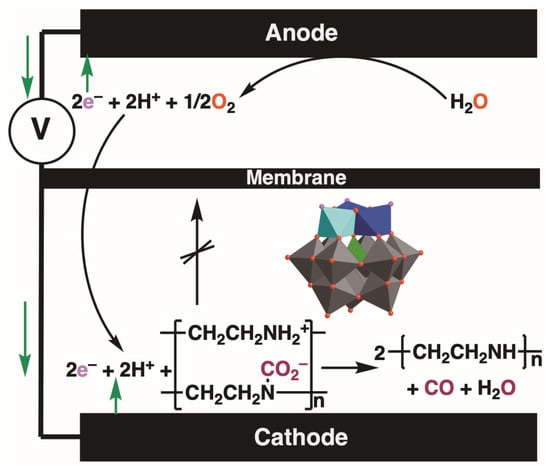
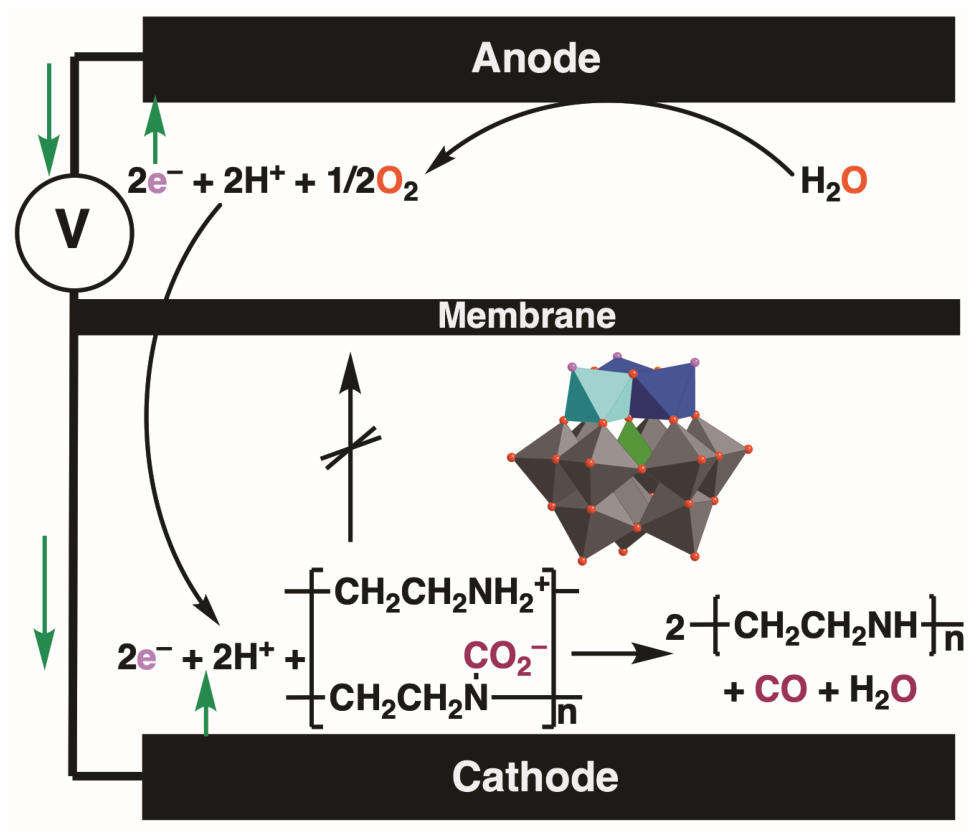
The research described herein asks several questions. First, are transition-metal-substituted polyoxometalates, previously studied for e-CO2RR [47], also active catalysts for e-RCC reactions and then which are the most active? Second, do small-molecule amines and their corresponding carbamates diffuse through commonly used PEMs or AEMs from the cathode to anode, and if so, what is a strategy to mitigate this diffusion? Third, are small-molecule amines and their corresponding carbamates oxidized at the anode under typical e-RCC cell potentials? As will be shown below and summarized in Figure 1, [SiCu2IIGaIII(H2O)3W9O37]9− was found to be the most active for e-RCC reactions, but carbamates based on small molecule amines quickly traverse PEMs and AEMs and are oxidized at the anode to form CO and CO2. To mitigate the problem of carbamate diffusion from cathode to anode cell compartments, high-molecular-weight amines were used to capture CO2, and the resulting carbamate solution was reduced to CO with the co-formation of H2 as a by-product.
Figure 1.
Reduction of branched polyethylenimine-derived carbamates to CO catalyzed by [SiCu2IIGaIII(H2O)3W9O37]9−. W: dark grey; Cu: blue; Ga: turquoise; O: red. For clarity the branched polyethylenimine is presented as a linear polymer.
2. Results and Discussion
To evaluate potential polyoxometalate compounds as catalysts for the reduction of ammonium carbamates, CO2 was reacted with 1:1 aqueous solutions of ethanolamine (MEA) and diethanolamine (DEA) to form the corresponding ammonium carbamates, as seen in Scheme 1.
Scheme 1.
Reaction of CO2 with MEA and DEA.
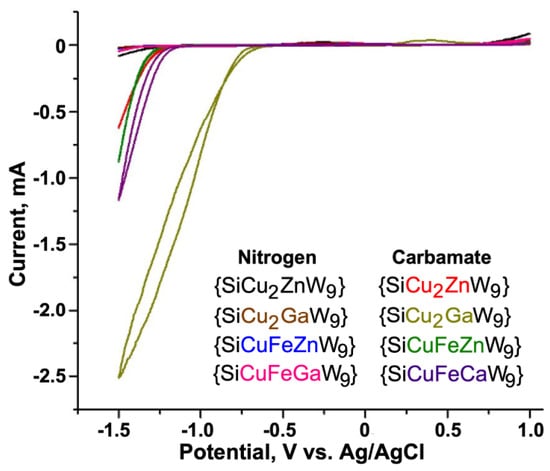
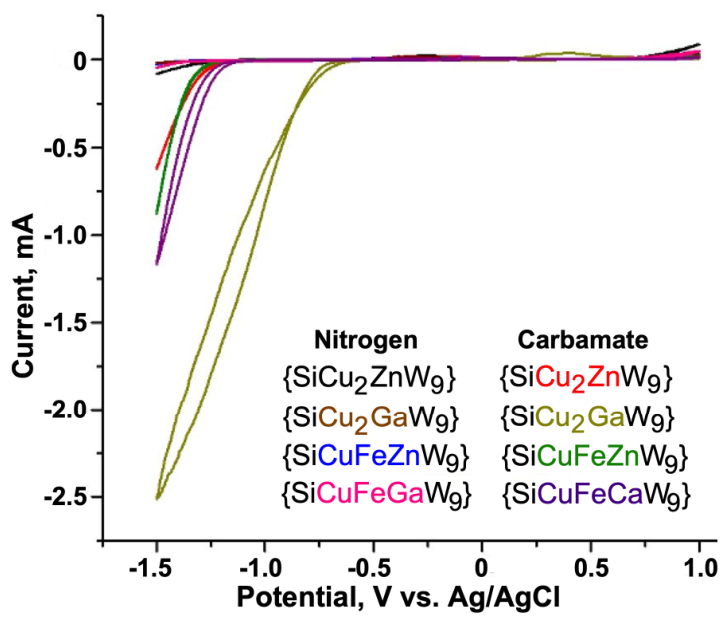
As can be seen from the 1H and 13C NMR measurements, depicted in Figures S1 and S2, CO2 was introduced into 1:1 by volume aqueous solutions containing either a primary amine, MEA, or a secondary amine, DEA, to afford in situ formation of aqueous ammonium carbamate species via the reaction of approximately one molar equivalent of CO2 with two molar equivalents of amine. After about 20 min the formation of the MEA and DEA carbamates was completed, and further addition of CO2 led to the decrease in pH and the formation of a small amount of bicarbonate and some dissolved CO2. Also, one can observe that MEA is notably more efficient in forming MEA-carbamate than DEA, and thus MEA was used to evaluate the electrocatalytic activity of polyoxometalates. Initial cyclic voltametric (CV) measurements were carried out under N2 and MEA carbamate (MEAC) for various polyoxometalates [SiCu2IIGaIII(H2O)3W9O37]9− {SiCu2GaW9}, [SiCuIIFeIIIGaIII(H2O)3W9O37]8− {SiCuFeGaW9}, [SiCu2IIZnII(H2O)3W9O37]10− {SiCu2ZnW9}, and [SiCuIIFeIIIZnII(H2O)3W9O37]9− {SiCuFeZnW9} chosen based on previous research that showed such polyoxometalates to be the most reactive [47], Figure 2.
Figure 2.
Cyclic voltammograms of four different polyoxometalates in 1:1 aqueous MEA under N2 and after formation of MEAC, by bubbling CO2 for 20 min. Conditions: 2 mM polyoxometalate, 3 mL MEA, 3 mL of DDW, glassy carbon working electrode (WE), stainless-steel wire counter electrode (CE), and Ag/AgCl reference electrode (RE), at room temperature, with scan rate 100 mV/s.
No reduction peaks were observed of MEA-H2O solutions under N2, but after formation of MEAC, {SiCuFeGaW9}, {SiCu2ZnW9}, and {SiCuFeZnW9} and others, Figure 3 shows catalytic peaks with onset reduction potentials at −1.18 to −1.22 V. Surprisingly, {SiCu2GaW9} showed significantly lower reduction onset potentials of −0.68 V and significantly higher reduction currents. This contrasts with e-CO2RR catalyzed by these polyoxometalates where the highest activity was observed at similar potentials as those obtained with {SiCuFeGaW9} [47]. To support a postulate that the observed reactivity of {SiCu2GaW9} originated predominantly from the carbamate species rather than dissolved CO2 or bicarbonate, solutions were (a) treated with N2 following CO2 saturation (20 min), and the CV was subsequently recorded. There is no change in the onset potential and only a very slight decrease in the reduction potential was observed and (b) CV measurements after extending the CO2 bubbling time to up to 40 min with a concurrent reduction in pH (Figure S1) resulted in a progressive decrease in the catalytic peak current, as depicted in Figure S3. This sensitivity to the decreasing pH in solution is likely due to a decrease in the relative amount of carbamate on the electrode during the CV measurement because of competition with bicarbonate and/or lower reactivity of CO2 formed in situ. CVs as a function of scan rate are shown in Figure S3 and show slightly decreasing current with the increase in scan rate likely because of incomplete regeneration of active species after electron transfer with increasing scan rates.
Figure 3.
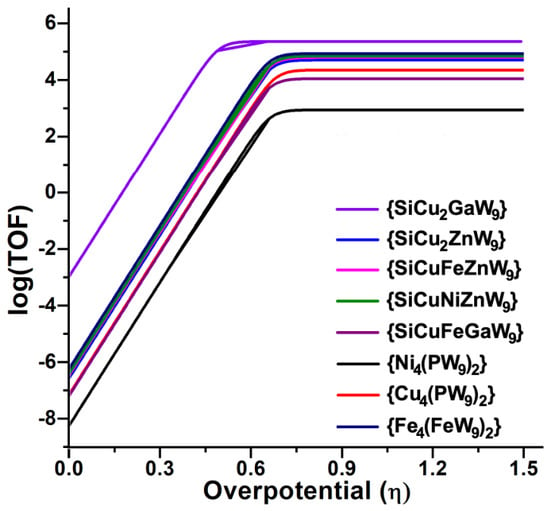
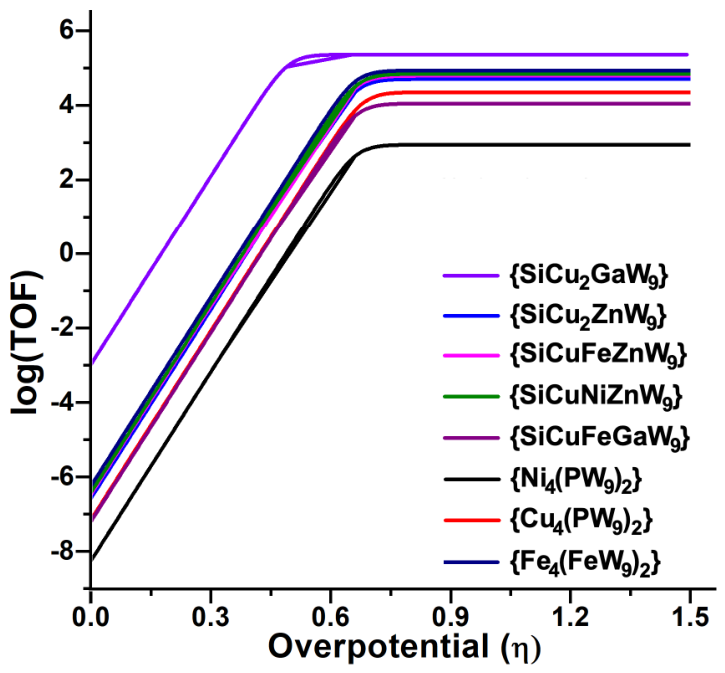
Catalytic Tafel plots for the cathodic MEAC reduction by various polyoxometalate electrocatalysts. Data was taken from cyclic voltammograms (Figure 2 and Figure S4–S7). Structures for the various complexes are presented in Figure S8.
One way to determine the maximum turnover frequencies, (TOFmax), and compare the electrocatalytic activity of the various polyoxometalates is by calculating TOFmax and the overpotential, η, using a catalytic Tafel plot [48,49,50], as in Equation (1) and Figure 3.
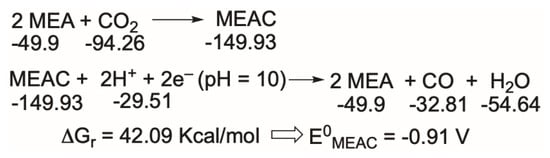
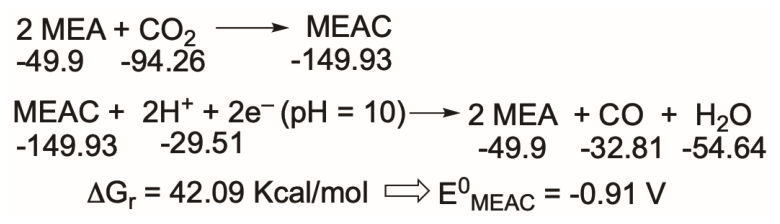
The kcat values were obtained from the CV measurements, as depicted in Figure 2 and Figures S4–S7, and E0MEAC is the standard potential for the cathodic reaction, as demonstrated in Equation (2), and at pH = 10 it is calculated to be −0.91 V (see further details in the Materials and Methods Section). E0cat is the standard potential of the catalyst under N2.
MEAC + 2 H+ + 2 e– ⟶ 2 MEA + CO + H2O
The results show that {SiCu2GaW9} has the lowest overpotential (η = 0.54 V) at the highest log TOFmax = 5.17 while the other catalysts have overpotentials of η = 0.69 V with a range of lower TOFmax values.
Initial controlled potential electrolysis (CPE) experiments were carried out in an undivided cell to sample the products of a MEAC reduction reaction. For example, a CPE reaction of a 6 mL 1:1 solution of MEA: H2O treated for 20 min with CO2 containing 2 mM {SiCu2GaW9}, at room temperature for 15 h at −1.5 V versus Ag/AgCl using a glassy carbon (d = 3 mm) WE and a stainless-steel CE, yielded 25 µmol CO and 25 µmol H2 as only products. Analysis was by gas chromatography with a thermal conductivity detector for the gas phase (GC-TCD) and 1H NMR for the liquid phase. To verify that the CO formed was indeed from the in situ prepared MEAC, an identical experiment was performed where MEAC was prepared using 13CO2. Analysis by GC with a mass selective detector (MSD) revealed the formation of >90% unlabeled 12CO2 indicating an anodic oxidation of MEA and/or MEAC. To further understand this anodic oxidation, (1) the CV for the oxidation of MEA, DEA, diethylamine and their corresponding carbamates were tested, and (2) the transport of MEAC was conducted through a Nafion membrane often used in divided cell configurations. One can see in Figure S9 that the amines themselves are quite stable to oxidation up to 1.5 V versus Ag/AgCl; however, the corresponding carbamates are oxidized at this potential; diethylamine carbamate > DEAC > MEAC. Furthermore, the transport of MEAC through a Nafion membrane in a H-cell configuration was measured by 1H NMR spectra as a function of time under open circuit conditions starting with MEAC in the cathode cell only, as depicted in Figure S10. As can be seen MEAC easily traverses the Nafion membrane within a short period of time. It should also be noted that upon crossing the Nafion membrane, MEAC was quantitatively hydrolyzed to MEA. Finally, reduction of MEAC was carried out in both an H-cell and a membrane electrode assembly (electrolyzer). The anode used for H2O oxidation was IrO2 on platinized Ti felt. The cathode was a polyoxometalate catalyst supported on a porous carbon gas diffusion electrode, and Sustainion® X37-50 grade 60 and Pipirion® were used as AEMs to prevent MEAC decomposition. The headspace above the cathode and anode cells was analyzed separately by GC-TCD. The results showed that CO was found almost exclusively in the anode cell, supporting the above-mentioned indications that CO can be formed from MEAC oxidation rather than MEAC reduction. H2 was formed exclusively at the cathode. See the Supplementary Materials for more details, specifically Figure S11.
Given that the catalytic reduction of MEAC as observed by CV could not be translated to a divided cell configuration because of fast transport of such small-molecule-derived carbamates through commercial PEMs and AEMs, the solution to this problem would be to use high-molecular-weight polyamines as CO2-capturing agents that would form carbamate units on the polymer chain and would not traverse PEMs or AEMs. Common and commercial branched polyethylenimine polymers (PEIs) that contain ~25% tertiary, ~50% secondary, and ~25% primary amines, already known as carbon-capture compounds [51,52,53,54], and available in a range of molecular weights from 800 to 1,000,000, were used for the e-RCC reaction in a membrane electrode assembly electrolyzer. The amount of CO2 bound by treatment of 1:1 PEI:H2O was ~80 mg CO2/g 25 K PEI (7.8 mol%/amine unit) and ~90 mg CO2/g 1 M PEI (8.9 mol%/amine unit), similar to previous reports [52,53].
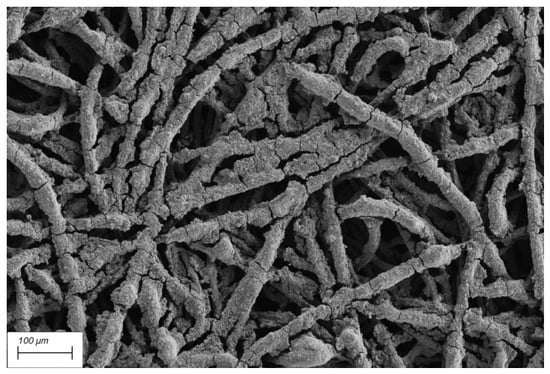
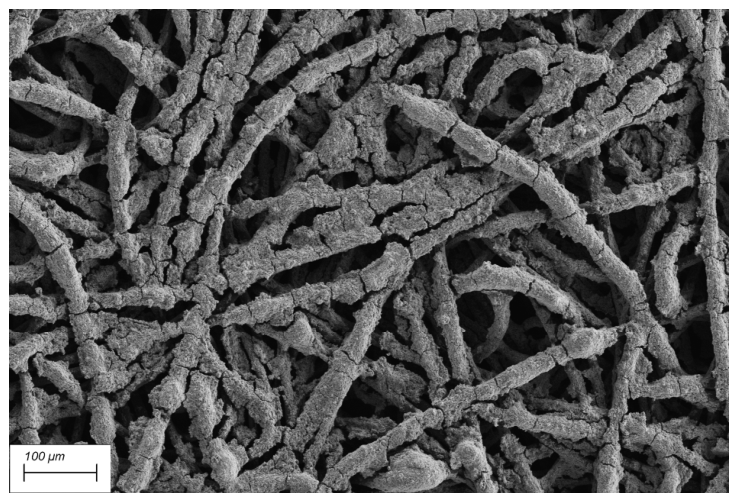
In the first step using the polyanionic properties of the polyoxometalate compounds and the polycationic properties of typical anion exchange ionomers based on quaternary ammonium sites, polyoxometalates were heterogenized onto porous carbon supports as gas diffusion layers (GDLs). The GDL electrode was fabricated by preparing an ink containing 80 wt% polyoxometalate, 10 wt% Aemion® ionomer, and 10 wt% carbon black, dispersed in a mixture of isopropanol and water. The suspension was homogenized by ultrasonication for 30 min and subsequently spray-coated onto a carbon paper substrate (Freudenberg H23C6 GDL with a microporous layer and hydrophobic surface treatment) using an air gun operated at 2 bar pressure. The catalyst morphology was evaluated on a high-resolution scanning electron microscope (HRSEM). The HRSEM images at 500× magnitude showed a very good dispersion of {SiCu2GaW9} on the GDL, as depicted in Figure 4 in comparison to the untreated carbon paper GDL in Figure S12. EDS measurements showed homogeneous coverage of {SiCu2GaW9} on the GDL as would be expected for a molecular compound, as depicted in Figure S13.
Figure 4.
HRSEM image of {SiCu2GaW9} on a carbon GDL using an Aemion® ionomer-based ink.
Initial exploratory CPE reactions were carried out in an cell using {SiCu2GaW9}, {SiCuFeGaW9}, or {Ni4(PW9)2} on a 1 cm2 carbon paper GDL as described above and pictured in Figure 4 as WE, a IrO2 on Pt-Ti felt separated by a glass frit as CE, and a Ag/AgCl RE. CPE was carried out in a 18 mL glass vial containing 1 mL of PEI (molecular weight 1 million), 3 mL of DDW, 2 mL of Na7DTPMP (heptasodium diethylenetriaminepentamethylenephosphonate 25% (w/v) in H2O), and 0.8 M Na2SO4·10H2O under 1 bar CO2 reacted at −1.5 V, −1.3 V, and −1.0 V versus Ag/AgCl for 15 h at room temperature. CO and H2 were the only observed products. Although the separation of the in situ formed carbamate of PEI from the anode was only by a frit, the importance of this measurement lies in the observation that {SiCu2GaW9} was active down to −1 V, while {SiCuFeGaW9} and {Ni4(PW9)2} were active at only more negative potentials, with {Ni4(PW9)2} as the poorest catalyst, as depicted in Figure S14. This supports the finding that {SiCu2Ga W9} is uniquely active at lower overpotentials as observed in the CV measurements. A control experiment to verify the source of CO from CO2 using PEI-carbamate prepared with 13CO2 showed formation of 13CO only.
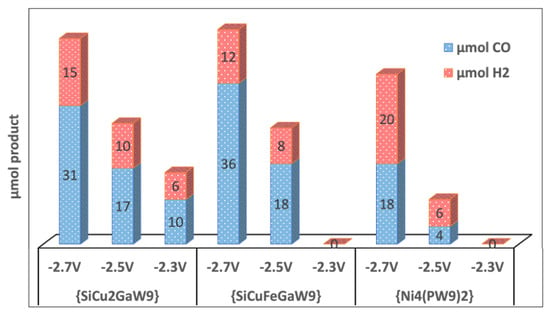
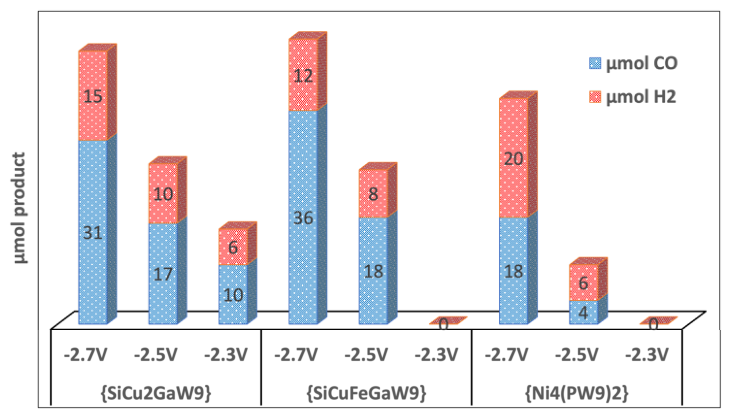
To solidify the advantage of the use of PEI for e-RCC, CPE was carried out in a membrane electrode assembly electrolyzer. Controlled-voltage electrolysis (CVE) was carried out in 4 cm2 electrolyzer using {SiCu2GaW9}, {SiCuFeGaW9}, or {Ni4(PW9)2} on a GDL cathode as described above (1 cm2 area) as WE. The catholyte was prepared from 1 mL PEI and 3 mL H2O, 2 mL Na7DTPMP 25% (w/v) in H2O, and 0.8 M Na2SO4·10H2O. The catholyte was treated for 20 min under a flow of CO2 gas to yield the corresponding PEI-carbamate and then purged with N2 and kept under 2 bar N2. The anolyte was Na7DTPMP 25% (w/v) in H2O and 0.8 M Na2SO4·10H2O. The anolyte and catholyte solutions were separated by a Nafion 107 membrane. CVE was carried out at 2.7, 2.5, and 2.3 V for 15 h at room temperature. Analysis of the gas phase by GC-TCD showed that CO and H2 were the only gaseous products formed while analysis by 1H NMR of the liquid phase from reactions carried out in D2O showed no discernible formation of any soluble products. The results are summarized in Figure 5.
Figure 5.
Controlled-voltage electrolysis comparing {SiCu2GaW9}, {SiCuFeGaW9}, or {Ni4(PW9)2} in an electrolyzer. Cathode: 1 cm2 carbon paper GDL from ink containing 10 µmol polyoxometalate, 2 mg Aemion® ionomer, and 5 mg carbon black. Anode: IrO2 on Pt-Ti felt as counter electrode. Catholyte: 1 mL PEI (molecular weight 1 M), 3 mL H2O, 2 mL Na7DTPMP 25% (w/v) in H2O, and 0.8 M Na2SO4·10H2O treated for 20 min under a flow of CO2. Anolyte was Na7DTPMP 25% (w/v) in H2O and 0.8 M Na2SO4·10H2O. Nafion 107 membrane, room temperature, and time of 15 h. Reactions were carried out in duplicate with minimal differences. Total faradaic efficiencies were moderate and typically less than 40%; see Table S1 for detailed data.
Post-reaction analysis by NMR showed that no polyethyleneimine or corresponding carbamate had diffused into the anolyte solution, as depicted in Figure S15. The {SiCu2GaW9} catalyst appeared to be stable after 15 h under CVE conditions, as depicted in Figure S16. There was no evidence of dissolution of the polyoxometalate or component elements as measured by ICP-MS. There were only statistically insignificant (±5%) amounts of Cu, Fe, Ga, or Ni above the background amounts of the elements measured in solution after the reactions. The results indeed confirm that {SiCu2GaW9} can yield product at the lowest overpotential; although, at more negative potentials of −2.7 V, {SiCuFeGaW9} yielded similar results. For both polyoxometalates the CO:H2 ratios hovered around 2:1. On the other hand, {Ni4(PW9)2} was less reactive and yielded H2 in preference to CO. A comparison of the use of different molecular weight PEI, 1,000,000 versus 25,000, showed that the former yields better results, as depicted in Figure S17. Tabulated results including the FE (%), charge density (J, mA/cm2), and total charge (Q, C) can be found in Table S1. Using the conditions described in Figure 5, control experiments (1) without catalyst (just GDL) showed no product formation; (2) PEI not treated with CO2 also showed no product formation; (3) experiments with CO2 dissolved in water yield only small trace amounts of CO; and (4) an experiment with 13CO2 showed only the formation of 13CO.
3. Materials and Methods
Polyoxometalate Synthesis. The alkali metal salts of {SiCu2ZnW9}, {SiCu2GaW9}, {SiCuFeGaW9}, {SiCuFeZnW9}, and {SiCuNiZnW9} were synthesized and analyzed as previously reported [47]. Similarly, the alkali metal salts of {Ni4(PW9)2}, {Cu4(PW9)2}, and {Fe4(FeW9)2} were also prepared by procedures reported in the literature [55,56,57].
Electrochemistry. Electrochemical experiments were carried out using a Biologic, Seyssinet-Pariset, France multichannel VSP 201 potentiostat. Cyclic voltammograms of 2 mM polyoxometalate in 3 mL water and 3 mL MEA were measured at different scan rates under 1 bar N and after formation of MEAC by treatment with a flow of 1 bar CO2 (99.99%) for 20 min. Glassy carbon (d = 3 mm) WE, a stainless-steel wire CE, and Ag/AgCl (3M KCl) RE. Similar CV measurement to evaluate the oxidation of MEA and MEAC were carried out in the same manner by exchanging the WE and CE. To extract catalytic parameters from the CV measurements, we used the equation proposed by Kubiak and coworkers for deriving the catalytic rate constant, kcat [48], namely Equation (1), where R is the universal gas constant, T = temperature, F = Faraday constant, ʋ = scan rate, n is the number of electron-transfer processes that occur at the electrode per catalyst and equals 2; n′ is the number of catalysts equivalents required per catalysts and equals 1; icat is the current under CO2; ip is the current under N2; and kcat is the catalytic rate constant.
The interdependency of turnover frequency (TOF) and overpotential (η) are based on the intrinsic properties of the catalyst and can be calculated from the difference between the applied potential and the standard potential for the reduction of CO2 to CO, independent of contingent factors such as the cell characteristics. The relevant catalytic Tafel plots were calculated using Equation (3) [49,50]. E0MEAC, the standard potential for the reduction of carbamate to CO under the specific conditions of catalysis, was calculated using literature data for ΔGf values and is shown in Figure 6; E0MEAC = −0.91 V. The pH = 10 value was the one measured before the CV measurements (Figure S1). The presence of bicarbonate or dissolved CO2 was not observed and therefore not considered.
Figure 6.
Calculation of E0MEAC from literature ΔGf values of ΔGf for MEA, CO2, CO, and H2O were taken directly from the literature [58,59]. The ΔGf for 2 H+ + 2 e– was calculated from E = 0.0591 V × pH. The ΔGf of MEAC was deduced from DFT-calculated literature values [60].
Controlled-voltage electrolysis. Reactions in 4 cm2 electrolyzer (with 1 cm2 active area). Cathode: a carbon-paper GDL electrode was fabricated by preparing an ink containing 80 wt% polyoxometalate cesium salts of ({SiCu2GaW9}, {SiCuFeGaW9}, or {Ni4(PW9)2}), 10 wt% Aemion ionomer, and 10 wt% carbon black, dispersed in a mixture of isopropanol and water. The suspension was homogenized by ultrasonication for 30 min and subsequently spray-coated onto a carbon-paper substrate (Freudenberg H23C6 GDL with a microporous layer and hydrophobic surface treatment) using an air gun operated at 2 bar pressure. Catholyte: 1 mL PEI, 3 mL H2O, 2 mL Na7DTPMP 25% (w/v) in H2O, and 0.8 M Na2SO4·10H2O treated for 20 min under a flow of CO2. Anode: IrO2/Pt-Ti felt. Anolyte: 3 mL DDW, 2 mL Na7DTPMP (25% w/v), and 0.8 M sodium sulfate decahydrate. Reactions were carried out under 2.5 bar N2 for 15 h at room temperature at cell voltages ranging from 2.3 to 2.7 V, respectively, with an anodic potential of ∼1.0 V versus SHE. The analysis of the products at the gas phase was conducted by using a HP 6890 GC-TCD, Santa Clara, CA, USA using a ShinCarbon ST 80/100 micropacked 2 m × 0.53 mm ID column with He as a carrier gas. Hydrogen was analyzed separately using a GOWMAC GC-TCD, Bethlehem, PA, USA, configured with two columns in series (4′ by 1/8” Hayesep T; 10′ by 1/8” Molecular sieve 5A) with Ar as a carrier gas carrier. CO and H2 were observed as the only products. Experiments using 13CO2-labeled carbamates were analyzed by GC-MS using a molecular sieve PLOT column (30 m × 0.32 mm)
1H NMR spectra were recorded on a Bruker Avance III 300 MHz spectrometer, Ettlingen, Rheinstetten, Germany at 298 K and referenced to the solvent shift. Data manipulations were completed using MestReNova 14.3.2 and TopSpin3.7 software.
HRSEM imaging was carried out on a Zeiss MERLIN high-resolution scanning electron microscope, Oberkochen, Germany containing an Inlens detector for higher energy secondary electrons for clear topographic mapping.
4. Conclusions
Others have noted an e-RCC reaction of captured carbamate with small-molecule amines such as MEA to form MEAC as substrate for the formation of CO to indirectly reduce low atmospheric concentrations of CO2. We have found, however, that such carbamates easily diffuse through membranes in divided cell configurations, e.g., H-cells or membrane assembly electrolyzers, and are oxidized at the anode. To circumvent this problem, we have shown that high-molecular-weight PEI can be used as a proven CO2 capturing agent. The corresponding carbamates can yield CO along with H2 in ~2:1 ratio in a CVE reaction using a membrane electrode assembly electrolyzer with a supported {SiCu2GaW9} catalyst. The experiments demonstrated that {SiCu2GaW9} reduces polyammonium carbamates at a significantly less negative potential (–1.0 V vs. Ag/AgCl), compared to other tested polyoxometalate catalysts, and produces CO with H2 as a co-product. Typically, current densities of 1–2 mA/cm2 were obtained with only moderate faradaic efficiencies. It is not yet possible to benchmark these results since previous e-RCC research using amine capture has not considered anodic oxidation of the small-molecule carbamates used as substrates, typically MEAC. Considering the too-low faradaic efficiencies and current densities, and limited actual turnover numbers, much more research is still required to optimize such polyamine-based e-RCC reactions.
Supplementary Materials
The following supporting information can be downloaded at https://www.mdpi.com/article/10.3390/molecules31183276/s1: Figure S1: 1H NMR spectra of 1:1 vol MEA:H2O and 1:1 vol DEA:H2O upon addition of CO2; Figure S2: 13C NMR spectra of 1:1 vol MEA:H2O upon addition of 13CO2; Figure S3: Cyclic voltammograms of {SiCu2GaW9}, {SiCuFeGaW9}, {SiCu2ZnW9}, and {SiCuFeZnW9} at different scan rates; Figure S4: Cyclic voltammogram of 2 mM {SiCuNiZnW9} under 1 bar N2 and MEAC; Figure S5: Cyclic voltammogram of 2 mM {Cu4(PW9)2} under 1 bar N2 and MEAC; Figure S6: Cyclic voltammogram of 2 mM {Ni4(PW9)2} under 1 bar N2 and MEAC; Figure S7: Cyclic voltammogram of 2 mM {Fe4(FeW9)2} under 1 bar N2 and MEAC; Figure S8: Polyhedral presentation of polyoxometalates tested; Figure S9: Anodic cyclic voltammetry of MEA, DEA, and Diethylamine and their corresponding carbamates; Figure S10: Transport of MEAC through a Nafion membrane as measured by 1H NMR; Figure S11: Controlled potential electrolysis of MEAC in divided cells; Figure S12: HRSEM image of the carbon GDL; Figure S13: Elemental mapping (HR-SEM; EDS) of {SiCu2GaW9} on a carbon GDL; Figure S14: Controlled potential electrolysis comparing {SiW9Cu2Ga}, {SiW9CuFeGa}, or {Ni4(PW9)2}; Figure S15: Post-reaction analysis of catholyte and anolyte 1H NMR; Figure S16: IR spectra of {SiCu2GaW9} after controlled-voltage electrolysis; Figure S17: Controlled-voltage electrolysis comparing PEI (1 M) and PEI (25 K) in an electrolyzer; Table S1: Faradaic efficiencies, current densities, product distributions, and charge using three catalysts, two polyethylenimines, and at three cell voltages.
Author Contributions
Conceptualization, D.A.-D. and R.N.; methodology, D.A.-D. and R.N.; validation, D.A.-D. and R.N.; investigation, D.A.-D.; resources, R.N.; data curation, D.A.-D.; original draft preparation, D.A.-D.; writing—review and editing, R.N.; visualization, D.A.-D. and R.N.; supervision, R.N.; project administration, R.N.; funding acquisition, R.N. All authors have read and agreed to the published version of the manuscript.
Funding
This research was funded by Israel Science Foundation, grant number 1237/18, and the APC was funded by internal funds.
Institutional Review Board Statement
Not applicable.
Informed Consent Statement
Not applicable.
Data Availability Statement
Supporting reported results can be found in the Supplementary Materials.
Acknowledgments
Alina Amel and Shaada Amar are thanked for carrying out experiments analyzing the headspace of both cathode and anode cells.
Conflicts of Interest
The authors declare no conflicts of interest.
Abbreviations
| AEM | Anion exchange membrane |
| CE | Counter electrode |
| CPE | Controlled-potential electrolysis |
| CV | Cyclic voltammetry |
| DEA | Diethanolamine |
| CCU | Carbon capture and utilization |
| DDW | Double-distilled water |
| e-CO2RR | Electrochemical CO2 reduction reaction |
| e-RCC | Electrochemically reactive capture |
| GC-TCD | Gas chromatography–thermal conductivity detector |
| GDL | Gas diffusion layer |
| HRSEM | High-resolution scanning electron microscopy |
| MEAC | Carbamate of monoethanolamine |
| Na7DTPMP | Heptasodium diethylenetriaminepentamethylenephosphonate |
| PEI | Polyethylenimine |
| PEM | Proton exchange membrane |
| RE | Reference electrode |
| TOF | Turnover frequency (1/s) |
| WE | Working electrode |
References
- Mikkelsen, M.; Jørgensen, M.; Krebs, F.C. The Teraton Challenge. A Review of Fixation and Transformation of Carbon Dioxide. Energy Environ. Sci. 2010, 3, 43–81. [Google Scholar] [CrossRef] [Scilit]
- Kibria, M.G.; Edwards, J.P.; Gabardo, C.M.; Dinh, C.-T.; Seifitokaldani, A.; Sinton, D.; Sargent, E.H. Electrochemical CO2 Reduction into Chemical Feedstocks: From Mechanistic Electrocatalysis Models to System Design. Adv. Mater. 2019, 31, e1807166. [Google Scholar] [CrossRef] [Scilit] [PubMed]
- Jiang, M.; Wang, H.; Zhu, M.; Luo, X.; He, Y.; Wang, M.; Wu, C.; Zhang, L.; Li, X.; Liao, X.; et al. Review on strategies for improving the added value and expanding the scope of CO2 electroreduction products. Chem. Soc. Rev. 2024, 53, 5149–5189. [Google Scholar] [CrossRef] [Scilit] [PubMed]
- Masel, R.I.; Liu, Z.; Yang, H.; Kaczur, J.J.; Carrillo, D.; Ren, S.; Salvatore, D.; Berlinguette, C.P. An industrial perspective on catalysts for low-temperature CO2 electrolysis. Nat. Nanotechnol. 2021, 16, 118–128. [Google Scholar] [CrossRef] [Scilit] [PubMed]
- Cokoja, M.; Bruckmeier, C.; Rieger, B.; Hermann, W.A.; Kühn, F.E. Transformation of carbon dioxide with homogeneous transition-metal catalysts: A molecular solution to a global challenge? Angew. Chem. Int. Ed. 2011, 50, 8510–8537. [Google Scholar] [CrossRef] [Scilit] [PubMed]
- Dalle, K.E.; Warnan, J.; Leung, J.J.; Reuillard, B.; Karmel, I.S.; Reisner, E. Electro- and Solar-Driven Fuel Synthesis with First Row Transition Metal Complexes. Chem. Rev. 2019, 119, 2752–2875. [Google Scholar] [CrossRef] [Scilit] [PubMed]
- Francke, R.; Schille, B.; Roemelt, M. Homogeneously Catalyzed Electroreduction of Carbon Dioxide—Methods, Mechanisms, and Catalysts. Chem. Rev. 2018, 118, 4631–4701. [Google Scholar] [CrossRef] [Scilit] [PubMed]
- Wagner, A.; Sahm, C.D.; Reisner, E. Towards molecular understanding of local chemical environment effects in electro- and photocatalytic CO2 reduction. Nat. Catal. 2020, 3, 775–786. [Google Scholar] [CrossRef] [Scilit]
- Langie, K.M.G.; Tak, K.; Kim, C.; Lee, H.W.; Park, K.; Kim, D.; Jung, W.; Lee, C.W.; Oh, H.-S.; Lee, D.K.; et al. Toward economical application of carbon capture and utilization technology with near-zero carbon emission. Nat. Commun. 2022, 13, 7482. [Google Scholar] [CrossRef] [Scilit] [PubMed]
- Jerng, S.E.; Gallant, B.M. Electrochemical reduction of CO2 in the captured state using aqueous or nonaqueous amines. iScience 2022, 25, 104558. [Google Scholar] [CrossRef] [Scilit] [PubMed]
- Siegel, R.E.; Pattanayak, S.; Berben, L.A. Reactive Capture of CO2: Opportunities and Challenges. ACS Catal. 2023, 13, 766–784. [Google Scholar] [CrossRef] [Scilit]
- Li, J.-J.; Qin, X.-R.; Wang, X.-R.; Wang, L.-L.; Yu, Z.-Y.; Lu, T.-B. Direct Electroreduction of Low-Concentration CO2: Progress and Perspective. ACS Nano 2025, 19, 10620–10629. [Google Scholar] [CrossRef] [Scilit] [PubMed]
- Almajed, H.M.; Kas, R.; Brimley, P.; Crow, A.M.; Somoza-Tornos, A.; Hodge, B.-M.; Burdyny, T.; Smith, W.A. Closing the Loop: Unexamined Performance Trade-Offs of Integrating Direct Air Capture with (Bi)carbonate Electrolysis. ACS Energy Lett. 2024, 9, 2472–2483. [Google Scholar] [CrossRef] [Scilit] [PubMed]
- Hua, Y.-B.; Ni, B.-X.; Jiang, K. Ambient CO2 Capture and Valorization Enabled by Tandem Electrolysis Using Solid-State Electrolyte Reactor. J. Electrochem. 2025, 31, 2504082. [Google Scholar] [CrossRef] [Scilit]
- Li, M.; Irtem, E.; Iglesias van Montfort, H.-P.; Abdinejad, M.; Burdyny, T. Energy comparison of sequential andintegrated CO2 capture and electrochemicalconversion. Nat. Commun. 2022, 13, 5398. [Google Scholar] [CrossRef] [Scilit] [PubMed]
- Freyman, M.C.; Hunag, Z.; Ravikumar, D.; Duoss, E.B.; Li, Y.; Baker, S.E.; Pang, S.H.; Schaidle, J.A. Reactive CO2 capture: A path forward for process integration in carbon management. Joule 2023, 7, 631–651. [Google Scholar] [CrossRef] [Scilit]
- Lee, S.; Choi, W.; Kim, J.H.; Park, S.; Hwang, Y.J.; Na, J. Techno-economic analysis and life-cycle assessment of the electrochemical conversion process with captured CO2 in an amine-based solvent. Green Chem. 2023, 25, 10398–10414. [Google Scholar] [CrossRef] [Scilit]
- Kim, Y.; Namdari, M.; Jewlal, A.M.L.; Chen, Y.F.; Pimlott, D.J.D.; Stolar, M.; Berlinguette, C.P. Economic Viability of Integrated CO2 Capture and Conversion. ACS Energy Lett. 2024, 10, 403–409. [Google Scholar] [CrossRef] [Scilit]
- Appel, A.M.; Yang, J.Y. Maximum and Comparative Efficiency Calculations for Integrated Capture and Electrochemical Conversion of CO2. ACS Energy Lett. 2024, 9, 768–770. [Google Scholar] [CrossRef] [Scilit]
- Namdari, M.; Kim, Y.; Pimlott, D.J.D.; Jewlal, A.M.L.; Berlinguette, C.P. Reactive carbon capture using electrochemical reactors. Chem. Soc. Rev. 2025, 54, 590–600. [Google Scholar] [CrossRef] [Scilit] [PubMed]
- Kim, Y.; Lees, E.W.; Donde, C.; Jewlal, A.M.L.; Waizenegger, C.E.B.; de Hepcee, B.M.; Simpson, G.L.; Valji, A.; Berlinguette, C.P. Integrated CO2 capture and conversion to form syngas. Joule 2024, 8, 3105–3125. [Google Scholar] [CrossRef] [Scilit]
- Pimlott, D.J.D.; Kim, Y.; Berlinguette, C.P. Reactive Carbon Capture Enables CO2 Electrolysis with Liquid Feedstocks. Acc. Chem. Res. 2024, 57, 1007–1018. [Google Scholar] [CrossRef] [Scilit] [PubMed]
- Zhang, Z.; Lees, E.W.; Habibzadeh, F.; Salvatore, D.A.; Ren, S.; Simpson, G.L.; Wheeler, D.G.; Liu, A.; Berlinguette, C.P. Porous metal electrodes enable efficient electrolysis of carbon capture solutions. Energy Environ. Sci. 2022, 15, 705–713. [Google Scholar] [CrossRef] [Scilit]
- Ma, S.; Kim, Y.; Zhang, Z.; Ren, S.; Donde, C.; Melo, L.; Williams, A.S.R.; Stolar, M.; Grant, E.R.; Berlinguette, C.P. Cathode Surface pH Modulates Multicarbon Product Selectivity during the Electrochemical Conversion of CO2 Capture Solutions. ACS Energy Lett. 2024, 9, 2326–2332. [Google Scholar] [CrossRef] [Scilit]
- Li, T.; Lees, E.W.; Zhang, Z.; Berlinguette, C.P. Conversion of Bicarbonate to Formate in an Electrochemical Flow Reactor. ACS Energy Lett. 2020, 5, 2624–2630. [Google Scholar] [CrossRef] [Scilit]
- Dutcher, B.; Fan, M.; Russell, A.G. Amine-Based CO2 Capture Technology Development from the Beginning of 2013: A Review. ACS Appl. Mater. Interfaces 2015, 7, 2137–2148. [Google Scholar] [CrossRef] [Scilit] [PubMed]
- Aghel, B.; Janati, S.; Wongwises, S.; Shadloo, M.S. Review on CO2 capture by blended amine solutions. Int. J. Greenh. Gas Control 2022, 119, 103715. [Google Scholar] [CrossRef] [Scilit]
- Meng, F.; Meng, Y.; Ju, T.; Han, S.; Lin, L.; Jiang, J. Research progress of aqueous amine solution for CO2 capture: A review. Renew. Sustain. Energy Rev. 2022, 168, 112902. [Google Scholar] [CrossRef] [Scilit]
- Chen, L.; Li, F.; Zhang, Y.; Bentley, C.L.; Horne, M.; Bond, A.M.; Zhang, J. Electrochemical Reduction of Carbon Dioxide in a Monoethanolamine Capture Medium. ChemSusChem 2017, 10, 4109–4118. [Google Scholar] [CrossRef] [Scilit] [PubMed]
- Filotás, D.; Nagy, T.; Nagy, L.; Mizsey, P.; Nagy, G. Extended Investigation of Electrochemical CO2 Reduction in Ethanolamine Solutions by SECM. Electroanalysis 2018, 30, 690–697. [Google Scholar] [CrossRef] [Scilit]
- Pérez-Gallent, E.; Vankani, C.; Sánchez-Martínez, C.; Anastasopol, A.; Goetheer, E. Integrating CO2 Capture with Electrochemical Conversion Using Amine-Based Capture Solvents as Electrolytes. Ind. Eng. Chem. Res. 2021, 60, 4269–4278. [Google Scholar] [CrossRef] [Scilit]
- Bhattacharya, M.; Sebghati, S.; VanderLinden, R.T.; Saouma, C.T. Toward Combined Carbon Capture and Recycling: Addition of an Amine Alters Product Selectivity from CO to Formic Acid in Manganese Catalyzed Reduction of CO2. J. Am. Chem. Soc. 2020, 142, 17589–17597. [Google Scholar] [CrossRef] [Scilit] [PubMed]
- Lee, G.; Li, Y.C.; Kim, J.-Y.; Peng, T.; Nam, D.-H.; Sedighian Rasouli, A.; Li, F.; Luo, M.; Ip, A.H.; Joo, Y.-C.; et al. Electrochemical upgrade of CO2 from amine capture solution. Nat. Energy 2021, 6, 46–53. [Google Scholar] [CrossRef] [Scilit]
- Liu, H.; Chen, Y.; Lee, J.; Gu, S.; Li, W. Ammonia-mediated CO2 capture and direct electroreduction to formate. ACS Energy Lett. 2022, 7, 4483–4489. [Google Scholar] [CrossRef] [Scilit]
- Leverick, G.; Bernhardt, E.M.; Ismail, A.I.; Law, J.H.; Arifutzzaman, A.; Aroua, M.K.; Gallant, B.M. Uncovering the Active Species in Amine-Mediated CO2 Reduction to CO on Ag. ACS Catal. 2023, 13, 12322–12337. [Google Scholar] [CrossRef] [Scilit]
- Choi, J.; Chiu, S.; Banerjee, A.; Sacci, R.L.; Veith, G.M.; Stieber, C.; Hahn, C.; Alexandrova, A.N.; Morales-Guio, C.G. Corrosion and Enhanced Hydrogen Evolution in Electrochemical Reduction of Ammonium Carbamate on Transition Metal Surfaces. J. Phys. Chem. Lett. 2024, 15, 8007–8017. [Google Scholar] [CrossRef] [Scilit] [PubMed]
- Xiao, Y.C.; Sun, S.S.; Zhao, Y.; Miao, R.K.; Fan, M.; Lee, G.; Chen, Y.; Gabardo, C.M.; Yu, Y.; Qiu, C.; et al. Reactive capture of CO2 via amino acid. Nat. Commun. 2024, 15, 7849. [Google Scholar] [CrossRef] [Scilit] [PubMed]
- Bohlen, B.; Daems, N.; Su, Z.; Chen, A.; Lipkowski, J.; Breugelmans, T. In Situ Spectroelectrochemical Study of Acetate Formation by CO2 Reduction Using Bi Catalyst in Amine-Based Capture Solution. ChemSusChem 2024, 17, e202400437. [Google Scholar] [CrossRef] [Scilit] [PubMed]
- Li, Q.; Qu, T.; Tan, S.; Wang, T.; Ding, Y.; Wang, C.; Zhang, J.; Xiong, Z.; Zhao, Y. Structure-activity relationship of a dual-function amine-based electrolyte for integrated CO2 capture and electro-chemical conversion. Chem. Eng. J. 2024, 498, 155056. [Google Scholar] [CrossRef] [Scilit]
- Siegel, R.E.; Aceves, M.; Berben, L.A. Direct Electrochemical Conversion of CO2 Sorbent Solution to Formate by a Molecular Iron Catalyst. ACS Energy Lett. 2024, 9, 2896–2901. [Google Scholar] [CrossRef] [Scilit]
- Verma, P.K.; McCrory, C.C.L. The influence of exogenous amines on the electrochemical CO2 reduction activity of a cobalt-pyridyldiimine catalyst. Chem. Commun. 2024, 60, 8039–8042. [Google Scholar] [CrossRef] [Scilit] [PubMed]
- Neves-Garcia, T.; Hasan, M.; Zhu, Q.; Li, J.; Jiang, Z.; Liang, Y.; Wang, H.; Rossi, L.M.; Warburton, R.E.; Baker, L.R. Integrated Carbon Dioxide Capture by Amines and Conversion to Methane on Single-Atom Nickel Catalysts. J. Am. Chem. Soc. 2024, 146, 31633–31646. [Google Scholar] [CrossRef] [Scilit] [PubMed]
- Dai, R.; Zhang, L.; Viet Bao Tran, K.; Sirisomboonchai, S.; Machida, H.; Norinaga, K. Mechanism investigation of direct electrochemical reduction of CO2-loaded 2-(ethylamino)ethanol solution into CO. Sep. Purif. Technol. 2025, 355, 129575. [Google Scholar] [CrossRef] [Scilit]
- Brar, A.; Wang, X.S.; Gillis, C.N.; Yang, J.Y.; Findlater, M. Challenges in Product Selectivity for Electrocatalytic Reduction of Amine-Captured CO2: Implications for Reactive Carbon Capture. ACS Omega 2025, 10, 21980–21984. [Google Scholar] [CrossRef] [Scilit] [PubMed]
- Mir, A.Q.; Banerjee, A.; Ihiri, F.; Chiu, S.; Alexandrova, A.N.; Morales-Guio, C.; Yang, J.Y. Optimizing CO2-Loaded Aqueous Amine Solutions for Higher Electrocatalytic CO2 Reduction Activity. J. Am. Chem. Soc. 2025, 147, 39123–39133. [Google Scholar] [CrossRef] [Scilit] [PubMed]
- Azaiza-Dabbah, D.; Vogt, C.; Wang, F.; Masip-Sánchez, A.; de Graaf, C.; Poblet, J.M.; Haviv, E.; Neumann, R. Molecular Transition Metal Oxide Electrocatalysts for the Reversible Carbon Dioxide-Carbon Monoxide Transformation. Angew. Chem. Int. Ed. 2022, 61, e202112915. [Google Scholar] [CrossRef] [Scilit] [PubMed]
- Azaiza-Dabbah, D.; Wang, F.; Haddad, E.; Solé-Daura, A.; Carmieli, R.; Poblet, J.M.; Vogt, C.; Neumann, R. Heterometallic Transition Metal Oxides Containing Lewis Acids as Molecular Catalysts for the Reduction of Carbon Dioxide to Carbon Monoxide with Bimodal Activity. J. Am. Chem. Soc. 2024, 146, 27871–27885. [Google Scholar] [CrossRef] [Scilit] [PubMed]
- Clark, M.L.; Cheung, P.L.; Lessio, M.; Carter, E.A.; Kubiak, C.P. Kinetic and Mechanistic Effects of Bipyridine (bpy) Substituent, Labile Ligand, and Brønsted Acid on Electrocatalytic CO2 Reduction by Re(bpy) Complexes. ACS Catal. 2018, 8, 2021–2029. [Google Scholar] [CrossRef] [Scilit]
- Azcarate, I.; Costentin, C.; Robert, M.; Savéant, J.M. Dissection of Electronic Substituent Effects in Multielectron–Multistep Molecular Catalysis. Electrochemical CO2-to-CO Conversion Catalyzed by Iron Porphyrins. J. Phys. Chem. C 2016, 120, 28951–28960. [Google Scholar] [CrossRef] [Scilit]
- Costentin, C.; Drouet, S.; Robert, M.; Savéant, J.M. Turnover Numbers, Turnover Frequencies, and Overpotential in Molecular Catalysis of Electrochemical Reactions. Cyclic Voltammetry and Preparative-Scale Electrolysis. J. Am. Chem. Soc. 2012, 134, 11235–11242. [Google Scholar] [CrossRef] [Scilit] [PubMed]
- Satyapal, S.; Filburn, T.; Trela, J.; Strange, J. Performance and Properties of a Solid Amine Sorbent for Carbon Dioxide Removal in Space Life Support Applications. Energy Fuels 2001, 15, 250–255. [Google Scholar] [CrossRef] [Scilit]
- Goeppert, A.; Czaun, M.; May, R.B.; Prakash, G.K.S.; Olah, G.A.; Narayanan, S.R. Carbon Dioxide Capture from the Air Using a Polyamine Based Regenerable Solid Adsorbent. J. Am. Chem. Soc. 2011, 133, 20164–20167. [Google Scholar] [CrossRef] [Scilit] [PubMed]
- Zhao, Y.; Zhu, Y.; Zhu, T.; Lin, G.; Shao, M.; Hong, W.; Hou, S. Polyethylenimine-Based Solid Sorbents for CO2 Adsorption: Performance and Secondary Porosity. Ind. Eng. Chem. Res. 2019, 58, 15506–15515. [Google Scholar] [CrossRef] [Scilit]
- Li, H.; Zhou, Z.; Ma, T.; Wang, K.; Zhang, H.; Alawadhi, A.H.; Yaghi, O.M. Bonding of Polyethylenimine in Covalent Organic Frameworks for CO2 Capture from Air. J. Am. Chem. Soc. 2024, 146, 35486–35492. [Google Scholar] [CrossRef] [Scilit] [PubMed]
- Weakley, T.J.R.; Finke, R.G. Single-crystal X-ray structures of the polyoxotungstate salts K8.3Na1.7[Cu4(H2O)2(PW9O34)2]•24H2O and Na14Cu[Cu4(H2O)2(P2W15O56)2•53H2O. Inorg. Chem. 1990, 29, 1235–1241. [Google Scholar] [CrossRef] [Scilit]
- Lv, H.; Guo, W.; Wu, K.; Chen, Z.; Bacsa, J.; Musaev, D.G.; Geletii, Y.V.; Lauinger, S.M.; Lian, T.; Hill, C.L. A Noble-Metal-Free, Tetra-nickel Polyoxotungstate Catalyst for Efficient Photocatalytic Hydrogen Evolution. J. Am. Chem. Soc. 2014, 136, 14015–14018. [Google Scholar] [CrossRef] [Scilit] [PubMed]
- Barats, D.; Leitus, G.; Popovitz-Biro, R.; Shimon, L.J.W.; Neumann, R. A Stable “End-On” Iron(III)–Hydroperoxo Complex in Water Derived from a Multi-Iron(II)-Substituted Polyoxometalate and Molecular Oxygen. Angew. Chem. Int. Ed. 2008, 47, 9908–9912. [Google Scholar] [CrossRef] [Scilit] [PubMed]
- Available online: https://www.chemeo.com/cid/20-170-0/Monoethanolamine (accessed on 15 January 2025).
- Stull, D.R.; Westrum, E.F., Jr.; Sinke, G.C. The Chemical Thermodynamics of Organic Compounds; John Wiley & Sons: Hoboken, NJ, USA, 1969. [Google Scholar]
- Davran-Candan, T. DFT Modeling of CO2 Interaction with Various Aqueous Amine Structures. J. Phys. Chem. A 2014, 118, 4582–4590. [Google Scholar] [CrossRef] [Scilit] [PubMed]


Disclaimer/Publisher’s Note: The statements, opinions and data contained in all publications are solely those of the individual author(s) and contributor(s) and not of MDPI and/or the editor(s). MDPI and/or the editor(s) disclaim responsibility for any injury to people or property resulting from any ideas, methods, instructions or products referred to in the content. |
© 2026 by the authors. Licensee MDPI, Basel, Switzerland. This article is an open access article distributed under the terms and conditions of the Creative Commons Attribution (CC BY) license.