


Abstract
This study investigated the corrosion resistance of laser-cladded AlCoCrFeNi high-entropy alloy coatings with varying TiO2 content (0 wt.%, 0.5 wt.%, 1.0 wt.%, and 1.5 wt.%) in 3.5 wt.% NaCl solution. Optimal cladding parameters (1500 W, 40 mm/s, 11.9 g/min) were determined via orthogonal experiments. TiO2 promoted Ti-rich BCC2-phase precipitation, increased corrosion potential (from −1.4185 V to −0.6841 V), decreased corrosion current density (from 2.33 × 10⁻⁴ to 2.28 × 10⁻⁶ A/cm2), and enhanced charge-transfer resistance. XPS analysis demonstrated that TiO2 promoted the enrichment of FeO, Cr2O3, and TiO2 components in the passive film while reducing the Al2O3 fraction, leading to the formation of a dense and stable composite passive film that effectively inhibited chloride ion attack. In summary, an appropriate amount of TiO2 doping significantly enhances the corrosion resistance of laser-cladded AlCoCrFeNi HEA coatings, with the 1.5 wt.% addition being the best-performing among the investigated compositions.
1. Introduction
With the rapid development of critical industrial sectors such as marine engineering, petrochemicals, and nuclear power generation, various metal components often require long-term service under extreme conditions including high temperatures, high pressures, salt spray, or strong acidic/alkaline environments. Corrosive failure not only severely threatens equipment operational safety and stability but also poses significant economic losses and environmental risks. Although traditional protective alloys (e.g., stainless steel) exhibit certain corrosion resistance, they are prone to stress corrosion cracking in harsh environments with high salinity, failing to meet long-term protection requirements [1,2]. In recent years, high-entropy alloys (HEAs), leveraging unique effects such as “high-entropy mixing,” “lattice distortion,” “slow diffusion,” and “cocktail” mechanisms [3,4], have demonstrated superior performance compared to conventional single-element or minority-element alloys in mechanical properties [5], high-temperature stability [6,7], and corrosion resistance [8,9]. Particularly in complex corrosive environments, HEAs’ exceptional surface passivation capability has made them a research focus in corrosion protection [10]. Various techniques have been employed to fabricate HEA coatings, including magnetron sputtering and plasma spraying. While effective under specific conditions, these conventional methods face certain limitations in heavy-duty applications. For instance, magnetron sputtering is highly efficient for depositing thin films, but internal stresses can compromise coating adhesion as thickness increases [11]. Atmospheric plasma spraying typically forms a mechanical bond with the substrate and is prone to introducing higher porosity and in-flight oxidation depending on the specific deposition conditions [12]. In contrast, laser cladding utilizes a high-energy beam to rapidly melt the HEA precursors along with a thin layer of the substrate. Although it requires precise parameter optimization to control the dilution rate and thermal stress, this process inherently yields highly dense coatings with robust metallurgical bonding and minimal porosity, offering a highly suitable approach for thick, corrosion-resistant HEA applications [13]. In contrast, laser-cladding technology, utilizing a high-energy beam for rapid heating and solidification, effectively suppresses grain growth and produces high-performance coatings with metallurgical bonding to the substrate, high density, and uniform composition, offering a promising technical approach for enhancing the corrosion resistance of HEA coatings [14,15].
Among various high-entropy alloy systems, the AlCoCrFeNi family has garnered significant attention as a highly promising protective material. The inherent synergistic effect of its constituent elements, particularly the strong passivation capabilities of Cr and Al, facilitates the formation of robust multielement oxide films, providing exceptional thermal stability, mechanical strength, and corrosion resistance [16]. Recent studies have extensively investigated the electrochemical performance of AlCoCrFeNi alloys in aggressive chloride environments, demonstrating that their passivation behavior and pitting resistance are highly sensitive to their phase constitution and microstructural evolution [17]. For instance, researchers have highlighted the critical role of phase distribution and element segregation in determining the localized corrosion resistance of AlCoCrFeNi coatings [18]. However, in highly complex and aggressive corrosive environments, the intrinsic microgalvanic effects between multiple phases in single AlCoCrFeNi HEA coatings can still lead to localized passivation film breakdown, posing performance limitations. Introducing a well-designed second phase can further regulate its microstructure and enhance the overall corrosion performance. For example, Zhou et al. [19] found that HEA coatings reinforced with submicron-sized TiC particles achieved an optimal balance between wear resistance and corrosion resistance. Li et al. [20] incorporated small amounts of TiB2 ceramic particles into Al-Mg alloys supplemented with trace amounts of Sc and Zr elements, achieving not only improved mechanical strength but also significantly enhanced resistance to sensitized corrosion through multiphase synergistic effects. TiO2, with its excellent chemical stability, good mechanical properties, and unique passivation-promoting effects, is a highly promising ceramic-reinforced phase material [21]. Podelinska et al. [22] provides new insights into the process–structure relationships of nanocrystalline TiO2-based powders synthesized by extraction pyrolysis, hydrothermal, and sol methods. Perumal et al. [23] prepared composite materials (Al–5SiC, Al–5SiC–4Al2O3, Al–5SiC–4TiO2) by introducing Al2O3 and TiO2 ceramic particles into an Al6061 matrix, finding that TiO2 effectively reduces the electrochemical active surface area of the aluminum matrix and enhances the corrosion resistance of the matrix material. Consequently, TiO2 content not only significantly lowers the surface activity of the matrix and promotes the formation of a dense passivation film but also improves coating corrosion resistance by refining grain size and filling micropores [24,25]. However, TiO2 possesses excellent chemical stability and unique passivation-promoting characteristics. Although TiO2 has been widely utilized in organic primers and Al-based composites to reduce surface electrochemical activity, its behavior in high-temperature multicomponent HEA melts remains largely unexplored. Unlike inert physical additions, the high-temperature metallurgical interaction between TiO2 and the AlCoCrFeNi matrix during laser cladding introduces a complex synergistic mechanism—potentially altering local elemental segregation, oxygen distribution, and the selective growth of Ti-rich phases. Currently, there is a critical scarcity of systematic research comparing how such TiO2-driven microstructural evolution translates to the macroscopic corrosion resistance of laser-cladded HEA coatings. A concise comparison of representative Ti-bearing and ceramic/oxide-modified HEA coatings reported in previous studies is provided in Table 1.
Table 1.
Representative studies on Ti-bearing or ceramic-modified HEA coatings.
Therefore, this study employed laser-cladding technology to prepare AlCoCrFeNi high-performance alloy (HEA) composite coatings doped with TiO2 at various mass fractions (0 wt.%; 0.5 wt.%; 1.0 wt.%; 1.5 wt.%). The research first systematically optimized laser-cladding process parameters through orthogonal experimental design, then focused on investigating the effects of different TiO2 content on the coating’s corrosion behavior in a 3.5 wt.% NaCl solution at room temperature. To elucidate the microscopic mechanisms, comprehensive analyses were conducted using X-ray diffraction (XRD), electron probe microanalysis (EPMA), and energy-dispersive spectroscopy (EDS) to examine TiO2’s regulatory effects on the coating’s phase composition, grain structure, and defects. Corrosion kinetics were evaluated via polarization curves and electrochemical impedance spectroscopy (EIS), while X-ray photoelectron spectroscopy (XPS) provided detailed insights into the chemical characteristics and formation mechanisms of the surface passivation film. This study aimed to clarify the relationship between TiO2 content and the evolution of the coating’s microstructure as well as its enhanced corrosion resistance, offering a solid theoretical foundation and technical guidance for the composition design and engineering applications of high-performance, corrosion-resistant, high-entropy alloy composite coatings.
2. Materials and Experiments
2.1. Preparation of Coating Materials
This experiment utilized AlCoCrFeNi HEA powder (particle size: 50–100 μm; purity: 99%) and nano-TiO2 powder (particle size: 25 nm; purity: 99.8%) as raw materials. The TiO2 powder was added to the HEA alloy powder at mass fractions of 0 wt.%, 0.5 wt.%, 1.0 wt.%, and 1.5 wt.% to prepare the following samples: pure AlCoCrFeNi HEA (Sample A); AlCoCrFeNi HEA doped with 0.5 wt.% TiO2 (Sample B); AlCoCrFeNi HEA doped with 1.0 wt.% TiO2 (Sample C); and AlCoCrFeNi HEA doped with 1.5 wt.% TiO2 (Sample D).
The mixture was transferred via a funnel into a clean container, and steel bearing balls were added as the grinding medium in a 1:3 ratio. To ensure uniform mixing, the gap between the container and the powder mixer was filled with medical-grade absorbent cotton to 95% capacity and sealed. The sealed container was then placed in a mixer and mechanically blended at 300 rpm for 48 h to achieve thorough homogenization of the composite powder. After mixing, the three powders were dried in a 100 °C oven for 4 h. Following natural cooling to room temperature, a high-entropy alloy composite coating was fabricated on the stainless steel substrate using laser-cladding technology.
2.2. Laser-Cladding Experiment
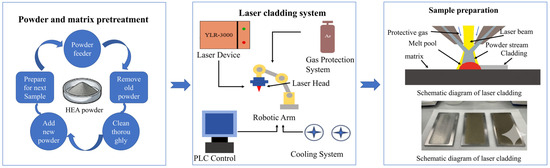
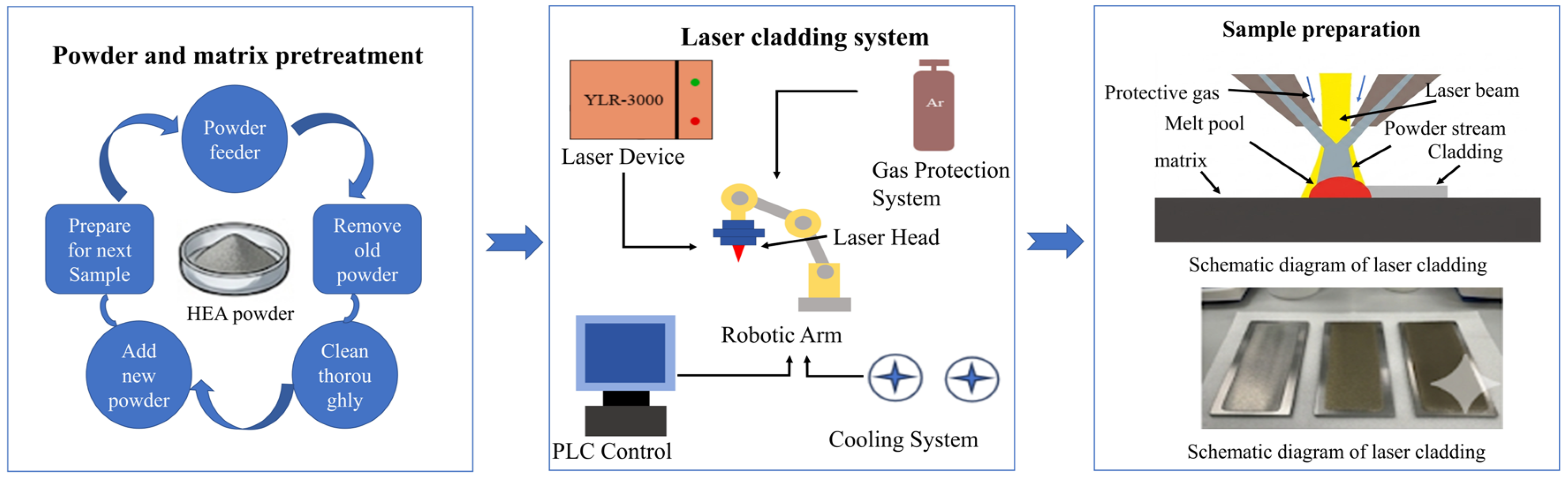
A composite coating was prepared on the surface of a commercial 304L stainless steel substrate using a laser-cladding system (DMG MORI, Bielefeld, Germany, as shown in Figure 1). This system mainly consists of a high-power laser, a cooling system (DL20-900, China), a powder feeding and gas protection system, and a robotic arm. Before cladding, the substrate surface was successively ground with SiC sandpaper to remove rust and then ultrasonically cleaned with anhydrous ethanol. The laser-cladding procedure was as follows. Firstly, the initial powder was taken out from the container and placed in a drying oven for thorough drying (the drying process needs to be carried out at 100 °C for two hours). Then, the surface of the stainless steel substrate was polished with fine sandpaper and wiped with alcohol to remove impurities. When preparing coatings for samples A, B, C and D, the powder must be replaced after each cladding process (the original powder needs to be removed and the powder supply container cleaned before replacing with new powder to reduce experimental errors).
Figure 1.
Process flow diagram of laser-cladding system.
To determine optimal forming quality, this study employed a three-factor, four-level orthogonal experiment (see Table 2) to systematically evaluate the effects of laser power, scanning speed, and powder feed rate on the coating dilution rate and shape factor. After preparing single-layer coatings using 16 different parameter combinations, the dilution rates and shape factor values of these coatings were measured as output variables. The optimal process parameters were determined through range analysis, and subsequent test specimens were fabricated accordingly. High-purity argon gas (99.99%) at a flow rate of 10 L/min was continuously supplied throughout the cladding process as a protective gas to prevent oxidation of the high-temperature molten pool. The laser-cladding process utilized a coaxial powder-feeding geometry with a laser spot diameter of 3.0 mm and a focal position of +2 mm. To fabricate the macroscopic surface coatings, a continuous zig-zag scanning strategy was adopted with an adjacent track overlap ratio of 50%. The final fabricated specimens consisted of a single layer with an average total coating thickness of approximately 2 mm. Furthermore, following the cladding process, the actual Ti and O elemental distribution and relative content in the solidified coatings were verified via EDS area scanning to ensure consistency with the nominal TiO2 doping fractions.
Table 2.
Orthogonal experimental process parameter design.
2.3. Electrochemical Corrosion Behavior Testing
Using a wire-cutting machine (DK7740C, Suzhou, China), the AlCoCrFeNi high-entropy alloy (HEA) coating was cut into standard block specimens measuring 15 mm × 15 mm × 10 mm. To minimize surface scratches and obtain a flat observation surface, the working surfaces of the specimens were successively water-ground with silicon carbide (SiC) sandpaper of grit sizes 180, 500, 1000, and 2000, followed by mirror polishing using a 0.25 μm diamond polishing agent. The specimens were then ultrasonically cleaned with anhydrous ethanol and dried with cold air. Except for the designated working surface area, all other surfaces of the specimens were sealed with epoxy resin insulation.
The electrochemical tests were conducted at room temperature in a 3.5 wt.% NaCl solution using the multi-channel electrochemical workstation (CS310X, Wuhan Kesite Instrument Co, Ltd., Wuhan, China) and a standard three-electrode system: the coated sample served as the working electrode, the platinum mesh as the auxiliary electrode, and the saturated calomel electrode (SCE) as the reference electrode [26]. Prior to testing, the instrument was preheated at a constant temperature for 30 min to eliminate instrumental errors and environmental interference, followed by immersion of the reference electrode in the electrolyte for 15 min to achieve equilibrium. The sample was then left undisturbed in the solution while its open-circuit potential (OCP) was monitored for 1 h to establish a stable solid–liquid interface electrochemical equilibrium. Subsequently, electrochemical impedance spectroscopy (EIS) was performed with an AC sinusoidal perturbation amplitude of 10 mV and a frequency range of 10−2 Hz to 105 Hz. Finally, a potentiodynamic polarization test was conducted with a scanning range of −0.5 V to 1.5 V (vs. OCP) at a rate of 0.5 mV/s to evaluate polarization potential, corrosion rate, and passivation region. To ensure the reliability and reproducibility of the experimental results, each sample was tested three times under identical experimental conditions. To further analyze the coating’s corrosion mechanism, a constant potential polarization test was performed by maintaining a specific voltage for a specified duration to obtain a stable passivation film. X-ray photoelectron spectroscopy (XPS) analysis of composition and oxidation states was carried out using the Axis-Ultra DLD-600W spectrometer (Kratos, Manchester, UK), equipped with a monochromatic Al Kα X-ray source (hv = 1486.6 eV) [27].
2.4. Microstructural Characterization
To systematically evaluate the phase composition, microstructural evolution, powder morphology and distribution, as well as surface failure characteristics after electrochemical corrosion of HEA coatings, this study employed a combination of various microscopic characterization techniques. X-ray diffraction (XRD, XRD-7000, Shimadzu, Kyoto, Japan) was used to analyze the crystal structure and phase composition of the high-entropy alloy powder and laser-cladding coatings with varying TiO2 content. Based on the diffraction results, the scanning range (2θ) was set between 10° and 90°. Field-emission scanning electron microscopy (FESEM, SIRION 200, FEI Company, Hillsboro, OR, USA) was utilized to observe the initial morphology and particle size distribution of the mixed powders, while electron probe microanalysis (EPMA, EPMA-8050G, Shimadzu Corporation, Kyoto, Japan) characterized the surface microstructure and cross-sectional metallurgical bonding interfaces of the coatings. Quantitative assessments were conducted on elemental diffusion behavior at the coating-substrate interface and the local segregation and distribution patterns of elements (e.g., Al, Co, Cr, Fe, Ni, Ti) within the coatings.
After completing the potentiodynamic polarization test, three-dimensional microscopic images of the corrosion regions on the coating surface were obtained using a super-depth-of-field 3D microscope (SuperView WT3000, Shenzhen, China). By extracting the two-dimensional cross-sectional contour curves of the corrosion pits, precise quantitative measurements of their geometric dimensions (maximum depth and opening width) were performed to visually assess the inhibitory effects of different TiO2 content levels on pitting corrosion lateral expansion and longitudinal penetration. To elucidate the passivation mechanism on the coating surface following the electrochemical reaction, constant potential polarization experiments were conducted to form a passivation film on the sample surface. Subsequently, X-ray photoelectron spectroscopy (XPS) analyses were carried out using an Axis-Ultra DLD-600W photoelectron spectrometer (Kratos, Manchester, UK), equipped with a monochromatic Al Kα X-ray source (hv = 1486.6 eV). Through the acquisition and fitting of core-level spectra for Al2p, Co2p, Cr2p, Fe2p, Ni2p, and Ti2p, the oxide composition and evolution of element valence states in the passivation film were thoroughly investigated.
3. Experimental Results and Analysis
3.1. Optimization of Laser-Cladding Process Parameters
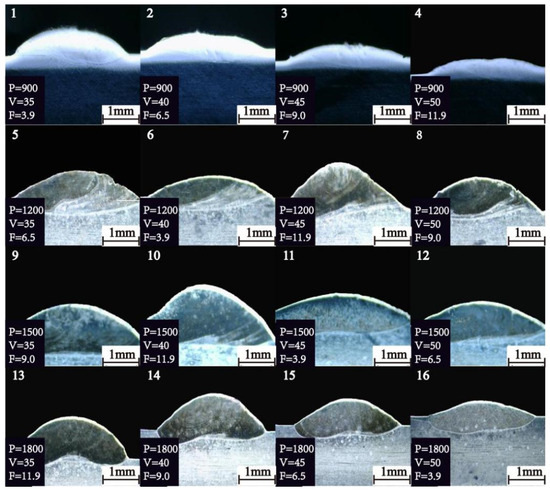
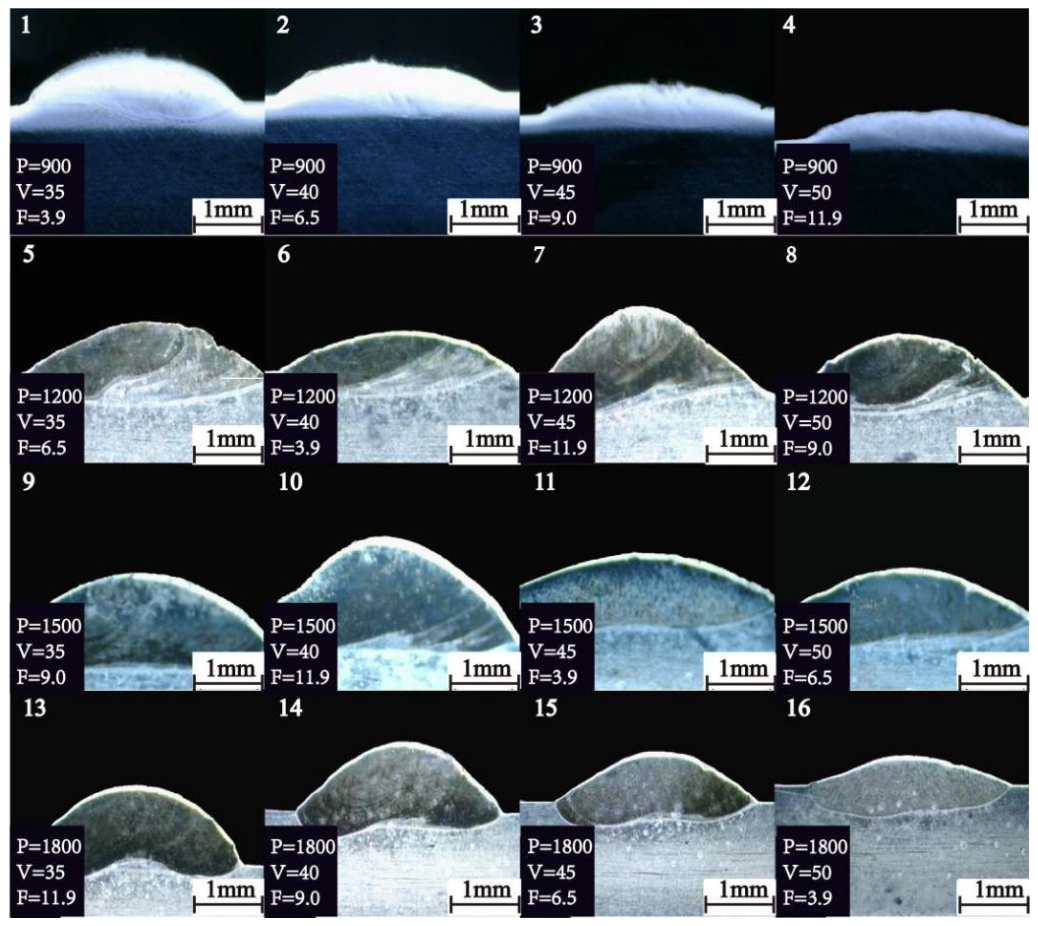
Strict control of scanning speed, powder feed rate, and laser power is crucial for obtaining high-quality laser-cladding coatings [28,29,30]. To identify the optimal process combination for preparing subsequent high-quality multilayer AlCoCrFeNi high-performance alloy (HEA) composite coatings, this study first prepared 16 sets of single-layer coating samples using a three-factor, four-level orthogonal experiment. As shown in the cross-sectional microstructure in Figure 2, the study systematically evaluated the metallurgical bonding status at the coating–matrix interface of all single-layer samples and examined the distribution of internal defects such as pores and cracks. Additionally, quantitative calculations were performed for key formation parameters (dilution rate and shape factor) for each coating group, with test data summarized in Table 3. Among these parameters, the dilution rate is a critical indicator of the metallurgical bonding strength between the coating and substrate as well as the retention rate of coating components. Excessively high dilution rates lead to excessive element migration from the substrate into the coating, compromising the initial design composition and inherent properties of the high-entropy alloy. Conversely, insufficient dilution rates fail to achieve adequate fusion depth, resulting in inadequate interfacial bonding strength [31]. Therefore, the core optimization principle of this study was to minimize the coating dilution rate while ensuring robust metallurgical bonding between the coating and substrate. All experimental data from the orthogonal experiment are presented in Table 3.
Figure 2.
Cross-sectional morphology of a single-pass coating of AlCoCrFeNi HEA.
Table 3.
Experimental data for cross sections of AlCoCrFeNi HEA coatings.
The microstructural characteristics of the cross sections of all samples were characterized and analyzed, with detailed observation of the metallurgical bonding interface between the coating and the substrate, as well as the distribution of internal defects such as pores and cracks. The cross-sectional morphology is shown in Figure 2. Additionally, quantitative measurements were performed for each coating group regarding key evaluation parameters (dilution ratio and shape factor).
To determine the importance of each process parameter on coating quality, identify key factors, and find the optimal combination of process parameters, this study employed range analysis to conduct an in-depth examination of the coating experimental data. Using range analysis, this paper evaluates the experimental data related to the coatings. Ki represents the sum of the experimental data from any column in the orthogonal table, while ki denotes the average value of Ki.
Here, s represents the number of occurrences at any given level in this column.
The range data table for the orthogonal experiment was calculated using the aforementioned formula, as shown in Table 4.
Table 4.
Range analysis in orthogonal experiments.
To determine the primary and secondary influences of process parameters on coating quality, range analysis was employed to statistically process the orthogonal experimental data. The results indicated that the optimal ranges for laser power, scanning speed, and powder feed rate were 0.095, 0.075, and 0.0775, respectively. According to range analysis principles, larger range values signify more significant impacts on experimental outcomes. Consequently, the importance ranking of factors affecting coating dilution rate was: laser power (R = 0.095) > powder feed rate (R = 0.0775) > scanning speed (R = 0.075). As a critical indicator of metallurgical bonding between the coating and substrate and component retention rate, the dilution rate directly influences coating performance. Excessively high dilution rates lead to excessive diffusion of substrate elements into the coating, compromising its designed composition and inherent properties. Conversely, insufficient dilution rates may weaken the metallurgical bond strength and affect adhesion stability [32]. Therefore, the core objective of the experimental optimization was to minimize the dilution rate while ensuring optimal adhesion between the coating and the substrate. The dilution rate of sample group 10 was 0.16, the lowest among all samples. Based on the range analysis results and the evaluation of cross-sectional defects and formation quality across all 16 sample groups, the optimal process parameters for preparing this HEA coating were determined: laser power of 1500 W, scanning speed of 40 mm/s, and powder feed rate of 11.9 g/min. This optimized parameter set was subsequently applied directly to the fabrication of all multilayer modified composite coatings.
3.2. Microstructural Analysis of the Coating
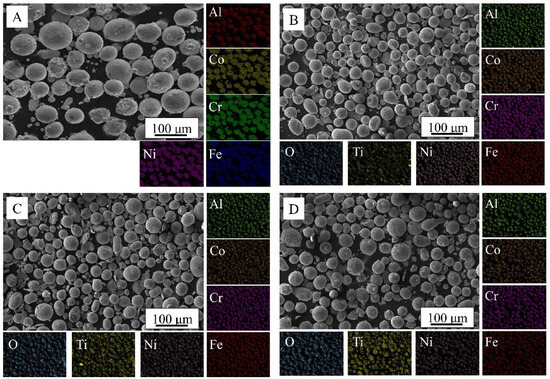
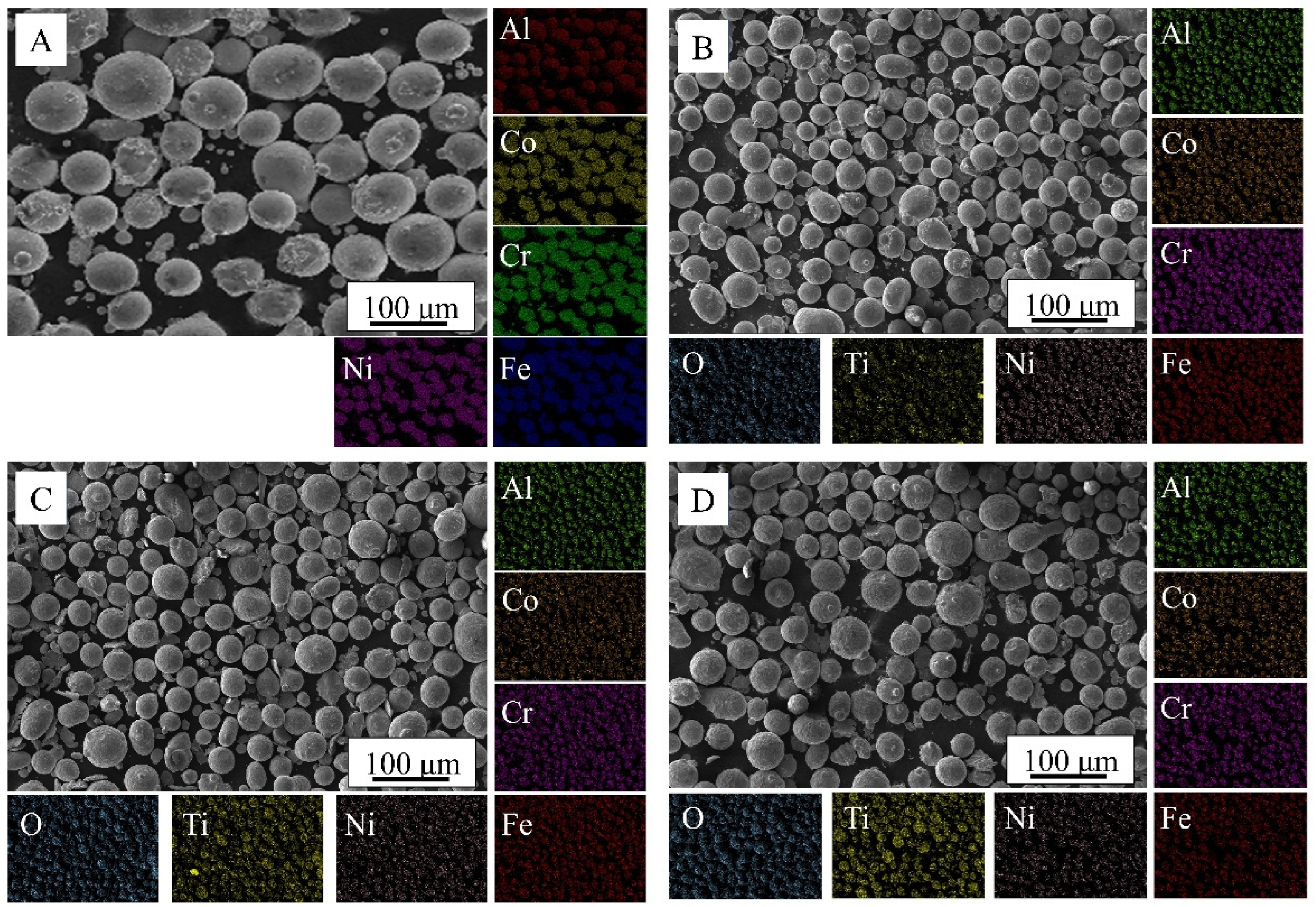
Figure 3 presents the SEM morphologies and energy-dispersive spectroscopy (EDS) elemental maps of the original AlCoCrFeNi high-entropy alloy powder before mechanical mixing and the TiO2-containing powders after mechanical mixing. Compared with the original powder, the mechanically mixed powders exhibit slight particle deformation and a modest increase in surface irregularity. Nevertheless, most of the AlCoCrFeNi particles remain predominantly spherical, with no obvious large-scale flattening, severe fragmentation, or extensive cold welding observed under the present mixing conditions. The overall particle size range also appears comparable to that of the original powder based on the SEM observations. In addition, the EDS elemental maps show that the constituent elements are relatively homogeneously distributed, while Ti and O are detected throughout the TiO2-containing powder mixtures, indicating effective incorporation and dispersion of TiO2. The predominantly spherical morphology of the mixed powders is favorable for stable powder feeding and subsequent melting during the laser-cladding process.
Figure 3.
Scanning electron microscope images of AlCoCrFeNi HEA powders doped with different TiO2 content: (A) 0 wt.%; (B) 0.5 wt.%; (C) 1 wt.%; (D) 1.5 wt.%.
According to the Hume-Rothery principle, the formation of phase structures in high-entropy alloy systems is determined by the relative strength of chemical affinities among the alloy elements [33]. However, differences in chemical affinities among multiple elements lead to distinct phase structures in different systems. The VEC values for AlCoCrFeNi HEA were calculated using Equation (3).
In the formula, ci denotes the atomic percentage of the i-th element, while (VEC)i represents the valence electron concentration of the i-th element. All data required for this study are available in the table [34]. Substitution of the data into Equation (3) yields the following result: the VEC value for AlCoCrFeNi HEA is 7.2, indicating that this alloy system may exhibit a tendency to form FCC + BCC or BCC-related solid solution structures. However, upon addition of TiO2, the system ceases to be a single metal solid solution and instead constitutes a composite structure comprising a metal matrix phase, a Ti-enriched phase, and oxide/reaction products [35]. Therefore, the phase composition of TiO2-added samples cannot be predicted solely based on traditional VEC criteria, but should primarily be determined through XRD analysis.
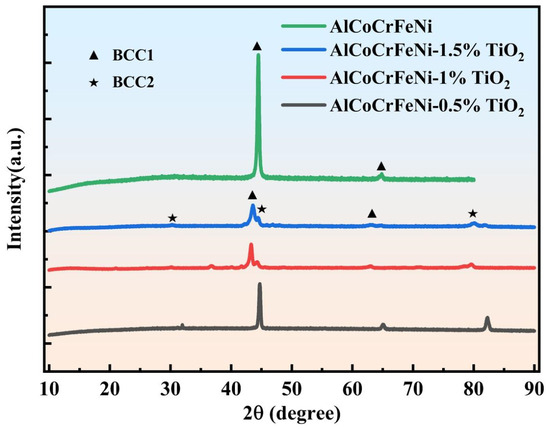
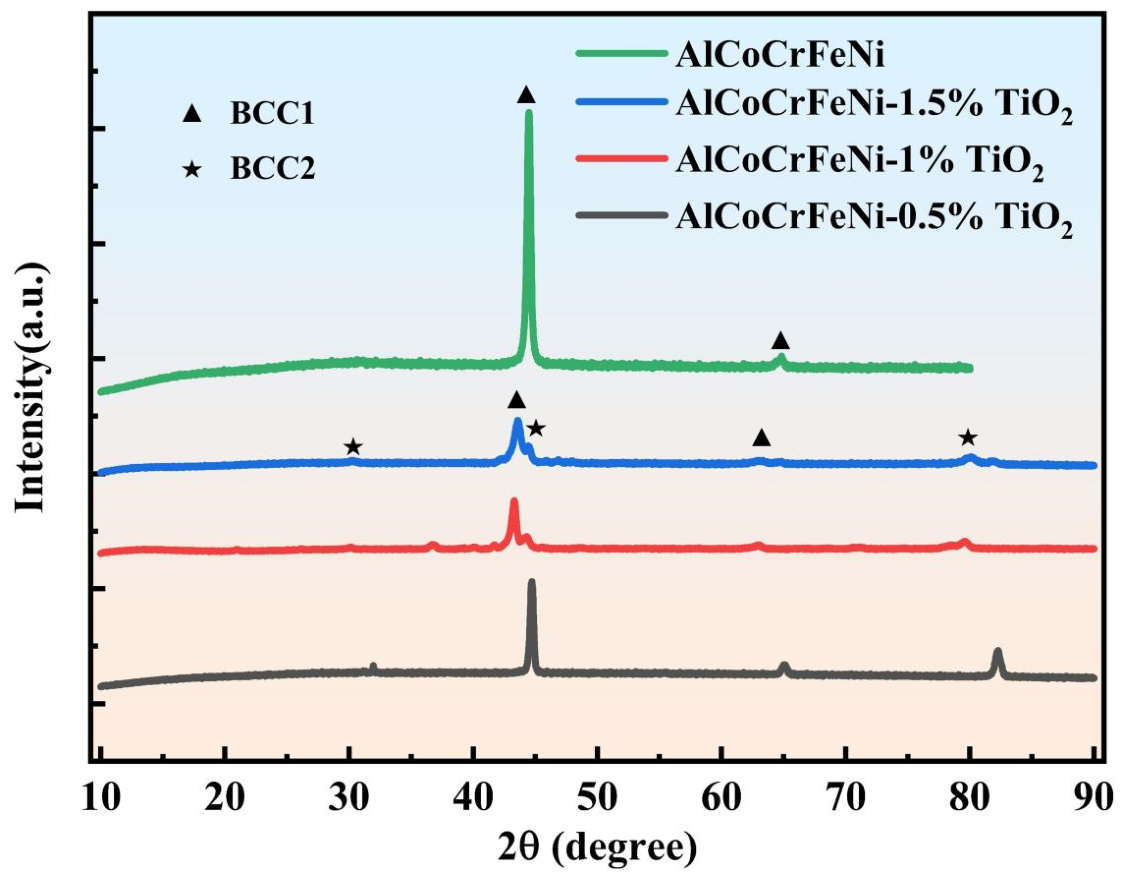
Figure 4 shows the XRD spectra of AlCoCrFeNi HEA coatings with different TiO2 content (0 wt.%, 0.5 wt.%, 1.0 wt.%, and 1.5 wt.%). Analysis indicates that all samples maintain a crystal structure dominated by the body-centered cubic (BCC) phase. Precise calibration of the diffraction peak positions reveals distinct peaks at approximately 44.6° and 65.0° for the TiO2-free substrate (AlCoCrFeNi), corresponding to the crystal planes of the BCC1 structure. This confirms that the high-entropy alloy matrix possesses a typical single-phase BCC crystal structure, typically attributed to lattice distortion effects caused by the large atomic radius of aluminum. With the addition of TiO2, the main peak of the BCC phase shifts significantly toward lower angles (left shift). According to Bragg’s law, this phenomenon indicates an increase in the lattice constant d due to the solid solution incorporation of Ti atoms into the BCC matrix lattice. Notably, no distinct independent TiO2 oxide diffraction peaks were observed in the XRD spectra, suggesting that TiO2 likely decomposed during the cladding process, facilitating Ti incorporation into the matrix lattice or participation in the formation of secondary phases.
Figure 4.
XRD patterns of AlCoCrFeNi HEA coatings with different TiO2 content (0 wt.%, 0.5 wt.%, 1.0 wt.% and 1.5 wt.%).
While a semiquantitative estimation of the diffraction peak areas indicates a progressive increase in the intensity of the secondary peaks with higher TiO2 content (suggesting a TiO2-induced phase separation trend), the inherently broad and overlapping nature of these peaks restricts precise quantitative extraction of phase fractions and lattice parameters. Therefore, the identification of this secondary phase as a distinct “BCC2” structure is currently considered a tentative assignment rather than an established crystallographic fact. Definitive confirmation of its exact crystal structure and precise lattice parameters would necessitate future high-resolution characterizations, such as transmission electron microscopy (TEM) or electron backscatter diffraction (EBSD). This phase separation phenomenon not only modulates the stress distribution in the matrix but also provides a theoretical basis for enhancing coating performance at the microstructural level.
Analysis of XRD data indicates that with increasing TiO2 content, more secondary phases (i.e., BCC2) form on the surface of the AlCoCrFeNi HEA coating. This suggests that the addition of TiO2 not only induces significant phase separation within the alloy but also exacerbates lattice distortion in the matrix [36].
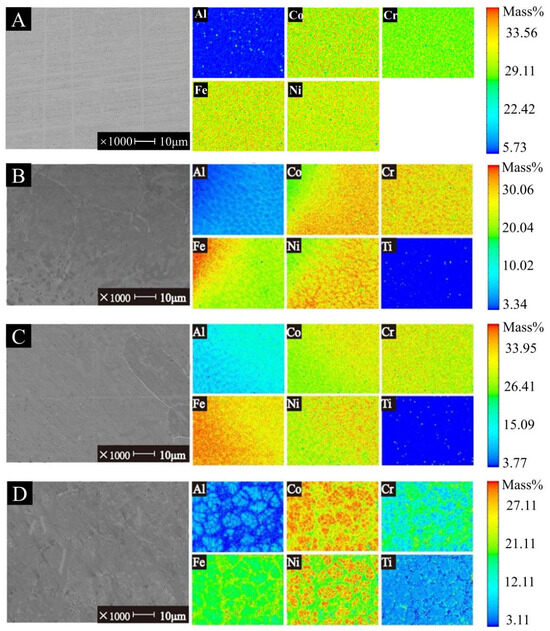
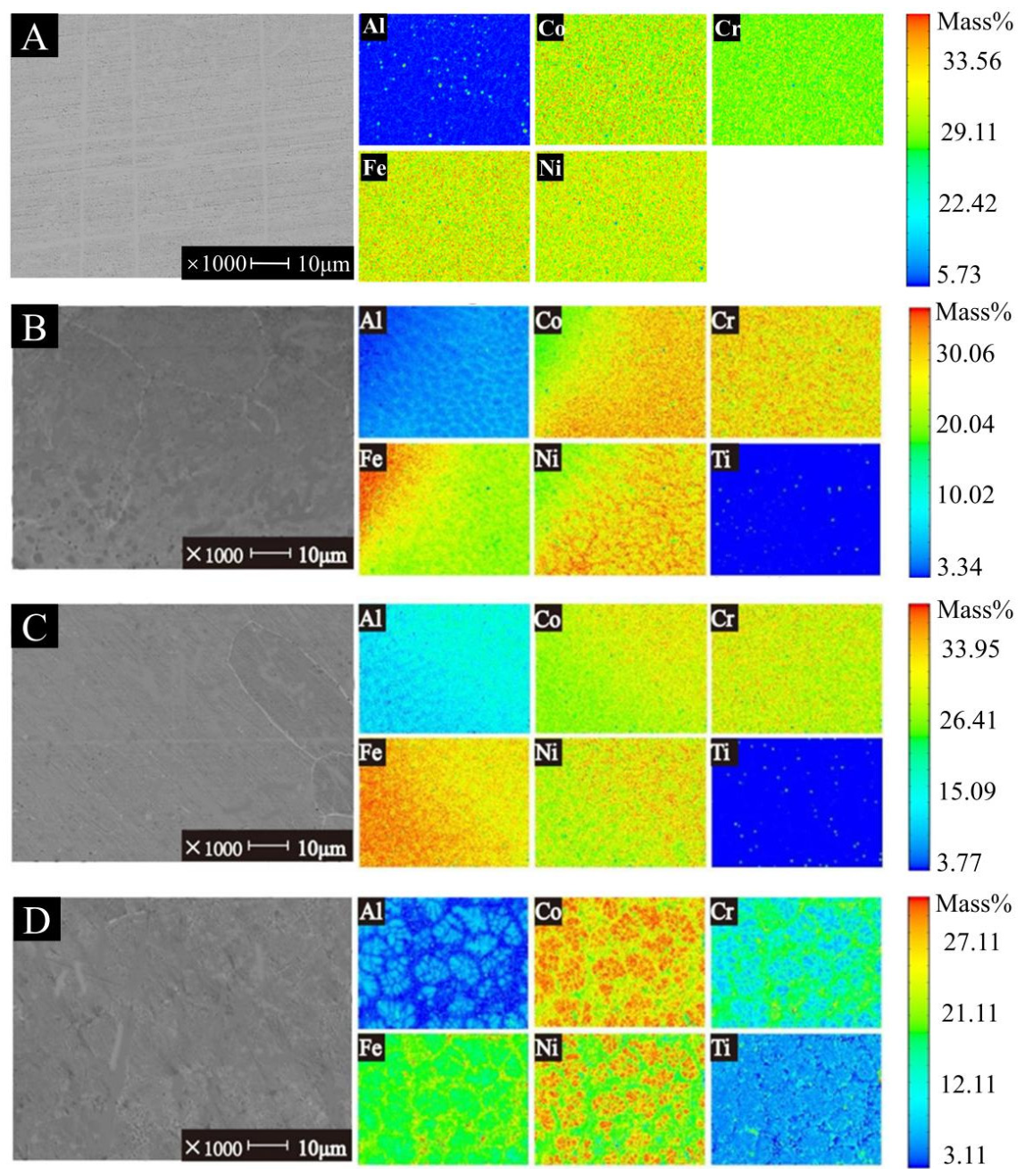
Figure 5 illustrates the microstructural evolution of AlCoCrFeNi HEA coatings under varying TiO2 content levels. As the TiO2 content increases from 0 wt.% to 1.5 wt.%, the phase separation characteristics of the coating become more pronounced, with the microstructure primarily consisting of an Ni–Al-rich ordered phase, a Co–Cr–Fe-rich matrix phase, and localized Ti–Cr-rich regions. Notably, the formation of the Ni–Al-rich ordered phase is primarily attributed to the strong negative mixing enthalpy between Ni and Al and their tendency toward ordering. However, the Ti released or introduced by TiO2 content does not entirely enter the Ni–Al ordered phase. Instead, it participates in competitive element distribution within the multicomponent system during rapid solidification.
Figure 5.
Surface scanning images of AlCoCrFeNi HEA coating samples with different TiO2 content: (A) 0 wt.%; (B) 0.5 wt.%; (C) 1 wt.%; (D) 1.5 wt.%.
From a thermodynamic perspective, the large atomic radius of titanium (Ti) significantly increases the atomic size mismatch and lattice distortion energy in the system [37]. To reduce local elastic energy and chemical free energy, the alloy system tends to optimize energy through element segregation and phase separation. On one hand, the strong interaction between nickel (Ni) and aluminum (Al) promotes the formation of an ordered Ni–Al-rich phase. On the other hand, Ti, as a typical BCC-stabilizing element, tends to accumulate in BCC-structured regions when its local concentration exceeds the matrix’s solid solution capacity. Meanwhile, chromium (Cr), with its high solid solution stability in the BCC phase, readily co-accumulates with Ti, forming secondary Ti–Cr-rich BCC regions. Thus, the presence of Ti–Cr-rich phases does not indicate the strongest negative mixing enthalpy between Ti and Cr, but rather results from the combined effects of elemental interactions, crystal structure stability, atomic size mismatch, and solute redistribution under rapid-solidification conditions in multicomponent high-entropy alloys [38].
Regarding the Ti–Cr-rich regions observed in the microstructural maps, they are tentatively correlated with the emerging secondary diffraction peaks in the XRD patterns. It should be noted that without higher-resolution crystallographic evidence, assigning these specific element-segregated regions directly to the proposed BCC2 phase remains a suggested microstructural evolution rather than a definitive proof. These findings are consistent with the thermodynamic principles governing how Ti stabilizes the BCC/B2 phases and promotes compositional segregation in AlCoCrFeNiTi high-entropy alloys. From a solidification kinetics perspective, fine TiO2 particles serve as heterogeneous nucleation centers during melt pool solidification, reducing the critical nucleation energy for local phase precipitation. Additionally, with its large solute atoms, Ti exhibits low diffusion rates in the high-entropy matrix. Under rapid-solidification conditions, its long-range diffusion is restricted, leading to solute accumulation near dendritic interstices or phase boundaries. This ultimately facilitates the localized expansion of Ti-rich regions and enhances the definition of phase boundary contours [39].
In summary, the regulation of the microstructure in AlCoCrFeNi HEA coatings by TiO2 content does not stem solely from the mixing enthalpy effects between individual elements, but rather results from a combination of factors: Ni–Al ordering, Ti’s BCC stabilizing effect, Cr’s tendency to dissolve into the BCC phase, lattice distortion, and solute redistribution during rapid solidification. This mechanism provides a more coherent explanation for the synergistic evolution observed: namely the enhanced Ni–Al ordered phase and the formation of Ti–Cr BCC2 regions in TiO2-doped coatings.
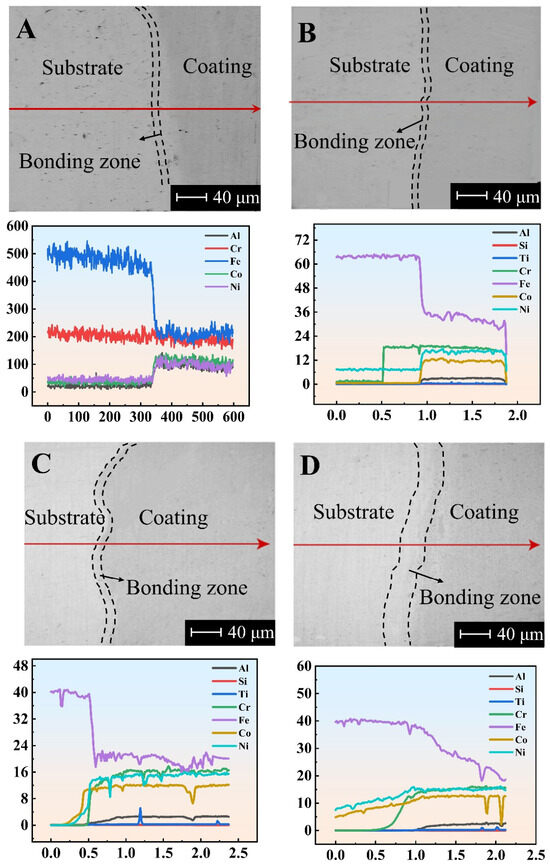
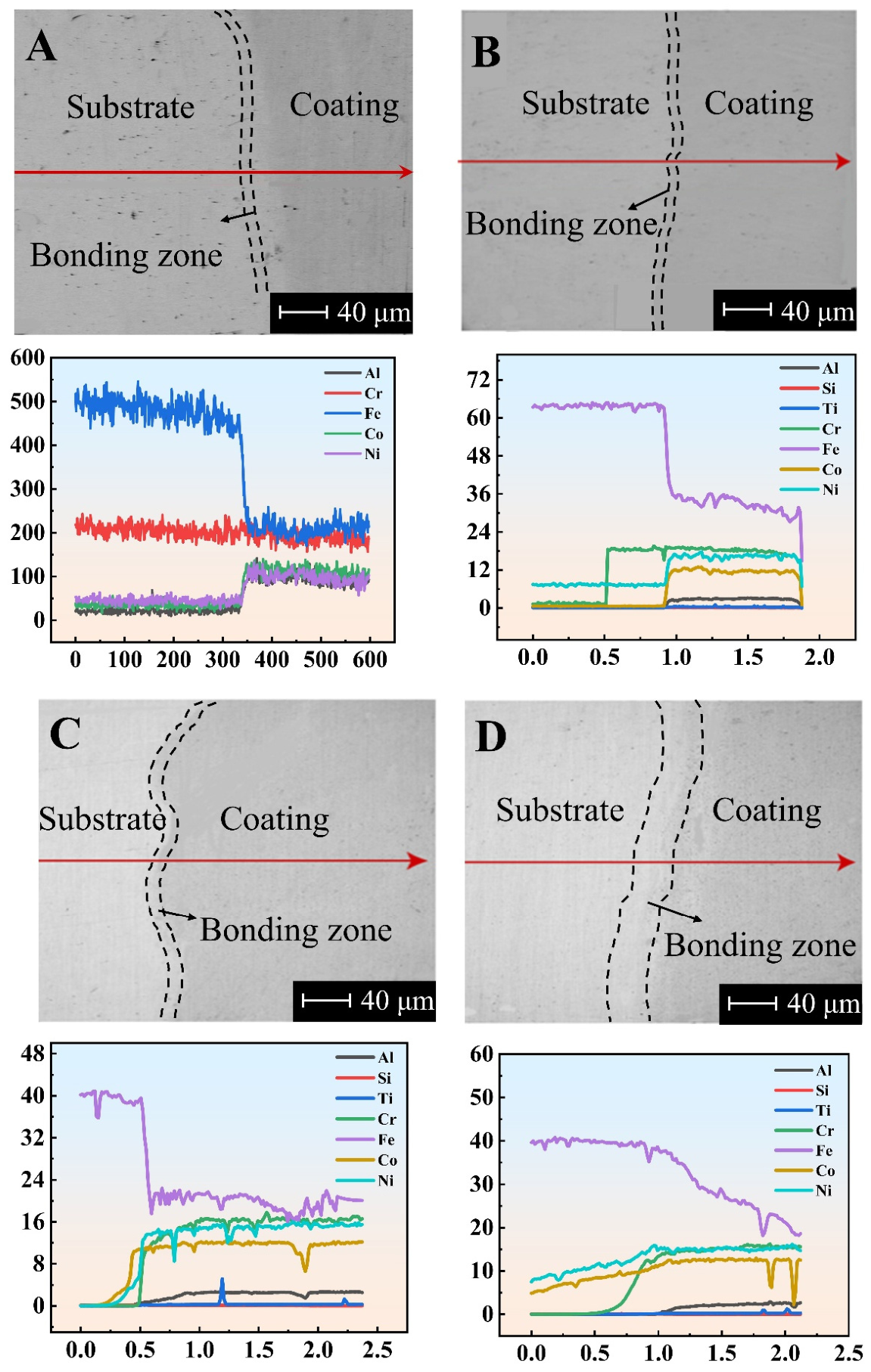
The line scan results in Figure 6 reveal the microstructural evolution between the substrate and the AlCoCrFeNi HEA coating, as well as between the substrate and the TiO2-doped AlCoCrFeNi HEA coating, within the sample cross section. As shown, a distinct transition zone exists between the substrate (light-colored area) and the coating (dark-colored area). Line scan analysis confirms significant element mutual diffusion: silicon (Si) from the substrate migrates toward the deposit layer, while chromium (Cr), nickel (Ni), and titanium (Ti) from the coating diffuse into the substrate. SEM images demonstrate a continuous grain structure at the interface of the TiO2-doped AlCoCrFeNi HEA coating, collectively demonstrating the formation of a metallurgical bond between the two layers.
Figure 6.
Cross-sectional line scan images of AlCoCrFeNi HEA coatings on stainless steel substrates with different TiO2 content: (A) 0 wt.%; (B) 0.5 wt.%; (C) 1 wt.%; (D) 1.5 wt.%.
Furthermore, as the TiO2 content increases, the width of the element diffusion zone increases significantly (most notably in Figure 6D), indicating further enhancement of interfacial bonding. This mechanism can be attributed to three factors: first, TiO2 content as a ceramic phase improves the melt pool’s absorption rate of laser energy, thereby raising its temperature and prolonging its duration, which facilitates thermal diffusion of solute atoms; second, titanium exhibits high chemical reactivity that effectively reduces the interfacial tension between the slag and the matrix metal, enhancing wettability; and finally, TiO2 particles refine grains near the interface within the melt pool, consolidating metallurgical bonding by increasing the effective contact area between interfaces.
3.3. Analysis of the Corrosion Behavior of the Coating
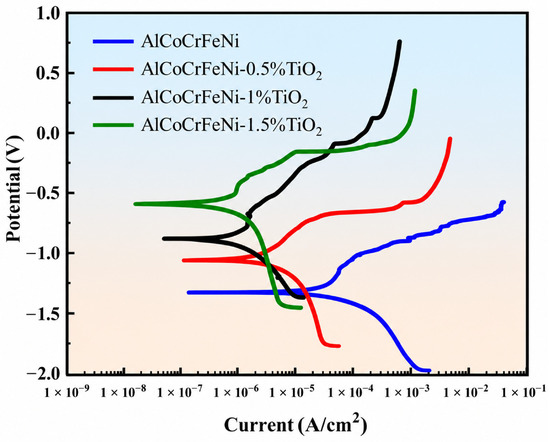
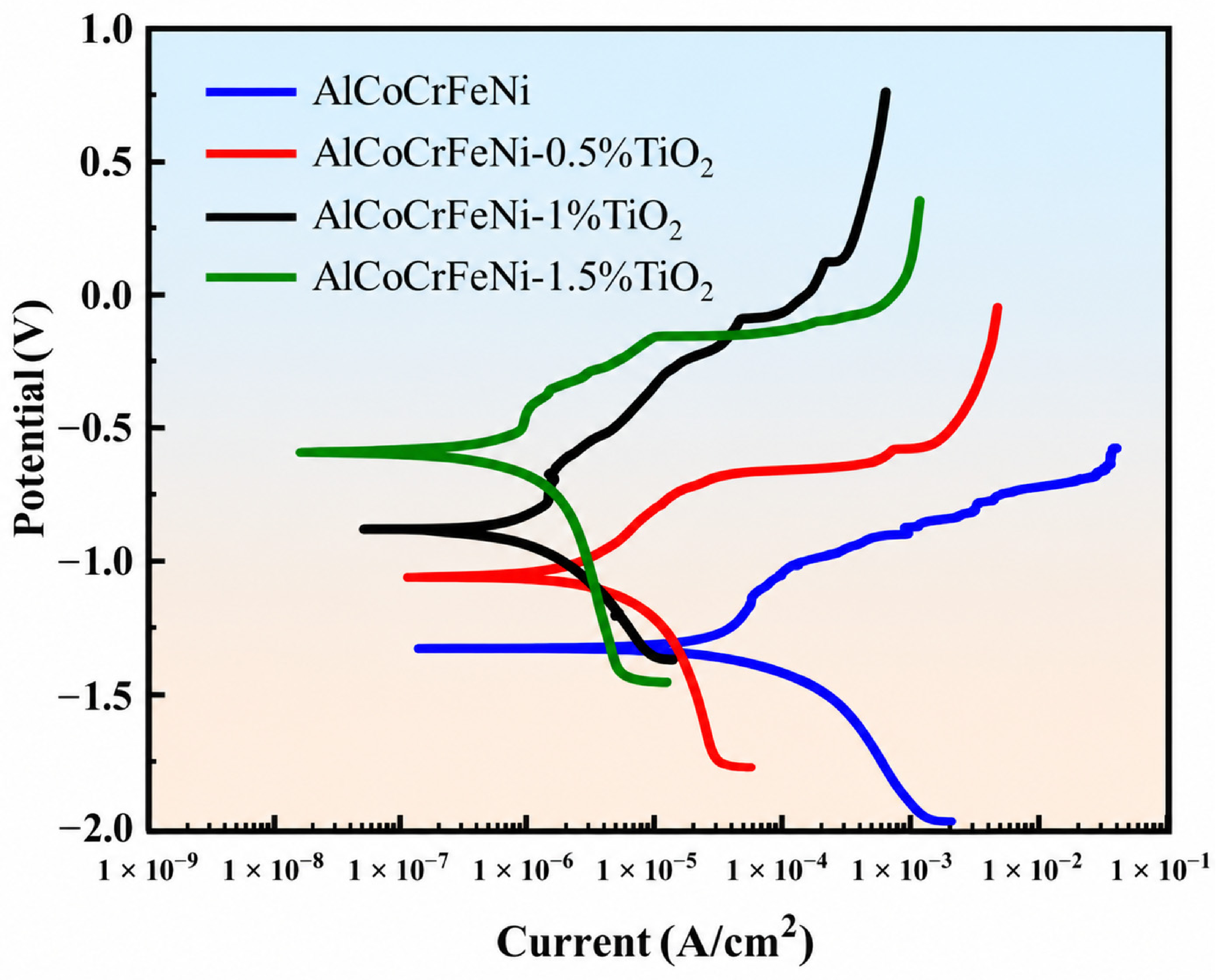
To evaluate the effect of different TiO2 content levels on the corrosion resistance of the AlCoCrFeNi coating, a potentiodynamic polarization test was conducted in a 3.5 wt.% NaCl solution (Figure 7). Tafel fitting results (Table 5) showed that the Ecorr value of the AlCoCrFeNi HEA coating was the lowest; however, the addition of TiO2 significantly increased the Ecorr value, with further elevation as TiO2 content increased. Notably, Icorr decreased with increasing TiO2 content, indicating that the positive shift in Ecorr and the reduction in Icorr were primarily due to strong inhibition of the anodic reaction (metal dissolution), resulting in a denser passivation film. Conversely, the AlCoCrFeNi HEA exhibited the highest current density, and the cathodic branch shifted toward lower current densities as TiO2 content increased, driving the corrosion potential toward the noble metal potential [40,41]. Despite enhanced cathodic activity, the coating maintained a low overall corrosion current density (Icorr) owing to TiO2-induced microstructural optimization.
Figure 7.
Dynamic potential polarization curves of AlCoCrFeNi HEA coatings with varying TiO2 content.
Table 5.
Dynamic polarization parameters of AlCoCrFeNi HEA coatings with different TiO2 content in 3.5 wt.% NaCl solution: A. 0 wt.%; B. 0.5 wt.%; C. 1 wt.%; D. 1.5 wt.%.
The mechanism behind the elevated Ecorr is primarily attributed to the dual effects of TiO2. On one hand, its electrocatalytic effect inhibits the anodic reaction, thermodynamically driving a positive shift in the self-corrosion potential. On the other hand, TiO2-induced grain refinement facilitates rapid formation of a dense surface passivation film, which not only activates the cathodic reaction but also enhances the physical barrier function, ensuring the material’s long-term chemical stability at higher potentials.
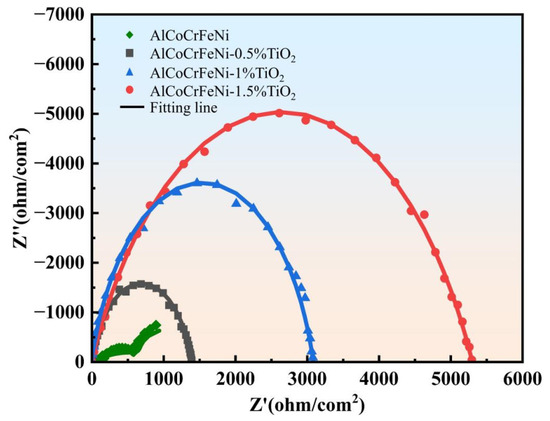
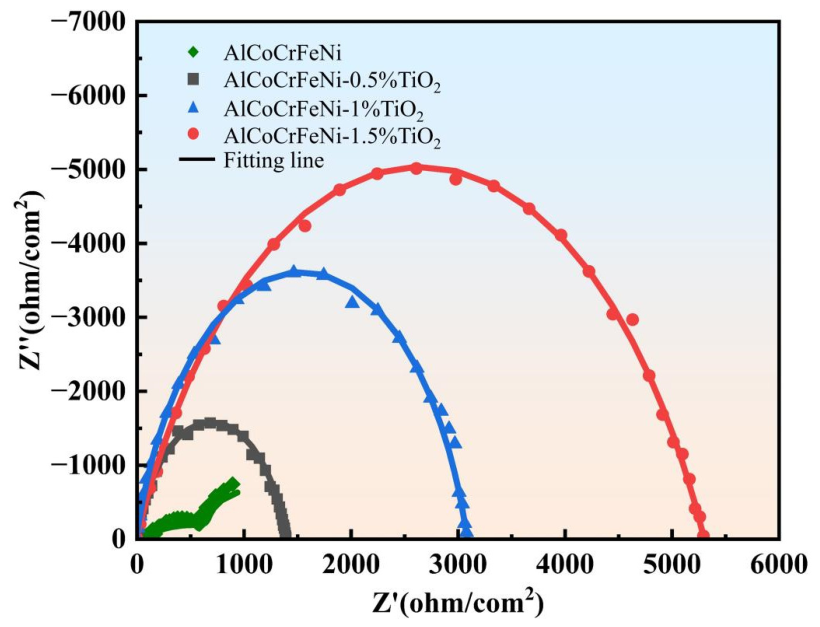
To investigate the interface electrochemical behavior and protective mechanism of the passivation film on the coating surface in depth, the study employed electrochemical impedance spectroscopy (EIS) technology [42]. Figure 8 displays the Nyquist plots of the samples along with their corresponding equivalent circuit models. In the Nyquist plots, the capacitance arc radius directly reflects the protective efficacy of the passivation film: a larger capacitance arc radius indicates higher passivation film density, greater charge-transfer resistance, and more pronounced shielding protection against the substrate [43,44]. As shown in Figure 8, the capacitance arc radii for samples with different TiO2 concentrations were: 1.5 wt.% TiO2 > 1.0 wt.% TiO2 > 0.5 wt.% TiO2 > 0 wt.% TiO2. These results align with potentiodynamic polarization test data, further confirming that TiO2 enhances the corrosion resistance of the AlCoCrFeNi high-entropy alloy (HEA), with the 1.5 wt.% TiO2-doped coating exhibiting the best corrosion resistance among the tested groups. The EIS data were analyzed using ZView 3 software, employing the equivalent circuit model comprising “solution resistance (Rs)—passivation film/substrate charge transfer resistance (Rct)—constant phase element (CPE)” [45,46].
Figure 8.
Electrochemical impedance spectroscopy and equivalent circuit of the coating.
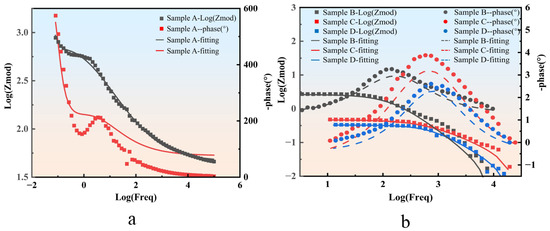
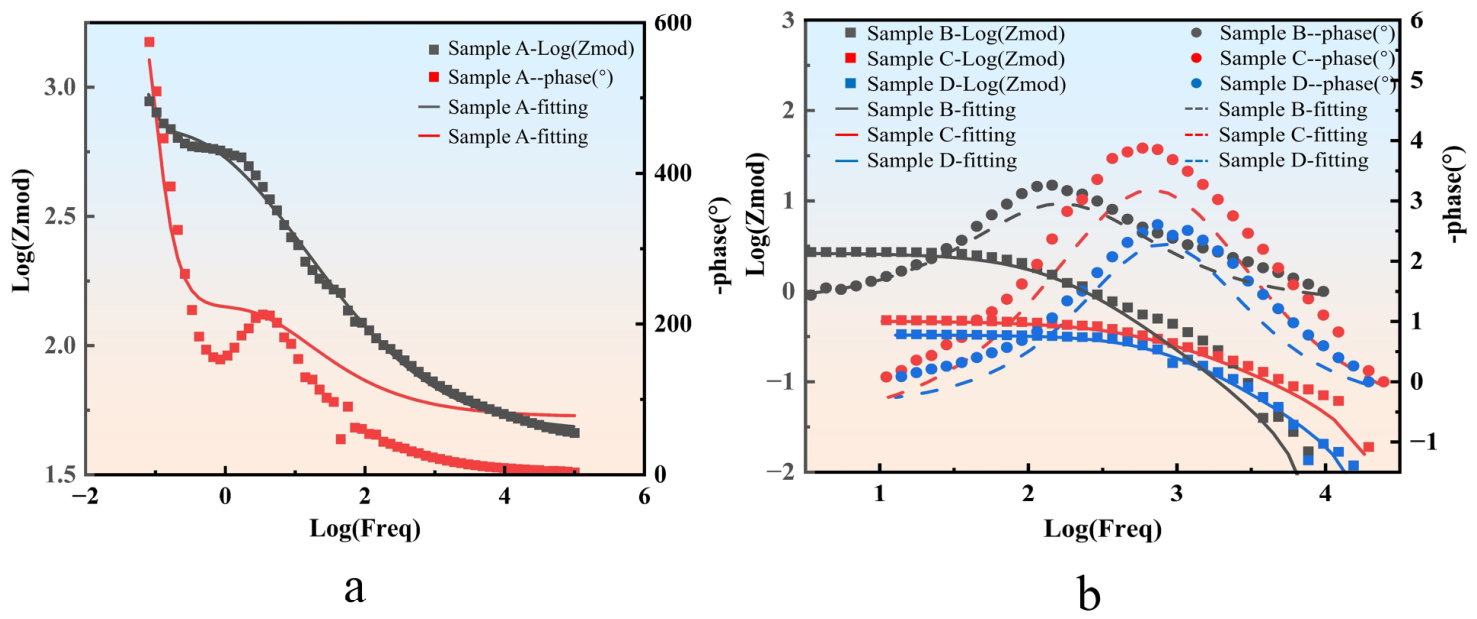
Figure 9 presents the Bode plots and corresponding fitting results of the AlCoCrFeNi HEA coatings with different TiO2 content. The impedance modulus generally decreases with increasing frequency, while the phase-angle curves exhibit distinct frequency-dependent responses, indicating the capacitive characteristics of the coating–electrolyte interface. Samples B–D show noticeable differences in both the impedance modulus and phase-angle response, suggesting that TiO2 content affects the interfacial electrochemical behavior of the coatings. The fitted curves generally agree with the experimental data, supporting the applicability of the selected equivalent-circuit model for describing the electrochemical response of the coatings.
Figure 9.
Bode plots and corresponding fitting curves of AlCoCrFeNi HEA coatings with different TiO2 content: (a) sample A (0 wt.% TiO2); (b) samples B–D, containing 0.5, 1.0, and 1.5 wt.% TiO2, respectively.
Table 6 summarizes the EIS data-fitting results for AlCoCrFeNi HEA coatings with varying TiO2 content levels. The fitting parameters indicate that the Rct value of the 0.5 wt.% TiO2 sample is 1802.57 Ω·cm2, while that of the 1.0 wt.% TiO2 sample rises to 3347.01 Ω·cm2, and further increases to 4821.00 Ω·cm2 for the 1.5 wt.% TiO2 sample, demonstrating a clear upward trend in Rct values with increasing TiO2 content. According to EIS theory, the Rct value directly reflects the passivation film’s ability to hinder charge transfer: higher Rct values indicate greater resistance to electron penetration through the passivation film for redox reactions on the substrate, effectively suppressing charge exchange between the substrate and the corrosive medium and significantly enhancing the coating’s corrosion resistance [47]. Comprehensive analysis of EIS measurements and fitting results shows that in a 3.5 wt.% sodium chloride corrosive medium, the corrosion resistance of the AlCoCrFeNi HEA coating improves markedly with increasing TiO2 content levels.
Table 6.
Electrochemical impedance spectroscopy (EIS) parameters of AlCoCrFeNi HEA coatings with different TiO2 content in 3.5 wt.% NaCl solution.
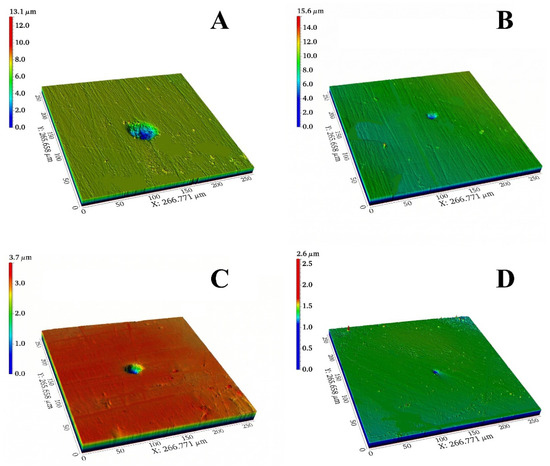
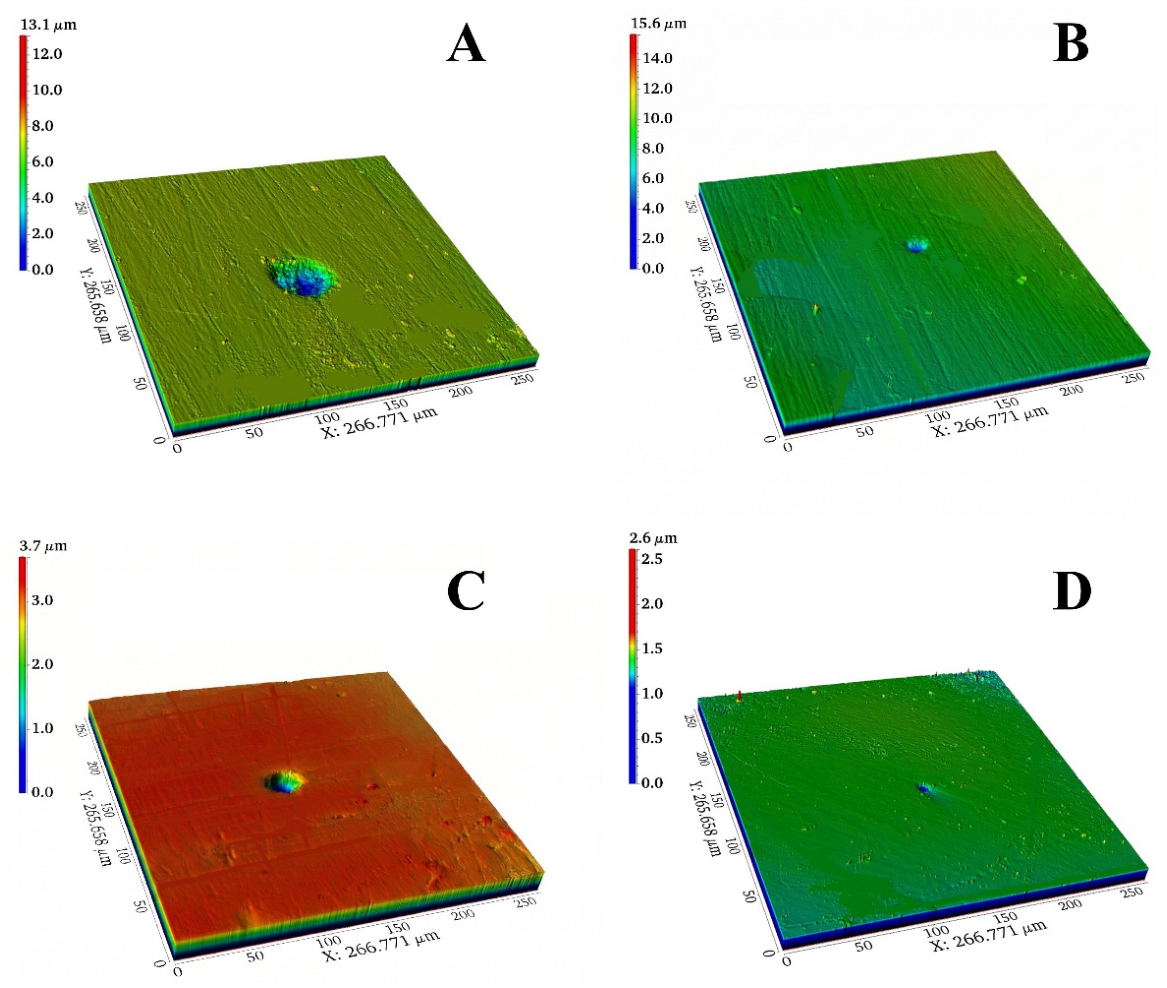
Figure 10 shows the surface morphology obtained via super-depth-of-field microscopy, providing an intuitive analysis of how different TiO2 content levels affect the pitting corrosion resistance of the AlCoCrFeNi HEA coating. The corrosion pits in the AlCoCrFeNi HEA coating exhibit a “wide and deep” characteristic, with large pit openings surrounded by distinct accumulation of corrosion products or secondary dissolution traces, indicating that the coating is prone to extensive localized pitting corrosion expansion in a 3.5% NaCl solution. In contrast, the AlCoCrFeNi HEA coating doped with 0.5% TiO2 demonstrates improved macroscopic flatness, with fewer large shallow pits, but the appearance of pronounced deep-pit defects. However, as the TiO2 content increases further, the volume of corrosion pits significantly decreases. Notably, in the 1.5% TiO2 coating, only minimal residual pitting corrosion is observed, resulting in the most uniform three-dimensional morphology (with a maximum height difference of merely 2.6 μm) and enhanced corrosion resistance.
Figure 10.
Three-dimensional morphological images of corrosion pits in AlCoCrFeNi HEA coatings with varying TiO2 content: (A) 0 wt.%; (B) 0.5 wt.%; (C) 1 wt.%; (D) 1.5 wt.%.
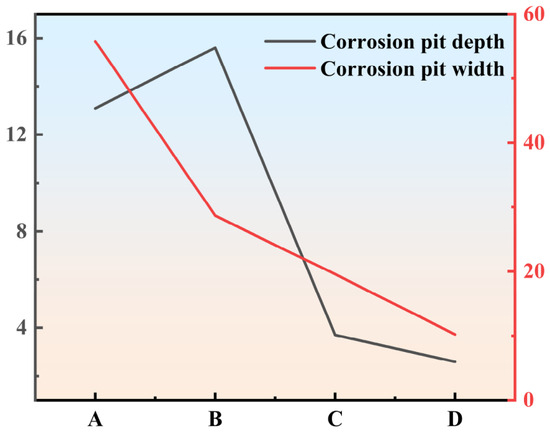
To quantitatively evaluate the pitting resistance, geometric data were extracted from the 3D optical profilometry. The quantitative analysis indicated that as the TiO2 content increased, the localized corrosion damage was significantly mitigated. Specifically, the maximum pit depth drastically decreased from approximately 13.1 μm in the undoped AlCoCrFeNi coating to merely 2.6 μm in the 1.5 wt.% TiO2 sample. Concurrently, the average opening diameter of the corrosion pits correspondingly shrank. The group doped with 1.5 wt.% TiO2 demonstrated the smallest corrosion pit depths and minimum volumetric material loss, exhibiting the highest pitting resistance among the investigated compositions.
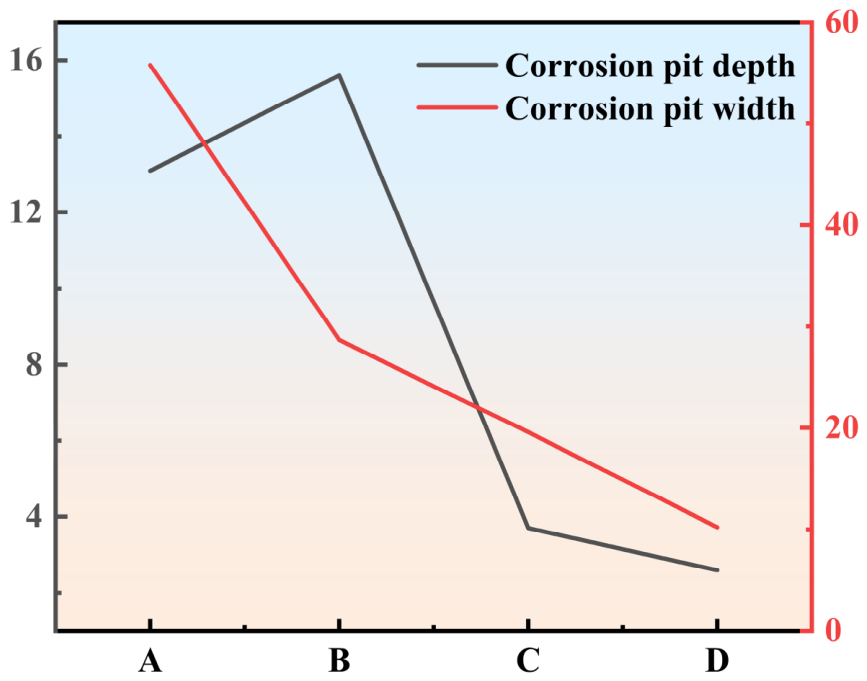
As shown in Figure 11, the corrosion pit dimensions vary significantly with increasing TiO2 content. The pit width decreases continuously from Sample A to Sample D, while the pit depth shows a slight increase from Sample A to Sample B, followed by a pronounced decrease for Samples C and D. In particular, Sample D exhibits the smallest pit depth and width, indicating that 1.5 wt.% TiO2 most effectively suppresses both the lateral propagation and vertical penetration of pitting corrosion. These results are consistent with the electrochemical measurements, further confirming the improved corrosion resistance of the TiO2-modified AlCoCrFeNi HEA coatings.
Figure 11.
Comparison of corrosion pit depth and width of AlCoCrFeNi HEA coatings with different TiO2 content: A. 0 wt.%; B. 0.5 wt.%; C. 1.0 wt.%; D. 1.5 wt.%.
3.4. Passivation Film Composition Analysis
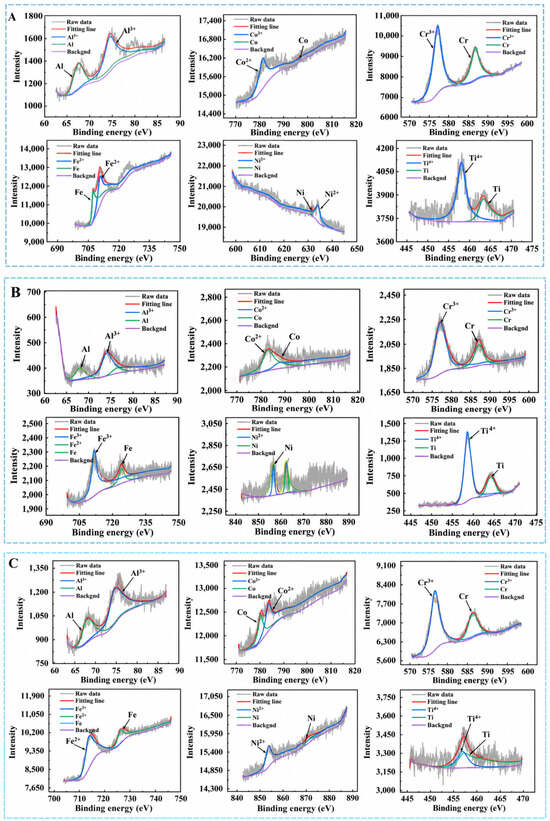
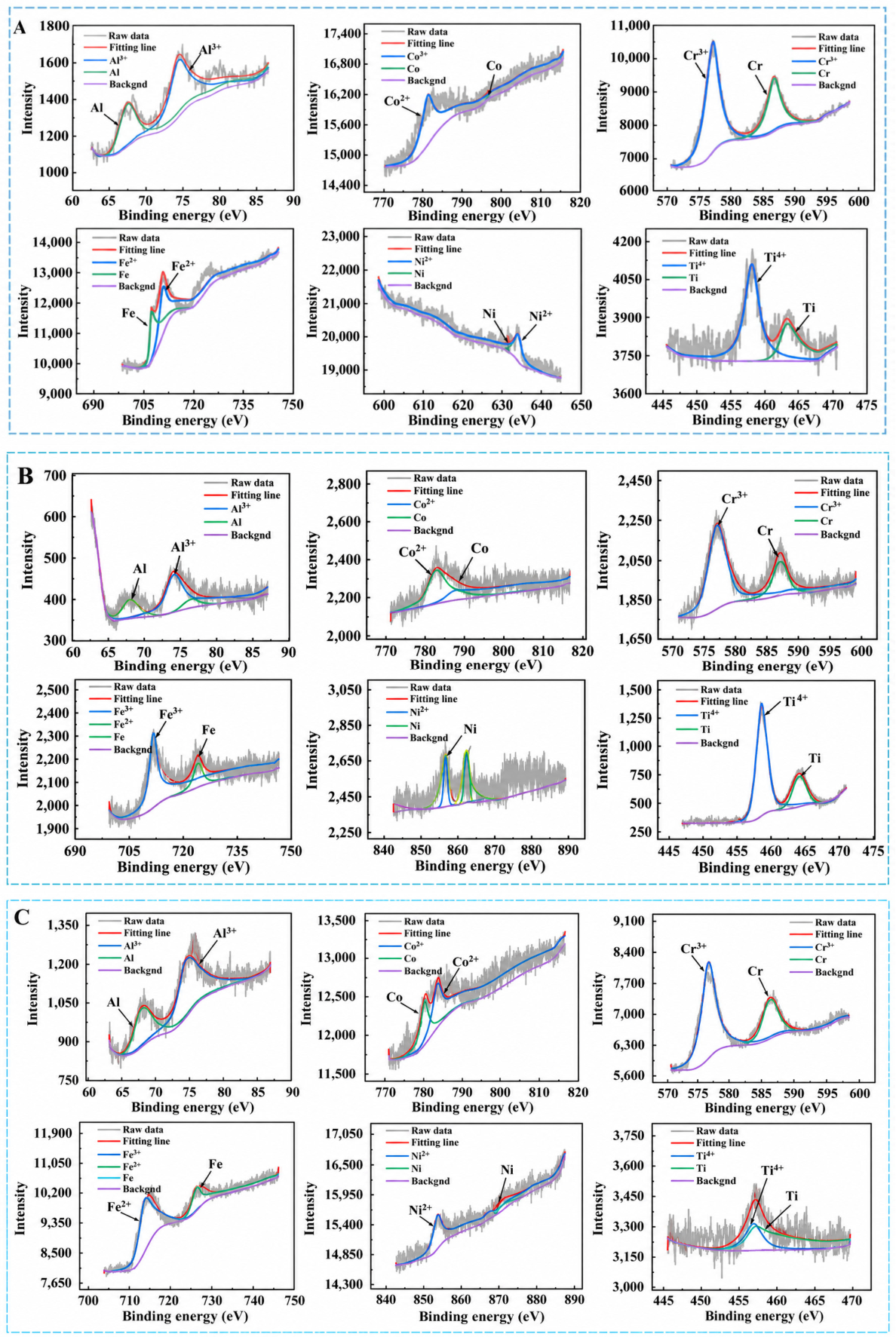
In the electrochemical corrosion experiments of AlCoCrFeNi HEA coatings, the formed passivation film on the surface serves as the critical carrier for analyzing corrosion resistance mechanisms and elucidating protective mechanisms. Its chemical composition and microstructural characteristics directly determine the coating’s corrosion resistance performance [48]. To systematically investigate the regulatory effects of different TiO2 content levels on the composition of the HEA coating passivation film and further elucidate the intrinsic mechanism of TiO2-enhanced corrosion resistance, this study conducted XPS analyses on three groups of HEA coatings with varying TiO2 content levels. The obtained spectral data are presented in Figure 12. To ensure the accuracy and reliability of the XPS results, the standard C1s peak (binding energy 284.8 eV) was used as a calibration reference before spectral interpretation, effectively eliminating interference from instrumental systematic errors and surface charge effects on binding energy measurements. Figure 12 displays the calibrated XPS core spectra of Al 2p, Co 2p, Cr 2p, Fe 2p, Ni 2p, Ti 2p, and C1s on each sample surface, providing fundamental data support for subsequent element chemical state analysis.
Figure 12.
XPS spectra of passivation films on AlCoCrFeNi HEA coatings with different TiO2 content: (A) 0.5 wt.%; (B) 1 wt.%; (C) 1.5 wt.%.
XPS analysis revealed that the nuclear-level spectra of the major metal elements (Al, Co, Cr, Fe, Ni, Ti) in the passivation films of AlCoCrFeNi HEA coatings with varying TiO2 content amounts all exhibited a typical double-peak splitting characteristic. The splitting peaks corresponded to the metallic state and specific oxidation states of each element, respectively, with the energy difference between the two peaks remaining constant for each element. Detailed spectral analyses of the elements are as follows. The Al 2p spectrum split into two characteristic peaks, Al 2p1/2 and Al 2p3/2, corresponding to the Al3+ oxidation state (primarily in the form of Al2O3) and the metallic state Al, respectively, with a splitting energy of 6.98 eV. The Co 2p spectrum split into Co 2p1/2 and Co 2p3/2 peaks, corresponding to the Co2+ oxidation state (e.g., CoO) and the metallic state Co, respectively, with a splitting energy of 14.11 eV. The Cr 2p spectrum exhibited a distinct double-peak structure, with the Cr 2p1/2 and Cr 2p3/2 peaks corresponding to the Cr3+ oxidation state (primarily in the form of Cr2O3) and the metallic state Cr, respectively, with a splitting energy of 10.55 eV. The XPS spectra of Fe and Ni displayed similar splitting patterns: The Fe 2p spectrum split into Fe 2p1/2 and Fe 2p3/2 peaks, corresponding to the Fe2+ oxidation state (e.g., FeO) and the metallic state Fe, respectively, with a splitting energy of 4.51 eV. The Ni 2p spectrum splits into the Ni 2p1/2 and Ni 2p3/2 peaks, corresponding to the oxidized state Ni2+ (e.g., NiO) and the metallic state Ni, respectively, with a splitting energy of 4.57 eV. As a characteristic element introduced by TiO2 content, the Ti 2p energy spectrum also exhibits a double-peak splitting feature. The Ti 2p1/2 and Ti 2p3/2 peaks correspond to the oxidized state Ti4+ (i.e., TiO2) and the metallic state Ti, respectively, with a splitting energy of 4.89 eV.
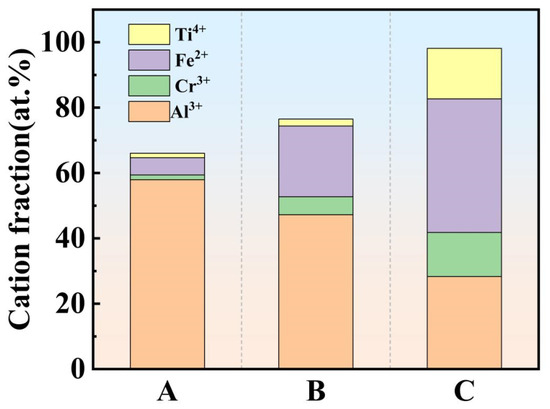
XPS analysis revealed that the passivation films on the surfaces of three AlCoCrFeNi high-entropy alloy (HEA) coatings with different TiO2 content levels primarily consist of metal oxide components, including Al, Co, Cr, Fe, Ni, and Ti. Figure 12 presents the peak fitting results of the core energy-level spectra for each element, while Figure 12 visually illustrates the relative content ratios of metal oxide components in the passivation films, providing quantitative data to support subsequent studies on the correlation between composition and corrosion resistance. Existing research has confirmed that the stability of HEA surface passivation films is inversely correlated with Al content: when Al content is excessively high, Al2O3 gradually replaces Cr2O3 as the dominant component of the passivation film. Data in Figure 11 show that in samples doped with 0.5 wt.% and 1.0 wt.% TiO2, the relative content of Al3+ (corresponding to Al2O3) significantly increased to 57.95% and 47.22%, respectively. This is one of the key factors contributing to the relatively poor corrosion resistance of these samples [49]. Conversely, as TiO2 content increases, the relative content of Fe2+ (corresponding to FeO) and Cr3+ (corresponding to Cr2O3) in the passivation films exhibits a significant upward trend. Previous studies have demonstrated that chromium (Cr) plays a dominant role in the formation of passivation films on CoCrFeNi-based HEA coatings. The weak binding characteristics of Cr-Cr bonds enable easier adsorption of O2− from corrosive media, leading to the formation of a dense Cr2O3 oxide film. This film layer effectively shields against corrosion from corrosive media due to its superior physical barrier properties and chemical stability [50,51]. Additionally, as the TiO2 content concentration increases, the relative content of Ti4+ (corresponding to TiO2) in the passivation film rises accordingly. Studies demonstrate that the enrichment of TiO2 in the passivation film significantly enhances the structural stability and corrosion resistance of the coating, thereby strengthening its protective effect on the substrate [52,53].
A comprehensive analysis of the XPS results in Figure 13 and the composition ratio of oxide components in the passivation film reveals that with increasing TiO2 content, the oxide content of Fe2+ (corresponding to FeO), Cr3+ (corresponding to Cr2O3), and Ti4+ (corresponding to TiO2) in the HEA coating surface passivation film shows a continuous upward trend, while the oxide content of Al3+ (corresponding to Al2O3) decreases markedly. This compositional evolution enables AlCoCrFeNi HEA coatings with higher TiO2 content concentrations to form a denser passivation film, thereby substantially improving their corrosion resistance.
Figure 13.
Relative content of cationic elements in the passivation film of AlCoCrFeNi HEA coatings with different TiO2 content: A. 0.5 wt.%; B. 1 wt.%; C. 1.5 wt.%.
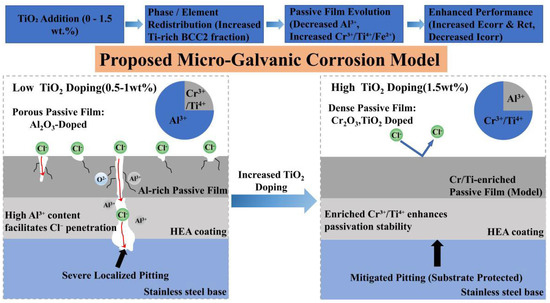
Based on the preceding discussions, Figure 14 illustrates the corrosion mechanism of AlCoCrFeNi HEA in a 3.5 wt.% sodium chloride solution. For AlCoCrFeNi HEA coatings with low TiO2 content, chloride ions initially accumulate on the oxides and hydroxides formed on the alloy surface. Due to weak grain boundary stability, chloride ion adsorption causes rupture of the passivation film, exposing the substrate to the Cl− solution and forming multiple small pits [54]. As corrosion progresses, the intact passivation film together with locally damaged regions establishes a large cathode–small anode structure, accelerating the formation and development of pitting nuclei, which in most cases further expand to form corrosion pores [55].
Figure 14.
Proposed mechanistic model correlating TiO2 addition to the altered microgalvanic corrosion behavior of AlCoCrFeNi HEA coatings in a 3.5 wt.% NaCl solution.
Based on the quantitative experimental evidence obtained in this study, increasing TiO2 addition demonstrably leads to a higher volume fraction of Ti–Cr-rich BCC2 regions and a fundamental shift in the passive film chemistry—specifically, increased relative content of Cr3+, Fe2+, and Ti4+ oxides at the expense of Al3+ oxides. These experimentally confirmed microstructural and chemical evolutions directly correlate with the significantly reduced pit depth and diameter observed macroscopically.
From these robust experimental observations, we mechanistically infer a microgalvanic corrosion model to explain the altered localized corrosion behavior. In this proposed model, the corrosion process is suggested to proceed through three distinct stages, as follows.
The HEA coating with higher TiO2 content exhibits a more corrosion-resistant BCC2 phase, leading to altered corrosion behavior that proceeds through three distinct stages. In the initial passivation stage (microscopic heterogeneity), a complete biphasic passivation film spontaneously forms on the coating surface, though the macroscopically continuous film demonstrates significant compositional and structural heterogeneity at the microscopic level. In the titanium-deficient BCC1-phase region, the passivation film contains numerous oxygen vacancies, grain boundary defects, and ion transport channels, resulting in poor film density and weak adhesion. Conversely, in the titanium-rich BCC2-phase region, the passivation film is dense, intact, and free of obvious defects, exhibiting robust adhesion to the substrate and superior passivation stability.
Corrosion initiation stage (Cl− selective erosion): In a 3.5 wt.% NaCl solution, Cl− ions—with their small radius and strong penetration capability—prioritize adsorption on the surface of the BCC1 phase, which exhibits higher electrochemical activity. These ions rapidly penetrate through oxygen vacancies and physical defects in the passivation film, undergo complexation reactions with metal cations to form soluble metal chlorides. The anodic reaction equation is as follows:
The oxygen reduction reaction at the cathode occurs on the outer surface near the pore opening, with the reaction equation as follows:
Corrosion progression stage (selective localized dissolution): As corrosion progresses, the difference in corrosion resistance between the two phases results in a typical non-uniform localized corrosion morphology. The titanium-deficient BCC1 phase undergoes irreversible matrix dissolution under continuous anodic dissolution and intra-pore autocatalytic acidification, forming large, deeply developed corrosion pits. In contrast, the titanium-rich BCC2 phase, protected by a highly stable composite oxide film, effectively resists Cl− erosion and microgalvanic corrosion, maintaining a smooth and dense surface. This ultimately manifests as a differentiated corrosion pattern characterized by “selective dissolution of BCC1 phase with complete preservation of BCC2 phase.”
The microscopic regulation mechanism of TiO2 content concentration: TiO2 content significantly modulates the phase composition ratio of the coating. As TiO2 content increases, the volume fraction of the highly corrosion-resistant titanium-rich BCC2 phase in the HEA coating rises, while the area of the more susceptible titanium-poor BCC1 phase correspondingly decreases. This optimized phase structure fundamentally reduces pitting nucleation sites, effectively inhibits the initiation and propagation of corrosion pits, and substantially enhances the coating’s overall corrosion resistance.
4. Conclusions
In summary, the original contribution of this study lies in elucidating the high-temperature metallurgical synergy between TiO2 and an AlCoCrFeNi matrix during laser cladding, a mechanism distinctly different from the physical barrier effects typically observed in traditional TiC or TiO2 particle-reinforced composites. While previous studies have primarily demonstrated that inert ceramic additions physically impede localized corrosion, our work explicitly establishes a novel composition–microstructure–passivation relationship. We experimentally demonstrate that reactive TiO2 doping actively modifies the alloy’s phase constitution (promoting Ti-rich BCC2 regions) and fundamentally alters the passive film chemistry (enriching Cr and Ti oxides). This interactive mechanism offers a novel metallurgical pathway for designing high-performance, chloride-resistant HEA composite coatings.
This study investigated the effect of TiO2 content on the microstructure and corrosion resistance of laser-cladded AlCoCrFeNi HEA coatings in 3.5 wt.% NaCl solution. The main conclusions are as follows.
- The optimal laser-cladding parameters were determined by orthogonal experimental design and range analysis: laser power of 1500 W, scanning speed of 40 mm/s, and powder feed rate of 11.9 g/min.
- TiO2 doping promoted the formation of a Ti–Cr-rich BCC2 phase and enhanced Ti segregation in the AlCoCrFeNi coating. This indicates that TiO2 effectively modified the solidification behavior, phase constitution, and elemental distribution of the coating.
- Electrochemical results showed that increasing TiO2 content reduced the corrosion current density, shifted the corrosion potential positively, and increased the charge-transfer resistance, thereby improving the corrosion resistance of the coating.
- XPS analysis indicated that TiO2 content increased the relative content of Fe, Cr, and Ti oxides in the passive film while reducing the Al oxide fraction. The resulting dense and stable composite passive film effectively inhibited corrosive ion penetration and enhanced the overall corrosion resistance of the coating.
Author Contributions
Y.W.: Validation, methodology, writing—review and editing. Y.X.: investigation, methodology. S.C.: Investigation, writing—original draft, data curation. M.Z.: investigation, writing—review and editing. Y.L.: investigation, data curation. Z.H.: validation, supervision. M.M.: methodology, investigation. All authors have read and agreed to the published version of the manuscript.
Funding
This work was financially supported by WHPU (2023Y35), Hubei Provincial Natural Science Foundation Project (2024AFC011), Wuhan Knowledge Innovation Dawn Special Plan Project (2023010201020454), National Natural Science Foundation of China (52371074), and State Key Laboratory of Materials Processing and Die & Mould Technology, Huazhong University of Science and Technology (P2024-24).
Institutional Review Board Statement
Not applicable.
Informed Consent Statement
Not applicable.
Data Availability Statement
The data presented in this study are not available on request from the corresponding author.
Conflicts of Interest
The authors declare no conflict of interest.
References
- González-Velázquez, J.L.; Rivas-López, D.I.; Beltrán Zúñiga, M.A.; Villagómez-Ortega, J.; Dorantes-Rosales, H.J. Fracture mechanics analysis of the stress corrosion cracking failure of stainless steel hexagonal head screws in a marine-industrial environment. Eng. Fail. Anal. 2023, 146, 107098. [Google Scholar] [CrossRef] [Scilit]
- Gorr, B.; Schellert, S.; Müller, F.; Christ, H.-J.; Kauffmann, A.; Heilmaier, M. Current Status of Research on the Oxidation Behavior of Refractory High Entropy Alloys. Adv. Eng. Mater. 2021, 23, 2001047. [Google Scholar] [CrossRef] [Scilit]
- Zhang, W.T.; Wang, X.Q.; Zhang, F.Q.; Cui, X.Y.; Fan, B.B.; Guo, J.M.; Guo, Z.M.; Huang, R.; Huang, W.; Li, X.B.; et al. Frontiers in high entropy alloys and high entropy functional materials. Rare Met. 2024, 43, 4639–4776. [Google Scholar] [CrossRef] [Scilit]
- Wang, X.; Guo, W.; Fu, Y. High-entropy alloys: Emerging materials for advanced functional applications. J. Mater. Chem. A 2021, 9, 663–701. [Google Scholar] [CrossRef] [Scilit]
- Gao, B.; Chen, Z.; Ma, G.; Hou, J.; Wu, R. Enhanced strength-ductility synergy of CoCrFeNiMn high-entropy alloy via multiscale heterogeneous structure. Prog. Nat. Sci. Mater. Int. 2026, 36, 358–366. [Google Scholar] [CrossRef] [Scilit]
- Shivam, V.; Kar, S.; Mandal, G.K.; Mukhopadhyay, N.; Srivastava, V. Microstructural design opportunities and phase stability in the spray-formed AlCoCr0.75Cu0.5FeNi high entropy alloy. J. Alloys Metall. Syst. 2024, 8, 100138. [Google Scholar] [CrossRef] [Scilit]
- Xia, A.; Franz, R. Thermal Stability of MoNbTaVW High Entropy Alloy Thin Films. Coatings 2020, 10, 941. [Google Scholar] [CrossRef] [Scilit]
- Cheng, Z.; Wang, S.; Wu, G.; Gao, J.; Yang, X.; Wu, H. Tribological properties of high-entropy alloys: A review. Int. J. Miner. Metall. Mater. 2022, 29, 389–403. [Google Scholar] [CrossRef] [Scilit]
- Qiu, Y.; Thomas, S.; Gibson, M.A.; Fraser, H.L.; Birbilis, N. Corrosion of high entropy alloys. npj Mater. Degrad. 2017, 1, 15. [Google Scholar] [CrossRef] [Scilit]
- Gao, P.-H.; Fu, R.-T.; Chen, B.-Y.; Zeng, S.-C.; Zhang, B.; Yang, Z.; Guo, Y.-C.; Liang, M.-X.; Li, J.-P.; Lu, Y.-Q.; et al. Corrosion Resistance of CoCrFeNiMn High Entropy Alloy Coating Prepared through Plasma Transfer Arc Claddings. Metals 2021, 11, 1876. [Google Scholar] [CrossRef] [Scilit]
- Li, W.; Liu, P.; Liaw, P.K. Microstructures and properties of high-entropy alloy films and coatings: A review. Mater. Res. Lett. 2018, 6, 199–229. [Google Scholar] [CrossRef] [Scilit]
- Meghwal, A.; Anupam, A.; Murty, B.S.; Berndt, C.C.; Kottada, R.S.; Ang, A.S.M. Thermal spray high-entropy alloy coatings: A review. J. Therm. Spray. Technol. 2020, 29, 857–893. [Google Scholar] [CrossRef] [Scilit]
- Anupam, A.; Kumar, P.; Singh, H. Microstructure and Mechanical Properties of High-entropy Alloy Coatings: Role of Constituent Elements and Fabrication Approaches. In High-Entropy Alloy Coatings; CRC Press: Boca Raton, FL, USA, 2025; pp. 61–92. [Google Scholar]
- Gong, N.; Meng, T.L.; Cao, J.; Wang, Y.; Karyappa, R.; Tan, C.K.I.; Suwardi, A.; Zhu, Q.; Ngo, A.C.Y.; Misra, K.P.; et al. Laser-cladding of high entropy alloy coatings: An overview. Mater. Technol. 2023, 38, 2151696. [Google Scholar] [CrossRef] [Scilit]
- Liang, H.; Liu, J.; Sun, L.; Hou, J.; Cao, Z. Optimization of the Forming Quality of a Laser-Cladded AlCrFeNiW0.2 High-Entropy Alloy Coating. Coatings 2023, 13, 1744. [Google Scholar] [CrossRef] [Scilit]
- Xu, Y.; Wang, D.; Wu, S.; Lu, H.; Yao, R.; Yang, J.; Jiang, F.; Takao, A. Research progress on defect formation mechanism and process optimization of laser cladding high entropy alloy coatings. Opt. Laser Technol. 2025, 187, 112819. [Google Scholar] [CrossRef] [Scilit]
- Wang, Y.; Li, G.; Qi, H.; Zhang, W.; Chen, R.; Su, R.; Qu, Y. Effect of Al content on the corrosion behavior and mechanism of AlxCoCrFeNi high-entropy alloys. J. Mater. Res. Technol. 2024, 30, 5977–5989. [Google Scholar] [CrossRef] [Scilit]
- Yu, K.; Zhao, W.; Li, Z.; Guo, N.; Xiao, G.; Zhang, H. High-temperature oxidation behavior and corrosion resistance of in-situ TiC and Mo reinforced AlCoCrFeNi-based high entropy alloy coatings by laser cladding. Ceram. Int. 2023, 49, 10151–10164. [Google Scholar] [CrossRef] [Scilit]
- Zhou, L.J.; Cheng, H.Y.; He, B.; Wan, Y.X.; Chen, H.; Wang, Y.F.; Yang, J.Y. Enhancement of high-entropy alloy coatings with multi-scale TiC ceramic particles via high-speed laser cladding: Microstructure, wear and corrosion. Appl. Surf. Sci. 2025, 685, 162061. [Google Scholar] [CrossRef] [Scilit]
- Li, X.; Zhao, K.; Li, X.; Li, B.; Yang, L.; Guo, E.; Kang, H.; Chen, Z.; Wang, T. Synergistic improvement of corrosion-strength of Al-Mg alloy by trace Sc/Zr and TiB2 particles. Corros. Sci. 2025, 246, 112760. [Google Scholar] [CrossRef] [Scilit]
- Marzena, T.; Małgorzata, G. Review of Recent Research on AlCoCrFeNi High-Entropy Alloy. Metals 2021, 11, 1302. [Google Scholar] [CrossRef] [Scilit]
- Podelinska, A.; Neilande, E.; Pankratova, V.; Serga, V.; Bandarenka, H.; Burko, A.; Piskunov, S.; Pankratov, V.A.; Sarakovskis, A.; Popov, A.I.; et al. Structural and spectroscopic characterization of TiO2 nanocrystalline materials synthesized by different methods. Nanomaterials 2025, 15, 498. [Google Scholar] [CrossRef] [Scilit] [PubMed]
- Perumal, G.; Senthilkumar, N.; Naik, N.; Deepanraj, B. Comparative assessment of the mechanical, tribological, and corrosion properties of Al/SiC/Al2O3 and Al/SiC/TiO2 hybrid composites. Discov. Appl. Sci. 2025, 7, 237. [Google Scholar] [CrossRef] [Scilit]
- Meng, X.; Hou, L.; Wang, Z.; Liu, W.; Hao, H.; Lv, X.; An, J. Waterborne acrylic anti-corrosion coatings with different proportions of yttrium oxide/titanium dioxide fillers. Prog. Org. Coat. 2025, 208, 109423. [Google Scholar] [CrossRef] [Scilit]
- Choi, J.H.; Dhakal, D.R.; Kshetri, Y.K.; Chaudhary, B.; Joshi, B.; Lee, S.W.; Kim, T.H. Role of surfactants on particle deposition, wear, and corrosion behavior of TaC particle incorporated electroless nickel-phosphorus coating. Prog. Nat. Sci. Mater. Int. 2022, 32, 655–663. [Google Scholar] [CrossRef] [Scilit]
- Gokcekaya, O.; Bulutsuz, A.G.; Gulec, B.; Gunen, A.; Yilmazer, H.; Nakano, T. Hot isostatic pressing temperature–driven microstructure–tribology relationships in laser powder bed fused pure chromium. J. Mater. Res. Technol. 2026, 43, 3150–3163. [Google Scholar] [CrossRef] [Scilit]
- Wang, Y.; Chen, S.; Peng, Y.; Zheng, X.; Li, D.; Nie, C.; Gong, P.; Hu, Z.; Ma, M. Effect of Porosity on the Corrosion Behavior of FeCoNiMnCrx Porous High-Entropy Alloy in 3.5 Wt.% NaCl Solution. Metals 2025, 15, 210. [Google Scholar] [CrossRef] [Scilit]
- Darabi, R.; Gil, J.W.; Azinpour, E.; Sousa, J.; Reis, A.; de Sá, J.C. Controlling hot cracking in WC–NiCrBSiFe coatings produced by laser surface cladding: A multiphase field approach for enhancing process repeatability. J. Mech. Phys. Solids 2025, 203, 106238. [Google Scholar] [CrossRef] [Scilit]
- Luo, Y.; Ni, X.; Hu, Q.; Yu, X.; Yin, S.; Zhang, C. Effect of rescanning on the microstructure and mechanical properties of SLMed WMoTaNbV refractory high entropy alloy. J. Mater. Res. Technol. 2026, 43, 373–383. [Google Scholar] [CrossRef] [Scilit]
- Riquelme, A.; Rodrigo, P.; Escalera-Rodríguez, M.D.; Rams, J. Analysis and optimization of process parameters in Al–SiCp laser cladding. Opt. Lasers Eng. 2016, 78, 165–173. [Google Scholar] [CrossRef] [Scilit]
- Hemmati, I.; Ocelik, V.; De Hosson, J.T.M. Dilution effects in laser cladding of Ni–Cr–B–Si–C hardfacing alloys. Mater. Lett. 2012, 84, 69–72. [Google Scholar] [CrossRef] [Scilit]
- Senkov, O.; Miracle, D. Effect of the atomic size distribution on glass forming ability of amorphous metallic alloys. Mater. Res. Bull. 2001, 36, 2183–2198. [Google Scholar] [CrossRef] [Scilit]
- Araujo, A.F.; Hayashi, C.M.; Cunha, D.F.; Souza, E.; André, F.; Galli, G.; Coury, F.; Poffo, C. Effect of Synthesis Route on the Microstructure, Phase Stability and Properties of the TiNiNbMo High-Entropy Alloy. J. Mater. Res. Technol. 2026, 43, 1340–1349. [Google Scholar] [CrossRef] [Scilit]
- Guo, S.; Liu, C.T. Phase stability in high entropy alloys: Formation of solid-solution phase or amorphous phase. Prog. Nat. Sci. Mater. Int. 2011, 21, 433–446. [Google Scholar] [CrossRef] [Scilit]
- Zhu, L.; Guo, M.; Li, G.; Zhang, J. Enhancing the intergranular corrosion resistance and mechanical properties of Al–Mg–xSi–Cu–Zn alloys by synergistic intergranular and intragranular precipitation behaviors. J. Mater. Sci. 2022, 57, 14490–14510. [Google Scholar] [CrossRef] [Scilit]
- Wu, H.; Huang, S.; Zhu, C.; Zhu, H.; Xie, Z. Influence of Cr content on the microstructure and mechanical properties of CrxFeNiCu high entropy alloys. Prog. Nat. Sci. Mater. Int. 2020, 30, 239–245. [Google Scholar] [CrossRef] [Scilit]
- Zhou, Y.J.; Zhang, Y.; Wang, Y.L.; Chen, G.L. Solid solution alloys of AlCoCrFeNiTix with excellent room-temperature mechanical properties. Appl. Phys. Lett. 2007, 90, 181904. [Google Scholar] [CrossRef] [Scilit]
- Li, M.; Jin, N.; Liu, H.; Zhao, N.; Liu, X.; He, Y. Exploring hot formability and strengthening mechanisms of a Co39.2Ni39.2Al19.6Ti2 dual-phase high entropy alloy. Prog. Nat. Sci. Mater. Int. 2025, 35, 876–893. [Google Scholar] [CrossRef] [Scilit]
- Tsai, K.Y.; Tsai, M.H.; Yeh, J.W. Sluggish diffusion in co–cr–fe–mn–ni high-entropy alloys. Acta Mater. 2013, 61, 4887–4897. [Google Scholar] [CrossRef] [Scilit]
- Zhang, X.; Zhang, K.; Deng, X.; Hongwei, L.; Yongjun, L.; Minglong, M.; Ning, L.; Wang, Y. Corrosion behavior of Mg–Y alloy in NaCl aqueous solution. Prog. Nat. Sci. Mater. Int. 2012, 22, 169–174. [Google Scholar] [CrossRef] [Scilit]
- Reitz, W. A Review of: “Impedance Spectroscopy, Theory, Experiment, and Applications”. In Materials and Manufacturing Processes; E. Barsoukov, E., Macdonald, J.R., Eds.; Wiley-Interscience, John Wiley & Sons: Hoboken, NJ, USA, 2005; Volume 21, 590p, ISBN 0-471-64749-7. [Google Scholar]
- Itagaki, M.; Taya, A.; Watanabe, K.; Noda, K. Deviations of Capacitive and Inductive Loops in the Electrochemical Impedance of a Dissolving Iron Electrode; Original Papers. Anal. Sci. 2005, 18, 641–644. [Google Scholar]
- Roen, S.; Strandbakke, R.; Norby, T. Current-overpotential relationships from electrochemical impedance spectroscopy (EIS) under DC bias—A tutorial exercise applied to a Pt||YSZ electrode. Solid State Ion. 2025, 428, 116939. [Google Scholar] [CrossRef] [Scilit]
- Orazem, M.E.; Pébère, N.; Tribollet, B. Enhanced Graphical Representation of Electrochemical Impedance Data. J. Electrochem. Soc. 2006, 153, B129. [Google Scholar] [CrossRef] [Scilit]
- Hsu, C.H.; Mansfeld, F. Technical Note: Concerning the Conversion of the Constant Phase Element Parameter Y0 into a Capacitance. Corrosion 2001, 57, 747–748. [Google Scholar] [CrossRef] [Scilit]
- Scisco, G.P.; Orazem, M.E.; Jones, K.S.; Ziegler, K.J. Constant Phase Element Analysis of Ordered Carbon Electrodes Via Electrochemical Impedance Spectroscopy and Cyclic Voltammetry. Electrochem. Soc. Meet. Abstr. 2021, 35, MA2021-01. [Google Scholar]
- Wu, H.; Wang, L.; Zhang, S. Corrosion and cavitation erosion behaviors of laser clad FeNiCoCr high-entropy alloy coatings with different types of TiC reinforcement. Surf. Coat. Technol. 2023, 471, 129910–129920. [Google Scholar] [CrossRef] [Scilit]
- Dewangan, K.S.; Kumar, S.; Maulik, O.; Pillai, G.M.; Kumar, V.; Ahn, B. XPS study on passivation behavior of naturally formed oxide on AlFeCuCrMg1.5 high-entropy alloy. Chem. Phys. Lett. 2024, 841, 141171. [Google Scholar] [CrossRef] [Scilit]
- Feng, L.; Yang, Y.; Zhao, Y.; Ma, K.; Cui, J. Corrosion Behaviors and Mechanism of AlxCrFeMnCu High-Entropy Alloys in a 3.5 wt.% NaCl Solution. Corros. Sci. 2024, 233, 112087. [Google Scholar] [CrossRef] [Scilit]
- Marcus, P. On some fundamental factors in the effect of alloying elements on passivation of alloys. Corros. Sci. 1994, 36, 2155–2158. [Google Scholar] [CrossRef] [Scilit]
- Yin, B.; Guo, X.; Zhang, D.; San, X. Influence of multiphase evolution on corrosion resistance of AlxCoCrFeNi alloys determined by transmission electron microscopy. J. Alloys Compd. 2023, 947, 169534. [Google Scholar] [CrossRef] [Scilit]
- Huang, X.; Wang, J.; Wu, Y.; Wang, Y.; Liu, P.; Chen, Z.; Zheng, S. A threshold of Cr dominated structure transition and stability enhancement of passive films in high entropy alloy CrxMnFeCoNi. Corros. Sci. 2025, 250, 112907. [Google Scholar] [CrossRef] [Scilit]
- Rekabizadeh, A.; Yeganeh, M.; Baghal, L.M.S. Effect of Ti content on the microstructure, hardness, wear properties, and corrosion resistance of AlCrCuFeNi high entropy alloy. Mater. Today Commun. 2025, 42, 111121. [Google Scholar] [CrossRef] [Scilit]
- Liang, J.; Wang, W.; Cao, Z.; Guo, J.; Sun, Z.; Hai, Y. Corrosion resistance and mechanism of high-entropy alloys: A review. Mater. Corros. 2024, 75, 424–432. [Google Scholar] [CrossRef] [Scilit]
- Fu, Y.; Li, J.; Luo, H.; Du, C.; Li, X. Recent advances on environmental corrosion behavior and mechanism of high-entropy alloys. J. Mater. Sci. Technol. 2020, 80, 217–233. [Google Scholar] [CrossRef] [Scilit]

Disclaimer/Publisher’s Note: The statements, opinions and data contained in all publications are solely those of the individual author(s) and contributor(s) and not of MDPI and/or the editor(s). MDPI and/or the editor(s) disclaim responsibility for any injury to people or property resulting from any ideas, methods, instructions or products referred to in the content. |
© 2026 by the authors. Licensee MDPI, Basel, Switzerland. This article is an open access article distributed under the terms and conditions of the Creative Commons Attribution (CC BY) license.