


Abstract
The pyranoside-into-furanoside (PIF) rearrangement is an uncommon but important process in carbohydrate chemistry. The quantum chemical investigation of the driving force of the recently discovered TfOH-catalyzed ring contraction revealed that it stemmed from the π–π interactions of the phenyl rings in benzoyl-protecting groups. In this study, we focused on the kinetic aspects, which included preliminary 2-O-benzoyl group rotation followed by the protonation of the endo-cyclic O5 atom. Using a combination of DFT and DLPNO-CCSDT methods, we found that in some cases, DFT may not produce adequate energies at the rate-limiting stage of the pyranoside ring opening, presumably due to inadequate modeling of Van der Waals interactions. Predicted rate constants for the PIF rearrangement of the β-O-methyl and β-S-ethyl galactosides were in agreement with NMR kinetic experiments, as the latter reacts significantly slower. The estimated constant for the β-O-phenyl galactoside supports its inability to undergo ring contraction and suggests temperatures of over 400 K for such transformation. The proposed mechanism was additionally confirmed by substituting the triflic acid with the much weaker trifluoroacetic one, which led to a drastic decrease of the reaction rate both in computations and in the experiment.
1. Introduction
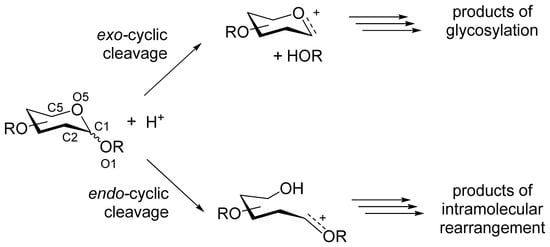
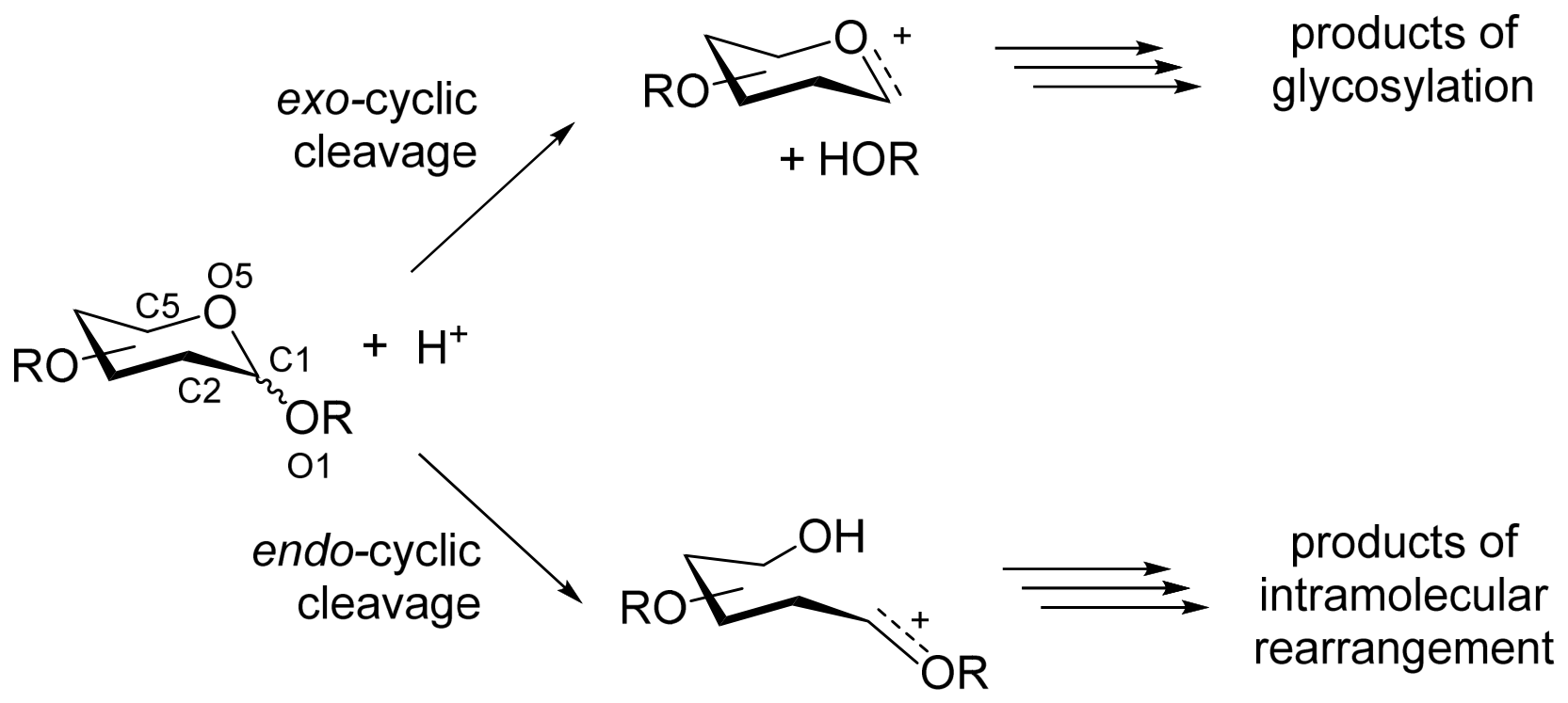
Carbohydrates play an important role in many biochemical processes [1,2,3]. Hence, the increased interest in understanding their synthesis and transformations [4,5,6,7]. Their molecules represent quite complex subjects due to the combination of the protective groups that may influence reactivity in synthetic intermediates and the presence of the acetal fragment commonly called the anomeric center [8,9,10]. Particularly, the latter is responsible for the most practical reactions in carbohydrate chemistry, such as glycosylations [11,12,13]. As can be seen, these transformations involve the exo-cyclic oxygen atom, O1 (Figure 1). These types of reactions have been widely studied both experimentally and theoretically [14,15,16,17]. Theoretical approaches included the DFT study of the oxacarbenium ion formation [18,19] and an investigation of the electronic density distribution in glycosides employing a combination of DFT and NBO methods [20]. Additionally, the QM-cluster approach [21] and combined QM-MM methods [22,23], along with the pure DFT [24], can be applied to study the glycoside hydrolysis.
Figure 1.
Two possible pathways of a reaction at the anomeric center: attack on O1 leading to glycosylation products, and attack on O5 probably leading to the ring opening.
Thus, it is seen that the reactions whose mechanism primarily includes an attack at the O1 exo-cyclic atom have been widely studied [11,12,13]. However, examples of reactions resulting from an attack on the endo-cyclic oxygen atom, O5, are also known [25,26,27,28]. Several years ago, a new type of carbohydrate reactivity was discovered by our group: a pyranoside ring contraction to the furanoside form upon the total sulfation of unprotected β-galactosides [29]. It was utilized as a key step for the preparation of blocks applied in the assembling of complex oligosaccharides related to antigenic cell-wall polysaccharides of pathogenic fungi and bacteria, including Aspergillus fumigatus [30], Klebsiella pneumonia [31], and Enterococcus faecalis [32], as well as a fucoidan of brown seaweed Chordaria flagelliformis [33]. It was also shown that PIF can be applied for the rearrangement of certain galactopyranoside units within a preassembled oligosaccharide chain [34].
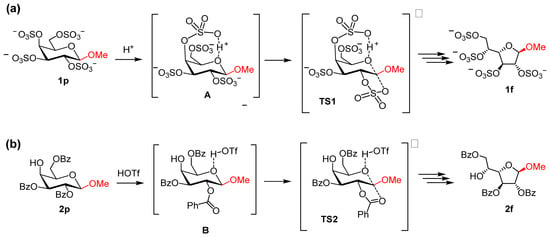
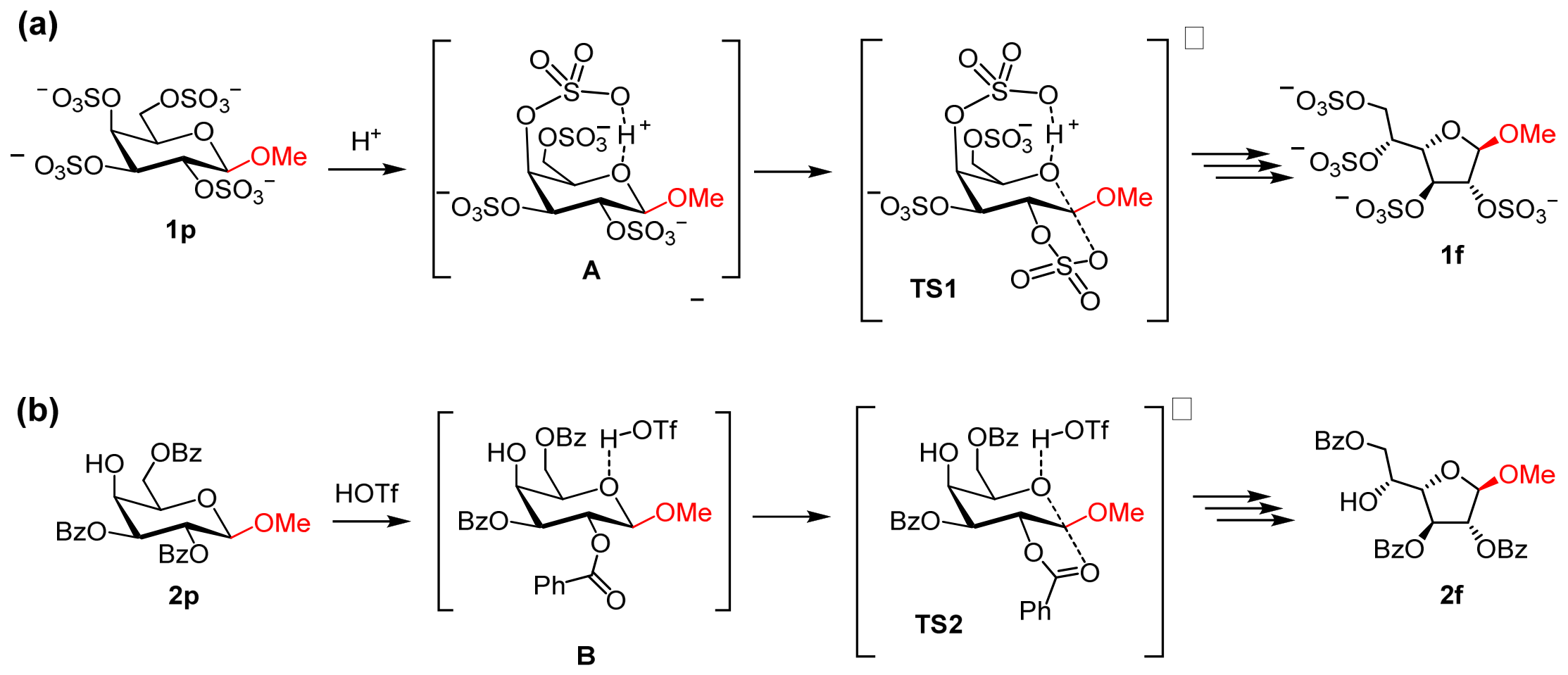
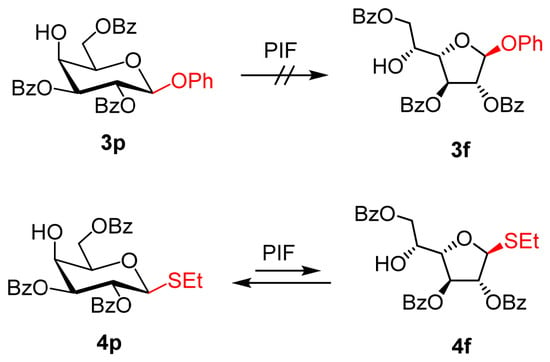
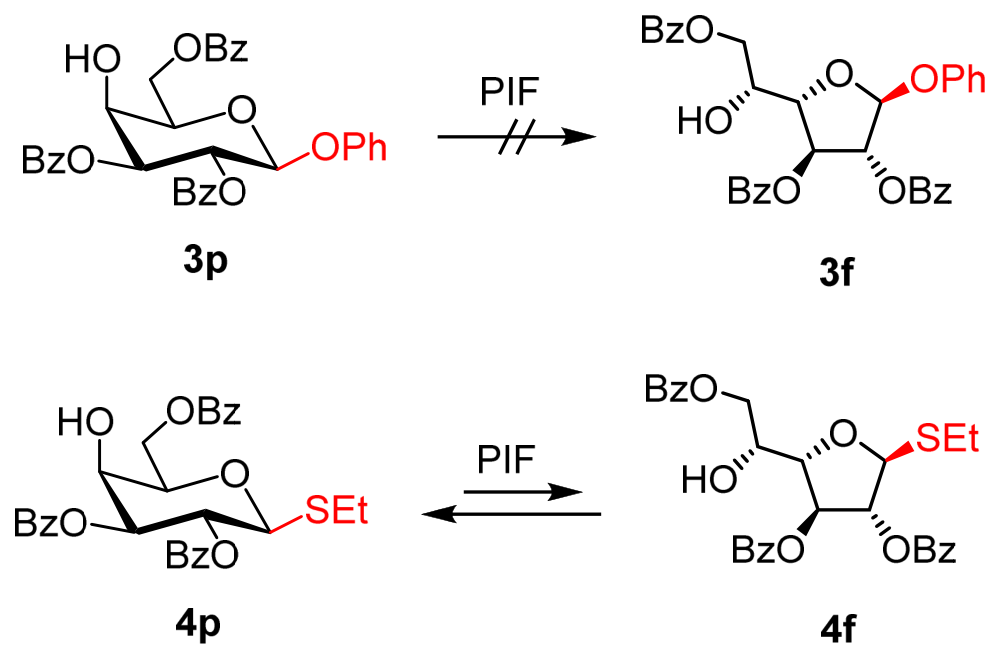
It seemed obvious to suggest a mechanism for this reaction [35] based on the involvement of the O5 oxygen atom, which led to the C1-O5 bond cleavage, permitting subsequent ring contraction [36] (Figure 2a). Furthermore, the possibility of this pyranoside-into-furanoside (PIF) transformation under the action of catalytic amounts of triflic acid was revealed [31], and its possible driving force was studied [37] (Figure 2b). The study included saccharides 2p–4p (Figure 3). It was demonstrated that they all should undergo the PIF rearrangement [37]. However, β-O-phenyl galactopyranoside 3p did not react at all, while the transforfdomation of 2p proceeded smoothly. Hence, it was decided to examine this situation in the mechanistic aspect using a combination of DFT and DLPNO-CCSD(T) approaches, and the results are reported below. For the DFT calculations, B3LYP functional with D3 correction was employed (see Materials and Methods) since it was previously found to demonstrate most reliable results for the conformational analysis of oxacarbenium ions [38].
Figure 2.
The plausible mechanism of the PIF rearrangement (a) under the exhaustive sulfation and (b) the acid catalysis.
Figure 3.
The structures of the galactosides considered in this work. PIF: TfOH (cat.), CH2Cl2, r.t.
2. Results and Discussion
In the present work, three β-galactosides—2p, 3p, and 4p—were the subject of the investigation (Figure 2 and Figure 3). The former two saccharides were discussed previously, while thiogalactoside 4p was added to the study as an example of slower rearrangement and predomination of pyranoside form in equilibrium.
In the course of the previous studies of PIF rearrangement promoted by exhaustive sulfation, we suggested a mechanism illustrated in Figure 2a. It included the protonation of endocyclic oxygen atom O5, which can be regarded as stabilized by the axially oriented sulfate at O4. After that, a C1-O5 bond cleavage occurred, assisted by the negatively charged sulfate group at O2. This is obviously followed by the ring opening and closure to form a furanoside isomer.
In the present case, it seemed straightforward to suppose the analogous way of the PIF transformation: First, protonation of O5 by the proton donated from the triflic acid, then bond breaking and ring opening/closure (Figure 2b) through the assistance by carbonyl oxygen at O2.
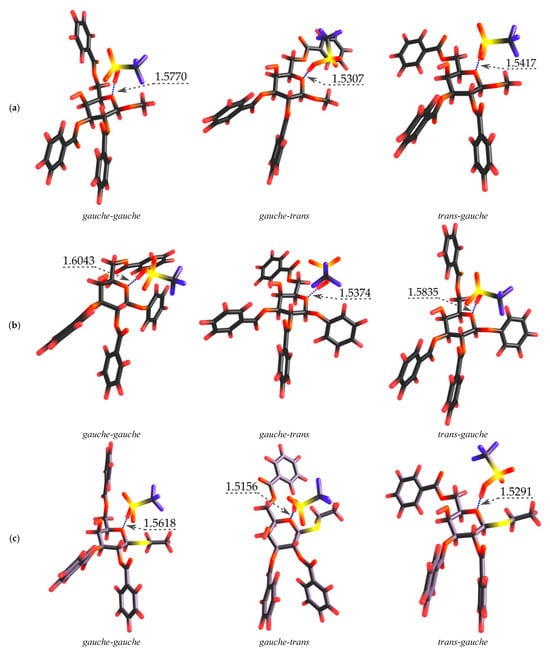
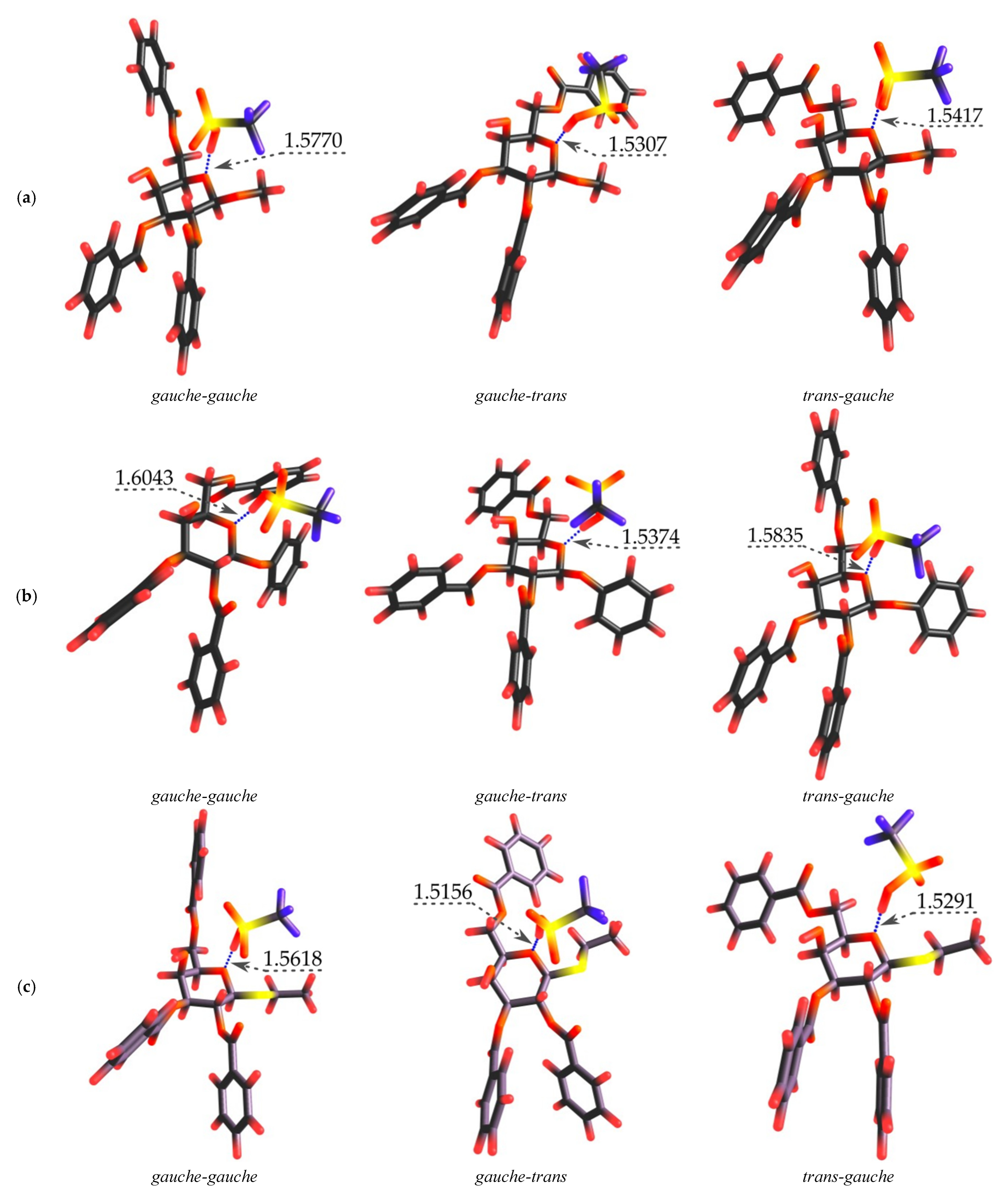
At the beginning of our study, β-O-methyl galactoside 2p was investigated. The geometry optimization of its complex with a molecule of TfOH yielded its three starting conformations, differed by the ω (O5-C5-C6-O6) torsion (Figure 4a). Notably, complete dissociation of the triflic acid was not observed in any of these structures. The distance between O5 and the proton of the triflic acid moiety varied in the range ca. 1.53–1.60 Å.
Figure 4.
Starting conformations of the TfOH-galactoside complexes: (a) for structure 2p; (b) for structure 3p; (c) for structure 4p. Numbers above arrows are O5···H+ distances given in Å.
It should also be mentioned that a benzoate group at O2 in carbohydrates is commonly assumed to be oriented as in the obtained structures. That is, the carbonyl oxygen atom in this substituent is in the position that does not allow it to participate in C1-O1 bond cleavage by the stabilization of the partial positive charge appearing on the C1 atom during this process. Thus, the next stage of the work was to determine the barrier of the O2 benzoate group rotation in order to make its carbonyl fragment closer to the anomeric center (C1). This was accomplished, first, by performing a relaxed potential energy surface (PES) scan of the H2-C2-O2-Ccarbonyl torsional angle from its optimized position towards −120°. The maximum of the energy curve was found to be about −80°, and this was used as a starting point for the saddle point search. Finally, when such a conformation was obtained and only one imaginary vibrational mode was found for it, indeed corresponding to the rotation of the benzoate group, Gibbs free energy of activation was computed relative to the starting conformation (Table 1). For the gg conformer of structure 1, it was found to be 8.0 kcal/mole; the graphical representation is given in Figure 5a. The last conformation obtained during the relaxed PES scan was subjected to geometry optimization to yield the conformation in which the stabilizing interaction between the carbonyl oxygen atom and the anomeric center was possible. This conformation was in turn used as a starting point for the search of the transition state (TS) of the C1-O5 bond cleavage.
Table 1.
The values of barriers of the benzoyl rotation at O2 and C1-O5 bond breaking calculated at DFT/B3LYP-D3 level of theory.
Figure 5.
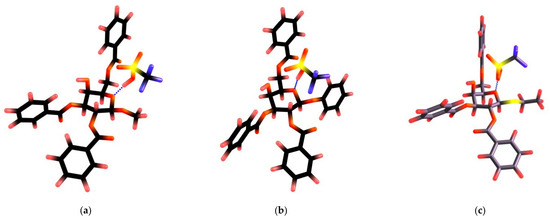
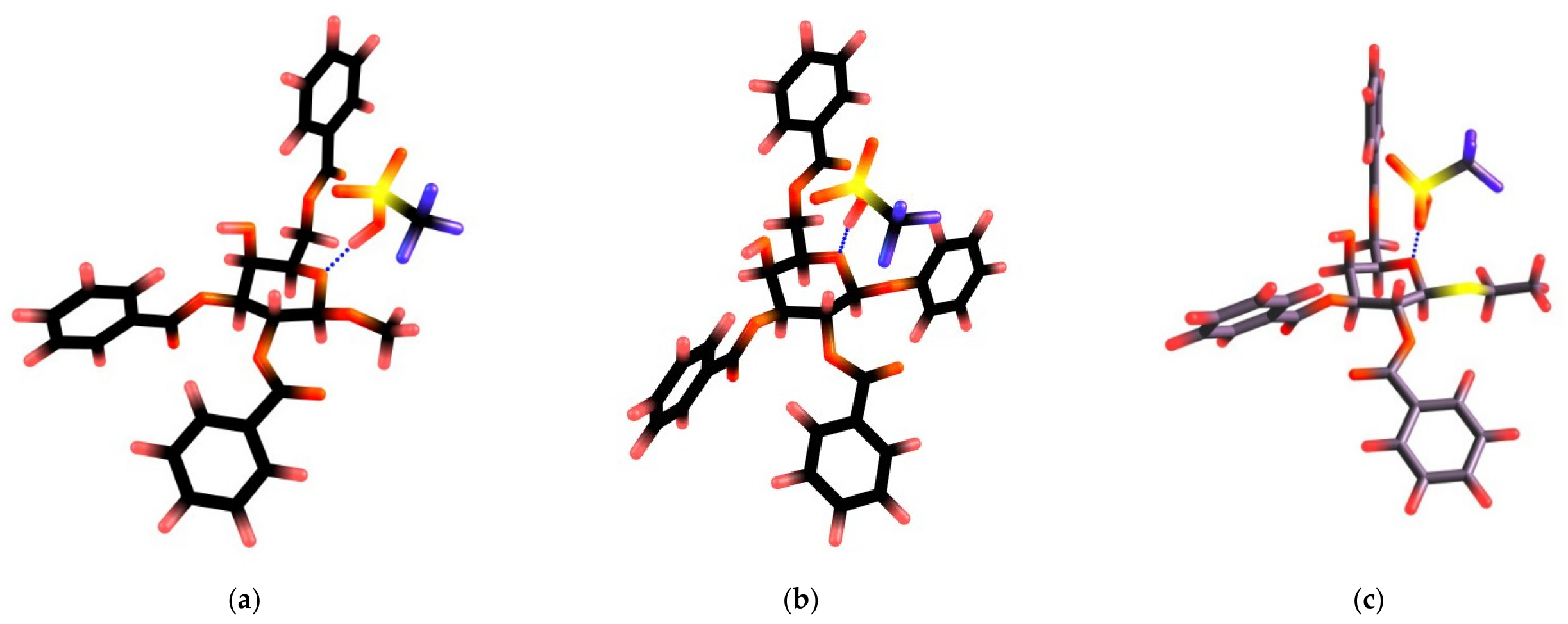
Transition states of the O2 benzoyl group rotation for gg conformers of 2p (a), 3p (b), and 4p (c). Note the counter direction of the benzoyl rotation for 4p.
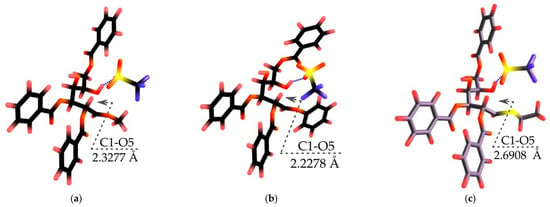
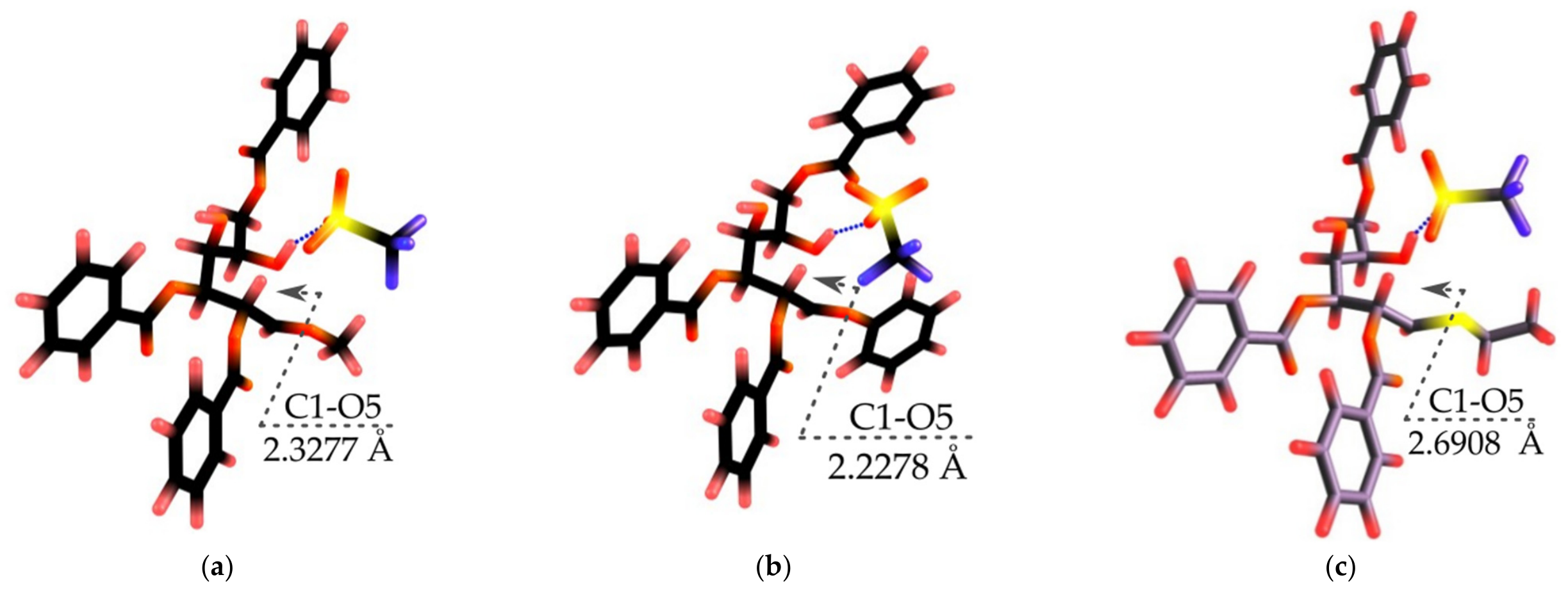
This time, the PES scan was performed for this bond starting from its optimized length (ca. 1.45 Å) to the value of 3 Å with a step value of approximately 0.1 Å. The maximum on the energy curve was found to be 2.23 Å. Successful optimization to the saddle point with a single imaginary vibrational mode corresponding to the C1-O5 bond breaking produced the desired TS (Figure 6a). The value of Gibbs free energy of the barrier was computed relative to the first conformation in this scan (Table 1). The procedure described above was repeated for each of the starting conformations of all three galactosides. The results are summarized in Figure 4, Figure 5 and Figure 6 and Table 1. Interestingly, we failed to locate the TS of the benzoyl rotation in the case of molecule 4p in the same direction as 2p and 3p. This fact is most likely due to the spatial hindrances caused by the sulfur atom and is depicted in Figure 5c. Furthermore, data for the gt conformer of structure 4p are missing because in that case, the optimization of the TS for the C1-O5 bond breaking failed to converge to a correct saddle point.
Figure 6.
Transition states of the C1-O5 bond cleavage for gg conformers of 2p (a), 3p (b), and 4p (c).
The first thing that attracts attention upon the examination of the data in Table 1 is that the values of the barriers for the benzoate rotation and the bond breaking are very close to each other in every case. Moreover, the calculated barriers correspond to reactions proceeding quickly at room temperature, which is natural for a side group rotation, but can hardly be expected for a bond cleavage. Additionally, the previously established reaction rate constant for the PIF transformation of galactoside 2p was 0.40 h−1: the reaction actually proceeds in dozens of minutes [31].
Hence, it was decided to refine the obtained results by performing single point DLPNO-CCDS(T) calculations on all the found conformations. For the computation of the Gibbs free energies of the barriers, the corresponding thermodynamic corrections to the electronic energy from the DFT runs were applied. The results are shown in Table 2.
Table 2.
The values of barriers of the benzoyl rotation at O2 and C1-O5 bond breaking calculated at DLPNO-CCSD(T) level of theory.
It can be seen that the values of the activation free energies for the benzoate rotation remain generally comparable to those calculated at the DFT level. Meanwhile, the barrier values for the bond-breaking process significantly increase in the DLPNO-CCSD(T) approximation. The difference between the barriers of rotation and the bond breaking definitely demonstrate the rate-limiting nature of the latter step. We suppose that such an effect might be related to a rather long (more than 2.2 Å) distance between C1 and O5 atoms in the TS. This can result in the appearance of some Van der Waals interactions, which are poorly described at the DFT level, while the DLPNO-CCSD(T) fixes the problem. Moreover, this finding is consistent with previous results [39,40] that DFT functionals, and particularly B3LYP-D3, may underestimate reaction barriers. It should also be noted that examination of the largest amplitudes in the coupled cluster calculations revealed that just one of them had a value of 0.06–0.07, while all the rest were below 0.05. This signifies that our structures could be described by the single-reference approach, and no additional calculations were needed.
For β-O-methyl galactoside 2p, the lowest barrier is found for the gg conformer and equals 14.3 kcal/mole. From the above-mentioned experimental rate constant of 0.40 h−1, the barrier of 13.0 kcal/mole is calculated according to the reversed form of Eyring Equation (1), where K is the rate constant, T—absolute temperature, R—gas constant, and k and h—Boltzmann and Planck constants, respectively:
This can be regarded as a very good coincidence. Boltzmann distribution including all other conformers was not performed because the previous study demonstrated that the gauche-gauche was the highest energy conformer [23]. Thus, consideration of other conformers would lead to even higher computed ΔG≠ values.
For β-O-phenyl galactoside 3p, with its lowest barrier for the gt conformer being 18.1 kcal/mole according to the same equation, temperatures of more than 400 K are required for the PIF transformation to reach the comparable reaction rate. However, acid-induced side reactions are expected to predominate over the ring contraction at this temperature. Indirect evidence for the correctness of the described ΔG≠ calculations for the phenyl galactoside could be obtained by performing its reverse transformation, since it was expected to proceed even slower.
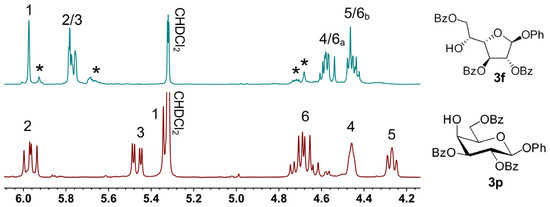
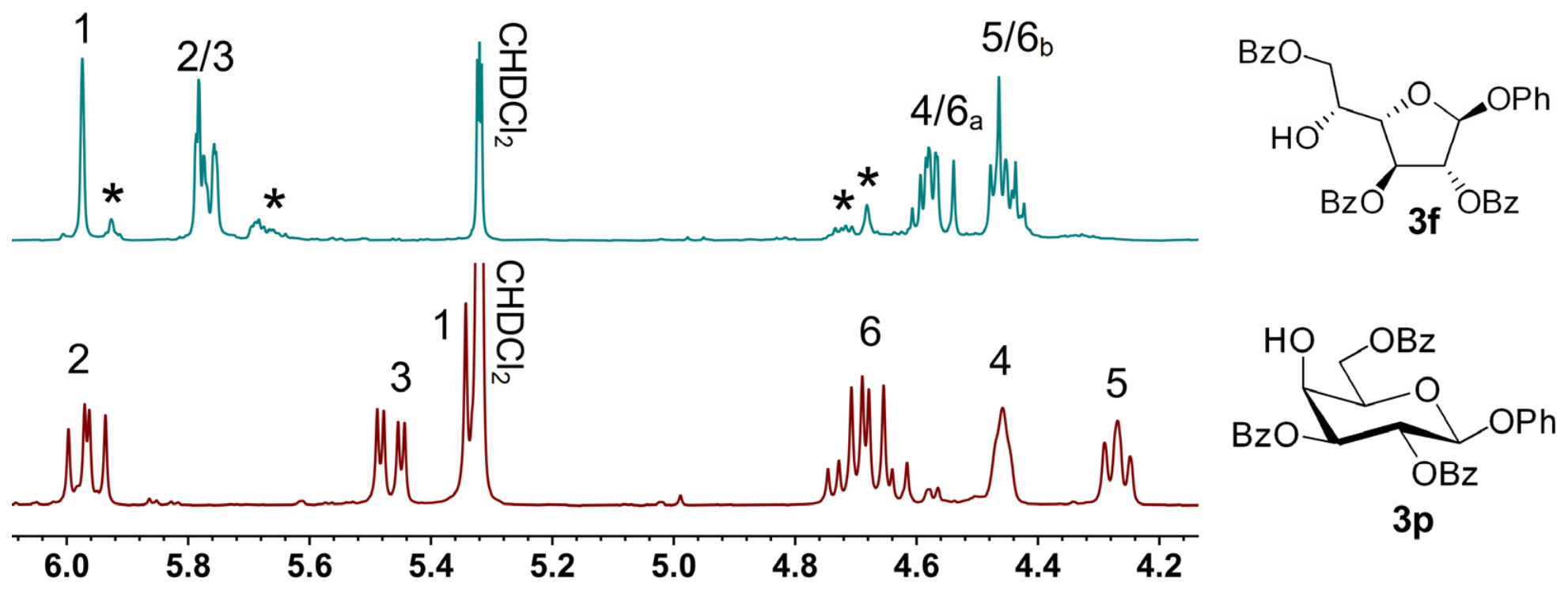
To test the feasibility of reverse furanoside to pyranoside conversion, the solution of phenyl galactofuranoside 3f in CD2Cl2 (600 μL) was treated with TfOH (0.1 μL). NMR monitoring of this reaction mixture over 16 h showed only products of acid-induced side reactions like phenyl cleavage, benzoates migration, and other related destructive transformations. No formation of the parent pyranoside was observed (Figure 7). Similar results with much faster acid-promoted destruction were observed when an increased amount of acid (0.5 μL) was used.
Figure 7.
1H NMR spectrum of galactofuranoside 3f treated with TfOH (upper) in comparison with the spectrum of the pure galactopyranoside 3p (lower). Asterisks denote the signals belonging to products of the furanoside destruction.
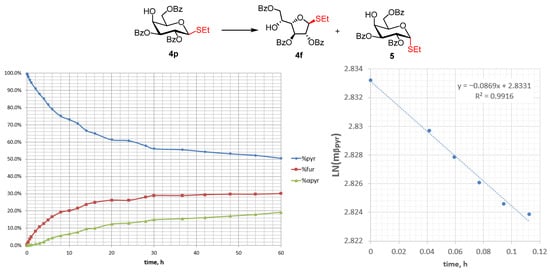
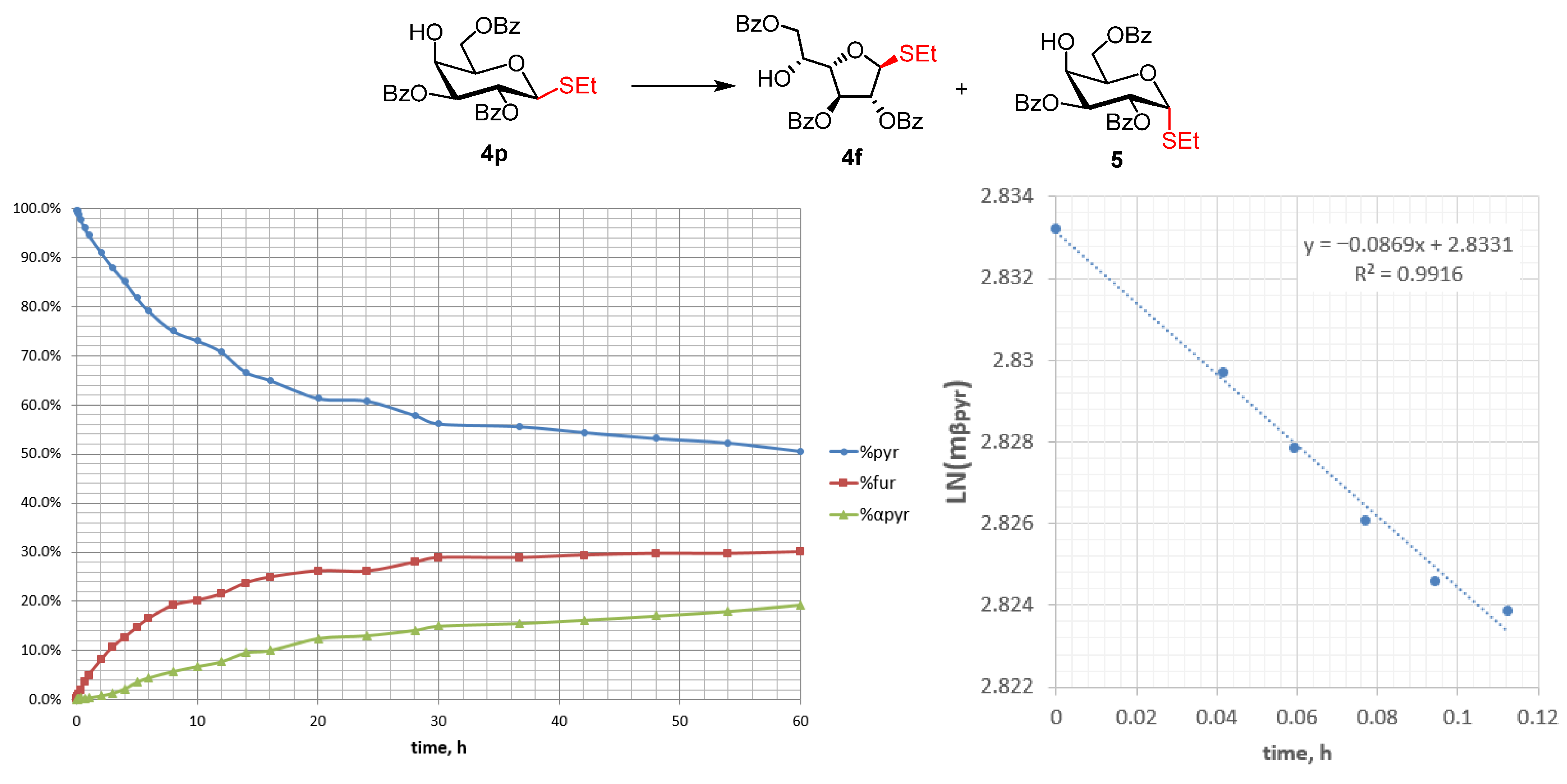
For β-S-ethyl galactopyranoside 4p, the PIF transformation proceeded considerably slower than in the case of pyranoside 2p, in accordance with the calculation results. Additionally, careful examination of reaction mixtures (24 h and longer) revealed the formation of a significant amount of α-pyranoside isomer 5. Notably, the same side reaction was observed when furanoside 4f was subjected to same conditions. Moreover, due to even lower reverse transformation speed, the furanoside form still predominated even after two days. Only increased TfOH concentration (0.25 µL) brought back pyranoside domination, which was observed in direct process. The kinetics of the isomerization of 5p are presented in Figure 8 (for the reverse furanoside transformation, see Supporting Information). The ΔG≠ calculated from the experimentally obtained rate constant (0.09 h−1) equaled 14.0 kcal/mole, which, although it does not coincide quantitatively with the lowest barrier for this structure from Table 2 (16.9 kcal/mole), still reproduced the tendency predicted from the calculations at the DLPNO-CCSD(T) level. The source of the observed discrepancy is most likely in the effects related to the solvent consideration. Since the continuum model was employed in this study, it may fail in the description of some solvent-specific effects, particularly occurring during the initial complex formation between the substrate and the catalyst. As mentioned previously, consideration of other conformers in the equilibrium would have only increased the computed ΔG≠ value.
Figure 8.
Kinetic curves (left) and estimation of the reaction rate constant (right) for the PIF rearrangement of structure 4p. Conditions: 600 µL CD2Cl2, 0.1 µL TfOH, 298 K.
To further elucidate the role of the O2 benzoate substituent in the C1-O5 breaking process, the natural atomic charges were calculated both for starting conformations of structures 2p–4p (after the rotation of the benzoate group) and in the transition state. The charges on the carbonyl oxygen, anomeric C1, and endo-cyclic O5 oxygene atoms are, of course, of the greatest interest. They are summarized in Table 3. It can be seen that, indeed, the charge on the carbonyl oxygen significantly decreases in TS, while the charges on C1 and O5 evidence the bond polarization. TSs corresponding to structures 2p and 3p lead to the development of an additional positive charge on C1. In structure 4p, the charge on C1 is always slightly negative, possibly due to the electron-donating properties of the sulfur atom in the aglycon. These data confirm the hypothesis that the carbonyl group of the benzoate substituent at O2 facilitates the bond cleavage between C1 and O5.
Table 3.
The values of natural atomic charges on carbonyl oxygens at O2, C1, and O5 atoms as calculated with NBO 7.0 program in the starting and transition states for structures 2p–4p.
After that, we decided to revisit the PIF rearrangement occurring at the exhaustive sulfation conditions (structure 1p in Figure 2a) and performed the calculations of its TS using the same approach as above, except that DMF was considered as a solvent instead of CH2Cl2. The gauche-gauche conformer was excluded from consideration, since the presence of the bulky charged sulfate group at O4 makes it obviously unlikely to appear in large amounts in the conformational equilibrium. The results are given in Table 4. Again, it is seen that the DFT approach provides incredibly low absolute values for ΔG≠ of the bond cleavage process, while using the DLPNO-CCSD(T) method drastically changes the situation.
Table 4.
The values of barriers of C1-O5 bond breaking calculated at the DFT/B3LYP-D3 and DLPNO-CCSD(T) levels of theory for structure 1p.
The role of the acidic catalyst was additionally evaluated by changing the triflic acid to trifluoroacetic acid (TFA) in case of compound 2p. The computed energy of the C1-O5 bond cleavage in this case was around 30 kcal/mole, indicating that no reaction should occur in this case. Accordingly, when a solution of methyl 2,3,6-tri-O-benzoyl-β-D-galactopyranoside 2p (31 mg, 0.060 mmol) in CD2Cl2 (600 μL) 10 μL of TFA was added, 1H NMR spectrum showed no visible changes after 1 h, and around 5% conversion after 24 h. It should be noted that the mentioned amount of TFA is about 100 times greater than that of TfOH used in the previous experiments. Only using 140 μL of TFA in 460 µL of CD2Cl2, we were able to reach the rate of TfOH-catalyzed transformation; however, spectra quality significantly degraded, and the yields of isolated furanoside product were generally lower than described earlier for the TfOH-catalyzed procedure.
3. Materials and Methods
All the calculations were performed using the ORCA 5.0.4 software package [41]. DFT B3LYP functional with the third order Grimme’s correction (D3) [42] and def2-TZVP [43] basis set were employed. CPCM model [44] with the default parameters for methylene chloride was used to account for bulk solvent effects. The defgrid3 option was used throughout the calculations. The optimized structures were subjected to hessian calculations, and the resulting Gibbs free energies and their corrections to the electronic energies were used for the analysis in this work. For DLPNO-CCSD(T) calculations, the CC-pVTZ basis set was used. Natural atomic charges were computed using NBO 7 software [45] with B3LYP-D3/def2-TZVP wave functions.
4. Conclusions
The PIF transformation of three galactosides has been studied by computational methods in this work. The plausibility of the mechanism suggested for it involving the participation of the endo-cyclic oxygen atom was confirmed by the calculations. The obtained results provide explanation for the fact that β-phenyl galactoside 3p does not rearrange at room temperature, contrary to β-methyl derivative 2p, while the previous thermodynamic studies predicted its transformation. For structure 3p, the calculations predicted the possibility of its transformation at temperatures exceeding 400 K, at which point decomposition products are expected to dominate.
It is shown that the DFT/B3LYP-D3 approach predicts incorrect and even unrealistic barriers for the C1-O5 bond-breaking process, while the application of the high-level DLPNO-CCSD(T) approximation fixes the situation. The difference between the barriers of rotation and the C1-O5 bond breaking clearly demonstrates that the latter stage is rate limiting. For β-methyl galactoside 2p and β-methyl 1-thiogalactoside 4p, the lowest predicted barriers coincide well with that that can be calculated from the experimentally determined reaction rate constants.
The used approach was also applied to the totally sulfated galactoside 1p, previously studied with rough Hartree–Fock methods, with which the obtained results were in agreement.
The results reported herein also definitely demonstrate that the reaction rate critically depends on the strength of the acid involved, which provides additional evidence for the correctness of the proposed PIF mechanism. Furthermore, we can probably predict feasibility of new substrate ring contractions prior to actual chemical synthesis and test reactions.
Supplementary Materials
The following supporting information can be downloaded at https://www.mdpi.com/article/10.3390/molecules31183145/s1, General methods; NMR data; Details of kinetic experiments; Cartesian coordinates end absolute DLPNO-CCSD(T) energies.
Author Contributions
Conceptualization, A.G.G., D.A.A., V.B.K. and N.E.N.; Methodology, A.G.G.; Software, A.G.G.; Validation, D.A.A. and A.G.G.; Formal Analysis, A.G.G., D.A.A. and V.B.K.; Investigation, A.G.G., D.A.A. and V.B.K.; Resources, N.E.N.; Data Curation, A.G.G., V.B.K. and N.E.N.; Writing—Original Draft Preparation and, A.G.G. and D.A.A.; Writing—Review and Editing, A.G.G., D.A.A., V.B.K. and N.E.N.; Visualization, A.G.G., D.A.A. and V.B.K.; Supervision, N.E.N.; Project Administration, N.E.N.; Funding Acquisition, N.E.N. All authors have read and agreed to the published version of the manuscript.
Funding
This research was funded by the Ministry of Science and Higher Education of the Russian Federation (Agreement no. 075-15-2024-531).
Data Availability Statement
The original contributions presented in this study are included in the article/Supplementary Materials. Further inquiries can be directed to the corresponding authors.
Conflicts of Interest
The authors declare no conflicts of interest. The funders had no role in the design of the study; in the collection, analyses, or interpretation of data; in the writing of the manuscript; or in the decision to publish the results.
Abbreviations
The following abbreviations are used in this manuscript:
| TFA | Trifluoroacetic acid |
| TfOH | Trifluoromethanesulfonic acid |
| PIF | Pyranoside-into-furanoside |
| DMF | Dimethyl formamide |
| TS | Transition state |
| PES | Potential energy surface |
| QM | Quantum mechanics |
| MM | Molecular mechanics |
| NBO | Natural bond orbitals |
References
- Mahara, G.; Tian, C.; Xu, X.; Zhu, J. Breakthrough of Glycobiology in the 21st Century. Front. Immunol. 2022, 13, 1071360. [Google Scholar] [CrossRef] [Scilit] [PubMed]
- Varki, A.; Press, C.S.H.L. Essentials of Glycobiology; Cold Spring Harbor Laboratory Press: Woodbury, NY, USA, 2022. [Google Scholar]
- Berger, E.G.; Clausen, H.; Cummings, R.D. Glycotechnology; Springer Science & Business Media: Berlin/Heidelberg, Germany, 2012. [Google Scholar]
- Wei, Y.; Lam, J.; Diao, T. Synthesis of C-Acyl Furanosides via the Cross-Coupling of Glycosyl Esters with Carboxylic Acids. Chem. Sci. 2021, 12, 11414–11419. [Google Scholar] [CrossRef] [Scilit] [PubMed]
- Crich, D. Mechanism of a Chemical Glycosylation Reaction. Acc. Chem. Res. 2010, 43, 1144–1153. [Google Scholar] [CrossRef] [Scilit] [PubMed]
- Nicolaou, K.C.; Mitchell, H.J. Adventures in Carbohydrate Chemistry: New Synthetic Technologies, Chemical Synthesis, Molecular Design, and Chemical Biology A List of Abbreviations Can Be Found at the End of This Article. Telemachos Charalambous Was an Inspiring Teacher at the Pancyprian Gymnasium, Nicosia, Cyprus. Angew. Chem. 2001, 40, 1576–1624. [Google Scholar]
- Shatskiy, A.; Stepanova, E.V.; Kärkäs, M.D. Exploiting Photoredox Catalysis for Carbohydrate Modification through C-H and C-C Bond Activation. Nat. Rev. Chem. 2022, 6, 782–805. [Google Scholar] [CrossRef] [Scilit] [PubMed]
- Guo, H.; Loh, C.C.J. Noncovalent Interactions: An Emerging Focal Point in Stereoselective Catalytic Carbohydrate Synthesis. Carbohydr. Res. 2025, 552, 109458. [Google Scholar] [CrossRef] [Scilit] [PubMed]
- Sebastian, A.T.; Loh, C.C.J. Emerging Capabilities of Nonclassical Noncovalent Interactions and Asymmetric Catalysis in Stereoselective Glycosylations and Carbohydrate Functionalizations. Acc. Chem. Res. 2025, 58, 2124–2144. [Google Scholar] [CrossRef] [Scilit] [PubMed]
- Loh, C.C.J. Exploiting Non-Covalent Interactions in Selective Carbohydrate Synthesis. Nat. Rev. Chem. 2021, 5, 792–815. [Google Scholar] [CrossRef] [Scilit] [PubMed]
- Ishiwata, A.; Tanaka, K.; Ao, J.; Ding, F.; Ito, Y. Recent Advances in Stereoselective 1,2-Cis-O-Glycosylations. Front. Chem. 2022, 10, 972429. [Google Scholar] [CrossRef] [Scilit] [PubMed]
- Yao, H.; Vu, M.D.; Liu, X.-W. Recent Advances in Reagent-Controlled Stereoselective/Stereospecific Glycosylation. Carbohydr. Res. 2019, 473, 72–81. [Google Scholar] [CrossRef] [Scilit] [PubMed]
- Mukherjee, M.M.; Ghosh, R.; Hanover, J.A. Recent Advances in Stereoselective Chemical O-Glycosylation Reactions. Front. Mol. Biosci. 2022, 9, 896187. [Google Scholar] [CrossRef] [Scilit] [PubMed]
- Nukada, T.; Berces, A.; Zgierski, M.Z.; Whitfield, D.M. Exploring the Mechanism of Neighboring Group Assisted Glycosylation Reactions. J. Am. Chem. Soc. 1998, 120, 13291–13295. [Google Scholar] [CrossRef] [Scilit]
- Satoh, H.; Hansen, H.S.; Manabe, S.; van Gunsteren, W.F.; Hünenberger, P.H. Theoretical Investigation of Solvent Effects on Glycosylation Reactions: Stereoselectivity Controlled by Preferential Conformations of the Intermediate Oxacarbenium-Counterion Complex. J. Chem. Theory Comput. 2010, 6, 1783–1797. [Google Scholar] [CrossRef] [Scilit] [PubMed]
- Mydock, L.K.; Demchenko, A.V. Mechanism of Chemical O-Glycosylation: From Early Studies to Recent Discoveries. Org. Biomol. Chem. 2010, 8, 497–510. [Google Scholar] [CrossRef] [Scilit] [PubMed]
- Guo, A.; Xu, Y.; Jia, Z.; Loh, T.-P.; Liu, X.-W. Unraveling Chemical Glycosylation: DFT Insights into Factors Imparting Stereoselectivity. Green Synth. Catal. 2024, 6, 302–310. [Google Scholar] [CrossRef] [Scilit]
- Hosoya, T.; Takano, T.; Kosma, P.; Rosenau, T. Theoretical Foundation for the Presence of Oxacarbenium Ions in Chemical Glycoside Synthesis. J. Org. Chem. 2014, 79, 7889–7894. [Google Scholar] [CrossRef] [Scilit] [PubMed]
- Franconetti, A.; Ardá, A.; Asensio, J.L.; Blériot, Y.; Thibaudeau, S.; Jiménez-Barbero, J. Glycosyl Oxocarbenium Ions: Structure, Conformation, Reactivity, and Interactions. Acc. Chem. Res. 2021, 54, 2552–2564. [Google Scholar] [CrossRef] [Scilit] [PubMed]
- Jeevitha, D.; Sadasivam, K.; Praveena, R.; Jayaprakasam, R. DFT Study of Glycosyl Group Reactivity in Quercetin Derivatives. J. Mol. Struct. 2016, 1120, 15–24. [Google Scholar] [CrossRef] [Scilit]
- Cheng, Q.; DeYonker, N.J. A Case Study of the Glycoside Hydrolase Enzyme Mechanism Using an Automated QM-Cluster Model Building Toolkit. Front. Chem. 2022, 10, 854318. [Google Scholar] [CrossRef] [Scilit] [PubMed]
- Soliman, M.E.S.; Pernía, J.J.R.; Greig, I.R.; Williams, I.H. Mechanism of Glycoside Hydrolysis: A Comparative QM/MM Molecular Dynamics Analysis for Wild Type and Y69F Mutant Retaining Xylanases. Org. Biomol. Chem. 2009, 7, 5236–5244. [Google Scholar] [CrossRef] [Scilit] [PubMed][Green Version]
- Ardèvol, A.; Rovira, C. Reaction Mechanisms in Carbohydrate-Active Enzymes: Glycoside Hydrolases and Glycosyltransferases. Insights from Ab Initio Quantum Mechanics/Molecular Mechanics Dynamic Simulations. J. Am. Chem. Soc. 2015, 137, 7528–7547. [Google Scholar] [CrossRef] [Scilit] [PubMed]
- Zhang, Y.; Zhao, Z.; Liu, H. Deriving Chemically Essential Interactions Based on Active Site Alignments and Quantum Chemical Calculations: A Case Study on Glycoside Hydrolases. ACS Catal. 2015, 5, 2559–2572. [Google Scholar] [CrossRef] [Scilit]
- Satoh, H.; Manabe, S.; Ito, Y.; Lüthi, H.P.; Laino, T.; Hutter, J. Endocyclic Cleavage in Glycosides with 2,3-Trans Cyclic Protecting Groups. J. Am. Chem. Soc. 2011, 133, 5610–5619. [Google Scholar] [CrossRef] [Scilit] [PubMed]
- Deslongchamps, P.; Li, S.; Dory, Y.L. Hydrolysis of Alpha- and Beta-Glycosides. New Experimental Data and Modeling of Reaction Pathways. Org. Lett. 2004, 6, 505–508. [Google Scholar] [CrossRef] [Scilit] [PubMed]
- Manabe, S.; Ishii, K.; Hashizume, D.; Koshino, H.; Ito, Y. Evidence for Endocyclic Cleavage of Conformationally Restricted Glycopyranosides. Chemistry 2009, 15, 6894–6901. [Google Scholar] [CrossRef] [Scilit] [PubMed]
- Pilgrim, W.; Murphy, P.V. SnCl(4)- and TiCl(4)-Catalyzed Anomerization of Acylated O- and S-Glycosides: Analysis of Factors That Lead to Higher α:β Anomer Ratios and Reaction Rates. J. Org. Chem. 2010, 75, 6747–6755. [Google Scholar] [CrossRef] [Scilit] [PubMed]
- Krylov, V.B.; Argunov, D.A.; Vinnitskiy, D.Z.; Verkhnyatskaya, S.A.; Gerbst, A.G.; Ustyuzhanina, N.E.; Dmitrenok, A.S.; Huebner, J.; Holst, O.; Siebert, H.-C.; et al. Pyranoside-into-Furanoside Rearrangement: New Reaction in Carbohydrate Chemistry and Its Application in Oligosaccharide Synthesis. Chem.-Eur. J. 2014, 20, 16516–16522. [Google Scholar] [CrossRef] [Scilit] [PubMed]
- Argunov, D.A.; Krylov, V.B.; Nifantiev, N.E. The Use of Pyranoside-into-Furanoside Rearrangement and Controlled O(5)→O(6) Benzoyl Migration as the Basis of a Synthetic Strategy to Assemble (1→5)-and (1→6)-Linked Galactofuranosyl Chains. Org. Lett. 2016, 18, 5504–5507. [Google Scholar] [CrossRef] [Scilit] [PubMed]
- Argunov, D.A.; Aladysheva, U.S.; Krylov, V.B.; Nifantiev, N.E. Acid-Catalyzed Transformation of Pyranosides into Furanosides as a Tool for Preparation of Furanoside Synthetic Blocks. Org. Lett. 2024, 26, 8090–8094. [Google Scholar] [CrossRef] [Scilit] [PubMed]
- Krylov, V.B.; Gerbst, A.G.; Argunov, D.A.; Dmitrenok, A.S.; Shashkov, A.S.; Kaczynski, Z.; Huebner, J.; Holst, O.; Nifantiev, N.E. Definitive Structural Assessment of Enterococcal Diheteroglycan. Chem.-Eur. J. 2015, 21, 1749–1754. [Google Scholar] [CrossRef] [Scilit] [PubMed]
- Vinnitskiy, D.Z.; Krylov, V.B.; Ustyuzhanina, N.E.; Dmitrenok, A.S.; Nifantiev, N.E. The Synthesis of Heterosaccharides Related to the Fucoidan from Chordaria Flagelliformis Bearing an α-L-Fucofuranosyl Unit. Org. Biomol. Chem. 2016, 14, 598–611. [Google Scholar] [CrossRef] [Scilit] [PubMed]
- Argunov, D.A.; Krylov, V.B.; Nifantiev, N.E. Pyranoside-into-Furanoside Rearrangement of Galactose Units within a Preassembled Oligosaccharide Chain. Org. Lett. 2025, 27, 10792–10796. [Google Scholar] [CrossRef] [Scilit] [PubMed]
- Krylov, V.B.; Argunov, D.A.; Vinnitskiy, D.Z.; Gerbst, A.G.; Ustyuzhanina, N.E.; Dmitrenok, A.S.; Nifantiev, N.E. The Pyranoside-into-Furanoside Rearrangement of Alkyl Glycosides: Scope and Limitations. Synlett 2016, 27, 1659–1664. [Google Scholar] [CrossRef] [Scilit]
- Manabe, S.; Ito, Y. Synthetic Utility of Endocyclic Cleavage Reaction. Pure Appl. Chem. 2017, 89, 899–909. [Google Scholar] [CrossRef] [Scilit]
- Gerbst, A.G.; Nikogosova, S.P.; Rastrepaeva, D.A.; Argunov, D.A.; Krylov, V.B.; Nifantiev, N.E. The Intramolecular Stabilizing Effects of O-Benzoyl Substituents as a Driving Force of the Acid-Promoted Pyranoside-into-Furanoside Rearrangement. Beilstein J. Org. Chem. 2025, 21, 2456–2464. [Google Scholar] [CrossRef] [Scilit] [PubMed]
- Gerbst, A.G.; Komarova, B.S.; Vlasenko, A.N.; Nifantiev, N.E. Modeling of the Carbohydrate Oxacarbenium Ionic Intermediates of Glycosylation Reactions with Explicit Account for Protective Group Effects. ACS Omega 2025, 10, 2305–2313. [Google Scholar] [CrossRef] [Scilit] [PubMed]
- Goncalves, T.J.; Plessow, P.N.; Studt, F. On the Accuracy of Density Functional Theory in Zeolite Catalysis. ChemCatChem 2019, 11, 4368–4376. [Google Scholar] [CrossRef] [Scilit]
- Plessow, P.N.; Studt, F. How Accurately Do Approximate Density Functionals Predict Trends in Acidic Zeolite Catalysis? J. Phys. Chem. Lett. 2020, 11, 4305–4310. [Google Scholar] [CrossRef] [Scilit] [PubMed]
- Neese, F. The ORCA Program System. WIREs Comput. Mol. Sci. 2012, 2, 73–78. [Google Scholar] [CrossRef] [Scilit]
- Grimme, S.; Antony, J.; Ehrlich, S.; Krieg, H. A Consistent and Accurate Ab Initio Parametrization of Density Functional Dispersion Correction (DFT-D) for the 94 Elements H-Pu. J. Chem. Phys. 2010, 132, 154104. [Google Scholar] [CrossRef] [Scilit] [PubMed]
- Weigend, F.; Ahlrichs, R. Balanced Basis Sets of Split Valence, Triple Zeta Valence and Quadruple Zeta Valence Quality for H to Rn: Design and Assessment of Accuracy. Phys. Chem. Chem. Phys. 2005, 7, 3297–3305. [Google Scholar] [CrossRef] [Scilit] [PubMed]
- Barone, V.; Cossi, M. Quantum Calculation of Molecular Energies and Energy Gradients in Solution by a Conductor Solvent Model. J. Phys. Chem. A 1998, 102, 1995–2001. [Google Scholar] [CrossRef] [Scilit]
- Glendening, E.D.; Badenhoop, J.K.; Reed, A.E.; Carpenter, J.E.; Bohmann, J.A.; Morales, C.M.; Karafiloglou, P.; Landis, C.R.; Weinhold, F. NBO, Version 7; Theoretical Chemistry Institute, University of Wisconsin: Madison, WI, USA, 2013.

Disclaimer/Publisher’s Note: The statements, opinions and data contained in all publications are solely those of the individual author(s) and contributor(s) and not of MDPI and/or the editor(s). MDPI and/or the editor(s) disclaim responsibility for any injury to people or property resulting from any ideas, methods, instructions or products referred to in the content. |
© 2026 by the authors. Licensee MDPI, Basel, Switzerland. This article is an open access article distributed under the terms and conditions of the Creative Commons Attribution (CC BY) license.