


Abstract
Constructing Schottky heterojunctions with plasmonic components offers a promising route to enhance photocatalytic performance, yet the synergistic roles of the Schottky barrier and localized surface plasmon resonance (LSPR) in pollutant degradation remain insufficiently elucidated. Herein, a series of Ti3C2/Ag-Ag2NCN (TAN) composites with varied Ag loadings was prepared via an in situ precipitation–chemical reduction method. The pseudo-first-order rate constant of the TAN-30 heterojunction reached roughly 7.0 times the value of bare Ag2NCN, while its tetracycline degradation efficiency under visible light reached 87.0% at 240 min. Moreover, the heterojunction exhibited outstanding reusability over five successive runs. Comprehensive characterizations reveal that the Schottky barrier at the Ti3C2/Ag2NCN interface effectively suppresses photogenerated carrier recombination, while the LSPR effect of metallic Ag0 broadens the light absorption range and elevates the local surface temperature, synergistically accelerating charge migration. The dominance of h+ and •O2− among the reactive species was established by both radical trapping assays and ESR spectroscopic analysis. This work provides mechanistic insights into LSPR-enhanced Schottky heterojunctions and offers a rational design strategy for MXene-based photocatalysts toward efficient antibiotic wastewater treatment.
1. Introduction
The increasing consumption of fossil fuels and the concomitant environmental pollution have spurred intense research into sustainable and clean energy technologies [1,2,3]. Tetracycline (TC) is a globally prevalent antibiotic contaminant in water bodies, arising from pharmaceutical and agricultural sources [4]. Its persistence, ecotoxicity, and role in propagating antibiotic resistance genes make it recalcitrant to conventional treatment. Photocatalysis offers a promising solution for TC degradation. Solar-driven photocatalysis has emerged as a promising approach for both energy conversion and environmental remediation, as it enables the direct utilization of abundant and renewable solar energy [5,6]. Among various photocatalytic applications, the degradation of persistent organic pollutants in wastewater, particularly antibiotics such as tetracycline (TC), has attracted considerable attention due to the growing threat of antibiotic resistance and the inadequacy of conventional treatment methods [7,8].
In recent years, silver cyanamide (Ag2NCN) has attracted growing interest as a novel semiconductor photocatalyst with a narrow band gap (~2.5 eV) and favorable band edge positions for visible-light-driven redox reactions [9,10]. Its unique [NCN]2− anion structure facilitates efficient charge separation, yet its photocatalytic performance remains constrained by moderate carrier mobility and insufficient surface reactivity [11,12]. Coupling Ag2NCN with a highly conductive support to form a Schottky heterojunction represents a rational strategy to address these limitations, as the built-in electric field at the interface can effectively drive photogenerated electrons toward the conductive component, thus suppressing bulk recombination [13].
Two-dimensional transition metal carbides and nitrides, namely MXenes, have recently emerged as promising cocatalyst materials owing to their metallic conductivity, tunable surface chemistry, and large specific surface area [14,15]. Ti3C2Tx, the most widely studied MXene, possesses excellent electrical conductivity and abundant terminal groups (−OH, −F, =O) that facilitate the anchoring of nanoparticles and the formation of intimate interfacial contacts [16,17,18]. When coupled with semiconductors, Ti3C2Tx can function as an efficient electron sink, promoting charge separation through the Schottky barrier [19,20,21]. However, simply integrating Ti3C2Tx with Ag2NCN may not fully exploit the potential of the composite system, as the plasmonic properties of metallic Ag nanoparticles could introduce additional light-harvesting capabilities that further enhance photocatalytic performance [22].
Metallic Ag nanoparticles exhibit localized surface plasmon resonance (LSPR) effects, which can significantly extend the light absorption range of composite photocatalysts into the visible and near-infrared regions [23]. More importantly, LSPR-generated hot electrons can be injected into the adjacent semiconductor, while the localized photothermal effect elevates the reaction temperature and accelerates carrier migration [24]. In this context, the in situ formation of Ag0 on the Ag2NCN surface during composite synthesis offers a distinct advantage: the intimate interface between Ag0 and Ag2NCN, combined with the subsequent coupling with Ti3C2Tx, could establish a ternary synergistic system where the Schottky barrier and LSPR effect jointly promote charge separation and light absorption. Nevertheless, the interplay between these mechanisms in the Ti3C2/Ag-Ag2NCN system remains poorly understood, and the optimal Ag loading for achieving synergistic enhancement has yet to be systematically investigated.
Herein, we report the design and fabrication of a Ti3C2/Ag-Ag2NCN (TAN) Schottky heterojunction via an in situ precipitation–chemical reduction route, in which Ag0 is generated concurrently with Ag2NCN deposition onto Ti3C2Tx nanosheets. Ag loading was systematically varied to optimize photocatalytic activity toward tetracycline degradation under visible light irradiation. Through a combination of structural characterization, photoelectrochemical measurements, and radical trapping experiments, we elucidate the synergistic roles of the Schottky barrier and the LSPR effect of in situ formed Ag0 in enhancing charge separation and reactive oxygen species (ROS) generation. This work provides mechanistic insights into MXene-based plasmonic heterojunctions and offers a rational design strategy for efficient antibiotic wastewater treatment.
2. Results and Discussion
2.1. Structural Characterization
The synthesis begins with the selective etching of aluminum layers from the bulk Ti3AlC2 MAX precursor using hydrofluoric acid, resulting in a multilayered Ti3C2 product with an accordion-like morphology [25]. Following this, intercalation with dimethyl sulfoxide (DMSO) combined with ultrasonication effectively exfoliates the stacked layers into few-layered nanosheets [26]. Upon subsequent AgNO3 addition, the negatively charged Ti3C2 surface readily captures Ag+ cations via electrostatic interactions, owing to its zeta potential, which arises from abundant terminal functional groups [27]. The introduction of H2NCN then provides NCN2− species that react with these adsorbed Ag+ ions to nucleate Ag2NCN nanoparticles, which are tightly anchored onto the Ti3C2 support. Concurrently, the strong reducing capability of the low-valence titanium species existing within the Ti3C2 lattice induces the partial reduction of Ag+ to elemental Ag0 [28].
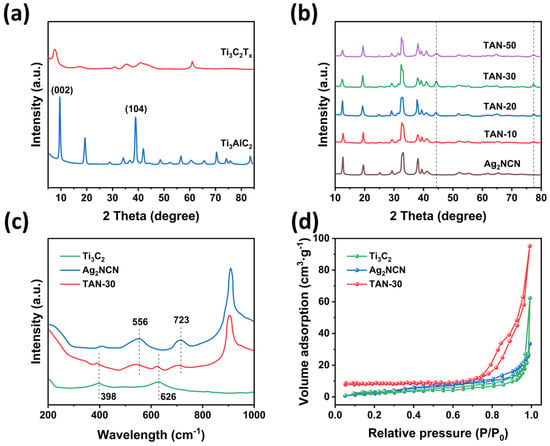
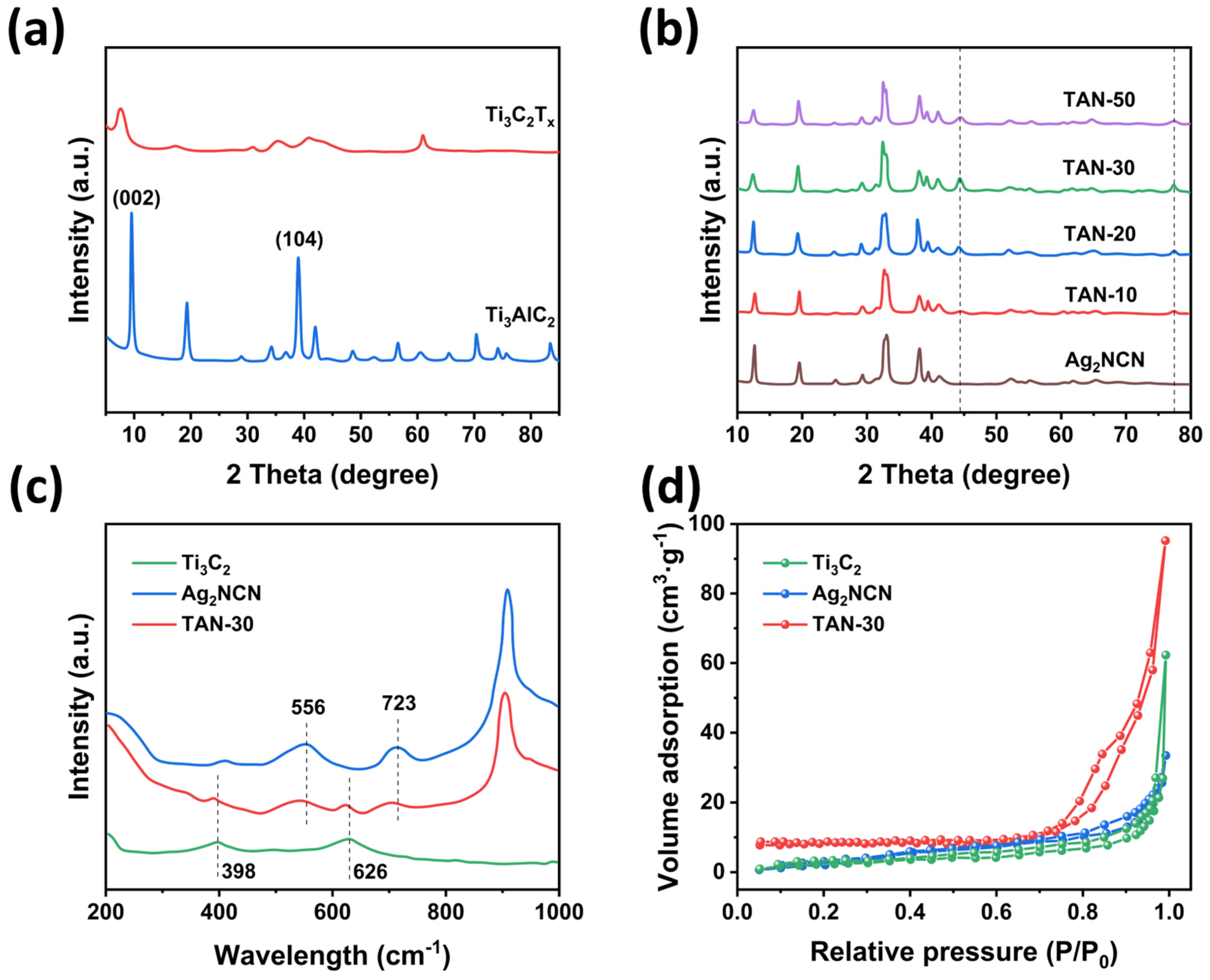
The crystal phase composition of the as-prepared samples was examined by X-Ray diffraction. In Figure 1a, the pristine MAX phase displays sharp reflections that match well with the reported Ti3AlC2 pattern [29]. Following HF etching and DMSO-assisted sonication exfoliation, the considerable weakening of the diffraction peaks, the near disappearance of the (104) reflection at approximately 39°, and the downshift in the (002) peak to a lower Bragg angle collectively confirm the successful removal of the Al layers and the conversion of the MAX precursor into Ti3C2 nanosheets [16]. Figure 1b presents the XRD profiles of Ag2NCN and the Ti3C2/Ag-Ag2NCN hybrids with varying Ti3C2 loadings. All samples show well-defined peaks attributable to Ag2NCN, indicating that the incorporation of Ti3C2 does not alter the lattice structure of Ag2NCN. The low Ti3C2 loading and its uniform distribution in the hybrids account for the absence of any detectable Ti3C2 reflections. Additionally, the hybrid XRD patterns reveal extra peaks corresponding to metallic Ag, which arise from the partial reduction of Ag+ by the low-valence Ti species present in Ti3C2 [21]. The emergence of Ag (200) and (311) reflections at 44.15° and 77.56° with plateaued intensities, observable when the Ti3C2 suspension addition reaches 30 mL (20 mg/mL), signals the establishment of a stable hybrid system.
Figure 1.
(a) XRD patterns of precursor Ti3AlC2 and product Ti3C2; (b) XRD patterns of Ag2NCN and its hybrids with varying Ti3C2 contents; (c) Raman spectra of Ti3C2, Ag2NCN, and TAN-30 for comparison; (d) N2 adsorption-desorption isotherms of Ti3C2, Ag2NCN, and TAN-30.
The Raman spectra of Ti3C2, Ag2NCN, and the TAN-30 hybrid are presented in Figure 1c. Pristine Ag2NCN shows distinct bands at 556 and 723 cm−1, whereas Ti3C2 has peaks at 398 and 626 cm−1. For TAN-30, these characteristic signals are weakened and shifted to lower wavenumbers relative to the pristine components, indicating the coexistence of Ti3C2 and Ag2NCN in the composite as well as a notable interfacial interaction between them. BET specific surface areas were derived from N2 adsorption–desorption isotherms (Figure 1d). All samples exhibit type IV isotherms with H3 hysteresis loops, characteristic of mesoporous structures. The calculated surface areas for Ti3C2, Ag2NCN and TAN-30 are 12, 9 and 20 m2 g−1, respectively. The hybrid TAN-30 shows a larger surface area than either pristine component, owing to the suppressed self-aggregation upon combining Ag2NCN with Ti3C2 [30]. This enlarged area affords additional active sites and facilitates ion transport, thereby promoting photocatalytic activity.
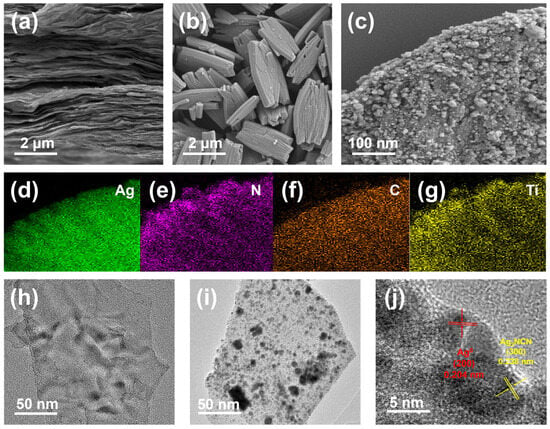
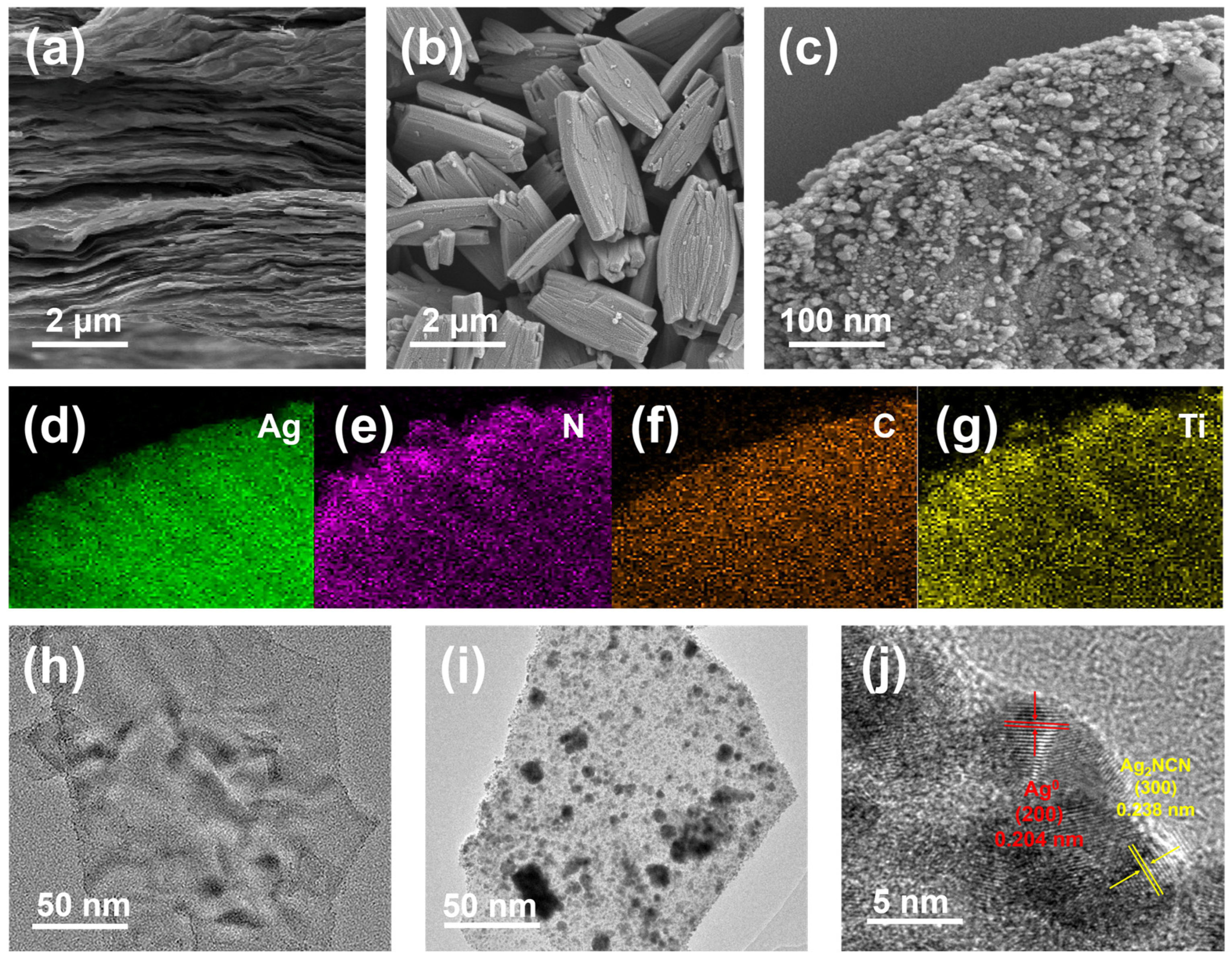
The surface morphologies of Ti3C2, Ag2NCN, and TAN-30 were examined via SEM, with the corresponding micrographs presented in Figure 2. The Ti3C2 sample exhibits a typical accordion-like multilayered structure with a smooth surface, confirming the complete removal of Al layers from the bulk Ti3AlC2 precursor after HF etching. Following DMSO intercalation and ultrasonic exfoliation, few-layer Ti3C2 nanosheets featuring distinct two-dimensional layered configurations were clearly observed (Figure 2a). In contrast, Ag2NCN displayed a micrometer-scale solid architecture composed of rectangular plate-like particles (Figure 2b). For TAN-30, which was prepared with the addition of 30 mL (25 mg·mL−1) Ti3C2 suspension, Ag/Ag2NCN nanoparticles were grown in situ onto the Ti3C2 nanosheet surfaces (Figure 2c). The corresponding elemental mapping (Figure 2d–g) corroborates the coexistence of Ag, N, C, and Ti within TAN-30 and further reveals their homogeneous dispersion throughout the composite.
Figure 2.
SEM images of (a) Ti3C2, (b) Ag2NCN, and (c) TAN-30 and (d–g) elemental mapping for TAN-30, TEM images of (h) Ti3C2 and (i) TAN-30 and (j) HRTEM images of TAN-30.
Transmission electron microscopy (TEM) was employed to further probe the microstructural features of the prepared samples. The ultrasonic exfoliation of Ti3C2 yielded thin, few-layered nanosheets with lateral dimensions on the order of several micrometers, as clearly observed in Figure 2h. For the TAN-30 composite (Figure 2i), Ag/Ag2NCN nanoparticles are seen to be anchored in situ onto the Ti3C2 surfaces, forming a close interfacial contact. Such an intimate junction is expected to facilitate the separation and migration of photogenerated charge carriers, thereby contributing to the enhanced photocatalytic performance. High-resolution TEM imaging (Figure 2j) resolved distinct lattice spacings of 0.204 nm and 0.238 nm, which correspond well to the (200) plane of metallic Ag and the (300) plane of Ag2NCN, respectively [31,32]. These findings corroborate the coexistence of Ag and Ag2NCN within TAN-30, in full agreement with the XRD results.
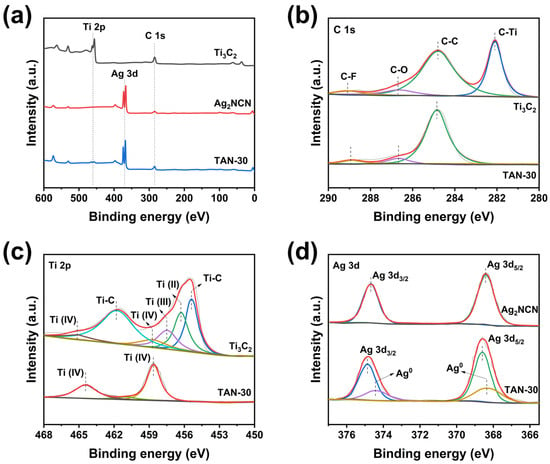
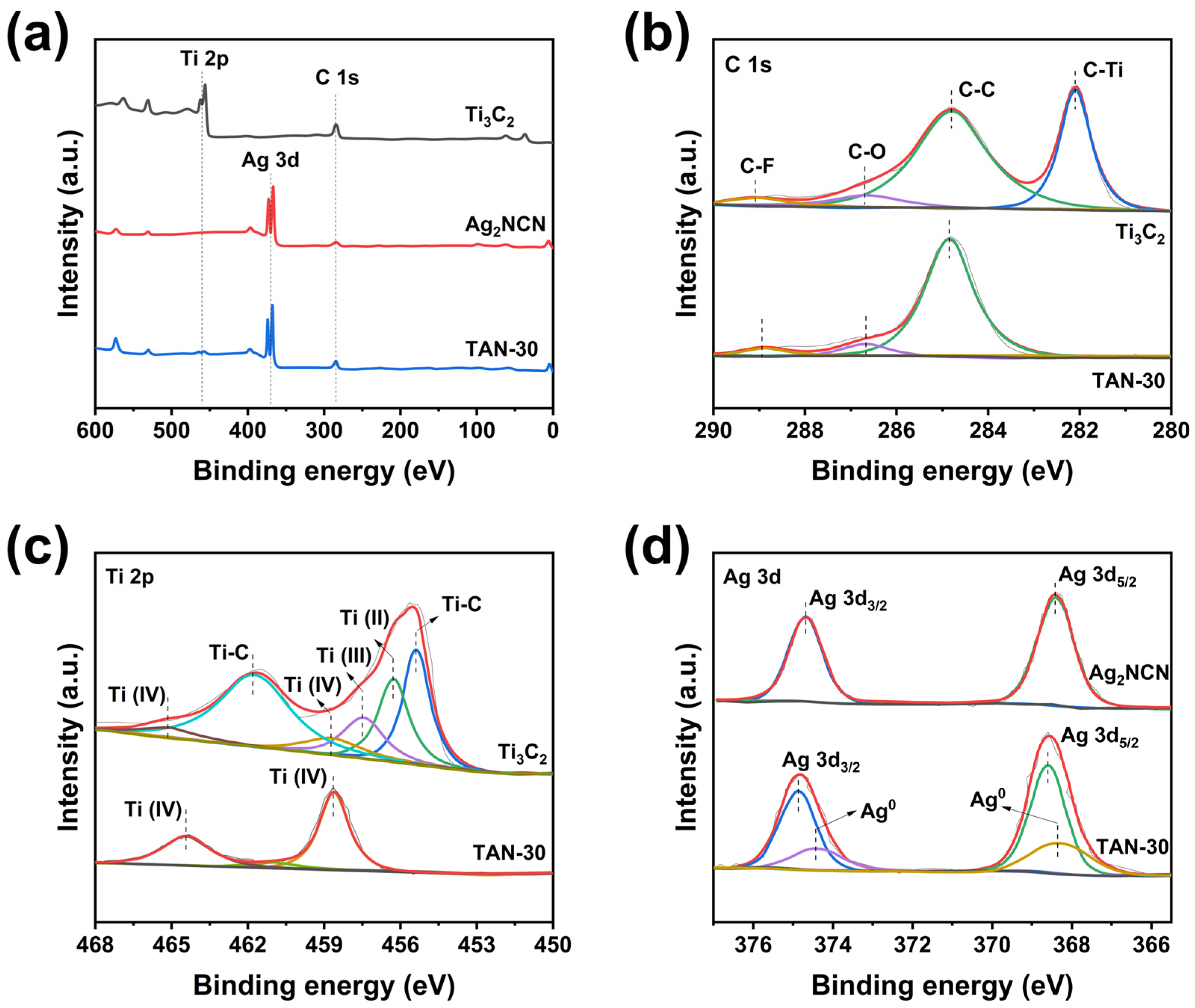
XPS analysis confirmed the elemental composition and interactions in the TAN-30 composite. Figure 3a presents the survey spectra of Ag2NCN, Ti3C2, and TAN-30, and the TAN-30 spectrum shows Ti, C, N, and Ag, consistent with elemental mapping (Figure 2d–g). As shown in Figure 3b, the C 1s spectrum of TAN-30 consists of four peaks at 282.1, 284.8, 286.7, and 289.2 eV, assigned to C–Ti, C–C, C–O, and C–F, respectively [33,34]. The significant attenuation of the C–Ti peak at 282.1 eV suggests that Ag2NCN forms a partial surface coating on the Ti3C2 nanosheets [35]. The Ti 2p spectrum of Ti3C2 is deconvoluted into six peaks at 455.5, 456.4, 457.3, 458.6, 461.8, and 465.2 eV, corresponding to Ti–C 2p3/2, Ti(II), Ti(III), Ti(IV) 2p3/2, Ti–C 2p1/2, and Ti(IV) 2p1/2 (Figure 3c) [36]. The low-valence Ti peaks are absent in TAN-30, implying that low-valence Ti species on the Ti3C2 surface provide localized electron-rich anchoring sites. These sites reduce the free energy barrier for Ag nucleation via heterogeneous nucleation pathways [37]. Notably, the Ti(IV) binding energies in TAN-30 shift negatively, whereas the Ag 3d peaks shift positively (Figure 3d), revealing electron transfer from Ag2NCN to Ti3C2 that favors charge separation and enhances photocatalytic activity. The Ag 3d spectrum of TAN-30 is resolved into peaks for Ag+ (367.8, 373.8 eV) and Ag0 (368.1, 374.6 eV), confirming the presence of metallic Ag [38]. To quantify the Ag0 and Ag+ proportions in the TAN composites, the Ag 3d high-resolution XPS spectra of the TAN samples (TAN-10, TAN-20, TAN-30, and TAN-50) were deconvoluted. The derived peak areas and Ag0/Ag+ ratios are summarized in Table S1.
Figure 3.
(a) Survey spectra of Ti3C2, Ag2NCN, and TAN-30; (b) C 1s and (c) Ti 2p high-resolution spectra (Ti3C2 vs. TAN-30); (d) Ag 3d high-resolution spectra (Ag2NCN vs. TAN-30).
2.2. Photoelectrochemical Performance
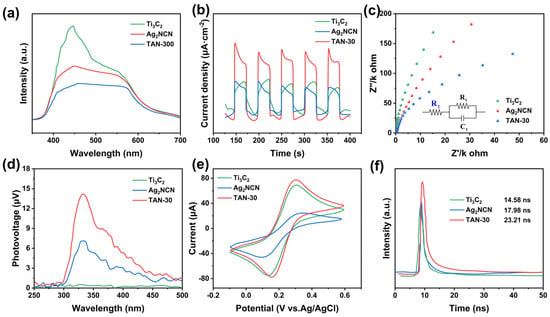
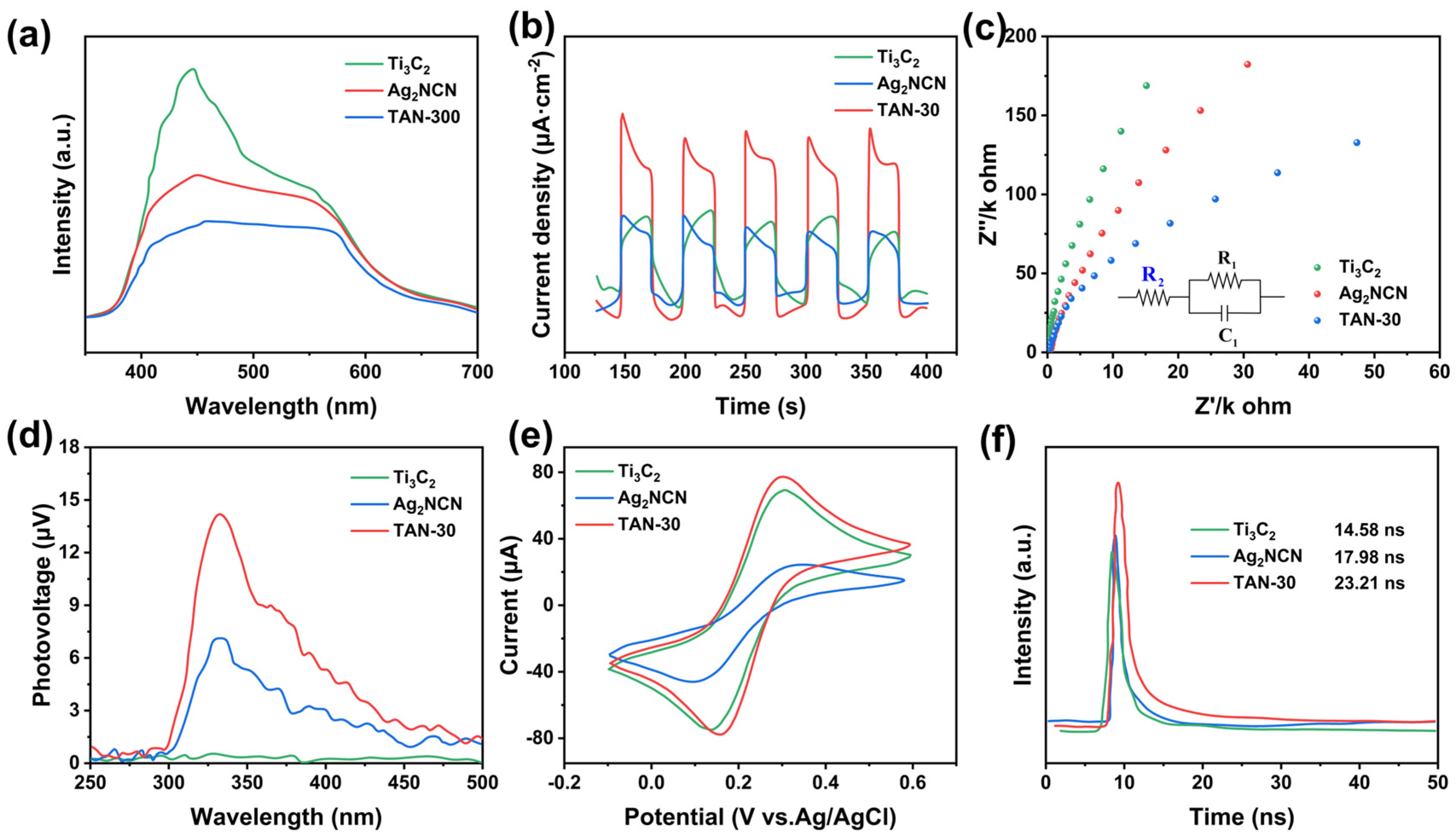
The efficiency of photogenerated charge separation and migration is pivotal for superior photocatalysis. To probe this aspect of the TAN-30 Schottky catalyst, we combined photoelectrochemical tests with steady-state and transient spectroscopy. Steady-state PL spectra (Figure 4a) revealed that the luminescence intensity of TAN-30 was lower than that of pristine Ti3C2 and Ag2NCN, indicating that their integration suppresses carrier recombination and promotes interfacial charge transfer, thus benefiting the photocatalytic reaction [39]. Transient photocurrent response (TPR) and electrochemical impedance spectroscopy (EIS) were further applied to the three samples to track charge transport dynamics. As shown in Figure 4b, TAN-30 exhibited a markedly higher photocurrent than the individual components during repeated on–off cycles, confirming its enhanced carrier separation capability [40]. Electrochemical impedance spectroscopy (EIS) was employed to probe the interfacial charge transfer kinetics (Figure 4c), where a diminished Nyquist arc radius signifies a lower charge transfer resistance [41]. The heterojunction exhibited a notably smaller arc diameter than either Ti3C2 or Ag2NCN, confirming that interfacing these two components effectively lowers the energy barrier for interfacial charge transfer and suppresses electron–hole pair recombination.
Figure 4.
(a) PL emission, (b) photocurrent density, (c) Nyquist plots from EIS, (d) SPV intensity, (e) CV traces, and (f) TR-PL attenuation profiles recorded for Ti3C2, Ag2NCN, and TAN-30 composite.
In line with this observation, the TAN-30 heterojunction delivered a substantially intensified surface photovoltage (SPV) response (Figure 4d). Both the SPV and photocurrent signals exhibited positive polarity, a feature characteristic of n-type semiconductors, where photogenerated holes tend to accumulate at the surface. Cyclic voltammetry (CV) measurements were further performed to evaluate the redox capability of the samples (Figure 4e). Compared with the pristine counterparts, the CV curve of TAN-30 presented a larger enclosed peak area, implying that the synergistic coupling between Ti3C2 and Ag2NCN is conducive to the oxidative degradation pathway [16]. To gain further insight into the carrier transport behavior, steady-state and time-resolved photoluminescence (PL) spectroscopy were carried out under 420 nm excitation. Upon the introduction of TC into the system, a marked improvement in carrier migration efficiency was observed. Specifically, TAN-30 showed pronounced PL quenching, while its transient carrier lifetime reached 23.21 ns—substantially longer than those of Ag2NCN (14.58 ns) and Ti3C2 (17.98 ns), further underscoring the beneficial role of heterojunction construction in prolonging charge separation [42]. These findings point to a synergistic mechanism in which the Schottky barrier and the localized surface plasmon resonance (LSPR) of Ag nanoparticles jointly facilitate photogenerated carrier separation and transport within TAN 30, accounting for its markedly enhanced photocatalytic activity.
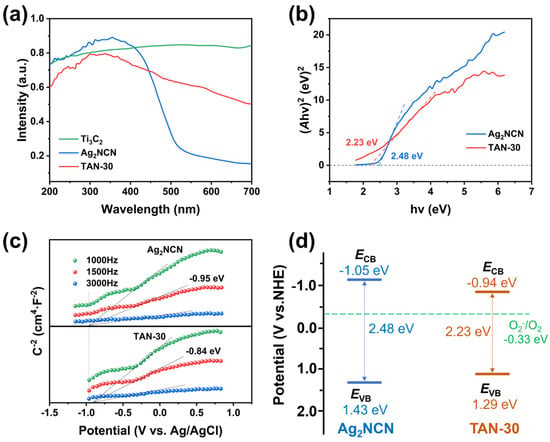
The band structure of the photocatalysts was probed by UV–visible diffuse reflectance spectroscopy (UV-DRS). As shown in Figure 5a, Ag2NCN exhibits an optical absorption edge at around 510 nm. In contrast, the TAN-30 heterojunction displays a clear red shift relative to pristine Ag2NCN. Moreover, a pronounced enhancement in light absorption is observed for TAN-30 over the 450–700 nm range, which is chiefly attributable to the surface plasmonic effect arising from Ag clusters [43]. Band gap energies were obtained by fitting the absorption data to the Tauc equation, (αhv) 1/m = A·(hv − Eg) [44], in which α, hv, and A denote the absorption coefficient, photon energy, and a constant, respectively. To determine the exponent m, we referred to the Mott–Schottky analysis. The positive slopes in Figure 5c for both Ag2NCN and TAN-30 confirm their n-type character, which implies an indirect transition (m = 2). The linear extrapolation of the Tauc plots (Figure 5b) then provided band gaps of 2.48 eV and 2.23 eV for Ag2NCN and TAN-30, respectively. Mott–Schottky measurements were further conducted to determine the band edge positions of the photocatalysts. As shown in Figure 5c, the flat-band potentials (Efb) of Ag2NCN and TAN-30 were found to be −0.95 and −0.84 V vs. Ag/AgCl, respectively. The conduction band (ECB) is typically taken as ca. 0.1 eV more negative than Efb for n-type semiconductors. Accordingly, the ECB values of Ag2NCN and TAN-30 were estimated to be −1.05 and −0.94 eV, respectively. Using the relation EVB = ECB + Eg, the corresponding valence band potentials (EVB) were calculated as 1.43 and 1.29 eV [38]. The resulting band alignment is schematically illustrated in Figure 5d. Notably, the redox potential of O2/•O2− (−0.33 eV) falls within the band gap, suggesting that the •O2− species may participate in the degradation process.
Figure 5.
(a) UV–Vis DRS of Ti3C2, Ag2NCN, and TAN-30 composite. (b) Tauc plots of Ti3C2, Ag2NCN, and TAN-30 composite. (c) Mott–Schottky of Ti3C2, Ag2NCN, and TAN-30 composite. (d) Energy band diagram of samples.
2.3. Photocatalytic Performance
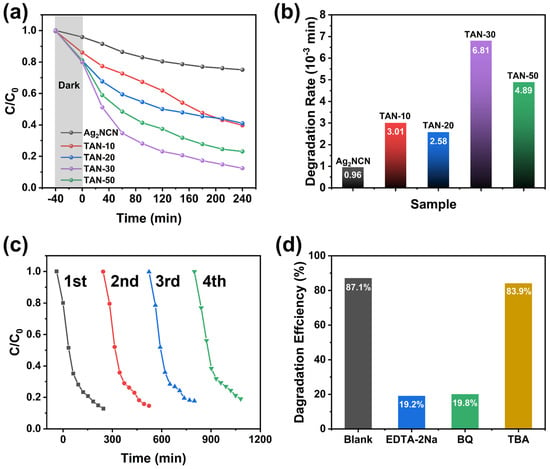
The photocatalytic degradation of tetracycline over Ag2NCN and Ti3C2/Ag–Ag2NCN (TAN) composites was evaluated under visible light irradiation (400–800 nm). As presented in Figure 6a, all TAN samples exhibited enhanced adsorption capacity during the dark equilibration stage relative to pristine Ag2NCN. Bare Ag2NCN showed negligible photoactivity, removing only 24.6% of tetracycline after 240 min of illumination. In contrast, the integration of Ti3C2 substantially boosted degradation efficiency, with the optimal TAN-30 composition achieving the highest removal rate of approximately 87.0% under identical conditions. The degradation kinetics were well described by a pseudo-first-order model (Figure 6b). The decolorization and structural destruction of TC do not necessarily equate to complete mineralization, as the generation of smaller organic intermediates may still pose environmental concerns. To evaluate the mineralization degree, total organic carbon (TOC) and chemical oxygen demand (COD) were monitored during the photocatalytic degradation of RhB over TAN-30. After 240 min of visible light irradiation, the removal efficiencies reached 59.2% for TOC and 66.8% for COD (Figure S4). Both values were lower than the corresponding TC degradation efficiency, which is attributable to the progressive accumulation of organic intermediates throughout the photocatalytic process. Nevertheless, the TOC data confirm that over 59.2% of the initial organic carbon in the RhB solution was ultimately mineralized to CO2. The rate constant of TAN-30 was determined to be 6.81 × 10⁻³ min−1, which is roughly 7.0 times that of pure Ag2NCN. To exclude the contributions of physical adsorption and increased specific surface area, a control experiment using a physically Ti3C2/Ag2NCN mix sample was performed (Figure S1). The marginal enhancement observed in the physical mixture, compared to the chemically bonded composite, confirms that the dominant mechanism is interfacial charge transfer (Schottky effect) and plasmonic resonance coupling, rather than mere textural or adsorptive effects. Furthermore, recycling experiments confirmed the satisfactory stability of TAN-30 over repeated degradation cycles.
Figure 6.
(a) Photocatalytic degradation performance of tetracycline over as-prepared samples; (b) corresponding pseudo-first-order kinetic linear fittings. (c) Reusability test of TAN-30 through cyclic runs; (d) radical trapping experiments for identifying main active species in TAN-30 system.
The reusability and structural stability of TAN-30 were assessed through cyclic photocatalytic experiments (Figure 6c). Over four successive runs, no appreciable loss in tetracycline (TC) degradation activity was observed, confirming the satisfactory recyclability of the composite. The structural stability of the TAN-30 composite was further investigated by comparing the XRD patterns of the fresh and used catalysts after the cycling tests (Figure S3). As shown in Figure S3, no discernible changes in peak positions or intensities were observed for either the Ti3C2 or metallic Ag components, confirming the absence of photocorrosion or oxidation during the photocatalytic reaction. To identify the primary reactive species involved in the degradation process, radical trapping experiments were carried out using ethylenediaminetetraacetic acid disodium salt (EDTA-2Na), benzoquinone (BQ) and tert-butanol (TBA) as quenchers for holes (h+), superoxide radicals (•O2−) and hydroxyl radicals (•OH), respectively [45]. As displayed in Figure 6d, the photocatalytic degradation efficiency in the absence of any scavenger (blank) reached 87.1%. Upon the addition of EDTA-2Na (1.0 mM), a hole (h+) scavenger, and p-benzoquinone (BQ, 1.0 mM), a superoxide radical (•O2−) scavenger, the degradation efficiencies were dramatically suppressed to 19.2% and 19.8%, respectively. This significant inhibition indicates that h+ and •O2− are the two dominant reactive species governing the photocatalytic reaction. In contrast, the addition of tert-butanol (TBA, 1.0 mM), a hydroxyl radical (•OH) scavenger, resulted in only a marginal decrease from 87.1% to 83.9%. This minor suppression suggests that •OH plays only a negligible role in the degradation process.
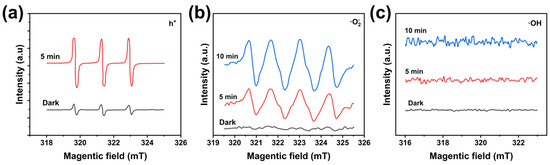
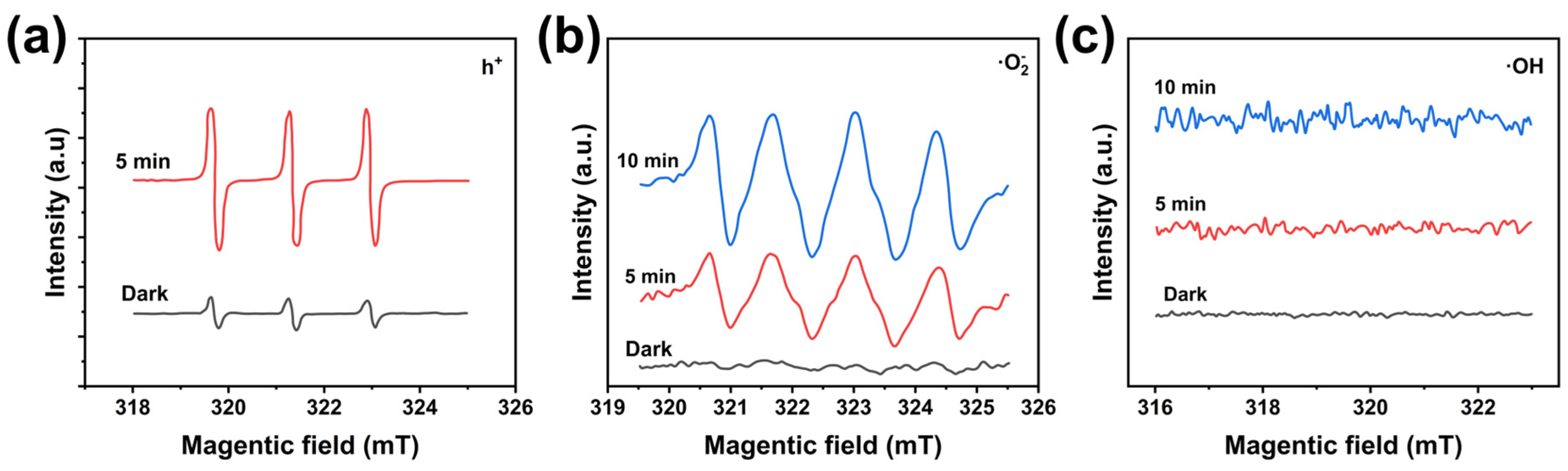
Spin-trapping ESR measurements were performed to identify the reactive species involved in the photocatalytic degradation of tetracycline. DMPO and TEMPO were used as spin traps for •O2−, •OH and h+, respectively [46]. As shown in Figure 6, no characteristic DMPO-•O2− or DMPO-•OH signals were detected in the dark, while a weak TEMPO-h+ peak was observed. Upon irradiation with a 300 W Xe lamp, the TEMPO-h+ signal increased markedly, and the DMPO–•O2− peaks grew progressively with extended illumination (Figure 7a,b). In contrast, no clear •OH-derived peaks were resolved, although a slight rise in the baseline signal was noted (Figure 7c). These observations confirm that both superoxide radicals and photogenerated holes participate in the photocatalytic process.
Figure 7.
ESR spectra of TEMPO-h+, DMPO-•O2−, and DMPO-•OH adducts in TAN-30 dispersion under Xe lamp irradiation: (a) h+, (b) •O2−, (c) •OH.
2.4. Analysis of Photocatalytic Mechanism
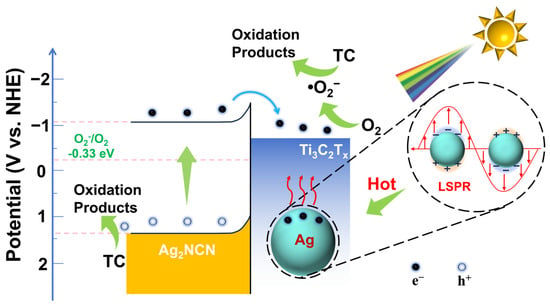
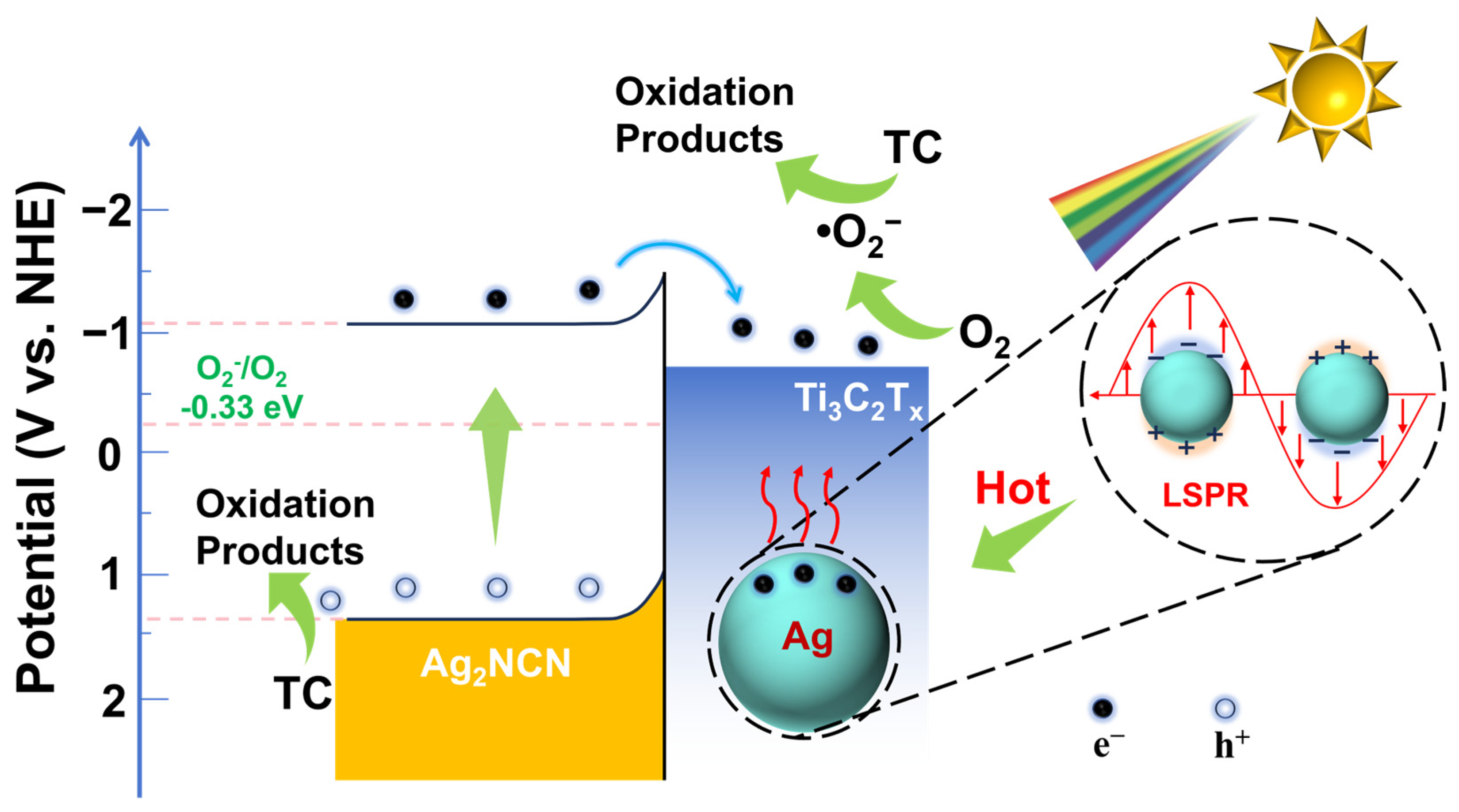
The photothermal response of the photocatalysts was evaluated by tracking the sample temperature via thermal imaging throughout visible light irradiation (Figure S2). A temperature gap of approximately 20 °C was observed between the TAN-30 composite and the neat Ag2NCN at the end of the illumination period, with the former reaching a markedly higher steady-state temperature. Although this photothermal conversion capability is notable, the photocatalytic experiments were conducted at a controlled temperature of 6 °C, where macroscopic photothermal heating is effectively suppressed. Therefore, the LSPR effect of Ag0 is proposed to operate predominantly via a nonthermal mechanism, namely the injection of hot electrons from plasmon-excited Ag0 into the adjacent Ag2NCN and Ti3C2 components. The proposed mechanism for the enhanced reactive oxygen species (ROS) generation over the TAN Schottky heterojunction under visible–near-infrared (vis–NIR) irradiation is illustrated in Figure 8. Upon photoexcitation, electrons in Ag2NCN are promoted to the conduction band and migrate across the Schottky interface to Ti3C2. The built-in Schottky barrier effectively suppresses charge recombination, thus promoting electron–hole separation. Concurrently, hot electrons generated from the LSPR-excited Ag0 are injected into the conduction band of Ag2NCN or directly into Ti3C2, further contributing to charge density. Meanwhile, the high electrical conductivity of layered Ti3C2 facilitates rapid electron transport, synergistically enhancing carrier separation. As a result, the optimal integration of Ag–Ag2NCN with Ti3C2 leads to significantly enhanced ROS production.
Figure 8.
A schematic illustration of the charge transfer and ROS generation mechanism over the TAN Schottky heterojunction.
3. Materials and Methods
3.1. Chemicals and Reagents
Ti3AlC2 powder (purity ≥98%, 200 mesh) was purchased from Jilin 11 Technology Co., Ltd. (China). Sodium fluoride (NaF, ≥99.0%, AR), hydrochloric acid (HCl, 36.0–38.0%, GR), ammonia solution (NH3·H2O, 25.0–28.0%, AR), and absolute ethanol (≥99.7%, AR) were obtained from Sinopharm Chemical Reagent Co., Ltd. (China). Silver nitrate (AgNO3, ≥99.8%, AR) and sodium borohydride (NaBH4, ≥98.0%, AR) were purchased from Shanghai Aladdin Biochemical Technology Co., Ltd. (China). Cyanamide (H2NCN, ≥98.0%, AR) was supplied by Shanghai Macklin Biochemical Co., Ltd. (China). Deionized (DI) water (resistivity ≥18.2 MΩ·cm) was produced by a Millipore Direct-Q UV water purification system and used throughout all experiments. All chemicals were used as received without further purification.
3.2. Synthesis of Ti3C2Tx
Ti3C2Tx was synthesized via the selective etching of Ti3AlC2 using a solution prepared by dissolving NaF (5.0 g) in 40.0 mL of hydrochloric acid (9.0 M) [47]. Typically, 2.0 g of Ti3AlC2 powder was gradually added to the etching solution (40.0 mL), and the suspension was stirred at 35 °C for 72 h. The resulting product was washed repeatedly with HCl and deionized water until the pH exceeded 6, then collected by centrifugation (8000 rpm, 5 min) and dried under vacuum at 60 °C overnight.
3.3. Synthesis of Ag2NCN
AgNO3 (0.85 g) was dissolved in deionized water (20 mL), followed by the rapid addition of NH3·H2O solution (1.5 M, 125.0 mL) under magnetic stirring to form a clear solution. The dropwise addition of cyanamide (H2NCN) aqueous solution (5.0 mL, containing 0.21 g, 5.0 mmol) caused the mixture to turn golden yellow with immediate precipitation. The precipitate was collected by centrifugation (3500 rpm, 5 min), washed three times with deionized water, and dried under vacuum at 60 °C overnight [22].
3.4. Synthesis of Preparation of Ti3C2/Ag–Ag2NCN Composites
A series of Ti3C2/Ag–Ag2NCN composites with varied Ag loadings, denoted as TAN-x (x = 10, 20, 30, 50), was prepared via an in situ precipitation–chemical reduction route. In a typical procedure, Ti3C2Tx powder (0.05 g) was dispersed in deionized water (20 mL) by ultrasonication for 30 min. A specified amount of AgNO3 (10, 20, 30, and 50 mmol) was dissolved in the above dispersion, followed by the rapid addition of NH3·H2O solution (1.5 M, 125.0 mL) under magnetic stirring to form a clear solution. The dropwise addition of an aqueous cyanamide (H2NCN) solution (with the same molar amount as AgNO3, in a total volume of 5.0 mL) immediately generated a golden-yellow precipitate of Ag2NCN, which deposited onto the Ti3C2 sheets. After stirring for 30 min, an aqueous NaBH4 solution was added dropwise over 10 min under vigorous stirring, reducing the Ag+ to metallic Ag0. The suspension was stirred for an additional 1 h. The final solid was collected by centrifugation, washed repeatedly with deionized water, and dried under vacuum at 60 °C overnight.
3.5. Photocatalytic Measurement
The photocatalytic degradation of tetracycline (TC) was carried out in a quartz photoreactor under a 300 W Xe lamp (PLS-SXE300, Beijing Perfectlight Technology Co., Ltd., China) equipped with a UV cutoff filter (λ > 420 nm) used as the visible light source. The spectrum confirms that the lamp predominantly emits in the visible light region (420–800 nm) with negligible UV components below 420 nm. The distance between the lamp and the surface of the reaction solution was fixed at 15 cm. In a typical experiment, 20 mg of the catalyst was dispersed in 100 mL of TC aqueous solution (20 mg·L−1). Before illumination, the suspension was magnetically stirred in the dark for 40 min to establish adsorption–desorption equilibrium. The reaction temperature was maintained at 6 °C by a circulating water jacket. At regular intervals, aliquots of the suspension were sampled, filtered through a 0.22 μm membrane, and analyzed using a UV-Vis spectrophotometer to monitor the residual TC concentration. Degradation efficiency was calculated from the change in absorbance at the characteristic absorption peak of TC. The concentration of tetracycline (TC) during the photocatalytic degradation experiments was determined by measuring absorbance at its characteristic absorption wavelength (λmax = 357 nm) using a UV-Vis spectrophotometer (Shimadzu UV-2600).
3.6. Reusability and Radical Trapping Experiments
To evaluate the stability and reusability of the TAN-30 composite, the photocatalyst was recovered after each photocatalytic degradation run by centrifugation at 8000 rpm for 10 min. The recovered catalyst was subsequently washed three times with deionized water and once with absolute ethanol, then dried in an oven at 60 °C for 12 h. The dried catalyst was directly reused in the next cycle under identical reaction conditions without any further regeneration. This recycling procedure was repeated for 4 consecutive runs, and the degradation efficiency of each cycle was recorded.
For the radical trapping experiments, the photocatalytic degradation of TC was carried out under identical conditions in the presence of various radical scavengers to identify the main reactive oxygen species (ROS). Specifically, tert-butanol (TBA, 1.0 mM) was employed as a hydroxyl radical (•OH) scavenger, benzoquinone (BQ, 1.0 mM) as a superoxide radical (•O2−) scavenger, and ethylenediaminetetraacetic acid disodium salt (EDTA-2Na, 1.0 mM) as a photogenerated hole (h+) scavenger. All scavengers were added to the TC solution prior to the addition of the photocatalyst and light irradiation. The photocatalytic activity in the presence of each scavenger was compared to that of the control experiment (without scavenger) performed under the same conditions.
3.7. Sample Characterizations
Powder X-ray diffraction (XRD) patterns were collected on a Bruker D8 Advance diffractometer with Cu Kα radiation (λ = 1.5418 Å) over 2θ = 5–80°. Raman spectra were recorded on a Renishaw inVia confocal microscope using 532 nm laser excitation. Scanning electron microscopy (SEM) and energy-dispersive X-ray spectroscopy (EDS) mapping were performed on a Zeiss Sigma 300 field-emission SEM, while transmission electron microscopy (TEM) and high-resolution TEM (HRTEM) were conducted on an FEI Talos F200X operated at 200 kV. X-ray photoelectron spectroscopy (XPS) was carried out on a Thermo Scientific K-Alpha spectrometer with monochromatic Al Kα radiation, and binding energies were calibrated using the C 1s peak at 284.8 eV. Nitrogen adsorption–desorption isotherms were measured at 77 K on a Micromeritics ASAP 2460 analyzer, with specific surface areas determined by the Brunauer–Emmett–Teller (BET) method. UV–vis diffuse reflectance spectra (UV–Vis DRS) were obtained on a Shimadzu UV-2600 spectrophotometer fitted with an integrating sphere, using BaSO4 as a reference. Photoluminescence (PL) and time-resolved PL (TRPL) decay profiles were acquired on an Edinburgh Instruments FLS1000 spectrometer at an excitation wavelength of 420 nm. Electrochemical measurements—including transient photocurrent response, electrochemical impedance spectroscopy (EIS), Mott–Schottky analysis, and cyclic voltammetry (CV)—were performed on a CHI 760E workstation in a standard three-electrode cell with a Pt wire counter electrode, an Ag/AgCl reference electrode, and a catalyst-coated FTO working electrode in 0.5 M Na2SO4 aqueous solution. Surface photovoltage (SPV) measurements were conducted on a home-built system with a lock-in amplifier. Electron spin resonance (ESR) spectra were recorded on a Bruker E500 spectrometer using DMPO and TEMPO as spin traps for •O2−/•OH and h+, respectively, under both dark and light irradiation.
4. Conclusions
In summary, a series of Ti3C2/Ag-Ag2NCN (TAN) Schottky heterojunctions with varying Ag loadings was successfully fabricated via an in situ precipitation–chemical reduction route, during which metallic Ag0 was generated concurrently with Ag2NCN deposition onto Ti3C2Tx nanosheets. Systematic characterizations confirmed the formation of intimate interfacial contacts among the three components, with Ag0 serving dual roles as a plasmonic photosensitizer and an electron mediator. The optimized TAN-30 composite exhibited a tetracycline degradation efficiency of 87.0% under visible light irradiation within 240 min, with a pseudo-first-order rate constant approximately 7.0 times that of pristine Ag2NCN. The enhanced photocatalytic performance is attributed to the synergistic interplay between the Schottky barrier at the Ti3C2/Ag2NCN interface and the LSPR effect of in situ formed Ag0. The Schottky junction facilitates unidirectional electron transfer from Ag2NCN to Ti3C2, effectively suppressing charge recombination, while the LSPR effect broadens the light absorption range and promotes hot electron injection. This work not only demonstrates the rational design of MXene-based plasmonic heterojunctions through in situ reduction strategies but also provides mechanistic insights into the cooperative enhancement in charge separation and light harvesting.
Supplementary Materials
The following supporting information can be downloaded at https://www.mdpi.com/article/10.3390/molecules31172955/s1, Figure S1: Photocatalytic degradation performance of tetracycline over the Ti3C2/Ag2NCN-mix samples; Figure S2: Temperature change of Ag2NCN and TAN-30 under/after VL (inset: IR images); Figure S3: XRD patterns of the TAN-30 after cycling four times; Figure S4: The COD and TOC removal rate of TC over TAN-30 nanocomposite; Table S1: Peak area and peak area ratio of Ag+ and Ag0 in TAN composites from Ag 3d high-resolution XPS.
Author Contributions
Conceptualization, H.Y. and H.D.; methodology, J.W. (Jincheng Wang); software, X.S.; validation, H.Y., H.D. and J.L.; formal analysis, P.Q.; investigation, J.W. (Jincheng Wang); resources, J.W. (Jie Wu); data curation, P.Q.; writing—original draft preparation, H.Y.; writing—review and editing, H.Y.; visualization, J.L.; supervision, P.Q.; project administration, H.Y.; funding acquisition, J.W. (Jie Wu). All authors have read and agreed to the published version of the manuscript.
Funding
This research was funded by “National Technical Support and Services for Gold and Other Strategic Mineral Analysis, DD20251133” and “Yanzhao Landscape Science and Technology Innovation Fund, KY01202608”.
Institutional Review Board Statement
Not applicable.
Informed Consent Statement
Not applicable.
Data Availability Statement
The authors confirm that the data supporting the findings of this study are available within the article.
Conflicts of Interest
The authors declare no conflicts of interest.
References
- Ma, R.; Zhu, J.; Xu, Z.; Shi, Q.; Zhang, L.; Fan, J. Novel biomass carbon dots/chitosan hydrogel-modified TiO2: An effective reduction of Cr(VI) in various wastewater under sunlight. Sep. Purif. Technol. 2025, 357, 130082. [Google Scholar] [CrossRef] [Scilit]
- Li, B.; Zhang, J.; Li, Y.; Ma, X.; Lei, M.; Jin, Z. Rapid interfacial charge transfer over Cd0.8Mn0.2S/MoS2 type I heterojunction for enhanced photocatalytic hydrogen evolution. J. Water Process Eng. 2025, 77, 108587. [Google Scholar] [CrossRef] [Scilit]
- Wang, J.; Fu, S.; Hou, P.; Liu, J.; Li, C.; Zhang, H.; Wang, G. Construction of TiO2/CuPc Heterojunctions for the Efficient Photocatalytic Reduction of CO2 with Water. Molecules 2024, 29, 1899. [Google Scholar] [CrossRef] [Scilit] [PubMed]
- Wu, F.-D.; Chen, J.-C.; Hu, J.-P. Synthesis of TiO2/Ti3C2T/AgI Z-scheme photocatalyst for tetracycline hydrochloride photocatalytic degradation. J. Environ. Chem. Eng. 2022, 10, 107117. [Google Scholar] [CrossRef] [Scilit]
- Rezaei, M.; Nezamzadeh-Ejhieh, A.; Massah, A.R. A Comprehensive Review on the Boosted Effects of Anion Vacancies in Photocatalytic Solar Water Splitting: Focus on g-C3N4 with Carbon and Nitrogen Vacancies. Energy Fuels 2024, 38, 8406–8436. [Google Scholar] [CrossRef] [Scilit]
- Han, J.; Xu, J.; Ning, X.; Zheng, M.; Lan, S. Synergistic morphological engineering and Schottky junction design Cu3(MoO4)2(OH)2/Boron composites for high-efficiency solar hydrogen evolution. Int. J. Hydrogen Energy 2025, 148, 150032. [Google Scholar] [CrossRef] [Scilit]
- Bi, Q.; Wang, K.; Zhao, Y.; Wu, G.; Zhou, Y.; Tang, C.; Leng, Z.; Xue, J. Synergistic effect of upconversion and LSPR effect in GdF3:Yb3+, Er3+/g-C3N4/Ag ternary photocatalyst for enhancing tetracycline hydrochloride photodegradation. Appl. Surf. Sci. 2026, 736, 166841. [Google Scholar] [CrossRef] [Scilit]
- Tian, F.; Li, Y.; Miao, W.; Liang, J.; Rodríguez, D.V.C.; Yan, X. Internal electric field-modulated charge migration behavior in atom co-sharing Bi2S3/Bi2Sn2O7 heterojunction for efficient tetracycline degradation. Surf. Interfaces 2025, 62, 106280. [Google Scholar] [CrossRef] [Scilit]
- Davi, M.; Drichel, A.; Mann, M.; Scholz, T.; Schrader, F.; Rokicinska, A.; Kustrowski, P.; Dronskowski, R.; Slabon, A. Enhanced Photoelectrochemical Water Oxidation Efficiency of CuWO4 Photoanodes by Surface Modification with Ag2NCN. J. Phys. Chem. C 2017, 121, 26265–26274. [Google Scholar] [CrossRef] [Scilit]
- Zhao, W.; Liu, Y.; Liu, J.; Chen, P.; Chen, I.W.; Huang, F.; Lin, J. Controllable synthesis of silver cyanamide as a new semiconductor photocatalyst under visible-light irradiation. J. Mater. Chem. A 2013, 1, 7942. [Google Scholar] [CrossRef] [Scilit]
- Li, Y.; Cao, C.; Zhang, Q.; Lu, Y.; Zhao, Y.; Li, Q.; Li, X.; Huang, T. Nanorod bundle-like silver cyanamide nanocrystals for the high-efficiency photocatalytic degradation of tetracycline. RSC Adv. 2021, 11, 10235–10242. [Google Scholar] [CrossRef] [Scilit] [PubMed]
- Meng, H.; Li, X.; Zhang, X.; Liu, Y.; Xu, Y.; Han, Y.; Xu, J. Fabrication of nanocomposites composed of silver cyanamide and titania for improved photocatalytic hydrogen generation. Dalton Trans. 2015, 44, 19948. [Google Scholar] [CrossRef] [Scilit] [PubMed]
- Yang, Z.; Wu, B.; Niu, S.; Zhai, C.; Xu, T.; Dang, L.; Qi, X.; Liu, X.; Shi, R.; Ma, S.; et al. Pressure-induced bandgap engineering and polymerization of silver cyanamide. Chem. Phys. Lett. 2024, 840, 141142. [Google Scholar] [CrossRef] [Scilit]
- Guan, Y.; Zhao, S.; Li, J.; Deng, X.; Ma, S.; Zhang, Y.; Jiang, B.; Yao, T.; Xin, B.; Zhang, J.; et al. Partially oxidized MXenes-derived C-TiO(2)/Ti(3)C(2) coupled with Fe-C(3)N(4) as a ternary Z-scheme heterojunction: Enhanced photothermal and photo-Fenton performance. J. Colloid Interface Sci. 2022, 626, 639–652. [Google Scholar] [CrossRef] [Scilit] [PubMed]
- Chen, X.; Guo, Y.; Bian, R.; Ji, Y.; Wang, X.; Zhang, X.; Cui, H.; Tian, J. Titanium carbide MXenes coupled with cadmium sulfide nanosheets as two-dimensional/two-dimensional heterostructures for photocatalytic hydrogen production. J. Colloid Interface Sci. 2022, 613, 644–651. [Google Scholar] [CrossRef] [Scilit] [PubMed]
- Zhang, Y.; Chen, W.; Yang, B.; Zou, Z.; Yang, N.; Gao, E.; Fedin, V.P. Design and synthesis of Ti3C2-functionalized Cd complexes and their ultrasensitive recognition of rutin. Chem. Eng. J. 2025, 507, 160597. [Google Scholar] [CrossRef] [Scilit]
- Qin, X.; Cao, R.; Gong, W.; Luo, L.; Shi, G.; Ji, L.; Zhu, A. Hydrothermal growth of ZnCdS/TiO2 nanoparticles on the surface of the Ti3C2 MXene sheet to enhance photocatalytic performance under visible light. J. Solid State Chem. 2022, 306, 122750. [Google Scholar] [CrossRef] [Scilit]
- Zhuge, Z.; Liu, X.; Chen, T.; Gong, Y.; Li, C.; Niu, L.; Xu, S.; Xu, X.; Alothman, Z.A.; Sun, C.Q.; et al. Highly efficient photocatalytic degradation of different hazardous contaminants by CaIn2S4-Ti3C2Tx Schottky heterojunction: An experimental and mechanism study. Chem. Eng. J. 2021, 421, 127838. [Google Scholar] [CrossRef] [Scilit]
- Tran, N.M.; Ta, Q.T.H.; Noh, J.-S. Unusual synthesis of safflower-shaped TiO2/Ti3C2 heterostructures initiated from two-dimensional Ti3C2 MXene. Appl. Surf. Sci. 2021, 538, 148023. [Google Scholar] [CrossRef] [Scilit]
- Liu, W.; Sun, M.; Ding, Z.; Gao, B.; Ding, W. Ti3C2 MXene embellished g-C3N4 nanosheets for improving photocatalytic redox capacity. J. Alloys Compd. 2021, 877, 160223. [Google Scholar] [CrossRef] [Scilit]
- Yu, H.; Jiang, H.; Cao, X.; Yao, S. Ag2NCN anchored on Ti3C2TxMXene as a Schottky heterojunction: Enhanced visible light photocatalytic efficiency of rhodamine B degradation. RSC Adv. 2023, 13, 16602–16609. [Google Scholar] [CrossRef] [Scilit] [PubMed]
- Zhou, H.; Jiresse, N.K.L.; Zhang, W.; Chen, Z.; Zhang, Y.; Zhang, J. MXene-derived TiO2/MXene-loaded Ag for the degradation of the methyl orange. J. Mater. Res. 2021, 36, 5002–5012. [Google Scholar] [CrossRef] [Scilit]
- Yu, X.; Huang, J.; Zhao, J.; Liu, S.; Xiang, D.; Tang, Y.; Li, J.; Guo, Q.; Ma, X.; Zhao, J. Efficient visible light photocatalytic antibiotic elimination performance induced by nanostructured Ag/AgCl@Ti3+-TiO2 mesocrystals. Chem. Eng. J. 2021, 403, 126359. [Google Scholar] [CrossRef] [Scilit]
- Yu, K.; Wang, S.; Li, Q.; Hou, T.; Xin, Y.; He, R.; Zhang, W.; Liang, S.; Wang, L.; Zhu, W. Au atoms doped in Ti3C2Tx MXene: Benefiting recovery of oxygen vacancies towards photocatalytic aerobic oxidation. Nano Res. 2021, 15, 2862–2869. [Google Scholar] [CrossRef] [Scilit]
- Sharma, N.; Charan, S.; Kumar, D.; Saini, S.; Sulania, I.; Vishwakarma, A.K.; Srivastava, S. Preparation of Ti3AlC2 MAX-phase as a precursor material using industrial waste carbon flex for MXene synthesis. Ceram. Int. 2024, 50, 55706–55713. [Google Scholar] [CrossRef] [Scilit]
- Liu, J.; Kong, X.; Li, Y.; Zhu, S.; Liang, Y.; Li, Z.; Wu, S.; Chang, C.; Cui, Z.; Yang, X. In situ synthesis of exfoliation TiO2@C hybrids with enhanced photocatalytic hydrogen evolution activity. Appl. Surf. Sci. 2020, 530, 147283. [Google Scholar] [CrossRef] [Scilit]
- Rozmysłowska, A.; Wojciechowski, T.; Ziemkowska, W.; Chlubny, L.; Olszyna, A.; Poźniak, S.; Tomkiewicz, K.; Jastrzębska, A.M. Colloidal Properties and Stability of 2D Ti3C2 and Ti2C MXenes in Water. Int. J. Electrochem. Sci. 2018, 13, 10837–10847. [Google Scholar] [CrossRef] [Scilit]
- Cai, T.; Wang, L.L.; Liu, Y.T.; Zhang, S.Q.; Dong, W.Y.; Chen, H.; Yi, X.Y.; Yuan, J.L.; Xia, X.N.; Liu, C.B.; et al. Ag3PO4/Ti3C2 MXene interface materials as a Schottky catalyst with enhanced photocatalytic activities and anti-photocorrosion performance. Appl. Catal. B-Environ. 2018, 239, 545–554. [Google Scholar] [CrossRef] [Scilit]
- Prathibha, C.P.; Mallapur, S. Interface-engineered Ti3C2 MXene/TiO2/NiCo2O4 Z-scheme heterostructure for efficient visible light driven photocatalyst. FlatChem 2026, 58, 101066. [Google Scholar] [CrossRef] [Scilit]
- Liu, J.; Chang, Y.; Guo, H.; Cao, D.; Sun, K.; Wang, T.; Liu, D.; Fu, Y.; Liu, J.; He, D. Self-assembled Ti3C2Tx/poly(diallyldimethylammonium chloride)-graphene oxide multilayers with large layer spacing for high capacity sodium-ion batteries. J. Power Sources 2024, 624, 235492. [Google Scholar] [CrossRef] [Scilit]
- Promhuad, P.; Sawatmongkhon, B.; Theinnoi, K.; Wongchang, T.; Chollacoop, N.; Sukjit, E.; Tunmee, S.; Tsolakis, A. Effect of Metal Oxides (CeO2, ZnO, TiO2, and Al2O3) as the Support for Silver-Supported Catalysts on the Catalytic Oxidation of Diesel Particulate Matter. ACS Omega 2024, 9, 19282–19294. [Google Scholar] [CrossRef] [Scilit] [PubMed]
- Fu, Z.; Wang, Y.; Li, Z.; Song, T.; Long, B.; Ali, A.; Deng, G.J. Controllable synthesis of porous silver cyanamide nanocrystals with tunable morphologies for selective photocatalytic CO2 reduction into CH4. J. Colloid Interface Sci. 2021, 593, 152–161. [Google Scholar] [CrossRef] [Scilit] [PubMed]
- Natu, V.; Benchakar, M.; Canaff, C.; Habrioux, A.; Célérier, S.; Barsoum, M.W. A critical analysis of the X-ray photoelectron spectra of Ti3C2Tz MXenes. Matter 2021, 4, 1224–1251. [Google Scholar] [CrossRef] [Scilit]
- Miao, Z.; Wang, G.; Zhang, X.; Dong, X. Oxygen vacancies modified TiO2/Ti3C2 derived from MXenes for enhanced photocatalytic degradation of organic pollutants: The crucial role of oxygen vacancy to schottky junction. Appl. Surf. Sci. 2020, 528, 146929. [Google Scholar] [CrossRef] [Scilit]
- Zhang, B.; Chen, Y.; Li, F.; Zhang, Y.; Li, X.; Xiong, W.; Dai, W. Photocatalytic CO2 reduction of Ag/Ag2S/Ti3C2TX heterojunctions with enhanced interfacial charge transfer. Nanoscale Adv. 2025, 7, 1195–1203. [Google Scholar] [PubMed]
- Pazniak, H.; Benchakar, M.; Bilyk, T.; Liedl, A.; Busby, Y.; Noël, C.; Chartier, P.; Hurand, S.; Marteau, M.; Houssiau, L.; et al. Ion Implantation as an Approach for Structural Modifications and Functionalization of Ti3C2Tx MXenes. ACS Nano 2021, 15, 4245–4255. [Google Scholar] [CrossRef] [Scilit] [PubMed]
- Wang, Y.; Wang, Y.; Chen, K.; Qi, K.; Xue, T.; Zhang, H.; He, J.; Xiao, S. Niobium Carbide MXenes with Broad-Band Nonlinear Optical Response and Ultrafast Carrier Dynamics. ACS Nano 2020, 14, 10492–10502. [Google Scholar] [CrossRef] [Scilit] [PubMed]
- Chen, Z.; Huang, L.; Zhou, X.; Zhang, Y.; Chen, X.; Zhou, C.; Abdelsalam, H.; Chen, W.; Wang, Z.; Zhang, Q. In-situ silver (Ag) clusters strengthed spatial separation of photogenerated charge-carriers for efficient photocatalytic tetracycline antibiotic purification. Environ. Res. 2025, 271, 121106. [Google Scholar] [CrossRef] [Scilit] [PubMed]
- Rana, A.; Sonu; Sudhaik, A.; Chawla, A.; Raizada, P.; Kaushik, A.K.; Ahamad, T.; Kaya, S.; Kumar, N.; Singh, P. Integrating BiOI/g-C3N4/Bi2WO6 Derived Dual S-Scheme Photocatalyst with Biochar for Emerging Adsorption for Photocatalysis: Multicharge Migration and Mechanistic Insights. Ind. Eng. Chem. Res. 2024, 63, 6960–6973. [Google Scholar] [CrossRef] [Scilit]
- Wang, F.; Zhao, Q.; Li, H.; Wu, Q.; Zhang, L.; Li, Y.; Qiao, L.; Yuan, Y.; Ma, J.; Wang, P.; et al. Crystal defect engineering to construct oxygen vacancies in MXene-derived TiO2 nanocomposites for boosting photocatalytic degradation of 2,4,6-trichlorophenol. Chem. Eng. J. 2024, 481, 148855. [Google Scholar] [CrossRef] [Scilit]
- Zhang, G.; Zhang, Y.; Zhao, X.; Jiao, Y.; Yan, Y.; Jiang, J. Synergistic enhancement of Ce–ZnO/g-C3N4 photocatalytic performance using N,O-bis-vacancy induction and S-scheme heterojunctions. J. Rare Earths 2024, 42, 817–826. [Google Scholar] [CrossRef] [Scilit]
- Zhou, Y.; Ding, Q.; Wang, Y.; OuYang, X.; Liu, L.; Li, J.; Wang, B. Carrier Transfer and Capture Kinetics of the TiO2/Ag2V4O11 Photocatalyst. Nanomaterials 2020, 10, 828. [Google Scholar] [CrossRef] [Scilit] [PubMed]
- Evadzi, W.K.; Kuruppu, U.M.; Gangishetty, M.K. Synergy Between LSPR and Energy Transfer in Ultrasmall Au Nanoclusters Stabilized on Plasmonic Ag@SiO2 Nanoantenna Supports: Implication for Photocatalysis. ACS Appl. Nano Mater. 2024, 7, 8746–8755. [Google Scholar] [CrossRef] [Scilit]
- Dhilshada, V.N.; Sen, S.; Chattopadhyaya, M. A density functional study of type I to type II crossover in g-C3N4/CoN4 heterostructure in presence of external perturbation. Int. J. Hydrogen Energy 2024, 91, 1136–1148. [Google Scholar] [CrossRef] [Scilit]
- Wu, Z.; Liang, Y.; Yuan, X.; Zou, D.; Fang, J.; Jiang, L.; Zhang, J.; Yang, H.; Xiao, Z. MXene Ti3C2 derived Z–scheme photocatalyst of graphene layers anchored TiO2/g–C3N4 for visible light photocatalytic degradation of refractory organic pollutants. Chem. Eng. J. 2020, 394, 124921. [Google Scholar] [CrossRef] [Scilit]
- Li, B.; Liu, S.; Lai, C.; Zeng, G.; Zhang, M.; Zhou, M.; Huang, D.; Qin, L.; Liu, X.; Li, Z.; et al. Unravelling the interfacial charge migration pathway at atomic level in 2D/2D interfacial Schottky heterojunction for visible-light-driven molecular oxygen activation. Appl. Catal. B Environ. 2020, 266, 118650. [Google Scholar] [CrossRef] [Scilit]
- Yu, H.; Cao, X.; Zhang, S.; Luo, S.; Feng, L.; An, X.; Jiang, H.; Yao, S. Nano-sized aggregate Ti3C2–TiO2 supported on the surface of Ag2NCN as a Z-scheme catalyst with enhanced visible light photocatalytic performance. Dalton Trans. 2023, 52, 14640–14648. [Google Scholar] [CrossRef] [Scilit] [PubMed]
Disclaimer/Publisher’s Note: The statements, opinions and data contained in all publications are solely those of the individual author(s) and contributor(s) and not of MDPI and/or the editor(s). MDPI and/or the editor(s) disclaim responsibility for any injury to people or property resulting from any ideas, methods, instructions or products referred to in the content. |
© 2026 by the authors. Licensee MDPI, Basel, Switzerland. This article is an open access article distributed under the terms and conditions of the Creative Commons Attribution (CC BY) license.